Start up: Yahoo’s mobile trouble, BLARPing, Galaxy S6’s slow start?, killing iOS, and more


Marissa Mayer, CEO of Yahoo. You OK hun? Photo by jdlasica on Flickr.

A selection of 8 links for you. Count them, I dare you. I’m charlesarthur on Twitter. Observations and links welcome.

Office role-play? Meet the people who pretend to work at an office together » Fast Company

Justine Sharrock:

You’re stuck at an office all day, deleting all-staff emails and futzing with the office printer. But imagine if you were also part of an online group, pretending that you were in an office all day.

That’s what’s happening at one of the latest cult Facebook Groups, Generic Office Roleplay. Over 2,500 members from around the world fill its virtual pages with posts that mimic office-wide emails. There are passive aggressive notes about food stolen out of the fridge, mandates about office dress and office supplies, and tips for improving synergy. Think TV’s The Office meets David Rees’s clip Art cartoons, My New Filing Technique is Unstoppable meets live action role play (LARP), all happening on Facebook.

The term of choice for its practitioners is BLARPing—business live action role-play.

This is just wonderful.


‘No iOS Zone’ Wi-Fi zero-day bug forces iPhones, iPads to crash and burn » The Register

Darren Pauli:

Adi Sharabani and Yair Amit have revealed a zero-day vulnerability in iOS 8 that, when exploited by a malicious wireless hotspot, will repeatedly crash nearby Apple iPhones, iPads and iPods.

The Skycure bods say the attack, dubbed “No iOS Zone”, will render vulnerable iOS things within range unstable – or even entirely unusable by triggering constant reboots.

“Anyone can take any router and create a Wi-Fi hotspot that forces you to connect to their network, and then manipulate the traffic to cause apps and the operating system to crash,” Sharabani told the RSA security conference in San Francisco today.

“There is nothing you can do about it other than physically running away from the attackers. This is not a denial-of-service where you can’t use your Wi-Fi – this is a denial-of-service so you can’t use your device even in offline mode.”


The denial-of-service is triggered by manipulating SSL certificates sent to the iOS devices over Wi-Fi; specially crafted data will cause apps or possibly the operating system to crash.

Fix in the works. Somewhere.


Galaxy S6 smartphones suffer weaker than expected sales in S. Korea » Yonhap News

Samsung Electronics Co.’s newest high-end smartphones – the Galaxy S6 and the Galaxy S6 Edge – are seen drawing less than expected attention from consumers, industry data showed Wednesday, casting clouds over the market’s upbeat sales estimate of over 50m units for 2015.

South Korea’s No. 1 tech giant had sold a little over 200,000 units of the two smartphones here as of Sunday since their launch on April 10, sharply falling short of the 300,000 preorders, according to the data, indicating that earlier sales forecasts may be exaggerated…

…industry watchers have been painting rosy pictures of the gadgets, with Hong Kong-based industry tracker Counterpoint suggesting the two will sell more than 50m units this year, while some researchers even gave a 70m-unit forecast.

But some industry watchers say the 10-day sales figure is not alarming, given that South Korea’s already saturated smartphone market is currently dented by the country’s regulations on subsidies.

Korea may be a special case (and the story says carriers are pushing harder on subsidies). But I think Samsung might find the top end saturated. This is going to be fascinating to watch play out.


Does a higher bill mean a better 4G service? » OpenSignal blog

Kevin Fitchard, guest-posting:

The U.S. has the highest average revenue per subscriber (ARPU) of the 29 countries sampled in the analysis at about $59. Yet as far as network speed goes, the U.S. ranks 26th out of 29, supplying an average connection of 7 Mbps. Meanwhile the lowest ARPU in the sample, $3, belongs to the Philippines, yet its two LTE operators deliver average speeds of 8 Mbps, ranking the country above the U.S.

The fastest LTE performance can now be found in Northern Europe, Spain, France, Hungary and South Korea, where speeds between 16 and 18 Mbps are the norm. But the differences in ARPU between them are huge. In Denmark, ARPU is around $19 a month. In Norway that number is $34, which is more in line with South Korea’s ARPU of $33 than it is with Norway’s neighbor just over the North Sea.

Within countries, the pattern – or lack thereof – was the same. In the U.K., EE has the distinction of having the fastest speeds (17.8 Mbps), seemingly justifying the $2 to $6 more it collects in ARPU over its competitors Vodafone and O2. But in the U.S. the opposite is true. T-Mobile has by far the fastest speeds (10 Mbps) compared to Verizon, AT&T and Sprint, but its ARPU is $49, undercutting its next cheapest competitor by $8 a month.

US 4G is more like European HSDPA+. But you try telling them that… (I’m a customer of Three in the UK, which offers 4G for free. I like it.)


Tesla: It’s a battery! » MarketWatch

Claudia Assis:

At the event [on 30 April], Tesla “will explain the advantages of our solutions and why past battery options weren’t compelling (OK Elon said “sucked”),” Tesla’s IR manager Jeff Evanson wrote in an email to analysts and investors early Wednesday. “Sorry, no motorcycle…but that was a creative guess.”

Shares of Tesla rose nearly 5%. A close around those levels would be Tesla’s highest in two weeks. Tesla shares have gained 9% in the past three months, but lost 1.4% in the last 12 months. That compares with gains of 2% for the S&P 500 index SPX, +0.27%  in the past 12 months.

Tesla Chief Executive Elon Musk said Tesla was working on a battery for homes and business back in February, when the company announced fourth-quarter results. Last month, Musk tweeted about a new “major product line” to be unveiled on April 30, saying only it was not a car.

Regular readers have known this since 3 April.


How Timehop was created » Business Insider

Maya Kosoff on Timehop, which has 19 staff but 15m registered users (of whom 7m check in every day) to see what they were doing exactly a year ago on social media:

When Jonathan Wegener and Benny Wong started Timehop in 2011, they were working on a completely different project: a Craigslist replacement. Wong and Wegener — self-proclaimed “Foursquare fanboys” — participated in Foursquare’s first-ever hackathon, and they ended up building out a product on top of Foursquare’s API that showed users where they checked in on Foursquare a year ago.

They appropriately called the product, which they built in eight hours, 4SquareAnd7YearsAgo.

“The original inspiration for it was the ghost in Mario Kart, where you get to race yourself in time trials after you’ve done a race,” Wegener says. “We thought it would be really interesting to do that with your Foursquare checkins.”

First time that a useful idea has taken inspiration from a game concept?


Yahoo’s CEO Marissa Mayer on Q4 2014 results – earnings call transcript » Seeking Alpha

This is from January, where Mayer was asked whether Yahoo would try to knock Google off iOS as the search default (as it has on Firefox in the US – because Google didn’t bid, I understand):

I will take the question on the Safari deal. The Safari platform is basically one of the premiere search engine in the world, if not the premiere search engine in the world. We are definitely in the search distribution business. I think we stated that really clearly in the past and I think with Mozilla and also in addition we brought Amazon and eBay onboard with smaller distribution partnerships in Q4, we are in search distribution business and anyone who is in that business needs to be interested in the Safari deal.

The Safari users are among the most engaged and lucrative users in the world and it’s something that we would really like to be able to provide. We work really closely with Mozilla to ultimately bring to their users an experience that they designed and that they feel really suit those users and we welcome the opportunity with any other partner to do the same, particularly one with Apple’s volume and end user base.

I think when she said “the premiere search engine in the world”, she meant “one of the most-used browsers to access search engines”. Statcounter data suggests Safari was used for half of US smartphone and tablet use in March; if Mayer crazy enough to try to buy that search deal when it comes up later this year? (There’s no mention of it in the Q1 earnings transcript.)


AdBlock Plus proves it’s not illegal » Betanews

So hated is AdBlock Plus, in fact, that a case was brought against the tool to try to prove that it is illegal.

Now a court in Hamburg has come to a decision, and ruled that AdBlock Plus – in case there was ever any doubt – is entirely legal. The plaintiffs in the case alleged that AdBlock Plus should not be permitted to block ads on the websites it owns. The judge presiding over the case disagreed.

The court ruled that AdBlock Plus is well within its rights to provide the option to hide advertisements on websites. The company sees this as setting a precedent and is taking this moment in the spotlight to reach out to content creators to work together to “develop new forms of nonintrusive ads that are actually useful and welcomed by users.”

ABP’s Ben Williams enjoys his Nelson Muntz moment on the company blog.


Start up: YouTube v smart TV, Google’s PR war, Gear Fit obsolete?, HTC goes in-car


You could watch this instead of YouTube on your old Apple TV or smart TV. Photo by ~Prescott on Flickr.

A selection of 7 links for you. Al dente. I’m charlesarthur on Twitter. Observations and links welcome.

Yahoo’s tiny, slow-growing mobile business » Beyond Devices

Jan Dawson on Yahoo’s first-quarter earnings:

Marissa Mayer must have described Yahoo as a mobile-first business a dozen times or so on the earnings call this afternoon. However, as Yahoo has also been quantifying its mobile business lately, we have some hard numbers to evaluate this claim by, and they’re not all that good at backing up her repeated claim.

Graphs don’t lie. Get left behind monetising mobile, and you’re left behind.


Wolff: Google’s antitrust bet that it’s a tech-led world » USA Today

I don’t usually have much time for Michael Wolff, but this seems on the money:

The other lesson that Google has clearly learned from Microsoft’s failures [to forestall antitrust action in the US and Europe] is that this is as much a PR battle as a legal one. Microsoft, wherever it went, was the nasty, unstoppable and lethal Goliath, gaining no sympathy in any quarter. Google, as nasty, unstoppable and lethal as Microsoft, understands the vast benefits of being, if only through the looking glass, the highest example of innovation and forward-thinking. Europe, and anyone who would get in its way, is the past, and Google — and you don’t want to miss this train — the obvious future.

Much of the world, including the world’s media, once happily aligned against evil-empire Microsoft.

Google’s bet now is that the world is a different place: the bias is actually for hegemonic tech companies instead of against them. Google is likely more dominant than Microsoft, both in the market and in the lives of its users, but that may well be to its benefit.


Apple TV, smart televisions hit by YouTube blackout » Expert Reviews

YouTube apps on older Apple TVs, smart televisions and iPhones may no longer work today after Google switched off an API that served many of these older devices. Products sold as recently as three years ago may no longer be able to stream from the world’s biggest video service.

The retirement of Google’s Data API v2 will leave some YouTube apps unable to show anything more than a warning message. Second-generation Apple TVs, iPhones and iPads running on iOS 6 or earlier, and many smart televisions, set-top boxes and Blu-ray players sold before 2013 will all be affected by the switch off.

Google has published a support page showing how different devices will be affected. Second-generation Apple TV owners are warned that “unfortunately, there’s no current way to watch YouTube on these devices”. Those still running iOS devices on iOS 6 or earlier are told they will either have to upgrade their OS (if possible) or watch YouTube video by going to the YouTube mobile site in the Safari browser. 

Older smart TV or games console owners are advised that they too may be able to continue viewing YouTube through the device’s web browser, but only if that browser supports flash and/or HTML5. 

Depending when you reckon smart TVs came along, this could hit between a third and half of those in place; TV sets get replaced about once every ten years. Having a YouTube app on a screen that doesn’t function to show you YouTube seems like a bit of a hassle.


Dilbert And Alice Add Features » Dilbert by Scott Adams

So true. Comments nail it too.


Samsung Gear Fit, or hardware obsoleted by software » Glazblog

Daniel Glazman has one – released with the Galaxy S5 on 11 April 2014. But he’s not happy:

The Gear Fit has a few downloadable extensions, based on a SDK also released a year ago. The fact extra apps can be created and maintained is a very important indicator of not only the market success of a given device, but also of the obsolescence of the device.

That SDK is not available any more from http://developer.samsung.com, as it is confirmed here. And it’s not a very recent change. Samsung then turned obsolete – because of software – a hardware they released less than a year ago. From a customer’s perspective (again, I bought that device), that’s pretty shocking.

The Samsung Gear Fit is still available everywhere here in France, from Orange stores to supermarkets. But it’s a dead duck without a SDK. Don’t buy it.


Review: Apple Watch for health and fitness » Re/code

Lauren Goode did a fairly deep dive (but not underwater, it’s not waterproof – haha) into the use of the Watch. I found this part about GPS interesting, because I was unclear from Apple’s description back in March, and thought it did have GPS. Turns out it doesn’t – but read on:

Apple Watch doesn’t have GPS, so you have to carry your iPhone with you if you want to track your run with GPS. Even if you do run with your iPhone, neither the Workout app nor the Activity app show you maps of courses you have run.

Also, the Workout app doesn’t show runners things like splits or cadence, although it’s possible that a third-party app could utilize the watch’s sensors and display this. And the Workout app doesn’t give audio alerts at key points throughout your run, which many running apps do.

That said, the Apple Watch automatically calibrates to your stride during your first few runs, so that even if you later run without your iPhone, you’ll get a close-to-accurate reading on distance. I found this to be true when I ran a couple of my regular neighborhood routes, and when I ran a 5K road race on an unfamiliar route, without my iPhone. Apple Watch recorded my 5K race as 3.05 miles, just .05 shy of the actual distance.


HTC in-car wireless device certified » Digitimes

Max Wang and Steve Shen:

HTC is reportedly stepping into the IoV (Internet of Vehicles) market and has one of its in-car wireless devices, the Think+ Touch OBU 2015, certified by Taiwan’s National Communications Commission (NCC), according to industry sources.

The Think+ Touch OBU 2015 features Bluetooth, GPS navigation, a lane departure warning system, tyre pressure monitoring system and sonar-based collision avoidance system, while supporting Android 4.4 KitKat platform, the sources noted.

Interesting move by HTC, though wonder how much retrofitting this would take (tyre pressure monitoring?). Also, please let “Internet of Vehicles” not be a thing.


Start up: Wikipedia’s oldest hoaxes, Android’s audio problem, EC seeks transparent search, and more


No, adding these chips won’t make you smart. Less hungry, maybe. Photo by malias on Flickr.

A selection of 8 links for you. Spread them like butter from the fridge. I’m charlesarthur on Twitter. Observations and links welcome.

Android’s 10 millisecond problem: the Android audio path latency explainer » Superpowered

Gabor and Patrick, who founded the audio-based software company:

Even though music apps make up only 3% of all downloads in the iOS App Store, the Music app category is the 3rd highest revenue generating app category after Games and Social Networking. Which suggests that music apps monetize disproportionately well on platforms that offer low latency performance such as the App Store/iOS devices.
On Android, it is a different story. In the Google Play store, the Music category is not even a top five revenue producing app category.

The overwhelming majority of Android devices suffer from too high audio latency, preventing developers from building apps that would satisfy consumer demand on Android.

As such, Google and Android app developers are leaving billions of dollars on the table for Apple and iOS developers because of Android’s 10 Millisecond Problem.

For the purposes of this explainer, roundtrip audio latency is simply the difference in time between when an audio input is introduced into a mobile device, undergo some sort of needed processing, and exits the same device. As any musician will tell you, we as humans are most comfortable with latencies of ~10 milliseconds. Anything significantly higher tends to disturb us.

Most Android apps have more than 100 ms of audio output latency, and more than 200 ms of round-trip (audio input to audio output) latency. To give you a quick example from the Oscar winning film Whiplash, it’s like the drummer is dragging by a half beat behind the band!

This has been a problem on Android for years; the analysis suggests it may be insoluble. (List of latencies here; some are really long.) The discussion on Hacker News is worth browsing too. (Via Benedict Evans.)


The story behind Jar’Edo Wens, the longest-running hoax in Wikipedia history » The Washington Post

Caitlin Dewey:

On Monday night, [Gregory] Kohs [a former Wikipedia editor who is now a prominent critic] wrapped up an experiment in which he inserted outlandish errors into 31 articles and tracked whether editors ever found them. After more than two months, half of his hoaxes still had not been found — and those included errors on high-profile pages, like “Mediterranean climate” and “inflammation.” (By his estimate, more than 100,000 people have now seen the claim that volcanic rock produced by the human body causes inflammation pain.)
And there are more unchecked hoaxes where those came from. Editors only recently caught a six-year-old article about the “Pax Romana,” an entirely fictitious Nazi program. Likewise “Elaine de Francias,” the invented illegitimate daughter of Henry II of France. And the obvious, eight-year-old hoax of “Don Meme,” a Mexican guru who materializes at parties and mentors hipster bands…

…“I think this has proved, beyond a reasonable doubt, that it’s not fair to say Wikipedia is ‘self-correcting,’” Kohs said.


We put a chip in it! » Tumblr

It was just a dumb thing. Then we put a chip in it. Now it’s a smart thing.

Such as for example these socks:


Elon Musk had a deal to sell Tesla to Google in 2013 » Bloomberg Business

Ashlee Vance, with an extract from a forthcoming book:

“The word of mouth on the [Model S] car sucked,” Musk says. By Valentine’s Day 2013, Tesla was heading toward a death spiral of missed sales targets and falling shares. The company’s executives had also hidden the severity of the problem from the intensely demanding Musk. When he found out, he pulled staff from every department — engineering, design, finance, HR — into a meeting and ordered them to call people who’d reserved Teslas and close those sales. “If we don’t deliver these cars, we are f—ed,” Musk told the employees, according to a person at the meeting. “So I don’t care what job you were doing. Your new job is delivering cars.”
Musk fired senior executives, promoted hungry junior employees, and assigned former Daimler executive Jerome Guillen to fix Tesla’s repair service and get its glitchy cars back on the road. He also proposed what eventually became his public guarantee of the resale price of the Model S: Unsatisfied buyers would get their money back from Musk personally if they couldn’t sell their car at a price comparable to that of another luxury model.

When in charge at Microsoft, Bill Gates used to insist that executives bring him at least one piece of bad news along with any good news. This is what happens when they don’t. Good on Musk getting the turnaround to happen through such a resourceful approach, though. Ah, but what might have been for Google.


EU to investigate transparency of Internet search results: document » Reuters

Julia Fioretti:

In a draft of the Commission’s strategy for creating a digital single market, seen by Reuters, it says it will “carry out a comprehensive investigation and consultation on the role of platforms, including the growth of the sharing economy.”
The investigation, expected to be carried out next year, will look into the transparency of search results – involving paid for links and advertisements – and how platforms use the information they acquire.

European Commission Vice-President Andrus Ansip is expected to formally announce the new strategy on May 6.

The transparency of search results came under particular scrutiny this week when the European competition chief accused Google of cheating competitors by distorting web search results to consistently favor its own shopping service.

There are concerns in Europe over how Internet companies such as Facebook and Amazon use the huge amounts of personal data they acquire.

The inquiry will also look at how platforms compensate rights-holders for showing copyrighted material and limits on the ability of individuals and businesses to move from one platform to another.

Don’t hold your breath for when this will report, though, or whether any of it will be implemented.


China smartphone shipments shed 30% sequentially in 1Q15 » Digitimes Research

Kristina Shih:

Shipments of smartphones by China-based vendors declined by nearly 30% sequentially to 91.8m units in the first quarter of 2015 due to sluggish demand both at home and overseas, as well as reduced production affected by the traditional Lunar New Year holidays, according to Digitimes Research.
Vendors which have a high ratio of export sales saw their shipments decline by over 40% sequentially in the first quarter, and those which focus more on the domestic market suffered declines ranging from 20-25%, Digitimes Research has found.

Huawei’s shipments were less affected by market factors, reaching 13.5m units in the first quarter and making the company the number vendor in the quarter. Xiaomi came in second with shipments totaling 10m units as it lowered the prices of some old models to boost sales.

Of course sequential changes don’t matter when you’re trying to analyse larger trends, but they hurt Digitimes’s intended audience of supply chain companies. That’s quite a drop; usually total worldwide mobile phone sales drop by about 10% from Q4 to Q1.


Instagram develops app for Apple Watch » FT.com

Tim Bradshaw and Hannah Kuchler:

Instagram, which built a billion-dollar business on smartphones, is making its first foray into wearable technology with a new app for the Apple Watch.
The popular photo-sharing app, which is owned by Facebook, will use the smartwatch to help users keep up with their closest friends through alerts as soon as they post a picture…
…“I think the Watch is really about quick information and notifications,” [Instagram designer Ian] Silber told the Financial Times. “It’s a huge use case that’s going to be a little bit different.”

So there’s going to be a version for a device that has only just launched, while the Windows Phone version hasn’t been updated for over a year. The power (or lack of it) of an ecosystem.


The great mobile divergence: how the app universe went beyond universal apps » John Kneeland

Kneeland nails the point that I also made: that just because app developers can write once for any Windows version (phone, PC, Xbox) doesn’t mean they will:

The value of a universal app is that you could write an app and have it easily working on all Windows platforms. If I had a bank app, an airline booking app, a casual game, or another app I was already planning on making for PCs, then sure, the idea of universal apps makes sense…
But what good is a Lyft app on a desktop? What good does the Luxe parking app do on my Xbox? What would Instagram even do on my ThinkPad? How could I use a barcode scanning price comparison app on a PC tethered to my desk? Is a PC going to count my steps or monitor my heart-rate in real-time? Can it help me navigate traffic with Waze? What good is a Starbucks card app (or any store app, or any mobile payments solution for that matter) going to do on a device that isn’t mobile? Heck, what would Grindr do if limited to a desktop—find romantic leads within my specified IP address blocks?

(Thanks Tero Alhonen.)


Start up: Chrome v Safari, designing Windows Phone, Apple Watch value, S6 battery life and more

Remember? That’s when Instagram for Windows Phone was last updated. Photo by Theen Moy on Flickr.

A selection of 9 links for you. Really, they are. I’m charlesarthur on Twitter. Observations and links welcome.

The Roomba for lawns is really pissing off astronomers » WIRED

Davey Alba on how the automated method of mowing lawns (using beacons to guide the mowers) could be a hassle for the star-struck:

the system requires special permission from the FCC due to its restrictions on fixed outdoor infrastructure. In a nutshell, the FCC doesn’t want people creating ad hoc networks of transmitters, which could interfere with existing authorized services like cellular and GPS systems. In its filings, iRobot says it should be exempt because it doesn’t set out to establish a broad communications network — its lawnbot networks would be tightly contained.
Astronomers say that’s not good enough. The frequency band proposed for the lawnbot (6240-6740 MHz) is the very same one several enormous radio telescopes operate on. Astronomers want the FCC to protect their share of the radio spectrum so their telescopes continue observing methanol, which abounds in regions where celestial bodies are forming.


Chrome is still a threat to your MacBook’s battery » The Verge

Vlad Savov on the comparative battery life of MacBooks using the Chrome browser, and Apple’s Safari:

It’s not just the distance you can go with Chrome that’s an issue. The speed and quality of the ride are also compromised. The widely used SunSpider browser benchmark clocks the MacBook Pro in at 203ms when using Chrome. Safari scores 30% better with a time of 144ms. Same machine, very different outcomes. You’d think YouTube would be a spot where Google collects an easy win, but that’s been another cause of distress: the new 4K 60fps videos that YouTube now supports are playable on the MacBook, but only — you guessed it — when using Safari and not Chrome. Google’s own browser chokes while playing back video from Google’s own video service.

Chrome’s problem is that it sets every page up as a virtual machine, demanding its own chunk of memory. Safari.. does it differently. The difference in battery life, though, is huge. Commenters weighing in seem to agree (while also liking the convenience of Chrome).


Apple Watch: an overnight multi-billion dollar business » carlhowe.com

Carl Howe used to analyse this sort of stuff for a living. Here he helps you think of the supply chain issues involved in the Apple Watch by likening it to producing a million origami lobsters:

Now let’s make this a little more realistic. As it turns out, we really want a million lobsters of two different sizes. Further, ordinary paper tears too easily and is the wrong colour for Origami lobsters, so we’ve decided to make our own paper; that will require its own process. We also need to be able to deliver some of the lobsters with glitter and others with hand-painted decorations; we’ll need to plan to supply and apply those materials too. Oh, and we want to make a few thousand out of two colors of pure gold leaf instead of paper. You’ll have to manufacture the paper for that too.
What’s your plan look like now?
There’s no rush; you can deliver your million lobsters any time during the month, provided that you don’t mind people complaining that you are way too slow at getting this done. Oh, and you’ll be criticized in the international press for every failure to produce perfect lobsters.
And now, imagine this same plan, except with this twist: no one has successfully folded this particular type of Origami lobster before, so you really don’t know how it’s all going to turn out. And your reward if you are successful will not be praise, but demands that you build even more next month.

This is such a wonderful post for wrapping your head around supply chain issues – as good in its way as Greg Koenig’s commentary about the amazing mechanics of how the Apple Watch is made.
Howe has a number for how many Watches have been sold, but you need to read his piece to find out. He’s probably right. (He also notes in an update that there’s only one module – that is lobster – so the Watch is even more profitable.)


Galaxy S6 Edge battery life – 4 days later » Android Authority

Let’s revisit Nirave Gondhia and see how he’s getting on with his series:

Another day of 13 to 16 hour battery life suggests that with my usage pattern, this is the most I can expect from the Galaxy S6 Edge. However, considering that the average user works approximately eight hours per day, it’s clear that the Galaxy S6 Edge will last a full working day, allowing you to charge it overnight and rely on it until you get home after work.
Another thing to take away is that using your phone at 50% brightness or less adds several hours to your battery life. I’ve done further testing on this and it’s certainly a key factor. The octa-core processor drives over 3.6 million pixels and if the brightness is set to full, it draws a large amount of power. Reducing to around 50 to 60% could increase your screen-on-time by over 50%.

16-hour battery life would certainly take you through a lot of the day.


Ex-Microsoft designer explains the move away from Metro » Thurrott.com

Paul Thurrott filleted an AMA by the designer of the new version of Office for Windows Phone so you don’t have to wade through the original. Fascinating bits, including:

Why is the hamburger menu in the top left of the display? It’s hard to reach, etc. I actually argued for top right. The issue with top right is that no one else does [it]. Being a special unique snowflake works for art but not design. Design should be invisible, so people shouldn’t be thinking ‘oh that’s odd. I’ve never seen this button used like this. I wonder if it does the same thing?’ … The industry decided top left. So to go against it you need to earn it. You need to be far, far better or else it just stands out awkwardly.”
But people need to be able to use it with one hand. “What the research is showing is that people aren’t actually as wedded to one handed use as we used to believe they are. Don’t get me wrong, this is clearly a tradeoff. Frequently used things have to be reachable, even one-handed. But hamburgers are not frequently used, and one-handed use is not ironclad. Combine those two factors together and you see why the industry has settled on this standard. It wasn’t random … And, sorry. But the hamburger has some real issues, but ‘I can’t reach uncommon things without adjusting my hand on my massive phone and that annoys me because it reminds me of the dominant OS on earth” [is not one of them].
But the bottom is better. “It turns out bottom is not better. You’d think that something 3 pixels from your palm would be easier to reach than something in the middle of the phone. But nope.

This really is a terrific post with so much about comparative user experience; this is the link you really should read today.


It has been one year since Instagram was last updated for Windows Phone » Neowin

Brad Sams:

It was on 3.22.14 that the Instagram beta was last updated and the app has remained unchanged since that day. In essence, this app represents the exact issue Windows Phone fans have expressed tirelessly over the years: It’s not the lack of apps, it’s the lack of support for the apps that do exist.
Twitter is another good example. While this app is updated more frequently, it lacks features of its iOS and Android counterparts. By all accounts, Twitter’s Windows Phone app is a distant second-thought for the company and while it is semi-frequently updated, when it does get new features, it’s months or years after the other apps.
Microsoft is aware of this, to no surprise, and they do hope that their universal apps will help to remedy this situation but it will not be an overnight fix.

It’s nice to hope. Has anyone pointed out yet that Instagram isn’t a desktop app, but is mobile-only, so the big Windows desktop installed base doesn’t matter at all to the company? Let me be the first then. Same for Snapchat, Uber.. the list goes on.


Here’s how much a Samsung Galaxy S6 replacement battery (and screen) costs » PC Mag

Sascha Segan:

According to a Samsung spokesperson in touch with the company’s support team, the Galaxy S6 battery has a one-year warranty. If its maximum capacity drops below 80% of its initial level during that year, your replacement is free (although you still have to pay for shipping.) At any other time, the replacement costs $45, plus shipping, though Samsung did not detail shipping costs.
That’s less than the $79 Apple charges for an iPhone battery replacement, but more than the official $29.99 price for a Galaxy S5 battery…
Samsung has walk-in repair centers in Los Angeles and Plano, Texas that don’t require shipping and do same-day battery swaps, the company said. Samsung is looking to establish those centers in more cities.
Screen replacements, meanwhile, cost $199 for the Galaxy S6 and S6 Edge. That’s more than the $109 Apple charges for iPhone 6 screen repair, but less than the $299 Apple charges for repairs that involve more than the screen. Samsung screen replacements also have a one-day turnaround.


Apple Pay plans to launch in Canada this fall » WSJ

Rita Trichur and Daisuke Wakabayashi, who note that Canada has lots of iPhones (30% installed base of smartphones) and lots of NFC-capable payment systems:

Canadian banks want Apple Pay to work in a way that requires a “secondary authentication” to verify customer information before cards can be used with the phones. That means that a consumer could be required to enter a PIN, log-on to a mobile banking app or use a one-time passcode sent via text message before cards can be used on Apple Pay, those people said.

Fair enough. Seems sensible given the problems US banks saw in letting people add cards without authentication. But then it carries on:

The trouble with that approach, however, is that it creates a clunky experience for consumers who expect mobile payments to be seamless—similar to tap-and-go credit cards that are already in wide use in Canada.

I checked this with the writers – surely the banks just want to authenticate initially, not every time? – but Trichur assured me she was hearing that the banks are considering a per-transaction authentication. Sounds bonkers to me.


This is why daddy drinks » Rusty Rants

Russell Ivanovic has been a dedicated disliker of Samsung phones since the S2 because “they often represented the worst possible Android experience you could have”. But they needed to have an S6 in the Shifty Jelly offices (which do Android app development):

The first thing that struck me was the build quality. It’s really good. The next thing that struck me was the screen. It’s amazing. Bright, super high density (far higher than the iPhone and Moto X I’m used to) and so beautiful. Then I was struck by the speed…this thing is fast…like really fast. Then I took a few test photos, and damned if they didn’t look better than all the same photos I was taking with my iPhone 6. In short I had a ‘huh?’ moment. Was it possible this was a good phone?


Lessons from history: the effect on Microsoft’s culture of the US antitrust verdict. Who’s next?


Internet Explorer: a voodoo doll, but for who? Photo by Verpletterend on Flickr.

The following is an extract from Chapter 2 of my book “Digital Wars: Apple, Google, Microsoft and the Battle for the Internet”, published by Kogan Page (and now in its second edition – make sure you get the 2014 version with the colourful cover). It’s available on:

• Amazon UK paperback, Kindle
• Amazon US paperback, Kindle
• iBooks
It’s also been translated into Finnish, Korean, Russian, Chinese, Thai, and (I think) Spanish. Someone near you is sure to sell it in a language you want to read it in, or that you want to learn. (Note that none of those is an affiliate link. All I get is the author royalties..)

I’m publishing this as a reference for anyone who wants to know how US antitrust law works (note particularly the point about “harm to consumers”), and what happens to companies that fall foul of it.

Note that in Europe, the EC’s antitrust rules don’t require it to show harm to consumers – only that competition has been stifled.

Obviously, it’s interesting to consider the cultural changes that are described by the Microsoft observers both inside and outside the company to the antitrust ruling, and wonder whether there are any parallels for Google – currently facing a Statement of Objections from the EC over its Shopping service, and an investigation to see whether its licensing for use of the Android mobile operating system is anti-competitive.


By the time Ballmer took charge [as chief executive of Microsoft, replacing Bill Gates, on 13 January 2000], the antitrust trial [against the Department of Justice] was over; the judge’s Findings of Fact had been delivered. They were damning: Microsoft had abused its monopoly in Windows to extend them to other areas. That was illegal. But no sentence had been delivered.

The trial, and especially the testimony and press coverage, had an enormous effect on the internal culture of Microsoft. The staff didn’t stop thinking they were the best programmers in the world. But quite suddenly they couldn’t attract the rest of the best programmers in the world. Partly that was because as the antitrust trial ground on through 1998 and 1999 the dot-com boom took off, promising enormous riches to smart coders who hitched a ride with the right company. Get your stock options cheaply, and when the business IPOs you’ll be rich, just like those lucky guys at Netscape and Yahoo. But there was also the feeling that to work for Microsoft was to compromise your ethics.

Inside Microsoft, there was soul-searching. An early example had come at the 1999 annual executive retreat, where Gates and Ballmer wanted to talk over the finances of the company, examine its performance and chart the next product lines – the “roadmap”. The antitrust trial’s “Findings of Fact” – the judge’s established truth about the company – hadn’t yet been published. But Microsoft had been hauled over the coals in court; Bill Gates in particular had been made to look evasive and arrogant in his videoed deposition with the prosecution’s Robert Boies.

At the meeting, Orlando Ayala, then head of sales for Latin America and the south Pacific, told the top executives that he didn’t want to talk about the roadmap. One participant recalls Ayala saying that “we’ve got to talk about what our values are at this company. I can’t work here any more if my brother [who didn’t work for Microsoft] keeps challenging what I’m doing.” The attendee describes it as an example of “stopping the normal company process of growth and business as usual, saying we have to change how this company does business.”

The attendee says: “We said ‘no, we don’t want to discuss that [roadmap], because we’re in a crisis here and we need to address what we stand for as a company’… We’ve been called evil; most of us with outside friends and family are being questioned by them, asked why we’re working for Microsoft if it’s an evil company.”

The executive admits it was an “uncomfortable” feeling: “we all recognised the ability of Microsoft to build great software that would change the world.” The trouble was that outside the company, it was simply thought of as acting like a gangster, threatening those who looked as though they might set up on a patch adjacent to its own ground. (The judge, Thomas Penfield Jackson, talking to journalists under embargo during the trial, suggested that Microsoft’s actions were like those of drug traffickers or gangland killers.)

The court’s Findings of Fact said Microsoft held a monopoly of PC operating systems; it could artificially set licence prices, safe in the knowledge that barely anyone would decline. Judge Penfield Jackson pointed to an internal Microsoft study, provided in evidence, which determined that charging $49 for the Windows 98 upgrade would earn a reasonable return on investment, but that charging $89 would maximise revenue, hitting the sweet spot of the demand curve beyond which too many would-be buyers would stick with what they had. Only a monopoly would have that pricing power.

Being a monopoly (generally defined as having 80% or more of a market) is not illegal in the US; nor does it necessarily attract sanctions. But using a monopoly in one field to extend or create one in another field is, and does, if it can be shown to have harmed consumers in either or both markets. By going after the Netscape browser, which had begun to set itself up as a platform of sorts (albeit one which almost always ran on Windows), and using its control of Windows first to deny Netscape access to some APIs it needed for Windows 95, and then to boost its own Internet Explorer by insisting on its inclusion – at the threat to OEM PC makers of not getting Windows licences, which would kill their businesses – Microsoft crossed the line.

Among those also targeted for Microsoft’s arm-twisting via Windows to try to crush other products in different fields, the trial heard, were Intel, Sun Microsystems, Real Networks, IBM – which was denied an OEM licence for Windows 95 until a quarter of an hour before its official launch, and so missed out on huge swathes of PC sales – and Apple. In particular, Apple was offered a deal: stop developing its own systems for playing music and films on Windows, and let Microsoft handle them using its DirectX system. If it did, Microsoft would stop putting obstacles in the way of Apple’s Quicktime on Windows. Steve Jobs, who was at the meeting in June 1998, rejected the idea because it would limit the ability for third parties to develop content that would run on Windows PCs and Apple machines. (In retrospect, that declsion may be one of the most significant to Apple’s later success that Jobs ever made, since it meant that Microsoft could not control how Apple-encoded music was played on Windows.)

Internet Explorer was the focus of the trial, though: the number of Microsoft staff working on it had grown from a handful in early 1995 to more than a thousand in 1999. And Microsoft gave it away because reaching an effective monopoly share (50% of the browser market would be good; 80% and up ideal) was the target. Penfield Jackson completed the necessary trio needed for an antitrust conviction by pointing to harm not only for the companies affected, but also for consumers: tying Internet Explorer into Windows “made it easier for malicious viruses that penetrate the system via Internet Explorer to infect non-browsing parts of the system”.

The stock market wasn’t worried by the Findings of Fact; in the month after their publication, Microsoft’s stock value actually jumped, and it reached its all-time peak market capitalisation, $612.5bn, on the last working day of December 1999. The rest of the market for technology stocks rose too – though one analysis suggested that this was because Jackson (a pro-business Republican) had cleared the way for other companies to begin competing effectively.

Then in April 2000, with Ballmer four months into his new job, Jackson handed down his sentence: Microsoft should be split into two – one company making operating systems, one making applications.

Microsoft fought the order with all its might and wile. Jackson, it transpired, had compromised his supposedly impartial position by talking to the New Yorker’s Ken Auletta during the trial, for a book to be published immediately after it. In February 2001 a group of appeal judges declared that Jackson had violated judicial ethics with his conversations. (The real problem was that his remarks were published before the appeals process was exhausted, instead of when his verdict was published.) The breakup was halted over Jackson’s “perceived bias”. He railed that any bias was Microsoft’s fault, because it “proved, time and time again, to be inaccurate, misleading, evasive, and transparently false . . . Microsoft is a company with an institutional disdain for both the truth and for rules of law that lesser entities must respect. It is also a company whose senior management is not averse to offering specious testimony to support spurious defences to claims of its wrongdoing.”

Inside the company there was relief – and also a realisation that it had dodged a bullet. Though the sentence had been set aside, the Findings of Fact, and conviction, had not been overturned. At the next annual worldwide sales conference – held in the Seattle Mariners stadium – Ballmer explained that the culture had to change: no longer could Microsoft use its advantage in one field to dominate another. (The European Commission was to follow with similar investigations which rumbled on in parallel before coming out with demands for Microsoft to open up its software interfaces in 2003.) But it was the US case which reached down into the company’s soul…

…Some inside the company felt they had already abandoned the practices for which they were being condemned. “Arguably some of the things that we’d written in contracts were sailing a bit close to the wind,” admits one former Microsoft staffer. “But frankly if you look now at other peoples’ current contracts, whether it’s Apple’s around the iPhone, or Google’s, or even Intel’s, you’d say they were far more egregious than any of the contract terms that Microsoft signed up with Intel.” Which misses the point: it wasn’t the contracts which were bad, but the tactics, allied to Microsoft having a monopoly. Apple has no monopoly share of smartphones. Intel and Google arguably do in their own fields – and have both attracted attention (in Intel’s case, to enormous cost) from antitrust investigators…

…Pieter Knook, who worked for Microsoft through the period in its Asian business, says that the post-judgement process was exhaustive. “Every executive officer, every year, had to go through antitrust training, certify they were in compliance with the terms of the [antitrust settlement] agreement – so there was this very strong understanding, and obligation that you felt to do the right thing.”
…

“It had a big impact, and even a decade later it was still having an impact,” says Mary Jo Foley, a journalist who has followed Microsoft for years. “When they think about adding new features to different products or how they make sure their products work together, I think in the back of their minds is always this lingering kind of thought or checklist, like: ‘if we do that, are we going to get sued by so and so for antitrust?’ ‘Are we going to get sued by so?’ And so or so and so.” When any feature was being thought about, that question kept coming up: will it break the antitrust ruling? “I think it has almost had a chilling effect on the way they do product development,” Foley suggests.

With Microsoft suitably admonished, and now living under a new regime of oversight, the scene was set for Microsoft’s next challenges: in search, digital music and in mobile phones. First was a little startup that was already becoming the talk of internet users, one which was to form its corporate thinking around a motto that tried to express a desire not to be Microsoft: “don’t be evil”.


If you found this useful, you might like the book. It’s longer. Links above.

Start up: correcting Google, science says videogames don’t make sexists, iPhone forecasts, and more


This is how we used to write and correct “blogposts”, kids. Photo by Julie McGalliard on Flickr.

A selection of 10 links for you. For free! I’m charlesarthur on Twitter. Observations and links welcome.

Electric cars won’t spread even with rapid chargers: Toyota engineer » Yahoo Finance

Electric vehicle (EV) supporters have touted developing high-speed charging technology as the way forward for cars like Nissan Motor Co’s Leaf. But Yoshikazu Tanaka, chief engineer of Toyota’s hydrogen fuel-cell car Mirai, said that would guzzle so much energy at once as to defeat the purpose of the EV as an ecologically sound form of transportation.

“If you were to charge a car in 12 minutes for a range of 500 km (310 miles), for example, you’re probably using up electricity required to power 1,000 houses,” Tanaka told a small group of reporters at the first test-drive event for the production version of the Mirai, the world’s only mass-market fuel-cell car.

“That totally goes against the need to stabilize electricity use on the grid.”

Ah. Good point.


Sub-Rs 10,000 smartphones contributing 75% of sales: Lenovo » India Times

Chinese tech major Lenovo today said almost three-fourth of its smartphone sales is coming from devices priced below Rs 10,000 [US$160].

The company offers smartphones priced in the range of Rs 4,000 to Rs 30,000.

“The industry itself sees about 75% of the sales coming from smartphones priced under Rs 10,000 and we have more or less a similar split,” Lenovo India Director Smartphones Sudhin Mathur told PTI.

The company started as a premium player but now have devices across entry, mid and premium segments, he added.


How many iPhones did Apple sell last quarter? » Fortune

Philip Elmer DeWitt:

BTIG’s Walter Piecyk has the low estimate (50m), independent Faizai Kara of the Braeburn Group the high (64m). The average estimate of each group — pros at 55.6m and amateurs at 59.3m — are not that far apart. Either would represent double-digit growth from the same quarter last year.

Last year’s figure was 43.7m. Apple financials are released after US market close on Monday.


Indian companies pull out of Facebook’s Internet.org amid battle over net neutrality » WSJ Digits blog

Aditi Majhotra:

A viral crusade to keep the Internet equally accessible to all users has won the backing of some of the country’s biggest online companies, which late Wednesday pulled out of a partnership with Facebook’s Internet.org over fears it could allow telecom operators to choose which web applications users can access and how fast.

India’s sophistication in this space shouldn’t be a surprise, yet it is.


From Product Club to Thington Inc. — Welcome to Thington » Medium

Tom Coates:

The more we explored the space, the more we found that however good and interesting the hardware was in the Internet of Things, the software and service layers were generally awful. Gradually, we came to believe that huge problems in these layers were hiding all of the value and the potential of the technology.

Which brings us to Thington! We decided that we wanted to build a new user interface and service layer that would push past all these problems and in the process bring in our experience working on social systems, location sharing, privacy, hardware and the web of data. And we’re super excited by what we’ve come up with. So excited in fact that we’ve put our money where our mouths are and have formally changed the name of the company from Product Club to Thington Inc.

Keep an eye on this: Coates and colleagues have a solid track record in making useful stuff.


The Search for Harm » Official Google Blog

Knowing that the EC would issue a Statement of Objections (because it sent them to Google ahead of time), Amit Singhal, Senior Vice President, Google Search, put his name to this blogpost which aimed to show that all the EC complaints are nonsense.

And it’s Google, so it’s all going to be built on really robust data, right? Except that the blogpost has been updated at least twice:

*Update: An earlier version of this post quoted traffic figures for Bild and The Guardian, researched on a third-party site. The Guardian data were for the domain guardian.co.uk, which is no longer the main domain for the paper. We’ve removed these references and we’re sorry for the error.

That was the first. And then:

Yelp has pointed out that they get 40% of their searches (not their traffic) direct from their mobile apps. They don’t appear to disclose their traffic numbers. We’re happy to correct the record.

Did I start the ball rolling querying the numbers in Singhal’s post? Yes, I did. Someone has to ask questions of Google, and it seems all the bloggers and reporters feverishly writing hot takes didn’t.

But if those two statistics are wrong… what about all the others in Singhal’s blogpost? Guess we’ll have to look at it all in detail at some point soon.


L.A. school district demands iPad refund from Apple » LA Times

The contract with Apple was approved by the Board of Education in June 2013 as part of a deal expected to reach at least $500m. Another $800m was earmarked to improve Internet access at schools.

Under the contract, Pearson was to provide English and math curriculum. The district selected Pearson based only on samples of curriculum — nothing more was available.

L.A. Unified made the deal anyway; it wanted to bundle the curriculum and the device into a single price. A three-year license to use the curriculum added about $200 to the $768 cost of each iPad. The entire purchase then was financed through school construction bonds, which can be used to purchase computers.

L.A. Unified bought 43,261 iPads with the Pearson curriculum. The district purchased another 77,175 iPads under the contract without the Pearson curriculum to be used initially for state standardized tests.

Pearson could offer only a partial curriculum during the first year of the license, which was permitted under the agreement. Teachers and principals never widely embraced the product.

Nearly a year ago, L.A. Unified sent Apple a letter demanding that it address problems with the Pearson curriculum.

“Only two schools of 69 in the Instructional Technology Initiative … use Pearson regularly,” according to an internal March report from project director Bernadette Lucas.

Seems like it’s the Pearson curriculum that’s screwed up more than the iPads, though the two also seem intertwined. The whole contract has unwound horribly.


Sexist Games=Sexist Gamers? A longitudinal study on the relationship between video game use and sexist attitudes » Abstract

Enlisting a 3 year longitudinal design, the present study assessed the relationship between video game use and sexist attitudes, using data from a representative sample of German players aged 14 and older (N=824). Controlling for age and education, it was found that sexist attitudes—measured with a brief scale assessing beliefs about gender roles in society—were not related to the amount of daily video game use or preference for specific genres for both female and male players. Implications for research on sexism in video games and cultivation effects of video games in general are discussed.

Unfortunately the study itself is paywalled, but this is the first potentially rigorous scientific study I’ve seen into the topic. So do we conclude that sexist dolts who play games would just be sexist dolts regardless? I think that’s pretty easy to answer. (Thanks to Jay Kannan for the link.)


Given enough money, all bugs are shallow » Coding Horror

Jeff Atwood on the trouble with open source and bugs (or even just code and bugs):

While I applaud any effort to make things more secure, and I completely agree that security is a battle we should be fighting on multiple fronts, both commercial and non-commercial, I am uneasy about some aspects of paying for bugs becoming the new normal. What are we incentivizing, exactly?

Money makes security bugs go underground

There’s now a price associated with exploits, and the deeper the exploit and the lesser known it is, the more incentive there is to not tell anyone about it until you can collect a major payout. So you might wait up to a year to report anything, and meanwhile this security bug is out there in the wild – who knows who else might have discovered it by then?

If your focus is the payout, who is paying more? The good guys, or the bad guys?


SanDisk forecasts first full-year revenue decline in three years » Reuters

Arathny Nair:

There is strong demand for SanDisk’s solid-state drives and memory chips.

But lower pricing, lean inventory, unplanned maintenance at its chip foundry last year and delay in sales of certain embedded parts has led to two revenue forecast cuts this year, including a warning last month.

“It looks like SanDisk is going to have pretty tough road ahead to haul in 2015,” said Wedbush Securities analyst Betsy Van Hees, adding that the company’s spending is high and will continue at “elevated levels”…

…The company had said in January it had lost a major customer, widely believed to be Apple Inc, which switched to using solid state drives made by Samsung Electronics Co Ltd in its MacBooks.

Would love to know quite how the (SD) memory chip demand is going in smartphones. Something about SanDisk’s SD business reminds me of Iomega – seemed like a great business offering consumer storage, which abruptly collapsed (when CD-Rs got cheap). SanDisk’s financials suggest the glimmerings of a fall in revenue in its “removable” business.


Start up: Yahoo buying 4sq?, keyless car breakins, smartphones in Africa, and more


Power amplifier widgets mean criminals don’t need to do this to your keyless car. But the alarm won’t go off either… Photo by Bekathwia on Flickr.

A selection of 9 links for you. And only you. I’m charlesarthur on Twitter. Observations and links welcome.

Sources: Yahoo in talks to buy Foursquare » TechCrunch

Yahoo has been busy rebuilding its business around mobile under CEO Marissa Mayer, and soon it could make one of its biggest bets yet on the platform. We have heard perennially that the company has been looking to buy Foursquare, the New York startup behind the eponymous local search app and location-based social “check-in” app Swarm. The latest rumour we are hearing is giving the deal a price tag of around $900m.

It must be hell going shopping with Marissa Mayer. “Let’s buy THAT!” “Marissa, it’s way overpriced.” “WANT IT!”

So, is this hideously overpriced? Let’s see…


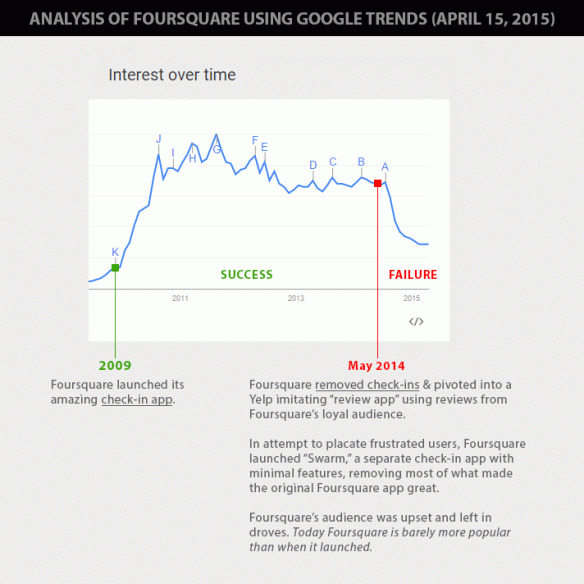
An analysis of Foursquare’s popularity after removing checkins » Junkyard Sam

Matthew Cox:

In May 2014 Foursquare removed check-ins and transformed the app into a lesser imitation of Yelp (using the accumulated reviews from Foursquare’s loyal audience.)

Foursquare’s users felt betrayed that their reviews were used but what they once loved about the app was removed.  Here’s how that worked out:

So, not well. Lesson: don’t change a winning formula.


Europe is targeting Google under antitrust laws but missing the bigger picture » The Guardian

Julia Powles:

As Maryland law professor Frank Pasquale writes in his acclaimed new book, The Black Box Society: “Google is not really a competitor in numerous markets, but instead serves as a hub and kingmaker setting the terms of competition for others.” For Pasquale, the solution lies in greater transparency. “Google’s secrecy keeps rivals from building upon its methods or even learning from them,” he writes. “Missing results are an ‘unknown unknown’: users for whom certain information is suppressed do not even know that they do not know the information.” The irony of the situation is that Google knows so much about us, and we know so little about it.

Let that thought roll around your head a little.


Feb 2009: Google joins Europe case against Microsoft » NYTimes.com

Miguel Helft, in February 2009, as Google applied to become a complainant in the EC’s case against Microsoft over illegal tying of Internet Explorer to Windows:

“Google believes that the browser market is still largely uncompetitive, which holds back innovation for users,” Sundar Pichai, a vice president for product management, wrote in a Google blog. “This is because Internet Explorer is tied to Microsoft’s dominant computer operating system, giving it an unfair advantage over other browsers.”

Google declined to make anyone available to discuss its announcement. By becoming a party to the case, it would participate in the proceedings and gain access to the confidential “statement of objections” that European regulators sent to Microsoft last month. Google could also argue for remedies it prefers.

This seems like a bad move, in retrospect. Google had just launched Chrome, and Android was just beginning to make its first moves. You’d have to be smart to see how mobile was going to grow (but aren’t the people at Google meant to be smart?), but angering Microsoft – as this surely did – meant that Microsoft was always going to seek revenge. Which it is now getting.


Keeping your car safe from electronic thieves » NYTimes.com

Nick Bilton is keeping the (electronic) key to his Toyota Prius in the freezer to stop people getting into his car. Here’s why:

Mr. Danev specializes in wireless devices, including key fobs, and has written several research papers on the security flaws of keyless car systems.

When I told him my story, he knew immediately what had happened. The teenagers, he said, likely got into the car using a relatively simple and inexpensive device called a “power amplifier.”

He explained it like this: In a normal scenario, when you walk up to a car with a keyless entry and try the door handle, the car wirelessly calls out for your key so you don’t have to press any buttons to get inside. If the key calls back, the door unlocks. But the keyless system is capable of searching for a key only within a couple of feet.

Mr. Danev said that when the teenage girl turned on her device, it amplified the distance that the car can search, which then allowed my car to talk to my key, which happened to be sitting about 50 feet away, on the kitchen counter. And just like that, open sesame.

BRB. Move aside, ice cubes.


Cellphones in Africa: communication lifeline » Pew Research Center’s Global Attitudes Project

Cell phones are pervasive in the region. In 2002, roughly one-in-ten owned a mobile phone in Tanzania, Uganda, Kenya and Ghana. Since then, cell phone ownership has grown exponentially. Today, cell phones are as common in South Africa and Nigeria as they are in the United States. Smartphones (those that can access the internet and applications) are less widely used, though significant minorities own these devices in several nations…

…Roughly a third of South Africans (34%) and about a quarter of Nigerians (27%) say that their device is a smartphone, i.e. one that can access the internet and apps, such as an iPhone, Blackberry or Android device. Smartphone ownership is less common in the other nations surveyed, and in Tanzania and Uganda it is still in the single digits. By comparison, 64% in the United States owned a smartphone as of December 2014.

But those who are more likely to own them are young, educated and English-speaking. I’d love to see some data on whether it has an economic effect to own one – though splitting that from the “educated” benefits would be tough.


The self-driving car revolution’s unintended consequence: lots of puking passengers » Co.Exist

According to a report from the University of Michigan’s Transportation Research Institute, 6% to 10% of American adults will get motion sickness—with nausea, dizziness, vomiting, and so on—in fully self-driving cars either most or all of the time. Another 6% to 12% of American adults will get moderate to severe motion sickness in a self-driving vehicle at least some of the time. That’s a fairly high percentage of potentially ill riders.

If you’ve ever been a passenger in a car driving down a windy road, feeling like you’re going to puke while the driver is perfectly fine, this shouldn’t be too surprising. As the study’s authors, Michael Sivak and Brandon Schoettle, explain, motion sickness is usually caused by two factors: a “conflict between visual and vestibular inputs” (like facing the side of the car instead of looking straight ahead) and a lack of ability to anticipate movements or a loss of control of movement. Since drivers have more control over where the vehicle is moving, they get motion sick less often than passengers.

And what makes it worse? Reading, texting or watching movies. Might as well just drive.


Samsung, LG Electronics have 99.2% of global TV monitor market » BusinessKorea

Cho Jin-young:

TV monitors, which are monitors for PC that can also receive TV signals via an onboard TV tuner, are very popular among single households who have trouble having a separate TV and monitor.

Recently, this convenience in daily life is growing with the coming-out of new monitors equipped with an enlarged screen mainly for watching TV and those that allow users to watch TV on one half and work on their PC on the other half simultaneously. With this, the portion of TV monitors is continuously growing and is expected to make up to 6.5% of all monitors sold this year, growing from 5.8% last year.

Just a guess, but are most of those sales in Asia?


Taiwan supply chain makers hope for increased adoption of force touch solutions » Digitimes

Ninelu Tu:

With Apple’s adoption of force touch technology onto the trackpad of its new MacBook, related component makers hope the trend will prompt other notebook vendors to adopt the solutions for their products, according to sources from the upstream supply chain.

Since technologies adopted by Apple’s products have been usually able to set new trends for its competitors to follow suit, related component suppliers are hoping the force touch technology will be the same. Many Taiwan suppliers are already able to supply related solutions, the sources noted.

The sources also pointed out that brand vendors including Hewlett-Packard (HP), Dell and Lenovo and ODMs such as Quanta Computer, Compal Electronics and Wistron are all able to incorporate the solutions into their notebooks, but they had been reluctant to feature the technology in their products.

Why does it need Apple to make a song and dance about it for this to happen? There’s a similar story about USB-C – Dell and Asus are going to offer products with it. None of the PC ODMs likes to jump first, it seems. But that means Apple scoops the publicity.


Amazon: ever-growing behemoth, or topped out?


An Amazon warehouse. Photo by hnnbz on Flickr

It’s the London Book Fair this week, and I was kindly invited to speak at its Digital Minds session on Monday. These are the slides that I created for the talk. (Plus the CC-licensed photo, as above.)

Obviously, for book publishers the terror over the past few years is that Amazon is going to eat up everything, laying waste to the old book-buying system and forcing down the prices they can ask while at the same time everyone dumps paper books in favour of Kindles.

For publishers, that looks like the worst kind of lock-in.

But I prefer a data-driven approach: look at the numbers, and the numbers in a broader context. Amazon provides pretty clear financial results (with useful breakdowns by geography and segment), and there are also useful datasets from book publishers about the size of the UK market. (I focussed on the UK market because that’s what was available, but if anyone wants to pay me to do a bigger study relating to other countries, get in touch :-))

Here’s the presentation:

A few words to add extra context (since I did actually talk too – this wasn’t just a mime show). The numbers relate to the slide number.

5) and 6) yeah, Amazon does sell beer, but my more general point is that these declines in numbers (of petrol filling stations and pubs open in the UK) are due to structural changes in society, not something Amazon has done. If you ascribe changes to the wrong cause, you’ll come up with the wrong solution to it.

7) Clearly, the decline in independent bookshops (overlaid onto the right-hand chart, showing the growth in book sales and ebook sales) predates ebooks – though not Amazon itself. This doesn’t look at concentration of the industry; I didn’t look at the simple number of books published. I think that has gone up, even excluding ebooks.

9) figures taken from Amazon’s results, and using a four-quarter moving average. The international media sales (red line) actually went negative in the most recent quarter, while US media sales (blue line) went to just 1%. “Media” covers everything from books to DVDs.

10) data from the Pew Research Center in the US, which does very robust studies. They haven’t found any growth in ereader ownership since January 2014. There’s a natural ceiling on ereader desire-to-buy.

11) Ereaders are popular with people who read a lot of books. The difference between the median and mean numbers here tell us this is a skewed population – those who read a lot really read a lot. They’re likely to have an ereader. But not everyone will get an ereader. The eager buyers have bought one.

13) See? New sales of Kindles have pretty much halted. Other more recent stories confirm this.

14) 30m Kindles sold in total is a lot – but compare that to total population in the US+Europe of about 500m. It’s not taking over the world.

15) 16) Amazon turns out not to be so great at making hardware that people want to buy.

17) Even in tablets, the rest of the market is growing, but the Kindle Fire HD isn’t doing much. Total about 30m sold (my calculation), also throughout US and Europe – but doubt there’s a lot of book reading going on with them; they’re for other media.

20) You may be able to think of another ebook that a “standard” publisher was able to turn into a bestselling book that was then made into a big film. (The Martian is being made into a film with Matt Damon. Looking forward to that.)

22) Amazon’s FCF (free cash flow) is a hot topic, at least in some quarters. The company shows very little profit, but its FCF is great. Isn’t it?

23) Well, the use of capital leases means that – rather as with the Labour government and PFI – the spending is all being pushed off the balance sheet and into a sort of future reckoning. Great as long as nobody worries about it; bad if Wall Street does worry about it.

24) you can just skip to this one if you want the conclusions.

Thanks for reading. I’m happy to come and give speeches at all sorts of events on topics like this.

Start up: Google v EC, decrypting ransomware, Apple’s troubled app reviews, and more


Hard to find off the US’s west coast. Photo by aftab on Flickr.

A selection of 7 links for you. Use them wisely. I’m charlesarthur on Twitter. Observations and links welcome.

Files encrypted by CoinVault ransomware? New free tool may decrypt them » PCWorld

Loek Essers:

Victims of the CoinVault ransomware might be able to decrypt their files with a free tool released by Kaspersky Lab together with the Dutch police.

The tool can be found at https://noransom.kaspersky.com. The application uses decryption keys found by the Dutch police as part of an investigation.

Ransomware like CoinVault encrypts data on a disk or blocks access to a computer system. It is usually installed by exploiting a vulnerability on victims’ computers via phishing emails or links to malicious websites.

Unlike other ransomware, CoinVault lets victims see a list of the files it encrypted and decrypt one for free to try to get people to pay up.

The National High Tech Crime Unit (NHTCU) of the Dutch police recently obtained a database from a CoinVault command-and-control server containing decryption keys, the Dutch police said in a news release. The information obtained from that database allowed Kaspersky to build a decryption tool.

Not all of the keys, but a useful start.


Final Words – The HTC One M9 Review: Part 2 » Anandtech

Joshua Ho:

Battery life is probably the most important aspect of any smartphone, and a poor showing here can be enough to write off a phone. HTC has traditionally done quite well here despite using a smaller battery in their phones than average. Unfortunately, this isn’t true of the One M9. Despite using a newer SoC and a bigger battery, HTC regresses significantly in battery life when compared to the One M8…

The camera of the One M9 is also a weak point, despite significant changes on HTC’s part in this area. Unfortunately, the post-processing here is just not acceptable, and the results of the camera are equally unacceptable.

Poor battery life, poor camera. HTC’s got problems – if people listen to reviews.


Sardine population collapses, prompting ban on commercial fishing » SFGate

Peter Fimrite:

The sardine population along the West Coast has collapsed due to changing ocean conditions and other factors, including allegations of overfishing, prompting regulators Monday to cancel fishing next season and schedule a vote this week on an immediate emergency ban.

The Pacific Fishery Management Council agreed to close the fishery from Mexico to the Canadian border starting July 1, when the 2015 season begins, after federal scientists documented a 91% decline in sardine numbers along the West Coast since 2007.

Water shortages, sardine population collapse. What’s next for California? When will people notice what’s happening?


Apple’s App Store review process is hurting users, but we’re not allowed to talk about it. » Medium

Kushal Dave:

There should be outrage.

Think about how much ink has been spilled over Amazon vs. Hachette, TimeWarner vs CBS, Verizon vs. net neutrality, Google vs. Yelp. Here we have a gatekeeper, which also has lock-in, and it has found the only reasons to close the gates that could be worse than profit: paternalism and complacency.

Many of us are afraid of retribution for speaking out too loudly. Apple has, unbelievably, made a threat explicitly in writing: “If your App is rejected, we have a Review Board that you can appeal to. If you run to the press and trash us, it never helps.” If Apple made good on its promise to penalize developers who complain in public, who would we appeal to?

Apple’s process makes sense for Apple, but less for developers. Users do get hurt by slower updates, certainly. But Apple is paranoid about apps being updated to malicious or other “embarrassing” forms, and apparently doesn’t have Google’s virus checking-in-the-cloud capability (though it does have a kill switch). The paranoia has now become routine.

But Apple does listen to complaints that reach the press. It should probably update that part of its guidelines.


Europe to accuse Google of illegally abusing its dominance – FT.com

Alex Barker, Christian Oliver and Anne-Sylvaine Chassany:

Margrethe Vestager, the EU’s competition commissioner, is to say that the US group will soon be served with a formal charge sheet alleging that it breached antitrust rules by diverting traffic from rivals to favour its own services, according to two people familiar with the case.

Serving Google with a so-called statement of objections will be the opening salvo in one of the defining antitrust cases of the internet era. It could prove as epic as the decade-long battle with Microsoft that ultimately cost the company €2bn in fines.

The commission’s move comes after a torrid five-year investigation that Google came close to settling without charges last year. The draft deal collapsed after fierce objections were raised by ministers in France and Germany, and by some of the continent’s most powerful telecoms and media groups.

Told you. Recap: Why Google’s struggles with the EC – and FTC – matter.


Google, Microsoft, Stall Points, and Growth » Paul Kedrosky

When might Google have its Microsoft moment? That is, when will it begin its inexorable decline – as most aging tech companies do when their growth stalls, and as Microsoft did – largely unbeknownst to (and even denied by) most observers? How might we know?

I have a few things I look for when thinking about inflection points in aging technology companies. Not all of these conditions need to be satisfied, but at least some of them do.

There are five major parts of the argument:
1. Stock compensation loses its luster
2. Declining growth
3. No longer hiring for innovation
4. Price & margin pressure in core business
5. Government action

Kedrosky asks smart questions, which yields surprising answers.


Apple acquires Israeli camera tech company LinX Imaging for ~$20m » Mac Rumors

Juli Clover:

Apple has purchased Israeli camera technology company LinX Imaging for approximately $20m, reports The Wall Street Journal. LinX specializes in creating multi-aperture camera equipment for mobile devices and it’s possible that Apple will use the company’s technology in upcoming iOS devices.

Last year, LinX announced the launch of miniature multi-aperture cameras half the height of standard mobile cameras with the ability to create “stunning color images and high accuracy depth maps” for SLR image quality without the bulk of an SLR camera.

The image quality of mobile cameras has reached a dead end. Device makers are striving to differentiate using imaging capabilities but the pixel size race has ended and next generation cameras do not reveal any dramatic improvements. LinX cameras revolutionize mobile photography and broaden the usability span and user experience, allowing us to leave our SLRs at home.

The engineers at LinX have solved all problems associated with combining multiple images captured from different points in space such as registration errors and occlusion related artifacts which are seen on competing technologies.

LinX’s technology uses software to extract depth information for each pixel to create a depth map for that can also be used for 3D image reconstruction. LinX’s website is now defunct, but the company offered products with two, three, and four camera arrays in multiple configurations and sizes. Its most recent technology was downscaled enough to be ready for use in mobile devices.

I linked to this writeup rather than the WSJ’s because of the background MacRumors found. Face recognition? 3D reconstruction? Lots of possibilities in this one. The Authentec fingerprint reader was incorporated within 18 months of purchasing that company – but quite possibly Apple is already working on incorporating these cameras into its products. I’d expect them in products in 2016.


Start up: spotting comment trolls, stopping piracy Of Thrones, where’s Android One?, and more


Try putting those on Bittorrent, suckahs. Photo by Jemimus on Flickr.

A selection of 8 links for you. Use them wisely. I’m charlesarthur on Twitter. Observations and links welcome.

Scientists develop algorithm that can auto-ban internet trolls » The Stack

Martin Anderson:

The study found that on CNN the studied trolls were more likely to initiate new posts or sub-threads, whilst at Breitbart and IGN they were more likely to weigh into existing threads.

The report does not exonerate host communities of all blame for troll behaviour, finding that immediately intolerant communities are more likely to foster trolls:

“[communities] may play a part in incubating antisocial behavior. In fact, users who are excessively censored early in their lives are more likely to exhibit antisocial behavior later on. Furthermore, while communities appear initially forgiving (and are relatively slow to ban these antisocial users), they become less tolerant of such users the longer they remain in a community. This results in an increased rate at which their posts are deleted, even after controlling for post quality.”

Seems mostly accurate, apart from calling breitbart.com a “political hub”. I’d go for “troll-employing troll magnet”, personally.


Game Of Thrones leak and watermark: a stupid tracking system » bru’s blog

The first four episodes of game of thrones leaked nearly 36 hours ago. They have been extensively downloaded, and the only tracking set up HBO seemed to be a watermark in the bottom left corner of the screen. Once blurred, it is useless. This impresses me. It’s 2015 and all you’re using is a “confirm you’re deleted” + “your copy is watermarked” for protection? There are simple schemes that would have allowed HBO to track the leak.

The idea is very simple: make each copy unique in a non-visible way.

Seems like the editing to create unique copies would be a hassle. Not sending them out (by getting people to come in to previews?) might be simpler. But there would be geographic reasons against that. No matter what, though, it only delays the piracy by 36 hours or so. That’s the bigger problem.


BOMBSHELL: MUSL employee might have rigged Hot Lotto computerized drawing » Lottery Post

Prosecutors countered this motion by claiming they have a “prima facie,” or at first glance, case that Tipton tampered with lottery equipment.

In their reply to the defense’s motion, prosecutors argued that Tipton’s co-workers said he “was ‘obsessed’ with root kits, a type of computer program that can be installed quickly, set to do just about anything, and then self-destruct without a trace.” The prosecution claimed a witness will testify that Tipton told him before December 2010 that he had a self-destructing root kit.

Prosecutors also argued in their reply that Tipton was in the draw room on Nov. 20, 2010, “ostensibly to change the time on the computers.” The prosecution alleged the cameras in the room on that date recorded about one second per minute instead of how they normally operate, recording every second a person is in the room.

“Four of the five individuals who have access to control the camera’s settings will testify they did not change the cameras’ recording instructions; the fifth person is Defendant,” the prosecution wrote.

Someone’s writing the screenplay already, yes? The accused bought a ticket that won $14.3m.


What’s Become of Android One? » CCS Insight

Peter Bryer is an analyst:

our checks indicate that Android One has had a limited direct effect on the market, despite initial enthusiasm for the programme. Sales of Android One-based smartphones began more than half a year ago in India, but volumes don’t stand out.

The first Android One products came from Karbonn, Micromax and Spice, with more familiar brands expected to begin adopting the platform. Acer, Asus, HTC, Lenovo and Panasonic were among the smartphone manufacturers listed by Google as partners in the project, but this interest appears to have stalled.

The fading momentum of Android One is an indication of the expanding selection of equally well-specified, low-cost smartphones and tablets in emerging markets. Hundreds of models are available at $100 or below — a once impossible price band has become very ordinary.

The standard having been set, others have matched it. All works for Google. But see later…


Flipkart’s move to dump mobile site could hit Google » WSJ

Rolfe Winkler:

Indian e-commerce giant Flipkart has decided it doesn’t need to rely on the Web to lure shoppers, dumping its mobile site and pushing visitors to its app. That move may spell trouble for the future of Google ‘s cash-cow search engine, which relies heavily on links to shopping sites.

Smartphone users that go to the mobile websites of either Flipkart or its sister site Myntra no longer see the same virtual store shelves as when they visit those sites from a personal computer. Instead they see a message to download the sites’ mobile apps.

The problem for Google is that a large percentage of its ad business is driven by paid links that direct users to e-commerce sites. But mobile apps are walled gardens unto themselves, unconnected by links to the broader Web.

A general problem, but if it starts happening early in countries like India, that is a problem for Google.


Brazil’s iPhone investment falls short on promises of jobs, lower prices » Reuters

Brad Haynes:

The Brazilian iPhone was meant to mark a new era.

When Taiwan’s Foxconn Technology Group agreed in April 2011 to make Apple products here, President Dilma Rousseff and her advisers promised that up to $12 billion in investments over six years would transform the Brazilian technology sector, putting it on the cutting edge of touch screen development. A new supply chain would be created, generating high-quality jobs and bringing down prices of the coveted gadgets.

Four years later, none of that has come true.

Foxconn has created only a small fraction of the 100,000 jobs that the government projected, and most of the work is in low-skill assembly. There is little sign that it has catalyzed Brazil’s technology sector or created much of a local supply chain.

Not quite clear where the blame lies – high expectation by Foxconn, local taxes or local culture.


Formal charges may be next in Europe’s Google antitrust inquiry » NYTimes.com

James Kanter and Conor Dougherty:

Some experts say that Mr. Almunia’s unsuccessful strategy makes further attempts to settle the case without formal charges unlikely.

“Given the history of failed attempts to reach a commitment decision, I just don’t see what she would gain from going down this route again, unless Google has promised more concessions that we don’t know about,” said Liza Lovdahl-Gormsen, the director of the Competition Law Forum at the British Institute of International and Comparative Law.

Without formal charges, Ms. Lovdahl-Gormsen said, “Google might try to buy themselves time by offering commitments that are unlikely to be accepted by the commission, and that it knows won’t be accepted by the market, simply because it does not want to be faced with the instrument of torture — the statement of objections.”

Expect news on Wednesday.


My voice is my passport: Android gets a “Trusted Voice” smart lock » Ars Technica

How secure is this system? We’re wondering the same thing. The popup when you enable “Trusted Voice” warns that the feature is not as secure as a traditional lock screen and that “Someone with a similar voice or a recording of your voice could unlock your device.” We’d love to test it out, but it hasn’t rolled out to any of our devices yet—we only know about it thanks to a report from Android Police.

Android Police hasn’t given it any scrutiny (none of its devices – even Nexuses – seem to have got it.) The commenters on AP don’t seem enamoured, though, pointing out how easy it would be to spoof (as Google itself admits). So there’s now pattern, PIN, face and voice unlock, and also “trusted device” (Android Wear). Flexibility is good, but they aren’t all equally robust, which feels like a problem.