
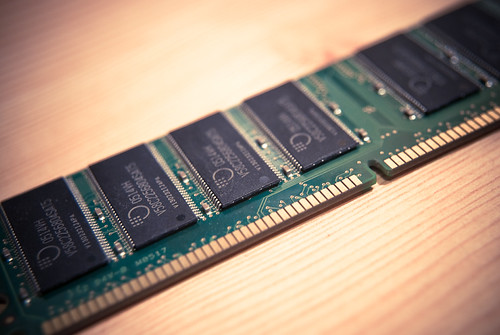
Is 10% or more of your computer’s RAM going unused during the day? Now you can email Sam Altman about what he’s missing out on. CC-licensed photo by materod on Flickr.
You can sign up to receive each day’s Start Up post by email. You’ll need to click a confirmation link, so no spam.
A selection of 9 links for you. Memorable. I’m @charlesarthur on Twitter. On Threads: charles_arthur. On Mastodon: https://newsie.social/@charlesarthur. On Bluesky: @charlesarthur.bsky.social. Observations and links welcome.
Is Jensen Huang too powerful to be punished by Nvidia? • The New York Times
Kalley Huang (no relation) and Tripp Mickle:
»
Mr. Huang, who is the largest Nvidia individual shareholder with a 3.56% stake, has led Nvidia to the top of Wall Street and elbowed his way through Washington. He has done it with a flat organizational structure and an executive team of more than 60 direct reports, putting him at the center of the company’s day-to-day operations.
If the board decides to punish Mr. Huang, there is no obvious successor, or even high-profile internal candidate, to run his giant chip company. That was not the case at Apple, when Tim Cook seamlessly took over for Mr. Jobs shortly before his death from pancreatic cancer.
In its early years, Nvidia made chips known as graphics processing units, which were mostly used in video games. Then, more than a decade ago, Mr. Huang bet that Nvidia’s chips could also be used for A.I. development and poured billions of dollars into making software and chips.
That gamble has paid off. Nvidia was the first publicly traded company to be valued at $5 trillion. Over this year and 2027, Amazon, Google, Meta and Microsoft are expected to spend a combined $1.842 trillion on capital expenditures like AI data centres, according to S&P Global Visible Alpha. Nvidia’s chips fill those data centers.
“Everything he talks about drives the industry,” Bob O’Donnell, the chief analyst at TECHnalysis Research, a technology research firm, said of Mr. Huang. “He’s had the Midas touch with technology.”
The demand for Nvidia’s chips has been so intense that Larry Ellison, a co-founder of the software company Oracle, in 2024 recalled a sushi dinner in Palo Alto, Calif., where he and Elon Musk, the chief executive of Tesla and SpaceX, begged Mr. Huang for more chips.
“Please take our money,” Mr. Ellison recalled telling Mr. Huang. “Take more of it. You’re not taking enough of it. We need you to take more of our money, please.”
«
There’s ever so much more, including that short sellers Culper recognised back in May that Ms Huang was some sort of Chinese plant, and asserted that huge amounts – as in 20% – of Nvidia’s output was being illegally funnelled to China, while Megaspeed, Ms Huang’s company, was a shell in the literal sense of the word.
Jensen Huang now looks like someone who needs to be kept under closer watch; though the US government was completely aware of his adultery and Ms Huang’s identity. Which takes us into the realms of “they don’t know that we know so we won’t let them know that we know” spycraft.
unique link to this extract
Cyber-attack on French supermarket freezers has geopolitical context • The Guardian
Dan Milmo:
»
France has attributed an attack on supermarket fridges to hackers operating under the Islamic Revolutionary Guard Corps, a key branch of Iran’s military establishment.
There was no message this time, but the disruption made headlines around the world. Some refrigerators had their temperature turned up so high they caught fire. In the hours after the hack, supermarket employees dumped piles of perished meat and melted ice-cream into rubbish containers.
France’s foreign minister described it as an act of “unprecedented scale and unprecedented aggression” and promised “Europe-wide sanctions” would be imposed against those responsible.
It follows attacks on industrial freezers at an Israeli food production plant in May and a wave of freezer malfunctions that spoiled food at US military bases in August that are now reportedly being treated as a suspected hack. Those attacks have not been officially attributed to Iran, but the French announcement is the first to implicate the state in this type of hack.
Rafe Pilling, a senior director at Sophos, a cybersecurity firm, said the relatively unsophisticated nature of the attack – hackers used default passwords to access fridge controls – was in line with Iranian capabilities. “The attacks themselves were not particularly complex,” he said.
Pilling said there was now a presumption the French attacks and a wave of rogue defrosting hacks across Europe last week were linked.
Hostile cyber operations against the west tend to come from a vexatious quartet of China, Russia, Iran and North Korea. All have different aims and characteristics: China has focused on industrial espionage and mass data gathering, Russia on disrupting enemy infrastructure and spreading disinformation, and North Korea on hacking crypto exchanges because it needs money. Iran, according to Pilling, wants to put a shot across the bow of its enemies.
«
There were about 700 fridges affected, though it’s not clear how many were grouped under a single controller. The French attribution – which includes issuing an arrest warrant for one of the leaders of an Iranian hacking group – torpedoes my thinking that this was script kiddies. Come on, state actors – leave a calling card at least.
unique link to this extract
Government’s EV targets expected to be reduced this week • BBC News
Joe Pike and Harry Sekulich:
»
The UK government’s electric vehicle (EV) targets are expected to be reduced this week in a move likely to be welcomed by carmakers but opposed by environmental groups.
Under the current rules, 80% of new cars sold in the UK must be electric by 2030 but industry groups have long called for “urgent relief”.
New petrol or diesel cars are due to be phased out by 2030 and by 2035 all new cars must be zero emission.
But the speed of the transition to electric has been hotly debated, including within the cabinet. The government has been consulting on reducing its 80% rule and a significant reduction is now expected. Downing Street has insisted no decision has been made.
A government source told the BBC it would approach the issue in a “pragmatic and balanced” way.
If ministers do decide on a steeper watering-down of the rules, it will arguably be interpreted by some – alongside the approval of the Jackdaw gas field in the North Sea – as the government prioritising economic considerations over environmental ones.
Prime Minister Andy Burnham has recused himself from this issue due to his wife’s links to an electric vehicle company. The key meetings on the subject will instead be chaired by Cabinet Office minister Louise Haigh.
Asked about reports the targets would be reduced, Burnham dismissed this as “speculation”, adding: “No decision has been made at this point.”
«
Sustainability groups oppose a reduction, Energy UK (trade group for the energy industry) ditto, so who can be in favour?
»
The Society of Motor Manufacturers and Traders welcomed the government’s review of the EV targets when it was announced in the summer. Last week, head of the association Mike Hawes said transitioning to electric vehicles had come at a “heavy cost” with billions spent on discounts to drive demand in electric vehicles.
He said the government’s targets could not be achieved “without putting at risk any future investment”.
«
Ah. There’s your answer. But such a typical act: announce big plan! Soak up applause! Then, later: quietly retreat from it.
unique link to this extract
Chinese carmaker BYD’s offices in Netherlands raided over JLR ‘copycat car’ claim • The Guardian
Jula Kollewe:
»
Bailiffs acting for Jaguar Land Rover raided the Dutch offices of a Chinese “copycat” rival before a legal showdown this week over whether its “Defender clone” infringes intellectual property rights.
Bailiffs acting on behalf of JLR reportedly seized digital records from the offices of Chinese carmaker BYD in Schiedam and Hoofddorp in August, according to the Sunday Times.
The raid took place before a court case in the The Hague this week which will decide whether the BYD has a case to answer over allegations that its Ti7 SUV infringes the intellectual property of the Land Rover Defender.
Motoring experts have likened BYD’s seven-seat plug-in hybrid SUV to the Defender since it went on sale in China in September last year. The company is scheduled to launch the vehicle, which the BBC’s Top Gear magazine called the “Chinese Defender clone”, in the UK market in January at a price of £47,995, undercutting the Defender by more than £20,000.
BYD says on its website that “an unapologetically boxy profile delivers the imposing, chunky design that finds favour among SUV buyers, yet delivers a contemporary look”.
The price of JLR’s seven-seat Defender 110 starts from £68,465 and is one of the country’s bestselling cars. The UK-based carmaker, which is owned by India’s Tata Motors, sold 29,500 Defenders to retail customers between July and September this year, compared with 25,370a year earlier.
The raid in the Netherlands was carried out by court-ordered bailiffs, with JLR suspecting that BYD reverse-engineered some of the technology that could be used in the Ti7, the Times reported. JLR wanted to secure the digital records before they could be destroyed.
«
We can be pretty confident, can’t we, that no honeypots were involved in this one?
unique link to this extract
Developer creates script to email Sam Altman about his unused RAM every day • Dexerto
Joe Pring:
»
A web developer has created a script that automatically emails OpenAI CEO Sam Altman to tell him how much RAM is sitting unused in their computer.
The project, appropriately named Ram-Altman, was published on GitHub by developer IainKay in response to Altman’s previous comments about the world’s limited supply of computer memory being wasted in personal PCs.
According to its GitHub page, Ram-Altman is a Bash script that monitors a Linux computer’s memory usage every five minutes.
If more than 10% of the machine’s RAM is available, the script can automatically send Altman an email detailing exactly how much memory isn’t being used, limited to one message per day.
The emails come with eight rotating subject lines, ten different messages, and six sign-offs to keep the correspondence varied. One example, titled “You missed a spot,” reads: “Please don’t be alarmed, but there is 8.6 GiB of RAM on my desk that isn’t in a data centre. That’s 56.2% of what’s installed here, and as far as I can tell it has no plans today.”
The developer explains that the project was inspired by Altman’s appearance on the Cheeky Pint podcast, where he discussed the limited global supply of DRAM and the efficiency of running AI models in data centres.
“From a global allocation perspective, actually, it’s quite terrible to have everybody have a bunch of the world’s limited supply of DRAM sitting in their own computer,” Altman said, adding that it was being used “maybe 5% of the time.”
The remarks attracted criticism, prompting Altman to clarify that he supports people having as much RAM as they want.
“I actually do want the world to have tons of memory and people to put as much as they want in their computers,” he wrote on X.
«
…just not before he has got as much as he wants and put it in his computers. Always fun to needle the pompous.
unique link to this extract
Crypto industry braces for reckoning over Trump ties • Financial Times
Jill Shah and Nikou Asgari:
»
Crypto executives are bracing for a painful reckoning after the Democrats stormed to victory in the US midterm elections and vowed to investigate the Trump family and its ties to the industry.
Democrats made the president’s alleged self-dealing and “crypto pay-offs” a defining issue in the elections, helping them win in Republican strongholds across the US.
Donald Trump, who had vowed to make America the “crypto capital of the world”, pursued aggressive deregulation of the industry since taking office last year, signed landmark legislation welcomed by the sector and pardoned executives such as Binance co-founder Changpeng Zhao — who had been jailed after pleading guilty to failing to protect against money laundering.
But digital assets have also been highly profitable for Trump personally, and last year he earned more than $1.16bn in crypto sales and token royalties. He has sold memecoins offering access to him, launched crypto ventures that came under scrutiny for foreign investment and accepted donations from crypto executives for projects such as the new White House ballroom.
Congressman Robert Garcia, who will chair the House oversight committee from January, has said he and his fellow Democrats will be “focused like a laser” on investigations, including into the Trump family and their crypto profits.
“The president himself has a crypto scheme where he’s making billions of dollars,” Garcia said on Wednesday. “This family is billions richer.”
«
The Trump family scam (pumping and dumping) is only the most open part. The bigger question is how much of the money washing around the crypto industry – the exchanges and especially Tether – is the proceeds of, or funding for, crime. The suspicion is that it’s a very large amount, both in percentage and real terms.
unique link to this extract
The climate cost of a single private jet flight is even worse than you think • ZME Science
Mihai Andrei:
»
You could spend an entire year commuting, heating your home, cooking meals, and going about your daily life — and still produce less carbon dioxide than a private jet releases on a single flight.
That’s the striking conclusion of a new Oxfam report, which estimates that the average private jet flight emitted 3.7 metric tons of CO₂ in 2025, roughly as much as the average person worldwide produces in an entire year.
The same report also shows that the world’s richest 0.1% produce more greenhouse gas emissions than half of humanity.
According to Oxfam’s analysis of flight-tracking data, private jets made approximately 4.4 million flights worldwide in 2025, releasing 16.05 million tonnes (17.7 million tons) of CO₂. It’s a staggering amount of pollution from a form of transport that most people never experience.
The report estimates that just 250,000 people use private jets; that represent just 0.003% of the world’s population. And unlike commercial aircraft, which distribute their emissions across dozens or hundreds of passengers, private jets often carry only a handful.
Getting a heavy aircraft off the ground requires enormous amounts of energy. Jet engines burn aviation fuel to produce thrust, releasing carbon dioxide in the process. A smaller aircraft generally burns less fuel overall than a large commercial airliner. But when that smaller aircraft carries just two or three passengers rather than 150, its emissions per traveller can be dramatically higher.
«
Oxfam (drawing on a number of researchers) also comments:
»
the richest 0.1% of the world’s population — approximately eight million people — now produce more consumption-related carbon emissions than the poorest 44%, or roughly 3.5 billion people combined.
«
Even if the calculations are too big by an order of magnitude, it’s still a colossal disparity.
unique link to this extract
Like many authors, I’m bombarded by scam fan mail. I wasn’t prepared for what would happen when I wrote back • The Guardian
Joe Dunthorne:
»
There’s no humble way to say it: I get a lot of fan mail. Almost every day, multi-paragraph emails arrive from passionate and well-informed readers in Barcelona and Frankfurt, Chicago and Warsaw. They have appealing names like Bella Monroe, Thalina Rose and Tricia Claxton. Some of them are straightforward enthusiasts while others are more irreverent, like the one who signs off her messages “warm chaos”. Some love the “deadpan genius” of my novels while others admire my nonfiction’s “moral courage”. What they all have in common, though, is that they are entirely fake and trying to con me out of money. They promise to promote my work at their city-wide book clubs or spread the word among their reading communities, if only I transfer a few hundred dollars to cover costs.
In the age of generative AI, scam emails have achieved a new level of personalisation. Most writers I know are receiving a steady stream of emails like this. The messages are often sophisticated enough to bypass a spam filter and reach our inboxes, leaving us no option but to read them and ask the painful question: would any real, living person feel this strongly about my work? Or, as one writer friend put it, the reason I know they’re fake is because they’ve actually read all my books.
…there is a part of me that fantasises about dramatically unmasking the scammer, revealing the villain beneath. So when I received an email from the founder of the Berlin Book Club, I decided to see how far I could get. I agreed that I did need help reaching new audiences. I was willing to pay for her connections and expertise. Soon we started discussing payment methods. She wanted me to use CashApp or make a direct bank transfer but I was insistent that I could only send hard cash.
We went back and forth for a couple of days. I impressed on her that I had, at that very moment, 500 US dollars in crisp notes in an unmarked envelope and that I lived quite near the post office. She finally relented and gave me a physical address. Neither of us commented on how unusual it was for the founder of the Berlin Book Club to have a postal address in the Philippines. I went on Google Maps and was able to find the street in question, a rural two-lane road with palm trees, a junk shop, an evangelical church and a large building hidden behind high white walls.
«
The reality of course being that these are people who are enslaved by organised crime to do this all day long. The world is stranger than we can imagine, and more oppressive.
unique link to this extract
Medium is launching a new note-taking app called TK • The Verge
David Pierce:
»
“I don’t think we’ve actually had a launch of anything important since 2017,” Medium CEO Tony Stubblebine tells me over Zoom, a few days ahead of the company’s biggest launch in apparently almost a decade. That was when Medium’s then-CEO, Ev Williams, decided to quit chasing ad dollars and become a subscription business. “It’s clear that the broken system is ad-driven media on the internet,” Williams wrote at the time. “It simply doesn’t serve people. In fact, it’s not designed to.” Medium began charging for access to most content. “We got out of the attention economy,” Stubblebine says now.
The trend Williams saw back then, though, has only accelerated and metastasized. AI companies are hoovering up any content they can get their hands on, legality be damned; search engines and chatbots are sending less and less traffic back to the web. Medium, like most websites on the internet, relies on Google for a huge portion of its traffic — in the time of Google Zero, that’s an existential risk. “When Google started taking away all the traffic,” Stubblebine says, “what I told them is that this hurts us, but it also hurts you, because I’ll just tell you what my product roadmap is going to do: I’m going to switch to private blogging… We’re just going to take everything underground.”
All of which brings us back to TK, an app and network that has no use or need for Google referrals. The idea behind TK is fairly straightforward: It’s a barebones note-taking app, with emphasis on daily journal-style notes and longer-form writing. The app itself is nice enough, like an ultra-minimalist take on Evernote, but it’s the stuff around the writing that has Stubblebine most excited.
For one thing, you can point an AI model at your writing, and use it to help organize or make sense of all the notes you’ve been taking, by searching through your notes or asking for feedback on your writing. “TK” is both the name of the app and a shortcut in it: type the letters (which writers use frequently as a placeholder — they’re easy to find later, since the letters T and K hardly ever appear next to each other otherwise) and you can summon the model to fill in a bit of information for you. Stubblebine refers to “Unix pipes” a few times in our conversation, and his idea is to use the large language models to do some of the grunt work of both creating and managing notes.
Once you’ve written something – and Stubblebine emphasizes that it doesn’t have to be a blog post — you can then share it however you like. You can share it via links or email the way you’d share a Google Doc, and collaborators can write, comment, and leave emoji reactions. You can also add your writing to what TK calls Libraries. Stubblebine calls the Libraries concept “private blogging,” which is a good metaphor.
…This concept of private blogging is a big part of the future of Medium.
«
I interpret that last bit as being “Medium as you know it is fading away”.
unique link to this extract
| • Why do social networks drive us a little mad? • Why does angry content seem to dominate what we see? • How much of a role do algorithms play in affecting what we see and do online? • What can we do about it? • Did Facebook have any inkling of what was coming in Myanmar in 2016? Read Social Warming, my latest book, and find answers – and more. |
Errata, corrigenda and ai no corrida: none notified

