Great truths of our time: “journalists and coders should sit together to create amazing stuff”


Seating plan. Photo by alimander on Flickr.

My previous post on this topic, entitled “Great lies of our time: ‘journalists and coders should sit together to create amazing stuff'” generated a big reaction on Twitter. At all sorts of levels.

It turns out to be much easier to work with Twitter-based stories on Storify than on WordPress (at least, using the tools I’m using here..), so I’ve created a Storify story with all the useful reactions to what I wrote, and a diametrically opposite title, because there are people who have made it work. Which is great.

Read it here: “Great truths of our time: ‘journalists and coders should sit together to create amazing things'”.

I think that should cover all the bases.. for now.

Update: I’ve added it to the Storify, but I think Benji Lanyado’s 2012 post on this topic remains relevant (as does he). Lanyado used to be at the Guardian, and he’s been on both sides of the fence, as both journalist and (now) developer:

Let’s start with the developers. For all their digital wizardry, the average developer will not fully understand the editorial process. If they’ve been kept separate from the newsroom and editorial desks, as is usually the case, how could they? But developers, generally, do not need to be in the same place all the time – IM is enough contact with their product managers and team leaders. Give them a laptop and let them roam. There’s a desk for them if they need it, but otherwise they can pick up their laptop and move around the building. They need to ask a lot of questions. Hell, why not give them an editorial mentor – someone who’s job it is to answer as many questions as the developer wishes to ask. Quite simply, they need to be there – with the journalists, every day, learning.

The journalists need to learn too. Anyone within a news organisation who is making digital decisions needs to understand the digital process, within reason. They don’t need to become fully proficient in CSS or jQuery, but they need to understand the process of how stuff works, and how stuff is built. The developers need to let them in. Once a fortnight, journalists should have to spend a day with a development team, asking as many questions as possible. When the roaming developers come and sit with them, they should be doing the same.

This is the very minimum, but it will go a long way.

Start up: Apple’s transit plans, app monetisation, Samsung’s S6 rebuttal, bitcoin booboo, and more


Surely not caused by a Google car. Photo by Oakland Pirate on Flickr.

A selection of 9 links for you. Free like nitrogen. I’m charlesarthur on Twitter. Observations and links welcome.

Californians are OK with Google self-driving cars and are ready to ban non-self-driving cars » Emerging Technologies Blog

One of the blog’s readers gave their experience:

It’s safe to cut off a Google car. I ride a motorcycle to work and in California motorcycles are allowed to split lanes (i.e., drive in the gap between lanes of cars at a stoplight, slow traffic, etc.). Obviously I do this at every opportunity because it cuts my commute time in 1/3. Once, I got a little caught out as the traffic transitioned from slow moving back to normal speed. I was in a lane between a Google car and some random truck and, partially out of experiment and partially out of impatience, I gunned it and cut off the Google car sort of harder than maybe I needed too… The car handled it perfectly (maybe too perfectly). It slowed down and let me in. However, it left a fairly significant gap between me and it. If I had been behind it, I probably would have found this gap excessive and the lengthy slowdown annoying. Honestly, I don’t think it will take long for other drivers to realize that self-driving cars are “easy targets” in traffic.


Why do we assume everyone can drive competently? » Remains of the Day

Eugene Wei just avoided a cycling crash when a car turned into his cycle lane without warning:

For the next two blocks, I played my near collision on loop in my head like a Vine, both angry at the driver’s reckless maneuver and relieved as I tallied up the likely severity of the injuries I had just managed to escape by less than a foot of clearance. This is not an unusual occurrence, unfortunately. When I bike, I just assume that drivers will suddenly make rights in front of me without turning on their turn signal or looking back to see if I’m coming in the bike lane to their right. It happens all the time. It’s not just a question of skill but of mental obliviousness. American drivers have been so used to having the road to themselves for so long that they feel no need to consider anyone else might be laying claim to any piece of it. Though the roads in Europe are often narrower, I feel a hundred times safer there when biking there than I do in the U.S. All that’s to say I agree wholeheartedly with the writer quoted above that self-driving cars are much less threatening than cars driven by humans. As an avid cyclist, especially, I could think of nothing that would ease my mind when biking through the city than replacing every car on the road with self-driving cars.


iOS 9 Transit Maps to launch in a handful of cities in North America, Europe & China » 9to5Mac

Mark Gurman, for it is he:

While Apple plans to debut its own mass transit directions service for Maps in iOS 9 as soon as June, the rollout will not be as ambitious as some users may have hoped. In its first iteration, Apple’s Transit service will only support approximately a half-dozen cities across the United States, Canada, and Europe, in addition to China, according to sources… In the United States, the planned launch cities are San Francisco and New York, two major metropolitan areas that are known for public transportation, while Toronto will be likely Canada’s sole representative for the iOS 9 Maps Transit feature at launch. In Europe, Apple is said to be gearing up to first launch the feature in London, Paris, and Berlin.

Google has been miles ahead in this for years (which made iOS 6 retrograde). Three years on, there are already lots of apps – especially Citymapper – which offer services like this. But it’s the integration that Apple has really lacked.


Google’s answer to the big problem with wearables » WSJ

Alistair Barr:

Wearable gadgets like smartwatches have seen a lot of hype but little commercial success. An obvious obstacle is that teensy touch screens can make such devices difficult to control. Google thinks it has an answer: a minuscule radar system that senses hand gestures. The company’s Advanced Technology and Projects research group shrank a radar system into a package roughly the size of a micro SD card, small enough to fit in a smartwatch. It beams a signal wide enough to capture hand motions and gestures and turn them into control signals, according to Ivan Poupyrev, who led the initiative called Project Silo. The tiny radar could let people control tiny-screen devices without having to touch them, he said during a session at the Google I/O 2015 developer conference. For instance, it transforms a twisting motion between thumb and forefinger into commands to scroll up and down a smartwatch’s screen. Poupyrev demonstrated by changing the hours and minutes on a small screen by rubbing his thumb and finger near to the radar gesture sensor. He also played a simple soccer game, his finger motions in midair near the sensor shooting an onscreen ball into a goal. ATAP plans to release the system to developers later in 2015, Poupyrev said.

This is one of those things that looks cool in demos, but I suspect could be prone to everything that real life is – mess-ups. Remember Leap Motion, another gesture control system? Went nowhere because waving your hand in the air isn’t a natural way to control things – because it’s prone to misinterpretation. Google might get this right, but it needs a ton of figuring out.


Apps spearhead Google’s battle with Apple » FT.com

Richard Waters and Tim Bradshaw:

Apple’s App Store accounts for about 45% of the revenue that developers make from apps, compared with 29% for Google’s Play, according to Digi-Capital. But counting in the income from handsets in China — where Google’s apps are blocked, meaning it makes no money — pushes the overall Android share to 52%, Digi-Capital calculates. Last week, matching — and trying to surpass — Apple was a strong subtext of Google’s pitch to developers. New features included Android Pay, a rival to Apple Pay and a fresh attempt to break into mobile payments after the disappointment of Google Wallet. A new Google Photos app — with the promise of software that can automatically organise libraries of pictures — also echoed capabilities that are already offered by Apple. But in other areas, Google seemed unprepared. While smartwatches based on last year’s Android Wear technology have been put in the shade by the launch of Apple Watch, Google had little new to show off in response. This was a sign that it is surrendering early leadership in wearables to Apple, according to Carolina Milanesi, an analyst at Kantar Worldpanel.

The download share of Android in China is 62.8%, compared to 22.2% for Google Play, and 13.9% for Apple. Remarkable that non-Google Android is so big – but it only takes 23.8% of revenue, against 28.6% for Google Play, and 44.7% for Apple.


Hello world: Windows 10 available on July 29 » Microsoft Windows blog

Terry Myerson:

We designed Windows 10 to create a new generation of Windows for the 1.5 billion people using Windows today in 190 countries around the world. With Windows 10, we start delivering on our vision of more personal computing, defined by trust in how we protect and respect your personal information, mobility of the experience across your devices, and natural interactions with your Windows devices, including speech, touch, ink, and holograms. We designed Windows 10 to run our broadest device family ever, including Windows PCs, Windows tablets, Windows phones, Windows for the Internet of Things, Microsoft Surface Hub, Xbox One and Microsoft HoloLens—all working together to empower you to do great things. Familiar, yet better than ever, Windows 10 brings back the Start menu you know and love.

“Speech, touch, ink and holograms” is quite enticing. (That’s Hololens, of course.)


Asus brings a choice of sizes to Android Wear with ZenWatch 2 » The Verge

Vlad Savov:

The ZenWatch 2 runs the latest version of Android Wear, which was recently introduced with the LG Watch Urbane, however Asus’ watch is still a long way from actually being released. Asus tells us that it will reveal the full specs, pricing, and availability information during IFA in Berlin this September — leaving this as more of a promise than an actual product. The goal is to keep prices consistent between the two watch sizes, leaving the choice of strap to determine the particular cost. Update: The original article speculated that Asus’ metal crown will function like the digital crown in the Apple Watch, however we’ve now confirmed with Asus that it’s simply an external button and not a physical scroll wheel.

1) Doesn’t this Osborne [kill by preannouncement] the existing Zenwatch, even though there’s no price etc etc for the 2? 2) Which company will be the first, do we think, to mimic Apple’s digital crown and risk the sure-to-ensue lawsuit?


Samsung says S6 sales meet internal forecast » Korea Times

Kim Yoo-chul:

A Samsung spokesman in Seoul refused to release any official information on sales; but the company is expected to unveil figures at its upcoming investor relations forum on [Wednesday] June 3. Such remarks come a few days after Samsung Electronics Corporate Affairs President Park Sang-jin told reporters that the firm has been seeing a steady increase of sales on international markets. “You have to wait and see; however, the S6 and S6 Edge sales will be far higher than those of the S5” he said. The two models were unveiled during the Mobile World Congress 2015 event at the beginning of March. Both models were made available for purchase in April. Citing a report by CounterPoint Research, a research firm, eBEST Investment analyst Kim Hyun-yong said Samsung sold 6.1m S6s and S6 Edges in April. He added 305,000 S6s were being sold daily since the devices’ availability ― better than the S5 and S4’s 124,000 and 241,000 per day, respectively.

I’m finding it hard to believe that the S6 (and Edge?) is selling triple the number of the S5, and 50% more than the S4, at a time when Samsung is down in China and seen sales declines for months, and the S6 is on sale in fewer countries than the S5 was. Though with Samsung it’s hard to know what “sales” means – usually, it’s “sell-in”, as in sales to carriers.


Bitcoin app issues critical update after rare bug leads to total crypto breakdown » The Guardian

Alex Hern:

Bitcoin wallets are typically created by randomly generating a public address and a related private key. As a result, it is important for address and key to be truly random, or else it may be possible to guess the private key by looking at the public address. [Bitcoin wallet app] Blockchain used two sources of random numbers, in what ought to have been a belt-and-braces approach: it pulled a random number from the Android operating system’s built-in random number generator, and then connected to online service Random.org to get a second random number, which it combined with the first. Unfortunately, on some Android phones (reportedly including devices from the Sony Xperia range), the built-in random number generator failed to report back to the blockchain app. Normally, this should have been survivable, because the app used a second source of random numbers. But on 4 January, Random.org strengthened the security of its website, requiring all visits to be made over an encrypted connection. The blockchain app, however, continued to access the site through an unencrypted connection. So rather than getting a random number, as expected, it got an error code telling it that the site had moved. It then used that error code as the random number, every single time.

Not quite bitcoin itself screwed (it’s far too robust) but those using that app could find themselves all sharing a wallet.


Start up: Google Wallet v Android Pay, chip consolidation, Buzzfeed’s news numbers, Android Wear lessons, and more


Cooking, though not devised by computer. Photo by Nicolas Alejandro Street Photography on Flickr.

A selection of 9 links for you. Everyone else is seeing a different set. I’m charlesarthur on Twitter. Observations and links welcome.

MIT cheetah robot lands the running jump » YouTube

Do Androids dream of electric cheetahs in sheeps’ clothing jumping over things? Whatever it is.. this is very worrying.


Google may have left the best Android “M” feature out of the keynote: automatic app data backup and restore » Android Police

David Ruddock:

Yes, it’s happening. Dot. Gif. Android apps are finally getting state backup in the new “M” version of the OS. The full details are here. The short of it is that Android apps will now automatically back up to Google Drive, up to 25MB per app, with no new code required from developers. This is huge. What’s backed up? Settings and app data, which is to say, basically everything so long as you’re not talking about something over 25MB in total size. While this may still mean signing into your apps on a new device depending on the app’s security, once you do log in, the concept here is that all your settings and saved app data should just reappear on your new device. Which, holy cow, haven’t we been asking for this since the beginning of time?

Great – in 2016, Android will have the backup capability that iCloud offered since 2011. Given Google’s huge power in cloud services, it’s really strange this hasn’t been in place much earlier.


Some big changes are coming to Google Wallet now that Android Pay is here » AndroidAuthority

Jimmy Westenberg:

So if Pay is going to be the new payment standard on Android, what’s going to happen to Wallet? Well, a new post on the Google Wallet Google+ account is trying to help clear up this muddy situation. According to the post, the Wallet service has seen a ton of growth in the number of people sending money to one another, whether that’s through Gmail or the Google Wallet application. So, Google Wallet is sticking around, and will receive a big revamp in the coming months that sounds like it will focus on payment transfers, as opposed to actually handling the payments themselves. Here’s a little taste as to what the new Wallet app will bring, as explained by the Wallet team:

The new app will allow anyone with a US debit card to send and receive money for free within minutes – even if the other person doesn’t have the app. The money you receive can either be directly sent to your bank account or it can be spent in stores using the Google Wallet card.

We would be lying if we said this whole situation wasn’t confusing.


char-rnn cooking recipes » Github

“Nylki”:

The following recipes are sampled from a trained neural net. You can find the repo to train your own neural net here: https://github.com/karpathy/char-rnn Thanks to Andrej Karpathy for the great code! It’s really easy to setup.

But now go and read the recipe. Beef! Pineapple! Orange juice! Sherry wheated curdup! “You made the recipe, you eat it.”


Android no longer competes with iOS » Naofumi Kagami

He called it back in April 2013 (“Predicting Android’s change of direction“). Now, he writes:

Google itself mentioned that Android M is mainly about fixing bugs and annoyances in Lollipop, and if that is to be believed, then the next version of Android coming out in 2016 should have many more features. However, since I am now more confident of my reading of Google’s strategic imperatives, I am pretty sure that this will not be the case. I predict that the 2016 version of Android will also not have any major new features. In short, I am now sure that Google no longer intends to compete with iOS with Android. Essentially, they are giving up the high-end smartphone market to Apple and they are cool with that. Instead, Google sees Android as a vehicle to spread their services to market segments that iOS cannot penetrate. How will this strategy fare in the future? This strategy is sound if Google’s sole objective is to learn about what people are doing. However, from a financial standpoint, there are many risks. By far the largest risk is, what if Apple is successful in distancing itself from Google? What if Apple somehow succeeds in significantly reducing the number of Google searches performed on iOS?


Charlie Warzel on Google’s ambitions post-I/O » Daring Fireball

John Gruber mulls:

In the demo, while playing a Skrillex song, Google director of product management Aparna Chennapragada asked the device, “What’s his real name?” And a moment later, the answer came: “Sonny John Moore”. Now on Tap is what allowed Google to know the context for “him”. It was a cool demo. But as soon as I saw it, I took my iPhone, held down the home button, and asked Siri, “What’s Skrillex’s real name?” And a moment later came the answer: “Sonny John Moore”. Allowing Google to index everything the apps you use show or play for you seems like a stiff privacy price to play for the ability to use “him” in that query, especially when, in my opinion, “What is Skrillex’s real name?” is the natural way most people would pose the question. Now on Tap has much more potential than this, of course. But, still. To me, this week’s I/O keynote made me more convinced than ever that Google is turning into the Microsoft of old: a company whose ambitions are boundless, who wants its fingers in every single pie, and who wants to do it all on its own. A company whose coolest stuff is always in the form of demos coming in the future, not products that are actually shipping now.

Wellll… the Photos app, which embodies machine learning (wonder if Pete Warden is involved – his company Jetpac was bought by Google last year), is shipping now, but cross-platform. That’s the thing: the some-day-my-demos-will-be-real things are OS-specific, while the right-here-right-now things are cross-platform. But that “new Microsoft” meme is a hard one to shake off. Notice how it attaches when you keep getting hardware wrong and have to try it again and again.


The five chip companies who will buy all the others » DIGITS to DOLLARS

Jay Greenberg:

As growth slows in an industry, the only way for companies to keep growing is to win market share (hard) or buy other companies. This is especially true in semiconductors because most of these companies outsource their manufacturing to the foundries like TSMC and Global Foundries. When one chip company buys another, the combined entity gets better pricing at the foundry (as they are now a bigger customer). The combination also gets to eliminate the duplicated non-design functions. You do not need two CEOs, nor two CFOs, not even two Corporate Development VPs (a not so subtle reminder that I am now looking for a new job). For several months now, I have been going around talking to friends at chip companies preaching this view – the industry will consolidate from over a hundred companies today down to five in a few years. In these conversations, I have always used Broadcom as an example. I would note that “Even Broadcom is not too big to get acquired someday.” So apparently, someday is yesterday. When the dust settles, I think there will be just five massive companies left in the business. (That will clear the decks for a new form of semis companies to emerge, but that is years away.) Here is my guess as to who the survivors will be.

You can probably guess three of them, but all five?


Five things Google figured out in Android Wear’s first year » Fast Company

Jared Newman:

At this year’s I/O, in lieu of splashy reveals, Google is announcing some minor tools for developers, including a way to show bird’s eye map views in their smartwatch apps. The company also revealed that it has 5,000 true watch apps in the Google Play Store, plus 1,500 custom watch faces. This year’s conference is mainly a time to reflect, and convince app makers that Android Wear is ready to compete with the Apple Watch.

Here are 2 and 3: “nobody agrees what looks good; people want smaller watches”. In pursuit of not achieving 3,

The brunt of the blame falls to the battery, which is the largest component by volume inside Android Wear smartwatches, [Android Wear lead product manager Jeff] Chang says. Still, Google doesn’t want to mandate smaller watches if it means giving up an always-on display or all-day battery life, which he sees as core values. “To accomplish an always-on screen that stays on the whole time, and at least one full day of battery life, and to have a really small volume battery, that’s a big challenge,” Chang says. “We’re working very hard on it, but we do uphold all those principles dearly.”

Good/fast/cheap; small/always-on/one-day. Choose two. (Note how Apple’s choices differ from Android Wear, but it’s still two out of three.)


BuzzFeed’s news is growing, but still a small part of its traffic » Digiday

Lucia Moses:

BuzzFeed drew 76.7 million multiplatform unique visitors in April, according to comScore. The publisher historically hasn’t broken out its content by vertical to comScore, like other top news sites including CNN, Yahoo and The Huffington Post do. But it started to on a limited basis as of last month, when it began breaking out its Entertainment and Life coverage, which stand at 43.7 million and 20.1 million uniques, respectively. BuzzFeed doesn’t break out its news traffic, suggesting it’s still relatively low. Bottom line, BuzzFeed may have made headway a short time, but it is still a small player when it comes to news, in which it includes business, tech, politics and longform. “You’ll hear clients say, ‘We want a BuzzFeed-style article,’” said Kim Alpert, director of digital strategy at Walton Isaacson. But when it comes to news, it hasn’t delivered a consistent product that’s instantly recognizable, she said. “Vice and Mashable, you kind of know what you’re going to get. I don’t believe their news has really matured in that people say, ‘I get my news from BuzzFeed.’” With CEO Jonah Peretti recently hinting at going public, BuzzFeed could invite more scrutiny of its editorial model. BuzzFeed’s main revenue source is native advertising, a format that has been criticized for mimicking editorial. The publisher also has admitted taking down posts at advertisers’ requests.


Great lies of our time: “journalists and coders should sit together to create amazing stuff” (updated)


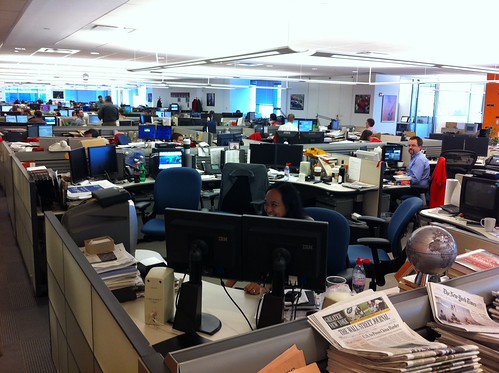
The Thomson Reuters newsroom. Note papers stacked all over the place. No idea if journalists and developers “sit together” here – but I’d bet they don’t. Photo by Targuman on Flickr.

I keep seeing people saying “you know how journalism and the internet can work better? Have the news org’s journalists and coders sit beside each other. Wonderful things will happen.”

Postscript, but at the top: this post generated a lot of reaction – so be sure to read the followup, which pulls together the many people saying that it can and does work./Postscript.

Let me tell you: when someone spins you this line, it’s pure unadulterated 100% bullshit. Anyone who says this has never looked at what happens when you do this, or considered the differences in work patterns between the two. (It pains me to point out that Wolfgang Blau is only the latest to suggest this – see point 4. I like and respect Wolfgang a lot and he’s really smart – he suggested adding a chapter about China to the second edition of my book – but on this, he’s wrong, as I’ll explain.)

Edit: let me be clear just before you dive all the way in: my criticism is that a seating plan will not solve this conundrum. It is possible to solve it. But not by simply putting people together. You need much more subtlety. /Edit.

Five stars for the idea..

Let’s begin with Anecdote 1. When I worked at the Guardian as technology editor, part of my remit was the games side. We had great games reviewers who turned out games reviews that people wanted to read. As time went on, though, I began to worry that these reviews (giving games between one and five stars) were being lost in the haystack of content. There were years of reviews which could all be relevant to a puzzled buyer looking to get the best stuff.

What, I wondered, about the people – parents especially – who had just got a new games console and wanted to know which were the top-rated games to get for them? Where did they go?

The obvious answer, it seemed to me, was to create a page for each console which would show the highest-ranking games – perhaps in a grid. Obviously you’d need to update it from time to time. Finding which games were for which console wouldn’t be hard because each review would be tagged “PS3” or “Xbox360” or “Wii”, but grabbing the star ranking and then ordering them was tougher. But it wouldn’t be a problem for a developer who knew their way around our CMS (content management system), I figured.

My cunning plan: make it possible to buy the games directly through the CMS, either from Amazon or a white-label seller, so that the pages would earn money.

So I went to one of the developers who I knew had some spare time and was a dab hand with the CMS. I explained the problem and the potential. He looked at me for a while. I also suggested that we might be able to get a list of upcoming games – which our reviewers could supply – and create a page where people could pre-order them. He looked at me a little longer.

Then he went away and spent a few months developing a way to display the Guardian on Google TV. After making no appreciable impact, Google TV got canned. We never got the “five-star games” pages or the “upcoming games” page.

Love ya, Excel

This leads to Anecdote 2, which followed on pretty directly from that. I’m a journalist, but I can code – PHP and Applescript, principally. Nodding acquaintance with Cobol, Fortran, Pascal, Lisp; blind date with Objective-C where I fell asleep in the wine; blind date with C where I walked out. Anyhow, I can wrangle simple-ish tasks to automate extremely boring stuff that is often the basis of work in many newspaper offices.

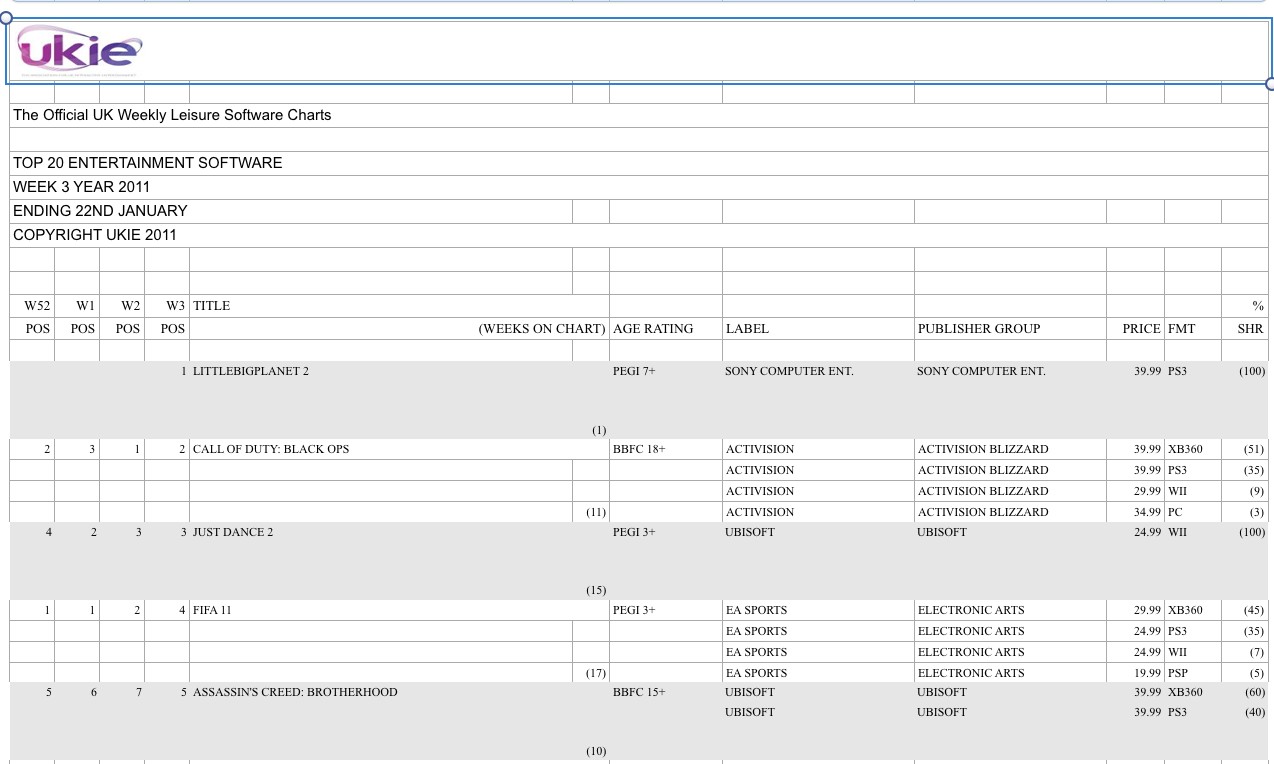
So, for example, every week the UK games industry puts out an Excel spreadsheet showing the top 10 games sold in the previous week by various platforms, with information such as the publisher, previous week’s position, and so on. Here’s what it looked like:

UKIE games chart, raw form

The raw UKIE games chart: an Excel file with lots of columns and spare rows. A formatting nightmare

I liked the idea of putting up a weekly chart, and making it possible for people to buy games directly from the chart. We already had a “buy” button embedded in the reviews. So you could find the relevant game, pull the “buy” button from it, embed it in a chart, and put it on the site. Money-spinner, potentially; and certainly not a money-loser.

I considered trying to get developer time for someone to write this for, oh, about two seconds. Then I decided to write it myself.

It wasn’t trivial. I had to assume access only to the tools and programs our subeditors (who would create the “story” with the chart) had, which meant a standard installation – no extras. That meant no Excel – we used OpenOffice. But that meant no Applescript, because OpenOffice has woeful Applescript support. That meant the sub had to copy the required cells out of the OpenOffice spreadsheet and paste them into TextEdit, which has fairly bad Applescript support, but at least it’s there. More wrangling (stepping through the cells to find the ones we wanted, spotting the many lines of padding in the spreadsheet and ignoring them, using Google’s API to find the link to the Guardian’s link to the game in question, pulling the source of that link to find the affiliate “buy” links) ensued. Once I had the set, we had to create another TextEdit document which could then be copied and pasted into OpenOffice, and saved as an Excel format spreadsheet, because that was the only one which our CMS recognised if you were going to include a chart.

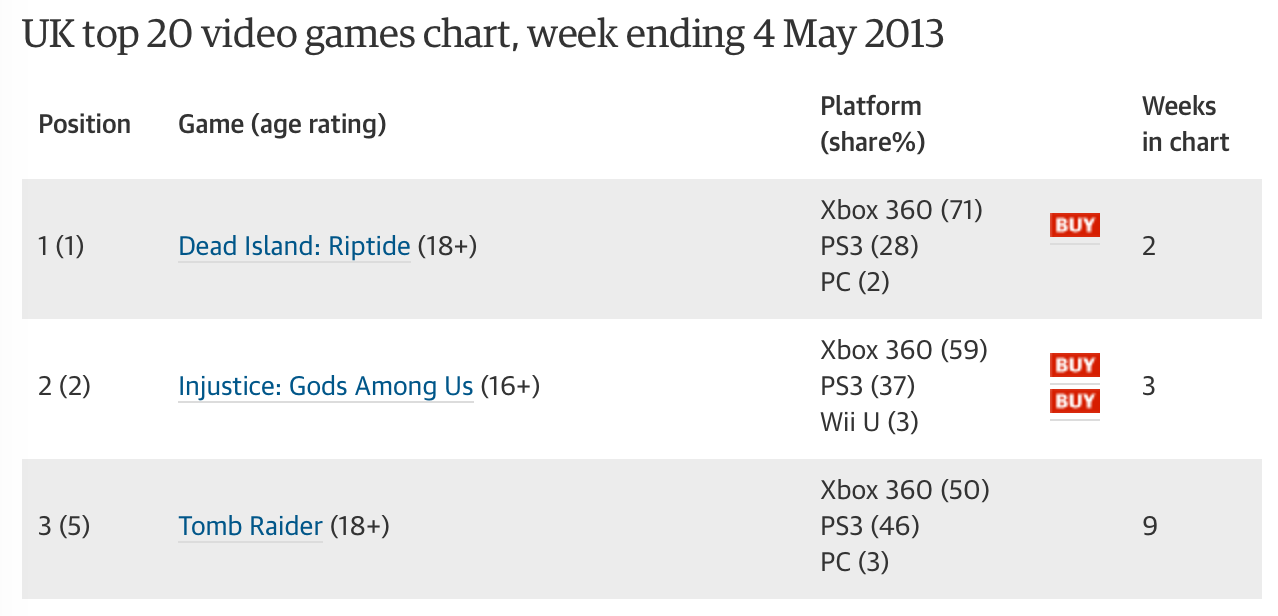
It took me a couple of weeks of spare time, but I got it done. The result was stuff like this:

UKIE games chart, formatted

After using my script, you could buy games directly, or follow the links to reviews. (It’s a different week from the chart above.)

The outcome was that work that would have taken any subeditor about an hour, and been prone to all sorts of errors (reading the wrong column, picking the wrong game) became a two-minute task in which the toughest part was choosing which picture to use. And it earned money through affiliate buying; not huge amounts, but more than zero.

Now – you’re probably saying “hey, wouldn’t it have been easier to ask the UKIE for a link to their API so that you could get it direct, and format it?” Answer: if they’d had an API, it would have been easier. But asking and getting wouldn’t have been. That’s the sort of thing which requires lots of meetings, chinstroking, and discussions about whether it’s possible. All those things are anethema to the culture of daily newsrooms, which is to Get Stuff Done.

(Oh, but of course: there came a time when UKIE changed the formatting of the spreadsheet. And by then, I couldn’t be bothered to work back through the code to adjust for it. So the chart died.)

Update/edit: Robert Rees, who is the developer manager at Guardian News & Media, has written about this subsequently:

The central assumption that runs through Arthur’s narrative is that it is valuable to let readers pre-order computer games via Amazon. One of the pieces of work I’ve done at the Guardian is to study the value of the Amazon links in the previous generation of the Guardian website. I can’t talk numbers but the outcome was that the expense of me looking at how much money was earned resulted in all the “profits” being eaten up by cost of my time. You open the box but the cat is always dead.

Now, that’s interesting. I had seen some of the affiliate revenue numbers too; they weren’t huge by any means. My point was more that we already had the Amazon buttons (that had been set up as an automated process some time before by our development team) and so we might as well use them. But Rees makes a good point – you have to look at the opportunity cost too of the developers’ time if you go ahead with the work. (No developer time was given to my idea.) Also, this was a time – still is – when we were being encouraged to “experiment” with revenue-generating ideas; I didn’t believe that affiliate money would make us rich, but thought that if we could get a white-label deal so we got bought at wholesale and sold at retail, rather than selling at retail-affiliate, then it could be worthwhile. (The Guardian does this with books.)

Sub-update: a little discussion at Gawker threw up this gem, from its former edit honcho Joel Johnson, discussing Gawker’s finances:

Gawker Media is an advertising-based business, with revenues of around 35- to 45-million dollars a year. There are a few other sources of income: a couple of million for international licensing fees (from the companies that publish international versions, such as Kotaku Australia); and affiliate fees, largely from Amazon, that add another $5-10 million a year.

$5-10m per year? Maybe this affiliate game can be played to win if you do it right./sub-update

Rees titles his post “No one loves a bad idea”, which is a fair criticism – my idea wasn’t useful in the wider scheme of things. Equally, though, that was never pointed out. In effect, I did a little skunkworks project, which died. /update

The difference is time

It’s this key difference – that journalists tend to want to get something up there for people to read/watch/listen to, dammit – which in my experience marks the giant gulf between journalists (including those who can code a bit, like me) and “developers”. Journalism, especially daily journalism, and increasingly all journalism, is about getting a result, and doing so effectively, quickly and (optionally) thoroughly. It’s a culture where getting it done right now is what matters. And then you move right on to the next thing, because there’s always a next thing.

Update: Rees calls this (correctly) out as an example of the rush to get stuff done:

British journalism favours action and instinct and sometimes that combination generates results. Mostly however it just fails and regardless of whom is sitting next to whom, who can get inspired by a muddle-minded last-minute joyride on the Titanic except deadline-loving action junkies?

(OK, I consider myself upbraided.) /update

Developers I’ve come across, by contrast, iterate around the same thing repeatedly, just as I did in trying to get the code to work in Anecdote 2. They don’t grab an idea, use their existing knowledge to turn it into a story, and put it out there. (OK, there are some gonzo programmers who do that sort of thing, but you don’t find them in newsrooms I’ve been in.)

My coding in the newsroom was all about timesaving. I wrote scripts that wrangled InCopy so that articles which needed to be strictly formatted (Ask Jack, in its printed days) could be, in different colours, in 10 seconds rather than the 20 eyestraining minutes that it took by hand. (Ask Kate Bevan and Stuart O’Connor about that.) I wrote a script that meant the subeditors on the Media desk could get the day’s Guardian Media stories from its web page in one second rather than five minutes, ready for the daily email which had to go out before 8am. What I did was all about saving time, because that tends to be the most precious commodity for the journalist.

For the developer – in my experience – things are different. I recall Dan Catt (one of the early Flickr developers), when he worked at the Guardian, pointing out how amazing it is that the paper starts with effectively nothing every morning and has a full, complete newspaper ready by 8pm or so. And then keeps doing it again and again and again. That’s organisation. That’s deadlines.

The task of developers in a news organisation, on the other hand, isn’t on that timescale at all. It’s about building apps; building great mobile sites; building great ways for people to interact; building systems to manage and interlink content so the almighty Goooooogle indexes it better. Sometimes it’s about building new CMSs, or ways to link multiple CMSs, but in my experience (again) it’s hardly ever about spotting kinks in workflow and easing them.

And as for the idea of journalists and developers sitting beside each other and the developer saying “hey! Why don’t we..” (or vice-versa) – forget it. They just don’t have that common ground. Journalism tends to be surface-skimming, fast-moving; coding/development tends to be deep-diving, strongly focussed.

Edit: one thing that occurs to me is that many journalists who don’t have awareness of coding don’t realise that boring, repetitive tasks can be automated. So they don’t know to ask. /Edit

Update: of course as soon as I hit “publish” I could think of a counter-example: the team at the Mirror’s @ampp3d team, such as Tom Phillips and Martin Belam, who created things such as the “badgers moving the goalposts” game.

Phillips’s description of how this came about is worth reading:

October 9, 2013. Owen Paterson, the Secretary of State for Environment, Food and Rural Affairs, made a comment in the Commons that morning about the failed badger cull – he blamed the badgers for “moving the goalposts”, which was obviously hilarious. What I love is that you can trace, to the minute, the time from when my mate Francis suggested to UsVsTh3m that they do an “Owen Paterson’s Badger Penalty Shootout” game, to when they put it live. 4 hours and 21 minutes to publish a fully playable game about a news event that happened that morning. Nobody else could come close to doing that then; nobody else has got anywhere close since. They were, in the most literal sense possible, playing a different game to everybody else.

Does this disprove my argument?

You’ll be unsurprised to hear me say: I don’t think so. I see that as an example of developers who are interested in current events basically being given free rein (in a good way). The aim was to get virality, a la Buzzfeed, not to “do journalism”. Repeatable? Effective? Maybe, but the journalism element isn’t exactly blinding.

Similar for the “photo comparison” slider that you see on, I think, the WSJ and Verge (possibly others) for literally side-by-side comparison of photos taken by different phone cameras: I’m sure a journalist or developer expressed frustration at the need for it, but getting it done is an iterative process, focussed on a particular target. Deep diving, not skimming.

The data question

But wait, you say: what about data journalism? My answer: it’s not programming. It’s not coding. Most of the time, it’s great works done with Excel. And most of the time, that’s all it needs. It’s certainly not something where you want a valuable developer spending their time. Journalists are cheaper, and they know how to spot a story, or ought to.

So should journalists learn to code?

I’ve answered this before, on my personal blog – jeez, it was 2009. Here’s the posts’s title: “If I had one piece of advice to a journalist starting out now, it would be: learn to code”. See if you can figure it out.

My advice on developer/journalist seating arrangements? Keep them well apart. But also have an effective manager who listens to the two groups and can tell each to do things. Have a manager who can direct them. Don’t stop the two groups talking. But let each be aware that they’re like animals living at different speeds, which means that they simply won’t be able to comprehend why the other side reacts as it does to some things (“why can’t they understand that hunting down bugs is hard?” “Why can’t they understand that we can’t have this sort of thing cause a screwup in a live blog?”). They can live a mutually beneficial existence. They just can’t live in the same cage.

Postscript: huge amount of pushback on Twitter over this, from Wolfgang (thanks, Wolfgang), Aaron Pilhofer and many others. And lots of good points and examples raised, which I collated in a Storify linked from this followup. It would be great to know that my experience was just an outlier, though I suspect it’s more that there are good ways to do it, and rather less good ways. What we want are the good ones.

Start up May 29: leap second fretting, Pebble Time reviewed, Apple’s AR buy, and more


A leap second: good, bad or indifferent news? Photo by /amf on Flickr.

A selection of 8 links for you. Use them wisely. I’m charlesarthur on Twitter. Observations and links welcome.

June 30 leap second worries markets, internet » GPS World

The Wall Street Journal is reporting that financial regulators and market participants are worried enough about the leap second that they’re planning for potential disruptions. The adjustment could present technical difficulties for traders and exchanges, as some computers might not be programmed to account for the adjustment, according to a Dow Jones report. “These guys are agonizing over it,” Steve Allen, a programmer-analyst at the University of California’s Lick Observatory, told Dow Jones. “It is definitely a hassle.” “The problem with the extra second is that it’s difficult to gauge how computer systems will react,” according to Journal writer Brian Hershberg. A US Commodity Futures Trading Commission spokeswoman said that “For the most part, we’re not too worried,” told Dow Jones. “But of course as the regulator, we do need to ensure folks are ready.” The last leap second occurred on June 30, 2012, and that leap second caused technical problems for websites and computing systems — including Reddit, Mozilla, Gawker, FourSquare, Yelp and LinkedIn.

Leap seconds are like millennium bugs that come around rather more often.


Apple acquires augmented reality company Metaio » TechCrunch

Ron Miller and Josh Constine:

A source told TechCrunch that clients who use Metaio are “flipping out” after seeing the shut down message on the website and not hearing a word from the company about what’s going on…until now. Metaio hadn’t taken traditional Silicon Valley venture capital, but had raised some money from Atlantic Bridge and Westcott. The company is well established. Many impressive projects have been produced using its tools including this one of with Ferrari that gives a potential buyer an AR tour of the car (as though the actual car isn’t cool enough): And this one for travelers in Berlin to see what the scene they are looking at would have looked like when the Berlin Wall was up. The program uses historical footage that you can see by pointing your smartphone or tablet at a particular place.

Apple getting into AR? I wrote about the resurgence in VR (which Google is pushing hard) for the Guardian; AR is actually slightly tougher.


Pay your way with Android » Official Android Blog

Pali Bhat, product manager:

With Android Pay you will be able to pay with your credit or debit card, across multiple Android devices, and at thousands of stores and apps that you already know and love. And by enabling bank apps to integrate with our platform, you’ll be able to add your credit and debit cards directly from bank apps for use with Android Pay. It’s still early days, but we’re very excited and think that this type of open platform will help drive adoption in mobile payments.

OK, and now let’s rewind almost exactly four years to May 26 2011, and the announcement of Google Wallet (which Android Pay replaces):

Because Google Wallet is a mobile app, it will do more than a regular wallet ever could. You’ll be able to store your credit cards, offers, loyalty cards and gift cards, but without the bulk. When you tap to pay, your phone will also automatically redeem offers and earn loyalty points for you… This is just the start of what has already been a great adventure towards the future of mobile shopping. We’re incredibly excited and hope you are, too.

The difference? Four years and the launch of Apple Pay last September. And a gradual shift in the utterly backward payment systems in the US towards NFC-capable checkouts.


Google ad chief says larger phones help with mobile sales » WSJ

Alistair Barr:

[Sridhar] Ramaswamy said the rising popularity of larger smartphones also helps. “As phones get bigger the space issue becomes less challenging,” he said, pulling his Nexus 6 smartphone out to show its six-inch display. “This is essentially a tablet. People’s ability to navigate sites and fill out forms and such goes up tremendously.” Mark Ballard, director of research at digital-marketing firm Merkle RKG, has spotted big increases in mobile-search ad prices over the past year. He said new, larger iPhones released last fall are part of the reason because they make it easier to buy something after clicking on a search ad. Ramaswamy declined to comment on the impact of larger iPhones. The Google executive questioned how Facebook, which has emerged as Google’s principal rival for online ads, measures how many users watch videos. YouTube counts a view when someone watches for at least 30 seconds, while Facebook counts a view more quickly. “How many of Facebook’s video views are engaged views?” he asked. A Facebook spokesman did not immediately respond to a request for comment.

Well. Why won’t he comment on larger iPhones? Also: Facebook videos don’t need to be 30 seconds long – after all, a Vine can only be six seconds long. But of course Ramaswamy knows that. But not commenting on the iPhone seems like a defensive move as the default search placement on Safari comes up for renewal.


Review: Pebble Time » WIRED

David Pierce:

It’s true that a small subset of users, call it the Casio Calculator crowd, doesn’t care about looks. They’ll like the Time because it’s sturdy, durable, and easy to use. But when nearly every critique of wearables relates to aesthetics and personalization, you have to wonder how Pebble convinces anyone to even put this plastic brick on… …I want the uncluttered and productive idea Pebble is selling. But I don’t want the watch.


Pebble Time review: the smartwatch that beats Android Wear » WSJ

Nathan Olivarez-Giles:

For the Time, Pebble redesigned its watch interface using the analogy of a timeline: Press the top right button to go back in time (recent alerts, news items, past calendar events), and press the bottom right button to go into the future (upcoming events, games, etc.). The lone left button always takes you back a step, while the middle right button serves as an OK or Enter key. It’s an almost laughably simple way to organize what you see on screen, but it’s effective and the main reason I prefer the Time over any Android Wear watch I’ve tried so far. Android Wear is chaotic. It often feels like your watch is buzzing out of control and you’re drowning in phone notifications that keep showing up no matter how often you swipe to dismiss them. Pebble’s new timeline approach, on the other hand, makes sense as soon as you start clicking buttons. Order is calming. Without having to peep at a user manual, you know where your stuff is.

Odd approach: the WSJ has had three different people reviewing the Apple Watch, LG Urbane and now the Pebble Time. Why?


Web vs. native: let’s concede defeat » QuirksBlog

Peter-Paul Koch:

Most business entities that require an internet presence (think small shops, plumbers, hip food carts, or the like) will not end up [as an app icon] on your homescreen. Instead, they require one just-in-time interaction — when you need their opening hours, phone number, or menu. Users will expect this information on the web because they’re not going through the hassle of installing their app. Actually, this is very good news for the web. If the user doesn’t want your icon on his home screen, if the user wants a just-in-time interaction, it’s the web they want — not because of any inherent technological superiority, but because it’s hassle-free. Go there, read, forget. No junk left on your phone. Most businesses don’t stand a chance of ending up on the users’ home screens. So they need the web — but not a web that emulates native to no particular purpose.

His biggest criticism of cruft-y websites is news sites – but then the counterargument comes in, as he concedes, that news sites need to have URLs so people can find the content via search. Tricky.


December 2013: Android’s permissions gap: why has it fallen so far behind Apple’s iOS? » The Guardian

In December 2013 (that’s 18 months ago), I asked:

why would you let an app get that sort of access to your contacts, location, or storage? If you’re using Android, the answer is that you don’t get much choice, unless (like those 40%+ in the survey carried out by the Information Commissioner’s Office) you decide not to download the app. And the peculiar thing is that Google seems to be quite OK with that – and in fact has gone as far as to reverse an update which let users block apps from accessing data they shouldn’t. The consequences of that are already beginning to play out as people notice the difference – and complain in the only way they can, by giving apps lower ratings for what they see as excessive demands. The problem surfaced at the end of last week, when the Electronic Frontier Foundation (EFF) first praised and then doled out brickbats to Google for implementing, and then reversing, a function which allowed users to set per-app permissions to data such as their contacts, call log, location and so on. To access it you had to download a free third-party app called App Ops Launcher.

Commenters’ response: “just don’t install the app”. Overlooking the fact that that had already been dealt with in the piece – the 40% who already don’t install. Apple’s iOS has had this on near-enough 100% of devices since September 2012. Android will have it in Android M. Android Lollipop, released in autumn 2014, is presently on 9.7% of devices. I forecast it will take until June 2017 for Android M to be on 50%.


How long can you wait for Android M to be on 50% of devices? Would June 2017 be OK?

Google is announcing all sorts of wonders for Android M (Macadamia Nut fruitcake, or whatever it is) at Google I/O.

At the moment, Lollipop (Android 5.x) is on 9.7% of devices – 9.0% for 5.0 and 0.7% for 5.1, according to Google’s developer dashboard.

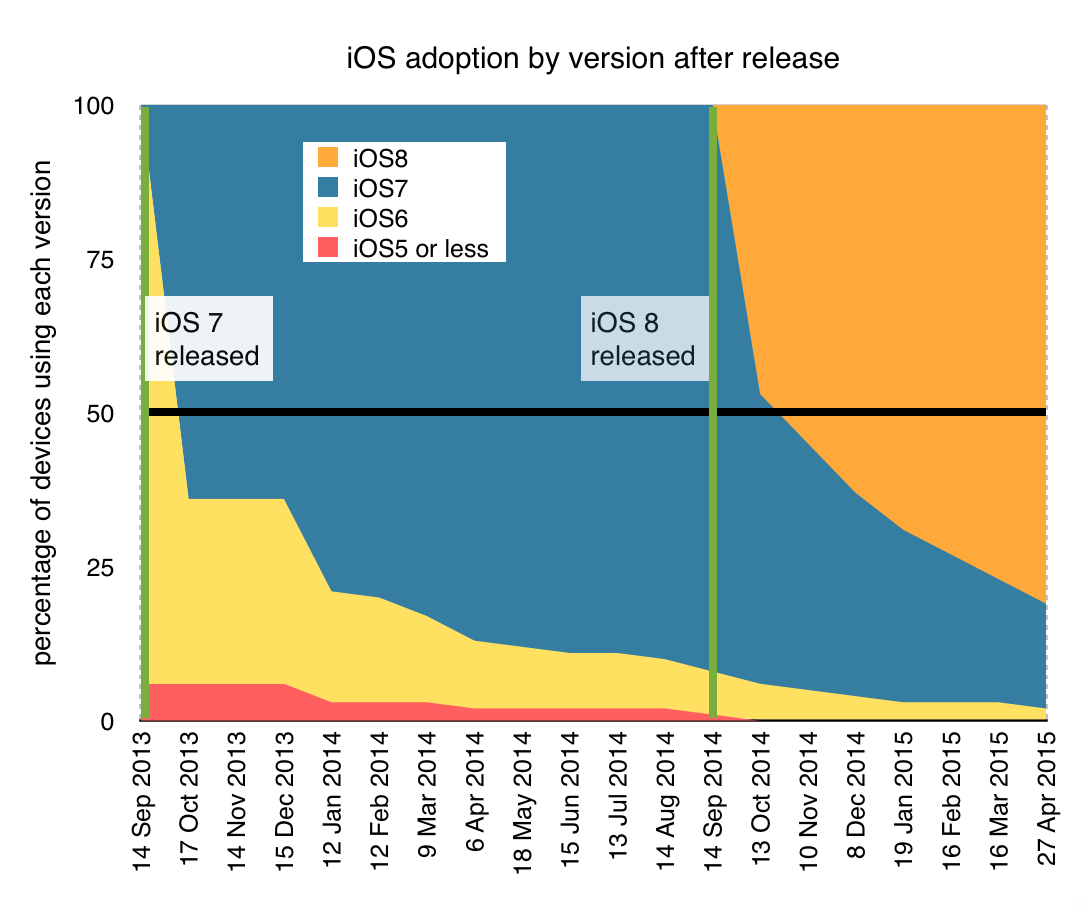
So when you get the announcement of “permissions for apps” (or indeed anything that is M-only), you have to ask: how long will it be before that is actually widespread? And by “widespread”, let’s define it as “on 50% of devices”. That 50% is useful because 50% of the billion of so Google Android devices in use is roughly comparable with the total number of Apple’s iOS devices in use. The thing is, the overwhelming number of active iOS devices get updated to the latest version within three months of the release of a new version; since iOS 6 in 2012 it’s taken just one month for the number running it to pass 50%. (At the time of writing, in May 2015, the current figure is 82% of devices on iOS 8, 16% on iOS 7, and 2% on something earlier. Revisiting it in March 2016 to add grammatical edits, the figure is 79% on iOS 9, which was released in September 2015.)

Apple iOS versions in use

Rapid adoption is a key element of Apple’s iOS due to its direct update mechanism.

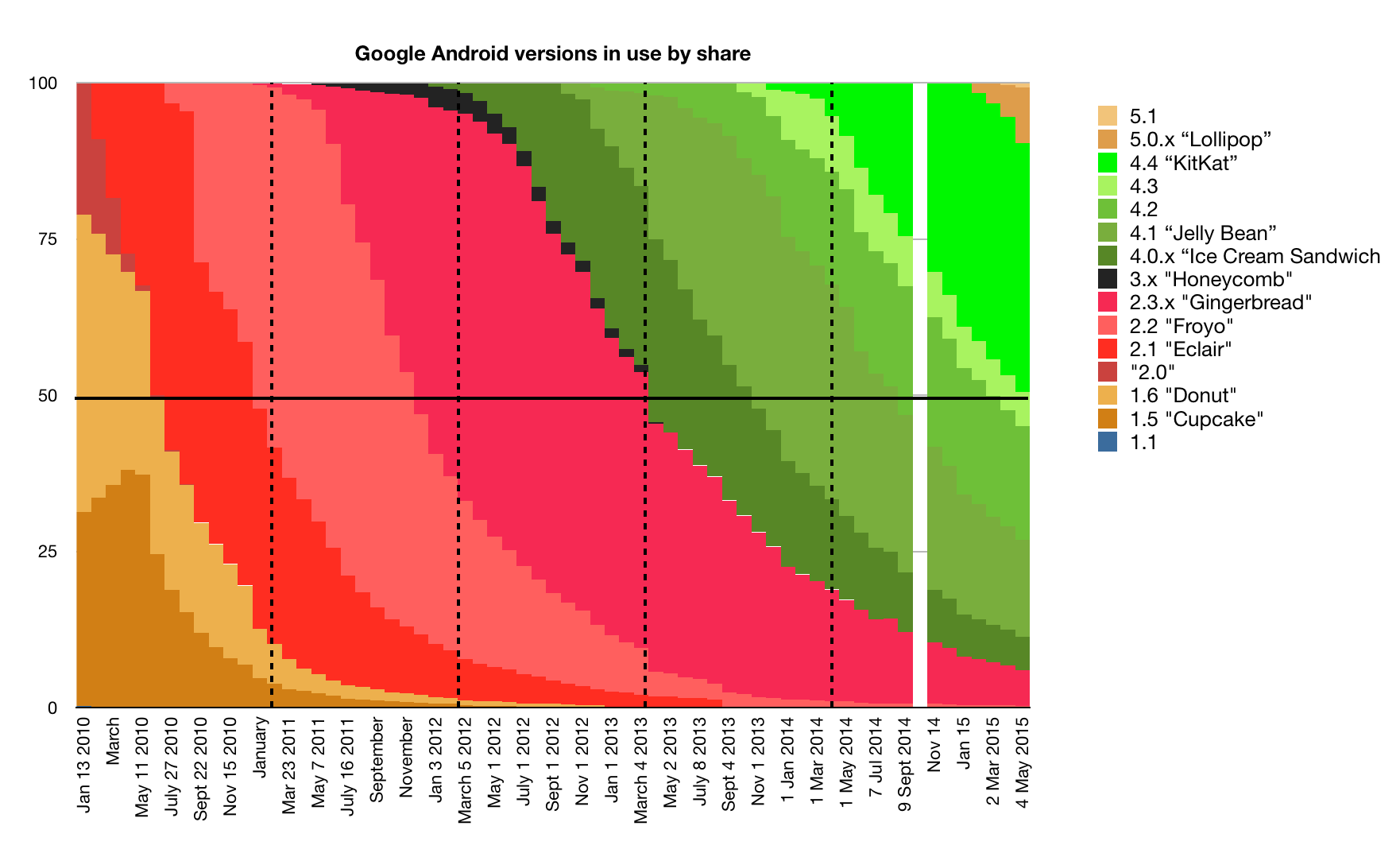
How do we figure this out? We let history be our guide. I’ve been collating the data about versions on the Android developer dashboard for a while, so we can look back to the past. In each case I’ve taken the beginning point as when a version first showed up on the dashboard, not when it was “released”.

Android versions in use

The release of a new version of Android doesn’t necessarily mean it reaches a large proportion of users quickly.

If we take it that “modern” Android starts with version 4 onwards – given that 2.3 (Gingerbread) was super-old, while 3.0 (Honeycomb) was tablet-only, we get this data:

Android 4.0: 16 months for it, or a later version, to be on 50% of devices according to the dashboard (January 2012 to April 2013).

Android 4.1: 13 months (October 2012 to November 2013).

Android 4.2: 22 months (December 2012 to September 2014 – the date of Lollipop’s release, officially).

Android 4.3: 18 months (October 2013 to March 2015)

Android 4.4: 19 months (forecast). Launched in December 2013, at the start of May 2015 it was at 49.5% for 4.4 and successors. It’s a safe bet that in June 2015 the total for Android 4.4 and successors will pass 50%. (Update: this was exactly right: the figure for May 2015 showed 49.5% on 4.4 or later; for June 2015, it was 51.6%, including 5.x; Android 4.4 itself peaked at 41.4% in April 2015.)

Android 5.x: 18 months (forecast). Presently, it’s 9.7% after 4 months, and its uptake pattern is more like 4.3 than 4.4. My forecast for its 50% point: July 2016.

On that basis, I’d say it’s a pretty safe bet that if Android M is released in December 2015 (which is likely) that it will take until June 2017 before it’s on 50% of Android devices according to Google’s measurements. Of course, that will vary regionally – there are still 6% of devices running 2.3 or earlier, which translates into about 60 million devices still in use. Some will get more rapid takeup, some will get less.

To put it into perspective (thanks Mark Blank-Settle on Twitter):
• presently, Apple’s offering iOS 8. It will show off iOS 9 in June.
• by the time Android M is released on devices later this, iOS 9 will already be on 60%+ of iOS devices
• by the time Android M – shown off in early 2015 – is on 50% of devices, Apple will have shown off iOS 10.

So if you’re depending on something such as, oh, the permissions model or Android Pay being introduced in Android M reaching the majority of your users any time soon, might be best to hold your breath. The revolution looks more like an evolution.

A vision of the future: the only two companies which get it right


We really are. The trick is figuring out which ones matter. Photo by topgold on Flickr.

In Digital Wars (book! Kindle! iBook!), in the chapter about the struggle between Apple and Microsoft for primacy in music, I detailed part of the visit by Steve Ballmer to London in October 2004 when he made his now-infamous comments: “What’s the most common format of music listened to on an iPod? Stolen!”

More telling, at least in hindsight, was this part. The analysis is mine, direct from the book.

One journalist asked: “Microsoft’s smartphone has been a slow seller [its PocketPC-based phones sold such small numbers Microsoft didn’t announce sales figures until 2005, when they hit nearly 6m] while Apple and other companies have stolen a lead in portable music player markets. How will Microsoft tackle that?”

 Ballmer’s reply: “Over time most people will carry a phone that has a little hard disk in it that carries lots of music. Mobile phones are about 600 million units a year. Now, how many devices do we want to carry? We have to have a more compelling value proposition. [Research In Motion’s] BlackBerry has a niche market position [at the time, around 2m users worldwide] but it’s not a very sticky device. It allows you to make bad phone calls but it’s a good Exchange client. We will see an explosion of larger keyboard devices.”

What’s interesting about that comment – apart from how well it illustrates Ballmer’s gadfly salesman’s mind flitting about the subject in search of a compelling way to persuade people to buy an integrated device that could make phone calls and play music – is its lack of technological foresight. First, that “most people would carry a phone with a ‘little hard disk”’. Apple had already bought up supplies of solid-state Flash memory for an iPod with no moving parts, and when meeting me four years earlier Hase had introduced the idea of a 1-gigabyte Flash chip – enough to hold about 250 music tracks. The Motorola phone being co-developed with Apple would store its songs in Flash memory; and any technologist knew that prices for Flash storage were, like those for hard drive storage, halving every year.

Second, the idea of the explosion of larger keyboard devices is classically short-term thinking that also ignores the relentless march of processing power. Although touch computing was still mainly in the laboratory, it was already conceivable: Nokia had that year built a prototype touch screen phone, and a small company called Fingerworks had been working between 2001 and 2005 on “multi-touch” systems for screens, and making presentations at conferences. A technologist – an engineer – keyed into the industry’s future would have known of it and seen its direction.

Very few companies are able to envision what the future will look like. Steven B Johnson wrote about the importance of “adjacent technologies” for innovation and invention: that before you can make one technological leap, you need to have all the technologies available that will let you do that.

But you also have to have people who can see how the landscape will look when you fast forward five, seven, ten years. It’s not just Moore’s Law, with its constant doubling; it’s also the pricing and availability of other technologies such as screens, batteries, sensors, and their integration with existing materials. The 2007 iPhone was unimaginable to almost anyone in 2002; by 2012, there was a feeling that it was old hat, and the shift towards wearables was already in full swing (the Pebble first appeared in 2012).

So which companies are good at doing this?

Having covered the technology space for decades, there are still only two companies which in my view reliably spot the future and move towards it, and shape themselves and their products to line up with it.

Far sight and big brains

The first: Google. Larry Page and Sergey Brin have proven, again and again, that they can see what’s coming around the corner, and position themselves (and their company) for it. Internet search? Minor problem in 1996, when they started on it. But they could follow the growth, and see the oncoming problem: a bazillion sites and no proper index.

Fast forward to 2005: while Eric Schmidt is busy chief executive-ing, Page and Brin investigated and bought a small mobile startup called “Android”. They didn’t even refer the purchase to Schmidt. They did it because they could see that the mobile internet would be the future, and that they had to be part of it with their own mobile platform; Android was a protective measure against Microsoft cornering the smartphone market and potentially locking out Google search.

It happens again and again. Collaborative editing through Google Docs (another purchased company). Google Maps (another purchased company). The self-driving car initiative, which puts together the improving capabilities of sensors, maps, computation and control, makes sense in hindsight; but to start work on it when it’s years away from being commercial so that you can steal a lead on the companies that are already well-placed is part of shaping the future. (This doesn’t mean that Google will be the first, or only, company to succeed with SDCs, or even that it will; but it’s seeing that possibility.)

There are tons more examples at Google, though many of them are still in the ferment of development; we don’t know if they’ll be farsighted or just overambitious when we look back in five years’ time.

Touching the alternative future

The second company that keeps seeing the future: Apple. The original iPod grasped the idea of music, and miniaturisation, wrapped in a beautiful design. The iPhone grasped the burgeoning capability of multi-touch (which Apple had already explored for years) along with the promise that Google had previously seen, and wrapped it in a package that had Andy Rubin (head of Android) hastily scrapping plans for a BlackBerry-alike and thinking immediately of an iPhone-alike. (For that immediate insight too Rubin deserves praise.)

Even the word that leaks out of what Apple hasn’t done shows that it’s trying to grab the future. Take the “nope, no TV” story that appeared in the Wall Street Journal, interestingly timed just after Carl Icahn published a long screed insisting that Apple was going to release a TV next year. (Hard not to see this as Apple putting the story out there to calm the stock market.)

In the WSJ story, we get details like:

Apple had searched for breakthrough features to justify building an Apple-branded television set, those people said. In addition to an ultra-high-definition display, Apple considered adding sensor-equipped cameras so viewers could make video calls through the set, they said.

Ultimately, though, Apple executives didn’t consider any of those features compelling enough to enter the highly competitive television market.

The sensor-equipped cameras sounds like Apple was trying to make use of technology acquired from PrimeSense in November 2013. At the time, I thought that the amount spent pointed to Apple wanting to put the technology into a product within a year – as had happened with Authentec (fingerprint unlock) and Anobit (SSD technology).

Here’s what PrimeSense had:

So PrimeSense is important, and Apple wants to use its technology soon. Its 3D sensors have a range of up to 3.5 metres – about the depth of the typical living room, or the sort of distance most people sit from a TV set – and were used in the original Microsoft Kinect add-on for Xbox. (For the second-generation Kinect, Microsoft has moved to a different supplier – which it acquired.)

We know what the original Kinect could do: it could detect faces, movements, people and map them all in 3D space. So what is Apple interested in doing around that?

Now you know: it wanted it for a TV. But the use case wasn’t compelling. Waving at your TV is not, apparently, the future.

Why not..?

You might be wondering where Microsoft is on this list, and Facebook, and a multitude of others. Microsoft – well, it hasn’t been able to overcome the contradictions of its own strategy taxes to be able to embrace the future and tear down its past. (Satya Nadella is doing that now, to some extent, but it’s long overdue.) Look again at that extract from my book at the top. Ballmer shows no sign of understanding what was coming, of how quickly the deluge would overwhelm the space. The Zune (2006) used a spinning hard drive, fer Crissake, when the iPod nano (SSD) had come out in September 2005.

That’s the other part of seeing the future: being able to let go of the past. Apple and Google have been able to shrug and say “OK, on to the next thing” in many cases, and let their old products die. Google search doesn’t die, of course, but that’s because it’s still an essential task for many. Equally, Google has been happy to cull products when they don’t fit the future it’s expecting.

Facebook hasn’t had enough time to show us what and how it can shape the future, and also I think that its reluctance to embrace hardware (understandably) also means that it’s reliant on others to lead the way. That would be Apple and Google, though, especially through mobile, where Google’s Android is driving the evolution of all sorts of adjacent industries to the smartphone (camera optics, GPS chips, batteries) and Apple is showing what really effective user interfaces and experiences feel like (the Watch is a giant leap, but one where you don’t realise that the ground has moved underneath you).

I’d love to know which other companies have shown that they can spot the future, and pivot themselves towards it repeatedly. Sure, Dropbox and Box foresaw storage being free; but what else have they seen? What are the other enterprises that have regrouped themselves and solved a problem that was coming our way five years ago, or are solving a problem coming our way in five years’ time? Do tell me your thoughts.

Start up, May 28: LG Urbane reviewed, crashing iOS, who really bought Re/Code?, Meeker’s 2015, and more


Strong feelings, and not about the video game. Photo by gato gato gato on Flickr.

A selection of 9 links for you. Use them wisely. I’m charlesarthur on Twitter. Observations and links welcome.

Mary Meeker’s Internet Trends for 2015

Have to admit I haven’t read it (found it late) but it’s always essential reading. Download and peruse.


Apple’s ‘Proactive’ to take on Google Now with deep iOS 9 search, Augmented Reality Maps, Siri API » 9to5Mac

It’s that Mark Gurman guy again:

Apple began to lay the groundwork for Proactive with its acquisition of a personal assistant app called Cue in 2013, seeking to relevantly broaden iOS’s Spotlight and Safari search results. iOS 8’s ability to display Wikipedia Search results within Spotlight was the first taste of the Proactive initiative, and was partially designed to reduce iOS’s search reliance on Google. Sources say that Apple’s internal iOS usage metrics indicate that Google clicks have indeed fallen since iOS 8’s release last fall. Now Apple wants to take Proactive to the next level, and it may do so with iOS 9’s introduction at the annual Worldwide Developers Conference on June 8. While Apple has positioned Siri as an “intelligent personal assistant” since the fall 2011 launch of the iPhone 4S, Proactive will go much further to integrate with your data. To begin with, Proactive will become a new layer within the iOS operating system, replacing the pulldown Spotlight menu currently found on the iOS Home screen.

But he says there’s also disagreement about whether to launch this in iOS 9, which was sorta going to be the “Slow down, Snow Leopard” release. (Also, “augmented reality” always sounds cool and then disappoints. I’ve tried it. It ain’t all that.) I’d love to see the metrics around Gurman’s stories compared to those for Re/Code. I think he might be ahead in pure readership. But of course he doesn’t have a giant conference attached.


Bug in iOS Unicode handling crashes iPhones with a simple text » AppleInsider

AppleInsider reader Kaitlyn on Tuesday discovered that receiving the Unicode characters seen in the screenshot above through Apple’s iOS Messages app triggers iPhone restarts, lockouts from Messages, Springboard crashes and more. A thread on Reddit narrowed down the system crash and reboot errors to iOS Unicode handling. More specifically, the Unicode string in question is part of a much longer block of text that cannot be fully rendered in Notifications.

If you’re thinking this sounds retro, that’s because it is: same sorta bug (different string) did the same thing back in August 2013. Wonder how long the fix will take. Also: Apple Watch apparently not susceptible, which is super-puzzling.


A series of wholly unrelated observations about Vox Media’s acquisition of Recode » The Awl

Matt Buchanan points out that if you pull the threads of both companies for long enough, you end up – from both – at Comcast, where its venture arm is trying to sell a company to the main arm. Trebles all round, or something. Also, take a look at the tags on the story. (Via Charles Knight.)


The Office of the Attorney General of Switzerland seizes documents at FIFA » Swiss Attorney General

Now, I don’t usually care about football (soccer to you Americans), but the evident corruption in FIFA (the “world governing body for football”) has been evident for years. Now, finally, something is happening – but not on just one, but two fronts:

In connection with irregularities surrounding football tournaments, two separate proceedings must be distinguished: The Office of the Attorney General of Switzerland (OAG) is conducting a Swiss criminal investigation regarding the allocation of the 2018 and 2022 World Cups. For inquiries regarding this Swiss criminal investigation, please contact the OAG. In separate proceedings, and independently of the Swiss criminal investigation of the OAG, the US Attorney’s Office for the Eastern District of New York is conducting a criminal investigation into the allocation of media, marketing and sponsoring rights for football tournaments carried out in the United States and Latin America. The Federal Office of Justice (FOJ) supports this criminal investigation as part of international legal assistance.

International Olympic Committee next?


Charles Johnson: world’s worst troll removed from Twitter » News.com Australia

Emma Reynolds:

Chuck is now raising money on his far-right website GotNews.com to have himself reinstated following this “censorship”. But his previous threats of legal action have never led to anything, with a website dedicated to the many times he has planned to sue for libel.

The list of things he has got egregiously wrong – on purpose? – is astonishing. But his whole schtick is about outrage and extremism. It’s more the attention paid to such people that’s the problem. When they’re just shouting to themselves, it means nothing.


Shipments of 2-in-1s to grow over 60% on year in 2015, says MIC » Digitimes

Notebook shipments, which are being impacted by tablets, are expected to drop 2.7% on year to reach 167m units in 2015, but 2-in-1 device shipments are expected to grow 62.5% on year to reach 13m units due to Microsoft’s aggressive promotions, according to figures from the Market Intelligence & Consulting Institute (MIC).

Compare to the estimated 7m Chromebooks: these are both still niche markets.


LG Watch Urbane review: why Android Wear trails Apple’s Watch » WSJ

Geoffrey Fowler:

The Urbane falls behind in its approach to the fundamental smartwatch problem: When technology is attached to our bodies, there’s a thin line between help and nuisance. Android Wear is the annoying little brother of operating systems. It really wants your attention, and to keep you swipe-swipe-swiping away on its little screen. A smartwatch’s purpose is to keep you plugged in so you don’t have to be glued to your phone. Since I started wearing an Apple Watch two months ago, I check my phone roughly 25% less, according to Moment, an app that monitors my habits. Ideally, a smartwatch should give you just enough information to keep your smartphone anxiety in check, but not so much that you’re tempted to keep looking at your wrist. The Urbane’s default settings do the opposite. When I just want to check the time, the Urbane often teases me with a notification “card” on the bottom of its screen. You’ve got four new emails! It’s 68 degrees today! You can quickly swipe it away, but after that one’s gone, there’s usually another card waiting.

Lots of room for improvement – but it’s still very early days. (Hadn’t heard of Moment before. “TRACK HOW MUCH YOU AND YOUR FAMILY USE YOUR PHONE”. Are you brave enough? Um, and it has a Watch version.)


Infomercial GIfs, because real life is hard. » Imgur

Zero tech in this collection of “how hard life is because we don’t have X tech that the informercial will sell you”. Lots of solutions looking for problems – happily, we don’t see the solutions, just guess at them (and, often, the problems). The most impressive, in my view, is the woman in the second GIF who juggles the bottle. That’s really hard to do badly well.


Start up: Ive v the SEC, Android M and the batteries, adblock apocalypse, and more


Imagine acting with this in front of you. Now read the first link.

A selection of 7 links for you. Use them wisely. I’m charlesarthur on Twitter. Observations and links welcome.

Behind the scenes: Car Share, BBC1 » Broadcast

George Bevir:

The premise of BBC comedy series Car Share is simple enough: two colleagues (played by Peter Kay and Sian Foulkes) are forced to travel to work together as a result of a company car share scheme.

But with the action taking place inside a rather compact Fiat 500, the technical setup required to film the Goodnight Vienna production was anything but straightforward.

Kay and Foulkes made it look like two people in a car; seen from their view, you see how difficult it would really be to “act natural”. And what a hell of a rig. (Link via Dave Lee.)


Jony Ive’s “promotion” by Apple is driven by money and fear of SEC disclosure » Forbes

Eric Jackson makes a good case that Ive’s promotion to a non-managing role means that he won’t count as an “executive officer” and so his pay won’t have to appear on SEC filings (which Jackson thinks it should have for the past two years). A lawyer emails him:

Part of a company’s competitive advantage is having an employee that everyone else would salivate over having and not having to give your competitors the data points for exactly what it would take to lure that person over, assuming money would be a big factor for that person’s decision to move (which you point out it almost always is). As we’ve seen, more disclosure of exec comp has had a major correlation to the exponential increases in exec comp over the past 20-25 years. If I ran Apple and had a Jony Ive on my team, I’d put his comp in the same vault as the concept design for the iPhone 7 and Apple Watch 2. It would be treated as a trade secret.


[Rumor] Google taking renewed focus on battery and RAM in Android M, Dev preview expected again this year » Android Police

Liam Spradlin:

According to our information, battery is set to be a big focus in Macadamia Nut Cookie, with Google emphasizing performance and smarter use of features that might drain your battery.

Google is apparently urging its own teams to focus on battery performance by cutting location checkins when possible, trimming down RAM usage, and reducing activity off-charger and when the device’s screen is off. Presumably this renewed focus on performance will extend to Google’s own Play Services package, which frequently manages to wiggle its way to the top of battery usage stats.

According to our info, Google will discuss these changes at I/O.

It’s hard to say how these efforts will materialize in Android M. Google, with additions to L like JobScheduler and Project Volta, has already taken aim at improving battery and performance on Android, but familiar battery life complaints still linger on for many users, even on the Nexus 6 and Nexus 9, Google’s flagship Lollipop devices.

Commenters unimpressed: “every year they say this”.


When Stephen Fry met Jony Ive: the self-confessed fanboi meets Apple’s newly promoted chief design officer » Telegraph

Stephen Fry:

ID [industrial design] is about the physical devices themselves while HI [human interface] is about the images, interactions, sounds, flow and feel of the software that we interact with as we use them.

With control over both, Ive has been able to migrate the mobile and desktop operating systems from their old-fashioned skeuomorphic rendering of app icons as real world representations (ring binders and even torn page effects on the contacts and calendars apps, for instance) into a brighter, clearer set of exquisitely designed images that speak for themselves. Ive’s inventiveness can perhaps most starkly be expressed by revealing that he has nearly 5,000 patents to his name. To give you some point of comparison, Edison was granted 2,332.

If nothing else Ive has done Britain a huge favour. Apple has recently developed a standard British power plug whose prongs fold elegantly back flush into their body. Easily stowed, no agony if accidentally trod on. A separate and wholly different solution to that offered by the Mu Plug which solves the problem in another way.

“It took ages to solve,” Ive says wistfully.

Of note: this piece is in the UK’s Telegraph, which seems to have the scoop (except it’s not written by a journalist); photos are taken by Gabriela Hasbun, a freelance photographer in San Francisco. Notable how the Telegraph is being chosen in the UK for Apple’s announcements.


Adblocks’ doomsday scenarios » Monday Note

Frederic Filloux:

In coming weeks, a large analytic firm will release disturbing figures on the state of the ad blocking scene. According to someone who has advanced knowledge of the data, on desktop computers and on critical segments of the digital audience, the use of ad blocking keeps rising exponentially.

Along with The Netherlands, the German market is by far the most affected one by the ad blocking phenomenon. There, ad block use approaches 40% of the internet population. The reasons for the epidemic are unclear…

…but if you read the comments, people will give you their views. A common refrain is that ads are often used to plant malware – a charge that publishers can’t deny, but which equally isn’t their fault. It never used to be a problem (per se) in print days.


The mystery of the power bank phone taking over Ghana » Quartz

Emmanuel Quartey noticed a bulky phone his friends were using:

I fired up Gmail and clicked the first email in my inbox — a promotional message by e-commerce startup, Jumia where it was the featured deal.
Since then, this phone keeps popping up everywhere I go. It’s obviously very popular, and it’s clearly taking off. But why?
Why’re some of my most stylish, most tech-savvy friends — all of whom already own smartphones — suddenly lugging this thing around?
This is what I’ve found.

Here’re some basic details about the phone:
Costs between 100 and 150 Ghana Cedis (about 25 to 38 USD)
Can hold up to 3 SIM Cards
Has built-in FM radio
Comes with Facebook and WhatsApp pre-installed
Doubles as a power bank to charge small electronics
LED flashlight

10,000 mAh battery = super long life. But then again, why not just have rechargeable battery packs? Answer: because these featurephones don’t have standard connectors.


Global smartphone growth expected to slow to 11.3% in 2015 as market penetration increases in top markets » IDC

The research company says:

smartphone shipments are expected to grow 11.3% in 2015, which is down from 27.6% in 2014. This is on par with IDC’s previous smartphone forecast of 11.8% growth in 2015. While overall smartphone growth will continue to slow, many markets will experience robust growth in 2015 and beyond, and worldwide shipment volumes are forecast to reach 1.9bn units annually by 2019.

IDC expects 2015 to bring two notable milestones. First, IDC projects this to be the first year in which China’s smartphone growth, forecast to be 2.5% in 2015, will be slower than the worldwide market. Second, and somewhat related to the China forecast, Android smartphone growth is also expected to be slower than the worldwide market at 8.5% in 2015. IDC believes both trends will persist throughout the forecast period, which now goes to 2019.

China smartphone shipments shrank year-on-year in the first quarter of 2015, IDC says, claiming saturation. This doesn’t quite make sense though. There are hundreds of millions of people in China, and elsewhere, without a smartphone. The block on growth is down to price, and perceived need: if you can’t get data, what’s the use?


Start up: a Microsoft BlackBerry bid?, Firefox’s dead mobile dream, Montblanc’s smart watchband, and more


Fitness lies within. Photo by cactusbeetroot on Flickr.

A selection of 9 links for you. Counted by computer. I’m charlesarthur on Twitter. Observations and links welcome.

Mozilla overhauls Firefox smartphone plan to focus on quality, not cost » CNET

Scoop by Stephen Shankland:

Mozilla has revamped its Firefox OS mobile software project after concluding that ultra-affordable $25 handsets aren’t enough to take on the biggest powers of the smartphone world, CNET has learned.

The nonprofit organization rose to prominence with the success of its Firefox Web browser a decade ago, but it’s having trouble achieving the same success with its Firefox operating system for smartphones. According to a Thursday email from new Chief Executive Chris Beard, Mozilla has changed its strategy to a new “Ignite” initiative that emphasizes phones with compelling features, not just with lower price tags. It’s also considering letting its operating system run apps written for its top rival, Google’s Android.

The idea that Firefox OS could undercut Android was always ridiculous, because Android volumes brought prices down so quickly. This won’t work either though – there’s no “quality gap” in the middle, and certainly not in the high end. Firefox may be destined for obscurity by the world’s move to mobile.


Montblanc to Apple: our Swiss smartwatch will outlast yours » Bloomberg Business

Corinne Gretler on Montblanc’s “e-strap”, which attaches to the strap, rather than replacing the watch itself:

The device is the first luxury Swiss product to directly compete with the Apple Watch, which costs $349 for the most basic version and $17,000 for an 18-karat gold model. The e-Strap and compatible timepieces will appear in Montblanc boutiques and retailers such as Bloomingdale’s in the U.S.

“The pricing is reasonable,” said Patrik Schwendimann, an analyst at Zuercher Kantonalbank. “If it turns out to be just a fad, at least the consumer still has a nice, normal watch they can continue to wear.”

The e-Strap consists of a stainless steel display attached via a leather strap and designed to be on the backside of the wrist when the watch is on the front. A two-line touchscreen displays e-mails when they arrive.

When connected to a smartphone, Montblanc’s device can select songs and jump through playlists. It has an activity tracker that allows users to set targets for calories burned and steps taken. The e-Strap can also trigger the phone’s camera, facilitating easier “selfie” shots and group photos.

The e-strap is amazingly ugly; I can’t imagine anyone who would buy a Montblanc buying one, let alone using one, to go with their watches which cost (deep breath) $3,700 to $5,800.

One begins to see why Jonathan Ive considered that Switzerland might be screwed.


Samsung layoffs at Milk Music, Milk Video Unit; Kevin Swint exits » Variety

Janko Roettgers:

Samsung’s Media Solutions Center America, which is responsible for the company’s Milk Music and Milk Video services, has been hit by layoffs and a key exec departure over the last couple of weeks, Variety has learned. These events have occurred as Samsung executives take a closer look at many of its business units, which could spell trouble for the company’s content plans going forward.

Media Solutions Center America saw dozens of staffers laid off earlier this month, according to multiple sources. Exact numbers are hard to come by, but one source estimated that as much as 15% of the staff may have been affected. I’ve been told that MSCA employed around 250 people total before the cuts went into effect.

Samsung said it remains committed to delivering “engaging, connected entertainment experiences through its Milk platform.”

Flashback on Samsung denials:
November 2014: Samsung denies ChatOn to close
December 2014: ChatOn to close by March 2015.


Filling the green circle » Marco.org

Marco Arment:

Ever since getting the Apple Watch, not only have I been getting more consistent exercise, but I’m pushing myself further. I take more walks, and I walk faster and further than ever before. I’ve been walking hops around the same streets for four years, but now I’ve been discovering new streets and paths just to extend our walking distance and try to beat my previous walks.

I’ve never cared before, but now, I care.

Apple Watch: a Skinner box in a smartwatch’s clothing.


The new Google Photos app will automatically group your images by faces and recognized objects like cars, skylines, and food » Android Police

Ryan Whitwam:

Google’s current Photos app uses some image processing smarts to piece together auto-awesome compilations and Stories, but the new Photos experience pushes the limits of computer vision. Not only does it pick out and identify faces, it recognizes objects like cars and food. It’s not perfect, but it’s sometimes creepily accurate.

Hmm. Is this one of those “because we can!” features, or something that’s actually really useful? Apple has had a “faces” feature in iPhoto and now Photos (only on desktop), so that is certainly helpful. But “objects”?


DxOMark reviews the HTC One M9, ranks it 22nd best mobile camera on the market » Android Police

Jeff Beck:

DxOMark just released their review of the HTC One M9’s camera. I’m not going to beat around the bush, the results aren’t great (not that any of us here at AP are all that surprised). The HTC One M9 scored a rather abysmal cumulative score of 69, placing the Taiwanese manufacturer’s latest flagship in 22nd place on DxOMark’s top mobile camera list.

Also behind the iPhone 4S (yes, the 2011 device), GoPro Hero3 and Amazon Fire Phone, as well as pretty much everything else. Hard to know to what extent DxOMark’s marks are objective, but this isn’t promising for HTC if it was hoping to pull in new users who care about this stuff.


Edward Snowden comments on ‘Just days left to kill mass surveillance under Section 215 of the Patriot Act’ » Reddit AMA

Edward Snowden in a thread in his reddit AMA, about the recently discovered weakness in SSL caused by 1990s crypto regulations, on what you’d do if you saw some encrypted traffic that looked like it needed investigation:

You then flag those comms and task them to CES [the NSA’s Cryptographic Exploitation Service] for processing. If they’ve got a capability against it and consider your target is worth using it against, they’ll return the plaintext decrypt. They might even set up a processor to automate decryption for that data flow going forward as matching traffic gets ingested as they pass the mass surveillance sensors out at the telecom companies and landing sites. If you don’t meet CES’s justifications for the capability use or they lack a capability, you get nothing back. In my experience NSA rarely uses meaningful decryption capabilities against terrorists, firstly because most of those who actually work in intelligence consider terrorism to be a nuisance rather than a national security threat, and secondly because terrorists are so fantastically inept that they can be countered through far less costly means.

Terrorists: a nuisance rather than a national security threat, and in general fantastically inept. That actually sounds about right. It’s just that sometimes they aren’t, and they aren’t.


‘Buy Buy’ BlackBerry? Microsoft could make offer for sleeping phone giant, rumors say » Somedroid

Rumors have been circulating recently that companies are lining up to acquire Blackberry. The shortlist includes Microsoft, Xiaomi, Huawei and Lenovo for now —  last month, Samsung was reportedly also on the list but backed out after getting a $7.5bn asking price.

As of now, Microsoft seems to be preparing a $7bn offer for the company — that’s a 26% premium for the stock.

If Microsoft does buy it, that would be the second failing phone company it has bought. Personally, I don’t see the point.


BlackBerry laying off workers in handset unit » Re/code

Ina Fried:

BlackBerry confirmed on Saturday that it plans to cut jobs in the unit responsible for its smartphones as it seeks to make that shrinking business profitable.

The company said it has “made the decision to consolidate (the) device software, hardware and applications business, impacting a number of employees around the world.”

BlackBerry did not quantify the number of workers that would be affected.

Fried’s piece has the full statement from BlackBerry, which includes the quote

“One of our priorities is making our device business profitable. At the same time, we must grow software and licensing revenues. You will see in the coming months a significant ramping up in our customer-facing activities in sales and marketing.”

The device business isn’t profitable and would need huge changes – principally cuts in running costs, or a huge leap in handset ASPs – to become so.