Start up: iOS 9, Google and adblocking; Kaspersky under attack; the Search for Harm Data, and more


Adblock? Roadblock? Photo by lludovic on Flickr.

A selection of 9 links for you. Oh yes. I’m charlesarthur on Twitter. Observations and links welcome.

A blow for mobile advertising: the next version of Safari will let users block ads on iPhones and iPads » Nieman Journalism Lab

Joshua Benton:

Why would Apple do this?

An Apple partisan might argue it just wants to give users control of their iPhone experience, and having debuted extensions in the last version of iOS, allowing them to alter web content is a natural next step.

An Apple realist might argue that its great rival Google makes more than 90% of its revenue from online advertising — a growing share of that on mobile, and a large share of that on iPhone. Indeed, Google alone makes about half of all global mobile advertising revenue. So anything that cuts back on mobile advertising revenue is primarily hurting its rival.

An Apple cynic might note that the company on Monday unveiled its new News app, which promises a beautiful reading experience — and a monetization model based on Apple’s iAds.

Oh, it’s that cynic again. Alternatively, someone who’s used iOS might have found their browsing hijacked by bad ads that take you to the App Store, and wanted to block those too – they’re a terrible user experience, and Apple hates things that cause bad UX (remember Flash and Java?)

Google gets its slice principally from iOS search – will those get blocked? Meanwhile, and unintuitively, AdBlock Plus doesn’t seem keen on it.


Google losing billions in adblocking devil’s deal » Inside PageFair

Pagefair is an “anti-adblock technology company”:

even more controversial than the debate over the ethics of adblocking is the sheer scale of the payments being made – and what that money is funding.

It is safe to assume that Google – rumored to be paying $25m – is the largest customer on the Acceptable Ads program. This is a relatively small sum for a global corporation with revenues of nearly $60bn, while being a huge cash injection for a fast-growing adblocking startup in Cologne. It is not credible that these funds are simply being spent on the administration of the acceptable ads program. Instead, they are presumably being reinvested in the future development of adblocking.

“Acceptable Ads” means that if you pay up, your ads don’t get automatically blocked. Taboola has done the same; AdBlock Plus must be minting it. And there’s no sign that this is going to go away. For both ABP users and ABP itself, it works perfectly.


Kaspersky Lab investigates attack on its own network » Kaspersky Lab Official Blog

Eugene Kaspersky:

We’ve found that the group behind Duqu 2.0 also spied on several prominent targets, including participants in the international negotiations on Iran’s nuclear program and in the 70th anniversary event of the liberation of Auschwitz. Though the internal investigation is still underway we’re confident that the prevalence of this attack is much wider and has included more top ranking targets from various countries. I also think it’s highly likely that after we detected Duqu 2.0 the people behind the attack wiped their presence on the infected networks to prevent exposure.

Kaspersky hints, but doesn’t outright say, that a nation state was behind the attack.


Washington scrutinizes the sharing economy » NYTimes.com

Rebecca Ruiz:

Matthew W. Daus, former commissioner and chairman of the New York City Taxi and Limousine Commission, took issue with calling Uber a member of the sharing economy.

“We’re coming up with these incredible definitions and clarifications, and I’m just trying to throw some water on everybody’s faces,” Mr. Daus said. “There’s no sharing going on. This is about for-hire transportation, and there needs to be a level playing field,” he said, suggesting that capping the number of vehicles on the road was necessary.

Across town at the exact same time, at another conference focused on the intersection of technology, business and government, the sharing economy was also under the microscope. The conference, called Techonomy Policy, included participation from the F.T.C. and the Federal Communications Commission.

“How sustainable is this?” asked Arun Sundararajan, a professor at New York University’s business school.

Perhaps more sustainable than some would like. Why would AirBnB or Uber go away?


Analysing Google’s public response to the EC’s Statement of Objections

Remember Google’s blogpost “The Search for Harm“, which suffered from misquoted statistics about incoming search to news websites?

This analysis by Foundem (one of the EC complainants over search) suggests – very strongly, with data to back it up – that the graphs Google included there to show how little effect it was having on online price comparison shopping, which is what the EC complaint is about initially, looked at quite different topics.
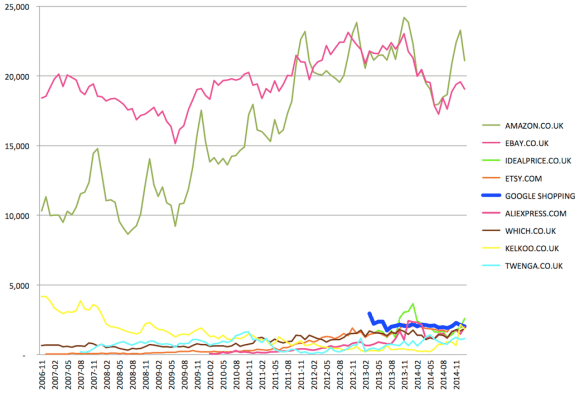
And that when you look more closely at what Google’s been doing, you discover far more effect than you might expect.


It’s a fascinating analysis; Google has questions to answer.


Huawei delays launch of its SmartWatch to September-October in China » TalkAndroid.com

Peter Holden:

Huawei’s Watch was first unveiled at MWC back in March, and it is still one of the better-looking Android Wear devices around. There is no set shipping date for the Huawei Watch just yet, although it is available to pre-order in most countries. Not in China though, availability of the Huawei Watch has been delayed until at least September, although October hasn’t been ruled out if things don’t go to plan.

It all stems down to Google having left the Chinese market due to disagreements with the Chinese government. This means that Google’s Services won’t work in China, which has left Huawei with the task of adapting Android Wear to use its own services. Obviously this isn’t going to be a quick fix.

Given that many westerners can’t pronounce Huawei (it’s Hoo-wah-way), and won’t know it has a smartwatch, no great loss of face. Also, Peter Holden: things stems *from*, not “down to”.


Open data on council spending is largely unread by voters » The Guardian

Ben Worthy at the Public Leaders Network:

there has been less interest in the data than many hoped. Council finance data is viewed around 200 times each month. The person on the street has not been desperate for data. No army of armchair auditors has sprung up. There are some enthusiasts here and there; a concerted campaign in Barnet used open data to build its case against the (now deceased) Conservative council. But few people have the time and, most importantly, the motivation to scroll through complicated pdf documents of raw council spending data. Data needs a narrative, and pdf documents and spreadsheets don’t yet tell a good enough story.

This links to a further problem. If you do find a smoking gun among the spreadsheets, who do you send it to? The council itself, the opposition or the local press? It’s notclear what the next step would be and how it would fit in with the processes by which councils are accountable to citizens.

The better news is that something is being done with the data. Users include businesses, pressure groups and journalists as well as a handful of members of the public. While they haven’t unleashed a wave of accountability, there have been sudden bursts of data-driven questioning of local authorities.

Sounds like there’s been pretty much exactly the right amount of interest in the data. And the key point is, if the councils and politicians know that the data is auditable, they will realise they can’t hide stuff. Compare and contrast: FIFA payments.


Why I’m breaking up with the Apple Watch » NYTimes.com

Jessica Friedman:

the busywork the watch’s apps can replace — handing over airline boarding passes, opening hotel room doors — seems less like an advance than a loss of control. Call me a Luddite, but honestly, I don’t mind unlocking things with my actual hands. The new watches announced this week may change the situation, but I am not sure I have the patience to wait.

Likewise (and I know this will be heresy to anyone really excited about the coming Fitbit initial public offering), the fitness-app aspect — the tracking of my steps, the measuring of my heart rate, the telling me to stand up when I am in the middle of an article — seems more like a burden than freedom.

I have worked hard to wean myself from a reliance on exercise machines telling me how hard I had worked — how many calories I had burned, how many stairs I had climbed — in part because I knew I was cheating pretty much all the time anyway and thus could not trust the results, and in part because it became an excuse to modify, or not, my ensuing behavior.

But the truth is, I know when I am in shape; I can see the difference in my body and feel it when I ride my bike in the park. The watch threatened to drag me back into a numbers-driven neurosis, and that’s a temptation I would rather not have.


The secrets of seven amazingly surreal photos revealed » Lumia blog

When it comes to Lumia photography, we think Pritesh Patel knows a thing or two about inspiring others. His amazingly surreal work is inspiring on many levels, with a magical combination of skill, creativity, and originality all working together to create some seriously fantastic photos.

Pritesh is a 22-year-old Mechanical Engineering graduate from Anand in Gujarat, India who has been a big lover all things Lumia for quite some time. And luckily for us, he’s here to tell us all about the magic behind his super photos — what he loves about his Lumia, what inspired him to create his photos, how he does it, and how you can do it too.

They are clever photos (though lots of post-editing is needed; it would be nice if some were clever trompes l’oeil). Also, “amazingly surreal” photos? Either amazing or surreal. Not both.

Start up: Russia’s misinformation detailed, USB-C wins!, automation woes?, and more


Endangered species? A truckstop by sunset. Photo by Indigo Skies Photography on Flickr.

A selection of 8 links for you. Because I like the cut of your jib. I’m charlesarthur on Twitter. Observations and links welcome.

App maker files EU complaint against Google, alleging abuse of Android dominance » WSJ

Alistair Barr on the lawsuit filed by Disconnect, which makes an anti-tracking app:

The app maker alleged Google pulled Disconnect because the software disrupted Google’s tracking and advertising efforts, the source of most of the internet company’s revenue and profit. In an email included in the complaint, a Play store employee said the app was removed [from Google Play] because it prevented other apps from delivering ads. Disconnect asked European antitrust regulators to require Google to put its apps back in the Play store and treat the apps the same way Google treats its own privacy and security software. A Google spokesman called Disconnect’s claims “baseless.” Google has allowed more than 200 other privacy apps in the Play store, but blocks any apps that alter other apps’ functionality or remove their way of making money, he added, saying Google applies this policy uniformly, with strong support from Android developers.

Tricky, this: Disconnect says that the key point is that Google doesn’t hold itself to that standard on privacy and security, and that it doesn’t prevent ad-serving – just tracking. Google says that it makes the store, so it decides the rules.


Self-driving trucks are going to hit us like a human-driven truck » Medium

Scott Santens:

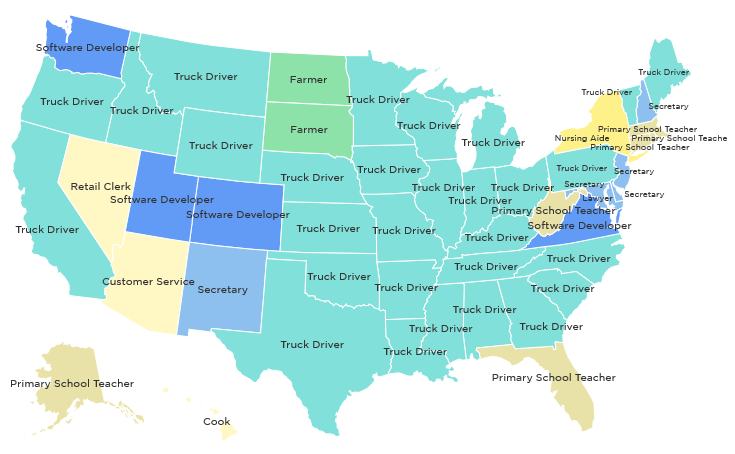
This is a map of the most common job in each US state in 2014. It should be clear at a glance just how dependent the American economy is on truck drivers. According to the American Trucker Association, there are 3.5 million professional truck drivers in the US, and an additional 5.2 million people employed within the truck-driving industry who don’t drive the trucks. That’s 8.7 million trucking-related jobs.
We can’t stop there though, because the incomes received by these 8.2 million people create the jobs of others. Those 3.5 million truck drivers driving all over the country stop regularly to eat, drink, rest, and sleep. Entire businesses have been built around serving their wants and needs. Think restaurants and motels as just two examples. So now we’re talking about millions more whose employment depends on the employment of truck drivers. But we still can’t even stop there…

…Truck driving is just about the last job in the country to provide a solid middle class salary without requiring a post-secondary degree.

You can argue about the exact numbers, but the point that it’s not just the driving that’s affected is important. See also the next link about sewing.


Made to measure » The Economist

Looking at the question of whether automation could put low-paid sewing machine workers out of, well, work in countries such as Myanmar:

it is devilishly difficult to make a machine in which fabric goes in one end and finished garments, such as jeans and T-shirts, come out the other. The particularly tricky bit is stitching two pieces of material together. This involves aligning the material correctly to the sewing head, feeding it through and constantly adjusting the fabric to prevent it slipping and buckling, while all the time keeping the stitches neat and the thread at the right tension. Nimble fingers invariably prove better at this than cogs, wheels and servo motors. “The distortion of the fabric is no longer an issue. That’s what prevented automatic sewing in the past,” says Steve Dickerson, the founder of SoftWear Automation, a textile-equipment manufacturer based in Atlanta, where Dr Dickerson was a professor at the Georgia Institute of Technology.

The company is developing machines which tackle the problems of automated sewing in a number of ways. They use cameras linked to a computer to track the stitching.

I’m moderating a session later this week looking at the questions around this topic: when automation and machine vision and capital come together to take these jobs away, what do the people who would have done them do instead?


USB-C has already won » The Verge

Sam Byford:

Although USB-C seems an inevitable success at this point, it does have a couple of issues to iron out, perhaps the most pressing of which is the complexity of its offering. There will be USB 2.0 devices with USB-C connectors, like the Nokia N1; USB 3.1 devices that use regular USB-A connectors; USB 3.1 “Gen 1” devices only capable of 5Gbps transfer speeds over USB-C, like the new Chromebook Pixel and MacBook; and USB 3.1 Gen 2 devices that give you 10Gbps. USB-C could be the only cable you ever need, but at this point it may be hard to know exactly what performance you’re going to get when you plug something in. “I think there’s the potential for confusion,” says [president and COO of the USB Implementers Forum, Jeff] Ravencraft, whose forum publishes language and usage guidelines for both USB 3.1 and USB-C.

“You do not get performance with the cable, you do not get power delivery with just the cable. The cable is a conduit for those things, right? So to have power delivery, the device has to have a power delivery controller, the host or the hub has to have a power delivery controller, and then you have to have the right cable.” The USB Implementers Forum offers training programs to help employees at retailers like Best Buy and Staples give accurate information to consumers, and is particularly aiming to crack down on “bad-actor” manufacturers that try to deliberately mislead.


MH17: forensic analysis of satellite images released by the Russian Ministry of Defence » bellingcat

With this new report all four major claims made at the Russian Ministry of Defence press conference have now been shown to be false:
– The MH17 flight path was not altered in the way claimed by the Russian Ministry of Defence. Data from the Dutch Safety Board’s preliminary report and other sources show Flight MH17 made no major course changes such as the one described in the Russian Ministry of Defence press conference.
– The Russian Ministry of Defence claimed the video of the Buk missile launcher presented by the Ukrainian Ministry of Interior was filmed in the Ukrainian government control town of Krasnoarmeisk. This has been proven to be untrue, with analysis of the video showing it was filmed in the separatists controlled city of Luhansk.
– Radar imagery was described as showing an aircraft close to Flight MH17 after it was shot down. Experts interviewed by various media organisations have stated this is almost certainly debris from Flight MH17 as it broke up over Eastern Ukraine.
– Satellite imagery shows Ukrainian Buk activity around July 17th. As this report shows, those claims are untrue, and were based on fabricated satellite imagery.

Weird that Russia is claiming to have had no involvement in MH17 and yet still takes the trouble to do this. But when you have a country whose leaders are paranoid.. well, read the next link.


The Agency » NYTimes.com

Adrian Chen on the “Internet Research Agency” in St Petersburg, which has industrialised the practice of trolling social media to promote Russian interests:

[Ludmila] Savchuk’s revelations about the agency have fascinated Russia not because they are shocking but because they confirm what everyone has long suspected: The Russian Internet is awash in trolls. “This troll business becomes more popular year by year,” says Platon Mamatov, who says that he ran his own troll farm in the Ural Mountains from 2008 to 2013.

During that time he employed from 20 to 40 people, mostly students and young mothers, to carry out online tasks for Kremlin contacts and local and regional authorities from Putin’s United Russia party. Mamatov says there are scores of operations like his around the country, working for government authorities at every level. Because the industry is secretive, with its funds funneled through a maze of innocuous-sounding contracts and shell businesses, it is difficult to estimate exactly how many people are at work trolling today. But Mamatov claims “there are thousands — I’m not sure about how many, but yes, really, thousands.”

That, though, is only the amuse-bouche. Then Chen finds himself dragged down the rabbit hole. Today’s must-read.


Lenovo replaces head of smartphone division as sales slump in China » Reuters

Liu Jun, one of four executive vice presidents under CEO Yang Yuanqing and a company veteran of 22 years, will be replaced by Chen Xudong, the head of ShenQi, a sub-division that sells mobile devices, the company said in a statement. Chen, 47, takes the reins of the division at a critical time. He must integrate the Motorola unit acquired from Google Inc for $2.9bn six months ago, while trying to counter a damaging slump in phone shipments. Lenovo, the fifth largest player in the Chinese market, shipped 22% fewer phones in the first quarter compared to the same period a year earlier, according to research firm IDC.

In stark contrast, Apple’s first-quarter China shipments jumped 62%, while Xiaomi and Huawei had gains of 42% and 40% respectively. Lenovo did not offer a reason for Liu leaving the post but said he would continue for an unspecified period as a special consultant to Yang.

Lenovo has a tough challenge with the tightening China market and Motorola’s integration.


How Twitter users can generate better ideas » MIT Sloan Management Review

in analyzing the structure of each employee’s Twitter network, we found that there was a positive relationship between the amount of diversity in one’s Twitter network and the quality of ideas submitted. However, Twitter activity and size measures (such as the number of tweets, number of followers and number of people followed) were not correlated with personal innovation.

We can explain these findings further by examining the Twitter sociograms of two EMC employees. In the diagrams, circles represent Twitter users, and an arrow from one user to another user indicates that the first user is following the second user on Twitter. Even though both employees A and B follow approximately the same number of Twitter accounts, A’s network is far more diverse than B’s. That is to say, the people whom employee A follows on Twitter are, for the most part, not following each other.

We can determine this level of diversity mathematically by using the compactness ratio, which measures the degree to which people in the network are connected to each other. For employee A, the network’s compactness ratio is quite low, at 18%. Our research found that loose Twitter networks, such as employee A’s, are better for ideation, because the potential for accessing a divergent set of ideas is greater.

Is it sort of “be less like Facebook”?


Start up: Apple’s transit plans, app monetisation, Samsung’s S6 rebuttal, bitcoin booboo, and more


Surely not caused by a Google car. Photo by Oakland Pirate on Flickr.

A selection of 9 links for you. Free like nitrogen. I’m charlesarthur on Twitter. Observations and links welcome.

Californians are OK with Google self-driving cars and are ready to ban non-self-driving cars » Emerging Technologies Blog

One of the blog’s readers gave their experience:

It’s safe to cut off a Google car. I ride a motorcycle to work and in California motorcycles are allowed to split lanes (i.e., drive in the gap between lanes of cars at a stoplight, slow traffic, etc.). Obviously I do this at every opportunity because it cuts my commute time in 1/3. Once, I got a little caught out as the traffic transitioned from slow moving back to normal speed. I was in a lane between a Google car and some random truck and, partially out of experiment and partially out of impatience, I gunned it and cut off the Google car sort of harder than maybe I needed too… The car handled it perfectly (maybe too perfectly). It slowed down and let me in. However, it left a fairly significant gap between me and it. If I had been behind it, I probably would have found this gap excessive and the lengthy slowdown annoying. Honestly, I don’t think it will take long for other drivers to realize that self-driving cars are “easy targets” in traffic.


Why do we assume everyone can drive competently? » Remains of the Day

Eugene Wei just avoided a cycling crash when a car turned into his cycle lane without warning:

For the next two blocks, I played my near collision on loop in my head like a Vine, both angry at the driver’s reckless maneuver and relieved as I tallied up the likely severity of the injuries I had just managed to escape by less than a foot of clearance. This is not an unusual occurrence, unfortunately. When I bike, I just assume that drivers will suddenly make rights in front of me without turning on their turn signal or looking back to see if I’m coming in the bike lane to their right. It happens all the time. It’s not just a question of skill but of mental obliviousness. American drivers have been so used to having the road to themselves for so long that they feel no need to consider anyone else might be laying claim to any piece of it. Though the roads in Europe are often narrower, I feel a hundred times safer there when biking there than I do in the U.S. All that’s to say I agree wholeheartedly with the writer quoted above that self-driving cars are much less threatening than cars driven by humans. As an avid cyclist, especially, I could think of nothing that would ease my mind when biking through the city than replacing every car on the road with self-driving cars.


iOS 9 Transit Maps to launch in a handful of cities in North America, Europe & China » 9to5Mac

Mark Gurman, for it is he:

While Apple plans to debut its own mass transit directions service for Maps in iOS 9 as soon as June, the rollout will not be as ambitious as some users may have hoped. In its first iteration, Apple’s Transit service will only support approximately a half-dozen cities across the United States, Canada, and Europe, in addition to China, according to sources… In the United States, the planned launch cities are San Francisco and New York, two major metropolitan areas that are known for public transportation, while Toronto will be likely Canada’s sole representative for the iOS 9 Maps Transit feature at launch. In Europe, Apple is said to be gearing up to first launch the feature in London, Paris, and Berlin.

Google has been miles ahead in this for years (which made iOS 6 retrograde). Three years on, there are already lots of apps – especially Citymapper – which offer services like this. But it’s the integration that Apple has really lacked.


Google’s answer to the big problem with wearables » WSJ

Alistair Barr:

Wearable gadgets like smartwatches have seen a lot of hype but little commercial success. An obvious obstacle is that teensy touch screens can make such devices difficult to control. Google thinks it has an answer: a minuscule radar system that senses hand gestures. The company’s Advanced Technology and Projects research group shrank a radar system into a package roughly the size of a micro SD card, small enough to fit in a smartwatch. It beams a signal wide enough to capture hand motions and gestures and turn them into control signals, according to Ivan Poupyrev, who led the initiative called Project Silo. The tiny radar could let people control tiny-screen devices without having to touch them, he said during a session at the Google I/O 2015 developer conference. For instance, it transforms a twisting motion between thumb and forefinger into commands to scroll up and down a smartwatch’s screen. Poupyrev demonstrated by changing the hours and minutes on a small screen by rubbing his thumb and finger near to the radar gesture sensor. He also played a simple soccer game, his finger motions in midair near the sensor shooting an onscreen ball into a goal. ATAP plans to release the system to developers later in 2015, Poupyrev said.

This is one of those things that looks cool in demos, but I suspect could be prone to everything that real life is – mess-ups. Remember Leap Motion, another gesture control system? Went nowhere because waving your hand in the air isn’t a natural way to control things – because it’s prone to misinterpretation. Google might get this right, but it needs a ton of figuring out.


Apps spearhead Google’s battle with Apple » FT.com

Richard Waters and Tim Bradshaw:

Apple’s App Store accounts for about 45% of the revenue that developers make from apps, compared with 29% for Google’s Play, according to Digi-Capital. But counting in the income from handsets in China — where Google’s apps are blocked, meaning it makes no money — pushes the overall Android share to 52%, Digi-Capital calculates. Last week, matching — and trying to surpass — Apple was a strong subtext of Google’s pitch to developers. New features included Android Pay, a rival to Apple Pay and a fresh attempt to break into mobile payments after the disappointment of Google Wallet. A new Google Photos app — with the promise of software that can automatically organise libraries of pictures — also echoed capabilities that are already offered by Apple. But in other areas, Google seemed unprepared. While smartwatches based on last year’s Android Wear technology have been put in the shade by the launch of Apple Watch, Google had little new to show off in response. This was a sign that it is surrendering early leadership in wearables to Apple, according to Carolina Milanesi, an analyst at Kantar Worldpanel.

The download share of Android in China is 62.8%, compared to 22.2% for Google Play, and 13.9% for Apple. Remarkable that non-Google Android is so big – but it only takes 23.8% of revenue, against 28.6% for Google Play, and 44.7% for Apple.


Hello world: Windows 10 available on July 29 » Microsoft Windows blog

Terry Myerson:

We designed Windows 10 to create a new generation of Windows for the 1.5 billion people using Windows today in 190 countries around the world. With Windows 10, we start delivering on our vision of more personal computing, defined by trust in how we protect and respect your personal information, mobility of the experience across your devices, and natural interactions with your Windows devices, including speech, touch, ink, and holograms. We designed Windows 10 to run our broadest device family ever, including Windows PCs, Windows tablets, Windows phones, Windows for the Internet of Things, Microsoft Surface Hub, Xbox One and Microsoft HoloLens—all working together to empower you to do great things. Familiar, yet better than ever, Windows 10 brings back the Start menu you know and love.

“Speech, touch, ink and holograms” is quite enticing. (That’s Hololens, of course.)


Asus brings a choice of sizes to Android Wear with ZenWatch 2 » The Verge

Vlad Savov:

The ZenWatch 2 runs the latest version of Android Wear, which was recently introduced with the LG Watch Urbane, however Asus’ watch is still a long way from actually being released. Asus tells us that it will reveal the full specs, pricing, and availability information during IFA in Berlin this September — leaving this as more of a promise than an actual product. The goal is to keep prices consistent between the two watch sizes, leaving the choice of strap to determine the particular cost. Update: The original article speculated that Asus’ metal crown will function like the digital crown in the Apple Watch, however we’ve now confirmed with Asus that it’s simply an external button and not a physical scroll wheel.

1) Doesn’t this Osborne [kill by preannouncement] the existing Zenwatch, even though there’s no price etc etc for the 2? 2) Which company will be the first, do we think, to mimic Apple’s digital crown and risk the sure-to-ensue lawsuit?


Samsung says S6 sales meet internal forecast » Korea Times

Kim Yoo-chul:

A Samsung spokesman in Seoul refused to release any official information on sales; but the company is expected to unveil figures at its upcoming investor relations forum on [Wednesday] June 3. Such remarks come a few days after Samsung Electronics Corporate Affairs President Park Sang-jin told reporters that the firm has been seeing a steady increase of sales on international markets. “You have to wait and see; however, the S6 and S6 Edge sales will be far higher than those of the S5” he said. The two models were unveiled during the Mobile World Congress 2015 event at the beginning of March. Both models were made available for purchase in April. Citing a report by CounterPoint Research, a research firm, eBEST Investment analyst Kim Hyun-yong said Samsung sold 6.1m S6s and S6 Edges in April. He added 305,000 S6s were being sold daily since the devices’ availability ― better than the S5 and S4’s 124,000 and 241,000 per day, respectively.

I’m finding it hard to believe that the S6 (and Edge?) is selling triple the number of the S5, and 50% more than the S4, at a time when Samsung is down in China and seen sales declines for months, and the S6 is on sale in fewer countries than the S5 was. Though with Samsung it’s hard to know what “sales” means – usually, it’s “sell-in”, as in sales to carriers.


Bitcoin app issues critical update after rare bug leads to total crypto breakdown » The Guardian

Alex Hern:

Bitcoin wallets are typically created by randomly generating a public address and a related private key. As a result, it is important for address and key to be truly random, or else it may be possible to guess the private key by looking at the public address. [Bitcoin wallet app] Blockchain used two sources of random numbers, in what ought to have been a belt-and-braces approach: it pulled a random number from the Android operating system’s built-in random number generator, and then connected to online service Random.org to get a second random number, which it combined with the first. Unfortunately, on some Android phones (reportedly including devices from the Sony Xperia range), the built-in random number generator failed to report back to the blockchain app. Normally, this should have been survivable, because the app used a second source of random numbers. But on 4 January, Random.org strengthened the security of its website, requiring all visits to be made over an encrypted connection. The blockchain app, however, continued to access the site through an unencrypted connection. So rather than getting a random number, as expected, it got an error code telling it that the site had moved. It then used that error code as the random number, every single time.

Not quite bitcoin itself screwed (it’s far too robust) but those using that app could find themselves all sharing a wallet.


Start up: Google Wallet v Android Pay, chip consolidation, Buzzfeed’s news numbers, Android Wear lessons, and more


Cooking, though not devised by computer. Photo by Nicolas Alejandro Street Photography on Flickr.

A selection of 9 links for you. Everyone else is seeing a different set. I’m charlesarthur on Twitter. Observations and links welcome.

MIT cheetah robot lands the running jump » YouTube

Do Androids dream of electric cheetahs in sheeps’ clothing jumping over things? Whatever it is.. this is very worrying.


Google may have left the best Android “M” feature out of the keynote: automatic app data backup and restore » Android Police

David Ruddock:

Yes, it’s happening. Dot. Gif. Android apps are finally getting state backup in the new “M” version of the OS. The full details are here. The short of it is that Android apps will now automatically back up to Google Drive, up to 25MB per app, with no new code required from developers. This is huge. What’s backed up? Settings and app data, which is to say, basically everything so long as you’re not talking about something over 25MB in total size. While this may still mean signing into your apps on a new device depending on the app’s security, once you do log in, the concept here is that all your settings and saved app data should just reappear on your new device. Which, holy cow, haven’t we been asking for this since the beginning of time?

Great – in 2016, Android will have the backup capability that iCloud offered since 2011. Given Google’s huge power in cloud services, it’s really strange this hasn’t been in place much earlier.


Some big changes are coming to Google Wallet now that Android Pay is here » AndroidAuthority

Jimmy Westenberg:

So if Pay is going to be the new payment standard on Android, what’s going to happen to Wallet? Well, a new post on the Google Wallet Google+ account is trying to help clear up this muddy situation. According to the post, the Wallet service has seen a ton of growth in the number of people sending money to one another, whether that’s through Gmail or the Google Wallet application. So, Google Wallet is sticking around, and will receive a big revamp in the coming months that sounds like it will focus on payment transfers, as opposed to actually handling the payments themselves. Here’s a little taste as to what the new Wallet app will bring, as explained by the Wallet team:

The new app will allow anyone with a US debit card to send and receive money for free within minutes – even if the other person doesn’t have the app. The money you receive can either be directly sent to your bank account or it can be spent in stores using the Google Wallet card.

We would be lying if we said this whole situation wasn’t confusing.


char-rnn cooking recipes » Github

“Nylki”:

The following recipes are sampled from a trained neural net. You can find the repo to train your own neural net here: https://github.com/karpathy/char-rnn Thanks to Andrej Karpathy for the great code! It’s really easy to setup.

But now go and read the recipe. Beef! Pineapple! Orange juice! Sherry wheated curdup! “You made the recipe, you eat it.”


Android no longer competes with iOS » Naofumi Kagami

He called it back in April 2013 (“Predicting Android’s change of direction“). Now, he writes:

Google itself mentioned that Android M is mainly about fixing bugs and annoyances in Lollipop, and if that is to be believed, then the next version of Android coming out in 2016 should have many more features. However, since I am now more confident of my reading of Google’s strategic imperatives, I am pretty sure that this will not be the case. I predict that the 2016 version of Android will also not have any major new features. In short, I am now sure that Google no longer intends to compete with iOS with Android. Essentially, they are giving up the high-end smartphone market to Apple and they are cool with that. Instead, Google sees Android as a vehicle to spread their services to market segments that iOS cannot penetrate. How will this strategy fare in the future? This strategy is sound if Google’s sole objective is to learn about what people are doing. However, from a financial standpoint, there are many risks. By far the largest risk is, what if Apple is successful in distancing itself from Google? What if Apple somehow succeeds in significantly reducing the number of Google searches performed on iOS?


Charlie Warzel on Google’s ambitions post-I/O » Daring Fireball

John Gruber mulls:

In the demo, while playing a Skrillex song, Google director of product management Aparna Chennapragada asked the device, “What’s his real name?” And a moment later, the answer came: “Sonny John Moore”. Now on Tap is what allowed Google to know the context for “him”. It was a cool demo. But as soon as I saw it, I took my iPhone, held down the home button, and asked Siri, “What’s Skrillex’s real name?” And a moment later came the answer: “Sonny John Moore”. Allowing Google to index everything the apps you use show or play for you seems like a stiff privacy price to play for the ability to use “him” in that query, especially when, in my opinion, “What is Skrillex’s real name?” is the natural way most people would pose the question. Now on Tap has much more potential than this, of course. But, still. To me, this week’s I/O keynote made me more convinced than ever that Google is turning into the Microsoft of old: a company whose ambitions are boundless, who wants its fingers in every single pie, and who wants to do it all on its own. A company whose coolest stuff is always in the form of demos coming in the future, not products that are actually shipping now.

Wellll… the Photos app, which embodies machine learning (wonder if Pete Warden is involved – his company Jetpac was bought by Google last year), is shipping now, but cross-platform. That’s the thing: the some-day-my-demos-will-be-real things are OS-specific, while the right-here-right-now things are cross-platform. But that “new Microsoft” meme is a hard one to shake off. Notice how it attaches when you keep getting hardware wrong and have to try it again and again.


The five chip companies who will buy all the others » DIGITS to DOLLARS

Jay Greenberg:

As growth slows in an industry, the only way for companies to keep growing is to win market share (hard) or buy other companies. This is especially true in semiconductors because most of these companies outsource their manufacturing to the foundries like TSMC and Global Foundries. When one chip company buys another, the combined entity gets better pricing at the foundry (as they are now a bigger customer). The combination also gets to eliminate the duplicated non-design functions. You do not need two CEOs, nor two CFOs, not even two Corporate Development VPs (a not so subtle reminder that I am now looking for a new job). For several months now, I have been going around talking to friends at chip companies preaching this view – the industry will consolidate from over a hundred companies today down to five in a few years. In these conversations, I have always used Broadcom as an example. I would note that “Even Broadcom is not too big to get acquired someday.” So apparently, someday is yesterday. When the dust settles, I think there will be just five massive companies left in the business. (That will clear the decks for a new form of semis companies to emerge, but that is years away.) Here is my guess as to who the survivors will be.

You can probably guess three of them, but all five?


Five things Google figured out in Android Wear’s first year » Fast Company

Jared Newman:

At this year’s I/O, in lieu of splashy reveals, Google is announcing some minor tools for developers, including a way to show bird’s eye map views in their smartwatch apps. The company also revealed that it has 5,000 true watch apps in the Google Play Store, plus 1,500 custom watch faces. This year’s conference is mainly a time to reflect, and convince app makers that Android Wear is ready to compete with the Apple Watch.

Here are 2 and 3: “nobody agrees what looks good; people want smaller watches”. In pursuit of not achieving 3,

The brunt of the blame falls to the battery, which is the largest component by volume inside Android Wear smartwatches, [Android Wear lead product manager Jeff] Chang says. Still, Google doesn’t want to mandate smaller watches if it means giving up an always-on display or all-day battery life, which he sees as core values. “To accomplish an always-on screen that stays on the whole time, and at least one full day of battery life, and to have a really small volume battery, that’s a big challenge,” Chang says. “We’re working very hard on it, but we do uphold all those principles dearly.”

Good/fast/cheap; small/always-on/one-day. Choose two. (Note how Apple’s choices differ from Android Wear, but it’s still two out of three.)


BuzzFeed’s news is growing, but still a small part of its traffic » Digiday

Lucia Moses:

BuzzFeed drew 76.7 million multiplatform unique visitors in April, according to comScore. The publisher historically hasn’t broken out its content by vertical to comScore, like other top news sites including CNN, Yahoo and The Huffington Post do. But it started to on a limited basis as of last month, when it began breaking out its Entertainment and Life coverage, which stand at 43.7 million and 20.1 million uniques, respectively. BuzzFeed doesn’t break out its news traffic, suggesting it’s still relatively low. Bottom line, BuzzFeed may have made headway a short time, but it is still a small player when it comes to news, in which it includes business, tech, politics and longform. “You’ll hear clients say, ‘We want a BuzzFeed-style article,’” said Kim Alpert, director of digital strategy at Walton Isaacson. But when it comes to news, it hasn’t delivered a consistent product that’s instantly recognizable, she said. “Vice and Mashable, you kind of know what you’re going to get. I don’t believe their news has really matured in that people say, ‘I get my news from BuzzFeed.’” With CEO Jonah Peretti recently hinting at going public, BuzzFeed could invite more scrutiny of its editorial model. BuzzFeed’s main revenue source is native advertising, a format that has been criticized for mimicking editorial. The publisher also has admitted taking down posts at advertisers’ requests.


Start up May 29: leap second fretting, Pebble Time reviewed, Apple’s AR buy, and more


A leap second: good, bad or indifferent news? Photo by /amf on Flickr.

A selection of 8 links for you. Use them wisely. I’m charlesarthur on Twitter. Observations and links welcome.

June 30 leap second worries markets, internet » GPS World

The Wall Street Journal is reporting that financial regulators and market participants are worried enough about the leap second that they’re planning for potential disruptions. The adjustment could present technical difficulties for traders and exchanges, as some computers might not be programmed to account for the adjustment, according to a Dow Jones report. “These guys are agonizing over it,” Steve Allen, a programmer-analyst at the University of California’s Lick Observatory, told Dow Jones. “It is definitely a hassle.” “The problem with the extra second is that it’s difficult to gauge how computer systems will react,” according to Journal writer Brian Hershberg. A US Commodity Futures Trading Commission spokeswoman said that “For the most part, we’re not too worried,” told Dow Jones. “But of course as the regulator, we do need to ensure folks are ready.” The last leap second occurred on June 30, 2012, and that leap second caused technical problems for websites and computing systems — including Reddit, Mozilla, Gawker, FourSquare, Yelp and LinkedIn.

Leap seconds are like millennium bugs that come around rather more often.


Apple acquires augmented reality company Metaio » TechCrunch

Ron Miller and Josh Constine:

A source told TechCrunch that clients who use Metaio are “flipping out” after seeing the shut down message on the website and not hearing a word from the company about what’s going on…until now. Metaio hadn’t taken traditional Silicon Valley venture capital, but had raised some money from Atlantic Bridge and Westcott. The company is well established. Many impressive projects have been produced using its tools including this one of with Ferrari that gives a potential buyer an AR tour of the car (as though the actual car isn’t cool enough): And this one for travelers in Berlin to see what the scene they are looking at would have looked like when the Berlin Wall was up. The program uses historical footage that you can see by pointing your smartphone or tablet at a particular place.

Apple getting into AR? I wrote about the resurgence in VR (which Google is pushing hard) for the Guardian; AR is actually slightly tougher.


Pay your way with Android » Official Android Blog

Pali Bhat, product manager:

With Android Pay you will be able to pay with your credit or debit card, across multiple Android devices, and at thousands of stores and apps that you already know and love. And by enabling bank apps to integrate with our platform, you’ll be able to add your credit and debit cards directly from bank apps for use with Android Pay. It’s still early days, but we’re very excited and think that this type of open platform will help drive adoption in mobile payments.

OK, and now let’s rewind almost exactly four years to May 26 2011, and the announcement of Google Wallet (which Android Pay replaces):

Because Google Wallet is a mobile app, it will do more than a regular wallet ever could. You’ll be able to store your credit cards, offers, loyalty cards and gift cards, but without the bulk. When you tap to pay, your phone will also automatically redeem offers and earn loyalty points for you… This is just the start of what has already been a great adventure towards the future of mobile shopping. We’re incredibly excited and hope you are, too.

The difference? Four years and the launch of Apple Pay last September. And a gradual shift in the utterly backward payment systems in the US towards NFC-capable checkouts.


Google ad chief says larger phones help with mobile sales » WSJ

Alistair Barr:

[Sridhar] Ramaswamy said the rising popularity of larger smartphones also helps. “As phones get bigger the space issue becomes less challenging,” he said, pulling his Nexus 6 smartphone out to show its six-inch display. “This is essentially a tablet. People’s ability to navigate sites and fill out forms and such goes up tremendously.” Mark Ballard, director of research at digital-marketing firm Merkle RKG, has spotted big increases in mobile-search ad prices over the past year. He said new, larger iPhones released last fall are part of the reason because they make it easier to buy something after clicking on a search ad. Ramaswamy declined to comment on the impact of larger iPhones. The Google executive questioned how Facebook, which has emerged as Google’s principal rival for online ads, measures how many users watch videos. YouTube counts a view when someone watches for at least 30 seconds, while Facebook counts a view more quickly. “How many of Facebook’s video views are engaged views?” he asked. A Facebook spokesman did not immediately respond to a request for comment.

Well. Why won’t he comment on larger iPhones? Also: Facebook videos don’t need to be 30 seconds long – after all, a Vine can only be six seconds long. But of course Ramaswamy knows that. But not commenting on the iPhone seems like a defensive move as the default search placement on Safari comes up for renewal.


Review: Pebble Time » WIRED

David Pierce:

It’s true that a small subset of users, call it the Casio Calculator crowd, doesn’t care about looks. They’ll like the Time because it’s sturdy, durable, and easy to use. But when nearly every critique of wearables relates to aesthetics and personalization, you have to wonder how Pebble convinces anyone to even put this plastic brick on… …I want the uncluttered and productive idea Pebble is selling. But I don’t want the watch.


Pebble Time review: the smartwatch that beats Android Wear » WSJ

Nathan Olivarez-Giles:

For the Time, Pebble redesigned its watch interface using the analogy of a timeline: Press the top right button to go back in time (recent alerts, news items, past calendar events), and press the bottom right button to go into the future (upcoming events, games, etc.). The lone left button always takes you back a step, while the middle right button serves as an OK or Enter key. It’s an almost laughably simple way to organize what you see on screen, but it’s effective and the main reason I prefer the Time over any Android Wear watch I’ve tried so far. Android Wear is chaotic. It often feels like your watch is buzzing out of control and you’re drowning in phone notifications that keep showing up no matter how often you swipe to dismiss them. Pebble’s new timeline approach, on the other hand, makes sense as soon as you start clicking buttons. Order is calming. Without having to peep at a user manual, you know where your stuff is.

Odd approach: the WSJ has had three different people reviewing the Apple Watch, LG Urbane and now the Pebble Time. Why?


Web vs. native: let’s concede defeat » QuirksBlog

Peter-Paul Koch:

Most business entities that require an internet presence (think small shops, plumbers, hip food carts, or the like) will not end up [as an app icon] on your homescreen. Instead, they require one just-in-time interaction — when you need their opening hours, phone number, or menu. Users will expect this information on the web because they’re not going through the hassle of installing their app. Actually, this is very good news for the web. If the user doesn’t want your icon on his home screen, if the user wants a just-in-time interaction, it’s the web they want — not because of any inherent technological superiority, but because it’s hassle-free. Go there, read, forget. No junk left on your phone. Most businesses don’t stand a chance of ending up on the users’ home screens. So they need the web — but not a web that emulates native to no particular purpose.

His biggest criticism of cruft-y websites is news sites – but then the counterargument comes in, as he concedes, that news sites need to have URLs so people can find the content via search. Tricky.


December 2013: Android’s permissions gap: why has it fallen so far behind Apple’s iOS? » The Guardian

In December 2013 (that’s 18 months ago), I asked:

why would you let an app get that sort of access to your contacts, location, or storage? If you’re using Android, the answer is that you don’t get much choice, unless (like those 40%+ in the survey carried out by the Information Commissioner’s Office) you decide not to download the app. And the peculiar thing is that Google seems to be quite OK with that – and in fact has gone as far as to reverse an update which let users block apps from accessing data they shouldn’t. The consequences of that are already beginning to play out as people notice the difference – and complain in the only way they can, by giving apps lower ratings for what they see as excessive demands. The problem surfaced at the end of last week, when the Electronic Frontier Foundation (EFF) first praised and then doled out brickbats to Google for implementing, and then reversing, a function which allowed users to set per-app permissions to data such as their contacts, call log, location and so on. To access it you had to download a free third-party app called App Ops Launcher.

Commenters’ response: “just don’t install the app”. Overlooking the fact that that had already been dealt with in the piece – the 40% who already don’t install. Apple’s iOS has had this on near-enough 100% of devices since September 2012. Android will have it in Android M. Android Lollipop, released in autumn 2014, is presently on 9.7% of devices. I forecast it will take until June 2017 for Android M to be on 50%.


How long can you wait for Android M to be on 50% of devices? Would June 2017 be OK?

Google is announcing all sorts of wonders for Android M (Macadamia Nut fruitcake, or whatever it is) at Google I/O.

At the moment, Lollipop (Android 5.x) is on 9.7% of devices – 9.0% for 5.0 and 0.7% for 5.1, according to Google’s developer dashboard.

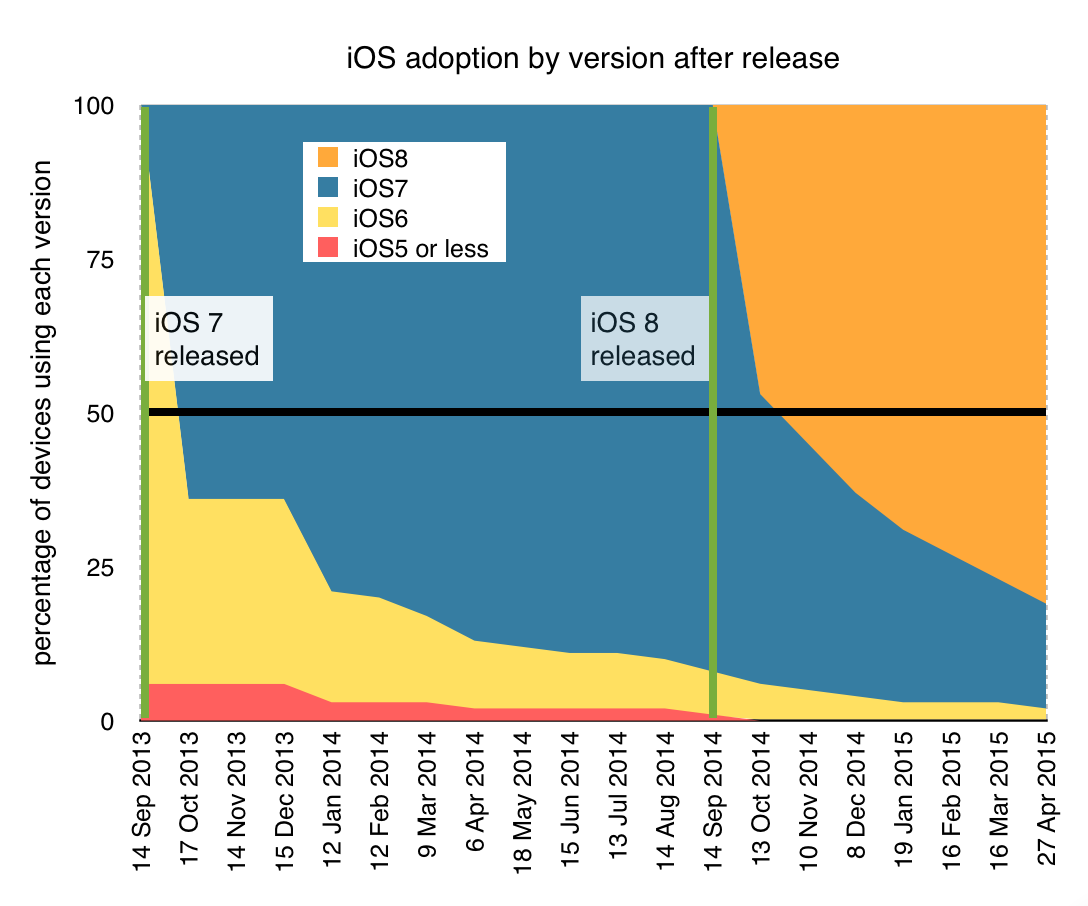
So when you get the announcement of “permissions for apps” (or indeed anything that is M-only), you have to ask: how long will it be before that is actually widespread? And by “widespread”, let’s define it as “on 50% of devices”. That 50% is useful because 50% of the billion of so Google Android devices in use is roughly comparable with the total number of Apple’s iOS devices in use. The thing is, the overwhelming number of active iOS devices get updated to the latest version within three months of the release of a new version; since iOS 6 in 2012 it’s taken just one month for the number running it to pass 50%. (At the time of writing, in May 2015, the current figure is 82% of devices on iOS 8, 16% on iOS 7, and 2% on something earlier. Revisiting it in March 2016 to add grammatical edits, the figure is 79% on iOS 9, which was released in September 2015.)

Apple iOS versions in use

Rapid adoption is a key element of Apple’s iOS due to its direct update mechanism.

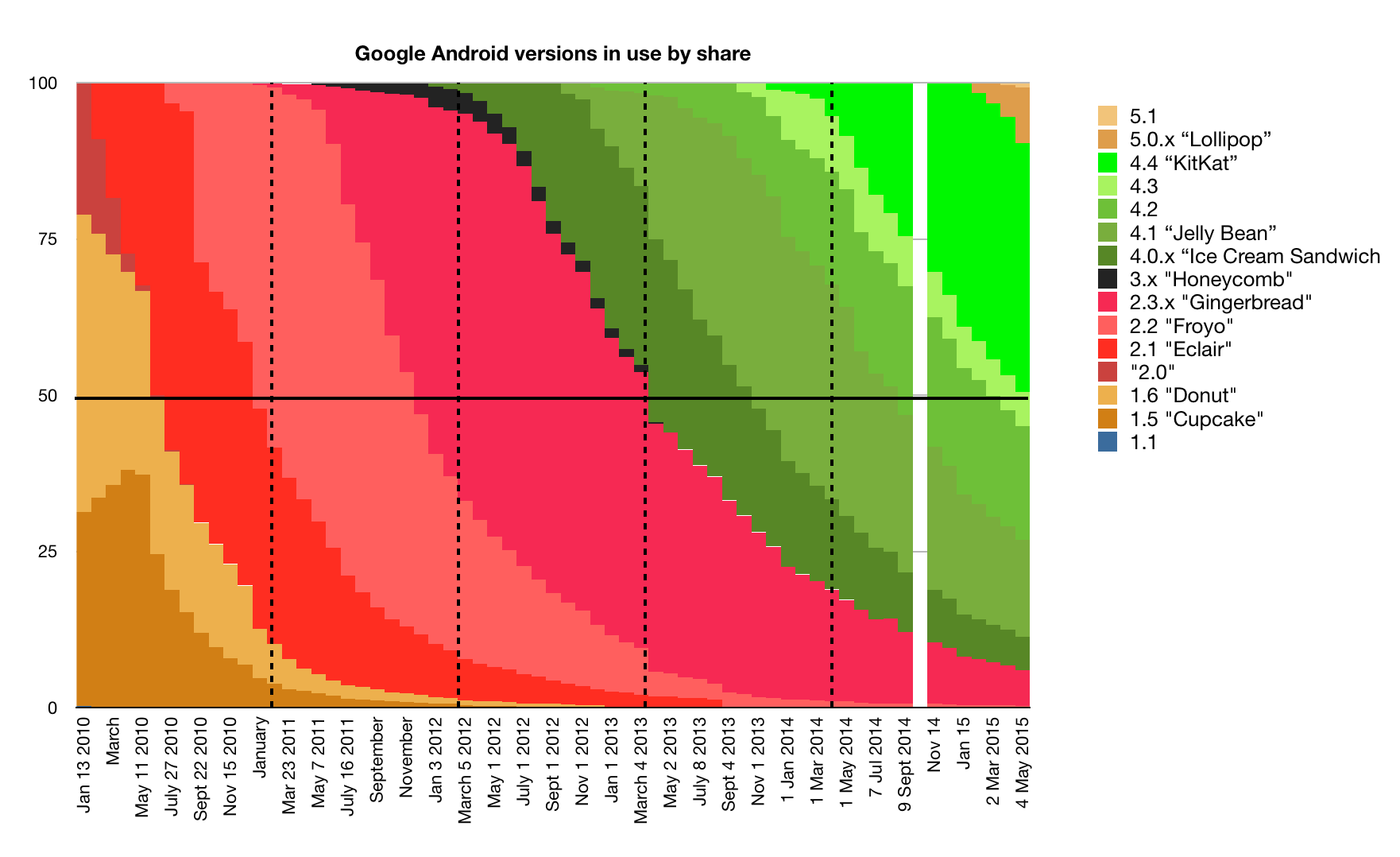
How do we figure this out? We let history be our guide. I’ve been collating the data about versions on the Android developer dashboard for a while, so we can look back to the past. In each case I’ve taken the beginning point as when a version first showed up on the dashboard, not when it was “released”.

Android versions in use

The release of a new version of Android doesn’t necessarily mean it reaches a large proportion of users quickly.

If we take it that “modern” Android starts with version 4 onwards – given that 2.3 (Gingerbread) was super-old, while 3.0 (Honeycomb) was tablet-only, we get this data:

Android 4.0: 16 months for it, or a later version, to be on 50% of devices according to the dashboard (January 2012 to April 2013).

Android 4.1: 13 months (October 2012 to November 2013).

Android 4.2: 22 months (December 2012 to September 2014 – the date of Lollipop’s release, officially).

Android 4.3: 18 months (October 2013 to March 2015)

Android 4.4: 19 months (forecast). Launched in December 2013, at the start of May 2015 it was at 49.5% for 4.4 and successors. It’s a safe bet that in June 2015 the total for Android 4.4 and successors will pass 50%. (Update: this was exactly right: the figure for May 2015 showed 49.5% on 4.4 or later; for June 2015, it was 51.6%, including 5.x; Android 4.4 itself peaked at 41.4% in April 2015.)

Android 5.x: 18 months (forecast). Presently, it’s 9.7% after 4 months, and its uptake pattern is more like 4.3 than 4.4. My forecast for its 50% point: July 2016.

On that basis, I’d say it’s a pretty safe bet that if Android M is released in December 2015 (which is likely) that it will take until June 2017 before it’s on 50% of Android devices according to Google’s measurements. Of course, that will vary regionally – there are still 6% of devices running 2.3 or earlier, which translates into about 60 million devices still in use. Some will get more rapid takeup, some will get less.

To put it into perspective (thanks Mark Blank-Settle on Twitter):
• presently, Apple’s offering iOS 8. It will show off iOS 9 in June.
• by the time Android M is released on devices later this, iOS 9 will already be on 60%+ of iOS devices
• by the time Android M – shown off in early 2015 – is on 50% of devices, Apple will have shown off iOS 10.

So if you’re depending on something such as, oh, the permissions model or Android Pay being introduced in Android M reaching the majority of your users any time soon, might be best to hold your breath. The revolution looks more like an evolution.

Start up: death to calendars!, S6 hits 10m (is that fast?), why Apple ditched the TV, and more


Yeah, you know it’s not really necessary. Photo by clagnut on Flickr.

A selection of 12 links for you. Don’t have a meeting about it. I’m charlesarthur on Twitter. Observations and links welcome.

The chokehold of calendars » Medium

Mike Monteiro:

The problem with calendars is that they are additive rather than subtractive. They approach your time as something to add to rather than subtract from. Adding a meeting is innocuous. You’re acting on a calendar. A calendar isn’t a person. It isn’t even a thing. It’s an abstraction. But subtracting an hour from the life of another human being isn’t to be taken lightly. It’s almost violent. It’s certainly invasive. Shared calendars are vessels you fill by taking things away from other people.

“I’m adding a meeting” should really be “I’m subtracting an hour from your life.”

We need a goal-oriented calendar, but first we need to understand why a goal-oriented calendar is necessary.


Here’s the problem with using YouTube as a babysitter for your kids » Huffington Post

Alexander Howard:

Six weeks after a coalition of consumer advocates accused Google of using ‘deceptive and unfair’ ads in its YouTube Kids app, the same group is raising new concerns about access to videos that are inappropriate for children.

“Our new claims are really about deceptive practices,” said Aaron Mackey, a graduate fellow at Georgetown University Law Center’s Institute for Public Representation, citing Section 5 of the Federal Trade Commission Act.

The coalition, which sent a letter to the Federal Trade Commission on Tuesday as a supplement to the previous complaint, includes the Campaign for a Commercial-Free Childhood and the Center for Digital Democracy.

The groups allege that the app, which is marketing to children ages 5 and under, allows kids to access inappropriate videos — including some that have nothing to do with children at all. Some of the unrelated videos are unremarkable, like videos of corporate filings. Others, though, will raise eyebrows with explicit language, jokes about drug use and pedophilia, and frank discussions of pornography, violence and suicide.

Wonder if the FTC will act on this.


LG unveils wallpaper OLED panel » The Korea Times

The 55-inch wallpaper OLED panel, presented as one of the company’s future displays at a media event, is only 0.97 mm thick, weighs 1.9 kg and can easily be stuck to a wall with a magnetic mat, or removed from it.

The new product is far slimmer compared with LG Display’s existing flagship 55-inch OLED panel that is 4.3 mm thick.

Come on, that is impressive. Imagine how you’d use that at home.


One big reason Jawbone took debt » Fortune

In fact, $300m of debt, rather than venture capital, as Bloomberg discovered. Dan Primack explains:

For BlackRock, this is obviously an effort at risk mitigation. For Jawbone and its existing shareholders, it’s a bit more complicated.

Yes, Jawbone clearly needs BlackRock’s money. But structuring this deal as debt instead of as equity also allows the San Francisco-based company to maintain a $3bn valuation it reportedly received last fall. That means it needn’t reprice existing employee stock options, and gives it upside flexibility when recruiting new employees. Plus, Jawbone doesn’t take the kind of ‘falling unicorn’ PR hit that could cause potential customers to purchase from more stable vendors.

My spidey sense feels that Jawbone is stuffed, though – especially when you compare it to the hugely profitable Fitbit.


Behind Apple’s move to shelve TV plans » WSJ

Daisuke Wakabayashi:

In an effort to distinguish itself, Apple investigated various display technologies.

In the mid-2000s, it created a prototype display that was transparent, like a pane of glass, when turned off but used lasers to display an image when turned on, according to a person familiar with the matter. That technology never made it past the research phase because it used an enormous amount of power and the image quality was poor. Apple patented the technology in 2010.

Apple had a small team working on the TV set in the years before it put the project on ice, said people familiar with the matter. It considered building TVs with screens offering four times the resolution of high-definition displays.

The price of such 4K displays—named because they have about 4,000 horizontal pixels in an image—have come down in the past few years, but those screens were still prohibitively expensive at the time.

Apple also looked at features that could expand the television’s function in the living room. Using cameras above the screen, Apple experimented with a video-calling feature—described as FaceTime for the television—that sensed who was talking and directed the camera to the speaker. In the end, the people familiar with the matter said the feature didn’t seem compelling enough to drive an entry into a new product area.

Truly sounds like a dud, to be honest, but you can imagine some companies putting it out because WE ALREADY SPENT A TON ON R+D HERE DAMMIT. (A great scoop by Wakabayashi, too.)


The Google-Twitter deal goes live, giving tweets prominent placement in Google’s results » Search Engine Land

Danny Sullivan:

Sometimes, tweets might not appear at all. We asked Google about why tweets might show, what controls exactly where they show, if they’re showing all tweets for a query in chronological order or filtering in some way such as to block obscenity or to surface more popular tweets. The company wouldn’t answer any of those questions.

Google’s blog post on the deal does say:

It’s a great way to get real-time info when something is happening. And it’s another way for organizations and people on Twitter to reach a global audience at the most relevant moments.

So presumably, you’re more likely to see tweets in Google when a hashtag, topic, person or organization appears to be trending or is newsworthy.

Twitter also says there’s no “direct” monetisation. (But of course it gets traffic.) Useful deal for both companies. I can only see them getting closer; their interests are aligning more and more.


Liveblog: What would you do if you woke up one morning and there was no Internet? » Liveblog

Dave Winer:

A question that reveals the problem is to wonder what would happen if you woke up one morning and found there was no electricity. Not much would happen in the world as it’s currently configured without electricity, even though there was a time when it worked fine without it.
I think the Internet is sufficiently integrated into our civilization at this point that if it were to be removed, it would be such an enormous shock to our economy that.. well, that’s why #2 [“Cry”] is also a correct answer. 😉

When you reflect on it, this is a great question to pose.


STRML: Projects and Work

Samuel Reed’s site needs to be visited. It builds itself while you watch. (Don’t worry, it’s HTML5.)


Global shipments of Galaxy S6 series top 10 million » Yonhap News

South Korea’s top tech giant Samsung Electronics Co. said Tuesday its global shipments of the latest flagship Galaxy S6 models surpassed 10m units in about one month after their release.
  
“The sales of the Galaxy S6 series have already surpassed 10 million,” a high-ranking Samsung official said. It marked the first time for the company to confirm the sales figure of the latest flagship.
 
 
The Galaxy S6 boasts Samsung’s first built-in wireless-charging batteries. The offbeat Galaxy S6 Edge also has been grabbing the market’s attention with the industry’s first screen that is curved at both the left and right edges. They started official sales on April 10.
  
The new models’ predecessors, the Galaxy S5 and the Galaxy S4, meanwhile, sold more than 10m units in less than a month. Samsung did not clarify when the 10m sales mark was reached for the Galaxy S6.

To be clear, the timings from “on sale” to 10m were:
S2: five months
S3: 42 days
S4: 27 days
S5: 25 days
The S6 doesn’t seem to have moved faster. But these are all sales to carriers (who may be feeling reluctant to take on stock) rather than sell-through. This story has barely begun.


Here’s how they built the beastly machines for Mad Max: Fury Road » The Credits

Bryan Abrams interviews Jacinta Leong, the art director for the film:

A specific challenge designing the vehicles was achieving aesthetic qualities as well as functionality. Our vehicles had to look amazing, but beyond that, they also had to drive safely at speed!

I’ll use a the GigaHorse for example. The Gigahorse was a stacked pair of Cadillac bodies, powered by a pair of Chevy 502 engines. So it obviously looked intimidating, but how did it actually drive? Engineer Antony Natoli and mechanic Mark McKinley designed a system so the two engines sat in a side by side arrangement and were connected to the transmission. I modelled the system in AutoCAD, and from this file, the plates and components were waterjet cut.

Like this:

Easy to forget how much work goes into films like this – which is part of why I find bittorrenting of films like this unbearably arrogant.


The three problems with Android Wear » Beyond Devices

Compare and contrast Jan Dawson’s view (from July 2014, pre-Apple Watch unveiling):

One of the selling points of Android Wear is its tight integration with Google Now, which has been available for quite some time on smartphones but is only now becoming available on smartwatches. The theory here is good: Google Now is supposed to surface information just when it’s likely to be useful to the user, but the watch allows it to be presented in a much more immediate way than were the user to have to dig through their phone to find it. But the problem is that Google Now, in my experience, still presents information much more on a “just in case” basis than a “just in time” basis, and the stuff that’s “just in time” is often not all that useful.


Bright Young Flacks: “Cameron’s cronies” now drive Silicon Valley’s most sinister propaganda machine » PandoDaily

Paul Carr in a lengthy dig into Rachel Whetstone’s move from Google to Uber:

Everyone in UK politics who I asked about Whetstone was agreed on one thing: She’s the person you bring in if you need to convince everyone that your company isn’t quite as nasty as it appears, and if your current spin doctors aren’t delivering the results you want. First that was Google, and now comes the biggest challenge of her career: Uber.

I have low hopes when it comes to the American business press covering Uber, but even I was surprised at how few journalists bothered to share even the most basic details of Whetstone’s background with their readers. That stuff sits barely below the surface and speaks volumes about the famously ultra-libertarian Travis Kalanick’s decision to replace Plouffe with her at Uber: an Obama liberal booted upstairs to make way for a multi-generation Cameron conservative/libertarian.

There’s more – much, much more.


Start up: Apple v Samsung redux, cornering the DRAM market, what millennials will do to tech


Speed: Facebook’s got it. Photo by _hadock_ on Flickr.

A selection of 8 links for you. Like butterflies, only linkier. I’m charlesarthur on Twitter. Observations and links welcome.

Tools don’t solve the web’s problems, they ARE the problem » QuirksBlog

Peter-Paul Koch:

The web definitely has a speed problem due to over-design and the junkyard of tools people feel they have to include on every single web page. However, I don’t agree that the web has an inherent slowness. The articles for the new Facebook feature will be sent over exactly the same connection as web pages. However, the web versions of the articles have an extra layer of cruft attached to them, and that’s what makes the web slow to load. The speed problem is not inherent to the web; it’s a consequence of what passes for modern web development. Remove the cruft and we can compete again.

The question is, how is Facebook speeding it up, given that it’s going to be shifting the same content? Data compression?


How aging millennials will affect technology consumption » WSJ

Christopher Mims on how the post-1980 “millennials” are moving into a new stage in life:

Data from comScore suggest most switching between Android and iPhone is in favor of Apple, and iPhones have a significantly higher average selling price than Android. So we can assume that, all other things being equal, as millennials age and their earning power increases, their taste in consumer electronics will become more expensive.

This is good news for Apple—and others targeting the higher end of the product spectrum. It’s also fantastic news for pretty much the entire consumer-electronics industry and countless online retailers such as Amazon: A giant demographic bulge is about to enter 20 years of peak earning power. This is a generation that likes its on-demand services, which means the coming decades will almost certainly see more Uber rides and same-day deliveries than ever.


Ad-blocking? No, mobile operators won’t be blocking adverts & charging Google to restore them » Disruptive Wireless

Dean Bubley:

In a nutshell, some European telcos feel they can “get away with” harassing Google and to a lesser degree Apple and Facebook, and get air-cover from their national regulators and the European Commission. While the current trials might have the convenient excuse of “protecting users’ dataplans”, the reality is much more duplicitous – they are jealous that Google has out-innovated and out-maneouvred them, in a similar fashion to their rhetoric about “OTTs”, when they have been asleep at the communications wheel for 20 years…

…[Among advertisers’ countermeasures to such a move] Encryption of content is the most obvious. It is already widespread in mobile, and is growing fast – in some networks, more than 50% is encrypted. There are multiple styles, ranging from SSL built-in to HTTPS traffic, SRTP for WebRTC traffic, through to using compression and proxy servers. Some of these are still theoretically “blockable” based on IP address, but the risk of false positives increases hugely. The inclusion of Google’s SPDY technology into the HTTP2 standard has pretty much ensured this is a one-way ratchet for web traffic in future.

As Bubley also points out, tons of mobile connections are actually made over Wi-Fi. And these points are only the beginning.


Asian component makers take slice of Apple’s iPhone spoils » FT.com

Simon Mundy and Kana Inagaki:

As well as the US-based global market leader Qualcomm, MediaTek must contend with China’s Spreadtrum, a chip designer whose processors are gaining a growing share of the Chinese market. Meanwhile shares in Ningbo-based Sunny Optical, which supplies camera modules to the likes of Xiaomi and Lenovo, have doubled in the past year.

“It’s clear the Chinese brands prefer to have Chinese suppliers,” says Nicolas Baratte, head of technology research for CLSA. “There is a different type of understanding between Chinese companies. The Chinese supply chain is amazingly flexible in terms of tolerance for specification change and redesign, and flexible payment terms.”

Yet with the Chinese market slowing, he adds, some Chinese suppliers — notably phone assembly groups such as Wingtech and Longcheer — are increasingly pinning their expansion hopes on work for faster-growing brands from other countries, especially India.
A reliance on foreign customers has been thrust upon Japan’s handset component suppliers by that country’s dramatic decline in the mobile phone market — but they have responded strongly according to analysts who say Japanese groups account for a third of the parts found in the iPhone, while achieving strong sales of high-tech components to Chinese producers.


EZTV shuts down after hostile takeover » TorrentFreak

A “hostile takeover” by scammers, who got access to the domain details and changed it to their own:

Sladinki007 says that NovaKing must have been devastated by what happened. A life’s work was completely ruined in a few days and access to personal domain names was gone as well.

While EZTV could technically start over using a new name the group’s founder decided to throw in the towel. Too much had already been lost. The group had always been a “fun” non-profit project, and the recent troubles took the fun away.

The scammers, meanwhile, continue to operate both the .it and .ch domain names and are now distributing their own torrents (sourced elsewhere) with the hijacked EZTV brand. They pretend to be the real deal, sending out misleading and false status updates, but they’re not.

Having control over NovaKing’s email address the scammers even reached out to other torrent site operators, claiming that EZTV was back in business. However, most knew better not to fall for it and have retired official EZTV uploader accounts.

So someone who enabled widespread torrenting of TV content (which – astonishingly – doesn’t actually make itself for free) gets scammed and gives up? A “life’s work”? Strike up the world’s smallest violin.


Tipping point ahead: Samsung’s DRAM market share at 40% » BusinessKorea

Cho Jin-young:

Samsung Electronics is riding high with its share of the global DRAM market at 40%.

According to a report on performance in the first quarter of this year published by Samsung on May 17, the company accounted for 43.1% of the DRAM market in Q1 2015, up 2.2% from the number for the entire year of 2014. The figure in Q1 2015 is a nearly 6% increase from the total number for 2013. That data that was mentioned was compiled by market research firm IDC.

Based on market research firm DisplaySearch’s data, Samsung’s share of the global display panel market was 21.8% in Q1 2015, up about 1% from the previous year. The tech giant explained that it is responding to market demand with a full line-up, from ultra large premium displays to those for entry-level UHD and curved TVs.

It made a loss on the TVs, but grew its market share. Could it corner the whole DRAM market? Weird thought.


Apple readies first significant Apple Watch updates, ’TVKit’ SDK for Apple TV » 9to5Mac

Mark Gurman:

Currently in development, the features seek to enhance Apple Watch security, connectivity with other Apple devices, health and fitness features, Wi-Fi capabilities, and integration with third-party applications. Additionally, Apple is also priming major updates for the Apple TV in both the hardware and software departments, including Apple Watch integration. Below, we detail what users can expect from Apple Watches and Apple TVs in the future…

Includes a “Find My Watch” which sounds more like Bluetooth leashing – if the Watch gets some distance away from the phone. There are also promises about health, and others, though they’re also cautioned as “possibly some way off”.


Appeals court finds third trial necessary in first Apple-Samsung case: $380m in damages vacated » FOSS Patents

Florian Müller:

today’s appellate opinion reverses the trade dress-related part of the district court ruling and, on that basis, remands the case for a new trial. A new jury will have to determine damages for all products the first jury found to have infringed an Apple trade dress: the Fascinate, Galaxy S (i9000), Galaxy S 4G, Galaxy S II Showcase (i500), Mesmerize, and Vibrant phones. The total amount of damages (these were only at issue in the 2012 retrial, not the 2013) retrial was over $380m.

The original jury verdict only specified damages by product, but not by product and intellectual property right. That’s why the total damages amount for those products must be redetermined. There’s no way to simply subtract the part that related to design patents.

The Federal Circuit agreed with Samsung that it would have been entitled to judgment as a matter of law (JMOL) on the functionality of the trade dresses on which Apple prevailed. In all other regards, such as invalidity of design and software patents, the Federal Circuit sided with Apple.

Oh good grief. Another trial. Just the other day I was thinking of how Google’s hurried purchase of Motorola for the ludicrous garbillions of dollars belonged to a different age when people thought patents would make a difference in the smartphone struggle. This is nostalgia reflux.

Note though that the appeals court didn’t reverse the jury verdict – as some wilder misunderstanders of legal process had forecast. Judges don’t reverse juries in civil trials without exceptional cause.


Start up: Starbucks gets pass-agg on hacking, what Uber really pays, adblocking for sociopaths, and more


Check that your backup doesn’t look like this. Photo by Mrs Gemstone on Flickr.

A selection of 8 links for you. Use them wisely. I’m charlesarthur on Twitter. Observations and links welcome.

Adblockers are immoral » The Next Web

Martin Bryant is editor-in-chief of the site:

It comes up a lot in conversation, especially online. “Oh yes, I can’t imagine viewing the Web without the ads blocked. I accidentally switched my adblocker off yesterday and it was HORRIBLE.”

No, it really wasn’t – it was perfectly fine, you’re just being a snob. The Web works well for me with the ads displayed. It’s a point of principle – helping publishers earn money is something I want to do and feel we all should do if we consume their work. For those few, accidental minutes your adblocker was off, you were helping the publishers of the sites you visit earn income for their content that you access for free.

I hate to go all high-and-mighty-Mr-Morals, but the proud ad-blocking folk out there are happily starving sites (that they rely on for information and entertainment) of vital income. Yes, publishers (including TNW) are increasingly opting to diversify their income with ‘native ads,’ events, deals, education offerings and the like, but display ads are still an important bread-and-butter income stream. Taking delight in denying publishers that revenue shows either sociopathic tendencies or ignorance of economic realities.

There really isn’t a middle ground. If you understand the economics, you’re being selfish. If you don’t understand the economics, you’re being wilfully ignorant these days. And the alternatives (native ads, paid placement?) will surely be worse. But they may soon be inevitable.


TeslaCrypt: Following the money trail and learning the human costs of ransomware « FireEye Threat Research

Nart Villeneuve:

We tracked the victims’ payments to the cybercriminals—available because the group used bitcoin—and determined that between February and April 2015, the perpetrators extorted $76,522 from 163 victims. This amount may seem trivial compared to millions made annually on other cyber crimes, or the estimated $3m the perpetrators of CryptoLocker were able to make during nine months in 2013-14.  However, even this modest haul demonstrates ransomware’s ability to generate profits and its devastating impact on victims.

The online correspondence between the victims and the cybercriminals provides context regarding the effect on peoples’ lives. The victims were spread across the globe from students in Iran and Spain to regular folks in the United States, Brazil, Argentina, Germany, Croatia and Mongolia. Some feared being expelled from school or fired by their employers if they are unable to retrieve their files. Fathers and mothers were devastated by the loss of family photos. The TeslaCrypt ransomware also affected nonprofits, including an organization dedicated to curing blood cancer, as well as small businesses. Many of the victims were simply unable to afford to pay the ransom and gave up.

Some of the conversations are heartbreaking. Weirdly, the extortionists sometimes cut their price for personal circumstances.


Can Google outsell Amazon and eBay? » WSJ

Google will launch buy buttons on its search-result pages in coming weeks, a controversial step by the company toward becoming an online marketplace rivaling those run by Amazon.com and eBay.

The search giant will start showing the buttons when people search for products on mobile devices, according to people familiar with the launch.

The buttons will accompany sponsored—or paid—search results, often displayed under a “Shop on Google” heading at the top of the page. Buttons won’t appear with the nonsponsored results that are driven by Google’s basic search algorithm…

…Some retailers said they worry the move will turn Google from a valuable source of traffic into a marketplace where purchases happen on Google’s own websites. The retailers, who wouldn’t voice their concerns publicly, fear such a move will turn them into back-end order takers, weakening their relationships with shoppers.

Mobile-only (to begin with). Wonder if this will be tried in Europe, where the concern over this is more substantial.


I was an undercover Uber driver » Philadelphia City Paper

Emily Guendelsberger, who was that undercover driver:

it’s no wonder the taxi industry is having so much trouble competing with Uber — taxi companies have to pay to maintain, acquire and insure all the cars in a taxi fleet. Uber’s drivers shoulder that burden themselves, with expenses eating around 20% of total gross fares. And Uber’s gross fares, according to a Business Insider tipster, are expected to hit $10 billion in 2015.

And it makes complete sense for Uber to continue cutting fares to as cheap as possible while flooding the market with more and more drivers and encouraging people to use Uber for shorter and shorter distances — all of which correlate with reduced take-home pay for each individual driver…

…after 100 rides, I felt like I had enough [data] to work with. Over that duration, during which I maintained a 4.83 [star] adjusted rating, high enough to qualify me for Uber’s VIP program, Uber would say I “earned” $17 an hour in gross fares. But subtract the 28% that went to Uber and the 19% that went to expenses, and I actually made $9.34 an hour (plus a grand total of $16 in tips, $10 of which were for meeting up with a guy who left his Porsche keys in my backseat).

Driving for UberX isn’t the worst-paying job I’ve ever had. I made less scooping ice cream as a 15-year-old, if you don’t adjust for inflation. If I worked 10 hours a day, six days a week with one week off, I’d net almost $30,000 a year before taxes.

But if I wanted to net that $90,000 a year figure that so many passengers asked about, I would only have to work, let’s see …

27 hours a day, 365 days a year.


Who’s responsible when a driverless car crashes? Tesla’s got an idea » WSJ

Mike Ramsey:

The Palo Alto, Calif., electric-car maker soon will begin activating semiautonomous features, including the capability to pass other cars without driver intervention, in its Model S sedans. A driver can trigger the passing function by hitting the turn signal, according to people familiar with the technology. That action not only tells the car it can pass, but also means the driver has given thought to whether the maneuver is safe.

While it might seem a minor detail, having drivers activate the turn signal could help auto makers like Tesla avoid a regulatory pile up.


Starbucks blaming passwords, victims doesn’t fix the problem; burning questions about attack remain » Bob Sullivan

Sullivan first pointed to the hacking of Starbucks app passwords, and now has had to tear down the spin put up around it by the company:

these positions are meant to create the impression that there’s nothing wrong with the way Starbucks is processing payments, and in fact, some journalists declared that to be the case. Fortune magazine wrote “Starbucks says its popular mobile app has not been hacked, contradicting multiple media reports that intruders have hijacked the accounts of hundreds of the coffee chain’s customers…” Starbucks actually never denied that intruders had hijacked consumers accounts, and anyone can find victims complaining about just that with a few moment’s work, but some journalists seemed eager to clear Starbucks of any culpability in the issue.

That’s unfortunate, because my email this week makes it clear that plenty of Starbucks customers are pretty angry at the way this issue has been handled, and many of them don’t appreciate being blamed for having their money stolen after they placed their trust in Starbucks.


Green lights for our self-driving vehicle prototypes » Official Google Blog

Chris Urmson, director of the self-driving car project:

We’ve been running the vehicles through rigorous testing at our test facilities, and ensuring our software and sensors work as they’re supposed to on this new vehicle. The new prototypes will drive with the same software that our existing fleet of self-driving Lexus RX450h SUVs uses. That fleet has logged nearly a million autonomous miles on the roads since we started the project, and recently has been self-driving about 10,000 miles a week. So the new prototypes already have lots of experience to draw on—in fact, it’s the equivalent of about 75 years of typical American adult driving experience.

Each prototype’s speed is capped at a neighborhood-friendly 25mph, and during this next phase of our project we’ll have safety drivers aboard with a removable steering wheel, accelerator pedal, and brake pedal that allow them to take over driving if needed. We’re looking forward to learning how the community perceives and interacts with the vehicles, and to uncovering challenges that are unique to a fully self-driving vehicle—e.g., where it should stop if it can’t stop at its exact destination due to construction or congestion.


Samsung’s Tizen Store is available in 182 countries and with 25 apps at launch » Malaysian Digest

At launch, the Tizen Store has 25 apps spread across four categories (games, apps to plan new resolutions, photography and EA games). Of the 25 apps, 14 of them are gaming while photography takes second spot with 6 apps.

There is currently only one device that supports the Tizen Store which is the Samsung Z1. Announced last June, the Samsung Z1 is now only sold in India and Bangladesh. Samsung initially wanted to launch the Z1 and other Tizen-powered smartphones in more markets, but things did not turn out as planned.

“Things did not turn out as planned” is putting it mildly.


Start up: Apple Watch’s big security hole, iPhone rumours!, fight for your right to be forgotten, and more


Forgetful sign. Photo by mikecogh on Flickr.

A selection of 8 links for you. Go on, click them. I’m charlesarthur on Twitter. Observations and links welcome.

Watch OS 1.0 lacks the necessary security features to dissuade thieves » iDownloadblog

Jeff Benjamin:

The Apple Watch contains security measures to prevent thieves from accessing your data, but it doesn’t include the necessary features to dissuade thieves from trying to steal your device to begin with.

The problem stems from the lack of an Activation Lock-like feature on Watch OS 1.0.

Unlike the iPhone, if someone steals your Apple Watch, they can easily reset the device (bypass the passcode), and pair it with a new iPhone logged in to a different iCloud account. In other words, it’s totally feasible to steal an Apple Watch and set it up on a different device as if you just purchased it from an Apple Store.

What a colossal security oversight. Bad, bad, bad.


Maybe Samsung is starting to think wearables through more carefully » ReadWrite

Brian Rubin:

Samsung’s new software development kit for its homegrown mobile OS Tizen offers a few hints about its upcoming Gear A smartwatch (codenamed Orbis)—namely, that it will probably sport a round display and a rotating bezel for taking a spin through the interface.

More important, though, the SDK also suggests that Samsung is taking a more measured approach to its new wearable—one that bodes well for its future efforts in the area.

Rotating bezel sounds a clever idea… until you try to think what you’d control with it. OK, it was a great idea on the iPod for scrolling through a long list. But on a watchface, you’d be obscuring part of the list at least once every revolution.


Introducing Windows 10 Editions » Microsoft

There’s Home, Pro, Enterprise, Education, and…

Windows 10 Mobile is designed to deliver the best user experience on smaller, mobile, touch-centric devices like smartphones and small tablets. It boasts the same, new universal Windows apps that are included in Windows 10 Home, as well as the new touch-optimized version of Office. Windows 10 Mobile offers great productivity, security and management capabilities for customers who use their personal devices at work. In addition, Windows 10 Mobile will enable some new devices to take advantage of Continuum for phone, so people can use their phone like a PC when connected to a larger screen.

Windows 10, a break from the past of confusing SKUs. Also: Windows Mobile. We have always been at war with Eurasia. (There’s a Mobile Enterprise version too.)


Next A9-based iPhone predicted to have 12MP camera, 2GB RAM, rose gold and more, mass production in August » Mac Rumors

As it’s never too early for “next iPhone” rumours, Joe Rossignol channels KGI Securities’ Ming-Chi Kuo (who has done OK on this stuff before):

The main selling point of the so-called “iPhone 6s” and “iPhone 6s Plus” will be Force Touch, the pressure-sensitive display technology built into Apple Watch and new MacBook trackpads. Other predicted features for Apple’s next iPhone, many of which have already been rumored, include an A9 processor with 2GB of RAM, improved 12-megapixel camera, a new Rose Gold colour option, possible sapphire cover lenses and more.

2GM of RAM is overdue. Unsure about the Force Touch thing: would that make the phone thicker? Would it work all over the screen? It might get rid of a moving part that’s probably prone to break (the home button) which could still have a sapphire lens for the fingerprint unlock. Might.

The most surprising forecast is that there won’t be a refashioned 4in model. Will the 5S remain on sale, but ageing? Or are the larger screens the only future?


Fitbit IPO rides on persuading you to dust off your wristband » Bloomberg Business

Caroline Chen:

Some Fitbit users have found they can use smartphone apps to count steps instead of having to wear a wristband. For others, the novelty just wore out. Catherine Toth Fox bought her Fitbit Charge, which sells for $129.95, in January and was done with it after a month.
“I stopped using it when I figured out how much activity it took me to hit 10,000 steps,” the Honolulu freelance writer, 40, said in an e-mail. “I realized very quickly that I was already reaching that goal just by my normal daily activities, so there was no need to have a device to tell me that anymore.” She gave the Fitbit to her mother, who uses it daily. Her husband, on the other hand, has never taken his out of the box.
Keeping users engaged will matter even more as Fitbit increases its offerings to employers. The device maker’s corporate wellness program lets companies buy Fitbits for their workers and monitor their health via a dashboard. For companies that are self-insured, encouraging employees to exercise more can help reduce the firm’s health bill.

That “I figured out how much was enough” point is an important one: it sets a ceiling even on active users.


How Google’s top minds decide what to forget » WSJ

Lisa Fleisher and Sam Schechner:

Google has only been removing results from European domains such as Google.fr or Google.co.uk—but not Google.com, even when accessed in Europe. That can make it simple to find results that have been removed, leading regulators to issue an opinion saying Google’s position didn’t go far enough.

Regulators say their position holds and that Google should comply or face legally binding orders to do so.

“Their position will have to change,” said Isabelle Falque-Pierrotin, head of the CNIL, France’s data-protection regulator, as well as chairwoman of a pan-European advisory body that includes all EU privacy regulators.

Another confrontation looms. (Clever headline, too.)


Google wins privacy case, allowed not to forget in Finland » Ars Technica UK

The (original) headline here is misleading. Let’s see why in this Glyn Moody article:

As the news site yle.fi reports, the case concerned a Finnish man’s business “blunders,” which he claimed were harming him because they continued to turn up in Google’s search results. After Google refused a request to remove them, the man appealed to Finland’s Data Protection Ombudsman. The latter pointed out that “Finland’s business register lists the man as still being involved in business operations, including debt collection.” That presumably meant the links to stories about his past would still be relevant to people who were seeking information about the person in question now. As such, there was no reason for Google to be forced to delete those hits from its search results page.

Ah, so this is an appeal. Which means the “RTBF” (or RTBdelinked) does apply in Finland. As the article continues by explaining:

Finland’s Data Protection Ombudsman is currently dealing with around 30 other complaints about Google’s refusal to delete results. According to the article, “In Finland there have been close to 3,700 requests [to Google] to remove information from roughly 12,000 search results. Google has conformed to about 45%.” This is close to its average compliance rate of 40% across the EU, where Google has received 250,000 requests to remove information from more than 900,000 search engine results.

So in fact the RTBF is enacted *more* strongly in Finland than elsewhere in Europe, on average. After I pointed this out to Moody, he tweaked the headline to “Google wins privacy case, allowed this time not to forget in Finland”.

People get worked up over the RTBF, even though it rests on the same principle as that preventing US companies from grabbing data from Europeans and abusing it. They like the latter, but not the former; except they’re indivisible because of their origin.


Apple Watch vs Android Wear: Why most smartwatches still suck for women » iMore

Serenity Caldwell:

When I first heard about Android Wear last year, I thought the folks behind the OS were doing a lot of things right. And I still do: the approach to notifications is smart, custom watch faces are neat, and Google Now — while creepy — works exceptionally well at providing smart information for your day.

There’s only one problem: There’s not a single Android Wear device designed to fit a small-wristed person.

If wearable technology is the next big thing for our tech-connected society, why is Apple the only company paying attention to the smaller-wristed set? Lady or dude, there are quite a few people on this earth whose arms don’t resemble the trunk of a Sequoia tree — many of whom would be excited to use a smartwatch. I was thrilled when Apple announced multiple sizes for the Apple Watch, and moreover that both were reasonably-sized for the wrist; sadly, I have yet to find an Android Wear device that will fit on my wrist without making it look like the technology equivalent of an iron shackle.