BlackBerry might have no BB7 users left by February 2016 – and that’s a big, bad problem


John Chen, BlackBerry’s chief executive, is a smart guy – but he’s got really big problems ahead. Photo by jdlasica on Flickr.

They really will let any old nonsense onto Seeking Alpha. On Wednesday there was a piece suggesting that “BlackBerry had a decent quarter; turnaround an extremely high probability“.

Yeah, and pigs will fly.

BlackBerry has a real problem, and it only becomes evident when you dig into the numbers. It’s this: BB7 users, who make up about 22m of its 33m subscribers, are deserting the platform at the rate of about 5m per quarter, while it’s only adding about 1m BB10 subscribers in the same period.

If this pattern continues, then by the end of this fiscal year – that is, February 2016 – there will be next to zero BB7 users, and only slightly more than 15m BB10 users. That will represent probably the bottoming out in subscribers, but will also mean that two key sources of revenue for BlackBerry – service revenues and handset sales – will effectively stop.

And in the just-gone quarter, those two categories made up 78% of its revenues – and the profit on the services, which only applies to BB7 users, amounted to about $211m.

Here’s the problem: once the BB7 users are gone, so are pretty much all the service revenues. And look how soon that could happen:
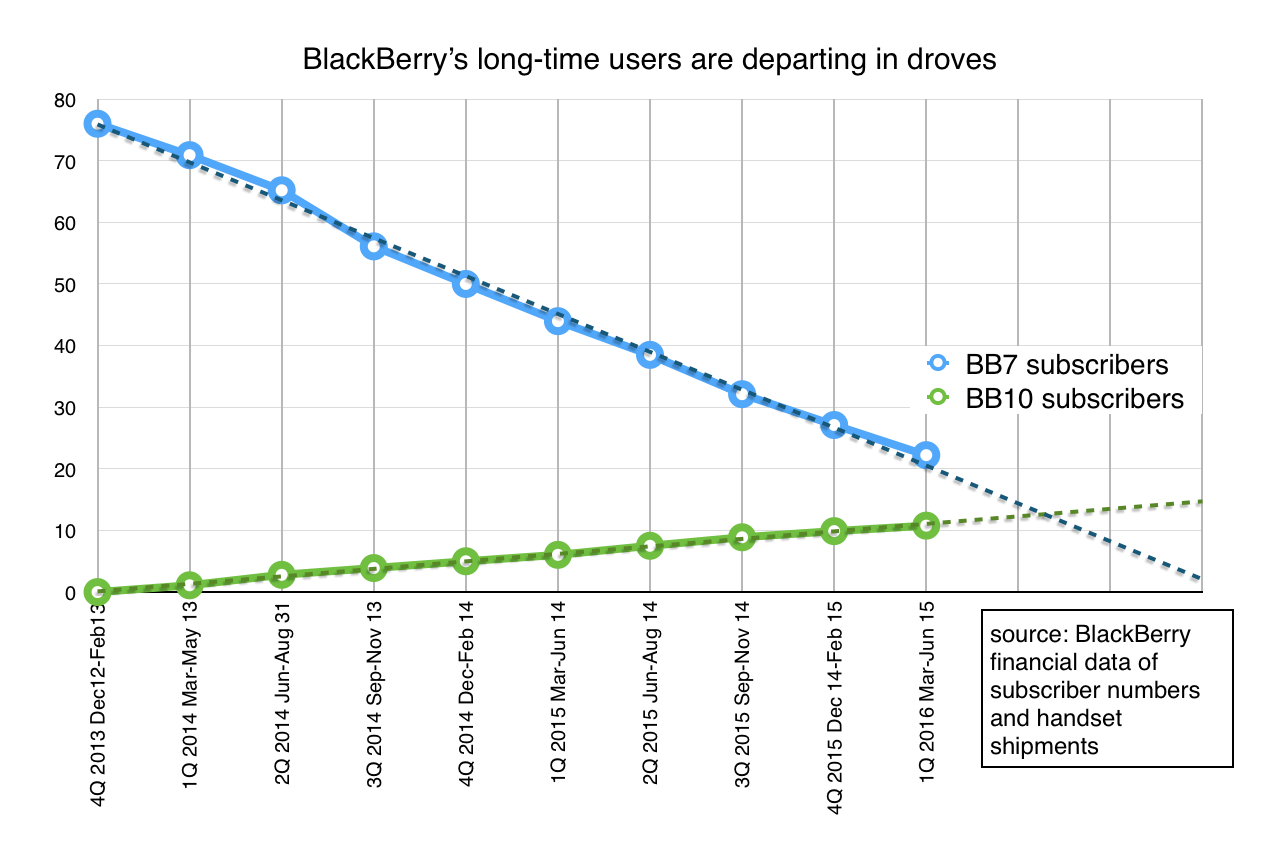
BlackBerry 7 users leaving; BB10 joining slower

BB7 users are departing the platform five times faster than they’re being replaced by BB10 users

With 15m handsets in use, and BB users replacing theirs roughly every three years (as I found previously), that means 5m handset sales per year, which is about where the company is now – and it currently makes horrendous operating losses on handsets. There just isn’t the scale.

Without the service revenue, and because the handsets are horrible money pits, BlackBerry is left with just its software revenues for profit. And oh dear, those aren’t pretty.

Let’s get stuck in

Here are some extra facts dug out of BlackBerry’s Q1 2016 10-Q, the quarterly detailed report:

• 33m subscribers (I estimated 34m; so it has fallen 4m from the previous quarter, an acceleration in decline)

• 81% of the 1.1m phones sold were BB10 (so 0.89m BB10, 0.2m BB7). Recall that BB7 was effectively dead with the launch of BB10 – back in January of 2013. Yet they’re still getting cleared out of the system.

• a total of 1.3m phones were sold through to end customers. That means that over the past eight quarters BlackBerry has “sold” (recognised revenue on) 15m phones, and sell-through has been 23.3m – that’s 55% more. Clearly, there was a gigantic amount of channel stuffing going on previously. And of those 15m phones (or 23.3m, take your pick) only 9.7m were BB10 models.

We know how many subscribers there were when BB10 was introduced, and we know how many there are now; we also know how many BB10 handsets have shipped. That means we know the split between BB7 subscribers and BB10 subscribers.
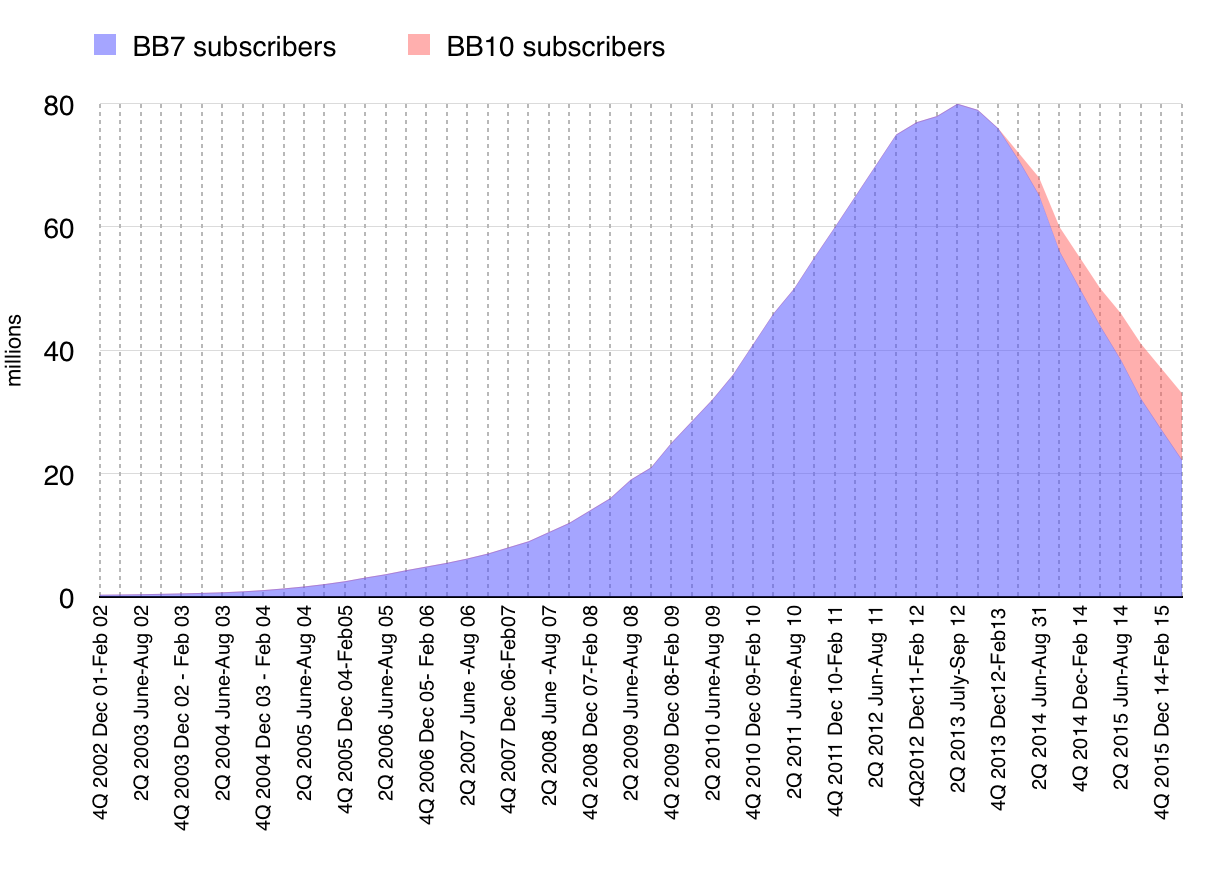
Rise and fall of BlackBerry subscribers

On the basis that every BB10 handset goes to a new user… it’s still not great.

In short, there are still twice as many BB7 users (22m or so) as BB10 users (10.8m). In the just-gone quarter, a total of 4.9m BB7 users left, and 0.89m “joined” BB10. Some of those “joining” will have been ex-BB7 users, of course, but the direction of travel is clear; if that 5:1 pattern continues, then when the last BB7 user exits, BB10 will only have 15.2m users.

And the graph above shows that if it’s a straight line, that will be February next year.

• that much-vaunted jump in software revenues (from $54m to $137m year-on-year, and from $67m to $137m sequentially – a rise of $70m) was actually due to a mysterious patent deal, one with Cisco and another with an unnamed company.

Some thought the rise heralded BlackBerry rising from the ashes as a profitable software business; the stock popped on the early results. But as was clarified in the earnings call and the documents, compared to the year before, software revenues rose by over 20% (Chen suggested “22-23-24%”); as the documents then make clear, software revenues alone actually fell compared to the previous sequential quarter.

As the year-ago software revenue was $54m, and the previous quarter software revenue was $67m, and 67/54 = 1.24, it’s evident that software revenues grew less than 24%. This $67m is the underlying quarterly software revenue figure you can rely on; multiply that by four, and you get pure software revenues for the fiscal year of about $270m.

That’s a long way short of the $500m (which excludes any BBM revenues, which I don’t see happening in a hurry) that Chen is aiming for this year. Of course, if he can sell off – I mean license – lots of patents, then he could be on course for that target; the extra $70m from licensing helps. Multiply that by four (one big deal per quarter!) and you get $280m, so if the licensing people can keep hitting home runs, and everything goes fine, he might hit that $500m target, just.

But there’s no indication that the licensing revenues will keep coming; this might have been a $70m one-off. Or (as is also hinted) the company might just sell some patents, and count those in its “licensing” revenue.

But even that is a downscaling from expectations of a $600m annual software revenue, and the analysts all zeroed in on the sleight of hand in the earnings call. The stock selloff that has followed is clearly their reaction to what weren’t such good numbers after all.

• the sequential rise in US revenues (from $147m to $216m, or $69m) was mostly caused by the licensing deal. (This actually emerged in the earnings call.) According to BlackBerry’s execs, US revenues excepting the licence did grow, slightly; which means we can peg one licensing deal at just under $69m. That leaves the other licensing deal at somewhere around $1m – because the total extra from licensing was about $70m.

Future imperfect

Soooo… you’ve got a handset platform (BB7) that people are abandoning at a remarkable rate, while they aren’t joining the new platform with any great alacrity. If things continue as now, by February 2016 there will be 15m BlackBerry users, and zero service revenue, and lossmaking handset revenue.

The saving grace is that the software is very profitable – about 84% gross margin. (This is in the annual 10K report published in March.)

So how does this look? If we have software revenues of about $125m, that generates $105m of gross profit (ie before expenses like R+D and keeping the lights on).

Now set against that the costs of the hardware business: it made a gross profit (by my calculations using the software profitability) of $13m on 1.1m sales. So everything’s rosy, right?

Unfortunately not – as Chen admitted, getting handsets to operating profitability (where you account for sales/general/administration and R+D) is much harder. By my calculation, allocating those costs in line with hardware revenues, the handset side hasn’t been operationally profitable since November 2011. I don’t think the handsets will ever come back to operating profit. Still, gross profit, eh?

Let’s see how the sums go. For the latest quarter, R+D was $139m, and SGA was $174m.

If those costs stay the same, your mostly-software-and-a-few-handsets company has gross profit of $118m, and immediate costs of $313m – that’s a loss of $195m, before any other costs arising (such as amortisation or inventory writedown or debenture revaluation). And make no mistake, there will be other costs arising.

Conclusion

If BlackBerry holds on to its hardware business, it’s going to run into the sand. It’s also losing its old BB7 userbase extremely fast. John Chen doesn’t have much time to start generating revenue from licences and software. I’d expect to see some sort of crisis point in a couple of quarters. But then, BlackBerry is always in crisis. And nobody much seems to care, either.


Start up: Apple’s Sonos rival?, Nokia’s smartwatch, three-ton Twitter, Netscape in the NHS, and more


Sunday Times sourcing? Photo by DrJohn2005 on Flickr

A selection of 8 links for you. Why not? I’m charlesarthur on Twitter. Observations and links welcome.

Apple Music’s missing link: how Beats Electronics fumbled its Sonos killer (EXCLUSIVE) » Variety

Janko Roettgers:

Beats was looking to build a premium product that would mimic and compete with wireless speakers produced by Sonos. Like Sonos, Beats wanted to give consumers the option to place speakers in multiple rooms of their house, and then have them all play the same music synchronously. And like Sonos, Beats was looking to introduce a bigger, more powerful speaker for the living room first, and then follow up with a smaller, more affordable product for the kitchen and bedroom.

However, Beats wasn’t just looking to copy Sonos. The company was also working on combining Bluetooth with Wifi and NFC to allow for seamless handovers, effectively making it possible to launch music playback as soon as you’d enter the room, said a source familiar with technical details of the project. And thanks to its premium brand, Beats wasn’t looking to undercut Sonos — quite the contrary: Word has it the company was looking to sell its bigger Wifi speaker for as much as $750.

1) wouldn’t have been a Sonos killer
2) this is utterly random, but my next-door neighbour works in the (legal) pharma industry, and four months ago told me the story of going to a party in San Diego where “people from Apple” were talking about exactly this device. So I’m inclined to believe it, weirdly. Also, my neighbour’s reaction: “I said, so you’ve reinvented the boombox?” Probably why it was canned.


Apple’s WWDC keynote: issues with structure, approach, direction » Mobile Forward

Hristo Daniel Ushev on the messy Apple WWDC keynote:

Ultimately, the issues above are symptoms of weak (or hand-cuffed) direction. Not just in the form of what to do (e.g., don’t have Eddy Cue focus on the app) but also in terms of what not to do – i.e., editing. Editing in this context: shortening the list of presenters, directing them to use fewer slides (at one point, they flashed by like pages in a flip book), and saying no to distracting uses of humor and movement. When viewed through this lens, I think this keynote lacked a director. Or at least one that could effectively influence the senior executives and the choices they made. (Believe me, I’m not saying any of this is easy.)

Will all this impact the products’ success? Not directly. Indirectly, however, key influencers of consumers (developers, fans, and journalists) may get a fuzzier picture of Apple’s intent or advantage.

The music segment was terrible. The rest, fine.


Sunday Times Snowden story is journalism at its worst » The Intercept

Glenn Greenwald on the Sunday Times’s story – its front-page lead (aka “splash”) claiming that UK intelligence agencies “had to move” agents and that Russia and China “had cracked” the files (here’s text of the print version; try reading it first):

how could these hidden British officials possibly know that China and Russia learned things from the Snowden files as opposed to all the other hacking and spying those countries do? Moreover, as pointed out last night by my colleague Ryan Gallagher – who has worked for well over a year with the full Snowden archive – “I’ve reviewed the Snowden documents and I’ve never seen anything in there naming active MI6 agents.” He also said: “I’ve seen nothing in the region of 1m documents in the Snowden archive, so I don’t know where that number has come from.”

Greenwald is furious, and rightly so. The Sunday Times story is clearly hung on a single quote from a UK intelligence agency source, but one which doesn’t support the story’s claims. The Snowden archive is vast, but putting a number on it is surprisingly difficult, because it has interrelated files – there’s an almost wiki-like quality to some parts.

Given that the UK (and US) intelligence agencies don’t claim to know what’s in the Snowden files, they can’t know what the Russians or Chinese know from it – if for the sake of credulity we believe that the Russians and Chinese have cracked the encryption, which I seriously doubt.

When I used to work Sunday shifts as a news reporter at The Independent, I often had to “follow up” stories that appeared in the Sunday Times. The problem was, as soon as you began trying to establish the facts they claimed, the stories fell apart – the claims didn’t match reality. This is another example, although that hasn’t stopped the BBC repeating it (though an analysis by Gordon Corera in the middle of this straight-up followup rather backs away from the Sunday Times claims).


Microsoft Moonraker was Nokia’s smartwatch before it was killed » The Verge

Tom Warren:

Nokia’s Moonraker smartwatch never made it to market primarily because Microsoft was anticipating its wearable Band. While the Moonraker had a number of sensors to allow you to lift your arm to read texts or drop it to turn off the display, Microsoft opted for the Band as it had more functionality. Nokia took the familiar “Metro” interface from Windows Phone and paired it with simple email, phone, and messaging apps on its smartwatch. There was even a camera remote feature to take pictures on a smartphone from the watch. Facebook and MixRadio integration was also built-in, alongside customizable watch faces and different colored straps.

It’s unlikely that the “Moonraker” will ever make it to the market, but given time Microsoft may want to bring some of the more fashion-related aspects of it over to the Band in the future. Microsoft is now working on the second generation of its Band. While the software platform on the upcoming Microsoft Band 2 will remain largely the same, the look and feel of the device will improve. Microsoft is expected to launch its next-generation Band later this year after Windows 10 is available broadly.

The UI looks unfinished in the photos. And would it have worked only with Windows Phone? If so, it was dead already.


The Twitter of the three-ton nail » Medium

Zeynep Tufekci on Twitter’s “metric-driven” approach to please Wall Street:

if you set up an absurd game, as Wall Street often does, ruled by the incentives of those who set the rules (their quarterly bonus calculations depend on chasing growth for the sake of growth), people will, naturally, game the system and produce the results you want, just as absurdly.

At the moment, sadly, Wall Street is not solely a representative of market dynamics, but also a collective madness imposed upon us by the distorted over-accumulation of capital in the hands of too-few people. This “elite failure” has repercussions beyond my beloved platform: from global warming to revving up global growth (you can’t grow demand if people don’t make money) but in a sustainable manner (because the annual bonus is not the right time-frame). We are paying the price for having surrendered our economy to a game that is not about some independent logic of the market, but the absurdity of accumulating more zeroes in a bank account (which you cannot spend in any reasonable lifetime).

If you’re not following @zeynep, you should. She’s so incisive.


Misunderstood or inappropriate mobile benchmarks are hurting the industry and consumers » Forbes

Patrick Moorhead:

Because of the creation, use and promotion of these inaccurate, misunderstood, and/or gameable  benchmarks, we are seeing smartphone manufacturers and SoC vendors dedicating time and engineering resources to ensuring that their performance in these benchmarks is up to expectations. After all, if so many people are using or mischaracterizing AnTuTu and Geekbench, it lends them credibility even when it shouldn’t.

Or vendors are adding features that make the misrepresentative benchmarks look better, like by adding more CPU cores beyond what any piece of software can use to improve the experience outside of battery life.

Additionally, because so many reputable tech blogs don’t run ANY benchmarks at all, they are essentially giving the ones that do more credibility when they show AnTuTu and other benchmarks.

I trust Anandtech (as does Moorhead), but most other benchmarks strike me as crap because they tell you nothing about experience. Google’s Project Butter (smoother scrolling) and Project Volta (longer battery life) and focus, in Android M, on standby life tells us that benchmarks tell you barely anything about real-life use.


Exclusive: BlackBerry may put Android system on new device: sources » Reuters

Euan Rocha:

BlackBerry is considering equipping an upcoming smartphone with Google’s Android software for the first time, an acknowledgement that its revamped line of devices has failed to win mass appeal, according to four sources familiar with the matter.

The move would be an about-face for the Waterloo, Ontario-based company, which had shunned Android in a bet that its BlackBerry 10 line of phones would be able to claw back market share lost to Apple’s iPhone and a slew of devices powered by Android.

The sources, who asked not to be named as they have not been authorized to discuss the matter publicly, said the move to use Android is part of BlackBerry’s strategy to pivot to focus on software and device management. BlackBerry, which once dominated smartphone sales, now has a market share of less than 1%.

Rocha is based in Toronto. I’d trust his sources. Can’t see why BlackBerry thinks this is a good idea though. It’s losing money on handsets; this would be a way to get commoditised out of the solar system, and lose its faithful buyers too.


NHS browser statistics » LinkedIn

Mark Reynolds:

Have you wondered what technology the NHS uses? We gather anonymous statistics on those using NHSmail and so have a good picture of technology across healthcare in England and Scotland.

88% of users access the service via Windows, with 8% on Macs and 3% on Linux. Amazingly we have a user browsing NHSmail using their Wii, which suggests dedication to the cause or spoofing the browser data. 65% of users are on Windows 7, followed by XP (20%) and Vista (3%). Windows 8 usage is too low to register. 

Microsoft Internet Explorer dominates browser statistics at 73%, followed by Chrome (13%), Safari (7%), Mozilla (5%) and Firefox (2%). 0.9% of traffic comes from Netscape! Internet Explorer 7 and 8 account for 61% of the traffic, with IE 11 too low to register.

Two things: Netscape > Windows 8. Also: XP > Vista + Windows 8. That’s inertia.

Worth comparing with data.gov.uk stats for web browsing.


Start up: a Microsoft BlackBerry bid?, Firefox’s dead mobile dream, Montblanc’s smart watchband, and more


Fitness lies within. Photo by cactusbeetroot on Flickr.

A selection of 9 links for you. Counted by computer. I’m charlesarthur on Twitter. Observations and links welcome.

Mozilla overhauls Firefox smartphone plan to focus on quality, not cost » CNET

Scoop by Stephen Shankland:

Mozilla has revamped its Firefox OS mobile software project after concluding that ultra-affordable $25 handsets aren’t enough to take on the biggest powers of the smartphone world, CNET has learned.

The nonprofit organization rose to prominence with the success of its Firefox Web browser a decade ago, but it’s having trouble achieving the same success with its Firefox operating system for smartphones. According to a Thursday email from new Chief Executive Chris Beard, Mozilla has changed its strategy to a new “Ignite” initiative that emphasizes phones with compelling features, not just with lower price tags. It’s also considering letting its operating system run apps written for its top rival, Google’s Android.

The idea that Firefox OS could undercut Android was always ridiculous, because Android volumes brought prices down so quickly. This won’t work either though – there’s no “quality gap” in the middle, and certainly not in the high end. Firefox may be destined for obscurity by the world’s move to mobile.


Montblanc to Apple: our Swiss smartwatch will outlast yours » Bloomberg Business

Corinne Gretler on Montblanc’s “e-strap”, which attaches to the strap, rather than replacing the watch itself:

The device is the first luxury Swiss product to directly compete with the Apple Watch, which costs $349 for the most basic version and $17,000 for an 18-karat gold model. The e-Strap and compatible timepieces will appear in Montblanc boutiques and retailers such as Bloomingdale’s in the U.S.

“The pricing is reasonable,” said Patrik Schwendimann, an analyst at Zuercher Kantonalbank. “If it turns out to be just a fad, at least the consumer still has a nice, normal watch they can continue to wear.”

The e-Strap consists of a stainless steel display attached via a leather strap and designed to be on the backside of the wrist when the watch is on the front. A two-line touchscreen displays e-mails when they arrive.

When connected to a smartphone, Montblanc’s device can select songs and jump through playlists. It has an activity tracker that allows users to set targets for calories burned and steps taken. The e-Strap can also trigger the phone’s camera, facilitating easier “selfie” shots and group photos.

The e-strap is amazingly ugly; I can’t imagine anyone who would buy a Montblanc buying one, let alone using one, to go with their watches which cost (deep breath) $3,700 to $5,800.

One begins to see why Jonathan Ive considered that Switzerland might be screwed.


Samsung layoffs at Milk Music, Milk Video Unit; Kevin Swint exits » Variety

Janko Roettgers:

Samsung’s Media Solutions Center America, which is responsible for the company’s Milk Music and Milk Video services, has been hit by layoffs and a key exec departure over the last couple of weeks, Variety has learned. These events have occurred as Samsung executives take a closer look at many of its business units, which could spell trouble for the company’s content plans going forward.

Media Solutions Center America saw dozens of staffers laid off earlier this month, according to multiple sources. Exact numbers are hard to come by, but one source estimated that as much as 15% of the staff may have been affected. I’ve been told that MSCA employed around 250 people total before the cuts went into effect.

Samsung said it remains committed to delivering “engaging, connected entertainment experiences through its Milk platform.”

Flashback on Samsung denials:
November 2014: Samsung denies ChatOn to close
December 2014: ChatOn to close by March 2015.


Filling the green circle » Marco.org

Marco Arment:

Ever since getting the Apple Watch, not only have I been getting more consistent exercise, but I’m pushing myself further. I take more walks, and I walk faster and further than ever before. I’ve been walking hops around the same streets for four years, but now I’ve been discovering new streets and paths just to extend our walking distance and try to beat my previous walks.

I’ve never cared before, but now, I care.

Apple Watch: a Skinner box in a smartwatch’s clothing.


The new Google Photos app will automatically group your images by faces and recognized objects like cars, skylines, and food » Android Police

Ryan Whitwam:

Google’s current Photos app uses some image processing smarts to piece together auto-awesome compilations and Stories, but the new Photos experience pushes the limits of computer vision. Not only does it pick out and identify faces, it recognizes objects like cars and food. It’s not perfect, but it’s sometimes creepily accurate.

Hmm. Is this one of those “because we can!” features, or something that’s actually really useful? Apple has had a “faces” feature in iPhoto and now Photos (only on desktop), so that is certainly helpful. But “objects”?


DxOMark reviews the HTC One M9, ranks it 22nd best mobile camera on the market » Android Police

Jeff Beck:

DxOMark just released their review of the HTC One M9’s camera. I’m not going to beat around the bush, the results aren’t great (not that any of us here at AP are all that surprised). The HTC One M9 scored a rather abysmal cumulative score of 69, placing the Taiwanese manufacturer’s latest flagship in 22nd place on DxOMark’s top mobile camera list.

Also behind the iPhone 4S (yes, the 2011 device), GoPro Hero3 and Amazon Fire Phone, as well as pretty much everything else. Hard to know to what extent DxOMark’s marks are objective, but this isn’t promising for HTC if it was hoping to pull in new users who care about this stuff.


Edward Snowden comments on ‘Just days left to kill mass surveillance under Section 215 of the Patriot Act’ » Reddit AMA

Edward Snowden in a thread in his reddit AMA, about the recently discovered weakness in SSL caused by 1990s crypto regulations, on what you’d do if you saw some encrypted traffic that looked like it needed investigation:

You then flag those comms and task them to CES [the NSA’s Cryptographic Exploitation Service] for processing. If they’ve got a capability against it and consider your target is worth using it against, they’ll return the plaintext decrypt. They might even set up a processor to automate decryption for that data flow going forward as matching traffic gets ingested as they pass the mass surveillance sensors out at the telecom companies and landing sites. If you don’t meet CES’s justifications for the capability use or they lack a capability, you get nothing back. In my experience NSA rarely uses meaningful decryption capabilities against terrorists, firstly because most of those who actually work in intelligence consider terrorism to be a nuisance rather than a national security threat, and secondly because terrorists are so fantastically inept that they can be countered through far less costly means.

Terrorists: a nuisance rather than a national security threat, and in general fantastically inept. That actually sounds about right. It’s just that sometimes they aren’t, and they aren’t.


‘Buy Buy’ BlackBerry? Microsoft could make offer for sleeping phone giant, rumors say » Somedroid

Rumors have been circulating recently that companies are lining up to acquire Blackberry. The shortlist includes Microsoft, Xiaomi, Huawei and Lenovo for now —  last month, Samsung was reportedly also on the list but backed out after getting a $7.5bn asking price.

As of now, Microsoft seems to be preparing a $7bn offer for the company — that’s a 26% premium for the stock.

If Microsoft does buy it, that would be the second failing phone company it has bought. Personally, I don’t see the point.


BlackBerry laying off workers in handset unit » Re/code

Ina Fried:

BlackBerry confirmed on Saturday that it plans to cut jobs in the unit responsible for its smartphones as it seeks to make that shrinking business profitable.

The company said it has “made the decision to consolidate (the) device software, hardware and applications business, impacting a number of employees around the world.”

BlackBerry did not quantify the number of workers that would be affected.

Fried’s piece has the full statement from BlackBerry, which includes the quote

“One of our priorities is making our device business profitable. At the same time, we must grow software and licensing revenues. You will see in the coming months a significant ramping up in our customer-facing activities in sales and marketing.”

The device business isn’t profitable and would need huge changes – principally cuts in running costs, or a huge leap in handset ASPs – to become so.


Start up: explaining BlackBerry’s demise, Samsung S6 sales concerns, Apple Watch shipments, and more


Remember? Photo by BitchBuzz on Flickr.

A selection of 9 links for you. Use them wisely. I’m charlesarthur on Twitter. Observations and links welcome.

Samsung silent on disastrous Galaxy S6 sales » Forbes

Gordon Kelly:

70 million.

Earlier this year that was the number of Galaxy S6 and Galaxy S6 Edge smartphones Samsung claimed it would sell in 2015. Samsung also claimed to have taken 20m pre-orders prior to both phones’ release. Sadly one month on the reality looks disastrously different…

Korean news agency Yonhap reports that it has taken a month for sales of the Galaxy S6 and Galaxy S6 Edge to reach 10m. Speaking to Yonhap a ‘high-ranking Samsung official’ confirmed this figure for the first time.

Trying to put a positive spin on it the official said: “The sales of the Galaxy S6 series have already surpassed 10 million.”…

…Consequently for combined sales of the Galaxy S6 and Galaxy S6 Edge to only pass 10m in a similar timeframe to the S5 and S4 represents a disastrous return. This is particularly true for the cheaper Galaxy S6 given Samsung has already confirmed demand for the Edge variant has been unexpectedly high.

All of which poses the obvious question: if Galaxy S6 Edge sales are performing above expectations, just how bad are Galaxy S6 sales?

Determined to get to the bottom of this I delayed this post in order to get official comment from Samsung. The company asked for 24 hours to respond, but eventually chose not to dispel any of the negative connotations or correct Yonhap’s figures. Instead its formal statement to me today was simply: “No Comment”.

Disastrous? Disappointing? Samsung supporters say the S5 was launched in 125 countries, the S6 in just 20 – so this 10m figure is “better” than last year’s. However that doesn’t explain how it could make such huge claims for preorders which then don’t seem to have been backed up by newer data.

There’s a growing suspicion in the tech world that the S6 isn’t succeeding as Samsung needs it to – because the business challenge is different from three years ago when the S3 was such a hit.


Apple Watch orders fell sharply after the first day and haven’t grown since, a shopping data firm says » Quartz

Dan Frommer:

Apple has taken orders for almost 2.5m watches in the US through Monday, May 18, according to Slice’s projections, which are based on more than 14,000 online shoppers. More than half of those orders were placed on April 10, the first day Apple accepted watch pre-orders in the US and eight other countries, according to Slice.

Since the first day—which we’ve excluded from this next chart to focus on detail—US orders have generally remained under 30,000 per day, according to Slice’s projections. Note the spike on April 24, the day US pre-orders started arriving—and when people started posting their initial Apple Watch experiences and real-life photos.

…One Wall Street analyst, Morgan Stanley’s Katy Huberty, recently increased her projection of first-year global Apple Watch shipments to 36m, based on survey results showing increased purchase intentions among US consumers. A second firm, however, just reportedly decreased its estimates to less than 15m watches, based on weak demand. To reach 36m shipments, Apple would need to average almost 100,000 per day worldwide.

30,000 in the US alone (if we assume the data is correct). Could the rest of the world triple that? Even if not, it means Apple has taken over the smartwatch market at a stroke.


Tracking protection for Firefox at Web 2.0 Security and Privacy 2015 » Monica Chew

My paper with Georgios Kontaxis got best paper award at the Web 2.0 Security and Privacy workshop today! Georgios re-ran the performance evaluations on top news sites and the decrease in page load time with tracking protection enabled is even higher (44%!) than in our Air Mozilla talk last August, due to prevalence of embedded third party content on news sites. You can read the paper here.

That 44% figure shows how the desire to know more about the audience in order to monetise the audience better is hurting the audience’s experience. That’s the sort of thing that drives adblocking.


The peak of ‘free’ on the Internet » Mashable

Jason Abbruzzese:

maybe we’ll look back at this point in time wistfully, telling tales of freely streaming music and viral videos. Perhaps the best days of the internet are behind us and its now just a platform on which mega-conglomerates can make money.

Or maybe this will come to be seen as a point where the internet’s initial promise of democratized distribution began to be fully realized. There’s a certain shabby charm in the weird old web with its terrible banner ads and dark humour. You can still find it, mostly on reddit.

The bottom line is that just about everything is online these days in every medium and almost all of it is free. As subscription services grow in number and popularity, that’s going to inevitably form a smaller part of the overall internet. The bottom line is that just about everything is online these days in every medium and almost all of it is free. As subscription services grow in number and popularity, that’s going to inevitably form a smaller part of the overall internet.

I think smartphones’ essentially closed nature – that they tend to be endpoints for app content – makes subscription models easier, for those which can charge for them. (A point Abbruzzese makes.) But there are still 750m or so PCs in the hands of consumers. That’s a lot of computing power able to crack DRM.


Analyzing the iPhone user base » Above Avalon Premium Recap

Neil Cybart, in a post that would normally be via premium access only:

Running basic arithmetic with that 48m number [of iPhone 6/6 Plus sold in January-March] and Tim Cook’s comments about the installed base, I get an iPhone installed base of approximately 475 million users. Is this an exact number? No. Is this a good estimate of roughly the number of people with an iPhone (all models)? Yes.  

With this estimate in hand, we can start to break out the iPhone base by model. iPhone 6 has been outselling 6 Plus by approximately 2.5x, while both have been outselling the iPhone 5s and 5c by nearly 4-to-1. Taking into account these ratios, I suspect the current iPhone user base breakout looks something like:

iPhone 6: 85 million users
iPhone 6 Plus: 35 million users
Older (5s, 5c, 5, 4s): 355 million users
Total: 475 million users

He then breaks it down further; turns out the bulge in ownership is of the 5S, at 125m users. (You can sign up for Cybart’s premium analysis on his website. Also: is there any equivalent premium analysis for Android?)


NSA planned to hijack Google App Store to hack smartphones » The Intercept

Ryan Gallagher:

The document outlines a series of tactics that the NSA and its counterparts in the Five Eyes were working on during workshops held in Australia and Canada between November 2011 and February 2012.

The main purpose of the workshops was to find new ways to exploit smartphone technology for surveillance. The agencies used the Internet spying system XKEYSCORE to identify smartphone traffic flowing across Internet cables and then to track down smartphone connections to app marketplace servers operated by Samsung and Google. (Google declined to comment for this story. Samsung said it would not be commenting “at this time.”)

As part of a pilot project codenamed IRRITANT HORN, the agencies were developing a method to hack and hijack phone users’ connections to app stores so that they would be able to send malicious “implants” to targeted devices. The implants could then be used to collect data from the phones without their users noticing.

Irritant horn. Such fabulous names the random two-word generator throws up. Wonder what the scheme that must have existed to do the same to iOS apps was called?


The inside story of how the iPhone crippled BlackBerry » WSJ

Extract from “Losing the Signal”, a book by Jacquie McNish and Sean Silcoff:

If the iPhone gained traction, RIM’s senior executives believed, it would be with consumers who cared more about YouTube and other Internet escapes than efficiency and security. RIM’s core business customers valued BlackBerry’s secure and efficient communication systems. Offering mobile access to broader Internet content, says Mr. Conlee, “was not a space where we parked our business.”

The iPhone’s popularity with consumers was illogical to rivals such as RIM, Nokia Corp. and Motorola Inc. The phone’s battery lasted less than eight hours, it operated on an older, slower second-generation network, and, as Mr. Lazaridis predicted, music, video and other downloads strained AT&T’s network. RIM now faced an adversary it didn’t understand.

“By all rights the product should have failed, but it did not,” said David Yach, RIM’s chief technology officer. To Mr. Yach and other senior RIM executives, Apple changed the competitive landscape by shifting the raison d’être of smartphones from something that was functional to a product that was beautiful.

As Horace Dediu pointed out on Twitter, Yach simply misunderstood the new basis of competition. It wasn’t “functional v beautiful”; it was a new axis of functionality, such as the web browser that BlackBerry didn’t offer.

One nitpick: the writers call mid-2007 RIM (as it was) “the world’s largest smartphone maker”. Nokia was shipping more smartphones, and its smartphone revenue was larger too.

BlackBerry, it’s revealed, didn’t have the flexibility of thinking to adjust to the changed world; the awful Storm (1m sold, 1m needing replacement) was perhaps its nadir.


The lesson of “don’t forget all the parts move” » Learning by Shipping

Steve Sinofsky on the BlackBerry excerpt:

While hindsight is always 20/20, when you are faced with a potentially disruptive situation you have to take a step back and revisit nearly all of your assumptions, foundational or peripheral, because whether you see it or not, they are all going to face intense reinvention.

In disruptive theory we always talk about the core concept that disruptive products are better in some things but worse in many of the things (tasks, use cases, features) that are currently in use by the incumbent product. This is the basis of the disruption itself. In reading the excerpt it is clear that out of the gate this reality was how the RIM executives chose to view the iPhone as introduced as targeting a different market segment or different use cases…

…There’s a natural business reaction to want to see a new entrant through the lens of a subset of your existing market. Once you can do that you get more comfortable doing battle in a small way rather than head-on.  You feel your market size will trump a “niche” player.

Sinofsky also wrote usefully on this topic in 2013. Read both posts along with the WSJ’s BlackBerry one.


Google seeking Taiwan partners to promote Chromebook, say makers » Digitimes

Google recently launched an education-use Chromebook for sale at US$99, the sources noted. In a bid to market inexpensive Chromebooks in emerging markets, Google has adopted chip solutions developed by China-based Fuzhou Rockchip Electronics and won support to launch models from China-based vendors Haier and Hisense as well as India-based Xolo and Indonesia-based Nexian, the sources indicated.

Google shipped 6.5m Chromebooks in 2014, mostly for educational use in the North America market, and expects to ship 8m units in 2015, the sources said.

Also talking to Acer and Asus. Trouble for PC makers is that Chromebooks are an even greater example of the “value trap” than Windows. If you’re selling stuff for $99 and the margin is low, you need huge scale to make any profit at all. And the scale so far is tiny.


Android (and Apple, and BlackBerry, and Microsoft Mobile) handset profitability – the Q1 scorecard (updated)


Quality. Profitable. Photo by Thomas Hawk on Flickr.

At the end of January, I drew together the figures from the fourth quarter of 2014 to look at how profitable making smartphones was for companies including Apple, Samsung, HTC, LG, and Sony. The approximate answer was: not very, unless you were Samsung or Apple.

Another quarter gone: time again to see if anyone is faring any better. As a bonus I’m also throwing in Microsoft Mobile and BlackBerry.

Proceed with caution

A few words first on procedure. I look at the companies’ financial statements and information about the smartphone shipments, revenues and operating margin of their handset divisions. In some cases they don’t give this explicitly, or they give some but not all of the numbers, which have to be estimated or wrangled by triangulating with analysts’ data. (I tend to use IDC and/or CounterPoint, who I’ve found to be reliable.)

Some people have wondered why I use operating margin rather than gross profit to calculate these numbers. There’s an important difference. “Gross profit” is what you have left over after subtracting the cost of the goods in the product, and the cost of making it, and the cost of getting it to the customer. It’s a number that flatters a business because it doesn’t take into account all the other costs involved in running that business – such as paying sales, general and administrative [SG&A] staff, marketing, R+D (which comes out of your current cash, and is an investment in the future of the business), and all the other things you think of as “keeping the lights on”. If selling your products doesn’t cover all those costs, then you don’t actually have a viable business.

The Motorola finesse

This was why it used to bug me when Motorola Mobility’s people would say that it “made money on each handset it sold” selling its low-priced devices while owned by Google. Sure – it made money on gross margin. It wasn’t a lie, but it was economical with the truth, a comment made perhaps in the knowledge that most journalists wouldn’t ask “you mean on gross margin or operating margin?”

Motorola Mobility was fabulously unprofitable; its losses, once you included SG&A and R&D, were dramatic. Between the second quarter of 2012 (when Google took it over) and the first quarter of 2014, Motorola’s total revenues were $10.98bn. Its losses, once you took account of those costs, were $1.9bn, or 17 cents for every dollar of sales. Motorola never had a profitable quarter while inside Google. In fact if you take its entire life after being spun off from the larger organisation at the start of 2010 to the start of 2014, over 17 quarters just two showed operating profit, totalling $160m. Total operating losses, including those profits: $2.47bn on revenues of $30.6bn. Now it has been swallowed by Lenovo, which promises to make it profitable. We’ll see.

So don’t let glib answers fool you. There are lots of way to talk about “profit”. Here’s mine. (“ASP” is average selling price, across the company’s whole portfolio of smartphones.)

So how was Q1 for you?

With the numbers now in from all the top-line handset makers (who you’d expect would be the profitable ones), here are the numbers. (An asterisk means the number isn’t absolute, and the reason for each is explained below the table.)

OEM Handset
revenue
US$ (approx)
Operating profit US$m Operating
margin %
handsets shipped Implied ASP per phone Implied profit per phone
HTC $1.35bn $0.89m 0.06% 5.0m $270 $0.18
Sony $2.28bn –$461m -20.2% 7.9m $288.70 –$58.40
LG $3.25bn $79.85m 2.46% 15.4m $210.79 $5.18
Samsung $22.53bn $2.47bn* 10.96% 83.3m* $250.88 $29.65
Total for top-end Android $29.41bn $2.09bn 7.1% 111.6m $263.50 $18.73
Lenovo $2.82bn* -$218m -7.7% 18.7m $150.80* -$10.28
Top-end Android inc Lenovo $32.23bn $1.87bn 5.80% 130.3m $247.35 $14.35
Apple $40.28bn $11.27bn (at 28% margin) 28% (est) 61.17m $658.53 $184.20
Microsoft Mobile $1.03bn –$369m -35.8% 8.6m $119.70 –$54.00
BlackBerry $274m –$156.88m -57.2% 1.3m $210.77 –$120.68

Assumptions
HTC: I’ve assumed that all the first-quarter revenue is for HTC phones – which isn’t true, given that it also now offers the HTC Re and made the Nexus 9 tablet sold by Google. (Sales were likely pretty small, since it didn’t show up in IDC’s tablets category where the smallest number was about 1m, and you’d expect that Amazon sold more. I understand Nexus 9 shipments in Q4 were just 70,000; the number would be substantially smaller in Q1.)
The 5m phones number comes from one of the big analysis companies that tracks smartphone shipments. (Not sure I have their permission to say who, but they’re very reliable.)
The operating margin isn’t a mistake – it really is $890,000 after conversion. HTC truly lives on the edge; and has been spending on R+D for its virtual reality headset. The phones are probably more profitable than this suggests; the Nexus 9 and Re probably aren’t, but it’s unlikely they contribute much to revenue.

Sony: Currency converted using the yen rate for the quarter cited in Sony’s results presentation. The huge operating loss is a puzzler: Sony’s explanation in its financials is that besides the dollar’s appreciation hitting costs, it was due to “the recording of intellectual property related reserves in the current quarter”. I don’t know what the IP-related issues are; is Sony gearing up for a court fight with someone? (Microsoft, over Android licensing?)

LG: Currency converted from Korean won using the same conversion rate as Samsung.

Samsung: the company doesn’t give exact figures for its smartphone shipments; it coyly said in its investor call it had shipped 99m mobile phones including featurephones and that smartphones were in the “mid-80s percent”. This is IDC’s number.
Its smartphone revenues calculated on the prevailing won-dollar exchange rate on 31 March, and the basis that those 15.7m featurephones had a shipping price of $15, and that the “about nine million” (quote from the earnings call) tablets had a shipping price of $175.
Samsung gives operating profit for its entire “IM” division, which includes its PC divison. I’m assuming these make zero profit, or not enough to perturb the figures. If any of its PCs, tablets or featurephones makes a profit, that reduces the per-handset smartphone profit.

Lenovo: now owns Motorola, which is dragging down its results, as it does everywhere. Assumptions: the 2.5m tablets it sold went for an ASP of $100 and made zero profit; a higher tablet ASP and profit means the smartphone business did worse. Another assumption: Moto360 smartwatch sales didn’t add materially to revenues, and didn’t lose money. (You can argue about this. It reduces the smartphone revenue, but boosts profitability if the Moto360 sold well at what was probably a loss or breakeven.)

Lenovo is odd in that its smartphone business is now partitioned into two – there’s the Lenovo brand, which sells almost entirely in China (and recently in India, a little), and the Motorola brand, which sells much more widely. The Lenovo brand phones have really low ASPs – historically, around the $100 mark. The Motorola ones have much higher ASPs – about $230 in the most recent quarter. None of it is profitable, though; even before Motorola the mobile business was losing money, and there are various unspecified writeoffs of unspecified amounts in the latest quarter that make the losses even worse. Lenovo says it’s aiming to get Motorola profitable within 4-6 quarters of acquisition. So that’s by the middle of 2016.

Trouble for Lenovo is that it hasn’t made a profit with low ASP phones, and it’s not making one with Motorola’s high ASP ones. Perhaps it hopes the profit will come with scale (or the departure of rivals?).

Top-end Android cumulatively: clearly, Samsung dominates: it has 30 times more profit than its nearest rival (LG) on about 5 times as many phones.

Apple: we have to assume Apple’s iPhone operating profit margin at 28%, because it doesn’t break out divisional profits; all costs are assigned across the company. (You could estimate it by taking iPhone revenues as a percentage of the total, and assigning that percentage of all other costs to it.)

Microsoft Mobile: I previously set out all the calculations used here (which exclude writedowns on intangibles). Specific assumptions: its featurephones have an ASP of $15 and make $5 profit per handset; sales and marketing was $300m per quarter. Mobile is a terrible business for Microsoft, but it has to stick with it.

BlackBerry: these are the figures for its quarter to the end of February. I looked at those in detail, and found that services and software have consistent gross profit margins of about 82%. Subtract that from the gross profit, and you get a total gross profit for handsets of $21.20m. Now we have to subtract operating expenses from that; assuming those are proportional to the revenues from each slice of its business (hardware, software, services) we take away 42%x $424m = $178.08m to get the operating profit for BB’s handsets. It’s negative.
Handsets are an even worse business for BlackBerry than for Microsoft – and BlackBerry can’t bear the losses like Microsoft can. Tick tock.

Questions you’re asking:

1) Where’s Lenovo (including Motorola)?
Hasn’t reported yet; calendar Q1 is the end of its financial year, and it takes an age putting together its results. Might have them some time in, who knows, June. (It seems to have shipped 18.8m phones in the quarter, down year-on-year from the 19.1m Lenovo and Motorola shipped when separate.)

There, it’s now included.

2) What about Xiaomi/Huawei?
Though they’re big players in shipments (15.3m and 17m respectively), Xiaomi doesn’t publish numbers anywhere I can find (pointers welcome), and Huawei doesn’t break out any detail from its mobile division – though a year ago it said it was operating just ahead of break-even.

Comparison

Sequential quarter comparisons are usually odious, especially if you look from the Christmas quarter to the new year one; shipments fall, revenues fall and stuff gets cheaper as companies try to shift unsold stock and get ready for New Things. Bearing that in mind, looking back at the Q4 figures, we find that:
• HTC’s margins worsened quite a lot; handset ASP stayed fairly steady.
• Sony’s ASP dropped a lot, from $305 to $288.70.
• LG actually improved its operating margin, kept revenues and shipments up, and saw only a slight dip in ASP
• Samsung kept revenues up while increasing shipments – hence a big drop in ASP, from $306 to $250.88 – and improved operating margins and profit
• Apple saw shipments fall (as expected), a slight fall in ASP but per-handset profit remained almost the same. And it’s still taking all the money.

Coming up…

In a followup post, I’ll look at ASP trends for these companies, and what they suggest about the challenges facing these companies – particularly Sony – and also the question of whether Samsung might withdraw from the PC business altogether. (It pulled out of Europe last year.) Stay tuned.

Start up: Watch experiences, Samsung gets Edgy, Nexus 7 stops, how CD leakers did it, and more


Remember? Photo by Orin Zebest on Flickr.

A selection of 9 links for you. Not golf links, no. They’re different. I’m charlesarthur on Twitter. Observations and links welcome.

My rocky first 24hrs with the Apple ᴡᴀᴛᴄʜ » Medium

Matt Haughey with a ton of really good criticism of the Watch setup for the novice user:

My phone has been downloading dozens of updates of apps made for the watch for weeks, but after getting the watch on my wrist, I realized none of those apps automatically added to the watch, but recent (meaning: as I was setting up the watch) app updates were automatically on the watch like my bank, which I don’t want on my watch. Five minutes later I learned the older apps had to be manually enabled one-by-one. Ugh. Again with the tedium. Additionally, apps asked if I wanted “Glances” enabled too, but in this first half-hour of watch ownership, I didn’t know what “Glances” were yet so I guessed and enabled it on apps I like most. I hope it doesn’t do awful things that I will have to disable one-by-one.

Hope Apple is watching stuff like this closely. As Haughey points out, the problems are also partly to do with third-party devs not having had experience when they wrote their apps and notifications. (The notes by the paragraphs are worth reading, especially those relating to your “Favourites” on the Watch itself.)


How popular will smartwatches be? » Naofumi Kagami

There are plenty of jobs where glancing at a watch is acceptable, but staring into your smartphone isn’t.

You could easily add other jobs where a smartwatch will quickly become a necessity and not just a convenience. For example, doctors working inside hospitals have to respond quickly if one of their patient’s condition suddenly deteriorates. They carry phones with them at all times, but it’s vital that they don’t miss a call. Rather then having a vibration in your pants which can sometimes be hard to notice, it’s much better to have a tap on your wrist.

Similarly, sales reps will also do much better if they quickly respond to emails or phone calls from customers, and so missing calls is not an option. For this very reason, many Japanese employees keep their phones in their shirt pocket and not in their trousers, because it’s much easier to notice a vibration on your chest. This will no longer be an issue if you are wearing a smartwatch.

Also lacking from the discussion is women who often carry their smartphones in their bags and not in their pockets. They don’t want to miss calls or important notifications either…

…This is why I am optimistic about Apple Watch sales, and sales of smartwatch sales in general. I would be very surprised if Android Wear did not start to sell briskly, although it may take a product iteration or two.


The man who broke the music business » The New Yorker

Stephen Witt, with a lovely description of what we all knew – on reflection – must be happening in the music business in the 1990s:

One Saturday in 1994, Bennie Lydell Glover, a temporary employee at the PolyGram compact-disk manufacturing plant in Kings Mountain, North Carolina, went to a party at the house of a co-worker. He was angling for a permanent position, and the party was a chance to network with his managers. Late in the evening, the host put on music to get people dancing. Glover, a fixture at clubs in Charlotte, an hour away, had never heard any of the songs before, even though many of them were by artists whose work he enjoyed.

Later, Glover realized that the host had been d.j.’ing with music that had been smuggled out of the plant. He was surprised. Plant policy required all permanent employees to sign a “No Theft Tolerated” agreement. He knew that the plant managers were concerned about leaking, and he’d heard of employees being arrested for embezzling inventory. But at the party, even in front of the supervisors, it seemed clear that the disks had been getting out. In time, Glover became aware of a far-reaching underground trade in pre-release disks. “We’d run them in the plant in the week, and they’d have them in the flea markets on the weekend,” he said. “It was a real leaky plant.”

The motives of the leakers are, to say the least, mixed. (A side note: if you look at the page source, you discover that the New Yorker includes a word count for each paragraph.)


The Oregon Trail generation: life before and after mainstream tech » Social Media Week

Anna Garvey:

We’re an enigma, those of us born at the tail end of the 70s and the start of the 80s. Some of the “generational” experts lazily glob us on to Generation X, and others just shove us over to the Millennials they love to hate – no one really gets us or knows where we belong.

We’ve been called Generation Catalano, Xennials, and The Lucky Ones, but no name has really stuck for this strange micro-generation that has both a healthy portion of Gen X grunge cynicism, and a dash of the unbridled optimism of Millennials.

A big part of what makes us the square peg in the round hole of named generations is our strange relationship with technology and the internet.  We came of age just as the very essence of communication was experiencing a seismic shift, and it’s given us a unique perspective that’s half analog old school and half digital new school.

Resonate with you? Read it.


Say goodbye to the Nexus 7 as Google pulls listing from store page » TalkAndroid.com

Jared Peters:

After releasing the Nexus 9 and not even mentioning the possibility of a refreshed 7in tablet, though, most of us could see the writing on the wall about the Nexus 7’s fate. Today, it’s finally happened, as Google no longer offers the Nexus 7 on their online store. Finding a listing for the Nexus 7 specifically says that it’s no longer for sale.

Google’s Nexus program has changed over the past couple of years, moving away from extremely affordable devices to more high-end devices that offer a flagship caliber experience without sacrificing development options and quick updates. Unfortunately, that move comes with flagship caliber price tags, too, which is evident in the Nexus 9’s doubled price tag over the Nexus 7.

The Nexus 7 is only just larger than the Nexus 6, which is a phone and is the only device you can use on Google’s Fi MVNO. Google doesn’t think tablets are worth it. (Side note: I had to follow two links to get back to this, as what seemed to be the original source. Why didn’t the first site to write it link back to the original one, rather than the first copier?)


How photography was optimized for white skin colour » Priceonomics


Photo of Villa Maria Academy, Bronx NY, 4th Grade, 1983. Photo by Wishitwas1984 on Flickr.
Rosie Cima:

The earliest colour film was not sensitive enough to accurately capture darker subjects, especially when the scene had brighter, whiter elements. This problem was particularly obvious in group portraiture, photographer Adam Broomberg has explained: “If you exposed film for a white kid, the black kid sitting next to him would be rendered invisible except for the whites of his eyes and teeth.” Photographer Syreeta McFadden, a black woman, describes the experience of looking at photos of herself as a young girl:

“In some pictures, I am a mud brown, in others I’m a blue black. Some of the pictures were taken within moments of one another. ‘You look like charcoal,’ someone said, and giggled. I felt insulted, but I didn’t have the words for that yet.”

“Film emulsions could have been designed initially with more sensitivity to the continuum of yellow, brown, and reddish skin tones,” Roth writes in her paper, ‘Looking at Shirley, the Ultimate Norm,’ “but the design process would have had to be motivated by a recognition of the need for an extended dynamic range.”…

…“I remember growing up and seeing Sidney Poitier sweating next to Rod Steiger in ‘In the Heat of the Night,’ and obviously [that was because] it’s very hot in the South,” Oscar-winning director Steve McQueen told the Washington Post, “But also he was sweating because he had tons of light thrown on him, because the film stock wasn’t sensitive enough for black skin.”

Nobody meant for film to be ‘racist’ (as Jean-Luc Goddard called it). It just happened that way. What are the embedded processes in society that do the equivalent now, and in what field of endeavour? Probably sexism, at a guess.


Samsung speeds up production of curved S6 with demand soaring » Bloomberg Business

Jungah Lee:

Samsung Electronics began production at a third factory for curved smartphone screens sooner than expected as demand surges for its Galaxy S6 Edge smartphone, according to people with direct knowledge of the matter.
Adding the production line, known as A3, enables Samsung Display Co. to more than double monthly output to 5m screens from about 2m currently, the people said, asking not to be identified as the matter is private. The plant is now online after the company previously planned on using the new factory sometime in June, one of the people said.
Samsung Electronics predicted record sales for the Galaxy S6 lineup, which includes a model with a traditional flat display, as the company seeks to win back customers who flocked to Apple’s new large-screen iPhones and Chinese vendors selling cheaper devices. Demand for Samsung’s new smartphones has exceeded company expectations since they went on sale April 10, the people said.

Interesting. It has had slow initial sales to end users in South Korea, perhaps because of restrictions on subsidies by carriers there. Of course, the “sales” in this story are to operators – not end users. That’s the acid test, and we won’t get a clear picture there for a few months.


Nobody famous » Medium

Anil Dash on the strange experience of having been put on Twitter’s Suggested Users List early on, and getting more than half a million followers – who often don’t know quite why they’re following him, but hope he can do something for them anyway:

I sometimes respond to people with facts and figures, showing how the raw number of connections in one’s network doesn’t matter as much as who those connections are, and how engaged they are. But the truth is, our technological leaders have built these tools in a way that explicitly promotes the idea that one’s follower count is the score we keep, the metric that matters. After more than a decade of having that lesson amplified across the Internet, the billion or so people who rely on online social networks have taken the message to heart.

As he says, having a really large following on a social network is strange.


BlackBerry closing design operations in Sweden, affecting up to 150 employees » TechCrunch

Ingrid Lunden:

Earlier this week smartphone maker BlackBerry confirmed it acquired Israel’s WatchDox to build out its security software business, but it looks like it may be downsizing elsewhere. According to reports from Swedish news sites, BlackBerry is closing down its software design operations in Sweden — a business that grew out of its acquisition of UI startup The Astonishing Tribe in 2010.

One report from Swedish site 8till5 notes layoffs of 100 in Malmo; other reports from news site Rapidus and financial newspaper Svenska Dagbladet says it will be letting go just over 150 employees: 93 in Malmö and 60 in Gothenburg.

Purchased for $92m; value now negative? Astonishing Tribe did stuff such as the UI of the first Android phone. Then they were hired to work on the PlayBook. Oh..


BlackBerry’s lucky that BB10 handsets sell so badly, or it would have real problems


A broken business model? Photo by MattHurst on Flickr.

BlackBerry announced its fiscal fourth-quarter results on Friday, covering the period over December 2014 to the end of February 2015, and they were pretty woeful. Revenues came in at $660m, way below what analysts were expecting, and the company made an operating loss of $106m ($50m of which was adjustment for the potential value of the $1.25bn cash injection it got from a debenture issue). It managed to squeak a net profit, helped by $115m gained from selling its share in the Rockstar patent consortium.

I’m continually fascinated by BlackBerry, because it’s a company struggling to turn itself from one thing (a business that sells handsets and takes an ongoing fee from handling data for them) to another (a company that makes its money from software licensing from managing handsets in businesses).

BlackBerry’s problem is that it’s still stuck on the old model, while the new model isn’t coming up fast enough to help it. Here’s the revenue breakdown:
• hardware revenues (from device sales) were $274m;
• service revenues (principally from carriers paying it for carrying data for its BB7 handsets) were $309m;
• software revenues were $67m. (There’s another $10m of “other” which is things like currency hedging and handset warranties.)

Service with a smile

BlackBerry gets the vast majority of its services revenue from the Service Activation Fee (SAF) on BB7 handsets, which is a recurring monthly payment from carriers for carrying data. When people buy BB10 handsets, it doesn’t get an SAF. However, users of its BB10 handsets are counted as “subscribers” in its numbers – its latest 40F annual report says

“BlackBerry World is a content distribution storefront managed by the Company that enables developers to reach BlackBerry subscribers around the world”

BB7 and BB10 handsets can access that storefront. Later it says that

“The Company currently generates service revenue from billings to its BlackBerry subscriber account base that utilize BlackBerry 7 and prior BlackBerry operating systems primarily from a monthly infrastructure access fee (sometimes referred to as a “service access fee” or “SAF”)…”

So both BB10 and BB7 users are “subscribers”, but only the BB7 ones generate SAF revenue.

Now consider this: BlackBerry isn’t gaining any new consumer subscribers. It’s losing them hand over fist, though it might be hanging on to some business users. BlackBerry is very coy about its subscriber count and how many BB10 handsets have reached end users, not mentioning them in its earnings releases, and squirrelling them away in its financial documents. But they can be unearthed if you’re determined enough. (I am.) Here’s the latest subscriber number, on p106 of the 40F, which was released some time after the financial results on Friday.

BlackBerry subscribers: 37m

Detail from BlackBerry’s 40F report for the latest year: it says it has 37m subscribers.

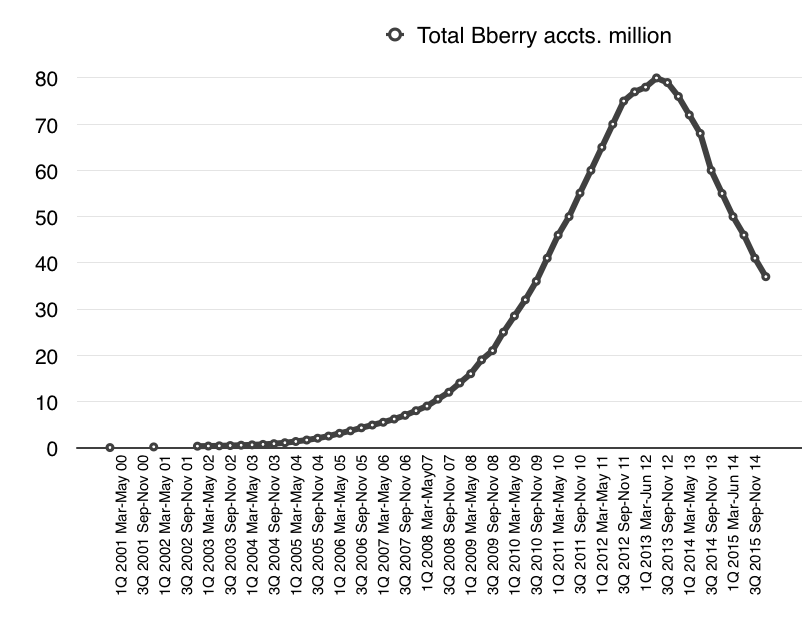
Here’s how its subscriber count has been going – dug out, again, from details in financials going back over many quarters:

Total BlackBerry subscribers over time

The peak – 80m – occurred before the release of BB10.

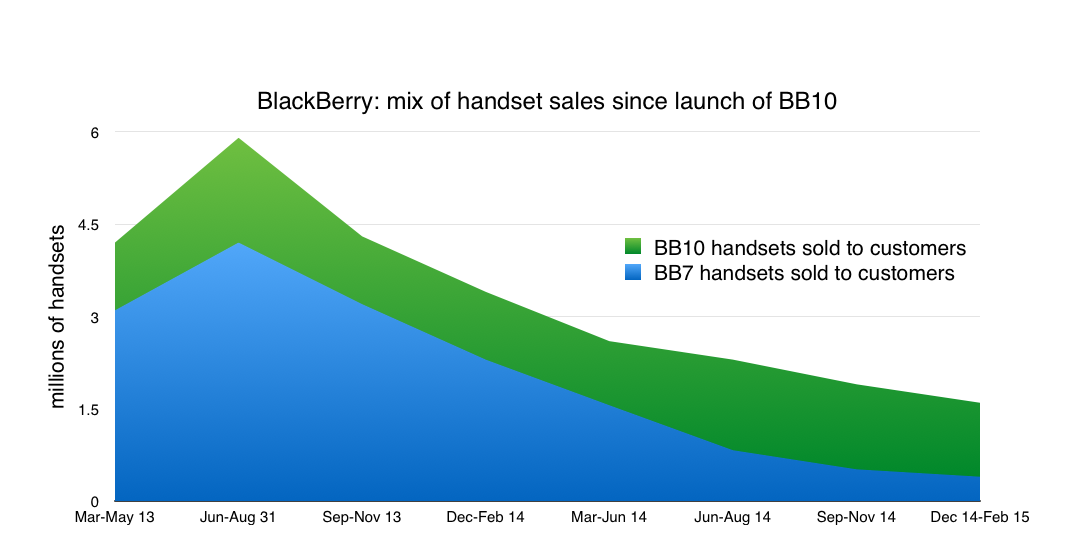
At the end of February 2015, the subscriber count was 37m. The total number of handsets that reached customers (“sell-through”) in the past eight quarters since BB10 was launched two years (eight quarters) ago is 26.2m. Digging back reveals how many BB10 handsets have actually shipped to end users – surely replacing existing BB7 handsets: just 10.1m.

Handset sales mix since BB10 launch

BB7 handsets have been substantial for some time.

Two things:
• this suggests that 70% of BlackBerry subscriber handsets now in use were bought in the past two years.
• isn’t it amazing that BB10, the platform that was going to be BlackBerry’s salvation, has only sold two-thirds as many handsets as the platform it was supposedly making redundant two years ago. It’s as if the iPhone 4S were running iOS 6 and radically outselling the iPhone 6, or the Galaxy S3 were outselling the Galaxy S5.

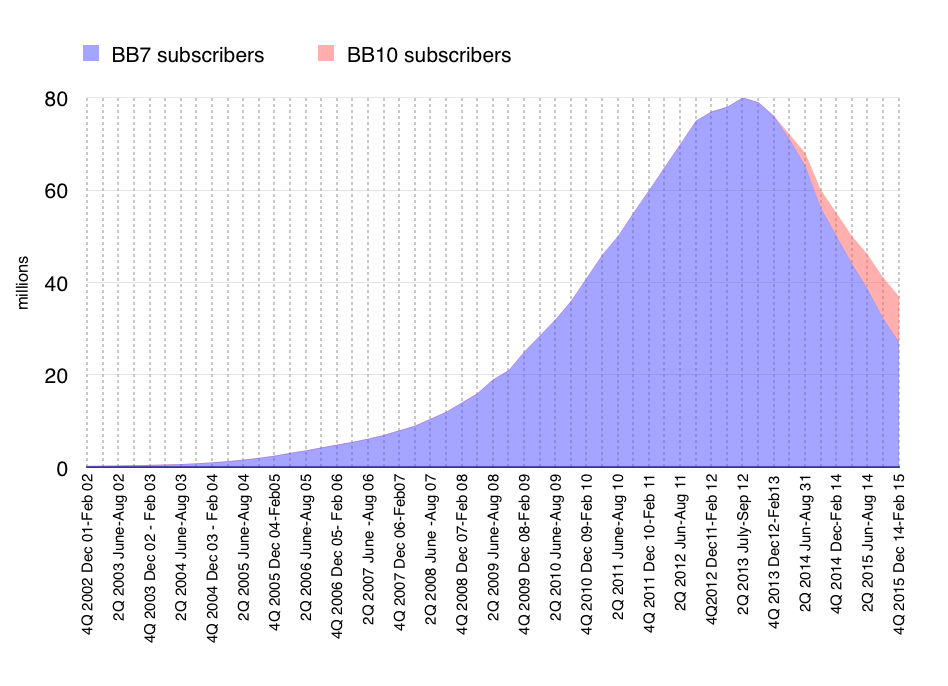
So this is how the subscriber base looks, split into BB7 and BB10:

BlackBerry subscriber base, by handset

BB10 still makes only a small proportion of users – about 10m out of 37m

Easy assumptions

Let’s assume all 10.1m BB10 handsets are in use, and all replaced BB7 handsets. That means there are now 26.9m BB7 handsets generating SAF revenues, at an average $309m/26.9m = $11.49 per quarter. (Remember this number, we’ll use it later.)

But – imagine – what if every handset sold since the introduction of BB10 had been a BB10 handset? That would mean 26.2m BB10 handsets, so only 37m-26.2m = 10.8m BB7 handsets in use. In the just-gone quarter they would have generated $11.49 x 10.8m = $124.1m in service revenue – a drop of $184.9m in service revenue. Yow!

Then again, think of all the hardware revenue! Surely that would more than make up for it?

Yes, it would – ah, but for one detail: SAF is crazy profitable, and it’s profitable during the lifetime of the handset. This has big implications. Companies want to be profitable, and want to be profitable for a long time – not just one-offs from handset sales.

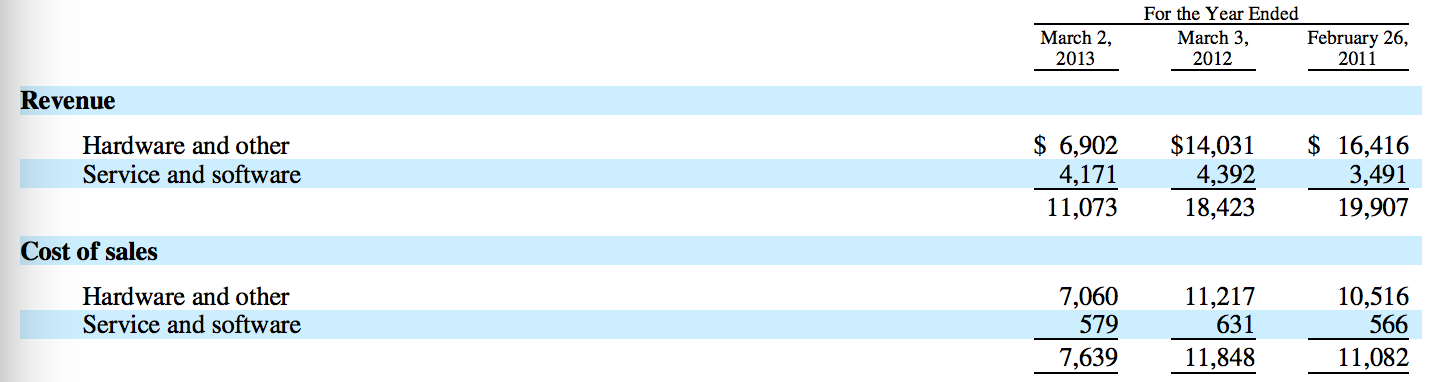
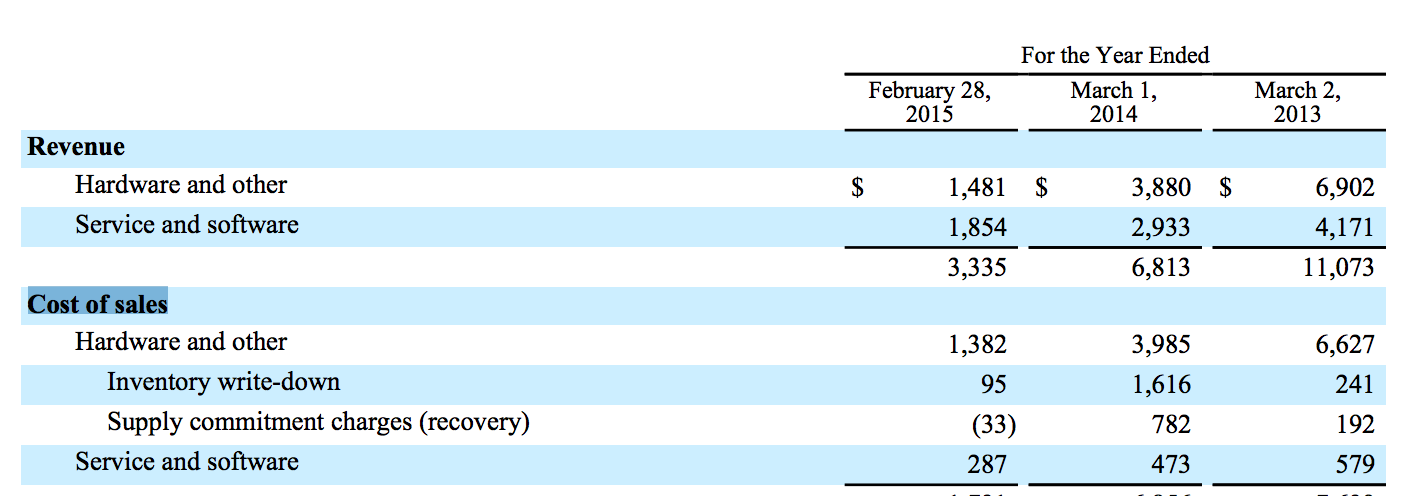
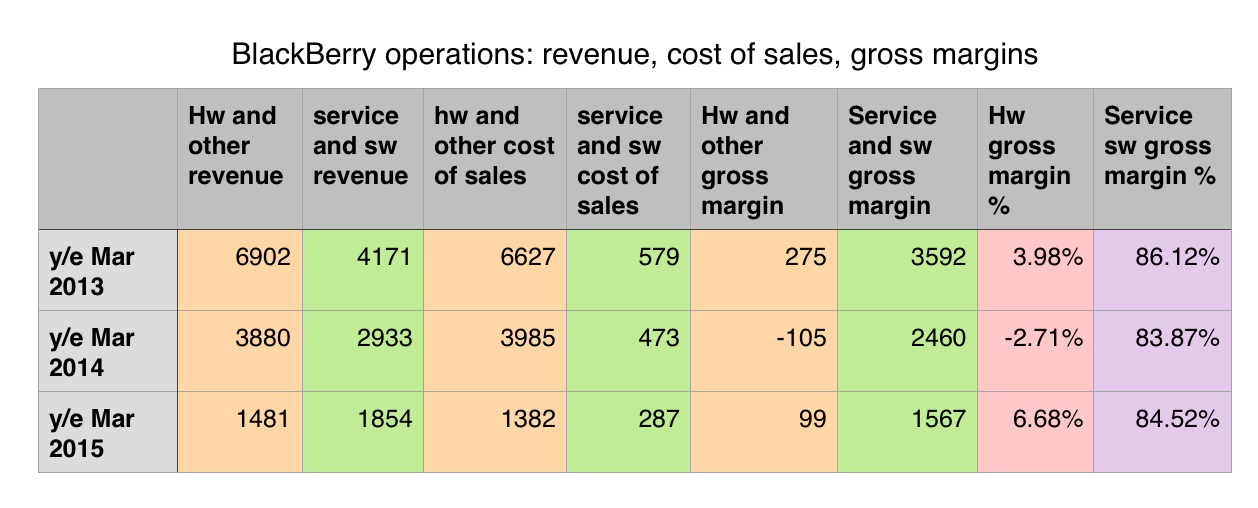
Services are super-profitable for BlackBerry because it has the infrastructure for it, and can easily handle the data volumes involved (it used to handle it for twice as many devices, after all). Another little detail I found in the financials is that in the fiscal year to end Feb 2015, services and software brought in revenues of $1,854m – but the cost of sales (ie how much it cost to do) was just $287m.

Here are the numbers for three preceding years:

BlackBerry hardware and software margins

Hardware slumps towards loss while services and software coin it.


And now the three most recent years:
Hardware, services software cost of sales

For the past three fiscal years

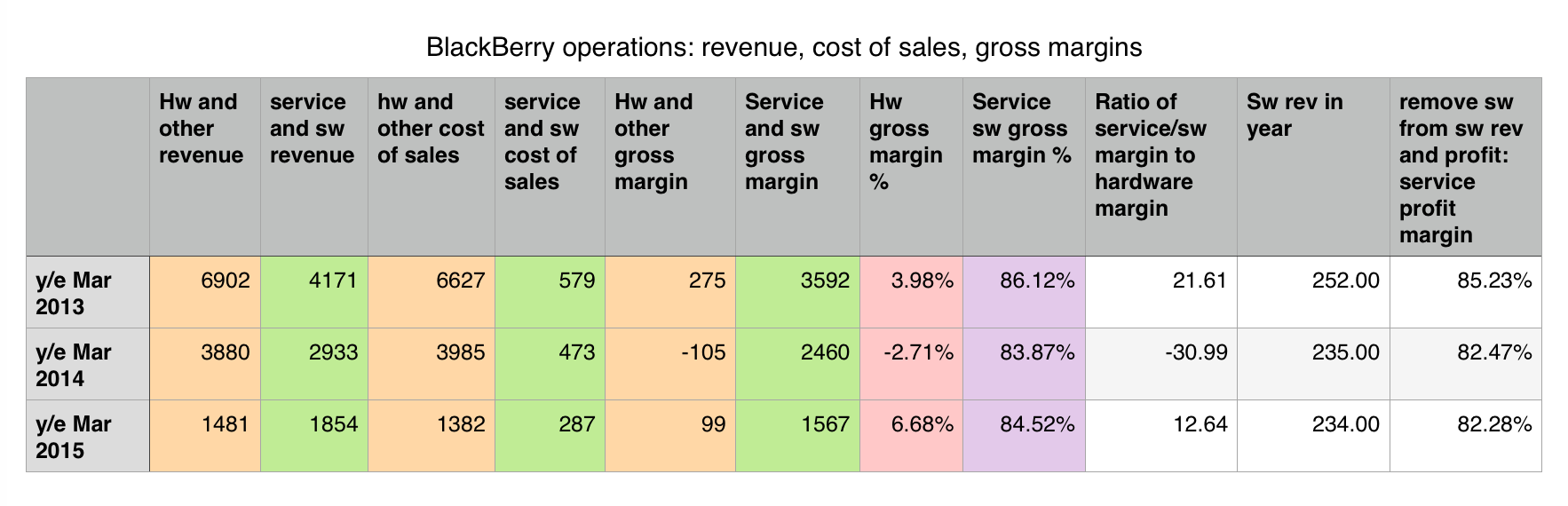
Services and software together have a gross margin of nearly 85%, compared to hardware gross margins which have wavered between 4% in FY13, -2.7% in FY14, and 6.7% in the latest year. (They were as high as 36% back in the year to March 2011, when it shipped 52m handsets, and 20% in the year following, when it shipped 49m. In the just-gone year it shipped 7m. You don’t get 20% margins at that scale.)

Hardware, services: comparative margins

Hardware’s a pretty lousy way to make money (at least if you’re BlackBerry)

Even if you treat software revenues as pure 100% profit, the services gross margin still comes out as 82%, even in a “bad” year.

Services: still very profitable

Even if you assume software is 100% profitable, services come in with a margin of 82% or so.

So in our scenario where BlackBerry has lost $184.9m in service revenue (because all the handsets it sold were BB10), that means it has forgone $151.6m in gross margin profit in a single quarter. At a time when it’s struggling to show any profit (remember, it recorded an operating loss, because of things like R+D and marketing), that’s bad.

What price do handsets need to sell for to make up for that? Let’s first find out how much we need to collect. Take the $11.49 per-handset SAF revenue from the latest quarter: at 82% margin, that yields $9.42 in gross margin profit per BB7 handset per quarter.

We saw above that 70% of handsets were replaced over two years; logically all 100% should refresh over three years. So SAF revenue yields profit for, let’s say, 12 quarters. Even at the low SAF revenues we’re seeing, if you take that as read, then over 12 quarters (at per-quarter $11.49 revenue, $9.42 gross margin) services yields a per-handset gross margin profit of $9.42 x 12 = $113.04 over a BB7 handset’s life..

Hardware: bad news

How does hardware compare? Well, for BB10 hardware to be worth it for BlackBerry, it has to generate as much, or more, gross profit over three years.

At 4% gross margin, that means BB10 handsets would have to sell at an average price of $113.04/0.04 = $2,826. Yes, nearly three thousand dollars. Even at 20% margin, it would need a handset that it sells to carriers for $565.20. That’s iPhone-style pricing.

They’re nowhere near that. Yeah, I know, the BlackBerry fans will tell me that the BB10 Classic is going to sell like crazy, because it looks like a BB7 handset, and that carriers are all behind the company, and so on. Look though at the price of the Classic: $449. At 10% gross margin (and taking the retail price as what BlackBerry gets, which it isn’t), that’s a hardware gross profit of $44.90 (and a service profit of $0). At 20% (which it won’t make at the tiny scale it operates on), the one-off hardware profit is $89.80.

On its current SAF, BlackBerry gets more profit from a BB7 handset in three quarters than a BB10 handset at 10% margin; or six quarters at 20% margin. You might argue that BB7 handsets lose money at sale while BB10 ones make it. The numbers don’t say that, though. BlackBerry’s numbers have all trended down ever since the launch of BB10, and its accounts are littered with writedowns on inventory.

Conclusion: squaring the circle

In short? John Chen is pretty fortunate that BB10 handsets don’t sell that well, because they’d tear down the already faltering finances of the company. It actually makes better financial sense to keep selling BB7 handsets. The immediate handset profit is lousy, but the recurring revenues are great.

Now, it’s true that carriers are pushing down the SAF. It’s also true that BlackBerry hardware average selling prices (ASPs) are edging up – to $231 in the most recent quarter, when “most” (66% – it’s on page 128 of the 40F) handsets that reached customers were BB10s. That yields a gross profit margin of $9.24 – but unlike the SAF, that has to last over 12 quarters. (This is why one-off hardware is such a hard game to make pay, and why recurring high-margin software revenues is so great. Contrast the business models of Apple v Microsoft.)

Apart from continuing to slash costs and headcount, there’s no obvious way for Chen to square this circle. He needs enterprise customers to sign up to the BES 12 service (enterprise server), but it was very noticeable that whenever he was asked about this during the earnings call he said he didn’t have the numbers who had converted over with him:

Q: So maybe give us a quarterly total and somewhat of a split between while under the EZ PASS program and after the EZ PASS program?

John Chen – Chief Executive Officer: First of all after the — the EZ PASS program ended at 6.8 million licenses, no, I don’t have that number with me and I will have to look at some metrics.

Uh-huh. I bet if the numbers had been good, he’d have made sure that they were right there at his side. The fact he couldn’t offer anything didn’t sound good to me.

Still, it could have been worse. He could have had to tell people that they’d only sold BB10 handsets.

(None of this, by the way, is a comment on the quality or otherwise of BB10. It’s simply what emerges from the numbers. But I will say that the hope held out by BlackBerry fans that people will buy it for “security” is misplaced. When the head of the FBI is demanding back doors into iPhones and Android phones because they’re too secure, smartphone security has easily reached “good enough”.)

Start up: FTC rebuts critics, Mars One or Capricorn One?, failures of tech criticism, how open is ResearchKit?, and more


Flooded view in Oxford. Photo by the.approximate.photographer on Flickr.

A selection of 9 links for you. None includes Jeremy Clarkson or One Direction. I’m charlesarthur on Twitter. Observations and links welcome.

Statement of Chairwoman Edith Ramirez, and Commissioners Julie Brill and Maureen K. Ohlhausen regarding the Google Investigation » Federal Trade Commission

The Federal Trade Commission conducted an exhaustive investigation of Google’s internet search practices during 2011 and 2012. Based on a comprehensive review of the voluminous record and extensive internal analysis, of which the inadvertently disclosed memo is only a fraction, all five Commissioners (three Democrats and two Republicans) agreed that there was no legal basis for action with respect to the main focus of the investigation – search. As we stated when the investigation was closed, the Commission concluded that Google’s search practices were not, “on balance, demonstrably anticompetitive.”

Contrary to recent press reports, the Commission’s decision on the search allegations was in accord with the recommendations of the FTC’s Bureau of Competition, Bureau of Economics, and Office of General Counsel.

Some of the FTC’s staff attorneys on the search investigation raised concerns about several other Google practices. In response, the Commission obtained commitments from Google regarding certain of those practices.  Over the last two years, Google has abided by those commitments.

I’d just like the full report published. Or reports – there seem to have been one from the competition bureau and one from the economic bureau.


Winter testing of the Oxford Flood Network » Nominet R&D blog

Bryan, who helped build it:

It’s been an extremely useful period for us all and in particular we’ve learnt a great deal about deploying devices in real conditions.

There are the hardware considerations: dull but important issues such as fixings become all important; how exactly do you fix a sensor to a disused 60cm cast iron pipe? (see photo below for the answer)

There are the radio considerations: how do you realistically achieve a 250m connection across wooded areas?

There are system deployment considerations: how do you remotely reboot a Raspberry PI gateway that is held securely in someone else’s property?

And there are some basic user interface considerations: how big do the buttons on a mobile app need to be when your fingers have gone numb from standing in a wet muddy field in December? 

The key thing to remember about the Internet of Things is that it is where the physical world meets the digital world. The physical world is complex and messy. A warm, protected office (where applications are inevitably built) can hide that messy world.

I find this enormously encouraging. Flood level and river data is the one key public dataset that the Environment Agency still won’t make publicly available for free commercial reuse; it’s been a sticking point for the Free Our Data campaign (nine years old this month, but pretty much sorted since 2010). Let’s get it sorted.


Mars One finalist speaks out, says Dutch non-profit likely scamming its rubes » Ars Technica

Megan Geuss:

there was an insidious side to the dream that Mars One put forward. So much of it didn’t add up. The $6 billion budget seemed ridiculously low, and the company was light enough on details and partnerships to suggest that something was either very secret or very suspect.

[Joseph] Roche [a professor at Dublin’s Trinity School of Education, with a PhD in physics and astrophysics, and a Mars One finalist] now seems to think it’s the latter, saying that not once did he ever meet with someone from Mars One in person, despite the fact that he was selected to be one of the “Mars One Hundred”—the lucky 100 people who advanced to the next level in the competition over spaceship seats.

The professor told Keep that ranking within Mars One is points-based; when you are selected to advance through the application process, you join the “Mars One Community,” and you are given points as you move through each next level. The points are arbitrary and have nothing to do with ranking, but “the only way to get more points is to buy merchandise from Mars One or to donate money to them,” Roche told Keep. So, in essence, people are likely paying their way to a final round.

Even so, that’s not going to raise $6bn, unless they’ve got Bill Gates aboard. (Have they?)


BlackBerry is about to hit bottom » Quartz

Dan Frommer:

BlackBerry’s turnaround strategy—focusing on software as its smartphone business has declined—has not been pretty. But the worst may be here.

When BlackBerry reports its fourth-quarter results on Mar. 26, it could post its lowest revenue number in nine years. That’s the warning from RBC analyst Mark Sue in a research note this week.

Sue predicts that BlackBerry’s fourth-quarter sales could drop to $661m, down 32% year-over-year and well below the Wall Street consensus of around $800m. BlackBerry hasn’t reported revenue that low since 2006, just as the smartphone industry was set to explode.

But after you hit bottom, you rise. At least that’s what RBC is forecasting, along with 1.3m phones shipped and perhaps a little profit in the future. (BlackBerry’s results are on Friday.)


The Taming of Tech Criticism » The Baffler

Evgeny Morozov reviews Nick Carr’s new book “The Glass Cage”, and makes many insightful points about how much technology criticism (including, he argues, Carr’s) can’t see the wood for the trees:

Take our supposed overreliance on apps, the favorite subject of many contemporary critics, Carr included. How, the critics ask, could we be so blind to the deeply alienating effects of modern technology? Their tentative answer—that we are simply lazy suckers for technologically mediated convenience—reveals many of them to be insufferable, pompous moralizers. The more plausible thesis—that the growing demands on our time probably have something to do with the uptake of apps and the substitution of the real (say, parenting) with the virtual (say, the many apps that allow us to monitor kids remotely)—is not even broached. For to speak of our shrinking free time would also mean speaking of capital and labor, and this would take the technology critic too far away from “technology proper.”

It’s the existence of this “technology proper” that most technology critics take for granted. In fact, the very edifice of contemporary technology criticism rests on the critic’s reluctance to acknowledge that every gadget or app is simply the end point of a much broader matrix of social, cultural, and economic relations. And while it’s true that our attitudes toward these gadgets and apps are profoundly shaped by our technophobia or technophilia, why should we focus on only the end points and the behaviors that they stimulate? Here is one reason: whatever attack emerges from such framing of the problem is bound to be toothless—which explains why it is also so attractive to many.

I think Morozov has by far the better perspective on this than Carr, because he isn’t grounded in an American social view.


ResearchKit and open source » Rusty Rants

Russell Ivanovic looks more closely and queries where the “open source” bit is:

ResearchKit, just like most other iOS frameworks, is a set of tools for building an iOS app that simplifies some of the things you’d need to do to collect patient data. The intention of open sourcing this part of it seems to be to encourage developers to build modules for it which would all be iOS only as well. Apple states as much in their technical document:

…developers are encouraged to build new modules and share them with the community

So, currently at least, there’s no open source server components, no open format for exchanging data and an iOS only open source framework that Apple want developers to build modules for. Don’t get me wrong, this still sounds like a huge step forward for medical research data collection. What it doesn’t sound like though is Apple’s altruistic gift to the world from which they receive no benefits.


China market buoying iPhone shipments » Digitimes

Cage Chao and Jessie Shen:

In China, sales of Apple’s iPhone 6 reached 15-20m units in the fourth quarter of 2014, the sources noted. China-sales of the 6-series are set to remain at similar levels in the first quarter of 2015, the sources said.

Judging from current order visibility, the sources estimated that 45-50m iPhone 6 devices would be shipped worldwide in the second quarter of 2015 with China contributing one-third of total shipments…

…While sales of Apple’s iPhone 6 series have been strong since launch, sales of Android-based smartphones have not picked up, according to industry sources. Except Samsung Electronics, which has started to enjoy growth in sales of its recently-announced Galaxy S6, other Android phone makers have seen their sales thus far in 2015 lower than a year earlier, the sources indicated.

Sources at Taiwan-based IC design houses have revealed that orders placed by their Android device customers have been weaker than expected which may affect their sales performance in the first quarter. The IC design houses said they are also cautious about orders placed by Android phone makers for the second quarter.

The iPhone figures feel like lowballing – Apple will probably pass 50m units for the quarter. It’s the part about Android phones that is intriguing. Is it just the Taiwan IC houses feeling the pinch?


What happened, and what’s going on » AllCrypt Blog

Read this, and feel the hairs stand up on the back of your neck:

We are not sure if AllCrypt was targeted, or if it was a “fortunate” thing for the hacker. Our hypothesis is this: The user’s email account was breached, and in looking through the emails, saw that he had some admin rights for AllCrypt.com. In that account were emails from myself and our MD. After playing on AllCrypt for some time, the hacker tries to do a WordPress password reset for all of the allcrypt related emails he sees. My personal email was not the email for the main admin blog account, and either was the user who’s email was breached. Our MD, however, did use his personal email. A password reset was issued, and sent to the MD.

The massive screwup that led to the loss of funds is when the MD forwarded that email to myself and the tech team member. He forwarded the password reset link. To the breached email account.

The hacker reset the MD’s password, and had administrative access to the blog. Access which allows uploading of new files/plugins for WordPress.

The hacker first uploaded a file, class.php. After we examined it, we discovered that it grants web-based command line access to any files the web user has access to. Namely, the entire http tree. Quick looks through the web source files is all it takes to see the hostnames, login names, and passwords for the database. The database credentials WERE protected in a ‘hidden’ file in a non-www accessible directory, however, anyone smart enough to read code can find the include lines that point to that file. The www user must have read access to that file, so the class.php the hacker uploaded also had read access.

Then, using WordPress, he uploaded adminer.php – a web based database management tool similar to PHPMyAdmin. It was a simple task to then query the database.

The hacker created a new user account on AllCrypt, used adminer.php to UPDATE userbalances SET balance=50 WHERE userid=whatever AND symbol=BTC to set his balances to whatever he wanted. Then he began to issue withdrawals. Lots of them.

You hosted WordPress and your bitcoin exchange on the same server. Also includes “Angry questions and contrite answers” section.


Samsung beaten by local smartphone brand in the Philippines » Tech In Asia

Judith Balea:

Philippine budget phone maker Cherry Mobile beat South Korean giant Samsung as the leading smartphone brand in the Philippines in 2014, IDC said today. It was the second straight year that Cherry has whipped Samsung in the nation.

According to the research firm, Cherry cornered 21.9% of the Philippine market in terms of volume of smartphones shipped in 2014, overtaking Samsung, whose share declined further to 13.3%.

Cherry has held the spot as the number one smartphone vendor in the Philippines since 2013. That year, it captured 24.3% of the market, and Samsung held 19.9%, based on data provided by IDC to Tech in Asia.

However, the smartphone market expanded by 76% yoy (from 7.2m to 12.6m), so Samsung’s shipments actually increased by 17.6% (from 1.42m to 1.68m). Big headline, but pretty much a rounding error for Samsung.


Start up: squinting at Lollipop, phone cameras ranked by pros, how Crossy Road triumphed, and more


“Your first day at Google?” “Mm-hm. Thought I’d get the eye surgery done first.” Photo by peretzp on Flickr.

A selection of 7 links for you. Contains 50% less sugar. I’m charlesarthur on Twitter. Observations and links welcome.

The Wolfram Data Drop Is Live! » Stephen Wolfram Blog

Our goal is to make it incredibly straightforward to get data into the Wolfram Data Drop from anywhere. You can use things like a web API, email, Twitter, web form, Arduino, Raspberry Pi, etc. And we’re going to be progressively adding more and more ways to connect to other hardware and software data collection systems. But wherever the data comes from, the idea is that the Wolfram Data Drop stores it in a standardized way, in a “databin”, with a definite ID.
Here’s an example of how this works. On my desk right now I have this little device:

Every 30 seconds it gets data from the tiny sensors on the far right, and sends the data via wifi and a web API to a Wolfram Data Drop databin, whose unique ID happens to be “3pw3N73Q”. Like all databins, this databin has a homepage on the web: http://wolfr.am/3pw3N73Q.

The homepage is an administrative point of presence that lets you do things like download raw data. But what’s much more interesting is that the databin is fundamentally integrated right into the Wolfram Language. A core concept of the Wolfram Language is that it’s knowledge based—and has lots of knowledge about computation and about the world built in.

Neat idea, aimed at the Internet Of Far Too Many Damn Things.


OneShot, a one week design case study — iOS App Development » Medium

Daniel Zarick:

On January 14th, my friend Ian Ownbey sent me a direct message on Twitter about a freelance design project. It turns out he was working on a small iOS app with his friend Jason Goldman and they were looking for a designer to help them wrap it up. At the time, I was in the middle of a substantial iPad design project for another client, but I really wanted to work on something with Ian and Jason. Luckily, since their project was small, I was able to squeeze a week of time for them in the middle of my other project.

Things I particularly noted (not particularly being an app developer, but interested in process): (1) they used Slack (2) they didn’t go with an iOS 8 Extension, and the only people who’ve queried that are techies. Pretty much nobody else cares. File that thought away.

A a side note, I find myself reading more and more stuff on Medium, and finding good quality.


WatchApps » WatchAware

Neat: shows you Apple Watch apps as they’re added to the store and also shows how they will look when used. I haven’t seen a killer app for me there yet.. but there are only a few.


Do all Google employees have perfect eyesight? » Terence Eden’s blog

Eden is unhappy with Lollipop, and particularly its design choices:

I can only assume that on their first day at Google, new employees are given their Android phone, a ChromeBook, a self-driving car, and complementary Laser Eye Surgery. That’s my theory on some of the problems besetting Android’s Lollipop release.

I’ve ranted about Lollipop before, and now I’d like to point out two particular problems.

All of these tests were performed on a Nexus 4 running Android 5.0.1, and the most recent versions of the apps.

In short: poor text wrapping in Google’s default web browser; and, more annoyingly, poor contrast between background and text in Google apps such as YouTube, Play and the General Settings menu. Remember, this is a Nexus, not some skin. Eden’s conclusion:

Lollipop is, for a large section of the population, really unpleasant to use.

I know I’m not the only person who has spent a lifetime working at a screen and appreciates legible text.


They wanted to make a phenomenon. They made $10m » Polygon

Dave Tach:

Unlike many of its contemporaries, nothing about Crossy Road makes a player feel the need to pay to progress or win. Its design subdues its monetization, and that has cost its developers revenue. Crossy Road rarely — if ever — squeezes onto the top of the iOS App Store’s list of highest grossing games, where titles like Clash of Clans and Candy Crush Saga are entrenched. Yet yesterday, Crossy Road was the 12th most popular free iPhone app without even appearing in the App Store’s list of top 100 grossing iPhone apps.

This is not an accident. Crossy Road was an experiment in doing free-to-play differently, and that experiment has been wildly effective.

Today, at a Game Developers Conference 2015 session, Hall and Sum told the story of Crossy Road’s creation and lifted the veil on its real success during the game’s first three months. They revealed that, 90 days after its release, Crossy Road’s combination of solid gameplay, unobtrusive in-app purchases, and optional in-app ads powered by the Unity engine, has earned $10m from 50m downloads.

A real lesson in the power of mobile’s reach. An average of 20 cents per install – and that’s probably skewed towards the high end, meaning 45m downloads probably paid nothing, or next to it.


And the best phone camera is… pro photogs rank Note 4, iPhone 6, Z3, Lumia 1020 and more » Phonearena

Taking a bunch of seasonal smartphones, like the iPhone 6, HTC One M8, LG G3, Nokia Lumia 1020, Samsung Galaxy Note 4, Sony Xperia Z1 Compact and Sony Xperia Z3, photo aficionados from Poland have snapped a bunch of samples in sunny Morocco, and then given them to professional photographers for ranking purposes.

The experiment has been a blind one, meaning that the shutterbugs didn’t know which picture came from which phone, just like we often do in our comparisons. The list of experts includes prominent lecturers and even editors of photography magazines, so it is as representative as it could be when it comes to accurately judging the true quality of the snaps. 

Usually these things are a bit pointless, but the variety of devices and the variation in what does best in which conditions is surprising – the Note 4 does extremely well, the Lumia doesn’t, despite the latter’s huge pixel count.


BlackBerry courts career builders with all-touch Leap smartphone » The Globe and Mail

Shane Dingman for Reuters:

The Leap is a buttonless touchscreen smartphone that looks like a lot of other mobile slabs on the market. Expected to be priced at around $275 (U.S.) without a subsidy, with an industry-standard five-inch display, a 2800 mAh battery promising 25 hours of use and a processor that first shipped in 2012, it’s a budget device designed for the mid-market.

But if it’s targeting a “volume opportunity,” Ryan Reith, research director for mobile devices at IDC, said BlackBerry’s Leap will find tough competition in Motorola or Huawei hardware with similar specifications.

“That’s directly where they are aiming, but they are still priced outside of that spectrum,” warns Mr. Reith, who said middle-market devices are selling for under $200. The Z3, unveiled at last year’s MWC, was also pegged as an emerging-market touchscreen device, but failed to gain traction. “In terms of moving commoditized handsets, this is a dying part of [BlackBerry’s] business.”

CEO John Chen has said that if BlackBerry can’t sell 10 million phones a year, it shouldn’t be in the hardware business. Mr. Reith said IDC projects BlackBerry will sell seven million or eight million devices in 2015.

Hard choices lie in BlackBerry’s near future. Chen is clearly trying to shift the BlackBerry software over to other platforms so that he can extricate the company from the loss-making hardware business while keeping customers in valuable software and service contracts.


Start up: Samsung’s future?, Lollipop drops mandatory crypto, the DDOS lightbulb, Microsoft and keyboards, and more


Samsung, in a few years? Photo by French Tart on Flickr.

A selection of 13 links for you. (Too many? Too much news.) I’m charlesarthur on Twitter. Observations and links welcome.

Google’s great encryption backtrack » Motherboard

Jason Koebler:

​In late October, Google announ​ced that Lollipop, its newest version of Android, would have “encryption by default.” Monday, it was a curious reporter, not Google, reporting that would no longer be the case.

Instead of requiring every file on an Android system to be encrypted by default, the choice will be left up to manufacturers such as Samsung, LG, and Motorola as to whether to turn that feature on out of the box, Ars Tec​hnica discovered.

“Google has made statements that are no longer true, and it’s Google’s obligation to publicly correct that statement,” Amie Stepanovich, US policy manager for the digital rights group Access, told me.

Google won’t say why it’s backtracking, but it’s pretty evident the reason is device performance – encryption slows them down. User security takes second place to performance – the story that has killed BlackBerry down the years.


Cybercriminals phish iCloud credentials from victims of iPhone, iPad theft » Symantec Connect Community

Cybercriminals have recently created multiple phishing sites in order to trick iOS device owners into providing login credentials for their iCloud accounts. The attackers appear to be focusing on users whose iPads and iPhones have been lost or stolen. It’s possible that the attackers are running this phishing operation as part of a service for iOS device thieves on underground forums.

In one particular case, a victim of iPad theft received an unsolicited message, informing him that his tablet had been found. The message then instructed him to click on a link to discover the location of his iPad.

Surprise! It’s a phishing site to get the iCloud credentials and unlock the stolen phone for resale.


This guy’s light bulb DDoSed his entire smart house — Fusion

Kashmir Hill on Raul Rojas, a computer science professor who made his whole house into a smart home (apart from the locks – he worried about the locks):

About two years ago, Rojas’s house froze up, and stopped responding to his commands. “Nothing worked. I couldn’t turn the lights on or off. It got stuck,” he says. It was like when the beach ball of death begins spinning on your computer—except it was his entire home.

…when he investigated, it turned out that the culprit was a single, connected light bulb.

“I connected my laptop to the network and looked at the traffic and saw that one unit was sending packets continuously,” said Rojas. He realized that his light fixture had burned out, and was trying to tell the hub that it needed attention. To do so, it was sending continuous requests that had overloaded the network and caused it to freeze. “It was a classic denial of service attack,” says Rojas. The light was performing a DDoS attack on the smart home to say, ‘Change me.’”

Take a look at his home hub. That’s not some little router.


BlackBerry CEO: I’m open to creating a tablet again » CNET

Roger Cheng:

BlackBerry may take another run at the tablet market.

That’s if CEO John Chen thinks the opportunity is right. “It’s not in the works, but it’s on my mind,” Chen said in an interview at the Mobile World Congress conference here.

A BlackBerry tablet could satisfy the needs of a small but fiercely loyal group of productivity-focused customers who have stuck with the struggling smartphone maker and its operating system, potentially giving it a new revenue stream. But there aren’t enough BlackBerry faithful to sustain such a business, especially given the tablet category saw its first year-over-year decline in shipments in the fourth quarter.

“History repeats itself, the first time as tragedy, the second as farce,” to quote Marx (not Groucho).


Does anybody understand these baffling MWC slogans? » Pocket-lint

Rik Henderson:

One of the things we always notice when trudging trade show floors is that companies feel the need to explain what they do, or what they are showing in a three or four word slogan. However, most of them are claptrap of the highest order.

Wonderful (and classically British) insistence on taking words at their face value, and asking the important questions that other sites (and certainly not the boring American ones) will, such as: “what actually does ‘unleash the future’ mean, Mozilla?”


Google reportedly preparing Android Wear for iPhone and iPad » Mac Rumors

Joe Rossignol:

Google is reportedly preparing to release an Android Wear app on the App Store for iPhone and iPad, according to French technology website 01net [Google Translate] (via iPhon.fr).

The report claims Android Wear with extended iOS support could be announced at Google’s I/O developer conference in late May, although Google may push the agenda depending on sales of the Apple Watch.

Google may be interested in capitalizing on iPhone and iPad users that are not planning to purchase an Apple Watch when the wrist-worn device is released in April, the report adds.

Essentially unsourced, but it would make sense: Google wants its services used as widely as possible, and not having Android Wear on iOS leaves tens of millions of potential customers unserved.

However, are there many iPhone users who would opt for Android Wear over an Apple Watch, except over the question of price? At the bottom end, the price delta is pretty low – and if that really matters, you’d get a Pebble, since it has been iOS-compatible from day one. So I believe this report, but don’t think Android Wear will benefit from it as much as Google (and AW makers) might want.


Cyanogen CEO Kirt McMaster on Android, Samsung, and more » Business Insider

Lisa Eadicicco, with a smart interview with McMaster, who says:

On the global platform, we see Xiaomi becoming the No. 3 OEM. Micromax is now No. 10. These guys are basically creating really cheap handsets that have really awesome performance. This is made possible because of Qualcomm’s turnkey solution as well as Mediatek’s.

One of the things Cyanogen does really well is optimizations at the low level, at the kernel level. Which means we can get performance out of these chipsets coming out of turnkey that make the device for all intents and purposes feel like a $600 iPhone.

The tier one OEMs like Samsung are going to be the next generation Nokias in the next five years. They’re going to be slaughtered. We think long term Apple itself will have problems because they’re just not good at competing at the low end.

Q: So you think Samsung will be toast in five years?

It could get pretty bad pretty damn quick. This is often the case.


Swedish speed camera pays drivers to slow down » WIRED

Is it possible to make road-safety fun? Yes, it turns out. Kevin’s Richardson’s idea is both smart and simple. As well as ticketing you when you run through a speed-radar too fast, Kevin’s “Speed Camera Lottery” also notices you when you come in at or under the speed-limit. It then automatically enters you in a lottery. And here’s the really smart part: the prizes come from the fines paid by speeders.

This would probably never work in the U.S, where speeding fines and red-light cameras exist as revenue streams for the police rather than as deterrents to bad driving, but the Swedish National Society for Road Safety, which worked with Kevin, has found it to be a success.

Neat idea (there’s the video) but of course it relies on tying your speed to your licence plate, ad so your address, and so you. Sweden is open enough that that is accessible. But other countries?

Even so, the idea of changing behaviour through “fun” is a subtle – yet powerful – one.


3D-printing with living organisms “could transform the food industry” » Dezeen

No content. Just consider
• use of “could” in the headline. As Paul Haine points out, you can extend Betteridge’s Law (“any headline posed as a question can be fully answered and the story implications understood with ‘No'”) to headlines which use “could”
• “3D printing with living organisms” is also known as “growing, preparing and cooking stuff”. No 3D printer required.


Zuckerberg: carriers will connect the world, not sci-fi – CNET

It’s regular carriers and regular technology that will bring Internet access to the billions of people who lack it today, not sci-fi ideas like Google’s Project Loon balloons or Project Titan drones, Facebook Chief Executive Mark Zuckerberg thinks.

“People like talking about that stuff because it’s sexy,” Zuckerberg said of such departures from networks delivered by plain old cell phone towers and fiber-optic lines. “That’s at the fringe of the real work that’s going on. Ninety percent of the people in the world already live within range of the network.”

Well that’s putting a pin in the balloon so laboriously pumped up by various blogs of how Loon is going to totally, utterly, y’know, transform how everyone stays connected.


Microsoft’s keyboard obsession » TechCrunch

Ron Miller:

this morning at Mobile World Congress, Microsoft announced a new version of Office 365. I gotta be honest. It looked like it was trying to take full-blown Office and squeeze it into a 5 or 6 inch screen. Sure, they tuned it a bit to make it mobile friendly, but it was still Office in all its glory in a smaller footprint.

So what did Microsoft do? You got it. It developed a keyboard.

It’s a small bluetooth variety engineered by the Microsoft hardware group. It folds up into a fairly small footprint to fit neatly in brief case or purse, but it’s another part of their total keyboard obsession. Instead of making Office fit the phone touch screen, it invented a keyboard to make it work better on a phone.

Next it will probably build a small wireless mouse to complete its whole vision of mobile device as a PC in a small package.

This is such an elegantly short yet well-observed piece. And captures it all. The commenters are furious because obviously he typed it. I wonder how much real typing they do. Perhaps too much. Journalists typically type at least a thousand words a day; I wonder how much the average Office user types. Any data out there?


Mobile consumers have the answer » Kantar Worldpanel

Carolina Milanesi asked the Kantar panel of consumers for their views:

We know that tablet sales are stagnant and that 79% of American panelists without a tablet have said that the reason they are not planning to buy a tablet in the next 12 month is because their PC is “good enough” for them. When we asked consumers who own a PC if they are planning to replace that PC in 2015, 85% of the panelists interviewed said they are not. 11.3% said they indeed are planning to replace their current PC with another, and1.7% said they will replace that PC with a tablet. Finally, 1.9% plan to replace their PC with a convertible.

Consumers in the 25 to 34 year bracket are the most favorable to tablets, with 2.9% planning to purchase one as a replacement for their PC. Consumers 16 to 24, are the most open to convertibles (3.5%) most likely because they’re still in their school years,

Also asked about virtual reality, to sniffy answers. But you could have asked people if they wanted to surf the web and get email on the move in 2006 and got similar uninterested answers. Asking consumers about future technologies isn’t always meaningful without clear use cases.


Galaxy S6 sales to outperform its predecessors, says Samsung Taiwan executive » Digitimes

Samsung Electronics will begin to market its newly released flagship smartphone the Galaxy S6 starting April 10 and expects sales to outperform the Galaxy S4, the vendor’s best-selling model so far, according to Andy Tu, general manager of Samsung’s mobile communication business in Taiwan.

Samsung has responded to criticism of the Galaxy S5 with great changes in terms of design and materials, expecting the new design to bring in significant replacement demand for the Galaxy family products, Tu said on the sidelines of a pre-MWC 2015 event.

Samsung will focus on promoting two flagship models, the Galaxy S6 and Galaxy Note 4, plus mid-range A- and E-series Galaxy models from the second quarter of 2015, Tu revealed.

In all the oceans of electrons splurged over the Samsung S6+Edge, I didn’t see a single one where a Samsung executive was asked whether it expected these to sell more, the same or fewer.

If Digitimes is doing better journalism than the people at MWC..