Start up: iPhone sales visualised, stopping VR sickness, Canon lurches downward, mobile design and more


Not so many of these being sold. Photo by lonelysandwich on Flickr.

A selection of 8 links for you. Perhaps. I’m charlesarthur on Twitter. Observations and links welcome.

iPhone sales by quarter » Bare Figures

Have a play with this excellent site, which shows financial data for all sorts of companies. Notable: iPhone sales in the just-gone quarter of 61.2m, up 39.9%. That really is a lot. And the revenues too.


How to reduce VR sickness? Just add a virtual nose » WIRED

Liz Stinson:

Eliminating simulator sickness is a major interest of the burgeoning VR industry, but so far there hasn’t been a clear answer. Home remedies include drinking alcohol, while companies like Oculus Rift are exploring better positional tracking and improved display resolution. But researchers at Purdue University believe they’ve found a way to reduce the negative physical effects of virtual reality by using something that’s right in front of your face.

“We’ve discovered putting a virtual nose in the scene seems to have a stabilizing effect,” says David Whittinghill, an assistant professor in Purdue University’s Department of Computer Graphics Technology.


Windows Phone and Prepaid in the US » Tech.pinions

Jan Dawson:

based on the combination of AdDuplex and Comscore data, it’s likely Cricket has between 1 and 1.5 million Windows Phone devices in its base, which is a fairly significant chunk of Cricket’s overall base, perhaps as much as 25%. Secondly, remember the overall Windows Phone growth numbers we looked at earlier? There was net growth of about 1 million Windows Phone handsets in the base during that same nine month period or, in other words, the difference between those that left the platform and joined it was 1 million. Given Cricket likely added around 1 million during that period, it’s possible it accounted for the vast majority of that net growth.

Cricket isn’t the only prepaid brand where Windows Phone is big, though. It’s hard to get a full postpaid/prepaid breakdown from the AdDuplex numbers because, for the major carrier brands, the two aren’t separated. But even if we just focus on MetroPCS, Cricket and a phone only available on AT&T’s GoPhone prepaid service, these three add up to around 40% of the total base in the US. Add in a few percentage points for other prepaid sales on the major carriers and we could be getting close to half the Windows Phone base on prepaid, compared with about 25% of the total US phone base on prepaid. In this sense, Windows Phone is the anti-iPhone, with the iPhone well underrepresented in the prepaid market, just as Windows Phone is well over-represented.

(The full article is via subscription – monthly or one-off.)


The hidden politics of video games » POLITICO Magazine

Michael Peck:

Sim City lets you indulge your wildest fiscal fantasies. Banish the IRS and set taxes to zero in Teapartyville, or hike them to 99 percent on the filthy rich in the People’s Republic of Sims. Either way, you will discover that the game’s economic model is based on the famous Laffer Curve, the theoretical darling of conservative politicians and supply-side economists. The Laffer Curve postulates that raising taxes will increase revenue until the tax rate reaches a certain point, above which revenue decrease as people lose incentive to work.

Finding that magic tax point is like catnip for hard-core Sim City players. One Web site has calculated that according to the economic model in Sim City, the optimum tax rate to win the game should be 12% for the poor, 11% for the middle class and 10% for the rich.

In other words, playing Sim City well requires not only embracing supply-side economics, but taxing the poor more than the rich. One can almost see a mob of progressive gamers marching on City Hall to stick Mayor McSim’s head on a pike.

The subtle reinforcing effects of such models isn’t much thought about. Philip K Dick did, for his short story War Game.


Canon first-quarter profit drops as compact camera demand collapses » Reuters

Thomas Wilson:

Japan’s Canon Inc reported first-quarter net profit that fell by almost a third on Monday, grossly undershooting expectations, citing a collapse in demand for compact digital cameras.

Profit at the world’s largest camera maker fell to 33.93bn yen (£188 million) in January-March, compared with the 53.64bn yen average estimate of 5 analysts according to Thomson Reuters data.

The result comes as the world’s No.1 camera maker contends with a shift in consumer preference toward increasingly capable smartphone cameras. That shift has dragged Canon’s compact sales down nearly 70% since the market’s peak in 2008 – the year after Apple released its game-changing iPhone.

“Sales volume for low-end (digital camera) models declined due to the ongoing contraction of the market in all regions from the previous year,” said Canon in its earnings release.

Revenues down 1% year-on-year; operating profit by 20%. Also cut this year’s forecasts for compact sales by 23% and for higher-end cameras by 9%.


Telecom act to stifle sales of LG G4, Galaxy S6 » Korea Times

Bahk Eun-ji:

LG Electronics will release its latest smartphone, the G4, on Wednesday and seek to steal customers from its bigger rivals Samsung Electronics and Apple. LG is betting big on the new smartphone to gain fresh momentum in its earnings.

However, it faces a bigger obstacle than Samsung and Apple in the domestic market ― the Telecom Act that caps handset subsidies.

Two weeks ago, the KCC [Korean Communications Commission] raised the maximum amount of subsidy that customers can receive when buying a new handset to 330,000 won [£203/$304], from 300,000 won [£185/$268]. However, the maximum subsidy is possible only for those who choose the highest monthly phone bill rate. For most consumers, the actual subsidies available for them are insignificant. That’s why they are not buying new handsets.

The government has drawn criticism for the enforcement of the Telecom Act from all interested parties, including consumers, telecom companies and retail shop operators.

In particular, retail handset dealerships have condemned the act as their handset sales plunged after the Mobile Distribution Act took effect in October. Under the current law, when consumers buy Samsung’s Galaxy S6 and select a highest phone bill rate, they can receive up to 330,000 won in subsidies.

Normally, retail shop owners get rebates from telecom companies when they sell new handsets, but if customers do not buy the devices at the shop, the owners will not get the rebate.

Besides, if customers cancel their contracts before six months, the shop owners have to pay a 200,000 won [£123/$184] penalty to the telecom companies.

This probably explains the low reported sales of the Galaxy S6. The purpose of the subsidy cap is to prevent carriers and handset makers colluding to lure customers from rivals in South Korea’s saturated market. In 2014, Samsung lobbied to raise the subsidy ceiling. Not hard to work out why.


Racist Camera! No, I did not blink… I’m just Asian! » Flickr

Jared Earle offered a followup to the story on Kodachrome from Monday, pointing to this photo and commentary from 2009:

We got our Mom a new Nikon S630 digital camera for Mother’s Day and I was playing with it during the Angels game we were at on Sunday.
 
As I was taking pictures of my family, it kept asking “Did someone blink?” even though our eyes were always open.

Surprising, to say the least, that Nikon would have this problem.
Time picked up the story about a year later, and pointed out more strange examples where systems seemed to have built-in prejudices.

Of course, you can blame “the algorithms”. But they don’t write themselves.


Obvious always wins » LukeW

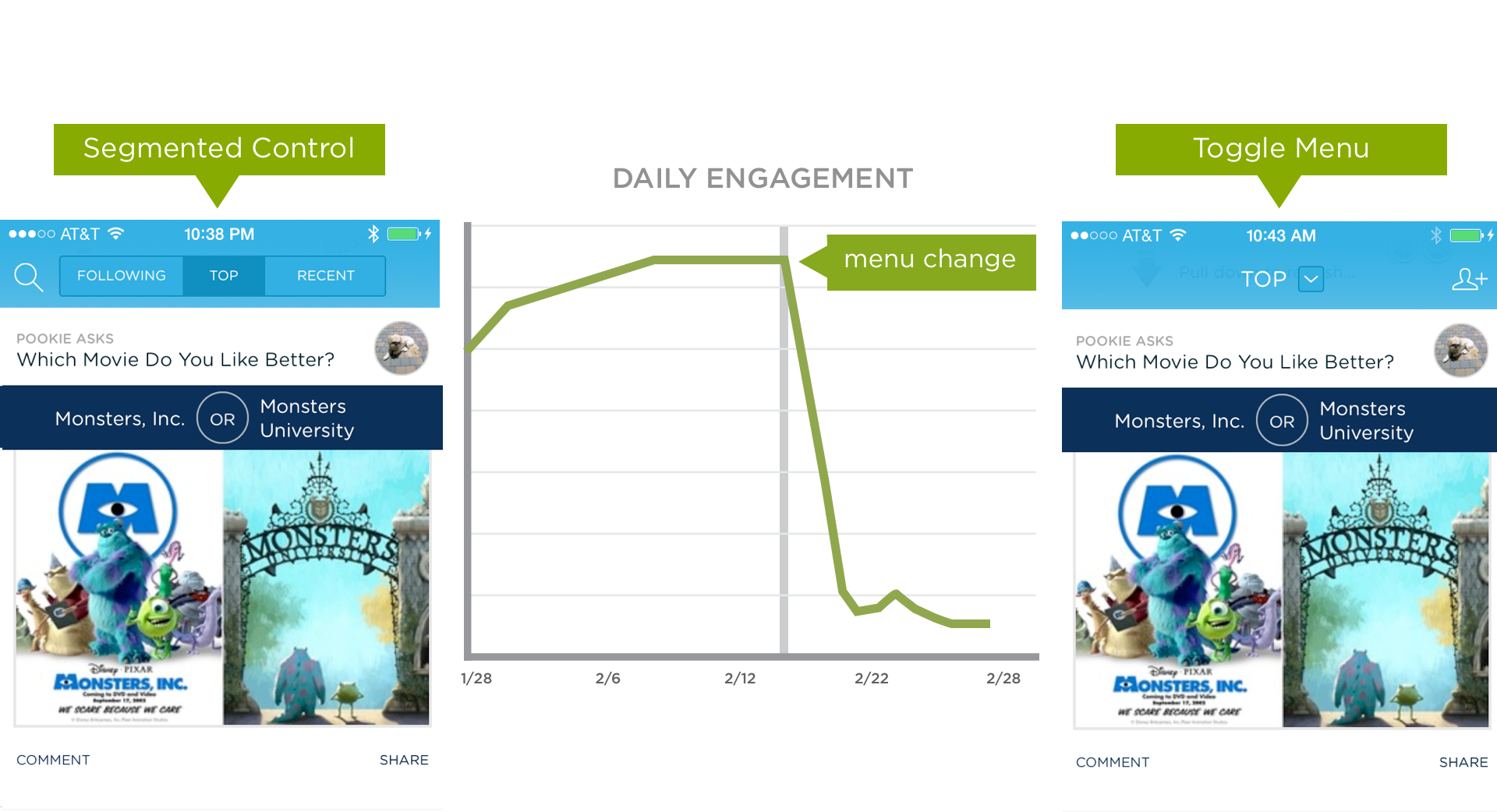
Luke Wroblewski, on how using menu controls (especially “hamburgers” and similar) can create big problems, even though the screen looks “simpler” (and so “better”, right?):

In an effort to simplify the visual design of the Polar app, we moved from a segmented control menu to a toggle menu. While the toggle menu looked “cleaner”, engagement plummeted following the change. The root cause? People were no longer moving between the major sections of the app as they were now hidden behind the toggle menu.

A similar fate befell the Zeebox app when they transitioned from a tab row for navigating between the major sections of their application to a navigation drawer menu. Critical parts of the app were now out of sight and thereby out of mind. As a result, engagement fell drastically.

[By contrast] When critical parts of an application are made more visible, usage of them can increase. Facebook found that not only did engagement go up when they moved from a “hamburger” menu to a bottom tab bar in their iOS app, but several other important metrics went up as well.

Start up: Watch experiences, Samsung gets Edgy, Nexus 7 stops, how CD leakers did it, and more


Remember? Photo by Orin Zebest on Flickr.

A selection of 9 links for you. Not golf links, no. They’re different. I’m charlesarthur on Twitter. Observations and links welcome.

My rocky first 24hrs with the Apple ᴡᴀᴛᴄʜ » Medium

Matt Haughey with a ton of really good criticism of the Watch setup for the novice user:

My phone has been downloading dozens of updates of apps made for the watch for weeks, but after getting the watch on my wrist, I realized none of those apps automatically added to the watch, but recent (meaning: as I was setting up the watch) app updates were automatically on the watch like my bank, which I don’t want on my watch. Five minutes later I learned the older apps had to be manually enabled one-by-one. Ugh. Again with the tedium. Additionally, apps asked if I wanted “Glances” enabled too, but in this first half-hour of watch ownership, I didn’t know what “Glances” were yet so I guessed and enabled it on apps I like most. I hope it doesn’t do awful things that I will have to disable one-by-one.

Hope Apple is watching stuff like this closely. As Haughey points out, the problems are also partly to do with third-party devs not having had experience when they wrote their apps and notifications. (The notes by the paragraphs are worth reading, especially those relating to your “Favourites” on the Watch itself.)


How popular will smartwatches be? » Naofumi Kagami

There are plenty of jobs where glancing at a watch is acceptable, but staring into your smartphone isn’t.

You could easily add other jobs where a smartwatch will quickly become a necessity and not just a convenience. For example, doctors working inside hospitals have to respond quickly if one of their patient’s condition suddenly deteriorates. They carry phones with them at all times, but it’s vital that they don’t miss a call. Rather then having a vibration in your pants which can sometimes be hard to notice, it’s much better to have a tap on your wrist.

Similarly, sales reps will also do much better if they quickly respond to emails or phone calls from customers, and so missing calls is not an option. For this very reason, many Japanese employees keep their phones in their shirt pocket and not in their trousers, because it’s much easier to notice a vibration on your chest. This will no longer be an issue if you are wearing a smartwatch.

Also lacking from the discussion is women who often carry their smartphones in their bags and not in their pockets. They don’t want to miss calls or important notifications either…

…This is why I am optimistic about Apple Watch sales, and sales of smartwatch sales in general. I would be very surprised if Android Wear did not start to sell briskly, although it may take a product iteration or two.


The man who broke the music business » The New Yorker

Stephen Witt, with a lovely description of what we all knew – on reflection – must be happening in the music business in the 1990s:

One Saturday in 1994, Bennie Lydell Glover, a temporary employee at the PolyGram compact-disk manufacturing plant in Kings Mountain, North Carolina, went to a party at the house of a co-worker. He was angling for a permanent position, and the party was a chance to network with his managers. Late in the evening, the host put on music to get people dancing. Glover, a fixture at clubs in Charlotte, an hour away, had never heard any of the songs before, even though many of them were by artists whose work he enjoyed.

Later, Glover realized that the host had been d.j.’ing with music that had been smuggled out of the plant. He was surprised. Plant policy required all permanent employees to sign a “No Theft Tolerated” agreement. He knew that the plant managers were concerned about leaking, and he’d heard of employees being arrested for embezzling inventory. But at the party, even in front of the supervisors, it seemed clear that the disks had been getting out. In time, Glover became aware of a far-reaching underground trade in pre-release disks. “We’d run them in the plant in the week, and they’d have them in the flea markets on the weekend,” he said. “It was a real leaky plant.”

The motives of the leakers are, to say the least, mixed. (A side note: if you look at the page source, you discover that the New Yorker includes a word count for each paragraph.)


The Oregon Trail generation: life before and after mainstream tech » Social Media Week

Anna Garvey:

We’re an enigma, those of us born at the tail end of the 70s and the start of the 80s. Some of the “generational” experts lazily glob us on to Generation X, and others just shove us over to the Millennials they love to hate – no one really gets us or knows where we belong.

We’ve been called Generation Catalano, Xennials, and The Lucky Ones, but no name has really stuck for this strange micro-generation that has both a healthy portion of Gen X grunge cynicism, and a dash of the unbridled optimism of Millennials.

A big part of what makes us the square peg in the round hole of named generations is our strange relationship with technology and the internet.  We came of age just as the very essence of communication was experiencing a seismic shift, and it’s given us a unique perspective that’s half analog old school and half digital new school.

Resonate with you? Read it.


Say goodbye to the Nexus 7 as Google pulls listing from store page » TalkAndroid.com

Jared Peters:

After releasing the Nexus 9 and not even mentioning the possibility of a refreshed 7in tablet, though, most of us could see the writing on the wall about the Nexus 7’s fate. Today, it’s finally happened, as Google no longer offers the Nexus 7 on their online store. Finding a listing for the Nexus 7 specifically says that it’s no longer for sale.

Google’s Nexus program has changed over the past couple of years, moving away from extremely affordable devices to more high-end devices that offer a flagship caliber experience without sacrificing development options and quick updates. Unfortunately, that move comes with flagship caliber price tags, too, which is evident in the Nexus 9’s doubled price tag over the Nexus 7.

The Nexus 7 is only just larger than the Nexus 6, which is a phone and is the only device you can use on Google’s Fi MVNO. Google doesn’t think tablets are worth it. (Side note: I had to follow two links to get back to this, as what seemed to be the original source. Why didn’t the first site to write it link back to the original one, rather than the first copier?)


How photography was optimized for white skin colour » Priceonomics


Photo of Villa Maria Academy, Bronx NY, 4th Grade, 1983. Photo by Wishitwas1984 on Flickr.
Rosie Cima:

The earliest colour film was not sensitive enough to accurately capture darker subjects, especially when the scene had brighter, whiter elements. This problem was particularly obvious in group portraiture, photographer Adam Broomberg has explained: “If you exposed film for a white kid, the black kid sitting next to him would be rendered invisible except for the whites of his eyes and teeth.” Photographer Syreeta McFadden, a black woman, describes the experience of looking at photos of herself as a young girl:

“In some pictures, I am a mud brown, in others I’m a blue black. Some of the pictures were taken within moments of one another. ‘You look like charcoal,’ someone said, and giggled. I felt insulted, but I didn’t have the words for that yet.”

“Film emulsions could have been designed initially with more sensitivity to the continuum of yellow, brown, and reddish skin tones,” Roth writes in her paper, ‘Looking at Shirley, the Ultimate Norm,’ “but the design process would have had to be motivated by a recognition of the need for an extended dynamic range.”…

…“I remember growing up and seeing Sidney Poitier sweating next to Rod Steiger in ‘In the Heat of the Night,’ and obviously [that was because] it’s very hot in the South,” Oscar-winning director Steve McQueen told the Washington Post, “But also he was sweating because he had tons of light thrown on him, because the film stock wasn’t sensitive enough for black skin.”

Nobody meant for film to be ‘racist’ (as Jean-Luc Goddard called it). It just happened that way. What are the embedded processes in society that do the equivalent now, and in what field of endeavour? Probably sexism, at a guess.


Samsung speeds up production of curved S6 with demand soaring » Bloomberg Business

Jungah Lee:

Samsung Electronics began production at a third factory for curved smartphone screens sooner than expected as demand surges for its Galaxy S6 Edge smartphone, according to people with direct knowledge of the matter.
Adding the production line, known as A3, enables Samsung Display Co. to more than double monthly output to 5m screens from about 2m currently, the people said, asking not to be identified as the matter is private. The plant is now online after the company previously planned on using the new factory sometime in June, one of the people said.
Samsung Electronics predicted record sales for the Galaxy S6 lineup, which includes a model with a traditional flat display, as the company seeks to win back customers who flocked to Apple’s new large-screen iPhones and Chinese vendors selling cheaper devices. Demand for Samsung’s new smartphones has exceeded company expectations since they went on sale April 10, the people said.

Interesting. It has had slow initial sales to end users in South Korea, perhaps because of restrictions on subsidies by carriers there. Of course, the “sales” in this story are to operators – not end users. That’s the acid test, and we won’t get a clear picture there for a few months.


Nobody famous » Medium

Anil Dash on the strange experience of having been put on Twitter’s Suggested Users List early on, and getting more than half a million followers – who often don’t know quite why they’re following him, but hope he can do something for them anyway:

I sometimes respond to people with facts and figures, showing how the raw number of connections in one’s network doesn’t matter as much as who those connections are, and how engaged they are. But the truth is, our technological leaders have built these tools in a way that explicitly promotes the idea that one’s follower count is the score we keep, the metric that matters. After more than a decade of having that lesson amplified across the Internet, the billion or so people who rely on online social networks have taken the message to heart.

As he says, having a really large following on a social network is strange.


BlackBerry closing design operations in Sweden, affecting up to 150 employees » TechCrunch

Ingrid Lunden:

Earlier this week smartphone maker BlackBerry confirmed it acquired Israel’s WatchDox to build out its security software business, but it looks like it may be downsizing elsewhere. According to reports from Swedish news sites, BlackBerry is closing down its software design operations in Sweden — a business that grew out of its acquisition of UI startup The Astonishing Tribe in 2010.

One report from Swedish site 8till5 notes layoffs of 100 in Malmo; other reports from news site Rapidus and financial newspaper Svenska Dagbladet says it will be letting go just over 150 employees: 93 in Malmö and 60 in Gothenburg.

Purchased for $92m; value now negative? Astonishing Tribe did stuff such as the UI of the first Android phone. Then they were hired to work on the PlayBook. Oh..


Start up: Yahoo’s mobile trouble, BLARPing, Galaxy S6’s slow start?, killing iOS, and more


Marissa Mayer, CEO of Yahoo. You OK hun? Photo by jdlasica on Flickr.

A selection of 8 links for you. Count them, I dare you. I’m charlesarthur on Twitter. Observations and links welcome.

Office role-play? Meet the people who pretend to work at an office together » Fast Company

Justine Sharrock:

You’re stuck at an office all day, deleting all-staff emails and futzing with the office printer. But imagine if you were also part of an online group, pretending that you were in an office all day.

That’s what’s happening at one of the latest cult Facebook Groups, Generic Office Roleplay. Over 2,500 members from around the world fill its virtual pages with posts that mimic office-wide emails. There are passive aggressive notes about food stolen out of the fridge, mandates about office dress and office supplies, and tips for improving synergy. Think TV’s The Office meets David Rees’s clip Art cartoons, My New Filing Technique is Unstoppable meets live action role play (LARP), all happening on Facebook.

The term of choice for its practitioners is BLARPing—business live action role-play.

This is just wonderful.


‘No iOS Zone’ Wi-Fi zero-day bug forces iPhones, iPads to crash and burn » The Register

Darren Pauli:

Adi Sharabani and Yair Amit have revealed a zero-day vulnerability in iOS 8 that, when exploited by a malicious wireless hotspot, will repeatedly crash nearby Apple iPhones, iPads and iPods.

The Skycure bods say the attack, dubbed “No iOS Zone”, will render vulnerable iOS things within range unstable – or even entirely unusable by triggering constant reboots.

“Anyone can take any router and create a Wi-Fi hotspot that forces you to connect to their network, and then manipulate the traffic to cause apps and the operating system to crash,” Sharabani told the RSA security conference in San Francisco today.

“There is nothing you can do about it other than physically running away from the attackers. This is not a denial-of-service where you can’t use your Wi-Fi – this is a denial-of-service so you can’t use your device even in offline mode.”


The denial-of-service is triggered by manipulating SSL certificates sent to the iOS devices over Wi-Fi; specially crafted data will cause apps or possibly the operating system to crash.

Fix in the works. Somewhere.


Galaxy S6 smartphones suffer weaker than expected sales in S. Korea » Yonhap News

Samsung Electronics Co.’s newest high-end smartphones – the Galaxy S6 and the Galaxy S6 Edge – are seen drawing less than expected attention from consumers, industry data showed Wednesday, casting clouds over the market’s upbeat sales estimate of over 50m units for 2015.

South Korea’s No. 1 tech giant had sold a little over 200,000 units of the two smartphones here as of Sunday since their launch on April 10, sharply falling short of the 300,000 preorders, according to the data, indicating that earlier sales forecasts may be exaggerated…

…industry watchers have been painting rosy pictures of the gadgets, with Hong Kong-based industry tracker Counterpoint suggesting the two will sell more than 50m units this year, while some researchers even gave a 70m-unit forecast.

But some industry watchers say the 10-day sales figure is not alarming, given that South Korea’s already saturated smartphone market is currently dented by the country’s regulations on subsidies.

Korea may be a special case (and the story says carriers are pushing harder on subsidies). But I think Samsung might find the top end saturated. This is going to be fascinating to watch play out.


Does a higher bill mean a better 4G service? » OpenSignal blog

Kevin Fitchard, guest-posting:

The U.S. has the highest average revenue per subscriber (ARPU) of the 29 countries sampled in the analysis at about $59. Yet as far as network speed goes, the U.S. ranks 26th out of 29, supplying an average connection of 7 Mbps. Meanwhile the lowest ARPU in the sample, $3, belongs to the Philippines, yet its two LTE operators deliver average speeds of 8 Mbps, ranking the country above the U.S.

The fastest LTE performance can now be found in Northern Europe, Spain, France, Hungary and South Korea, where speeds between 16 and 18 Mbps are the norm. But the differences in ARPU between them are huge. In Denmark, ARPU is around $19 a month. In Norway that number is $34, which is more in line with South Korea’s ARPU of $33 than it is with Norway’s neighbor just over the North Sea.

Within countries, the pattern – or lack thereof – was the same. In the U.K., EE has the distinction of having the fastest speeds (17.8 Mbps), seemingly justifying the $2 to $6 more it collects in ARPU over its competitors Vodafone and O2. But in the U.S. the opposite is true. T-Mobile has by far the fastest speeds (10 Mbps) compared to Verizon, AT&T and Sprint, but its ARPU is $49, undercutting its next cheapest competitor by $8 a month.

US 4G is more like European HSDPA+. But you try telling them that… (I’m a customer of Three in the UK, which offers 4G for free. I like it.)


Tesla: It’s a battery! » MarketWatch

Claudia Assis:

At the event [on 30 April], Tesla “will explain the advantages of our solutions and why past battery options weren’t compelling (OK Elon said “sucked”),” Tesla’s IR manager Jeff Evanson wrote in an email to analysts and investors early Wednesday. “Sorry, no motorcycle…but that was a creative guess.”

Shares of Tesla rose nearly 5%. A close around those levels would be Tesla’s highest in two weeks. Tesla shares have gained 9% in the past three months, but lost 1.4% in the last 12 months. That compares with gains of 2% for the S&P 500 index SPX, +0.27%  in the past 12 months.

Tesla Chief Executive Elon Musk said Tesla was working on a battery for homes and business back in February, when the company announced fourth-quarter results. Last month, Musk tweeted about a new “major product line” to be unveiled on April 30, saying only it was not a car.

Regular readers have known this since 3 April.


How Timehop was created » Business Insider

Maya Kosoff on Timehop, which has 19 staff but 15m registered users (of whom 7m check in every day) to see what they were doing exactly a year ago on social media:

When Jonathan Wegener and Benny Wong started Timehop in 2011, they were working on a completely different project: a Craigslist replacement. Wong and Wegener — self-proclaimed “Foursquare fanboys” — participated in Foursquare’s first-ever hackathon, and they ended up building out a product on top of Foursquare’s API that showed users where they checked in on Foursquare a year ago.

They appropriately called the product, which they built in eight hours, 4SquareAnd7YearsAgo.

“The original inspiration for it was the ghost in Mario Kart, where you get to race yourself in time trials after you’ve done a race,” Wegener says. “We thought it would be really interesting to do that with your Foursquare checkins.”

First time that a useful idea has taken inspiration from a game concept?


Yahoo’s CEO Marissa Mayer on Q4 2014 results – earnings call transcript » Seeking Alpha

This is from January, where Mayer was asked whether Yahoo would try to knock Google off iOS as the search default (as it has on Firefox in the US – because Google didn’t bid, I understand):

I will take the question on the Safari deal. The Safari platform is basically one of the premiere search engine in the world, if not the premiere search engine in the world. We are definitely in the search distribution business. I think we stated that really clearly in the past and I think with Mozilla and also in addition we brought Amazon and eBay onboard with smaller distribution partnerships in Q4, we are in search distribution business and anyone who is in that business needs to be interested in the Safari deal.

The Safari users are among the most engaged and lucrative users in the world and it’s something that we would really like to be able to provide. We work really closely with Mozilla to ultimately bring to their users an experience that they designed and that they feel really suit those users and we welcome the opportunity with any other partner to do the same, particularly one with Apple’s volume and end user base.

I think when she said “the premiere search engine in the world”, she meant “one of the most-used browsers to access search engines”. Statcounter data suggests Safari was used for half of US smartphone and tablet use in March; if Mayer crazy enough to try to buy that search deal when it comes up later this year? (There’s no mention of it in the Q1 earnings transcript.)


AdBlock Plus proves it’s not illegal » Betanews

So hated is AdBlock Plus, in fact, that a case was brought against the tool to try to prove that it is illegal.

Now a court in Hamburg has come to a decision, and ruled that AdBlock Plus – in case there was ever any doubt – is entirely legal. The plaintiffs in the case alleged that AdBlock Plus should not be permitted to block ads on the websites it owns. The judge presiding over the case disagreed.

The court ruled that AdBlock Plus is well within its rights to provide the option to hide advertisements on websites. The company sees this as setting a precedent and is taking this moment in the spotlight to reach out to content creators to work together to “develop new forms of nonintrusive ads that are actually useful and welcomed by users.”

ABP’s Ben Williams enjoys his Nelson Muntz moment on the company blog.


Start up: YouTube v smart TV, Google’s PR war, Gear Fit obsolete?, HTC goes in-car


You could watch this instead of YouTube on your old Apple TV or smart TV. Photo by ~Prescott on Flickr.

A selection of 7 links for you. Al dente. I’m charlesarthur on Twitter. Observations and links welcome.

Yahoo’s tiny, slow-growing mobile business » Beyond Devices

Jan Dawson on Yahoo’s first-quarter earnings:

Marissa Mayer must have described Yahoo as a mobile-first business a dozen times or so on the earnings call this afternoon. However, as Yahoo has also been quantifying its mobile business lately, we have some hard numbers to evaluate this claim by, and they’re not all that good at backing up her repeated claim.

Graphs don’t lie. Get left behind monetising mobile, and you’re left behind.


Wolff: Google’s antitrust bet that it’s a tech-led world » USA Today

I don’t usually have much time for Michael Wolff, but this seems on the money:

The other lesson that Google has clearly learned from Microsoft’s failures [to forestall antitrust action in the US and Europe] is that this is as much a PR battle as a legal one. Microsoft, wherever it went, was the nasty, unstoppable and lethal Goliath, gaining no sympathy in any quarter. Google, as nasty, unstoppable and lethal as Microsoft, understands the vast benefits of being, if only through the looking glass, the highest example of innovation and forward-thinking. Europe, and anyone who would get in its way, is the past, and Google — and you don’t want to miss this train — the obvious future.

Much of the world, including the world’s media, once happily aligned against evil-empire Microsoft.

Google’s bet now is that the world is a different place: the bias is actually for hegemonic tech companies instead of against them. Google is likely more dominant than Microsoft, both in the market and in the lives of its users, but that may well be to its benefit.


Apple TV, smart televisions hit by YouTube blackout » Expert Reviews

YouTube apps on older Apple TVs, smart televisions and iPhones may no longer work today after Google switched off an API that served many of these older devices. Products sold as recently as three years ago may no longer be able to stream from the world’s biggest video service.

The retirement of Google’s Data API v2 will leave some YouTube apps unable to show anything more than a warning message. Second-generation Apple TVs, iPhones and iPads running on iOS 6 or earlier, and many smart televisions, set-top boxes and Blu-ray players sold before 2013 will all be affected by the switch off.

Google has published a support page showing how different devices will be affected. Second-generation Apple TV owners are warned that “unfortunately, there’s no current way to watch YouTube on these devices”. Those still running iOS devices on iOS 6 or earlier are told they will either have to upgrade their OS (if possible) or watch YouTube video by going to the YouTube mobile site in the Safari browser. 

Older smart TV or games console owners are advised that they too may be able to continue viewing YouTube through the device’s web browser, but only if that browser supports flash and/or HTML5. 

Depending when you reckon smart TVs came along, this could hit between a third and half of those in place; TV sets get replaced about once every ten years. Having a YouTube app on a screen that doesn’t function to show you YouTube seems like a bit of a hassle.


Dilbert And Alice Add Features » Dilbert by Scott Adams

So true. Comments nail it too.


Samsung Gear Fit, or hardware obsoleted by software » Glazblog

Daniel Glazman has one – released with the Galaxy S5 on 11 April 2014. But he’s not happy:

The Gear Fit has a few downloadable extensions, based on a SDK also released a year ago. The fact extra apps can be created and maintained is a very important indicator of not only the market success of a given device, but also of the obsolescence of the device.

That SDK is not available any more from http://developer.samsung.com, as it is confirmed here. And it’s not a very recent change. Samsung then turned obsolete – because of software – a hardware they released less than a year ago. From a customer’s perspective (again, I bought that device), that’s pretty shocking.

The Samsung Gear Fit is still available everywhere here in France, from Orange stores to supermarkets. But it’s a dead duck without a SDK. Don’t buy it.


Review: Apple Watch for health and fitness » Re/code

Lauren Goode did a fairly deep dive (but not underwater, it’s not waterproof – haha) into the use of the Watch. I found this part about GPS interesting, because I was unclear from Apple’s description back in March, and thought it did have GPS. Turns out it doesn’t – but read on:

Apple Watch doesn’t have GPS, so you have to carry your iPhone with you if you want to track your run with GPS. Even if you do run with your iPhone, neither the Workout app nor the Activity app show you maps of courses you have run.

Also, the Workout app doesn’t show runners things like splits or cadence, although it’s possible that a third-party app could utilize the watch’s sensors and display this. And the Workout app doesn’t give audio alerts at key points throughout your run, which many running apps do.

That said, the Apple Watch automatically calibrates to your stride during your first few runs, so that even if you later run without your iPhone, you’ll get a close-to-accurate reading on distance. I found this to be true when I ran a couple of my regular neighborhood routes, and when I ran a 5K road race on an unfamiliar route, without my iPhone. Apple Watch recorded my 5K race as 3.05 miles, just .05 shy of the actual distance.


HTC in-car wireless device certified » Digitimes

Max Wang and Steve Shen:

HTC is reportedly stepping into the IoV (Internet of Vehicles) market and has one of its in-car wireless devices, the Think+ Touch OBU 2015, certified by Taiwan’s National Communications Commission (NCC), according to industry sources.

The Think+ Touch OBU 2015 features Bluetooth, GPS navigation, a lane departure warning system, tyre pressure monitoring system and sonar-based collision avoidance system, while supporting Android 4.4 KitKat platform, the sources noted.

Interesting move by HTC, though wonder how much retrofitting this would take (tyre pressure monitoring?). Also, please let “Internet of Vehicles” not be a thing.


Start up: Chrome v Safari, designing Windows Phone, Apple Watch value, S6 battery life and more

Remember? That’s when Instagram for Windows Phone was last updated. Photo by Theen Moy on Flickr.

A selection of 9 links for you. Really, they are. I’m charlesarthur on Twitter. Observations and links welcome.

The Roomba for lawns is really pissing off astronomers » WIRED

Davey Alba on how the automated method of mowing lawns (using beacons to guide the mowers) could be a hassle for the star-struck:

the system requires special permission from the FCC due to its restrictions on fixed outdoor infrastructure. In a nutshell, the FCC doesn’t want people creating ad hoc networks of transmitters, which could interfere with existing authorized services like cellular and GPS systems. In its filings, iRobot says it should be exempt because it doesn’t set out to establish a broad communications network — its lawnbot networks would be tightly contained.
Astronomers say that’s not good enough. The frequency band proposed for the lawnbot (6240-6740 MHz) is the very same one several enormous radio telescopes operate on. Astronomers want the FCC to protect their share of the radio spectrum so their telescopes continue observing methanol, which abounds in regions where celestial bodies are forming.


Chrome is still a threat to your MacBook’s battery » The Verge

Vlad Savov on the comparative battery life of MacBooks using the Chrome browser, and Apple’s Safari:

It’s not just the distance you can go with Chrome that’s an issue. The speed and quality of the ride are also compromised. The widely used SunSpider browser benchmark clocks the MacBook Pro in at 203ms when using Chrome. Safari scores 30% better with a time of 144ms. Same machine, very different outcomes. You’d think YouTube would be a spot where Google collects an easy win, but that’s been another cause of distress: the new 4K 60fps videos that YouTube now supports are playable on the MacBook, but only — you guessed it — when using Safari and not Chrome. Google’s own browser chokes while playing back video from Google’s own video service.

Chrome’s problem is that it sets every page up as a virtual machine, demanding its own chunk of memory. Safari.. does it differently. The difference in battery life, though, is huge. Commenters weighing in seem to agree (while also liking the convenience of Chrome).


Apple Watch: an overnight multi-billion dollar business » carlhowe.com

Carl Howe used to analyse this sort of stuff for a living. Here he helps you think of the supply chain issues involved in the Apple Watch by likening it to producing a million origami lobsters:

Now let’s make this a little more realistic. As it turns out, we really want a million lobsters of two different sizes. Further, ordinary paper tears too easily and is the wrong colour for Origami lobsters, so we’ve decided to make our own paper; that will require its own process. We also need to be able to deliver some of the lobsters with glitter and others with hand-painted decorations; we’ll need to plan to supply and apply those materials too. Oh, and we want to make a few thousand out of two colors of pure gold leaf instead of paper. You’ll have to manufacture the paper for that too.
What’s your plan look like now?
There’s no rush; you can deliver your million lobsters any time during the month, provided that you don’t mind people complaining that you are way too slow at getting this done. Oh, and you’ll be criticized in the international press for every failure to produce perfect lobsters.
And now, imagine this same plan, except with this twist: no one has successfully folded this particular type of Origami lobster before, so you really don’t know how it’s all going to turn out. And your reward if you are successful will not be praise, but demands that you build even more next month.

This is such a wonderful post for wrapping your head around supply chain issues – as good in its way as Greg Koenig’s commentary about the amazing mechanics of how the Apple Watch is made.
Howe has a number for how many Watches have been sold, but you need to read his piece to find out. He’s probably right. (He also notes in an update that there’s only one module – that is lobster – so the Watch is even more profitable.)


Galaxy S6 Edge battery life – 4 days later » Android Authority

Let’s revisit Nirave Gondhia and see how he’s getting on with his series:

Another day of 13 to 16 hour battery life suggests that with my usage pattern, this is the most I can expect from the Galaxy S6 Edge. However, considering that the average user works approximately eight hours per day, it’s clear that the Galaxy S6 Edge will last a full working day, allowing you to charge it overnight and rely on it until you get home after work.
Another thing to take away is that using your phone at 50% brightness or less adds several hours to your battery life. I’ve done further testing on this and it’s certainly a key factor. The octa-core processor drives over 3.6 million pixels and if the brightness is set to full, it draws a large amount of power. Reducing to around 50 to 60% could increase your screen-on-time by over 50%.

16-hour battery life would certainly take you through a lot of the day.


Ex-Microsoft designer explains the move away from Metro » Thurrott.com

Paul Thurrott filleted an AMA by the designer of the new version of Office for Windows Phone so you don’t have to wade through the original. Fascinating bits, including:

Why is the hamburger menu in the top left of the display? It’s hard to reach, etc. I actually argued for top right. The issue with top right is that no one else does [it]. Being a special unique snowflake works for art but not design. Design should be invisible, so people shouldn’t be thinking ‘oh that’s odd. I’ve never seen this button used like this. I wonder if it does the same thing?’ … The industry decided top left. So to go against it you need to earn it. You need to be far, far better or else it just stands out awkwardly.”
But people need to be able to use it with one hand. “What the research is showing is that people aren’t actually as wedded to one handed use as we used to believe they are. Don’t get me wrong, this is clearly a tradeoff. Frequently used things have to be reachable, even one-handed. But hamburgers are not frequently used, and one-handed use is not ironclad. Combine those two factors together and you see why the industry has settled on this standard. It wasn’t random … And, sorry. But the hamburger has some real issues, but ‘I can’t reach uncommon things without adjusting my hand on my massive phone and that annoys me because it reminds me of the dominant OS on earth” [is not one of them].
But the bottom is better. “It turns out bottom is not better. You’d think that something 3 pixels from your palm would be easier to reach than something in the middle of the phone. But nope.

This really is a terrific post with so much about comparative user experience; this is the link you really should read today.


It has been one year since Instagram was last updated for Windows Phone » Neowin

Brad Sams:

It was on 3.22.14 that the Instagram beta was last updated and the app has remained unchanged since that day. In essence, this app represents the exact issue Windows Phone fans have expressed tirelessly over the years: It’s not the lack of apps, it’s the lack of support for the apps that do exist.
Twitter is another good example. While this app is updated more frequently, it lacks features of its iOS and Android counterparts. By all accounts, Twitter’s Windows Phone app is a distant second-thought for the company and while it is semi-frequently updated, when it does get new features, it’s months or years after the other apps.
Microsoft is aware of this, to no surprise, and they do hope that their universal apps will help to remedy this situation but it will not be an overnight fix.

It’s nice to hope. Has anyone pointed out yet that Instagram isn’t a desktop app, but is mobile-only, so the big Windows desktop installed base doesn’t matter at all to the company? Let me be the first then. Same for Snapchat, Uber.. the list goes on.


Here’s how much a Samsung Galaxy S6 replacement battery (and screen) costs » PC Mag

Sascha Segan:

According to a Samsung spokesperson in touch with the company’s support team, the Galaxy S6 battery has a one-year warranty. If its maximum capacity drops below 80% of its initial level during that year, your replacement is free (although you still have to pay for shipping.) At any other time, the replacement costs $45, plus shipping, though Samsung did not detail shipping costs.
That’s less than the $79 Apple charges for an iPhone battery replacement, but more than the official $29.99 price for a Galaxy S5 battery…
Samsung has walk-in repair centers in Los Angeles and Plano, Texas that don’t require shipping and do same-day battery swaps, the company said. Samsung is looking to establish those centers in more cities.
Screen replacements, meanwhile, cost $199 for the Galaxy S6 and S6 Edge. That’s more than the $109 Apple charges for iPhone 6 screen repair, but less than the $299 Apple charges for repairs that involve more than the screen. Samsung screen replacements also have a one-day turnaround.


Apple Pay plans to launch in Canada this fall » WSJ

Rita Trichur and Daisuke Wakabayashi, who note that Canada has lots of iPhones (30% installed base of smartphones) and lots of NFC-capable payment systems:

Canadian banks want Apple Pay to work in a way that requires a “secondary authentication” to verify customer information before cards can be used with the phones. That means that a consumer could be required to enter a PIN, log-on to a mobile banking app or use a one-time passcode sent via text message before cards can be used on Apple Pay, those people said.

Fair enough. Seems sensible given the problems US banks saw in letting people add cards without authentication. But then it carries on:

The trouble with that approach, however, is that it creates a clunky experience for consumers who expect mobile payments to be seamless—similar to tap-and-go credit cards that are already in wide use in Canada.

I checked this with the writers – surely the banks just want to authenticate initially, not every time? – but Trichur assured me she was hearing that the banks are considering a per-transaction authentication. Sounds bonkers to me.


This is why daddy drinks » Rusty Rants

Russell Ivanovic has been a dedicated disliker of Samsung phones since the S2 because “they often represented the worst possible Android experience you could have”. But they needed to have an S6 in the Shifty Jelly offices (which do Android app development):

The first thing that struck me was the build quality. It’s really good. The next thing that struck me was the screen. It’s amazing. Bright, super high density (far higher than the iPhone and Moto X I’m used to) and so beautiful. Then I was struck by the speed…this thing is fast…like really fast. Then I took a few test photos, and damned if they didn’t look better than all the same photos I was taking with my iPhone 6. In short I had a ‘huh?’ moment. Was it possible this was a good phone?


Start up: correcting Google, science says videogames don’t make sexists, iPhone forecasts, and more


This is how we used to write and correct “blogposts”, kids. Photo by Julie McGalliard on Flickr.

A selection of 10 links for you. For free! I’m charlesarthur on Twitter. Observations and links welcome.

Electric cars won’t spread even with rapid chargers: Toyota engineer » Yahoo Finance

Electric vehicle (EV) supporters have touted developing high-speed charging technology as the way forward for cars like Nissan Motor Co’s Leaf. But Yoshikazu Tanaka, chief engineer of Toyota’s hydrogen fuel-cell car Mirai, said that would guzzle so much energy at once as to defeat the purpose of the EV as an ecologically sound form of transportation.

“If you were to charge a car in 12 minutes for a range of 500 km (310 miles), for example, you’re probably using up electricity required to power 1,000 houses,” Tanaka told a small group of reporters at the first test-drive event for the production version of the Mirai, the world’s only mass-market fuel-cell car.

“That totally goes against the need to stabilize electricity use on the grid.”

Ah. Good point.


Sub-Rs 10,000 smartphones contributing 75% of sales: Lenovo » India Times

Chinese tech major Lenovo today said almost three-fourth of its smartphone sales is coming from devices priced below Rs 10,000 [US$160].

The company offers smartphones priced in the range of Rs 4,000 to Rs 30,000.

“The industry itself sees about 75% of the sales coming from smartphones priced under Rs 10,000 and we have more or less a similar split,” Lenovo India Director Smartphones Sudhin Mathur told PTI.

The company started as a premium player but now have devices across entry, mid and premium segments, he added.


How many iPhones did Apple sell last quarter? » Fortune

Philip Elmer DeWitt:

BTIG’s Walter Piecyk has the low estimate (50m), independent Faizai Kara of the Braeburn Group the high (64m). The average estimate of each group — pros at 55.6m and amateurs at 59.3m — are not that far apart. Either would represent double-digit growth from the same quarter last year.

Last year’s figure was 43.7m. Apple financials are released after US market close on Monday.


Indian companies pull out of Facebook’s Internet.org amid battle over net neutrality » WSJ Digits blog

Aditi Majhotra:

A viral crusade to keep the Internet equally accessible to all users has won the backing of some of the country’s biggest online companies, which late Wednesday pulled out of a partnership with Facebook’s Internet.org over fears it could allow telecom operators to choose which web applications users can access and how fast.

India’s sophistication in this space shouldn’t be a surprise, yet it is.


From Product Club to Thington Inc. — Welcome to Thington » Medium

Tom Coates:

The more we explored the space, the more we found that however good and interesting the hardware was in the Internet of Things, the software and service layers were generally awful. Gradually, we came to believe that huge problems in these layers were hiding all of the value and the potential of the technology.

Which brings us to Thington! We decided that we wanted to build a new user interface and service layer that would push past all these problems and in the process bring in our experience working on social systems, location sharing, privacy, hardware and the web of data. And we’re super excited by what we’ve come up with. So excited in fact that we’ve put our money where our mouths are and have formally changed the name of the company from Product Club to Thington Inc.

Keep an eye on this: Coates and colleagues have a solid track record in making useful stuff.


The Search for Harm » Official Google Blog

Knowing that the EC would issue a Statement of Objections (because it sent them to Google ahead of time), Amit Singhal, Senior Vice President, Google Search, put his name to this blogpost which aimed to show that all the EC complaints are nonsense.

And it’s Google, so it’s all going to be built on really robust data, right? Except that the blogpost has been updated at least twice:

*Update: An earlier version of this post quoted traffic figures for Bild and The Guardian, researched on a third-party site. The Guardian data were for the domain guardian.co.uk, which is no longer the main domain for the paper. We’ve removed these references and we’re sorry for the error.

That was the first. And then:

Yelp has pointed out that they get 40% of their searches (not their traffic) direct from their mobile apps. They don’t appear to disclose their traffic numbers. We’re happy to correct the record.

Did I start the ball rolling querying the numbers in Singhal’s post? Yes, I did. Someone has to ask questions of Google, and it seems all the bloggers and reporters feverishly writing hot takes didn’t.

But if those two statistics are wrong… what about all the others in Singhal’s blogpost? Guess we’ll have to look at it all in detail at some point soon.


L.A. school district demands iPad refund from Apple » LA Times

The contract with Apple was approved by the Board of Education in June 2013 as part of a deal expected to reach at least $500m. Another $800m was earmarked to improve Internet access at schools.

Under the contract, Pearson was to provide English and math curriculum. The district selected Pearson based only on samples of curriculum — nothing more was available.

L.A. Unified made the deal anyway; it wanted to bundle the curriculum and the device into a single price. A three-year license to use the curriculum added about $200 to the $768 cost of each iPad. The entire purchase then was financed through school construction bonds, which can be used to purchase computers.

L.A. Unified bought 43,261 iPads with the Pearson curriculum. The district purchased another 77,175 iPads under the contract without the Pearson curriculum to be used initially for state standardized tests.

Pearson could offer only a partial curriculum during the first year of the license, which was permitted under the agreement. Teachers and principals never widely embraced the product.

Nearly a year ago, L.A. Unified sent Apple a letter demanding that it address problems with the Pearson curriculum.

“Only two schools of 69 in the Instructional Technology Initiative … use Pearson regularly,” according to an internal March report from project director Bernadette Lucas.

Seems like it’s the Pearson curriculum that’s screwed up more than the iPads, though the two also seem intertwined. The whole contract has unwound horribly.


Sexist Games=Sexist Gamers? A longitudinal study on the relationship between video game use and sexist attitudes » Abstract

Enlisting a 3 year longitudinal design, the present study assessed the relationship between video game use and sexist attitudes, using data from a representative sample of German players aged 14 and older (N=824). Controlling for age and education, it was found that sexist attitudes—measured with a brief scale assessing beliefs about gender roles in society—were not related to the amount of daily video game use or preference for specific genres for both female and male players. Implications for research on sexism in video games and cultivation effects of video games in general are discussed.

Unfortunately the study itself is paywalled, but this is the first potentially rigorous scientific study I’ve seen into the topic. So do we conclude that sexist dolts who play games would just be sexist dolts regardless? I think that’s pretty easy to answer. (Thanks to Jay Kannan for the link.)


Given enough money, all bugs are shallow » Coding Horror

Jeff Atwood on the trouble with open source and bugs (or even just code and bugs):

While I applaud any effort to make things more secure, and I completely agree that security is a battle we should be fighting on multiple fronts, both commercial and non-commercial, I am uneasy about some aspects of paying for bugs becoming the new normal. What are we incentivizing, exactly?

Money makes security bugs go underground

There’s now a price associated with exploits, and the deeper the exploit and the lesser known it is, the more incentive there is to not tell anyone about it until you can collect a major payout. So you might wait up to a year to report anything, and meanwhile this security bug is out there in the wild – who knows who else might have discovered it by then?

If your focus is the payout, who is paying more? The good guys, or the bad guys?


SanDisk forecasts first full-year revenue decline in three years » Reuters

Arathny Nair:

There is strong demand for SanDisk’s solid-state drives and memory chips.

But lower pricing, lean inventory, unplanned maintenance at its chip foundry last year and delay in sales of certain embedded parts has led to two revenue forecast cuts this year, including a warning last month.

“It looks like SanDisk is going to have pretty tough road ahead to haul in 2015,” said Wedbush Securities analyst Betsy Van Hees, adding that the company’s spending is high and will continue at “elevated levels”…

…The company had said in January it had lost a major customer, widely believed to be Apple Inc, which switched to using solid state drives made by Samsung Electronics Co Ltd in its MacBooks.

Would love to know quite how the (SD) memory chip demand is going in smartphones. Something about SanDisk’s SD business reminds me of Iomega – seemed like a great business offering consumer storage, which abruptly collapsed (when CD-Rs got cheap). SanDisk’s financials suggest the glimmerings of a fall in revenue in its “removable” business.


Start up: spotting comment trolls, stopping piracy Of Thrones, where’s Android One?, and more


Try putting those on Bittorrent, suckahs. Photo by Jemimus on Flickr.

A selection of 8 links for you. Use them wisely. I’m charlesarthur on Twitter. Observations and links welcome.

Scientists develop algorithm that can auto-ban internet trolls » The Stack

Martin Anderson:

The study found that on CNN the studied trolls were more likely to initiate new posts or sub-threads, whilst at Breitbart and IGN they were more likely to weigh into existing threads.

The report does not exonerate host communities of all blame for troll behaviour, finding that immediately intolerant communities are more likely to foster trolls:

“[communities] may play a part in incubating antisocial behavior. In fact, users who are excessively censored early in their lives are more likely to exhibit antisocial behavior later on. Furthermore, while communities appear initially forgiving (and are relatively slow to ban these antisocial users), they become less tolerant of such users the longer they remain in a community. This results in an increased rate at which their posts are deleted, even after controlling for post quality.”

Seems mostly accurate, apart from calling breitbart.com a “political hub”. I’d go for “troll-employing troll magnet”, personally.


Game Of Thrones leak and watermark: a stupid tracking system » bru’s blog

The first four episodes of game of thrones leaked nearly 36 hours ago. They have been extensively downloaded, and the only tracking set up HBO seemed to be a watermark in the bottom left corner of the screen. Once blurred, it is useless. This impresses me. It’s 2015 and all you’re using is a “confirm you’re deleted” + “your copy is watermarked” for protection? There are simple schemes that would have allowed HBO to track the leak.

The idea is very simple: make each copy unique in a non-visible way.

Seems like the editing to create unique copies would be a hassle. Not sending them out (by getting people to come in to previews?) might be simpler. But there would be geographic reasons against that. No matter what, though, it only delays the piracy by 36 hours or so. That’s the bigger problem.


BOMBSHELL: MUSL employee might have rigged Hot Lotto computerized drawing » Lottery Post

Prosecutors countered this motion by claiming they have a “prima facie,” or at first glance, case that Tipton tampered with lottery equipment.

In their reply to the defense’s motion, prosecutors argued that Tipton’s co-workers said he “was ‘obsessed’ with root kits, a type of computer program that can be installed quickly, set to do just about anything, and then self-destruct without a trace.” The prosecution claimed a witness will testify that Tipton told him before December 2010 that he had a self-destructing root kit.

Prosecutors also argued in their reply that Tipton was in the draw room on Nov. 20, 2010, “ostensibly to change the time on the computers.” The prosecution alleged the cameras in the room on that date recorded about one second per minute instead of how they normally operate, recording every second a person is in the room.

“Four of the five individuals who have access to control the camera’s settings will testify they did not change the cameras’ recording instructions; the fifth person is Defendant,” the prosecution wrote.

Someone’s writing the screenplay already, yes? The accused bought a ticket that won $14.3m.


What’s Become of Android One? » CCS Insight

Peter Bryer is an analyst:

our checks indicate that Android One has had a limited direct effect on the market, despite initial enthusiasm for the programme. Sales of Android One-based smartphones began more than half a year ago in India, but volumes don’t stand out.

The first Android One products came from Karbonn, Micromax and Spice, with more familiar brands expected to begin adopting the platform. Acer, Asus, HTC, Lenovo and Panasonic were among the smartphone manufacturers listed by Google as partners in the project, but this interest appears to have stalled.

The fading momentum of Android One is an indication of the expanding selection of equally well-specified, low-cost smartphones and tablets in emerging markets. Hundreds of models are available at $100 or below — a once impossible price band has become very ordinary.

The standard having been set, others have matched it. All works for Google. But see later…


Flipkart’s move to dump mobile site could hit Google » WSJ

Rolfe Winkler:

Indian e-commerce giant Flipkart has decided it doesn’t need to rely on the Web to lure shoppers, dumping its mobile site and pushing visitors to its app. That move may spell trouble for the future of Google ‘s cash-cow search engine, which relies heavily on links to shopping sites.

Smartphone users that go to the mobile websites of either Flipkart or its sister site Myntra no longer see the same virtual store shelves as when they visit those sites from a personal computer. Instead they see a message to download the sites’ mobile apps.

The problem for Google is that a large percentage of its ad business is driven by paid links that direct users to e-commerce sites. But mobile apps are walled gardens unto themselves, unconnected by links to the broader Web.

A general problem, but if it starts happening early in countries like India, that is a problem for Google.


Brazil’s iPhone investment falls short on promises of jobs, lower prices » Reuters

Brad Haynes:

The Brazilian iPhone was meant to mark a new era.

When Taiwan’s Foxconn Technology Group agreed in April 2011 to make Apple products here, President Dilma Rousseff and her advisers promised that up to $12 billion in investments over six years would transform the Brazilian technology sector, putting it on the cutting edge of touch screen development. A new supply chain would be created, generating high-quality jobs and bringing down prices of the coveted gadgets.

Four years later, none of that has come true.

Foxconn has created only a small fraction of the 100,000 jobs that the government projected, and most of the work is in low-skill assembly. There is little sign that it has catalyzed Brazil’s technology sector or created much of a local supply chain.

Not quite clear where the blame lies – high expectation by Foxconn, local taxes or local culture.


Formal charges may be next in Europe’s Google antitrust inquiry » NYTimes.com

James Kanter and Conor Dougherty:

Some experts say that Mr. Almunia’s unsuccessful strategy makes further attempts to settle the case without formal charges unlikely.

“Given the history of failed attempts to reach a commitment decision, I just don’t see what she would gain from going down this route again, unless Google has promised more concessions that we don’t know about,” said Liza Lovdahl-Gormsen, the director of the Competition Law Forum at the British Institute of International and Comparative Law.

Without formal charges, Ms. Lovdahl-Gormsen said, “Google might try to buy themselves time by offering commitments that are unlikely to be accepted by the commission, and that it knows won’t be accepted by the market, simply because it does not want to be faced with the instrument of torture — the statement of objections.”

Expect news on Wednesday.


My voice is my passport: Android gets a “Trusted Voice” smart lock » Ars Technica

How secure is this system? We’re wondering the same thing. The popup when you enable “Trusted Voice” warns that the feature is not as secure as a traditional lock screen and that “Someone with a similar voice or a recording of your voice could unlock your device.” We’d love to test it out, but it hasn’t rolled out to any of our devices yet—we only know about it thanks to a report from Android Police.

Android Police hasn’t given it any scrutiny (none of its devices – even Nexuses – seem to have got it.) The commenters on AP don’t seem enamoured, though, pointing out how easy it would be to spoof (as Google itself admits). So there’s now pattern, PIN, face and voice unlock, and also “trusted device” (Android Wear). Flexibility is good, but they aren’t all equally robust, which feels like a problem.


Start up: PC shipments slump (again), are reviews broken?, Tidal’s challenge, monetising Android and more


Now containing fewer PCs. Photo by runner310 on Flickr.

A selection of 8 links for you. Use them wisely. I’m charlesarthur on Twitter. Observations and links welcome.

Mercury News editorial: Google’s YouTube Kids should meet TV ad standards » San Jose Mercury News

It’s disappointing that Google didn’t voluntary follow the Federal Communications Commission’s longtime TV standards with its online YouTube Kids app, which ignores basic protections for children whose developing brains cannot grasp the difference between ads and entertainment.

The Federal Trade Commission, not the FCC, has jurisdiction over online commerce, and it needs to catch up. Google apparently decided to push the envelope, given its mission as a public company is to maximize profits.

But as one of the Valley’s biggest success stories — it could reach a market capitalization of $1 trillion in this decade — Google should be a leader in taking responsibility for the welfare of children viewing products designed for them. So should Netflix, Apple and any other Valley company producing or contemplating kids programming.

Now the FTC is investigating. You won’t however have been surprised by Google’s behaviour if you read my piece on Google, EC, antitrust and the FTC, which looked at the tenets the search company works by.


Product reviews are broken » Above Avalon

Neil Cybart:

I still think the world needs independent product reviews. There is enough prior misbehaviour on behalf of companies to suggest such third-party reviews can serve a purpose by giving consumers value. The problem is that many reviewers don’t know what kind of value that is. The move into personalized wearables has largely turned the traditional tech gadget review into an artifact from a begone era. The nature of the tech review should have changed, but many tech reviewers haven’t adapted their review process to this new wave of technology. While adding video may represent a new dimension to the review, the underlying premise of the review needs to be rethought.

I agree with Cybart. Reviews have turned into a mess; the desire on social networks to attract attention by being outrageous dilutes the thoughtful ones. And commenters’ desire to attach a single value to a device’s “worth” – is it one star, five stars? Why is that four stars but this five – wipes subtlety away in pursuit of a blunt distinction.


How TIDAL can deliver on its promises » Music Industry Blog

Mark Mulligan:

With streaming, music fans don’t need to waste time listening to music they don’t like upon first listen. They can bypass the duff. They also tend to listen less to any single piece of music in general because they have so much other music to choose from at no additional cost. Artists earning a 150th per stream of what they earn from a download is thus only part of the problem. Most of the time their mainstream fans (and by that I mean not their top 10% of super fans) aren’t listening to them enough.

Scale will come, but it will take time.

The theory is that this will be fixed by scale, that a massive installed base of users will result in bigger listening volumes.  But it’s not that easy.


Apple Maps now includes hotel reviews from TripAdvisor and Booking.com » Mac Rumors

Eric Slivka:

Since the release of Apple’s in-house Maps app as part of iOS 6 back in 2012, Yelp has been the company’s sole partner for integrating customer reviews of businesses and other points of interest. In recent days, however, Apple’s Maps app has begun including reviews from TripAdvisor and Booking.com on select hotel listings.

Very slow but steady improvement. Apple Maps is getting better and better at finding whatever you want.


PC shipments beat expectations despite weak currencies and product transitions » IDC

Worldwide PC shipments totalled 68.5m units in the first quarter of 2015 (1Q15), a year-on-year decline of -6.7%, and slightly ahead of previous projections, according to the International Data Corporation (IDC) Worldwide Quarterly PC Tracker.

Following a strong second half of 2014, which benefitted from the tailwind of the Windows XP refresh and pockets of price-driven consumer activity, the Q1 market faced multiple headwinds – including inventory build-up of Windows Bing based notebooks, commercial slow down following the XP refresh and constrained demand in many regions due to currency fluctuations and unfavorable economic indicators. As a result, growth and volume declined with Q1 shipments below 69m units, the lowest recorded volume since Q1 2009.

Those have to have been some low expectations. And here’s the threat:

“Although shipments did exceed an already cautious forecast, the market unfortunately remains heavily dependent on pricing being a major driver, with entry SKU volume masking a still tenuous demand for higher priced systems that is needed to sustain a more diverse PC ecosystem. Pricing pressure is bringing many premium SKUs into formerly mid-level pricing tiers” said Jay Chou, Senior Research Analyst, Worldwide PC Trackers. “As more vendors find it increasingly difficult to compete, we can expect additional consolidation in the PC market.”

Who’ll withdraw next? Samsung? Toshiba? Actually, Acer is seeing terrible profits – about $3 per unit sold at an ASP of $363, based on operating profit and revenue numbers.


Understanding tech penetration in Latin America » TechCrunch

Fascinating article by Omar Téllez, a director of Moovit:

With more than 85 million Facebook users and around 15 million Twitter accounts growing at 25 percent per year, it’s no wonder the Wall Street Journal called Brazil “The Social Media Capital of the Universe.”

Brazilians spend on social media networks more time per month than anyone else in the world.

Latin American startups have a canny ability to take a proven business model, and execute like crazy to improve on it.

After winning “Best International Startup” in the 2012 Crunchies, Peixe Urbano the online to offline (O2O) daily deal company, went on to grow to more than 25 million users and 30K merchant partners, and recently sold control to China’s Baidu, the No. 2 Internet search engine in the world, for and undisclosed amount.

While it’s easy to be amazed by the growth that taxi app companies such as Easy Taxi and 99Taxis have driven in Brazil, after raising hoards of money, it’s difficult not to be impressed by Tappsi. With a focus in Colombia, Perú and Ecuador, Tappsi has easily surpassed 1.3 million bookings per month with only $600K in seed funding.


Universities Inc. in the UK

After yesterday’s link about Procter & Gamble’s disruptive capacity, David Colquhoun from University College London pointed out that it’s not all sweetness and light – far from it:

Dr Aubrey Blumsohn MBBCh, PhD, MSc, BSc(hons), FRCPath was, until 2006, a senior lecturer and honorary consultant in metabolic bone diseases at Sheffield University. He, and his boss, Richard Eastell, were doing a clinical study of a Procter & Gamble Pharmaceuticals (P&G) drug, Actonel (risedronate), The work was funded by Procter & Gamble.

Richard Eastell is Professor of Bone Metabolism, and was Research Dean.

Procter & Gamble refused, from 2002 onwards, to release the randomisation codes for the trial to the authors whose names appear on the paper. After trying to see the data for years, and getting little support from his employer, Blumsohn subsequently got hold of it in 2005, and then discovered flaws in the analysis provided by P&G’s statistician. P&G wrote papers on which the names of university academics as authors. Blumsohn did the only thing that any honest scientist could do: he went public with his complaint.

Bad things ensued.


Goldman Sachs says Android is making Google very little money » Business Insider

Nicholas Carlson:

according to a new report from a group of Goldman Sachs analysts, Android users aren’t clicking on very many Google ads.

Earlier this week, Goldman’s analysts estimated that Google did $11.8bn in mobile search revenue in 2014.

Goldman estimated that 75% of that revenue, $8.9bn, came from web searches made using iPhones and iPads.

That means that, at most, Google generated $3bn from searches made on Android devices in 2014.

$3bn is a paltry amount compared to Google’s overall business, which generated $66bn in the last twelve months. For further context, consider that Facebook generated more than $2.65bn in mobile ad revenues during the fourth quarter of 2014 alone.

It makes you wonder: Will Android ever become a big business?

On the basis of a billion Android users, that $3 per user per year. That’s likely to go down as the user base grows because most developed countries are pretty saturated; those coming onstream are in emerging countries with lower per-capita income. All additive for Google, though. Not a great business, but a profitable one. (Also, how about the actual BI headline: “Android is supposed to save Google, but it’s actually a terrible business”?)


Start up: P&G’s disruptive nature, duck searching, Watch reviews, Google’s new ad chief, and more


Disrupt this before Proctor & Gamble does. Photo by Premshree Pillai on Flickr.

A selection of 9 links for you. Use them wisely. I’m charlesarthur on Twitter. Observations and links welcome.

Why Procter & Gamble is more disruptive than you » Medium

Kavin Stewart:

So how does a company of this size [>$80bn in annual revenue] stay so disruptive? P&G is dealing with constantly changing consumer needs across many product lines (many of which are customized for local markets). Instead of relying on the personal experiences of their employees, P&G borrows a page from the playbook of anthropologists — they find relevant cultural groups to study and embed their employees where they live for a period of time, participating in their day to day lives to gather holistic data:

Soon after they’re hired, new employees of P&G undergo special cultural training. “They spend a week in a low-income neighbourhood, working in a bodega, a little shop,” [Jim] Stengel [global marketing officer of P&G] says. “He [the executive] puts an apron on. He works there. He talks to the shop owner. He talks to the people who come in. He becomes part of life.”

Product managers pay a lot of lip service to knowing the customer. But how many of them would spend a week living in Mexico and working at a bodega?

You can read a longer piece about Stengel at the FT. But the lesson that big companies can self-disrupt shouldn’t be ignored.


Apple sides with Microsoft in closely watched patent dispute with Google » GeekWire

Todd Bishop:

The case has already created some unusual alliances. Apple and T-Mobile are among the companies siding with Microsoft in the case, while Nokia and Qualcomm are seeking to overturn a lower court’s ruling that found in Microsoft’s favor.

After a 2013 trial in Seattle, Microsoft won a $14.5m jury verdict against Motorola based on a finding that Motorola breached its obligation to offer its standard-essential patents for video and wireless technologies on fair, reasonable and non-discriminatory terms, known in legal circles as “RAND” or “FRAND.”

The case is notable in part because U.S. District Judge James Robart in Seattle took the unusual step of setting a process for establishing royalties for standard essential patents.

Based on his process, Robart ruled in April 2013 that the Microsoft owed less than $1.8m a year for its use of Motorola’s patented video and wireless technologies in Windows, Xbox and other products. Motorola had originally sought a rate amounting to more than $4bn a year, plus $20bn in back payments.

Slightly more complex than it seems, because it could debase the idea of SEPs if they’re too low-priced. But Motorola was really trying too hard. (It tried the same against Apple and was rebuffed.)


Apple releases iOS 8.3 with emoji updates, wireless CarPlay, space bar UI fix » Mac Rumors

Ton of bugs squashed, apparently. Space bar very slightly elongated. Apple Watch icon/app can now be hidden/removed, apparently. And those all-important emoji fixes.


The ascension of Google’s Sridhar Ramaswamy » The Information

Amir Efrati has a real in-depth piece about Ramaswamy (who doesn’t seem to have cooperated with it) pointing to tensions with Susan Wojicki, head of YouTube ads):

Mr. Ramaswamy viewed himself as a protector of the search-history data. In the past, he and Mr. Page and others had stated their fear that it might feel creepy if people saw banner ads on non-Google sites based on things they had searched for on Google.com. Ms. Wojcicki had long pushed Google to stay current with ad-tech industry trends, pushing the boundaries of what people like Mr. Ramaswamy were comfortable with.

In the 2013 meetings, Mr. Ramaswamy also expressed hesitation about Google search data being used to target ads to people visiting YouTube, where the DoubleClick cookie was used, because it might be visible or “leak” to advertisers that used the cookie, which might lower its value. And he feared that Ms. Wojcicki and her team would use the search data to try to improve the ad quality of non-Google sites that are part of the display-advertising “network,” which also includes YouTube.

“Tell me what you really want to do,” Mr. Ramaswamy asked Ms. Wojcicki at one meeting, looking visibly annoyed, according to one participant. “You want to use search data on the network,” including non-Google sites. “Just say it.”


Battery life: Apple’s solving for x » Six Colors

Jason Snell:

Over the years I’ve said numerous times that when it comes to battery life on iOS devices, Apple appears to have a target battery life in mind and builds its hardware—a balance of power-saving software, hardware efficiency, and battery capacity—to hit that number.

It’s an observation born out of reading spec sheet after spec sheet over the years while writing reviews of new iPhones and iPads. Every year, people who are frustrated with their iPhones running out of juice before the end of the day hold out hope that the next iPhone will ameliorate the issue. In general, those people have not been satisfied.

And here’s the graph that proves his point – though note the pop at the end:


Samsung execs briefed over user experience » Korea Times

Kim Yoo-chul:

Yonsei University Professor Cho Kwang-soo was the speaker for this week’s session. The professor said the mantra of “one person, one device” has passed.

“Today, ‘one person, multi device’ has become the main trend, meaning that one person is now being connected to multiple devices. Without understanding about human nature, you can’t develop products that can meet consumer expectations,” Cho was quoted as saying.

Samsung needs to invest more for the development of wireless charging and new mobile operating systems that allow multiple devices to activate, the professor said.

In a briefing to local reporters, chief Samsung communications officer Lee Joon said the Apple iPhone was presented as the right device that has shown remarkable advancements in user-experience design.

Not the S6?


Surface tablet shipments expected to exceed 4 million units in 2015 » Digitimes

Aaron Lee and Joseph Tsai:

Microsoft is expected to have a chance to ship over four million Surface tablets in 2015, up from two million units in 2014, because of its new Surface 3 and Surface Pro series products, according to sources from the upstream supply chain.

Microsoft is reportedly planning to unveil its next-generation Surface Pro 4 tablet during the upcoming Build developer conference in April. The new Surface Pro tablet is estimated to enter mass production in June and will be released along with Windows 10 in the second half of 2015, the sources said.


Apple Watch reviews are in: an ‘elegant’, overpriced gadget ‘you don’t need’ » The Guardian

Sam Thielman:

The upshot seems to be that the battery life is good, unless you’re using it as a glorified FitBit (which it kind of is), that the application loading times are very long (which Apple has promised to fix in subsequent versions) and that it’s a lovely little device, unless of course you disagree, but it’s slow, not particularly intuitive and it’s probably worth waiting for the inevitable upgrade.

There’s also a fundamentalist split between the haute horologie posse and the tech world: in the former, consumers expect a flawless device for an unspeakable amount of money. In the latter, where inconveniences and flaws are ironed out by simply iterating the product again, a new chunk of tech is often praised for the novelty of what it aspires to do. “Unlike the Cartier I got for college graduation, the original Apple Watch’s beauty will soon fade,” [Joanna] Stern [at the WSJ] observes.


The ducks are always greener » Marco.org

Marco Arment:

My principles are only diverging further from Google’s over time, and I feel a bit defeated whenever I turn to them for anything anymore, so I attacked my primary dependence head-on: web search.

In my experience so far, DuckDuckGo’s search is good enough the vast majority of the time. Sometimes, its results are even better than Google’s, and they’re rarely much worse.

The number of people moving to DuckDuckGo is growing, very slowly; they’re finding that search is a commodity.


Start up: iMessage v Android, Waze in Costa Rica, Google knows your face!, and more


A bit like Costa Rica’s maps. But here comes Waze! Photo by Ted’s photos on Flickr.

A selection of 10 links for you. Use them wisely. I’m charlesarthur on Twitter. Observations and links welcome.

Back to Android » AVC

Rather like those rich people who split their time between whichever hemisphere is sunny, venture capitalist Fred Wilson spends six months a year on an iPhone, and six on an Android phone:

After a few days on iOS I wrote a post about what I liked and did not like about iOS. Reading it now after six months on iOS, it is still pretty accurate. But now that I am back on Android, the two things I really miss about he iPhone are TouchID and iMessage. If Android had both of those two things, I wouldn’t miss anything. I don’t totally understand why Apple doesn’t make an iMessage client for Android. They have the most popular messenger in the US (maybe the world) and they aren’t taking advantage of it. They are doing the same thing with iMessage that Blackberry did with BBM.

Is this man really trusted with other peoples’ money? BlackBerry didn’t fail because it didn’t open BBM; the opposite is true – people stayed on the platform despite its worsening lack of apps because of BBM. (But eventually the lack was too much.) Similarly, iMessage is a USP (unique selling point) for iOS and OSX; making an Android version would add no value to Apple at all. (And in all the fulminating comments, nobody points this out.)


Why Google’s struggles with the EC – and FTC – matter » The Overspill

ICYMI, I read the (half) FTC report so you don’t have to. And:

“Google doesn’t have any friends,” I was told by someone who has watched the search engine’s tussle with the US Federal Trade Commission and latterly with the European Commission. “It makes enemies all over the place. Look how nobody is standing up for it in this fight. It’s on its own.”


Karen, an app that knows you all too well » NYTimes.com

Frank Rose on London-based Blast Theory’s forthcoming (April 16) app:

Unlike most real life-coaching apps, this one displays video rather than text — a tactic that makes it easy to forget the distinction between what’s digital and what’s human. When you open the app, Karen (played by Claire Cage, an actress who has appeared on the British TV series “Coronation Street” and “Being Human”) starts speaking to you directly, asking a series of questions.

She seems winsome and friendly — a little too friendly, perhaps. “She’s only recently out of a long-term relationship,” explained Matt Adams, one of the three members of Blast Theory, “and she has a hunger for a new social alternative.”

The dynamic that unfolds is somewhat reminiscent of “Her,” the 2013 Spike Jonze film in which Joaquin Phoenix’s character falls in love with an operating system. With Karen, however, it’s not the user but the app that starts exhibiting inappropriate behavior. “She develops a kind of friend crush,” Mr. Adams said. “And over the next 10 days or so, she feeds back to you things she’s learning about you — including some things you’re not quite sure how she knows or why.”


Why Waze is so incredibly popular in Costa Rica » The Washington Post

Matt McFarland:

“It’s a nightmare.” That’s how Eduardo Carvajal describes the Costa Rican way to give an address.

“If I want to give the address of my office I say ‘Okay, go to the ice cream cone shop in Curridabat then drive 100 meters south and 50 meters east,” Carvajal said.

He’s part of the team of volunteers who mapped Costa Rica in Waze, a crowdsourced traffic and navigation app. Carvajal, whose day job is running a software company, has made hundreds of thousands of edits to Waze’s map of Costa Rica.

Fellow volunteer Felipe Hidalgo spent 50 hours a week for almost two years helping to map the country. Hidalgo has made 378,000 edits to maps in Costa Rica, Nicaragua, Cameroon, St. Helena Island, Panama and Trinidad and Tobago. He described the work as addicting. Since the mapping of Costa Rica was completed, he scaled back to 10-15 hours a week.

Pity that it wasn’t OpenStreetMap; then everyone could have benefited, including Waze. But as the article shows, Waze “addresses” have become part of the culture there – so much so that the government partnered with it on road closures.


Google: our new system for recognizing faces is the best one ever » Fortune

Derrick Harris:

Last week, a trio of Google researchers published a paper on a new artificial intelligence system dubbed FaceNet that it claims represents the most-accurate approach yet to recognizing human faces. FaceNet achieved nearly 100% accuracy on a popular facial-recognition dataset called Labeled Faces in the Wild, which includes more than 13,000 pictures of faces from across the web. Trained on a massive 260-million-image dataset, FaceNet performed with better than 86% accuracy.

Researchers benchmarking their facial-recognition systems against Labeled Faces in the Wild are testing for what they call “verification.” Essentially, they’re measuring how good the algorithms are at determining whether two images are of the same person…

…However, the approach Google’s researchers took goes beyond simply verifying whether two faces are the same. Its system can also put a name to a face—classic facial recognition—and even present collections of faces that look the most similar or the most distinct.


Samsung Galaxy S6 and Galaxy S6 edge review » Android Central

Andrew Martonik:

Bottom Line: The Galaxy S6 finally offers the hardware that we’ve long desired, and it’s included a wonderful camera. But not everything is perfect — the software experience and battery life just aren’t up to speed.

Harsh? But Jessica Dolcourt at Cnet seems to be unhappy too, saying battery life is less than the S5. (Hers is a review worth reading too.)


Samsung earnings point to smartphones pick-up » FT.com

Simon Mundy:

Samsung executives had stoked anticipation for the first-quarter results with bullish public statements. “We’re done with recovery,” Kim Hyun-seok, head of Samsung’s television business, told local reporters last week.

Nevertheless, revenue was lower than expected, in part a reflection of weaker household electronics revenue in Europe and some emerging markets, whose currencies have fallen significantly in recent months.

And while the earnings figure was up from Won5.3tn in the prior quarter, it reflected significant margin shrinkage following strong profits in the first half of last year — a level of profitability Samsung will not regain in the near future, said CW Chung, an analyst at Nomura, pointing to the ever-fiercer competition in the smartphone market.

“Last year’s smartphone profit in the first half was about Won11tn, but this year it will be maximum Won6tn,” he said…

…Samsung’s first-quarter results were boosted by early shipments of 3m Galaxy S6 phones, said Daniel Kim at Macquarie, citing guidance from the company.

Telling final detail there: Samsung likes to shove handsets into the channel for early revenues. Here’s the graph of Samsung’s revenue and operating profit growth. Really interested to see how the S6/Edge fare.

Samsung revenue and operating profit change

Year-on-year change in operating profit (green) and revenues (blue) at Samsung Electronics


Interview with Matt MacInnis, CEO of Inkling » Pi.co

A long interview by Om Malik with MacInnis, who seems to want – yet also not to want – to “reinvent” the book. This point struck me as particularly relevant:

I look at content through another axis, which is its longevity. If you look at the scale of how long something lasts, a Tweet can have a shelf life of minutes. There are exceptions, but in general a blog post might have a shelf life of a few weeks, sometimes months. If you look at news articles, they tend to have a shelf life of a day. Nobody wants to pick up the New York Times from a week ago and read it for the news. Monthly magazines with long-form feature pieces are interesting on the span of months. And then you get into things like nonfiction and textbooks, which have shelf lives of years. Travel guides have the shelf life of about a year.

You’re talking about taking content that has a long shelf life, things like facts that don’t change, data about the history of something that informs the present, and using it to inform the news article that has a shelf life of a few days. You watch the Tour De France and you want to know who won yesterday. That information that was reported about who got where in the interim period is useless to you once somebody wins the Tour De France.


Angela Ahrendts says a ‘significant change in mindset’ to launching Apple Watch online » Business Insider

Jim Edwards:

For observers, shortages of Apple products have appeared to be a PR advantage. When Apple ran out of the gold iPhone 5S shortly after launch, it generated yet more publicity for the product. Some people have even thought these shortages are part of Apple’s marketing strategy — to make them seem more desired and scarce than they actually are.

The Ahrendts memo, however, is an indicator that Apple does not like being unable to meet demand or leave customers frustrated. Channelling customers online partly solves that problem. Customers will still have to wait if there isn’t enough product, but at least they know the product is on its way — and they’re not wasting their time showing up at Apple’s stores.

For the Apple Watch launch in the UK, the only way to get an Apple Watch will be to order online and then have it shipped to your home, even if you’re in the store.

So much for “observers”.


Google denies YouTube Kids app unfairly targets children » The Guardian

Sam Thielman:

[US] TV rules, for example, mandate “bumpers” between programs and commercials – the five-second segments that announce that the show will be right back – while YouTube Kids goes on in an uninterrupted stream.

More seriously, the complaint alleges YouTube violates its own advertising guidelines: “Products related to consumable food and drinks are prohibited, regardless of nutritional content,” says the company’s Advertising on YouTube Kids page, and yet the stream of watchable videos (not the ads, the actual programs) includes a McDonald’s channel, complete with a video starring Mythbusters’ Grant Imahara called “Our Food. Your Questions: What Are McDonald’s Chicken Nuggets Made Of?”

A small tag in the corner reads “promotional consideration provided by McDonald’s.” The complaint alleges that this counts as deceptive marketing by YouTube of the Kids app, not to kids, but to parents.

The complaint also questions “unboxing” videos – user0generated videos of new products, ranging from iPhones and new toys and sneakers, being opened for the first time. Last year Google said it had received 20m searches for “unboxing.”

Google, the complaint notes, “urges advertisers to ‘[c]onsider how unboxing videos might help your brand connect with consumers.’”

Google, YouTube and advertising. I’m reminded of the fable of the fox, the river and the scorpion.