Start up: Apple gets prismatic, the tricorder cometh, smart home dilemmas, oceans in trouble, and more


Coming to a future iPhone camera? Photo by refeia on Flickr.

A selection of 9 links for you. Use them wisely. I’m charlesarthur on Twitter. Observations and links welcome.

The HTC One M9 review: part 1 » AnandTech

Why part 1? Because, Joshua Ho explains, there was a big ol’ software update last Friday which changed lots of stuff. Which is a good thing:

Friday’s software update introduced significant changes to the phone’s power and temperature management capabilities, which in turn has introduced a significant changes in the phone’s performance. HTC’s notes on the matter are very brief – updates to the camera, the UI, and thermal throttling – in practice it appears that HTC has greatly altered how the phone behaves under sustained loads. Our best guess at this point is that HTC appears to have reduced the maximum skin temperature allowed on the phone, which means that for short, bursty workloads that don’t approach the maximum skin temperature the changes are minimal, but for sustained loads performance has gone down due to the reduction in the amount of heat allowed to be generated.

Case in point, our GFXBench 3.0 battery life results were significantly altered by the update. With the initial version of the phone’s software we hit 1.73 hours – the phone ran fast but almost unbearably hot – and after the software update the One M9 is over 3 hours on the same test with a maximum temperature of 45C, a still-warm but certainly much cooler temperature, as seen in the photo above. And none of this takes into account the camera changes, which so far we are finding to be similarly significant. It has made the One M9 a very different phone from when we started.

Part 2 will look at the camera.


Apple invents 3-sensor iPhone camera with light splitting cube for accurate colors, low-light performance » Apple Insider

Mikey Campbell on a Apple patent filed in 2011 that has just been published:

Older three-CCD cameras relied on the tech to more accurately capture light and negate the “wobble” effect seen with a single energy-efficient CMOS chip. Modern equipment employs global shutter CMOS modules that offer better low-light performance and comparable color accuracy, opening the door to entirely new shooting possibilities.

Apple’s design uses light splitting techniques similar to those applied in current optics packages marketed by Canon, Panasonic, Philips and other big-name players in the camera space. For its splitter assembly, Apple uses a cube arrangement constructed using four identical polyhedrons that meet at dichroic interfaces.

By coating each interface with an optical coating, particular wavelengths of incident light can be reflected or allowed to transmit through to an adjoining tetrahedron. Adjusting dichroic filters allows Apple to parse out red, green and blue wavelengths and send them off to three sensors positioned around the cube. Aside from RGB, the patent also allows for other color sets like cyan, yellow, green and magenta (CYGM) and red, green, blue and emerald (RGBE), among others.

Light splitters also enable other desirable effects like sum and difference polarization, which achieves the same results as polarization imaging without filtering out incident light. The process can be taken a step further to enhance image data for feature extraction, useful in computer vision applications.

Basically, it’s about Apple wanting to have the smartphone with the best and fastest camera on the planet. Nothing more or less.


MAGZET: the audio jack reinvented with the power of magnets » Kickstarter

Basically, it’s Apple’s MagSafe idea applied to headphone jacks. A neat idea, though with a gigantic target of over a quarter of a million dollars. But I like it, so I backed it. (Then again, think how often your headphone lead has saved your phone from plunging to the floor. On the other hand, it may have yanked your phone out of your pocket.. oh anyway.)


The tricorder, an all-in-one diagnostic device, draws nigh » ReadWrite

After pushing back deadlines by a few months, the 10 remaining teams in the Tricorder X Prize are nearing the day they will deliver a device that can diagnose 15 diseases and other basic health information through at-home tests. The teams are scheduled to deliver working prototypes in June to a UC-San Diego study that will test the devices on patients with known medical disorders to measure their accuracy.

“We’re pretty confident that the majority of the 10 finalist teams will actually be able to deliver,” senior director Grant Company said. “Some may merge, and some may fall out, just because they can’t pull it together. And that just reinforces how big of a challenge this really is. It’s because the goals are very high.”

Another thing posited in Star Trek (the original series) being made reality.


Improbable: enabling the development of large-scale simulated worlds » cdixon blog

Chris Dixon of a16z, which is putting $20m into London-based Improbable, a spin-out from the University of Cambridge:

The Improbable team had to solve multiple hard problems to make this work. Think of their tech as a “spatial operating system”: for every object in the world — a person, a car, a microbe —the system assigns “ownership” of different parts of that entity to various worker programs. As entities move around (according to whatever controls them  — code, humans, real-world sensors) they interact with other entities. Often these interactions happen across machines, so Improbable needs to handle inter-machine messaging. Sometimes entities need to be reassigned to new hardware to load balance. When hardware fails or network conditions degrade, Improbable automatically reassigns the workload and adjusts the network flow. Getting the system to work at scale under real-world conditions is a very hard problem that took the Improbable team years of R&D.

Wow! What will it be used for? Mars missions? Lunar missions? Climate calculations?

One initial application for the Improbable technology is in gaming.

Gnnnh..

Beyond gaming, Improbable is useful in any field that models complex systems — biology, economics, defense, urban planning, transportation, disease prevention, etc. Think of simulations as the flip side to “big data.” Data science is useful when you already have large data sets. Simulations are useful when you know how parts of the system work and want to generate data about the system as a whole. Simulations are especially well suited for asking hypothetical questions: what would happen to the world if we changed X and Y? How could we change X and Y to get the outcome we want?

Better.


Connected car lawsuits begin » LinkedIn

Peggy Smedley:

It was only a matter a time before this was going to happen. And now it has. A lawsuit has been filed against three leading automakers seeking damages in the millions. But as I talked about on my radio show http://www.peggysmedleyshow.com a little more than a week ago, this lawsuit just might surprise you.

From court documents filed in Dallas, Texas, it appears this class action has been issued against Toyota, Ford Motor Co., and General Motors, for selling connected vehicles for allegedly knowing these in-vehicle systems could be hacked.

But, more importantly, the court documents go on to assert the automakers attempted to mislead consumers by not revealing the dangers associated with connected cars and not addressing the safety concerns.


The smart home decade dilemma » Tech.pinions

Bob O’Donnell thought he might be in line for some new (and smart?) appliances:

The new GE connected refrigerator won’t be available until later this spring but we needed to replace our fridge now. Plus, frankly, all the smart fridge seems to offer is a warning the water filter needs to be replaced and an optional alarm when someone leaves the door open. Nice to have, sure, but really essential? Hardly. Same thing with the new smart dishwasher. Getting an alert the dishes are done isn’t my idea of something I need to have.

In the case of the smart oven, the ability to remotely start preheating your oven, get a timer notice when something has finished cooking, or change the temperature or turn off the oven from the comfort of your sofa, did actually sound modestly interesting. But then the paranoid side of me kicked in and I realized that, though highly unlikely, a device sitting on my home WiFi network could theoretically get hacked (despite both mine and GE’s best efforts.) Now, if there was one appliance in my home I really didn’t want to be taken over and remotely controlled by someone other than my family, it would be the oven because, in theory, it could actually end up burning your house down. So, my previous disappointment with not getting at least one smart appliance in the overhaul actually morphed into a modest sense of relief.

The “decade” reference in the title is to the fact that appliances have typical lifespans of at least 10 years, and often 20. That’s longer than some tech companies.


Global warming is now slowing down the circulation of the oceans — with potentially dire consequences » The Washington Post

http://www.washingtonpost.com/posttv/c/embed/c1f126ae-d192-11e4-8b1e-274d670aa9c9

Chris Mooney:

Welcome to this week’s installment of “Don’t Mess with Geophysics.”

Last week, we learned about the possible destabilization of the Totten Glacier of East Antarctica, which could unleash over 11 feet of sea level rise in coming centuries.

And now this week brings news of another potential mega-scale perturbation. According to a new study just out in Nature Climate Change by Stefan Rahmstorf of the Potsdam Institute for Climate Impact Research and a group of co-authors, we’re now seeing a slowdown of the great ocean circulation that, among other planetary roles, helps to partly drive the Gulf Stream off the U.S. east coast. The consequences could be dire – including significant extra sea level rise for coastal cities like New York and Boston.

Somehow just linking to this feels insufficient. Equally, we’re talking about the world’s oceans here, and it’s hard to know quite what to do.


Gartner recommends Samsung, LG partner with watchmakers » Korea Times

Yoon Sung-won:

Gartner said Tuesday that Samsung Electronics and LG Electronics may need to adjust strategies in the wearable device business to strengthen their brand’s position.

The global market research agency said in a briefing session in Seoul that many fashion brands are launching smartwatches as jewellery or luxury items in the second phase of the wearable devices market. Gartner stressed that electronics makers are recommended to partner with traditional watch brands on quality features.

“Customers believe that fashion brands can set a new trend in the smartwatch industry tapping into their strong brand power and consumer channels, which many electronics makers do not have,” Gartner’s research director Angela McIntyre said.

Yeah, might help.


Start up: self-driving car wars, trying Hololens, Google’s targeted ads on Kansas TV, Glass undead, and more


Beware if attached to a car with a GPS device built in. Photo by Omar Omar on Flickr.

A selection of 8 links for you. Use them wisely. I’m charlesarthur on Twitter. Observations and links welcome.

Miss a payment? Good luck moving that car » NYTimes.com

Michael Corkery and Jessica Silver-Greenberg:

The thermometer showed a 103.5-degree fever, and her 10-year-old’s asthma was flaring up. Mary Bolender, who lives in Las Vegas, needed to get her daughter to an emergency room, but her 2005 Chrysler van would not start.

The cause was not a mechanical problem — it was her lender.

Ms. Bolender was three days behind on her monthly car payment. Her lender, C.A.G. Acceptance of Mesa, Ariz., remotely activated a device in her car’s dashboard that prevented her car from starting. Before she could get back on the road, she had to pay more than $389, money she did not have that morning in March.

“I felt absolutely helpless,” said Ms. Bolender, a single mother who stopped working to care for her daughter.

At present, this story has 983 comments. People feel strongly about this topic.


Delphi self-driving car begins world’s first 3500-mile cross-country trip » Tech Times

Christian de Looper:

The car is an Audi SQ5 outfitted with Delphi’s tech, and has been tested on shorter drives in California and Nevada. Delphi believes the drive across the country will help it collect more insight and expects to collect a total of 2.3 terabytes of data during the trip.

News surrounding autonomous cars seems to be making headlines ever day. Tesla recently announced the next update to the Tesla Model S will allow the car to drive itself, despite the fact it is still unclear as to whether or not this type of technology is legal.

The Delphi car’s “brain” was developed in partnership with Ottomatika, which takes the data from the sensors during test drives and created a virtual environment for the car, which it uses to apply driving behaviors.

The trip itself will take eight days, and the car will not drive for more than eight hours per day. This will allow the car to complete the tip in daylight, stick to the speed limit, and keep the human passengers, who will make sure that everything runs smoothly, comfortable.

It’s important to note the car will only operate autonomously on highways, with human drivers taking the wheel once the car gets into a city.

It’s not Google’s software; from another article:

The software that interprets the data drawn from those systems and the algorithms that help the car make driving decisions were developed jointly by Delphi and Ottomatika – a company started by Carnegie Mellon University.

The frustrating thing is that Delphi’s own site which is meant to follow this – delphidrive.com – doesn’t have any useful information.


Delphi’s autonomous car is remarkably…unremarkable » Fast Company

Harry McCracken tried it before it set off on its possibly unlicensed jaunt:

I’ve already spent enough time being driven around by autonomous vehicles (always with a human behind the wheel just in case) that at least some of the novelty has worn off. The fact that Delphi’s car drove itself pretty much like a human would have—stopping at safe distances at stop lights, switching lanes when necessary, and not doing anything which felt particularly robotic—didn’t startle me. But I was surprised by how normal the vehicle looked.

Unlike the Google car I’d rode in, there was no giant spinning lidar sensor atop the vehicle to tip off other motorists that this particular Audi SUV was anything unusual. It was well equipped with lidar, radar, and cameras, but they were unobtrusive—some of the gadgetry was even concealed behind the bumpers and license plate. The data collected by those sensors was displayed on the ordinary in-dash infotainment system rather than on specially rigged-up LCD screens. And the tech didn’t take up an out-of-the-ordinary amount of space, which I didn’t realize until after the trip was over and we popped the trunk, which was empty…

…Delphi isn’t working on self-driving as an exercise in futurism. It’s doing it because the car companies of the world are going to expect it to have competence in this field over the next few years. Delphi will need to be able to supply the necessary components, at a price and level of integration which makes sense for production vehicles.

There would be a strange irony if Google were to get outpaced in self-driving cars by all the other manufacturers.


Google isn’t giving up on Glass, Eric Schmidt says » WSJ Digits blog

Alistair Barr:

Google stopped selling the first version of Glass and shut its Explorer program in January, moving the project out of its Google X research lab into a standalone unit. Ivy Ross remained head of the Glass team but Tony Fadell, head of Google’s Nest connected home division, now oversees strategy for the project.

The changes sparked speculation that Google will abandon Glass. However, Schmidt told The Wall Street Journal that it has been put under Fadell’s watch “to make it ready for users.”

“It is a big and very fundamental platform for Google,” Schmidt said. “We ended the Explorer program and the press conflated this into us canceling the whole project, which isn’t true. Google is about taking risks and there’s nothing about adjusting Glass that suggests we’re ending it.”

He said Glass, like Google’s self-driving car, is a long-term project. “That’s like saying the self-driving car is a disappointment because it’s not driving me around now,” he said. “These things take time.”

Which users, though? Consumer users? I don’t see it. Glass didn’t get consumer approval; instead it met direct and continued rejection. Industrial users, sure. There’s a use case there. But Google will quickly find itself competing with rivals – as the above link shows for self-driving cars.


HTC One M9 review » CNET

Andrew Hoyle tried it out, and it’s the camera and battery where most of his complaints come. (For the rest, it’s a phone like many other metal-cased phones.) I noted this:

We don’t miss the M8’s duo-lens, which is no longer seen on the back of the M9. This extra sensor was designed to create unusual images with 3D effects. Sure, they were a bit of fun, but they were definitely a novelty and one that quickly wore off. We do miss a few other things, though. Despite incorporating the latest version of Android, it doesn’t incorporate all the new camera features, most notably raw support. It could also really use optical image stabilisation (OIS), which helps physically smooth bumpy shots; not only does OIS help at slow shutter speeds, but when you’re steadier there are fewer low-light artifacts (noise processing exacerbates the effect of camera shake).

The video looks acceptable, though you’ll really notice the jitter in bright light, when it chooses a fast shutter speed. Without image stabilisation, the combination makes the rolling shutter (that ugly wobble) look even worse. In low light, it suffers from the same lack of tonal range that’s in the photos.

HTC suggested last year that the duo-lens made sliced bread look a bit declassé. Now it’s dropped it. Ditto Samsung, with tons of features removed from the S6 compared to the S5. If you’re so sure a hardware feature matters for your flagship, why drop it after a year?


Google Fiber will sell ads in Kansas City tied to TV viewing habits » The Kansas City Star The Kansas City Star

Scott Canon:

your neighbor might see a different commercial than you while watching the same basketball game. And your kids, watching that game in another room, might see yet a different spot.

That super-narrow targeting represents something nearing a holy grail for television advertisers, even as it raises privacy issues about a company selling TV service tracking what its customers watch.

On a post to its online product forum on Friday, Google Fiber said the targeting “allows you to see ads for nearby businesses — like the car dealership downtown or the neighborhood flower shop.” It says it will start “a small trial” in early April. Kansas City will be the first market where the technology will be deployed — by Google or any cable company.

The practice won’t mean Google Fiber customers will see any more ads. Rather, like most cable companies, it will sell targeted spots replacing some national advertising.

Customers who don’t want those targeted ads, the company says, can change the settings on their TV boxes to opt out. But those who do nothing will see ads aimed at them based on their viewing behaviour…

…[Roger] Entner [who monitors the TV industry for Recon Analytics] speculated that the targeted ads might ultimately draw attention from federal regulators over privacy concerns. Think of someone who has friends over to watch TV. The targeted ads that appear during a show might give visitors insight to what that person watches when no one else is around.

“It can very quickly get to that creepy part of the equation,” he said.


Hilton Honors flaw exposed all accounts » Krebs on Security

Brian Krebs:

The vulnerability was uncovered by Brandon Potter and JB Snyder, technical security consultant and founder, respectively, at security consulting and testing firm Bancsec. The two found that once they’d logged into a Hilton Honors account, they could hijack any other account just by knowing its account number. All it took was a small amount of changing the site’s HTML content and then reloading the page.

After that, they could see and do everything available to the legitimate holder of that account, such as changing the account password; viewing past and upcoming travel; redeeming Hilton Honors points for travel or hotel reservations worldwide; or having the points sent as cash to prepaid credit cards or transferred to other Hilton Honors accounts. The vulnerability also exposed the customer’s email address, physical address and the last four digits of any credit card on file.

Terrible, terrible testing.


Magic Leap and HoloLens demos show augmented reality challenges » MIT Technology Review

Rachel Metz has previously tried Magic Leap’s AR system; now she’s trying Microsoft’s Hololens in its prototype stage:

I was not blown away by what I saw in Redmond. The holograms looked great in a couple of instances, such as when I peered at the underside of a rock on a reconstruction of the surface of Mars, created with data from the Curiosity rover. More often, though, images appeared distractingly transparent and not nearly as crisp as the creatures Magic Leap showed me some months before. What’s more, the relatively narrow viewing area in front of my face meant the 3-D imagery seen through HoloLens was often interrupted by glimpses of the unenhanced world on the periphery. The headset also wasn’t closed off to the world around me, so I still had my natural peripheral vision of the unenhanced room. This was okay when looking at smaller or farther-away 3-D images, like an underwater scene I was shown during my first demo, or while moving around to inspect images close-up from different angles. The illusion got screwed up, though, when it came to looking at something larger than my field of view.+

Microsoft is also still working on packing everything into the HoloLens form it has promised. Unlike the untethered headset that the company demonstrated in January, the device I tried was unwieldy and unfinished: it had see-through lenses attached to a heavy mass of electronics and plastic straps, tethered to a softly whirring rectangular box (Microsoft’s holographic processing unit) that I had to wear around my neck and to a nearby computer.


Start up: Steve Jobs v Neil Young, the robot nightmare, thoughts on watches, and more


They’ve come for your job. Picture via sweenpole2001 on Flickr.

A selection of 9 links for you. Use them wisely. I’m charlesarthur on Twitter. Observations and links welcome.

In our horrifying future, very few people will have work or make money » Alternet

Robert Reich:

A friend, operating from his home in Tucson, recently invented a machine that can find particles of certain elements in the air.

He’s already sold hundreds of these machines over the Internet to customers all over the world. He’s manufacturing them in his garage with a 3D printer.

So far, his entire business depends on just one person — himself.

New technologies aren’t just labor-replacing. They’re also knowledge-replacing.

The combination of advanced sensors, voice recognition, artificial intelligence, big data, text-mining, and pattern-recognition algorithms, is generating smart robots capable of quickly learning human actions, and even learning from one another.

If you think being a “professional” makes your job safe, think again.

This is the Robert Reich who was Secretary of Labor for President Bill Clinton. You could argue that (1) he’s old and doesn’t know how this stuff is going to work out or (2) he’s seen these changes play out and is echoing what everyone else has, and that’s worrying.


Major labels begin to question Spotify ‘free music’ model » Rolling Stone

Steve Knopper:

In a speech last month, Lucian Grainge, Universal Music’s chairman, decried the ad-supported portions of on-demand streaming services as “not something that is particularly sustainable in the long-term”; Warner Music’s chief executive, Steve Cooper, has suggested the free and paid portions of streaming services should be “clearly differentiated.” Bolstering this point of view: Apple, according to major-label sources, is planning to relaunch Beats Music as early as this summer as a $10-per-month paid service to complement its free, ad-supported iTunes Radio.

At least one of the three major labels is in the process of renegotiating its contract with Spotify this year, sources say, and most are pushing for this sort of change to the free service. “It’s one of those rare things— artists and labels are unified about their skepticism of the model,” says a second major-label source. “You can’t have a service that’s unlimited, ad-supported, free. Every other service — Sirius XM, Netflix — doesn’t offer its product unlimited, for free, in any context.”

Spotify has an incredibly low conversion rate to paid subscribers, even with its Christmas giveaway (be interesting to see how long it takes to get those “new” subscribers who took up its free offer to stick). Problem is the music industry is setting too high a price per play. Something’s gotta give.


Chinese internet users: beware mobile payment frauds » TechNode

Emma Lee:

Nowadays, Chinese internet users tend to make payments and bank transfers on-the-go, via public WiFi networks because it is just there and free. However, this habit could make you easy prey for hackers who set up fraudulent WiFi in shopping malls or entertainment centers.

Once WiFi squatters connect their mobile device to this network, their personal information is in danger of being stolen. If they conduct any kind of purchase or transfer in the meantime, hackers can record their IP address and information at the back-end, and then steal their accounts and passwords.

Although QR codes never quite took off in the West, they have become immensely popular in China as customers scan codes to find friends, make payments, exchange information, redeem coupons, follow services on WeChat, and so on. Hackers can embed a virus to QR codes so that anyone scanning them will automatically download a virus to their smartphones. Personal information from phone numbers to bank details and passwords can be stolen in seconds.

In this case, hackers send out short messages in fraudulent bank service numbers to lure users to log in to a fake website. Once customers input bank accounts and passwords on the site, hackers will steal the information and be able to access the money in their bank accounts.

Huh.


Apple opens up iTunes Radio to automated buying through iAd » Advertising Age

Mark Bergen:

Rumors of iAd’s demise have been greatly exaggerated.
Starting on Thursday, Apple is extending its mobile advertising network to iTunes Radio, its web streaming service that competes with Pandora, through programmatic ad buying. Previously, advertisers had to buy through Apple’s lean iAd sales staff. The new feature also comes with updated targeting capabilities, using customer phone numbers and email addresses that can be cross-referenced anonymously against marketers’ data.

You’re (and I am) thinking: how does this match with Apple’s rhetoric about privacy?

As it pitches advertisers, Apple is stressing privacy controls as paramount. When a brand matches Apple’s customer data with its own, Apple insists neither it nor the client can see which customer is matched. In recent months, Apple CEO Tim Cook has hammered home Apple’s devotion to privacy, particularly as he positions it against rival Google…

Any iPhone, iPad or Mac user who opts out of ad-targeting on their device is exempt from the targeting feature, said the executives working with iAd. Apple does not disclose how many of its millions of customers opt out. It’s a very small number, said an executive familiar with Apple.

Hmm. Even so, this seems to have the potential to sour the “privacy” story. Is iAd that important? Not in revenue terms, but maybe in tying advertisers to the whole concept.


This is what happened when Neil Young tried to make peace with Steve Jobs » Fast Company

This is coming out in dribs and drabs. Latest, by Chris Gayomali:

In the book Becoming Steve Jobs by Fast Company executive Rick Tetzeli and longtime technology reporter Brent Schlender, it’s revealed that Young tried to quash the beef by offering him a set of remastered vinyl editions of every album in his catalog. It was an “[attempt] to smoke the peace pipe,” writes Schlender:

I knew that Steve enjoyed listening to records on vinyl from time to time, so I agreed to call him to see if he’d like to get the LPs. Steve answered the phone on the second ring, and I explained what I was calling about. We had talked about Neil’s criticisms a year or so before, and I thought this might soften his grudge.

Fat chance. “Fuck Neil Young,” he snapped, “and fuck his records. You keep them.” End of conversation.

Jobs had a way with words, didn’t he. Wonder what he would have made of the Pono Player.


All four major browsers take a stomping at Pwn2Own hacking competition » Ars Technica

Dan Goodin:

The annual Pwn2Own hacking competition wrapped up its 2015 event in Vancouver with another banner year, paying $442,000 for 21 critical bugs in all four major browsers, as well as Windows, Adobe Flash, and Adobe Reader.

The crowning achievement came Thursday as contestant Jung Hoon Lee, aka lokihardt, demonstrated an exploit that felled both the stable and beta versions of Chrome, the Google-developed browser that’s famously hard to compromise. His hack started with a buffer overflow race condition in Chrome. To allow that attack to break past anti-exploit mechanisms such as the sandbox and address space layout randomization, it also targeted an information leak and a race condition in two Windows kernel drivers, an impressive feat that allowed the exploit to achieve full System access.


The future of the dumbwatch » Marco.org

Marco Arment:

The Apple Watch isn’t just a watch, interchangeable like any other. It’s an entire mobile computing and communication platform, and a significant enhancement to the smartphone, which is probably the most successful, ubiquitous, and disruptive electronic device in history.

Once you’re accustomed to wearing one, going out for a night without your Apple Watch is going to feel like going out without your phone.

I suspect smartwatches will be a one-way move for most of their owners, and most people won’t wear two watches at once. The iPod didn’t make people appreciate portable music enough to buy a Discman for the weekends, and the iPhone didn’t ignite interest in flip-phones or PDAs.

Some people will always want to own and wear traditional watches, but they’ll only become more of a niche, not a growing market

Yup.


HTC chairwoman Cher Wang takes over CEO role from Peter Chou » Bloomberg Business

Tim Culpan:

HTC Corp. Chairwoman Cher Wang replaced Peter Chou as chief executive officer after three years of declining sales at the Taiwanese smartphone maker.

“I know the company, I know the people, and I have the vision,” Wang, 56, told Bloomberg News in an interview. “I think I am the best candidate. I suggested it.”

Chou, 58, presided over HTC’s rise to the top of the U.S. smartphone rankings, the settling of a patent dispute with Apple Inc. and the purchase and sale of Beats Electronics. His reign also saw the stock drop and market share shrink as HTC suffered at the hands of cheaper models from Xiaomi Corp. and the broader lineup of Samsung Electronics Co.

“Peter had done poorly, but even with Cher’s return it will be difficult for HTC to turn things around,” said Jeff Pu, who rates the stock sell at Yuanta Financial Holding Co. “Her appointment may also imply that it’s difficult to find a fresh leader from outside.”

I love the bombast in Wang’s quote. But she was also the one who refused takeover approaches from Amazon a couple of years ago. She’s got her hands full now.


TAG Heuer and the future of the luxury watch… » Matt Richman

TAG Heuer’s smartwatch won’t sell. There’s no market for it.

Apple Watch requires pairing with an iPhone, and TAG’s smartwatch will need to pair with a smartphone to even have a chance of being as feature-rich as Apple Watch.

Apple isn’t going to re-engineer iOS for TAG’s benefit, so TAG’s smartwatch won’t pair with an iPhone the way Apple Watch does.

In order to have even a chance of being as feature-rich as Apple Watch, then, TAG’s smartwatch will have to pair with an Android phone. However, TAG wearers aren’t Android users. Rich people buy TAG watches, but rich people don’t buy Android phones.

This is TAG’s dilemma… Ultimately, this dynamic is representative of the entire luxury watch industry. Replace TAG with Rolex, Omega, Longines, or any other high-end watchmaker, and the problem is the exact same.

It’s not quite true that zero rich people buy Android, but the Venn diagram of overlap between “people who buy Android” and “people who buy TAG/Rolex/Omega” is very small. Add in the third circle of “people who want a smartwatch for that” and you’ve got a really tiny number – hundreds, perhaps?


Start up: Google v FTC (and Europe), Tim Cook on Apple’s culture, Xiaomi on Microsoft, and more


Shopping! Flights! Things that rivals offered which Google does now! Photograph by keso on Flickr.

A selection of 7 links for you. It’s a bit Google/Apple/Microsofty today. I’m charlesarthur on Twitter. Observations and links welcome.

EU said to ask Google’s foes to share evidence in probe » Bloomberg Business

Aoife White:

Google’s antitrust foes were asked to allow the search-engine giant to see secret evidence they gave to European Union regulators, two people familiar with the case said.

The EU request for complainants to declassify some of their documents may be a sign that officials are preparing to escalate their four-year-long antitrust investigation, according to the people who asked not to be identified because details of the probe aren’t public.

“If the commission is contacting the parties to declassify stuff, it is a smoke sign that a statement of objections may be underway,” said Nicolas Petit, a law professor at the University of Liege. “As soon as a statement is out” the company “will request access to the file to see what’s in the commission’s hand.”

Margrethe Vestager, the new EC antitrust chief, seems more inclined to go for the aggressive Statement of Objections than her predecessor.


Inside the US antitrust probe of Google » WSJ

Typically crap US newspaper headline; the subhead, “Key FTC staff wanted to sue internet giant after finding ‘real harm to consumers and to innovation'” was used in its email alert, and a version of that would have made an arresting headline.

Anyhow, the WSJ got hold of a copy of the internal FTC staff report that was sent to the five commissioners in 2012; the staff wanted to sue for antitrust. (FTC staff I was speaking to in 2012 for my book were saying this – which I also mentioned in stories.) Then the FTC commissioners decided not to fight it.

This seems a key element from the story by Brody Mullins, Rolfe Winkler and Brent Kendall:

The staff report said Google’s conduct “helped it to maintain, preserve and enhance Google’s monopoly position in the markets for search and search advertising” in violation of the law. Google’s behavior “will have lasting negative effects on consumer welfare,” the report said.

Google has long disputed any characterization that it is a monopoly, saying that competition is “just a click away.”

In discussing one of the issues the FTC staff wanted to sue over, the report said the company illegally took content from rival websites such as Yelp, TripAdvisor Inc. and Amazon to improve its own websites. It cited one instance when Google copied Amazon’s sales rankings to rank its own items. It also copied Amazon’s reviews and ratings, the report found. A TripAdvisor spokesman declined to comment.

When competitors asked Google to stop taking their content, Google threatened to remove them from its search engine.

“It is clear that Google’s threat was intended to produce, and did produce, the desired effect,” the report said, “which was to coerce Yelp and TripAdvisor into backing down.”

Brings a new meaning to “just a click away”. I do hope the WSJ will publish the full document.


The New York Times and fear mongering about the Apple Watch and wearable tech » Scienceblogs

“Orac” (aka David Gorski) on an article by Nick Bilton for the New York Times that seems to have people very worked up, because it asks whether there might be any cancer risk from wearables.

This week, the NYT Style section has printed pseudoscience.

I’m referring to an article by Nick Bilton entitled The Health Concerns in Wearable Tech. It’s an article that’s so obviously designed to take advantage of the high level of media interest in the Apple Watch since Tim Cook announced it two weeks ago. I’d say it was click bait, except that, this being the Gray Lady and all, at least the editor resisted the temptation to slap too obvious a clickbait headline on it, but the article starts out in a way that makes its author’s intentions quite clear.

The only cancer risk from a wearable would be from some material leaching into your skin, but Bilton doesn’t seem to have looked at that – it’s just about “will phones give you cancer?”, 20 years on. The first time I wrote a story about that was 20 years ago. Since then phones emit less EMR, are usually held further away from the face, and we’ve had 20 years of extra data. Result: no link to cancer found. It looks as safe as a thing can be.

Oh, and the NYT public editor has responded on the same day saying “The column clearly needed much more vetting”. Er, yuh.


Upgrading to Windows 10 on pirated versions won’t get you a valid license » Neowin

Vlad Dudau:

Yesterday Microsoft announced plans to allow pirated versions of Windows to upgrade to Windows 10 once the new operating system launches. Now the company has clarified some of its statements and the picture is a bit less rosy.

Yesterday’s good news may have been a bit too good to be true. Microsoft’s Terry Myerson announced that the upcoming free upgrade to Windows 10 would be available to pirates as well, in an effort to bolsters adoption numbers and “re-engage” the hundreds of millions of users that are running non-genuine software.

Unfortunately, the company had scaled back a bit on its plans saying that the free upgrade, though available, won’t actually change the license state of a user’s OS. In plain speak this means that if you were running a pirated copy of Windows, you’ll still be running a pirated copy even after upgrading to Windows 10.

Microsoft hurried this “clarifying” statement out after Reuters correctly quoted what was said at a Microsoft press conference (which then spread ALL OVER THE INTERWEBS).

The problem is with Microsoft’s language. It’s chronically incapable of expressing an idea simply; this is multiplied 10-fold when it comes to anything about licensing. It confused people about what it meant on upgrades by not being clear (and it’s still being unclear about what happens a year after release). Now it’s trying to herd the cats of blogging back into line. Good luck with that.


Clarifying Microsoft’s announcement re Windows 10 build for Xiaomi Mi4 » Hugo Barra

We received many questions from Mi fans about an announcement made by Microsoft yesterday regarding Windows 10 Technical Preview for Mi 4 users in China. We’d like to clarify a few points.

– This is an experimental program led by Microsoft, working directly with the Mi fan community in China. 

– Microsoft is working on a build of Windows 10 specifically for Mi 4 devices. This Windows 10 build will not be running on top of Android nor be available as a dual-boot option. A small number of Mi 4 power users from the Xiaomi Forum in China who choose to take part in this experimental program will have to manually re-flash their Mi 4 devices with this Windows 10 ROM, in the same way they would re-flash other Android ROMs.

Also, “Xiaomi continues to fully embrace the Android ecosystem”. This is a Microsoft initiative through and through.


Google’s self-driving cars hit regulatory traffic » WSJ

Alistair Barr:

Bryan Salesky, technical program manager for Google’s self-driving car program, told the Jan. 27 workshop that most of Google’s experts have been working on the technology for more than a decade. To think outsiders could develop enough expertise in a few months for their scrutiny to reach a “definitive conclusion” for state officials would be “naive,” he said.

“There’s this open question about the appropriate way to certify the safety of autonomous vehicles,” said Steven Shladover, a transportation expert at the University of California, Berkeley, who is advising the state’s DMV on the technology.

In September, the California DMV introduced rules for testing autonomous vehicles on public roads, and issued permits to companies including Google, Daimler AG’s Mercedes-Benz unit and Volkswagen AG’s Audi unit, which have started testing. But the agency is struggling to devise a way to assess the safety of the self-driving systems for full public use.

Should have thought the sensible move would be to look at what happens with certifying fly-by-wire aircraft and autopilots.


Tim Cook on Apple’s Future: everything can change except values » Fast Company

Long exclusive interview, with many bits worth picking out, but this one stood out for me:

Rick Tetzeli: You talked about the sense of limitlessness that Steve created. Part of that was the insistence on insane standards of excellence. He seemed to personally enforce that. Do you now play that same role, or is that kind of quality control more spread out?

Tim Cook: The truth is that it has always been spread out. Steve couldn’t touch everything in the company when he was here, and the company is now three times as large as it was in 2010. So do I touch everything? No, absolutely not. It’s the sum of many people in the company. It’s the culture that does that.

Steve was almost viewed from the exterior as the micromanager checking to make sure that every i was dotted, and every t was crossed, that every circuit was correct, that every color was exactly right. And yes, he made a lot of decisions. His capacity was unbelievable. But he was just one person—and he knew that.

It was his selection of people that helped propel the culture. You hear these stories of him walking down a hallway and going crazy over something he sees, and yeah, those things happened. But extending that story to imagine that he did everything at Apple is selling him way short. What he did more than anything was build a culture and pick a great team, that would then pick another great team, that would then pick another team, and so on.

He’s not given credit as a teacher. But he’s the best teacher I ever had by far. There was nothing traditional about him as a teacher. But he was the best. He was the absolute best.

Definitely one to read and ponder. The culture of a company, and how it’s transmitted downwards and upwards, determines its arc.


Start up: YouTube’s war on loudness, American’s price fears, Sharp’s cost cuts, and more


Loudness: YouTube’s getting rid of it. Photo by jonlclark on Flickr.

A selection of 8 links for you. Delight oozes from every pore. I’m charlesarthur on Twitter. Observations and links welcome.

Map: The strange things people Google in every state » The Washington Post

Ana Swanson:

What strange goods and services is your state researching on Google? Apparently California has been looking into the price of facelifts, tummy tucks, swimming pools and marriage licenses, while Oklahoma is curious about the cost of breast lifts, liposuction, gas and daycare, according to Fixr.com, a cost-estimating website.

Fixr created the map below with Google Autocomplete, typing “How much does * cost in Sacramento, California?” into Google for each state or state capital, and then marking down the most commonly searched-for good or service.

Fun. Also, scary.


Sharp to ax more than 10% of Japanese workforce: Nikkei » Reuters

Sharp Corp is cutting more than 10% of its Japanese workforce starting in April, according to a Nikkei report.

The embattled electronics manufacturer will slash about 3,000 jobs through voluntary retirements and expects to book about 30bn yen ($250m) in retirement-related expenses for 2015, the business daily said.

Sharp’s could also shed its North American television business as part of its plans to restructure operations in unprofitable businesses, the Nikkei said.

Embattled.


YouTube just put the final nail in the Loudness War’s coffin » Production Advice

Ian Shepherd:

What does this mean ?
It means that YouTube have been using loudness normalisation on their music videos – and they’ve been doing it since December last year. Everything plays at a similar loudness, regardless of how it was mastered. And no-one has noticed.

Hear it for yourself – this playlist is composed almost entirely of current releases, with a wide variety of loudness on CD – and some of them are REALLY loud:

So for example, at the more dynamic end of the spectrum, Mark Ronson & Bruno Mars’ massive hit ”Uptown Funk” measures -12 LUFS (DR 8 on the TT Meter) on CD. Whereas “Love Me Like You Do” by Ellie Goulding is squashed up to -8 LUFS (DR 5) on CD, and later in the playlist, Madonna’s “Living For Love” clocks in at an eye-watering (and heavily distorted) -7 LUFS (DR 4!)

But on YouTube, all of them are being played back at a similar loudness of roughly -13 LUFS.

What this means is that songs with greater dynamic range – from quiet to loud – will be able to stand out. And those which just crank the volume to 11 won’t.

Interesting too that as with app review, Google has quietly done this and made no noise about it.


Kindle Cover Disasters » Tumblr

Words can’t describe how great this is. Let’s see if an image will…

Nah, you have to see them collected together to get the full horror.


Unscrupulous website adverts again redirecting some users to App Store from Safari » 9to5Mac

Benjamin Mayo:

Website advertisement companies have found a way to circumvent the protections introduced in iOS 8 to stop users from being kicked to the App Store because of certain cleverly-coded JavaScript advertisements.

I am now experiencing this myself, and it makes browsing on the iPhone unusable. Browsing to websites such as Reddit and Reuters and others now automatically open the App Store. In many cases, there is no way for me to read the actual content on the pages. You can see this happen in this video.

The sites he has problems with – Reddit, Macstories, Venturebeat, and more – load OK on the iPhone I’m using, but after the page has loaded the “data” dial keeps spinning, which implies it’s trying to load something. Mayo might have something set up differently. And this is definitely a problem. It also affects Android users. The blame is clearly on unscrupulous advertisers.


When will Apple build a weightless laptop? Let 26 years’ data tell us » The Overspill

I looked at trends in the weights, volumes and densities of Apple laptops:

when you start adding in the data about various laptop launches, trying to focus on the ones which are 12in or 13in (so that the screen size, and hence weight, is comparable), you find a definite trend.

It’s this: if we were relying on straight-line trends, we’d have weightless MacBooks by 2017. Yes. Perhaps they’d be airtight and filled with helium? Why not?

(Does this make me a link farm? Hope not.)


Google Play finally surpasses iOS in mobile game sessions » Chartboost

In parallel with Android’s game session growth, CPIs (Cost Per Install) — which can be used an approximation for lifetime value (LTV) — have surged by 41% from February 2014 to February 2015.

As we all know, app installs have become a major business. And as mobile gaming continues to be the leading driver of mobile revenues, a shift of gaming sessions in Tier 1 markets could be an early indicator of Google Play approaching parity with the iOS App Store.

It’s not a huge surprise to our CEO and co-founder Maria Alegre who says that over the past year she’s noticed developers have been thinking about more than one platform when launching campaigns. “While iOS has typically been where game developers start with user acquisition, we see the window of exclusive focus on iOS shrinking,” she says.

Alegre believes 2015 will indeed be the year where Android becomes more relevant than iOS. Though iOS will continue to have higher unit economics, the differences between iOS ARPU (Average Revenue Per User) and Android ARPU are shrinking — while Android’s mobile game sessions are growing month over month. “That combination of higher traffic and smaller difference between ARPU will make Android overall a more attractive business opportunity,” she predicts.

The report covers North, South and Central America. Not surprising that Android total sessions would pass iOS, since once you add in south and central America, Android ownership hugely outnumbers iOS (most of which will be in the US and Canada). (The full country data – available through the report – shows some weird changes, such as huge increase in iOS gameplay in Spain and Finland. Go figure.)

The surprise is in the suggestion that Android ARPU in the Americas is approaching that of iOS, since you’d expect many of the new Android users to be non-premium. Either iOS ARPU is falling generally, or something odd is happening with Android premium.


Tumult Hype Professional » TumultCo


Jonathan Deutsch came to my notice through a fantastic, simple app called Hyperedit (which lets you write HTML/PHP/CSS code and see it directly rendered in an adjacent screen). Since then he’s been employed by Apple, and then left Apple, and now has Tumult Hype Pro, which uses HTML5 capabilities.

I wish I were capable enough to use this program to anything like its capabilities.


Start up: Google checks apps, Nintendo’s app strategy?, Galaxy S6 review, why 4Chan is for sale, and more


Google will check your app now. Photo by nateOne on Flickr.

A selection of 8 links for you. Contains nuts. I’m charlesarthur on Twitter. Observations and links welcome.

Gacha: explaining Japan’s top money-making social game mechanism » Kantan Games

Serkan Toto outlines a tactic that just might be the one Nintendo uses when it releases its mobile games:

Pricing varies depending on the title: some games charge 100 Yen [about $1] per turn, others 300 yen. The more expensive gacha contain particularly rare cards, but the element of luck is always there.

A lot of makers offer playing gacha once per day for free in order to a) get users “addicted” and b) to boost retention/the number of log-ins. Makers also offer discounts (for example during a special sales campaign), or limited-edition items (for example during seasonal events like Christmas or Halloween).

And gacha work well – extremely well: from some makers, I am hearing that up to 50% of their overall sales come from these machines. People just can’t stop paying money (in the form of paid virtual coins or tokens) to be able to go for another round.


Google X boss says company should have curbed Glass hype » Yahoo Finance

Alexei Oreskovic:

The Internet company did not do enough to make clear that the $1,500 computer that mounts to a pair of eyeglasses was merely a prototype and not a finished product, Google’s Astro Teller said during a talk at the South by Southwest Interactive conference in Austin.

“We allowed and sometimes even encouraged too much attention for the programme,” said Teller, whose official title at Google is Captain of Moonshots, during a talk that focused on how his group has learned from some of its failures.

Uh-huh. And now recall this, from February 2013 (in Nick Bilton’s story that was probably the first to source Apple working on the Watch):

While Apple continues its experiments with wearables, its biggest competitor, Google, is pressing ahead with plans to make wearable computers mainstream.

According to a Google executive who spoke on the condition that he not be named, the company hopes its wearable glasses, with a display that sits above the eye, will account for 3% of revenue by 2015.

Oh, Nick. Name that executive. Go on go on go on.


The inside story of how Apple’s new medical research platform was born » Fusion

Kashmir Hill has the exclusive:

A few months earlier, Apple had poached [Michael] O’Reilly from Masimo, a Bay Area-based sensor company that developed portable iPhone-compatible health trackers. Now, [as the new VP for medical technologies at Apple] he was interested in building something else, something that had the potential to implement Friend’s vision of a patient-centered, medical research utopia and radically change the way clinical studies were done.

After[Dr Stephen] Friend’s talk, O’Reilly approached the doctor, and, in typical tight-lipped Apple fashion, said: “I can’t tell you where I work, and I can’t tell you what I do, but I need to talk to you,” Friend recalls. Friend was intrigued, and agreed to meet for coffee.

Gotta love that introduction. It’s either the CIA or Apple, basically.


Samsung Galaxy S6 review: in depth » Recombu

Chris Barraclough got his hands on one. I found this section surprising:

The Galaxy S6 rocks Samsung’s own Exynos chipset, an octa-core processor comprised of two quad-core chips running at 1.5GHz and 2.1GHz. For everyday use, this provides solid all-round performance. I saw only the occasional tiny judder when multitasking with apps, while the latest games ran perfectly and HD movies streamed without stutter. The phone also admirably handles some intense camera use, including 4k and Full HD 60fps video recording.

The Galaxy S6 (and the Edge) does get a little toasty at times, if you’re doing a lot of downloading or shooting video. However, it never reaches alarming or uncomfortable levels and I never saw any adverse effects like the phone shutting down or spurting errors.

Battery life is actually pretty good too, considering that bright, super-crisp power-sucking screen. If you mess around shooting high-def video and generally thrashing the Galaxy S6, it won’t last anywhere near a full day. However, if you’re more conservative and limit yourself to occasional web browsing, email checks and piddling around with apps, you should easily make it to bed before the S6 dies.

Occasional judder? Toasty?

And:

The camera interface is a little cluttered, especially after slick, clean efforts like the LG G3’s, but anyone who likes fiddling with manual controls will enjoy.

When will UX designers learn that people don’t want to mess around with manual controls? Though the camera seems pretty good. However, there’s no comparison with any other phone here, apart from via benchmarking. That’s a poor service to readers.


How Bluebox fell for a counterfeit Xiaomi Mi 4 to claim it came with pre-installed malware » BGR India

Rajat Agrawal:

Over the past few days, a little known but well funded mobile security firm, Bluebox, published a report claiming Xiaomi was pre-installing malware on its Mi 4 smartphone. The report also claimed that Xiaomi was shipping the Mi 4 with a rooted ROM and came pre-installed with tampered versions of popular benchmarking apps. It also claimed that Xiaomi’s own identifier app showed that the phone was a legitimate Xiaomi product, raising questions on the security of products made by one of the fastest rising smartphone brand in South East Asia. However, as it turns out, the smartphone Bluebox had acquired through an unofficial source in China was nothing more than a sophisticated counterfeit. But how did a startup, with $27.5 million in funding from Andreessen Horowitz, Tenaya Capital, and Andreas Bechtolsheim fall for a counterfeit product?

Because it was fake, and they didn’t twig it.


Creating better user experiences on Google Play » Android Developers Blog

Eunice Kim, product manager for Google Play:

Several months ago, we began reviewing apps before they are published on Google Play to better protect the community and improve the app catalog. This new process involves a team of experts who are responsible for identifying violations of our developer policies earlier in the app lifecycle. We value the rapid innovation and iteration that is unique to Google Play, and will continue to help developers get their products to market within a matter of hours after submission, rather than days or weeks. In fact, there has been no noticeable change for developers during the rollout.

To assist in this effort and provide more transparency to developers, we’ve also rolled out improvements to the way we handle publishing status. Developers now have more insight into why apps are rejected or suspended, and they can easily fix and resubmit their apps for minor policy violations.

Let’s be clear: this is a good move which can only benefit users. It’s only going to be uncomfortable for those who insisted that Google Play is somehow superior to Apple’s App Store because it didn’t have any checking.

This is largely being automated; Google admits to TechCrunch that its system may not be “as robust” as “rivals”. Assume 100 new apps per day, and it probably takes, what, 20 people working flat out? You could easily triple or quadruple that without Google noticing the cost. And follow the discussion on Android Developers on G+. Plus Russell Ivanovic is not enamoured: “file under things I never thought I’d see in my lifetime”.

Considering all of which, why does it take Apple so long to approve an app?


4chan’s overlord Christopher Poole reveals why he walked away » Rolling Stone

David Kushner on Chris Poole’s decision to put the site up for sale:

last year, he undertook what he calls “the summer of Chris.” He went to Europe and Asia, reread The Little Prince, and took classes in cooking and ballroom dancing. He began to unplug — leaving behind his laptop and weaning himself off social media. “Why am I so concerned about what’s going on back in New York?” he thought at one point while in a cafe overseas. “It’s taking me out of this really great moment, this new experience.”

But the good times didn’t last. On the evening of August 31st, Poole was thumbing through his phone in bed when a CNN report caught his eye. Hackers leaked nude photos of dozens of celebrities, including Kate Upton and Jennifer Lawrence. One of the main hubs for the pictures was 4chan. Poole complied with takedown notices from Hollywood lawyers, which 4channers expected. But then he went further. In the wake of the leaks, he decided to post the Digital Millennium Copyright Act policy on his site for the first time — something he’d never gotten around to doing before. Some 4channers cried sellout. “Is this the end of everything?” one posted.

The same week news of the Fappening broke, so did Gamergate.

Gamergate turned out to be the final straw. Now 4chan is up for sale. Question is, who would want it?


How will Apple Watch teach people to love watches? » aBlogtoWatch

Ariel Adams points out that Apple has put a lot more, well, love into its watches than Android Wear rivals:

While the Samsung Gear models have some traditional looking watch dials, they clearly didn’t put the effort or apply the same type of understanding to the watch world as Apple did in their hardware. With that said, is passion and a love of watches by some key Apple employees why the Apple Watch is so much like a traditional watch? I think there are more practical reasons than that, and here is where Apple confuses so many of the journalists who traditionally cover the brand. Things people wear are part of fashion, a category that tech writers tend to not cover too much. Fashion is what gets people to wear something, and technology is what gets people to use something.


Start up: cracking iPhone passcodes, why .sucks sucks, Superfish away!, Lyft and Uber face key court case


Superfish! Photo by noodlepie on Flickr.

A selection of 13 links for you. Helps you work, rest and play. I’m charlesarthur on Twitter. Observations and links welcome.

The SSD endurance experiment: they’re all dead » The Tech Report

Geoff Gasior:

I never thought this whole tech journalism gig would turn me into a mass murderer. Yet here I am, with the blood of six SSDs on my hands, and that’s not even the half of it. You see, these were not crimes of passion or rage, nor were they products of accident. More than 18 months ago, I vowed to push all six drives to their bitter ends. I didn’t do so in the name of god or country or even self-defense, either. I did it just to watch them die.

Technically, I’m also a torturer—or at least an enhanced interrogator. Instead of offering a quick and painless death, I slowly squeezed out every last drop of life with a relentless stream of writes far more demanding than anything the SSDs would face in a typical PC. To make matters worse, I exploited their suffering by chronicling the entire process online.

Brilliant idea for an article, spread over nearly two years, which also provides truly useful info. Those things really last ages.


Uber, Lyft cases could help clarify drivers’ legal status » WSJ

Rachel Emma Silverman:

Two San Francisco judges separately ruled last week that suits filed by drivers of the ride-sharing services should go before juries. At issue in both cases is whether drivers, who are employed as independent contractors, should be considered employees of those firms, and thus entitled to the protections afforded most full-time workers.

A verdict that required Lyft or Uber to reclassify their drivers as employees would throw a wrench in business models that have commanded large investments and valuations. Last week, Japanese e-commerce giant Rakuten led a $530m round of funding for Lyft, helping to boost its valuation to more than $2.5bn. Uber, which is much larger, has raised more than $5bn in funding and is valued at more than $41bn.

Should the cases proceed to trial, the resulting verdicts could also set a legal precedent about how many workers should be classified in the so-called on-demand economy. That could come as welcome news for employment lawyers and others charged with figuring out whether the workers who fulfill Instacart orders, drive UberX passengers, clean homes for Handy clients and perform other tasks assigned by apps should be considered independent contractors or actual employees.

Watch these ones. Though whichever way the verdicts go they probably won’t be the last.


A new, simple way to log in » Yahoo

Chris Stoner is director of product management at Yahoo:

We’ve made the steps easy to follow – check them out below.

1)    Sign in to your Yahoo.com account.
2)    Click on your name at the top right corner to go to your account information page.
3)    Select “Account Security” in the left bar.
4)    Click on the slider for “On-demand passwords” to opt-in.
5)    Enter your phone number and Yahoo will send you a verification code.
6)    Enter the code and voila!

And the next time you sign-in, we’ll send a password to your phone when you need it to log in. On-demand passwords is now available for U.S. users. Try it out today!

What if I lose my phone? Or I’m abroad? Do normal passwords not work any more? Not clear and not answered anywhere I can find.


Apple will offer Android switchers gift cards to trade-in rival smartphones for iPhones » 9to5Mac

Mark Gurman:

Apple is preparing to launch another program to boost iPhone sales in its stores, a stated goal of CEO Tim Cook.

According to sources, Apple will soon introduce a new recycling and trade-in program that will accept non-Apple smartphones, notably including Android devices, in exchange for gift cards to be used toward the purchase of new iPhones. In continuing to court Android switchers, Apple will use a similar system to the one it uses to repurchase iPhones, whereby Apple Retail Store employees determine trade-in values for devices by considering their cosmetic and functional condition.

The new program will begin in the coming weeks, following extensive training programs for retail store employees that will begin later this week. Apple employees will be able to transfer address book contacts from the rival smartphones to the iPhones, but other data will have to be moved by customers.

Two points: 1) we’ve pretty much arrived at “in Gurman we trust”, right? 2) trying to grab rival platforms’ users is the mark of a saturated market – which the US smartphone market increasingly resembles.


People who use Firefox or Chrome are better employees » The Atlantic

Joe Pinsker:

in the world of Big Data, everything means something. Cornerstone OnDemand, a company that sells software that helps employers recruit and retain workers, analyzed data on about 50,000 people who took its 45-minute online job assessment (which is like a thorough personality test) and then were successfully hired at a firm using its software. These candidates ended up working customer-service and sales jobs for companies in industries such as telecommunications, retail, and hospitality.

Cornerstone’s researchers found that people who took the test on a non-default browser, such as Firefox or Chrome, ended up staying at their jobs about 15 percent longer than those who stuck with Safari or Internet Explorer. They performed better on the job as well. (These statistics were roughly the same for both Mac and PC users.)

Why? Perhaps, the company hazards, because it means they’re “non-default”, and so are an “informed consumer”. (Other datum: “people who use “boozy” or “sexy” in their email addresses make for worse employees.”)


Joint effort guts Superfish » Computerworld

In a blog post announcing the addition of another Superfish clean-up tool, Microsoft’s security team said that the number of infected PCs detected by its software peaked at around 60,000 on Feb. 21, slumped slightly over the next two days before falling precipitously. By Feb. 25, the daily number of infected PCs encountered by Microsoft’s tools had dropped to around 3,000, sliding further over the next several days to what appeared to be less than 1,000 each day.

All told, Microsoft implied that about a quarter of a million Lenovo PCs were cleansed of Superfish between Feb. 20 and March 4.

Useful to know how many “consumer” PCs Lenovo sold over the course of three months or so, which this in effect is.


Apple iOS hardware assisted screenlock bruteforce crack » MDSec blog

Dominic Chell:

We recently became aware of a device known as an IP Box that was being used in the phone repair markets to bruteforce the iOS screenlock. This obviously has huge security implications and naturally it was something we wanted to investigate and validate. For as little as £200 we were able to acquire one of these devices and put it to work.

Although we’re still analyzing the device it appears to be relatively simple in that it simulates the PIN entry over the USB connection and sequentially bruteforces every possible PIN combination. That in itself is not unsurprising and has been known for some time. What is surprising however is that this still works even with the “Erase data after 10 attempts” configuration setting enabled.

Our initial analysis indicates that the IP Box is able to bypass this restriction by connecting directly to the iPhone’s power source and aggressively cutting the power after each failed PIN attempt, but before the attempt has been synchronized to flash memory. As such, each PIN entry takes approximately 40 seconds, meaning that it would take up to ~111 hours to bruteforce a 4 digit PIN.

Multiply by 10 for each extra digit on your PIN; use a password instead. (Clever, cutting the power before the write-to-memory.)


“.sucks” registrations begin soon — at up to $2,500 per domain » Ars Technica

Lee Hutchinson:

The number of generic top-level domains (gTLDs) available for use has climbed into the hundreds, and “.sucks” will soon be added to the list. However, angry customers eager to get their hands on brand-specific domains like “bestbuy.sucks” or “comcast.sucks” shouldn’t get their hopes up; according to MarketingLand, the domains will cost far more than most consumers will want to pay.

The pricing situation around .sucks domain names is complicated. Companies with registered trademarks will have to pay an astounding $2,499 to register their trademarked names in .sucks. Registration of non-trademarked names during the “sunrise” period (March 30 until June 1) before .sucks goes live will cost at least $199 per name, while the standard registration fee after June 1 rises to $249 per name.

Companies are typically hyper-sensitive about brand usage, and few will want their .sucks domains under someone else’s control. The .sucks pricing scheme has led to outrage from many quarters, with MarketingLand’s writeup quoting several industry figures who use words like “extortion” and “predatory.”

The words of Seth Finkelstein from 2007 on the topic of “.xxx” remain just as relevant: these TLDs are just money-making schemes for registrars (and for Icann).

In a world with any more than zero working search engines, TLDs are next to pointless, and the exotic ones like .sucks amount to nothing more than legitimised extortion schemes against companies worried about attacks on their brand.


Samsung to beat forecast on S6 » Korea Times

Kim Yoo-chul:

Bernstein Research and Deutsche Bank expect [the] S6 to boost the company’s bottom line.

“For our thesis on Samsung Electronics, the S6 does not need to be a mega-success; even a further decline to 27% market share in the premium segment would be more than enough,” Mark Newman at Bernstein Research said.

“We believe the unveiled phone is sufficient to deliver and has the potential to beat that modest expectation. Furthermore, we think the components side of the S6 is more positive for Samsung’s earnings direction with the processor moving internal (saving potentially $28 per phone), significantly more memory (DRAM and particularly NAND) and the display showing off their technology lead in flexible OLED.”

Han Seung-hoon at Deutsche Bank said Samsung’s strategies for diversified pricing on the S6 according to memory storage capacity like Apple will help its semiconductor division see a big divisional increase.

Apple seems to be having a strong quarter – analyst expectations are for well over 50m sales (compared to 43.7 in Q1 2014). Last year Samsung shipped 85m smartphones.


June 2007: Apple iPhone debut to flop, product to crash in flames » Suckbusters

David Platt in June 2007:

the iPhone is going to fail because its design is fundamentally flawed. The designers and technophiles who encouraged development of the iPhone have fallen into the trap of all overreaching hardware and software designers; thinking that their users are like themselves. As I expound in great detail in my book Why Software Sucks (Addison-Wesley, 2006, http://www.whysoftwaresucks.com) your user is not you. The iPhone’s designers have forgotten this fundamental law of the universe. The market will severely punish them for doing so.

I have three specific reasons why the iPhone’s design will cause it to crash in flames the way Apple’s late and unlamented Newton did, only much more loudly and publicly because of all the hype it’s gotten.

None of them is its price. Platt seems to have a line writing for Microsoft’s Developer Network magazine and admitted his mistake in 2012.


Microsoft X-box and a family problem » Medium

Jeremy Hillman’s son ran up thousands of dollars on Xbox Live buying “players” for FIFA at a hundred dollars a pop:

So these are my questions to Microsoft on behalf of the thousands and thousands of parents who have fallen into this same situation (you can see online that this isn’t a rare occurrence and Microsoft employs its many escalation analysts for a reason).

With all the brilliance of your engineers and sophisticated systems to protect data how hard could it be to put a realistic ceiling on what can be spent on in-app purchases before the credit card details and security code need to be re-entered? Most Apple iTunes purchases need a password to be re-entered for each new purchase.

How many users legitimately spend thousands of dollars on in-app purchases and just how much usage would it actually take for you to flag this as unusual behaviour and require confirmation that the purchase is legitimate? Banks and credit card companies regularly do this — there can’t be many reasons you don’t.

Might just want to check your credit card statement, parents.


Behind Apple’s openness is desire for data centre help » The Information

Steve Nellis and Amir Efrati:

Both Google and Amazon long have designed their own racks, servers and switches in their data centers, contracting with Asian manufacturers for production. They see their hardware designs as a competitive advantage, keeping them under wraps. Neither are in the Open Compute Project [which Apple has joined].

Facebook also designs its own data center equipment but started much later than Amazon and Google. By helping found the Open Compute Project, it has a chance to catch up. In the group, Facebook released its designs for servers and switches publicly and invited others to do the same. Microsoft, Intel, IBM and others eventually joined. The idea was that lots of companies working together can build better data centers cheaper.

“There’s this industry pattern I’ve come to observe: Open when you’re behind, closed when you’re ahead,” said Christopher Nguyen, CEO of Adatao and former engineering director of Google Apps.

That last point is so insightful, and worth bearing in mind. The article meanwhile confirms that Apple outsources some of iCloud’s services to Microsoft (Azure) and Amazon (S3).


New YouTube interface rolling out to some users ditches the hamburger menu » Android Police

Liam Spradin:

Just in case you were getting comfortable with the YouTube app’s latest design, it looks like there may be more changes in store. It seems a number of users are encountering a new YouTube interface, apparently triggered server-side without an app update.

The change sees YouTube’s hamburger menu flipping right out of the interface, going the way of Google+ in discarding the left-side navigation drawer. Instead, users are given four primary tabs – Home, Trending, Subscriptions, and your profile. Interestingly, a couple of these tabs seem to have bars underneath to switch from, say, all videos to music on the home tab, or from uploads to channels on the subscription tab. Besides these changes, things are ostensibly working just like before.

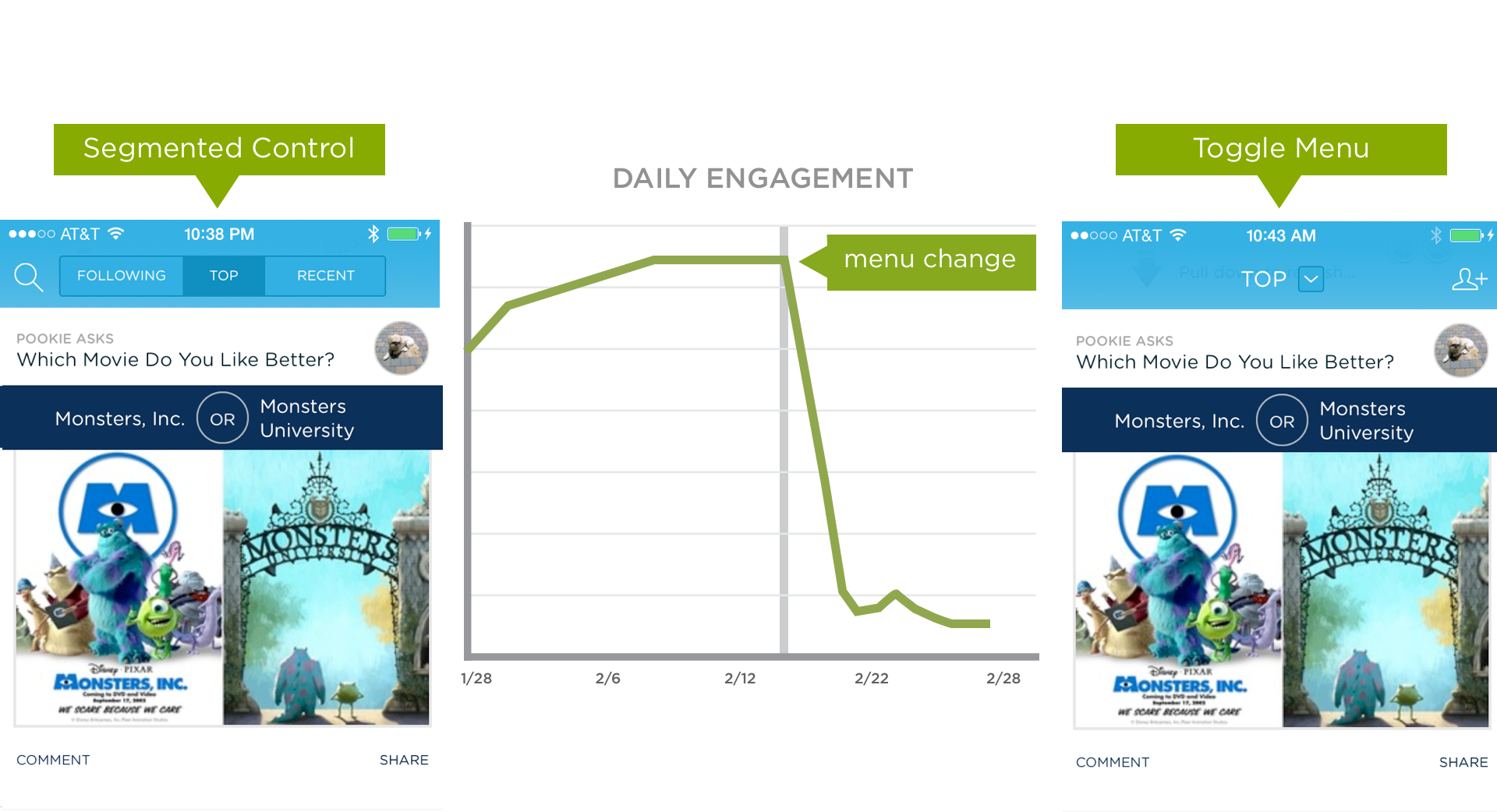
Apple doesn’t like hamburger menus (those three lines at the top left or right of a screen where “other options” are available): here’s a summary of a WWDC 2014 talk about it – from which they key extract is

Remember, the three key things about an intuitive navigation system is that they tell you where you are, and they show you where else you can go.

Hamburger menus are terrible at both of those things, because the menu is not on the screen. It’s not visible. Only the button to display the menu is. And in practice, talking to developers, they found this out themselves.


Samsung tablets made spy-proof by BlackBerry using IBM software » Bloomberg Business

Cornelius Rahn:

BlackBerry introduced a modified Samsung Electronics Co. tablet computer that lets government and corporate users access consumer applications such as YouTube and WhatsApp while keeping confidential work-related information away from spies and crooks.

The €2,250 ($2,360) SecuTABLET will be available by the third quarter, Hans-Christoph Quelle, head of BlackBerry’s Secusmart unit, said in an interview Sunday. More than 10,000 units will be shipped annually in Germany alone by next year, with a higher number sold by IBM, which is handling sales to companies worldwide, he said.

The SecuTABLET combines Samsung Electronics’s Tab S 10.5 with Secusmart’s microSD card and IBM software to wrap applications that hold sensitive data into a virtual container where they can’t be harmed by malware. Germany’s computer-security watchdog is evaluating the device for classified government communication and will probably give its approval before the end of the year, Quelle said.

I’m not sure in what sense BlackBerry “introduced” this. Its tieup with Samsung seems to be as an MDM (mobile device management) vendor. Samsung makes the hardware, IBM does the virtualisation, BlackBerry does the..?


Start up: making the Apple Watch, Tinder with an AI, web v apps again, what’s the real mobile search?, and more


Uvas reservoir, California, in February 2014. Photo by ian_photos on Flickr.

A selection of 9 links for you. Can be hung on string to deter tigers. I’m charlesarthur on Twitter. Observations and links welcome.

Tinder users at SXSW are falling for this woman, but she’s not what she appears » Adweek

Tinder users at the SXSW festival on Saturday were encountering an attractive 25-year-old woman named Ava on the dating app. A friend of ours made a match with her, and soon they were have a conversation over text message.

But when he opened up Ava’s Instagram, it became clear something was amiss. There was one photo and one video, both promoting Ex Machina, a sci-fi film that just happened to be premiering Saturday night here in Austin. The link in her bio went to the film’s website. And it turns out the woman in the photos is Swedish actress Alicia Vikander, who plays an artificial intelligence in the movie.

The conversation is rather clever, in the context of the film. I liked this as a promotional idea. (Other people didn’t. I’d say, abandon hope all ye who go on Tinder, and you won’t be disappointed.)


How Apple makes the Watch » Atomic Delights

This link has been shared all over the place, but you might have chosen to avoid it. That’s a mistake; you can discover so much just about manufacturing from reading it. Here’s just a tiny piece of Greg Koenig’s writeup, based solely on the Apple Watch manufacturing video:

Apple chooses to not show what is likely the most unique and important step in the production of the Watch; cold forging. In production forging, a blank of metal is placed between two extraordinarily hard steel dies that have the bottom and top halves formed into open faced molds. The hammer – a piece of capital equipment roughly the size of a house laid on it’s end – slams the dies closed with force measured in tens of thousands of tonnes. Under such pressure, the metal reaches a state called “plastic deformation” and literally bends, compresses and flows into the shaped cavities of the die. For complex, or high-precision forging, multiple dies with successively deeper cavities are used to gradually tease the material into the desired shape.

Forging produces what’s called a “net shape” part; the process is unable to create precision holes, pockets, threads and other features that will require a trip to the CNC mills. What forging does do is create parts of exceptional strength.

A hammer the size of a house. Consider that for a moment. Koenig merits your attention.


Can the mobile Web win back developers from iOS, Android? » CNET

Stephen Shankland speaks to Dominique Hazaël-Massieux of the W3C:

Web allies are working to make up for lost time. The Application Foundations effort, announced in October 2014, adds new heft to existing work to improve standards. It emphasizes a collection of priorities like video chat, cryptography, typography, responsiveness and streaming media.

“There are challenges around performance, around making apps work offline and outside the browser,” Hazaël-Massieux said. One big part of the fixes is a standard called Service Workers that dramatically remakes Web apps’ deeper workings. Service Workers are programs that run in the background, letting Web apps work even if there’s no network connection and enabling things like push notifications. With Service Workers, those notifications could come through even if a person is using another app.

“A component provided by the browser registers itself with the operating system. When the OS receives a notification, it knows it should wake up the browser, and the browser wakes up the Web application,” Hazaël-Massieux said. “Service Workers are about getting the Web to live also outside the browser. That opens up interesting opportunities.”

Another feature he’s excited about is payments provided with an interface that would take Apple and Google out of the loop, letting the programmer choose what payment mechanisms to offer.

In general, the answer has to be “no”, though. Simply because (as Matt Gemmell has pointed out) a web app is “an app running on an app running on the system”, where an app is “an app running on the system”. It’s a bit like interpreted v compiled code.


I’ve seen the new face of Search, and it ain’t Google » Alex Iskold

The “ten blue links” aren’t optimum on mobile (Google already knows this, of course);

imagine, that instead of Google text field or browser bar, you get a familiar Text Messaging interface and you can ask questions. Here is what happens next:

1. You will ask questions in the natural form, like you do in real life.

2. Your questions will be naturally compact, because you are used to compact form of text messaging, but they won’t be one word or one phrase like we type into Google. You still can have typos, and missing punctuation.

3. This format naturally lends itself onto the conversation. That is, you don’t expect 10 links, you expect a human response. And you expect to respond in response to this response, and so on – that is, you expect a conversation.

4. ‘The answer’ will be things / objects / places, and links will become secondary. The answer will be 1 or 2 or 3 things but not 10 things. The choice will be naturally added via a conversation and iteration, not by pushing 10 links on the user upfront.

5. You won’t be able to tell the difference between a person or machine replying to you. This is where all the amazing AI stuff (looking at you, Amy) is going to come handy and will really shine.

6. You won’t think of this as search anymore, but as your command and control for all things you need – tasks, purchases and of course good old search. It will be like Siri, except it will be based on text, and have a lot more capabilities. And it will actually work great. (No offense Siri, but you have ways to go).

Sounds a bit like the (failed) Jelly, but he suggests Magic, Sensay and Cloe as possible implementations. This feels like it’s heading in the right direction. Search shouldn’t really be might-be-right links on mobile.


California has about one year of water left. Will you ration now? » LA Times

Jay Famigliette:

As difficult as it may be to face, the simple fact is that California is running out of water — and the problem started before our current drought. NASA data reveal that total water storage in California has been in steady decline since at least 2002, when satellite-based monitoring began, although groundwater depletion has been going on since the early 20th century.

Right now the state has only about one year of water supply left in its reservoirs, and our strategic backup supply, groundwater, is rapidly disappearing. California has no contingency plan for a persistent drought like this one (let alone a 20-plus-year mega-drought), except, apparently, staying in emergency mode and praying for rain.

In short, we have no paddle to navigate this crisis.

I wonder what this means for all the technology companies in that region.


Connected audio products to grow at a CAGR of 88% from 2010-2018, says IHS » Digitimes

Annual shipments of connected audio products, including wireless speakers, wireless soundbars, and connected AV receivers, are expected to grow at a CAGR of 88%, from 1.5m units in 2010 to nearly 66m units in 2018, according to IHS.

The popularity of mobile devices and changing consumer habits in media consumption are not only increasing demand for wirelessly connected audio devices, but also rapidly altering the home audio landscape.

Within this composite group of products, connected soundbars and wireless speakers are expected to provide noteworthy growth, not just within home audio, but also within the overall consumer electronics market. Combined shipments are forecast to grow at a CAGR of 94% over the same period.

That’s some pretty dramatic growth, driven by people listening to audio at home from their mobile.


Samsung seals big SSD chip deal with Apple » Korea Times

The latest agreement is calling for Samsung Electronics to sell its latest solid state drive (SSD) storage devices using its V-NAND technology to Apple’s new range of ultra-slim and high-end notebook models, two people directly involved with the deal told The Korea Times, Friday.

“Samsung Electronics recently agreed with Apple to provide SSDs using its latest three-dimensional (3D) V-NAND tech. The deal is estimated to be worth a “few billion dollars,” said one of the people.

Samsung’s chip factory in Xian, China, will handle the production.

Still best of frenemies.


What Is Android 5.1’s anti-theft “Device Protection” feature and how do I use it? » Android Police

David Ruddock wrestles with this feature, which is basically the same as Apple’s iCloud lock (introduced in 2013) and Samsung’s similar feature:

With Android 5.1, Google revealed that it was releasing a new feature for handsets called Device Protection. This anti-theft feature makes it basically impossible for a thief to use your phone in the event it is stolen and wiped. First things first, though: how do you get this feature?

Right now (as in, at the time of this article), there is a single device with the feature currently enabled: the Nexus 6. The Nexus 9 will get device protection as well, but its Android 5.1 update has not yet rolled out. Nexus 4, 5, 7 (2012 and 2013), and 10 will not receive the factory reset Device Protection feature. Allegedly, no phone or tablet that did not ship with Android 5.1 or higher out of the box will receive the factory reset protection feature (again, except Nexus 6 and Nexus 9), at least according to Google at this time.

However, Google’s support site says the info applies to devices that have 5.0 or higher preinstalled (as in shipped with), though, so it’s not clear if devices that shipped with 5.0 and then later upgrade to 5.1 (or higher) will then get it. Google didn’t provide a satisfactory response to this question, unfortunately.

I get the faint feeling with Lollipop that Google is struggling to keep everything from falling off the table. First the rollback on encryption, now this. (Some commenters claim to see it on their Nexus 5, but Ruddock says it’s “simply a leftover that Google forgot to remove from the ROMs of unsupported 5.1 devices.”)


MWC: not all 4G LTE modems are created equal according to tests with Qualcomm and Samsung » Moor Insights & Strategy

Even though many modems and networks may currently only be capable of Category 4 LTE speeds (150 Mbps downlink), there are still some differences in how much those modems perform given the exact same conditions. In some cases, our testing at 20 MHz band width showed that the performance differences between Qualcomm’s and Samsung’s modems can be as big as 20%, meaning that one user can get their files 20% faster than someone else with a competitor’s phone and they are also saving power by getting that file faster and shutting down the data connection quicker.

Also finds differences in power consumption – Qualcomm’s Snapdragon 810 is 5-10% better there too. But Samsung benefits by buying its own modems, of course.


Start up: Intel stutters, Google goes retail, why Apple Watch?, what people really want in news apps, and more


The view for too many small businesses, in Intel’s opinion. Photo by Ella’s Dad on Flickr.

A selection of 7 links for you. To read. I’m charlesarthur on Twitter. Observations and links welcome.

Why is Apple making a gold watch? » Benedict Evans

Apple stores are huge rich-media billboards on every major shopping street in the developed world: I can’t think of any other company that has shops as big as that in such premium locations in as many places. Apple retail is a self-funding marketing operation. So too, perhaps, is the gold watch. Apple might only sell a few tens of thousands, but what impression does it create around the $1,000 watch, or the $350 watch? After all, the luxury goods market is full of companies whose most visible products are extremely expensive, but whose revenue really comes from makeup, perfume and accessories. You sell the $50k (or more) couture dress (which may be worn once), but you also sell a lot of lipsticks with the brand halo (and if you think Apple’s margins are high, have a look at the gross margins on perfume). 

Meanwhile, though other companies are already making metal smart watches, I struggle to imagine Samsung making solid gold watches. Apple’s brand might or might not work there, but no other CE company’s does. That is, if this is marketing, and if it works, it’s marketing that no-one else can do. 

On another tack, perhaps the biggest message that this sends is that the Apple watch is not a technology product. It’s a post-‘feeds and speeds’ product. Today we have prices and release dates for the watch but no tech specs at all – because they’re irrelevant to the user experience.

Perfume margins are amazing. And yes, consider how sales of a Samsung gold smartwatch would go.


An incredibly shrinking Firefox faces endangered species status » Computerworld

Gregg Keizer:

Mozilla’s Firefox is in danger of making the endangered species list for browsers.

Just two weeks after Mozilla’s top Firefox executive said that rumors of its demise were “dead wrong,” the iconic browser dropped another three-tenths of a percentage point in analytics firm Net Applications’ tracking, ending February with 11.6%.

That was Firefox’s lowest share since July 2006, when the browser had been in the market for less than two years…

…In the last 12 months, Firefox’s user share – an estimate of the portion of all those who reach the Internet via a desktop browser – has plummeted by 34%. Since Firefox crested at 25.1% in April 2010, Firefox has lost 13.5 percentage points, or 54% of its peak share.

“Hello? It’s Marissa. Now, about that refund clause..”


Intel lowers first-quarter revenue outlook » Intel Newsroom

Intel Corporation today announced that first-quarter revenue is expected to be below the company’s previous outlook. The company now expects first-quarter revenue to be $12.8bn, plus or minus $300m, compared to the previous expectation of $13.7bn, plus or minus $500m.
 
The change in revenue outlook is a result of weaker than expected demand for business desktop PCs and lower than expected inventory levels across the PC supply chain. The company believes the changes to demand and inventory patterns are caused by lower than expected Windows XP refresh in small and medium business and increasingly challenging macroeconomic and currency conditions, particularly in Europe.

The XP refresh is/was still going on? Amazing. (During the same period last year, Intel’s revenue was $12.7bn. So it might be very close to zero growth.)


What do people want from a news experience? » Tales of a Developer Advocate

Paul Kinlan was building a news app:

I posited that users want (in order of priority):

• Notifications of important news as it happens
• An icon on the launcher so it can be loaded like an app
• News available to them offline (i.e, when they are in the tube)
• A fast site

My own intuition of an industry I am not too heavily involved in probably can’t be trusted as much as I think it can, so I sent out a terribly worded tweet.

What happened next will inform and entertain you. (No really, it will.) It did him.


Thousands have already signed up for Apple’s ResearchKit » Bloomberg Business

Michelle Fay Cortez and Caroline Chen:

Stanford University researchers were stunned when they awoke Tuesday to find that 11,000 people had signed up for a cardiovascular study using Apple Inc.’s ResearchKit, less than 24 hours after the iPhone tool was introduced.

“To get 10,000 people enrolled in a medical study normally, it would take a year and 50 medical centers around the country,” said Alan Yeung, medical director of Stanford Cardiovascular Health. “That’s the power of the phone.”

That’s people who would have had to download the update and opt in. Some fret about the quality of data (biased selection) but:

The data may not be perfect, but many concerns about ResearchKit – such as whether the patient sample is representative – are issues with traditional clinical trials as well, said Todd Sherer, CEO of the Michael J. Fox Foundation for Parkinson’s Research, which has collaborated with nonprofit group Sage Bionetworks on one of the apps.


Forking hell! Baidu gives up on its Android-based OS » Tech In Asia

Steven Millward:

No news means bad news when it comes to tech companies. If they’ve nothing to boast about, the ensuing silence looks suspicious. That’s been the case with Baidu’s version of Android (pictured above), which launched in late 2011.

Despite a high-profile and promising start as Dell made use of Baidu’s Android-based Yun OS for a new China-only phone, the Chinese search giant’s OS thereafter didn’t show any signs of finding favor with the nation’s smartphone shoppers. Yesterday, Baidu confirmed in its Yun OS forums that the Android skin will not get any more updates. The project is now suspended.

Had its own product suite, but missed the boat for this. However, has 500m monthly active users for its mobile search and 200m MAUs for its maps product. Might struggle by.


Google opens its first Google-branded store-in-a-store, in London » WSJ

Saabira Chaudhuri:

Google has opened in London its first Google-branded store-in-a-store selling space.

Housed within Dixons Carphone DC.LN -0.41%’s Currys PC World store on Tottenham Court Road, the Google Shop will give Google the opportunity to show off its range of Android phones and tablets, Chromebook laptops and Chromecasts.

“The pace of innovation of the devices we all use is incredible, yet the way we buy them has remained the same for years. With the Google Shop, we want to offer people a place where they can play, experiment and learn about all of what Google has to offer,” said James Elias, the U.K. marketing director for Google.

In some ways, the Google Shop is more of a branding exercise than an approximation of a standalone store. All sales from the store go to Dixons Carphone.

So it’s to sell.. Chromebooks? Chromecast? And – Google needs branding? Seriously?


Start up: how Brin/Page handle email, smartwatch disruption and use, from $500k to zero on Kickstarter, and more


The Google founders’ approach to triaging email. Photo by M@XONGS on Flickr.

A selection of 8 links for you. May contain the word “smartwatch”. I’m charlesarthur on Twitter. Observations and links welcome.

Use cases for smart watches » Action at a Distance

Richard Gaywood:

I have been using an Android Wear smartwatch for the last three months, exploring different software options and possibilities. What follows is a list of the roles I have found it playing in my life — my use cases, in software engineer jargon. I’m not going to pretend this isn’t a very personal list; perhaps none of these things appeal to you, would be a reason for you to desire a smartwatch. But then again, there are surely more use cases I don’t care about or haven’t found that you do. This is by no means an exhaustive list.

However, note that there are a couple of well-discussed banner features people associate with smartwatches that I’m going to skip over purely because they have already been thoroughly discussed elsewhere: fitness (not only through step counters and heart rate tracking, but also utilities like interval trainers and performance recording like Strava and Runkeeper) and notification triage. What I’m trying to do with this post is point out some less commonly thought of use cases than these.

Good to hear from someone who has actually been using this for longer than a few minutes.


David Shin’s answer to ‘How do Bill Gates, Larry Page, Mark Zuckerberg and Jack Dorsey manage their email?’ » Quora

Shin’s response:

When I worked at Google in 2006/2007, Larry and Sergey held a Q&A session, and this exact question was asked of them. One of them answered (I don’t remember which) with the following humorous response (paraphrased):

“When I open up my email, I start at the top and work my way down, and go as far as I feel like. Anything I don’t get to will never be read. Some people end up amazed that they get an email response from a founder of Google in just 5 minutes. Others simply get what they expected (no reply).”

Seems pretty sensible to me. That’s roughly how I work. Which is why I haven’t responded to your email, and probably never will.


Syncthing

Interesting product which

replaces proprietary sync and cloud services with something open, trustworthy and decentralized. Your data is your data alone and you deserve to choose where it is stored, if it is shared with some third party and how it’s transmitted over the Internet.

Selling points (if you can have that on something that’s free):

• Private. None of your data is ever stored anywhere else than on your computers. There is no central server that might be compromised, legally or illegally.
• Encrypted. All communication is secured using TLS. The encryption used includes perfect forward secrecy to prevent any eavesdropper from ever gaining access to your data.
• Authenticated. Every node is identified by a strong cryptographic certificate. Only nodes you have explicitly allowed can connect to your cluster.


Apple Watch isn’t good enough (that’s great news), and overlooked jobs » Valuing Disruption

Bill Esbenshade looks at Apple’s Watch as a low-end disruptor:

A lot of people are looking at the Watch and saying “it’s not good enough” because of a range of issues related to functionality/reliability: battery life too short, watch too thick or clunky looking, too tethered to the iPhone, not enough health sensors, etc.

The irony is that these shortcomings should be good news for the Watch’s future. That’s because under disruption theory, when a product isn’t good enough on a range of performance dimensions, then the vendor has lots of things to improve — through new product versions — before the product starts overserving. See Concepts page and discussion of Clayton Christensen. This means there’s lots of room for Apple — as an integrated manufacturer — to making sustaining leaps ahead of more modular smartwatch competitors relying on Android. See post titled Apple’s Long Term Advantages. Apple has plenty of room to improve the user experience and move up the improvement trajectory without overserving.

(Esbenshade owns Apple stock.) My own query is – shouldn’t this sort of disruption be coming in from the high end or the low end? The Watch seems to approach from somewhere around the middle.


No, the CIA isn’t stealing Apple’s secrets » Errata Security

Robert Graham on The Intercept’s story on the matter:

The Intercept doesn’t quote people who actually know what they are talking about. As I repeat over and over, for every Snowden document, there’s some expert who has presented on that topic at BlackHat, DefCon, or similar hacking/cybersec conference. There’s no excuse for writing a story on these topics and quoting only activists like Soghoian rather than technical experts from these conferences. For example, a quick search of “BlackHat reverse engineering chips” quickly lead to this presentation.

I point this out because another subject of that Intercept article was about trojaning XCode, the Apple development tool used to compile iOS apps. A quick search would have come up with a BlackHat presentation by Errata Security’s own David Maynor where he trojaned Microsoft’s compiler, GCC, and a lesser known compiler called LCC. There’s no excuse for writing this story without reaching out to Maynor, or even Ken Thompson, the co-creator of C/Unix who inspired compiler-trojaning.

Again with compilers, there’s context that is carefully hidden by the Intercept story.

Complex topic, though, which has got everyone looking over their shoulders, and quizzically at their compiler errors, saying “But is it a REAL error, or..?”


How a half-million dollar Kickstarter project can crash and burn » Medium

Haje Jan Kamps has the scars to prove it:

the legal costs were only step one of the battle. The electronics and software design for Triggertrap Ada ended up costing vastly more than we had originally budgeted, in part because it turned out that we couldn’t use the microprocessor we wanted to (the electronics agency claimed that the original microprocessor didn’t have enough memory), and had to do several more design iterations than we had anticipated. Compared to our original project budget, we spent 9.4x more on this phase than we planned to.

In part because of the additional design iterations, we ended up having to spend two and a half times what we had budgeted on our prototyping costs — high-quality 3D printing and subsequent hand-finishing of prototype plastics is hideously expensive — and our industrial and plastics design went significantly over budget.

(Via Matt Baxter-Reynolds.)


Quick take on disruptive potential of smartwatches » Naofumi Kagami

Kagami is a student of disruption theory and practice, and has an interesting take: that it’s the existing watch brands that will thrive in the newly created smartwatch space:

Without going into detail, this is what I expect the smartwatch landscape to look like after the dust has settled;

• Apple will be the undisputed number 1. They will aggressively innovate on the Apple Watch, even to the extent that it cannibalises the iPhone. The Apple Watch will gradually become more and more independent of the iPhone.

• The current Android smartphone OEMs will initially play in the smartwatch market, but they will fail to make profits due to their lack of brand power. Eventually most will retreat from the smartwatch market and focus on making big and powerful smartphones. The few that remain will only get the scraps from the very low-end of the market. The exception might be Samsung. If their Tizen operating system enables them to innovate faster than Android Wear, there is the possibility that Samsung will be able to profit from smartwatches (due to the lock-in they get).

• Current watchmakers will be the major Android Wear players in the smartwatch space, especially in profits. The electronics will be provided by the Shenzhen ecosystem or a chipset provider (maybe Intel). Depending on how well Google can monetise from Android Wear, we might see some rapid innovation.

But read all of it for what that then implies for those smartphone OEMs…


Microsoft has its ‘groove back,’ say some CIOs » WSJ

Clint Boulton:

Michael Sajor, CIO of Apollo Education Group, stopped meeting with Microsoft sales executives a few years ago because they tried to sell him software without bothering to learn about it would help him run his business. “They were, all-around, just a pretty ugly company to deal with,” Mr. Sajor said.

But Mr. Sajor said the company is showing “signs of life” improving its focus under Mr. Nadella. Now Microsoft representatives ask how they can better support the 250,000 University of Phoenix students for whom Mr. Sajor provides technology. Two months ago, Apollo converted from the on-premises Office software to Microsoft’s Office 365 productivity software, which includes the version of Office for iPad. He said the company still has some work to do to solidify customers’ trust in the company, but he’s optimistic in his experience with the company under Mr. Nadella. “If they stay on track, they’ll win our hearts and minds like other companies have done by becoming real partners,” Mr. Sajor said.

Mobile-first, cloud-first. Nadella is a smart strategist.