Unknown's avatar

About charlesarthur

Freelance journalist - technology, science, and so on. Author of "Digital Wars: Apple, Google, Microsoft and the battle for the internet".

Oh, and also: Microsoft’s warning it might write down the mobile division


Got anything you want to dump? “Goodwill” by Editor B on Flickr.

Did you read my piece about the negative per-handset margins of Microsoft’s Lumia phones? Oh, you should, it’s great.

Bearing that in mind…

Spotted in Microsoft’s 10-Q (that’s the full quarterly writeup of everything going on in the business is this rather important couple of paragraphs. (“Goodwill” is accounting talk for “stuff that you can’t drop on your foot but honestly, it’s worth something, that’s why we paid so much for the company”). I’ve added some emphasis:

We determined that none of our reporting units were at risk of impairment as of our most recent annual goodwill impairment testing date. The valuation of acquired assets and liabilities, including goodwill, resulting from the acquisition of NDS, is reflective of the enterprise value based on the long-term financial forecast for the Phone Hardware business. In this highly competitive and volatile market, it is possible that we may not realize our forecast.

Considering the magnitude of the goodwill and intangible assets in the Phone Hardware reporting unit (see Note 8 – Business Combinations of the Notes to Financial Statements), we closely monitor the performance of the business versus the long-term forecast to determine if any impairments exist in our Phone Hardware reporting unit.

In the third quarter of fiscal year 2015, Phone Hardware did not meet its sales volume and revenue goals, and the mix of units sold had lower margins than planned.

We are currently beginning our annual budgeting and planning process. We use the targets, resource allocations, and strategic decisions made in this process as the inputs for the associated cash flows and valuations in our annual impairment test.

Given its recent performance, the Phone Hardware reporting unit is at an elevated risk of impairment. Declines in expected future cash flows, reduction in future unit volume growth rates, or an increase in the risk-adjusted discount rate used to estimate the fair value of the Phone Hardware reporting unit may result in a determination that an impairment adjustment is required, resulting in a potentially material charge to earnings.

And how much goodwill is there? In Note 8, we find that there’s an allocation of $5,456m to “goodwill” for the acquisition of Nokia Devices and Services (NDS). Five and a half billion dollars of “no, honestly, it’s worth this much in the long term, just watch”.

Or as the 10-Q puts it, “The goodwill was primarily attributed to increased synergies that are expected to be achieved from the integration of NDS.”

Now it seems those synergies maybe aren’t happening.

Sony in September wrote down the expected value of its phone business by £1bn. And it has a mobile business that competes quite well at the high end.

Microsoft’s writedown could be much, much bigger. Perhaps not as big as the $6.2bn writedown of aQuantive in 2012 (it wrote off the whole value of the acquisition), but potentially quite a lot.

Microsoft’s per-handset profit, or the lack of it – and its impact on Windows Phone’s future


How much did this Lumia 920 cost to make? And will it have a successor? Photo by Whatleydude on Flickr.

In case anyone was in any doubt, Microsoft’s results last week demonstrated once more what we’re coming to know about the mobile handset industry: it’s damned hard to make any money in it. When I published a fairly simple analysis of the state of the top-end Android handset market (with a comparator to Apple’s iPhone profits), people were apparently flabbergasted by how thin the per-handset operating margins were on these devices which sold for hundreds of dollars.

Estimated Android handset operating profit Q4 2014

See the original post for more detail and caveats.

But Microsoft showed that it’s not even able to generate gross margin while selling millions of handsets. (Gross margin is the difference between how much it costs you to make the item – usually factory costs and distribution costs – and what you get for it. Gross margin normally excludes R&D and sales & marketing costs; to get the operating profit, you subtract those costs too, so operating profit is always less than gross margin.) My analysis of Android handset makers looked at operating profit.

Negative gross margin takes some doing; spending more making stuff than you take in for it is exceptionally bad business. But Microsoft Mobile did, officially: take a look at Microsoft’s 10Q for the calendar first quarter of 2015.

Microsoft phone hardware revenues, Jan-Mar 2015

It says

Phone Hardware revenue was $1.4bn in the third quarter of fiscal year 2015, as we sold 8.6m Lumia phones and 24.7m non-Lumia phones. We acquired NDS in the fourth quarter of fiscal year 2014. Phone Hardware gross margin was $(4) million in the third quarter of fiscal year 2015. Phone Hardware cost of revenue, including $147m amortization of acquired intangible assets, was $1.4bn.

For those unversed in accountancy notation, that “$(4) million” means “minus $4 million”. Accountants use brackets rather than a minus sign because it’s easy to overlook a minus sign and create a horrendous hash in your calculations.

For the nine months,

Phone Hardware revenue was $6.3bn in fiscal year 2015, as we sold 28.5m Lumia phones and 107.3m non-Lumia phones. Phone Hardware gross margin was $805m in fiscal year 2015. Phone Hardware cost of revenue, including $401m amortization of acquired intangible assets, was $5.5bn.

This does take some untangling. In my analysis, I’m going to ignore the writeoffs (amortisation) of intangible assets – essentially, goodwill (“how much more we paid than the physical assets are worth”) being written down. This actually makes the gross margin look better – as in, in positive territory. That’s a start.

Pause for history

Some brief history. When Nokia made phones, it used to provide wonderfully detailed results, in which it would tell you how many featurephones and smartphones it had sold, and at what average selling price (ASP). This made it easy to see how its business was going. It didn’t give you gross margins – only operating margin for the whole phone business. In general, though, we knew its featurephone business was profitable, and that once it moved to the Windows Phone Lumia range, the smartphone side lost a ton of money.

Enter Microsoft, buying Nokia’s phone business – including featurephones – for €5.4bn, which was completed on April 25th 2014. That’s when the featurephone and Lumia sales start showing up in Microsoft’s results, and we shift to the “gross margin” measurement. (Microsoft does this because Steve Ballmer reorganised it to an Apple-style “apportion all cost across the board”, rather than making each division its own profit-and-loss fiefdom.)

Given the Lumia ASP and sales figures at Nokia, you could work out the ASP of featurephones, and their contribution to revenues. What I’ve done in the table below is use Nokia’s featurephone and Lumia ASP (converted from euros to dollars at the prevailing rate at the end of each quarter) and try to carry that forward to estimate the recent ASPs of Lumia handsets under Microsoft’s ownership, and their contribution to revenues.

Featurephone and estimated Lumia ASPs

If you estimate the ASP for featurephones based on the Nokia numbers, you can figure out those for the Lumia phones at Microsoft.

A few things to note: I’m assuming that featurephone ASPs are falling. Even with that, there’s a clear fall in the ASP of the Lumia phones – from (a really quite high) $238 in the second calendar quarter of 2014 to the present. There hasn’t been a flagship phone released in that time, so perhaps not surprising.

Also, smartphone revenue has flipped from being the minority source at Nokia to being the majority source now (even at $20 featurephone ASP, it’s still like that) because featurephone sales are collapsing, while those of smartphones are remaining fairly static – like this:

Estimated split of smartphone and featurephone revenue at Microsoft

Based on ASP assumptions, you can figure out how much revenue smartphones and featurephones generate. That’s not profit, though.

Now we move on, to seek out gross margin. There’s no data from Microsoft about the separate gross margins of the featurephones or Lumias. We don’t know how much they cost to build, or which might be profitable. So we have to use estimates and what people tell us.

Fortunately, we do have some indication of how profitable Nokia featurephones were. In an interview in April 2013, Nokia’s director of platform and content said that the profit margins on the $20 Nokia 105 were the same as those on the Lumia phones. How much might that be? Again, we don’t know, but it can’t be a lot. Putting it at $5 seems reasonable.

We have the figures for total gross margin; we also have the intangibles writeoff in the financials. So that gives us a “real” gross margin (ie the day-to-day gross margin for the quarter, excluding accountancy writeoffs):

Gross margin, excluding intangibles

Microsoft gives quarterly figures for intangible writeoffs; subtracting that gives the hardware gross margin.

Now we make assumptions about featurephone gross margin. I’ve gone for $5, falling to $4 as the average price of the handset falls from $20 to $15.

From this, and from the data we’ve got about total phone shipments, it’s quite simple to back-calculate to come out with figures for the total contribution to gross margin by featurephones and Lumias.

Progress! GM and profit gives Lumia data

If we assume per-handset profit on featurephones, we can use that with the GM data to figure out how much Lumias cost to make. And we have the ASP..

Which tells us what? The CQ2 figure is anomalous – Microsoft mentions an intangibles writeoff in that period, but doesn’t specify how much (unlike other periods). It’s likely the total gross margin was larger if you ignore that, which would put the gross margin per Lumia into the black.

What we also see is that even if we allow a miniscule per-handset gross margin for each featurephone, we see a rapidly falling gross margin for the Lumia line. Here’s an alternative scenario, if we think that the featurephones have a $8 gross margin, falling to $6 in the latest quarter:

What if featurephones have higher profit?

Giving a per-handset profit of $8 for featurephones makes the Lumia business look much worse. It’s unlikely, though.

On this higher profit for featurephones, the Lumia gross margin goes into negative territory. You can argue that’s too high a margin for a featurephone. Doesn’t matter though – the direction of travel is clear: the Lumia barely washes its face.

And this, don’t forget, is before you include the costs of sales and marketing – all those Lumia ads! – and research and development. Here’s the R+D impact:

Three months ended March 31, 2015 compared with three months ended March 31, 2014: Research and development expenses increased $241 million or 9%, mainly due to increased investment in new products and services, including NDS expenses of $212 million.

For the nine months:

Research and development expenses increased $694 million or 8%, mainly due to increased investment in new products and services, including NDS expenses of $815 million. These increases were partially offset by a decline in research and development expenses in our Operating Systems engineering group, primarily driven by reduced headcount-related expenses.

A little digging shows the R+D costs for the NDS (Nokia Devices and Services) segment by quarter. That gives us a sort of “halfway” operating profit once you deduct R+D, which shows that the division has moved into the red even before you consider sales and marketing costs.

R+D by quarter for Microsoft's mobile business

R+D numbers are mentioned in the quarterly 10Q. To get towards the operating profit (or loss), we need to subtract that.

That’s not profit

To figure out whether the handset division makes an operating profit we’d have to know the sales and marketing costs. It’s pretty improbable that those were anything less than $300m per quarter (that’s $10m per day, worldwide). Which means that Microsoft’s handset division has been loss-making since it took it over, despite those profitable featurephones, and ignoring the writedown of intangibles.

On a per-handset basis, if you allow $300m per quarter for sales and marketing (into which we’ll also roll administration), then you get a clear picture: Lumia handsets don’t make an operating profit at all.

Estimated per-handset loss for Lumias

Don’t forget, this relies on assumptions around featurephone profitability and price.

But hey, you say, that’s all assuming that featurephones are making $5 per handset. What if it’s $0? No problem – that’s the fun of spreadsheets. You can play with assumptions:

What if featurephones make $0?

Lumias still show a per-handset loss. (Remember this is with featurephone pricing of $15 in the latest quarter.)

OK, dammit – what if featurephones lose $5 per handset? Lumias still plunge into operating loss in the latest quarter – and remember, this is ignoring intangible writeoffs, and allowing just $10m per day worldwide for sales and marketing:

What if featurephones lose money?

Even at a $5 loss per featurephone, Lumias aren’t moneymakers at the operating level (on my assumptions).

You might have thought that Android handset makers had it tough, but at least – at the top end – they’re ekeing out something.

(Yes, these numbers are based on assumptions about featurephone pricing and margin, but I’d defend them as all being reasonable based on what we know about the business in the present and past.)

Update: thanks to Vlad Dudau of Neowin, who pointed me to Microsoft’s discussion of its results, where they say

We have made significant progress in reducing the operating expense base in the Phone business, moving from an annualized rate of $4.5bn at acquisition to a run rate under $2.5bn.

Opex is R+D plus sales+marketing and things like general+administration; an annualised run rate of $2.5bn is $625m per quarter – which is slightly more than I was allowing there. That would make the Lumia margins worse.

Microsoft adds:

That said, the changing mix of our portfolio to the value segment and the significant negative headwind from FX [foreign exchange rates] will impact our ability to reach operational break even in FY16.

So, no good news in the offing. (/Update.)

Why carry on, then?

Why, then, does Microsoft persist with Windows Phone? It can’t really think that it’s somehow going to come good and suddenly take off to challenge iOS and Android. The idea (which some outside Microsoft cling to) that the introduction of Windows 10, where apps can be written for both desktop and mobile, will suddenly lead to a huge uptake (by businesses?) is pie in the sky. Mobile and desktop have different design demands. Corporations with mobile needs haven’t been sitting on their hands for the past five years waiting for Windows Phone to reach a sort of maturity; they’ve been hiring people who can hook into their systems using iPhones and Android phones. Under Satya Nadella, Microsoft has recognised this, offering Office and other key software on rival platforms to capture (or retain) users and revenue.

You can’t justify it on “they’ll make it back in profits on services”; the 80m or so Lumia owners around the world aren’t the high-end users, but low-end ones who are less likely to spend on apps, or pricey Microsoft products.

So why? Two clear reasons. First, it’s important to keep playing in this space; Microsoft needs to have a mobile offering because it’s impossible to say where in the future a mobile-focussed offering might be key.

Secondly, though, is that more simple one: pride. Couple that with the inertia of a big organisation, and the fact that in the scheme of Microsoft’s profits the losses from the mobile division (about $500m, ignoring intangibles, over the past three quarters) are piffling, and there’s no reason to stop.

However, things could change. I’ve argued previously that Nadella should just give up on Windows Phone, and move to an Android fork. Not long after I argued that, Nokia (then still Finnish-owned) introduced the Nokia X, using Microsoft services and AOSP (Android without Google services on top). Microsoft rapidly killed it.

But now Microsoft is preinstalling its apps on the Samsung Galaxy S6 – and more importantly, has a “strategic partnership” with Cyanogen. The latter is a huge, and smart, move: it seems to me the easiest way for Microsoft to make a real impact on mobile.

If the Cyanogen move takes off, though, I could see Windows Phone withering. Why bother with loss-making hardware when you can piggyback on the world’s most successful mobile OS (that’s Android/AOSP) for the pure gravy of services profit? I wouldn’t.


Other posts you might find interesting:
Android OEM profitability, and the most surprising number from Q4 2014

Why Google’s struggles with the EC – and FTC – matter

How Gresham’s Law explains why news sites are turning off online comments


Start up: iPhone sales visualised, stopping VR sickness, Canon lurches downward, mobile design and more


Not so many of these being sold. Photo by lonelysandwich on Flickr.

A selection of 8 links for you. Perhaps. I’m charlesarthur on Twitter. Observations and links welcome.

iPhone sales by quarter » Bare Figures

Have a play with this excellent site, which shows financial data for all sorts of companies. Notable: iPhone sales in the just-gone quarter of 61.2m, up 39.9%. That really is a lot. And the revenues too.


How to reduce VR sickness? Just add a virtual nose » WIRED

Liz Stinson:

Eliminating simulator sickness is a major interest of the burgeoning VR industry, but so far there hasn’t been a clear answer. Home remedies include drinking alcohol, while companies like Oculus Rift are exploring better positional tracking and improved display resolution. But researchers at Purdue University believe they’ve found a way to reduce the negative physical effects of virtual reality by using something that’s right in front of your face.

“We’ve discovered putting a virtual nose in the scene seems to have a stabilizing effect,” says David Whittinghill, an assistant professor in Purdue University’s Department of Computer Graphics Technology.


Windows Phone and Prepaid in the US » Tech.pinions

Jan Dawson:

based on the combination of AdDuplex and Comscore data, it’s likely Cricket has between 1 and 1.5 million Windows Phone devices in its base, which is a fairly significant chunk of Cricket’s overall base, perhaps as much as 25%. Secondly, remember the overall Windows Phone growth numbers we looked at earlier? There was net growth of about 1 million Windows Phone handsets in the base during that same nine month period or, in other words, the difference between those that left the platform and joined it was 1 million. Given Cricket likely added around 1 million during that period, it’s possible it accounted for the vast majority of that net growth.

Cricket isn’t the only prepaid brand where Windows Phone is big, though. It’s hard to get a full postpaid/prepaid breakdown from the AdDuplex numbers because, for the major carrier brands, the two aren’t separated. But even if we just focus on MetroPCS, Cricket and a phone only available on AT&T’s GoPhone prepaid service, these three add up to around 40% of the total base in the US. Add in a few percentage points for other prepaid sales on the major carriers and we could be getting close to half the Windows Phone base on prepaid, compared with about 25% of the total US phone base on prepaid. In this sense, Windows Phone is the anti-iPhone, with the iPhone well underrepresented in the prepaid market, just as Windows Phone is well over-represented.

(The full article is via subscription – monthly or one-off.)


The hidden politics of video games » POLITICO Magazine

Michael Peck:

Sim City lets you indulge your wildest fiscal fantasies. Banish the IRS and set taxes to zero in Teapartyville, or hike them to 99 percent on the filthy rich in the People’s Republic of Sims. Either way, you will discover that the game’s economic model is based on the famous Laffer Curve, the theoretical darling of conservative politicians and supply-side economists. The Laffer Curve postulates that raising taxes will increase revenue until the tax rate reaches a certain point, above which revenue decrease as people lose incentive to work.

Finding that magic tax point is like catnip for hard-core Sim City players. One Web site has calculated that according to the economic model in Sim City, the optimum tax rate to win the game should be 12% for the poor, 11% for the middle class and 10% for the rich.

In other words, playing Sim City well requires not only embracing supply-side economics, but taxing the poor more than the rich. One can almost see a mob of progressive gamers marching on City Hall to stick Mayor McSim’s head on a pike.

The subtle reinforcing effects of such models isn’t much thought about. Philip K Dick did, for his short story War Game.


Canon first-quarter profit drops as compact camera demand collapses » Reuters

Thomas Wilson:

Japan’s Canon Inc reported first-quarter net profit that fell by almost a third on Monday, grossly undershooting expectations, citing a collapse in demand for compact digital cameras.

Profit at the world’s largest camera maker fell to 33.93bn yen (£188 million) in January-March, compared with the 53.64bn yen average estimate of 5 analysts according to Thomson Reuters data.

The result comes as the world’s No.1 camera maker contends with a shift in consumer preference toward increasingly capable smartphone cameras. That shift has dragged Canon’s compact sales down nearly 70% since the market’s peak in 2008 – the year after Apple released its game-changing iPhone.

“Sales volume for low-end (digital camera) models declined due to the ongoing contraction of the market in all regions from the previous year,” said Canon in its earnings release.

Revenues down 1% year-on-year; operating profit by 20%. Also cut this year’s forecasts for compact sales by 23% and for higher-end cameras by 9%.


Telecom act to stifle sales of LG G4, Galaxy S6 » Korea Times

Bahk Eun-ji:

LG Electronics will release its latest smartphone, the G4, on Wednesday and seek to steal customers from its bigger rivals Samsung Electronics and Apple. LG is betting big on the new smartphone to gain fresh momentum in its earnings.

However, it faces a bigger obstacle than Samsung and Apple in the domestic market ― the Telecom Act that caps handset subsidies.

Two weeks ago, the KCC [Korean Communications Commission] raised the maximum amount of subsidy that customers can receive when buying a new handset to 330,000 won [£203/$304], from 300,000 won [£185/$268]. However, the maximum subsidy is possible only for those who choose the highest monthly phone bill rate. For most consumers, the actual subsidies available for them are insignificant. That’s why they are not buying new handsets.

The government has drawn criticism for the enforcement of the Telecom Act from all interested parties, including consumers, telecom companies and retail shop operators.

In particular, retail handset dealerships have condemned the act as their handset sales plunged after the Mobile Distribution Act took effect in October. Under the current law, when consumers buy Samsung’s Galaxy S6 and select a highest phone bill rate, they can receive up to 330,000 won in subsidies.

Normally, retail shop owners get rebates from telecom companies when they sell new handsets, but if customers do not buy the devices at the shop, the owners will not get the rebate.

Besides, if customers cancel their contracts before six months, the shop owners have to pay a 200,000 won [£123/$184] penalty to the telecom companies.

This probably explains the low reported sales of the Galaxy S6. The purpose of the subsidy cap is to prevent carriers and handset makers colluding to lure customers from rivals in South Korea’s saturated market. In 2014, Samsung lobbied to raise the subsidy ceiling. Not hard to work out why.


Racist Camera! No, I did not blink… I’m just Asian! » Flickr

Jared Earle offered a followup to the story on Kodachrome from Monday, pointing to this photo and commentary from 2009:

We got our Mom a new Nikon S630 digital camera for Mother’s Day and I was playing with it during the Angels game we were at on Sunday.
 
As I was taking pictures of my family, it kept asking “Did someone blink?” even though our eyes were always open.

Surprising, to say the least, that Nikon would have this problem.
Time picked up the story about a year later, and pointed out more strange examples where systems seemed to have built-in prejudices.

Of course, you can blame “the algorithms”. But they don’t write themselves.


Obvious always wins » LukeW

Luke Wroblewski, on how using menu controls (especially “hamburgers” and similar) can create big problems, even though the screen looks “simpler” (and so “better”, right?):

In an effort to simplify the visual design of the Polar app, we moved from a segmented control menu to a toggle menu. While the toggle menu looked “cleaner”, engagement plummeted following the change. The root cause? People were no longer moving between the major sections of the app as they were now hidden behind the toggle menu.

A similar fate befell the Zeebox app when they transitioned from a tab row for navigating between the major sections of their application to a navigation drawer menu. Critical parts of the app were now out of sight and thereby out of mind. As a result, engagement fell drastically.

[By contrast] When critical parts of an application are made more visible, usage of them can increase. Facebook found that not only did engagement go up when they moved from a “hamburger” menu to a bottom tab bar in their iOS app, but several other important metrics went up as well.


Start up: Watch experiences, Samsung gets Edgy, Nexus 7 stops, how CD leakers did it, and more


Remember? Photo by Orin Zebest on Flickr.

A selection of 9 links for you. Not golf links, no. They’re different. I’m charlesarthur on Twitter. Observations and links welcome.

My rocky first 24hrs with the Apple ᴡᴀᴛᴄʜ » Medium

Matt Haughey with a ton of really good criticism of the Watch setup for the novice user:

My phone has been downloading dozens of updates of apps made for the watch for weeks, but after getting the watch on my wrist, I realized none of those apps automatically added to the watch, but recent (meaning: as I was setting up the watch) app updates were automatically on the watch like my bank, which I don’t want on my watch. Five minutes later I learned the older apps had to be manually enabled one-by-one. Ugh. Again with the tedium. Additionally, apps asked if I wanted “Glances” enabled too, but in this first half-hour of watch ownership, I didn’t know what “Glances” were yet so I guessed and enabled it on apps I like most. I hope it doesn’t do awful things that I will have to disable one-by-one.

Hope Apple is watching stuff like this closely. As Haughey points out, the problems are also partly to do with third-party devs not having had experience when they wrote their apps and notifications. (The notes by the paragraphs are worth reading, especially those relating to your “Favourites” on the Watch itself.)


How popular will smartwatches be? » Naofumi Kagami

There are plenty of jobs where glancing at a watch is acceptable, but staring into your smartphone isn’t.

You could easily add other jobs where a smartwatch will quickly become a necessity and not just a convenience. For example, doctors working inside hospitals have to respond quickly if one of their patient’s condition suddenly deteriorates. They carry phones with them at all times, but it’s vital that they don’t miss a call. Rather then having a vibration in your pants which can sometimes be hard to notice, it’s much better to have a tap on your wrist.

Similarly, sales reps will also do much better if they quickly respond to emails or phone calls from customers, and so missing calls is not an option. For this very reason, many Japanese employees keep their phones in their shirt pocket and not in their trousers, because it’s much easier to notice a vibration on your chest. This will no longer be an issue if you are wearing a smartwatch.

Also lacking from the discussion is women who often carry their smartphones in their bags and not in their pockets. They don’t want to miss calls or important notifications either…

…This is why I am optimistic about Apple Watch sales, and sales of smartwatch sales in general. I would be very surprised if Android Wear did not start to sell briskly, although it may take a product iteration or two.


The man who broke the music business » The New Yorker

Stephen Witt, with a lovely description of what we all knew – on reflection – must be happening in the music business in the 1990s:

One Saturday in 1994, Bennie Lydell Glover, a temporary employee at the PolyGram compact-disk manufacturing plant in Kings Mountain, North Carolina, went to a party at the house of a co-worker. He was angling for a permanent position, and the party was a chance to network with his managers. Late in the evening, the host put on music to get people dancing. Glover, a fixture at clubs in Charlotte, an hour away, had never heard any of the songs before, even though many of them were by artists whose work he enjoyed.

Later, Glover realized that the host had been d.j.’ing with music that had been smuggled out of the plant. He was surprised. Plant policy required all permanent employees to sign a “No Theft Tolerated” agreement. He knew that the plant managers were concerned about leaking, and he’d heard of employees being arrested for embezzling inventory. But at the party, even in front of the supervisors, it seemed clear that the disks had been getting out. In time, Glover became aware of a far-reaching underground trade in pre-release disks. “We’d run them in the plant in the week, and they’d have them in the flea markets on the weekend,” he said. “It was a real leaky plant.”

The motives of the leakers are, to say the least, mixed. (A side note: if you look at the page source, you discover that the New Yorker includes a word count for each paragraph.)


The Oregon Trail generation: life before and after mainstream tech » Social Media Week

Anna Garvey:

We’re an enigma, those of us born at the tail end of the 70s and the start of the 80s. Some of the “generational” experts lazily glob us on to Generation X, and others just shove us over to the Millennials they love to hate – no one really gets us or knows where we belong.

We’ve been called Generation Catalano, Xennials, and The Lucky Ones, but no name has really stuck for this strange micro-generation that has both a healthy portion of Gen X grunge cynicism, and a dash of the unbridled optimism of Millennials.

A big part of what makes us the square peg in the round hole of named generations is our strange relationship with technology and the internet.  We came of age just as the very essence of communication was experiencing a seismic shift, and it’s given us a unique perspective that’s half analog old school and half digital new school.

Resonate with you? Read it.


Say goodbye to the Nexus 7 as Google pulls listing from store page » TalkAndroid.com

Jared Peters:

After releasing the Nexus 9 and not even mentioning the possibility of a refreshed 7in tablet, though, most of us could see the writing on the wall about the Nexus 7’s fate. Today, it’s finally happened, as Google no longer offers the Nexus 7 on their online store. Finding a listing for the Nexus 7 specifically says that it’s no longer for sale.

Google’s Nexus program has changed over the past couple of years, moving away from extremely affordable devices to more high-end devices that offer a flagship caliber experience without sacrificing development options and quick updates. Unfortunately, that move comes with flagship caliber price tags, too, which is evident in the Nexus 9’s doubled price tag over the Nexus 7.

The Nexus 7 is only just larger than the Nexus 6, which is a phone and is the only device you can use on Google’s Fi MVNO. Google doesn’t think tablets are worth it. (Side note: I had to follow two links to get back to this, as what seemed to be the original source. Why didn’t the first site to write it link back to the original one, rather than the first copier?)


How photography was optimized for white skin colour » Priceonomics


Photo of Villa Maria Academy, Bronx NY, 4th Grade, 1983. Photo by Wishitwas1984 on Flickr.
Rosie Cima:

The earliest colour film was not sensitive enough to accurately capture darker subjects, especially when the scene had brighter, whiter elements. This problem was particularly obvious in group portraiture, photographer Adam Broomberg has explained: “If you exposed film for a white kid, the black kid sitting next to him would be rendered invisible except for the whites of his eyes and teeth.” Photographer Syreeta McFadden, a black woman, describes the experience of looking at photos of herself as a young girl:

“In some pictures, I am a mud brown, in others I’m a blue black. Some of the pictures were taken within moments of one another. ‘You look like charcoal,’ someone said, and giggled. I felt insulted, but I didn’t have the words for that yet.”

“Film emulsions could have been designed initially with more sensitivity to the continuum of yellow, brown, and reddish skin tones,” Roth writes in her paper, ‘Looking at Shirley, the Ultimate Norm,’ “but the design process would have had to be motivated by a recognition of the need for an extended dynamic range.”…

…“I remember growing up and seeing Sidney Poitier sweating next to Rod Steiger in ‘In the Heat of the Night,’ and obviously [that was because] it’s very hot in the South,” Oscar-winning director Steve McQueen told the Washington Post, “But also he was sweating because he had tons of light thrown on him, because the film stock wasn’t sensitive enough for black skin.”

Nobody meant for film to be ‘racist’ (as Jean-Luc Goddard called it). It just happened that way. What are the embedded processes in society that do the equivalent now, and in what field of endeavour? Probably sexism, at a guess.


Samsung speeds up production of curved S6 with demand soaring » Bloomberg Business

Jungah Lee:

Samsung Electronics began production at a third factory for curved smartphone screens sooner than expected as demand surges for its Galaxy S6 Edge smartphone, according to people with direct knowledge of the matter.
Adding the production line, known as A3, enables Samsung Display Co. to more than double monthly output to 5m screens from about 2m currently, the people said, asking not to be identified as the matter is private. The plant is now online after the company previously planned on using the new factory sometime in June, one of the people said.
Samsung Electronics predicted record sales for the Galaxy S6 lineup, which includes a model with a traditional flat display, as the company seeks to win back customers who flocked to Apple’s new large-screen iPhones and Chinese vendors selling cheaper devices. Demand for Samsung’s new smartphones has exceeded company expectations since they went on sale April 10, the people said.

Interesting. It has had slow initial sales to end users in South Korea, perhaps because of restrictions on subsidies by carriers there. Of course, the “sales” in this story are to operators – not end users. That’s the acid test, and we won’t get a clear picture there for a few months.


Nobody famous » Medium

Anil Dash on the strange experience of having been put on Twitter’s Suggested Users List early on, and getting more than half a million followers – who often don’t know quite why they’re following him, but hope he can do something for them anyway:

I sometimes respond to people with facts and figures, showing how the raw number of connections in one’s network doesn’t matter as much as who those connections are, and how engaged they are. But the truth is, our technological leaders have built these tools in a way that explicitly promotes the idea that one’s follower count is the score we keep, the metric that matters. After more than a decade of having that lesson amplified across the Internet, the billion or so people who rely on online social networks have taken the message to heart.

As he says, having a really large following on a social network is strange.


BlackBerry closing design operations in Sweden, affecting up to 150 employees » TechCrunch

Ingrid Lunden:

Earlier this week smartphone maker BlackBerry confirmed it acquired Israel’s WatchDox to build out its security software business, but it looks like it may be downsizing elsewhere. According to reports from Swedish news sites, BlackBerry is closing down its software design operations in Sweden — a business that grew out of its acquisition of UI startup The Astonishing Tribe in 2010.

One report from Swedish site 8till5 notes layoffs of 100 in Malmo; other reports from news site Rapidus and financial newspaper Svenska Dagbladet says it will be letting go just over 150 employees: 93 in Malmö and 60 in Gothenburg.

Purchased for $92m; value now negative? Astonishing Tribe did stuff such as the UI of the first Android phone. Then they were hired to work on the PlayBook. Oh..


Start up: who’ll buy HERE?, Loon gets ready, Vermeer and the Apple Watch, web v native redux, and more


A Project Loon balloon. Photo by theglobalpanorama on Flickr.

A selection of 8 links for you. Links as in, you know, links. I’m charlesarthur on Twitter. Observations and links welcome.

Microsoft’s Q3 2015: Surface and Lumia up, but profit down » The Verge

Tom Warren:

Microsoft sold 8.6m Lumia devices in the most recent quarter, and the company says that’s an 18% increase over the prior year. Microsoft completed its acquisition of Nokia around this time last year, and neither company revealed Lumia sales at the time, but it’s safe to say they’re rising again. Either way, Windows Phone revenue has dropped by 16%.

While Microsoft is heading towards finalizing Windows 10 in the coming months, the PC market is still fragile. OEM revenue for Windows decreased by a massive 22% this quarter, following an equally bad quarter over the holiday period. Part of this decline is related to less business PC sales, and the general PC market as a whole. Office appears to be a mixed bag for Microsoft. While it’s helping drive commercial revenues, Office consumer revenues declined 41% due to the transition to Office 365 and weaknesses in Japan where Office is popular on PCs. However, Office 365 Consumer subscriptions have grown to 12.4m, so Microsoft is continuing to convince consumers that the cloud is the future.

If 8.6m is an 18% increase, a total of 7.3m were sold (well, shipped) in Q1 2014. The fall in revenue maybe isn’t surprising as the Lumia line has all been focussed on the lower end.

Surface revenue was up 44% year-on-year to $713m. As usual, no news on how many sold.


How Uber surge pricing really works » The Washington Post

Nicholas Diakopoulos:

is Uber’s surge pricing algorithm really doing what they claim? Do surge prices really get more cars on the road?

My analysis suggests that rather than motivating a fresh supply of drivers, surge pricing instead re-distributes drivers already on the road.

I collected four weeks worth of Uber’s dynamic pricing information from their own publicly available data for five locations in Washington, DC. Every 15 seconds between March 15 and April 11, I pinged their servers and collected the surge price and estimated waiting time for an UberX car at those locations. Though only a tiny sliver of all of Uber’s data, it provided an initial window into how their algorithms are working

…So, why don’t surge prices work to get new drivers on the road? It might simply be that surge prices jump around too much.

Reverse-engineering these algorithms seems to be the way forward.


Nokia targeting Apple, Alibaba and Amazon in maps-unit sale » Bloomberg Business

Nokia Oyj, the Finnish company selling its money-losing maps business, is trying to drum up interest from some of the biggest names in technology including Apple Inc., Alibaba Group Holding Ltd. and Amazon.com Inc., people with knowledge of the matter said.
Those companies as well as Facebook Inc., a group of German carmakers, and private-equity firms are among the companies looking at Nokia’s maps operations, known as HERE, highlighting the ubiquity and utility of location-based services. Nokia is seeking more than €3bn ($3.2bn) from a sale of the unit, said one of the people, who asked not to be identified discussing private information.

Bought it for €8.1bn in 2008; valued at €2bn in the accounts last year. Big lossmaker; the question is how any company that bought HERE would be able to make the purchase worthwhile in monetary terms.


Google’s Project Loon close to launching thousands of balloons » Computerworld

Martyn Williams:

Google says its Project Loon is close to being able to produce and launch thousands of balloons to provide Internet access from the sky.

Such a number would be required to provide reliable Internet access to users in remote areas that are currently unserved by terrestrial networks, said Mike Cassidy, the Google engineer in charge of the project, in a video posted Friday.

The ambitious project has been under way for a couple of years and involves beaming down LTE cellular signals to handsets on the ground from balloons thousands of feet in the air, well above the altitude that passenger jets fly.

“At first it would take us 3 or 4 days to tape together a balloon,” Cassidy says in the video. “Today, through our own manufacturing facility, the automated systems can get a balloon produced in just a few hours. We’re getting close to the point where we can roll out thousands of balloons.”


Why Apple Watch margins should set a new record for Apple » carlhowe.com/blog

Carl Howe with a new thought experiment:

Last week, I asked readers to imagine how they’d manufacture a million Origami lobsters out of paper. I’m going to continue that though experiment theme this week with a different question. If you’re not interested in such context, skip ahead to the next section where we’ll dive into revisions to the model I posted last week.

Meanwhile, this week’s thought experiment question is this:

What were the parts cost and gross margin of a Johannes Vermeer painting in his day?

Johannes Vermeer, of course, was a modestly successful 17th century Dutch painter, known for such paintings as Girl with a Pearl Earring and The Music Lesson. Art historians the world over praise his works for their subtle portrayal of light and his use of brilliant and lifelike color. Today, historians attribute 34 surviving paintings to undoubtedly be Vermeer’s work. While priceless due to their rarity, owners who have sold Vermeer paintings have invariably seen prices in the tens of millions of dollars.

But what did they cost to paint?

In other words, why do we think it’s OK for art to have high added value, but not technology? The whole post is wonderful.


In Google case, do what’s best for consumers » TheHill

Thomas Lenard:

Since the FTC closed its [antitrust investigation] case in 2013, the search space has become, if anything, more competitive. In addition to competition from general search engines such as Bing, Google faces competition from Facebook, Apple (Siri) and Amazon — all of which perform search functions. There is vigorous competition in shopping sites in Europe with Amazon and eBay being the major players. Numerous local shopping sites provide additional competition. In fact, Google is a minor player with a very small share of this (online shopping) market. And there is a whole new world of apps through which consumers search for a variety of information, including product information.

Thus, despite the fact that Google’s share of general search is higher in Europe than in the U.S., it is unlikely the European authorities will now find harm to consumers or to competition where the U.S. authorities didn’t.

Lenard is a senior fellow at the Technology Policy Institute, whose “supporters” include Amazon, Facebook, Intel, the MPAA, Motorola, Yahoo and – hey! – Google. I include this to show the way that one can distort reality by chucking some names in: look at all the alternative search engines! Bing, Yahoo, DuckDuckGo, er, Yandex.. but the reality is that none has more than a tiny fraction of the market in Europe. It’s like Microsoft suggesting that there are loads of desktop OSs – MacOS, Ubuntu, FreeBSD, umm..

And while Google might be a minor player in the local shopping market, the EC data (and to some extent Google itself) suggests it would be nowhere if Google Shopping had to compete in the same way as all the other shopping sites – and hadn’t penalised the search ranking and access to AdWords of rivals (who then complained).

And, finally, “harm to consumers” isn’t the EC test for antitrust. It’s the US test.


Skipping the web » Remains of the Day

Eugene Wei:

Having grown up in the U.S., the web was one of the first and still longest-running touchpoint to the internet. My first was using newsgroups in college, and the web came about towards the end of my undergrad days. I can understand why so many in the U.S. are nostalgic and defensive of the web as a medium. Seeing so much content and online interaction move behind the walls of social networks seems like an epic tragedy to many, and I empathize.

Many people in India, China, and other parts of the world, where bandwidth is low and slow, and where mobile phones are their one and only computer, have no room for such sentimentality. They may never have experienced the same heyday of the web, so they feel no analogous nostalgia for it as a medium. Path dependence matters here, as it does in lots of areas of tech, and one of the best ways to detect it is to widen your geographic scope of study outside the U.S. Asia is a wonderful comparison group, especially for me because I have so many friends and relatives there and because I still interact with them online at a decent frequency.

In the U.S., many tech companies were lauded as pioneers for going mobile first when in Asia companies are already going mobile only.


Mobile malware is like Ebola – an overhyped threat » Net Security

Reporting from the RSA Conference 2015:

In 2012, monitoring 33% of US Mobile Data Traffic, Damballa saw 3,492 out of a total of 23M mobile devices – 0.015% – contacting a domain on the mobile blacklist (MBL). In Q4 2014, monitoring nearly 50% of US Mobile Data Traffic, only 9,688 out of a total of 151M mobile devices contacted mobile black list domains (.0064%). The National Weather Services says the odds of being struck by lightning in a lifetime are 0.01%.

“This research shows that mobile malware in the Unites States is very much like Ebola – harmful, but greatly over exaggerated, and contained to a limited percentage of the population that are engaging in behavior that puts them at risk for infection,” said Charles Lever, senior scientific researcher at Damballa. “Ask yourself, ‘How many of you have been infected by mobile malware? How many of you know someone infected by mobile malware?’”


Start up: Yahoo’s mobile trouble, BLARPing, Galaxy S6’s slow start?, killing iOS, and more


Marissa Mayer, CEO of Yahoo. You OK hun? Photo by jdlasica on Flickr.

A selection of 8 links for you. Count them, I dare you. I’m charlesarthur on Twitter. Observations and links welcome.

Office role-play? Meet the people who pretend to work at an office together » Fast Company

Justine Sharrock:

You’re stuck at an office all day, deleting all-staff emails and futzing with the office printer. But imagine if you were also part of an online group, pretending that you were in an office all day.

That’s what’s happening at one of the latest cult Facebook Groups, Generic Office Roleplay. Over 2,500 members from around the world fill its virtual pages with posts that mimic office-wide emails. There are passive aggressive notes about food stolen out of the fridge, mandates about office dress and office supplies, and tips for improving synergy. Think TV’s The Office meets David Rees’s clip Art cartoons, My New Filing Technique is Unstoppable meets live action role play (LARP), all happening on Facebook.

The term of choice for its practitioners is BLARPing—business live action role-play.

This is just wonderful.


‘No iOS Zone’ Wi-Fi zero-day bug forces iPhones, iPads to crash and burn » The Register

Darren Pauli:

Adi Sharabani and Yair Amit have revealed a zero-day vulnerability in iOS 8 that, when exploited by a malicious wireless hotspot, will repeatedly crash nearby Apple iPhones, iPads and iPods.

The Skycure bods say the attack, dubbed “No iOS Zone”, will render vulnerable iOS things within range unstable – or even entirely unusable by triggering constant reboots.

“Anyone can take any router and create a Wi-Fi hotspot that forces you to connect to their network, and then manipulate the traffic to cause apps and the operating system to crash,” Sharabani told the RSA security conference in San Francisco today.

“There is nothing you can do about it other than physically running away from the attackers. This is not a denial-of-service where you can’t use your Wi-Fi – this is a denial-of-service so you can’t use your device even in offline mode.”


The denial-of-service is triggered by manipulating SSL certificates sent to the iOS devices over Wi-Fi; specially crafted data will cause apps or possibly the operating system to crash.

Fix in the works. Somewhere.


Galaxy S6 smartphones suffer weaker than expected sales in S. Korea » Yonhap News

Samsung Electronics Co.’s newest high-end smartphones – the Galaxy S6 and the Galaxy S6 Edge – are seen drawing less than expected attention from consumers, industry data showed Wednesday, casting clouds over the market’s upbeat sales estimate of over 50m units for 2015.

South Korea’s No. 1 tech giant had sold a little over 200,000 units of the two smartphones here as of Sunday since their launch on April 10, sharply falling short of the 300,000 preorders, according to the data, indicating that earlier sales forecasts may be exaggerated…

…industry watchers have been painting rosy pictures of the gadgets, with Hong Kong-based industry tracker Counterpoint suggesting the two will sell more than 50m units this year, while some researchers even gave a 70m-unit forecast.

But some industry watchers say the 10-day sales figure is not alarming, given that South Korea’s already saturated smartphone market is currently dented by the country’s regulations on subsidies.

Korea may be a special case (and the story says carriers are pushing harder on subsidies). But I think Samsung might find the top end saturated. This is going to be fascinating to watch play out.


Does a higher bill mean a better 4G service? » OpenSignal blog

Kevin Fitchard, guest-posting:

The U.S. has the highest average revenue per subscriber (ARPU) of the 29 countries sampled in the analysis at about $59. Yet as far as network speed goes, the U.S. ranks 26th out of 29, supplying an average connection of 7 Mbps. Meanwhile the lowest ARPU in the sample, $3, belongs to the Philippines, yet its two LTE operators deliver average speeds of 8 Mbps, ranking the country above the U.S.

The fastest LTE performance can now be found in Northern Europe, Spain, France, Hungary and South Korea, where speeds between 16 and 18 Mbps are the norm. But the differences in ARPU between them are huge. In Denmark, ARPU is around $19 a month. In Norway that number is $34, which is more in line with South Korea’s ARPU of $33 than it is with Norway’s neighbor just over the North Sea.

Within countries, the pattern – or lack thereof – was the same. In the U.K., EE has the distinction of having the fastest speeds (17.8 Mbps), seemingly justifying the $2 to $6 more it collects in ARPU over its competitors Vodafone and O2. But in the U.S. the opposite is true. T-Mobile has by far the fastest speeds (10 Mbps) compared to Verizon, AT&T and Sprint, but its ARPU is $49, undercutting its next cheapest competitor by $8 a month.

US 4G is more like European HSDPA+. But you try telling them that… (I’m a customer of Three in the UK, which offers 4G for free. I like it.)


Tesla: It’s a battery! » MarketWatch

Claudia Assis:

At the event [on 30 April], Tesla “will explain the advantages of our solutions and why past battery options weren’t compelling (OK Elon said “sucked”),” Tesla’s IR manager Jeff Evanson wrote in an email to analysts and investors early Wednesday. “Sorry, no motorcycle…but that was a creative guess.”

Shares of Tesla rose nearly 5%. A close around those levels would be Tesla’s highest in two weeks. Tesla shares have gained 9% in the past three months, but lost 1.4% in the last 12 months. That compares with gains of 2% for the S&P 500 index SPX, +0.27%  in the past 12 months.

Tesla Chief Executive Elon Musk said Tesla was working on a battery for homes and business back in February, when the company announced fourth-quarter results. Last month, Musk tweeted about a new “major product line” to be unveiled on April 30, saying only it was not a car.

Regular readers have known this since 3 April.


How Timehop was created » Business Insider

Maya Kosoff on Timehop, which has 19 staff but 15m registered users (of whom 7m check in every day) to see what they were doing exactly a year ago on social media:

When Jonathan Wegener and Benny Wong started Timehop in 2011, they were working on a completely different project: a Craigslist replacement. Wong and Wegener — self-proclaimed “Foursquare fanboys” — participated in Foursquare’s first-ever hackathon, and they ended up building out a product on top of Foursquare’s API that showed users where they checked in on Foursquare a year ago.

They appropriately called the product, which they built in eight hours, 4SquareAnd7YearsAgo.

“The original inspiration for it was the ghost in Mario Kart, where you get to race yourself in time trials after you’ve done a race,” Wegener says. “We thought it would be really interesting to do that with your Foursquare checkins.”

First time that a useful idea has taken inspiration from a game concept?


Yahoo’s CEO Marissa Mayer on Q4 2014 results – earnings call transcript » Seeking Alpha

This is from January, where Mayer was asked whether Yahoo would try to knock Google off iOS as the search default (as it has on Firefox in the US – because Google didn’t bid, I understand):

I will take the question on the Safari deal. The Safari platform is basically one of the premiere search engine in the world, if not the premiere search engine in the world. We are definitely in the search distribution business. I think we stated that really clearly in the past and I think with Mozilla and also in addition we brought Amazon and eBay onboard with smaller distribution partnerships in Q4, we are in search distribution business and anyone who is in that business needs to be interested in the Safari deal.

The Safari users are among the most engaged and lucrative users in the world and it’s something that we would really like to be able to provide. We work really closely with Mozilla to ultimately bring to their users an experience that they designed and that they feel really suit those users and we welcome the opportunity with any other partner to do the same, particularly one with Apple’s volume and end user base.

I think when she said “the premiere search engine in the world”, she meant “one of the most-used browsers to access search engines”. Statcounter data suggests Safari was used for half of US smartphone and tablet use in March; if Mayer crazy enough to try to buy that search deal when it comes up later this year? (There’s no mention of it in the Q1 earnings transcript.)


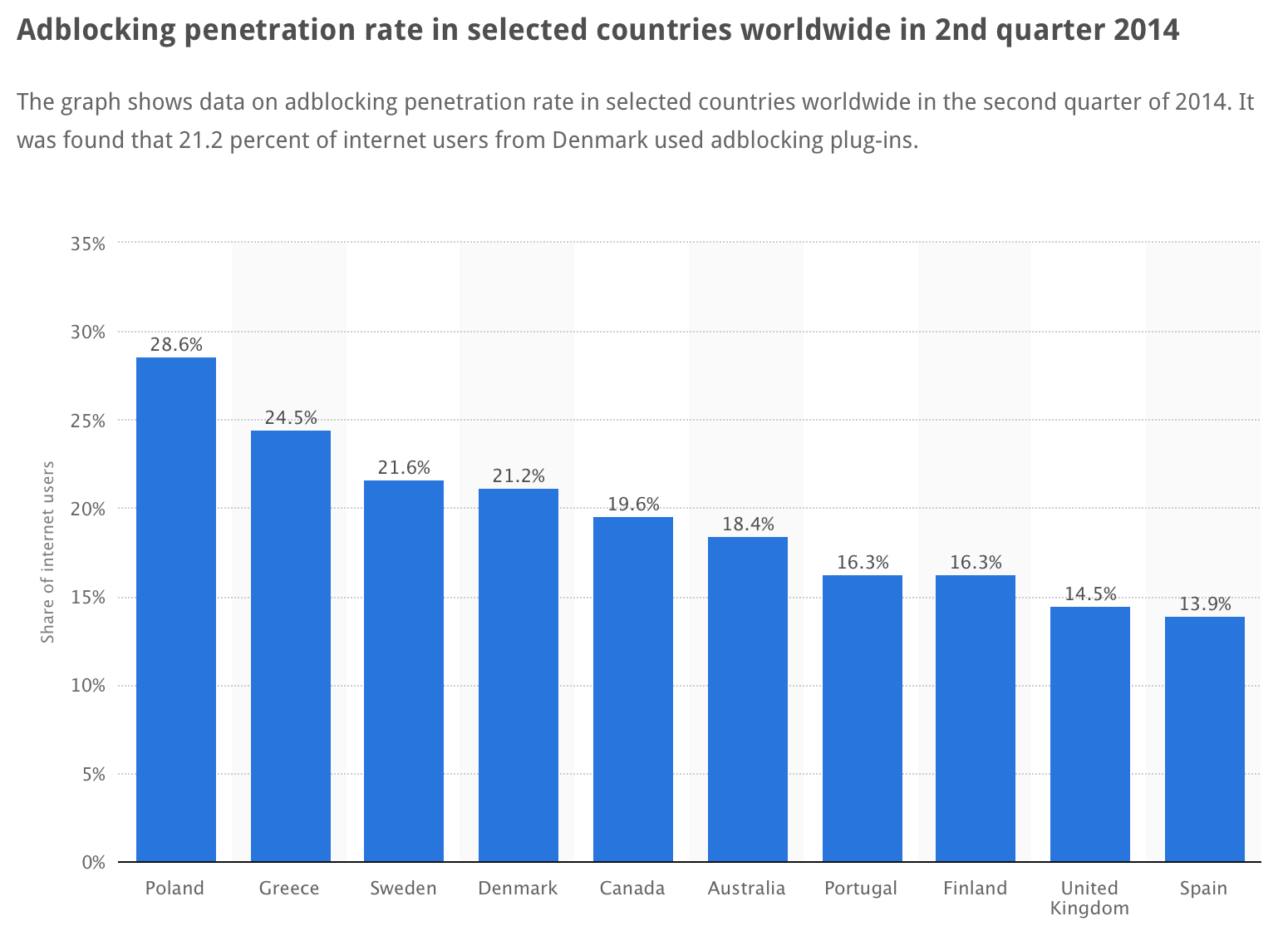
AdBlock Plus proves it’s not illegal » Betanews

So hated is AdBlock Plus, in fact, that a case was brought against the tool to try to prove that it is illegal.

Now a court in Hamburg has come to a decision, and ruled that AdBlock Plus – in case there was ever any doubt – is entirely legal. The plaintiffs in the case alleged that AdBlock Plus should not be permitted to block ads on the websites it owns. The judge presiding over the case disagreed.

The court ruled that AdBlock Plus is well within its rights to provide the option to hide advertisements on websites. The company sees this as setting a precedent and is taking this moment in the spotlight to reach out to content creators to work together to “develop new forms of nonintrusive ads that are actually useful and welcomed by users.”

ABP’s Ben Williams enjoys his Nelson Muntz moment on the company blog.


Start up: YouTube v smart TV, Google’s PR war, Gear Fit obsolete?, HTC goes in-car


You could watch this instead of YouTube on your old Apple TV or smart TV. Photo by ~Prescott on Flickr.

A selection of 7 links for you. Al dente. I’m charlesarthur on Twitter. Observations and links welcome.

Yahoo’s tiny, slow-growing mobile business » Beyond Devices

Jan Dawson on Yahoo’s first-quarter earnings:

Marissa Mayer must have described Yahoo as a mobile-first business a dozen times or so on the earnings call this afternoon. However, as Yahoo has also been quantifying its mobile business lately, we have some hard numbers to evaluate this claim by, and they’re not all that good at backing up her repeated claim.

Graphs don’t lie. Get left behind monetising mobile, and you’re left behind.


Wolff: Google’s antitrust bet that it’s a tech-led world » USA Today

I don’t usually have much time for Michael Wolff, but this seems on the money:

The other lesson that Google has clearly learned from Microsoft’s failures [to forestall antitrust action in the US and Europe] is that this is as much a PR battle as a legal one. Microsoft, wherever it went, was the nasty, unstoppable and lethal Goliath, gaining no sympathy in any quarter. Google, as nasty, unstoppable and lethal as Microsoft, understands the vast benefits of being, if only through the looking glass, the highest example of innovation and forward-thinking. Europe, and anyone who would get in its way, is the past, and Google — and you don’t want to miss this train — the obvious future.

Much of the world, including the world’s media, once happily aligned against evil-empire Microsoft.

Google’s bet now is that the world is a different place: the bias is actually for hegemonic tech companies instead of against them. Google is likely more dominant than Microsoft, both in the market and in the lives of its users, but that may well be to its benefit.


Apple TV, smart televisions hit by YouTube blackout » Expert Reviews

YouTube apps on older Apple TVs, smart televisions and iPhones may no longer work today after Google switched off an API that served many of these older devices. Products sold as recently as three years ago may no longer be able to stream from the world’s biggest video service.

The retirement of Google’s Data API v2 will leave some YouTube apps unable to show anything more than a warning message. Second-generation Apple TVs, iPhones and iPads running on iOS 6 or earlier, and many smart televisions, set-top boxes and Blu-ray players sold before 2013 will all be affected by the switch off.

Google has published a support page showing how different devices will be affected. Second-generation Apple TV owners are warned that “unfortunately, there’s no current way to watch YouTube on these devices”. Those still running iOS devices on iOS 6 or earlier are told they will either have to upgrade their OS (if possible) or watch YouTube video by going to the YouTube mobile site in the Safari browser. 

Older smart TV or games console owners are advised that they too may be able to continue viewing YouTube through the device’s web browser, but only if that browser supports flash and/or HTML5. 

Depending when you reckon smart TVs came along, this could hit between a third and half of those in place; TV sets get replaced about once every ten years. Having a YouTube app on a screen that doesn’t function to show you YouTube seems like a bit of a hassle.


Dilbert And Alice Add Features » Dilbert by Scott Adams

So true. Comments nail it too.


Samsung Gear Fit, or hardware obsoleted by software » Glazblog

Daniel Glazman has one – released with the Galaxy S5 on 11 April 2014. But he’s not happy:

The Gear Fit has a few downloadable extensions, based on a SDK also released a year ago. The fact extra apps can be created and maintained is a very important indicator of not only the market success of a given device, but also of the obsolescence of the device.

That SDK is not available any more from http://developer.samsung.com, as it is confirmed here. And it’s not a very recent change. Samsung then turned obsolete – because of software – a hardware they released less than a year ago. From a customer’s perspective (again, I bought that device), that’s pretty shocking.

The Samsung Gear Fit is still available everywhere here in France, from Orange stores to supermarkets. But it’s a dead duck without a SDK. Don’t buy it.


Review: Apple Watch for health and fitness » Re/code

Lauren Goode did a fairly deep dive (but not underwater, it’s not waterproof – haha) into the use of the Watch. I found this part about GPS interesting, because I was unclear from Apple’s description back in March, and thought it did have GPS. Turns out it doesn’t – but read on:

Apple Watch doesn’t have GPS, so you have to carry your iPhone with you if you want to track your run with GPS. Even if you do run with your iPhone, neither the Workout app nor the Activity app show you maps of courses you have run.

Also, the Workout app doesn’t show runners things like splits or cadence, although it’s possible that a third-party app could utilize the watch’s sensors and display this. And the Workout app doesn’t give audio alerts at key points throughout your run, which many running apps do.

That said, the Apple Watch automatically calibrates to your stride during your first few runs, so that even if you later run without your iPhone, you’ll get a close-to-accurate reading on distance. I found this to be true when I ran a couple of my regular neighborhood routes, and when I ran a 5K road race on an unfamiliar route, without my iPhone. Apple Watch recorded my 5K race as 3.05 miles, just .05 shy of the actual distance.


HTC in-car wireless device certified » Digitimes

Max Wang and Steve Shen:

HTC is reportedly stepping into the IoV (Internet of Vehicles) market and has one of its in-car wireless devices, the Think+ Touch OBU 2015, certified by Taiwan’s National Communications Commission (NCC), according to industry sources.

The Think+ Touch OBU 2015 features Bluetooth, GPS navigation, a lane departure warning system, tyre pressure monitoring system and sonar-based collision avoidance system, while supporting Android 4.4 KitKat platform, the sources noted.

Interesting move by HTC, though wonder how much retrofitting this would take (tyre pressure monitoring?). Also, please let “Internet of Vehicles” not be a thing.


Start up: Wikipedia’s oldest hoaxes, Android’s audio problem, EC seeks transparent search, and more


No, adding these chips won’t make you smart. Less hungry, maybe. Photo by malias on Flickr.

A selection of 8 links for you. Spread them like butter from the fridge. I’m charlesarthur on Twitter. Observations and links welcome.

Android’s 10 millisecond problem: the Android audio path latency explainer » Superpowered

Gabor and Patrick, who founded the audio-based software company:

Even though music apps make up only 3% of all downloads in the iOS App Store, the Music app category is the 3rd highest revenue generating app category after Games and Social Networking. Which suggests that music apps monetize disproportionately well on platforms that offer low latency performance such as the App Store/iOS devices.
On Android, it is a different story. In the Google Play store, the Music category is not even a top five revenue producing app category.

The overwhelming majority of Android devices suffer from too high audio latency, preventing developers from building apps that would satisfy consumer demand on Android.

As such, Google and Android app developers are leaving billions of dollars on the table for Apple and iOS developers because of Android’s 10 Millisecond Problem.

For the purposes of this explainer, roundtrip audio latency is simply the difference in time between when an audio input is introduced into a mobile device, undergo some sort of needed processing, and exits the same device. As any musician will tell you, we as humans are most comfortable with latencies of ~10 milliseconds. Anything significantly higher tends to disturb us.

Most Android apps have more than 100 ms of audio output latency, and more than 200 ms of round-trip (audio input to audio output) latency. To give you a quick example from the Oscar winning film Whiplash, it’s like the drummer is dragging by a half beat behind the band!

This has been a problem on Android for years; the analysis suggests it may be insoluble. (List of latencies here; some are really long.) The discussion on Hacker News is worth browsing too. (Via Benedict Evans.)


The story behind Jar’Edo Wens, the longest-running hoax in Wikipedia history » The Washington Post

Caitlin Dewey:

On Monday night, [Gregory] Kohs [a former Wikipedia editor who is now a prominent critic] wrapped up an experiment in which he inserted outlandish errors into 31 articles and tracked whether editors ever found them. After more than two months, half of his hoaxes still had not been found — and those included errors on high-profile pages, like “Mediterranean climate” and “inflammation.” (By his estimate, more than 100,000 people have now seen the claim that volcanic rock produced by the human body causes inflammation pain.)
And there are more unchecked hoaxes where those came from. Editors only recently caught a six-year-old article about the “Pax Romana,” an entirely fictitious Nazi program. Likewise “Elaine de Francias,” the invented illegitimate daughter of Henry II of France. And the obvious, eight-year-old hoax of “Don Meme,” a Mexican guru who materializes at parties and mentors hipster bands…

…“I think this has proved, beyond a reasonable doubt, that it’s not fair to say Wikipedia is ‘self-correcting,’” Kohs said.


We put a chip in it! » Tumblr

It was just a dumb thing. Then we put a chip in it. Now it’s a smart thing.

Such as for example these socks:


Elon Musk had a deal to sell Tesla to Google in 2013 » Bloomberg Business

Ashlee Vance, with an extract from a forthcoming book:

“The word of mouth on the [Model S] car sucked,” Musk says. By Valentine’s Day 2013, Tesla was heading toward a death spiral of missed sales targets and falling shares. The company’s executives had also hidden the severity of the problem from the intensely demanding Musk. When he found out, he pulled staff from every department — engineering, design, finance, HR — into a meeting and ordered them to call people who’d reserved Teslas and close those sales. “If we don’t deliver these cars, we are f—ed,” Musk told the employees, according to a person at the meeting. “So I don’t care what job you were doing. Your new job is delivering cars.”
Musk fired senior executives, promoted hungry junior employees, and assigned former Daimler executive Jerome Guillen to fix Tesla’s repair service and get its glitchy cars back on the road. He also proposed what eventually became his public guarantee of the resale price of the Model S: Unsatisfied buyers would get their money back from Musk personally if they couldn’t sell their car at a price comparable to that of another luxury model.

When in charge at Microsoft, Bill Gates used to insist that executives bring him at least one piece of bad news along with any good news. This is what happens when they don’t. Good on Musk getting the turnaround to happen through such a resourceful approach, though. Ah, but what might have been for Google.


EU to investigate transparency of Internet search results: document » Reuters

Julia Fioretti:

In a draft of the Commission’s strategy for creating a digital single market, seen by Reuters, it says it will “carry out a comprehensive investigation and consultation on the role of platforms, including the growth of the sharing economy.”
The investigation, expected to be carried out next year, will look into the transparency of search results – involving paid for links and advertisements – and how platforms use the information they acquire.

European Commission Vice-President Andrus Ansip is expected to formally announce the new strategy on May 6.

The transparency of search results came under particular scrutiny this week when the European competition chief accused Google of cheating competitors by distorting web search results to consistently favor its own shopping service.

There are concerns in Europe over how Internet companies such as Facebook and Amazon use the huge amounts of personal data they acquire.

The inquiry will also look at how platforms compensate rights-holders for showing copyrighted material and limits on the ability of individuals and businesses to move from one platform to another.

Don’t hold your breath for when this will report, though, or whether any of it will be implemented.


China smartphone shipments shed 30% sequentially in 1Q15 » Digitimes Research

Kristina Shih:

Shipments of smartphones by China-based vendors declined by nearly 30% sequentially to 91.8m units in the first quarter of 2015 due to sluggish demand both at home and overseas, as well as reduced production affected by the traditional Lunar New Year holidays, according to Digitimes Research.
Vendors which have a high ratio of export sales saw their shipments decline by over 40% sequentially in the first quarter, and those which focus more on the domestic market suffered declines ranging from 20-25%, Digitimes Research has found.

Huawei’s shipments were less affected by market factors, reaching 13.5m units in the first quarter and making the company the number vendor in the quarter. Xiaomi came in second with shipments totaling 10m units as it lowered the prices of some old models to boost sales.

Of course sequential changes don’t matter when you’re trying to analyse larger trends, but they hurt Digitimes’s intended audience of supply chain companies. That’s quite a drop; usually total worldwide mobile phone sales drop by about 10% from Q4 to Q1.


Instagram develops app for Apple Watch » FT.com

Tim Bradshaw and Hannah Kuchler:

Instagram, which built a billion-dollar business on smartphones, is making its first foray into wearable technology with a new app for the Apple Watch.
The popular photo-sharing app, which is owned by Facebook, will use the smartwatch to help users keep up with their closest friends through alerts as soon as they post a picture…
…“I think the Watch is really about quick information and notifications,” [Instagram designer Ian] Silber told the Financial Times. “It’s a huge use case that’s going to be a little bit different.”

So there’s going to be a version for a device that has only just launched, while the Windows Phone version hasn’t been updated for over a year. The power (or lack of it) of an ecosystem.


The great mobile divergence: how the app universe went beyond universal apps » John Kneeland

Kneeland nails the point that I also made: that just because app developers can write once for any Windows version (phone, PC, Xbox) doesn’t mean they will:

The value of a universal app is that you could write an app and have it easily working on all Windows platforms. If I had a bank app, an airline booking app, a casual game, or another app I was already planning on making for PCs, then sure, the idea of universal apps makes sense…
But what good is a Lyft app on a desktop? What good does the Luxe parking app do on my Xbox? What would Instagram even do on my ThinkPad? How could I use a barcode scanning price comparison app on a PC tethered to my desk? Is a PC going to count my steps or monitor my heart-rate in real-time? Can it help me navigate traffic with Waze? What good is a Starbucks card app (or any store app, or any mobile payments solution for that matter) going to do on a device that isn’t mobile? Heck, what would Grindr do if limited to a desktop—find romantic leads within my specified IP address blocks?

(Thanks Tero Alhonen.)


Start up: Chrome v Safari, designing Windows Phone, Apple Watch value, S6 battery life and more

Remember? That’s when Instagram for Windows Phone was last updated. Photo by Theen Moy on Flickr.

A selection of 9 links for you. Really, they are. I’m charlesarthur on Twitter. Observations and links welcome.

The Roomba for lawns is really pissing off astronomers » WIRED

Davey Alba on how the automated method of mowing lawns (using beacons to guide the mowers) could be a hassle for the star-struck:

the system requires special permission from the FCC due to its restrictions on fixed outdoor infrastructure. In a nutshell, the FCC doesn’t want people creating ad hoc networks of transmitters, which could interfere with existing authorized services like cellular and GPS systems. In its filings, iRobot says it should be exempt because it doesn’t set out to establish a broad communications network — its lawnbot networks would be tightly contained.
Astronomers say that’s not good enough. The frequency band proposed for the lawnbot (6240-6740 MHz) is the very same one several enormous radio telescopes operate on. Astronomers want the FCC to protect their share of the radio spectrum so their telescopes continue observing methanol, which abounds in regions where celestial bodies are forming.


Chrome is still a threat to your MacBook’s battery » The Verge

Vlad Savov on the comparative battery life of MacBooks using the Chrome browser, and Apple’s Safari:

It’s not just the distance you can go with Chrome that’s an issue. The speed and quality of the ride are also compromised. The widely used SunSpider browser benchmark clocks the MacBook Pro in at 203ms when using Chrome. Safari scores 30% better with a time of 144ms. Same machine, very different outcomes. You’d think YouTube would be a spot where Google collects an easy win, but that’s been another cause of distress: the new 4K 60fps videos that YouTube now supports are playable on the MacBook, but only — you guessed it — when using Safari and not Chrome. Google’s own browser chokes while playing back video from Google’s own video service.

Chrome’s problem is that it sets every page up as a virtual machine, demanding its own chunk of memory. Safari.. does it differently. The difference in battery life, though, is huge. Commenters weighing in seem to agree (while also liking the convenience of Chrome).


Apple Watch: an overnight multi-billion dollar business » carlhowe.com

Carl Howe used to analyse this sort of stuff for a living. Here he helps you think of the supply chain issues involved in the Apple Watch by likening it to producing a million origami lobsters:

Now let’s make this a little more realistic. As it turns out, we really want a million lobsters of two different sizes. Further, ordinary paper tears too easily and is the wrong colour for Origami lobsters, so we’ve decided to make our own paper; that will require its own process. We also need to be able to deliver some of the lobsters with glitter and others with hand-painted decorations; we’ll need to plan to supply and apply those materials too. Oh, and we want to make a few thousand out of two colors of pure gold leaf instead of paper. You’ll have to manufacture the paper for that too.
What’s your plan look like now?
There’s no rush; you can deliver your million lobsters any time during the month, provided that you don’t mind people complaining that you are way too slow at getting this done. Oh, and you’ll be criticized in the international press for every failure to produce perfect lobsters.
And now, imagine this same plan, except with this twist: no one has successfully folded this particular type of Origami lobster before, so you really don’t know how it’s all going to turn out. And your reward if you are successful will not be praise, but demands that you build even more next month.

This is such a wonderful post for wrapping your head around supply chain issues – as good in its way as Greg Koenig’s commentary about the amazing mechanics of how the Apple Watch is made.
Howe has a number for how many Watches have been sold, but you need to read his piece to find out. He’s probably right. (He also notes in an update that there’s only one module – that is lobster – so the Watch is even more profitable.)


Galaxy S6 Edge battery life – 4 days later » Android Authority

Let’s revisit Nirave Gondhia and see how he’s getting on with his series:

Another day of 13 to 16 hour battery life suggests that with my usage pattern, this is the most I can expect from the Galaxy S6 Edge. However, considering that the average user works approximately eight hours per day, it’s clear that the Galaxy S6 Edge will last a full working day, allowing you to charge it overnight and rely on it until you get home after work.
Another thing to take away is that using your phone at 50% brightness or less adds several hours to your battery life. I’ve done further testing on this and it’s certainly a key factor. The octa-core processor drives over 3.6 million pixels and if the brightness is set to full, it draws a large amount of power. Reducing to around 50 to 60% could increase your screen-on-time by over 50%.

16-hour battery life would certainly take you through a lot of the day.


Ex-Microsoft designer explains the move away from Metro » Thurrott.com

Paul Thurrott filleted an AMA by the designer of the new version of Office for Windows Phone so you don’t have to wade through the original. Fascinating bits, including:

Why is the hamburger menu in the top left of the display? It’s hard to reach, etc. I actually argued for top right. The issue with top right is that no one else does [it]. Being a special unique snowflake works for art but not design. Design should be invisible, so people shouldn’t be thinking ‘oh that’s odd. I’ve never seen this button used like this. I wonder if it does the same thing?’ … The industry decided top left. So to go against it you need to earn it. You need to be far, far better or else it just stands out awkwardly.”
But people need to be able to use it with one hand. “What the research is showing is that people aren’t actually as wedded to one handed use as we used to believe they are. Don’t get me wrong, this is clearly a tradeoff. Frequently used things have to be reachable, even one-handed. But hamburgers are not frequently used, and one-handed use is not ironclad. Combine those two factors together and you see why the industry has settled on this standard. It wasn’t random … And, sorry. But the hamburger has some real issues, but ‘I can’t reach uncommon things without adjusting my hand on my massive phone and that annoys me because it reminds me of the dominant OS on earth” [is not one of them].
But the bottom is better. “It turns out bottom is not better. You’d think that something 3 pixels from your palm would be easier to reach than something in the middle of the phone. But nope.

This really is a terrific post with so much about comparative user experience; this is the link you really should read today.


It has been one year since Instagram was last updated for Windows Phone » Neowin

Brad Sams:

It was on 3.22.14 that the Instagram beta was last updated and the app has remained unchanged since that day. In essence, this app represents the exact issue Windows Phone fans have expressed tirelessly over the years: It’s not the lack of apps, it’s the lack of support for the apps that do exist.
Twitter is another good example. While this app is updated more frequently, it lacks features of its iOS and Android counterparts. By all accounts, Twitter’s Windows Phone app is a distant second-thought for the company and while it is semi-frequently updated, when it does get new features, it’s months or years after the other apps.
Microsoft is aware of this, to no surprise, and they do hope that their universal apps will help to remedy this situation but it will not be an overnight fix.

It’s nice to hope. Has anyone pointed out yet that Instagram isn’t a desktop app, but is mobile-only, so the big Windows desktop installed base doesn’t matter at all to the company? Let me be the first then. Same for Snapchat, Uber.. the list goes on.


Here’s how much a Samsung Galaxy S6 replacement battery (and screen) costs » PC Mag

Sascha Segan:

According to a Samsung spokesperson in touch with the company’s support team, the Galaxy S6 battery has a one-year warranty. If its maximum capacity drops below 80% of its initial level during that year, your replacement is free (although you still have to pay for shipping.) At any other time, the replacement costs $45, plus shipping, though Samsung did not detail shipping costs.
That’s less than the $79 Apple charges for an iPhone battery replacement, but more than the official $29.99 price for a Galaxy S5 battery…
Samsung has walk-in repair centers in Los Angeles and Plano, Texas that don’t require shipping and do same-day battery swaps, the company said. Samsung is looking to establish those centers in more cities.
Screen replacements, meanwhile, cost $199 for the Galaxy S6 and S6 Edge. That’s more than the $109 Apple charges for iPhone 6 screen repair, but less than the $299 Apple charges for repairs that involve more than the screen. Samsung screen replacements also have a one-day turnaround.


Apple Pay plans to launch in Canada this fall » WSJ

Rita Trichur and Daisuke Wakabayashi, who note that Canada has lots of iPhones (30% installed base of smartphones) and lots of NFC-capable payment systems:

Canadian banks want Apple Pay to work in a way that requires a “secondary authentication” to verify customer information before cards can be used with the phones. That means that a consumer could be required to enter a PIN, log-on to a mobile banking app or use a one-time passcode sent via text message before cards can be used on Apple Pay, those people said.

Fair enough. Seems sensible given the problems US banks saw in letting people add cards without authentication. But then it carries on:

The trouble with that approach, however, is that it creates a clunky experience for consumers who expect mobile payments to be seamless—similar to tap-and-go credit cards that are already in wide use in Canada.

I checked this with the writers – surely the banks just want to authenticate initially, not every time? – but Trichur assured me she was hearing that the banks are considering a per-transaction authentication. Sounds bonkers to me.


This is why daddy drinks » Rusty Rants

Russell Ivanovic has been a dedicated disliker of Samsung phones since the S2 because “they often represented the worst possible Android experience you could have”. But they needed to have an S6 in the Shifty Jelly offices (which do Android app development):

The first thing that struck me was the build quality. It’s really good. The next thing that struck me was the screen. It’s amazing. Bright, super high density (far higher than the iPhone and Moto X I’m used to) and so beautiful. Then I was struck by the speed…this thing is fast…like really fast. Then I took a few test photos, and damned if they didn’t look better than all the same photos I was taking with my iPhone 6. In short I had a ‘huh?’ moment. Was it possible this was a good phone?


Lessons from history: the effect on Microsoft’s culture of the US antitrust verdict. Who’s next?


Internet Explorer: a voodoo doll, but for who? Photo by Verpletterend on Flickr.

The following is an extract from Chapter 2 of my book “Digital Wars: Apple, Google, Microsoft and the Battle for the Internet”, published by Kogan Page (and now in its second edition – make sure you get the 2014 version with the colourful cover). It’s available on:

• Amazon UK paperback, Kindle
• Amazon US paperback, Kindle
iBooks
It’s also been translated into Finnish, Korean, Russian, Chinese, Thai, and (I think) Spanish. Someone near you is sure to sell it in a language you want to read it in, or that you want to learn. (Note that none of those is an affiliate link. All I get is the author royalties..)

I’m publishing this as a reference for anyone who wants to know how US antitrust law works (note particularly the point about “harm to consumers”), and what happens to companies that fall foul of it.

Note that in Europe, the EC’s antitrust rules don’t require it to show harm to consumers – only that competition has been stifled.

Obviously, it’s interesting to consider the cultural changes that are described by the Microsoft observers both inside and outside the company to the antitrust ruling, and wonder whether there are any parallels for Google – currently facing a Statement of Objections from the EC over its Shopping service, and an investigation to see whether its licensing for use of the Android mobile operating system is anti-competitive.


By the time Ballmer took charge [as chief executive of Microsoft, replacing Bill Gates, on 13 January 2000], the antitrust trial [against the Department of Justice] was over; the judge’s Findings of Fact had been delivered. They were damning: Microsoft had abused its monopoly in Windows to extend them to other areas. That was illegal. But no sentence had been delivered.

The trial, and especially the testimony and press coverage, had an enormous effect on the internal culture of Microsoft. The staff didn’t stop thinking they were the best programmers in the world. But quite suddenly they couldn’t attract the rest of the best programmers in the world. Partly that was because as the antitrust trial ground on through 1998 and 1999 the dot-com boom took off, promising enormous riches to smart coders who hitched a ride with the right company. Get your stock options cheaply, and when the business IPOs you’ll be rich, just like those lucky guys at Netscape and Yahoo. But there was also the feeling that to work for Microsoft was to compromise your ethics.

Inside Microsoft, there was soul-searching. An early example had come at the 1999 annual executive retreat, where Gates and Ballmer wanted to talk over the finances of the company, examine its performance and chart the next product lines – the “roadmap”. The antitrust trial’s “Findings of Fact” – the judge’s established truth about the company – hadn’t yet been published. But Microsoft had been hauled over the coals in court; Bill Gates in particular had been made to look evasive and arrogant in his videoed deposition with the prosecution’s Robert Boies.

At the meeting, Orlando Ayala, then head of sales for Latin America and the south Pacific, told the top executives that he didn’t want to talk about the roadmap. One participant recalls Ayala saying that “we’ve got to talk about what our values are at this company. I can’t work here any more if my brother [who didn’t work for Microsoft] keeps challenging what I’m doing.” The attendee describes it as an example of “stopping the normal company process of growth and business as usual, saying we have to change how this company does business.”

The attendee says: “We said ‘no, we don’t want to discuss that [roadmap], because we’re in a crisis here and we need to address what we stand for as a company’… We’ve been called evil; most of us with outside friends and family are being questioned by them, asked why we’re working for Microsoft if it’s an evil company.”

The executive admits it was an “uncomfortable” feeling: “we all recognised the ability of Microsoft to build great software that would change the world.” The trouble was that outside the company, it was simply thought of as acting like a gangster, threatening those who looked as though they might set up on a patch adjacent to its own ground. (The judge, Thomas Penfield Jackson, talking to journalists under embargo during the trial, suggested that Microsoft’s actions were like those of drug traffickers or gangland killers.)

The court’s Findings of Fact said Microsoft held a monopoly of PC operating systems; it could artificially set licence prices, safe in the knowledge that barely anyone would decline. Judge Penfield Jackson pointed to an internal Microsoft study, provided in evidence, which determined that charging $49 for the Windows 98 upgrade would earn a reasonable return on investment, but that charging $89 would maximise revenue, hitting the sweet spot of the demand curve beyond which too many would-be buyers would stick with what they had. Only a monopoly would have that pricing power.

Being a monopoly (generally defined as having 80% or more of a market) is not illegal in the US; nor does it necessarily attract sanctions. But using a monopoly in one field to extend or create one in another field is, and does, if it can be shown to have harmed consumers in either or both markets. By going after the Netscape browser, which had begun to set itself up as a platform of sorts (albeit one which almost always ran on Windows), and using its control of Windows first to deny Netscape access to some APIs it needed for Windows 95, and then to boost its own Internet Explorer by insisting on its inclusion – at the threat to OEM PC makers of not getting Windows licences, which would kill their businesses – Microsoft crossed the line.

Among those also targeted for Microsoft’s arm-twisting via Windows to try to crush other products in different fields, the trial heard, were Intel, Sun Microsystems, Real Networks, IBM – which was denied an OEM licence for Windows 95 until a quarter of an hour before its official launch, and so missed out on huge swathes of PC sales – and Apple. In particular, Apple was offered a deal: stop developing its own systems for playing music and films on Windows, and let Microsoft handle them using its DirectX system. If it did, Microsoft would stop putting obstacles in the way of Apple’s Quicktime on Windows. Steve Jobs, who was at the meeting in June 1998, rejected the idea because it would limit the ability for third parties to develop content that would run on Windows PCs and Apple machines. (In retrospect, that declsion may be one of the most significant to Apple’s later success that Jobs ever made, since it meant that Microsoft could not control how Apple-encoded music was played on Windows.)

Internet Explorer was the focus of the trial, though: the number of Microsoft staff working on it had grown from a handful in early 1995 to more than a thousand in 1999. And Microsoft gave it away because reaching an effective monopoly share (50% of the browser market would be good; 80% and up ideal) was the target. Penfield Jackson completed the necessary trio needed for an antitrust conviction by pointing to harm not only for the companies affected, but also for consumers: tying Internet Explorer into Windows “made it easier for malicious viruses that penetrate the system via Internet Explorer to infect non-browsing parts of the system”.

The stock market wasn’t worried by the Findings of Fact; in the month after their publication, Microsoft’s stock value actually jumped, and it reached its all-time peak market capitalisation, $612.5bn, on the last working day of December 1999. The rest of the market for technology stocks rose too – though one analysis suggested that this was because Jackson (a pro-business Republican) had cleared the way for other companies to begin competing effectively.

Then in April 2000, with Ballmer four months into his new job, Jackson handed down his sentence: Microsoft should be split into two – one company making operating systems, one making applications.

Microsoft fought the order with all its might and wile. Jackson, it transpired, had compromised his supposedly impartial position by talking to the New Yorker’s Ken Auletta during the trial, for a book to be published immediately after it. In February 2001 a group of appeal judges declared that Jackson had violated judicial ethics with his conversations. (The real problem was that his remarks were published before the appeals process was exhausted, instead of when his verdict was published.) The breakup was halted over Jackson’s “perceived bias”. He railed that any bias was Microsoft’s fault, because it “proved, time and time again, to be inaccurate, misleading, evasive, and transparently false . . . Microsoft is a company with an institutional disdain for both the truth and for rules of law that lesser entities must respect. It is also a company whose senior management is not averse to offering specious testimony to support spurious defences to claims of its wrongdoing.”

Inside the company there was relief – and also a realisation that it had dodged a bullet. Though the sentence had been set aside, the Findings of Fact, and conviction, had not been overturned. At the next annual worldwide sales conference – held in the Seattle Mariners stadium – Ballmer explained that the culture had to change: no longer could Microsoft use its advantage in one field to dominate another. (The European Commission was to follow with similar investigations which rumbled on in parallel before coming out with demands for Microsoft to open up its software interfaces in 2003.) But it was the US case which reached down into the company’s soul…

…Some inside the company felt they had already abandoned the practices for which they were being condemned. “Arguably some of the things that we’d written in contracts were sailing a bit close to the wind,” admits one former Microsoft staffer. “But frankly if you look now at other peoples’ current contracts, whether it’s Apple’s around the iPhone, or Google’s, or even Intel’s, you’d say they were far more egregious than any of the contract terms that Microsoft signed up with Intel.” Which misses the point: it wasn’t the contracts which were bad, but the tactics, allied to Microsoft having a monopoly. Apple has no monopoly share of smartphones. Intel and Google arguably do in their own fields – and have both attracted attention (in Intel’s case, to enormous cost) from antitrust investigators…

…Pieter Knook, who worked for Microsoft through the period in its Asian business, says that the post-judgement process was exhaustive. “Every executive officer, every year, had to go through antitrust training, certify they were in compliance with the terms of the [antitrust settlement] agreement – so there was this very strong understanding, and obligation that you felt to do the right thing.”

“It had a big impact, and even a decade later it was still having an impact,” says Mary Jo Foley, a journalist who has followed Microsoft for years. “When they think about adding new features to different products or how they make sure their products work together, I think in the back of their minds is always this lingering kind of thought or checklist, like: ‘if we do that, are we going to get sued by so and so for antitrust?’ ‘Are we going to get sued by so?’ And so or so and so.” When any feature was being thought about, that question kept coming up: will it break the antitrust ruling? “I think it has almost had a chilling effect on the way they do product development,” Foley suggests.

With Microsoft suitably admonished, and now living under a new regime of oversight, the scene was set for Microsoft’s next challenges: in search, digital music and in mobile phones. First was a little startup that was already becoming the talk of internet users, one which was to form its corporate thinking around a motto that tried to express a desire not to be Microsoft: “don’t be evil”.


If you found this useful, you might like the book. It’s longer. Links above.