Why Sony might pull out of smartphones: it’s trying to raise prices in a falling market


A message for Sony? Photo by LendingMemo on Flickr.

After my look at the first-quarter performance of various high-end handset vendors – Samsung, Sony, LG, HTC, Apple – plus Microsoft and BlackBerry, it’s time to focus more tightly. First up: Sony, which I think is most likely to pull out of the smartphone business among those presently in it.

Why not LG, HTC, Microsoft or BlackBerry? (Samsung we can be sure will stick with smartphones. Apple, ditto.)

• LG is a rarity: a company that has pulled itself out of the lossmaking mire to come back to success. In part this is because it’s a conglomerate, so it can afford to pile money into its handset division, because (like Samsung) when the handset division does well, it pulls the rest along.

• HTC somehow stutters along. It’s a minor player now, but doesn’t look imperilled as it did last year, when it was posting losses as though it enjoyed it. With cash in the bank, it looks safe for now (though we’ll have to see how the M9 and associated handsets sell).

• Microsoft can bear the losses from handsets pretty much endlessly, and they’re useful for other research.

• BlackBerry has horrendous problems with handset profitability, but handsets are essential to its existence while it doesn’t have a completely solid business in mobile device management; they also lend it a USP, so it’s likely to stick with them even though they don’t make money. Then again, let’s check back when it announces its next set of results in June.

Last man standing

Sony is the one I think is most likely to pull out of this market. It’s in the middle of a huge struggle with its identity, where the only divisions that are performing up to snuff are its image sensor manufacturing and games, while music and films tick over. The mobile side? Not so much.

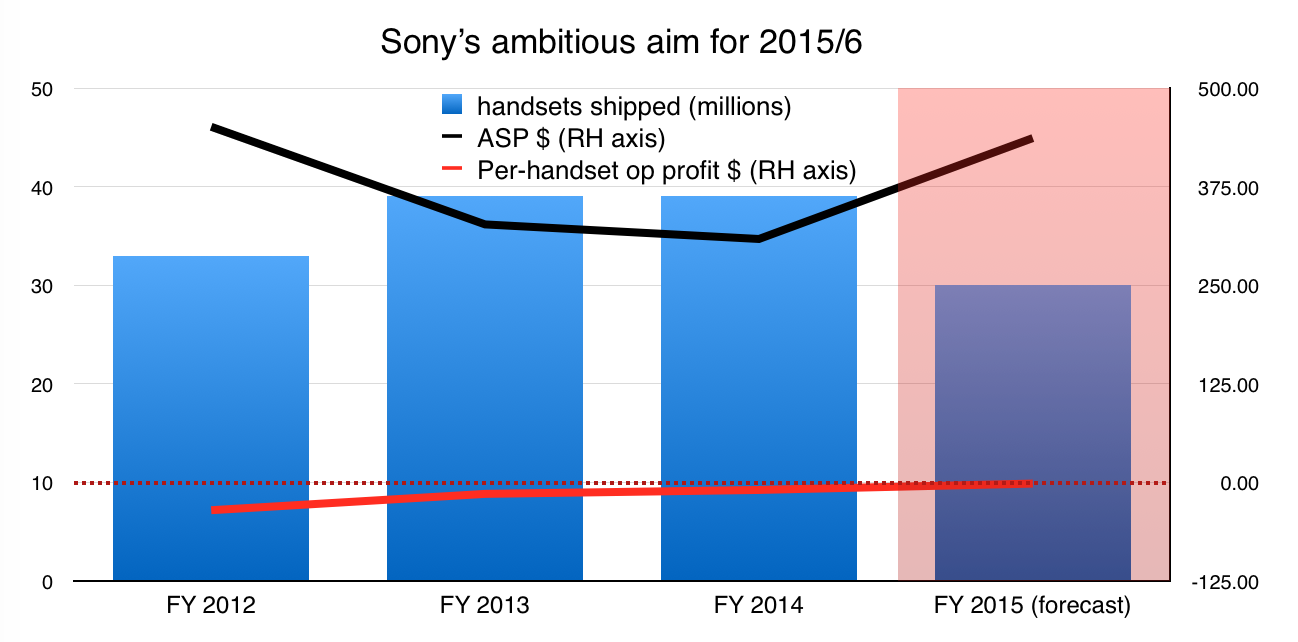
Here’s how it has been doing – plus its stated ambitions for the coming financial year, outlined in red.

Sony's smartphone aims for 2016

What Sony wants from its smartphones: sell fewer at higher prices, smaller losses.

Sony is aiming to get the average selling price (ASP) of its phones to rise, according to its forecast for next year:

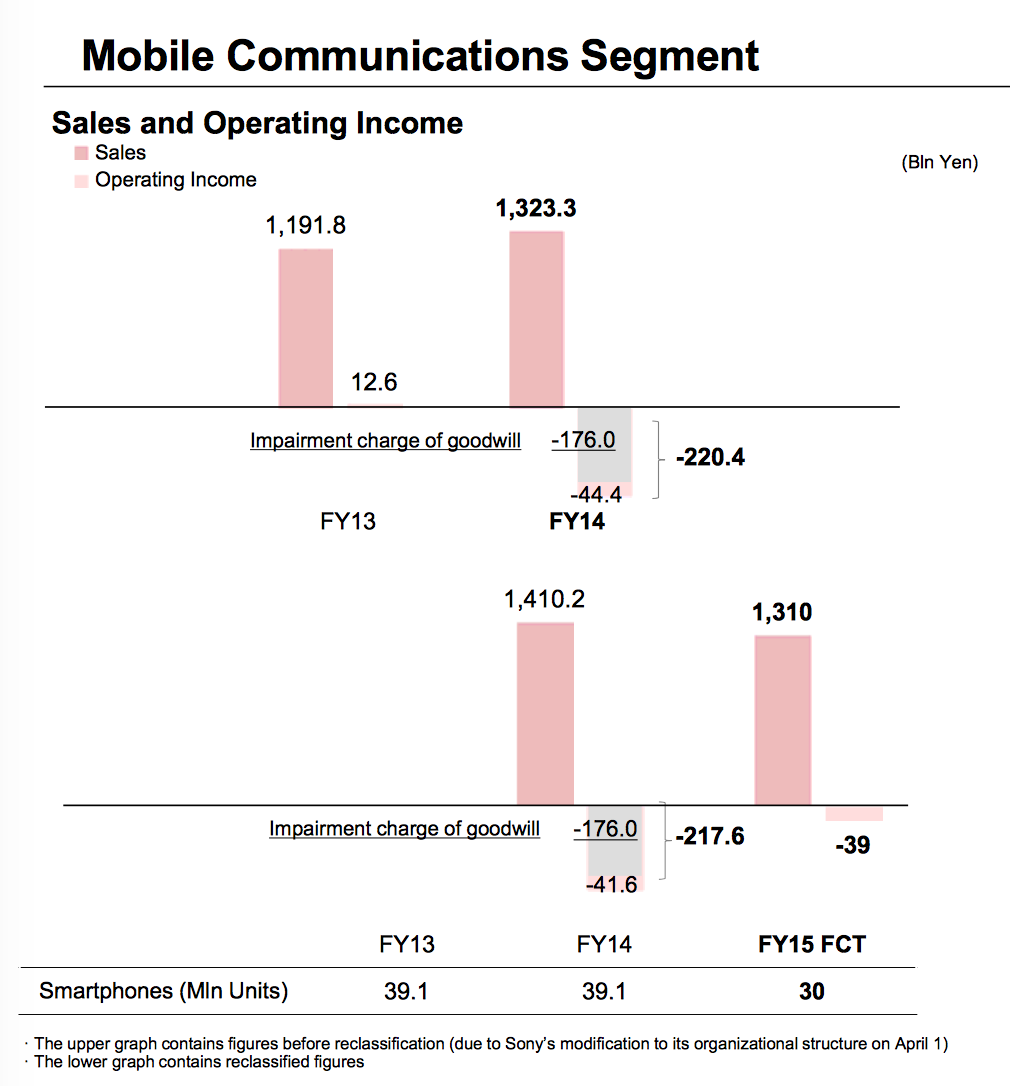
Sony's forecast for smartphone revenues and profits. Well, loss.

Sony’s forecast for smartphone revenues and profits. Well, loss.

Sony presentation: smartphone sales/profit

Extract from Sony’s financial review of 2014 and forecast to March 2015

Specifically, it says it’s going to sell fewer handsets but keep revenue about the same. The figures imply raising handset ASPs from around the $300 mark to over $400.

I don’t think that will work. None of Samsung, LG or HTC has an ASP over $400; for all, the figure has been generally trending down for some time. Apple has a high ASP – over $600 – but it claim all sorts of unique selling points (notably, its brand). Sony is competing with other high-end Android phone makers where it hasn’t been able to stand out.

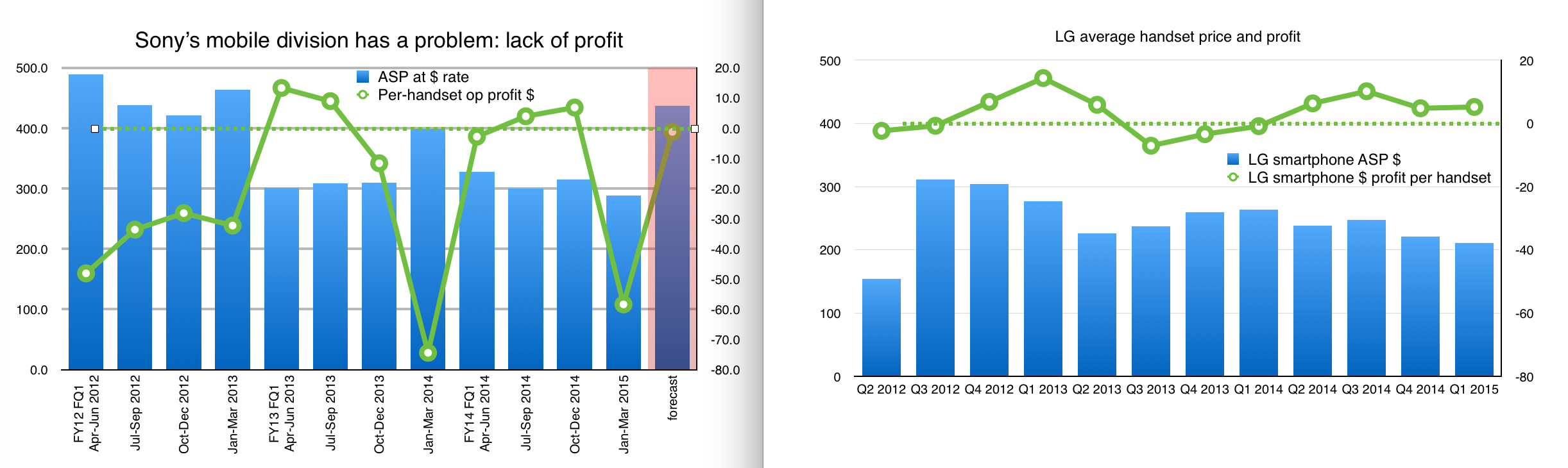
Also, compare Sony’s ASPs and profitability with LG’s:

Comparing Sony and LG smartphone ASP and profit

Sony’s profit wobbles all over the place – but its ambitions for ASP look wild

They’re both on the same scales: ASP on the left axis, profit per handset on the right. (I ignored Sony’s intangibles writedown for the latest quarter.) LG sells on average for less, but does a lot better from it. Sony swings around wildly – a manifestation of its internal problems. Note also how both firms are seeing falling ASPs (ignoring Sony’s forecast).

The problem for Android handset makers is that the ASP is being driven down relentlessly: entrants such as Xiaomi and big players like Huawei are prepared to set low price expectations, which then make it hard for pricier offerings.

But but but! you say. Sony has a world-famous brand, and it has differentiation from Samsung and LG: its phones are waterproof, you can add SD cards (well, that differentiates them from the top-end Samsung flagship now, at least), and.. hmm.

Not so easy to think of features that really distinguish Sony phones from the others jostling for the top end, is it? Which means that in its aim to push up ASPs while selling fewer phones in turns means concentrating even more on the top-end market. There it is going to bump right into LG, Samsung, HTC and Apple, of which at least two have more powerful brands in this field. While 30m isn’t an ambitious target, the price is.

Not that Sony’s admitting that; it has “financial targets” for the fiscal year to March 2018, where it wants the mobile business to have revenues of between ¥1,000 and 1,250bn ($8.32bn and $10.40bn) with operating income margins of 3% and 5%, which translates to between $416m (lowest revenue, lowest profit) and $520m (highest).

Goals are nice, but Sony’s brand isn’t strong enough in smartphones: I think its strategy may take it in the same direction as PCs, where it fought at the high end (competing, notably, with Apple), making devices that were well-regarded critically but which didn’t sell in sufficient volume to make the business worthwhile. It then threw in the towel as losses grew.

The smartphone business is similar: once you lose scale (as has happened to HTC), it’s really hard to regain it. Sony is aiming to sell half as many phones as LG did in 2014, and only 50% more than HTC did. The incremental sales of camera sensors and phone screens will be nice, but it doesn’t have its own CPU or memory foundry as Samsung does; those factors all help drive Samsung’s profitability. I suspect this will be more like PCs than LG’s smartphone business.

How soon? That rather depends on the smartphone market, and how tolerant Sony’s management are if the strategy doesn’t go according to plan. Give it a few quarters. Then we’ll see if Sony really has the guts for this.

But it also raises a key question. What is the differentiating feature to boost sales for an Android handset today? Waterproofing? SD cards? Removable battery? Great camera? Or is it just price? Sony will have to hope it’s not that.

Start up: Starbucks app hack, more image recognition, HomeKit on the way, drone questions and more


That’s another sort of third-party keyboard altogether. Photo by zen on Flickr.

A selection of 7 links for you. They are. I’m charlesarthur on Twitter. Observations and links welcome.

EXCLUSIVE: Hackers target Starbucks mobile users, steal from linked credit cards without knowing account number » Bob Sullivan

Sullivan broke this story:

Because Starbucks isn’t answering specific questions about the fraud, I cannot confirm precisely how it works, but I have informed speculation, based on conversations with an anonymous source who is familiar with the crime. The source said Starbucks was known to be wrestling with the problem earlier this year. Essentially, any criminal who obtains username and password credentials to Starbucks.com can drain a consumer’s stored value, and attack their linked credit card.

Hackers often manage to steal hordes of username and password combinations, the way they steal databases of credit card account numbers. Because consumers often re-use credentials, hackers take them and “brute force” thousands of potential logins at the website. Because Starbucks’ mobile payment app is so popular, any large set of stolen credentials is bound to have at least a few combinations that unlock Starbucks accounts.

Perhaps you’re wondering: what’s the use of hacking the Starbucks app? Answer, as a wilier mind than mine pointed out: you can buy Starbucks gift cards at the counter with them. Then you sell them on eBay. (Though I can’t decide if this is pretty small-time crookedness or a huge line of business. Certainly going to be inflating Starbucks’s bottom line though.)


Wolfram Language Artificial Intelligence: the Image Identification project » Stephen Wolfram Blog

“What is this a picture of?” Humans can usually answer such questions instantly, but in the past it’s always seemed out of reach for computers to do this. For nearly 40 years I’ve been sure computers would eventually get there — but I’ve wondered when.
I’ve built systems that give computers all sorts of intelligence, much of it far beyond the human level. And for a long time we’ve been integrating all that intelligence into the Wolfram Language.
Now I’m excited to be able to say that we’ve reached a milestone: there’s finally a function called ImageIdentify built into the Wolfram Language that lets you ask, “What is this a picture of?”— and get an answer.


Apple says first HomeKit smart devices coming in June » WSJ Digits blog

Daisuke Wabayashi:

“HomeKit [hardware certification] has been available for just a few months and we already have dozens of partners who have committed to bringing HomeKit accessories to market and we’re looking forward to the first ones coming next month,” said Apple spokeswoman Trudy Muller.

Apple’s statement comes on the heels of a report in Fortune that said Apple’s software platform — which will allow the company’s devices to control connected home appliances — was experiencing problems and that the introduction of the first HomeKit devices were being delayed.

For its part, Apple has never said when HomeKit-compliant devices would start hitting the market, but one developer working with Apple on the platform had told Re/code earlier this year that new products would be ready in May or June.

Interesting: Apple moved quickly to respond to this – within hours – and chose the WSJ to say it.


Dirt cheap drones: Is Europe’s largest Kickstarter in over its head? » Ars Technica UK

Cyrus Farivar:

In January 2015, the Welsh drone startup concluded its Kickstarter campaign to fund production of the Zano. It raised over £2.3m ($3.4m) in under two months, becoming the most crowdfunded European project ever. This summer, Torquing [Group, which is making the device] says it will ship drones to the more than 12,000 people who backed the project.

There’s only one problem. Despite Zano’s release date being less than two months away, no one outside Torquing has actually flown the drone. And it’s questions about the project that are truly beginning to take off.

Ars visited Torquing last month for an exclusive tour of the company’s offices. After spending a couple of hours with the Zano team, we don’t have a good sense of how well the device actually flies. Although we heard more about its touted “swarm” feature, we didn’t see the drone working in a real-world situation; we were merely able to hold a Zano and verify its existence.

Reece Crowther, the company’s head of marketing, regretfully informed us that we turned up just before a shipment of 500 last-minute prototypes arrived. Torquing, therefore, said it was unable to let us fly one. At the time, Reedman noted that only 12 Zanos existed, and we saw what appeared to be only a few of them.

I’m one of the backers. Fingers crossed. I’d expect this to be late, at best.


Sunrise launches ‘Meet’, a custom keyboard to schedule meetings » MacStories

Federico Viticci:

When I first tried Meet, Sunrise’s latest addition to their popular calendar app, I didn’t think it made much sense as a custom keyboard. Now, a few months later, Meet has become my favorite way to check on my availability from any app and create one-to-one meetings. With Meet, the Sunrise team has created one of the most innovative mobile calendar features I’ve seen in years.

Sunrise, part of Microsoft since February, rarely shied away from subverting traditional calendar features found in most clients for smartphones and tablets. As I explored last year, Sunrise’s biggest strengths lie in excellent integration with web services, prolific use of icons to quickly discern events, weather support, external calendars, and the ability to show details for event participants. At its core, Sunrise aims to reimagine the calendar by expanding it beyond a list of days and events

.

Super-clever. Expect more lateral thinking on keyboards as a result. Available on iOS and Android. Oh, Windows Phone? Doesn’t allow third-party keyboards.


How smartphone startup Light plans to replace high-end cameras » Re/code

Ina Fried on a company that’s not exactly making a smartphone; it’s making the camera systems to go into them:

Put more simply, Light tries to emulate digitally what a big zoom lens does through expensive glass lenses. It aggregates the data from the different cameras to create both optical zoom and high-resolution images. Light has applied for a bunch of patents to cover aspects of its approach, including creating zoom using images from the multiple fixed-focal length lenses.

As a business, Light is banking on the fact that using smartphone cameras, even a bunch of them, is a far more economical way to achieve the kind of images that in the past have required expensive glass lenses.

The technology is ready, says Grannan, who previously ran start-up Vlingo and also worked at Sprint PCS. There is of course, added cost in putting a bunch of cameras and mirrors inside a cell phone, an addition of perhaps $60 to $80 in the final cost of a phone, Light estimates.

Seems high. Creating a big lens from smaller ones is a solved software problem: it’s how the Very Large Array works, for example. Wonder if this is really a defensible USP.


Why I’m breaking up with Google Chrome » The Next Web

Owen Williams, on a topic I previously linked to:

The Verge reported that using Chrome over Safari resulted in a three and a half hour shorter battery life on the latest MacBook.

I’ve always loved Chrome’s interface, its plethora of extensions, and how it integrates with services every day, but it’s time for something new. We can do better.

The problem is that the Web is now optimized for Chrome users and that means alternatives often provide a terrible experience.

Thanks in part to the browser’s massive market share, the best developer tools and Google’s aggressive adoption of the latest Web technologies, developers have gravitated toward Chrome’s rendering engine as the only one they support.

I’ve switched to Safari (on a Mac), and found that yes, processor use plummets and battery life extends dramatically. Nor is it noticeably slower (or faster).

But the important point here is in the third paragraph of this excerpt: that lots of sites are now using Chrome-specific tweaks, which means that they don’t work as well in other browsers, at least on the desktop.

This does pose a problem if it becomes dominant in mobile: Android isn’t going away, and Chrome is increasingly the default browser on mobile too.


Start up: tablets sink further, Indiegogo’s vaporware campaigns, pricing Apple Watch, and more


Available in Lego before it reached Windows Phone. Photo by Ochre Jelly on Flickr. (See their photostream for how they achieved this “impossible” shot.)

A selection of 9 links for you. Set them free. I’m charlesarthur on Twitter. Observations and links welcome.

Game of fear: the story behind GamerGate » Boston Magazine

Zachary Jason with a fabulously detailed yet clear recitation of what most of us know:

[Eron] Gjoni, a software engineer, had set out to construct a machine to destroy his ex. Every written word Quinn had ever entrusted with him—all of her flirtations, anxieties, professional grudges, and confessions about her family and sex life—would serve as his iron and ore. He scoured their entire text and email history, archiving and organizing Quinn’s private information on his laptop and cell phone. Then he typed it all in black and white — minus, of course, the tones in their voices, their laughter and tears, and any context whatsoever.

Of course, Gjoni could have just deleted the document, along with Quinn’s phone number and email address, and tried to woo one of the millions of other women on OkCupid or joined any of the roughly 5,000 other dating sites. He could have posted his thoughts on a blog and omitted her name. After several days, though, Gjoni decided to go through with it—after all, he was protected by the First Amendment, right?

Gjoni comes across as being somewhere on the autistic spectrum. Also, a real jerk.


For the second straight quarter the worldwide tablet market contracts amid competition from alternative devices » IDC

Apple still leads the overall market despite five consecutive quarters of negative annual shipment growth. Apple shipped 12.6m iPads in the first quarter, capturing 26.8% of the market in volume and declining -22.9% when compared to 1Q14. Samsung (19.1% share) maintained its second place in the market despite a -16.5% decline in shipments compared to the same period last year. Lenovo (5.3% share), Asus (3.8 %) and LG (3.1%) rounded out the top 5 positions. LG’s year-over-year growth was notable as it continues to benefit from US carriers’ strategy to bundle connected tablets with existing customers.

“Although the tablet market is in decline, 2-in-1s are certainly a bright spot,” said Jitesh Ubrani, Senior Research Analyst, Worldwide Quarterly Tablet Tracker. “While 2-in-1, or detachables, still account for a small portion of the overall market, growth in this space has been stunning as vendors like Asus, Acer, and E-FUN have been able to offer products at a fantastic value; and vendors like Microsoft have been able to drive growth at the high end with devices like the Surface Pro 3.”

The smallest figure that IDC splits out is 1.4m, for LG, which implies that the Surface shipped fewer. Tablets took off fast; now they’re awaiting the replacement cycle.


Windows will win your heart by not caring » Remotely Mobile

Benjamin Robbins on Microsoft’s BUILD announcements:

In short, Microsoft has clearly shown it doesn’t care; but in a good way. They don’t care which apps you want to use, they’ll support them. They don’t care which operating system you want to develop on, they’ll support it. They don’t care if you are on a phone or a PC, they just seamlessly switch between the two experiences.This is huge for all of us end users. Why? Because in the end we don’t really care either. We just want to be able to use the apps and services we think are best to get the task done and move on. I don’t want to fight the OS, app, or device. I just want to do my work and be done with it. This is where mobility is ultimately pushing us and it’s great to finally have someone not care either.


New Apple Watch has lowest ratio of hardware costs to retail price, IHS teardown reveals » Business Wire

The much-anticipated new Apple Watch has the lowest hardware costs compared to retail price of any Apple product IHS Technology has researched, according to a preliminary estimate by IHS and its Teardown Mobile Handsets Intelligence Service. The teardown of the Apple Watch Sport by IHS Technology estimates that the actual hardware costs are only about 24 percent of the manufacturer’s suggested retail price (MSRP). Estimated hardware cost to MSRP ratios for other Apple products reviewed by IHS are in the range of 29 to 38%.

The teardown of the Apple Watch Sport 38 mm by IHS Technology shows a bill of materials of $81.20 with the cost of production rising to $83.70 when the $2.50 manufacturing expense is added. The retail price of the Apple Watch Sport 38 mm is $349.00. The IHS Technology analysis does not include logistics, amortized capital expenses, overhead, SG&A, R&D, software, IP licensing and other variables throughout the supply chain such as the EMS provider.

That’s some low manufacturing expense for what the Watch looks like. And of course even if it’s right, that’s just the gross margin. Look at what it doesn’t include too.


Play Monument Valley on your Windows Phone today » Windows blog

Monument Valley: a fantasy world of impossible architecture and a beautiful, silent princess awaits you! Today we’re excited to share that Monument Valley is available to download from the Windows Phone Store.

Originally released on iOS just over a year ago. I wonder how many Windows Phone users have not heard of or played this on a friend’s phone. Or an iPad?


China is rewriting the rules of the mobile game, and Apple is still winning » The Verge

Vlad Savov:

The recognition of China’s importance is evident everywhere in the mobile industry. HTC is, for the first time, introducing two flagship smartphones this year, with the One M9+ being tailored to the needs and preferences of the Chinese market. In February, around the turn of the Chinese New Year, Lenovo brought Motorola back to China, setting it up as a sort of exotic alternative to local offerings, one where user customization is paramount.

But no one has benefited from China’s growing appetite for smartphones more than Apple. Even as the developed world was becoming saturated with iPhones, Apple kept expanding its sales with the help of China. The iPhone first became available in China in 2009, relatively early in its now gloried history, and has kept growing in line with the country’s expansion in disposable income and smartphone demand. This past quarter, Apple sold more iPhones in China than in the United States, belying prognostications that the Chinese market wouldn’t be receptive to such a premium, high-margin device.

As I criticised The Verge yesterday for not seeking out points of view, I should point to this as exactly the opposite: Savov gets comments from analysts who know and understand the market to produce an insightful piece. (Though Nokia used to be HUGE in China, Vlad. Until Q1 of 2012, when its mobile revenue there halved, and halved again within a year.)


comScore ranks top UK digital media properties for March 2015 » comScore, Inc

More than 47.5 million UK unique visitors accessed the Internet in March 2015 across desktop and mobile (smartphone and tablet) platforms. 45.1 million visitors accessed the Internet via desktop while 36.4 million users browsed the web via mobile. 

According to comScore MMX Multi-Platform, which provides an unduplicated view of usage across desktop, smartphone and tablet, Google Sites ranked as the top property with nearly 46 million combined desktop and mobile Internet users. The majority of Google Sites’ audience visited from both desktop and mobile platforms (66%), while 28% visited exclusively from desktop and 5% were mobile-only users. BBC Sites was the second most popular online property with a multi-platform audience of 40.6 million, 36% of which were mobile-only.

There is so much to extract from the short table in the release. For instance: Google gets 96.7% of the total audience; Amazon gets 77% of it, and more people access Amazon mobile-only than desktop-only; Mail Online, Sky sites, Apple, Trinity Mirror, Twitter and LinkedIn get more visits via mobile-only (which is 5% of the total audience) than desktop; all the media groups get more visitors via mobile-only than desktop-only.

If you re-sort it by mobile-only, Sky actually comes top – and Google comes last.

One to really mull over. Can hardly accuse the news organisations of being behind the times.


[Update: Indiegogo Investigating] Indiegogo continues to have no standards, allows $50,000 flex-fund campaign for vaporware modular smartphone » Android Authority

David Ruddock:

While it has served as a legitimate platform for fans to support products and content they genuinely believe in and want to see become a reality, it is also ripe for scamming and incompetence. Case in point: Fonkraft, a $50,000 Indiegogo campaign that allegedly will culminate in the production of a Project Ara-style modular smartphone.

To date, the flex-funded (as in, even if it doesn’t reach the goal, the project still gets what money was raised) campaign has amassed over $25,000 from people who probably know no better, with over 130 phones funded by supporters. The team behind the campaign? Literally two people, neither of whom state where it is they previously worked (no LinkedIn profiles, either – or any easily locatable social media profiles – surprise!), what specific experience they have in the phone industry, or how they plan to build a phone with two people and $50,000…. or less, since it’s a flex-fund campaign. For the record, Ubuntu wouldn’t even build a regular phone for less than $32 million.

Also, these guys provide literally no insight on how their product would actually work in a technical sense. You just have to believe!

Incredible that IndieGoGo lets people keep money raised even if it doesn’t reach the goal. It’s an open invitation to those with absurd optimism or bad intent.


Apple iPhone captures 12% smartphone market share in China in Q1 2015 » Strategy Analytics

According to the latest research from Strategy Analytics’ Handset Country Share Tracker(HCST) service, China smartphone shipments grew 17% annually to reach 110m units in the first quarter of 2015. Xiaomi maintained first position, but Apple is rapidly closing the gap with 12% marketshare in second place.

China smartphone shipments grew 17% annually from 93.6m units in Q1 2014 to a 109.8m in Q1 2015. China smartphone growth on an annualized basis has slowed from 39% to 17% during the past year, due to increasing penetration maturity. This is the first quarter that China’s smartphone annual growth rate has been lower than the global average since 2010.

Xiaomi, Apple, Huawei are the top three. Notice the company that’s missing from that list. Seems Samsung sold below 11.2m smartphones in China in Q1. Is the S6 going to bring it back?


Microsoft’s per-handset profit, or the lack of it – and its impact on Windows Phone’s future


How much did this Lumia 920 cost to make? And will it have a successor? Photo by Whatleydude on Flickr.

In case anyone was in any doubt, Microsoft’s results last week demonstrated once more what we’re coming to know about the mobile handset industry: it’s damned hard to make any money in it. When I published a fairly simple analysis of the state of the top-end Android handset market (with a comparator to Apple’s iPhone profits), people were apparently flabbergasted by how thin the per-handset operating margins were on these devices which sold for hundreds of dollars.
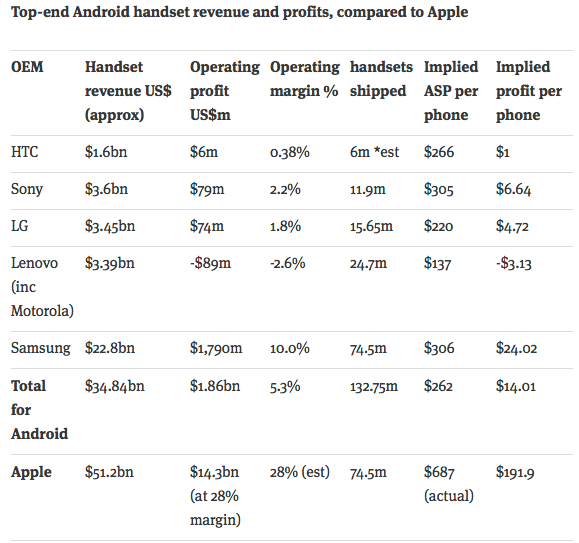
Estimated Android handset operating profit Q4 2014

See the original post for more detail and caveats.

But Microsoft showed that it’s not even able to generate gross margin while selling millions of handsets. (Gross margin is the difference between how much it costs you to make the item – usually factory costs and distribution costs – and what you get for it. Gross margin normally excludes R&D and sales & marketing costs; to get the operating profit, you subtract those costs too, so operating profit is always less than gross margin.) My analysis of Android handset makers looked at operating profit.

Negative gross margin takes some doing; spending more making stuff than you take in for it is exceptionally bad business. But Microsoft Mobile did, officially: take a look at Microsoft’s 10Q for the calendar first quarter of 2015.

Microsoft phone hardware revenues, Jan-Mar 2015

It says

Phone Hardware revenue was $1.4bn in the third quarter of fiscal year 2015, as we sold 8.6m Lumia phones and 24.7m non-Lumia phones. We acquired NDS in the fourth quarter of fiscal year 2014. Phone Hardware gross margin was $(4) million in the third quarter of fiscal year 2015. Phone Hardware cost of revenue, including $147m amortization of acquired intangible assets, was $1.4bn.

For those unversed in accountancy notation, that “$(4) million” means “minus $4 million”. Accountants use brackets rather than a minus sign because it’s easy to overlook a minus sign and create a horrendous hash in your calculations.

For the nine months,

Phone Hardware revenue was $6.3bn in fiscal year 2015, as we sold 28.5m Lumia phones and 107.3m non-Lumia phones. Phone Hardware gross margin was $805m in fiscal year 2015. Phone Hardware cost of revenue, including $401m amortization of acquired intangible assets, was $5.5bn.

This does take some untangling. In my analysis, I’m going to ignore the writeoffs (amortisation) of intangible assets – essentially, goodwill (“how much more we paid than the physical assets are worth”) being written down. This actually makes the gross margin look better – as in, in positive territory. That’s a start.

Pause for history

Some brief history. When Nokia made phones, it used to provide wonderfully detailed results, in which it would tell you how many featurephones and smartphones it had sold, and at what average selling price (ASP). This made it easy to see how its business was going. It didn’t give you gross margins – only operating margin for the whole phone business. In general, though, we knew its featurephone business was profitable, and that once it moved to the Windows Phone Lumia range, the smartphone side lost a ton of money.

Enter Microsoft, buying Nokia’s phone business – including featurephones – for €5.4bn, which was completed on April 25th 2014. That’s when the featurephone and Lumia sales start showing up in Microsoft’s results, and we shift to the “gross margin” measurement. (Microsoft does this because Steve Ballmer reorganised it to an Apple-style “apportion all cost across the board”, rather than making each division its own profit-and-loss fiefdom.)

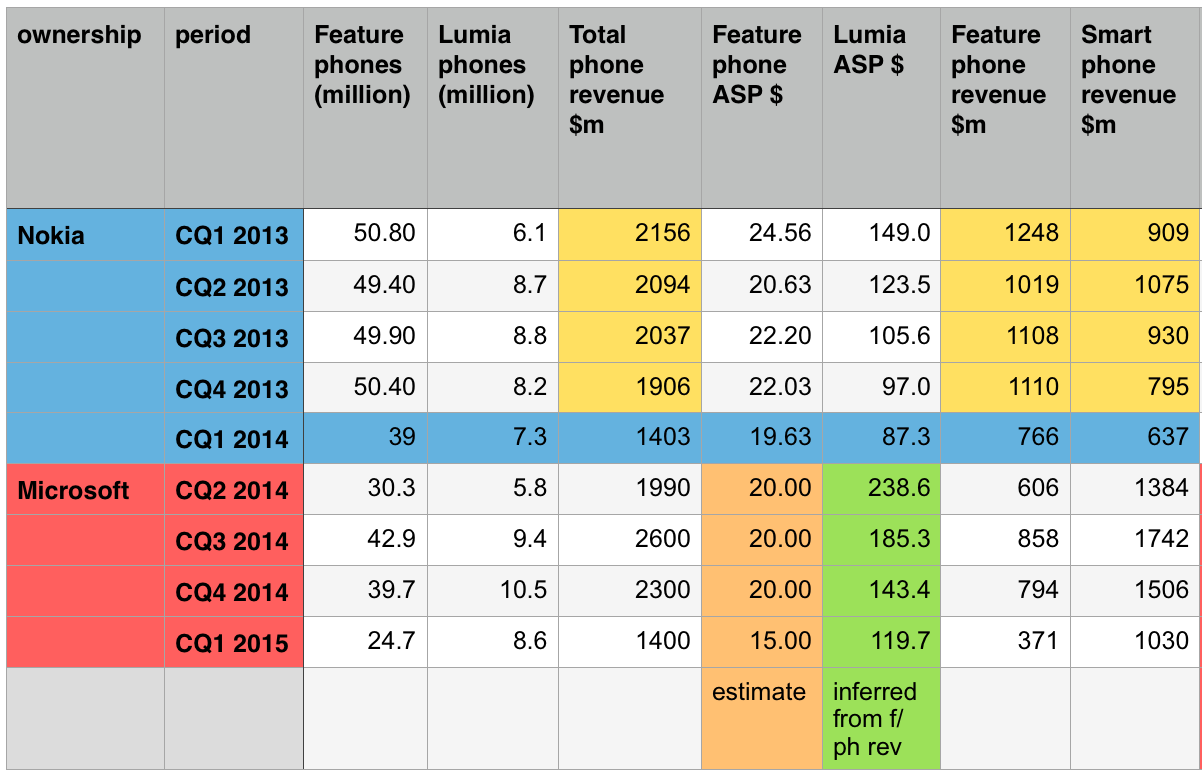
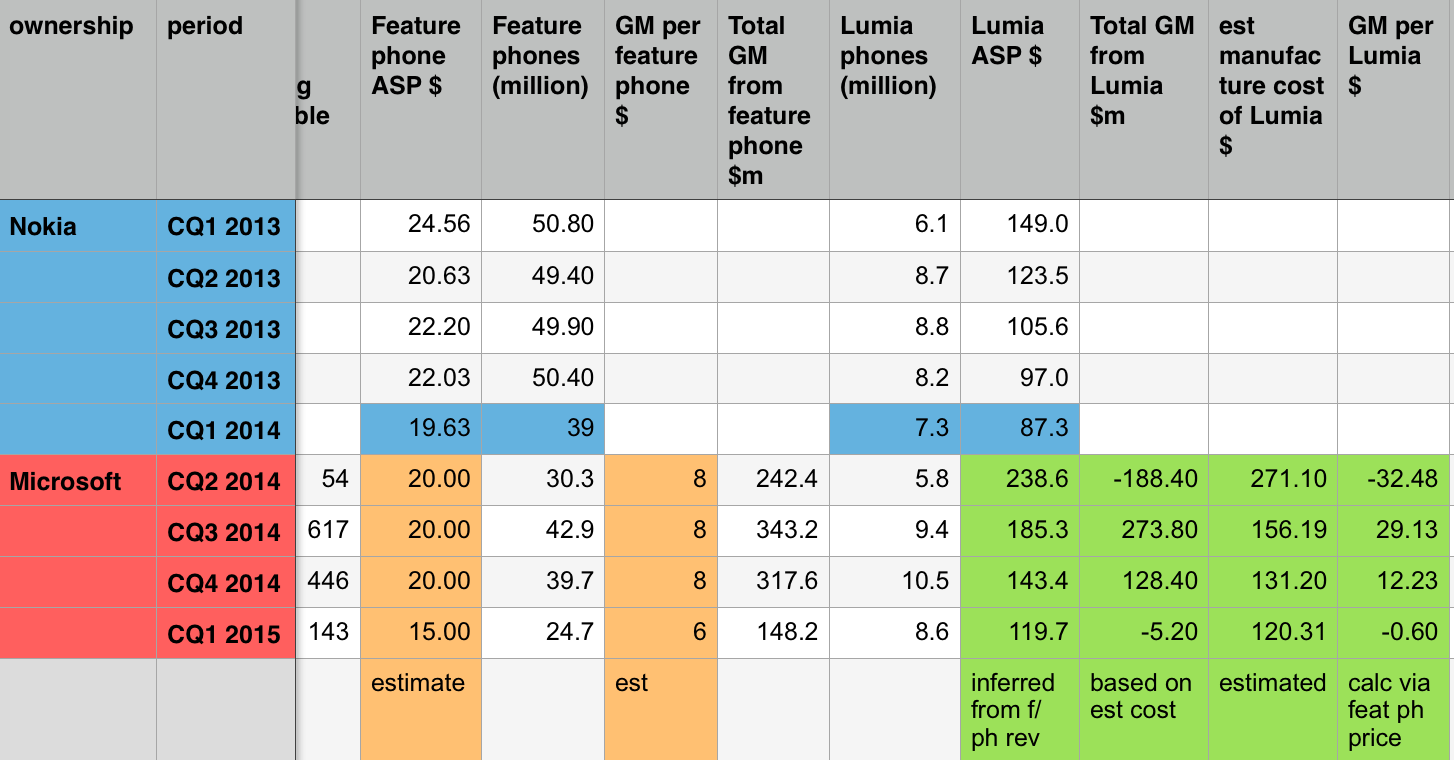
Given the Lumia ASP and sales figures at Nokia, you could work out the ASP of featurephones, and their contribution to revenues. What I’ve done in the table below is use Nokia’s featurephone and Lumia ASP (converted from euros to dollars at the prevailing rate at the end of each quarter) and try to carry that forward to estimate the recent ASPs of Lumia handsets under Microsoft’s ownership, and their contribution to revenues.
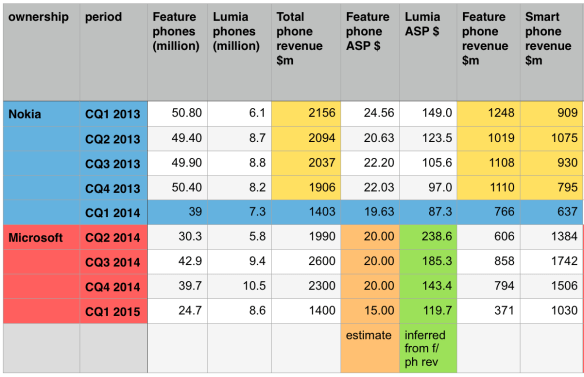
Featurephone and estimated Lumia ASPs

If you estimate the ASP for featurephones based on the Nokia numbers, you can figure out those for the Lumia phones at Microsoft.

A few things to note: I’m assuming that featurephone ASPs are falling. Even with that, there’s a clear fall in the ASP of the Lumia phones – from (a really quite high) $238 in the second calendar quarter of 2014 to the present. There hasn’t been a flagship phone released in that time, so perhaps not surprising.

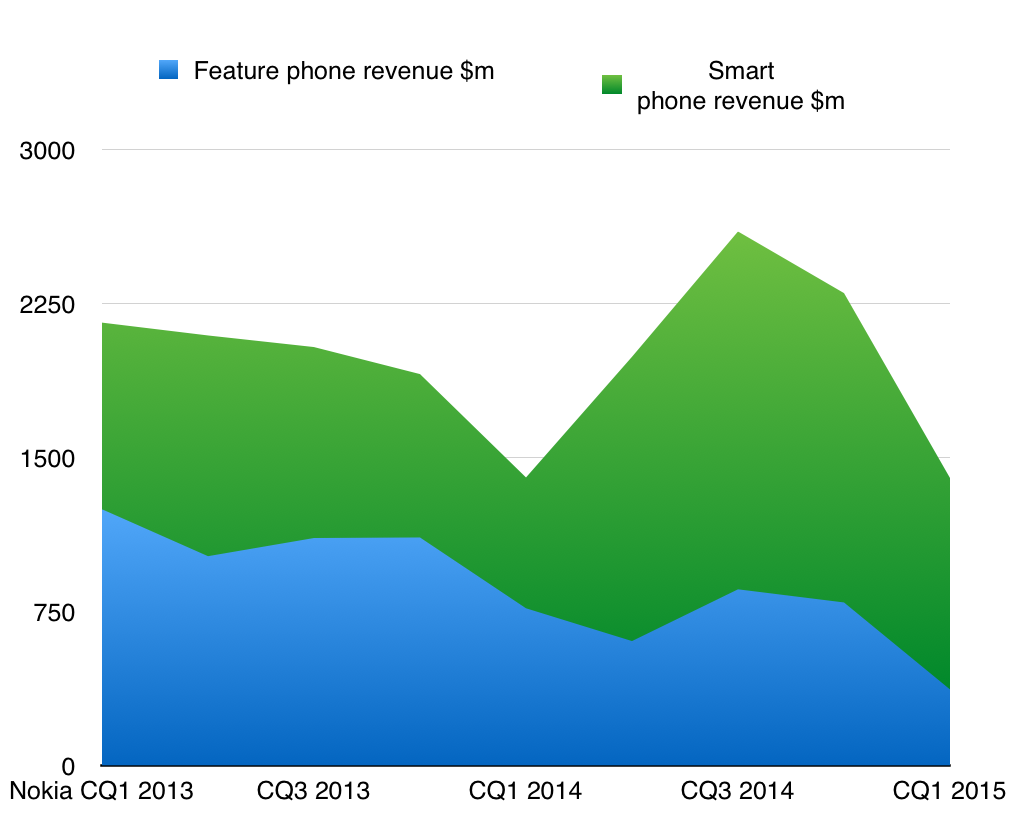
Also, smartphone revenue has flipped from being the minority source at Nokia to being the majority source now (even at $20 featurephone ASP, it’s still like that) because featurephone sales are collapsing, while those of smartphones are remaining fairly static – like this:
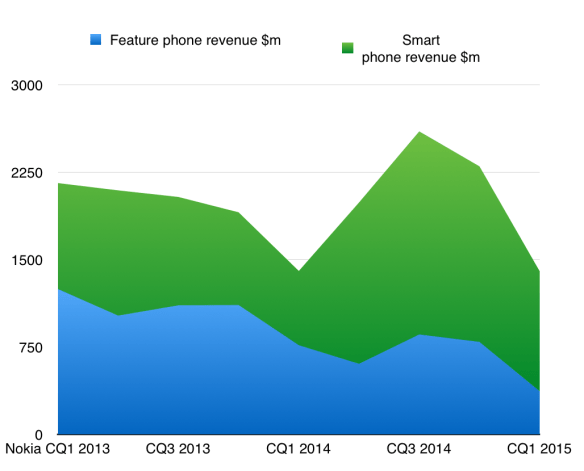
Estimated split of smartphone and featurephone revenue at Microsoft

Based on ASP assumptions, you can figure out how much revenue smartphones and featurephones generate. That’s not profit, though.

Now we move on, to seek out gross margin. There’s no data from Microsoft about the separate gross margins of the featurephones or Lumias. We don’t know how much they cost to build, or which might be profitable. So we have to use estimates and what people tell us.

Fortunately, we do have some indication of how profitable Nokia featurephones were. In an interview in April 2013, Nokia’s director of platform and content said that the profit margins on the $20 Nokia 105 were the same as those on the Lumia phones. How much might that be? Again, we don’t know, but it can’t be a lot. Putting it at $5 seems reasonable.

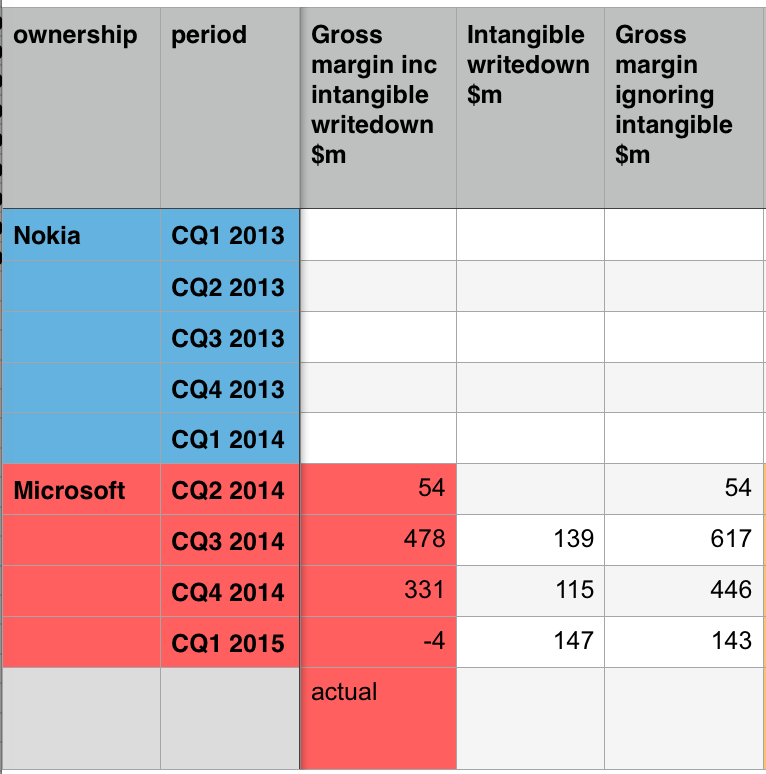
We have the figures for total gross margin; we also have the intangibles writeoff in the financials. So that gives us a “real” gross margin (ie the day-to-day gross margin for the quarter, excluding accountancy writeoffs):

Gross margin, excluding intangibles

Microsoft gives quarterly figures for intangible writeoffs; subtracting that gives the hardware gross margin.

Now we make assumptions about featurephone gross margin. I’ve gone for $5, falling to $4 as the average price of the handset falls from $20 to $15.

From this, and from the data we’ve got about total phone shipments, it’s quite simple to back-calculate to come out with figures for the total contribution to gross margin by featurephones and Lumias.
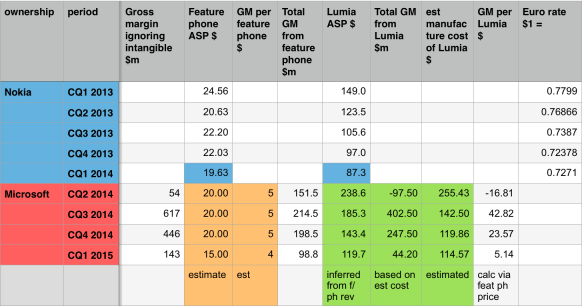
Progress! GM and profit gives Lumia data

If we assume per-handset profit on featurephones, we can use that with the GM data to figure out how much Lumias cost to make. And we have the ASP..

Which tells us what? The CQ2 figure is anomalous – Microsoft mentions an intangibles writeoff in that period, but doesn’t specify how much (unlike other periods). It’s likely the total gross margin was larger if you ignore that, which would put the gross margin per Lumia into the black.

What we also see is that even if we allow a miniscule per-handset gross margin for each featurephone, we see a rapidly falling gross margin for the Lumia line. Here’s an alternative scenario, if we think that the featurephones have a $8 gross margin, falling to $6 in the latest quarter:

What if featurephones have higher profit?

Giving a per-handset profit of $8 for featurephones makes the Lumia business look much worse. It’s unlikely, though.

On this higher profit for featurephones, the Lumia gross margin goes into negative territory. You can argue that’s too high a margin for a featurephone. Doesn’t matter though – the direction of travel is clear: the Lumia barely washes its face.

And this, don’t forget, is before you include the costs of sales and marketing – all those Lumia ads! – and research and development. Here’s the R+D impact:

Three months ended March 31, 2015 compared with three months ended March 31, 2014: Research and development expenses increased $241 million or 9%, mainly due to increased investment in new products and services, including NDS expenses of $212 million.

For the nine months:

Research and development expenses increased $694 million or 8%, mainly due to increased investment in new products and services, including NDS expenses of $815 million. These increases were partially offset by a decline in research and development expenses in our Operating Systems engineering group, primarily driven by reduced headcount-related expenses.

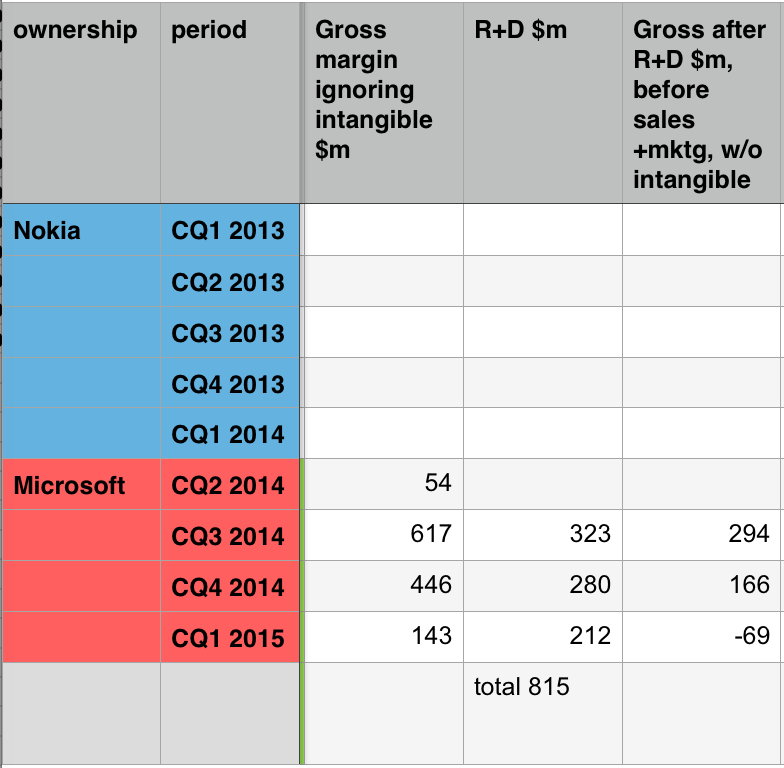
A little digging shows the R+D costs for the NDS (Nokia Devices and Services) segment by quarter. That gives us a sort of “halfway” operating profit once you deduct R+D, which shows that the division has moved into the red even before you consider sales and marketing costs.

R+D by quarter for Microsoft's mobile business

R+D numbers are mentioned in the quarterly 10Q. To get towards the operating profit (or loss), we need to subtract that.

That’s not profit

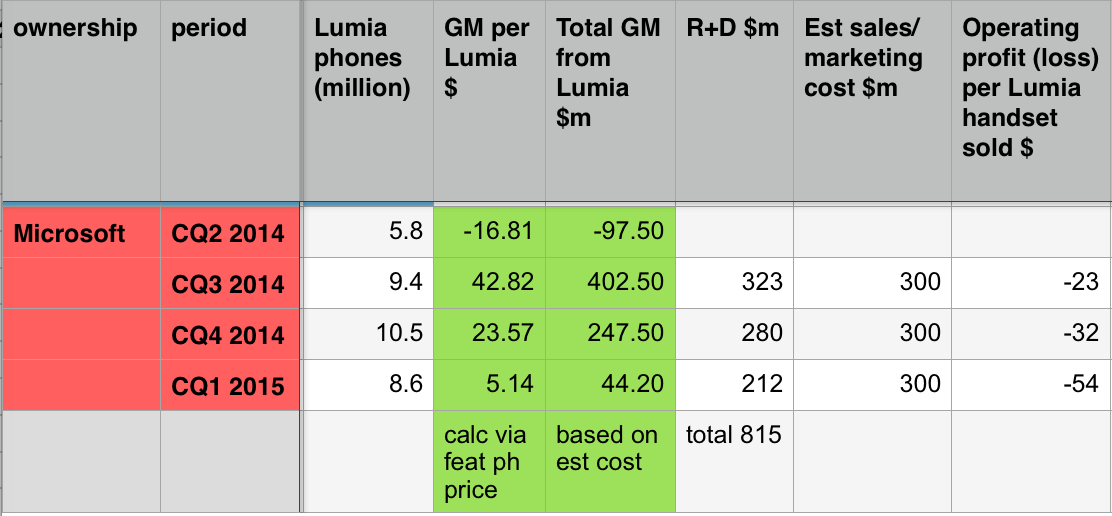
To figure out whether the handset division makes an operating profit we’d have to know the sales and marketing costs. It’s pretty improbable that those were anything less than $300m per quarter (that’s $10m per day, worldwide). Which means that Microsoft’s handset division has been loss-making since it took it over, despite those profitable featurephones, and ignoring the writedown of intangibles.

On a per-handset basis, if you allow $300m per quarter for sales and marketing (into which we’ll also roll administration), then you get a clear picture: Lumia handsets don’t make an operating profit at all.
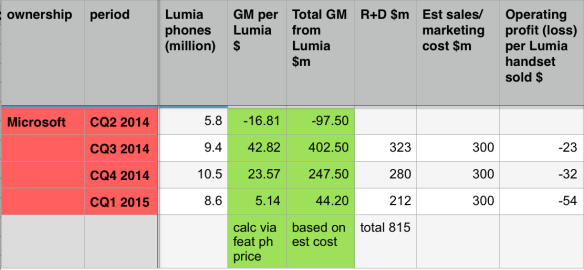
Estimated per-handset loss for Lumias

Don’t forget, this relies on assumptions around featurephone profitability and price.

But hey, you say, that’s all assuming that featurephones are making $5 per handset. What if it’s $0? No problem – that’s the fun of spreadsheets. You can play with assumptions:

What if featurephones make $0?

Lumias still show a per-handset loss. (Remember this is with featurephone pricing of $15 in the latest quarter.)

OK, dammit – what if featurephones lose $5 per handset? Lumias still plunge into operating loss in the latest quarter – and remember, this is ignoring intangible writeoffs, and allowing just $10m per day worldwide for sales and marketing:
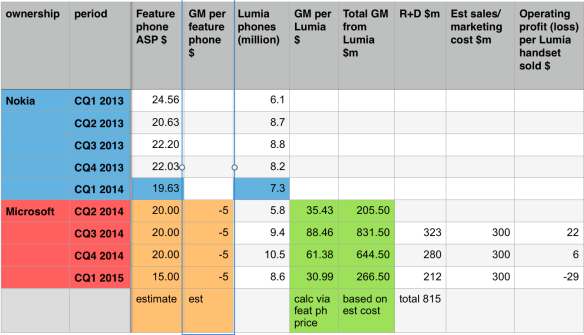
What if featurephones lose money?

Even at a $5 loss per featurephone, Lumias aren’t moneymakers at the operating level (on my assumptions).

You might have thought that Android handset makers had it tough, but at least – at the top end – they’re ekeing out something.

(Yes, these numbers are based on assumptions about featurephone pricing and margin, but I’d defend them as all being reasonable based on what we know about the business in the present and past.)

Update: thanks to Vlad Dudau of Neowin, who pointed me to Microsoft’s discussion of its results, where they say

We have made significant progress in reducing the operating expense base in the Phone business, moving from an annualized rate of $4.5bn at acquisition to a run rate under $2.5bn.

Opex is R+D plus sales+marketing and things like general+administration; an annualised run rate of $2.5bn is $625m per quarter – which is slightly more than I was allowing there. That would make the Lumia margins worse.

Microsoft adds:

That said, the changing mix of our portfolio to the value segment and the significant negative headwind from FX [foreign exchange rates] will impact our ability to reach operational break even in FY16.

So, no good news in the offing. (/Update.)

Why carry on, then?

Why, then, does Microsoft persist with Windows Phone? It can’t really think that it’s somehow going to come good and suddenly take off to challenge iOS and Android. The idea (which some outside Microsoft cling to) that the introduction of Windows 10, where apps can be written for both desktop and mobile, will suddenly lead to a huge uptake (by businesses?) is pie in the sky. Mobile and desktop have different design demands. Corporations with mobile needs haven’t been sitting on their hands for the past five years waiting for Windows Phone to reach a sort of maturity; they’ve been hiring people who can hook into their systems using iPhones and Android phones. Under Satya Nadella, Microsoft has recognised this, offering Office and other key software on rival platforms to capture (or retain) users and revenue.

You can’t justify it on “they’ll make it back in profits on services”; the 80m or so Lumia owners around the world aren’t the high-end users, but low-end ones who are less likely to spend on apps, or pricey Microsoft products.

So why? Two clear reasons. First, it’s important to keep playing in this space; Microsoft needs to have a mobile offering because it’s impossible to say where in the future a mobile-focussed offering might be key.

Secondly, though, is that more simple one: pride. Couple that with the inertia of a big organisation, and the fact that in the scheme of Microsoft’s profits the losses from the mobile division (about $500m, ignoring intangibles, over the past three quarters) are piffling, and there’s no reason to stop.

However, things could change. I’ve argued previously that Nadella should just give up on Windows Phone, and move to an Android fork. Not long after I argued that, Nokia (then still Finnish-owned) introduced the Nokia X, using Microsoft services and AOSP (Android without Google services on top). Microsoft rapidly killed it.

But now Microsoft is preinstalling its apps on the Samsung Galaxy S6 – and more importantly, has a “strategic partnership” with Cyanogen. The latter is a huge, and smart, move: it seems to me the easiest way for Microsoft to make a real impact on mobile.

If the Cyanogen move takes off, though, I could see Windows Phone withering. Why bother with loss-making hardware when you can piggyback on the world’s most successful mobile OS (that’s Android/AOSP) for the pure gravy of services profit? I wouldn’t.


Other posts you might find interesting:
Android OEM profitability, and the most surprising number from Q4 2014

Why Google’s struggles with the EC – and FTC – matter

How Gresham’s Law explains why news sites are turning off online comments


Start up: Wikipedia’s oldest hoaxes, Android’s audio problem, EC seeks transparent search, and more


No, adding these chips won’t make you smart. Less hungry, maybe. Photo by malias on Flickr.

A selection of 8 links for you. Spread them like butter from the fridge. I’m charlesarthur on Twitter. Observations and links welcome.

Android’s 10 millisecond problem: the Android audio path latency explainer » Superpowered

Gabor and Patrick, who founded the audio-based software company:

Even though music apps make up only 3% of all downloads in the iOS App Store, the Music app category is the 3rd highest revenue generating app category after Games and Social Networking. Which suggests that music apps monetize disproportionately well on platforms that offer low latency performance such as the App Store/iOS devices.
On Android, it is a different story. In the Google Play store, the Music category is not even a top five revenue producing app category.

The overwhelming majority of Android devices suffer from too high audio latency, preventing developers from building apps that would satisfy consumer demand on Android.

As such, Google and Android app developers are leaving billions of dollars on the table for Apple and iOS developers because of Android’s 10 Millisecond Problem.

For the purposes of this explainer, roundtrip audio latency is simply the difference in time between when an audio input is introduced into a mobile device, undergo some sort of needed processing, and exits the same device. As any musician will tell you, we as humans are most comfortable with latencies of ~10 milliseconds. Anything significantly higher tends to disturb us.

Most Android apps have more than 100 ms of audio output latency, and more than 200 ms of round-trip (audio input to audio output) latency. To give you a quick example from the Oscar winning film Whiplash, it’s like the drummer is dragging by a half beat behind the band!

This has been a problem on Android for years; the analysis suggests it may be insoluble. (List of latencies here; some are really long.) The discussion on Hacker News is worth browsing too. (Via Benedict Evans.)


The story behind Jar’Edo Wens, the longest-running hoax in Wikipedia history » The Washington Post

Caitlin Dewey:

On Monday night, [Gregory] Kohs [a former Wikipedia editor who is now a prominent critic] wrapped up an experiment in which he inserted outlandish errors into 31 articles and tracked whether editors ever found them. After more than two months, half of his hoaxes still had not been found — and those included errors on high-profile pages, like “Mediterranean climate” and “inflammation.” (By his estimate, more than 100,000 people have now seen the claim that volcanic rock produced by the human body causes inflammation pain.)
And there are more unchecked hoaxes where those came from. Editors only recently caught a six-year-old article about the “Pax Romana,” an entirely fictitious Nazi program. Likewise “Elaine de Francias,” the invented illegitimate daughter of Henry II of France. And the obvious, eight-year-old hoax of “Don Meme,” a Mexican guru who materializes at parties and mentors hipster bands…

…“I think this has proved, beyond a reasonable doubt, that it’s not fair to say Wikipedia is ‘self-correcting,’” Kohs said.


We put a chip in it! » Tumblr

It was just a dumb thing. Then we put a chip in it. Now it’s a smart thing.

Such as for example these socks:


Elon Musk had a deal to sell Tesla to Google in 2013 » Bloomberg Business

Ashlee Vance, with an extract from a forthcoming book:

“The word of mouth on the [Model S] car sucked,” Musk says. By Valentine’s Day 2013, Tesla was heading toward a death spiral of missed sales targets and falling shares. The company’s executives had also hidden the severity of the problem from the intensely demanding Musk. When he found out, he pulled staff from every department — engineering, design, finance, HR — into a meeting and ordered them to call people who’d reserved Teslas and close those sales. “If we don’t deliver these cars, we are f—ed,” Musk told the employees, according to a person at the meeting. “So I don’t care what job you were doing. Your new job is delivering cars.”
Musk fired senior executives, promoted hungry junior employees, and assigned former Daimler executive Jerome Guillen to fix Tesla’s repair service and get its glitchy cars back on the road. He also proposed what eventually became his public guarantee of the resale price of the Model S: Unsatisfied buyers would get their money back from Musk personally if they couldn’t sell their car at a price comparable to that of another luxury model.

When in charge at Microsoft, Bill Gates used to insist that executives bring him at least one piece of bad news along with any good news. This is what happens when they don’t. Good on Musk getting the turnaround to happen through such a resourceful approach, though. Ah, but what might have been for Google.


EU to investigate transparency of Internet search results: document » Reuters

Julia Fioretti:

In a draft of the Commission’s strategy for creating a digital single market, seen by Reuters, it says it will “carry out a comprehensive investigation and consultation on the role of platforms, including the growth of the sharing economy.”
The investigation, expected to be carried out next year, will look into the transparency of search results – involving paid for links and advertisements – and how platforms use the information they acquire.

European Commission Vice-President Andrus Ansip is expected to formally announce the new strategy on May 6.

The transparency of search results came under particular scrutiny this week when the European competition chief accused Google of cheating competitors by distorting web search results to consistently favor its own shopping service.

There are concerns in Europe over how Internet companies such as Facebook and Amazon use the huge amounts of personal data they acquire.

The inquiry will also look at how platforms compensate rights-holders for showing copyrighted material and limits on the ability of individuals and businesses to move from one platform to another.

Don’t hold your breath for when this will report, though, or whether any of it will be implemented.


China smartphone shipments shed 30% sequentially in 1Q15 » Digitimes Research

Kristina Shih:

Shipments of smartphones by China-based vendors declined by nearly 30% sequentially to 91.8m units in the first quarter of 2015 due to sluggish demand both at home and overseas, as well as reduced production affected by the traditional Lunar New Year holidays, according to Digitimes Research.
Vendors which have a high ratio of export sales saw their shipments decline by over 40% sequentially in the first quarter, and those which focus more on the domestic market suffered declines ranging from 20-25%, Digitimes Research has found.

Huawei’s shipments were less affected by market factors, reaching 13.5m units in the first quarter and making the company the number vendor in the quarter. Xiaomi came in second with shipments totaling 10m units as it lowered the prices of some old models to boost sales.

Of course sequential changes don’t matter when you’re trying to analyse larger trends, but they hurt Digitimes’s intended audience of supply chain companies. That’s quite a drop; usually total worldwide mobile phone sales drop by about 10% from Q4 to Q1.


Instagram develops app for Apple Watch » FT.com

Tim Bradshaw and Hannah Kuchler:

Instagram, which built a billion-dollar business on smartphones, is making its first foray into wearable technology with a new app for the Apple Watch.
The popular photo-sharing app, which is owned by Facebook, will use the smartwatch to help users keep up with their closest friends through alerts as soon as they post a picture…
…“I think the Watch is really about quick information and notifications,” [Instagram designer Ian] Silber told the Financial Times. “It’s a huge use case that’s going to be a little bit different.”

So there’s going to be a version for a device that has only just launched, while the Windows Phone version hasn’t been updated for over a year. The power (or lack of it) of an ecosystem.


The great mobile divergence: how the app universe went beyond universal apps » John Kneeland

Kneeland nails the point that I also made: that just because app developers can write once for any Windows version (phone, PC, Xbox) doesn’t mean they will:

The value of a universal app is that you could write an app and have it easily working on all Windows platforms. If I had a bank app, an airline booking app, a casual game, or another app I was already planning on making for PCs, then sure, the idea of universal apps makes sense…
But what good is a Lyft app on a desktop? What good does the Luxe parking app do on my Xbox? What would Instagram even do on my ThinkPad? How could I use a barcode scanning price comparison app on a PC tethered to my desk? Is a PC going to count my steps or monitor my heart-rate in real-time? Can it help me navigate traffic with Waze? What good is a Starbucks card app (or any store app, or any mobile payments solution for that matter) going to do on a device that isn’t mobile? Heck, what would Grindr do if limited to a desktop—find romantic leads within my specified IP address blocks?

(Thanks Tero Alhonen.)


Start up: Yahoo buying 4sq?, keyless car breakins, smartphones in Africa, and more


Power amplifier widgets mean criminals don’t need to do this to your keyless car. But the alarm won’t go off either… Photo by Bekathwia on Flickr.

A selection of 9 links for you. And only you. I’m charlesarthur on Twitter. Observations and links welcome.

Sources: Yahoo in talks to buy Foursquare » TechCrunch

Yahoo has been busy rebuilding its business around mobile under CEO Marissa Mayer, and soon it could make one of its biggest bets yet on the platform. We have heard perennially that the company has been looking to buy Foursquare, the New York startup behind the eponymous local search app and location-based social “check-in” app Swarm. The latest rumour we are hearing is giving the deal a price tag of around $900m.

It must be hell going shopping with Marissa Mayer. “Let’s buy THAT!” “Marissa, it’s way overpriced.” “WANT IT!”

So, is this hideously overpriced? Let’s see…


An analysis of Foursquare’s popularity after removing checkins » Junkyard Sam

Matthew Cox:

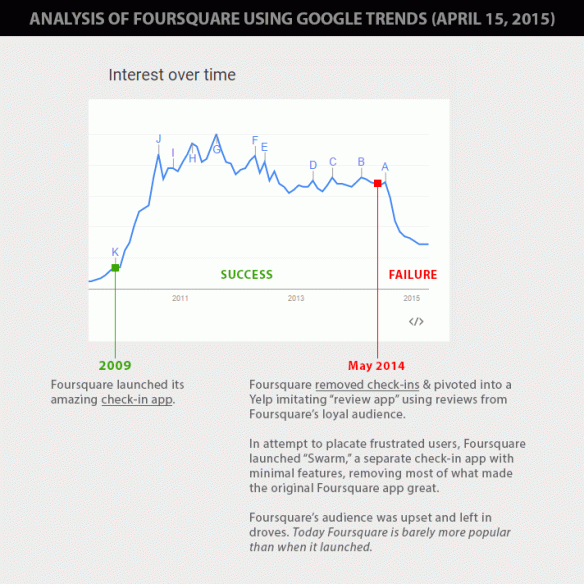
In May 2014 Foursquare removed check-ins and transformed the app into a lesser imitation of Yelp (using the accumulated reviews from Foursquare’s loyal audience.)

Foursquare’s users felt betrayed that their reviews were used but what they once loved about the app was removed.  Here’s how that worked out:

So, not well. Lesson: don’t change a winning formula.


Europe is targeting Google under antitrust laws but missing the bigger picture » The Guardian

Julia Powles:

As Maryland law professor Frank Pasquale writes in his acclaimed new book, The Black Box Society: “Google is not really a competitor in numerous markets, but instead serves as a hub and kingmaker setting the terms of competition for others.” For Pasquale, the solution lies in greater transparency. “Google’s secrecy keeps rivals from building upon its methods or even learning from them,” he writes. “Missing results are an ‘unknown unknown’: users for whom certain information is suppressed do not even know that they do not know the information.” The irony of the situation is that Google knows so much about us, and we know so little about it.

Let that thought roll around your head a little.


Feb 2009: Google joins Europe case against Microsoft » NYTimes.com

Miguel Helft, in February 2009, as Google applied to become a complainant in the EC’s case against Microsoft over illegal tying of Internet Explorer to Windows:

“Google believes that the browser market is still largely uncompetitive, which holds back innovation for users,” Sundar Pichai, a vice president for product management, wrote in a Google blog. “This is because Internet Explorer is tied to Microsoft’s dominant computer operating system, giving it an unfair advantage over other browsers.”

Google declined to make anyone available to discuss its announcement. By becoming a party to the case, it would participate in the proceedings and gain access to the confidential “statement of objections” that European regulators sent to Microsoft last month. Google could also argue for remedies it prefers.

This seems like a bad move, in retrospect. Google had just launched Chrome, and Android was just beginning to make its first moves. You’d have to be smart to see how mobile was going to grow (but aren’t the people at Google meant to be smart?), but angering Microsoft – as this surely did – meant that Microsoft was always going to seek revenge. Which it is now getting.


Keeping your car safe from electronic thieves » NYTimes.com

Nick Bilton is keeping the (electronic) key to his Toyota Prius in the freezer to stop people getting into his car. Here’s why:

Mr. Danev specializes in wireless devices, including key fobs, and has written several research papers on the security flaws of keyless car systems.

When I told him my story, he knew immediately what had happened. The teenagers, he said, likely got into the car using a relatively simple and inexpensive device called a “power amplifier.”

He explained it like this: In a normal scenario, when you walk up to a car with a keyless entry and try the door handle, the car wirelessly calls out for your key so you don’t have to press any buttons to get inside. If the key calls back, the door unlocks. But the keyless system is capable of searching for a key only within a couple of feet.

Mr. Danev said that when the teenage girl turned on her device, it amplified the distance that the car can search, which then allowed my car to talk to my key, which happened to be sitting about 50 feet away, on the kitchen counter. And just like that, open sesame.

BRB. Move aside, ice cubes.


Cellphones in Africa: communication lifeline » Pew Research Center’s Global Attitudes Project

Cell phones are pervasive in the region. In 2002, roughly one-in-ten owned a mobile phone in Tanzania, Uganda, Kenya and Ghana. Since then, cell phone ownership has grown exponentially. Today, cell phones are as common in South Africa and Nigeria as they are in the United States. Smartphones (those that can access the internet and applications) are less widely used, though significant minorities own these devices in several nations…

…Roughly a third of South Africans (34%) and about a quarter of Nigerians (27%) say that their device is a smartphone, i.e. one that can access the internet and apps, such as an iPhone, Blackberry or Android device. Smartphone ownership is less common in the other nations surveyed, and in Tanzania and Uganda it is still in the single digits. By comparison, 64% in the United States owned a smartphone as of December 2014.

But those who are more likely to own them are young, educated and English-speaking. I’d love to see some data on whether it has an economic effect to own one – though splitting that from the “educated” benefits would be tough.


The self-driving car revolution’s unintended consequence: lots of puking passengers » Co.Exist

According to a report from the University of Michigan’s Transportation Research Institute, 6% to 10% of American adults will get motion sickness—with nausea, dizziness, vomiting, and so on—in fully self-driving cars either most or all of the time. Another 6% to 12% of American adults will get moderate to severe motion sickness in a self-driving vehicle at least some of the time. That’s a fairly high percentage of potentially ill riders.

If you’ve ever been a passenger in a car driving down a windy road, feeling like you’re going to puke while the driver is perfectly fine, this shouldn’t be too surprising. As the study’s authors, Michael Sivak and Brandon Schoettle, explain, motion sickness is usually caused by two factors: a “conflict between visual and vestibular inputs” (like facing the side of the car instead of looking straight ahead) and a lack of ability to anticipate movements or a loss of control of movement. Since drivers have more control over where the vehicle is moving, they get motion sick less often than passengers.

And what makes it worse? Reading, texting or watching movies. Might as well just drive.


Samsung, LG Electronics have 99.2% of global TV monitor market » BusinessKorea

Cho Jin-young:

TV monitors, which are monitors for PC that can also receive TV signals via an onboard TV tuner, are very popular among single households who have trouble having a separate TV and monitor.

Recently, this convenience in daily life is growing with the coming-out of new monitors equipped with an enlarged screen mainly for watching TV and those that allow users to watch TV on one half and work on their PC on the other half simultaneously. With this, the portion of TV monitors is continuously growing and is expected to make up to 6.5% of all monitors sold this year, growing from 5.8% last year.

Just a guess, but are most of those sales in Asia?


Taiwan supply chain makers hope for increased adoption of force touch solutions » Digitimes

Ninelu Tu:

With Apple’s adoption of force touch technology onto the trackpad of its new MacBook, related component makers hope the trend will prompt other notebook vendors to adopt the solutions for their products, according to sources from the upstream supply chain.

Since technologies adopted by Apple’s products have been usually able to set new trends for its competitors to follow suit, related component suppliers are hoping the force touch technology will be the same. Many Taiwan suppliers are already able to supply related solutions, the sources noted.

The sources also pointed out that brand vendors including Hewlett-Packard (HP), Dell and Lenovo and ODMs such as Quanta Computer, Compal Electronics and Wistron are all able to incorporate the solutions into their notebooks, but they had been reluctant to feature the technology in their products.

Why does it need Apple to make a song and dance about it for this to happen? There’s a similar story about USB-C – Dell and Asus are going to offer products with it. None of the PC ODMs likes to jump first, it seems. But that means Apple scoops the publicity.


Start up: SLR death throes, why fusion won’t change things, Apple’s waterproof phone?, Samsung’s big spend, and more


What are those funny phones they’re holding, dad? Photo by w|©kedf|lm on Flickr

A selection of 10 links for you. Slather over the body when nobody is looking. I’m charlesarthur on Twitter. Observations and links welcome.

Prediction: the age of the standalone still camera is coming to an end for all but pros » Vincent Laforet’s Blog

who wants to stick a CF/SD card in a computer, import, edit, tone, export, share / publish a website anymore – when you can do the same thing in 1-3 clicks of your thumb on a smartphone?

The battle is over… the smartphones and iOSs have won. The quality is good enough on a smartphone/iPhone today, that when combined with software the need for a dedicated still camera can appear to be a burden to the majority of people out there: unless they have a specific technical need that only a DSLR or speciality lenses can offer.

With platforms like Twitter, FB, Storehouse, Instagram, 500 pixels, Tumblr etc etc – it’s too late to go back to the clunky way of doing things unless you are TRULY a big time hobbyist who loves the process. And I do! But not that often… and truth is: we’re in the vast minority…

The technological trends and shift towards digital and now smartphones that are connected to the web are undeniably the most important factors at play here: we’re all gotten used to having a $300-$900 mini computer on us at ALL times, and you can’t compete with a tool that is glued to your end-user… no camera company can compete with that, and they simply haven’t even tried to put editing/social media software into their cameras, which is a potentially devastating oversight long term.

It’s not that dramatic a prediction, but it’s the relentlessness that’s so imposing.


If Lockheed’s recent announcement on nuclear fusion energy is true, how would it change the world? » Quora

Ryan Carlyle, who says he’s a BSChE (chemical engineer?) and subsea hydraulics engineer, is here to rain on the parade:

Real-world fusion reactors aren’t going to be like “Mr Fusion” style reactors from Back To The Future. I mean, seriously -it ran on garbage and powered a flying car. That almost makes the time travel plot seem realistic in comparison. But that’s what people seem to think when they hear “miniature fusion plant.”

Pro tip: the physics of fusion power do not support the concept of automobile-scale fusion. Seriously, this isn’t Tony Stark’s Arc Reactor; it’s just a thermoelectric power plant with a slightly smaller heat source. You need a giant steam turbine and ridiculously giant cooling system to generate serious electricity from a fusion reactor. Even if you miniaturize the reaction chamber, the support equipment required for electricity generation will still be extremely large.

Here’s a small nuclear power plant. I have helpfully indicated the size of the actual fission reactor inside the containment structure:

And here’s my detailed conceptual rendering of a “miniature” fusion reactor power plant with the same power output:

And that’s only the start of it.


Ghacks is dying and needs your help » gHacks Tech News

Martin Brinkmann, who started the site in 2005 and was able to make it his full-time job, now faces the chasm:

In addition to [Google downranking the site in 2011 with its Penguin search update], ad blockers and script blockers became increasingly popular. Since advertisement is what keeps this site alive, a yearly increase between 5 and 10% in ad-block usage is not something that you can endure for long especially if it goes hand in hand with a decline in traffic.

Currently, between 42% and 44% of all users use blockers when they visit the site and if the trend continues, more than 50% might before the end of the year.

If you take these two factors together, it is only a matter of time before ad revenue won’t be sufficient to pay for the site’s upkeep anymore.

Advertising is dying in its current form. While I could make a quick buck throwing popups, auto-playing videos or other nasty stuff at you, I’d never do that.

Heck, those are the things that make people use ad-blockers in the first place and as much as I like this site to survive, I like to protect the integrity of this site and you from these diabolical monetization methods even more.

Advertisements won’t be sufficient to keep this site up and there is not really much out there that I could implement or try instead to make sure this site is not taken off the Internet in the next year.

He’s going to try Patreon. Presently the pledges aren’t enough to cover the server costs – $280 per month?! I wish him luck, but I’m not optimistic. (I’ll return to see how things are in a few months.)

I think Brinkmann’s business problems are probably echoed all over the web by small sites which were once able to make money from ads, but are now finding them sucked up by Facebook, or Twitter, or the effect of Google invisibility.


US DOJ accuses three men in largest email breach ‘in the history of the Internet’ » GeekWire

Frank Catalano:

The indictments against two Vietnamese citizens and a Canadian citizen — operating from Vietnam, the Netherlands, and Canada — alleges the trio were involved in hacking at least eight U.S. email service providers, spamming tens of millions of email recipients, getting money from affiliate relationships for spammed products, and laundering the proceeds.

“The defendants allegedly made millions of dollars by stealing over a billion email addresses from email service providers,” U.S. Assistant Attorney General Caldwell said in a statement. “This case again demonstrates the resolve of the Department of Justice to bring accused cyber hackers from overseas to face justice in the United States.”

The Department of Justice (DOJ) estimates the accused allegedly took in approximately $2 million through the affiliate marketing sales linked to spam. One of the three is said to have already pleaded guilty.

Brian Krebs suggests it was a breach of the email marketing company Epsilon in 2011 – whose servers were then hijacked to send the spam. A reminder that spam is still big, big business.


Why do we care about Xiaomi? » Benedict Evans

Evans (who works at VC company a16z) thinks we care (or should) because of what it implies for the “next stage” of Android:

Historically, Google’s lock on Android outside China has therefore been based on three things: 

• You can’t experiment outside very tight constraints: making even one forked device means Google won’t allow you to sell a single phone running Google services. And all the OEMs have too much to lose to risk experimenting
• There’s a widespread belief that an Android device without Google services (really, this means Maps and the app store) is unsaleable outside China (I’m not entirely sure about this, as I wrote here)
• No OEM managed to build a compelling set of services or tools of its own that might offer alternatives to Google, because, well, that was impossible (see above)

These new trends place all of those in question. The growth of smaller operators pursuing different models, with no existing base of sales and hence nothing to fear from  Google ban, may mean more experiments with forks. Xiaomi and its imitators point to a new potential model to differentiate (and note that Xiaomi is not a fork), and Cyanogen (an a16z portfolio company) offers the tools to do it. Smaller OEMs are less powerful than Samsung as a counterpart to Google, but also harder collectively to impose upon – Google can’t shout at them all.


Apple researching device waterproofing via vapor deposition, silicone seals » Apple Insider

Mikey Campbell:

As published by the US Patent and Trademark Office, Apple’s filing for “Methods for shielding electronic components from moisture” outlines a process for coating sensitive device components using advanced vapor deposition technology and protecting solder leads with silicone seals.

Instead of sealing off the entire device housing like a common wristwatch, Apple proposes coating integral components, like the printed circuit board (PCB), with a hydrophobic coating. Depositing the coating via plasma-assisted chemical vapor deposition (PACVD) would create an acceptable insulating layer to protect against short circuits that occur when high voltage parts are exposed to liquid.

I’ve thought for some time that Apple would add waterproofing (well, water resistance) to its phones in due course, but that it sees no rush while it’s not completely commonplace elsewhere. (Look at how Samsung has taken it out of the Galaxy S6.) This would also require factory equipment, so might be something for 2016’s range.


Technology helps visually impaired navigate the Tube » BBC News

Hugh Pym (the health editor):

Members of the Youth Forum of the Royal London Society for Blind People (RLSB) said they wanted to navigate the tube system independently.

Currently most have to rely on friends to help them get used to familiar routes or phone ahead to request assistance from London Underground staff. Many do not feel confident about using the whole network. They group teamed up with a digital products designer, ustwo, which then devised a system which was effective below ground.

The Bluetooth beacons transmit signals which can be picked up by smartphones and other mobile devices. Audible directions are provided to users via “bone conduction” earphones which allow them to hear sounds around them as well.

The directions warn users when they are approaching escalators and ticket barriers and which platforms they may be approaching. It’s the first such trial of a technology which can guide blind and partially sighted people underground or in areas with limited mobile phone reception.

Developers say it could be used in other subway networks like those in Newcastle and Glasgow or in other busy public transport hubs

That’s ustwo, as in Monument Valley. Many strings to their bow. Wonderfully clever application.


Samsung breaks records with £45m push behind Galaxy S6 » Daily Telegraph

Chris Williams:

Samsung is launching a record-breaking £45m marketing barrage to support its new Galaxy S6 smartphone and regain ground lost to Apple.

The figure, disclosed by industry sources, is the largest ever for a mobile phone launch and is believed to be the largest for any single product in the UK.

Samsung is spending heavily across all traditional and new media marketing channels, but is understood to be especially targeting the mass audiences provided by television and high-profile outdoor advertising sites.

The Galaxy S6 is already being heavily promoted on the digital billboards on the London Underground network, for instance.

Samsung also paid for a special advert based on the Galaxy S6 launch event last week in Barcelona. It aired three hours later in the UK on Sunday evening during ITV’s primetime drama Mr Selfridge.

Samsung has long been among the world’s biggest marketing spenders, devoting a larger proportion of its annual sales to promoting its products than any other top 20 global company.

Reading the comments under Apple articles always reveals two trains of thought, often following each other: (1) Apple is only popular because it spends so much on marketing (2) [when it’s pointed out that Samsung spends more] Apple is only popular because “the media” pushes it.

On the basis of (1), the S6 is going to be the most humungous hit, surely?


Popular Xiaomi phone could put data at risk » Bluebox Security

There’s a big asterisk on this one, but first read what Andrew Blaich found:

We ran several of the top malware and antivirus scanners on the Mi 4 to determine if any questionable apps came pre-loaded on the device. We used several scanners to compile a comprehensive list as some scanners returned nothing and others flagged different apps. Ultimately, we found six suspicious apps that can be considered malware, spyware or adware; a few were more notable than others.

One particularly nefarious app was Yt Service. Yt Service embeds an adware service called DarthPusher that delivers ads to the device among other things[2]. This was an interesting find because, though the app was named Yt Service, the developer package was named com.google.hfapservice (note this app is NOT from Google). Yt Service is highly suspicious because it disguised its package to look as if it came from Google; something an Android user would expect to find on their device. In other words, it tricks users into believing it’s a “safe” app vetted by Google.

Other risky apps of note included PhoneGuardService (com.egame.tonyCore.feicheng) classified as a Trojan, AppStats classified (org.zxl.appstats) as riskware and SMSreg classified as malware[3]

However, Xiaomi says that the device “appears to have been tampered [with] in the distribution/retail process by an unknown third party”. But as Blaich points out, if it’s that easy to mess with, that raises other questions too. Selling smartphones isn’t as simple as just choosing a spec list.


The Apple Watch is time, saved » TechCrunch

Matthew Panzarino does that thing where, you know, you talk to sources to find stuff out, which he then collects in this fascinating article:

Here’s a tidbit you might not know — in order to receive notifications from apps, the Watch must be on your wrist and locked. The Watch requires contact with your skin to receive notifications. There will be no in-app dropdown notifications or constant pinging while it’s off your wrist. Push notifications also cease when the battery reaches 10%. Those decisions speak to the care with which Apple is handling notifications.

The notifications are also different at an elemental level than the ones on your phone — both on the developer and user side of things. These are seen right away rather than at some point. You act on them quickly and they don’t stack up like they do on the phone.

There is that added bit of context because you know exactly when they got it, which means that time-sensitive notifications like those that recommend a precise establishment or ping you during a live event become much more germane.

And this is a key point:

the only resource we all have exactly in common is time. Kings don’t have more of it than peasants. Not everyone will be able to afford an Apple Watch (or even an iPhone), but if they’re in an economic situation where that’s feasible then they’re also in the situation where they are probably willing to trade money for time.


Start up: Apple Pay in the UK?, 10m Chromecasts, the hacker whose cat betrayed him, and more


OK, definitely seen harder than that. Photo by health_bar on Flickr.

A selection of 9 links for you. Do not plant in acidic soil. I’m charlesarthur on Twitter. Observations and links welcome.

Due to me screwing up, the headline yesterday about finding Waldo referred to an article that’s in today’s list. Hope you didn’t spend too long looking for it.

Is there a battle looming in the UK between Apple Pay and Zapp? » Mobile Payments Today

Will Hernandez:

While Apple has yet to reveal a hard date for Apple Pay’s launch in the UK, pundits speculate that it could happen in April. This also happens to be about the same time Zapp is supposed to make its debut in the U.K.

Zapp relies on banks building it into their mobile apps, although as those banks own Zapp’s parent company, this shouldn’t be too much of a problem. The system is intended to provide real-time payments between consumers and merchants — both online and at the point of sale — without the need for a digital wallet. Zapp will generate digital tokens that will hide customer bank account details from merchants, and it is intended to work with different technologies such as NFC, Bluetooth, QR codes and PIN-entry point-of-sale terminals.

Zapp, however, has faced launch delays since at least the third quarter of 2014. Meantime, it announced in October retail partnerships that will go into effect this year. Asda, Sainsbury’s, House of Fraser and Shop Direct are among some of the major High Street retailers that will support Zapp. Earlier in the year, HSBC, first direct, Nationwide, Santander and Metro Bank announced their support for the system.

I’d never heard of Zapp either. Apparently it’s “a mobile payments system from Vocalink, which created the Faster Payments Service and is owned by all the major UK banks.”

Zapp has lots of benefits (cost, data sharing with retailers) and so could have a UK advantage – this is a good article for getting an idea of the competitive landscape in the UK as Apple prepares to land.


Android Wear’s newest trick, playing a full-length movie » Android Community

John Hoff:

Apparently, your Android Wear smartwatch can be taught to do cooler tricks – cooler than, say, playing Minecraft or Doom, or even running Windows 95. Once again, smart hacker Corbin Davenport has shown us that there’s a lot of stuff – not necessarily important world-changing stuff – just a lot of stuff that can be done to your Android Wear smartwatch when you have a lot of time on your hands.

“You haven’t watched a movie—until you’ve watched it on your watch,” Davenport proudly proclaims of his newest wild idea, which he shows via YouTube. The demo shows Davenport playing Star Trek: Into Darkness on his Android Wear, which is probably a delightful coincidence as he shows us that Android Wear devices can really go where no smartwatch has gone before (excuse the pun, we couldn’t help it).

Davenport has done some weird, weird stuff there.


Big three mobile phone markets beyond China » Counterpoint Technology Market Research

According to the latest research from [the] Market Monitor program for Q4 2014 (Oct-Dec), total mobile phone shipments for India, Indonesia and Bangladesh stood at 89m as smartphone demand skyrocketed and the total smartphone shipments contributed to more than a third of all mobile phones shipped during the quarter. These three markets combined offers an opportunity for mobile phone industry players looking to grow beyond the saturating China mobile phone market.

“Smartphone growth in these regions touches almost all the price segments with regional brands being prominent in the entry level smartphone segment. Apart from this we have seen Chinese vendors entering these geographies for the first time in CY 2014 and enjoyed a significant success rate. However it will be important to keep an eye on  Online only players on how they capture the smartphone growth in rural areas in these regions” says Tina Lu Sr. Consultant at Counterpoint research

Mobile phones, not just smartphones – note. By comparison, Japan bought about 25.7m smartphones in 2014 and that is expected to rise to 27m in 2015. (About half of that total would be iPhones, judging by Kantar’s figure.)


The utterly crazy story of the death threat hacker » We Live Security

Graham Cluley on a Japanese hacker who caused lots of problems via trojan-infected PCs in Japan in 2012:

the police arrested four separate people, and allegedly managed to “extract” confessions from some of those whose computers had posted death threats to a popular messageboard.

However, the confessions were clearly unreliable (one wonders how the confessors were “encouraged” to make them), as the suspects had in fact had their computers infected by the hacker’s malware, which had posted the death threats without their knowing.

It became clear to the police that they had made a colossal blunder, when the hacker – who went by the alias Oni Koroshi (Demon Killer) – continued to send taunting emails to the police force and local newspapers.

You can just imagine how embarrassing that must have been for the Japanese police, in what was becoming a high profile case.

Er.. yeah. But then it gets utterly weird, when the hacker sends a series of clues to the police, and it all ends up with a showdown involving a cat, an island and a sikrit chip worn on the cat. If Ian Fleming were alive today and writing this stuff you’d call it too far-fetched.

(Also, stupid hacker. Should have stopped when the people confessed.)


License plate scanners also taking photos of drivers and passengers » American Civil Liberties Union

The Drug Enforcement Agency is using its license plate reader program not only to track drivers’ locations, but also to photograph these drivers and their passengers, according to newly disclosed records obtained by the ACLU via a Freedom of Information Act request.

One internal 2009 DEA communication stated clearly that the license plate program can provide “the requester” with images that “may include vehicle license plate numbers (front and/or rear), photos of visible vehicle occupants [redacted] and a front and rear overall view of the vehicle.” Clearly showing that occupant photos are not an occasional, accidental byproduct of the technology, but one that is intentionally being cultivated, a 2011 email states that the DEA’s system has the ability to store “up to 10 photos per vehicle transaction including 4 occupant photos.”…

…Some law enforcement agencies that employ ALPRs recognize that the technology should not be used to capture photos of vehicle occupants. We obtained an ALPR policy from Tiburon, California that speaks to our privacy concerns. The policy states that “cameras will be directed only to capture the rear of vehicles and not into any place where a ‘reasonable expectation of privacy’ might exist.”

Tricky argument. You can see that it would be useful for law enforcement to know who’s driving a car. And do you have “a reasonable expectation of privacy” when you’re driving a car on a public road where people can take pictures of you and your car – as happens here?

(By the way, in the UK we call it an “Automatic Number Plate Reader”. Even though it now has letters and numbers.)


Twitter cuts off employee access to its metrics » Re/code

Kurt Wagner:

There’s no metric more important to the social network than the number of people that use the service — more specifically, its monthly active users, or MAUs. Recent events inside the company show how sensitive Twitter’s top brass can be about this number, which also partly explains the company’s push to use other metrics to showcase Twitter’s reach.

The company used to grant all employees access to its MAU figure through an internal intranet, but that access was revoked a few weeks ago, according to multiple sources familiar with change. Now, the MAU metric is only available on a need-to-know basis.

There has been so much noise ahead of Twitter’s results (which came out after I added this) that one has to feel there’s something weird going on there. A culture clash? Internal political struggle? Whatever, this will be the year it plays out.


Xiaomi has a San Francisco press event scheduled for 12 February… but it’s still not entering the US market » Android Police

Any tech journalist worth his silicon would probably assume that Xiaomi intends to finally push into the US market to take on the likes of Apple and Samsung, possibly even with new mobile hardware. But apparently that’s not the case. We specifically asked Xiaomi’s PR representative about the possibility of a North American expansion, and this is the response that we were given:

We can also confirm that Xiaomi will not be launching in the US or entering the US market this time, but this is an opportunity to get to know the company and leadership a bit more.​

Any tech journalist worth her or his silicon would know that Xiaomi would face insuperable IP issues in trying to enter the US market, and also that it’s simply the wrong sort of market to try to get in to just now for Xiaomi.

At least they called Xiaomi to have their castles in the air shot down.


Google sold 10 million Chromecasts last year » Korea Times

Google has sold about 10 million Chromecast, a streaming-media dongle for high-definition (HD) TVs, globally in 2014, Google Korea said Wednesday.

Chromecast, which made its debut in July 2013, now supports more than 350 apps and services, including YouTube, Tving and Hoppin in Korea.

It started selling the device in Korea in May 2014, the first marketing debut in the Asian market.

This number sounds entirely feasible; it also sounds like the sort of thing that Google Korea might blurt out, when its corporate headquarters has only ever said “millions”.

Ten million is pretty impressive. Now, of course, we can divide all the numbers it has put out to get average use, such as its “used for one billion ‘casts’” stat in the January earnings call: that works out to an average of about 100 “casts” per device over the whole of 2014 (but of course not all were in use all through 2014).

So probably double that 100 figure (or even treble it) for those bought early in the year; halve it, or one-third, for those bought later. Sound good?


Here’s Waldo: computing the optimal search strategy for finding Waldo » Randal S. Olson

I decided to approach this problem as a traveling salesman problem: We need to check every possible location that Waldo could be at while taking as little time as possible. That means we need to cover as much ground as possible without any backtracking.

In computer terms, that means we’re making a list of all 68 points that Waldo could be at, then sorting them based on the order that we’re going to visit them. So now we just need to try every possible arrangement of the points and find the one with the shortest distance traveled. Easy, right? Wrong.

Those 68 points can be arranged in ~2.48 x 1096 possible ways. To provide some context, that’s more possible arrangements than the number of atoms in the universe. That’s so many possible arrangements that even if finding Waldo became an international priority and the world banded together to dedicate the 8.25 million computing cores from the world’s 10 largest supercomputers to the job, it would still take ~9.53 x 1077 years — about 6.35 x 1067x longer than the universe has existed — to exhaustively evaluate all possible combinations. (Generously assuming that each core could perform 10,000 evaluations per second.) In other words: if we don’t have a smarter solution, Waldo is as gone as Carmen Sandiego.

I admit I was disappointed that he didn’t do it by image recognition. And anyhow, his solution (probable regions) doesn’t help you at all with Wizard Whitebeard, Wenda, Wilma, Odlaw, Woof or the Waldo Watchers.


Start up: Google v security redux, how your browser can track you, unboiling eggs (really), Android MVNO = flop, and more


Don’t worry, we’ll soon have that nice and runny for you. Photo by Sidereal on Flickr.

A selection of 10 links for you. Avoid contact with hands. I’m charlesarthur on Twitter. Observations and links welcome.

This guy found a way to block robocalls when phone companies wouldn’t » WIRED

Robert McMillan:

Aaron Foss won a $25,000 cash prize from the Federal Trade Commission for figuring out how eliminate all those annoying robocalls that dial into your phone from a world of sleazy marketers.

The year was 2013. Using a little telephone hackery, Foss found a way of blocking spammers while still allowing the emergency alert service and other legitimate entities to call in bulk. Basically, he re-routed all calls through a service that would check them against a whitelist of legitimate operations and a blacklist of spammers, and this little trick was so effective, he soon parlayed it into a modest business.

Last year, his service, called Nomorobo, blocked 15.1 million robocalls. He uses cloud computing services—primarily Amazon Web Services and Twilio—to block Florida timeshare sellers and fake Microsoft support gurus from the 190,000 VOIP customers1 who use his free product.

I know, you’re saying “Where do I sign up??” Except for this addendum to the story:

113:00 EST. Correction. An earlier version of this story stated that the Nomorobo service works with mobile phones. It runs on VOIP phones only.

Damn.


How you can be tracked by your browser’s fingerprint and how you can stop it » CompTutor

You have your browser set to Private Browsing or Incognito mode where it doesn’t store coookies or history. You load up your favorite VPN, Tor, or I2P and are thinking, “I am totally secure and no one can track me now.” Wrong. You still are possibly leaving a digital fingerprint or browser fingerprint behind. Just because you have a secure computer and can change your IP, people can still find you. Browser Fingerprinting is how some agencies have been able to identify people even through Tor or a VPN.

The EFF, or Electronic Frontier Foundation, discovered this a few years ago and has set up a website to demonstrate their findings. Check out the website below, run their fingerprinting test, and see if your online fingerprint is unique to you out of everyone they have tested. I’m guessing it will be.

https://panopticlick.eff.org

It’s “canvas fingerprinting”, which has already found favour with Google, and relies on characteristics of HTML5-capable browsers.


Microsoft is no longer manufacturing the Surface 2 » The Verge

The big unmentioned detail there is that it’s the end of the line for Windows RT, which everyone except for Microsoft had already given up on. Its future looked even bleaker during Microsoft’s Windows 10 announcements last week, with the company saying that the new OS was not coming to the Surface RT or Surface 2, its last remaining Windows RT devices.

The Surface 2 debuted near in the fall of 2013 as a successor to the Surface RT, which received a lukewarm response and ended up costing Microsoft millions in stock that did not sell. It was thinner and lighter than the previous model, and also had a considerably better display, but was still stymied by Windows RT, which did not support traditional Windows programs.

RT’s really dead now, Jim.


Android Wi-Fi Direct vulnerability disclosed » Threatpost

Michael Mimoso:

Google and Core Security are at odds over the severity of a vulnerability affecting a number of Android mobile devices, details of which were released by the security vendor today.

The issue was reported to the Android security team on Sept. 26 and in subsequent communication between the two parties, the severity of the vulnerability was debated, culminating today with Core’s disclosure. Google three times acknowledged Core’s report and request for a timeline on a patch, and each time Google said it did not have one.

The flaw is a remotely exploitable denial-of-service vulnerability in Wi-Fi-Direct, a standard that allows wireless devices to connect directly. The implementation is used not only between Android devices, but also printers, cameras, PCs and more.

So here’s Google not fixing new flaws in Android. Shouldn’t Core Security feel justified in releasing exploit code and full details?

Read on for Google justifying not fixing old code in Android….


Google defends policy that leaves most Android devices unpatched » Computerworld

Remember the WebView weaknesses that had everyone jumping up and down because around 60% of Android devices that hit Google Play (and potentially many more altogether) are vulnerable? Gregg Keizer followed up:

“Until recently, we have also provided backports for the version of WebKit that is used by WebView on Android 4.3 and earlier,” wrote Adrian Ludwig, Android lead security engineer on Google+. “But WebKit alone is over 5 million lines of code and hundreds of developers are adding thousands of new commits every month, so in some instances applying vulnerability patches to a two-plus-year-old branch of WebKit required changes to significant portions of the code and was no longer practical to do safely.”

So it’s too much trouble for Google to fix code that’s over two years old, but it feels justified in publicising security flaws – and exploit code – for Windows and OSX? What’s that Biblical saying about beams and motes?


‘Thunderstrike’ attack also fixed in OS X 10.10.2 » iMore

Rene Ritchie:

“Thunderstrike” is the name for an attack that can target Mac hardware via the Thunderbolt port. Apple had previously updated the Retina 5K iMac and 2014 Mac mini to partially secure them against Thunderstrike. Now, the upcoming OS X Yosemite 10.10.2 will fix the problem for all recent Macs running Yosemite.

Thunderstrike was explained here: it requires physical access or very good social engineering. Good that it’s being fixed for “all recent Macs running Yosemite”; bad that it isn’t going further back. (Is it even possible to fix it further back? Nobody seems to know for sure.)


Why an Apple-featured indie dev abandoned iOS in favor of PC » Gamasutra

Alex Wawro:

what’s more interesting about [Erik] Asmussen’s current project, at least from a developer’s perspective, isn’t so much where it is now as where it isn’t — namely, Apple’s App Store.

Like many developers, Asmussen quit his job a few years ago to dive into mobile development full-time; but despite some significant success with mobile games like PWN: Combat Hacking, Asmussen has decided to devote himself to PC development.

“I finally gave up on iOS after I got a ‘Best New Games’ feature and saw how little revenue that actually brought in,” Asmussen tells me, via email. “The risk/reward profile was just terrible, combined with annoying barriers like having to put all updates through a review process. So I decided to switch to PC. That has proven to be a good decision by any measure.”

Why? Because

his final mobile game, PWN: Combat Hacking, earned roughly $10k in its launch month.

“Which sounds cool, until you consider that it took a year to build and about $3-4K in art,” adds Asmussen. “And that that figure is in the top percentile of indie mobile games. And that it got the biggest app store feature short of the top banner.”

Asmussen laments the fact that mobile game makers often can’t get people into their games until after they’re released, and believes that developing PC games for Steam’s Early Access service is more empowering for small-scale developers.

(Thanks @Jaykannan for the link.)


Apple reports record first quarter results » Apple

The results were fueled by all-time record revenue from iPhone® and Mac® sales as well as record performance of the App Store℠. iPhone unit sales of 74.5m also set a new record.

“We’d like to thank our customers for an incredible quarter, which saw demand for Apple products soar to an all-time high,” said Tim Cook, Apple’s CEO. “Our revenue grew 30 percent over last year to $74.6bn, and the execution by our teams to achieve these results was simply phenomenal.” 

Oh, yeah, this happened. Not quite a record for Mac shipments (that happened in the previous quarter) but those iPhone numbers? That is phenomenal execution, as Cook says. It’s so easily overlooked that there’s no value in all the brand stuff and marketing if you can’t actually deliver product to people. Between Apple and Samsung, that’s about half of the smartphone market sewn up.


Chemists find a way to unboil eggs » Phys Org

Janet Wilson on news that will delight, well, anyone?

Like many researchers, he has struggled to efficiently produce or recycle valuable molecular proteins that have a wide range of applications but which frequently “misfold” into structurally incorrect shapes when they are formed, rendering them useless.

“It’s not so much that we’re interested in processing the eggs; that’s just demonstrating how powerful this process is,” [Gregory] Weiss [professor of chemistry and molecular biology at UCal at Irvine] said. “The real problem is there are lots of cases of gummy proteins that you spend way too much time scraping off your test tubes, and you want some means of recovering that material.”

But older methods are expensive and time-consuming: The equivalent of dialysis at the molecular level must be done for about four days. “The new process takes minutes,” Weiss noted. “It speeds things up by a factor of thousands.”

To re-create a clear protein known as lysozyme once an egg has been boiled, he and his colleagues add a urea substance that chews away at the whites, liquefying the solid material. That’s half the process; at the molecular level, protein bits are still balled up into unusable masses. The scientists then employ a vortex fluid device, a high-powered machine designed by Professor Colin Raston’s laboratory at South Australia’s Flinders University. Shear stress within thin, microfluidic films is applied to those tiny pieces, forcing them back into untangled, proper form.

Unspilling milk next, I hope.


5 reasons why a Google MVNO would fail » FierceWireless

Phil Goldstein enumerates them rather clearly. Summarised, they are:
1) engineering phones and networks is difficult (you can’t get one phone to join both T-Mobile and Sprint in the US as they use GSM and CDMA)
2) Google would need customer service centres and distribution – outside its core competency
3) incumbent carriers spend billions on ads, and have inbuilt advantages
4) the service wouldn’t be differentiated, and what’s the target audience?
5) if it doesn’t get scale, Google might kill it.

His article goes into much more detail. It feels persuasive.


Start up: China’s smartphone wall, Glass stops?, PC slowdown ahead, Monument Valley sales stats, and more


Lots of this, but hard to sell more? Photo by japp1967 on Flickr.

A selection of 9 links for you. Use them wisely. I’m charlesarthur on Twitter. Observations and links welcome.

Smartphones at tipping point in China » Forbes

Doug Young:

The year ahead will be a pivotal one for smartphone makers in China, where around a dozen domestic manufacturers are all vying for a piece of a market that is the world’s largest but also one that’s contracting due to saturation. Leading players include Huawei, Lenovo , ZTE and Xioami, all of which are well funded and have the resources to survive the slowdown. But smaller, newer names like Oppo, OnePlus and Smartisan may not be so lucky, and I expect that 2 or 3 will be forced to close before 2015 ends.

Sales of all phones fell by 22% to 452m units: 64% fall in 2G phones, 46% fall in non-smart 3G. Total of 1.28bn users, implying penetration of 95%. Smartphone shipments actually dropped by 8.2% overall to 389m units. And quite a few of those might be sitting on shelves.


Intel forecast misses estimates, signalling deeper PC slump » Bloomberg

Intel Corp, the largest maker of chips that run personal computers, forecast first-quarter sales that may fall short of analysts’ estimates, sparking concern that the PC industry is headed for a steeper decline.

Revenue will be $13.7bn, plus or minus $500m, the company said today in a statement. On average, analysts had estimated sales of $13.8bn, according to data compiled by Bloomberg.

While corporate demand for new machines helped moderate the PC market’s deterioration last year, the industry has failed to attract enough consumers with new slim laptops designed to compete with tablets and smartphones. Users have learned to live without the keyboards and larger screens of the computers powered by Intel’s processors, said Gus Richard, an analyst at Northland Securities Inc.

“Why would the consumer ever want to buy a PC?” said Richard, who has the equivalent of a hold rating on Intel stock. “The first thing that people do in the morning is check their smartphones.”

Incomes and revenues up, but outlook down.


Apple’s diversifying and maturing user base » Tech.pinions

Jan Dawson:

Apple has gone from tens of millions of Mac users to hundreds of millions of iPhone customers and to a billion iOS devices sold. Whereas Apple once served a fairly small number of specific niches, it now serves almost every kind of customer imaginable: from the power user to the first time smartphone owner, from the wealthy American to the rising Chinese middle class. It’s also increasingly being adopted in the enterprise market and the IBM deal will only accelerate this trend. To be sure, Apple still isn’t universal in its appeal, especially since its devices tend to be costlier than those from other manufacturers, particularly in markets where phones aren’t heavily subsidized. But Apple’s customer base is becoming ever more diverse over time.

The other thing that’s happening is Apple’s customer base is maturing. I don’t mean it’s getting older (though that is almost certainly the case), but an increasing proportion of its customer base is using its third, fourth or fifth Apple device. These customers are becoming accustomed to a certain way of doing things, becoming “trained” in the Apple way of delivering tightly coupled software and hardware. Their expectations of how Apple will act, therefore, start to harden over time, leading to less flexibility in response to major changes in iOS and OS X.

As he explains, that has deeper – perhaps Microsoft-like – implications.


Monument Valley sales data » UsTwo

An infographic (apologies) but packed full of fascinating detail about the sales and revenues by country and platform for the twisty mindbending game. For all those saying it was “too short”, only 50% completed it, according to the data.

The data also provides an interesting comparison with these estimates of its sales.


RadioShack prepares bankruptcy filing » WSJ

RadioShack Corp. is preparing to file for bankruptcy protection as early as next month, people familiar with the matter said, following a sputtering turnaround effort that left the electronics chain short on cash.

A filing could come in the first week of February, one of the people said. The Fort Worth, Texas, company has reached out to potential lenders who could help fund its operations during the process, another person said.

Might get sold to a private equity company. Cumulative losses over the past seven quarters: $770m or so. Electronics is tough; started in the 1920s but couldn’t adapt to the web age.

And next…


Sony announces that it will close all stores in Canada » Androidheadlines.com

Cory McNutt:

As Sony struggles to reinvent itself, they made a rather surprising announcement – Sony is closing all fourteen of its Sony Stores in Canada over the next two months. Toronto had the heaviest concentration with five Sony Stores and one Sony Style Store. There are three Sony Stores in Vancouver, two in Calgary, and just one in Ottawa, Edmonton, Montreal and Quebec City. The employees were informed in an announcement today and then released a news statement to The Citizen.

Toronto had six Sony stores?! If you’ve got a good memory you might remember that in February 2014 Sony said it would shut 20 of its 31 US stores by the end of 2014. Wonder how those 11 are doing.


BlackBerry shares slide 16% after denying Samsung talks » MarketWatch

Shares of BlackBerry fell more than 16% in premarket trade Thursday after the company denied reports that it was approached by Samsung Electronics regarding a potential $7.5bn takeover. The stock was up as much as 28% on Wednesday after Reuters reported that the two had been in talks about a possible deal. Reuters late Wednesday said Samsung approached BlackBerry with a buyout price range of $13.35 to $15.49 a share. Samsung reportedly called the report “groundless.” BlackBerry in a post on its website said it has not engaged with discussions with Samsung with respect to “any possible offer to purchase BlackBerry.”

Hey ho. Still a lot of road to go though. Patents? QNX? Corporate accounts? Samsung could want all or part of them. Then again, BlackBerry has been “sold” about 10 times in the past two years by market rumours.


Goodbye » SuperSite for Windows

Paul Thurrott is moving on. But the site will remain:

What changed over time is just the usual work-related stuff. Penton purchased Duke Publishing several months after I signed on, in August 2000, and over time the impact of being part of a big company weighed ever more heavily on me. For many years, I was insulated from this as the Duke team in Colorado effectively sheltered me. But as my friends and coworkers were in some cases promoted within “big Penton” (as I thought of it) or were laid off—hey, it’s a big company with priorities that extend far beyond my little group—the layers between me and the corporation around me grew thin and then disappeared.

This isn’t a dig at Penton. It’s a great company, and was a wonderful benefactor for all these years. And I’m friends with—and care deeply for—many people at Penton. I’m just not fit for corporate life. I need to be on my own or with a smaller team to thrive, and over the course of the past I year I felt increasingly that it was time to move on. I do so with a deep sense of regret because I know I’m letting down some people whom I care for, and because I’m leaving behind the legacy of this site.

But I’m also hopeful for the future. I plan to continue doing what I do at thurrott.com and I’ve partnered with some new friends to make that happen.

Everyone’s going individual, have you noticed? Also, everyone seems to be doing it with email newsletters. (Pause for thought.)


Google makes changes to its Glass project » WSJ

Alistair Barr:

Glass is moving from the Google X research lab to be a stand-alone unit led by Ivy Ross. Ms. Ross and her team will report to Tony Fadell, a former Apple executive who heads Nest Labs, the smart-home device company Google acquired for $3.2 billion in February 2014. Mr. Fadell will still run Nest, but he also will oversee Glass and provide strategic guidance to Ms. Ross.

Google will stop selling the initial version of Glass to individuals through its Explorer program after Jan. 19. Google will still sell Glass to companies and developers for work applications.

Google plans to release a new version of Glass in 2015, but it hasn’t been more specific about timing.

The changes usher in a new strategy for Glass that will shun large, public tests of hardware prototypes in favor of the approach used by Apple and Nest, which develop consumer gadgets in secret and release them as fully finished products.

Does that mean we’re not going to hear any more about that bloody self-driving car and the diabetes-diagnosing contact lenses until they’re actually ready, rather than five or more years from ready?