
In the land of the refuseniks: what Kantar’s latest smartphone data reveals

Kantar ComTech Worldpanel’s latest numbers for smartphone sales share are out (or dig the groovy but very dark animation), and pretty much as expected they show that iPhones have had a terrific time in sales terms for the three months to the end of November – so that covers September, October, and November, basically all the time that the new range has been on sale.

My only frustration with Kantar is that it doesn’t index the numbers from year to year; there’s no way to know if sales in 2014 are lower, higher or the same than the previous year or year before. You might think that because more people own smartphones that volume must be increasing, but it’s not necessarily the case; GfK data suggested that mobile phone sales value fell in Christmas 2013 compared to 2012, though increased in 2014 (helped, one suspects, by the Apple phones).

I’ve asked Kantar previously to include an indexing figure (eg 2012 = 100, 2013 = 105, ie 5% greater in sales volume) with these numbers, but they haven’t. (In a future post I’ll try estimating this from general levels of mobile sales from quarter to quarter, and country populations and smartphone shares.)

In the absence of that, we just have the graphs – which I’ll put below. But there’s a much more interesting story which hasn’t been picked out of the press release, though they put it in there. It’s about the refuseniks: the people who have a featurephone, but are determined not to move to a smartphone.
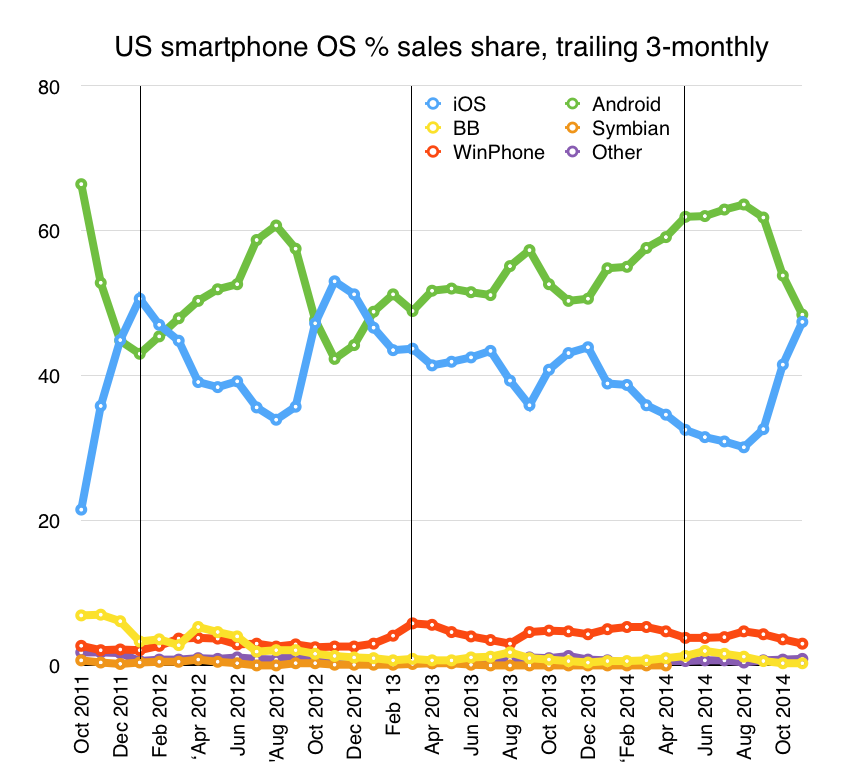
US smartphone sales share to end November 2014

Data from Kantar. iPhone share is high, but not as high as the iPhone 5 launch. (No comparative data on volumes, however.)
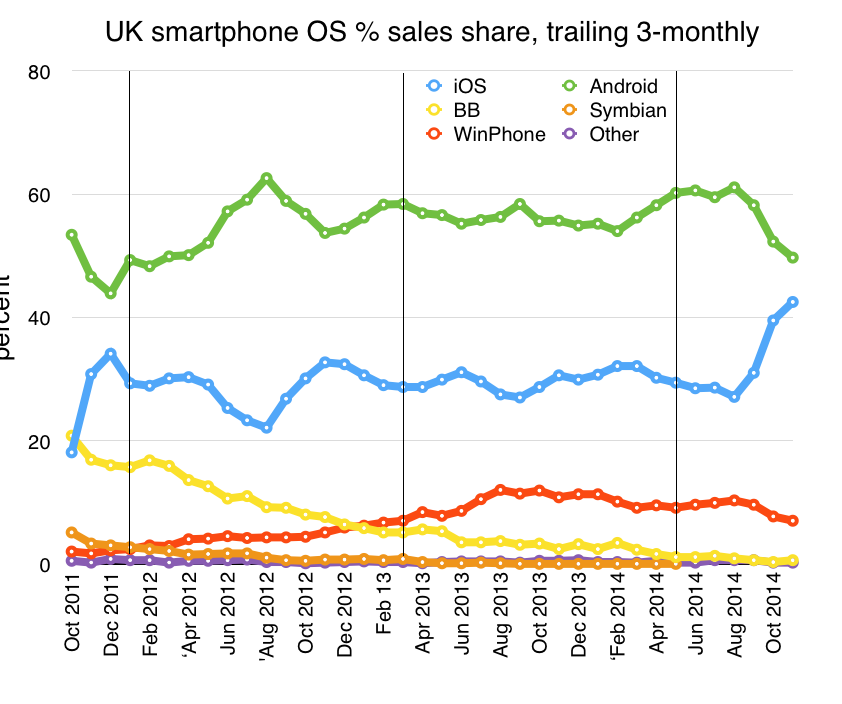
UK smartphone sales share to end November 2014

UK smartphone sales share to end November 2014, from Kantar; iOS share is highest ever recorded
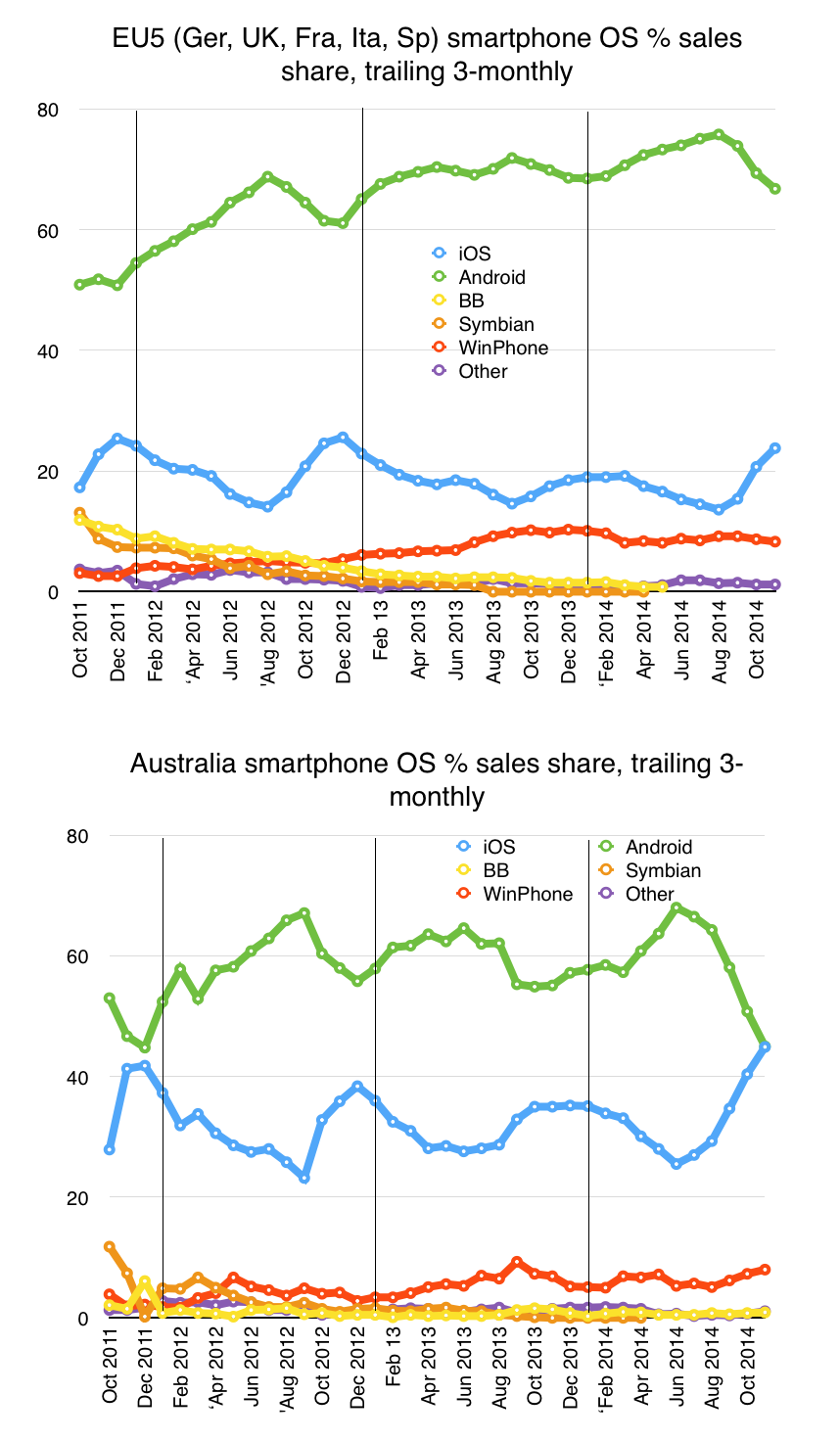
EU5 and Australia smartphone sales share

Share of smartphone sales for three months to end November 2014, via Kantar. (EU5 = Germany, UK, France, Italy, Spain = 184m smartphone users; Australia = 16.4m smartphone users)

(Note among all these that Windows Phone is still not making anything resembling progress; nor is “other”, though Firefox phones are few and very far between in these countries. The smartphone platform space is played out.)

Here’s the most interesting part, left to the very last paragraph of the release:

Smartphone penetration reached 58% in the US and 65% across Europe’s big five economies. “While die-hard featurephone owners state they are not planning to buy a smartphone in the next 12 months, they might not have a choice as vendors continue to transition their portfolio away from featurephones to smartphones”, concluded [Kantar head of research Carolina] Milanesi. Forty-seven percent of featurephones owners looking to change their current device in the next six months in the US and 35% across Europe’s top five [countries] are not planning to upgrade to a smartphone.

Once again: 47% and 35% of featurephone owners in the US and EU5 (Germany, UK, Italy, Spain, France) who are looking to change device won’t go to a smartphone.

Now, you could flip those numbers over: out of all (remaining) featurephone owners, 53% in the US and 65% in the EU5 may go to a smartphone in the next six months. It’s only “may” because they haven’t said they will, only that it isn’t definite they won’t.

The longrunning ComScore data in the US, meanwhile, which tracks installed base, shows that at the end of October there were about 65m featurephone users remaining there. For the UK, I calculate that smartphone penetration of mobile phone users is now 80.2% – based on the data and calculations I did for a piece last April using Kantar’s data.

In the US, the number of featurephone users converting to smartphones had been fairly constant, at a few million per month, but as the graph below shows, it nosedived during 2014 (the data only goes up to the end of October) – indicating that fewer are shifting up to smartphones.
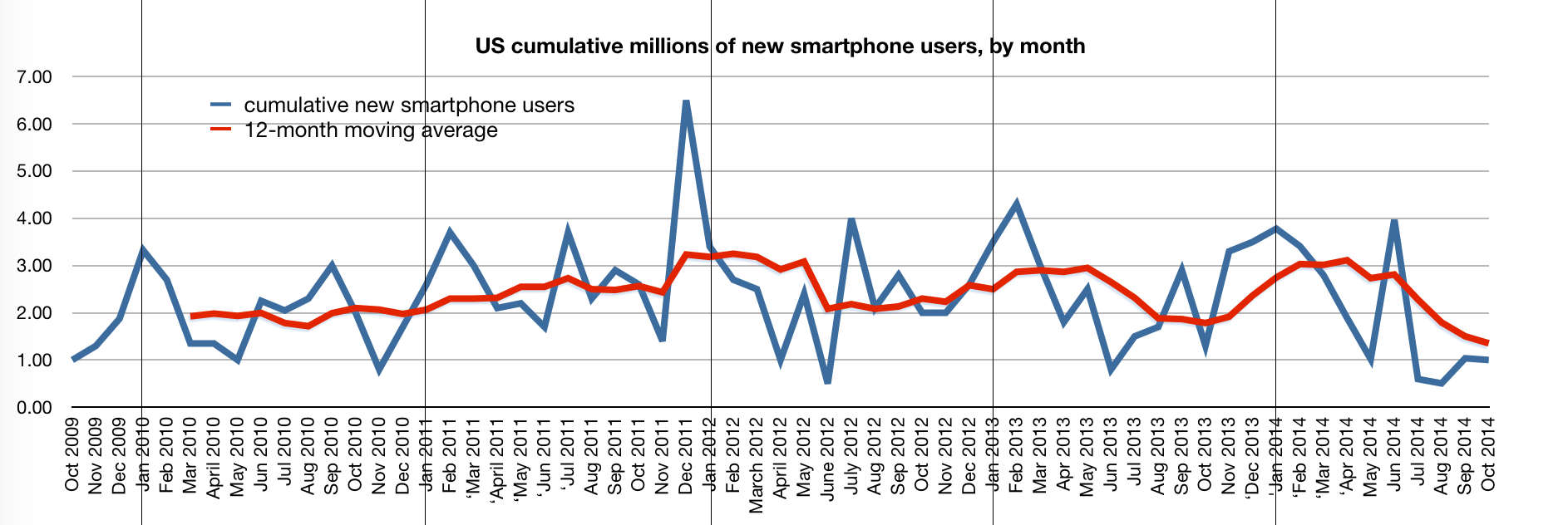
Number of US featurephone users moving to smartphones, by month

Data calculated from ComScore, showing how many featurephone users shifted to smartphones in the US. The trendline seems to have fallen off in 2014.

And indeed, why would you shift to a smartphone in the US if you don’t particularly need one, given its crazy system where you pay a huge per-month fee for the phone, and then for carrier service, and then for data, and then perhaps for “extras” (loosely defined)?

Thus we may now be at the point where the only ones without smartphones are the refuseniks – the people who don’t want a smartphone. In other words, we’re hitting the “laggards” – the 16% who don’t care. Given that the best fit for the data suggests smartphone penetration will top out at 92%-95%, and with 80% already using them (in the UK), we’re clearly in laggard territory.

Diffusion of innovations: segmentation

Stages of adoption of innovations. Source: Wikipedia
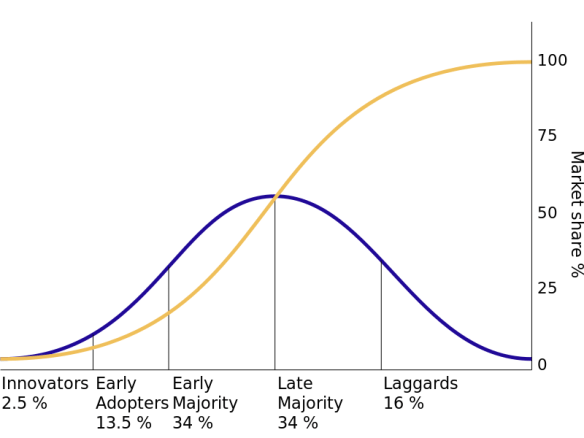
What does this mean? Mostly, that selling more phones becomes a battle where the existing smartphone platforms try to win people over from their rivals, while there’s also a gradual accretion from the last featurephone holdouts – who, as Milanesi says, might find they have barely any choice when it comes to replacing their dead one.

For BlackBerry, this is almost played out; it’s down to something like 40m users worldwide, of whom perhaps 8m are consumers and thus remain to be poached.

For Windows Phone – well, it’s unclear quite what’s happening there. The numbers sold remain consistently small, and low-end, and there just doesn’t seem to be a lot of movement. There’s some anecdotal suggestions that many of the low-end ones are used as sort of semi-smartphones, with pay-as-you-go contracts and little use made of their internet capabilities.

Android and iOS

The more interesting flow, aka churn, is between iOS and Android, and Android and iOS: in percentage terms for the three months, 11% of iPhone buyers were previously Android users; and 13% of Android buyers were previously iPhone buyers.

I know – the simplistic view would be that iOS is losing users overall. Except the numbers don’t work out that way; there are more Android users than iPhone users in the US (92m v 73.7m), so that iOS is actually gaining users.

Here’s how:
• 13% of 73.7 = 9.6 iPhone users shifting to Android;
• 11% of 92 = 10.1 Android users shifting to iOS.
Assume that the number of people changing phone is proportional to the total installed base at any time (which is likely), and the iPhone user base grows – just.

Even so, that churn must be a concern to Apple. Maybe the new screen sizes of the iPhone 6 and 6 Plus will reduce that, or perhaps it’s inherent in the dynamics of smartphone platforms.

Meanwhile, if you know a refusenik, do ask them what they’ll do when their phone breaks. Smartphone without data? Buy a featurephone on eBay?

Whatever; it’s unlikely the refuseniks are going to make a big impact now. In the developed world, the smartphone platform wars are so played out.

Start up: Google gets lyrical, Snapchat clone killing, the stolen smartphone business, and more


“Do you know Google’s getting into another content business?” “You hum it, I’ll play it”. Photo by guzzphoto on Flickr.

A selection of 9 links for you. Use them wisely. I’m charlesarthur on Twitter. Observations and links welcome.

What did they say? Google including song lyrics in search results >> WSJ Digits blog

Google is trying to answer some of the world’s biggest questions. That list now includes: Wait, what did he just sing?

Song lyrics are now part of the increasingly robust packet of information Google shows in its search results, a move that threatens traffic to popular lyrics sites.

It’s unclear when Google started showing lyrics on the initial results people see when searching for, say, “Love Is Blindness lyrics.” (A TechCrunch article traces it to a post on a blog about SEO that points to this Google+ post from Dec. 19.) For now, the lyrics apply only to U.S. searches.

A Google spokewoman said, with apologies to Led Zeppelin we’re sure, “There’s a feeling you get when you turn to a song and you know that the words have two meanings. Well it’s whispered that now if you go search the tune, maybe Google will lead you to reason. Ooh, it makes you wonder.”

Makes you wonder if lyric sites are stuffed – as in, how can they make their businesses work now? How many content businesses is Google going to tramp into?


North Korea experiencing severe internet outages >> Associated Press

North Korea experienced sweeping and progressively worse internet outages extending into Monday, with one computer expert saying the country’s online access is “totally down.” The White House and the State Department declined to say whether the U.S. government was responsible.

That’s the internet in North Korea, home to 24m people, where the internet is available to.. nobody quite knows how many people.


Huge privacy flaw uncovered in mobile phone networks >> HOTforSecurity

Graham Cluley:

In the last year or so there’s been a lot of bad news about how intelligence agencies and hackers can exploit weaknesses in internet communications to snoop upon our conversations and private messages.

Indeed, such has been the avalanche of revelations that it’s not uncommon at all to hear security researchers advise you to turn off your phone’s WiFi, and communicate via regular calls vand SMS messages instead because of the 3G phone network’s built-in advanced encryption.

Well, there’s bad news folks…

Two German security researchers have uncovered what they claim are serious security flaws that could allow criminals and intelligence agencies to spy upon private phone calls and text messages transmitted via cellular networks.

Still, as long as it doesn’t interfere with our film release schedule, that’s OK.


2015: The Year of Android >> Rusty Rants

Russell Ivanovic of Shifty Jelly:

I don’t often make predictions, but I’m willing to make this one: 2015 is going to be a huge year for Android. I’m not talking about the Market Share Wars, I never cared for them and Android won them long ago. I have little interest in the Who Makes The Most Money Wars either, I’m often baffled as to why people even care. As a developer and user of mobile platforms I’m more interested in app profitability, quality and diversity. I think 2015 is going to be a huge one for Android in this regard. Don’t believe me, ok, allow me to walk you through why.

Let’s start off with a myth: “No one makes money on Android”. I hear that all the time. The irony of the fact that we make 80% of our daily income on Android doesn’t escape me as these people wax eloquent about how this is a well established fact

Shifty Jelly does nicely from a podcast app; but Apple offers a free podcast app, so it’s not surprising that he sees money from Android and not iOS.

Reading this, though, he doesn’t quite explain what will make 2015 the specific year, or how we’ll measure it. More that it’s not a bad place for developers to be – which those who are interested in it probably know already.

More subtly, Android’s expansion in 2015 is going to be in low-income countries. Total revenues will go up, but per-install revenues will probably fall – and mobile ad rates will fall in line with installation growth.


6 things I learned from riding in a Google Self-Driving Car >> The Oatmeal

Matthew Inman:

Riding in a self-driving car is not the white-knuckled, cybernetic thrill ride one might expect. The car drives like a person, and after a few minutes you forget that you’re being driven autonomously. You forget that a robot is differentiating cars from pedestrians from mopeds from raccoons. You forget that millions of photons are being fired from a laser and interpreting, processing, and reacting to the hand signals of a cyclist. You forget that instead of an organic brain, which has had millions of years to evolve the cognitive ability to fumble its way through a four-way stop, you’re being piloted by an artificial one, which was birthed in less than a decade.

The unfortunate part of something this transformative is the inevitable, ardent stupidity which is going to erupt from the general public. Even if in a few years self-driving cars are proven to be ten times safer than human-operated cars, all it’s going to take is one tragic accident and the public is going to lose their minds. There will be outrage. There will be politicizing. There will be hashtags.
It’s going to suck.

But I say to hell with the public. Let them spend their waking lives putt-putting around on a crowded interstate with all the other half-lucid orangutans on their cell phones.


The secret world of stolen smartphones, where business is booming >> Wired

Matthew Shaer:

A picture slowly emerged of a so-called credit-mule scheme, ingenious in its simplicity and impressive in its reach. Middlemen such as Shamshad were dispatched to seemingly random American cities, where they trolled homeless shelters and halfway houses, offering $100 to anyone who would buy, on their behalf, a few on-contract phones from a local electronics store.

Back in California, the contraband was handed off to Wen and Tan, who arranged to have the phones shipped to their contacts in Asia. The profit margin was enormous: In North America, wireless carriers typically subsidize the cost of our smartphones in order to lure us into multiyear voice and data contracts. To obtain a phone, in other words, we fork over a small fraction of the device’s actual market worth. Wen and Tan took advantage of the system by obtaining iPhones — through middlemen and mules — for $200 a pop, then selling them in China for close to $1,000.

Records obtained by the eCrime Unit indicate that in a single year, Wen mailed 111 parcels using his FedEx account. By the time the whole operation was brought down in March of 2013, he and his wife had become very wealthy, to the tune of close to $2.5m in annual income.

Terrific article, rich in detail and observation. The numbers implied in the insurance sums and the numbers is amazing.


From messaging apps to ecosystems : Line, WeChat, Viber & Others >> Counterpoint Technology

Neil Shah:

It is foolish to ignore the growing scale of these platforms which are growing in capabilities and are becoming ecosystems in themselves.

If we look at carefully these platforms are beginning to look identical and at some point in future will become a commonplace. However, the differences that will make them standout or survive in long run is their business model and their reach in terms of capabilities and user base.

These ambitious app based platforms are expanding their reach across multiple areas attracting users to spend more time communicating, shopping as well as consuming content. These are creating greater amount of stickiness and using their horizontal business model to scale and with presence on the major platforms from iOS to Android to Windows to target the complete pie of smart devices users.

Notably including Samsung ChatON (reckoned here to have 100m monthly active users), but not Apple’s iMessage – which probably has about 300m MAUs.


What happened when Marissa Mayer tried to be Steve Jobs >> NYTimes.com

Nicholas Carlson (in an extract from his forthcoming book on Yahoo:

Previous Yahoo C.E.O.s had underinvested in mobile-app development, plowing money into advertising technology and web tools instead. A couple of days into the job, Mayer was having lunch at URL’s when an employee walked up to her and introduced himself as Tony. “I’m a mobile engineer,” Tony said. “I’m on the mobile team.”

Mayer responded to Tony, “Great, how big is our mobile team?” After some back and forth, Tony replied that there were “maybe 60” engineers. Mayer was dumbfounded. Facebook, for instance, had a couple of thousand people working on mobile. When she queried the engineering management department, it responded that Yahoo had roughly 100. “Like an actual hundred,” Mayer responded, “or like 60 rounded up to 100 to make me feel better?” The department responded that it was more like 60.

Companies like Facebook and Google are known for their fast-paced product updates. Yahoo, by contrast, was sluggish. Yahoo Mail, with its 30 billion emails a day, was arguably the company’s most important product. But despite the decline in desktop email use, Yahoo hadn’t built mail apps for smartphones. It had simply made the Yahoo Mail website usable on smaller mobile screens.

Although we know how the story turns out, it seems like this is going to be a book worth reading. (There are all sorts of pieces you could pull out of this article. Yahoo has been such a mess for so long.)


Microsoft removes all third-party Snapchat apps from the Windows Phone store >> TechCrunch

Jon Russell:

The ban on third parties may not last for too long, however. We know that Snapchat is working on building a mobile messaging platform, and that could mean that it finally releases an official API to allow third parties to connect to its service while providing increased protection for user privacy.

That said, the company recently introduced video advertising so keeping its service free of third party apps on all devices gives it absolute control over targeting its user base with ads, thus potentially maximizing its value to advertisers.

None of this means much for Snapchat fans on Windows Phone, who have never had an official app and now don’t even have unofficial ones. Such are the problems of being a ‘third’ platform in today’s iOS-Android dominated world.

I recall Stephen Elop at Nokia in mid-2013 pointing to a Snapchat-compatible app as evidence of how things were improving. (It’s worth looking back at to see how things haven’t changed for Windows Phone in those 18 or so months.) Wonder if this clearout was some sort of precondition by Snapchat before it would build a first-party app.