Start up: Swift v Apple, Beats gets heft, Aibos’ mortality, why Upworthy pivoted, and more


A number will get you into many peoples’ emails. Photo by Kohei314 on Flickr.

A selection of 10 links for you. I mean, do you even? I’m charlesarthur on Twitter. Observations and links welcome.

To Apple, love Taylor » Taylor Swift

Taylor Swift (yup, her):

I’m sure you are aware that Apple Music will be offering a free 3 month trial to anyone who signs up for the service. I’m not sure you know that Apple Music will not be paying writers, producers, or artists for those three months. I find it to be shocking, disappointing, and completely unlike this historically progressive and generous company.

This is not about me. Thankfully I am on my fifth album and can support myself, my band, crew, and entire management team by playing live shows. This is about the new artist or band that has just released their first single and will not be paid for its success. This is about the young songwriter who just got his or her first cut and thought that the royalties from that would get them out of debt.

This looks like an obvious one, but it isn’t. Lots of streaming services (all of them?) offer a free month initially, and the evidence suggests they don’t pay artists for those streams. (I’ve yet to confirm that absolutely.) Apple’s three-month deal seems to have come at the cost of higher royalty rates for those who sign up.

So Taylor Swift may be completely right – but that new artist or band might just want the exposure. It would certainly be good if Apple did pay in those three months. But that might then fall foul of antitrust.

Update: oh, internet, you do move fast. At 4.29am Eddy Cue tweeted that Apple would after all pay. More detail by Peter Kafka.


How It’s Made series: Beats By Dre » Medium

Avery Louie:

One of the great things about the [Beats] solo headphones is how substantial they feel. A little bit of weight makes the product feel solid, durable, and valuable. One way to do this cheaply is to make some components out of metal in order to add weight. In these headphones, 30% of the weight comes from four tiny metal parts that are there for the sole purpose of adding weight.

The two larger parts are cast zinc. Cast parts are similar to injection molded parts in that there is a tooling cost and a per-part cost. Compared to injection molding, the tool is marginally more expensive, but the per-part costs are higher, and the tools do not last as long.

The brilliant thing here is that the two large metal parts are not mirror images of each other- they are actually the same part!

The parts give them heft. And do nothing else at all.


How to hack into an email account, with just your victim’s mobile number » Graham Cluley

A bad guy – let’s call him Malcolm – is keen to break into Alice’s account, but doesn’t know her password. However, he does know Alice’s email address and phone number.

So, he visits the Gmail login page and enters Alice’s email address. But Malcolm cannot correctly enter Alice’s password of course (because he doesn’t know it).

So instead he clicks on the “Need help?” link, normally used by legitimate users who have forgotten their passwords.

Rather than choosing one of the other options, Malcolm selects “Get a verification code on my phone: [mobile phone number]” to have an SMS message containing six digit security code sent to Alice’s mobile phone.

This where things get sneaky.

Because at this point, Malcolm sends Alice a text pretending to be Google.

This is very sneaky, and would probably work against lots of people. Beware.


A robotic dog’s mortality » The New York Times

Jonathan Soble on the death of the Aibo – which is running out of juice:

They didn’t shed, chew the sofa or bite the postman, but for thousands of people Sony’s Aibo robotic dog was the closest thing to a real canine companion. So when the Japanese company stopped servicing the robots last year, eight years after it ended production, owners faced a wrenching prospect: that their aging “pets” would break down for good.

Sony introduced the Aibo in 1999, at a price of 250,000 yen (about $2,000 at current exchange rates). The beaglelike robots could move around, bark and perform simple tricks. Sony sold 150,000 units through 2006; the fifth and final generation was said to be able to express 60 emotional states.


Platform Patched – The Awl

John Herrman with a great analysis of why Upworthy has been forced to pivot: because Facebook turned its unique selling point into a feature of the platform:

Upworthy was succeeding according to metrics favored by Facebook, but not necessarily by doing the things Facebook believed those metrics would cultivate. A reader might spend five minutes watching a video on Upworthy and leave satisfied, but the site neither created the video nor hosts it—it would have been created by yet another party and hosted on YouTube, a site owned by Google. For Facebook, this is fine but not optimal: Why not just embed the YouTube video directly into News Feed with the same headline and description? Better yet, why not just host the video directly on Facebook?

Facebook-native video took off with the Ice Bucket Challenge, the success of which Facebook summarized in August and later used in explaining its vision for video. Seeing opportunity, publishers started publishing more videos, and more professional videos, as soon as they could.

And here’s The Awl’s graphic of Upworthy traffic:
Upworthy's falling traffic


1Password inter-process communication: a discussion » Agile blog

Jeff Goldberg, in a long blogpost about the “malicious OSX apps could grab inter-app comms by registering to receive them first” vulnerability:

Neither we nor Luyi Xing and his team have been able to figure out a completely reliable way to solve this problem. We thank them for their help and suggestions during these discussions. But, although there is no perfect solution, there are things that can be done to make such attacks more difficult.

The blogpost goes into a lot more detail; this is a really tricky problem. Though “keep process running all the time in the background” turns out to be a good solution.


Analyzing 10 yrs (and 5TB) of OpenStreetMap » Mapsense

Many fun insights to be found, but this one will ring true for any crowdsourced effort:

Insight #3- Very few people contribute the vast majority of features

We know the OSM community is growing, but we wanted to know what the impact of that growth is on the map that we all use.  

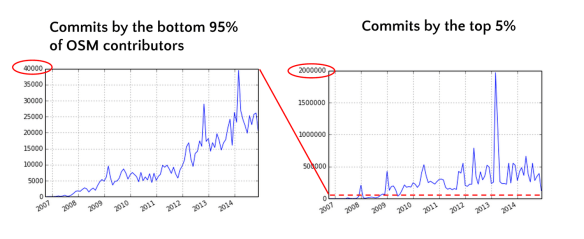
We segmented users into the top 5% of committers and the bottom 95%.  Here’s how their edits compare:

Open Street Map contributors

The number of commits in the bottom 95% is growing nicely over time, but even at its peak, their commits are orders of magnitude fewer than the commits of the top 5%. These power users are incredibly prolific, often importing large swathes of data such as building outlines or roads.

These users are making a huge impact on OSM- how can we encourage more of this to accelerate OSM’s quality?

Apple vs. Samsung: Samsung asks court to reconsider appeal » San Jose Mercury News

Howard Mintz:

Samsung urged the U.S. Federal Circuit Court of Appeals to rehear the case with its full 12-judge roster, arguing that a three-judge panel erred earlier this year when it left intact a jury’s verdict that the South Korean tech giant’s smartphones and tablets infringed on Apple’s design patents.

That part of the verdict – which has been pared from an original judgment of $1bn – accounts for about $400m of the $548m in damages Samsung still must pay Apple from their first trial.

Samsung’s continued interventions make this now officially the most boring court case in history. (Thanks John Molloy for the link.)


UK private copyright exception ‘unlawful’, rules High Court » Out-law

Prior to introducing the private copying exception, the UK government argued that it did not believe the private copying exception would result in lost sales for rights holders. However, the new regime was challenged by music industry bodies. The British Academy of Songwriters, Composers and Authors (BASCA), the Musicians’ Union (MU) and UK Music claimed that the government should have to compensate them and other rights holders for the harm caused to them by the new exception.

Mr Justice Green said that that the UK government was entitled to “implement a private usage exception” and to define the scope of that right. He said, though, that the government was obliged to introduce a “compensation mechanism” for rights holders if the harm caused to them by the introduction of the private copying exception was above a “de minimis level”.

Here’s the judgement. Not sure how this is going to be implemented – a surcharge on systems that can rip CDs? It’s the very definition of shutting the stable door after the horse has bolted, moved to another town, brought up foals, and died peacefully in its sleep.


Sizing up the suitors for Here, Nokia’s map business » TechCrunch

Ingrid Lunden:

One former longtime senior employee of Here estimates there are around 300 different location attributes, with corresponding historical databases, that can be tracked using Here’s technology. They include more obvious mapping and location-based applications such as driving directions and street maps, but also spatial data technology used in video and gaming applications.

“It’s incredibly difficult to get the type of mapping data that Here has. Base geometry and 20-40 road attributes are relatively easy to collect. However, to collect the 250+ attributes needed for the best navigation experience requires a combination of field teams and user-generated content,” notes entrepreneur Kurt Uhlir.

“Here has proprietary collection hardware and software that is unmatched, even by Google. Plus, they have the most extensive patent portfolio covering collecting and creating spatial content for current generation of maps and dynamic data. Here also has the foundational patents covering usage of spatial data for creating video games, movie content and the upcoming ADAS vehicle applications.”

Unmatched even by Google? Protected by patents? Such talk is heresy.


Start up: Grexit to bitcoin?, Google’s antitrust deadline, Merkel’s suspect PC, Samsung security hole and more


Stockpiled – a bit like HTC’s unsold phones. Photo by .dh on Flickr.

A selection of 7 links for you. Use them wisely. I’m charlesarthur on Twitter. Observations and links welcome.

Bitcoin surges as Grexit worries mount, posts best run in 18 months » Reuters

Jemima Kelly:

Joshua Scigala, co-founder of Vaultoro.com, a firm that holds bitcoin for its customers and allows them to exchange it for gold and vice versa, said that Greeks were buying the currency as their trust in the authorities waned. It is also unclear what currency would be used if a Grexit does occur — another potential factor driving Greek demand for bitcoin.

“Some people aren’t waiting for the government to figure out an exit plan and are doing it for themselves,” said Scigala.

“You have people worrying about their families’ wealth or their life savings, and worrying that their money might be locked up in banks … They’d rather hold money in a private asset like gold or bitcoin.”

Scigala said over the past two months, with Greece locked in talks with its creditors, the company had seen a 124% pick-up in inflows from Greek IP addresses – numerical labels that identify computers and other internet-enabled devices.

124% = doubling. Which doesn’t amount to much, really, unless Greece was already a lot of business. Here’s the problem with this story. To buy bitcoin, you have to sell the euros to someone. If Greeks are withdrawing their euros from banks, why not hold on to those euros instead of buying bitcoin with them? Do they really think a post-Grexit euro will be worth less, rather than more? I’d bet on the latter.

There may be some Greek euros moving into bitcoin, which is moving bitcoin – but that only indicates that bitcoin has low liquidity, and so small amounts of money can move the value easily. Or else it’s something else altogether causing it.


Critics due to get EU’s Google antitrust charge sheet this week: sources » Reuters

Foo Yun Chee:

Microsoft, German publisher Axel Springer and 17 other critics of Google are expected to get a copy of the EU’s antitrust charge sheet against the search engine giant this week in order to allow them to provide feedback, four people familiar with the matter said on Tuesday.

The 19 companies, which include U.S. online travel site Expedia, U.S. consumer reviews website Yelp, online mapping service Hot-map and British price comparison site Foundem, helped triggered the European Commission’s case against Google nearly five years ago…

…Google has until July 7 to respond to the accusations. This can be extended on request. It can also seek a closed-door hearing to argue its case before a broad audience of antitrust officials and the critics.

The complainants were told on Monday to sign confidentiality waivers not to disclose the so-called statement of objections to journalists or public affairs consultants before they could get a copy of the redacted document, according to a Commission letter seen by Reuters.

The critics were told to restrict the charge sheet to their lawyers and economists.

Leaks in 3,2,1… And there’s Andrew Orlowski’s writeup of the Foundem examination into Google’s “search for harm” blogpost.


One tiny number can reveal big problems at a global smartphone maker » Bloomberg Business

Tim Culpan:

Tucked away in a corporate earnings report—past the data on profit margins and revenue growth, hidden deep inside a balance sheet—is a number that can tell you a lot about a mobile phone maker’s health. In the global smartphone war, brands are routinely measured by market share, revenue, profit, and the coolness of their ads. But one line item called finished goods inventory, which refers to the percentage of materials that were manufactured into phones but went unsold, can give insight into whether a company’s fortunes are changing.

The latest company to let phones pile up in warehouses and on store shelves is HTC. The Taiwanese company’s stock just fell to its lowest point in a decade after lowering its sales forecast on June 5 and announcing a NT$2.9 billion ($93 million) writedown, though it’s recovered some of that loss amid speculation the decline could make it a buyout target. HTC’s finished goods inventory had climbed to a record high 2.35% of total assets at the end of last quarter. During the company’s heyday, that figure rarely nudged above 1%.

Culpan has done a neat job, building on what I pointed out last week about HTC’s broader inventory numbers. Relating inventory to total assets is an effective way to look at it; here’s the graph.

HTC inventory as percent of assets
So now it’s higher than ever before. Finished goods inventory is going to be one of the first numbers people look at when the Q2 figures are published (in late July, probably).


Merkel’s PC was the first one infected in the Bundestag hack »Security Affairs

I have written many posts regarding a recent attack against the German Bundestag with caused a major data breach.

We discussed the possibility that the cyber attack against the German Parliament was coordinated by Russian state-sponsored hackers that spread a highly sophisticated malware inside the network of the Bundestag.

The consequence of the data breach could be serious for the German Government, German media states that Bundestag may need to replace 20,000 computers after the intrusion, an operation that could cost millions of euros.

New revelations in the investigation confirms that the cyber attack on the German Bundestag began with the compromise of Chancellor Angela Merkel’s personal computer.

Her phone by the NSA, her computer by Russia…


Flaw lingers in Samsung phones, illustrating hacking risk » WSJ

Danny Yadron:

Last fall, researchers at cybersecurity firm NowSecure found a bug in most Samsung smartphones that could allow hackers to spy on users.

In March, Samsung told NowSecure it had sent a fix to wireless carriers that they could distribute to users. It asked NowSecure to wait three months before going public.

Last week, the researchers bought two new Samsung Galaxy S6’s from Verizon Wireless and Sprint. They found both were still vulnerable to the security hole, which involves how the phone accepts data when updating keyboard software.

NowSecure CEO Andrew Hoog shared his version of events with The Wall Street Journal as his company prepared to release its research Tuesday. The story helps illuminate why hacking is so hard to stamp out.

That’s particularly true in smartphones, with its diffuse system of device makers, software programmers and network operators. Things likely are only to get worse as Americans connect their thermostats, door locks and cars to the Internet and face the need to update their software…

…Welton found he could hijack the process of updating one of the virtual keyboards Samsung installs on many Android smartphones. From there, he could eavesdrop on phone conversations, rummage through text messages and contacts, or turn on the microphone to capture audio.

That was possible, Hoog said, because Samsung didn’t encrypt the update process.

It’s the IOT vulnerability that’s the real worry here, much more than which make of phone is involved. Except that Samsung asked NowSecure for a year to fix the bug – a month after it was told about it. And what does this mean for Google’s “we find a bug and we publicise it in 90 days” stance?


Nokia faces lengthy arbitration over LG patent royalty payments » Reuters

Jussi Rosendahl:

Nokia said the arbitration with LG is expected to conclude within two years. Shares in Nokia rose 1.4 percent by 1204 GMT (8.04 a.m ET).

“This is becoming a more and more common model. The companies won’t go to the court but instead let an independent party decide,” said Nordea analyst Sami Sarkamies.

He estimated that the Samsung deal, expected to conclude later this year, could eventually mean Nokia receives 100-200 million euros of additional royalty payments annually, on top of retroactive payments.

Seems to be related to 4G patents; Nokia signed a similar deal with Samsung a while back. For LG, means that profitability in the smartphone side becomes that little bit more elusive – especially after the back payment.


Apple News curation will have human editors and that will raise important questions » 9to5Mac

Jordan Kahn:

Techmeme‘s founder Gabe Rivera gave us the hard truth on why being an algorithm-based service like Google News doesn’t make sense for the Apple News app saying, “All news aggregators intended for the mass market need editors, so this makes sense for Apple.” But the flip side of Apple’s human-based curation is that without a separation of editorial and the business, there will undoubtedly be conflicts of interest. Rivera points out that “…as the world’s most valuable corporation, they can’t and shouldn’t be trusted to present well-rounded coverage on many important topics.” Rivera continues, “But most readers won’t care about that.”

Apple doesn’t want this to be an algorithm thing, because (a) algorithms might not pull outré-yet-fascinating stuff to the surface (b) if some story that were grisly/violent/sexual – pick the topic you think Americans in particular would react in horror to – popped up, Apple would of course get the blame. Apple hates that.

So it wants humans on hand to stop the Bad Stuff that will Offend People finding its way into the app. But that immediately raises the question: what will it define as Bad Stuff? Are Mark Gurman’s well-sourced leaks of Apple plans Bad Stuff? Is vicious criticism of Apple?

I suspect people are overplaying this; Apple is really wary of consumer backlashes over pr0n. Look at how Facebook struggles with the same topic, and the issue of content posted by millions of people which some find offensive and others really don’t.

No simple answer, but Apple may not have realised it was putting itself in the position of a publisher.


Start up: more PC slowdowns, Apple Pay goes big, Facebook gets AI, Uber’s early days, and more

2012 Keynote
Big touchscreens: what are they good for? Photo by Microsoft Ignite NZ on Flickr.

A selection of 9 links for you. Use them wisely. I’m charlesarthur on Twitter. Observations and links welcome.

A compilation of robots falling down at the DARPA Robotics Challenge » YouTube

I for one welcome our new robotic ove.. AH, NOT SO SMART NOW, ARE YOU?


Siri’s search power grows, as Apple accelerates machine learning » Mobile Forward

Hristo Daniel Ushev:

I’m changing my mind about Google’s data-volume-based advantage. I believe Apple sees a volume of (anonymized) user data that’s on the same order of magnitude as Google (on mobile). Google Now may provide Google with more question/intent data, but Apple sees the bigger picture of what consumers (in aggregate) do/need throughout the day. I base my belief on iOS’s huge installed base, high app downloads and usage, and Apple’s full-stack access to iOS devices.

With so many dots to connect – Mac, iPhone, iPad, Apple Watch, Apple TV, Siri, Maps, News, HealthKit, HomeKit, and CarPlay – Apple will have great opportunities to add value to consumers’ daily life.

Machine learning is to 21st century devices as the graphical user interface was to 20th century computers. I don’t mean that as a user interface metaphor, but as a way to express how critical it will be to a high-performance product.

At a machine learning conference the other day, someone said to me: “a really smart AI wouldn’t need a ton of data. It would figure out what lions look like from just one picture of a lion, not hundreds. Maybe Google’s aren’t that good if they need so much data.” Well, perhaps..


Samsung’s new smartwatch to offer mobile payments: Electronic Times » Reuters

Tech giant Samsung Electronics Co Ltd plans to offer a mobile payments function in a smartwatch to be launched in the second half of the year, South Korea’s Electronic Times newspaper reported on Monday citing unnamed sources.

Samsung would use near-field communication (NFC) technology to support mobile payments on the smartwatch, the report said. This is the same technology Apple Inc uses for the Apple Pay function supported by its smartwatches.

How about that.


The future of computers is the mind of a toddler » Bloomberg Business

Jack Clark:

On June 9, Facebook plans to publish a research paper detailing a system that can chew through several million pieces of data, remember the key points, and answer complicated questions about them. A system like this might let a person one day ask Facebook to find photos of themselves wearing pink at a friend’s birthday party, or ask broader, fuzzier questions, like whether they seemed happier than usual last year, or appeared to spend more time with friends.

While AI has long been an area of interest for Hollywood and novelists, companies hadn’t paid much attention to it until about five years ago. That’s when research institutions and academics, aided by new techniques for crunching reams of data, started breaking records in speech recognition and image analysis at an unexpected rate. Venture capitalists took notice and invested $309.2 million in AI startups last year, a twentyfold increase from 2010, according to research firm CB Insights. Some of these startups are helping to break new ground. One in Silicon Valley, called MetaMind, has developed improvements to computers’ understanding of everyday speech. Clarifai, an AI startup in New York, is doing complex video analysis and selling the service to businesses.

Facebook’s office for this is in France. British companies are big in this too. Cannot emphasis enough how important this field is. (Can’t find the research paper, though.)


Apple Pay UK: some retailers to ditch £20 contactless limit » Pocket-lint

Stuart Miles:

As is the case with Apple Pay in the US, Apple has convinced retailers and banks to remove the limit because they can prove the customer is present thanks to the use of the Touch ID fingerprint scanner on the iPhone.

MasterCard have confirmed similar options for Apple Pay retailers in the UK too:

“Currently the vast majority of payment terminals here in the UK are set to accept contactless transactions up to the £20 spending limit, but that will rise to £30 in September (for cards as well),” a spokesman for MasterCard told Pocket-lint when we asked about clarification on the limit thresholds.

“As more digital services like Apple Pay come to market, we’re [MasterCard] supporting retailers and banks as they update the terminals so that they can accept authenticated transactions above that limit from digital devices.”


Uber: An oral history » Fortune

Some fascinating interviews by Adam Lashinsky (with Uber’s cooperation, of course), which are all worth reading; including this by Conrad Whelan, who was its first engineer:

When I joined the company, you couldn’t actually sign up for the product. It was just a way to order the car. So I built the sign-up flows that would take a credit card and make user accounts. So as soon as we did that, we could officially launch, which was June 1st, 2010, two months after I started.

I think the next thing I did, which I really enjoyed, was optimize the dispatch algorithms to take into account drivers that might miss a dispatch. That lasted like three years, or something like that, which is pretty cool.

Sounds throwaway, but gives a hint of the huge complexity involved.


Large touchscreens: what’s different? » Nielsen-Norman Group

Amy Schade tried out a 24in tablet with her children (because children don’t know what they’re not supposed to not do):

While the large screen was completely enthralling to my 2 year olds, the size of the touchscreen was a drawback for my daughter. She leaned on the screen with one hand in order to reach another part of the screen. As a result, the puzzle pieces that she was trying to move jumped from one hand to the other, if they moved at all.

Using the large screen was particularly hard for her, based on her size relative to the device —most of us aren’t using devices that are nearly as big as we are. However, her attempts to use it also illustrate a problem far more likely to be encountered with large touchscreens: that of unintended two-handed touches and other accidental touches.

We see this play out in our testing of mobile devices. We witness more accidental touches or brushes of the screen as people maneuver standard sized tablets than we do when watching people use their phones.

Designs need to anticipate and accommodate accidental touches and consider ways to incorporate larger gestures, hand presses versus finger touches, and multi-hand interactions.


PC inventory issues growing serious in Europe; retailers boycotting vendors dumping inventory » Digitimes

Monica Chen and Joseph Tsai:

First-tier PC vendors reportedly are seeing serious inventory issues in Europe and may try to digest stocks by offering price cuts. At the same time, some channel retailers are reacting to the news by boycotting the vendors to avoid having inventory dumped on them, according to sources from the upstream supply chain.

The PC supply chain was originally optimistic about demand for PCs in the second quarter, but component suppliers have seen their orders from brand vendors weakening during the quarter as most vendors have high inventory levels on hand, which they are struggling to clear as most consumers have halted their notebook purchasing to wait for the release of Windows 10, which is scheduled for the end of July…

…In addition, Windows 10’s free upgrade strategy is also expected to weaken consumers’ demand for buying new PCs.

“First-tier PC vendors” is probably code, here, for Asus and Acer.


Facing the music » All this

Dr Drang on the longest half-hour ever, at the end of the Apple keynote in which Eddy Cue introduced Apple Music:

nothing justifies the dancing. I’m sure Eddy thought it was funny and self-deprecating, but it was just annoying and a waste of our time. I often think Craig Federighi overdoes the jokes, but he knows when to pull it back and doesn’t let his presentation get derailed. Eddy doesn’t have that sense.

As to whether Apple Music is really good, we’ll have to wait and see, but the signs aren’t pointing in that direction. The elevator pitch is that “Apple Music is three things” – an attempt to tie it to the 2007 introduction to the iPhone. (And someone should have explained that to Iovine before sending him onstage. He clearly didn’t understand the audience’s reaction to the “three things” line.) But while the advantages of a multifunction device are obvious, the advantages of a multifunction app aren’t. The App Store’s success is largely based on tightly focused apps, not sprawling suites.


Start up: watch the commuters!, SamsungPay’s big obstacle, Apple gets mappy, and more


Mars: likely to remain inhabited only by robots for quite a long time yet. Photo by ridingwithrobots on Flickr.

A selection of 9 links for you. Use them wisely. I’m charlesarthur on Twitter. Observations and links welcome.

The Samsung Galaxy S6 might be the best Android phone of 2015, but it is unusable » Android Beat

Rajesh Pandey:

The Moto X 2014, which has 2GB of RAM, has around 700MB of free RAM with a similar setup. Despite the 1GB difference in RAM, the Moto X — running Android 5.1 — feels significantly smoother to use. The RAM management issue on the Galaxy S6 is so bad that jumping between a Chrome tab and another app running will force the Chrome tab to reload. This makes the phone completely useless for any kind of serious browsing or for doing any transactions through a bank’s website. I have to restart my Galaxy S6 once every 24 hours to make sure the handset does not feel sluggish and slow. On the days that I do forget to reboot the handset, the phone gets so slow that it feels like I am using some low-end Android device and not the best Android handset in the market currently. It’s nothing short of a miracle that I have not yet thrown the phone in sheer frustration. In all probability, the poor RAM management of the Galaxy S6 stems from different memory leaks present in Android 5.0 Lollipop. The Moto X and Nexus devices had similar issues on Android 5.0, so it makes sense that the Galaxy S6 has them as well. However, the Galaxy S6 was released more than 5 months after Google had released Lollipop, which means that Samsung had more than ample time to track down and fix the memory leaks.

I’ve previously linked to the complaints about Lollipop having memory leaks. I haven’t seen this complaint before, though.


The Apple vs. Google battle has changed » Above Avalon

Neil Cybart:

Google I/O made it clear that Google needs Apple and iOS. To ignore such a vibrant base of highly-engaged users, especially when other companies like Facebook enjoy a prominent place in the platform, would be highly destructive to Google’s ambitions. On the other hand, Apple also needs Google as its services remain very popular among iOS users. However, judging from Apple’s prior actions and mission statement to personalize technology, I would expect Apple will continue to try to minimize its dependence on Google as such a situation represents a long-term threat to Apple’s mission. Similar to how the Nexus experience provides the closest thing to pure Android, I suspect Apple wants to continue down the path of being in a position to ship an iPhone and suite of apps and services that make it possible to live within the Apple ecosystem without much interference from Google. While most consumers will end up settling somewhere in the middle, using both Apple and Google products and services, it is this quest to control the entire user experience that ultimately validates the competition between Apple and Google as genuine. The probability of a world where Android excels as a direct result of iOS faltering is becoming more remote as time goes on. Instead, Google is becoming more reliant on a healthy iOS platform…


Watch the City of London pulling in commuters from across the south east like an imploding star » CityMetric

Last week we ran some fascinating maps [Alasdair Rae] created showing the population density (and, consequently, urban area) of major British cities. Now, he’s created a visualisation that shows the limits of this type of static density modelling: an animation that shows the massive population shift that takes place every day as workers commute into the City of London. The visualisation is based on 2011 census data showing daily commuter journeys into the square mile, London’s main financial distract. It shows commuters speeding into the city’s centre from as far away as Bournemouth and Margate. It’s also completely hypnotic to watch:

Now I want the commute home too…


Toyota unintended acceleration and the big bowl of “spaghetti” code » Safety Research & Strategies, Inc

[Embedded software expert Michael] Barr testified: “There are a large number of functions that are overly complex. By the standard industry metrics some of them are untestable, meaning that it is so complicated a recipe that there is no way to develop a reliable test suite or test methodology to test all the possible things that can happen in it. Some of them are even so complex that they are what is called unmaintainable, which means that if you go in to fix a bug or to make a change, you’re likely to create a new bug in the process. Just because your car has the latest version of the firmware — that is what we call embedded software — doesn’t mean it is safer necessarily than the older one….And that conclusion is that the failsafes are inadequate. The failsafes that they have contain defects or gaps. But on the whole, the safety architecture is a house of cards. It is possible for a large percentage of the failsafes to be disabled at the same time that the throttle control is lost.” Even a Toyota programmer described the engine control application as “spaghetti-like” in an October 2007 document Barr read into his testimony. Koopman was highly critical of Toyota’s computer engineering process.

Remember how shonky the interfaces for VCRs and DVDs were? What if the people who did those were writing your car code? What if they already are?


Jobs at Apple » Apple

Job Summary The Maps team is looking for a web technology expert to help make maps work seamlessly on the web. The ideal candidate will be a JavaScript expert, have in- depth knowledge of various core web technologies, and be proficient with web developer tools for debugging and performance analysis.

If you have an iOS device and use iCloud.com, you can use Apple Maps online to do Find My iPhone. Either Apple is looking to expand its desktop Maps so that it’s not just an OSX experience, or this is just strengthening the FMI team.


Mars One reveals true number of applicants » Matter on Medium

Elmo Keep:

On a new page on its site, The Science of Screening Astronauts, Mars One writes, “The total number of completed and submitted applications was 4,227.” Citing a report by NBC, Matter reported the figure of publicly available video applications at 2,782. We don’t know that 4,227 is any more real than 200,000. It’s just what they’re self-reporting. (Mars One did not provide us any clarification despite repeat queries.) Regardless, that falls far short of the 200,000 widely reported initially by countless media outlets, and shorter yet of the one million applicants CEO Bas Lansdorp anticipated at the launch of the project.

This is starting to feel like Capricorn One.


Why SamsungPay is toast » Starpoint Blog

Tom Noyes (who – reminder – called it correctly that the iPhone 6 would have NFC and payments back in May of 2014):

Let’s assume that Samsung solves ALL of the technical issues above and now SamsungPay works on all Android devices. Everyone knows that MNOs decide what gets pre-installed on the phones they subsidize (even Apple). Six weeks before Mobile World Congress [in March], Google made a strategic deal with the US MNOs to buy ISIS in exchange for Android Pay (the new Google wallet) becoming part of Google Mandatory Services (GMS.. just like search and gmail). Part of this is also a new android registration flow that addresses THE KEY weakness of Android profitability.. it gets consumers to add a card and play account (Apple brilliantly required an iTunes account… with accompanying credit card.. in launch of iPhone). Samsung’s wallet could still work.. however IT IS NOT PRE LOADED.. so this is what the consumer would have to do (AFTER REGISTERING FOR ANDROID PAY): 1) Find out about Samsung pay
2) Install Samsung Pay
3) Register for Samsung Pay
4) Understand where they can use Samsung Pay
5) Wave it near the Mag Head reader
6) Then use Android pay for in-app and play purchases..
Forget about the technical issues.

But it can attempt it in other countries.


Sizing up the opportunity for Apple Pay » Kantar

Carolina Milanesi:

Among iPhone 6 and 6 Plus owners in the US, 13% have used Apple Pay, and 11% are planning to do so. Lack of trust and knowledge do not play a major role as reasons not to use it. Only 2.6% said they did not use Apple Pay because they do not trust it, and only 4.1% said they did not use it because they do not understand how it works. Eleven percent said they did not use it because their credit cards work just fine, and 58% just answered “no” without adding any more detail. Among Apple Pay users, men were more numerous than women, with 59% versus 41% of users, and 55% versus 45% of intenders. This is not surprising since early adopters tend to skew male, but what is interesting is that adoption of the new iPhone models has been slightly stronger among women at 52% versus 48% for men… …In March 2015, as a measure of comparison, only 7% of Android users we surveyed in the US said they used NFC/mobile payment. Google Wallet has been around since 2010, and any Android device with NFC capability can access it for payments.

I’d say that’s actually a pretty good showing for Google Wallet.


Three Google directors survive challenge over pay » Reuters

Devika Krishna Kumar and Ross Kerber:

Three Google compensation committee members were re-elected on Wednesday, the technology company said at its annual meeting, despite a challenge from a high-profile proxy adviser that raised concerns over executive pay. Google did not immediately detail by how much of a margin the directors won re-election at the meeting, which was webcast. Proxy adviser Institutional Shareholder Services (ISS) had recommended that Google shareholders withhold votes for the three directors, saying “mega grants” provided to executive chairman Eric Schmidt and chief business officer Omid Kordestani were “problematic.” ISS recommended that votes be withheld for Google compensation committee members John Doerr, Paul Otellini and Ram Shriram. ISS also recommended investors withhold votes from Google director John Hennessy, president of Stanford University, citing what it said is his role as a non-independent member of the board’s nominating committee.


Start up: Apple’s transit plans, app monetisation, Samsung’s S6 rebuttal, bitcoin booboo, and more


Surely not caused by a Google car. Photo by Oakland Pirate on Flickr.

A selection of 9 links for you. Free like nitrogen. I’m charlesarthur on Twitter. Observations and links welcome.

Californians are OK with Google self-driving cars and are ready to ban non-self-driving cars » Emerging Technologies Blog

One of the blog’s readers gave their experience:

It’s safe to cut off a Google car. I ride a motorcycle to work and in California motorcycles are allowed to split lanes (i.e., drive in the gap between lanes of cars at a stoplight, slow traffic, etc.). Obviously I do this at every opportunity because it cuts my commute time in 1/3. Once, I got a little caught out as the traffic transitioned from slow moving back to normal speed. I was in a lane between a Google car and some random truck and, partially out of experiment and partially out of impatience, I gunned it and cut off the Google car sort of harder than maybe I needed too… The car handled it perfectly (maybe too perfectly). It slowed down and let me in. However, it left a fairly significant gap between me and it. If I had been behind it, I probably would have found this gap excessive and the lengthy slowdown annoying. Honestly, I don’t think it will take long for other drivers to realize that self-driving cars are “easy targets” in traffic.


Why do we assume everyone can drive competently? » Remains of the Day

Eugene Wei just avoided a cycling crash when a car turned into his cycle lane without warning:

For the next two blocks, I played my near collision on loop in my head like a Vine, both angry at the driver’s reckless maneuver and relieved as I tallied up the likely severity of the injuries I had just managed to escape by less than a foot of clearance. This is not an unusual occurrence, unfortunately. When I bike, I just assume that drivers will suddenly make rights in front of me without turning on their turn signal or looking back to see if I’m coming in the bike lane to their right. It happens all the time. It’s not just a question of skill but of mental obliviousness. American drivers have been so used to having the road to themselves for so long that they feel no need to consider anyone else might be laying claim to any piece of it. Though the roads in Europe are often narrower, I feel a hundred times safer there when biking there than I do in the U.S. All that’s to say I agree wholeheartedly with the writer quoted above that self-driving cars are much less threatening than cars driven by humans. As an avid cyclist, especially, I could think of nothing that would ease my mind when biking through the city than replacing every car on the road with self-driving cars.


iOS 9 Transit Maps to launch in a handful of cities in North America, Europe & China » 9to5Mac

Mark Gurman, for it is he:

While Apple plans to debut its own mass transit directions service for Maps in iOS 9 as soon as June, the rollout will not be as ambitious as some users may have hoped. In its first iteration, Apple’s Transit service will only support approximately a half-dozen cities across the United States, Canada, and Europe, in addition to China, according to sources… In the United States, the planned launch cities are San Francisco and New York, two major metropolitan areas that are known for public transportation, while Toronto will be likely Canada’s sole representative for the iOS 9 Maps Transit feature at launch. In Europe, Apple is said to be gearing up to first launch the feature in London, Paris, and Berlin.

Google has been miles ahead in this for years (which made iOS 6 retrograde). Three years on, there are already lots of apps – especially Citymapper – which offer services like this. But it’s the integration that Apple has really lacked.


Google’s answer to the big problem with wearables » WSJ

Alistair Barr:

Wearable gadgets like smartwatches have seen a lot of hype but little commercial success. An obvious obstacle is that teensy touch screens can make such devices difficult to control. Google thinks it has an answer: a minuscule radar system that senses hand gestures. The company’s Advanced Technology and Projects research group shrank a radar system into a package roughly the size of a micro SD card, small enough to fit in a smartwatch. It beams a signal wide enough to capture hand motions and gestures and turn them into control signals, according to Ivan Poupyrev, who led the initiative called Project Silo. The tiny radar could let people control tiny-screen devices without having to touch them, he said during a session at the Google I/O 2015 developer conference. For instance, it transforms a twisting motion between thumb and forefinger into commands to scroll up and down a smartwatch’s screen. Poupyrev demonstrated by changing the hours and minutes on a small screen by rubbing his thumb and finger near to the radar gesture sensor. He also played a simple soccer game, his finger motions in midair near the sensor shooting an onscreen ball into a goal. ATAP plans to release the system to developers later in 2015, Poupyrev said.

This is one of those things that looks cool in demos, but I suspect could be prone to everything that real life is – mess-ups. Remember Leap Motion, another gesture control system? Went nowhere because waving your hand in the air isn’t a natural way to control things – because it’s prone to misinterpretation. Google might get this right, but it needs a ton of figuring out.


Apps spearhead Google’s battle with Apple » FT.com

Richard Waters and Tim Bradshaw:

Apple’s App Store accounts for about 45% of the revenue that developers make from apps, compared with 29% for Google’s Play, according to Digi-Capital. But counting in the income from handsets in China — where Google’s apps are blocked, meaning it makes no money — pushes the overall Android share to 52%, Digi-Capital calculates. Last week, matching — and trying to surpass — Apple was a strong subtext of Google’s pitch to developers. New features included Android Pay, a rival to Apple Pay and a fresh attempt to break into mobile payments after the disappointment of Google Wallet. A new Google Photos app — with the promise of software that can automatically organise libraries of pictures — also echoed capabilities that are already offered by Apple. But in other areas, Google seemed unprepared. While smartwatches based on last year’s Android Wear technology have been put in the shade by the launch of Apple Watch, Google had little new to show off in response. This was a sign that it is surrendering early leadership in wearables to Apple, according to Carolina Milanesi, an analyst at Kantar Worldpanel.

The download share of Android in China is 62.8%, compared to 22.2% for Google Play, and 13.9% for Apple. Remarkable that non-Google Android is so big – but it only takes 23.8% of revenue, against 28.6% for Google Play, and 44.7% for Apple.


Hello world: Windows 10 available on July 29 » Microsoft Windows blog

Terry Myerson:

We designed Windows 10 to create a new generation of Windows for the 1.5 billion people using Windows today in 190 countries around the world. With Windows 10, we start delivering on our vision of more personal computing, defined by trust in how we protect and respect your personal information, mobility of the experience across your devices, and natural interactions with your Windows devices, including speech, touch, ink, and holograms. We designed Windows 10 to run our broadest device family ever, including Windows PCs, Windows tablets, Windows phones, Windows for the Internet of Things, Microsoft Surface Hub, Xbox One and Microsoft HoloLens—all working together to empower you to do great things. Familiar, yet better than ever, Windows 10 brings back the Start menu you know and love.

“Speech, touch, ink and holograms” is quite enticing. (That’s Hololens, of course.)


Asus brings a choice of sizes to Android Wear with ZenWatch 2 » The Verge

Vlad Savov:

The ZenWatch 2 runs the latest version of Android Wear, which was recently introduced with the LG Watch Urbane, however Asus’ watch is still a long way from actually being released. Asus tells us that it will reveal the full specs, pricing, and availability information during IFA in Berlin this September — leaving this as more of a promise than an actual product. The goal is to keep prices consistent between the two watch sizes, leaving the choice of strap to determine the particular cost. Update: The original article speculated that Asus’ metal crown will function like the digital crown in the Apple Watch, however we’ve now confirmed with Asus that it’s simply an external button and not a physical scroll wheel.

1) Doesn’t this Osborne [kill by preannouncement] the existing Zenwatch, even though there’s no price etc etc for the 2? 2) Which company will be the first, do we think, to mimic Apple’s digital crown and risk the sure-to-ensue lawsuit?


Samsung says S6 sales meet internal forecast » Korea Times

Kim Yoo-chul:

A Samsung spokesman in Seoul refused to release any official information on sales; but the company is expected to unveil figures at its upcoming investor relations forum on [Wednesday] June 3. Such remarks come a few days after Samsung Electronics Corporate Affairs President Park Sang-jin told reporters that the firm has been seeing a steady increase of sales on international markets. “You have to wait and see; however, the S6 and S6 Edge sales will be far higher than those of the S5” he said. The two models were unveiled during the Mobile World Congress 2015 event at the beginning of March. Both models were made available for purchase in April. Citing a report by CounterPoint Research, a research firm, eBEST Investment analyst Kim Hyun-yong said Samsung sold 6.1m S6s and S6 Edges in April. He added 305,000 S6s were being sold daily since the devices’ availability ― better than the S5 and S4’s 124,000 and 241,000 per day, respectively.

I’m finding it hard to believe that the S6 (and Edge?) is selling triple the number of the S5, and 50% more than the S4, at a time when Samsung is down in China and seen sales declines for months, and the S6 is on sale in fewer countries than the S5 was. Though with Samsung it’s hard to know what “sales” means – usually, it’s “sell-in”, as in sales to carriers.


Bitcoin app issues critical update after rare bug leads to total crypto breakdown » The Guardian

Alex Hern:

Bitcoin wallets are typically created by randomly generating a public address and a related private key. As a result, it is important for address and key to be truly random, or else it may be possible to guess the private key by looking at the public address. [Bitcoin wallet app] Blockchain used two sources of random numbers, in what ought to have been a belt-and-braces approach: it pulled a random number from the Android operating system’s built-in random number generator, and then connected to online service Random.org to get a second random number, which it combined with the first. Unfortunately, on some Android phones (reportedly including devices from the Sony Xperia range), the built-in random number generator failed to report back to the blockchain app. Normally, this should have been survivable, because the app used a second source of random numbers. But on 4 January, Random.org strengthened the security of its website, requiring all visits to be made over an encrypted connection. The blockchain app, however, continued to access the site through an unencrypted connection. So rather than getting a random number, as expected, it got an error code telling it that the site had moved. It then used that error code as the random number, every single time.

Not quite bitcoin itself screwed (it’s far too robust) but those using that app could find themselves all sharing a wallet.


Start up: a Microsoft BlackBerry bid?, Firefox’s dead mobile dream, Montblanc’s smart watchband, and more


Fitness lies within. Photo by cactusbeetroot on Flickr.

A selection of 9 links for you. Counted by computer. I’m charlesarthur on Twitter. Observations and links welcome.

Mozilla overhauls Firefox smartphone plan to focus on quality, not cost » CNET

Scoop by Stephen Shankland:

Mozilla has revamped its Firefox OS mobile software project after concluding that ultra-affordable $25 handsets aren’t enough to take on the biggest powers of the smartphone world, CNET has learned.

The nonprofit organization rose to prominence with the success of its Firefox Web browser a decade ago, but it’s having trouble achieving the same success with its Firefox operating system for smartphones. According to a Thursday email from new Chief Executive Chris Beard, Mozilla has changed its strategy to a new “Ignite” initiative that emphasizes phones with compelling features, not just with lower price tags. It’s also considering letting its operating system run apps written for its top rival, Google’s Android.

The idea that Firefox OS could undercut Android was always ridiculous, because Android volumes brought prices down so quickly. This won’t work either though – there’s no “quality gap” in the middle, and certainly not in the high end. Firefox may be destined for obscurity by the world’s move to mobile.


Montblanc to Apple: our Swiss smartwatch will outlast yours » Bloomberg Business

Corinne Gretler on Montblanc’s “e-strap”, which attaches to the strap, rather than replacing the watch itself:

The device is the first luxury Swiss product to directly compete with the Apple Watch, which costs $349 for the most basic version and $17,000 for an 18-karat gold model. The e-Strap and compatible timepieces will appear in Montblanc boutiques and retailers such as Bloomingdale’s in the U.S.

“The pricing is reasonable,” said Patrik Schwendimann, an analyst at Zuercher Kantonalbank. “If it turns out to be just a fad, at least the consumer still has a nice, normal watch they can continue to wear.”

The e-Strap consists of a stainless steel display attached via a leather strap and designed to be on the backside of the wrist when the watch is on the front. A two-line touchscreen displays e-mails when they arrive.

When connected to a smartphone, Montblanc’s device can select songs and jump through playlists. It has an activity tracker that allows users to set targets for calories burned and steps taken. The e-Strap can also trigger the phone’s camera, facilitating easier “selfie” shots and group photos.

The e-strap is amazingly ugly; I can’t imagine anyone who would buy a Montblanc buying one, let alone using one, to go with their watches which cost (deep breath) $3,700 to $5,800.

One begins to see why Jonathan Ive considered that Switzerland might be screwed.


Samsung layoffs at Milk Music, Milk Video Unit; Kevin Swint exits » Variety

Janko Roettgers:

Samsung’s Media Solutions Center America, which is responsible for the company’s Milk Music and Milk Video services, has been hit by layoffs and a key exec departure over the last couple of weeks, Variety has learned. These events have occurred as Samsung executives take a closer look at many of its business units, which could spell trouble for the company’s content plans going forward.

Media Solutions Center America saw dozens of staffers laid off earlier this month, according to multiple sources. Exact numbers are hard to come by, but one source estimated that as much as 15% of the staff may have been affected. I’ve been told that MSCA employed around 250 people total before the cuts went into effect.

Samsung said it remains committed to delivering “engaging, connected entertainment experiences through its Milk platform.”

Flashback on Samsung denials:
November 2014: Samsung denies ChatOn to close
December 2014: ChatOn to close by March 2015.


Filling the green circle » Marco.org

Marco Arment:

Ever since getting the Apple Watch, not only have I been getting more consistent exercise, but I’m pushing myself further. I take more walks, and I walk faster and further than ever before. I’ve been walking hops around the same streets for four years, but now I’ve been discovering new streets and paths just to extend our walking distance and try to beat my previous walks.

I’ve never cared before, but now, I care.

Apple Watch: a Skinner box in a smartwatch’s clothing.


The new Google Photos app will automatically group your images by faces and recognized objects like cars, skylines, and food » Android Police

Ryan Whitwam:

Google’s current Photos app uses some image processing smarts to piece together auto-awesome compilations and Stories, but the new Photos experience pushes the limits of computer vision. Not only does it pick out and identify faces, it recognizes objects like cars and food. It’s not perfect, but it’s sometimes creepily accurate.

Hmm. Is this one of those “because we can!” features, or something that’s actually really useful? Apple has had a “faces” feature in iPhoto and now Photos (only on desktop), so that is certainly helpful. But “objects”?


DxOMark reviews the HTC One M9, ranks it 22nd best mobile camera on the market » Android Police

Jeff Beck:

DxOMark just released their review of the HTC One M9’s camera. I’m not going to beat around the bush, the results aren’t great (not that any of us here at AP are all that surprised). The HTC One M9 scored a rather abysmal cumulative score of 69, placing the Taiwanese manufacturer’s latest flagship in 22nd place on DxOMark’s top mobile camera list.

Also behind the iPhone 4S (yes, the 2011 device), GoPro Hero3 and Amazon Fire Phone, as well as pretty much everything else. Hard to know to what extent DxOMark’s marks are objective, but this isn’t promising for HTC if it was hoping to pull in new users who care about this stuff.


Edward Snowden comments on ‘Just days left to kill mass surveillance under Section 215 of the Patriot Act’ » Reddit AMA

Edward Snowden in a thread in his reddit AMA, about the recently discovered weakness in SSL caused by 1990s crypto regulations, on what you’d do if you saw some encrypted traffic that looked like it needed investigation:

You then flag those comms and task them to CES [the NSA’s Cryptographic Exploitation Service] for processing. If they’ve got a capability against it and consider your target is worth using it against, they’ll return the plaintext decrypt. They might even set up a processor to automate decryption for that data flow going forward as matching traffic gets ingested as they pass the mass surveillance sensors out at the telecom companies and landing sites. If you don’t meet CES’s justifications for the capability use or they lack a capability, you get nothing back. In my experience NSA rarely uses meaningful decryption capabilities against terrorists, firstly because most of those who actually work in intelligence consider terrorism to be a nuisance rather than a national security threat, and secondly because terrorists are so fantastically inept that they can be countered through far less costly means.

Terrorists: a nuisance rather than a national security threat, and in general fantastically inept. That actually sounds about right. It’s just that sometimes they aren’t, and they aren’t.


‘Buy Buy’ BlackBerry? Microsoft could make offer for sleeping phone giant, rumors say » Somedroid

Rumors have been circulating recently that companies are lining up to acquire Blackberry. The shortlist includes Microsoft, Xiaomi, Huawei and Lenovo for now —  last month, Samsung was reportedly also on the list but backed out after getting a $7.5bn asking price.

As of now, Microsoft seems to be preparing a $7bn offer for the company — that’s a 26% premium for the stock.

If Microsoft does buy it, that would be the second failing phone company it has bought. Personally, I don’t see the point.


BlackBerry laying off workers in handset unit » Re/code

Ina Fried:

BlackBerry confirmed on Saturday that it plans to cut jobs in the unit responsible for its smartphones as it seeks to make that shrinking business profitable.

The company said it has “made the decision to consolidate (the) device software, hardware and applications business, impacting a number of employees around the world.”

BlackBerry did not quantify the number of workers that would be affected.

Fried’s piece has the full statement from BlackBerry, which includes the quote

“One of our priorities is making our device business profitable. At the same time, we must grow software and licensing revenues. You will see in the coming months a significant ramping up in our customer-facing activities in sales and marketing.”

The device business isn’t profitable and would need huge changes – principally cuts in running costs, or a huge leap in handset ASPs – to become so.


Start up: explaining BlackBerry’s demise, Samsung S6 sales concerns, Apple Watch shipments, and more


Remember? Photo by BitchBuzz on Flickr.

A selection of 9 links for you. Use them wisely. I’m charlesarthur on Twitter. Observations and links welcome.

Samsung silent on disastrous Galaxy S6 sales » Forbes

Gordon Kelly:

70 million.

Earlier this year that was the number of Galaxy S6 and Galaxy S6 Edge smartphones Samsung claimed it would sell in 2015. Samsung also claimed to have taken 20m pre-orders prior to both phones’ release. Sadly one month on the reality looks disastrously different…

Korean news agency Yonhap reports that it has taken a month for sales of the Galaxy S6 and Galaxy S6 Edge to reach 10m. Speaking to Yonhap a ‘high-ranking Samsung official’ confirmed this figure for the first time.

Trying to put a positive spin on it the official said: “The sales of the Galaxy S6 series have already surpassed 10 million.”…

…Consequently for combined sales of the Galaxy S6 and Galaxy S6 Edge to only pass 10m in a similar timeframe to the S5 and S4 represents a disastrous return. This is particularly true for the cheaper Galaxy S6 given Samsung has already confirmed demand for the Edge variant has been unexpectedly high.

All of which poses the obvious question: if Galaxy S6 Edge sales are performing above expectations, just how bad are Galaxy S6 sales?

Determined to get to the bottom of this I delayed this post in order to get official comment from Samsung. The company asked for 24 hours to respond, but eventually chose not to dispel any of the negative connotations or correct Yonhap’s figures. Instead its formal statement to me today was simply: “No Comment”.

Disastrous? Disappointing? Samsung supporters say the S5 was launched in 125 countries, the S6 in just 20 – so this 10m figure is “better” than last year’s. However that doesn’t explain how it could make such huge claims for preorders which then don’t seem to have been backed up by newer data.

There’s a growing suspicion in the tech world that the S6 isn’t succeeding as Samsung needs it to – because the business challenge is different from three years ago when the S3 was such a hit.


Apple Watch orders fell sharply after the first day and haven’t grown since, a shopping data firm says » Quartz

Dan Frommer:

Apple has taken orders for almost 2.5m watches in the US through Monday, May 18, according to Slice’s projections, which are based on more than 14,000 online shoppers. More than half of those orders were placed on April 10, the first day Apple accepted watch pre-orders in the US and eight other countries, according to Slice.

Since the first day—which we’ve excluded from this next chart to focus on detail—US orders have generally remained under 30,000 per day, according to Slice’s projections. Note the spike on April 24, the day US pre-orders started arriving—and when people started posting their initial Apple Watch experiences and real-life photos.

…One Wall Street analyst, Morgan Stanley’s Katy Huberty, recently increased her projection of first-year global Apple Watch shipments to 36m, based on survey results showing increased purchase intentions among US consumers. A second firm, however, just reportedly decreased its estimates to less than 15m watches, based on weak demand. To reach 36m shipments, Apple would need to average almost 100,000 per day worldwide.

30,000 in the US alone (if we assume the data is correct). Could the rest of the world triple that? Even if not, it means Apple has taken over the smartwatch market at a stroke.


Tracking protection for Firefox at Web 2.0 Security and Privacy 2015 » Monica Chew

My paper with Georgios Kontaxis got best paper award at the Web 2.0 Security and Privacy workshop today! Georgios re-ran the performance evaluations on top news sites and the decrease in page load time with tracking protection enabled is even higher (44%!) than in our Air Mozilla talk last August, due to prevalence of embedded third party content on news sites. You can read the paper here.

That 44% figure shows how the desire to know more about the audience in order to monetise the audience better is hurting the audience’s experience. That’s the sort of thing that drives adblocking.


The peak of ‘free’ on the Internet » Mashable

Jason Abbruzzese:

maybe we’ll look back at this point in time wistfully, telling tales of freely streaming music and viral videos. Perhaps the best days of the internet are behind us and its now just a platform on which mega-conglomerates can make money.

Or maybe this will come to be seen as a point where the internet’s initial promise of democratized distribution began to be fully realized. There’s a certain shabby charm in the weird old web with its terrible banner ads and dark humour. You can still find it, mostly on reddit.

The bottom line is that just about everything is online these days in every medium and almost all of it is free. As subscription services grow in number and popularity, that’s going to inevitably form a smaller part of the overall internet. The bottom line is that just about everything is online these days in every medium and almost all of it is free. As subscription services grow in number and popularity, that’s going to inevitably form a smaller part of the overall internet.

I think smartphones’ essentially closed nature – that they tend to be endpoints for app content – makes subscription models easier, for those which can charge for them. (A point Abbruzzese makes.) But there are still 750m or so PCs in the hands of consumers. That’s a lot of computing power able to crack DRM.


Analyzing the iPhone user base » Above Avalon Premium Recap

Neil Cybart, in a post that would normally be via premium access only:

Running basic arithmetic with that 48m number [of iPhone 6/6 Plus sold in January-March] and Tim Cook’s comments about the installed base, I get an iPhone installed base of approximately 475 million users. Is this an exact number? No. Is this a good estimate of roughly the number of people with an iPhone (all models)? Yes.  

With this estimate in hand, we can start to break out the iPhone base by model. iPhone 6 has been outselling 6 Plus by approximately 2.5x, while both have been outselling the iPhone 5s and 5c by nearly 4-to-1. Taking into account these ratios, I suspect the current iPhone user base breakout looks something like:

iPhone 6: 85 million users
iPhone 6 Plus: 35 million users
Older (5s, 5c, 5, 4s): 355 million users
Total: 475 million users

He then breaks it down further; turns out the bulge in ownership is of the 5S, at 125m users. (You can sign up for Cybart’s premium analysis on his website. Also: is there any equivalent premium analysis for Android?)


NSA planned to hijack Google App Store to hack smartphones » The Intercept

Ryan Gallagher:

The document outlines a series of tactics that the NSA and its counterparts in the Five Eyes were working on during workshops held in Australia and Canada between November 2011 and February 2012.

The main purpose of the workshops was to find new ways to exploit smartphone technology for surveillance. The agencies used the Internet spying system XKEYSCORE to identify smartphone traffic flowing across Internet cables and then to track down smartphone connections to app marketplace servers operated by Samsung and Google. (Google declined to comment for this story. Samsung said it would not be commenting “at this time.”)

As part of a pilot project codenamed IRRITANT HORN, the agencies were developing a method to hack and hijack phone users’ connections to app stores so that they would be able to send malicious “implants” to targeted devices. The implants could then be used to collect data from the phones without their users noticing.

Irritant horn. Such fabulous names the random two-word generator throws up. Wonder what the scheme that must have existed to do the same to iOS apps was called?


The inside story of how the iPhone crippled BlackBerry » WSJ

Extract from “Losing the Signal”, a book by Jacquie McNish and Sean Silcoff:

If the iPhone gained traction, RIM’s senior executives believed, it would be with consumers who cared more about YouTube and other Internet escapes than efficiency and security. RIM’s core business customers valued BlackBerry’s secure and efficient communication systems. Offering mobile access to broader Internet content, says Mr. Conlee, “was not a space where we parked our business.”

The iPhone’s popularity with consumers was illogical to rivals such as RIM, Nokia Corp. and Motorola Inc. The phone’s battery lasted less than eight hours, it operated on an older, slower second-generation network, and, as Mr. Lazaridis predicted, music, video and other downloads strained AT&T’s network. RIM now faced an adversary it didn’t understand.

“By all rights the product should have failed, but it did not,” said David Yach, RIM’s chief technology officer. To Mr. Yach and other senior RIM executives, Apple changed the competitive landscape by shifting the raison d’être of smartphones from something that was functional to a product that was beautiful.

As Horace Dediu pointed out on Twitter, Yach simply misunderstood the new basis of competition. It wasn’t “functional v beautiful”; it was a new axis of functionality, such as the web browser that BlackBerry didn’t offer.

One nitpick: the writers call mid-2007 RIM (as it was) “the world’s largest smartphone maker”. Nokia was shipping more smartphones, and its smartphone revenue was larger too.

BlackBerry, it’s revealed, didn’t have the flexibility of thinking to adjust to the changed world; the awful Storm (1m sold, 1m needing replacement) was perhaps its nadir.


The lesson of “don’t forget all the parts move” » Learning by Shipping

Steve Sinofsky on the BlackBerry excerpt:

While hindsight is always 20/20, when you are faced with a potentially disruptive situation you have to take a step back and revisit nearly all of your assumptions, foundational or peripheral, because whether you see it or not, they are all going to face intense reinvention.

In disruptive theory we always talk about the core concept that disruptive products are better in some things but worse in many of the things (tasks, use cases, features) that are currently in use by the incumbent product. This is the basis of the disruption itself. In reading the excerpt it is clear that out of the gate this reality was how the RIM executives chose to view the iPhone as introduced as targeting a different market segment or different use cases…

…There’s a natural business reaction to want to see a new entrant through the lens of a subset of your existing market. Once you can do that you get more comfortable doing battle in a small way rather than head-on.  You feel your market size will trump a “niche” player.

Sinofsky also wrote usefully on this topic in 2013. Read both posts along with the WSJ’s BlackBerry one.


Google seeking Taiwan partners to promote Chromebook, say makers » Digitimes

Google recently launched an education-use Chromebook for sale at US$99, the sources noted. In a bid to market inexpensive Chromebooks in emerging markets, Google has adopted chip solutions developed by China-based Fuzhou Rockchip Electronics and won support to launch models from China-based vendors Haier and Hisense as well as India-based Xolo and Indonesia-based Nexian, the sources indicated.

Google shipped 6.5m Chromebooks in 2014, mostly for educational use in the North America market, and expects to ship 8m units in 2015, the sources said.

Also talking to Acer and Asus. Trouble for PC makers is that Chromebooks are an even greater example of the “value trap” than Windows. If you’re selling stuff for $99 and the margin is low, you need huge scale to make any profit at all. And the scale so far is tiny.


Start up: dual-app iPads?, Pebble’s cash call, improving S6 battery life, Chromebook sales and more


S6 discharging too fast? This might sort it. Photo by AndyArmstrong on Flickr.

A selection of 8 links for you. Use them wisely. I’m charlesarthur on Twitter. Observations and links welcome.

Future of iPad: dual-app viewing mode, then J98/J99 ‘iPad Pros,’ multi-user support » 9to5Mac

Mark Gurman:

Facing slowing growth for the first time since the iPad’s 2010 debut, Apple is working on several significant software and hardware updates to reinvigorate the tablet over the next year. Apple is developing a dual-app viewing mode, 12-inch iPads codenamed “J98″ and “J99,” as well as support for multi-user logins, according to sources briefed on the plans. First planned for debut last year, the split-screen applications feature for the iPad could be introduced as soon as June at Apple’s annual Worldwide Developers Conference, while multi-user login support and the 12-inch iPads will apparently arrive later…

In Gurman we trust. He’s never told us they’re working on a TV. And these improvements would help the iPad in businesses, which is the next frontier for tablet penetration.


Adult dating site hack exposes millions of users » Channel 4 News

Geoff White:

Channel 4 News has been investigating the cyber underworld, discovering which websites have been hacked and exposing the trade in personal information of millions of people through so-called “dark web” sites.

The investigation led to a secretive forum in which a hacker nicknamed ROR[RG] posted the details of users of Adult FriendFinder. The site boasts 63 million users worldwide and claims more than 7 million British members. It bills itself as a “thriving sex community”, and as a result users often share sensitive sexual information when they sign up.

The information of 3.9m Adult FriendFinder members has been leaked, including those who told the site to delete their accounts…

…The front page of Adult FriendFinder, which is based in California, features photos of dozens of attractive young women. Yet the hacked data, contained in 15 spreadsheets, reveals how few females appear to use Adult FriendFinder.

Among the 26,939 users with a UK email address, for example, there are just 1,596 who identified as female: a ratio of one woman to every 16 men.

How.. unsurprising.


Rumor has it that Pebble is on the rocks even with $18m in the bank » TechCrunch

John Biggs:

Smartwatch maker Pebble seems to be in some trouble. According to sources close to the company, the company is having trouble maintaining its growth and has turned to a Silicon Valley bank for a $5 million loan and $5 million line of credit. Valley VCs have been turning down the company’s requests for new capital.

Pebble CEO Eric Migicovsky offered no comment.

Actually this feels like cashflow: it has to commit factory time to make those watches, and VC money isn’t what it needs; it needs a line of credit to pay for that. Whether it’s in trouble is a different question. I’d be surprised if it were.


Few business takers yet, but ​Chromebook sales grow to 7.3 million this year » ZDNet

Liam Tung:

The number of the low-cost Google-powered laptops sold this year is on track to grow 27m, up from 5.7m units in 2014 to 7.3m in 2015, research from analyst house Gartner shows.

The Chromebook’s growth contrasts markedly with the shrinking global PC market. However, sales of the devices remain heavily skewed towards the US and within that market, they’re largely used in schools, despite growing interest from consumers in the country.

In 2014, the US accounted for 84% of all Chromebooks sold, with 60% of sales coming from education, 39% from consumers, and 1% from business.

Last year, noting signs of growing interest among businesses for Chromebooks, Gartner forecast that by 2017 sales to the education sector could rise to over 6m units, driving total sales for the year to 14 million laptops sold.

Its outlook for the next two years is more conservative, with the analyst predicting shipments to rise to 7.9m by 2016, suggesting growth of under 10% for next year.

This in a market of about 300m PCs per year. Not the dramatic displacement that had been expected. Chromebooks began in 2009. Do they really offer too little utility, or are people too wedded to Windows even though cloud services would serve them fine?


Not so fast: connected cars could cause data traffic jams » Reuters

Eric Auchard:

Traffic jams in the future could cause potentially dangerous data snarl-ups as cars packed with entertainment, safety and navigation features vie for airwaves with smartphones, tablets and networked features in other vehicles, according to a study.

By 2024, mobile networks will see machine-to-machine (M2M) connections jump 10-fold to 2.3 billion from 250 million in 2014. Half these links will be automotive, said the study published on Thursday by Machina Research.

On the roads, about one in five vehicles worldwide will have some form of wireless network connection by 2020, or more than a quarter of a billion connected vehicles, according to a forecast from technology research firm Gartner.


This one tweak could boost battery life on your Galaxy S6 or S6 Edge » ZDNet

My ZDNet colleague, Matthew Miller, bought and then returned a Samsung Galaxy S6 Edge. He liked the phone, but in the end, the poor battery life he experienced was a deal-breaker.

That’s the same problem Business Insider’s Antonio Villas-Boas found after using a Galaxy S6, essentially the same handset but without the curved edge displays, for a month. Villas-Boas learned that one single setting solved his battery life issues, however.

“I switched off Google Now, Google’s digital assistant, and my battery life skyrocketed to last me about 36 hours on a single charge with relatively decent usage, including music streaming, but without using Bluetooth or GPS. I charge it every night, but I usually have just under 50% battery left before I go to bed.”

That’s interesting for a few reasons. First of all, if it addresses the short run-time on a single charge, the setting change provides a reasonable workaround for Galaxy S6 and S6 Edge owners.

Second, there’s something else going on with Google Now on these particular handsets: The always listening feature of Google Now stopped working on these two handsets for many people in the middle of April. Google is aware of the problem, publicly noting on April 23 that it is actively working on a solution.

Some suggestions that Google Now is optimised (somehow) for Qualcomm processors; the S6 and S6 Edge uses Samsung’s own Exynos. That’s a problem is Google Now is killing the battery, though.


The clock is ticking for Dropbox » Business Insider

Eugene Kim, with a good investigative piece:

After coming out of Y Combinator in 2007, Dropbox hit 100 million users by 2012, and 300 million by 2015. That rapid growth made some people feel like they’d already made it. “There wasn’t that sense of ‘We haven’t won yet,'” this former employee says.

This person also tells us that DfB growth was “not stellar” as of the middle of last year.

Another person who left Dropbox last year said that the company has become noticeably slower as it’s gotten larger. (Dropbox went from 500 to 1,200 employees in the past 12 months.)

For example, a simple team change request had to go through multiple HR managers, creating a culture of heavy “process” that many engineers dislike.

In fact, in one of the internal surveys that asked if the engineers felt they were empowered to perform at full potential, almost half of them said “No,” according to this person.

What’s Dropbox’s USP?


Myntra sales dip 10% in app-only mode, rivals Amazon, Snapdeal, eBay to play safe for now » The Economic Times

Varun Jain:

Myntra.com, India’s largest online fashion retailer, has seen a 10% drop in sales since it shut its website and turned a mobile app-only etailer last week. The company, owned by Flipkart, had factored in such a decline and hoped to return to the level of sales prior to the move in the coming weeks, according to a source. Its closest rivals, Snapdeal and Amazon, however, said they had no plans to wind up their websites and focus only on mobile phone users.

“Our data shows that there are still many customers who use PCs to shop online. We do not want to force our customers to use one specific medium to shop on Snapdeal,” a Snapdeal spokesperson said.

The app-only approach seems to follow this logic: if you’re dependent on web visits for traffic and hence revenue, you’re vulnerable to someone who has better SEO or the vicissitudes of the dominant search engine. Better therefore to build up a loyal audience on the app, and drive people there through advertising.


Start up: death to calendars!, S6 hits 10m (is that fast?), why Apple ditched the TV, and more


Yeah, you know it’s not really necessary. Photo by clagnut on Flickr.

A selection of 12 links for you. Don’t have a meeting about it. I’m charlesarthur on Twitter. Observations and links welcome.

The chokehold of calendars » Medium

Mike Monteiro:

The problem with calendars is that they are additive rather than subtractive. They approach your time as something to add to rather than subtract from. Adding a meeting is innocuous. You’re acting on a calendar. A calendar isn’t a person. It isn’t even a thing. It’s an abstraction. But subtracting an hour from the life of another human being isn’t to be taken lightly. It’s almost violent. It’s certainly invasive. Shared calendars are vessels you fill by taking things away from other people.

“I’m adding a meeting” should really be “I’m subtracting an hour from your life.”

We need a goal-oriented calendar, but first we need to understand why a goal-oriented calendar is necessary.


Here’s the problem with using YouTube as a babysitter for your kids » Huffington Post

Alexander Howard:

Six weeks after a coalition of consumer advocates accused Google of using ‘deceptive and unfair’ ads in its YouTube Kids app, the same group is raising new concerns about access to videos that are inappropriate for children.

“Our new claims are really about deceptive practices,” said Aaron Mackey, a graduate fellow at Georgetown University Law Center’s Institute for Public Representation, citing Section 5 of the Federal Trade Commission Act.

The coalition, which sent a letter to the Federal Trade Commission on Tuesday as a supplement to the previous complaint, includes the Campaign for a Commercial-Free Childhood and the Center for Digital Democracy.

The groups allege that the app, which is marketing to children ages 5 and under, allows kids to access inappropriate videos — including some that have nothing to do with children at all. Some of the unrelated videos are unremarkable, like videos of corporate filings. Others, though, will raise eyebrows with explicit language, jokes about drug use and pedophilia, and frank discussions of pornography, violence and suicide.

Wonder if the FTC will act on this.


LG unveils wallpaper OLED panel » The Korea Times

The 55-inch wallpaper OLED panel, presented as one of the company’s future displays at a media event, is only 0.97 mm thick, weighs 1.9 kg and can easily be stuck to a wall with a magnetic mat, or removed from it.

The new product is far slimmer compared with LG Display’s existing flagship 55-inch OLED panel that is 4.3 mm thick.

Come on, that is impressive. Imagine how you’d use that at home.


One big reason Jawbone took debt » Fortune

In fact, $300m of debt, rather than venture capital, as Bloomberg discovered. Dan Primack explains:

For BlackRock, this is obviously an effort at risk mitigation. For Jawbone and its existing shareholders, it’s a bit more complicated.

Yes, Jawbone clearly needs BlackRock’s money. But structuring this deal as debt instead of as equity also allows the San Francisco-based company to maintain a $3bn valuation it reportedly received last fall. That means it needn’t reprice existing employee stock options, and gives it upside flexibility when recruiting new employees. Plus, Jawbone doesn’t take the kind of ‘falling unicorn’ PR hit that could cause potential customers to purchase from more stable vendors.

My spidey sense feels that Jawbone is stuffed, though – especially when you compare it to the hugely profitable Fitbit.


Behind Apple’s move to shelve TV plans » WSJ

Daisuke Wakabayashi:

In an effort to distinguish itself, Apple investigated various display technologies.

In the mid-2000s, it created a prototype display that was transparent, like a pane of glass, when turned off but used lasers to display an image when turned on, according to a person familiar with the matter. That technology never made it past the research phase because it used an enormous amount of power and the image quality was poor. Apple patented the technology in 2010.

Apple had a small team working on the TV set in the years before it put the project on ice, said people familiar with the matter. It considered building TVs with screens offering four times the resolution of high-definition displays.

The price of such 4K displays—named because they have about 4,000 horizontal pixels in an image—have come down in the past few years, but those screens were still prohibitively expensive at the time.

Apple also looked at features that could expand the television’s function in the living room. Using cameras above the screen, Apple experimented with a video-calling feature—described as FaceTime for the television—that sensed who was talking and directed the camera to the speaker. In the end, the people familiar with the matter said the feature didn’t seem compelling enough to drive an entry into a new product area.

Truly sounds like a dud, to be honest, but you can imagine some companies putting it out because WE ALREADY SPENT A TON ON R+D HERE DAMMIT. (A great scoop by Wakabayashi, too.)


The Google-Twitter deal goes live, giving tweets prominent placement in Google’s results » Search Engine Land

Danny Sullivan:

Sometimes, tweets might not appear at all. We asked Google about why tweets might show, what controls exactly where they show, if they’re showing all tweets for a query in chronological order or filtering in some way such as to block obscenity or to surface more popular tweets. The company wouldn’t answer any of those questions.

Google’s blog post on the deal does say:

It’s a great way to get real-time info when something is happening. And it’s another way for organizations and people on Twitter to reach a global audience at the most relevant moments.

So presumably, you’re more likely to see tweets in Google when a hashtag, topic, person or organization appears to be trending or is newsworthy.

Twitter also says there’s no “direct” monetisation. (But of course it gets traffic.) Useful deal for both companies. I can only see them getting closer; their interests are aligning more and more.


Liveblog: What would you do if you woke up one morning and there was no Internet? » Liveblog

Dave Winer:

A question that reveals the problem is to wonder what would happen if you woke up one morning and found there was no electricity. Not much would happen in the world as it’s currently configured without electricity, even though there was a time when it worked fine without it.
I think the Internet is sufficiently integrated into our civilization at this point that if it were to be removed, it would be such an enormous shock to our economy that.. well, that’s why #2 [“Cry”] is also a correct answer. 😉

When you reflect on it, this is a great question to pose.


STRML: Projects and Work

Samuel Reed’s site needs to be visited. It builds itself while you watch. (Don’t worry, it’s HTML5.)


Global shipments of Galaxy S6 series top 10 million » Yonhap News

South Korea’s top tech giant Samsung Electronics Co. said Tuesday its global shipments of the latest flagship Galaxy S6 models surpassed 10m units in about one month after their release.
  
“The sales of the Galaxy S6 series have already surpassed 10 million,” a high-ranking Samsung official said. It marked the first time for the company to confirm the sales figure of the latest flagship.
 
 
The Galaxy S6 boasts Samsung’s first built-in wireless-charging batteries. The offbeat Galaxy S6 Edge also has been grabbing the market’s attention with the industry’s first screen that is curved at both the left and right edges. They started official sales on April 10.
  
The new models’ predecessors, the Galaxy S5 and the Galaxy S4, meanwhile, sold more than 10m units in less than a month. Samsung did not clarify when the 10m sales mark was reached for the Galaxy S6.

To be clear, the timings from “on sale” to 10m were:
S2: five months
S3: 42 days
S4: 27 days
S5: 25 days
The S6 doesn’t seem to have moved faster. But these are all sales to carriers (who may be feeling reluctant to take on stock) rather than sell-through. This story has barely begun.


Here’s how they built the beastly machines for Mad Max: Fury Road » The Credits

Bryan Abrams interviews Jacinta Leong, the art director for the film:

A specific challenge designing the vehicles was achieving aesthetic qualities as well as functionality. Our vehicles had to look amazing, but beyond that, they also had to drive safely at speed!

I’ll use a the GigaHorse for example. The Gigahorse was a stacked pair of Cadillac bodies, powered by a pair of Chevy 502 engines. So it obviously looked intimidating, but how did it actually drive? Engineer Antony Natoli and mechanic Mark McKinley designed a system so the two engines sat in a side by side arrangement and were connected to the transmission. I modelled the system in AutoCAD, and from this file, the plates and components were waterjet cut.

Like this:

Easy to forget how much work goes into films like this – which is part of why I find bittorrenting of films like this unbearably arrogant.


The three problems with Android Wear » Beyond Devices

Compare and contrast Jan Dawson’s view (from July 2014, pre-Apple Watch unveiling):

One of the selling points of Android Wear is its tight integration with Google Now, which has been available for quite some time on smartphones but is only now becoming available on smartwatches. The theory here is good: Google Now is supposed to surface information just when it’s likely to be useful to the user, but the watch allows it to be presented in a much more immediate way than were the user to have to dig through their phone to find it. But the problem is that Google Now, in my experience, still presents information much more on a “just in case” basis than a “just in time” basis, and the stuff that’s “just in time” is often not all that useful.


Bright Young Flacks: “Cameron’s cronies” now drive Silicon Valley’s most sinister propaganda machine » PandoDaily

Paul Carr in a lengthy dig into Rachel Whetstone’s move from Google to Uber:

Everyone in UK politics who I asked about Whetstone was agreed on one thing: She’s the person you bring in if you need to convince everyone that your company isn’t quite as nasty as it appears, and if your current spin doctors aren’t delivering the results you want. First that was Google, and now comes the biggest challenge of her career: Uber.

I have low hopes when it comes to the American business press covering Uber, but even I was surprised at how few journalists bothered to share even the most basic details of Whetstone’s background with their readers. That stuff sits barely below the surface and speaks volumes about the famously ultra-libertarian Travis Kalanick’s decision to replace Plouffe with her at Uber: an Obama liberal booted upstairs to make way for a multi-generation Cameron conservative/libertarian.

There’s more – much, much more.


Start up: Apple v Samsung redux, cornering the DRAM market, what millennials will do to tech


Speed: Facebook’s got it. Photo by _hadock_ on Flickr.

A selection of 8 links for you. Like butterflies, only linkier. I’m charlesarthur on Twitter. Observations and links welcome.

Tools don’t solve the web’s problems, they ARE the problem » QuirksBlog

Peter-Paul Koch:

The web definitely has a speed problem due to over-design and the junkyard of tools people feel they have to include on every single web page. However, I don’t agree that the web has an inherent slowness. The articles for the new Facebook feature will be sent over exactly the same connection as web pages. However, the web versions of the articles have an extra layer of cruft attached to them, and that’s what makes the web slow to load. The speed problem is not inherent to the web; it’s a consequence of what passes for modern web development. Remove the cruft and we can compete again.

The question is, how is Facebook speeding it up, given that it’s going to be shifting the same content? Data compression?


How aging millennials will affect technology consumption » WSJ

Christopher Mims on how the post-1980 “millennials” are moving into a new stage in life:

Data from comScore suggest most switching between Android and iPhone is in favor of Apple, and iPhones have a significantly higher average selling price than Android. So we can assume that, all other things being equal, as millennials age and their earning power increases, their taste in consumer electronics will become more expensive.

This is good news for Apple—and others targeting the higher end of the product spectrum. It’s also fantastic news for pretty much the entire consumer-electronics industry and countless online retailers such as Amazon: A giant demographic bulge is about to enter 20 years of peak earning power. This is a generation that likes its on-demand services, which means the coming decades will almost certainly see more Uber rides and same-day deliveries than ever.


Ad-blocking? No, mobile operators won’t be blocking adverts & charging Google to restore them » Disruptive Wireless

Dean Bubley:

In a nutshell, some European telcos feel they can “get away with” harassing Google and to a lesser degree Apple and Facebook, and get air-cover from their national regulators and the European Commission. While the current trials might have the convenient excuse of “protecting users’ dataplans”, the reality is much more duplicitous – they are jealous that Google has out-innovated and out-maneouvred them, in a similar fashion to their rhetoric about “OTTs”, when they have been asleep at the communications wheel for 20 years…

…[Among advertisers’ countermeasures to such a move] Encryption of content is the most obvious. It is already widespread in mobile, and is growing fast – in some networks, more than 50% is encrypted. There are multiple styles, ranging from SSL built-in to HTTPS traffic, SRTP for WebRTC traffic, through to using compression and proxy servers. Some of these are still theoretically “blockable” based on IP address, but the risk of false positives increases hugely. The inclusion of Google’s SPDY technology into the HTTP2 standard has pretty much ensured this is a one-way ratchet for web traffic in future.

As Bubley also points out, tons of mobile connections are actually made over Wi-Fi. And these points are only the beginning.


Asian component makers take slice of Apple’s iPhone spoils » FT.com

Simon Mundy and Kana Inagaki:

As well as the US-based global market leader Qualcomm, MediaTek must contend with China’s Spreadtrum, a chip designer whose processors are gaining a growing share of the Chinese market. Meanwhile shares in Ningbo-based Sunny Optical, which supplies camera modules to the likes of Xiaomi and Lenovo, have doubled in the past year.

“It’s clear the Chinese brands prefer to have Chinese suppliers,” says Nicolas Baratte, head of technology research for CLSA. “There is a different type of understanding between Chinese companies. The Chinese supply chain is amazingly flexible in terms of tolerance for specification change and redesign, and flexible payment terms.”

Yet with the Chinese market slowing, he adds, some Chinese suppliers — notably phone assembly groups such as Wingtech and Longcheer — are increasingly pinning their expansion hopes on work for faster-growing brands from other countries, especially India.
A reliance on foreign customers has been thrust upon Japan’s handset component suppliers by that country’s dramatic decline in the mobile phone market — but they have responded strongly according to analysts who say Japanese groups account for a third of the parts found in the iPhone, while achieving strong sales of high-tech components to Chinese producers.


EZTV shuts down after hostile takeover » TorrentFreak

A “hostile takeover” by scammers, who got access to the domain details and changed it to their own:

Sladinki007 says that NovaKing must have been devastated by what happened. A life’s work was completely ruined in a few days and access to personal domain names was gone as well.

While EZTV could technically start over using a new name the group’s founder decided to throw in the towel. Too much had already been lost. The group had always been a “fun” non-profit project, and the recent troubles took the fun away.

The scammers, meanwhile, continue to operate both the .it and .ch domain names and are now distributing their own torrents (sourced elsewhere) with the hijacked EZTV brand. They pretend to be the real deal, sending out misleading and false status updates, but they’re not.

Having control over NovaKing’s email address the scammers even reached out to other torrent site operators, claiming that EZTV was back in business. However, most knew better not to fall for it and have retired official EZTV uploader accounts.

So someone who enabled widespread torrenting of TV content (which – astonishingly – doesn’t actually make itself for free) gets scammed and gives up? A “life’s work”? Strike up the world’s smallest violin.


Tipping point ahead: Samsung’s DRAM market share at 40% » BusinessKorea

Cho Jin-young:

Samsung Electronics is riding high with its share of the global DRAM market at 40%.

According to a report on performance in the first quarter of this year published by Samsung on May 17, the company accounted for 43.1% of the DRAM market in Q1 2015, up 2.2% from the number for the entire year of 2014. The figure in Q1 2015 is a nearly 6% increase from the total number for 2013. That data that was mentioned was compiled by market research firm IDC.

Based on market research firm DisplaySearch’s data, Samsung’s share of the global display panel market was 21.8% in Q1 2015, up about 1% from the previous year. The tech giant explained that it is responding to market demand with a full line-up, from ultra large premium displays to those for entry-level UHD and curved TVs.

It made a loss on the TVs, but grew its market share. Could it corner the whole DRAM market? Weird thought.


Apple readies first significant Apple Watch updates, ’TVKit’ SDK for Apple TV » 9to5Mac

Mark Gurman:

Currently in development, the features seek to enhance Apple Watch security, connectivity with other Apple devices, health and fitness features, Wi-Fi capabilities, and integration with third-party applications. Additionally, Apple is also priming major updates for the Apple TV in both the hardware and software departments, including Apple Watch integration. Below, we detail what users can expect from Apple Watches and Apple TVs in the future…

Includes a “Find My Watch” which sounds more like Bluetooth leashing – if the Watch gets some distance away from the phone. There are also promises about health, and others, though they’re also cautioned as “possibly some way off”.


Appeals court finds third trial necessary in first Apple-Samsung case: $380m in damages vacated » FOSS Patents

Florian Müller:

today’s appellate opinion reverses the trade dress-related part of the district court ruling and, on that basis, remands the case for a new trial. A new jury will have to determine damages for all products the first jury found to have infringed an Apple trade dress: the Fascinate, Galaxy S (i9000), Galaxy S 4G, Galaxy S II Showcase (i500), Mesmerize, and Vibrant phones. The total amount of damages (these were only at issue in the 2012 retrial, not the 2013) retrial was over $380m.

The original jury verdict only specified damages by product, but not by product and intellectual property right. That’s why the total damages amount for those products must be redetermined. There’s no way to simply subtract the part that related to design patents.

The Federal Circuit agreed with Samsung that it would have been entitled to judgment as a matter of law (JMOL) on the functionality of the trade dresses on which Apple prevailed. In all other regards, such as invalidity of design and software patents, the Federal Circuit sided with Apple.

Oh good grief. Another trial. Just the other day I was thinking of how Google’s hurried purchase of Motorola for the ludicrous garbillions of dollars belonged to a different age when people thought patents would make a difference in the smartphone struggle. This is nostalgia reflux.

Note though that the appeals court didn’t reverse the jury verdict – as some wilder misunderstanders of legal process had forecast. Judges don’t reverse juries in civil trials without exceptional cause.