HTC won’t forecast this quarter’s revenues. But don’t worry, we can. (They’re bad.)


Too much of this, not enough selling phones: that’s HTC’s problem. Photo by caribb on Flickr.

HTC, in its Q3 earnings call, declined to give any forecasts for its revenues or profits in the current quarter: “it’s our intention that we will not be providing financial forecast in the coming quarters,” said Chialin Chang, CFO and president, global sales, complaining that the guidance they used to give was far too detailed – gross margin, earnings per share, revenue. But he would offer this: “I will say the following. We are expecting – I’d like to expect Q4 result as compared to Q3 result to see the incremental improvement on revenue and the net income.”

(Actually, I challenge anyone to read that transcript and get any sense out of it. Sure, English isn’t Chang’s first language – it might not be his second language – but he seems competent enough to talk a lot in it. He just doesn’t actually explain anything. And what a sad little call; only two analysts on it, based on the questions.)

Law of averages

Still, even if HTC isn’t going to predict its revenues, we can. That’s because the Taiwan Stock Exchange makes listed companies report monthly revenues. And there’s a pattern to companies’ sales, especially those which are quite seasonal and predictable, like HTC. February is smaller than January; March is bigger than February; April’s about the same; and so on.

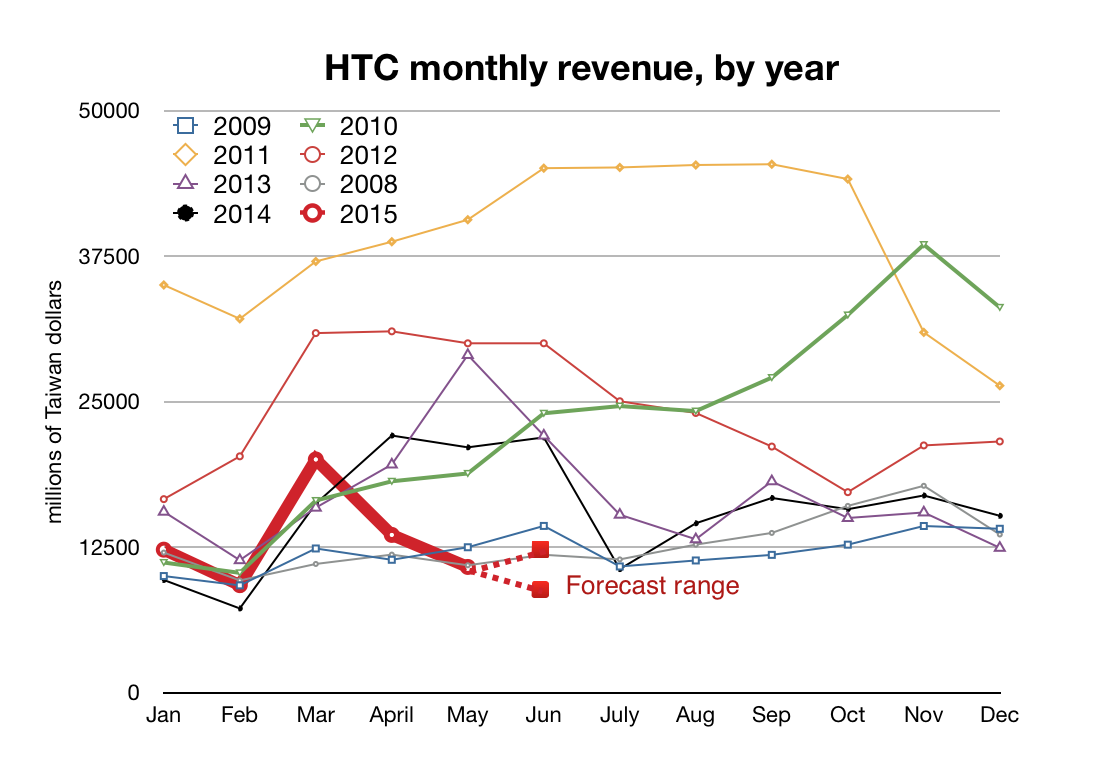
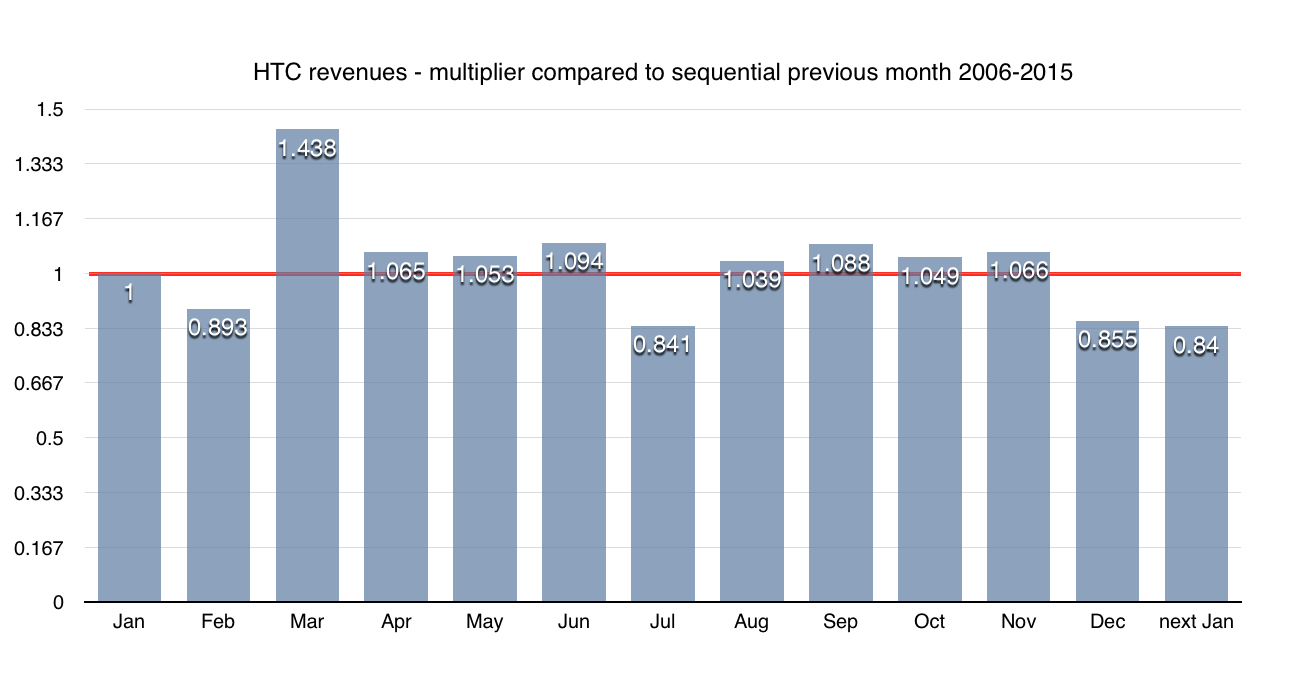
Using the monthly data from the past nine years, I’ve generated the “average” forecast for HTC’s revenues by month over the year. And we’ll use this to forecast this quarter’s revenues (and maybe profits).

Here’s how HTC’s year goes, from month to month, on average over the past nine years:

HTC average monthly revenue

Past financial data lets us see how HTC revenues change by month, on average

You’ll notice that the “next January” mark is lower than the previous one – which is just one of those things; on average, the revenue has grown by 3% over the year, then fallen by 17% the next January. Shrinking, in other words, which it has been doing since 2010.

But this is a pretty simple model. How good is it at predicting? How does it fare when we compare it with HTC’s revenue this year?

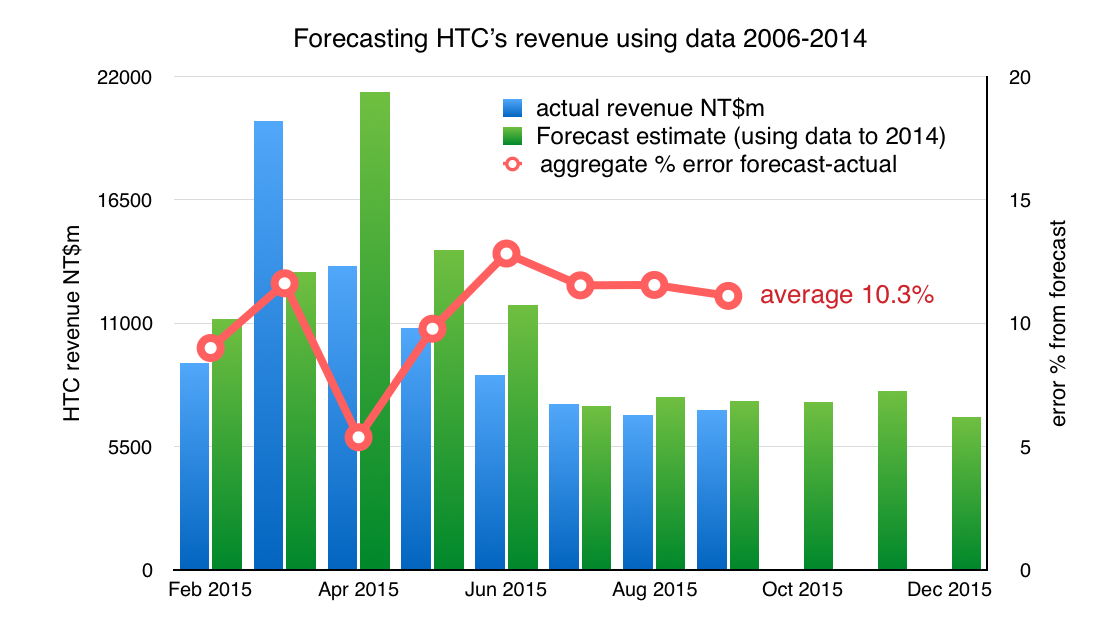
Here is the comparison, where we only use the data up to 2014 for the forward guidance:

HTC monthly revenues forecast

There’s an error, but it’s not gigantic; around 10%

So the aggregate error in revenue from forecast over the year is 10% – the highest value being around 12%. (I’ve used absolute values for the error, rather than averaging the plus and minus.)

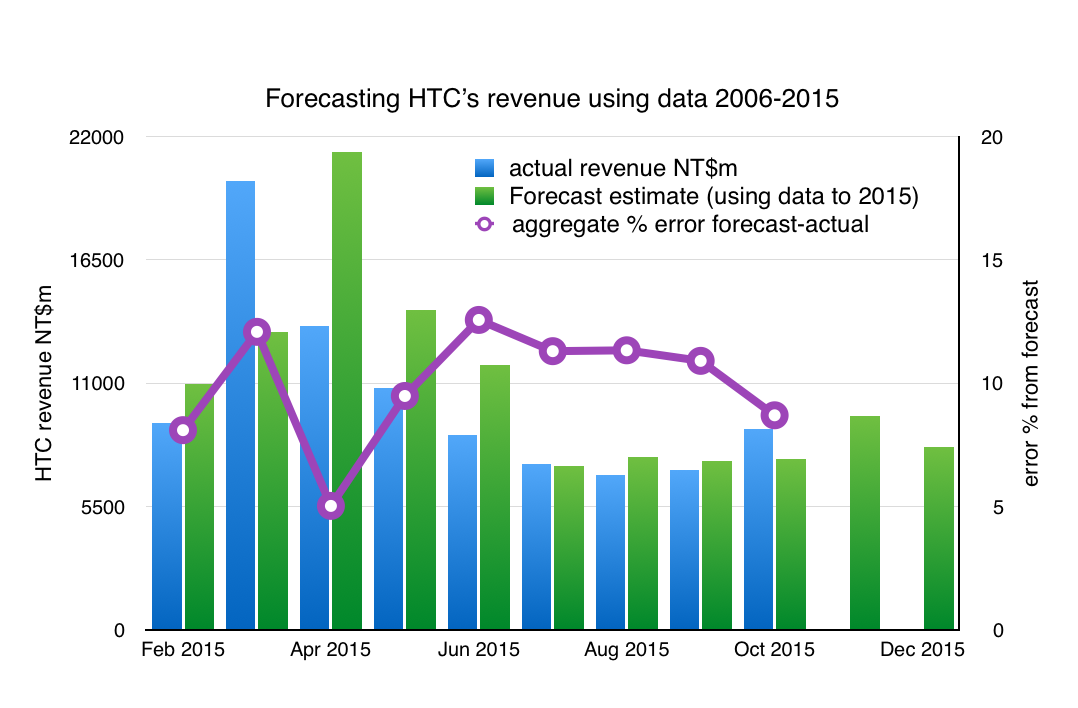
But what if we feed in the results from 2015 too? It improves the graph a little:

HTC monthly data forecast for 2015

If we go up to the September-October data point, the aggregate error reduces further

I’ve changed the colour for the aggregate error: 8.7% for total revenues over the year so far. Not so bad.

Given this, what can we say about HTC’s revenue to the end of this year in two months? We’ve just had the October revenues, so we can look forward to the rest of the year. On the adjusted basis, using the new data, my forecast comes in at NT$26.64bn (about US$830m). That’s down from $47.9bn in the same period a year ago – a forecast decline of 45%.

Bear in mind there’s a likely error either way of 10% – so I’m forecasting NT$29bn-$23.9bn. (The midpoint figure would satisfy Chang’s wish for incremental improvement in revenue.)

And profit? Pretty hard to say, but assuming that things continue as they have at HTC, its gross margin will be 18%, so about NT$4.79bn; that’s NT$1bn more than the previous quarter, so the loss will be about that much less – so probably NT$4bn (around US$125m), which would also satisfy Chang’s vague wishes.

Obviously these are forecasts, based on single chunks of data, though they have been pretty accurate so far this year. If the HTC A9 takes off, or if the Vive VR set is a hit, I’d be completely wrong. I don’t see any obvious signs of that though.

The inventory squeeze

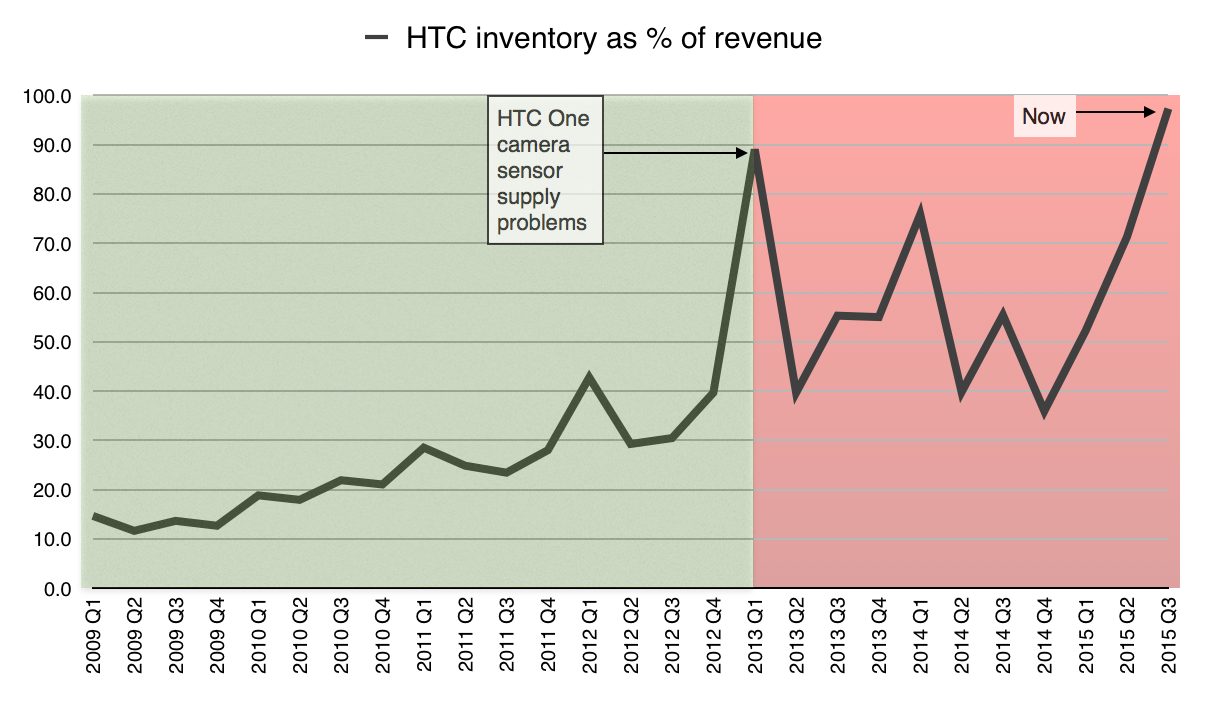
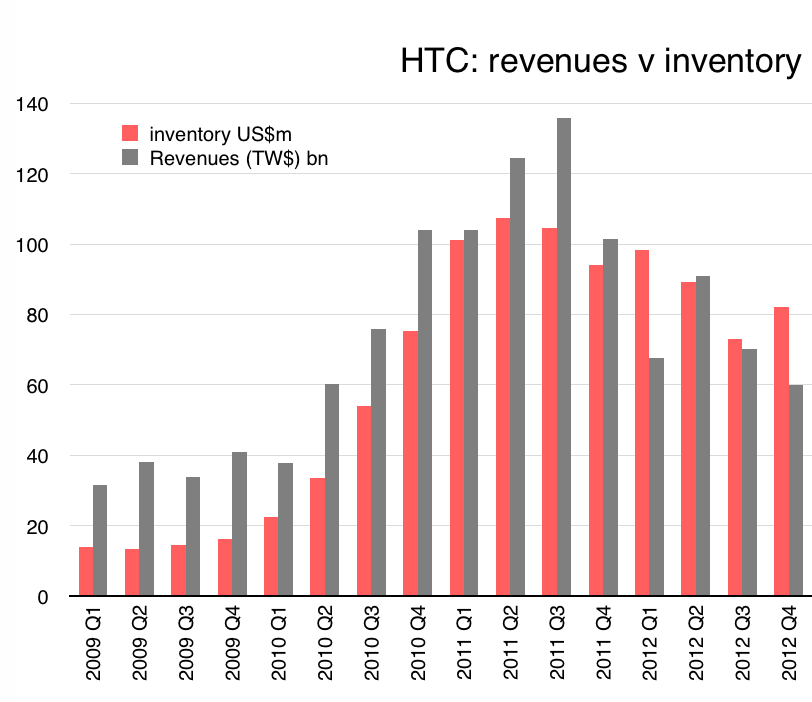
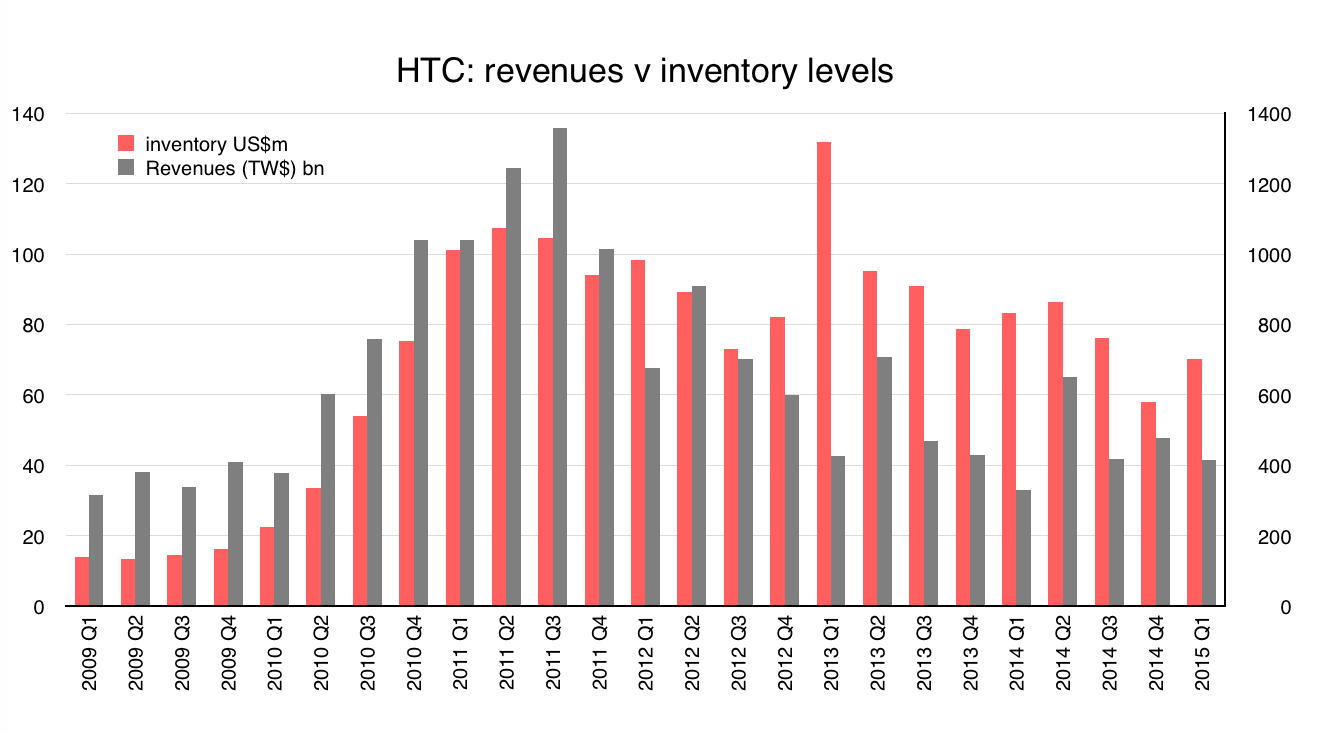
More generally, HTC is a company in crisis, with no obvious reason to exist and little to differentiate it from any other Android OEM. You can see the incredible pressure on it in its inventory/revenue numbers, which measure how much stuff it has sitting in the backroom compared to how much stuff it has sold. This ratio has now hit a historic high of nearly 100%, as of the end of the third quarter:

HTC's inventory ratio is at a historic high

Revenue is low but inventory is high: the signs of a company in stress

High inventory/revenue levels tend to mark out a company in severe stress. It can mean that it has lots of wonderful new finished products in the warehouse just waiting to be sprung on the world, which will fall on it with delight. But usually it doesn’t because you have to distribute those things to wholesalers who will sell them. And historically, HTC hasn’t been a rabbit-from-hat sort of company, as the graph suggests.

Clearly this isn’t a situation that can go on indefinitely. HTC says that it has things coming down the chute – there’s the HTC Vive, its virtual reality offering. Much handwaving from Chang in the earnings call, but nothing concrete. And if HTC really thinks that VR is going to bring its business back into profit in 2016, well, I don’t see it; these are high-priced devices with an uncertain market, regardless of the quality of HTC’s offering.

Of course that could have been said back when HTC was preparing its first Android smartphone. But the difference was that HTC had already been making smartphones (for Windows Mobile) for some years.

Overall, the best summing up of this came from The Verge, where Vlad Savov’s story had the deathless headline: “HTC will no longer give guidance for the future it doesn’t have”. Quietly brilliant, that one.

Start up: can machines do fact-checking?, HP’s split, HTC gets evasive, adblocking starts to hurt, and more


“The words are too wordy, and the sentences too sentient.” Review photo by Andrew Mason on Flickr.

You can now sign up to receive each day’s Start Up post by email. You’ll need to click a confirmation link, so no spam.

A selection of 9 links for you. And look, it’s November already. I’m charlesarthur on Twitter. Observations and links welcome.

In search of fact checking’s ‘Holy Grail’: News outlets might not get there alone » Medium

Craig Silverman:

The authors [of a scientific paper published at Columbia University] write that ClaimBuster represents one piece of what could eventually be a fully automated fact-checking system. They call this the “Holy Grail” of fact-checking, while also acknowledging that an automated system is a complex an far-off goal.

“A fully automated fact-checker calls for fundamental breakthroughs in multiple fronts and, eventually, it represents a form of Artificial Intelligence (AI),” they write in the paper.

Along with being able to automatically identify checkable claims in real-time, the “Holy Grail” system would need to be able to compare the claims to a database of accurate and up-to-date checked facts that is comprehensive enough to check a wide range of claims. In a perfect scenario, the claim and the corresponding checked fact would be compared and the system would render an accurate verdict within a few seconds of the statement being made.

We may never get there. But ClaimBuster on its own could prove useful for verification and debunking.

link to this extract


Amazon reviews hijacked by causes, conspiracies, rage » The Seattle Times

Jay Greene:

Reviewers have long used Amazon as a platform to vent about products that failed to live up to their expectations. Some have even used it to attack authors whose views differ from their own.

Increasingly, though, people are launching coordinated campaigns to push political and social agendas through negative reviews often only tangentially related to the product for sale. They are able to do so because Amazon welcomes reviews regardless of whether the writer has actually purchased the product.

[The author of a book about Sandy Hook, Scarlett] Lewis isn’t the only target of the Sandy Hook tragedy deniers. “We want to hit this woman as hard as we can,” says a narrator in a YouTube video as he walks viewers through posting 1-star ratings and negative reviews for “Choosing Hope: Moving Forward from Life’s Darkest Hours,” by Sandy Hook Elementary first-grade teacher Kaitlin Roig-DeBellis. The video, posted by “Peekay22,” even guides viewers to click a “Yes” button indicating they found other negative reviews helpful.

Since Peekay22’s video posted on Oct. 16, “Choosing Hope” has received more than 170 1-star reviews out of just over 250 total reviews. That’s tanked the book’s rating down to 2.1 stars out of 5.

“Amazon is giving these people a forum … ,” Lewis said. “Obviously, Amazon should remove (the reviews).”

But Amazon appears to have no intent of doing so. To the company, as long as the reviews are “authentic,” they have a place on its website.

“All authentic reviews, whether the reviewer bought the product on Amazon or not, are valuable to customers, helping them make informed buying decisions every day,” Amazon spokesman Tom Cook wrote in reply to questions about its review policy.

What about “whether they bought the product or not”?
link to this extract


Too much of a bad thing » Jay Pinho

Pinho asks why the NY Times is going to have people dedicated to doing rapid rewrites of already-viral stories, and then looks more broadly at what’s happening to journalism:

Very few, if any, sites have managed to support a substantial journalistic operation via digital ad revenues alone. This leaves us with two distinct models: large, legacy organizations with complementary revenue sources (subscriptions for newspapers or TV advertising for major news channels) on the one hand, and aggregators relying purely on online ad revenue on the other. (There are also niche sites produced as works of love, business models be damned.)

Both adblocking and the possibility of an eventual contraction of available VC money threaten to severely damage the latter business model. They certainly won’t damage advertisers, at least not significantly: they’re going to find a way to spend their budgets one way or another. But, and this should be clear by this point, they also won’t necessarily damage journalism. At the Times, for example, the CEO and executive editor are clearly focusing on building out subscribers, not simply inflating their page views…

…High-quality content producers, in other words, are reasonably confident that they can continue to extract monetary value from their readers even if and when the advertising landscape shifts dramatically. If, however, you’re a ViralNova, EliteDaily, Upworthy, Huffington Post, or another outfit with similarly vanishing per-article revenues, you’ve got to be worried. And you should be, because much of your content is terrible.

But that doesn’t mean any of us should be overly concerned if some of these businesses begin to go under. If anything, the eventual constriction of ad inventory supply could help return CPMs to financially sustainable levels.

link to this extract


The devastating effect of adblockers for Guru3D.com » Guru3D.com

Hilbert Hagedoorn:

last year in (October 2014) we had nearly 4.5m hits (read) on our articles. This year (October 2015) we are at 4.4m hits,  while the month has not ended yet. So in terms of traffic things remain the same.

There is however a huge discrepancy in Google analytics / DFP. Where a year ago we served 375~400K pageviews per day, we now register just over 200K pageviews a day. That’s right, nearly 50% of the readers are blocking ads.

After some further investigation, the direct effect of the ongoing trend of adblockers is resulting into halving our revenues / registered pageviews.  Over the past year we have seen our income literally halfed as a direct result of active adblocking. Everybody can understand that long term this is not sustainable anymore, right now adblockers are a true danger for our existence.

There are 28 pages of comments. Some are really not happy with how links were turned into pop-up overlay ads if they don’t adblock. Tragedy of the commons, again. But the donations seem to have rolled in.
link to this extract


Meg Whitman seeks reinvention for HP as it prepares for split » The New York Times

Quentin Hardy on the split, that by the time you read this will have happened:

Ms. Whitman, who will run HPE, made certain throughout the transition that her company would most assuredly still be able to ship computers.

“We have to ship products, we have to send invoices, we have to collect money,” she said. “HP sells two PCs a second. A server every six seconds. We had to keep selling them.”

The change cannot come fast enough for HP, whose stock is off more than 30 percent since the start of the year. The question is whether Wall Street believes the two companies will benefit from the separation.

“Anytime you make a change, you make a claim,” said Toni Sacconaghi, an analyst with Sanford C. Bernstein. “They say, ‘We’re on the front edge, everyone will have to catch up to us.’ But both new companies aren’t that wildly different. They’re both growth-challenged.”

HP, the printers-and-PCs company, is very definitely “growth-challenged”. Both markets it operates in are struggling.
link to this extract


HTC to see revenues grow 20-30% sequentially in 4Q15, say sources » Digitimes

Ma Wang and Steve Shen:

HTC is expected to see its revenues grow 20-30% sequentially to NT$25-28bn in the fourth quarter of 2015, buoyed by the launch of new models including the HTC One A9, HTC Butterfly 3 and HTC Desire 729 dual-SIM, according to an estimate of industry sources.

Despite increased sales in the fourth quarter, analysts are still conservative about HTC’s earning prospects and expect its earnings for the quarter to stay flat or increase marginally from the previous quarter. HTC posted a net loss of NT$4.48bn or NT$5.41 per share in the third quarter.

Hilariously, HTC refused to give guidance for this quarter at its earnings call. Equally hilariously, Taiwan-based Digitimes never points out the uncomfortable reality about Taiwan-based HTC: even a 30% sequential rise in quarterly revenues would equate to a fall of more than 40% year-on-year, and likely another hefty loss.
link to this extract


More Apple Car thoughts: software culture » Monday Note

Jean-Louis Gassée:

what we’ve grown to accept in our personal computers [in the form of software crashes and bugs] can’t be allowed in a vehicle carrying human beings at 60 miles per hour.

Just because the software running inside Apple’s personal computing devices is considered high quality doesn’t mean that the culture that produces it is capable of producing the high-reliability, real-time embedded software needed for an electric car.

I am one of the many who believe culture always wins. Culture eats strategy for breakfast, it causes mergers and acquisitions to fail and, above all, it resists virile executive calls to change. Culture evolves slowly, as if having its own independent will, or not at all.

The bottom line is this: For the hypothetical Apple Car project to succeed, a necessary (but not sufficient) condition is a culture change of a kind rarely, if ever, achieved by large organizations.
Perhaps the new software culture could arise in a new, separate group, well protected against the corporate lymphocytes always prone to attack what they see foreign objects. But that would break Apple in two separate cultures, and be the beginning of a dangerous process for a company that, today, strives on having a united functional organization.

link to this extract


Self-driving cars have a high crash rate, but it’s all humanity’s fault » Popular Mechanics

Jay Bennett:

New research from the University of Michigan’s Transportation Research Institute indicates that self-driving cars are more frequently involved in accidents than conventional vehicles. For every million miles driven, autonomous cars had an average of 9.1 crashes, compared to 4.1 for conventional vehicles according to data for Google, Delphi, and Audi autonomous vehicles between 2012 and 2015 and the total accident rate of conventional human-piloted vehicles in 2013.​

However, this data amounts to 11 total crashes for self-driving cars. All of these involved Google vehicles (which have been undergoing testing for much longer) but most importantly, the self-driving cars were not at fault in any of the accidents.

I expect this to continue to be the case: human drivers are going to be worse in all but the most extreme, remarkable cases.
link to this extract


33 of the hardest Apple interview questions » Business Insider

Maya Kosoff:

Like Google and other big tech companies, Apple asks both technical questions based on your past work experience and some mind-boggling puzzles.

We combed through recent posts on Glassdoor to find some of the toughest interview questions candidates have been asked.

Some require solving tricky math problems, while others are simple but vague enough to keep you on your toes.

Great way to find out if you’re actually awake this Monday.
link to this extract


Start up: Tor for iOS 9?, Google wins book appeal, HTC’s new (i)Phone, DNA suspects, and more


A crucial part of some fake Amazon reviews. Photo by Joe Shlabotnik on Flickr.

You can now sign up to receive each day’s Start Up post by email. You’ll need to click a confirmation link, so no spam.

A selection of 9 links for you. Use them wisely. I’m charlesarthur on Twitter. Observations and links welcome.

New Tor apps for iOS 9 headed to iPhone, iPad » Daily Dot

Patrick Howell O’Neill:

The new iOS offering will come from a group led by Chris Ballinger, founder of ChatSecure and including Frederic Jacobs of Open Whisper Systems; Mike Tigas, who wrote Onion Browser; and Conrad Kramer, a former device jailbreaker. 

That group is working on iCepa, a system-wide iOS Tor client that can change the way every app on iOS connects to the Internet by routing traffic from each app through the Tor network.

Older versions of iOS lacked key capabilities that would allow for an effective Tor app, Freitas said. But certain changes implemented in iOS 9 — specifically the ability to incorporate Tor into multiple apps simultaneously — make the mobile operating system far more attractive for Tor developers.

“iOS has some new capabilities in it,” Freitas said. “You can create a device-wide [virtual private network], and it can be a Tor-based VPN. So we can create an Orbot-like service on iOS 9, which is exciting.”

Orbot empowers other Android apps to use Tor. It’s an anonymity amplifier that’s been impossible on iOS up until now because Tor could only run in a single app at a time.

link to this extract


Dear reader, we’re closing comments » IOL Beta

Adrian Ephraim, managing editor of the South Africa Independent:

Dear IOL reader, we need to talk …

I thought you should be the first to know that Independent Online (IOL) will be closing comments on its online articles with immediate effect.

It is a difficult but necessary decision to make and we arrived at it after careful consideration of all the factors at play.

The freedom of expression guaranteed by our Constitution was never meant to override the personal freedoms and human rights of our fellow citizens.

Let me be clear that commenting on an article is not a right, but a courtesy afforded to you by IOL as a reader.

If you are prone to being racist or sexist in your thinking, by all means express yourself on other platforms that may find such behaviour acceptable, but not on IOL.

We are of the view that instances of abuse in our comments section have become untenable.

..And another one. Just keeping tabs, really.
link to this extract


HTC One A9 photos leak: It’s an iPhone » BGR

Zach Epstein:

We’ve seen a number of leaked images of the upcoming HTC One A9 in the past, but the clearest pictures yet were just accidentally published by European wireless carrier Orange. HTC is already in deep trouble following its One M9 flop, but this phone may very well get the struggling smartphone maker sued into oblivion.

It really does look amazingly like an iPhone 6 (or 6S). Then again, so did the Galaxy S6. Hard to see it making any difference to HTC’s gradual demise.
link to this extract


Getting LEAN with Digital Ad UX » IAB

Scott Cunningham , svp of the Interactive Advertising Bureau’s Tech and Ad operations, begins this post “We messed up”. But the mea culpa also has a nostrum explicatum:

We engineered not just the technical, but also the social and economic foundation that users around the world came to lean on for access to real time information. And users came to expect this information whenever and wherever they needed it. And more often than not, for anybody with a connected device, it was free.

This was choice—powered by digital advertising—and premised on user experience.

But we messed up.

Through our pursuit of further automation and maximization of margins during the industrial age of media technology, we built advertising technology to optimize publishers’ yield of marketing budgets that had eroded after the last recession. Looking back now, our scraping of dimes may have cost us dollars in consumer loyalty.

Loose translation: “We did so much good that we made things worse.” Now the IAB is suggesting ads should be “light; encrypted; ad choice supported; non-invasive”. Nice idea. Not sure “encrypted” is necessary; is that to stop people like AdBlock Plus?
link to this extract


After undercover sting, Amazon files suit against 1,000 Fiverr users over fake product reviews » GeekWire

Jacob Demmitt:

Fiverr is an online marketplace that lets people sell simple services to strangers, like transcribing audio, converting photos or editing video. Amazon simply had to contact Fiverr users who advertised their review-writing services and set up the transaction.

The company said most people offered the undercover Amazon investigators 5-star reviews for $5 each.

One Fiverr.com user that went by bess98 offered to write the reviews from multiple computers, so as to deceive Amazon. Another user, Verifiedboss, unwittingly told the investigators, “You know the your [sic] product better than me. So please provide your product review, it will be better.”

As in the previous lawsuit, Amazon alleges that these reviewers often arranged to have empty boxes shipped to them in order to make it look like they had purchased the products.

Amazon is not suing Fiverr. The company noted in the court filing that these kinds of services are banned by Fiverr’s terms and conditions and Fiverr has tried to cut down on the practice.

Would love to know which products these people reviewed.
link to this extract


Appeals court gives Google a clear and total fair use win on book scanning » Techdirt

Mike Masnick:

The Authors Guild’s never-ending lawsuit against Google for its book scanning project has been hit with yet another blow. The 2nd Circuit appeals court has told the Authors Guild (once again) that Google’s book scanning is transformative fair use. This is not a surprise. Though this case has gone through many twists and turns, a few years ago it was also before the 2nd Circuit on a separate issue (over the appropriateness of it being a class action lawsuit) and the 2nd Circuit panel ignored that question, saying that it shouldn’t even matter because it seemed like this was fair use. Thus it was sent back to the district court, where Judge Danny Chin correctly said that the scanning was fair use. That ruling was appealed, and the AG trotted out some truly nutty legal theories (arguing that it wasn’t fair use because someone like Aaron Swartz might hack into Google’s computers and free the books).

These arguments did not work. The 2nd Circuit has affirmed the lower court ruling and given another nice appellate ruling establishing the importance of fair use — and a reminder that, yes, commercial uses can still be fair use:

Google’s making of a digital copy to provide a search function is a transformative use, which augments public knowledge by making available information about Plaintiffs’ books without providing the public with a substantial substitute for matter protected by the Plaintiffs’ copyright interests in the original works or derivatives of them.

Pretty convincing win for Google.
link to this extract


Your relative’s DNA could turn you into a suspect » WIRED

Brendan Koerner:

In [Michael] Usry’s case the crime scene DNA [from an unsolved killing in 1969] bore numerous similarities to that of Usry’s father, who years earlier had donated a DNA sample to a genealogy project through his Mormon church in Mississippi. That project’s database was later purchased by Ancestry, which made it publicly searchable—a decision that didn’t take into account the possibility that cops might someday use it to hunt for genetic leads.

Usry, whose story was first reported in The New Orleans Advocate, was finally cleared after a nerve-racking 33-day wait—the DNA extracted from his cheek cells didn’t match that of Dodge’s killer, whom detectives still seek. But the fact that he fell under suspicion in the first place is the latest sign that it’s time to set ground rules for familial DNA searching, before misuse of the imperfect technology starts ruining lives.

Mitch Morrissey, Denver’s district attorney and one of the nation’s leading advocates for familial DNA searching, stresses that the technology is “an innovative approach to investigating challenging cases, particularly cold cases where the victims are women or children and traditional investigative tactics fail to yield a solid suspect.”

Not sure if UK police would be able to demand access in the same way. Previously they didn’t need to – there was a national DNA database which included completely innocent people.
link to this extract


Apple’s iPhone finds more fans on Samsung’s home turf » MarketWatch

Jennifer Booton notes that the iPhone has hit a 14% sales share in South Korea over the summer:

Samsung was able to recoup some of the losses incurred from Apple by going after the smaller manufacturers, such as LG Electronics and Pantech. LG’s share slid to 22% from 29%, while Pantech’s nose-dived from 4% to 1%, according to the Counterpoint research. Apple’s influence is having an effect, though.

“Samsung still has a loyal following in Korea,” said Ramon Llamas, research manager at industry tracker IDC. “But Apple is certainly making a run.”

Apple’s share in South Korea, where users have long been accustomed to the Samsung Galaxy Note phablets and other larger-screen Galaxy phones, has been gaining ever since the launch of the 5.5-inch iPhone 6 Plus, Apple’s first large-screen iPhone, Kang said. Its share gain was most prominent right after the iPhone 6 Plus launched, growing sevenfold in the fourth quarter of 2014.

While the growth rate has since slowed, Kang said he believes there’s still room for Apple to grow there as the “iPhone ecosystem effect” — the idea that Apple’s interconnected operating systems and devices keep users within the Apple brand — begins to take hold.

“Mature smartphone users (mostly Android) have started to upgrade to Apple iPhones,” he said.

link to this extract


Soul of a virtual machine » Medium

Jerry Chen:

In 2005, as the product manager for VMware’s enterprise desktop business, I made the pilgrimage down to Round Rock, Texas to meet the executives running Dell’s PC business. This was a year before I created VDI (Virtual Desktop Infrastructure) and VMware was still the small but fast growing, and recently acquired division of EMC. For almost an hour I pitched Dell on the virtues of desktop virtualization. The Dell executives smiled, nodded politely, and at the end of the meeting they asked me, “You understand that we sell PCs here? Why would we ever want to commoditize our differentiation with virtualization?”

I collected my things and flew back to Palo Alto.

2015: Dell buys EMC, including VMWare, for $67bn, as its PC business keeps struggling. Now, VMWare didn’t kill off the PC business directly, but it certainly helped the move to the cloud that has forced Dell into this catchup acquisition.

Note how similar the Dell execs’ question is to Jerry Yang at Yahoo, who in 1997 told two guys with a new search algorithm “but we want people to click multiple search pages, because we can show them ads.” Larry Page and Sergey Brin didn’t come back. Yahoo isn’t dead, but it’s a zombie.
link to this extract


Start up: Firefox attacked, iPhone’s “3D Touch Display”?, ad folks fret on blockers, Note 5/Edge+ reviewed, and more


A drinks machine in the Soviet arcade museum. OK, back to work! Photo (and many more) by jasoneppink on Flickr.

A selection of 9 links for you. Do not feed. I’m charlesarthur on Twitter. Observations and links welcome.

Mozilla: data stolen from hacked bug database was used to attack Firefox » Ars Technica

Megan Geuss:

An attacker stole security-sensitive vulnerability information from the Mozilla’s Bugzilla bug tracking system and probably used it to attack Firefox users, the maker of the open-source Firefox browser warned Friday.

In an FAQ published (PDF) alongside Mozilla’s blog post about the attack, the company added that the loss of information appeared to stem from a privileged user’s compromised account. The user appeared to have re-used their Bugzilla account password on another website, which suffered a data breach. The attacker then allegedly gained access to the sensitive Bugzilla account and was able to “download security-sensitive information about flaws in Firefox and other Mozilla products.”

Mozilla added that the attacker accessed 185 non-public Firefox bugs, of which 53 involved “severe vulnerabilities.” Ten of the vulnerabilities were unpatched at the time, while the remainder had been fixed in the most recent version of Firefox at the time.

Publishing the FAQ as a PDF is a bit crummy – makes it harder to process. Reuse of passwords is a big problem but you wouldn’t expect someone with high-level access to Bugzilla to do it.
link to this extract


iPhone 6s to have ‘3D Touch’ three-level, next-gen Force Touch interface » 9to5Mac

Mark Gurman, so we should trust it, right?

One of the cornerstone features of the iPhone 6s and iPhone 6s Plus, to be announced next Wednesday, is a screen based on the Force Touch technology from the latest MacBook trackpads and the Apple Watch. However, as we noted in previous articles such as our event expectations roundup from yesterday, the Force Touch feature in the new iPhones will actually be a next-generation version of the technology. According to sources familiar with the new iPhones, the new pressure-sensitive screen will likely be called the “3D Touch Display”…

Sounds like a bit of a clunky name?
link to this extract


The alternate universe of Soviet arcade games » Atlas Obscura

Kristin Winet:

When you walk into the Museum of Soviet Arcade Games in St. Petersburg, the first thing you’ll see is a series of gray, hard-edged soda machines from the early 1980s. If you choose the one in the middle, it will dispense a tarragon-flavored and slightly fermented soda whose recipe relies on a syrup that has not been mass produced since the fall of the Soviet Union. It tastes not unlike a mix of molasses and breath mints.

All around us are beeps, pings, and shot blasts coming from rickety old machines that seem like they’ve time-traveled from the golden era of American arcade games. And yet, everything’s in Russian, we’re using kopecks as currency, and there is no Donkey Kong here.

This is not your typical museum. For one thing, everything is not only touchable, but playable. Designed to look like a 1980s USSR video game arcade, the museum is filled with restored games carefully modeled after those in Japan and the West and manufactured to the approval of the Cold War-era Soviet leader, Nikita Khrushchev…

…“The fact that some of these products are in danger of disappearing is why they are beloved,” says Dr. Steven Norris, a Professor of History at Miami University in Ohio who specializes in Russian and post-Soviet studies. “Nostalgia for the video games of the 1970s and 1980s is part of a larger nostalgia for Soviet consumer products of late socialism.”

Fabulous journalism bringing us a view of the world we’d not otherwise get. And of course in Soviet Russia, arcade games play you.
link to this extract


DirectLinks » Canisbos

This [Safari] extension circumvents certain techniques used by Google and Facebook to track link clicks.

When you click a link in Google search results, Google uses JavaScript to replace the actual link with an indirect one, which they use for click tracking. Google then redirects the browser to the actual destination after logging the click. DirectLinks disables the JavaScript that replaces real links with indirect ones, so that when you click a search result link, Safari goes straight to the destination.

The extension does something similar for links in Facebook posts: it removes JavaScript that Facebook uses to track clicks on these links.

Probably won’t be long before this is incorporated into content blockers for iOS 9. It’s super-annoying to try to copy a link off Google and get a bunch of obfuscated Javascript.
link to this extract


IAB surveys options to fight ad blockers, including lawsuits » Advertising Age

Tim Peterson:

To catch up with the growing issue, the IAB [Interactive Advertising Bureau] hosted a member leadership summit on July 9 at the IAB Ad Lab in New York City that convened the IAB and IAB Tech Lab boards as well as a number of sales and technology executives to discuss ad blocking. “It was more of an educational [meeting] to get the options on the table,” [Scott] Cunningham [senior VP at IAB and general manager of its Technology Lab] said.

Some of the options put on the table were a lot stronger than some of the more Pollyanna-ish calls for better ads or publisher appeals asking people to turn off their ad blockers as ways to fight ad blockers.

“I advocated for the top 100 websites to, beginning on the same day, not let anybody with ad blockers turned on [to view their content],” said Mr. Moore. He said that the other IAB members in attendance considered it “a good idea but the possibility of pulling it off slim.”

That might not even be the most drastic option the IAB and its members are considering. The possibility of suing the ad-blocking companies is being explored.

The ad blockers “are interfering with websites’ ability to display all the pixels that are part of that website, arguably there’s some sort of law that prohibits that,” Mr. Moore said. “I’m not by any means a lawyer, but there is work being done to explore whether in fact that may be the case.”

“interfering with websites’ ability to display all the pixels that are part of that website”. I’m not going to laug…HAHAHAHAHA.

Denial, anger, bargaining, depression, acceptance. I think we’re on No.2. Progress still to be made.

Still, there is good news: the IAB officially adopted HTML5 as the new standard for display ads, replacing Flash.
link to this extract


How to write a great error message » Medium

Thomas Fuchs:

Imagine being in an office. In your cubicle. You’ve worked long hours this week for an upcoming product introduction. You’re tired and cranky, and you just want the weekend to finally arrive.

But first you have to try if the homepage for the new product works fine on Windows 10. No problem, you think, your trusty Mac laptop has software installed that allows you to run Windows.

You fire up the software, and when Windows politely asks you to update with several intrusive notifications, you say, sure, go ahead.

And then you see this.

That would be almost amusing, if it wasn’t for the deadline for the product.

Terrific article. (Via Dave Verwer’s iOS Dev Weekly. You should try it.)
link to this extract


Samsung Galaxy Note 5 and S6 edge+ review: pretty much exactly what you’d expect » Android Police

David Ruddock, who has been doing some terrific work at Android Police, has a great review with this conclusion:

So, should you buy these phones? I mean, that really comes down to the criteria they don’t meet for you, not what they do. Because these devices really are the technical pinnacle of the smartphones currently out there, a given person’s lack of interest in them is going to almost certainly come down to price, philosophy, or a particular missing feature or other perceived weakness (such as the absent microSD slot or a lack of stock Android). Make no mistake: these are excellent phones. But is excellence worth this much money, especially when the pitfalls (subpar battery life, slow updates, and performance hiccups) mirror or sometimes even exceed those of devices costing potentially much less? That’s for you, the consumer, to decide. If you’re asking me, the flash isn’t worth the cash – Samsung’s premium phones today are much more about brand image and fashion than they are user empowerment or choice.

The comments also show that Samsung users are… animated about the absence of SD cards/removable batteries, battery life, price, the “why upgrade?” question and app performance.
link to this extract


HTC: from riches to rags » Counterpoint Technology Market Research

Neil Shah analyses HTC’s position, where its August revenues were the lowest for 10 years – and there’s no sign of improvement:

Being a pure hardware only vendor won’t take HTC far enough. HTC should learn from another Taiwanese company Asus how it is making a comeback and scaling up with cutting edge specs at highly affordable price-points.

Similarly, Motorola as well following Xiaomi’s footsteps selling online in many markets its highly attractive offering in form of Moto X/G/E at affordable price-points and charting phenomenal comeback.

If this doesn’t work, a potential merger or getting acquired is the only way the company can return value to its shareholders and think about growing with other company.

However, for that HTC at least for short- to mid-term will need to raise its game, make itself attractive to others.

HTC should focus on building an IP portfolio over the next couple of years and eventually maximize its valuation. Merging with other Taiwanese companies such as Acer or Asus to justify scale could also be a possible strategy.

HTC’s Cher Wang seems unwilling to countenance a takeover, but she might have to consider it seriously pretty soon.
link to this extract


BlackBerry to acquire Good Technology: executive point of view » Inside BlackBerry

BlackBerry is spending $425m of its not-growing cash pile to buy Good, which has been a bitter rival for more than a decade. Inside BlackBerry lobbed some soft questions at BlackBerry COO Marty Beard and Good CEO Christy Wyatt, but not all the answers were quite that gentle:

IBB: Speaking of customers, how does this impact each of your existing customers and what new areas will come of it?

MB: Our acquisition of Good will mean the end of compromise for customers. We will be able to provide even stronger cross-platform capabilities – ensuring customers won’t have to make any sacrifices in operating systems, deployment models, or any level of privacy and security in their mobile environments. I truly believe that combined, BlackBerry and Good will raise the bar in the enterprise mobility market, enabling our customers to be more productive and protecting their sensitive data across all of their mobile end points.

CW: Historically, when a customer chooses their enterprise mobility platform, they have been asked to make tough choices: do they want deep management, deep security, a great user experience or enterprise scalability? The truth is that customers should not have to choose. They will need different tools to solve different mobility challenges. With this combination, customers can have the best in security, management, ecosystem and experiences all on a common platform.

I love how they’re both needling about each others’ products, but now saying that ach, it’s all good. This is a smart acquisition by BlackBerry; now it needs to make it work.
link to this extract


Start up: Huawei’s ambition, HTC R+D layoffs, 3D copyright, Google’s odd war on app ads, and more


But not with “Google Here”, thank you. Photo by x-ray delta one on Flickr.

A selection of 11 links for you. Still nothing about logos. I’m charlesarthur on Twitter. Observations and links welcome.

FTC settles with Machinima for paying YouTube influencers to endorse Xbox One » GamesBeat | Games | by Dean Takahashi

Dean Takahashi:

According to the FTC’s complaint, Machinima and its influencers were part of an Xbox One marketing campaign managed by Microsoft’s advertising agency, Starcom MediaVest Group. Machinima guaranteed Starcom that the influencer videos receive at least 19 million times.

In a statement, Machinima said, “Machinima is actively and deeply committed to ensuring transparency with all of its social influencer campaigns.  Through collaboration with the FTC, we are pleased to have firmly resolved this matter, related to an incident that occurred in 2013, prior to Machinima’s change of management in March 2014. We hope and expect that the agreement we have reached today will set standards and best practices for the entire industry to follow to ensure the best consumer experience possible.”

In the first phase of the marketing campaign, a small group of influencers received access to prerelease versions of the Xbox One console and video games in order to produce and upload two endorsement videos each. According to the FTC, Machinima paid two of these endorsers $15,000 and $30,000 for producing You Tube videos that garnered 250,000 views and 730,000 views, respectively.

After that, Machinima promised to pay a larger group of influencers $1 for every 1,000 video views, up to a total of $25,000. Machinima did not require any of the influencers to disclose they were being paid for their endorsement.

link to this extract


Huawei chips away at Samsung » WSJ

Juro Osawa:

For the past three years, Samsung Electronics Co. has been the world’s top seller of smartphones, but its global lead is now under attack from fast-growing Chinese rival Huawei Technologies Co.

Long known as a telecommunications-equipment supplier to global carriers, Huawei has already toppled Samsung in China, the world’s biggest market, where 425 million smartphones are expected to be shipped this year. Globally, the Shenzhen-based company became the third-largest smartphone maker in the second quarter, according to data from IDC. This is due, in part, to its ability to gain market share in the Middle East and Africa, where smartphone growth exceeds that of any other region.

With handset revenue up 87% in the first half of this year, Huawei expects profit from its smartphone business to more than double this year. If its pace of growth continues, Huawei hopes to challenge top competitors Samsung and Apple in the smartphone market.

Huawei doesn’t (yet?) break out its handset profits. It’s aiming to ship 109m smartphones this year – a weirdly precise figure – having shifted 47m in the first half, so 62m to go. Apple sold 192m phones in 2014, and 109m in the first half of this year, so the challenge might take a little while yet.

Cleverly, it introduced a phone with a “Force Touch”-style capability at IFA on Wednesday; it showed it estimating the weight of an orange resting on the screen. Not an apple?

The biggest challenge will be teaching non-Chinese how to say the name (Hoo-waa-way).
link to this extract


Chinese mobe market suffers pre-pwned Android pandemic » The Register

G DATA found that more than two dozen phones from different manufacturers were already compromised straight out of the box.

Kit from manufacturers including Huawei, Lenovo and Xiaomi have pre-installed espionage functions in the firmware. G DATA suspects that middlemen modified the device software to steal user data and inject their own advertising to earn money.

Other possibilities include unintentional infection through compromised devices in the supply chain (a problem which affected Vodafone Spain back in 2010) or intentional interference by government spies. Many of the models implicated in the malfeasance sell well in China.

The pre-pwned device issue has become a perennial problem for privacy-conscious smartphone users. Sticking to the Play Store, avoiding dodgy websites and following common-sense security precautions are no help in such cases.

If the phones got to G DATA then it seems unlikely to have been the Chinese government, non? More like middlemen seeking cash for ads.
link to this extract


HTC to lay off 600 employees working in Taiwan » Digitimes

Trevor Huang and Steve Shen:

About 400 out of the more than 9,000 employees currently at HTC’s headquarters in Taoyuan will be laid off, confirmed the Taoyuan City Government, which has received the layoff plan from HTC. The 400 employees include production line works, R&D and backup personnel.

The New Taipei City Government also confirmed that it had received a notification from HTC about discharging 200 workers at its Xindian plant by the end of October. Those who will lose their jobs at the Xindian plant, which has a total of 2,912 employees, are mostly R&D personnel.

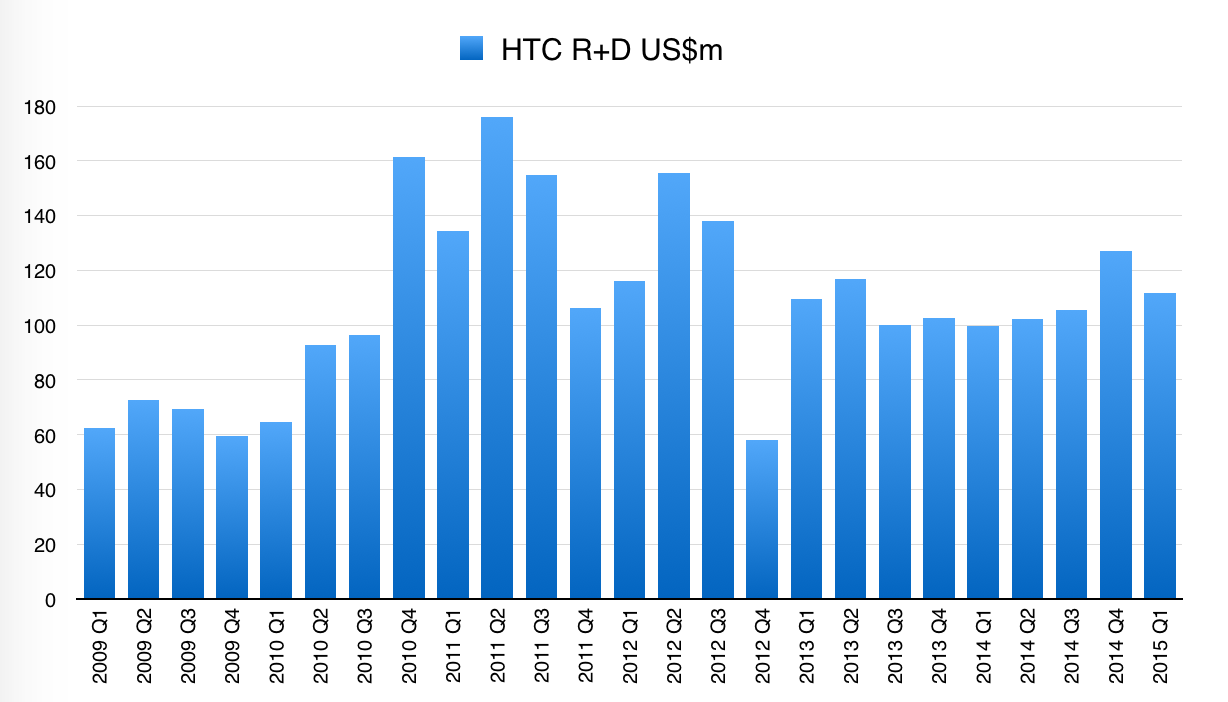
Cutting R+D staff seems like an obvious thing to do when finances are tight, but tends to leave you with nothing to go forward with when – if – you emerge from the squeeze.
link to this extract


Apple receiving G/G touch samples for 2016 iPhone » Digitimes

Siu Han and Alex Wolfgram:

Makers have already begun sending samples of fully laminated G/G technology to Apple and Corning along with Asahi Glass have also reportedly sent glass samples.

Market observers have recently noted that Apple is in discussions over whether to go back to G/G instead of in-cell technology for future iPhone devices as in-cell technology is currently struggling with various production bottlenecks that are preventing Apple from adding new features as well as increasing resolutions. As a result, touch panel makers are aiming to create G/G touch panels that would allow Apple to create smartphones similar in thickness to current iPhones equipped with in-cell touch panels.

G/G touch panels may also help Apple develop bezel-free smartphones as in-cell touch panels reportedly are struggling with touch sensitivity on the edges. Additionally, in-cell touch panels also make it difficult for vendors to pursue higher resolutions including Ultra HD (4K) due to current bottlenecks, the observers said.

Tells you something about what Apple might have planned for 2016. Incremental steps every time.
link to this extract


What happened to the Readymake: Duchamp chess pieces? » Scott Kildall

Kildall and Bryan Cera had scanned these very rare pieces and uploaded the scanned files to Thingiverse, a site for sharing Makerbot 3D printing files:


The answer is that we ran into an unexpected copyright concern. The Marcel Duchamp Estate objected to the posting of our reconstructed 3D files on Thingiverse, claiming that our project was an infringement of French intellectual property law. Although the copyright claim never went to legal adjudication, we decided that it was in our best interests to remove the 3D-printable files from Thingiverse – both to avoid a legal conflict, and to respect the position of the estate.

Disputes like this might become commonplace if 3D printing really breaks through.
link to this extract


Beautiful New Designs for Full-Screen In-App Ads » Inside Google AdWords blog

Pasha Nahass, product manager:

Nearly 60% of smartphone users expect their favorite apps to look visually appealing. We’ve always believed that in-app ads can enhance an app’s overall experience by being well designed. So today we’re announcing a completely new look for our interstitial in-app ad formats – also known as full-screen ads – that run on apps in the AdMob network and DoubleClick Ad Exchange.

Ah. So let’s walk through this.
• Full-screen interstitials for apps from mobile search results = bad, attracting search ranking penalties
• Full-screen AdWord ads inside existing apps = good. Especially if, as this post suggests, you use the full-screen interstitials for a mobile app install campaign.

On Twitter, this was described to me as “just don’t block the front door [from search] with an interstitial.” Which makes sense; if you’re already inside the app, you’re less likely to bounce away from a full-page ad.
link to this extract


Silk Road case: US agent investigating dark web drug site admits to $800,000 Bitcoin theft » City A.M.

Clara Guiborg:

Former secret service agent Shaun Bridges has pleaded guilty to Bitcoin theft, admitting to sending over $800,000 worth of the digital currency to his personal account while he was investigating the dark web drug trafficking site.

Silk Road was shut down in the autumn of 2013, having netted Bitcoin sales of over $200m of drugs and other illegal items during its two years of operations. The site’s founder, Ross Ulbricht, who went by the alias “Dread Pirate Roberts”, was sentenced to life imprisonment during a highly-publicised case.

But the investigation itself led to further illicit uses of Bitcoin.

Bridges is the second US federal agent to have fallen foul of Bitcoin theft temptation during the investigation, after former agent Carl Force pleaded guilty to this just two months ago.

Did they think that bitcoins were untraceable? Strange.
link to this extract


Almost no one sided with #GamerGate: a research paper on the internet’s reaction to last year’s mob » Superheroes in Racecars

Livio de la Cruz is a program manager at Microsoft, and has done an exhaustive study on coverage and reactions of Gamergate:

The Week compared GamerGate to a soccer team that has only ever managed to score on its own goal and responds with self-congratulatory remarks on a job well done. Their efforts to silence feminist and political critique of games actually ended up inspiring more of it. Their efforts to convince journalists to stop critiquing gamers for their sexist, bigoted behavior has only amplified people’s awareness of society’s misogyny problem. Their efforts to discredit Zoe Quinn, Leigh Alexander, Anita Sarkeesian, and Brianna Wu have led to them becoming some of the most respected voices in games, as more people are inspired by their work against abuse and their advancement of the medium itself. Their efforts to scare women out of the games industry actually led to more money, time, and talent being dedicated towards fixing tech’s diversity problem.

Before GamerGate, people might have had a rough idea of how diversity in teams was good for companies and how online harassment was maybe a problem that needed to be fixed. But now I suspect that people’s thought processes tend to go like this: Why do we need diversity in tech? Because of GamerGate. Why do need to fix online harassment? Because of GamerGate. Why is feminism so important? Because: GamerGate.

link to this extract


Windows 10 first month worldwide usage well ahead of that recorded by Windows 8 » StatCounter Global Stats

In its first calendar month since launch, Windows 10 worldwide usage share far exceeds that of Windows 8 in the same time period, according to independent web analytics company StatCounter. Its analytics arm, StatCounter Global Stats finds that Windows 10 level of usage after one month also exceeds that recorded by Windows 7.

StatCounter conducted a special analysis of the take up of Edge by Windows 10 users. It found that Edge usage on Windows 10 peaked at 20.1% on 30th July, the day after the global launch, but fell back to 14.1% on the 31st August.

Easy to explain that dropoff: people went back to work on the August Monday (it wasn’t a holiday in the US), stopped using their Windows 10-updated machines at home, and used the old-OS machines at work. The peak in July is probably explained in the same way – people were on holiday.

Remarkable what happens when you force-upgrade peoples’ machines for free.
link to this extract


Google shut down a secret Google Maps project called ‘Google Here’ » Fortune

Nice scoop by Erin Griffith:

The product was called Google Here, according to a document obtained by Fortune that describes the project’s specifications. The effort spanned multiple departments and was led by Dan Cath, a strategic partner manager, and the Google Maps team. The launch included partnerships with retailers, including Starbucks SBUX -2.03% . Had it launched, Google Here would have been available to more than 350 million Android users by early 2015, with plans to support iOS later in the year.

But people familiar with the project say it was shut down for two reasons: Google Here was potentially too invasive, and the company wasn’t sure if many retailers would want it. (Not helping matters, Nokia has used the name “Here” for its own mapping service.) A Google spokesman declined to comment.

Google Here worked by sending a notification to a smartphone user’s lock screen within five seconds of their entering a partner’s location. If the user clicked on the notification, a full screen HTLM5 “app” experience would launch. Google Here would know when to send the notification via Google Maps and beacons placed in the stores of participating partners. Google planned to supply the beacons to partners for the launch, according to the document. The experience could also be found by going to the Google Maps app.

Too invasive? Probably more likely retailers weren’t prepared to put the money in for an unclear return, since it would be permission-based (and hence isn’t really that invasive).
link to this extract


Start up: Chrome v Flash (and Google v iOS 9), HTC delays Vive, streaming’s true problem, and more


Suggested caption: “I wish I’d never mentioned the bloody sealion”. Can a computer do better? Picture from MCAD Library on Flickr.

A selection of 9 links for you. Use them wisely. I’m charlesarthur on Twitter. Observations and links welcome.

Google makes it official: Chrome will freeze Flash ads on sight from Sept 1 » The Register

Shaun Nichols:

Back in June, Google warned that, in cooperation with Adobe, it would change the way Flash material is shown on websites.

Basically, “essential” Flash content (such as embedded video players) are allowed to automatically run, while non-essential Flash content, much of that being advertisements, will be automatically paused.

As we explained a couple of months ago, it’s effectively taking Chrome’s “Detect and run important plugin content” feature, and making it the default: only the “main plugin content on websites” will be run automatically. That should put a stop to irritating ads around the sides of pages.

Google’s reasoning for the move is largely performance-based, apparently. The Chocolate Factory worries that with too many pieces of Flash content running at once, Chrome’s performance is hamstrung, and, more critically, battery life is drained in notebooks and tablets running the Flash plugin.

A performance and battery hit? From Flash? I’m shocked, shocked to hear of such a thing.
link to this extract

Handling App Transport Security in iOS 9 » Hacker News discussion

Remember the Google Ads blogpost from last week explaining how developers could enable non-HTTPS ads to show on iOS 9, which enforces (almost) HTTPS? The discussion on Hacker News include some who’ve been in the trenches:

At my last job, we did something similar to what iOS 9 is now doing, where we migrated a survey engine to serve all forms over https. There was high fiving and champagne all around the engineers desks, while media was freaking out that their impressions took the sharpest reverse-hockey-stick in the world. Ad networks are seriously the worst when it comes to https traffic. Given the dozens of redirects and pixel injections and iframes slapped into a media page, it’s nearly impossible to serve secure traffic since it only takes one network to downgrade the https request to http and then the page is “broken”.

Other comments provide useful insight too.
link to this extract


The wait for HTC’s Vive VR headset just got longer » ReadWrite

Adriana Lee:

Other projects and software features are likely in the works [from Oculus Rift] as well. (We may know more at the Oculus Connect 2 developer conference in Los Angeles next month.) 

There’s also increasing competition from VR hardware startups and other (bigger) competitors eyeing virtual and augmented reality—including Sony, Google, Samsung and Microsoft. Apple may also be pursuing virtual and augmented reality behind closed doors.

All of which makes HTC’s decision to delay the Vive’s consumer release rather risky—especially if the company is relying on this initiative to make up for its flagging smartphone business. For end users and developers, however, the scenario points to something else: Next year is going to be absolutely huge for all realities virtual. 

Can HTC hang on long enough to ride that wave? Testers say it’s terrific quality. Most valuable asset?
link to this extract

Chromebooks gaining on iPads in school sector » The New York Times

Natasha Singer:

In terms of the sheer numbers of devices sold, however, Microsoft remained in the lead. In 2014, about 4.9m Windows devices, including notebooks and desktops, shipped to schools, giving Microsoft a roughly 38% market share in unit sales, IDC said.

Apple, meanwhile, shipped about 4.2m devices for schools, including desktops, notebook computers and tablets, accounting for about 32% of the education market, according to the report.

But the Chromebook category is fast gaining traction in the United States.

Last year, about 3.9m Chromebooks were shipped in the education sector, an increase in unit sales of more than 310% compared with the previous year, IDC said. By contrast, iPad unit sales for education fell last year to 2.7m devices, compared to 2.9m in 2013, according to IDC data.

“Even if Microsoft is No. 1 in volume and Apple is No. 1 in revenue, from the growth perspective, nobody can beat Chromebook,” said Rajani Singh, a senior research analyst at IDC who tracks the personal computer market and is the author of the report.

In the first half of this year, she said, roughly 2.4m Chromebooks shipped to schools compared with about 2.2m Windows-based desktops and notebook computers.

Maybe this is where Chromebooks begin to eat away at Windows. They certainly should be a lot easier to secure and manage.
link to this extract


We built a robot to help you win The New Yorker’s cartoon caption contest » The Verge

Michael Zelenko and Frank Bi:

Each week The New Yorker runs a cartoon contest on its back page, where the publication invites readers to submit captions to cartoons drawn by the magazine’s illustrators. Winning the contest is notoriously difficult — writers have to generate a quip that’s funny, but also perfectly mimics the magazine’s sensibilities. A deep knowledge of The New Yorker is a prerequisite. Or is it?

We’ve collected all the first, second, and third place winning entries going back to when the magazine introduced the competition in 2005 — all 1,425 of them. Then, we ran them through a Markov text generator program that analyzes the winning captions and generates new, randomized entries that echo the original set.

Observation: using this won’t even get you to the last three in the caption contest. Maybe when the robots have taken all the other jobs, “comedian” will still remain for humans.
link to this extract


The real problem with streaming » Music Industry Blog

Mark Mulligan:

Even without considering the entirely intentional complexity of details such as minimas, floors and ceilings, the underlying principle is simple: a record label secures a fixed level of revenue regardless, while a music service assumes a fixed level of cost regardless.

Labels call this covering their risk and argue that it ensures that the services that get licensed are committed to being a success. Which is a sound and reasonable position in principle, except that in practice it often results in the exact opposite by transferring all of the risk to the music service. Saddling the service with so much up front debt increases the chance it will fail by ensuring large portions (sometimes the majority) of available working capital is spent on rights, not on building great product or marketing to consumers.

None of this matters too much if you are a successful service or a big tech company (both of which have lots of working capital). Both Google and Apple are rumoured to have paid advances in the region of $1 billion. While the payments are much smaller for most music services, Apple, with its $183bn in revenues and $194bn in cash reserves can afford $1bn a lot more easily than a pre-revenue start up with $1m in investment can afford $250,000.  Similarly a pre-revenue, pre-product start up is more likely to launch late and miss its targets but will still be on the hook for the minimum revenue guarantees (MRG).

It is abundantly clear that this model skews the market towards big players and to tech companies that simply want to use music as a tool for helping sell their core products. 

 
link to this extract


Heads-up, Google: fighting the EU is useless » Bloomberg View

Leonid Bershidsky:

Microsoft can tell Google exactly what happens next; indeed, Google’s lawyers realize there will be other antitrust investigations. One, concerning the Android operating system and its links to Google services, is already in the works, although no official charges have been brought. Another may soon hit Google where it really hurts, challenging its dominance in online advertising. Google will fight and probably lose, because Europe doesn’t like big U.S. companies to dominate its markets. 

Lobbying and complying with whatever demands still can’t be avoided is a less painful path. Microsoft spent 4.5 million euros last year, a million more than Google, on efforts to get EU officials to see its points on issues such as data protection and cloud computing. Among other things, the European Parliament is now considering a Microsoft proposal that would cap fines for Internet privacy violations at 2m euros a case, instead of 2% of a company’s international turnover.

It’s admirable that Google now wants to fight for its principles and against the dilution of its superior offering. It makes me cringe, however, to think of the time and money that will be burned in this hopeless battle.

link to this extract


The fembots of Ashley Madison » Gizmodo

Annalee Newitz:

In the data dump of Ashley Madison’s internal emails, I found ample evidence that the company was actively paying people to create fake profiles. Sometimes they outsourced to companies who build fake profiles, like the ones Caitlin Dewey wrote about this week in the Washington Post. But many appear to have been generated by people working for Ashley Madison. The company even had a shorthand for these fake profiles—“angels.” Perhaps this is a tip of the hat to Victoria’s Secret models, also known as angels.

Ashley Madison created their angels all over the world, and the dump contains dozens of emails where Avid Life Media management arranged to generate more. Here you can see a July 4, 2013 email from Avid Life Media’s director of internal operations, Nora Abtan, to CEO Noel Biderman and other managers, with the subject “summary angels status”…

…An email chain between Sandra Simpson and an employee named Eduardo Borges, dated July 30, 2012, suggests that quality control on the angel profiles was actually pretty rigorous. Borges asks whether it’s OK to reuse photos if they are in different states, and Simpson says no—she notes that many members travel and they might spot the duplicates.

Such great journalism; such a scammy business. The question becomes, did the company take this direction from the start, or was it forced towards fakery by circumstance?
link to this extract


Apple is about to lay down its TV cards » TechCrunch

Matthew Panzarino:

It stands to reason that Apple will be able to push the A8 much, much further than it ever has before given that the Apple TV is plugged into the wall, and not dependent on battery.

This will enable developers of games and other resource-intensive applications to produce higher quality and more demanding apps. Among the demos I’d expect to see on stage next month are content apps, games, and broadcast companies. These apps fit the venue (fixed, but large and participatory) and purpose of your television — and the apps that people will build for the Apple TV would do well to take those factors into account as well.

A native SDK that takes advantage of the hardware fully will, for the first time ever, turn the Apple TV into a platform, a self-sustaining life form that Apple likely hopes will dominate competitors who have done only slightly better about adding third-party support.

To control the new Apple TV? A new remote. One major feature of which was pretty much nailed by Brian Chen in an article earlier this year. It’s slightly bigger and thicker, with physical buttons on the bottom half, a Touchpad area at the top and a Siri microphone.

I thought the Apple TV would get its own SDK
back in 2012. Totally wrong; it just wasn’t ready.
link to this extract


Start up: Google and real accident rates, who really buys iPods?, Reddit and trolls, and more


Apple Music is available if you’re running iOS 8.4. Photo by danielooi on Flickr.

A selection of 7 links for you. Do you feel lucky? Well, do ya, punk? I’m charlesarthur on Twitter. Observations and links welcome.

Apple Music adoption » Mixpanel Trends

This is amazing: from 29 June, when iOS 8.4 was released (bringing Apple Music), Mixpanel’s measurement suggests that it passed 50% of all installed iOS devices by 16 July. That’s less than three weeks. It’s gaining about 1% per day. There has to be an upper limit, but it’s pretty high – 84% of devices are running iOS 8.

This also means, if Mixpanel is representative, that about 200m devices could already be able to try Apple Music.
link to this extract


The view from the front seat of the Google self-driving car, chapter » Medium


(That’s Google’s SDC being rear-ended on July 1 in the right-hand lane: the car causing the crash doesn’t even brake.)

Chris Urmson, who leads Google’s SDC effort:

National crashes-per-miles-driven rates are currently calculated on police-reported crashes. Yet there are millions of fender benders every year that go unreported and uncounted  —  potentially as many as 55% of all crashes, according to the National Highway Traffic Safety Administration. (None of the accidents in which people hit us resulted in a police report  —  not even the July 1 crash, even though the police were on site.) Furthermore, the numbers that are available don’t distinguish between miles-driven before causing a crash vs simply being involved in one. This all means no one knows the real crashes-per-miles-driven rates for typical American streets.

link to this extract


Who’s actually buying iPods these days? » BirchTree

Former Target manager Matt Birchler:

Kids would buy (or their parents would buy for them) the iPod Touch because of 3 things:

• It played games (Minecraft, mostly)
• It had YouTube
* It could stream music

A lot of families stopped buying iPod Touches once the iPad Mini got down to the $249 price point. You get a lot more device for your buck, and Touch sales dropped off very quickly. I could go on and on about this, but young kids love iPads more than most of us 20-30 somethings can imagine.

You also see more and more kids just using a hand-me-down smartphone that the parents have since upgraded from.

And then there were older people who bought Touches. They were more rare, but they were people who wanted something to FaceTime with their kids/grandkids. Maybe they wanted to use a couple apps they had heard about, but didn’t want to pay the ridiculous data fees to get them on a smartphone. This was a much smaller market, and many of them would end up buying an iPod Nano (for reasons I’ll address in the next section).

Nano and Shuffle had very different audiences. I asked who used to buy the Classic; his reply: “You’d be shocked how few were sold. Let’s just say it’s too few for me to draw any real conclusions.”
link to this extract


HTC won’t ship the Grip after all, but its fitness ambition lives on » Engadget

Chris Velazco:

Hey, remember that time HTC built a fitness tracker (with a little help from Under Armor) and showed it off in Barcelona? The one that was originally slated for a Spring launch? Well, we’re knee-deep in Summer already, and the company just confirmed to us that it no longer plans to ship the Grip we’ve already seen. As a spokesperson put it, the company “decided to align Grip with the entire product portfolio for health and fitness launching later this year” after “extensive wear testing and user feedback.” In other words, the exact Grip we saw in Spain won’t hit the market, but something better will.

Uh-huh. Let’s see how this progresses. HTC made the right call putting off its smartwatch (pre-announced in February 2014); this would also be a tough sell when it’s losing money. Problem is, how do you make money except with new things?
link to this extract


How iCloud Drive deletes your files without warning » Michael Tsai

Tsai quotes Mark Jaquith:

let’s say that, on your shiny new Mac, you want to move these files from iCloud Drive to your local hard drive, or to another synced drive like Google Drive or Dropbox. Well, you can just drag their folders do the other destination, right? You sure can. Apple kindly warns you that your dragging action is moving that folder, and that the files will be moved to your Mac, and won’t exist on iCloud Drive anymore. Fine. That’s what dragging a file from one place to another generally does!

But what happens if there are files inside this folder that haven’t yet synced to your local machine? Well, the move operation will be slower, because your Mac has to first download them from iCloud Drive. But once they download, they’ll be in their new location. Right?

Nope. Those files are now gone. Forever.

Tsai then follows up to show that Apple knows about this – though also pulls together other comments, including one from an ex-Apple services employee, showing that this problem is known internally, but it is being starved of funding.
link to this extract


Former Reddit CEO Ellen Pao: the trolls are winning the battle for the Internet » The Washington Post

To understand the challenges facing today’s Internet content platforms, layer onto that original balancing act a desire to grow audience and generate revenue. A large portion of the Internet audience enjoys edgy content and the behavior of the more extreme users; it wants to see the bad with the good, so it becomes harder to get rid of the ugly. But to attract more mainstream audiences and bring in the big-budget advertisers, you must hide or remove the ugly.

Expecting internet platforms to eliminate hate and harassment is likely to disappoint. As the number of users climbs, community management becomes ever more difficult. If mistakes are made 0.01% of the time, that could mean tens of thousands of mistakes. And for a community looking for clear, evenly applied rules, mistakes are frustrating. They lead to a lack of trust. Turning to automation to enforce standards leads to a lack of human contact and understanding. No one has figured out the best place to draw the line between bad and ugly — or whether that line can support a viable business model.

The basic problem is that we remember the vicious words and acts more than the kind ones; possibly we’re evolutionarily set out that way.
link to this extract


Dozens of phone apps with 300M downloads vulnerable to password cracking » Ars Technica

Dan Goodin:

many smartphone apps still allow users to make an unlimited number of login attempts. That failure allows attackers to cycle through long lists of the most commonly used passwords. Given the difficulty of entering strong passwords on smartphone keyboards, it’s a likely bet that it wouldn’t be hard to compromise a statistically significant number of accounts over a period of weeks.

According to research from smartphone security firm AppBugs, dozens of Android and iPhone apps downloaded more than 300 million times contain no limits on the number of logins that can be attempted. Per the company’s disclosure policy, researchers give app developers up to 90 days to fix vulnerabilities before making them public. That means most of the 50 or so apps identified by AppBugs still aren’t being made public. Still, the grace period has expired on at least 12 apps, including those from CNN, ESPN, Slack, Expedia, Zillow, SoundCloud, Walmart, Songza, iHeartRadio, Domino’s Pizza, AutoCAD, and Kobo. Three other apps, from Wunderlist, Dictionary, and Pocket, were found to be vulnerable but were later fixed after AppBugs brought the weaknesses to the developers’ attention.

link to this extract

Start up: Grexit to bitcoin?, Google’s antitrust deadline, Merkel’s suspect PC, Samsung security hole and more


Stockpiled – a bit like HTC’s unsold phones. Photo by .dh on Flickr.

A selection of 7 links for you. Use them wisely. I’m charlesarthur on Twitter. Observations and links welcome.

Bitcoin surges as Grexit worries mount, posts best run in 18 months » Reuters

Jemima Kelly:

Joshua Scigala, co-founder of Vaultoro.com, a firm that holds bitcoin for its customers and allows them to exchange it for gold and vice versa, said that Greeks were buying the currency as their trust in the authorities waned. It is also unclear what currency would be used if a Grexit does occur — another potential factor driving Greek demand for bitcoin.

“Some people aren’t waiting for the government to figure out an exit plan and are doing it for themselves,” said Scigala.

“You have people worrying about their families’ wealth or their life savings, and worrying that their money might be locked up in banks … They’d rather hold money in a private asset like gold or bitcoin.”

Scigala said over the past two months, with Greece locked in talks with its creditors, the company had seen a 124% pick-up in inflows from Greek IP addresses – numerical labels that identify computers and other internet-enabled devices.

124% = doubling. Which doesn’t amount to much, really, unless Greece was already a lot of business. Here’s the problem with this story. To buy bitcoin, you have to sell the euros to someone. If Greeks are withdrawing their euros from banks, why not hold on to those euros instead of buying bitcoin with them? Do they really think a post-Grexit euro will be worth less, rather than more? I’d bet on the latter.

There may be some Greek euros moving into bitcoin, which is moving bitcoin – but that only indicates that bitcoin has low liquidity, and so small amounts of money can move the value easily. Or else it’s something else altogether causing it.


Critics due to get EU’s Google antitrust charge sheet this week: sources » Reuters

Foo Yun Chee:

Microsoft, German publisher Axel Springer and 17 other critics of Google are expected to get a copy of the EU’s antitrust charge sheet against the search engine giant this week in order to allow them to provide feedback, four people familiar with the matter said on Tuesday.

The 19 companies, which include U.S. online travel site Expedia, U.S. consumer reviews website Yelp, online mapping service Hot-map and British price comparison site Foundem, helped triggered the European Commission’s case against Google nearly five years ago…

…Google has until July 7 to respond to the accusations. This can be extended on request. It can also seek a closed-door hearing to argue its case before a broad audience of antitrust officials and the critics.

The complainants were told on Monday to sign confidentiality waivers not to disclose the so-called statement of objections to journalists or public affairs consultants before they could get a copy of the redacted document, according to a Commission letter seen by Reuters.

The critics were told to restrict the charge sheet to their lawyers and economists.

Leaks in 3,2,1… And there’s Andrew Orlowski’s writeup of the Foundem examination into Google’s “search for harm” blogpost.


One tiny number can reveal big problems at a global smartphone maker » Bloomberg Business

Tim Culpan:

Tucked away in a corporate earnings report—past the data on profit margins and revenue growth, hidden deep inside a balance sheet—is a number that can tell you a lot about a mobile phone maker’s health. In the global smartphone war, brands are routinely measured by market share, revenue, profit, and the coolness of their ads. But one line item called finished goods inventory, which refers to the percentage of materials that were manufactured into phones but went unsold, can give insight into whether a company’s fortunes are changing.

The latest company to let phones pile up in warehouses and on store shelves is HTC. The Taiwanese company’s stock just fell to its lowest point in a decade after lowering its sales forecast on June 5 and announcing a NT$2.9 billion ($93 million) writedown, though it’s recovered some of that loss amid speculation the decline could make it a buyout target. HTC’s finished goods inventory had climbed to a record high 2.35% of total assets at the end of last quarter. During the company’s heyday, that figure rarely nudged above 1%.

Culpan has done a neat job, building on what I pointed out last week about HTC’s broader inventory numbers. Relating inventory to total assets is an effective way to look at it; here’s the graph.

HTC inventory as percent of assets
So now it’s higher than ever before. Finished goods inventory is going to be one of the first numbers people look at when the Q2 figures are published (in late July, probably).


Merkel’s PC was the first one infected in the Bundestag hack »Security Affairs

I have written many posts regarding a recent attack against the German Bundestag with caused a major data breach.

We discussed the possibility that the cyber attack against the German Parliament was coordinated by Russian state-sponsored hackers that spread a highly sophisticated malware inside the network of the Bundestag.

The consequence of the data breach could be serious for the German Government, German media states that Bundestag may need to replace 20,000 computers after the intrusion, an operation that could cost millions of euros.

New revelations in the investigation confirms that the cyber attack on the German Bundestag began with the compromise of Chancellor Angela Merkel’s personal computer.

Her phone by the NSA, her computer by Russia…


Flaw lingers in Samsung phones, illustrating hacking risk » WSJ

Danny Yadron:

Last fall, researchers at cybersecurity firm NowSecure found a bug in most Samsung smartphones that could allow hackers to spy on users.

In March, Samsung told NowSecure it had sent a fix to wireless carriers that they could distribute to users. It asked NowSecure to wait three months before going public.

Last week, the researchers bought two new Samsung Galaxy S6’s from Verizon Wireless and Sprint. They found both were still vulnerable to the security hole, which involves how the phone accepts data when updating keyboard software.

NowSecure CEO Andrew Hoog shared his version of events with The Wall Street Journal as his company prepared to release its research Tuesday. The story helps illuminate why hacking is so hard to stamp out.

That’s particularly true in smartphones, with its diffuse system of device makers, software programmers and network operators. Things likely are only to get worse as Americans connect their thermostats, door locks and cars to the Internet and face the need to update their software…

…Welton found he could hijack the process of updating one of the virtual keyboards Samsung installs on many Android smartphones. From there, he could eavesdrop on phone conversations, rummage through text messages and contacts, or turn on the microphone to capture audio.

That was possible, Hoog said, because Samsung didn’t encrypt the update process.

It’s the IOT vulnerability that’s the real worry here, much more than which make of phone is involved. Except that Samsung asked NowSecure for a year to fix the bug – a month after it was told about it. And what does this mean for Google’s “we find a bug and we publicise it in 90 days” stance?


Nokia faces lengthy arbitration over LG patent royalty payments » Reuters

Jussi Rosendahl:

Nokia said the arbitration with LG is expected to conclude within two years. Shares in Nokia rose 1.4 percent by 1204 GMT (8.04 a.m ET).

“This is becoming a more and more common model. The companies won’t go to the court but instead let an independent party decide,” said Nordea analyst Sami Sarkamies.

He estimated that the Samsung deal, expected to conclude later this year, could eventually mean Nokia receives 100-200 million euros of additional royalty payments annually, on top of retroactive payments.

Seems to be related to 4G patents; Nokia signed a similar deal with Samsung a while back. For LG, means that profitability in the smartphone side becomes that little bit more elusive – especially after the back payment.


Apple News curation will have human editors and that will raise important questions » 9to5Mac

Jordan Kahn:

Techmeme‘s founder Gabe Rivera gave us the hard truth on why being an algorithm-based service like Google News doesn’t make sense for the Apple News app saying, “All news aggregators intended for the mass market need editors, so this makes sense for Apple.” But the flip side of Apple’s human-based curation is that without a separation of editorial and the business, there will undoubtedly be conflicts of interest. Rivera points out that “…as the world’s most valuable corporation, they can’t and shouldn’t be trusted to present well-rounded coverage on many important topics.” Rivera continues, “But most readers won’t care about that.”

Apple doesn’t want this to be an algorithm thing, because (a) algorithms might not pull outré-yet-fascinating stuff to the surface (b) if some story that were grisly/violent/sexual – pick the topic you think Americans in particular would react in horror to – popped up, Apple would of course get the blame. Apple hates that.

So it wants humans on hand to stop the Bad Stuff that will Offend People finding its way into the app. But that immediately raises the question: what will it define as Bad Stuff? Are Mark Gurman’s well-sourced leaks of Apple plans Bad Stuff? Is vicious criticism of Apple?

I suspect people are overplaying this; Apple is really wary of consumer backlashes over pr0n. Look at how Facebook struggles with the same topic, and the issue of content posted by millions of people which some find offensive and others really don’t.

No simple answer, but Apple may not have realised it was putting itself in the position of a publisher.


HTC’s prospects begin to look like a death spiral

HTC's stock has plummeted in the past few days after a profit warning.

HTC’s stock has plummeted in the past few days after a profit warning.

On Friday, HTC released a gold edition of its flagship M9 smartphone. Oh, hubris: the timing couldn’t have been worse. Not only did it emerge that the product promo photos had been taken with an iPhone, but within hours the company also issued a formal warning that its financial performance in the current quarter (running from April to June) would be substantially worse than it had expected. Revenues in May were terrible – down by 48% from the year before, which itself had been nothing to sing about.

Now it says that Q2 revenues won’t be the forecast TW$46-51bn (about $1.7bn), but more like TW$33-36bn (about $1.1bn) and that rather than a small profit it will make a net loss – between TW$9.70 and $9.94 per share, which is about TW$8.2bn (US$250m).

HTC has been skating along on operating margins of less than 1% for the past three quarters; cumulative net profits for that period is TW$1.47bn, or US$47m (yes, forty-seven million).

This latest news though feels like a headlong plunge into the abyss.

The forecast suggests that HTC’s June revenues will be as low as they’ve ever been since 2009 – perhaps worse.

HTC revenues through 2015 by month

Forecast for June is as low as 2009 – before the Android explosion.

The stock market certainly seems to think so, marking HTC’s shares down 9% for two successive days – the maximum drop allowed before “circuit-breakers” come in.

Caught in the value trap

HTC’s story is a cautionary tale about life in the value trap – when you don’t make the core software, and so have to rely on hardware differentiation and software add-ons. It has reduced the PC business to one where the five biggest Windows PC OEMs have 60% of the market, and pretty much all the profits; it’s doing much the same to the Android smartphone market, except the profits there are accruing to just one company (Samsung).

HTC’s problem is that its hardware advantage ran into the sand once Samsung really got serious about dominating the smartphone space, and now – rather like Samsung – it’s being eaten from below by Chinese rivals that do the job just as well, and at the high end is being outcompeted by LG (which has upped its game enormously in the past two years) and to a lesser extent by Sony (which offers features such as waterproofing and SD cards). Let’s also not mention those terrible adverts with the no-doubt-expensive Robert Downey Jr.

In its profit warning, HTC said:

“The change for revenue outlook is due to slower demand for high-end Android devices, and weaker than forecast sales in China, while gross margin is revised primarily on product mix change and lowered scale. At the same time, increased competition has raised operating costs for product promotion; HTC is enacting measures to further improve operating efficiency.”

In brief: the M9 (this year’s flagship) isn’t selling; Chinese buyers are buying other phones (or fewer phones altogether); it’s harder to get noticed with so many rivals; HTC’s going to cut some jobs and spending in an attempt to save itself.

HTC has been a sub-scale player for some time now – remember the calamitous delay to the HTC One in March 2013? – and to some extent the only interesting question is whether any of its attempts to escape the downward spiral can succeed. On the plus side, it’s well-capitalised, so it’s unlikely to abruptly go bust. Its key problem is how quickly it can ramp up other businesses such as its Vive VR headset and Re camera, and how much revenue they’ll generate, while it tries to rely on making smartphones that too few people want to buy.

Losing traction

You can actually trace the point where the wheels came off by looking at HTC’s accounts, and specifically the inventory levels. “Inventory” is a mixture of goods waiting to be made into handsets in factories, work-in-progress, and finished devices.

Now compare HTC’s revenues with its inventory level. You can see that it remains largely under control through to the end of 2012 – although it’s beginning to rise as the iPhone 5 and Galaxy S3 began pushing it out of the market, meaning it was harder to sell handsets. (The lines are on slightly different scales: by the end of 2012, inventory was about 40% of revenue.)

HTC revenues and inventory, by quarter

Revenues kept ahead of inventories, at least to the end of 2012…

But in 2013, it hit that problem sourcing camera sensors for the HTC One M8 (the original – thanks Matjaz Ropret). And it shows up in inventory: all those goods sitting in factories and warehouses waiting to be shipped. Inventory spiked to 89% of revenue for the quarter. Revenues have tracked down, and inventories have stayed relatively high (above 35% of revenue, and sometimes 76%) ever since. High inventories are bad because they’re goods that you’ve paid for, but can’t sell; they’re a drag on business, and what’s worse is that as they age they drop in value. Tim Cook described inventory as “like milk – it goes off after a few days”. (Apple’s inventory is consistently below five days of hardware sales.) HTC had 45 days’ worth of inventory at the end of Q1; watch out for the figure at the end of June, because it will tell us how the M9 has sold to carriers, if not end users.

HTC inventory v revenues

Suddenly at the end of 2012, things go out of control…

Basically, the inventory story breaks into two parts – green marks the OK stage, and red the point where it’s gone bad:

HTC inventory v revenues

The red period, from the end of 2012 on, shows inventories growing way above associated revenues

(This, by the way, is why it matters to look at company accounts. You can find stories if you read them closely enough. That’s where I found BlackBerry’s PlayBooks piling up in 2011.)

The company’s caught in a bind. It doesn’t make enough profit to invest in really top-level R+D that might let it break through into new spaces. Here’s its R+D spending by quarter, in US dollars:

HTC R+D, by quarter

With spending at about $100m per quarter, HTC can’t break out of its position as a mid-tier smartphone maker.

It’s pretty hard to spot where it is spending money on the HTC Re camera, or the HTC Vive VR headset. The latter seems like a smart move (whereas the camera is a complete commodity product whose minimal margins will get eaten by rivals, just like in the phone market). HTC’s in there comparatively early, and has a deal with Valve. I wouldn’t rely on that being the saviour of the business, though.

In search of a USP

So how does HTC get out of this? A better way to ask the question is: what’s HTC’s unique selling point (USP)? What does it bring to the smartphone and device party that nobody else does? Apple has its brand and vertical integration; Samsung has scale and vertical integration (it makes the chips and displays for its own phones); LG has vertical integration; Sony has its brand and terrific photo sensors, though I don’t think that’s necessarily sufficient for the survival of its smartphone business, it is at least a USP.

HTC doesn’t have a geographical advantage (it’s not in China, it’s in Taiwan); it doesn’t have a vertical integration advantage. It isn’t developing the software, though its Sense overlay for Android is nice. There’s no point making Windows Phone handsets, because they don’t sell except at the low end, and there’s no profit there.

Contrast BlackBerry and HTC: both are now pulling in roughly the same revenue per quarter (sub-$2bn). BlackBerry sells far fewer handsets than HTC – only 1.6m in the December-February quarter, and by my estimates perhaps 1.3m in the March-May period, while HTC shipped around 5m handsets in Q1.

BlackBerry’s advantage, though, is that it has a cushion of customers, particularly in enterprise, who are willing to pay subscription fees. If handsets were all BlackBerry had, it would have gone bust long ago.

HTC doesn’t have that cushion. So what does the future look like? At one time in 2012/3, Amazon was interested in buying it – but Cher Wang, its chair (and now CEO, having pushed Peter Chou over to the “future products” side) turned Jeff Bezos down. That looks like a bad decision. Short of a miracle, it doesn’t look like anything’s going to pull HTC out of the mire.

Start up: why Google lost its Safari appeal, US gov trumps Kim Dotcom, S6 still bloated?, and more


But also for your “we’d like to be in VR now that it’s hip (again)” moments. Photo by TORLEY on Flickr.

A selection of 10 links for you. Use them wisely. I’m charlesarthur on Twitter. Observations and links welcome.

Second Life is still around and getting ready to conquer virtual reality » Business Insider

Matt Weinberger:

although you probably haven’t heard much about it lately, Second Life hasn’t gone anywhere. With 900,000 active users a month, who get payouts of $60m in real-world money every year, and a virtual economy that has more than $500m in GDP every year, Second Life is still a world of opportunity. 

Today, the rising tide of virtual reality — with companies like Facebook, HTC, and Sony betting big on immersive 3D technology — means that Second Life’s time may have come around.

“Now the world is waking up again,” Ebbe Altberg, CEO of Second Life developer Linden Lab, which now has over 200 employees, told Business Insider.

Linden Lab is marshalling its expertise and experience in building immersive, functional virtual worlds to make a proper successor to the Second Life platform and take advantage of the bold new world of immersive VR. Specifically, Linden sees a huge opportunity in making it easier for people to build and share cool virtual reality experiences. 


Holway says RIP to his Blackberry Bold » TechMarketView

Richard Holway is yet another of those moving on, having used a BlackBerry since the year dot:

I loved – still love – my Blackberry Bold. It is the best email sender/receiver ever invented. Its physical qwerty keyboard is still better than the puny iPhone 6 touchscreen. Its battery lasts for days too. But, it can’t really do anything else.

And that last sentence is the key thing, isn’t it?


Driverless cars need to be spy machines so they don’t kill you » Fusion

Daniela Hernandez:

For instance, an app that controls the [self-driving Mercedes] F 015 can also turn the cameras it uses to see the road as remote prying eyes. Through the app, you can connect to the car’s cameras to spy on the car’s surroundings through your phone. It effectively turns your car into a lurking Dropcam that can be used to watch unknowing passersby, anywhere, anytime. Or as another journalist on the junket put it, it turns every single vehicle into a Google Street View car. The privacy implications will be huge.

But it doesn’t stop there. Just like your iPhone or Android device, your car will communicate with other internet-connected devices in your life. It’ll learn your habits and adapt to your needs. For instance, say your car “realizes” you’re on your way home at dinner time. It “knows” your smart fridge is stocked with nothing but booze, so it prompts you to go to the grocery store or local eatery to pick up some grub. It’ll pull up the number of your favorite restaurant or suggest a new one based on your preferences. While you call, your robo-butler adjusts its course to take you where you need to go. By the time you arrive for curbside pickup, your credit card will already have been charged.

“We call it predictive learning,” said Mercedes’ Tattersall. “This will be something not so far away.”


Google Inc v Vidal-Hall & Ors [2015] EWCA Civ 311 (27 March 2015) » Bailii

“Bailii” is the British and Irish Legal Information Institute; it collects written judgements from courts in those countries. This is the key passage in the decision by the court of appeal on the “Safari hack” by Google of three complainants:

We come back then to the question we have to decide. Against the background we have described, and in the absence of any sound reasons of policy or principle to suggest otherwise, we have concluded in agreement with the judge that misuse of private information should now be recognised as a tort for the purposes of service out the jurisdiction. This does not create a new cause of action. In our view, it simply gives the correct legal label to one that already exists. We are conscious of the fact that there may be broader implications from our conclusions, for example as to remedies, limitation and vicarious liability, but these were not the subject of submissions, and such points will need to be considered as and when they arise.

(A “tort” is a legal wrong.) Google has fought this case all the way – particularly because the original judge, Tugendhat, decided that hacking someone’s device to follow them to collect data about what they look at online is a tort. Google will probably appeal this to the UK supreme court.

The full decision is twisty, so don’t rush it.


US government wins dozens of millions from Kim Dotcom » TorrentFreak

“Ernesto” (TorrentFreak’s founder):

A few hours ago District Court Judge Liam O’Grady ordered a default judgment in favour of the US Government. This means that the contested assets, which are worth an estimated $67m, now belong to the United States.

“It all belongs to the US government now. No trial. No due process,” Dotcom informs TF.

More than a dozen Hong Kong and New Zealand bank accounts have now been forfeited (pdf) including some of the property purchased through them. The accounts all processed money that was obtained through Megaupload’s alleged illegal activities.

The list of forfeited assets further includes several luxury cars, such as a silver Mercedes-Benz CLK DTM and a 1959 pink Cadillac, two 108″ Sharp LCD TVs and four jet skis.

The wheels of justice grind slow…


The Samsung Galaxy S6 has as much bloatware as ever » Gizmodo

Eric Limer:

At first glance, the new S6 and S6 Edge appear to be less cluttered, but you’ll actually find some 56 applications pre-installed. That’s 6 more than the 50 you’ll find on the Galaxy Note 4! Between the Google Apps you’ll find on every phone (Play Newstand? Come on), Samsung’s apps like S Voice and S Health, the new Microsoft apps like OneDrive (intended to soften the blow of no microSD slot), assorted social apps like Whatsapp and Instagram, and carrier apps (6 on T-Mobile), there’s a ton of cruft. A Moto G I have hanging around — which runs near stock Android — starts with just 33.

And despite statements from Samsung that “Samsung has allowed users to remove the pre-installed applications on Galaxy S6 and S6 Edge,” the most severe action you can take is “disabling” them. This removes them from the app drawer and the homescreen, but not from the phone entirely. You’re basically opting instead to put them in a sort of stasis, out of sight but not out of storage.

They don’t take much storage – Limer suggests about 100MB – but it’s the principle, really. Will the reviewers find the S6 “stripped back” even so?


HTC’s lead designer leaves after less than a year » Engadget

Richard Lai:

For a tech company that places so much emphasis on design, we can’t help but think something’s up when one of the key designers leaves. Today, we bring you the sad news that HTC’s VP of Industrial Design, Jonah Becker, has announced his departure on Twitter. To our surprise, that’s less than a year after he picked up from where his predecessor Scott Croyle left off.

It’s not “sad” news. It’s news. The more interesting part:

we have learned from our sources that there is an ever increasing power struggle between the design team and sales team these days. Another source told us the switch from the M8’s UltraPixel main camera to the M9’s 20-megapixel counterpart is an example of such.

HTC is in so much flux, yet clings on doughtily to existence.


Six surprising facts about who’s winning the operating system and browser wars in the U.S. » ZDNet

Ed Bott:

What I love about this data is that we finally have statistically meaningful details about which technologies people are using in the United States today. The database is enormous, and it should be broadly representative of the U.S. population, with a mix of consumers and businesses represented. (The data reported here is not strictly limited to the United States, of course. People from foreign countries occasionally need information from the United States government. But for the sake of this article one can consider the data to be an accurate snapshot of the U.S.)


Google investors will love these charts. Android developers will hate them. » Business Insider

Jillian D’Onfro:

As investors and analysts panic about how Google’s search advertising revenue growth is slowing because it can’t charge as much for mobile ad clicks as desktop ad clicks, this move gives Google another huge avenue for mobile monetization. 

“We view this move as akin to when the company first introduced 
sponsored links in the search engine results page,” analysts from Credit Suisse wrote in a note Friday morning.

Credit Suisse included two charts in its note that perfectly underscore exactly why investors and analysts love this move and why it could have negative effects for Android developers. 

Because they’ll have to pay for advertising, which is 20% of revenues – so after the 30% cut, that means Google gets 50% of revenues. #savedyouaclick


You’ll soon get 10TB SSDs thanks to new memory tech » Engadget

Steve Dent:

SSDs and other flash memory devices will soon get cheaper and larger thanks to big announcements from Toshiba and Intel. Both companies revealed new “3D NAND” memory chips that are stacked in layers to pack in more data, unlike single-plane chips currently used. Toshiba said that it’s created the world’s first 48-layer NAND, yielding a 16GB chip with boosted speeds and reliability. The Japanese company invented flash memory in the first place and has the smallest NAND cells in the world at 15nm. Toshiba is now giving manufacturers engineering samples, but products using the new chips won’t arrive for another year or so.

I can wait a year, though I haven’t managed to fill the 512GB drive on my laptop in three years.