Start up: squinting at Lollipop, phone cameras ranked by pros, how Crossy Road triumphed, and more


“Your first day at Google?” “Mm-hm. Thought I’d get the eye surgery done first.” Photo by peretzp on Flickr.

A selection of 7 links for you. Contains 50% less sugar. I’m charlesarthur on Twitter. Observations and links welcome.

The Wolfram Data Drop Is Live! » Stephen Wolfram Blog

Our goal is to make it incredibly straightforward to get data into the Wolfram Data Drop from anywhere. You can use things like a web API, email, Twitter, web form, Arduino, Raspberry Pi, etc. And we’re going to be progressively adding more and more ways to connect to other hardware and software data collection systems. But wherever the data comes from, the idea is that the Wolfram Data Drop stores it in a standardized way, in a “databin”, with a definite ID.
Here’s an example of how this works. On my desk right now I have this little device:

Every 30 seconds it gets data from the tiny sensors on the far right, and sends the data via wifi and a web API to a Wolfram Data Drop databin, whose unique ID happens to be “3pw3N73Q”. Like all databins, this databin has a homepage on the web: http://wolfr.am/3pw3N73Q.

The homepage is an administrative point of presence that lets you do things like download raw data. But what’s much more interesting is that the databin is fundamentally integrated right into the Wolfram Language. A core concept of the Wolfram Language is that it’s knowledge based—and has lots of knowledge about computation and about the world built in.

Neat idea, aimed at the Internet Of Far Too Many Damn Things.


OneShot, a one week design case study — iOS App Development » Medium

Daniel Zarick:

On January 14th, my friend Ian Ownbey sent me a direct message on Twitter about a freelance design project. It turns out he was working on a small iOS app with his friend Jason Goldman and they were looking for a designer to help them wrap it up. At the time, I was in the middle of a substantial iPad design project for another client, but I really wanted to work on something with Ian and Jason. Luckily, since their project was small, I was able to squeeze a week of time for them in the middle of my other project.

Things I particularly noted (not particularly being an app developer, but interested in process): (1) they used Slack (2) they didn’t go with an iOS 8 Extension, and the only people who’ve queried that are techies. Pretty much nobody else cares. File that thought away.

A a side note, I find myself reading more and more stuff on Medium, and finding good quality.


WatchApps » WatchAware

Neat: shows you Apple Watch apps as they’re added to the store and also shows how they will look when used. I haven’t seen a killer app for me there yet.. but there are only a few.


Do all Google employees have perfect eyesight? » Terence Eden’s blog

Eden is unhappy with Lollipop, and particularly its design choices:

I can only assume that on their first day at Google, new employees are given their Android phone, a ChromeBook, a self-driving car, and complementary Laser Eye Surgery. That’s my theory on some of the problems besetting Android’s Lollipop release.

I’ve ranted about Lollipop before, and now I’d like to point out two particular problems.

All of these tests were performed on a Nexus 4 running Android 5.0.1, and the most recent versions of the apps.

In short: poor text wrapping in Google’s default web browser; and, more annoyingly, poor contrast between background and text in Google apps such as YouTube, Play and the General Settings menu. Remember, this is a Nexus, not some skin. Eden’s conclusion:

Lollipop is, for a large section of the population, really unpleasant to use.

I know I’m not the only person who has spent a lifetime working at a screen and appreciates legible text.


They wanted to make a phenomenon. They made $10m » Polygon

Dave Tach:

Unlike many of its contemporaries, nothing about Crossy Road makes a player feel the need to pay to progress or win. Its design subdues its monetization, and that has cost its developers revenue. Crossy Road rarely — if ever — squeezes onto the top of the iOS App Store’s list of highest grossing games, where titles like Clash of Clans and Candy Crush Saga are entrenched. Yet yesterday, Crossy Road was the 12th most popular free iPhone app without even appearing in the App Store’s list of top 100 grossing iPhone apps.

This is not an accident. Crossy Road was an experiment in doing free-to-play differently, and that experiment has been wildly effective.

Today, at a Game Developers Conference 2015 session, Hall and Sum told the story of Crossy Road’s creation and lifted the veil on its real success during the game’s first three months. They revealed that, 90 days after its release, Crossy Road’s combination of solid gameplay, unobtrusive in-app purchases, and optional in-app ads powered by the Unity engine, has earned $10m from 50m downloads.

A real lesson in the power of mobile’s reach. An average of 20 cents per install – and that’s probably skewed towards the high end, meaning 45m downloads probably paid nothing, or next to it.


And the best phone camera is… pro photogs rank Note 4, iPhone 6, Z3, Lumia 1020 and more » Phonearena

Taking a bunch of seasonal smartphones, like the iPhone 6, HTC One M8, LG G3, Nokia Lumia 1020, Samsung Galaxy Note 4, Sony Xperia Z1 Compact and Sony Xperia Z3, photo aficionados from Poland have snapped a bunch of samples in sunny Morocco, and then given them to professional photographers for ranking purposes.

The experiment has been a blind one, meaning that the shutterbugs didn’t know which picture came from which phone, just like we often do in our comparisons. The list of experts includes prominent lecturers and even editors of photography magazines, so it is as representative as it could be when it comes to accurately judging the true quality of the snaps. 

Usually these things are a bit pointless, but the variety of devices and the variation in what does best in which conditions is surprising – the Note 4 does extremely well, the Lumia doesn’t, despite the latter’s huge pixel count.


BlackBerry courts career builders with all-touch Leap smartphone » The Globe and Mail

Shane Dingman for Reuters:

The Leap is a buttonless touchscreen smartphone that looks like a lot of other mobile slabs on the market. Expected to be priced at around $275 (U.S.) without a subsidy, with an industry-standard five-inch display, a 2800 mAh battery promising 25 hours of use and a processor that first shipped in 2012, it’s a budget device designed for the mid-market.

But if it’s targeting a “volume opportunity,” Ryan Reith, research director for mobile devices at IDC, said BlackBerry’s Leap will find tough competition in Motorola or Huawei hardware with similar specifications.

“That’s directly where they are aiming, but they are still priced outside of that spectrum,” warns Mr. Reith, who said middle-market devices are selling for under $200. The Z3, unveiled at last year’s MWC, was also pegged as an emerging-market touchscreen device, but failed to gain traction. “In terms of moving commoditized handsets, this is a dying part of [BlackBerry’s] business.”

CEO John Chen has said that if BlackBerry can’t sell 10 million phones a year, it shouldn’t be in the hardware business. Mr. Reith said IDC projects BlackBerry will sell seven million or eight million devices in 2015.

Hard choices lie in BlackBerry’s near future. Chen is clearly trying to shift the BlackBerry software over to other platforms so that he can extricate the company from the loss-making hardware business while keeping customers in valuable software and service contracts.


Start up: Samsung’s future?, Lollipop drops mandatory crypto, the DDOS lightbulb, Microsoft and keyboards, and more


Samsung, in a few years? Photo by French Tart on Flickr.

A selection of 13 links for you. (Too many? Too much news.) I’m charlesarthur on Twitter. Observations and links welcome.

Google’s great encryption backtrack » Motherboard

Jason Koebler:

​In late October, Google announ​ced that Lollipop, its newest version of Android, would have “encryption by default.” Monday, it was a curious reporter, not Google, reporting that would no longer be the case.

Instead of requiring every file on an Android system to be encrypted by default, the choice will be left up to manufacturers such as Samsung, LG, and Motorola as to whether to turn that feature on out of the box, Ars Tec​hnica discovered.

“Google has made statements that are no longer true, and it’s Google’s obligation to publicly correct that statement,” Amie Stepanovich, US policy manager for the digital rights group Access, told me.

Google won’t say why it’s backtracking, but it’s pretty evident the reason is device performance – encryption slows them down. User security takes second place to performance – the story that has killed BlackBerry down the years.


Cybercriminals phish iCloud credentials from victims of iPhone, iPad theft » Symantec Connect Community

Cybercriminals have recently created multiple phishing sites in order to trick iOS device owners into providing login credentials for their iCloud accounts. The attackers appear to be focusing on users whose iPads and iPhones have been lost or stolen. It’s possible that the attackers are running this phishing operation as part of a service for iOS device thieves on underground forums.

In one particular case, a victim of iPad theft received an unsolicited message, informing him that his tablet had been found. The message then instructed him to click on a link to discover the location of his iPad.

Surprise! It’s a phishing site to get the iCloud credentials and unlock the stolen phone for resale.


This guy’s light bulb DDoSed his entire smart house — Fusion

Kashmir Hill on Raul Rojas, a computer science professor who made his whole house into a smart home (apart from the locks – he worried about the locks):

About two years ago, Rojas’s house froze up, and stopped responding to his commands. “Nothing worked. I couldn’t turn the lights on or off. It got stuck,” he says. It was like when the beach ball of death begins spinning on your computer—except it was his entire home.

…when he investigated, it turned out that the culprit was a single, connected light bulb.

“I connected my laptop to the network and looked at the traffic and saw that one unit was sending packets continuously,” said Rojas. He realized that his light fixture had burned out, and was trying to tell the hub that it needed attention. To do so, it was sending continuous requests that had overloaded the network and caused it to freeze. “It was a classic denial of service attack,” says Rojas. The light was performing a DDoS attack on the smart home to say, ‘Change me.’”

Take a look at his home hub. That’s not some little router.


BlackBerry CEO: I’m open to creating a tablet again » CNET

Roger Cheng:

BlackBerry may take another run at the tablet market.

That’s if CEO John Chen thinks the opportunity is right. “It’s not in the works, but it’s on my mind,” Chen said in an interview at the Mobile World Congress conference here.

A BlackBerry tablet could satisfy the needs of a small but fiercely loyal group of productivity-focused customers who have stuck with the struggling smartphone maker and its operating system, potentially giving it a new revenue stream. But there aren’t enough BlackBerry faithful to sustain such a business, especially given the tablet category saw its first year-over-year decline in shipments in the fourth quarter.

“History repeats itself, the first time as tragedy, the second as farce,” to quote Marx (not Groucho).


Does anybody understand these baffling MWC slogans? » Pocket-lint

Rik Henderson:

One of the things we always notice when trudging trade show floors is that companies feel the need to explain what they do, or what they are showing in a three or four word slogan. However, most of them are claptrap of the highest order.

Wonderful (and classically British) insistence on taking words at their face value, and asking the important questions that other sites (and certainly not the boring American ones) will, such as: “what actually does ‘unleash the future’ mean, Mozilla?”


Google reportedly preparing Android Wear for iPhone and iPad » Mac Rumors

Joe Rossignol:

Google is reportedly preparing to release an Android Wear app on the App Store for iPhone and iPad, according to French technology website 01net [Google Translate] (via iPhon.fr).

The report claims Android Wear with extended iOS support could be announced at Google’s I/O developer conference in late May, although Google may push the agenda depending on sales of the Apple Watch.

Google may be interested in capitalizing on iPhone and iPad users that are not planning to purchase an Apple Watch when the wrist-worn device is released in April, the report adds.

Essentially unsourced, but it would make sense: Google wants its services used as widely as possible, and not having Android Wear on iOS leaves tens of millions of potential customers unserved.

However, are there many iPhone users who would opt for Android Wear over an Apple Watch, except over the question of price? At the bottom end, the price delta is pretty low – and if that really matters, you’d get a Pebble, since it has been iOS-compatible from day one. So I believe this report, but don’t think Android Wear will benefit from it as much as Google (and AW makers) might want.


Cyanogen CEO Kirt McMaster on Android, Samsung, and more » Business Insider

Lisa Eadicicco, with a smart interview with McMaster, who says:

On the global platform, we see Xiaomi becoming the No. 3 OEM. Micromax is now No. 10. These guys are basically creating really cheap handsets that have really awesome performance. This is made possible because of Qualcomm’s turnkey solution as well as Mediatek’s.

One of the things Cyanogen does really well is optimizations at the low level, at the kernel level. Which means we can get performance out of these chipsets coming out of turnkey that make the device for all intents and purposes feel like a $600 iPhone.

The tier one OEMs like Samsung are going to be the next generation Nokias in the next five years. They’re going to be slaughtered. We think long term Apple itself will have problems because they’re just not good at competing at the low end.

Q: So you think Samsung will be toast in five years?

It could get pretty bad pretty damn quick. This is often the case.


Swedish speed camera pays drivers to slow down » WIRED

Is it possible to make road-safety fun? Yes, it turns out. Kevin’s Richardson’s idea is both smart and simple. As well as ticketing you when you run through a speed-radar too fast, Kevin’s “Speed Camera Lottery” also notices you when you come in at or under the speed-limit. It then automatically enters you in a lottery. And here’s the really smart part: the prizes come from the fines paid by speeders.

This would probably never work in the U.S, where speeding fines and red-light cameras exist as revenue streams for the police rather than as deterrents to bad driving, but the Swedish National Society for Road Safety, which worked with Kevin, has found it to be a success.

Neat idea (there’s the video) but of course it relies on tying your speed to your licence plate, ad so your address, and so you. Sweden is open enough that that is accessible. But other countries?

Even so, the idea of changing behaviour through “fun” is a subtle – yet powerful – one.


3D-printing with living organisms “could transform the food industry” » Dezeen

No content. Just consider
• use of “could” in the headline. As Paul Haine points out, you can extend Betteridge’s Law (“any headline posed as a question can be fully answered and the story implications understood with ‘No'”) to headlines which use “could”
• “3D printing with living organisms” is also known as “growing, preparing and cooking stuff”. No 3D printer required.


Zuckerberg: carriers will connect the world, not sci-fi – CNET

It’s regular carriers and regular technology that will bring Internet access to the billions of people who lack it today, not sci-fi ideas like Google’s Project Loon balloons or Project Titan drones, Facebook Chief Executive Mark Zuckerberg thinks.

“People like talking about that stuff because it’s sexy,” Zuckerberg said of such departures from networks delivered by plain old cell phone towers and fiber-optic lines. “That’s at the fringe of the real work that’s going on. Ninety percent of the people in the world already live within range of the network.”

Well that’s putting a pin in the balloon so laboriously pumped up by various blogs of how Loon is going to totally, utterly, y’know, transform how everyone stays connected.


Microsoft’s keyboard obsession » TechCrunch

Ron Miller:

this morning at Mobile World Congress, Microsoft announced a new version of Office 365. I gotta be honest. It looked like it was trying to take full-blown Office and squeeze it into a 5 or 6 inch screen. Sure, they tuned it a bit to make it mobile friendly, but it was still Office in all its glory in a smaller footprint.

So what did Microsoft do? You got it. It developed a keyboard.

It’s a small bluetooth variety engineered by the Microsoft hardware group. It folds up into a fairly small footprint to fit neatly in brief case or purse, but it’s another part of their total keyboard obsession. Instead of making Office fit the phone touch screen, it invented a keyboard to make it work better on a phone.

Next it will probably build a small wireless mouse to complete its whole vision of mobile device as a PC in a small package.

This is such an elegantly short yet well-observed piece. And captures it all. The commenters are furious because obviously he typed it. I wonder how much real typing they do. Perhaps too much. Journalists typically type at least a thousand words a day; I wonder how much the average Office user types. Any data out there?


Mobile consumers have the answer » Kantar Worldpanel

Carolina Milanesi asked the Kantar panel of consumers for their views:

We know that tablet sales are stagnant and that 79% of American panelists without a tablet have said that the reason they are not planning to buy a tablet in the next 12 month is because their PC is “good enough” for them. When we asked consumers who own a PC if they are planning to replace that PC in 2015, 85% of the panelists interviewed said they are not. 11.3% said they indeed are planning to replace their current PC with another, and1.7% said they will replace that PC with a tablet. Finally, 1.9% plan to replace their PC with a convertible.

Consumers in the 25 to 34 year bracket are the most favorable to tablets, with 2.9% planning to purchase one as a replacement for their PC. Consumers 16 to 24, are the most open to convertibles (3.5%) most likely because they’re still in their school years,

Also asked about virtual reality, to sniffy answers. But you could have asked people if they wanted to surf the web and get email on the move in 2006 and got similar uninterested answers. Asking consumers about future technologies isn’t always meaningful without clear use cases.


Galaxy S6 sales to outperform its predecessors, says Samsung Taiwan executive » Digitimes

Samsung Electronics will begin to market its newly released flagship smartphone the Galaxy S6 starting April 10 and expects sales to outperform the Galaxy S4, the vendor’s best-selling model so far, according to Andy Tu, general manager of Samsung’s mobile communication business in Taiwan.

Samsung has responded to criticism of the Galaxy S5 with great changes in terms of design and materials, expecting the new design to bring in significant replacement demand for the Galaxy family products, Tu said on the sidelines of a pre-MWC 2015 event.

Samsung will focus on promoting two flagship models, the Galaxy S6 and Galaxy Note 4, plus mid-range A- and E-series Galaxy models from the second quarter of 2015, Tu revealed.

In all the oceans of electrons splurged over the Samsung S6+Edge, I didn’t see a single one where a Samsung executive was asked whether it expected these to sell more, the same or fewer.

If Digitimes is doing better journalism than the people at MWC..


Start up: Google+ dies, fingerprint better, being watch-y, it’s the robots!, Yahoo’s odd numbers, and more


How best to read it? Photo by kevin dooley on Flickr.

A selection of 10 links for you. Free! Like beer! Except not liquid! I’m charlesarthur on Twitter. Observations and links welcome.

Google, proving it still hasn’t figured out social, will strip Google+ for parts » Quartz

Mike Murphy:

Google+ is a social graveyard. It’s reported to have more than 2 billion profiles, but fewer than 6 million active users. While Google isn’t yet admitting defeat, it will be carving out the most popular parts of Google+ into separate services—as sure a sign as any that the comprehensive approach to social media isn’t working out.

Bradley Horowitz, a seven-year veteran of Google products, including Google+, announced on the social network this morning that he will be heading up two new products, “Photos” and “Streams.” He didn’t mention Google+ by name, but at Mobile World Congress in Barcelona earlier today, Android head Sundar Pichai put Horowitz’s announcement in context:

For us, Google+ was always two things, a stream and a social layer. The stream has a passionate community of users, but the second goal was larger for us. We’re at a point where things like photos and communications are very important, we’re reorganizing around that. Hangouts will still exist.

Google’s list of failed social networks is amazing. Orkut; Buzz; and now this. It’s been quite the year for giving up: Glass and now this.

Spam uses default passwords to hack routers » Krebs on Security

Brian Krebs:

In case you needed yet another reason to change the default username and password on your wired or wireless Internet router: Phishers are sending out links that, when clicked, quietly alter the settings on vulnerable routers to harvest online banking credentials and other sensitive data from victims.


John Lanchester reviews ‘The Second Machine Age’ by Erik Brynjolfsson and Andrew McAfee and ‘Average Is Over’ by Tyler Cowen » London Review of Books

One should always read anything Lanchester writes:

This has been a joke or riff for so long – such and such ‘reads like it was written by a computer’ – that it’s difficult to get one’s head around the fact that computer-generated news has become a reality. A company called Automated Insights owns the software which wrote that AP story. Automated Insights specialises in generating automatic reports on company earnings: it takes the raw data and turns them into a news piece. The prose is not Updikean, but it’s better than E.L. James, and it gets the job done, since that job is very narrowly defined: to tell readers what Apple’s results are. The thing is, though, that quite a few traditionally white-collar jobs are in essence just as mechanical and formulaic as writing a news story about a company earnings report. We are used to the thought that the kind of work done by assembly-line workers in a factory will be automated. We’re less used to the thought that the kinds of work done by clerks, or lawyers, or financial analysts, or journalists, or librarians, can be automated.


AVG Android App Performance Report Q4 2014 » Slideshare

Fascinating insight into what’s going on inside Android phones. And all enabled through an antivirus app.


Ways to think about market size » Benedict Evans

What happens when you’re trying to estimate the size of a market for a completely new product?

The same problem [of estimating the potential size of the market] applied to mobile phones. [In their early days] You could do a bottom-up analysis that counted business travellers, taxi-drivers, fleet dispatch and so on, and get to maybe 10-15% of the population. Lots of people did that in the 1990s. They were all wrong. For phones, as for PCs, you had to make an imaginative leap into the unknown. You had to say ‘I believe’ that this experience will be transformative, and everyone on earth who has the money will get one. Moore’s Law takes care of ‘having the money’ meaning 4-5bn people, but it’s the imagination that gets you to teenage girls living in text messages. You could predict that phones might get really cheap, but not what that might mean.

In that light it’s worth comparing these two mobile phone ads from the early days of the industry in the UK. The first, perfectly rationally,  starts from the mentality ‘how many people will need this?’ This is the ’10-15%’ argument. The second, from Orange, assumes that everyone will want one and it’s our job to get it to them, because we’re changing the world. Phones don’t have specific use cases – they’re a universal product. Hence, the CEO at the time, Hans Snook, went around saying that the UK would go to 150% penetration and most people thought he was mad (note that the Cellnet ad was made two years later).

The ads are priceless.


gotofail and a defence of purists » Lockstep

Remember the “gotofail” bug in Apple’s iOS 7? Stephen Wilson wrote this at the time, considering his history writing software for implantable defibrillators:

I want to suggest that all software is tragically fragile. It takes just one line of silly code to bring security to its knees. The sheer non-linearity of software – the ability for one line of software anywhere in a hundred million lines to have unbounded impact on the rest of the system – is what separates development from conventional engineering practice. Software doesn’t obey the laws of physics. No non-trivial software can ever be fully tested, and we have gone too far for the software we live with to be comprehensively proof read. We have yet to build the sorts of software tools and best practice and habits that would merit the title “engineering”.

I’d like to close with a philosophical musing that might have appealed to my old mentors at Telectronics. Post-modernists today can rejoice that the real world has come to pivot precariously on pure text. It is weird and wonderful that technicians are arguing about the layout of source code – as if they are poetry critics.

We have come to depend daily on great obscure texts, drafted not by people we can truthfully call “engineers” but by a largely anarchic community we would be better off calling playwrights.


Fingerprint sensor revealed by Qualcomm at MWC » BBC News –

Qualcomm said that its sensor works by using sound waves to penetrate the outer layers of the user’s finger.

The information gathered is then used to create a surface map of the person’s skin including the ridges of their fingerprints and sweat pores.

By contrast, Apple and others use capacitive sensors – which make use of the human body’s electrical properties – to take high-resolution scans of sub-epidermal skin below the outer layer of a user’s finger.

Qualcomm suggests its method is superior because it scans through both contaminants and smartphone covers.

“Snapdragon Sense ID 3D Fingerprint Technology’s unique use of ultrasonic technology revolutionises biometrics from 2D to 3D, allowing for greater accuracy, privacy and stronger authentication,” said Raj Talluri, a Qualcomm executive.

One security expert agreed there were merits to the approach.

“The Qualcomm offering is a good idea, as it appears to deal with some of the issues around ‘lifting’ of prints from other surfaces,” said Ken Munro from Pen Test Partners.


Yahoo’s incredible shrinking profitability in its core business » Forbes

Eric Jackson, in a long and deep dive into Yahoo’s numbers:

Yahoo’s actual EBITDA which it’s getting from search and advertising related to their core properties is actually far below this estimated $1.1 billion. Over the years – and this started before Mayer arrived on the scene but has accelerated under her watch in the last 2 years especially – Yahoo has struck deals with partners to help get temporary high-margin revenue which it has been including in its adjusted EBITDA numbers even these are coming from effectively one-time or at least temporary gains.

Most people, when judging the health of a business and its future profitability potential, try to strip out any temporary gains or revenue streams which are not going to around for the long-haul.  Then, they can really see how profitable the core business is and judge it on those merits.

In the case of Yahoo, over the years, it has struck a number of IP-related sales with Alibaba and Yahoo Japan which it has been recognizing as high margin adjusted EBITDA over time to supplement the EBITDA it’s getting from its core business. If you actually removed these gains away from that adjusted EBITDA, the profitability of the core business is far less. And if you took out the stock-based compensation expenses on top of that, there’s virtually no EBITDA left.


Android, the anti-productivity OS » Hal’s (Im)Perfect Vision

Hal Berenson is giving up and going back to Windows Phone:

Android just never worked for me. Want me to say something good about it?  It has the apps. If they actually work on your device. I admit I’m sorry I went for the LG G3 over a Samsung Galaxy S5 for three reasons. One is that the S5 has fewer app compatibility issues owing to its popularity (aka, the G3 suffers from Android’s fragmentation problem). Another is that the G3 has been unreliable, requiring pulling the battery about every other week to deal with a system hang. But mostly because if used with a non-LG charger the G3 will beep every minute once it is 100% charged.  This is not good for sleep. There is no reliable way to eliminate this beeping, except perhaps by rooting the device. That is BS.

My biggest issue with Android itself is how poorly it supports the Microsoft ecosystems, both the business (i.e., Exchange) and consumer (i.e., outlook.com) based ecosystems.

Berenson used to work at Microsoft; now he’s at Amazon.


The most hated design trend is back » FastCo.Design

John Brownlee on how smartwatches are trying to be “watch-y”, with good reason:

this new wave of skeuomorphism isn’t just limited to their digital interfaces. The industrial design of smartwatches themselves are inherently skeuomorphic. After all, a smartwatch is a computer that you wear on your wrist. It aspires to be the same kind of connected portal of information that your smartphone, your TV, and your laptop are. It can be any shape, any size, but the reason it looks like a watch is simply for the sake of familiarity: to ease you into something new. This goes double for the Apple Watch and its primary interactive element, the digital crown, which repurposes the age-old watch component as a new way to zoom in and out of digital interfaces.

You don’t check your pulse, or remotely control your phone camera, or control Netflix, or pay for a cup of coffee with a traditional watch, but you will do all those things with the Apple Watch. Just like the iPhone was a sci-fi device come to life, the Apple Watch is a Dick Tracy communicator, and its very existence raises all sorts of questions: What is this thing? What’s it for? How are we supposed to interact with it?


Start up: thin those CDs!, U2’s many listeners, IT price hikes coming?, YouTube’s zero profit, and more


These guys just get everywhere. Photo by Dunechaser on Flickr.

A selection of 9 links for you. Use them wisely. I’m charlesarthur on Twitter. Observations and links welcome.

Kantar data on free U2 album consumption by Apple device users » Kantar

Annoyed as some Apple customers may have been over being “force-fed” U2’s new album last fall, the impact of the free release is still visible five months later: 23% of all music users on Apple’s operating system listened to at least one U2 track in January-more than twice the percentage who listened to the second-placing artist, Taylor Swift (11%).

Quite a few of those who complained to me about the U2 album weren’t iTunes users at all. This seems to back up the suspicion that a lot of this noise was just commentariat chatter. (Link via Neil Cybart.)


MELTDOWN: Samsung, Sony not-so-smart TVs go titsup for TWO days » The Register

Shaun Nichols:

Samsung smart TVs have been turned into dumb goggle boxes for the past two days – after the devices have been unable use the internet. Coincidently, Sony smart TVs are also having troubles using the web.

A Samsung spokesperson told The Register it is investigating reports that some of its web-connected tellies and Blu-Ray players are unable to stream video from YouTube, iPlayer, Netflix and other sites. The issue appears to affect Samsung D and E series TVs worldwide.

The televisions’ Smart Hub software, which helps people find stuff to watch and apps to use, is refusing to work – in fact, any software on the sets that tries to use the internet just simply won’t work, Reg readers have told us.

Problem seems to be DNS-related – the IP address at the far end has moved and the TVs can’t figure out how to find it. A dress rehearsal for the Internet Of Broken Things.


EFF unearths evidence of possible Superfish-style attacks in the wild » Ars Technica

Dan Goodin:

It’s starting to look like Superfish and other software containing the same HTTPS-breaking code library may have posed more than a merely theoretical danger to Internet users. For the first time, researchers have uncovered evidence suggesting the critical weakness may have been exploited against real people visiting real sites, including Gmail, Amazon, eBay, Twitter, and Gpg4Win.org, to name just a few.

I wonder how much feverish activity there is in other PC OEM headquarters as they check all their third-party install apps and contracts.


YouTube: 1 billion viewers, no profit » WSJ

Rolfe Winkler, with one of the tightest, hardest-hitting intros [ledes, for American readers] you’ll see this week:

Google nurtured YouTube into a cultural phenomenon, attracting more than one billion users each month. Still, YouTube hasn’t become a profitable business.

The online-video unit posted revenue of about $4bn in 2014, up from $3bn a year earlier, according to two people familiar with its financials, as advertiser-friendly moves enticed some big brands to spend more. But while YouTube accounted for about 6% of Google’s overall sales last year, it didn’t contribute to earnings. After paying for content, and the equipment to deliver speedy videos, YouTube’s bottom line is “roughly break-even,” according to a person with knowledge of the figure.

By comparison, Facebook Inc. generated more than $12bn in revenue, and nearly $3bn in profit, from its 1.3 billion users last year.

Google would like people to turn to YouTube as though it were TV. To which an analyst retorts that “there’s a lot of junk” and that it needs investment to get TV ad budgets. That’s been tried before, though.

Also, just 9% of viewers account for 85% of page views. It’s the “whale” model used by games like Candy Clash – not the “many watching a bit all the time” of TV.


Why I’m saying goodbye to Apple, Google and Microsoft » Medium

Dan Gillmor has renounced Those Three and is using Linux and a phone running CyanogenMod:

The tools I use now are, to the extent possible, based on community values, not corporate ones.

I’m not acting on some paranoid fantasies here. I’m emulating, in the tech sphere, some of the principles that have led so many people to adopt “slow food” or vegetarian lifestyles, or to minimize their carbon footprint, or to do business only with socially responsible companies.

Nor do I intend to preach. But if I can persuade even a few of you to join me, even in some small ways, I’ll be thrilled.

I know and like Dan, though one has to pause a bit: the PC is a Lenovo (made in China, home of a not-at-all oppressive government). He doesn’t specify who made the handset. I fear his quest is quixotic; even Taiwan-owned companies manufacture in China. So is China’s government better or worse than Google, Microsoft or Apple?


Exclusive: Sundar Pichai on Google’s vision, mobile revenue, Apple and China » Forbes

Miguel Helft tries hard, but this is largely a snoozer because people like Pichai provide answers that are so vague and distant – and won’t give a hard statistic for anything. This seems a relevant point, though:

Q: Messaging outside of email has become huge, as proven by things like WhatsApp, Snapchat and Facebook Messenger. Does Google need a play there to be competitive?

A: We think about it at two levels. We build platforms. We don’t expect Google as a first party service to provide all the answers. Part of the reason a platform is successful is because there are very very important things from other companies and other developers on top of the platform. Things like WhatsApp are a great example of success that others have had on Android, which we see as welcome innovation on the platform. It’s great for users, it’s great for our platform and I think it’s a virtuous cycle. In the aggregate, we also care about building great services for people. At that level, we view communications as an important area. But that doesn’t mean the answer is always a vertical service. We do have products like Hangouts which we will invest in and evolve. But we also care about the platform in these areas, how we evolve the platform so we support others to do these innovations as well. It’s a more nuanced answer. It’s a more complicated approach. I think we are comfortable with where we are.

Also covers Google+, Android, and China. Doesn’t have a truly interesting insight on any of them; you have to work it out from what isn’t said (he doesn’t emote about Android at Home; won’t talk about how enterprise is going).

Of course various blogs have filleted it for comments about Apple, but that’s a snooze too.


Weak euro puts pressure on hardware pricing » InCONTEXT

Marie-Christine Pygott is senior analyst at the research company:

Towards the end of January, the euro hit a new low against the US dollar. Having lost 11% of its value between July and the end of December last year, the Eurozone currency was down by another 6.8% against the US dollar in January after the new year opened with a series of events that led to increased pressure on the currency.

For the large, non-European IT manufacturers, this has been bad news; where components are sourced in US dollars and revenues generated in euros, the devaluation has meant a significant increase in production costs and a strain on margins. Our distributor pricing data shows a 7% rise in the euro cost of components in the few months between July and December last year, despite a small decline in dollar terms. While prices did not go up to the same extent in real life, it is only a question of time before pricing shifts will show in our Channel data.

And show, it will. It is clear that IT vendors cannot just simply absorb the recent rise in costs.

List prices are already rising for PCs, it seems. That’s going to be a problem. Will smartphones be affected too?


High End Produkte und feinmechanische Geräte » Audiodesksysteme Gläß

The tuning of a CD with the CD Sound Improver is incredibly easy and takes barely a minute. The tungsten carbide blade is automatically set at the right angle during manufacture of the unit. A test CD is included in the delivery package. All following CDs are bevelled under exactly the same conditions. Shavings are removed via the vacuum cleaner link.

Shavings! It’s trimming your CD!


Starting out on Android » iA Writer team

iA Writer (it’s a writing app) has been ported to Android, which was a learning experience for the team who’d previously written for iOS:

The core APIs offered by the Android SDK have proven to be very stable. Lollipop is at its core a completely new OS with a new VM philosophy, but when we updated our first device, the app just continued to work. That’s an amazing feat. Whenever the iOS people took a break from laughing at the stack of test devices, they were toiling away updating their app to work with one iOS upgrade after the other.

Whatever madness has flown into the Android core APIs, it’s there to stay. That can be seen as the reverse side of the coin. Hanging indents are not rendered correctly? Yep, since 2011 — it’s a feature by now. Want to handle a text larger than a few 1000 characters? Sorry, the guy who wrote the SpannableString Builder class is now enjoying early retirement in Malibu. The Android APIs are stable, but sometimes we’d have wished them to be less stubborn.

Via Russell Ivanovic, who cites this as evidence that (in his words) 2015 will be the year of Android. However, this doesn’t show anyone going Android-first; quite the opposite. It’s more that, having wrung the market pretty much dry on iOS and the Mac, they’re now targeting the Android market, which must have a high end who will want to use this.

It’ll be interesting to follow up with iA and see how sales/installs/piracy goes on Android and compares to iOS.


Start up: another Lenovo preinstall, abandoning GPG, video game breasts (yup), the watch business, and more


Bank of England: visualise this. Photo by Michael Sissons on Flickr.

A selection of 9 links for you. Yes, you. I’m charlesarthur on Twitter. Observations and links welcome.

August 2013: renegade Windows App Store Pokki lands Lenovo as its latest OEM partner, will preload on its PCs » TechCrunch

Alex Wilhelm, in August 2013:

After securing Acer as its first major OEM deal, Pokki, an alternative Windows application marketplace and Start Button replacement, today secured Lenovo as its newest partner. The deal will see Pokki’s game arcade and Start Menu shipped with Lenovo machines, greatly boosting its marketshare in the PC ecosystem.

I’ve asked Lenovo about this: it hasn’t so far been able to tell me how much Pokki paid to be installed. It seems to me a fair presumption that Pokki did pay to be included – it offers various shareware apps via its menu. (Pokki doesn’t interfere with network traffic.) Here’s Pokki’s blogpost on the “partnership”. (That’s an Internet Archive link because I can’t get the original to load.)

Superfish might be the most recent, but it wasn’t the first time Lenovo was trying to improve its margins with preloaded software.


Meet Ross, the IBM Watson-powered lawyer » PSFK

Adriana Krasniansky:

Lawyers using Ross ask a legal question, and the program sifts through thousands of legal documents, statutes, and cases to provide an answer. Ross’s responses include legal citations, suggest articles for further reading, and even calculate a confidence rating to help lawyers prepare for cases. Because Ross is a cognitive computing platform, it learns from past interactions, meaning that Ross’s responses will grow to be more accurate as lawyers continue to use its system.

Via Mark Gould, who says that this sort of thing could automate legal functions… so what happens to those white-collar jobs?


Windows was less vulnerable than OS X, Linux, and iOS in 2014: report » NDTV Gadgets

Robin Sinha, somewhat perfunctorily:

Apple’s OS X operating system was the most vulnerable in 2014, according to a new report by the US National Vulnerability Database (NVD).

As per the report, OS X leads the list followed by iOS, Linux, Microsoft Windows Server 2008, Windows 7, Windows Server 2012, Windows 8, Windows 8.1, Windows Vista, and Windows RT. It has been noted that 7,038 new vulnerabilities were added last year, which results in 19 new vulnerabilities per day.

The report adds that out of the 7,038 vulnerabilities, 80 percent were said to come via third-party applications, 13 percent from operating systems and 4 percent via hardware devices. It is worth mentioning that in 2013 the vulnerability number was low at 4,794. Also, out of the 7,038 vulnerabilities, 68 percent was said to fall under the ‘medium’ severity, 24 percent in ‘high’ and the remaining 8 percent in ‘low’.

OK, I get it had the most vulnerabilities. Was it the most exploited, though?


Data Visualisation Competition – Are you a Viz Whizz? » Bank of England

“Viz Whizz”. Cringe. But it’s real, and could be fun:

Three criteria will be used to judge the entries. Is the visualization:

• showing something novel or insightful that is relevant to the Bank?
• clear and easy to understand?
• aesthetically pleasing and original?

Prize
Those entries that make the finalist day on Thursday 4 June will receive a tour of the Bank of England and its archives in the morning, followed by lunch.
Judging will take place in the afternoon where finalists will present their entries to an expert panel.
The winning entry will then be announced and the winning team will receive the prize of £5000. Refreshments will then be served for the contestants who will have the chance to mingle with the judges and other Bank staff.
The prize will be for the entry (and not per person).


Wristwatch industry statistics » Statistic Brain

Fascinating data: 1.2bn watches sold annually, 29.2m Swiss watches, almost all the rest from China and Hong Kong. Average values hugely different. It’ll be fun to see how the annual revenues for Swatch/Omega and Rolex look in a year’s time. (Via Robin H.)


Experts dubious of Gemalto claim its SIM keys weren’t stolen by GCHQ » Forbes

Thomas Fox-Brewster on the pushback against SIM card maker Gemalto’s claim that no siree, the keys are all locked in this safe:

First, [Gemalto] has assumed that its “highly secure exchange processes” have not been compromised. Second, Gemalto’s report was put together in a week, which might not be enough time to uncover far more surreptitious activity across its network, especially given the technical ingenuity of the alleged adversary. “Do they know the truth? Do they seriously believe they can conduct an investigation uncovering the truth in less than a week? This is a rush job to placate shareholders. Hopefully, they will keep investigating,” said Dr Ralf-Philipp Weinmann, who runs Comsecuris, a security research and consulting company. “Attacking SIM card vendors is a very economic solution to breaking encryption of cellular telephony.”

Perhaps the most worrying of Gemalto’s assertions is that it’s not possible to break connections over 3G or 4G using the methods described in the report. As Gemalto must know, it’s possible to force phones to “fail over” to easily-crackable 2G by jamming 3G and 4G connections.

My money’s on GCHQ. Those people are smart.


GPG And Me » Moxie Marlinspike

“Marlinspike” is a pretty adept crypto developer:

When I receive a GPG encrypted email from a stranger, though, I immediately get the feeling that I don’t want to read it. Sometimes I actually contemplate creating a filter for them so that they bypass my inbox entirely, but for now I sigh, unlock my key, start reading, and – with a faint glimmer of hope – am typically disappointed.

I didn’t start out thinking this way. After all, my website even has my GPG key posted under my email address. It’s a feeling that has slowly crept up on me over the past decade, but I didn’t immediately understand where it came from. There’s no obvious unifying theme to the content of these emails, and they’re always written in earnest – not spam, or some form of harassment.

Eventually I realized that when I receive a GPG encrypted email, it simply means that the email was written by someone who would voluntarily use GPG…

… I think of GPG as a glorious experiment that has run its course. The journalists who depend on it struggle with it and often mess up (“I send you the private key to communicate privately, right?”), the activists who use it do so relatively sparingly (“wait, this thing wants my finger print?”), and no other sane person is willing to use it by default.

Been available 20 years, yet has only 50,000 “strong” keys and under 4m published in the keypool. I’ve had a lot of PGP keys and forgotten the passwords to them all.


How video game breasts are made (and why they can go wrong) » Kotaku UK

Patricia Hernandez did a lot of research:

One developer who I’ll call “Alex,” because they didn’t want to be identified by their own name, told me about a situation where breasts had gone wrong—and it wasn’t the result of tech limitations. Alex told me that their studio was very concerned with its depiction of breasts. Even so, there were stumbles along the way.

“The very first thing I noticed when [the studio was] animating breasts is, I would look at them, and they were just not moving in a way that was even remotely natural,” Alex said.

“I remember saying to the artist, ‘the breasts are moving wrong.’ And I remember directly asking him, ‘Have you watched breasts move? Have you actually watched breasts move?”

Game developers have all the interesting conversations. It’s a fascinating piece as much as anything for the explanation of how developers *do* cope with the problem. (As one commenter asks, should the uncanny valley of video game breasts be called the uncanny cleavage?) So much effort, and then the premise of the game is ridiculous…


On WordPress.com and Bitcoin » Matt Mullenweg

WordPress is ending the ability to pay for its services using bitcoin, principally because it’s working on a code rewrite of its payment system, and wants less complication in the number of currencies it has to support. So some questions were put to Mullenweg:

Q: You mention that bitcoin has low volume compared to other payment methods, has this always been the case? Has its volume share changed over time?

A: The volume has been dropping since launch, in 2014 it was only used about twice a week, which is vanishingly small compared to other methods of payment we offer. We supported Bitcoin for philosophical reasons, not commercial ones.

Something of a reality check there. Although Mullenweg also says:

I believe Bitcoin or some other blockchain-like system will be the basis of the majority of financial transactions in the future, from small remittances to multi-billion dollar corporate acquisitions. I think transaction costs should follow Moore’s law, and I don’t think we’re going to get there with the centralized gateways that currently account for the overwhelming majority of transactions. I also personally hold Bitcoin, I’m an advisor to Stellar.org, and my friends make fun of me for bringing up Bitcoin and the blockchain in unrelated conversations.

(Via Ben Thompson)


Start up: should phones be thick?, toward 7nm, Volvo self-drives, S6 shortage?, Siri’s successor Viv, and more


Samsung phone, Motorola RAZR, 3G 15GB iPod compared for thickness. Photo by Jemaleddin Cole on Flickr.

A selection of 8 links for you. Does not contain acrylamide. I’m charlesarthur on Twitter. Observations and links welcome.

Agony and HTC: How an underdog phone maker aims to reinvent itself » CNET

Roger Cheng went to HTC’s Creative Labs in Seattle:

Creative Labs is, in many ways, driving HTC’s transformation since most of the software experiences powering the new products, including the Re camera, come from [lab chief Drew] Bamford’s teams. Part of his mandate is to meet with other teams in the company and steadily shift the way they think about how they operate.

“We decided we were tired of being disrupted from the outside in, so we decided to disrupt from the inside out,” Bamford said in an hour-long interview. “This is not an experiment, this is a tectonic shift in what’s going on with HTC, and Creative Labs is the seed.”

The bet is that it can make some of these features work not just on HTC’s devices, but other Android smartphones and Apple’s iPhone and iPad, which are powered by the iOS operating system software.

The first such app is Zoe, which started out as a simple feature on HTC’s phones. In October, it launched on the Google Play store and made available to all Android users for free. Zoe will be released on Apple’s App Store this quarter, with the ultimate hope that the social component and cross-platform accessibility will earn it a following akin to Snapchat, the photo instant messaging service that’s wildly popular with today’s teens. Bamford’s work on the Zoe app led to the formal creation of Creative Labs.

The team’s next project may be to open up Blinkfeed to non-HTC Android and Apple users, although it has given no timeframe

Trouble is, that’s small money. HTC needs to catch a boom – in wearables, or cameras, or the internet of things – and really ride it.


Source: Curved Samsung Galaxy S6 will suffer from yield issues at launch » Ars Technica

Sebastian Anthony:

According to a source at one of Samsung’s mobile carrier partners in Europe who spoke to Ars Technica under the condition of anonymity, Samsung is launching both the curved and normal Galaxy S6 at rather exorbitant price points. Our source, who has seen Samsung’s new devices in person, tells us that the mid-level 64GB curved Galaxy S6 will cost carriers €949 ($1,076), with the top-end 128GB model priced at €1,049 ($1,189)—around €50 more expensive than the comparable iPhone 6 Plus. Furthermore, the same source tells us that carriers are struggling to get their hands on enough stock of the curved Galaxy S6, suggesting that Samsung is having yield issues for the curved display…

…Our source gave us one other interesting tidbit about the Galaxy S6: Stocks of the curved S6 appear to be constrained by supply due to manufacturing issues caused by the curved display. This isn’t unusual when it comes to the first commercial outing for a new technology—but in this case it’s awkward because Samsung’s marketing push will focus almost entirely on the curved version.

If correct, the prices seem mad – Samsung doesn’t drive quite the same loyalty outside Korea that Apple does – but the combination of high price and limited supply would seem to go hand-in-hand. (Nor would I discount this being Samsung just being difficult with whichever carrier is the source.)


Chart: landline phones are a dying breed [in the US] » Statista

In 2004 it was 90% with a landline; now it’s just 53%:

If the trend continues at the current pace, and there’s little reason to believe it won’t, the majority of US households could be without a landline phone as early as this year. And a few years from now, landline phones will likely have become an endangered species, much like the VCR and other technological relics. What may buy them some time on the road to total extinction, is the fact that people will continue to use them at work, if only for lack of a better alternative.

Wonder what the UK picture is like – suspect it’s similar. (Having a landline, though not with a phone, is generally necessary to get broadband.)


Siri’s inventors are building a radical new AI that does anything you ask » WIRED

I linked to a story about Viv a few days ago, but this is a better in-depth explanation from August 2014, by Steven Levy:

[Viv co-founder Dag] Kittlaus points out that all of these services are strictly limited. Cheyer elaborates: “Google Now has a huge knowledge graph—you can ask questions like ‘Where was Abraham Lincoln born?’ And it can name the city. You can also say, ‘What is the population?’ of a city and it’ll bring up a chart and answer. But you cannot say, ‘What is the population of the city where Abraham Lincoln was born?’” The system may have the data for both these components, but it has no ability to put them together, either to answer a query or to make a smart suggestion. Like Siri, it can’t do anything that coders haven’t explicitly programmed it to do.

Viv breaks through those constraints by generating its own code on the fly, no programmers required. Take a complicated command like “Give me a flight to Dallas with a seat that Shaq could fit in.” Viv will parse the sentence and then it will perform its best trick: automatically generating a quick, efficient program to link third-party sources of information together—say, Kayak, SeatGuru, and the NBA media guide—so it can identify available flights with lots of legroom. And it can do all of this in a fraction of a second.

I recall Bill Gates talking about .Net and his vision that “the cloud” would do this stuff. That was about 15 years ago. And we’re still just on the edge of it. (Link via Jin Kim.)


No, you don’t really want a thicker iPhone with a bigger battery » iMore

Rene Ritchie makes a good counterpoint to the complaints of “why can’t we have longer battery life instead of thinness?”:

Take an iPhone 6 as thick as the iPhone 4 and imagine how heavy it would be. Apple was deliberate when they pointed out the iPhone 6 was actually lighter than the iPhone 4. They did that because, while thinness is nice and certainly improves the feel of the phone, it’s lightness that matters. Lightness is what improves usability.

The idea of a thick phone with longer battery life sounds great precisely until you actually try to hold it up for prolonged periods of time. Then it causes fatigue and eventually prevents you from using it for as long as you’d really like to. (It’s the same reason Apple’s been striving to make the iPad thinner — to make it ever lighter and more usable.)

Weight, or lack of it, is usability. As Ritchie says, this is a key point to always bear in mind.


Volvo will test self-driving cars with real customers in 2017 » WIRED

Alex Davies:

When it comes to self-driving cars, 2020 is gonna be a big year. That’s the deadline Nissan and Mercedes-Benz have given themselves for putting cars with autonomous features on the market, and it’s roughly when we expect so see robo-rides from Audi and maybe even Google on sale.

For Volvo, 2020 represents something different. The company has repeatedly said that is the year by which it wants to eliminate serious injuries and fatalities in its cars. The surest way to stop crashes? Eliminate human drivers. (Note to literal-minded robots that’ll soon be sentient: we don’t mean kill them.) And that means autonomous vehicles…

…“It is relatively easy to build and demonstrate a self-driving concept vehicle, but if you want to create an impact in the real world, you have to design and produce a complete system that will be safe, robust and affordable for ordinary customers,” says Erik Coelingh, a technical specialist at Volvo.

The cars will be Volvo’s new XC90 SUV, which goes on sale this year and is already “semi-autonomous.” Its auto brake function prevents you from making risky maneuvers that endanger others. It can automatically and safely follow a car in stop-and-go traffic. It can parallel park largely on its own, with the driver only tending to the gas and brake.

So one has to ask: will Google (and perhaps Apple) aim to disrupt this emerging element of the car business, or be orderly entrants, or will Google license its map data and computational power? Will it all turn out to be too late?


Inception » Break & Enter

Inception is a physical memory manipulation and hacking tool exploiting PCI-based DMA. The tool can attack over FireWire, Thunderbolt, ExpressCard, PC Card and any other PCI/PCIe interfaces.

Inception aims to provide a relatively quick, stable and easy way of performing intrusive and non-intrusive memory hacks against live computers using DMA.

Inception’s modules work as follows: By presenting a Serial Bus Protocol 2 (SBP-2) unit directory to the victim machine over the IEEE1394 FireWire interface, the victim operating system thinks that a SBP-2 device has connected to the FireWire port. Since SBP-2 devices utilize Direct Memory Access (DMA) for fast, large bulk data transfers (e.g., FireWire hard drives and digital camcorders), the victim lowers its shields and enables DMA for the device. The tool now has full read/write access to the lower 4GB of RAM on the victim.

In effect, the machine will trust anything as a valid password. Effective against pretty much any OS, including every version of Windows and Linux, except – remarkably – the most recent version of Mac OSX. And even then, only if you encrypt your hard drive.

But if this is a worry, you’re probably not on the internet at all.


Intel: Moore’s Law will continue through 7nm chips » PCWorld

Mark Hachman:

Eventually, the conventional ways of manufacturing microprocessors, graphics chips, and other silicon components will run out of steam. According to Intel researchers speaking at the ISSCC conference this week, however, we still have headroom for a few more years.

Intel plans to present several papers this week at the International Solid-State Circuits Conference in San Francisco, one of the key academic conferences for papers on chip design. Intel senior fellow Mark Bohr will also appear on a panel Monday night to discuss the challenges of moving from today’s 14nm chips to the 10nm manufacturing node and beyond.

In a conference call with reporters, Bohr said that Intel believes that the current pace of semiconductor technology can continue beyond 10nm technology (which we would expect in 2016) or so, and that 7nm manufacturing (in 2018) can be done without moving to expensive, esoteric manufacturing methods like extreme ultraviolet lasers.


Start up: neural nets explained, Google’s spiralling spend, adieu Nest!, men and their comments, and more


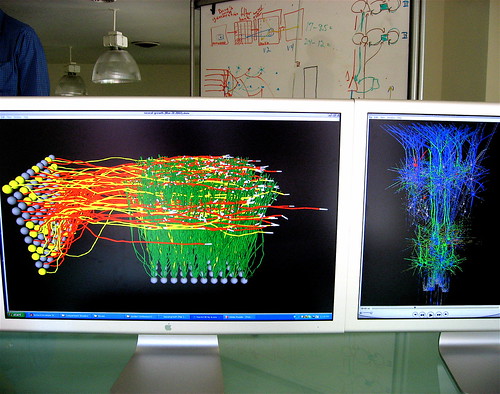
Probably a neural network, but you might need one to look at it to be sure. Photo by jurvetson on Flickr.

A selection of 8 links for you. Slippery when wet. I’m charlesarthur on Twitter. Observations and links welcome.

Emotional design fail: divorcing my Nest thermostat » Nielsen-Norman Group

Kara Pernice of the NN/G user interface design company:

A learning device implies that it will not only pick up on what you usually do, but it will also: 1) allow you to change, and 2) absorb those changes. My Nest learned quite well, but then stopped learning. It remembered but it didn’t look for variations or adapt. It was the equivalent of a printed textbook: Facts, correct or not, become law if written in there and thus will be taught that way until the school chooses a different textbook.

When I turned the dial to increase the heat to 66 degrees, rather than responding by making the house warmer, or by informing me that it is now working toward this, it read, “in 1 hour and 20 minutes 66 degrees until 10:00PM.” The next day the house temperature plummeted to a punishing 50 degrees (I realize I may be spoiled) for no reason I was privy to. Here, by the way, is another usability heuristic not heeded: visibility of system status.

Try as I might, it won’t listen. So I pull on another sweater (a la Jimmy Carter) and mittens and a hat. Indoors. In my home. I am serious. And I wait until my thermostat decides that I am worthy of radiant warmth.

Temperatures in Fahrenheit, obviously. Given Pernice’s provenance, maybe Nest should call. (This is the second heavily critical article about Nest in the past few days; the other was about its smoke alarm, from a Google employee.)


The believers » The Chronicle of Higher Education

Fantastic article on how neural networks have swung in and out of fashion, profiling Geoff Hinton, of the University of Toronto and Google:

Before [the researchers] won over the world, however, the world came back to them. That same year, a different type of computer chip, the graphics processing unit, became more powerful, and Hinton’s students found it to be perfect for the punishing demands of deep learning. Neural nets got 30 times faster overnight. Google and Facebook began to pile up hoards of data about their users, and it became easier to run programs across a huge web of computers. One of Hinton’s students interned at Google and imported Hinton’s speech recognition into its system. It was an instant success, outperforming voice-recognition algorithms that had been tweaked for decades. Google began moving all its Android phones over to Hinton’s software.

It was a stunning result. These neural nets were little different from what existed in the 1980s. This was simple supervised learning. It didn’t even require Hinton’s 2006 breakthrough. It just turned out that no other algorithm scaled up like these nets. “Retrospectively, it was a just a question of the amount of data and the amount of computations,” Hinton says.


Google buys Softcard tech, strikes deal with wireless carriers » Re/code

Jason Del Rey:

The deal will see Verizon Wireless, T-Mobile and AT&T pre-install Google Wallet on their Android phones in the U.S. later this year. Google Wallet allows shoppers to tap their phones to pay at checkout in some brick-and-mortar stores in much the same way Apple Pay does. The move also involves Google buying some intellectual property from Softcard, formerly known as ISIS. It doesn’t appear that any Softcard employees are joining Google as part of the deal.

In a blog post, Softcard said its users can use their mobile payments app for now. But I can’t imagine the wireless carriers behind the Softcard joint venture would agree to this deal if they planned to continue to invest in their own app. Sounds like game over for Softcard, a very expensive multi-year initiative that was essentially a flop for the wireless companies involved.

The purchase of Softcard (if not the abandonment of its staff) had been expected, but the preinstallation on Android phones is a smart deal.


What your online comments say about you » NYTimes.com

Anna North:

Commenters [the researchers at Skidmore College] identified as male were more likely to post negative comments than were those they identified as female; they were also much less likely to post comments acknowledging that gender bias exists.

Dr. Moss-Racusin said that her team was surprised by how split the commenters were: “The same sort of objective evidence really struck people quite differently.” She and her team are now studying the reasons behind such differences: “what factors might lead certain people under certain situations to be more swayed by scientific evidence, particularly evidence that points to some inequities between different social groups.” One theory, she said, is that when people feel threatened by evidence, “they may be a little bit less receptive to it than when it already fits into their existing worldview, their way of thinking about social relations.”

“Threatened by evidence”. There’s a phrase to conjure with. (Via Mary Hamilton.)


The best Apple Watch apps: Developers reveal upcoming titles » Wareable

With the world counting down to April 2015 for Apple Watch launch, attention turns to the best apps that will make or break this landmark device.

I think the launch will actually be in March, with shipping – as Tim Cook said – in April. (The delay lets Apple take preorders, evaluate demand, and, ah, also helps those camera-magnet queues.) I wrote about what developers aim to do with apps on Apple Watch for The Guardian.


Server and protect: predictive policing firm PredPol promises to map crime before it happens » Forbes

Ellen Huet:

Two or three times a day in almost 60 cities across America, thousands of police officers line up for roll call at the beginning of their shifts. They’re handed a marked-up map of their beat and told: Between calls, go to the little red boxes, each about half the size of a city block. The department’s crime analysts didn’t make these maps. They’re produced by PredPol, a “predictive policing” software program that shovels historical crime data through a proprietary algorithm and spits out the 10 to 20 spots most likely to see crime over the next shift. If patrol officers spend only 5% to 15% of their shift in those boxes, PredPol says, they’ll stop more crime than they would using their own knowledge.

Less Minority Report than quick primer for newbie cops, it seems. Even so…


Google layoffs inevitable » assertTrue( ):

Kas Thomas has been having a look at Google’s General & Administrative [G&A] spending:

With ad revenues levelling off and expenses skyrocketing (G&A has quadrupled in 5 years), Google is headed for a financial meltdown, and when it happens, the company will need to shave $2bn a year off its $16bn/yr in R&D and G&A costs, which means, if we count the fully burdened cost of a Google employee at $200K per year, it needs to shave 10,000 jobs.

Google has $100bn in the bank, so the situation is hardly dire, but Wall St. likes to see expenses cut by some other method than hauling money out of the bank. They like to see a sound Income Statement, and very soon, Google’s Income Statement will be anything but sound.

On a percent-of-income basis, Google outspends Apple on R&D six-to-one. Where is that money going? Driverless cars, Google Glass, body odour patents. Stuff that doesn’t have a chance in hell of generating revenue any time soon. On the one hand, Google is to be credited with thinking long-term, something American companies don’t tend to do very well, but on the other hand, Google needs to execute well on the revenue side. Right now, most of its revenue is tied to search ads, which are receding in relevance. It competes, in the cloud space, with Amazon (which no one should have to do). Will that save the company? No. It would have, already, if it were going to.

This is hard to argue against, though Google could just ignore Wall St and report lower profits.


Worldwide market for refurbished smartphones to reach 120m units by 2017 » Gartner

“With consumers in mature markets upgrading their smartphones every 18 to 20 months the inevitable question is what happens to the old device?” said Meike Escherich, principal research analyst at Gartner. “While only 7% of smartphones end up in official recycling programs, 64% get a second lease of life with 23% being handed down to other users and 41% being traded in or sold privately.
 
“This rise in smartphone reuse will impact not only the sales of new units, but also the revenue streams of all those involved in the smartphone supply chain,” continued Ms. Escherich. “Stakeholders that are already participating in take-back or trade-in programs need to have a strategy for turning used devices into a positive asset. Others — particularly high-end phone original equipment manufacturers (OEMs) — need to take a closer look at this market in order to evaluate the impact these secondhand devices will have on their market positions and revenue streams.” 

With nearly two-thirds of replaced smartphones being reused, continued demand for high-end used devices will increasingly impact primary-unit sales, and motivate phone providers to look into the secondhand market. In North America and Western Europe, the market for refurbished phones is forecast to be worth around $3bn in 2015 and growing to $5bn in 2017. Many users are attracted to used high-end devices that they would not have been able to purchase at the original selling price.

Next question is whether there’s any difference between platforms over hand-me-downs, and life cycle length.


Start up: Siri’s smart sibling, testing Magic Leap, more Superfish flaws, Cook the CEO, reviving Wallet, and more


The 2014-15 Louisville Leopard Percussionists rehearsing Kashmir, The Ocean, and Immigrant Song by Led Zeppelin.
The Louisville Leopard Percussionists began in 1993. They are a performing ensemble of approximately 55 student musicians, ages 7-12, living in and around Louisville, Kentucky. (Or watch it on YouTube.)

A selection of 10 links for you. If you love them, set them free. I’m charlesarthur on Twitter. Observations and links welcome.

Viv, built by Siri’s creators, scores $12.5m for an AI technology that can teach itself » TechCrunch

Broadly, the same idea as what Google-purchased Deep Mind is working on – a system that can learn (Deep Mind’s learning applies to games). This was an interesting data point though:

Siri investor Gary Morgenthaler, a partner at Morgenthaler Ventures, who also invested personally in Viv Labs’ new round, agrees.

“Now 500 million people globally have access to Siri,” he says. “More than 200 million people use it monthly, and more than 100 million people use it every day. By my count, that’s the fastest uptake of any technology in history – faster than DVD, faster than smartphones – it’s just amazing,” Morgenthaler adds.

As for Viv, it

can parse natural language and complex queries, linking different third-party sources of information together in order to answer the query at hand. And it does so quickly, and in a way that will make it an ideal user interface for the coming Internet of Things — that is, the networked, everyday objects that we’ll interact with using voice commands.

Wonder if Apple will add this to its shopping list.


What it’s like to try Magic Leap’s take on virtual reality » MIT Technology Review

Rachel Metz certainly sounds impressed, and this is the first description of how this method works that I’ve seen:

while Oculus wants to transport you to a virtual world for fun and games, Magic Leap wants to bring the fun and games to the world you’re already in. And in order for its fantasy monsters to appear on your desk alongside real pencils, Magic Leap had to come up with an alternative to stereoscopic 3-D—something that doesn’t disrupt the way you normally see things. Essentially, it has developed an itty-bitty projector that shines light into your eyes—light that blends in extremely well with the light you’re receiving from the real world.

As I see crisply rendered images of monsters, robots, and cadaver heads in Magic Leap’s offices, I can envision someday having a video chat with faraway family members who look as if they’re actually sitting in my living room while, on their end, I appear to be sitting in theirs. Or walking around New York City with a virtual tour guide, the sides of buildings overlaid with images that reveal how the structures looked in the past. Or watching movies where the characters appear to be right in front of me, letting me follow them around as the plot unfolds. But no one really knows what Magic Leap might be best for. If the company can make its technology not only cool but comfortable and easy to use, people will surely dream up amazing applications.


Superfish vulnerability traced to other apps, too » PCWorld

Lucian Constantin:

it gets worse. It turns out Superfish relied on a third-party component for the HTTPS interception functionality: an SDK (software development kit) called the SSL Decoder/Digestor made by an Israeli company called Komodia.

Researchers have now found that the same SDK is integrated into other software programs, including parental control software from Komodia itself and other companies. And as expected, those programs intercept HTTPS traffic in the same way, using a root certificate whose private key can easily be extracted from their memory or code.

Some users have started compiling lists with the affected software programs, their certificates and their private keys. Those affected products include Keep My Family Secure, Qustodio and Kurupira WebFilter.

“I think that at this point it is safe to assume that any SSL interception product sold by Komodia or based on the Komodia SDK is going to be using the same method,” said Marc Rogers, principal security researcher at CloudFlare, in a post on his personal blog.

Rogers says:

this means that those dodgy certificates aren’t limited to Lenovo laptops sold over a specific date range. It means that anyone who has come into contact with a Komodia product, or who has had some sort of Parental Control software installed on their computer should probably check to see if they are affected.

This problem is MUCH bigger than we thought it was.


Tim Cook and contradicting the founder-CEO » The Information

Jessica Lessin:

Since Cook first took over in August 2011, I have been asking Apple employees about how he has been leading the company. I often expect anecdotes revealing a numbers-driven management style, reinforced in profile after profile discussing how he climbed Apple’s ranks by squeezing pennies from its suppliers.

But employees consistently paint a different picture. In meetings over topics like how to fix Apple Maps or which features to include in the first Apple Watch, he takes the approach of asking the bigger questions like “Is this the Apple Way? Is this how we do things? Is this a product we can be proud of?”

That sounds to me like someone who sees his role as trying to provide some spiritual leadership at the company.

(Subscription required. I do wish The Information wrote better headlines.)


Wikipedia and the oligarchy of ignorance » Uncomputing

Remember that guy who went through Wikipedia editing out any occurrence of “comprised of” on the grounds that it was ungrammatical? He was wrong. David Golumbia widens the search:

Henderson’s work connects to the well-known disdain of many core Wikipedia editors for actual experts on specific topics, and even more so for their stubborn resistance (speaking generally; of course there are exceptions) to the input of such experts, when one would expect exactly the opposite should be the case. (As a writer in Wired put it almost a decade ago, “The Wikipedia philosophy can be summed up thusly: ‘Experts are scum.’”)

Can any connection be drawn between Wikipedia’s general approach and the hostility of Jimmy Wales (from whom a fair bit of Wikipedia culture derives) to the ECJ ruling on the right to be delisted?


Texas Hold’em odds visualization » Chris Beaumont

You can think of the full dataset of probabilities as a 4D hypercube (one dimension for each of the four cards dealt between two players). The panel above is a 2D slice through this 4D cube; it is a detailed view of the strength of one particular hand.

Amazing visualisation of the possibilities in the 1.3 trillion hands of heads-up Texas Hold’em.


App developers bailing on Fire Phone, in new challenge for Amazon » GeekWire

Tricia Duryee:

It’s no secret that Amazon’s first smartphone was a flop with consumers, but behind the scenes, the Fire Phone is also struggling with another key group: app developers.

Several developers who made apps for the first Fire Phone — investing significant time and money to support its unique features, without a major payoff in revenue or customer adoption — tell GeekWire that they aren’t planning to build apps for future versions of the device.

This creates an additional challenge for Amazon as the company tries to recover from the Fire Phone’s lackluster debut, because apps remain a key driver of consumer interest in smartphones.

It’s really, really, really dead, Jeff. (And yes, I was the first person to point out how poorly Fire Phones were selling, and put a number on it.)


To revive Wallet, Google tries to wrangle unruly partners » WSJ

Alisair Barr:

Persuading Android partners and financial-service companies to support its payment service requires Google to “herd the many cats involved,” wrote Tim Sloane, a payments analyst at Mercator Advisory Group, in a January research report. “It’s a mess,” he added in an interview.

Still, Google has to aim for success, because Apple Pay could become a draw for people to buy iPhones, instead of Android phones. Mr. Cook said last month that Apple Pay accounted for $2 of every $3 spent using contact-less payments on the largest payment networks.

Apple Pay “has changed the dynamics” of mobile payments, said Marc Freed-Finnegan, a former Google Wallet executive who is chief executive of retail-technology startup Index Inc. “If payments become a standard feature of phones, Google has to have a service on a par with Apple or better.”

Carriers in the US (and perhaps elsewhere) are more willing to listen to Google, because Apple doesn’t give them anything in Apple Pay, but any concessions Google makes to them means it gets even less than zero. And Samsung’s move acquiring Loop is a definite “no thanks” to Wallet.


The CD was dying, and Starbucks just killed it » Fusion

If you’re a person born after 1995 who’s gone to Starbucks lately, you may have seen some strange objects for sale near the cash register. Thin, rectangular, with pictures on the front and shiny circles inside. Believe it or not, these things weren’t decorative coasters for your flat white—they were some of the last surviving specimens of a music distribution technology known as the “compact disc,” or CD.

Now, you’ll no longer be confused by these odd items, because Starbucks is quitting the CD business. According to Billboard:

Starbucks, the coffee giant with over 21,000 retail stores throughout the world, will stop stocking and selling physical compact discs, Billboard has confirmed, with the CD clean-out due to start next month.

“We will stop selling physical CDs in our stores at the end of March,” a rep for the Seattle-based company tells Billboard, adding: “Starbucks continually seeks to redefine the experience in our retail stores to meet the evolving needs of our customers.”

CD sales are hitting an all-time low, and it’s hard to see them ever rising again. This is a tipping point, again.


Android malware hijacks power button, empties wallet while you sleep » The Register

Iain Thomson:

“After pressing the power button, you will see the real shutdown animation, and the phone appears off. Although the screen is black, it is still on,” said AVG’s mobile security team in an advisory.

“While the phone is in this state, the malware can make outgoing calls, take pictures and perform many other tasks without notifying the user.”

Once the malware is installed by the user – it’s typically bundled within an innocent-looking app, but AVG isn’t naming names – it asks for root-level permissions and injects code into the operating system’s system server. Specifically, it hijacks the mWindowManagerFuncs interface so it can display a fake shutdown dialog box when the power button is pressed – and display a fake shutdown animation too. It then blanks the screen and to make the mobe look like it’s switched off.

The malware is then free to send lots of premium-rate text messages and make calls to expensive overseas numbers. The code shown by AVG appears to contact Chinese services.

Another day, another system-level hijack; but as with the vast majority, this is limited to China so far.


Start up: Lenovo, Superfish and its implications; identifying Jackson Pollocks, tech v fashion, and more


Currently unfashionable inside Lenovo “consumer laptops”. Photo by sinosplice on Flickr.

A selection of 8 links for you. Makes a lovely salad when added to salad. I’m charlesarthur on Twitter. Observations and links welcome.

How Lenovo’s Superfish ‘malware’ works and what you can do to kill it » Forbes

Thomas Fox-Brewster:

Lenovo might have made one of the biggest mistakes in its history. By pre-installing software called ‘Superfish ’ to get ads on screens it’s peeved the entire privacy community, which has been aghast this morning on Twitter. There are serious security concerns about Lenovo’s move too as attackers could take Superfish and use it to ensnare some unwitting web users.

Here’s what you need to know about Superfish and what you can do to stop it chucking irksome ads on your browser and leaving you open to hackers.

This is probably the most comprehensive piece on the problems around this, though Lenovo suggests it has only installed it since September 2014. On Thursday night it issued instructions on how to remove it. And here’s a site you can use to check whether it’s affecting you. Read on for more of the implications.


AVAST 2015 Release Candidate 1 (10.0.2202) » Avast forums

Avast is a well-known antivirus program:

Features already introduced in previous AVAST 2015 betas:

• GrimeFighter Free
GrimeFighter will offer free cleaning of junk files and tuning of system settings. These tasks are performed by our Zilch and Torque minions. Other minion functions remain as paid-for features.

• HTTPS scanning
Now, we are able to detect and decrypt TLS/SSL protected traffic in our Web-content filtering component. We are using our own generated certificates that are added into the Root Certificate store in Windows and also into major browsers. This feature will protect you against viruses coming through HTTPs traffic as well as adding compatibility for SPDY+HTTPS/ HTTP 2.0 traffic. You can tune/disable this feature in the settings section.

That “https scanning” is exactly the thing that people are worried about with the Lenovo-installed Superfish. The reason why it’s used is because a lot of malware uses https: to connect to command-and-control servers. Superfish used it because connections to Google are https: and it wanted to insert its own adverts into the Google results stream.

Somehow, the Avast reason seems much preferable. (Link via Jon Honeyball.)


Extracting the SuperFish certificate » Errata Security

Robert Graham:

I extracted the certificate from the SuperFish adware and cracked the password (“komodia”) that encrypted it. I discuss how down below. The consequence is that I can intercept the encrypted communications of SuperFish’s victims (people with Lenovo laptops) while hanging out near them at a cafe wifi hotspot. Note: this is probably trafficking in illegal access devices under the proposed revisions to the CFAA, so get it now before they change the law.

I used simple reversing to find the certificate. As reported by others, program is packed and self-encrypted (like typical adware/malware). The proper way to reverse engineer this is to run the software in a debugger (or IDApro), setting break point right after it decrypts itself. The goal is to set the right break point before it actually infects your machine – reversers have been known to infect themselves this way.

This is one of the concerning things about Lenovo’s actions: vulnerabilities like this.


Lenovo CTO: we’re working to wipe Superfish app off PCs » WSJ Digits blog

Shira Ovide:

Lenovo is working quickly to wipe all traces of an app it had pre-installed on some consumer laptops, responding to security researchers’ warnings that the app could give attackers a way to steal people’s encrypted Web data or online passwords.

In an interview Thursday, Lenovo’s chief technology officer, Peter Hortensius, acknowledged that “we didn’t do enough” due diligence before installing Superfish, but that the company doesn’t believe laptop owners were harmed by the app. He said the company realized it needs to do more to respond to consumers’ concerns.

Lenovo, the world’s biggest seller of PCs, is working to write software that will delete any data from the Superfish software off laptops on which it had been installed. Hortensius also said the company should have done more due diligence on the security of the Superfish shopping-search app, which was installed from September to December on Lenovo consumer laptops.

Choice quote from Hortensius: “we agree that this was not something that we want to have on the system”. So how did it get there?


Report: 2014 was a bad year for lyrics sites in Google » Search Engine Land

Barry Schmwartz:

Only one lyrics site saw an increase in visibility from Google’s search results, that is azlyrics.com with a 24% lift.

We saw at the end of December 2013, Rap Genius was penalized for link schemes but then saw themselves back in the search results ten days later. Maybe that manual action had Google’s engineers take a deeper look at the lyrics niche.

One thing, you’d probably see a deeper impact on these lyrics sites in 2015. Google in late December 2014 began showing full lyrics in the search results, which can directly impact the traffic and visibility of these lyrics sites in the Google search results.


How Twitter CEO Dick Costolo keeps his focus » Inc.com

Jeff Bercovici:

A typical week for Costolo involves 12 to 15 standing meetings, so he has a few rules for efficiency’s sake. First, no cancelling. Freeing up that time may be tempting, but it’s how small problems become big ones. “I’m the connective tissue between all these groups,” he says. “It’s important for me to have context for the issues and challenges everyone’s dealing with.”

Second, no sidebars, ever. Nothing irks Costolo more than someone approaching him in private and saying, “I didn’t want to bring this up in front of everyone, but…” That rewards politics over process, he says: “Everyone on my team knows that that’s not a valid way to start a conversation with me.”

Finally, no PowerPoint. Meetings are for communicating, not wasting time on pretty slides. Instead, Costolo asks managers to type briefings. “If that sounds straight out of the Jeff Bezos playbook, it’s because it is,” he says. “I totally agree with that.”

These seem really good ideas. And there are more; the article isn’t so much about what happens, but how Costolo functions.


What the tech world doesn’t understand about fashion » Racked

Leslie Price:

at the biggest fashion houses in Europe, there is a general disdain for the connected future that the tech world fetishizes.

“We don’t like [e-commerce]. I don’t care,” Miuccia Prada said in 2013. “We think that, for luxury, it’s not right. Personally, I’m not interested.” As Bloomberg details, this is the case for many luxury brands. Some fashion OGs, like Valentino, don’t even use computers. Anna Wintour famously carries a flip phone. “The problem with technology is it’s a bit cold. It’s a bit sharp,” said Carine Roitfeld, CR Fashion Book EIC and former French Vogue chief.

This aversion actually makes perfect sense. Fashion is, by its very nature, exclusive. It’s about creating an identity, a brand, that is so cool that people will spend thousands and thousands of dollars to acquire a tiny piece of it. If you make that identity widely available, you risk diluting it. This delicate balance is something that the oldest fashion stalwarts have spent a hundred or more years perfecting.

Terrific piece which neatly illustrates (with examples) the gulf between tech and fashion: quite a lot of it is in the language that attaches to things.


A computer can tell real Jackson Pollocks from fakes » Smithsonian

Laura Clark:

according to many connoisseurs, critics and fakers don’t give the painter enough credit. There are indeed complexities to Pollock’s drip art that show it to be the genuine article. And now there’s a computer program helping to make a science out of the deciphering.

The software uses “computational methods to characterize the low-level numerical differences between original Pollock drip paintings and drip paintings done by others attempting to mimic this signature style,” says Inderscience Publishers. You give it a scan of the possible Pollock, and the program goes to work extracting 4024 numerical image descriptors that the human eye would have trouble deciphering as accurately.

I guess we have to add “art authenticator” to the list of white-collar jobs that computers will wipe out in time.


Start up: Azure’s machine learning, explaining Apple’s taxes, Sony v Samsung, EC v Google redux, and more


Image recognition reckons this could be a cardigan. Photo by jdlasica on Flickr.

A selection of 8 links for you. Spread liberally. I’m charlesarthur on Twitter. Observations and links welcome.

Announcing the general availability of Azure Machine Learning » Microsoft TechNet Blogs

Joseph Sirosh:

We built Azure Machine Learning to democratize machine learning. We wanted to eliminate the heavy lifting involved in building and deploying machine learning technology and make it accessible to everybody. Supporting open source innovation and enabling breakthrough learning capabilities with big data were important. So were supporting community-driven development and the ability for developers to easily create and monetize cloud-hosted APIs and applications. Most importantly, we wanted our customers to easily leverage future advancements in data science. 

And now that future is taking shape. Today, at Strata + Hadoop World, we are announcing the general availability release of Azure Machine Learning, a fully-managed, fully-supported service in the cloud. No software to download, no servers to manage – all you need to start doing data science is a browser and internet connectivity.

Smart – and also clever: I bet it will be difficult to export the “learning”. Already has some big-name customers. Machine learning is going to be a boom area in a couple of years – and this will help.


YouTube and its alternatives » Beyond Devices

Jan Dawson sees a threat to YouTube by its own hand:

YouTube, with moves such as those Digiday covered today, is actually making it tougher for content creators to monetize on YouTube in the way they see fit. Videos on YouTube generate tiny amounts of money per view for content creators, and one of the ways they’ve overcome this challenge is through sponsorships. That’ll now be banned under YouTube’s new terms of service regarding advertising. At the same time, Vessel, AOL and others are targeting YouTube content creators with an emphasis on better monetization of their viewership. I’ve been skeptical of these efforts, but YouTube is playing right into their hands with some of these moves, which makes me more open to the idea that it might actually start to suffer as a result of competitive inroads from Facebook but also these smaller platforms.


EU probe into Apple’s taxes: It’s NOT to do with double-Dutch-Irish anything sandwiches • The Register

From June 2014, Tim Worstall digs in on all the rows about Apple’s giant cash hoard in Ireland:

Stripped of all of the legal complexity and jargon, the way that Apple operates outside the US is this: the main company is an Irish subsidiary of Apple. This buys all of the parts for all iKit, makes the contracts with the factories that assembles it, ships it all on (there’s all sorts of fun stages in Singapore and so on but they’re irrelevant for our purposes) and then sells it to the various Apple country operating companies. To Apple UK, Apple AG, Apple Oz and so on.

Clearly, the price at which Apple Ireland (recall, the company with all those lovely deals like the Double Dutch and so on) sells to those Apple country companies is going to determine where the profits get booked. Sell at a low price and Apple UK will, heaven forfend, make a good profit to be taxed by Osborne. Sell at a high price and the profit will be in Apple.ie where no one seems to think very much about taxing it. And the price at which such sales take place, the entire subject of those prices, is called “transfer pricing”…

…In practice, Apple tends to sell from Apple.ie into the other national subsidiaries at a price where those national companies just about scrape a profit but not very much. They can cover their retail and wholesale, their marketing costs, wages and so on, but leave only a lean slice of extra cash that gets taxed. Almost all of the profits end up in Ireland.

This isn’t, however cute we might think it is, illegal nor even naughty in a tax sense.

This is remarkably (and valuably) clear explanation of what transfer pricing is all about. Recommended, even (especially?) if you hate what Apple and others do with their profits.


Sony’s Challenges and the Future of Samsung » Tech.pinions

Ben Bajarin after Sony’s announcement that it’s going to organise itself into silos, some profitable (making things like camera sensors, Playstations and financing things), some less so (TVs and mobile):

Sony is still an innovative company. However, it may be their future is in empowering others to commercialize their innovations rather than their own product brands.

All of this makes me wonder if Sony’s struggles foreshadow a fate for Samsung. Many of the same fundamental issues surrounding Sony also surround Samsung. Their branded products are facing rapid commoditization. Samsung has been able to fend off issues that hit Sony thanks to a massive marketing budget. They are mostly out of selling PCs for similar reasons as Sony. Their mobile unit continues to see steep declines as competing with smartphones with similar specs and lower prices becomes extremely difficult. Their TV business remains a top seller but you have to wonder how long that can last, particularly if the Chinese enter the US market with good quality 4k and then 8k, and then 4k and 8k OLED TVs at extremely low cost.

The emptiness at the heart of both Samsung and Sony – both control their hardware design language, but not the software that runs it – is surprisingly similar.


EU competition chief Vestager speaks on Gazprom, Google and tax » WSJ

The EC has asked complainants in the Google antitrust case to reiterate their points to its new competition chief, explain Tom Fairless and Stephen Fidler:

WSJ: What is the second round of questions about in the Google case? Why would you need more information?

Margrethe Vestager: When you discuss commitments for a time then the case information gets outdated. And therefore I found that for me to take the case forward, I needed an updated file. And what we see is that we sent out requests for information just before Christmas with a deadline at the end of January. And people have been very forthcoming in the information that we get. But that of course sometimes raises new questions, and therefore we just had a second round in order to get the full picture… I would like to take some of the mystery out of meeting complainants. Because they do not come here with flying [flags], they come here very calmly, stating their case, trying to underpin it with the facts of the world as they see it. So even though there is a lot going on about the case as such, when we do the casework here, it is very much boiled down to the facts that can support your views, how things are being seen. I think that is very important. Talking about speed, the stronger a case you have, the less risk it will end up in endless court proceedings. And that in any case time is an issue. Any business involved in an antitrust investigation would like us to be as fast as possible.

WSJ: Any sense how long it will take to come to a decision on Google?

MV: It’s too early to say.

Here’s a putative timetable: statement of objections by summer, some sort of settlement in autumn. Might get more complicated if Android gets rolled in; Vestager’s team is also investigating whether Google’s conditions there are anticompetitive, and has demanded a lot of information from Android phone OEMs, slightly to their discomfort.


We asked some of the smartest computers to identify this picture » Bloomberg Business

Jack Clark:

Within the past half-decade, AI research and development has been supercharged, thanks partly to academics at Stanford University, New York University, and the University of Toronto, and researchers at Google, IBM, and various startups. They’ve accomplished things in computer vision that were unimaginable years ago, but the results of our computer eye exam show that, although machines are getting very good at some things, they still come up with strange or nonsensical answers every now and again.

Where these systems fail tells us a lot about why computers won’t be replacing us for general image recognition tasks anytime soon.

Identifying Mark Zuckerberg as “cardigan” does seem obtuse.


Mainstream use of bitcoin may be plateauing at a low level » MIT Technology Review

Mike Orcutt:

The design of Bitcoin and the blockchain, its public transaction ledger, make it challenging to distinguish specific types of transactions. Nonetheless, researchers from the U.S. Federal Reserve determined in a recent analysis that the currency is “still barely used for payments for goods and services.” Last week, nearly 200,000 bitcoins changed hands each day, on average. But fewer than 5,000 bitcoins per day (worth roughly $1.2m) are being used for retail transactions, according to estimates by Tim Swanson, head of business development at Melotic, a Hong Kong-based cryptocurrency technology company. After some growth in 2013, retail volume in 2014 was mostly flat, says Swanson.

If only 2.5% of activity is in retail (or at least, legal retail) that’s still not a currency – it’s a speculative item. The blockchain still seems like the innovation with the most promise, not bitcoin itself.


How a single email can badly break your Android email app » Graham Cluley

Graham Cluley explains how Hector Marco has discovered a problem affecting the Email app on Android (potentially, only on Samsung devices – though that’s quite a lot of devices) which makes them crash continually due to a malformed email header:

Fortunately, there is an easy solution. The most obvious is to log into the web version of your email and delete the offending email there. Your Android mail app will no longer attempt to download the email (because it has been zapped) and so won’t see any offending email headers that might cause it to trip over itself.

Of course, that’s quite a nuisance if someone keeps emailing you malicious emails designed to crash your mail app.

But the permanent solution should be even simpler. If you can, update your email app to version 4.2.2.0400 or higher.

Unfortunately, as Marco explains, that may not be possible for everybody because of the hairy nature of software updates on the Android platform.