Start up: Google Wallet v Android Pay, chip consolidation, Buzzfeed’s news numbers, Android Wear lessons, and more


Cooking, though not devised by computer. Photo by Nicolas Alejandro Street Photography on Flickr.

A selection of 9 links for you. Everyone else is seeing a different set. I’m charlesarthur on Twitter. Observations and links welcome.

MIT cheetah robot lands the running jump » YouTube

Do Androids dream of electric cheetahs in sheeps’ clothing jumping over things? Whatever it is.. this is very worrying.


Google may have left the best Android “M” feature out of the keynote: automatic app data backup and restore » Android Police

David Ruddock:

Yes, it’s happening. Dot. Gif. Android apps are finally getting state backup in the new “M” version of the OS. The full details are here. The short of it is that Android apps will now automatically back up to Google Drive, up to 25MB per app, with no new code required from developers. This is huge. What’s backed up? Settings and app data, which is to say, basically everything so long as you’re not talking about something over 25MB in total size. While this may still mean signing into your apps on a new device depending on the app’s security, once you do log in, the concept here is that all your settings and saved app data should just reappear on your new device. Which, holy cow, haven’t we been asking for this since the beginning of time?

Great – in 2016, Android will have the backup capability that iCloud offered since 2011. Given Google’s huge power in cloud services, it’s really strange this hasn’t been in place much earlier.


Some big changes are coming to Google Wallet now that Android Pay is here » AndroidAuthority

Jimmy Westenberg:

So if Pay is going to be the new payment standard on Android, what’s going to happen to Wallet? Well, a new post on the Google Wallet Google+ account is trying to help clear up this muddy situation. According to the post, the Wallet service has seen a ton of growth in the number of people sending money to one another, whether that’s through Gmail or the Google Wallet application. So, Google Wallet is sticking around, and will receive a big revamp in the coming months that sounds like it will focus on payment transfers, as opposed to actually handling the payments themselves. Here’s a little taste as to what the new Wallet app will bring, as explained by the Wallet team:

The new app will allow anyone with a US debit card to send and receive money for free within minutes – even if the other person doesn’t have the app. The money you receive can either be directly sent to your bank account or it can be spent in stores using the Google Wallet card.

We would be lying if we said this whole situation wasn’t confusing.


char-rnn cooking recipes » Github

“Nylki”:

The following recipes are sampled from a trained neural net. You can find the repo to train your own neural net here: https://github.com/karpathy/char-rnn Thanks to Andrej Karpathy for the great code! It’s really easy to setup.

But now go and read the recipe. Beef! Pineapple! Orange juice! Sherry wheated curdup! “You made the recipe, you eat it.”


Android no longer competes with iOS » Naofumi Kagami

He called it back in April 2013 (“Predicting Android’s change of direction“). Now, he writes:

Google itself mentioned that Android M is mainly about fixing bugs and annoyances in Lollipop, and if that is to be believed, then the next version of Android coming out in 2016 should have many more features. However, since I am now more confident of my reading of Google’s strategic imperatives, I am pretty sure that this will not be the case. I predict that the 2016 version of Android will also not have any major new features. In short, I am now sure that Google no longer intends to compete with iOS with Android. Essentially, they are giving up the high-end smartphone market to Apple and they are cool with that. Instead, Google sees Android as a vehicle to spread their services to market segments that iOS cannot penetrate. How will this strategy fare in the future? This strategy is sound if Google’s sole objective is to learn about what people are doing. However, from a financial standpoint, there are many risks. By far the largest risk is, what if Apple is successful in distancing itself from Google? What if Apple somehow succeeds in significantly reducing the number of Google searches performed on iOS?


Charlie Warzel on Google’s ambitions post-I/O » Daring Fireball

John Gruber mulls:

In the demo, while playing a Skrillex song, Google director of product management Aparna Chennapragada asked the device, “What’s his real name?” And a moment later, the answer came: “Sonny John Moore”. Now on Tap is what allowed Google to know the context for “him”. It was a cool demo. But as soon as I saw it, I took my iPhone, held down the home button, and asked Siri, “What’s Skrillex’s real name?” And a moment later came the answer: “Sonny John Moore”. Allowing Google to index everything the apps you use show or play for you seems like a stiff privacy price to play for the ability to use “him” in that query, especially when, in my opinion, “What is Skrillex’s real name?” is the natural way most people would pose the question. Now on Tap has much more potential than this, of course. But, still. To me, this week’s I/O keynote made me more convinced than ever that Google is turning into the Microsoft of old: a company whose ambitions are boundless, who wants its fingers in every single pie, and who wants to do it all on its own. A company whose coolest stuff is always in the form of demos coming in the future, not products that are actually shipping now.

Wellll… the Photos app, which embodies machine learning (wonder if Pete Warden is involved – his company Jetpac was bought by Google last year), is shipping now, but cross-platform. That’s the thing: the some-day-my-demos-will-be-real things are OS-specific, while the right-here-right-now things are cross-platform. But that “new Microsoft” meme is a hard one to shake off. Notice how it attaches when you keep getting hardware wrong and have to try it again and again.


The five chip companies who will buy all the others » DIGITS to DOLLARS

Jay Greenberg:

As growth slows in an industry, the only way for companies to keep growing is to win market share (hard) or buy other companies. This is especially true in semiconductors because most of these companies outsource their manufacturing to the foundries like TSMC and Global Foundries. When one chip company buys another, the combined entity gets better pricing at the foundry (as they are now a bigger customer). The combination also gets to eliminate the duplicated non-design functions. You do not need two CEOs, nor two CFOs, not even two Corporate Development VPs (a not so subtle reminder that I am now looking for a new job). For several months now, I have been going around talking to friends at chip companies preaching this view – the industry will consolidate from over a hundred companies today down to five in a few years. In these conversations, I have always used Broadcom as an example. I would note that “Even Broadcom is not too big to get acquired someday.” So apparently, someday is yesterday. When the dust settles, I think there will be just five massive companies left in the business. (That will clear the decks for a new form of semis companies to emerge, but that is years away.) Here is my guess as to who the survivors will be.

You can probably guess three of them, but all five?


Five things Google figured out in Android Wear’s first year » Fast Company

Jared Newman:

At this year’s I/O, in lieu of splashy reveals, Google is announcing some minor tools for developers, including a way to show bird’s eye map views in their smartwatch apps. The company also revealed that it has 5,000 true watch apps in the Google Play Store, plus 1,500 custom watch faces. This year’s conference is mainly a time to reflect, and convince app makers that Android Wear is ready to compete with the Apple Watch.

Here are 2 and 3: “nobody agrees what looks good; people want smaller watches”. In pursuit of not achieving 3,

The brunt of the blame falls to the battery, which is the largest component by volume inside Android Wear smartwatches, [Android Wear lead product manager Jeff] Chang says. Still, Google doesn’t want to mandate smaller watches if it means giving up an always-on display or all-day battery life, which he sees as core values. “To accomplish an always-on screen that stays on the whole time, and at least one full day of battery life, and to have a really small volume battery, that’s a big challenge,” Chang says. “We’re working very hard on it, but we do uphold all those principles dearly.”

Good/fast/cheap; small/always-on/one-day. Choose two. (Note how Apple’s choices differ from Android Wear, but it’s still two out of three.)


BuzzFeed’s news is growing, but still a small part of its traffic » Digiday

Lucia Moses:

BuzzFeed drew 76.7 million multiplatform unique visitors in April, according to comScore. The publisher historically hasn’t broken out its content by vertical to comScore, like other top news sites including CNN, Yahoo and The Huffington Post do. But it started to on a limited basis as of last month, when it began breaking out its Entertainment and Life coverage, which stand at 43.7 million and 20.1 million uniques, respectively. BuzzFeed doesn’t break out its news traffic, suggesting it’s still relatively low. Bottom line, BuzzFeed may have made headway a short time, but it is still a small player when it comes to news, in which it includes business, tech, politics and longform. “You’ll hear clients say, ‘We want a BuzzFeed-style article,’” said Kim Alpert, director of digital strategy at Walton Isaacson. But when it comes to news, it hasn’t delivered a consistent product that’s instantly recognizable, she said. “Vice and Mashable, you kind of know what you’re going to get. I don’t believe their news has really matured in that people say, ‘I get my news from BuzzFeed.’” With CEO Jonah Peretti recently hinting at going public, BuzzFeed could invite more scrutiny of its editorial model. BuzzFeed’s main revenue source is native advertising, a format that has been criticized for mimicking editorial. The publisher also has admitted taking down posts at advertisers’ requests.

Start up May 29: leap second fretting, Pebble Time reviewed, Apple’s AR buy, and more


A leap second: good, bad or indifferent news? Photo by /amf on Flickr.

A selection of 8 links for you. Use them wisely. I’m charlesarthur on Twitter. Observations and links welcome.

June 30 leap second worries markets, internet » GPS World

The Wall Street Journal is reporting that financial regulators and market participants are worried enough about the leap second that they’re planning for potential disruptions. The adjustment could present technical difficulties for traders and exchanges, as some computers might not be programmed to account for the adjustment, according to a Dow Jones report. “These guys are agonizing over it,” Steve Allen, a programmer-analyst at the University of California’s Lick Observatory, told Dow Jones. “It is definitely a hassle.” “The problem with the extra second is that it’s difficult to gauge how computer systems will react,” according to Journal writer Brian Hershberg. A US Commodity Futures Trading Commission spokeswoman said that “For the most part, we’re not too worried,” told Dow Jones. “But of course as the regulator, we do need to ensure folks are ready.” The last leap second occurred on June 30, 2012, and that leap second caused technical problems for websites and computing systems — including Reddit, Mozilla, Gawker, FourSquare, Yelp and LinkedIn.

Leap seconds are like millennium bugs that come around rather more often.


Apple acquires augmented reality company Metaio » TechCrunch

Ron Miller and Josh Constine:

A source told TechCrunch that clients who use Metaio are “flipping out” after seeing the shut down message on the website and not hearing a word from the company about what’s going on…until now. Metaio hadn’t taken traditional Silicon Valley venture capital, but had raised some money from Atlantic Bridge and Westcott. The company is well established. Many impressive projects have been produced using its tools including this one of with Ferrari that gives a potential buyer an AR tour of the car (as though the actual car isn’t cool enough): And this one for travelers in Berlin to see what the scene they are looking at would have looked like when the Berlin Wall was up. The program uses historical footage that you can see by pointing your smartphone or tablet at a particular place.

Apple getting into AR? I wrote about the resurgence in VR (which Google is pushing hard) for the Guardian; AR is actually slightly tougher.


Pay your way with Android » Official Android Blog

Pali Bhat, product manager:

With Android Pay you will be able to pay with your credit or debit card, across multiple Android devices, and at thousands of stores and apps that you already know and love. And by enabling bank apps to integrate with our platform, you’ll be able to add your credit and debit cards directly from bank apps for use with Android Pay. It’s still early days, but we’re very excited and think that this type of open platform will help drive adoption in mobile payments.

OK, and now let’s rewind almost exactly four years to May 26 2011, and the announcement of Google Wallet (which Android Pay replaces):

Because Google Wallet is a mobile app, it will do more than a regular wallet ever could. You’ll be able to store your credit cards, offers, loyalty cards and gift cards, but without the bulk. When you tap to pay, your phone will also automatically redeem offers and earn loyalty points for you… This is just the start of what has already been a great adventure towards the future of mobile shopping. We’re incredibly excited and hope you are, too.

The difference? Four years and the launch of Apple Pay last September. And a gradual shift in the utterly backward payment systems in the US towards NFC-capable checkouts.


Google ad chief says larger phones help with mobile sales » WSJ

Alistair Barr:

[Sridhar] Ramaswamy said the rising popularity of larger smartphones also helps. “As phones get bigger the space issue becomes less challenging,” he said, pulling his Nexus 6 smartphone out to show its six-inch display. “This is essentially a tablet. People’s ability to navigate sites and fill out forms and such goes up tremendously.” Mark Ballard, director of research at digital-marketing firm Merkle RKG, has spotted big increases in mobile-search ad prices over the past year. He said new, larger iPhones released last fall are part of the reason because they make it easier to buy something after clicking on a search ad. Ramaswamy declined to comment on the impact of larger iPhones. The Google executive questioned how Facebook, which has emerged as Google’s principal rival for online ads, measures how many users watch videos. YouTube counts a view when someone watches for at least 30 seconds, while Facebook counts a view more quickly. “How many of Facebook’s video views are engaged views?” he asked. A Facebook spokesman did not immediately respond to a request for comment.

Well. Why won’t he comment on larger iPhones? Also: Facebook videos don’t need to be 30 seconds long – after all, a Vine can only be six seconds long. But of course Ramaswamy knows that. But not commenting on the iPhone seems like a defensive move as the default search placement on Safari comes up for renewal.


Review: Pebble Time » WIRED

David Pierce:

It’s true that a small subset of users, call it the Casio Calculator crowd, doesn’t care about looks. They’ll like the Time because it’s sturdy, durable, and easy to use. But when nearly every critique of wearables relates to aesthetics and personalization, you have to wonder how Pebble convinces anyone to even put this plastic brick on… …I want the uncluttered and productive idea Pebble is selling. But I don’t want the watch.


Pebble Time review: the smartwatch that beats Android Wear » WSJ

Nathan Olivarez-Giles:

For the Time, Pebble redesigned its watch interface using the analogy of a timeline: Press the top right button to go back in time (recent alerts, news items, past calendar events), and press the bottom right button to go into the future (upcoming events, games, etc.). The lone left button always takes you back a step, while the middle right button serves as an OK or Enter key. It’s an almost laughably simple way to organize what you see on screen, but it’s effective and the main reason I prefer the Time over any Android Wear watch I’ve tried so far. Android Wear is chaotic. It often feels like your watch is buzzing out of control and you’re drowning in phone notifications that keep showing up no matter how often you swipe to dismiss them. Pebble’s new timeline approach, on the other hand, makes sense as soon as you start clicking buttons. Order is calming. Without having to peep at a user manual, you know where your stuff is.

Odd approach: the WSJ has had three different people reviewing the Apple Watch, LG Urbane and now the Pebble Time. Why?


Web vs. native: let’s concede defeat » QuirksBlog

Peter-Paul Koch:

Most business entities that require an internet presence (think small shops, plumbers, hip food carts, or the like) will not end up [as an app icon] on your homescreen. Instead, they require one just-in-time interaction — when you need their opening hours, phone number, or menu. Users will expect this information on the web because they’re not going through the hassle of installing their app. Actually, this is very good news for the web. If the user doesn’t want your icon on his home screen, if the user wants a just-in-time interaction, it’s the web they want — not because of any inherent technological superiority, but because it’s hassle-free. Go there, read, forget. No junk left on your phone. Most businesses don’t stand a chance of ending up on the users’ home screens. So they need the web — but not a web that emulates native to no particular purpose.

His biggest criticism of cruft-y websites is news sites – but then the counterargument comes in, as he concedes, that news sites need to have URLs so people can find the content via search. Tricky.


December 2013: Android’s permissions gap: why has it fallen so far behind Apple’s iOS? » The Guardian

In December 2013 (that’s 18 months ago), I asked:

why would you let an app get that sort of access to your contacts, location, or storage? If you’re using Android, the answer is that you don’t get much choice, unless (like those 40%+ in the survey carried out by the Information Commissioner’s Office) you decide not to download the app. And the peculiar thing is that Google seems to be quite OK with that – and in fact has gone as far as to reverse an update which let users block apps from accessing data they shouldn’t. The consequences of that are already beginning to play out as people notice the difference – and complain in the only way they can, by giving apps lower ratings for what they see as excessive demands. The problem surfaced at the end of last week, when the Electronic Frontier Foundation (EFF) first praised and then doled out brickbats to Google for implementing, and then reversing, a function which allowed users to set per-app permissions to data such as their contacts, call log, location and so on. To access it you had to download a free third-party app called App Ops Launcher.

Commenters’ response: “just don’t install the app”. Overlooking the fact that that had already been dealt with in the piece – the 40% who already don’t install. Apple’s iOS has had this on near-enough 100% of devices since September 2012. Android will have it in Android M. Android Lollipop, released in autumn 2014, is presently on 9.7% of devices. I forecast it will take until June 2017 for Android M to be on 50%.


How long can you wait for Android M to be on 50% of devices? Would June 2017 be OK?

Google is announcing all sorts of wonders for Android M (Macadamia Nut fruitcake, or whatever it is) at Google I/O.

At the moment, Lollipop (Android 5.x) is on 9.7% of devices – 9.0% for 5.0 and 0.7% for 5.1, according to Google’s developer dashboard.

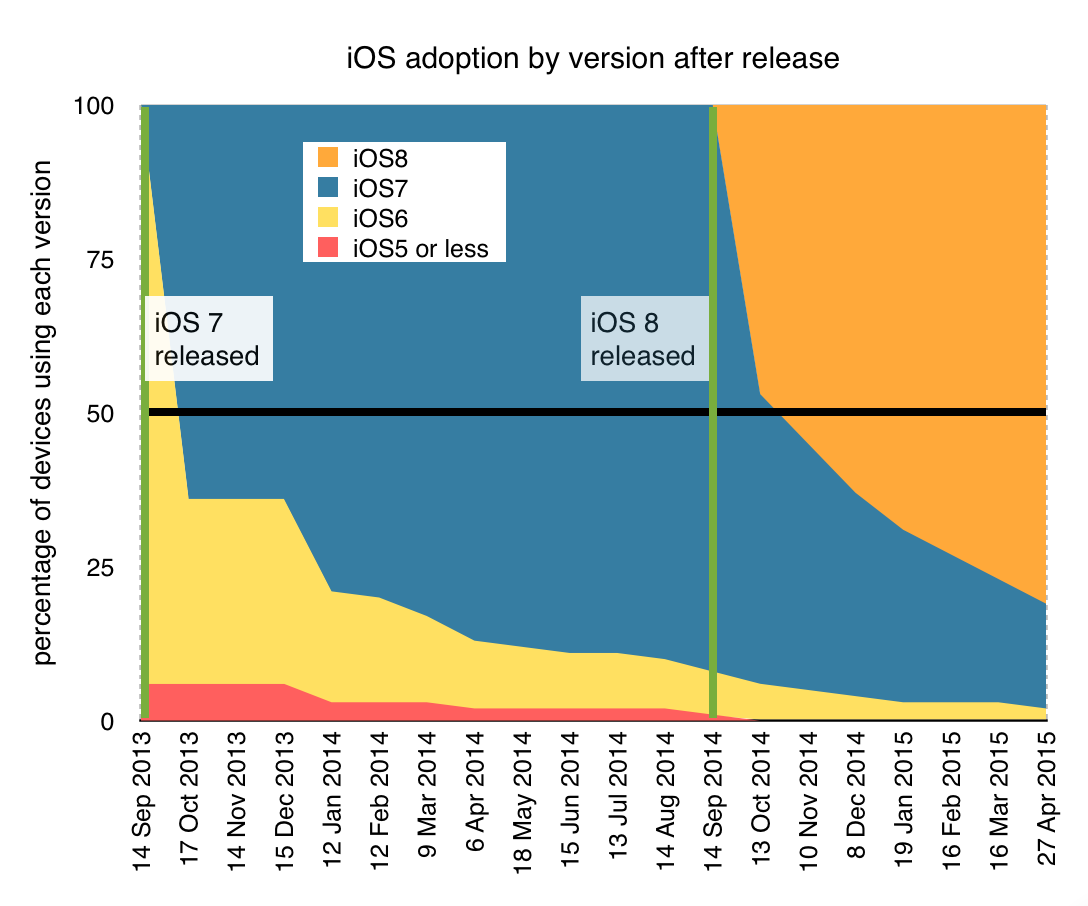
So when you get the announcement of “permissions for apps” (or indeed anything that is M-only), you have to ask: how long will it be before that is actually widespread? And by “widespread”, let’s define it as “on 50% of devices”. That 50% is useful because 50% of the billion of so Google Android devices in use is roughly comparable with the total number of Apple’s iOS devices in use. The thing is, the overwhelming number of active iOS devices get updated to the latest version within three months of the release of a new version; since iOS 6 in 2012 it’s taken just one month for the number running it to pass 50%. (At the time of writing, in May 2015, the current figure is 82% of devices on iOS 8, 16% on iOS 7, and 2% on something earlier. Revisiting it in March 2016 to add grammatical edits, the figure is 79% on iOS 9, which was released in September 2015.)

Apple iOS versions in use

Rapid adoption is a key element of Apple’s iOS due to its direct update mechanism.

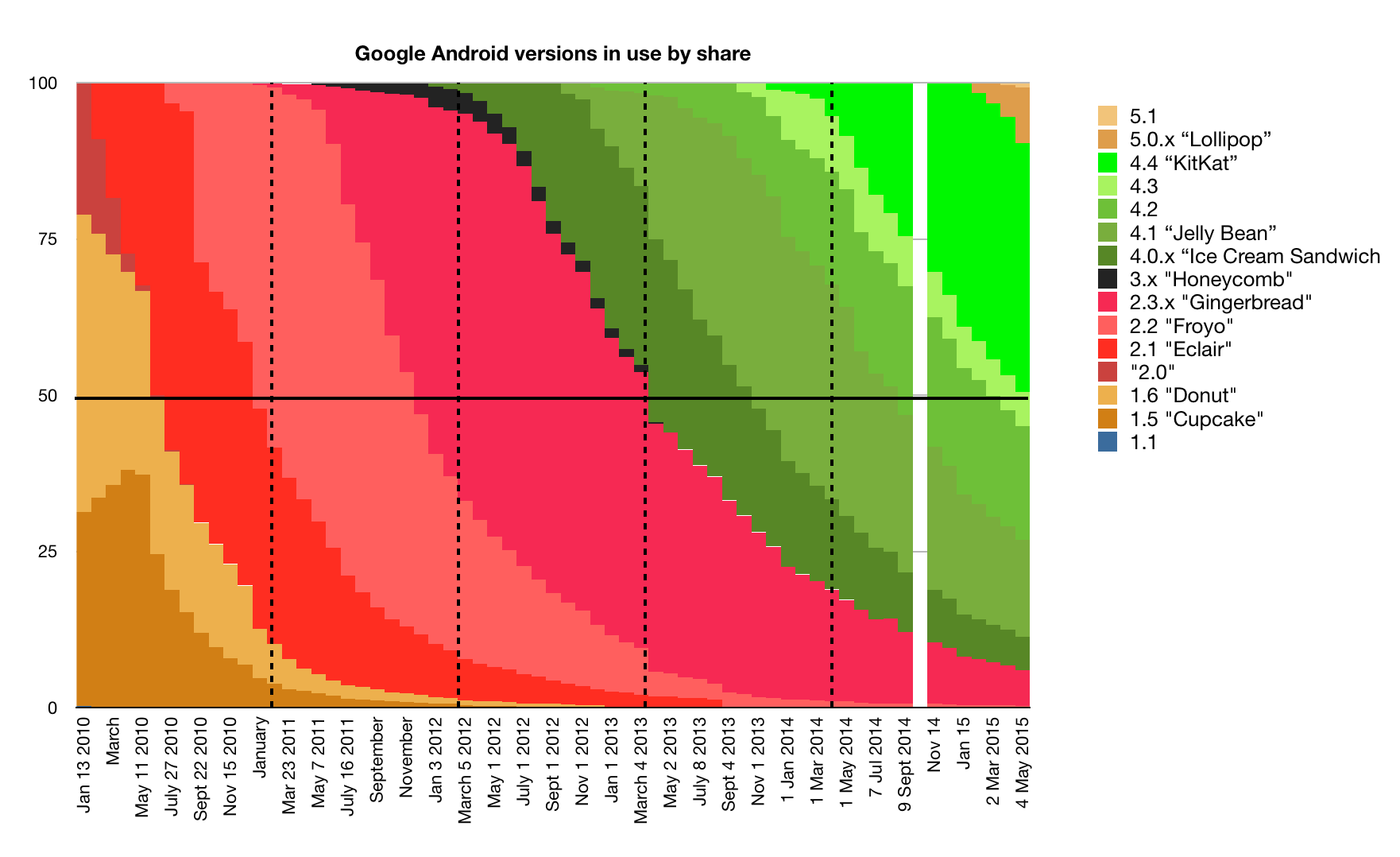
How do we figure this out? We let history be our guide. I’ve been collating the data about versions on the Android developer dashboard for a while, so we can look back to the past. In each case I’ve taken the beginning point as when a version first showed up on the dashboard, not when it was “released”.

Android versions in use

The release of a new version of Android doesn’t necessarily mean it reaches a large proportion of users quickly.

If we take it that “modern” Android starts with version 4 onwards – given that 2.3 (Gingerbread) was super-old, while 3.0 (Honeycomb) was tablet-only, we get this data:

Android 4.0: 16 months for it, or a later version, to be on 50% of devices according to the dashboard (January 2012 to April 2013).

Android 4.1: 13 months (October 2012 to November 2013).

Android 4.2: 22 months (December 2012 to September 2014 – the date of Lollipop’s release, officially).

Android 4.3: 18 months (October 2013 to March 2015)

Android 4.4: 19 months (forecast). Launched in December 2013, at the start of May 2015 it was at 49.5% for 4.4 and successors. It’s a safe bet that in June 2015 the total for Android 4.4 and successors will pass 50%. (Update: this was exactly right: the figure for May 2015 showed 49.5% on 4.4 or later; for June 2015, it was 51.6%, including 5.x; Android 4.4 itself peaked at 41.4% in April 2015.)

Android 5.x: 18 months (forecast). Presently, it’s 9.7% after 4 months, and its uptake pattern is more like 4.3 than 4.4. My forecast for its 50% point: July 2016.

On that basis, I’d say it’s a pretty safe bet that if Android M is released in December 2015 (which is likely) that it will take until June 2017 before it’s on 50% of Android devices according to Google’s measurements. Of course, that will vary regionally – there are still 6% of devices running 2.3 or earlier, which translates into about 60 million devices still in use. Some will get more rapid takeup, some will get less.

To put it into perspective (thanks Mark Blank-Settle on Twitter):
• presently, Apple’s offering iOS 8. It will show off iOS 9 in June.
• by the time Android M is released on devices later this, iOS 9 will already be on 60%+ of iOS devices
• by the time Android M – shown off in early 2015 – is on 50% of devices, Apple will have shown off iOS 10.

So if you’re depending on something such as, oh, the permissions model or Android Pay being introduced in Android M reaching the majority of your users any time soon, might be best to hold your breath. The revolution looks more like an evolution.

Android (and Apple, and BlackBerry, and Microsoft Mobile) handset profitability – the Q1 scorecard (updated)


Quality. Profitable. Photo by Thomas Hawk on Flickr.

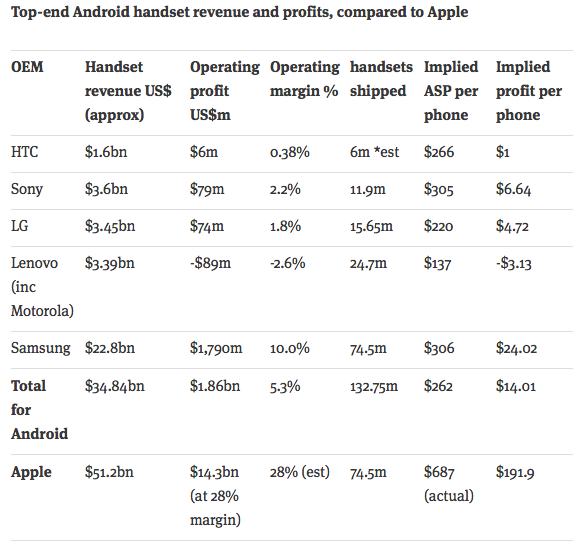
At the end of January, I drew together the figures from the fourth quarter of 2014 to look at how profitable making smartphones was for companies including Apple, Samsung, HTC, LG, and Sony. The approximate answer was: not very, unless you were Samsung or Apple.

Another quarter gone: time again to see if anyone is faring any better. As a bonus I’m also throwing in Microsoft Mobile and BlackBerry.

Proceed with caution

A few words first on procedure. I look at the companies’ financial statements and information about the smartphone shipments, revenues and operating margin of their handset divisions. In some cases they don’t give this explicitly, or they give some but not all of the numbers, which have to be estimated or wrangled by triangulating with analysts’ data. (I tend to use IDC and/or CounterPoint, who I’ve found to be reliable.)

Some people have wondered why I use operating margin rather than gross profit to calculate these numbers. There’s an important difference. “Gross profit” is what you have left over after subtracting the cost of the goods in the product, and the cost of making it, and the cost of getting it to the customer. It’s a number that flatters a business because it doesn’t take into account all the other costs involved in running that business – such as paying sales, general and administrative [SG&A] staff, marketing, R+D (which comes out of your current cash, and is an investment in the future of the business), and all the other things you think of as “keeping the lights on”. If selling your products doesn’t cover all those costs, then you don’t actually have a viable business.

The Motorola finesse

This was why it used to bug me when Motorola Mobility’s people would say that it “made money on each handset it sold” selling its low-priced devices while owned by Google. Sure – it made money on gross margin. It wasn’t a lie, but it was economical with the truth, a comment made perhaps in the knowledge that most journalists wouldn’t ask “you mean on gross margin or operating margin?”

Motorola Mobility was fabulously unprofitable; its losses, once you included SG&A and R&D, were dramatic. Between the second quarter of 2012 (when Google took it over) and the first quarter of 2014, Motorola’s total revenues were $10.98bn. Its losses, once you took account of those costs, were $1.9bn, or 17 cents for every dollar of sales. Motorola never had a profitable quarter while inside Google. In fact if you take its entire life after being spun off from the larger organisation at the start of 2010 to the start of 2014, over 17 quarters just two showed operating profit, totalling $160m. Total operating losses, including those profits: $2.47bn on revenues of $30.6bn. Now it has been swallowed by Lenovo, which promises to make it profitable. We’ll see.

So don’t let glib answers fool you. There are lots of way to talk about “profit”. Here’s mine. (“ASP” is average selling price, across the company’s whole portfolio of smartphones.)

So how was Q1 for you?

With the numbers now in from all the top-line handset makers (who you’d expect would be the profitable ones), here are the numbers. (An asterisk means the number isn’t absolute, and the reason for each is explained below the table.)

OEM Handset
revenue
US$ (approx)
Operating profit US$m Operating
margin %
handsets shipped Implied ASP per phone Implied profit per phone
HTC $1.35bn $0.89m 0.06% 5.0m $270 $0.18
Sony $2.28bn –$461m -20.2% 7.9m $288.70 –$58.40
LG $3.25bn $79.85m 2.46% 15.4m $210.79 $5.18
Samsung $22.53bn $2.47bn* 10.96% 83.3m* $250.88 $29.65
Total for top-end Android $29.41bn $2.09bn 7.1% 111.6m $263.50 $18.73
Lenovo $2.82bn* -$218m -7.7% 18.7m $150.80* -$10.28
Top-end Android inc Lenovo $32.23bn $1.87bn 5.80% 130.3m $247.35 $14.35
Apple $40.28bn $11.27bn (at 28% margin) 28% (est) 61.17m $658.53 $184.20
Microsoft Mobile $1.03bn –$369m -35.8% 8.6m $119.70 –$54.00
BlackBerry $274m –$156.88m -57.2% 1.3m $210.77 –$120.68

Assumptions
HTC: I’ve assumed that all the first-quarter revenue is for HTC phones – which isn’t true, given that it also now offers the HTC Re and made the Nexus 9 tablet sold by Google. (Sales were likely pretty small, since it didn’t show up in IDC’s tablets category where the smallest number was about 1m, and you’d expect that Amazon sold more. I understand Nexus 9 shipments in Q4 were just 70,000; the number would be substantially smaller in Q1.)
The 5m phones number comes from one of the big analysis companies that tracks smartphone shipments. (Not sure I have their permission to say who, but they’re very reliable.)
The operating margin isn’t a mistake – it really is $890,000 after conversion. HTC truly lives on the edge; and has been spending on R+D for its virtual reality headset. The phones are probably more profitable than this suggests; the Nexus 9 and Re probably aren’t, but it’s unlikely they contribute much to revenue.

Sony: Currency converted using the yen rate for the quarter cited in Sony’s results presentation. The huge operating loss is a puzzler: Sony’s explanation in its financials is that besides the dollar’s appreciation hitting costs, it was due to “the recording of intellectual property related reserves in the current quarter”. I don’t know what the IP-related issues are; is Sony gearing up for a court fight with someone? (Microsoft, over Android licensing?)

LG: Currency converted from Korean won using the same conversion rate as Samsung.

Samsung: the company doesn’t give exact figures for its smartphone shipments; it coyly said in its investor call it had shipped 99m mobile phones including featurephones and that smartphones were in the “mid-80s percent”. This is IDC’s number.
Its smartphone revenues calculated on the prevailing won-dollar exchange rate on 31 March, and the basis that those 15.7m featurephones had a shipping price of $15, and that the “about nine million” (quote from the earnings call) tablets had a shipping price of $175.
Samsung gives operating profit for its entire “IM” division, which includes its PC divison. I’m assuming these make zero profit, or not enough to perturb the figures. If any of its PCs, tablets or featurephones makes a profit, that reduces the per-handset smartphone profit.

Lenovo: now owns Motorola, which is dragging down its results, as it does everywhere. Assumptions: the 2.5m tablets it sold went for an ASP of $100 and made zero profit; a higher tablet ASP and profit means the smartphone business did worse. Another assumption: Moto360 smartwatch sales didn’t add materially to revenues, and didn’t lose money. (You can argue about this. It reduces the smartphone revenue, but boosts profitability if the Moto360 sold well at what was probably a loss or breakeven.)

Lenovo is odd in that its smartphone business is now partitioned into two – there’s the Lenovo brand, which sells almost entirely in China (and recently in India, a little), and the Motorola brand, which sells much more widely. The Lenovo brand phones have really low ASPs – historically, around the $100 mark. The Motorola ones have much higher ASPs – about $230 in the most recent quarter. None of it is profitable, though; even before Motorola the mobile business was losing money, and there are various unspecified writeoffs of unspecified amounts in the latest quarter that make the losses even worse. Lenovo says it’s aiming to get Motorola profitable within 4-6 quarters of acquisition. So that’s by the middle of 2016.

Trouble for Lenovo is that it hasn’t made a profit with low ASP phones, and it’s not making one with Motorola’s high ASP ones. Perhaps it hopes the profit will come with scale (or the departure of rivals?).

Top-end Android cumulatively: clearly, Samsung dominates: it has 30 times more profit than its nearest rival (LG) on about 5 times as many phones.

Apple: we have to assume Apple’s iPhone operating profit margin at 28%, because it doesn’t break out divisional profits; all costs are assigned across the company. (You could estimate it by taking iPhone revenues as a percentage of the total, and assigning that percentage of all other costs to it.)

Microsoft Mobile: I previously set out all the calculations used here (which exclude writedowns on intangibles). Specific assumptions: its featurephones have an ASP of $15 and make $5 profit per handset; sales and marketing was $300m per quarter. Mobile is a terrible business for Microsoft, but it has to stick with it.

BlackBerry: these are the figures for its quarter to the end of February. I looked at those in detail, and found that services and software have consistent gross profit margins of about 82%. Subtract that from the gross profit, and you get a total gross profit for handsets of $21.20m. Now we have to subtract operating expenses from that; assuming those are proportional to the revenues from each slice of its business (hardware, software, services) we take away 42%x $424m = $178.08m to get the operating profit for BB’s handsets. It’s negative.
Handsets are an even worse business for BlackBerry than for Microsoft – and BlackBerry can’t bear the losses like Microsoft can. Tick tock.

Questions you’re asking:

1) Where’s Lenovo (including Motorola)?
Hasn’t reported yet; calendar Q1 is the end of its financial year, and it takes an age putting together its results. Might have them some time in, who knows, June. (It seems to have shipped 18.8m phones in the quarter, down year-on-year from the 19.1m Lenovo and Motorola shipped when separate.)

There, it’s now included.

2) What about Xiaomi/Huawei?
Though they’re big players in shipments (15.3m and 17m respectively), Xiaomi doesn’t publish numbers anywhere I can find (pointers welcome), and Huawei doesn’t break out any detail from its mobile division – though a year ago it said it was operating just ahead of break-even.

Comparison

Sequential quarter comparisons are usually odious, especially if you look from the Christmas quarter to the new year one; shipments fall, revenues fall and stuff gets cheaper as companies try to shift unsold stock and get ready for New Things. Bearing that in mind, looking back at the Q4 figures, we find that:
• HTC’s margins worsened quite a lot; handset ASP stayed fairly steady.
• Sony’s ASP dropped a lot, from $305 to $288.70.
• LG actually improved its operating margin, kept revenues and shipments up, and saw only a slight dip in ASP
• Samsung kept revenues up while increasing shipments – hence a big drop in ASP, from $306 to $250.88 – and improved operating margins and profit
• Apple saw shipments fall (as expected), a slight fall in ASP but per-handset profit remained almost the same. And it’s still taking all the money.

Coming up…

In a followup post, I’ll look at ASP trends for these companies, and what they suggest about the challenges facing these companies – particularly Sony – and also the question of whether Samsung might withdraw from the PC business altogether. (It pulled out of Europe last year.) Stay tuned.

Putting iOS and Android apps on Windows 10 is a white flag to rivals – and a red flag for developers


We just need some firmware in here and everything will be fine. Photo by 4nitsirk on Flickr.

Microsoft announced at its BUILD conference that it will be providing a way for iOS and Android developers to port – sorta kinda – their mobile apps to Windows 10, so they don’t have to rewrite them from scratch in its coding language.

As Peter Bright described it at Ars Technica:

[In “Project Islandwood] Microsoft has developed an Objective C toolchain and middleware layer that provide the operating system APIs that iOS apps expect. A select group of third parties have been using the Islandwood tools already, with King’s Candy Crush Saga for Windows Phone being one of the first apps built this way. King’s developers had to change only a “few percent” of the code in order to fully port it to Windows Phone.

For Android, there is Project Astoria. Rumors of Android apps on Windows have been floating around for some time, and in Windows 10 Microsoft is delivering on those rumors. Astoria will allow Android apps to run in Windows. Specifically, Windows Mobile (and yes, that’s now officially the name for Windows on phones and sub-8 inch tablets) will include an Android runtime layer that’ll let them run existing Android apps (both Java and C++) unmodified.

Bright then followed up on Monday last Friday (thanks Walt) with an analysis which goes much more deeply into the mechanics of how it will be done, but also points to two examples where companies have tried to make up for the lack of apps on their platform by enabling others effectively to run on them: IBM’s OS/2 platform, and BlackBerry’s BB10.

The point about OS/2 is well-remembered, delving back into PC history when Windows was young and IBM was trying to keep control of the burgeoning PC platform. It failed, because IBM couldn’t update OS/2 fast enough to keep compatibility with the fast-expanding Windows 3.x API base; but also, developers didn’t want to get distracted by having to look after more than one platform.

Indeed, when it comes to porting, Bright observes that “neither OS/2 nor BB10 has made a success of this capability”. He could also have added Amazon’s Android fork, and the Nokia X, which used AOSP (Android Open Source Platform) and tried to replace Google services with Microsoft ones.

We surrender to your platform

The trouble with “compatibility mode” is that it’s so evidently a white flag on the part of the company that enables it. In effect, the company is saying: we can’t attract enough developers to write natively for our platform, so we’ll try to piggyback on the more successful one.

But that’s also a giant red warning flag to developers on that platform. By effectively telling them that other platforms are more successful, it calls into question the future of the development tools on the platform, and the user base; it accepts that there are both more users and more developers elsewhere.

I don’t think Islandwood and Astoria will work. Not because they technically won’t work – Microsoft has scads of smart people who can do clever things with code – but because this is a technical solution to a business problem.

Even worse, it’s a technical solution that makes the business problem worse. If you subscribe to the idea of “moats and castles” (that businesses aim to surround themselves with an advantage that rivals can’t cross), then effectively dumping your own developer kit on mobile so that you can lure people from rival platforms strengthens the rivals’ moats – their loyal cohorts of third-party developers. Why would anyone write first for mobile on Windows, given these two projects?

The business problem

Microsoft’s user base for Windows Phone is around 70m-80m worldwide, out of a total smartphone user base of around 2 billion. Superficially this sounds like the late 1990s, when Apple was just about able to eke out an existence by having around 50m-60m out of 1.5bn PCs.

The crucial difference though is that Apple had the high-end users, who were willing to pay a premium for Apple’s qualities (principally in desktop publishing and graphic design, and lots of consumers in the US). Windows Phone occupies the low end. Its users don’t monetise well. That means developers don’t concentrate on them. A little experiment for you: today, when you see an ad for an app, notice how many mention availability on Windows Phone. If you get above zero, you’re lucky (or browsing a Windows site).

The category error

But, say the the Windows diehards, the access to 1.5 billion PCs and, ahem, Windows Phone will prove irresistible to all those developers currently writing for iOS and Android. All those PCs! Who wouldn’t want to be on those?

This is wrong, for two reasons: context and support costs.
1) apps written for mobile do not, in the main, translate to the desktop/laptop. What would Snapchat on the desktop be like? Or Uber? Apps that rely on the camera or geolocation don’t make sense; others can in general be done in the browser (example: Facebook). John Kneeland pointed this out back in February, before we knew about these initiatives. What he wrote remains true:

The most interesting developers and companies today aren’t shrinking down desktop experiences. They are building entirely new experiences that wouldn’t make any sense — or even be possible — on a PC.

2) the cost of “writing” the app is only the start; after that you have support, updates and compatibility. Imagine an iOS developer who has written an app for iOS 8 (presently covering 81% of users) considering this.

If they’re sensible, they’ll look first at monetisation via Android – after all, it’s the far bigger market, which has a premium (= willing to pay) segment that rivals iOS in size. So they do that. And then clean up, perhaps, with the iPad market too.

Now – Windows Phone via compatibility mode or Android tablets? If they write for “Windows Phone compatibility” they’ll have a product that will need special tweaking on a new platform where because of the comparatively low number of users, a few bad reviews could spell doom. Even if they get it right, Apple will introduce iOS 9 in the autumn, which might or might not tweak or twerk the existing APIs, and will surely kill off some of the older ones. How long will it take Microsoft to update to those? One thing’s for sure – iOS new version adoption will run ahead of Microsoft’s ability to update. This means there are now two versions of the app, on slightly different APIs, not entirely compatible.

When iOS 9 comes out, the iOS developers’ attentions will be on bugfixing and customer support there. This means (because people are finite) less time to attend to the Windows Phone customers. Things don’t get fixed there, bad reviews get left, the app sinks down the store, and.. what was the point of writing for this thing again?

As for Android developers – if we assume that they haven’t already done an iOS version, then do you think they’d want to write something for a platform with over 500m mobile devices in use, or one with 1.5bn users… except that for almost all of those 1.5bn, their app will make no sense at all (if they’re even able to load it – for don’t forget that about half of those PCs are in businesses, and probably locked down)?

Again, this isn’t hard to figure out.

A good try, but doomed

Microsoft had to do something, and people who like clever technical solutions are delighted by this clever technical solution to the fact of developer indifference and incompatible software. But it doesn’t change the fundamental truth: Windows Phone (v10 or whatever) is too small to matter in platform terms on mobile.

Microsoft is surely interested in keeping the mobile side going, as much as anything because of all the lessons it teaches you about things like power management, chip integration, sensor management, and a multitude of other things that are important.

History tells us that software compatibility is a losers’ move. Far better to move the fight to a new battleground and win there – as Apple did, first with the iPod and then the iPhone and then the iPad and then (thus far) the Apple Watch. Seems like a working strategy.

Update: some responses on Twitter have been along the lines of “Oh, no, really, developers will love it!”

Why, I ask? “Azure! The developer environment! Access to Xbox! It’ll get people to switch to Windows!”

In order:
• developers don’t need Windows 10 to use Azure. Vesper, which is resolutely iOS-only, uses Azure, for instance.
• if there’s one thing developers likely don’t want to get accustomed to, it’s yet another developer environment if the payback is small. Also, is there any developer who hasn’t heard that Windows (desktop) has a lot of users? The point is that Windows 10 is not magically going to make those desktop users into mobile users, for the reasons discussed above. iOS and Android have 95% of pretty much any market that’s worth squeezing developer money from. If anyone wants to tell me which niches monetise better on Windows Phone than on iOS and/or Android, I’m all ears.

• Xbox access isn’t worth much. There are about as many Xbox users as Windows Phone users (of the order of 70-80m; Xbox One is replacing Xbox 360, and any new buyers are balanced out by those abandoning as they get older). Games are notoriously difficult to write well; developers need to write “close to the metal”. Porting mobile games to the Xbox isn’t a sensible strategy.

• people do switch to Windows Phone from other platforms. However, just as many (if not more) flow back to the other two platforms because they aren’t happy with the app situation. And if this works, then what’s the reason for switching to Windows? So that you can get the apps that you already had on the smartphone platform you were on before? That doesn’t make sense.

I’m happy to be proved wrong, of course – if those who say I’m going to be wrong are willing to put up some solid numbers here (in the comments) that we can refer back to in a year or so, such as forecast Lumia sales, or Lumia installed base, or forecast length in 2016 of the app gap between other platforms and Windows Phone/10.

I’m charlesarthur on Twitter. Say hi or leave a comment.

Start up: costing Apple’s Watch, why Glass flopped, evaluating Fitbit, with Android’s permission?, and more


“Yeah, I think my Fitbit fell out of my trousers during this, so I bought another…” Photo by betta design on Flickr.

A selection of 8 links for you. Use them wisely. I’m charlesarthur on Twitter. Observations and links welcome.

No, the Apple Watch does *not* cost $84 to make » Mobile Forward

Hristo Daniel Ushev:

Here are two examples. These firms looked at the (1) hardware and (2) manufacturing costs of the Apple Watch.

IHS’ estimate for the 38mm Sport version: $83.70.
TechInsights’ estimate for the 42mm Sport version: $138.50.
Can both be correct?  No. “But they looked at different-sized models” one might say. Nah; that’s almost irrelevant.

From my experience working with product and cost experts at a well-known mobile device company, I can tell you:  Apple Watch does not cost $84 in hardware and manufacturing. It costs meaningfully more. Probably more than 2X that. And I’ll tell you why. Maybe I’ll even give you my estimate.

(By the way congrats to the TechInsights crew for having a reasonable estimate, in my view.)

First, it’s not for the reasons you see in the comments on the articles that re-publish these estimates. In those articles, you’ll typically see well-intentioned commenters say that one needs to account for research and development, sales and marketing, corporate income taxes, etc. None of that is accurate.

(Ushev used to work at Motorola. He points out so many ways in which costs are higher that you begin to wonder how Apple makes such big gross margins.)


The debacle of Google Glass » Tech.pinions

Tim Bajarin:

the bottom line is most technology gets started and refined in what we call vertical markets well before they get perfected and priced low enough for consumers.
When Google introduced their Google Glass, this was the first thing that came to mind about this project. I wondered if Google even had a clue how tech adoption cycles develop. While it is true glasses had been used in vertical markets since 1998, even after all of this time, we saw no interest by consumers. Google’s decision to aim Glass at consumers first, yet price them as if they were going to vertical markets, stumped me. Even the folks who had spent decades making specialized glasses for use in manufacturing, government applications, and transportation were dumfounded by Google’s consumer focus with Google Glass, priced at $1500.
Apparently, Google found out the hard way how tech products get adopted…

…I was a Google Glass Explorer and the experience was horrible from the start. Google Glass now sits in my office museum of failed products. The UI was terrible, the connection unreliable, and the info it delivered had little use to me. It was the worst $1500 I have ever spent in my life. On the other hand, as a researcher, it was a great tool to help me understand what not to do when creating a product for the consumer.

Google’s go-to-market strategy with Glass always puzzled me. It obviously had, and has, applications in business (medical, etc). Yet as Bajarin says, the marketing suggested a consumer product. Result: failure.


LG Watch Urbane review: $350 buys you the nicest Android Wear watch yet, if that’s something you want » Android Police

David Ruddock:

For a lot of people, there’s probably going to be something at least remotely interesting about Wear.

For me, it’s managing emails and messages. Don’t want to read that work email while I’m in the middle of typing up an article or otherwise engaged? Quickly skim the subject on the watch, and dismiss or archive it. I’ve even started using the voice replies for SMS and Hangouts when I’m in my own home (frankly, it weirds me out voice messaging somebody on my watch in public for some reason???), because it’s less disruptive than pulling out my phone, unlocking it, opening the app, and typing out a reply. It’s also great for quick Google searches, turn-by-turn navigation (especially when you’re walking), music controls, and activity tracking.

Of course, our smartphones do most of this stuff, too, so I’m not about to claim there’s actually a compelling economic argument for smartwatches yet – there isn’t.

In places, Ruddock sounds bored beyond belief with the whole concept of a smartwatch. You’d certainly struggle to find any enthusiasm at all for it.


Thoughts on the Fitbit IPO filing » Beyond Devices

Jan Dawson digs into the numbers; he finds that the best model for usage is that on average, a Fitbit is used for about six months:

So, how important is this abandon rate information to our evaluation of Fitbit’s prospects going forward? Well, one could argue that at just 10 million sales per year, there’s tons of headroom, especially as Fitbit expands beyond the US (the source of around 75% of its revenues today). But in most consumer electronics categories, there’s a replacement rate for devices, which continues to drive sales over time even as penetration reaches saturation. The biggest worry in the data presented above is twofold: one, very few Fitbit buyers have yet bought a second device; and two, many don’t even use the first one they bought anymore. Once Fitbit maxes out its addressable market, it’s going to have a really tough time continuing to grow sales.

This may be a factor for all wearables, unless they can show some compelling reason to upgrade from the previous one.


Upon this wrist » Medium

Craig Mod, channelling Hemingway:

Oh, they are so downtrodden now, those who asked about the thing, the thing on the wrist. I am the harbinger of technodoom. Knower of useless celestialisms. And I can see in their eyes that they want to hear some accolades. Some uplifting remark. Nothing gibbous. And so I say a single word: Exercise. Like I am selling plastics in 1930. Exercise, I say. And I smile. That is what it does best. But I have to caveat, slumping back into my chair, my posture as the worst salesman ever — Well, I mean, it’s good, or, rather, it has potential. But presently it is very dumb.


LG G4: the best Android smartphone camera » WSJ

Nathan Olivarez-Giles:

My colleague Joanna Stern already covered the merits of Samsung’s Galaxy S6 and S6 Edge, and sung the praises of their 16-megapixel rear cameras. So I was surprised to find that LG’s new flagship phone has an even better camera.

After putting the Galaxy S6 Edge, the iPhone 6 Plus and the LG G4 through a series of photo tests, I found that not only did the G4 keep up in most conditions, it took better low-light and night photos. LG says one reason is the f/1.8 aperture lens on the G4’s 16-megapixel camera. It lets in more light than any other smartphone on the market. This camera system also bumps up the exposure, so that these low-light settings come off brighter than comparative shots — and even brighter than what the naked eye sees.

It’s all about the camera; the review barely touches any other topic.


The women working in NYC’s nail salons are treated more terribly than you can imagine » VICE

Allie Conti shows how the NYT exposé of treatment of workers in these salons got made. It’s impressive.

VICE: Did you ever just go from nail salon to nail salon, or was that too risky?
Sarah Maslin Nir: I started doing that toward the end, because it’s a very collusive industry. Everybody conspires. The experts I’ve spoken to say the owners teach each other the methods of how to exploit the workers and how to avoid prosecution. So I was afraid if I started going from salon to salon, an owner would catch me and tell all the others, and it would all get shut down. So only toward the end would I go to salons, and I’d actually go get a manicure and talk with the women, sometimes with a translator sitting next to me, and just have these quiet conversations.

One of the most interesting things about the story is I learned how to ask questions. At the beginning, I’d ask, “Where do you live?” And they’d say, “Oh, I live in a one-bedroom in Flushing, Queens.” And then I realized that when they live in a one-bedroom, they lived with six to eight other people. So my questions changed. I would say, “How many people do you live with?” and they’d say, “Oh, twelve.”

Amazing, detailed work about something that’s been sitting in front of people for ages.


Google said ready to give Android users more privacy controls » Bloomberg Business

Brian Womack and Lulu Yilun Chen:

Google is planning to give its mobile users more control over what information applications can access, people familiar with the matter said.
Google’s Android operating system is set to give users more detailed choices over what apps can access, according to the people, who asked not to be identified because the matter remains private. That could include photos, contacts or location. An announcement of the change, which would put Android closer in line with Apple’s iOS, is expected for Google’s developer’s conference in San Francisco this month, one of the people said.

Long overdue. Apple introduced it to iOS in September 2012. And it was actually included – against Google’s intent – in Android 4.3 in July 2013, though you had to download a separate app to enable it, but then removed three weeks later. Also, we know it will take years for any substantial proportion of people to get this if it’s included in Android ‘M’ (Marzipan?). Though there are some suggestions that this will only apply to Chrome, not across Android.


Start up: Pariser on the Facebook bubble, Android Wear’s Wi-Fi tweak, bitcoin economics, and more


Is Facebook keeping you inside this? Photo by sramses177 on Flickr.

A selection of 9 links for you. Use them wisely. I’m charlesarthur on Twitter. Observations and links welcome.

Facebook published a big new study on the filter bubble. Here’s what it says. » Medium

Eli Pariser, author of The Filter Bubble:

Here’s the upshot: Yes, using Facebook means you’ll tend to see significantly more news that’s popular among people who share your political beliefs. And there is a real and scientifically significant “filter bubble effect” — the Facebook news feed algorithm in particular will tend to amplify news that your political compadres favor.

This effect is smaller than you might think (and smaller than I’d have guessed.) On average, you’re about 6% less likely to see content that the other political side favors. Who you’re friends with matters a good deal more than the algorithm.

You’re probably friends with people who share your beliefs, though. Pariser also has fun facts from the study, which is being torn apart by the wolves of Twitter in various places.


SSD storage: ignorance of technology is no excuse » KoreBlog

Kore stores data as evidence. So it has to be correct:

Digital evidence storage for legal matters is a common practice. As the use of Solid State Drives (SSD) in consumer and enterprise computers has increased, so too has the number of SSDs in storage increased. When most, if not all, of the drives in storage were mechanical, there was little chance of silent data corruption as long as the environment in the storage enclosure maintained reasonable thresholds. The same is not true for SSDs.

A stored SSD, without power, can start to lose data in as little as a single week on the shelf.

SSDs have a shelf life. They need consistent access to a power source in order for them to not lose data over time…

…What started this look into SSDs? An imaging job of a laptop SSD left in storage for well over the 3-month minimum retention period quoted by the manufacturer of the drive before it was turned over to us. This drive had a large number of bad sectors identified during the imaging period. Not knowing the history, I did not consider the possibility of data loss due to the drive being in storage. Later, I learned that the drive was functioning well when it had been placed into storage. When returned to its owner a couple of months after the imaging, the system would not even recognize the drive as a valid boot device. Fortunately, the user data and files were preserved in the drive image that had been taken, thus there was no net loss.

Now imagine a situation in which an SSD was stored in legal hold where the data was no longer available for imaging, much less use in court.

Bet you thought SSDs “store their data forever, no power needed”. Turns out it’s mag disks that do that.


Google can’t ignore the Android update problem any longer (op-ed) » Tom’s Hardware

Lucian Armasu:

For years, Apple has made fun of Android and its fragmented update system, and it will continue for years more. Microsoft has recently started doing the same. The update system on Android is something Google can ignore no longer, and it needs to do whatever it takes to fix it. Otherwise, it risks having users (slowly but surely) switch to more secure platforms that do give them updates in a timely manner. And if users want those platforms, OEMs will have no choice but to switch to them too, leaving Google with less and less Android adoption.

Google also can’t and shouldn’t leave the responsibility to OEMs and carriers anymore, because so far they’ve proven themselves to be quite irresponsible from this point of view. At best, we see flagship smartphones being updated for a year and a half, and even that is less than the time most people keep their phones.

Even worse, the highest volume phones (lower-end handsets) usually never get an update. If they do it’s only one update, and it comes about a year after Google released that update to other phones, giving malicious attackers plenty of time to take advantage of those users.

Google’s (or its fans’) argument is that updates to Play Services do most of this task. In which case, why have OS updates at all? Even so, there doesn’t seem to be any clear suggestion for how Google can do this. And there’s no real evidence that it turns users off. Chances of change: minimal.


Android Wear on Wi-Fi: Using a smartwatch without a phone nearby » Computerworld

JR Raphael:

The two devices don’t have to be on the same network or in the same physical location; your phone could be sitting in your car and you could be miles away in a building with Wi-Fi access. As long as the phone is getting some sort of data – be it via Wi-Fi or a mobile data network – and the watch is in a place with an accessible Wi-Fi network, you’re good to go.

I tested this by turning off my phone’s Wi-Fi and Bluetooth and heading out to the gym. Once I was inside the building (and thus in range of its Wi-Fi network), my watch showed itself as being online in less than 30 seconds. From that point forward, without my phone nearby or in any way connected, the Watch Urbane received notifications like new text messages, Hangouts messages, and emails. I could respond to those messages from the watch via voice. And I could send new messages by using the new Contacts list in the latest Wear update, which is accessible by swiping to the left twice from the main Wear home screen.

I could even use apps like Google Keep – viewing existing notes and lists and dictating new ones (which I confirmed showed up in my account almost instantly). I could give regular “Okay, Google” voice commands, too, but those worked somewhat sporadically; some of the time, the watch would time out and give me a “Disconnected” error instead of an answer. That was the only function that didn’t work consistently for me in this context.

This seems potentially useful, and like the sort of thing Apple might add too in a future update – perhaps next year? No point hurrying…


On the clothing of emperors: a rant about 21.co and the future of bitcoin mining » Medium

Bernie Rihn digs into the economics of bitcoin, and mining, and demolishes the idea that 21.co is going to sell “devices you’ll use in your home that will mine bitcoin and pay you back”:

We’ve established from the above (rant-warm-up) that 21 can’t (sustainably, with a straight face) sell anything that mines bitcoin in our house as a network-connected device masquerading as a “heater.”

They are clearly already in the mining business (their mining pool, pool34 was recently outed and is humming along nicely at 3–4 petahashes / second). They are clearly building an ASIC (Application Specific Integrated Circuit, commonly called a “chip”). The question is, for what?


How Google keeps execs from leaving » Business Insider

The title on the page is “Google has a secret ‘bench’ program that keeps executives at the company even when they’re not leading anything”, which says it better. Alexei Oreskovic and Jillian D’Onfro explain:

The bench system is an effective but little-discussed strategic tactic in Google’s playbook as the company looks to expand into new markets and keep an edge over a growing crop of web challengers that are all desperate for seasoned internet business experts.

“It helps keep people off the market,” one former Google executive says. “It helps keep the institutional knowledge if you need them back for any reason. And it costs [Google] so little to retain these people rather than to have them leave and start the next Facebook.”

About one-third of Google’s first 100 hires still work at the company, according to “Work Rules!” a recent book by HR boss Laszlo Bock.

It’s more of an informal system than an established program, sources say. But the underlying intention and goals are clear and purposeful. “It’s very rational,” the former Google executive says. (Google declined to comment on this story.)

With its deep pockets and sundry internal projects, Google can offer its elites attractive incentives to hang around, even after they have moved on from, or been replaced in, their previous role. The company will often tell someone to take 18 months or 24 months to figure out what he or she wants to do next at the company, the former Googler says.

Keeping those smart people out of other companies, and keeping their institutional knowledge inside Google, is a really clever move.


RCS is still a zombie technology, “28 quarters later” » Disruptive Wireless

Dean Bubley:

In February 2008, a number of major telcos and technology vendors announced the “Rich Communications Suite Initiative” (see here).  I first saw the details a couple of months later, at the April 2008 IMS World Forum conference in Paris.

It is now 7 years, 2 billion smartphones, and 800m WhatsApp users later.

Or to put it another way, 28 Quarters Later*. [Actually 29 but 28 since he discovered the details. Hence the asterisk.]

However, unlike Danny Boyle’s scary, fast-moving monsters in the 28 Days and 28 Weeks Later movies, RCS is not infected with the “Rage Virus”, but is more of a traditional zombie: dead, but still shambling slowly about and trying to eat your brains. It’s infected with bureaucracy, complexity and irrelevance.

To remind you: April 2008 was also a few months after the launch of the first iPhone, and a few months before the launch of the AppStore. It was also when Facebook Chat, now Messenger, was switched on in my browser for the first time – while I was waiting on the podium, to start chairing the IMS event. The world of mobile devices, apps and – above all – communications has moved on incredibly far since then.

But not for RCS.

Mobile operators never like to admit something’s dead.


Are social sharing buttons on mobile sites a waste of space? » Moovweb

Short answer: yes. Longer answer: still yes.

Just because sharing buttons have been popular on the desktop web does not mean they can be ported over with the same experience on the mobile web. And while .02% of mobile users clicking on a social sharing button is a minuscule figure, it does reflect the way social media usage on mobile has evolved: away from the web and toward apps.
Most mobile users access social networks via an app, so they are often not logged in to the corresponding social networks on the mobile web. Pinterest, for example, gets 75% of its traffic from apps.
The heart of the sharing problem is that users must be logged in in order to share. If you’re not logged in, sharing can be kind of a nightmare.


HIV and syphilis biomarkers: smartphone, finger prick, 15-minute diagnosis » ScienceDaily

A team of researchers, led by Samuel K. Sia, associate professor of biomedical engineering at Columbia Engineering, has developed a low-cost smartphone accessory that can perform a point-of-care test that simultaneously detects three infectious disease markers from a finger prick of blood in just 15 minutes. The device replicates, for the first time, all mechanical, optical, and electronic functions of a lab-based blood test. Specifically, it performs an enzyme-linked immunosorbent assay (ELISA) without requiring any stored energy: all necessary power is drawn from the smartphone.

ELISA kit typically costs over $18,000; the dongle for this test about $34.


Microsoft’s per-handset profit, or the lack of it – and its impact on Windows Phone’s future


How much did this Lumia 920 cost to make? And will it have a successor? Photo by Whatleydude on Flickr.

In case anyone was in any doubt, Microsoft’s results last week demonstrated once more what we’re coming to know about the mobile handset industry: it’s damned hard to make any money in it. When I published a fairly simple analysis of the state of the top-end Android handset market (with a comparator to Apple’s iPhone profits), people were apparently flabbergasted by how thin the per-handset operating margins were on these devices which sold for hundreds of dollars.

Estimated Android handset operating profit Q4 2014

See the original post for more detail and caveats.

But Microsoft showed that it’s not even able to generate gross margin while selling millions of handsets. (Gross margin is the difference between how much it costs you to make the item – usually factory costs and distribution costs – and what you get for it. Gross margin normally excludes R&D and sales & marketing costs; to get the operating profit, you subtract those costs too, so operating profit is always less than gross margin.) My analysis of Android handset makers looked at operating profit.

Negative gross margin takes some doing; spending more making stuff than you take in for it is exceptionally bad business. But Microsoft Mobile did, officially: take a look at Microsoft’s 10Q for the calendar first quarter of 2015.

Microsoft phone hardware revenues, Jan-Mar 2015

It says

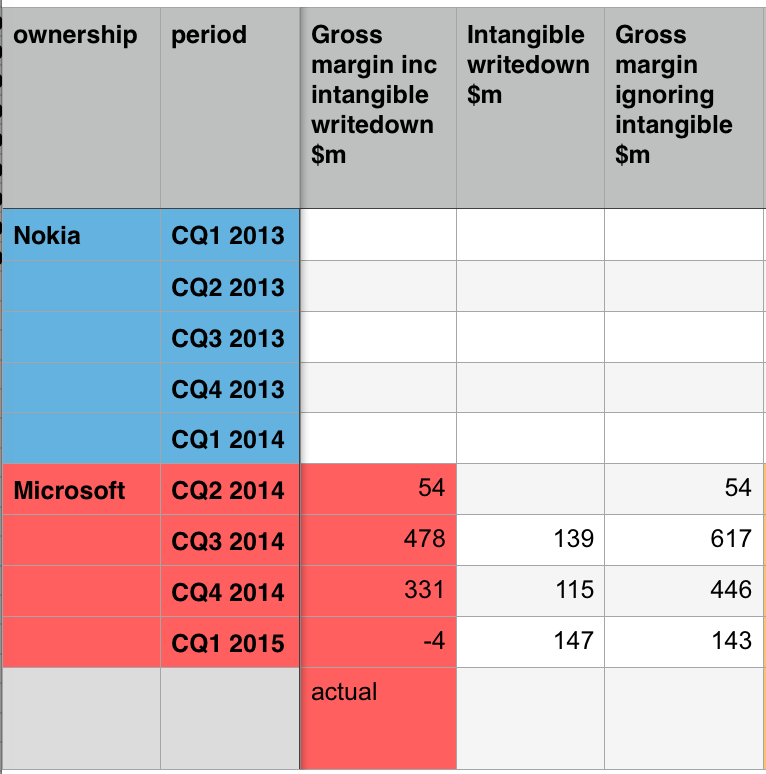
Phone Hardware revenue was $1.4bn in the third quarter of fiscal year 2015, as we sold 8.6m Lumia phones and 24.7m non-Lumia phones. We acquired NDS in the fourth quarter of fiscal year 2014. Phone Hardware gross margin was $(4) million in the third quarter of fiscal year 2015. Phone Hardware cost of revenue, including $147m amortization of acquired intangible assets, was $1.4bn.

For those unversed in accountancy notation, that “$(4) million” means “minus $4 million”. Accountants use brackets rather than a minus sign because it’s easy to overlook a minus sign and create a horrendous hash in your calculations.

For the nine months,

Phone Hardware revenue was $6.3bn in fiscal year 2015, as we sold 28.5m Lumia phones and 107.3m non-Lumia phones. Phone Hardware gross margin was $805m in fiscal year 2015. Phone Hardware cost of revenue, including $401m amortization of acquired intangible assets, was $5.5bn.

This does take some untangling. In my analysis, I’m going to ignore the writeoffs (amortisation) of intangible assets – essentially, goodwill (“how much more we paid than the physical assets are worth”) being written down. This actually makes the gross margin look better – as in, in positive territory. That’s a start.

Pause for history

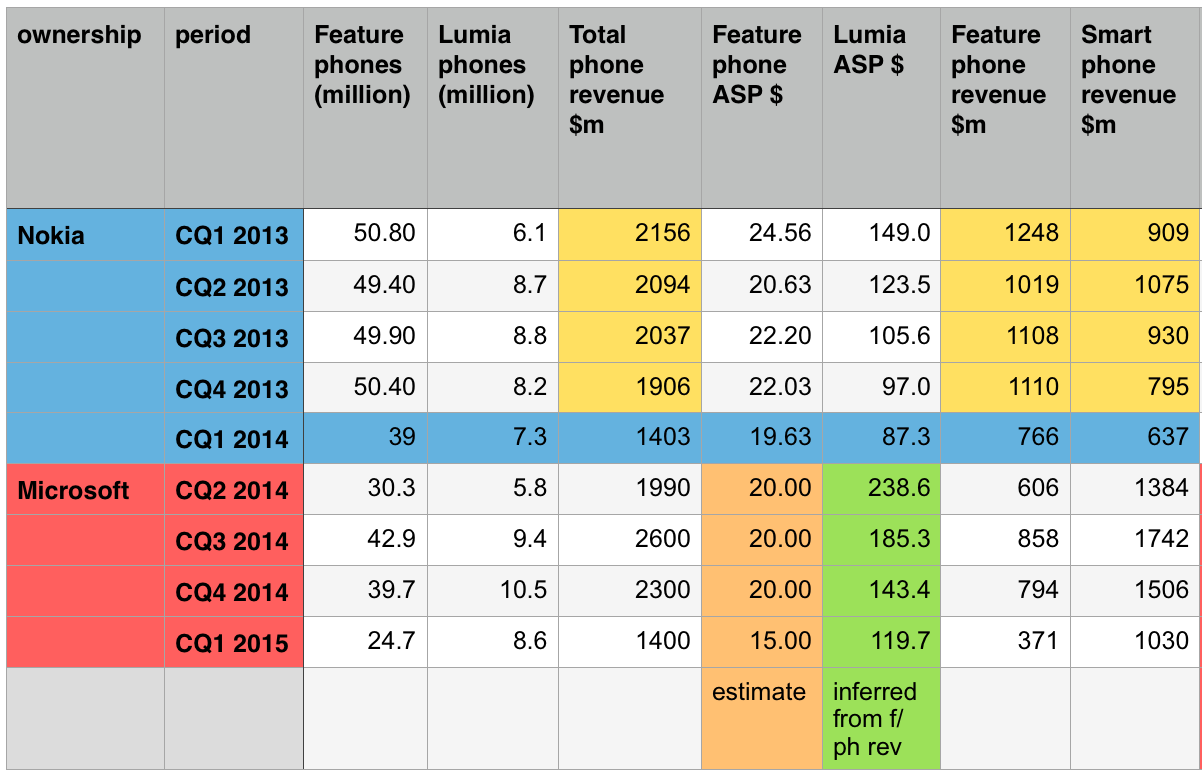
Some brief history. When Nokia made phones, it used to provide wonderfully detailed results, in which it would tell you how many featurephones and smartphones it had sold, and at what average selling price (ASP). This made it easy to see how its business was going. It didn’t give you gross margins – only operating margin for the whole phone business. In general, though, we knew its featurephone business was profitable, and that once it moved to the Windows Phone Lumia range, the smartphone side lost a ton of money.

Enter Microsoft, buying Nokia’s phone business – including featurephones – for €5.4bn, which was completed on April 25th 2014. That’s when the featurephone and Lumia sales start showing up in Microsoft’s results, and we shift to the “gross margin” measurement. (Microsoft does this because Steve Ballmer reorganised it to an Apple-style “apportion all cost across the board”, rather than making each division its own profit-and-loss fiefdom.)

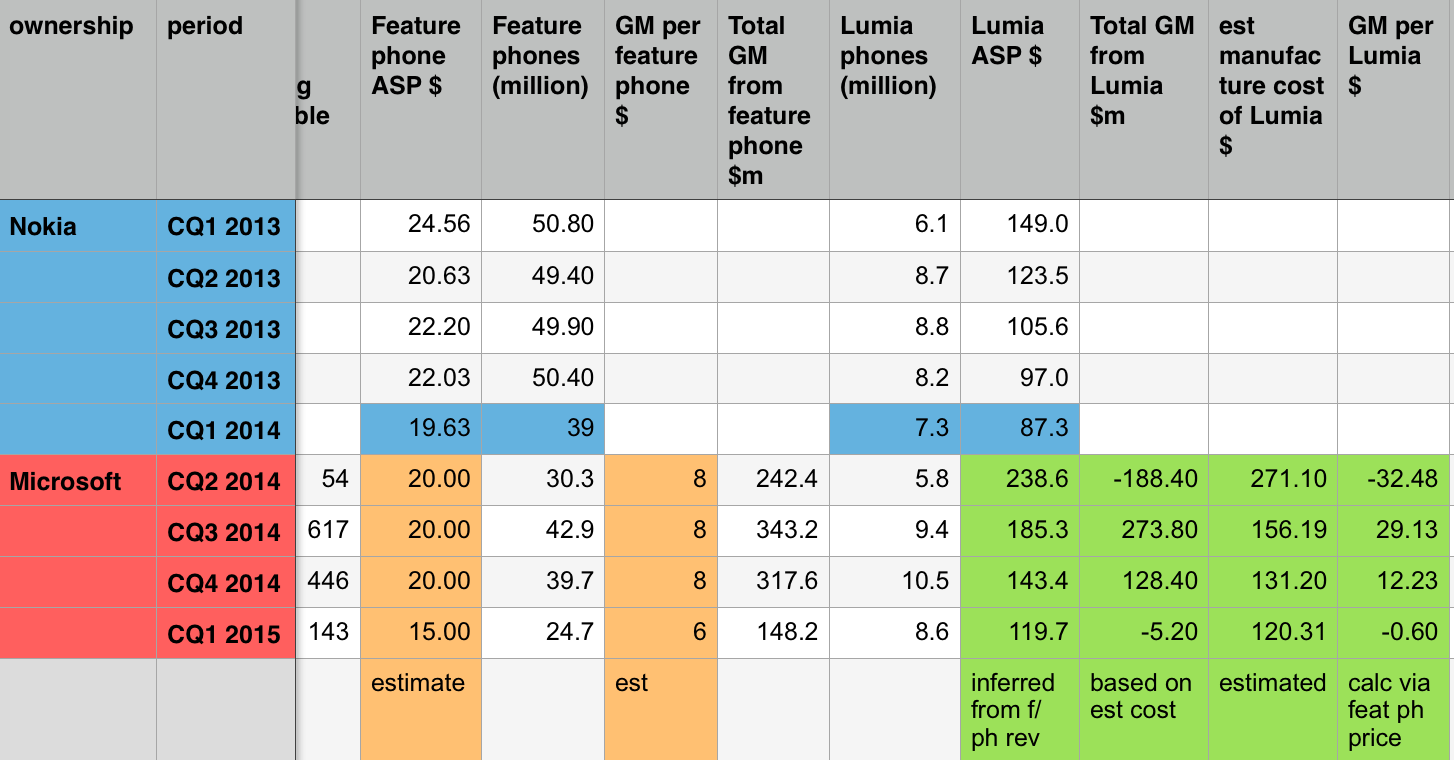
Given the Lumia ASP and sales figures at Nokia, you could work out the ASP of featurephones, and their contribution to revenues. What I’ve done in the table below is use Nokia’s featurephone and Lumia ASP (converted from euros to dollars at the prevailing rate at the end of each quarter) and try to carry that forward to estimate the recent ASPs of Lumia handsets under Microsoft’s ownership, and their contribution to revenues.

Featurephone and estimated Lumia ASPs

If you estimate the ASP for featurephones based on the Nokia numbers, you can figure out those for the Lumia phones at Microsoft.

A few things to note: I’m assuming that featurephone ASPs are falling. Even with that, there’s a clear fall in the ASP of the Lumia phones – from (a really quite high) $238 in the second calendar quarter of 2014 to the present. There hasn’t been a flagship phone released in that time, so perhaps not surprising.

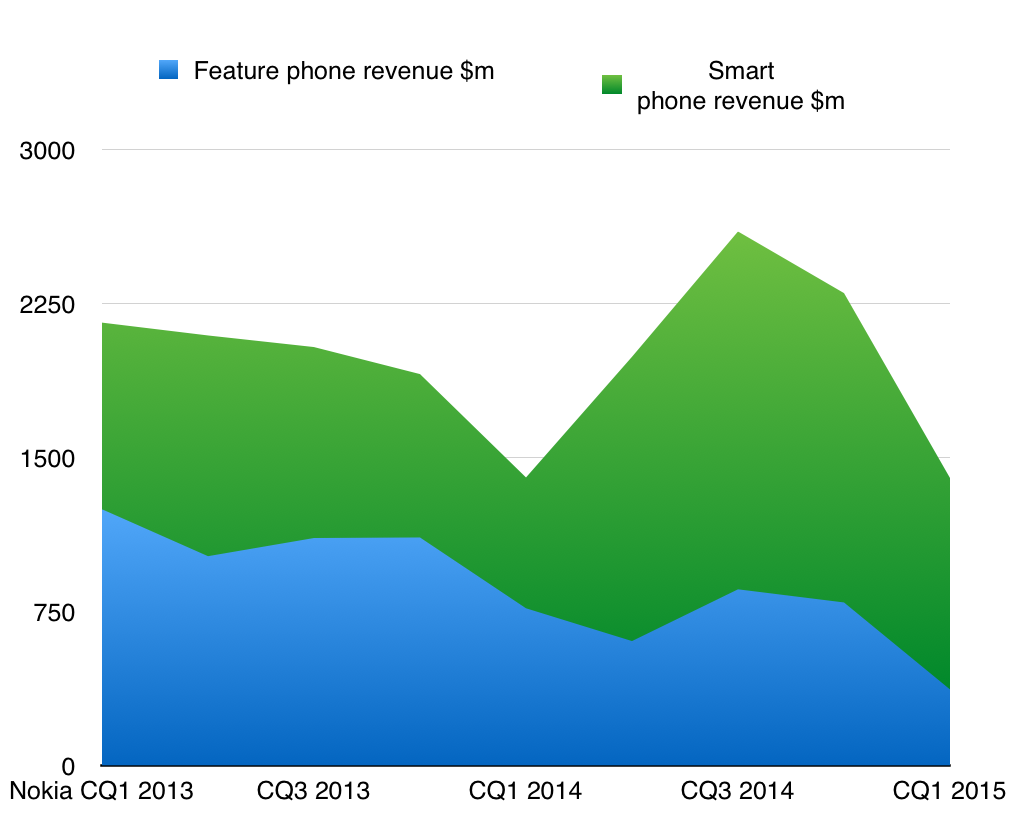
Also, smartphone revenue has flipped from being the minority source at Nokia to being the majority source now (even at $20 featurephone ASP, it’s still like that) because featurephone sales are collapsing, while those of smartphones are remaining fairly static – like this:

Estimated split of smartphone and featurephone revenue at Microsoft

Based on ASP assumptions, you can figure out how much revenue smartphones and featurephones generate. That’s not profit, though.

Now we move on, to seek out gross margin. There’s no data from Microsoft about the separate gross margins of the featurephones or Lumias. We don’t know how much they cost to build, or which might be profitable. So we have to use estimates and what people tell us.

Fortunately, we do have some indication of how profitable Nokia featurephones were. In an interview in April 2013, Nokia’s director of platform and content said that the profit margins on the $20 Nokia 105 were the same as those on the Lumia phones. How much might that be? Again, we don’t know, but it can’t be a lot. Putting it at $5 seems reasonable.

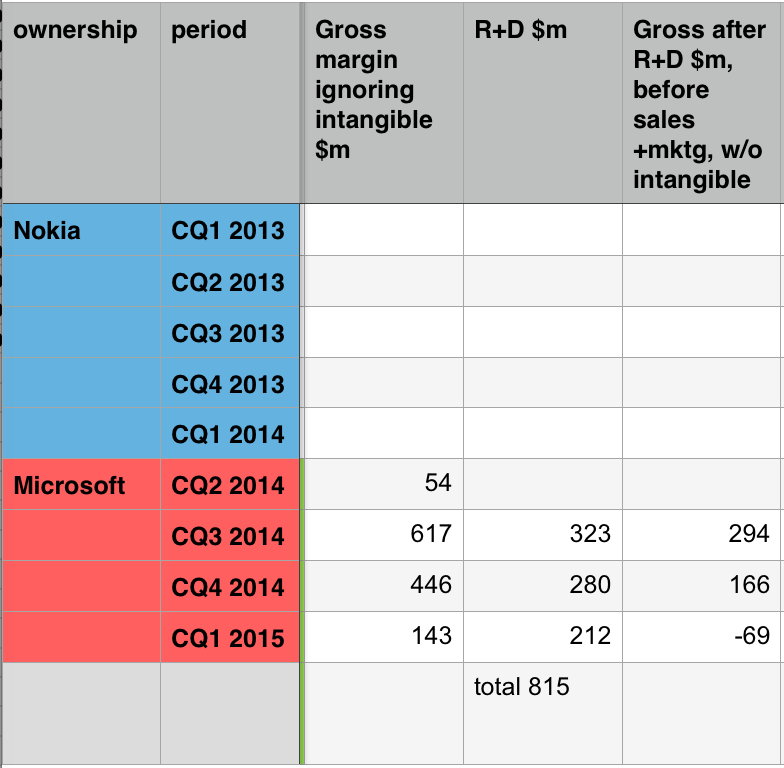
We have the figures for total gross margin; we also have the intangibles writeoff in the financials. So that gives us a “real” gross margin (ie the day-to-day gross margin for the quarter, excluding accountancy writeoffs):

Gross margin, excluding intangibles

Microsoft gives quarterly figures for intangible writeoffs; subtracting that gives the hardware gross margin.

Now we make assumptions about featurephone gross margin. I’ve gone for $5, falling to $4 as the average price of the handset falls from $20 to $15.

From this, and from the data we’ve got about total phone shipments, it’s quite simple to back-calculate to come out with figures for the total contribution to gross margin by featurephones and Lumias.

Progress! GM and profit gives Lumia data

If we assume per-handset profit on featurephones, we can use that with the GM data to figure out how much Lumias cost to make. And we have the ASP..

Which tells us what? The CQ2 figure is anomalous – Microsoft mentions an intangibles writeoff in that period, but doesn’t specify how much (unlike other periods). It’s likely the total gross margin was larger if you ignore that, which would put the gross margin per Lumia into the black.

What we also see is that even if we allow a miniscule per-handset gross margin for each featurephone, we see a rapidly falling gross margin for the Lumia line. Here’s an alternative scenario, if we think that the featurephones have a $8 gross margin, falling to $6 in the latest quarter:

What if featurephones have higher profit?

Giving a per-handset profit of $8 for featurephones makes the Lumia business look much worse. It’s unlikely, though.

On this higher profit for featurephones, the Lumia gross margin goes into negative territory. You can argue that’s too high a margin for a featurephone. Doesn’t matter though – the direction of travel is clear: the Lumia barely washes its face.

And this, don’t forget, is before you include the costs of sales and marketing – all those Lumia ads! – and research and development. Here’s the R+D impact:

Three months ended March 31, 2015 compared with three months ended March 31, 2014: Research and development expenses increased $241 million or 9%, mainly due to increased investment in new products and services, including NDS expenses of $212 million.

For the nine months:

Research and development expenses increased $694 million or 8%, mainly due to increased investment in new products and services, including NDS expenses of $815 million. These increases were partially offset by a decline in research and development expenses in our Operating Systems engineering group, primarily driven by reduced headcount-related expenses.

A little digging shows the R+D costs for the NDS (Nokia Devices and Services) segment by quarter. That gives us a sort of “halfway” operating profit once you deduct R+D, which shows that the division has moved into the red even before you consider sales and marketing costs.

R+D by quarter for Microsoft's mobile business

R+D numbers are mentioned in the quarterly 10Q. To get towards the operating profit (or loss), we need to subtract that.

That’s not profit

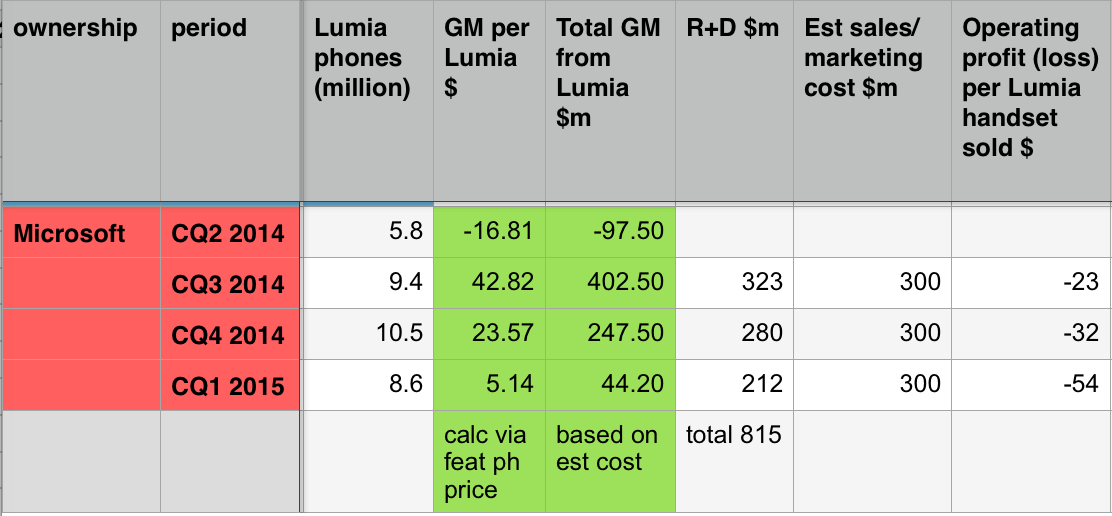
To figure out whether the handset division makes an operating profit we’d have to know the sales and marketing costs. It’s pretty improbable that those were anything less than $300m per quarter (that’s $10m per day, worldwide). Which means that Microsoft’s handset division has been loss-making since it took it over, despite those profitable featurephones, and ignoring the writedown of intangibles.

On a per-handset basis, if you allow $300m per quarter for sales and marketing (into which we’ll also roll administration), then you get a clear picture: Lumia handsets don’t make an operating profit at all.

Estimated per-handset loss for Lumias

Don’t forget, this relies on assumptions around featurephone profitability and price.

But hey, you say, that’s all assuming that featurephones are making $5 per handset. What if it’s $0? No problem – that’s the fun of spreadsheets. You can play with assumptions:

What if featurephones make $0?

Lumias still show a per-handset loss. (Remember this is with featurephone pricing of $15 in the latest quarter.)

OK, dammit – what if featurephones lose $5 per handset? Lumias still plunge into operating loss in the latest quarter – and remember, this is ignoring intangible writeoffs, and allowing just $10m per day worldwide for sales and marketing:

What if featurephones lose money?

Even at a $5 loss per featurephone, Lumias aren’t moneymakers at the operating level (on my assumptions).

You might have thought that Android handset makers had it tough, but at least – at the top end – they’re ekeing out something.

(Yes, these numbers are based on assumptions about featurephone pricing and margin, but I’d defend them as all being reasonable based on what we know about the business in the present and past.)

Update: thanks to Vlad Dudau of Neowin, who pointed me to Microsoft’s discussion of its results, where they say

We have made significant progress in reducing the operating expense base in the Phone business, moving from an annualized rate of $4.5bn at acquisition to a run rate under $2.5bn.

Opex is R+D plus sales+marketing and things like general+administration; an annualised run rate of $2.5bn is $625m per quarter – which is slightly more than I was allowing there. That would make the Lumia margins worse.

Microsoft adds:

That said, the changing mix of our portfolio to the value segment and the significant negative headwind from FX [foreign exchange rates] will impact our ability to reach operational break even in FY16.

So, no good news in the offing. (/Update.)

Why carry on, then?

Why, then, does Microsoft persist with Windows Phone? It can’t really think that it’s somehow going to come good and suddenly take off to challenge iOS and Android. The idea (which some outside Microsoft cling to) that the introduction of Windows 10, where apps can be written for both desktop and mobile, will suddenly lead to a huge uptake (by businesses?) is pie in the sky. Mobile and desktop have different design demands. Corporations with mobile needs haven’t been sitting on their hands for the past five years waiting for Windows Phone to reach a sort of maturity; they’ve been hiring people who can hook into their systems using iPhones and Android phones. Under Satya Nadella, Microsoft has recognised this, offering Office and other key software on rival platforms to capture (or retain) users and revenue.

You can’t justify it on “they’ll make it back in profits on services”; the 80m or so Lumia owners around the world aren’t the high-end users, but low-end ones who are less likely to spend on apps, or pricey Microsoft products.

So why? Two clear reasons. First, it’s important to keep playing in this space; Microsoft needs to have a mobile offering because it’s impossible to say where in the future a mobile-focussed offering might be key.

Secondly, though, is that more simple one: pride. Couple that with the inertia of a big organisation, and the fact that in the scheme of Microsoft’s profits the losses from the mobile division (about $500m, ignoring intangibles, over the past three quarters) are piffling, and there’s no reason to stop.

However, things could change. I’ve argued previously that Nadella should just give up on Windows Phone, and move to an Android fork. Not long after I argued that, Nokia (then still Finnish-owned) introduced the Nokia X, using Microsoft services and AOSP (Android without Google services on top). Microsoft rapidly killed it.

But now Microsoft is preinstalling its apps on the Samsung Galaxy S6 – and more importantly, has a “strategic partnership” with Cyanogen. The latter is a huge, and smart, move: it seems to me the easiest way for Microsoft to make a real impact on mobile.

If the Cyanogen move takes off, though, I could see Windows Phone withering. Why bother with loss-making hardware when you can piggyback on the world’s most successful mobile OS (that’s Android/AOSP) for the pure gravy of services profit? I wouldn’t.


Other posts you might find interesting:
Android OEM profitability, and the most surprising number from Q4 2014

Why Google’s struggles with the EC – and FTC – matter

How Gresham’s Law explains why news sites are turning off online comments


Start up: Wikipedia’s oldest hoaxes, Android’s audio problem, EC seeks transparent search, and more


No, adding these chips won’t make you smart. Less hungry, maybe. Photo by malias on Flickr.

A selection of 8 links for you. Spread them like butter from the fridge. I’m charlesarthur on Twitter. Observations and links welcome.

Android’s 10 millisecond problem: the Android audio path latency explainer » Superpowered

Gabor and Patrick, who founded the audio-based software company:

Even though music apps make up only 3% of all downloads in the iOS App Store, the Music app category is the 3rd highest revenue generating app category after Games and Social Networking. Which suggests that music apps monetize disproportionately well on platforms that offer low latency performance such as the App Store/iOS devices.
On Android, it is a different story. In the Google Play store, the Music category is not even a top five revenue producing app category.

The overwhelming majority of Android devices suffer from too high audio latency, preventing developers from building apps that would satisfy consumer demand on Android.

As such, Google and Android app developers are leaving billions of dollars on the table for Apple and iOS developers because of Android’s 10 Millisecond Problem.

For the purposes of this explainer, roundtrip audio latency is simply the difference in time between when an audio input is introduced into a mobile device, undergo some sort of needed processing, and exits the same device. As any musician will tell you, we as humans are most comfortable with latencies of ~10 milliseconds. Anything significantly higher tends to disturb us.

Most Android apps have more than 100 ms of audio output latency, and more than 200 ms of round-trip (audio input to audio output) latency. To give you a quick example from the Oscar winning film Whiplash, it’s like the drummer is dragging by a half beat behind the band!

This has been a problem on Android for years; the analysis suggests it may be insoluble. (List of latencies here; some are really long.) The discussion on Hacker News is worth browsing too. (Via Benedict Evans.)


The story behind Jar’Edo Wens, the longest-running hoax in Wikipedia history » The Washington Post

Caitlin Dewey:

On Monday night, [Gregory] Kohs [a former Wikipedia editor who is now a prominent critic] wrapped up an experiment in which he inserted outlandish errors into 31 articles and tracked whether editors ever found them. After more than two months, half of his hoaxes still had not been found — and those included errors on high-profile pages, like “Mediterranean climate” and “inflammation.” (By his estimate, more than 100,000 people have now seen the claim that volcanic rock produced by the human body causes inflammation pain.)
And there are more unchecked hoaxes where those came from. Editors only recently caught a six-year-old article about the “Pax Romana,” an entirely fictitious Nazi program. Likewise “Elaine de Francias,” the invented illegitimate daughter of Henry II of France. And the obvious, eight-year-old hoax of “Don Meme,” a Mexican guru who materializes at parties and mentors hipster bands…

…“I think this has proved, beyond a reasonable doubt, that it’s not fair to say Wikipedia is ‘self-correcting,’” Kohs said.


We put a chip in it! » Tumblr

It was just a dumb thing. Then we put a chip in it. Now it’s a smart thing.

Such as for example these socks:


Elon Musk had a deal to sell Tesla to Google in 2013 » Bloomberg Business

Ashlee Vance, with an extract from a forthcoming book:

“The word of mouth on the [Model S] car sucked,” Musk says. By Valentine’s Day 2013, Tesla was heading toward a death spiral of missed sales targets and falling shares. The company’s executives had also hidden the severity of the problem from the intensely demanding Musk. When he found out, he pulled staff from every department — engineering, design, finance, HR — into a meeting and ordered them to call people who’d reserved Teslas and close those sales. “If we don’t deliver these cars, we are f—ed,” Musk told the employees, according to a person at the meeting. “So I don’t care what job you were doing. Your new job is delivering cars.”
Musk fired senior executives, promoted hungry junior employees, and assigned former Daimler executive Jerome Guillen to fix Tesla’s repair service and get its glitchy cars back on the road. He also proposed what eventually became his public guarantee of the resale price of the Model S: Unsatisfied buyers would get their money back from Musk personally if they couldn’t sell their car at a price comparable to that of another luxury model.

When in charge at Microsoft, Bill Gates used to insist that executives bring him at least one piece of bad news along with any good news. This is what happens when they don’t. Good on Musk getting the turnaround to happen through such a resourceful approach, though. Ah, but what might have been for Google.


EU to investigate transparency of Internet search results: document » Reuters

Julia Fioretti:

In a draft of the Commission’s strategy for creating a digital single market, seen by Reuters, it says it will “carry out a comprehensive investigation and consultation on the role of platforms, including the growth of the sharing economy.”
The investigation, expected to be carried out next year, will look into the transparency of search results – involving paid for links and advertisements – and how platforms use the information they acquire.

European Commission Vice-President Andrus Ansip is expected to formally announce the new strategy on May 6.

The transparency of search results came under particular scrutiny this week when the European competition chief accused Google of cheating competitors by distorting web search results to consistently favor its own shopping service.

There are concerns in Europe over how Internet companies such as Facebook and Amazon use the huge amounts of personal data they acquire.

The inquiry will also look at how platforms compensate rights-holders for showing copyrighted material and limits on the ability of individuals and businesses to move from one platform to another.

Don’t hold your breath for when this will report, though, or whether any of it will be implemented.


China smartphone shipments shed 30% sequentially in 1Q15 » Digitimes Research

Kristina Shih:

Shipments of smartphones by China-based vendors declined by nearly 30% sequentially to 91.8m units in the first quarter of 2015 due to sluggish demand both at home and overseas, as well as reduced production affected by the traditional Lunar New Year holidays, according to Digitimes Research.
Vendors which have a high ratio of export sales saw their shipments decline by over 40% sequentially in the first quarter, and those which focus more on the domestic market suffered declines ranging from 20-25%, Digitimes Research has found.

Huawei’s shipments were less affected by market factors, reaching 13.5m units in the first quarter and making the company the number vendor in the quarter. Xiaomi came in second with shipments totaling 10m units as it lowered the prices of some old models to boost sales.

Of course sequential changes don’t matter when you’re trying to analyse larger trends, but they hurt Digitimes’s intended audience of supply chain companies. That’s quite a drop; usually total worldwide mobile phone sales drop by about 10% from Q4 to Q1.


Instagram develops app for Apple Watch » FT.com

Tim Bradshaw and Hannah Kuchler:

Instagram, which built a billion-dollar business on smartphones, is making its first foray into wearable technology with a new app for the Apple Watch.
The popular photo-sharing app, which is owned by Facebook, will use the smartwatch to help users keep up with their closest friends through alerts as soon as they post a picture…
…“I think the Watch is really about quick information and notifications,” [Instagram designer Ian] Silber told the Financial Times. “It’s a huge use case that’s going to be a little bit different.”

So there’s going to be a version for a device that has only just launched, while the Windows Phone version hasn’t been updated for over a year. The power (or lack of it) of an ecosystem.


The great mobile divergence: how the app universe went beyond universal apps » John Kneeland

Kneeland nails the point that I also made: that just because app developers can write once for any Windows version (phone, PC, Xbox) doesn’t mean they will:

The value of a universal app is that you could write an app and have it easily working on all Windows platforms. If I had a bank app, an airline booking app, a casual game, or another app I was already planning on making for PCs, then sure, the idea of universal apps makes sense…
But what good is a Lyft app on a desktop? What good does the Luxe parking app do on my Xbox? What would Instagram even do on my ThinkPad? How could I use a barcode scanning price comparison app on a PC tethered to my desk? Is a PC going to count my steps or monitor my heart-rate in real-time? Can it help me navigate traffic with Waze? What good is a Starbucks card app (or any store app, or any mobile payments solution for that matter) going to do on a device that isn’t mobile? Heck, what would Grindr do if limited to a desktop—find romantic leads within my specified IP address blocks?

(Thanks Tero Alhonen.)


Start up: spotting comment trolls, stopping piracy Of Thrones, where’s Android One?, and more


Try putting those on Bittorrent, suckahs. Photo by Jemimus on Flickr.

A selection of 8 links for you. Use them wisely. I’m charlesarthur on Twitter. Observations and links welcome.

Scientists develop algorithm that can auto-ban internet trolls » The Stack

Martin Anderson:

The study found that on CNN the studied trolls were more likely to initiate new posts or sub-threads, whilst at Breitbart and IGN they were more likely to weigh into existing threads.

The report does not exonerate host communities of all blame for troll behaviour, finding that immediately intolerant communities are more likely to foster trolls:

“[communities] may play a part in incubating antisocial behavior. In fact, users who are excessively censored early in their lives are more likely to exhibit antisocial behavior later on. Furthermore, while communities appear initially forgiving (and are relatively slow to ban these antisocial users), they become less tolerant of such users the longer they remain in a community. This results in an increased rate at which their posts are deleted, even after controlling for post quality.”

Seems mostly accurate, apart from calling breitbart.com a “political hub”. I’d go for “troll-employing troll magnet”, personally.


Game Of Thrones leak and watermark: a stupid tracking system » bru’s blog

The first four episodes of game of thrones leaked nearly 36 hours ago. They have been extensively downloaded, and the only tracking set up HBO seemed to be a watermark in the bottom left corner of the screen. Once blurred, it is useless. This impresses me. It’s 2015 and all you’re using is a “confirm you’re deleted” + “your copy is watermarked” for protection? There are simple schemes that would have allowed HBO to track the leak.

The idea is very simple: make each copy unique in a non-visible way.

Seems like the editing to create unique copies would be a hassle. Not sending them out (by getting people to come in to previews?) might be simpler. But there would be geographic reasons against that. No matter what, though, it only delays the piracy by 36 hours or so. That’s the bigger problem.


BOMBSHELL: MUSL employee might have rigged Hot Lotto computerized drawing » Lottery Post

Prosecutors countered this motion by claiming they have a “prima facie,” or at first glance, case that Tipton tampered with lottery equipment.

In their reply to the defense’s motion, prosecutors argued that Tipton’s co-workers said he “was ‘obsessed’ with root kits, a type of computer program that can be installed quickly, set to do just about anything, and then self-destruct without a trace.” The prosecution claimed a witness will testify that Tipton told him before December 2010 that he had a self-destructing root kit.

Prosecutors also argued in their reply that Tipton was in the draw room on Nov. 20, 2010, “ostensibly to change the time on the computers.” The prosecution alleged the cameras in the room on that date recorded about one second per minute instead of how they normally operate, recording every second a person is in the room.

“Four of the five individuals who have access to control the camera’s settings will testify they did not change the cameras’ recording instructions; the fifth person is Defendant,” the prosecution wrote.

Someone’s writing the screenplay already, yes? The accused bought a ticket that won $14.3m.


What’s Become of Android One? » CCS Insight

Peter Bryer is an analyst:

our checks indicate that Android One has had a limited direct effect on the market, despite initial enthusiasm for the programme. Sales of Android One-based smartphones began more than half a year ago in India, but volumes don’t stand out.

The first Android One products came from Karbonn, Micromax and Spice, with more familiar brands expected to begin adopting the platform. Acer, Asus, HTC, Lenovo and Panasonic were among the smartphone manufacturers listed by Google as partners in the project, but this interest appears to have stalled.

The fading momentum of Android One is an indication of the expanding selection of equally well-specified, low-cost smartphones and tablets in emerging markets. Hundreds of models are available at $100 or below — a once impossible price band has become very ordinary.

The standard having been set, others have matched it. All works for Google. But see later…


Flipkart’s move to dump mobile site could hit Google » WSJ

Rolfe Winkler:

Indian e-commerce giant Flipkart has decided it doesn’t need to rely on the Web to lure shoppers, dumping its mobile site and pushing visitors to its app. That move may spell trouble for the future of Google ‘s cash-cow search engine, which relies heavily on links to shopping sites.

Smartphone users that go to the mobile websites of either Flipkart or its sister site Myntra no longer see the same virtual store shelves as when they visit those sites from a personal computer. Instead they see a message to download the sites’ mobile apps.

The problem for Google is that a large percentage of its ad business is driven by paid links that direct users to e-commerce sites. But mobile apps are walled gardens unto themselves, unconnected by links to the broader Web.

A general problem, but if it starts happening early in countries like India, that is a problem for Google.


Brazil’s iPhone investment falls short on promises of jobs, lower prices » Reuters

Brad Haynes:

The Brazilian iPhone was meant to mark a new era.

When Taiwan’s Foxconn Technology Group agreed in April 2011 to make Apple products here, President Dilma Rousseff and her advisers promised that up to $12 billion in investments over six years would transform the Brazilian technology sector, putting it on the cutting edge of touch screen development. A new supply chain would be created, generating high-quality jobs and bringing down prices of the coveted gadgets.

Four years later, none of that has come true.

Foxconn has created only a small fraction of the 100,000 jobs that the government projected, and most of the work is in low-skill assembly. There is little sign that it has catalyzed Brazil’s technology sector or created much of a local supply chain.

Not quite clear where the blame lies – high expectation by Foxconn, local taxes or local culture.


Formal charges may be next in Europe’s Google antitrust inquiry » NYTimes.com

James Kanter and Conor Dougherty:

Some experts say that Mr. Almunia’s unsuccessful strategy makes further attempts to settle the case without formal charges unlikely.

“Given the history of failed attempts to reach a commitment decision, I just don’t see what she would gain from going down this route again, unless Google has promised more concessions that we don’t know about,” said Liza Lovdahl-Gormsen, the director of the Competition Law Forum at the British Institute of International and Comparative Law.

Without formal charges, Ms. Lovdahl-Gormsen said, “Google might try to buy themselves time by offering commitments that are unlikely to be accepted by the commission, and that it knows won’t be accepted by the market, simply because it does not want to be faced with the instrument of torture — the statement of objections.”

Expect news on Wednesday.


My voice is my passport: Android gets a “Trusted Voice” smart lock » Ars Technica

How secure is this system? We’re wondering the same thing. The popup when you enable “Trusted Voice” warns that the feature is not as secure as a traditional lock screen and that “Someone with a similar voice or a recording of your voice could unlock your device.” We’d love to test it out, but it hasn’t rolled out to any of our devices yet—we only know about it thanks to a report from Android Police.

Android Police hasn’t given it any scrutiny (none of its devices – even Nexuses – seem to have got it.) The commenters on AP don’t seem enamoured, though, pointing out how easy it would be to spoof (as Google itself admits). So there’s now pattern, PIN, face and voice unlock, and also “trusted device” (Android Wear). Flexibility is good, but they aren’t all equally robust, which feels like a problem.