Samsung knows how many replacement batteries it sells. Which is why the S6 doesn’t have one


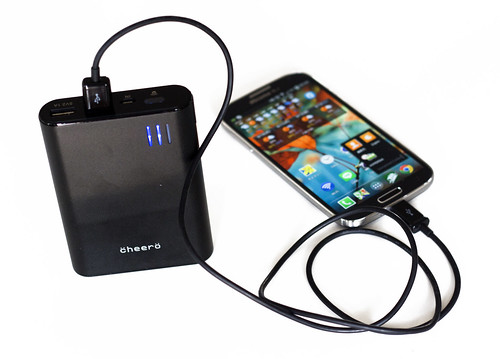
A replaceable battery for the S6. Photo by japanexpertena.se on Flickr.

I’m interested to see the result of this poll on Android Pit, which asks Samsung owners how important a replaceable battery and (separately) microSD card is to them.

Part of my interest is that I helped inspire it, through a conversation on Twitter. Modest, moi?

Ever since it was announced that the Galaxy S6 wouldn’t offer either a removable battery or a microSD slot, there was all sorts of kerfuffle on tech blogs, and the comments therein: people said that they bought Samsung stuff specifically for those elements, and that those were key things which set them apart from the (reviled, in their eyes) iPhone range, which has never offered a removable battery or slot-in storage.

However, I’m pretty sure that Samsung’s move is not only idealistic – not having to make the back removable avoids all sorts of design compromises – but also driven by clear data.

Consider this: Samsung knows exactly how many Galaxy S phones it has sold. It also knows exactly how many replacement batteries it has sold – it certifies them or similarly gets data from any company that’s selling it with its name. So that’s the battery story sorted. (See the update below if you’re just now saying “ah, but third-party batteries…”)

I suspect that it also gets analytics on the use of microSD cards – anonymised, of course – since I know that it gets that sort of data about stylus use on the Note series (apparently about 10% of users ever use the stylus).

In which case, its decision to dump removable batteries and microSD cards is simply one where it knows a few people will be upset, but the vast majority won’t. And that once again will show that people who make a lot of noise on the various tech blogs (whether above or below the line) may feel keenly about these issues, but aren’t necessarily representative of wider use. (The comments on that Android Pit story are typical: people annoyed about the change, but no clarity on what they’ll do instead.)

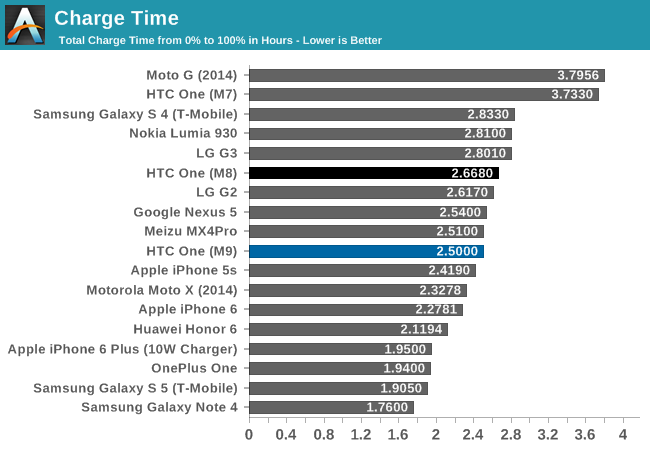
I’ve long felt anyway that the arguments about replacement batteries don’t hold water. External battery chargers are comparatively cheap, and don’t require you to take the back off your phone and the battery out (which immediately means your phone has to be restarted). And a good point made by Janak Parekh via Twitter: Samsung has focussed on fast recharging for the S6. (I’ve been impressed for some time by how quickly iPhones recharge. I haven’t seen it documented in comparative benchmarks, though. Update: but of course Anandtech, the site for which nothing is not worth a benchmark and a graph, documents it. Here’s the chart comparing how quickly various top-end smartphones recharge, in its HTC M9 review: it shows that the Galaxy S5 and Note 4 have the fastest recharge times, about 10% faster than the iPhone 6.)

Similarly on the microSD point: Google offers a lot of free cloud storage, and so does Dropbox, and I don’t buy the idea that you really need to have a bazillion gigabytes of music on your phone all the time. 1GB of music is 1,000 minutes of listening time, or over 16 hours. And that’s not very much to have devoted to music. When you get back in range of Wi-Fi, you can download a whole new lot.

The direction there is only towards more availability of cloud storage, not less – so, away from microSDs. (What’s more, microSD cards are amazingly fiddly and easy to lose.)

So I don’t think that the absence of these elements is going to significantly affect sales of the S6.

However, that doesn’t mean that I think the S6 is necessarily going to do gangbusters. It’s much too early to say that. Samsung’s position at the top end is being chewed in China and elsewhere by the iPhone 6 and 6 Plus, and from below by Xiaomi and local vendors. It’s going to be a tough row to hoe.

Update: plenty of responses on Twitter (as well as here). Let’s deal with a couple.

1) “Samsung doesn’t know about sales of third-party batteries”

You know, I think a company the size of Samsung might have the resources to carry out a bit of market research to find out how many third-party batteries fitting its specification are being sold.

And I’m not denying that there are people on Twitter who have bought replacement batteries and are happy with them. That’s not my point. My point is that I suspect Samsung has taken a careful look at how pissed off people are going to be if it doesn’t allow replaceable batteries, and concluded – based on sales data – that actually it’s not going to be that much of the Galaxy-buying population. I don’t see why people are struggling with the idea that a big company that’s not called Google might be data-driven in some of what it does.

Another bonus for Samsung, pointed out by @misterleoni:

https://twitter.com/misterleoni/status/582114795052265472

Certainly, being sure that you can keep “OMG SAMSUNG BURNT DOWN MY HOUSE” stories out of the papers has its attractions. Also, for the makers of third-party batteries, there’s the chance instead to move up the value chain by developing a brand around their external battery (as in the picture at the top of this piece): much better margins doing that than being some faceless unknown inside a phone.

2) “Dammit, I need an SD card for my 200GB of music!”

Again, if you’ve got 200GB of music then you’re such an outlier you can’t see the shore any more. Some data from 2011, looking at the “average” iTunes library, found that the average person (who uploaded their list, so self-selecting, so likely larger) had 7,160 tracks in their library. At 4 minutes per song, that works out to 28GB. (At 1 min = 1MB.) I think that’s an exaggeration too – people in this Yahoo Answers thread offer much smaller numbers. I’d suggest it’s likely closer to 5GB or 10GB, like the early iPods.

So again, I’m not saying there aren’t people who want or need microSD cards to store their music or photos. I’m saying that I think Samsung has looked at the market, and is taking a decision based on that.

Of course, there’s another possibility, which is that almost everyone wants removable batteries and microSD cards, and that Samsung has decided to spite them all by forcing them to buy non-replaceable ones to force an upgrade (or costly repair), and force them to buy pricey inbuilt storage. (Well, the latter certainly works for Apple.) But that’s so customer-hostile for a company that’s in straitened times, in smartphone terms, that it fails Occam’s Razor. So I’ll stick to the simpler answer: it’s the result of analysing data, and getting simple answers that allow some design compromises (backs that come off, slots for slow microSD cards) to be jettisoned.

Start up: Meerkat v Periscope, three new iPhones?, life as a Russian troll, and more


Ahoy there! Periscope is getting noticed. Photo by zoonabar on Flickr.

A selection of 9 links for you. Go on, count them. I’m charlesarthur on Twitter. Observations and links welcome.

Censoring myself for Apple » Marco.org

Marco Arment, on the suggestion that people (especially developers) writing about Apple self-censor so that they won’t be treated vindictively:

every Apple employee I’ve spoken with has not only been receptive of criticism, but has practically begged for honest feedback from developers. The idea that you’d be penalized in the App Store for being critical of Apple on your blog is ridiculous and untrue.

Apple employees are also humans, Apple users, and often former or future independent app developers. Chances are very good that any criticism we have is also being criticized and debated inside Apple. Employees can only exert so much influence inside the company, and they need people like us to blog publicly about important issues to help convince the higher-ups to change policies or reallocate resources. One of the reasons I don’t expect to ever take a job at Apple is that I believe I can be more effective from the outside.

My experience is that highlighting things that are going wrong with outside developers leads to them being treated better. Apple notices this at a high level.


Apple and Synaptics: a convergence in the force » Forbes

Patrick Moorhead, pointing out that Synaptics has had a “force touch” trackpad for a little while, and is in fact moving to its second generation – but Windows OEMs haven’t adopted it:

The rest of the Windows notebook industry will likely be forced to follow Apple and Hewlett-Packard’s lead and start to adopt force touchpads. Also, they will very likely use physical haptic feedback as well, at least on high-end and mid-range designs as it delivers a superior experience. Many Windows notebook OEMs will be seen as copying Apple’s Force Touch touchpad design, but the reality is that Apple isn’t quite the first to market with this technology even though they may have perfected it first.

Also needs support in Windows: will Microsoft get that into Windows 10?


Available storage on 32GB Galaxy S6 will be just over 23GB » SamMobile

Those who go with the 32GB Galaxy S6/S6 edge will have slightly more than 23GB storage available for their apps, files, music, movies and other content. That’s after hooking up a Google account with the device and updating all of the pre-installed apps. Extrapolating this figure shows that users should expect about 55GB free on the 64GB model and around 119GB free on the 128GB model. The numbers might vary based on the region and carrier so these are just ballpark figures.

By comparison, the iPhone 6 OS seems to take up about 3GB. What’s eating up those 9GB?


16 smartphones that were deemed ‘iPhone Killer,’ 2008-2011 » Yahoo Tech

Jason Gilbert:

After the first iPhone came out in 2007, tech publications rushed to identify the phone that would be the “iPhone killer.”

SPOILER: Apple sold more than 190 million iPhones last year. It is safe to say that the iPhone has not, in fact, been killed. 

Terrific list (and you can work out how easy it was to put together once he’d had the excellent idea of doing it). Arguably, though, the Galaxy S2 (in 2011) really made a difference.


EU to open extensive e-commerce sector probe » WSJ

Tom Fairless:

The inquiry, announced Thursday by the EU’s antitrust chief Margrethe Vestager, follows pressure from France and Germany to use EU competition rules and other regulations to better target the business practices of large technology firms.

And it is part of a broader EU strategy to knit together the bloc’s fragmented online ecosystems into a digital single market. Policy makers hope that will help European Internet firms to build their clout to better compete with US web giants like Google and Facebook.

The antitrust investigation, encompassing all 28 EU countries, aims to establish whether some companies are raising contractual or other barriers to limit how consumers can shop online across EU national borders, Ms. Vestager said at a news conference.

It could lead to cases against individual companies that are suspected of abusing their dominant market position to restrict trade, in violation of EU law.


Three phases of consumer products » Medium

Arjun Sethi:

There are three phases. Consumer products start as a want then turn into a need. In the final phase, which most don’t get to, they evolve into a utility. Here’s how I define the three phases:

• Want — Solves a core value proposition that’s very unique and feels like a novelty.
• Need — People can’t live without it and keep coming back for more.
• Utility — It becomes a feature of other products.

The fastest growing consumer products have already gone through these phase,s while the up and coming ones are in the middle of one of these three phases right now. Facebook and Twitter are great examples of growing companies with large user bases that have gone through or are in the middle of this progression…

The ones that become huge are the ones that take the core and spread it out over time. You can’t get there over night and you don’t start by creating the network from day one. You start by creating a novel, memorable experience for people. Most ideas are fun or stupid with a core value proposition and over time they become a utility as they get embedded to become culture.


One professional Russian troll tells all » Radio Free Europe

Dmitry Volchek and Daisy Sindelar:

There are thousands of fake accounts on Twitter, Facebook, LiveJournal, and vKontakte, all increasingly focused on the war in Ukraine. Many emanate from Russia’s most famous “troll factory,” the Internet Research center, an unassuming building on St. Petersburg’s Savushkina Street, which runs on a 24-hour cycle. In recent weeks, former employees have come forward to talk to RFE/RL about life inside the factory, where hundreds of people work grinding, 12-hour shifts in exchange for 40,000 rubles ($700) a month or more.

St. Petersburg blogger Marat Burkhard spent two months working at Internet Research in the department tasked with clogging the forums on Russia’s municipal websites with pro-Kremlin comments. In the following interview, he describes a typical day and the type of assignments he encountered.

Choice quote:

You have to just sit there and type and type, endlessly. We don’t talk, because we can see for ourselves what the others are writing, but in fact you don’t even have to really read it, because it’s all nonsense. The news gets written, someone else comments on it, but I think real people don’t bother reading any of it at all.

Modern salt mines, but much better pay and conditions.


Periscope review: does Twitter’s live-streaming service beat Meerkat? » The Guardian

Alex Hern points to an interesting contrast:

not every comparison between Periscope and Meerkat is fair. In some places, the app has zigged where its competitor has zagged.

That’s no clearer than when you finish a live session, and Periscope pops up a screen which says “preparing for replay”. There’s no ephemerality here (at least, not by default). When a stream is over, it can be rewatched by viewers who missed their chance first time around, and everything – the comments, hearts, and new-viewer notifications – plays out as-live.

“We didn’t want you to miss the experience, we thought it was special because it was live,” explains [Keyvon] Beykpour [Periscope’s co-founder]. “I still believe that, but we want to balance that with practicality. The synchronicity problem” – ensuring that viewers are available at the same time the streamer is – “is hard. There just is a significant drop-off with that problem.

“The true test for us has been does it decrease the percentage of people who watch live, and the answer I think is no. If you’re watching live, given how low latency the product is, you can change what’s happening.”

But one reason why Meerkat has no replay function is to make sure that people who have never streamed themselves before feel comfortable giving it a go. “To do that we wanted to make sure that you feel like you control the content,” said Meerkat founder Ben Rubin at this year’s South by South West festival. “If we want you to go a little bit outside your comfort zone, we want to make sure that you control the content. We want to make sure that people feel comfortable to stream their grandson’s soccer game on a Sunday afternoon.”

Retention versus ephemerality. I wonder if Meerkat will attract a younger demographic, like Snapchat?


Apple to release 3 iPhone models in 2H15 » Digitimes

Rebecca Kuo and Alex Wolfgram:

Apple will release three different iPhones in the second half of 2015, the iPhone 6S, iPhone 6S Plus and a 4-inch device currently being referred to as iPhone 6C, according to industry sources.

All of the handsets will come equipped with LTPS panels and supply for the iPhone 6S Plus and iPhone 6C will come from Japan Display, Sharp and LG Display while that for the iPhone 6S will come from Japan Display and LG.

All of the devices will come equipped with Corning Gorilla Glass, the sources said, adding the 6S series will use A9 chips and the 6C A8 chips. All of the devices will come equipped with NFC and fingerprint scanning technologies.

All makes sense – the 4in device, the fingerprint, the NFC.


Start up: FTC rebuts critics, Mars One or Capricorn One?, failures of tech criticism, how open is ResearchKit?, and more


Flooded view in Oxford. Photo by the.approximate.photographer on Flickr.

A selection of 9 links for you. None includes Jeremy Clarkson or One Direction. I’m charlesarthur on Twitter. Observations and links welcome.

Statement of Chairwoman Edith Ramirez, and Commissioners Julie Brill and Maureen K. Ohlhausen regarding the Google Investigation » Federal Trade Commission

The Federal Trade Commission conducted an exhaustive investigation of Google’s internet search practices during 2011 and 2012. Based on a comprehensive review of the voluminous record and extensive internal analysis, of which the inadvertently disclosed memo is only a fraction, all five Commissioners (three Democrats and two Republicans) agreed that there was no legal basis for action with respect to the main focus of the investigation – search. As we stated when the investigation was closed, the Commission concluded that Google’s search practices were not, “on balance, demonstrably anticompetitive.”

Contrary to recent press reports, the Commission’s decision on the search allegations was in accord with the recommendations of the FTC’s Bureau of Competition, Bureau of Economics, and Office of General Counsel.

Some of the FTC’s staff attorneys on the search investigation raised concerns about several other Google practices. In response, the Commission obtained commitments from Google regarding certain of those practices.  Over the last two years, Google has abided by those commitments.

I’d just like the full report published. Or reports – there seem to have been one from the competition bureau and one from the economic bureau.


Winter testing of the Oxford Flood Network » Nominet R&D blog

Bryan, who helped build it:

It’s been an extremely useful period for us all and in particular we’ve learnt a great deal about deploying devices in real conditions.

There are the hardware considerations: dull but important issues such as fixings become all important; how exactly do you fix a sensor to a disused 60cm cast iron pipe? (see photo below for the answer)

There are the radio considerations: how do you realistically achieve a 250m connection across wooded areas?

There are system deployment considerations: how do you remotely reboot a Raspberry PI gateway that is held securely in someone else’s property?

And there are some basic user interface considerations: how big do the buttons on a mobile app need to be when your fingers have gone numb from standing in a wet muddy field in December? 

The key thing to remember about the Internet of Things is that it is where the physical world meets the digital world. The physical world is complex and messy. A warm, protected office (where applications are inevitably built) can hide that messy world.

I find this enormously encouraging. Flood level and river data is the one key public dataset that the Environment Agency still won’t make publicly available for free commercial reuse; it’s been a sticking point for the Free Our Data campaign (nine years old this month, but pretty much sorted since 2010). Let’s get it sorted.


Mars One finalist speaks out, says Dutch non-profit likely scamming its rubes » Ars Technica

Megan Geuss:

there was an insidious side to the dream that Mars One put forward. So much of it didn’t add up. The $6 billion budget seemed ridiculously low, and the company was light enough on details and partnerships to suggest that something was either very secret or very suspect.

[Joseph] Roche [a professor at Dublin’s Trinity School of Education, with a PhD in physics and astrophysics, and a Mars One finalist] now seems to think it’s the latter, saying that not once did he ever meet with someone from Mars One in person, despite the fact that he was selected to be one of the “Mars One Hundred”—the lucky 100 people who advanced to the next level in the competition over spaceship seats.

The professor told Keep that ranking within Mars One is points-based; when you are selected to advance through the application process, you join the “Mars One Community,” and you are given points as you move through each next level. The points are arbitrary and have nothing to do with ranking, but “the only way to get more points is to buy merchandise from Mars One or to donate money to them,” Roche told Keep. So, in essence, people are likely paying their way to a final round.

Even so, that’s not going to raise $6bn, unless they’ve got Bill Gates aboard. (Have they?)


BlackBerry is about to hit bottom » Quartz

Dan Frommer:

BlackBerry’s turnaround strategy—focusing on software as its smartphone business has declined—has not been pretty. But the worst may be here.

When BlackBerry reports its fourth-quarter results on Mar. 26, it could post its lowest revenue number in nine years. That’s the warning from RBC analyst Mark Sue in a research note this week.

Sue predicts that BlackBerry’s fourth-quarter sales could drop to $661m, down 32% year-over-year and well below the Wall Street consensus of around $800m. BlackBerry hasn’t reported revenue that low since 2006, just as the smartphone industry was set to explode.

But after you hit bottom, you rise. At least that’s what RBC is forecasting, along with 1.3m phones shipped and perhaps a little profit in the future. (BlackBerry’s results are on Friday.)


The Taming of Tech Criticism » The Baffler

Evgeny Morozov reviews Nick Carr’s new book “The Glass Cage”, and makes many insightful points about how much technology criticism (including, he argues, Carr’s) can’t see the wood for the trees:

Take our supposed overreliance on apps, the favorite subject of many contemporary critics, Carr included. How, the critics ask, could we be so blind to the deeply alienating effects of modern technology? Their tentative answer—that we are simply lazy suckers for technologically mediated convenience—reveals many of them to be insufferable, pompous moralizers. The more plausible thesis—that the growing demands on our time probably have something to do with the uptake of apps and the substitution of the real (say, parenting) with the virtual (say, the many apps that allow us to monitor kids remotely)—is not even broached. For to speak of our shrinking free time would also mean speaking of capital and labor, and this would take the technology critic too far away from “technology proper.”

It’s the existence of this “technology proper” that most technology critics take for granted. In fact, the very edifice of contemporary technology criticism rests on the critic’s reluctance to acknowledge that every gadget or app is simply the end point of a much broader matrix of social, cultural, and economic relations. And while it’s true that our attitudes toward these gadgets and apps are profoundly shaped by our technophobia or technophilia, why should we focus on only the end points and the behaviors that they stimulate? Here is one reason: whatever attack emerges from such framing of the problem is bound to be toothless—which explains why it is also so attractive to many.

I think Morozov has by far the better perspective on this than Carr, because he isn’t grounded in an American social view.


ResearchKit and open source » Rusty Rants

Russell Ivanovic looks more closely and queries where the “open source” bit is:

ResearchKit, just like most other iOS frameworks, is a set of tools for building an iOS app that simplifies some of the things you’d need to do to collect patient data. The intention of open sourcing this part of it seems to be to encourage developers to build modules for it which would all be iOS only as well. Apple states as much in their technical document:

…developers are encouraged to build new modules and share them with the community

So, currently at least, there’s no open source server components, no open format for exchanging data and an iOS only open source framework that Apple want developers to build modules for. Don’t get me wrong, this still sounds like a huge step forward for medical research data collection. What it doesn’t sound like though is Apple’s altruistic gift to the world from which they receive no benefits.


China market buoying iPhone shipments » Digitimes

Cage Chao and Jessie Shen:

In China, sales of Apple’s iPhone 6 reached 15-20m units in the fourth quarter of 2014, the sources noted. China-sales of the 6-series are set to remain at similar levels in the first quarter of 2015, the sources said.

Judging from current order visibility, the sources estimated that 45-50m iPhone 6 devices would be shipped worldwide in the second quarter of 2015 with China contributing one-third of total shipments…

…While sales of Apple’s iPhone 6 series have been strong since launch, sales of Android-based smartphones have not picked up, according to industry sources. Except Samsung Electronics, which has started to enjoy growth in sales of its recently-announced Galaxy S6, other Android phone makers have seen their sales thus far in 2015 lower than a year earlier, the sources indicated.

Sources at Taiwan-based IC design houses have revealed that orders placed by their Android device customers have been weaker than expected which may affect their sales performance in the first quarter. The IC design houses said they are also cautious about orders placed by Android phone makers for the second quarter.

The iPhone figures feel like lowballing – Apple will probably pass 50m units for the quarter. It’s the part about Android phones that is intriguing. Is it just the Taiwan IC houses feeling the pinch?


What happened, and what’s going on » AllCrypt Blog

Read this, and feel the hairs stand up on the back of your neck:

We are not sure if AllCrypt was targeted, or if it was a “fortunate” thing for the hacker. Our hypothesis is this: The user’s email account was breached, and in looking through the emails, saw that he had some admin rights for AllCrypt.com. In that account were emails from myself and our MD. After playing on AllCrypt for some time, the hacker tries to do a WordPress password reset for all of the allcrypt related emails he sees. My personal email was not the email for the main admin blog account, and either was the user who’s email was breached. Our MD, however, did use his personal email. A password reset was issued, and sent to the MD.

The massive screwup that led to the loss of funds is when the MD forwarded that email to myself and the tech team member. He forwarded the password reset link. To the breached email account.

The hacker reset the MD’s password, and had administrative access to the blog. Access which allows uploading of new files/plugins for WordPress.

The hacker first uploaded a file, class.php. After we examined it, we discovered that it grants web-based command line access to any files the web user has access to. Namely, the entire http tree. Quick looks through the web source files is all it takes to see the hostnames, login names, and passwords for the database. The database credentials WERE protected in a ‘hidden’ file in a non-www accessible directory, however, anyone smart enough to read code can find the include lines that point to that file. The www user must have read access to that file, so the class.php the hacker uploaded also had read access.

Then, using WordPress, he uploaded adminer.php – a web based database management tool similar to PHPMyAdmin. It was a simple task to then query the database.

The hacker created a new user account on AllCrypt, used adminer.php to UPDATE userbalances SET balance=50 WHERE userid=whatever AND symbol=BTC to set his balances to whatever he wanted. Then he began to issue withdrawals. Lots of them.

You hosted WordPress and your bitcoin exchange on the same server. Also includes “Angry questions and contrite answers” section.


Samsung beaten by local smartphone brand in the Philippines » Tech In Asia

Judith Balea:

Philippine budget phone maker Cherry Mobile beat South Korean giant Samsung as the leading smartphone brand in the Philippines in 2014, IDC said today. It was the second straight year that Cherry has whipped Samsung in the nation.

According to the research firm, Cherry cornered 21.9% of the Philippine market in terms of volume of smartphones shipped in 2014, overtaking Samsung, whose share declined further to 13.3%.

Cherry has held the spot as the number one smartphone vendor in the Philippines since 2013. That year, it captured 24.3% of the market, and Samsung held 19.9%, based on data provided by IDC to Tech in Asia.

However, the smartphone market expanded by 76% yoy (from 7.2m to 12.6m), so Samsung’s shipments actually increased by 17.6% (from 1.42m to 1.68m). Big headline, but pretty much a rounding error for Samsung.


Start up: Apple gets prismatic, the tricorder cometh, smart home dilemmas, oceans in trouble, and more


Coming to a future iPhone camera? Photo by refeia on Flickr.

A selection of 9 links for you. Use them wisely. I’m charlesarthur on Twitter. Observations and links welcome.

The HTC One M9 review: part 1 » AnandTech

Why part 1? Because, Joshua Ho explains, there was a big ol’ software update last Friday which changed lots of stuff. Which is a good thing:

Friday’s software update introduced significant changes to the phone’s power and temperature management capabilities, which in turn has introduced a significant changes in the phone’s performance. HTC’s notes on the matter are very brief – updates to the camera, the UI, and thermal throttling – in practice it appears that HTC has greatly altered how the phone behaves under sustained loads. Our best guess at this point is that HTC appears to have reduced the maximum skin temperature allowed on the phone, which means that for short, bursty workloads that don’t approach the maximum skin temperature the changes are minimal, but for sustained loads performance has gone down due to the reduction in the amount of heat allowed to be generated.

Case in point, our GFXBench 3.0 battery life results were significantly altered by the update. With the initial version of the phone’s software we hit 1.73 hours – the phone ran fast but almost unbearably hot – and after the software update the One M9 is over 3 hours on the same test with a maximum temperature of 45C, a still-warm but certainly much cooler temperature, as seen in the photo above. And none of this takes into account the camera changes, which so far we are finding to be similarly significant. It has made the One M9 a very different phone from when we started.

Part 2 will look at the camera.


Apple invents 3-sensor iPhone camera with light splitting cube for accurate colors, low-light performance » Apple Insider

Mikey Campbell on a Apple patent filed in 2011 that has just been published:

Older three-CCD cameras relied on the tech to more accurately capture light and negate the “wobble” effect seen with a single energy-efficient CMOS chip. Modern equipment employs global shutter CMOS modules that offer better low-light performance and comparable color accuracy, opening the door to entirely new shooting possibilities.

Apple’s design uses light splitting techniques similar to those applied in current optics packages marketed by Canon, Panasonic, Philips and other big-name players in the camera space. For its splitter assembly, Apple uses a cube arrangement constructed using four identical polyhedrons that meet at dichroic interfaces.

By coating each interface with an optical coating, particular wavelengths of incident light can be reflected or allowed to transmit through to an adjoining tetrahedron. Adjusting dichroic filters allows Apple to parse out red, green and blue wavelengths and send them off to three sensors positioned around the cube. Aside from RGB, the patent also allows for other color sets like cyan, yellow, green and magenta (CYGM) and red, green, blue and emerald (RGBE), among others.

Light splitters also enable other desirable effects like sum and difference polarization, which achieves the same results as polarization imaging without filtering out incident light. The process can be taken a step further to enhance image data for feature extraction, useful in computer vision applications.

Basically, it’s about Apple wanting to have the smartphone with the best and fastest camera on the planet. Nothing more or less.


MAGZET: the audio jack reinvented with the power of magnets » Kickstarter

Basically, it’s Apple’s MagSafe idea applied to headphone jacks. A neat idea, though with a gigantic target of over a quarter of a million dollars. But I like it, so I backed it. (Then again, think how often your headphone lead has saved your phone from plunging to the floor. On the other hand, it may have yanked your phone out of your pocket.. oh anyway.)


The tricorder, an all-in-one diagnostic device, draws nigh » ReadWrite

After pushing back deadlines by a few months, the 10 remaining teams in the Tricorder X Prize are nearing the day they will deliver a device that can diagnose 15 diseases and other basic health information through at-home tests. The teams are scheduled to deliver working prototypes in June to a UC-San Diego study that will test the devices on patients with known medical disorders to measure their accuracy.

“We’re pretty confident that the majority of the 10 finalist teams will actually be able to deliver,” senior director Grant Company said. “Some may merge, and some may fall out, just because they can’t pull it together. And that just reinforces how big of a challenge this really is. It’s because the goals are very high.”

Another thing posited in Star Trek (the original series) being made reality.


Improbable: enabling the development of large-scale simulated worlds » cdixon blog

Chris Dixon of a16z, which is putting $20m into London-based Improbable, a spin-out from the University of Cambridge:

The Improbable team had to solve multiple hard problems to make this work. Think of their tech as a “spatial operating system”: for every object in the world — a person, a car, a microbe —the system assigns “ownership” of different parts of that entity to various worker programs. As entities move around (according to whatever controls them  — code, humans, real-world sensors) they interact with other entities. Often these interactions happen across machines, so Improbable needs to handle inter-machine messaging. Sometimes entities need to be reassigned to new hardware to load balance. When hardware fails or network conditions degrade, Improbable automatically reassigns the workload and adjusts the network flow. Getting the system to work at scale under real-world conditions is a very hard problem that took the Improbable team years of R&D.

Wow! What will it be used for? Mars missions? Lunar missions? Climate calculations?

One initial application for the Improbable technology is in gaming.

Gnnnh..

Beyond gaming, Improbable is useful in any field that models complex systems — biology, economics, defense, urban planning, transportation, disease prevention, etc. Think of simulations as the flip side to “big data.” Data science is useful when you already have large data sets. Simulations are useful when you know how parts of the system work and want to generate data about the system as a whole. Simulations are especially well suited for asking hypothetical questions: what would happen to the world if we changed X and Y? How could we change X and Y to get the outcome we want?

Better.


Connected car lawsuits begin » LinkedIn

Peggy Smedley:

It was only a matter a time before this was going to happen. And now it has. A lawsuit has been filed against three leading automakers seeking damages in the millions. But as I talked about on my radio show http://www.peggysmedleyshow.com a little more than a week ago, this lawsuit just might surprise you.

From court documents filed in Dallas, Texas, it appears this class action has been issued against Toyota, Ford Motor Co., and General Motors, for selling connected vehicles for allegedly knowing these in-vehicle systems could be hacked.

But, more importantly, the court documents go on to assert the automakers attempted to mislead consumers by not revealing the dangers associated with connected cars and not addressing the safety concerns.


The smart home decade dilemma » Tech.pinions

Bob O’Donnell thought he might be in line for some new (and smart?) appliances:

The new GE connected refrigerator won’t be available until later this spring but we needed to replace our fridge now. Plus, frankly, all the smart fridge seems to offer is a warning the water filter needs to be replaced and an optional alarm when someone leaves the door open. Nice to have, sure, but really essential? Hardly. Same thing with the new smart dishwasher. Getting an alert the dishes are done isn’t my idea of something I need to have.

In the case of the smart oven, the ability to remotely start preheating your oven, get a timer notice when something has finished cooking, or change the temperature or turn off the oven from the comfort of your sofa, did actually sound modestly interesting. But then the paranoid side of me kicked in and I realized that, though highly unlikely, a device sitting on my home WiFi network could theoretically get hacked (despite both mine and GE’s best efforts.) Now, if there was one appliance in my home I really didn’t want to be taken over and remotely controlled by someone other than my family, it would be the oven because, in theory, it could actually end up burning your house down. So, my previous disappointment with not getting at least one smart appliance in the overhaul actually morphed into a modest sense of relief.

The “decade” reference in the title is to the fact that appliances have typical lifespans of at least 10 years, and often 20. That’s longer than some tech companies.


Global warming is now slowing down the circulation of the oceans — with potentially dire consequences » The Washington Post

http://www.washingtonpost.com/posttv/c/embed/c1f126ae-d192-11e4-8b1e-274d670aa9c9

Chris Mooney:

Welcome to this week’s installment of “Don’t Mess with Geophysics.”

Last week, we learned about the possible destabilization of the Totten Glacier of East Antarctica, which could unleash over 11 feet of sea level rise in coming centuries.

And now this week brings news of another potential mega-scale perturbation. According to a new study just out in Nature Climate Change by Stefan Rahmstorf of the Potsdam Institute for Climate Impact Research and a group of co-authors, we’re now seeing a slowdown of the great ocean circulation that, among other planetary roles, helps to partly drive the Gulf Stream off the U.S. east coast. The consequences could be dire – including significant extra sea level rise for coastal cities like New York and Boston.

Somehow just linking to this feels insufficient. Equally, we’re talking about the world’s oceans here, and it’s hard to know quite what to do.


Gartner recommends Samsung, LG partner with watchmakers » Korea Times

Yoon Sung-won:

Gartner said Tuesday that Samsung Electronics and LG Electronics may need to adjust strategies in the wearable device business to strengthen their brand’s position.

The global market research agency said in a briefing session in Seoul that many fashion brands are launching smartwatches as jewellery or luxury items in the second phase of the wearable devices market. Gartner stressed that electronics makers are recommended to partner with traditional watch brands on quality features.

“Customers believe that fashion brands can set a new trend in the smartwatch industry tapping into their strong brand power and consumer channels, which many electronics makers do not have,” Gartner’s research director Angela McIntyre said.

Yeah, might help.


Start up: self-driving car wars, trying Hololens, Google’s targeted ads on Kansas TV, Glass undead, and more


Beware if attached to a car with a GPS device built in. Photo by Omar Omar on Flickr.

A selection of 8 links for you. Use them wisely. I’m charlesarthur on Twitter. Observations and links welcome.

Miss a payment? Good luck moving that car » NYTimes.com

Michael Corkery and Jessica Silver-Greenberg:

The thermometer showed a 103.5-degree fever, and her 10-year-old’s asthma was flaring up. Mary Bolender, who lives in Las Vegas, needed to get her daughter to an emergency room, but her 2005 Chrysler van would not start.

The cause was not a mechanical problem — it was her lender.

Ms. Bolender was three days behind on her monthly car payment. Her lender, C.A.G. Acceptance of Mesa, Ariz., remotely activated a device in her car’s dashboard that prevented her car from starting. Before she could get back on the road, she had to pay more than $389, money she did not have that morning in March.

“I felt absolutely helpless,” said Ms. Bolender, a single mother who stopped working to care for her daughter.

At present, this story has 983 comments. People feel strongly about this topic.


Delphi self-driving car begins world’s first 3500-mile cross-country trip » Tech Times

Christian de Looper:

The car is an Audi SQ5 outfitted with Delphi’s tech, and has been tested on shorter drives in California and Nevada. Delphi believes the drive across the country will help it collect more insight and expects to collect a total of 2.3 terabytes of data during the trip.

News surrounding autonomous cars seems to be making headlines ever day. Tesla recently announced the next update to the Tesla Model S will allow the car to drive itself, despite the fact it is still unclear as to whether or not this type of technology is legal.

The Delphi car’s “brain” was developed in partnership with Ottomatika, which takes the data from the sensors during test drives and created a virtual environment for the car, which it uses to apply driving behaviors.

The trip itself will take eight days, and the car will not drive for more than eight hours per day. This will allow the car to complete the tip in daylight, stick to the speed limit, and keep the human passengers, who will make sure that everything runs smoothly, comfortable.

It’s important to note the car will only operate autonomously on highways, with human drivers taking the wheel once the car gets into a city.

It’s not Google’s software; from another article:

The software that interprets the data drawn from those systems and the algorithms that help the car make driving decisions were developed jointly by Delphi and Ottomatika – a company started by Carnegie Mellon University.

The frustrating thing is that Delphi’s own site which is meant to follow this – delphidrive.com – doesn’t have any useful information.


Delphi’s autonomous car is remarkably…unremarkable » Fast Company

Harry McCracken tried it before it set off on its possibly unlicensed jaunt:

I’ve already spent enough time being driven around by autonomous vehicles (always with a human behind the wheel just in case) that at least some of the novelty has worn off. The fact that Delphi’s car drove itself pretty much like a human would have—stopping at safe distances at stop lights, switching lanes when necessary, and not doing anything which felt particularly robotic—didn’t startle me. But I was surprised by how normal the vehicle looked.

Unlike the Google car I’d rode in, there was no giant spinning lidar sensor atop the vehicle to tip off other motorists that this particular Audi SUV was anything unusual. It was well equipped with lidar, radar, and cameras, but they were unobtrusive—some of the gadgetry was even concealed behind the bumpers and license plate. The data collected by those sensors was displayed on the ordinary in-dash infotainment system rather than on specially rigged-up LCD screens. And the tech didn’t take up an out-of-the-ordinary amount of space, which I didn’t realize until after the trip was over and we popped the trunk, which was empty…

…Delphi isn’t working on self-driving as an exercise in futurism. It’s doing it because the car companies of the world are going to expect it to have competence in this field over the next few years. Delphi will need to be able to supply the necessary components, at a price and level of integration which makes sense for production vehicles.

There would be a strange irony if Google were to get outpaced in self-driving cars by all the other manufacturers.


Google isn’t giving up on Glass, Eric Schmidt says » WSJ Digits blog

Alistair Barr:

Google stopped selling the first version of Glass and shut its Explorer program in January, moving the project out of its Google X research lab into a standalone unit. Ivy Ross remained head of the Glass team but Tony Fadell, head of Google’s Nest connected home division, now oversees strategy for the project.

The changes sparked speculation that Google will abandon Glass. However, Schmidt told The Wall Street Journal that it has been put under Fadell’s watch “to make it ready for users.”

“It is a big and very fundamental platform for Google,” Schmidt said. “We ended the Explorer program and the press conflated this into us canceling the whole project, which isn’t true. Google is about taking risks and there’s nothing about adjusting Glass that suggests we’re ending it.”

He said Glass, like Google’s self-driving car, is a long-term project. “That’s like saying the self-driving car is a disappointment because it’s not driving me around now,” he said. “These things take time.”

Which users, though? Consumer users? I don’t see it. Glass didn’t get consumer approval; instead it met direct and continued rejection. Industrial users, sure. There’s a use case there. But Google will quickly find itself competing with rivals – as the above link shows for self-driving cars.


HTC One M9 review » CNET

Andrew Hoyle tried it out, and it’s the camera and battery where most of his complaints come. (For the rest, it’s a phone like many other metal-cased phones.) I noted this:

We don’t miss the M8’s duo-lens, which is no longer seen on the back of the M9. This extra sensor was designed to create unusual images with 3D effects. Sure, they were a bit of fun, but they were definitely a novelty and one that quickly wore off. We do miss a few other things, though. Despite incorporating the latest version of Android, it doesn’t incorporate all the new camera features, most notably raw support. It could also really use optical image stabilisation (OIS), which helps physically smooth bumpy shots; not only does OIS help at slow shutter speeds, but when you’re steadier there are fewer low-light artifacts (noise processing exacerbates the effect of camera shake).

The video looks acceptable, though you’ll really notice the jitter in bright light, when it chooses a fast shutter speed. Without image stabilisation, the combination makes the rolling shutter (that ugly wobble) look even worse. In low light, it suffers from the same lack of tonal range that’s in the photos.

HTC suggested last year that the duo-lens made sliced bread look a bit declassé. Now it’s dropped it. Ditto Samsung, with tons of features removed from the S6 compared to the S5. If you’re so sure a hardware feature matters for your flagship, why drop it after a year?


Google Fiber will sell ads in Kansas City tied to TV viewing habits » The Kansas City Star The Kansas City Star

Scott Canon:

your neighbor might see a different commercial than you while watching the same basketball game. And your kids, watching that game in another room, might see yet a different spot.

That super-narrow targeting represents something nearing a holy grail for television advertisers, even as it raises privacy issues about a company selling TV service tracking what its customers watch.

On a post to its online product forum on Friday, Google Fiber said the targeting “allows you to see ads for nearby businesses — like the car dealership downtown or the neighborhood flower shop.” It says it will start “a small trial” in early April. Kansas City will be the first market where the technology will be deployed — by Google or any cable company.

The practice won’t mean Google Fiber customers will see any more ads. Rather, like most cable companies, it will sell targeted spots replacing some national advertising.

Customers who don’t want those targeted ads, the company says, can change the settings on their TV boxes to opt out. But those who do nothing will see ads aimed at them based on their viewing behaviour…

…[Roger] Entner [who monitors the TV industry for Recon Analytics] speculated that the targeted ads might ultimately draw attention from federal regulators over privacy concerns. Think of someone who has friends over to watch TV. The targeted ads that appear during a show might give visitors insight to what that person watches when no one else is around.

“It can very quickly get to that creepy part of the equation,” he said.


Hilton Honors flaw exposed all accounts » Krebs on Security

Brian Krebs:

The vulnerability was uncovered by Brandon Potter and JB Snyder, technical security consultant and founder, respectively, at security consulting and testing firm Bancsec. The two found that once they’d logged into a Hilton Honors account, they could hijack any other account just by knowing its account number. All it took was a small amount of changing the site’s HTML content and then reloading the page.

After that, they could see and do everything available to the legitimate holder of that account, such as changing the account password; viewing past and upcoming travel; redeeming Hilton Honors points for travel or hotel reservations worldwide; or having the points sent as cash to prepaid credit cards or transferred to other Hilton Honors accounts. The vulnerability also exposed the customer’s email address, physical address and the last four digits of any credit card on file.

Terrible, terrible testing.


Magic Leap and HoloLens demos show augmented reality challenges » MIT Technology Review

Rachel Metz has previously tried Magic Leap’s AR system; now she’s trying Microsoft’s Hololens in its prototype stage:

I was not blown away by what I saw in Redmond. The holograms looked great in a couple of instances, such as when I peered at the underside of a rock on a reconstruction of the surface of Mars, created with data from the Curiosity rover. More often, though, images appeared distractingly transparent and not nearly as crisp as the creatures Magic Leap showed me some months before. What’s more, the relatively narrow viewing area in front of my face meant the 3-D imagery seen through HoloLens was often interrupted by glimpses of the unenhanced world on the periphery. The headset also wasn’t closed off to the world around me, so I still had my natural peripheral vision of the unenhanced room. This was okay when looking at smaller or farther-away 3-D images, like an underwater scene I was shown during my first demo, or while moving around to inspect images close-up from different angles. The illusion got screwed up, though, when it came to looking at something larger than my field of view.+

Microsoft is also still working on packing everything into the HoloLens form it has promised. Unlike the untethered headset that the company demonstrated in January, the device I tried was unwieldy and unfinished: it had see-through lenses attached to a heavy mass of electronics and plastic straps, tethered to a softly whirring rectangular box (Microsoft’s holographic processing unit) that I had to wear around my neck and to a nearby computer.


Start up: Steve Jobs v Neil Young, the robot nightmare, thoughts on watches, and more


They’ve come for your job. Picture via sweenpole2001 on Flickr.

A selection of 9 links for you. Use them wisely. I’m charlesarthur on Twitter. Observations and links welcome.

In our horrifying future, very few people will have work or make money » Alternet

Robert Reich:

A friend, operating from his home in Tucson, recently invented a machine that can find particles of certain elements in the air.

He’s already sold hundreds of these machines over the Internet to customers all over the world. He’s manufacturing them in his garage with a 3D printer.

So far, his entire business depends on just one person — himself.

New technologies aren’t just labor-replacing. They’re also knowledge-replacing.

The combination of advanced sensors, voice recognition, artificial intelligence, big data, text-mining, and pattern-recognition algorithms, is generating smart robots capable of quickly learning human actions, and even learning from one another.

If you think being a “professional” makes your job safe, think again.

This is the Robert Reich who was Secretary of Labor for President Bill Clinton. You could argue that (1) he’s old and doesn’t know how this stuff is going to work out or (2) he’s seen these changes play out and is echoing what everyone else has, and that’s worrying.


Major labels begin to question Spotify ‘free music’ model » Rolling Stone

Steve Knopper:

In a speech last month, Lucian Grainge, Universal Music’s chairman, decried the ad-supported portions of on-demand streaming services as “not something that is particularly sustainable in the long-term”; Warner Music’s chief executive, Steve Cooper, has suggested the free and paid portions of streaming services should be “clearly differentiated.” Bolstering this point of view: Apple, according to major-label sources, is planning to relaunch Beats Music as early as this summer as a $10-per-month paid service to complement its free, ad-supported iTunes Radio.

At least one of the three major labels is in the process of renegotiating its contract with Spotify this year, sources say, and most are pushing for this sort of change to the free service. “It’s one of those rare things— artists and labels are unified about their skepticism of the model,” says a second major-label source. “You can’t have a service that’s unlimited, ad-supported, free. Every other service — Sirius XM, Netflix — doesn’t offer its product unlimited, for free, in any context.”

Spotify has an incredibly low conversion rate to paid subscribers, even with its Christmas giveaway (be interesting to see how long it takes to get those “new” subscribers who took up its free offer to stick). Problem is the music industry is setting too high a price per play. Something’s gotta give.


Chinese internet users: beware mobile payment frauds » TechNode

Emma Lee:

Nowadays, Chinese internet users tend to make payments and bank transfers on-the-go, via public WiFi networks because it is just there and free. However, this habit could make you easy prey for hackers who set up fraudulent WiFi in shopping malls or entertainment centers.

Once WiFi squatters connect their mobile device to this network, their personal information is in danger of being stolen. If they conduct any kind of purchase or transfer in the meantime, hackers can record their IP address and information at the back-end, and then steal their accounts and passwords.

Although QR codes never quite took off in the West, they have become immensely popular in China as customers scan codes to find friends, make payments, exchange information, redeem coupons, follow services on WeChat, and so on. Hackers can embed a virus to QR codes so that anyone scanning them will automatically download a virus to their smartphones. Personal information from phone numbers to bank details and passwords can be stolen in seconds.

In this case, hackers send out short messages in fraudulent bank service numbers to lure users to log in to a fake website. Once customers input bank accounts and passwords on the site, hackers will steal the information and be able to access the money in their bank accounts.

Huh.


Apple opens up iTunes Radio to automated buying through iAd » Advertising Age

Mark Bergen:

Rumors of iAd’s demise have been greatly exaggerated.
Starting on Thursday, Apple is extending its mobile advertising network to iTunes Radio, its web streaming service that competes with Pandora, through programmatic ad buying. Previously, advertisers had to buy through Apple’s lean iAd sales staff. The new feature also comes with updated targeting capabilities, using customer phone numbers and email addresses that can be cross-referenced anonymously against marketers’ data.

You’re (and I am) thinking: how does this match with Apple’s rhetoric about privacy?

As it pitches advertisers, Apple is stressing privacy controls as paramount. When a brand matches Apple’s customer data with its own, Apple insists neither it nor the client can see which customer is matched. In recent months, Apple CEO Tim Cook has hammered home Apple’s devotion to privacy, particularly as he positions it against rival Google…

Any iPhone, iPad or Mac user who opts out of ad-targeting on their device is exempt from the targeting feature, said the executives working with iAd. Apple does not disclose how many of its millions of customers opt out. It’s a very small number, said an executive familiar with Apple.

Hmm. Even so, this seems to have the potential to sour the “privacy” story. Is iAd that important? Not in revenue terms, but maybe in tying advertisers to the whole concept.


This is what happened when Neil Young tried to make peace with Steve Jobs » Fast Company

This is coming out in dribs and drabs. Latest, by Chris Gayomali:

In the book Becoming Steve Jobs by Fast Company executive Rick Tetzeli and longtime technology reporter Brent Schlender, it’s revealed that Young tried to quash the beef by offering him a set of remastered vinyl editions of every album in his catalog. It was an “[attempt] to smoke the peace pipe,” writes Schlender:

I knew that Steve enjoyed listening to records on vinyl from time to time, so I agreed to call him to see if he’d like to get the LPs. Steve answered the phone on the second ring, and I explained what I was calling about. We had talked about Neil’s criticisms a year or so before, and I thought this might soften his grudge.

Fat chance. “Fuck Neil Young,” he snapped, “and fuck his records. You keep them.” End of conversation.

Jobs had a way with words, didn’t he. Wonder what he would have made of the Pono Player.


All four major browsers take a stomping at Pwn2Own hacking competition » Ars Technica

Dan Goodin:

The annual Pwn2Own hacking competition wrapped up its 2015 event in Vancouver with another banner year, paying $442,000 for 21 critical bugs in all four major browsers, as well as Windows, Adobe Flash, and Adobe Reader.

The crowning achievement came Thursday as contestant Jung Hoon Lee, aka lokihardt, demonstrated an exploit that felled both the stable and beta versions of Chrome, the Google-developed browser that’s famously hard to compromise. His hack started with a buffer overflow race condition in Chrome. To allow that attack to break past anti-exploit mechanisms such as the sandbox and address space layout randomization, it also targeted an information leak and a race condition in two Windows kernel drivers, an impressive feat that allowed the exploit to achieve full System access.


The future of the dumbwatch » Marco.org

Marco Arment:

The Apple Watch isn’t just a watch, interchangeable like any other. It’s an entire mobile computing and communication platform, and a significant enhancement to the smartphone, which is probably the most successful, ubiquitous, and disruptive electronic device in history.

Once you’re accustomed to wearing one, going out for a night without your Apple Watch is going to feel like going out without your phone.

I suspect smartwatches will be a one-way move for most of their owners, and most people won’t wear two watches at once. The iPod didn’t make people appreciate portable music enough to buy a Discman for the weekends, and the iPhone didn’t ignite interest in flip-phones or PDAs.

Some people will always want to own and wear traditional watches, but they’ll only become more of a niche, not a growing market

Yup.


HTC chairwoman Cher Wang takes over CEO role from Peter Chou » Bloomberg Business

Tim Culpan:

HTC Corp. Chairwoman Cher Wang replaced Peter Chou as chief executive officer after three years of declining sales at the Taiwanese smartphone maker.

“I know the company, I know the people, and I have the vision,” Wang, 56, told Bloomberg News in an interview. “I think I am the best candidate. I suggested it.”

Chou, 58, presided over HTC’s rise to the top of the U.S. smartphone rankings, the settling of a patent dispute with Apple Inc. and the purchase and sale of Beats Electronics. His reign also saw the stock drop and market share shrink as HTC suffered at the hands of cheaper models from Xiaomi Corp. and the broader lineup of Samsung Electronics Co.

“Peter had done poorly, but even with Cher’s return it will be difficult for HTC to turn things around,” said Jeff Pu, who rates the stock sell at Yuanta Financial Holding Co. “Her appointment may also imply that it’s difficult to find a fresh leader from outside.”

I love the bombast in Wang’s quote. But she was also the one who refused takeover approaches from Amazon a couple of years ago. She’s got her hands full now.


TAG Heuer and the future of the luxury watch… » Matt Richman

TAG Heuer’s smartwatch won’t sell. There’s no market for it.

Apple Watch requires pairing with an iPhone, and TAG’s smartwatch will need to pair with a smartphone to even have a chance of being as feature-rich as Apple Watch.

Apple isn’t going to re-engineer iOS for TAG’s benefit, so TAG’s smartwatch won’t pair with an iPhone the way Apple Watch does.

In order to have even a chance of being as feature-rich as Apple Watch, then, TAG’s smartwatch will have to pair with an Android phone. However, TAG wearers aren’t Android users. Rich people buy TAG watches, but rich people don’t buy Android phones.

This is TAG’s dilemma… Ultimately, this dynamic is representative of the entire luxury watch industry. Replace TAG with Rolex, Omega, Longines, or any other high-end watchmaker, and the problem is the exact same.

It’s not quite true that zero rich people buy Android, but the Venn diagram of overlap between “people who buy Android” and “people who buy TAG/Rolex/Omega” is very small. Add in the third circle of “people who want a smartwatch for that” and you’ve got a really tiny number – hundreds, perhaps?


Start up: Google v FTC (and Europe), Tim Cook on Apple’s culture, Xiaomi on Microsoft, and more


Shopping! Flights! Things that rivals offered which Google does now! Photograph by keso on Flickr.

A selection of 7 links for you. It’s a bit Google/Apple/Microsofty today. I’m charlesarthur on Twitter. Observations and links welcome.

EU said to ask Google’s foes to share evidence in probe » Bloomberg Business

Aoife White:

Google’s antitrust foes were asked to allow the search-engine giant to see secret evidence they gave to European Union regulators, two people familiar with the case said.

The EU request for complainants to declassify some of their documents may be a sign that officials are preparing to escalate their four-year-long antitrust investigation, according to the people who asked not to be identified because details of the probe aren’t public.

“If the commission is contacting the parties to declassify stuff, it is a smoke sign that a statement of objections may be underway,” said Nicolas Petit, a law professor at the University of Liege. “As soon as a statement is out” the company “will request access to the file to see what’s in the commission’s hand.”

Margrethe Vestager, the new EC antitrust chief, seems more inclined to go for the aggressive Statement of Objections than her predecessor.


Inside the US antitrust probe of Google » WSJ

Typically crap US newspaper headline; the subhead, “Key FTC staff wanted to sue internet giant after finding ‘real harm to consumers and to innovation'” was used in its email alert, and a version of that would have made an arresting headline.

Anyhow, the WSJ got hold of a copy of the internal FTC staff report that was sent to the five commissioners in 2012; the staff wanted to sue for antitrust. (FTC staff I was speaking to in 2012 for my book were saying this – which I also mentioned in stories.) Then the FTC commissioners decided not to fight it.

This seems a key element from the story by Brody Mullins, Rolfe Winkler and Brent Kendall:

The staff report said Google’s conduct “helped it to maintain, preserve and enhance Google’s monopoly position in the markets for search and search advertising” in violation of the law. Google’s behavior “will have lasting negative effects on consumer welfare,” the report said.

Google has long disputed any characterization that it is a monopoly, saying that competition is “just a click away.”

In discussing one of the issues the FTC staff wanted to sue over, the report said the company illegally took content from rival websites such as Yelp, TripAdvisor Inc. and Amazon to improve its own websites. It cited one instance when Google copied Amazon’s sales rankings to rank its own items. It also copied Amazon’s reviews and ratings, the report found. A TripAdvisor spokesman declined to comment.

When competitors asked Google to stop taking their content, Google threatened to remove them from its search engine.

“It is clear that Google’s threat was intended to produce, and did produce, the desired effect,” the report said, “which was to coerce Yelp and TripAdvisor into backing down.”

Brings a new meaning to “just a click away”. I do hope the WSJ will publish the full document.


The New York Times and fear mongering about the Apple Watch and wearable tech » Scienceblogs

“Orac” (aka David Gorski) on an article by Nick Bilton for the New York Times that seems to have people very worked up, because it asks whether there might be any cancer risk from wearables.

This week, the NYT Style section has printed pseudoscience.

I’m referring to an article by Nick Bilton entitled The Health Concerns in Wearable Tech. It’s an article that’s so obviously designed to take advantage of the high level of media interest in the Apple Watch since Tim Cook announced it two weeks ago. I’d say it was click bait, except that, this being the Gray Lady and all, at least the editor resisted the temptation to slap too obvious a clickbait headline on it, but the article starts out in a way that makes its author’s intentions quite clear.

The only cancer risk from a wearable would be from some material leaching into your skin, but Bilton doesn’t seem to have looked at that – it’s just about “will phones give you cancer?”, 20 years on. The first time I wrote a story about that was 20 years ago. Since then phones emit less EMR, are usually held further away from the face, and we’ve had 20 years of extra data. Result: no link to cancer found. It looks as safe as a thing can be.

Oh, and the NYT public editor has responded on the same day saying “The column clearly needed much more vetting”. Er, yuh.


Upgrading to Windows 10 on pirated versions won’t get you a valid license » Neowin

Vlad Dudau:

Yesterday Microsoft announced plans to allow pirated versions of Windows to upgrade to Windows 10 once the new operating system launches. Now the company has clarified some of its statements and the picture is a bit less rosy.

Yesterday’s good news may have been a bit too good to be true. Microsoft’s Terry Myerson announced that the upcoming free upgrade to Windows 10 would be available to pirates as well, in an effort to bolsters adoption numbers and “re-engage” the hundreds of millions of users that are running non-genuine software.

Unfortunately, the company had scaled back a bit on its plans saying that the free upgrade, though available, won’t actually change the license state of a user’s OS. In plain speak this means that if you were running a pirated copy of Windows, you’ll still be running a pirated copy even after upgrading to Windows 10.

Microsoft hurried this “clarifying” statement out after Reuters correctly quoted what was said at a Microsoft press conference (which then spread ALL OVER THE INTERWEBS).

The problem is with Microsoft’s language. It’s chronically incapable of expressing an idea simply; this is multiplied 10-fold when it comes to anything about licensing. It confused people about what it meant on upgrades by not being clear (and it’s still being unclear about what happens a year after release). Now it’s trying to herd the cats of blogging back into line. Good luck with that.


Clarifying Microsoft’s announcement re Windows 10 build for Xiaomi Mi4 » Hugo Barra

We received many questions from Mi fans about an announcement made by Microsoft yesterday regarding Windows 10 Technical Preview for Mi 4 users in China. We’d like to clarify a few points.

– This is an experimental program led by Microsoft, working directly with the Mi fan community in China. 

– Microsoft is working on a build of Windows 10 specifically for Mi 4 devices. This Windows 10 build will not be running on top of Android nor be available as a dual-boot option. A small number of Mi 4 power users from the Xiaomi Forum in China who choose to take part in this experimental program will have to manually re-flash their Mi 4 devices with this Windows 10 ROM, in the same way they would re-flash other Android ROMs.

Also, “Xiaomi continues to fully embrace the Android ecosystem”. This is a Microsoft initiative through and through.


Google’s self-driving cars hit regulatory traffic » WSJ

Alistair Barr:

Bryan Salesky, technical program manager for Google’s self-driving car program, told the Jan. 27 workshop that most of Google’s experts have been working on the technology for more than a decade. To think outsiders could develop enough expertise in a few months for their scrutiny to reach a “definitive conclusion” for state officials would be “naive,” he said.

“There’s this open question about the appropriate way to certify the safety of autonomous vehicles,” said Steven Shladover, a transportation expert at the University of California, Berkeley, who is advising the state’s DMV on the technology.

In September, the California DMV introduced rules for testing autonomous vehicles on public roads, and issued permits to companies including Google, Daimler AG’s Mercedes-Benz unit and Volkswagen AG’s Audi unit, which have started testing. But the agency is struggling to devise a way to assess the safety of the self-driving systems for full public use.

Should have thought the sensible move would be to look at what happens with certifying fly-by-wire aircraft and autopilots.


Tim Cook on Apple’s Future: everything can change except values » Fast Company

Long exclusive interview, with many bits worth picking out, but this one stood out for me:

Rick Tetzeli: You talked about the sense of limitlessness that Steve created. Part of that was the insistence on insane standards of excellence. He seemed to personally enforce that. Do you now play that same role, or is that kind of quality control more spread out?

Tim Cook: The truth is that it has always been spread out. Steve couldn’t touch everything in the company when he was here, and the company is now three times as large as it was in 2010. So do I touch everything? No, absolutely not. It’s the sum of many people in the company. It’s the culture that does that.

Steve was almost viewed from the exterior as the micromanager checking to make sure that every i was dotted, and every t was crossed, that every circuit was correct, that every color was exactly right. And yes, he made a lot of decisions. His capacity was unbelievable. But he was just one person—and he knew that.

It was his selection of people that helped propel the culture. You hear these stories of him walking down a hallway and going crazy over something he sees, and yeah, those things happened. But extending that story to imagine that he did everything at Apple is selling him way short. What he did more than anything was build a culture and pick a great team, that would then pick another great team, that would then pick another team, and so on.

He’s not given credit as a teacher. But he’s the best teacher I ever had by far. There was nothing traditional about him as a teacher. But he was the best. He was the absolute best.

Definitely one to read and ponder. The culture of a company, and how it’s transmitted downwards and upwards, determines its arc.


Start up: YouTube’s war on loudness, American’s price fears, Sharp’s cost cuts, and more


Loudness: YouTube’s getting rid of it. Photo by jonlclark on Flickr.

A selection of 8 links for you. Delight oozes from every pore. I’m charlesarthur on Twitter. Observations and links welcome.

Map: The strange things people Google in every state » The Washington Post

Ana Swanson:

What strange goods and services is your state researching on Google? Apparently California has been looking into the price of facelifts, tummy tucks, swimming pools and marriage licenses, while Oklahoma is curious about the cost of breast lifts, liposuction, gas and daycare, according to Fixr.com, a cost-estimating website.

Fixr created the map below with Google Autocomplete, typing “How much does * cost in Sacramento, California?” into Google for each state or state capital, and then marking down the most commonly searched-for good or service.

Fun. Also, scary.


Sharp to ax more than 10% of Japanese workforce: Nikkei » Reuters

Sharp Corp is cutting more than 10% of its Japanese workforce starting in April, according to a Nikkei report.

The embattled electronics manufacturer will slash about 3,000 jobs through voluntary retirements and expects to book about 30bn yen ($250m) in retirement-related expenses for 2015, the business daily said.

Sharp’s could also shed its North American television business as part of its plans to restructure operations in unprofitable businesses, the Nikkei said.

Embattled.


YouTube just put the final nail in the Loudness War’s coffin » Production Advice

Ian Shepherd:

What does this mean ?
It means that YouTube have been using loudness normalisation on their music videos – and they’ve been doing it since December last year. Everything plays at a similar loudness, regardless of how it was mastered. And no-one has noticed.

Hear it for yourself – this playlist is composed almost entirely of current releases, with a wide variety of loudness on CD – and some of them are REALLY loud:

So for example, at the more dynamic end of the spectrum, Mark Ronson & Bruno Mars’ massive hit ”Uptown Funk” measures -12 LUFS (DR 8 on the TT Meter) on CD. Whereas “Love Me Like You Do” by Ellie Goulding is squashed up to -8 LUFS (DR 5) on CD, and later in the playlist, Madonna’s “Living For Love” clocks in at an eye-watering (and heavily distorted) -7 LUFS (DR 4!)

But on YouTube, all of them are being played back at a similar loudness of roughly -13 LUFS.

What this means is that songs with greater dynamic range – from quiet to loud – will be able to stand out. And those which just crank the volume to 11 won’t.

Interesting too that as with app review, Google has quietly done this and made no noise about it.


Kindle Cover Disasters » Tumblr

Words can’t describe how great this is. Let’s see if an image will…

Nah, you have to see them collected together to get the full horror.


Unscrupulous website adverts again redirecting some users to App Store from Safari » 9to5Mac

Benjamin Mayo:

Website advertisement companies have found a way to circumvent the protections introduced in iOS 8 to stop users from being kicked to the App Store because of certain cleverly-coded JavaScript advertisements.

I am now experiencing this myself, and it makes browsing on the iPhone unusable. Browsing to websites such as Reddit and Reuters and others now automatically open the App Store. In many cases, there is no way for me to read the actual content on the pages. You can see this happen in this video.

The sites he has problems with – Reddit, Macstories, Venturebeat, and more – load OK on the iPhone I’m using, but after the page has loaded the “data” dial keeps spinning, which implies it’s trying to load something. Mayo might have something set up differently. And this is definitely a problem. It also affects Android users. The blame is clearly on unscrupulous advertisers.


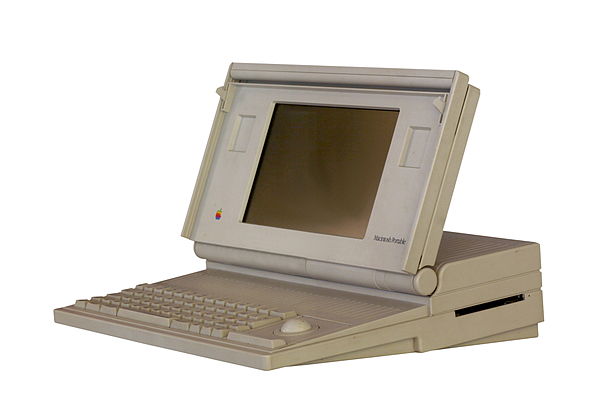
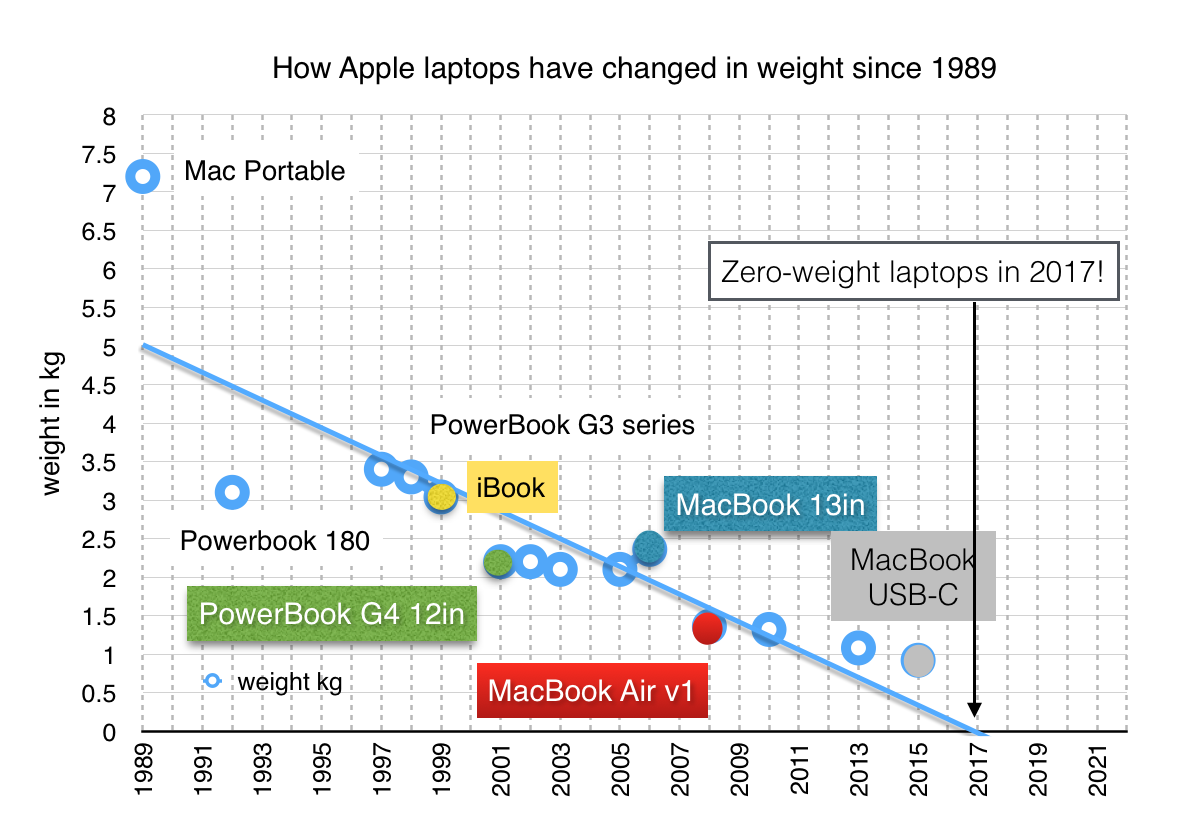
When will Apple build a weightless laptop? Let 26 years’ data tell us » The Overspill

I looked at trends in the weights, volumes and densities of Apple laptops:

when you start adding in the data about various laptop launches, trying to focus on the ones which are 12in or 13in (so that the screen size, and hence weight, is comparable), you find a definite trend.

It’s this: if we were relying on straight-line trends, we’d have weightless MacBooks by 2017. Yes. Perhaps they’d be airtight and filled with helium? Why not?

(Does this make me a link farm? Hope not.)


Google Play finally surpasses iOS in mobile game sessions » Chartboost

In parallel with Android’s game session growth, CPIs (Cost Per Install) — which can be used an approximation for lifetime value (LTV) — have surged by 41% from February 2014 to February 2015.

As we all know, app installs have become a major business. And as mobile gaming continues to be the leading driver of mobile revenues, a shift of gaming sessions in Tier 1 markets could be an early indicator of Google Play approaching parity with the iOS App Store.

It’s not a huge surprise to our CEO and co-founder Maria Alegre who says that over the past year she’s noticed developers have been thinking about more than one platform when launching campaigns. “While iOS has typically been where game developers start with user acquisition, we see the window of exclusive focus on iOS shrinking,” she says.

Alegre believes 2015 will indeed be the year where Android becomes more relevant than iOS. Though iOS will continue to have higher unit economics, the differences between iOS ARPU (Average Revenue Per User) and Android ARPU are shrinking — while Android’s mobile game sessions are growing month over month. “That combination of higher traffic and smaller difference between ARPU will make Android overall a more attractive business opportunity,” she predicts.

The report covers North, South and Central America. Not surprising that Android total sessions would pass iOS, since once you add in south and central America, Android ownership hugely outnumbers iOS (most of which will be in the US and Canada). (The full country data – available through the report – shows some weird changes, such as huge increase in iOS gameplay in Spain and Finland. Go figure.)

The surprise is in the suggestion that Android ARPU in the Americas is approaching that of iOS, since you’d expect many of the new Android users to be non-premium. Either iOS ARPU is falling generally, or something odd is happening with Android premium.


Tumult Hype Professional » TumultCo


Jonathan Deutsch came to my notice through a fantastic, simple app called Hyperedit (which lets you write HTML/PHP/CSS code and see it directly rendered in an adjacent screen). Since then he’s been employed by Apple, and then left Apple, and now has Tumult Hype Pro, which uses HTML5 capabilities.

I wish I were capable enough to use this program to anything like its capabilities.


When will Apple build a weightless laptop? Let 26 years’ data tell us

All the talk around Apple’s new MacBook – the lack of anything other than a USB-C port and a headphone port, the new “Force Touch” trackpad (which really is amazing, and I’ll write about another time) and how light it is got me thinking.

Particularly, how light it is. That thing really doesn’t weigh at all: you pick it up, and it barely seems to be there. It’s a helluva contrast with the Apple laptops of yore; I recall people toting around PowerBook G3s. Hell, I remember when the first portables came in from Compaq: they were gigantic things which could have been used as pricey weight training add-ons.

The discussion about the ports and lightness of course centred around two sides of a really quite polarised debate. One side said: “Apple is being stupid with this ‘thin and light’ stuff. We need ports.” The other said: “People want their portable devices to be ever more thin and light, and Apple is just giving them what they want.”

Well, how far can this go? Doesn’t there come a point when there’s nothing more to be shaved off?

I thought it would be fun to dig back and see how Apple has driven the “thin and light” idea, going right back to the original Apple Portable from 1989. Look, here it is. Isn’t it adorable?

Macintosh Portable

The Macintosh Portable from 1989. Bigger than a Macbook. Source: Wikipedia.

Introduced September 1989, weighed 7.2kg, measuring 10.3cm (closed) by 38.7cm by 37.7cm for a total volume of 15,027 cubic centimetres, and density of 479 kg/m^3 – a little more dense than barley (which is 400kg/m^3).

And then you compare this year’s model, 26 years later:

The new MacBook.

It’s thin. Also, light. Look, it’s almost floating off the table.


(All the data about the Apple products, by the way, comes from the invaluable resource of Mactracker, which tells you everything about pretty much every Apple product going back to the beginning of time, which for these purposes is 1975. And before you ask why I’m not comparing it with other PC makers’ laptops, it’s because there isn’t a simple or sensible comparison to be made, nor any easily available data as there is with Mactrack, which has a neat desktop and mobile app. So there.)

So when you start adding in the data about various laptop launches, trying to focus on the ones which are 12in or 13in (so that the screen size, and hence weight, is comparable), you find a definite trend.

He, He, He

It’s this: if we were relying on straight-line trends, we’d have weightless MacBooks by 2017. Yes. Perhaps they’d be airtight and filled with helium? Why not?

Apple laptop weights since 1989

Fitting Apple laptop weights to a straight line: turns out they’ll weigh nothing by 2017. Data: Mactracker

Before you snigger and yawn, just bear in mind that hard drive makers are now making them airtight – and filling them with helium. Not laughing so hard now, are you?

However if you take the more reasonable logarithmic trend, then it looks like we’re some way off weightlessness – although we might expect a half-kilo laptop in five years or so.

Apple laptops' weight: fitted to log curve

Not as much fun: seems weightless laptops are still some distance off.

(The log curve is a better fit than the polynomial one, which I’ll use below for other graphs.)

Note too that the PowerBook 180, released in 1992, seems to have been a real outlier: much lower weight than you’d expect.

Turning the volume down

But what about volume? If Apple’s making these things thinner, while keeping the screen roughly the same size, then the volume’s going down. What’s happening there?

Apple laptops volume since 1989

Fitting a power curve works best here, but 1989 distorts it a bit

Apple laptops' volume since 1992

Fitted to a power curve (which works best): the most recent models are below trend, ie lighter than expected

I’ve done two graphs, so you can see what it looks like if you exclude the original Portable. Notice how the latest machines lie below the trend line (which seems to work best as a power, rather than logarithmic, fit). There has to be a limit on how low volume can go, of course – you need a screen, you need some sort of keyboard – but Apple has really pushed the latter down in the new MacBook: the keys have less travel and the trackpad doesn’t move. That reduces the empty space needed to fit everything in, but I’d expect we won’t see much change in the next few years.

Gravity. I mean, density

Finally, if the weight is going down, and the volume’s going down, what’s happening to the density (which, let’s remind ourselves, is weight divided by volume)?

Turns out it’s increasing – quite quickly. From that barley-equalling density, it has moved quite quickly past the density of water (with the 2003 PowerBook G4 12in) and then solid magnesium (with the 2010 MacBook Air).

Apple laptops' density over time

A straight line fit seems best here. Barley, water, magnesium… all past. But pure silicon (metal) and aluminium remain way off.

There’s however quite some way to go before it goes past solid aluminium (2700 kg/cubic metre). There’s a lovely list of densities of common materials – butter, 865kg/cu m, who’d have guessed? – which might allow one to play “guess the material the Macbook model matches”.

But what does it mean?

All those graphs. But what’s the conclusion? Quite obvious really – given enough time, Apple will produce a weightless laptop of infinite density, which will suck its buyers into its gravitational well, from which they won’t be able to emerge. It’s one way to hold on to your users.

Then again, given the gravitational pull that its designs exert on a significant chunk of the internet, you could argue that it’s doing that pretty well already.

Start up: Google checks apps, Nintendo’s app strategy?, Galaxy S6 review, why 4Chan is for sale, and more


Google will check your app now. Photo by nateOne on Flickr.

A selection of 8 links for you. Contains nuts. I’m charlesarthur on Twitter. Observations and links welcome.

Gacha: explaining Japan’s top money-making social game mechanism » Kantan Games

Serkan Toto outlines a tactic that just might be the one Nintendo uses when it releases its mobile games:

Pricing varies depending on the title: some games charge 100 Yen [about $1] per turn, others 300 yen. The more expensive gacha contain particularly rare cards, but the element of luck is always there.

A lot of makers offer playing gacha once per day for free in order to a) get users “addicted” and b) to boost retention/the number of log-ins. Makers also offer discounts (for example during a special sales campaign), or limited-edition items (for example during seasonal events like Christmas or Halloween).

And gacha work well – extremely well: from some makers, I am hearing that up to 50% of their overall sales come from these machines. People just can’t stop paying money (in the form of paid virtual coins or tokens) to be able to go for another round.


Google X boss says company should have curbed Glass hype » Yahoo Finance

Alexei Oreskovic:

The Internet company did not do enough to make clear that the $1,500 computer that mounts to a pair of eyeglasses was merely a prototype and not a finished product, Google’s Astro Teller said during a talk at the South by Southwest Interactive conference in Austin.

“We allowed and sometimes even encouraged too much attention for the programme,” said Teller, whose official title at Google is Captain of Moonshots, during a talk that focused on how his group has learned from some of its failures.

Uh-huh. And now recall this, from February 2013 (in Nick Bilton’s story that was probably the first to source Apple working on the Watch):

While Apple continues its experiments with wearables, its biggest competitor, Google, is pressing ahead with plans to make wearable computers mainstream.

According to a Google executive who spoke on the condition that he not be named, the company hopes its wearable glasses, with a display that sits above the eye, will account for 3% of revenue by 2015.

Oh, Nick. Name that executive. Go on go on go on.


The inside story of how Apple’s new medical research platform was born » Fusion

Kashmir Hill has the exclusive:

A few months earlier, Apple had poached [Michael] O’Reilly from Masimo, a Bay Area-based sensor company that developed portable iPhone-compatible health trackers. Now, [as the new VP for medical technologies at Apple] he was interested in building something else, something that had the potential to implement Friend’s vision of a patient-centered, medical research utopia and radically change the way clinical studies were done.

After[Dr Stephen] Friend’s talk, O’Reilly approached the doctor, and, in typical tight-lipped Apple fashion, said: “I can’t tell you where I work, and I can’t tell you what I do, but I need to talk to you,” Friend recalls. Friend was intrigued, and agreed to meet for coffee.

Gotta love that introduction. It’s either the CIA or Apple, basically.


Samsung Galaxy S6 review: in depth » Recombu

Chris Barraclough got his hands on one. I found this section surprising:

The Galaxy S6 rocks Samsung’s own Exynos chipset, an octa-core processor comprised of two quad-core chips running at 1.5GHz and 2.1GHz. For everyday use, this provides solid all-round performance. I saw only the occasional tiny judder when multitasking with apps, while the latest games ran perfectly and HD movies streamed without stutter. The phone also admirably handles some intense camera use, including 4k and Full HD 60fps video recording.

The Galaxy S6 (and the Edge) does get a little toasty at times, if you’re doing a lot of downloading or shooting video. However, it never reaches alarming or uncomfortable levels and I never saw any adverse effects like the phone shutting down or spurting errors.

Battery life is actually pretty good too, considering that bright, super-crisp power-sucking screen. If you mess around shooting high-def video and generally thrashing the Galaxy S6, it won’t last anywhere near a full day. However, if you’re more conservative and limit yourself to occasional web browsing, email checks and piddling around with apps, you should easily make it to bed before the S6 dies.

Occasional judder? Toasty?

And:

The camera interface is a little cluttered, especially after slick, clean efforts like the LG G3’s, but anyone who likes fiddling with manual controls will enjoy.

When will UX designers learn that people don’t want to mess around with manual controls? Though the camera seems pretty good. However, there’s no comparison with any other phone here, apart from via benchmarking. That’s a poor service to readers.


How Bluebox fell for a counterfeit Xiaomi Mi 4 to claim it came with pre-installed malware » BGR India

Rajat Agrawal:

Over the past few days, a little known but well funded mobile security firm, Bluebox, published a report claiming Xiaomi was pre-installing malware on its Mi 4 smartphone. The report also claimed that Xiaomi was shipping the Mi 4 with a rooted ROM and came pre-installed with tampered versions of popular benchmarking apps. It also claimed that Xiaomi’s own identifier app showed that the phone was a legitimate Xiaomi product, raising questions on the security of products made by one of the fastest rising smartphone brand in South East Asia. However, as it turns out, the smartphone Bluebox had acquired through an unofficial source in China was nothing more than a sophisticated counterfeit. But how did a startup, with $27.5 million in funding from Andreessen Horowitz, Tenaya Capital, and Andreas Bechtolsheim fall for a counterfeit product?

Because it was fake, and they didn’t twig it.


Creating better user experiences on Google Play » Android Developers Blog

Eunice Kim, product manager for Google Play:

Several months ago, we began reviewing apps before they are published on Google Play to better protect the community and improve the app catalog. This new process involves a team of experts who are responsible for identifying violations of our developer policies earlier in the app lifecycle. We value the rapid innovation and iteration that is unique to Google Play, and will continue to help developers get their products to market within a matter of hours after submission, rather than days or weeks. In fact, there has been no noticeable change for developers during the rollout.

To assist in this effort and provide more transparency to developers, we’ve also rolled out improvements to the way we handle publishing status. Developers now have more insight into why apps are rejected or suspended, and they can easily fix and resubmit their apps for minor policy violations.

Let’s be clear: this is a good move which can only benefit users. It’s only going to be uncomfortable for those who insisted that Google Play is somehow superior to Apple’s App Store because it didn’t have any checking.

This is largely being automated; Google admits to TechCrunch that its system may not be “as robust” as “rivals”. Assume 100 new apps per day, and it probably takes, what, 20 people working flat out? You could easily triple or quadruple that without Google noticing the cost. And follow the discussion on Android Developers on G+. Plus Russell Ivanovic is not enamoured: “file under things I never thought I’d see in my lifetime”.

Considering all of which, why does it take Apple so long to approve an app?


4chan’s overlord Christopher Poole reveals why he walked away » Rolling Stone

David Kushner on Chris Poole’s decision to put the site up for sale:

last year, he undertook what he calls “the summer of Chris.” He went to Europe and Asia, reread The Little Prince, and took classes in cooking and ballroom dancing. He began to unplug — leaving behind his laptop and weaning himself off social media. “Why am I so concerned about what’s going on back in New York?” he thought at one point while in a cafe overseas. “It’s taking me out of this really great moment, this new experience.”

But the good times didn’t last. On the evening of August 31st, Poole was thumbing through his phone in bed when a CNN report caught his eye. Hackers leaked nude photos of dozens of celebrities, including Kate Upton and Jennifer Lawrence. One of the main hubs for the pictures was 4chan. Poole complied with takedown notices from Hollywood lawyers, which 4channers expected. But then he went further. In the wake of the leaks, he decided to post the Digital Millennium Copyright Act policy on his site for the first time — something he’d never gotten around to doing before. Some 4channers cried sellout. “Is this the end of everything?” one posted.

The same week news of the Fappening broke, so did Gamergate.

Gamergate turned out to be the final straw. Now 4chan is up for sale. Question is, who would want it?


How will Apple Watch teach people to love watches? » aBlogtoWatch

Ariel Adams points out that Apple has put a lot more, well, love into its watches than Android Wear rivals:

While the Samsung Gear models have some traditional looking watch dials, they clearly didn’t put the effort or apply the same type of understanding to the watch world as Apple did in their hardware. With that said, is passion and a love of watches by some key Apple employees why the Apple Watch is so much like a traditional watch? I think there are more practical reasons than that, and here is where Apple confuses so many of the journalists who traditionally cover the brand. Things people wear are part of fashion, a category that tech writers tend to not cover too much. Fashion is what gets people to wear something, and technology is what gets people to use something.