How many Android Wear devices out of 720,000 were activated in 2014? Here’s the number

Canalys announced on Wednesday that 720,000 Android Wear devices shipped in 2014.

But how many got onto peoples’ wrists? You can get an idea by looking at the number of downloads of the Android Wear app on Google Play.

However it’s intentionally vague – Google just gives you limits between which the install number lies. The levels are between 5k-10k installs, 10k-50k installs, 50k-100k installs, 100k-500k installs, 500k-1m installs, and so on.

Digging in

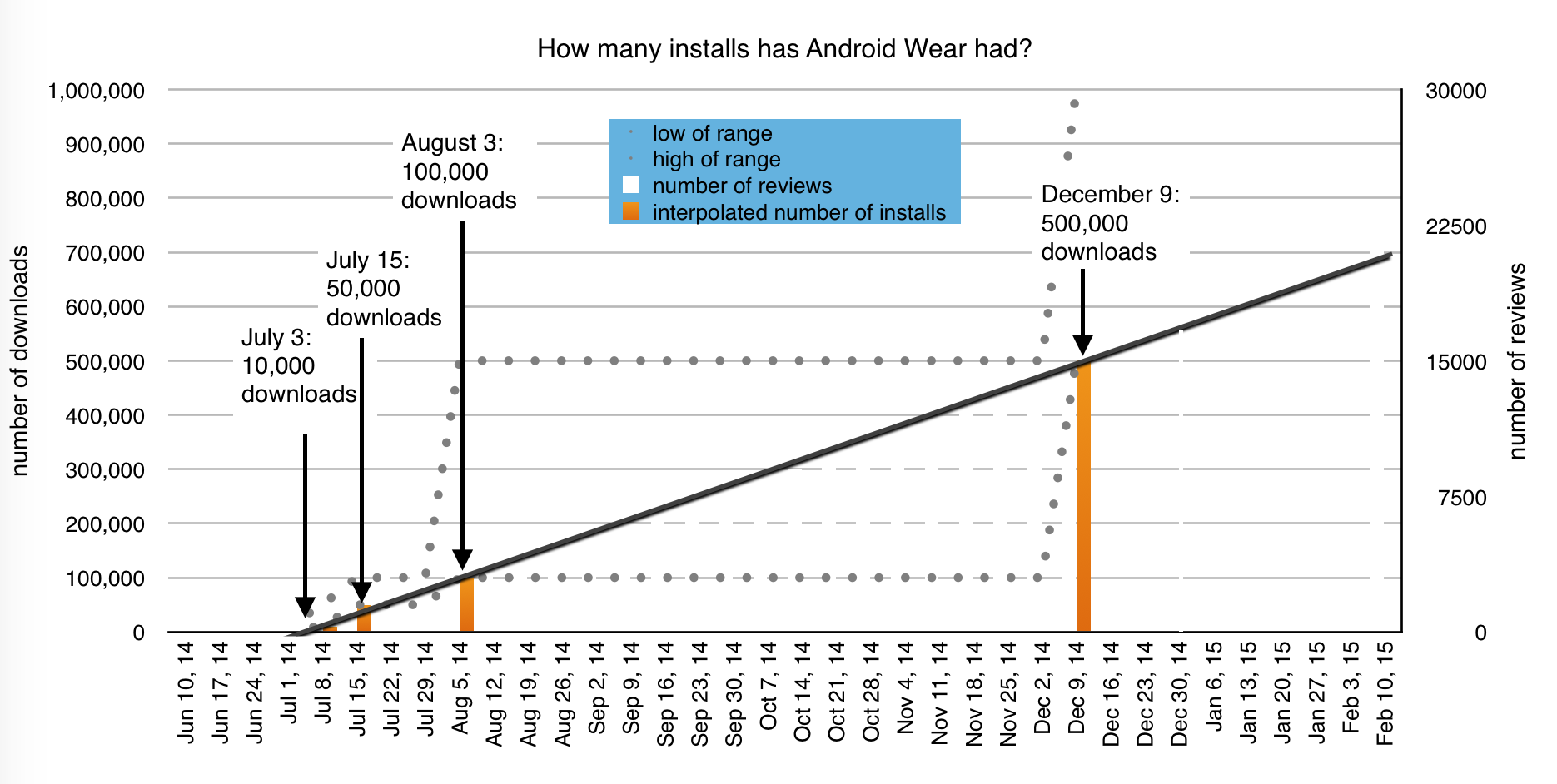
If you do some digging on the past captures of the Android Wear page on Google Play, you can quite quickly figure out when the number of installs passed various milestones. (Updates don’t count as extra downloads, so each “download” is a unique activation.)

A little bit of twiddling shows that the Android Wear app
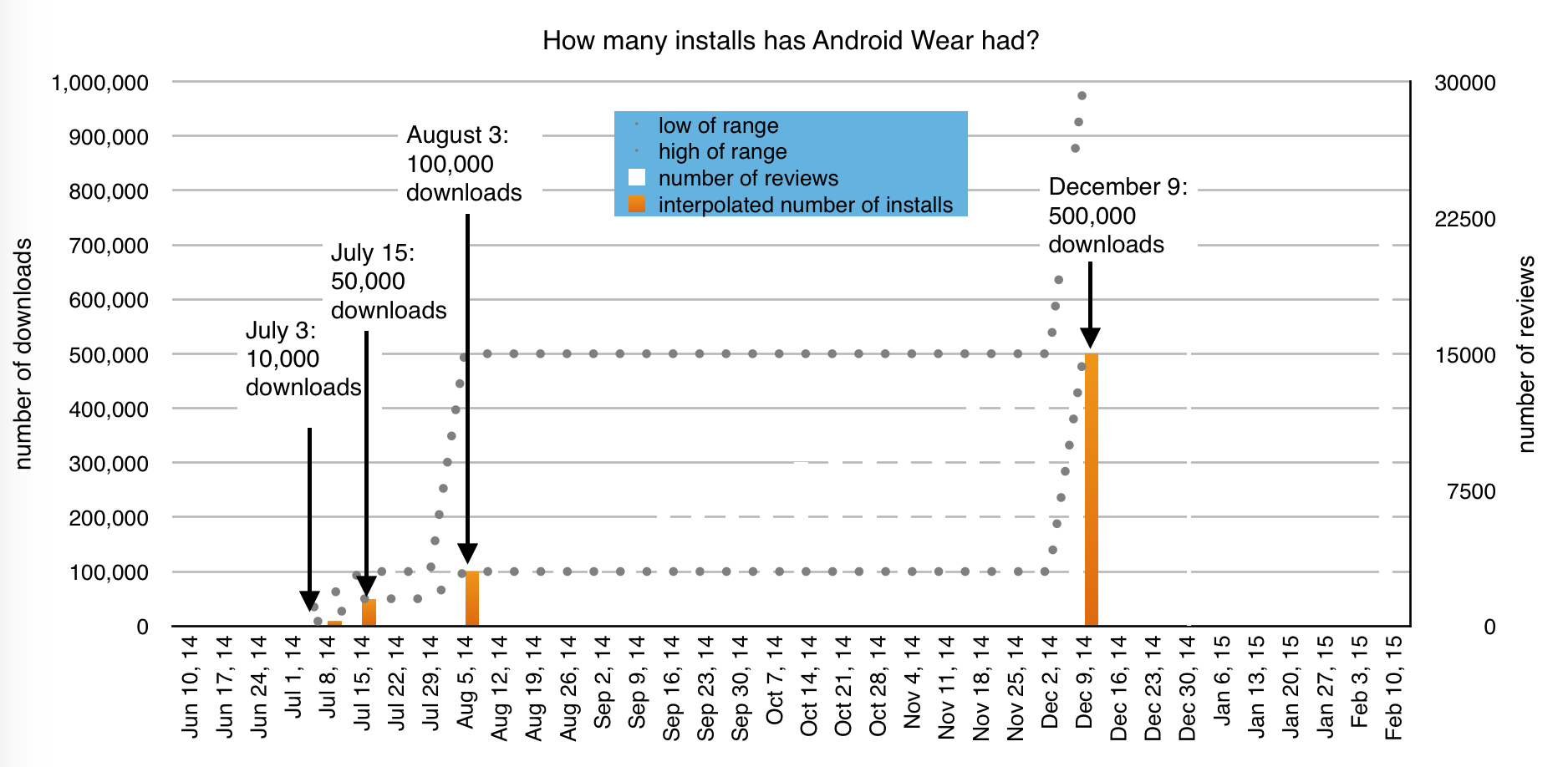
• passed 10,000 downloads on July 3
• passed 50,000 downloads on July 15 (good progress!)
• passed 100,000 downloads on August 3
• passed 500,000 downloads between December 2 and 9.

The page also includes the number of reviews, which is also a useful thing to track.

So I graphed it out, and once you add in the download breakpoints, and especially the reviews, there’s a fairly clear straight-line relationship over time.

Here is is with just the download breakpoints:

Android Wear: download breakpoints

Using the Internet Archive shows you when downloads of Android Wear passed particular points.

Then we can draw a straight-line trendline

Android Wear: trendline

The download breakpoints offer a straight line interpolation

The number of reviews (graphed on the right-hand axis) seems to reinforce that there’s roughly a straight-line relationship.

Android Wear: reviews

Adding in the number of reviews from the app page suggests a straight-line growth in downloads

If you look in more detail, there seems to have been a rush of reviews early on, a bit of a dip from August to the end of October, and a fairly clear linear relationship after that. But that’s not surprising, given that Google handed out a few thousand Android Wear devices at Google I/O in June.

So that trendline looks even better once you’ve got the reviews graphed:

Android Wear: downloads and reviews

Downloads and reviews of Android Wear seem to agree pretty well. So how many by the end of 2014?

That’s pretty solid. And here’s what this graph says: by December 30, there had been about 560,000 downloads of Android Wear.

By 11 February, based on the number of reviews, it’s around 700,000.

Android Wear: all the numbers

Put it together, and we have about 560,000 Android Wear activations by the end of 2014, and 700,000 to mid-February.

Is that a good or bad figure? I’ve no idea, to be honest. (If you assume 1.2bn Google Android phones in use, with Android Wear working on everything from 4.3 upwards, which takes in 47.6% of Android phones, then you have a potential addressable market of over 570m phones. (If you take it as 1bn Google Android phones, then it’s an addressable market of 476m.)

The much more important question – which I don’t know how you measure – is how many are still being used. Abandonment of wearables has been quite high, at around a third of all users.

Update: at the suggestion of @jasonostrander on Twitter, one might get an idea of the split of use via watchface downloads. There’s a ton of them, and people seem to have downloaded at least two each.

Start up: Apple squeezes leakers, Google pushes health, Samsung exiting Japan?, tablet puzzles, and more


Yes, human, I’m registering how you kicked me on that icy day in the parking lot. Let’s see how you like it in a few years.

A selection of 10 links for you. Spread to taste. I’m charlesarthur on Twitter. Observations and links welcome.

Apple threatens to ban iPhone, iPad accessory makers that design based on leaks » 9to5Mac

Jordan Kahn:

Apple is working to step up the secrecy surrounding future iPhone and iPad models by targeting a frequent source of leaks: third-party accessory makers. 9to5Mac has learned that in fall 2014, just before the iPhone 6 launched, Apple demanded that a number of leading accessory makers sign agreements barring them from seeking out information about future Apple devices, according to four sources with first-hand knowledge of the matter.

On one hand, the agreement dangled the loss of “future business opportunities that Apple and/or its affiliates may present to you” as a potential consequence of violating or not signing the agreement.

Ah. This would explain why, when I was interviewing companies for my piece about the size of the iPhone accessory market after its launch, they were very quick to deny any suggestion that they based their designs on leaked prototypes – even though there seemed no other explanation.


Introducing Spot » YouTube

Boston Dynamics (owned by Google) shows off its quadruped robot, Spot (in the video at the top of the post). Notable how the back legs have the same hinging mechanism as horses and other quadrupeds – though the front ones do too. And it can withstand being kicked and keep its balance on icy ground.

Scary. Imagine one of these chasing you over open ground or through a forest.


A remedy for your health-related questions: health info in the Knowledge Graph » Official Google Blog

Product manager Prem Ramaswami:

this stuff really matters: one in 20 Google searches are for health-related information. And you should find the health information you need more quickly and easily.

So starting in the next few days, when you ask Google about common health conditions, you’ll start getting relevant medical facts right up front from the Knowledge Graph. We’ll show you typical symptoms and treatments, as well as details on how common the condition is — whether it’s critical, if it’s contagious, what ages it affects, and more. For some conditions you’ll also see high-quality illustrations from licensed medical illustrators. Once you get this basic info from Google, you should find it easier to do more research on other sites around the web, or know what questions to ask your doctor.

We worked with a team of medical doctors (led by our own Dr. Kapil Parakh, M.D., MPH, Ph.D.) to carefully compile, curate, and review this information. All of the gathered facts represent real-life clinical knowledge from these doctors and high-quality medical sources across the web, and the information has been checked by medical doctors at Google and the Mayo Clinic for accuracy.

That doesn’t mean these search results are intended as medical advice.

If I were a family doctor, I think I’d read this with a sense of foreboding, in the expectation of seeing many more hypochondriac patients quite soon.


Chinese hackers attack blue-chip groups via Forbes website » FT.com

Sam Jones and Hannah Kuchler, in a piece that is basically a roundup of “who got hacked today” (also separately including Twitter’s CFO and Newsweek’s Twitter account):

Visitors to Forbes who worked for defence companies and banks were those who were subsequently targeted most, Mr McBride said.

“An attacker would choose to use a major publisher because it is a legitimate website that earns the trust of users who visit on a regular basis with confidence,” said Oren Falkowitz, a former NSA employee who runs Area 1 Security, another cyber security firm. “What they want is a platform with a large audience so they can get the users that they want in that pool and then be very discriminating about who they want to go to the next stage with.”

The attack was launched through Forbes’ “thought for the day” pop-up screen that welcomes visitors to the site and is run using Adobe software.

Codoso, the Chinese hacking group, was able to exploit the pop-up because of a loophole they had discovered in Adobe’s software. A second loophole then enabled them to bypass security on Microsoft operating systems that would ordinarily have blocked the attack.

I’ve never had Flash on my phone, and I’ve removed it from my laptop. Its only real purpose now is as an avenue for malware.


Samsung considers withdrawing smartphone business from Japan » BusinessKorea

Jung Suk-yee:

Samsung Electronics chose Japan as the first country in which to release the Galaxy Note Edge in October 2014, where YOUM technology was used on both sides of the phone. The company made its bid to increase its share of the Japanese market, the world’s largest premium market, through the new model. However, the results were not good. 

According to industry sources on Feb. 9, Samsung is in a quandary over its struggling smartphone business in Japan. Some in the company are reportedly saying that continuing the business only causes losses rather than profits. 

The Korean tech giant accounted for 4% of the Japanese smartphone market as of December of last year, which put the firm in 6th place. Samsung was kept out of the top 5 for two years, and its share decreased from 17% to 4%. 

Apple topped the list, and Sony and Sharp followed. The Galaxy Note Edge only sold tens of thousands of units for four months after its launch.

Not clear if those tens of thousands of sales are for Japan, or worldwide. But it feels like it makes sense to withdraw from a market that only causes you pain and loss. Samsung already pulled out of the TV business in Japan back in 2007 – and that hasn’t hurt its position as the biggest TV maker in the world.

But it’s getting into the withdrawing habit a bit. Pulled out of PCs in Europe.. smartphones in Japan.. what next?


About that UK digital biz renaissance? Not so fast » The Register

Marcus Gibson:

The Tech City quango last week claimed to conduct the “first national” survey of the UK’s digital businesses, covering 2,000 companies, according to a report in the Financial Times. The quango’s survey drew on a youthful database firm DueDil, run by US-born, Groton-educated Damian Kimmelman, and it makes a number of questionable methodological assumptions.

Although Kimmelman does not list it as a source, the report appears to be based on the number of new companies being registered at Companies House. This is a dangerous move, and one that is avoided by experienced trend-watchers. Why? Many firms give the address of their accountant or lawyer, or the owner’s home address – not their office address. (The Register is based in London, but its administrative address for Companies House purposes is in Southport).

Secondly, tens of thousands of foreign-born individuals have registered themselves as companies in order to buy UK homes and avoid stamp duty. DueDil’s own survey of immigrant-founded startups a few years ago listed more than 600 new firms in the Reading-Bracknell area started by German nationals – though we couldn’t find any evidence of any dramatic surge in new companies there. It makes geographic surveys hazardous if not impossible.

Bear this in mind for the next time you’re told there’s “documentary evidence” of London being a super-amazing explosive site for tech company creation. It might be, but this isn’t the proof that’s needed.


Cyanogen tapping tech giants to build war chest for a non-Google Android » Re/code

Ina Fried:

Beyond who ends up signing up for the round, Cyanogen’s valuation is significant, especially for a company that has yet to show how it can make significant revenue from its efforts. As with Google’s flavor of Android, the core of Cyanogen’s offering — CyanogenMod — is free and open source. Cyanogen the company, meanwhile, could make money by bundling other services and software on top of the open source core.

In theory, it could put together a flavor of Android that bundled together services from, say, Amazon, Facebook and Microsoft, in much the same way the Google version of Android bundles YouTube, Chrome, Gmail and the Google Play store, among other services.

The company’s most significant deal is one to provide its software on phones sold by India’s Micromax. It has also made a number of high-profile hires in the last year as it expands both its technical and business ranks.

I wonder if Google is at all worried by this. The Micromax deal is important, because that’s now the largest smartphone OEM in India.


The rumoured Google MVNO: what’s likely & unlikely? » Disruptive Wireless

Dean Bubley on “those rumours”, which he mostly downplays:

One possibility for Google could be a unique form of pricing rather than standard “monthly plans” – perhaps part-subsidised by itself or others, perhaps customised on a per-user basis. (My idea from a couple of years ago was insurance-style pricing for mobile data). A “freemium” model could also work. This could be adjusted based on the balance of WiFi vs. cellular access, whether the user tended to consume advertising-rich apps, and so on. 

All that said, unless this is just another Google small-scale experiment, it would be extremely tough for it to scale to millions or tens of millions of users, without huge investments in sales and support infrastructure.

Instead, perhaps a likelier option is that this is – like Apple’s SIM – a tablet-oriented service rather than a smartphone-based one. This gets around two problems – firstly, it doesn’t need a conventional numbered “phone service”, and secondly it can be pitched to the operator partners as a way of adding extra cellular devices to the market, rather than competing for market share of existing ones. Data-only connections also don’t come with lots of the traditional perceptual baggage of being a “monthly plan”.

Remember how excited everyone got over the Apple SIM? Notice how it’s had virtually zero impact? And take note of Bubley’s “what not to expect” list (which is long).


TurboTax temporarily suspends e-filings on fraud concerns » WSJ

The largest online tax-software company in the U.S. temporarily halted electronic filing of all state returns after more than a dozen states spotted criminal attempts to obtain refunds through its systems.

Intuit Inc., based in Mountain View, Calif., said Friday that its TurboTax unit stopped transmitting state e-filing tax returns Thursday after seeing attempts to use stolen personal information to file fraudulent returns for tax refunds.

Intuit wasn’t hacked, but there have been so many breaches of systems that US usernames and passwords are easy to come by – they’re like air for criminals.


Tablet vendors taking new strategies to rekindle sales in 2015 » Digitimes

Apple’s shipments of iPad devices in 2014 also highlighted the falling momentum of tablets, said the sources, noting that shipments of iPad devices slid 14% on year to 63.4 million units in the year.

Additionally, consumers’ enthusiasm over iPad Air 2 and iPad mini 3 launched in October 2014 has not been strong, said the sources. Shipments of other tablets, including those from Xiaomi Technology and HTC (the Nexus 9) have also been lower than expected.

Apple’s strategy of launching the anticipated 12-inch iPad aims to create a new application market to revive the declining trend, the sources commented.

Notebook vendors, including Asustek Computer, Acer and Lenovo, are expected to reduce their R&D projects for tablets although they will continue to roll out tablets in order to maintain their bargaining chips for the purchase of related parts and components, as well as their brand images, said the sources.

I’ve heard from an industry source that HTC shipped fewer than 100,000 Nexus 9s in the fourth quarter. I’d really love to see some stats for usage of Android tablets with Android apps (ie not YouTube or simple web browsing). I suspect it’s really low despite how well Android tablets sell.)


Start up: the internet of advertising things, (more) smartphone profits, Left Shark attack!, the death of good sound, and more


Hello and welcome to the Internet Of Things That Advertise To You! Photo by Justin in SD on Flickr.

A selection of 8 links for you. Contains heavy metals. I’m charlesarthur on Twitter. Observations and links welcome.

Intimate data will be key to the Internet of Things » Advertising Age

Tom Goodwin:

The first change comes from data. If we’re wearing watches, clever clothes and using sentient spoons, our heartbeat, moods, location, stress levels, calendars and search activity are all being recorded, shared and analyzed. If we circumvent for now the obvious privacy concerns, we’re armed with the best data we’ve ever had. Forget big data. When you have intimate data, little else seems important.

If we assume that programmatic is about buying against audiences, not channels, the next stage will be about buying people at a moment in time — buying micro-moments to serve hyper-relevant personal ads. If we go even further and assume that this information layer makes suggestions, the ads of the future may be promoted routes in our cars, notifications on our smartphones that it’s about to rain and an Uber is close, or money-off codes for holiday resorts when sensors on our smartphones detect we’re getting stressed.

Ugh. Ugh ugh ugh. Not Wanted On Voyage. (My take on the Internet of Things: security will be the real bugbear.)


Left Shark printer chomps on Katy Perry’s copyright claim » Gigaom

Jeff John Roberts on how Katy Perry’s lawyer tried to block the 3D printing of left shark (who didn’t do what s/he oughta at the Super Bowl halftime show):

3D Left Shark is now available once again, along with some new 3D friends. In a blog post announcing his legal pushback, Sosa wrote:

I’m also resuming the sale of this 3D printed full color desk figurine at a different store front Etsy.com/shop/amznfx along with a couple other characters which include a drunk shark, pink drunk shark, and right shark.

So that’s where we stand. Your move, Katy.

Perry’s lawyer, Steve Plinio of Greenberg Traurig, did not immediately reply to a request for comment, but he appears to face an uphill swim.

As Sosa points out to Plinio in a public letter, the copyright claim suffers from two big flaws: 1) Perry doesn’t appear to own any rights in Left Shark; 2) there may not be any intellectual property rights at all, since costumes can’t usually be copyrighted.

Monetising this shark stuff seems promising. For a suitable amount, I’m prepared to vouch that you were the shark on the right, not the left.


Vertical integration of design and post-pcs » iLike.code

Nat Brown looks back at his time at Microsoft, while looking around at what’s happening in smartphones:

We were helping key [Windows PC] OEMs prototype different special-purpose uses for the Windows operating system which could be sold with new high-volume consumer products under a lower licensing cost to hit the <$300 retail price point. (This effort and some of our prototyping was one contributor to the initial XBox.) I was fascinated to learn details about how much PC OEM’s had outsourced manufacturing (and some forms of the hard intellectual property design) to foreign white-label manufacturers. Some small players had literally outsourced everything but their logo, their sales staff, and their direct-mailing lists. It was clear even then that they were not differentiable and fully doomed. Others, like Dell, were still doing final customer-specific options assembly and industrial/mechanical (particularly pluggable component) design but were no longer designing much of their printed circuit boards (PCBs). The more I learned the more this seemed like a difficult-to-defend position without unique software capabilities to differentiate the clearly commodity hardware. PC OEM’s had no brand-exclusive content.

This has broader ramifications, as he explains, in the smartphone business.


Tablet magazine starts charging commenters » Capital New York

Nicole Levy:

As a number of news sites eliminate their comments sections altogether, Tablet, a daily online magazine of Jewish news and culture, is introducing a new policy charging its readers to comment on articles.

As of today, a reader visiting the nonprofit site that is otherwise paywall-free will have to pay at least $2 to leave a comment at the foot of any story. The move is not part of a plan to generate any significant revenue, but rather to try and change the tone of its comments section.

Tablet has set up commenting charges of $2 a day, $18 a month and $180 a year, because “the Internet, for all of its wonders, poses challenges to civilized and constructive discussion, allowing vocal—and, often, anonymous—minorities to drag it down with invective (and worse),” editor in chief Alana Newhouse wrote in a post published today.

Metafilter has had a version of this policy in place for years (a one-off charge, but similar). Certainly, though, it’s a clear implementation of my exposition of the economic theory around leaving comments: you have to make them valuable in some way to the commenter to attract the valuable commenters and deter the bad. Attaching monetary value to the act is smart, though of course it demarcates not by the value of the comment itself, but the disposable income of the commenter.


Apple has 93% of mobile profits; 650M users by 2018, says Canaccord » Tech Trader Daily

Tiernan Ray:

Canaccord Genuity’s Mike Walkley this morning raises his price target on shares of Apple to $145 from $135, writing that his review of market data suggests continued strength for the iPhone 6 upgrade cycle.

Walkley writes that his assessment of vendor data in smartphones suggests, whose shares he rates a Buy, captured 93% of industry profits in Q4.

Apple may have one third of all users of smartphones by the end of 2018, he reckons:

We believe the strong iPhone 6 replacement sales should continue during C’15, as we estimate only 15% of the current estimated 404m iPhone installed base has upgraded to the new devices. We also anticipate continued strong share gains for the larger screen iPhones from high-tier Android smartphones during C’15 driving strong growth in the iPhone installed base and model the iPhone installed base growing to 487m subscribers exiting C’15 up 20% Y/Y. Longer term, we anticipate a gradually moderating rate of growth for the installed base from C’16 through C’18 and estimate 650M iPhone users exiting C’18. We note this base would only represent 1/3rd of an estimated 1.82B global premium smartphone subscribers anticipated by C’18. Finally, we anticipate steady long-term iPhone replacement sales within this growing iPhone installed base, and we believe this combined with our modest installed base growth expectations position Apple for steady sales of roughly 210m-215m iPhone units annually between C2015 to C2018.

Walkley offers the following infographic to show Apple scooping up the vast majority of profit in mobile in Q4, while Samsung Electronics has a minority of profit and all others operate at no profit or at a negative margin.

Not quite “one third of all smartphone users”; one-third of premium smartphone users. There are probably already over 2bn smartphone users. By 2018, that will probably have more than doubled.

It all tallies rather closely with my analysis of high-end Android profitability. Unsurprising, since we’re working off the same publicly available data.


Commission guide: Competition ‘enforcement’ key to supporting growth » The EU Parliament Magazine

Desmond Hilton-Beales:

Many in Europe are looking to the landmark Google antitrust case which [EC Competition Commissioner Margrethe] Vestager inherited from her predecessor Joaquín Almunia, who reopened the investigation during the final months of the Barroso II commission. The Danish official won’t be drawn on the details of the case, but instead issues a call for clarity. “Many concerns are raised about Google’s conduct, only some of which relate to competition policy,” she stresses.

“It is therefore very important to define clearly what is for competition policy and what may be more appropriately considered under other policy areas. The case before us is very important in today’s digital economy, and it attracts much interest. As such, we have a duty to fairly enforce our competition rules on the basis of the legal framework. What is critical for me therefore is to do so in an objective way and on the basis of the facts before us.”

Expect things to hot up on the Google-EC front over the next couple of months. There’s some murmuring about a Statement of Objections – a sort of EC version of “shots fired”.


Is audio quality a thing of the past? » TVTechnology:

Jay Yeary:

Jim Anderson, multiple-Grammy winner and jazz recording engineer extraordinaire, was teaching the class on critical-listening that day, discussing frequency ranges of instruments, ear training, and getting the participating high school and college students to concentrate and understand what they were hearing. Toward the end of the class, Anderson would play samples of work he had recorded in the studio to compare original mixes against compressed versions of the same songs.

It was a truly glorious experience to hear a well-recorded, high-quality, uncompressed mix from a professional studio, crafted by a masterful engineer.

Everyone in the room listened intently as the versions were played and when Anderson asked the students which they preferred, I naturally assumed everyone would choose the original. To my utter horror, many preferred the lower bit-rate compressed version. While some of the compressed files sounded quite good, others were lacking upper harmonic content and had a collapsed soundfield compared to the original.

As I discussed this experience with other engineers present at the event we pondered whether the students had ever heard real instruments or whether they were so accustomed to modified and effected sounds that that was now their preference. It also left me wondering if anyone cares about quality anymore and whether it has been displaced by convenience.

Convenience trumps a lot of things. High-quality audio is a great pleasure, but few people have the time or money to experience it. (Vinyl is definitely not a high-quality audio experience.)


Google risks legal action over ‘right to be forgotten’ report » FT.com

Murad Ahmed, Richard Waters and Duncan Robinson:

Google could face legal action after Europe’s privacy watchdogs rejected the conclusions of an independent group of experts that largely backed the internet company’s implementation of the “right to be forgotten” law online.

Last year, Google convened a group of experts to advise it on how to apply last year’s ruling by Europe’s highest court, giving citizens the right to ask internet search engines to remove embarrassing results related to them.

The company’s “advisory council”, which is made up of eight independent experts and two Google executives, chief legal officer David Drummond and chairman Eric Schmidt, released its conclusions on Thursday. It said the company could continue its policy of stripping sensitive links only from European versions of its search engine, meaning that links expunged from Google’s French, German or British sites do not need be stripped from Google.com.

It’s fun to read the council members’ reactions to their own report: some seem to disagree with it quite a bit (which raises the question of quite how it got written as it has). Jimmy Wales in particular comes across as someone who hates the sort of nuance that the original ruling employs. (For my take on the different attitudes of the US and Europe to the ruling, see “the newest shibboleth”.)

I do like the suggestion that the ruling should be called “The right to be unlinked”. That’s a much better description than “forgotten”, because the key point about the ruling is that the original data remains exactly where it always was.


Android OEM profitability, and the most surprising number from Q4’s smartphone market

I’ll admit – I’m surprised myself by how low the profitability even of “high-end” Android OEMs is. I hadn’t investigated it in detail until I wrote this post.

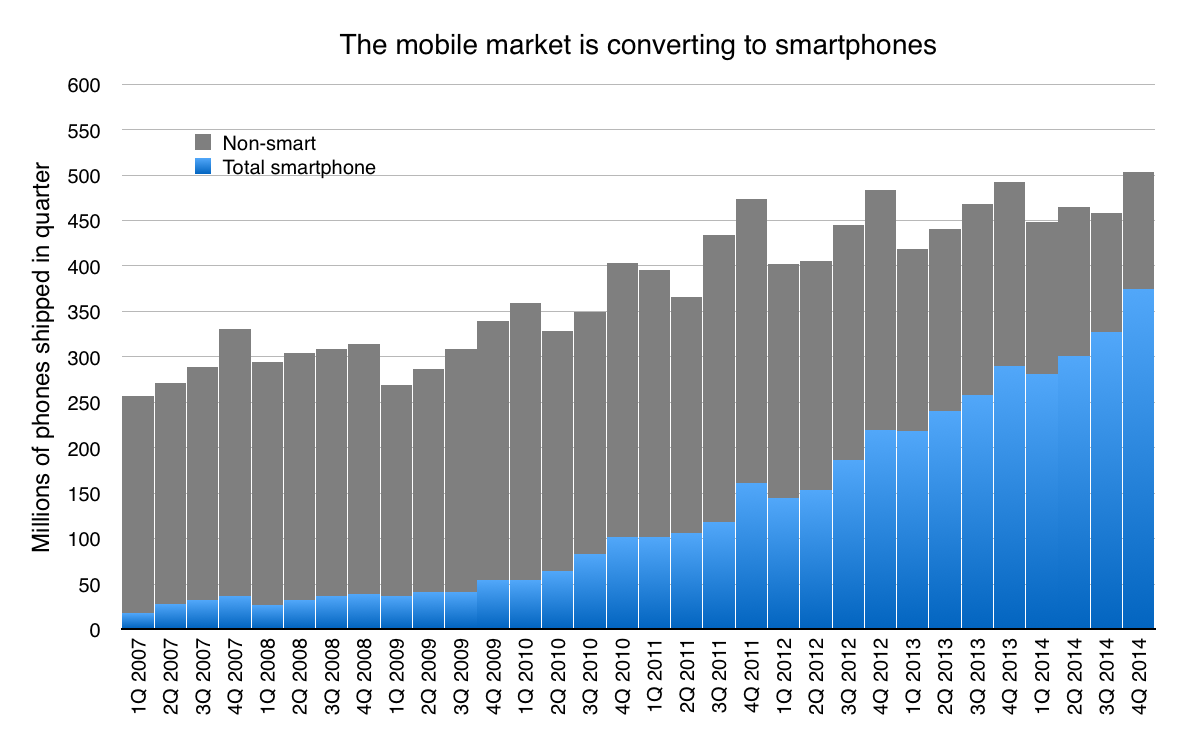
The end of 2014’s fourth calendar quarter, and hence year, brought forth a blizzard of data about the mobile and the smartphone markets. The mobile market (so including featurephones) passed the 500m mark for the quarter, according to Counterpoint. The smartphone chunk is growing as a proportion of that faster than ever: in Q4 it made up about 75% of sales.

As a proportion, smartphone sales are rising healthily:
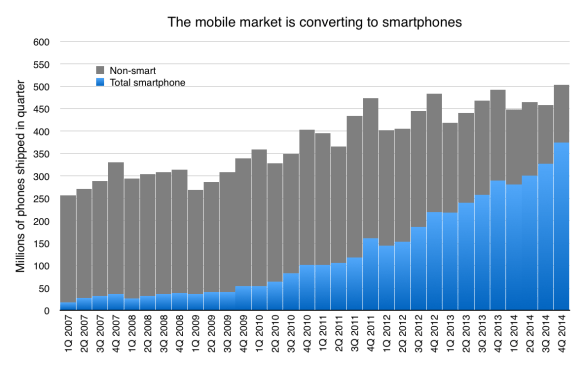
Smartphones are a growing proportion of all mobile phone sales

Smartphones are a growing proportion of all mobile phone sales

That compares with a 58% smartphone mix in 4Q 2013. Even so, I don’t expect the 90% mark to be hit before 1Q 2018 (yes, 2018), on the assumption their sales rise as a diffusion curve.

If the proportion continues at about a 3% increase in smartphone share per quarter (as happened roughly in 2014), smartphones will be 90% of sales in 1Q 2016 – just a year away – and 95% in 3Q 2016. By then, effectively all the market is smartphones.

Apple’s enormous sales – 74.5m units shifted – attracted lots of the attention. It ended the quarter with less inventory in the channel than at the start, suggesting that sell-through (ie the number bought by people) was actually higher.

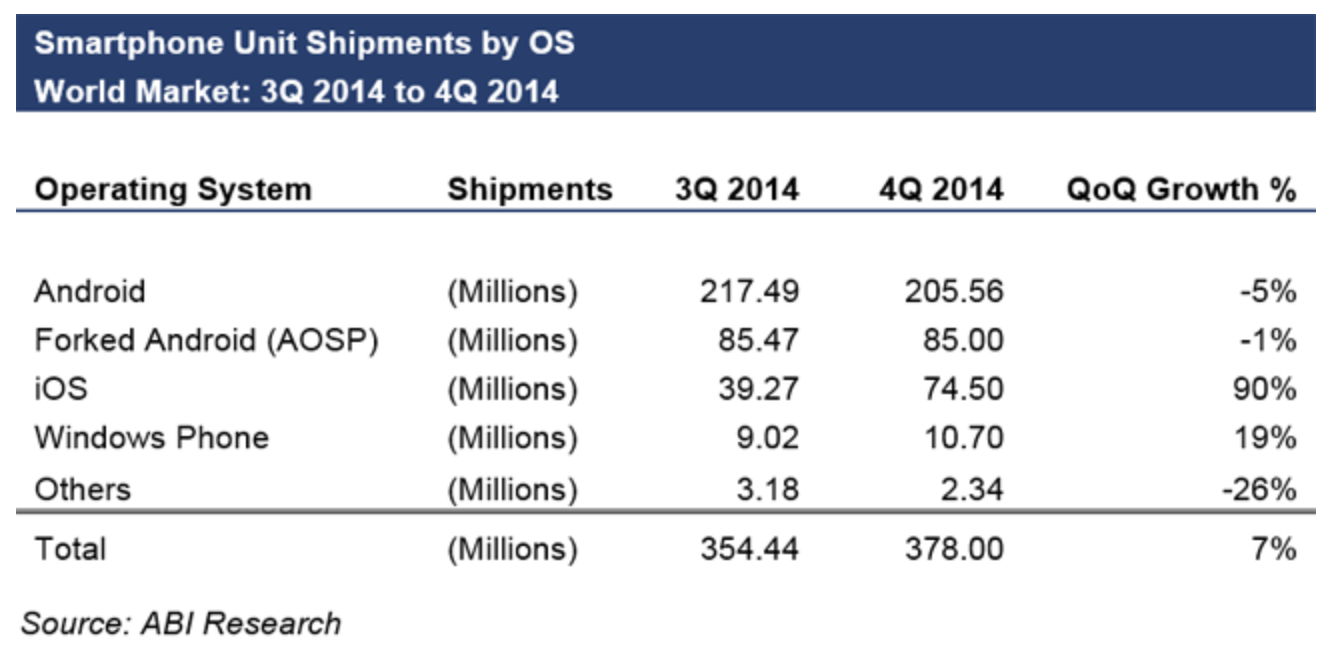
But the really surprising figure – the one that had me firing off emails asking for more detail – came not from Apple, nor any individual company, but from ABI Research. Its headline: “Android Smartphone Shipments Fall for the First Time”.
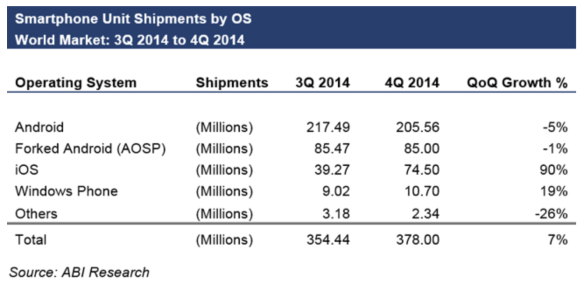
Android shipments fell in Q4 2014, ABI says

This is surprising: Android shipments have never fallen from quarter to quarter before

Wow. I mean, truly wow. As it says, that’s never happened before. Android shipments have always increased from quarter to quarter, both for “Google Android” and AOSP, since the platform’s first phone. (Unlike pretty much every other research company, ABI also breaks its Android figures down into “Google Android” – ie Google Mobile Services certified, carrying all Google’s services – and “AOSP” – principally, China.)

Yet here ABI is, saying G-Android shipments fell by 11.9m, and AOSP by 0.47m, a total of 12.4m. That’s quite a lot more than a margin of error.

Objection!
Now, you could object right away. There are lots and lots of research companies to choose from, and all are pushing their own datasets, and all diss each others’ datasets in more or less subtle ways. There’s IDC, Gartner, Counterpoint, ABI, Strategy Analytics, Canalys, CCS Insight, Kantar, and more. Couldn’t ABI be wrong?

It could. But then you also have the numbers that come from the companies themselves. Samsung helpfully said that in the fourth quarter it shipped a total of 95m mobile phones (ie featurephones and smartphones) – and that smartphones were in the “high 70 percent” range.

So… how high in that 70s exactly? Because if it wasn’t in the 78.5% or above range, it was less than Apple. But Samsung wouldn’t want to admit that. Sony also reported numbers, as did LG, and Lenovo. LG’s numbers fell from 3Q to 4Q, Sony’s grew, Samsung’s fell, Lenovo’s and Motorola’s both fell independently. Together, they lost 6.5m sales from 3Q to 4Q, at a time when you’d expect sales to rise.

Let Jeff Orr of ABI Research explain it in a bit more detail.

“China was definitely the lead influencer in the OS share change during 4Q’14. ABI will be a lot more precise once the final vendor tallies are announced and tallied.

“Thinking about Apple’s financial call, Tim Cook highlighted exceptional iPhone growth in the US (up 44% QoQ) and BRIC [Brazil, Russia, India, China] region (up 97% QoQ), adding that China was the company’s second largest iPhone customer for the quarter and that Singapore and Brazil also saw significant increases (though these last two were not given any numbers).

“Apple also noted the amount of Android-to-iPhone switching it observed in the quarter. Given Apple’s premium price points in the smartphone world, one has to believe that switching impacted a subset of all Android handset makers that would be comparable in ASP to iPhone (or at least within a similar pricing tier). Again, it’s too early to name names here just yet, but you can probably guess the likely Android vendor names to put in that bucket.”

The competitors
Basically, it’s the big companies that compete directly with Apple – so Samsung, Sony, LG, HTC – and to a lesser extent Chinese companies such as Lenovo and perhaps (though it’s not certain) Xiaomi, whose shipments fell from the third to the fourth quarter.

Apple stole customers who might otherwise have bought Android phones away from those makers, and that helped cause a fall in sales.

How many iPhone users upgraded?
Note Cook’s comments on the earnings call about how many of the existing iPhone base upgraded to the iPhone 6 and 6 Plus: he put it in the “low to mid teens percent of the existing base” (these chief executives and their vague percentages, eh?). So how many is that?

Assuming a 400m iPhone base before the fourth quarter, and 13% upgrading to the 6/6 Plus (the minimum possible): 52m iPhones.

Assuming a 440m iPhone base, and 15% upgrading: 66m.

So if you subtract those from the sales figures, you get between 8.5m and 22.5m who were new to the iPhone – either upgrading from a featurephone, or coming over from Android.

Split the difference and you get 15.5m. That’s surprisingly close to the 12.4m figure earlier of “missing” Android sales from ABI Research; and you’d also expect that there would be sales growth from the third to the fourth quarter, which is the largest by volume of the year. Perhaps up to.. 15.5m more phones? (Update: Canaccord puts the user base at 404m, and the upgrade percentage at 15%, which gives 60.6m upgrades, and so 14.4m upgrading a featurephone or coming from Android.) (Second update: Mav, in the comments, points out that the total iPhone 6/6 Plus sales includes those sold in the third calendar quarter, at the end of September when they went on sale. That means an extra 10m and more sales of the iPhone 6/6 Plus. So it’s a very substantial landgrab from featurephones and Android.)

So it looks like Apple actually skimmed off some of Android’s growth in the fourth quarter. What’s worse for the Android OEMs is that Apple tends to grab two classes of customers: the loyal ones (who just keep buying Apple stuff – see how the majority of buyers were loyal ones here), and the high-paying ones, especially in China and the west, where its brand is able to command a premium price. Then it converts those high-paying customers into loyal ones.

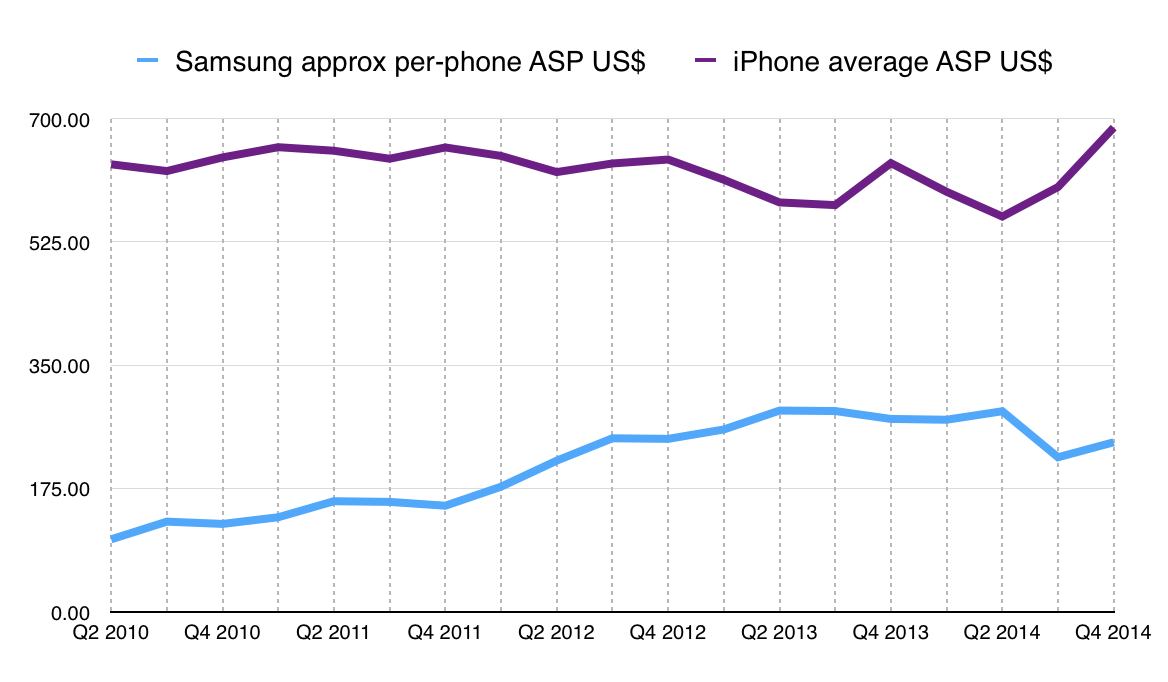
That’s notable from Samsung’s apparent mobile ASP (average selling price – what it gets from carriers and wholesalers), which dipped badly in Q3 and came back only slightly in Q4, helped by the Galaxy Note 4. Even that couldn’t help against Apple’s iPhone 6 Plus – note how Apple’s ASP rose while Samsung’s fell in Q4.
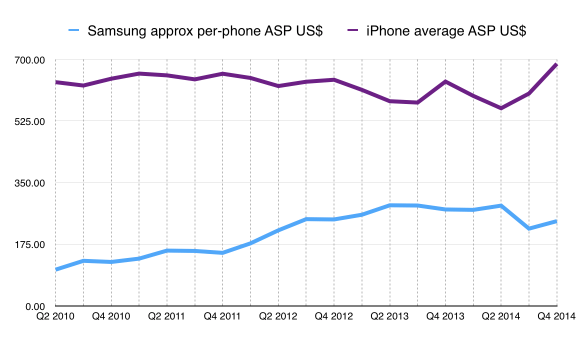
iPhone v Samsung average selling price

Figures for Samsung ignore revenues from featurephones, which are comparatively tiny compared to its smartphone revenues

Samsung’s smartphone shipments are reckoned to have fallen from 78.5m in the third quarter – to (if we’re generous) 74.5m, equal to Apple, in the fourth. That’s down from 82m a year before (a 9% fall).

The value trap, Android version
Let’s be clear: I think Android is a boon to the world; quite possibly it’s the best invention of this century so far. (I’ve said as much many times, but some people find this hard to understand.) It’s a great thing that people who previously couldn’t get internet access at all can now get a cheap handheld device capable of running apps that can provide all sorts of information, and use far less power and are far more portable than a PC. Smartphones put power in the palm of your hand; and Android is the OS of choice for that.

However, for handset manufacturers, Android isn’t such a boon. Take a look at the operating profit and margins for the top-end Android OEMs. (I use operating profit rather than gross profit because it takes into account the costs of actually competing in the market through marketing, R+D and so on – not just what you take over the counter).

I’ve estimated HTC’s shipments at 6m, based on Sony and LG’s revenues and shipment numbers (it comes out between 5m and 7m, depending which you use).

Top-end Android handset revenue and profits, compared to Apple

OEM Handset revenue US$ (approx) Operating profit US$m Operating margin % handsets shipped Implied ASP per phone Implied profit per phone
HTC $1.6bn $6m 0.38% 6m *est $266 $1
Sony $3.6bn $79m 2.2% 11.9m $305 $6.64
LG $3.45bn $74m 1.8% 15.65m $220 $4.72
Lenovo (inc Motorola) $3.39bn -$89m -2.6% 24.7m $137 -$3.13
Samsung $22.8bn $1,790m 10.0% 74.5m $306 $24.02
Total
for Android
$34.84bn $1.86bn 5.3% 132.75m $262 $14.01
Apple $51.2bn $14.3bn
(at 28% margin)
28% (est) 74.5m $687
(actual)
$191.9

Note that these are rough-and-ready figures. Here are a few of the caveats.
• For Sony, Lenovo and Samsung I haven’t accounted for tablet sales, which in Samsung’s case were 11m at an unknown ASP; for Lenovo tablet numbers weren’t stated (though it puts them at 4.8% worldwide, which would be 3.6m out of 76.1m). I haven’t even tried to estimate them for HTC, which in its financial report on Q4 doesn’t even mention the Nexus 9 it made for Google which went on sale in Q4.

• The Samsung figures overstate smartphone revenues, because they ignore the 20m or so featurephones which will have had an ASP of around $15 and unknown profit. Samsung’s mobile profits have risen in line with its smartphone shipments, so we can reason that its featurephones have less profit than smartphones; so ignoring their revenue and assigning their profits to smartphones is generous, but not madly so. Also, Samsung’s profit figure is for its “IM” division, which includes PCs, of which it sells a few million per quarter but probably doesn’t get much more than $10-20 of operating profit per sale.

• ASPs are thus approximate, and so are profit estimates: tablets might be money losers, depressing the apparent profitability of the handset business. But what all these companies except Samsung have in common is that their handset businesses have lost, or are losing, money. So these probably aren’t that far off; tablets might be less profitable, but there are fewer of them to spoil the numbers.

• These are only top-end Android phone makers. There is a ton of others: ABI reckons there were a total of 303m G-Android and AOSP phones shipped in the quarter, so more than half of those aren’t accounted for in this total. Many of them are cheaper (Huawei, ZTE, Coolpad, Micromax come to mind) and ship in volume. Being cheaper, they’re unlikely to make a lot more profit, and since they don’t appear in the top five, they probably don’t make much difference to these figures except downwards in ASP and per-handset profit.

• Apple gives the number of phones shipped and total revenues (so you can calculate ASP) but doesn’t break out the operating profit of its divisions; analysts make estimates. I got the 28% operating profit figure from this 2013 analysis by Canaccord. Update: for 4Q 2014, Canaccord puts iPhone operating profit at 38%, which is colossal, and would make that table look even more lopsided. (Canaccord reckons Apple has 79% of mobile profits, and Samsung 25%; the others have between 0% and 1%, if they’re profitable.)

So what does this tell us?
That 2013 Cannacord estimate isn’t the most recent but things are unlikely to have shifted far – and even if they’ve moved by a few percentage points, it still doesn’t change the overall picture. Apple makes a ton of profit per phone, and top-end Android OEMs generally don’t. (Motorola has been a basket case for years, and dragged down Lenovo’s figures; see Jan Dawson’s analysis of how that’s affected the mobile bottom line.)

You can argue – and lots of people do – that Apple is therefore “charging too much for the iPhone, and it should cut the price so that more people would buy it”. This is superficially attractive logic to people who (a) aren’t running a business and (b) can’t think long-term.

For Apple, the cash it rakes in is used to reinvest in factory and supply contracts in ventures for forthcoming products. If it didn’t have that surplus cash, it couldn’t buy fingerprint reader companies, lock up supplies of camera sensors, guarantee enough factory production to make 74.5m phones, fund machinery to diamond mill the sides of phones, and pay forward for whatever it’s going to do over the next two, five, ten years.

(But what about that cash mountain? Well, lots of that is profits earned abroad that Apple doesn’t want to repatriate to the US, because that would attract a high rate of interest tax, so it leaves it sitting in Ireland and reinvests it in those things as above.)

By contrast, the Android OEMs whose phone divisions are living hand-to-mouth on those incredibly slim margins can’t afford to reinvest. They’re essentially at the mercy of the rest of the smartphone and component ecosystem.

For example, they can implement a fingerprint scanner (HTC and Samsung have) but it’s incomplete; HTC didn’t use it across all its models and it wasn’t part of a payment system – as Apple Pay is, carefully planned over a two-year arc. Similarly, 64-bit Android hasn’t happened to any appreciable extent, and while you can argue about whether 64-bit makes a difference (these ARM engineers reckon it does, and explain why), Apple is still a mile ahead of the rest in implementing it. Lots of Android has to move at the pace of the slowest part of the hardware ecosystem, much of which is 32-bit.

Note that three of the four top-line OEMs are part of large conglomerates which collectively make everything from camera sensors to games consoles to TVs to washing machines to memory chips. That means the smartphone divisions are effectively a bit of icing on the main, hopefully profitable, other parts of the business, and also that they can bear quite sizeable losses for a while (LG and Sony have). For Samsung, mobile enjoyed a spell in the sun; now the chip business has become dominant again. HTC’s survival is anomalous, but somehow heartening.

High-end Android – trying to compete with Apple, especially in the fourth and first quarters (because the latter is a gift-giving time in China particularly) – is becoming a rich man’s game, with low returns. Nor are these ASPs and profits for the fourth quarter unusual; tracking them over time you see similar figures. LG’s average smartphone operating margin for the past 8 quarters is 1.3%; for HTC it’s -1.4%; for Sony it’s a few percent.

In fact, they’re all caught in the “value trap” that I wrote about a while back for the PC market: because they don’t control the software, there’s little chance to differentiate. These companies are vulnerable to customers who choose simply on price. That means only those who can manufacture at scale or compete locally can benefit.

So what’s do we conclude?
• Android will continue to be gigantic. For local OEMs in countries like India and China, it offers huge opportunities for scale

• high-end Android handset makers will keep struggling, against Apple and notably against Samsung – which is meanwhile struggling with the aforementioned local OEMs (which eat into its low-ASP base) and Apple, which is stealing its top-end customers

• there’s little opportunity even for high-end Android OEMs to invest and innovate, because it’s not profitable enough. Only Samsung is an exception, because it’s part of a gigantic conglomerate. All are weak in software, and there’s no sign of that changing.

The giant in the niche
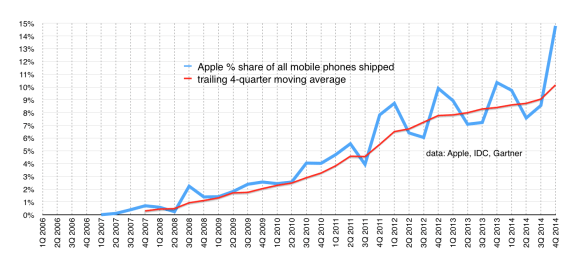
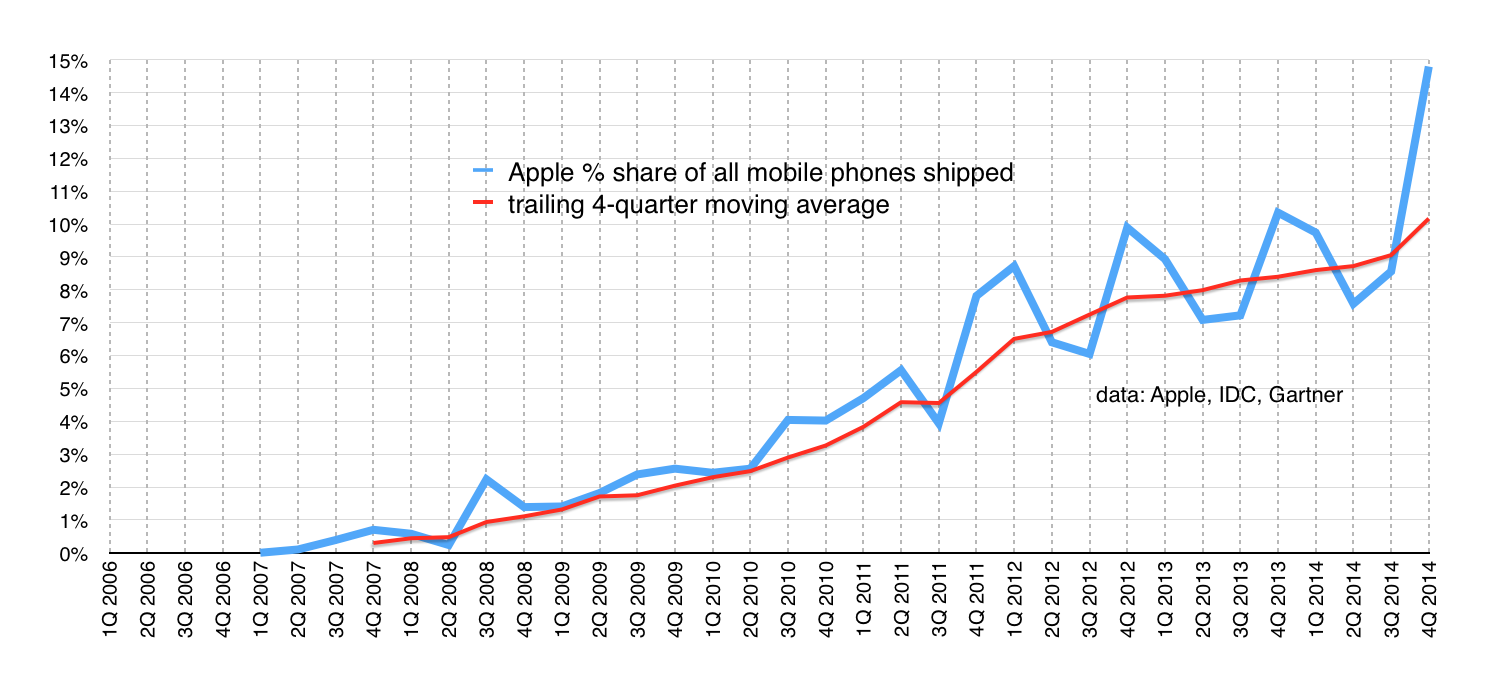
Apple's share of the overall mobile market

A niche player? Apple’s share of the overall mobile market (including featurephones) is at 10% for the past year, and 15% in the past quarter.

Apple’s a niche player – if that’s what you want to call the largest smartphone OEM – but it’s the most valuable niche, and also the one that lets it decide what people view as “valuable” in a phone. (For example, waterproofing hasn’t helped the Sony Xperia range or the Galaxy S5 sell, despite being a distinction compared to the iPhone range. Having a fingerprint sensor apparently has helped the iPhone 5S onwards.)

If Apple has the most valuable and the most loyal customers (and especially if it gets the most loyal valuable customers) then that means it can continue to expand its ecosystem, continue to charge a premium, continue to make big profits, continue to buy up companies that rivals had their eyes on, aim to undercut others in the services it offers.

Skimming off the top end gives Apple huge leverage. Ben Bajarin reckons Apple has about 60% to 70% of the “premium” market. On the basis of that 400m-440m user base (and don’t forget another 100m iPads and some iPod Touches too, though probably with a lot of overlap), that suggests there’s a total premium market worldwide of about 750m smartphone users worldwide. If Apple keeps pulling in 10m or so of them every quarter, it’s going to be a monster.

Update: Canaccord’s latest February 2015 calculation (which appeared the day I published this) reckons it will reach 650m by the end of 2018 – though it thinks that will be only a third of a global premium audience of 1.8bn. Android’s got plenty of room to grow. But so, it seems, has Apple.

Start up: TSMC/Samsung chip intrigue, emoticon overcharging, is that William Shatner?, going broke with encryption


Alternate Perspectives: photo by Randy Scott Slavin. Source: Dezeen

A selection of 10 links for you. Keep away from children. I’m charlesarthur on Twitter. Observations and links welcome.

Alternate perspectives by Randy Scott Slavin » Dezeen

New York photographer Randy Scott Slavin has joined hundreds of photographs to create distorted views of American cities and landscapes (+ slideshow).

Named Alternate Perspectives, the images present a series of panoramic views that curve around to form impossible circles.

Places depicted include the Empire State Building and Battery Park in New York, as well the region of Big Sur and the Redwood National Park in California.

As I wrongly retweeted (since deleted) a claim that one of these photographs was “a panorama produced by rolling down a hill”, it seems worth linking to this amazing set. Fabulous imagination required just to create them. (An example at the top of this post.)


What my hearing aid taught me about the future of wearables » The Atlantic

Ryan Budish:

despite initial appearances, both medical and consumer wearables share a few important goals.

Broadly speaking, both types of wearables aim to fill gaps in human capacity. As Sara Hendren aptly put it, “all technology is assistive technology.” While medical devices fill gaps created by disability or illness, consumer wearables fill gaps created by being human. For example, evolution hasn’t given us brain wi-fi, yet.

Both kinds of wearables also need to justify being attached to our bodies. This seems pretty obvious for hearing aids, but it is just as true for consumer devices. A wearable that serves as only a slightly more convenient screen for your phone is hardly reason for the average person to spend hundreds of dollars. Instead, wearables need to offer a feature that works best when in close contact with your body, like measuring heart rate or offering haptic feedback.

Also, both types of wearables need to embed themselves seamlessly into our experiences. If a wearable obstructs your experience of the real world, or is a distraction, it’s likely to end up on a shelf instead of your wrist.

There are other lessons too.


Did chip espionage, IP theft give Samsung its 14nm manufacturing lead? » ExtremeTech

TSMC argues that a former employee, Liang Mong-song, gave Samsung critical information to help it leapfrog TSMC in making its 14/16 nanometre gate process, breaking a non-compete agreement. In 2011 Liang had already been found guilty of breaching that condition:

The judge in Liang’s case clearly felt that the engineer had engaged in a bad-faith breach of his non-compete agreement given that he was forbidden to work for Samsung for an additional period of months, but the punishment was a slap on the wrist compared to the potential damage to TSMC’s core business. According to Maybank’s Kim Eng:

When comparing to a full-node migration, ie 20nm to 14nm at Samsung and Intel, TSMC’s half-node approach 16nm underperformed in cost reduction (by as much as 25% if not higher), power consumption and performance. In a very rare case, intel infamously highlighted the potential risks of TSMC’s 16nm undertaking during its Nov-13 investors’ day. After the initial round of evaluation, many customers “strongly encouraged” TSMC to enhance its 16nm technology offering.

In other words, not only did Liang possibly tap his knowledge of TSMC’s cutting-edge implementations inappropriately, he may have done so at the worst possible time (from TSMC’s perspective). Samsung has come out of nowhere to lead in foundry manufacturing, at least in the short term. Maybank’s latest report on TSMC cut the company from “Hold” to “Sell” on the strength of Samsung’s 14nm ramp. According to Liang himself, he left TSMC after he was passed over for promotion and felt his work was under-appreciated by his former employer.


Emoticons in texts can rack up huge bills » BBC News

Jane Wakefield:

The issue revolves around how the handset interprets the icons, known as emoticons or emojis.

In some cases, especially on older handsets, the emoticons are converted into MMS (multi-media service) messages, which can cost up to 40p each depending on the network.

MoneySavingExpert also found that, in some cases, users creating their own icons from full-stops, commas and brackets found they were converted into emoticons, running up the same charges.

“We have seen many complaints from our users who have racked up huge bills for sending what they thought were text messages,” Guy Anker, managing editor, told the BBC.

Paula Cochrane told the Daily Record that she had no idea that the emoticons were being charged as picture messages.

She complained to her provider EE and also plans to take her case to the Scottish ombudsman, an independent organisation that settles consumer complaints.

Amazing. But it’s the way that the carriers continue to rake in money; people on my Twitter feed have suffered this quite recently.


William Shatner: my problem with Twitter’s verified accounts » Mashable

Fantastic reporting by Lance Ulanoff, who actually took the trouble to try to contact Shatner, who had been grumbling on Twitter after Engadget’s social media manager got verified:

By the time I spoke to Shatner late Monday, he was upset that media outlets were misrepresenting his words. I offered to interview him to set the record straight. He agreed to answer questions sent via a Google Doc. What follows is unexpurgated Shatner on the controversy, Twitter, verification, TVTag, and how he uses social media.

Mashable: You’re one of the more digitally savvy celebrities/actors of your generation. What draws you to a medium like Twitter?

WS: I’m from the old studio system where there were departments of people that spoke on your behalf, giving the studio’s version of what I liked, what I do, what I like to eat, etc. So Twitter and social media is liberating for someone like me. I can speak my mind, my thoughts, my ideas and usually they don’t get filtered.

That may be a good thing or a bad thing! 😉

Shatner emerges from this as someone who has really thought deeply about what “verification” can and should mean, understands what social media is about, and is a charming and, especially, smart person. Read it and reflect.


Samsung: watch what you say in front of our TVs, they’re sending your words to third parties » Boing Boing

Part of the Samsung Smart TV EULA: “Please be aware that if your spoken words include personal or other sensitive information, that information will be among the data captured and transmitted to a third party through your use of Voice Recognition.”

This is part of their speech-recognition tech, which uses third parties (whose privacy policies Samsung doesn’t make any representations about) to turn your words into text.

I dunno. It’s lovely for those who want to believe that we’re living in a world of telescreens (and indeed for the NSA, GCHQ etc this might fit) but it’s not really the “privacy” aspect that’s a concern. It’s the potential for hackers to turn on your microphone and/or camera and record it that I’d find concerning.


What you can learn from Oakland’s raw ALPR data » Electronic Frontier Foundation

The EFF got the data about where and when the Oakland police department collected licence plate data (in a sort of passive surveillance; police cars capture the data using their cameras and the time and location is fed back). So what’s done with it?

We also filed a California Public Records Act request to obtain the Oakland Police Department’s crime data for the same period. Each white dot here indicates a recorded crime. It’s not much of a shocker that ALPR use doesn’t correlate very well with crime. For example, OPD did not use ALPR surveillance in the southeast part of Oakland nearly as much as in the north, west, and central parts of Oakland, even though there seems to be just as much crime.

To see if perhaps OPD was just focusing its ALPR use in areas with high incidents of automobile-related crime, we decided to map only the auto-related crime:

The result is the same—ALPRs are clearly not being used to deter automobile-related crimes.

The conclusion? A great big shrug. It seems like data being collected in order to collect data.


Could the HoloLens be Microsoft’s iMoment? » Gigaom

Ross Rubin:

The HoloLens, unlike the iPod, is an independent device, albeit one that extends Microsoft’s Windows franchise.

So, perhaps the HoloLens is more akin to the iPhone, which shrunk down the capabilities of not the user interface of the PC. Indeed, Microsoft has positioned the HoloLens as “the next PC” although the smartphone has already claimed that mantle and Windows 8 showed that the company can get a little overzealous in labelling things “PCs.”

Nope.


My first and last time at the Crunchies » Medium

Katie Jacobs Stanton:

At the Crunchies, comedian T.J. Miller, a star of the show “Silicon Valley” (which I watch and love), threw out a bunch of playful zingers in his opening act. But then at one point, he engaged with a woman (Gabi Holzwarth) a few rows in front of me by calling her a “bitch”. She responded increduously, “Did you just call me a bitch?” He then said, “Bitch, Asians aren’t supposed to be this entitled in the U.S. … Is this bitch from Palo Alto?” The audience laughed nervously. I was so uncomfortable I wanted to leave, but of course I couldn’t given that our award was coming up.

What a mess. Plenty of women didn’t enjoy it. Then again, it’s an awards ceremony at which Uber – you know, with a billion dollars in VC backing – won the award for “best startup”. And best hardware startup award winner was… GoPro, founded in 2002, which went public earlier this year.

Sure, it’s a networking event for Silicon Valley. But couldn’t they make it less embarrassing somehow?


The world’s email encryption software relies on one guy, who is going broke » Huffington Post

Julia Angwin:

The man who built the free email encryption software used by whistleblower Edward Snowden, as well as hundreds of thousands of journalists, dissidents and security-minded people around the world, is running out of money to keep his project alive.

Werner Koch wrote the software, known as Gnu Privacy Guard, in 1997, and since then has been almost single-handedly keeping it alive with patches and updates from his home in Erkrath, Germany. Now 53, he is running out of money and patience with being underfunded.

“I’m too idealistic,” he told me in an interview at a hacker convention in Germany in December. “In early 2013 I was really about to give it all up and take a straight job.” But then the Snowden news broke, and “I realized this was not the time to cancel.”

He’s earned about $25k per year since 2001. That’s not a lot.


Start up: Apple Pay in the UK?, 10m Chromecasts, the hacker whose cat betrayed him, and more


OK, definitely seen harder than that. Photo by health_bar on Flickr.

A selection of 9 links for you. Do not plant in acidic soil. I’m charlesarthur on Twitter. Observations and links welcome.

Due to me screwing up, the headline yesterday about finding Waldo referred to an article that’s in today’s list. Hope you didn’t spend too long looking for it.

Is there a battle looming in the UK between Apple Pay and Zapp? » Mobile Payments Today

Will Hernandez:

While Apple has yet to reveal a hard date for Apple Pay’s launch in the UK, pundits speculate that it could happen in April. This also happens to be about the same time Zapp is supposed to make its debut in the U.K.

Zapp relies on banks building it into their mobile apps, although as those banks own Zapp’s parent company, this shouldn’t be too much of a problem. The system is intended to provide real-time payments between consumers and merchants — both online and at the point of sale — without the need for a digital wallet. Zapp will generate digital tokens that will hide customer bank account details from merchants, and it is intended to work with different technologies such as NFC, Bluetooth, QR codes and PIN-entry point-of-sale terminals.

Zapp, however, has faced launch delays since at least the third quarter of 2014. Meantime, it announced in October retail partnerships that will go into effect this year. Asda, Sainsbury’s, House of Fraser and Shop Direct are among some of the major High Street retailers that will support Zapp. Earlier in the year, HSBC, first direct, Nationwide, Santander and Metro Bank announced their support for the system.

I’d never heard of Zapp either. Apparently it’s “a mobile payments system from Vocalink, which created the Faster Payments Service and is owned by all the major UK banks.”

Zapp has lots of benefits (cost, data sharing with retailers) and so could have a UK advantage – this is a good article for getting an idea of the competitive landscape in the UK as Apple prepares to land.


Android Wear’s newest trick, playing a full-length movie » Android Community

John Hoff:

Apparently, your Android Wear smartwatch can be taught to do cooler tricks – cooler than, say, playing Minecraft or Doom, or even running Windows 95. Once again, smart hacker Corbin Davenport has shown us that there’s a lot of stuff – not necessarily important world-changing stuff – just a lot of stuff that can be done to your Android Wear smartwatch when you have a lot of time on your hands.

“You haven’t watched a movie—until you’ve watched it on your watch,” Davenport proudly proclaims of his newest wild idea, which he shows via YouTube. The demo shows Davenport playing Star Trek: Into Darkness on his Android Wear, which is probably a delightful coincidence as he shows us that Android Wear devices can really go where no smartwatch has gone before (excuse the pun, we couldn’t help it).

Davenport has done some weird, weird stuff there.


Big three mobile phone markets beyond China » Counterpoint Technology Market Research

According to the latest research from [the] Market Monitor program for Q4 2014 (Oct-Dec), total mobile phone shipments for India, Indonesia and Bangladesh stood at 89m as smartphone demand skyrocketed and the total smartphone shipments contributed to more than a third of all mobile phones shipped during the quarter. These three markets combined offers an opportunity for mobile phone industry players looking to grow beyond the saturating China mobile phone market.

“Smartphone growth in these regions touches almost all the price segments with regional brands being prominent in the entry level smartphone segment. Apart from this we have seen Chinese vendors entering these geographies for the first time in CY 2014 and enjoyed a significant success rate. However it will be important to keep an eye on  Online only players on how they capture the smartphone growth in rural areas in these regions” says Tina Lu Sr. Consultant at Counterpoint research

Mobile phones, not just smartphones – note. By comparison, Japan bought about 25.7m smartphones in 2014 and that is expected to rise to 27m in 2015. (About half of that total would be iPhones, judging by Kantar’s figure.)


The utterly crazy story of the death threat hacker » We Live Security

Graham Cluley on a Japanese hacker who caused lots of problems via trojan-infected PCs in Japan in 2012:

the police arrested four separate people, and allegedly managed to “extract” confessions from some of those whose computers had posted death threats to a popular messageboard.

However, the confessions were clearly unreliable (one wonders how the confessors were “encouraged” to make them), as the suspects had in fact had their computers infected by the hacker’s malware, which had posted the death threats without their knowing.

It became clear to the police that they had made a colossal blunder, when the hacker – who went by the alias Oni Koroshi (Demon Killer) – continued to send taunting emails to the police force and local newspapers.

You can just imagine how embarrassing that must have been for the Japanese police, in what was becoming a high profile case.

Er.. yeah. But then it gets utterly weird, when the hacker sends a series of clues to the police, and it all ends up with a showdown involving a cat, an island and a sikrit chip worn on the cat. If Ian Fleming were alive today and writing this stuff you’d call it too far-fetched.

(Also, stupid hacker. Should have stopped when the people confessed.)


License plate scanners also taking photos of drivers and passengers » American Civil Liberties Union

The Drug Enforcement Agency is using its license plate reader program not only to track drivers’ locations, but also to photograph these drivers and their passengers, according to newly disclosed records obtained by the ACLU via a Freedom of Information Act request.

One internal 2009 DEA communication stated clearly that the license plate program can provide “the requester” with images that “may include vehicle license plate numbers (front and/or rear), photos of visible vehicle occupants [redacted] and a front and rear overall view of the vehicle.” Clearly showing that occupant photos are not an occasional, accidental byproduct of the technology, but one that is intentionally being cultivated, a 2011 email states that the DEA’s system has the ability to store “up to 10 photos per vehicle transaction including 4 occupant photos.”…

…Some law enforcement agencies that employ ALPRs recognize that the technology should not be used to capture photos of vehicle occupants. We obtained an ALPR policy from Tiburon, California that speaks to our privacy concerns. The policy states that “cameras will be directed only to capture the rear of vehicles and not into any place where a ‘reasonable expectation of privacy’ might exist.”

Tricky argument. You can see that it would be useful for law enforcement to know who’s driving a car. And do you have “a reasonable expectation of privacy” when you’re driving a car on a public road where people can take pictures of you and your car – as happens here?

(By the way, in the UK we call it an “Automatic Number Plate Reader”. Even though it now has letters and numbers.)


Twitter cuts off employee access to its metrics » Re/code

Kurt Wagner:

There’s no metric more important to the social network than the number of people that use the service — more specifically, its monthly active users, or MAUs. Recent events inside the company show how sensitive Twitter’s top brass can be about this number, which also partly explains the company’s push to use other metrics to showcase Twitter’s reach.

The company used to grant all employees access to its MAU figure through an internal intranet, but that access was revoked a few weeks ago, according to multiple sources familiar with change. Now, the MAU metric is only available on a need-to-know basis.

There has been so much noise ahead of Twitter’s results (which came out after I added this) that one has to feel there’s something weird going on there. A culture clash? Internal political struggle? Whatever, this will be the year it plays out.


Xiaomi has a San Francisco press event scheduled for 12 February… but it’s still not entering the US market » Android Police

Any tech journalist worth his silicon would probably assume that Xiaomi intends to finally push into the US market to take on the likes of Apple and Samsung, possibly even with new mobile hardware. But apparently that’s not the case. We specifically asked Xiaomi’s PR representative about the possibility of a North American expansion, and this is the response that we were given:

We can also confirm that Xiaomi will not be launching in the US or entering the US market this time, but this is an opportunity to get to know the company and leadership a bit more.​

Any tech journalist worth her or his silicon would know that Xiaomi would face insuperable IP issues in trying to enter the US market, and also that it’s simply the wrong sort of market to try to get in to just now for Xiaomi.

At least they called Xiaomi to have their castles in the air shot down.


Google sold 10 million Chromecasts last year » Korea Times

Google has sold about 10 million Chromecast, a streaming-media dongle for high-definition (HD) TVs, globally in 2014, Google Korea said Wednesday.

Chromecast, which made its debut in July 2013, now supports more than 350 apps and services, including YouTube, Tving and Hoppin in Korea.

It started selling the device in Korea in May 2014, the first marketing debut in the Asian market.

This number sounds entirely feasible; it also sounds like the sort of thing that Google Korea might blurt out, when its corporate headquarters has only ever said “millions”.

Ten million is pretty impressive. Now, of course, we can divide all the numbers it has put out to get average use, such as its “used for one billion ‘casts’” stat in the January earnings call: that works out to an average of about 100 “casts” per device over the whole of 2014 (but of course not all were in use all through 2014).

So probably double that 100 figure (or even treble it) for those bought early in the year; halve it, or one-third, for those bought later. Sound good?


Here’s Waldo: computing the optimal search strategy for finding Waldo » Randal S. Olson

I decided to approach this problem as a traveling salesman problem: We need to check every possible location that Waldo could be at while taking as little time as possible. That means we need to cover as much ground as possible without any backtracking.

In computer terms, that means we’re making a list of all 68 points that Waldo could be at, then sorting them based on the order that we’re going to visit them. So now we just need to try every possible arrangement of the points and find the one with the shortest distance traveled. Easy, right? Wrong.

Those 68 points can be arranged in ~2.48 x 1096 possible ways. To provide some context, that’s more possible arrangements than the number of atoms in the universe. That’s so many possible arrangements that even if finding Waldo became an international priority and the world banded together to dedicate the 8.25 million computing cores from the world’s 10 largest supercomputers to the job, it would still take ~9.53 x 1077 years — about 6.35 x 1067x longer than the universe has existed — to exhaustively evaluate all possible combinations. (Generously assuming that each core could perform 10,000 evaluations per second.) In other words: if we don’t have a smarter solution, Waldo is as gone as Carmen Sandiego.

I admit I was disappointed that he didn’t do it by image recognition. And anyhow, his solution (probable regions) doesn’t help you at all with Wizard Whitebeard, Wenda, Wilma, Odlaw, Woof or the Waldo Watchers.


Start up: finding Waldo, Amazon’s tablet gripe, Samsung 4:3 tablet?, better interface design, and more


OK, that’s not so challenging. Picture by cybertoad on Flickr.

A selection of 9 links for you. May contain nuts. I’m charlesarthur on Twitter. Observations and links welcome.

Sapphire displays to see major step forward with lower reflectivity » Mac Rumors

While GT Advanced experienced difficulties with both the quality and quantity of sapphire, it is possible that Gorilla Glass was the better choice for the iPhone 6 and iPhone 6 Plus after all. TIME reported in September that sapphire, in its current form, has several properties that are less ideal than glass, including being thicker and heavier, more expensive, unable to transmit as much light and less durable after exposure to normal wear and tear. Sapphire also has up to double the screen reflectance of glass, especially under bright light, which could make it difficult to read the screen.

The reflective issue in particular could soon be a thing of the past, however, as DisplayMate confirmed to MacRumors that it has lab tested new sapphire technology that it believes will be a major breakthrough for smartphone displays. The display calibration and evaluation company found the production-ready enhanced sapphire to be at an advantage over both regular sapphire and glass based on the results of its testing, and predicted that “rapidly falling production costs” could make the material go mainstream in the near future.

I doubt that the sapphire being made at GT Advanced was planned for 2014’s iPhones. These problems would have been recognised, and the volumes would be too low to make screens for so many devices. Sapphire feels like a super-top-end product – as it is for Vertu. And that means low volume (comparatively).

Other phone makers are considering it, for sure.


Microsoft’s mobile inabilities » Om Malik

Microsoft has acquired two iOS applications — Acompli (email) and Sunrise* (calendar) — for about $300 million. Those acquisitions are good for the founders (and their investors). Some might see it as a sign of a new Microsoft — aggressive and quick in trying to turnover a new leaf. To me, they are all of that, but more importantly indicative of the much deeper cultural rot facing Microsoft and its now not so new chief executive, Satya Nadella.

“He’s hit all the low-hanging fruit — that said, these things were not easy to do — but now he has to address all the long-term issues,” Brad Silverberg, a former Microsoft executive-turned-venture capitalist told Bloomberg Business in an interview. Spot on — and these two acquisitions are just a perfect example of these long term challenges.

It is a pretty damning indictment that Microsoft had to spend hundreds of millions on front end apps for its own platform –Microsoft Exchange — and it should send alarm bells ringing. Exchange is something Microsoft understands better than most and it should in theory be able to develop good apps as front end for it.

I don’t agree. Nadella is being pragmatic here: Microsoft is a big organisation, and it moves slowly. Everyone recognises that small startups can hit precisely the user needs that big organisations can’t see, or can’t develop for even if they see. It has done poorly in mobile so far.

What it’s doing with these app purchases is strengthening Outlook – locking it in place as a product that will continue to rake in money year after year, especially because everyone will get a great experience using it on mobile via these apps.


Meet the ultimate WikiGnome » Medium

Andrew McMillen:

Maryana Pinchuk and Steven Walling addressed a packed room as they answered a question that has likely popped into the minds of even the most casual users of Wikipedia: who the hell edits the site, and why do they do it?

Pinchuk and Walling conducted hundreds of interviews to find out. They learned that many serious contributors have an independent streak and thrive off the opportunity to work on any topic they like. Other prolific editors highlight the encyclopedia’s huge global audience or say they derive satisfaction from feeling that their work is of use to someone, no matter how arcane their interests. Then Walling lands on a slide entitled, ‘perfectionism.’ The bespectacled young man pauses, frowning.

“I feel sometimes that this motivation feels a little bit fuzzy, or a little bit negative in some ways… Like, one of my favorite Wikipedians of all time is this user called Giraffedata,” he says. “He has, like, 15,000 edits, and he’s done almost nothing except fix the incorrect use of ‘comprised of’ in articles.”

Turns out to be 51-year-old software engineer Bryan Henderson. It beats commenting on websites as a lasting contribution, don’t you think?


The Next Episode: Apple’s plans for Beats-based music service revealed » 9to5Mac

Mark Gurman on the much-anticipated integration of Beats into Apple:

Rather than merely installing the existing Beats Music app onto iPhones, Apple has decided to deeply integrate Beats into iOS, iTunes, and the Apple TV. The company is currently developing new Beats-infused versions of the Music application for the iPad, iPhone, and iPod touch, as well as an updated iTunes application for computers that deeply integrates Beats functionality. A new Apple TV application is also in the works.

Based heavily upon cloud streaming, Apple’s new service is centered around the user’s music library. A new search feature will be able to locate any song in the iTunes/Beats catalog, and users will be able to stream music from the catalog as well as add songs to their personal libraries. Users will be able to select specific tracks to store on their iOS devices and/or computers, or keep all songs solely in the cloud. Apple will also deeply integrate Beats Music’s Playlists, Activities, and Mixes features into the new service, letting users access a vast array of pre-made, human-curated playlists to fit various activities. Surprisingly, Apple is likely to also update Beats’ social networking features, allowing people to follow other users and artists as they did with the failed Ping social music network.

Aiming for a lower price point than the $9.99 per month; Apple wanted $5 but is being pushed to $7.99 by labels. This fits with what I’ve been hearing from analysts and people in the music industry. A lower price is essential to getting more subscribers.


To make tech design human again, look to the past » WIRED

Tom Lakovic of the design company INDUSTRY:

who’s doing it wrong? Examples are everywhere of touch screens existing where no touchscreen should be. Even our favourite innovators over at Tesla Motors have missed out on potentially great DigiLog experiences in their Model S. Personally, I’d love to redesign their console just so I could get that oversized iPad out of their otherwise amazing cars.

You can’t just lean on PARC-style metaphors in every single context moving forward. You have to evaluate and re-evaluate the tradeoffs of digital versus analog interactions. What you gain by dropping in a giant touchscreen that controls every aspect of your vehicle experience is easy to state: customizable skins and software upgradable UIs, but what is lost in the translation?

I’m pleased that he agrees with me about Android Auto and Apple’s CarPlay: I don’t like the distraction they imply. I also liked this diagram of touch done right and wrong:

(Via Neil Cybart’s Above Avalon newsletter. You should subscribe.)


Profitable and uncopyable » Matt Richman

Apple Pay will succeed for one simple reason: Everyone in the system has an interest in it succeeding. Card issuers like Apple Pay because it reduces their fraud liability. Card networks like it because it reinforces their role in the system. Merchants like that it precludes Target-style data breaches. Everyone has a reason to want Apple Pay to succeed, so it will.

How much Apple will profit from Apple Pay is anyone’s guess. Mine is: Over time, a lot. In the US alone, credit and debit card transactions totalled $3.9trn in 2013. Since Apple gets a 0.15% cut of every Apple Pay transaction, a measly 10% transaction share is worth $585m. One year, one country, $585m. Over time, Apple will make billions from Apple Pay.

Though Apple Pay will make Apple a ton of money, the strategic implications of the service are worth far more. With Apple Pay, Apple leveraged its business model, cultural influence, and customer base to enter arguably the most heavily-regulated international system on Earth in a way that everyone already in the system had a reason to like. This is an incredible accomplishment, and no other company could have done it.

Google does not control Android enough to create anything truly comparable to Apple Pay. Even if Google were able to add Apple Pay’s software components to Android, the company would have to rely on its hardware partners to replicate Touch ID and the secure element and to seamlessly integrate everything together. They’re not going to be able to do that for the foreseeable future.

A few nitpicks. Not all retailers like all aspects of Apple Pay – in particular, they don’t get customer data they got previously, and might still want. (Whether they should get that is another matter.) Also, 10% of all transactions is a lot – but his number shows that even a couple of percentage points is very valuable, and almost all profit.

On the topic of Google, there is Google Wallet – whose key problem is poor and inconsistent implementation. The secure element is already available in ARM chips. But it will take a long time to feed through to handsets in use.


Amazon takes issue with report that holiday Fire tablet sales fizzled » Re/code

Dawn Chmielewski:

Researcher IDC said Amazon showed the steepest annual decline among the five major tablet makers, with worldwide shipments of its Kindle Fire devices falling by as much as 70% compared with the holiday 2013 period. The declines come at a time when worldwide shipments in the fourth quarter fell for the first time since the tablet market’s inception in 2010.

But there’s a caveat in the results: IDC doesn’t count shipments of Amazon’s new six-inch version of its Kindle Fire HD tablet, introduced in September and ranked among the “most wished for” gift items of the holiday season. A spokesperson for the retailer criticized IDC’s methodology, saying “our most affordable tablet ever, the Fire HD 6 at $99, which is one of our high volume products, wasn’t included in the report.” She declined to discuss sales.

Er.. if you’re going to call it a “high-volume product”, shouldn’t you help people out by explaining what that volume is? Doing this is like saying the cake you’ve got in the fridge is wayyy bigger than people are saying. But then not opening the fridge. Mmm, cake.

But wait, there’s more:

IDC Senior Research Analyst Jitesh Ubrani said the researcher doesn’t consider the Kindle Fire HD 6 a tablet because of its screen size and its inability to connect to cellular networks. It’s more of a media player, in the researcher’s view. But even if the estimated 1.2m shipments of the device were included in IDC’s numbers, Amazon’s holiday tablet shipments would still be off by 50% from the prior year, he said.

Soooo… the Kindle has hit its ceiling for sales; the Fire phone was a flop; the Fire tablet has fizzled. Let’s look forward to not hearing how the Amazon Echo has sold.


Wishbone: the world’s smallest smart thermometer by Joywing Tech » Kickstarter

The core function of Wishbone is to detect temperature using an infrared sensor. Wishbone is noninvasive, reliable and versatile for many applications. It can accurately measure body temperature by measuring forehead skin and examine liquid temperature from surfaces in just a few seconds. While measuring, Wishbone does not emit any radiation or sound as it uses a passive sensor.  Wishbone can also measure environment temperature by pointing it toward the sky or ceiling. Both Object and Ambient modes are still currently under development.

Works on iOS and Android (it plugs into the headphone jack). I think this is neat; I’ve backed it. (It’s already miles past its goal.) I like the idea of the Object and Ambient modes. Notice too how smartphones are now offering core functionality for medical products like this.

Yes, a simple alcohol thermometer is cheaper – but less flexible. As more people have smartphones, more functions and industries get sucked into them.


New Galaxy Tab 5 might have 4:3 aspect ratio as well » SamMobile

We have already reported that Samsung is working on new Galaxy Tab tablets. It is expected that these tablets are going to have displays with 4:3 aspect ratio instead of the 16:9 aspect ratio that Samsung has stuck with in the past. According to information obtained through the import tracking website Zauba the new Galaxy Tab 5 may also have a 4:3 aspect ratio. The import tracker picked up on a new Galaxy Tab 5 model imported into India and it seems to have a 9.7-inch display, similar to the screen size of Apple’s iPad, which also has a 4:3 ratio.

I’ve been told – endlessly – by people who claim it’s important that 16:9 is the “right” ratio for tablets because it means you can watch films without letterboxing. Now we find that Google (qua the HTC-built Nexus 9) and now perhaps Samsung are going for 4:3, like the iPad… which has seen the most success in the market.


Start up: dual-SIM nations, Korea v Apple (and Google), Galaxy S6 flat – or rounded?, and more


A dual-SIM Sony Xperia. Photo by hirotomo on Flickr.

A selection of 8 links for you. Keep moist. I’m charlesarthur on Twitter. Observations and links welcome.

Korea’s FTC has created a task force to determine whether Apple and Google are damaging the Korean market » Patently Apple

Today the South Korean press is reporting that he Korea Fair Trade Commission (FTC) will create a task force for ICT this year and closely monitor Social Networking Service providers (SNS) and operating system providers.

The country’s anti-trust regulator announced its plan for this year on Feb. 1. What is most noticeable is a task force for information, communication Technology (ICT).

The FTC is said to establish a task force and closely monitor whether or not monopolistic companies like Google and Apple inflict damage to the Korean market using their dominant position in the market.

The regulatory body is paying attention to the fact that the two companies comprise 99.5% of the local mobile operating system market.

Umm.. that percentage hasn’t changed. All that’s changed is Apple’s proportion of it, which went from about 10% to 33%.


Enough is ENOUGH: It’s time to flush Flash back to where it came from – Hell » The Register

Iain Thomson:

Even if Adobe put its top programmers working on Flash, a free piece of software, a lot of people around the world are very keen to find exploitable bugs in the plugin so they can break into victims’ computers.

Many netizens have recognized that Flash is too old and doddery to be worth the hassle. YouTube finally dumped the technology in favor of HTML5 video. Twitch doesn’t need it any more, neither does Netflix and others.

“The reality is there’s a market out there and people are going to exploit it,” Williams said. “Java has been a top vector, as has Flash, and now the attackers are moving to Silverlight as well.”

The fact is, Flash is just not fit for purpose. It will ruin your month. It will fill your hard drive with raw sewage seeping in from the grotesque underbelly of internet. It’s the Lego brick in your foot when you’re feeling your way through a dark kitchen at 3am.

It’s not even good for funny animations any more – we have HTML5 and a GIF resurgence for that. If you’re still using the plugin, you may as well hang a sign out for hackers reading: “Here’s my arse, please kick it. And then empty my back account.”


The global prevalence of dual-SIM Android devices » OpenSignal


Dual SIM devices are particularly popular in Asia

What we found

– The number of multi SIM devices is huge:
in the last month 26% of new users of the OpenSignal app had a device multi SIM support. This survey covers just over 1 million app users up to 18th January 2015.

– There is a very broad choice of multi SIM devices:
we identified over 10,000 different Android models with multi-SIM support.

– There are profound differences between markets:
in general developing economies have a higher proportion of dual-SIM users, in several countries dual (or multi) SIM users are the majority of Android users. The US, UK and Canada all have around 4% penetration, Australia is slightly higher at 5%. Several European countries have middle of the road values – Greece, Hungary, Spain, Albania, Croatia are all around 25%.

Ten thousand different Android models with multi-SIM support. Just amazing. Multiple SIMS are used for many purposes: having a business and personal number on a single phone, choosing between providers in different locations or data/voice plans, being.. er.. duplicitous.

India, Russia, Tanzania, Nigeria, and the Philippines lead the pack (greener means higher percentage).


Supply chain sees weak demand for Xiaomi’s Mi4 model in 4Q14 » Digitimes

Supply chain shipments for Xiaomi Technology’s Mi4 were weaker-than-expected in the fourth quarter of 2014, while those for the company’s previous Hongmi model remained steady.

Orders to supply chains for the Mi4 throughout the quarter until February 2015 have lagged, which coupled with an expected slowdown in the overall handset industry during the first quarter of 2015 has left supply chains rather pessimistic about orders for the device.

Supply chain sources commented that China’s handset market cooled down over the fourth quarter, which coupled with weak demand in emerging markets also influenced orders for the Mi4.

The cooling market in China really is going to have a lot of effects – principally, forcing a number of Chinese OEMs to look abroad or suffer badly in the slowdown.


Samsung pins hope on Galaxy S6 for rebound » Korea Times

“The Galaxy S6 is expected to have pretty much upgraded features compared to previous models. It will help the company post stable growth,” said Kim Young-chan, a technology analyst at Shinhan Investment. “If it successfully attracts users who have been reluctant to change their devices, Samsung can increase market share in the premium smartphone segment.”

On Tuesday, Samsung started giving out invitations for its Galaxy Unpacked Event 2015.

“The Galaxy S6 will make its debut in two versions ― flat and rounded screens,” said an executive at a local parts supplier, Tuesday. “It will have a metal build, which will make it look even more like Apple’s latest models.”

Galaxy S6 will use glass on the front and back, making it more appealing, he said.

Samsung dropped its earlier plan to adopt a dual-edge design on the new phone due to concerns over defect rates of curved glasses.

Also: 5.1in screen, embedded (ie non-changeable) lithium polymer battery. It’s hoping this will win back share in the premium phone market. Don’t see why any of those characteristics would do it, to be honest.


Senior Samsung executive resigns » WSJ

A senior Samsung Electronics Co. executive in charge of the technology giant’s rollout of its next flagship smartphone has abruptly resigned, people familiar with the matter said, in the latest management departure at the struggling mobile division.

Just a little over a month into the job, Kim Seok-pil, who was named head of strategic marketing for Samsung’s mobile business in December, will be replaced by another Samsung executive, Lee Sang-chul, who is currently in charge of Samsung’s Russia operations, one of the people said Tuesday.

This person said Mr. Kim was leaving due to health reasons and could return to the company at a later time.


Is Windows RT dead? Microsoft stops making Nokia Lumia 2520 » PCWorld

Microsoft could be close to pulling the plug on Windows RT with its decision to stop manufacturing the Nokia Lumia 2520 tablet.

The Lumia 2520 tablet was the last tablet remaining running Windows RT with Microsoft not making its Surface 2 tablet. Microsoft didn’t provide the specific date it stopped making the Lumia 2520 tablet to Dutch publication PCM, which broke the news.

Microsoft did not immediately respond to a request for comment. But Nokia Lumia 2520 tablets are still being sold through Verizon Wireless in the U.S. starting at $499.99 with a two-year commitment, and for $599.99 without a contract.

That could bring a quiet end to Microsoft’s experiment with Windows RT, which was built for tablets and PCs based on ARM processors. The first tablets with Windows RT shipped in 2012, but the response has been poor, with PC makers like Dell, Asus, Lenovo and Samsung abandoning devices with the OS. Microsoft last year cancelled plans to launch a small-screen tablet with Windows 8.1 RT.

The “Surface mini” just missed its window of opportunity by about six months. Now it would be impossible without gigantic corporate customer buy-in to sell them. But Apple and IBM look to be going after that business, if it exists.


Asustek facing challenges in 2015 » Digitimes

Monica Chen:

Asustek managed to ramp up its notebook shipments to 20.1m units in 2014, up from 18.8m shipped a year earlier. However, shipments of low-priced models to some designated markets contributed much of the growth in 2014.

Meanwhile, shipments of desktops totalled 2m units in 2014, doubling from those shipped in 2013.

Excluding shipments of Windows-based tablets and 2-in-1 models, Asustek’s notebook shipments lagged slightly behind the 20m units shipped by Apple in 2014, according to IDC…

Although Asustek boasts a number of notebook lines, including Gun-, KX- and T100- and Chi-series as well as EeeBook and Chromebook families, slack global demand for notebooks will cap Asustek’s efforts to ramp up its shipments, according to industry sources.

Asustek’s tablet shipments fell short of its target in 2014, reaching less than 10m units compared to 12m units shipped a year earlier. However, buoyed by its voice-calling Fonepad tablet series, the company still aims to ship 12m tablets in 2015.

The company shipped eight million smartphones in 2014, but saw a loss of NT$2bn (US$64m) for the handset business. Asustek plans to release its second generation ZenFone soon and aims to ship 16m units in 2015.

You can just about use those numbers to back out the number of 2-in-1s that Asus shipped, which looks like the low single-digit millions for the year. And that handset business is painful.


Start up: smartwatches are go!, tablets shrink, bitcoins all spent?, Yahoo keeps growing in search, and more


What’s Apple up to with its privacy drive? Photo by dmelchordiaz on Flickr.

A selection of 8 links for you. Use them wisely. I’m charlesarthur on Twitter. Observations and links welcome.

Pebble has now sold over 1 million smartwatches » The Verge

While Google and Apple have been getting the lion’s share of attention for smartwatches lately, indie darling Pebble has been quietly soldiering on, improving its product and selling watches. In an exclusive interview, CEO Eric Migicovsky revealed that the company shipped its one millionth Pebble on December 31st of last year. That’s more than double what Pebble reported in March, indicating that price cuts and new feature additions later in the year successfully boosted sales figures.

Pebble’s biggest and most visible competitor so far has been Google’s Android Wear, which launched in the middle of 2014 and is found on devices from Motorola, Samsung, LG, Sony, and Asus. Google has yet to reveal how many Android Wear watches have been sold in the six months or so it has been on the market, so it is difficult to determine if the platform is a success or not.

Google’s silence speaks volumes; it must know, surely? Also, how many of its employees are still wearing their LG smartwatch Christmas gift? A million is good going for Pebble. Seems like the smartwatch market will split three ways: Apple, Android, Pebble. (I have a Kickstarter Pebble, and recently rediscovered its usefulness through its step-and-sleep counting Misfit app.)


Worldwide tablet shipments experience first year-over-year decline in the fourth quarter while full year shipments show modest growth » IDC

Worldwide tablet shipments recorded a year-over-year decline for the first time since the market’s inception in 2010. Overall shipments for tablets and 2-in-1 devices reached 76.1 million in the fourth quarter of 2014 (4Q14) for -3.2% growth, according to preliminary data from the International Data Corporation (IDC) Worldwide Quarterly Tablet Tracker. Although the fourth quarter witnessed a decline in the global market, shipments for the full year 2014 increased 4.4%, totaling 229.6m units.

“The tablet market is still very top heavy in the sense that it relies mostly on Apple and Samsung to carry the market forward each year,” said Jitesh Ubrani, senior research analyst, worldwide quarterly tablet tracker.

Apple, Samsung, Asus, Amazon, all lost share and sales; only Lenovo, third-largest, grew (by 0.3m), which may have been mainly in 2-in-1s. Amazon’s dropoff is dramatic in both the Q4 and full year. But remember that tablets are principally going to consumers, have saturated their market, and have a replacement period of around four years. Compare that to PCs, which go to companies and consumers, and were at some times replaced as rapidly as every two years.


New findings suggest nearly 90% of all bitcoin holdings already spent » CoinSpeaker

Nearly 90% of those who have purchased or mined Bitcoin may have already cashed out their holdings, it emerged this weekend. Before now, it was thought that just 36% of bitcoins had currently been spent or sold, an argument often used by both advocates and their adversaries to support the fact that Bitcoin is both likely and unlikely to succeed as an asset class over the long term.

The findings were posted by Reddit user intmaxt64 and are being revealed in the Bitcoin press for the first time here at Coinspeaker…

…the findings may indicate that the Bitcoin price has suffered directly as a result of the major holders of Bitcoin liquidating their holdings while claiming the opposite. Many of the potential sellers appear to be the same individuals and organizations who got buyers to purchase during 2011-2013, since the large quantities of unit exchanges happened during this time.

Very deep implications to this, including the potential to corner the market.


Yahoo gains further US search share in January » StatCounter Global Stats

January saw Yahoo further increase the gain it made in US search share last month, according to the latest data from independent website analytics provider, StatCounter. Google fell below 75% in the US for the first time since StatCounter Global Stats began recording data [in June 2008].

StatCounter Global Stats reports that in January, Google took 74.8% of US search referrals followed by Bing on 12.4% and Yahoo on 10.9%, its highest US search share for over five years.

This is desktop-only, of course, and it’s not a giant change. But US users are surely the most valuable ones. Take Firefox out of the equation, and Google’s share remains where it was (despite Google’s attempts to win them back)

So what sort of people use Firefox and don’t change their search engine back to Google? Well, there’s Katharine Viner, editor-in-chief of the Guardian’s US operation. Did she notice the change?

https://twitter.com/KathViner/status/562213757300903936

So why’s she sticking with Yahoo?

https://twitter.com/KathViner/status/562214149329940480


How new versions of Android work » Rusty Rants

Russell Ivanovic of Shifty Jelly, which makes Android and iOS apps:

People are often quick to mis-interpret these numbers. “iOS 8 adoption is at 64%, but Android 4.4, a version that’s years old isn’t even at that!”. There’s two things wrong with these kinds of comments. Firstly there are roughly 6-8x more Android devices than iOS devices in the world, depending on which market share numbers you use. This means that if a version of Android achieves 39% adoption, that’s a huge deal, and you could develop just for that platform and address a larger user base than targeting iOS 8 with its 64%. Secondly people confuse overall numbers, with actual numbers of people who buy apps. Here for example are the version breakdowns of people who buy Pocket Casts on Android:

So while Android 5.0 has less than 1% adoption in the overall Android ecosystem, 23% of our customers already run it. This makes sense when you put a bit of thought into these numbers. People that have the money to buy apps, and are passionate about Android, have up to date phones.

I find Ivanovic a necessary counterpoint to a lot of what one reads about Android and iOS. He’s sincere, and expresses his views directly. (He’s Australian, so..) One point about Pocket Casts is that it’s a podcast player. There are paid-for podcast players on iOS (Marco Arment, obviously) but it seems to me the opportunity is much larger because there’s no OS-level podcast app on Android as there is for iOS.

That said, Ivanovic’s points are still valid. It’s install base x amount paid that really matters for developers (and, to some extent, users, as they benefit from the availability of apps, driven by the size of the ecosystem). Also, he wrote this piece before today’s data about Lollipop share – 1.6% of all Google Play installs as of 2 February.


Apple on privacy, security and identity » Benedict Evans

Evans tries to connect the dots that Apple has left around, on the basis that products it has now – such as Apple Pay – are obvious in retrospect (TouchID + Passbook). With that in mind, why Apple’s focus on “privacy”, he asks:

it may also be that as our phones go from sharing pictures to unlocking our front doors, privacy becomes a much more valuable selling point. This might be one reason why Nest is being kept semi-detached at Google. Worrying that Google knows what you search for has always seemed to me rather like worrying that your bank knows how much money you have, but Google knowing when you get out of bed or unlock your front door might be different (though of course it gets a fair bit of this through Android). So, perhaps Apple is talking about privacy not because of its current products, but because it thinks privacy will be a real competitive advantage for future ones. Not the iPhones, but the Watch, or other wearables, or the connected home. There’s an interesting question here – is the big data dividend worth the privacy implications? Is it better to let Google know when you flush the loo for what it can tell you about your bowels, or would people really rather not? 


Why I’ve found that online communities on media sites always seem doomed to fail » Martin Belam

I used to work with Martin at The Guardian (he’s now at the Daily Mirror); he’s got great insights into how communities fail or work. His key points – “The behaviour of the regular users becomes self-limiting for the community as a whole” and “The community believes they are representative of the primary audience” are, to me, the essence of the problem.

As a reminder, I did a pseudo-economic analysis of why comments on media sites just don’t work, which comes down to “the crap drive out the good”. I think that’s what Martin’s saying in his first point, only more nicely. Also, as he notes:

At the moment we don’t have comments on the Mirror site where I work, and I must confess it is a slight relief not to be immediately called a twat every time I press publish, but equally I find sites without comments don’t feel as alive. You know an article has had an impact when it has generated hundreds of comments.

I’d disagree on that latter point. You know an article has generated hundreds of comments when it generates hundreds of comments. But if you read them, you might find there’s no actual impact at all – as in, the comments haven’t added to the sum of human knowledge in the slightest.


Apple Watch sightings picking up ahead of official launch » Mac Rumors

Juli Clover:

Due to the large number of employees testing the device, Apple Watch sightings in the wild have become more common over the course of the last few weeks. On the MacRumors forums, readers are aggregating photos and stories of device sightings, giving us an in-use look at the device that will be attached to many of our wrists in just a few short months.

One of the first major Apple Watch sightings occurred several weeks ago, when Vogue Editor Suzy Menkes snapped a photo of someone wearing the device. Rumors and speculation have suggested the arm in the photo could belong to Marc Newson, the designer who now works at Apple part time alongside Jony Ive.

The forums aren’t that helpful (lots of vague discussion); James Cook at BusinessInsider has wrapped the (few) pics together.

Though the iPhone was announced before its public release, the only person I recall ever being seen in public using it ahead of that was Steve Jobs. This quiet seeding and testing is quite different.

Of course – and ponder this for a moment – everyone’s got an internet-connected camera now. Maybe there were tons more iPhones in public testing in 2007. We just didn’t hear about them.


Start up: Pono Pogued, Jawbone money hassles?, car hacking, Apple Watch ahoy!, and more


Apple Watch v the rest. Photo by Martin uit Utrecht on Flickr.

A selection of 9 links for you. Use them wisely. I’m charlesarthur on Twitter. Observations and links welcome.

Neil Young’s PonoPlayer: The emperor has no clothes » Yahoo News

David Pogue idly kicks a hornet’s nest:

The Pono Player, once just a Kickstarter prototype, is now a product that anyone can buy, for $400. To hear the magic, you’re supposed to buy all new music—high-resolution audio files—from Pono’s new music store (ponomusic.force.com), and load them onto your Pono using a new Mac or PC loading-dock program (Pono World). Albums cost about $25 each.

You’ve got to admit it: The argument for the Pono Player sure is appealing — that we don’t know what we’ve been missing in our music.

Unfortunately, it isn’t true.

I’m 51 and a former professional musician. I know how to listen. But when I bought Pono’s expensive remastered songs and compared them with the identical songs on my phone, I couldn’t hear any difference whatsoever.

He carried out an A/B test , but – DOOM! – used a Radioshack switch to do it. This has people saying that the switch is the reason why people couldn’t tell the difference. Uh, no. It’s electricity, not witchcraft.


BMW fixes security flaw in its in-car software » Reuters

Edward Taylor:

BMW said officials at German motorist association ADAC had identified the problem, which affected cars equipped with the company’s ConnectedDrive software using on-board SIM cards – the chips used to identify authorised users of mobile devices.

BMW drivers can use the software and SIM cards to activate door locking mechanisms, as well as a range of other services including real-time traffic information, online entertainment and air conditioning.…

…cybersecurity experts have criticized the automotive industry for failing to do more to secure internal communications of vehicles with network-connected features.

The danger, they say, is that once external security is breached, hackers can have free rein to access onboard vehicle computer systems which manage everything from engines and brakes to air conditioning.

They fear it is only a matter of time before hackers might break into wireless networks on cars to exploit software glitches and other vulnerabilities to try to harm drivers.

Charlie Miller, ex-NSA, is very interested in hacking cars – just to see what can be done. He was the person who showed publicly how to hack the iPhone back in 2009. So what he’s thinking, the NSA – and many others – probably are too.


Waze and the politics of public spaces » NYMag

Benjamin Wallace-Wells:

To let Waze pick your route is to feel a kind of surrender. The presence of all those other users in the system (50 million worldwide, dutifully flagging accidents and vehicles stopped on the side of the road and police cars up ahead) means that you never know whether you are being directed by the machine algorithm or the human ghost within it. You could imagine that my Dobbs Ferry detour was a kind of hiccup in the Waze mapping algorithm, or the consequence of someone driving up the Saw Mill ahead of me and mistakenly flagging an accident when they were trying to text. Or, if you are open to more devious possibilities, you might imagine an unscrupulous coffee-shop owner in downtown Dobbs Ferry continuously reporting phantom accidents on the Saw Mill, hoping to divert customers off the road and past his counter…

…The promise of Waze is that it occupies public spaces while subverting the public’s control of that space — the cops, whose speed traps are flagged by passing Wazers, and the arterial systems by which we funnel traffic away from residential neighborhoods. I think this explains that strange little feeling you get, both a bit anxious and a bit excited, when Waze starts sending your car on some manic sprint away from traffic

An odd feeling, and that’s just from traffic routing. Wait until it’s deciding what you do with your day all the time.


Let’s ignore each other together » Medium

Leigh Alexander:

Recently I was out to dinner with a big group of colleagues, chatting while we waited to be seated in a restaurant. I didn’t notice the sudden lull that had come over the group until someone commented, “So we’re all doing this, huh?”

Most of us were looking at our phones. And resigned in the act, too — no pretense of apology, no genuine sense that it was inappropriate or impolite. Once acknowledged, more people took phones out, and we all began concentrating on them in earnest rather than guiltily, enjoying the permission to indulge in the few minutes of relief we all knew we all wanted.

Despite the finger-wagging modern etiquette pieces, the obligation to provide your full attention to any one person or thing for a sustained period of time is becoming more difficult to meet.

Er.. is this a generational thing? If I’m out for dinner with people, then sure I’ll have put my phone away. It’s pretty easy really. But sure, you have to want to talk to people who are there.

The whole piece is an interesting take on Ringly, a ring that does notifications which I think is a novel approach to the topic.


One word sums up Google’s problem: Facebook » Seeking Alpha

Dana Blankenhorn (who owns Google stock) enunciating a view that is becoming increasingly widely held among industry analysts:

While Google Plus is a failure, Facebook is super-sticky, and acquisitions like Instagram and WhatsApp are designed to make it even stickier. While a 40-something Google user might be in-and-out in seconds, a 20-something Facebook user may spend hours on that site. Over the last year, Facebook is up 40% while Google stock is down 10%.

This doesn’t mean Google is dead. Google has an enormous global infrastructure, it has lots of smart people and it has enormous resources with which to address its problems. But YouTube isn’t Amazon.com or Netflix, as a studio it’s nowhere.

Google has always described its business as search, but what happens to customers when they find? This is something the company’s products have never answered. They’re the conduit, not the destination.

“Stickiness” matters; if people spend time on a service, that matters. Though you could ask “what about people looking at Facebook on Android phones?” But the ability to monetise mobile is where Facebook clearly shines – and outshines Google.


How ‘precarious’ are Jawbone’s finances? » Fortune

A lawsuit suggested the wearables company was a long way behind paying some debts, Adam Lashinsky explains:

One reason why Jawbone, a company with hundreds of millions of dollars of revenue, is having trouble paying its debts is that it isn’t profitable. What’s more, it has had trouble raising additional funding, despite having collected more than $400m in debt and equity over the course of its 16-year existence. As previously reported, Jawbone agreed with financial firm Rizvi Traverse early last year to an investment round of $250m. Yet over the course of 2014 not all the investment materialized. According to the Flextronics suit, in late June Jawbone agreed to a five-month payment plan with Flextronics. “Jawbone advised Flextronics that it would be receiving additional funding that would assure Jawbone’s ability to make the payments,” the suit says.

According to the suit, Jawbone again failed to make a payment deadline, prompting the suit, which was promptly settled. Jawbone, surprised the lawsuit documents were publicly available, issued the following statement: “The fact that the lawsuit was so quickly dismissed after it was filed shows that this business dispute was really more of a miscommunication between two partners.” According to multiple sources, Jawbone repeatedly has been late on payments to various vendors over the course of its corporate history.

Jawbone seems to pervasive to fail, and yet it’s the sort of thing that can happen. Who would buy it if it hits the rocks?


I spotted an Apple Watch on the train this morning, and now I’m a believer » VentureBeat

Mark Sullivan:

As the train stopped in a tunnel, the man apparently received a reminder on his wrist, and when he raised his wrist I got a clear view. No, it wasn’t one of the knockoffs they were selling at CES. This thing looked like a luxury item, and it had the now familiar “bubbles” Watch user interface.

I saw a text reminder on the screen, and then, briefly, a map. It appeared that the guy had been using the Watch for some time and was pretty used to it. The product is supposed to go on sale in April, but Apple gave Watches to a number of its employees to gather feedback and fix bugs.

On this guy, at least, the Watch looked proportionate to his wrist. The polished metal watch band looked very traditional, and, it seemed to me, made the Watch itself seem less out of the ordinary. It’s very much within the wristwatch paradigm, and doesn’t scream for attention.

One thing that disturbed me slightly about the device?

Like other blockbuster Apple products, when you see it, something somewhere in the corner of your mind clicks on, and then you realize:

You want one.

The commenters are enthralled. Well, that might be the wrong word. Obviously, they’ve all seen one and… no, hang on.


Cyanogen spurns Google acquisition interest, seeks $1bn valuation » The Information

Amir Efrati, in October 2014:

Billions of new customers will buy phones powered by Android before the end of the decade. Already there are hundreds of millions of Android phones that don’t run Google’s version of the software, but that group is highly fragmented. Cyanogen investors believe the company can consolidate a chunk of the non-Google-controlled Android market and build its own “ecosystem” of hardware and app partners.

As Google requires Android phone manufacturers to pre-install more Google-owned apps, much to the chagrin of Google’s rivals and some of those manufacturers, Cyanogen sees an opportunity to create an “open” platform that rewards the best services and applications based on what device owners choose. That’s closer to the original vision of Android co-founder Andy Rubin, who sold his startup to Google and developed the Android operating system there, before stepping aside for Mr. Pichai last year.

A Google spokesman did not have a comment. Kirt McMaster, Cyanogen’s CEO, acknowledged the startup is “talking to many potential partners including software makers and hardware manufacturers.” Existing investors include Andreessen Horowitz, Redpoint Ventures, Benchmark Capital and Chinese Web-services giant Tencent.

If Microsoft is investing, things become more interesting – and Cyanogen could be the route out of China for lots of software and services companies that otherwise can’t get onto Android handsets.


Why solar costs will fall another 40% in just two years » Renew Economy

Deutsche Bank notes that total module costs of leading Chinese solar companies have decreased from around $1.31 a watt in 2011 to around $0.50/W in 2014. It says this was primarily due to the reduction in processing costs, the fall in polysilicon costs and improvement in conversion efficiencies.

That represents a fall of around 60% in just three years. Deutsche Bank says total costs could fall another 30-40% over the next several years, with the greatest cost reductions are likely to come from the residential segments as scale and operating efficiencies improve.

It sees a precedent for this in the oldest major solar market in the world – Germany. “Costs today are well below costs in the United States and other less mature markets, and total installed costs have declined around 40% over the past three years in the country. The exact drivers behind cost declines may vary between countries, but we believe the German example continues to prove that overall system costs have yet to reach a bottom even in comparatively mature markets.”

Make a note: even with the plunging oil price, solar is going to be a sensible power source in the longer term.