Start up: smartphone jobs bloodbath, Apple v watch sales, Android’s messy sharing, and more


Content blockers for iOS are having their first tests: how do they do? Photo by WSDOT on Flikr.

A selection of 10 links for you. Use them wisely. I’m charlesarthur on Twitter. Observations and links welcome.

JFK displays actual wait times using sensors that monitor mobile phones » Blip Systems : Blip Systems

Passengers moving through JFK Airport’s Terminal 4 are now presented with estimated processing times on 13 new screens. The large and prominent screens are placed at TSA Security and Customs and Border Protection checkpoints, as well as the indoor taxi queue.

“It continuously updates,” says Daryl Jameson, vice president at the company JFKIAT, which runs Terminal 4. People like to know how long they are going to wait in queues. Nobody likes to wait in lines and signage helps to manage expectations.”

The wait times are driven by sensors that monitor passenger’s mobile devices as they move through the airport. The BlipTrack solution, invented by Denmark-based BLIP Systems, and installed by Lockheed Martin, detects Wi-Fi or Bluetooth devices in “discoverable” mode, found in mobile phones and tablets. When a device passes the sensors, its non-personal unique ID—called a MAC address—is recorded, encrypted and time-stamped. By re-identifying the device from multiple sensors, the travel times, dwell times and movement patterns become available.

Neat idea, though when you’re waiting in an inescapable queue, you don’t actually want to know your wait time; you want a distraction. This is why lift designers put mirrors and TVs showing news in lobbies where people wait for lifts: so you can do something else while you wait. Doesn’t speed up the lift; does reduce the subjective queuing time.
link to this extract


Ashley Madison search sites like Trustify are harvesting email addresses and spamming searched victims » Troy Hunt

I had this forwarded to me earlier today and frankly, I couldn’t believe it. I mean I knew Trustify were making email addresses publicly searchable and somehow not falling foul of DMCA takedowns whilst others doing the same thing were (possibly because Trustify has more lawyers than employees), but I had no idea they’d actually harvest addresses and then send unsolicited emails, so I Googled a bit and found a very unsympathetic Reddit thread on it. There’s a series of responses from thejournalizer (reportedly the content marketing director at Trustify) which provide such enlightening insights as:

The email OP received was actually established to help you and warn you that someone is seeking out details about you.

Ah, it’s there to help you! So after you search on the site and it says “You’ve been compromised” and provides a handy form to sign up to their commercial services, an email is also sent to you because, well, it might not be you.

Isn’t capitalism great, especially where data breaches are concerned.
link to this extract


Smartphone giants have lost 15,000 jobs to cheap Android phones this year » Quartz

Josh Horwitz:

The world’s smartphone manufacturing giants are losing their luster, leading to a steady stream of job cuts inside previously prestigious mobile units.

The most recent high-profile cuts occurred last week, when HTC and Lenovo each reported less than stellar earnings reports. HTC, after reporting a loss that exceeded analyst estimates five-fold (and caused its market valuation to fall below its cash assets), told investors it would cut fifteen percent of its workforce, amounting to over 2,000 jobs.

Lenovo, meanwhile, announced that it would reduce its workforce by 3,200 people, and cut its non-manufacturing headcount by 10%. The company didn’t specify which specific jobs were at risk, but it pointed to flagging global PC sales, along with the need to streamline its mobile phone unit, as its key goals for the coming year. The company’s net profits were down 51% year-on-year, and its Motorola handset division saw shipments plummet 31% to 5.9 million units.

You can argue about whether Microsoft, the source of half those 15,000 job losses, counts as a “smartphone giant” – shifted more units than Motorola, Sony or HTC – but when Lenovo (now owning Motorola) is cutting, that’s something.
link to this extract


Apple helps push US watch sales to biggest drop in seven years » Bloomberg Business

Thomas Mulier:

US watch sales fell the most in seven years in June, one of the first signs Apple’s watch is eroding demand for traditional timepieces.

Retailers sold $375m of watches during the month, 11 percent less than in June 2014, according to data from NPD Group. The 14% decline in unit sales was the largest since 2008, according to Fred Levin, head of the market researcher’s luxury division.

“The Apple Watch is going to gain a significant amount of penetration,” he said Thursday in a phone interview. “The first couple of years will be difficult for watches in fashion categories.”
The market for watches that cost less than $1,000 is most at risk, as consumers in that price range have indicated they’re the most likely to buy an Apple Watch, Levin said.

Well, it’s a data point.
link to this extract


Crystal benchmarks » Murphy Apps

Dean Murphy is developing a Safari content blocker called Crystal for iOS 9:

For this experiment, I have picked 10 pages from different news websites – Some I use regularly, some I don’t. The metrics I’m monitoring is page size (in MB) and load time (in Seconds). 10 pages is far from a good sample size for the web, I know, but the web is a big place, and my time to benchmark is limited. 

Websites tested: New York Times, Business Insider, Macworld, Wired, The Verge, PC Gamer, iMore, Kotaku, Huffington Post, Vice.

Method: All sites tested on an iPhone 6+, connected to wifi (154Mb Fiber). All metrics are taken from Safari Web Inspector after doing an Ignored Cache Reload (CMD+Shift+R).

Results

On average, pages loaded 74% faster with Crystal and used 53% less bandwidth. Just by having Crystal installed, I saved a total of 70 seconds and 35MB of data on these 10 pages.

These are dramatic differences. (Click through for the graphs.) I’m beta testing Crystal myself; it makes the mobile web very attractive, all of a sudden. Though perhaps sites don’t feel the same way.
link to this extract


Staff exodus plus pressure from Microsoft and Apple hits Google Now » Re/code

Mark Bergen:

[Sundar] Pichai [who now heads Google] is known as an executive who seeks consensus rather than conflict. A former Googler who worked on Now recalled Pichai’s response to their protests [when Google Now was shifted from the Android division to the search division – seen as the “boring” area, and not the right fit for a mobile OS framework]: “‘Look, I’ve got a lot on my plate. Chrome and Android are my top priorities. Google Now is not on that. I can’t fight that battle for you.’”

Now has its own battles in store. It has a solid user base, more than a hundred million monthly ones, according to multiple sources. (Google declined to comment on these numbers.) Yet it’s unclear how active those users are, and only a slim slice of them are on the iOS app.

Apple, for its part, looks prepared to launch a competitor to Now on Tap. With its proactive assistant and spotlight search, the Apple entry could elbow Google out. Several people said it was unusual for Google to pre-announce a feature like Now on Tap before it is ready. That hurriedness may have been to pre-empt Apple’s announcement the following month.

And now Bing, which powers search on Apple devices, has its own Now on Tap foil.

iOS 9, with Proactive, will make Google Now largely pointless for the vast majority of iOS users; Google Now will be fine for Android users. Microsoft might pick up a few diehards, but it’s hard to see it really making an impact.

Google, meanwhile, is discovering internal politics in a big way. And that’s before Alphabet.
link to this extract


Sharing on Android is Broken » Terence Eden’s Blog

I’ve been using Android – Google’s mobile OS – it since before it was launched. I now love and loathe it in equal measure.

Consider the simple act of sharing a piece of content. A fairly common activity which the OS should be able to handle in a standard manner. Yet Google’s own apps each have a radically different way of completing this basic task.

Let’s take a look at the latest versions of Play, Maps, YouTube, Chrome, Google+, and Docs – all running on Lollipop.

• Google Play, has the normal Share Icon.
• Google Maps hides the option in a menu.
• YouTube has two share buttons, neither of which look like the one in Play.
• Chrome hides the option in a dropdown (weird how it floats over the menu button, unlike Maps).
• Google+ takes us back to the regular share icon (with no text label).
• Google Docs uses a floating bottom menu (what?!) with a yet another icon and a “Send file” text label.
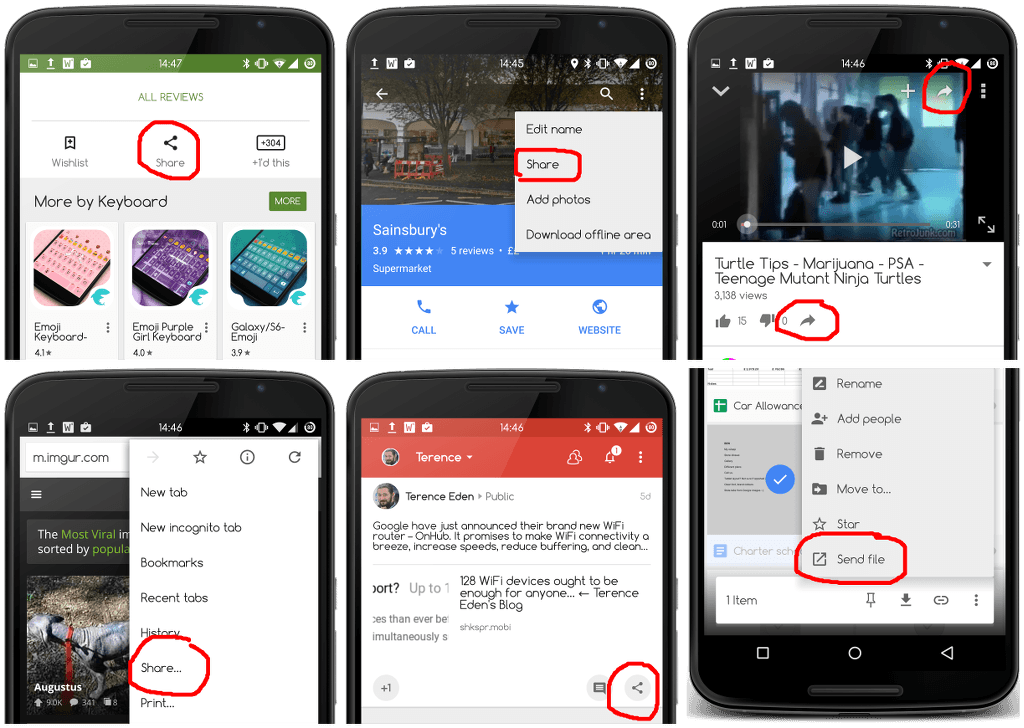
Things get even worse once you open the Share menu, though. Eden makes a good point: there’s clearly no single person in charge of this UX element for Android, even for Google’s own apps, despite the fact that they’re on every single Android phone sold outside China.
link to this extract


Samsung smart fridge leaves Gmail logins open to attack » The Register

John Leyden:

Pen Test Partners discovered the MiTM (man-in-the-middle) vulnerability that facilitated the exploit during an IoT hacking challenge run by Samsung at the recent DEF CON hacking conference.

The hack was pulled off against the RF28HMELBSR smart fridge, part of Samsung’s line-up of Smart Home appliances which can be controlled via their Smart Home app. While the fridge implements SSL, it fails to validate SSL certificates, thereby enabling man-in-the-middle attacks against most connections.

The internet-connected device is designed to download Gmail Calendar information to an on-screen display. Security shortcomings mean that hackers who manage to jump on to the same network can potentially steal Google login credentials from their neighbours.

Yeah, it’s that “jump on the same network” thing which is the sticking point. I’d wager that most home networks are secured nowadays.
link to this extract


EU deepens antitrust investigation into Google’s practices » WSJ

Natalia Drozdiak:

In one of the questionnaires [sent out to website operators] inquiring about “exclusivity obligations”—whether Google prevents or obstructs website operators from placing ads on their websites that compete with Google’s advertising business—the commission asks companies to update responses they made about the issue in 2010 and to provide a copy of all their advertising agreements with Google over the last four years.

A separate questionnaire, investigating the allegations that Google copies or “scrapes” content from rival sites, asks companies to provide more information about whether Google takes content, such as images, from the companies and uses it in its own online services.

The images question – raised by Getty – is about Google Images effectively bypassing visits to sites, and making copies of images. The latter is potentially a bigger problem than most other topics; “fair dealing” (the UK version of the US’s “fair use”) is hard to argue when you’re copying and storing entire image libraries.
link to this extract


BT may have to hive off Openreach to improve the UK’s broadband services » Telegraph

Labour MP Chris Bryant, who lives in a rural constituency:

The government’s roll-out of broadband has been far too slow.

The Government has cannibalised the BBC licence fee to fund otherwise not commercially viable superfast connections to the tune of more than £1bn. Yet they have already missed their initial deadline of May 2015 and shifted it back by two and a half years to December 2017.

Even the 2017 deadline is only a hope, as senior BT executives and almost half of councils have warned it could end up being 2018 before the roll-out to 95% of the country is finished. But there is also another problem. The Government designed the tender process for the superfast roll-out in such a way that it was virtually impossible for anyone other than BT to win. The end result was that BT Openreach won 44 out of 44 contracts and its monopoly was reinforced.

Although BT Openreach, which owns the existing copper network and delivers the rollout, is nominally at arm’s length from BT, it is right that Ofcom is now considering whether this provides an unfair advantage to BT and whether it should be split off in the interests of transparency and fair competition.

No question; it should. BT Openreach had an operating profit margin of around 50% in the most recent quarter – while the rest of BT languished. BT OR is being milked, and we’re the cows.
link to this extract


Start up: Second Life higher ed, killing more comments, Spotify’s hari-kiri, and more


BT could have had fibre everywhere already – if not for Maggie. Photo by Craig A Rodway.

Welcome back! It’s been three weeks, you’ve been wonderfully patient, news-y things have come and gone (AGoogleZ, Galaxy Note 5) and we’re probably a couple of weeks away from new iPhones, new iOS software and a new Apple TV. So here’s a big Monday morning chunk o’fun for you.

A selection of 14 links for you. Don’t overdose. I’m charlesarthur on Twitter. Observations and links welcome.

Second Life college campuses: A tour of abandoned worlds » Fusion

Patrick Hogan:

Colleges were among those that bought the hype of the Linden Lab-developed virtual world. Many universities set up their own private islands to engage students; some even held classes within Second Life.

Most of these virtual universities are gone –– it costs almost $300 per month to host your own island –– but it turns out a handful remain as ghost towns. I decided to travel through several of the campuses, to see what’s happening in Second Life college-world in 2015

First, I didn’t see a a single other user during my tour. They are all truly abandoned.

Second, the college islands are bizarre. They mostly are laid out in a way to evoke stereotypes of how college campuses should look, but mixed in is a streak of absurd choices, like classrooms in tree houses and pirate ships. These decisions might have seemed whimsical at the time, but with the dated graphics, they just look weird.

And weird is the overall theme of this trip, which begins in Arkansas.

So, so weird. And such a great idea to investigate.
link to this extract


Why we’re killing our comments section » Daily Dot

Austin Powell and Nicholas White:

In the wake of Gamergate, Celebgate, and the Reddit Meltdown of 2015, both publishers and social networks are grappling with the same fundamental issue: how to foster engagement and dialogue without inadvertently feeding the trolls in the process. The general consensus is that we need to detoxify the Web—to make it a cleaner, nicer, safer, and more inclusive place to live and work. Of course, at the Daily Dot, we would like to see a more civil, compassionate Web, but we want to be careful that in the name of fostering civility, we do not inadvertently kill all dissention. It is the cacophony of the Web—the voices from every point in the spectrum that give it its vibrancy—that make it the community we love. No one has quite figured out how to thread that needle yet, even those who have invested significantly in their own internal systems.

Yeah, it’s because the people who have worthwhile comments get drowned out by the idiots who don’t, who have a lot more time to spare. As I previously explained. The number of sites that have turned off comments (to a greater or lesser extent) is only growing.
link to this extract


Some thoughts on the Project Ara delay » PHONEBLOKS.COM

Dave Hakkens:

When I shared Phonebloks it was just an idea, something I thought would make sense to reduce e-waste. It was a future vision, something that would hopefully be made in 5-10 years.

Some companies are trying to make a modular phone. Of all those companies Google is taking the biggest leap. They have an insane amount of resources/smart guys and set a 2 year timeframe for themselves to get it done. Seemed unrealistic and turns out it is. They are delayed for over a year!

However this is not bad. Sure the sooner it would be in our hands the better since we could save e-waste.

There will never be a useful phone using phonebloks. The premise might work for some lab/testing/environmental equipment, but the price and size will make it pointless when you can get a pocket supercomputer with phone functions for $50.

link to this extract


Is this really the beginning of the end for web ads? – The Guardian » Android & iPhones Information

I got a ping back to my blog because this piece has (somewhere) a link to my piece about adblocking. Read for a while and see if anything strikes you:

Mail Online is among the world’s many popular news websites and it’s free: no paywall. Yet my browser has actually a plug-in routine called Ghostery, which will certainly scan any sort of web page you visit and tell you exactly how several “third-celebration trackers” it has actually located on it. These are small pieces of code that advertisers and ad-brokers put on pages or in cookies in order to monitor just what you’re executing on the web and where you’ve been prior to hitting the most up to date page.

“Third-celebration trackers”? Oh, third-party trackers. It’s the Guardian’s article (from Sunday) but with a thesaurus applied. What’s puzzling about the page is that there are no ads – so I don’t see how it’s monetising. It’s crap, through and through, and it would be great to wipe this sort of third-pa.. third-celebration crap off the web. Not sure how you’d do it, though.
link to this extract


How Thatcher killed the UK’s superfast broadband before it even existed » TechRadar

Jay McGregor, who was told by BT’s former R+D chief Peter Cochrane:

“In 1986, I managed to get fibre to the home cheaper than copper and we started a programme where we built factories for manufacturing the system. By 1990, we had two factories, one in Ipswich and one in Birmingham, where were manufacturing components for systems to roll out to the local loop”.

At that time, the UK, Japan and the United States were leading the way in fibre optic technology and roll-out. Indeed, the first wide area fibre optic network was set up in Hastings, UK. But, in 1990, then Prime Minister, Margaret Thatcher, decided that BT’s rapid and extensive rollout of fibre optic broadband was anti-competitive and held a monopoly on a technology and service that no other telecom company could do.

“Unfortunately, the Thatcher government decided that it wanted the American cable companies providing the same service to increase competition. So the decision was made to close down the local loop roll out and in 1991 that roll out was stopped. The two factories that BT had built to build fibre related components were sold to Fujitsu and HP, the assets were stripped and the expertise was shipped out to South East Asia.

“Our colleagues in Korea and Japan, who were working with quite closely at the time, stood back and looked at what happened to us in amazement. What was pivotal was that they carried on with their respective fibre rollouts. And, well, the rest is history as they say.

I’d have to say that Thatcher’s instinct made sense, given the way BT was privatised: it could have demanded monopoly rents on the infrastructure. However, if BT Openreach (as is now) had been spun off and ISPs then competed, you’d have a working model.
link to this extract


San Antonio city employee with email address linked to Ashley Madison committed suicide » San Antonio Current

Albert Salazar:

Reports surfaced yesterday of three City of San Antonio employee email accounts that were exposed in this week’s Ashley Madison account leak. One of those email accounts belongs to an employee who committed suicide on Thursday. 

It’s unclear at this time if the Ashley Madison hack had anything to do with the employee’s death, the San Antonio Express-News reports.

Two @sanantonio.gov accounts exposed this week belonged to a detective and captain with the San Antonio Police Department. The third belonged to a former city employee. None have been publicly identified, and the City did not confirm whether the employees were informed that their email addresses were leaked in the hack.

(I linked to this report because it’s more clearly written.) There were 99,170 accounts located to San Antonio, which has a population of about 1.4m. Perhaps there are lots of unhappy marriages there; and perhaps unhappy people. The link between the hack and the death isn’t definite. But both the hacker(s) and Ashley Madison might be wondering who’s liable if there is a link.
link to this extract


Spotify’s chief executive apologises after user backlash over new privacy policy » The Guardian

Alex Hern and Jennifer Rankin:

The chief executive of music service Spotify has apologised to users after anger over sweeping changes to its privacy policy that give the company much greater access to personal data on users’ phones.

As well as collecting personal information, such as email addresses and birthdays, Spotify will be able to sift though users’ contacts, collect their photos and in some cases, even check their location and determine how quickly they are moving. Depending on the device being used, Spotify said it may be able to collect sensor data, such as “data about the speed of your movements, such as whether you are running, walking, or in transit”.

Some information would also be shared with advertisers, although Spotify did not spell out exactly what data it would pass on.

“Hey, Apple has a big rival service coming out which might challenge us. They’re really hot on privacy. How can we really screw this up?” In addition, the exchange between Daniel Ek of Spotify and Markus Persson (ex-Minecraft) is epic in its directness.

Short version: Spotify completely screwed up its messaging and is likely to pay a price.
link to this extract


Google Groups and the Right to be forgotten | Removing Usenet search results » Agent Privateur

An anonymous European:

European citizens, have, since May 2014, had “the right to be forgotten.” This means that they can request that Google remove search results from searches for their name or a name by which they are known, if the results are “inadequate, irrelevant, or no longer relevant for the purposes for which they were processed.” In this blog post, I will explain why Google is handling the delinking requests they receive in an irresponsible manner, arguably leading to censorship of pages that shouldn’t be removed as well as a lack of proper treatment and rights for those who do have a valid claim…

The postings Google agreed to delink contain controversial, personally revealing and embarrassing things I posted in the mid-90s in Usenet newsgroups. I was still formally a child at the time. And I had no idea that it would be shoved in everyone’s face everywhere 20 years later. People hardly knew what a search engine would be capable of in the future. I had been to an Internet Trade Fair in California around that time, and was introduced by Altavista to a new concept: a “web spider” that could crawl the web and index information. The idea was, in fact, new to most of the people at that trade fair. Yes, really, it was.

Now read on (though the next case isn’t, as far as I know, the same.)
link to this extract


Google ordered to remove links to stories about Google removing links to stories » Ars Technica UK

Glyn Moody:

The UK’s Information Commissioner’s Office (ICO) has ordered Google to remove links from its search results that point to news stories reporting on earlier removals of links from its search results. The nine further results that must be removed point to Web pages with details about the links relating to a criminal offence that were removed by Google following a request from the individual concerned. The Web pages involved in the latest ICO order repeated details of the original criminal offence, which were then included in the results displayed when searching for the complainant’s name on Google.

Understandably, Google is not very happy about this escalation of the EU’s so-called “right to be forgotten”—strictly speaking, a right to have certain kinds of information removed from search engine results. According to the ICO press release on the new order, Google has refused to remove the later links from its search results: “It argued these links were to articles that concerned one of its decisions to delist a search result and that the articles were an essential part of a recent news story relating to a matter of significant public importance.”

People are throwing around the words “censorship” about this, happily ignoring the fact that the information is still there on the web – and also that 95% of people who ask for information to be delinked are just trying to protect personal information, as above.
link to this extract


iSight camera replacement program for iPhone 6 Plus » Apple Support

Apple has determined that, in a small percentage of iPhone 6 Plus devices, the iSight camera has a component that may fail causing your photos to look blurry. The affected units fall into a limited serial number range and were sold primarily between September 2014 and January 2015.

If your iPhone 6 Plus is producing blurry photos and falls into the eligible serial number range, Apple will replace your device’s iSight camera, free of charge.

The iSight camera is located on the back of your iPhone 6 Plus.

Odd, since the iSight cameras used to be the ones that looked at you, not away from you. The page has a serial number checker.

Given the date range, that would be about, what, many millions of potentially affected lenses? So why has it taken so long to surface? Perhaps it really is a small percentage. Note how Apple hasn’t given any of the serial ranges, which it has for other product problems.
link to this extract


All-in-one PC demand from China Internet cafes rising » Digitimes

Monica Chen and Joseph Tsai:

Despite the PC market’s weak performance, all-in-one (AIO) PCs have become popular in China’s Internet cafe market after the China government relaxed the restrictions on Internet cafes.

Now regular cafes, restaurants and karaoke houses are all eligible to apply for Internet cafe permits, and orders have started to surge for all-in-one PCs that are thin and light in form factors.

China’s all-in-one PC market is able to achieve shipments of about 13-14 million a year with Lenovo, Apple and Hewlett-Packard (HP) together contributing 70% of the volume, while Dell, Acer, Micro-Star International (MSI), Asustek Computer and others have also been aggressively trying to expand their presence in the market.

In the past, China’s Internet cafes used to procure their PCs via PC DIY channels, but they have now turned to all-in-one PCs that take up less space.

Bad for motherboard makers, good for PC makers.
link to this extract


Botched Google Stagefright fix won’t be resolved until September » The Register

John Leyden:

Google released a six-pack update to resolve the Stagefright vulnerability last week, but it quickly emerged that one of the components was incomplete, so that even patched devices were still at risk.

These shortcomings have put back the whole security remediation process by weeks.

Tod Beardsley, security engineering manager at Rapid7 – the firm behind the Metasploit pen-testing tool – commented: “The problem Google is facing is not so much shipping security vulnerabilities in popular software products: everyone ships bugs, it happens. The real problem we’re seeing today is a breakdown in the Android patch pipeline.”

There was a patch pipeline?
link to this extract


SSL malvertising campaign continues » Malwarebytes Unpacked

Jerome Segura:

The actors behind the recent Yahoo! malvertising attack are still very much active and able to infect people who browse popular websites.

We have been tracking this campaign and noticed that is has recently moved to a new ad network used by many top publishers.

drudgereport.com 61.8M visits per month
wunderground.com 49.9M visits per month
findagrave.com 6M visits per month
webmaila.juno.com 3.6M visits per month
my.netzero.net 3.2M visits per month
sltrib.com 1.8M visits per month

OK, so this really is a reason to use an adblocker: this stuff is nasty, and hitting millions of people. This isn’t like a rogue app on an app store; it’s as if a basic app on a phone were rogue.

I’m presently testing Crystal, a content blocker for Safari on iOS by Dean Murphy. Some sites really look a lot different. (Via IvanIvanovich.)
link to this extract


Japan’s Sharp to exit Americas TV market after deep first quarter loss » Reuters

The company, which sought a bank-led bailout in May, said it would sell its TV manufacturing plant in Mexico and license its Aquos brand in the Americas to China’s Hisense, effectively withdrawing from the region’s TV market.

“Sharp has not been able to fully adapt to the intensifying market competition, which led to significantly lower profits compared to the initial projections for the previous fiscal year, and has been suffering from poor earnings performance,” Sharp said in a statement explaining the TV deal.

Osaka-based Sharp, which gains much of its revenue from liquid crystal displays and TV sets, has focused on high-end screens to protect profit margins and avoid directly competing with cheaper Chinese and South Korean rivals.

But it has struggled to innovate sufficiently to keep commanding significant premiums. In addition to Chinese competitors, it has also faced strong competition from Japan Display Inc in smartphone screens.

Second-quarter operating loss of 28.8bn ($233m), yet thinks it’s going to generate 80bn yen ($644m) of operating profit for the year. Not so sure about that.
link to this extract


Start up: the Samsung conflict, Google Analytics v Edge, Windows 95 v 10, Android woes and more


A smart cap could tell you if your milk had gone off – so much more accurate than someone’s nose. Photo by alisdair on Flickr.

A selection of 11 links for you. Because you can take it. (You’d better, I’m taking a three-week holiday break.) I’m charlesarthur on Twitter. Observations and links welcome.

Samsung’s profit center » Asymco

Horace Dediu:

Phone operating margins [at Samsung] peaked in Q1 2014 at 20% but are half that level today. These margins have dropped to levels Samsung had in 2009, before the Galaxy launched and before they had any substantial revenues from smartphones.

In contrast, the semiconductor group is growing both revenues and margins. Margins and operating profits are both 50% higher than those of devices.

We also know that Apple is Samsung Semiconductor’s single biggest customer. We can’t be sure how much of the total revenue/profit comes from Apple but if the pattern continues then Apple could be the greatest contributor to Samsung’s profitability in the near future.

How could this be? Wasn’t Samsung supposed to “disrupt” Apple?

The reality is that Samsung’s own smartphones are being disrupted by good-enough Android devices, typically made by Chinese brands. This low-end disruption is also affecting LG, another phone maker and Apple supplier.

Unlike Samsung and LG, Apple is less susceptible to low-end disruption. What Apple offers is a brand promise, an ecosystem, associated products and services and what amounts to a new market. It’s this parallel value network that competes with Android/Google, rather than with Samsung.

I’ll add another data point: the “phone operating margins” actually cover the IM [IT & Mobile] division, which includes PCs and (I believe) cameras. In the latest quarter, the non-phone revenue in the IM division was below US$500m, for the first time in at least four years. That suggests we’re very close to seeing the true profit margin of Samsung’s phone business, as the non-phone business probably doesn’t perturb the very much larger (US$22bn, ie over 44x larger) phone business.

And read Dediu’s post for the killer payoff line.
link to this extract


Google loses bid to overturn low-cost patent licenses to Microsoft » Reuters

Andrew Chung:

In a setback for Google, a U.S. appeals court ruled on Thursday that the low licensing rate Microsoft pays to use some of Google’s Motorola Mobility patents had been properly set.

The 9th U.S. Circuit Court of Appeals in San Francisco said a lower court judge properly determined the patents’ value even though the royalty rate was only a fraction of what Motorola had asked for. Google sold the Motorola handset business to Lenovo last year but kept its patents.

The court also upheld $14.5m awarded to Microsoft for Motorola’s breach of contract to license its patents fairly.

Patents at issue being standards-essential; Motorola kicked it off demanding $4bn per year. Judge James Robart put the royalty rate at $1.8m per year.
link to this extract


BT hands £129m back to UK.gov after beating rural broadband targets » The Register

Simon Rockman:

Both BT and the Ministry of Fun – or the Department of Culture, Media and Sport, if you prefer – have spun BT’s toeing-the-line-of-a-contractual-obligation as unbridled generosity towards taxpayers.

A statement from the Minister of Fun, John Whittingdale, said:

It’s fantastic to see that the rollout of superfast broadband is delivering for customers and for the taxpayer. The Government was clear from the start that as levels of people taking up superfast broadband went beyond our expectations in areas where we invested public money, BT would reimburse the taxpayer for reinvesting into further coverage across the UK. This now means that BT will be providing up to £129m cashback for some of the most hard to reach areas.
The funding was part of a Broadband Delivery UK (BDUK) project which has the aims of:

• provide superfast broadband coverage to 90 per cent of the UK by 2016
• provide basic broadband (2Mbps) for all by 2016
• provide superfast broadband to 95 per cent of the UK by 2017
• explore options to get near universal superfast broadband coverage across the UK by 2018
• create 22 “SuperConnected Cities” across the UK by 2015
• improve mobile coverage in remote areas by 2016

Speaking as someone who keeps finding themselves somehow forever in that “it’s coming in a couple of years, honest” part of the country (which seems to be a lot larger than 5%), I’d prefer Whittingdale to be lighting a fire under BT, and for Ofcom to demand that BT Openreach (which does the infrastructure) be split from the rest of BT.

After all, power generators don’t own the power lines, rail operators don’t own the track; why does BT own the phone lines?
link to this extract


Enterprises retake lead in tech adoption » Deloitte CIO – WSJ

Apparently a sort of chief information officer-focussed niche of the WSJ, this has the entertaining premise that:

many believe this trend of consumer-originated innovations entering the workplace, dubbed the consumerization of IT, will become the dominant model going forward. But there is strong evidence that the pendulum is swinging back to enterprise-first adoption, with organizations likely to capture more near-term value than consumers in the following four technology areas:

Which areas? Let’s see: wearables; 3D printers; drones; Internet of Things. Not a chance on wearables – enterprise adoption and value will lag far behind consumers (already does). On 3D printing, businesses are already ahead through prototyping, so no contest. On drones, again, armies got there first, so not really at issue. And IoT? It’s such a pain at present for most people that again, it’s left to businesses which have the time and patience to deploy. But I’d bet once IoT stuff becomes prevalent enough, it will be widely used by the ordinary folk.
link to this extract


The challenge of tracking Microsoft’s new Edge browser in Google Analytics » GeekWire

Even though Edge is now in the wild, tracking usage and adoption of the browser is going to be problematic for many web developers and site owners because tracking for Edge is not yet supported in Google Analytics.

Web developers and designers frequently consult Google Analytics to answer important browser usage questions for their website. Answers to questions like “Do we need to still support IE8?” or “Are there enough users affected by this particular Chrome bug to implement a hack to fix it?” are usually answered by running a browser usage report in Google Analytics. Google Analytics provides an easy way to break down a website’s readers by their OS, browser and browser version, except in the case of Edge.

Taking a look at Google Analytics reports for Operating System Version in Windows, you’ll notice that there is no version 10 listed.

WTH, Google? (Via Richard Burte.)
link to this extract


UC Berkeley engineers devise 3D-printed ‘Smart Cap’ to check safety of milk, juice » Food Safety News

The “smart cap” has an embedded inductor-capacitor tank as the wireless passive sensor and can monitor the quality of milk and juice wirelessly, the article stated.

“A quick flip of the carton allowed a bit of milk to get trapped in the cap’s capacitor gap, and the entire carton was then left unopened at room temperature (about 71.6 degrees F) for 36 hours,” according to a university news report.

The result shows a 4.3% resonance frequency shift from milk stored in the room temperature environment for that period. This work establishes an innovative approach to construct arbitrary 3D systems with embedded electrical structures as integrated circuitry for various applications, including the demonstrated passive wireless sensors, the article explained.

The Berkeley folk are saying “hey, people will print them out at home!” while everyone else is saying “this would be so useful in mass-produced containers”.

So here’s a picture of the 3D printer that the UC Berkeley people think you’ll want to print out milk carton tops with.
UC Berkely 3D printer
Yeah, I’ll have two – you never know when you might need a spare.
link to this extract


The fastest-growing mobile phone markets barely use apps » Quartz

Africa and Asia, the two fastest growing mobile markets, aren’t very big on apps.

The overwhelming majority of mobile internet activity in the regions is spent on web pages, according to a report released on 28 July by Opera Mediaworks. In Asia and Africa, websites made up 90% and 96% of mobile impressions, respectively, in the second quarter.

Their habits are a sharp contrast to the US, where apps accounted for 91% of impressions. Globally, there’s a more even distribution, with apps making up 56% of mobile impressions and websites comprising the remainder…

…“A big portion of the mobile audience in mobile-first regions like Africa and [Asia-Pacific] are still using low-end feature phones because of the cost factor,” a spokesman tells Quartz. “This therefore compels them to use the mobile web more than apps, which are usually dominant on smartphones.”

Today’s challenger for the “well duh” prize.
link to this extract


Windows 10 launched so quietly you may have missed it » The Guardian

Some two-bit hack blathering about a new version of Windows:

Windows 10’s biggest new feature? It’s free if you download it within the next year, and will install on machines running Windows 7 or Windows 8. Its second biggest feature? It isn’t Windows 8, which was released in 2012 and created widespread puzzlement by submerging the traditional desktop interface beneath big, bright “tiles” and getting rid of the familiar, popular Start menu.

That puzzlement soon turned to anger, forcing the ejection of the man who had led Windows 8’s development, Steve Sinofsky, and the introduction of Windows 8.1, which, while it didn’t bring the Start menu, did at least let you start off in desktop mode.

Now, Microsoft breezily says, “the familiar Start menu is back”, as though it had been on holiday rather than unceremoniously dumped.

On reflection, the biggest feature of Windows 10 is that it isn’t Windows 8. Being free is its second-biggest.
link to this extract


August 1995: A window we will all want to open » The Independent

Some two-bit hack blathering about a new version of Windows:

Microsoft’s computer program lines up with a number of other classic products: the Biro, aerosols, the Sony Walkman, the Boeing 747 jumbo jet, the Mini and the compact disc. It is a piece of technology which has arrived at just the right time to satisfy people’s wants.

Like those other classic products, Windows 95 enhances our personal independence and autonomy, and makes our lives more convenient. It draws everyone deeper into the existence of the “me” generation. Thus, aerosols let you manage your hair, your hygiene, your cleaning as you choose: convenience in a can. A Biro can write for far longer than a fountain pen, and when it’s finished you simply throw it away. The Mini, costing £400 in its first incarnation, made car ownership possible for the young and relatively poor, not just the comfortably well-off. The Walkman provided everyone with their own personal environment: the music (or noise) that you want at the volume you choose.

But like those earlier products, Windows 95 also exemplifies a wider economic and cultural trend. Just as globalisation gives corporations multinational reach, their products link physically and culturally diverse peoples, homogenising aspects of our lifestyles and, literally, connecting us up. Software can be “shipped” over a telephone line across borders; Windows 95 will be the same in Australia or the Arctic.

link to this extract


CNET’s early coverage of Windows 95, back in 1995 » YouTube

CNET’s first impression of Windows 95 was that it would create a huge impact, what with the long file names, taskbar and a recycle bin for unwanted files. Check out this vintage review along with Microsoft’s own promotional video that went with the launch.

Here’s the video:

(The presenter is Richard Hart.)

How far we’ve come. No, don’t disagree. Look at that video of the Fonz.
link to this extract


The security flaw Google built into Android » MIT Technology Review

Tom Simonite:

Google can’t push you an update for Android. It hands out the operating system to device manufacturers for free. They get to tinker with it to add features or apps of their own and are the only ones—along with cellular carriers in some cases —that can push updates to the devices they sell. Google does bind companies that use Android with some restrictions (for example to do with using its app store) but doesn’t require them to push out security updates quickly.

That leaves users of Android devices unable to avail themselves of what security experts say is the most important strategy for staying safe, at least according to researchers at none other than Google itself. They reported last week on a survey that asked computer security pros how they stay safe. Applying security updates emerged as the experts’ number one priority.

Google has lately come up with workarounds for Android’s flawed security model. It has shunted many key functions into apps that it can push updates to via its app store. But that doesn’t cover all of Android, and the app store doesn’t have a way to signal to you whether an app wants to update for security reasons or just to add new features.

The text message vulnerability revealed today can’t be fully fixed by upgrading apps. And it’s not unlikely that most vulnerable phones will never get the security patches for Android that Google has developed and will offer up to manufacturers and cellular operators.

Android has done spectacularly well, but one feels that it’s overdue its Blaster moment.
link to this extract


The adblocking revolution is months away (with iOS 9) – with trouble for advertisers, publishers and Google


The thing about print adverts was that they stayed where they were. Photo by Bethan on Flickr.

TL:DR: when Apple’s iOS 9 comes out in September, there’s going to be a dramatic uptake of ad blockers on iOS – and it’s going to have far-reaching effects not just on websites and advertisers, but potentially also on the balance in mobile platforms and even on Google’s revenues.

Now, the longer version.

Remember newspapers?

In the old days, adverts appeared in print, on the radio and on the TV. Most ad-supported news organisations that have shifted to the internet began in print.

Ads in print were straightforward. Advertisers bought space, and editors could turn them down, or sometimes decide not to run them if a story broke that would bring about an awkward juxtaposition of, say, the advert for a shoe store on page 3 and the big breaking story now being placed on page 3 about people having feet crushed by a runaway steamroller. (The ad would get moved to another page.) Print ads were hard for advertisers to track, though they could use codes and so on that would clue them in to where someone had seen one if they responded directly.

Then came the internet, and the promise of measuring which adverts people had seen, and which they had clicked, followed swiftly by the realisation that you’d be able to follow what adverts people had seen between different sites by use of tracking cookies and scripts.

Now we have the situation where news websites are plentiful (some just rewriting, sometimes by machine, sometimes not) and adverts even more so: the attempt by The Verge’s Nilay Patel to pin the blame on mobile browsers’ lack of capability has been effectively shot down by Les Orchard, who pointed out the colossal amount of data that a simple page requires.

That’s where we’re at: websites are getting overloaded with ads, beacons, trackers and scripts that are all scrambling over each other in their attempt to squeeze the last bit of information about us from every page.

But nobody asked us, the readers, along the way whether that was OK. And now, people are deciding that it’s not OK.

Block that ad!

The uptake of AdBlock and its commercial sibling Adblock Plus has been gradual, but has now reached more than 150m users, and it’s accelerating. People are getting pissed off with the huge data loads pages impose without their consent, and the idea that they’re being tracked without their consent. In this post-Snowden age, the latter particularly bugs people. Fine, I came to your site; record the fact. But you’re watching me wherever I go online? That’s not acceptable.

People are also pissed off about what can happen when they view an advert online. In all the years I’ve viewed print adverts, I’ve never had one that:
• filled the page I was trying to read and insisted I either wait or click on a particular point on the page to read the article I came for;
• moved up from off the page to insert itself in front of the article I was reading and ask me to sign up for a mailing list;
• started automatically playing a video advert while I was reading some text;
• infected my computer with malware inserted in the ad;
• ran a Javascript script that pretended I need to pay a ransom, or otherwise blocked any interaction unless I pressed a button saying “OK”;
• turned me away from the page I was reading to a completely different one demanding I download an unrelated app.

You may well have other examples. (I’ve not had the malware/Javascript experience online, but other people certainly have.)

Apple: bite me

Into this comes Apple, which guards the user experience on the iOS platform, its biggest moneymaker, very jealously. Apple’s executives and staff aren’t blind to the things that are going on; they use their phones, and they get the same experiences. User experience is what Apple puts above pretty much everything else, and they’ve decided that they don’t like the experience available through the ad-supported web, and so they’re going to do something about it. Hence content blockers for Safari (and all web views) on iOS 9, which wasn’t announced onstage at WWDC but was one of those “Whoa!” moments on browsing through the Settings in the first iOS 9 beta. (Do read the link in the previous sentence, which explains what iOS 9 content blockers are, and are not.) Hence also Apple News, which is basically “all those sites but with the crap taken out”.

The ad intrusion situation on mobile is arguably worse than on desktop, since people are more sensitive about the amount of data they download on mobile, and their phones are less powerful so that complex layouts take longer.

You can get some adblockers for Android (though reviews for the main one are mixed), though you can’t get AdBlock Plus. You can get Ghostery (which shows you what you’re being tracked by) for Android. But there’s nothing like either presently for iOS.

That’s going to change, and I think the advent of iOS 9 and content blocking extensions will touch off a firestorm.

Update: just to clarify: content blocking extensions aren’t built in to iOS 9; only the capability to use them. But people are already working on them. You’ll have to download them and install them, rather like third-party keyboards.

Here’s a video of one presently being developed by Chris Aljoidi:

/Update

These blocking extensions will be paid for (at least initially), but the effect of people tweeting and updating Facebook about how much they enjoy the ad-free web will be hard to ignore. As Carl Howe observes, “Like it or not, once Apple supports ad-blocking in its browsers, it will become the default for people who don’t want tracking.” That also plays into Apple’s other general message, about how it doesn’t track what you do when you’re using its products.

Once this begins happening on mobile, it’s going to sweep back on to the desktop. “How do I do this on my PC?” will become quite a common question. People will load up with adblockers. That’s when websites will begin to face a real problem.

The moral conundrum

Of course, at this point we should step back and ask “why were the adverts there in the first place?” Oh yes, because they help pay for the content. In some – well, many, almost all – cases, they pay for all of the content. As Rene Ritchie of iMore explains, these days sites have to rely on getting ad inventory from all over to fill space; multiple networks vie to fill the space with the most apposite ad for the lowest price (to the advertiser) that the publisher will accept.

It’s worth considering what Ritchie wrote at length:

While we sell premium ads directly to advertisers, that only fills a small subset of the required “inventory” to support the network. Some 85% of ads we served last month were “programmatic”—provided by ad exchanges like Google Adx and Appnexus. Those exchanges are pretty much black boxes. We get a tag, we insert it, and ads appear.

Each ad gets its own iframe, so load is asynchronous and, if one fails, it doesn’t kill the entire site. Unfortunately, that also means each one fires its own trackers, even if those trackers are identical across ads. It’s terribly inefficient.

We’ve tried to find or figure out a way to streamline them, but haven’t been able to. They’re built into the foundations of all the major networks, ad and social, ostensibly to provide more “relevant” content.

When we do get good ads, as soon as they finish their allotted impressions, they go away, and the ad spot gets back-filled with “remnants” which get progressively worse and worse the more we refresh the site.

We also have no ability to screen ad exchange ads ahead of time; we get what they give us. We can and have set policies, for example, to disallow autoplay video or audio ads. But we get them anyway, even from Google. Whether advertisers make mistakes or try to sneak around the restrictions and don’t get caught, we can’t tell. It happens, though, all the time.

So ads are out of control even for sites. That’s so removed from the world of print, where an editor could veto or move an ad, that it’s boggling.

It’s this lack of control – the mad desire and demand by advertisers to get everything, indifferent to the effect of the user experience on the reader – that is driving people to adblockers. It’s a variant of the tragedy of the commons.

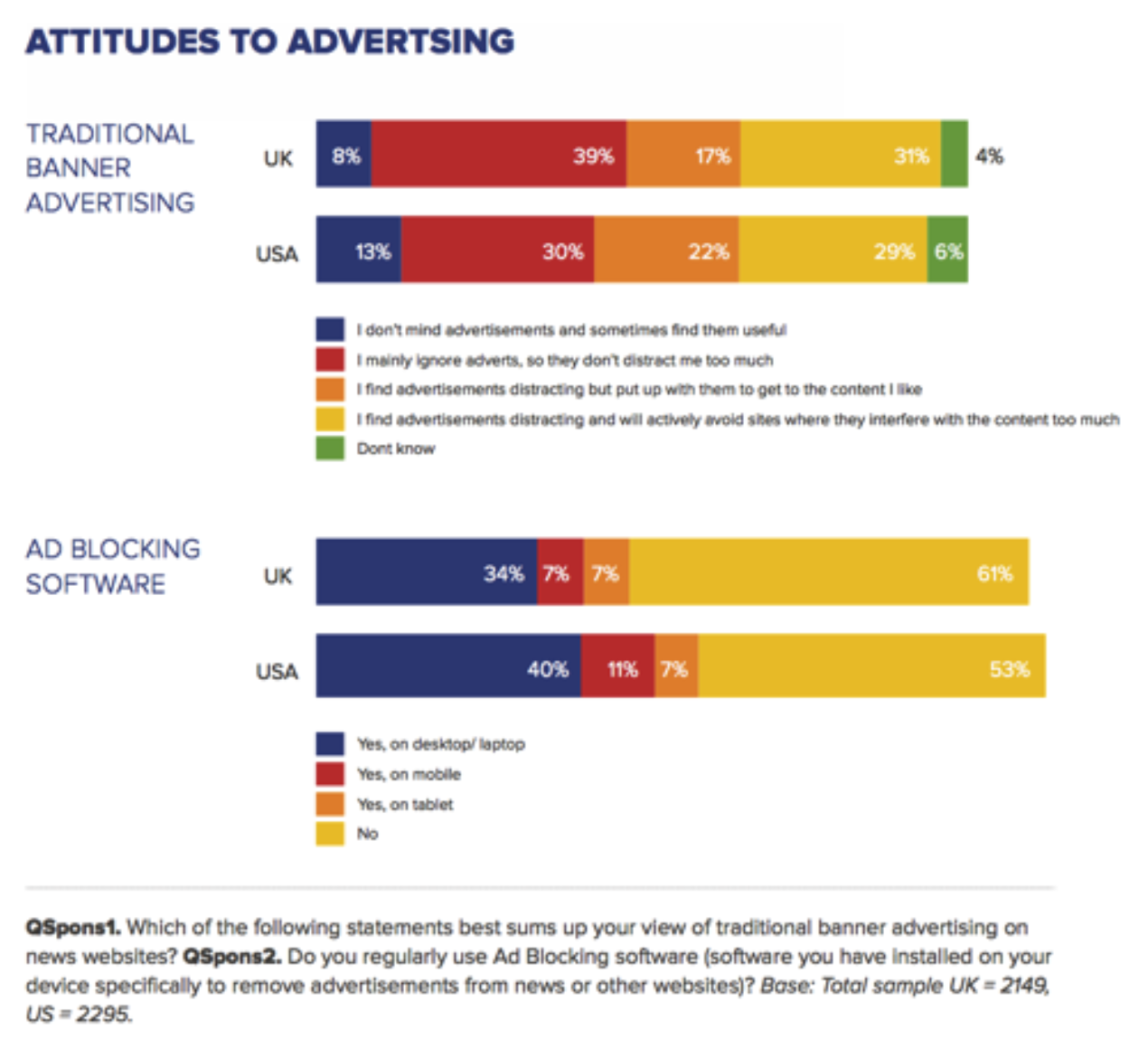
People don’t like it; here’s what a recent survey for Reuters shows. (What it doesn’t show is how many of those who don’t block ads know of the capability for doing it.)

Attitudes to advertising and use of adblocking

Not very legible; adblocking is the lower bars. People aren’t happy.

But wait, what about the moral dimension? The fact that if you block the ads, the sites lose their income?

I’ve previously written that the two sides on this are far apart; that adblocking is the new speeding: those who do it can justify why to themselves, while those who think it’s wrong are stern in their disapproval.

Entertainingly, when I noted on Twitter how many trackers I’d blocked using Ghostery (as part of an experiment using Ghostery, AdBlock, Javascript Blocker and uBlock to see how it changed my browsing experience), I was at once the object of finger-wagging and the accusation of the destruction of journalism:

Have I any responsibility to them? Well, not really. Certainly as a standard reader, here’s what happened: I accepted an invitation to read an article, but I don’t think that we quite got things straight at the top of the page over the extent to which I’d be tracked, and how multiple ad networks would profile me, and suck up my data allowance, and interfere with the reading experience. Don’t I get any say in the last two, at least?

Hence my response:

(You can view the entire conversation if you’re logged in to Twitter.)

Print evolved. Now it’s the web advertisers’ turn

This is the part of the debate that so interests (and, frankly, entertains) me. Print-based organisations were told they needed to evolve, and stop being such dinosaurs, because the web was where it was at: advertising was moving, and if they didn’t move too, they’d just die.

Now we’re all online, but somehow we’re meant to accept that web advertising is how it is, and never question or deviate from it? Nuh-uh. Why should web advertisers be immune from evolutionary or revolutionary change in user habits? What’s sauce for the print goose is sauce for the online gander. I don’t recall the people who scolded me for using tracking detectors previously saying that everyone had to stick with print adverts because they made more money (which those ads still do).

Furthermore, any argument that tries to put a moral dam in front of a technological river is doomed. Napster; Bittorrent; now adblocking.

Which quickly leads to…

If any significant number of users shift to using adblockers, web advertisers are going to have to move quickly to deal with that new reality. Web publishers too.

(Though I have to say I have very little sympathy for a lot of web “publishers”. Back in the early days of the web, the Guardian ran a brilliant ad which asked “Ever wondered how every day there’s just enough news to fit in the newspaper?” It was advertising the Guardian website, and the fact there was more there than you’d find in the paper.

Now? There are a gazillion websites – but tons of them are simple copies, monetised by adverts from Google or whoever, which leach from the originating sites by copying their content. We’ve now established the limits of how much news is generated each day: it’s more than fits in newspapers, but less than fits on all the websites currently dedicated to “news”. If adblocking puts some of the copiers on the skids, I won’t weep. That’s not journalism; it’s a sort of horrible stenography, even worse than some of the stenography that does pass for journalism at some bigger sites. Good journalism, and worthwhile sites, will survive. Or good journalists will.)

What form will the evolution take? Well, look at sites like Buzzfeed, and their use of native content. If the site generates the ad, it’s suddenly a lot harder to block. We’re back, in a way, in the land of print, where the printing of the editorial and the ads happened in the same place.

Ecosystem fights

Beyond all this, there’s a longer-term potential effect. I don’t think Apple was gleefully thinking of ways to nobble Google when it decided to introduce content blocking, but this could have quite an effect.

Consider: iOS 9 arrives, and lots of happy iOS users say how delighted they are to be blocking those annoying ads. (Don’t underestimate how quickly iOS 9 will be taken up: it’s going to be available for devices going back to the iPhone 4S and iPad 2 and will use less storage than iOS 8. Even iOS 8 was on half of iOS devices within two months of release.) Meanwhile Android users won’t be able to follow suit (to anything like the same extent). At least one of two things will happen:
• some Android users begin considering switching to iPhones
• Google comes under pressure to allow adblockers on the Play Store to prevent Android switching.

Neither of these is good for Google. The loss of Android users is probably more tolerable in the short term. Adblocking could pose an existential risk to Google (which is why it pays Adblock Plus’s makers to not block Google ads).

It’s unlikely that adblocking could ever reach a pitch where it really offers a grave threat to Google. But as more and more people from developing countries come online, paying for every kilobyte of data, they might want adblocking too. India in particular is a generally tech-savvy country where data prices are high; and it has embraced Android enthusiastically. Consider for a moment how that could play out.

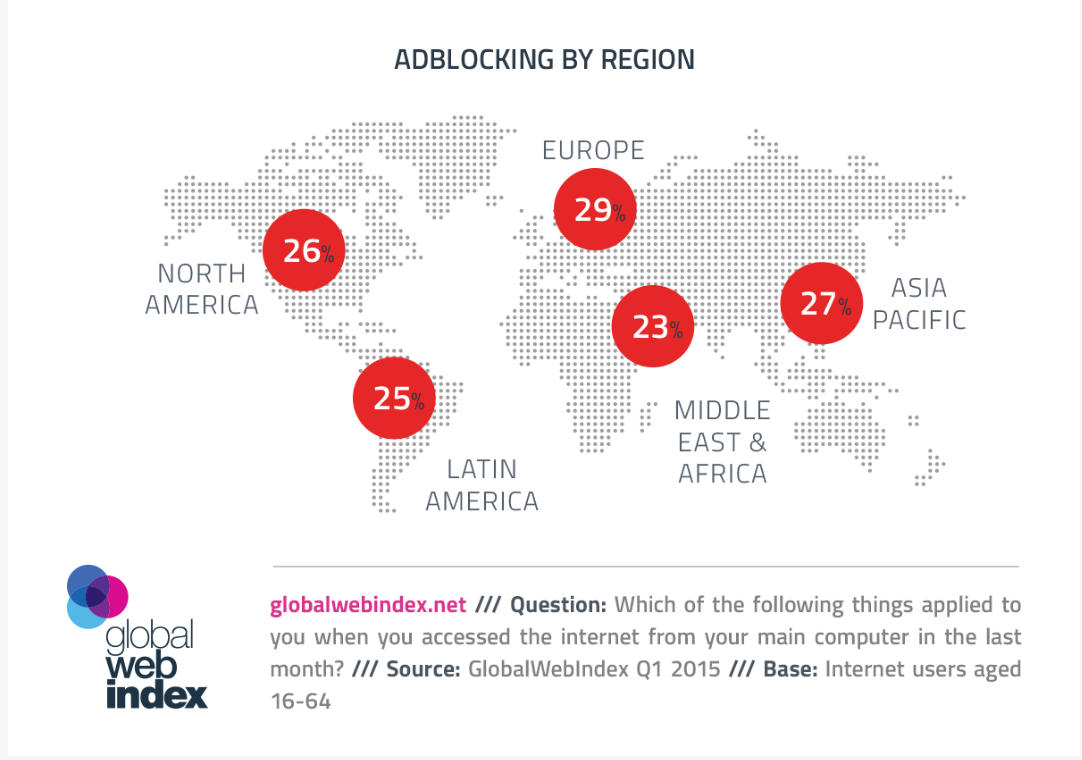
Relevantly, Global Web Index has a survey of adblocking use which found that 27% of users aged 16-64 globally in its 33-country survey had used an adblocker, and 15% had blocked tracking.

Adblocking by region

Adblocking by region. Source: GlobalWebIndex.

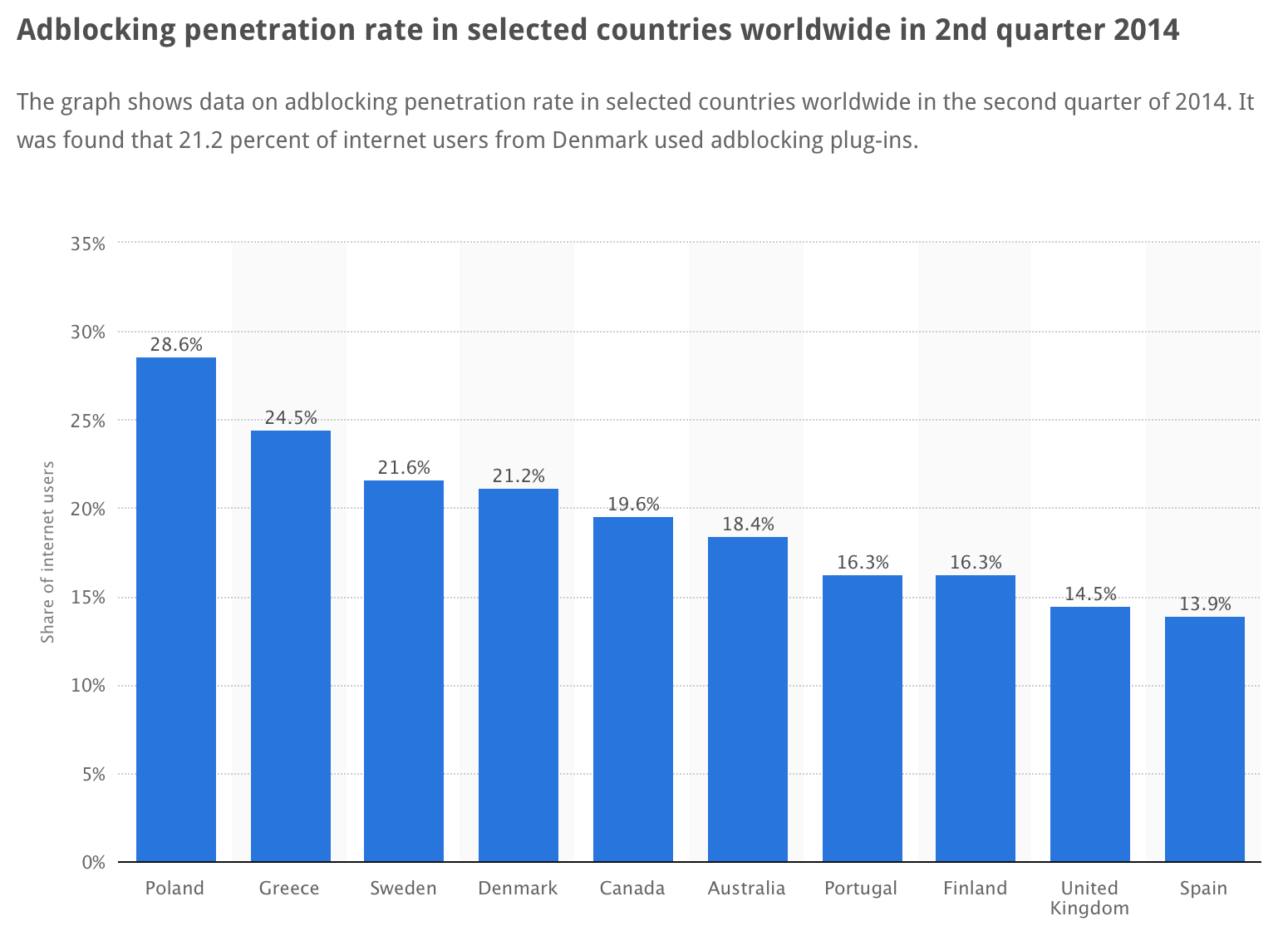
Statista also had detail about European use:

Adblocking by country in the EU

Adblocking has relatively low use – but what happens when it arrives on mobile?

Consider: hardly any of that is mobile yet. Mobile is the biggest platform. Adblocking is coming to a key mobile platform in September.

Things could get ugly quite suddenly.


Update: there’s a discussion of this post on Hacker News. You don’t need root to read it.


Like this? Other analysis I’ve done you might like:
• How Gresham’s Law explains why sites are turning off comments
• The death of “Others”: how the PC market’s implosion is squeezing smaller players
• Android (and Apple, and BlackBerry, and Microsoft Mobile) handset profitability – the Q1 scorecard (updated)
• BlackBerry might have no BB7 users left by February 2016 – and that’s a big, bad problem

Enjoy!

Start up: Wi-Fi Sense explained, another giant Android vulnerability, the US’s sleepiest cities, and more


What happens when you create a way for any programmer to analyse peoples’ DNA? (Hint: not good things.) Photo by micahb37 on Flickr.

A selection of 11 links for you. Use them wisely. I’m charlesarthur on Twitter. Observations and links welcome.

Wi-Fi Sense in Windows 10: Yes, it shares your passkeys; no, you shouldn’t be scared » Ars Technica

Sebastian Anthony:

For a start, when a Wi-Fi passkey is shared with your PC via Wi-Fi Sense, you never actually see the password: it comes down from a Microsoft server in encrypted form, and is decrypted behind the scenes. There might be a way to see the decrypted passkeys if you go hunting through the registry, or something along those lines, but it’s certainly not something that most people are likely to do.

Perhaps more importantly, though, just how sacred is your Wi-Fi password anyway? Corporate networks notwithstanding (and you shouldn’t share those networks with Wi-Fi Sense anyway), most people give out their Wi-Fi keys freely. You could even argue that Wi-Fi Sense is more secure: if I ask Adam for his Wi-Fi password, I am free to give it away to anyone. If I receive the password via Wi-Fi Sense, I can still connect to Adam’s network, but I can’t tell anyone else the password.

And it only goes to immediate-circle friends, not friends of friends of.. So probably not such a big thing to worry about.
link to this extract


Why Grooveshark failed » The Verge

Stephen Witt:

The Grooveshark streaming application launched in April of 2008 — several months ahead of Spotify. The service proved explosively popular from the outset. Users, especially younger users, loved on-demand music delivery, and Greenberg left school to focus on Grooveshark full time. But there was a problem: Grooveshark still relied on peer-to-peer infrastructure similar to Napster, Kazaa, and bitTorrent. In other words, although it functioned as a streaming service, it still sourced the music from its users’ file libraries. And to the record companies, that looked like copyright infringement.

Without approval from the labels, Grooveshark struggled to attract venture capital. In its first five years of existence, the company raised just under a million dollars. In the same time, Spotify, with equity buy-in from the music majors, raised a hundred times as much.

It didn’t “look like” copyright infringement; it clearly was infringement, in just the same way that the original Napster was. That’s why it was sued into the ground. Grooveshark never played by the rules (artists demanded their music be removed; Grooveshark staff re-uploaded it, or ignored new uploads). They failed because they could never stay inside the rules.
link to this extract


Drones and spyware: the bizarre tale of a brutal kidnapping » WIRED

Kevin Poulsen with a wonderful tale of how truth is stranger than fiction:

efforts to trace the new emails were in vain. The author boasted that he was using Tor as well as other anonymizing precautions that would withstand even an “Egotistical Giraffe exploit,” a reference to an NSA de-anonymizing technique that surfaced in the Edward Snowden leaks. He sent the messages through the Singapore-based anonymous remailer anonymousemail.com, and shared the photos—stripped of metadata—through the anonymous image sharing site Anony.ws.

Evidently unconvinced, the Vallejo police still insisted the crime was a put-on, but the FBI was also on the case. And, it turned out, despite his sophistication, the kidnapper had left a digital trail.

The kidnapper had slipped by using a disposable Tracfone to call Quinn after the abduction. The FBI reached out to Tracfone, which was able to tell the agents that the phone was purchased from a Target store in Pleasant Hill on March 2 at 5:39 pm. Target provided the bureau with a surveillance-cam photo of the buyer: a white male with dark hair and medium build. AT&T turned over records showing the phone had been used within 650 feet of a cell site in South Lake Tahoe.

But the real break in the case came when the kidnapper evidently struck again.

link to this extract


Trend Micro discovers vulnerability that renders Android devices silent » Trend Micro

Wish Wu (Mobile Threat Response Engineer):

We have discovered a vulnerability in Android that can render a phone apparently dead – silent, unable to make calls, with a lifeless screen. This vulnerability is present from Android 4.3 (Jelly Bean) up to the current version, Android 5.1.1 (Lollipop). Combined, these versions account for more than half of Android devices in use today. No patch has been issued in the Android Open Source Project (AOSP) code by the Android Engineering Team to fix this vulnerability since we reported it in late May.

This vulnerability can be exploited in two ways: either via a malicious app installed on the device, or through a specially-crafted web site. The first technique can cause long-term effects to the device: an app with an embedded MKV file that registers itself to auto-start whenever the device boots would case the OS to crash every time it is turned on.

In some ways, this vulnerability is similar to the recently discovered Stagefright vulnerability. Both vulnerabilities are triggered when Android handles media files, although the way these files reach the user differs.

Seems like the media file handling is where everyone is focussing for Android weaknesses just now.
link to this extract


September 2014: iPhone 6 and Android value » Benedict Evans

From September 2014:

with the iPhone 6 and iOS8, Apple has done its best to close off all the reasons to buy high-end Android beyond simple personal preference. You can get a bigger screen, you can change the keyboard, you can put widgets on the notification panel (if you insist) and so on. Pretty much all the external reasons to choose Android are addressed – what remains is personal taste.

Amongst other things, this is a major cull of Steve Jobs’ sacred cows – lots of these are decisions he was deeply involved in. No-one was quicker than Steve Jobs himself to change his mind, but it’s refreshing to see so many outdated assumptions being thrown out. 

Meanwhile, with the iPhone 6 Plus (a very Microsofty name, it must be said) Apple is also tackling the phablet market head on. The available data suggests this is mostly important in East Asia but not actually dominant even there – perhaps 10-20% of units except in South Korea, where it is much larger.  Samsung has tried hard to make the pen (or rather stylus) a key selling point for these devices, but without widespread developer support (there is nothing as magical as Paper for the Note) it is not clear that these devices have actually sold on anything beyond screen size and inverse price sensitivity (that is, people buy it because it’s the ‘best’ and most expensive one). That in turn means the 6 Plus could be a straight substitute. 

Now we have Samsung’s results (out by the time you read this) and LG’s results, where the latter specifically says that sales were lower in South Korea than expected. Evans seems to have been borne out: the only differentiator between premium Android and iPhones was screen size.
link to this extract


Busy-ness data on Google search results » Google

Do you ever find yourself trying to avoid long lines or wondering when is the best time to go grocery shopping, pick up coffee or hit the gym (hint: avoid Monday after work)? You’re in luck!

Now, you can avoid the wait and see the busiest times of the week at millions of places and businesses around the world directly from Google Search. For example, just search for “Blue Bottle Williamsburg”, tap on the title and see how busy it gets throughout the day. Enjoy your extra time!

busy-ness data from Google

That’s very clever. (Location data from Android phones, one guesses.)
link to this extract


Android security, bugs and exploits » Google+

Adrian Ludwig is head of security for Android:

There’s common, mistaken assumption that any software bug can be turned into a security exploit.  In fact, most bugs aren’t exploitable and there are many things Android has done to improve those odds. We’ve spent the last 4 years investing heavily in technologies focused on one type of bug – memory corruption bugs – and trying to make those bugs more difficult to exploit. 

A list of some of those technologies that have been introduced since since Ice Cream Sandwich (Android 4.0) are listed here. The most well known of these is called Address Space Layout Randomization (‘ASLR’), which was fully completed in Android 4.1 with support for PIE (Position Independent Executables) and is now on over 85% of Android devices. This technology makes it more difficult for an attacker to guess the location of code, which is required for them to build a successful exploit.

What Ludwig doesn’t mention: the Stagefright bug. Is it right to say it could be used to take over a phone via MMS? Or would ASLR defeat that? You’d hope the head of security for Android would tackle this in a public blogpost talking about security. But he doesn’t. Which tends to make one think the worst.
link to this extract


Which cities get the most sleep? » The Jawbone Blog

Tyler Nolan:

One of the major findings in our study of city sleep was that people living in cities just don’t get enough. No major city in the United States averages above the NIH-recommended seven hours of sleep per night. But it’s only part of the picture. The vast majority of the suburban and rural counties have much healthier sleep numbers.

Geography has a profound effect on the routines we follow and the habits we form. Our sleep cycles adapt to the pace and lifestyle of the world we live in and the world by which we are surrounded. We look forward to further investigating the effects of geography and how it influences UP wearers in all parts of the world.

Technical Notes: This study was based on over one million UP wearers who track their sleep using UP by Jawbone. Less populous counties were blended with neighboring counties to generate significant results. This technique revealed patterns at finer granularity than the state level, such as time zone boundaries. All data is anonymized and presented in aggregate.

One still gets that little tingle of concern that your sleep data could be tracked directly back to you by someone malicious or stalker-y at Jawbone. (The visualisations are lovely, though.)
link to this extract


Brinks’ super-secure smart safes: not so secure » WIRED

Kim Zetter:

Vulnerabilities found in CompuSafe Galileo safes, smart safes made by the ever-reliable Brinks company that are used by retailers, restaurants, and convenience stores, would allow a rogue employee or anyone else with physical access to them to command their doors to open and relinquish their cash, according to Daniel Petro and Oscar Salazar, researchers with the security firm Bishop Fox, who plan to demonstrate their findings next week at the Def Con hacker conference in Las Vegas.

The hack has the makings of the perfect crime, because a thief could also erase any evidence that the theft occurred simply by altering data in a back-end database where the smartsafe logs how much money is inside and who accessed it. If done well, the only telltale sign of an attack would be left on security cameras—if anyone bothered to look.

They’re “smart” because they can tally how much money is put into them. Dumb because they run Windows XP Embedded. And there’s an external USB port for “troubleshooting”.
link to this extract


Retailer Acceptance » Contactless Life

Duncan Stevenson has compiled a gigantic table of which companies accept contactless and Apple Pay payments (and to what amount).

In theory Apple Pay should be accepted at all retailers that accept contactless, and this seems to be the case for Mastercard and Visa cards, however American Express cards are currently experiencing issues with Apple Pay in certain retailers (hence the existence of the “Amex Apple Pay” column).  I have a blog post coming soon covering the issues with American Express Apple Pay in the UK.

(It’s a real HTML table too.)
link to this extract


Your 23andMe DNA can be used in racist, discriminatory ways » BuzzFeed News

This week, an anonymous programmer posted on GitHub an early-stage program called Genetic Access Control. It basically worked as a log-in mechanism. The third-party program was designed to hook up to the company’s API and mine the 23andMe accounts of users who agreed to share their information, as they would agree to let apps connect to their Facebook or Twitter profiles. Websites using Genetic Access Control could scan that data for information about “sex, ancestry, disease susceptibility, and arbitrary characteristics” — and then restrict users’ access to the site based on this information.

For example, people with only the “right” amount of European ancestry would be allowed to access a website that used Genetic Access Control:

Ways to use 23andMe API

But 23andMe shut down the developer’s access to its API on Wednesday, two days after the code was published. 23andMe spokesperson Catherine Afarian told BuzzFeed News the program violated a policy that forbids use of the API for, among other things, “hate materials or materials urging acts of terrorism or violence.”

I think a programmer who actually wanted to cause trouble (as opposed to one, as here, just showing 23andMe how blithely trusting it is) could reasonably point out that they’re not creating hate materials or anything to do with terrorism or violence.

And – whoever they were – succeeded with a beautiful example of why you don’t really want to have open public access to a DNA database. As well as why 23andMe are twits for ever having thought so.
link to this extract


Start up: after Windows Everywhere, what?, flying Twitter’s nest, Happy Uncopyrightday, and more


Lots of cabs, in theory. But in reality too? Photo by UrbanPaul on Flickr.

A selection of 8 links for you. Use them wisely. I’m charlesarthur on Twitter. Observations and links welcome.

Microsoft, capitulation and the end of Windows Everywhere » Benedict Evans

Benedict Evans:

A new CEO is acknowledging the end of ‘Windows Everywhere’ as the driving strategic engine for Microsoft, and also acknowledging the decline of Microsoft Office as the monolithic, universal experience for productivity. Microsoft is also suggesting that Xbox is not strategically core either, reflecting the reality that it will be the smartphone, not the TV or a box plugged into it, that will be the hub of the digital experience for most people. The smartphone is the sun and everything else orbits it. 

This is a little like Google’s transition away from the plain-text web search as the centre of everything, and indeed Facebook’s tentative shifts away from the Newsfeed. Microsoft has two huge, profitable businesses in Windows and Office: they will slowly go away, so how do you use them to create something new? Instead of every new project having in some way to support Office and Windows, how do you use Office and Windows to support the future? You must distinguish between things that prop up the legacy Office and Windows businesses (and Microsoft is doing plenty to do that), while using them to drive the new things.

But you also need to work out was that ‘new’ would look like.

link to this extract


More than 450 staff fly Twitter’s nest – FT.com

Hannah Kuchler, Aimee Keane, Leaf Arbuthnot:

An FT analysis of LinkedIn profiles suggests about 12% of Twitter’s staff have left in the last year, including senior staff in corporate development and partnerships, and executives from its MoPub acquisition.

The figure is likely to underestimate the true number of departures as not every employee has a profile on the professional social network or keeps it up to date. Despite the staff turnover, the group’s total headcount has increased 18% in the last year.

Robert Peck, a SunTrust Robinson Humphreys analyst, wrote in a note that while “brain drain” is always a risk in the highly competitive technology industry, he was concerned that the large sums of capital raised by start-ups “increases the risk for Twitter during the chief executive transition” as employees could be lured to private rivals by valuable pre-initial public offering stock.

“While some key talent may leave the company while it is in flux, it may also be difficult to hire new key talent without a permanent chief executive being in place,” he wrote.

link to this extract


Apple HomeKit requires ID chip » EE Times

Rick Merritt:

Apple requires anyone making a device compatible with its HomeKit environment to buy and use a special identity chip. The revelation was one of many from a session on platforms for the Internet of Things at last week’s ESC SV event here.

“I know a lot of people who have been surprised by this requirement and had to re-spin boards for the chip,” said Michael Anderson, chief scientist of PTR Group in his talk. “A lot of manufacturers are up in arms [about the] Apple silicon [that makes their] device more expensive,” he said.

“There’s no clear story what the chip does but I expect it is involved with access to the cloud and may have triggers for geo location,” Anderson said. Overall, “there’s not a lot known about HomeKit since it was first launched in iOS 8 because Apple’s got it under wraps,” he added.

Good way to add cost, but also a good way to be sure of security. Or.. a good way for everything to be susceptible to the same security flaw.
link to this extract


Windows 10 or OS X? A Mac user falls for the PC again » WSJ

Joanna Stern really loves Windows 10, but finds the hardware lacking:

Ironically, I found my MacBook Air to be the best Windows 10 laptop. It may not have a touchscreen, but it was snappier, and beat the Dell and Surface for normal scrolling and navigating. (The three-finger swipe wasn’t enabled during my tests, however.) Windows 10 is in desperate need of a worthy PC laptop.

Another thing that’s made me a master Windows 10 multitasker is the ability to easily snap email to one side of the screen and a Web browser to the other. Microsoft included app-snapping in previous Windows versions, but now it suggests other open apps or windows to place next to it. It also lets you tile up to four windows on the screen. It’s a huge time saver, especially when helping herd the stray windows on my external monitor.

The feature is so great, Apple put it in its next version of OS X and iOS for the iPad. But Microsoft’s implementation is better, in part because it has addictive keyboard shortcuts.

link to this extract


Filmmakers fighting “Happy Birthday” copyright find their “smoking gun” » Ars Technica

Joe Mullin:

The “smoking gun” is a 1927 version of the “Happy Birthday” lyrics, predating Warner/Chappell’s 1935 copyright by eight years. That 1927 songbook, along with other versions located through the plaintiffs’ investigations, “conclusively prove that any copyright that may have existed for the song itself… expired decades ago.”

If the filmmakers’ lawyers are right, it could mean a quick route to victory in a lawsuit that’s been both slow-moving and closely watched by copyright reform advocates. Warner/Chappell has built a licensing empire based on “Happy Birthday,” which in 1996 was pulling in more than $2m per year.
Plaintiff Jennifer Nelson’s movie is actually called Happy Birthday, and it’s about the song. She had to pay Warner/Chappell $1,500 to use the song in her movie, and that didn’t sit well with the documentarian. She’s seeking to get that money back and also represent a class of plaintiffs who have paid similar licensing fees to Warner/Chappell on a copyright she and her lawyers say is illegitimate.

The 1927 songbook referenced above was found in a batch of 500 documents provided by Warner/Chappell earlier this month. That cache included “approximately 200 pages of documents [Warner/Chappell] claim were ‘mistakenly’ not produced during discovery, which ended on July 11, 2014, more than one year earlier,” Nelson’s lawyers write.

This has been a thorn in peoples’ sides for years. It would be great for it to be wiped out.
link to this extract


Your car won’t be driving itself anytime soon » Forbes

Thejo Kote, co-founder and CEO of Automatic, which makes connectors for cars:

There is also the legal elephant in the room: liability. Car makers have always made sure that liability for the operation of a vehicle rests solely on the driver. The shift of liability to the manufacturer of the self-driving car is a huge change. Evaluating and understanding the risk they’re signing up for in a way that satisfies lawyers, legislators, and society at large is going to take a long time.

Auto insurance as we know it can’t be applied to self-driving cars; brand new insurance models will have to be developed. I work closely with senior executives at some of the largest insurers in the world, and while they’re actively preparing for the transition, even their most aggressive projections indicate that there won’t be any meaningful changes in the market for well over a decade.

link to this extract


OnePlus 2 vs Moto X Play: what’s the difference? » Pocket-lint

Elyse Betters:

Based on white sheet specs, the OnePlus 2 seems to beat the Moto X Play in terms of internal specs (like processor speed and RAM). It also completely beat the Moto X Play when it came to design and build, whereas the Moto X Play dominated in the camera department. And both devices had comparable displays and software experiences.

Moto X Play also makes improvements over its predecessor and naturally blows the Moto G out of the water, but as we said, it costs £299. Moto X Play also supports microSD, which the OnePlus 2 doesn’t, but the OnePlus 2 does have a fingerprint sensor and USB Type-C. And the 64GB version with 4GB of RAM only costs $389 (convers to £249).

Specs of course don’t tell everything. But she comes down on the side of the OnePlus (though it doesn’t have NFC).
link to this extract


Uber’s phantom cabs » Motherboard

Alex Rosenblat:

There are two versions of Uber’s app: one for drivers to use to find passengers, and one for passengers to use to hail a ride. Frequently, drivers login to the passenger app to see where other drivers are so they don’t sit unknowingly in the same one-mile stretch as the competition.

What the passenger app shows can be deceptive, however. The discrepancy Heather noticed wouldn’t have been obvious in a busy location with a shorter wait time. But in more remote areas, the app clearly shows drivers where there are none.

Over a six month period, my colleague Luke Stark and I have been studying how Uber drivers interact with the Uber app as part of a research project funded by Microsoft FUSE Labs. Our research was conducted primarily in Uber driver forums, and through interviews with Uber drivers. We’ve observed that drivers across multiple forums discuss the fake cars they see on their own residential streets.

Ooh, this article is fascinating all the way through.
link to this extract


Start up: a huge new Android security risk, Google+ downgraded, iTunes’s giant mess, and more


It was 20 years ago (roughly) that a Rolling Stones song launched Windows 95. Photo by michfiel on Flickr.

A selection of 9 links for you. Use them wisely. I’m charlesarthur on Twitter. Observations and links welcome.

Making free work (hint: cannibalize radio, not sales) » Music Industry Blog

Mark Mulligan:

Neither Spotify or Deezer is in the business of free music, they are in the business of subscriptions and simply use free as a marketing tool. So they have no reason to cling doggedly to free users that show no sign of converting. Instead after a sufficient period of free music has been offered users should be pushed to subscriptions or onto a radio tier (see figure). There is no business benefit to the streaming services nor rights holders to have perpetual on demand free users.

The assumption that free music is some sort of internet right is symptomatic of the internet’s growing pains. In terms of market development we’re probably at the adolescence stage of the internet, the stage at which carefree childhood starts to be replaced by responsibility and consequences. We’re seeing this happen right across the internet economy, from privacy, data, free speech, jurisdiction etc. Because music has been free online for so long consumers have learned to accept it as fact. That assumption will not be changed any time soon, and try to force the issue too quickly and illegal services will prosper.

Of course YouTube is, and always has been the elephant in the room, buoyed by the schizophrenic attitude of record labels who simultaneously question its impact on the market while continuing to use it as their number 1 digital promotional channel. While the tide may finally be beginning to turn, don’t expect YouTube to go anywhere any time soon. But should the screws tighten do expect YouTube to stop playing ball.

Apple Music, of course, chucks you out after your three-month trial unless you subscribe. Let’s see how it does for conversion.
link to this extract


Continuum on Windows 10 » Blogging Windows

Windows 10 adjusts your experience for your activity, device and display, so you can do your thing in any mode anytime you want. Onscreen features, like menus and taskbars, adapt for easy navigation. Apps are built to scale smoothly from screen to screen so they look good from the smallest app window up to the largest 8k displays*.

That’s gr– hey, what’s the asterisk?

“*App experiences may vary.”

Oh. (Via Wes Miller.)
link to this extract


Start Me Up (again) » GartenBlog

Windows 10 will arrive, without fanfare, on computers tomorrow (July 29th). In August 1995, Windows 95 was launched with the Rolling Stones’ “Start Me Up” as its theme song. Michael Gartenberg recounts Microsoft’s Brad Stone talking about the negotiations with the band:

For a good month we continued negotiations mostly on the phone. I had only so much I would and could pay and that made things easier on our end. The fact that we had to fish or cut bait to get our TV ads done in time for the August 24th launch served as a forcing function and eventually we agreed to terms. They rushed WK the “Start Me Up” recording as we were already working on the ad. The next day I got a frantic call from WK saying that the Stones had sent a later live version of “Start Me Up” that wouldn’t work. I called up Cohl and told him that I had to have the original version or there was no deal. Eventually they agreed. I found out later that the reason they gave us the live version was that it was recorded after Bill Wyman had left the band. Giving us the original meant that Wyman got his allocation of the deal which of course meant that giving us the original version of “Start Me Up” meant that Jagger, Richards and the rest of the band got less.

I also found out later that Jagger and Richards did not always see eye to eye on the deal. As Brad indicated, Jagger was less inclined to commercialize their music in this way. I was told he was especially ready to just forget the deal when we made it clear we needed the original version but that he did not want to piss off Richards over it because Richards wanted or needed the money.

One British paper (not me) suggested Microsoft paid $14m. “We paid a fraction of this”, Stone writes.
link to this extract


Dmail makes your Gmail messages self-destruct » TechCrunch

Sarah Perez:

The product works by way of a Google Chrome web browser extension, which only you, as the email sender, have to install.

Once loaded, you’ll have a new option within the Gmail “compose” interface that allows you to turn the Dmail service off and on using a toggle switch. When on, you can specify ahead of sending an email if you want the email destroyed in an hour, a day, a week, or “never.” Even if you choose the “never” option, you can later go into your sent message and click a “Revoke Email” button to remove access to that email from all recipients.

What’s clever about Dmail is that, unlike some other secure messaging products, recipients don’t have to use the service themselves in order for it to work. If they don’t have the extension installed, they’ll instead receive an email that states: “This secure message was sent using Dmail. To view this message, simply click the button below.” 

Clicking the included “View Message” button will then redirect them to a web view where they can read your email.

More accurate headline: Dmail makes your Gmail messages into shareable web pages whose access you control. These attempts to reinvent email are doomed to failure.
link to this extract


Canon cuts outlook as weak camera sales hit second-quarter profit » Reuters

Ritsuko Ando:

Japan’s Canon Inc cut its earnings outlook for the full year and reported a 16% fall in quarterly profit as consumers, increasingly in the habit of taking photos with their smartphones, bought fewer compact digital cameras.

The world’s largest camera maker said on Monday its second-quarter net profit fell to 68bn yen ($552m) compared with 81bn yen a year earlier. Analysts on average expected 65bn yen, according to Thomson Reuters data.

The firm said it now expects full-year profit of 245bn yen rather than the 255bn it forecast three months ago.

Wait and see what they forecast in another quarter. This is a trend that will only continue.
link to this extract


The hidden opportunity of corporate smartphones » Tech.pinions

Bob O’Donnell:

Many of the IT professionals who are making or strongly influencing these purchases also have a soft spot for Windows and this preference clearly shows up in survey results. Though it’s well known the percentage of consumers actively using Windows Phones is small, what isn’t well known is a surprisingly large percentage of companies (over 40% in several different surveys) have employees who use devices running Microsoft’s mobile OS. In fact, in a TECHnalysis Research survey of US healthcare companies, 17% of work smartphones in their organizations were running Windows Phone. This goes a long way towards explaining Microsoft’s recent comments about focusing their future smartphone development towards enterprise as a key target. They actually have a solid opportunity there.

Goes to show how little influence IT professionals have in the new mobile world order, if you ask me. A reminder: about 80m Windows Phones are being used worldwide; in the US it’s in the low single-digit millions. That might be a gigantic corporate usage. Or it might be a small corporate usage and a small corporate usage.
link to this extract


Major flaw in Android phones would let hackers in with just a text » All Tech Considered : NPR

Aarti Shamani:

In this attack, the target would not need to goof up — open an attachment or download a file that’s corrupt. The malicious code would take over instantly, the moment you receive a text message.

“This happens even before the sound that you’ve received a message has even occurred,” says Joshua Drake, security researcher with Zimperium and co-author of Android Hacker’s Handbook. “That’s what makes it so dangerous. [It] could be absolutely silent. You may not even see anything.”

Here’s how the attack would work: The bad guy creates a short video, hides the malware inside it and texts it to your number. As soon as it’s received by the phone, Drake says, “it does its initial processing, which triggers the vulnerability.”

The messaging app Hangouts instantly processes videos, to keep them ready in the phone’s gallery. That way the user doesn’t have to waste time looking. But, Drake says, this setup invites the malware right in.

If you’re using the phone’s default messaging app, he explains, it’s “a tiny bit less dangerous.” You would have to view the text message before it processes the attachment. But, to be clear, “it does not require in either case for the targeted user to have to play back the media at all,” Drake says.

Gives attackers system privileges. Proportion of Android devices vulnerable: 95%. Google has pushed out an update to hardware makers. But have the hardware makers pushed the update out? Google reckons that if 50% of devices get it, that will be good.

The big risk is that someone will create a Blaster-style worm that attacks a phone and then accesses its phone book to send malicious MMSs to the numbers in the phone book.
link to this extract


Don’t order the fish » Marco.org

Marco Arment:

With the introduction of Apple Music, Apple confusingly introduced a confusing service backed by the iTunes Store that’s confusingly integrated into iTunes and the iOS Music app (don’t even get me started on that) and partially, maybe, mostly replaces the also very confusing and historically unreliable iTunes Match.

So iTunes is a toxic hellstew of technical cruft and a toxic hellstew of UI design, in the middle of a transition between two partly redundant cloud services, both of which are confusing and vague to most people about which songs of theirs are in the cloud, which are safe to delete, and which ones they actually have.

iTunes has Microsoft’s problem: supporting a gigantic range of legacy hardware in the form of millions of iPods and iPhones.
link to this extract


Everything in its right place » Official Google Blog

Bradley Horowitz, VP of “Streams, Photos and Sharing”:

People have told us that accessing all of their Google stuff with one account makes life a whole lot easier. But we’ve also heard that it doesn’t make sense for your Google+ profile to be your identity in all the other Google products you use.

So in the coming months, a Google Account will be all you’ll need to share content, communicate with contacts, create a YouTube channel and more, all across Google. YouTube will be one of the first products to make this change, and you can learn more on their blog. As always, your underlying Google Account won’t be searchable or followable, unlike public Google+ profiles. And for people who already created Google+ profiles but don’t plan to use Google+ itself, we’ll offer better options for managing and removing those public profiles.

You’ll see these changes roll out in stages over several months. While they won’t happen overnight, they’re right for Google’s users—both the people who are on Google+ every single day, and the people who aren’t.

On that YouTube blogpost:

The comments you make on YouTube will now appear only on YouTube, not also on Google+. And vice-versa. This starts rolling out today.

Google+ is no longer obligatory. Slightly too soon to call it dead. But it will never grow big. And we’ll never hear those faintly bogus stats about “user sharing” or inflated claims of users.
link to this extract


Start up: adblocking animus, Amazon’s aims, Ubuntu phone reviewed, the iPod Watch, and more


“They say this replacement can’t be hacked remotely!” Photo by Hugo90 on Flickr.

A selection of 10 links for you. Use them wisely. I’m charlesarthur on Twitter. Observations and links welcome.

New iPhone apps will include ad blockers for the mobile web » MIT Technology Review

Tom Simonite:

Some [iOS developers] are now testing ad blocking apps they intend to release when iOS9 becomes available. Their results suggest these apps could be popular. For example, when Dean Murphy, an app developer based in the U.K., hacked together an ad blocker in about an hour earlier this month, he found it slashed the time taken to load the popular Apple blog iMore from 11 seconds to just two seconds.

He is now working to release a fully polished ad blocker called Crystal, and expects there will be many others when iOS9 launches. “Apple has laid a solid foundation for quality ad blocking applications,” he says.

One of Murphy’s competitors will be an app called Purify, created by Chris Aljoudi, who leads development of the desktop ad blocker uBlock, which he says has over one million active users. A video of Purify in action shows how it makes a news site load faster and strips pre-roll video ads from YouTube. Aljoudi says his tests have showed that Purify cuts Web browsing data usage by about a quarter—which could cut some people’s data bills and extend battery life. Both Aljoudi and Murphy intend to make their apps cheap, but not free.

I think they’re going to make good money. Advertisers (and sites) have a problem coming their way. Here’s Purify at work:

link to this extract


The Verge’s web sucks » blog.lmorchard.com

Les Orchard tried examining The Verge’s desktop site, and found it linked him to 47 third-party trackers:

I feel like someone just set up the entire vendor hall from an awful tech conference in my living room. Seriously, could you folks just not pick one or two or ten? Did you hit every booth and say “Yeah, cool, sign us up!” I feel thoroughly spindled & folded & researched, here.

As a webdev at Mozilla, I’ve been in hour-long meetings where we’ve agonized over whether it’s copacetic to include just one little Google Analytics snippet without notifying users and updating the privacy policy. But, I know we’re crazy in our own very special ways.

In former lives, I’ve worked at ad agencies and digital marketing companies. I’m no stranger to conversations that revolve around partners & bizdev & analytics & media buys. I can only imagine things have intensified & evolved since I’ve been out of those trenches.

Still – and maybe this is the Mozilla brain-damage talking – I can’t imagine a sane conversation that resulted in The Verge extending an invitation to over 20 companies to set up shop on my computer with every page visit.

The reckoning is moving just that bit closer each day. Once a significant number of people start getting faster, better experiences from using adblockers (or tracker-blockers), they won’t care that the ads aren’t targeted. Newspaper and magazine ads didn’t use to follow you around the room, and they were quite a good business.
link to this extract


I got my music back. At least most of it » Loop Insight

Jim Dalrymple, after the debacle of last week:

So now I have the iTunes Match service that I pay for separately, and Apple Music, both of which use iCloud Music Library. There is really no way to get away from them if you want to use the latest and greatest from Apple.

I’ll admit, I’m still trying to get my head around how this works.

Some of the songs I own were incorrectly tagged as Apple Music, but that’s been fixed too, which means they show up correctly in iTunes. That is great news.

However, I’m still missing a couple of hundred songs. Apple’s theory is that I deleted them—that when I was trying to fix Apple Music, I mistakenly deleted my own files. While I concede that it is within the realm of possibility that I deleted my own files, it doesn’t make sense to me.

Apple is clearly struggling with Apple Music – a colossal effort launched in a huge number of territories – which is why my advice would be not to get worked up about precisely what seems to be working or not at present. And especially not to delete anything that you think you might own.
link to this extract


Ubuntu Phone review: years in the making, but still not consumer-ready » Engadget

Jamie Rigg:

I get the idea of Scopes [which are like Live Tiles in Windows], kind of. They are supposed to give the user a personal experience, remove their reliance on walled apps and bring content to the forefront. I just don’t think Scopes deliver, or maybe I’m just so used to the app-first experience that I’m having trouble adapting to the Scope way of doing things. And if that’s the case, then most people will be in the same boat. My main problem with Scopes is that I feel I’m being bombarded with content. If I want to check out upcoming concerts on an iOS/Android device, I’d load up the Songkick app. But when that’s not what I’m looking for, I don’t really want to see Songkick listings permanently displayed on my phone, like I’m being advertised to. You could argue the solution is to remove the Songkick feed from the Scopes it populates. But, if I was constantly adding and removing sources from Scopes when they are or aren’t relevant, I don’t see how that’s preferable to having dedicated apps that offer a better experience.

It seems like there’s just no way to create a new user interface at present, certainly on a mobile screen. The gigantic gravitational field of the app-driven iOS/Android system precludes it.

Also, this sounds like crap.
link to this extract


Toshiba’s woes show how PC sales slump is squeezing big tech firms » The Guardian

I wrote about the Others:

It is whispered among some analysts that only the preinstallation of third-party antivirus programs – which try to get users to sign up to subscriptions – keeps some PC makers afloat at all, owing to the fees they receive from antivirus software firms.

It was the PC business that triggered the current turmoil at the Japanese giant [Toshiba], after an internal auditor asked in late January to look at the accounts for the company’s laptop business. That eventually concluded with an examination by an external panel, whose 294-page report noted “inappropriate accounting” in various business segments, including those “relating to component transactions” in the PC business.

In a statement on 21 July it said that 111bn yen (£580m) of assets in the PC business in the past six financial years were “under consideration” for re-evaluation. That could affect its financial results, which will be finalised by 31 August. But even in its most recent quarterly report, before any restatement, Toshiba said that its PC business recorded restructuring costs of 46bn yen in the previous three quarters, and that otherwise it “would have recorded positive operating income over three consecutive quarters”.

46bn yen is $370m. Is Toshiba really saying it made an average operating profit of $123m per quarter in the PC business? That’s as much as Asus, which is one of the biggest makers. Seems unlikely.
link to this extract


Twitter is deleting stolen jokes on copyright grounds » The Verge

Dante D’Orazio:

some people just copy good tweets from other people and act like they came up with the 140-character witticism on their own. This has been going on since the beginning of Twitter.

It now appears Twitter is using its legal authority to crack down on these tweet-stealers. A number of tweets have been deleted on copyright grounds for apparently stealing a bad joke.

As first spotted by @PlagiarismBad, at least five separate tweets have been deleted by Twitter for copying this joke:

saw someone spill their high end juice cleanse all over the sidewalk and now I know god is on my side
— uh (@runolgarun) July 9, 2015
Olga Lexell, who, according to her Twitter bio, is a freelance writer in LA, appears to be the first person to publish the joke on Twitter. In a tweet posted this afternoon, she confirmed that she did file a request to have the tweets removed.

I simply explained to Twitter that as a freelance writer I make my living writing jokes (and I use some of my tweets to test out jokes in my other writing). I then explained that as such, the jokes are my intellectual property, and that the users in question did not have my permission to repost them without giving me credit.

She added that most of the accounts that were reusing her tweets without accreditation were “spam accounts that repost tons of other people’s jokes every day.” This also isn’t the first time Twitter has complied with a request like this: Lexell tells The Verge that she’s filed similar requests for other jokes. Twitter staffers typically remove the offending tweets “within a few days” without asking Lexell any follow-up questions.

Couldn’t she, you know, just not tweet them but try them on other people? Or try them from a protected account? This is quite weird.
link to this extract


Pakistan to shut down BlackBerry services by December for “security reasons” » Reuters

Syed Raza Hassan:

Pakistan, a nuclear-armed nation of 180 million people, is plagued by militancy, criminal gangs and drug traffickers.

“PTA has issued directions to local mobile phone operators to close BlackBerry Enterprise Services from Nov. 30 on security reasons,” an official with the Pakistan Telecommunications Authority said in a text message.

He asked not to be named due to the sensitivity of discussing communications and intelligence.

BlackBerry was not immediately available to comment.

A report released this week by British-based watchdog Privacy International said Pakistan’s powerful military intelligence agency, the Inter-Services Intelligence (ISI), was seeking to dramatically expand its ability to intercept communications.

BlackBerry encrypts data such as emails and its BlackBerry Messenger messages sent between a user’s phone and public networks, ensuring greater privacy for users but making life harder for police and intelligence agencies.

link to this extract


Fiat Chrysler recalls 1.4 million vehicles to defend against hacks » Bloomberg Business

Mark Clothier:

Fiat Chrysler Automobiles NV is recalling about 1.4 million cars and trucks equipped with radios that are vulnerable to hacking.

The company was already distributing software to insulate connected vehicles from illegal remote manipulation after Wired magazine published a story about software programmers who were able to take over a Jeep Cherokee being driven on a Missouri highway. Fiat Chrysler reiterated that it’s not aware of any real-world unauthorized remote hack into any of its vehicles.

It stressed that no defect was found and that it’s conducting the campaign out of “an abundance of caution.”

Fiat Chrysler said it has blocked unauthorized remote access to certain vehicles systems via an over-the-air update on Thursday.

link to this extract


Amazon and the “profitless business model” fallacy » Remains of the Day

Eugene Wei (who used to work at Amazon):

There are very few people in technology and business who are what I’d call apex predators. Jeff [Bezos] is one of them, the most patient and intelligent one I’ve met in my life. An apex predator doesn’t wake up one day and decide it is done hunting. Right now I envision only one throttle to Jeff’s ambitions and it is human mortality, but I would not be surprised if one day he announced he’d started another side project with Peter Thiel to work on a method of achieving immortality.

One popular thesis among Amazon profitability skeptics is that Amazon can’t “flip a switch” and become profitable. The most common guess as to how Amazon flips the switch is that it will wait until it is the last retailer standing and then raise prices across the board, so Amazon skeptics argue against that narrative possibility.

But “flipping a switch” is the wrong analogy because Amazon’s core business model does generate a profit with most every transaction at its current price level.

In that light, it’s wrong to look at the AWS “profits” as a proportion of revenue and say “wow”. The profit number is meaningless. Amazon can make any part of the business look as profitable or unprofitable as it likes.
link to this extract


The future of Apple Watch will be more like the iPod’s than the iPhone’s » Beyond Devices

Aaron Miller (in a guest post on Jan Dawson’s site):

First, and most importantly, the Apple Watch is an ecosystem product. Right now, the Watch only works as an extension of the iPhone. Its upper boundary is the total number of iPhones in the world.

This makes the Watch much more like the iPod than the iPhone. From the time the iPod first launched, it was a product tied to a computer, first to Macs then eventually to Windows computers as well. (Remember the Digital Hub strategy?) Just as the iPod existed to enhance the Personal Computer + iTunes ecosystem, the Watch exists to enhance the iPhone ecosystem. The iPhone, even if tied to iTunes early on, was never merely an ecosystem enhancement—nor designed to be one, like the iPod or Apple Watch have been.

Naturally, we expect the Watch’s reliance on iPhones to change over time. LTE and GPS seem like inevitable Apple Watch additions, for example, as does a Watch-native App Store. With true third-party apps coming soon, reliance on the iPhone will diminish even more. But there’s one limitation that may always tie Apple Watches to iPhones: the screen…

…the Apple Watch category is not just smartwatches. The correct category is wearables, and wearables right now, at the birth of the Apple Watch, are very similar to the early MP3-player market. Some are huge and multi-functional. Some are svelte and limited. Some are banking on unique features trying to find a niche.

Wonder what other wearables Apple might have in mind. What’s the iPod shuffle version of a Watch?
link to this extract


Start up: Amazon’s profitable cloud, Apple Music woes, early days of search, and more

Kepler 452b
“Hello! Have you heard of ‘Greece’? Do you have spare money?” Artist impression by Nasa.

A selection of 9 links for you. Lather them all over yourself. I’m charlesarthur on Twitter. Observations and links welcome.

How Lycos almost won the search engine wars » Gizmodo

Jim Gilliam with a tale from the pit:

A few months later, our team made a huge discovery. In our ongoing efforts to make search results better, Dennis set up an eye-tracking lab and began scientific testing of how people used search. We watched where people looked on the pages and noticed something shocking: people didn’t look at the ads. Not only that, but the more we tried to make the ads stand out, the less people looked at them. Our entire advertising philosophy was based on making ads flashy so people would notice them. But we saw, quite counterintuitively, that people instinctively knew that the good stuff was on the boring part of the page, and that they ignored the parts of the page that we—and the advertisers—wanted them to click on.

This discovery would give us an edge over everyone in the industry. All we had to do was make the ads look less like ads and more like text. But that was not what the ad people wanted, and the ad people ran Lycos. The advertiser was seen as our true customer, since advertising was where our revenue came from. Our team argued that our customers were also the people searching, and without them, we’d lose the advertisers. The eye-tracking revelation wasn’t enough to convince them, so we tried another tack.

In the ultracompetitive world of search engines, the biggest factor aside from the quality of the results was how fast they loaded. We were constantly trying to take things out of the pages to make them load faster. So I created a program that took queries coming into our site and ran them on all the major search engines, ranking them in order of speed.

And guess which speed-obsessed, blinky-ad-ignoring company came along next? It’s an extract from Gilliam’s new book, The Internet Is My Religion. Have a free download of the book.
link to this extract


Amazon Web Services is now a $6 billion-a-year cloud-computing monster » Quartz

Dan Frommer:

AWS generated almost $400m in operating income during the quarter, and almost $1bn over the past four quarters. It represented almost 40% of Amazon’s consolidated-segment operating income for the second quarter in a row—despite only generating about 8% of the company’s sales.

In short: AWS is one of Amazon’s most valuable assets.

That 40%-8% ratio is something to ponder. Prices are going to fall as Microsoft and Google keep trying to win share. Will profits remain as strong?
link to this extract


Apple Music is a nightmare and I’m done with it » Loop Insight

Jim Dalrymple had a terrible experience:

I went through about 15 albums one night and manually added all of the missing songs. It was frustrating, to say the least, but I did it. I nearly lost my mind the next morning when I checked my iPhone and Apple Music and taken out all of the songs I added the night before. I was right back where I started.

In some cases, like Bob Dylan and Neil Young, a few of the songs show up twice on one album. When you tap to play the song, they both show the animated icon in iTunes, as if they are both playing. Note in the screenshot that the songs are different in terms of their length of playing time. Either Apple Music shaved a few seconds off one of the tracks, or they’re from different albums.

I’ve had some problems a little like this – duplicate tracks on iOS devices, ie not the originating device, which is the desktop. But nothing like Dalrymple’s awful loss of thousands of tracks. I’ve lost nothing. (People, don’t suffer the same way; make backups.) I’m just waiting for it to sort itself out. And I have a backup.

I suspect that Apple’s servers are suddenly under a colossal load, and that this is related in some way. Apple Music is very, very complicated. Not that that excuses track deletion. But it’s Spotify plus the iTunes Music Store plus iTunes Match. A gigantic beast.
link to this extract


An identity thief explains the art of emptying your bank account » Bloomberg Business

Dune Lawrence:

On this particular winter night [in Minsk] in 2009, [Dmitry] Naskovets checks the online orders that have come in and sees a routine assignment. A client has tried to buy a MacBook Pro online with a stolen credit card, but American Express blocked the purchase. Now it’s Naskovets’s job to work it out with Amex.

He calls the toll-free number, using software that makes it look as if he’s dialing from the U.S. Any information the customer rep might ask for, Naskovets’s client sends him instantly by chat. The questions don’t usually get beyond the cardholder’s date of birth, Social Security number, or mother’s maiden name, but the woman fielding this call is unusually thorough. She notices that the phone number on the account has changed recently, triggering extra security. She puts Naskovets on hold while a colleague dials the old number and gets the actual cardholder on the line.

Thus begins an absurd contest: Naskovets against the man he’s impersonating. The agents throw out questions to distinguish the fake. When did you buy your home? What color was the car you bought in 2004? Each time Amex puts him on hold, he knows the legitimate cardholder is being asked the same question. At last, the rep thanks him, apologizes, and approves the purchase. Naskovets was even better than the real thing.

Scary.
link to this extract


Apple Watch: a work in progress but packed with potential » CCS Insight

Ben Wood says his initial expectations were too high, and that he has been left underwhelmed. But, he adds:

this is version 1.0 and Apple has a proven track record of making a nice first device and then slowly but surely making it better and better. I’m not going to lie — I was among those who misjudged the original iPhone. It was easy to pick holes in the first model when it launched: poor battery life, no concessions to operators or subsidy, and missing features like 3G and MMS made it easy to jump to the wrong conclusions. But over time it’s become one of the most transformative electronic devices of our generation. That’s because the product that appeared in 2007 is not the product that hundreds of millions of people are using today. It was a full year before Apple opened the App Store, a major catalyst to the iPhone’s success. I predict we’ll take a similar journey with its watch.

When you go beyond the basic features and think about the sheer potential of the device you start to realise how significant it is. To me, it comes down to offering capabilities that are so compelling it’s not even worth the milliseconds it takes to whip your smartphone out of your pocket.

A perfect example of this is payment. Apple Pay landed in the UK this month. Although I’ve only used it a few times, my initial impression is that having a secure, predictable payment mechanism easily accessible on your wrist is hugely useful, whether you’re buying a coffee or hopping on a bus.

Another inspiring application is an electronic hotel room key – something Apple is already supporting at some Starwood hotels. No more arriving at your room struggling to get an unreliable plastic keycard out of your pocket or wallet, with a coffee in one hand and a suitcase in the other. A tap of the wrist and you’re in.

Things get even better when you add another layer of intelligence. At some point in the future, you’ll arrive at the hotel or approach the counter to pay for your coffee; a nearby beacon will tell your Apple Watch what information you’re likely to need. As if by magic the relevant loyalty card appears on the watch face ready to help you check in or pay for the coffee. These types of rich application are limited only by developers’ imagination and the software needed to create them.

Judging devices that obey Moore’s Law on their first incarnation really is a mug’s game.
link to this extract


NASA just discovered ‘Earth 2.0’ » Business Insider

Jessica Orwig:

Kepler 452b will forever be remembered as the first, second Earth or what NASA refers to as “Earth 2.0” ever discovered:

Here’s what we know so far about this Earth 2.0:

It’s 60% larger than Earth.
• It’s most likely rocky, meaning it has a solid surface as opposed to a gaseous one, like Jupiter.
• It’s about 1,400 light years from Earth.
• It orbits its star every 385 days, very similar to Earth’s orbital length.
• The planet and star it’s orbiting are about 6 billion years old — 1.5 billion years older than our sun.

Any chance they could bail out Greece? Just asking.
link to this extract


Google+: a case study on app download interstitials » Official Google Webmaster Central Blog

David Morell, software engineer at Google+ on why “hey, get our app!” things that take over the page might bug users:

Despite our intuition that we should remove the interstitial, we prefer to let data guide our decisions, so we set out to learn how the interstitial affected our users. Our analysis found that:
• 9% of the visits to our interstitial page resulted in the ‘Get App’ button being pressed. (Note that some percentage of these users already have the app installed or may never follow through with the app store download.)
• 69% of the visits abandoned our page. These users neither went to the app store nor continued to our mobile website.

While 9% sounds like a great CTR for any campaign, we were much more focused on the number of users who had abandoned our product due to the friction in their experience. With this data in hand, in July 2014, we decided to run an experiment and see how removing the interstitial would affect actual product usage. We added a Smart App Banner to continue promoting the native app in a less intrusive way, as recommended in the Avoid common mistakes section of our Mobile SEO Guide. The results were surprising:
• 1-day active users on our mobile website increased by 17%.
• G+ iOS native app installs were mostly unaffected (-2%). (We’re not reporting install numbers from Android devices since most come with Google+ installed.)

So much is weird about this. Why were they ever showing the interstitial to Android users, since “most” already had it? The news that not blocking a screen leads to people not giving up (especially for an app they’re likely to already have) isn’t that astonishing. Also: only 17% more read the page? That doesn’t seem so great, given that there were 69% abandoning before. Note too how the measurements aren’t congruent: in the first set, you’re told how many follows to the app there were, and how many abandoned. In the second, you’re told how “1-day active users” increased and how nothing happened to iOS installs – not how many clicked through.

When you aren’t given congruent statistics (in experiment A, X happened; in experiment B, X changed by Y), be distrustful.

And the other missing stat: the balance between iOS users and Android users who came to the page. It all just seems like a study in “what were you even thinking by trying to force people to click past an interstitial?”
link to this extract


Worldwide smartphone market posts 11.6% year-over-year growth in Q2 2015, the second-highest shipment total for a single quarter » IDC

According to the latest preliminary release from the International Data Corporation (IDC) Worldwide Quarterly Mobile Phone Tracker, vendors shipped a total of 337.2 million smartphones worldwide in the second quarter of 2015 (2Q15), up 11.6% from the 302.1 million units in 2Q14. The 2Q15 shipment volume represents the second highest quarterly total on record. Following an above average first quarter (1Q15), smartphone shipments were still able to remain slightly above the previous quarter thanks to robust growth in many emerging markets. In the worldwide mobile phone market (inclusive of smartphones), vendors shipped 464.6 million units, down -0.4% from the 466.3 million units shipped 2Q14.

Quite a contrast with the gloomier number from Trendforce on Tues/Weds. That gives smartphones 73% of sales; the 90% point, when featurephones are just edge cases, is fast approaching. Minor details: Samsung was the only top vendor to see a fall in shipments (and that by about 1m, so within margins of error). Apple, Huawei and Xiaomi all seeing growth faster than the market.

A notable quote from Melissa Chau on the phone team: “IDC now tracks over 200 different smartphone brands globally, many of them focused on entry level and mid-range models, and most with a regional or even single-country focus.”
link to this extract


Lottery IT security boss guilty of hacking lotto systems to win $14.3m » The Register

Iain Thomson:

Iowa state lottery’s IT security boss hacked his employer’s computer system, and rigged the lottery so he could buy a winning ticket in a subsequent draw.

On Tuesday, at the Polk County Courthouse in Des Moines, Iowa, the disgraced director of information security was found guilty of fraud.

Eddie Tipton, 52, installed a hidden rootkit on a computer system run by the Multi-State Lottery Association so he could secretly alter the lottery’s random number generator, the court heard. This allowed him to calculate the numbers that would be drawn in the state’s Hot Lotto games, and therefore buy a winning ticket beforehand.

The prosecution said he also tampered with security cameras covering the lottery computer to stop them recording access to the machine.

Hmm – worth a one-hour drama. Not really a miniseries or a film.
link to this extract