Start up: Dell, the movie!, Surfacebook reviewed, why WD bought SanDisk, IT disasters sized, and more


Studying by the light of a solar lantern. Photo by Barefoot Photography on Flickr.

You can now sign up to receive each day’s Start Up post by email. You’ll need to click a confirmation link, so no spam.

A selection of 10 links for you. Use them wisely. I’m charlesarthur on Twitter. Observations and links welcome.

Theranos CEO: company is in a “pause period” » WSJ

John Carreyrou:

Theranos Inc. founder and Chief Executive Elizabeth Holmes said Wednesday that the Silicon Valley laboratory company is in a “pause period” as it seeks to get its proprietary technology approved by the U.S. Food and Drug Administration.

“We have to move, as a company, from the lab framework and quality systems to the FDA framework and quality systems,” Ms. Holmes said, speaking at the WSJDLive global technology conference in Laguna Beach, Calif.

At the conference, she confirmed that the company is down to offering just one test using a few drops of blood and is performing the other more than 240 blood tests it offers by using larger blood samples drawn with needles from patients’ arms.

The downslope beckons.
link to this extract


Microsoft Surface Book review » SlashGear

Chris Davies:

I’m warily wiling to put most of the flakiness down to early hardware and work-in-progress drivers, but it’s clear that the practicalities of this new architecture are still being ironed out. In theory, the Clipboard shouldn’t allow itself to be detached if it’ll make the system unstable; in practice, that’s not always the case.

Throw in underwhelming battery life for the Clipboard alone, and it’s clear that thinking of the Surface Book as both a laptop and a tablet isn’t really accurate. This isn’t a replacement for your MacBook Pro and your iPad; it’s a PC that tells you to take an hour or so of downtime with a Netflix video before getting back to work. I can’t help but hope that Microsoft uses the same hybrid mechanism in a smaller form-factor, with more of a focus on equal battery life between the halves.

For all the launch day excitement it caused, Surface Book will inevitably be a niche product. As the standard bearer for a new architecture of modular graphics, though, it may be in Microsoft’s better interests in the long run if, Nexus-style, other OEMs see what’s been done and experiment with the same approach themselves.

So not quite a laptop or tablet replacement.
link to this extract


Chip merger pace rises with Western Digital, Lam deals » Bloomberg Business

The merger wave sweeping the computer-chip industry is now engulfing the makers of the machines needed to crank out semiconductors.

Lam Research Corp. said Wednesday that it would buy KLA-Tencor Corp. for $10.6bn in cash and stock. Within four hours, Western Digital Corp. announced a deal to acquire SanDisk Corp. for about $19bn. The pacts added to what was already a record year for chip deals – a total of $76bn before Wednesday.

With half of the spending on the manufacturing equipment coming from just three chipmakers – Samsung Electronics Co., Taiwan Semiconductor Manufacturing Co. and Intel Corp. – suppliers of the gear need to pool resources to keep up with the increasing pace of spending on research and development.

Consolidation is a sign of shrinking profit too. WD is struggling because the disk business is shrinking; the NAND business (where SanDisk) is growing, but getting tougher. Next question: whither Seagate?
link to this extract


Forget “Steve Jobs,” get ready for “Michael Dell” » CONAN on TBS

From my book Digital Wars:

[Bob] Ohlweiler [then at Windows MP3 player MusicMatch] recalls seeing the prototype for the third-generation iPod during a discussion with Apple executives. Steve Jobs made an appearance – “he would kind of drift in and say ‘this is shit’, and walk out,” Ohlweiler recalls. “Or he would say ‘this is far too big. It’s too bulky.’ Then he’d walk out.” (The picture that emerges is of Jobs prowling the corridors of Apple, caroming between meetings in which he offers minimal but essential advice and then moves on to the next one.)…

A month or so later Ohlweiler was at the headquarters of Dell Computer in Austin, Texas. Dell was eager to get into this burgeoning market, reasoning that it could use Microsoft’s software, design its own hardware (as it did with PCs) and use its buying heft to drive down costs to undercut Apple. Dell’s revenues at the time were six times larger than Apple’s. It was going to be easy. The market was there for the taking.

Or perhaps not. Ohlweiler recalls being handed a prototype for the Dell DJ player, which like the iPod used a 1.8in hard drive. “Jeez, this thing is HUGE!” he thought, but managed not to say.

It was noticeably deeper than Apple’s existing iPod, and substantially more so than the forthcoming iPod… Dell had done its part of the horizontal model: it had driven down costs by dual-sourcing components from Hitachi and from Toshiba. The result, though, was a bulkier machine: “one of the Dell designers explained that that was because the Toshiba version of the hard drive had its connector on the side, and the Hitachi one had it on the bottom, but because they were dual-sourcing they could get the price down by 40 cents,” Ohlweiler recalls. “That was the difference in a nutshell. Apple was all about the industrial design and getting it to work. Dell was all driven by their procurement guys.”

Sometimes satire is about telling the truth in a new way.
link to this extract


Uber CEO Travis Kalanick on self-driving cars » Business Insider

Jillian D’Onfro:

In the last year, Uber has poached more than 40 autonomous vehicle experts from the robotics program at Carnegie Mellon University, as well as top car security researchers. 

This move comes at a time when the likes of Google, Apple, and Tesla are all working on some sort of autonomous-driving projects. Kalanick says he believes Google to be the farthest ahead, but that we’re still a while away from seeing any company’s self-driving cars on the roads.

“Getting Google’s cars to a 90% solution is going to happen soon,” he said, but he asks, “when do they get to that 99.99% success level?” By his count, it could be five, 10, even 15 years. 

“It’s going to be interesting, ultimately, to see how cities handle these disruption waves, which are going to be coming faster and faster,” he said. “Some cities are going to allow it, and then they’re going to be the bastion of the future, and the other cities are going to look like they’re in the middle ages.”

link to this extract


The truth and distraction of US cord cutting » REDEF

Liam Boluk:

During the past five and a half years, the cable ecosystem has been hit with heavy losses. Nearly 8.9M net subscribers have been lost (versus 3.3M in net gains from Q3 2004 to Q4 2009) – a fact obsessed upon by journalists and bloggers alike. But at the same time – and with significantly less media coverage – Satellite (DirecTV and Dish) and Telco (i.e. AT&T U-verse and Verizon FiOS) MVPDs have surged to the point of offsetting (or reclaiming) nearly 95% of these net losses.

Looks to me like people are moving away from the standard set of cable offerings. “Gradually, and then suddenly” is how it works.
link to this extract


How solar lanterns are giving power to the people » National Geographic magazine

Michael Edison Hayden:

Prashant Mandal flips on a candy-bar-sized LED light in the hut he shares with his wife and four children. Instantly hues of canary yellow and ocean blue—reflecting off the plastic tarps that serve as the family’s roof and walls—fill the cramped space where they sleep. Mandal, a wiry 42-year-old with a thick black beard and a lazy eye, gestures with a long finger across his possessions: a torn page from a dated Hindu calendar, a set of tin plates, a wooden box used as a chair. He shuts down the solar unit that powers the light and unplugs it piece by piece, then carries it to a tent some 20 yards away, where he works as a chai wallah, selling sweet, milky tea to travelers on the desolate road in Madhotanda, a forested town near the northern border of India.

“My life is sad, but I have my mind to help me through it,” Mandal says, tapping the fraying cloth of his orange turban. “And this solar light helps me to keep my business open at night.”

It’s white LED lights that have made this possible; 40W solar panel feeds them for a long time.
link to this extract


Semantic sensors » Pete Warden’s blog

Pete Warden (you know, the machine learning bought-by-Google guy):

I think we’re going to see a lot of “Semantic Sensors” emerging. These will be tiny, cheap, all-in-one modules that capture raw noisy data from the real world, have built-in AI for analysis, and only output a few high-level signals. Imagine a small optical sensor that is wired like a switch, but turns on when it sees someone wave up, and off when they wave down. Here are some other concrete examples of what I think they might enable:

• Meeting room lights that stay on when there’s a person sitting there, even if the conference call has paralyzed them into immobility.
• Gestural interfaces on anything with a switch.
• Parking meters that can tell if there’s a car in their spot, and automatically charge based on the license plate.
• Cat-flaps that only let in cats, not raccoons!
• Farm gates that spot sick or injured animals.
• Streetlights that dim themselves when nobody’s around, and even report car crashes or house fires.

And lots more. The only questions are how soon, and would we throw away the images or keep them?
link to this extract


Rumor: AMD making custom x86 SOC for Apple’s 2017 and 2018 iMac designs » WCCFTech

Khalid Moammer:

At the 2017-2018 timeframe AMD will have two high performance CPU cores, an ARM based design code named K12 and a second generation Zen “Zen+” x86 design. However the report explains that as the x86 ISA is a necessity in the high-end desktop and prosumer level Apple products a Zen based design is most likely.

In addition to driving cost significantly down for Apple, another high-profile design win for AMD would serve as viability booster for the company’s semi-custom business following its success in the consoles. Both companies have entered a long-standing partnership, with AMD providing the graphics chips for the current iMac and Mac Pro designs.

A semi-custom SOC x86 for the iMac would have to include a high performance x86 component, namely Zen, in addition to a graphics engine to drive the visual experience of the device. Such a design would be very similar to the current semi-custom Playstation 4 and XBOX ONE Accelerated Processing Units, combining x86 CPU cores with a highly capable integrated graphics solution.

Filed under “far enough away that it could even happen”. Chip fab lead times are very long, though, which could make this a reasonable timeframe.
link to this extract


The staggering impact of IT systems gone wrong » IEEE Spectrum

We’ve scoured our archives to create a rogues’ gallery of the most notable, interesting, and emblematic failures from the past decade. We’ve included a diverse assortment of failures, which means there’s no single metric for measuring their impact. Some, like failed IT system upgrades or modernization projects, have straightforward financial consequences. Others, like operational outages and disruptions, are better measured by the time wasted and the number of people affected.

Keep in mind that the failures below are just the tip of the iceberg. They’re just a tiny fraction of the hundreds of incidents we’ve covered in Risk Factor, and an even smaller fraction of the global total. A complete list would be several orders of magnitude larger.

The UK comes out top for the NHS IT writeoff! Hooray! No, wait. (Via Matt Ballantine.)
link to this extract


Start up: hacked ATMs in Mexico, Cyanogen + Cortana, iPhone forecasts, Apple TV v consoles, and more


Content blockers are days away from going live with iOS 9. Photo by Dave Lanovaz on Flickr.

A selection of 10 links for you. Wash at 40 degrees. I’m charlesarthur on Twitter. Observations and links welcome.

Should police have the right to take control of self-driving cars? » Techdirt

Karl Bode:

Just how much power should law enforcement have over your self-driving vehicle? Should law enforcement be able to stop a self-driving vehicle if you refuse to? That was a question buried recently in https://assets.documentcloud.org/documents/2388355/rand-rr928.pdf (pdf) which posits a number of theoretical situations in which law enforcement might find the need for some kind of automobile kill switch:

“The police officer directing traffic in the intersection could see the car barreling toward him and the occupant looking down at his smartphone. Officer Rodriguez gestured for the car to stop, and the self-driving vehicle rolled to a halt behind the crosswalk.

Commissioned by the National Institute of Justice, the RAND report is filled with benign theoreticals like this, and while it briefly discusses some of the obvious problems created by giving law enforcement (and by proxy intelligence agencies) this type of power over vehicle systems and data, it doesn’t offer many solutions.

That’s quite a question. Then again, would you try to make a getaway in an SDC?
link to this extract


Intelligent machines: Making AI work in the real world » BBC News

Eric Schmidt – you know, the Google guy – wrote a piece for the BBC’s machine learning week. Most of it is blah. Then there’s this bit:

In the next generation of software, machine learning won’t just be an add-on that improves performance a few percentage points; it will really replace traditional approaches.

To give just one example: a decade ago, to launch a digital music service, you probably would have enlisted a handful of elite tastemakers to pick the hottest new music.

Today, you’re much better off building a smart system that can learn from the real world – what actual listeners are most likely to like next – and help you predict who and where the next Adele might be.

As a bonus, it’s a much less elitist taste-making process – much more democratic – allowing everyone to discover the next big star through our own collective tastes and not through the individual preferences of a select few.

This is being taken as a dig at Apple Music with its human-curated lists. Well, sure, but the “radio” function in Apple Music isn’t human-curated. And music choice “democratic”? Isn’t that how it already works?
link to this extract


iOS dev: why Apple TV is game over for Xbox One and PS4 » Forbes

Dave Thier:

It’s hard to imagine an immediate threat to Microsoft MSFT -0.93% Xbox One and Sony PS4 running games like Halo and Uncharted. But I talked to Jeff Smith, CEO of the popular Karaoke app Smule , and a developer who’s been with the iOS platform since the beginning. He says that Xbox One and PS4 fans shouldn’t be too quick to dismiss the Apple TV as a serious gaming contender. The key, he says, is that Apple is a developer-friendly platform, and that means more content, and, as iOS has shown, more quality content as well.

“We think it’s significant if you consider the console market today: it’s been a market where there have been high barriers of entry to get into that market,” Smith says. “You have to get Sony and Microsoft or Nintendo to get you on to the platform, you have to have a custom deal, and they’re all proprietary platforms. With Apple bringing tvOS, which is a subset of iOS, onto a console-like platform, we think it lowers the barrier of entry. And I think you’ll see a lot more developers on the console market than ever before.”

Suitably overdone headline, but it’s certainly a mistake to dismiss the Apple TV out of hand. It has an install base of 25m, which isn’t much (the PS3 and Xbox 360 are at about 70m, the PS4 and Xbox One rather less so far), but the next version will attract a lot more people. And you don’t need to pay to put a game on iOS.
link to this extract


Tracking a Bluetooth skimmer gang in Mexico » Krebs on Security

Brian Krebs:

“–Sept. 9, 12:30 p.m. CT, Yucatan Peninsula, Mexico: Halfway down the southbound four-lane highway from Cancun to the ancient ruins in Tulum, traffic inexplicably slowed to a halt. There was some sort of checkpoint ahead by the Mexican Federal Police. I began to wonder whether it was a good idea to have brought along the ATM skimmer instead of leaving it in the hotel safe. If the cops searched my stuff, how could I explain having ultra-sophisticated Bluetooth ATM skimmer components in my backpack?”

The above paragraph is an excerpt that I pulled from the body of Part II in this series of articles and video essays stemming from a recent four-day trip to Mexico. During that trip, I found at least 19 different ATMs that all apparently had been hacked from the inside and retrofitted with tiny, sophisticated devices that store and transmit stolen card data and PINs wirelessly.

In June 2015, I heard from a source at an ATM firm who wanted advice and help in reaching out to the right people about what he described as an ongoing ATM fraud campaign of unprecedented sophistication, organization and breadth. Given my focus on ATM skimming technology and innovations, I was immediately interested.

Krebs gets up to some amazing jaunts.
link to this extract


Google found guilty of ‘abusing dominant market position’ in Russia » WSJ

Olga Razumovskaya and Alistair Barr:

Google has been found guilty in a rapid Russian antitrust probe, a spokesperson for the country’s antitrust regulator told The Wall Street Journal.

In February, Russia’s Federal Antimonopoly Service opened a probe into Google for alleged anticompetitive practices related to how the company bundles apps with its Android mobile operating system.

The company was found guilty of “abusing its dominant market position,” but not of “unfair competition practices,” the regulator told The Wall Street Journal.

The Russian agency will have 10 business days to issue its ruling on the case in full. “We haven’t yet received the ruling,“ Google’s Russia spokeswoman said. “When we do, we will study it and determine our next steps.”

Form an orderly queue behind the EC, Canada and the rest, please, Russia. Also, how do you have dominance abuse but not unfair competition?
link to this extract


Cortana on Cyanogen: CEO Kirt McMaster on building the next great smartphone OS » IB Times

David Gilbert:

Cyanogen has not announced any partnerships with hardware manufacturers beyond what is already on the market, but to really reach the masses, it will have to partner with a well-known name – and for companies like Sony, HTC and LG, all struggling to make Android work, Cyanogen could be an enticing option.

Of course, with Microsoft’s Lumia range failing to capture any significant market share since the company bought Nokia’s mobile phone division, it, too, could be on the lookout for something new.

While McMaster tells it like it is about Microsoft’s smartphone woes, he says Microsoft is still a great company and builds great services, one of which is going to be key in building the next version of Cyanogen – and that is Cortana.

Microsoft’s digital personal assistant has grown significantly since it began life on the company’s smartphones and this summer had its biggest update to date when it was deeply integrated into Windows 10 and Microsoft’s Edge browser.

McMaster revealed that Cyanogen is working with Microsoft to deeply integrate Cortana into the next version of Cyanogen OS. This is key to catapulting Cyanogen into the mass market, he asserts: Cortana is currently available as an app on Android, but in order for it to make a real difference, it needs to be able to be integrated at the OS level so that its full potential can be leveraged.

So how would that work in a phone running Google services? Wouldn’t Cortana and ‘OK Google’ fight like cats in a sack?
link to this extract


Next up: iPhone preorder sales data » BTIG Research

Walter Piecyk:

The focus of investors is squarely on the number of phones that can be sold over the next three and a half months. Our estimate is that it can sell 80 million units in the December quarter versus a consensus view that expects little to no growth this year. We believe 3D touch is a much bigger deal that many think and wrote about that and our hands-on experience with all of Apple’s new products. (Link). Of course the bigger issue is that 70% of existing iPhone users are carrying 5s or older models, of which the 6 and 6S models are big upgrades. As we have discussed in the past, the lower hurdles to upgrade those phones in the United States could be a key driver of sales.

Last year at this time Apple shipped 74.5m phones; only Samsung has previously shipped 80m or more smartphones in a quarter (which it’s done four times).

link to this extract


Hands on with three iOS 9 content blockers: 1Blocker, Blockr and Crystal » TechCrunch

Sarah Perez:

ahead of iOS 9’s release, a number of companies and indie developers have been building content blockers of their own and testing them out with iOS 9’s sizable group of beta testers.

While many consumers will likely gravitate toward AdBlock Plus because of their familiarity with the brand’s name and reputation, there will be a good handful of new apps on the horizon as well, which are also worth a look.

As she says, you can choose from super-twiddly, a bit twiddly, and simple. I’d bet that simple will actually be the one people pick.

Meanwhile…
link to this extract


Advertisers complain about format & approval obstacles with iOS 9’s News app » Apple Insider

Roger Fingas:

Although publishers like CNN, Time, and Vox are making most of their content available in the app, some are said to be planning to offer a few dozen stories a day at most. Standouts in that sense include companies that depend on paid subscription models, such as the New York Times and Wall Street Journal.

Some ad executives have complained that common tools like real-time placement bidding aren’t in place for the News launch, and that Apple is requiring 48 hours notice before approving a campaign. The company is also allegedly demanding that pre-roll ads before video segments get their own approval.

Apple is moreover refusing to support Google’s DoubleClick ad platform. Edward Kim, a member of the online marketing company SimpleReach, argued to the Post that Apple is attempting to use News to build up iAd. That platform has struggled to gain ground in a market dominated by Google — whereas Google ads can reach virtually any device, iAd is unusable in some key spaces, like Android.

“Real-time placement bidding” is what quickly leads to malware and “bounce you out to App Store install” ads.
link to this extract


Google reveals plans to increase production of self-driving cars » The Guardian

Mark Harris (who has done so much great original reporting on this topic):

[Sarah] Hunter [head of Google X] also shared new details about how the existing driverless prototypes work. “All [the car] has is a ‘go’ button, a ‘please slow down and stop’ button and a ‘stop pretty quickly’ button,” she said. “The intention is that the passenger gets in the vehicle, says into microphone, take me to Safeway, and the car does the entire journey.”

Advertisement

Google’s self-driving cars currently require highly detailed maps of the areas they’re operating in, with centimetre accuracy of road features like lanes, roundabouts and traffic lights. They are also limited to 25mph so that Google could get them on to public roads without expensive and time-consuming crash tests. Even more importantly, they need safety drivers able to take control back in an instant if the system malfunctions. California is slowly working on regulations that will pave the way for the operation of completely driverless vehicles by the public.

All of this means that Google is unlikely to move its self-driving technology into full production any time soon. “We haven’t decided yet how we’re going to bring this to market,” admitted Hunter. “Right now, our engineers are trying to figure out … how to make a car genuinely drive itself. Once we figure that out, we’ll figure out how to bring it to market and in which way. Is it something that we manufacture at scale for sale to individuals? Or is it something that we own and operate as a service?”

Is it a taxi, a bus or an owned device? Seems trivial; actually gets to the heart of what a “car” is.
link to this extract


Start up: design for cars and Xbox 360s, the rural broadband row, is Huawei Samsung v2?, hacking OSX, and more


A magnetic wormhole! Really exists! Looks nothing like this! Photo by w4nd3rl0st on Flickr.

A selection of 9 links for you. Use them wisely. I’m charlesarthur on Twitter. Observations and links welcome.

Google self-driving cars don’t need windshield wipers » Mashable

Chris Perkins:

When asked if the car had windshield wipers, a Google employee replied, “Yes, but not on the windshield. They’re on our sensors—our car’s ‘eyes.'” Essentially, the Google car doesn’t have windshield wipers because it doesn’t need them.

Let that sink in for a second.

The ultimate goal of an autonomous car is to be, well, fully autonomous. A self-driving car wouldn’t require any human input other than specifying a destination. A self-driving car wouldn’t require any human input other than specifying a destination. To that end, Google’s self-driving prototype doesn’t have windshield wipers because humans aren’t required to see out of it.

This brave new world of “cars” truly aren’t cars as we understand them. Yes, they have four wheels and take people from point A to point B, but the similarities end there. If humans don’t need to drive these cars, a very different approach to design is allowed.

Listened to John Gruber and Ben Thompson on the Talk Show earlier. Electric cars, one pointed out, are effectively computers on wheels; you no longer need expertise in pistons and cylinder heads to make a car. That changes the landscape.
link to this extract


How the Red Ring of Death problem happened » Business Insider

Robbie Bach, formerly of Microsoft, has written a book about his time there. Ben Gilbert picks up what happened that led to a billion-dollar cost:

With the Xbox 360, Microsoft took a design-first approach. Here’s how Bach describes it:

We started with design at the front of the process, and we said, ‘This has to be designed with a designer’s sensibility.’ So the enclosure work we did was done relatively early. Not locked in stone, but we have a shell under which we want to fit. So then the engineering team goes and puts things in the shell.

More clearly: Microsoft designed the look of the Xbox 360 and then figured out how to fit the console’s guts inside, which can be risky. Though game consoles are designed to be pretty enough for a living room home theater, their design is also based on heat management. These things are basically computers. If you pack a computer in a tight box, it will eventually overheat.

Worse, it might loosen parts of the system’s internals or cause other havoc. 

Microsoft had run the console through various tests, from heat to longevity to cold to movement, and plenty of others, and the Red Ring of Death problem was apparently something they didn’t come across. It was only when consoles started coming in as returns that Microsoft began to see the scope of the issue.

“Design is how it works, not how it looks”, allegedly. Though Apple has had problems with iBooks in the past, where heat-related issues led to some failures. But not a billion dollars worth.
link to this extract


June 2015: MPs set up rural broadband all-party Parliamentary group to tackle BT » ISPreview UK

Mark Jackson:

A group of MPs, primarily from Devon and Somerset in England’s South West, have established a new All-Party Parliamentary Group that will investigate the roll-out of superfast broadband (24Mbps+) services. The group also intends to “put pressure” on BT to stop the operators alleged “delaying antics” and be more transparent with their coverage plans.

It’s understood that the group’s formation was sparked last week after 50 MPs from the South West gathered to moan about progress in the Government’s Broadband Delivery UK programme, which aims to make fixed line superfast broadband services available to 95% of the UK by 2017/18.

The new group will be chaired by Ian Liddell-Grainger MP and has support from Rebecca Pow MP and Neil Parish MP among others. Unfortunately the Government’s register of APPG’s hasn’t been updated since March 2015 (here) and as such the details are still a bit thin on the ground.

Might there be some progress now MPs are about to come back into session?
link to this extract


Why the smartwatch hype machine is running five years fast » Bloomberg Business

Amy Thomson:

Here’s why you probably want a smartwatch: You can use it to do cool stuff like open doors, pay for coffee, and start cars. Here’s why you probably won’t buy one for another five years or so: There still aren’t many doors, stores, or cars that your smartwatch will work with.

At the IFA electronics show in Berlin this week, Samsung Electronics, Lenovo Group and Huawei unveiled updated watches with upgraded features like tap-to-pay and the ability to interact with other devices ranging from your cell phone to your thermostat to your minivan.  

The stumbling block is that it will take several years before there are enough sensors in homes, businesses and vehicles to make it worth the trouble to strap on a smartwatch.

“For watches to become more popular and more mainstream, they have to deliver a number of capabilities to be relevant,” said Andy Griffiths, head of Samsung’s UK and Ireland division. “Our expected timeline is out to 2020.”

link to this extract


Magnetic wormhole created for first time » UAB Barcelona

The researchers used metamaterials and metasurfaces to build the tunnel experimentally, so that the magnetic field from a source, such as a magnet or a an electromagnet, appears at the other end of the wormhole as an isolated magnetic monopole. This result is strange enough in itself, as magnetic monopoles – magnets with only one pole, whether north or south – do not exist in nature. The overall effect is that of a magnetic field that appears to travel from one point to another through a dimension that lies outside the conventional three dimensions.

The wormhole in this experiment is a sphere made of different layers: an external layer with a ferromagnetic surface, a second inner layer, made of superconducting material, and a ferromagnetic sheet rolled into a cylinder that crosses the sphere from one end to the other. The sphere is made in such a way as to be magnetically undetectable – invisible, in magnetic field terms – from the exterior.

The magnetic wormhole is an analogy of gravitational ones, as it “changes the topology of space, as if the inner region has been magnetically erased from space”, explains Àlvar Sánchez, the lead researcher.

That last sentence has a new use of the word “explains”. Potential applications already exist for MRIs etc.
link to this extract


HTML5 deck of cards » Github

That’s it, really. Code available on Github. Neat.
link to this extract


Huawei is the new Samsung » The Verge

As in it’s a “fast follower” (read: mimic), argues Vlad Savov. But he notes that it does it more subtly than Samsung did:

When Huawei takes risks on rumored new features, as it is doing with Force Touch, it does so in a limited manner. The Force Touch version of the Mate S will only be available in certain markets — mainly the ones where you can say “Force Touch” without being immediately slapped down by Apple’s lawyers — so whatever extra cost there is to adding it in can be borne even if it doesn’t stimulate any extra sales. But then, the Mate S has already stirred up hype and discussion by following Apple’s lead so closely and obviously. Even if you never buy a Force Touch Mate S, you’re now better aware of it because of that Apple analogy.

Samsung knew this better than anyone else: biting the heels of the top dog is a great way to get noticed. And if you happen to have a well-priced, technically appealing product, you can convert that hype into sales. Huawei has been chasing the hype with unquenchable thirst, and by grabbing all the best ideas it sees in the market, it’s been delivering those technically proficient devices to make it prosperous. It’s no accident that Huawei is the third-biggest smartphone vendor in the world. The Chinese company combines the best of what’s available and sells it at a lower price — which it can afford to do because it only needs to spend on engineering. The innovative ideas are already out there waiting to be plucked. It might not be fair, but it sure is effective.

link to this extract


Researchers discover new keychain vulnerability in OSX » CSO Online

Steve Ragan:

The command creates a situation where, instead of asking for a user’s Keychain password, Keychain will prompt them to click an allow button instead. The two researchers then took their theory further and developed a proof-of-concept exploit that triggers the command and simulates a user mouse click in the exact location where the allow button would appear.

This process happens in milliseconds (less than 200ms to be exact), right in front of the user, who wouldn’t notice a thing.

“The ‘allow’ button appears 10% to the right of the centre of the screen and 7% below it,” Jebara said in an email.

“We noticed that the only issue that could affect the location of this ‘allow’ button is the size of the dock, so we also issue a command that hides the dock for 500ms in order for us to successfully press the ‘allow’ button.”

After the allow button is pressed, the password is intercepted and sent via SMS to the attacker’s phone. However, SMS could be replaced by any delivery system, including exfiltration to a C&C server, or it could be stored locally for later retrieval.

This seems to use the Accessibility API – but I didn’t think that was automatically enabled on OSX. A subtle and dangerous flaw.
link to this extract


Sony – Plethora of pixels » Radio Free Mobile

Richard Windsor on Sony’s 806 pixels-per-inch Xperia Z5 Premium:

the 4K is screen is, in my opinion, fairly useless for a number of reasons.
• First. In order to see the difference between this screen and a 1080p device the user will have to hold the device between 5-8 inches from his eyes. The viewing distance of most smartphones is around 9-12 inches meaning that in most use cases, users will not be able to tell the difference.
• Second. There is no content available for it meaning that everything has to be up-scaled by a graphics processor to display correctly on the screen. Historically, the Japanese companies have been by far the best at upscaling technologies, but there is still a significant risk that most content and apps will not display optimally.
• Third. Even compressed using VP9 or H.265, 4K video takes up far more space than 1080p and requires up to 4x the bandwidth to be transmitted.

Consequently, users will be able to store less content on their devices and incur up to 4x the cost and 4x the wait to view content that in most cases will look no better than 1080p.
However, despite the practical limitations of a 4K smartphone, it is well known that pointless gimmicks sell phones.

Not so sure about that last point. This is a classic spec-war move; Sony is constrained in what it can do with software, so it has a meaningless spec. (And there’s no suggestion so far of using it in VR, unlike the Note 4, though Sony does have a VR project called Morpheus.)
link to this extract


Start up: Wikipedia’s blackmail ban, Ashley Madison redux, Google OnHub meta-reviewed, and more


“Adblocking? Yeah, I heard about it on the radio.” Photo by Skyco on Flickr.

A selection of 12 links for you. Contains nothing about logo changes, so keep moving along. I’m charlesarthur on Twitter. Observations and links welcome.

Hundreds of Wikipedia editors got banned for secretly promoting brands » Motherboard

Jordan Pearson:

Wikipedia has 381 fewer editors today, after hundreds of accounts were banned for taking undisclosed pay to create and edit “promotional articles.”

According to a post on Wikipedia’s administrator board, Wikipedia’s CheckUser team investigated for months to uncover the accounts clogging the site with bogus articles for cash. The 381 banned accounts were active between April and August, but the “nature and quality” of the edits suggests that the scam had been carrying on for some time, the post states.

The “sock puppet” accounts, as they’re called, were essentially extorting their customers. First, they would create a draft article and populate it with promotional links. Next, they contacted their victim, often posing as more established Wikipedians, and requested a fee to publish the article. To keep the page from being edited or taken down, the accounts charged their victims $30 per month, in some cases.

This story is the front-page lead (“splash”) in Wednesday’s Independent newspaper in the UK, where it is branded an “exclusive”. Clearly a new use of the word.
link to this extract


Mobile-friendly web pages using app banners » Official Google Webmaster Central Blog

Daniel Bathgate, Google Search software engineer:

sometimes a user may tap on a search result on a mobile device and see an app install interstitial that hides a significant amount of content and prompts the user to install an app. Our analysis shows that it is not a good search experience and can be frustrating for users because they are expecting to see the content of the web page.

Starting today, we’ll be updating the Mobile-Friendly Test to indicate that sites should avoid showing app install interstitials that hide a significant amount of content on the transition from the search result page. The Mobile Usability report in Search Console will show webmasters the number of pages across their site that have this issue.

After November 1, mobile web pages that show an app install interstitial that hides a significant amount of content on the transition from the search result page will no longer be considered mobile-friendly.

Note what Google is actually saying here. It isn’t saying it will penalise all interstitials; only those which are a call to install an app and which cover a lot of the page. So page-covering interstitials that aren’t for app installs are OK. Remember that it’s bad for Google if people install apps: they then tend not to use Google search so much on mobile. This is exactly what Yelp’s CEO Jeremy Stoppelman predicted only last week after that slightly flakey Google study about app install interstitials. Now the other shoe drops.

One thing I wonder about: how will Google detect these? Won’t sites just hide those app interstitials from the Googlebot, and then use them for normal users? It’s what I would do.
link to this extract


Encryption, lock mechanism vulnerabilities plague lock app AppLock » Threatpost

Chris Brook:

A researcher is claiming that the app, which is supposed to securely store photos, videos and other apps, doesn’t really use encryption to do so, it simply hides the files elsewhere on the phone, where an attacker could theoretically read them.

The app also suffers from what Noam Rathaus, a researcher who blogs about vulnerabilities for the portal SecuriTeam, dubs a weak PIN reset mechanism and a weak lock mechanism. Rathaus, who is also the Chief Technology Officer for Beyond Security, published technical details on the vulnerabilities, along with step by step methods to exploit them on Monday.

Rathaus claims that when users save files on AppLock, they’re actually stored in the read/write partition of the filesystem and not in the one assigned to the application. This means that an attacker would only have to install a file manager application and guide themselves to a certain SQLite database, then a PATH, to find the images.

100 million users can’t be wrong.. can they?
link to this extract


Alliance for Open Media Established to Deliver Next-Generation Open Media Formats

Seven leading Internet companies today announced formation of the Alliance for Open Media – an open-source project that will develop next-generation media formats, codecs and technologies in the public interest. The Alliance’s founding members are Amazon, Cisco, Google, Intel Corporation, Microsoft, Mozilla and Netflix.

John Paczkowski’s tweet-headline for this is absolutely perfect: “Microsoft, Google, and Amazon Partner On Next Failed Open-Video Format”.

Don’t believe me/him? The press release tacitly acknowledges that Google’s WebM project has run into the sand:

“Google launched the WebM Project in 2010 in the belief that web video innovation was too slow and too closed, and that broad collaboration — in the open — would fix both problems. The Alliance for Open Media is a big leap forward for these core philosophies, and we’re gratified that our AOMedia partners share this vision. Our combined strength, resources and expertise will drive the next generation of web media experiences much further and faster than WebM can do alone,” said Matt Frost, Head of Strategy and Partnerships, Chrome Media.

Let’s circle back and reach out in a couple of years, eh?
link to this extract


Fluid Coupling » Asymco

Horace Dediu on the question of “when exactly did enterprises become late adopters of technology” – given that they were (relatively) early ones for high-priced products such as the first computers:

companies have procedures for accepting technologies (capital expenditures) which require high degrees of interaction and decision making. In order to step though these procedures, the vendors need to have sales people who need to invest lots of their time and therefore need to be compensated with large commissions. If those commissions are a percent of sale then the total sales price needs to be large enough “to make it worth while to all parties”. As a result, paradoxically, an enterprise technology must be sufficiently slow and expensive to be adopted.

Mobility was disruptive to enterprise because the new computing paradigm was both too fast and too cheap to be implementable.

This implies that the problem with enterprises is not the stupidity of its buyers. They are no less smart than the average person – in fact, they are as smart with their personal choices for computing as anybody. The problem is that enterprises have a capital use and allocation model which is obsolete. This capital decision process assumes that capital goods are expensive, needing depreciation, and therefore should be regulated, governed and carefully chosen. The processes built for capital goods are extended to ephemera like devices, software and networking.

It does not help that these new capital goods are used to manage what became the most important asset of the company: information. We thus have a perfect storm of increasingly inappropriate allocation of resources to resolving firms’ increasingly important processes. The result is loss of productivity, increasingly bizarre regulation and prohibition of the most desirable tools.

link to this extract


Ashley Madison code shows more women, and more bots » Gizmodo

Annalee Newitz, who must feel like it’s Christmas every single day as she wades through the data and code dumps:

Once the man struck up a conversation, the bot would say things like this:

Hmmmm, when I was younger I used to sleep with my friend’s boyfriends. I guess old habits die hard although I could never sleep with their husbands.

I’m sexy, discreet, and always up for kinky chat. Would also meet up in person if we get to know each other and think there might be a good connection. Does this sound intriguing?”

It’s unclear what else the engager would say—either the bots really are this simple, or further chat phrases weren’t in the code. Most likely, based on what I saw from other bot code, the bot would urge the man to pay credits to talk further.

Mr. Falcon pointed out that there’s actually a special bot service, called “RunChatBotXmppGuarentee.service.php,” apparently designed just for interactions with customers who paid the premium $250 for a “guaranteed affair.” When I checked the code, I found Mr. Falcon was right. It appears that this bot would chat up the man, urge him to pay credits, and then pass him along to what’s called an “affiliate.” Likely the affiliate is a third party that provides a real person for the man to chat with. It might also be connecting him to an escort service…

…Ashley Madison aspired to be a global network of people breaking the bonds of monogamy in the name of YOLO. Instead, it was mostly a collection straight men talking to extremely busy bots who bombarded them with messages asking for money.

Plus: it was popular with (real) women who were looking for women for a fling. The data don’t lie.

I do hope Newitz will collect all this into a book. This deserves to be a huge story that’s read and re-read. And it puts every other dating site under just that little extra bit of suspicion.

link to this extract


Amazon curtails development of consumer devices » WSJ

Greg Bensinger:

Fallout from the Fire phone flop has hurt morale at Lab126, according to current and former employees, and raises questions about Amazon’s ability to develop compelling consumer devices. The $180 Echo virtual assistant, a voice-activated speaker, has developed something of a cult following, if not yet mass appeal.

Some workers say Lab126’s shifting and, at times, enigmatic priorities, including a planned high-end computer for the kitchen, have contributed to a frenetic workplace and ill-defined roles. That has led a number of workers to take jobs at other tech firms, the people said.

Amazon established Lab126—the 1 and 26 stand for the letters A and Z—in 2004 under former Palm Computing Vice President Gregg Zehr to develop what became the popular Kindle e-reader in 2007. Located in Sunnyvale, Calif., some 800 miles from Seattle, the division has since rolled out more than a dozen products, including several versions of the Kindle and the generally well-received Fire tablet.

Last year, Lab126 released a flurry of 10 devices, including a television set-top box, the Echo and a wand for scanning bar codes at home.

“What Amazon makes are devices that are not too flashy, but they are inexpensive and they are simple to use,” said Tom Mainelli, an IDC analyst. “Mostly they are another way to serve up content that Amazon can sell you.”

I’m not sure that it’s really “consumer devices” that Amazon is curtailing, but consumer devices that don’t fit into that latter description from Mainelli. The Fire Phone was a bad idea; the Kindle a great one. The Dash button (press it and it orders [item] from Amazon) is a really smart idea; the Echo, unproven.
link to this extract


Quick Thoughts: Google’s OnHub router » Beyond Devices

Jan Dawson has the meta-analysis:

To my mind, the OnHub router is also a symbol of Google’s disjointed approach to so many of its projects, and I worry that the Alphabet reorg will only make things worse. Google already has a home automation business, Nest, which not only makes its own products but has been the vehicle for both making further home automation acquisitions (Dropcam) and for acting as a hub for other home automation gear (the Works with Nest strategy). And yet, this product isn’t branded Nest, nor does it apparently sit under Tony Fadell’s hardware group, which also includes Google Glass.

In fact, Mark Bergen of Recode and Amir Efrati of The Information have both suggested that this product actually came out of the Google Fiber team. I’ve written previously about how disconnected from the rest of Google the Fiber project has seemed, and it’s ironic to now see Google proper appropriate this technology just as Fiber is being hived off into a separate Alphabet company. The good thing about Google is that people throughout the organization feel free to experiment with various things, some of which eventually become products. The bad thing is that this means you could have several separate teams working on similar things in isolation, and in some cases you end up with several products apparently chasing the same use case (e.g. the Nexus Q, Chromecast, and Google TV/Android TV).

Meanwhile, on the performance, Glenn Fleishman’s review of the reviews is the one to read.
link to this extract


Howard Stern just sent adblocking mainstream » Medium

Howard Stern (for non-US readers: he’s a widely-listened to broadcaster in the US) discovered on-air that he can install an “ad blocker”, with a predictably vociferous reaction. Ian Schafer picks up on the likely fallout:

as Richard Blakely suggested on Twitter, we’ll all probably be installing ad blocking extensions on our parents’ browsers this Thanksgiving.

As more consumers learn to (and are able to) pay for ad-free versions of their favorite content, they are beginning to prefer media choices that give them that option. “Premium” versions of ad-supported media are becoming the norm.

So why would people want to see ads (hint: they don’t)? And what does that spell for the future of ad-supported media?

If you’re a brand, you should be dedicating efforts to figuring out how to get your message in front of consumers without running “ad units”. This could be in the form of “content”, “utility”, or anything else that provides some sort of value. But you should be allocating resources to figuring this out now so you can have a competitive advantage.

If you’re a creative agency, you need to figure out what you’re going to be making or doing in a world where consumers are ad avoidant. Core advertising services are destined to change, and innovation should be happening as much on the business and operations end as it is on the creative and technology side of the business.

If you’re a media agency, you should be figuring out what side of history you want to be on, and whether you want to evolve beyond the current state of affairs, or go down with the ship.

link to this extract


Content blockers on iOS 9 will be 64-bit device only » Twitter

Benjamin Poulain (of Apple’s Safari team) tweeted thus:

Content Blockers do work on 32 bits, but the App Store policies restrict them to 64 bits devices as @reneritchie said.

The extensions already work on 32-bit devices (I’m testing three on an iPhone 5C), but Poulain then says the reason for the limitation is because of the performance of the compiler on the largest extensions. (The blockers are compiled on the fly, as I understand it.)

Cynics will say this is Apple trying to get people to upgrade from 32-bit devices to 64-bit ones. (And other extensions do work on 32-bit..) Depends how compelling you think content blocking is, of course.
link to this extract


Encounter with the Google car today… » Cycling Forums

“Oxtox”:

a Google self-driving Lexus has been in my neighborhood for the last couple of weeks doing some road testing.

Near the end of my ride today, we both stopped at an intersection with 4-way stop signs.

The car got to the stop line a fraction of a second before I did, so it had the ROW. I did a track-stand and waited for it to continue on through.

It apparently detected my presence (it’s covered in Go-Pros) and stayed stationary for several seconds. it finally began to proceed, but as it did, I rolled forward an inch while still standing. the car immediately stopped…

I continued to stand, it continued to stay stopped. then as it began to move again, I had to rock the bike to maintain balance. it stopped abruptly.

We repeated this little dance for about 2 full minutes and the car never made it past the middle of the intersection. the two guys inside were laughing and punching stuff into a laptop, I guess trying to modify some code to ‘teach’ the car something about how to deal with the situation.

Lots of little situations like this will make the difference between self-driving cars other road users like and which they really don’t. (Can an SDC be “rude”?)
link to this extract


Google’s driverless cars run into problem: cars with drivers » The New York Times

Matt Richtel and Conor Dougherty:

Google’s fleet of autonomous test cars is programmed to follow the letter of the law. But it can be tough to get around if you are a stickler for the rules. One Google car, in a test in 2009, couldn’t get through a four-way stop because its sensors kept waiting for other (human) drivers to stop completely and let it go. The human drivers kept inching forward, looking for the advantage — paralyzing Google’s robot.

It is not just a Google issue. Researchers in the fledgling field of autonomous vehicles say that one of the biggest challenges facing automated cars is blending them into a world in which humans don’t behave by the book.

“The real problem is that the car is too safe,” said Donald Norman, director of the Design Lab at the University of California, San Diego, who studies autonomous vehicles. “They have to learn to be aggressive in the right amount, and the right amount depends on the culture.”

If it’s about the culture, might be a while before we see them in France or (especially) Italy. Or [insert country where you gaped at the driving].
link to this extract


Start up: after Windows Everywhere, what?, flying Twitter’s nest, Happy Uncopyrightday, and more


Lots of cabs, in theory. But in reality too? Photo by UrbanPaul on Flickr.

A selection of 8 links for you. Use them wisely. I’m charlesarthur on Twitter. Observations and links welcome.

Microsoft, capitulation and the end of Windows Everywhere » Benedict Evans

Benedict Evans:

A new CEO is acknowledging the end of ‘Windows Everywhere’ as the driving strategic engine for Microsoft, and also acknowledging the decline of Microsoft Office as the monolithic, universal experience for productivity. Microsoft is also suggesting that Xbox is not strategically core either, reflecting the reality that it will be the smartphone, not the TV or a box plugged into it, that will be the hub of the digital experience for most people. The smartphone is the sun and everything else orbits it. 

This is a little like Google’s transition away from the plain-text web search as the centre of everything, and indeed Facebook’s tentative shifts away from the Newsfeed. Microsoft has two huge, profitable businesses in Windows and Office: they will slowly go away, so how do you use them to create something new? Instead of every new project having in some way to support Office and Windows, how do you use Office and Windows to support the future? You must distinguish between things that prop up the legacy Office and Windows businesses (and Microsoft is doing plenty to do that), while using them to drive the new things.

But you also need to work out was that ‘new’ would look like.

link to this extract


More than 450 staff fly Twitter’s nest – FT.com

Hannah Kuchler, Aimee Keane, Leaf Arbuthnot:

An FT analysis of LinkedIn profiles suggests about 12% of Twitter’s staff have left in the last year, including senior staff in corporate development and partnerships, and executives from its MoPub acquisition.

The figure is likely to underestimate the true number of departures as not every employee has a profile on the professional social network or keeps it up to date. Despite the staff turnover, the group’s total headcount has increased 18% in the last year.

Robert Peck, a SunTrust Robinson Humphreys analyst, wrote in a note that while “brain drain” is always a risk in the highly competitive technology industry, he was concerned that the large sums of capital raised by start-ups “increases the risk for Twitter during the chief executive transition” as employees could be lured to private rivals by valuable pre-initial public offering stock.

“While some key talent may leave the company while it is in flux, it may also be difficult to hire new key talent without a permanent chief executive being in place,” he wrote.

link to this extract


Apple HomeKit requires ID chip » EE Times

Rick Merritt:

Apple requires anyone making a device compatible with its HomeKit environment to buy and use a special identity chip. The revelation was one of many from a session on platforms for the Internet of Things at last week’s ESC SV event here.

“I know a lot of people who have been surprised by this requirement and had to re-spin boards for the chip,” said Michael Anderson, chief scientist of PTR Group in his talk. “A lot of manufacturers are up in arms [about the] Apple silicon [that makes their] device more expensive,” he said.

“There’s no clear story what the chip does but I expect it is involved with access to the cloud and may have triggers for geo location,” Anderson said. Overall, “there’s not a lot known about HomeKit since it was first launched in iOS 8 because Apple’s got it under wraps,” he added.

Good way to add cost, but also a good way to be sure of security. Or.. a good way for everything to be susceptible to the same security flaw.
link to this extract


Windows 10 or OS X? A Mac user falls for the PC again » WSJ

Joanna Stern really loves Windows 10, but finds the hardware lacking:

Ironically, I found my MacBook Air to be the best Windows 10 laptop. It may not have a touchscreen, but it was snappier, and beat the Dell and Surface for normal scrolling and navigating. (The three-finger swipe wasn’t enabled during my tests, however.) Windows 10 is in desperate need of a worthy PC laptop.

Another thing that’s made me a master Windows 10 multitasker is the ability to easily snap email to one side of the screen and a Web browser to the other. Microsoft included app-snapping in previous Windows versions, but now it suggests other open apps or windows to place next to it. It also lets you tile up to four windows on the screen. It’s a huge time saver, especially when helping herd the stray windows on my external monitor.

The feature is so great, Apple put it in its next version of OS X and iOS for the iPad. But Microsoft’s implementation is better, in part because it has addictive keyboard shortcuts.

link to this extract


Filmmakers fighting “Happy Birthday” copyright find their “smoking gun” » Ars Technica

Joe Mullin:

The “smoking gun” is a 1927 version of the “Happy Birthday” lyrics, predating Warner/Chappell’s 1935 copyright by eight years. That 1927 songbook, along with other versions located through the plaintiffs’ investigations, “conclusively prove that any copyright that may have existed for the song itself… expired decades ago.”

If the filmmakers’ lawyers are right, it could mean a quick route to victory in a lawsuit that’s been both slow-moving and closely watched by copyright reform advocates. Warner/Chappell has built a licensing empire based on “Happy Birthday,” which in 1996 was pulling in more than $2m per year.
Plaintiff Jennifer Nelson’s movie is actually called Happy Birthday, and it’s about the song. She had to pay Warner/Chappell $1,500 to use the song in her movie, and that didn’t sit well with the documentarian. She’s seeking to get that money back and also represent a class of plaintiffs who have paid similar licensing fees to Warner/Chappell on a copyright she and her lawyers say is illegitimate.

The 1927 songbook referenced above was found in a batch of 500 documents provided by Warner/Chappell earlier this month. That cache included “approximately 200 pages of documents [Warner/Chappell] claim were ‘mistakenly’ not produced during discovery, which ended on July 11, 2014, more than one year earlier,” Nelson’s lawyers write.

This has been a thorn in peoples’ sides for years. It would be great for it to be wiped out.
link to this extract


Your car won’t be driving itself anytime soon » Forbes

Thejo Kote, co-founder and CEO of Automatic, which makes connectors for cars:

There is also the legal elephant in the room: liability. Car makers have always made sure that liability for the operation of a vehicle rests solely on the driver. The shift of liability to the manufacturer of the self-driving car is a huge change. Evaluating and understanding the risk they’re signing up for in a way that satisfies lawyers, legislators, and society at large is going to take a long time.

Auto insurance as we know it can’t be applied to self-driving cars; brand new insurance models will have to be developed. I work closely with senior executives at some of the largest insurers in the world, and while they’re actively preparing for the transition, even their most aggressive projections indicate that there won’t be any meaningful changes in the market for well over a decade.

link to this extract


OnePlus 2 vs Moto X Play: what’s the difference? » Pocket-lint

Elyse Betters:

Based on white sheet specs, the OnePlus 2 seems to beat the Moto X Play in terms of internal specs (like processor speed and RAM). It also completely beat the Moto X Play when it came to design and build, whereas the Moto X Play dominated in the camera department. And both devices had comparable displays and software experiences.

Moto X Play also makes improvements over its predecessor and naturally blows the Moto G out of the water, but as we said, it costs £299. Moto X Play also supports microSD, which the OnePlus 2 doesn’t, but the OnePlus 2 does have a fingerprint sensor and USB Type-C. And the 64GB version with 4GB of RAM only costs $389 (convers to £249).

Specs of course don’t tell everything. But she comes down on the side of the OnePlus (though it doesn’t have NFC).
link to this extract


Uber’s phantom cabs » Motherboard

Alex Rosenblat:

There are two versions of Uber’s app: one for drivers to use to find passengers, and one for passengers to use to hail a ride. Frequently, drivers login to the passenger app to see where other drivers are so they don’t sit unknowingly in the same one-mile stretch as the competition.

What the passenger app shows can be deceptive, however. The discrepancy Heather noticed wouldn’t have been obvious in a busy location with a shorter wait time. But in more remote areas, the app clearly shows drivers where there are none.

Over a six month period, my colleague Luke Stark and I have been studying how Uber drivers interact with the Uber app as part of a research project funded by Microsoft FUSE Labs. Our research was conducted primarily in Uber driver forums, and through interviews with Uber drivers. We’ve observed that drivers across multiple forums discuss the fake cars they see on their own residential streets.

Ooh, this article is fascinating all the way through.
link to this extract


Start up: Google and real accident rates, who really buys iPods?, Reddit and trolls, and more


Apple Music is available if you’re running iOS 8.4. Photo by danielooi on Flickr.

A selection of 7 links for you. Do you feel lucky? Well, do ya, punk? I’m charlesarthur on Twitter. Observations and links welcome.

Apple Music adoption » Mixpanel Trends

This is amazing: from 29 June, when iOS 8.4 was released (bringing Apple Music), Mixpanel’s measurement suggests that it passed 50% of all installed iOS devices by 16 July. That’s less than three weeks. It’s gaining about 1% per day. There has to be an upper limit, but it’s pretty high – 84% of devices are running iOS 8.

This also means, if Mixpanel is representative, that about 200m devices could already be able to try Apple Music.
link to this extract


The view from the front seat of the Google self-driving car, chapter » Medium


(That’s Google’s SDC being rear-ended on July 1 in the right-hand lane: the car causing the crash doesn’t even brake.)

Chris Urmson, who leads Google’s SDC effort:

National crashes-per-miles-driven rates are currently calculated on police-reported crashes. Yet there are millions of fender benders every year that go unreported and uncounted  —  potentially as many as 55% of all crashes, according to the National Highway Traffic Safety Administration. (None of the accidents in which people hit us resulted in a police report  —  not even the July 1 crash, even though the police were on site.) Furthermore, the numbers that are available don’t distinguish between miles-driven before causing a crash vs simply being involved in one. This all means no one knows the real crashes-per-miles-driven rates for typical American streets.

link to this extract


Who’s actually buying iPods these days? » BirchTree

Former Target manager Matt Birchler:

Kids would buy (or their parents would buy for them) the iPod Touch because of 3 things:

• It played games (Minecraft, mostly)
• It had YouTube
* It could stream music

A lot of families stopped buying iPod Touches once the iPad Mini got down to the $249 price point. You get a lot more device for your buck, and Touch sales dropped off very quickly. I could go on and on about this, but young kids love iPads more than most of us 20-30 somethings can imagine.

You also see more and more kids just using a hand-me-down smartphone that the parents have since upgraded from.

And then there were older people who bought Touches. They were more rare, but they were people who wanted something to FaceTime with their kids/grandkids. Maybe they wanted to use a couple apps they had heard about, but didn’t want to pay the ridiculous data fees to get them on a smartphone. This was a much smaller market, and many of them would end up buying an iPod Nano (for reasons I’ll address in the next section).

Nano and Shuffle had very different audiences. I asked who used to buy the Classic; his reply: “You’d be shocked how few were sold. Let’s just say it’s too few for me to draw any real conclusions.”
link to this extract


HTC won’t ship the Grip after all, but its fitness ambition lives on » Engadget

Chris Velazco:

Hey, remember that time HTC built a fitness tracker (with a little help from Under Armor) and showed it off in Barcelona? The one that was originally slated for a Spring launch? Well, we’re knee-deep in Summer already, and the company just confirmed to us that it no longer plans to ship the Grip we’ve already seen. As a spokesperson put it, the company “decided to align Grip with the entire product portfolio for health and fitness launching later this year” after “extensive wear testing and user feedback.” In other words, the exact Grip we saw in Spain won’t hit the market, but something better will.

Uh-huh. Let’s see how this progresses. HTC made the right call putting off its smartwatch (pre-announced in February 2014); this would also be a tough sell when it’s losing money. Problem is, how do you make money except with new things?
link to this extract


How iCloud Drive deletes your files without warning » Michael Tsai

Tsai quotes Mark Jaquith:

let’s say that, on your shiny new Mac, you want to move these files from iCloud Drive to your local hard drive, or to another synced drive like Google Drive or Dropbox. Well, you can just drag their folders do the other destination, right? You sure can. Apple kindly warns you that your dragging action is moving that folder, and that the files will be moved to your Mac, and won’t exist on iCloud Drive anymore. Fine. That’s what dragging a file from one place to another generally does!

But what happens if there are files inside this folder that haven’t yet synced to your local machine? Well, the move operation will be slower, because your Mac has to first download them from iCloud Drive. But once they download, they’ll be in their new location. Right?

Nope. Those files are now gone. Forever.

Tsai then follows up to show that Apple knows about this – though also pulls together other comments, including one from an ex-Apple services employee, showing that this problem is known internally, but it is being starved of funding.
link to this extract


Former Reddit CEO Ellen Pao: the trolls are winning the battle for the Internet » The Washington Post

To understand the challenges facing today’s Internet content platforms, layer onto that original balancing act a desire to grow audience and generate revenue. A large portion of the Internet audience enjoys edgy content and the behavior of the more extreme users; it wants to see the bad with the good, so it becomes harder to get rid of the ugly. But to attract more mainstream audiences and bring in the big-budget advertisers, you must hide or remove the ugly.

Expecting internet platforms to eliminate hate and harassment is likely to disappoint. As the number of users climbs, community management becomes ever more difficult. If mistakes are made 0.01% of the time, that could mean tens of thousands of mistakes. And for a community looking for clear, evenly applied rules, mistakes are frustrating. They lead to a lack of trust. Turning to automation to enforce standards leads to a lack of human contact and understanding. No one has figured out the best place to draw the line between bad and ugly — or whether that line can support a viable business model.

The basic problem is that we remember the vicious words and acts more than the kind ones; possibly we’re evolutionarily set out that way.
link to this extract


Dozens of phone apps with 300M downloads vulnerable to password cracking » Ars Technica

Dan Goodin:

many smartphone apps still allow users to make an unlimited number of login attempts. That failure allows attackers to cycle through long lists of the most commonly used passwords. Given the difficulty of entering strong passwords on smartphone keyboards, it’s a likely bet that it wouldn’t be hard to compromise a statistically significant number of accounts over a period of weeks.

According to research from smartphone security firm AppBugs, dozens of Android and iPhone apps downloaded more than 300 million times contain no limits on the number of logins that can be attempted. Per the company’s disclosure policy, researchers give app developers up to 90 days to fix vulnerabilities before making them public. That means most of the 50 or so apps identified by AppBugs still aren’t being made public. Still, the grace period has expired on at least 12 apps, including those from CNN, ESPN, Slack, Expedia, Zillow, SoundCloud, Walmart, Songza, iHeartRadio, Domino’s Pizza, AutoCAD, and Kobo. Three other apps, from Wunderlist, Dictionary, and Pocket, were found to be vulnerable but were later fixed after AppBugs brought the weaknesses to the developers’ attention.

link to this extract

Start up: Russia’s misinformation detailed, USB-C wins!, automation woes?, and more


Endangered species? A truckstop by sunset. Photo by Indigo Skies Photography on Flickr.

A selection of 8 links for you. Because I like the cut of your jib. I’m charlesarthur on Twitter. Observations and links welcome.

App maker files EU complaint against Google, alleging abuse of Android dominance » WSJ

Alistair Barr on the lawsuit filed by Disconnect, which makes an anti-tracking app:

The app maker alleged Google pulled Disconnect because the software disrupted Google’s tracking and advertising efforts, the source of most of the internet company’s revenue and profit. In an email included in the complaint, a Play store employee said the app was removed [from Google Play] because it prevented other apps from delivering ads. Disconnect asked European antitrust regulators to require Google to put its apps back in the Play store and treat the apps the same way Google treats its own privacy and security software. A Google spokesman called Disconnect’s claims “baseless.” Google has allowed more than 200 other privacy apps in the Play store, but blocks any apps that alter other apps’ functionality or remove their way of making money, he added, saying Google applies this policy uniformly, with strong support from Android developers.

Tricky, this: Disconnect says that the key point is that Google doesn’t hold itself to that standard on privacy and security, and that it doesn’t prevent ad-serving – just tracking. Google says that it makes the store, so it decides the rules.


Self-driving trucks are going to hit us like a human-driven truck » Medium

Scott Santens:

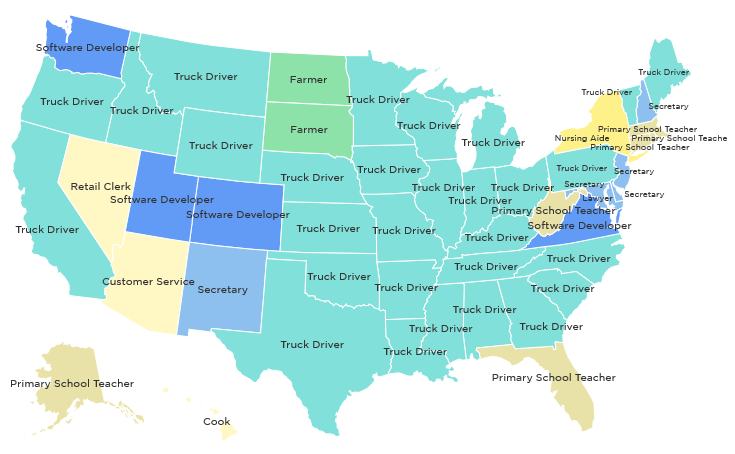
This is a map of the most common job in each US state in 2014. It should be clear at a glance just how dependent the American economy is on truck drivers. According to the American Trucker Association, there are 3.5 million professional truck drivers in the US, and an additional 5.2 million people employed within the truck-driving industry who don’t drive the trucks. That’s 8.7 million trucking-related jobs.
We can’t stop there though, because the incomes received by these 8.2 million people create the jobs of others. Those 3.5 million truck drivers driving all over the country stop regularly to eat, drink, rest, and sleep. Entire businesses have been built around serving their wants and needs. Think restaurants and motels as just two examples. So now we’re talking about millions more whose employment depends on the employment of truck drivers. But we still can’t even stop there…

…Truck driving is just about the last job in the country to provide a solid middle class salary without requiring a post-secondary degree.

You can argue about the exact numbers, but the point that it’s not just the driving that’s affected is important. See also the next link about sewing.


Made to measure » The Economist

Looking at the question of whether automation could put low-paid sewing machine workers out of, well, work in countries such as Myanmar:

it is devilishly difficult to make a machine in which fabric goes in one end and finished garments, such as jeans and T-shirts, come out the other. The particularly tricky bit is stitching two pieces of material together. This involves aligning the material correctly to the sewing head, feeding it through and constantly adjusting the fabric to prevent it slipping and buckling, while all the time keeping the stitches neat and the thread at the right tension. Nimble fingers invariably prove better at this than cogs, wheels and servo motors. “The distortion of the fabric is no longer an issue. That’s what prevented automatic sewing in the past,” says Steve Dickerson, the founder of SoftWear Automation, a textile-equipment manufacturer based in Atlanta, where Dr Dickerson was a professor at the Georgia Institute of Technology.

The company is developing machines which tackle the problems of automated sewing in a number of ways. They use cameras linked to a computer to track the stitching.

I’m moderating a session later this week looking at the questions around this topic: when automation and machine vision and capital come together to take these jobs away, what do the people who would have done them do instead?


USB-C has already won » The Verge

Sam Byford:

Although USB-C seems an inevitable success at this point, it does have a couple of issues to iron out, perhaps the most pressing of which is the complexity of its offering. There will be USB 2.0 devices with USB-C connectors, like the Nokia N1; USB 3.1 devices that use regular USB-A connectors; USB 3.1 “Gen 1” devices only capable of 5Gbps transfer speeds over USB-C, like the new Chromebook Pixel and MacBook; and USB 3.1 Gen 2 devices that give you 10Gbps. USB-C could be the only cable you ever need, but at this point it may be hard to know exactly what performance you’re going to get when you plug something in. “I think there’s the potential for confusion,” says [president and COO of the USB Implementers Forum, Jeff] Ravencraft, whose forum publishes language and usage guidelines for both USB 3.1 and USB-C.

“You do not get performance with the cable, you do not get power delivery with just the cable. The cable is a conduit for those things, right? So to have power delivery, the device has to have a power delivery controller, the host or the hub has to have a power delivery controller, and then you have to have the right cable.” The USB Implementers Forum offers training programs to help employees at retailers like Best Buy and Staples give accurate information to consumers, and is particularly aiming to crack down on “bad-actor” manufacturers that try to deliberately mislead.


MH17: forensic analysis of satellite images released by the Russian Ministry of Defence » bellingcat

With this new report all four major claims made at the Russian Ministry of Defence press conference have now been shown to be false:
– The MH17 flight path was not altered in the way claimed by the Russian Ministry of Defence. Data from the Dutch Safety Board’s preliminary report and other sources show Flight MH17 made no major course changes such as the one described in the Russian Ministry of Defence press conference.
– The Russian Ministry of Defence claimed the video of the Buk missile launcher presented by the Ukrainian Ministry of Interior was filmed in the Ukrainian government control town of Krasnoarmeisk. This has been proven to be untrue, with analysis of the video showing it was filmed in the separatists controlled city of Luhansk.
– Radar imagery was described as showing an aircraft close to Flight MH17 after it was shot down. Experts interviewed by various media organisations have stated this is almost certainly debris from Flight MH17 as it broke up over Eastern Ukraine.
– Satellite imagery shows Ukrainian Buk activity around July 17th. As this report shows, those claims are untrue, and were based on fabricated satellite imagery.

Weird that Russia is claiming to have had no involvement in MH17 and yet still takes the trouble to do this. But when you have a country whose leaders are paranoid.. well, read the next link.


The Agency » NYTimes.com

Adrian Chen on the “Internet Research Agency” in St Petersburg, which has industrialised the practice of trolling social media to promote Russian interests:

[Ludmila] Savchuk’s revelations about the agency have fascinated Russia not because they are shocking but because they confirm what everyone has long suspected: The Russian Internet is awash in trolls. “This troll business becomes more popular year by year,” says Platon Mamatov, who says that he ran his own troll farm in the Ural Mountains from 2008 to 2013.

During that time he employed from 20 to 40 people, mostly students and young mothers, to carry out online tasks for Kremlin contacts and local and regional authorities from Putin’s United Russia party. Mamatov says there are scores of operations like his around the country, working for government authorities at every level. Because the industry is secretive, with its funds funneled through a maze of innocuous-sounding contracts and shell businesses, it is difficult to estimate exactly how many people are at work trolling today. But Mamatov claims “there are thousands — I’m not sure about how many, but yes, really, thousands.”

That, though, is only the amuse-bouche. Then Chen finds himself dragged down the rabbit hole. Today’s must-read.


Lenovo replaces head of smartphone division as sales slump in China » Reuters

Liu Jun, one of four executive vice presidents under CEO Yang Yuanqing and a company veteran of 22 years, will be replaced by Chen Xudong, the head of ShenQi, a sub-division that sells mobile devices, the company said in a statement. Chen, 47, takes the reins of the division at a critical time. He must integrate the Motorola unit acquired from Google Inc for $2.9bn six months ago, while trying to counter a damaging slump in phone shipments. Lenovo, the fifth largest player in the Chinese market, shipped 22% fewer phones in the first quarter compared to the same period a year earlier, according to research firm IDC.

In stark contrast, Apple’s first-quarter China shipments jumped 62%, while Xiaomi and Huawei had gains of 42% and 40% respectively. Lenovo did not offer a reason for Liu leaving the post but said he would continue for an unspecified period as a special consultant to Yang.

Lenovo has a tough challenge with the tightening China market and Motorola’s integration.


How Twitter users can generate better ideas » MIT Sloan Management Review

in analyzing the structure of each employee’s Twitter network, we found that there was a positive relationship between the amount of diversity in one’s Twitter network and the quality of ideas submitted. However, Twitter activity and size measures (such as the number of tweets, number of followers and number of people followed) were not correlated with personal innovation.

We can explain these findings further by examining the Twitter sociograms of two EMC employees. In the diagrams, circles represent Twitter users, and an arrow from one user to another user indicates that the first user is following the second user on Twitter. Even though both employees A and B follow approximately the same number of Twitter accounts, A’s network is far more diverse than B’s. That is to say, the people whom employee A follows on Twitter are, for the most part, not following each other.

We can determine this level of diversity mathematically by using the compactness ratio, which measures the degree to which people in the network are connected to each other. For employee A, the network’s compactness ratio is quite low, at 18%. Our research found that loose Twitter networks, such as employee A’s, are better for ideation, because the potential for accessing a divergent set of ideas is greater.

Is it sort of “be less like Facebook”?


Start up: Apple’s transit plans, app monetisation, Samsung’s S6 rebuttal, bitcoin booboo, and more


Surely not caused by a Google car. Photo by Oakland Pirate on Flickr.

A selection of 9 links for you. Free like nitrogen. I’m charlesarthur on Twitter. Observations and links welcome.

Californians are OK with Google self-driving cars and are ready to ban non-self-driving cars » Emerging Technologies Blog

One of the blog’s readers gave their experience:

It’s safe to cut off a Google car. I ride a motorcycle to work and in California motorcycles are allowed to split lanes (i.e., drive in the gap between lanes of cars at a stoplight, slow traffic, etc.). Obviously I do this at every opportunity because it cuts my commute time in 1/3. Once, I got a little caught out as the traffic transitioned from slow moving back to normal speed. I was in a lane between a Google car and some random truck and, partially out of experiment and partially out of impatience, I gunned it and cut off the Google car sort of harder than maybe I needed too… The car handled it perfectly (maybe too perfectly). It slowed down and let me in. However, it left a fairly significant gap between me and it. If I had been behind it, I probably would have found this gap excessive and the lengthy slowdown annoying. Honestly, I don’t think it will take long for other drivers to realize that self-driving cars are “easy targets” in traffic.


Why do we assume everyone can drive competently? » Remains of the Day

Eugene Wei just avoided a cycling crash when a car turned into his cycle lane without warning:

For the next two blocks, I played my near collision on loop in my head like a Vine, both angry at the driver’s reckless maneuver and relieved as I tallied up the likely severity of the injuries I had just managed to escape by less than a foot of clearance. This is not an unusual occurrence, unfortunately. When I bike, I just assume that drivers will suddenly make rights in front of me without turning on their turn signal or looking back to see if I’m coming in the bike lane to their right. It happens all the time. It’s not just a question of skill but of mental obliviousness. American drivers have been so used to having the road to themselves for so long that they feel no need to consider anyone else might be laying claim to any piece of it. Though the roads in Europe are often narrower, I feel a hundred times safer there when biking there than I do in the U.S. All that’s to say I agree wholeheartedly with the writer quoted above that self-driving cars are much less threatening than cars driven by humans. As an avid cyclist, especially, I could think of nothing that would ease my mind when biking through the city than replacing every car on the road with self-driving cars.


iOS 9 Transit Maps to launch in a handful of cities in North America, Europe & China » 9to5Mac

Mark Gurman, for it is he:

While Apple plans to debut its own mass transit directions service for Maps in iOS 9 as soon as June, the rollout will not be as ambitious as some users may have hoped. In its first iteration, Apple’s Transit service will only support approximately a half-dozen cities across the United States, Canada, and Europe, in addition to China, according to sources… In the United States, the planned launch cities are San Francisco and New York, two major metropolitan areas that are known for public transportation, while Toronto will be likely Canada’s sole representative for the iOS 9 Maps Transit feature at launch. In Europe, Apple is said to be gearing up to first launch the feature in London, Paris, and Berlin.

Google has been miles ahead in this for years (which made iOS 6 retrograde). Three years on, there are already lots of apps – especially Citymapper – which offer services like this. But it’s the integration that Apple has really lacked.


Google’s answer to the big problem with wearables » WSJ

Alistair Barr:

Wearable gadgets like smartwatches have seen a lot of hype but little commercial success. An obvious obstacle is that teensy touch screens can make such devices difficult to control. Google thinks it has an answer: a minuscule radar system that senses hand gestures. The company’s Advanced Technology and Projects research group shrank a radar system into a package roughly the size of a micro SD card, small enough to fit in a smartwatch. It beams a signal wide enough to capture hand motions and gestures and turn them into control signals, according to Ivan Poupyrev, who led the initiative called Project Silo. The tiny radar could let people control tiny-screen devices without having to touch them, he said during a session at the Google I/O 2015 developer conference. For instance, it transforms a twisting motion between thumb and forefinger into commands to scroll up and down a smartwatch’s screen. Poupyrev demonstrated by changing the hours and minutes on a small screen by rubbing his thumb and finger near to the radar gesture sensor. He also played a simple soccer game, his finger motions in midair near the sensor shooting an onscreen ball into a goal. ATAP plans to release the system to developers later in 2015, Poupyrev said.

This is one of those things that looks cool in demos, but I suspect could be prone to everything that real life is – mess-ups. Remember Leap Motion, another gesture control system? Went nowhere because waving your hand in the air isn’t a natural way to control things – because it’s prone to misinterpretation. Google might get this right, but it needs a ton of figuring out.


Apps spearhead Google’s battle with Apple » FT.com

Richard Waters and Tim Bradshaw:

Apple’s App Store accounts for about 45% of the revenue that developers make from apps, compared with 29% for Google’s Play, according to Digi-Capital. But counting in the income from handsets in China — where Google’s apps are blocked, meaning it makes no money — pushes the overall Android share to 52%, Digi-Capital calculates. Last week, matching — and trying to surpass — Apple was a strong subtext of Google’s pitch to developers. New features included Android Pay, a rival to Apple Pay and a fresh attempt to break into mobile payments after the disappointment of Google Wallet. A new Google Photos app — with the promise of software that can automatically organise libraries of pictures — also echoed capabilities that are already offered by Apple. But in other areas, Google seemed unprepared. While smartwatches based on last year’s Android Wear technology have been put in the shade by the launch of Apple Watch, Google had little new to show off in response. This was a sign that it is surrendering early leadership in wearables to Apple, according to Carolina Milanesi, an analyst at Kantar Worldpanel.

The download share of Android in China is 62.8%, compared to 22.2% for Google Play, and 13.9% for Apple. Remarkable that non-Google Android is so big – but it only takes 23.8% of revenue, against 28.6% for Google Play, and 44.7% for Apple.


Hello world: Windows 10 available on July 29 » Microsoft Windows blog

Terry Myerson:

We designed Windows 10 to create a new generation of Windows for the 1.5 billion people using Windows today in 190 countries around the world. With Windows 10, we start delivering on our vision of more personal computing, defined by trust in how we protect and respect your personal information, mobility of the experience across your devices, and natural interactions with your Windows devices, including speech, touch, ink, and holograms. We designed Windows 10 to run our broadest device family ever, including Windows PCs, Windows tablets, Windows phones, Windows for the Internet of Things, Microsoft Surface Hub, Xbox One and Microsoft HoloLens—all working together to empower you to do great things. Familiar, yet better than ever, Windows 10 brings back the Start menu you know and love.

“Speech, touch, ink and holograms” is quite enticing. (That’s Hololens, of course.)


Asus brings a choice of sizes to Android Wear with ZenWatch 2 » The Verge

Vlad Savov:

The ZenWatch 2 runs the latest version of Android Wear, which was recently introduced with the LG Watch Urbane, however Asus’ watch is still a long way from actually being released. Asus tells us that it will reveal the full specs, pricing, and availability information during IFA in Berlin this September — leaving this as more of a promise than an actual product. The goal is to keep prices consistent between the two watch sizes, leaving the choice of strap to determine the particular cost. Update: The original article speculated that Asus’ metal crown will function like the digital crown in the Apple Watch, however we’ve now confirmed with Asus that it’s simply an external button and not a physical scroll wheel.

1) Doesn’t this Osborne [kill by preannouncement] the existing Zenwatch, even though there’s no price etc etc for the 2? 2) Which company will be the first, do we think, to mimic Apple’s digital crown and risk the sure-to-ensue lawsuit?


Samsung says S6 sales meet internal forecast » Korea Times

Kim Yoo-chul:

A Samsung spokesman in Seoul refused to release any official information on sales; but the company is expected to unveil figures at its upcoming investor relations forum on [Wednesday] June 3. Such remarks come a few days after Samsung Electronics Corporate Affairs President Park Sang-jin told reporters that the firm has been seeing a steady increase of sales on international markets. “You have to wait and see; however, the S6 and S6 Edge sales will be far higher than those of the S5” he said. The two models were unveiled during the Mobile World Congress 2015 event at the beginning of March. Both models were made available for purchase in April. Citing a report by CounterPoint Research, a research firm, eBEST Investment analyst Kim Hyun-yong said Samsung sold 6.1m S6s and S6 Edges in April. He added 305,000 S6s were being sold daily since the devices’ availability ― better than the S5 and S4’s 124,000 and 241,000 per day, respectively.

I’m finding it hard to believe that the S6 (and Edge?) is selling triple the number of the S5, and 50% more than the S4, at a time when Samsung is down in China and seen sales declines for months, and the S6 is on sale in fewer countries than the S5 was. Though with Samsung it’s hard to know what “sales” means – usually, it’s “sell-in”, as in sales to carriers.


Bitcoin app issues critical update after rare bug leads to total crypto breakdown » The Guardian

Alex Hern:

Bitcoin wallets are typically created by randomly generating a public address and a related private key. As a result, it is important for address and key to be truly random, or else it may be possible to guess the private key by looking at the public address. [Bitcoin wallet app] Blockchain used two sources of random numbers, in what ought to have been a belt-and-braces approach: it pulled a random number from the Android operating system’s built-in random number generator, and then connected to online service Random.org to get a second random number, which it combined with the first. Unfortunately, on some Android phones (reportedly including devices from the Sony Xperia range), the built-in random number generator failed to report back to the blockchain app. Normally, this should have been survivable, because the app used a second source of random numbers. But on 4 January, Random.org strengthened the security of its website, requiring all visits to be made over an encrypted connection. The blockchain app, however, continued to access the site through an unencrypted connection. So rather than getting a random number, as expected, it got an error code telling it that the site had moved. It then used that error code as the random number, every single time.

Not quite bitcoin itself screwed (it’s far too robust) but those using that app could find themselves all sharing a wallet.


Start up (May 21): Cisco in Russia, more Google Maps malarkey, a Watch forecast cut, and more

Somehow this didn’t publish on May 21 as it should have. Bah.


Android Wear lets you do all sorts of watchfaces. Photo by leolambertini on Flickr.

A selection of 10 links for you. Use them wisely. I’m charlesarthur on Twitter. Observations and links welcome.

After sanctions, Cisco altered sales records in Russia » BuzzFeed News

Aram Roston and Max Seddon, with a blockbuster piece:

After Western sanctions began shutting down sales of high-tech internet equipment to Russia’s military and security forces, employees at technology giant Cisco Systems Inc. altered sales records and booked deals under a false customer name, according to internal company documents. The intent, according to a confidential source with deep knowledge of Cisco’s Moscow operations, was to dodge the sanctions by masking the true customers behind more innocuous-sounding straw buyers.

Nonononononotatall we were just correcting some errors, says Cisco.
Remind me again about how Buzzfeed is just cat pictures and listicles?


Sex, monsters and outrage » Public Address

Joshua Drummond on the outrage (overhyped) about students in a sex education class being handed literature that, um, outraged some people:

By analogy, it’s a lot like students studying World War Two. Some knowledge of the Nazis’ peculiar, perverted ideology and the conditions in which it flourished is necessary to understand how the war got going. But no-one’s being taught that Nazis are rad, any more than they’re being taught that unmarried women are sluts in this particular case. The lesson was – and why not have some fun with paraphrasing – intended to point out the unfortunate truth that there are a lot of dicks in the world and some of them try to force their dickery on others. I’d have thought this was a pretty important lesson, especially when it comes to sexual health, and where better to experience it than in the (relatively) safe space of a health education class?

No! said Labour education spokesperson Chris Hipkins, who thundered mildly: “It’s fine for schools to be using stuff to provoke kids into thinking but there’s a fine line between provoking critical thought and something that’s offensive. That, I think, crosses the line.”

Well, I suppose that’s up for debate. Should students be privy to the extremist views of nutcases?

What’s most worrying is that, as always happens, the initial distortion gets far more broadly distributed than the correction.

Think about that: the wrong stuff always gets the broader distribution.


Facebook’s Internet.org comes under fire for being a walled garden » Fortune

Mathew Ingram:

In effect, says the EFF, the structure of Internet.org means that Facebook has set itself up as a gatekeeper when it comes to accessing the Internet, and this means that it has “issued an open invitation for governments and special interest groups to lobby, cajole or threaten them to withhold particular content from their service.” Until the social network truly opens up the project to anyone and everyone, Internet.org will “not be living up to its promise or its name,” the foundation says.


Today’s solar panels are fine for tomorrow » Solar Love

Steve Hanley:

An interdisciplinary MIT study led by the MIT Energy Initiative has led to a 332-page report entitled The Future of Solar Energy. Among its key findings are that today’s solar panels are all that is needed to supply the world with many terawatts of clean solar power by 2050 (a terawatt is equivalent to 1,000,000 megawatts). The other main point the study makes is that it will take political will to finally wean the world off of fossil fuels.

I was pointed to this on Twitter by Leonardo DiCaprio. Yup, him. Not personally, you understand.


KGI lowers Apple Watch forecast to 15 million » WatchAware

Abdel Ibrahim, commenting on 9to5Mac reporting on KGI research lowering its estimat for the lead from 20-30m to “just” 15m:

As with any new product, it takes time for things to get going. New features, functions, and even new versions are what will be the most important test for Apple Watch in the coming years. Most V1 products are usually adopted by the comparatively small minority of Apple fans who are interested in the company’s latest gadgets.

15m feels astonishing. For a v1 product? And as Ibrahim points out, that’s a lot more than Android Wear seems to be doing (downloads passed 1m in late February, now around 1.2m).


Proper Google Maps app appears on Android Wear via latest phone app update » Android Central

Andrew Martonik:

The app can be launched from the app launcher or by voice with an “open Maps” command, and when opened you get a full screen top-down map experience. You can scroll around, pinch-to-zoom (barely) and even switch between true North and device direction views. Zoom in/out buttons appear on the top of the screen when you tap it, which is much better than pinching, and you also get a small pin button that lets you quickly scroll through nearby places and navigate to them — though when you fire up navigation from the Maps app on the watch it still corresponds with launching Maps on your phone.

There’s even a neat feature that gives you a simple black and white outline map when the watch doesn’t receive interaction for while, just like the ambient watch faces do.

Aside from the handful of reboots of our phone and watch that were necessary just to get it to run, the app still seems rather unstable. Several times in just a few minutes of playing with the app it has failed to respond or open up navigation properly — we have a feeling that this isn’t quite ready without a new version of Google Play Services or potentially a new version of Android Wear on the watch.

Options for resizing: pinch-to-zoom or prodding a plus/minus onscreen tab. Neither seems ideal. The black/white outline map is horrible. The “list of pins” looks smart.


How do I get rid of the “Try the New Drive” banner? » Google Product Forums

Q: It is super annoying and it won’t go away. I’ve tried going to the new drive and then coming back, but it’s still there. I like the old drive a lot better than the new one and I want to stay on it. This banner is basically trying to force me to use the new drive which I *don’t want to do*. Anyone know if there’s a way to get rid of it??

And wouldn’t you know, there’s a Googler ready with an answer. However…


Apple Watch and Continuous Computing » Stratechery

Ben Thompson has a fantastic examination of the Watch’s potentials, and limits, as well as Apple’s advantages and strategic disadvantage:

it’s clear that what the mouse was to the Mac and multi-touch was to the iPhone, Siri is to the Watch. The concern for Apple is that, unlike the others, the success or failure of Siri doesn’t come down to hardware or low-level software optimizations, which Apple excels at, and which ensures that Apple products have the best user interfaces. Rather, it depends on the cloud, and as much as Apple has improved, an examination of their core competencies and incentives argues that the company will never be as good as Google. That was acceptable on the phone, but is a much more problematic issue when the cloud is so central to the most important means of interacting with the Watch.

A key advantage: lots of people who will buy it and use it, creating a virtuous circle for developers who write for it. (Yes, a calculator for the Watch.)


Breaking News: Howard University shows up as ‘N***er University’ on Google Maps » Seely Security

Bryan Seely:

A few hours ago, Bomani X @AceBoonCoon  updated his twitter feed with yet another one of his shocking discoveries on Google Maps.  Yesterday the world took notice when he posted an image of his Google Maps results where he found that when he searched for the keyword ‘nigga’ or ‘nigger’ , the White House would come up. Unfortunately, President Obama and his family are not the only targets of this deplorable prank. When you run a Google Maps search for ‘nigger university’ you get search results for ‘Howard University,’ a private university in Washington, D.C.

Beginning to look like we’re discovering the limits of useful crowdsourcing. (Though of course the Google search for “miserable failure” of a few years ago was already showing the dangers.)


Driverless cars may cut US auto sales by 40%, Barclays says » Bloomberg Business

Keith Naughton:

US auto sales may drop about 40% in the next 25 years because of shared driverless cars, forcing mass-market producers such as General Motors Co. and Ford Motor Co. to slash output, a Barclays Plc analyst said.

Vehicle ownership rates may fall by almost half as families move to having just one car, according to a report published Tuesday by the analyst, Brian Johnson. Driverless cars will travel twice as many miles as current autos because they will transport each family member during the day, he wrote.

Large-volume automakers “would need to shrink dramatically to survive,” Johnson wrote. “GM and Ford would need to reduce North American production by up to 68% and 58%, respectively.”…

…When most vehicles are driverless, annual U.S. auto sales will fall about 40% to 9.5%, while the number of cars on American roads declines by 60% to fewer than 100m, he estimated.

“While extreme, a historical precedent exists,” Johnson wrote. “Horses once filled the many roles that cars fill today, but as the automobile came along, the population of horses dropped sharply.”

Hard to argue against that one.


Start up: Hololens on the edge, what self-driving cars need, the buttons that do nothing, and more


Might make a difference. Might not. Photo by Cyron on Flickr.

A selection of 8 links for you. No strings attached. I’m charlesarthur on Twitter. Observations and links welcome.

Google’s self-driving cars have been in 11 accidents, but none were the car’s fault » The Verge

Chris Ziegler notes that Ford thinks we need some flexibility:

another example [Mike] Tinskey [Ford’s head of electrification and infrastructure] brought up was that of overcoming the excessively careful self-driving systems of the future:

Q: So you’re saying that from the driver’s perspective, the car will be self-driving, but really there’s someone else driving it from afar for them?
Tinskey: That’s right. If you’ve ever had the pleasure to go to, for instance, China, if you’re not aggressive to try to turn left, there will be people that will walk in front of you all day long. And an autonomous vehicle would end up sitting there forever. And a driver normally just has to kind of say, “Alright, I’m going,” and the people will stop and the car heads through. So there are going to be situations where a remote driver can actually pilot a vehicle better than an autonomous in certain conditions. Or just because of policy, that might be the way that we have to deal with it.

Indeed, in Google’s view of vehicle autonomy — as in the generally rational view — a car can never assume (or hope, at least) that a pedestrian will stop or jump out of the way the way a human driver can. Sometimes, simply moving (particularly in the world’s most congested cities) requires a degree of cowboyishness that a stupidity-proof autonomous car can never permit. There needs to be a way for the car to say, “well, I can’t make this potentially dumb decision, but I invite a human to make it for me.”


The growing US smartphone base » Tech.pinions

Jan Dawson, in a subscriber-only article looking at the disparity (of about 40m smartphones) between Comscore’s US smartphone number, and that shown by mobile operators – which has various explanations:

If you were relying on Comscore’s data to forecast the total iPhone market in the US, for example, you’d end up with about 80m users, while there would be just under 100m Android users. But we already know that Comscore is under-counting the total smartphone market by around 35-40m, so each of these numbers might be 15-20m higher in practice. That’s important if you’re trying to get an accurate gauge.
The next question is whether the split between operating systems is accurate, or whether that’s defective too. That’s harder to ascertain through other sources and Kantar and other data seems to bear out similar trends in broad terms, so I’m inclined to believe it’s fairly accurate. But I take it with at least a pinch of salt on the basis that I know the overall data is flawed. I think the key, ultimately, is not to rely on any one data point, but rather to find as many data points as possible that either corroborate or contradict one another, then synthesize and aggregate them to arrive at the best possible picture of reality.


On sale now: Tesco Mobile » Counterpoint Technology Market Research

Peter Richardson, on the UK supermarket MVNO, which is up for sale to try to alleviate corporate debts of around £22bn:

Tesco Mobile is actually one area where is has carved out a strong position. Its range of attractively priced and no-nonsense tariffs appeal strongly to particular segments: young people, family orientated consumers and seniors being primary focal areas. It also offers a good range of handsets at prices on par with most high street mobile stores. Its success means it contributes approximately £100m per year to Tesco’s profits. Assuming similar multiples as other recent trade sales, Tesco could realize seven to eight times net profit — therefore something around £800m when it sells its stake in the venture. The most likely buyer is Tesco’s partner in the business, O2. However other MVNOs may also enter the bidding including Talk Talk, which recently purchased Tesco’s video TV service, Blinkbox.

Tesco Mobile also operates around 250 Tesco Phone Shops, that provide point of sale for a range of feature phones, smartphones and accessories. It sells around 2m units per year through these stores and online. Tesco has done well addressing seniors and is one of the UK’s leading suppliers of Doro’s range of products that are designed specifically for older generation consumers. It is not clear what will become of Tesco Phone Shops — even to staff working in them.

Last year saw Phones4U squashed; will Tesco’s outlets be next?


HoloLens: why Microsoft has to play down expectations to avoid Google Glass failure » IBTimes

After yesterday’s post from Tim Bajarin on why Google Glass didn’t click with consumers, David Gilbert contrasts the stage promise of Hololens with the experience (at present):

Just hours later I was given the chance to test out this game-changing technology for myself and my initial reaction was one of huge disappointment and being completely underwhelmed.

That was until I realised what HoloLens really was and what it could do, and I readjusted my expectations. By the end of my time with HoloLens I saw the huge potential this device has, but Microsoft is in danger of falling into some of the same traps as Google Glass.

Microsoft is a company in need of a revolutionary product like HoloLens. Unlike Apple, Microsoft is seen as a stale and staid tech company, one which is associated with “boring” products like Office and Windows rather than the iPhone or iPad.

The problem for Microsoft, is that while HoloLens may be revolutionary, it is not (yet) a mass consumer product like the iPhone or iPad. It is a hugely powerful holographic computer that is ideally suited to enterprise applications and that is where the company needs to focus its attention.

Via David Gilbert. (It’s OK to promote your own stuff to me, folks.)


How the Apple Watch cured my iPhone addiction » Medium

Evgenia Grinblo:

It’s not that I was addicted, per se. I just spent a lot of time using my phone. But the app Moment, which I installed on my phone to prove I didn’t have a problem, told me that my average total daily iPhone use added up over two hours.

On my worst day, I spent 7 hours and 41 minutes on my iPhone.

As a UX designer and qualitative researcher, this was not only alarming but also fascinating. I wanted to know what it was that kept hooked on my phone. I researched mobile phone addiction (it sounded dramatic), I tried a 30-day-off-Facebook challenge (but still clocked considerable time on my phone). I also spoke with others. It appeared that many felt equally drawn to their smartphones but no one quite understood why.

Then came the Watch.
Everything changed when I got my Apple Watch. Within twenty-four hours of wearing it, I forgot where my iPhone was for the first time.

(Via Jay Kannan.)


How World of Warcraft led to Glassdoor » Business Insider

Julie Bort:

in 2006, Hohman quit a fabulous job as president of Hotwire to do nothing but play the game. Full time. For a year.

And the second he hit the highest level, the itch to play was scratched, and he needed a new thing to obsess over. So he launched a startup.

In his words: “I took a year off and played World of Warcraft. I would pat the kids on the bottom every morning, send them to school and then I would dominate as an Orc Warrior.”

He adds, “I played for a year nonstop and then I hit the maximum level in WoW. I was maniacal in chasing this goal and literally the next day I started a company, Glassdoor.”

The meaning of ‘community’
The year of WoW helped him decide the kind of company he wanted to build.

“I learned from playing WoW about community. It was the first time I really felt part of a online community. I’d be up the morning and be excited to see my guild. Isn’t that nerdy?” he laughs.

Yes. Yes, it is. But it’s hard to argue with success: he learnt the difference between offline and online community through that experience. (Arguably, he could have learnt it in less time than a year.)


Press me! The buttons that lie to you » BBC Future

Chris Baraniuk:

Computer scientist Eytan Adar at the University of Michigan has described a series of fascinating “benevolent deceptions” in a paper co-written with two Microsoft researchers. Take the 1960s 1ESS telephone system for instance. After dialling, a caller’s connection would sometimes fail to go through properly. Instead of a dead tone or error noise, the system would instead simply route the call to a completely different person. “The caller, thinking that she had simply misdialled, would hang up and try again: disruption decreased and the illusion of an infallible phone system preserved,” notes the paper.

Adar and his co-authors also describe how Skype phone calls today sometimes contain “fake static noise” because when users experience a completely noise free line, they are prone to thinking that the call has in fact dropped. A quick Google search reveals that there are plenty of examples of fake noises. From pre-recorded car door slams to artificial shutter sounds made by digital cameras, the world is full of noises designed to delight users and reassure them that the device is working as intended.

Those noises deserve a word of their own, rather like onomatopeia.


Snapchat debuts video ads for 2 cents per view » Adweek

Snapchat wants companies to know its not just for millennials: Advertisers can find a home there as well. At the Daily Mail/Elite Daily Digital Content NewFronts presentation Thursday, the platform announced it would be unveiling 10-second ads that cost 2 cents per view.
The new ad offering creates a new way for Snapchat Discover publishers to generate revenue. Daily Mail North America CEO Jon Steinberg said his company was standing by to create those snaps for brands.

Another American platform using adverts to monetise. I often wonder whether if US TV were more like the (licence fee-subsidised, ad-free) UK’s BBC whether “advertise for money” would be a less reflexive monetisation strategy.