Start up: Windows Phone hits the buffers, more Flash woes, do Google ads discriminate?, and more


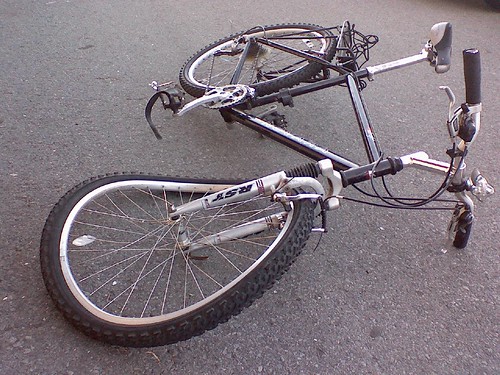
If there’s a stream and nobody listens… hang on. Photo by jjjj56cp on Flickr.

A selection of 9 links for you. They flip, they bend, they twirl away. I’m charlesarthur on Twitter. Observations and links welcome.

Zero-day Flash player exploit disclosed in ‘Hacking Team’ data dump » The Hacker News

Swati Khandelwal:

While analyzing the leaked data dump, researchers discovered at least three software exploits – two for Adobe Flash Player and one for Microsoft’s Windows kernel.
Out of two, one of the Flash Player vulnerabilities, known as Use-after-free vulnerability with CVE-2015-0349, has already been patched.

However, the Hacking Team described the other Flash Player exploit, which is a zero-day exploit with no CVE number yet, as “the most beautiful Flash bug for the last four years.”
Symantec has also confirmed the existence of the zero-day flaw in Adobe Flash that could allow hackers to remotely execute code on a targeted computer, actually allowing them to take full control of it.

Researchers found a Flash zero-day proof-of-concept (POC) exploit code that, after testing, successfully worked on the most latest, fully patched version of Adobe Flash (version 18.0.0.194) with Internet Explorer.

Successful exploitation of the zero-day Flash vulnerability could cause a system crash, potentially allowing a hacker to take complete control of the affected computer.

Flash depresses me. I removed it from my machine some time ago; it’s basically a malware vector whose functions can almost always be replaced with HTML5 by normal users. See below.


How to enable click-to-play plugins in every web browser » Hot-To Geek

Chris Hoffman:

Most web browsers load Flash and other plug-in content as soon as you open a web page. Enable “click-to-play” plug-ins and your browser will load a placeholder image instead — click it to actually download and view the content.

Click-to-play allows you to conserve download bandwidth, improve page load times, reduce CPU usage, and extend laptop battery life. This feature gained popularity with Flashblock for Firefox and is now built into modern browsers.

Do this, for the safety of your system.


Satya Nadella email to employees on sharpening business focus » Microsoft News Center

Phones. Today, we announced a fundamental restructuring of our phone business. As a result, the company will take an impairment charge of approximately $7.6bn related to assets associated with the acquisition of the Nokia Devices and Services business in addition to a restructuring charge of approximately $750m to $850m.

This isn’t actual lost money, but lost value of the business – a “goodwill” writedown. The phones aren’t any more or less profitable as a result.

I am committed to our first-party devices including phones. However, we need to focus our phone efforts in the near term while driving reinvention. We are moving from a strategy to grow a standalone phone business to a strategy to grow and create a vibrant Windows ecosystem that includes our first-party device family.

Translation: phones that don’t run Windows are not needed. Say goodbye to those Nokia featurephones (24.7m in Q1, likely fewer in Q2, probably zero by Q4).

In the near term, we will run a more effective phone portfolio, with better products and speed to market given the recently formed Windows and Devices Group. We plan to narrow our focus to three customer segments where we can make unique contributions and where we can differentiate through the combination of our hardware and software. We’ll bring business customers the best management, security and productivity experiences they need; value phone buyers the communications services they want; and Windows fans the flagship devices they’ll love.

Translation: cheap Lumias continue; will do a flagship. Business customers will get support on whichever platform.

In the longer term, Microsoft devices will spark innovation, create new categories and generate opportunity for the Windows ecosystem more broadly. Our reinvention will be centered on creating mobility of experiences across the entire device family including phones.

Translation: phones aren’t so important, are they?


September 2013: The deal that makes no sense » Stratechery

Ben Thompson, back in September 2013:

Early this morning Microsoft acquired Nokia for €3.79 billion (plus €1.65 billion for patents). It is a deal that makes no sense.

While industry observers love to pontificate about mergers and acquisitions, the reality is that most ideas are value-destroying. It is far better to form an alliance or partnership; most of the benefits, none of the costs.

A partnership similar, in fact, to the one formed just two years ago between Microsoft and Nokia.

From Microsoft’s perspective, that was a brilliant deal; Matt Drance characterized it as “Microsoft Buys Nokia for $0B,” and he wasn’t far off. The premier pre-iPhone phone maker, with what was even then one of the best supply chains, distribution networks, and brands in the world would be exclusively devoted to Windows Phone.

There is nothing further to be gained by an acquisition.

Actually, turned out to have negative value, financially speaking. (The whole post is very well worth re-reading in hindsight.)


Two-Factor authentication » Apple Developer

Is going to be built in to iOS 9 and OSX 10.11 (aka “El Capitan”):

Whenever you sign in with your Apple ID on a new device or browser, you will verify your identity by entering your password plus a six-digit verification code. The verification code will be displayed automatically on any Apple devices you are already signed in to that are running iOS 9 or OS X El Capitan. Just enter the code to complete sign in. If you don’t have an Apple device handy, you can receive the code on your phone via a text message or phone call instead.

Once signed in, you won’t be prompted for a verification code again on that device unless you erase your device, remove it from your device list, or need to change your password for security reasons. When signing in on the web, you can choose to trust your browser so you won’t be prompted for a verification code the next time you sign in from that computer.

The problem with 2FA is always “what if I lose my phone?” Google gets around this by letting you have printed codes that act as verification numbers; it’s a good idea that Apple might do well to take up.

But this looks a lot better than the version used at present in iCloud.


Study suggests Google’s ad-targeting system may discriminate » MIT Technology Review

Tom Simonite:

Researchers from Carnegie Mellon University and the International Computer Science Institute built a tool called AdFisher to probe the targeting of ads served up by Google on third-party websites. They found that fake Web users believed by Google to be male job seekers were much more likely than equivalent female job seekers to be shown a pair of ads for high-paying executive jobs when they later visited a news website.

AdFisher also showed that a Google transparency tool called “ads settings,” which lets you view and edit the “interests” the company has inferred for you, does not always reflect potentially sensitive information being used to target you. Browsing sites aimed at people with substance abuse problems, for example, triggered a rash of ads for rehab programs, but there was no change to Google’s transparency page.

What exactly caused those specific patterns is unclear, because Google’s ad-serving system is very complex. Google uses its data to target ads, but ad buyers can make some decisions about demographics of interest and can also use their own data sources on people’s online activity to do additional targeting for certain kinds of ads. Nor do the examples breach any specific privacy rules—although Google policy forbids targeting on the basis of “health conditions.” Still, says Anupam Datta, an associate professor at Carnegie Mellon University who helped develop AdFisher, they show the need for tools that uncover how online ad companies differentiate between people.

Google didn’t respond to the researchers’ requests. But, oddly, it changed the language on that transparency page. This is the AdFisher study


Apple Music and the listener-to-buyer ratio » Music Industry Blog

Mark Mulligan on the maths of streaming v buying:

What quickly becomes apparent is that the most viable route to ensuring Apple Music streaming revenue offsets the impact of lost iTunes sales revenue is as big an installed base of streaming users as possible. The more Apple Music users there are, the more likely more of them will find and listen to your music. This is why the scale argument so is so important for streaming and also why small labels feel the effect less quickly. If you have a vast catalogue you don’t need to worry too much about the listener-to-buyer ratio because you have so many tracks that you are a much bigger target to hit. The laws of probability mean that most users are going to listen to some of your catalogue.

Let’s say you are a big major with 1 million tracks out of the 5 million tracks that get played to any meaningful degree in streaming services. That gives you a 20% market share. But if you are an independent with 50,000 tracks that gives you 1%, 20 times less than the major. Which means that you are 20 times less likely to have your music listened to. And that is without even considering the biases that work in favour of the majors such as dominating charts and playlists, and other key discovery points.


YouTube gaming star PewDiePie ‘earned $7m in 2014’ » BBC News

YouTube continues to be a profitable enterprise for its top tier stars, who earn money from advertisements placed around their videos.

The site’s terms and conditions forbid creators from disclosing how much they earn, but on Monday gamer Olajide Olatunji, known as KSI, told the newspaper Metro he had earned enough money to buy his parents a house.

Although some stars supplement their income with product placement deals, [Felix] Kjellberg [aka PewdiePie] says he does not do very many.

“I make more than I need from YouTube,” he wrote on Reddit. “With that freedom, but also to respect my fans for making that possible, I don’t end up doing many endorsements.”

[Ian] Maude [of Enders Analysis] has a word of caution for anybody eyeing up YouTube with dreams of becoming a millionaire.

“As with many things, a few people at the top do exceptionally well but there’s a long tail of people who don’t make any money at all,” he said.

Why can’t they disclose how much they earn?


Apple Watch sales plunge 90% » MarketWatch

Brett Arends:

two-thirds of the watches sold so far have been the lower-profit “Sport” version, whose price starts at $349, according to Slice, rather than the costlier and more advanced models that start at $549.

In an ambitious bid for the luxury market, Apple also unveiled a gold “Edition” model priced at $10,000 or more. So far, fewer than 2,000 of them have been sold in the U.S., Slice contends.

Slice bases its research on electronic receipts sent to millions of email addresses following purchases. The company conducts market research on behalf of consumer-goods companies, among others, many of them in the Fortune 500.

Wall Street has been desperately trying to work out how well the new watch has been selling, but Apple has been refusing to say. The company, which in the past has updated Wall Street on the sales of new products soon after the launch, has yet to release any numbers about the watch.

Those Edition watches will have made a ton of profit. But apparently the fall in sales is “ominous”. Seems like about 3m sold in the US in the quarter. That’s about four times the number of Android Wear devices sold in seven months or so from multiple manufacturers at lower prices worldwide last year. Ominous.

Start up: Wi-Fi password sharing?, machine intelligence smart and stupid, Pebble Time review, and more


You’ll never believe what happens if you play it backwards. Photo by Janitors on Flickr.

A selection of 9 links for you. Show them eagerly to the person beside you! I’m charlesarthur on Twitter. Observations and links welcome.

UH OH: Windows 10 will share your WiFi key with your friends’ friends » The Register

Simon Rockman:

A Windows 10 feature, Wi-Fi Sense, smells like a security risk: it shares WiFi passwords with the user’s contacts.

Those contacts include their Outlook.com (nee Hotmail) contacts, Skype contacts and, with an opt-in, their Facebook friends. There is method in the Microsoft madness – it saves having to shout across the office or house “what’s the Wi-Fi password?” – but ease of use has to be teamed with security. If you wander close to a wireless network, and your friend knows the password, and you both have Wi-Fi Sense, you can now log into that network.

Wi-Fi Sense doesn’t reveal the plaintext password to your family, friends, acquaintances, and the chap at the takeaway who’s an Outlook.com contact, but it does allow them, if they are also running Wi-Fi Sense, to log in to your Wi-Fi. The password must be stored centrally by Microsoft, and is copied to a device for it to work; Microsoft just tries to stop you looking at it. How successful that will be isn’t yet known.

“For networks you choose to share access to, the password is sent over an encrypted connection and stored in an encrypted file on a Microsoft server, and then sent over a secure connection to your contacts’ phone if they use Wi-Fi Sense and they’re in range of the Wi-Fi network you shared,” the Wi-Fi Sense FAQ states.

Has been on Windows Phone for ages, yes, but most WP users don’t know any significant number of other WP users (because they’re so few). Not so with Windows. Microsoft says it only allows internet access and not LAN access – via port restrictions? That’s going to get hacked for sure.

Or could people maliciously spread their Wi-Fi details to try to sniff people’s viewing habits and details?


Pebble Time review » Wareable

Sophie Charara:

First things first, the Pebble looks better in real life than the pics you’ll have seen online. The black model is a little boring but will look neat under suit sleeves – for the record, we prefer the red and black Time.

Admittedly, the Time is plasticky, with a stainless steel bezel, but it retains the toy-like charm of the original Pebble while adding friendlier, more unisex curves. It’s very light at just 42.5g including the standard strap, 20% thinner at 9.5mm and the new slightly curved body helps to make it comfortable to wear on the wrist.

It’s amazing how many smartwatch manufacturers are satisfied with making devices that sit flat on top. The Time is the kind of smartwatch you can forget you’re wearing, until it vibrates.

I bought an original Pebble on Kickstarter. This? Looks like a toy compared to the Apple Watch. Not quite half the price, but really nothing like half as attractive.


Apple Sim iPads change the international data roaming game » Fortune

This morning, Apple and GigSky teamed up to offer travelers the ability to instantly connect to a local data network in more than 90 countries and territories upon touchdown—no need to visit a kiosk, talk to a service agent, or really, do anything at all. Instead, iPads with AppleSIM cards will automatically offer the option to sign up for a data plans as soon as a local network is in reach. (The GigSky network includes most of Western Europe, from France and Germany to the Netherlands; Australia; South Africa; parts of the Middle East; and beyond.)

Because travelers are accessing onto local networks, rather that roaming from their domestic carrier, prices are impressively affordable as long as you’re traveling on the beaten path. Entry-level data plans begin at just $10, covering anywhere between 10MB (in Papua New Guinea) to 75 MB (in Italy); in countries with better access, the premium plans top out at 3GB for $50. By comparison, AT&T’s best deal currently charges $30 for 120 MB or $120 for 800 MB.

Latest iPads only have them preinstalled, although for older ones you can get Apple SIMs in its stores, apparently.


Superconductivity record bolstered by magnetic data » Scientific American

Edwin Cartlidge:

The long-standing quest to find a material that can conduct electricity without resistance at room temperature may have taken a decisive step forward. Scientists in Germany have observed the common molecule hydrogen sulfide superconducting at a record-breaking 203 kelvin (–70 ˚C) when subjected to very high pressures. The result confirms preliminary findings released by the researchers late last year, and is said to be corroborated by data from several other groups.

Some physicists urge caution, however. Ivan Schuller at the University of California in San Diego, says that the results “look promising” but are not yet watertight.

Pressure of 1.5 million atmospheres. Don’t hold your breath for this one.


Why the BBC is wrong to republish ‘right to be forgotten’ links » The Guardian

Julia Powles:

The reaction to [BBC Online managing editor Neil] McIntosh’s post was predictable, inaccurate and devastating. The Times led with “BBC lists stories on abusers and rapists hidden under ‘right to be forgotten’”, gratuitously highlighting two stories.

The first was a 12-year-old story about a settlement between an alleged rape victim and the Catholic church, over incidents that occurred a half-century ago. The long-deceased abuser clearly couldn’t have filed the obscurity request with Google – leaving, rather less salaciously, the victim.

The second case concerned a nanny jailed for child abuse. Even a cursory Google search coupled with the basics of the Rehabilitation of Offenders Act would have told the journalist that an unspent conviction for such an offence clearly denied any reasonable claim to delisting. Caution raised, a bit more searching would have revealed the truth: that the conviction was overturned by the Court of Appeal. That former nanny has been exculpated under the law of the land – but not by Google and not, it seems, by the press either.

Other publications followed suit. Boing Boing drew attention to a rape story. Given it concerned a fairly recent conviction in 2012, clearly the sex offender has no entitlement to be delisted.

But what about his friend who was also named in the article because he happened to be in the house where the attack took place?

The “right to be forgotten” is so poorly understood, which frustrates the hell out of me. (See the comments under the article.) I wrote an explanation of what it is, and what it is not; please, before you discuss the topic with me (or anyone), read and absorb it. The topic is simple. It just takes a bit of thought.


Growing conspiracy theory: is spy equipment really included in Samsung smartphone batteries? » BusinessKorea

Cho Jin-young:

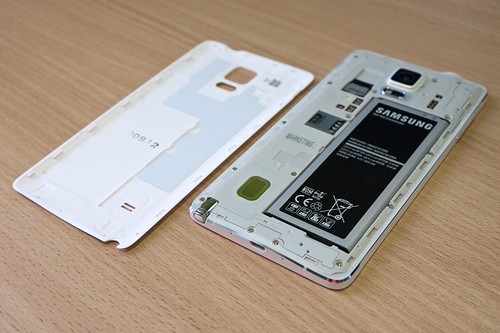
A video circulating on Facebook and YouTube that was posted at the beginning of the last week of June shows that after tearing off a sticker that wraps around the battery of the Galaxy S4, the man in the video points to a small coil inside, saying, “This is the spy equipment.”

He remarked, “Samsung can record pictures on your smartphone and overhear your calls through the coil shaped like this antenna,” adding, “So, you’d better tear off the sticker that wraps the battery first and use the phone.”

In fact, this video attracted 12 million views on Facebook only four days after it was initially posted, and around 300,000 people reportedly shared the video.

However, local media outlets pointed out that this conspiratorial video originated from a misunderstanding about the Near Field Communication (NFC) antenna, a communication technology that makes it possible to transmit different kinds of wireless data to a distance of 10 cm.

Would be fun to know how weird ideas like this get started. I’ve seen a few incoming search queries on this to this blog, and wondered what was going on (it was because I wrote about Samsung obviously knowing whether people use replacement batteries).


DRAM spot prices hit 28-month low, says Taiwan Central News Agency » Digitimes

Jessie Chen:

Spot prices for 4Gb DDR3 chips already declined 17.55% in the second quarter, after falling 12.77% in the first quarter, the report quoted DRAMeXchange as saying.

Since 2015, DRAM spot prices have been dragged down by sluggish PC sales and a slowdown in smartphone demand, the report noted.

Hadn’t heard about this slowdown in smartphone demand anywhere else. China has, but elsewhere? Dram prices are often an early warning though.


Google apologises for Photos app’s racist blunder » BBC News

Google says it is “appalled” that its new Photos app mistakenly labelled a black couple as being “gorillas”.

Its product automatically tags uploaded pictures using its own artificial intelligence software.
The error was brought to its attention by a New York-based software developer who was one of the people pictured in the photos involved.

Google was later criticised on social media because of the label’s racist connotations.
“This is 100% not OK,” acknowledged Google executive Yonatan Zunger after being contacted by Jacky Alcine via Twitter.

“[It was] high on my list of bugs you ‘never’ want to see happen.”

Machines can’t be racist, of course; but quite how Google is going to prevent this happening again is an open question. Neural network/deep learning like this isn’t something you can tweak directly. You can’t really peer inside it. Great when it’s drawing arcane pictures, not good when it’s mislabelling pictures.


Could this computer save your life? » CNN

Jillian Eugenios:

“In one panel of scans that we looked at, when you look at the number of times that radiologists sent someone home with a clean bill of health, about 7% of the time that patient was ultimately found to have cancer,” said John Zedlewski, a data scientist with Enlitic, a medical technology company.

When Zedlewski used Enlitic’s algorithm against the same panel, there weren’t any mistakes.

How does it work? Enlitic’s technology uses machine learning — which some say is a version of artificial intelligence. It takes medical information from one patient — whether it’s a CT scan, an X-ray or details about, say, a tumor — and then converts it into a mathematical representation. It’s then added to a large pool of data and compared to other patients who have experienced similar issues.

Think of it as crowdsourcing your symptoms. And not just with one or two people, but millions. The more data the computer has, the smarter it gets, and the more accurate the diagnoses.

At least that’s the dream.

Seems to have a large base of data.


Start up: China’s Uber ripoff, Microsoft’s maps and ads exit, Google v Oracle redux, and more


Low power, but still pretty powerful. Photo licensed from Apple, I guess, on Flickr.

A selection of 12 links for you. Use them wisely. I’m charlesarthur on Twitter. Observations and links welcome.

One driver explains how he is helping to rip off Uber in China » Bloomberg Business

To create a fake trip, an Uber driver has essentially two options, according to drivers interviewed by Bloomberg, who asked not to be named discussing information that may get them barred by the company.

The first is a do-it-yourself option where the driver buys a hacked smartphone that can operate with multiple phone numbers and therefore multiple Uber accounts. Drivers use one number to act as a rider and request a lift, and then accept the trip as a driver with another phone number.

A driver like Li, for example, may know that he has a legitimate fare waiting for him at the airport, but he doesn’t want to make the trip there without getting paid. He could then request a trip as a rider, let the booking show up on Uber’s GPS tracking software as his car heads to the airport and then get paid by Uber for taking a “customer” on the route.

The second option involves working with other scammers over the Internet. If a driver doesn’t have a hacked phone, he can go into one of several invitation-only online forums and request a fake fare from professional ride-bookers. These bookers are referred to as “nurses” because they use specially tailored software to put an “injection,” or location-specific ride request near the driver.


Uber acquires part of Bing’s mapping assets, will absorb around 100 Microsoft employees » TechCrunch

Alex Wilhelm:

Uber will acquire assets from Microsoft Bing, including roughly 100 employees focused on the product’s image collection activities. In short, Uber is absorbing data-collection engineers from Microsoft to bolster its own mapping work.

The companies confirmed the transaction with TechCrunch, but each declined to name the terms of the agreement. Microsoft handing Uber part of its operating expenses is minor, given the financial scale of the firms. The technology transfer is far more interesting.

Uber’s app is essentially a map with add-ons, so that it would want to pick up engineers — currently the hottest Silicon Valley commodity1 — isn’t surprising. And that Microsoft might want to shed some talent that isn’t precisely core to its larger platforms and productivity efforts doesn’t shock.

So that’s one cost centre gone (and a nice win for Uber). One shoe drops..


Microsoft said to exit display ad business, cut 1,200 jobs » Bloomberg Business

Dina Bass:

Microsoft Corp. is shutting down its Web display advertising business and handing operations over to AOL Inc. and AppNexus Inc., a person with knowledge of the matter said.

About 1,200 jobs at Microsoft will be impacted, with some positions to be moved to AOL and AppNexus, said the person, who asked not to be identified because the deal hasn’t yet been announced. Some people will be offered other positions at Microsoft, while other jobs will be cut, the person said.

The software maker is shedding the business as Chief Executive Officer Satya Nadella works to sharpen focus on three key areas: personal computing, cloud platforms and business productivity.

And now we wait for the other other shoe to drop. Note how these disposals have come just ahead of the end of the fiscal quarter; Nadella is cleaning house.


CVE-2015-3113 (Flash up to 18.0.0.160) and Exploit Kits » Malware don’t need Coffee

Patched four days ago (2015-06-23) with Flash 18.0.0.194, the CVE-2015-3113 has been spotted as a 0day by FireEye, exploited in limited targeted attacks.  It’s now making its path to Exploit Kits

In other words, if there’s a Flash installation on your network that hasn’t been patched in the past four days, it’s vulnerable. (In this case, to malware aiming to exploit IE11 on Windows 7.)

If you haven’t removed Flash from your computer.. why not? YouTube will work fine (it goes to HTML5).


Reddit is an incubator of hate » BuzzFeed News

Charlie Warzel, pulling no punches:

At the core of the problem is Reddit’s newfound vow to police hate only when it manifests into real-world harassment — that is, to create a distinction between ideas and behavior that doesn’t actually exist. Ideas inform and incite behavior; we see this both in the physical world and on Reddit, where the ideals and discussions of its thousands of communities are reflected in the actions — both good (raising money for a Kenyan orphanage as well as a terminally ill cancer patient) and bad (Violentacrez, r/creepshots, and The Fappening) — of its members.

What’s more, there’s credible research to suggest that right-wing extremist online communities are frequently linked to hate crimes. An April 2014 report from the Southern Poverty Law Center found that more than 100 murders have been linked to Stormfront.org, a white nationalist website and forum that first emerged in 1995. The author of the report, Heidi Beirich, told The Guardian that her research showed that online hate forums helped nurture and strengthen already formed prejudices and, in the case of Stormfront, transform them into real-world violence


Benchmarks show iPhone performance difference when iOS 9’s Low Power mode is activated » Mac Rumors

Juli Clover:

Without Low Power mode activated, an iPhone 6 Plus scored 1606 on the single-core processor test and 2891 on the multi-core processor test. When Low Power mode was turned on, the same iPhone 6 Plus scored 1019 on the single-core test and 1751 on the multi-core test, suggesting there’s a significant performance reduction when Low Power mode is enabled to save as much battery as possible.

Results were similar on an iPhone 5s, with performance reduced by about 40%. We saw single/multi-core scores of 1386/2511 without Low Power mode and scores of 816/1405 with Low Power mode turned on.

Low Power mode activates when an iPhone is at 10% or 20% battery level, providing a popup that lets users toggle it on quickly. It can also be turned on via the new Battery section of the Settings app. When it’s turned on, in addition to lowering CPU speeds, Low Power mode also disables Mail Fetch, Background App Refresh, motion effects, and animated wallpapers.

At a guess, most people won’t notice the difference in processing power of engaging Low Power, but will like the battery life difference. And iOS 9 (in my own early testing) has remarkable battery life if you don’t have the phone baseband running, ie on non-LTE iPads and phones with Airplane mode engaged but Wi-Fi and Bluetooth on (so mobile calls and data aren’t on). And it’s still only beta 2.


The secret to groovy drumming may be math » Science/AAAS

Kerry Klein:

Holger Hennig, a physicist at the Max Planck Institute for Dynamics and Self-Organization in Göttingen, Germany, and colleagues decided to analyze the technique of prolific drummer Jeff Porcaro, one of the more famous musicians most people have never heard of. For more than a decade he drummed for the band Toto, and as a session musician he kept time for an extensive list of musical icons including Pink Floyd, Steely Dan, Michael Jackson, and Madonna. Porcaro died of a heart attack in 1992. Hennig and his colleagues chose to study Porcaro’s technique because the paper’s lead author, physicist Esa Räsänen of the Tampere University of Technology in Finland, is himself a drummer and admires Porcaro’s work.

As a representative sample of Porcaro’s timekeeping skills, the research team focused on the studio recording of the 1982 hit “I Keep Forgettin’ ” by singer Michael McDonald. The rapid, high-pitched tink-tink-tink-tink keeping the beat is the hi-hat, a clamshell arrangement of two small cymbals that a drummer opens and closes with a foot pedal and simultaneously strikes with a drumstick. With one hand, Porcaro hit the hi-hat four times on every beat, in subbeats known as sixteenth notes, and motored out almost 400 of them in every minute of the song.

It turns out that fractals are lurking. (Though when did he drum for Pink Floyd, exactly? I thought that was Nick Mason’s job.)


Hacker News » Premii

If you ever read Hacker News, you’ll have been frustrated by the way you have to click away to read the article, then click back (or to another tab) to read the comments on the story.

No more: now it’s in a convenient interface on Premii.


Do you trust Google to be the gatekeeper of your kids’ content? » Digital Content Next

Chris Pedigo (who is SVP of government affairs at DCN):

Google’s YouTube for Kids service is getting some attention recently from regulators and policymakers in Washington, DC. The FTC and now Senator Bill Nelson (D-FL) are asking questions about how content is selected for YouTube for Kids and how Google helps young viewers understand the difference between content and advertising. It has been alleged that some content is not appropriate for children and that some advertising in or around the content may not be labeled clearly enough for children and their parents.

While Google has a history of innovation, upending old business models and creating new opportunities and experiences via the internet, their “developer mentality” of breaking things to create even better new things may not work the same when it comes to products targeted to kids.

YouTube is great if you’re an adult, a disaster area (from a parent’s point of view) if you’re a child. Dividing the world into “over 18/under 18” really doesn’t work.


Oracle v. Google Android-Java copyright case goes back to San Fran: Supreme Court denies Google petition » FOSS Patents

Florian Müller (who has followed the ins and outs of this case over the years):

Now that the Supreme Court has denied Google’s petition and appellate attorney Joshua Rosenkranz (of Orrick Herrington Sutcliffe) has once again shown why he was dubbed the “Defibrillator” (for bringing cases back to life that appeared to have been lost), the sizable litigation caravan that had gone from California to Washington DC for the appellate proceedings–where an amazing reversal of fortunes occurred, with Oracle now having the upper hand–can finally head back all the way to the West. There, “fair use” will be the topic du jour. And, provided that Oracle wins (which I’ve always believed it will), remedies. This means injunctive relief more than anything else. The strategic implications are not described accurately by portraying this as a billion-dollar case.

On this occasion I do wish to say a few things about fair use. About a year ago I explained why I ultimately concluded that Google Books probably should fall under the “fair use” exception, but Android should not. What is really the idea of “fair use”? At a philosophical level, it’s all about whether, on balance, an unauthorized use of copyrighted material does more good than harm.

It’s difficult to get a handle on this case, but Müller is fairly sure that Google is going to have to pay something – perhaps quite a large something – to Oracle. (Note: Müller acts as a consultant to Oracle, and others. But his line on this case has been consistent since before Oracle hired him.)


Sky reveals evidence of Openreach service failure and calls for market investigation » Sky

In the submission, Sky sets out details of the standard of service delivered to consumers by BT’s Openreach division, which operates and maintains the UK’s national telecoms network. The evidence highlights how a history of under-investment has led to range of service quality problems including an excessive number of network faults, failure to meet targets for repairing faults, long waits to have new lines installed, appointments that are missed and jobs that are not completed. 

Key findings from Sky’s submission include:

More than 90% of new line installations, which require an Openreach engineer to attend, take 10 calendar days or longer. Almost one in ten installations takes longer than 30 days.
• Openreach changes the agreed installation date for Sky customers on average around 36,000 times a month.
• Openreach misses over 5002 appointments each month to install new lines for Sky customers and fails to complete a further 4,000 jobs per month.
• Fault rates across Openreach’s network increased by 50% between 2009 and 2012, the last year for which reliable data is publicly available.
• Openreach’s performance in fixing faults is consistently below the targets set out in agreements with service providers.

BT Openreach is such an anomaly. The electricity grid is owned separately from power generators; the railway lines aren’t owned by the train operators. So why does the dominant landline provider get to own the company doing landline upkeep and determine its budgets?


Galaxy S6 sales to reach 45 mln units in 2015: report » Yonhap News

“Samsung continues to struggle at the low-to-mid end, while the Galaxy S6 and S6 Edge combined look on course to reach a respectable 45m units this year,” EE Times said, citing a report released by Deutsche Bank.

If the sales estimate is accomplished, the Galaxy S6 will manage to catch up with the Galaxy S4, which holds the current annual sales record at 45m units.

The latest estimate, however, falls behind expectations made earlier by other market analysts.

Industry tracker DRAMeXchange had earlier estimated combined sales of 55m units for the new lineup, while Hong Kong-based researcher Counterpoint had offered a 50m sales figure for this year.


Start up: Apple’s transit plans, app monetisation, Samsung’s S6 rebuttal, bitcoin booboo, and more


Surely not caused by a Google car. Photo by Oakland Pirate on Flickr.

A selection of 9 links for you. Free like nitrogen. I’m charlesarthur on Twitter. Observations and links welcome.

Californians are OK with Google self-driving cars and are ready to ban non-self-driving cars » Emerging Technologies Blog

One of the blog’s readers gave their experience:

It’s safe to cut off a Google car. I ride a motorcycle to work and in California motorcycles are allowed to split lanes (i.e., drive in the gap between lanes of cars at a stoplight, slow traffic, etc.). Obviously I do this at every opportunity because it cuts my commute time in 1/3. Once, I got a little caught out as the traffic transitioned from slow moving back to normal speed. I was in a lane between a Google car and some random truck and, partially out of experiment and partially out of impatience, I gunned it and cut off the Google car sort of harder than maybe I needed too… The car handled it perfectly (maybe too perfectly). It slowed down and let me in. However, it left a fairly significant gap between me and it. If I had been behind it, I probably would have found this gap excessive and the lengthy slowdown annoying. Honestly, I don’t think it will take long for other drivers to realize that self-driving cars are “easy targets” in traffic.


Why do we assume everyone can drive competently? » Remains of the Day

Eugene Wei just avoided a cycling crash when a car turned into his cycle lane without warning:

For the next two blocks, I played my near collision on loop in my head like a Vine, both angry at the driver’s reckless maneuver and relieved as I tallied up the likely severity of the injuries I had just managed to escape by less than a foot of clearance. This is not an unusual occurrence, unfortunately. When I bike, I just assume that drivers will suddenly make rights in front of me without turning on their turn signal or looking back to see if I’m coming in the bike lane to their right. It happens all the time. It’s not just a question of skill but of mental obliviousness. American drivers have been so used to having the road to themselves for so long that they feel no need to consider anyone else might be laying claim to any piece of it. Though the roads in Europe are often narrower, I feel a hundred times safer there when biking there than I do in the U.S. All that’s to say I agree wholeheartedly with the writer quoted above that self-driving cars are much less threatening than cars driven by humans. As an avid cyclist, especially, I could think of nothing that would ease my mind when biking through the city than replacing every car on the road with self-driving cars.


iOS 9 Transit Maps to launch in a handful of cities in North America, Europe & China » 9to5Mac

Mark Gurman, for it is he:

While Apple plans to debut its own mass transit directions service for Maps in iOS 9 as soon as June, the rollout will not be as ambitious as some users may have hoped. In its first iteration, Apple’s Transit service will only support approximately a half-dozen cities across the United States, Canada, and Europe, in addition to China, according to sources… In the United States, the planned launch cities are San Francisco and New York, two major metropolitan areas that are known for public transportation, while Toronto will be likely Canada’s sole representative for the iOS 9 Maps Transit feature at launch. In Europe, Apple is said to be gearing up to first launch the feature in London, Paris, and Berlin.

Google has been miles ahead in this for years (which made iOS 6 retrograde). Three years on, there are already lots of apps – especially Citymapper – which offer services like this. But it’s the integration that Apple has really lacked.


Google’s answer to the big problem with wearables » WSJ

Alistair Barr:

Wearable gadgets like smartwatches have seen a lot of hype but little commercial success. An obvious obstacle is that teensy touch screens can make such devices difficult to control. Google thinks it has an answer: a minuscule radar system that senses hand gestures. The company’s Advanced Technology and Projects research group shrank a radar system into a package roughly the size of a micro SD card, small enough to fit in a smartwatch. It beams a signal wide enough to capture hand motions and gestures and turn them into control signals, according to Ivan Poupyrev, who led the initiative called Project Silo. The tiny radar could let people control tiny-screen devices without having to touch them, he said during a session at the Google I/O 2015 developer conference. For instance, it transforms a twisting motion between thumb and forefinger into commands to scroll up and down a smartwatch’s screen. Poupyrev demonstrated by changing the hours and minutes on a small screen by rubbing his thumb and finger near to the radar gesture sensor. He also played a simple soccer game, his finger motions in midair near the sensor shooting an onscreen ball into a goal. ATAP plans to release the system to developers later in 2015, Poupyrev said.

This is one of those things that looks cool in demos, but I suspect could be prone to everything that real life is – mess-ups. Remember Leap Motion, another gesture control system? Went nowhere because waving your hand in the air isn’t a natural way to control things – because it’s prone to misinterpretation. Google might get this right, but it needs a ton of figuring out.


Apps spearhead Google’s battle with Apple » FT.com

Richard Waters and Tim Bradshaw:

Apple’s App Store accounts for about 45% of the revenue that developers make from apps, compared with 29% for Google’s Play, according to Digi-Capital. But counting in the income from handsets in China — where Google’s apps are blocked, meaning it makes no money — pushes the overall Android share to 52%, Digi-Capital calculates. Last week, matching — and trying to surpass — Apple was a strong subtext of Google’s pitch to developers. New features included Android Pay, a rival to Apple Pay and a fresh attempt to break into mobile payments after the disappointment of Google Wallet. A new Google Photos app — with the promise of software that can automatically organise libraries of pictures — also echoed capabilities that are already offered by Apple. But in other areas, Google seemed unprepared. While smartwatches based on last year’s Android Wear technology have been put in the shade by the launch of Apple Watch, Google had little new to show off in response. This was a sign that it is surrendering early leadership in wearables to Apple, according to Carolina Milanesi, an analyst at Kantar Worldpanel.

The download share of Android in China is 62.8%, compared to 22.2% for Google Play, and 13.9% for Apple. Remarkable that non-Google Android is so big – but it only takes 23.8% of revenue, against 28.6% for Google Play, and 44.7% for Apple.


Hello world: Windows 10 available on July 29 » Microsoft Windows blog

Terry Myerson:

We designed Windows 10 to create a new generation of Windows for the 1.5 billion people using Windows today in 190 countries around the world. With Windows 10, we start delivering on our vision of more personal computing, defined by trust in how we protect and respect your personal information, mobility of the experience across your devices, and natural interactions with your Windows devices, including speech, touch, ink, and holograms. We designed Windows 10 to run our broadest device family ever, including Windows PCs, Windows tablets, Windows phones, Windows for the Internet of Things, Microsoft Surface Hub, Xbox One and Microsoft HoloLens—all working together to empower you to do great things. Familiar, yet better than ever, Windows 10 brings back the Start menu you know and love.

“Speech, touch, ink and holograms” is quite enticing. (That’s Hololens, of course.)


Asus brings a choice of sizes to Android Wear with ZenWatch 2 » The Verge

Vlad Savov:

The ZenWatch 2 runs the latest version of Android Wear, which was recently introduced with the LG Watch Urbane, however Asus’ watch is still a long way from actually being released. Asus tells us that it will reveal the full specs, pricing, and availability information during IFA in Berlin this September — leaving this as more of a promise than an actual product. The goal is to keep prices consistent between the two watch sizes, leaving the choice of strap to determine the particular cost. Update: The original article speculated that Asus’ metal crown will function like the digital crown in the Apple Watch, however we’ve now confirmed with Asus that it’s simply an external button and not a physical scroll wheel.

1) Doesn’t this Osborne [kill by preannouncement] the existing Zenwatch, even though there’s no price etc etc for the 2? 2) Which company will be the first, do we think, to mimic Apple’s digital crown and risk the sure-to-ensue lawsuit?


Samsung says S6 sales meet internal forecast » Korea Times

Kim Yoo-chul:

A Samsung spokesman in Seoul refused to release any official information on sales; but the company is expected to unveil figures at its upcoming investor relations forum on [Wednesday] June 3. Such remarks come a few days after Samsung Electronics Corporate Affairs President Park Sang-jin told reporters that the firm has been seeing a steady increase of sales on international markets. “You have to wait and see; however, the S6 and S6 Edge sales will be far higher than those of the S5” he said. The two models were unveiled during the Mobile World Congress 2015 event at the beginning of March. Both models were made available for purchase in April. Citing a report by CounterPoint Research, a research firm, eBEST Investment analyst Kim Hyun-yong said Samsung sold 6.1m S6s and S6 Edges in April. He added 305,000 S6s were being sold daily since the devices’ availability ― better than the S5 and S4’s 124,000 and 241,000 per day, respectively.

I’m finding it hard to believe that the S6 (and Edge?) is selling triple the number of the S5, and 50% more than the S4, at a time when Samsung is down in China and seen sales declines for months, and the S6 is on sale in fewer countries than the S5 was. Though with Samsung it’s hard to know what “sales” means – usually, it’s “sell-in”, as in sales to carriers.


Bitcoin app issues critical update after rare bug leads to total crypto breakdown » The Guardian

Alex Hern:

Bitcoin wallets are typically created by randomly generating a public address and a related private key. As a result, it is important for address and key to be truly random, or else it may be possible to guess the private key by looking at the public address. [Bitcoin wallet app] Blockchain used two sources of random numbers, in what ought to have been a belt-and-braces approach: it pulled a random number from the Android operating system’s built-in random number generator, and then connected to online service Random.org to get a second random number, which it combined with the first. Unfortunately, on some Android phones (reportedly including devices from the Sony Xperia range), the built-in random number generator failed to report back to the blockchain app. Normally, this should have been survivable, because the app used a second source of random numbers. But on 4 January, Random.org strengthened the security of its website, requiring all visits to be made over an encrypted connection. The blockchain app, however, continued to access the site through an unencrypted connection. So rather than getting a random number, as expected, it got an error code telling it that the site had moved. It then used that error code as the random number, every single time.

Not quite bitcoin itself screwed (it’s far too robust) but those using that app could find themselves all sharing a wallet.


Start up: a Microsoft BlackBerry bid?, Firefox’s dead mobile dream, Montblanc’s smart watchband, and more


Fitness lies within. Photo by cactusbeetroot on Flickr.

A selection of 9 links for you. Counted by computer. I’m charlesarthur on Twitter. Observations and links welcome.

Mozilla overhauls Firefox smartphone plan to focus on quality, not cost » CNET

Scoop by Stephen Shankland:

Mozilla has revamped its Firefox OS mobile software project after concluding that ultra-affordable $25 handsets aren’t enough to take on the biggest powers of the smartphone world, CNET has learned.

The nonprofit organization rose to prominence with the success of its Firefox Web browser a decade ago, but it’s having trouble achieving the same success with its Firefox operating system for smartphones. According to a Thursday email from new Chief Executive Chris Beard, Mozilla has changed its strategy to a new “Ignite” initiative that emphasizes phones with compelling features, not just with lower price tags. It’s also considering letting its operating system run apps written for its top rival, Google’s Android.

The idea that Firefox OS could undercut Android was always ridiculous, because Android volumes brought prices down so quickly. This won’t work either though – there’s no “quality gap” in the middle, and certainly not in the high end. Firefox may be destined for obscurity by the world’s move to mobile.


Montblanc to Apple: our Swiss smartwatch will outlast yours » Bloomberg Business

Corinne Gretler on Montblanc’s “e-strap”, which attaches to the strap, rather than replacing the watch itself:

The device is the first luxury Swiss product to directly compete with the Apple Watch, which costs $349 for the most basic version and $17,000 for an 18-karat gold model. The e-Strap and compatible timepieces will appear in Montblanc boutiques and retailers such as Bloomingdale’s in the U.S.

“The pricing is reasonable,” said Patrik Schwendimann, an analyst at Zuercher Kantonalbank. “If it turns out to be just a fad, at least the consumer still has a nice, normal watch they can continue to wear.”

The e-Strap consists of a stainless steel display attached via a leather strap and designed to be on the backside of the wrist when the watch is on the front. A two-line touchscreen displays e-mails when they arrive.

When connected to a smartphone, Montblanc’s device can select songs and jump through playlists. It has an activity tracker that allows users to set targets for calories burned and steps taken. The e-Strap can also trigger the phone’s camera, facilitating easier “selfie” shots and group photos.

The e-strap is amazingly ugly; I can’t imagine anyone who would buy a Montblanc buying one, let alone using one, to go with their watches which cost (deep breath) $3,700 to $5,800.

One begins to see why Jonathan Ive considered that Switzerland might be screwed.


Samsung layoffs at Milk Music, Milk Video Unit; Kevin Swint exits » Variety

Janko Roettgers:

Samsung’s Media Solutions Center America, which is responsible for the company’s Milk Music and Milk Video services, has been hit by layoffs and a key exec departure over the last couple of weeks, Variety has learned. These events have occurred as Samsung executives take a closer look at many of its business units, which could spell trouble for the company’s content plans going forward.

Media Solutions Center America saw dozens of staffers laid off earlier this month, according to multiple sources. Exact numbers are hard to come by, but one source estimated that as much as 15% of the staff may have been affected. I’ve been told that MSCA employed around 250 people total before the cuts went into effect.

Samsung said it remains committed to delivering “engaging, connected entertainment experiences through its Milk platform.”

Flashback on Samsung denials:
November 2014: Samsung denies ChatOn to close
December 2014: ChatOn to close by March 2015.


Filling the green circle » Marco.org

Marco Arment:

Ever since getting the Apple Watch, not only have I been getting more consistent exercise, but I’m pushing myself further. I take more walks, and I walk faster and further than ever before. I’ve been walking hops around the same streets for four years, but now I’ve been discovering new streets and paths just to extend our walking distance and try to beat my previous walks.

I’ve never cared before, but now, I care.

Apple Watch: a Skinner box in a smartwatch’s clothing.


The new Google Photos app will automatically group your images by faces and recognized objects like cars, skylines, and food » Android Police

Ryan Whitwam:

Google’s current Photos app uses some image processing smarts to piece together auto-awesome compilations and Stories, but the new Photos experience pushes the limits of computer vision. Not only does it pick out and identify faces, it recognizes objects like cars and food. It’s not perfect, but it’s sometimes creepily accurate.

Hmm. Is this one of those “because we can!” features, or something that’s actually really useful? Apple has had a “faces” feature in iPhoto and now Photos (only on desktop), so that is certainly helpful. But “objects”?


DxOMark reviews the HTC One M9, ranks it 22nd best mobile camera on the market » Android Police

Jeff Beck:

DxOMark just released their review of the HTC One M9’s camera. I’m not going to beat around the bush, the results aren’t great (not that any of us here at AP are all that surprised). The HTC One M9 scored a rather abysmal cumulative score of 69, placing the Taiwanese manufacturer’s latest flagship in 22nd place on DxOMark’s top mobile camera list.

Also behind the iPhone 4S (yes, the 2011 device), GoPro Hero3 and Amazon Fire Phone, as well as pretty much everything else. Hard to know to what extent DxOMark’s marks are objective, but this isn’t promising for HTC if it was hoping to pull in new users who care about this stuff.


Edward Snowden comments on ‘Just days left to kill mass surveillance under Section 215 of the Patriot Act’ » Reddit AMA

Edward Snowden in a thread in his reddit AMA, about the recently discovered weakness in SSL caused by 1990s crypto regulations, on what you’d do if you saw some encrypted traffic that looked like it needed investigation:

You then flag those comms and task them to CES [the NSA’s Cryptographic Exploitation Service] for processing. If they’ve got a capability against it and consider your target is worth using it against, they’ll return the plaintext decrypt. They might even set up a processor to automate decryption for that data flow going forward as matching traffic gets ingested as they pass the mass surveillance sensors out at the telecom companies and landing sites. If you don’t meet CES’s justifications for the capability use or they lack a capability, you get nothing back. In my experience NSA rarely uses meaningful decryption capabilities against terrorists, firstly because most of those who actually work in intelligence consider terrorism to be a nuisance rather than a national security threat, and secondly because terrorists are so fantastically inept that they can be countered through far less costly means.

Terrorists: a nuisance rather than a national security threat, and in general fantastically inept. That actually sounds about right. It’s just that sometimes they aren’t, and they aren’t.


‘Buy Buy’ BlackBerry? Microsoft could make offer for sleeping phone giant, rumors say » Somedroid

Rumors have been circulating recently that companies are lining up to acquire Blackberry. The shortlist includes Microsoft, Xiaomi, Huawei and Lenovo for now —  last month, Samsung was reportedly also on the list but backed out after getting a $7.5bn asking price.

As of now, Microsoft seems to be preparing a $7bn offer for the company — that’s a 26% premium for the stock.

If Microsoft does buy it, that would be the second failing phone company it has bought. Personally, I don’t see the point.


BlackBerry laying off workers in handset unit » Re/code

Ina Fried:

BlackBerry confirmed on Saturday that it plans to cut jobs in the unit responsible for its smartphones as it seeks to make that shrinking business profitable.

The company said it has “made the decision to consolidate (the) device software, hardware and applications business, impacting a number of employees around the world.”

BlackBerry did not quantify the number of workers that would be affected.

Fried’s piece has the full statement from BlackBerry, which includes the quote

“One of our priorities is making our device business profitable. At the same time, we must grow software and licensing revenues. You will see in the coming months a significant ramping up in our customer-facing activities in sales and marketing.”

The device business isn’t profitable and would need huge changes – principally cuts in running costs, or a huge leap in handset ASPs – to become so.


Putting iOS and Android apps on Windows 10 is a white flag to rivals – and a red flag for developers


We just need some firmware in here and everything will be fine. Photo by 4nitsirk on Flickr.

Microsoft announced at its BUILD conference that it will be providing a way for iOS and Android developers to port – sorta kinda – their mobile apps to Windows 10, so they don’t have to rewrite them from scratch in its coding language.

As Peter Bright described it at Ars Technica:

[In “Project Islandwood] Microsoft has developed an Objective C toolchain and middleware layer that provide the operating system APIs that iOS apps expect. A select group of third parties have been using the Islandwood tools already, with King’s Candy Crush Saga for Windows Phone being one of the first apps built this way. King’s developers had to change only a “few percent” of the code in order to fully port it to Windows Phone.

For Android, there is Project Astoria. Rumors of Android apps on Windows have been floating around for some time, and in Windows 10 Microsoft is delivering on those rumors. Astoria will allow Android apps to run in Windows. Specifically, Windows Mobile (and yes, that’s now officially the name for Windows on phones and sub-8 inch tablets) will include an Android runtime layer that’ll let them run existing Android apps (both Java and C++) unmodified.

Bright then followed up on Monday last Friday (thanks Walt) with an analysis which goes much more deeply into the mechanics of how it will be done, but also points to two examples where companies have tried to make up for the lack of apps on their platform by enabling others effectively to run on them: IBM’s OS/2 platform, and BlackBerry’s BB10.

The point about OS/2 is well-remembered, delving back into PC history when Windows was young and IBM was trying to keep control of the burgeoning PC platform. It failed, because IBM couldn’t update OS/2 fast enough to keep compatibility with the fast-expanding Windows 3.x API base; but also, developers didn’t want to get distracted by having to look after more than one platform.

Indeed, when it comes to porting, Bright observes that “neither OS/2 nor BB10 has made a success of this capability”. He could also have added Amazon’s Android fork, and the Nokia X, which used AOSP (Android Open Source Platform) and tried to replace Google services with Microsoft ones.

We surrender to your platform

The trouble with “compatibility mode” is that it’s so evidently a white flag on the part of the company that enables it. In effect, the company is saying: we can’t attract enough developers to write natively for our platform, so we’ll try to piggyback on the more successful one.

But that’s also a giant red warning flag to developers on that platform. By effectively telling them that other platforms are more successful, it calls into question the future of the development tools on the platform, and the user base; it accepts that there are both more users and more developers elsewhere.

I don’t think Islandwood and Astoria will work. Not because they technically won’t work – Microsoft has scads of smart people who can do clever things with code – but because this is a technical solution to a business problem.

Even worse, it’s a technical solution that makes the business problem worse. If you subscribe to the idea of “moats and castles” (that businesses aim to surround themselves with an advantage that rivals can’t cross), then effectively dumping your own developer kit on mobile so that you can lure people from rival platforms strengthens the rivals’ moats – their loyal cohorts of third-party developers. Why would anyone write first for mobile on Windows, given these two projects?

The business problem

Microsoft’s user base for Windows Phone is around 70m-80m worldwide, out of a total smartphone user base of around 2 billion. Superficially this sounds like the late 1990s, when Apple was just about able to eke out an existence by having around 50m-60m out of 1.5bn PCs.

The crucial difference though is that Apple had the high-end users, who were willing to pay a premium for Apple’s qualities (principally in desktop publishing and graphic design, and lots of consumers in the US). Windows Phone occupies the low end. Its users don’t monetise well. That means developers don’t concentrate on them. A little experiment for you: today, when you see an ad for an app, notice how many mention availability on Windows Phone. If you get above zero, you’re lucky (or browsing a Windows site).

The category error

But, say the the Windows diehards, the access to 1.5 billion PCs and, ahem, Windows Phone will prove irresistible to all those developers currently writing for iOS and Android. All those PCs! Who wouldn’t want to be on those?

This is wrong, for two reasons: context and support costs.
1) apps written for mobile do not, in the main, translate to the desktop/laptop. What would Snapchat on the desktop be like? Or Uber? Apps that rely on the camera or geolocation don’t make sense; others can in general be done in the browser (example: Facebook). John Kneeland pointed this out back in February, before we knew about these initiatives. What he wrote remains true:

The most interesting developers and companies today aren’t shrinking down desktop experiences. They are building entirely new experiences that wouldn’t make any sense — or even be possible — on a PC.

2) the cost of “writing” the app is only the start; after that you have support, updates and compatibility. Imagine an iOS developer who has written an app for iOS 8 (presently covering 81% of users) considering this.

If they’re sensible, they’ll look first at monetisation via Android – after all, it’s the far bigger market, which has a premium (= willing to pay) segment that rivals iOS in size. So they do that. And then clean up, perhaps, with the iPad market too.

Now – Windows Phone via compatibility mode or Android tablets? If they write for “Windows Phone compatibility” they’ll have a product that will need special tweaking on a new platform where because of the comparatively low number of users, a few bad reviews could spell doom. Even if they get it right, Apple will introduce iOS 9 in the autumn, which might or might not tweak or twerk the existing APIs, and will surely kill off some of the older ones. How long will it take Microsoft to update to those? One thing’s for sure – iOS new version adoption will run ahead of Microsoft’s ability to update. This means there are now two versions of the app, on slightly different APIs, not entirely compatible.

When iOS 9 comes out, the iOS developers’ attentions will be on bugfixing and customer support there. This means (because people are finite) less time to attend to the Windows Phone customers. Things don’t get fixed there, bad reviews get left, the app sinks down the store, and.. what was the point of writing for this thing again?

As for Android developers – if we assume that they haven’t already done an iOS version, then do you think they’d want to write something for a platform with over 500m mobile devices in use, or one with 1.5bn users… except that for almost all of those 1.5bn, their app will make no sense at all (if they’re even able to load it – for don’t forget that about half of those PCs are in businesses, and probably locked down)?

Again, this isn’t hard to figure out.

A good try, but doomed

Microsoft had to do something, and people who like clever technical solutions are delighted by this clever technical solution to the fact of developer indifference and incompatible software. But it doesn’t change the fundamental truth: Windows Phone (v10 or whatever) is too small to matter in platform terms on mobile.

Microsoft is surely interested in keeping the mobile side going, as much as anything because of all the lessons it teaches you about things like power management, chip integration, sensor management, and a multitude of other things that are important.

History tells us that software compatibility is a losers’ move. Far better to move the fight to a new battleground and win there – as Apple did, first with the iPod and then the iPhone and then the iPad and then (thus far) the Apple Watch. Seems like a working strategy.

Update: some responses on Twitter have been along the lines of “Oh, no, really, developers will love it!”

Why, I ask? “Azure! The developer environment! Access to Xbox! It’ll get people to switch to Windows!”

In order:
• developers don’t need Windows 10 to use Azure. Vesper, which is resolutely iOS-only, uses Azure, for instance.
• if there’s one thing developers likely don’t want to get accustomed to, it’s yet another developer environment if the payback is small. Also, is there any developer who hasn’t heard that Windows (desktop) has a lot of users? The point is that Windows 10 is not magically going to make those desktop users into mobile users, for the reasons discussed above. iOS and Android have 95% of pretty much any market that’s worth squeezing developer money from. If anyone wants to tell me which niches monetise better on Windows Phone than on iOS and/or Android, I’m all ears.

• Xbox access isn’t worth much. There are about as many Xbox users as Windows Phone users (of the order of 70-80m; Xbox One is replacing Xbox 360, and any new buyers are balanced out by those abandoning as they get older). Games are notoriously difficult to write well; developers need to write “close to the metal”. Porting mobile games to the Xbox isn’t a sensible strategy.

• people do switch to Windows Phone from other platforms. However, just as many (if not more) flow back to the other two platforms because they aren’t happy with the app situation. And if this works, then what’s the reason for switching to Windows? So that you can get the apps that you already had on the smartphone platform you were on before? That doesn’t make sense.

I’m happy to be proved wrong, of course – if those who say I’m going to be wrong are willing to put up some solid numbers here (in the comments) that we can refer back to in a year or so, such as forecast Lumia sales, or Lumia installed base, or forecast length in 2016 of the app gap between other platforms and Windows Phone/10.

I’m charlesarthur on Twitter. Say hi or leave a comment.

Oh, and also: Microsoft’s warning it might write down the mobile division


Got anything you want to dump? “Goodwill” by Editor B on Flickr.

Did you read my piece about the negative per-handset margins of Microsoft’s Lumia phones? Oh, you should, it’s great.

Bearing that in mind…

Spotted in Microsoft’s 10-Q (that’s the full quarterly writeup of everything going on in the business is this rather important couple of paragraphs. (“Goodwill” is accounting talk for “stuff that you can’t drop on your foot but honestly, it’s worth something, that’s why we paid so much for the company”). I’ve added some emphasis:

We determined that none of our reporting units were at risk of impairment as of our most recent annual goodwill impairment testing date. The valuation of acquired assets and liabilities, including goodwill, resulting from the acquisition of NDS, is reflective of the enterprise value based on the long-term financial forecast for the Phone Hardware business. In this highly competitive and volatile market, it is possible that we may not realize our forecast.

Considering the magnitude of the goodwill and intangible assets in the Phone Hardware reporting unit (see Note 8 – Business Combinations of the Notes to Financial Statements), we closely monitor the performance of the business versus the long-term forecast to determine if any impairments exist in our Phone Hardware reporting unit.

In the third quarter of fiscal year 2015, Phone Hardware did not meet its sales volume and revenue goals, and the mix of units sold had lower margins than planned.

We are currently beginning our annual budgeting and planning process. We use the targets, resource allocations, and strategic decisions made in this process as the inputs for the associated cash flows and valuations in our annual impairment test.

Given its recent performance, the Phone Hardware reporting unit is at an elevated risk of impairment. Declines in expected future cash flows, reduction in future unit volume growth rates, or an increase in the risk-adjusted discount rate used to estimate the fair value of the Phone Hardware reporting unit may result in a determination that an impairment adjustment is required, resulting in a potentially material charge to earnings.

And how much goodwill is there? In Note 8, we find that there’s an allocation of $5,456m to “goodwill” for the acquisition of Nokia Devices and Services (NDS). Five and a half billion dollars of “no, honestly, it’s worth this much in the long term, just watch”.

Or as the 10-Q puts it, “The goodwill was primarily attributed to increased synergies that are expected to be achieved from the integration of NDS.”

Now it seems those synergies maybe aren’t happening.

Sony in September wrote down the expected value of its phone business by £1bn. And it has a mobile business that competes quite well at the high end.

Microsoft’s writedown could be much, much bigger. Perhaps not as big as the $6.2bn writedown of aQuantive in 2012 (it wrote off the whole value of the acquisition), but potentially quite a lot.

Microsoft’s per-handset profit, or the lack of it – and its impact on Windows Phone’s future


How much did this Lumia 920 cost to make? And will it have a successor? Photo by Whatleydude on Flickr.

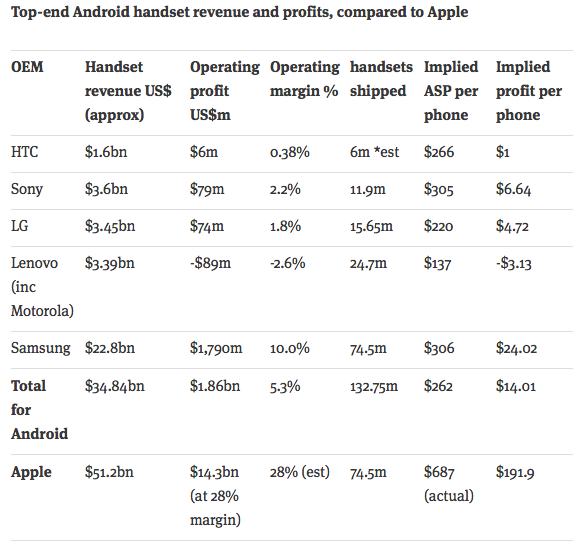
In case anyone was in any doubt, Microsoft’s results last week demonstrated once more what we’re coming to know about the mobile handset industry: it’s damned hard to make any money in it. When I published a fairly simple analysis of the state of the top-end Android handset market (with a comparator to Apple’s iPhone profits), people were apparently flabbergasted by how thin the per-handset operating margins were on these devices which sold for hundreds of dollars.

Estimated Android handset operating profit Q4 2014

See the original post for more detail and caveats.

But Microsoft showed that it’s not even able to generate gross margin while selling millions of handsets. (Gross margin is the difference between how much it costs you to make the item – usually factory costs and distribution costs – and what you get for it. Gross margin normally excludes R&D and sales & marketing costs; to get the operating profit, you subtract those costs too, so operating profit is always less than gross margin.) My analysis of Android handset makers looked at operating profit.

Negative gross margin takes some doing; spending more making stuff than you take in for it is exceptionally bad business. But Microsoft Mobile did, officially: take a look at Microsoft’s 10Q for the calendar first quarter of 2015.

Microsoft phone hardware revenues, Jan-Mar 2015

It says

Phone Hardware revenue was $1.4bn in the third quarter of fiscal year 2015, as we sold 8.6m Lumia phones and 24.7m non-Lumia phones. We acquired NDS in the fourth quarter of fiscal year 2014. Phone Hardware gross margin was $(4) million in the third quarter of fiscal year 2015. Phone Hardware cost of revenue, including $147m amortization of acquired intangible assets, was $1.4bn.

For those unversed in accountancy notation, that “$(4) million” means “minus $4 million”. Accountants use brackets rather than a minus sign because it’s easy to overlook a minus sign and create a horrendous hash in your calculations.

For the nine months,

Phone Hardware revenue was $6.3bn in fiscal year 2015, as we sold 28.5m Lumia phones and 107.3m non-Lumia phones. Phone Hardware gross margin was $805m in fiscal year 2015. Phone Hardware cost of revenue, including $401m amortization of acquired intangible assets, was $5.5bn.

This does take some untangling. In my analysis, I’m going to ignore the writeoffs (amortisation) of intangible assets – essentially, goodwill (“how much more we paid than the physical assets are worth”) being written down. This actually makes the gross margin look better – as in, in positive territory. That’s a start.

Pause for history

Some brief history. When Nokia made phones, it used to provide wonderfully detailed results, in which it would tell you how many featurephones and smartphones it had sold, and at what average selling price (ASP). This made it easy to see how its business was going. It didn’t give you gross margins – only operating margin for the whole phone business. In general, though, we knew its featurephone business was profitable, and that once it moved to the Windows Phone Lumia range, the smartphone side lost a ton of money.

Enter Microsoft, buying Nokia’s phone business – including featurephones – for €5.4bn, which was completed on April 25th 2014. That’s when the featurephone and Lumia sales start showing up in Microsoft’s results, and we shift to the “gross margin” measurement. (Microsoft does this because Steve Ballmer reorganised it to an Apple-style “apportion all cost across the board”, rather than making each division its own profit-and-loss fiefdom.)

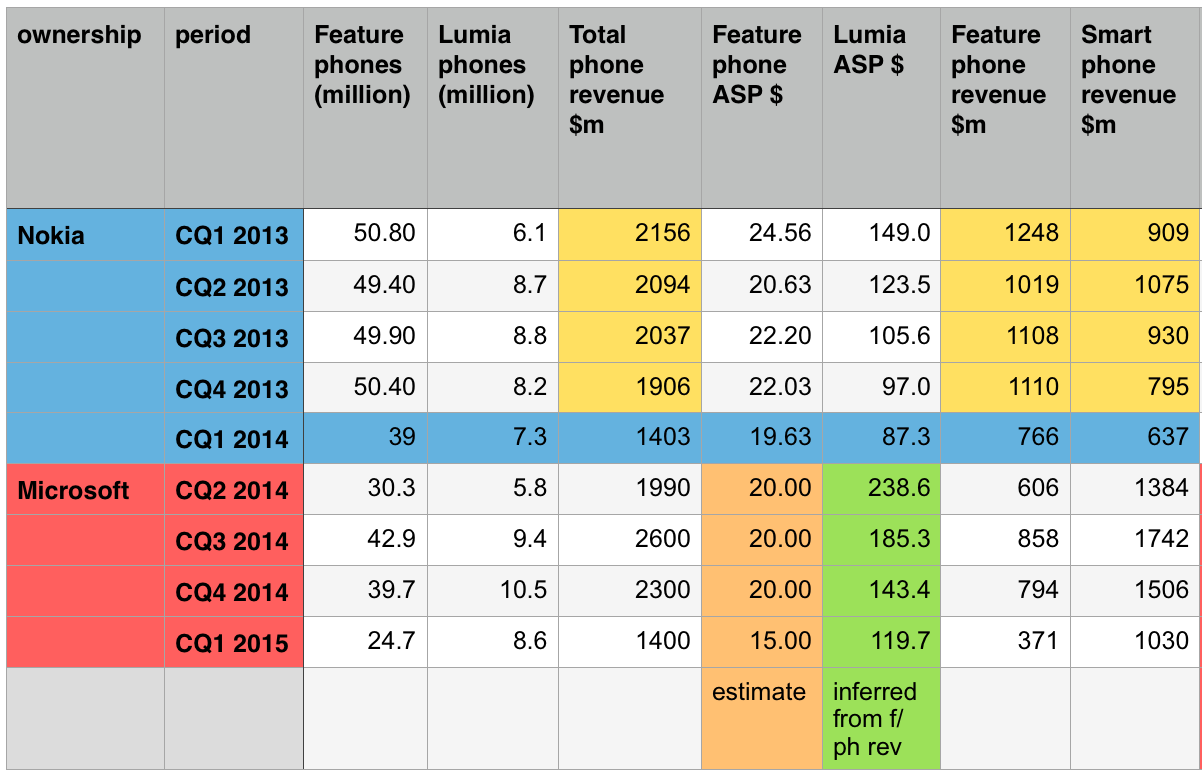
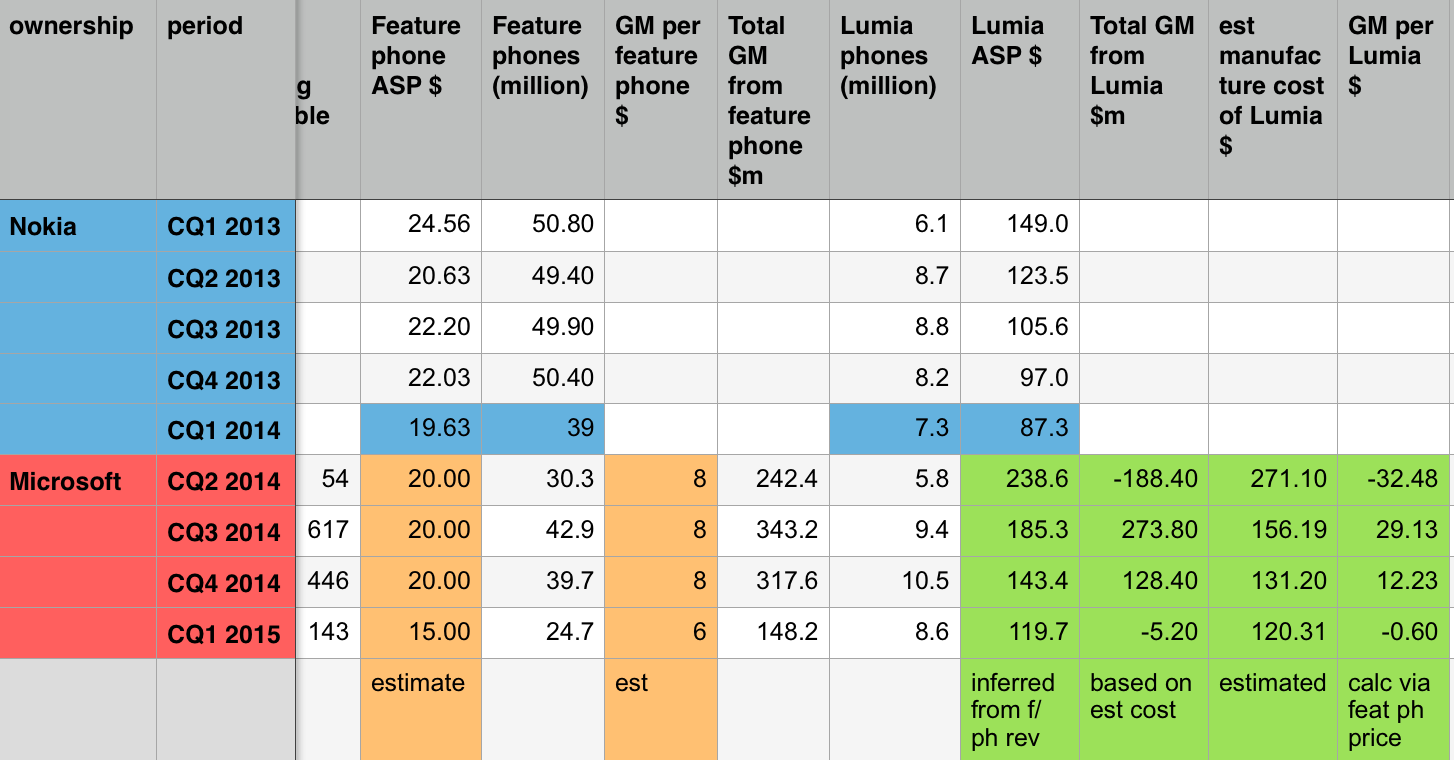
Given the Lumia ASP and sales figures at Nokia, you could work out the ASP of featurephones, and their contribution to revenues. What I’ve done in the table below is use Nokia’s featurephone and Lumia ASP (converted from euros to dollars at the prevailing rate at the end of each quarter) and try to carry that forward to estimate the recent ASPs of Lumia handsets under Microsoft’s ownership, and their contribution to revenues.

Featurephone and estimated Lumia ASPs

If you estimate the ASP for featurephones based on the Nokia numbers, you can figure out those for the Lumia phones at Microsoft.

A few things to note: I’m assuming that featurephone ASPs are falling. Even with that, there’s a clear fall in the ASP of the Lumia phones – from (a really quite high) $238 in the second calendar quarter of 2014 to the present. There hasn’t been a flagship phone released in that time, so perhaps not surprising.

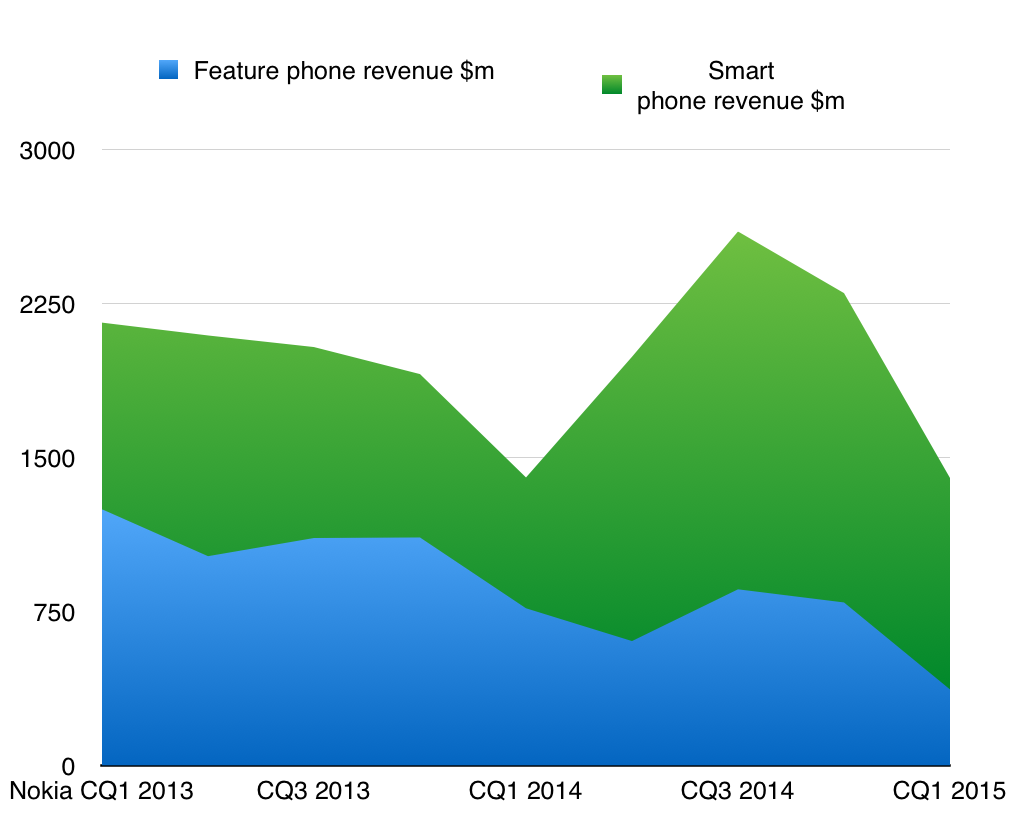
Also, smartphone revenue has flipped from being the minority source at Nokia to being the majority source now (even at $20 featurephone ASP, it’s still like that) because featurephone sales are collapsing, while those of smartphones are remaining fairly static – like this:

Estimated split of smartphone and featurephone revenue at Microsoft

Based on ASP assumptions, you can figure out how much revenue smartphones and featurephones generate. That’s not profit, though.

Now we move on, to seek out gross margin. There’s no data from Microsoft about the separate gross margins of the featurephones or Lumias. We don’t know how much they cost to build, or which might be profitable. So we have to use estimates and what people tell us.

Fortunately, we do have some indication of how profitable Nokia featurephones were. In an interview in April 2013, Nokia’s director of platform and content said that the profit margins on the $20 Nokia 105 were the same as those on the Lumia phones. How much might that be? Again, we don’t know, but it can’t be a lot. Putting it at $5 seems reasonable.

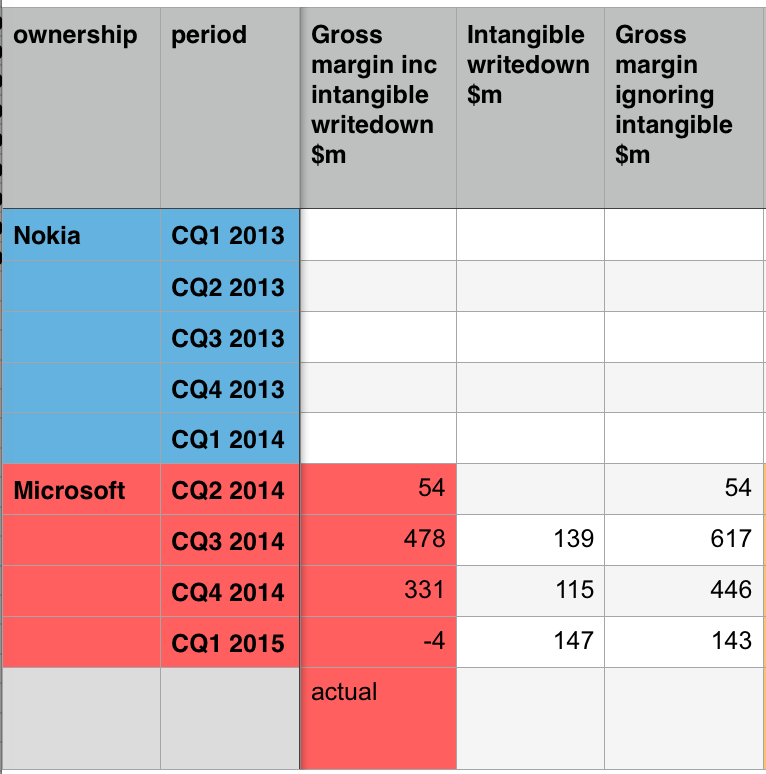
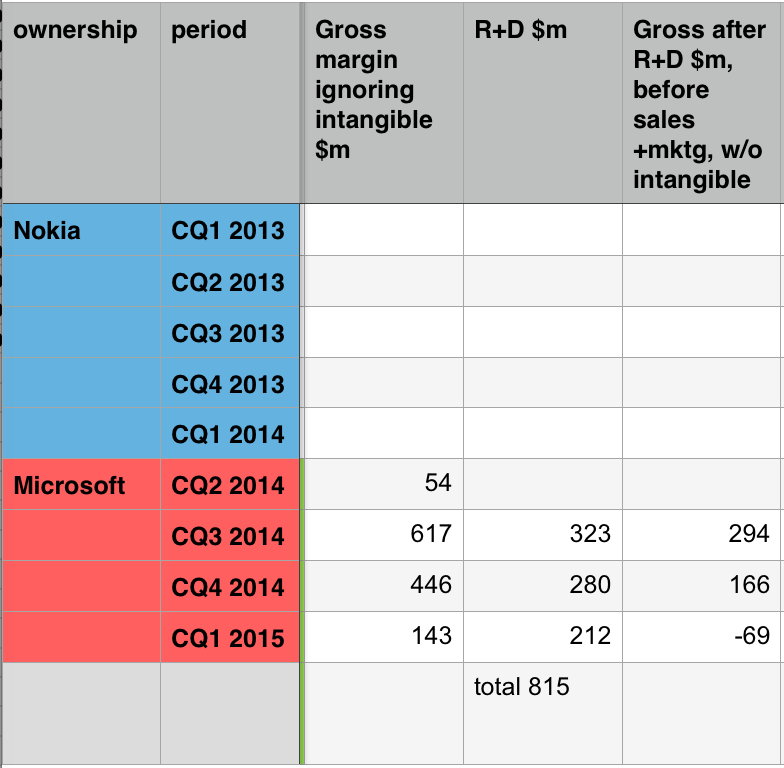
We have the figures for total gross margin; we also have the intangibles writeoff in the financials. So that gives us a “real” gross margin (ie the day-to-day gross margin for the quarter, excluding accountancy writeoffs):

Gross margin, excluding intangibles

Microsoft gives quarterly figures for intangible writeoffs; subtracting that gives the hardware gross margin.

Now we make assumptions about featurephone gross margin. I’ve gone for $5, falling to $4 as the average price of the handset falls from $20 to $15.

From this, and from the data we’ve got about total phone shipments, it’s quite simple to back-calculate to come out with figures for the total contribution to gross margin by featurephones and Lumias.

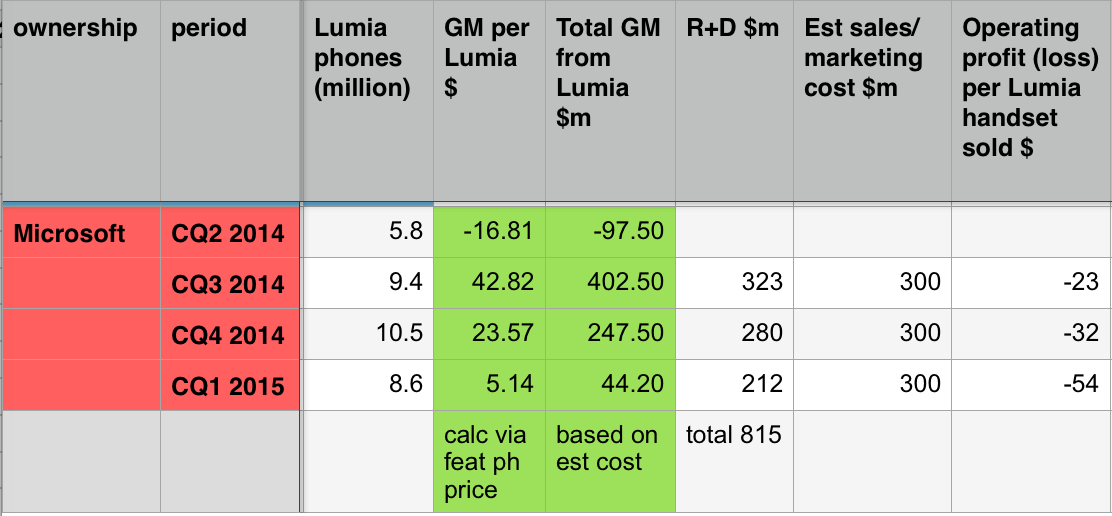
Progress! GM and profit gives Lumia data

If we assume per-handset profit on featurephones, we can use that with the GM data to figure out how much Lumias cost to make. And we have the ASP..

Which tells us what? The CQ2 figure is anomalous – Microsoft mentions an intangibles writeoff in that period, but doesn’t specify how much (unlike other periods). It’s likely the total gross margin was larger if you ignore that, which would put the gross margin per Lumia into the black.

What we also see is that even if we allow a miniscule per-handset gross margin for each featurephone, we see a rapidly falling gross margin for the Lumia line. Here’s an alternative scenario, if we think that the featurephones have a $8 gross margin, falling to $6 in the latest quarter:

What if featurephones have higher profit?

Giving a per-handset profit of $8 for featurephones makes the Lumia business look much worse. It’s unlikely, though.

On this higher profit for featurephones, the Lumia gross margin goes into negative territory. You can argue that’s too high a margin for a featurephone. Doesn’t matter though – the direction of travel is clear: the Lumia barely washes its face.

And this, don’t forget, is before you include the costs of sales and marketing – all those Lumia ads! – and research and development. Here’s the R+D impact:

Three months ended March 31, 2015 compared with three months ended March 31, 2014: Research and development expenses increased $241 million or 9%, mainly due to increased investment in new products and services, including NDS expenses of $212 million.

For the nine months:

Research and development expenses increased $694 million or 8%, mainly due to increased investment in new products and services, including NDS expenses of $815 million. These increases were partially offset by a decline in research and development expenses in our Operating Systems engineering group, primarily driven by reduced headcount-related expenses.

A little digging shows the R+D costs for the NDS (Nokia Devices and Services) segment by quarter. That gives us a sort of “halfway” operating profit once you deduct R+D, which shows that the division has moved into the red even before you consider sales and marketing costs.

R+D by quarter for Microsoft's mobile business

R+D numbers are mentioned in the quarterly 10Q. To get towards the operating profit (or loss), we need to subtract that.

That’s not profit

To figure out whether the handset division makes an operating profit we’d have to know the sales and marketing costs. It’s pretty improbable that those were anything less than $300m per quarter (that’s $10m per day, worldwide). Which means that Microsoft’s handset division has been loss-making since it took it over, despite those profitable featurephones, and ignoring the writedown of intangibles.

On a per-handset basis, if you allow $300m per quarter for sales and marketing (into which we’ll also roll administration), then you get a clear picture: Lumia handsets don’t make an operating profit at all.

Estimated per-handset loss for Lumias

Don’t forget, this relies on assumptions around featurephone profitability and price.

But hey, you say, that’s all assuming that featurephones are making $5 per handset. What if it’s $0? No problem – that’s the fun of spreadsheets. You can play with assumptions:

What if featurephones make $0?

Lumias still show a per-handset loss. (Remember this is with featurephone pricing of $15 in the latest quarter.)

OK, dammit – what if featurephones lose $5 per handset? Lumias still plunge into operating loss in the latest quarter – and remember, this is ignoring intangible writeoffs, and allowing just $10m per day worldwide for sales and marketing:

What if featurephones lose money?

Even at a $5 loss per featurephone, Lumias aren’t moneymakers at the operating level (on my assumptions).

You might have thought that Android handset makers had it tough, but at least – at the top end – they’re ekeing out something.

(Yes, these numbers are based on assumptions about featurephone pricing and margin, but I’d defend them as all being reasonable based on what we know about the business in the present and past.)

Update: thanks to Vlad Dudau of Neowin, who pointed me to Microsoft’s discussion of its results, where they say

We have made significant progress in reducing the operating expense base in the Phone business, moving from an annualized rate of $4.5bn at acquisition to a run rate under $2.5bn.

Opex is R+D plus sales+marketing and things like general+administration; an annualised run rate of $2.5bn is $625m per quarter – which is slightly more than I was allowing there. That would make the Lumia margins worse.

Microsoft adds:

That said, the changing mix of our portfolio to the value segment and the significant negative headwind from FX [foreign exchange rates] will impact our ability to reach operational break even in FY16.

So, no good news in the offing. (/Update.)

Why carry on, then?

Why, then, does Microsoft persist with Windows Phone? It can’t really think that it’s somehow going to come good and suddenly take off to challenge iOS and Android. The idea (which some outside Microsoft cling to) that the introduction of Windows 10, where apps can be written for both desktop and mobile, will suddenly lead to a huge uptake (by businesses?) is pie in the sky. Mobile and desktop have different design demands. Corporations with mobile needs haven’t been sitting on their hands for the past five years waiting for Windows Phone to reach a sort of maturity; they’ve been hiring people who can hook into their systems using iPhones and Android phones. Under Satya Nadella, Microsoft has recognised this, offering Office and other key software on rival platforms to capture (or retain) users and revenue.

You can’t justify it on “they’ll make it back in profits on services”; the 80m or so Lumia owners around the world aren’t the high-end users, but low-end ones who are less likely to spend on apps, or pricey Microsoft products.

So why? Two clear reasons. First, it’s important to keep playing in this space; Microsoft needs to have a mobile offering because it’s impossible to say where in the future a mobile-focussed offering might be key.

Secondly, though, is that more simple one: pride. Couple that with the inertia of a big organisation, and the fact that in the scheme of Microsoft’s profits the losses from the mobile division (about $500m, ignoring intangibles, over the past three quarters) are piffling, and there’s no reason to stop.

However, things could change. I’ve argued previously that Nadella should just give up on Windows Phone, and move to an Android fork. Not long after I argued that, Nokia (then still Finnish-owned) introduced the Nokia X, using Microsoft services and AOSP (Android without Google services on top). Microsoft rapidly killed it.

But now Microsoft is preinstalling its apps on the Samsung Galaxy S6 – and more importantly, has a “strategic partnership” with Cyanogen. The latter is a huge, and smart, move: it seems to me the easiest way for Microsoft to make a real impact on mobile.

If the Cyanogen move takes off, though, I could see Windows Phone withering. Why bother with loss-making hardware when you can piggyback on the world’s most successful mobile OS (that’s Android/AOSP) for the pure gravy of services profit? I wouldn’t.


Other posts you might find interesting:
Android OEM profitability, and the most surprising number from Q4 2014

Why Google’s struggles with the EC – and FTC – matter

How Gresham’s Law explains why news sites are turning off online comments


Start up: who’ll buy HERE?, Loon gets ready, Vermeer and the Apple Watch, web v native redux, and more


A Project Loon balloon. Photo by theglobalpanorama on Flickr.

A selection of 8 links for you. Links as in, you know, links. I’m charlesarthur on Twitter. Observations and links welcome.

Microsoft’s Q3 2015: Surface and Lumia up, but profit down » The Verge

Tom Warren:

Microsoft sold 8.6m Lumia devices in the most recent quarter, and the company says that’s an 18% increase over the prior year. Microsoft completed its acquisition of Nokia around this time last year, and neither company revealed Lumia sales at the time, but it’s safe to say they’re rising again. Either way, Windows Phone revenue has dropped by 16%.

While Microsoft is heading towards finalizing Windows 10 in the coming months, the PC market is still fragile. OEM revenue for Windows decreased by a massive 22% this quarter, following an equally bad quarter over the holiday period. Part of this decline is related to less business PC sales, and the general PC market as a whole. Office appears to be a mixed bag for Microsoft. While it’s helping drive commercial revenues, Office consumer revenues declined 41% due to the transition to Office 365 and weaknesses in Japan where Office is popular on PCs. However, Office 365 Consumer subscriptions have grown to 12.4m, so Microsoft is continuing to convince consumers that the cloud is the future.

If 8.6m is an 18% increase, a total of 7.3m were sold (well, shipped) in Q1 2014. The fall in revenue maybe isn’t surprising as the Lumia line has all been focussed on the lower end.

Surface revenue was up 44% year-on-year to $713m. As usual, no news on how many sold.


How Uber surge pricing really works » The Washington Post

Nicholas Diakopoulos:

is Uber’s surge pricing algorithm really doing what they claim? Do surge prices really get more cars on the road?

My analysis suggests that rather than motivating a fresh supply of drivers, surge pricing instead re-distributes drivers already on the road.

I collected four weeks worth of Uber’s dynamic pricing information from their own publicly available data for five locations in Washington, DC. Every 15 seconds between March 15 and April 11, I pinged their servers and collected the surge price and estimated waiting time for an UberX car at those locations. Though only a tiny sliver of all of Uber’s data, it provided an initial window into how their algorithms are working

…So, why don’t surge prices work to get new drivers on the road? It might simply be that surge prices jump around too much.

Reverse-engineering these algorithms seems to be the way forward.


Nokia targeting Apple, Alibaba and Amazon in maps-unit sale » Bloomberg Business

Nokia Oyj, the Finnish company selling its money-losing maps business, is trying to drum up interest from some of the biggest names in technology including Apple Inc., Alibaba Group Holding Ltd. and Amazon.com Inc., people with knowledge of the matter said.
Those companies as well as Facebook Inc., a group of German carmakers, and private-equity firms are among the companies looking at Nokia’s maps operations, known as HERE, highlighting the ubiquity and utility of location-based services. Nokia is seeking more than €3bn ($3.2bn) from a sale of the unit, said one of the people, who asked not to be identified discussing private information.

Bought it for €8.1bn in 2008; valued at €2bn in the accounts last year. Big lossmaker; the question is how any company that bought HERE would be able to make the purchase worthwhile in monetary terms.


Google’s Project Loon close to launching thousands of balloons » Computerworld

Martyn Williams:

Google says its Project Loon is close to being able to produce and launch thousands of balloons to provide Internet access from the sky.

Such a number would be required to provide reliable Internet access to users in remote areas that are currently unserved by terrestrial networks, said Mike Cassidy, the Google engineer in charge of the project, in a video posted Friday.

The ambitious project has been under way for a couple of years and involves beaming down LTE cellular signals to handsets on the ground from balloons thousands of feet in the air, well above the altitude that passenger jets fly.

“At first it would take us 3 or 4 days to tape together a balloon,” Cassidy says in the video. “Today, through our own manufacturing facility, the automated systems can get a balloon produced in just a few hours. We’re getting close to the point where we can roll out thousands of balloons.”


Why Apple Watch margins should set a new record for Apple » carlhowe.com/blog

Carl Howe with a new thought experiment:

Last week, I asked readers to imagine how they’d manufacture a million Origami lobsters out of paper. I’m going to continue that though experiment theme this week with a different question. If you’re not interested in such context, skip ahead to the next section where we’ll dive into revisions to the model I posted last week.

Meanwhile, this week’s thought experiment question is this:

What were the parts cost and gross margin of a Johannes Vermeer painting in his day?

Johannes Vermeer, of course, was a modestly successful 17th century Dutch painter, known for such paintings as Girl with a Pearl Earring and The Music Lesson. Art historians the world over praise his works for their subtle portrayal of light and his use of brilliant and lifelike color. Today, historians attribute 34 surviving paintings to undoubtedly be Vermeer’s work. While priceless due to their rarity, owners who have sold Vermeer paintings have invariably seen prices in the tens of millions of dollars.

But what did they cost to paint?

In other words, why do we think it’s OK for art to have high added value, but not technology? The whole post is wonderful.


In Google case, do what’s best for consumers » TheHill

Thomas Lenard:

Since the FTC closed its [antitrust investigation] case in 2013, the search space has become, if anything, more competitive. In addition to competition from general search engines such as Bing, Google faces competition from Facebook, Apple (Siri) and Amazon — all of which perform search functions. There is vigorous competition in shopping sites in Europe with Amazon and eBay being the major players. Numerous local shopping sites provide additional competition. In fact, Google is a minor player with a very small share of this (online shopping) market. And there is a whole new world of apps through which consumers search for a variety of information, including product information.

Thus, despite the fact that Google’s share of general search is higher in Europe than in the U.S., it is unlikely the European authorities will now find harm to consumers or to competition where the U.S. authorities didn’t.

Lenard is a senior fellow at the Technology Policy Institute, whose “supporters” include Amazon, Facebook, Intel, the MPAA, Motorola, Yahoo and – hey! – Google. I include this to show the way that one can distort reality by chucking some names in: look at all the alternative search engines! Bing, Yahoo, DuckDuckGo, er, Yandex.. but the reality is that none has more than a tiny fraction of the market in Europe. It’s like Microsoft suggesting that there are loads of desktop OSs – MacOS, Ubuntu, FreeBSD, umm..

And while Google might be a minor player in the local shopping market, the EC data (and to some extent Google itself) suggests it would be nowhere if Google Shopping had to compete in the same way as all the other shopping sites – and hadn’t penalised the search ranking and access to AdWords of rivals (who then complained).

And, finally, “harm to consumers” isn’t the EC test for antitrust. It’s the US test.


Skipping the web » Remains of the Day

Eugene Wei:

Having grown up in the U.S., the web was one of the first and still longest-running touchpoint to the internet. My first was using newsgroups in college, and the web came about towards the end of my undergrad days. I can understand why so many in the U.S. are nostalgic and defensive of the web as a medium. Seeing so much content and online interaction move behind the walls of social networks seems like an epic tragedy to many, and I empathize.

Many people in India, China, and other parts of the world, where bandwidth is low and slow, and where mobile phones are their one and only computer, have no room for such sentimentality. They may never have experienced the same heyday of the web, so they feel no analogous nostalgia for it as a medium. Path dependence matters here, as it does in lots of areas of tech, and one of the best ways to detect it is to widen your geographic scope of study outside the U.S. Asia is a wonderful comparison group, especially for me because I have so many friends and relatives there and because I still interact with them online at a decent frequency.

In the U.S., many tech companies were lauded as pioneers for going mobile first when in Asia companies are already going mobile only.


Mobile malware is like Ebola – an overhyped threat » Net Security

Reporting from the RSA Conference 2015:

In 2012, monitoring 33% of US Mobile Data Traffic, Damballa saw 3,492 out of a total of 23M mobile devices – 0.015% – contacting a domain on the mobile blacklist (MBL). In Q4 2014, monitoring nearly 50% of US Mobile Data Traffic, only 9,688 out of a total of 151M mobile devices contacted mobile black list domains (.0064%). The National Weather Services says the odds of being struck by lightning in a lifetime are 0.01%.

“This research shows that mobile malware in the Unites States is very much like Ebola – harmful, but greatly over exaggerated, and contained to a limited percentage of the population that are engaging in behavior that puts them at risk for infection,” said Charles Lever, senior scientific researcher at Damballa. “Ask yourself, ‘How many of you have been infected by mobile malware? How many of you know someone infected by mobile malware?’”


Lessons from history: the effect on Microsoft’s culture of the US antitrust verdict. Who’s next?


Internet Explorer: a voodoo doll, but for who? Photo by Verpletterend on Flickr.

The following is an extract from Chapter 2 of my book “Digital Wars: Apple, Google, Microsoft and the Battle for the Internet”, published by Kogan Page (and now in its second edition – make sure you get the 2014 version with the colourful cover). It’s available on:

• Amazon UK paperback, Kindle
• Amazon US paperback, Kindle
iBooks
It’s also been translated into Finnish, Korean, Russian, Chinese, Thai, and (I think) Spanish. Someone near you is sure to sell it in a language you want to read it in, or that you want to learn. (Note that none of those is an affiliate link. All I get is the author royalties..)

I’m publishing this as a reference for anyone who wants to know how US antitrust law works (note particularly the point about “harm to consumers”), and what happens to companies that fall foul of it.

Note that in Europe, the EC’s antitrust rules don’t require it to show harm to consumers – only that competition has been stifled.

Obviously, it’s interesting to consider the cultural changes that are described by the Microsoft observers both inside and outside the company to the antitrust ruling, and wonder whether there are any parallels for Google – currently facing a Statement of Objections from the EC over its Shopping service, and an investigation to see whether its licensing for use of the Android mobile operating system is anti-competitive.


By the time Ballmer took charge [as chief executive of Microsoft, replacing Bill Gates, on 13 January 2000], the antitrust trial [against the Department of Justice] was over; the judge’s Findings of Fact had been delivered. They were damning: Microsoft had abused its monopoly in Windows to extend them to other areas. That was illegal. But no sentence had been delivered.

The trial, and especially the testimony and press coverage, had an enormous effect on the internal culture of Microsoft. The staff didn’t stop thinking they were the best programmers in the world. But quite suddenly they couldn’t attract the rest of the best programmers in the world. Partly that was because as the antitrust trial ground on through 1998 and 1999 the dot-com boom took off, promising enormous riches to smart coders who hitched a ride with the right company. Get your stock options cheaply, and when the business IPOs you’ll be rich, just like those lucky guys at Netscape and Yahoo. But there was also the feeling that to work for Microsoft was to compromise your ethics.

Inside Microsoft, there was soul-searching. An early example had come at the 1999 annual executive retreat, where Gates and Ballmer wanted to talk over the finances of the company, examine its performance and chart the next product lines – the “roadmap”. The antitrust trial’s “Findings of Fact” – the judge’s established truth about the company – hadn’t yet been published. But Microsoft had been hauled over the coals in court; Bill Gates in particular had been made to look evasive and arrogant in his videoed deposition with the prosecution’s Robert Boies.

At the meeting, Orlando Ayala, then head of sales for Latin America and the south Pacific, told the top executives that he didn’t want to talk about the roadmap. One participant recalls Ayala saying that “we’ve got to talk about what our values are at this company. I can’t work here any more if my brother [who didn’t work for Microsoft] keeps challenging what I’m doing.” The attendee describes it as an example of “stopping the normal company process of growth and business as usual, saying we have to change how this company does business.”

The attendee says: “We said ‘no, we don’t want to discuss that [roadmap], because we’re in a crisis here and we need to address what we stand for as a company’… We’ve been called evil; most of us with outside friends and family are being questioned by them, asked why we’re working for Microsoft if it’s an evil company.”

The executive admits it was an “uncomfortable” feeling: “we all recognised the ability of Microsoft to build great software that would change the world.” The trouble was that outside the company, it was simply thought of as acting like a gangster, threatening those who looked as though they might set up on a patch adjacent to its own ground. (The judge, Thomas Penfield Jackson, talking to journalists under embargo during the trial, suggested that Microsoft’s actions were like those of drug traffickers or gangland killers.)

The court’s Findings of Fact said Microsoft held a monopoly of PC operating systems; it could artificially set licence prices, safe in the knowledge that barely anyone would decline. Judge Penfield Jackson pointed to an internal Microsoft study, provided in evidence, which determined that charging $49 for the Windows 98 upgrade would earn a reasonable return on investment, but that charging $89 would maximise revenue, hitting the sweet spot of the demand curve beyond which too many would-be buyers would stick with what they had. Only a monopoly would have that pricing power.

Being a monopoly (generally defined as having 80% or more of a market) is not illegal in the US; nor does it necessarily attract sanctions. But using a monopoly in one field to extend or create one in another field is, and does, if it can be shown to have harmed consumers in either or both markets. By going after the Netscape browser, which had begun to set itself up as a platform of sorts (albeit one which almost always ran on Windows), and using its control of Windows first to deny Netscape access to some APIs it needed for Windows 95, and then to boost its own Internet Explorer by insisting on its inclusion – at the threat to OEM PC makers of not getting Windows licences, which would kill their businesses – Microsoft crossed the line.

Among those also targeted for Microsoft’s arm-twisting via Windows to try to crush other products in different fields, the trial heard, were Intel, Sun Microsystems, Real Networks, IBM – which was denied an OEM licence for Windows 95 until a quarter of an hour before its official launch, and so missed out on huge swathes of PC sales – and Apple. In particular, Apple was offered a deal: stop developing its own systems for playing music and films on Windows, and let Microsoft handle them using its DirectX system. If it did, Microsoft would stop putting obstacles in the way of Apple’s Quicktime on Windows. Steve Jobs, who was at the meeting in June 1998, rejected the idea because it would limit the ability for third parties to develop content that would run on Windows PCs and Apple machines. (In retrospect, that declsion may be one of the most significant to Apple’s later success that Jobs ever made, since it meant that Microsoft could not control how Apple-encoded music was played on Windows.)

Internet Explorer was the focus of the trial, though: the number of Microsoft staff working on it had grown from a handful in early 1995 to more than a thousand in 1999. And Microsoft gave it away because reaching an effective monopoly share (50% of the browser market would be good; 80% and up ideal) was the target. Penfield Jackson completed the necessary trio needed for an antitrust conviction by pointing to harm not only for the companies affected, but also for consumers: tying Internet Explorer into Windows “made it easier for malicious viruses that penetrate the system via Internet Explorer to infect non-browsing parts of the system”.

The stock market wasn’t worried by the Findings of Fact; in the month after their publication, Microsoft’s stock value actually jumped, and it reached its all-time peak market capitalisation, $612.5bn, on the last working day of December 1999. The rest of the market for technology stocks rose too – though one analysis suggested that this was because Jackson (a pro-business Republican) had cleared the way for other companies to begin competing effectively.

Then in April 2000, with Ballmer four months into his new job, Jackson handed down his sentence: Microsoft should be split into two – one company making operating systems, one making applications.

Microsoft fought the order with all its might and wile. Jackson, it transpired, had compromised his supposedly impartial position by talking to the New Yorker’s Ken Auletta during the trial, for a book to be published immediately after it. In February 2001 a group of appeal judges declared that Jackson had violated judicial ethics with his conversations. (The real problem was that his remarks were published before the appeals process was exhausted, instead of when his verdict was published.) The breakup was halted over Jackson’s “perceived bias”. He railed that any bias was Microsoft’s fault, because it “proved, time and time again, to be inaccurate, misleading, evasive, and transparently false . . . Microsoft is a company with an institutional disdain for both the truth and for rules of law that lesser entities must respect. It is also a company whose senior management is not averse to offering specious testimony to support spurious defences to claims of its wrongdoing.”

Inside the company there was relief – and also a realisation that it had dodged a bullet. Though the sentence had been set aside, the Findings of Fact, and conviction, had not been overturned. At the next annual worldwide sales conference – held in the Seattle Mariners stadium – Ballmer explained that the culture had to change: no longer could Microsoft use its advantage in one field to dominate another. (The European Commission was to follow with similar investigations which rumbled on in parallel before coming out with demands for Microsoft to open up its software interfaces in 2003.) But it was the US case which reached down into the company’s soul…

…Some inside the company felt they had already abandoned the practices for which they were being condemned. “Arguably some of the things that we’d written in contracts were sailing a bit close to the wind,” admits one former Microsoft staffer. “But frankly if you look now at other peoples’ current contracts, whether it’s Apple’s around the iPhone, or Google’s, or even Intel’s, you’d say they were far more egregious than any of the contract terms that Microsoft signed up with Intel.” Which misses the point: it wasn’t the contracts which were bad, but the tactics, allied to Microsoft having a monopoly. Apple has no monopoly share of smartphones. Intel and Google arguably do in their own fields – and have both attracted attention (in Intel’s case, to enormous cost) from antitrust investigators…

…Pieter Knook, who worked for Microsoft through the period in its Asian business, says that the post-judgement process was exhaustive. “Every executive officer, every year, had to go through antitrust training, certify they were in compliance with the terms of the [antitrust settlement] agreement – so there was this very strong understanding, and obligation that you felt to do the right thing.”

“It had a big impact, and even a decade later it was still having an impact,” says Mary Jo Foley, a journalist who has followed Microsoft for years. “When they think about adding new features to different products or how they make sure their products work together, I think in the back of their minds is always this lingering kind of thought or checklist, like: ‘if we do that, are we going to get sued by so and so for antitrust?’ ‘Are we going to get sued by so?’ And so or so and so.” When any feature was being thought about, that question kept coming up: will it break the antitrust ruling? “I think it has almost had a chilling effect on the way they do product development,” Foley suggests.

With Microsoft suitably admonished, and now living under a new regime of oversight, the scene was set for Microsoft’s next challenges: in search, digital music and in mobile phones. First was a little startup that was already becoming the talk of internet users, one which was to form its corporate thinking around a motto that tried to express a desire not to be Microsoft: “don’t be evil”.


If you found this useful, you might like the book. It’s longer. Links above.