Start up: PC shipments slump (again), are reviews broken?, Tidal’s challenge, monetising Android and more


Now containing fewer PCs. Photo by runner310 on Flickr.

A selection of 8 links for you. Use them wisely. I’m charlesarthur on Twitter. Observations and links welcome.

Mercury News editorial: Google’s YouTube Kids should meet TV ad standards » San Jose Mercury News

It’s disappointing that Google didn’t voluntary follow the Federal Communications Commission’s longtime TV standards with its online YouTube Kids app, which ignores basic protections for children whose developing brains cannot grasp the difference between ads and entertainment.

The Federal Trade Commission, not the FCC, has jurisdiction over online commerce, and it needs to catch up. Google apparently decided to push the envelope, given its mission as a public company is to maximize profits.

But as one of the Valley’s biggest success stories — it could reach a market capitalization of $1 trillion in this decade — Google should be a leader in taking responsibility for the welfare of children viewing products designed for them. So should Netflix, Apple and any other Valley company producing or contemplating kids programming.

Now the FTC is investigating. You won’t however have been surprised by Google’s behaviour if you read my piece on Google, EC, antitrust and the FTC, which looked at the tenets the search company works by.


Product reviews are broken » Above Avalon

Neil Cybart:

I still think the world needs independent product reviews. There is enough prior misbehaviour on behalf of companies to suggest such third-party reviews can serve a purpose by giving consumers value. The problem is that many reviewers don’t know what kind of value that is. The move into personalized wearables has largely turned the traditional tech gadget review into an artifact from a begone era. The nature of the tech review should have changed, but many tech reviewers haven’t adapted their review process to this new wave of technology. While adding video may represent a new dimension to the review, the underlying premise of the review needs to be rethought.

I agree with Cybart. Reviews have turned into a mess; the desire on social networks to attract attention by being outrageous dilutes the thoughtful ones. And commenters’ desire to attach a single value to a device’s “worth” – is it one star, five stars? Why is that four stars but this five – wipes subtlety away in pursuit of a blunt distinction.


How TIDAL can deliver on its promises » Music Industry Blog

Mark Mulligan:

With streaming, music fans don’t need to waste time listening to music they don’t like upon first listen. They can bypass the duff. They also tend to listen less to any single piece of music in general because they have so much other music to choose from at no additional cost. Artists earning a 150th per stream of what they earn from a download is thus only part of the problem. Most of the time their mainstream fans (and by that I mean not their top 10% of super fans) aren’t listening to them enough.

Scale will come, but it will take time.

The theory is that this will be fixed by scale, that a massive installed base of users will result in bigger listening volumes.  But it’s not that easy.


Apple Maps now includes hotel reviews from TripAdvisor and Booking.com » Mac Rumors

Eric Slivka:

Since the release of Apple’s in-house Maps app as part of iOS 6 back in 2012, Yelp has been the company’s sole partner for integrating customer reviews of businesses and other points of interest. In recent days, however, Apple’s Maps app has begun including reviews from TripAdvisor and Booking.com on select hotel listings.

Very slow but steady improvement. Apple Maps is getting better and better at finding whatever you want.


PC shipments beat expectations despite weak currencies and product transitions » IDC

Worldwide PC shipments totalled 68.5m units in the first quarter of 2015 (1Q15), a year-on-year decline of -6.7%, and slightly ahead of previous projections, according to the International Data Corporation (IDC) Worldwide Quarterly PC Tracker.

Following a strong second half of 2014, which benefitted from the tailwind of the Windows XP refresh and pockets of price-driven consumer activity, the Q1 market faced multiple headwinds – including inventory build-up of Windows Bing based notebooks, commercial slow down following the XP refresh and constrained demand in many regions due to currency fluctuations and unfavorable economic indicators. As a result, growth and volume declined with Q1 shipments below 69m units, the lowest recorded volume since Q1 2009.

Those have to have been some low expectations. And here’s the threat:

“Although shipments did exceed an already cautious forecast, the market unfortunately remains heavily dependent on pricing being a major driver, with entry SKU volume masking a still tenuous demand for higher priced systems that is needed to sustain a more diverse PC ecosystem. Pricing pressure is bringing many premium SKUs into formerly mid-level pricing tiers” said Jay Chou, Senior Research Analyst, Worldwide PC Trackers. “As more vendors find it increasingly difficult to compete, we can expect additional consolidation in the PC market.”

Who’ll withdraw next? Samsung? Toshiba? Actually, Acer is seeing terrible profits – about $3 per unit sold at an ASP of $363, based on operating profit and revenue numbers.


Understanding tech penetration in Latin America » TechCrunch

Fascinating article by Omar Téllez, a director of Moovit:

With more than 85 million Facebook users and around 15 million Twitter accounts growing at 25 percent per year, it’s no wonder the Wall Street Journal called Brazil “The Social Media Capital of the Universe.”

Brazilians spend on social media networks more time per month than anyone else in the world.

Latin American startups have a canny ability to take a proven business model, and execute like crazy to improve on it.

After winning “Best International Startup” in the 2012 Crunchies, Peixe Urbano the online to offline (O2O) daily deal company, went on to grow to more than 25 million users and 30K merchant partners, and recently sold control to China’s Baidu, the No. 2 Internet search engine in the world, for and undisclosed amount.

While it’s easy to be amazed by the growth that taxi app companies such as Easy Taxi and 99Taxis have driven in Brazil, after raising hoards of money, it’s difficult not to be impressed by Tappsi. With a focus in Colombia, Perú and Ecuador, Tappsi has easily surpassed 1.3 million bookings per month with only $600K in seed funding.


Universities Inc. in the UK

After yesterday’s link about Procter & Gamble’s disruptive capacity, David Colquhoun from University College London pointed out that it’s not all sweetness and light – far from it:

Dr Aubrey Blumsohn MBBCh, PhD, MSc, BSc(hons), FRCPath was, until 2006, a senior lecturer and honorary consultant in metabolic bone diseases at Sheffield University. He, and his boss, Richard Eastell, were doing a clinical study of a Procter & Gamble Pharmaceuticals (P&G) drug, Actonel (risedronate), The work was funded by Procter & Gamble.

Richard Eastell is Professor of Bone Metabolism, and was Research Dean.

Procter & Gamble refused, from 2002 onwards, to release the randomisation codes for the trial to the authors whose names appear on the paper. After trying to see the data for years, and getting little support from his employer, Blumsohn subsequently got hold of it in 2005, and then discovered flaws in the analysis provided by P&G’s statistician. P&G wrote papers on which the names of university academics as authors. Blumsohn did the only thing that any honest scientist could do: he went public with his complaint.

Bad things ensued.


Goldman Sachs says Android is making Google very little money » Business Insider

Nicholas Carlson:

according to a new report from a group of Goldman Sachs analysts, Android users aren’t clicking on very many Google ads.

Earlier this week, Goldman’s analysts estimated that Google did $11.8bn in mobile search revenue in 2014.

Goldman estimated that 75% of that revenue, $8.9bn, came from web searches made using iPhones and iPads.

That means that, at most, Google generated $3bn from searches made on Android devices in 2014.

$3bn is a paltry amount compared to Google’s overall business, which generated $66bn in the last twelve months. For further context, consider that Facebook generated more than $2.65bn in mobile ad revenues during the fourth quarter of 2014 alone.

It makes you wonder: Will Android ever become a big business?

On the basis of a billion Android users, that $3 per user per year. That’s likely to go down as the user base grows because most developed countries are pretty saturated; those coming onstream are in emerging countries with lower per-capita income. All additive for Google, though. Not a great business, but a profitable one. (Also, how about the actual BI headline: “Android is supposed to save Google, but it’s actually a terrible business”?)


Start up: P&G’s disruptive nature, duck searching, Watch reviews, Google’s new ad chief, and more


Disrupt this before Proctor & Gamble does. Photo by Premshree Pillai on Flickr.

A selection of 9 links for you. Use them wisely. I’m charlesarthur on Twitter. Observations and links welcome.

Why Procter & Gamble is more disruptive than you » Medium

Kavin Stewart:

So how does a company of this size [>$80bn in annual revenue] stay so disruptive? P&G is dealing with constantly changing consumer needs across many product lines (many of which are customized for local markets). Instead of relying on the personal experiences of their employees, P&G borrows a page from the playbook of anthropologists — they find relevant cultural groups to study and embed their employees where they live for a period of time, participating in their day to day lives to gather holistic data:

Soon after they’re hired, new employees of P&G undergo special cultural training. “They spend a week in a low-income neighbourhood, working in a bodega, a little shop,” [Jim] Stengel [global marketing officer of P&G] says. “He [the executive] puts an apron on. He works there. He talks to the shop owner. He talks to the people who come in. He becomes part of life.”

Product managers pay a lot of lip service to knowing the customer. But how many of them would spend a week living in Mexico and working at a bodega?

You can read a longer piece about Stengel at the FT. But the lesson that big companies can self-disrupt shouldn’t be ignored.


Apple sides with Microsoft in closely watched patent dispute with Google » GeekWire

Todd Bishop:

The case has already created some unusual alliances. Apple and T-Mobile are among the companies siding with Microsoft in the case, while Nokia and Qualcomm are seeking to overturn a lower court’s ruling that found in Microsoft’s favor.

After a 2013 trial in Seattle, Microsoft won a $14.5m jury verdict against Motorola based on a finding that Motorola breached its obligation to offer its standard-essential patents for video and wireless technologies on fair, reasonable and non-discriminatory terms, known in legal circles as “RAND” or “FRAND.”

The case is notable in part because U.S. District Judge James Robart in Seattle took the unusual step of setting a process for establishing royalties for standard essential patents.

Based on his process, Robart ruled in April 2013 that the Microsoft owed less than $1.8m a year for its use of Motorola’s patented video and wireless technologies in Windows, Xbox and other products. Motorola had originally sought a rate amounting to more than $4bn a year, plus $20bn in back payments.

Slightly more complex than it seems, because it could debase the idea of SEPs if they’re too low-priced. But Motorola was really trying too hard. (It tried the same against Apple and was rebuffed.)


Apple releases iOS 8.3 with emoji updates, wireless CarPlay, space bar UI fix » Mac Rumors

Ton of bugs squashed, apparently. Space bar very slightly elongated. Apple Watch icon/app can now be hidden/removed, apparently. And those all-important emoji fixes.


The ascension of Google’s Sridhar Ramaswamy » The Information

Amir Efrati has a real in-depth piece about Ramaswamy (who doesn’t seem to have cooperated with it) pointing to tensions with Susan Wojicki, head of YouTube ads):

Mr. Ramaswamy viewed himself as a protector of the search-history data. In the past, he and Mr. Page and others had stated their fear that it might feel creepy if people saw banner ads on non-Google sites based on things they had searched for on Google.com. Ms. Wojcicki had long pushed Google to stay current with ad-tech industry trends, pushing the boundaries of what people like Mr. Ramaswamy were comfortable with.

In the 2013 meetings, Mr. Ramaswamy also expressed hesitation about Google search data being used to target ads to people visiting YouTube, where the DoubleClick cookie was used, because it might be visible or “leak” to advertisers that used the cookie, which might lower its value. And he feared that Ms. Wojcicki and her team would use the search data to try to improve the ad quality of non-Google sites that are part of the display-advertising “network,” which also includes YouTube.

“Tell me what you really want to do,” Mr. Ramaswamy asked Ms. Wojcicki at one meeting, looking visibly annoyed, according to one participant. “You want to use search data on the network,” including non-Google sites. “Just say it.”


Battery life: Apple’s solving for x » Six Colors

Jason Snell:

Over the years I’ve said numerous times that when it comes to battery life on iOS devices, Apple appears to have a target battery life in mind and builds its hardware—a balance of power-saving software, hardware efficiency, and battery capacity—to hit that number.

It’s an observation born out of reading spec sheet after spec sheet over the years while writing reviews of new iPhones and iPads. Every year, people who are frustrated with their iPhones running out of juice before the end of the day hold out hope that the next iPhone will ameliorate the issue. In general, those people have not been satisfied.

And here’s the graph that proves his point – though note the pop at the end:


Samsung execs briefed over user experience » Korea Times

Kim Yoo-chul:

Yonsei University Professor Cho Kwang-soo was the speaker for this week’s session. The professor said the mantra of “one person, one device” has passed.

“Today, ‘one person, multi device’ has become the main trend, meaning that one person is now being connected to multiple devices. Without understanding about human nature, you can’t develop products that can meet consumer expectations,” Cho was quoted as saying.

Samsung needs to invest more for the development of wireless charging and new mobile operating systems that allow multiple devices to activate, the professor said.

In a briefing to local reporters, chief Samsung communications officer Lee Joon said the Apple iPhone was presented as the right device that has shown remarkable advancements in user-experience design.

Not the S6?


Surface tablet shipments expected to exceed 4 million units in 2015 » Digitimes

Aaron Lee and Joseph Tsai:

Microsoft is expected to have a chance to ship over four million Surface tablets in 2015, up from two million units in 2014, because of its new Surface 3 and Surface Pro series products, according to sources from the upstream supply chain.

Microsoft is reportedly planning to unveil its next-generation Surface Pro 4 tablet during the upcoming Build developer conference in April. The new Surface Pro tablet is estimated to enter mass production in June and will be released along with Windows 10 in the second half of 2015, the sources said.


Apple Watch reviews are in: an ‘elegant’, overpriced gadget ‘you don’t need’ » The Guardian

Sam Thielman:

The upshot seems to be that the battery life is good, unless you’re using it as a glorified FitBit (which it kind of is), that the application loading times are very long (which Apple has promised to fix in subsequent versions) and that it’s a lovely little device, unless of course you disagree, but it’s slow, not particularly intuitive and it’s probably worth waiting for the inevitable upgrade.

There’s also a fundamentalist split between the haute horologie posse and the tech world: in the former, consumers expect a flawless device for an unspeakable amount of money. In the latter, where inconveniences and flaws are ironed out by simply iterating the product again, a new chunk of tech is often praised for the novelty of what it aspires to do. “Unlike the Cartier I got for college graduation, the original Apple Watch’s beauty will soon fade,” [Joanna] Stern [at the WSJ] observes.


The ducks are always greener » Marco.org

Marco Arment:

My principles are only diverging further from Google’s over time, and I feel a bit defeated whenever I turn to them for anything anymore, so I attacked my primary dependence head-on: web search.

In my experience so far, DuckDuckGo’s search is good enough the vast majority of the time. Sometimes, its results are even better than Google’s, and they’re rarely much worse.

The number of people moving to DuckDuckGo is growing, very slowly; they’re finding that search is a commodity.


Start up: iMessage v Android, Waze in Costa Rica, Google knows your face!, and more


A bit like Costa Rica’s maps. But here comes Waze! Photo by Ted’s photos on Flickr.

A selection of 10 links for you. Use them wisely. I’m charlesarthur on Twitter. Observations and links welcome.

Back to Android » AVC

Rather like those rich people who split their time between whichever hemisphere is sunny, venture capitalist Fred Wilson spends six months a year on an iPhone, and six on an Android phone:

After a few days on iOS I wrote a post about what I liked and did not like about iOS. Reading it now after six months on iOS, it is still pretty accurate. But now that I am back on Android, the two things I really miss about he iPhone are TouchID and iMessage. If Android had both of those two things, I wouldn’t miss anything. I don’t totally understand why Apple doesn’t make an iMessage client for Android. They have the most popular messenger in the US (maybe the world) and they aren’t taking advantage of it. They are doing the same thing with iMessage that Blackberry did with BBM.

Is this man really trusted with other peoples’ money? BlackBerry didn’t fail because it didn’t open BBM; the opposite is true – people stayed on the platform despite its worsening lack of apps because of BBM. (But eventually the lack was too much.) Similarly, iMessage is a USP (unique selling point) for iOS and OSX; making an Android version would add no value to Apple at all. (And in all the fulminating comments, nobody points this out.)


Why Google’s struggles with the EC – and FTC – matter » The Overspill

ICYMI, I read the (half) FTC report so you don’t have to. And:

“Google doesn’t have any friends,” I was told by someone who has watched the search engine’s tussle with the US Federal Trade Commission and latterly with the European Commission. “It makes enemies all over the place. Look how nobody is standing up for it in this fight. It’s on its own.”


Karen, an app that knows you all too well » NYTimes.com

Frank Rose on London-based Blast Theory’s forthcoming (April 16) app:

Unlike most real life-coaching apps, this one displays video rather than text — a tactic that makes it easy to forget the distinction between what’s digital and what’s human. When you open the app, Karen (played by Claire Cage, an actress who has appeared on the British TV series “Coronation Street” and “Being Human”) starts speaking to you directly, asking a series of questions.

She seems winsome and friendly — a little too friendly, perhaps. “She’s only recently out of a long-term relationship,” explained Matt Adams, one of the three members of Blast Theory, “and she has a hunger for a new social alternative.”

The dynamic that unfolds is somewhat reminiscent of “Her,” the 2013 Spike Jonze film in which Joaquin Phoenix’s character falls in love with an operating system. With Karen, however, it’s not the user but the app that starts exhibiting inappropriate behavior. “She develops a kind of friend crush,” Mr. Adams said. “And over the next 10 days or so, she feeds back to you things she’s learning about you — including some things you’re not quite sure how she knows or why.”


Why Waze is so incredibly popular in Costa Rica » The Washington Post

Matt McFarland:

“It’s a nightmare.” That’s how Eduardo Carvajal describes the Costa Rican way to give an address.

“If I want to give the address of my office I say ‘Okay, go to the ice cream cone shop in Curridabat then drive 100 meters south and 50 meters east,” Carvajal said.

He’s part of the team of volunteers who mapped Costa Rica in Waze, a crowdsourced traffic and navigation app. Carvajal, whose day job is running a software company, has made hundreds of thousands of edits to Waze’s map of Costa Rica.

Fellow volunteer Felipe Hidalgo spent 50 hours a week for almost two years helping to map the country. Hidalgo has made 378,000 edits to maps in Costa Rica, Nicaragua, Cameroon, St. Helena Island, Panama and Trinidad and Tobago. He described the work as addicting. Since the mapping of Costa Rica was completed, he scaled back to 10-15 hours a week.

Pity that it wasn’t OpenStreetMap; then everyone could have benefited, including Waze. But as the article shows, Waze “addresses” have become part of the culture there – so much so that the government partnered with it on road closures.


Google: our new system for recognizing faces is the best one ever » Fortune

Derrick Harris:

Last week, a trio of Google researchers published a paper on a new artificial intelligence system dubbed FaceNet that it claims represents the most-accurate approach yet to recognizing human faces. FaceNet achieved nearly 100% accuracy on a popular facial-recognition dataset called Labeled Faces in the Wild, which includes more than 13,000 pictures of faces from across the web. Trained on a massive 260-million-image dataset, FaceNet performed with better than 86% accuracy.

Researchers benchmarking their facial-recognition systems against Labeled Faces in the Wild are testing for what they call “verification.” Essentially, they’re measuring how good the algorithms are at determining whether two images are of the same person…

…However, the approach Google’s researchers took goes beyond simply verifying whether two faces are the same. Its system can also put a name to a face—classic facial recognition—and even present collections of faces that look the most similar or the most distinct.


Samsung Galaxy S6 and Galaxy S6 edge review » Android Central

Andrew Martonik:

Bottom Line: The Galaxy S6 finally offers the hardware that we’ve long desired, and it’s included a wonderful camera. But not everything is perfect — the software experience and battery life just aren’t up to speed.

Harsh? But Jessica Dolcourt at Cnet seems to be unhappy too, saying battery life is less than the S5. (Hers is a review worth reading too.)


Samsung earnings point to smartphones pick-up » FT.com

Simon Mundy:

Samsung executives had stoked anticipation for the first-quarter results with bullish public statements. “We’re done with recovery,” Kim Hyun-seok, head of Samsung’s television business, told local reporters last week.

Nevertheless, revenue was lower than expected, in part a reflection of weaker household electronics revenue in Europe and some emerging markets, whose currencies have fallen significantly in recent months.

And while the earnings figure was up from Won5.3tn in the prior quarter, it reflected significant margin shrinkage following strong profits in the first half of last year — a level of profitability Samsung will not regain in the near future, said CW Chung, an analyst at Nomura, pointing to the ever-fiercer competition in the smartphone market.

“Last year’s smartphone profit in the first half was about Won11tn, but this year it will be maximum Won6tn,” he said…

…Samsung’s first-quarter results were boosted by early shipments of 3m Galaxy S6 phones, said Daniel Kim at Macquarie, citing guidance from the company.

Telling final detail there: Samsung likes to shove handsets into the channel for early revenues. Here’s the graph of Samsung’s revenue and operating profit growth. Really interested to see how the S6/Edge fare.

Samsung revenue and operating profit change

Year-on-year change in operating profit (green) and revenues (blue) at Samsung Electronics


Interview with Matt MacInnis, CEO of Inkling » Pi.co

A long interview by Om Malik with MacInnis, who seems to want – yet also not to want – to “reinvent” the book. This point struck me as particularly relevant:

I look at content through another axis, which is its longevity. If you look at the scale of how long something lasts, a Tweet can have a shelf life of minutes. There are exceptions, but in general a blog post might have a shelf life of a few weeks, sometimes months. If you look at news articles, they tend to have a shelf life of a day. Nobody wants to pick up the New York Times from a week ago and read it for the news. Monthly magazines with long-form feature pieces are interesting on the span of months. And then you get into things like nonfiction and textbooks, which have shelf lives of years. Travel guides have the shelf life of about a year.

You’re talking about taking content that has a long shelf life, things like facts that don’t change, data about the history of something that informs the present, and using it to inform the news article that has a shelf life of a few days. You watch the Tour De France and you want to know who won yesterday. That information that was reported about who got where in the interim period is useless to you once somebody wins the Tour De France.


Angela Ahrendts says a ‘significant change in mindset’ to launching Apple Watch online » Business Insider

Jim Edwards:

For observers, shortages of Apple products have appeared to be a PR advantage. When Apple ran out of the gold iPhone 5S shortly after launch, it generated yet more publicity for the product. Some people have even thought these shortages are part of Apple’s marketing strategy — to make them seem more desired and scarce than they actually are.

The Ahrendts memo, however, is an indicator that Apple does not like being unable to meet demand or leave customers frustrated. Channelling customers online partly solves that problem. Customers will still have to wait if there isn’t enough product, but at least they know the product is on its way — and they’re not wasting their time showing up at Apple’s stores.

For the Apple Watch launch in the UK, the only way to get an Apple Watch will be to order online and then have it shipped to your home, even if you’re in the store.

So much for “observers”.


Google denies YouTube Kids app unfairly targets children » The Guardian

Sam Thielman:

[US] TV rules, for example, mandate “bumpers” between programs and commercials – the five-second segments that announce that the show will be right back – while YouTube Kids goes on in an uninterrupted stream.

More seriously, the complaint alleges YouTube violates its own advertising guidelines: “Products related to consumable food and drinks are prohibited, regardless of nutritional content,” says the company’s Advertising on YouTube Kids page, and yet the stream of watchable videos (not the ads, the actual programs) includes a McDonald’s channel, complete with a video starring Mythbusters’ Grant Imahara called “Our Food. Your Questions: What Are McDonald’s Chicken Nuggets Made Of?”

A small tag in the corner reads “promotional consideration provided by McDonald’s.” The complaint alleges that this counts as deceptive marketing by YouTube of the Kids app, not to kids, but to parents.

The complaint also questions “unboxing” videos – user0generated videos of new products, ranging from iPhones and new toys and sneakers, being opened for the first time. Last year Google said it had received 20m searches for “unboxing.”

Google, the complaint notes, “urges advertisers to ‘[c]onsider how unboxing videos might help your brand connect with consumers.’”

Google, YouTube and advertising. I’m reminded of the fable of the fox, the river and the scorpion.


Why Google’s struggles with the EC – and FTC – matter


Margrethe Vestager, the Danish-born EC competition commissioner. Photo by Radikal Venstre on Flickr.

“Google doesn’t have any friends,” I was told by someone who has watched the search engine’s tussle with the US Federal Trade Commission and latterly with the European Commission. “It makes enemies all over the place. Look how nobody is standing up for it in this fight. It’s on its own.”

The release, apparently accidentally, of the FTC staff’s report on whether to sue Google over antitrust in 2012 to the Wall Street Journal has highlighted just how true that is. We only got every other page of one of two reports. But that gives us a lot to chew on as the EC prepares a Statement of Objections against Google that will force some sort of settlement. (It’s obvious that the EC is going for an SOO: three previous attempts to settle without one foundered, and the new competition commissioner Margrethe Vestager clearly isn’t going to go down the same road into the teeth of political disapproval.)

The Wall Street Journal has published the FTC staffers’ internal report to the commissioners. And guess what? It shows them outlining many ways in which Google was behaving anticompetitively.

The FTC report says Google
• demoted rivals for vertical business (such as Shopping) in its search engine results pages (SERPS), and promoted its own businesses above those rivals, even when its own offered worse options
• scraped content such as Amazon rankings in order to populate its own rankings for competing services
• scraped content from sites such as Yelp, and when they complained, threatened to remove them from search listings
• crucially, acted in a way that (the report says) resulted “in real harm to consumers and to innovation in the online search and advertising markets. Google has strengthened its monopolies over search and search advertising through anticompetitive means, and has forestalled competitors and would-be competitors’ ability to challenge those monopolies, and this will have lasting negative effects on consumer welfare.”
• among the companies that complained to the FTC, confidentially, were Amazon, eBay, Yelp, Shopzilla and more. Amazon and eBay stand out, because they’re two of Google’s biggest advertisers – yet there they are, saying they don’t like its tactics.

Now the WSJ has published what it got from the FTC: every other page of the report prepared by the staff looking at what happened, with some amazing stories. It’s worth a read. Particularly worth looking at is “footnote 154”, which is on p132 of the physical report, p71 of the electronic one on the WSJ. This is where it shows how Google put its thumb on the scale when it came to competing with rival vertical sites.

What does Google want, though?

Before you do that, though, bear in mind the prism through which you have to understand Google’s actions.

Google’s key business model is to offer search across the internet, and sell ads against peoples’ searches for information (AdWords) or reading on sites where it controls the ads (AdSense).

For that business model to work at maximum efficiency, Google needs
• to be able to offer the “best” search results, as perceived by users (though it’s willing to sacrifice this – see later – and you could ask whether the majority of users will notice)
• to have the maximum possible access to information across the internet to populate search results. Note that this is why it’s in Google’s interests to make cost barriers to information to be pushed to zero, even if that isn’t in the interests of the people or organisations that initially gather and actually own and collate the information; it’s also in Google’s interests to ignore copyright for as long and as far as possible until forced to comply, because that means it can use datasets of dubious legality to improve search results
• to capture as much search advertising as it can
• to capture as much online display advertising as it can

None of those is “evil” in itself. But equally, none is fairies and kittens. It’s rapacious; the image in Dave Eggers’s The Circle (a parable about Google), of a transparent shark that swallows everything it can and turns it into silt, is apt.

YouTube (which it has owned since 2005) is an interesting supporting example here. It’s in Google’s interests for there to be as much material as possible on it, regardless of copyright, so that it can show display adverts (those irritating pre-rolls). It’s in its interests for videos to follow endlessly unless you stop them (an “innovation” it has recently introduced, and from which you have to opt out).

It’s also in its interests for YouTube to rank as highly as possible in search results even if it isn’t the optimum, original or most-linked source of a video, because that way Google captures the advertising around that content, rather than any content owner capturing value (from rental or sale or associated advertising).

It’s also in its interests to do only as much as it absolutely has to in order to remove copyrighted content – and even then, it will often suggest to the copyright owner instead that they just overlook the copyright infringement, and monetise it instead in an ad revenue split. Where of course Google gets to decide the split. (Example: film studios, and all the pirated content from their productions; record labels, and all the uploaded content there, which is monetised through ContentID. Pause for a moment and think about this: you and I wouldn’t have a hope of making money from content other people had uploaded without permission to our website. And particularly not to be able to decide the revenue split from any such monetisation. That Google can and does with YouTube shows its market power – and also the weakness of the law in this space. The record labels couldn’t get a preemptive injunction; so they were left with a fait accompli.)

Think vertical

In building associated businesses (aka “vertical search” – so-called because they’re specific to a field) – such as Google Shopping (where listing was at first free, but then became paid-for just like AdWords), or Google Flight Search (where Google could benefit from being top), or Google Product Search, the FTC report confirmed what everyone had said repeatedly: Google pushed its own product above rivals, even when its own were worse, and even at its own expense.

The FTC report is instructive here. It cites a number of examples where Google either forced other sites to give it content, or took that content (even when the other sites didn’t want it to), or sacrificed search quality in order to push its own vertical products.

Forcing sites to give it content? In building Google Local, Google copied content from Yelp and many other local websites. When they protested – Yelp cut off its data feed to Google – Google tried for a bit, and then came up with a masterplan: it set up Google Places and told local websites that they had to allow it to scrape their content and allow it there, or it would exclude them altogether from web search. Ta-da! There were all the reviews that Google needed to populate Google Local, provided by its putative rivals for free, despite all the effort and cost it had taken them to gather them.

Classic Google: access other peoples’ content for free; ignore the consequential benefits. For Google, it isn’t important whether those local websites survive or not, because it has their data. For a company like Yelp, which relies on people coming to its site and using it, and inputting data, and makes its money from local ads and brand ads, any move by Google to annex its content is a serious threat.

This also points to Google’s dominance. Sites like Shopzilla, the FTC noted, were scared to deny Google the free rein to its data because they worried that people wouldn’t find them.
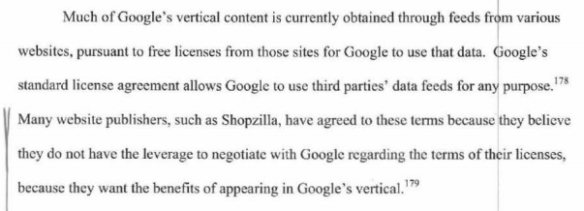
Shopzilla worried about exclusion from Google's listings

Google offers you a ‘standard licence’, and you’d better accept it.

That’s arm-twisting of the first order.

Google was definitely worried about verticals taking away from its core business: in 2005 Bill Brougher, a Google product manager, said in an internal email that “the real threat” of Google not “executing on verticals” (ie having its own offerings) was

“(a) loss of traffic from Google.com because folks search elsewhere for some queries (b) related revenue loss for high spend verticals like travel (c) missing opportunity if someone else creates the platform to build verticals (d) if one of our big competitors builds a constellation of high quality verticals, we are hurt badly”.

You’ve got questions

Obviously, you’ll be going “but..”:
1) But aren’t “verticals” just another form of search? No – though they need search to be visible. A retailer of any sort is a “vertical”: a shop needs to know what it has to sell in order to offer it for sale. But populating the shop, tying up deals with wholesalers, figuring out pricing – those aren’t “search”. Amazon is a “vertical”; Moneysupermarket is a “vertical” (where it sells various deals, and wraps it with information in its forums). Hotel booking sites, shopping sites, they’re all “verticals”.

Their problem is that they need what they’re offering (“hotel tonight in Wolverhampton”) to be visible via general search, but they don’t want that to be something that can be scraped easily.

Amazon, for example, gave Google limited access to its raw feed; but Google wanted more, including star ratings and sales rankings. Amazon didn’t want to give that up for bulk use (though it was happy for it to be visible individually, when users called a page up). Google simply scraped the Amazon data, page by page – and used the rankings to populate its own shopping services. It did the same with Yelp – which eventually complained and sent a formal cease-and-desist notice.

In passing, this is a classic example of Google having it both ways: if your dataset is big enough, as with Amazon’s, then Google – and its supporters – can claim that scooping up of extra data such as shopping rankings and star ratings is “fair use”; if your dataset is small, then you’re probably small too, and will be threatened by the possibility of exclusion if you refuse to yield it up – witness Shopzilla, above.

(Side note: Microsoft wasn’t above doing something similar when it was dominant. Just read about the Stac compression case: Microsoft got a deep look at a third-party technology that effectively doubled your storage space in the bad old days of MS-DOS; then it took the idea and used rolled it into MS-DOS for free, rather than licensing it. Monopolists act in very similar ways.)

2) But rival search sites are “just a click away”. You don’t have to use Google. The FTC acknowledges this point, which is one that Eric Schmidt and Google have made often. There’s a true/not true element to this. The search engine business effectively collapsed after the dot-com boom in 2000: Alta Vista, which was then the biggest (in revenue and staffing terms) lost all its display ads. And Google did the job better. That’s undeniable. But for at least five crucial years, it had pretty much zero competition. Microsoft was in disarray, and Google was able to attract both search data and advertisers to corner the market.

What’s more, it was the default for search on Firefox and Safari, which helped propel its use. The combination of “better, unrivalled and default” made it a monopoly. Most people don’t even know there’s an alternative, and couldn’t find one if asked. Just listen how many times in everyday conversation – on the radio, in the street, in newspapers – you hear “google” used as a verb.

One thought on that “just a click away” – Google has poured huge amounts of money into making sure that people aren’t presented with any other search engine to begin with. The Mozilla organisation’s biggest source of funds for years has been Google, paying to be its default search (until last autumn, when Yahoo paid for the US default and Google, I understand, didn’t enter a bid – because Google Chrome is now bigger than Firefox). Google pays Apple billions every year to be the default search on Safari on the Mac, iPhone and iPad.

Clearly, Google doesn’t want to be in the position where it’s the one that’s a click away. That’s because it knows that the vast majority of people – usually 95% or so, for any setting – use the defaults.

The reality is that we are where we are: Google is the most-used search engine, it has the largest number and value of search advertisers, and crucially it is annexing other markets in verticals. This dominance/annexation nexus is exactly the point that Microsoft was at with Windows and Internet Explorer.

The difference, the FTC acknowledged, is in the “harm to consumers”. Antitrust, under the US Sherman act, rests on three legs: monopoly of a market; using that monopoly to annexe other markets; harm to consumers. In US v Microsoft, the “harm to consumers” was that by forcing inclusion of Internet Explorer,

“Microsoft foreclosed an opportunity for OEMs to make Windows PC systems less confusing and more user-friendly, as consumers desired” and “by pressuring Intel to drop the development of platform-level NSP software, and otherwise to cut back on its software development efforts, Microsoft deprived consumers of software innovation that they very well may have found valuable, had the innovation been allowed to reach the marketplace. None of these actions had pro-competitive justifications”; furthermore, in the final line of the judgement, Thomas Penfield Jackson says “The ultimate result is that some innovations that would truly benefit consumers never occur for the sole reason that they do not coincide with Microsoft’s self-interest.”

In the case of the FTC and Google, the harm to consumers is less clear-cut; in fact, that’s part of why the FTC held off. Yet it’s hard to look at the tactics that Google used – grabbing other companies’ content, demoting vertical rivals in search, promoting its own verticals even though they’re worse – and not see the same restriction of innovation going on. Might Shopzilla have turned into a rival to Amazon? Could Yelp have built its own map service? Or become something else? History is full of companies which have sort-of-accidentally “pivoted” into something remarkable: Microsoft with MS-DOS for IBM (a contract it got because the company IBM first contacted didn’t respond); Instagram into photos (it was going to be a rival to Foursquare).

What’s most remarkable about the demotion of rivals is that users actually preferred the rivals to be ranked higher according to Google’s own tests.

Footnote 154: the smoking gun

In footnote 154 (on page 132 of the report, but referring to page 29 of the body – which is sadly missing), the FTC describes what happened in 2006-7, when Google was essentially trying to push “vertical search” sites off the front page of results. Google would test big changes to its algorithms on “raters” – ordinary people who were asked to judge how much better a set of SERPs were, according to criteria given them by Google. I’m quoting at length from the footnote:

Initially, Google compiled a list of target comparison shopping sites and demoted them from the top 10 web results, but users preferred comparison shopping sites to the merchant sites that were often boosted by the demotion. (Internal email quote: “We had moderate losses [in raters’ rating – CA] when we promoted an etailer page which listed a single product because the raters thought this was worse than a bizrate or nextag page which listed several similar products. Etailer pagers which listed multiple products fared better but were still not considered better than the meta-shopping pages like bizrate or nextag”).

Google then tried an algorithm that would demote the CSEs [comparison shopping etailer], but not below sites of a certain relevance. Again, the experiment failed, because users liked the quality of the CSE sites. (Internal email quote: “The bizrate/nextag/epinions pages are decently good results, They are usually formatted, rarely broken, load quickly and usually on-topic. Raters tend to like them. I make this point because the replacement pages that we promoted are occasionally off-topic or dead links. Another positive aspect of the meta-shopping pages is that they usually give a variety of choices… The single retailer pagers tend to be single product pages, For a more general query, raters like the variety of choices the meta-shopping site seems to give.”)

Google tried another experiment which kept a CSE within the top five results if it was already there, but demoted others “aggressively”. This too resulted in slightly negative results.

Unable to get positive reviews from raters when Google demoted comparison shopping sites, Google changed the raters’ criteria [my emphasis – CA] to try to get positive results.

Previously, raters judged new algorithms by looking at search results before and after he change “side by side” (SxS), and rated which search results was more relevant in each position. After the first set of results, Google asked the users to instead focus on the diversity and utility of the whole set of results, rather than result by result, telling users explicitly that “if two results on the same side have very similar content then having those two results may not be more valuable than just having one,” When Google tried the new rating criteria with an algorithm which demoted CSEs such that sometimes no CSEs remained in the top 10, the test again came back “solidly negative”.

Google again changed changed its algorithm to demote CSEs only if more than two appeared in the top 10 results, and then, only demoting those beyond the top two. With this change, Google finally got a slightly positive rating it its “diversity test” from its raters. Google finally launched this algorithm change in June 2007.

Here’s the point to hold on to: users preferred having the comparison sites on the first page. But Google was trying to push them off because, as page 28 of the report explains,

“While Google embarked on a multi-year strategy of developing and showcasing its own vertical properties, Google simultaneously adopted a strategy of demoting, or refusing to display, links to certain vertical websites in highly commercial categories. According to Google, the company has targeted for demotion vertical websites that have ‘little or no original content’ or that contains ‘duplicative’ content.”

On that basis, wouldn’t Google have to demote its own verticals? There’s nothing original there. But Google also decided that comparison sites were “undesirable to users” – despite all the evidence that it kept getting from its raters – while at the same time deciding that its own verticals, which sometimes held worse results, were desirable to users.

Clearly, Google doesn’t necessarily pursue what users perceive to be the best results. It’s quite happy to abandon that in the pursuit of what’s perceived as best for Google.

Fair fight?

Now, that’s fair enough – up to a point. Google can mess around with its SERPs but only until it uses its search monopoly to annex other markets to the disbenefit of consumers. It’s easy to argue that in preventing rival verticals getting visibility, it reduced the options open to consumers. What’s much harder is proving harm. That’s where the FTC stalled.

But in Europe, that last part isn’t a block. Monopoly power together with annexation is enough to get you hauled before the European Commission’s DGCOMP (directorate-general of competition). The FTC and EC coordinated closely on their investigations, to the extent of swapping papers and evidence. So the EC DGCOMP has full copies of both the FTC reports. (If only they would leak..)

There’s been plenty of complaining that the EC’s pursuit of Google is just petty nationalism. People – well, Americans – point to the experiment where papers prevented Google News linking to them. Their traffic collapsed. They came back to Google News. Traffic recovered. Sure, this shows that Google is essential; cue Americans crowing about how stupid the newspapers were.

However, if you stop to think about the meaning of the word “monopoly”, that’s not necessarily a good thing for Google to have demonstrated – even unwittingly – in Europe. Now the publishers, who have what could generously be called a love-hate relationship with Google, can show yet another piece of evidence to DGCOMP about the company’s dominant position.

What happens next?

Vestager will issue a Statement of Objections (which, sadly, won’t be public) some time in the next few weeks; that will go to Google, which will redact the commercially confidential bits, then send it back to Vestager, who will show it to complainants (of whom there are quite a few), who will comment and then give it back to Vestager.

Then the hard work starts. Whether Google seeks to settle will depend on what Vestager is demanding. Will she try to forestall Google from foreclosing emerging spaces – the future verticals we don’t know about? Or just try to change how it treats existing verticals? (Ideally, she’d do both.) Many of the issues around scraping and portability of advertising which Almunia enumerated in May 2012 have been settled already (now that Google has wrapped them up; the scraped datasets aren’t coming out of its data roach motel).

Neither is going to make all the revenue lost to Google favouring its own services come back. And as with record labels and YouTube, it’s likely that Google will try to stretch this out for as long as possible; the more it does, the more money it gets, and the less leverage its rivals have.

Even so, I can’t help thinking that rather as with Microsoft and Internet Explorer, the chance to act decisively has long been missed. Instead, a different phenomenon is pushing Google’s dominance on the desktop aside: mobile. Mobile ads are cheaper, see fewer clicks, and search is used less compared to apps. I’d love to see a breakdown of Google’s income from mobile between app sales and search ad sales (and YouTube ad sales): I wonder if apps might be the bigger revenue generator. Yelp, meanwhile, seems to do OK in the new world of mobile. It’s possible – maybe even likely – that Google’s dominance of the desktop will be, like Microsoft, broken not by the actions of legislators but by the broader change in technologies.

Right and wrong lessons

But the wrong lesson to take from that would be “legislators shouldn’t do anything”. Because there’s always the potential for inaction to corner a market and foreclose on real innovation. Big companies which become dominant need to worry that legislators will come after them, because even that consideration makes them play more fairly.

And that’s why the Google tussle with the FTC and EC matters. It might not make any difference to those that feel wronged by Google on the desktop. But it could forestall whoever comes next, and it will focus the minds of the legislators and the would-be rivals. Google might not have any friends. There might come a time when it will wish it had some, though.

Start up: Apple’s China watch pricing, Google v EC (and FTC), inside the Watch, and more


Not from Elon Musk, but who knows in future? Photo by Eva the Weaver on Flickr.

A selection of 8 links for you. Use them wisely. I’m charlesarthur on Twitter. Observations and links welcome.

The Apple Watch, China Edition » MarkDMill

Mark Miller:

This is the political and social environment in which the gold Apple Watch Edition enters China. Luxury watches are worn in China as a display of one’s wealth, but right now displaying wealth on one’s wrist is dangerous and, legitimately or not, is taken as a sign of corruption. The gold Apple Watch will sell,  but I would wager an Apple Watch Edition that it won’t be seen on the wrists of government officials or successful business people with political connections (which is most successful business people)–or, if it is seen, that person will quickly be sanctioned or even sacked.

This, then, is why Apple’s positioning of Apple Watch is so brilliant: by releasing Apple Watch Edition at the luxury price of RMB 74,800 ($12,062),1 the “normal” Apple Watch seems downright frugal at RMB 4,188 ($675). Even the most expensive Apple Watch (RMB 8,288; $1336) looks cheap in comparison to the most expensive Apple Watch Edition (RMB 112,800; $18,190). By pricing one collection so high, Apple has managed to make Apple Watch seem downright moderate – even though it costs 15-30% of the average Chinese annual salary!


Twitter meets deep search, and much, much more. — Medium

Mark Yoshitake:

Today Kifi is proud to announce the launch of a Twitter integration that will allow you and millions of others to automatically save links you have shared through Twitter, and use them in an entirely new way. Think of this as a search engine built just for the content you’ve Tweeted. Kifi will also recommend other great content for you to share, based on these links. Join the beta now, its free.

We know one of the huge problems people have is recalling all the wealth of information they’ve found and shared, on Twitter. So we built this incredibly powerful tool to allow you to get back to any link you have shared on Twitter, instantly.

Twitter will either kill this or buy it, won’t it?


iPhone killer: the secret history of the Apple Watch » WIRED

David Pierce:

one thing was clear [to Kevin Lynch, who was surprised to find himself in charge of the project – already underway – on his first day in the job, and two days from a top-level review] from the start: The Watch would succeed or fail on the strength of what’s prosaically called the user interface. The interface would determine whether the Watch ended up displayed in a dozen museums or remembered as Apple’s biggest flop since the Newton.

That’s where Alan Dye comes in. As chief of Apple’s human interface group, he’s in charge of creating the ways you tell your device what to do and how that device responds. Those cool little experiences you have with your laptop and phone and tablet, like when the app icons quiver because they’re ready to move around your screen? That’s the human interface team.

Pierce has written a fantastic piece. The amount of access seems comparable to that afforded the New Yorker. Clearly, Apple wants both the fashion crew and the tech crew to like it; but note how it’s approaching them, in different ways.


Beyond the FTC memorandum: comparing Google’s internal discussions with its public claims » Ben Edelman

Edelman is a specialist in competition law; he has consulted for rivals to Google, including Microsoft, but also for Google. This is a deep dive of what’s in the FTC memorandum and others. Here’s just a taste:

Specialized search and favoring Google’s own services: targeting bad sites or solid competitors?

In public statements, Google often claimed that sites were rightly deprioritized in search results, indicating that demotions targeted “low quality,” “shallow” sites with “duplicate, overlapping, or redundant” content that is “mass-produced by or outsourced to a large number of creators … so that individual pages or sites don’t get as much attention or care.” Google Senior Vice President Jonathan Rosenberg chose the colorful phrase “faceless scribes of drivel” to describe sites Google would demote “to the back of the arena.”

But when it came to the competing shopping services Google staff sought to relegate, Google’s internal assessments were quite different. “The bizrate/nextag/epinions pages are decently good results. They are usually well-format[t]ed, rarely broken, load quickly and usually on-topic. Raters tend to like them. …. [R]aters like the variety of choices the meta-shopping site[s] seem… to give” (footnote 154, citing GOOGSING-000014375).

Here too, Google’s senior leaders approved the decision to favor Google’s services. Google co-founder Larry Page personally reviewed the prominence of Google’s services and, indeed, sought to make Google services more prominent. For example: “Larry thought product [Google’s shopping service] should get more exposure” (footnote 120, citing GOOG-Texas-1004148). Product managers agreed, calling it “strategic” to “dial up” Google Shopping (footnote 120, citing GOOG-Texas-0197424). Others noted the competitive importance: Preferred placement of Google’s specialized search services was deemed important to avoid “ced[ing] recent share gains to competitors” (footnote 121, citing GOOG-Texas-0191859) or indeed essential: “most of us on geo [Google Local] think we won’t win unless we can inject a lot more of local directly into google results” (footnote 121, citing GOOGEC-0069974).

The European Commission’s antitrust group has seen the full FTC report. Speaking of the Commission…


EU lays groundwork for antitrust charges against Google » WSJ

Tom Fairless and Alistair Barr:

The European Commission, the European Union’s top antitrust authority, has been asking companies that filed complaints against Google for permission to publish some information they previously submitted confidentially, according to several people familiar with the requests. Shopping, local and travel companies are among those that have been contacted, one of those people said.

A decision to file charges against Google would kick off the EU’s highest-profile antitrust suit since its lengthy campaign that started a decade ago against Microsoft Corp., which paid the bloc €1.7 billion ($1.8 billion) in fines through 2012.

A settlement in Google’s case is always possible. Even if the EU presses ahead with charges, Google could still strike a deal to resolve the bloc’s concerns that the company abuses its dominance in the European search market.

“Publish” doesn’t mean quite what you’d hope. Here’s what happens:
• If – as now seems certain – the EC raises a “Statement of Objections” against Google, it will include in the SOO that gets sent (privately) to Google some of the info that objectors provided to it confidentially.
• So it has to ask them to send that.
• Google looks at the SOO, redacts any info about itself it thinks is commercially confidential, sends that back to the EC.
• The EC sends the now-Google-redacted SOO to objectors, who can comment to the EC about it
• EC has a finished SOO and can use it against Google.

The process then is still lengthy. Expect all this to carry on through 2015 – possibly even to 2016 – before any resolution. But the possibility of a fine exists, and isn’t minimal.

Margrethe Vestager has clearly decided though to take a different tack from her predecessor, Joaquin Almunia; she’s not looking to settle. He tried three times and failed, in the face of objections from those who had complained, and latterly of politicians in Germany and France.


Google Lab puts a time limit on innovations » WSJ

Alistair Barr:

the new emphasis on Advanced Technology and Projects, which upends some Google traditions. Most projects are limited to two years, after which they are killed, moved into Google, spun off into independent firms or licensed to others. The group jettisons project leaders after two years and hires mostly outside experts.

There have been 11 projects in the group, including Ara, a smartphone with switchable components; Tango, a 3-D mapping technology; and Spotlight Stories, interactive animations and short films for smaller phone screens.

The approach is the brainchild of Regina Dugan, the former head of the U.S. Defense Advanced Research Projects Agency. She joined Motorola, then a division of Google, in 2012 and is close to [Eric] Schmidt, who’s been spending more time at the research lab recently.

“We like this model because it puts pressure on people to perform and do relevant things or stop,” Mr. Schmidt said. “I’ve spent an awful lot of time on projects that never end and products that would never ship.”

Is there just a little note of.. anxiety here? (In passing, Alistair Barr has been doing some great, solid reporting of late.)


Slack hack and broken model of centralized data » Medium

Muneeb Ali:

The interesting thing about security is no one cares about it until shit hits the fan. That shiny new product feature you’re working on seems so much more important than securing your chat logs. Our solution was to simply stop talking about anything sensitive over Slack. You can afford to do that when you’re a small startup and literally sit next to each other. But you can’t scale this as you grow.

To me the Slack hack is yet another reminder that centralized models are broken by design. Slack is an awesome company and I’m sure they’ll comply with the best security practices. It doesn’t look like the hacker got access to chat logs in this hack. But that still means that Slack is a single point of failure. They’re a prime target for hackers. A single place from where confidential information of a lot of other companies can be accessed.

Ali’s company Onename uses a blockchain-based approach for decentralised identity. Interesting approach.


Musk’s tweeted promise not such a surprise after all » FT Tech blog

Richard Waters:

there are no real surprises here, it seems. Speaking on a Tesla earnings call on February 11th, he said the company was working on a “consumer battery that will be for use in people’s houses or businesses”, with a product unveiling “probably in the next month or two”.

SolarCity – the installer of solar systems of which Musk is also chairman – says on its own website that it has been experimenting with a Tesla-branded residential battery at 300 test sites, with another 130 to come. It promises to have a storage product “available again in late summer 2015,” which also fits with the Musk tweet timeline.

The solar company promotes the residential battery as an emergency back-up in case the utility grid fails, “such as after an earthquake or other natural disasters”. That sounds like a product for a niche market: it will be interesting to see how Musk presents it next month.


Start up: Google swipes ad injectors, streaming v vinyl, Galaxy S6 reviewed, FTC-Google scrutiny, and more


Wait, is that from Amazon? Photo by star5112 on Flickr.

A selection of 9 links for you. None is an April Fool. (Apparently it’s necessary to say this stuff.) I’m charlesarthur on Twitter. Observations and links welcome.

Out with unwanted ad injectors » Google Online Security Blog

Nav Jagpal, software engineer for “safe browsing”:

To increase awareness about ad injectors and the scale of this issue, we’ll be releasing new research on May 1 that examines the ad injector ecosystem in depth. The study, conducted with researchers at University of California Berkeley, drew conclusions from more than 100 million pageviews of Google sites across Chrome, Firefox, and Internet Explorer on various operating systems, globally. It’s not a pretty picture. Here’s a sample of the findings:

• Ad injectors were detected on all operating systems (Mac and Windows), and web browsers (Chrome, Firefox, IE) that were included in our test.
• More than 5% of people visiting Google sites have at least one ad injector installed. Within that group, half have at least two injectors installed and nearly one-third have at least four installed.
• 34% of Chrome extensions injecting ads were classified as outright malware.
• Researchers found 192 deceptive Chrome extensions that affected 14 million users; these have since been disabled. Google now incorporates the techniques researchers used to catch these extensions to scan all new and updated extensions.


Tidal, Apple, Beyonce, and the future of streaming music » NextDraft Originals

First of two links on this. Point 8 (you should also read 1-7):

You just held a press conference with some of the biggest celebrities of our time. And the consumer buzz and press you got wasn’t even close to a Tim Cook Apple keynote. You’re in the technology business now. And we’re all in a new world. Today, product is a bigger star than any celebrity. That’s so important and so right, I’m gonna make it the chorus of this post and repeat it a couple more times. Product is a bigger star than any celebrity … Product is a bigger star than any celebrity. And in the high end tech business, we got 99 problems, but UI ain’t one. Seriously, if you think having a beef with another rapper is dangerous, try dealing with a product manager who disagrees with your vision. Here’s what the company that acquires Tidal should do to further differentiate itself…

9. Push back against the Internet-era dogma that we all hate having our music streams hosted by a human curator. That idea was never more than an assumption. And it’s one that needs to be tested. You’ll still have access to uninterrupted music when you want it. But when you want a radio station or a hosted playlist, then someone should let you hear a human voice.

True. Will Zane Lowe be the human voice on Beats?


Google and Asus announce the Chromebit, a sub $100 Chrome PC » MobileSyrup.com

Igor Bonifacic:

Thanks to Google and Asus, an entirely new type of Chrome OS computer is coming this summer. The two companies just announced the Chromebit, a $100 computer on a HDMI dongle.

Each one comes equipped with a 1.8GHz ARM Cortex-A17 processor, 2GB of RAM, 16 GB of solid state storage, Bluetooth 4.0, a dual band 802.11ac WiFi chip and a single full-size USB 2.0 port. Using its HDMI port, the Chromebit can be connected with any other HDMI-equipped monitor or television.

When it ships this summer, the Chromebit will be available in three different colours—blue, orange and grey. Google and Asus haven’t yet announced how much the unit will retail for in Canada, but based on a post on its Chrome Blog, it appears the company’s aim is to have the Chromebit cost less than $100 everywhere it’s sold. Of course, those that purchase one will still need to provide a Bluetooth mouse and keyboard.

So you need an HDMI monitor, mouse and keyboard. Who’s going to have those hanging around yet not have a PC?


Samsung Galaxy S6 review: the iPhone 6 has met its match » WSJ

Joanna Stern:

No, neither of the new Galaxys brings any original ideas to the evolution of the smartphone. If anything, Samsung has actually sucked out the differentiators, including the waterproof design and removable storage and battery. And Samsung still needs some schooling in the software department.

Yet with a series of improvements, the Galaxy now has a leg up on the hardware of other Android phones and the iPhone. It’s got me, a once extremely satisfied iPhone 6 owner, wishing for a better screen, sharper camera and faster charging.

One reason I probably like the new Galaxys so much—especially the white models I’ve been testing — is that the design looks like a compilation of the iPhone’s greatest hits.

Okey doke. The one thing the S6 does have: a dual-app view. Hard to pull off, but potentially useful. The cameras (S6 v iPhone 6) seem like a dead heat.

And this isn’t where the battle will be fought. It’ll be in China, and Europe.


Noah Smith on Twitter: “10/And what near-future sci-fi used to be – Neuromancer, Snow Crash, etc. – is now just called “real stuff happening in the news”.”

What with the events in Turkey.. part of a larger tweetstorm that’s worth reading at Eugene Wei’s blog.


US recording industry dips slightly, streaming and vinyl jump » Billboard

Ed Christman:

The story within digital remains intriguing. While streaming revenue jumped nearly 29% – to $1.87bn from $1.45bn – download sales fell 9.5%, to $2.64bn from $2.92bn. That means that overall digital grew by $140bn, 3.2%, to $4.5bn, up from $4.37bn in the prior year.

Looking more closely at digital streaming revenue, paid subscriptions’ value jumped to nearly $800m, via 7.7m subscribers, up 25% from 2013’s $639m in revenue and 6.2m subscribers. The RIAA also reports that ad-supported streaming services’ contribution to the overall U.S. music industry grew 34%, to nearly $295m – from $220m in the prior year – while SoundExchange distributions grew 31%, to $773.4m.

CD albums fell 12.3%, to $1.85bn from $2.12bn in 2013. Overall CD sales, on a unit basis, were down 16.3%m to 144.1m from $172.2m…

On a bright note, vinyl sales continued to grow, contributing $320.8m to the total pie, from the prior year’s total of $213.7m – a 50% growth.

Got that? Ad-supported “free” streaming generated less revenue than vinyl in the world’s largest, most connected market. (This likely doesn’t include YouTube revenues, though.)


Key senator to take closer look at FTC-Google meetings » NASDAQ.com

A key US senator plans to ask the Federal Trade Commission for information about meetings it had with Google Inc. executives during the time it was investigating the company for possible antitrust violations.

Sen. Mike Lee (R., Utah), who chairs the Senate’s antitrust panel, will conduct a preliminary inquiry to determine what conversations took place between the FTC and the Internet giant during the probe, people in his office said on Monday.

The senator could later expand his inquiry to include conversations people in the White House had with the FTC and Google, these people said.

A Republican senator is looking at Google’s relationship with the White House? No doubt to irk Obama, but it makes Google’s blogpost thumbing its nose at the Wall Street Journal (in which it used GIFs of babies) look both incredibly jejeune and ill-judged. Even if (as is likely) this comes to nothing, I suspect it will be embarrassing for Google to explain the post, which detailed visits to the White House by Google staff.


Criminal charges against FBI agents reveal staggering corruption in the Silk Road investigation » Forbes

Sarah Jeong describes

a sprawling case tainted by an unbelievable web of corruption. A state’s witness took the fall for an agent’s theft, thus becoming the target for a murder-for-hire—a murder that was then faked by the same agent. The Silk Road case was compromised again and again as Force and Bridges allegedly took every opportunity to embezzle and steal money. With so much bitcoin on their hands, the two had to coax various bitcoin and payments companies to help convert their ill-gotten gains to dollars. When companies resisted, investigations were launched, subpoenas were issued, and civil forfeitures were sought in retaliation.

Someone’s gotta be writing the screenplay, right? More to the point, I wonder if there was some assumption that bitcoin transactions would be anonymous on anyone’s part..


Amazon Dash Button » Amazon

Dash Button comes with a reusable adhesive and a hook so you can hang, stick, or place it right where you need it. Keep Dash Button handy in the kitchen, bath, laundry, or anywhere you store your favorite products. When you’re running low, simply press Dash Button, and Amazon quickly delivers household favorites so you can skip the last-minute trip to the store.

I know, it looks like an April Fool’s. But it isn’t – it’s real. Amazon is making it easier to order stuff directly, with a very clever, Internet of Things approach.

Next question is whether people will trust Amazon to always be the cheapest to deliver this. Miles ahead of supermarkets – though what’s to stop them doing the same? Maybe your washing machine will be festooned with buttons offering lights showing which is cheaper at any time (excluding P&P, of course).


Start up: why Google lost its Safari appeal, US gov trumps Kim Dotcom, S6 still bloated?, and more


But also for your “we’d like to be in VR now that it’s hip (again)” moments. Photo by TORLEY on Flickr.

A selection of 10 links for you. Use them wisely. I’m charlesarthur on Twitter. Observations and links welcome.

Second Life is still around and getting ready to conquer virtual reality » Business Insider

Matt Weinberger:

although you probably haven’t heard much about it lately, Second Life hasn’t gone anywhere. With 900,000 active users a month, who get payouts of $60m in real-world money every year, and a virtual economy that has more than $500m in GDP every year, Second Life is still a world of opportunity. 

Today, the rising tide of virtual reality — with companies like Facebook, HTC, and Sony betting big on immersive 3D technology — means that Second Life’s time may have come around.

“Now the world is waking up again,” Ebbe Altberg, CEO of Second Life developer Linden Lab, which now has over 200 employees, told Business Insider.

Linden Lab is marshalling its expertise and experience in building immersive, functional virtual worlds to make a proper successor to the Second Life platform and take advantage of the bold new world of immersive VR. Specifically, Linden sees a huge opportunity in making it easier for people to build and share cool virtual reality experiences. 


Holway says RIP to his Blackberry Bold » TechMarketView

Richard Holway is yet another of those moving on, having used a BlackBerry since the year dot:

I loved – still love – my Blackberry Bold. It is the best email sender/receiver ever invented. Its physical qwerty keyboard is still better than the puny iPhone 6 touchscreen. Its battery lasts for days too. But, it can’t really do anything else.

And that last sentence is the key thing, isn’t it?


Driverless cars need to be spy machines so they don’t kill you » Fusion

Daniela Hernandez:

For instance, an app that controls the [self-driving Mercedes] F 015 can also turn the cameras it uses to see the road as remote prying eyes. Through the app, you can connect to the car’s cameras to spy on the car’s surroundings through your phone. It effectively turns your car into a lurking Dropcam that can be used to watch unknowing passersby, anywhere, anytime. Or as another journalist on the junket put it, it turns every single vehicle into a Google Street View car. The privacy implications will be huge.

But it doesn’t stop there. Just like your iPhone or Android device, your car will communicate with other internet-connected devices in your life. It’ll learn your habits and adapt to your needs. For instance, say your car “realizes” you’re on your way home at dinner time. It “knows” your smart fridge is stocked with nothing but booze, so it prompts you to go to the grocery store or local eatery to pick up some grub. It’ll pull up the number of your favorite restaurant or suggest a new one based on your preferences. While you call, your robo-butler adjusts its course to take you where you need to go. By the time you arrive for curbside pickup, your credit card will already have been charged.

“We call it predictive learning,” said Mercedes’ Tattersall. “This will be something not so far away.”


Google Inc v Vidal-Hall & Ors [2015] EWCA Civ 311 (27 March 2015) » Bailii

“Bailii” is the British and Irish Legal Information Institute; it collects written judgements from courts in those countries. This is the key passage in the decision by the court of appeal on the “Safari hack” by Google of three complainants:

We come back then to the question we have to decide. Against the background we have described, and in the absence of any sound reasons of policy or principle to suggest otherwise, we have concluded in agreement with the judge that misuse of private information should now be recognised as a tort for the purposes of service out the jurisdiction. This does not create a new cause of action. In our view, it simply gives the correct legal label to one that already exists. We are conscious of the fact that there may be broader implications from our conclusions, for example as to remedies, limitation and vicarious liability, but these were not the subject of submissions, and such points will need to be considered as and when they arise.

(A “tort” is a legal wrong.) Google has fought this case all the way – particularly because the original judge, Tugendhat, decided that hacking someone’s device to follow them to collect data about what they look at online is a tort. Google will probably appeal this to the UK supreme court.

The full decision is twisty, so don’t rush it.


US government wins dozens of millions from Kim Dotcom » TorrentFreak

“Ernesto” (TorrentFreak’s founder):

A few hours ago District Court Judge Liam O’Grady ordered a default judgment in favour of the US Government. This means that the contested assets, which are worth an estimated $67m, now belong to the United States.

“It all belongs to the US government now. No trial. No due process,” Dotcom informs TF.

More than a dozen Hong Kong and New Zealand bank accounts have now been forfeited (pdf) including some of the property purchased through them. The accounts all processed money that was obtained through Megaupload’s alleged illegal activities.

The list of forfeited assets further includes several luxury cars, such as a silver Mercedes-Benz CLK DTM and a 1959 pink Cadillac, two 108″ Sharp LCD TVs and four jet skis.

The wheels of justice grind slow…


The Samsung Galaxy S6 has as much bloatware as ever » Gizmodo

Eric Limer:

At first glance, the new S6 and S6 Edge appear to be less cluttered, but you’ll actually find some 56 applications pre-installed. That’s 6 more than the 50 you’ll find on the Galaxy Note 4! Between the Google Apps you’ll find on every phone (Play Newstand? Come on), Samsung’s apps like S Voice and S Health, the new Microsoft apps like OneDrive (intended to soften the blow of no microSD slot), assorted social apps like Whatsapp and Instagram, and carrier apps (6 on T-Mobile), there’s a ton of cruft. A Moto G I have hanging around — which runs near stock Android — starts with just 33.

And despite statements from Samsung that “Samsung has allowed users to remove the pre-installed applications on Galaxy S6 and S6 Edge,” the most severe action you can take is “disabling” them. This removes them from the app drawer and the homescreen, but not from the phone entirely. You’re basically opting instead to put them in a sort of stasis, out of sight but not out of storage.

They don’t take much storage – Limer suggests about 100MB – but it’s the principle, really. Will the reviewers find the S6 “stripped back” even so?


HTC’s lead designer leaves after less than a year » Engadget

Richard Lai:

For a tech company that places so much emphasis on design, we can’t help but think something’s up when one of the key designers leaves. Today, we bring you the sad news that HTC’s VP of Industrial Design, Jonah Becker, has announced his departure on Twitter. To our surprise, that’s less than a year after he picked up from where his predecessor Scott Croyle left off.

It’s not “sad” news. It’s news. The more interesting part:

we have learned from our sources that there is an ever increasing power struggle between the design team and sales team these days. Another source told us the switch from the M8’s UltraPixel main camera to the M9’s 20-megapixel counterpart is an example of such.

HTC is in so much flux, yet clings on doughtily to existence.


Six surprising facts about who’s winning the operating system and browser wars in the U.S. » ZDNet

Ed Bott:

What I love about this data is that we finally have statistically meaningful details about which technologies people are using in the United States today. The database is enormous, and it should be broadly representative of the U.S. population, with a mix of consumers and businesses represented. (The data reported here is not strictly limited to the United States, of course. People from foreign countries occasionally need information from the United States government. But for the sake of this article one can consider the data to be an accurate snapshot of the U.S.)


Google investors will love these charts. Android developers will hate them. » Business Insider

Jillian D’Onfro:

As investors and analysts panic about how Google’s search advertising revenue growth is slowing because it can’t charge as much for mobile ad clicks as desktop ad clicks, this move gives Google another huge avenue for mobile monetization. 

“We view this move as akin to when the company first introduced 
sponsored links in the search engine results page,” analysts from Credit Suisse wrote in a note Friday morning.

Credit Suisse included two charts in its note that perfectly underscore exactly why investors and analysts love this move and why it could have negative effects for Android developers. 

Because they’ll have to pay for advertising, which is 20% of revenues – so after the 30% cut, that means Google gets 50% of revenues. #savedyouaclick


You’ll soon get 10TB SSDs thanks to new memory tech » Engadget

Steve Dent:

SSDs and other flash memory devices will soon get cheaper and larger thanks to big announcements from Toshiba and Intel. Both companies revealed new “3D NAND” memory chips that are stacked in layers to pack in more data, unlike single-plane chips currently used. Toshiba said that it’s created the world’s first 48-layer NAND, yielding a 16GB chip with boosted speeds and reliability. The Japanese company invented flash memory in the first place and has the smallest NAND cells in the world at 15nm. Toshiba is now giving manufacturers engineering samples, but products using the new chips won’t arrive for another year or so.

I can wait a year, though I haven’t managed to fill the 512GB drive on my laptop in three years.


Start up: self-driving car wars, trying Hololens, Google’s targeted ads on Kansas TV, Glass undead, and more


Beware if attached to a car with a GPS device built in. Photo by Omar Omar on Flickr.

A selection of 8 links for you. Use them wisely. I’m charlesarthur on Twitter. Observations and links welcome.

Miss a payment? Good luck moving that car » NYTimes.com

Michael Corkery and Jessica Silver-Greenberg:

The thermometer showed a 103.5-degree fever, and her 10-year-old’s asthma was flaring up. Mary Bolender, who lives in Las Vegas, needed to get her daughter to an emergency room, but her 2005 Chrysler van would not start.

The cause was not a mechanical problem — it was her lender.

Ms. Bolender was three days behind on her monthly car payment. Her lender, C.A.G. Acceptance of Mesa, Ariz., remotely activated a device in her car’s dashboard that prevented her car from starting. Before she could get back on the road, she had to pay more than $389, money she did not have that morning in March.

“I felt absolutely helpless,” said Ms. Bolender, a single mother who stopped working to care for her daughter.

At present, this story has 983 comments. People feel strongly about this topic.


Delphi self-driving car begins world’s first 3500-mile cross-country trip » Tech Times

Christian de Looper:

The car is an Audi SQ5 outfitted with Delphi’s tech, and has been tested on shorter drives in California and Nevada. Delphi believes the drive across the country will help it collect more insight and expects to collect a total of 2.3 terabytes of data during the trip.

News surrounding autonomous cars seems to be making headlines ever day. Tesla recently announced the next update to the Tesla Model S will allow the car to drive itself, despite the fact it is still unclear as to whether or not this type of technology is legal.

The Delphi car’s “brain” was developed in partnership with Ottomatika, which takes the data from the sensors during test drives and created a virtual environment for the car, which it uses to apply driving behaviors.

The trip itself will take eight days, and the car will not drive for more than eight hours per day. This will allow the car to complete the tip in daylight, stick to the speed limit, and keep the human passengers, who will make sure that everything runs smoothly, comfortable.

It’s important to note the car will only operate autonomously on highways, with human drivers taking the wheel once the car gets into a city.

It’s not Google’s software; from another article:

The software that interprets the data drawn from those systems and the algorithms that help the car make driving decisions were developed jointly by Delphi and Ottomatika – a company started by Carnegie Mellon University.

The frustrating thing is that Delphi’s own site which is meant to follow this – delphidrive.com – doesn’t have any useful information.


Delphi’s autonomous car is remarkably…unremarkable » Fast Company

Harry McCracken tried it before it set off on its possibly unlicensed jaunt:

I’ve already spent enough time being driven around by autonomous vehicles (always with a human behind the wheel just in case) that at least some of the novelty has worn off. The fact that Delphi’s car drove itself pretty much like a human would have—stopping at safe distances at stop lights, switching lanes when necessary, and not doing anything which felt particularly robotic—didn’t startle me. But I was surprised by how normal the vehicle looked.

Unlike the Google car I’d rode in, there was no giant spinning lidar sensor atop the vehicle to tip off other motorists that this particular Audi SUV was anything unusual. It was well equipped with lidar, radar, and cameras, but they were unobtrusive—some of the gadgetry was even concealed behind the bumpers and license plate. The data collected by those sensors was displayed on the ordinary in-dash infotainment system rather than on specially rigged-up LCD screens. And the tech didn’t take up an out-of-the-ordinary amount of space, which I didn’t realize until after the trip was over and we popped the trunk, which was empty…

…Delphi isn’t working on self-driving as an exercise in futurism. It’s doing it because the car companies of the world are going to expect it to have competence in this field over the next few years. Delphi will need to be able to supply the necessary components, at a price and level of integration which makes sense for production vehicles.

There would be a strange irony if Google were to get outpaced in self-driving cars by all the other manufacturers.


Google isn’t giving up on Glass, Eric Schmidt says » WSJ Digits blog

Alistair Barr:

Google stopped selling the first version of Glass and shut its Explorer program in January, moving the project out of its Google X research lab into a standalone unit. Ivy Ross remained head of the Glass team but Tony Fadell, head of Google’s Nest connected home division, now oversees strategy for the project.

The changes sparked speculation that Google will abandon Glass. However, Schmidt told The Wall Street Journal that it has been put under Fadell’s watch “to make it ready for users.”

“It is a big and very fundamental platform for Google,” Schmidt said. “We ended the Explorer program and the press conflated this into us canceling the whole project, which isn’t true. Google is about taking risks and there’s nothing about adjusting Glass that suggests we’re ending it.”

He said Glass, like Google’s self-driving car, is a long-term project. “That’s like saying the self-driving car is a disappointment because it’s not driving me around now,” he said. “These things take time.”

Which users, though? Consumer users? I don’t see it. Glass didn’t get consumer approval; instead it met direct and continued rejection. Industrial users, sure. There’s a use case there. But Google will quickly find itself competing with rivals – as the above link shows for self-driving cars.


HTC One M9 review » CNET

Andrew Hoyle tried it out, and it’s the camera and battery where most of his complaints come. (For the rest, it’s a phone like many other metal-cased phones.) I noted this:

We don’t miss the M8’s duo-lens, which is no longer seen on the back of the M9. This extra sensor was designed to create unusual images with 3D effects. Sure, they were a bit of fun, but they were definitely a novelty and one that quickly wore off. We do miss a few other things, though. Despite incorporating the latest version of Android, it doesn’t incorporate all the new camera features, most notably raw support. It could also really use optical image stabilisation (OIS), which helps physically smooth bumpy shots; not only does OIS help at slow shutter speeds, but when you’re steadier there are fewer low-light artifacts (noise processing exacerbates the effect of camera shake).

The video looks acceptable, though you’ll really notice the jitter in bright light, when it chooses a fast shutter speed. Without image stabilisation, the combination makes the rolling shutter (that ugly wobble) look even worse. In low light, it suffers from the same lack of tonal range that’s in the photos.

HTC suggested last year that the duo-lens made sliced bread look a bit declassé. Now it’s dropped it. Ditto Samsung, with tons of features removed from the S6 compared to the S5. If you’re so sure a hardware feature matters for your flagship, why drop it after a year?


Google Fiber will sell ads in Kansas City tied to TV viewing habits » The Kansas City Star The Kansas City Star

Scott Canon:

your neighbor might see a different commercial than you while watching the same basketball game. And your kids, watching that game in another room, might see yet a different spot.

That super-narrow targeting represents something nearing a holy grail for television advertisers, even as it raises privacy issues about a company selling TV service tracking what its customers watch.

On a post to its online product forum on Friday, Google Fiber said the targeting “allows you to see ads for nearby businesses — like the car dealership downtown or the neighborhood flower shop.” It says it will start “a small trial” in early April. Kansas City will be the first market where the technology will be deployed — by Google or any cable company.

The practice won’t mean Google Fiber customers will see any more ads. Rather, like most cable companies, it will sell targeted spots replacing some national advertising.

Customers who don’t want those targeted ads, the company says, can change the settings on their TV boxes to opt out. But those who do nothing will see ads aimed at them based on their viewing behaviour…

…[Roger] Entner [who monitors the TV industry for Recon Analytics] speculated that the targeted ads might ultimately draw attention from federal regulators over privacy concerns. Think of someone who has friends over to watch TV. The targeted ads that appear during a show might give visitors insight to what that person watches when no one else is around.

“It can very quickly get to that creepy part of the equation,” he said.


Hilton Honors flaw exposed all accounts » Krebs on Security

Brian Krebs:

The vulnerability was uncovered by Brandon Potter and JB Snyder, technical security consultant and founder, respectively, at security consulting and testing firm Bancsec. The two found that once they’d logged into a Hilton Honors account, they could hijack any other account just by knowing its account number. All it took was a small amount of changing the site’s HTML content and then reloading the page.

After that, they could see and do everything available to the legitimate holder of that account, such as changing the account password; viewing past and upcoming travel; redeeming Hilton Honors points for travel or hotel reservations worldwide; or having the points sent as cash to prepaid credit cards or transferred to other Hilton Honors accounts. The vulnerability also exposed the customer’s email address, physical address and the last four digits of any credit card on file.

Terrible, terrible testing.


Magic Leap and HoloLens demos show augmented reality challenges » MIT Technology Review

Rachel Metz has previously tried Magic Leap’s AR system; now she’s trying Microsoft’s Hololens in its prototype stage:

I was not blown away by what I saw in Redmond. The holograms looked great in a couple of instances, such as when I peered at the underside of a rock on a reconstruction of the surface of Mars, created with data from the Curiosity rover. More often, though, images appeared distractingly transparent and not nearly as crisp as the creatures Magic Leap showed me some months before. What’s more, the relatively narrow viewing area in front of my face meant the 3-D imagery seen through HoloLens was often interrupted by glimpses of the unenhanced world on the periphery. The headset also wasn’t closed off to the world around me, so I still had my natural peripheral vision of the unenhanced room. This was okay when looking at smaller or farther-away 3-D images, like an underwater scene I was shown during my first demo, or while moving around to inspect images close-up from different angles. The illusion got screwed up, though, when it came to looking at something larger than my field of view.+

Microsoft is also still working on packing everything into the HoloLens form it has promised. Unlike the untethered headset that the company demonstrated in January, the device I tried was unwieldy and unfinished: it had see-through lenses attached to a heavy mass of electronics and plastic straps, tethered to a softly whirring rectangular box (Microsoft’s holographic processing unit) that I had to wear around my neck and to a nearby computer.


Start up: Google v FTC (and Europe), Tim Cook on Apple’s culture, Xiaomi on Microsoft, and more


Shopping! Flights! Things that rivals offered which Google does now! Photograph by keso on Flickr.

A selection of 7 links for you. It’s a bit Google/Apple/Microsofty today. I’m charlesarthur on Twitter. Observations and links welcome.

EU said to ask Google’s foes to share evidence in probe » Bloomberg Business

Aoife White:

Google’s antitrust foes were asked to allow the search-engine giant to see secret evidence they gave to European Union regulators, two people familiar with the case said.

The EU request for complainants to declassify some of their documents may be a sign that officials are preparing to escalate their four-year-long antitrust investigation, according to the people who asked not to be identified because details of the probe aren’t public.

“If the commission is contacting the parties to declassify stuff, it is a smoke sign that a statement of objections may be underway,” said Nicolas Petit, a law professor at the University of Liege. “As soon as a statement is out” the company “will request access to the file to see what’s in the commission’s hand.”

Margrethe Vestager, the new EC antitrust chief, seems more inclined to go for the aggressive Statement of Objections than her predecessor.


Inside the US antitrust probe of Google » WSJ

Typically crap US newspaper headline; the subhead, “Key FTC staff wanted to sue internet giant after finding ‘real harm to consumers and to innovation'” was used in its email alert, and a version of that would have made an arresting headline.

Anyhow, the WSJ got hold of a copy of the internal FTC staff report that was sent to the five commissioners in 2012; the staff wanted to sue for antitrust. (FTC staff I was speaking to in 2012 for my book were saying this – which I also mentioned in stories.) Then the FTC commissioners decided not to fight it.

This seems a key element from the story by Brody Mullins, Rolfe Winkler and Brent Kendall:

The staff report said Google’s conduct “helped it to maintain, preserve and enhance Google’s monopoly position in the markets for search and search advertising” in violation of the law. Google’s behavior “will have lasting negative effects on consumer welfare,” the report said.

Google has long disputed any characterization that it is a monopoly, saying that competition is “just a click away.”

In discussing one of the issues the FTC staff wanted to sue over, the report said the company illegally took content from rival websites such as Yelp, TripAdvisor Inc. and Amazon to improve its own websites. It cited one instance when Google copied Amazon’s sales rankings to rank its own items. It also copied Amazon’s reviews and ratings, the report found. A TripAdvisor spokesman declined to comment.

When competitors asked Google to stop taking their content, Google threatened to remove them from its search engine.

“It is clear that Google’s threat was intended to produce, and did produce, the desired effect,” the report said, “which was to coerce Yelp and TripAdvisor into backing down.”

Brings a new meaning to “just a click away”. I do hope the WSJ will publish the full document.


The New York Times and fear mongering about the Apple Watch and wearable tech » Scienceblogs

“Orac” (aka David Gorski) on an article by Nick Bilton for the New York Times that seems to have people very worked up, because it asks whether there might be any cancer risk from wearables.

This week, the NYT Style section has printed pseudoscience.

I’m referring to an article by Nick Bilton entitled The Health Concerns in Wearable Tech. It’s an article that’s so obviously designed to take advantage of the high level of media interest in the Apple Watch since Tim Cook announced it two weeks ago. I’d say it was click bait, except that, this being the Gray Lady and all, at least the editor resisted the temptation to slap too obvious a clickbait headline on it, but the article starts out in a way that makes its author’s intentions quite clear.

The only cancer risk from a wearable would be from some material leaching into your skin, but Bilton doesn’t seem to have looked at that – it’s just about “will phones give you cancer?”, 20 years on. The first time I wrote a story about that was 20 years ago. Since then phones emit less EMR, are usually held further away from the face, and we’ve had 20 years of extra data. Result: no link to cancer found. It looks as safe as a thing can be.

Oh, and the NYT public editor has responded on the same day saying “The column clearly needed much more vetting”. Er, yuh.


Upgrading to Windows 10 on pirated versions won’t get you a valid license » Neowin

Vlad Dudau:

Yesterday Microsoft announced plans to allow pirated versions of Windows to upgrade to Windows 10 once the new operating system launches. Now the company has clarified some of its statements and the picture is a bit less rosy.

Yesterday’s good news may have been a bit too good to be true. Microsoft’s Terry Myerson announced that the upcoming free upgrade to Windows 10 would be available to pirates as well, in an effort to bolsters adoption numbers and “re-engage” the hundreds of millions of users that are running non-genuine software.

Unfortunately, the company had scaled back a bit on its plans saying that the free upgrade, though available, won’t actually change the license state of a user’s OS. In plain speak this means that if you were running a pirated copy of Windows, you’ll still be running a pirated copy even after upgrading to Windows 10.

Microsoft hurried this “clarifying” statement out after Reuters correctly quoted what was said at a Microsoft press conference (which then spread ALL OVER THE INTERWEBS).

The problem is with Microsoft’s language. It’s chronically incapable of expressing an idea simply; this is multiplied 10-fold when it comes to anything about licensing. It confused people about what it meant on upgrades by not being clear (and it’s still being unclear about what happens a year after release). Now it’s trying to herd the cats of blogging back into line. Good luck with that.


Clarifying Microsoft’s announcement re Windows 10 build for Xiaomi Mi4 » Hugo Barra

We received many questions from Mi fans about an announcement made by Microsoft yesterday regarding Windows 10 Technical Preview for Mi 4 users in China. We’d like to clarify a few points.

– This is an experimental program led by Microsoft, working directly with the Mi fan community in China. 

– Microsoft is working on a build of Windows 10 specifically for Mi 4 devices. This Windows 10 build will not be running on top of Android nor be available as a dual-boot option. A small number of Mi 4 power users from the Xiaomi Forum in China who choose to take part in this experimental program will have to manually re-flash their Mi 4 devices with this Windows 10 ROM, in the same way they would re-flash other Android ROMs.

Also, “Xiaomi continues to fully embrace the Android ecosystem”. This is a Microsoft initiative through and through.


Google’s self-driving cars hit regulatory traffic » WSJ

Alistair Barr:

Bryan Salesky, technical program manager for Google’s self-driving car program, told the Jan. 27 workshop that most of Google’s experts have been working on the technology for more than a decade. To think outsiders could develop enough expertise in a few months for their scrutiny to reach a “definitive conclusion” for state officials would be “naive,” he said.

“There’s this open question about the appropriate way to certify the safety of autonomous vehicles,” said Steven Shladover, a transportation expert at the University of California, Berkeley, who is advising the state’s DMV on the technology.

In September, the California DMV introduced rules for testing autonomous vehicles on public roads, and issued permits to companies including Google, Daimler AG’s Mercedes-Benz unit and Volkswagen AG’s Audi unit, which have started testing. But the agency is struggling to devise a way to assess the safety of the self-driving systems for full public use.

Should have thought the sensible move would be to look at what happens with certifying fly-by-wire aircraft and autopilots.


Tim Cook on Apple’s Future: everything can change except values » Fast Company

Long exclusive interview, with many bits worth picking out, but this one stood out for me:

Rick Tetzeli: You talked about the sense of limitlessness that Steve created. Part of that was the insistence on insane standards of excellence. He seemed to personally enforce that. Do you now play that same role, or is that kind of quality control more spread out?

Tim Cook: The truth is that it has always been spread out. Steve couldn’t touch everything in the company when he was here, and the company is now three times as large as it was in 2010. So do I touch everything? No, absolutely not. It’s the sum of many people in the company. It’s the culture that does that.

Steve was almost viewed from the exterior as the micromanager checking to make sure that every i was dotted, and every t was crossed, that every circuit was correct, that every color was exactly right. And yes, he made a lot of decisions. His capacity was unbelievable. But he was just one person—and he knew that.

It was his selection of people that helped propel the culture. You hear these stories of him walking down a hallway and going crazy over something he sees, and yeah, those things happened. But extending that story to imagine that he did everything at Apple is selling him way short. What he did more than anything was build a culture and pick a great team, that would then pick another great team, that would then pick another team, and so on.

He’s not given credit as a teacher. But he’s the best teacher I ever had by far. There was nothing traditional about him as a teacher. But he was the best. He was the absolute best.

Definitely one to read and ponder. The culture of a company, and how it’s transmitted downwards and upwards, determines its arc.


Start up: Google checks apps, Nintendo’s app strategy?, Galaxy S6 review, why 4Chan is for sale, and more


Google will check your app now. Photo by nateOne on Flickr.

A selection of 8 links for you. Contains nuts. I’m charlesarthur on Twitter. Observations and links welcome.

Gacha: explaining Japan’s top money-making social game mechanism » Kantan Games

Serkan Toto outlines a tactic that just might be the one Nintendo uses when it releases its mobile games:

Pricing varies depending on the title: some games charge 100 Yen [about $1] per turn, others 300 yen. The more expensive gacha contain particularly rare cards, but the element of luck is always there.

A lot of makers offer playing gacha once per day for free in order to a) get users “addicted” and b) to boost retention/the number of log-ins. Makers also offer discounts (for example during a special sales campaign), or limited-edition items (for example during seasonal events like Christmas or Halloween).

And gacha work well – extremely well: from some makers, I am hearing that up to 50% of their overall sales come from these machines. People just can’t stop paying money (in the form of paid virtual coins or tokens) to be able to go for another round.


Google X boss says company should have curbed Glass hype » Yahoo Finance

Alexei Oreskovic:

The Internet company did not do enough to make clear that the $1,500 computer that mounts to a pair of eyeglasses was merely a prototype and not a finished product, Google’s Astro Teller said during a talk at the South by Southwest Interactive conference in Austin.

“We allowed and sometimes even encouraged too much attention for the programme,” said Teller, whose official title at Google is Captain of Moonshots, during a talk that focused on how his group has learned from some of its failures.

Uh-huh. And now recall this, from February 2013 (in Nick Bilton’s story that was probably the first to source Apple working on the Watch):

While Apple continues its experiments with wearables, its biggest competitor, Google, is pressing ahead with plans to make wearable computers mainstream.

According to a Google executive who spoke on the condition that he not be named, the company hopes its wearable glasses, with a display that sits above the eye, will account for 3% of revenue by 2015.

Oh, Nick. Name that executive. Go on go on go on.


The inside story of how Apple’s new medical research platform was born » Fusion

Kashmir Hill has the exclusive:

A few months earlier, Apple had poached [Michael] O’Reilly from Masimo, a Bay Area-based sensor company that developed portable iPhone-compatible health trackers. Now, [as the new VP for medical technologies at Apple] he was interested in building something else, something that had the potential to implement Friend’s vision of a patient-centered, medical research utopia and radically change the way clinical studies were done.

After[Dr Stephen] Friend’s talk, O’Reilly approached the doctor, and, in typical tight-lipped Apple fashion, said: “I can’t tell you where I work, and I can’t tell you what I do, but I need to talk to you,” Friend recalls. Friend was intrigued, and agreed to meet for coffee.

Gotta love that introduction. It’s either the CIA or Apple, basically.


Samsung Galaxy S6 review: in depth » Recombu

Chris Barraclough got his hands on one. I found this section surprising:

The Galaxy S6 rocks Samsung’s own Exynos chipset, an octa-core processor comprised of two quad-core chips running at 1.5GHz and 2.1GHz. For everyday use, this provides solid all-round performance. I saw only the occasional tiny judder when multitasking with apps, while the latest games ran perfectly and HD movies streamed without stutter. The phone also admirably handles some intense camera use, including 4k and Full HD 60fps video recording.

The Galaxy S6 (and the Edge) does get a little toasty at times, if you’re doing a lot of downloading or shooting video. However, it never reaches alarming or uncomfortable levels and I never saw any adverse effects like the phone shutting down or spurting errors.

Battery life is actually pretty good too, considering that bright, super-crisp power-sucking screen. If you mess around shooting high-def video and generally thrashing the Galaxy S6, it won’t last anywhere near a full day. However, if you’re more conservative and limit yourself to occasional web browsing, email checks and piddling around with apps, you should easily make it to bed before the S6 dies.

Occasional judder? Toasty?

And:

The camera interface is a little cluttered, especially after slick, clean efforts like the LG G3’s, but anyone who likes fiddling with manual controls will enjoy.

When will UX designers learn that people don’t want to mess around with manual controls? Though the camera seems pretty good. However, there’s no comparison with any other phone here, apart from via benchmarking. That’s a poor service to readers.


How Bluebox fell for a counterfeit Xiaomi Mi 4 to claim it came with pre-installed malware » BGR India

Rajat Agrawal:

Over the past few days, a little known but well funded mobile security firm, Bluebox, published a report claiming Xiaomi was pre-installing malware on its Mi 4 smartphone. The report also claimed that Xiaomi was shipping the Mi 4 with a rooted ROM and came pre-installed with tampered versions of popular benchmarking apps. It also claimed that Xiaomi’s own identifier app showed that the phone was a legitimate Xiaomi product, raising questions on the security of products made by one of the fastest rising smartphone brand in South East Asia. However, as it turns out, the smartphone Bluebox had acquired through an unofficial source in China was nothing more than a sophisticated counterfeit. But how did a startup, with $27.5 million in funding from Andreessen Horowitz, Tenaya Capital, and Andreas Bechtolsheim fall for a counterfeit product?

Because it was fake, and they didn’t twig it.


Creating better user experiences on Google Play » Android Developers Blog

Eunice Kim, product manager for Google Play:

Several months ago, we began reviewing apps before they are published on Google Play to better protect the community and improve the app catalog. This new process involves a team of experts who are responsible for identifying violations of our developer policies earlier in the app lifecycle. We value the rapid innovation and iteration that is unique to Google Play, and will continue to help developers get their products to market within a matter of hours after submission, rather than days or weeks. In fact, there has been no noticeable change for developers during the rollout.

To assist in this effort and provide more transparency to developers, we’ve also rolled out improvements to the way we handle publishing status. Developers now have more insight into why apps are rejected or suspended, and they can easily fix and resubmit their apps for minor policy violations.

Let’s be clear: this is a good move which can only benefit users. It’s only going to be uncomfortable for those who insisted that Google Play is somehow superior to Apple’s App Store because it didn’t have any checking.

This is largely being automated; Google admits to TechCrunch that its system may not be “as robust” as “rivals”. Assume 100 new apps per day, and it probably takes, what, 20 people working flat out? You could easily triple or quadruple that without Google noticing the cost. And follow the discussion on Android Developers on G+. Plus Russell Ivanovic is not enamoured: “file under things I never thought I’d see in my lifetime”.

Considering all of which, why does it take Apple so long to approve an app?


4chan’s overlord Christopher Poole reveals why he walked away » Rolling Stone

David Kushner on Chris Poole’s decision to put the site up for sale:

last year, he undertook what he calls “the summer of Chris.” He went to Europe and Asia, reread The Little Prince, and took classes in cooking and ballroom dancing. He began to unplug — leaving behind his laptop and weaning himself off social media. “Why am I so concerned about what’s going on back in New York?” he thought at one point while in a cafe overseas. “It’s taking me out of this really great moment, this new experience.”

But the good times didn’t last. On the evening of August 31st, Poole was thumbing through his phone in bed when a CNN report caught his eye. Hackers leaked nude photos of dozens of celebrities, including Kate Upton and Jennifer Lawrence. One of the main hubs for the pictures was 4chan. Poole complied with takedown notices from Hollywood lawyers, which 4channers expected. But then he went further. In the wake of the leaks, he decided to post the Digital Millennium Copyright Act policy on his site for the first time — something he’d never gotten around to doing before. Some 4channers cried sellout. “Is this the end of everything?” one posted.

The same week news of the Fappening broke, so did Gamergate.

Gamergate turned out to be the final straw. Now 4chan is up for sale. Question is, who would want it?


How will Apple Watch teach people to love watches? » aBlogtoWatch

Ariel Adams points out that Apple has put a lot more, well, love into its watches than Android Wear rivals:

While the Samsung Gear models have some traditional looking watch dials, they clearly didn’t put the effort or apply the same type of understanding to the watch world as Apple did in their hardware. With that said, is passion and a love of watches by some key Apple employees why the Apple Watch is so much like a traditional watch? I think there are more practical reasons than that, and here is where Apple confuses so many of the journalists who traditionally cover the brand. Things people wear are part of fashion, a category that tech writers tend to not cover too much. Fashion is what gets people to wear something, and technology is what gets people to use something.