iOS 9 review: longer battery life, more storage, and adblocking. What more could an iOS – or Android user – want?


Apple called this year’s WWDC “the epicentre of change”. So what did its iOS update bring? Photo by karmadude on Flickr.

iOS 9! It comes down the intertubes today! I’ve been testing iOS 9 on an iPhone 5C (equivalent to an iPhone 5) since the first beta, using a Three PAYG SIM so that it would have to connect to the mobile network (to test such things), and an iPad Air 2, and also an iPad 2.

My takeaways: Apple’s given you more battery life and more storage for free. Plus some other nice things. Definitely worth any hassle in upgrading.

More phone storage, for free

iOS 9 is reputed to require less storage than iOS 8 – a feat that I think may be done by removing some unneeded resources from the packages, so that you only get what you need. Ars Technica’s review suggests that the savings once installed are minimal – a few hundred megabytes – in a comprehensive testg. (Joanna Stern at the WSJ says it needs less free space to install too – 1.3GB v 4.58GB for iOS 8.)

“App thinning” (officially it’s “App Slicing”, apparently) means that apps only download the resources that they need for the device you’re using. Put like that, it’s amazing that they didn’t to begin with, isn’t it? Still, given the proliferation of screen sizes, this should avoid games in particular from bloating up and taking over your preeeecious storage. (There’s also a method called “On Demand Resources” where games in particular can download just stuff needed for a particular level, which can then be deleted when it’s not needed. Apple’s taking the same approach with its Apple TV tvOS.) This means that you want developers to update their apps, so they take advantage of this: your phone should actually get emptier. Apart from those photos you take.

And also, for its next trick, iOS 9 updates will be able to work in chunks – so that you won’t need a colossal amount of storage free to do the incremental updates. (The iOS 8 ➡️ 9 update, less clear.)

A battery upgrade, for free

Android has had a “low power” mode since forever, but it isn’t on by default; you have to hunt it out and turn it on.
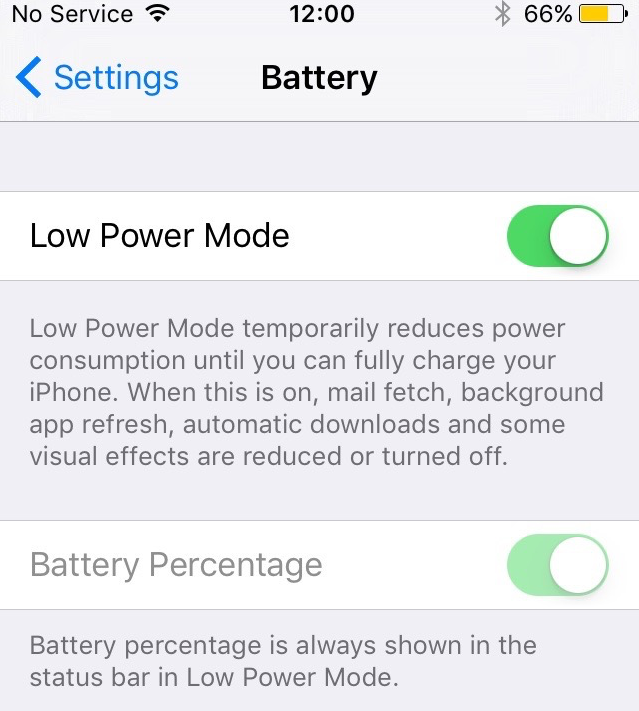
Low Power mode on iOS 9

The battery icon goes yellow but the phone goes on and on. Found through the new “Battery” mode in Settings.

iOS 9’s Low Power mode (found in a new Settings er, setting called “Battery”) isn’t on by default either, but when you hit 20% and 10% battery and the “20% battery” dialog comes up, you’ll get an option to activate it. And of course you can turn it on any time you like. When you recharge, it automatically turns off at 70% of charge. (Note: it’s only available on iPhones – not iPads.)

I’ve run my test phone on Low Power from 100% and got huge lifespans – around two and a half days, which included a fair bit of use. This is a big improvement. Note though that it will seriously slow down a lot of apps, and kills background refresh. But if you’re not using the phone for anything for a while, it’s great for extending the life. You’ll know it’s on: the battery icon turns an anaemic yellow. The screen brightness goes down, but I didn’t notice this particularly.

There’s also another battery-saving feature: if the phone is face-down (on a table, say), notifications don’t light the screen. Subtle, but worthwhile.

Even without using Low Power, I was getting good lifespans from both the iPhone 5C and iPad Air 2 I tested iOS 9 on: pretty much always better than iOS 8. This is unusual in a beta.

A poke in the eye for battery/storage upgrades

Low Power and the storage saving together represent something clever: Apple saying that battery life on its own and storage on its own aren’t enough to merit a device upgrade. After last week’s iPhone/iPad event, there was no shortage of people moaning that they’d rather have a thicker phone with a longer battery life, or more storage for the base model.

Actually: that wouldn’t drive new device sales, which is what Apple wants. A slightly thicker device wouldn’t suddenly last two days – you’d have to roughly double the thickness to get that. Furthermore, people would say “I’ll buy a battery add-on thanks – it’s cheaper.” This would Not Be Good for iPhone sales.

And storage: well, of course Apple upsells you from the low-end phone to the mid-range one. If you’re surprised by this… would it shock you to know that companies actually try to make profit? I find the argument about storage slightly tired; there’s more cloud storage available through Dropbox et al (though – shocker! – they will charge you too). But taking out unnecessary content from apps and the OS is a great way to reclaim some of that phone storage.

Parsimony in the cloud

Certainly, it’s annoying as hell that Apple only offers 5GB of iCloud storage – an amount that hasn’t changed since its introduction in 2011, although the prices for the larger storage amounts has fallen. 5GB isn’t enough for most people, but they equally can’t be bothered to update their storage, and certainly not pay for it.

Since 2011, the cost of storage has gone through two Moore’s Law cycles (halving in cost), so on that basis Apple ought to be offering 20GB for free. Then again, Dropbox only offers 2GB for free to begin with; it’s pretty easy though to upgrade that to 10GB through a few encouraging tweets, or used to be – I’m somehow at 10GB without paying anything.

iCloud backups don’t have to include your photos – iCloud Photo Library is a great way to get your photos into the cloud and out of the “iCloud backup” space. You can also get Dropbox to suck them up, or Livedrive, or of course Google Photos. iCloud backups remain terrific, though, and better than Android’s current offerings, because they back up all the app data, as well as most settings (excepting some mail and other important passwords). Some more would be nice, though.

Settings are now searchable
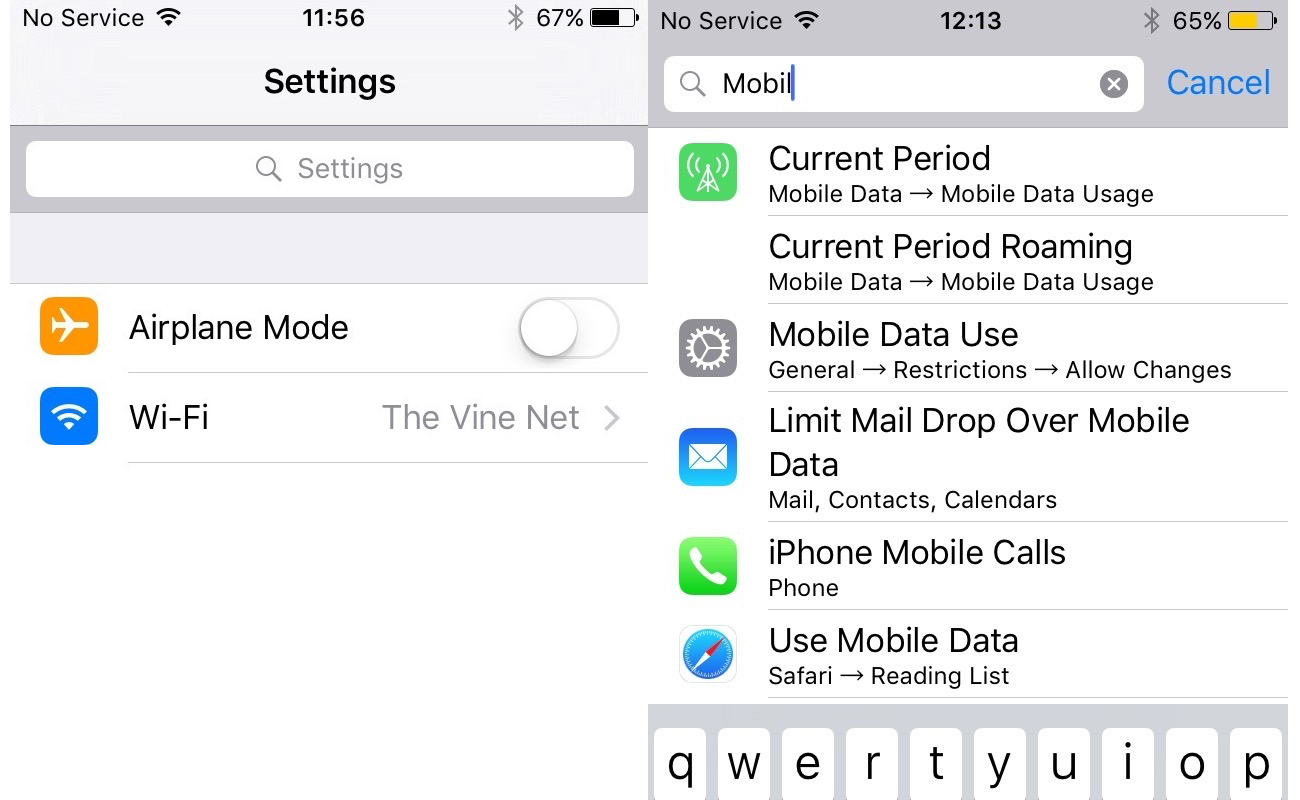
iOS 9: Settings are searchable

The Settings app is so giant that it needs its own search bar, and has done for a while. Go straight to Mobile Data, for example. At last.

Oh God I’ve been asking for this since forev… well, for a few years (iOS 6?) because Settings have become gigantic. Where does the passcode live? App Store restrictions? And so on. Now you just search (pull down in the main part of the Settings menu).

Keyboard: now in lower case
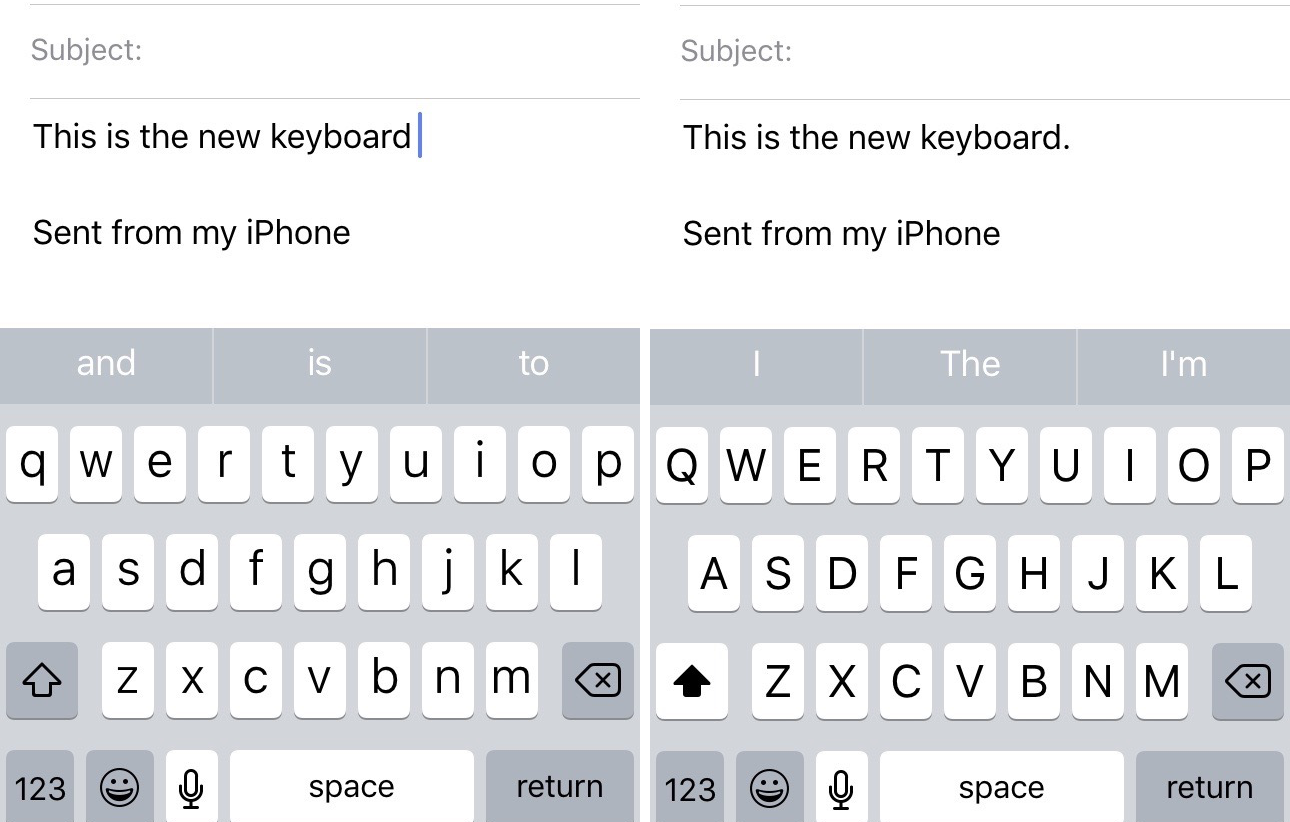
iOS 9 keyboard shows upper/lower case dynamically

iOS 9’s keyboard shows upper/lower case: end a sentence and it offers capitals. Don’t like it? You can turn it off.


Everyone else seems to be delighted that the keyboard now has upper/lower case – so that when you type, the keys Go Up And Down With Capitals. Personally, I find it distracting, even though I understand that for a lot of people this eases a frustration they’ve felt for ages. (Android users of course have had this since forever). If like me you don’t like it you can turn it off in Settings ➡️ Accessibility ➡️ Keyboard ➡️ “Show Lowercase Keys”.

A Back button? Sort of

Again, Android has had a “Back” button since forever. But it has UI/UX gotchas: if you pressed it, where would it take you? If you had jumped from one app into another (say from an email into the browser), would the Back button take you to the canonical place in the browser app – say, the last thing you had been looking at in the browser before that – or back to the email app? Usually it would be the email app, of course, but this wasn’t explicit.

The thing about the Back button is that it can be a user puzzle, but for a power user it’s great; if you’re the sort of person who keeps a mental stack of what you’ve been doing on the way through the phone, the ability to go back and back in time appeals. Windows Phone has had the same feature from its inception, so there’s clearly a perceived need.
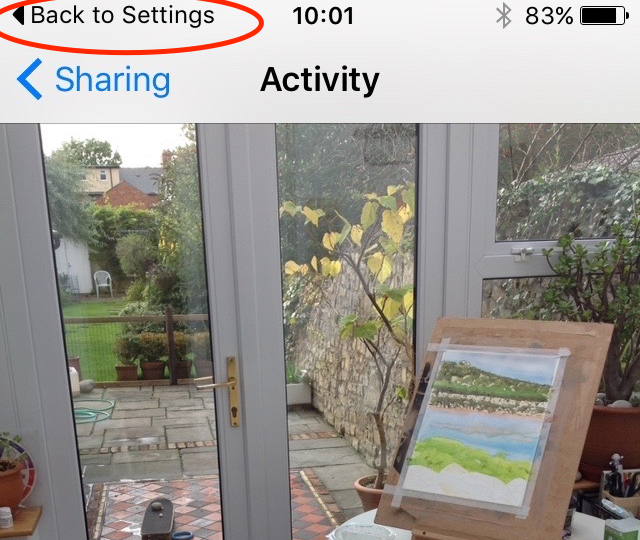
iOS 9 gets its own "back" button system

Which app did you come from? Want to get back there? Here you go – as long as you don’t lock the screen.

Apple has bowed to the (perhaps) inevitable, but done it in its own way. The “Back” instruction isn’t a button; instead it’s a tab at the top left of the screen telling you how to get back, and which app it’ll take you back to.

It’s generated when you follow a notification that pops into the top of the screen (and haven’t we all prodded one of those by accident?), or when you follow a link such as “Show in Calendar” from apps such as Mail or Messages.

I see this as having a dual purpose. First is a user frustration/behaviour thing. Watch people using an iPhone, and you’ll often see them follow a link from an app to another app, where they do something; then to return to the previous app, they press the Home button and then launch the previous app. That’s evidently wasteful, and though you can say “people should use the app switcher” (double-tap on the Home button) it’s clear that they don’t.

Second, implementing the “Back tab” helps with what I see as Apple’s intention to get rid of the Home button.

The Back tab is some distance from perfect. It obscures network settings such as mobile signal strength or Wi-Fi connectivity, and knowing about those is often more important to me than figuring out which app to go back to. It doesn’t persist across screen on/off (so if your screen locks and you unlock it, the signpost back is gone). It’s also in the most inaccessible part of the screen if you usually hold your phone in your right hand.

San where?

iOS 9 uses a new font – San Francisco. I’ll be honest: I never noticed. I’m not generally a font person, unless you try to replace a serif face with a sans-serif one, in which case I’ll punch you. It’s the same as that on the Watch, which in my experience is more legible than that on iOS 8. But I’ll leave the dissection of the curve on the “6” and the length of the descender on the “p” to others.

Proactive
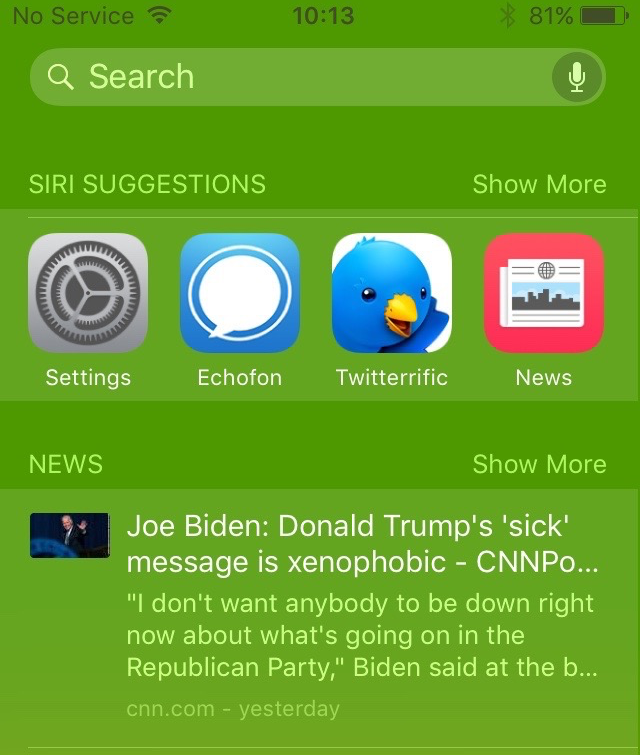
Proactive aims to fulfil search before you search

Maybe these are the apps you’re looking for? How about some news? Location-aware apps also come into play when you’re out and about.


Swipe left or downwards from the main screen, and you’ll get the phone-wide search that was there in iOS 7 and taken out (eyeroll) in iOS 8. But you also get “suggestions” – apps you might like, or if you’re out and about, things you might be looking for (food and petrol often came up). Proactive is hard to evaluate until you’re using something as your main phone for quite some time; I was using iOS 9 on a secondary phone. Like Siri, this may be one of those things that improves quite substantially once more people are using it.

The “Proactive” pane also now contains your recent contacts, with fast access to phone/messaging. Discussion is below in the “odds and sods” section.

Hey, Siri, how did you get better?

There’s no mystery in why Siri is better now than it used to be; more people are using it. Apple artificially restricted it to the 4S upwards on its introduction in 2011 (it had worked fine as a third-party app on lots of earlier phones, because it’s a network-connected service; Apple wanted to make it a reason to upgrade). Since then, hundreds of millions of people have been using it and processors have got faster, so there’s a huge corpus of data to work with. It’s great on the Watch; it’s getting used a lot now.

In iOS 8, a charging phone would respond to “Hey Siri” plus your query (eg “what’s this song” – always nice). In iOS 9, it’s available when not charging too. This could be problematic (news reports about Syria are often a cause), but there is training to your voice. We’ll see how this goes. And yes, Motorola did have this a couple of years ago. Apple, though, has been cautious about the potential battery hit. Plus, of course, it’s a temptation to upgrade.

Content blocking, and Safari everywhere
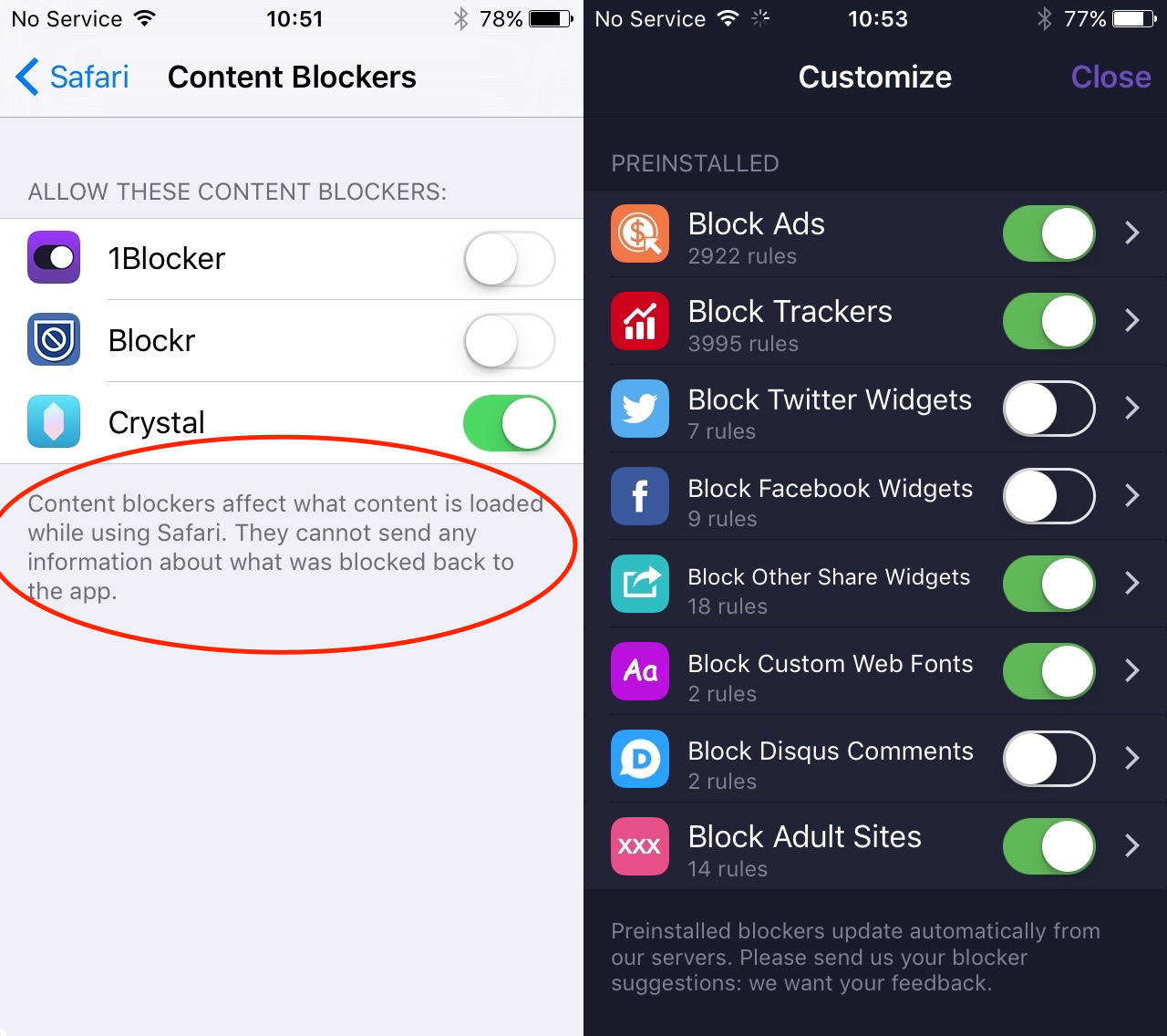
Content blocking in iOS 9

You enable content blockers in Safari’s settings. Some – such as 1Blocker, on the right, offer a lot of tweaking


Unmentioned in the WWDC keynote, but a “wow!” moment for those who twigged it, is the ability to block content – including websites and scripts – from Safari in iOS 9. On its own, that wouldn’t be so dramatic, but iOS 9 also lets any app that shows a web view, such as when you click a web link in a tweet (which usually brings up a proto-web browser inside the app) use Safari to do it, still inside the app.

This has a couple of benefits: if you’re viewing a page that needs a username/password (say, a subscription paper such as the FT or WSJ or Economist) then Safari’s iCloud Keychain can fill it in for you automatically; second, the aforesaid content blocks come into play.

And wow indeed – content blocking, aka adblocking, makes a big difference. Pages are cleaner, less annoying, load tons faster. There are going to be lots of people making good money from adblockers in the App Store very soon. Installation is straightforward: you download the “app”, and then in Settings ➡️ Safari ➡️ Content Blockers, and it will appear there as an option. As it says, none can send any information back about what they’ve seen or blocked. You can also configure particular things about the blocking within the apps themselves.

I tried three – Crystal, 1Blocker and Blockr. Crystal is simplest; Blockr the next; and 1Blocker has a huge list of options, making it super-tweaky configurable. Crystal and Blockr have already been approved for sale through the App Store.

Noticeable among 1Blocker’s blocking groups is “adult sites” – which suggests another use for content blockers inside enterprises, where IT departments, not to mention management, don’t want staff viewing Teh Pr0n on company phones. Locking them down and installing a content blocker is going to be popular, I think.

Note though that Content Blocking doesn’t work inside apps that use their own layouts – so Facebook is protected from this incursion. And as we’ll see, Apple’s own ad-served app is safe too.

Content Blocking will only work on 64-bit devices, which means the 5S upwards. This is due to compiler limitations (according to an Apple staffer.) This is frustrating, since they worked fine on my 32-bit 5C. Even so, I think Content Blocking is going to have a huge impact.

Public transport directions

Public transport in iOS 9 is back.. sort of

It’s fine if you want to go from Brighton to London to Edinburgh – just don’t try going any further.


Apple made much of how iOS 9 has public transport directions – something that had been missing ever since the ejection of Google as the mapping default in iOS 6 which left a huge gap for Google Maps and Citymapper and various others to work back in to. (Citymapper seems to get the usability vote.)

While it seems to be great if you live in China (300 cities!) or the US, it’s not that stunning in the UK. Major cities are covered (London, obviously) and major train routes (London to Brighton, for example, and Birmingham) but it’s far from comprehensive: no public transport data for Edinburgh or Glasgow, for instance.

Apple is updating these all the time, though, so this may be more of a stealth improvement, rather as has happened with Maps – which are unrecognisably better than when they launched in 2012.

Multi-window multitasking

On the iPad Air 2, and any other device with a large-enough screen and 2GB of RAM (the iPad mini 4, iPad Pro.. and 6S Plus? Not sure about the latter) you can bring in other apps by sliding in from the side (charming, you can hear Microsoft saying), and then scroll them simultaneously, and resize them – to half-and-half, or 3:2. No other sizing is allowed.
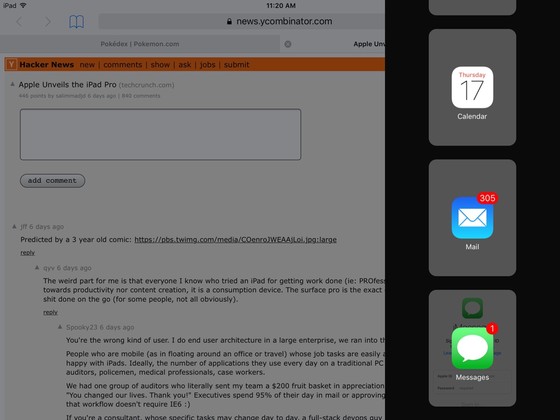
iOS 9 multitasking: browse in one, pick another app..

With one app running, pull in from the right and then swipe down for available apps..
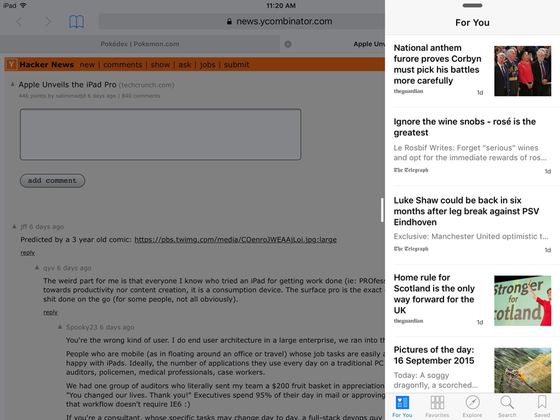

Choose an app, and both run at once

By default, the second app runs in a window two-fifths of the screen. But you can resize it..
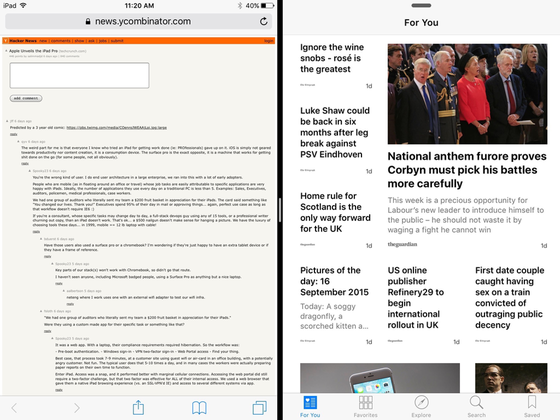

iOS 9 multiwindow resized

Two apps side by side on an iPad! Lap it up, folks.

Multitasking is one of those things where you need a specific use case; watching a video while you read something, perhaps, or (the one I found) copying data from a web page into a spreadsheet. Clearly it’s Apple chasing after business users who will have more uses like that than the average person sitting at home drifting through Facebook.

All the news that’s fit to.. something
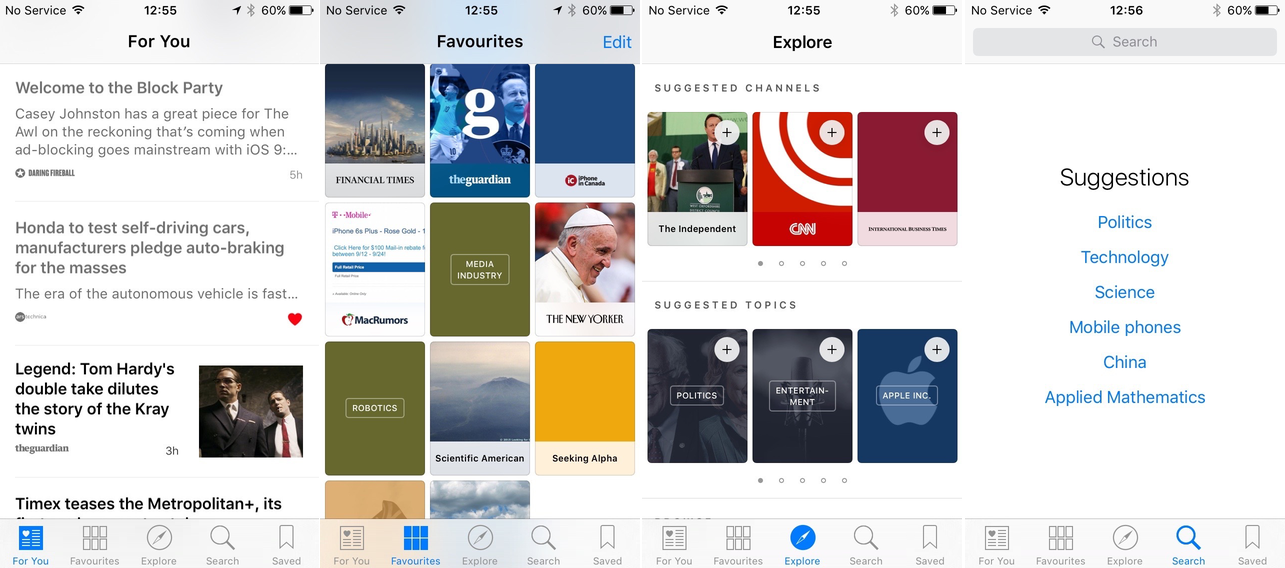
Apple News: broad

Rather like Apple Music, there’s “For You”, and then “Favourites”, “Explore” and Search. (I hadn’t saved anything).

Remember all the excitement over the new top-level domains, things like “.amazon” and “.balloons” and “.weboughtthisforbraggingrights”? Well, someone bought “.news” and now Apple (which didn’t buy it) is making use of it.

The Apple News app has a ton of sources, though in the beta I could only get access by changing my region to the US; once it’s live, it should be available in the US, UK and Australia.

I had mixed results; News only appeared in beta 3. I chose to get news about technology, science and business; I was nonplussed then to get CNN stories about celebrities. But more recently it has improved somewhat. I think that pressing the “Love” button at the bottom of a (read) story will improve the results you get.

You can share stories you read on Twitter or Facebook, and this is where the “apple.news” bit comes in – links you share begin “http://apple.news/”. This presumably means Apple can see what stories are getting the most traction and have been read.

For those who like a good conspiracy, note that Apple is offering its own publishing service into Apple News, and that this will be monetised via its iAd service (ie advertisers buy space on iAd, rather than just showing the publisher’s ads).

And guess what? Content blocking (aka adblocking) doesn’t work in Apple News. So if you follow a link to a story inside News, you see ads; if you open the same story in Safari when you have adblocking running, you don’t see ads. I predict this will have some publishers furious. I don’t see Apple retreating from having content blocking enablers on Safari, though. Get some popcorn.

Odds and sods

The app switcher (double click on the home button) is changed: rather than a side-by-side set of frames of the apps, it’s now an overlapping fan of the apps, which you pull to the right. Same method to kill apps (swipe them upwards).

The app switcher change also means that the “recent contacts” and “favourite contacts” that used to appear above the app switcher in iOS 8 are now in the Proactive search screen. Clearly, too few people used the app switcher, and too few used those contacts via the app switcher, for them to merit that space. (I can’t recall a time that I contacted someone via that above-the-app-switcher method.)

Notes have been updated so that they can do to-do lists, and alaso take your crude finger drawings, and you can stuff things into them from Safari via the share sheet. I didn’t test this, as if you update the format it’s not back-compatible with iOS 8 or earlier. (You get a suitably big warning.)

More camera folders. Selfies and screenshots get their own default folders, along with (deep breath) Favourites, Panoramas, Videos, Slo-mo, Bursts, and Recently Deleted.

Quick replies in all apps, not just Messages. When Notifications come down from the top of the screen, you could respond quickly in messages; now you can do it for all apps where replies are possible.

Folders can now contain other folders. So if you want to hide those Apple apps you can’t (yet) delete really thoroughly, here’s how.

Health

Health app: now with menstruation

All these are focussed on women. Good.


Look! It now recognises that some humans menstruate and ovulate. Amazing, sure. This was well overdue; it should have been in last year’s release, and would it have killed Apple to include it in a point release some time in the past 12 months?

There must be a load of other things that I’ve overlooked. Let me know what they are in the comments.

Adoption
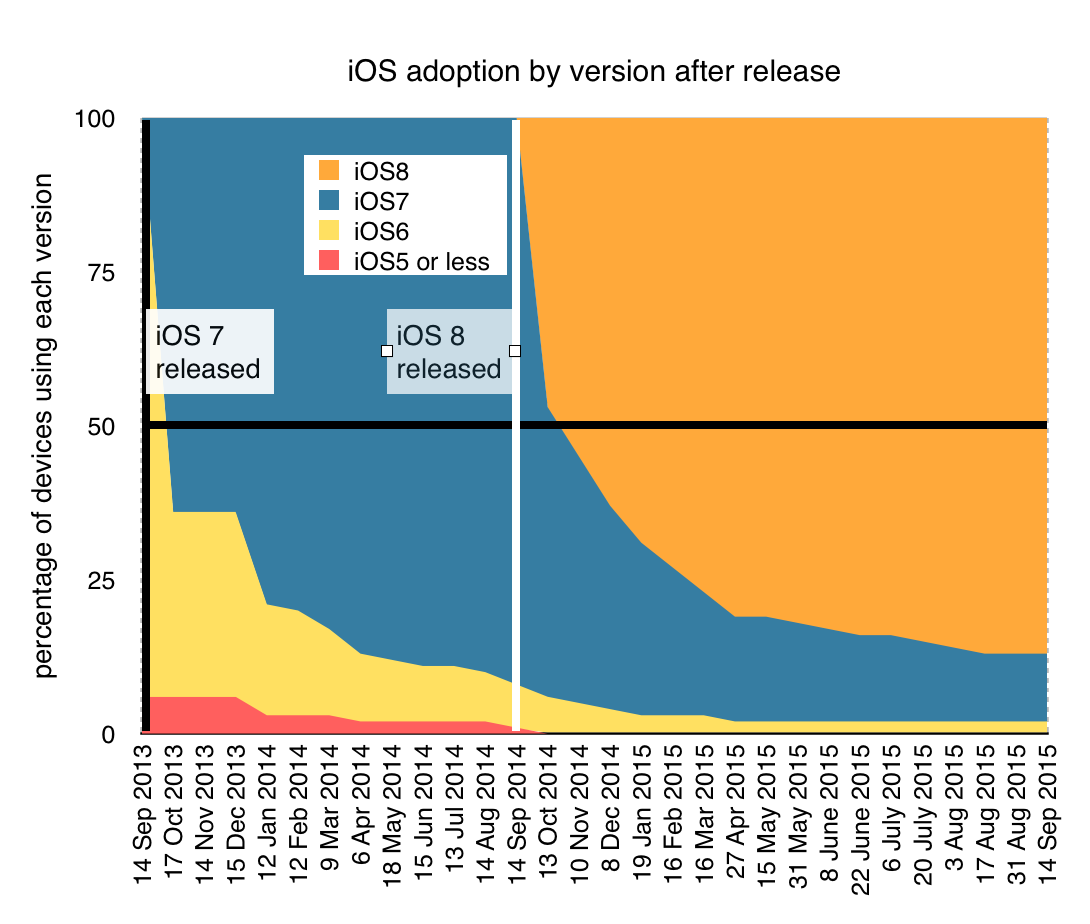
iOS 7 and iOS 8 adoption after release

Apple’s data shows rapid takeup of iOS 8 and 9; other sources such as Mixpanel and Fiksu confirm it

All these things – the longer battery life, the extra storage, the public transport directions, the content blockers (particularly those) – are going to be available from about 1700 GMT, if Apple’s servers can bear the crush. (There’s also a 9.1 beta available if you want to live in the future.) iOS 9 will run on every phone since the iPhone 4S, and iPads since the iPad 2. If you’re running iOS 8 on any of those, it should be an improvement in speed, battery life and storage.

We can predict that within a month or so, iOS 9 will have at least 50% adoption, based on previous experience: in the past two releases, it has hit 50% or more after five weeks.

That’s about 200 million or more iPhones, iPads and iPod Touches running it. All the changes in this – especially those four picked out above – are going to get a lot of discussion. Apple has been very canny. iOS 9 takes some ideas from Android – upper/lower keyboard, back button, low power – and made them slightly more usable. But then it’s gone to places that Android hasn’t, and made them a reason to stick with iOS. Content blocking in particular is tricky on Android – you have to download a specific browser and make it your default, or sideload an app; neither is a big pursuit. With mobile viewing so big, it might be a cold Christmas for some publishers. (Read my views on adblocking, if you haven’t already.)

Android fans will mutter about the things Apple has finally caught up with. But that misses the point. Apple is playing its own game: and this one is about keeping its existing iOS users loyal, and tempting non-users aboard with things that are both familiar and unavailable.

Should you upgrade? Yes. Back up first to iCloud (if you can – dammit) or iTunes. And then enjoy it.


Other stuff you might also like to read here:
Review: this is the worst Apple Watch ever. (Think about it.)
Analysis: Q2 2015: Premium Android hits the wall
Analysis: the adblocking revolution is months away in iOS 9 – with trouble for publishers, advertisers and Google

Start up: now on email!, video adblocking, Toshiba’s PC loss, iOS 9 for enterprise, and more


This is the hamburger menu you’re looking for. Photo by jpellgen on Flickr.

Hey! You can now sign up to receive each day’s The Overspill’s Start Up post by email.
You’ll need to click a confirmation link and then it should all roll on. (We’re still ironing out a few bugs in formatting for mobile but otherwise it’s perfect. Ish.)

A selection of 8 links for you. May contain nuts. I’m charlesarthur on Twitter. Observations and links welcome.

Adblockers hit another market: video » Monday Note

Frederic Filloux:

Using its thorough analytics, YouTube was first to understand that viewers should be given the opportunity to skip videos ads. This markedly increased the value of actually viewed clips.

But the damage is done. With ad blockers, the tragedy is that one bad apple contaminates the whole crate. Once installed, the adblocker will indiscriminately eliminate ads from all sites. The few that were willing to preserve a decent user experience were washed away.

Between April and June 2015, SecretMedia, teaming up with with JW Player, reviewed the data from one billion devices in 42 countries. Here, precautions are warranted: SecretMedia, based in New York, sells an anti-adblocking solution for video; its clients are mainly broadcasters. But even though SecretMedia has a vested interest in darkening the picture, its conclusions are consistent with other surveys in the US and Europe.

The point about the bad apple contaminating the crate is key. Oh well, iOS 9 comes out today – and tons of people will begin deploying adblockers. Let’s watch.
link to this extract


​Mozilla quietly deploys built-in Firebox advertising » ZDNet

Steven Vaughan-Nichols:

Darren Herman, Mozilla’s VP of Content Services, announced in May 2015 that “Suggested Tiles represents an important step for us to improve the state of digital advertising.”

Then, this summer, Mozilla quietly launched Suggested Tiles, the organization’s first commercial ad product. Well, it will be ads. At the moment, Mozilla claims it’s not getting paid for them.

Herman explained, “Since early August, we have been delivering promoted content provided by our first wave of partners including Yahoo, a number of top tier news titles including Fortune Magazine and Quartz, and mission-oriented partners such as the Make-a-Wish Foundation and the Electronic Frontier Foundation.”

Not sure that’s going to be popular.
link to this extract


Random thoughts on the new Apple TV » Medium

Ouriel Ohayon of Appsfire:

Most apps live out of ads. Most apps are Free. What was not said today is whether TV apps will be able to monetize with ads the same way iphone apps are monetized with ads. This is a big deal not just for monetization but also for discovery. Ads are one of the key channels for discovery and if no native ads are allowed in TV apps then the only way to get discovered is via the TV app store: meaning you have zero chance unless featured by Apple. I doubt Apple will completely ignore that question: Ads on TV can be a huge opportunity (including for iAds). They may not be ready for it just yet.

But what that means for app developers: get ready to suffer to get your free TV app (or paid app) discovered and monetized.

link to this extract


Toshiba loss on weak TV, PC sales boosts case for revamp » Reuters

Makiko Yamazaki:

Toshiba Corp swung to a first-quarter loss on weak PC and TV sales, raising pressure on its new chief executive to speed up a business revamp in addition to improving governance after a $1.3bn accounting scandal.

The laptops-to-nuclear power conglomerate reported an April-June operating loss of 10.96bn yen ($91m) on Monday compared with a ¥47.7bn profit a year earlier.

Specifically looking at the PC business – which is the one under stress – the Toshiba financials say “The Lifestyle Products & Services segment saw significantly lower sales, reflecting significantly lower sales in the Visual Products business, which includes LCD TVs, and the PC business, due to a shift in focus to redefined sales territories and other factors.
The segment as a whole saw deteriorated operating income (loss), reflecting deteriorated operating income in the PC and Home Appliances businesses.”

Specifically, the PC business shrank from a quarterly ¥169.4bn ($1.4bn) a year ago to ¥116.8bn ($970m) in the April-June period. And to a loss. How long can Toshiba’s PC business carry on?
link to this extract


Apple makes its biggest push to date into the enterprise » Re/code

Sean Ginevan, sr director of strategy, MobileIron:

With iOS 9, Apple is introducing features that will more easily enable IT to control iOS devices and automate provisioning of software. Using iOS 9, an enterprise can provision apps from the App Store silently, and disallow the user from installing their own applications. The operating system also makes it easier to place devices into supervised mode, which enables capabilities like disabling iMessage and locking device settings, round out the abilities to make an iPad Pro more suited to mission-specific tasks enterprise IT wishes to deploy them for…

…Three features have been introduced in iOS 9 that address that issue [of data going to non-managed devices]. The first allows enterprise IT to decide which applications are “managed,” meaning the data within them is owned by IT. Prior to iOS 9, if a user installed a business app from the App Store, then the app was “unmanaged” and could not interact with enterprise data. The user would have to reinstall the app over again through their corporate app storefront to make it managed. Now, enterprise IT can easily flag which apps are managed and reduce the user intervention required.

Second, iOS 9 provides enhanced controls over AirDrop. Prior to iOS 9, the only way to prevent corporate data from being shared with an unauthorized device was to turn off AirDrop completely. Now, enterprises can configure iOS 9 such that managed applications can’t have their data shared out via AirDrop.

Third, Apple decided that “simple passcodes,” will now require a minimum of six characters when a device with TouchID is enabled.

MobileIron is now up against BlackBerry/Good Technology in aiming to manage enterprise iOS devices.
link to this extract


Hamburger menu, the most recognizable thing on the planet » DeveloperTown

Randy Fisher:

Using eye tracking software, we ran 25 people through a series of tasks to gather viewing data. We used Google Inbox as the test site, but created two different versions that were presented at random. Version 1 was Inbox exactly as it is currently designed today with a hamburger menu, and Version 2 was another version we created with a horizontal menu of the same main menu choices hidden in the hamburger.

What happened next will [pick from menu above]
link to this extract


Why tablets are the future of computing » WSJ

Christopher Mims:

Take Intel’s coming line of Skylake chips, which CEO Brian Krzanich has said will enable thinner, lighter notebook PCs with better battery life. All of this will be possible because the chips will be more efficient, with some Skylake chips drawing less than 4½ watts, says IT analyst Patrick Moorhead.
“That power envelope is the first time you can do a fanless device, and fanless means thin,” says Mr. Moorhead. In other words, those svelte, MacBook Air-like “ultrabooks” Intel has been touting have the potential to turn into ultra tablets with detachable keyboards.

These devices won’t just be running Windows, of course, because manufacturers also have plans to sell them with Google’s Chrome operating system and even a version of the Android OS modified to function like a full desktop operating system.

What’s just over the horizon is a weird moment in computing history, when every major desktop and mobile OS, with the notable exception of Mac OS, will be competing on devices with the same ultra tablet form factor. With Windows 10, Microsoft has already blurred the lines between a mobile and a desktop OS, and now Google, Apple and others are following suit.

Arguably it should be “why 2-in-1s are the future of computing”, but it would make the headline unwieldy. Does this mean the Ubuntu Edge idea of a mobile phone you plug into a keyboard/display becomes feasible soon? It seems an idea that comes and goes – some times it’s good (Handspring had a good version in the early 2000s), some times it’s bad (Motorola Atrix).
link to this extract


Notebook retailers in Europe having difficulty clearing inventory » Digitimes

Aaron Lee and Joseph Tsai:

As the year-end holidays approach, the [upstream supply chain] sources are concerned that the retailers may reduce their notebook prices further in order to quickly clear up their inventory, but such a move is expected to greatly impact notebook brand vendors’ profitability and affect overall notebook sales in the second half.

The sources pointed out that brand vendors such as Lenovo and Hewlett-Packard (HP) have been encouraging their retail partners to stock up since May by offering them high commissions. However, weak demand and Windows 10’s failure to kickstart a PC replacement trend have caused the retailers to suffer from high inventory pileup despite their aggressive promotions.

Acer and Asustek Computer, neither of whom has used the high-commission strategy, are still expected to be affected as the retailers are selling competitors’ notebooks at a much lower price range, forcing the two firms to follow suit or risk losing market shares. Currently, Acer and Asustek take up about 30-40% of Europe’s notebook sales.

Asia Pacific is also seeing weakening notebook demand amid a slowing China economy. The PC market in the US is the only one seeing meaningful growth, but only US-based vendors HP, Dell and Apple will benefit.

I’d guess the “sources” in this story aren’t too far from Asus and Acer.
link to this extract


Once more: sign up to receive this and similar posts by email. (Start Up only – not posts from the rest of the blog.)

What Apple’s 3D Touch aims to do: replace the physical iPhone home button


Buttons: who needs ’em? Photo by H is for Home on Flickr.

Apple is a very measured company. It tends not to rush into things. It lays down the foundations, and then it builds on them.

Take the example of Apple Pay. Clearly, executives could years ago see the potential of NFC-based payments; any company in the smartphone business could. But how to implement it so that people would love using it, rather than tolerate it? As things stood three years ago, putting NFC into iPhones would be easy enough. However then you’d have to have an app or interface, and then the user would have to enter a PIN, and we all know that people are terrible both at remembering PINs, and at using long-enough ones for security. Google Wallet used an app+PIN method, and you had to be pretty determined to use it much.

For Apple, that’s too much work to impose on users, because if you’re trying to replace cash or card swiping (in the US) then you don’t replace it with something that’s more difficult and fiddly. It’s also part of why, despite there being millions of NFC-capable Android phones in the US, Google Wallet made no impact. The lack of NFC-capable tills in the US also played a big part – but Google Wallet never went outside the US, even though NFC-capable tills are plentiful in Europe. Clearly, Google’s heart wasn’t in it.

Make it simpler, stupid

So what’s a simpler yet more secure way to do payments? Biometrics, obviously, get around the “remember a password or PIN and enter it” hassle. Which biometric? Retina prints? Bit fussy. Fingerprints? Sure, because you’re already holding the phone. But that means having a reliable fingerprint reader. And NFC.

You see the elements: fingerprint reading, and NFC. Apple clearly saw the potential, so in mid-2012 bought a fingerprint reader company (the best on the market, apparently). It then integrated that into the iPhone 5S for September 2013.

But not NFC. Apple clearly could have put both fingerprint reading and NFC into its new phones at once. But it didn’t.

“Touch ID” laid the foundation for getting people used to using their fingerprints to unlock the phone – and an API meant the fingerprint reader could be used in other apps (Dropbox, etc) and to pay for stuff in the App Store or iTunes Store.

The plan, obviously, was to introduce NFC+fingerprint reading in the iPhone 6, when people would be used to the idea of the fingerprint as a “means to pay”. It also helped that it would be part of an upgrade path: 5S has fingerprint but no NFC; iPhone 6 has fingerprint and NFC. Clear differentiation, but also careful laying of foundations. By looking back, the path forward is obvious.

The path forward from 3D Touch

Now on to 3D Touch. It’s available under different names but the same concept on the new iPhones, some Macs (MacBook and some Retina Pros) and the Watch.

It’s clever – though as Chris Lacy and Ben Sandofsky discussed in The Blerg podcast just after the announcement, apps that are 3D Touch-enabled don’t seem to have any way to make that evident; only by pressing them do you discover whether they have that capability.

You can say that 3D Touch is just Android’s “long press”. It sort of is, and isn’t. The key difference is that long press didn’t have haptic feedback. It just happened: you pressed for longer than usual, and you got a laundry list of options. Google has deprecated “long press” in favour of “hamburger menus”, which are visible all the time on screen. This speaks to the point Lacy and Sandofsky make: user interface affordances that aren’t visibly signposted on a screen can be really hard to find. Apple should add some sort of edging or 3D effect to the icons to make this clear; perhaps app designers will find some common method of doing so.

With 3D Touch, you learn how much harder to press because you get a little pushback when you succeed; if you try pressing on something that doesn’t offer it (I tried the Settings app, hoping for a giant menu of settings – ha) then you get three quick low-intensity taps back, a sort of “nothing here” signal.

3D Touch can also invoke the app switcher: press on the left-hand side of the screen and you get the fan of available apps. (I found this tricky; press-and-roll the thumb inwards seemed to work best for me. Again, practice would improve it; the fingerprint reader used to be “hard” to use at first but is now second nature.)

So fast forward a bit, and in the near future you’ll have all sorts of apps offering 3D Touch capability right from the home screen. It has an API, so developers will surely be spending the next few weeks feverishly aiming for app releases on or around September 25 that use it.

What happens a year from now? Apple introduces new phones, and they of course incorporate 3D Touch. The iPhone 6 becomes the “low-end” model, and thus the only one without it.

But what this new interaction really enables is movement between apps, and quick jumps into apps, that don’t rely on your pressing the home button at all.

Note also how iOS 9 includes a “Back” button of sorts (in the top left corner, if you’ve come from one app to another, you can go straight back – rather than using the home button to invoke the app switcher).

(Screenshot from Jeff Brynes’s thoughts on iOS 9 beta 5)

What’s all that – the “back” button, the 3D Touch capability – about? It’s about not using the Home button.

You should never go Home

To date, the iPhone has been built around the Home button, yet it is increasingly an encumbrance: if you want to go to the icon screen, you have to press it. To get the app switcher, you have to press it. To switch between apps (unless you’re invoking something like “Create event” in Calendar from Mail) you have to press it.

That’s a lot of pressing, and I bet that mechanical failure of Home buttons is one thing that keeps showing up in Apple’s fault reports. Broken screens are easily replaced (and people can get by with broken screens for a looong time), but broken home buttons not so. Grit can get in. Water can get in. Constant movement isn’t ideal in electronics. You might say that it’s just tough if peoples’ Home buttons break, but compared to Android phones which don’t have them, it’s an obvious point of weakness – and customer dissatisfaction.

However, the Home button is needed as the place where your fingerprint is read. But that doesn’t need a moving home button; it just needs a circle of sapphire glass through which your print is read.

Are the foundations that have been laid becoming clear yet? In the new Macbooks and the Force Touch-enabled Retina Pros, the keypad seems to click when you press it. Seems to. Yet in fact it doesn’t move, as Matt Panzarino noted back in March:

The new trackpad does not move, at all.

When you ‘click’ it, it ‘clicks’, but it doesn’t actually click. There is an audible ‘click’ sound (that’s what the silly picture below is, me listening) and it does in fact feel like it clicks, but that is merely an illusion.

There is a set of vibrating motors underneath that provides ‘force feedback’, also known as haptics in some applications. This feedback fools your finger into believing that you’ve pressed down on a hinged button, the way your current trackpad works. This feedback relies on phenomenon called lateral force fields (LFFs), which can cause humans to experience vibrations as haptic ‘textures’. This can give you the feel of a ‘clickable’ surface or even depth. The Force Touch feature of the new trackpad allows you to press ‘deeper’, giving you additional levels of tapping feedback. The effect is done so well that you actually feel like you’re pressing down deeper into a trackpad that still isn’t moving at all. It’s so good it’s eerie.

What if – and it’s just speculation, you know, but what if – you were to put that “seems to move but doesn’t” technology into a phone? Yes, you’d have 3D Touch. That’s happened. But what if you put it into an iPhone home button? You could have something that seemed to move, and felt like it moved, but didn’t. You can double-click the Macbook trackpad; you could double-click a 3D Touch home button. But nothing moves. There’s just a piece of glass, and a sapphire circle for reading, and that’s it.

Think: when do you press the home button? When the phone is off and you’re enabling it, or to switch apps, or to get back to the home screen (so you can switch between app screens).

Most of the time – that is, time when you’re in apps – the Home button serves no purpose at all, except to be a grit-attracting water-allowing problem. Replacing it with a not-moving solid piece of glass would be a design and fault-resistance win.

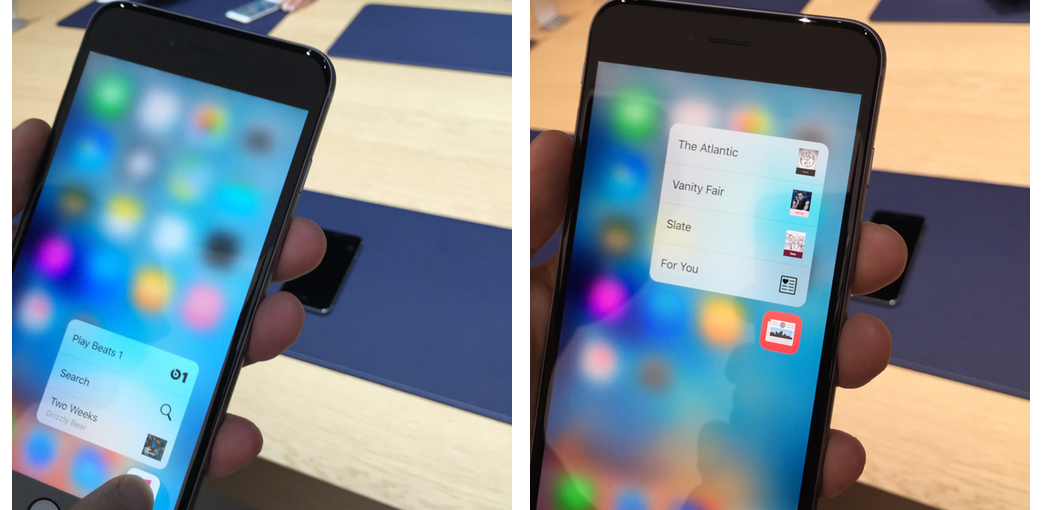
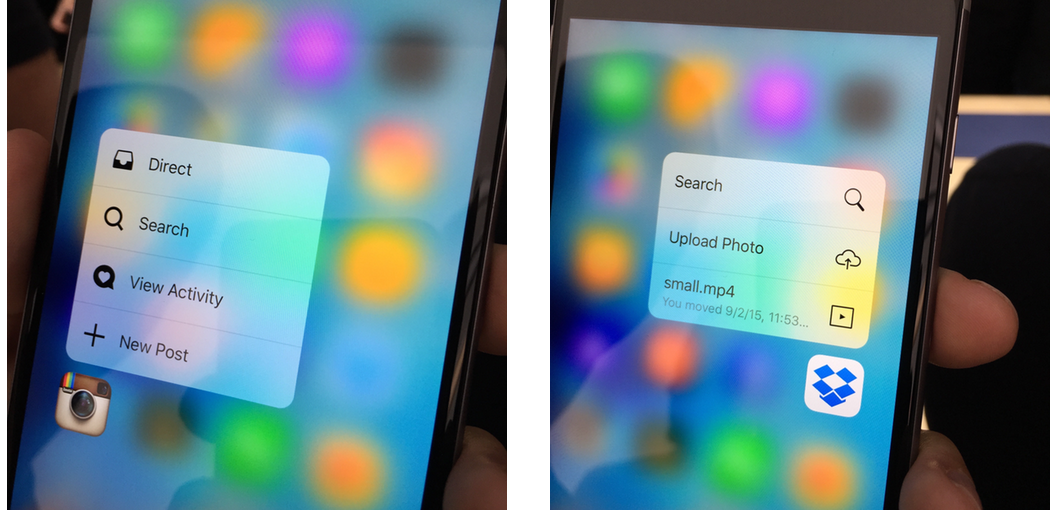
Here’s how 3D Touch works. In the pictures below, I’ve force-pressed on the relevant icons that you see highlighted from the main screen:

3D Touch brings up contacts

No need to enter the app – 3D Touch brings up recent or favourite contacts in Phone and Messages


Force.. er, 3D-touch on the phone or messages icon and you get your three most recent interactions (or possibly three top favourites for the phone – this may change)

Music and News are 3D Touch-enabled

3D Touch lets you jump straight into elements of apps such as Music and News


Want some Apple Music without opening the app? Or to go straight to News? It’s just a forceful touch away

3D Touch on Dropbox and Instagram

3D Touch on Dropbox and Instagram


Third-party apps can incorporate it too

And as I said, you can also use 3D Touch to invoke the app switcher (I had a picture, but it just looks like the app switcher). So you could, if you were determined, spend entire sessions and never touch the home button – except if you needed Siri (except that would be available via “Hey Siri”) or to make a payment. Only one of those needs a moving home button, and is replaceable too. (You can get to the main icon screen by invoking the app switcher then choosing the icon screen, so no home button needed there either.)

Is this reasonable? Quite separately, Neil Cybart has had the same idea:

Apple’s new 3D Touch feature not only brings an additional user interface to iPhone, but should be thought of as the missing piece for allowing iPhone screens to become even larger without increasing the iPhone’s form factor. 3D Touch begins to reduce the need for the home button, which has turned into a type of reset button used to switch between apps. By removing the iPhone home button and filling the additional space with screen real estate, the iPhone will only gain more power and capabilities when compared to devices like the iPad mini and Air.

His piece appeared after I’d drafted this. Cybart is smart, so I’m glad to find we’re thinking the same way.

Which means that…

Getting 3D/Force Touch into the Home button requires the technology to improve somewhat, and become dependable, and people have to get used to the idea. But after that, what becomes possible?

• The Home button stops being a separate physical element, and just becomes an area on the screen

• You can have a larger screen in the same form factor: you don’t need the black band at the bottom of the device where the home button lives (notice how Android OEMs have been able to enlarge the screen because they don’t have to have a physical button). Weird to think, but Apple could offer a smaller device with the same size screen, thus answering people who don’t like the physical size of the iPhone 6 but do like a bigger screen

• You don’t have the mechanical problems of a moving button

• You can provide clearer haptic feedback when people press the button – the difference between a long press (for Siri) and a double-press becomes evident to the user.

It all makes sense (as these things so often do). So, when will it happen? Only two choices really: next year, with the “iPhone 7”, or after that. Or, OK, third choice, never. I mean, perhaps Jony Ive is really wedded to having a moving home button. But I bet he isn’t. Getting rid of moving trackpads in the MacBook seems to me just the start; the first brick of the building. The Watch was the second part, and iPhones the next. Now wait for next year.

Start up: hacked ATMs in Mexico, Cyanogen + Cortana, iPhone forecasts, Apple TV v consoles, and more


Content blockers are days away from going live with iOS 9. Photo by Dave Lanovaz on Flickr.

A selection of 10 links for you. Wash at 40 degrees. I’m charlesarthur on Twitter. Observations and links welcome.

Should police have the right to take control of self-driving cars? » Techdirt

Karl Bode:

Just how much power should law enforcement have over your self-driving vehicle? Should law enforcement be able to stop a self-driving vehicle if you refuse to? That was a question buried recently in https://assets.documentcloud.org/documents/2388355/rand-rr928.pdf (pdf) which posits a number of theoretical situations in which law enforcement might find the need for some kind of automobile kill switch:

“The police officer directing traffic in the intersection could see the car barreling toward him and the occupant looking down at his smartphone. Officer Rodriguez gestured for the car to stop, and the self-driving vehicle rolled to a halt behind the crosswalk.

Commissioned by the National Institute of Justice, the RAND report is filled with benign theoreticals like this, and while it briefly discusses some of the obvious problems created by giving law enforcement (and by proxy intelligence agencies) this type of power over vehicle systems and data, it doesn’t offer many solutions.

That’s quite a question. Then again, would you try to make a getaway in an SDC?
link to this extract


Intelligent machines: Making AI work in the real world » BBC News

Eric Schmidt – you know, the Google guy – wrote a piece for the BBC’s machine learning week. Most of it is blah. Then there’s this bit:

In the next generation of software, machine learning won’t just be an add-on that improves performance a few percentage points; it will really replace traditional approaches.

To give just one example: a decade ago, to launch a digital music service, you probably would have enlisted a handful of elite tastemakers to pick the hottest new music.

Today, you’re much better off building a smart system that can learn from the real world – what actual listeners are most likely to like next – and help you predict who and where the next Adele might be.

As a bonus, it’s a much less elitist taste-making process – much more democratic – allowing everyone to discover the next big star through our own collective tastes and not through the individual preferences of a select few.

This is being taken as a dig at Apple Music with its human-curated lists. Well, sure, but the “radio” function in Apple Music isn’t human-curated. And music choice “democratic”? Isn’t that how it already works?
link to this extract


iOS dev: why Apple TV is game over for Xbox One and PS4 » Forbes

Dave Thier:

It’s hard to imagine an immediate threat to Microsoft MSFT -0.93% Xbox One and Sony PS4 running games like Halo and Uncharted. But I talked to Jeff Smith, CEO of the popular Karaoke app Smule , and a developer who’s been with the iOS platform since the beginning. He says that Xbox One and PS4 fans shouldn’t be too quick to dismiss the Apple TV as a serious gaming contender. The key, he says, is that Apple is a developer-friendly platform, and that means more content, and, as iOS has shown, more quality content as well.

“We think it’s significant if you consider the console market today: it’s been a market where there have been high barriers of entry to get into that market,” Smith says. “You have to get Sony and Microsoft or Nintendo to get you on to the platform, you have to have a custom deal, and they’re all proprietary platforms. With Apple bringing tvOS, which is a subset of iOS, onto a console-like platform, we think it lowers the barrier of entry. And I think you’ll see a lot more developers on the console market than ever before.”

Suitably overdone headline, but it’s certainly a mistake to dismiss the Apple TV out of hand. It has an install base of 25m, which isn’t much (the PS3 and Xbox 360 are at about 70m, the PS4 and Xbox One rather less so far), but the next version will attract a lot more people. And you don’t need to pay to put a game on iOS.
link to this extract


Tracking a Bluetooth skimmer gang in Mexico » Krebs on Security

Brian Krebs:

“–Sept. 9, 12:30 p.m. CT, Yucatan Peninsula, Mexico: Halfway down the southbound four-lane highway from Cancun to the ancient ruins in Tulum, traffic inexplicably slowed to a halt. There was some sort of checkpoint ahead by the Mexican Federal Police. I began to wonder whether it was a good idea to have brought along the ATM skimmer instead of leaving it in the hotel safe. If the cops searched my stuff, how could I explain having ultra-sophisticated Bluetooth ATM skimmer components in my backpack?”

The above paragraph is an excerpt that I pulled from the body of Part II in this series of articles and video essays stemming from a recent four-day trip to Mexico. During that trip, I found at least 19 different ATMs that all apparently had been hacked from the inside and retrofitted with tiny, sophisticated devices that store and transmit stolen card data and PINs wirelessly.

In June 2015, I heard from a source at an ATM firm who wanted advice and help in reaching out to the right people about what he described as an ongoing ATM fraud campaign of unprecedented sophistication, organization and breadth. Given my focus on ATM skimming technology and innovations, I was immediately interested.

Krebs gets up to some amazing jaunts.
link to this extract


Google found guilty of ‘abusing dominant market position’ in Russia » WSJ

Olga Razumovskaya and Alistair Barr:

Google has been found guilty in a rapid Russian antitrust probe, a spokesperson for the country’s antitrust regulator told The Wall Street Journal.

In February, Russia’s Federal Antimonopoly Service opened a probe into Google for alleged anticompetitive practices related to how the company bundles apps with its Android mobile operating system.

The company was found guilty of “abusing its dominant market position,” but not of “unfair competition practices,” the regulator told The Wall Street Journal.

The Russian agency will have 10 business days to issue its ruling on the case in full. “We haven’t yet received the ruling,“ Google’s Russia spokeswoman said. “When we do, we will study it and determine our next steps.”

Form an orderly queue behind the EC, Canada and the rest, please, Russia. Also, how do you have dominance abuse but not unfair competition?
link to this extract


Cortana on Cyanogen: CEO Kirt McMaster on building the next great smartphone OS » IB Times

David Gilbert:

Cyanogen has not announced any partnerships with hardware manufacturers beyond what is already on the market, but to really reach the masses, it will have to partner with a well-known name – and for companies like Sony, HTC and LG, all struggling to make Android work, Cyanogen could be an enticing option.

Of course, with Microsoft’s Lumia range failing to capture any significant market share since the company bought Nokia’s mobile phone division, it, too, could be on the lookout for something new.

While McMaster tells it like it is about Microsoft’s smartphone woes, he says Microsoft is still a great company and builds great services, one of which is going to be key in building the next version of Cyanogen – and that is Cortana.

Microsoft’s digital personal assistant has grown significantly since it began life on the company’s smartphones and this summer had its biggest update to date when it was deeply integrated into Windows 10 and Microsoft’s Edge browser.

McMaster revealed that Cyanogen is working with Microsoft to deeply integrate Cortana into the next version of Cyanogen OS. This is key to catapulting Cyanogen into the mass market, he asserts: Cortana is currently available as an app on Android, but in order for it to make a real difference, it needs to be able to be integrated at the OS level so that its full potential can be leveraged.

So how would that work in a phone running Google services? Wouldn’t Cortana and ‘OK Google’ fight like cats in a sack?
link to this extract


Next up: iPhone preorder sales data » BTIG Research

Walter Piecyk:

The focus of investors is squarely on the number of phones that can be sold over the next three and a half months. Our estimate is that it can sell 80 million units in the December quarter versus a consensus view that expects little to no growth this year. We believe 3D touch is a much bigger deal that many think and wrote about that and our hands-on experience with all of Apple’s new products. (Link). Of course the bigger issue is that 70% of existing iPhone users are carrying 5s or older models, of which the 6 and 6S models are big upgrades. As we have discussed in the past, the lower hurdles to upgrade those phones in the United States could be a key driver of sales.

Last year at this time Apple shipped 74.5m phones; only Samsung has previously shipped 80m or more smartphones in a quarter (which it’s done four times).

link to this extract


Hands on with three iOS 9 content blockers: 1Blocker, Blockr and Crystal » TechCrunch

Sarah Perez:

ahead of iOS 9’s release, a number of companies and indie developers have been building content blockers of their own and testing them out with iOS 9’s sizable group of beta testers.

While many consumers will likely gravitate toward AdBlock Plus because of their familiarity with the brand’s name and reputation, there will be a good handful of new apps on the horizon as well, which are also worth a look.

As she says, you can choose from super-twiddly, a bit twiddly, and simple. I’d bet that simple will actually be the one people pick.

Meanwhile…
link to this extract


Advertisers complain about format & approval obstacles with iOS 9’s News app » Apple Insider

Roger Fingas:

Although publishers like CNN, Time, and Vox are making most of their content available in the app, some are said to be planning to offer a few dozen stories a day at most. Standouts in that sense include companies that depend on paid subscription models, such as the New York Times and Wall Street Journal.

Some ad executives have complained that common tools like real-time placement bidding aren’t in place for the News launch, and that Apple is requiring 48 hours notice before approving a campaign. The company is also allegedly demanding that pre-roll ads before video segments get their own approval.

Apple is moreover refusing to support Google’s DoubleClick ad platform. Edward Kim, a member of the online marketing company SimpleReach, argued to the Post that Apple is attempting to use News to build up iAd. That platform has struggled to gain ground in a market dominated by Google — whereas Google ads can reach virtually any device, iAd is unusable in some key spaces, like Android.

“Real-time placement bidding” is what quickly leads to malware and “bounce you out to App Store install” ads.
link to this extract


Google reveals plans to increase production of self-driving cars » The Guardian

Mark Harris (who has done so much great original reporting on this topic):

[Sarah] Hunter [head of Google X] also shared new details about how the existing driverless prototypes work. “All [the car] has is a ‘go’ button, a ‘please slow down and stop’ button and a ‘stop pretty quickly’ button,” she said. “The intention is that the passenger gets in the vehicle, says into microphone, take me to Safeway, and the car does the entire journey.”

Advertisement

Google’s self-driving cars currently require highly detailed maps of the areas they’re operating in, with centimetre accuracy of road features like lanes, roundabouts and traffic lights. They are also limited to 25mph so that Google could get them on to public roads without expensive and time-consuming crash tests. Even more importantly, they need safety drivers able to take control back in an instant if the system malfunctions. California is slowly working on regulations that will pave the way for the operation of completely driverless vehicles by the public.

All of this means that Google is unlikely to move its self-driving technology into full production any time soon. “We haven’t decided yet how we’re going to bring this to market,” admitted Hunter. “Right now, our engineers are trying to figure out … how to make a car genuinely drive itself. Once we figure that out, we’ll figure out how to bring it to market and in which way. Is it something that we manufacture at scale for sale to individuals? Or is it something that we own and operate as a service?”

Is it a taxi, a bus or an owned device? Seems trivial; actually gets to the heart of what a “car” is.
link to this extract


Start up: Samsung Pay to win?, Apple on Siri/Photos privacy, mystery ministry mujahadeen hack, and more


Scanning the content is only half the battle. Photo by JonathanCohen on Flickr.

A selection of 12 links for you. Not valid in Montana. I’m charlesarthur on Twitter. Observations and links welcome.

Lockpickers 3D print TSA master luggage keys from leaked photos » WIRED

Andy Greenberg:

If you have sensitive keys—say, a set of master keys that can open locks you’ve asked millions of Americans to use—don’t post pictures of them on the Internet.

A group of lock-picking and security enthusiasts drove that lesson home Wednesday by publishing a set of CAD files to Github that anyone can use to 3-D print a precisely measured set of the TSA’s master keys for its “approved” locks—the ones the agency can open with its own keys during airport inspections. Within hours, at least one 3-D printer owner had already downloaded the files, printed one of the master keys, and published a video proving that it opened his TSA-approved luggage lock.

Those photos first began making the rounds online last month, after the Washington Post unwittingly published (and then quickly deleted) a photo of the master keys in an article about the “secret life” of baggage in the hands of the TSA. It was too late.

link to this extract


Samsung Pay: the mobile wallet winner? » Mobile Payments Today

Will Hernandez:

During a panel discussion about the current state of ATMs, bitcoin, and mobile wallets, ATM Industry Association CEO Mike Lee unapologetically threw his support behind Samsung Pay as the mobile wallet that will “win.”

Lee’s Samsung Pay endorsement can be boiled down to a single feature that is supposed to separate it from other mobile wallet providers: magnetic secure transmission technology support on the device itself. 

Samsung acquired the rights to the technology when it bought LoopPay earlier this year, and has since embedded it into Galaxy S6 and Galaxy S6 Edge smartphones. The devices still rely on NFC chips to enable users to conduct tap-and-pay transactions at contactless-enabled point-of-sale terminals. Should contactless be unavailable, MST can “communicate” with the magnetic stripe reader currently present on all terminals in the United States. Samsung Pay will sense which option is available and transact accordingly.

But whether MST is really that true game changer in the industry remains to be seen.

link to this extract


Apple addresses privacy questions about ‘Hey Siri’ and Live Photo features » TechCrunch

Matt Panzarino:

With ‘Hey Siri’, “In no case is the device recording what the user says or sending that information to Apple before the feature is triggered,” says Apple.

Instead, audio from the microphone is continuously compared against the model, or pattern, of your personal way of saying ‘Hey Siri’ that you recorded during setup of the feature. Hey Siri requires a match to both the ‘general’ Hey Siri model (how your iPhone thinks the words sound) and the ‘personalized’ model of how you say it. This is to prevent other people’s voices from triggering your phone’s Hey Siri feature by accident.

Until that match happens, no audio is ever sent off of your iPhone. All of that listening and processing happens locally.

Live Photos:

Because Live Photos record motion before your still image, they are continuously buffered beginning the moment you open your camera app and see the Live icon (orange circle) at the top of your screen. Apple says that this 1.5 second recording only happens when the camera is on, and this information is not permanently saved until you take a picture, period.

“Although the camera is “recording” while you’re in Live Photo mode, the device will not save the 1.5 seconds before until you press the camera button,” says Apple. “The pre-captured images are not saved to the user’s device nor are they sent off the device.”

The 1.5 seconds after the still capture are also recorded because you’ve tapped the camera button in live mode.

From what we’ve gleaned, Live Photos are a single 12-megapixel image and a paired motion format file, likely a .mov. They are presented together by iOS but are actually separate entities tied to one another.

link to this extract


With iOS 9, ‘Hey Siri’ gains a new setup process tailored to your voice » Apple Insider

“Appleinsider Staff”:

Setting up “Hey Siri” is a simple, five-step process where users must speak a number of commands. If the iPhone or iPad does not properly hear the user, they are instructed to speak again.

Users say the words “Hey Siri” three times, then “Hey Siri, how’s the weather today?” followed by “Hey Siri, it’s me.” Once this is completed, iOS 9 informs the user that “Hey Siri” is ready to use.

Previously, in iOS 8, “Hey Siri” was enabled without a setup process. On occasion, the voice-initiated function would not work properly and took multiple tries. Presumably Apple’s new setup process will address some of those issues from iOS 8.

Smart to personalise it, if that is what this is. I’ve had Siri go off while plugged in and the radio’s on: stories about Syria tend to be the cause. Not sure this will help any iPhone-owning newsreaders, though.
link to this extract


App Programming Guide for tvOS: On-Demand Resources » Apple Developer Documents

On-demand resources are app contents that are hosted on the App Store and are separate from the related app bundle that you download. They enable smaller app bundles, faster downloads, and richer app content. The app requests sets of on-demand resources, and the operating system manages downloading and storage. The app uses the resources, and then releases the request. After downloading, the resources may stay on the device through multiple launch cycles, making access even faster.

Each app stored on Apple TV is limited to a maximum of 200MB. In order to create an app greater than this amount, you must break up your app into downloadable bundles. In Xcode, create tags and attach them to the required resources. When your app requests the resources associated with a tag, the operating system downloads only the required assets. You must wait until the assets are downloaded before you can use them in your app.

So many people saw the headline that each app is limited to 200MB and thought that that is the upper limit for everything related to an app on AppleTV. As this clearly says, it isn’t – and note also that point about “After downloading, the resources may stay on the device through multiple launch cycles, making access even faster.”

But reading dev documents takes effort. Tweeting “200MB OMG” is much simpler.
link to this extract


Whatever happened to Google Books? » The New Yorker

Tim Wu on the project that has been stalled since 2011:

There are plenty of ways to attribute blame in this situation. If Google was, in truth, motivated by the highest ideals of service to the public, then it should have declared the project a non-profit from the beginning, thereby extinguishing any fears that the company wanted to somehow make a profit from other people’s work. Unfortunately, Google made the mistake it often makes, which is to assume that people will trust it just because it’s Google. For their part, authors and publishers, even if they did eventually settle, were difficult and conspiracy-minded, particularly when it came to weighing abstract and mainly worthless rights against the public’s interest in gaining access to obscure works. Finally, the outside critics and the courts were entirely too sanguine about killing, as opposed to improving, a settlement that took so many years to put together, effectively setting the project back a decade if not longer.

link to this extract


Who controls the off switch? » Light Blue Touchpaper

Ross Anderson (who leads some of the UK’s best academic security researchers:

We have a new paper on the strategic vulnerability created by the plan to replace Britain’s 47 million meters with smart meters that can be turned off remotely. The energy companies are demanding this facility so that customers who don’t pay their bills can be switched to prepayment tariffs without the hassle of getting court orders against them. If the Government buys this argument – and I’m not convinced it should – then the off switch had better be closely guarded. You don’t want the nation’s enemies to be able to turn off the lights remotely, and eliminating that risk could just conceivably be a little bit more complicated than you might at first think. (This paper follows on from our earlier paper On the security economics of electricity metering at WEIS 2010.)

Anderson doesn’t need to scare people for money. But what he points to is often worrisome.
link to this extract


Cabinet ministers’ email hacked by Isil spies » Telegraph

So this is how modern media – well, I use the word “modern” in its loosest sense – works. Writing this story took four journalists, so please stand up, Claire Newell, Edward Malnick, Lyndsey Telford and Luke Heighton, for this 22-paragraph story which begins:

Jihadists in Syria have hacked into ministerial email accounts in a sophisticated espionage operation uncovered by GCHQ, the Telegraph can disclose.

I know! Blimey, you think. Hacked in to their accounts? They must have found a ton of stuff there, right?

You then plough on through tons of paragraphs about drone strikes and various bits of handwaving, but no detail. You carry on, and eventually – in the 13th paragraph – there’s this:

The recent cyber threat first emerged in a warning to Whitehall security officials in May and it is understood that the plans to attack Britain were exposed by the GCHQ investigation.

It is unclear what information the extremists were able to access, but it is understood that no security breaches occurred. However, officials were told to tighten security procedures, including changing passwords.

And that’s it. No more detail. So what do we think actually happened? Based on this very thin gruel, my guess is that the ministerial email had two-factor authentication, and someone got phished, and it set all sorts of alarm off in Cheltenham (where GCHQ is). No breach, but someone had been very stupid.

And of course “hacked” in the headline is overplayed. “Targeted” might work. Classic Sunday journalism: no paper will be able to follow this up for a Monday story, because there aren’t any facts to it. The story falls apart in your hands.
link to this extract


Ten years later, this is how Techmeme has avoided clickbait, autoplay ads, and more » LinkedIn

Gabe Rivera, the site’s chief executive and frequent editor:

In 2015, supporting an online news operation with advertising when your page view and unique visitor numbers aren’t massive is always an uphill battle. Media sites in this predicament are often tempted to run ads units that pay more but repel and infuriate readers.

Fortunately what Techmeme does have is the attention of the people who lead the tech industry. (Ask your CEO “where do you get your tech news?”) When a news destination is a hub for industry decision-makers, companies will want to reach its readers, making it possible to sell the far more welcome form of “ads” that Techmeme does include. These include posts from sponsors’ blogs, catchy taglines from companies that want you to check out their job openings, and events that companies want you to consider attending. While not all companies are used to making these sorts of marketing buys, many are learning how, and Techmeme is here to serve them.

link to this extract


FBI says ‘Australian IS jihadist’ is actually a Jewish American troll named Joshua Ryne Goldberg » Brisbane Times

Elise Potaka and Luke McMahon:

The Australi Witness persona fooled members of the international intelligence community as well as journalists, with well-known analyst Rita Katz of SITE Intelligence Group saying the “IS supporter” held a “prestige” position in online jihadi circles and was “part of the hard core of a group of individuals who constantly look for targets for other people to attack”.

Ms Katz has previously acted as a consultant for US and foreign governments and testified before Congress on online terrorist activities.

The Australian Federal Police were unaware of Australi Witness’s real identity as Goldberg until contacted by journalists working on behalf of Fairfax Media.

On the internet, nobody knows you’re a troll.
link to this extract


Why Xbox Kinect didn’t take off » Business Insider

Matt Weinberger:

The Kinect also introduced voice commands and a gesture interface to the Xbox 360 itself. You could pause a movie with your voice, or log in to your account on the console by standing in front of the camera.

But as cool as that all sounded, the Kinect was still a new technology, and there were some glitches with those cool new interface tricks.

“It does do magic, but only 85% correctly. When you encounter the 15%, it’s frustrating,” the former Xbox insider said.

Serious gamers care about precise movements, like landing a perfect Super Combo in “Street Fighter IV” or nailing a headshot in “Call of Duty.” Similarly, if you have voice controls for a movie, it had better work the first time, or else you’re just shouting “pause” at your TV over and over.

In both cases, it wasn’t quite the totally accurate experience that people wanted.

“It’s essentially a less precise replacement for a lot of things which, once the novelty wears off, is not valued by the market. So it’s real value is for new experiences impossible before without it. There isn’t enough interest or investment in those,” the ex-insider says.

Worse, the longer people used Kinect, the more they found places and situations where it just fell short and didn’t work as well as it should have.

In my apartment, playing a Kinect game requires moving furniture around to give the sensor the field of view that it needs to work well. It’s a big problem for lots of gamers, since you need 6 to 10 feet between you and the sensor.

Try playing that in a dorm room or small apartment.

Yes, precisely.
link to this extract


iPad Pro won’t replace the PC any time soon » Teschspective

Tony Bradley:

Perhaps the biggest change that has occurred over the past few years that makes the iPad Pro viable as a potential PC replacement is Microsoft. The shift in strategy by Microsoft to embrace the cross-platform ecosystem and make Microsoft Office and other key Microsoft products available across rival devices removes one of the biggest obstacles for the iPad as a laptop replacement. Microsoft was at the Apple event this week and stood on stage to reveal that it has improved apps developed specifically for iOS 9 and the iPad Pro that will make Microsoft Office arguably better on the iPad Pro than it is on a standard Windows PC or even on the Surface Pro 3 itself.

The flip side of that, though, is that the iPad Pro still runs iOS. It is still primarily a mobile device trying to be a PC—whereas the Surface Pro tablet is a PC trying to be a mobile device. Not much has changed since my experience using the iPad as a laptop replacement for 30 days. It is still a suitable device for a limited range of tasks and applications. It still won’t work as well as a traditional PC for a number of specific functions.

More importantly—at least as it relates to the ability of the iPad Pro to compete with Windows PCs in a business environment—it can’t run the software that organizations have already invested in and rely on to get things done.

Thus you have the bear (pessimist) case on the iPad Pro. But it’s that last sentence which betrays the flaw in the argument. Lots of organisations can’t get the new things done they want to on older systems. An iPad begins as a mobile device; the Surface yearns to be a laptop (just look at its screen ratio).
link to this extract


Start up: Uber’s China fight, Stagefright goes public, women and Apple, Wileyfox reviewed, and more


Feast your eyes: you’ll never see its like again. (Hopefully.) Photo by MarkGregory007 on Flickr.

A selection of 10 links for you. Use them wisely. I’m charlesarthur on Twitter. Observations and links welcome.

Inside Uber’s fight with its Chinese nemesis, Didi Kuaidi » WSJ

Fabulous in-depth piece by Eva Dou and Rick Carew:

Both companies have sought to woo drivers with bonuses to those who rack up rides. Uber has offered larger bonuses in an effort to catch up in scale, earlier this year giving as much as 7,000 yuan weekly to Beijing drivers who completed a high number of rides—quadruple a traditional taxi driver’s wages, according to drivers. Both companies have bonuses for individual rides during peak times and smaller bonuses for individual achievements, such as referring friends or getting high ratings.

Now the challenge for both is keeping drivers and riders while weaning them off bonuses and coupons.

Yang Yang, a 33-year-old Uber driver in Beijing, says bonuses are increasingly difficult to get. He stays on the road 12 to 14 hours a day to qualify for the weekly bonus, using minty salves to stay awake.

The lure of bonuses has led drivers to game the system. Uber and Didi Kuaidi battle drivers who book fake rides—known as “brushing” in China. In brushing, the scammer will typically pose as both driver and rider, essentially paying himself multiple times to build up enough fake business to win a bonus.

Rings of scammers use specialized software bought online to rack up fake rides while they sit at home, drivers interviewed say. They say they get calls and texts from people offering to help them scam Uber for a fee. Didi Kuaidi is suffering less from the problem, according to drivers, as its lower driver bonuses are less of a draw.

I love how people find ways to game systems like this; it’s the thing that definitely keeps us a step ahead of the damn robots.
link to this extract


The Washington Post has begun blocking the ad blockers » BuzzFeed News

Matthew Zeitlin:

“Many people already receive our journalism for free online, with digital advertising paying only a portion of the cost,” a Washington Post spokesperson told BuzzFeed News.

“Without income via subscriptions or advertising, we are unable to deliver the journalism that people coming to our site expect from us. We are currently running a test using a few different approaches to see what moves these readers to either enable ads on The Washington Post, or subscribe.”

There’s a kind of Cold War brewing between publishers who say that ad blocking software cuts off the lifeblood of free media online, and readers who complain about pages crammed with garish ads and intrusive trackers, which make many sites bloated and slow to load.

Not sure it’s a cold war. It’s about to get a lot more heated: iOS 9 comes out next week, and the content blocking apps will all be lining up for it.
link to this extract


Android Stagefright exploit code released to public » Threatpost

Michael Mimoso:

[Joshua] Drake, vice president of platform research and exploitation at Zimperium zLabs, said in July the bug could affect more than 950m Android devices. He chose not to publish exploit code at the time, giving Google time to push patches to the Android Open Source Project and subsequently to handset manufacturers and carriers. He originally planned to release exploit code on Aug. 24.

Google, meanwhile, wasted no time in changing the way it releases security updates for Android, announcing at Black Hat that it would send monthly over-the-air updates its Nexus phones. The move was mirrored by others, including Samsung and LG, and the first Nexus updates included patches for Stagefright. Silent Circle also patched its Blackphone and Mozilla patched Firefox, which uses Stagefright code in the browser.

Stagefright is the name of the media playback engine native to Android, and the vulnerabilities Drake discovered date back to version 2.2; devices older than Jelly Bean (4.2) are especially at risk since they lack exploit mitigations such as Address Space Layout Randomization (ASLR) that are present in newer versions of Android.

The problem is that Stagefright is an over-privileged application with system access on some devices, which enables privileges similar to apps with root access.

When the tide goes out, you discover who’s been swimming naked, or hasn’t put on their security trousers.
link to this extract


Focusing on the full picture with data » FlowingData

Nathan Yau:

I don’t know the full context of this discussion, but in the interview below, Hans Rosling talks to media person Adam Holm about why we shouldn’t use the media to form our opinions about the world. Media person disputes. Rosling puts foot on table and says Holm is wrong.

This is terrific. Enjoy.

Rosling also gave a TED talk in 2014: “How not to be ignorant about the world“.
link to this extract


Wileyfox Swift: Brit startup budget ‘droid is the mutt’s nuts » The Register

Alun Taylor:

If someone asked me what my ideal smartphone would be I’d say one that costs no more than £120, has 16GB of storage, at least 2GB of RAM, a 5-inch IPS screen, a removable battery, two SIM slots, space for a microSD card, the best iteration of Android available (that’s the Cyanogen OS Android fork, in my opinion) and is waterproof.

There’s nothing revolutionary about the Swift’s design, it’s just smart and well made
Wileyfox’s new Swift actually fails to meet two of those criteria – the cost is £130, and there’s no waterproofing. But as we’ll see, considering the rest of the package, it’s very easy to forgive those two failings.

In an increasingly competitive market the Swift is up against the likes of the Motorola Moto G and Sony Xperia M4 Aqua, both of which we have reviewed recently. And both of which are rather more expensive at £189 (for the 2GB RAM version) and £199 respectively.

Along with price deflation, Android is splitting into niches, as well as software specialisation – such as the use of Cyanogen here. This is great value; it’s not going to sell in huge volumes (simply because of supply chain constraints) but it’s where the Android market is going.
link to this extract


Bullshit, selfies and Photoshopped smiles: Apple’s iPhone 6S announcement was a joke » Gadgette

Holly Brockwell is pissed off and she isn’t going to take it any more:

It’s no secret that I’m far from Apple’s biggest fan. In fact, despite what Reddit seems to think, I’m firmly Team Android. But that doesn’t mean I don’t give Apple credit where it’s due – it’s just that it seems to be due less and less these days. Last night’s announcement was their worst yet.

Her principal complaint seems to be “these things have all been done before!” along with “there was a Photoshop demo using a woman’s face!”. The “where were the women?” thing seemed to become a mini-meme on Twitter. Perhaps I was missing the bit where Jen Folse came out and demoed Apple TV entirely on her own. Or where a female doctor showed off the iPad Pro, again, entirely on her own. Or a female entrepreneur from Gilt showed what she could do on Apple TV. Sure, there were more men. But that’s true in pretty much any tech event.

My wife constantly quotes a friend says you can divide the world into drains and radiators – some suck you dry, some warm you up. I prefer radiators. Which is why I love this tweet from Lia Napolitano, who used to work on the Apple TV team, praising Folse, who still does.

link to this extract


Production of new 21-inch iMac begins, say Taiwan makers » Digitimes

Aaron Lee and Joseph Tsai:

Production of a new 21-inch iMac featuring a 4096 by 2304 screen kicked off in early September and will be launched in the fourth quarter, with shipments in the quarter estimated at 1.4m-1.5m units, according to Taiwan-based supply chain makers.

With shipments from existing iMac products, Apple’s overall all-in-one PC shipments could surpass those of Lenovo in the second half.

The sources pointed out that the new 21-inch iMac only has a limited change in industrial design, but is upgraded with better hardware specifications, especially the Ultra HD display.

This will probably be no more than a press release from Apple. The current 21in iMac is 1920 by 1080 pixels – so this is going to be an amazing screen.
link to this extract


Amazon finally stops selling the Fire Phone, as company adjusts its hardware strategy » GeekWire

Tricia Duryee:

It’s taken more than a year, but Amazon has finally exhausted its supply of Fire Phones.

At least that appears to be the case based on the phone’s product page, which now lists the device as “currently unavailable,” with an additional note in the buy box, stating: “We don’t know when or if this item will be back in stock.”

That’s true for both the 32GB and 64GB models.

A year ago I calculated that no more than 35,000 had been sold. I wonder what the final number was.
link to this extract


Electronic noise is drowning out the Internet of Things » IEEE Spectrum

Mark McHenry, Dennis Roberson and Robert Matheson:

it is expensive to trace RF [radio frequency] pollution to a source and, when you do, it is often challenging to get offenders to stop offending.

The coming Internet of Things is going to make things worse. Much worse. It will do so by adding complex RF-control chips to countless common devices, like door locks, light switches, appliances of every type, our cars, and maybe even our bodies, which will enable them to connect to the Internet. Each of these chips is a potential source of noise. Plenty of technological fixes are available, of course, but the huge number of chips means that manufacturers will be more reluctant to add costly shielding and other noise-muffling features to their products. Silence is golden: It costs money to get it.

link to this extract


Apple promo video confirms the 6s has a smaller battery » TechCrunch

Fitz Teppper:

a 3D Touch promotional video released by the company seems to confirm that the 6s will indeed have a smaller battery than the iPhone 6. Specifically, GSMArena discovered that the video shows a shot of the battery marked “1715 mAh”, which is less than the iPhone 6’s 1810 mAh battery.

The extra space gained from reducing the device’s battery is most likely being used to fit new, larger components like the Taptic Engine and Force Touch-enabled display.

It’s important to note that this doesn’t mean the device will provide fewer hours of usage. In fact, Apple’s specs on the 6s show that the device will have the exact same talk, Internet browsing, and video playback time as its predecessor. This is most likely due to increased power efficiency in the new phone.

In my (beta) experience, iOS 9 has better battery life than iOS 8. Have to see how the rest of it plays out. Safe bet though that “smaller battery!” will be found in the comments sections of many blogs in the days – months even – to come.
link to this extract


Start up: how 3D Touch was made (and what it’s like), adblock wars redux, why PC makers want gamers, and more


“What’s the call quality like?” LG’s next big growth market. Photo by stevec77 on Flickr.

A selection of 9 links for you. Use them wisely. I’m charlesarthur on Twitter. Observations and links welcome.

Apple TV Pre-Reprecussions » iLike.code

Nat Brown:

Apple TV will draw more people to gaming on televisions, so “television-based gaming” as a category will grow due to Apple TV in the near term. Consoles will continue to meet a very clear consumer demand for higher-end gaming using gamepads, though many independent game developers and even high-end publishers will abandon lagging consoles over time for the less restrictive Apple TV market as the Apple TV silicon matures, and for PC gaming on Steam (and with luck on Windows). If Apple introduces a gamepad or has a strong attach rate for third-party MFi gamepads, I expect a lot of current console buyers will within a few years find Apple TV’s performance, price-point and more appealing catalog of gamepad content their choice over the next Microsoft or Sony consoles, if those even get built.

Very true in the US, where Apple TV has more of a role (because box sets without ads sure beat the crap TV with ads) but less so in countries like the UK, I think.
link to this extract


LG Electronics looks to washing machines to keep spinning profits » WSJ

Min Jeong-Lee:

just as Samsung Electronics Co. and Sony Corp. have become more dependent on other business areas like components rather than mobile devices, LG is looking to its less-glamorous appliances’ unit to secure modest-but-steady profit growth.

“The mobile and TV businesses tend to have a lot of ups and downs. The home appliance business, meanwhile, is less vulnerable to swings,” Jo Seong-jin, LG’s home-appliance chief, said in a recent interview with The Wall Street Journal.

LG’s revenue for appliances—based on local currency value—is up about 13% so far this year, and operating profit margins in the division of about 4.5% to 6% will be “attainable” this year, he said. While far short of the double-digit margins enjoyed by Apple Inc., those levels will outshine LG’s other key business units and that of Samsung’s appliances unit, analysts say.

Washing machines. Washing machines.
link to this extract


How are artists actually using Apple Music Connect? » Musically

Stuart Dredge looked at some data from the past 10 weeks:

What are they posting? Two kinds of posts seem to be dominating Connect: photos – often cross-posted from Instagram, which suggests that artists (or often their social teams) think Instagram’s visual aesthetic and Apple’s new social service. And secondly promotional messages: encouraging fans to stream songs or albums on Apple Music, pre-order albums on iTunes, or – in the case of artists who are involved with the Beats 1 radio station – posts about their shows.

What’s missing, so far, is the kind of exclusive, engaging stuff promised at the Apple Music launch. In June, Apple’s services boss Eddy Cue said that Pharrell Williams would be posting photos, lyrics and raw mixes of songs – but at the time of writing, he’s posted a single photo two months ago.

Connect isn’t a ghost town: based on the iTunes and Facebook-based lists above, if you followed 30 popular artists on Apple Music, your Connect feed would have between 24 and 33 new posts a week – or 3-5 a day. That might actually be a nicely-manageable complement to the information blur on Twitter and Facebook IF the updates were more than just promotional messages and reposted photos.

It’s still early days, and I’d expect Apple to be working hard to encourage artists not just to use Connect, but to use it well, in the months ahead. As things stand, it is not delivering on its potential. But that potential is there.

link to this extract


iPhone 6s and iPhone 6s Plus first look: Hands-on with 3D Touch » IB Times

Me! I was there:

on the new models, which go on sale on 25 September in 12 countries including the UK, a hard press on an icon generates a subtle “tap” against the fingers holding the phone.

If the app can do something, you feel a single tap on your fingers, and a menu pops up; if it can’t (because it hasn’t been enabled, or the options don’t make sense) there’s a subtler triple tap, and nothing happens.

It needs a quite different approach from the normal “delete” push; you have to intend to make it happen. In the few minutes I was able to try it out, I quickly got used to the difference – which is helped by the haptic feedback. Practice would likely make perfect, or at least more familiar.

The “left-hand-side” press is not easy at first – it’s a sort of push-and-roll for the thumb. The process for getting the haptic pop is simpler. It’s not the sort of thing you’d find by accident in a hurry, though.

I also wrote hands-on for the iPad Pro and Apple TV; check the IB Times site for those later today (Thursday).
link to this extract


How Apple built 3D Touch » Bloomberg

Josh Tyrangiel gets the sort of prebrief/access that you’ll recall the New Yorker got a year back:

in lieu of the usual polite deflection, Federighi picked up an iPhone 6S and explained one of 3D Touch’s simpler challenges: “It starts with the idea that, on a device this thin, you want to detect force. I mean, you think you want to detect force, but really what you’re trying to do is sense intent. You’re trying to read minds. And yet you have a user who might be using his thumb, his finger, might be emotional at the moment, might be walking, might be laying on the couch. These things don’t affect intent, but they do affect what a sensor [inside the phone] sees. So there are a huge number of technical hurdles. We have to do sensor fusion with accelerometers to cancel out gravity—but when you turn [the device] a different way, we have to subtract out gravity. … Your thumb can read differently to the touch sensor than your finger would. That difference is important to understanding how to interpret the force. And so we’re fusing both what the force sensor is giving us with what the touch sensor is giving us about the nature of your interaction. So down at even just the lowest level of hardware and algorithms—I mean, this is just one basic thing. And if you don’t get it right, none of it works.”

It’s a great article that (especially if read with the New Yorker one) gives you an increasingly clear view of how Apple’s design process works.
link to this extract


Analyst suggests this may be the last big iPhone launch » PC Retail

Dominic Sacco:

Argus Insights CEO John Feland predicts that “Apple has one good cycle left in them, barring any earth shattering innovations”.

“This upcoming round of iPhones is likely to be the iPhone’s Farewell tour,” he said. “Market demand of future handsets will not be as high because the innovation pipeline has apparently run out of good (compelling enough for consumers to upgrade) ideas.

“iPhone sales are unlikely to hit the same peaks at next year’s upgrade cycle as the level of smartphone saturation tips to replacement over new users.

Noted for future reference. He’s certainly right about saturation, but the odd thing about saturation is that in theory it means you have more people who could upgrade at any given time than in an unsaturated market.
link to this extract


Samsung to cut 10% of head office staff, Economic Daily says » Bloomberg Business

Jungah Lee:

Samsung is targeting workers in the human resources, public relations and finance departments, Korea Economic Daily reported Tuesday, citing people it didn’t identify. The Suwon, South Korea-based company also plans to cut some expenses next year, the report added. Samsung declined to comment in an e-mail.

The moves come after new high-end Galaxy smartphones failed to impress consumers, triggering five straight monthly declines and wiping out more than $40bn in Samsung’s market value since April. The company’s share of global smartphone shipments fell more than 3 percentage points in the second quarter, and it’s no longer the top seller in China, the world’s biggest mobile-phone market.

“Cutting jobs is the easiest way to control costs and Samsung’s spending on mobile business could also be more tightly controlled,” said Chung Chang Won, an analyst at Nomura Holdings Inc. in Seoul. “Samsung’s preparing to tighten its belt as it isn’t likely see rapid profit growth in the years to come.”

Subsequently, Samsung has denied this, saying a number of employees are being “relocated”. To their homes?
link to this extract


After selling his company to Google, this man now wants to block ad-blockers » VentureBeat

Paul Sawer:

While [Ben] Barokas was cagey about the specifics of how the technology works, he did refer to a blurring of lines between ads and publishers’ content.

“There are many nuances, but at a high level our platform makes it harder for ad-block software to distinguish advertising from content,” he said. “We believe we can recover pretty much any advertising that exists today.  We have started with direct-sold brand campaigns because they tend to be of higher value to publishers and higher quality to users.”

Barokas said that dozens of ComScore 500 publishers are currently using the platform, but he didn’t reveal any specific details yet regarding the uptake of Sourcepoint, other than that demand has been “overwhelming,” far-exceeding its most optimistic projections.

I was discussing this topic on Twitter the other day and it occurred to me that advertising is a classic example where those who consume aren’t the customer. Advertisers buy space with publishers, but the people to whom those ads are shown aren’t involved in the transaction. This means there’s no way for them – that’s you and I, the readers – to show our displeasure except via adblocking. (A similar disconnect occurred when Microsoft was trying to displace the iPod: it sold music for enabling Windows Media music playback to Windows Media music player makers, not to listeners. That breaks the feedback loop.)

In that sense, adblocking is peoples’ way of speaking up in the transaction. It’s somewhat all-or-nothing, though.
link to this extract


The PC industry is betting big on gamers » The Verge

Vlad Savov:

The PC gaming market produced $21.5 billion in hardware sales last year, according to data from Jon Peddie Research, which is more than double the revenues derived from console sales. More notably, unlike the broader PC market, which continues shrinking, gaming PC sales are projected to increase over the next couple of years. The JPR analysis suggests the biggest chunk of gaming PC revenue — somewhere in the vicinity of 44% — comes from the so-called enthusiast segment, which the researchers identify as “very performance and style oriented, much like sports car owners.”

Sports car PCs are exactly what we saw from the big manufacturers at IFA. Acer’s Predators, whether it be on the desktop or in the form of pseudo-portable laptops, ape Lamborghini’s angular shapes and aggressive motifs throughout. Asus, with its Republic of Gamers sub-brand, does the very same. From overclocked monitors to otherworldly arachnid routers, both of these Taiwanese companies are pushing as hard as they can to give conventional, commoditized products the veneer of a fresh attitude and personality.

The very apt comment from Sameer Singh, industry analyst at App Annie: “Predictable response when facing disruption – flee upmarket.” (The source of the disruption fits in a pocket and also makes phone calls.)
link to this extract


This is the worst Apple Watch ever. (Think about it.)


Watches could get smaller yet. Photo by JonChanLon on Flickr.

Late in September 2001, Apple invited some American journalists to a little event on its campus. The invite said “Hint: it’s not a Mac.”

The original iPod invite in 2001

Not a Mac? Maybe a printer?

The product turned out to be the iPod – a music player that, as Slashdot’s editor Cmdr Taco famously remarked of its specifications that it had “No wireless. Less space than a [Creative Labs] Nomad” and hence was “Lame”.

We all know how the story turned out; the iPod trampled all the rivals in the space, capturing interest in music players at the time when phones weren’t quite capable of doing all the things one might want from a music player on the move. At the very least, an iPod was easier and faster to load up and navigate than even the phones that were around then.

But look at what the original iPod looked like. If you come across one now, it seems a giant hulking thing. 5GB of storage on a spinning hard drive! It weighed 184g, and had a volume of 124.9 cubic centimetres. It didn’t sell that well either.

Talking ’bout a second generation

Then in July 2002 the second-generation iPod came out: this had a touch-sensitive wheel, double the storage capacity (for an extra 3g in weight) in a package with a volume of 118.7 cubic centimetres – very slightly less volume, you’ll notice.

Fast forward four years from the original, to September 2005, and you had the iPod nano – 4GB of storage, 42.5g (that’s a quarter of the weight), in a volume of 24.9 cubic centimetres (that’s one-fifth of the original’s volume).

iPod evolution visualised

It started big and got smaller (and bigger)

It’s pretty obvious what happens: Apple optimises along certain hardware improvement axes. Screens got larger and added colour while the body got smaller and the controls remained largely the same (even the screenless iPod shuffle has similar controls to its parent, though without the moving scroll wheel).

So the first generation is just the beginning. The hardware will improve in various ways. The question is, which?

Experience: a perfect teacher, if you’re willing to learn

And so we come to the Apple Watch. I’ve been testing one loaned to me by Apple for about four months now. It’s a classic case where a hurried verdict won’t work. Reviewers who tried to decide on its usefulness in a weekend of testing missed the point, I think. There are two things to bear in mind about the Apple Watch (and arguably any smartwatch):
• the products you see now are version one. Everything about them is going to get better
• these are products which have to find a place in your life: every person only understands them in the context that they fit into their own life

The first point is the one that’s easiest to overlook. I’ll lay out the easy criticisms first, because it’s staringly obvious if you look at the iPod data above that lots of these are just hardware issues that will vanish as time goes by.

So here are easy criticisms of the Apple Watch:
• the display doesn’t always detect when you’ve rotated your wrist to view it, so doesn’t always light. This is definitely my biggest bugbear; so sometimes I have to tap the display. Is this a software/gyroscope thing? Definitely. Can it be improved by an update? I’d bet on it.
• the display isn’t lit all the time, so you can’t always see the time. Is this a technology thing? Yup – Android Wear watches have solved this already, so this is not out of reach. (Implementing this would also solve the first problem.)
• the battery doesn’t last for 50 years. In fact, the question people have asked me most often about it is “does the battery last all day?” to which I honestly can answer “Yup”. I often find I can get up to two days or so. If I’m wearing a watch, I don’t like taking it off at night; I like to be able to see the time. So I tend to put the Watch on “power reserve” overnight, which uses about 1% of battery during my typical sleeps, and then charge it first thing in the morning. You can pretty easily get two days of use if you don’t do a lot of exercise. Ben Wood of CCS Insight makes the excellent point about wearables in general: every time you have to take them off to charge them increases the chance you won’t put them back on, perhaps ever.
• third-party apps are slow to load. Uh, yeah. They’re running off the phone, which is talking back and forth with them via Bluetooth. This is going to be solved to a large extent by Watch OS2, due for release imminently. In fact Watch OS2 might fix a number of these things, at least to some extent.

All these things – battery life, display technology, processor speed – are works-in-progress. They haven’t reached an endpoint. You can bet that they will get better, and possibly quite quickly. Think about that in the context of those annoyances listed above.

Now here are the things where it seems to me the Watch is a huge advance on just having an iPhone:
• maps and directions. On the very first day I started using the Watch, I had to walk to another venue. I put the destination in on my phone, started the directions, put the phone in my pocket, and the watch took over – with the Taptic Engine tapping my wrist to indicate it was time to turn left or right (two for left, three for right). Walking along and looking occasionally at your watch is a lot more comfortable than gazing into your phone, or taking out your phone anxiously to see what you should do. (This is the first use that I cite to anyone who asks what it’s useful for; and when I tell them, they get an “ooh, useful” look.)

The same applies when driving – getting direct tactile feedback when a turn is coming up is a hell of a lot more useful than having to glance back and forth from the road to a screen. (The husband of a friend apparently likes the direction system so much he attaches his to his steering wheel. I don’t recommend this.)

• The Taptic Engine is a hell of a useful thing: together with the sounds, it lets you distinguish between an incoming message, a phone call, a calendar event coming due, a notification from another app (I find Dark Sky’s rain warnings helpful), and so on. Again, it’s something you just don’t get elsewhere.

• not having to be tethered to my phone. Of course, your phone still has to be in range (though once Watch OS 2 comes out, only on a Wi-Fi network that both your Watch and phone recognise). I’ve had the experience of being one floor up doing some DIY and having a phone call coming in to my phone a floor below. I took the call on the watch.

• quick responses to (or ignoring) messages. When a message comes in, you can see what it is and ignore it, use a pre-filled response, or dictate a reply. Siri is darned good on the dictation.

• the exercise measurement. I know that this is like Skinner boxes (pretty much the first thing I did was to turn off the “stand at 10 minutes before the hour” notification), but having something passively measuring how much activity you’re doing makes you consider it. Jim Dalrymple’s post on the huge effect that small but cumulative actions can have is inspiring; to that extent, I don’t care if the heart monitor is 100% accurate, as long as it’s consistent. And it seems to have a pretty clear idea of how much physical activity I’ve done in a day. Again, you don’t get that psychological benefit by testing for a weekend.

• it’s personal. Everyone sets their Watch up differently. I like having the “multiple” face, on which I have sunset/sunrise (this matters to me, for domestic reasons); exercise rings; time; day and night temperature highs and lows (this also matters, for domestic reasons; and the charge. There are tons of other things I like – being able to advance songs on the phone, or to like/hate songs on Apple Music, and so on.

The hardest part of using an Apple Watch is definitely getting the notifications under control. It would be easy to have everything on it; but you don’t need email, or tweets, or Instagram, or a ton of other things. The value is in having only the things that are very important to you; in that sense the Watch becomes a sort of proxy assistant (though one you have to set up yourself) which filters most of the crap out. You decide what of the crap you want to have.

Do you believe in the future?

I thought the reaction of the fashion industry to the Watch might be indicative. Apple courted it intensely ahead of and after its launch. There’s not much sign of how much penetration it has achieved there.

But those who would like to call the Watch a flop are, as usual, premature. If you’d seen the first six quarters’ sales of the iPod, you’d have concluded that that was a flop too. Here’s how they looked:

iPod sales - first six quarters

The pattern for iPod sales at the start isn’t encouraging.

Pretty terrible, right? The sixth quarter is below the very first quarter, for a product that was only on sale for part its first quarter. And yet the iPod went on to define an industry.

What happened after those six quarters? Here’s the view over 13 quarters, with the sudden growth coming after the introduction of the iPod mini – which, let’s note, had a capacity of 4GB (less than the original, or the “classic” iPods then available, which started at 15GB) but a weight of only 104g (compared to 158g for the larger “classic” version) and a volume of 58.7 cubic centimetres, compared to 99.6 cubic centimetres for the “classic” version then on sale.

iPod sales over first 13 quarters

That looks healthier.

Clearly, people like lighter and smaller – a trend that Apple has been happy to fulfil with its phones. I can’t see it not doing exactly the same with its Watches as time progresses. Will they be as useful?

Put it this way: do you really think that the smartphone is the endpoint of communications development? Do you think that communication cannot get any more personal? Smartwatches are already showing us that actually, you can do more, and do it even more personally. (Samsung’s out in the lead by adding 3G capability to its models; again, do you think smartwatches will never want that?)

U say UX, I say choices

What about the fact that the Apple Watch is sort of squarish, while Motorola and most recently Samsung have gone for a round face? (Samsung has a particularly nifty UI involving turning the top of the face to scroll through options.)

Obviously this is a choice. A round face is ideally optimised for showing the sweep of hands, and also for turning things. It’s not so good, though, for displaying text. You either have to squash it in, or justify like mad, or reduce the text font size. None is optimal for text display.

Round v oblong for showing text

Your round watch face isn’t so good at showing text.

I find the Watch’s text size is just big enough to read without the glasses I need to read my phone. There’s probably a font legibility element in there too – San Francisco, the font on the Watch, is slightly different from that on the iPhone.

Flop, fly, forecast

It’s easy to declare that peoples’ inability to grok what a smartwatch really is about means that the category is a flop, and won’t be useful. I think we’re instead going to see a parallel development: the technology will improve, and people will see situations where the phone just doesn’t quite do enough – but a smartwatch would. Apple’s adverts on this latter point are a slow burn; but it’s coming.

The fairest evaluation of the first-generation Apple Watch? It does much more than you might ever expect (and damn, it’s a million times more useful than my Pebble ever was), even at the cost of a couple of annoyances that mark it out as a first-generation product. Technology improves. Our need to communicate remains consistent. The intersection of usefulness and demand will come, and we’ll probably take it for granted when it does.

Start up: Firefox attacked, iPhone’s “3D Touch Display”?, ad folks fret on blockers, Note 5/Edge+ reviewed, and more


A drinks machine in the Soviet arcade museum. OK, back to work! Photo (and many more) by jasoneppink on Flickr.

A selection of 9 links for you. Do not feed. I’m charlesarthur on Twitter. Observations and links welcome.

Mozilla: data stolen from hacked bug database was used to attack Firefox » Ars Technica

Megan Geuss:

An attacker stole security-sensitive vulnerability information from the Mozilla’s Bugzilla bug tracking system and probably used it to attack Firefox users, the maker of the open-source Firefox browser warned Friday.

In an FAQ published (PDF) alongside Mozilla’s blog post about the attack, the company added that the loss of information appeared to stem from a privileged user’s compromised account. The user appeared to have re-used their Bugzilla account password on another website, which suffered a data breach. The attacker then allegedly gained access to the sensitive Bugzilla account and was able to “download security-sensitive information about flaws in Firefox and other Mozilla products.”

Mozilla added that the attacker accessed 185 non-public Firefox bugs, of which 53 involved “severe vulnerabilities.” Ten of the vulnerabilities were unpatched at the time, while the remainder had been fixed in the most recent version of Firefox at the time.

Publishing the FAQ as a PDF is a bit crummy – makes it harder to process. Reuse of passwords is a big problem but you wouldn’t expect someone with high-level access to Bugzilla to do it.
link to this extract


iPhone 6s to have ‘3D Touch’ three-level, next-gen Force Touch interface » 9to5Mac

Mark Gurman, so we should trust it, right?

One of the cornerstone features of the iPhone 6s and iPhone 6s Plus, to be announced next Wednesday, is a screen based on the Force Touch technology from the latest MacBook trackpads and the Apple Watch. However, as we noted in previous articles such as our event expectations roundup from yesterday, the Force Touch feature in the new iPhones will actually be a next-generation version of the technology. According to sources familiar with the new iPhones, the new pressure-sensitive screen will likely be called the “3D Touch Display”…

Sounds like a bit of a clunky name?
link to this extract


The alternate universe of Soviet arcade games » Atlas Obscura

Kristin Winet:

When you walk into the Museum of Soviet Arcade Games in St. Petersburg, the first thing you’ll see is a series of gray, hard-edged soda machines from the early 1980s. If you choose the one in the middle, it will dispense a tarragon-flavored and slightly fermented soda whose recipe relies on a syrup that has not been mass produced since the fall of the Soviet Union. It tastes not unlike a mix of molasses and breath mints.

All around us are beeps, pings, and shot blasts coming from rickety old machines that seem like they’ve time-traveled from the golden era of American arcade games. And yet, everything’s in Russian, we’re using kopecks as currency, and there is no Donkey Kong here.

This is not your typical museum. For one thing, everything is not only touchable, but playable. Designed to look like a 1980s USSR video game arcade, the museum is filled with restored games carefully modeled after those in Japan and the West and manufactured to the approval of the Cold War-era Soviet leader, Nikita Khrushchev…

…“The fact that some of these products are in danger of disappearing is why they are beloved,” says Dr. Steven Norris, a Professor of History at Miami University in Ohio who specializes in Russian and post-Soviet studies. “Nostalgia for the video games of the 1970s and 1980s is part of a larger nostalgia for Soviet consumer products of late socialism.”

Fabulous journalism bringing us a view of the world we’d not otherwise get. And of course in Soviet Russia, arcade games play you.
link to this extract


DirectLinks » Canisbos

This [Safari] extension circumvents certain techniques used by Google and Facebook to track link clicks.

When you click a link in Google search results, Google uses JavaScript to replace the actual link with an indirect one, which they use for click tracking. Google then redirects the browser to the actual destination after logging the click. DirectLinks disables the JavaScript that replaces real links with indirect ones, so that when you click a search result link, Safari goes straight to the destination.

The extension does something similar for links in Facebook posts: it removes JavaScript that Facebook uses to track clicks on these links.

Probably won’t be long before this is incorporated into content blockers for iOS 9. It’s super-annoying to try to copy a link off Google and get a bunch of obfuscated Javascript.
link to this extract


IAB surveys options to fight ad blockers, including lawsuits » Advertising Age

Tim Peterson:

To catch up with the growing issue, the IAB [Interactive Advertising Bureau] hosted a member leadership summit on July 9 at the IAB Ad Lab in New York City that convened the IAB and IAB Tech Lab boards as well as a number of sales and technology executives to discuss ad blocking. “It was more of an educational [meeting] to get the options on the table,” [Scott] Cunningham [senior VP at IAB and general manager of its Technology Lab] said.

Some of the options put on the table were a lot stronger than some of the more Pollyanna-ish calls for better ads or publisher appeals asking people to turn off their ad blockers as ways to fight ad blockers.

“I advocated for the top 100 websites to, beginning on the same day, not let anybody with ad blockers turned on [to view their content],” said Mr. Moore. He said that the other IAB members in attendance considered it “a good idea but the possibility of pulling it off slim.”

That might not even be the most drastic option the IAB and its members are considering. The possibility of suing the ad-blocking companies is being explored.

The ad blockers “are interfering with websites’ ability to display all the pixels that are part of that website, arguably there’s some sort of law that prohibits that,” Mr. Moore said. “I’m not by any means a lawyer, but there is work being done to explore whether in fact that may be the case.”

“interfering with websites’ ability to display all the pixels that are part of that website”. I’m not going to laug…HAHAHAHAHA.

Denial, anger, bargaining, depression, acceptance. I think we’re on No.2. Progress still to be made.

Still, there is good news: the IAB officially adopted HTML5 as the new standard for display ads, replacing Flash.
link to this extract


How to write a great error message » Medium

Thomas Fuchs:

Imagine being in an office. In your cubicle. You’ve worked long hours this week for an upcoming product introduction. You’re tired and cranky, and you just want the weekend to finally arrive.

But first you have to try if the homepage for the new product works fine on Windows 10. No problem, you think, your trusty Mac laptop has software installed that allows you to run Windows.

You fire up the software, and when Windows politely asks you to update with several intrusive notifications, you say, sure, go ahead.

And then you see this.

That would be almost amusing, if it wasn’t for the deadline for the product.

Terrific article. (Via Dave Verwer’s iOS Dev Weekly. You should try it.)
link to this extract


Samsung Galaxy Note 5 and S6 edge+ review: pretty much exactly what you’d expect » Android Police

David Ruddock, who has been doing some terrific work at Android Police, has a great review with this conclusion:

So, should you buy these phones? I mean, that really comes down to the criteria they don’t meet for you, not what they do. Because these devices really are the technical pinnacle of the smartphones currently out there, a given person’s lack of interest in them is going to almost certainly come down to price, philosophy, or a particular missing feature or other perceived weakness (such as the absent microSD slot or a lack of stock Android). Make no mistake: these are excellent phones. But is excellence worth this much money, especially when the pitfalls (subpar battery life, slow updates, and performance hiccups) mirror or sometimes even exceed those of devices costing potentially much less? That’s for you, the consumer, to decide. If you’re asking me, the flash isn’t worth the cash – Samsung’s premium phones today are much more about brand image and fashion than they are user empowerment or choice.

The comments also show that Samsung users are… animated about the absence of SD cards/removable batteries, battery life, price, the “why upgrade?” question and app performance.
link to this extract


HTC: from riches to rags » Counterpoint Technology Market Research

Neil Shah analyses HTC’s position, where its August revenues were the lowest for 10 years – and there’s no sign of improvement:

Being a pure hardware only vendor won’t take HTC far enough. HTC should learn from another Taiwanese company Asus how it is making a comeback and scaling up with cutting edge specs at highly affordable price-points.

Similarly, Motorola as well following Xiaomi’s footsteps selling online in many markets its highly attractive offering in form of Moto X/G/E at affordable price-points and charting phenomenal comeback.

If this doesn’t work, a potential merger or getting acquired is the only way the company can return value to its shareholders and think about growing with other company.

However, for that HTC at least for short- to mid-term will need to raise its game, make itself attractive to others.

HTC should focus on building an IP portfolio over the next couple of years and eventually maximize its valuation. Merging with other Taiwanese companies such as Acer or Asus to justify scale could also be a possible strategy.

HTC’s Cher Wang seems unwilling to countenance a takeover, but she might have to consider it seriously pretty soon.
link to this extract


BlackBerry to acquire Good Technology: executive point of view » Inside BlackBerry

BlackBerry is spending $425m of its not-growing cash pile to buy Good, which has been a bitter rival for more than a decade. Inside BlackBerry lobbed some soft questions at BlackBerry COO Marty Beard and Good CEO Christy Wyatt, but not all the answers were quite that gentle:

IBB: Speaking of customers, how does this impact each of your existing customers and what new areas will come of it?

MB: Our acquisition of Good will mean the end of compromise for customers. We will be able to provide even stronger cross-platform capabilities – ensuring customers won’t have to make any sacrifices in operating systems, deployment models, or any level of privacy and security in their mobile environments. I truly believe that combined, BlackBerry and Good will raise the bar in the enterprise mobility market, enabling our customers to be more productive and protecting their sensitive data across all of their mobile end points.

CW: Historically, when a customer chooses their enterprise mobility platform, they have been asked to make tough choices: do they want deep management, deep security, a great user experience or enterprise scalability? The truth is that customers should not have to choose. They will need different tools to solve different mobility challenges. With this combination, customers can have the best in security, management, ecosystem and experiences all on a common platform.

I love how they’re both needling about each others’ products, but now saying that ach, it’s all good. This is a smart acquisition by BlackBerry; now it needs to make it work.
link to this extract


Start up: Android Wear on iOS, will Slack kill Dropbox?, India v Google, after the adblockers, and more


One other piece of technology – besides the lifejackets and boat – probably kept them alive. Photo by Irish Defence Forces on Flickr.

A selection of 9 links for you. Blimey, it’s September (here at least). I’m charlesarthur on Twitter. Observations and links welcome.

Android Wear now works with iPhones » Official Google Blog

David Singleton, director of engineering for Android Wear:

When you wear something every day, you want to be sure it really works for you. That’s why Android Wear offers countless design choices, so you can find the watch that fits your style. Want a round watch with a more classic look? Feel like a new watch band? How about changing things up every day with watch faces from artists and designers? With Android Wear you can do all of that. And now, Android Wear watches work with iPhones.

Android Wear for iOS is rolling out today. Just pair your iPhone (iPhone 5, 5c, 5s, 6, or 6 Plus running iOS 8.2+) with an Android Wear watch to bring simple and helpful information right to your wrist.

Key problem – and I think it will be a problem – is that it won’t be able to show reply to iMessages on the Wear watch. And iMessage is a huge part of using an iPhone (demonstrated by the volume sent each day), and, in my experience, the Apple Watch. The picture in the blogpost shows Google Hangouts; if you’re that dedicated to Hangouts, you’ll be on Android. Also: no third-party (Android Wear, nor, obviously, iOS) apps. Harry McCracken has a useful rundown – mostly of what it doesn’t do on iOS – at Fast Company.

So this might goose Android Wear watch sales a little, but I don’t see it lasting.
link to this extract


Dropbox: the first dead decacorn » Thoughts from Alex Danco

Slack (the workplace collaboration tool) is going to kill it, Danco reckons:

The problem for Dropbox is that our work habits are evolving to make better use of what’s available; specifically, the awesome power of the internet. And on the internet, the concept of a ‘file’ is a little weird if you stop and think about it. Files seem woefully old-fashioned when you consider organization tools like Evernote, task management tools like Trello, and communication channels like Slack. Files are discrete objects that exist in a physical place; the internet is … pretty much the opposite of that. And while it made sense that the birth and early growth of information and the internet would contain familiar, old-school ideas and organizing systems, and some point the other shoe was bound to drop. To me, Slack feels like the first truly internet and mobile-native productivity platform – especially as it expands beyond messaging and into workflow automation, helper bots, and who knows what else. Dropbox might be the pinnacle of file management, but Slack is the beginning of what comes next.
  
I don’t think files are going to completely disappear; not anytime soon, anyway. They’ll certainly still exist as data structures, deep inside our servers and our phones, for a very long time – and yet most people will be indifferent to their existence. I’m pretty sure Dropbox’s multi-billion dollar valuation isn’t an anticipation of this new reality – it’s simply a projection of our current world, played in fast-forward. This is gravely shortsighted. Dropbox may not be the first Unicorn to slide slowly and then quickly towards irrelevance and death – but it’ll happen.

Having used Slack, I can believe a lot of that. If you haven’t used Slack, you’ll be harrumphing at this. (People who still put music and video files onto SD cards to slot into their phones will be incredulous.) It’s just a matter of time.
link to this extract


India’s competition authority charges Google with rigging search results; Flipkart, Facebook corroborate complaints » The Economic Times

Deepali Gupta:

Flipkart, Facebook, Nokia’s maps division, MakeMy-Trip.com and several other companies have corroborated complaints that US Internet giant Google abused its dominant market position, in their response to queries raised by the Competition Commission of India.

Based on the responses from 30 businesses spanning search, social networks, ecommerce, travel and content sites, the CCI director-general last week filed a report that accuses Google of abusing its dominant position to rig search outcomes, both the actual search result as well as sponsored links. This marks the first case globally where an antitrust body is formally raising such charges against Google.

Flipkart’s complaint – that its position in organic results varied on how much it spent on ads with Google – is an eye-opener; often whispered, never made part of a complaint.

The list is comprehensive; if anything, Google faces more fires here than in Europe. What’s not clear is how determined, and meticulous, the CCI is. Anyone know? Google has to respond by September 10.
link to this extract


Adobe aims to bring Photoshop to mobile masses with upcoming app » CNET

Stephen Shankland:

“Project Rigel is designed and built in a way that serves the needs of professionals familiar with retouching tools on the desktop, but more so for people not familiar with Photoshop tools like content-aware fill or spot healing,” Manu Anand, Adobe’s senior product manager for digital imaging, said in an interview at Adobe’s offices here. “It democratizes them and makes them easier to use.”

The app itself has a touchscreen interface, with a menu of editing options across the bottom, pop-out tool adjustments on the left side and a strong zoom ability to offer precision when selecting areas of an image with fat fingertips. It’s even got face recognition technology that Photoshop for PC lacks, a feature that identifies facial features then lets people enlarge or tilt eyes or raise the corners of a subject’s mouth to emphasize a smile.

Bringing Photoshop to the mobile masses is crucial for Adobe as it tries to adapt its business to modern computing trends. The company has no desire to suffer Microsoft’s fate, being largely left behind by the meteoric rise of Apple’s iOS and Google’s Android, the software that powers nearly all smartphones and tablets.

Not sure Adobe gets a choice there. It has clung on to the desktop with Flash, and it’s hard to see how Photoshop is really that relevant for mobile; it feels like overkill. (Adobe has a large, unseen-by-consumers business in web measurement too.)
link to this extract


A 21st-century migrant’s essentials: food, shelter, smartphone » The New York Times

Matthew Brunwasser:

The tens of thousands of migrants who have flooded into the Balkans in recent weeks need food, water and shelter, just like the millions displaced by war the world over. But there is also one other thing they swear they cannot live without: a smartphone charging station.

“Every time I go to a new country, I buy a SIM card and activate the Internet and download the map to locate myself,” Osama Aljasem, a 32-year-old music teacher from Deir al-Zour, Syria, explained as he sat on a broken park bench in Belgrade, staring at his smartphone and plotting his next move into northern Europe.

“I would never have been able to arrive at my destination without my smartphone,” he added. “I get stressed out when the battery even starts to get low.”

Not a thing one would have been likely to forecast even five years ago. GPS and WhatsApp are now essential.
link to this extract


Apple iPhone 6 Plus vs. Samsung Galaxy Note 5 » Business Insider

Lisa Eadicicco:

After spending a week switching between the two, here’s what I came away with. 

• Both phones are gorgeous, but with the Note 5 you get a slightly larger screen packed into a phone that’s the same size as the iPhone 6 Plus.
• The Note 5’s screen displays colors more vibrantly than the iPhone, but it’s not any sharper than the iPhone’s screen even though it’s a higher spec.
• The iPhone is still much more simple to use than Samsung’s phone.
• The Note 5’s S Pen feels natural and the multiwindow feature is useful, but Samsung’s version of Android is still too cluttered for me.
• Both phones take excellent photos. It’s a win-win here, but, as is the case with the Note 5’s display, its camera also sometimes exaggerates color. 

She also liked the Note’s split screen, and found the pen useful too.
link to this extract


The mobile video ad lie » Medium

Rob Leathern found a page apparently with no video ads on the NY Post was loading 10MB. But how?

The large JPG files I referenced earlier make up the majority of the payload of this page — and are coming from the images.fusevid.com domain. Here again are those example1 and example2 of the image files.

Remember, I didn’t see any video content nor any video ads at all. If there is not willful fraud here, loading ads in the background that are impossible to see, then at the very least it is ‘user-hating’ irresponsible behavior to have a 10+mb payload with hundreds of http calls in a mobile browser.

Many publishers simply must have a sense that something nasty is going on — when their users complain about slow page loads on mobile web — but they either don’t have the tech savvy and/or more likely, they won’t ask questions about how their site could possibly be monetizing as well as it is when simple math indicates that their users aren’t watching that many video streams. Many simply turn a blind eye.

Ad industry insiders talk about “improving viewability” — but make no mistake, these are likely not mistakes made by inexperienced workers — just as mobile ads that pop up iTunes Store pages for mobile app installs are not casual errors — this is an industry that persists by helping already-fraught businesses like newspapers and online publishers survive at the expense of the advertisers who supposedly help us users have free content.

Is it any wonder desktop ad blocking has been on the rise, and many iOS users are excited at the prospect of using content blocking in iOS9 to get rid of mobile ads? The industry has only itself to blame.

I find these stories – which are growing in volume – fascinating. This is a boil that the internet community is looking to lance with vigour.
link to this extract


Life after content blocking » Monday Note

Jean-Louis Gassee:

What are the smaller publishers to do?

Displaying their outrage by posting “Access Denied” when reached by an “offending” browser won’t work.

Some very specialized sites, such as Ben Thompson’s Stratechery and Ben Bajarin’s TechPinions, are able to generate membership revenue because the quality of their content — sober analysis versus mere reporting — makes it worth the price of subscription.

But these are exceptions. Too many sites are just echo chambers, they rewrite news releases, add strong adjectives and adverbs, and a bit of spin. Competition for attention, pageviews, and advertising dollars drives them to shout from the rooftops. If they don’t want to disappear or be rolled up into a larger entity to “optimize expenses”, they’ll have to get us to pay for their content.

This is much easier said than done. It’s difficult to conjure up a picture in which we’ll have subscriptions to most of the sites we graze today in their ad-supported form.

An alternative to subscriptions for content we may or may not actually “consume” is pay-as-you-go. In principle, this isn’t very different from what we do when we buy an episode of Breaking Bad. We gladly pay $2.99 to watch what we want, when we want, and without ads.

This works well for TV shows, but it doesn’t easily translate to websites.

I do foresee a number of those middling sites selling up to others which reckon they can make a go of it.
link to this extract


We have no interest in competing with Apple: John Sculley of Obi Worldphone » Business Today

Interviewed by Manu Kaushik:

[Inflexionpoint chief executive] Neeraj [Chauhan] and I sat down. I asked him why he thought there’s an opportunity for us to go into this industry. He said that we have skills of distribution and supply chains, we know how to negotiate with various vendors, and we can run on a different business model.

At the same time, we were looking at the opportunity of buying BlackBerry. We were approached by the Canadian government. We have big operations in Toronto with another one of our companies. They said that we would like to keep BlackBerry a Canadian company and would you consider acquiring it. We studied BlackBerry’s business practices. We realised that they had 7,000 people in their handsets division at that time. That was incredible number of people. There’s no way you can make money with that. Eventually, BlackBerry pulled the auction [down]. They brought a talented CEO to run the company John Chen. They should have brought him in three years earlier.

But it opened our eyes. I asked Neeraj how many people you would need to run BlackBerry’s handset business. He said that he could do it with hundreds of people.

Via Charles Knight, who adds: “You have to wonder who else in Canada they approached.” It’s probably a long list.
link to this extract