Start up: DMCA v Volkswagen, cruel opt-outs, self-parking cars win, HP’s irrelevance, and more


The tsunami that hit the Fukushima reactor nearly led to a meltdown – but how many people died from radiation release? Photo by NRCgov on Flickr.

You can now sign up to receive each day’s Start Up post by email. You’ll need to click a confirmation link, so no spam.

A selection of 10 links for you. Use them wisely. I’m charlesarthur on Twitter. Observations and links welcome.

Researchers could have uncovered Volkswagen’s emissions cheat if not hindered by the DMCA » Electronic Frontier Foundation

Kit Walsh:

Automakers argue that it’s unlawful for independent researchers to look at the code that controls vehicles without the manufacturer’s permission. We’ve explained before how this allows manufacturers to prevent competition in the markets for add-on technologies and repair tools. It also makes it harder for watchdogs to find safety or security issues, such as faulty code that can lead to unintended acceleration or vulnerabilities that let an attacker take over your car.

The legal uncertainly created by the Digital Millennium Copyright Act also makes it easier for manufacturers to conceal intentional wrongdoing. We’ve asked the Librarian of Congress to grant an exemption to the DMCA to make it crystal clear that independent research on vehicle software doesn’t violate copyright law. In opposing this request, manufacturers asserted that individuals would violate emissions laws if they had access to the code. But we’ve now learned that, according to the Environmental Protection Agency, Volkswagen had already programmed an entire fleet of vehicles to conceal how much pollution they generated, resulting in a real, quantifiable impact on the environment and human health.

This code was shielded from watchdogs’ investigation by the anti-circumvention provision of the DMCA. Surprisingly, the EPA wrote in [PDF] to the Copyright Office to oppose the exemptions we’re seeking.

With a headline like that, it sounds like an episode of Scooby-Doo. The EPA’s argument in the linked letter is actually reasonable: you know that people will hack the ECM, especially if they get the source code.
link to this extract


The Cruelest Opt-Out Forms » Tumblr

A project in which @lydialaurenson collects all those forms where, when you decline, you’re meant to feel guilty for doing so. Such as this:

Of course you don’t have to read it. You could just miss the best chance of your life.
link to this extract


Self-parking cars are better than humans at parking » Fusion

A new study from the AAA put human drivers who considered themselves adept at parallel parking in a “park-off” against five models of self-parking cars. The result? Human drivers got absolutely destroyed by the automated cars in a test of basic parking skills.

Nearly 80% of survey respondents contacted by the AAA said they were “confident in their parallel parking abilities.” But self-parking cars hit the curb 81% less often than human drivers in the road test, and parked themselves with 47% fewer maneuvers. Self-parking cars were also able to park 37% closer to the curb than human drivers, and—to add insult to injury—they did it 10% faster than the humans.

“Self-parking cars” somehow doesn’t sound as sexy, you know? But the clincher is: only one in four of the people in a survey said they’d trust a car to do the parking. This is the knowledge gap that’s so crucial: we don’t know how good robots are at things.
link to this extract


One million Android users infected with malware through an IQ testing application » Softpedia

Catalin Cimpanu:

The app is called Brain Test and is a simple IQ testing utility, which comes packed with a combination of complex malware strands.

According to Check Point’s research staff, the application was detected via the company’s Mobile Threat Prevention system, first on a Nexus 5 device.

Because its owner, after receiving the malware alert, did not manage to uninstall the malicious app, this prompted Check Point’s team to have a closer look at the source of the infection.

By reverse-engineering the Brain Test app, researchers found a very well-designed piece of malware, which allowed attackers to install third-party applications on the user’s phone, after previously rooting the device and even managing to become boot-persistent.

Brain Test came with a complex detection avoidance system

Looking even further into the issue, researchers found a complex system that allowed the malware to avoid detection by Google’s Bouncer, an automated app testing system that checks for known security issues.

The malware contained code that prevented it from executing if it detected it was being run from certain IP ranges, or domains containing “google”, ”android”, ”1e100.”

After managing to get around Bouncer’s checks and getting installed on a user’s phone, Brain Test would execute a time bomb function whenever the user would run it for the first time.

Even after Google zapped it, the app was re-uploaded five days later. Software that detects when it’s being tested really is the flavour of the month, isn’t it?
link to this extract


London Collision Map Beta

Discover where road traffic collisions have happened in London since 2005; then filter by year, road user, collision severity and age group.

Figures for 2014 show that the number of people Killed or Seriously Injured (KSI) on London’s roads fell to the lowest level since records began. Safe Streets for London, London’s road safety plan, set out the ambition to work towards roads free from death and serious injury and the Mayor’s new target is to halve the number of KSIs by 2020 compared to the Government baseline.

Nice idea, but it’s pretty hellish to use. Heatmaps might have worked better.

link to this extract


Why HP is irrelevant » Om Malik

A few years ago, in a conversation with my friend Pip Coburn (who spent a long time as a tech-stocks strategist for UBS before starting his own firm, Coburn Ventures), I mentioned that a certain company was dead, though not many realized it. And by “dead,” I didn’t mean that it was bankrupt, out of money or out of business. I meant it was dead in its ability to find growth, excitement and new ideas. Any positive energy had flattened and turned negative. “With that lens on, HP has been ‘dead’ for 15+ years,” Pip emailed me this morning.

Pip says that “companies have a space and time and purpose and when those fade the company would be wise to steadily shut itself down.” Like some other large tech companies, HP fits that bill. In a note to some of his clients, Pip pointed out, “The company [HP] doesn’t even do a good job of pretending to have a strategy.” And he is right.

It’s true: HP hasn’t made a market since, what the inkjet printer? Bubblejet printer? Laser printer? Whichever, it’s been a long time.
link to this extract


When radiation isn’t the real risk » The New York Times

George Johnson:

This spring, four years after the nuclear accident at Fukushima, a small group of scientists met in Tokyo to evaluate the deadly aftermath.

No one has been killed or sickened by the radiation — a point confirmed last month by the International Atomic Energy Agency. Even among Fukushima workers, the number of additional cancer cases in coming years is expected to be so low as to be undetectable, a blip impossible to discern against the statistical background noise.

But about 1,600 people died from the stress of the evacuation — one that some scientists believe was not justified by the relatively moderate radiation levels at the Japanese nuclear plant.

None of the workers who went into the stricken plant has died of radiation poisoning. The biggest problem for those workers is heatstroke caused by the extra protective equipment they wear.

Truly, the media reaction to Fukushima was enormously overblown; we are all bad at evaluating risk, but the media perhaps worst of all because “if it bleeds, it leads”.
link to this extract


BT pledges better broadband for UK » BBC News

BT has hit back at rivals calling for its break-up, with a strategy to make the UK the fastest broadband nation.

It revealed plans to connect 10 million homes to ultrafast broadband [300-500Mbps] by the end of 2020 and raise the minimum broadband speed for homes that cannot get fibre to 5-10Mbps (megabits per second).

It comes in a week when rivals have denounced the quality of UK broadband.

In a letter to the Financial Times on Monday, they said BT should be split.

Sky, Vodafone and TalkTalk were among signatories to the letter which claimed that millions of customers currently have a “substandard” broadband service.

Homes currently passed by fibre, according to Ofcom: 23.6m (with 30% takeup, ie 7.1m users).
Households in UK: 26.4m.

However, the gap between that pledge of ultrafast and minimum is just absurd. And it’ll be those who need the faster speeds – in rural areas – who won’t get it.
link to this extract


Soft underbelly » Asymco

Horace Dediu suggests that existing carmakers are underestimating the threat they face from computer-industry entrants:

Traditional car making is capital intensive due to the processes and materials used. There are however alternatives on the shelf. iStream from Gordon Murray Design proposed switching to tubular frames and low cost composites.  BMW has an approach using carbon fiber other composites. 3D printing is waiting in the wings. All offer a departure from sheet metal stamping.

With new materials, costs for new plants can be reduced by as much as 80% and since amortizing the tooling is as much as 40% of the cost of new car, the margins on new production methods could result in significant boosts in margin.

There is a downside however. What is usually compromised when using these new methods is volume and scale of production. So that becomes the real question: how many cars can Apple target? 10k, 50k, 100k per year? Could they target 500k? That would be 10 times Tesla’s current volumes but only a bit more than the output of the Mini brand.

Now consider that the total market is 85 million vehicles per year. For Apple to get 10% share would imply 8.5 million cars a year, a feat that is hard to contemplate right now with any of the production systems. On the other hand selling 80 million iPhones and iPads in a single quarter has become routine for Apple and that was considered orders of magnitude beyond what they could deliver. Amazing what 8 years of production ramping can offer.

Given that cars are increasingly computers with fancy cases on wheels, you really don’t want to rule out low-end or even high-end disruption.
link to this extract


Ad tech always wins: Ad blocker users are the new hot ad-targeting segment » Digiday

Lucia Moses:

“We want to find ways to reach these consumers in ways that suit how they want to be communicated to and with,” Laura Mete Frizzell, gm of search/analytics/media at 360i. “They are part of an audience for which the brand is relevant and can offer utility.”

The potential to target ad blockers is “on the radar,” said Jon Anselmo, senior vp, managing director of digital innovation at MediaVest. “People’s behaviors, including ad blocking, do provide us insights about who they are and what they care about. A tech-savvy nature could absolutely be one such insight.”

On the seller side, too, the idea of targeting blockers is starting to pop up in conversations with publishers like Complex, said its CEO and founder Rich Antoniello. “Those are the hardest to reach people,” he said. One response by Complex has been to use the space normally given over to ads to present ad blocker users with a message asking for their emails to target them regardless.

Mark that last one, because it must surely be the dumbest thing you’ll see today. (Via Rowland Manthorpe.)
link to this extract

How big (and bad) adblocking could get – and why news sites should sell adblockers

Diffusion of innovations: segmentation

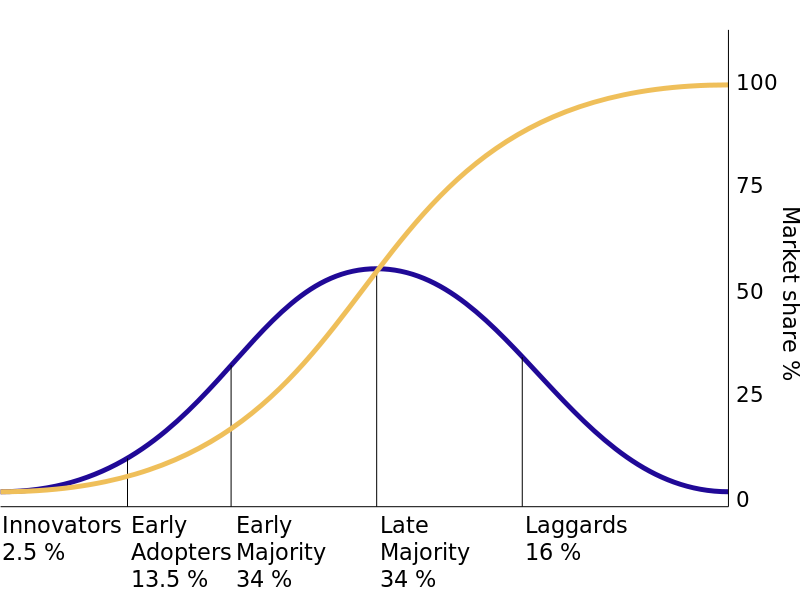
Stages of adoption of innovations. Source: Wikipedia

“I’ve got something to show you,” I told Horace Dediu as we chatted the other day. “I think it’s a logistic curve.”

Dediu’s face lit up. He of course is the one who has predicted smartphone adoption in the US with remarkable accuracy by using the straightforward maths of the “diffusion curve”, or “logistic curve” as it’s also known. That’s one up there at the top in yellow.

The logistic curve can be used to model all sorts of things: disease, populations, growth. It’s the integral of the bell curve (in blue at the top), and so it’s about “normal” populations.

Dediu has built a terrific series of presentations around data he has collated about the adoption of various technologies – refrigerators, cars, PCs, tablets, microwave ovens, smartphones. Pretty much all of them follow a logistic curve. There’s a slow uptake at first as only those in the know find out. Then there’s a sudden takeoff, and a rush that then leads rapidly upwards, until you come to the laggards who are the last to hear, or the least willing to adopt. (Don’t hassle me with your science oven.)

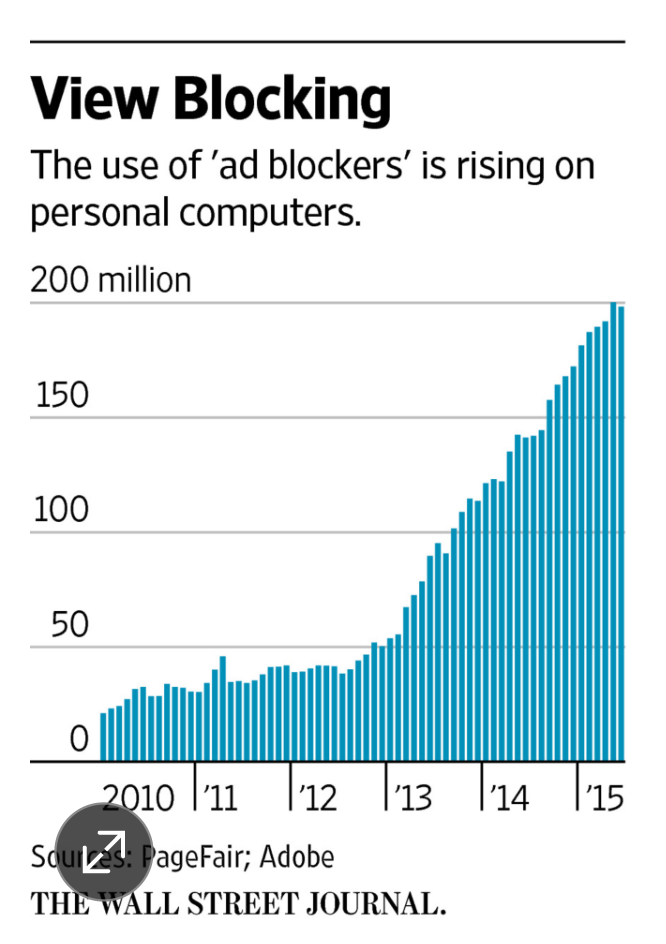
The graphic I wanted to show him? Adoption of adblocking. The picture below, taken from the Wall Street Journal’s writeup of the Pagefair report, shows the classic inflexion point of adoption: the rapid upward sweep that keeps building.

The growth of adblocking to 200m

Pagefair data suggests there were about 200m people blocking ads by mid-2015. Graphic: Wall Street Journal

Question is, how big is it going to get? You can fit the diffusion curve to this data in lots of ways.

The optimistic view takes the sheer number, and gives it a straight-ahead fit.

Adblocking: the optimistic forecast

On this measure, we’re about halfway through the diffusion of this technology.

This looks quite encouraging for those worried about the adpocalypse. The current number of adblock users is 200m, and it looks to be about halfway up the curve, so that’s 400m total once it saturates. OK, not great, but tolerable.

Dediu himself wrote a commentary this week, wondering about what has taken adblocking so long to take off:

What we never know is how quickly diffusion happens. I’ve observed “no-brainer” technologies or ideas lie unadopted for decades, languishing in perpetual indifference and suddenly, with no apparent cause, flip into ubiquity and inevitability at a vicious rate of adoption.

He argues that for takeoff, you need both a “push” and a “pull”. The push has now happened with the availability of adblockers easily installed via the App Store; now he wonders how fast the “pull” from users will be.

(I think, actually, that the key push happened before that, in mid-2013: that’s where that Pagefair curve suddenly moves upward. What happened in mid-2013? The Snowden revelations about tracking by governments. I don’t think the rise of adblocking after that point is a coincidence.)

That graph above might say “well, quite soon we’ll be done, and it’s not going to be that bad.” Ah, but we’re not done. When I showed the WSJ graphic to Dediu, he said “OK, but you have to adjust for internet population.”

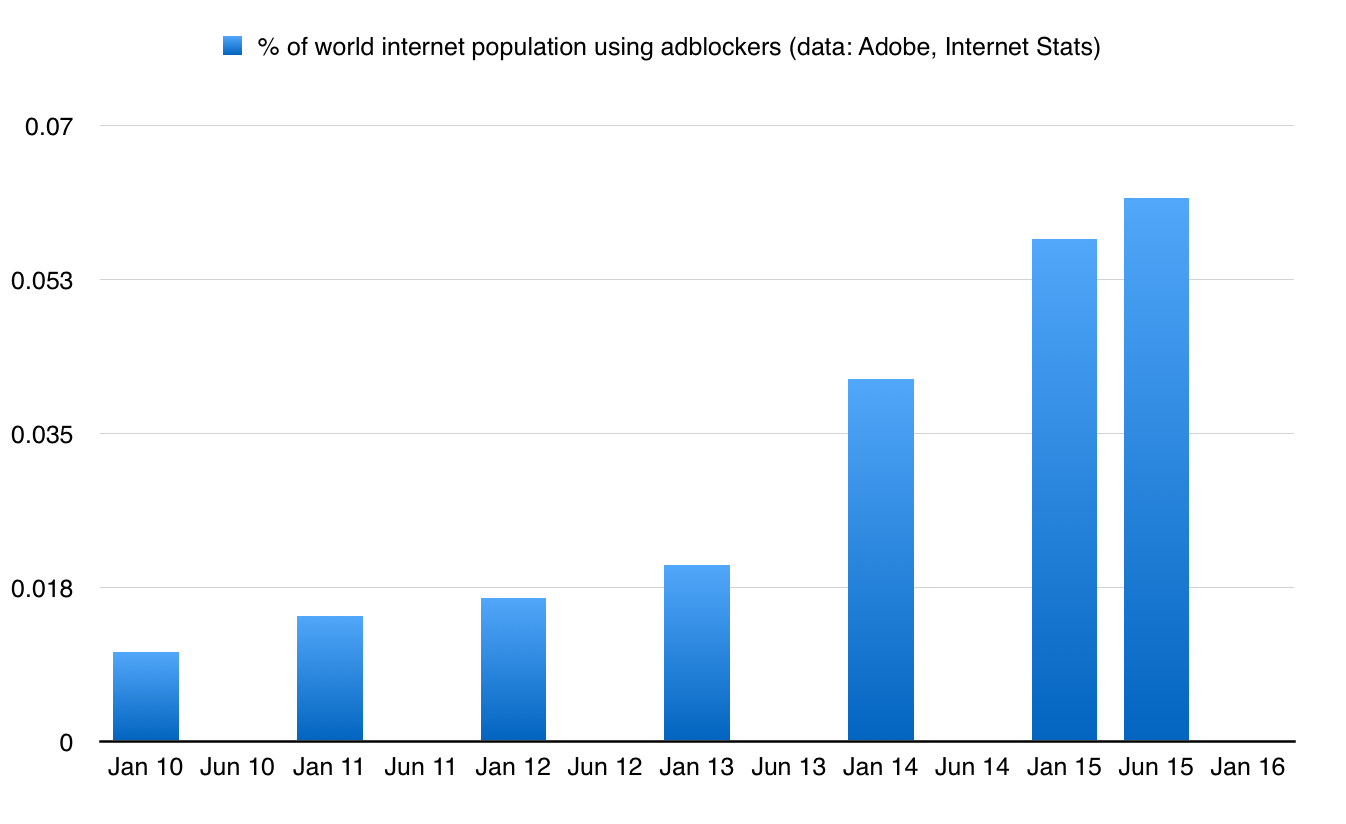
While the number of adblocker users has been growing, so has the total internet population. Adblocking as a percentage of total users hasn’t grown quite so fast. Arguably, people in countries such as China and India who are on mobile more than PC have a greater incentive to adblock than people on unmetered desktop systems.

Here’s how that growth chart looks like when you present it as a percentage of the internet population (data sourced from internetworldstats.com):

Adblocking as a percentage of intenet users

Data from Pagefair shows adblocking as a minority sport – so far

And now with the diffusion curve roughly fitted to it:

Adblocking: the less rosy view

If you compare adblocking penetration to the internet population, it looks like it’s got a lot of potential to grow

On this graph, 200m users adblocking is perhaps 10% of those who will eventually use it. So yes, we’re saying that 2bn people could be adblocking eventually. Which would leave us wondering, as Dediu puts it, “how quickly will ads disappear from the internet?” (The current internet population is about 3bn users.)

Put it another way:
the data suggests there are going to be between 400m and 2bn adblocking users within a few years.

OK. How much is that going to lose? Or put it another way, using data we can adduce: how much are visitors to ad-funded websites worth at present?

The value of a reader

Below, I’m going to use data from The Guardian, because it’s easily available (not because I’m a contributing writer). I’d welcome figures from another other news site such as the New York Times or Washington Post.

In March 2014, the Guardian hit 100m browsers for the month. In July 2014 it managed 137m. (“Browsers” aren’t the same as “views”, nor the same as “users”. A single browser could do multiple page views; a single user might use multiple browsers, such as a mobile one and a desktop one at different times of the day. If you’re feeling wonkish, the Audit Bureau of Circulation has more data at appendix 2.1 of its measurement requirements: “This metric measures each browser on a given device; it does not measure a person.”)

There’s a spreadsheet with the past year’s figures for browsers for the main UK national papers.

According to that spreadsheet of ABC-audited browser figures, in the ten months from June 2014 to March 2015, the Guardian’s average monthly browser figure was 111m.

So how does that compare to its digital revenues (which are broken out separately from print)? I’ve chosen the Guardian because its browser stats are available, and there isn’t any confusion caused by a paywall. But there are a couple of confounding elements:
• its “membership” scheme. I’m assuming there’s no significant income from that compared to the number of visitors. This is a gloss; the income from “membership events” is definitely non-zero.
• there’s a Guardian app for iOS and Android, which offers in-app purchases (IAPs) ranging from £3.99 to £11.99, including six- and 12-month subscriptions (£3.99 and £4.99 respectively). We don’t know how many of those have been downloaded, nor what the average payment is. Obviously it’s non-zero, and might materially affect our assumptions.
• the Guardian has “sponsored content”, which again is definitely non-zero in revenue terms – it has signed at least one deal worth a million pounds. This will reduce the contribution from plain advertising.

From the Guardian’s statement for the year to the end of March 2015:

GNM [Guardian News and Media, the publishing arm] total revenue grew by 2.6% to £214,600,000 (2014: £209,000,000) with increases in digital and new product revenue more than offsetting declines in print revenue. GNM divisional digital revenue for the year increased by 20.1% to £82,100,000 (2014: £68,300,000).

If you assume every month was equal, that’s £6.84m per month in digital revenue. If you assume 111m browsers per month on average, that’s 6.16p for each “browser” visit (which isn’t, remind yourself, necessarily a user or page view; a browser might be part of a user, and might do multiple page views. So if you view it on your desktop, and then on your mobile, that’s two “browsers”; the Guardian gets 12.32p from you).

My impression, not knowing much about monetisation, is that the Guardian is monetising its visitors pretty well. Others who know the ad business better can update me.

Spread across a year, that’s 73.95p per browser. In other words, £0.74, or $1.14 per browser per year.

Note that there’s going to be gigantic variation in the actual value to the Guardian of those “browsers”. If it’s the same 111m browsers visiting each month then that might be as few as 55 million people (“few”, huh) around the world, or even fewer if they’re showing up as more than two browsers – perhaps they view the site from a work PC, then their mobile on the train, and then their tablet and their home PC at the end of the day.

Or it might be 111m different browsers, each run by a different person, each month – so 1.330 billion people. As that latter figure is pretty much half the internet population, we can say with certainty it’s not true.

Given that £0.74 per year average figure, it’s pretty clear that anyone who subscribes to the Guardian app is way more valuable than the average. Anyone who accesses by more than one method (mobile plus desktop) is more valuable than the average.

But the average is really pretty low in sheer monetary terms, and that’s with the best that the advertising business has to throw at people – and that’s before we subtract the income from the app, the membership scheme, and the sponsored content, which probably come to a few millions.

All in all, you’d have to say that the per-browser value of you, as an individual who doesn’t have the app, isn’t a member and isn’t reading sponsored content (actually you don’t care about the latter – the Guardian gets paid for it anyhow), is probably pretty low; maybe in the 5p per browser range, or 60p per year.

Take that spread

Spread that figure across the 400m people in our optimistic take on adblocking, and you have £240m taken out of the online advertising business. That’s doesn’t sound very much – except each of those people is abstracting their per-site payment at every site. So you have to multiply that impact across every site that those 400m people go to. How many ad-supported sites is that? Well, 400m is about 12.5% of the internet population. Basically, slice 12.5% off the ad income. For some, that might make the difference between positive and negative.

It’s trickier if you take the pessimistic outlook and assume 2bn people take up adblocking, because that’s two-thirds of the current internet population. It would have become such a mainstream pursuit that the online ad business would have been destroyed.

For a news site getting 60p per year on average from users, but seeing that inevitably being eroded by adblocking, the obvious path is – since you can’t beat ’em – to join them from the front by making an adblocker and selling it. Disrupt yourself before others do. A one-off price of £1.29, say, would yield 90p after Apple’s 30% cut; that’s 18 months of your “lost” ad-supplied visitor paid for. (Yeah, yeah, you have to support the app too. Perhaps IAPs? Easily switchable settings to allow the ads on your site? Ways for people to vote on ads they do and don’t like which gets fed back to you, the publisher, rather than invisibly back to the ad networks which will ignore it?)

In that 18 months, you might be able to figure out a better business model, because there’s no reason this should get smaller. iOS is a key platform, and adblocking apps are already taking the food out of news sites’ mouths – to the tune of probably a million pounds in less than a week.

Again, that might not sound like much; but every single time those users visit those sites in future, they’ll not be making themselves available for monetisation. An adblocker is a one-off purchase, but its effects are repetitive.

Who’s to blame? Make no mistake: using an adblocker is a natural reaction to the intrusive, annoying, and even dangerous ad-tech industry. Concerns about tracking have amplified it, and created a perfect storm. It’s the ad industry’s own fault.

Sure, you can argue that people shouldn’t use adblockers on your site if they love you. But lots of people might love your site, but consider the ads an unacceptable intrusion, because you didn’t choose them. They just got inserted, often by a real-time bidding process choosing from inventory matched against the tracking profile of you (which could have your age, gender and interests completely wrong).

So the diffusion has begun. Quite where it ends, we don’t know. I do know though that I’m very much looking forward to Pagefair’s next report on the size of the adblocking market.

Start up: explaining XcodeGhost, Monument Valley goes VR, will Venice sink BlackBerry?, and more


What’s the common factor in iOS devices bricked by trying to update to iOS 9? Photo by marc falardeau on Flickr.

You can now sign up to receive each day’s Start Up post by email. You’ll need to click a confirmation link, so no spam.

A selection of 10 links for you. Use them wisely. I’m charlesarthur on Twitter. Observations and links welcome.

Monument Valley’s creators just made a stunning VR game » WIRED

Liz Stinson:

Like most early VR games, Land’s End is in many ways an experiment designed to discover what does and doesn’t work in the medium. Ustwo’s Ken Wong, Peter Pashley and Dan Gray spent more than a year developing the game, with many stops and starts and do-overs along the way. “It took a long long time to reinvent all these fundamental things about how you move around a world and how you interact,” says Wong.

Things like navigation took some toying with. “We spent a lot of time trying to figure out the best way to let people move around these worlds in a way that felt kind of almost subconscious,” says Pashley. You make your way through the levels by glancing at “lookpoints,” shimmering spheres of light that burst open and propel you forward when you look at them. The motion is slow and controlled; it feels almost like a moving sidewalk at the airport.

This looks terrific. Presently for Samsung Gear VR + Oculus only. I’d happily buy the soundtrack.
link to this extract


BlackBerry Venice » YouTube

A pretty much full-size touchscreen Android phone sort of running some sort of BlackBerry software. With a big keyboard that slides out from below. See for yourself.

Notice that he never actually tries to type anything. This may be significant: the top end of the phone would have to be very light to stop it overbalancing.

I wonder (with @charlesknight) whether this is John Chen’s last attempt at hardware; if this flops – which seems pretty likely – there’s little point carrying on. In a few quarters, BlackBerry should have swallowed Good Technology completely and can live on software and services revenues, which are much more profitable.
link to this extract


What you need to know about iOS malware XcodeGhost » Mac Rumors

The story so far (which I did notice over the weekend; I apologise for not including it in Monday’s Start Up): impatient iOS developers in China downloaded hacked copies of Xcode from Baidu servers because the ones from Apple came over slow-as-snails links from the US. The hacked copies included malware libraries that were included by default in any apps developed with them. The apps got through Apple’s approval process – and were then noticed by Palo Alto Networks, which itself noticed it on Weibo after analysis by Alibaba researchers.

Q How does XcodeGhost put my iOS devices at risk?
iOS apps infected with XcodeGhost malware can and do collect information about devices and then encrypt and upload that data to command and control (C2) servers run by attackers through the HTTP protocol. The system and app information that can be collected includes:

• Current time
• Current infected app’s name
• The app’s bundle identifier
• Current device’s name and type
• Current system’s language and country
• Current device’s UUID
• Network type

Palo Alto Networks also discovered that infected iOS apps can receive commands from the attacker through the C2 server to perform the following actions:

Prompt a fake alert dialog to phish user credentials; hijack opening specific URLs based on their scheme, which could allow for exploitation of vulnerabilities in the iOS system or other iOS apps; read and write data in the user’s clipboard, which could be used to read the user’s password if that password is copied from a password management tool.

Q Can XcodeGhost affect users outside of China?
Yes. Some of the iOS apps infected with XcodeGhost malware are available on the App Store in countries outside of China. CamCard, for example, is a popular business card reader and scanner app available in the United States and several other countries, while WeChat is a popular messaging app in the Asia-Pacific region.

Q Why would some Chinese developers download Xcode from Baidu?
Xcode is a large file that can take a long time to download from Apple’s servers in China, leading some developers to download Xcode from unofficial sources.

Q How are Apple and Chinese developers dealing with XcodeGhost?
Palo Alto Networks claims that it is cooperating with Apple on the issue, while multiple developers have updated their apps to remove the malware.

There’s a list of affected apps.

This is a significant attack, but it’s also a remarkably hard one to do more than once. I suspect the next attack will involve some sort of man-in-the-middle on security certificates that Apple will surely enforce on Xcode downloads.

Rich Mogull has a great writeup in which he says it’s about the economics of security:

Apple doesn’t believe all attacks can be stopped, and certainly not those from governments or well-funded criminal organizations, but if you make the cost of attack higher than the benefits, you knock out entire categories of bad guys and reduce the impact on users.

link to this extract


French regulator rejects Google appeal on scope of ‘right to be forgotten’ » WSJ

Sam Schechner:

France’s Commission Nationale de l’Informatique et des Libertés, or CNIL, said that Google must now adhere to a formal order in May directing it to apply Europe’s right to be forgotten to “all domain names” of the search engine, including google.com—or face possible sanctions proceedings.

Established just over a year ago by the European Union’s Court of Justice, the right to be forgotten gives European residents the ability to request that search engines remove links that appear in searches for their own name. Google has applied the ruling, but insisted on only removing results from European domain names, such as google.fr, not from google.com.

Google on Monday reiterated that it doesn’t believe the French regulator has the authority to expand the scope of the rule. “As a matter of principle we respectfully disagree with the idea that one national data protection authority can assert global authority to control the content that people can access around the world,” a spokesman said.

Ever so tricky. The US has claimed jurisdiction over sites that are hosted and authored elsewhere in the world that use the “.com” suffix; is that the same?

One suspects that Google will – if it loses in any appeal – work around this by offering filtered content to any IP address identified as being in France, just as it does to identify who to serve .fr content to.
link to this extract


Apple iPhones, iPads BRICKED by iOS 9’s ‘slide-to-upgrade’ bug » The Register

Shaun Nichols:

Reg reader Carlton told us today: “I have just updated my iPad to iOS 9 and found to my horror that once it has ‘successfully’ installed and then gone through the initial setup phase, I cannot progress past the second request to ‘slide to upgrade’ page.

“The setup order is ‘passcode’ – ‘slide to upgrade’ – ‘select Wi-Fi’ – ‘slide to upgrade’ at which point no further actions are possible.”

He was eventually able to upgrade his device to the new iOS using Apple’s suggested clean install procedure, though he said it took multiple attempts to accomplish.

Other fans reported similar problems when they tried to get the latest and greatest version of iOS on their iPads, iPhones and iPod Touch players.

While the issue appeared to be largely relegated to devices running iOS 7 skipping over to iOS 9, Apple would not confirm if that was in fact the case. No word yet on when a fix for the bug will be released.

Apple already has its hands full patching flaws with its firmware updates.

Commenters seem to concur: works fine if you’re just going from iOS 8, kills the device if you’re trying to skip upwards from iOS 7. An Apple support note says “This will be resolved soon in an upcoming iOS update”. Let’s see. (Meanwhile, Apple said in an aside in its press release about the release on Friday of the new iPhone that 50% of devices contacting the App Store as of September 19 were using iOS 9. In less than a week?!)
link to this extract


How to record a phone call on your iPhone – no additional kit of apps required » BBC College of Journalism

Marc Settle discovered (via Mashable) a terrific way to record a call:

A statement is never as good as an interview, which is where the ‘advanced’ function comes in, even if it needs a little willingness from your guest.

Call them from your iPhone and explain what you plan to do. Press ‘add call’ and then call the phone number you’re ringing them from. Yes, you did read that correctly: you need to call your own number from your own phone. As you’re on the phone, your answerphone will kick in. At this point tap ‘merge calls’: you and your interviewee will now be recording your conversation on your answerphone. End the call and then proceed as above to access the recording.

This reminds me of the “huh??” method that used to exist for running (old, old) pre-OSX Macs entirely from RAM, no disk access required, which meant gigantic battery life: you loaded a minimal OS, and then dragged your hard drive into the Trash. Honest. You just had to remember not to empty it.
link to this extract


Why we need a competition inquiry into the UK broadband market » TalkTalk BlogBlog

Dido Harding, TalkTalk chief executive:

Over 500 telecoms companies exist in the UK, but most depend on a shared set of wires that connect individual homes to our networks. When BT was privatised, it was allowed to keep control of this network on behalf of the whole industry, and it is managed today by Openreach, a BT company. It’s like one gas supplier owning the national grid, or one airline owning Heathrow.

Unfortunately, that system isn’t working because BT has used its sole control over the network to its advantage, rather than to benefit the network or customers. Openreach makes a lot of money, but it hasn’t invested enough in maintaining the network, leaving customers suffering from poor quality of service and facing long waits to repair faults or install new lines. It allows BT to abuse its control to restrict choice for customers. It also makes it harder for the regulator to enforce the rules and be a powerful consumer champion. Put simply, it’s a tired model not fit for a superfast future.

Openreach is TalkTalk’s biggest supplier; we couldn’t operate as a business without it. So naturally, I’ve got a vested interest in this debate. But what matters about today’s letter is the breadth of the coalition calling for change. It includes some of the biggest companies in the industry who have tried – and failed – for years to improve the system, as well as smaller players battling to bring innovation and choice to the market, but let down by Openreach.

Agree. Where do I sign up too?
link to this extract


600 ad companies blacklist The Pirate Bay » Music Week

Coral Williamson:

The Pirate Bay has been blacklisted by more than 600 advertisers.

The blacklist, comprising 10 sites so far, is the result of a partnership between anti-piracy group Rights Alliance and Swedish Advertisers, an association of advertisers with more than 600 member companies.

Swedish Advertisers has published a list of  recommendations designed to keep advertisers away from unlicensed sites, including observing good ethics, avoiding advertising contracts that include bulk sales, and considering where ads are ultimately placed.

OK, I have to ask. Is it unethical to use adblockers on torrent sites?
link to this extract


The number of people using search engines is in decline » Business Insider

Lara O’Reilly:

search is facing a huge challenge. The paid search business was built on a desktop browser model. And consumers are increasingly shifting to mobile. On mobile, consumers say they just don’t search as much as they used to because they have apps that cater to their specific needs. They might still perform searches within those apps, but they’re not doing as many searches on traditional search engines (although Google, Bing, and so on do power some in-app search engines.)

It sounds obvious, but there’s new data to show it’s a trend that’s really happening. And it could have a severe impact on Google’s (and Bing, and Yahoo’s) core search business. Indeed, data from eMarketer shows search ad spend growth is set to decline from 2014 through to 2019.

Speaking at digital trade show Dmexco in Cologne earlier this week, global communications agency ZenithOptimedia’s chief digital officer Stefan Bardega and research company GlobalWebIndex’s head of trends Jason Mander gave a mobile trends presentation. It was the slides on search that made the audience really sit up and start taking notes and photos.

And it’s this:

App usage and voice search both contribute too. How do you sell an ad beside a voice search?
link to this extract


Advertising is unwanted, day 2 » Scripting News

Dave Winer, in a followup to a post of a day earlier, suggesting news orgs need to find new ways to bring their readers together:

Here’s an idea for a geography-based news org (i.e. a newspaper) – give readers a place to talk about movies, and then sponsor movie nights based on their interests. Encourage people to provide lists of their favorite movies and do some collaborative filtering. Then collate the reviews and present them alongside your professional reviewer’s post. Work with the movie industry. It can have incredible promotional value, for the movie, the theater, you, the whole idea of going to the movies (as opposed to watching on your home TV, phone or tablet). What’s great for your community is they get to meet people who like the same kinds of movies they do. And you get to know who they are! It’s such a huge, easy win, all-around. That more local news orgs haven’t done it tell you how stuck in old print models we still are. This is an example of a kind of idea that really can only blossom online.

Creating community is a great idea. But what if the community lives all over the world? How does this physically-based idea work?
link to this extract


Start up: Facebook’s AI ambitions, it’s the Galaxy S7!, the value of comments, Apple goes Android, and more


Peace began the new war. Photo by ‘Lil on Flickr.

You can now sign up to receive each day’s Start Up post by email. You’ll need to click a confirmation link, so no spam.

A selection of 8 links for you. Use them wisely. I’m charlesarthur on Twitter. Observations and links welcome.

Facebook’s problem: Its algorithms aren’t smart enough » Fortune

Mathew Ingram:

Zuckerberg said: “Under the current system, our community reports content that they don’t like, and then we look at it to see if it violates our polices, and if it does we take it down. But part of the problem with that is by the time we take it down, someone has already seen it and they’ve had a bad experience.”

The promise of artificial intelligence, said the Facebook founder, is that some day computers might be able to filter such content more accurately, and allow people to personalize their news-feed. “But right now, we don’t have computers that can look at a photo and understand it in the way that a person can, and tell kind of basic things about it… is this nudity, is this graphic, what is it,” he said.

Zuckerberg said that in the case of the Syrian child lying dead on the beach, he thought that image was very powerful, because it symbolized a huge problem and crystallized a complex social issue. “I happen to think that was a very important photo in the world, because it raised awareness for this issue,” he said. “It’s easy to describe the stats about refugees, but there’s a way that capturing such a poignant photo has of getting people’s attention.”

Any AI that could make the right call about that photograph, though, would be as wise as the super-experienced editors around the world. It would have passed the Turing test and then some.
link to this extract


New ad blocker “Peace” tops iTunes paid apps chart within hours » Marketing Land

Danny Sullivan:

For months, marketers have been worrying over the possibility that consumers might embrace ad blocking that’s made easier in iOS 9. Now iOS 9 is out, and within hours of its launch yesterday, a new ad blocker called “Peace” became the most popular paid app.

The Peace app was created by Marco Arment, former CTO of Tumblr and founder of Instapaper. It sells for $2.99 in Apple’s app store. Within hours of the app going live, it topped the iTunes chart for paid apps for iPhone.

In addition to Peace, Purify Blocker also made the charts ranked fifth for iPhone. The Blockr app is ranked 28th. Crystal, which had some attention earlier this month, is listed at 110 in the free charts. It’s supposed to change to a paid model shortly.

As for iPad, Peace was the number two paid app (Purify is further down at 22; Blockr at 36):

The app is technically a “content blocker,” because it blocks not only ads but other types of tracking codes and anything that is deemed worth blocking based on a list that Ghostery maintains.

Ads are only blocked in Safari, not in other browsers like Chrome. It also doesn’t block ads within apps.

So the outbreak of war began with Peace. But not in other browsers like Chrome, because they don’t use the new WKWebKit viewer, available since iOS 8, which is really fast and powerful and, in iOS 9, enables content blockers. Wonder if Google has considered it? Read on…
link to this extract


Issue 423444 – chromium – Use WKWebView on iOS 8+ » Chromium Project

Stuart Morgan of Google’s Chromium project discussing, in October 2014, whether to use WKWebView instead of UIWebView in Chrome on iOS:

Unfortunately, despite the advantages of WKWebView, it has some significant technical limitations that UIWebView does not, which means we can’t simply drop it in as a replacement. A partial list of regressions relative to UIWebView that we’re currently aware of:
– There is no cookie management API, which means there is no obvious way to clear/manage cookies
– Protocol handlers no longer work, which breaks several very important features
– POST bodies are missing from delegate callbacks, which breaks certain aspects of form handling

We’re still actively investigating WKWebView, looking for possible alternate approaches, and providing feedback to Apple about issues. We certainly hope to use WKWebView in the future, but there’s currently no way of knowing if or when that will be possible.

The thread continues through the introduction of iOS 9, right up to 10 days ago. Still no movement. It seems remarkable that the newest, most powerful webview on iOS should be so behind in things that Google sees as essential. So Chrome on iOS uses the old – creaking, now – UIWebView instead of WKWebView. No modern compatibility (and lots of crashes, according to some) but equally, no adblocking on Chrome on iOS. (Thanks @reneritchie for pointing it out.)
link to this extract


Trash talk » Popbitch

The article (byline unprovided) does useful work in estimating the cost of moderating comments at the Mail Online and Guardian (it’s remarkably high) and then looks at sites that have shut down comments, and notes:

A number of journalists from across the political spectrum have spent this last week voicing their displeasure at Twitter, talking about how unpleasant it’s all become. It used to be fun and productive and helpful, they say, but the conversation nowadays is just vicious fighting.

Those reporting on the Scottish referendum last year complained of the same thing too; many threatening to quit social media in the face of brutal Cybernat campaigns. The sheer volume of vitriol leveled at them became unbearable, unmanageable.

Sadly, this will be the inevitable result of shutting down comments sections. People aren’t going to suddenly want to stop voicing their opinions. That’s one genie that won’t ever go back in the bottle. Instead those displaced commenters will simply take up an alternative platform, and the most obvious one of those is social media.

They can do that anyway, of course – the option has been open to them for as long as Facebook and Twitter have been around – but it’s no coincidence that the current trend for editors wanting to direct the conversation away from comments sections and onto social media correlates exactly with journalists’ growing dissatisfaction at the level of discourse on social media.

Comments sections are easy to avoid when you know where they are.

This I don’t agree with. People will find you on social media regardless of whether there are comments sections. The big advantage? There, you can block them. I prefer Mic Wright’s characterisation: comments are the radioactive waste of the web, there effectively forever, and never really useful. (And I speak as someone who has left a fair number of comments all over the place.) Gresham’s Law applies.
link to this extract


Welcome to hell: Apple vs Google vs Facebook and the slow death of the web » The Verge

Nilay Patel:

with iOS 9 and content blockers, what you’re seeing is Apple’s attempt to fully drive the knife into Google’s revenue platform. iOS 9 includes a refined search that auto-suggests content and that can search inside apps, pulling content away from Google and users away from the web, it allows users to block ads, and it offers publishers salvation in the form of Apple News, inside of which Apple will happily display (unblockable!) ads, and even sell them on publishers’ behalf for just a 30% cut.

Oh, and if you’re not happy with Apple News, you can always turn to Facebook’s Instant Articles, which will also track the shit out of you and serve unblockable ads inside of the Facebook app, but from Apple’s perspective it’s a win as long as the money’s not going to Google.

This is the dynamic to keep in mind — especially when you see Apple bloggers like [John] Gruber forcefully discount the notion that Apple’s decisions will affect small publishers. The Apple vs. Google fight has never been more heated or more tense, and Facebook’s opportunity to present itself as the savior of media has never been bigger — through hey-it’s-just-about-speed Instant Articles, which will almost certainly be featured higher in the News Feed, and huge things like its massive video initiative, which is a direct assault on YouTube. And oh — Apple’s new tvOS, that huge bet on bringing apps to TV? Doesn’t support WebKit at all.

Malicious view of Apple adding content blocking to Safari: it’s trying to kill Google.
Non-malicious view of Apple adding content blocking to Safari: it’s trying to kill ads which take over the mobile browsing experience, bouncing you to an app or putting up a non-removable screen (because the close button is off the screen), and/or trying to keep enterprise buyers happy that they can restrict what their users view.

Patel portrays this as a knife fight, but overlooks the fact that ads will work perfectly well inside iOS apps (annoying as they might be). Apple’s trying to do two things here: stop annoying, intrusive ads on Safari and in Safari web views, and trying to keep apps at the forefront of what people do on iPhones.

Both of those have collateral damage for Google, but it’s a stretch to think of this as a desperate fight to the death. He’s worried for his site, sure. And so he should be. But as I’ve said previously, web ads have to evolve. Nobody said they were somehow protected.
link to this extract


Sony shuts down its UK online retail store » AndroidAuthority

Andrew Grush:

Sony has never had a major presence in the US, offering most of its products either through its website or a partnering retailer. Sony has also had a carrier presence, but it has generally been limited to just T-Mobile or Verizon. This summer, Sony shut off one of these channels: its retail store. This meant that Sony fans had to either go through a site like Amazon, or turn to carriers. And now they are essentially doing the same in the UK.

Effective immediately, Sony shoppers will now be reliant on carriers or Sony’s partnering retails for Sony devices in the UK. The Japanese giant’s UK website will continue to offer advice on their phones but will no longer sell them, similar to what we have seen with the US website.

Sony gets so much right with the design of their phones, but unfortunately fails at the areas that matter most to average consumers: pricing, availability, and marketing.

That last sentence reminds me of a famous cricket writeup: “there are only three things wrong with the English team: can’t bat, can’t bowl, can’t field.”
link to this extract


Move to iOS » Android Apps on Google Play

Would it surprise you to hear there are lots of 1-star reviews? (But also, weirdly, lots of 5-star ones, though rather outnumbered by the 1-stars.)

Sample 1-star: Poor functionality:

I attempted to switch to iOS (apparently zombies ate my brain) and my iPhone 3G would not accept my data. Also, my micro USB would not fit.

Sample 5-star:

Reading all these reviews about people who say “1 star because I don’t want to move to Apple” ticks me off! THIS APP WAS NOT MEANT FOR YOU! Unlike everyone else who thinks Android is all that, there are people who make the jump to Apple. There are also people who switch to Samsung from Apple. (Using Samsung smart switch). Working for a MAJOR US cell phone carrier; this app is perfect!!!! Before we had to use stupid Celbrite machines or our made transfer app. Thank you Apple for making this!

So, you know, horses for courses.
link to this extract


Exclusive: first Galaxy S7 details emerge, codenamed Project Lucky » SamMobile

Abhijeet M:

Our insiders tell us that the Galaxy S7 is being tested with Samsung’s screaming fast UFS 2.0 storage, but the company might have found a way to make it work with SD cards. As we explained earlier this year, the memory controller on SD cards and the UFS 2.0 storage aren’t compatible with each other, making it impossible for them to co-exist on the same device. Samsung probably is trying out interfacing techniques to get around the limitation, though it would be best to not get too hopeful that the final product will bring back expandable storage to Samsung’s flagship line.

Finally, Samsung is supposedly testing a new 20-megapixel ISOCELL camera on the Galaxy S7, and also a project called the “all lens cover.” We have no idea what this project is; it’s perhaps a cover that will add additional lenses for the camera on to the phone, but we admit we’re in the dark about what the actual purpose will be.

The SD card explanation didn’t get much traction, did it? It makes complete sense, but Samsung sacrificed the broader principle of forward feature compatibility for a hard-to-see benefit in read/write speed. How many people say “wow, the read/write speed on this phone is great!” compared to the number who say “I can still use my SD card in this one!”
link to this extract


Start up: the Foodpanda takeaway scam, watch iOS 9 grow!, 2 billion lines of Google, and more


“Hi! You look like you want an (artificially) intelligent conversation!” Photo by RomitaGirl67 on Flickr.

You can now sign up to receive each day’s Start Up post by email. You’ll need to click a confirmation link, so no spam.

A selection of 9 links for you. May cause. I’m charlesarthur on Twitter. Observations and links welcome.

Mixpanel Trends » Mixpanel Mobile Analytics

The link is to the iOS 9 adoption curve from Mixpanel; it’s live, so when you click through it’ll be the latest figures. At the time of writing, three hours after iOS 9 went live, its adoption was at 3.2%, against 7.2% for “older than iOS 8” and 89.6% for iOS 8. (Apple’s own stats on September 14 were 87% iOS 8, 11% iOS 7, 2% earlier.)
link to this extract


The trouble with Foodpanda » Livemint

Ashish Mishra with a terrific tale of a much-funded startup which didn’t quite figure out that not everyone is honest:

Let’s say you are a restaurant. Now, place 10 orders using 10 names or even the same name, each for Rs.300. Every order is a takeaway. Pay online using the BOGO voucher, a campaign (Buy One Get One) run by Foodpanda. So for Rs.300, get Rs.300 free. So for a Rs.600 order, you paid only Rs.300. How much does Foodpanda have to return to you, the restaurant? Rs.600. After deducting 12% as its cut, Rs.528. How much did you make in the process? Rs.228 . Did you have to deliver that order? Nope. So, a straight profit of Rs.228.

Now, let’s say you processed 100 such orders a day. For a month. Total investment: Rs.9 lakh. Reimbursed by Foodpanda: Rs.15.84 lakh. Your total gain, by just processing fake orders: Rs.6.84 lakh.

Now imagine you are not the only restaurant on the platform doing this.

link to this extract


Issue 178139 – android – Android full lockscreen bypass – 5.1.1 PoC » Android Open Source Project

John Gordon at the University of Texas at Austin:

Android 5.1.1 Lockscreen Bypass
—–
Summary: Unlock a locked device to access the homescreen, run arbitrary applications, and enable full adb access to the device. This includes access to encrypted user data on encrypted devices.
Prerequisites: Must have a password lockscreen enabled. (PIN / swipe untested)
Hardware: Nexus 4
Software: Google factory image – occam 5.1.1 (LMY47V)

Attack details:
Pasting a sufficiently large string into an input field will cause portions of the lockscreen to become unresponsive and allow the user to terminate those processes. An attacker can construct a large string by typing characters into the Emergency Dialer, then select all + copy + paste repeatedly to increase the string size exponentially. Once the string has been pasted, either into the Emergency Dialer or the lockscreen password prompt, attempting to type more characters or performing other intaractions quickly and repeatedly causes the process to become overloaded and crash, or produce a dialog allowing the user to kill the process. If done in a password prompt in the foreground of the camera application, this crash results in the homescreen or Settings applcation being exposed.

PIN/swipe is untested, rather than safe (as far as we can see). This seems to be pretty hard to do – the video is 18 minutes long, involving lots of copy/pasting. It’s not really a giant flaw like Stagefright; and Apple has had some egregious lockscreen bypasses in the past. (Though none in iOS 8 that I’ve seen.) The problem though is that this doesn’t help Android’s reputation among businesses considering whether to buy it. It’s not the exploit; it’s the suggestion of vulnerability.
link to this extract


Popping the publishing bubble » Stratechery

Ben Thompson, in his weekly “free to view” article, says that iOS 9’s adblockers are just going to finish what was already happening:

It is easy to feel sorry for publishers: before the Internet most were swimming in money, and for the first few years online it looked like online publications with lower costs of production would be profitable as well. The problem, though, was the assumption that advertising money would always be there, resulting in a “build it and they will come” mentality that focused almost exclusively on content product and far too little on sustainable business models.

In fact, publishers going forward need to have the exact opposite attitude of publishers in the past: instead of focusing on journalism and getting the business model for free, publishers need to start with a sustainable business model and focus on journalism that works hand-in-hand with the business model they have chosen. First and foremost that means publishers need to answer the most fundamental question required of any enterprise: are they a niche or scale business?

• Niche businesses make money by maximizing revenue per user on a (relatively) small user base
• Scale businesses make money by maximizing the number of users they reach
The truth is most publications are trying to do a little bit of everything: gain more revenue per user here, reach more users over there.

Worth it for the illustrations. You should subscribe so he can afford an iPad Pro and a stylus.
link to this extract


Google is 2 billion lines of code — and it’s all in one place » WIRED

Cade Metz:

Google has built its own “version control system” for juggling all this code. The system is called Piper, and it runs across the vast online infrastructure Google has built to run all its online services. According to [Google’s head of… big stuff? Rachel] Potvin, the system spans 10 different Google data centers.

It’s not just that all 2 billion lines of code sit inside a single system available to just about every engineer inside the company. It’s that this system gives Google engineers an unusual freedom to use and combine code from across myriad projects. “When you start a new project,” Potvin tells WIRED, “you have a wealth of libraries already available to you. Almost everything has already been done.” What’s more, engineers can make a single code change and instantly deploy it across all Google services. In updating one thing, they can update everything.

There are limitations this system. Potvin says certain highly sensitive code—stuff akin to the Google’s PageRank search algorithm—resides in separate repositories only available to specific employees. And because they don’t run on the ‘net and are very different things, Google stores code for its two device operating systems — Android and Chrome — on separate version control systems. But for the most part, Google code is a monolith that allows for the free flow of software building blocks, ideas, and solutions.

The point about Android and Chrome being on separate version control systems is one to note. Can’t merge the code until those two come together.
link to this extract


IPv6 will get a big boost from iOS 9, Facebook says » Computerworld

Stephen Lawson:

Even when all the pieces are in place for IPv6, iOS 8 makes an IPv6 connection only about half the time or less because of the way it treats the new protocol. With iOS 9, and IPv6 connection will happen 99% of the time, Saab predicts. 

IPv4 is running out of unused Internet addresses, while IPv6 is expected to have more than enough for all uses long into the future. Adoption has been slow since its completion in 1998 but is starting to accelerate. The release of iOS 9 may give a big boost to that trend. 

“Immediately, starting on the 16th, I’m expecting to see a lot more v6 traffic show up,” said Samir Vaidya, director of device technology at Verizon Wireless. About 50% of Verizon Wireless traffic uses IPv6, and Vaidya thinks it may be 70% by this time next year as subscribers flock to the iPhone 6s. 

Apple’s change should help drive more IPv6 use on Comcast’s network, too. About 25% of its traffic uses the new protocol now, and that figure could rise above 50% by early next year, said John Brzozowski, Comcast Cable’s chief IPv6 architect. 

This is the point, again and again. Android has the installed base; but iOS adoption is so rapid that it can drive change almost immediately.
link to this extract


Barbie wants to get to know your child » The New York Times

James Vlahos:

Hello Barbie is by far the most advanced to date in a new generation of A.I. toys whose makers share the aspiration of Geppetto: to persuade children that their toys are alive — or, at any rate, are something more than inanimate. At Ariana’s product-testing session, which took place in May at Mattel’s Imagination Center in El Segundo, Calif., near Los Angeles, Barbie asked her whether she would like to do randomly selected jobs, like being a scuba instructor or a hot-air-balloon pilot. Then they played a goofy chef game, in which Ariana told a mixed-up Barbie which ingredients went with which recipes — pepperoni with the pizza, marshmallows with the s’mores. ‘‘It’s really fun to cook with you,’’ Ariana said.

At one point, Barbie’s voice got serious. ‘‘I was wondering if I could get your advice on something,’’ Barbie asked. The doll explained that she and her friend Teresa had argued and weren’t speaking. ‘‘I really miss her, but I don’t know what to say to her now,’’ Barbie said. ‘‘What should I do?’’

‘‘Say ‘I’m sorry,’ ’’ Ariana replied.

‘‘You’re right. I should apologize,’’ Barbie said. ‘‘I’m not mad anymore. I just want to be friends again.’’

We now return you to our regular scheduled programming of “Philip K Dick short stories brought to life.” Take your pick: War Game, Second Variety or The Days of Perky Pat?
link to this extract


One great reason to update to iOS 9 – a nasty silent AirDrop attack is in town » Forbes

Australian researcher Mark Dowd, who heads up Azimuth Security, told FORBES ahead of Apple’s iOS 9 release on Wednesday that the flaw allowed anyone within range of an AirDrop user to install malware on a target device and tweak iOS settings so the exploit would still work if the victim rejected an incoming AirDrop file, as seen in the video below.

Users should update to iOS 9 and Mac OS X El Capitan, version 10.11, as soon as possible to avoid losing control of their phones and PCs to malware. Any iOS versions that support AirDrop, from iOS 7 onwards, are affected, as are Mac OS X versions from Yosemite onwards. There are few protections outside of upgrading, other than turning AirDrop off altogether. The service is off by default, though it’s possible to start it running from the lockscreen.

By carrying out what’s known as a “directory traversal attack”, where a hacker enters sections of the operating system they should not be able to access, Dowd found it was possible to exploit AirDrop and then alter configuration files to ensure iOS would accept any software signed with an Apple enterprise certificate. Those certificates are typically used by businesses to install software not hosted in the App Store and are supposed to guarantee trust in the provenance of the application. But, as FORBES found in a recent investigation into the Chinese iPhone jailbreaking industry, they’re often used to bypass Apple security protections.

I dunno, getting AirDrop to work is usually the biggest challenge I face. (The mitigation is pretty easy on any version – turn off Wi-Fi or Bluetooth, or turn Airdrop to accept files from Contacts Only or off; this leaves Wi-Fi and Bluetooth untouched.)
link to this extract


Google taken to court to uncloak ebook pirates » TorrentFreak

Early June, GAU [the Dutch trade organisation representing dozens of book publishers in the Netherlands] reported that Google appeared to be taking steps to prevent rogue sellers from offering illegal content via its Play store. The group also noted that BREIN was attempting to obtain the personal details of the ‘pirate’ seller from Google.

Unsurprisingly that wasn’t a straightforward exercise, with Google refusing to hand over the personal details of its user on a voluntary basis. If BREIN really wanted the seller’s identity it would have to obtain it via a court order. Yesterday the anti-piracy group began the process to do just that.

Appearing before the Court of The Hague, BREIN presented its case, arguing that the rogue seller was not merely a user of Google, but actually a commercial partner of Google Play, a partnership that earned revenue for both parties.

“The case is clear,” BREIN said in a statement.

“There was infringement carried out by an anonymous seller that was actually a commercial ‘partner’ of Google via Google Play. This is how Google refers to sellers in its own terms of use.”

BREIN says that ultimately Google is responsible for the unauthorized distribution and sales carried out via its service.

“There is no right to anonymously sell illegal stuff, not even on Google Play while Google earns money,” the anti-piracy group concludes.

In the UK I think this would be a fairly straightforward “Norwich Pharmacal” case. Wonder if Holland has anything comparable.
link to this extract


Start up: now on email!, video adblocking, Toshiba’s PC loss, iOS 9 for enterprise, and more


This is the hamburger menu you’re looking for. Photo by jpellgen on Flickr.

Hey! You can now sign up to receive each day’s The Overspill’s Start Up post by email.
You’ll need to click a confirmation link and then it should all roll on. (We’re still ironing out a few bugs in formatting for mobile but otherwise it’s perfect. Ish.)

A selection of 8 links for you. May contain nuts. I’m charlesarthur on Twitter. Observations and links welcome.

Adblockers hit another market: video » Monday Note

Frederic Filloux:

Using its thorough analytics, YouTube was first to understand that viewers should be given the opportunity to skip videos ads. This markedly increased the value of actually viewed clips.

But the damage is done. With ad blockers, the tragedy is that one bad apple contaminates the whole crate. Once installed, the adblocker will indiscriminately eliminate ads from all sites. The few that were willing to preserve a decent user experience were washed away.

Between April and June 2015, SecretMedia, teaming up with with JW Player, reviewed the data from one billion devices in 42 countries. Here, precautions are warranted: SecretMedia, based in New York, sells an anti-adblocking solution for video; its clients are mainly broadcasters. But even though SecretMedia has a vested interest in darkening the picture, its conclusions are consistent with other surveys in the US and Europe.

The point about the bad apple contaminating the crate is key. Oh well, iOS 9 comes out today – and tons of people will begin deploying adblockers. Let’s watch.
link to this extract


​Mozilla quietly deploys built-in Firebox advertising » ZDNet

Steven Vaughan-Nichols:

Darren Herman, Mozilla’s VP of Content Services, announced in May 2015 that “Suggested Tiles represents an important step for us to improve the state of digital advertising.”

Then, this summer, Mozilla quietly launched Suggested Tiles, the organization’s first commercial ad product. Well, it will be ads. At the moment, Mozilla claims it’s not getting paid for them.

Herman explained, “Since early August, we have been delivering promoted content provided by our first wave of partners including Yahoo, a number of top tier news titles including Fortune Magazine and Quartz, and mission-oriented partners such as the Make-a-Wish Foundation and the Electronic Frontier Foundation.”

Not sure that’s going to be popular.
link to this extract


Random thoughts on the new Apple TV » Medium

Ouriel Ohayon of Appsfire:

Most apps live out of ads. Most apps are Free. What was not said today is whether TV apps will be able to monetize with ads the same way iphone apps are monetized with ads. This is a big deal not just for monetization but also for discovery. Ads are one of the key channels for discovery and if no native ads are allowed in TV apps then the only way to get discovered is via the TV app store: meaning you have zero chance unless featured by Apple. I doubt Apple will completely ignore that question: Ads on TV can be a huge opportunity (including for iAds). They may not be ready for it just yet.

But what that means for app developers: get ready to suffer to get your free TV app (or paid app) discovered and monetized.

link to this extract


Toshiba loss on weak TV, PC sales boosts case for revamp » Reuters

Makiko Yamazaki:

Toshiba Corp swung to a first-quarter loss on weak PC and TV sales, raising pressure on its new chief executive to speed up a business revamp in addition to improving governance after a $1.3bn accounting scandal.

The laptops-to-nuclear power conglomerate reported an April-June operating loss of 10.96bn yen ($91m) on Monday compared with a ¥47.7bn profit a year earlier.

Specifically looking at the PC business – which is the one under stress – the Toshiba financials say “The Lifestyle Products & Services segment saw significantly lower sales, reflecting significantly lower sales in the Visual Products business, which includes LCD TVs, and the PC business, due to a shift in focus to redefined sales territories and other factors.
The segment as a whole saw deteriorated operating income (loss), reflecting deteriorated operating income in the PC and Home Appliances businesses.”

Specifically, the PC business shrank from a quarterly ¥169.4bn ($1.4bn) a year ago to ¥116.8bn ($970m) in the April-June period. And to a loss. How long can Toshiba’s PC business carry on?
link to this extract


Apple makes its biggest push to date into the enterprise » Re/code

Sean Ginevan, sr director of strategy, MobileIron:

With iOS 9, Apple is introducing features that will more easily enable IT to control iOS devices and automate provisioning of software. Using iOS 9, an enterprise can provision apps from the App Store silently, and disallow the user from installing their own applications. The operating system also makes it easier to place devices into supervised mode, which enables capabilities like disabling iMessage and locking device settings, round out the abilities to make an iPad Pro more suited to mission-specific tasks enterprise IT wishes to deploy them for…

…Three features have been introduced in iOS 9 that address that issue [of data going to non-managed devices]. The first allows enterprise IT to decide which applications are “managed,” meaning the data within them is owned by IT. Prior to iOS 9, if a user installed a business app from the App Store, then the app was “unmanaged” and could not interact with enterprise data. The user would have to reinstall the app over again through their corporate app storefront to make it managed. Now, enterprise IT can easily flag which apps are managed and reduce the user intervention required.

Second, iOS 9 provides enhanced controls over AirDrop. Prior to iOS 9, the only way to prevent corporate data from being shared with an unauthorized device was to turn off AirDrop completely. Now, enterprises can configure iOS 9 such that managed applications can’t have their data shared out via AirDrop.

Third, Apple decided that “simple passcodes,” will now require a minimum of six characters when a device with TouchID is enabled.

MobileIron is now up against BlackBerry/Good Technology in aiming to manage enterprise iOS devices.
link to this extract


Hamburger menu, the most recognizable thing on the planet » DeveloperTown

Randy Fisher:

Using eye tracking software, we ran 25 people through a series of tasks to gather viewing data. We used Google Inbox as the test site, but created two different versions that were presented at random. Version 1 was Inbox exactly as it is currently designed today with a hamburger menu, and Version 2 was another version we created with a horizontal menu of the same main menu choices hidden in the hamburger.

What happened next will [pick from menu above]
link to this extract


Why tablets are the future of computing » WSJ

Christopher Mims:

Take Intel’s coming line of Skylake chips, which CEO Brian Krzanich has said will enable thinner, lighter notebook PCs with better battery life. All of this will be possible because the chips will be more efficient, with some Skylake chips drawing less than 4½ watts, says IT analyst Patrick Moorhead.
“That power envelope is the first time you can do a fanless device, and fanless means thin,” says Mr. Moorhead. In other words, those svelte, MacBook Air-like “ultrabooks” Intel has been touting have the potential to turn into ultra tablets with detachable keyboards.

These devices won’t just be running Windows, of course, because manufacturers also have plans to sell them with Google’s Chrome operating system and even a version of the Android OS modified to function like a full desktop operating system.

What’s just over the horizon is a weird moment in computing history, when every major desktop and mobile OS, with the notable exception of Mac OS, will be competing on devices with the same ultra tablet form factor. With Windows 10, Microsoft has already blurred the lines between a mobile and a desktop OS, and now Google, Apple and others are following suit.

Arguably it should be “why 2-in-1s are the future of computing”, but it would make the headline unwieldy. Does this mean the Ubuntu Edge idea of a mobile phone you plug into a keyboard/display becomes feasible soon? It seems an idea that comes and goes – some times it’s good (Handspring had a good version in the early 2000s), some times it’s bad (Motorola Atrix).
link to this extract


Notebook retailers in Europe having difficulty clearing inventory » Digitimes

Aaron Lee and Joseph Tsai:

As the year-end holidays approach, the [upstream supply chain] sources are concerned that the retailers may reduce their notebook prices further in order to quickly clear up their inventory, but such a move is expected to greatly impact notebook brand vendors’ profitability and affect overall notebook sales in the second half.

The sources pointed out that brand vendors such as Lenovo and Hewlett-Packard (HP) have been encouraging their retail partners to stock up since May by offering them high commissions. However, weak demand and Windows 10’s failure to kickstart a PC replacement trend have caused the retailers to suffer from high inventory pileup despite their aggressive promotions.

Acer and Asustek Computer, neither of whom has used the high-commission strategy, are still expected to be affected as the retailers are selling competitors’ notebooks at a much lower price range, forcing the two firms to follow suit or risk losing market shares. Currently, Acer and Asustek take up about 30-40% of Europe’s notebook sales.

Asia Pacific is also seeing weakening notebook demand amid a slowing China economy. The PC market in the US is the only one seeing meaningful growth, but only US-based vendors HP, Dell and Apple will benefit.

I’d guess the “sources” in this story aren’t too far from Asus and Acer.
link to this extract


Once more: sign up to receive this and similar posts by email. (Start Up only – not posts from the rest of the blog.)

Start up: how 3D Touch was made (and what it’s like), adblock wars redux, why PC makers want gamers, and more


“What’s the call quality like?” LG’s next big growth market. Photo by stevec77 on Flickr.

A selection of 9 links for you. Use them wisely. I’m charlesarthur on Twitter. Observations and links welcome.

Apple TV Pre-Reprecussions » iLike.code

Nat Brown:

Apple TV will draw more people to gaming on televisions, so “television-based gaming” as a category will grow due to Apple TV in the near term. Consoles will continue to meet a very clear consumer demand for higher-end gaming using gamepads, though many independent game developers and even high-end publishers will abandon lagging consoles over time for the less restrictive Apple TV market as the Apple TV silicon matures, and for PC gaming on Steam (and with luck on Windows). If Apple introduces a gamepad or has a strong attach rate for third-party MFi gamepads, I expect a lot of current console buyers will within a few years find Apple TV’s performance, price-point and more appealing catalog of gamepad content their choice over the next Microsoft or Sony consoles, if those even get built.

Very true in the US, where Apple TV has more of a role (because box sets without ads sure beat the crap TV with ads) but less so in countries like the UK, I think.
link to this extract


LG Electronics looks to washing machines to keep spinning profits » WSJ

Min Jeong-Lee:

just as Samsung Electronics Co. and Sony Corp. have become more dependent on other business areas like components rather than mobile devices, LG is looking to its less-glamorous appliances’ unit to secure modest-but-steady profit growth.

“The mobile and TV businesses tend to have a lot of ups and downs. The home appliance business, meanwhile, is less vulnerable to swings,” Jo Seong-jin, LG’s home-appliance chief, said in a recent interview with The Wall Street Journal.

LG’s revenue for appliances—based on local currency value—is up about 13% so far this year, and operating profit margins in the division of about 4.5% to 6% will be “attainable” this year, he said. While far short of the double-digit margins enjoyed by Apple Inc., those levels will outshine LG’s other key business units and that of Samsung’s appliances unit, analysts say.

Washing machines. Washing machines.
link to this extract


How are artists actually using Apple Music Connect? » Musically

Stuart Dredge looked at some data from the past 10 weeks:

What are they posting? Two kinds of posts seem to be dominating Connect: photos – often cross-posted from Instagram, which suggests that artists (or often their social teams) think Instagram’s visual aesthetic and Apple’s new social service. And secondly promotional messages: encouraging fans to stream songs or albums on Apple Music, pre-order albums on iTunes, or – in the case of artists who are involved with the Beats 1 radio station – posts about their shows.

What’s missing, so far, is the kind of exclusive, engaging stuff promised at the Apple Music launch. In June, Apple’s services boss Eddy Cue said that Pharrell Williams would be posting photos, lyrics and raw mixes of songs – but at the time of writing, he’s posted a single photo two months ago.

Connect isn’t a ghost town: based on the iTunes and Facebook-based lists above, if you followed 30 popular artists on Apple Music, your Connect feed would have between 24 and 33 new posts a week – or 3-5 a day. That might actually be a nicely-manageable complement to the information blur on Twitter and Facebook IF the updates were more than just promotional messages and reposted photos.

It’s still early days, and I’d expect Apple to be working hard to encourage artists not just to use Connect, but to use it well, in the months ahead. As things stand, it is not delivering on its potential. But that potential is there.

link to this extract


iPhone 6s and iPhone 6s Plus first look: Hands-on with 3D Touch » IB Times

Me! I was there:

on the new models, which go on sale on 25 September in 12 countries including the UK, a hard press on an icon generates a subtle “tap” against the fingers holding the phone.

If the app can do something, you feel a single tap on your fingers, and a menu pops up; if it can’t (because it hasn’t been enabled, or the options don’t make sense) there’s a subtler triple tap, and nothing happens.

It needs a quite different approach from the normal “delete” push; you have to intend to make it happen. In the few minutes I was able to try it out, I quickly got used to the difference – which is helped by the haptic feedback. Practice would likely make perfect, or at least more familiar.

The “left-hand-side” press is not easy at first – it’s a sort of push-and-roll for the thumb. The process for getting the haptic pop is simpler. It’s not the sort of thing you’d find by accident in a hurry, though.

I also wrote hands-on for the iPad Pro and Apple TV; check the IB Times site for those later today (Thursday).
link to this extract


How Apple built 3D Touch » Bloomberg

Josh Tyrangiel gets the sort of prebrief/access that you’ll recall the New Yorker got a year back:

in lieu of the usual polite deflection, Federighi picked up an iPhone 6S and explained one of 3D Touch’s simpler challenges: “It starts with the idea that, on a device this thin, you want to detect force. I mean, you think you want to detect force, but really what you’re trying to do is sense intent. You’re trying to read minds. And yet you have a user who might be using his thumb, his finger, might be emotional at the moment, might be walking, might be laying on the couch. These things don’t affect intent, but they do affect what a sensor [inside the phone] sees. So there are a huge number of technical hurdles. We have to do sensor fusion with accelerometers to cancel out gravity—but when you turn [the device] a different way, we have to subtract out gravity. … Your thumb can read differently to the touch sensor than your finger would. That difference is important to understanding how to interpret the force. And so we’re fusing both what the force sensor is giving us with what the touch sensor is giving us about the nature of your interaction. So down at even just the lowest level of hardware and algorithms—I mean, this is just one basic thing. And if you don’t get it right, none of it works.”

It’s a great article that (especially if read with the New Yorker one) gives you an increasingly clear view of how Apple’s design process works.
link to this extract


Analyst suggests this may be the last big iPhone launch » PC Retail

Dominic Sacco:

Argus Insights CEO John Feland predicts that “Apple has one good cycle left in them, barring any earth shattering innovations”.

“This upcoming round of iPhones is likely to be the iPhone’s Farewell tour,” he said. “Market demand of future handsets will not be as high because the innovation pipeline has apparently run out of good (compelling enough for consumers to upgrade) ideas.

“iPhone sales are unlikely to hit the same peaks at next year’s upgrade cycle as the level of smartphone saturation tips to replacement over new users.

Noted for future reference. He’s certainly right about saturation, but the odd thing about saturation is that in theory it means you have more people who could upgrade at any given time than in an unsaturated market.
link to this extract


Samsung to cut 10% of head office staff, Economic Daily says » Bloomberg Business

Jungah Lee:

Samsung is targeting workers in the human resources, public relations and finance departments, Korea Economic Daily reported Tuesday, citing people it didn’t identify. The Suwon, South Korea-based company also plans to cut some expenses next year, the report added. Samsung declined to comment in an e-mail.

The moves come after new high-end Galaxy smartphones failed to impress consumers, triggering five straight monthly declines and wiping out more than $40bn in Samsung’s market value since April. The company’s share of global smartphone shipments fell more than 3 percentage points in the second quarter, and it’s no longer the top seller in China, the world’s biggest mobile-phone market.

“Cutting jobs is the easiest way to control costs and Samsung’s spending on mobile business could also be more tightly controlled,” said Chung Chang Won, an analyst at Nomura Holdings Inc. in Seoul. “Samsung’s preparing to tighten its belt as it isn’t likely see rapid profit growth in the years to come.”

Subsequently, Samsung has denied this, saying a number of employees are being “relocated”. To their homes?
link to this extract


After selling his company to Google, this man now wants to block ad-blockers » VentureBeat

Paul Sawer:

While [Ben] Barokas was cagey about the specifics of how the technology works, he did refer to a blurring of lines between ads and publishers’ content.

“There are many nuances, but at a high level our platform makes it harder for ad-block software to distinguish advertising from content,” he said. “We believe we can recover pretty much any advertising that exists today.  We have started with direct-sold brand campaigns because they tend to be of higher value to publishers and higher quality to users.”

Barokas said that dozens of ComScore 500 publishers are currently using the platform, but he didn’t reveal any specific details yet regarding the uptake of Sourcepoint, other than that demand has been “overwhelming,” far-exceeding its most optimistic projections.

I was discussing this topic on Twitter the other day and it occurred to me that advertising is a classic example where those who consume aren’t the customer. Advertisers buy space with publishers, but the people to whom those ads are shown aren’t involved in the transaction. This means there’s no way for them – that’s you and I, the readers – to show our displeasure except via adblocking. (A similar disconnect occurred when Microsoft was trying to displace the iPod: it sold music for enabling Windows Media music playback to Windows Media music player makers, not to listeners. That breaks the feedback loop.)

In that sense, adblocking is peoples’ way of speaking up in the transaction. It’s somewhat all-or-nothing, though.
link to this extract


The PC industry is betting big on gamers » The Verge

Vlad Savov:

The PC gaming market produced $21.5 billion in hardware sales last year, according to data from Jon Peddie Research, which is more than double the revenues derived from console sales. More notably, unlike the broader PC market, which continues shrinking, gaming PC sales are projected to increase over the next couple of years. The JPR analysis suggests the biggest chunk of gaming PC revenue — somewhere in the vicinity of 44% — comes from the so-called enthusiast segment, which the researchers identify as “very performance and style oriented, much like sports car owners.”

Sports car PCs are exactly what we saw from the big manufacturers at IFA. Acer’s Predators, whether it be on the desktop or in the form of pseudo-portable laptops, ape Lamborghini’s angular shapes and aggressive motifs throughout. Asus, with its Republic of Gamers sub-brand, does the very same. From overclocked monitors to otherworldly arachnid routers, both of these Taiwanese companies are pushing as hard as they can to give conventional, commoditized products the veneer of a fresh attitude and personality.

The very apt comment from Sameer Singh, industry analyst at App Annie: “Predictable response when facing disruption – flee upmarket.” (The source of the disruption fits in a pocket and also makes phone calls.)
link to this extract


Start up: iOS 9 and the BBC, AdBlock v Chrome/YouTube, Imogen Heap’s blockchain, and more


And we just happen by great good fortune to know a good source of women who aren’t wives too. Photo by James Maskell on Flickr.

A selection of 8 links for you. Tested on humans for irritancy. I’m charlesarthur on Twitter. Observations and links welcome.

Ashley Madison’s parent company secretly operated an escort website » Daily Dot

Dell Cameron:

After the details of roughly 33 million Ashley Madison accounts were posted online, the hackers responsible, known as Impact Team, leaked more than 197,000 private emails from the inbox of Noel Biderman, the former CEO of Avid Life Media (ALM), a Toronto, Canada–based company that operates the Ashley Madison site. Documents and emails contained in the trove and reviewed by the Daily Dot detail the company’s escort-related businesses.

Escorts.ca was leased in 2013 through a shell company called Pernimus Limited, which is listed among ALM’s “legal entities” on an internal company memo. According to a leaked contract, ALM leased the escort-service property from an Ontario-based company called Steeltown Marketing Inc., on Feb. 20, 2013.

The escorts.ca website was still active until roughly 6pm ET on Tuesday, when it was abruptly suspended. A version of the site from Aug. 1, 2015, can still be viewed, however, via the Wayback Machine.

Innocent explanation: ALM was into teh sexy bsns, so having an escort company as well as a “YOLO BE UNFAITHFUL” site was just consistent corporate thinking.

Malevolent explanation: 1) have a site encouraging guys to be unfaithful; 2) funnel them towards escorts 3) Profit!

Hang on, further down:

The document shows that ALM’s intention for the site, which did not charge users to browse its pages, was to funnel traffic to Ashley Madison and other ALM properties.

Having some trouble making the innocent explanation work here.

link to this extract


Apple’s iOS 9: Tweaks not revolution for video, photos and audio » BBC Blogs: College of Journalism

Marc Settle, who specialises in smartphone reporting for the BBC Academy:

Doesn’t time fly. It’s already a year since my now-traditional blog post examining what’s in the latest version of iOS, the operating system on iPhones and iPads. It’s also therefore a year since the equally traditional complaint of ‘preferential treatment’ to Apple over Android, the operating system that runs on around 80% of smartphones globally.

However, it remains the case that iPhones are the device of choice for many leading news organisations around the world – not just the BBC – for their employees to gather and send broadcast-quality footage at a far lower cost than traditional methods.

It’s also the case that this review of iOS 9 will be far more relevant, far more quickly, to iPhone owners if the pattern of previous releases is repeated. iOS 8 came out on 17 September 2014; a week later it was running on more than a third of compatible devices (as shown on the graph above).

In stark contrast, the latest version of Android, called Lollipop, was released in November 2014 but nine months later it’s still barely on 20% of devices.

Seems iOS 9 doesn’t add much, apart from some little tweaks in video editing. It has been noticeable in the latest reports on the refugee crisis that some of the BBC reporters are doing the reports with iPhones; one did a whole report using the front-facing camera and flash so that he could show the extent of the problem.
link to this extract


YouTube ads aren’t being blocked in Chrome / Recently Reported / Knowledge Base » AdBlock Support

And lo, there was great consternation that YouTube might have found a way to make people view ads. But it turned out not to be:

Some users have been able to confirm, that removing YouTube app from Chrome (by navigating to chrome://apps on Chrome) fixes YouTube ads, which are not blocked.

According to the EasyList forum post on this topic (you can read the original Google Code issue if you’d like to know the gory details) it’s caused by a recent Chrome security update, not the ad blockers or YouTube finding a way around the current filters.

At this point, we’re waiting for news about another update to Chrome which will fix this. In the meantime, we recommend switching to Firefox or Safari, which continue to block ads in YouTube videos just fine

In the Chromium discussion, a Chromium developer says “It was a security fix tracked in bug 510802 which we can’t make public yet, but it has the details.” (I can’t find a way to view bug 510802, so maybe it’s a doozy.)

link to this extract


Michael Dell sees consolidation among PC makers in next few years » Reuters

The top three global PC makers would be able to raise market share in the next few years through consolidation amid shrinking sales of personal computers, Dell Inc chief executive Michael Dell said on Monday.

Lenovo Group Ltd tops global PC shipment ranking with a 20.3% market share, followed by Hewlett-Packard Co at 18.5% and Dell at 14.5%, according to research firm International Data Corp.

The top three companies could corner about 80% of the market in the next five to seven years, Dell said at a roundtable conference with journalists in Bengaluru, India.

“In the first half of this year, we outgrew the two in notebooks and we have grown now 10 quarters in a row,” Dell said.

IDC last month forecast PC shipments to fall 8.7% this year, steeper than its earlier estimate of a 6.2% decline, and said they are expected to return to growth in 2017.

Presently those top three have 53%; it would take quite a consolidation (such as the collapse/withdrawal of a player like Acer with 6.5% share and a smaller one like Toshiba with maybe 3% share) to reach that. But the ongoing consolidation is steady.

Read it too for Dell’s comment on smartphones.
link to this extract


Imogen Heap: saviour of the music industry? » The Guardian

Jamie Bartlett on how one British artist aims to use blockchain technology to create an accountable system for buying and listening to and crediting music:

Because [Imogen] Heap now produces her own music independently she’s not contracted to release her song via the usual route. Instead, she will be placing the studio-recorded song, video, live performance and all Tiny Human-related data as files on her website, open to those developing new tech for the blockchain. All the taggable associated data that could interest fans or potential clients (film and TV, brands, other artists), such as the lyrics, photographs, the instruments she used, the musicians who played, etc (“I think I’ll add this article too,” she told me) will prove inspirational, she hopes.

Crucially, she’ll also include simple contracts, revealing under what terms the music would (ideally, as this is an experiment) be downloaded or used by third parties, such as advertisers, and how any money earned will be divided up among the creatives involved. All payment received – using crypto-currencies – will be routed to the recipients, as set out in the contract, within seconds. (It typically takes between weeks and months for royalty payments to work their way through the chain at the moment.)

It’s a long but worthwhile article. There’s a fair amount of handwaving around how it will work, though I suspect that’s just as much because really getting into the details of how the blockchain system would work might frighten the horses (as in, regular non-techie readers) too much.

And remember, MP3 started as a way to compress background music and sounds for video games.
link to this extract


Premium Android hits the wall: discussion » Hacker News

Among the discussion of my post elsewhere on this blog is this anecdote:

My wife went into the EE shop (UK mobile company) recently to see what was on the market as her old Galaxy S2 was dying.

She came out with a list of six Samsung phones alone and a couple of Sonys. Is a Galaxy Alpha better than an S6? What’s a Galaxy Mini? So bewildered by the permutations that she just threw away the list and bought a second-hand Galaxy S4 on eBay. Potential sale for Samsung lost.

Android vendors might think they’re satisfying all possible market requirements but actually they’re confusing potential customers. As you say, probably easier just to go to the Apple store and choose between two.

I know anecdotes aren’t data, but I think the contrast between a plethora of choices and a couple makes a difference. Note too how few features Apple adds at each release. (Read the full discussion too.)
link to this extract


Negative feedback: attack on a YouTube channel » Dell SecureWorks Security and Compliance Blog

Joe Stewart of CTU Research on how an “attack” (lots of dislikes) against a YouTube channel might have been organised via hijacked routers in Vietnam:

All it takes to bounce traffic through a vulnerable broadband modem is to know the standard administrative username/password pair used by the ISP, something trivially obtained by analysis of the device’s firmware image or even by brute force scanners. Once you can configure the modem, you can set up port forwarding and relay traffic inbound to a specific TCP port to an outside site (i.e. YouTube). This isn’t a proxy in the conventional sense, where one can arbitrarily tunnel all HTTP traffic through another IP, but it can work in essentially the same way for a single destination site.

Vietnam is certainly not the only country with this problem. A rush to create broadband infrastructure in some countries where ISP choices are limited has led to a dangerous monoculture of vulnerable router deployments. As consumer operating systems are increasingly becoming more secure against exploitation that would cause them to become part of the botnet ecosystem, we are increasingly seeing broadband routers being abused for these purposes instead.

It used to be that shonky Windows installations in developing countries were the main problem for such attacks; now it’s broadband routers in developing countries too. (Via Stefan Pause.)
link to this extract


Why you hate Google’s new logo » The New Yorker

Sarah Larson:

Now Google is so smart and powerful, across so many platforms—Androids, a translation service, Chrome, Maps, Earth, self-driving cars, our collective brain—that our trust, our connection to that first thrilling moment, that gratitude and excitement, should be essential to maintain. You’d think the company would get that, and that rebranding, generally, feels suspicious. When I see that shifty new rainbow-colored “G” bookmarked on my toolbar, I recoil with mild distrust, thinking of when Philip Morris became Altria — No cigarettes here, see? Just rainbows! — or when British Petroleum suggested we think of it as Beyond Petroleum, or when the Bush Administration would name something Freedom.

Zingg! (Personally, though, I don’t like the new logo. I prefer the old one.)
link to this extract


Start up: Firefox attacked, iPhone’s “3D Touch Display”?, ad folks fret on blockers, Note 5/Edge+ reviewed, and more


A drinks machine in the Soviet arcade museum. OK, back to work! Photo (and many more) by jasoneppink on Flickr.

A selection of 9 links for you. Do not feed. I’m charlesarthur on Twitter. Observations and links welcome.

Mozilla: data stolen from hacked bug database was used to attack Firefox » Ars Technica

Megan Geuss:

An attacker stole security-sensitive vulnerability information from the Mozilla’s Bugzilla bug tracking system and probably used it to attack Firefox users, the maker of the open-source Firefox browser warned Friday.

In an FAQ published (PDF) alongside Mozilla’s blog post about the attack, the company added that the loss of information appeared to stem from a privileged user’s compromised account. The user appeared to have re-used their Bugzilla account password on another website, which suffered a data breach. The attacker then allegedly gained access to the sensitive Bugzilla account and was able to “download security-sensitive information about flaws in Firefox and other Mozilla products.”

Mozilla added that the attacker accessed 185 non-public Firefox bugs, of which 53 involved “severe vulnerabilities.” Ten of the vulnerabilities were unpatched at the time, while the remainder had been fixed in the most recent version of Firefox at the time.

Publishing the FAQ as a PDF is a bit crummy – makes it harder to process. Reuse of passwords is a big problem but you wouldn’t expect someone with high-level access to Bugzilla to do it.
link to this extract


iPhone 6s to have ‘3D Touch’ three-level, next-gen Force Touch interface » 9to5Mac

Mark Gurman, so we should trust it, right?

One of the cornerstone features of the iPhone 6s and iPhone 6s Plus, to be announced next Wednesday, is a screen based on the Force Touch technology from the latest MacBook trackpads and the Apple Watch. However, as we noted in previous articles such as our event expectations roundup from yesterday, the Force Touch feature in the new iPhones will actually be a next-generation version of the technology. According to sources familiar with the new iPhones, the new pressure-sensitive screen will likely be called the “3D Touch Display”…

Sounds like a bit of a clunky name?
link to this extract


The alternate universe of Soviet arcade games » Atlas Obscura

Kristin Winet:

When you walk into the Museum of Soviet Arcade Games in St. Petersburg, the first thing you’ll see is a series of gray, hard-edged soda machines from the early 1980s. If you choose the one in the middle, it will dispense a tarragon-flavored and slightly fermented soda whose recipe relies on a syrup that has not been mass produced since the fall of the Soviet Union. It tastes not unlike a mix of molasses and breath mints.

All around us are beeps, pings, and shot blasts coming from rickety old machines that seem like they’ve time-traveled from the golden era of American arcade games. And yet, everything’s in Russian, we’re using kopecks as currency, and there is no Donkey Kong here.

This is not your typical museum. For one thing, everything is not only touchable, but playable. Designed to look like a 1980s USSR video game arcade, the museum is filled with restored games carefully modeled after those in Japan and the West and manufactured to the approval of the Cold War-era Soviet leader, Nikita Khrushchev…

…“The fact that some of these products are in danger of disappearing is why they are beloved,” says Dr. Steven Norris, a Professor of History at Miami University in Ohio who specializes in Russian and post-Soviet studies. “Nostalgia for the video games of the 1970s and 1980s is part of a larger nostalgia for Soviet consumer products of late socialism.”

Fabulous journalism bringing us a view of the world we’d not otherwise get. And of course in Soviet Russia, arcade games play you.
link to this extract


DirectLinks » Canisbos

This [Safari] extension circumvents certain techniques used by Google and Facebook to track link clicks.

When you click a link in Google search results, Google uses JavaScript to replace the actual link with an indirect one, which they use for click tracking. Google then redirects the browser to the actual destination after logging the click. DirectLinks disables the JavaScript that replaces real links with indirect ones, so that when you click a search result link, Safari goes straight to the destination.

The extension does something similar for links in Facebook posts: it removes JavaScript that Facebook uses to track clicks on these links.

Probably won’t be long before this is incorporated into content blockers for iOS 9. It’s super-annoying to try to copy a link off Google and get a bunch of obfuscated Javascript.
link to this extract


IAB surveys options to fight ad blockers, including lawsuits » Advertising Age

Tim Peterson:

To catch up with the growing issue, the IAB [Interactive Advertising Bureau] hosted a member leadership summit on July 9 at the IAB Ad Lab in New York City that convened the IAB and IAB Tech Lab boards as well as a number of sales and technology executives to discuss ad blocking. “It was more of an educational [meeting] to get the options on the table,” [Scott] Cunningham [senior VP at IAB and general manager of its Technology Lab] said.

Some of the options put on the table were a lot stronger than some of the more Pollyanna-ish calls for better ads or publisher appeals asking people to turn off their ad blockers as ways to fight ad blockers.

“I advocated for the top 100 websites to, beginning on the same day, not let anybody with ad blockers turned on [to view their content],” said Mr. Moore. He said that the other IAB members in attendance considered it “a good idea but the possibility of pulling it off slim.”

That might not even be the most drastic option the IAB and its members are considering. The possibility of suing the ad-blocking companies is being explored.

The ad blockers “are interfering with websites’ ability to display all the pixels that are part of that website, arguably there’s some sort of law that prohibits that,” Mr. Moore said. “I’m not by any means a lawyer, but there is work being done to explore whether in fact that may be the case.”

“interfering with websites’ ability to display all the pixels that are part of that website”. I’m not going to laug…HAHAHAHAHA.

Denial, anger, bargaining, depression, acceptance. I think we’re on No.2. Progress still to be made.

Still, there is good news: the IAB officially adopted HTML5 as the new standard for display ads, replacing Flash.
link to this extract


How to write a great error message » Medium

Thomas Fuchs:

Imagine being in an office. In your cubicle. You’ve worked long hours this week for an upcoming product introduction. You’re tired and cranky, and you just want the weekend to finally arrive.

But first you have to try if the homepage for the new product works fine on Windows 10. No problem, you think, your trusty Mac laptop has software installed that allows you to run Windows.

You fire up the software, and when Windows politely asks you to update with several intrusive notifications, you say, sure, go ahead.

And then you see this.

That would be almost amusing, if it wasn’t for the deadline for the product.

Terrific article. (Via Dave Verwer’s iOS Dev Weekly. You should try it.)
link to this extract


Samsung Galaxy Note 5 and S6 edge+ review: pretty much exactly what you’d expect » Android Police

David Ruddock, who has been doing some terrific work at Android Police, has a great review with this conclusion:

So, should you buy these phones? I mean, that really comes down to the criteria they don’t meet for you, not what they do. Because these devices really are the technical pinnacle of the smartphones currently out there, a given person’s lack of interest in them is going to almost certainly come down to price, philosophy, or a particular missing feature or other perceived weakness (such as the absent microSD slot or a lack of stock Android). Make no mistake: these are excellent phones. But is excellence worth this much money, especially when the pitfalls (subpar battery life, slow updates, and performance hiccups) mirror or sometimes even exceed those of devices costing potentially much less? That’s for you, the consumer, to decide. If you’re asking me, the flash isn’t worth the cash – Samsung’s premium phones today are much more about brand image and fashion than they are user empowerment or choice.

The comments also show that Samsung users are… animated about the absence of SD cards/removable batteries, battery life, price, the “why upgrade?” question and app performance.
link to this extract


HTC: from riches to rags » Counterpoint Technology Market Research

Neil Shah analyses HTC’s position, where its August revenues were the lowest for 10 years – and there’s no sign of improvement:

Being a pure hardware only vendor won’t take HTC far enough. HTC should learn from another Taiwanese company Asus how it is making a comeback and scaling up with cutting edge specs at highly affordable price-points.

Similarly, Motorola as well following Xiaomi’s footsteps selling online in many markets its highly attractive offering in form of Moto X/G/E at affordable price-points and charting phenomenal comeback.

If this doesn’t work, a potential merger or getting acquired is the only way the company can return value to its shareholders and think about growing with other company.

However, for that HTC at least for short- to mid-term will need to raise its game, make itself attractive to others.

HTC should focus on building an IP portfolio over the next couple of years and eventually maximize its valuation. Merging with other Taiwanese companies such as Acer or Asus to justify scale could also be a possible strategy.

HTC’s Cher Wang seems unwilling to countenance a takeover, but she might have to consider it seriously pretty soon.
link to this extract


BlackBerry to acquire Good Technology: executive point of view » Inside BlackBerry

BlackBerry is spending $425m of its not-growing cash pile to buy Good, which has been a bitter rival for more than a decade. Inside BlackBerry lobbed some soft questions at BlackBerry COO Marty Beard and Good CEO Christy Wyatt, but not all the answers were quite that gentle:

IBB: Speaking of customers, how does this impact each of your existing customers and what new areas will come of it?

MB: Our acquisition of Good will mean the end of compromise for customers. We will be able to provide even stronger cross-platform capabilities – ensuring customers won’t have to make any sacrifices in operating systems, deployment models, or any level of privacy and security in their mobile environments. I truly believe that combined, BlackBerry and Good will raise the bar in the enterprise mobility market, enabling our customers to be more productive and protecting their sensitive data across all of their mobile end points.

CW: Historically, when a customer chooses their enterprise mobility platform, they have been asked to make tough choices: do they want deep management, deep security, a great user experience or enterprise scalability? The truth is that customers should not have to choose. They will need different tools to solve different mobility challenges. With this combination, customers can have the best in security, management, ecosystem and experiences all on a common platform.

I love how they’re both needling about each others’ products, but now saying that ach, it’s all good. This is a smart acquisition by BlackBerry; now it needs to make it work.
link to this extract


Start up: Wikipedia’s blackmail ban, Ashley Madison redux, Google OnHub meta-reviewed, and more


“Adblocking? Yeah, I heard about it on the radio.” Photo by Skyco on Flickr.

A selection of 12 links for you. Contains nothing about logo changes, so keep moving along. I’m charlesarthur on Twitter. Observations and links welcome.

Hundreds of Wikipedia editors got banned for secretly promoting brands » Motherboard

Jordan Pearson:

Wikipedia has 381 fewer editors today, after hundreds of accounts were banned for taking undisclosed pay to create and edit “promotional articles.”

According to a post on Wikipedia’s administrator board, Wikipedia’s CheckUser team investigated for months to uncover the accounts clogging the site with bogus articles for cash. The 381 banned accounts were active between April and August, but the “nature and quality” of the edits suggests that the scam had been carrying on for some time, the post states.

The “sock puppet” accounts, as they’re called, were essentially extorting their customers. First, they would create a draft article and populate it with promotional links. Next, they contacted their victim, often posing as more established Wikipedians, and requested a fee to publish the article. To keep the page from being edited or taken down, the accounts charged their victims $30 per month, in some cases.

This story is the front-page lead (“splash”) in Wednesday’s Independent newspaper in the UK, where it is branded an “exclusive”. Clearly a new use of the word.
link to this extract


Mobile-friendly web pages using app banners » Official Google Webmaster Central Blog

Daniel Bathgate, Google Search software engineer:

sometimes a user may tap on a search result on a mobile device and see an app install interstitial that hides a significant amount of content and prompts the user to install an app. Our analysis shows that it is not a good search experience and can be frustrating for users because they are expecting to see the content of the web page.

Starting today, we’ll be updating the Mobile-Friendly Test to indicate that sites should avoid showing app install interstitials that hide a significant amount of content on the transition from the search result page. The Mobile Usability report in Search Console will show webmasters the number of pages across their site that have this issue.

After November 1, mobile web pages that show an app install interstitial that hides a significant amount of content on the transition from the search result page will no longer be considered mobile-friendly.

Note what Google is actually saying here. It isn’t saying it will penalise all interstitials; only those which are a call to install an app and which cover a lot of the page. So page-covering interstitials that aren’t for app installs are OK. Remember that it’s bad for Google if people install apps: they then tend not to use Google search so much on mobile. This is exactly what Yelp’s CEO Jeremy Stoppelman predicted only last week after that slightly flakey Google study about app install interstitials. Now the other shoe drops.

One thing I wonder about: how will Google detect these? Won’t sites just hide those app interstitials from the Googlebot, and then use them for normal users? It’s what I would do.
link to this extract


Encryption, lock mechanism vulnerabilities plague lock app AppLock » Threatpost

Chris Brook:

A researcher is claiming that the app, which is supposed to securely store photos, videos and other apps, doesn’t really use encryption to do so, it simply hides the files elsewhere on the phone, where an attacker could theoretically read them.

The app also suffers from what Noam Rathaus, a researcher who blogs about vulnerabilities for the portal SecuriTeam, dubs a weak PIN reset mechanism and a weak lock mechanism. Rathaus, who is also the Chief Technology Officer for Beyond Security, published technical details on the vulnerabilities, along with step by step methods to exploit them on Monday.

Rathaus claims that when users save files on AppLock, they’re actually stored in the read/write partition of the filesystem and not in the one assigned to the application. This means that an attacker would only have to install a file manager application and guide themselves to a certain SQLite database, then a PATH, to find the images.

100 million users can’t be wrong.. can they?
link to this extract


Alliance for Open Media Established to Deliver Next-Generation Open Media Formats

Seven leading Internet companies today announced formation of the Alliance for Open Media – an open-source project that will develop next-generation media formats, codecs and technologies in the public interest. The Alliance’s founding members are Amazon, Cisco, Google, Intel Corporation, Microsoft, Mozilla and Netflix.

John Paczkowski’s tweet-headline for this is absolutely perfect: “Microsoft, Google, and Amazon Partner On Next Failed Open-Video Format”.

Don’t believe me/him? The press release tacitly acknowledges that Google’s WebM project has run into the sand:

“Google launched the WebM Project in 2010 in the belief that web video innovation was too slow and too closed, and that broad collaboration — in the open — would fix both problems. The Alliance for Open Media is a big leap forward for these core philosophies, and we’re gratified that our AOMedia partners share this vision. Our combined strength, resources and expertise will drive the next generation of web media experiences much further and faster than WebM can do alone,” said Matt Frost, Head of Strategy and Partnerships, Chrome Media.

Let’s circle back and reach out in a couple of years, eh?
link to this extract


Fluid Coupling » Asymco

Horace Dediu on the question of “when exactly did enterprises become late adopters of technology” – given that they were (relatively) early ones for high-priced products such as the first computers:

companies have procedures for accepting technologies (capital expenditures) which require high degrees of interaction and decision making. In order to step though these procedures, the vendors need to have sales people who need to invest lots of their time and therefore need to be compensated with large commissions. If those commissions are a percent of sale then the total sales price needs to be large enough “to make it worth while to all parties”. As a result, paradoxically, an enterprise technology must be sufficiently slow and expensive to be adopted.

Mobility was disruptive to enterprise because the new computing paradigm was both too fast and too cheap to be implementable.

This implies that the problem with enterprises is not the stupidity of its buyers. They are no less smart than the average person – in fact, they are as smart with their personal choices for computing as anybody. The problem is that enterprises have a capital use and allocation model which is obsolete. This capital decision process assumes that capital goods are expensive, needing depreciation, and therefore should be regulated, governed and carefully chosen. The processes built for capital goods are extended to ephemera like devices, software and networking.

It does not help that these new capital goods are used to manage what became the most important asset of the company: information. We thus have a perfect storm of increasingly inappropriate allocation of resources to resolving firms’ increasingly important processes. The result is loss of productivity, increasingly bizarre regulation and prohibition of the most desirable tools.

link to this extract


Ashley Madison code shows more women, and more bots » Gizmodo

Annalee Newitz, who must feel like it’s Christmas every single day as she wades through the data and code dumps:

Once the man struck up a conversation, the bot would say things like this:

Hmmmm, when I was younger I used to sleep with my friend’s boyfriends. I guess old habits die hard although I could never sleep with their husbands.

I’m sexy, discreet, and always up for kinky chat. Would also meet up in person if we get to know each other and think there might be a good connection. Does this sound intriguing?”

It’s unclear what else the engager would say—either the bots really are this simple, or further chat phrases weren’t in the code. Most likely, based on what I saw from other bot code, the bot would urge the man to pay credits to talk further.

Mr. Falcon pointed out that there’s actually a special bot service, called “RunChatBotXmppGuarentee.service.php,” apparently designed just for interactions with customers who paid the premium $250 for a “guaranteed affair.” When I checked the code, I found Mr. Falcon was right. It appears that this bot would chat up the man, urge him to pay credits, and then pass him along to what’s called an “affiliate.” Likely the affiliate is a third party that provides a real person for the man to chat with. It might also be connecting him to an escort service…

…Ashley Madison aspired to be a global network of people breaking the bonds of monogamy in the name of YOLO. Instead, it was mostly a collection straight men talking to extremely busy bots who bombarded them with messages asking for money.

Plus: it was popular with (real) women who were looking for women for a fling. The data don’t lie.

I do hope Newitz will collect all this into a book. This deserves to be a huge story that’s read and re-read. And it puts every other dating site under just that little extra bit of suspicion.

link to this extract


Amazon curtails development of consumer devices » WSJ

Greg Bensinger:

Fallout from the Fire phone flop has hurt morale at Lab126, according to current and former employees, and raises questions about Amazon’s ability to develop compelling consumer devices. The $180 Echo virtual assistant, a voice-activated speaker, has developed something of a cult following, if not yet mass appeal.

Some workers say Lab126’s shifting and, at times, enigmatic priorities, including a planned high-end computer for the kitchen, have contributed to a frenetic workplace and ill-defined roles. That has led a number of workers to take jobs at other tech firms, the people said.

Amazon established Lab126—the 1 and 26 stand for the letters A and Z—in 2004 under former Palm Computing Vice President Gregg Zehr to develop what became the popular Kindle e-reader in 2007. Located in Sunnyvale, Calif., some 800 miles from Seattle, the division has since rolled out more than a dozen products, including several versions of the Kindle and the generally well-received Fire tablet.

Last year, Lab126 released a flurry of 10 devices, including a television set-top box, the Echo and a wand for scanning bar codes at home.

“What Amazon makes are devices that are not too flashy, but they are inexpensive and they are simple to use,” said Tom Mainelli, an IDC analyst. “Mostly they are another way to serve up content that Amazon can sell you.”

I’m not sure that it’s really “consumer devices” that Amazon is curtailing, but consumer devices that don’t fit into that latter description from Mainelli. The Fire Phone was a bad idea; the Kindle a great one. The Dash button (press it and it orders [item] from Amazon) is a really smart idea; the Echo, unproven.
link to this extract


Quick Thoughts: Google’s OnHub router » Beyond Devices

Jan Dawson has the meta-analysis:

To my mind, the OnHub router is also a symbol of Google’s disjointed approach to so many of its projects, and I worry that the Alphabet reorg will only make things worse. Google already has a home automation business, Nest, which not only makes its own products but has been the vehicle for both making further home automation acquisitions (Dropcam) and for acting as a hub for other home automation gear (the Works with Nest strategy). And yet, this product isn’t branded Nest, nor does it apparently sit under Tony Fadell’s hardware group, which also includes Google Glass.

In fact, Mark Bergen of Recode and Amir Efrati of The Information have both suggested that this product actually came out of the Google Fiber team. I’ve written previously about how disconnected from the rest of Google the Fiber project has seemed, and it’s ironic to now see Google proper appropriate this technology just as Fiber is being hived off into a separate Alphabet company. The good thing about Google is that people throughout the organization feel free to experiment with various things, some of which eventually become products. The bad thing is that this means you could have several separate teams working on similar things in isolation, and in some cases you end up with several products apparently chasing the same use case (e.g. the Nexus Q, Chromecast, and Google TV/Android TV).

Meanwhile, on the performance, Glenn Fleishman’s review of the reviews is the one to read.
link to this extract


Howard Stern just sent adblocking mainstream » Medium

Howard Stern (for non-US readers: he’s a widely-listened to broadcaster in the US) discovered on-air that he can install an “ad blocker”, with a predictably vociferous reaction. Ian Schafer picks up on the likely fallout:

as Richard Blakely suggested on Twitter, we’ll all probably be installing ad blocking extensions on our parents’ browsers this Thanksgiving.

As more consumers learn to (and are able to) pay for ad-free versions of their favorite content, they are beginning to prefer media choices that give them that option. “Premium” versions of ad-supported media are becoming the norm.

So why would people want to see ads (hint: they don’t)? And what does that spell for the future of ad-supported media?

If you’re a brand, you should be dedicating efforts to figuring out how to get your message in front of consumers without running “ad units”. This could be in the form of “content”, “utility”, or anything else that provides some sort of value. But you should be allocating resources to figuring this out now so you can have a competitive advantage.

If you’re a creative agency, you need to figure out what you’re going to be making or doing in a world where consumers are ad avoidant. Core advertising services are destined to change, and innovation should be happening as much on the business and operations end as it is on the creative and technology side of the business.

If you’re a media agency, you should be figuring out what side of history you want to be on, and whether you want to evolve beyond the current state of affairs, or go down with the ship.

link to this extract


Content blockers on iOS 9 will be 64-bit device only » Twitter

Benjamin Poulain (of Apple’s Safari team) tweeted thus:

Content Blockers do work on 32 bits, but the App Store policies restrict them to 64 bits devices as @reneritchie said.

The extensions already work on 32-bit devices (I’m testing three on an iPhone 5C), but Poulain then says the reason for the limitation is because of the performance of the compiler on the largest extensions. (The blockers are compiled on the fly, as I understand it.)

Cynics will say this is Apple trying to get people to upgrade from 32-bit devices to 64-bit ones. (And other extensions do work on 32-bit..) Depends how compelling you think content blocking is, of course.
link to this extract


Encounter with the Google car today… » Cycling Forums

“Oxtox”:

a Google self-driving Lexus has been in my neighborhood for the last couple of weeks doing some road testing.

Near the end of my ride today, we both stopped at an intersection with 4-way stop signs.

The car got to the stop line a fraction of a second before I did, so it had the ROW. I did a track-stand and waited for it to continue on through.

It apparently detected my presence (it’s covered in Go-Pros) and stayed stationary for several seconds. it finally began to proceed, but as it did, I rolled forward an inch while still standing. the car immediately stopped…

I continued to stand, it continued to stay stopped. then as it began to move again, I had to rock the bike to maintain balance. it stopped abruptly.

We repeated this little dance for about 2 full minutes and the car never made it past the middle of the intersection. the two guys inside were laughing and punching stuff into a laptop, I guess trying to modify some code to ‘teach’ the car something about how to deal with the situation.

Lots of little situations like this will make the difference between self-driving cars other road users like and which they really don’t. (Can an SDC be “rude”?)
link to this extract


Google’s driverless cars run into problem: cars with drivers » The New York Times

Matt Richtel and Conor Dougherty:

Google’s fleet of autonomous test cars is programmed to follow the letter of the law. But it can be tough to get around if you are a stickler for the rules. One Google car, in a test in 2009, couldn’t get through a four-way stop because its sensors kept waiting for other (human) drivers to stop completely and let it go. The human drivers kept inching forward, looking for the advantage — paralyzing Google’s robot.

It is not just a Google issue. Researchers in the fledgling field of autonomous vehicles say that one of the biggest challenges facing automated cars is blending them into a world in which humans don’t behave by the book.

“The real problem is that the car is too safe,” said Donald Norman, director of the Design Lab at the University of California, San Diego, who studies autonomous vehicles. “They have to learn to be aggressive in the right amount, and the right amount depends on the culture.”

If it’s about the culture, might be a while before we see them in France or (especially) Italy. Or [insert country where you gaped at the driving].
link to this extract