Start up: adblockers v retailers, robot nail technicians, who killed Nokia?, the SKU wars, and more


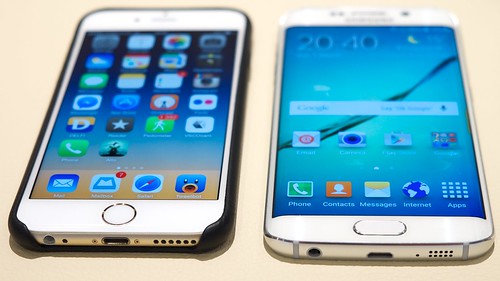
Apple Watch owners might get left behind with new phones unless they back up. Photo by Ian Muttoo on Flickr.

You can now sign up to receive each day’s Start Up post by email. You’ll need to click a confirmation link, so no spam.

(Apologies if yesterday’s didn’t arrive: WordPress’s RSS feed is co-written by Volkswagen, it seems.)

A selection of 9 links for you. Use them wisely. I’m charlesarthur on Twitter. Observations and links welcome.

Symantec employees fired for issuing rogue HTTPS certificate for Google » Ars Technica

Dan Goodin:

Symantec has fired an undisclosed number of employees after they were caught issuing unauthorized cryptographic certificates that made it possible to impersonate HTTPS-protected Google webpages.

“We learned on Wednesday that a small number of test certificates were inappropriately issued internally this week for three domains during product testing,” Symantec officials wrote in a blog post published Friday. “All of these test certificates and keys were always within our control and were immediately revoked when we discovered the issue. There was no direct impact to any of the domains and never any danger to the Internet.”

The post went on to say that the unnamed employees were terminated for failing to follow Symantec policies. Symantec officials didn’t identify the three domains the test certificates covered, but in a http://googleonlinesecurity.blogspot.com/2015/09/improved-digital-certificate-security.html, Google researchers said Symantec’s Thawte-branded certificate authority service issued an Extended Validation pre-certificate for the domains google.com and http://www.google.com.

“This pre-certificate was neither requested nor authorized by Google,” they wrote.

link to this extract


How to swap iPhones and not lose Apple Watch data » Finer Things in Tech

David Chartier:

When you unpair an Apple Watch from an iPhone, your iPhone creates a backup of your Watch data and configuration, then wipes the Watch. Since so many people will be getting a new iPhone 6S [from Friday], I wanted to see if there was an easy way to pair an Apple Watch to a new phone and restore all important data.

According to this Apple document (thanks to Rob Wensing), iPhone includes your Watch backups when it runs an iCloud backup. So, in theory, and supported by a few of my Twitter followers, here is the easiest way to switch your Apple Watch to a new iPhone and keep all your data. I don’t know what your schedule is like, but it might be best to start this the night before you get your new iPhone.

It’s a five-step process but it could take a while; crucial to it is making iCloud/iTunes backups.
link to this extract


Apple’s ad-blocking move is hurting retailers like Walmart » Fortune

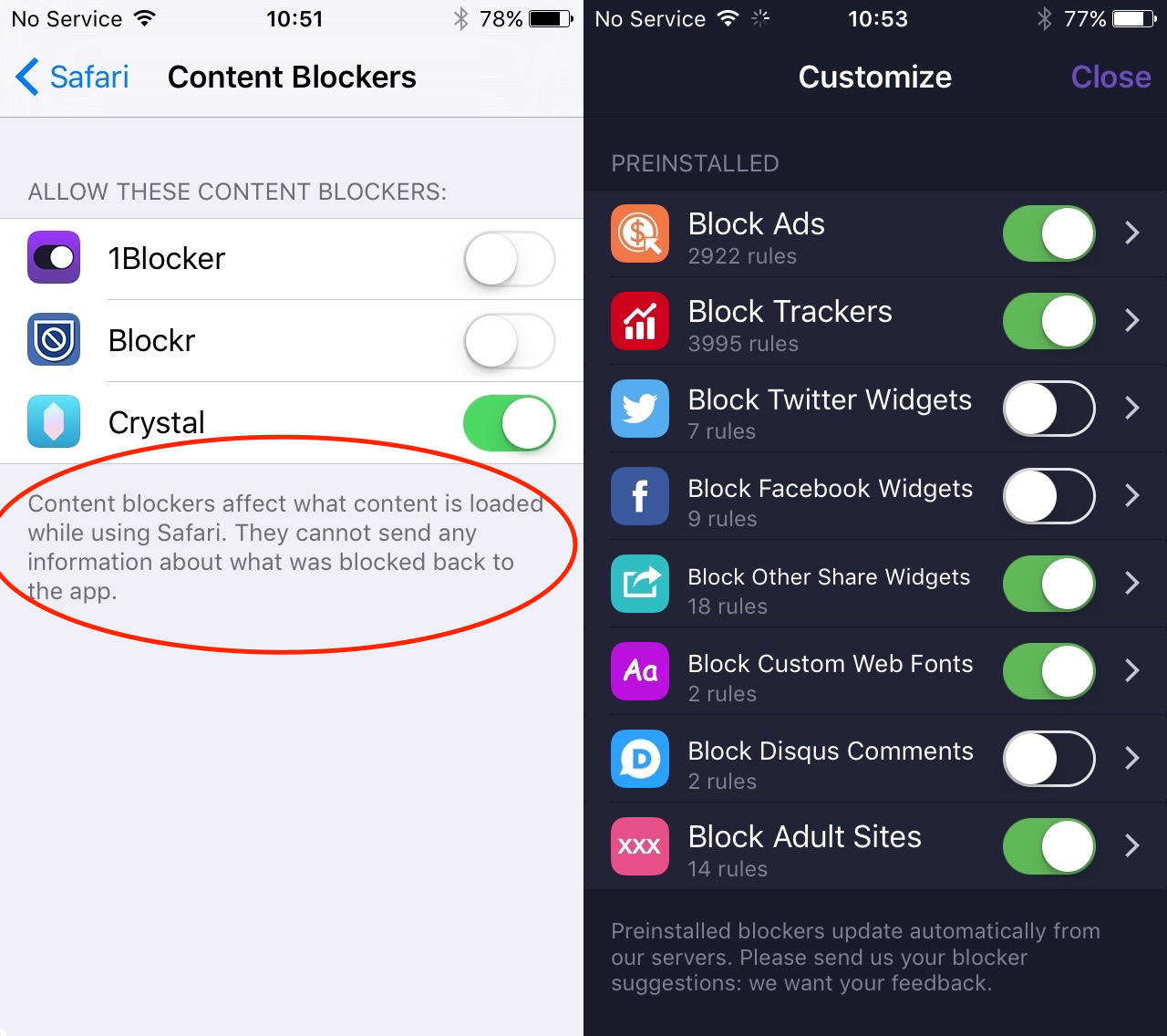
Dan Primack points out that the Crystal adblocker doesn’t play nicely with some US retail sites:

Walgreens.com had a similar problem to Sears, when using Crystal. The homepage worked, but the Safari browser went blank after clicking the “Shop Products” link.

And, as Mason said, this issue goes far beyond just image rendering. For example, everything (mostly) loaded just fine on the mobile sites for Lululemon and Walmart with Crystal enabled. But it was impossible to add any products to the shopping cart. So if you just went to browse the pretty pictures, then there’s no problem. If you want to actually buy something, however…

Even for mobile websites that are working properly from a customer perspective, such ad-blocking technology also can strip out back-end code like Google Analytics or Adobe’s Omniture, which provide retailers with real-time insights into customer behavior. And then there is the whole matter of how retailers generate around 60% of their mobile web traffic inorganically, via online ads that Crystal and other ad-blockers are designed to eliminate.

“Retailers can work around it on the consumer side by doing a lot of recoding, but a lot of them freeze their codes on November 1, ahead of the holiday shopping season,” Branding Brand’s Mason says. “So that gives them just over a month or so to get it done. On the back-end they could use different sources of information for sales — kind of like checking the cash register instead of receipts — but it is a different process and also depends, in part, on if the sites are hosted on servers in-house or not.”

Do these retailers have any of the world’s smallest violins in stock? I feel I need one. A few things: Crystal isn’t the only adblocking app; Dean Murphy, Crystal’s developer, is looking at the problem; and as for “real-time insights into customer behaviour”, well, tough. Looks like it might be back to interpreting logs.
link to this extract


Preemadonna turns your smartphone into a nail salon » TechCrunch

Megan Rose Dickey:

Preemadonna just unveiled the Lacey Nailbot, a nail decorating robot, at TechCrunch Disrupt SF 2015.

The Lacey, which will retail for $199, uses your smartphone’s back camera and prints full color art on nails in just a few seconds. The only thing you have to do before putting your finger under the Nailbot is prime your nail with white polish.

The Nailbot uses inkjet, and will eventually use actual nail polish, that is controlled through its system over wireless connection (BLE) to decorate the nail with a swipe or through a motorized solution. The Nailbot utilizes Hewlett Packard’s thermal technology, your phone’s camera, machine vision, computer vision and other technologies. In addition to the Nailbot itself, users can create, design, modify and share their art with the accompanying app.

Wow. If there were a job I would have thought was safe from robots, it would be nail salon worker. Side note: how great to see a story about something involving a service for women.
link to this extract


Who killed Nokia? Nokia did » INSEAD Knowledge

Quy Huy, INSEAD Professor of Strategy and Timo Vuori, Assistant Professor of Strategy, Aalto University:

Nokia’s fall from the top of the smartphone pyramid is typically put down to three factors by executives who attempt to explain it: 1) that Nokia was technically inferior to Apple, 2) that the company was complacent and 3) that its leaders didn’t see the disruptive iPhone coming.

We argue that it was none of the above. As we have previously asserted, Nokia lost the smartphone battle because of divergent shared fears among the company’s middle and top managers led to company-wide inertia that left it powerless to respond to Apple’s game changing device.

In a recent paper, we dug deeper into why such fear was so prevalent. Based on the findings of an in-depth investigation and 76 interviews with top and middle managers, engineers and external experts, we find that this organisational fear was grounded in a culture of temperamental leaders and frightened middle managers, scared of telling the truth.

Ex-Nokia people on Twitter disagree pretty strongly. And it’s hardly as if Apple was led by a gentle consensus-seeking always-relaxed paragon. (We don’t know how frightened its middle managers are/were, either.)
link to this extract


More BlackBerry layoffs: 200 Venice devs binned amid Android shift » The Register

Reuters reports that around 200 hardware and design staff have been laid off, following the completion of work on an Android device codenamed “Venice”. It’s the latest in a succession of “resource reallocations”.

BlackBerry has struggled to achieve significant volumes since BB10 launched in January 2013, with only 1.1 million units shipped last quarter. The total number is shipped is probably lower than 10 million.

BlackBerry’s CEO John Chen has repeatedly said that BlackBerry will only continue to develop handsets if it’s profitable to do so, and that the break-even point hadn’t yet been reached. Chen has shied away from committing to enhancing BlackBerry’s own BB10 platform, and various indicators suggest it’s now Android or bust for BlackBerry phones, with BB10 placed in maintenance mode while continuing to receive critical security updates.

BlackBerry continues to hire in its QNX embedded systems division, but hasn’t advertised for BB10 developers for some time. While the company released a redesigned Passport in August, it hasn’t revealed any significant enhancements to BB10 this year. Its BB10 developer program is gathering cobwebs.

Chen has also qualified a commitment he made at MWC in March to produce four phones this year. It may just be one annually.

BlackBerry announces its second-quarter results at 0800EST (1300BST). Analysts reckon its revenues will be $611m, down a third from a year ago – its lowest figure since the same period in 2006.
link to this extract


Mail Online digital advertising slows down to 16% annual growth » The Guardian

Mark Sweney:

Stephen Daintith, finance director at DMGT [which owns the Daily Mail and Mail Online], said the company expects Mail Online to “comfortably” pass £70m for its full financial year to the end of September.

The company has previously said that it was aiming to make £80m in revenue this year, although it has said this is not a “hard target”.

The slowdown prompted analysts at Exane to publish a note to investors earlier this month warning that Mail Online was likely to miss its stated revenue target of £100m by the end of next year.

“We see the recent revenue slowdown of Mail Online (despite strong audience growth) as more structural than cyclical, with mobile, ad blocking and social media all bringing new challenges to monetisation,” said William Packer, analyst at Exane. “We now expect Mail Online to miss their £100m revenue target.”

Daintith admitted that given the slowdown, hitting £100m next year was now a “big goal”.

Never seen adblocking mentioned before in an analyst note, but this is quite a slowdown; previously it was 50%.
link to this extract


Note to readers » Toronto Sun

James Wallace, vp editorial, Toronto Sun:

As a paper, we pride ourselves both on dishing out and taking criticism – especially when the latter comes from our readers.

And part of that conversation has taken place on our online comment boards.

However, the increasing use of Sun comment boards for anonymous, negative, even malicious personal attacks, albeit by a minority, has led us to conclude our current commenting system is not serving the interests of the majority of our readers.

Therefore we have decided, for the time being, to no longer allow commenting on most online articles until we sort out a better and more accountable way for our readers to interact with us and each other.

Like a growing number of news organizations, we are also moving away from anonymous commenting because there are other options that encourage respectful, civil debate.

Much of that debate already takes place on social media.

Should we call this “reader-blocking”? “Comment-blocking”?
link to this extract


Why aren’t some smartphone makers simplifying SKU count to increase profitability? » Forbes

Patrick Moorhead:

many OEMs who never thought they could compete on the global market are now directly competing with Samsung Electronics and Apple for market share and consumers’ mind share. To compete with Samsung Electronics and Apple, many upcoming OEMs are wasting millions of dollars creating too many SKUs that they may eventually never sell. We created an economic model that shows that through SKU consolidation, one could see an 8% margin improvement through aggressive SKU management. This column is a flyover, but you can find more information here.

Apple has 6 SKUs, globally (different models; memory capacity and colour aren’t counted as SKUs) while Samsung’s SKU count is 14 for the Galaxy S6, 13 for the S6 Edge, 6 for the Edge Plus and 1 for the S6 active. That’s 34 SKUs, even before you look at the Note 5 and all the others.

Too many SKUs are an obvious problem because you have to match production, distribution, demand and sales – else you’re left with inventory or other writeoffs.
link to this extract


Start up: a shorter rounder Pebble, VW v DMCA redux, Lenovo’s other spyware, IAB defends ads, and more


This bloke’s car might offer some clues about Apple’s future offering. Photo by Konabish on Flickr.

You can now sign up to receive each day’s Start Up post by email. You’ll need to click a confirmation link, so no spam.

A selection of 11 links for you. Use them wisely. I’m charlesarthur on Twitter. Observations and links welcome.

Pebble debuts its first round smartwatch with the Pebble Time Round » TechCrunch

Greg Kumparak:

Pebble is thus far known for its solid battery life; in a world where most smartwatches last a day or so at best, Pebble’s lightweight OS and e-ink display traditionally let it crank on for closer to a week.

Curiously, though, the Pebble Time Round has shaved off a fair bit of that signature battery life in favor of a lighter, slimmer design — instead of five or six days of battery life, Pebble Time Round promises two days. A quick charge feature lets you add 24 hours of juice with just 15 minutes on the charger — but you won’t be taking this one for week long camping trips.

Less battery life?
link to this extract


You have the right… to reverse engineer » getwired.com

Wes Miller:

This NYTimes article about the VW diesel issue and the DMCA made me think about how, 10 years ago next month, the Digital Millennium Copyright Act (DMCA) almost kept Mark Russinovich from disclosing the Sony BMG Rootkit. While the DMCA provides exceptions for reporting security vulnerabilities, it does nothing to allow for reporting breaches of… integrity.

I believe that we need to consider an expansion of how researchers are permitted to, without question, reverse engineer certain systems. While entities need a level of protection in terms of their copyright and their ability to protect their IP, VW’s behavior highlights the risks to all of us when of commercial entities can ship black box code and ensure nobody can question it – technically or legally.

Miller advised Russinovich on whether he could publish. The VW case is surely going to lead to a lot of questions about the DMCA and engine control unit (ECU) software – as highlighted yesterday.
link to this extract


What will the Apple Car look like? Jony Ive’s taste for Bentleys and Aston Martins could influence design » IB Times

David Gilbert:

So what will Apple’s car look like? By talking to the people in the industry and those who know Ive and his work, IBT gleaned some idea.

“If you look at the Apple philosophy of less is more, then apply that to a car then you would have an Apple product,” said Chris Longmore, founder if U.K.-based automotive design consultancy Drive. Longmore, who has worked with Ford, Nissan and Rolls Royce who believes it is a huge benefit for Apple to be starting with a blank sheet of paper. “If you take the iPhone and move into different areas, because the building blocks would be common throughout that, the DNA would be common across all the products and that’s how they should be looking to do it,” he said.

That too is the view of Ive’s former boss, Martin Darbyshire, CEO and founder of London-based design company Tangerine, who worked with Ive for 18 months before he moved to Apple.

“Sometimes coming at something with a fresh perspective is fundamental to finding something new and developing a paradigm shift. Of all the design teams in the world one would expect Apple to do something interesting and different,” Darbyshire told International Business Times.

Smart move asking Darbyshire. When you look at all the fan-generated renders of the “iWatch”, you realise the gulf between what people wish for and what Apple really does.
link to this extract

Lenovo collects usage data on ThinkPad, ThinkCentre and ThinkStation PCs » Computerworld

Michael Horowitz:

The task that gave me pause is called “Lenovo Customer Feedback Program 64”. It was running daily. According to the description in the task scheduler: “This task uploads Customer Feedback Program data to Lenovo”.

I have setup my fair share of new Lenovo machines and can’t recall ever being asked about a Customer Feedback program.

The program that runs daily is Lenovo.TVT.CustomerFeedback.Agent.exe and it resides in folder C:\Program Files (x86)\Lenovo\Customer Feedback Program.

Other files in this folder are Lenovo.TVT.CustomerFeedback.Agent.exe.config, Lenovo.TVT.CustomerFeedback.InnovApps.dll and Lenovo.TVT.CustomerFeedback.OmnitureSiteCatalyst.dll.

According to Wikipedia, Omniture is an online marketing and web analytics firm, and SiteCatalyst (since renamed) is their software as a service application for client-side web analytics.

So, while there may not be extra ads on ThinkPads, there is some monitoring and tracking.

Lenovo confirms in a support note that it does this, but says it’s non-personal. It seems the purpose is to see which applications, service and offers you go for during system setup. Which says something about the parlous state of crapware on Windows PCs in its own right.
link to this extract

The Apple bias is real » The Verge

Vlad Savov, bravely:

The next time you read an iPhone review, keep all these biases in mind. The iPhone is the favored tech product of a vast swathe of our planet’s population, serving both utilitarian and aspirational purposes. It is the catalyst for and sole supporter of entire ancillary industries. It is the nexus where communication and commerce blend most easily, and it is the surest harbinger of the future that is to come. Any review that doesn’t account for all of these factors might be considered technically objective and ubiased, but it would also be frightfully uninformative. Assessing an iPhone against a blank canvas is akin to describing Notre Dame or Sagrada Família as old, large, religious buildings.

Apple bias exists in reviews because it exists in the real world. The company’s track record with the iPhone and other products like it — characterized by a great deal more right decisions than wrong ones — encourages optimism about its riskier new ventures today. The Apple Watch is credited with greater potential than the Samsung Gear S2 because of the two companies’ different histories. The Huawei Mate S has Force Touch similar to the iPhone 6S, but only Apple’s phone is expected to turn that technology into a transformative new mode of interaction.

That’s justified bias. That’s relevant context derived from history and experience. Without it, we’d be reciting facts and figures, but no meaning. Megabytes and millimeters matter only after they’ve been passed through the prism of human judgment, and we shouldn’t pretend that it can, or should, ever be unbiased.

link to this extract

Functioning ‘mechanical gears’ seen in nature for the first time » Phys.org

Each gear tooth has a rounded corner at the point it connects to the gear strip; a feature identical to man-made gears such as bike gears – essentially a shock-absorbing mechanism to stop teeth from shearing off.

The gear teeth on the opposing hind-legs lock together like those in a car gear-box, ensuring almost complete synchronicity in leg movement – the legs always move within 30 ‘microseconds’ of each other, with one microsecond equal to a millionth of a second.

This is critical for the powerful jumps that are this insect’s primary mode of transport, as even miniscule discrepancies in synchronisation between the velocities of its legs at the point of propulsion would result in “yaw rotation” – causing the Issus to spin hopelessly out of control.

“This precise synchronisation would be impossible to achieve through a nervous system, as neural impulses would take far too long for the extraordinarily tight coordination required,” said lead author Professor Malcolm Burrows, from Cambridge’s Department of Zoology.

“By developing mechanical gears, the Issus can just send nerve signals to its muscles to produce roughly the same amount of force – then if one leg starts to propel the jump the gears will interlock, creating absolute synchronicity.

link to this extract

Ad blocking: the unnecessary internet apocalypse » Advertising Age

Randall Rothenberg is president and chief executive of the Interactive Advertising Bureau:

Let’s take these challenges in order. Advertising (as everyone reading these words knows well) pays for the ability for nearly anyone around the world to type in any URL and have content of unimaginable variety appear on a screen. Advertising also subsidizes the cost of apps, which can take hundreds of thousands of dollars to produce, but are often free or low-priced.

Without advertising, digital content and services either will vanish, or the cost for their production and distribution will come directly from consumers’ wallets.

Of even greater importance is the impact on the economy itself. Advertising represents $350 billion of the U.S. gross national product, and consumers depend on it to help make $9 trillion of annual spending decisions. “Advertising helps the economy function smoothly,” said Nobel Laureate economists Kenneth Arrow and George Stigler. “It keeps prices low and facilitates the entry of new products and new firms into the market.”

Ad blocking disrupts this engine of competition. I wish I were crying wolf, but I’m not. Some websites, particularly those with millennial audiences, are already losing up to 40% of their ad revenue because of ad blocking. Our own IAB research found at least 34% of U.S. adults use ad blockers.

Good grief, where to start?
(1) Content was online long before advertising shoved its sweaty arse in front of us;
(2) Advertising doesn’t pay for smartphones, PCs or internet connectivity;
(3) advertising doesn’t subsidise the production, it subsidises the presentation of many apps – but substantial numbers are simply paid-for (think of UsTwo’s Monument Valley);
(4) the cost of content etc already comes from our wallets, because the cost of advertising is a factor in any company’s costs and so its products
(5) adblocking isn’t going to kill the whole advertising industry, just the bit that behaves unreasonably online
(6) adblocking actually intensifies competition, because it creates a new space where would-be advertisers have to figure out how to get their message across
(7) wouldn’t it have been good to notice that your members were pissing people off before desktop adblocking had been adopted by a third of one section of your audience, Mr Rothenberg?
link to this extract


Shut Up: Comment Blocker » iOS App Store

Richard Romero:

Shut Up spares you from Internet troglodytes by hiding all comment sections when browsing the web in Safari. You can even set your favorite websites to show comments by default.

This stuff is only just getting started.
link to this extract


Malware with your news? Forbes website victim of malvertising attack » FireEye Inc

From Sept. 8 to Sept. 15, 2015, the Forbes.com website was serving content from a third-party advertising service that had been manipulated to redirect viewers to the Neutrino and Angler exploit kits.  We notified Forbes, who worked quickly to correct the issue.

This type of malicious redirection is known as malvertising, where ad networks and content publishers are abused and leveraged to serve ads that redirect users to malicious sites.

I promise that FireEye is not paying for its position here or in the next links. It’s just on top of the relevant news. Also: pretty good case for desktop adblocking there.
link to this extract

Protecting our customers from XcodeGhost » FireEye Inc

Immediately after learning of XcodeGhost, FireEye Labs identified more than 4,000 infected apps on the App Store. FireEye has since updated detection rules in its NX and Mobile Threat Prevention (MTP) products to detect the malicious apps and their activity on a network.

FireEye NX customers are alerted if an employee uses an infected app while the iOS device is connected to the corporate network. It’s important to note that, although the CnC servers have been taken down, the malicious apps still try to connect to them using HTTP. This HTTP session is vulnerable to hijacking by other attackers.

FireEye MTP management customers have full visibility when a mobile device is infected in their deployment base. End users receive on-device notifications of malware detection and IT administrators receive email alerts of the infection.

Four thousand is a lot. Does Apple have any means to killswitch those apps? It can’t kill them based on the developer certificate, because there are lots of developer certificates involved – it’s not a single malicious developer, it’s a single malicious library (or set of libraries) used by many developers.
Apple also has an FAQ up about the exploit.
link to this extract

Guaranteed clicks: mobile app company takes control of Android phones » FireEye Inc

FireEye Labs mobile researchers discovered a malicious adware family quickly spreading worldwide that allows for complete takeover of an Android user’s device. This attack is created by a mobile app promotion company called NGE Mobi/Xinyinhe that claims to be valued at more than $100M with offices in China and Singapore.

The malicious adware uses novel techniques to maintain persistence and obfuscate its activity, including installing system level services, modifying the recovery script executed on boot, and even tricking the user into enabling automatic app installation. We have observed over 300 malicious, illegitimate versions of Android apps being distributed, including: Amazon, Memory Booster, Clean Master, PopBird, YTD Video Downloader, and Flashlight…

…has infected 20 different versions of Android from 2.3.4 to 5.1.1. Victims with 308 different phone models from more than 26 countries and four continents have been infected.

Another day…
link to this extract

Start up: DMCA v Volkswagen, cruel opt-outs, self-parking cars win, HP’s irrelevance, and more


The tsunami that hit the Fukushima reactor nearly led to a meltdown – but how many people died from radiation release? Photo by NRCgov on Flickr.

You can now sign up to receive each day’s Start Up post by email. You’ll need to click a confirmation link, so no spam.

A selection of 10 links for you. Use them wisely. I’m charlesarthur on Twitter. Observations and links welcome.

Researchers could have uncovered Volkswagen’s emissions cheat if not hindered by the DMCA » Electronic Frontier Foundation

Kit Walsh:

Automakers argue that it’s unlawful for independent researchers to look at the code that controls vehicles without the manufacturer’s permission. We’ve explained before how this allows manufacturers to prevent competition in the markets for add-on technologies and repair tools. It also makes it harder for watchdogs to find safety or security issues, such as faulty code that can lead to unintended acceleration or vulnerabilities that let an attacker take over your car.

The legal uncertainly created by the Digital Millennium Copyright Act also makes it easier for manufacturers to conceal intentional wrongdoing. We’ve asked the Librarian of Congress to grant an exemption to the DMCA to make it crystal clear that independent research on vehicle software doesn’t violate copyright law. In opposing this request, manufacturers asserted that individuals would violate emissions laws if they had access to the code. But we’ve now learned that, according to the Environmental Protection Agency, Volkswagen had already programmed an entire fleet of vehicles to conceal how much pollution they generated, resulting in a real, quantifiable impact on the environment and human health.

This code was shielded from watchdogs’ investigation by the anti-circumvention provision of the DMCA. Surprisingly, the EPA wrote in [PDF] to the Copyright Office to oppose the exemptions we’re seeking.

With a headline like that, it sounds like an episode of Scooby-Doo. The EPA’s argument in the linked letter is actually reasonable: you know that people will hack the ECM, especially if they get the source code.
link to this extract

The Cruelest Opt-Out Forms » Tumblr

A project in which @lydialaurenson collects all those forms where, when you decline, you’re meant to feel guilty for doing so. Such as this:

Of course you don’t have to read it. You could just miss the best chance of your life.
link to this extract


Self-parking cars are better than humans at parking » Fusion

A new study from the AAA put human drivers who considered themselves adept at parallel parking in a “park-off” against five models of self-parking cars. The result? Human drivers got absolutely destroyed by the automated cars in a test of basic parking skills.

Nearly 80% of survey respondents contacted by the AAA said they were “confident in their parallel parking abilities.” But self-parking cars hit the curb 81% less often than human drivers in the road test, and parked themselves with 47% fewer maneuvers. Self-parking cars were also able to park 37% closer to the curb than human drivers, and—to add insult to injury—they did it 10% faster than the humans.

“Self-parking cars” somehow doesn’t sound as sexy, you know? But the clincher is: only one in four of the people in a survey said they’d trust a car to do the parking. This is the knowledge gap that’s so crucial: we don’t know how good robots are at things.
link to this extract

One million Android users infected with malware through an IQ testing application » Softpedia

Catalin Cimpanu:

The app is called Brain Test and is a simple IQ testing utility, which comes packed with a combination of complex malware strands.

According to Check Point’s research staff, the application was detected via the company’s Mobile Threat Prevention system, first on a Nexus 5 device.

Because its owner, after receiving the malware alert, did not manage to uninstall the malicious app, this prompted Check Point’s team to have a closer look at the source of the infection.

By reverse-engineering the Brain Test app, researchers found a very well-designed piece of malware, which allowed attackers to install third-party applications on the user’s phone, after previously rooting the device and even managing to become boot-persistent.

Brain Test came with a complex detection avoidance system

Looking even further into the issue, researchers found a complex system that allowed the malware to avoid detection by Google’s Bouncer, an automated app testing system that checks for known security issues.

The malware contained code that prevented it from executing if it detected it was being run from certain IP ranges, or domains containing “google”, ”android”, ”1e100.”

After managing to get around Bouncer’s checks and getting installed on a user’s phone, Brain Test would execute a time bomb function whenever the user would run it for the first time.

Even after Google zapped it, the app was re-uploaded five days later. Software that detects when it’s being tested really is the flavour of the month, isn’t it?
link to this extract


London Collision Map Beta

Discover where road traffic collisions have happened in London since 2005; then filter by year, road user, collision severity and age group.

Figures for 2014 show that the number of people Killed or Seriously Injured (KSI) on London’s roads fell to the lowest level since records began. Safe Streets for London, London’s road safety plan, set out the ambition to work towards roads free from death and serious injury and the Mayor’s new target is to halve the number of KSIs by 2020 compared to the Government baseline.

Nice idea, but it’s pretty hellish to use. Heatmaps might have worked better.

link to this extract

Why HP is irrelevant » Om Malik

A few years ago, in a conversation with my friend Pip Coburn (who spent a long time as a tech-stocks strategist for UBS before starting his own firm, Coburn Ventures), I mentioned that a certain company was dead, though not many realized it. And by “dead,” I didn’t mean that it was bankrupt, out of money or out of business. I meant it was dead in its ability to find growth, excitement and new ideas. Any positive energy had flattened and turned negative. “With that lens on, HP has been ‘dead’ for 15+ years,” Pip emailed me this morning.

Pip says that “companies have a space and time and purpose and when those fade the company would be wise to steadily shut itself down.” Like some other large tech companies, HP fits that bill. In a note to some of his clients, Pip pointed out, “The company [HP] doesn’t even do a good job of pretending to have a strategy.” And he is right.

It’s true: HP hasn’t made a market since, what the inkjet printer? Bubblejet printer? Laser printer? Whichever, it’s been a long time.
link to this extract

When radiation isn’t the real risk » The New York Times

George Johnson:

This spring, four years after the nuclear accident at Fukushima, a small group of scientists met in Tokyo to evaluate the deadly aftermath.

No one has been killed or sickened by the radiation — a point confirmed last month by the International Atomic Energy Agency. Even among Fukushima workers, the number of additional cancer cases in coming years is expected to be so low as to be undetectable, a blip impossible to discern against the statistical background noise.

But about 1,600 people died from the stress of the evacuation — one that some scientists believe was not justified by the relatively moderate radiation levels at the Japanese nuclear plant.

None of the workers who went into the stricken plant has died of radiation poisoning. The biggest problem for those workers is heatstroke caused by the extra protective equipment they wear.

Truly, the media reaction to Fukushima was enormously overblown; we are all bad at evaluating risk, but the media perhaps worst of all because “if it bleeds, it leads”.
link to this extract

BT pledges better broadband for UK » BBC News

BT has hit back at rivals calling for its break-up, with a strategy to make the UK the fastest broadband nation.

It revealed plans to connect 10 million homes to ultrafast broadband [300-500Mbps] by the end of 2020 and raise the minimum broadband speed for homes that cannot get fibre to 5-10Mbps (megabits per second).

It comes in a week when rivals have denounced the quality of UK broadband.

In a letter to the Financial Times on Monday, they said BT should be split.

Sky, Vodafone and TalkTalk were among signatories to the letter which claimed that millions of customers currently have a “substandard” broadband service.

Homes currently passed by fibre, according to Ofcom: 23.6m (with 30% takeup, ie 7.1m users).
Households in UK: 26.4m.

However, the gap between that pledge of ultrafast and minimum is just absurd. And it’ll be those who need the faster speeds – in rural areas – who won’t get it.
link to this extract

Soft underbelly » Asymco

Horace Dediu suggests that existing carmakers are underestimating the threat they face from computer-industry entrants:

Traditional car making is capital intensive due to the processes and materials used. There are however alternatives on the shelf. iStream from Gordon Murray Design proposed switching to tubular frames and low cost composites.  BMW has an approach using carbon fiber other composites. 3D printing is waiting in the wings. All offer a departure from sheet metal stamping.

With new materials, costs for new plants can be reduced by as much as 80% and since amortizing the tooling is as much as 40% of the cost of new car, the margins on new production methods could result in significant boosts in margin.

There is a downside however. What is usually compromised when using these new methods is volume and scale of production. So that becomes the real question: how many cars can Apple target? 10k, 50k, 100k per year? Could they target 500k? That would be 10 times Tesla’s current volumes but only a bit more than the output of the Mini brand.

Now consider that the total market is 85 million vehicles per year. For Apple to get 10% share would imply 8.5 million cars a year, a feat that is hard to contemplate right now with any of the production systems. On the other hand selling 80 million iPhones and iPads in a single quarter has become routine for Apple and that was considered orders of magnitude beyond what they could deliver. Amazing what 8 years of production ramping can offer.

Given that cars are increasingly computers with fancy cases on wheels, you really don’t want to rule out low-end or even high-end disruption.
link to this extract


Ad tech always wins: Ad blocker users are the new hot ad-targeting segment » Digiday

Lucia Moses:

“We want to find ways to reach these consumers in ways that suit how they want to be communicated to and with,” Laura Mete Frizzell, gm of search/analytics/media at 360i. “They are part of an audience for which the brand is relevant and can offer utility.”

The potential to target ad blockers is “on the radar,” said Jon Anselmo, senior vp, managing director of digital innovation at MediaVest. “People’s behaviors, including ad blocking, do provide us insights about who they are and what they care about. A tech-savvy nature could absolutely be one such insight.”

On the seller side, too, the idea of targeting blockers is starting to pop up in conversations with publishers like Complex, said its CEO and founder Rich Antoniello. “Those are the hardest to reach people,” he said. One response by Complex has been to use the space normally given over to ads to present ad blocker users with a message asking for their emails to target them regardless.

Mark that last one, because it must surely be the dumbest thing you’ll see today. (Via Rowland Manthorpe.)
link to this extract

How big (and bad) adblocking could get – and why news sites should sell adblockers

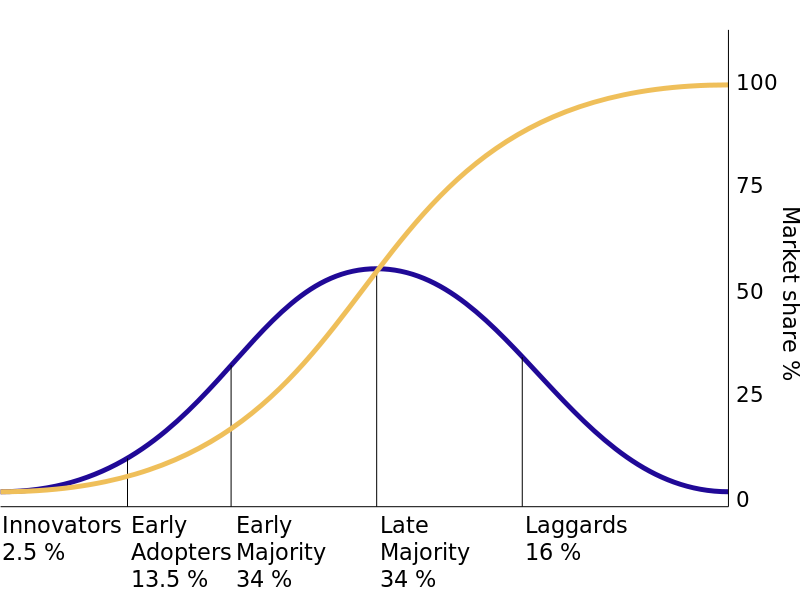
Diffusion of innovations: segmentation

Stages of adoption of innovations. Source: Wikipedia

“I’ve got something to show you,” I told Horace Dediu as we chatted the other day. “I think it’s a logistic curve.”

Dediu’s face lit up. He of course is the one who has predicted smartphone adoption in the US with remarkable accuracy by using the straightforward maths of the “diffusion curve”, or “logistic curve” as it’s also known. That’s one up there at the top in yellow.

The logistic curve can be used to model all sorts of things: disease, populations, growth. It’s the integral of the bell curve (in blue at the top), and so it’s about “normal” populations.

Dediu has built a terrific series of presentations around data he has collated about the adoption of various technologies – refrigerators, cars, PCs, tablets, microwave ovens, smartphones. Pretty much all of them follow a logistic curve. There’s a slow uptake at first as only those in the know find out. Then there’s a sudden takeoff, and a rush that then leads rapidly upwards, until you come to the laggards who are the last to hear, or the least willing to adopt. (Don’t hassle me with your science oven.)

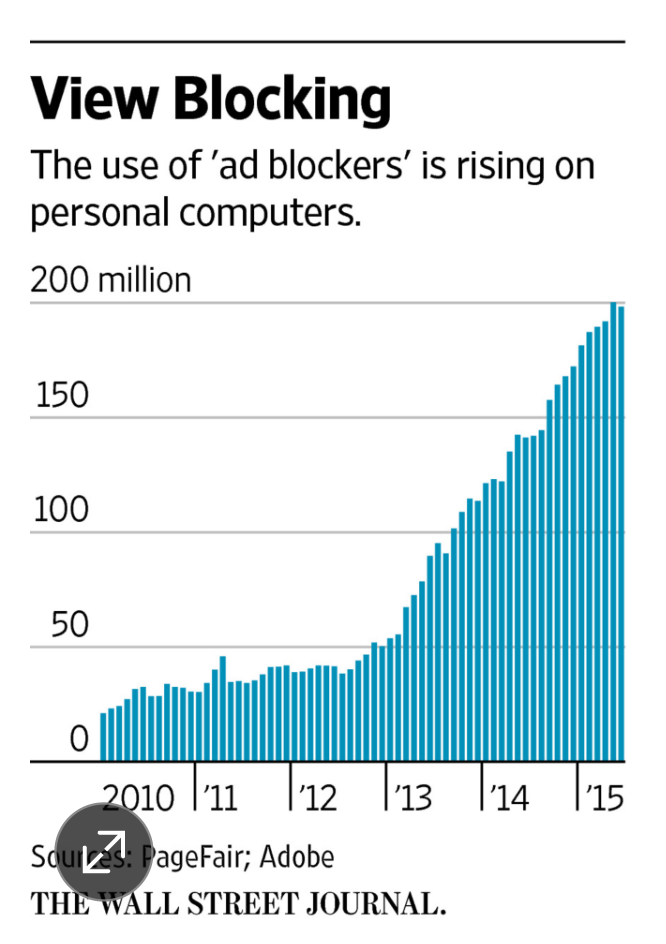
The graphic I wanted to show him? Adoption of adblocking. The picture below, taken from the Wall Street Journal’s writeup of the Pagefair report, shows the classic inflexion point of adoption: the rapid upward sweep that keeps building.

The growth of adblocking to 200m

Pagefair data suggests there were about 200m people blocking ads by mid-2015. Graphic: Wall Street Journal

Question is, how big is it going to get? You can fit the diffusion curve to this data in lots of ways.

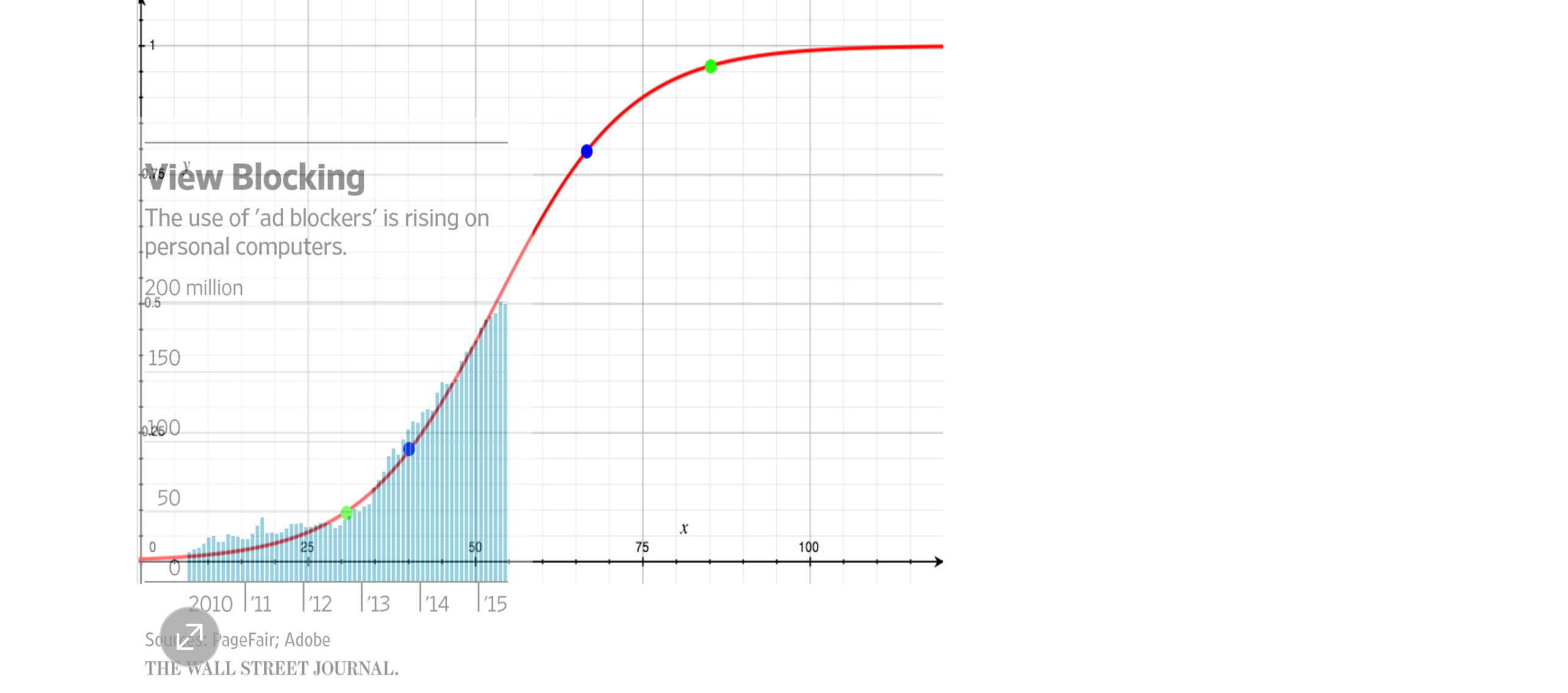
The optimistic view takes the sheer number, and gives it a straight-ahead fit.

Adblocking: the optimistic forecast

On this measure, we’re about halfway through the diffusion of this technology.

This looks quite encouraging for those worried about the adpocalypse. The current number of adblock users is 200m, and it looks to be about halfway up the curve, so that’s 400m total once it saturates. OK, not great, but tolerable.

Dediu himself wrote a commentary this week, wondering about what has taken adblocking so long to take off:

What we never know is how quickly diffusion happens. I’ve observed “no-brainer” technologies or ideas lie unadopted for decades, languishing in perpetual indifference and suddenly, with no apparent cause, flip into ubiquity and inevitability at a vicious rate of adoption.

He argues that for takeoff, you need both a “push” and a “pull”. The push has now happened with the availability of adblockers easily installed via the App Store; now he wonders how fast the “pull” from users will be.

(I think, actually, that the key push happened before that, in mid-2013: that’s where that Pagefair curve suddenly moves upward. What happened in mid-2013? The Snowden revelations about tracking by governments. I don’t think the rise of adblocking after that point is a coincidence.)

That graph above might say “well, quite soon we’ll be done, and it’s not going to be that bad.” Ah, but we’re not done. When I showed the WSJ graphic to Dediu, he said “OK, but you have to adjust for internet population.”

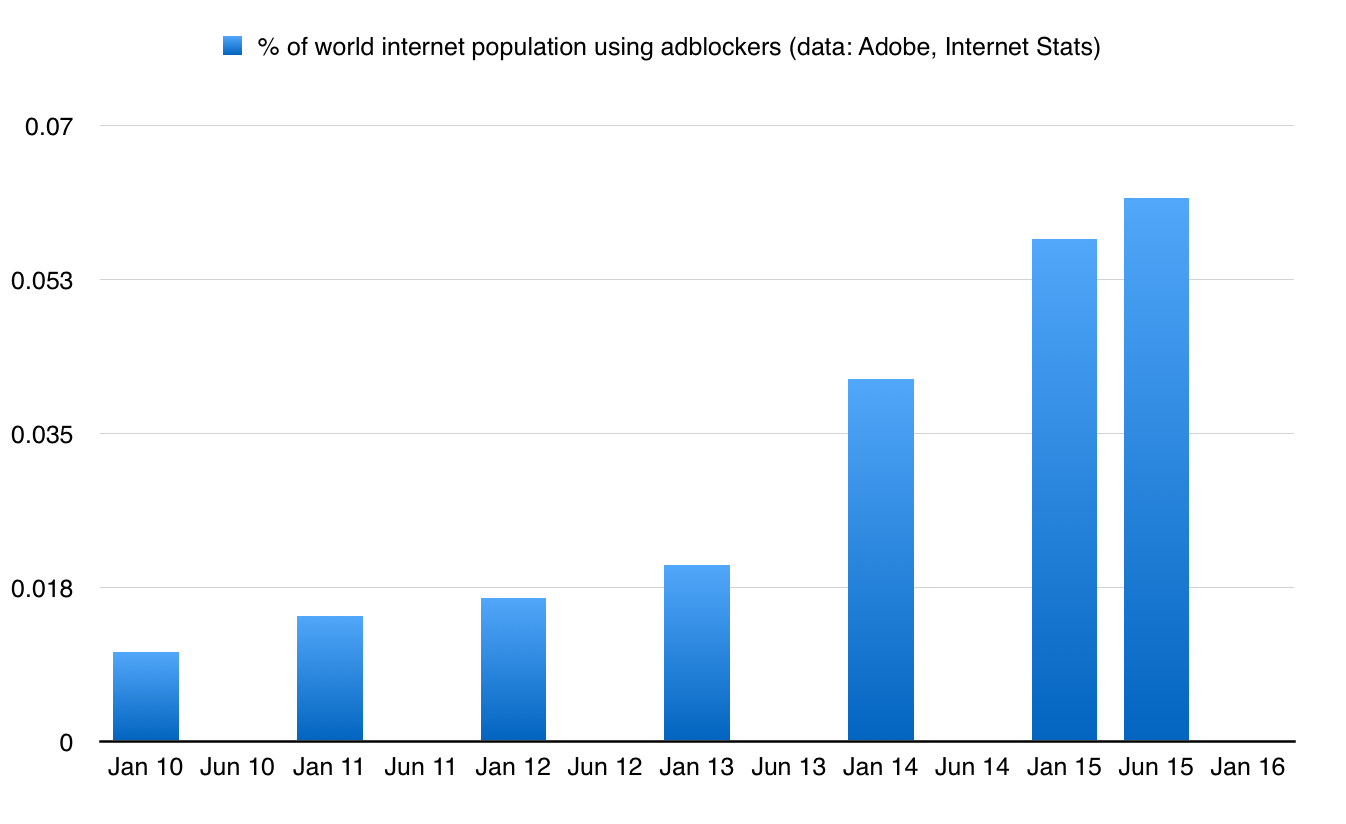
While the number of adblocker users has been growing, so has the total internet population. Adblocking as a percentage of total users hasn’t grown quite so fast. Arguably, people in countries such as China and India who are on mobile more than PC have a greater incentive to adblock than people on unmetered desktop systems.

Here’s how that growth chart looks like when you present it as a percentage of the internet population (data sourced from internetworldstats.com):

Adblocking as a percentage of intenet users

Data from Pagefair shows adblocking as a minority sport – so far

And now with the diffusion curve roughly fitted to it:

Adblocking: the less rosy view

If you compare adblocking penetration to the internet population, it looks like it’s got a lot of potential to grow

On this graph, 200m users adblocking is perhaps 10% of those who will eventually use it. So yes, we’re saying that 2bn people could be adblocking eventually. Which would leave us wondering, as Dediu puts it, “how quickly will ads disappear from the internet?” (The current internet population is about 3bn users.)

Put it another way:
the data suggests there are going to be between 400m and 2bn adblocking users within a few years.

OK. How much is that going to lose? Or put it another way, using data we can adduce: how much are visitors to ad-funded websites worth at present?

The value of a reader

Below, I’m going to use data from The Guardian, because it’s easily available (not because I’m a contributing writer). I’d welcome figures from another other news site such as the New York Times or Washington Post.

In March 2014, the Guardian hit 100m browsers for the month. In July 2014 it managed 137m. (“Browsers” aren’t the same as “views”, nor the same as “users”. A single browser could do multiple page views; a single user might use multiple browsers, such as a mobile one and a desktop one at different times of the day. If you’re feeling wonkish, the Audit Bureau of Circulation has more data at appendix 2.1 of its measurement requirements: “This metric measures each browser on a given device; it does not measure a person.”)

There’s a spreadsheet with the past year’s figures for browsers for the main UK national papers.

According to that spreadsheet of ABC-audited browser figures, in the ten months from June 2014 to March 2015, the Guardian’s average monthly browser figure was 111m.

So how does that compare to its digital revenues (which are broken out separately from print)? I’ve chosen the Guardian because its browser stats are available, and there isn’t any confusion caused by a paywall. But there are a couple of confounding elements:
• its “membership” scheme. I’m assuming there’s no significant income from that compared to the number of visitors. This is a gloss; the income from “membership events” is definitely non-zero.
• there’s a Guardian app for iOS and Android, which offers in-app purchases (IAPs) ranging from £3.99 to £11.99, including six- and 12-month subscriptions (£3.99 and £4.99 respectively). We don’t know how many of those have been downloaded, nor what the average payment is. Obviously it’s non-zero, and might materially affect our assumptions.
• the Guardian has “sponsored content”, which again is definitely non-zero in revenue terms – it has signed at least one deal worth a million pounds. This will reduce the contribution from plain advertising.

From the Guardian’s statement for the year to the end of March 2015:

GNM [Guardian News and Media, the publishing arm] total revenue grew by 2.6% to £214,600,000 (2014: £209,000,000) with increases in digital and new product revenue more than offsetting declines in print revenue. GNM divisional digital revenue for the year increased by 20.1% to £82,100,000 (2014: £68,300,000).

If you assume every month was equal, that’s £6.84m per month in digital revenue. If you assume 111m browsers per month on average, that’s 6.16p for each “browser” visit (which isn’t, remind yourself, necessarily a user or page view; a browser might be part of a user, and might do multiple page views. So if you view it on your desktop, and then on your mobile, that’s two “browsers”; the Guardian gets 12.32p from you).

My impression, not knowing much about monetisation, is that the Guardian is monetising its visitors pretty well. Others who know the ad business better can update me.

Spread across a year, that’s 73.95p per browser. In other words, £0.74, or $1.14 per browser per year.

Note that there’s going to be gigantic variation in the actual value to the Guardian of those “browsers”. If it’s the same 111m browsers visiting each month then that might be as few as 55 million people (“few”, huh) around the world, or even fewer if they’re showing up as more than two browsers – perhaps they view the site from a work PC, then their mobile on the train, and then their tablet and their home PC at the end of the day.

Or it might be 111m different browsers, each run by a different person, each month – so 1.330 billion people. As that latter figure is pretty much half the internet population, we can say with certainty it’s not true.

Given that £0.74 per year average figure, it’s pretty clear that anyone who subscribes to the Guardian app is way more valuable than the average. Anyone who accesses by more than one method (mobile plus desktop) is more valuable than the average.

But the average is really pretty low in sheer monetary terms, and that’s with the best that the advertising business has to throw at people – and that’s before we subtract the income from the app, the membership scheme, and the sponsored content, which probably come to a few millions.

All in all, you’d have to say that the per-browser value of you, as an individual who doesn’t have the app, isn’t a member and isn’t reading sponsored content (actually you don’t care about the latter – the Guardian gets paid for it anyhow), is probably pretty low; maybe in the 5p per browser range, or 60p per year.

Take that spread

Spread that figure across the 400m people in our optimistic take on adblocking, and you have £240m taken out of the online advertising business. That’s doesn’t sound very much – except each of those people is abstracting their per-site payment at every site. So you have to multiply that impact across every site that those 400m people go to. How many ad-supported sites is that? Well, 400m is about 12.5% of the internet population. Basically, slice 12.5% off the ad income. For some, that might make the difference between positive and negative.

It’s trickier if you take the pessimistic outlook and assume 2bn people take up adblocking, because that’s two-thirds of the current internet population. It would have become such a mainstream pursuit that the online ad business would have been destroyed.

For a news site getting 60p per year on average from users, but seeing that inevitably being eroded by adblocking, the obvious path is – since you can’t beat ’em – to join them from the front by making an adblocker and selling it. Disrupt yourself before others do. A one-off price of £1.29, say, would yield 90p after Apple’s 30% cut; that’s 18 months of your “lost” ad-supplied visitor paid for. (Yeah, yeah, you have to support the app too. Perhaps IAPs? Easily switchable settings to allow the ads on your site? Ways for people to vote on ads they do and don’t like which gets fed back to you, the publisher, rather than invisibly back to the ad networks which will ignore it?)

In that 18 months, you might be able to figure out a better business model, because there’s no reason this should get smaller. iOS is a key platform, and adblocking apps are already taking the food out of news sites’ mouths – to the tune of probably a million pounds in less than a week.

Again, that might not sound like much; but every single time those users visit those sites in future, they’ll not be making themselves available for monetisation. An adblocker is a one-off purchase, but its effects are repetitive.

Who’s to blame? Make no mistake: using an adblocker is a natural reaction to the intrusive, annoying, and even dangerous ad-tech industry. Concerns about tracking have amplified it, and created a perfect storm. It’s the ad industry’s own fault.

Sure, you can argue that people shouldn’t use adblockers on your site if they love you. But lots of people might love your site, but consider the ads an unacceptable intrusion, because you didn’t choose them. They just got inserted, often by a real-time bidding process choosing from inventory matched against the tracking profile of you (which could have your age, gender and interests completely wrong).

So the diffusion has begun. Quite where it ends, we don’t know. I do know though that I’m very much looking forward to Pagefair’s next report on the size of the adblocking market.

Start up: explaining XcodeGhost, Monument Valley goes VR, will Venice sink BlackBerry?, and more


What’s the common factor in iOS devices bricked by trying to update to iOS 9? Photo by marc falardeau on Flickr.

You can now sign up to receive each day’s Start Up post by email. You’ll need to click a confirmation link, so no spam.

A selection of 10 links for you. Use them wisely. I’m charlesarthur on Twitter. Observations and links welcome.

Monument Valley’s creators just made a stunning VR game » WIRED

Liz Stinson:

Like most early VR games, Land’s End is in many ways an experiment designed to discover what does and doesn’t work in the medium. Ustwo’s Ken Wong, Peter Pashley and Dan Gray spent more than a year developing the game, with many stops and starts and do-overs along the way. “It took a long long time to reinvent all these fundamental things about how you move around a world and how you interact,” says Wong.

Things like navigation took some toying with. “We spent a lot of time trying to figure out the best way to let people move around these worlds in a way that felt kind of almost subconscious,” says Pashley. You make your way through the levels by glancing at “lookpoints,” shimmering spheres of light that burst open and propel you forward when you look at them. The motion is slow and controlled; it feels almost like a moving sidewalk at the airport.

This looks terrific. Presently for Samsung Gear VR + Oculus only. I’d happily buy the soundtrack.
link to this extract


BlackBerry Venice » YouTube

A pretty much full-size touchscreen Android phone sort of running some sort of BlackBerry software. With a big keyboard that slides out from below. See for yourself.

Notice that he never actually tries to type anything. This may be significant: the top end of the phone would have to be very light to stop it overbalancing.

I wonder (with @charlesknight) whether this is John Chen’s last attempt at hardware; if this flops – which seems pretty likely – there’s little point carrying on. In a few quarters, BlackBerry should have swallowed Good Technology completely and can live on software and services revenues, which are much more profitable.
link to this extract


What you need to know about iOS malware XcodeGhost » Mac Rumors

The story so far (which I did notice over the weekend; I apologise for not including it in Monday’s Start Up): impatient iOS developers in China downloaded hacked copies of Xcode from Baidu servers because the ones from Apple came over slow-as-snails links from the US. The hacked copies included malware libraries that were included by default in any apps developed with them. The apps got through Apple’s approval process – and were then noticed by Palo Alto Networks, which itself noticed it on Weibo after analysis by Alibaba researchers.

Q How does XcodeGhost put my iOS devices at risk?
iOS apps infected with XcodeGhost malware can and do collect information about devices and then encrypt and upload that data to command and control (C2) servers run by attackers through the HTTP protocol. The system and app information that can be collected includes:

• Current time
• Current infected app’s name
• The app’s bundle identifier
• Current device’s name and type
• Current system’s language and country
• Current device’s UUID
• Network type

Palo Alto Networks also discovered that infected iOS apps can receive commands from the attacker through the C2 server to perform the following actions:

Prompt a fake alert dialog to phish user credentials; hijack opening specific URLs based on their scheme, which could allow for exploitation of vulnerabilities in the iOS system or other iOS apps; read and write data in the user’s clipboard, which could be used to read the user’s password if that password is copied from a password management tool.

Q Can XcodeGhost affect users outside of China?
Yes. Some of the iOS apps infected with XcodeGhost malware are available on the App Store in countries outside of China. CamCard, for example, is a popular business card reader and scanner app available in the United States and several other countries, while WeChat is a popular messaging app in the Asia-Pacific region.

Q Why would some Chinese developers download Xcode from Baidu?
Xcode is a large file that can take a long time to download from Apple’s servers in China, leading some developers to download Xcode from unofficial sources.

Q How are Apple and Chinese developers dealing with XcodeGhost?
Palo Alto Networks claims that it is cooperating with Apple on the issue, while multiple developers have updated their apps to remove the malware.

There’s a list of affected apps.

This is a significant attack, but it’s also a remarkably hard one to do more than once. I suspect the next attack will involve some sort of man-in-the-middle on security certificates that Apple will surely enforce on Xcode downloads.

Rich Mogull has a great writeup in which he says it’s about the economics of security:

Apple doesn’t believe all attacks can be stopped, and certainly not those from governments or well-funded criminal organizations, but if you make the cost of attack higher than the benefits, you knock out entire categories of bad guys and reduce the impact on users.

link to this extract


French regulator rejects Google appeal on scope of ‘right to be forgotten’ » WSJ

Sam Schechner:

France’s Commission Nationale de l’Informatique et des Libertés, or CNIL, said that Google must now adhere to a formal order in May directing it to apply Europe’s right to be forgotten to “all domain names” of the search engine, including google.com—or face possible sanctions proceedings.

Established just over a year ago by the European Union’s Court of Justice, the right to be forgotten gives European residents the ability to request that search engines remove links that appear in searches for their own name. Google has applied the ruling, but insisted on only removing results from European domain names, such as google.fr, not from google.com.

Google on Monday reiterated that it doesn’t believe the French regulator has the authority to expand the scope of the rule. “As a matter of principle we respectfully disagree with the idea that one national data protection authority can assert global authority to control the content that people can access around the world,” a spokesman said.

Ever so tricky. The US has claimed jurisdiction over sites that are hosted and authored elsewhere in the world that use the “.com” suffix; is that the same?

One suspects that Google will – if it loses in any appeal – work around this by offering filtered content to any IP address identified as being in France, just as it does to identify who to serve .fr content to.
link to this extract


Apple iPhones, iPads BRICKED by iOS 9’s ‘slide-to-upgrade’ bug » The Register

Shaun Nichols:

Reg reader Carlton told us today: “I have just updated my iPad to iOS 9 and found to my horror that once it has ‘successfully’ installed and then gone through the initial setup phase, I cannot progress past the second request to ‘slide to upgrade’ page.

“The setup order is ‘passcode’ – ‘slide to upgrade’ – ‘select Wi-Fi’ – ‘slide to upgrade’ at which point no further actions are possible.”

He was eventually able to upgrade his device to the new iOS using Apple’s suggested clean install procedure, though he said it took multiple attempts to accomplish.

Other fans reported similar problems when they tried to get the latest and greatest version of iOS on their iPads, iPhones and iPod Touch players.

While the issue appeared to be largely relegated to devices running iOS 7 skipping over to iOS 9, Apple would not confirm if that was in fact the case. No word yet on when a fix for the bug will be released.

Apple already has its hands full patching flaws with its firmware updates.

Commenters seem to concur: works fine if you’re just going from iOS 8, kills the device if you’re trying to skip upwards from iOS 7. An Apple support note says “This will be resolved soon in an upcoming iOS update”. Let’s see. (Meanwhile, Apple said in an aside in its press release about the release on Friday of the new iPhone that 50% of devices contacting the App Store as of September 19 were using iOS 9. In less than a week?!)
link to this extract


How to record a phone call on your iPhone – no additional kit of apps required » BBC College of Journalism

Marc Settle discovered (via Mashable) a terrific way to record a call:

A statement is never as good as an interview, which is where the ‘advanced’ function comes in, even if it needs a little willingness from your guest.

Call them from your iPhone and explain what you plan to do. Press ‘add call’ and then call the phone number you’re ringing them from. Yes, you did read that correctly: you need to call your own number from your own phone. As you’re on the phone, your answerphone will kick in. At this point tap ‘merge calls’: you and your interviewee will now be recording your conversation on your answerphone. End the call and then proceed as above to access the recording.

This reminds me of the “huh??” method that used to exist for running (old, old) pre-OSX Macs entirely from RAM, no disk access required, which meant gigantic battery life: you loaded a minimal OS, and then dragged your hard drive into the Trash. Honest. You just had to remember not to empty it.
link to this extract


Why we need a competition inquiry into the UK broadband market » TalkTalk BlogBlog

Dido Harding, TalkTalk chief executive:

Over 500 telecoms companies exist in the UK, but most depend on a shared set of wires that connect individual homes to our networks. When BT was privatised, it was allowed to keep control of this network on behalf of the whole industry, and it is managed today by Openreach, a BT company. It’s like one gas supplier owning the national grid, or one airline owning Heathrow.

Unfortunately, that system isn’t working because BT has used its sole control over the network to its advantage, rather than to benefit the network or customers. Openreach makes a lot of money, but it hasn’t invested enough in maintaining the network, leaving customers suffering from poor quality of service and facing long waits to repair faults or install new lines. It allows BT to abuse its control to restrict choice for customers. It also makes it harder for the regulator to enforce the rules and be a powerful consumer champion. Put simply, it’s a tired model not fit for a superfast future.

Openreach is TalkTalk’s biggest supplier; we couldn’t operate as a business without it. So naturally, I’ve got a vested interest in this debate. But what matters about today’s letter is the breadth of the coalition calling for change. It includes some of the biggest companies in the industry who have tried – and failed – for years to improve the system, as well as smaller players battling to bring innovation and choice to the market, but let down by Openreach.

Agree. Where do I sign up too?
link to this extract


600 ad companies blacklist The Pirate Bay » Music Week

Coral Williamson:

The Pirate Bay has been blacklisted by more than 600 advertisers.

The blacklist, comprising 10 sites so far, is the result of a partnership between anti-piracy group Rights Alliance and Swedish Advertisers, an association of advertisers with more than 600 member companies.

Swedish Advertisers has published a list of  recommendations designed to keep advertisers away from unlicensed sites, including observing good ethics, avoiding advertising contracts that include bulk sales, and considering where ads are ultimately placed.

OK, I have to ask. Is it unethical to use adblockers on torrent sites?
link to this extract


The number of people using search engines is in decline » Business Insider

Lara O’Reilly:

search is facing a huge challenge. The paid search business was built on a desktop browser model. And consumers are increasingly shifting to mobile. On mobile, consumers say they just don’t search as much as they used to because they have apps that cater to their specific needs. They might still perform searches within those apps, but they’re not doing as many searches on traditional search engines (although Google, Bing, and so on do power some in-app search engines.)

It sounds obvious, but there’s new data to show it’s a trend that’s really happening. And it could have a severe impact on Google’s (and Bing, and Yahoo’s) core search business. Indeed, data from eMarketer shows search ad spend growth is set to decline from 2014 through to 2019.

Speaking at digital trade show Dmexco in Cologne earlier this week, global communications agency ZenithOptimedia’s chief digital officer Stefan Bardega and research company GlobalWebIndex’s head of trends Jason Mander gave a mobile trends presentation. It was the slides on search that made the audience really sit up and start taking notes and photos.

And it’s this:

App usage and voice search both contribute too. How do you sell an ad beside a voice search?
link to this extract


Advertising is unwanted, day 2 » Scripting News

Dave Winer, in a followup to a post of a day earlier, suggesting news orgs need to find new ways to bring their readers together:

Here’s an idea for a geography-based news org (i.e. a newspaper) – give readers a place to talk about movies, and then sponsor movie nights based on their interests. Encourage people to provide lists of their favorite movies and do some collaborative filtering. Then collate the reviews and present them alongside your professional reviewer’s post. Work with the movie industry. It can have incredible promotional value, for the movie, the theater, you, the whole idea of going to the movies (as opposed to watching on your home TV, phone or tablet). What’s great for your community is they get to meet people who like the same kinds of movies they do. And you get to know who they are! It’s such a huge, easy win, all-around. That more local news orgs haven’t done it tell you how stuck in old print models we still are. This is an example of a kind of idea that really can only blossom online.

Creating community is a great idea. But what if the community lives all over the world? How does this physically-based idea work?
link to this extract


Start up: more PC market woe, tons more adblocking, Android One comes to Europe, and more


No longer the kids’ dream? Photo by LesPaulSupreme on Flickr.

You can now sign up to receive each day’s Start Up post by email. You’ll need to click a confirmation link, so no spam.

A selection of 12 links for you. Use them wisely. I’m charlesarthur on Twitter. Observations and links welcome.

PCs: Citi sees deeper 10% decline; is a sustained recovery possible? » Tech Trader Daily – Barrons.com

Tiernan Ray:

Citigroup’s Jim Suva this afternoon cut his estimates for the personal computer market to a decline of 10% in unit shipments versus his prior forecast for a 7% drop, while noting that there’s a nascent PC recovery that could help.

Suva, however, reiterates his Buy ratings on Hewlett-Packard (HPQ) and Lenovo Group (0992HK), endorsing the former because of its pending split, and the latter because of it’s restructuring effort. “We expect Lenovo and HP to continue to gain share from other PC companies,” writes Suva.

Suva, citing “finalized” PC data from Q2, after all vendor data has been gathered, now models the industry having sold 27.9m desktops last quarter and 37.5m notebook computers, down from his prior projections of 28.7m and 39.7m, respectively. 

He notes the 10% drop he’s looking for is worse than research firm IDC’s projected 9% decline.

For 2015, he now sees total industry volume of 277.2m units, down from a prior 287.2m forecast. His tablet computer estimate goes to 213.7m, which is up from his prior forecast of 205.1m. That’ still a 7% decline in tablet sales.

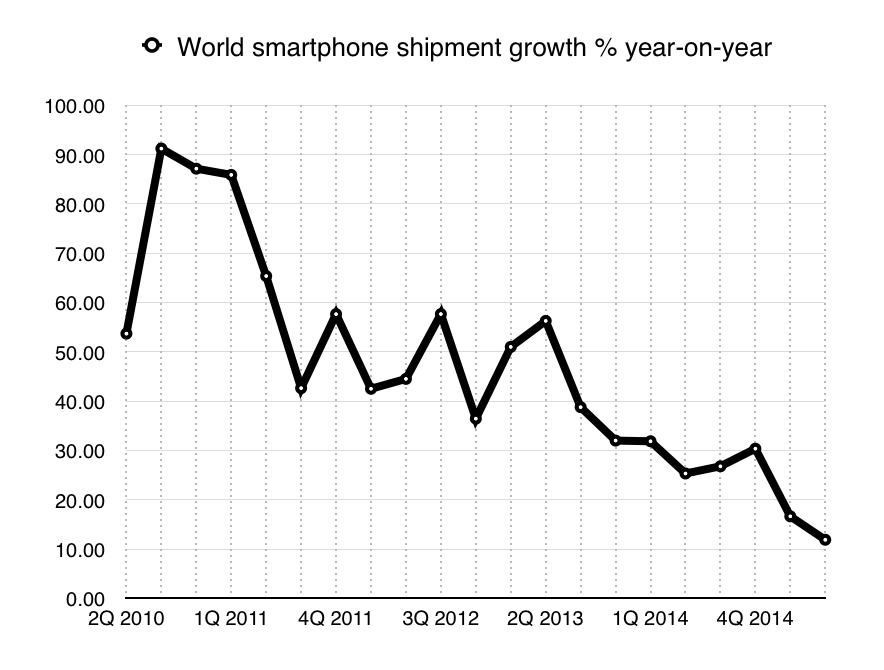
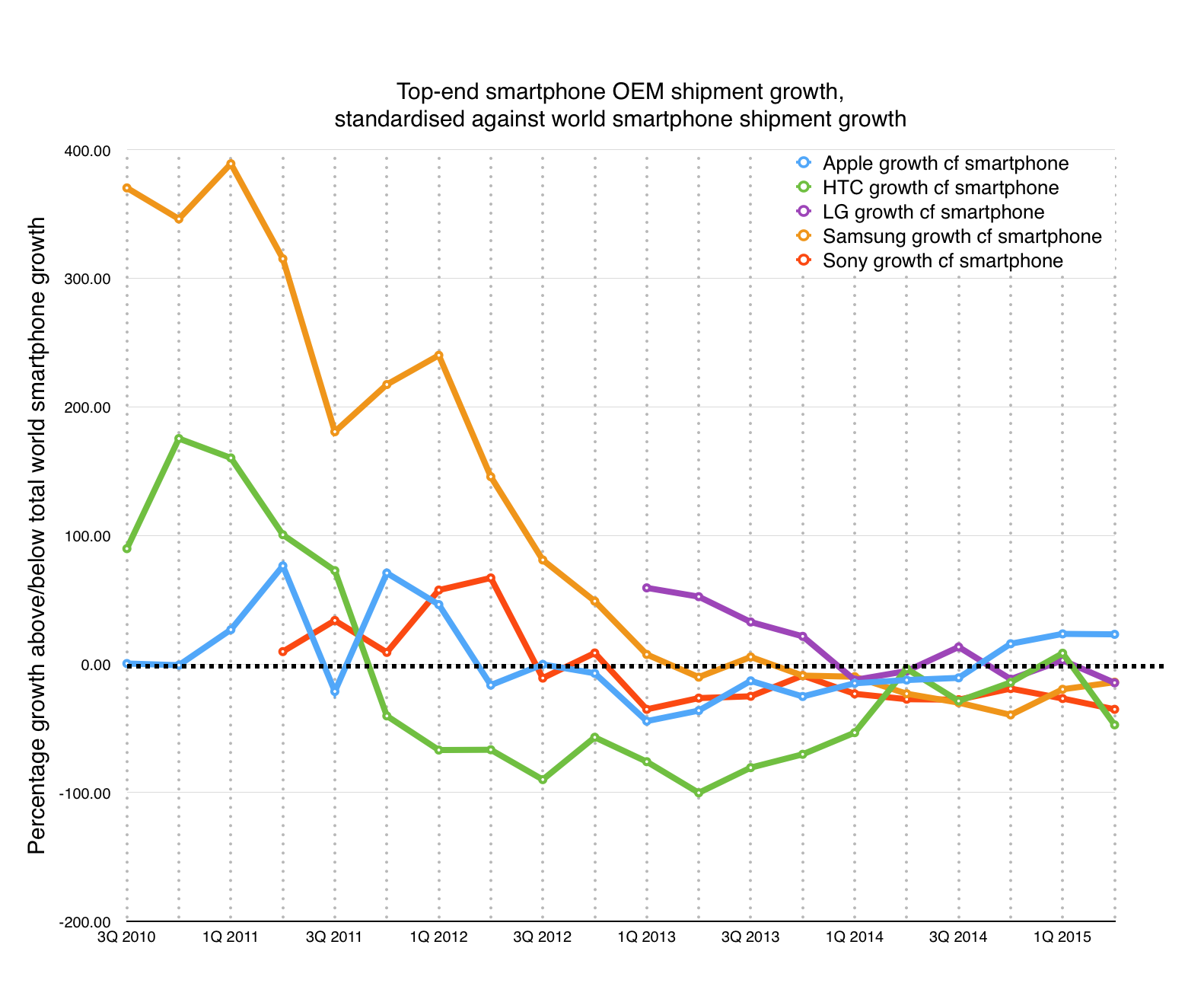
Smartphone sales growth is slowing too. Is this indicative of something broader? Also: smaller players in the PC market are going to get squeezed out.
link to this extract


EPA says VW intentionally violates clean air standards » Associated Press

Matthew Daly:

The Environmental Protection Agency said Friday that Volkswagen intentionally skirted clean air laws by using a piece of software that enabled about 500,000 of its diesel cars to emit fewer smog-causing pollutants during testing than in real-world driving conditions.

The agency ordered VW to fix the cars at its own expense. The German automaker also faces billions of dollars in fines, although exact amounts were not determined.

The cars, all built in the last seven years, include the VW Jetta, Beetle, Golf and Passat models, as well as the Audi A3. The vehicles all contain a device programmed to detect when they are undergoing official emissions testing, the EPA said. The cars only turn on full emissions control systems during that testing. The controls are turned off during normal driving situations, the EPA said, allowing the cars to emit more than the legal limit of pollutants.

The internet of intentionally sneaky things.
link to this extract


Just doesn’t feel good » Marco.org

After two days, in which his adblocking app Peace (which used Ghostery’s blocklist) had been top of the App Store, Marco Arment pulled it:

I still believe that ad blockers are necessary today, and I still think Ghostery is the best one, but I’ve learned over the last few crazy days that I don’t feel good making one and being the arbiter of what’s blocked.

Ad-blocking is a kind of war — a first-world, low-stakes, both-sides-are-fortunate-to-have-this-kind-of-problem war, but a war nonetheless, with damage hitting both sides. I see war in the Tao Te Ching sense: it should be avoided when possible; when that isn’t possible, war should be entered solemnly, not celebrated.

Even though I’m “winning”, I’ve enjoyed none of it. That’s why I’m withdrawing from the market.

His key problem, I think, was that it blocked the Deck ads on his own site, which he’d approved, and he couldn’t reasonably allow an exception for just that. I’m sure he’ll continue using one, though. (He just installed Ghostery on his wife’s desktop.)
link to this extract


iPhone launch weekends are getting silly » Above Avalon

Neil Cybart on Apple’s reluctance this year to offer a figure for how many iPhones were sold in pre-orders:

Critics will say Apple stopped releasing sales because of weaker sales growth. While iPhone sales growth may very well slow, I rather look at it as Apple is now a much bigger company in a different landscape. The Android/iOS activation wars are over. There are other ways to convince the world that iPhones are popular and worth buying besides releasing opening weekend sales. In addition, opening weekend numbers aren’t even a good measure of iPhone growth. If we compare the change in opening weekend sales to the corresponding iPhone growth over the following FY year: 

2010: 70% growth in iPhone opening weekend sales (81% iPhone unit growth in following year)
2011: 135% (73%)
2012: 25% (20%)
2013: 80% (13%)
2014: 11% (38%)
I look at that discrepancy as reason for why opening weekend sales is not the most useful parameter to judge iPhone sales. 

link to this extract


iOS 9.0 to tvOS 9.0 API Differences » Apple Developer Library

As has previously been noted, there’s no WebKit (ie no way to have an app that’s just a “web wrapper”). Makes sense – have you ever seen a decent web browser interface on a TV?

Notably also missing: iAd, Apple’s advertising system. Among others removed: AddressBook, HealthKit, CoreAudio, CoreMIDI, CoreTelephony (durr), and – weirdly – HomeKit.
link to this extract


Active malware campaign uses thousands of WordPress sites to infect visitors » Ars Technica

Dan Goodin:

“If you think about it, the compromised websites are just means for the criminals to get access to as many endpoint desktops as they can,” [Daniel] Cid [of security firm Sucuri] wrote. “What’s the easiest way to reach out to endpoints? Websites, of course.”

On Thursday, Sucuri detected thousands of compromised sites, 95 percent of which are running on WordPress. Company researchers have not yet determined how the sites are being hacked, but they suspect it involves vulnerabilities in WordPress plugins. Already, 17 percent of the hacked sites have been blacklisted by a Google service that warns users before they visit booby-trapped properties. Interestingly, Cid added, the attackers have managed to compromise security provider Coverity and are using it as part of the malicious redirection mechanism.

Checked this site with Sucuri. It’s fine.
link to this extract


YouTube’s biggest threat to the music industry isn’t what you probably think it is » Music Industry Blog

Mark Mulligan:

At the Future Music Forum, Frukt’s Jack Horner observed that because most music genres, and indeed media as a whole, are becoming age agnostic, which means that it is really hard for Generation Edge to find music that they can own, that their mum and dad aren’t going to sing along to too. This is the price to be paid for media and brands having successfully convinced aging 30 and 40 somethings that they are still young at heart and in the pocket.  So with no music subculture to cling to Generation Edge has instead gravitated to YouTube stars.

For those not familiar with this wave of YouTubers, it is nothing short of an entire new culture in which the platform, medium, format and talent blends into a single entity. Where the term ‘YouTube’ represents to each one of those aspects.  The type of content created is as diverse as fashion vloggers, slow motion film makers, online gamers, pranksters and comedy.  The unifying factor is that these creators are young and have build personality brands and audiences that not only owe nothing whatsoever to traditional media, but that often far surpass that of traditional TV film and music audiences.

It ain’t about having a Gibson without a case any more.
link to this extract


ADNAUSEAM – Clicking Ads So You Don’t Have To

As online advertising is becoming more automatic, universal and unsanctioned, AdNauseam works to complete the cycle by automating all ad-clicks universally and blindly on behalf of the target audience. Working in coordination with your ad blocker, AdNauseam quietly clicks every blocked ad, registering a visit on the ad networks databases. As the data gathered shows an omnivorous click-stream, user profiling, targeting and surveillance becomes futile.

Nice idea; presently only a browser extension in Firefox. Not yet in Chrome or Safari, or of course on mobile. (How would it work?)
link to this extract


Apple meets California officials to discuss self-driving car » The Guardian

Mark Harris:

Last month, the Guardian disclosed that Apple had looked into booking a secure car testing site in California to road-test its vehicle, codenamed Project Titan. Maletic wrote the mutual confidentiality agreement signed by GoMentum Station, a disused military base near San Francisco with miles of empty streets for driverless cars, when Apple inquired about testing there in May.

The department would not comment on what was discussed at the August meeting, beyond saying that “the Apple meeting was to review [the] DMV’s autonomous vehicle regulations.”…

…If Apple does seek a testing permit for its Project Titan self-driving car, it will have to sacrifice much of its legendary preference for secrecy. Manufacturers applying for a permit have to detail the make, model and vehicle identification number (VIN) of cars they want to test, share details of autonomous features and capabilities, and identify test drivers by name.

They will also have to explain how these safety drivers will be trained to cope with any malfunctions of the car. Manufacturers need to report every “disengagement” where the car unexpectedly hands control back to the driver, as well as all accidents it is involved in.

So the cat’s out of the bag: definitely a self-driving (or at least, autonomous) car. Harris has done great work on this story and on Google’s efforts in the field.
link to this extract


AdBlock Plus offering money to competing companies to use its “Acceptable Ads” policy » Business Insider

Max Slater-Robins:

Ben Williams, a spokesperson for Eyeo, confirmed the practice in an email saying that the company did offer people who develop iOS ad-blocking software “compensation for their work in implementing Acceptable Ads.”

Apple’s latest operating system, iOS 9, makes it possible to block ads through third-party apps, such as Peace (which uses technology from Ghostery) or Crystal. If you download these apps, they strip the ads out of any webpage you look at on your iPhone. That usually makes browsing the web faster. It blocks advertising trackers, and it means that less of your data plan is spent downloading ads you don’t want.

This has led to a surge in development of ad blockers for iOS. While Adblock Plus is the largest, its dominance is limited to desktop. An increase in use from other developers on iOS could reduce its position, especially if the Adblock Plus Browser doesn’t take off.

Adblock Plus currently charges companies, including Google, Microsoft, and Amazon, “30% of the additional ad revenues” they would’ve generated through unblocked ads. Presumably, if the company’s dominance in that market is eroded by a large number of competing, smaller apps then big internet advertisers are less likely to pay ABP to let its ads through.

Doesn’t seem to be a lot though – low four-figure sums.
link to this extract


Apple wins patent ruling against Samsung in U.S. appeals court » Reuters

Andrew Chung:

A US appeals court on Thursday said Apple should have been awarded an injunction barring Samsung from selling products that infringe its patents, handing Apple another victory in its ongoing smartphone fight with its biggest rival.

The US Court of Appeals for the Federal Circuit in Washington, D.C. said the lower court abused its discretion when it denied Apple Inc an injunction after a jury ordered Samsung Electronics Co Ltd to pay $120m in May, 2014 for infringing three of Apple’s patents.

The case involved Apple patents covering the iPhone’s slide-to-unlock, autocorrect and data detection features.

The 2-1 appeals court ruling said that Apple’s proposed injunction is narrow because it does not want to ban Samsung’s devices from the marketplace, and that Samsung can remove the patented features without recalling its products.

“Apple does not seek to enjoin the sale of lifesaving drugs, but to prevent Samsung from profiting from the unauthorized use of infringing features in its cellphones and tablets,” the court said.

The case was sent back to a federal district court in San Jose, California, to reconsider the injunction.

Does Samsung even still sell the phones that were the subject of this? And this isn’t an injunction – the lower court now has to “reconsider” its lack of an injunction. Entire species have evolved and died out in the time this case has been going back and forth.
link to this extract


Google expanding Android One to Europe, starting with Portugal and Spain » Android Police

Martim Lobao:

Android One phones have typically been targeted at developing markets, so far launching in Asia, the Middle East, and recently Africa as well. However, yesterday Google Spain announced the Aquaris A4.5, — a phone made by Spanish manufacturer bq — thereby expanding Android One into the European market for the first time.

The Aquaris A4.5 has many of the features and specifications common to other Android One phones: a MediaTek quad-core CPU, dual SIM support, and a MicroSD slot. It also includes a 3-month subscription to Google Play Music All Access and an impressive 5-year guarantee. Unfortunately, those five years do not cover software upgrades, with Google and bq nonetheless promising 24 months of those.

I find this odd. Android phones already sell terrifically well in these two countries: Kantar’s numbers consistently show it having sales share close to 90% in Spain, well above any other country in its sampling – including China. (There’s no reason to think Portugal is different.) So what’s Google’s purpose in offering cheap Android phones in countries which have already been buying cheap Android phones in bulk for years?
link to this extract


Start up: Facebook’s AI ambitions, it’s the Galaxy S7!, the value of comments, Apple goes Android, and more


Peace began the new war. Photo by ‘Lil on Flickr.

You can now sign up to receive each day’s Start Up post by email. You’ll need to click a confirmation link, so no spam.

A selection of 8 links for you. Use them wisely. I’m charlesarthur on Twitter. Observations and links welcome.

Facebook’s problem: Its algorithms aren’t smart enough » Fortune

Mathew Ingram:

Zuckerberg said: “Under the current system, our community reports content that they don’t like, and then we look at it to see if it violates our polices, and if it does we take it down. But part of the problem with that is by the time we take it down, someone has already seen it and they’ve had a bad experience.”

The promise of artificial intelligence, said the Facebook founder, is that some day computers might be able to filter such content more accurately, and allow people to personalize their news-feed. “But right now, we don’t have computers that can look at a photo and understand it in the way that a person can, and tell kind of basic things about it… is this nudity, is this graphic, what is it,” he said.

Zuckerberg said that in the case of the Syrian child lying dead on the beach, he thought that image was very powerful, because it symbolized a huge problem and crystallized a complex social issue. “I happen to think that was a very important photo in the world, because it raised awareness for this issue,” he said. “It’s easy to describe the stats about refugees, but there’s a way that capturing such a poignant photo has of getting people’s attention.”

Any AI that could make the right call about that photograph, though, would be as wise as the super-experienced editors around the world. It would have passed the Turing test and then some.
link to this extract


New ad blocker “Peace” tops iTunes paid apps chart within hours » Marketing Land

Danny Sullivan:

For months, marketers have been worrying over the possibility that consumers might embrace ad blocking that’s made easier in iOS 9. Now iOS 9 is out, and within hours of its launch yesterday, a new ad blocker called “Peace” became the most popular paid app.

The Peace app was created by Marco Arment, former CTO of Tumblr and founder of Instapaper. It sells for $2.99 in Apple’s app store. Within hours of the app going live, it topped the iTunes chart for paid apps for iPhone.

In addition to Peace, Purify Blocker also made the charts ranked fifth for iPhone. The Blockr app is ranked 28th. Crystal, which had some attention earlier this month, is listed at 110 in the free charts. It’s supposed to change to a paid model shortly.

As for iPad, Peace was the number two paid app (Purify is further down at 22; Blockr at 36):

The app is technically a “content blocker,” because it blocks not only ads but other types of tracking codes and anything that is deemed worth blocking based on a list that Ghostery maintains.

Ads are only blocked in Safari, not in other browsers like Chrome. It also doesn’t block ads within apps.

So the outbreak of war began with Peace. But not in other browsers like Chrome, because they don’t use the new WKWebKit viewer, available since iOS 8, which is really fast and powerful and, in iOS 9, enables content blockers. Wonder if Google has considered it? Read on…
link to this extract


Issue 423444 – chromium – Use WKWebView on iOS 8+ » Chromium Project

Stuart Morgan of Google’s Chromium project discussing, in October 2014, whether to use WKWebView instead of UIWebView in Chrome on iOS:

Unfortunately, despite the advantages of WKWebView, it has some significant technical limitations that UIWebView does not, which means we can’t simply drop it in as a replacement. A partial list of regressions relative to UIWebView that we’re currently aware of:
– There is no cookie management API, which means there is no obvious way to clear/manage cookies
– Protocol handlers no longer work, which breaks several very important features
– POST bodies are missing from delegate callbacks, which breaks certain aspects of form handling

We’re still actively investigating WKWebView, looking for possible alternate approaches, and providing feedback to Apple about issues. We certainly hope to use WKWebView in the future, but there’s currently no way of knowing if or when that will be possible.

The thread continues through the introduction of iOS 9, right up to 10 days ago. Still no movement. It seems remarkable that the newest, most powerful webview on iOS should be so behind in things that Google sees as essential. So Chrome on iOS uses the old – creaking, now – UIWebView instead of WKWebView. No modern compatibility (and lots of crashes, according to some) but equally, no adblocking on Chrome on iOS. (Thanks @reneritchie for pointing it out.)
link to this extract


Trash talk » Popbitch

The article (byline unprovided) does useful work in estimating the cost of moderating comments at the Mail Online and Guardian (it’s remarkably high) and then looks at sites that have shut down comments, and notes:

A number of journalists from across the political spectrum have spent this last week voicing their displeasure at Twitter, talking about how unpleasant it’s all become. It used to be fun and productive and helpful, they say, but the conversation nowadays is just vicious fighting.

Those reporting on the Scottish referendum last year complained of the same thing too; many threatening to quit social media in the face of brutal Cybernat campaigns. The sheer volume of vitriol leveled at them became unbearable, unmanageable.

Sadly, this will be the inevitable result of shutting down comments sections. People aren’t going to suddenly want to stop voicing their opinions. That’s one genie that won’t ever go back in the bottle. Instead those displaced commenters will simply take up an alternative platform, and the most obvious one of those is social media.

They can do that anyway, of course – the option has been open to them for as long as Facebook and Twitter have been around – but it’s no coincidence that the current trend for editors wanting to direct the conversation away from comments sections and onto social media correlates exactly with journalists’ growing dissatisfaction at the level of discourse on social media.

Comments sections are easy to avoid when you know where they are.

This I don’t agree with. People will find you on social media regardless of whether there are comments sections. The big advantage? There, you can block them. I prefer Mic Wright’s characterisation: comments are the radioactive waste of the web, there effectively forever, and never really useful. (And I speak as someone who has left a fair number of comments all over the place.) Gresham’s Law applies.
link to this extract


Welcome to hell: Apple vs Google vs Facebook and the slow death of the web » The Verge

Nilay Patel:

with iOS 9 and content blockers, what you’re seeing is Apple’s attempt to fully drive the knife into Google’s revenue platform. iOS 9 includes a refined search that auto-suggests content and that can search inside apps, pulling content away from Google and users away from the web, it allows users to block ads, and it offers publishers salvation in the form of Apple News, inside of which Apple will happily display (unblockable!) ads, and even sell them on publishers’ behalf for just a 30% cut.

Oh, and if you’re not happy with Apple News, you can always turn to Facebook’s Instant Articles, which will also track the shit out of you and serve unblockable ads inside of the Facebook app, but from Apple’s perspective it’s a win as long as the money’s not going to Google.

This is the dynamic to keep in mind — especially when you see Apple bloggers like [John] Gruber forcefully discount the notion that Apple’s decisions will affect small publishers. The Apple vs. Google fight has never been more heated or more tense, and Facebook’s opportunity to present itself as the savior of media has never been bigger — through hey-it’s-just-about-speed Instant Articles, which will almost certainly be featured higher in the News Feed, and huge things like its massive video initiative, which is a direct assault on YouTube. And oh — Apple’s new tvOS, that huge bet on bringing apps to TV? Doesn’t support WebKit at all.

Malicious view of Apple adding content blocking to Safari: it’s trying to kill Google.
Non-malicious view of Apple adding content blocking to Safari: it’s trying to kill ads which take over the mobile browsing experience, bouncing you to an app or putting up a non-removable screen (because the close button is off the screen), and/or trying to keep enterprise buyers happy that they can restrict what their users view.

Patel portrays this as a knife fight, but overlooks the fact that ads will work perfectly well inside iOS apps (annoying as they might be). Apple’s trying to do two things here: stop annoying, intrusive ads on Safari and in Safari web views, and trying to keep apps at the forefront of what people do on iPhones.

Both of those have collateral damage for Google, but it’s a stretch to think of this as a desperate fight to the death. He’s worried for his site, sure. And so he should be. But as I’ve said previously, web ads have to evolve. Nobody said they were somehow protected.
link to this extract


Sony shuts down its UK online retail store » AndroidAuthority

Andrew Grush:

Sony has never had a major presence in the US, offering most of its products either through its website or a partnering retailer. Sony has also had a carrier presence, but it has generally been limited to just T-Mobile or Verizon. This summer, Sony shut off one of these channels: its retail store. This meant that Sony fans had to either go through a site like Amazon, or turn to carriers. And now they are essentially doing the same in the UK.

Effective immediately, Sony shoppers will now be reliant on carriers or Sony’s partnering retails for Sony devices in the UK. The Japanese giant’s UK website will continue to offer advice on their phones but will no longer sell them, similar to what we have seen with the US website.

Sony gets so much right with the design of their phones, but unfortunately fails at the areas that matter most to average consumers: pricing, availability, and marketing.

That last sentence reminds me of a famous cricket writeup: “there are only three things wrong with the English team: can’t bat, can’t bowl, can’t field.”
link to this extract


Move to iOS » Android Apps on Google Play

Would it surprise you to hear there are lots of 1-star reviews? (But also, weirdly, lots of 5-star ones, though rather outnumbered by the 1-stars.)

Sample 1-star: Poor functionality:

I attempted to switch to iOS (apparently zombies ate my brain) and my iPhone 3G would not accept my data. Also, my micro USB would not fit.

Sample 5-star:

Reading all these reviews about people who say “1 star because I don’t want to move to Apple” ticks me off! THIS APP WAS NOT MEANT FOR YOU! Unlike everyone else who thinks Android is all that, there are people who make the jump to Apple. There are also people who switch to Samsung from Apple. (Using Samsung smart switch). Working for a MAJOR US cell phone carrier; this app is perfect!!!! Before we had to use stupid Celbrite machines or our made transfer app. Thank you Apple for making this!

So, you know, horses for courses.
link to this extract


Exclusive: first Galaxy S7 details emerge, codenamed Project Lucky » SamMobile

Abhijeet M:

Our insiders tell us that the Galaxy S7 is being tested with Samsung’s screaming fast UFS 2.0 storage, but the company might have found a way to make it work with SD cards. As we explained earlier this year, the memory controller on SD cards and the UFS 2.0 storage aren’t compatible with each other, making it impossible for them to co-exist on the same device. Samsung probably is trying out interfacing techniques to get around the limitation, though it would be best to not get too hopeful that the final product will bring back expandable storage to Samsung’s flagship line.

Finally, Samsung is supposedly testing a new 20-megapixel ISOCELL camera on the Galaxy S7, and also a project called the “all lens cover.” We have no idea what this project is; it’s perhaps a cover that will add additional lenses for the camera on to the phone, but we admit we’re in the dark about what the actual purpose will be.

The SD card explanation didn’t get much traction, did it? It makes complete sense, but Samsung sacrificed the broader principle of forward feature compatibility for a hard-to-see benefit in read/write speed. How many people say “wow, the read/write speed on this phone is great!” compared to the number who say “I can still use my SD card in this one!”
link to this extract


Podcast guesting: talking premium Android on The Blerg


One sold well, the other not so much. Howcome? Photo by Janitors on Flickr.

The Blerg podcast, if you didn’t know, is run by Chris Lacy, an Android developer who lives in Australia. It’s terrific – Chris has a knack for finding people to chat to who really know their stuff.

Still, his run of good luck had to come to an end, so he got in touch with me to talk about my analysis from August: how in Q2 2015, premium Android hit the wall (while Apple kept on growing).

The podcast is now live. And here are some graphs that I cooked up to help the discussion. Feast your eyes on them as you listen.

First is the graph showing year-on-year growth in quarterly shipments for all smartphones. The figures are from IDC.

World smartphone growth, year-on-year

From dramatic a couple of years ago, it has gone to so-so.

As you can see, it used to be gigantic, but in the past few quarters it has slowed down considerably. Part of that is the shine coming off China, while India and Africa haven’t yet started contributing in significant numbers. The US is slowing, Europe is slowing.

But what has happened to the top-end smartphone makers relative to the growth of the rest of the market? Here’s what the spreadsheet looks like if you subtract their year-on-year shipment growth from that of the smartphone market. Basically, if the cell is red, then its shipments grew less than the market; if green, they grew more.

Ranking smartphone makers against the market

Relative to the overall market growth, which OEMs have thrived, and which haven’t?

You can also graph this. There’s more data for iPhones, which is why those go back further.

Long term OEM shipment growth v overall market

Not all data is available for all OEMs.

But let’s zero in on the more recent quarters. What this shows is that while all the “top-end Android” companies have decelerated, Apple has for the past three quarters – ie since the launch of the iPhone 6/Plus – been growing faster than the market.

Recent smartphone OEM growth v overall market

Remember, this is normalised against the growth of the whole market.

That to me suggests that any talk about a 4in “iPhone 6C” was dead in the water: what people want is bigger iPhone screens, and if people really want to have a 4in screen, then Apple is happy to sell them 2013’s iPhone 5S at a low, low price.

And then there’s Chris’s own data for one of his apps direct from the Google Play store.

Chris Lacy's snapshot of Action Launcher installs

Notice how few phones there are from 2015.


Look down the list, and what do you see? Most of the downloads come from phones which weren’t released this year.

What does that mean for the “premium” Android handset makers though? Chris and I work through this, including discussions about why there isn’t a 32GB iPhone 6/6S/Plus, where all the buyers have gone and what the future holds for people like Chris, who make paid-for apps that you’d expect “premium Android” buyers to be purchasing.

Hey! If you enjoyed the podcast, why not subscribe? You should be pretty safe from hearing me again for a while.

Start up: the Foodpanda takeaway scam, watch iOS 9 grow!, 2 billion lines of Google, and more


“Hi! You look like you want an (artificially) intelligent conversation!” Photo by RomitaGirl67 on Flickr.

You can now sign up to receive each day’s Start Up post by email. You’ll need to click a confirmation link, so no spam.

A selection of 9 links for you. May cause. I’m charlesarthur on Twitter. Observations and links welcome.

Mixpanel Trends » Mixpanel Mobile Analytics

The link is to the iOS 9 adoption curve from Mixpanel; it’s live, so when you click through it’ll be the latest figures. At the time of writing, three hours after iOS 9 went live, its adoption was at 3.2%, against 7.2% for “older than iOS 8” and 89.6% for iOS 8. (Apple’s own stats on September 14 were 87% iOS 8, 11% iOS 7, 2% earlier.)
link to this extract


The trouble with Foodpanda » Livemint

Ashish Mishra with a terrific tale of a much-funded startup which didn’t quite figure out that not everyone is honest:

Let’s say you are a restaurant. Now, place 10 orders using 10 names or even the same name, each for Rs.300. Every order is a takeaway. Pay online using the BOGO voucher, a campaign (Buy One Get One) run by Foodpanda. So for Rs.300, get Rs.300 free. So for a Rs.600 order, you paid only Rs.300. How much does Foodpanda have to return to you, the restaurant? Rs.600. After deducting 12% as its cut, Rs.528. How much did you make in the process? Rs.228 . Did you have to deliver that order? Nope. So, a straight profit of Rs.228.

Now, let’s say you processed 100 such orders a day. For a month. Total investment: Rs.9 lakh. Reimbursed by Foodpanda: Rs.15.84 lakh. Your total gain, by just processing fake orders: Rs.6.84 lakh.

Now imagine you are not the only restaurant on the platform doing this.

link to this extract


Issue 178139 – android – Android full lockscreen bypass – 5.1.1 PoC » Android Open Source Project

John Gordon at the University of Texas at Austin:

Android 5.1.1 Lockscreen Bypass
—–
Summary: Unlock a locked device to access the homescreen, run arbitrary applications, and enable full adb access to the device. This includes access to encrypted user data on encrypted devices.
Prerequisites: Must have a password lockscreen enabled. (PIN / swipe untested)
Hardware: Nexus 4
Software: Google factory image – occam 5.1.1 (LMY47V)

Attack details:
Pasting a sufficiently large string into an input field will cause portions of the lockscreen to become unresponsive and allow the user to terminate those processes. An attacker can construct a large string by typing characters into the Emergency Dialer, then select all + copy + paste repeatedly to increase the string size exponentially. Once the string has been pasted, either into the Emergency Dialer or the lockscreen password prompt, attempting to type more characters or performing other intaractions quickly and repeatedly causes the process to become overloaded and crash, or produce a dialog allowing the user to kill the process. If done in a password prompt in the foreground of the camera application, this crash results in the homescreen or Settings applcation being exposed.

PIN/swipe is untested, rather than safe (as far as we can see). This seems to be pretty hard to do – the video is 18 minutes long, involving lots of copy/pasting. It’s not really a giant flaw like Stagefright; and Apple has had some egregious lockscreen bypasses in the past. (Though none in iOS 8 that I’ve seen.) The problem though is that this doesn’t help Android’s reputation among businesses considering whether to buy it. It’s not the exploit; it’s the suggestion of vulnerability.
link to this extract


Popping the publishing bubble » Stratechery

Ben Thompson, in his weekly “free to view” article, says that iOS 9’s adblockers are just going to finish what was already happening:

It is easy to feel sorry for publishers: before the Internet most were swimming in money, and for the first few years online it looked like online publications with lower costs of production would be profitable as well. The problem, though, was the assumption that advertising money would always be there, resulting in a “build it and they will come” mentality that focused almost exclusively on content product and far too little on sustainable business models.

In fact, publishers going forward need to have the exact opposite attitude of publishers in the past: instead of focusing on journalism and getting the business model for free, publishers need to start with a sustainable business model and focus on journalism that works hand-in-hand with the business model they have chosen. First and foremost that means publishers need to answer the most fundamental question required of any enterprise: are they a niche or scale business?

• Niche businesses make money by maximizing revenue per user on a (relatively) small user base
• Scale businesses make money by maximizing the number of users they reach
The truth is most publications are trying to do a little bit of everything: gain more revenue per user here, reach more users over there.

Worth it for the illustrations. You should subscribe so he can afford an iPad Pro and a stylus.
link to this extract


Google is 2 billion lines of code — and it’s all in one place » WIRED

Cade Metz:

Google has built its own “version control system” for juggling all this code. The system is called Piper, and it runs across the vast online infrastructure Google has built to run all its online services. According to [Google’s head of… big stuff? Rachel] Potvin, the system spans 10 different Google data centers.

It’s not just that all 2 billion lines of code sit inside a single system available to just about every engineer inside the company. It’s that this system gives Google engineers an unusual freedom to use and combine code from across myriad projects. “When you start a new project,” Potvin tells WIRED, “you have a wealth of libraries already available to you. Almost everything has already been done.” What’s more, engineers can make a single code change and instantly deploy it across all Google services. In updating one thing, they can update everything.

There are limitations this system. Potvin says certain highly sensitive code—stuff akin to the Google’s PageRank search algorithm—resides in separate repositories only available to specific employees. And because they don’t run on the ‘net and are very different things, Google stores code for its two device operating systems — Android and Chrome — on separate version control systems. But for the most part, Google code is a monolith that allows for the free flow of software building blocks, ideas, and solutions.

The point about Android and Chrome being on separate version control systems is one to note. Can’t merge the code until those two come together.
link to this extract


IPv6 will get a big boost from iOS 9, Facebook says » Computerworld

Stephen Lawson:

Even when all the pieces are in place for IPv6, iOS 8 makes an IPv6 connection only about half the time or less because of the way it treats the new protocol. With iOS 9, and IPv6 connection will happen 99% of the time, Saab predicts. 

IPv4 is running out of unused Internet addresses, while IPv6 is expected to have more than enough for all uses long into the future. Adoption has been slow since its completion in 1998 but is starting to accelerate. The release of iOS 9 may give a big boost to that trend. 

“Immediately, starting on the 16th, I’m expecting to see a lot more v6 traffic show up,” said Samir Vaidya, director of device technology at Verizon Wireless. About 50% of Verizon Wireless traffic uses IPv6, and Vaidya thinks it may be 70% by this time next year as subscribers flock to the iPhone 6s. 

Apple’s change should help drive more IPv6 use on Comcast’s network, too. About 25% of its traffic uses the new protocol now, and that figure could rise above 50% by early next year, said John Brzozowski, Comcast Cable’s chief IPv6 architect. 

This is the point, again and again. Android has the installed base; but iOS adoption is so rapid that it can drive change almost immediately.
link to this extract


Barbie wants to get to know your child » The New York Times

James Vlahos:

Hello Barbie is by far the most advanced to date in a new generation of A.I. toys whose makers share the aspiration of Geppetto: to persuade children that their toys are alive — or, at any rate, are something more than inanimate. At Ariana’s product-testing session, which took place in May at Mattel’s Imagination Center in El Segundo, Calif., near Los Angeles, Barbie asked her whether she would like to do randomly selected jobs, like being a scuba instructor or a hot-air-balloon pilot. Then they played a goofy chef game, in which Ariana told a mixed-up Barbie which ingredients went with which recipes — pepperoni with the pizza, marshmallows with the s’mores. ‘‘It’s really fun to cook with you,’’ Ariana said.

At one point, Barbie’s voice got serious. ‘‘I was wondering if I could get your advice on something,’’ Barbie asked. The doll explained that she and her friend Teresa had argued and weren’t speaking. ‘‘I really miss her, but I don’t know what to say to her now,’’ Barbie said. ‘‘What should I do?’’

‘‘Say ‘I’m sorry,’ ’’ Ariana replied.

‘‘You’re right. I should apologize,’’ Barbie said. ‘‘I’m not mad anymore. I just want to be friends again.’’

We now return you to our regular scheduled programming of “Philip K Dick short stories brought to life.” Take your pick: War Game, Second Variety or The Days of Perky Pat?
link to this extract


One great reason to update to iOS 9 – a nasty silent AirDrop attack is in town » Forbes

Australian researcher Mark Dowd, who heads up Azimuth Security, told FORBES ahead of Apple’s iOS 9 release on Wednesday that the flaw allowed anyone within range of an AirDrop user to install malware on a target device and tweak iOS settings so the exploit would still work if the victim rejected an incoming AirDrop file, as seen in the video below.

Users should update to iOS 9 and Mac OS X El Capitan, version 10.11, as soon as possible to avoid losing control of their phones and PCs to malware. Any iOS versions that support AirDrop, from iOS 7 onwards, are affected, as are Mac OS X versions from Yosemite onwards. There are few protections outside of upgrading, other than turning AirDrop off altogether. The service is off by default, though it’s possible to start it running from the lockscreen.

By carrying out what’s known as a “directory traversal attack”, where a hacker enters sections of the operating system they should not be able to access, Dowd found it was possible to exploit AirDrop and then alter configuration files to ensure iOS would accept any software signed with an Apple enterprise certificate. Those certificates are typically used by businesses to install software not hosted in the App Store and are supposed to guarantee trust in the provenance of the application. But, as FORBES found in a recent investigation into the Chinese iPhone jailbreaking industry, they’re often used to bypass Apple security protections.

I dunno, getting AirDrop to work is usually the biggest challenge I face. (The mitigation is pretty easy on any version – turn off Wi-Fi or Bluetooth, or turn Airdrop to accept files from Contacts Only or off; this leaves Wi-Fi and Bluetooth untouched.)
link to this extract


Google taken to court to uncloak ebook pirates » TorrentFreak

Early June, GAU [the Dutch trade organisation representing dozens of book publishers in the Netherlands] reported that Google appeared to be taking steps to prevent rogue sellers from offering illegal content via its Play store. The group also noted that BREIN was attempting to obtain the personal details of the ‘pirate’ seller from Google.

Unsurprisingly that wasn’t a straightforward exercise, with Google refusing to hand over the personal details of its user on a voluntary basis. If BREIN really wanted the seller’s identity it would have to obtain it via a court order. Yesterday the anti-piracy group began the process to do just that.

Appearing before the Court of The Hague, BREIN presented its case, arguing that the rogue seller was not merely a user of Google, but actually a commercial partner of Google Play, a partnership that earned revenue for both parties.

“The case is clear,” BREIN said in a statement.

“There was infringement carried out by an anonymous seller that was actually a commercial ‘partner’ of Google via Google Play. This is how Google refers to sellers in its own terms of use.”

BREIN says that ultimately Google is responsible for the unauthorized distribution and sales carried out via its service.

“There is no right to anonymously sell illegal stuff, not even on Google Play while Google earns money,” the anti-piracy group concludes.

In the UK I think this would be a fairly straightforward “Norwich Pharmacal” case. Wonder if Holland has anything comparable.
link to this extract


iOS 9 review: longer battery life, more storage, and adblocking. What more could an iOS – or Android user – want?


Apple called this year’s WWDC “the epicentre of change”. So what did its iOS update bring? Photo by karmadude on Flickr.

iOS 9! It comes down the intertubes today! I’ve been testing iOS 9 on an iPhone 5C (equivalent to an iPhone 5) since the first beta, using a Three PAYG SIM so that it would have to connect to the mobile network (to test such things), and an iPad Air 2, and also an iPad 2.

My takeaways: Apple’s given you more battery life and more storage for free. Plus some other nice things. Definitely worth any hassle in upgrading.

More phone storage, for free

iOS 9 is reputed to require less storage than iOS 8 – a feat that I think may be done by removing some unneeded resources from the packages, so that you only get what you need. Ars Technica’s review suggests that the savings once installed are minimal – a few hundred megabytes – in a comprehensive testg. (Joanna Stern at the WSJ says it needs less free space to install too – 1.3GB v 4.58GB for iOS 8.)

“App thinning” (officially it’s “App Slicing”, apparently) means that apps only download the resources that they need for the device you’re using. Put like that, it’s amazing that they didn’t to begin with, isn’t it? Still, given the proliferation of screen sizes, this should avoid games in particular from bloating up and taking over your preeeecious storage. (There’s also a method called “On Demand Resources” where games in particular can download just stuff needed for a particular level, which can then be deleted when it’s not needed. Apple’s taking the same approach with its Apple TV tvOS.) This means that you want developers to update their apps, so they take advantage of this: your phone should actually get emptier. Apart from those photos you take.

And also, for its next trick, iOS 9 updates will be able to work in chunks – so that you won’t need a colossal amount of storage free to do the incremental updates. (The iOS 8 ➡️ 9 update, less clear.)

A battery upgrade, for free

Android has had a “low power” mode since forever, but it isn’t on by default; you have to hunt it out and turn it on.

Low Power mode on iOS 9

The battery icon goes yellow but the phone goes on and on. Found through the new “Battery” mode in Settings.

iOS 9’s Low Power mode (found in a new Settings er, setting called “Battery”) isn’t on by default either, but when you hit 20% and 10% battery and the “20% battery” dialog comes up, you’ll get an option to activate it. And of course you can turn it on any time you like. When you recharge, it automatically turns off at 70% of charge. (Note: it’s only available on iPhones – not iPads.)

I’ve run my test phone on Low Power from 100% and got huge lifespans – around two and a half days, which included a fair bit of use. This is a big improvement. Note though that it will seriously slow down a lot of apps, and kills background refresh. But if you’re not using the phone for anything for a while, it’s great for extending the life. You’ll know it’s on: the battery icon turns an anaemic yellow. The screen brightness goes down, but I didn’t notice this particularly.

There’s also another battery-saving feature: if the phone is face-down (on a table, say), notifications don’t light the screen. Subtle, but worthwhile.

Even without using Low Power, I was getting good lifespans from both the iPhone 5C and iPad Air 2 I tested iOS 9 on: pretty much always better than iOS 8. This is unusual in a beta.

A poke in the eye for battery/storage upgrades

Low Power and the storage saving together represent something clever: Apple saying that battery life on its own and storage on its own aren’t enough to merit a device upgrade. After last week’s iPhone/iPad event, there was no shortage of people moaning that they’d rather have a thicker phone with a longer battery life, or more storage for the base model.

Actually: that wouldn’t drive new device sales, which is what Apple wants. A slightly thicker device wouldn’t suddenly last two days – you’d have to roughly double the thickness to get that. Furthermore, people would say “I’ll buy a battery add-on thanks – it’s cheaper.” This would Not Be Good for iPhone sales.

And storage: well, of course Apple upsells you from the low-end phone to the mid-range one. If you’re surprised by this… would it shock you to know that companies actually try to make profit? I find the argument about storage slightly tired; there’s more cloud storage available through Dropbox et al (though – shocker! – they will charge you too). But taking out unnecessary content from apps and the OS is a great way to reclaim some of that phone storage.

Parsimony in the cloud

Certainly, it’s annoying as hell that Apple only offers 5GB of iCloud storage – an amount that hasn’t changed since its introduction in 2011, although the prices for the larger storage amounts has fallen. 5GB isn’t enough for most people, but they equally can’t be bothered to update their storage, and certainly not pay for it.

Since 2011, the cost of storage has gone through two Moore’s Law cycles (halving in cost), so on that basis Apple ought to be offering 20GB for free. Then again, Dropbox only offers 2GB for free to begin with; it’s pretty easy though to upgrade that to 10GB through a few encouraging tweets, or used to be – I’m somehow at 10GB without paying anything.

iCloud backups don’t have to include your photos – iCloud Photo Library is a great way to get your photos into the cloud and out of the “iCloud backup” space. You can also get Dropbox to suck them up, or Livedrive, or of course Google Photos. iCloud backups remain terrific, though, and better than Android’s current offerings, because they back up all the app data, as well as most settings (excepting some mail and other important passwords). Some more would be nice, though.

Settings are now searchable

iOS 9: Settings are searchable

The Settings app is so giant that it needs its own search bar, and has done for a while. Go straight to Mobile Data, for example. At last.

Oh God I’ve been asking for this since forev… well, for a few years (iOS 6?) because Settings have become gigantic. Where does the passcode live? App Store restrictions? And so on. Now you just search (pull down in the main part of the Settings menu).

Keyboard: now in lower case

iOS 9 keyboard shows upper/lower case dynamically

iOS 9’s keyboard shows upper/lower case: end a sentence and it offers capitals. Don’t like it? You can turn it off.


Everyone else seems to be delighted that the keyboard now has upper/lower case – so that when you type, the keys Go Up And Down With Capitals. Personally, I find it distracting, even though I understand that for a lot of people this eases a frustration they’ve felt for ages. (Android users of course have had this since forever). If like me you don’t like it you can turn it off in Settings ➡️ Accessibility ➡️ Keyboard ➡️ “Show Lowercase Keys”.

A Back button? Sort of

Again, Android has had a “Back” button since forever. But it has UI/UX gotchas: if you pressed it, where would it take you? If you had jumped from one app into another (say from an email into the browser), would the Back button take you to the canonical place in the browser app – say, the last thing you had been looking at in the browser before that – or back to the email app? Usually it would be the email app, of course, but this wasn’t explicit.

The thing about the Back button is that it can be a user puzzle, but for a power user it’s great; if you’re the sort of person who keeps a mental stack of what you’ve been doing on the way through the phone, the ability to go back and back in time appeals. Windows Phone has had the same feature from its inception, so there’s clearly a perceived need.

iOS 9 gets its own "back" button system

Which app did you come from? Want to get back there? Here you go – as long as you don’t lock the screen.

Apple has bowed to the (perhaps) inevitable, but done it in its own way. The “Back” instruction isn’t a button; instead it’s a tab at the top left of the screen telling you how to get back, and which app it’ll take you back to.

It’s generated when you follow a notification that pops into the top of the screen (and haven’t we all prodded one of those by accident?), or when you follow a link such as “Show in Calendar” from apps such as Mail or Messages.

I see this as having a dual purpose. First is a user frustration/behaviour thing. Watch people using an iPhone, and you’ll often see them follow a link from an app to another app, where they do something; then to return to the previous app, they press the Home button and then launch the previous app. That’s evidently wasteful, and though you can say “people should use the app switcher” (double-tap on the Home button) it’s clear that they don’t.

Second, implementing the “Back tab” helps with what I see as Apple’s intention to get rid of the Home button.

The Back tab is some distance from perfect. It obscures network settings such as mobile signal strength or Wi-Fi connectivity, and knowing about those is often more important to me than figuring out which app to go back to. It doesn’t persist across screen on/off (so if your screen locks and you unlock it, the signpost back is gone). It’s also in the most inaccessible part of the screen if you usually hold your phone in your right hand.

San where?

iOS 9 uses a new font – San Francisco. I’ll be honest: I never noticed. I’m not generally a font person, unless you try to replace a serif face with a sans-serif one, in which case I’ll punch you. It’s the same as that on the Watch, which in my experience is more legible than that on iOS 8. But I’ll leave the dissection of the curve on the “6” and the length of the descender on the “p” to others.

Proactive

Proactive aims to fulfil search before you search

Maybe these are the apps you’re looking for? How about some news? Location-aware apps also come into play when you’re out and about.


Swipe left or downwards from the main screen, and you’ll get the phone-wide search that was there in iOS 7 and taken out (eyeroll) in iOS 8. But you also get “suggestions” – apps you might like, or if you’re out and about, things you might be looking for (food and petrol often came up). Proactive is hard to evaluate until you’re using something as your main phone for quite some time; I was using iOS 9 on a secondary phone. Like Siri, this may be one of those things that improves quite substantially once more people are using it.

The “Proactive” pane also now contains your recent contacts, with fast access to phone/messaging. Discussion is below in the “odds and sods” section.

Hey, Siri, how did you get better?

There’s no mystery in why Siri is better now than it used to be; more people are using it. Apple artificially restricted it to the 4S upwards on its introduction in 2011 (it had worked fine as a third-party app on lots of earlier phones, because it’s a network-connected service; Apple wanted to make it a reason to upgrade). Since then, hundreds of millions of people have been using it and processors have got faster, so there’s a huge corpus of data to work with. It’s great on the Watch; it’s getting used a lot now.

In iOS 8, a charging phone would respond to “Hey Siri” plus your query (eg “what’s this song” – always nice). In iOS 9, it’s available when not charging too. This could be problematic (news reports about Syria are often a cause), but there is training to your voice. We’ll see how this goes. And yes, Motorola did have this a couple of years ago. Apple, though, has been cautious about the potential battery hit. Plus, of course, it’s a temptation to upgrade.

Content blocking, and Safari everywhere

Content blocking in iOS 9

You enable content blockers in Safari’s settings. Some – such as 1Blocker, on the right, offer a lot of tweaking


Unmentioned in the WWDC keynote, but a “wow!” moment for those who twigged it, is the ability to block content – including websites and scripts – from Safari in iOS 9. On its own, that wouldn’t be so dramatic, but iOS 9 also lets any app that shows a web view, such as when you click a web link in a tweet (which usually brings up a proto-web browser inside the app) use Safari to do it, still inside the app.

This has a couple of benefits: if you’re viewing a page that needs a username/password (say, a subscription paper such as the FT or WSJ or Economist) then Safari’s iCloud Keychain can fill it in for you automatically; second, the aforesaid content blocks come into play.

And wow indeed – content blocking, aka adblocking, makes a big difference. Pages are cleaner, less annoying, load tons faster. There are going to be lots of people making good money from adblockers in the App Store very soon. Installation is straightforward: you download the “app”, and then in Settings ➡️ Safari ➡️ Content Blockers, and it will appear there as an option. As it says, none can send any information back about what they’ve seen or blocked. You can also configure particular things about the blocking within the apps themselves.

I tried three – Crystal, 1Blocker and Blockr. Crystal is simplest; Blockr the next; and 1Blocker has a huge list of options, making it super-tweaky configurable. Crystal and Blockr have already been approved for sale through the App Store.

Noticeable among 1Blocker’s blocking groups is “adult sites” – which suggests another use for content blockers inside enterprises, where IT departments, not to mention management, don’t want staff viewing Teh Pr0n on company phones. Locking them down and installing a content blocker is going to be popular, I think.

Note though that Content Blocking doesn’t work inside apps that use their own layouts – so Facebook is protected from this incursion. And as we’ll see, Apple’s own ad-served app is safe too.

Content Blocking will only work on 64-bit devices, which means the 5S upwards. This is due to compiler limitations (according to an Apple staffer.) This is frustrating, since they worked fine on my 32-bit 5C. Even so, I think Content Blocking is going to have a huge impact.

Public transport directions

Public transport in iOS 9 is back.. sort of

It’s fine if you want to go from Brighton to London to Edinburgh – just don’t try going any further.


Apple made much of how iOS 9 has public transport directions – something that had been missing ever since the ejection of Google as the mapping default in iOS 6 which left a huge gap for Google Maps and Citymapper and various others to work back in to. (Citymapper seems to get the usability vote.)

While it seems to be great if you live in China (300 cities!) or the US, it’s not that stunning in the UK. Major cities are covered (London, obviously) and major train routes (London to Brighton, for example, and Birmingham) but it’s far from comprehensive: no public transport data for Edinburgh or Glasgow, for instance.

Apple is updating these all the time, though, so this may be more of a stealth improvement, rather as has happened with Maps – which are unrecognisably better than when they launched in 2012.

Multi-window multitasking

On the iPad Air 2, and any other device with a large-enough screen and 2GB of RAM (the iPad mini 4, iPad Pro.. and 6S Plus? Not sure about the latter) you can bring in other apps by sliding in from the side (charming, you can hear Microsoft saying), and then scroll them simultaneously, and resize them – to half-and-half, or 3:2. No other sizing is allowed.

iOS 9 multitasking: browse in one, pick another app..

With one app running, pull in from the right and then swipe down for available apps..


Choose an app, and both run at once

By default, the second app runs in a window two-fifths of the screen. But you can resize it..


iOS 9 multiwindow resized

Two apps side by side on an iPad! Lap it up, folks.

Multitasking is one of those things where you need a specific use case; watching a video while you read something, perhaps, or (the one I found) copying data from a web page into a spreadsheet. Clearly it’s Apple chasing after business users who will have more uses like that than the average person sitting at home drifting through Facebook.

All the news that’s fit to.. something

Apple News: broad

Rather like Apple Music, there’s “For You”, and then “Favourites”, “Explore” and Search. (I hadn’t saved anything).

Remember all the excitement over the new top-level domains, things like “.amazon” and “.balloons” and “.weboughtthisforbraggingrights”? Well, someone bought “.news” and now Apple (which didn’t buy it) is making use of it.

The Apple News app has a ton of sources, though in the beta I could only get access by changing my region to the US; once it’s live, it should be available in the US, UK and Australia.

I had mixed results; News only appeared in beta 3. I chose to get news about technology, science and business; I was nonplussed then to get CNN stories about celebrities. But more recently it has improved somewhat. I think that pressing the “Love” button at the bottom of a (read) story will improve the results you get.

You can share stories you read on Twitter or Facebook, and this is where the “apple.news” bit comes in – links you share begin “http://apple.news/”. This presumably means Apple can see what stories are getting the most traction and have been read.

For those who like a good conspiracy, note that Apple is offering its own publishing service into Apple News, and that this will be monetised via its iAd service (ie advertisers buy space on iAd, rather than just showing the publisher’s ads).

And guess what? Content blocking (aka adblocking) doesn’t work in Apple News. So if you follow a link to a story inside News, you see ads; if you open the same story in Safari when you have adblocking running, you don’t see ads. I predict this will have some publishers furious. I don’t see Apple retreating from having content blocking enablers on Safari, though. Get some popcorn.

Odds and sods

The app switcher (double click on the home button) is changed: rather than a side-by-side set of frames of the apps, it’s now an overlapping fan of the apps, which you pull to the right. Same method to kill apps (swipe them upwards).

The app switcher change also means that the “recent contacts” and “favourite contacts” that used to appear above the app switcher in iOS 8 are now in the Proactive search screen. Clearly, too few people used the app switcher, and too few used those contacts via the app switcher, for them to merit that space. (I can’t recall a time that I contacted someone via that above-the-app-switcher method.)

Notes have been updated so that they can do to-do lists, and alaso take your crude finger drawings, and you can stuff things into them from Safari via the share sheet. I didn’t test this, as if you update the format it’s not back-compatible with iOS 8 or earlier. (You get a suitably big warning.)

More camera folders. Selfies and screenshots get their own default folders, along with (deep breath) Favourites, Panoramas, Videos, Slo-mo, Bursts, and Recently Deleted.

Quick replies in all apps, not just Messages. When Notifications come down from the top of the screen, you could respond quickly in messages; now you can do it for all apps where replies are possible.

Folders can now contain other folders. So if you want to hide those Apple apps you can’t (yet) delete really thoroughly, here’s how.

Health

Health app: now with menstruation

All these are focussed on women. Good.


Look! It now recognises that some humans menstruate and ovulate. Amazing, sure. This was well overdue; it should have been in last year’s release, and would it have killed Apple to include it in a point release some time in the past 12 months?

There must be a load of other things that I’ve overlooked. Let me know what they are in the comments.

Adoption

iOS 7 and iOS 8 adoption after release

Apple’s data shows rapid takeup of iOS 8 and 9; other sources such as Mixpanel and Fiksu confirm it

All these things – the longer battery life, the extra storage, the public transport directions, the content blockers (particularly those) – are going to be available from about 1700 GMT, if Apple’s servers can bear the crush. (There’s also a 9.1 beta available if you want to live in the future.) iOS 9 will run on every phone since the iPhone 4S, and iPads since the iPad 2. If you’re running iOS 8 on any of those, it should be an improvement in speed, battery life and storage.

We can predict that within a month or so, iOS 9 will have at least 50% adoption, based on previous experience: in the past two releases, it has hit 50% or more after five weeks.

That’s about 200 million or more iPhones, iPads and iPod Touches running it. All the changes in this – especially those four picked out above – are going to get a lot of discussion. Apple has been very canny. iOS 9 takes some ideas from Android – upper/lower keyboard, back button, low power – and made them slightly more usable. But then it’s gone to places that Android hasn’t, and made them a reason to stick with iOS. Content blocking in particular is tricky on Android – you have to download a specific browser and make it your default, or sideload an app; neither is a big pursuit. With mobile viewing so big, it might be a cold Christmas for some publishers. (Read my views on adblocking, if you haven’t already.)

Android fans will mutter about the things Apple has finally caught up with. But that misses the point. Apple is playing its own game: and this one is about keeping its existing iOS users loyal, and tempting non-users aboard with things that are both familiar and unavailable.

Should you upgrade? Yes. Back up first to iCloud (if you can – dammit) or iTunes. And then enjoy it.


Other stuff you might also like to read here:
• Review: this is the worst Apple Watch ever. (Think about it.)
• Analysis: Q2 2015: Premium Android hits the wall
• Analysis: the adblocking revolution is months away in iOS 9 – with trouble for publishers, advertisers and Google