Start up: who’ll exit PCs next?, Gwen Stefani v iCloud, Chrome vuln pwns Android, and more


A castle in Gibraltar lit up with the French colours in solidarity following the killings on Friday night. Photo by ollygringo on Flickr.

A selection of 10 links for you. Use them wisely. I’m charlesarthur on Twitter. Observations and links welcome.

“It’s War”: being a cop in post-Charlie Hebdo France » Matter on Medium

Mac McClelland lives with a French policier; the events of January 2015 changed things hugely:

These gendarmes had caught something early on in the TV footage that told them a very, very terrible event had transpired. The riot branch of the national police was visible in the background of the newscast. Usually, they carried only nine-millimeter handguns. Now they all had M14s.

Eight of Theo’s colleagues watched the cop’s killing on YouTube together. Theo’s dark, serious eyebrows raised in astonishment, then knitted together as he immediately went into analytical mode.

Their rifles aren’t fully automatic, he thought. They’re firing one shot at a time. That’s weird. They look trained, but not quite professional. The news was reporting that the suspects looked like professionals. No, Theo thought. They’re not checking their perimeter. Not the roofs.

His training permitted him to watch the violence more coldly than your average guy. But as his normally scheduled, 24-hour shift wore on, his professional distance vanished. “Gros fils de pute de merde,” he texted another gendarme he knew, a guy from a mobile intervention platoon.

There’s a sea change going on in how the police think of their job in modern France, McClelland suggests. (If you’ve seen the most recent series of the French policier series Engrenages – “Spiral” in the UK – you have a sense of it.)
link to this extract


What ISIS really wants » The Atlantic

Graeme Wood:

Our ignorance of the Islamic State is in some ways understandable: It is a hermit kingdom; few have gone there and returned. Baghdadi has spoken on camera only once. But his address, and the Islamic State’s countless other propaganda videos and encyclicals, are online, and the caliphate’s supporters have toiled mightily to make their project knowable. We can gather that their state rejects peace as a matter of principle; that it hungers for genocide; that its religious views make it constitutionally incapable of certain types of change, even if that change might ensure its survival; and that it considers itself a harbinger of—and headline player in—the imminent end of the world.

This is not a short read. But you will come away from it much, much better informed.
link to this extract


The dream life of driverless cars » The New York Times

Geoff Manaugh:

All of the glares, reflections and misunderstood signs that [Illah] Nourbakhsh [professor of robotics at Carnegie Mellon University] warned about are exactly what [London design studio] ScanLAB now seeks to capture. Their goal, [32-year-old Matthew] Shaw said, is to explore ‘‘the peripheral vision of driverless vehicles,’’ or what he calls ‘‘the sideline stuff,’’ the overlooked edges of the city that autonomous cars and their unblinking scanners will ‘‘perpetually, accidentally see.’’ By deliberately disabling certain aspects of their scanner’s sensors, ScanLAB discovered that they could tweak the equipment into revealing its overlooked artistic potential. While a self- driving car would normally use corrective algorithms to account for things like long periods stuck in traffic, [William] Trossell and Shaw instead let those flaws accumulate. Moments of inadvertent information density become part of the resulting aesthetic.

The London that their work reveals is a landscape of aging monuments and ornate buildings, but also one haunted by duplications and digital ghosts. The city’s double- decker buses, scanned over and over again, become time- stretched into featureless mega- structures blocking whole streets at a time. Other buildings seem to repeat and stutter, a riot of Houses of Parliament jostling shoulder to shoulder with themselves in the distance. Workers setting out for a lunchtime stroll become spectral silhouettes popping up as aberrations on the edge of the image. Glass towers unravel into the sky like smoke. Trossell calls these ‘‘mad machine hallucinations,’’ as if he and Shaw had woken up some sort of Frankenstein’s monster asleep inside the automotive industry’s most advanced imaging technology.

link to this extract


Gwen Stefani split shows cross-device sharing of naughty photos is new bane of the digital age » SiliconValley.com

Cross-device text and photo streaming was the undoing of Stefani’s cheatin’ heartthrob, when naked pictures of the nanny began popping up on the family iPad, US magazine uncovered this week. Like a lot of families, they evidently linked their mobile devices together – so a text or photo sent to one showed up on the others.

A lot of non-boldface names – many of them right here in switched-on Silicon Valley – have learned the same lesson the hard way. Apple customers frequently make their iCloud photo stream the default screen saver for Apple TV, transforming their selfies into 60in widescreen Ken Burns dissolves.

That’s what happened to Alex (who responded to a Facebook request for cringeworthy cases of cross-device photo streaming, but declined to give his last name). He took revealing pictures intended for his “certain someone,” then walked into the living room he shared with new roommates to find himself streaming in all his gaudy glory on the TV they were watching. “Let’s just say it made for some awkward dinner hours for a while,” he says.

“The future of TV is apps where you’ve definitely logged out first.” (Also, the Stefani case is just excruciating.)
link to this extract


BlackBerry Priv review: Android fixes the OS, but the hardware can’t compete » Ars Technica UK

Ron Amadeo is merciless:

With Google, Motorola, Xiaomi, and OnePlus pumping out high-end devices in the £200-350 range, pricing your Android phone at £560 is a boastful statement that you’ve made a kick-ass, no compromise device. The BlackBerry Priv can’t back up that kind of bragging, though, and that’s why it’s a failure. Other than the subpar keyboard and camera, everything on the Priv is merely passable. It’s a “C” student, but the price demands we grade on a curve that flunks the Priv.

Even at a competitive price of something like £350-£450, we’d be hard pressed to buy a phone with a hardware keyboard when the hardware keyboard is bad. The keys are small and flat, the keyboard is cramped, and hardware keyboard autocorrect is shoehorned into an operating system layout where it clearly isn’t welcome. Closing the Priv and using the more spacious software keyboard wasn’t just faster, it was a relief. That’s the real deal-breaker for the Priv—the hardware keyboard needed to be spectacular, and it isn’t.

His critique of the keyboard in particular is painstaking and murderous.
link to this extract


Five things I think journalism students need to know about technology » Medium

Martin Belam gave a talk to City University journalism students (lucky sods) and made five points. This is one of the subtler ones:

Treat every bit of content you publish to Facebook like an A/B test.
You post it to your page. If nobody interacts with it — by sharing or liking or commenting on it — it’s already failed. If the first few people to see it engage with it, then you have a chance that Facebook will show your content to more people.

So how can your piece pass that first test?

Ask yourself who is going to share that article, and why are they going to share it? If you can’t answer that question about your own story, you’ve done it wrong.

All worth considering (including the GIF one – which isn’t about how to pronounce it).
link to this extract


Two top PC vendors predicted to exit the market soon » Investors.com

Patrick Seitz:

As PC sales have shrunk in recent years, the top four vendors have consolidated market share. They are Lenovo, HP Inc, Dell and Apple, [IDC PC analyst Tom] Mainelli said. So the two companies likely to bow out of the PC market probably will be in the lower half of the top 10, he said.

The bottom six are Acer, Asus, Toshiba, Samsung, Tongfang and Fujitsu, Mainelli said.

“The most likely scenario is that two will simply leave the market,” Mainelli said. “I don’t expect there to be many acquisitions as the (top four) don’t gain much from buying anybody in the bottom half of the list. There will likely be much discussion about possible mergers among the rest, but I’m not sure that this course of action will play out.”

Tongfang?
link to this extract


Acer, Asustek will not die in global PC market, says Acer founder » Digitimes

Aaron Lee and Joseph Tsai:

In response to IDC forecasts that two of the top-10 international PC vendors will withdraw from the global PC market over the next two years due to unbearable operating losses and the two are possibly Acer, Asustek Computer, Toshiba, Samsung Electronics, Tsinghua Tongfang, or Fujitsu, Acer founder Stan Shih said that Acer and Asustek will not die due to lower overheads compared to other vendors.

Acer achieved net profits of NT$191m (US$5.84m) and EPS of NT$0.06 for the third quarter and the results were a lot higher than those of the previous quarter mainly due to an exchange income of NT$799m.

Shih noted that Acer’s third-quarter profits were seriously impacted by competitors’ buy-two-get-one-free promotions and Acer also chose to focus on digesting inventory in the quarter, knowing it would gain profits from exchange rates.

I’d not be surprised if Toshiba and Fujitsu pulled out; they’re losing money. Samsung is a long way from profitable scale too, but has the advantage of making key components such as the displays.

Acer’s PC business isn’t looking healthy, though.
link to this extract


Inquiring minds want to know… » Mountain View Police Department


This afternoon [12 November] a Mountain View Police Department traffic officer noticed traffic backing up behind a slow moving car traveling in the eastbound #3 lane on El Camino Real, near Rengstorff Ave. The car was traveling at 24 mph in a 35 mph zone. As the officer approached the slow moving car he realized it was a Google Autonomous Vehicle. The officer stopped the car and made contact with the operators to learn more about how the car was choosing speeds along certain roadways and to educate the operators about impeding traffic per 22400(a) of the California Vehicle Code. The Google self-driving cars operate under the Neighborhood Electric Vehicle Definition per 385.5 of the California Vehicle Code and can only be operated on roadways with speed limits at or under 35 mph. In this case, it was lawful for the car to be traveling on the street as El Camino Real is rated at 35 mph.

Just wanted to check the car wasn’t drunk, I guess.
link to this extract


Single Chrome exploit can compromise any Android smartphone » AndroidAuthority

John Dye:

A researcher at [security company] Quihoo 360 recently discovered an exploit in Chrome that can probably demolish even the newest, most up-to-date Android devices if the user visits an infected site.

The vulnerability was exposed at PacSec’s MobilePwn2Own event. What makes the exploit particularly unsettling is that it’s just one exploit, not an elaborate chain of exploits that interlink to reach an eventual compromise. Although the showcase did not go into the precise details regarding how the exploit works, it was revealed that it takes advantage of a vulnerability in JavaScript v8.

The researcher who discovered the exploit is Guang Gong, and PacSec will be rewarding Guang for uncovering and releasing the exploit by flying him to the CanSecWest security conference for a ski trip in March of 2016. In addition to this, Google will also likely pay a bounty for the bug’s discovery, as a Google security representative at the event took Guang’s work back for consideration.

Chrome will likely get fixed quickly, but is the vulnerability more widespread? Also, where are the stats about how those monthly security updates for Android going? Anyone know?
link to this extract


You can now sign up to receive each day’s Start Up post by email. You’ll need to click a confirmation link, so no spam.

Errata, corrigenda and ai no corrida: none today.

Start up: Google adds mobile ads, the sensing wearable, paying for snoops, and more


“Wait – that’s no moon!” Photo of the iPad Pro by portalgda on Flickr.

Something something receive each day’s Start Up post by email mutter mutter. Rhubarb rhubarb confirmation link mutter mutter.

A selection of 11 links for you. Curl up with them for the weekend. I’m charlesarthur on Twitter. Observations and links welcome.

Google’s efforts to monetize mobile pay off, but sites see a hit to organic visits » Search Engine Land

Andy Taylor notes that since August, there are now three ads rather than two before “organic” results on mobile phones in Google searches – and paid-for click-through rates (CTR) on ads have leapt accordingly:

One explanation is that some of the ads now getting impressions in the third spot above the organic results were already getting impressions below the organic results prior to the change. Thus, when the ads got the bump to the top of the page, the likelihood of a click went up substantially.

However, we see average position moving farther down the page, and Google is still showing ads at the bottom of the page, indicating that any ads that were moved up to the top were probably “replaced” at the bottom by additional ads. Thus, this probably isn’t causing the substantial improvement in mobile CTR we’re observing.

Rather, it’s possible that by adding a third text ad and pushing organic links even farther down the page, Google has broken the will of users who would have clicked on an organic link if they could find one at the top of the page but are instead just clicking ads because they don’t want to scroll down.

This would mean the addition of the third text ad may have pretty seriously impacted searcher behavior on phones, resulting in more ad clicks and spend headed Google’s way.

Just in case you were wondering how Google boosted its mobile revenue in the latest quarter, despite fewer than half of people doing one search per day on mobile. Taylor points to other methods too – very big “product listing ads” twice the size of earlier this month.
link to this extract


The iPad Pro: the start of something new » Tech.pinions

Ben Bajarin:

the most interesting observation I made was not how I used the tablet but how my oldest daughter, who is twelve, used the iPad Pro. She goes to a private school where each kid uses an iPad all day, every day. They use the iPad in every aspect of their education, from textbooks and learning materials, to real-time collaboration, notes, making movies during class, presenting, and much more. When we were checking out this school, we spent time watching kids use their iPads to do a range of things in the classroom. I was stunned by their fluency and efficiency. How fast they type, how quickly they multi-task between taking notes or a picture of the teacher’s notes on the board and then mark up their own notes on top of that. These kids were more literate with the iPad than many people I know who are highly technical, including myself. This ingrained literacy is the result of using a touch-based computer and the apps built on top of the mobile ecosystem, every day. After watching them for a day, I’m honestly not sure I could have accomplished as much as they did in as short of a time using a traditional laptop.

So I should not have been surprised when my daughter started playing with the iPad Pro for a few hours and came back and showed me all the things she had done: movies she made, photos she took outside (which she edited/mashed up using the different apps she also uses in creative projects at school) and taking advantage of the unique benefits of the Apple Pencil. With nearly everything she showed me, I had to ask her how she did it.

Do you really think she’s a future Surface user?
link to this extract


EM-Sense wearable knows what objects you’re touching » Digital Trends

Chloe Olewitz:

The human body is naturally conductive, so the electromagnetic noise that most electrical and electromechanical objects emit is propagated throughout the person touching it. Using a small, affordable radio-powered wearable, researchers at Disney and Carnegie Mellon University were able to develop a custom smart watch that detects the electromagnetic noise traveling through the body. Paired with their software definition system, the EM-Sense smart watch can identify what specific objects the wearer is touching at any given moment.

Examples of the EM-Sense’s detection capabilities are what really bring the technology to life. The main function allows the EM-Sense smart watch to simply identify objects, like a doorknob, a toothbrush, or a kitchen appliance. But that’s just the beginning. With a bit more development, EM-Sense’s creators think the technology could be used to automate frequent actions and augment important aspects of our daily routines.

Neat – definitely like the idea of your smartwatch or band being able to identify what you’re dealing with. (Beware the web page’s autoplay video, though.)
link to this extract


DynamicPricer PUP disables browser updates » Malwarebytes Unpacked

Pieter Arntz:

Although this one has been around for a while, DynamicPricer deserves some attention because of the different approach it uses compared to other Potentially Unwanted Programs (PUPs).

What’s different?

Where other adware applications look for sneaky ways to invade your up-to-date browsers or even install their own browser on your system, this one just installs an old version of Chrome and then disables the automatic updates for Chrome and Firefox.

As far as I could retrieve the version of Chrome it installs dates back to February of 2014. My guess is because that was the first build that included an API to take actions depending on the content of a page, without requiring permission to read the page’s content.

So sneaky to prevent the upgrading.
link to this extract


Fossil Group to buy Misfit for $260m » WSJ

Yuliya Chernova:

Watchmaker Fossil Group Inc. has agreed to acquire startup Misfit Inc., a maker of wearable fitness trackers, for $260m.

Richardson, Texas-based Fossil Group has its Fossil and Skagen brands, and it licenses a host of others, including Michael Kors, Diesel and DKNY.

“If you don’t have a brand it is hard to be legit in this space,” said Sonny Vu, chief executive and co-founder of Misfit. He will become president and chief technology officer of connected devices for Fossil Group after the transaction closes, which Fossil expects before the end of the year.

Consolidation in the wearables space already?
link to this extract


Cloud computing promises fall short » WSJ

Angus Loten and Rachael King on the shift to on-demand off-premise cloud computing not quite being the nice elasticated experience companies expected:

Frank Sirianni, CIO of Fordham University, said the university recently shifted from using an on-premises version of Ellucian Inc. business software to the cloud version. Although he agreed to a three-year-deal, Ellucian sought to lock him in for a longer term with variable pricing from month to month and a minimum monthly charge. Mr. Sirianni said he opted for a fixed monthly price, in order to avoid paying more if the university used more computing cycles, but not less if usage declined. Fordham wanted more predictable software spending over the course of the year, he said.

Ellucian said it doesn’t comment on the specific pricing that any client may pay for its products or services. “Our focus is to deliver significant value in these arrangements and enable our customers to leverage their entire investment in technology and services by going to the cloud,” said a company spokeswoman.

Translation: “we don’t want to lose revenue when customers make this shift.”
link to this extract


YouTube and the attention economy » Music Industry Blog

Mark Mulligan points out that YouTube is the one to deal with because “Free music streamers – of which YouTube is the largest single component – comprise 92.5% of all music streaming users and just 32% of all streaming revenue.” So how to balance those numbers?

YouTube is not suddenly going to start delivering dramatically better music stream rates, largely because labels and publishers haven’t had the courage to demand the requisite fair share it should pay. Rights owners’ fears are understandable: one senior label executive recounted a YouTube negotiator saying ‘Don’t push us. Right now you don’t like us much and we’re your friend. Imagine what we’d be like if we weren’t your friend.’ Sooner or later bullying tactics need standing up to. But that will not be a quick process, regardless of the steps currently being taken behind the scenes.

So in the meantime artists and labels need to figure out how to get more out of YouTube in a way that complements the other ways they make money digitally. Put simply that means making more non-music video content to generate more viewing hours and thus more ad revenue from YouTube. Heck, they might even generate some YouTube subscription revenue some time. But do it they must, else they’ll forever be leaving chunks of YouTube money on the table.

link to this extract


Broadband bills will have to increase to pay for snooper’s charter, MPs are warned » Technology | The Guardian

Alex Hern:

For [Matthew] Hare [chief executive of ISP Gigaclear], the other major problem is that separating “metadata” from “content”, as the law mandates for the purposes of mass surveillance, is a very difficult technical challenge.

For a simple connection like a phone call, the difference is easy: information like the number dialled and length of the call is clearly metadata, while the audio transmitted over the line is clearly content. But for a typical internet user, a number of different services are being used at any one time, and they all blur the lines between the two categories.

“The web isn’t a single application, that’s the fundamental problem I’ve got,” Hare said. He outlined a common scenario: “A teenager is currently playing a game using Steam, that’s not a web application … and then they’re broadcasting the game they’re playing using something called Twitch. They may well also be doing a voice call where they’re shouting at their friends, and those are all running simultaneously. At any one time any of those services could drop in, drop out, be replaced.”

MPs discover it isn’t just a series of pipes.
link to this extract


TomTom to provide data for Uber driver app »TomTom

TomTom has signed a global, multi-year agreement to provide maps and traffic data for the Uber driver app.   

TomTom’s advanced map-making technology, combined with its world class traffic information, will ensure Uber has a seamless navigation experience, accurate arrival times and efficient journeys in more than 300 cities around the world.

“We are excited to provide Uber with our best-in-class location data.” said Charles Cautley, Managing Director Maps & Licensing at TomTom. “TomTom is a truly independent map provider with the platform for the future. With this platform, TomTom is the trusted partner for innovative and future proof location technology for the global automotive and consumer technology industry.”

Edging just that little bit further away from Google; surprised some that it didn’t go with Nokia’s HERE. TomTom is also a traffic and maps data supplier to Apple. Will Uber buy TomTom? Does Apple have a break clause if someone buys TomTom?
link to this extract


Experts still think uBeam’s through-the-air charging tech is unlikely » IEEE Spectrum

Lee Gomes:

In some regards, uBeam is already walking back some of the more extravagant claims it has made in the dozens of stories that have been written about it. A September piece in TechCrunch, said uBeam “could power up your phone while it’s in your pocket when you’re at a café.” While that sort of ubiquitous charging would be appealing for its simplicity and convenience, experts consider it to be impossible on account of the line-of-sight nature of ultrasound waves.

A TechCrunch interview from Saturday concedes the point, saying, The system “requires a line of sight and can’t charge through walls or clothes.” The latest story, though, didn’t address the obvious discrepancy with the earlier account. The most recent story says uBeam could transmit up to 4 meters, far less than the 30 feet (9 meters) claimed in an earlier piece.

While the company has made several technical advances involving ultrasound, “the idea that uBeam is going to eliminate the need for wires is ridiculous,” said one person with knowledge of the situation.

Leaning towards IEEE Spectrum’s sources knowing more about this topic than Techcrunch’s.
link to this extract


I’m going to make Facebook’s AI predict what happens in videos » New Scientist

Yann Lecun is Facebook’s head of AI:

Q: Are there problems that you think deep learning or the image-sensing convolutional neural nets you use can’t solve?
JL: There are things that we cannot do today, but who knows? For example, if you had asked me like 10 years ago, “Should we use convolutional nets or deep learning for face recognition?”, I would have said there’s no way it’s going to work. And it actually works really well.

Q: Why did you think that neural nets weren’t capable of this?
JL: At that time, neural nets were really good at recognising general categories. So here’s a car, it doesn’t matter what car it is or what position it is. Or there’s a chair, there are lots of different possible chairs and those networks are good at extracting the “chair-ness” or the “car-ness”, independently of the particular instance and the pose.

But for things like recognising species of birds or breeds of dogs or plants or faces, you need fine-grained recognition, where you might have thousands or millions of categories, and the differences between the different categories is very minute. I would have thought deep learning was not the best approach for this – that something else would work better. I was wrong. I underestimated the power of my own technique. There’s a lot of things that now I might think are difficult, but, once we scale up, are going to work.

link to this extract


Errata, corrigenda and ai no corrida: Satya Nadella uses a Lumia 950 XL.

Android Wear downloads: a more nuanced (and slightly higher) estimate


Android Wear doesn’t seem to have set consumers’ hearts racing. Photo by pestoverde on Flickr.

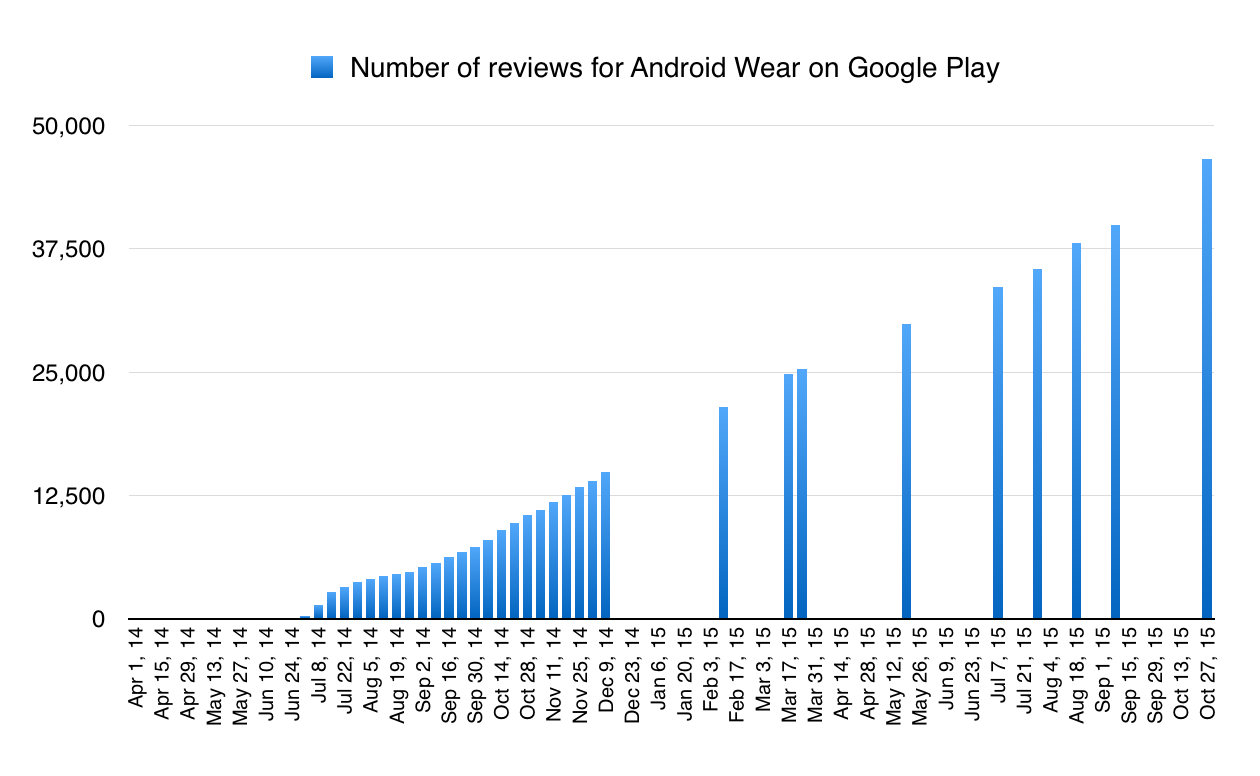
In my estimate last week of the number of Android Wear downloads, and hence actual “sell-through” (as it’s called), I used the number of reviews left on the Android Wear app page and drew a straight-line extrapolation from that, and from various known waypoints, to get my estimate for the number in use – which was about 1.9m, up from 0.7m in February 2015.

Among the provisos, though, was this one:

My previous estimate worked on the basis that the number of comments was proportional to the number of downloads. I don’t see any reason to change that assumption.

Oh, behave

Having said that, I’ve thought a bit more about likely consumer behaviour, as well as what the data actually shows us.

We know that as more people get to use something, the number who actually comment on/review it falls – it’s just human nature that early adopters are the most likely to be vociferous, whereas those who follow are less troubled about it. After all, who wants to be the 1,900th commenter below an article?

So I took a look at the number of comments* per download, for the waypoints where we know the number of downloads for sure. We know those waypoints because the Google Play figure abruptly goes from saying, for example, “number of downloads: between 10,000 and 50,000” to “between 50,000 and 100,000”. Obviously the 50,000 download point has been crossed between those two points. (* “comments” not “reviews” because they’re not necessarily reviews; you can make them without having downloaded the app.)

So I marked those points, and the number of comments at those points, and tried to find the best fit curve. I get this:

Android Wear: downloads per comment (est)

The data seem to suggest that the number of downloads required to generate a new comment grows over time; currently we’re at the black mark.

(That’s an R-squared of 0.89, using a logarithmic fit; it’s the best value of R-squared I could get out of trying a linear, logarithmic, polynomial, power and exponential fit.)

What this is telling us is that to begin with, you get lots of reviews/comments for every download. Right at the start, there was a comment for more than one in every seven downloads. By 100,000 downloads there are 4,032 comments, which means by then, on average, every 24.8 downloads someone had left a comment.

But by the time you get to 500,000 downloads, there are 14,981 comments – so on average it has taken 33 downloads to get each comment. By the time you get to a million downloads, the average has fallen to 44 downloads per comment.

A certain ratio

This is the sort of behaviour we’d expect: early on, lots of people are mad keen to give feedback on their experience; and then it tails off, until we’re dealing with a gradually falling ratio as the numbers of downloads head into the multiple millions.

Fitting this to that curve (which is the only data we’ve got, absent sales figures or numbers from Google) tells us that we’re currently at about 57.5 downloads per comment overall – that is, over the whole time Android Wear has been going, on average you get a comment every 57.5 downloads.

And how many comments are there? Currently, 47,620 (with the average review score just dipping under 4.0). How many downloads is that, and hence how many sell-throughs? Pretty simple:

47,620 comments * 57.5 downloads per comment = 2.74m Android Wear downloads.

This is quite a bit bigger – 44% more – than my previous estimate of 1.9m Android Wear users. There are (as always) potentially confounding factors, which would tend to reduce the actual number:

1) some people may have left more than one comment/review.
2) you can leave a comment/review without having actually downloaded the app
3) the number of comments added per week is quite variable – as below:

Rate of addition of comments varies, a lot

Sometimes you get a lot of comments on Android Wear – and sometimes you don’t. Does that match downloads? Hard to say.

This is possibly prompted by the release of new versions: a number of people commented on 9/10 November about the new version and its removal of battery stats. That’s going to bump up the apparent number of “downloads” while the actual number in use is no different.

On the whole, I feel comfortable suggesting that the correct number probably lies somewhere between these two – the straight-line extrapolation and the “reducing comment” number. In other words, somewhere between 1.9m and 2.74m. (The midpoint is 2.32m.)

Quite probably the only way to be sure will be to watch the Android Wear page and spot when it crosses the 5m download mark. Is it going to be before the end of this year, though?

Only maybe, at least if we go by IDC’s forecast for how many Android Wear devices will be shipped this year. In a press release in September, IDC reckoned that there would be 4.1m shipments of Android Wear devices in 2015. That would take the total activations by the end of 2015 to 4.7m, as at the start of the year it was around 0.6m (it passed 1m activated in late February, by my data). As long, that is, as those shipments are actually bought by people, rather than sitting on shelves.

Comparing that to my estimates for the number activated so far this year – a low of 1.3m (1.9m – 0.6m), and high of 2.1m (2.74 – 0.6m) – we’re left with somewhere between 2.8m (4.7m – 1.9m) and 1.96m (4.7m – 2.74m) to be shipped, sold and activated in the next couple of months around Christmas if IDC’s target is to be met (and if my estimates are correct). So, the week following Boxing Day could be fun.

Low, high, in between

There are some other numbers: Strategy Analytics says that in the second quarter, Android Wear shipments were just 0.6m units; for the third quarter, it says that Samsung shipped 0.6m and “Others” (including Pebble) 1.0m. We don’t know how many of the Samsung ones were running Tizen, and how many Android Wear; nor how many Pebbles were shipped. If we ignore that, we get 1.6m Android Wear shipped in the third quarter; 2.2m since March (when the 1m download point was passed). If they’re all in use, there might be 3.2m running.

Even with the high estimate, it begins to look like maybe this is going to be one of those spaces where Apple shows how the category should look, and grabs the majority of sales and profit – as it did with the iPod and iPad. Because Strategy Analytics reckons that in the third quarter alone, Apple shipped 4.5m units – more than Android Wear has all year.

Start up: how self-driving cars will change life, why *is* http on port 80?, iPad Pro reviewed, and more


Creating a more beautiful subway map for Tokyo wasn’t easy. Photo by aka.me on Flickr.

You can now sign up to receive each day’s Start Up post by email. You’ll need to click a confirmation link, so no spam.

A selection of 9 links for you. Smoosh them. I’m charlesarthur on Twitter. Observations and links welcome.

How Uber’s autonomous cars will destroy 10 million jobs and reshape the economy by 2025 » Zack Kanter

Industry experts think that consumers will be slow to purchase autonomous cars – while this may be true, it is a mistake to assume that this will impede the transition. Morgan Stanley’s research shows that cars are driven just 4% of the time, which is an astonishing waste considering that the average cost of car ownership is nearly $9,000 per year. Next to a house, an automobile is the second most expensive asset that most people will ever buy – it is no surprise that ride sharing services like Uber and car sharing services like Zipcar are quickly gaining popularity as an alternative to car ownership. It is now more economical to use a ride sharing service if you live in a city and drive less than 10,000 miles per year. The impact on private car ownership is enormous: a UC-Berkeley study showed that vehicle ownership among car sharing users was cut in half. The car purchasers of the future will not be you and me – cars will be purchased and operated by ride sharing and car sharing companies.

And current research confirms that we would be eager to use autonomous cars if they were available. A full 60% of US adults surveyed stated that they would ride in an autonomous car, and nearly 32% said they would not continue to drive once an autonomous car was available instead.

Today’s children are the last generation that will have to pass a driving test. Think about that briefly. Then read the rest of Kanter’s piece. (It’s actually optimistic, overall.) And one more thing: it doesn’t have to be about Uber.
link to this extract


Fantastical designs from the frontier of subway maps » Washington Post

For many designers, creating a better subway map is an irresistible puzzle — “infinitely alterable, incredibly vexing, with no definitive answer,” writes Emily Badger. Badger’s new article looks at some amazing examples of metro maps from the frontier of design, including the beautiful 2010 diagram of all of the rails in the Tokyo region, designed by Kim Ji-hwan.

link to this extract


Rooted, Trojan-infected Android tablets sold on Amazon » Help-Net Security

Zeljka Zorz:

If you want to buy a cheap Android-powered tablet, and you’re searching for it on Amazon, the best thing you can do is carefully read all the negative reviews you can find. If you are lucky, you’ll see some that will warn you about the device being rooted and coming pre-installed with malware.

Security researchers from Cheetah Mobile have recently discovered a slew of these devices – over 30 tablet brands in total – being sold on Amazon and other reputable online stores.

Here’s a short overview of affected devices, along with a sample of reviews warning about the malware.

The malware in question is the Cloudsota Trojan, which allows remote control of the infected devices and conducts malicious activities without user consent.

Remember, a Trojan is for life, not just for Christmas. Estimated that over 17,000 have been sold.
link to this extract


The case against a Google phone » The Information

Amir Efrati on the rumours that Google is looking to design its own phone chips:

the ecosystem of partners that build and sell Android phones has matured to some extent; those companies have 1.4bn customers (there’s one third as many iPhones in customer’s hands, by contrast). While many of those customers aren’t necessarily loyal, and surprising upstarts are gaining ground, Google won’t be able to suddenly capture a significant amount of market share with a better device, at their expense. (It would also risk its chance to return to China, given that it is working with local handset brands to do so.) There is no going back.

Even if Google wanted to compete on price by offering devices cheaper than the iPhone, it would still have to engineer a marketing apparatus so impressive that it convinces smartphones buyers that the Google phone is the best in the world. That’s the only way it could convert iPhone and even some Samsung Galaxy S users — who are wealthier than typical Android users — to the Google phone. Good luck with that.

Then there’s the fact that prices for phones have come down so much as components become cheaper that it’s become exceedingly difficult for existing Android phone brands to stand out in the market.

Even if the Google phone struck a chord, it’s hard to see it selling more than tens of millions of devices in the next few years, and that’s optimistic.

I can believe that Google is interested in designing ARM architecture chips. But I think it’s more likely considering them for its server farms. People inside Google already know Efrati’s argument (which holds water). Sundar Pichai is hardly the sort to hang on to an idea for pride. He killed Google+, remember?
link to this extract


Ad Replacer: turn spammy ads into breaking news

We take those terrible, misleading ads that take you to garbage websites (or worse!) and switch them out for real-time, human-curated headlines and links from ONLY the most trusted, reliable websites.

Sites that never end in best-deals-4-everyone.ru. Sites that never pop up 8 windows asking if you’re SURE you want to click away. Just sites you like and stories you want to read, all seamlessly integrated into your browsing experience before you even notice it’s changed. Doesn’t that sound nice?

Neat idea; Chrome extension only for now.
link to this extract


Facebook Messenger adds facial recognition » Tech Insider

Alex Heath:

Adding facial recognition to Messenger may seem odd given that it’s primarily considered to be a messaging app, but when you consider that people send a staggering 9.5 billion photos through Messenger every month, the decision begins to make more sense.

Messenger is very proactive in prompting to share a photo with friends it thinks are in a photo — the app will send a notification asking you to send a photo to people on Facebook it thinks are tagged. (This specific behavior can be turned off in the Messenger app’s settings.)

Australia only for now, but your feeling on whether this is creepy or great will probably depend on age. Note though that it’s machine learning/AI being deployed as utterly normal; even five years ago this would have been hard to implement on such scale.
link to this extract


iPad Pro review: jack of all trades, master of most » WSJ

Joanna Stern:

On paper, 12.9 inches may not seem much bigger than the standard iPad’s 9.7 inches, but the Pro screen made me more productive. I spent much of my week writing in Microsoft Word on the left hand of the screen and toggling between websites and my inbox on the right. Text looks incredibly crisp, especially in comparison with my MacBook Air’s display, which has just half the pixels.

The A9X processor and 4GB of RAM kept those apps running swiftly. But most impressive? When I exported the same 4K video in iMovie on both the Pro and my Intel Core i5-powered MacBook Air with 8GB of RAM, the iPad reached the finish line a minute and a half faster. And, unlike the Air, it didn’t sound like it was about to blast off from Cape Canaveral.

For real work, it’s all about attaching Apple’s $170 Smart Keyboard. You don’t do this via Bluetooth, but rather with the new magnetic Smart Connector. I quickly fell in love with the feel of the bouncy fabric keys, and it became second nature to hit Command+Tab to toggle between apps. Oh, and did I mention the keyboard is spill-proof? Seriously, my iced latte just wiped right off.

Still, many times I wished for something closer to Microsoft’s Surface Type Cover. Apple’s keyboard only props the screen at a 120-degree angle; attaching it and folding it take origami skill. It all almost toppled off my lap a few times, and the keys aren’t backlit. Plus, there’s no trackpad, like the Type Cover’s. I constantly had to reach out and touch the screen to scroll or select text and icons…

…Despite iOS 9’s improved multitasking, there are still shortcomings. You can’t customize the home screen’s comically large icons with files or other shortcuts. You can’t place the same app—say two Safari windows—side by side. And iOS’s lack of real file management can be maddening. Microsoft saddles its Surface Pro with full-blown desktop Windows while the iPad Pro is still too closely related to an iPhone. Apple has to keep working to find the happy middle.

Pricey. But here’s the kicker:

There’s one thing the iPad has over all other laptops and competing tablets though: incredible apps. The Pro helped me realize that I’ve been living in the past, using legacy desktop programs to accomplish things.

link to this extract


Why was 80 chosen as the default HTTP port and 443 as the default HTTPS port? » How To Geek

According to superuser jcbermu:

The Internet Assigned Numbers Authority (IANA) is a department of ICANN, a non-profit private corporation that oversees global IP address allocation, the Domain Name System (DNS), well-known ports, and other Internet Protocol-related symbols and numbers.

During March of 1990, they published a document (RFC 1060) where they listed all the well-known ports at that time. In that list there was no protocol assigned to port 80 (it jumped from 79 to 81). 79 was assigned to “finger” (find out if someone was online) and 81 to HOSTS2-NS, the HOSTS2 Name Server.

At that time, port 80 was officially free. In 1991, Tim Berners-Lee issued the first version of HTTP in a document (HTTP 0.9) where he stated “If the port number is not specified, 80 is always assumed for HTTP.”

HTTPS? Lost in time. Blamed on someone at NCSA Mosaic. So there’s your pub quiz question/answer pair.
link to this extract


Apple Music » Android Apps on Google Play

It arrived as an app on Android, as version 0.9.0:

Introducing the beta of Apple Music on Android.
Notes about the beta period:
• Music videos are coming soon.
• Family membership sign-ups and upgrades require Mac or iOS.
• Sign-up process to be optimized for Android.

Notable that it hasn’t attracted the hate reviews that the “Move to iOS” app did; there are actually a lot of five-star reviews. (Average 3.1.) The key element looks like the “family membership” element; that’s a really powerful reason for Apple to want to reach Android users – because families are mixed users.
link to this extract


Errata, corrigenda and ai no corrida:

Start up: Surface Book review, Google v EC redux, where are the iPad Pro apps?, after Google Flu, and more


Is this a perfect app signup? Photo by kastner on Flickr.

You can now sign up to receive each day’s Start Up post by email. You’ll need to click a confirmation link, so no spam.

A selection of 10 links for you. Aren’t they pretty? I’m charlesarthur on Twitter. Observations and links welcome.

Final words – the Microsoft Surface Book review » Anandtech

Brett Howse likes it a lot. Apart from the lack of ports. And also..

The other issue with the hardware is one that plagues all 2-in-1 devices which offer a detachable display. Because the display has to house all of the PC components it gets heavy. The Surface Book display/Clipboard is 1.6 lbs (726 grams) and all of this weight is out over the hinge. The Surface Book does better than any other detachable convertible device for balance, but at the end of the day it is still more top heavy than a traditional notebook. On a desk it’s not going to be an issue, but if you do have to type in your lap, depending on the seating arrangement, it may want to tip backwards. This is compounded by the feet on the bottom not having a lot of grip. The Surface Book’s display travel is also limited to prevent it from tipping over, although it does open far enough that it should not be an issue for almost any situation.

The hardware is overall very good. Where the Surface Book is let down though is on software. It’s kind of ironic that the hardware is well done but the software can’t keep up when you consider Microsoft is first and foremost a software company, and one that has only been in the PC market for a couple of years at that. But there have been a lot of issues with software. When the Surface Book first launched, it suffered from display driver crashes along with hue changes and flickering on the screen when doing certain tasks. Luckily these issues seem to have been corrected with a firmware update issues on November 2nd. But there are still outstanding issues. The fact that you can’t close the lid and expect the laptop to actually go to sleep is a terrible bug. Leaving the Surface Book unplugged but sleeping is going to result in a dead battery. Just yesterday, I closed the lid on the Surface Book, only to notice the fans had kicked in and it was very hot.

I find the coexistence of a laptop that can turn into a tablet (Surface Book) and a tablet that can turn into a laptop (Surface Pro) suggestive of a “let’s turn this ship around any way we can” approach. Also, the Surface Book sure is pricey.

link to this extract


Google faces new round of EU probing over Android mapping apps » Bloomberg Business

Aoife White:

Google faces a fresh round of European Union questions about its Android operating system for mobile devices as regulators quizzed rivals and customers over applications for maps, e-mail and other services.

The EU wants to know whether Google Maps for phones has supplanted portable or in-car navigation devices, such as those produced by TomTom NV and the HERE unit of Nokia Oyj, according to a document sent to companies and seen by Bloomberg.

Officials are also seeking data, such as user numbers, about downloaded or pre-installed mapping apps on devices, as well as costs mapmakers face to produce a mobile-ready app.

Wonder how long that one will take to reach any decision. 2017? 2018?
link to this extract


Google EU antitrust response argues Amazon, eBay robust competitors » Re/code

Mark Bergen, who has seen a redacted copy of Google’s response to the EC:

Google points to the number of online price aggregators — sites that collate retail prices elsewhere on the Internet — born in Europe: 180 between 2008 and 2014. The EU’s charge sheet, or statement of objections (SO), “focuses on a handful of aggregators that lost free Google traffic, but ignores many that gained traffic,” Google’s lawyers wrote. Google says it drove 20bn “free clicks” to these aggregators in Europe over the past decade.

More critical to Google’s defense is the argument that online marketplaces, like eBay and Amazon, should be considered peers to Google’s shopping service, a position at odds with the EU, which charges that these merchants are “irrelevant” when it comes to price comparisons. Google’s lawyers claim, using internal data, that Web visitors prefer merchant links over aggregators and go directly to Amazon for product searches. (They do.) Google also argues that these giant merchants consider the smaller price aggregators as rivals as well — in the response, Google cites Amazon SEC filings where the e-commerce company lists “comparison shopping websites” and “Web search engines” as competitors. Ergo, Google contends, the EU should see them that way too.

And echoing the company’s internal note to the charges in April, Google spells out how Amazon and eBay are far more dominant as online retailers in Europe than Google’s service.

Pretty much all these points of Google’s were rebutted thoroughly by Foundem (a price aggregation service which complained to the EC) in June.
link to this extract


Where are Apple’s iPad Pro apps for pros? » Lou Miranda

There’s a big gap in Apple’s pro app lineup, with Aperture being retired along with iPhoto. iPhoto’s replacement is the Photos app, but there is no Aperture replacement yet. What better device to introduce a Photos Pro app than a giant-screened iPad Pro with a pressure sensitive Pencil?

Likewise with Final Cut Pro X. There’s no reason to make it iPad Pro-only, but it would certainly shine on an iPad Pro. This is similar to Macs: sure you can run Photoshop or FCP X on a MacBook Air, but they really shine on a MacBook Pro or Mac Pro. I discussed this at length in my post “There’s No Such Thing as an iPad App“.

So why would Apple release an iPad Pro without its own pro apps?

My feeling is that the iPad Pro is much like Apple TV: the hardware was ready before the software, and Apple is soft-pedaling both, mostly to developers and early adopters. (You could argue Apple does this with every new device, and I wouldn’t argue with you.)

link to this extract


AI will reorganize the human population » Medium

Silver Keskkula, who is working on the “Teleport” app which aims to find the best place for you to live:

Matching people to locations is hard — there are more things to account for than might be feasible to code into a human understandable model. Although today we’ve managed to keep things simple and are missing a purely machine learning driven parameter from our search, I’m more than convinced that in the very near future we will need to resort to AI to help guide people’s search into where to live (our first tests are quite encouraging).

All and all we’re all just inefficient computational machines running on wetware and largely biased by evolutionary adaptations more suited to the hunter-gatherer era, so getting AI involved in our next wave of migrations might not be such a bad thing.

link to this extract


This is how you design your mobile app for maximum growth » First Round Review

[Primer CEO] Kamo Asatryan may very well be one of the best kept secrets in the startup ecosystem. He’s one of a small handful of people who have observed hundreds of mobile apps, thought deeply and scientifically about their mechanics, and determined what they could change to grow faster.

To demonstrate his particular brand of magic: Asatryan’s team recently worked with an app that required users to swipe through four screens explaining the product in-depth before they could sign up. Then the permissions screen literally begged them to let the app access their location data. 60% said no and went on to a dead-end experience.

To turn things around, Asatryan tested a radically different approach: assume that users who installed the app already understood the need to provide their location data. This allowed them to axe the long-winded welcome flow and make the permissions request the second screen. The text was changed to say that users needed to “Enable Location Permissions” (making it clear that it would be for their benefit), and they were literally not able to move on from the screen without saying yes. This sounds risky, but after the shift, 95% of users said yes and went on to a much better product experience.

This is a long article, but every single element of it will be useful if you’re in any way involved in designing or critiquing mobile app design. Today’s must-read. (Via Dave Verwer’s iOS Dev Weekly.)
link to this extract


New flu tracker uses Google search data better than Google » Ars Technica

Beth Mole:

With big data comes big noise. Google learned this lesson the hard way with its now kaput Google Flu Trends. The online tracker, which used Internet search data to predict real-life flu outbreaks, emerged amid fanfare in 2008. Then it met a quiet death this August after repeatedly coughing up bad estimates.

But big Internet data isn’t out of the disease tracking scene yet.

With hubris firmly in check, a team of Harvard researchers have come up with a way to tame the unruly data, combine it with other data sets, and continually calibrate it to track flu outbreaks with less error. Their new model, published Monday in the Proceedings of the National Academy of Sciences, out-performs Google Flu Trends and other models with at least double the accuracy. If the model holds up in coming flu seasons, it could reinstate some optimism in using big data to monitor disease and herald a wave of more accurate second-generation models.

I wrote about the failure of Google Flu Trends in March 2014; in 2008 it had claimed 90% correlation. Google said then it would “welcome feedback”. The old data is still available.
link to this extract


TLC NAND SSDs: The crippling problem storage makers don’t advertise » PCWorld

Jon Jacobi:

With last week’s release of Crucial’s BX200 SSD, a drive that features TLC (triple-level cell) NAND, it’s time to shine a light on this burgeoning segment of the SSD market—especially as vendors happily quote numbers that would have you believe that these SSDs perform just like any other.

Most of the time TLC SSDs perform quite well. But copy a large amount of data to a TLC drive, and part way through the operation you’ll see something discomforting—a startling drop in write speed. With some drives it’s relatively mild, but in the case of many recent TLC drives, the drop is so drastic you’ll wonder if the SSD is dying. It’s not, but you may wish it was.  

While this is true, it turns out you’ll only hit the problem if you’re transferring more data than fits in the disk cache – which could be 3GB or more. Still, a subtle gotcha.
link to this extract


Microsoft CEO Satya Nadella shows ‘iPhone Pro,’ reveals how much time he spends on email » IB Times

David Gilbert:

Speaking at the company’s Future Decoded conference in London on Tuesday, Nadella, who took the reins at Microsoft over 18 months ago, demonstrated the power of Windows 10 and gave us a glimpse into what he does and how he works on a day-to-day basis.

Using Delve — an Office 365 app which automatically tracks a user’s activities throughout the week by monitoring calendars, emails and the other productivity tools — Nadella showed the audience that last week he spent a total of 16 hours in meetings, well within his goal of under 20 hours per week.

Nadella failed to meet his goal of spending less than nine hours per week on emails, clocking up 9.6 hours in the past seven days. He also fell short on the time he wanted to spend focusing – which he described simply as “time for work.” Nadella considered himself “focused” for only two hours last week, just half of his assigned goal.

Notice how he didn’t show us what devices – and in particular phone – he uses. (Sure, it will be a Lumia, but which?) The “iPhone Pro” is just an iPhone loaded with Microsoft software. Puzzled by how a machine measures your “focus hours”. How does it know?
link to this extract


No Comcast app on the new Apple TV » Tech Insider

Tim Stenovec:

Marcien Jenckes, the executive vice president of consumer services for Comcast Cable, told Tech Insider in an interview last week that Comcast isn’t working on an app for the new Apple TV.

“We’re not philosophically against it,” Jenckes said of developing an app for the new device. “We just haven’t seen the need to run out and do that, given the fact that we’re already delivering content to the TVs in a way that has our customers already satisfied.”

If American customers were that satisfied, they wouldn’t be buying set-top boxes and TV sticks by the million.
link to this extract


Errata, corrigenda and ai no corrida: none reported.

Start up: Google open-sources machine learning, Adele v streaming, Facebook’s Belgian problem, and more


Steve Reich’s Piano Phase, as a video, by Alexander Chen.

You can now sign up to receive each day’s Start Up post by email. You’ll need to click a confirmation link, so no spam.

A selection of 9 links for you. Made without nuts. I’m charlesarthur on Twitter. Observations and links welcome.

Preserving security in Belgium » Facebook

Alex Stamos works on online security for Facebook, while a Belgian court has ruled that the “datr” cookie it uses is not legal. Stamos isn’t happy:

The reason I’m bullish on the datr cookie is because for at least the last five years we have used it every day to defend people’s accounts through the following actions:
• Preventing the creation of fake and spammy accounts
• Reducing the risk of someone’s account being taken over by someone else
• Protecting people’s content from being stolen
• Stopping DDoS attacks that could make our site inaccessible to people

If the court blocks us from using the datr cookie in Belgium, we would lose one of our best signals to demonstrate that someone is coming to our site legitimately. In practice, that means we would have to treat any visit to our service from Belgium as an untrusted login and deploy a range of other verification methods for people to prove that they are the legitimate owners of their accounts. It would also make Belgian devices more attractive to spammers and others who traffic in compromised accounts on underground forums…

The datr cookie is only associated with browsers, not individual people. It doesn’t contain any information that identifies or is tied to a particular person. At a technical level, we use the datr cookie to collect statistical information on the behavior of a browser on sites with social plugins, such as the Like button, to help us distinguish patterns that look like an attacker from patterns that look like a real person.

Tricky.
link to this extract


Why streaming doesn’t really matter for Adele » Music Industry Blog

Mark Mulligan:


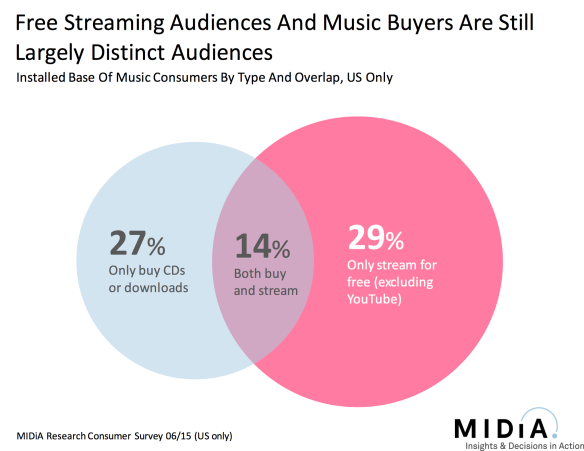
Looking at mid-year 2015 consumer data from the US we can see that music buyers (i.e. CD buyers and download buyers) are still a largely distinct group from free streamers (excluding YouTube). While this may seem counter intuitive it is in fact evidence of the twin speed music consumer landscape that is emerging. This is why ‘Hello’ was both a streaming success (the 2nd fastest Vevo video to reach 100m views) and a sales success (the first ever song to sell a million downloads in one week in the US). These are two largely distinct groups of consumers.

As a reader of this blog you probably live much or most of your music life digitally, but for vast swathes of the population, including many music buyers, this is simply not the case. Given that the mainstream audience was so key to ‘21’s success we can make a sensible assumption that many of these will also fall into the 27% of consumers that buy music but do not stream.

This is also why it was so tricky for Apple to move into streaming: lots of iTunes users simply don’t. And also why Adele’s audience and prospects are very different from Taylor Swift’s.
link to this extract


Facing pressure in China, Xiaomi also stalls in India » The Information

Amir Efrati:

the domestic Chinese market has slowed, while Xiaomi has dropped to No. 2 there after Huawei Technologies in terms of market share for the third quarter of this year, according to research firm Canalys.

The results in India seem to bear out the bear thesis on Xiaomi’s expansion plans: that it will be harder to succeed outside of China because it would have to work within the bounds of Google’s version of Android, where it can’t customize the software—and run an app store—the way it does inside of China, where Google mobile apps are almost completely absent.

In India, Xiaomi is “just another low-cost phone hardware company,” says one rival executive.

One Indian e-commerce executive whose firm sells smartphones says Xiaomi has “stagnated” online and that sales of Samsung and Motorola phones were much stronger during a recent period of online promotions known as “Big Billions Days.” Xiaomi, bucking its traditional practice of selling phones only online, has been willing to sacrifice some margin and sell phones through some retail stores in India.

If you have to offer Google Mobile Services, in the end your differentiation will be whittled away.
link to this extract


Tim Cook: Apple CEO on the company’s latest venture – the iPad Pro » The Independent

David Phelan bagged an interview while the Apple chief was in London:

The iPad Pro is the most expensive tablet yet, £679 and up. At a time when iPad sales are flat, was he tempted to do as some competitors have done and released, say, a £50 tablet? “No, there are no good £50 tablets. We’ve never been about making the most, we’ve been about making the best. This was a way of making a product that people can do a lot of things with. I think it will attract a lot of PC users and people who are not currently using Apple products. And I think it will be a reason for people to upgrade who love iPad and who have been waiting for something very different and now here it is.”

Along with the Pencil, there’s a keyboard cover. Cook says it’s different from rival keyboards because with none of those would you say it “came from the same parent” as the tablet itself. “Now all of a sudden you have a keyboard that has been perfectly designed for the iPad, it’s integrated and then you’ve got the software with split view and it’s inherently very productive. I’m travelling with the iPad Pro and other than the iPhone it’s the only product I’ve got.” 

You have to love Cook’s rejection of “why did you do a stylus?” “It isn’t a stylus, it’s a Pencil.” Hear the capital. And his description of his youth as a trombone player is hilarious.
link to this extract


DTEK by BlackBerry » Android Apps on Google Play

Interesting move by BlackBerry: DTEK looks at how often and to what extent other apps have been accessing your location, contacts and so on:

In this world of interconnected apps and networks, controlling what is shared and who it’s shared with can be a challenge. BlackBerry® DTEK for Android™ allows you to view and improve your privacy level and monitor application access to your camera, microphone, location and personal information. Take control with DTEK by BlackBerry.
Key Features:

• Monitor – Know at a glance the overall security rating for your device, as well as for specific security features. You can identify whether or not you need to take any action to improve the security of your device.

And so on. For Android 5.0 and up; seems like it would be a useful app for anyone on Android. Certainly some of the folk at UTB blogs found Facebook taking amazing liberties – such as Facebook accessing the phone location 561 times in 60 hours. That’s roughly every 6 minutes. You were asking about your battery life? (Apparently there’s a version coming for iOS too.)
link to this extract


TensorFlow: smarter machine learning, for everyone » Official Google Blog

Sundar Pichai:

It’s a highly scalable machine learning system—it can run on a single smartphone or across thousands of computers in datacenters. We use TensorFlow for everything from speech recognition in the Google app, to Smart Reply in Inbox, to search in Google Photos. It allows us to build and train neural nets up to five times faster than our first-generation system, so we can use it to improve our products much more quickly.

We’ve seen firsthand what TensorFlow can do, and we think it could make an even bigger impact outside Google. So today we’re also open-sourcing TensorFlow. We hope this will let the machine learning community—everyone from academic researchers, to engineers, to hobbyists—exchange ideas much more quickly, through working code rather than just research papers. And that, in turn, will accelerate research on machine learning, in the end making technology work better for everyone. Bonus: TensorFlow is for more than just machine learning. It may be useful wherever researchers are trying to make sense of very complex data—everything from protein folding to crunching astronomy data.

No quibbles: this is excellent news. Main site is http://www.tensorflow.org. Written in Python; binaries available for Linux and Mac. I’m sure there’s another desktop OS, isn’t there?
link to this extract


RECONSIDER » Medium

David Heinermeier Hansson (he usually goes by “DHH”), who founded Basecamp which – yawn! – is just mildly and continually successful:

it’s hard to carry on a conversation with most startup people these days without getting inundated with odes to network effects and the valiance of deferring “monetization” until you find something everyone in the whole damn world wants to fixate their eyeballs on.

In this atmosphere, the term startup has been narrowed to describe the pursuit of total business domination. It’s turned into an obsession with unicorns and the properties of their “success”. A whole generation of people working with and for the internet enthralled by the prospect of being transformed into a mythical creature.

But who can blame them? This set of fairytale ideals are being reinforced at every turn.
Let’s start at the bottom: People who make lots of little bets on many potential unicorns have christened themselves angels. Angels? Really?

link to this extract


Piano Phase » Alexander Chen

This site is based on the first section from Steve Reich’s 1967 piece Piano Phase. Two pianists repeat the same twelve note sequence, but one gradually speeds up. Here, the musical patterns are visualized by drawing two lines, one following each pianist.

The sound is performed live in the browser with the Web Audio API, and drawn in HTML5 Canvas.

This is really wonderful. Chen is a creative director at Google Creative Lab – he has done lots of other visualisations of music.
link to this extract


The consumerization of the automobile supply chain » DIGITS to DOLLARS

Jonathan Greenberg:

Last week I saw an interesting post on Venture Beat about Acer Launching an Electric All-Terrain Vehicle [quad bike, for UK readers]. This struck a chord because Taiwan-based Acer is a manufacturer of PCs and other consumer electronics (CE) devices. Acer is one of the most prominent companies in Taiwan’s CE complex, which builds almost all of our consumer gadgets. They are closely tied to some of the industry’s most important ODMs, component vendors and contract manufacturers. It is not that surprising to see a consumer electronics giant diversify into higher priced devices as they move up the value chain. However, if you don’t look at Acer as an device maker, but instead view them as a flagship of the Taiwanese electronics industry, the announcement has broader implications.

You can see where this is going, can’t you?
link to this extract


Errata, corrigenda and ai no corrida: none reported.

Start up: yet another UK broadband pledge, what is mobile?, hacking Samsung’s theft protection, and more


A Huawei-made Nexus 6P: no breakage of the camera visor panel here. Photo by TechStage on Flickr.

You can now sign up to receive each day’s Start Up post by email. You’ll need to click a confirmation link, so no spam.

A selection of 12 links for you. Use them wisely. I’m charlesarthur on Twitter. Observations and links welcome.

Fast broadband for all by 2020 pledged by David Cameron » BBC News

All UK homes and businesses will have access to “fast broadband” [of at least 10 megabits per second] by 2020, David Cameron has pledged.

The PM is to introduce a “universal service obligation” (USO) for broadband, giving the public a legal right to request an “affordable” connection.

It would put broadband on a similar footing to other basic services such as water and electricity.
In 2010, the coalition government promised the UK would have the best superfast broadband in Europe by 2015.

Then, in 2012, a pledge was made by then-Culture Secretary Jeremy Hunt that the UK would have “the fastest broadband of any major European country” by 2015.

He defined high-speed broadband as offering a download speed of greater than 24 megabits per second (Mbps). Communications regulator Ofcom defines it as 30Mbps.

That final sentence completely shows how weak this “pledge” really is: from 30Mpbs down to 24 down to 10. I suspect BT, as the dominant operator which also now owns a 4G network, will aim to fulfil this revised USO via 4G.
link to this extract


Some Nexus 6P owners are reporting spontaneously broken rear glass panels » Android Police

Michael Crider:

The early reaction to the Nexus 6P from both critics and owners has been mostly positive, but a few new owners seem to be encountering serious problems. Specifically, the glass panel on the rear of the phone, which covers the camera, LED flash, and laser autofocus module, is reportedly cracking and breaking on its own. A user on the Android subreddit reported the rear panel cracking, and at least two others have reported similar results, with the panel splitting into multiple cracks with no particular rough handling or impact.

That subreddit is getting pretty big, and there isn’t a lot of joy for the 6P. One person has had two in a row go wrong. Problem for Huawei?
link to this extract


How uBeam transmits energy wirelessly using ultrasound » uBeam

Meredith Perry, uBeam’s founder, has a big explainer about how it works, because people have been saying that either it doesn’t work, or it’s dangerous:

The uBeam system is composed of two parts: a transmitter that emits energy, and a receiver that receives energy. The transmitter is like a sound speaker, but instead of emitting audible sound, uBeam’s transmitter emits high frequency sound. This sound can’t be heard by humans or dogs; it’s called ultrasound. The receiver, like a microphone, picks up the sound and converts it into usable energy. Sound, like light and wind, is a form of energy that can be converted into electrical energy with our proprietary energy harvesting technology. The receiver then sends this electrical power to charge or power an electronic device.

link to this extract


Mobile, ecosystems and the death of PCs » Benedict Evans

Evans wrestles with the question of “what is ‘mobile’?” in the face of competing devices like the SurfaceBook, the Surface Pro, iPad Pro and so on:

Each generation of technology goes through an S-curve of development – slow improvement of an impractical product, then explosively fast improvement once fundamental barriers are solved, and then slowing iteration and refinement as you solve every last issue and the curve flattens out. PCs are on that flattening part of the curve, just as the [fastest ever piston-powered aircraft developed at the end of WW2, soon surpassed by jets, the Republic] Rainbow was.

They get perfect because you’re debugging the big things you invented in the past, and now your innovation is in the extra little things (such as the Rainbow using exhaust for extra thrust), and there are no big new innovations to debug. But meanwhile, the new ecosystem is catching up, and the curve of development and innovation for that generation will flatten out way out of reach. The new curve is crossing the old one. This is why they look simliar – this is why a Surface Pro and an iPad Pro look similar. They both exist right at the point that those development curves cross. The iPad might still be a little below, but its curve is heading up.

That is, the point that you can start to do old ecosystem things on what look like new ecosystem devices is also the point that the new ecosystem can do those things too – but the new ecosystem has 10x the scale, and the new ecosystem is just starting down the innovation track where the old one is at its end.

The really tricky part is knowing where on the S-curve something is, and whether there’s still money to be made from it. As Evans points out,

No-one is going to found a new company to make Win32 applications (though enterprise Windows apps will be worked on for a long time, just as mainframe apps were [after the IBM PC arrived]).

link to this extract


It’s incredibly easy to bypass Factory Reset Protection on a Samsung phone [with video] » 9to5 Google

Stephen Hall:

Factory Reset Protection was introduced with Android Lollipop, and, like Apple’s iCloud Activation Lock, it’s supposed to make it really hard to resell a stolen Android phone. The gist is that when you use Android recovery menu to reset a phone to factory settings, the phone will require upon reboot that you sign in using a Google account you previously used on the device before resetting it. If someone steals your phone and wipes it, they need your Google account for it to be anything but a brick.

Well, it appears that a flaw in Samsung’s phones lets potential thieves around this security measure, and it looks like the workaround takes just about five minutes to pull off…
Obviously a thief wouldn’t be able to get around a password-secured phone, so a factory reset would require going to Android’s recovery menu after a reboot (as opposed to going into the Settings app and doing a factory reset from there).

But since Samsung’s phones automatically pull up a file manager when you plug in an external storage device (even in the set up process), all you have to do is load an app file that lets you open up the stock Settings app. Press a couple buttons to do what the phone thinks is a legitimate/authorized reset, and the phone reboots without tripping Factory Reset Protection.

D’oh.
link to this extract


Google annual search Statistics » Statistic Brain

The number of annual searches conducted by Google, according to ComScore and the “Statistic Brain Research Institute” (sounds grand).

Compare the numbers in the top two lines of the table. It suggests that in 2014 the total number of Google searches fell, for the first time ever. Even within margins of error, that suggests search growth has stopped.
link to this extract


XcodeGhost S: a new breed hits the US » FireEye Threat Research

Yong Kang, Zhaofeng Chen, and Raymond Wei:

Through continuous monitoring of our customers’ networks, FireEye researchers have found that, despite the quick response, the threat of XcodeGhost has maintained persistence and been modified.

More specifically, we found that:

• XcodeGhost has entered into U.S. enterprises and is a persistent security risk
• Its botnet is still partially active
• A variant we call XcodeGhost S reveals more advanced samples went undetected

After monitoring XcodeGhost related activity for four weeks, we observed 210 enterprises with XcodeGhost-infected applications running inside their networks, generating more than 28,000 attempts to connect to the XcodeGhost Command and Control (CnC) servers – which, while not under attacker control, are vulnerable to hijacking by threat actors.

Pretty dramatic. And it can affect apps via third-party frameworks, as Possible Mobile discovered. Meanwhile, on Android…
link to this extract


Lookout discovers new trojanized adware; 20K popular apps caught in the crossfire » Lookout Blog

Michael Bentley of the anti-malware company:

Auto-rooting adware is a worrying development in the Android ecosystem in which malware roots the device automatically after the user installs it, embeds itself as a system application, and becomes nearly impossible to remove. Adware, which has traditionally been used to aggressively push ads, is now becoming trojanized and sophisticated. This is a new trend for adware and an alarming one at that.

Lookout has detected over 20,000 samples of this type of trojanized adware masquerading as legitimate top applications, including Candy Crush, Facebook, GoogleNow, NYTimes, Okta, Snapchat, Twitter, WhatsApp, and many others.

Malicious actors behind these families repackage and inject malicious code into thousands of popular applications found in Google Play, and then later publish them to third-party app stores. Indeed, we believe many of these apps are actually fully-functional, providing their usual services, in addition to the malicious code that roots the device.

Oh, and also: if you get infected you probably won’t be able to uninstall it; you’ll either need a pro or a trip to buy a new one. (Factory reset won’t do it.)
link to this extract


BlackBerry Priv review: good, but probably only for keyboard junkies » Android Police

David Ruddock is befuddled by those little things with letters on:

But time for some real talk about those keys, in respect to my particular tapping of them. I am awful at these tiny little keyboards. Like, your grandpa trying to use an ATM when 6 other people are in line behind him and all of them are clearly in a rush awful. It’s just not my thing, it never has been, and it never will be. To me, this is mind-bendingly unintuitive and would take me months to master in anything approaching a respectable way. I’m not going to be using the Priv for months. I cannot give you a good evaluation of the keyboard on the merits. Sorry. I can show you what it looks like, though! Also, it’s backlit.

My thoughts without getting into the related software bits are as follows: the keys are really small. They depress and feel clicky. They are keys. Again, I am sorry. I really, really, can’t get into this keyboard-for-ants thing, even as I have forced myself to use it on the Priv.

This is the reason why anyone who began using a smartphone after 2010 is going to find the Priv completely weird. It’s like introducing typewriters to schools that have used iPads.
link to this extract


HTC One A9 review » AndroidAuthority

Joshua Vergara:

Remember the Sensor Suite originally announced in the HTC One M8? It allowed for the phone to go straight into specific areas with taps and swipes after the phone knew it was brought up for usage. Now, because the fingerprint reader is there, it is the wall that prevents all of these extra unlocking methods from being used. That also doesn’t include the fact that it can be a home button, without any capacitive keys accompanying it. Soft keys are still used, so using the reader as a home button takes some getting used to – and fiddling between the two, we’ve found to be really common.

Of course, there is also the omission of BoomSound speakers due to the addition of the fingerprint reader. This is a pretty bold move for the company, as one of its most-recognized features isn’t here anymore. Sound, thus, gets a big downgrade with the bottom-mounted unit. It certainly doesn’t get very loud at all, and it’s safe to say that we miss the stereo audio found in past One devices.

Storage options with the A9 are pretty standard, with the option to choose between 16 or 32GB variants. It should be noted that the 16GB model comes with just 2GB of RAM, while the 32GB variant comes with 3GB. We’ve been testing the 32GB model with 3GB of RAM, and we’ve noticed that it gets a little slow at times.

Jeepers – it’s sometimes slow with 3GB of RAM? None of this is really a vote of confidence.
link to this extract


HTC pushes US One A9 pre-order shipments back by up to several weeks, delays Verizon compatibility indefinitely » Android Police

David Ruddock:

While the A9 is indeed a pretty good phone, there’s no doubt HTC’s bungled the launch of the device a bit. First, the whole promotional pricing thing (and the 2GB/16GB variant abroad being so damn expensive), and now? A pre-order shipment delay for those who did choose to buy one. We’re hearing from US readers that HTC has sent out the following email, pushing back shipment of the initially available colors until next Tuesday, November 10th, at the earliest. Some customers, though, will be waiting much longer than that – especially if you ordered a Sprint variant.

In addition, HTC has now delayed Verizon network compatibility for the One A9 indefinitely. They had promised compatibility shortly after the November launch, then in December, and now have no ETA for the feature.

And it gets worse; certain colour variants are going to take weeks and weeks to ship. Dead on non-arrival?
link to this extract


Who the f*** is that advertiser? » Medium

Rob Leathern on the problem of validating who is advertising (which amounts to “running random Javascript on your system); the Interactive Advertising Bureau wants to charge $10,000 per company for this. Leathern laughs:

Google Adwords probably has over 2.5 million advertisers by this estimate. The top 100 to 1,000 advertisers (likely to be cost-insensitive enough to sign up for a program like this) aren’t the problem for online and mobile advertisers. The problem area is distinguishing between tens of thousands of large but legitimate advertisers, and those with money who are not legitimate or who are fronts for malware, botnets, and schlocky affiliate offers.

The goal shouldn’t be to register the top few thousands advertisers, but make the barriers low enough that we can validate every single advertiser consistently, and then do the kinds of auditing, checks and follow-up necessary to stop problem advertisers from being banned and then popping back up right away under another name or identity. Once you can accurately identify advertisers and have every part of the value chain understand this information, both publishers and consumers should be able to decide what kinds of advertisers they want to block.

If I had to guess, it’s a $10/year fee (ten dollars) and not $10,000, that will be a better incentive to get companies to participate and to create the infrastructure needed to validate this information at enormous scale.

Even at that level, it wouldn’t happen. And malware generators would still find ways to get around it.
link to this extract


Errata, corrigenda and ai no corrida: none notified. But the week is still young.

If you think the Apple Watch is a ‘flop’, try this estimate for Android Wear device sales


Got an LG Watch Urbane? Congratulations – you’re part of a pretty exclusive club. Photo by Janitors on Flickr.

Back in February I tried to estimate how many Android Wear devices were activated in 2014, following Canalys saying that 720,000 had shipped that year.

The figure I got, based on the page on Google Play, where one can track not just downloads but also comments and average rating for the Android Wear app (which you need to control your shiny new Android Wear device), was 700,000.

Android Wear: all the numbers

Put it together, and we have about 560,000 Android Wear activations by the end of 2014, and 700,000 to mid-February.

Progress, or the lack of it

OK. So what about progress since then? I’ve kept noting the progress of the number of downloads, and the number of comments, on the Google Play page, helped from time to time by the Internet Archive (it’s wonderful. Donate).

My previous estimate worked on the basis that the number of comments was proportional to the number of downloads. I don’t see any reason to change that assumption.

So how does it look now? The number of comments keeps going up:

Android Wear: number of reviews

Steady growth suggests steady download, and hence sales, figures

(One point to note: the average review score has been trending down steadily. You would expect this for a new technology: the keen people who forgive anything are first in, and are followed by those who got it as a gift, or an experiment, or whatever. Notably, some of the recent low ratings come from people complaining about updates; that would suggest that the installs/comments ratio is actually falling.)

Whichever, the precise value of the average review has fallen from a comfortable 4.83 (out of 5) to dip to 3.98 at the end of October, recovering to 4.00 last week.

And now we try to fit the number of installs – using the points that we have, which isn’t a lot – to that graph, assuming downloads are directly proportional to comments.

According to Google’s stats, Android Wear is now past the 1m download point, but not the 5m download point.

So I’ve tried to fit the graph as best I can. And this is what I get:

Android Wear sales estimate: 1.9m in November

Fitting known waypoints to the number of comments suggests that 1.9m Android Wear devices have been sold

That’s the figure I get: 1.9m downloads in total, suggesting that since February there have been a total of 1.2m more installations of Android Wear.

So again we ask: is that bad or good? There are now 1.4bn Android devices in use, according to Sundar Pichai. Only those running Android 4.3 upwards can use Android Wear, which means we’re potentially talking about 67.8% of devices according to the very latest figures from the Android Dashboard. (That’s up substantially from 47.6% back in February.)

The penetrant question

Back in February, I guessed at 1.2bn Android devices in use (which seems close enough – 1bn announced at Google I/O in 2014, 1.4bn this time). So back then the potential market was
1.2bn * 0.476 = 571.2m devices, of which 700,000 had Android Wear: that was a penetration of 0.12%.

Now we have a potential addressable market for Android Wear of
1.4bn * 0.678 = 949.2m devices. Of which it seems 1.9m, or 0.2%, have bought. (This doesn’t allow for people owning multiple devices, but the incidence will be very low compared to the 949m devices available.)

Conclusions and thoughts

• The absolute number of Android Wear devices in use is still really low.
• A total of 1.2m have been sold since February
• It’s tiny compared to any estimate of the number of Apple Watches sold since the launch in April, which varies by analyst; Canalys estimates that it has shipped 7m in two quarters, which compares to 1.2m Android Wear sold
• These may be the lull before the storm of purchases on Black Friday/Christmas, but abandonment could be a problem
• Android Wear, despite being first to market, suffers from a lack of brand visibility, and visibility overall. Kantar ComTech released a survey in October based on a study from August which found that in the US,

Among panelists who knew what a smartwatch or smartband was, 92% connected Apple to the category, far more than any other brand. This was followed by Fitbit in second place with 47%, with Google (34%) edging out Samsung (33%) for third place.

That doesn’t leave a lot of room for others, at least in the US buyer’s mind.

I’ll keep tabs on Android Wear, absent Google releasing any figures. But for now, this is starting to look like an interesting question: can a device category succeed if it doesn’t have a successful Android version?

Start up: the Watch drop, Tango slows, Samsung’s bug bonanza, kids and tablets, and more


Guess how much this ad cost. OK, if it were actually inside the TV. Photo by wonderferret on Flickr.

You can now sign up to receive each day’s Start Up post by email. You’ll need to click a confirmation link, so no spam.

A selection of 9 links for you. Use them wisely. I’m charlesarthur on Twitter. Observations and links welcome.

Popular Apple blogger stops wearing his Apple Watch every day » Fortune

Philip Elmer-DeWitt quoting John Gruber, speaking to developer Guy English on his own Talk Show podcast:

“I’ve been intrigued. And I do wear mine, but I don’t wear it every day. I foresee a bright future for it. But I just don’t think I was ever squarely in the market for it. It’s just not the sort of thing that speaks to me.”

[Here Guy English jokes about Gruber’s lack of interest in fitness — fitness tracking being one of the device’s key selling points.]

“Yeah. Right. Once I stopped wearing it every day… there is this weird motivating thing where you want to keep filling these circles everyday. And you get this streak going and you keep going. And I’m sure people are more fit. But then once you stop wearing it every day you definitely by definition have days where you didn’t fill all the circles. [It] just ruins it. It means you don’t care anymore. I don’t know. It just doesn’t excite me that much.”

Personally, still wearing mine each day; does so many things I need (such as, on Thursday evening while driving, starting navigation home via Siri because my normal route was blocked. Would have been tough and distracting with the phone).
link to this extract


Google is cutting the cost of its Project Tango depth-sensing tablets in half » VentureBeat

Harrison Weber:

The deal, effective “in the coming weeks,” Google said, follows the company’s $20,000 contest that tasked developers with creating “unique augmented reality (AR) experiences” for Tango devices. The winning submissions require a Project Tango device to work, but you can get a taste of the ideas here (and here).

Google told us it doesn’t have a set duration for the discount, but the company apparently has “a limited, but sizable number of promotional codes. We haven’t finalized the exact number yet,” a spokesperson told us…

…Project Tango’s future remains unclear: Google originally aimed to launch a “consumer-scale” Project Tango device with LG in 2015. Then in January, the company spun Tango out of its Advanced Technology and Projects group without sharing much information on the initiative’s next steps.

When asked if the discount was designed to get rid of developer units ahead of a new release, a spokesperson replied, “This is very much to get kits in the hands of developers and shore up the ecosystem. We still don’t have a timetable on consumer-ready units.”

Suggested headline tweak: “Google is halving the cost of…”
link to this extract


Can I annoy you for a penny a minute? » Medium

Rob Leathern:

US TV advertising revenue is expected to reach $78.8bn this year. The average person over 2 years of age in the United States still watches an amazing 29 hours and 47 minutes of TV per week. Which means, when you work it out, that’s just $0.18 in ad revenue per hour of TV watched.

TV Networks are even speeding up their programming in order to fit in more ads as prices fall and viewership dwindles. The average hour of cable television now has 15.8 minutes of ads compared with 14.5 minutes five years ago. The Wall Street Journal reported that “TBS used compression technology to speed up [movies and TV shows]”  —  this video on YouTube shows an example of this tactic with a Seinfeld rerun. For reruns and movies especially, cable networks have long rolled credits very quickly or cut TV opening sequences out entirely.

I find Leathern a must-follow: he has so much inside knowledge of the online ad business, both good and bad. Meanwhile, I find TV in the US unwatchable because of the volume (in both senses) of ads.
link to this extract


Open Data Institute summit 2015: Matt Hancock speech » GOV.UK

Hancock is an MP and the Paymaster General (a role within the Treasury):

One local authority is using this [LIDAR] data to make the case for new flood defences. Council staff 3D printed the local area and fashioned blocks to show where the flood defences might go. Then they poured water on the model, to show local residents exactly which areas would flood, depending on where they put the defences.

Nor is it just local engagement. Precision farming, archaeological digs, urban planning, even uploading England to the game Minecraft: these are just some of the applications we’ve heard about since the data was published.

Let’s take another example. Two years ago Land Registry released the Price Paid Dataset (PPD), tracking residential property sales in England and Wales. The PPD is used by sites like RightMove and Zoopla to bring up-to-date sales data to an audience of millions.

Now we’re enriching it. As of last week, this dataset will also include sales through repossession, those purchased by companies and by-to-lets. It will also allow users to see the sales of non-residential property for the first time.

The applications include developing valuation software, improving planning policy, building apps that analyse market trends, and for academic research.

And the point is this. No minister, even armed with the best policy advice, could possibly conceive of all the things that government data can do.

The only way to find out is to open it up.

Great to see a Treasury minister advocating free government data – which is exactly what the Free Our Data campaign was about, almost ten years ago. Less heartening to see Hancock not pushing for the same from the Freedom of Information Commission.
link to this extract


Hack the Galaxy: hunting bugs in the Samsung Galaxy S6 Edge » Project Zero blog

Natalie Silvanovich, of Google’s Project Zero team, which tries to find bugs in all sorts of software, on a sustained effort to see what weaknesses Samsung’s TouchWiz and other customisations brought to Android:

A week of investigation showed that there are a number of weak points in the Samsung Galaxy S6 Edge. Over the course of a week, we found a total of 11 issues with a serious security impact. Several issues were found in device drivers and image processing, and there were also some logic issues in the device that were high impact and easy-to-exploit.

The majority of these issues were fixed on the device we tested via an OTA [over the air] update within 90 days, though three lower-severity issues remain unfixed. It is promising that the highest severity issues were fixed and updated on-device in a reasonable time frame.

So only a few hundred other devices to work through then. How different are the other Samsung devices? And then there’s the LG, Sony, and everyone else..
link to this extract


Toddlers are already pros with tablets and smartphones, study finds » NBC News

Maggie Fox:

Toddlers and preschoolers are often left to their own mobile devices, with half enjoying their very own TV by the tender age of 4 and more than three-quarters regularly using their own mobile devices, researchers said Monday.

Most are starting before they are even a year old — and by age 3, they’re using the devices all by themselves, the team reports in the journal Pediatrics.

The survey was done in a single urban pediatric clinic in Philadelphia, and the researchers note that the findings do not necessarily extend to the whole country.

But they paint a troubling picture of populations of low-income and minority babies, and toddlers being kept quiet with televisions or tablet devices streaming cartoons.

I’m much more worried about the idea of sitting the children in front of US TV, which spews up to 20 minutes of ads per hour at them, than of them using tablets – where at least they might have some agency. (Could we wish for better software for kids though?)
link to this extract


Apple and sapphire supplier reach new accord on $439m loan » WSJ

Peg Brickley:

GT Advanced Technologies Inc. has reached an accord with Apple that will get it out from under $439m in debt it picked up in a failed effort to qualify as a supplier of smartphone-screen material.

The settlement provides for an auction by Nov. 23 of equipment that GT provided in the effort, the proceeds of which will be divided, GT said in papers filed on Monday in the U.S. Bankruptcy Court in New Hampshire. While GT intends to hang on to some of the equipment—as many as 600 sapphire-making furnaces—it is prepared to auction what it can and abandon what it can’t cart off, court papers say.

Anything not sold will be handed over to Apple, which has agreed to scrap the equipment and extinguish the loan it made to transform GT from an equipment manufacturer into a supplier of smartphone-screen material.

End to a long saga. I wrote about it a year ago.
link to this extract


The No.1 mistake people I interview [for jobs] are making these days » Business Insider

Jessica Liebman is managing editor of Business Insider:

Lately, the majority of people I interview have one thing in common.

They’re all messing up on something that I think is very important when trying to get a job: the Thank You Email.

Did not know this was A Thing.
link to this extract


FBI official: It’s America’s choice whether we want to be spied on » Ars Technica

Jon Brodkin:

While technology companies have resisted government attempts to access customer data, [FBI general counsel James] Baker said [at the Advanced Cyber Security Center conference] law enforcement has more success with some companies than others.

In some cases, a company will tell law enforcement that it can only provide metadata or a “snapshot of the account once a day” instead of the real-time surveillance authorities want, he said.

The FBI has an easier time getting data from companies whose business models depend on viewing customer data, he said.

Some companies “want to monetize the analysis of communications of their customers, for example those companies that actually look at e-mail and analyze it and send you targeted ads,” Baker said.

Baker didn’t mention any specific companies, but this is a practice in place at Google.

“None of that is encrypted, so we can go there and get the order and have the order be effective, and that’s good,” Baker said.

Well, good-ish. (Thanks @papanic for the link.)
link to this extract


Errata, corrigenda and ai no corrida: After yesterday’s item on GPS errors compared to a marathon: they measure marathons (PDF) using “a calibrated bicycle fitted with a Jones counter” which is “the only approved method of measuring road race courses” (which includes marathons).

HTC won’t forecast this quarter’s revenues. But don’t worry, we can. (They’re bad.)


Too much of this, not enough selling phones: that’s HTC’s problem. Photo by caribb on Flickr.

HTC, in its Q3 earnings call, declined to give any forecasts for its revenues or profits in the current quarter: “it’s our intention that we will not be providing financial forecast in the coming quarters,” said Chialin Chang, CFO and president, global sales, complaining that the guidance they used to give was far too detailed – gross margin, earnings per share, revenue. But he would offer this: “I will say the following. We are expecting – I’d like to expect Q4 result as compared to Q3 result to see the incremental improvement on revenue and the net income.”

(Actually, I challenge anyone to read that transcript and get any sense out of it. Sure, English isn’t Chang’s first language – it might not be his second language – but he seems competent enough to talk a lot in it. He just doesn’t actually explain anything. And what a sad little call; only two analysts on it, based on the questions.)

Law of averages

Still, even if HTC isn’t going to predict its revenues, we can. That’s because the Taiwan Stock Exchange makes listed companies report monthly revenues. And there’s a pattern to companies’ sales, especially those which are quite seasonal and predictable, like HTC. February is smaller than January; March is bigger than February; April’s about the same; and so on.

Using the monthly data from the past nine years, I’ve generated the “average” forecast for HTC’s revenues by month over the year. And we’ll use this to forecast this quarter’s revenues (and maybe profits).

Here’s how HTC’s year goes, from month to month, on average over the past nine years:

HTC average monthly revenue

Past financial data lets us see how HTC revenues change by month, on average

You’ll notice that the “next January” mark is lower than the previous one – which is just one of those things; on average, the revenue has grown by 3% over the year, then fallen by 17% the next January. Shrinking, in other words, which it has been doing since 2010.

But this is a pretty simple model. How good is it at predicting? How does it fare when we compare it with HTC’s revenue this year?

Here is the comparison, where we only use the data up to 2014 for the forward guidance:

HTC monthly revenues forecast

There’s an error, but it’s not gigantic; around 10%

So the aggregate error in revenue from forecast over the year is 10% – the highest value being around 12%. (I’ve used absolute values for the error, rather than averaging the plus and minus.)

But what if we feed in the results from 2015 too? It improves the graph a little:

HTC monthly data forecast for 2015

If we go up to the September-October data point, the aggregate error reduces further

I’ve changed the colour for the aggregate error: 8.7% for total revenues over the year so far. Not so bad.

Given this, what can we say about HTC’s revenue to the end of this year in two months? We’ve just had the October revenues, so we can look forward to the rest of the year. On the adjusted basis, using the new data, my forecast comes in at NT$26.64bn (about US$830m). That’s down from $47.9bn in the same period a year ago – a forecast decline of 45%.

Bear in mind there’s a likely error either way of 10% – so I’m forecasting NT$29bn-$23.9bn. (The midpoint figure would satisfy Chang’s wish for incremental improvement in revenue.)

And profit? Pretty hard to say, but assuming that things continue as they have at HTC, its gross margin will be 18%, so about NT$4.79bn; that’s NT$1bn more than the previous quarter, so the loss will be about that much less – so probably NT$4bn (around US$125m), which would also satisfy Chang’s vague wishes.

Obviously these are forecasts, based on single chunks of data, though they have been pretty accurate so far this year. If the HTC A9 takes off, or if the Vive VR set is a hit, I’d be completely wrong. I don’t see any obvious signs of that though.

The inventory squeeze

More generally, HTC is a company in crisis, with no obvious reason to exist and little to differentiate it from any other Android OEM. You can see the incredible pressure on it in its inventory/revenue numbers, which measure how much stuff it has sitting in the backroom compared to how much stuff it has sold. This ratio has now hit a historic high of nearly 100%, as of the end of the third quarter:

HTC's inventory ratio is at a historic high

Revenue is low but inventory is high: the signs of a company in stress

High inventory/revenue levels tend to mark out a company in severe stress. It can mean that it has lots of wonderful new finished products in the warehouse just waiting to be sprung on the world, which will fall on it with delight. But usually it doesn’t because you have to distribute those things to wholesalers who will sell them. And historically, HTC hasn’t been a rabbit-from-hat sort of company, as the graph suggests.

Clearly this isn’t a situation that can go on indefinitely. HTC says that it has things coming down the chute – there’s the HTC Vive, its virtual reality offering. Much handwaving from Chang in the earnings call, but nothing concrete. And if HTC really thinks that VR is going to bring its business back into profit in 2016, well, I don’t see it; these are high-priced devices with an uncertain market, regardless of the quality of HTC’s offering.

Of course that could have been said back when HTC was preparing its first Android smartphone. But the difference was that HTC had already been making smartphones (for Windows Mobile) for some years.

Overall, the best summing up of this came from The Verge, where Vlad Savov’s story had the deathless headline: “HTC will no longer give guidance for the future it doesn’t have”. Quietly brilliant, that one.