Start up: why Win10 update was pulled, Android v the law, post-iPad mini, neural nets on the move, and more


Quiet eye? Roger Federer winds up to serve. Photo by not enough megapixels on Flickr.

You can now receive each day’s Start Up post by email. You’ll need to click a confirmation link, so it ain’t spam.

A selection of 11 links for you. Hug them to your chest like your long-lost children. I’m charlesarthur on Twitter. Observations and links welcome.

Microsoft pulled the Windows 10 November Update due to privacy setting bug » Winbeta

Zac Bowden:

Microsoft has today detailed why they chose to pull the Windows 10 November Update from Windows Update and the Media Creation Tool over the weekend. Their initial comment regarding the situation claimed the company decided that all users needed to update via Windows Update, but it appears that was not the entire story.

Microsoft told WinBeta the update was pulled due to issues with privacy concerns. More specifically, upon installing the update, Windows would not remember the users set privacy settings, meaning Windows would simply default them. While not a huge bug, it did raise a few privacy concerns amongst those upgrading.

link to this extract


How the ‘quiet eye’ technique makes athletes more coordinated » The Atlantic

David Kohn:

Until recently, most researchers viewed these skills in terms of coordination and reflex, believing that those who were better at making a free-throw or suturing a wound simply had had superior physical dexterity. But in the past few years, a small group of neuroscientists have identified a new way of understanding coordination, one that focuses on visual and cognitive skills over physical prowess.

The concept, known as the quiet-eye theory, is deceptively simple: Before you perform an action, you focus your gaze on the salient aspects of your goal—the rim, the catcher’s mitt, the malignant tissue, and so on. In recent years, using eye-tracking technology, researchers have found that locking onto the relevant stimulus during the right time frame—typically the few hundred milliseconds before, during and after the movement—greatly improves your chances of success.

“When your eyes provide the data, your motor system just knows what to do,” says Joan Vickers, a cognitive psychologist at the University of Calgary and one of the originators of the quiet-eye theory. “Your brain is like a GPS system. It detects target, speed, intensity, and distance.”

link to this extract


On smartphone encryption and public safety » Manhattan District Attorney’s Office

There are a larger variety of Android devices than Apple devices. Forensic examiners are able to bypass passcodes on some of those devices using a variety of forensic techniques. For some other types of Android devices, Google can reset the passcodes when served with a search warrant and an order instructing them to assist law enforcement to extract data from the device. This process can be done by Google remotely and allows forensic examiners to view the contents of a device.

For Android devices running operating systems Lollipop 5.0 and above, however, Google plans to use default full-disk encryption, like that being used by Apple, that will make it impossible for Google to comply with search warrants and orders instructing them to assist with device data extraction.

Did not know about the remote reset.
link to this extract


Peak iPad mini » Above Avalon

Neil Cybart:

The iPad mini’s best days are behind it. Using app analytics data from Fiksu and Mixpanel, along with my own iOS device sales estimates and projections, I was able to derive iPad mini sales since launch. Over the past two years, iPad mini sales trends have deteriorated much faster than most people think. When taking into account the move to larger iPhones and iPads, the iPad mini’s value proposition has likely been weakened to such a degree that the decline in sales is permanent. 
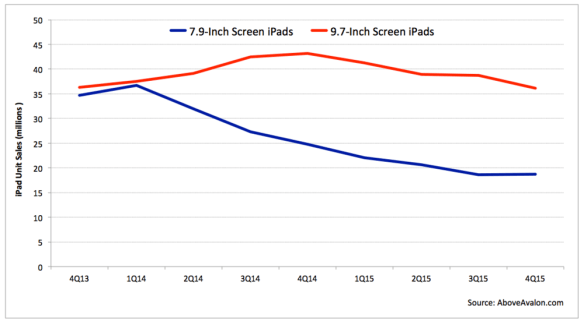
Seems that the real decline in iPad sales is of the mini – not the bigger one. So how will the giant iPad fare? Cybart’s analysis is always thoughtful.
link to this extract


You may be more exposed to the tech bubble than you think » Quartz

Allison Schrager:

First, you might have a stake in these companies if you own any actively managed mutual funds, perhaps through your retirement plan. According to Todd Rosenbluth, director of mutual fund research at Standard &Poor’s, large mutual funds have been investing in non-public companies for years. “Most people have no idea.” he says. The payoffs can be big if some of these firms successfully go public, but the risks are significant because it’s impossible to assign a consistent, accurate value to these investments, and they are hard to sell if the fund faces redemptions. However, regulation keeps mutual funds from holding large amounts of private shares, which would mitigate the impact. “It’s a tiny part of their portfolios,” Rosenbluth says. For example, only about 2% of the Fidelity Blue Chip Growth fund is made up of tech startup investments.

The second way you’re exposed is through public pensions, whether you’re a direct beneficiary or not.

Feels like a stretch, to be honest. And certainly nothing like the dot-com bust.
link to this extract


YouTube Kids app faces new complaints » The New York Times

Ceclia Kang:

Visit YouTube Kids and it typically does not take long before promotions for junk food appear. The advertisements regularly appear in the form of funny contests and animated stories.

In complaints filed to federal officials on Tuesday, two prominent consumer advocacy groups argued that those ads are deceptive, particularly for children. The two complaints, made to the Federal Trade Commission, expand on filings the groups made to the agency in April and could increase pressure on federal officials to intervene in the fast-growing online video market.

The groups, the Campaign for Commercial-Free Childhood and the Center for Digital Democracy, argue in the complaints that online video aimed at children has become too commercialized and is not held to the same standards as cable and broadcast TV. The complaints call for an investigation of food marketers, video programmers and Google, which owns YouTube, as well as a broad examination of advertising of such food to children online.

If YouTube by default becomes the new online TV, shouldn’t it be held to the same standards as broadcast TV?
link to this extract


Sony employees on the hack, one year later » Slate

Amanda Hess:

Outside Sony, it would eventually seem as if all the studio’s info had been exposed for everyone to see. But inside the studio, nobody could access anything. “Everything was so completely destroyed. It was surreal. Everything was down,” one ex-employee told me. “It wasn’t just one system or one part of the lot or one building. The network was completely chewed up by the virus.”

“It was like a bomb went off,” one staffer says. “We looked around. We were still alive. So we started doing triage.”

The telephone directory vanished. Voicemail was offline. Computers became bricks.  Internet access on the lot was shuttered. The cafeteria went cash-only. Contracts—and the templates those contracts were based on—disappeared. Sony’s online database of stock footage was unsearchable. It was near impossible for Sony to communicate directly with its employees—much less ex-employees, who were also gravely affected by the hack—to inform them of what was even happening and what to do about it. “It was like moving back into an earlier time,” one employee says. The only way to reach other Sony staffers was to dial their number directly—if you could figure out what it was—or hunt them down and talk face to face.

link to this extract


NeuralTalk and Walk » Vimeo

Kyle McDonald:

NeuralTalk and Walk from Kyle McDonald on Vimeo.

Andrej Karpathy’s “NeuralTalk” code (github.com/karpathy/neuraltalk2) slightly modified to run from a webcam feed. I recorded this live while walking near the bridge at Damstraat and Oudezijds Voorburgwal in Amsterdam.

All processing is done on my 2013 MacBook Pro with the NVIDIA 750M and only 2GB of GPU memory. I’m walking around with my laptop open pointing it at things, hence the shaky footage and people staring at themselves.

Pretty smart.
link to this extract


Top Android app devs found exfiltrating mystery stealth packets » The Register

Four researchers have found two thirds of the most popular Android apps indulge in seemingly-useless covert chatter with remote servers.

Top developers including Gameloft, Unity3d, and grillgames are implicated to varying degrees.

The chatter has no use to users. About half of the traffic is related to analytics, such as that used by Twitter and Pandora, with the rest of unknown purpose.

They make the findings in the paper Covert Communication in Mobile Applications (PDF).

“…In fact, some applications start collecting analytics information even before they get activated. For example, twitter, Walmart and Pandora start their data collection as soon as the phone is booted and continue, periodically, during the phone’s entire up time, even if the applications themselves were never used. In most cases, the user cannot opt-out from such data sharing without uninstalling the application.”

Five apps died when the covert chatter was killed off after the code in question was manipulated by the research team.

link to this extract


Automated scanning of Firefox extensions is security theatre (and here’s code to prove it) » Dan Stillman

Stillman wrote a simple Javascript extension that grabs sites and passwords, yet passes Mozilla’s “scanner” which looks for “malware”:

I asked in February how the scanner would possibly catch things like this, and the response from Mozilla’s Add-ons Developer Relations Lead was that most malware authors are lazy and that he believed the scanner could be made to “block the majority of malware”. The fact that, nine months later, and a few weeks before an enforcement deadline that was already postponed by several months, someone can write a trivial extension in a few minutes that steals passwords, runs a local process, and executes arbitrary remote code, but that is still automatically signed, demonstrates just how ill-conceived this scheme is. It also destroys any argument that whitelisting would put users at greater risk for malware, and it’s infuriating that we’ve had to waste the last few months arguing about the dangers of a whitelisted Zotero. And it’s just depressing that the entire Mozilla developer community spent the last year debating extension signing and having every single counterargument be dismissed only to end up with a system that is utterly incapable of actually combating malware.

link to this extract


Android One fails to make a mark despite revamp » The Economic Times

Danish Khan:

According to Counterpoint Research, only 1.2m units of Android One [handsets] were shipped to India during its first year (September 2014 to September 2015) in the country, making up only 3.5% of the $50-$100 phone market, the segment which sells the most phones.

Only 3m devices are said to have been shipped in total across the 19 countries that Android One has launched in. Of this, 85% of sales took place in the Asia-Pacific market.

Counterpoint’s Tarun Pathak said that for Android One to succeed in India, Google and its partners need to scale down to lower price points and differentiate the product from biggest competitor which is “Android” itself, which is competing with Android One via original equipment makers (OEM) that are present across $50-$100 price band in India.

Lack of LTE turns out to be a key mistake.
link to this extract


Errata, corrigenda and ai no corrida: none notified.

Dark matter full of piranhas: Android, Apple and the 3Q 15 smartphone scorecard


Remind you of the smartphone market? Red piranhas photo by Stig Nygaard on Flickr.

A friend of mine recently showed me his new handset. “It’s a Huawei,” he said. “Never heard of them, but it was a good price, and it does all I need.” He’d bought it to replace his ageing Nexus 4, and he seemed happy.

And so goes another example of Android dark matter: a company that is selling lots of handsets, but where we have no idea whether it’s making any money from them.

Yet we might guess that the answer is a qualified “no” when we look around at its rivals. Another quarter, and the profit story remains much the same: Apple and Samsung are making it all. The others whose financials we can actually see – LG, Sony, HTC, Lenovo, Microsoft, BlackBerry – all lost money as though it was what you’re meant to do. The big mystery: Huawei, which was the third biggest smartphone maker in this period, but doesn’t release financials. Is it making money? If so, it’s the only Android OEM besides Samsung which is to any notable extent.

But the third quarter, from June to the end of September (already receding into the distance) is notable because we’re now seeing the effect we’d expect from the rapid expansion of the Android OEM business: price deflation. It’s becoming rampant, and it’s beginning to tear into Samsung, which is being eaten from below by piranhas.

The effect of this was that even though Samsung shipped more smartphones than it has ever done before – a titanic 84.5m – its mobile revenues were only its 9th largest, and its mobile profits only one-third the size of its biggest (which came in early 2013).

That equally raises a very important question for the future of the big noise in the smartphone business: Apple. If even the biggest Android OEM is having its prices yanked down by smaller but numerous rivals, how (or how long) can Apple maintain its gigantic difference in pricing compared to those rivals?

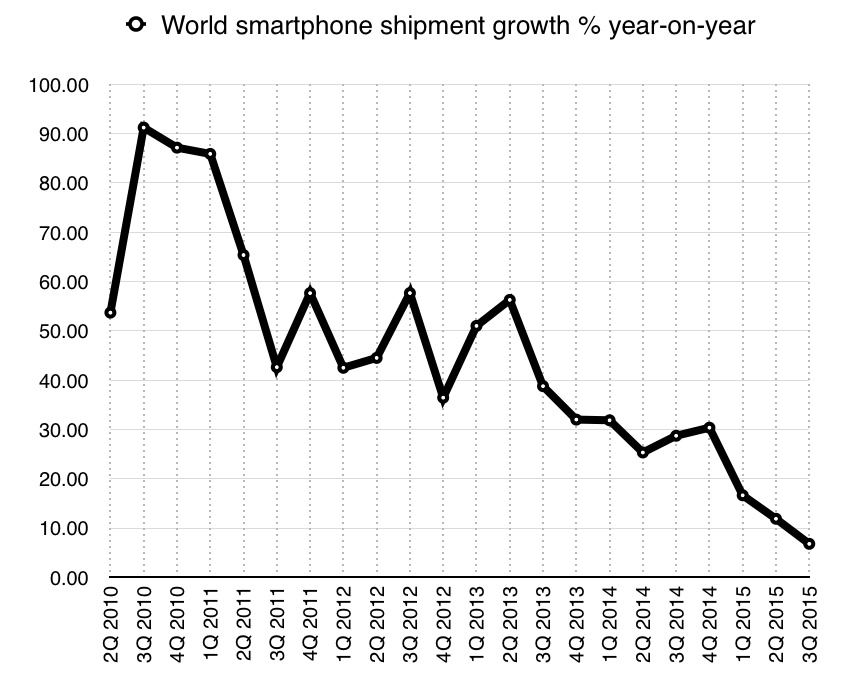
Note too that the smartphone market is still decelerating; from 11.9% growth (compared to the same period in 2014) in the second quarter, to 6.8% in the third, according to IDC’s numbers, which are the ones I use for consistency. (Gartner has a higher growth rate.)

World smartphone shipment growth by quarter

Data from IDC

Score that

I’ve added two columns to the scorecard this quarter: year-on-year shipment growth, and that growth normalised against the whole smartphone market. Apologies if this demands a lot of horizontal scrolling.

OEM S/phone revenue US$ (approx) Op profit US$m Op margin % S/phones shipped Implied ASP per s/phone Implied profit per s/phone Shipment growth y/y Shipment growth v s/phone mkt (6.8%)
HTC $0.674bn -$154m –23.1% 2.6m $259.27 –$59.85 –46.9% –53.7%
Sony $2.32bn -$171.7m –7.4% 6.7m $346.12 –$25.62 –32.3% –39.1%
LG $2.96bn –$88.6m –2.3% 14.9m $198.49 –$5.95 –11.3% –18.1%
Samsung $20.70bn* $2,440m 11.79% 84.5m $248.55 $28.86 +7.6% +0.9%
Lenovo
(inc Motorola)
$2.37bn* -$217m –9.2% 18.8m $126.22 –$11.54 –32.9% –39.6%
Total for ‘public’ Android $29.024bn $1,810m 6.2% 127.5m $227.64 $14.20 –7.7% –14.5%
Huawei ????? ????? ????? 26.5m ????? ????? +57.7% +50.9%
Xiaomi ????? ????? ????? 18.3m ????? ????? +1.1% –5.7%
ZTE ????? ????? ????? 16.2m ????? ????? +42.1% +35.3%
Total for “dark Android” ????? ????? ????? 61.0m ????? ????? +35.6% +28.8%
Apple $32.21bn $9,022m* (28% est) 48.05m $670.38 $187.76* +22.6% +15.8%
Microsoft Mobile $0.72bn* –$603m –83.8%% 5.8m $105.00 –$104.00 –38.6% –45.4%
BlackBerry $0.20bn –$180m* –89% 0.83m $242.16 –217.00 –61.9% –68.7%

* estimated smartphone revenues/profits/ASP only – excluding featurephones and tablets.

Working assumptions:
HTC: all revenues from smartphones – zero from the Nexus 9 tablet (pretty certainly true), zero from the HTC Re camera (probably true).
Sony: all revenues and profits from smartphones; zero from tablets – of which it shifted fewer than 1.6m, given IDC’s numbers; and zero profit from tablets. If tablets generated significant revenue and were profitable, then the smartphone ASP goes down, as does per-handset profit. (If tablets lost money, the per-handset loss is less.)
LG: $100 average selling price for the 1.6m tablets I’m estimating it shifted in the quarter. (That would put it equal with shipments in the previous quarter.) Tablets assumed to have zero profit, though they might have made some loss that made everything else look worse.
Samsung: featurephones (it shipped 20.5m) sold for $15, zero profit; tablets (8.0m) sold for $175 at zero profit. If the tablets or featurephones made any profit, then the profit from smartphones were lower.
Lenovo: assuming the 3.1m tablets it sold had an ASP of $100, and zero operating profit. If the tablet ASP was lower, Lenovo smartphone revenues were higher; if the tablets were profitable, per-smartphone loss was greater.
Apple: operating margin, as previously, of 28%. You could halve this, or even put it level with Samsung’s declared margin, and its operating profit would still be more than all the others’ profits (even ignoring losses) put together.
Microsoft Mobile: the figures here have to be backed out from the not-quite-stated phone revenue, including featurephones: “phone revenue decreased 58% by $1.5bn”, which takes us down to $1.1bn. There’s no gross margin given for phones, so I assumed –$104m, as in the previous quarter. Microsoft shipped 25.5m featurephones (up from 19.4m the quarter before, but down from 42.9m the year before) and 5.8m Lumia smartphones (stated; down from 8.4m the quarter before, and 9.4m the year before). Assuming featurephones had an ASP of $15 and made zero profit (same as with Samsung). The Lumia ASP has to be estimated, but seems reasonable.
BlackBerry: device revenue is given in financial statement; assuming software/services have gross margins of 84.5% (true historically), and that hardware R+D and sales costs are proportional to device revenues as % of overall revenues.

Troubles in common

Here’s the surprise: a number of Android OEMs managed to make their device ASPs rise from the previous quarter. First is Sony – up from $319.40 to $346.12. And who knows whether the $5m spent on product placement for Sony smartphones in the James Bond film Spectre won’t pay off some time. (They’ll have to have a hell of a return on investment, though.) HTC also managed it: up from $236.90 to $259.27. Lenovo also did it, up from $115.06 to $126.22.

And what else did those three companies, along with LG, all do? Lost money. The problem for premium Android goes on. We’re seeing the rise of “dark Android” – the companies which have huge reach (especially inside China) but whose finances are opaque. (All three of Huawei, ZTE and Xiaomi sell many, if not a majority, of their phones without Google’s services installed, because they sell them inside China.) Meanwhile Apple raises its ASP, and its profit rises in line, as far as we can tell.

The really interesting case is Samsung. A year ago, in the third quarter of 2014, Samsung had a terrible time: profits crashed and its semiconductor division became the most profitable part of the business – which is still the case. At that time, Samsung discovered that making a new “S” series phone wasn’t a guarantee of success; it was caught with lots of unsold Galaxy S5s sitting with wholesalers, and had to offer all sorts of discounts to get them moving, which hurt profits.

This time around, Samsung’s profits have risen year-on-year, but only because the same time last year it was so dire. The Wall Street Journal had some interesting data about how it managed to get so many phones sold: basically, it concentrated on the low-to-mid end. Screw the S6 and S6 Edge and its kin; this was about getting phones out the door.

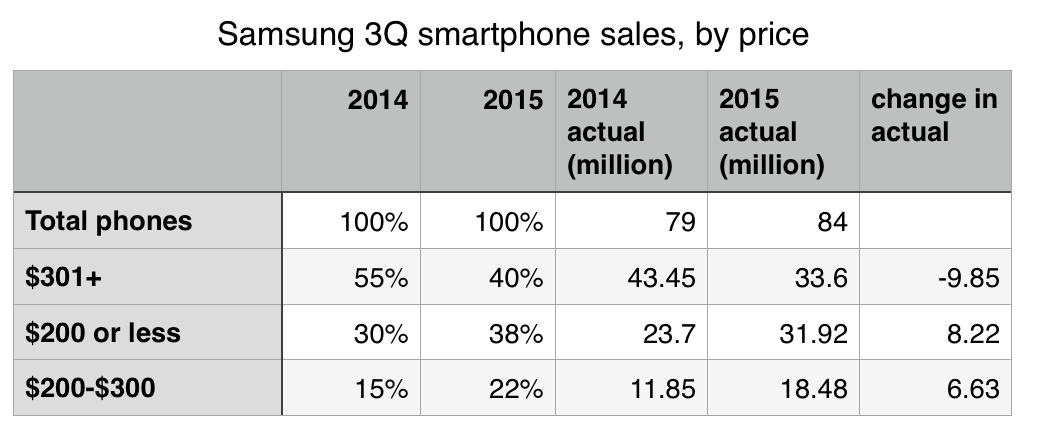
…while 55% of its smartphones were priced at $301 per unit or more at this time last year, that high-end segment has fallen to just 40% of Samsung’s overall smartphone sales, Counterpoint said.

Phones priced $200 or below now account for 38% of total units shipped at Samsung, versus 30% this time last year.

You can work this out pretty easily:

Samsung phones sales, by price segment

Data from Counterpoint Research for 3Q 14 and 3Q 15

Here’s how that looks when you visualise it:

Samsung phone sales by segment, visualised

Data from Counterpoint Research. The mid-level segment is growing at the expense of the high-end one.

Look at how the blue and green edge up into the pricier yellow – which is now much smaller. And we’re comparing, remember, with last year, where the yellow (pricey) segment went pretty badly for Samsung as it was.

This is Samsung reacting to what’s going on in the market, and responding as it does best: by using its manufacturing and distribution might to try to squash competition. But in places like China and India, for example, local suppliers can compete pretty evenly:

“Samsung Electronics has decided to release the products priced at some 100,000 won for price competitiveness with Chinese and Indian smartphone makers. Local manufacturers, such as Xiaomi and Micromax, have already launched many models in the same price range. An official from the industry said, “Now, it is impossible to hold a dominant position in the competition just with a brand image of Samsung Electronics without releasing models in the same price range with local companies. When we have similar price competitiveness, we can defend our market share but profitability will get worse further.”

And LG? It’s getting walloped. Strategy Analytics says (in a super-pricey report I won’t buy) “LG’s global handset shipments dipped -21% YoY in Q3 2015. Competition from ZTE, Huawei and others ramped up across Asia and North America. A major challenge for LG is that it still has too many eggs in too few country baskets and it badly needs to diversify geographically for regrowth in 2016.”

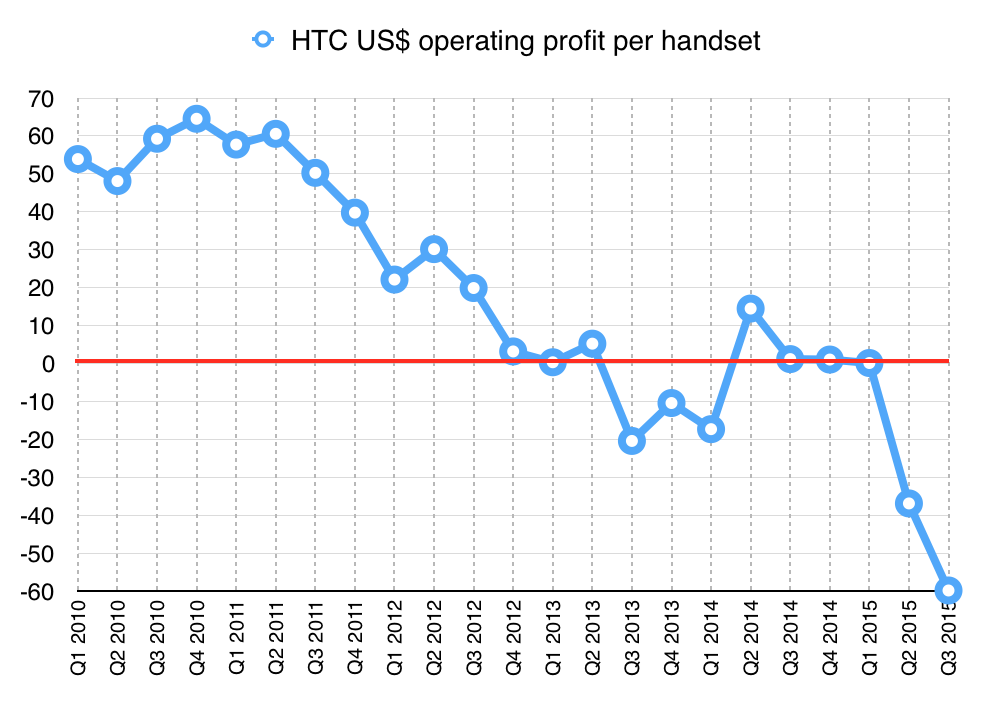
I don’t see that happening. What I find remarkable is that top-end Android vendors are now howling into the hurricane. The LG G4 has a camera that seems remarkable in all the sample shots I’ve seen; yet it’s struggling to sell them. HTC might hope that the newly released iPhone-alike A9 will raise revenues briefly this quarter, but I’m pretty sure they won’t reverse its per-handset losses, which are looking awful:

HTC US$ operating profit per handset

Data calculated from HTC financials

Android’s dark matter

Consumers are clearly beginning to think that many other Android handsets are “good enough”. My friend with his cheap Huawei handset is just one example. ZTE and Xiaomi and OnePlus and, now, the UK’s WileyFox and Marshall (the amplifier makers, yes) and even Pepsi are all piling into the handset market, sure that they can make money.

In some cases, it’s quite possible they are: by restricting its supply and distribution, OnePlus has a model that can scale as long as it can keep a lid on demand. What the phone OEMs really want is to be able to move closer to a Dell-type model: where you order the device and it’s pretty much custom-made for you from modular parts. That means lower inventory, and certainty about pricing components and satisfying demand.

Meanwhile, Android OEMs such as LG, Sony and Samsung are faced with the harsh reality spelt out by Ben Bajarin in one of his columns:

as a market matures, the early innovators get disrupted by competitors who come into their space with lower priced products, similar specs (the specs that matter), and eat into the market share of the early innovator in the category. Once the market embraces “good enough” products, the innovator can no longer push premium innovations as their value is diminished once a “good enough” mentality sets in. Android devices in the $200-$400 range are “good enough” for the masses, leaving Samsung’s $600 devices and above stranded on an island.

As he points out:

the innovator’s dilemma, in this case, only applies to Android-land because all the hardware OEMs run the same operating system. As I’m fond of saying, when you ship the same operating system as your competition you are only as good as their lowest price.

This is what Samsung is reacting to, but Sony and LG and HTC can’t react to without cutting their own throats even more. They have high fixed costs in order to produce those super-high-resolution phones (QuadHD, anyone? Even if you can’t tell the difference?) but it doesn’t cut any ice with the public.

Meanwhile Huawei, ZTE and Xiaomi the dark matter of the smartphone business: we know they’re there because of the enormous influence they wield on everyone around them. They’re also the only part of the Android OEM business that’s growing. But it’s very hard to have any idea of their financial position. (You can get some idea: CoolPad says it can’t make sufficient profit to sell a tablet to compete with Xiaomi’s newest model at the same price.) The way that the low-price piranhas are piling into Android does remind me of the days when the iTunes Music Store was taking off, and every company in a vaguely associated area scrambled to have their own download store – HMV, Tesco, Wal-Mart, Virgin – without much consideration of how they’d turn it profitable; they just reckoned it was a good idea. (Most have now shuttered those stores.)

In the same way, offering an Android phone is beginning to look like a possible sideline for all sorts of companies, which speaks to the problem that the big Android players have: if anyone can make a smartphone, why are they making a smartphone? Sure, the rivals don’t outsell the big players, but they don’t need to. For almost any price, control your inventory and demand and you control your profitability.

Black days for BlackBerry

You’ll notice BlackBerry’s figure, where its costs are so mad that it’s effectively losing enormous amounts on each device it sells. Chief executive John Chen may say handsets are “profitable”, but that’s gross margin, before you take away distribution, administration, sales, and R+D. In day-to-day terms, BlackBerry’s hardware division is a mess, and I don’t see why Chen doesn’t say “we’re going to go into a maintenance mode where we supply legacy handsets to existing clients on demand” and simply focus on the software/services business for profit. The BlackBerry Priv would have to be a colossal hit to make up this ground, and there is simply no sign of that happening. Richard Windsor agrees:

The new BlackBerry Priv and its rumoured successors are aimed at such a narrow niche that I doubt that they will ever make money. Once this realisation has sunk in, I think that BlackBerry will abandon its hardware business and focus on its software business which has recently been bolstered with the acquisition of Good Technology.

The iPhone pricing puzzle and the single spec that matters

How much longer can Apple keep on with its premium pricing? This question has been asked pretty much since the first Macintosh was launched. The answer from the PC market seems to be “a lot longer than you might expect”. In the smartphone market, the distance between the iPhone ASP and the average Android handset ASP, even on these public figures, is $450, which is itself double the price of the average Android ASP. And it’s unlikely that the missing Android data covers handsets with higher prices.

This seems like a situation that can’t last, and yet we’ve seen in the PC market that it can and does: Apple’s ASP there is over $1,200, while that of the big five Windows PC makers wobbles around $500. Apple also makes about twice the operating profit on PCs as HP, Lenovo, Asus and Acer combined.

Yet in a space where prices of phones are dropping precipitously, the iPhone’s price tag seems more and more anomalous. Yet by standing outside those price wars, and by incrementally improving its offering again and again, it keeps pulling it off. In part, that’s because of the price: as CCS Insight noted in April,

Apple’s success in opening up new, high-growth markets such as China, India and Indonesia is significant. Although its products are out of reach for many people, the iPhone is widely regarded as a badge of success in these countries and there are still enough buyers who are affluent enough to afford one.

In that sense, the price is a spec – one where rivals are actually being degraded. It sounds completely contrary, but to a number of people an iPhone is an affordable luxury. Think of it like a car: some people really want Porsches. But if you could buy a Porsche for the same price as any other car, would it still have that cachet?

Maturity and change

We’re now moving into a situation where the biggest markets – China and the US – are approaching saturation, so that it becomes increasingly hard to persuade the remaining featurephone owners to trade up, and people are less willing to buy a new device just because it’s new. That CCS Insight forecast in April also says that smartphone sales in western Europe and North America will peak in 2017; but it also expects Apple’s share to grow.

Again, this seems contrary – won’t that just lead to people being driven by price? But in a mature market, you can get a move towards perceived quality and luxury, because you’re in a situation of plenty. As I showed using Ericsson’s data from mature markets, Apple can gain users in that situation, creaming them off from Android (and to a less extent from Windows Phone).

Conclusion: segue to VR

Three months or so back I wrote about “premium Android” hitting the wall. Now it’s sliding down, and being swallowed by dark matter and eaten by piranhas. So what keeps the lossmaking companies in the business? I think it’s pretty evident that they now have their eyes on the future: virtual reality. It’s a hugely promising technology which demands integrated systems with gyroscopes and, moreover, super-high-quality screens where you can’t discern pixels even if it’s a few inches from your face. That’s what Sony, LG, HTC and Samsung are all aiming at; each has its own offering in VR, while Apple hasn’t so far made a move.

Perhaps, though, history is going to repeat itself here. Each of those companies was strong in phones before Apple came onto the scene with the iPhone. It cannot have escaped Apple’s notice that VR is a promising market, with lots of applications. And it has been granted patents in that space.

Maybe in a few years’ time, we’ll be scoring profits in the VR market. For now, though, it’s all about smartphones – and there are still only two clear winners.

More articles to read:
• BlackBerry might have no BB7 users left by February 2016
• Premium Android hits the wall: the Q2 2015 smartphone scorecard
• Google’s growing problem: 50% of people do zero searches per day on mobile
• The adblocking revolution, and iOS 9

Start up: Adele v pirates, Alphabet’s challenge, Mayer’s end? and more


The authentic feel of everything from Shaft to.. everything else. Photo of a wah-wah pedal by Kmeron on Flickr.

You can now sign up to receive each day’s Start Up post by email. You’ll need to click a confirmation link, so no spam.

A selection of 10 links for you. Handle with care. I’m charlesarthur on Twitter. Observations and links welcome.

Burma gives a big thumbs-up to Facebook » Foreign Policy

Christian Caryl:

As the vote count draws to a close, it’s clear that Burma’s long-suffering opposition has scored a landslide victory in Sunday’s historic national election. And the leader of that opposition knows whom to thank. As she was explaining the reasons for her party’s remarkable triumph in an interview with the BBC this week, Nobel Prize Laureate Aung San Suu Kyi said this: “And then of course there’s the communications revolution. This has made a huge difference. Everybody gets onto the net and informs everybody else of what is happening. And so it’s much more difficult for those who wish to commit irregularities to get away with it.”

She could have been a little more specific, though. When people here in Burma refer to the “Internet,” what they often have in mind is Facebook — the social media network that dominates all online activity in this country to a degree unimaginable anywhere else.

link to this extract


Inside the problem with Alphabet » The Information

Amir Efrati and Jessica Lessin:

[Larry] Page unveiled Alphabet in August as a way to empower entrepreneurs and strong CEOs to build new companies “with a long term view.” Mr. Page had already been creating new companies under Google, like Calico, the secretive life-extension startup that former Genentech CEO Art Levinson is leading.

Some of those companies wanted more autonomy from Google and its bureaucracy, on issues big and small; [Arthur] Levinson [in charge of Calico], for instance, bristled when Google’s food services staff tried to apply Google’s nutritional guidelines to dining areas that served Calico employees, according to several people Mr. Page told about it.

Many details about the new structure have yet to be figured out. They include whether and how Alphabet companies can raise outside capital; who will control the IP they create, especially if they borrowed some from the old Google; and how they will use Google’s technical infrastructure.

If Google’s world-class cybersecurity software extends to the new Alphabet companies and those companies are later spun out or sell a significant chunk of themselves to another party, will those companies still get to use the Google software? Does it make sense for people at an Alphabet company to get Alphabet stock as part of their compensation, given that the performance of Alphabet will be heavily influenced by the performance of Google Search ads?

link to this extract


Wireless carriers are favouring the iPhone » The Motley Fool

Sam Mattera:

The gradual decline of contract plans has sparked a wave of innovation in the U.S. wireless industry. In the past, consumers mostly signed two-year agreements in exchange for heavily subsidized handsets. Today, they have a vast array of choices, including installment options and leasing programs. Most of these plans reduce upfront costs by doing away with down payments, and give consumers the ability to upgrade their smartphones more often.

But some of these plans – the most advantageous, in fact – are only available to buyers of Apple’s iPhone.

I could have sworn that the hot take on the end of subsidies (aka contract plans) was that it meant dire trouble for Apple.
link to this extract


The last days Of Marissa Mayer? » Forbes

Miguel Helft goes into detail and finds many of the same stories we’ve been hearing for the past couple of years:

Mayer hired some executives without fully vetting them with her team, and some of those decisions proved costly. One of her first big hires was Google sales executive Henrique De Castro, brought on as chief operating officer. De Castro failed to meet sales goals and Mayer fired him after 15 months, but not before he reportedly pocketed as much as $109 million in compensation and severance. Mayer also spent a year without a chief information officer after her IT operations chief David Dibble quit for personal reasons in 2013. In August 2014 Mayer finally announced to her executive staff that she had found the right person in Netflix executive Mike Kail, who came recommended by her husband, the investor Zachary Bogue. Three months later Netflix sued Kail for fraud, after he allegedly collected kickbacks from vendors. Yahoo quietly let him go in May.

Mayer’s propensity for micromanaging also exasperated many of her executives. By her own admission, Mayer spent an entire weekend working with a team of designers to revamp the Yahoo corporate logo, debating such details as the right slant for the exclamation point (9 degrees from vertical). Mayer also insisted on personally reviewing even minor deviations from a compensation policy she had instituted. When managers wanted to give top performers a bonus or raise above the parameters she had set, they had to write her an e-mail explaining the circumstances and wait for an approval or denial. Some managers dispute that this was a hard-and-fast rule. Mayer also insisted on reviewing the terms given to hundreds of contractors and vendors on a quarterly basis, whether they were engineers or writers or makeup artists. “She would go line by line and decide on what date a contract should end,” says a senior executive. Adds another: “It was a colossal waste of time.”

There’s detail, and then there’s detail that doesn’t merit a chief executive’s very expensive time.
link to this extract


EE proposes restrictions on mobile adverts » Telegraph

Christopher Williams:

EE, Britain’s biggest mobile operator, is considering introducing technology that will hand smartphone users the power to control the advertising they see online, in a clampdown that would cause major upheaval in the £2bn mobile advertising market.

Olaf Swantee, EE’s chief executive, has launched a strategic review that will decide whether the operator should help its 27 million customers to restrict the quantity and type of advertising that reaches their devices, amid concern over increasingly intrusive practices.

The review will look at options for creating new tools for subscribers that would allow them to block some forms of advertising on the mobile web and potentially within apps, such as banners that pop up on top of pages or videos that play automatically. EE customers could also get the ability to control the overall volume of advertising.

Mr Swantee told The Sunday Telegraph: “We think it’s important that, over time, customers start to be offered more choice and control over the level and intensity of ads on mobile.

“For EE, this is not about adblocking, but about starting an important debate around customer choice, controls and the level of ads customers receive.”

It’s about adblocking. And potentially creating a whitelist.. in paid-for manner?
link to this extract


Syria’s climate-fuelled conflict, in one stunning comic strip » Mother Jones

I would hotlink to the strip directly, to embed it, but that would probably take more scrolling room than you want to bother with here. However, it makes a crucial point: the Arab Spring wasn’t caused by some abrupt realisation among the peoples of the Middle East that democracy would be nice; instead, it was driven by the rising cost of staple foods and rural displacement to cities, which created huge tensions – which authoritarian regimes couldn’t handle without causing more unrest.

Thus when people snigger at Prince Charles saying that the refugee crisis is a result of climate change, he’s not the one who’s wrong; they are.
link to this extract


Adele is NOT No.1 on this chart (and it’s a really important one) » Music Business Worldwide

Tim Ingham:

The Pirate Bay’s regularly-updated Music chart shows the 100 most popular torrents on the service in the past 48 hours.

The shock news: [Adele’s new album] 25 is nowhere. Literally nowhere.

Below, you can see the 25 most popular music files on TPB as of yesterday morning (November 22) UK time – two days after the astonishingly successful release of Adele’s new LP.

Not only does 25 not feature in the tracks we’ve featured above – it didn’t feature in the entire top 100.

It was the same story on Saturday (November 21) – a day after release – and it’s the same story this morning.

Adele did briefly claim a position on the TPB chart yesterday, MBW noticed – at No.63, with her previous release 21 – but she’s since disappeared.

Speaks again to the different generations interested in Adele. If it had been, say, a new Nine Inch Nails album, it would have been all over the pirate sites.
link to this extract


I worked in a video store for 25 years. Here’s what I learned as my industry died » Vox

Dennis Perkins makes the point that a lot of it is about choice and curation:

It was a point of pride that we had everything and could turn people on to some obscurity we knew would appeal. A video store had sneaky cultural punching power — movies championed by our staff got watched. They stayed alive. You know, as long as we did.

By contrast: Netflix routinely adds and removes films at a whim based almost exclusively on licensing agreements. These agreements just don’t mean that movies any respectable video store would have remain “unavailable for streaming,” but that a substantial portion of Netflix’s (rather small) 10,000 film inventory is garbage: direct-to-DVD movies (or movies that bypass DVD for streaming entirely) accepted as part of package deals to get the rights to titles somebody might actually want to see. Although not everything you might want to see. As of this writing, you can’t watch Annie Hall, Argo, The Exorcist, This Is Spinal Tap, Taxi Driver, Schindler’s List, The Muppet Movie, A Nightmare On Elm Street, Fight Club, or Frozen on Netflix. You can, however, stream Transmorphers or Atlantic Rim, two suspiciously titled low-budget knockoffs of the movie you meant to watch.

His other key point: you had to choose to go to a video store. Netflix and its kin generally offer “let’s settle for this” content.
link to this extract


How LSD microdosing became the hot new business trip » Rolling Stone

Andrew Leonard:

“Ken” is 25, has a master’s degree from Stanford and works for a tech startup in San Francisco, doing a little bit of everything: hardware and software design, sales and business development. Recently, he has discovered a new way to enhance his productivity and creativity, and it’s not Five Hour Energy or meditation.

Ken is one of a growing number of professionals who enjoy taking “microdoses” of psychedelics – in his free time and, occasionally, at the office. “I had an epic time,” he says at the end of one such day. “I was making a lot of sales, talking to a lot of people, finding solutions to their technical problems.”

A microdose is about a tenth of the normal dose – around 10 micrograms of LSD, or 0.2-0.5 grams of mushrooms. The dose is subperceptual – enough, says Rick Doblin, founder and executive director of the Multidisciplinary Association for Psychedelic Studies, “to feel a little bit of energy lift, a little bit of insight, but not so much that you are tripping.”

This will become the new go-to explanation for crazy startup ideas.
link to this extract


The invention of the wah-wah pedal » Priceonomics

In 1965, in a small back room of a Los Angeles facility, Thomas Organ’s engineers began to build Vox amplifiers. Among these engineers was a bright-eyed 20-year-old by the name of Brad Plunkett.

Plunkett was given a challenging task by Thomas Organ’s CEO: he was to take apart a Vox AC-100 guitar amp and find a way to make it cheaper to produce while still maintaining the sound quality.

“The first thing I noticed,” he recalls in the documentary Cry Baby, “was this little switch [on the amp] entitled ‘MRB.’”

This switch, invented by British engineer Dick Denney and installed on all Vox AC-100 amps at the time, stood for “middle range boost.” When flicked on, it would highlight the middle sound frequencies of the guitar (notes between 300 and 5,000 hertz); in doing so, it would tame the extremes (very high and very low pitches), and produce a flattened, smoother sound. Plunkett realized that he could replace this pricey switch with a potentiometer – essentially an adjustable knob that divided voltages and acts as a variable resistor – and achieve the same effect.

“The switches were very expensive, about $4 each,” Plunkett continues. “The potentiometer would only cost about 30 cents.”

After a few days of fiddling around with spare parts, Plunkett succeeded in designing a circuit that could change the frequency of notes by simply rotating a potentiometer. Then, something unexpected happened.

(This makes an hour-long video.)

Patented as “foot controlled continuously variable preference circuit for musical instruments”. The patent came too late. Everyone could figure it out. Still, should the wah-wah pedal be added to the list of serendipitous discoveries, along with vulcanized rubber and Post-It notes?
link to this extract


Errata, corrigenda and ai no corrida: none notified.
Start up: journalism v Sean Rad, the Lumia 950 zombie?, Pepsi phones, and more


Too few of these getting sold. Photo by Yuxuan.fishy.Wang on Flickr.

Alternatively, you can sign up to receive each day’s Start Up post by email. There’s a confirmation link, so no spam.

A selection of 10 links for you. Aren’t they fluffy? I’m charlesarthur on Twitter. Observations and links welcome.

An Open Letter to Tinder’s Sean Rad from Vanity Fair’s Nancy Jo Sales | Vanity Fair

Nancy Jo Sales, who wrote a fabulous piece about how dating has changed (including Tinder), which some seemed to think meant she should “seek a quote from Tinder” before publishing. Rad, in the Evening Standard, suggested he had “information” about Sales:

Sean, you and I both know that when you spoke of me as “an individual,” you were talking about me personally. And you seemed to speak from a place of emotion, admitting that you were “upset” about my piece in Vanity Fair—which wasn’t actually just about Tinder per se, but changes in the world of dating, with the introduction of dating apps overall. This was something I tried to point out in my response to an avalanche of tweets directed at me, one night in August, when someone at Tinder decided that he or she would try to besmirch my reputation as a journalist as well. Your Twitter account admonished me: “Next time reach out to us first . . . that’s what journalists typically do.”

I don’t know what you and your colleagues at Tinder think journalism is, but I don’t believe it’s the same as what most journalists think it is. Our job is to report on what real people say and do, and how this impacts our world. It’s not our job to parrot what companies would like us to know about their products. Our job is an important one, and when the heads of companies decide to go after journalists personally, then I think we’re in very dangerous territory—not only for journalists, but for the whole practice of journalism, without which we can’t have a democracy.

This last paragraph. Oh yes, oh yes. I grow so weary of publications which think that a company announcing the new model of a phone or some new tweak to their software merits a breathless single-sourced story.
link to this extract


Match Group Inc – Free Writing Prospectus » US Securities and Exchange Commission

On November 18, 2015, the Evening Standard (the “Standard”), an online and print news service, published an article based on an interview with Sean Rad, the Chief Executive Officer of Tinder, a subsidiary of the Company. The article is described in relevant part in the following paragraph and the full article is attached hereto.

The article was not approved or condoned by, and the content of the article was not reviewed by, the Company or any of its affiliates. Mr. Rad is not a director or executive officer of the Company and was not authorized to make statements on behalf of the Company for purposes of the article. The article noted that “Analysts believe the [Tinder] app, which launched in 2012, has around 80 million users worldwide and records 1.8 billion “swipes” a day.”  While these statements were not made by Mr. Rad, the Company notes that they are inaccurate and directs readers to the Preliminary Prospectus, which states that for the month of September 2015, Tinder had approximately 9.6 million daily active users, with Tinder users “swiping” through an average of more than 1.4 billion user profiles each day.

Evening Standard routinely publishes articles and is unaffiliated with the Company and all other offering participants, and, as of the date of this free writing prospectus, none of the Company, any other offering participant and any of their respective affiliates have made any payment or given any consideration to Evening Standard in connection with the article described in this free writing prospectus.

The statements by Mr. Rad were not intended to qualify any of the information, including the risk factors, set forth in the Registration Statement or the Preliminary Prospectus and are not endorsed or adopted by the Company.

I can’t actually find that 9.6 million daily active user figure in the Preliminary Prospectus in the link. Still, nice to know.
link to this extract


Edward Snowden and the Paris attacks » Business Insider

Natasha Bertrand:

some experts are skeptical that revelations regarding the NSA’s ability to access encrypted data and the encryption methods adopted by companies in the wake of the Snowden disclosures had any effect on the ways terrorists have chosen to communicate.

“There is no evidence at all that the Snowden leaks contributed or altered the kind of terrorist activity that ISIS and Al Qaeda do,” Dave Aitel, CEO of the cybersecurity firm Immunity, Inc., told Business Insider.

“Al Qaeda was using high-grade operational technology long before the leaks — and they knew the NSA was their prime enemy long before Snowden,” he added. “For Morell to say the intel gaps that facilitated the Paris attacks fall into Snowden’s lap is a fantastic work of intellectual fiction.”

Indeed, Al Qaeda and other terrorist groups have been using their own encryption software since at least 2007, beginning with a program known as “Asrar al-Mujihideen” (Secrets of the Mujahideen). They extended that program to other devices, such as cellphones and text messaging, as the technology became available.

“Nothing has changed about the encryption methodologies that they use,” Evan Kohlmann, a partner at the private security firm Flashpoint Global Partners, told NBC in 2014. “It’s difficult to reconcile that with the claim that they have dramatically improved their encryption technology since Snowden.”

Paris seems to have been organised by plain old text message.
link to this extract


Pepsi Phone P1 is official: 5.5in 1080p display, 4G LTE and fingerprint sensor for $110 » Fone Arena

Srivatsan Sridhar:

After the leaks, Pepsi Phone P1s has gone official in China. It features a 5.5-inch (1080 x 1920 pixels) 2.5D curved glass display, is powered by an Octa-Core MediaTek MT6592 processor and runs on dido OS based on Android 5.1 (Lollipop). It has a aluminum unibody design and even has a finger print sensor on the back. It has a 13-megapixel rear camera on the back and 5-megapixel front-facing camera.

It has 4G LTE connectivity and dual SIM support that lets you use the second nano SIM slot as a microSD slot when required. Pepsi is just licensing its branding, and Shenzhen Scooby Communication Equipment Co., Ltd will manufacture the phone. The standard version of the phone is called P1 and the China Unicom version with FDD-LTE support is called P1s.

Phones are now just branding exercises; those specs would have been flagship two years ago. Interesting question: why hasn’t Coca-Cola done this? Probably because it doesn’t need to – Pepsi is playing catch-up in the branding stakes.
link to this extract


Pepsi phone: can it “change the game”? » Counterpoint Technology Market Research

Neil Shah:

The smartphone space is already looking like a FMCG [fast-moving consumer goods, akin to supermarkets] space where the goods are moving faster than ever and has become highly commoditized with value shifting beyond hardware to brand, content, software, commerce and services.

This offers a perfect opportunity for Pepsi to find some synergies in leveraging its strong brand to this consumer electronics FMCG segment which is smartphone (a highly personal good) and drive its brand further.

This could turn out to be a great and disruptive move if Pepsi plays its cards right and strike key partnerships across different markets to promote Pepsi brand via phones.

As we said, smartphone is “highly personal device” and this could give unique insights about consumers and we believe its the marketing dollars well spent more than Super Bowl commercials to consistently and continuously learn about consumers’ habits on phone as most users now have almost most of their lives use-cases linked to their phones.

We see “Pepsi Phone” as a great marketing & marketing research tool for Pepsi.

Remember when pretty much every FMCG company had its own music download store? I think this will pan out like that. (Count how many FMCG companies still operate their own music download store.)
link to this extract


Chrome Extensions – aka total absence of privacy » Detectify Labs

We signed up for one of the services which provides this information gathered by the Chrome extensions. We were able to see the following:

• Common URLs used by employees on targeted companies.
• Internal network URLs, exposing internal network structure as well as completely separated websites for internal use only.
• Internal PDFs being placed on AWS S3 referencing competitors.
• Pages which only one person had visited. We tested this out. One of the guys in the office using one of the plugins created a local website, page X, which didn’t link anywhere, but while being on the site he changed the address bar to page Y. He was the only visitor of page X. Two weeks later page X ended up in the “Similar sites” of page Y with “Affinity: 0.01%”.

Technical Details – how they are doing it

• They are running the tracking scripts in a separate background instance of the extension, but can still get access to all information about your tabs. By doing this, your network traffic of a web page will not disclose that requests are being done to a third party. This bypasses all Content Security Policy-rules and Chrome extensions – such as Ghostery – that tries to prevent tracking, since the requests are being done inside the extension itself.

Plus obfuscation, subdomains for extensions and more. Isn’t the web fun?
link to this extract


China’s chip acquisitions send ripples across industry – News & Trends – EETA

Junko Yoshiba:

The technologies and IP targeted by China include disk drives, CMOS image sensors, servers, memory chips and advanced semiconductor packaging and test services.

For the moment, the biggest prize sought by a private fund such as Tsinghua Unigroup appears to be NAND memory chips. In August, the firm made an informal $23bn takeover offer for US giant Micron Technology. The Idaho-based chipmaker rejected the deal outright, conceded that it might endanger US national security.

In an interview with Reuters this week, the Tsinghua Unigroup chair, Zhao Weiguo, said his firm plans to about $47bn “over the next five years in a bid to become the world’s third-biggest chipmaker.” To put the matter into perspective, this five-year investment target roughly equals a year’s revenue at Intel. (Intel’s 2014 revenue was $55.9bn.)

Over the past two years, Tsinghua has spent more than $9.4bn on acquisitions and investments at home and abroad. These include the purchase of stakes in US data storage company Western Digital Corp. and Taiwan’s Powertech Technology Inc. Without disclosing specifics, the chair revealed that the company is about to close another investment deal, a minority stake in a US chip company, as early as the end of this month, Reuters reported.

link to this extract


Who turned my blue state red? » The New York Times

Subtitle of this article by Alec MacGillis of ProPublic is “Why poor areas vote for politicians who want to slash the safety net”; for non-US readers, “blue” states vote Democrat, and “red” ones Republican:

The people in these communities who are voting Republican in larger proportions are those who are a notch or two up the economic ladder — the sheriff’s deputy, the teacher, the highway worker, the motel clerk, the gas station owner and the coal miner. And their growing allegiance to the Republicans is, in part, a reaction against what they perceive, among those below them on the economic ladder, as a growing dependency on the safety net, the most visible manifestation of downward mobility in their declining towns.

These are voters like Pamela Dougherty, a 43-year-old nurse I encountered at a restaurant across from a Walmart in Marshalltown, Iowa, where she’d come to hear Rick Santorum, the conservative former Pennsylvania senator with a working-class pitch, just before the 2012 Iowa caucuses. In a lengthy conversation, Ms. Dougherty talked candidly about how she had benefited from government support.

Pulling the ladder up.
link to this extract


Jawbone lays off 60, 15% of staff globally, closes NY office » TechCrunch

Ingrid Lunden:

TechCrunch has learned and confirmed that the company yesterday [Thursday] laid off around 60 employees, or 15% of staff. It’s a global round of layoffs affecting all areas of the business; and as part of it Jawbone is also closing down its New York office (which was concentrated on marketing) and downsizing satellite operations in Sunnyvale and Pittsburgh.

In an emailed statement, a spokesperson said the layoffs are part of a wider “streamlining.”

“Jawbone’s success over the past 15 years has been rooted in its ability to evolve and grow dynamically in a rapidly scaling marketplace. As part of our strategy to create a more streamlined and successful company, we have made the difficult decision to reorganize the company which has had an impact on our global workforce,” he said. “We are sad to see colleagues go, but we know that these changes, while difficult for those impacted, will set us up for greater success.”

Seventh among wearable device vendors, with a market share of 2.8%; Fitbit by comparison is No.1 (ahead of Apple) with 24.3%, selling 4.4m. Can’t see a market for that many non-smartwatch vendors except the really specialist, eg athletics.
link to this extract


Microsoft Lumia 950 review: can a smartphone be your PC? » WSJ

Joanna Stern loves the hardware, though notes the mobile apps are limited or out of date (Instagram hasn’t been updated for two years), then tries the “Continuum” system, plugging it into (just) a monitor:

this made for a decent basic desktop computing experience—decent enough for me to write this entire review and not spend every minute pining for my laptop. Word, Excel, PowerPoint all look and feel like they do on a laptop, and the Edge Web browser loads desktop sites instead of mobile ones.

The problem is, despite the hexa-core processor and 3GB of RAM, the system feels out of power. Having just five or six open tabs reminded me of the dial-up modem days. Not only were sites slow to load over Wi-Fi, but the entire system and browser got bogged down. Besides, Google’s Chrome is just a far better desktop browser, feature-wise.

But that’s not the worst of it. Remember those app problems? Because this is Windows 10 Mobile and there is no Intel chip inside, Windows desktop apps don’t work. That means no downloading the desktop version of Spotify or Slack or iTunes. You can’t run mobile apps on the big screen, either. For example, I couldn’t open the Windows Phone Spotify app in the desktop PC mode, but I could run it on the phone while I did work on the computer monitor.

Ah, Windows RT is back. Or risen from its zombie grave. (Via Mike Hole.)
link to this extract


Errata, corrigenda and ai no corrida: none notified.
Start up: blocking Trump,dissecting Pencil, evaluating Uber, and more


“Hey, I can’t find our product marketing guy in here either!” Photo of an HTC Vive wearer by pestoverde on Flickr.

You can now sign up to receive each day’s Start Up post by email. You’ll need to click a confirmation link, so no spam.

A selection of 11 links for you. Use them wisely. I’m charlesarthur on Twitter. Observations and links welcome.

Apple Pencil teardown » iFixit

We’ve caught sight of more chips at the other end, so we ditch the battery and move to the fun stuff—like the teeeny logic board!

This little board is folded in half to make the most of the minimal space. Clever!

What is this—a logic board for ants? Not quite, but weighing in at a whopping 1.0 gram it’s definitely the smallest we’ve ever seen.

Really, really tiny engineering.
link to this extract


IBM Watson Trend pegs Apple Watch as hottest holiday gift » Apple Insider

Neil Hughes:

IBM on Wednesday launched a new app and service called Watson Trend, which forecasts what consumer products will be popular this holiday season based on online chatter. Currently dominating the list: the Apple Watch.

IBM Watson Trend is a free download from the iOS App Store, designed for both iPhone and iPad. It uses IBM’s supercomputer technology to read and interpret millions of reviews, expert blogs and social media conversations to determine what gifts people are talking about.

By far the most popular device on the list is the Apple Watch, which has maintained a “trend score” above 90 (out of 100) since mid-August. With a perfect score of 100 as of Wednesday, the Apple Watch has a score nearly double that of the next closest product: Samsung TVs.

Of course, the Watson algorithm simply says that users are talking about the Apple Watch, not necessarily buying it. Apple’s actual hottest selling product is the iPhone lineup, which observers expect to sell nearly 80m units in this quarter alone.

Isn’t in the UK app store >:-| but is on the web too. The only phone in the list on Thursday night was the iPhone 6S, at a trend score of “3” out of 100. Hm.
link to this extract


Sky News broadcasts first 360-degree virtual reality news report on migrants crisis » UK Press Gazette

Dominic Ponsford:

Sky News has broadcast its first virtual reality news report: Migrants Crisis, The Whole Picture.

The report has been produced with technology from Jaunt Inc and uses a camera with multiple lenses to take a 360-degree moving image.

This can be then viewed with a smartphone placed inside a Google Cardboard VR viewer, which costs around £15.

It’s the future; mark it in your diary for future reference.
link to this extract


Gawker’s Kinja retreat is more evidence publishers struggle as tech companies » Digiday

Ricardo Bilton:

Gawker the tech company is back to being just Gawker the media company.

Alongside the news that it’s shifting its coverage to focus on politics, Gawker said that it’s also abandoning its pipe dream of licensing its publishing and commenting platform Kinja to other media companies. The shift away from the licensing model made sense, “given the competition that exists from technology companies devoted entirely to that challenge,” wrote CEO Nick Denton. Gawker, will, however, continue to use the platform for its own sites.

Gawker called itself a tech company for the same reason that the likes of BuzzFeed and Vox Media do: Compared to the sky-high valuations and thick margins of tech companies, media companies make for bad investments. The “media-company-as-tech-company” narrative made for better PR story than an actual business model.

“The idea of selling tech to other publishers is probably foolhardy at best,” said Todd Sawicki, CEO of Zemanta, a firm that amplifies content ads. “It’s like fighting a land war in Asia. If your goal is to sell tech to other publishers, I would question that from the start.”

Harsh, but fair. I could never see how anyone would want to buy Kinja – the price of commenting and publishing platforms has long since fallen to zero, since (or possibly before) WordPress 1.0.
link to this extract


VBB-Livekarte

Fascinating live map of public transport in Berlin. Notable too because the map is from OpenStreetMap, not Google. (Via Benedict Evans.)
link to this extract


Magic Leap poaches HTC Vive’s executive director of global marketing ahead of launch [exclusive] » UploadVR

Will Mason:

In an exclusive interview with UploadVR, Gattis said that his decision came down to two things, the technology’s potential and how close that potential was to being realized.

“I think what struck me so much about Magic Leap was the quality of the technology and seeing how far along it was. I knew there was a great vision but I didn’t know how far along the technology was and how close it is to becoming real and commercial,” he says. “That was the biggest takeaway for me, how it advanced and how quickly it has gotten to the point it is at now.”

One of the things that makes Gattis’ hire as the Director of Product Marketing so interesting is it suggests that the company may be getting close to finally pulling back the veil on what they have been working on. Recently, Magic Leap began speaking a little bit more about its technology now that it has moved out of the R&D phase and into the “transitional stage for presenting a new product.”

“Do you want to work at our gigantically VC-funded company on the west coast, or for that dwindling company which is laying people off?” Tough recruiting pitch, eh.
link to this extract


Boom: the Return » Solipsism Gradient

Rainer Brockerhoff:

the recently-released iPad Pro seems to have the much-awaited USB3 capability on its Lightning connector. It does ship with a Lightning-to-USB2 cable, though, and USB3 capability isn’t mentioned in the tech specs.

The main objection to this actually happening is that Lightning, with its 8 pins, doesn’t have enough pins to support the standard USB 3 specification. This is, again, the old assumption that Lightning cables are “just… wires leading from one end to the other”.

To restate what I posted previously, if you actually look at the USB3 pinout, there are the two differential pairs which Lightning already has, and one additional pair for USB2 compatibility. So a legacy wire-to-wire USB3 cable would need 9 pins — but, remember, Lightning connectors don’t work that way!

In other words, if you plug in an old Lightning-to-USB2 cable into an iOS device, the cable itself already has to convert the two differential pairs to USB2’s single pair. So, no need to have the extra legacy pair on the Lightning connector itself — a future Lightning-to-USB3 cable will generate that as well, and use the two high-speed pairs when plugged into a USB3 peripheral. The current pinout is, therefore, quite sufficient.

So.. USB3 for free? Seems good. What’s the delay, then?
link to this extract


What is Sky Q, when is it coming and how can I get it? » Pocket-lint

Luke Edwards and Chris Hall:

The Sky Q Mini box is your gateway to viewing Sky content in other rooms. This connects to your main Sky Q box, either by Wi-Fi or via powerline networking, letting you use your electrical wiring to carry the information between boxes. Powerline networking is built-in across Sky Q devices, which works if you also subscribe to Sky broadband and have the Sky Q Hub installed.

The Sky Q Mini box also only supports up to full HD, but it can work as a Wi-Fi hotspot, expanding your Sky Broadband connection. Again, this is reliant on a Sky Q Hub. It is possible to use the Sky Q TV service and the Mini boxes using a separate internet service provider, but you cannot use them as Wi-Fi extenders or through powerline connectivity.

You’ll get full access to all the Sky Q features through the Mini box, be that live TV, watch recordings stored on the main Sky Q or Silver boxes, or view on demand content.

Sky Q touch remote: The new remote adds touch, so there will be less button pressing and more swiping to help you get around. It’s also a Bluetooth remote, so there’s no need for line-of-sight, perfect for those who want to hide the Sky Q box out of sight.

It also features a built-in microphone, and in the future it will be offering voice as a search option, helping you quickly find your content.

Sky, clearly, begs to differ with the notion that “the future of TV is apps”. It’s going pretty strongly for the integrated viewing approach. It’s also adept at staying just in line with peoples’ expectations for how they want to consume content.
link to this extract


Quarter: Apple Pencil Dock and Protective Cap by Jason Lim » Kickstarter

Neat and cheap idea for how you keep the Apple Pencil from vanishing: plug it in to the device. Come on, Jony Ive, your team’s falling behind.
link to this extract


Analyzing 1.1bn NYC taxi and Uber trips, with a vengeance » Todd W. Schneider

Schneider grapples with the amazingly detailed yellow taxi data – pickup and dropoff points (seriously – who cares about privacy, eh?) – and compared it with “green taxi” (non-Manhattan) and Uber trips:

Uber has grown dramatically in Manhattan as well, notching a 275% increase in pickups from June 2014 to June 2015, while taxi pickups declined by 9% over the same period. Uber made 1.4 million more Manhattan pickups in June 2015 than it did in June 2014, while taxis made 1.1 million fewer pickups. However, even though Uber picked up nearly 2 million Manhattan passengers in June 2015, Uber still accounts for less than 15% of total Manhattan pickups:

Queens still has more yellow taxi pickups than green taxi pickups, but that’s entirely because LaGuardia and JFK airports are both in Queens, and they are heavily served by yellow taxis. And although Uber has experienced nearly Brooklyn-like growth in Queens, it still lags behind yellow and green taxis, though again the yellow taxis are heavily influenced by airport pickups:

Uber is clearly expanding the market, which is not what the narrative might lead you to expect.
link to this extract


Trump content blocker for iOS » Trump Trump

Trump-free browsing. Block links, images and websites related to the word Trump. Why would you want anything Trump on your iPhone? Banish Trump from the web. The easiest way to make Trump go away for good. No need to manually edit blacklists, rules, etc. Filter Trump out of your life.

I think everyone can agree that this is A Good Thing.
link to this extract


Errata, corrigenda and ai no corrida:

Android, iOS and Ericsson’s new leaky bucket meet the featurephone swamp


“You sell those Apple-Google-Samsung phones here?” Photo by rante_to4ak on Flickr.

Amid the tedious rows that punctuate the smartphone landscape, a recurrent cause of outraged comments is the idea of “switching”: that people might actually move from one smartphone platform to another, and do it of their own volition, and to a platform that is different from the one the commenter uses.

This tends to be seen not as an interesting insight into consumer behaviour, but instead as some sort of outright offence. That in itself is quite telling: it shows how personal our smartphones are. Insult (or leave) my smartphone platform, insult me.

That said, study after study tends to suggest the same thing: as a smartphone platform, Android is a “leaky bucket”: people join, but they leave too. By contrast, the iPhone is more of a roach motel (or Hotel California, if you prefer): people join, and they tend to stay.

There are plenty of examples of earlier studies that suggested this. Here’s an August 2013 piece I did on the “leaky bucket” prediction by Yankee Group, which has some supporting data from CIRP, and another from January 2014 by a UK company called Foolproof. Note how a lot of the comments say it’s nonsense because, well, it just must be.

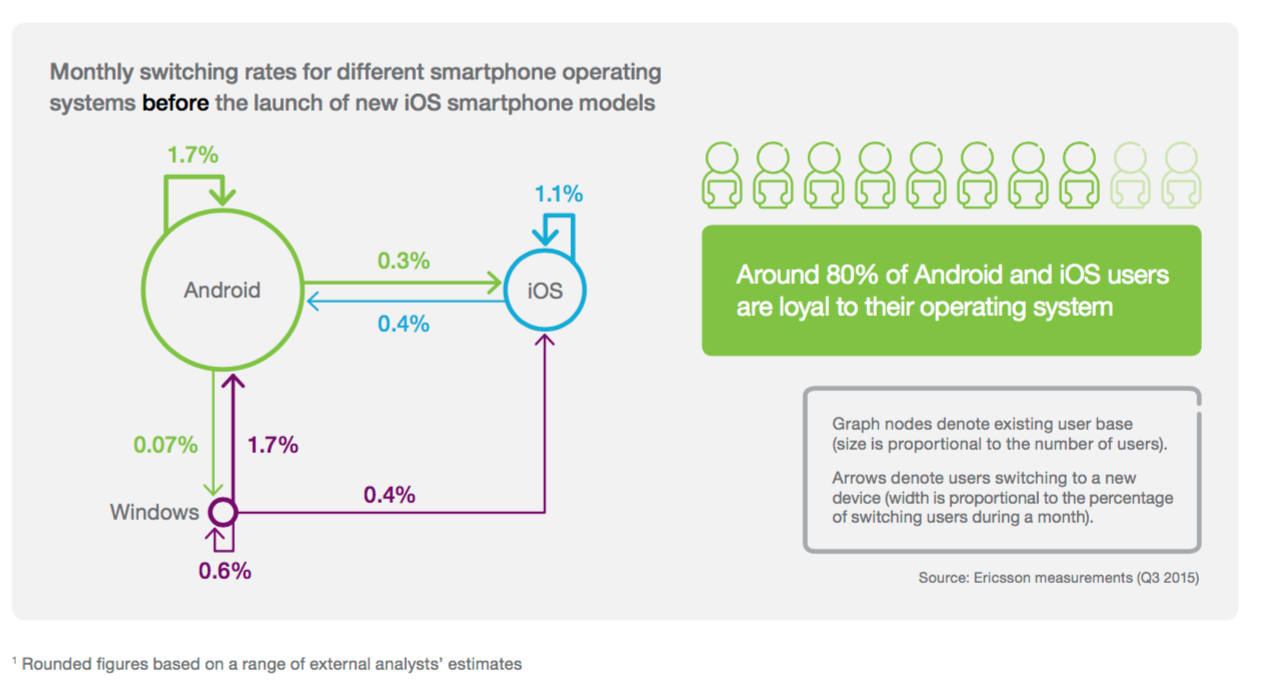
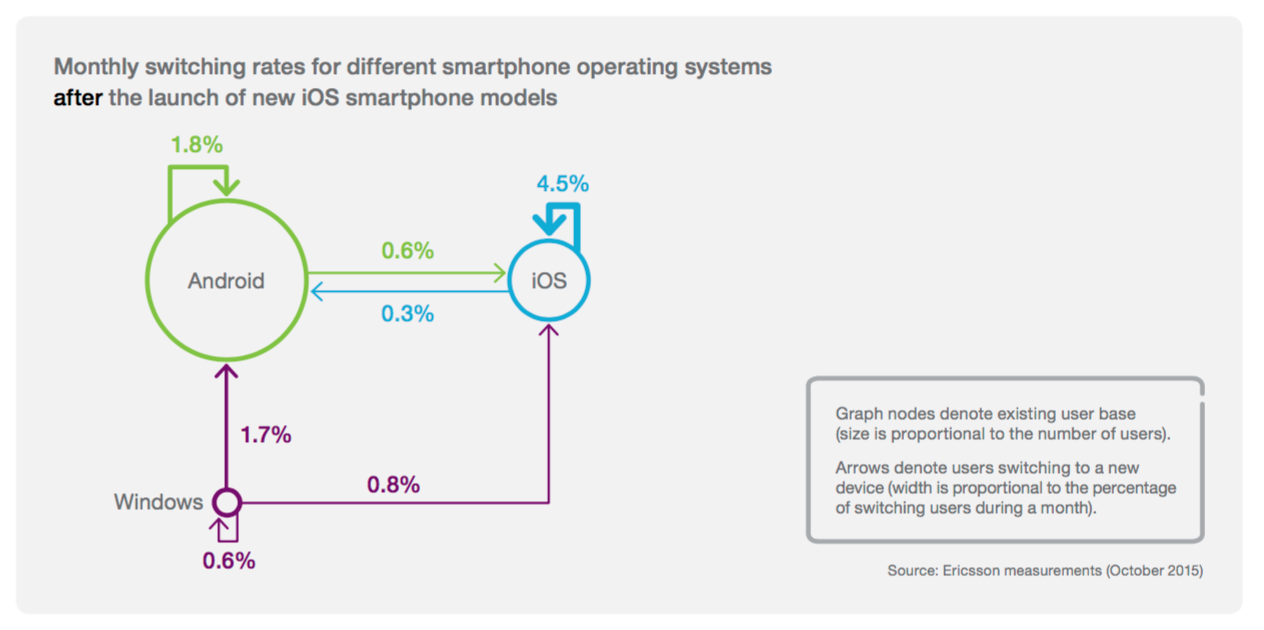
Now there’s a new switching study, embedded in Ericsson’s Mobility Report for Q3 2015. You have to scroll down a fair way to find it (it’s on page 28/9), but it’s summed up in two graphics, where it splits the movement between the three mobile ecosystems into a “before a new iPhone launch” and “after a new iPhone launch”. Here’s “before”:

Ericsson: switching behaviour before iPhone  launch

And “after”:

Ericsson: platform loyalty after iPhone launch

Note the caveat of where the data comes from:

“This analysis is based on measurements before and after the launch of new iOS smartphone models in a selected number of mature mobile broadband networks in Europe, Asia and North America. The study encompassed iOS, Android and Windows devices. Other operating systems like BlackBerry, Symbian and FirefoxOS had very low penetration in all measured networks and therefore were not included.”

“Mature markets” probably means the US, Canada, some or most of the “big five” in Europe (UK, Germany, France, Spain, Italy) and perhaps a couple of others, plus Japan, China and perhaps South Korea.

So those who want to disagree with this data will already be saying “bah, mature markets”.

The mature approach

That overlooks the fact though that all markets for a product eventually become mature markets. Ericsson is giving us a glimpse of the future.

What the data says is quite informative. A few quick takeaways:
• in a “before” month, 6.3% of people buy a new phone – though only 2.87% (45% of them) change platforms
• in an “after” month, 10.3% buy a new phone – with 3.4% (33%) of them changing platforms. (Nearly half of those buying a new phone are iPhone owners.)
• nobody, by this data, ever changes from an iPhone to Windows. Yes, yes, I know your second aunt’s cousin who works in IT did, but we’re talking here about scale – across millions of users. 0.01% of a million equates to 100 people. Apparently not even at that scale does this happen enough to register.
• on the 6.3% and 10.3% turnover rate, everyone replaces their phone somewhere between 10 and 16 months.
• Windows Phone users seem to be the busiest in buying phones.

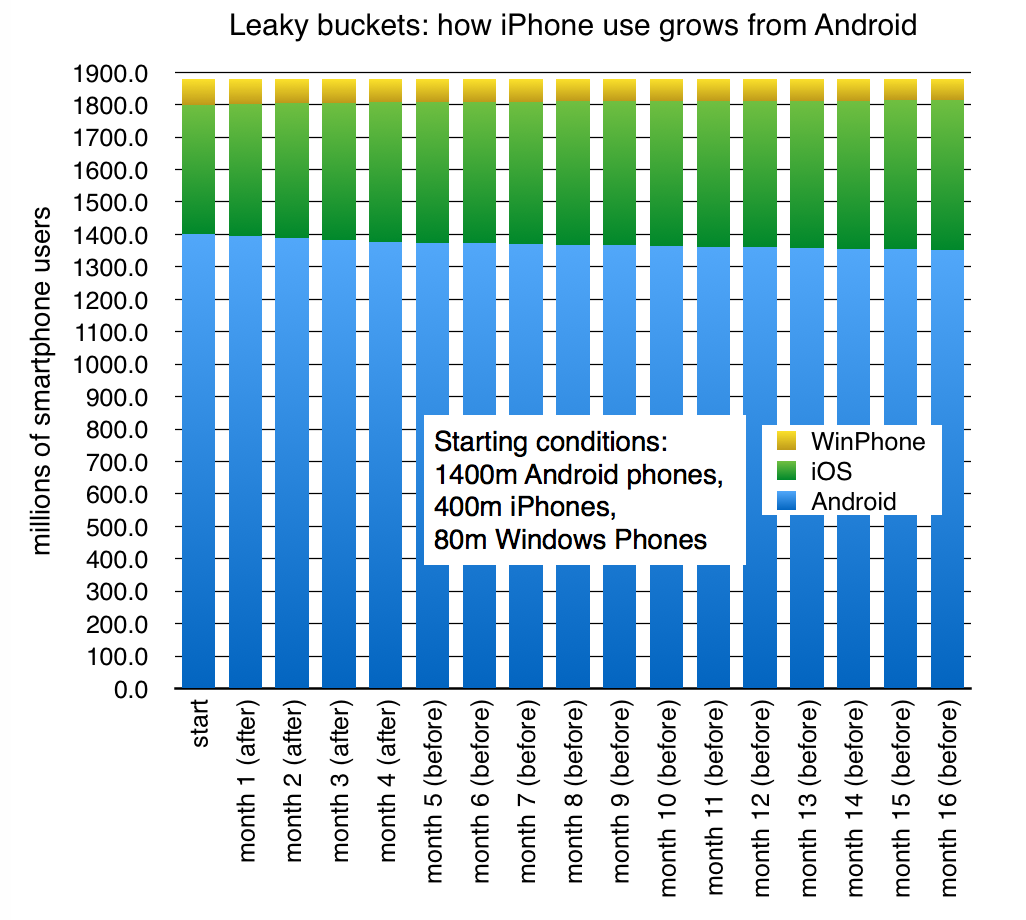
I thought it would be interesting to model how this changes the user base if it’s repeated over time. Note that Ericsson is suggesting it’s only a snapshot for a few weeks, and only for people who get a new phone and stay on the same carrier. (But the latter is true of most people.) If this is how things play out, perhaps we can learn something. So I put the data into a spreadsheet, and set up the algorithm to step through month by month according to the Ericsson platform change stats. So from 10,000 Android users, in a “before” month you’d get 30 going to iOS and 7 to Windows Phone (see the diagram above). And so on.

My spreadsheet is here. I used the 1.4bn figure for the Android base, 400m for the iPhone, and 80m for Windows Phone – about the total number of Lumias sold since their inception. (The extra 0.1 that appears over time is due to imprecision in the calculation – each “before” month adds 0.01 to the figure.)

The graph doesn’t show much perceptible change:

Modelling platform change from Ericsson data

Note that this assumes 15 months with only one iPhone launch.

Note that this is over 16 months, but with only one iPhone “launch” right at the start (whose effects then carry on for four months) – so you can see that the iPhone launch doesn’t make a big difference to the general trend.

Equally, you can also see that there isn’t a huge amount of movement. The iPhone chunk gets wider: in this example, with a four-month “after launch” period and eight-month “before launch” period, by the end of the 12th month
• the iPhone has gained 51.9m users
• Android has lost 40.1m
• Windows Phone has lost 11.8m.

In percentage terms, it’s pretty unimportant to Android – 2.9% loss – but big for iPhone (+13.0%) and bigger for Windows Phone (-14.8%).

If you change to a 12-month “before launch” year, the changes are -25.1m for Android (1.8% change), +31.1m for iPhone (+7.2%), and -5.9m for Windows Phone (8.2%).

You can quibble with the starting figures. Playing around with them, I found the following properties:
• the larger the initial figure for Android, the larger its final fall (obvious) but also the larger its percentage fall
• the larger the initial figure for iOS, the smaller the absolute and percentage growth
• iOS is the only platform to show overall growth on any combination of the “before launch”/”after launch” model.

The featurephone swamp

In which case, you might ask, howcome Android’s installed base is still growing? Simple: there’s still a huge base of featurephone owners who are being converted upwards to smartphones. They’re easy to overlook, but key to this dynamic.

For instance, in the Yankee Group study from August 2013 quoted above, the key mistake that it made in forecasting that iPhone use would overtake Android use by 2014 was to overlook the continuing source of new Android users – from featurephone owners moving to smartphones. In August 2013, there were 90m of them, according to ComScore; the latest figure, from September 2015, says there are still 56.2m of them (so 33.8m fewer).

In that period,
•the number of US iPhone users has grown from 59.0m to 84.3m (up 25.3m);
• the number of Android users has grown from 74.8m to 98.8m (up 24m).

There’s hardly a dramatic difference in growth between Android and the iPhone (contrary to what Forrester expected). You wonder where the other net users came from besides featurephones? The fall in BlackBerry users (5.8m to 2.3m). In the same period, Windows Phone users barely grew (4.6m to 5.5m). And there are 12m extra featurephone users in September 2015 compared to August 2013 making up the gap.

As for Windows Phone: if Ericsson’s numbers say it’s losing users, the obvious question is: how did it get to 80m (or so) users in the first place? The easy answer: Ericsson’s diagrams don’t show the pipeline bringing users into Windows Phone from featurephones – usually via the Lumia 5xx low-end range.

The eternal puzzle of iPhone growth

Even allowing for that, it’s notable that the ComScore data says that in the US iPhone users have grown more (both in percentage and sheer numbers) than Android users. Sure, home distortions and all that. But why is that the case in the other mature markets too? Why is iPhone ownership growing in other places, and why don’t they leave?

It’s this last point which befuddles and almost infuriates people. Why on earth, they say, do people buy iPhones, which only have a dual-core CPU with 2GB of RAM running at 1.8GHz and without an SD card slot, when for less money they can get an octacore phone running at 2.6GHz with 4GB of RAM, an SD card slot, removable battery and a QuadHD screen? You can hear the puzzlement in comments from people who can read a spec list, yet can’t see why the inertial scroll on the iPhone is a more pleasing experience than the rolling velcro on even top-end Android phones. (I keep going and checking the scrolling on each new Android phone. Still isn’t smooth. Clearly 2012’s Project Butter still needs to be supplanted by Project Ghee.)

There’s more than that, though. I don’t think anyone buys an iPhone by accident. I don’t think people walk into a store not intending to buy an iPhone and then find themselves surprised to be holding one as they walk out.

Whereas choosing between Android phones can be like a beauty contest of clones. You put various models of Samsung phone against LG phones against the slightly harder edges of the Sony against the iPhone-alikeness of the HTC models, and you try to pick. How do you choose? Probably on some subtle mixture of the price tag, tickboxes and comparative sizes of numbers on the spec list and.. that’s probably about it.

You can argue (and oh my giddy aunt people do) about why people buy iPhones. I’d say there’s clearly a perception among those who do that they’re getting something premium. The price tag alone suggests that.

That isn’t enough however to keep people on a platform if the experience didn’t also work for them. Do some people migrate from Android to iPhone, and then migrate back? Undoubtedly. But the data suggests most who make the shift don’t.

Is your argument that people get “locked in to the Apple ecosystem”? Perhaps. But it’s not just on iOS, as this comment from an article about Android Wear demonstrates:

Comment on Android Wear

Note the nose-spiting-face nature of the first one..

On that basis, people should be just as reluctant to move to iOS as away from it. Again, the evidence disagrees.

I think there’s a frustration factor driving some movement too; I watched the friend of a relative struggle to get the maps on her Sony phone work recently. First to find the apps, then to find the maps app, then to get any sensible input, then to get sensible output. (Since you ask, she’s one of the country’s leading barristers.)

I couldn’t help but wonder if she would have found it simpler to have a Maps icon front and centre. Apple’s reputation for simplicity is actually a selling point for such users, even if it isn’t for the gigahertz-SD-RAM-removable battery crowd.

Feeling it

Conveniently, just as I was writing this piece, Ben Thompson wrote a piece on Stratechery about “Selling feelings“, with this notable point:

how silly must you be to carry a $5,000 handbag with far less functionality than another a fraction of the price, or wear a $10,000 watch or $200 necktie? What about flying first class or staying in a five-star hotel — you can’t take either with you! It’s completely irrational.

Or, rather, it’s irrational if you only look at features. The entire point is how these purchases make you feel, and it’s that feeling, whether it be an appreciation for craftsmanship, status, or simply being pampered, that provides the sort of differentiation that makes all of these products profitable. One could argue that an insistence on limiting the calculation of value to items that are permanent, physical, and easily listed on a spreadsheet is the real irrationality.

There’s no shortage of that latter group who’ll tell you that the iPhone is rubbish. Meanwhile, continuing evidence from a growing number of studies says that over time, the iPhone base continues to grow. The question is, once the swamp of featurephone users is drained, what happens over the longer term?

Start up: hackers for hire, Chrome grows, Tinder’s CEO chats, and more


Google Timeline: law-enforcement-friendly, at least in theory. Picture by portalgda on Flickr.

Mumble mumble receive each day’s Start Up post by email. Rhubarb rhubarb confirmation link, mutter no spam.

A selection of 9 links for you. Free as in cabbage. I’m charlesarthur on Twitter. Observations and links welcome.

Hired-gun hacking played key role in JPMorgan, Fidelity breaches » Reuters

Jim Finkle and Joseph Menn:

The trio, who are accused of orchestrating massive computer breaches at JPMorgan Chase & Co and other financial firms, as well as a series of other major offences, did little if any hacking themselves, the federal indictments and a previous civil case brought by the U.S. Securities and Exchange Commission indicate.

Rather, they constructed a criminal conglomerate with activities ranging from pump-and-dump stock fraud to Internet casino break-ins and unlicensed Bitcoin trading. And just like many legitimate corporations, they outsourced much of their technology needs.

“They clearly had to recruit co-conspirators and have that type of hacker-for-hire,” said Austin Berglas, former assistant special agent in charge of the FBI’s New York cyber division, who worked the JPMorgan case before he left the agency in May. “This is the first case where it’s that clear of a connection.” Berglas, who now heads cyber investigations for private firm K2 Intelligence, said additional major cases of freelance hacking will come to light, especially as more people become familiar with online tools such as Tor that seek to conceal a user’s identity and location.

link to this extract


Living in different worlds » Benedict Evans

A few years ago, one of the big UK retailers told me an anecdote from some market research they’d done into cameras. Their customers had said they wanted a solution for storing all the camera cards they had. This puzzled the researchers, so they dug a little further, and found out that a lot of their customers had dozens and dozens of memory cards.…

[they] just took the memory card out of the camera at the end of a trip, and when they wanted to show people the photos they’d taken they retrieved the card and put it back into the camera. 

I recognise this behaviour because it’s what my father-in-law does – and when he wants to print something from his computer, he takes a photo of the screen, takes out the camera’s memory card, slots it into the printer and prints out the photo (he also made quite a lot of money day-trading Imagination Tech – over the phone). 

As we go from 1.5bn PCs, of which only half are consumer, to 3bn iOS and Android devices today and 4-5bn in the future, this will become ever more important.

link to this extract


Chrome’s number of monthly active users on mobile devices has doubled over the past year

Bertel King:

During the keynote address yesterday for this year’s Chrome Dev Summit, VP of Chrome Darin Fisher shared some numbers about the mobile web browser’s rate of adoption. tl;dr, people are flocking to Chrome, and fast. Over the past year, the number of 30 day active users has doubled from 400 million to 800 million.

Chrome’s adoption has been boosted by an increasing number of devices now shipping the browser by default. Chrome for Android users visit 100+ sites a month on average, showing a decent level of engagement.

The power of defaults. Once it was Internet Explorer; now it’s Chrome. That final sentence is maddening, though. Where’s the evidence that that’s a decent level of anything? What does it compare to? Three different sites per day is “decent engagement”? Seriously? There’s a new generation of people writing content who seem incapable of doing simple maths and following its thread. (1.4bn Google Android monthly active users, 800m Chrome monthly active users. Think about that too.)
link to this extract


Exclusive: Samsung Pay to launch in China, Spain, and the UK in Q1 2016 » SamMobile

As per the information that we’ve received, Samsung is planning to launch Samsung Pay in China, Spain, and the UK in the first quarter of 2016. Currently, only five Samsung devices – the Galaxy S6, the Galaxy S6 edge, the Galaxy S6 edge+, the Galaxy Note 5, and the Gear S2 – support Samsung Pay, though the Gear S2 only supports NFC payments.

Samsung uses MST technology, which mimics card swipes at regular checkout equipments to make payments, in Samsung Pay-enabled smartphones.

Card swipes are useless in the UK and Spain, as everything is chip-and-PIN. But Samsung Pay does support those too. Wonder if that will help sales of the high-end phones at all.
link to this extract


How law enforcement can use Google Timeline to track your every move » The Intercept

Jana Winter:

The recent expansion of Google’s Timeline feature can provide investigators unprecedented access to users’ location history data, allowing them in many cases to track a person’s every move over the course of years, according to a report recently circulated to law enforcement.

“The personal privacy implications are pretty clear but so are the law enforcement applications,” according to the document, titled “Google Timelines: Location Investigations Involving Android Devices,” which outlines the kind of information investigators can now obtain.

The Timeline allows users to look back at their daily movements on a map; that same information is also potentially of interest to law enforcement. “It is now possible to submit a legal demand to Google for location history greater than six months old,” the report says. “This could revitalize cold cases and potentially help solve active investigations.”

Familiar? Exactly the same realisation for iOS in 2011, which was then quickly encrypted. Android was already doing that too.

Four years later, nothing’s really changed.
link to this extract


Tinder? I’m an addict, says hook-up app’s co-creator and CEO Sean Rad » London Evening Standard

Charlotte Edwardes swipes quite a weird interview, including this:

He’s obsessed with journalists — “too many are not seeking truth but fame” — and baffled by critics because “you can’t deny Tinder is what the world wants”. His own “truth” is that Tinder is “wonderful” — “we’ve solved the biggest problem in humanity: that you’re put on this planet to meet people.” 

In September Vanity Fair accused Tinder of heralding the “dawn of the dating apocalypse” in an article that interviewed twentysomethings in New York who used it solely for casual sex. 

Rad is “defensive” and still “upset” about the article, muttering  mysteriously that he has done his own “background research” on the writer Nancy Jo Sales, “and there’s some stuff about her as an individual that will make you think differently.” He won’t elaborate on the matter.

His argument for why the piece was “wrong” veers from “our research shows 80 per cent of users are looking for a long-term meaningful relationship” to “we believe in democracy. If society just wants to ‘hook up’, who am I to judge?” 

link to this extract


WhatsApp reneges on their promise of true message encryption » Medium

Dawud Gordon:

In interviews with journalists WhatsApp stated that they would use Public Key Encryption, where only the sender and recipient can unencrypted content. Indeed they did, but they used the same key for every user. This makes the Brno hack possible, meaning anyone on the same network as your phone could gain access to the content of your messages. Also, it means that WhatsApp themselves still have access to all message content. Moreover, their parent corporation Facebook has access as well and the ability to target you with advertising based on the content of your WhatsApp messaging. While this is surprising given WhatsApp’s previous PR, it does explain the mysterious $19bn price tag that Facebook was willing to put on WhatsApp.

link to this extract


India to overtake US next month with 402 million internet users » Tech In Asia

Malavika Velayanikal:

The number of internet users in India will reach 402 million next month, nearly 50% more than what it was last year, according to a study by the Internet and Mobile Association of India (IAMAI) and IMRB International. With the latest surge, India will overtake the US to have the second-largest internet user base in the world, next only to China. This will be music to the ears of mobile and internet-based businesses targeting the fast-growing digital market in India.

It took a decade for India to move from 10 million internet users to 100 million, but only four years to quadruple that figure. The primary driver of this takeoff is the boom in affordable smartphones over the past couple of years. But two-thirds of India’s population remain outside the internet, and broadband availability is poor.

link to this extract


Google Glass successor dumps some glass » The Information

Jessica Lessin:

So much for the screen. We’ve learned that Google’s revamped Google Glass project, dubbed Project Aura, is working on a wearable with a screen—and at least one without.

People tell us there have been three versions of the head-mounted device in development, although the three may be consolidated into two. One version, targeted at enterprises, has a screen. The others, one of which is targeted at “sport” users, doesn’t and relies on audio. They use bone conduction, like the original Google Glass. In other words, headphones worn on your face.

Or even like headphones worn on your head?
link to this extract


Errata, corrigenda and ai no corrida:

Start up: the $10 iPhone, the mobile data boom, Watch 2 in June? and more


Clickbait! (Translation optional, but it’s nothing too shocking.) Photo by pvantees on Flickr.

You can now sign up to receive each day’s Start Up post by email. You’ll need to click a confirmation link, so no spam.

A selection of 11 links for you. Use them wisely. I’m charlesarthur on Twitter. Observations and links welcome.

Walmart’s $10 smartphone has better specs than the original iPhone » Motherboard

Nicholas Deleon:

Walmart is now selling a TracFone-branded LG smartphone that costs $9.82 (it also ships free if your online order total tops $50). Now, there are a few reasons why you may not want such a smartphone—for one, it’s running an outdated version of Android that may make it vulnerable to hackers—but there’s no denying that it represents something pretty special.

For less than $10 (plus the cost of data access) the user gets access to the Google Play app store, giving him or her the power to summon transportation at the push of a button, instantly connect with friends, and watch livestreams from all over the world. A bona fide smartphone, in other words.

It’s perhaps even more impressive when you consider that its modest specs — a 3.8in display, 3G and Wi-Fi networking, and a 3-megapixel camera — surpass those of the original iPhone, which was referred to in the tech press at the time as the “Jesus phone.”

It’s been eight years, so, what, three Moore’s Law cycles? Impressive nonetheless.
link to this extract


Funniest new Twitter feed of the day: Clickbait Robot » Quirker

Michael Moran:

it’s easy to get sucked in – especially when a clickbait story piggybacks on a current trend and gets mixed in with genuine news.

Understandably, web users don’t much like it. And actually, most web professionals don’t like it much either.

Rob Manuel, is just such an internet professional. In the past he has devised quizzes, games and animations for B3ta and UsVsTh3m that might have been called clickbait, but generally did deliver on their promise.

And now he’s devised the ultimate clickbait machine. It scrapes Twitter’s current trending topics and boils them down into crazy-sounding headlines without any human intervention. It’s weird, and it’s very very funny…

link to this extract


A team of robots may learn to grasp a million objects » MIT Technology Review

Will Knight:

[Stefanie] Tellex [of Brown University] says robotics researchers are increasingly looking for more efficient ways of training robots to perform tasks such as manipulation. “We have powerful algorithms now—such as deep learning—that can learn from large data sets, but these algorithms require data,” she says. “Robot practice is a way to acquire the data that a robot needs for learning to robustly manipulate objects.”

Tellex also notes that there are around 300 Baxter robots in various research labs around the world today. If each of those robots were to use both arms to examine new objects, she says, it would be possible for them to learn to grasp a million objects in 11 days. “By having robots share what they’ve learned, it’s possible to increase the speed of data collection by orders of magnitude,” she says.

link to this extract


Ericsson Mobility Report » Ericsson

The Ericsson Mobility Report is one of the leading analyses of mobile network data traffic. It provides in-depth measurements from the world’s largest selection of live networks spread all around the globe, with analysis based on these measurements, internal forecasts and other relevant studies. The report provides insights into the current mobile network data traffic and market trends, applicable to both consumers and enterprises.

This one is for the third quarter: suggests 3.4bn smartphone subscriptions, up from 2.6bn last year, and 1.4GB of data per user on average per month, up from 1.0GB a year ago. In western Europe it’s 2.0GB per user per month. Lots of interesting data, including one about churn between iOS, Android and Windows Phone.

5G doesn’t look like a big winner though.
link to this extract


Encrypted messaging apps face new scrutiny over possible role in Paris attacks » The New York Times

David Sanger and Nicole Perlroth:

American and French officials say there is still no definitive evidence to back up their presumption that the terrorists who massacred 129 people in Paris used new, difficult-to-crack encryption technologies to organize the plot.

But in interviews, Obama administration officials say the Islamic State has used a range of encryption technologies over the past year and a half, many of which defy cracking by the National Security Agency. Other encryption technologies, the officials hint, are less secure than terrorist and criminal groups may believe, and clearly they want to keep those adversaries guessing which ones the N.S.A. has pierced.

Some of the most powerful technologies are free, easily available encryption apps with names like Signal, Wickr and Telegram, which encode mobile messages from cellphones. Islamic State militants used Telegram two weeks ago to claim responsibility for the crash of the Russian jet in the Sinai Peninsula that killed 224 people, and used it again last week, in Arabic, English and French, to broadcast responsibility for the Paris carnage.

This argument isn’t going to go away; it’s going to continue between privacy advocates and governments (who are always seeking to surveil and gather). Every incident like that in Paris becomes ammunition, in a near-literal sense.
link to this extract


The TalkTalk hack can’t be shrugged off » The Guardian

John Naughton:

Imagine a chemicals company that, as part of its operations, needs to process hazardous, carcinogenic materials, and therefore has to store them on site. Now imagine that some unscrupulous guy siphons off large quantities of the hazardous gunk and when this crime is revealed by the company, the boss is unable to tell reporters whether the tank containing the hazardous material was locked, or even covered.

If TalkTalk had been a chemicals producer and toxic chemicals had been stolen, the public outrage would be palpable. But because it’s a communications company, the response is just a resigned shrug. It’s just personal data, theft of which goes on every week: just think of the infidelity site Ashley Madison and the US health insurer Anthem. Stuff happens, move on.

The trouble is that personal data in the wrong hands is a very hazardous substance indeed. It’s the raw material that fuels a vast global industry, which uses it for phishing, pharming, malware distribution, hacking of corporate databases, extortion and blackmail.

Also worth it for the David Runciman quote about the difference between a scandal and a crisis.
link to this extract


​How to easily defeat Linux Encoder ransomware » ZDNet

Neat, from Steven Vaughan-Nichols:

just crack open your files yourself.

You see the would-be cyber-criminals made a fundamental mistake. Their encryption method uses a faulty implementation of Advanced Encryption Standard (AES) to generate the encryption key. Specifically, as the anti-virus company Bitdefender reported, the “AES key is generated locally on the victim’s computer. … rather than generating secure random keys and IVs [initialization vector], the sample would derive these two pieces of information from the libc rand() function seeded with the current system time-stamp at the moment of encryption. This information can be easily retrieved by looking at the file’s time-stamp.”

Armed with this, it’s trivial – well, for encryption experts – to find the key you need to restore your files. Since most of you don’t know your AES from your Playfair, Bitdefender is offering a free Python 2.7 script to obtain the Linux.Encoder key and IV for your containinated server.

They probably won’t make the same mistake next time, though.
link to this extract


We are not getting out of PCs, says Fujitsu exec » The Register

Paul Kunert:

Fujitsu is the latest bit part PC player to state its commitment to the product line, as it prepares to spin off the computer and mobile businesses into two separate subsidiaries.

The units were part of the Ubiquitous Solutions division but at some point in the next 12 months will be distinct entities sitting under the Product division, the company told us.

“We are super committed to the PC business,” said head of product EMEA, India and Africa, Michael Keegan.

“It’s a very big part of the overall P&L [account] but we recognise that it is a massively changing business and needs more focus.”

I think you’ll find Fujitsu’s PCs are probably part of the “loss” in P&L, which swung to a loss for the half-year. But as it’s splitting the mobile phone and PC businesses, we’ll be able to see more clearly in future.
link to this extract


Wearable devices becoming main growth driver for ODMs » Digitimes

Aaron Lee and Joseph Tsai:

Quanta and Compal together have already acquired over 50% of the overall notebook orders for 2016, but both are still pessimistic about overall shipments in 2016. In 2016, the market watchers expect the market will gradually lean toward both the entry-level and high-end segments. More inexpensive Windows-based notebooks and Chromebooks are expected to be introduced, while vendors will also focus more on high-end products such as gaming notebooks.

Meanwhile, wearable device shipments are also expected to grow dramatically. Quanta, the maker of the Apple Watch, is expected to see related orders surging in 2016 and the ODM reportedly has also received orders for Apple’s second-generation Apple Watch for the second quarter of 2016.

Jeez, talk about burying the intro. “APPLE WATCH 2 TO SHIP IN APRIL?” is the way to write this. Although that rumour is already doing the rounds.
link to this extract


Google to contest Russia’s antitrust ruling on Android » Reuters

Maria Kiselyova:

Google will contest in court a ruling by Russia’s antitrust agency that it broke competition law by abusing its dominant position with its Android mobile platform, the U.S. technology company said on Tuesday.

Russia’s competition watchdog ruled in September that Google had broken the law by requiring pre-installation of certain applications on mobile devices running on Android.

“We intend to contest this decision and explain in court why we consider it unfounded,” Google said in its official Russian blog.

Google has until Dec. 18 to amend its contracts with smartphone manufacturers in order to comply with the ruling in the case that was launched by local rival Yandex.

link to this extract


Google removes another app from the Play Store for dodgy reasons, this time it’s the notorious Tasker » Android Police

Rita El Khoury:

the app isn’t just useful for gimmicks and even if many of us feel overwhelmed by it or don’t need it, it’s still part of the foundation of Android and the poster child for all the possibilities you have with the platform.

Taking Tasker out without a notice isn’t just reckless, it’s being stupidly blind to the entire history of Android, especially when the grounds for removal are dodgy at best. We’ve contacted Pent, Tasker’s developer to see what’s going on, and so far the story is as weird as it gets.

Pent didn’t get a warning regarding the removal and in the Developer Console, he sees this explanation:

“This app has been removed from Google Play for a violation of the Google Play Developer Programme Policy regarding Dangerous Products. Please review the Optimising for Doze and App Standby article, modify your app’s manifest and resubmit. More details have been emailed to the account owner.”

It seems that the removal was based on the existence of a dangerous permission that disables Doze in the app’s manifest: android.permission.REQUEST_IGNORE_BATTERY_OPTIMIZATIONS. The same reason was given to Stefan Pledl for the removal of his app LocalCast from the Play Store.

However, and here’s the weird part, that permission isn’t in the Play Store version of Tasker. As a matter of fact, Pent tells us the app wasn’t published in any form to the Play Store with that permission.

People will be up in arms about this, right? Update: as of Wednesday morning, it’s back.
link to this extract


Errata, corrigenda and ai no corrida: none notified.
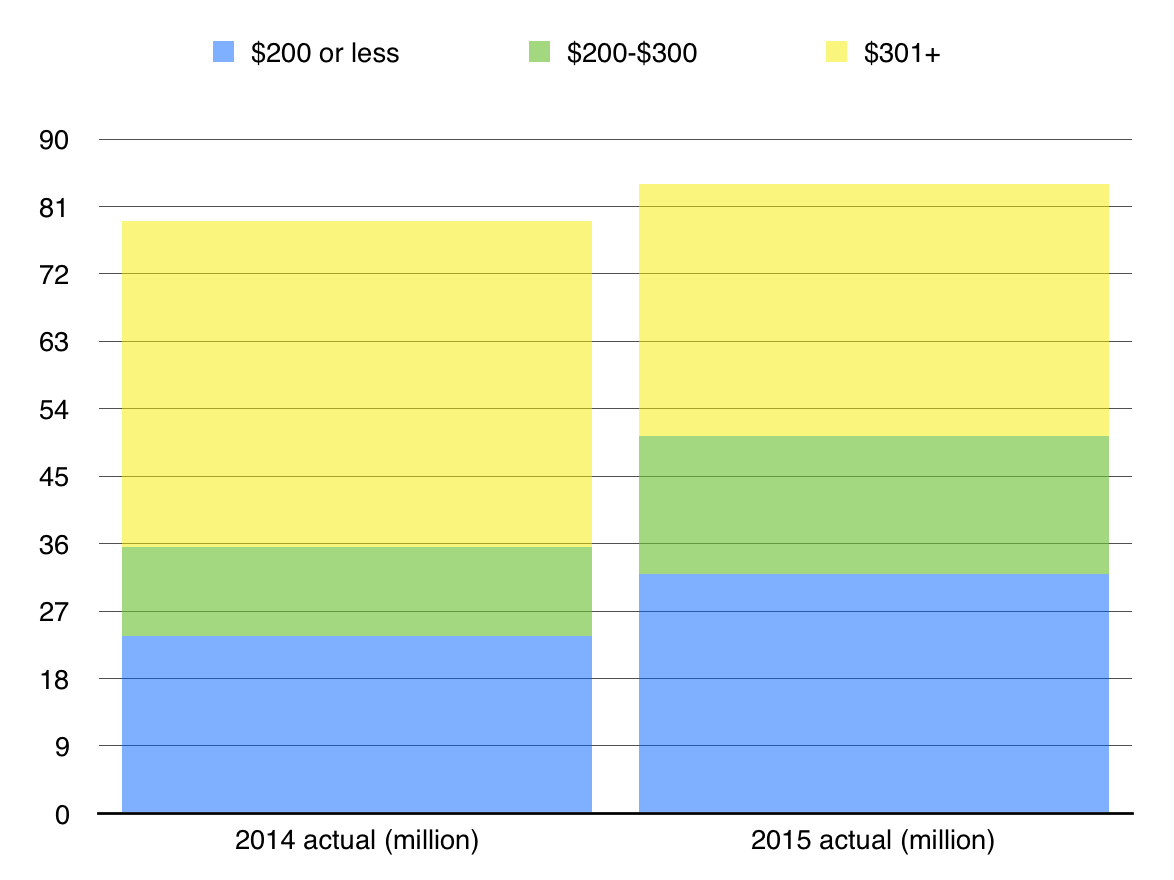
Start up: Apple Music on Android, Zuckerberg profiled, the dark tower and more


Soon to stream internationally? Photo by djuggler on Flickr.

You can now sign up to receive each day’s Start Up post by email. You’ll need to click a confirmation link, so no spam.

A selection of 13 links for you. Use them wisely. I’m charlesarthur on Twitter. Observations and links welcome.

Apple Music review: I was ready to hate it, but Apple got me singing a different tune » Android Police

Rita El Khoury:

for a few billion people from China to India to Nigeria to lil’ Lebanon where I live, Apple Music is one of just a couple of services that we can use, and for many of us, it’s the best option when all pros and cons are diligently weighed against its competitors.

And if, like me, you happen to live on the bleeding edge between Apple and Google’s ecosystems, owning Macs and/or iOS devices along with your Android phones and tablets, and you have used iTunes over many years to carefully organize your music collection, Apple Music might make more sense to you, regardless of where you live and whether or not you have access to Google Play Music and other streaming options.

That’s what you have to keep in mind while reading this review. I’m aware other options exist. I’m aware iTunes and Apple are far from universally liked. I’m aware that you couldn’t care less about Apple Music. But that doesn’t stop the app and service from being good, and even great.

The “cloud upload” element still seems to be a mess. I don’t understand why: doesn’t it just match the track data, like identifying tracks on a CD? In which case what’s hard about adding it to a cloud library, which is just a set of indexes?
link to this extract


Rdio is shutting down and Pandora is buying up the scraps » The Verge

Ben Popper:

Pandora is the grandaddy of streaming music, with more than 15 years in business and more monthly listeners using it to hear tunes than anyone save for YouTube. But Pandora, a public company, has struggled to turn a profit, and has seen its user growth slow in recent years. Today it announced that it is acquiring “several key assets” from Rdio, which is filing for bankruptcy. The purchase price is $75 million, and the acquisition includes technology and intellectual property. The announcement says “many employees” from Rdio will be offered the chance to work at Pandora, implying that at least some will be out of work. Rdio’s CEO, however, will not be making a move to join Pandora’s ranks.

The pairing would make a lot of sense. Pandora struggles in part because its royalty rates are set by the government, something that allowed it to avoid the high costs that have battered Spotify, but soured relationships with the music labels. That in turn kept it from expanding internationally or adding more complex on-demand features.

Pandora adding international streaming could make things interesting.
link to this extract


The most popular curl download – by malware » haxx.se

Daniel Steinberg noticed that a particular curl library was in demand:

In October it alone was downloaded more than 300,000 times, accounting for over 70% of the site’s bandwidth. Why?

The downloads came from what appears to be different locations. They don’t use any HTTP referer headers and they used different User-agent headers. I couldn’t really see a search bot gone haywire or a malicious robot stuck in a crazy mode.

After I shared some of this data over in our IRC channel (#curl on freenode), Björn Stenberg stumbled over this AVG slide set, describing how a particular malware works when it infects a computer. Downloading that particular file is thus a step in its procedures to create a trojan that will run on the host system – see slide 11 for the curl details.

So he renamed the file. Now we await developments.
link to this extract


Why states of emergency and extreme security measures won’t stop ISIS » Counterpunch

Patrick Cockburn (formerly at The Independent):

the apocalyptic tone of press coverage is exaggerated: the violence experienced hitherto in Paris is not comparable with Belfast and Beirut in the 1970s or Damascus and Baghdad today. Contrary to the hyperbole of wall-to-wall television coverage, the shock of living in a city being bombed soon wears off.

A further disadvantage flows from excessive rhetoric about the massacre: instead of the atrocities acting as an incentive for effective action, the angry words become a substitute for a real policy. After the Charlie Hebdo murders in January, 40 world leaders marched with linked arms through the streets of Paris proclaiming, among other things, that they would give priority to the defeat of ISIS and its al-Qaeda equivalents.

But, in practice, they did nothing of the sort. When ISIS forces attacked Palmyra in eastern Syria in May, the US did not launch air strikes against it because the city was defended by the Syrian army and Washington was frightened of being accused of keeping President Bashar al-Assad in power.

link to this extract


Inside Mark Zuckerberg’s bold plan for the Future of Facebook » Fast Company

Harry McCracken with a super-long profile of Zuckerberg and what he’s up to, including this:

If you’ve ever felt like your Facebook News Feed is filled with people you don’t care about sharing thoughts you didn’t particularly want to hear, you’ll appreciate why Facebook is pushing to further the art of artificial intelligence. In its current form, the social network is still far better at collecting vast amounts of data than understanding what that data means. Advanced AI could help emphasize the stuff that’s truly relevant to you, keeping you on the service longer and boosting your attractiveness as a subject for targeted advertising. “Facebook is working to be at the center of the world of AI because it will affect Instagram, WhatsApp, and Messenger,” says Systrom. “It’s broadly applicable to all social products.”

Facebook has dabbled in AI for years. In 2010, for example, it introduced facial-recognition technology to identify people in photos. In late 2013, though, Zuckerberg came to believe that AI—which he calls “one of the hardest engineering challenges of our time”—was central to the company’s future and decided to establish a lab devoted to it. He began courting Yann LeCun, a New York University faculty member and world-class expert in deep learning, to run it. Unlike the archetypal young turk Facebook employee, the 55-year-old, Paris-born LeCun is an éminence grise of his craft, with decades of experience studying machine vision, pattern recognition, and other technologies with the potential to make the social network smarter.

LeCun, however, was disinclined to leave academia or New York. When Zuckerberg thinks Facebook needs something, though, he refuses to treat obstacles as obstacles. He offered to let LeCun set up Facebook AI Research’s headquarters in Manhattan and retain his professorship on the side. LeCun came aboard. Problem solved.

Lots about Zuckerberg’s effective CEO methods too.
link to this extract


Microsoft fails to deliver tool to bring Android apps to Windows » Re/code

Ina Fried:

The Android tool [called Project Astoria] was seen as the riskiest of the four bridges as it amounted to essentially porting over apps written for Android without really taking advantage of Windows itself. BlackBerry employed a similar strategy, allowing Android apps to run on BlackBerry 10 devices via Amazon’s app store. In the end, that proved largely unsatisfying and the company opted to build the Priv, a true Android-based smartphone.

Microsoft’s options for iOS and Web developers require more work on the part of app creators, but they also end up with something that was more of a true Windows app versus just an Android hand-me-down.

With the demise or delay of Astoria, the stakes are even higher for Microsoft to convince mobile developers to put some effort into making a Windows version of their apps. While Microsoft has struggled to lure mobile developers because of Windows’ low share of the phone market, it has a bit more compelling story with Windows 10, where developers can write a universal application that can run on Windows-based phones, tablets, PCs and even on the Xbox game console.

Still don’t see why you’d make a Windows desktop version of any mobile-intended app.
link to this extract


TEDx Hilversum: “How to spot the next big thing” – slides and commentary from my talk » The Overspill

Shameless self-promotion corner:

I was invited to talk at the inaugural TEDx Hilversum – the Dutch city which is the country’s medialand, and whence the TV format ideas both for “Big Brother” and “The Voice” came.

The topic: “How to spot the next big thing”, building on a column I wrote for The Guardian’s Tech Monthly supplement back in October, about how the selfie was pretty much accidental.

What I wanted to explore and expand on in the talk was how these “next big things” in social interaction happen, and where you’d look to find the next one. (This isn’t a transcript – it’s the ideas I spoke on. The talk is about 15 minutes. I’ll put up the link when it’s available.)

link to this extract


One man’s hard lesson after the Eiffel Tower’s darkness was mistaken for a moving tribute » The Washington Post

Rurik Bradbury, who runs the satirical-parodical Twitter account @ProfJeffJarvis, saw one of those tweets go viral after the Paris attacks, and reflected on how social media reacts to such horrifying events:

the part that feels the most useless to me is people’s vicarious participation in the event, which on the ground is a horrible tragedy, but in cyberspace is flattened to a meme like any other. Millions of people with no connection to Paris or the victims mindlessly throw in their two cents: performative signaling purely for their own selfish benefit, spreading information that is often false and which they have not vetted at all, simply for the sake of making noise. If people wanted to be helpful, they would either be silent, or they would put in some — even minimal — effort to be thoughtful. First, they could spread useful and vetted information. And second, they could throw support behind a viewpoint they believe in, such as speaking out against politicians using the attacks to demonize Muslims or migrants, which is exactly what the murderers responsible for the Paris attacks want to provoke.

“Flattened to a meme like any other” is the internet’s epitaph. And the “hard lesson” is actually for everyone else, not Bradbury.
link to this extract


The advertising bubble » (Idle Words)

Maciej Ceglowski points out that more money is being made from advertising than consumers are putting in. (How? Venture capital.) But at some point, those investors will want their money out, with interest:

The only way to make the [money flows in and out] balance at this point will be to divert more of each consumer dollar into advertising (raise the ad tax), or persuade people to buy more stuff.

I doubt whether either option is viable. Compare the number of ads you see in a given day to the number of purchases you make. And consider the indirect maziness of modern advertising, with its brand awareness campaigns and social media influencers. There’s not a lot of milk left in this cow.

Investors are herd animals. When they bolt, the adtech swamp will drain, and who knows what hideous monstrosities will be left flopping on its muddy bottom.

The problem is not that these companies will fail (may they all die in agony), but that the survivors will take desperate measures to stay alive as the failure spiral tightens.

These companies have been collecting and trafficking in our most personal data for many years. It’s going to get ugly.

The only way I see to avert disaster is to reduce the number of entities in the swamp and find a way back to the status quo ante, preferably through onerous regulation. But nobody will consider this.

The prognosis for publishers is grim. Repent! Find a way out of the adtech racket before it collapses around you. Ditch your tracking, show dumb ads that you sell directly (not through a thicket of intermediaries), and beg your readers for mercy. Respect their privacy, bandwidth, and intelligence, flatter their vanity, and maybe they’ll subscribe to something.

link to this extract


iOS App Store revenue now 80% higher than Google Play, thanks to China » TechCrunch

Sarah Perez on the new App Annie data:

In the third quarter, worldwide downloads were 90% higher on Google Play versus the iOS App Store, up from its earlier 85% lead in the prior quarter. This growth is being contributed to emerging markets like India, Indonesia, and Vietnam, where sub-$50 smartphones are bringing more of the population online.

However, these newly mobile users will not necessarily help the Google Play store’s revenue grow, given their economic status. App Annie instead advises developers to target new users at the lower-end of the market, catering to their differing needs, in order to stand out from the competition here.

Currently, India, in particular, is having a huge impact on download growth for Google Play. For example, in Q3, it was one of the three largest markets by downloads for both Facebook and WhatsApp. The country is also Google Play’s third-largest by downloads, as well as the world’s third-largest smartphone market. And there’s room for substantial growth yet – smartphone penetration in India is only in the 10-15% range, notes App Annie.

The iOS App Store, on the other hand, may not have the downloads but its revenue was 80% higher than Google Play in Q3, up from 70% in Q2. This is largely due to China, of course. China already surpassed the U.S. by iOS downloads earlier this year, and now those download numbers have translated into revenues.

By my calculations, that means each iOS user generates 3.4 (1.9 x 1.8) times as much revenue as a Google Play user.
link to this extract


Lessons from the PC video game industry » Medium

Chris Dixon:

The PC gaming world has taken the freemium model to the extreme. In contrast to smartphone games like Candy Crush that are “free-to-play,” PC games like Dota 2 are “free-to-win.” You can’t spend money to get better at the game  —  that would be seen as corrupting the spirit of fair competition. (PC gamers, like South Park, generally view the smartphone gaming business model as cynical and manipulative). The things you can buy are mostly cosmetic, like new outfits for your characters or new background soundtracks. League of Legends (the most popular PC game not on Steam) is estimated to have made over $1bn last year selling these kinds of cosmetic items.

PC games are so popular they can also make money from live events. Live gaming competitions have become huge: over 32m people watched the League of Legends championship this year, almost double the number of people who watched the NBA finals.

Watching these events online is free, but offline tickets cost $50–$100 each. This is similar to the trend in the music business where concerts have become an increasingly important source of income for musicians. Concert ticket prices have increased dramatically while digital music prices have dropped.

What the PC game industry figured out is that in a world of abundant media, users have endless choices; instead of fighting for scarcity, fight for attention. Maximize user engagement and money will  —  with enough experiments  —  inevitably follow.

This is what other organisations, such as publishing, are struggling for, but the monetisation part is proving harder.
link to this extract


Facebook Instant Articles and the fight over how many ads per words you should see » Finer Things in Tech

David Chartier:

The first 20 publishers taking part in Facebook’s Instant Articles program are struggling to make as much revenue from each article. Facebook imposes a number of App-Store-like rules on these articles, but among them:

“That’s because of the strict guidelines Facebook has laid down on the type and volume of ads publishers are allowed to sell. For example, the guidelines state that just one “large banner” ad sized 320 x 250 pixels may be included for every 500 words of content. On their own mobile properties, publishers such as the washington post would typically include three or perhaps four of those ads alongside a 500-word article.”

Think about that: large publishers want to show up to three to four ads per 500 words. And they wonder why ad blockers are a thing. 

link to this extract


App bubble update: hit mobile game publishers are running out of steam » MIDiA Research

Karol Severin:


King serves a mainstream user base of casual gamers, whose primary objective is often to ‘kill time’ instead of ‘proceed to the next level’, let alone ‘be psyched for the next years release’. This is one of the major differences between freemium mobile game franchises like Angry Birds or Candy Crush and those of traditional game publishers like EA or Activision who are growing in the mobile space. Both, EA and Activision built their most successful franchises catering to well defined niches first, through desktop and consoles. Only then did they expand into the wider, more mainstream, mobile space. With a solid payer base and a clearly proven business model, they are not as dependent on mobile revenue, compared to their ‘mobile only’ competitors. Having a secure and profitable business model in place now gives them more freedom to be creative and experiment with wider audiences on mobile. In contrast, purely mobile freemium franchises were built up catering to mainstream masses first.

link to this extract


Errata, corrigenda and ai no corrida: none noted.

TEDx Hilversum: “How to spot the next big thing” – slides and commentary from my talk

I spoke at the first TEDx in Hilversum, Holland

There was a “selfie booth”, appropriately enough.

I was invited to talk at the inaugural TEDx Hilversum – the Dutch city which is the country’s medialand, and whence the TV format ideas both for “Big Brother” and “The Voice” came.

The topic: “How to spot the next big thing”, building on a column I wrote for The Guardian’s Tech Monthly supplement back in October, about how the selfie was pretty much accidental.

What I wanted to explore and expand on in the talk was how these “next big things” in social interaction happen, and where you’d look to find the next one. (This isn’t a transcript – it’s the ideas I spoke on. The talk is about 15 minutes. I’ll put up the link when it’s available.)

Spotting the next big thing

How to spot the next big thing
Photo by c@rljones

This isn’t, therefore, about which startup you should put your money into, though it might give you hints about what sort of things could generate money – if you’re ahead of the game.

Three characteristics

Three characteristics of a 'next big thing'
Photo by Japanexperterna.se

Three characteristics of “next big things”: they’re about kids and teens experimenting; adults find them a bit silly (or impossible or embarrassing); and they don’t require anything extra, because they’re immanent to the device.

Only mobile matters

Mobile is the only platform that matters
Photo by Kris Krug

When we’re looking for the “next big thing”, the only place to bother looking is mobile. It’s the only platform that matters. People might say “what about the PC? There are 1.5 billion of them installed around the world.” Nope.

Think about this: what was the last important app that launched first on the desktop (not in the browser, because browsers work on mobile too)? There were two – Spotify and Dropbox, which both launched around the autumn of 2009. Everything big since then – Instagram, Snapchat, Whatsapp, Uber – has launched first and pretty much only on mobile, with essentially no functionality on the desktop.

By contrast, everyone has a mobile phone – there are more than 2 billion smartphones in use today. Pretty soon everyone will have a smartphone. Look at the people in the picture above: they’re holding up their mobile phones, not their laptops.

The first big thing

The first big thing on mobile: texting
Photo by larskflem

The first big thing was text messaging, aka SMS. Invented in 1986 and implemented in 1992, it didn’t take off at first – until the advent of pay-as-you-go (PAYG or pre-pay) phones, which meant that they were cheaper and adults didn’t have to commit to a contract for their kids; they’d just use what they needed. And those kids discovered SMS was cheap, and fast, and personal, and they loved it. The explosion in PAYG phones, in the UK at least, happened in 1999.

Watch SMS grow

How SMS use grew globally
Here’s how SMS use grew globally. There’s almost exponential growth right up to 2011; and then it peaks in 2011-2012 and has fallen off since.

Why the falloff? Because the people who had been kids in 1999 were 12-13 years older. They’re grown up, having their own kids. Meanwhile the other kids growing up in the intervening years were moving on to their own things – OTT services using data, such as BBM, iMessage and Whatsapp. SMS was a golden goose for the carriers; now it’s being killed off. Whatsapp has only been available for five years – founded in 2009 and first released in 2010 – yet it’s now bigger than SMS in volume.

Me, my selfie, I

The source of 'selfie'
Sure, we know that there have been “selfies” for ages – painters in the Renaissance doing self-portraits, even Buzz Aldrin doing one in space during an Apollo mission in 1966. But we didn’t call it that, and “selfie” has a particular meaning in our context: pictures taken with our mobile phones, generally using the front-facing camera.

Watch ‘selfie’ grow

Photos tagged 'selfie' on Flickr, 2000-2005
I thought this 2002 origin was interesting, so I dug out data from Flickr, looking for photos tagged “selfie” by year (1 January-31 December for the respective years). There’s that first 2002 use highlighted for reference, and clearly lots of millennium-dated photos that were backloaded; Flickr didn’t even exist until 2004. Yahoo bought it in 2005, and things started growing.

..and grow

Photos tagged 'selfie' on Flickr, 2000-2012
Fast forward to 2012, and the number is exploding.

..and peak?

Photos tagged 'selfie' on Flickr, 2000-2015
Fast forward again, and this really looks like exponential growth. Though the 2015 figure – with my estimate for the final total – looks like growth has slowed substantially. Why’s that? We’ll come to that in a moment.

Trending searches

Google search trends for 'selfie'
Just for contrast, here are the Google search trends for “selfie”. Pretty much nothing until 2013, when it takes off. (Think of the selfie at the Mandela funeral by Obama and the Danish prime minister in December 2013, which is the first peak there, and the Oscars selfie by Ellen DeGeneres – actually taken by Bradley Cooper in March 2014 – which marks the high point.) But it looks as though interest in the selfie is dying, doesn’t it?

Peak selfie?

Google trends and Flickr trends for 'selfie'
If you superimpose the Google Trends data and the Flickr data, their growth looks pretty similar. So is the selfie dying off?

What’s more probably happening here is that a new generation of kids isn’t using Flickr – they’re on Instagram, where millions of selfies are posted every day. I couldn’t extract the data from Instagram, but you can be sure it’s huge. The selfie has probably got a few years left in it yet. But that generational shift is interesting, because it’s just what we saw with SMS before.

Next to arrive

Two big things; what might be a third?
So there are two examples so far of “next big things”. What might be next?

Well, the smartphone is the most personal device ever. It knows who we know, when they call, when we ignore them, what we like and what we watch, what we read, how we communicate, where we go.

Why wouldn’t it be used for… sex?

Call me maybe

Tinder's three-screen explanation
Turns out, it already is. Apps like Tinder fit all of our three criteria: it’s used by the young, it puzzles the old (“why would you judge someone based on so little information?”), and it uses qualities inherent to the device – selfies for profiles, real-time data updates, touch interaction, geolocation.

Tinder alone sees billions of “swipes” on profiles every day, and millions of meetups, and there are surely going to be Tinder babies – people created on the basis of algorithms on smartphones. Is that weird, or just natural? Your view might depend on your age.

A new search

It's in our phone, but what is it?
After SMS, selfies, sex, what will the next big thing look like? There are some clues. The biggest one is that it’s almost surely already in the phone, just as SMS was a capability in 1992, before PAYG phones, and selfies were possible from the first phones with a front-facing camera in 2003.

So here are three elements that I think might feed into the next big thing.

Three potential elements

The capability is there, and growing
Deep dream: photo by kevin dooley
Google Cardboard: photo by juan tan kwon

Artificial intelligence: The first, and biggest, is artificial intelligence or “machine learning”. This is a picture of someone as visualised through Google’s “Deep Dream” neural network. We don’t understand it because the machine refracts its view. But to the machine, it makes a sort of sense. There is a growing amount of AI/ML/NN technology in all our smartphones: Apple’s Siri, Google Now, Microsoft’s Cortana. You can also get “assistants” such as Amy (which will set up meetings) and “Charlie” (which will give you a social media profile of people you’re going to meet).

This AI tells us if we should leave early for meetings, who’s calling us (perhaps based only on phone numbers found in emails, not our contacts), what apps we look at, what news we look at, how we interact with the world through our phone. In the next few years, we should expect that it will become far more powerful, even without a connection to the cloud; if you think that sounds fanciful, just go back five years, to 2010, and none of the phones we have had those sorts of capabilities. Siri hadn’t been introduced. Think five years ahead, and that’s the sort of gap between now and then that we’re going to see.

Health/fitness: if my AI knows what I’ve been doing, shouldn’t it also know how well I’m doing? Connected to devices such as a watch or fitness band, there’s far more data about ourselves becoming available. Does that feed into the Next Big Thing by showing that you’re *really* fit in your online dating profile? Does your AI tell you before you’re going to be ill?

Virtual reality: This is Google Cardboard, a super-low-cost implementation of virtual reality: you cut and paste it together from a kit, and then slot your smartphone into the gap, and bingo. It’s on the tipping point, I think; ready to take off. And when that happens, everything becomes possible. What if the Tinder profile of the future lets you walk around the person you’re interested in dating, in 3D? What if you meet without physically being in the same place?

Conclusion

I don’t know what the Next Big Thing actually is. But consider a couple of points. SMS was invented over a decade before it actually took off. The word “selfie” was coined for the activity back in 2002 – yet it only exploded into public consciousness a decade later.

Perhaps the word for the next big thing has already been coined; it’s been tossed around carelessly on an online forum where someone is describing something they did or something that happened. And in years to come we’ll look back and say ah, it was obvious.

That’s because spotting the next big thing is a puzzle, not a mystery. There’s a difference between the two. A mystery is – well, think of a murder mystery. Only one person knows who did it, and they’re not saying. Mysteries are meant to remain unsolved.

But to understand a puzzle, think of a jigsaw puzzle. The pieces are all there, in plain view; the only problem is putting them together correctly.

For entrepreneurs, there is good news: if you’re alert, you can cash in. SMS made huge profits for carriers. Selfie sticks meanwhile have been nice business for some factories in Shenzhen. (They’ve even led to museums changing rules; that’s success, when you change society, even a little.)

Just as puzzles just need the pieces put together correctly, it’s very likely that everything necessary for the next big thing is right there, just waiting for someone to put it together. The people who do that probably won’t be the adults; it’ll be the kids and teens messing around. And adults will probably think it’s stupid. But that’s how it goes.

Still, we won’t have to look far to find it. It’ll be right there in the palm of our hands – in our phones.