Start up: SXSW’s silencing problem, the Strava bicycle thief, Apple claims Android switchers, Google gets chippy, and more

You can now sign up to receive each day’s Start Up post by email. You’ll need to click a confirmation link, so no spam.

A selection of 9 links for you. Use them wisely. I’m charlesarthur on Twitter. Observations and links welcome.

Vox Media and The Verge will not attend SXSW unless it takes harassment seriously » The Verge

After the organizers of the SXSW conference canceled an anti-harassment panel due to alleged Gamergate-related “threats of violence,” Vox Media is reevaluating its participation in the SXSW conference. Vox, the parent company of The Verge, says it will not be participating in this year’s conference unless changes are made.

This is quickly going to turn into a big problem for SXSW (which made a stupid decision in the first place) unless it reinstates the panels; you can see more organisations making the same stand, until not withdrawing comes to look like supporting Gamergate’s lunatic fringe (which is basically all of it).
link to this extract


The superconductor that works at earth temperature » MIT Technology Review

The world of superconductivity is in uproar. Last year, Mikhail Eremets and a couple of pals from the Max Planck Institute for Chemistry in Mainz, Germany, made the extraordinary claim that they had seen hydrogen sulphide superconducting at -70 °C. That’s some 20 degrees hotter than any other material—a huge increase over the current record.

Followers of this blog will have read about this work last December, when it was first posted to the arXiv. At the time, physicists were cautious about the work. The history of superconductivity is littered with dubious claims of high-temperature activity that later turn out to be impossible to reproduce.

But in the months since then, Eremets and co have worked hard to conjure up the final pieces of conclusive evidence. A few weeks ago, their paper was finally published in the peer reviewed journal Nature, giving it the rubber stamp of respectability that mainstream physics requires. Suddenly, superconductivity is back in the headlines.

It’s not going to be in use in a hurry – it requires gigantic pressures to form the material – but it’s significant because liquid nitrogen, which is cheap and plentiful, has a temperature of -96C.
link to this extract


Douglas Adams live on stage with Pink Floyd » YouTube

For Douglas Adams’s 42nd birthday his friend David Gilmour gave him the opportunity to join Pink Floyd on stage during their 1994 tour live at Earls Court in London. Douglas played rhythm guitar on the tracks Eclipse and Brain Damage. While it was always known by Douglas’ family that the concert had been filmed by someone in the audience, the tape of the event could never be found. That is, until now.

That’s 21 years ago today! Adams wasn’t some random person; he was very accomplished and had a huge guitar collection. If you still think “oh, it’s only playing a guitar on a stage” – ask yourself how you’d fare playing football as one of Chelsea, Arsenal, etc. And they have 10 other players, unlike a band.
link to this extract


Google is leading a ‘chip development effort’ that could turn the heat up on Apple » Business Insider

Alexei Oreskovic and Jillian D’Onfro:

new job listing shows Google is seeking a “multimedia chip architect” who can “lead a chip development effort” and “work with other engineers to take chip to product shipment.”

The phrasing of the job posting suggests Google is about to get a lot more serious about designing, and perhaps even building, its own chips, following in Apple’s footsteps.

The job posting comes from the company’s Pixel team, which recently announced its high-end productivity tablet, the Pixel C, a person close to the matter tells Business Insider.

Apple bought an entire chip design company. Google’s hiring a couple of people?
link to this extract


Thieves use Strava and other sites to find homes with expensive bikes » Sticky Bottle

Police forces are warning cyclists who use ride-sharing sites and apps – such as Strava – that thieves are now searching them to identify houses with expensive bikes to rob.

Ireland is in the middle of what can only be described as a bike-theft epidemic; with the rate of bikes being stolen now higher than ever and increasing faster than any other crime type.

Most of the bikes being stolen are taken from the streets; after their owners have ridden into urban areas and locked them up.

The Garda [Irish police force] has reacted by conducting a number of specialist policing operations, but they have only just begun and their success or otherwise is still unclear.

Aside from on-street thefts, there have been countless cases of cyclists with expensive racing and training bikes being targeted in their homes.

Location-awareness considered harmful.
link to this extract


Siri’s next trick needs to be multitasking » number23

Philip McDermott on how Siri’s “modal” – interrupt-everything-stop-for-this – interaction model needs to evolve:

Imagine this: you are browsing recipes in Safari and want to save one to your recipes collection. Right now, you can say: “Hey Siri, add this to my recipes note” and the link will be appended to the end of your note entitled Recipes. While this is, let’s be honest, pretty impressive, why stop there? Why should you not carry on scrolling through the website while you carry out this task? You can multitask, your touch-input methods can multitask: why not your voice input?

Another example: you’re writing in a text editor on your iPad, and you remember something for later: “Hey Siri, remind me to take the recycling out when I leave the house later”. But why stop the flow of writing while Siri listens and acts?

Why indeed? Especially as Siri is always listening.
link to this extract


Google Brings Podcasting to Play Music Streaming Service, Android » Re/code

Mark Bergen:

The Alphabet company is getting ready to open a dedicated home for podcasts on its Google Play hub. Today the company is letting podcast creators upload shows to Google Play Music, its streaming service; it says listeners will be able to listen to those shows “in the coming months.” It will be, remarkably, the first native app for podcast listening on Android in the content market where Apple carries disproportionate weight.

But Google isn’t just trying to create more Serial fanatics on Android. No, it wants to reach people that have never listened to podcasts. And it wants to broaden its media offerings in the fight with Apple, the frequent go-to platform for media producers.

In so doing, Google plans to use radio shows to bolster its plan to deliver media tailored for the listener’s interests, activities, even moods. That directive is evident in the product’s lead: Elias Roman, co-founder of the streaming service Songza, whose main schtick was building these contextual playlists before Google acquired it last year.

There isn’t (wasn’t) a native podcast app on Android; how will this affect third-party makers of podcast apps? Is Google getting into that space, or leaving it to them?
link to this extract


Making sense of Dell + EMC + VMware » Business Insider

Jamie McGurk, Stephen McDermid, Vishal Amin, Irvin Chan from Andreessen Horowitz explain how “the python can swallow the cow”:

The ultimate question is — will it work? Are all these financial acrobatics going to deliver on the promise of the Dell-EMC deal as the two companies walk a high-altitude tightrope?

We’re not sure what else companies on the backside of their growth curves can do when competing with more nimble competitors, other than to consolidate, split, or restructure. We have players like IBM and Microsoft aggressively acquiring new companies to make a shift to new platforms as their core businesses decline; HP and others bifurcating themselves into more focused, slimmer, and presumably more agile players with streamlined operations so they can better address secular platform shifts; and now, we have Dell + EMC (+ VMware) consolidating their businesses to stay competitive in a rapidly changing world.

link to this extract


Apple earnings lifted by iPhone sales in China » WSJ

Daisuke Wakabayashi:

[Tim] Cook said many iPhone consumers still haven’t upgraded to the larger-screen iPhone. He says about two-thirds of iPhone’s customer base before the first batch of larger iPhones were introduced in 2014 haven’t upgraded to newer models.

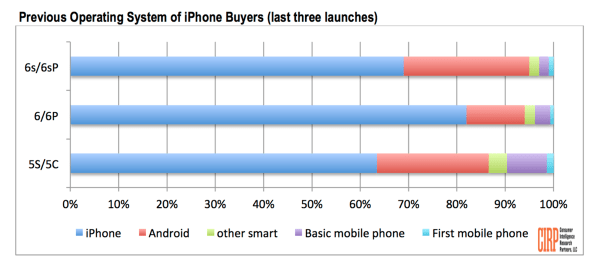
At the same time, Apple said it is winning over customers from rivals. Mr. Cook said 30% of consumers who bought an iPhone replaced a smartphone running Google Inc.’s Android operating system during the quarter. He said this is the highest rate of Android “switchers” that Apple has ever measured.

Apple said it sold 48.04m iPhones in the July-September quarter, compared to 39.27m units a year earlier; that’s 22% growth at a time when the smartphone market growth has been slower. That 30% figure is remarkably high: it suggests 14m switchers from Android. Perhaps those are buyers in China. It doesn’t make sense for the 30% to be “buyers new to iPhone”, because that suggests 70% from Windows Phone, BlackBerry and featurephones. (Might be, but seems to stretch it.)
link to this extract


Start up: Google’s antitrust expansion, Morocco goes solar, Apple Music revealed?, IoT hacked again, and more


What makes a great selfie? Ask a neural network. Photo by Verónica Bautista on Flickr.

You can now sign up to receive each day’s Start Up post by email. You’ll need to click a confirmation link, so no spam.

A selection of 9 links for you. Lather them on. I’m charlesarthur on Twitter. Observations and links welcome.

EU antitrust chief Vestager speaks about Google and other key cases » WSJ

Amazing to think it’s a year since Vestager took over (and the Google case[s] still aren’t resolved…). She tells Tom Fairless and Stephen Fidler in a long interview that with the cases against various bits of Google’s operations:

what they have in common is that the name Google appears in each one, but apart from that they are very different. And therefore I do not think of it as one Google case but literally as different investigations and different cases.

WSJ: So there’s not a read across from the shopping case to the others?

MV: Well, there may be a lesson learned. It’s a very fine balance. The shopping case may have similarities when we eventually look at maps and travel and a number of other related services, because the complaints sort of tell the same story. People feel or experience that they are either being demoted, or Google preferences its own services. But there is no such thing as you have done one, you’ve done them all. You can’t do that. On the other hand, if you look at the shopping case then there will be insights that will probably also be valid when it comes to other neighboring markets. But it’s a very, very fine balance, because we cannot do one case and then say the rest is the same. In a union of law and with due process, this cannot be the case.

WSJ: But equally, Google has many business lines besides shopping and could have many more in the future, and you would presumably not want to open a new case each time. So you would want to establish some sort of precedent?

MV: Yes, but still whatever precedent comes out has to be taken from the finalization of the case. And since we’re not there yet, it is very difficult to see where that will take us.

link to this extract


What a deep neural network thinks about your #selfie » Andrej Karpathy

Karpathy set a neural network to examine a few million not-liked and well-liked selfies, and draw conclusions:

A few patterns stand out for me, and if you notice anything else I’d be happy to hear about in the comments. To take a good selfie, Do:

• Be female. Women are consistently ranked higher than men. In particular, notice that there is not a single guy in the top 100.
• Face should occupy about 1/3 of the image. Notice that the position and pose of the face is quite consistent among the top images. The face always occupies about 1/3 of the image, is slightly tilted, and is positioned in the center and at the top. Which also brings me to:
• Cut off your forehead. What’s up with that? It looks like a popular strategy, at least for women.
• Show your long hair. Notice the frequent prominence of long strands of hair running down the shoulders.
• Oversaturate the face. Notice the frequent occurrence of over-saturated lighting, which often makes the face look much more uniform and faded out. Related to that,
• Put a filter on it. Black and White photos seem to do quite well, and most of the top images seem to contain some kind of a filter that fades out the image and decreases the contrast.
• Add a border. You will notice a frequent appearance of horizontal/vertical white borders.

You can also tweet your selfies to @deepselfie and get a score (100% is top!).
link to this extract


Morocco poised to become a solar superpower with launch of desert mega-project » The Guardian

Arthur Neslen:

When they are finished, the four plants at Ouarzazate will occupy a space as big as Morocco’s capital city, Rabat, and generate 580MW of electricity, enough to power a million homes. Noor 1 itself has a generating capacity of 160MW.

Morocco’s environment minister, Hakima el-Haite, believes that solar energy could have the same impact on the region this century that oil production had in the last. But the $9bn (£6bn) project to make her country’s deserts boom was triggered by more immediate concerns, she said.

“We are not an oil producer. We import 94% of our energy as fossil fuels from abroad and that has big consequences for our state budget,” el-Haite told the Guardian. “We also used to subsidise fossil fuels which have a heavy cost, so when we heard about the potential of solar energy, we thought; why not?”

Solar energy will make up a third of Morocco’s renewable energy supply by 2020, with wind and hydro taking the same share each.

link to this extract


Lawsuit accuses Apple’s iOS 9 Wi-Fi Assist of burning through $5M+ in data » Apple Insider

Neil Hughes:

Apple was slapped with a class-action suit on Friday, claiming that the company failed to properly warn users that the new Wi-Fi Assist feature in iOS 9 will use data from their cellular plan.

In the complaint, plaintiffs William Scott Phillips and Suzanne Schmidt Phillips allege that because of costs related to Wi-Fi Assist, the “overall amount in controversy exceeds” $5m. Filed in a U.S. District Court in San Jose on Friday, the suit was first discovered by AppleInsider.

Once users update to iOS 9, Wi-Fi Assist is turned on by default. Its goal is ensure a smooth internet experience, switching to cellular data in the event that the user is connected to a weak Wi-Fi signal.
The lawsuit claims that Apple “downplays the possible data overcharges a user could incur” from Wi-Fi Assist.

Some who don’t understand how Wi-Fi Assist works, or even that it exists, have alleged that the new feature has caused them to use more cellular data than anticipated. But the new class-action suit alleges it should be Apple who should reimburse customers for any overages [excess data use].

Default-enabling something that could burn through your mobile data is plain stupid. Why not offer people the chance of whether to use it the first time the chance comes up? This is poor focus – putting user experience in the narrow field of device use ahead of the wider user experience of “how big is my mobile bill?”

It puzzles me how implementations like this get through Apple’s processes. (See also: the pain of being the person working on Wi-Fi inside Apple.)
link to this extract


TalkTalk boss says cybersecurity ‘head and shoulders’ above competitors » The Guardian

Josh Halliday:

TalkTalk chief executive Dido Harding has insisted the company’s cybersecurity is “head and shoulders” better than its competitors in the wake of the massive hack attack affecting thousands of customers.

In an interview with the Guardian, Harding conceded it would be “naive” to rule out the prospect of the telecoms firm suffering a similar cyber-attack in the future, describing the threat from hackers as “the crime of our generation”.

Asked about claims by an IT researcher that he raised concerns about TalkTalk’s security with her office last September, Harding said its security had “improved dramatically” in the last year.

TalkTalk’s customer account details (excluding bank details, but including usernames and phone numbers) were stolen from an India call centre last year, and again, and now it has been hacked in a big way. The hackers are miles ahead of the companies here – which is becoming a depressingly common refrain. Also see the blogpost from last October showing how poor TalkTalk’s cybersecurity was.
link to this extract


Content paywalls on the agenda for digital news sites » FT.com

Matthew Garrahan:

Business Insider, which was acquired by German media group Axel Springer last month for close to $390m already charges for its research service and is now on course to be one of the first digital only news operations to erect a paywall around some of its general content. John Ore, Business Insider’s product manager, said in a recent blog post that the company was planning a broad “subscription offering” for readers “who prefer to pay us directly”.

Sweeping changes to the online advertising market mean other free news sites may follow suit. Sir Martin Sorrell thinks all newspapers should charge for content: the chief executive of WPP, the world’s largest advertising group said this week that paywalls were “the way to go”.

The problem, he says, is the lack of growth in digital advertising — an issue which is likely to get worse as ad blocking software grows in popularity. Ad blockers pose a real threat to the revenues generated by news sites. Meanwhile, rampant online ad fraud and the fact that brands often do not know whether their campaigns are being seen by real people, has shaken confidence in an industry that could do without the additional anxiety.

Would Business Insider try to block people using adblockers, as Axel Springer has?
link to this extract


New screenshots purportedly show Apple Music for Android ahead of release » 9to5Google

Mike Beasley:

In bringing its software to Android, Apple has taken a slightly different approach from Google’s own iOS apps. While Google’s apps attempt to mimic the company’s Material Design principles—even going so far as to include custom-made toggle switches and other elements—Apple relies on UI elements built into Android rather than attempting to recreate the iOS versions of them. The main navigation has even been moved from an iOS-like tab bar to a more Android-friendly slide-out sidebar.

Despite this, the company hasn’t managed to stick completely to Google’s design guidelines and has injected some of its own style into the app. For example, the For Me page almost identically mirrors its iOS counterpart.

The images appear to be legitimate and match up with the design Apple teased during the Apple Music announcement at WWDC this year. Not every feature of the app is shown off in the screenshots below, but you can get a feel for how the app will look and behave from our gallery of screenshots.

Looks quite Android-y, though not a full dive into Material.
link to this extract


DoJ to Apple: your software is licensed, not sold, so we can force you to decrypt » Boing Boing

Cory Doctorow:

The Justice Department lawyers argue [in a case where a defendant’s phone has been seized but they won’t give up the passcode; Apple has however acknowledged that it can bypass the code in pre-iOS 8 devices] that because Apple licenses its software – as opposed to selling it outright – that it is appropriate for the government to demand that Apple provide assistance in its legal cases.

To my knowledge, this is an entirely novel argument, but as I say, it has far-reaching consequences. Virtually every commercial software vendor licenses its products, rather than selling them. If the DoJ establishes the precedent that a product’s continued ownership interest in a product after it is sold obliges the company to act as agents of the state, this could ripple out to cars and pacemakers, voting machines and tea-kettles, thermostats and CCTVs and door locks and every other device with embedded software.

Might work in this particular case, but devices running iOS 8 onwards it won’t. That of course doesn’t apply to the many more internet-enabled “things”. Though those bring their own associated problems…
link to this extract


Compromised CCTV and NAS devices found participating in DDoS attacks » Slashdot

the security firm Incapsula [reports] that its researchers discovered compromised closed circuit cameras as well as home network attached storage (NAS) devices participating in denial of service attacks. The compromised machines included a CCTV at a local mall, just a couple minutes from the Incapsula headquarters.

According to the report, Incapsula discovered the infections as part of an investigation into a distributed denial of service attack on what it described as a “rarely-used asset” at a “large cloud service.” The attack used a network of 900 compromised cameras to create a flood of HTTP GET requests, at a rate of around 20,000 requests per second, to try to disable the cloud-based server. The cameras were running the same operating system: embedded Linux with BusyBox, which is a collection of Unix utilities designed for resource-constrained endpoints.

The Internet of Compromised Things is growing faster than our ability to cope with its effects.
link to this extract


Start up: Adblock Plus v Axel Springer, Apple’s Wi-Fi problem, Xiaomi’s shortfall, sell that Priv!, and more


(Just over) 14 years ago… evolution, revolution or just another MP3 player? Photo by MarkGregory007 on Flickr.

You can now sign up to receive each day’s Start Up post by email. You’ll need to click a confirmation link, so no spam.

A selection of 9 links for you. Yes, I know if you’re reading this in the US it’s an hour earlier than usual – that’s because we’ve finished British Summer Time before you. I’m charlesarthur on Twitter. Observations and links welcome.

Adblock Plus and (a little) more: Smells like censorship, Big Brother » AdBlock Plus

Eyeo, which runs Adblock Plus, has been accused of behaviour tantamount to blackmail by saying it will allow “acceptable ads” from some sites that pay it money. Axel Springer in Germany, meanwhile, decided to institute an “non-paywall” which would prevent people using an adblocker from seeing its content on Bild.de etc. Then:

One of the independent moderators of our free and open forum discussed a workaround to the Bild.de blockade, because they still wanted to access the site. Basically, they just talked about how to write a specific filter that users could add to their ad blocker to get around “Axel’s Wall.”

Last week, Axel Springer demanded that we take down those forum posts, in effect demanding that we censor what people had written on our own forum. Our response basically channeled former basketball player/current journalist Jalen Rose: Nah … not gonna be able to do it.

Just a few minutes ago, a court in Hamburg served us with papers FORCING us to remove these specific forum posts. Apparently Axel Springer felt so strongly that they went to a court to get people to stop saying things they didn’t like. This is not without precedent: this week they sent a YouTuber a similar order after he decided to make a video describing how to circumvent …. the Wall.

Damn you, Internet Archive.
link to this extract


October 2001: Apple’s New Thing (iPod) » MacRumors Forums

Fabulous comment thread from Macrumors, including those calling it “Cube 2.0” (the Cube computer was killed after a year), and this from “WeezerX80”:

This isn’t revoltionary!

I still can’t believe this! All this hype for something so ridiculous! Who cares about an MP3 player? I want something new! I want them to think differently!

Why oh why would they do this?! It’s so wrong! It’s so stupid!

Tons more fun to be had. Sadly, Weezerx80 stopped posting there the same day, so we’ll never be able to ask him what he thought of the outcome. (Via Greg Koenig.)
link to this extract


Wi-Fi Assist: a $5 million mess » Medium

Alf Watt, developer of iStumbler, worked on the Mac OS Wi-Fi client user experience at Apple from 2007-12:

During my last few years I spent a lot of time working closely with AppleCare on customer Wi-Fi and networking issues: poring over user trouble reports, sitting down at call centers and listening in on calls, and generally doing everything I could to improve the user experience of Wi-Fi for Apple users.

I failed. It may have been possible to succeed, but the structure of the various teams working on Wi-Fi and networking at the time made it a seemingly insurmountable challenge. This current situation makes it clear to me that there are still forces inside of Apple which prevent any kind of real, comprehensive solution from being implemented. Balkanization, poor management and some uninformed decisions by executives contributed to the problem; and as I’m all to human, my own limitations and personal struggles played a large part. But it didn’t have to happen this way, and it doesn’t have to continue.

Lots of fascinating nuggets in this, including

“when a user calls the vendor of their Wi-Fi access point, nearly the entire profit margin for that box is destroyed by the end of the call.”

link to this extract


Xiaomi won’t hit its smartphone sales targets this year » TechInAsia

Charles Custer:

Last year, Xiaomi gave itself the goal of selling 100m phones in 2015. That seemed ambitious, but not outside the realm of possibility, especially after the fast-growing company finished 2014 having shipped more than 60m units after having originally projected only 40m sales.

2015 has not gone nearly as well, though. By March, Xiaomi CEO Lei Jun had revised this year’s goal to 80m to 100m units. In July, the company announced that it had sold 34.7m smartphones in the first half of the year, putting it on track to possibly miss even the lower end of Lei Jun’s revised target.

Now, there are additional signs that even 80m might be optimistic. Taiwan-based research firm Trendforce just released a report suggesting that Xiaomi is on track to sell around 70m smartphones this year. Meanwhile, research firm Canalys is saying that Xiaomi’s sales in the third quarter of this year actually dropped year-on-year, the first time that has happened.

What’s disrupting Xiaomi? Probably just the slowdown in the Chinese market, which is happening faster than its ability to expand into new markets. Hence it offering products such as a cheap 4K TV (China only, sadly).
link to this extract


We applied to Google’s €150m journalism fund – here’s what we sent in » The Register

The Register’s Kieren McCarthy filled out the form, which has questions such as:

Q Please provide a brief overview of the project. (max 1200 characters)

The project would use a combination of traditional news gathering skills and modern communication tools to gather data around a range of practices performed by internet search engine giant Google, in an effort to expose potential wrongdoing or abuse of market power.

In particular, the project would focus on:

• The skewing of search results.
• The tracking of right-to-be-forgotten requests performed by Google.
• The size, breadth, and impact of Google’s news service on online news sites, looking in particular at the phenomenon of stories written specifically to gather Google News traffic and any possible negative impact on quality journalism due to biases in the Google News algorithm.
• A logging and policy-tracking service to discern the impact of Google lobbying activities on policies and laws developed in Washington DC.
• An open source complaints system focused on gathering early warning signs of abuse of market power by Google.
• A “revolving door” service that specifically tracks current and former Google employees to identify how informal social networks may be used to influence public policy.

Looking to fund three staff. One to watch for sure.
link to this extract


Should we trust the young Turkers? » Tim Harford

The FT’s ‘undercover economist’:

“The majority of papers presented at the conferences I go to now use [Amazon’s Mechanical] Turk [which lets you hire people online to complete tasks],” says Dan Goldstein, a cognitive psychologist at Microsoft Research. Goldstein, an academic who has also worked at London Business School and Columbia University, has used MTurk in his own research, for instance, into the impact of distracting online display ads.

This stampede to MTurk has made some researchers uneasy. Dan Kahan of Yale Law School studies “motivated reasoning” — the way our goals or political opinions can influence the way we process conflicting evidence. He has written a number of pieces warning about the careless use of the Amazon Turk platform.

The most obvious objection is that Turkers aren’t representative of any particular population one might wish to examine. As an illustration of this, two political scientists hired more than 500 Turkers to complete a very brief survey on the day of the 2012 US presidential election. (Tellingly, the entire survey cost the researchers just $28 and the results arrived within four hours.) The researchers, Sean Richey and Ben Taylor, found that 73% of their Turkers said they had voted for Barack Obama; 12% had voted for “other” — compared with 1.6% of all voters. Mitt Romney polled vastly worse with the Turkers than the US public as a whole. Relative to the general population, Turkers were also more likely to vote and be young, male, poor but highly educated. Or so they claimed; it is hard to be sure.

There are all sorts of reasons not to trust Turk-sourced studies, and only a few in favour of them.
link to this extract


Microsoft’s quarter looks worse this way » Business Insider

Julie Bort:

Microsoft rolled out a new way to report earnings with its first quarter, 2016 earnings on Thursday.

This new reporting structure consolidated Microsoft’s businesses into three new units.

The previous structure had two major units (commercial and consumer) and broke out a few different businesses in each of those.

As you can see, under the old scheme, all business units shrunk except two:

Phone hardware down 54% to $1.1bn, computing and gaming hardware (Xbox, essentially) down 13% to $2bn; only “Device and Consumer Other” (Bing, MSN, Office 365, video games, app store) and “Commercial Other” (cloud services) showed growth. The puzzling thing is how Microsoft’s shares would move up on something like this.
link to this extract


Android, iPhone divergence: mid-price smartphones disappearing from Korean market » BusinessKorea

Jung Suk-yee:

The polarization between high-end and mass market products in the Korean smartphone market is expected to accelerate with the iPhone 6S’s local debut.

At present, few smartphones ranging from 400,000 to 700,000 won (US$353 to $617) in price are available in the domestic market, except for the recently-released Samsung Galaxy Note 5 and LG V10. This is because the prices of existing high-end handsets have been reduced to 400,000 won or less by a cut in factory price and an upward adjustment of the subsidies. The prices of the Galaxy Note 5 and the V10 are predicted to be lowered in the near future, too.

This is certainly a trend – most Android phones are getting cheaper and cheaper, but Apple and a few others, are holding on to top-end pricing. South Korea is the sort of “end state” of the smartphone business; it’s super-saturated.
link to this extract


Shop BlackBerry Priv Stock good or bad Sales? » CrackBerry forums

“So this was interesting. I started entering 999 QTY for the Priv at 10am today, and it told me they only have 965 available.

checking right now (12:25p), it says 840. so is that good or bad? what do you guys think..”

Later they figure out that it has sold 206 in six hours. Guys, is that good or bad?
link to this extract


Start up: Surface Book v MacBook Pro, Microsoft’s cloud boost, HP’s cloudburst, BlackBerry’s last stand?, and more


Facebook has noticed that your battery is dying and thinks it might be its fault. Photo by Poster Boy NYC on Flickr.

You can now sign up to receive each day’s Start Up post by email. You’ll need to click a confirmation link, so no spam.

A selection of 8 links for you. Use them wisely. I’m charlesarthur on Twitter. Observations and links welcome.

Surface Book vs. MacBook Pro: It isn’t twice as fast. It’s three times as fast » PCWorld

Gordon Mah Ung:

Rather than rely on a synthetic game benchmark, I also decided to throw a real game at it. Square Enix’s Tomb Raider is available on Steam on both platforms. It’s a fairly recent game and came out for PC and consoles in 2013. Feral Interactive ported the game to OSX the same year.

One caveat here: As a port there’s clearly a lot of things that could be different between the PC version and the Mac version. For my test, I ran it at 1400×900, which was the default resolution on the Mac, and selected the “Normal” quality setting on both. I also poked around the game’s graphics settings to see if there was any variance between them that got lost in translation.

The result is a bone-crushing blow for the MacBook Pro 13: Tomb Raider ran at a pathetic sub-24 fps, while the Surface Book whizzes along at 74 fps.

If Microsoft based its marketing statements on this test alone, it could have safely said “triple the performance of a MacBook Pro.”

To be fair, if you’ve read this far, you know the Surface Book isn’t  twice as fast or three times as fast as the MacBook Pro 13 in all things.

Benchmarks – especially skewed ones like this (is the game optimised for Windows? Bet it is) – really bore me. They capture nothing of the general experience of using a device. But hey, there’s the headline that will be used.
link to this extract


Facebook app: we recently heard reports of some people… » Ari Grant on Facebook

Grant is a Facebook developer:

We recently heard reports of some people experiencing battery issues with the Facebook iOS app and have been looking into the causes of these problems. We found a few key issues and have identified additional improvements, some of which are in the version of the app that was released today.

The first issue we found was a “CPU spin” in our network code. A CPU spin is like a child in a car asking, “Are we there yet? Are we there yet? Are we there yet?”with the question not resulting in any progress to reaching the destination. This repeated processing causes our app to use more battery than intended. The version released today has some improvements that should start making this better.

The second issue is with how we manage audio sessions. If you leave the Facebook app after watching a video, the audio session sometimes stays open as if the app was playing audio silently. This is similar to when you close a music app and want to keep listening to the music while you do other things, except in this case it was unintentional and nothing kept playing.

Still ain’t going to reinstall. Note that it’s not *all* of the identified improvements in the new app.
link to this extract


Microsoft quarterly revenue beats as cloud demand rises » Reuters

The company said Office 365, another key cloud-based offering, had about 18.2m consumer subscribers at the end of its first quarter, an increase of about 3m from the end of the preceding quarter.

Microsoft launched Windows 10, its first new operating system in almost three years, in July. The system, seen as critical for the company, won positive reviews for its user-friendly and feature-packed interface.

The company launched a number of new devices earlier this month, including its first ever laptop and a new Surface Pro tablet, all running on Windows 10.

Revenue in the company’s “More Personal Computing” business, which includes the Windows operating system, fell 17% to $9.4bn.

Excluding the impact of the strong dollar, revenue in the business fell 13%.

Sharp observation by Stefan Constantine: there are more people paying for Spotify than for Office 365. That’s likely to be reversed in a couple of quarters, though.

Phone revenue dropped 54%.
link to this extract


HP shutting down HP Helion public cloud » Business Insider

Matt Weiberger:

Cloud computing is a hot market, letting customers swipe a credit card and get access to essentially unlimited supercomputing power. Developers at startups and large enterpries alike love it because it gives them the ability to get really big, really quickly. 

But while Amazon, Google, and Microsoft have all found great success in the public cloud market, simply buying and maintaining all the servers required to get up to the massive economies of scale necessary to compete in this kind of low-margin business is really hard.

That’s something HP has found out the hard way, with the HP Helion public cloud [which will be shut down from January] constantly coming under fire for being too small and too unfocused on the market to seriously make a dent. 

And so, HP is going to shut down the HP Helion public cloud to stick with what its good at: Helping customers run their own data centers with hardware, software, and services to run at cloud levels of efficiency.

HP’s blogpost announcing this move is a masterful piece of corporate doublespeak: it makes it sound as though everything’s going so well they just have to shut down the public cloud offering.
link to this extract


Force Touch patent: will pressure input be possible in Samsung’s Galaxy S7? » BusinessKorea

Marie Kim:

Samsung Electro-Mechanics filed a patent application with the Korea Intellectual Property Office (KIPO) for Force Touch, which is virtually the same as 3D Touch used in the iPhone 6S. This technology offers different types of functions based on the strength of a push on the screen.

According to the patent information retrieval system of KIPO on Oct. 20, Samsung Electro-Mechanics filed a patent named “touch input equipment and electronics device with touch input” with KIPO on April 9, 2014. Considering that the Korean company supplies core components for Samsung Electronics’ smartphones, the patent is likely to be used in the Galaxy S7.

Would be surprised if it wasn’t. But Samsung’s problem is that pretty much every third-party developer will ignore it; it will have to wait for Google to implement it in Android. Will Apple trouble to sue, though? (At a guess, not.)
link to this extract


The dominance of Alphabet » Global Web Index

Felim McGrath:

With Alphabet set to post healthy financial results later today and  hot on the heels of the announcement of YouTube Red, Thursday’s Chart of the Day looks at just how important this company has become.

Among the hundreds of websites tracked by GlobalWebIndex, Alphabet has the two most popular properties among online adults outside of China. Close to 9 in 10 visit Google each month, while 82% visit YouTube. These figures place Alphabet’s sites above Facebook – which three quarters visited last month – and give it a healthy lead over rival search giant Yahoo (half visit this site monthly). 

This vast user base underlines just how central Alphabet remains to internet users’ online activities despite the ongoing shift to mobile.

link to this extract


Dell may sell assets to pay for EMC deal » Re/code

Arik Hesseldahl from a Q+A with Marius Haas, chief commercial officer of Dell:

Q: It looks like after the close Dell will essentially absorb the EMC federation, but will adapt that structure for its own purposes by making it bigger with pieces like Secureworks, Virtustream and Pivotal. Is that how we should think about it? And if so, how does that complicate or enhance your mission here?

If you dissect what has already been published, you will see there is a strong commitment to de-leveraging or paying down the debt very quickly. There are different angles and different levers we can pull to do that. This is why we have such high confidence in what we’re doing.

Q: That implies that paying down the debt won’t just come by way of cash from operations. Does that mean you might consider selling some assets? Is there anything within Dell that doesn’t stay?

We’re not prepared to talk about that yet, but it’s probably not a bad train of thought.

What’s it going to sell, though? The PC business?
link to this extract


BlackBerry might have leaked the Priv’s specs and release date (update: confirmed) » Engadget

Daniel Cooper:

we know that the Priv is packing a fair bit of power beneath the hood, but has a listed price of $749. There’s no indication if that figure is for the US or Canada — but the page does reference the (GSM) handset not working on American CDMA networks like Verizon and Sprint. You’ll also spot that the device is marked for release on November 16th, so we won’t have long to find out if all of this is true or not.

Performance-wise, the Priv is packing a 1.8Ghz Qualcomm Snapdragon 808 with 3GB RAM, 32GB storage and a microSD card slot that’ll take up to 2TB. Much was made of the Priv’s curved screen, and we know that it’s a 5.4-inch plastic AMOLED with a 2,560 x 1,440 resolution (540 DPI) that can handle styluses and gloves. The physical keyboard measures 37mm high by 77.2mm wide, and there’s a 3,410mAh battery that’s rated for 22.5 hours of use tucked inside.

Price in the UK: £580, against £539 for an iPhone 6S with 16GB and £450 for a Samsung Galaxy S6. At that price, BlackBerry will have positive gross margins on the device (it’s not selling it for less than it costs to make), but so few will sell that you can start the timer now on how soon John Chen announces that the hardware division just isn’t making money because of the costs involved in R+D, distribution, marketing and administration – which feed through to operating profit, or loss. Remember, last financial quarter BB sold 0.8m phones, and made an operating loss on those.
link to this extract


Start up: Dell, the movie!, Surfacebook reviewed, why WD bought SanDisk, IT disasters sized, and more


Studying by the light of a solar lantern. Photo by Barefoot Photography on Flickr.

You can now sign up to receive each day’s Start Up post by email. You’ll need to click a confirmation link, so no spam.

A selection of 10 links for you. Use them wisely. I’m charlesarthur on Twitter. Observations and links welcome.

Theranos CEO: company is in a “pause period” » WSJ

John Carreyrou:

Theranos Inc. founder and Chief Executive Elizabeth Holmes said Wednesday that the Silicon Valley laboratory company is in a “pause period” as it seeks to get its proprietary technology approved by the U.S. Food and Drug Administration.

“We have to move, as a company, from the lab framework and quality systems to the FDA framework and quality systems,” Ms. Holmes said, speaking at the WSJDLive global technology conference in Laguna Beach, Calif.

At the conference, she confirmed that the company is down to offering just one test using a few drops of blood and is performing the other more than 240 blood tests it offers by using larger blood samples drawn with needles from patients’ arms.

The downslope beckons.
link to this extract


Microsoft Surface Book review » SlashGear

Chris Davies:

I’m warily wiling to put most of the flakiness down to early hardware and work-in-progress drivers, but it’s clear that the practicalities of this new architecture are still being ironed out. In theory, the Clipboard shouldn’t allow itself to be detached if it’ll make the system unstable; in practice, that’s not always the case.

Throw in underwhelming battery life for the Clipboard alone, and it’s clear that thinking of the Surface Book as both a laptop and a tablet isn’t really accurate. This isn’t a replacement for your MacBook Pro and your iPad; it’s a PC that tells you to take an hour or so of downtime with a Netflix video before getting back to work. I can’t help but hope that Microsoft uses the same hybrid mechanism in a smaller form-factor, with more of a focus on equal battery life between the halves.

For all the launch day excitement it caused, Surface Book will inevitably be a niche product. As the standard bearer for a new architecture of modular graphics, though, it may be in Microsoft’s better interests in the long run if, Nexus-style, other OEMs see what’s been done and experiment with the same approach themselves.

So not quite a laptop or tablet replacement.
link to this extract


Chip merger pace rises with Western Digital, Lam deals » Bloomberg Business

The merger wave sweeping the computer-chip industry is now engulfing the makers of the machines needed to crank out semiconductors.

Lam Research Corp. said Wednesday that it would buy KLA-Tencor Corp. for $10.6bn in cash and stock. Within four hours, Western Digital Corp. announced a deal to acquire SanDisk Corp. for about $19bn. The pacts added to what was already a record year for chip deals – a total of $76bn before Wednesday.

With half of the spending on the manufacturing equipment coming from just three chipmakers – Samsung Electronics Co., Taiwan Semiconductor Manufacturing Co. and Intel Corp. – suppliers of the gear need to pool resources to keep up with the increasing pace of spending on research and development.

Consolidation is a sign of shrinking profit too. WD is struggling because the disk business is shrinking; the NAND business (where SanDisk) is growing, but getting tougher. Next question: whither Seagate?
link to this extract


Forget “Steve Jobs,” get ready for “Michael Dell” » CONAN on TBS

From my book Digital Wars:

[Bob] Ohlweiler [then at Windows MP3 player MusicMatch] recalls seeing the prototype for the third-generation iPod during a discussion with Apple executives. Steve Jobs made an appearance – “he would kind of drift in and say ‘this is shit’, and walk out,” Ohlweiler recalls. “Or he would say ‘this is far too big. It’s too bulky.’ Then he’d walk out.” (The picture that emerges is of Jobs prowling the corridors of Apple, caroming between meetings in which he offers minimal but essential advice and then moves on to the next one.)…

A month or so later Ohlweiler was at the headquarters of Dell Computer in Austin, Texas. Dell was eager to get into this burgeoning market, reasoning that it could use Microsoft’s software, design its own hardware (as it did with PCs) and use its buying heft to drive down costs to undercut Apple. Dell’s revenues at the time were six times larger than Apple’s. It was going to be easy. The market was there for the taking.

Or perhaps not. Ohlweiler recalls being handed a prototype for the Dell DJ player, which like the iPod used a 1.8in hard drive. “Jeez, this thing is HUGE!” he thought, but managed not to say.

It was noticeably deeper than Apple’s existing iPod, and substantially more so than the forthcoming iPod… Dell had done its part of the horizontal model: it had driven down costs by dual-sourcing components from Hitachi and from Toshiba. The result, though, was a bulkier machine: “one of the Dell designers explained that that was because the Toshiba version of the hard drive had its connector on the side, and the Hitachi one had it on the bottom, but because they were dual-sourcing they could get the price down by 40 cents,” Ohlweiler recalls. “That was the difference in a nutshell. Apple was all about the industrial design and getting it to work. Dell was all driven by their procurement guys.”

Sometimes satire is about telling the truth in a new way.
link to this extract


Uber CEO Travis Kalanick on self-driving cars » Business Insider

Jillian D’Onfro:

In the last year, Uber has poached more than 40 autonomous vehicle experts from the robotics program at Carnegie Mellon University, as well as top car security researchers. 

This move comes at a time when the likes of Google, Apple, and Tesla are all working on some sort of autonomous-driving projects. Kalanick says he believes Google to be the farthest ahead, but that we’re still a while away from seeing any company’s self-driving cars on the roads.

“Getting Google’s cars to a 90% solution is going to happen soon,” he said, but he asks, “when do they get to that 99.99% success level?” By his count, it could be five, 10, even 15 years. 

“It’s going to be interesting, ultimately, to see how cities handle these disruption waves, which are going to be coming faster and faster,” he said. “Some cities are going to allow it, and then they’re going to be the bastion of the future, and the other cities are going to look like they’re in the middle ages.”

link to this extract


The truth and distraction of US cord cutting » REDEF

Liam Boluk:

During the past five and a half years, the cable ecosystem has been hit with heavy losses. Nearly 8.9M net subscribers have been lost (versus 3.3M in net gains from Q3 2004 to Q4 2009) – a fact obsessed upon by journalists and bloggers alike. But at the same time – and with significantly less media coverage – Satellite (DirecTV and Dish) and Telco (i.e. AT&T U-verse and Verizon FiOS) MVPDs have surged to the point of offsetting (or reclaiming) nearly 95% of these net losses.

Looks to me like people are moving away from the standard set of cable offerings. “Gradually, and then suddenly” is how it works.
link to this extract


How solar lanterns are giving power to the people » National Geographic magazine

Michael Edison Hayden:

Prashant Mandal flips on a candy-bar-sized LED light in the hut he shares with his wife and four children. Instantly hues of canary yellow and ocean blue—reflecting off the plastic tarps that serve as the family’s roof and walls—fill the cramped space where they sleep. Mandal, a wiry 42-year-old with a thick black beard and a lazy eye, gestures with a long finger across his possessions: a torn page from a dated Hindu calendar, a set of tin plates, a wooden box used as a chair. He shuts down the solar unit that powers the light and unplugs it piece by piece, then carries it to a tent some 20 yards away, where he works as a chai wallah, selling sweet, milky tea to travelers on the desolate road in Madhotanda, a forested town near the northern border of India.

“My life is sad, but I have my mind to help me through it,” Mandal says, tapping the fraying cloth of his orange turban. “And this solar light helps me to keep my business open at night.”

It’s white LED lights that have made this possible; 40W solar panel feeds them for a long time.
link to this extract


Semantic sensors » Pete Warden’s blog

Pete Warden (you know, the machine learning bought-by-Google guy):

I think we’re going to see a lot of “Semantic Sensors” emerging. These will be tiny, cheap, all-in-one modules that capture raw noisy data from the real world, have built-in AI for analysis, and only output a few high-level signals. Imagine a small optical sensor that is wired like a switch, but turns on when it sees someone wave up, and off when they wave down. Here are some other concrete examples of what I think they might enable:

• Meeting room lights that stay on when there’s a person sitting there, even if the conference call has paralyzed them into immobility.
• Gestural interfaces on anything with a switch.
• Parking meters that can tell if there’s a car in their spot, and automatically charge based on the license plate.
• Cat-flaps that only let in cats, not raccoons!
• Farm gates that spot sick or injured animals.
• Streetlights that dim themselves when nobody’s around, and even report car crashes or house fires.

And lots more. The only questions are how soon, and would we throw away the images or keep them?
link to this extract


Rumor: AMD making custom x86 SOC for Apple’s 2017 and 2018 iMac designs » WCCFTech

Khalid Moammer:

At the 2017-2018 timeframe AMD will have two high performance CPU cores, an ARM based design code named K12 and a second generation Zen “Zen+” x86 design. However the report explains that as the x86 ISA is a necessity in the high-end desktop and prosumer level Apple products a Zen based design is most likely.

In addition to driving cost significantly down for Apple, another high-profile design win for AMD would serve as viability booster for the company’s semi-custom business following its success in the consoles. Both companies have entered a long-standing partnership, with AMD providing the graphics chips for the current iMac and Mac Pro designs.

A semi-custom SOC x86 for the iMac would have to include a high performance x86 component, namely Zen, in addition to a graphics engine to drive the visual experience of the device. Such a design would be very similar to the current semi-custom Playstation 4 and XBOX ONE Accelerated Processing Units, combining x86 CPU cores with a highly capable integrated graphics solution.

Filed under “far enough away that it could even happen”. Chip fab lead times are very long, though, which could make this a reasonable timeframe.
link to this extract


The staggering impact of IT systems gone wrong » IEEE Spectrum

We’ve scoured our archives to create a rogues’ gallery of the most notable, interesting, and emblematic failures from the past decade. We’ve included a diverse assortment of failures, which means there’s no single metric for measuring their impact. Some, like failed IT system upgrades or modernization projects, have straightforward financial consequences. Others, like operational outages and disruptions, are better measured by the time wasted and the number of people affected.

Keep in mind that the failures below are just the tip of the iceberg. They’re just a tiny fraction of the hundreds of incidents we’ve covered in Risk Factor, and an even smaller fraction of the global total. A complete list would be several orders of magnitude larger.

The UK comes out top for the NHS IT writeoff! Hooray! No, wait. (Via Matt Ballantine.)
link to this extract


Start up: Safe Harbour’s failure, Google Photos grows, Android Doze, Theranos redux, and more


Guess what sort of things Facebook’s “M” assistant gets asked to do. Photo by PeterThoeny on Flickr.

You can now sign up to receive each day’s Start Up post by email. You’ll need to click a confirmation link, so no spam.

A selection of 10 links for you. Use them wisely. I’m charlesarthur on Twitter. Observations and links welcome.

The collapse of the US-EU Safe Harbor: solving the new privacy Rubik’s Cube » Microsoft on the Issues

Brad Smith, Microsoft’s chief legal officer:

On Oct. 6, the Court of Justice of the European Union struck down an international legal regime that over 4,000 companies have been relying upon not just to move data across the Atlantic, but to do business and serve consumers on two continents with over 800 million people.

The decision made clear what many have been advocating for some time: Legal rules that were written at the dawn of the personal computer are no longer adequate for an era with ubiquitous mobile devices connected to the cloud. In both the United States and Europe, we need new laws adapted to a new technological world.

As lawyers and officials scurry to assess the situation, it’s apparent that both a variety of smaller steps and a more fundamental long-term change will be needed. We need to focus on both of these aspects.

Haven’t seen a blogpost from Google on this. Have I missed it?
link to this extract


Google Photos cloud storage service hits 100 million monthly users » Re/code

Mark Bergen:

Love for Google Photos inside the Googleplex overfloweth. At conferences, on earnings calls, in cocktail parties, Google execs shower praise on the cloud photo storage and sharing service it launched back in May. For good reason: It’s a simple, practical product that shows off Google’s machine learning prowess without any of the baggage of Google+, from which it was born.

And people are using it. On Tuesday, the search giant announced that Photos, in its first five months, has crossed 100 million monthly active users.

Google+: launched June 2011, claimed 100m users by September 2012. So this is faster – and surely a lot more engaging. Everyone loves their own photos, as opposed to everyone else’s opinions.
link to this extract


Facebook M assistant’s top requests include restaurant suggestions and shopping help » TechCrunch

After an early report from The Information, Facebook provided official details on its M project in August. Built into Messenger, M lets users text in almost any request, from assistance with online chores to booking real-world services or making purchases on their behalf. Requests are currently fielded by a combination of Facebook workers and artificial intelligence.

The hope is that over time, the humans will teach the AI to do more and more complicated tasks on their own. If M succeeds and can be affordably rolled out, it could make people’s lives easier while strengthening their loyalty to Facebook Messenger amid intense competition between chat apps. Though if it’s too costly to scale, Facebook could burn a lot of money on the project.

M could potentially earn revenue itself by taking a margin on top of purchases or services booked for people. But the big opportunity is for Facebook to lock users further into its ecosystem where it makes ample money on News Feed ads. One day, Facebook could even sell ads that convince you to initiate an M request that involves an advertiser’s business.

Right now, Facebook tells me the No. 1 type of request is for restaurant suggestions and reservations. People might know their desired food type, distance, price range, or some quality they’re looking for in a restaurant, and M helps find them the one that fits and gets them a table.

Not so different from what Siri or Google Now or Cortana can do – “find me Mexican restaurants within three minutes’ walk.” Baby steps. But really interesting ones.
link to this extract


Deutsche Telekom said to weigh new antitrust complaint against Google » The New York Times

Mark Scott:

Deutsche Telekom, which owns a controlling stake in T-Mobile US, the cellphone carrier, appears ready to get involved in Europe’s investigation into Google’s Android mobile software as well. Deutsche Telekom is expected to file a formal complaint with European competition authorities in the coming weeks, according to several people with direct knowledge of the discussions.

The complaint, which may be submitted by early November, focuses on whether Google uses its Android mobile operating system to unfairly promote its own products like Google Maps and online search over those of rivals, the people said. They would speak only on the condition of anonymity because they were not authorized to speak publicly.

This is separate from the search antitrust investigation (which is principally looking at desktop).
link to this extract


Google will require OEMs to include unmodified Doze Mode in Android 6.0 » Android Police

Ryan Whitwam:

For years Android has struggled with battery life due to apps running in the background when they aren’t supposed to, and Marshmallow could finally put a stop to it. To make sure device makers play ball, Google’s Android 6.0 Compatibility Definition Document (CDD) explicitly requires Marshmallow phones to include Doze, and OEMs aren’t allowed to monkey around with it.

Doze mode is Google’s answer to the sometimes terrible standby time of Android devices. If a phone or tablet hasn’t been used for a while, the system goes into Doze mode—apps remain asleep and wakelocks are ignored. Important cloud message pings still get through and the device wakes up briefly on occasion to sync, but that’s it…

If you go into the power optimization settings in Android 6.0, you can see which apps are exempt from Doze. On stock Android that’s just Play Services and device manager, but Google will require OEMs to show users anything else they choose to exempt from Doze in that list. That doesn’t necessarily mean you’ll be able to remove the exemption, but you’ll at least know what’s been given special treatment.

It was all going so well until that last sentence. But good to see Google tightening up on this stuff; user experience counts.
link to this extract


City AM becomes first UK newspaper to ban ad blocker users » The Guardian

Mark Sweney:

City AM is launching a trial from Tuesday that will blur out text of stories on cityam.com for desktop users of Firefox browsers who are detected using ad blocking software.

Readers will be encounter a message saying: “We are having trouble showing you adverts on this page, which may be a result of ad blocker software being installed on your device. As City AM relies on advertising to fund its journalism, please disable any adblockers from running on cityam.com to see the rest of this content.”

Martin Ashplant, the digital director at City AM, said about 8% of the site’s 1.2 million monthly browsers use Firefox on desktop and around 20% of those have ad blocking software installed.

The trial currently does not include any other browser types or non-desktop devices such as mobile phones and tablets.

Let’s see if we can guess: adblocker users will move to different browsers? Also, it’s doing this for 1.6% of its users – ie 19,200 people? Perhaps trying to get the thin end of the wedge in there.
link to this extract


Theranos trouble: a first-person account » Monday Note

Jean-Louis Gassée tried them because he has some skin (well, blood) in the game:

It seems a Hungarian forebear passed down an errant JAK2 gene that trips bone marrow into polycythemia vera (PCV), a fancy name for “too many blood cells” — and potential clots, especially as one’s vessels degrade with age. There’s no cure, yet, but with frequent attention the treatment is simple: Hydroxyurea, an inexpensive 19th century urea derivative, slows bone marrow output.

In homage to my ancestor, I perform a decade-old routine, a stroll to Stanford Hospital’s Hematology Lab to give blood samples that are tested for Complete Blood Count (CBC) and Metabolites. My numbers haven’t fluctuated much since my last visit and the kind hematologist pronounces me “medically boring” (Pourvu que ça dure! ). Good for me: If the hematocrit (HCT) number crosses the 45% threshold, I get to meet the vampire and “donate” 500ml of blood. (After which this perfectly good pint of blood must be tossed. Regulations. Sigh…)

On my way back to my University Avenue office, a thought pops up: Why not try Theranos for comparison?

His experience is a tad worrying; the comments below the post from people in the lab/testing industry are pretty eye-opening too. You don’t come away thinking the noise around Theranos is nonsense.
link to this extract


Some tech investors sure seem to be getting defensive lately … » Business Insider

Matt Rosoff with a well-argued counterpoint to the venture capitalists who – while lacking any detailed knowledge – complain about exposés such as the NYT’s on Amazon, or the WSJ’s on Theranos:

Journalists don’t set out to write takedowns of companies. But when a journalist begins investigating a company and finds something is amiss, and the story is well vetted and fairly reported, the venture community should welcome that reporting.

Because every faker, every charlatan, and every company whose product just isn’t good enough to win is taking money that could have been invested in other companies that have a better chance. 

(One more thing. Journalists are happy to hear companies defend themselves. But when a company refuses to share any data that could bolster its case, and refuses to let anything they say privately be used publicly — that’s “off the record” in journalism-speak — it’s awfully hard to take these defenses seriously.)

If you’re a journalist, you’ve surely had the latter experience. Rosoff’s piece really does need to be read in full.
link to this extract


Intel has 1,000 people working on a chip for iPhone? Of course they do » DIGITS to DOLLARS

Jonathan Greenberg (who has a lot of valuable experience in the chip industry):

I would argue that Intel has a lot of levers they can pull to win Apple as a wireless customer. They can offer a bundled deal which includes processors for the MacBook, and even cut Apple a deal to serve as their foundry for future versions of Apple’s A-Series of processors. I have no idea if any of these will ever happen, but I want to point out that this is a complex negotiation environment.
And, of course, there is Apple itself to reckon with. The post makes a big deal about the fact that Apple hired a big team of people from Infineon, but that started years ago, and that team has been using Qualcomm modems for a long time. More intriguing is the idea that Apple just wants to license the modem software from Intel and then design their own chip. That rumor has been circling for a long time. And I think it is important to remember that. Apple wants to manage their suppliers for its own ends. They now have two foundry partners to fight over iPhone share. For the past few years Apple has had little choice but to use Qualcomm for modems, so it is only natural for them to want a second source. When (if?) Intel finally gets its LTE modem working, Apple will have that second source. My guess is that Apple really does not want to design its own modems. That requires a lot of labor intensive software work to keep up with those standards mentioned above.

link to this extract


Tim Cook gets passionate about privacy at “The Wall Street Journal” tech conference » Fast Company

Harry McCracken:

The conversation was more fun when Cook spoke about the new Apple TV. He pushed back on Baker’s contention that the streaming box wasn’t much of a disruptor, and went on an entertaining rant against TV as it’s existed for decades. (“Why does a channel even exist? Think about it. My nephew asked me once, and I couldn’t even answer.”)

But the liveliest portion of the session by far involved privacy. It’s been a big talking point for Cook for a while now. And onstage, he got worked up talking about it in a way that was strikingly different from his normal, preternaturally calm, on-point manner.

“Privacy is a key value of our company,” Cook began, in a manner similar to his previous statements on the topic. “We think it will become increasingly important to more and more people over time as they realize that intimate parts of their lives are in the open and being used for all kinds of things.” He explained that Apple encrypts personal information and keeps it on your phone, drawing an unstated contrast with Google, whose fundamental business model involves storing personal data in the cloud where the company can slice it, dice it, and monetize it with advertising.

But when the discussion turned to government monitoring of the digital world—National Security Agency director Michael Rogers having preceded Cook onstage—Baker said there were basic tradeoffs between privacy and national security. And Cook didn’t buy it. “I don’t agree,” he said. “I think that’s a copout.”

Cook also objected to Baker’s what-if scenario involving a back door that would have let government agents override encrypted data and foil the 9/11 plot before it was carried out: “No one should have to decide, privacy or security. We should be smart enough to do both.”

That point about channels should have been in Cook’s introduction of the new Apple TV in September – except the answer is easy: it’s to give you a predictable experience, just as a newspaper does. Apple lacks a good storyteller at present. (You can read the liveblog on the WSJ Digits blog.)
link to this extract


Start up: sneaking iOS apps, spoofing Spotify, CIA director gets hacked, and more


One of these is probably chewing up your battery by playing silent audio (on Android too). But which? Photo by microsiervos on Flickr.

You can now sign up to receive each day’s Start Up post by email. You’ll need to click a confirmation link, so no spam.

A selection of 9 links for you. Like champagne for the mind! Perhaps. I’m charlesarthur on Twitter. Observations and links welcome.

iOS apps caught using private APIs » SourceDNA

Nate Lawson and team:

we noticed that these functions were all part of a common codebase, the Youmi advertising SDK from China.

We then associated the clusters of this SDK’s code with the release dates of the apps that contain them to see how it has evolved over time. The older versions do not call private APIs, so the 142 apps that have them are ok. But almost two years ago, we believe the Youmi developers began experimenting with obfuscating a call to get the frontmost app name.

Once they were able to get this through App Review, they probably became more confident they weren’t being detected and added the above behaviors in order. They also use the same obfuscation to hide calls to retrieve the advertising ID, which is allowable for tracking ad clicks, but they may be using it for other purposes since they went to the trouble to obfuscate this. The latest version of the Youmi SDK (v5.3.0), published a month ago, still gathers all the above information.

Apple has been locking down private APIs, including blocking apps from reading the platform serial number in iOS 8. Youmi worked around this by enumerating peripheral devices, such as the battery system, and sending those serial numbers as a hardware identifier.

Find out now! Just select your developer accounts from a list, and we’ll tell you what we found about your apps. We’ll also show the commercial and open-source code you’re using and alert you to future issues we find.

We found 256 apps (est. total of 1 million downloads) that have one of the versions of Youmi that violates user privacy. Most of the developers are located in China. We believe the developers of these apps aren’t aware of this since the SDK is delivered in binary form, obfuscated, and user info is uploaded to Youmi’s server, not the app’s. We recommend developers stop using this SDK until this code is removed.

Apple’s yanking the apps. Developer? Check it here. It’s always China, isn’t it? But nothing to stop apps from other countries doing the same.
link to this extract


The background data and battery usage of Facebook’s iOS app » MacStories

Federico Viticci:

With iOS 9’s improved energy consumption stats, it’s easier to guess one of the various tricks Facebook may be employing to stay active in the background and drain battery. On my girlfriend’s iPhone, for instance, iOS 9 reports 5 hours of on-screen usage for the last 7 days, and another 11 hours of background audio usage with Background App Refresh turned off.

My guess is that Facebook is hijacking audio sessions on iOS by keeping silent audio in the background whenever a video plays in the app. And because, by default, videos on Facebook auto-play on both Wi-Fi and Cellular and few people ever bother to turn it off, that means there’s a high chance the Facebook app will always find a way to play a video, keep audio in the background, and consume energy to perform background tasks. I’m not alone in noticing the mysterious “Facebook audio” background consumption, and video auto-play seems to me the most likely explanation at this point. I don’t know if turning off auto-play may fix the problem, but I’d recommend doing that anyway to save data.

Un-fricking-believable. The web is suddenly alive with people who have used iOS 9’s better battery monitoring system and discovered that Facebook is eating their battery like nobody’s business.

More discussion here, and a full-on Medium post, which shows Facebook using 3.4hrs in the background with background app refresh turned off.

Just delete it, and use the mobile site – navigate there and create a home page icon for it. And close the tab when done.
link to this extract


Microsoft announces price of 1TB Surface Book — $500 more than the top 13-inch MacBook Pro » GeekWire

James Risley:

The top-of-the-line 1TB Surface Book comes with 16GB RAM and a Core Intel i7 processor for a cool $3,199, $500 more than the fully tricked out 13-inch MacBook Pro, and the same price as the fully enhanced, much larger 15-inch option. The Surface Book does have a few more tricks up its sleeve than the MacBook Pro, including a touchscreen, removable keyboard and a 360-degree hinge, so the price difference isn’t without reason.

The 1TB option joins the lineup that starts at $1,499 for a 128GB Core i5 version. Microsoft isn’t offering many fine-grained customizations for its first laptop, like allowing for more RAM on its 128GB model, but most models look adequately powerful for the everyday user.

“Everyday user”? Wasn’t the point of the Surface Book that it was for some slightly mythical ultra-user? As for the touchscreen and removable keyboard… the case for the touchscreen is still pretty weak for the “everyday user”.
link to this extract


Teen says he hacked CIA director’s AOL account » New York Post

Philip Messing, Jamie Schram and Bruce Golding:

Hillary Rodham Clinton’s email scandal didn’t stop the head of the CIA from using his own personal AOL account to stash work-related documents, according to a high school student who claims to have hacked into them.

CIA Director John Brennan’s private account held sensitive files — including his 47-page application for top-secret security clearance — until he recently learned that it had been infiltrated, the hacker told The Post.

Other emails stored in Brennan’s non-government account contained the Social Security numbers and personal information of more than a dozen top American intelligence officials, as well as a government letter about the use of “harsh interrogation techniques” on terrorism suspects, according to the hacker.

The FBI and other federal agencies are now investigating the hacker, with one source saying criminal charges are possible, law enforcement sources said.

The hacker is getting investigated for criminal charges? Brennan is the one who ought to be prosecuted. If a kid in high school could do this, any Chinese or Russian hacker would have.
link to this extract


Why it’s OK to block ads » Practical Ethics

James Williams:

Think about the websites, apps, or communications platforms you use most. What behavioral metric do you think they’re trying to maximize in their design of your attentional environment? I mean, what do you think is actually on the dashboards in their weekly product design meetings?

Whatever metric you think they’re nudging you toward—how do you know? Wouldn’t you like to know? Why shouldn’t you know? Isn’t there an entire realm of transparency and corporate responsibility going undemanded here?

I’ll give you a hint, though: it’s probably not any of the goals you have for yourself. Your goals are things like “spend more time with the kids,” “learn to play the zither,” “lose twenty pounds by summer,” “finish my degree,” etc. Your time is scarce, and you know it.

Your technologies, on the other hand, are trying to maximize goals like “Time on Site,” “Number of Video Views,” “Number of Pageviews,” and so on. Hence clickbait, hence auto-playing videos, hence avalanches of notifications. Your time is scarce, and your technologies know it.

But these design goals are petty and perverse. They don’t recognize our humanity because they don’t bother to ask about it in the first place.

Neatly argued, by stepping right back from the debate as framed by the ad industry.
link to this extract


I built a botnet that could destroy Spotify with fake listens » Motherboard

William Bedell:

I decided to prototype a robot with an endless appetite for music to see if Spotify could detect what it was doing.

Here is what I coded into life:

Image: William Bedell
First, a remote server used browser automation to sign up for Spotify accounts with randomly generated names, ages, and email addresses. This gave me a limitless supply of accounts to stream songs, so as not to alert Spotify by having a handful of users with inhuman amounts of activity.

A central command server periodically sent out Spotify login credentials to cloud servers (or repurposed personal computers) running dozens of Spotify clients, all masked behind virtual private networks. Each “user” logged in, listened to a few hours of music, then logged out. Their playlists were random selections from various artists I like. Then, I deployed the botnet using a patchwork of free cloud instances and my own hardware.

It was mesmerizing to watch the plays rack up. Unknown albums from minor celebrities I adore suddenly had tens of thousands of hits, where before they had virtually none. With minimal effort, I was generating $32.26 per day in royalties. Inevitably, my thoughts wandered to greed: how profitable would this music royalty factory be if I turned it on music I owned the rights to?

link to this extract


Intel has 1,000 people working on chips for the iPhone » VentureBeat

Mark Sullivan:

Intel now has a thousand people or more working to outfit a 2016 iPhone with its lauded 7360 LTE modem chip, sources say. If all goes well, Intel may end up providing both the modem and the fabrication for a new Apple system on a chip.

Sources close to the matter say Intel is pulling out the stops to supply the modems for at least some of the iPhones Apple manufactures in 2016. This phone will likely be the iPhone 7. VentureBeat was the first to report on the two companies’ work together, and more pieces are falling into place as the project progresses and grows.

Apple may dual-source the LTE modems in its new iPhones from both Intel and Qualcomm. Today, Qualcomm’s 9X45 LTE chip is baked into all iPhone modems.

This story makes one go “hmm..” right up to the point where it talks about dual-sourcing. Then it suddenly makes perfect sense: Apple would look to play the two off against each other, as with CPU supply.
link to this extract


E.U. rule change could be big headache for small businesses » Advertising Age

Kate Kaye:

“I think everybody was hoping [the ECJ] wouldn’t [rule against Safe Harbour], but we were kind of expecting them to rule it this way,” said Acxiom Chief Privacy Officer Jennifer Glasgow. But, she said, “This is not going to disrupt a lot of data flow today or tomorrow or next week.”

The Safe Harbor compact has helped streamline the data flow for more than 4,000 companies including data brokers, ad technology firms and ecommerce companies among others for 15 years. But alarmed by Edward Snowden’s revelations, the E.U. court decided the agreement is not strong enough to protect Europeans’ privacy, including against U.S. spies.

Most large firms handling massive amounts of data such as Google, Facebook and Amazon should already have other legal contracts in place, including previous agreements guiding heavily-regulated health and financial data, that should allow them to continue data transfer as usual. Smaller marketers and data vendors won’t be so lucky, which could have ripple effects throughought the marketing ecosystem.

Correction: the ECJ wasn’t “alarmed” by the revelations; it made a judgement in the light of those revelations about whether EU law could still be applied to data transferred to the US under Safe Harbour.

What’s weird is how people are acting as though this won’t make a difference. If you’re not allowed to transfer data US-owned servers on the basis that it might be rifled through by the US government, how can it not? (Of course, everyone would be howling for safety if these were Chinese-owned servers and companies; witness the US administration’s lockout of China’s Huawei from communications contracts.)
link to this extract


The secrets of a billionaire’s blood-testing startup » The New Yorker

Eric Lach:

Part of the Theranos story is the tension between commerce, science, and secrecy. Ken Auletta explored this tension in the magazine late last year, in his December profile of Holmes. For most of its existence, Auletta wrote, Theranos has “operated with a stealth common to many Silicon Valley startups.” The company has published little data in peer-reviewed journals describing its devices or its test results, and it has kept the workings of its technology a closely guarded secret. Holmes herself prefers speaking about the coming revolution that her company will bring rather than the specifics of the technology itself.

Holmes and the company say this is normal, that Theranos is only trying to protect itself and its trade secrets while it creates something new. The company says that it has taken steps to get its tests approved by the F.D.A. But there are many who say that health-care technology can’t be afforded the same hushed reception as a new model of the iPhone. “Science is peer-reviewed,” Lakshman Ramamurthy, a former F.D.A. official and a vice-president at the consulting company Avalere Health, said, reacting to the Journal article this week.

Of course, Holmes could be a billionaire, or a zeroinaire, depending how things pan out over the next few months.

What the WSJ story also shows (by its impact, and the puzzled followups) is how little understanding there is of biotech among most journalists. Science journalists tend to shy away from it because it involves business, and business journalists aren’t good at figuring out what questions to ask experts about the science.
link to this extract


Start up: Tor for iOS 9?, Google wins book appeal, HTC’s new (i)Phone, DNA suspects, and more


A crucial part of some fake Amazon reviews. Photo by Joe Shlabotnik on Flickr.

You can now sign up to receive each day’s Start Up post by email. You’ll need to click a confirmation link, so no spam.

A selection of 9 links for you. Use them wisely. I’m charlesarthur on Twitter. Observations and links welcome.

New Tor apps for iOS 9 headed to iPhone, iPad » Daily Dot

Patrick Howell O’Neill:

The new iOS offering will come from a group led by Chris Ballinger, founder of ChatSecure and including Frederic Jacobs of Open Whisper Systems; Mike Tigas, who wrote Onion Browser; and Conrad Kramer, a former device jailbreaker. 

That group is working on iCepa, a system-wide iOS Tor client that can change the way every app on iOS connects to the Internet by routing traffic from each app through the Tor network.

Older versions of iOS lacked key capabilities that would allow for an effective Tor app, Freitas said. But certain changes implemented in iOS 9 — specifically the ability to incorporate Tor into multiple apps simultaneously — make the mobile operating system far more attractive for Tor developers.

“iOS has some new capabilities in it,” Freitas said. “You can create a device-wide [virtual private network], and it can be a Tor-based VPN. So we can create an Orbot-like service on iOS 9, which is exciting.”

Orbot empowers other Android apps to use Tor. It’s an anonymity amplifier that’s been impossible on iOS up until now because Tor could only run in a single app at a time.

link to this extract


Dear reader, we’re closing comments » IOL Beta

Adrian Ephraim, managing editor of the South Africa Independent:

Dear IOL reader, we need to talk …

I thought you should be the first to know that Independent Online (IOL) will be closing comments on its online articles with immediate effect.

It is a difficult but necessary decision to make and we arrived at it after careful consideration of all the factors at play.

The freedom of expression guaranteed by our Constitution was never meant to override the personal freedoms and human rights of our fellow citizens.

Let me be clear that commenting on an article is not a right, but a courtesy afforded to you by IOL as a reader.

If you are prone to being racist or sexist in your thinking, by all means express yourself on other platforms that may find such behaviour acceptable, but not on IOL.

We are of the view that instances of abuse in our comments section have become untenable.

..And another one. Just keeping tabs, really.
link to this extract


HTC One A9 photos leak: It’s an iPhone » BGR

Zach Epstein:

We’ve seen a number of leaked images of the upcoming HTC One A9 in the past, but the clearest pictures yet were just accidentally published by European wireless carrier Orange. HTC is already in deep trouble following its One M9 flop, but this phone may very well get the struggling smartphone maker sued into oblivion.

It really does look amazingly like an iPhone 6 (or 6S). Then again, so did the Galaxy S6. Hard to see it making any difference to HTC’s gradual demise.
link to this extract


Getting LEAN with Digital Ad UX » IAB

Scott Cunningham , svp of the Interactive Advertising Bureau’s Tech and Ad operations, begins this post “We messed up”. But the mea culpa also has a nostrum explicatum:

We engineered not just the technical, but also the social and economic foundation that users around the world came to lean on for access to real time information. And users came to expect this information whenever and wherever they needed it. And more often than not, for anybody with a connected device, it was free.

This was choice—powered by digital advertising—and premised on user experience.

But we messed up.

Through our pursuit of further automation and maximization of margins during the industrial age of media technology, we built advertising technology to optimize publishers’ yield of marketing budgets that had eroded after the last recession. Looking back now, our scraping of dimes may have cost us dollars in consumer loyalty.

Loose translation: “We did so much good that we made things worse.” Now the IAB is suggesting ads should be “light; encrypted; ad choice supported; non-invasive”. Nice idea. Not sure “encrypted” is necessary; is that to stop people like AdBlock Plus?
link to this extract


After undercover sting, Amazon files suit against 1,000 Fiverr users over fake product reviews » GeekWire

Jacob Demmitt:

Fiverr is an online marketplace that lets people sell simple services to strangers, like transcribing audio, converting photos or editing video. Amazon simply had to contact Fiverr users who advertised their review-writing services and set up the transaction.

The company said most people offered the undercover Amazon investigators 5-star reviews for $5 each.

One Fiverr.com user that went by bess98 offered to write the reviews from multiple computers, so as to deceive Amazon. Another user, Verifiedboss, unwittingly told the investigators, “You know the your [sic] product better than me. So please provide your product review, it will be better.”

As in the previous lawsuit, Amazon alleges that these reviewers often arranged to have empty boxes shipped to them in order to make it look like they had purchased the products.

Amazon is not suing Fiverr. The company noted in the court filing that these kinds of services are banned by Fiverr’s terms and conditions and Fiverr has tried to cut down on the practice.

Would love to know which products these people reviewed.
link to this extract


Appeals court gives Google a clear and total fair use win on book scanning » Techdirt

Mike Masnick:

The Authors Guild’s never-ending lawsuit against Google for its book scanning project has been hit with yet another blow. The 2nd Circuit appeals court has told the Authors Guild (once again) that Google’s book scanning is transformative fair use. This is not a surprise. Though this case has gone through many twists and turns, a few years ago it was also before the 2nd Circuit on a separate issue (over the appropriateness of it being a class action lawsuit) and the 2nd Circuit panel ignored that question, saying that it shouldn’t even matter because it seemed like this was fair use. Thus it was sent back to the district court, where Judge Danny Chin correctly said that the scanning was fair use. That ruling was appealed, and the AG trotted out some truly nutty legal theories (arguing that it wasn’t fair use because someone like Aaron Swartz might hack into Google’s computers and free the books).

These arguments did not work. The 2nd Circuit has affirmed the lower court ruling and given another nice appellate ruling establishing the importance of fair use — and a reminder that, yes, commercial uses can still be fair use:

Google’s making of a digital copy to provide a search function is a transformative use, which augments public knowledge by making available information about Plaintiffs’ books without providing the public with a substantial substitute for matter protected by the Plaintiffs’ copyright interests in the original works or derivatives of them.

Pretty convincing win for Google.
link to this extract


Your relative’s DNA could turn you into a suspect » WIRED

Brendan Koerner:

In [Michael] Usry’s case the crime scene DNA [from an unsolved killing in 1969] bore numerous similarities to that of Usry’s father, who years earlier had donated a DNA sample to a genealogy project through his Mormon church in Mississippi. That project’s database was later purchased by Ancestry, which made it publicly searchable—a decision that didn’t take into account the possibility that cops might someday use it to hunt for genetic leads.

Usry, whose story was first reported in The New Orleans Advocate, was finally cleared after a nerve-racking 33-day wait—the DNA extracted from his cheek cells didn’t match that of Dodge’s killer, whom detectives still seek. But the fact that he fell under suspicion in the first place is the latest sign that it’s time to set ground rules for familial DNA searching, before misuse of the imperfect technology starts ruining lives.

Mitch Morrissey, Denver’s district attorney and one of the nation’s leading advocates for familial DNA searching, stresses that the technology is “an innovative approach to investigating challenging cases, particularly cold cases where the victims are women or children and traditional investigative tactics fail to yield a solid suspect.”

Not sure if UK police would be able to demand access in the same way. Previously they didn’t need to – there was a national DNA database which included completely innocent people.
link to this extract


Apple’s iPhone finds more fans on Samsung’s home turf » MarketWatch

Jennifer Booton notes that the iPhone has hit a 14% sales share in South Korea over the summer:

Samsung was able to recoup some of the losses incurred from Apple by going after the smaller manufacturers, such as LG Electronics and Pantech. LG’s share slid to 22% from 29%, while Pantech’s nose-dived from 4% to 1%, according to the Counterpoint research. Apple’s influence is having an effect, though.

“Samsung still has a loyal following in Korea,” said Ramon Llamas, research manager at industry tracker IDC. “But Apple is certainly making a run.”

Apple’s share in South Korea, where users have long been accustomed to the Samsung Galaxy Note phablets and other larger-screen Galaxy phones, has been gaining ever since the launch of the 5.5-inch iPhone 6 Plus, Apple’s first large-screen iPhone, Kang said. Its share gain was most prominent right after the iPhone 6 Plus launched, growing sevenfold in the fourth quarter of 2014.

While the growth rate has since slowed, Kang said he believes there’s still room for Apple to grow there as the “iPhone ecosystem effect” — the idea that Apple’s interconnected operating systems and devices keep users within the Apple brand — begins to take hold.

“Mature smartphone users (mostly Android) have started to upgrade to Apple iPhones,” he said.

link to this extract


Soul of a virtual machine » Medium

Jerry Chen:

In 2005, as the product manager for VMware’s enterprise desktop business, I made the pilgrimage down to Round Rock, Texas to meet the executives running Dell’s PC business. This was a year before I created VDI (Virtual Desktop Infrastructure) and VMware was still the small but fast growing, and recently acquired division of EMC. For almost an hour I pitched Dell on the virtues of desktop virtualization. The Dell executives smiled, nodded politely, and at the end of the meeting they asked me, “You understand that we sell PCs here? Why would we ever want to commoditize our differentiation with virtualization?”

I collected my things and flew back to Palo Alto.

2015: Dell buys EMC, including VMWare, for $67bn, as its PC business keeps struggling. Now, VMWare didn’t kill off the PC business directly, but it certainly helped the move to the cloud that has forced Dell into this catchup acquisition.

Note how similar the Dell execs’ question is to Jerry Yang at Yahoo, who in 1997 told two guys with a new search algorithm “but we want people to click multiple search pages, because we can show them ads.” Larry Page and Sergey Brin didn’t come back. Yahoo isn’t dead, but it’s a zombie.
link to this extract


Start up: lightening YouTube, more Flash vulnerability, farewell to Apple’s store fan, NSA cracking, and more


“Yeah, pretty frazzled after a long day writing clickbait headlines. You?” Photo by peyri on Flickr.

You can now sign up to receive each day’s Start Up post by email. You’ll need to click a confirmation link, so no spam.

A selection of 8 links for you. Hand-picked by fingers. I’m charlesarthur on Twitter. Observations and links welcome.

Page weight matters » Chris Zacharias

At YouTube, Zacharias was challenged to get the standard 1.2MB page down below 100KB:

Having just finished writing the HTML5 video player, I decided to plug it in instead of the far heavier Flash player. Bam! 98KB and only 14 requests. I threaded the code with some basic monitoring and launched an opt-in to a fraction of our traffic.

After a week of data collection, the numbers came back… and they were baffling. The average aggregate page latency under Feather had actually INCREASED. I had decreased the total page weight and number of requests to a tenth of what they were previously and somehow the numbers were showing that it was taking LONGER for videos to load on Feather. This could not be possible. Digging through the numbers more and after browser testing repeatedly, nothing made sense. I was just about to give up on the project, with my world view completely shattered, when my colleague discovered the answer: geography.

The explanation is rather smart.
link to this extract


Forbes: a quick adtech video » Medium

Rob Leathern wanted to read an article – you know, one of those text things – on Forbes:

In order for me to read that one article I had to receive 1,083 URL calls from 197 different domains adding up to 18.3 Megabytes of data, summarized here in an Excel spreadsheet. I closed any videos as soon as I could if they had the ability to do so.

Is it worth it? I like Alex Konrad and the article was probably a good one, but given I’m not sure where my data is going, or who some of these entities are (jwpltx.com? wishabi.com?) I just don’t know.

link to this extract


Auto-generating clickbait with recurrent neural networks » Lars Eidnes’ blog

To generate clickbait, we’ll train such an RNN [recurrent neural network] on ~2,000,000 headlines, scraped from Buzzfeed, Gawker, Jezebel, Huffington Post and Upworthy.

How realistic can we expect the output of this model to be? Even if it can learn to generate text with correct syntax and grammar, it surely can’t produce headlines that contain any new knowledge of the real world? It can’t do reporting? This may be true, but it’s not clear that clickbait needs to have any relation to the real world in order to be successful. When this work was begun, the top story on BuzzFeed was “50 Disney Channel Original Movies, Ranked By Feminism“. More recently they published “22 Faces Everyone Who Has Pooped Will Immediately Recognized“. It’s not clear that these headlines are much more than a semi-random concatenation of topics their userbase likes, and as seen in the latter case, 100% correct grammar is not a requirement.

The training converges after a few days of number crunching on a GTX980 GPU. Let’s take a look at the results.

The results are spooky – such as “Taylor Swift Becomes New Face Of Victim Of Peace Talks” and “This Guy Thinks His Cat Was Drunk For His Five Years, He Gets A Sex Assault At A Home”. Because, you know, if you looked out of the corner of your eye, isn’t that what was on some site somewhere? (They weren’t.)

One feels Eidnes’s work should have happened in a Transylvanian laboratory in a thunderstorm. Next you get a machine to write the story that fits the headline, and.. we can all knock off for the century.
link to this extract


Broadband in the UK ‘to stay top of the 5 major EU countries until 2020’ » ISPreview UK

Mark Jackson:

A new BT-commissioned report from telecoms analyst firm Analysys Mason has perhaps unsurprisingly found that the take-up and availability of superfast broadband (30Mbps+) connectivity in the United Kingdom is ahead of Spain, Germany, Italy and France, and will remain there until at least 2020.

The benchmarking report marks the United Kingdom as the “most competitive broadband market of all the countries it features“, although there are a few caveats to its findings. For example, the report overlooks most of Europe’s other states, including those with superior broadband infrastructure to ours, and seems to only focus on fixed line networks.

Furthermore it also makes an assumption that the current roll-out progress will hold to the Government’s promised targets, which may well be the case but we won’t know for certain until 2020. In addition, the study only appears to consider “superfast” services (defined as 30Mbps+ in the report), which overlooks the important area of “ultrafast” (100Mbps+) connectivity.

BT tweeted this headline and added “thanks to BT’s rollout of fibre”, and the culture/media/sport minister Ed Vaizey retweeted it without comment.

Is it really healthy that during an Ofcom examination of BT’s position a minister is doing that? Meanwhile Jackson’s longer analysis provides much-needed scepticism about the claims, and the lack of data in the report.
link to this extract


Adobe Flash Player security vulnerability: how to protect yourself » BGR

Zach Epstein:

The fun never ends with Adobe Flash.

Just one day after Adobe released its monthly security patches for various software including Flash Player, the company confirmed a major security vulnerability that affects all versions of Flash for Windows, Mac and Linux computers. You read that correctly… all versions. Adobe said it has been made aware that this vulnerability is being used by hackers to attack users, though it says the attacks are limited and targeted. Using the exploit, an attacker can crash a target PC or even take complete control of the computer.

And now for the fun part: The only way to effectively protect yourself against this serious security hole is to completely uninstall Flash Player from your machine.

Here’s the security note: “Adobe is aware of a report that an exploit for this vulnerability is being used in limited, targeted attacks. Adobe expects to make an update available during the week of October 19.” Spear phishing, no doubt; but Flash really is beginning to look like the worst thing you can have on your machine, especially if you’re in any sort of sensitive work.
link to this extract


Why Google is wrong to say advertisers should shift 24% of their TV budgets to YouTube » Business Insider

Lindsey Clay in chief executive of Thinkbox, which just happens to be a commercial TV marketing body, and doesn’t like Google’s suggestion:

why would an advertiser remove a quarter of the money they invest in the most effective part of their advertising and give it to something that hasn’t shown any proof of actually selling anything? 

However, it needs a response lest anyone believes Google on this. Here are some things to consider:

This is Google’s data. We’ve asked to see the data itself, but usually Google doesn’t share. If and when it does, we’ll comment on it but we obviously need to comment now. We understand the TV elements are based around a panel of Google users managed by Kantar that does not measure all TV and that the YouTube element is provided by Google themselves.

If that isn’t flaky and biased enough, it is also unaudited. They even called it the “Google Extra Reach Tool”; it is a self-fulfilling prophecy. And does it take account of the 50% of online ads that are not seen by humans? And how does it square with the report in the FT recently revealing that YouTube has been selling fraudulent ad views to advertisers?

Their recommendation also seriously challenges common sense when official industry sources including comScore show that YouTube accounts for 7.5% of 16 to 24-year-olds’ video time, with TV at 65%. The numbers for the whole population are 3.5% and 81%. Ad minutage on commercial TV is approximately 15% of that time, but is much lower on YouTube, and that is before you consider users’ impatient use of its ‘Skip ad’ button.

Clay is hardly impartial, but she raises worthwhile points.
link to this extract


Apple’s biggest fan has died » The Washington Post

Michael Rosenwald:

There are plenty of goofballs — like me — who stand outside Apple stores all night waiting for the company’s latest, thinnest, must-have offering.

There was nobody like Gary Allen, who died Sunday from brain cancer at 67.

Allen didn’t care so much about Apple’s new products (though he bought many of them.) He cared about the stores, the sleek and often innovative ways Apple presented itself to the world — the winding staircases, the floor-to-ceiling glass, the exposed brick.

Allen, a retired EMS dispatcher, traveled around the world — obsessively and expensively — to be among the first in line at the company’s new stores. He attended more than 140 openings, collecting all sorts of trivia. He could even tell you where Apple store tables are made (Utah; he stopped by the factory once to say thanks).

The headline is a trifle unfair; Allen was a fan of the stores, and their design. Rosenwald recounts a story of someone who just liked paying attention to detail; it’s a delightful mini-obituary.
link to this extract


How is NSA breaking so much crypto? » Freedom To Tinker

Alex Halderman and Nadia Heninger:

The Snowden documents also hint at some extraordinary capabilities: they show that NSA has built extensive infrastructure to intercept and decrypt VPN traffic and suggest that the agency can decrypt at least some HTTPS and SSH connections on demand.

However, the documents do not explain how these breakthroughs work, and speculation about possible backdoors or broken algorithms has been rampant in the technical community. Yesterday at ACM CCS, one of the leading security research venues, we and twelve coauthors presented a paper that we think solves this technical mystery.

The key is, somewhat ironically, Diffie-Hellman key exchange, an algorithm that we and many others have advocated as a defense against mass surveillance. Diffie-Hellman is a cornerstone of modern cryptography used for VPNs, HTTPS websites, email, and many other protocols. Our paper shows that, through a confluence of number theory and bad implementation choices, many real-world users of Diffie-Hellman are likely vulnerable to state-level attackers.

Estimated cost: $100m for a system that could break a single Diffie-Hellman key per year. But after two years, with the correctly chosen keys, you could passively eavesdrop on 20% of the top million HTTPS sites. Don’t underestimate the NSA. But of course, don’t underestimate the Chinese, Russians, and so on..
link to this extract


Start up: a cure for ageing?, smartphone slowdown, how many Surface Books?, Playboy’s China link, and more


Probably not the A7 CPU, but it’s the principle that counts. Photo by tsukacyi on Flickr.

A selection of 10 links for you. Use them wisely. I’m charlesarthur on Twitter. Observations and links welcome.

Elizabeth Parrish, CEO of BioViva, claims to undergo anti-aging therapy » MIT Technology Review

Antonio Regalado:

Elizabeth Parrish, the 44-year-old CEO of a biotechnology startup called BioViva, says she underwent a gene therapy at an undisclosed location overseas last month, a first step in what she says is a plan to develop treatments for ravages of old age like Alzheimer’s and muscle loss. “I am patient zero,” she declared during a Q&A on the website Reddit on Sunday. “I have aging as a disease.”

Since last week, MIT Technology Review has attempted to independently verify the accuracy of Parrish’s claims, particularly how she obtained the genetic therapy. While many key details could not be confirmed, people involved with her company said the medical procedure took place September 15 in Colombia.

The experiment seems likely to be remembered as either a new low in medical quackery or, perhaps, the unlikely start of an era in which people receive genetic modifications not just to treat disease, but to reverse aging. It also raises ethical questions about how quickly such treatments should be tested in people and whether they ought to be developed outside the scrutiny of regulators. The field of anti-aging research is known for attracting a mix of serious scientists, vitamin entrepreneurs, futurists, and cranks peddling various paths to immortality, including brain freezing.

When I covered science as well as technology at The Independent (daily national in the UK), I literally lost count of the number of people who sincerely told me that they had finally got gene therapy/cloning/stem cell therapy/Alzheimers licked this time. None of them ever actually did – and the most high-profile announcements always receded fastest once challenged.
link to this extract


SanDisk in merger talks with rivals » FT.com

James Fontanella-Khan and Leslie Hook:

A wave of consolidation has swept across the chip industry since the beginning of the year, as once high-growth companies come to terms with a maturing industry and higher costs. Merger and acquisition activity in the tech sector has reached the highest level since the dotcom bubble of the late 1990s, hitting about $370bn in value, according to Thomson Reuters.

This year Singapore’s Avago acquired US rival Broadcom for $37bn, the biggest acquisition in the semiconductor sector. In March, NXP Semiconductors, the Dutch chipmaker, took over Freescale in an $11.8bn deal, and in June Intel bought Altera, a maker of programmable processors, for $16.7bn.
Meanwhile, Unisplendour, a Chinese state-controlled technology group, acquired a 15 per cent stake in Western Digital for $3.8bn this month.

Global chipmakers are combining rapidly as hardware makers such as Apple and Samsung squeeze them, forcing component makers to reach for greater scale to survive.

Intel’s chief financial officer Stacy Smith told the Financial Times that consolidation among chipmakers could continue. “One factor is that the scale that you need to afford your own factories has got so large, that there are only a couple of companies that have the scale to build their own factory.”

link to this extract


Seeing stars again: US Naval Academy reinstates celestial navigation » Capital Gazette

Tim Prudente:

“We went away from celestial navigation because computers are great,” said Lt. Cmdr. Ryan Rogers, the deputy chairman of the academy’s Department of Seamanship and Navigation. “The problem is,” he added, “there’s no backup.”

Among the fleet, the Navy ended all training in celestial navigation in 2006, said Lt. Cmdr. Kate Meadows, a Navy spokeswoman. Then officers’ training returned in 2011 for ship navigators, she said. And officials are now rebuilding the program for enlisted ranks; it’s expected to begin next fall.

“There’s about 10 years when the Navy didn’t teach to celestial,” said Rogers, the Naval Academy instructor. “New lieutenants, they don’t have that instruction.”

As Prudente observes, “you can’t hack a sextant” – and if GPS shut down, how would you navigate? (How would tons of planes that would be in the air navigate? I’m reliably told they don’t rely only on GPS. Phew.)
link to this extract


Third-quarter global smartphone shipments grew 9.1% to 332m; Huawei succeeds in its target of 10m shipped » Trendforce

Samsung retained its title as the top smartphone brand by contributing up to 25% of the global shipments in the third quarter, but the projected shipments of Galaxy S6 and S series devices for 2015 have been reduced to 40m units [from the 2Q estimate of 45m]. Also, approximately 10m units of the newly launched flagship device, Note 5, will be shipped by the end of this year. Samsung has lost much of its shares in the low-end to mid-range markets to Chinese competitors. TrendForce therefore anticipates that the vendor will see its first ever decline of annual smartphone shipments in 2015, with a 1% year-on-year drop and around 323.5m units shipped.

Apple iPhone 6s, which was released on schedule in September, has captivated consumers with its 3D Touch technology and rose gold exterior. Nonetheless, to surpass the incredible overall shipment result of iPhone 6 will be quite challenging for iPhone 6s as there is not much that sets apart the two devices appearance-wise. Wu noted that the main contributors to this year’s iPhone shipments are the large-size models that Apple introduced for the first time. Based on TrendForce’s analysis, iPhone’s annual shipment growth for this year will reach 16% with about 223.7m units shipped.

Trendforce’s total shipment figures tend to be about 10% lower than those from IDC and Gartner – in the second quarter it put them at 304m, against IDC’s 337m.

The Samsung prediction isn’t surprising; the company has already had four quarters of negative shipment growth, starting in 3Q 2014, and is being torn apart in China and India.
link to this extract


Funding request for Our World In Data » Max Roser

Roser has run the site for a year, but funding will end in December unless someone steps in:

It is easy to be cynical about the world and to maintain that nothing is ever getting better. But fortunately the empirical evidence contradicts this view. I believe it is partly due to a lack of relevant and understandable information that a negative view on how the world is changing is so very common. It is not possible to understand how the world is changing by following the daily news – disasters are happening in an instant, but progress is a slow process that does not make the headlines.

I believe it is important to communicate to a large audience that technical, academic, entrepreneurial, political, and social efforts have in fact a very positive impact. OurWorldInData shows both: It highlights the challenges that lie ahead and it shows visually that we are successfully making the world a better place.

It would be wonderful if someone could fund this. If you know someone who could make that happen, please point them to Roser’s page; it’s a wonderful resource.
link to this extract


China — not online porn — is why Playboy is dumping nude photographs » Quartz

Josh Horwitz:

Dumping the brand’s association with nudity, however mild compared to online porn standards, gives it a better image in countries where government policies towards pornographers can be highly critical—which just happen to be the two most populous countries in the world. Attempts to open Playboy-branded clubs in India were swatted by authorities twice. China, meanwhile, has repeatedly announced anti-porn campaigns in recent years.

Even with the government’s tough attitude to pornography, Playboy earns 40% of its revenues from China, according to the New York Times.

Across the country, it’s not uncommon to see men and women wearing t-shirts or carrying handbags donning the Playboy Bunny. Playboy-branded retailers take up space in high-end department stores and dingy street shops alike. Earlier this year the company made a further push in the Middle Kingdom, signing a 10-year licensing agreement with Handong United the oversee manufacturing and distribution of Playboy-branded items, and to increase its retail presence to 3,500 locations.

It’s remarkable how often the answer to “why is [X] doing this?” actually turns out to be “Because China.” So why didn’t Playboy say this was the reason? Perhaps because it doesn’t want its western audience to think it’s pandering to China’s morality.
link to this extract


Apple found in infringement of University of Wisconsin CPU patent, faces $862M in damages » Apple Insider

Mikey Campbell:

The IP in question, U.S. Patent No. 5,781,752 for a “Table based data speculation circuit for parallel processing computer,” was granted to a University of Wisconsin team led by Dr. Gurindar Sohi in 1998. According to WARF and original patent claims, the ‘752 patent focuses on improving power efficiency and overall performance in modern computer processor designs by utilizing “data speculation” circuit, also known as a branch predictor.

It was argued that Apple willfully infringed on the ‘752 patent, as it cited the property in its own patent filings. Further, the lawsuit claims Apple refused WARF’s requests to license the IP.

The initial complaint named A7 and all the products it powered at the time, a list that included iPhone 5S, iPad Air, and iPad Mini with Retina display. Apple subsequently incorporated the chip into iPad mini 3 models. The A8 and A8X SoCs were later added to the suit and affect iPhone 6, 6 Plus and multiple iPad versions.

WARF leveraged the same patent against Intel’s Core 2 Duo CPU in 2008, a case settled out of court in 2009 for an undisclosed sum, according to a 2014 report from The Register.

Branch prediction is essential for multi-core processors – and WARF sued Intel over the Core2Duo (first dual-core Intel processor) and A7 (first multi-core Apple processor). Pretty egregious of Apple to think it could cite a patent and yet not license it. (It will have to license it for all forthcoming Ax chips too.) Raises the question of who else is licensing this patent, of course: Samsung and Qualcomm make multi-core ARM processors, so they must too. Wisconsin’s alumni research foundation must be coining it.
link to this extract


Here’s how many Surface Books Microsoft could sell » Business Insider

Max Slater-Robins goes to the trouble of, shock, asking someone the question:

Microsoft’s latest product, the Surface Book, could see sales of between 50,000 and 100,000 units in the fourth quarter of 2015, research firm Gartner told Business Insider. 

The laptop, which was unveiled at an event on October 6, can be used with a keyboard dock or in a “clipboard” mode that is similar to a tablet computer. While the Surface Pro competes with the MacBook Air, the Book is designed to go head-to-head with the MacBook Pro. 

Annette Jump, a research director for Gartner, told Business Insider that Microsoft “probably won’t sell millions and millions of Surface Books but it could cause PC vendors to re-look at their current offerings and future offerings.” 

Gartner reckons Apple sold 5.4m MacBook Airs and 2m MacBook Pros in the first six months of the year, out of a total of 9.3m Macs total – so that’s less than 2m desktop machines (iMacs and Mac Pros) sold in the same period. That’s another reason why I don’t think Microsoft will do a “Surface iMac”.
link to this extract


Guaranteeing the integrity of a register » Government Digital Service

Philip Potter:

There are a number of ways of achieving this but one we have been exploring is based around Google’s Certificate Transparency project. At its heart, Certificate Transparency depends on the creation of a digitally signed append-only log. The entries in the log are hashed together in a Merkle tree and the tree is signed. The registrar can append to the log by issuing a new signature. Consumers can request proof that a single entry appears in a particular log. Consumers can also request proof that the registrar has not rewritten history which the registrar can easily provide.

At this point knowledgeable readers will be saying “BLOCKCHAIN! IT’S A BLOCKCHAIN!” And indeed it is. The British government is looking at the feasibility of using blockchain technology for things like registries for everything from restaurant inspections upwards and outwards.
link to this extract


By The Numbers » Daily Mail Online

This is real: it’s the Mail Online’s actual stats page, showing heatmap of where readership is, which commenters are most liked and most reviled, who’s busiest, and so on. A fascinating little insight into the busiest newspaper site in the world. And its readers. (Via Dan Catt.)
link to this extract


You can now sign up to receive each day’s Start Up post by email. You’ll need to click a confirmation link, so no spam.