Unknown's avatar

About charlesarthur

Freelance journalist - technology, science, and so on. Author of "Digital Wars: Apple, Google, Microsoft and the battle for the internet".

Start up: Apple Pay in the UK?, 10m Chromecasts, the hacker whose cat betrayed him, and more


OK, definitely seen harder than that. Photo by health_bar on Flickr.

A selection of 9 links for you. Do not plant in acidic soil. I’m charlesarthur on Twitter. Observations and links welcome.

Due to me screwing up, the headline yesterday about finding Waldo referred to an article that’s in today’s list. Hope you didn’t spend too long looking for it.

Is there a battle looming in the UK between Apple Pay and Zapp? » Mobile Payments Today

Will Hernandez:

While Apple has yet to reveal a hard date for Apple Pay’s launch in the UK, pundits speculate that it could happen in April. This also happens to be about the same time Zapp is supposed to make its debut in the U.K.

Zapp relies on banks building it into their mobile apps, although as those banks own Zapp’s parent company, this shouldn’t be too much of a problem. The system is intended to provide real-time payments between consumers and merchants — both online and at the point of sale — without the need for a digital wallet. Zapp will generate digital tokens that will hide customer bank account details from merchants, and it is intended to work with different technologies such as NFC, Bluetooth, QR codes and PIN-entry point-of-sale terminals.

Zapp, however, has faced launch delays since at least the third quarter of 2014. Meantime, it announced in October retail partnerships that will go into effect this year. Asda, Sainsbury’s, House of Fraser and Shop Direct are among some of the major High Street retailers that will support Zapp. Earlier in the year, HSBC, first direct, Nationwide, Santander and Metro Bank announced their support for the system.

I’d never heard of Zapp either. Apparently it’s “a mobile payments system from Vocalink, which created the Faster Payments Service and is owned by all the major UK banks.”

Zapp has lots of benefits (cost, data sharing with retailers) and so could have a UK advantage – this is a good article for getting an idea of the competitive landscape in the UK as Apple prepares to land.


Android Wear’s newest trick, playing a full-length movie » Android Community

John Hoff:

Apparently, your Android Wear smartwatch can be taught to do cooler tricks – cooler than, say, playing Minecraft or Doom, or even running Windows 95. Once again, smart hacker Corbin Davenport has shown us that there’s a lot of stuff – not necessarily important world-changing stuff – just a lot of stuff that can be done to your Android Wear smartwatch when you have a lot of time on your hands.

“You haven’t watched a movie—until you’ve watched it on your watch,” Davenport proudly proclaims of his newest wild idea, which he shows via YouTube. The demo shows Davenport playing Star Trek: Into Darkness on his Android Wear, which is probably a delightful coincidence as he shows us that Android Wear devices can really go where no smartwatch has gone before (excuse the pun, we couldn’t help it).

Davenport has done some weird, weird stuff there.


Big three mobile phone markets beyond China » Counterpoint Technology Market Research

According to the latest research from [the] Market Monitor program for Q4 2014 (Oct-Dec), total mobile phone shipments for India, Indonesia and Bangladesh stood at 89m as smartphone demand skyrocketed and the total smartphone shipments contributed to more than a third of all mobile phones shipped during the quarter. These three markets combined offers an opportunity for mobile phone industry players looking to grow beyond the saturating China mobile phone market.

“Smartphone growth in these regions touches almost all the price segments with regional brands being prominent in the entry level smartphone segment. Apart from this we have seen Chinese vendors entering these geographies for the first time in CY 2014 and enjoyed a significant success rate. However it will be important to keep an eye on  Online only players on how they capture the smartphone growth in rural areas in these regions” says Tina Lu Sr. Consultant at Counterpoint research

Mobile phones, not just smartphones – note. By comparison, Japan bought about 25.7m smartphones in 2014 and that is expected to rise to 27m in 2015. (About half of that total would be iPhones, judging by Kantar’s figure.)


The utterly crazy story of the death threat hacker » We Live Security

Graham Cluley on a Japanese hacker who caused lots of problems via trojan-infected PCs in Japan in 2012:

the police arrested four separate people, and allegedly managed to “extract” confessions from some of those whose computers had posted death threats to a popular messageboard.

However, the confessions were clearly unreliable (one wonders how the confessors were “encouraged” to make them), as the suspects had in fact had their computers infected by the hacker’s malware, which had posted the death threats without their knowing.

It became clear to the police that they had made a colossal blunder, when the hacker – who went by the alias Oni Koroshi (Demon Killer) – continued to send taunting emails to the police force and local newspapers.

You can just imagine how embarrassing that must have been for the Japanese police, in what was becoming a high profile case.

Er.. yeah. But then it gets utterly weird, when the hacker sends a series of clues to the police, and it all ends up with a showdown involving a cat, an island and a sikrit chip worn on the cat. If Ian Fleming were alive today and writing this stuff you’d call it too far-fetched.

(Also, stupid hacker. Should have stopped when the people confessed.)


License plate scanners also taking photos of drivers and passengers » American Civil Liberties Union

The Drug Enforcement Agency is using its license plate reader program not only to track drivers’ locations, but also to photograph these drivers and their passengers, according to newly disclosed records obtained by the ACLU via a Freedom of Information Act request.

One internal 2009 DEA communication stated clearly that the license plate program can provide “the requester” with images that “may include vehicle license plate numbers (front and/or rear), photos of visible vehicle occupants [redacted] and a front and rear overall view of the vehicle.” Clearly showing that occupant photos are not an occasional, accidental byproduct of the technology, but one that is intentionally being cultivated, a 2011 email states that the DEA’s system has the ability to store “up to 10 photos per vehicle transaction including 4 occupant photos.”…

…Some law enforcement agencies that employ ALPRs recognize that the technology should not be used to capture photos of vehicle occupants. We obtained an ALPR policy from Tiburon, California that speaks to our privacy concerns. The policy states that “cameras will be directed only to capture the rear of vehicles and not into any place where a ‘reasonable expectation of privacy’ might exist.”

Tricky argument. You can see that it would be useful for law enforcement to know who’s driving a car. And do you have “a reasonable expectation of privacy” when you’re driving a car on a public road where people can take pictures of you and your car – as happens here?

(By the way, in the UK we call it an “Automatic Number Plate Reader”. Even though it now has letters and numbers.)


Twitter cuts off employee access to its metrics » Re/code

Kurt Wagner:

There’s no metric more important to the social network than the number of people that use the service — more specifically, its monthly active users, or MAUs. Recent events inside the company show how sensitive Twitter’s top brass can be about this number, which also partly explains the company’s push to use other metrics to showcase Twitter’s reach.

The company used to grant all employees access to its MAU figure through an internal intranet, but that access was revoked a few weeks ago, according to multiple sources familiar with change. Now, the MAU metric is only available on a need-to-know basis.

There has been so much noise ahead of Twitter’s results (which came out after I added this) that one has to feel there’s something weird going on there. A culture clash? Internal political struggle? Whatever, this will be the year it plays out.


Xiaomi has a San Francisco press event scheduled for 12 February… but it’s still not entering the US market » Android Police

Any tech journalist worth his silicon would probably assume that Xiaomi intends to finally push into the US market to take on the likes of Apple and Samsung, possibly even with new mobile hardware. But apparently that’s not the case. We specifically asked Xiaomi’s PR representative about the possibility of a North American expansion, and this is the response that we were given:

We can also confirm that Xiaomi will not be launching in the US or entering the US market this time, but this is an opportunity to get to know the company and leadership a bit more.​

Any tech journalist worth her or his silicon would know that Xiaomi would face insuperable IP issues in trying to enter the US market, and also that it’s simply the wrong sort of market to try to get in to just now for Xiaomi.

At least they called Xiaomi to have their castles in the air shot down.


Google sold 10 million Chromecasts last year » Korea Times

Google has sold about 10 million Chromecast, a streaming-media dongle for high-definition (HD) TVs, globally in 2014, Google Korea said Wednesday.

Chromecast, which made its debut in July 2013, now supports more than 350 apps and services, including YouTube, Tving and Hoppin in Korea.

It started selling the device in Korea in May 2014, the first marketing debut in the Asian market.

This number sounds entirely feasible; it also sounds like the sort of thing that Google Korea might blurt out, when its corporate headquarters has only ever said “millions”.

Ten million is pretty impressive. Now, of course, we can divide all the numbers it has put out to get average use, such as its “used for one billion ‘casts’” stat in the January earnings call: that works out to an average of about 100 “casts” per device over the whole of 2014 (but of course not all were in use all through 2014).

So probably double that 100 figure (or even treble it) for those bought early in the year; halve it, or one-third, for those bought later. Sound good?


Here’s Waldo: computing the optimal search strategy for finding Waldo » Randal S. Olson

I decided to approach this problem as a traveling salesman problem: We need to check every possible location that Waldo could be at while taking as little time as possible. That means we need to cover as much ground as possible without any backtracking.

In computer terms, that means we’re making a list of all 68 points that Waldo could be at, then sorting them based on the order that we’re going to visit them. So now we just need to try every possible arrangement of the points and find the one with the shortest distance traveled. Easy, right? Wrong.

Those 68 points can be arranged in ~2.48 x 1096 possible ways. To provide some context, that’s more possible arrangements than the number of atoms in the universe. That’s so many possible arrangements that even if finding Waldo became an international priority and the world banded together to dedicate the 8.25 million computing cores from the world’s 10 largest supercomputers to the job, it would still take ~9.53 x 1077 years — about 6.35 x 1067x longer than the universe has existed — to exhaustively evaluate all possible combinations. (Generously assuming that each core could perform 10,000 evaluations per second.) In other words: if we don’t have a smarter solution, Waldo is as gone as Carmen Sandiego.

I admit I was disappointed that he didn’t do it by image recognition. And anyhow, his solution (probable regions) doesn’t help you at all with Wizard Whitebeard, Wenda, Wilma, Odlaw, Woof or the Waldo Watchers.


Start up: finding Waldo, Amazon’s tablet gripe, Samsung 4:3 tablet?, better interface design, and more


OK, that’s not so challenging. Picture by cybertoad on Flickr.

A selection of 9 links for you. May contain nuts. I’m charlesarthur on Twitter. Observations and links welcome.

Sapphire displays to see major step forward with lower reflectivity » Mac Rumors

While GT Advanced experienced difficulties with both the quality and quantity of sapphire, it is possible that Gorilla Glass was the better choice for the iPhone 6 and iPhone 6 Plus after all. TIME reported in September that sapphire, in its current form, has several properties that are less ideal than glass, including being thicker and heavier, more expensive, unable to transmit as much light and less durable after exposure to normal wear and tear. Sapphire also has up to double the screen reflectance of glass, especially under bright light, which could make it difficult to read the screen.

The reflective issue in particular could soon be a thing of the past, however, as DisplayMate confirmed to MacRumors that it has lab tested new sapphire technology that it believes will be a major breakthrough for smartphone displays. The display calibration and evaluation company found the production-ready enhanced sapphire to be at an advantage over both regular sapphire and glass based on the results of its testing, and predicted that “rapidly falling production costs” could make the material go mainstream in the near future.

I doubt that the sapphire being made at GT Advanced was planned for 2014’s iPhones. These problems would have been recognised, and the volumes would be too low to make screens for so many devices. Sapphire feels like a super-top-end product – as it is for Vertu. And that means low volume (comparatively).

Other phone makers are considering it, for sure.


Microsoft’s mobile inabilities » Om Malik

Microsoft has acquired two iOS applications — Acompli (email) and Sunrise* (calendar) — for about $300 million. Those acquisitions are good for the founders (and their investors). Some might see it as a sign of a new Microsoft — aggressive and quick in trying to turnover a new leaf. To me, they are all of that, but more importantly indicative of the much deeper cultural rot facing Microsoft and its now not so new chief executive, Satya Nadella.

“He’s hit all the low-hanging fruit — that said, these things were not easy to do — but now he has to address all the long-term issues,” Brad Silverberg, a former Microsoft executive-turned-venture capitalist told Bloomberg Business in an interview. Spot on — and these two acquisitions are just a perfect example of these long term challenges.

It is a pretty damning indictment that Microsoft had to spend hundreds of millions on front end apps for its own platform –Microsoft Exchange — and it should send alarm bells ringing. Exchange is something Microsoft understands better than most and it should in theory be able to develop good apps as front end for it.

I don’t agree. Nadella is being pragmatic here: Microsoft is a big organisation, and it moves slowly. Everyone recognises that small startups can hit precisely the user needs that big organisations can’t see, or can’t develop for even if they see. It has done poorly in mobile so far.

What it’s doing with these app purchases is strengthening Outlook – locking it in place as a product that will continue to rake in money year after year, especially because everyone will get a great experience using it on mobile via these apps.


Meet the ultimate WikiGnome » Medium

Andrew McMillen:

Maryana Pinchuk and Steven Walling addressed a packed room as they answered a question that has likely popped into the minds of even the most casual users of Wikipedia: who the hell edits the site, and why do they do it?

Pinchuk and Walling conducted hundreds of interviews to find out. They learned that many serious contributors have an independent streak and thrive off the opportunity to work on any topic they like. Other prolific editors highlight the encyclopedia’s huge global audience or say they derive satisfaction from feeling that their work is of use to someone, no matter how arcane their interests. Then Walling lands on a slide entitled, ‘perfectionism.’ The bespectacled young man pauses, frowning.

“I feel sometimes that this motivation feels a little bit fuzzy, or a little bit negative in some ways… Like, one of my favorite Wikipedians of all time is this user called Giraffedata,” he says. “He has, like, 15,000 edits, and he’s done almost nothing except fix the incorrect use of ‘comprised of’ in articles.”

Turns out to be 51-year-old software engineer Bryan Henderson. It beats commenting on websites as a lasting contribution, don’t you think?


The Next Episode: Apple’s plans for Beats-based music service revealed » 9to5Mac

Mark Gurman on the much-anticipated integration of Beats into Apple:

Rather than merely installing the existing Beats Music app onto iPhones, Apple has decided to deeply integrate Beats into iOS, iTunes, and the Apple TV. The company is currently developing new Beats-infused versions of the Music application for the iPad, iPhone, and iPod touch, as well as an updated iTunes application for computers that deeply integrates Beats functionality. A new Apple TV application is also in the works.

Based heavily upon cloud streaming, Apple’s new service is centered around the user’s music library. A new search feature will be able to locate any song in the iTunes/Beats catalog, and users will be able to stream music from the catalog as well as add songs to their personal libraries. Users will be able to select specific tracks to store on their iOS devices and/or computers, or keep all songs solely in the cloud. Apple will also deeply integrate Beats Music’s Playlists, Activities, and Mixes features into the new service, letting users access a vast array of pre-made, human-curated playlists to fit various activities. Surprisingly, Apple is likely to also update Beats’ social networking features, allowing people to follow other users and artists as they did with the failed Ping social music network.

Aiming for a lower price point than the $9.99 per month; Apple wanted $5 but is being pushed to $7.99 by labels. This fits with what I’ve been hearing from analysts and people in the music industry. A lower price is essential to getting more subscribers.


To make tech design human again, look to the past » WIRED

Tom Lakovic of the design company INDUSTRY:

who’s doing it wrong? Examples are everywhere of touch screens existing where no touchscreen should be. Even our favourite innovators over at Tesla Motors have missed out on potentially great DigiLog experiences in their Model S. Personally, I’d love to redesign their console just so I could get that oversized iPad out of their otherwise amazing cars.

You can’t just lean on PARC-style metaphors in every single context moving forward. You have to evaluate and re-evaluate the tradeoffs of digital versus analog interactions. What you gain by dropping in a giant touchscreen that controls every aspect of your vehicle experience is easy to state: customizable skins and software upgradable UIs, but what is lost in the translation?

I’m pleased that he agrees with me about Android Auto and Apple’s CarPlay: I don’t like the distraction they imply. I also liked this diagram of touch done right and wrong:

(Via Neil Cybart’s Above Avalon newsletter. You should subscribe.)


Profitable and uncopyable » Matt Richman

Apple Pay will succeed for one simple reason: Everyone in the system has an interest in it succeeding. Card issuers like Apple Pay because it reduces their fraud liability. Card networks like it because it reinforces their role in the system. Merchants like that it precludes Target-style data breaches. Everyone has a reason to want Apple Pay to succeed, so it will.

How much Apple will profit from Apple Pay is anyone’s guess. Mine is: Over time, a lot. In the US alone, credit and debit card transactions totalled $3.9trn in 2013. Since Apple gets a 0.15% cut of every Apple Pay transaction, a measly 10% transaction share is worth $585m. One year, one country, $585m. Over time, Apple will make billions from Apple Pay.

Though Apple Pay will make Apple a ton of money, the strategic implications of the service are worth far more. With Apple Pay, Apple leveraged its business model, cultural influence, and customer base to enter arguably the most heavily-regulated international system on Earth in a way that everyone already in the system had a reason to like. This is an incredible accomplishment, and no other company could have done it.

Google does not control Android enough to create anything truly comparable to Apple Pay. Even if Google were able to add Apple Pay’s software components to Android, the company would have to rely on its hardware partners to replicate Touch ID and the secure element and to seamlessly integrate everything together. They’re not going to be able to do that for the foreseeable future.

A few nitpicks. Not all retailers like all aspects of Apple Pay – in particular, they don’t get customer data they got previously, and might still want. (Whether they should get that is another matter.) Also, 10% of all transactions is a lot – but his number shows that even a couple of percentage points is very valuable, and almost all profit.

On the topic of Google, there is Google Wallet – whose key problem is poor and inconsistent implementation. The secure element is already available in ARM chips. But it will take a long time to feed through to handsets in use.


Amazon takes issue with report that holiday Fire tablet sales fizzled » Re/code

Dawn Chmielewski:

Researcher IDC said Amazon showed the steepest annual decline among the five major tablet makers, with worldwide shipments of its Kindle Fire devices falling by as much as 70% compared with the holiday 2013 period. The declines come at a time when worldwide shipments in the fourth quarter fell for the first time since the tablet market’s inception in 2010.

But there’s a caveat in the results: IDC doesn’t count shipments of Amazon’s new six-inch version of its Kindle Fire HD tablet, introduced in September and ranked among the “most wished for” gift items of the holiday season. A spokesperson for the retailer criticized IDC’s methodology, saying “our most affordable tablet ever, the Fire HD 6 at $99, which is one of our high volume products, wasn’t included in the report.” She declined to discuss sales.

Er.. if you’re going to call it a “high-volume product”, shouldn’t you help people out by explaining what that volume is? Doing this is like saying the cake you’ve got in the fridge is wayyy bigger than people are saying. But then not opening the fridge. Mmm, cake.

But wait, there’s more:

IDC Senior Research Analyst Jitesh Ubrani said the researcher doesn’t consider the Kindle Fire HD 6 a tablet because of its screen size and its inability to connect to cellular networks. It’s more of a media player, in the researcher’s view. But even if the estimated 1.2m shipments of the device were included in IDC’s numbers, Amazon’s holiday tablet shipments would still be off by 50% from the prior year, he said.

Soooo… the Kindle has hit its ceiling for sales; the Fire phone was a flop; the Fire tablet has fizzled. Let’s look forward to not hearing how the Amazon Echo has sold.


Wishbone: the world’s smallest smart thermometer by Joywing Tech » Kickstarter

The core function of Wishbone is to detect temperature using an infrared sensor. Wishbone is noninvasive, reliable and versatile for many applications. It can accurately measure body temperature by measuring forehead skin and examine liquid temperature from surfaces in just a few seconds. While measuring, Wishbone does not emit any radiation or sound as it uses a passive sensor.  Wishbone can also measure environment temperature by pointing it toward the sky or ceiling. Both Object and Ambient modes are still currently under development.

Works on iOS and Android (it plugs into the headphone jack). I think this is neat; I’ve backed it. (It’s already miles past its goal.) I like the idea of the Object and Ambient modes. Notice too how smartphones are now offering core functionality for medical products like this.

Yes, a simple alcohol thermometer is cheaper – but less flexible. As more people have smartphones, more functions and industries get sucked into them.


New Galaxy Tab 5 might have 4:3 aspect ratio as well » SamMobile

We have already reported that Samsung is working on new Galaxy Tab tablets. It is expected that these tablets are going to have displays with 4:3 aspect ratio instead of the 16:9 aspect ratio that Samsung has stuck with in the past. According to information obtained through the import tracking website Zauba the new Galaxy Tab 5 may also have a 4:3 aspect ratio. The import tracker picked up on a new Galaxy Tab 5 model imported into India and it seems to have a 9.7-inch display, similar to the screen size of Apple’s iPad, which also has a 4:3 ratio.

I’ve been told – endlessly – by people who claim it’s important that 16:9 is the “right” ratio for tablets because it means you can watch films without letterboxing. Now we find that Google (qua the HTC-built Nexus 9) and now perhaps Samsung are going for 4:3, like the iPad… which has seen the most success in the market.


Start up: dual-SIM nations, Korea v Apple (and Google), Galaxy S6 flat – or rounded?, and more


A dual-SIM Sony Xperia. Photo by hirotomo on Flickr.

A selection of 8 links for you. Keep moist. I’m charlesarthur on Twitter. Observations and links welcome.

Korea’s FTC has created a task force to determine whether Apple and Google are damaging the Korean market » Patently Apple

Today the South Korean press is reporting that he Korea Fair Trade Commission (FTC) will create a task force for ICT this year and closely monitor Social Networking Service providers (SNS) and operating system providers.

The country’s anti-trust regulator announced its plan for this year on Feb. 1. What is most noticeable is a task force for information, communication Technology (ICT).

The FTC is said to establish a task force and closely monitor whether or not monopolistic companies like Google and Apple inflict damage to the Korean market using their dominant position in the market.

The regulatory body is paying attention to the fact that the two companies comprise 99.5% of the local mobile operating system market.

Umm.. that percentage hasn’t changed. All that’s changed is Apple’s proportion of it, which went from about 10% to 33%.


Enough is ENOUGH: It’s time to flush Flash back to where it came from – Hell » The Register

Iain Thomson:

Even if Adobe put its top programmers working on Flash, a free piece of software, a lot of people around the world are very keen to find exploitable bugs in the plugin so they can break into victims’ computers.

Many netizens have recognized that Flash is too old and doddery to be worth the hassle. YouTube finally dumped the technology in favor of HTML5 video. Twitch doesn’t need it any more, neither does Netflix and others.

“The reality is there’s a market out there and people are going to exploit it,” Williams said. “Java has been a top vector, as has Flash, and now the attackers are moving to Silverlight as well.”

The fact is, Flash is just not fit for purpose. It will ruin your month. It will fill your hard drive with raw sewage seeping in from the grotesque underbelly of internet. It’s the Lego brick in your foot when you’re feeling your way through a dark kitchen at 3am.

It’s not even good for funny animations any more – we have HTML5 and a GIF resurgence for that. If you’re still using the plugin, you may as well hang a sign out for hackers reading: “Here’s my arse, please kick it. And then empty my back account.”


The global prevalence of dual-SIM Android devices » OpenSignal


Dual SIM devices are particularly popular in Asia

What we found

– The number of multi SIM devices is huge:
in the last month 26% of new users of the OpenSignal app had a device multi SIM support. This survey covers just over 1 million app users up to 18th January 2015.

– There is a very broad choice of multi SIM devices:
we identified over 10,000 different Android models with multi-SIM support.

– There are profound differences between markets:
in general developing economies have a higher proportion of dual-SIM users, in several countries dual (or multi) SIM users are the majority of Android users. The US, UK and Canada all have around 4% penetration, Australia is slightly higher at 5%. Several European countries have middle of the road values – Greece, Hungary, Spain, Albania, Croatia are all around 25%.

Ten thousand different Android models with multi-SIM support. Just amazing. Multiple SIMS are used for many purposes: having a business and personal number on a single phone, choosing between providers in different locations or data/voice plans, being.. er.. duplicitous.

India, Russia, Tanzania, Nigeria, and the Philippines lead the pack (greener means higher percentage).


Supply chain sees weak demand for Xiaomi’s Mi4 model in 4Q14 » Digitimes

Supply chain shipments for Xiaomi Technology’s Mi4 were weaker-than-expected in the fourth quarter of 2014, while those for the company’s previous Hongmi model remained steady.

Orders to supply chains for the Mi4 throughout the quarter until February 2015 have lagged, which coupled with an expected slowdown in the overall handset industry during the first quarter of 2015 has left supply chains rather pessimistic about orders for the device.

Supply chain sources commented that China’s handset market cooled down over the fourth quarter, which coupled with weak demand in emerging markets also influenced orders for the Mi4.

The cooling market in China really is going to have a lot of effects – principally, forcing a number of Chinese OEMs to look abroad or suffer badly in the slowdown.


Samsung pins hope on Galaxy S6 for rebound » Korea Times

“The Galaxy S6 is expected to have pretty much upgraded features compared to previous models. It will help the company post stable growth,” said Kim Young-chan, a technology analyst at Shinhan Investment. “If it successfully attracts users who have been reluctant to change their devices, Samsung can increase market share in the premium smartphone segment.”

On Tuesday, Samsung started giving out invitations for its Galaxy Unpacked Event 2015.

“The Galaxy S6 will make its debut in two versions ― flat and rounded screens,” said an executive at a local parts supplier, Tuesday. “It will have a metal build, which will make it look even more like Apple’s latest models.”

Galaxy S6 will use glass on the front and back, making it more appealing, he said.

Samsung dropped its earlier plan to adopt a dual-edge design on the new phone due to concerns over defect rates of curved glasses.

Also: 5.1in screen, embedded (ie non-changeable) lithium polymer battery. It’s hoping this will win back share in the premium phone market. Don’t see why any of those characteristics would do it, to be honest.


Senior Samsung executive resigns » WSJ

A senior Samsung Electronics Co. executive in charge of the technology giant’s rollout of its next flagship smartphone has abruptly resigned, people familiar with the matter said, in the latest management departure at the struggling mobile division.

Just a little over a month into the job, Kim Seok-pil, who was named head of strategic marketing for Samsung’s mobile business in December, will be replaced by another Samsung executive, Lee Sang-chul, who is currently in charge of Samsung’s Russia operations, one of the people said Tuesday.

This person said Mr. Kim was leaving due to health reasons and could return to the company at a later time.


Is Windows RT dead? Microsoft stops making Nokia Lumia 2520 » PCWorld

Microsoft could be close to pulling the plug on Windows RT with its decision to stop manufacturing the Nokia Lumia 2520 tablet.

The Lumia 2520 tablet was the last tablet remaining running Windows RT with Microsoft not making its Surface 2 tablet. Microsoft didn’t provide the specific date it stopped making the Lumia 2520 tablet to Dutch publication PCM, which broke the news.

Microsoft did not immediately respond to a request for comment. But Nokia Lumia 2520 tablets are still being sold through Verizon Wireless in the U.S. starting at $499.99 with a two-year commitment, and for $599.99 without a contract.

That could bring a quiet end to Microsoft’s experiment with Windows RT, which was built for tablets and PCs based on ARM processors. The first tablets with Windows RT shipped in 2012, but the response has been poor, with PC makers like Dell, Asus, Lenovo and Samsung abandoning devices with the OS. Microsoft last year cancelled plans to launch a small-screen tablet with Windows 8.1 RT.

The “Surface mini” just missed its window of opportunity by about six months. Now it would be impossible without gigantic corporate customer buy-in to sell them. But Apple and IBM look to be going after that business, if it exists.


Asustek facing challenges in 2015 » Digitimes

Monica Chen:

Asustek managed to ramp up its notebook shipments to 20.1m units in 2014, up from 18.8m shipped a year earlier. However, shipments of low-priced models to some designated markets contributed much of the growth in 2014.

Meanwhile, shipments of desktops totalled 2m units in 2014, doubling from those shipped in 2013.

Excluding shipments of Windows-based tablets and 2-in-1 models, Asustek’s notebook shipments lagged slightly behind the 20m units shipped by Apple in 2014, according to IDC…

Although Asustek boasts a number of notebook lines, including Gun-, KX- and T100- and Chi-series as well as EeeBook and Chromebook families, slack global demand for notebooks will cap Asustek’s efforts to ramp up its shipments, according to industry sources.

Asustek’s tablet shipments fell short of its target in 2014, reaching less than 10m units compared to 12m units shipped a year earlier. However, buoyed by its voice-calling Fonepad tablet series, the company still aims to ship 12m tablets in 2015.

The company shipped eight million smartphones in 2014, but saw a loss of NT$2bn (US$64m) for the handset business. Asustek plans to release its second generation ZenFone soon and aims to ship 16m units in 2015.

You can just about use those numbers to back out the number of 2-in-1s that Asus shipped, which looks like the low single-digit millions for the year. And that handset business is painful.


Start up: smartwatches are go!, tablets shrink, bitcoins all spent?, Yahoo keeps growing in search, and more


What’s Apple up to with its privacy drive? Photo by dmelchordiaz on Flickr.

A selection of 8 links for you. Use them wisely. I’m charlesarthur on Twitter. Observations and links welcome.

Pebble has now sold over 1 million smartwatches » The Verge

While Google and Apple have been getting the lion’s share of attention for smartwatches lately, indie darling Pebble has been quietly soldiering on, improving its product and selling watches. In an exclusive interview, CEO Eric Migicovsky revealed that the company shipped its one millionth Pebble on December 31st of last year. That’s more than double what Pebble reported in March, indicating that price cuts and new feature additions later in the year successfully boosted sales figures.

Pebble’s biggest and most visible competitor so far has been Google’s Android Wear, which launched in the middle of 2014 and is found on devices from Motorola, Samsung, LG, Sony, and Asus. Google has yet to reveal how many Android Wear watches have been sold in the six months or so it has been on the market, so it is difficult to determine if the platform is a success or not.

Google’s silence speaks volumes; it must know, surely? Also, how many of its employees are still wearing their LG smartwatch Christmas gift? A million is good going for Pebble. Seems like the smartwatch market will split three ways: Apple, Android, Pebble. (I have a Kickstarter Pebble, and recently rediscovered its usefulness through its step-and-sleep counting Misfit app.)


Worldwide tablet shipments experience first year-over-year decline in the fourth quarter while full year shipments show modest growth » IDC

Worldwide tablet shipments recorded a year-over-year decline for the first time since the market’s inception in 2010. Overall shipments for tablets and 2-in-1 devices reached 76.1 million in the fourth quarter of 2014 (4Q14) for -3.2% growth, according to preliminary data from the International Data Corporation (IDC) Worldwide Quarterly Tablet Tracker. Although the fourth quarter witnessed a decline in the global market, shipments for the full year 2014 increased 4.4%, totaling 229.6m units.

“The tablet market is still very top heavy in the sense that it relies mostly on Apple and Samsung to carry the market forward each year,” said Jitesh Ubrani, senior research analyst, worldwide quarterly tablet tracker.

Apple, Samsung, Asus, Amazon, all lost share and sales; only Lenovo, third-largest, grew (by 0.3m), which may have been mainly in 2-in-1s. Amazon’s dropoff is dramatic in both the Q4 and full year. But remember that tablets are principally going to consumers, have saturated their market, and have a replacement period of around four years. Compare that to PCs, which go to companies and consumers, and were at some times replaced as rapidly as every two years.


New findings suggest nearly 90% of all bitcoin holdings already spent » CoinSpeaker

Nearly 90% of those who have purchased or mined Bitcoin may have already cashed out their holdings, it emerged this weekend. Before now, it was thought that just 36% of bitcoins had currently been spent or sold, an argument often used by both advocates and their adversaries to support the fact that Bitcoin is both likely and unlikely to succeed as an asset class over the long term.

The findings were posted by Reddit user intmaxt64 and are being revealed in the Bitcoin press for the first time here at Coinspeaker…

…the findings may indicate that the Bitcoin price has suffered directly as a result of the major holders of Bitcoin liquidating their holdings while claiming the opposite. Many of the potential sellers appear to be the same individuals and organizations who got buyers to purchase during 2011-2013, since the large quantities of unit exchanges happened during this time.

Very deep implications to this, including the potential to corner the market.


Yahoo gains further US search share in January » StatCounter Global Stats

January saw Yahoo further increase the gain it made in US search share last month, according to the latest data from independent website analytics provider, StatCounter. Google fell below 75% in the US for the first time since StatCounter Global Stats began recording data [in June 2008].

StatCounter Global Stats reports that in January, Google took 74.8% of US search referrals followed by Bing on 12.4% and Yahoo on 10.9%, its highest US search share for over five years.

This is desktop-only, of course, and it’s not a giant change. But US users are surely the most valuable ones. Take Firefox out of the equation, and Google’s share remains where it was (despite Google’s attempts to win them back)

So what sort of people use Firefox and don’t change their search engine back to Google? Well, there’s Katharine Viner, editor-in-chief of the Guardian’s US operation. Did she notice the change?

https://twitter.com/KathViner/status/562213757300903936

So why’s she sticking with Yahoo?

https://twitter.com/KathViner/status/562214149329940480


How new versions of Android work » Rusty Rants

Russell Ivanovic of Shifty Jelly, which makes Android and iOS apps:

People are often quick to mis-interpret these numbers. “iOS 8 adoption is at 64%, but Android 4.4, a version that’s years old isn’t even at that!”. There’s two things wrong with these kinds of comments. Firstly there are roughly 6-8x more Android devices than iOS devices in the world, depending on which market share numbers you use. This means that if a version of Android achieves 39% adoption, that’s a huge deal, and you could develop just for that platform and address a larger user base than targeting iOS 8 with its 64%. Secondly people confuse overall numbers, with actual numbers of people who buy apps. Here for example are the version breakdowns of people who buy Pocket Casts on Android:

So while Android 5.0 has less than 1% adoption in the overall Android ecosystem, 23% of our customers already run it. This makes sense when you put a bit of thought into these numbers. People that have the money to buy apps, and are passionate about Android, have up to date phones.

I find Ivanovic a necessary counterpoint to a lot of what one reads about Android and iOS. He’s sincere, and expresses his views directly. (He’s Australian, so..) One point about Pocket Casts is that it’s a podcast player. There are paid-for podcast players on iOS (Marco Arment, obviously) but it seems to me the opportunity is much larger because there’s no OS-level podcast app on Android as there is for iOS.

That said, Ivanovic’s points are still valid. It’s install base x amount paid that really matters for developers (and, to some extent, users, as they benefit from the availability of apps, driven by the size of the ecosystem). Also, he wrote this piece before today’s data about Lollipop share – 1.6% of all Google Play installs as of 2 February.


Apple on privacy, security and identity » Benedict Evans

Evans tries to connect the dots that Apple has left around, on the basis that products it has now – such as Apple Pay – are obvious in retrospect (TouchID + Passbook). With that in mind, why Apple’s focus on “privacy”, he asks:

it may also be that as our phones go from sharing pictures to unlocking our front doors, privacy becomes a much more valuable selling point. This might be one reason why Nest is being kept semi-detached at Google. Worrying that Google knows what you search for has always seemed to me rather like worrying that your bank knows how much money you have, but Google knowing when you get out of bed or unlock your front door might be different (though of course it gets a fair bit of this through Android). So, perhaps Apple is talking about privacy not because of its current products, but because it thinks privacy will be a real competitive advantage for future ones. Not the iPhones, but the Watch, or other wearables, or the connected home. There’s an interesting question here – is the big data dividend worth the privacy implications? Is it better to let Google know when you flush the loo for what it can tell you about your bowels, or would people really rather not? 


Why I’ve found that online communities on media sites always seem doomed to fail » Martin Belam

I used to work with Martin at The Guardian (he’s now at the Daily Mirror); he’s got great insights into how communities fail or work. His key points – “The behaviour of the regular users becomes self-limiting for the community as a whole” and “The community believes they are representative of the primary audience” are, to me, the essence of the problem.

As a reminder, I did a pseudo-economic analysis of why comments on media sites just don’t work, which comes down to “the crap drive out the good”. I think that’s what Martin’s saying in his first point, only more nicely. Also, as he notes:

At the moment we don’t have comments on the Mirror site where I work, and I must confess it is a slight relief not to be immediately called a twat every time I press publish, but equally I find sites without comments don’t feel as alive. You know an article has had an impact when it has generated hundreds of comments.

I’d disagree on that latter point. You know an article has generated hundreds of comments when it generates hundreds of comments. But if you read them, you might find there’s no actual impact at all – as in, the comments haven’t added to the sum of human knowledge in the slightest.


Apple Watch sightings picking up ahead of official launch » Mac Rumors

Juli Clover:

Due to the large number of employees testing the device, Apple Watch sightings in the wild have become more common over the course of the last few weeks. On the MacRumors forums, readers are aggregating photos and stories of device sightings, giving us an in-use look at the device that will be attached to many of our wrists in just a few short months.

One of the first major Apple Watch sightings occurred several weeks ago, when Vogue Editor Suzy Menkes snapped a photo of someone wearing the device. Rumors and speculation have suggested the arm in the photo could belong to Marc Newson, the designer who now works at Apple part time alongside Jony Ive.

The forums aren’t that helpful (lots of vague discussion); James Cook at BusinessInsider has wrapped the (few) pics together.

Though the iPhone was announced before its public release, the only person I recall ever being seen in public using it ahead of that was Steve Jobs. This quiet seeding and testing is quite different.

Of course – and ponder this for a moment – everyone’s got an internet-connected camera now. Maybe there were tons more iPhones in public testing in 2007. We just didn’t hear about them.


Start up: Pono Pogued, Jawbone money hassles?, car hacking, Apple Watch ahoy!, and more


Apple Watch v the rest. Photo by Martin uit Utrecht on Flickr.

A selection of 9 links for you. Use them wisely. I’m charlesarthur on Twitter. Observations and links welcome.

Neil Young’s PonoPlayer: The emperor has no clothes » Yahoo News

David Pogue idly kicks a hornet’s nest:

The Pono Player, once just a Kickstarter prototype, is now a product that anyone can buy, for $400. To hear the magic, you’re supposed to buy all new music—high-resolution audio files—from Pono’s new music store (ponomusic.force.com), and load them onto your Pono using a new Mac or PC loading-dock program (Pono World). Albums cost about $25 each.

You’ve got to admit it: The argument for the Pono Player sure is appealing — that we don’t know what we’ve been missing in our music.

Unfortunately, it isn’t true.

I’m 51 and a former professional musician. I know how to listen. But when I bought Pono’s expensive remastered songs and compared them with the identical songs on my phone, I couldn’t hear any difference whatsoever.

He carried out an A/B test , but – DOOM! – used a Radioshack switch to do it. This has people saying that the switch is the reason why people couldn’t tell the difference. Uh, no. It’s electricity, not witchcraft.


BMW fixes security flaw in its in-car software » Reuters

Edward Taylor:

BMW said officials at German motorist association ADAC had identified the problem, which affected cars equipped with the company’s ConnectedDrive software using on-board SIM cards – the chips used to identify authorised users of mobile devices.

BMW drivers can use the software and SIM cards to activate door locking mechanisms, as well as a range of other services including real-time traffic information, online entertainment and air conditioning.…

…cybersecurity experts have criticized the automotive industry for failing to do more to secure internal communications of vehicles with network-connected features.

The danger, they say, is that once external security is breached, hackers can have free rein to access onboard vehicle computer systems which manage everything from engines and brakes to air conditioning.

They fear it is only a matter of time before hackers might break into wireless networks on cars to exploit software glitches and other vulnerabilities to try to harm drivers.

Charlie Miller, ex-NSA, is very interested in hacking cars – just to see what can be done. He was the person who showed publicly how to hack the iPhone back in 2009. So what he’s thinking, the NSA – and many others – probably are too.


Waze and the politics of public spaces » NYMag

Benjamin Wallace-Wells:

To let Waze pick your route is to feel a kind of surrender. The presence of all those other users in the system (50 million worldwide, dutifully flagging accidents and vehicles stopped on the side of the road and police cars up ahead) means that you never know whether you are being directed by the machine algorithm or the human ghost within it. You could imagine that my Dobbs Ferry detour was a kind of hiccup in the Waze mapping algorithm, or the consequence of someone driving up the Saw Mill ahead of me and mistakenly flagging an accident when they were trying to text. Or, if you are open to more devious possibilities, you might imagine an unscrupulous coffee-shop owner in downtown Dobbs Ferry continuously reporting phantom accidents on the Saw Mill, hoping to divert customers off the road and past his counter…

…The promise of Waze is that it occupies public spaces while subverting the public’s control of that space — the cops, whose speed traps are flagged by passing Wazers, and the arterial systems by which we funnel traffic away from residential neighborhoods. I think this explains that strange little feeling you get, both a bit anxious and a bit excited, when Waze starts sending your car on some manic sprint away from traffic

An odd feeling, and that’s just from traffic routing. Wait until it’s deciding what you do with your day all the time.


Let’s ignore each other together » Medium

Leigh Alexander:

Recently I was out to dinner with a big group of colleagues, chatting while we waited to be seated in a restaurant. I didn’t notice the sudden lull that had come over the group until someone commented, “So we’re all doing this, huh?”

Most of us were looking at our phones. And resigned in the act, too — no pretense of apology, no genuine sense that it was inappropriate or impolite. Once acknowledged, more people took phones out, and we all began concentrating on them in earnest rather than guiltily, enjoying the permission to indulge in the few minutes of relief we all knew we all wanted.

Despite the finger-wagging modern etiquette pieces, the obligation to provide your full attention to any one person or thing for a sustained period of time is becoming more difficult to meet.

Er.. is this a generational thing? If I’m out for dinner with people, then sure I’ll have put my phone away. It’s pretty easy really. But sure, you have to want to talk to people who are there.

The whole piece is an interesting take on Ringly, a ring that does notifications which I think is a novel approach to the topic.


One word sums up Google’s problem: Facebook » Seeking Alpha

Dana Blankenhorn (who owns Google stock) enunciating a view that is becoming increasingly widely held among industry analysts:

While Google Plus is a failure, Facebook is super-sticky, and acquisitions like Instagram and WhatsApp are designed to make it even stickier. While a 40-something Google user might be in-and-out in seconds, a 20-something Facebook user may spend hours on that site. Over the last year, Facebook is up 40% while Google stock is down 10%.

This doesn’t mean Google is dead. Google has an enormous global infrastructure, it has lots of smart people and it has enormous resources with which to address its problems. But YouTube isn’t Amazon.com or Netflix, as a studio it’s nowhere.

Google has always described its business as search, but what happens to customers when they find? This is something the company’s products have never answered. They’re the conduit, not the destination.

“Stickiness” matters; if people spend time on a service, that matters. Though you could ask “what about people looking at Facebook on Android phones?” But the ability to monetise mobile is where Facebook clearly shines – and outshines Google.


How ‘precarious’ are Jawbone’s finances? » Fortune

A lawsuit suggested the wearables company was a long way behind paying some debts, Adam Lashinsky explains:

One reason why Jawbone, a company with hundreds of millions of dollars of revenue, is having trouble paying its debts is that it isn’t profitable. What’s more, it has had trouble raising additional funding, despite having collected more than $400m in debt and equity over the course of its 16-year existence. As previously reported, Jawbone agreed with financial firm Rizvi Traverse early last year to an investment round of $250m. Yet over the course of 2014 not all the investment materialized. According to the Flextronics suit, in late June Jawbone agreed to a five-month payment plan with Flextronics. “Jawbone advised Flextronics that it would be receiving additional funding that would assure Jawbone’s ability to make the payments,” the suit says.

According to the suit, Jawbone again failed to make a payment deadline, prompting the suit, which was promptly settled. Jawbone, surprised the lawsuit documents were publicly available, issued the following statement: “The fact that the lawsuit was so quickly dismissed after it was filed shows that this business dispute was really more of a miscommunication between two partners.” According to multiple sources, Jawbone repeatedly has been late on payments to various vendors over the course of its corporate history.

Jawbone seems to pervasive to fail, and yet it’s the sort of thing that can happen. Who would buy it if it hits the rocks?


I spotted an Apple Watch on the train this morning, and now I’m a believer » VentureBeat

Mark Sullivan:

As the train stopped in a tunnel, the man apparently received a reminder on his wrist, and when he raised his wrist I got a clear view. No, it wasn’t one of the knockoffs they were selling at CES. This thing looked like a luxury item, and it had the now familiar “bubbles” Watch user interface.

I saw a text reminder on the screen, and then, briefly, a map. It appeared that the guy had been using the Watch for some time and was pretty used to it. The product is supposed to go on sale in April, but Apple gave Watches to a number of its employees to gather feedback and fix bugs.

On this guy, at least, the Watch looked proportionate to his wrist. The polished metal watch band looked very traditional, and, it seemed to me, made the Watch itself seem less out of the ordinary. It’s very much within the wristwatch paradigm, and doesn’t scream for attention.

One thing that disturbed me slightly about the device?

Like other blockbuster Apple products, when you see it, something somewhere in the corner of your mind clicks on, and then you realize:

You want one.

The commenters are enthralled. Well, that might be the wrong word. Obviously, they’ve all seen one and… no, hang on.


Cyanogen spurns Google acquisition interest, seeks $1bn valuation » The Information

Amir Efrati, in October 2014:

Billions of new customers will buy phones powered by Android before the end of the decade. Already there are hundreds of millions of Android phones that don’t run Google’s version of the software, but that group is highly fragmented. Cyanogen investors believe the company can consolidate a chunk of the non-Google-controlled Android market and build its own “ecosystem” of hardware and app partners.

As Google requires Android phone manufacturers to pre-install more Google-owned apps, much to the chagrin of Google’s rivals and some of those manufacturers, Cyanogen sees an opportunity to create an “open” platform that rewards the best services and applications based on what device owners choose. That’s closer to the original vision of Android co-founder Andy Rubin, who sold his startup to Google and developed the Android operating system there, before stepping aside for Mr. Pichai last year.

A Google spokesman did not have a comment. Kirt McMaster, Cyanogen’s CEO, acknowledged the startup is “talking to many potential partners including software makers and hardware manufacturers.” Existing investors include Andreessen Horowitz, Redpoint Ventures, Benchmark Capital and Chinese Web-services giant Tencent.

If Microsoft is investing, things become more interesting – and Cyanogen could be the route out of China for lots of software and services companies that otherwise can’t get onto Android handsets.


Why solar costs will fall another 40% in just two years » Renew Economy

Deutsche Bank notes that total module costs of leading Chinese solar companies have decreased from around $1.31 a watt in 2011 to around $0.50/W in 2014. It says this was primarily due to the reduction in processing costs, the fall in polysilicon costs and improvement in conversion efficiencies.

That represents a fall of around 60% in just three years. Deutsche Bank says total costs could fall another 30-40% over the next several years, with the greatest cost reductions are likely to come from the residential segments as scale and operating efficiencies improve.

It sees a precedent for this in the oldest major solar market in the world – Germany. “Costs today are well below costs in the United States and other less mature markets, and total installed costs have declined around 40% over the past three years in the country. The exact drivers behind cost declines may vary between countries, but we believe the German example continues to prove that overall system costs have yet to reach a bottom even in comparatively mature markets.”

Make a note: even with the plunging oil price, solar is going to be a sensible power source in the longer term.


Start up: Apple v Samsung, Microsoft + Cyanogen, how three bits can end your privacy, and more


You think you’re anonymous, but with three points of data you’re probably not. Photo by mripp on Flickr.

A selection of 10 links for you. Available in other colours. I’m charlesarthur on Twitter. Observations and links welcome.

Microsoft to invest in rogue Android startup Cyanogen » WSJ

Rolfe Winkler and Shira Ovide say it’s going to be a minority investor in a $70m round:

Google has frustrated manufacturers in recent years by requiring them to feature Google apps and set Google search as the default for users, in exchange for access to the search engine, YouTube, or the millions of apps in its Play Store.

Such restrictions make it harder for apps that compete with Google’s to win distribution on Android devices. For Microsoft, that means less exposure for its Bing search engine, which is up against Google search. It also could limit growth of other Microsoft software products.

Cyanogen offers an alternate version of the Android mobile operating system free of such restrictions. The 80-person company claims to have a volunteer army of 9,000 software developers working on its own version of Android.

“We’re going to take Android away from Google,” said Kirt McMaster, Cyanogen’s chief executive, in a brief interview last week. The next day, at an industry event sponsored by tech news service The Information, McMaster said Cyanogen had raised $100 million to date. Previously the company had disclosed that it raised $30 million of funding. The company spokeswoman declined to make McMaster available for this story.

McMaster said more than 50 million people use a version of the Cyanogen Android operating system, most of whom have installed it in place of their phone’s initial operating system.

Nokia X didn’t do it; might Cyanogen be the route for Microsoft to get its services onto AOSP?


Unique in the shopping mall: On the reidentifiability of credit card metadata » Science

Science magazine has a special this week on data and privacy. Here, it looks at how many data points are needed to identify someone uniquely:

To provide a quantitative assessment of the likelihood of identification from financial data, we used a data set D of 3 months of credit card transactions for 1.1 million users in 10,000 shops in an Organisation for Economic Co-operation and Development country (Fig. 1). The data set was simply anonymized, which means that it did not contain any names, account numbers, or obvious identifiers. Each transaction was time-stamped with a resolution of 1 day and associated with one shop. Shops are distributed throughout the country, and the number of shops in a district scales with population density (r2 = 0.51, P < 0.001) (fig. S1).

How many data points for identification? Three.


In a near tie, Apple closes the gap on Samsung in the fourth quarter as worldwide smartphone shipments top 1.3bn for 2014 » IDC

Ryan Reith:

“First, at a time when average selling prices (ASPs) for smartphone are rapidly declining, Apple managed to increase its reported ASPs in the fourth quarter due to higher-cost new models. Second, the growth of iPhone sales in both the U.S., which is considered a saturated market, and China, which presents the dual challenges of strong local competitors and serious price sensitivity, were remarkable. Sustaining this growth and higher ASPs a year from now could prove challenging, but right now there is no question that Apple is leading the way.”

In 2013 IDC talked about the smartphone industry topping the 1 billion unit milestone, and while year-over-year growth did slow from 40.5% in 2013 to 27.6% in 2014, the market clearly still has legs. This past year volumes surpassed 1.3 billion units and the vendor scenario has witnessed continued shakeups. Growth is forecast to decline to the mid-teens in 2015, but opportunity exists as much of the world’s population is either not a wireless subscriber or has yet to move to a smartphone.

“That the worldwide smartphone market grew by 27.6% in 2014 is noteworthy, but it also represents a significant slowdown compared to 2013,” said Ramon Llamas, Research Manager with IDC’s Mobile Phone team. “Mature markets have become increasingly dependent on replacement purchases rather than first-time buyers, which has contributed to slower growth. In emerging markets, first-time buyers continue to provide a lot of market momentum, but the focus has shifted toward low-cost devices, creating a different dynamic for both global and local vendors.

IDC reckons Apple was 0.6m behind Samsung. Strategy Analytics reckons Samsung was ahead. Counterpoint reckons Apple was ahead. Samsung, in its results call, said it sold (maybe “shipped”) 95m handsets (including featurephones) in Q4, of which “71m to 76m” were smartphones.

You have to love the intentional inaccuracy in Samsung’s statement. It knows how many it shipped.


Samsung’s mobile profits plunge 64.2% after Apple’s iPhone 6 devastates premium Galaxy sales » Apple Insider

Yeah yeah, but this is one of the more interesting points:

Apple’s overall operating profits for the quarter were $24.2bn, up 36.9% over the year-ago quarter. That means Samsung Mobile is now earning less than 7.5% of Apple’s profits while still shipping more phone units.

Apple’s net (after tax) profits were $18bn for the quarter, provisioning $6.4 billion for tax payments. Samsung reported just $230m in income taxes, an effective tax rate of 4.5%.

Apple’s effective tax rate is 26.4%.

Strange, especially given Apple’s tax shenanigans (profits earned abroad sit in an American company offshore in Ireland: the US won’t tax them because they’re offshore, the Irish won’t tax them because they’re American) that Samsung is able to go so much lower.


Never trust a corporation to do a library’s job » Medium

Andy Baio:

Two months ago, Larry Page said the company’s outgrown its 14-year-old mission statement. Its ambitions have grown, and its priorities have shifted.

Google in 2015 is focused on the present and future. Its social and mobile efforts, experiments with robotics and artificial intelligence, self-driving vehicles and fiberoptics.

As it turns out, organizing the world’s information isn’t always profitable. Projects that preserve the past for the public good aren’t really a big profit center. Old Google knew that, but didn’t seem to care.

The desire to preserve the past died along with 20% time, Google Labs, and the spirit of haphazard experimentation.

Google may have dropped the ball on the past, but fortunately, someone was there to pick it up.

The Internet Archive stands at least alongside Wikipedia (and perhaps ahead of it?) as one of the great efforts of the internet.


Visa Europe to spend €200m on digital payment technologies » Finextra

Nicolas Huss, chief executive officer of Visa Europe, bills 2015 as a defining year for digital payments.

“We will further eat away at the 70% of transactions that are still settled in cash in Europe,” he says. “We will make use of the abundance of digital technology that now surrounds us to enable new digital payment solutions. And, most importantly, we will deliver an even better quality of service to retailers and consumers alike by making payment simpler, smarter and more secure than ever before.”

One could interpret that to mean that Visa is going to be a partner with Apple in introducing ApplePay in Europe in 2015.


Huawei to focus on higher-end smartphones » WSJ

“If we sold more low-end phones, we could even double our shipments…but in the low-end market there is no margin,” said Richard Yu, who heads Huawei’s consumer business group, at a briefing at the company’s headquarters in Shenzhen Tuesday.

Huawei expects more than 30% of its consumer devices shipped this year will be priced above 2,000 yuan ($320), up from 18% last year.

Competition in the global smartphone market is intensifying and while Apple Inc. dominates the high-end segment globally, most vendors selling smartphones that use Google Inc.’s Android operating system are struggling to set themselves apart from rivals.

Mr. Yu said most low-cost vendors from China will likely disappear in three to five years because their business models aren’t sustainable. “There are too many brands in this industry,” he said.

Huawei is developing a habit of telling it like it is. Recall that it said there was no money to be made selling Windows Phone either.


Qualcomm falls 9% on China competition, implies lost Samsung business » Barrons.com

Qualcomm implied its chip has, indeed, missed the initial shipments of Samsung’s “Galaxy S6” flagship phone, expected out next month, which has been rumored in the last couple of weeks, without Qualcomm actually mentioning Samsung:

A shift in share among OEMs at the premium tier, which has reduced our near-term opportunity for sales of our integrated Snapdragon™ processors and has skewed our product mix towards more modem chipsets in this tier; Expectations that our Snapdragon 810 processor will not be in the upcoming design cycle of a large customer’s flagship device; and Heightened competition in China.

It feels – taken together with Samsung’s results – as though Samsung is aiming to use its own Exynos processors, in order to get the maximum use (and so profit) from its chip factories; if LG can get the 810 into a phone without trouble, as seems to be the case, Samsung probably can.

The other Chinese competition is principally from TSMC and Mediatek.


At least 30% of China-based white-box tablet vendors exit market, says report » Digitimes

As the average gross margin for China-based white-box tablet vendors/makers dropped below 5% in 2014, at least 30% of them have withdrawn from the market and shifted production to mobile power supplies, driving recorders and mobile device accessories, according to China-based National Business Daily (NBD).

White-box tablet production is concentrated in Shenzhen, southern China, and retail prices for such tablets mostly range from CNY299 (US$48.4) to CNY399, NBD said.

That’s pretty thin pickings, but suggests the low end of the market is getting cleared out.


One week of harassment on Twitter » Feminist Frequency

Anita Sarkeesian:

Ever since I began my Tropes vs Women in Video Games project, two and a half years ago, I’ve been harassed on a daily basis by irate gamers angry at my critiques of sexism in video games. It can sometimes be difficult to effectively communicate just how bad this sustained intimidation campaign really is. So I’ve taken the liberty of collecting a week’s worth of hateful messages sent to me on Twitter. The following tweets were directed at my @femfreq account between 1/20/15 and 1/26/15.

I’d really like to see an analysis that looks at when the abusive accounts were created, and what sort of use they are put to if they aren’t being abusive. There are two competing hypotheses: one, that it’s the work of a small and super-determined coterie who create abusive accounts; two, that it’s a large group of real people who are all just jerks. Hard to figure out which would be worse.


Start up: Douglas Adams’s living video game, Sony cuts, Microsoft’s future, haunted empires and more


How To Train Your Dragon was a success for Dreamworks, but other films aren’t. Picture by donielle on Flickr.

A selection of 9 links for you. Use them wisely. I’m charlesarthur on Twitter. Observations and links welcome.

Samsung patents home-screen backup and transfer solution » Phandroid

No major smartphone manufacturer has yet to create a solution for copying home screen setups from one device to another. It’s a feature we’ve been hoping to see in Android from Google’s own ingenuity for quite some time, but someone seems to have beaten them to the punch.

Samsung’s latest patent details a software solution that would allow a user to configure a home-screen and copy it to another remote device. The details in the patent are very specific about the process, but an abstract look at the thing reveals a few different possible scenarios…

Umm, “no major smartphone manufacturer”? Apple has had this backup thing called iCloud since 2011 which lets you create a phone that clones your previous layout, apps, settings, everything. Commenters also mention an app called Nova – and say that Lollipop does it anyway.


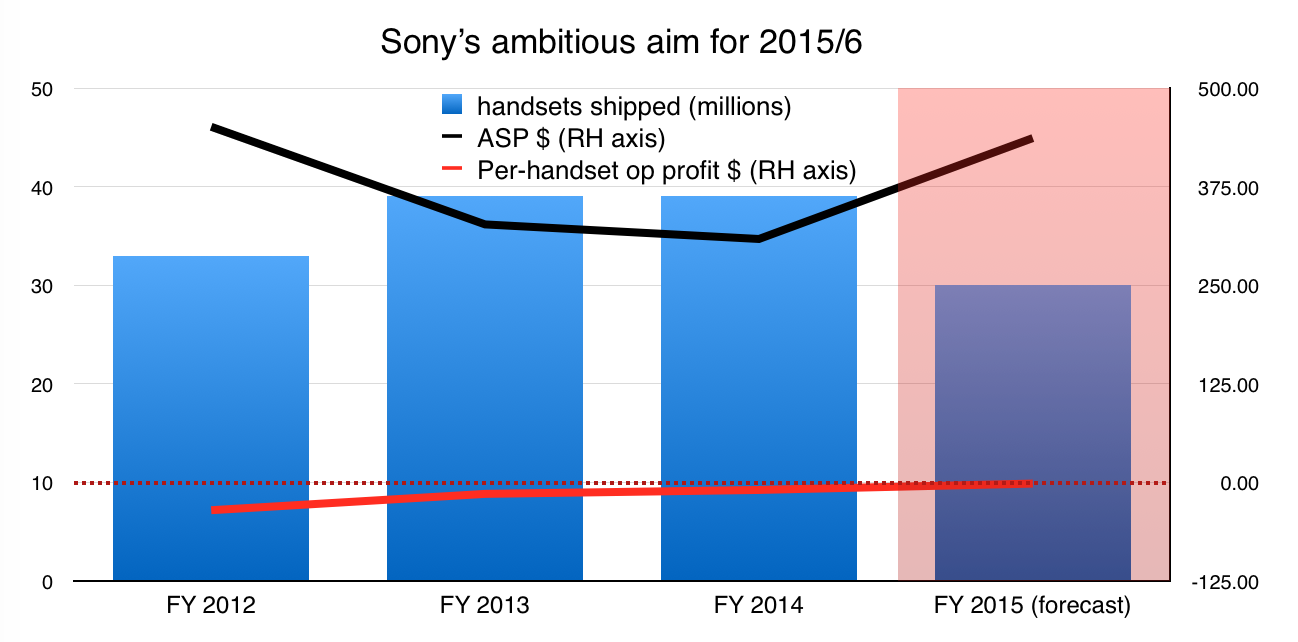
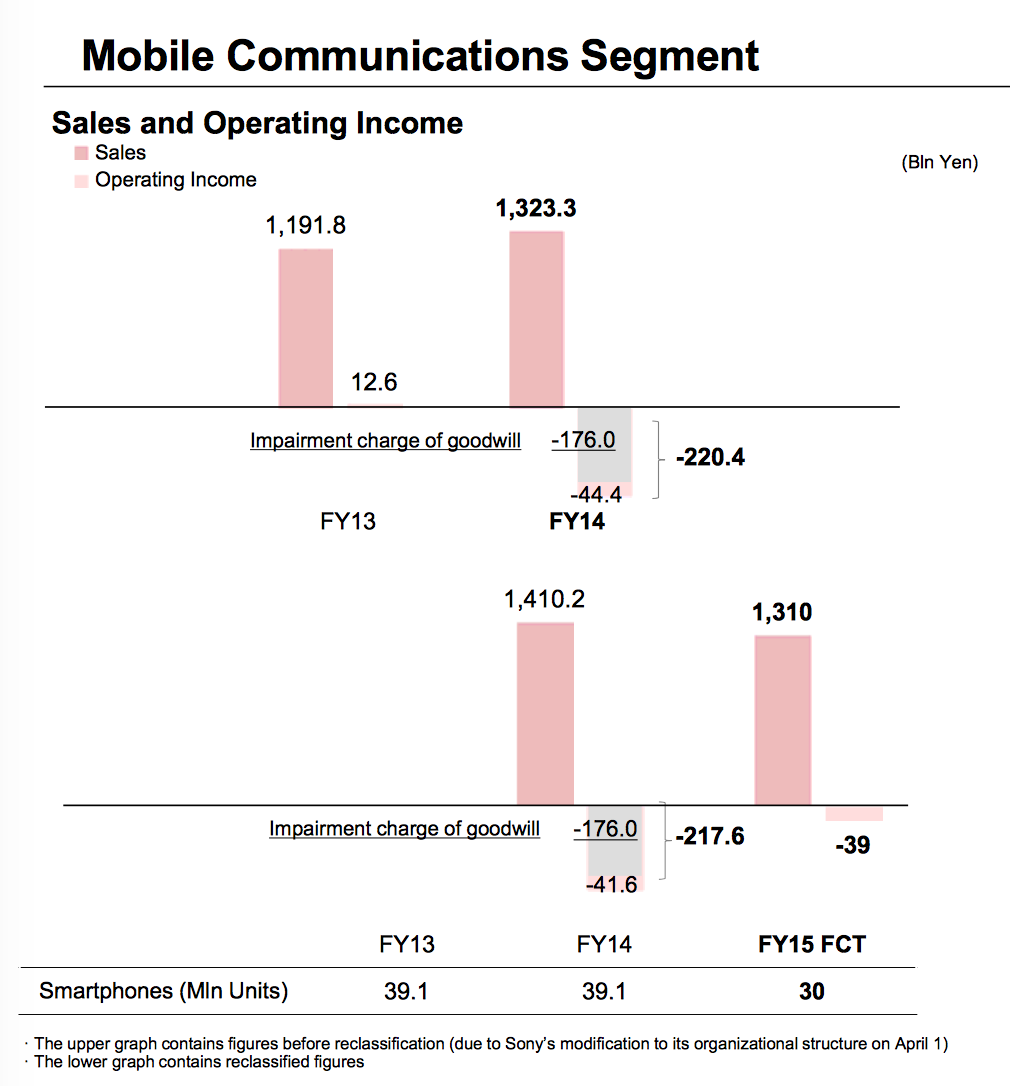
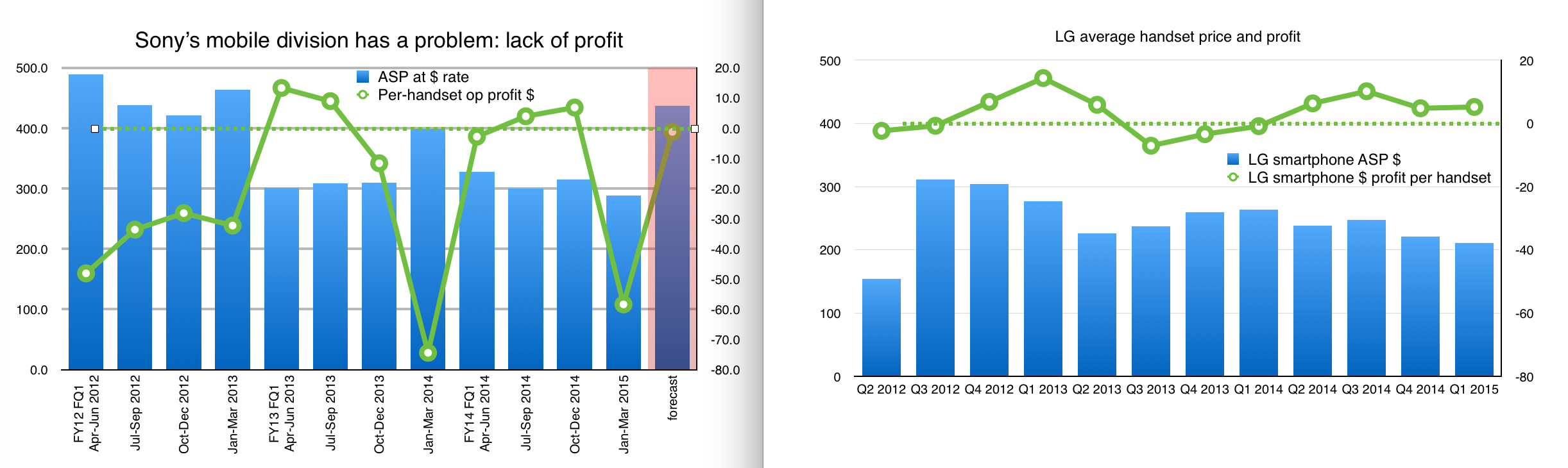
Sony to cut 1,000 jobs in smartphone business, says Nikkei » Re/code

Sony plans to cut another 1,000 jobs in its smartphone division, mainly in Europe and China, the Nikkei business daily reported.

The cuts are in addition to the 1,000 jobs Sony said it would eliminate in its mobile unit in October, the Nikkei said.

Overall, Sony’s mobile division workforce will shrink by about 30% to 5,000 by the end of the fiscal year ending March 2016, the report said.

Can’t remember when I saw a report of Sony expanding a division. (Maybe the PlayStation division does it quietly.) Of course, contract manufacturing means you don’t need a gigantic dedicated workforce to make a lot of phones. Just the right workforce.


My thesis on Microsoft » Beyond Devices

Jan Dawson:

I see a downward trajectory over time in sales of Windows in total, even accounting for the many different form factors Windows runs on. As such, last quarter’s poor performance in Windows sales is much more indicative of the longer-term trend than short-term headwinds. I see Windows 10 slowing the decline a little, but I actually think the free upgrades could stall or postpone new device purchases for some users, which may be counterproductive in the short term. I don’t see Windows 10 solving any of the fundamental challenges I just outlined.

Software sales to consumers will shrink to zero

To my mind, the other major question about Microsoft’s future is its ability to continue to sell software to consumers for a price. I’ve talked for some time now about the fact that, in Microsoft’s two major software categories (OS and productivity), its two major competitors and essentially every other company now give their software away for free.

Hard to argue with any part of this. The downward pressure on Microsoft is inescapable. Strange that at a time when software is eating the world, the ability to charge for it is vanishing.


Haunted Empire » Asymco

Horace Dediu:

I’ve often said that corporate governance is medieval, or pre-scientific in its approach to understanding causality. That may be too generous. As far as the reward/punishment system (also known as Human Resources) it’s probably pre-neolithic. The luxuries and extravagance which we heap upon the leader provide abundant evidence. Leaders insist on these ironic “pay packages” and boards approve them because they know they can and will be ritualistically sacrificed if and when the mobs turn against them.

A manager would be a fool to accept even generous pay given the risk, actually near certainty, of ritualistic slaughter. They demand and are unquestionably given absurd pay that has no relationship to performance. Such pay has no relationship to performance because it isn’t designed to reward performance but to account for the risk of arbitrary and very public sacrifice. Boards (and hence shareholders) are deliberately hiring a scapegoat for sins as yet unknown. Luxury and violence are thus finely balanced in what is called “Executive Search”.

A finely-judged thumb in the eye for a lot of management speak, and for a book about Apple.. oh, what was the name…


How DreamWorks Animation can claw its way back » The Hollywood Reporter

The maker of Shrek is in financial trouble:

And while the film unit is clearly troubled — four of the last six movies have resulted in write-downs (Rise of the Guardians, Mr. Peabody & Sherman, Turbo and Penguins of Madagascar) — Katzenberg has put new co-presidents (Bonnie Arnold and Mireille Soria) in charge of filmmaking and is making good on his 2013 promise to diversify “from an animated feature film company into a multifaceted, branded-entertainment company.” For its most recent quarter, DWA reported a $46.4m loss, but its television segment showed a $2.3m profit and consumer products posted a $4.2m profit.

There also are signs that its digital acquisition AwesomenessTV is profitable (DWA reported a $1.2m profit attributed to “other items,” which consists largely of Awesomeness). DWA paid $33m for Awesomeness in 2013 with a potential earn-out of another $115m. Instead, DWA settled the earn-out last year for $80m then sold 25% of Awesomeness to Hearst Corp. for $81.3m. The net result is that DWA paid about $33m for a 75% stake in a fast-growing, potentially highly profitable digital asset that has a perceived value of more than $300m.

But by focusing on expansion and diversification, Katzenberg acknowledges he might have been distracted from job No. 1: making profitable movies.

Contrast with Pixar, bought by Disney and still turning out successful films – yet always focussing on the story, and not just churning them out. Pixar, of course, was made successful by Steve Jobs. And it retains its focus.


The Apple Watch: The next big thing or living on borrowed time? » Harvard Business School

From September 2014:

Q Do you think the Apple Watch will fundamentally change our lives in a similar way the iPhone and iPad did?

Ryan Raffaelli, Harvard Business School assistant professor: We often define radical innovations as “competency- destroying,” meaning that they render all related products and services in the same market category obsolete. While the Apple Watch is certainly the most advanced smartwatch on the market today, I’m not sure it fits the traditional definition of a “radical” innovation. For instance, it is unlikely the Apple Watch will have the same transformative effect on society as other life-changing innovations throughout history – think about the steamship’s impact on the sailing industry, how the personal computer ended the use of typewriters, or how electronic fuel injection systems replaced carburettors.

The news that the Apple Watch isn’t as radical as the steamship or fuel injection will, surely, persuade Jony Ive once and for all that it’s time to give it up and head off into the sunset.


BlackPwn: BlackPhone SilentText type confusion vulnerability » Azimuth Security

In the phone market, one of the premier products to be released in recent years is undoubtedly the BlackPhone (http://www.blackphone.ch), which has been cited numerous times in tech publications as being one of the best available defences against mass surveillance, as it provides full end-to-end encryption facilities for voice calls and text/MMS messaging.

While exploring my recently purchased BlackPhone, I discovered that the messaging application contains a serious memory corruption vulnerability that can be triggered remotely by an attacker.  If exploited successfully, this flaw could be used to gain remote arbitrary code execution on the target’s handset. The code run by the attacker will have the privileges of the messaging application, which is a standard Android application with some additional privileges. Specifically, it is possible to:

• decrypt messages / commandeer SilentCircle account
• gather location information
• read contacts
• write to external storage
• run additional code of the attacker’s choosing (such as a privilege escalation exploit aimed at gaining root or kernel-mode access, thus taking complete control of the phone)

How surprising that people would believe a claim made by a company about having excellent security.


The secret Douglas Adams RPG people have been playing for 15 years » Kotaku

Fantastic tale from Lewis Packwood:

Yoz [Grahame] then quickly forgot all about the employee forum, but six months later he happened to take a quick peek. And there were ten thousand posts in there.

Bearing in mind that the forum was buried deep within the website and was (just about) password secured, this was a phenomenal result. But even more fascinatingly, the forum had evolved into an extension of the game itself.

Visitors to the forum had created fictional employees and passengers on the Starship Titanic and begun role playing as them. Someone would make up an implausible, Adams-esque scenario, and everyone else would react to it in character, resulting in some enormously complex storylines and in-jokes that developed and diversified over years. And this strange fictional world had appeared entirely spontaneously, without any input from Douglas Adams or The Digital Village. Indeed, Yoz was as surprised as anyone when he stumbled across it: “It was like ignoring the vegetable drawer of your fridge for a year, then opening it to find a bunch of very grateful sentient tomatoes busily working on their third opera,” he says.

I loved Starship Titanic. Not least because there were two alternative endings, diametrically opposed in their result.


A pirated version of the Assassin’s Creed application for Android is bundled with malware » 0xicf

“Blackpiano”:

The Trojanized variety of the Assassin’s Creed application has the potential to be quite potent, because when a user downloads it, what he or she is actually downloading is malware. The malware in turn downloads a fully functional, pirated version of the actual application. The gaming app works as advertised, so the standard mobile gamer is going to have a tough time realizing that the package they’ve downloaded is malicious…

…The malicious application is capable of sending multi-part text messages, harvesting text messages from a victim’s device, and sending stolen information to a remote Command & Control (C2) server. We were able to locate phone numbers belonging to Russian bank “Volga-Vyatka Bank of Sberbank of Russia” in the malicious application code for which SMS messages are being intercepted to steal sensitive information.

Sneaky.


Start up: Google v security redux, how your browser can track you, unboiling eggs (really), Android MVNO = flop, and more


Don’t worry, we’ll soon have that nice and runny for you. Photo by Sidereal on Flickr.

A selection of 10 links for you. Avoid contact with hands. I’m charlesarthur on Twitter. Observations and links welcome.

This guy found a way to block robocalls when phone companies wouldn’t » WIRED

Robert McMillan:

Aaron Foss won a $25,000 cash prize from the Federal Trade Commission for figuring out how eliminate all those annoying robocalls that dial into your phone from a world of sleazy marketers.

The year was 2013. Using a little telephone hackery, Foss found a way of blocking spammers while still allowing the emergency alert service and other legitimate entities to call in bulk. Basically, he re-routed all calls through a service that would check them against a whitelist of legitimate operations and a blacklist of spammers, and this little trick was so effective, he soon parlayed it into a modest business.

Last year, his service, called Nomorobo, blocked 15.1 million robocalls. He uses cloud computing services—primarily Amazon Web Services and Twilio—to block Florida timeshare sellers and fake Microsoft support gurus from the 190,000 VOIP customers1 who use his free product.

I know, you’re saying “Where do I sign up??” Except for this addendum to the story:

113:00 EST. Correction. An earlier version of this story stated that the Nomorobo service works with mobile phones. It runs on VOIP phones only.

Damn.


How you can be tracked by your browser’s fingerprint and how you can stop it » CompTutor

You have your browser set to Private Browsing or Incognito mode where it doesn’t store coookies or history. You load up your favorite VPN, Tor, or I2P and are thinking, “I am totally secure and no one can track me now.” Wrong. You still are possibly leaving a digital fingerprint or browser fingerprint behind. Just because you have a secure computer and can change your IP, people can still find you. Browser Fingerprinting is how some agencies have been able to identify people even through Tor or a VPN.

The EFF, or Electronic Frontier Foundation, discovered this a few years ago and has set up a website to demonstrate their findings. Check out the website below, run their fingerprinting test, and see if your online fingerprint is unique to you out of everyone they have tested. I’m guessing it will be.

https://panopticlick.eff.org

It’s “canvas fingerprinting”, which has already found favour with Google, and relies on characteristics of HTML5-capable browsers.


Microsoft is no longer manufacturing the Surface 2 » The Verge

The big unmentioned detail there is that it’s the end of the line for Windows RT, which everyone except for Microsoft had already given up on. Its future looked even bleaker during Microsoft’s Windows 10 announcements last week, with the company saying that the new OS was not coming to the Surface RT or Surface 2, its last remaining Windows RT devices.

The Surface 2 debuted near in the fall of 2013 as a successor to the Surface RT, which received a lukewarm response and ended up costing Microsoft millions in stock that did not sell. It was thinner and lighter than the previous model, and also had a considerably better display, but was still stymied by Windows RT, which did not support traditional Windows programs.

RT’s really dead now, Jim.


Android Wi-Fi Direct vulnerability disclosed » Threatpost

Michael Mimoso:

Google and Core Security are at odds over the severity of a vulnerability affecting a number of Android mobile devices, details of which were released by the security vendor today.

The issue was reported to the Android security team on Sept. 26 and in subsequent communication between the two parties, the severity of the vulnerability was debated, culminating today with Core’s disclosure. Google three times acknowledged Core’s report and request for a timeline on a patch, and each time Google said it did not have one.

The flaw is a remotely exploitable denial-of-service vulnerability in Wi-Fi-Direct, a standard that allows wireless devices to connect directly. The implementation is used not only between Android devices, but also printers, cameras, PCs and more.

So here’s Google not fixing new flaws in Android. Shouldn’t Core Security feel justified in releasing exploit code and full details?

Read on for Google justifying not fixing old code in Android….


Google defends policy that leaves most Android devices unpatched » Computerworld

Remember the WebView weaknesses that had everyone jumping up and down because around 60% of Android devices that hit Google Play (and potentially many more altogether) are vulnerable? Gregg Keizer followed up:

“Until recently, we have also provided backports for the version of WebKit that is used by WebView on Android 4.3 and earlier,” wrote Adrian Ludwig, Android lead security engineer on Google+. “But WebKit alone is over 5 million lines of code and hundreds of developers are adding thousands of new commits every month, so in some instances applying vulnerability patches to a two-plus-year-old branch of WebKit required changes to significant portions of the code and was no longer practical to do safely.”

So it’s too much trouble for Google to fix code that’s over two years old, but it feels justified in publicising security flaws – and exploit code – for Windows and OSX? What’s that Biblical saying about beams and motes?


‘Thunderstrike’ attack also fixed in OS X 10.10.2 » iMore

Rene Ritchie:

“Thunderstrike” is the name for an attack that can target Mac hardware via the Thunderbolt port. Apple had previously updated the Retina 5K iMac and 2014 Mac mini to partially secure them against Thunderstrike. Now, the upcoming OS X Yosemite 10.10.2 will fix the problem for all recent Macs running Yosemite.

Thunderstrike was explained here: it requires physical access or very good social engineering. Good that it’s being fixed for “all recent Macs running Yosemite”; bad that it isn’t going further back. (Is it even possible to fix it further back? Nobody seems to know for sure.)


Why an Apple-featured indie dev abandoned iOS in favor of PC » Gamasutra

Alex Wawro:

what’s more interesting about [Erik] Asmussen’s current project, at least from a developer’s perspective, isn’t so much where it is now as where it isn’t — namely, Apple’s App Store.

Like many developers, Asmussen quit his job a few years ago to dive into mobile development full-time; but despite some significant success with mobile games like PWN: Combat Hacking, Asmussen has decided to devote himself to PC development.

“I finally gave up on iOS after I got a ‘Best New Games’ feature and saw how little revenue that actually brought in,” Asmussen tells me, via email. “The risk/reward profile was just terrible, combined with annoying barriers like having to put all updates through a review process. So I decided to switch to PC. That has proven to be a good decision by any measure.”

Why? Because

his final mobile game, PWN: Combat Hacking, earned roughly $10k in its launch month.

“Which sounds cool, until you consider that it took a year to build and about $3-4K in art,” adds Asmussen. “And that that figure is in the top percentile of indie mobile games. And that it got the biggest app store feature short of the top banner.”

Asmussen laments the fact that mobile game makers often can’t get people into their games until after they’re released, and believes that developing PC games for Steam’s Early Access service is more empowering for small-scale developers.

(Thanks @Jaykannan for the link.)


Apple reports record first quarter results » Apple

The results were fueled by all-time record revenue from iPhone® and Mac® sales as well as record performance of the App Store℠. iPhone unit sales of 74.5m also set a new record.

“We’d like to thank our customers for an incredible quarter, which saw demand for Apple products soar to an all-time high,” said Tim Cook, Apple’s CEO. “Our revenue grew 30 percent over last year to $74.6bn, and the execution by our teams to achieve these results was simply phenomenal.” 

Oh, yeah, this happened. Not quite a record for Mac shipments (that happened in the previous quarter) but those iPhone numbers? That is phenomenal execution, as Cook says. It’s so easily overlooked that there’s no value in all the brand stuff and marketing if you can’t actually deliver product to people. Between Apple and Samsung, that’s about half of the smartphone market sewn up.


Chemists find a way to unboil eggs » Phys Org

Janet Wilson on news that will delight, well, anyone?

Like many researchers, he has struggled to efficiently produce or recycle valuable molecular proteins that have a wide range of applications but which frequently “misfold” into structurally incorrect shapes when they are formed, rendering them useless.

“It’s not so much that we’re interested in processing the eggs; that’s just demonstrating how powerful this process is,” [Gregory] Weiss [professor of chemistry and molecular biology at UCal at Irvine] said. “The real problem is there are lots of cases of gummy proteins that you spend way too much time scraping off your test tubes, and you want some means of recovering that material.”

But older methods are expensive and time-consuming: The equivalent of dialysis at the molecular level must be done for about four days. “The new process takes minutes,” Weiss noted. “It speeds things up by a factor of thousands.”

To re-create a clear protein known as lysozyme once an egg has been boiled, he and his colleagues add a urea substance that chews away at the whites, liquefying the solid material. That’s half the process; at the molecular level, protein bits are still balled up into unusable masses. The scientists then employ a vortex fluid device, a high-powered machine designed by Professor Colin Raston’s laboratory at South Australia’s Flinders University. Shear stress within thin, microfluidic films is applied to those tiny pieces, forcing them back into untangled, proper form.

Unspilling milk next, I hope.


5 reasons why a Google MVNO would fail » FierceWireless

Phil Goldstein enumerates them rather clearly. Summarised, they are:
1) engineering phones and networks is difficult (you can’t get one phone to join both T-Mobile and Sprint in the US as they use GSM and CDMA)
2) Google would need customer service centres and distribution – outside its core competency
3) incumbent carriers spend billions on ads, and have inbuilt advantages
4) the service wouldn’t be differentiated, and what’s the target audience?
5) if it doesn’t get scale, Google might kill it.

His article goes into much more detail. It feels persuasive.


Start up: web design for 2015, Nexus 6’s long slipway, hacking journalism under threat?, Zoë Keating v YouTube redux, and more


In 2012 the Nexus 6 designers were expecting to deal with these to unlock the phone. Photo by kevin dooley on Flickr.

A selection of 7 links for you. Refrigerate before use. I’m charlesarthur on Twitter. Observations and links welcome.

The challenge for web designers in 2015 (or how to cheat at the future) » Memespring

Richard Pope:

The 7 years of the Apple App Store and the android equivalents have, in effect, been mass, micro funded experiments in UI design for small, touch sensitive devices with lots of sensors and outputs. They have generated winning patterns like:

Checkboxes replaced by switches
Check-ins
Edit without save button
Everything can be contextual, any bit of UI can disappear between pages
Everything has it’s own settings page
Floating buttons
Keeping primary navigation off canvas (hidden behind the page)
Minimal or zero page header (the context an old school page header / nav gives seems less important when you are holding the app in your hand.)
Multiple, focused apps for the same service
Offline by default
Overscroll to refresh
Reserving dropdown menus for actions on the current context
Search scoped to their current context (the app)
These are patterns that people use day in day out on facebook, Gmail and WhatsApp. These are the new normal, what people expect.

But with a few notable exceptions – eg the mobile versions of Wikipedia and Forecast – these are not patterns that are making their way on to the web.

So, here is the challenge for anyone designing and building for the web in 2015.

He also points out what you can do with HTML5 browsers now too. Worth considering.


Dennis Woodside on Motorola, Google and the future of Dropbox » Telegraph

Matt Warman spoke to Woodside, formerly chief executive at Motorola, and now chief operating officer at Dropbox:

the 6-inch Nexus 6, he can now admit, was stymied by just one of those big players [which he previously criticised for keeping prices high]. A dimple on the back that helps users hold the device should, in fact, have been rather more sophisticated. “The secret behind that is that it was supposed to be fingerprint recognition, and Apple bought the best supplier. So the second best supplier was the only one available to everyone else in the industry and they weren’t there yet,” says Woodside. Nonetheless, he adds, the addition of fingerprint recognition, “wouldn’t have made that big a difference.”

Here’s what’s interesting about this. Apple bought Authentec in mid-2012 (for $356m). The Nexus 6 was released in September 2014. Motorola’s development of that smartphone was so far in train that it didn’t have time to change the design of the back fascia from dimpled to flat.

Smartphones take two or more years to design and implement. Consider that: what comes out now was being worked on in early 2013.

Kudos to Woodside for admitting fingerprint recognition wouldn’t have made much difference. As it wasn’t being tied into a payment system, it would have been a gimmick – and those don’t add lasting value.


We should all step back from security journalism » Medium

Quinn Norton:

Part of Barrett Brown’s 63 month sentence, issued yesterday, is a 12 month sentence for a count of Accessory After the Fact, of the crime of hacking Stratfor. This sentence was enhanced by Brown’s posting a link in chat and possessing credit card data. This, and a broad pattern of misunderstanding and criminalizing normal behavior online, has lead me to feel that the situation for journalists and security researchers is murky and dangerous.

I am stepping back from reporting on hacking/databreach stories, and restricting my assistance to other journalists to advice. (But please, journalists, absolutely feel free to ask me for advice!) I can’t look at the specific data another journalist has, and I can’t pass it along to a security expert, without feeling like there’s risk to the journalists I work with, the security experts, and myself.

Brown’s sentence wasn’t quite as simple as “linking to stolen stuff”, but Norton’s concern is understandable – especially given the tendency of US law enforcement to go like a runaway train after hackers, and those defined as hackers, of all stripes.


Zoe Keating’s experience shows us why YouTube’s attitudes to its creators must change » Music Industry Blog

Mark Mulligan weighs in on the Zoë Keating row linked here on Monday:

it is the Content ID clause that is most nefarious. Content UD is not an added value service YouTube provides to content owners, it is the obligation of a responsible partner designed to help content creators protect their intellectual property. YouTube implemented Content ID in response to rights owners, labels in particular, who were unhappy about their content being uploaded by users without their permission. YouTube’s willingness to use Content ID as a contractual lever betrays a blatant disregard for copyright.

Ben Thompson is much more straightforward: on Stratechery.com he analyses Keating’s position, and suggests – for her particular situation, as a niche player seeking the most eager fans – that she should tell YouTube to take a hike. Especially when you look at her income breakdown: 60,000 tracks (roughly) sold on iTunes generated $38,195, while 1.9m YouTube views (mostly of her music on other peoples’ videos) earned $1,248.

Would the iTunes sales have happened without the YouTube views? Quite possibly not – but using ContentID as a lever, as Mulligan says, is to aggressively deny her copyright.


Digital music sales on iTunes and beyond are now fading as fast as CDs. – The Atlantic

Derek Thompson has some shudder-making figures:

how about the hits? The top 1% of bands and solo artists now earn about 80% of all revenue from recorded music, as I wrote in “The Shazam Effect.”

But the market for streamed music is not so concentrated. The ten most-popular songs accounted for just shy of 2% of all streams in 2013 and 2014. That sounds crazy low. But there are 35m songs on Spotify and many more remixes and covers on SoundCloud and YouTube, and one in every 50 or 60 online plays is going to a top-ten song. With the entire universe of music available on virtual jukeboxes, the typical 3.5-hour listening session still includes at least one song selected from a top-ten playlist that accounts for .00003% of that universe. The long tail of digital music is the longest of tails. Still, there is a fat head at the front.


China buying more iPhones than US » FT.com

Analysts at UBS estimate that China accounted for 36% of iPhone shipments in the most recent quarter, compared with 24% for the US. During the same period last year, 29% of units were sold in the US and 22% were in China, UBS said.

Predictable enough, given the size of China, and the fact that the US is essentially saturated. The fact that two markets probably account for 60% of all iPhone shipments – around 36m phones in the quarter – is perhaps a concern for Apple. It’s much the same for Samsung: losing its lead in China has hurt it and left the US as its key market.

However, this rather gives the lie to those stories from September which said that Apple was washed up in China when smugglers had to cut prices of the iPhone 6 – ignoring the fact that the devices were going to go on sale officially in a few weeks. Nope, then the problem was that

Four years ago, the iPhone 4 was a status symbol, with the black market booming before the product was officially introduced. Today, the iPhone is simply one option among many, as local companies like Xiaomi and Meizu Technology rival Apple in terms of coolness while charging less than half the price.


Demographics of key social networking platforms » Pew Research Center’s Internet & American Life Project

Tons of demographic data (including age, ethnicity, gender, education, income and location) about the online over-18s in the US:
• 71% use Facebook (more women than men, strong in 18-29);
• 23% use Twitter (men strongly growing, skews towards degree-qualified);
• 26% use Instagram (53% of 18-29s; also strong among Hispanics and African-Americans);
• 28% use Pinterest (up from 21% in August 2013; 3:1 women:men, strongly skewed to white)
• 28% use LinkedIn, strongly up among women since 2013, but now equal across sexes; skews strongly to university education

The whole study is fascinating: Facebook growth is slowing down, but it’s still “home base”, and used most daily.


Start up: where’s Apple’s Hololens?, the Xiaomi copiers, CES or Skymall product?, YouTube’s tough licensing, and more


Where’s Apple in this virtual reality landscape? No iPhones there. A screenshot from the Drax files Oculus Rift view by draxtor on Flickr.

A selection of 8 links for you. Can be swapped for Green Shield stamps at participating stores. I’m charlesarthur on Twitter. Observations and links welcome.

Apple needs a Microsoft HoloLens augmented reality competitor » Business Insider

Dave Smith:

By all accounts, it sounds like augmented reality devices like these are “the next big thing.” And at this point, Microsoft, Google, Facebook, Samsung, and others have invested hundreds of millions — even billions — of dollars into these new virtual and augmented reality experiences. 

Apple, meanwhile, is nowhere to be found. 

Oh no! And already millions– well, thousands– ok, hundreds.. er, dozens of people are using Oculus Rift, and Google has retreated on Google Glass. So where the hell is Apple in this.. race? Smith continues:

Last June, I wrote about how Apple’s patent for “interactive holograms” was one I wanted to see become a reality. Filed in October 2012 but published in April 2014, Apple had created a system that allows you to interact with projected images that appear to hang in mid-air, even letting you control and manipulate those virtual objects with the swipes and gestures iOS users are used to (pinch to zoom, etc.)

It’s not too late for Apple to use this patent.

Not too late? If anything, it’s way too early for Apple to use it. It seems people don’t learn the lessons of Google Wallet v Apple Pay, or Palm and RIM v the iPhone: throwing technology out there isn’t enough; you need the business and experience to fit in too.


5 new phone makers hoping to replicate Xiaomi’s success » Tech In Asia

Much more detail in the article, but the five brands (or sub-brands) are:
• Yu Yureka (by Micromax)
• Shenqi (by Lenovo)
• Ivvi (by Coolpad)
• OnePlus (born out of Oppo)
• Himax.


DNS poisoning slams web traffic from millions in China into the wrong hole » The Register

A widespread DNS outage hit China on Tuesday , leaving millions of surfers adrift.

DNS issues in China between 7am and 9am GMT left millions of domains inaccessible. Two-thirds of China’s DNS (Domain Name System) infrastructure was blighted by the incident, which stemmed from a cache poisoning attack.

Chinese netizens were left unable to visit websites or use social media and instant messaging services as a result of the screw-up, the Hong Kong-based South China Morning Post reports.

The snafu, which affected China’s root servers, meant all queries resolve to the IP address 65.49.2.178. A fix was implemented around two hours after the snag first surfaced.

Put like that, it sounds like “yeah, yeah”. But when it happens to you, as it did to Craig Hockenberry, it’s very different.


Quiz: CES gadget or SkyMall product? » PandoDaily

SkyMall produced an in-flight magazine selling “Innovations”-style products (as in, stupid, useless, and yet able to make you go “ooh!”), but has now filed for bankruptcy. David Holmes had the brilliant idea of making this quiz:

judging by some of the products that caught the media’s attention at CES this year, I’m not sure SkyMall and Silicon Valley are so far off in their passion for absurdity. The “Rollkers” at CES? Sounds a lot like these OrbitWheels sold through SkyMall. Or what about the “gTar”? Is it so different than the All-Star Guitar, which is basically a fake guitar you plug into an iPad? Can you even tell which one is from CES and which one is a SkyMall product?

I didn’t even try to score myself because I’d put them all in both category. But the fact that Holmes can confuse us at all shows what a microcosm of crap CES has become.


What should I do about Youtube? » Zoë Keating

Keating is a successful cellist whose videos have a respectable, if not mind-boggling, number of views:

My Google Youtube rep contacted me the other day. They were nice and took time to explain everything clearly to me, but the message was firm: I have to decide. I need to sign on to the new Youtube music services agreement or I will have my Youtube channel blocked.

This new music service agreement covers my Content ID account and it includes mandatory participation in Youtube’s new subscription streaming service, called Music Key, along with all that participation entails. Here are some of the terms I have problems with:

Must have ads, must be in 320kbps (nonsensical), can’t release elsewhere first, must allow all catalog in free and paid music service, five-year contract. Non-optional. Keating wants control; YouTube doesn’t want her to have control. And there seem to be strange goings-on in search:

Here is something weird. Until yesterday a search for “Zoe Keating” would yield a Google Knowledge Graph box on the right with all my info, including links to listen to my music. It always bugged me that those links were only to Google Play, Rhapsody and Spotify, all services which have hardly any of my music in them. If the metadata about me is really pure, why not link to the only services that actually have all my music? i.e. Bandcamp, SoundCloud and iTunes? I know the links were there yesterday because I searched to get the list for this blog. As of today, there are no music links whatsoever. Ideas?

Her sad conclusion: “The revolution has been corporatized.” And now read on..


Is Google playing fair with Android developers? » The Information

Transcript of long and really interesting interviews with various developers from The Information’s “Next Phase of Android” event held recently. Lots to consider, but I was struck by this:

Tom Moss, CEO of Nextbit: The next phase of Android is that people have finally shifted away from asking, “Is there going to be a third mobile platform?” or, “My friends all use iOS, so is Android a thing?” And now you can think, if you can’t compete with Android, you can compete with Google by co-opting Android. That’s what Kirt is doing. In my own game theory, I was thinking, “God, I hope Microsoft doesn’t adopt Android and come out with a bunch of services to grab market share.” It’s not the OS wars any more. It’s the services.

Kirt McMaster [CEO of Cyanogen]: This notion of a creating a Windows Phone or a Facebook phone is absurd. All of these guys have failed. We’re able to build on top of Android and make Android better. Now we’re opening up Android and partnering with everybody you can imagine. Google is running the table, and nobody likes that. We’ve emerged as the white horse that opens the entire platform up. We think this is where the innovation is going to happen.

(The piece is paywalled.) The idea that “Google is running the table, and nobody likes that” might sound surprising. Moss’s fear about Microsoft and services sounds like Nokia X – which still seems to me a tolerable idea, except that Google would make AOSP an unusable husk if Microsoft really made headway with it.


Smart mousetraps and lazy mice » Drop Labs

Cherian Abraham, explaining the – surprising – 6% figure (at peak) for fraud committed using Apple Pay according to early reports:

No, iPhones weren’t stolen and then used for unauthorized purchases, TouchID was not compromised, Credentials weren’t ripped out of Apple’s tamper proof secure element – nor the much feared but rarely attempted MITM attacks (capture and relay an NFC transmission at a different terminal). Instead fraudsters bought stolen consumer identities complete with credit card information, and convinced both software and manual checks that they were indeed a legitimate customer.

Partly, that’s because banks didn’t have very good checks (called the “Yellow Path” – is it an Oz reference?) to verify identity when someone wanted to enter a credit card onto a phone.

Apple bears some of the responsibility though:

In fact initially “Yellow Path” was marked optional for card issuers by Apple – which meant that only a couple of Issuers directed much focus at it. Apple reversed its decision and made it mandatory less than a month before launch – which led to issuers scrambling to build and provide this support. Why any bank would consider this optional is beyond me.

Either way, Card issuer implementations of the Apple Pay Yellow Path have proved to be inadequate.

It’s the whole insecure US credit system in microcosm.


Google suggesting Firefox users change their search engine & home page » Search Engine Land

Danny Sullivan on how Firefox users visiting Google are being encouraged to switch away from Yahoo:

I figured it was inevitable Google would do this, if the Firefox-Yahoo deal really did seem to be having an impact. Even the loss of a little share might be enough to scare investors. Certainly, I’ve taken enough calls from various press outlets wondering if the deal and subsequent share loss meant a big problem for Google.

My response has always been that if Google was worried, it could and would fight back in this type of manner. Now it is, and I suspect it will regain some of that share lost to Yahoo.

I also suspect Yahoo won’t gain much more search share than it has, because with the Firefox deal fully rolled out, it’s effectively hit a high water mark for all that particular channel is likely to produce.

“People can switch away any time.”