Unknown's avatar

About charlesarthur

Freelance journalist - technology, science, and so on. Author of "Digital Wars: Apple, Google, Microsoft and the battle for the internet".

Start up: Google eases Project Zero, Xiaomi’s patent woe, Microsoft’s big Office vision, driving helium, and more


“Flash, I love you – but we only have 90 days excluding public holidays and weekends to issue a fix for CVE-2013-6629!” Photo via Tom Simpson on Flickr

A selection of 8 links for you. Use them wisely. I’m charlesarthur on Twitter. Observations and links welcome.

Google amends bug disclosure policy following Apple and Microsoft scuffle » V3

Project Zero courted controversy when it publicly disclosed flaws in Microsoft’s Windows 8.1 and Apple’s Mac OS X operating systems.

Google moved to address these concerns, arguing that it may have applied the policy too rigorously but that public disclosure is effective.

“For example, the Adobe Flash team probably has the largest install base and number of build combinations of any of the products we’ve researched so far,” read the [Google] blog post.

“To date, they have fixed 37 Project Zero vulnerabilities (or 100 percent) within the 90-day deadline. More generally, of 154 Project Zero bugs fixed so far, 85% were fixed within 90 days.

“Furthermore, recent well-discussed deadline misses were typically fixed very quickly after 90 days. Looking ahead, we’re not going to have any deadline misses for at least the rest of February.

I fixed all of my Adobe Flash vulnerabilities in five minutes by removing Flash from my computer. However, Google’s position of playing private security guard to the internet remains discomforting, and I can’t help feeling that it’s going to prove embarrassing in some horrible way – a sort of schadenfreude-in-waiting.


Qualcomm deal sparks China smartphone patent skirmishes » Reuters

From last Friday (I didn’t link to it then), but as Ben Thompson points out, this element of the deal could have big implications – given that Xiaomi became China’s biggest smartphone vendor in 2014:

The settlement has allowed wireless patent holders like ZTE and Huawei Technologies to seek royalties, while introducing a new risk of litigation to China’s younger handset industry at a time when domestic patent law is gaining traction.

“For the first time, the settlement is forcing domestic manufacturers to recognize the value of IP (intellectual property) and consider how to use it strategically, which companies do in the West,” said Wang Yanhui, secretary general of the Mobile China Alliance, an industry consortium. “That’s the real significance of the (Qualcomm) settlement.”

The competitive dynamics are particularly complex in China, the world’s biggest smartphone manufacturer and consumer, as large Chinese telecom equipment makers that hold many essential patents for wireless technology also compete in the phone market against younger, nimbler manufacturers.

The settlement could prove tricky for companies like Xiaomi Inc, a four-year-old Beijing-based smartphone maker whose weak patent position has proved a major vulnerability. In December, a court in India temporarily halted its shipments there after Swedish telecom firm Ericsson complained Xiaomi had not been paying its royalties.

Although Xiaomi has been reported by Chinese media to be one of the handset makers now targeted by ZTE’s lawyers, both companies declined to discuss the issue.

But in response to questions from Reuters, Bin Lin, Xiaomi’s president, said he expects Xiaomi to only attract more patent threats and litigation from rivals in the future, as does any young firm that enjoys explosive growth.


Rembrandt Technologies wins $15.7m jury verdict in patent infringement case against Samsung » PRNewswire

A Texas federal jury has awarded $15.7 million to Rembrandt Wireless Technologies LP after finding that Korean electronics giant Samsung Electronics Co. Ltd. infringed on two Rembrandt patents covering Bluetooth technology.

Jurors deliberated only one hour before issuing the Feb. 13 verdict. The five-day trial focused on two Rembrandt patents, U.S. Patent Nos. 8,023,580 and 8,457,228. In addition to the $15.7 million award, Rembrandt also will receive royalty payments on all Samsung Bluetooth sales for the life of the patents.

Rembrandt, a Pennsylvania-based business technology company, sued Samsung and Blackberry Ltd. in 2013. Blackberry settled before the trial. Rembrandt argued that its patents for Bluetooth “enhanced data rate” inventions were infringed by Samsung in its Galaxy S phones.

That’s a brief deliberation, and a brief trial.


New cloud storage integration for Office » Microsoft Office Blogs

Kirk Koenigsbauer, corporate VP of Office:

We want Office to be the preferred way to work with documents no matter where they’re stored.  In November we announced a special partnership with Dropbox to make it easy to access, edit and share Dropbox files from the Office apps.  And today, in addition to the existing Dropbox integrations, we’re pleased to announce two new integration features for an even broader set of cloud services: First, file picker integration for the iPad and iPhone; and second, Office Online integration for viewing and editing.  While these may seem like small enhancements, these new features represent a big step forward for Office integration into the apps and services that are important to our customers.

This is huge. It’s actually all in that first sentence, which is all you need: “We want Office to be the preferred way to work with documents no matter where they’re stored.” Microsoft wants Office – its most lucrative monopoly – to endure. This is part of how it does that.


May 2012: once deemed evil, Google now embraces “paid inclusion”

Danny Sullivan, in May 2012, noting changes in how Google represented and collated its Flight Search, Hotel Search and Shopping categories so that they became pay-to-play for companies to appear – a reversal of Google’s previous stance:

paid inclusion isn’t necessarily bad, especially if it’s used to solve an otherwise difficult challenge in search, rather than being an excuse to generate revenue. However, it it still feels odd watching Google, having previously attacked the objectivity of its competitors over the practice, quietly adopt paid inclusion now that it’s the search market leader. That doesn’t sit right. At the very least, I kind of want someone at Google to acknowledge that it was wrong those years ago.

Postscript (7:30pm ET): Google, after seeing this article, sent along this statement about paid inclusion:

Paid inclusion has historically been used to describe results that the website owner paid to place, but which were not labelled differently from organic search results.  We are making it very clear to users that there is a difference between these results for which Google may be compensated by the providers, and our organic search results.

I have to disagree.

The reason I’m linking to this now is that it’s pertinent to all the antitrust discussion that’s reopening in Europe over Google and particularly vertical search. Google presents its results as untouched by human hand, but there’s a whole lotta touching really going on. (One point on the headline: Sullivan means that paid inclusion used to be deemed evil, not Google.)


November 2013: Western Digital adds helium to enterprise hard drives » AllThingsD

Arik Hesseldahl:

It turns out that the insides of hard drives are pretty violent places. There’s a lot of high-speed motion, what with the disk platters spinning at several thousand rotations per minute, and the head moving back and forth across its surface. If you’ve ever held your arm out the window of a fast-moving car, you get some sense of the problem…

…The secret sauce to all this is that the drives are built to be hermetically sealed, which means they’re both perfectly airtight and leakproof. While the science behind doing all this has been well understood for a while, Cordan says that Western Digital is the first to figure how to do it in a repeatable manufacturing process. It adds an extra step or two to the manufacturing process, and thus some cost.

It gets more interesting: Hermetically sealed drives don’t let the helium out, but they also don’t let anything else in, including liquid. That makes them good for use in immersion-cooled data centers. These are small, dense collections of IT gear packed into a box the size of a shipping container and filled to the top with nonconductive liquid that keeps everything running at a constant temperature. (If you didn’t know that this was a thing, you’re not alone, because I didn’t, either.)

This came (via @jearle) after I happened across a Digitimes report about helium-filled drives. Presumably vacuum is next, since if a drive can survive being immersed then it must have tough joints.


Intel reportedly to delay launch of 14nm Skylake desktop CPUs » Digitimes

Monica Chen:

Intel reportedly has informed its motherboard partners that it will delay the release of its 14nm Skylake desktop CPUs and corresponding 100-series chipsets to the end of August, compared to its original schedule set for the second quarter of 2015, according to sources in Taiwan’s motherboard industry.

The delay will affect PC makers’ production and shipment plans for Haswell Refresh and Broadwell-U series products and may also delay the development of Broadwell models with a TDP of 65W, the sources noted.

PC makers will also not be able to unveil Skylake-based models during the upcoming Computex 2015 to be held in June in Taipei, thereby affecting PC sales in the second haft of 2015, said motherboard makers.

Intel is saying that it always planned to release Skylake in the second half of the year. For reference, the Pentium 4, introduced in 2000, had transistor sizes of 0.18 micron – or 180nm.


$1.75m in bitcoin stolen from Chinese exchange Bter » The Next Web

Abhimanyu Ghoshal:

Even as Bitcoin is starting to shake things up in the US, all is not well in the cryptocurrency world. China-based Bitcoin exchange Bter was hacked on Valentine’s Day and $1.75m worth of Bitcoin was stolen.

The company hasn’t revealed much about the breach, except that 7,170 BTC was taken from its cold (offline) wallet on February 14 via a single transaction (link) and that the platform is suspending operations until further notice.

I feel like we’re getting so used to this that $1.75m is like “yeah, sure”.


Start up: Snapchat discovers media, Google v privacy, that Jony Ive interview, Russia’s phone market and more


OK, not all mobile phones in Russia are smartphones. Photo by thejamo on Flickr.

A selection of 8 links for you. Do not use as sunscreen. I’m charlesarthur on Twitter. Observations and links welcome.

Snapchat Discover could be the biggest thing in news since Twitter » Fusion

Kevin Roose:

A few weeks ago, Snapchat updated its app. The new version had a little purple dot in the upper-right corner of the app’s Stories screen. If you’re a normal, casual Snapchat user who uses the app to send goofy selfies to your friends, you might not have noticed the dot at all. Or you might have tapped it, seen an unfamiliar menu with a panoply of weird logos on it, and gone back to your selfie-taking.

But if you’re a media executive, that little purple dot — the gateway to Snapchat’s new Discover platform — might represent a big shift in your thinking.

There’s a ton of chatter in the media world about Snapchat’s foray into news. And the media is right to gossip: Snapchat Discover is huge. I’m not privy to Fusion’s Snapchat metrics (and even if I were, they wouldn’t be representative of the platform as a whole, since we’re only on the non-US, non-UK versions of Discover) and Snapchat isn’t giving out any specifics. But from speaking to people at several other news organizations, I can tell you secondhand that the numbers, at least for the initial launch period, were enormous. We’re talking millions of views per day, per publisher.

Social starts to make an impact on mobile.


China Internet a really big grid with 649m users, majority on mobile » Mobile Marketing Watch

J Barton:

Recent data from The China Internet Network Information Center, the number of Internet users grew 5% in 2014 to about 649m. That means nearly half of China’s population (47.9%) is now firmly on the grid.

“More Chinese now access the Internet on their mobile phones than PC desktops,” notes a blog post by financial publisher Barron’s. “The mobile penetration rate is now at 85.8%, up from 81% a year ago, to 557m users. Meanwhile, the desktop PC penetration is only 70.8%.”

Well, it means that most people who are online have both PC and mobile access, but some don’t.


Google’s lip service to privacy cannot conceal that its profits rely on your data » The Conversation

Eerke Bolten, who is senior lecturer of computing and director of the Interdisciplinary Cyber Security Centre at the University of Kent:

The [ECJ] court ruling demonstrated the law catching up with privacy ethics: an ethical approach would be to implement it according to the spirit rather than the letter of the law. But in many places in this report [from Google’s handpicked advisory council on how to implement the ruling], privacy ethics wins out only where it has the law on its side – where it doesn’t, Google’s business interests (bolstered by appeals to freedom of expression) prevail. In doing so Google invents bizarre new “freedoms”, such as the right to use different national versions of Google search…

…What if the politicians get wind of another form of cyberbullying, namely “doxing” – the publishing online of someone’s personal information (and specifically their address) in order to harass and annoy?

Any attempt to legislate against that would run into a certain large internet company through whose website such information is inevitably found. Interesting times ahead, that is certain.

Bolten points out that the report never examines how Google actually goes about delisting, even though it was recommended to by people on and off the council. Something feels odd about this report. But that final situation might be the collision point for Google and governments.


Jonathan Ive and the future of Apple » The New Yorker

A terrific (long) piece by Ian Parker, who was given access to Apple’s holy of holies, its design studio:

Each table serves a single product, or product part, or product concept; some of these objects are scheduled for manufacture; others might come to market in three or five years, or never. “A table can get crowded with a lot of different ideas, maybe problem-solving for one particular feature,” Hönig, the former Lamborghini designer, later told me. Then, one day, all the clutter is gone. He laughed: “It’s just the winner, basically. What we collectively decided is the best.” The designers spend much of their time handling models and materials, sometimes alongside visiting Apple engineers. Jobs used to come by almost every day. Had I somehow intruded an hour earlier, I would have seen an exhibition of the likely future. Now all but a few tables were covered in sheets of gray silk, and I knew only that that future would be no taller than an electric kettle.

The cloth covering the table nearest the door was curiously flat. “This is actually complicated,” Ive said, feeling through the material. “This will make sense later. I’m not messing with you at all, I promise.”

By my analysis of the piece Parker had four fairly short meetings with Ive, and one with Tim Cook. What’s not obvious (but I can see, with my journalist’s hat on) is that he must have done dozens of other interviews, of unknown length, with other people inside and outside Apple, some of which result in just a single throwaway line in the piece. That’s thoroughness. He also has a deliciously ironic touch – see his comment about how Tim Cook is alerted to the progress of a meeting.

(Of course it’s been published just as everyone is thinking APPLE IS MAKING CARS OMG. No hint of that in the design studio, it seems.)


Russia smartphone sales to stall on iPhone slowdown, IDC says » Bloomberg Business

Ilya Khrennikov:

Apple doubled iPhone shipments to Russia to 3.25m last year, garnering $2.14bn in sales, according to the researcher’s Worldwide Mobile Phone Tracker.

While Samsung Electronics Co. remained the market leader, shipping more than 6m smartphones last year, its revenue share was overtaken by Cupertino, California-based Apple.
In the fourth quarter, when Russians rushed to spend their tumbling rubles on big-ticket items including premium handsets, iPhone sales reached $827m, or a record 46% share in the Russian smartphone market, versus Samsung’s 18% slice, according to IDC.

There’s a table of data, with shipments and revenues for the top seven companies (Samsung, Apple, LG, Lenovo, HTC, Sony, Nokia). The fascinating details: Samsung and HTC sales fell; Apple, LG, Lenovo (x4!) and Nokia grew. But of all of them, only LG grew its ASP (average selling price) from 2013 to 2014, though even that (at US$224) was below the ASP of US$230. (I calculated the ASPs; they aren’t on the sheet.)


HTC and other vendors to launch non-Android Wear smart devices » Digitimes

Although Sony Mobile Communications, LG Electronics, Motorola Mobility and Asustek Computer have launched Android Wear-based smartwatches, Samsung Electronics, HTC and some China-based makers are likely to release comparable models running on their own platforms initially, according to industry sources.

A lack of efficient ecosystem and supporting environment for Chinese such as a Chinese-language interface, are the main reasons HTC and China’s handset makers are developing wearable devices based on in-house platforms, said the sources.

Surprising omission if Android Wear doesn’t have Chinese character support.


Why is my smart home so fucking dumb? » Gizmodo

Adam Clark Estes:

I unlocked my phone. I found the right home screen. I opened the Wink app. I navigated to the Lights section. I toggled over to the sets of light bulbs that I’d painstakingly grouped and labeled. I tapped “Living Room”—this was it—and the icon went from bright to dark. (Okay, so that was like six taps.)

Nothing happened.

I tapped “Living Room.” The icon—not the lights—went from dark to bright. I tapped “Living Room,” and the icon went from bright to dark. The lights seemed brighter than ever.

“How many gadget bloggers does it take to turn off a light?” said the friend, smirking. “I thought this was supposed to be a smart home.”

This is where voice control (Siri, Google, Cortana) would be ideal. Always assuming it dims the lights in the correct room. This experience also points to why “smart control” isn’t necessarily what you want; smart feedback (what lights etc are on) could be more useful. Still requires installing stuff, though.


Why science is so hard to believe » The Washington Post

Joel Achenbach:

In the United States, climate change has become a litmus test that identifies you as belonging to one or the other of these two antagonistic tribes. When we argue about it, Kahan says, we’re actually arguing about who we are, what our crowd is. We’re thinking: People like us believe this. People like that do not believe this.

Science appeals to our rational brain, but our beliefs are motivated largely by emotion, and the biggest motivation is remaining tight with our peers. “We’re all in high school. We’ve never left high school,” says Marcia McNutt. “People still have a need to fit in, and that need to fit in is so strong that local values and local opinions are always trumping science. And they will continue to trump science, especially when there is no clear downside to ignoring science.”

That’s the key point: you can be an idiot, and it doesn’t have any effect. Well, apart from vaccination, and if you’re in charge of the country. (With luck, most of the commenters on the article will never be in a position where they can make any difference to anything.)


Start up: Zane Lowe joins Apple, Windows Phone five years on, Google closing Helpouts, and more


Oh yeah? Well I would say it’s a terrible rating. Photo by rynsms on Flickr.

A selection of 10 links for you. Yes, I’ve tweaked the CSS for blockquote. I’m charlesarthur on Twitter. Observations and links welcome.

Zane Lowe to leave BBC Radio 1 for Apple » The Guardian

Vanessa Thorpe:

Zane Lowe, the BBC Radio 1 DJ , is leaving the network for Apple’s new iTunes radio service.

New Zealander Lowe, credited with helping to make the name of British music stars such as Arctic Monkeys, Adele and Ed Sheeran, is moving to America with his wife and two sons to work at Apple.

His final show in the prestigious evening slot will go out on 5 March. Lowe, who joined the station from XFM in 2003, said: “I want to thank everyone at Radio 1 for their support and friendship.

“The station has allowed me to share incredible music with the country’s best music fans – I’ve loved every minute of it. Exciting times lie ahead.”

This is fascinating. US readers probably won’t have any idea how influential Lowe is, but those few famous names are just an indicator – and he has continued his enthusiasm for decades. (I was listening to him when he was on London’s XFM 15 years ago, when he presented a nightly chart of new music.) Obviously, he’s going to be something to do with Beats Music as it gets rebranded.

That Apple is hiring him suggests it’s getting really serious about music content; and I hear it’s getting serious about expanding its public presence in other forms of content too.


Five years later, a full-on retreat from what made Windows Phone special » Thurrott.com

Paul Thurrott:

Microsoft CEO Steve Ballmer announced Windows Phone 7 Series at Mobile World Congress on February 15, 2010. “This is really about the phones and how the consumer will react to these devices,” he said during his introductory speech, setting the stage for the first big change: Microsoft was focusing Windows Phone 7 Series on the same high-end consumer smart phone market as the iPhone, and not on the traditional business market.

“We design for life maximizers,” a Microsoft representative told me at the time. “Windows Phone 7 Series is not about information workers.”

What’s a life maximizer, you ask?

“They’re 38 years old, 76 percent of them are employed, and 73 percent are in partnered relationships,” I was told. “They do care about work email. But what’s important to this audience is not feeling overwhelmed, balancing priorities, growing personally and professionally, and living life to the fullest.”

Yes. Really. And to spare Microsoft further embarrassment, I won’t get into the “personas” they created to show how Windows Phone was going to make everyone’s life better.

An object lesson in how you should not design your product to a tightly imagined demographic. It’s a fascinating article, full of reminders of things Windows Phone used to do but has now largely given up on. I still wonder what Microsoft gets out of Windows Phone, the platform, since it’s effectively the only company making handsets for it.


Privacy error “Your connection is not private” Google chrome » YouTube

Unintentionally (on the part of the video maker) hilarious, but also depressing: he’s being told by Google Chrome that OKCupid’s SSL certificate isn’t entirely valid, and it blocks him from going there. So what does he do? He sees the problem as “my browser is mispelling it ‘https’ instead of ‘http'”, and why won’t it let him to go the site when Firefox will?

Point to bear in mind: it’s not the user who’s stupid here, it’s the people writing the error messages and associated jargon. (Though you can also make a separate determination about the user based on his videos.)


MIT uses patent from 1997 to sue Apple over chips » Gigaom

Jeff John Roberts:

The Massachusetts Institute of Technology filed a patent lawsuit against Apple and its suppliers this week, claiming that semiconductor wafers found in the company’s computers and mobile devices infringe on a patent obtained by two academics more than 15 years ago.

The lawsuit, filed Thursday in Boston federal court, claims that Idaho-based Micron Technology knew about a laser-cutting method described in the patent, but used it all the same when supplying DRAM semiconductor devices for products like iPhones, iPads and MacBook Airs.

The patent itself was issued to Joseph Bernstein, who is now an engineering professor in Israel, and a co-inventor, Zhihui Duan. MIT claims it controls the right to the patent, which has a 1997 filing date and was issued in 2000. The school says it’s entitled to damages and to royalties on all Apple products that contain chips using the laser method in question.

Seems that this is a lawsuit for Micron, not Apple, though MIT claims Apple commits contributory infringement by importing and selling equipment containing specific Micron products.


Apple’s Titan Car Project to Challenge Tesla » WSJ

Daisuke Wakabayashi and Mike Ramsey, following up on the FT report by Tim Bradshaw and Andy Sharman:

Apple may decide not to proceed with a car. In addition, many technologies used in an electric car, such as advanced batteries and in-car electronics, would be useful to other Apple products, including the iPhone and iPad. Apple often investigates technologies and potential products, going as far as building multiple prototypes for some things that it won’t ever sell. Any product would take several years to complete and obtain safety certifications.

But the size of the project team and some of the people assigned to it indicate that the company is serious, these people said. Apple executives have flown to Austria to meet with contract manufacturers for high-end cars including the Magna Steyr unit of Canadian auto supplier Magna International Inc.

What needs to be improved in cars? What can be improved in cars? This sets up a fascinating scenario, given Google’s semi-position in this game.


How Apple keeps the competition whipped » Tech.pinions

Steve Wildstrom (who is, happily, recovered from brain surgery):

Apple has an interest in autos, but that certainly is for developing systems for cars–support for the iPhone is already common and is likely to be expanded–but not designing or building cars. Although cars are increasingly wheeled computers, everything about their manufacture — their regulation, their sales, their ownership — is dramatically different from anything Apple knows.

The car business also violates Apple’s core move that new products should quickly be profitable. Tesla is in its fifth year and its losses are growing at about the same rate as its sales. CEO Elon Musk admits profits are still quite a distance away. Apple could afford to buy Tesla in the extremely unlikely chance Musk was interested in selling it but it simply does not fit its approach to business. Starting a new car company would be even more complex, more expensive, and less practical.

Even with the report over the weekend of Apple hiring a team with car expertise, his point about buying Tesla is an excellent one. Apple doesn’t buy lossmaking established businesses – with one exception: NeXT Computer in 1996.


Google is shutting down Google Helpouts, its expert video chat service » TechCrunch

Sarah Perez:

The idea with Helpouts has been to leverage Google’s identity tools, payment technologies and online video service in order to provide web users with both free and paid advice and support sessions covering a range of topics. Today, the Helpouts website continues to work, offering sessions on topics like Photography, Parenting, Fashion and Beauty, Cooking and much more. Unfortunately for Google, much of this sort of advice is already available for free on its other video site, YouTube. While YouTube videos may not connect you with a live person in real-time, they can often give you the answers you’re looking for, and YouTube’s advertisements help the videos’ creators generate additional income.

Google’s Helpouts service has not been without its challenges on the monetization front, either. A couple of months ago, Google had to shut down paid Helpouts in the EU thanks to changing tax laws. Today, the website advises providers from the U.K. and Ireland that they may only offer free Helpouts, and EU customers may only take free Helpouts. That’s likely been a blow to the service’s ability to attract providers and consumers in these markets.

Survival: 531 days. “It hasn’t grown at the pace we expected,” Google says. Note also the first comment on Hacker News from when it launched.


October 2014: Google’s product strategy: Make two of everything » Ars Technica

Ron Amadeo in a piece from October 2014 that is very relevant in that light:

Judging by Google’s messy and often-confusing product line, it’s something the company takes to heart. Google likes to have multiple, competing products that go after the same user base. That way, if one product doesn’t work out, hopefully the other one will.

The most extreme case of this has been Google’s instant messaging solutions. At one point there were four different ways to send a text message on Android: Google Talk, Google+ Messenger, Messaging (Android’s SMS app), and Google Voice. Google Hangouts came along and eventually merged everything into a single instant messaging platform.

Mercifully, Google has a single, unified instant messaging program now, and all further IM efforts will be poured into this, right? Wrong. A report from The Economic Times of India says that Google is working on a fifth instant messaging program. This one reportedly won’t require a Google account and will be aimed at Whatsapp. In KitKat Google removed the stock SMS app and used Hangouts for SMSes, but in Lollipop it is adding back an SMS client, so soon we could potentially be back up to three texting clients. The unified Hangouts update also added a second dialer app to Android, so now there is the main Google Dialer that was introduced in KitKat and a new Hangouts Dialer that makes VOIP calls. Users went from needing IM unity, having it, then chaotically clamoring for dialer unity.

At the price of annoying and/or confusing the users, of course. Notable that it has never felt the need to A/B its front search page.


Samsung’s Microsoft deal and Cyanogen » Beyond Devices

After the rumours of that Microsoft-Samsung app deal, Jan Dawson comments:

I wouldn’t be at all surprised if at least some flavor of Cyanogen devices in future come with Microsoft apps and services where the Google ones would normally be. We won’t see Microsoft launching another Android-based line of devices, but rather an Android-based line of devices that puts Microsoft’s services and apps front and center. That, after all, is the real goal here: getting Microsoft’s services in front of as many customers as possible, integrated into the platform in a way that makes them the default options for key tasks, and which provides benefits across the platform. Windows Phone has been the only platform where that’s been true, but Cyanogen could easily become a second. Quite what Cyanogen’s current customer base would make of that is unclear, but then Cyanogen’s future depends on broadening its appeal way beyond the hackers and tinkerers who flash alternative ROMs on their Android devices, and Microsoft could be a great fit there.

Yes. Absolutely. This is a terrific solution for both Cyanogen and for Microsoft – but a looming problem for Google if Microsoft can begin to impose its services on millions of phones.


Steam Review Watch » Tumblr

” Just don’t,don’t even,just please no…DON’T BUY IT ! 🙂 ” – 999.8 hours played.

” *****DONT LET MY HOURS FOOL YOU!!**** This is probably the most terrible game of all time. ” – 239.7 hours played.

And many more reviews from the toughest (and most entitled?) audience ever. (Via @daveverwer of iOS Dev Weekly.)


Start up: Microsoft apps on Galaxy S6?, ransomware’s reward, the absent smartwatches, and more


A boy with measles in 1974; forty years later it’s avoidable, but some aren’t taking the right action. Photo by pni on Flickr.

A selection of 7 links for you. Edible up to three days after opening. I’m charlesarthur on Twitter. Observations and links welcome.

There is no smartwatch market » Tech-Thoughts

Sameer Singh:

It is clear to me that smartwatch technology has improved significantly over the past year. But the fact that this has had no impact on consumer adoption should be worrying. It is becoming increasingly clear that the use cases targeted by smartwatches (at least today) are primarily valued by a niche segment of technology enthusiasts. The list of questions about wearables, seems to be getting longer, but we are no closer to finding answers.

Also worth reading: Jan Dawson’s study from August 2014 on what people wanted (and didn’t) from wearables, including smartwatches; and his take on the experience of using Android Wear. And don’t forget my analysis of precisely how many Android Wear devices have been activated – though that’s not the same as “active”.


Apple’s inability to monitor standards lets Pegatron pay low wages, NGO says » Reuters

Michael Gold:

A labor rights group said Apple Inc is unable to effectively monitor standards along some of its supply chain, allowing companies such as Taiwanese assembler Pegatron Corp to keep base wages below local living expenses.

Low costs helped Pegatron win business from Apple, who moved some orders from Foxconn after an increase in labor costs aimed at addressing a spate of worker suicides in 2010, China Labor Watch (CLW) said in a report released on Thursday.

CLW, which based its findings on 96 pay stubs submitted by an unknown number of employees, said low pay compels workers to put in more hours. Its report came on the same day Apple published its 2015 Supplier Responsibility Progress Report, which showed a decline in compliance related to working hours.

“Apple constantly claims that it is monitoring suppliers’ compliance with Apple labor standards,” New York-based CLW said. “Apple consistently suppresses labor costs by shifting production to the cheapest manufacturer.”


Fitbit advises rash sufferers to take a break from wearable » Re/code

Lauren Goode:

“We continue to be aware of a very limited percentage of users reporting skin irritation among our users,” a Fitbit spokeswoman said in a statement to Re/code, adding that the skin reactions are not uncommon with jewellery or other wearable devices that are pressed against the skin for long periods of time.

“According to our consulting dermatologists, they are likely from wearing the band too tight; sweat, water, or soap being held against the skin under the device; or from pressure or friction against the skin.” The irritation “should resolve quickly when users take a break from the device, usually within hours or days.”

A fitness tracker that you can’t wear to track your fitness? Seems like a problem.


CTB Locker AMA : Malware » Reddit

hello. I use CTB locker and im bored now so i decided to make this ama [Ask Me Anything]. In case you didn’t know CTB locker is a form of ransomware, probably the 2nd most wide spread after cryptowall.

Assuming this person is truthful, they claim that the percentage of affected users in “tier 1” countries who pay is 5-7%, and “0.5% on crap like India… the poorer the country the lower the rate”. Quite big income (which he then launders) but also some sizeable expenses – $2k-$10k on supporting technologies.


The sickeningly low vaccination rates at Silicon Valley day cares » WIRED

Joanna Pearlstein:

The scientists, technologists, and engineers who populate Silicon Valley and the California Bay Area deserve their reputation as innovators, building entire new economies on the strength of brains and imagination. But some of these people don’t seem to be vaccinating their children.

A WIRED investigation shows that some children attending day care facilities affiliated with prominent Silicon Valley companies have not been completely vaccinated against preventable infectious diseases.

6 of 12 had vaccination levels below the 92% needed for herd immunity. And there’s an amazing stat at one of the Google daycares – though Google says that that’s due to outdated records. Unnerving, even so.


Exclusive: Galaxy S6 software will bring some amazing changes » SamMobile

Today, we have new info on the software side of things of the Galaxy S6, thanks to one of our insiders. There are some really interesting things Samsung is doing if our info is correct, and perhaps the biggest change the S6 will bring is the removal of all pre-installed Samsung apps, or at least that’s how our insider put it.

It’s unclear just what kind of apps Samsung has removed. It’s possible that things like S Voice, S Health, S Note or Scrapbook will not be pre-loaded anymore and will instead be offered on the Galaxy Apps store. What’s interesting is that Samsung has apparently pre-installed quite a few Microsoft apps, possibly as a result of the deal the two companies made recently in relation to the patent royalty case they were embroiled in.

The Galaxy S6 will come with apps like Microsoft OneNote, OneDrive, Office Mobile (with a free Office 365 subscription), and Skype. With Windows Phone failing to make a dent on the smartphone market, Microsoft has recently shifted focus to its software services, and having them pre-installed on one of the bestselling Android smartphone lineups might just give the Redmond giant the exposure it needs to court consumers into switching from Google’s massively more popular services that come preloaded on all Android devices.

This would make sense from all parties’ point of view. Wonder what Google would make of it, though.


What are they afraid of: will Schmidt take the Fifth again in @agjimhood’s Mississippi investigation? » MUSIC • TECHNOLOGY • POLICY

Chris Castle:

During Eric Schmidt’s Senate antitrust subcommittee hearing in 2011, a strange thing happened–Eric Schmidt refused to answer under oath on the advice of counsel when Senator John Cornyn–formerly of the Texas Supreme Court–asked questions about Google’s then-recent non-prosecution agreement with the U.S. Department of Justice.  While he didn’t give the usual catechism of “taking the 5th” around the answer, he definitely refused to answer on the advice of counsel.  And when you’re testifying before the US Senate, invoking your right to refuse to answer on the advice of counsel pretty much has one meaning.

So it’s not surprising that Google is now trying to block Mississippi Attorney General Jim Hood’s investigation into the self same “plea bargain” that Google struck with the Criminal Division of the US Department of Justice for which Google paid $500,000,000.

There’s something about that agreement that Google really, really, really doesn’t want to discuss.

This is related to Google paying $500m for having advertised prescription drugs from Canada to US users, which broke the law. Now the Mississippi attorney-general is after them, and this article points out how there’s some very strange goings-on.


Start up: damn smart TVs, peak Google?, acting on gators, no Apple car, blue bubble discrimination and more


Samsung’s Smart TV ads opt-in. No, wait, opt-out. Photo by user on Ars Technica.

A selection of 9 links for you. Can be used as floor wax. I’m charlesarthur on Twitter. Observations and links welcome.

Google’s time at the top may be nearing its end » NYTimes.com

Farhad Manjoo, riffing on an idea set out by (and credited here to) Ben Thompson:

The problem for Google, though, is that its efforts aren’t impossible to replicate. In less than five years, Facebook has also built an enviable ad-technology infrastructure, a huge sales team that aims to persuade marketers of the benefits of Facebook ads over TV ads, and new ways for brands to measure how well their ads are doing. These efforts have paid off quickly: In 2014 Facebook sold $11.5bn in ads, most of them on mobile devices. That was up 65% over 2013.

Any number of up-and-coming social services, including Pinterest and Snapchat, could also do well. So even if YouTube does very well, it will be only one of several services where marketers want to spend their money.

“The movement of brand advertising into digital will probably not be winner-take-all, like it was in search,” said Ari Paparo, a former advertising product director at Google who is now the chief executive of an ad technology company called Beeswax. “And if it were to be winner-takes-all, it’s much more likely to be Facebook that takes all than it would be Google.”

Google would still make a lot of money if it doesn’t dominate online ads the way it does now. But it would need to find other businesses to keep growing.

Notable, by the way, how many ideas in big papers start out with Thompson. You should subscribe to his Stratechery blog.


Smart TVs are a great idea. Too bad TV makers are ruining them » WIRED

David Pierce (in his new post-Verge writing gig):

We should be rooting for smart TVs that don’t suck. We could ditch our Rokus and Fire TVs and do everything on our TVs themselves. It would mean fewer boxes, cables, and remotes to worry about. It’s just that smart TVs right now exist only on the spectrum between irritating and dangerous. It’s time for someone to do better.

Someday, if and when manufacturers figure it out, smart TVs will have lots of uses. One will be as a hub for our entire home—imagine a universal remote that doesn’t just control your programming, but light switches, the microwave, and the margarita machine. The other will be as a launching pad into a massively segmented world of content: your TV could make it easy to search for what you want to watch, no matter where it is, and could help you find something great even when you don’t know what you’re looking for.

I used a TiVo back in 2000, and it was terrific. But that level of intelligence vanished from UK TV (though Virgin reintroduced a sort of TiVo). It’s sorely needed.


I’m Brianna Wu, and I’m risking my life standing up to Gamergate » Bustle

I have a folder on my hard drive with letters from dozens and dozens of women who’ve abandoned their dream of becoming game developers due to Gamergate, some as young as 12. 

You’d hope that the gaming press would provide some sort of check on the unrelenting sexism in the game business, but the truth is, they’re complicit in creating our Gamebro culture. One of our largest gaming sites, IGN, has written one single, weak article addressing Gamergate where they don’t even mention it by name. I wish I could say I was surprised, but this is the site that advertises itself as “broverload.”

All this horror begs the question — what can be done? 

Fortunately, this isn’t something that requires us to boil the ocean to solve. Here are four easily achievable things that can be done immediately.

Her four points of action for Reddit, the FBI, Twitter and US law administration all seem sensible. One wonders which will get acted on first. One hopes they all will.


Is Apple making a car? In your dreams! » Tech.pinions

Tim Bajarin on the latest rumour mill output:

For the car, I believe Apple is interested in creating a whole in-car digital experience that spans navigation, voice search, communications, media, and safety and wants to learn from what Tesla has done so far. That is why they poached so many Tesla employees. Ultimately they want to revolutionize the in-car navigation, audio/video, communication and safety features experience and work to get them integrated into future automobiles.

For Apple TV, it makes no sense for them to create their own given the TV market competition and the rapid change in TV hardware itself. However, Jobs had a major vision on how to revolutionize the TV navigation and user interface and deliver live and streaming content with integrated apps and services. That is most likely going to be delivered through a brand new Apple TV box I believe will be released later this year.

You can never rule out Apple doing something brand new in hardware and even in a new category of devices but doing an Apple branded car or TV is just not in the cards.


New tech brings era of sub-nanometre semiconductors closer » Business Korea

Cho Jin-young:

A Korean research team has successfully developed a technology to manufacture semiconductors smaller than 1 nanometre within a large area. 

A research team headed by Ahn Jong-ryeol and Dr. Song In-kyung, professors in the Department of Physics at Sungkyunkwan University, announced on Feb. 9 that they have succeeded in arranging metal wires smaller than 1 nm with different characteristics on a silicon substrate. 

As a result, it may be possible to make silicon semiconductors at not only the nanometer but also angstrom (one ten-billionth of one meter) level. In the past, it was unclear whether or not the phenomena possible at the nanometer size could also be feasible at an atomic size.

Once you get down to that size, quantum physical effects are going to make behaviour wild, surely. This just seems to be (laborious) fabrication, rather than any actual testing of behaviour. But one to note, even so.


Hear that sound? It’s the Windows XP PC bubble popping » The Register

Paul Kunert:

The XP bubble has well and truly burst, leaving the UK [PC wholesale] channel awash with unwanted commercial PCs and vendors facing a costly write-down to clear a mountain of misery.

Microsoft ending support for the creaking operating system last April revived the industry in 2014, but it seems vendors forgot the sales cycle and that their products have a shelf life.

Distributors told El Chan that up to £50m of excess stock is lodged in warehouses, with all of the major players, including Lenovo, HP, Dell, Toshiba and Fujitsu blamed.

“The market was driven really hard last year,” said one, “but since November there was an awareness the channel was over-stocked. There’s been a correction in sales-out and now we are having tough conversations with vendors about resetting quotas.”

Another agreed it took three months for PC makers to realise that boxes were being pushed out of the door more slowly, and “they were buying in for the XP bubble”.

Could be some fun when Q1 PC figures are announced in April, followed by profit data in the succeeding weeks.


As Apple’s payments strategy takes shape, Google and Square respond » The Information

Amir Efrati and Jessica Lessin, with a generous definition of “respond”, which in Google’s case includes a being-tested service called “Plaso”:

A manager at a store that accepts Plaso payments said Google had “hooked up” Plaso directly to the store’s payment system and “all the data feeds back to Google.” In a different store that accepts Plaso, a manager said it runs as an app on Android phones that Google provided to the store. The manager said the app can “see” other Plaso users via the phones’ Bluetooth technology when they enter the store, allowing employees to identify those people just by their initials.

Plaso is currently being used only by Google employees, and its technical underpinnings are unclear…

…How Plaso would integrate with Google Wallet, which has yet to gain much traction as an in-store payment product, couldn’t be learned. While Google found a technical solution to bypass the wireless carriers that once blocked Google Wallet, the new method is costlier to Google, which is believed to lose money on in-store transactions done through Google Wallet.

Wow. Google loses money on in-store Wallet transactions – whereas Apple makes a per-transaction profit? This highlights the importance of “bizdev” – business development, aka getting everyone involved in a new technology in line before you unveil it, rather than hoping some mysterious consumer “pull” will lead to widespread adoption (as pretty much happened with Wallet).


It’s kind of cheesy being green » Medium

Paul Ford on the effect that Apple using white-on-blue for iMessages, v white-on-lurid green for text messages (ie anything to a non-iPhone, generally) has on users – and he has the tweets culled from Twitter to prove it:

This spontaneous anti-green-bubble brigade is an interesting example of how sometimes very subtle product decisions in technology influence the way culture works. Apple uses a soothing, on-brand blue for messages in its own texting platform, and a green akin to that of the Android robot logo for people tweeting from outside its ecosystem (as people have pointed out on Twitter, iPhone texts were default green in days before iMessage—but it was shaded and more pleasant to the eye; somewhere along the line things got flat and mean).

There are all sorts of reasons for them to use different colors. (iMessage texts are seen as data, not charged on a per-text basis, and so the different colors allow people to register how much a given conversation will cost—useful!). However, one result of that decision is that a goofy class war is playing out over digital bubble colors. Their decision has observable social consequences.


January 2014: Samsung appears to be stuffing pop-up ads for Yahoo in its Smart TVs » Business Insider

Steve Kovach, in January 2014 (that’s over a year ago):

Samsung’s Web-connected Smart TVs appear to be more than just a way to stream stuff from Netflix and Pandora. It looks like the company is also experimenting with ways to show you ads on your set, just like you’d see when browsing the Internet.

David Chartier, a tech writer and commentator, posted a photo of a pop-up ad for a “Yahoo Broadcast Interactivity” app that randomly appeared on his Samsung Smart TV last week. But the pop-up ad itself wasn’t the strangest part. It turns out the ad showed up while Chartier was watching his Apple TV, which was on a separate input. Whether it was a glitch or not, this clearly isn’t an optimal experience.

So that’s over a year ago; now this, in Australia – where you have to opt out:

Although GigaOm suggests the ad placement in third-party apps may have been a mistake on Samsung’s part, the business model is certainly intentional. As one redditor explained, the ads can be disabled: “To disable: press Menu on your Samsung Remote and scroll to Smart Hub > Terms & Policy > Yahoo Privacy Policy. Scroll to ‘I disagree with the Yahoo Privacy Notice’ and you can toggle the option on to opt-out.”

Bad week for Samsung: first always-listening TVs, now this.


How many Android Wear devices out of 720,000 were activated in 2014? Here’s the number

Canalys announced on Wednesday that 720,000 Android Wear devices shipped in 2014.

But how many got onto peoples’ wrists? You can get an idea by looking at the number of downloads of the Android Wear app on Google Play.

However it’s intentionally vague – Google just gives you limits between which the install number lies. The levels are between 5k-10k installs, 10k-50k installs, 50k-100k installs, 100k-500k installs, 500k-1m installs, and so on.

Digging in

If you do some digging on the past captures of the Android Wear page on Google Play, you can quite quickly figure out when the number of installs passed various milestones. (Updates don’t count as extra downloads, so each “download” is a unique activation.)

A little bit of twiddling shows that the Android Wear app
• passed 10,000 downloads on July 3
• passed 50,000 downloads on July 15 (good progress!)
• passed 100,000 downloads on August 3
• passed 500,000 downloads between December 2 and 9.

The page also includes the number of reviews, which is also a useful thing to track.

So I graphed it out, and once you add in the download breakpoints, and especially the reviews, there’s a fairly clear straight-line relationship over time.

Here is is with just the download breakpoints:

Android Wear: download breakpoints

Using the Internet Archive shows you when downloads of Android Wear passed particular points.

Then we can draw a straight-line trendline

Android Wear: trendline

The download breakpoints offer a straight line interpolation

The number of reviews (graphed on the right-hand axis) seems to reinforce that there’s roughly a straight-line relationship.

Android Wear: reviews

Adding in the number of reviews from the app page suggests a straight-line growth in downloads

If you look in more detail, there seems to have been a rush of reviews early on, a bit of a dip from August to the end of October, and a fairly clear linear relationship after that. But that’s not surprising, given that Google handed out a few thousand Android Wear devices at Google I/O in June.

So that trendline looks even better once you’ve got the reviews graphed:

Android Wear: downloads and reviews

Downloads and reviews of Android Wear seem to agree pretty well. So how many by the end of 2014?

That’s pretty solid. And here’s what this graph says: by December 30, there had been about 560,000 downloads of Android Wear.

By 11 February, based on the number of reviews, it’s around 700,000.

Android Wear: all the numbers

Put it together, and we have about 560,000 Android Wear activations by the end of 2014, and 700,000 to mid-February.

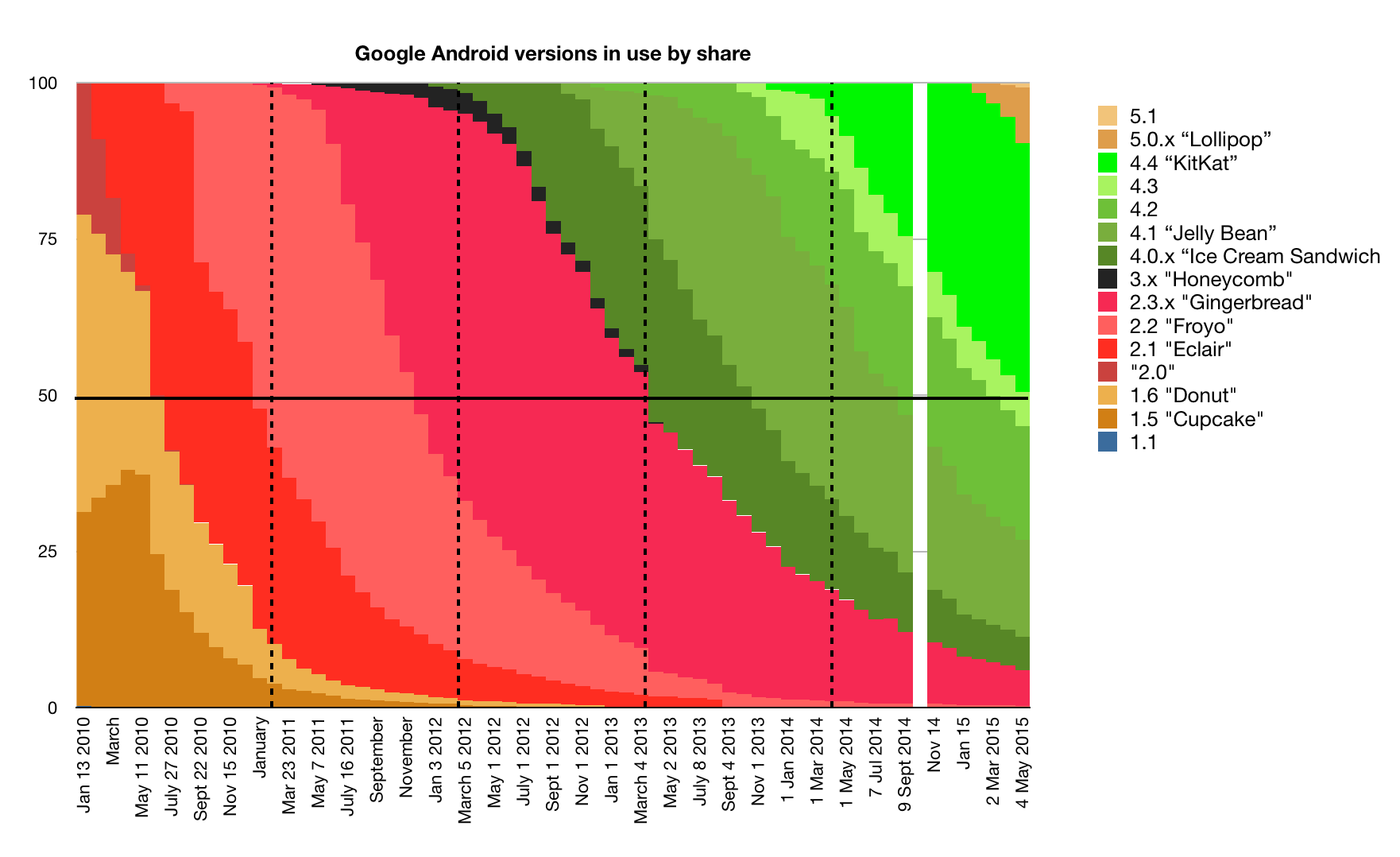
Is that a good or bad figure? I’ve no idea, to be honest. (If you assume 1.2bn Google Android phones in use, with Android Wear working on everything from 4.3 upwards, which takes in 47.6% of Android phones, then you have a potential addressable market of over 570m phones. (If you take it as 1bn Google Android phones, then it’s an addressable market of 476m.)

The much more important question – which I don’t know how you measure – is how many are still being used. Abandonment of wearables has been quite high, at around a third of all users.

Update: at the suggestion of @jasonostrander on Twitter, one might get an idea of the split of use via watchface downloads. There’s a ton of them, and people seem to have downloaded at least two each.

Start up: Apple squeezes leakers, Google pushes health, Samsung exiting Japan?, tablet puzzles, and more


Yes, human, I’m registering how you kicked me on that icy day in the parking lot. Let’s see how you like it in a few years.

A selection of 10 links for you. Spread to taste. I’m charlesarthur on Twitter. Observations and links welcome.

Apple threatens to ban iPhone, iPad accessory makers that design based on leaks » 9to5Mac

Jordan Kahn:

Apple is working to step up the secrecy surrounding future iPhone and iPad models by targeting a frequent source of leaks: third-party accessory makers. 9to5Mac has learned that in fall 2014, just before the iPhone 6 launched, Apple demanded that a number of leading accessory makers sign agreements barring them from seeking out information about future Apple devices, according to four sources with first-hand knowledge of the matter.

On one hand, the agreement dangled the loss of “future business opportunities that Apple and/or its affiliates may present to you” as a potential consequence of violating or not signing the agreement.

Ah. This would explain why, when I was interviewing companies for my piece about the size of the iPhone accessory market after its launch, they were very quick to deny any suggestion that they based their designs on leaked prototypes – even though there seemed no other explanation.


Introducing Spot » YouTube

Boston Dynamics (owned by Google) shows off its quadruped robot, Spot (in the video at the top of the post). Notable how the back legs have the same hinging mechanism as horses and other quadrupeds – though the front ones do too. And it can withstand being kicked and keep its balance on icy ground.

Scary. Imagine one of these chasing you over open ground or through a forest.


A remedy for your health-related questions: health info in the Knowledge Graph » Official Google Blog

Product manager Prem Ramaswami:

this stuff really matters: one in 20 Google searches are for health-related information. And you should find the health information you need more quickly and easily.

So starting in the next few days, when you ask Google about common health conditions, you’ll start getting relevant medical facts right up front from the Knowledge Graph. We’ll show you typical symptoms and treatments, as well as details on how common the condition is — whether it’s critical, if it’s contagious, what ages it affects, and more. For some conditions you’ll also see high-quality illustrations from licensed medical illustrators. Once you get this basic info from Google, you should find it easier to do more research on other sites around the web, or know what questions to ask your doctor.

We worked with a team of medical doctors (led by our own Dr. Kapil Parakh, M.D., MPH, Ph.D.) to carefully compile, curate, and review this information. All of the gathered facts represent real-life clinical knowledge from these doctors and high-quality medical sources across the web, and the information has been checked by medical doctors at Google and the Mayo Clinic for accuracy.

That doesn’t mean these search results are intended as medical advice.

If I were a family doctor, I think I’d read this with a sense of foreboding, in the expectation of seeing many more hypochondriac patients quite soon.


Chinese hackers attack blue-chip groups via Forbes website » FT.com

Sam Jones and Hannah Kuchler, in a piece that is basically a roundup of “who got hacked today” (also separately including Twitter’s CFO and Newsweek’s Twitter account):

Visitors to Forbes who worked for defence companies and banks were those who were subsequently targeted most, Mr McBride said.

“An attacker would choose to use a major publisher because it is a legitimate website that earns the trust of users who visit on a regular basis with confidence,” said Oren Falkowitz, a former NSA employee who runs Area 1 Security, another cyber security firm. “What they want is a platform with a large audience so they can get the users that they want in that pool and then be very discriminating about who they want to go to the next stage with.”

The attack was launched through Forbes’ “thought for the day” pop-up screen that welcomes visitors to the site and is run using Adobe software.

Codoso, the Chinese hacking group, was able to exploit the pop-up because of a loophole they had discovered in Adobe’s software. A second loophole then enabled them to bypass security on Microsoft operating systems that would ordinarily have blocked the attack.

I’ve never had Flash on my phone, and I’ve removed it from my laptop. Its only real purpose now is as an avenue for malware.


Samsung considers withdrawing smartphone business from Japan » BusinessKorea

Jung Suk-yee:

Samsung Electronics chose Japan as the first country in which to release the Galaxy Note Edge in October 2014, where YOUM technology was used on both sides of the phone. The company made its bid to increase its share of the Japanese market, the world’s largest premium market, through the new model. However, the results were not good. 

According to industry sources on Feb. 9, Samsung is in a quandary over its struggling smartphone business in Japan. Some in the company are reportedly saying that continuing the business only causes losses rather than profits. 

The Korean tech giant accounted for 4% of the Japanese smartphone market as of December of last year, which put the firm in 6th place. Samsung was kept out of the top 5 for two years, and its share decreased from 17% to 4%. 

Apple topped the list, and Sony and Sharp followed. The Galaxy Note Edge only sold tens of thousands of units for four months after its launch.

Not clear if those tens of thousands of sales are for Japan, or worldwide. But it feels like it makes sense to withdraw from a market that only causes you pain and loss. Samsung already pulled out of the TV business in Japan back in 2007 – and that hasn’t hurt its position as the biggest TV maker in the world.

But it’s getting into the withdrawing habit a bit. Pulled out of PCs in Europe.. smartphones in Japan.. what next?


About that UK digital biz renaissance? Not so fast » The Register

Marcus Gibson:

The Tech City quango last week claimed to conduct the “first national” survey of the UK’s digital businesses, covering 2,000 companies, according to a report in the Financial Times. The quango’s survey drew on a youthful database firm DueDil, run by US-born, Groton-educated Damian Kimmelman, and it makes a number of questionable methodological assumptions.

Although Kimmelman does not list it as a source, the report appears to be based on the number of new companies being registered at Companies House. This is a dangerous move, and one that is avoided by experienced trend-watchers. Why? Many firms give the address of their accountant or lawyer, or the owner’s home address – not their office address. (The Register is based in London, but its administrative address for Companies House purposes is in Southport).

Secondly, tens of thousands of foreign-born individuals have registered themselves as companies in order to buy UK homes and avoid stamp duty. DueDil’s own survey of immigrant-founded startups a few years ago listed more than 600 new firms in the Reading-Bracknell area started by German nationals – though we couldn’t find any evidence of any dramatic surge in new companies there. It makes geographic surveys hazardous if not impossible.

Bear this in mind for the next time you’re told there’s “documentary evidence” of London being a super-amazing explosive site for tech company creation. It might be, but this isn’t the proof that’s needed.


Cyanogen tapping tech giants to build war chest for a non-Google Android » Re/code

Ina Fried:

Beyond who ends up signing up for the round, Cyanogen’s valuation is significant, especially for a company that has yet to show how it can make significant revenue from its efforts. As with Google’s flavor of Android, the core of Cyanogen’s offering — CyanogenMod — is free and open source. Cyanogen the company, meanwhile, could make money by bundling other services and software on top of the open source core.

In theory, it could put together a flavor of Android that bundled together services from, say, Amazon, Facebook and Microsoft, in much the same way the Google version of Android bundles YouTube, Chrome, Gmail and the Google Play store, among other services.

The company’s most significant deal is one to provide its software on phones sold by India’s Micromax. It has also made a number of high-profile hires in the last year as it expands both its technical and business ranks.

I wonder if Google is at all worried by this. The Micromax deal is important, because that’s now the largest smartphone OEM in India.


The rumoured Google MVNO: what’s likely & unlikely? » Disruptive Wireless

Dean Bubley on “those rumours”, which he mostly downplays:

One possibility for Google could be a unique form of pricing rather than standard “monthly plans” – perhaps part-subsidised by itself or others, perhaps customised on a per-user basis. (My idea from a couple of years ago was insurance-style pricing for mobile data). A “freemium” model could also work. This could be adjusted based on the balance of WiFi vs. cellular access, whether the user tended to consume advertising-rich apps, and so on. 

All that said, unless this is just another Google small-scale experiment, it would be extremely tough for it to scale to millions or tens of millions of users, without huge investments in sales and support infrastructure.

Instead, perhaps a likelier option is that this is – like Apple’s SIM – a tablet-oriented service rather than a smartphone-based one. This gets around two problems – firstly, it doesn’t need a conventional numbered “phone service”, and secondly it can be pitched to the operator partners as a way of adding extra cellular devices to the market, rather than competing for market share of existing ones. Data-only connections also don’t come with lots of the traditional perceptual baggage of being a “monthly plan”.

Remember how excited everyone got over the Apple SIM? Notice how it’s had virtually zero impact? And take note of Bubley’s “what not to expect” list (which is long).


TurboTax temporarily suspends e-filings on fraud concerns » WSJ

The largest online tax-software company in the U.S. temporarily halted electronic filing of all state returns after more than a dozen states spotted criminal attempts to obtain refunds through its systems.

Intuit Inc., based in Mountain View, Calif., said Friday that its TurboTax unit stopped transmitting state e-filing tax returns Thursday after seeing attempts to use stolen personal information to file fraudulent returns for tax refunds.

Intuit wasn’t hacked, but there have been so many breaches of systems that US usernames and passwords are easy to come by – they’re like air for criminals.


Tablet vendors taking new strategies to rekindle sales in 2015 » Digitimes

Apple’s shipments of iPad devices in 2014 also highlighted the falling momentum of tablets, said the sources, noting that shipments of iPad devices slid 14% on year to 63.4 million units in the year.

Additionally, consumers’ enthusiasm over iPad Air 2 and iPad mini 3 launched in October 2014 has not been strong, said the sources. Shipments of other tablets, including those from Xiaomi Technology and HTC (the Nexus 9) have also been lower than expected.

Apple’s strategy of launching the anticipated 12-inch iPad aims to create a new application market to revive the declining trend, the sources commented.

Notebook vendors, including Asustek Computer, Acer and Lenovo, are expected to reduce their R&D projects for tablets although they will continue to roll out tablets in order to maintain their bargaining chips for the purchase of related parts and components, as well as their brand images, said the sources.

I’ve heard from an industry source that HTC shipped fewer than 100,000 Nexus 9s in the fourth quarter. I’d really love to see some stats for usage of Android tablets with Android apps (ie not YouTube or simple web browsing). I suspect it’s really low despite how well Android tablets sell.)


Start up: the internet of advertising things, (more) smartphone profits, Left Shark attack!, the death of good sound, and more


Hello and welcome to the Internet Of Things That Advertise To You! Photo by Justin in SD on Flickr.

A selection of 8 links for you. Contains heavy metals. I’m charlesarthur on Twitter. Observations and links welcome.

Intimate data will be key to the Internet of Things » Advertising Age

Tom Goodwin:

The first change comes from data. If we’re wearing watches, clever clothes and using sentient spoons, our heartbeat, moods, location, stress levels, calendars and search activity are all being recorded, shared and analyzed. If we circumvent for now the obvious privacy concerns, we’re armed with the best data we’ve ever had. Forget big data. When you have intimate data, little else seems important.

If we assume that programmatic is about buying against audiences, not channels, the next stage will be about buying people at a moment in time — buying micro-moments to serve hyper-relevant personal ads. If we go even further and assume that this information layer makes suggestions, the ads of the future may be promoted routes in our cars, notifications on our smartphones that it’s about to rain and an Uber is close, or money-off codes for holiday resorts when sensors on our smartphones detect we’re getting stressed.

Ugh. Ugh ugh ugh. Not Wanted On Voyage. (My take on the Internet of Things: security will be the real bugbear.)


Left Shark printer chomps on Katy Perry’s copyright claim » Gigaom

Jeff John Roberts on how Katy Perry’s lawyer tried to block the 3D printing of left shark (who didn’t do what s/he oughta at the Super Bowl halftime show):

3D Left Shark is now available once again, along with some new 3D friends. In a blog post announcing his legal pushback, Sosa wrote:

I’m also resuming the sale of this 3D printed full color desk figurine at a different store front Etsy.com/shop/amznfx along with a couple other characters which include a drunk shark, pink drunk shark, and right shark.

So that’s where we stand. Your move, Katy.

Perry’s lawyer, Steve Plinio of Greenberg Traurig, did not immediately reply to a request for comment, but he appears to face an uphill swim.

As Sosa points out to Plinio in a public letter, the copyright claim suffers from two big flaws: 1) Perry doesn’t appear to own any rights in Left Shark; 2) there may not be any intellectual property rights at all, since costumes can’t usually be copyrighted.

Monetising this shark stuff seems promising. For a suitable amount, I’m prepared to vouch that you were the shark on the right, not the left.


Vertical integration of design and post-pcs » iLike.code

Nat Brown looks back at his time at Microsoft, while looking around at what’s happening in smartphones:

We were helping key [Windows PC] OEMs prototype different special-purpose uses for the Windows operating system which could be sold with new high-volume consumer products under a lower licensing cost to hit the <$300 retail price point. (This effort and some of our prototyping was one contributor to the initial XBox.) I was fascinated to learn details about how much PC OEM’s had outsourced manufacturing (and some forms of the hard intellectual property design) to foreign white-label manufacturers. Some small players had literally outsourced everything but their logo, their sales staff, and their direct-mailing lists. It was clear even then that they were not differentiable and fully doomed. Others, like Dell, were still doing final customer-specific options assembly and industrial/mechanical (particularly pluggable component) design but were no longer designing much of their printed circuit boards (PCBs). The more I learned the more this seemed like a difficult-to-defend position without unique software capabilities to differentiate the clearly commodity hardware. PC OEM’s had no brand-exclusive content.

This has broader ramifications, as he explains, in the smartphone business.


Tablet magazine starts charging commenters » Capital New York

Nicole Levy:

As a number of news sites eliminate their comments sections altogether, Tablet, a daily online magazine of Jewish news and culture, is introducing a new policy charging its readers to comment on articles.

As of today, a reader visiting the nonprofit site that is otherwise paywall-free will have to pay at least $2 to leave a comment at the foot of any story. The move is not part of a plan to generate any significant revenue, but rather to try and change the tone of its comments section.

Tablet has set up commenting charges of $2 a day, $18 a month and $180 a year, because “the Internet, for all of its wonders, poses challenges to civilized and constructive discussion, allowing vocal—and, often, anonymous—minorities to drag it down with invective (and worse),” editor in chief Alana Newhouse wrote in a post published today.

Metafilter has had a version of this policy in place for years (a one-off charge, but similar). Certainly, though, it’s a clear implementation of my exposition of the economic theory around leaving comments: you have to make them valuable in some way to the commenter to attract the valuable commenters and deter the bad. Attaching monetary value to the act is smart, though of course it demarcates not by the value of the comment itself, but the disposable income of the commenter.


Apple has 93% of mobile profits; 650M users by 2018, says Canaccord » Tech Trader Daily

Tiernan Ray:

Canaccord Genuity’s Mike Walkley this morning raises his price target on shares of Apple to $145 from $135, writing that his review of market data suggests continued strength for the iPhone 6 upgrade cycle.

Walkley writes that his assessment of vendor data in smartphones suggests, whose shares he rates a Buy, captured 93% of industry profits in Q4.

Apple may have one third of all users of smartphones by the end of 2018, he reckons:

We believe the strong iPhone 6 replacement sales should continue during C’15, as we estimate only 15% of the current estimated 404m iPhone installed base has upgraded to the new devices. We also anticipate continued strong share gains for the larger screen iPhones from high-tier Android smartphones during C’15 driving strong growth in the iPhone installed base and model the iPhone installed base growing to 487m subscribers exiting C’15 up 20% Y/Y. Longer term, we anticipate a gradually moderating rate of growth for the installed base from C’16 through C’18 and estimate 650M iPhone users exiting C’18. We note this base would only represent 1/3rd of an estimated 1.82B global premium smartphone subscribers anticipated by C’18. Finally, we anticipate steady long-term iPhone replacement sales within this growing iPhone installed base, and we believe this combined with our modest installed base growth expectations position Apple for steady sales of roughly 210m-215m iPhone units annually between C2015 to C2018.

Walkley offers the following infographic to show Apple scooping up the vast majority of profit in mobile in Q4, while Samsung Electronics has a minority of profit and all others operate at no profit or at a negative margin.

Not quite “one third of all smartphone users”; one-third of premium smartphone users. There are probably already over 2bn smartphone users. By 2018, that will probably have more than doubled.

It all tallies rather closely with my analysis of high-end Android profitability. Unsurprising, since we’re working off the same publicly available data.


Commission guide: Competition ‘enforcement’ key to supporting growth » The EU Parliament Magazine

Desmond Hilton-Beales:

Many in Europe are looking to the landmark Google antitrust case which [EC Competition Commissioner Margrethe] Vestager inherited from her predecessor Joaquín Almunia, who reopened the investigation during the final months of the Barroso II commission. The Danish official won’t be drawn on the details of the case, but instead issues a call for clarity. “Many concerns are raised about Google’s conduct, only some of which relate to competition policy,” she stresses.

“It is therefore very important to define clearly what is for competition policy and what may be more appropriately considered under other policy areas. The case before us is very important in today’s digital economy, and it attracts much interest. As such, we have a duty to fairly enforce our competition rules on the basis of the legal framework. What is critical for me therefore is to do so in an objective way and on the basis of the facts before us.”

Expect things to hot up on the Google-EC front over the next couple of months. There’s some murmuring about a Statement of Objections – a sort of EC version of “shots fired”.


Is audio quality a thing of the past? » TVTechnology:

Jay Yeary:

Jim Anderson, multiple-Grammy winner and jazz recording engineer extraordinaire, was teaching the class on critical-listening that day, discussing frequency ranges of instruments, ear training, and getting the participating high school and college students to concentrate and understand what they were hearing. Toward the end of the class, Anderson would play samples of work he had recorded in the studio to compare original mixes against compressed versions of the same songs.

It was a truly glorious experience to hear a well-recorded, high-quality, uncompressed mix from a professional studio, crafted by a masterful engineer.

Everyone in the room listened intently as the versions were played and when Anderson asked the students which they preferred, I naturally assumed everyone would choose the original. To my utter horror, many preferred the lower bit-rate compressed version. While some of the compressed files sounded quite good, others were lacking upper harmonic content and had a collapsed soundfield compared to the original.

As I discussed this experience with other engineers present at the event we pondered whether the students had ever heard real instruments or whether they were so accustomed to modified and effected sounds that that was now their preference. It also left me wondering if anyone cares about quality anymore and whether it has been displaced by convenience.

Convenience trumps a lot of things. High-quality audio is a great pleasure, but few people have the time or money to experience it. (Vinyl is definitely not a high-quality audio experience.)


Google risks legal action over ‘right to be forgotten’ report » FT.com

Murad Ahmed, Richard Waters and Duncan Robinson:

Google could face legal action after Europe’s privacy watchdogs rejected the conclusions of an independent group of experts that largely backed the internet company’s implementation of the “right to be forgotten” law online.

Last year, Google convened a group of experts to advise it on how to apply last year’s ruling by Europe’s highest court, giving citizens the right to ask internet search engines to remove embarrassing results related to them.

The company’s “advisory council”, which is made up of eight independent experts and two Google executives, chief legal officer David Drummond and chairman Eric Schmidt, released its conclusions on Thursday. It said the company could continue its policy of stripping sensitive links only from European versions of its search engine, meaning that links expunged from Google’s French, German or British sites do not need be stripped from Google.com.

It’s fun to read the council members’ reactions to their own report: some seem to disagree with it quite a bit (which raises the question of quite how it got written as it has). Jimmy Wales in particular comes across as someone who hates the sort of nuance that the original ruling employs. (For my take on the different attitudes of the US and Europe to the ruling, see “the newest shibboleth”.)

I do like the suggestion that the ruling should be called “The right to be unlinked”. That’s a much better description than “forgotten”, because the key point about the ruling is that the original data remains exactly where it always was.


Android OEM profitability, and the most surprising number from Q4’s smartphone market

I’ll admit – I’m surprised myself by how low the profitability even of “high-end” Android OEMs is. I hadn’t investigated it in detail until I wrote this post.

The end of 2014’s fourth calendar quarter, and hence year, brought forth a blizzard of data about the mobile and the smartphone markets. The mobile market (so including featurephones) passed the 500m mark for the quarter, according to Counterpoint. The smartphone chunk is growing as a proportion of that faster than ever: in Q4 it made up about 75% of sales.

As a proportion, smartphone sales are rising healthily:

Smartphones are a growing proportion of all mobile phone sales

Smartphones are a growing proportion of all mobile phone sales

That compares with a 58% smartphone mix in 4Q 2013. Even so, I don’t expect the 90% mark to be hit before 1Q 2018 (yes, 2018), on the assumption their sales rise as a diffusion curve.

If the proportion continues at about a 3% increase in smartphone share per quarter (as happened roughly in 2014), smartphones will be 90% of sales in 1Q 2016 – just a year away – and 95% in 3Q 2016. By then, effectively all the market is smartphones.

Apple’s enormous sales – 74.5m units shifted – attracted lots of the attention. It ended the quarter with less inventory in the channel than at the start, suggesting that sell-through (ie the number bought by people) was actually higher.

But the really surprising figure – the one that had me firing off emails asking for more detail – came not from Apple, nor any individual company, but from ABI Research. Its headline: “Android Smartphone Shipments Fall for the First Time”.

Android shipments fell in Q4 2014, ABI says

This is surprising: Android shipments have never fallen from quarter to quarter before

Wow. I mean, truly wow. As it says, that’s never happened before. Android shipments have always increased from quarter to quarter, both for “Google Android” and AOSP, since the platform’s first phone. (Unlike pretty much every other research company, ABI also breaks its Android figures down into “Google Android” – ie Google Mobile Services certified, carrying all Google’s services – and “AOSP” – principally, China.)

Yet here ABI is, saying G-Android shipments fell by 11.9m, and AOSP by 0.47m, a total of 12.4m. That’s quite a lot more than a margin of error.

Objection!
Now, you could object right away. There are lots and lots of research companies to choose from, and all are pushing their own datasets, and all diss each others’ datasets in more or less subtle ways. There’s IDC, Gartner, Counterpoint, ABI, Strategy Analytics, Canalys, CCS Insight, Kantar, and more. Couldn’t ABI be wrong?

It could. But then you also have the numbers that come from the companies themselves. Samsung helpfully said that in the fourth quarter it shipped a total of 95m mobile phones (ie featurephones and smartphones) – and that smartphones were in the “high 70 percent” range.

So… how high in that 70s exactly? Because if it wasn’t in the 78.5% or above range, it was less than Apple. But Samsung wouldn’t want to admit that. Sony also reported numbers, as did LG, and Lenovo. LG’s numbers fell from 3Q to 4Q, Sony’s grew, Samsung’s fell, Lenovo’s and Motorola’s both fell independently. Together, they lost 6.5m sales from 3Q to 4Q, at a time when you’d expect sales to rise.

Let Jeff Orr of ABI Research explain it in a bit more detail.

“China was definitely the lead influencer in the OS share change during 4Q’14. ABI will be a lot more precise once the final vendor tallies are announced and tallied.

“Thinking about Apple’s financial call, Tim Cook highlighted exceptional iPhone growth in the US (up 44% QoQ) and BRIC [Brazil, Russia, India, China] region (up 97% QoQ), adding that China was the company’s second largest iPhone customer for the quarter and that Singapore and Brazil also saw significant increases (though these last two were not given any numbers).

“Apple also noted the amount of Android-to-iPhone switching it observed in the quarter. Given Apple’s premium price points in the smartphone world, one has to believe that switching impacted a subset of all Android handset makers that would be comparable in ASP to iPhone (or at least within a similar pricing tier). Again, it’s too early to name names here just yet, but you can probably guess the likely Android vendor names to put in that bucket.”

The competitors
Basically, it’s the big companies that compete directly with Apple – so Samsung, Sony, LG, HTC – and to a lesser extent Chinese companies such as Lenovo and perhaps (though it’s not certain) Xiaomi, whose shipments fell from the third to the fourth quarter.

Apple stole customers who might otherwise have bought Android phones away from those makers, and that helped cause a fall in sales.

How many iPhone users upgraded?
Note Cook’s comments on the earnings call about how many of the existing iPhone base upgraded to the iPhone 6 and 6 Plus: he put it in the “low to mid teens percent of the existing base” (these chief executives and their vague percentages, eh?). So how many is that?

Assuming a 400m iPhone base before the fourth quarter, and 13% upgrading to the 6/6 Plus (the minimum possible): 52m iPhones.

Assuming a 440m iPhone base, and 15% upgrading: 66m.

So if you subtract those from the sales figures, you get between 8.5m and 22.5m who were new to the iPhone – either upgrading from a featurephone, or coming over from Android.

Split the difference and you get 15.5m. That’s surprisingly close to the 12.4m figure earlier of “missing” Android sales from ABI Research; and you’d also expect that there would be sales growth from the third to the fourth quarter, which is the largest by volume of the year. Perhaps up to.. 15.5m more phones? (Update: Canaccord puts the user base at 404m, and the upgrade percentage at 15%, which gives 60.6m upgrades, and so 14.4m upgrading a featurephone or coming from Android.) (Second update: Mav, in the comments, points out that the total iPhone 6/6 Plus sales includes those sold in the third calendar quarter, at the end of September when they went on sale. That means an extra 10m and more sales of the iPhone 6/6 Plus. So it’s a very substantial landgrab from featurephones and Android.)

So it looks like Apple actually skimmed off some of Android’s growth in the fourth quarter. What’s worse for the Android OEMs is that Apple tends to grab two classes of customers: the loyal ones (who just keep buying Apple stuff – see how the majority of buyers were loyal ones here), and the high-paying ones, especially in China and the west, where its brand is able to command a premium price. Then it converts those high-paying customers into loyal ones.

That’s notable from Samsung’s apparent mobile ASP (average selling price – what it gets from carriers and wholesalers), which dipped badly in Q3 and came back only slightly in Q4, helped by the Galaxy Note 4. Even that couldn’t help against Apple’s iPhone 6 Plus – note how Apple’s ASP rose while Samsung’s fell in Q4.

iPhone v Samsung average selling price

Figures for Samsung ignore revenues from featurephones, which are comparatively tiny compared to its smartphone revenues

Samsung’s smartphone shipments are reckoned to have fallen from 78.5m in the third quarter – to (if we’re generous) 74.5m, equal to Apple, in the fourth. That’s down from 82m a year before (a 9% fall).

The value trap, Android version
Let’s be clear: I think Android is a boon to the world; quite possibly it’s the best invention of this century so far. (I’ve said as much many times, but some people find this hard to understand.) It’s a great thing that people who previously couldn’t get internet access at all can now get a cheap handheld device capable of running apps that can provide all sorts of information, and use far less power and are far more portable than a PC. Smartphones put power in the palm of your hand; and Android is the OS of choice for that.

However, for handset manufacturers, Android isn’t such a boon. Take a look at the operating profit and margins for the top-end Android OEMs. (I use operating profit rather than gross profit because it takes into account the costs of actually competing in the market through marketing, R+D and so on – not just what you take over the counter).

I’ve estimated HTC’s shipments at 6m, based on Sony and LG’s revenues and shipment numbers (it comes out between 5m and 7m, depending which you use).

Top-end Android handset revenue and profits, compared to Apple

OEM Handset revenue US$ (approx) Operating profit US$m Operating margin % handsets shipped Implied ASP per phone Implied profit per phone
HTC $1.6bn $6m 0.38% 6m *est $266 $1
Sony $3.6bn $79m 2.2% 11.9m $305 $6.64
LG $3.45bn $74m 1.8% 15.65m $220 $4.72
Lenovo (inc Motorola) $3.39bn -$89m -2.6% 24.7m $137 -$3.13
Samsung $22.8bn $1,790m 10.0% 74.5m $306 $24.02
Total
for Android
$34.84bn $1.86bn 5.3% 132.75m $262 $14.01
Apple $51.2bn $14.3bn
(at 28% margin)
28% (est) 74.5m $687
(actual)
$191.9

Note that these are rough-and-ready figures. Here are a few of the caveats.
• For Sony, Lenovo and Samsung I haven’t accounted for tablet sales, which in Samsung’s case were 11m at an unknown ASP; for Lenovo tablet numbers weren’t stated (though it puts them at 4.8% worldwide, which would be 3.6m out of 76.1m). I haven’t even tried to estimate them for HTC, which in its financial report on Q4 doesn’t even mention the Nexus 9 it made for Google which went on sale in Q4.

• The Samsung figures overstate smartphone revenues, because they ignore the 20m or so featurephones which will have had an ASP of around $15 and unknown profit. Samsung’s mobile profits have risen in line with its smartphone shipments, so we can reason that its featurephones have less profit than smartphones; so ignoring their revenue and assigning their profits to smartphones is generous, but not madly so. Also, Samsung’s profit figure is for its “IM” division, which includes PCs, of which it sells a few million per quarter but probably doesn’t get much more than $10-20 of operating profit per sale.

• ASPs are thus approximate, and so are profit estimates: tablets might be money losers, depressing the apparent profitability of the handset business. But what all these companies except Samsung have in common is that their handset businesses have lost, or are losing, money. So these probably aren’t that far off; tablets might be less profitable, but there are fewer of them to spoil the numbers.

• These are only top-end Android phone makers. There is a ton of others: ABI reckons there were a total of 303m G-Android and AOSP phones shipped in the quarter, so more than half of those aren’t accounted for in this total. Many of them are cheaper (Huawei, ZTE, Coolpad, Micromax come to mind) and ship in volume. Being cheaper, they’re unlikely to make a lot more profit, and since they don’t appear in the top five, they probably don’t make much difference to these figures except downwards in ASP and per-handset profit.

• Apple gives the number of phones shipped and total revenues (so you can calculate ASP) but doesn’t break out the operating profit of its divisions; analysts make estimates. I got the 28% operating profit figure from this 2013 analysis by Canaccord. Update: for 4Q 2014, Canaccord puts iPhone operating profit at 38%, which is colossal, and would make that table look even more lopsided. (Canaccord reckons Apple has 79% of mobile profits, and Samsung 25%; the others have between 0% and 1%, if they’re profitable.)

So what does this tell us?
That 2013 Cannacord estimate isn’t the most recent but things are unlikely to have shifted far – and even if they’ve moved by a few percentage points, it still doesn’t change the overall picture. Apple makes a ton of profit per phone, and top-end Android OEMs generally don’t. (Motorola has been a basket case for years, and dragged down Lenovo’s figures; see Jan Dawson’s analysis of how that’s affected the mobile bottom line.)

You can argue – and lots of people do – that Apple is therefore “charging too much for the iPhone, and it should cut the price so that more people would buy it”. This is superficially attractive logic to people who (a) aren’t running a business and (b) can’t think long-term.

For Apple, the cash it rakes in is used to reinvest in factory and supply contracts in ventures for forthcoming products. If it didn’t have that surplus cash, it couldn’t buy fingerprint reader companies, lock up supplies of camera sensors, guarantee enough factory production to make 74.5m phones, fund machinery to diamond mill the sides of phones, and pay forward for whatever it’s going to do over the next two, five, ten years.

(But what about that cash mountain? Well, lots of that is profits earned abroad that Apple doesn’t want to repatriate to the US, because that would attract a high rate of interest tax, so it leaves it sitting in Ireland and reinvests it in those things as above.)

By contrast, the Android OEMs whose phone divisions are living hand-to-mouth on those incredibly slim margins can’t afford to reinvest. They’re essentially at the mercy of the rest of the smartphone and component ecosystem.

For example, they can implement a fingerprint scanner (HTC and Samsung have) but it’s incomplete; HTC didn’t use it across all its models and it wasn’t part of a payment system – as Apple Pay is, carefully planned over a two-year arc. Similarly, 64-bit Android hasn’t happened to any appreciable extent, and while you can argue about whether 64-bit makes a difference (these ARM engineers reckon it does, and explain why), Apple is still a mile ahead of the rest in implementing it. Lots of Android has to move at the pace of the slowest part of the hardware ecosystem, much of which is 32-bit.

Note that three of the four top-line OEMs are part of large conglomerates which collectively make everything from camera sensors to games consoles to TVs to washing machines to memory chips. That means the smartphone divisions are effectively a bit of icing on the main, hopefully profitable, other parts of the business, and also that they can bear quite sizeable losses for a while (LG and Sony have). For Samsung, mobile enjoyed a spell in the sun; now the chip business has become dominant again. HTC’s survival is anomalous, but somehow heartening.

High-end Android – trying to compete with Apple, especially in the fourth and first quarters (because the latter is a gift-giving time in China particularly) – is becoming a rich man’s game, with low returns. Nor are these ASPs and profits for the fourth quarter unusual; tracking them over time you see similar figures. LG’s average smartphone operating margin for the past 8 quarters is 1.3%; for HTC it’s -1.4%; for Sony it’s a few percent.

In fact, they’re all caught in the “value trap” that I wrote about a while back for the PC market: because they don’t control the software, there’s little chance to differentiate. These companies are vulnerable to customers who choose simply on price. That means only those who can manufacture at scale or compete locally can benefit.

So what’s do we conclude?
• Android will continue to be gigantic. For local OEMs in countries like India and China, it offers huge opportunities for scale

• high-end Android handset makers will keep struggling, against Apple and notably against Samsung – which is meanwhile struggling with the aforementioned local OEMs (which eat into its low-ASP base) and Apple, which is stealing its top-end customers

• there’s little opportunity even for high-end Android OEMs to invest and innovate, because it’s not profitable enough. Only Samsung is an exception, because it’s part of a gigantic conglomerate. All are weak in software, and there’s no sign of that changing.

The giant in the niche

Apple's share of the overall mobile market

A niche player? Apple’s share of the overall mobile market (including featurephones) is at 10% for the past year, and 15% in the past quarter.

Apple’s a niche player – if that’s what you want to call the largest smartphone OEM – but it’s the most valuable niche, and also the one that lets it decide what people view as “valuable” in a phone. (For example, waterproofing hasn’t helped the Sony Xperia range or the Galaxy S5 sell, despite being a distinction compared to the iPhone range. Having a fingerprint sensor apparently has helped the iPhone 5S onwards.)

If Apple has the most valuable and the most loyal customers (and especially if it gets the most loyal valuable customers) then that means it can continue to expand its ecosystem, continue to charge a premium, continue to make big profits, continue to buy up companies that rivals had their eyes on, aim to undercut others in the services it offers.

Skimming off the top end gives Apple huge leverage. Ben Bajarin reckons Apple has about 60% to 70% of the “premium” market. On the basis of that 400m-440m user base (and don’t forget another 100m iPads and some iPod Touches too, though probably with a lot of overlap), that suggests there’s a total premium market worldwide of about 750m smartphone users worldwide. If Apple keeps pulling in 10m or so of them every quarter, it’s going to be a monster.

Update: Canaccord’s latest February 2015 calculation (which appeared the day I published this) reckons it will reach 650m by the end of 2018 – though it thinks that will be only a third of a global premium audience of 1.8bn. Android’s got plenty of room to grow. But so, it seems, has Apple.

Start up: TSMC/Samsung chip intrigue, emoticon overcharging, is that William Shatner?, going broke with encryption


Alternate Perspectives: photo by Randy Scott Slavin. Source: Dezeen

A selection of 10 links for you. Keep away from children. I’m charlesarthur on Twitter. Observations and links welcome.

Alternate perspectives by Randy Scott Slavin » Dezeen

New York photographer Randy Scott Slavin has joined hundreds of photographs to create distorted views of American cities and landscapes (+ slideshow).

Named Alternate Perspectives, the images present a series of panoramic views that curve around to form impossible circles.

Places depicted include the Empire State Building and Battery Park in New York, as well the region of Big Sur and the Redwood National Park in California.

As I wrongly retweeted (since deleted) a claim that one of these photographs was “a panorama produced by rolling down a hill”, it seems worth linking to this amazing set. Fabulous imagination required just to create them. (An example at the top of this post.)


What my hearing aid taught me about the future of wearables » The Atlantic

Ryan Budish:

despite initial appearances, both medical and consumer wearables share a few important goals.

Broadly speaking, both types of wearables aim to fill gaps in human capacity. As Sara Hendren aptly put it, “all technology is assistive technology.” While medical devices fill gaps created by disability or illness, consumer wearables fill gaps created by being human. For example, evolution hasn’t given us brain wi-fi, yet.

Both kinds of wearables also need to justify being attached to our bodies. This seems pretty obvious for hearing aids, but it is just as true for consumer devices. A wearable that serves as only a slightly more convenient screen for your phone is hardly reason for the average person to spend hundreds of dollars. Instead, wearables need to offer a feature that works best when in close contact with your body, like measuring heart rate or offering haptic feedback.

Also, both types of wearables need to embed themselves seamlessly into our experiences. If a wearable obstructs your experience of the real world, or is a distraction, it’s likely to end up on a shelf instead of your wrist.

There are other lessons too.


Did chip espionage, IP theft give Samsung its 14nm manufacturing lead? » ExtremeTech

TSMC argues that a former employee, Liang Mong-song, gave Samsung critical information to help it leapfrog TSMC in making its 14/16 nanometre gate process, breaking a non-compete agreement. In 2011 Liang had already been found guilty of breaching that condition:

The judge in Liang’s case clearly felt that the engineer had engaged in a bad-faith breach of his non-compete agreement given that he was forbidden to work for Samsung for an additional period of months, but the punishment was a slap on the wrist compared to the potential damage to TSMC’s core business. According to Maybank’s Kim Eng:

When comparing to a full-node migration, ie 20nm to 14nm at Samsung and Intel, TSMC’s half-node approach 16nm underperformed in cost reduction (by as much as 25% if not higher), power consumption and performance. In a very rare case, intel infamously highlighted the potential risks of TSMC’s 16nm undertaking during its Nov-13 investors’ day. After the initial round of evaluation, many customers “strongly encouraged” TSMC to enhance its 16nm technology offering.

In other words, not only did Liang possibly tap his knowledge of TSMC’s cutting-edge implementations inappropriately, he may have done so at the worst possible time (from TSMC’s perspective). Samsung has come out of nowhere to lead in foundry manufacturing, at least in the short term. Maybank’s latest report on TSMC cut the company from “Hold” to “Sell” on the strength of Samsung’s 14nm ramp. According to Liang himself, he left TSMC after he was passed over for promotion and felt his work was under-appreciated by his former employer.


Emoticons in texts can rack up huge bills » BBC News

Jane Wakefield:

The issue revolves around how the handset interprets the icons, known as emoticons or emojis.

In some cases, especially on older handsets, the emoticons are converted into MMS (multi-media service) messages, which can cost up to 40p each depending on the network.

MoneySavingExpert also found that, in some cases, users creating their own icons from full-stops, commas and brackets found they were converted into emoticons, running up the same charges.

“We have seen many complaints from our users who have racked up huge bills for sending what they thought were text messages,” Guy Anker, managing editor, told the BBC.

Paula Cochrane told the Daily Record that she had no idea that the emoticons were being charged as picture messages.

She complained to her provider EE and also plans to take her case to the Scottish ombudsman, an independent organisation that settles consumer complaints.

Amazing. But it’s the way that the carriers continue to rake in money; people on my Twitter feed have suffered this quite recently.


William Shatner: my problem with Twitter’s verified accounts » Mashable

Fantastic reporting by Lance Ulanoff, who actually took the trouble to try to contact Shatner, who had been grumbling on Twitter after Engadget’s social media manager got verified:

By the time I spoke to Shatner late Monday, he was upset that media outlets were misrepresenting his words. I offered to interview him to set the record straight. He agreed to answer questions sent via a Google Doc. What follows is unexpurgated Shatner on the controversy, Twitter, verification, TVTag, and how he uses social media.

Mashable: You’re one of the more digitally savvy celebrities/actors of your generation. What draws you to a medium like Twitter?

WS: I’m from the old studio system where there were departments of people that spoke on your behalf, giving the studio’s version of what I liked, what I do, what I like to eat, etc. So Twitter and social media is liberating for someone like me. I can speak my mind, my thoughts, my ideas and usually they don’t get filtered.

That may be a good thing or a bad thing! 😉

Shatner emerges from this as someone who has really thought deeply about what “verification” can and should mean, understands what social media is about, and is a charming and, especially, smart person. Read it and reflect.


Samsung: watch what you say in front of our TVs, they’re sending your words to third parties » Boing Boing

Part of the Samsung Smart TV EULA: “Please be aware that if your spoken words include personal or other sensitive information, that information will be among the data captured and transmitted to a third party through your use of Voice Recognition.”

This is part of their speech-recognition tech, which uses third parties (whose privacy policies Samsung doesn’t make any representations about) to turn your words into text.

I dunno. It’s lovely for those who want to believe that we’re living in a world of telescreens (and indeed for the NSA, GCHQ etc this might fit) but it’s not really the “privacy” aspect that’s a concern. It’s the potential for hackers to turn on your microphone and/or camera and record it that I’d find concerning.


What you can learn from Oakland’s raw ALPR data » Electronic Frontier Foundation

The EFF got the data about where and when the Oakland police department collected licence plate data (in a sort of passive surveillance; police cars capture the data using their cameras and the time and location is fed back). So what’s done with it?

We also filed a California Public Records Act request to obtain the Oakland Police Department’s crime data for the same period. Each white dot here indicates a recorded crime. It’s not much of a shocker that ALPR use doesn’t correlate very well with crime. For example, OPD did not use ALPR surveillance in the southeast part of Oakland nearly as much as in the north, west, and central parts of Oakland, even though there seems to be just as much crime.

To see if perhaps OPD was just focusing its ALPR use in areas with high incidents of automobile-related crime, we decided to map only the auto-related crime:

The result is the same—ALPRs are clearly not being used to deter automobile-related crimes.

The conclusion? A great big shrug. It seems like data being collected in order to collect data.


Could the HoloLens be Microsoft’s iMoment? » Gigaom

Ross Rubin:

The HoloLens, unlike the iPod, is an independent device, albeit one that extends Microsoft’s Windows franchise.

So, perhaps the HoloLens is more akin to the iPhone, which shrunk down the capabilities of not the user interface of the PC. Indeed, Microsoft has positioned the HoloLens as “the next PC” although the smartphone has already claimed that mantle and Windows 8 showed that the company can get a little overzealous in labelling things “PCs.”

Nope.


My first and last time at the Crunchies » Medium

Katie Jacobs Stanton:

At the Crunchies, comedian T.J. Miller, a star of the show “Silicon Valley” (which I watch and love), threw out a bunch of playful zingers in his opening act. But then at one point, he engaged with a woman (Gabi Holzwarth) a few rows in front of me by calling her a “bitch”. She responded increduously, “Did you just call me a bitch?” He then said, “Bitch, Asians aren’t supposed to be this entitled in the U.S. … Is this bitch from Palo Alto?” The audience laughed nervously. I was so uncomfortable I wanted to leave, but of course I couldn’t given that our award was coming up.

What a mess. Plenty of women didn’t enjoy it. Then again, it’s an awards ceremony at which Uber – you know, with a billion dollars in VC backing – won the award for “best startup”. And best hardware startup award winner was… GoPro, founded in 2002, which went public earlier this year.

Sure, it’s a networking event for Silicon Valley. But couldn’t they make it less embarrassing somehow?


The world’s email encryption software relies on one guy, who is going broke » Huffington Post

Julia Angwin:

The man who built the free email encryption software used by whistleblower Edward Snowden, as well as hundreds of thousands of journalists, dissidents and security-minded people around the world, is running out of money to keep his project alive.

Werner Koch wrote the software, known as Gnu Privacy Guard, in 1997, and since then has been almost single-handedly keeping it alive with patches and updates from his home in Erkrath, Germany. Now 53, he is running out of money and patience with being underfunded.

“I’m too idealistic,” he told me in an interview at a hacker convention in Germany in December. “In early 2013 I was really about to give it all up and take a straight job.” But then the Snowden news broke, and “I realized this was not the time to cancel.”

He’s earned about $25k per year since 2001. That’s not a lot.