Start up: porn’s new business model, the real emissions scam, Jamaica’s 419 scammers, and more


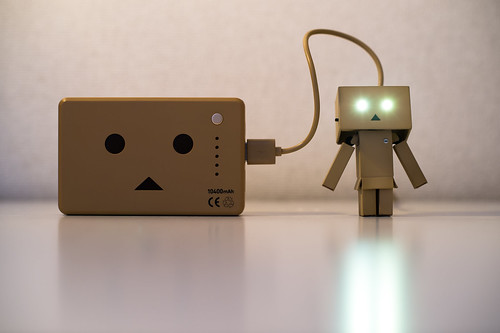
What’s really using up the energy in your phone’s battery? Photo by Takashi(aes256) on Flickr.

You can now sign up to receive each day’s Start Up post by email. You’ll need to click a confirmation link, so no spam.

A selection of 10 links for you. Use them wisely. I’m charlesarthur on Twitter. Observations and links welcome.

The Emissionary Position: screwing the motorist the European way » The Register

John Wilkinson with a tour de force on the entire topic of emissions, testing, ECUs, specific heat capacity, diesel taxation, and whether you should buy a secondhand VW. It’s a long read, but will leave you feeling completely informed:

Emission cheating is not new. Caterpillar, Cummins and others were busted in 1998 for doing exactly what VW has now done – and there have been many more offenders before and since. Why has nothing learned from such instances? How is it the US emissions testing authorities appear to have done nothing for all this time to circumvent cheating?

VW is, of course German, whereas the regulations it has failed to meet are American. Years of cheap gasoline means America does not have a history of running small diesel passenger cars, and they do not form a high percentage of the fleet; nothing like the penetration in Europe.

American cars are historically less fuel efficient than European cars. So why are the American diesel emission regulations so much more stringent than the European equivalent? Could it be protectionism … or, perhaps, the European regulations are rubbish?

link to this extract


Four more carmakers join diesel emissions row » The Guardian

Damian Carrington:

In more realistic on-road tests, some Honda models emitted six times the regulatory limit of NOx pollution while some unnamed 4×4 models had 20 times the NOx limit coming out of their exhaust pipes.

“The issue is a systemic one” across the industry, said Nick Molden, whose company Emissions Analytics tested the cars. The Guardian revealed last week that diesel cars from Renault, Nissan, Hyundai, Citroen, Fiat, Volvo and Jeep all pumped out significantly more NOx in more realistic driving conditions. NOx pollution is at illegal levels in many parts of the UK and is believed to have caused many thousands of premature deaths and billions of pounds in health costs.

All the diesel cars passed the EU’s official lab-based regulatory test (called NEDC), but the test has failed to cut air pollution as governments intended because carmakers designed vehicles that perform better in the lab than on the road. There is no evidence of illegal activity, such as the “defeat devices” used by Volkswagen.

link to this extract


Satya Nadella and Microsoft’s very good day » The New Yorker

Nicholas Thompson (who edits the New Yorker website):

Much of the energy in the hardware business has been directed toward phones in recent years. But Microsoft’s strategy is sort of the opposite. The company will never catch up to Apple or to Google’s Android, where phones are concerned, at least in the developed world. So now it’s trying to make all the other devices—namely tablets and laptops—exciting again. You probably won’t buy your next laptop from Microsoft, but the company hopes to have demonstrated to other laptop manufacturers, particularly ones that preload Windows, how to make their devices exciting again. “Here’s my main point that I filter by,” Nadella told me. “Does the world need something like it and does it need it from Microsoft?” With the new laptop, he said, Microsoft was willing to take the risk of spending wildly on R. & D. to show that laptops could be exciting again—perhaps as exciting as phones.

After the event, I wrote to [Mike] Gerbasio [a consultant to construction companies who had been invited to see the event by Microsoft] to ask him if he was, in fact, going to buy anything. He told me that he’d pre-ordered the Surface Pro 4, but was thinking of maybe switching to the laptop. Either way, he said, he was happy with Nadella and the new Microsoft. For the first time, he thinks, the company genuinely cares what he, a normal consumer, actually wants.

link to this extract


Driven to death by phone scammers » CNN.com

Wayne Drash with an in-depth report (though mute the video) about what Britons would call the 419 or “forward fee” scam – where callers say you’ve won tons of money but have to send them money to get it released:

More than 200 Jamaicans a year are killed in connection with lottery scams — a fifth of the killings in the island nation, which has the dubious distinction of being among the most violent countries per capita in the world.

Scammers who sell names and numbers to callers expect a cut of their profits; if they find out they’re being cheated, they’ll hunt down and kill the caller or a member of his family. Other killings occur when rival gang members steal caller lists.

“It’s a cancer in the society,” says Luis Moreno, the U.S ambassador to Jamaica. “Gangs escalate armed competition with each other over who is going to control these lists and who is going to get the best scammers, the best phone numbers, the best phone guys. Even children as young as 10, 12 years old are tied in as couriers.”

In June, a 14-year-old was dragged out of his home and machine-gunned by gang members connected to the scams. The same fate befell a 62-year-old grandmother in July. Two American women were wounded in August at a nightclub when a gang member opened fire on a rival who owed him money. The rival was killed.

“These gangs are often indiscriminate,” says Bunting, the national security minister. “When they come looking for their target, if they don’t find him, they will shoot members of his family to essentially send a message.”

The average Jamaican makes about $300 a month. The top lottery scammers boast of bringing in $100,000 a week. They share videos of washing cars with champagne and show off by setting fire to thousands of dollars in cash…

Lottery scamming sprang up between 1998 and 1999 when legitimate American and Canadian call centers set up operations in Montego Bay. Young Jamaicans were trained on how to empathize with customers.

No one could have known how those skills would result in today’s flourishing scam business.

Unintended consequences, indeed. Just as Indian PC scam calls arose from British companies setting up call centres there.
link to this extract


On Apple’s insurmountable platform advantage » steve cheney

Cheney says it’s all about the chips:

The truth is the best people in chip design no longer want to work at Intel or Qualcomm. They want to work at Apple. I have plenty of friends in the Valley who affirm this. Sure Apple products are cooler. But Apple has also surpassed Intel in performance. This is insane. A device company – which makes CPUs for internal use – surpassing Intel, the world’s largest chip maker which practically invented the CPU and has thousands of customers.

This pedigree that Apple developed now has a secondary powerful force: portable devices serve as the reference platform whereby all chip design starts. Components from the smartphone market now power almost all other markets, giving Apple’s in-house team a comparative advantage as they enter new product categories, like wearables and electric cars.

All of this supplier / buyer power that Apple has secured will be extended to cars. And because cars are lower volume by many orders of magnitude than phones, no other car maker will be able to enter the chip making game. Both the costs and the risks of designing chips are way too high. Tesla sells around 100K cars a year. Apple sold that many iPhones every 30 minutes on opening day weekend.

link to this extract


How MindGeek transformed the economics of porn » Fusion

Felix Salmon:

Porn videos, today, have become free advertising for other business lines—whether that’s camming, or stripping, or outright prostitution. Even in the world of escorting, tube videos are increasingly replacing the photographs of old. As a result, it can make financial sense to appear in porn films even if you get paid very little for doing so, because developing an online following is a great way to build a fan base. And that is where today’s porn stars earn most of their money: fans will pay to see stars like Veronica Rodriguez in a strip club, or for one-on-one Skype sessions, or for IRL sex. It’s the “freemium” business model: most people will be perfectly happy with the free product, but a small minority will pay for more exclusive services.

Meanwhile, the cost of appearing in a porn film—both in terms of production costs and in terms of reputation—has never been lower. We live in a world where young adults are freer than ever to explore and express their sexuality, and where everybody has a high-def video camera in their pocket at all times. The shame factor of porn has been nearly eliminated in popular culture: just ask Kim Kardashian, whose sex tape essentially launched her career.

On the basis that the porn industry presages everything else that happens online..
link to this extract


See the Milky Way anew » Chromoscope

The Milky Way, viewed at different light frequencies – from gamma ray to radio. It looks very different depending on how your eyes work, as you quickly realise. Fun (though possibly not so much on mobile)
link to this extract


Smartphone energy consumption » Pete Warden’s blog

Pete Warden:

I found a lot of very useful estimates for components power usages scattered through the book. These are just rough guides, but they helped my mental modeling, so here are some I found notable:

An ARM A9 CPU can use between 500 and 2,000 mW.
• A display might use 400 mW.
• Active cell radio might use 800 mW.
• Bluetooth might use 100 mW.
• Accelerometer is 21 mW.
• Gyroscope is 130 mW.
• Microphone is 101 mW.
• GPS is 176 mW.
• Using the camera in ‘viewfinder’ mode, focusing and looking at a picture preview, might use 1,000 mW.
• Actually recording video might take another 200 to 1,000 mW on top of that.

A key problem for wireless network communication is the ‘tail energy’ used to keep the radio active after the last communication, even when nothing’s being sent. This is vital for responsiveness, but it can be ten seconds for LTE, so apparently short communications can use a lot more energy than you’d expect. Sending a single byte can use a massive amount of power if it keeps the radio active for ten seconds after!

A Microsoft paper showed that over 50% of the power on several popular games is consumed by the ads they show!

The whole blogpost is really great reading. (Warden used to work at Apple, and then was CTO at Jetpac and did some amazing work on neural network apps; so good that Google bought the company.)
link to this extract


It’s Apple’s world, so why do other smartphone makers even bother? » Bloomberg Business

Ashlee Vance:

Some struggling phone makers likely believe they can profit by selling tons of cheap phones at low margins, says Endpoint’s Kay, while companies like Microsoft and Sony will stay in the business to spread their software as far as possible.

Even Apple may not be immune to these trends. About 2 billion people have smartphones today, and another 150 million to 200 million will buy their first in each of the next three years, estimates researcher EMarketer. Most first-time buyers will be looking for high-powered phones at the lowest possible prices, and every company will have to reckon with that race to the bottom, says McMaster. The companies likely to thrive will be local players that can build money-making services on top of their cheap phones. “We will see sub-$35 devices roll out in sub-Saharan Africa in the next two years,” he says. “It’s just a matter of time.”

The question of how Apple will keep its prices up as every other smartphone maker sees price deflation is a critical one.
link to this extract


PC shipments remain depressed by volatile currencies, inventory, and OS transition in the third quarter, although 2016 should fare better » IDC

Worldwide PC shipments totaled nearly 71.0m units in the third quarter of 2015 (3Q15), according to the International Data Corporation (IDC) Worldwide Quarterly PC Tracker. This volume represented a year-on-year decline of -10.8% – slightly worse than projections for a decline of -9.2%.

The lackluster volume of PC shipments was consistent with expectations that the third quarter would face challenging financial conditions and be a transition period. Across many regions, the channel remained focused on clearing Windows 8 inventory before a more complete portfolio of models incorporating Windows 10 and Intel Skylake processors comes on the scene. Vendors and channels were also working to limit price swings in the face of changes in currency exchange rates. Though easing a bit, currency devaluation continued to inhibit PC shipments in the third quarter.

While Windows 10 has generally received favorable reviews and raised consumer interest in PCs, many users opted to upgrade existing PCs rather than purchase new hardware…

…the top four vendors performed much better than the rest of the market. Collectively, the top 4 vendors saw shipments fall by -4.5% from a year ago compared to a decline of almost -20% for the rest of the market.

2016 could hardly do worse. PC market now down 26% from the same period in 2011, when it peaked.
link to this extract


Start up: flat design problems , ad tech stocks drop, life inside HP, LG’s challenge, and more


Google’s got a new motto. Photo by vizeur_photos on Flickr.

You can sign up to receive each day’s Start Up post by email. You’ll need to click a confirmation link, so no spam.

A selection of 11 links for you. Use them wisely. I’m charlesarthur on Twitter. Observations and links welcome.

Flat design: its origins, its problems, and why Flat 2.0 is better for users » Nielsen-Norman Group

Kate Meyer:

Google’s Material design language is one example of flat 2.0 with the right priorities: it uses consistent metaphors and principles borrowed from physics to help users make sense of interfaces and interpret visual hierarchies in content.

The Evernote app for Android is a good example of the possible benefits of flat 2.0. Despite having a mostly flat UI, the app provides a few subtle shadows on the navigation bar and the floating plus button (‘add new’). It also makes use of the card metaphor to display content as flat, layer-able planes in a 3D space.

As with any design trend, we advise balance and moderation. Don’t make design decisions that sacrifice usability for trendiness. Don’t forget that—unless you’re designing only for other designers—you are not the user. Your preferences and ability to interpret clickability signifiers aren’t the same as your users’ because you know what each element in your own design is intended to do.

Early pseudo3D GUIs and Steve-Jobs-esque skeuomorphism often produced heavy, clunky interfaces.Scaling back from those excesses is good for usability. But removing visual distinctions to produce fully flat designs with no signifiers can be an equally bad extreme. Flat 2.0 provides an opportunity for compromise—visual simplicity without sacrificing signifiers.

link to this extract


Ad tech stocks keep falling » WSJ

Jack Marshall notes they’re down by 17%-50%:

Serious questions about the future of ad tech and online advertising are also mounting. Some online publishers say they’re now actively avoiding working with third-party ad tech firms, for example, because they argue the vendors devalue their ad space.

Meanwhile the industry is struggling to come to grips with major challenges such as the growth of ad-blocking technologies, and the ongoing problem of fraudulent or “non-human” Internet traffic.

The latter problem might be the one that really does for ad tech companies.
link to this extract


Autonomy ex-boss Lynch tells of poisonous life within HP in High Court showdown » The Register

Neil McAllister:

The suit asserts that many parties within HP “viewed Autonomy negatively,” including HP CFO Cathie Lesjak, who had never liked how the merger looked on paper; HP’s then-software boss Bill Veghte, who hadn’t played a role in the acquisition and reportedly felt snubbed; and the bosses of HP’s hardware division, who viewed Apotheker’s software-centric strategy as a threat.

Even where there was no direct animosity at play, other HP divisions were given perverse incentives to undermine Autonomy, Lynch claimed.

“In Autonomy’s case, other HP business units did not receive ‘quota credit’ or commissions for sales of Autonomy products,” the suit reads. “As a result, HP business units were incentivized to market and sell competing third-party products rather than Autonomy software.”

When HP did sell Autonomy to its customers, the suit alleges, it often did so at deep discounts, without Autonomy’s knowledge. In other cases, HP sales teams would jack up Autonomy’s price tag to boost their own bottom line, which had the result of making competing software look like a better bargain.

Similarly, sales of HP hardware to Autonomy didn’t count toward the hardware division’s sales quota. Thus, Lynch’s suit alleges, the hardware group refused to certify Autonomy on its machines. Dealings with the hardware group were so fraught, the suit adds, that even obtaining HP hardware on which to demo Autonomy proved impossible, and the demo machines were ultimately sourced from competitors, such as Oracle.

Read all about it. Seems like quite standard corporate politics, especially in a sales-driven environment like HP.
link to this extract


Apple’s clever tech makes the iPhone 6s nearly waterproof » WIRED

Brian Barrett:

The phones that have offered this level of water resistance, though, haven’t exactly been chart-toppers. The Samsung Galaxy S6 Active; the Sony Xperia Z3; the HTC Desire Eye; these are phones (or variants) you may have heard of, but their aquaphobia hasn’t demonstrably made them any more desirable. Besides which, the new iPhones aren’t necessarily more water-resistant than others, at least not in any way that’s easily perceivable to consumers; they’re just water-resistant in a more clever way.

Even if it’s largely invisible to its customers, that cleverness could pay off soon for Apple. “Now that you can pay a small monthly fee and get a new iPhone every year, Apple’s going to be getting a lot of iPhones back,” says Suovanen of the company’s new iPhone Upgrade Plan. “In the long run this may help them save money. Because the iPhones are less susceptible to water damage, they’re getting them back in better condition.”

That helps explain, too, Apple opting not to coat the case itself. The same features that make a waterproof case effective make it hell to take apart or repair.

“Nearly waterproof” is a nothing phrase; it’s like “nearly pregnant”. It’s water-resistant to a higher IP rating than previous models. That nothing has been bruited about this seems anomalous.
link to this extract


Google’s ‘Don’t Be Evil’ becomes Alphabet’s ‘Do the Right Thing’ » WSJ

Alistair Barr:

“Don’t be evil” is so 2004.

Alphabet Inc. posted a new code of conduct for its employees Friday, after Google completed its transformation into a holding company. There were few substantive changes in more than 20 documents filed with the Securities and Exchange Commission; the Alphabet code of conduct, posted on its website, is among them.

Google’s code of conduct, of course, is best-known for its first line, which was also included in Google’s 2004 filing for its initial public offering: “Don’t be evil.”

Alphabet’s code doesn’t include that phrase. Instead, it says employees of Alphabet and its subsidiaries “should do the right thing – follow the law, act honorably, and treat each other with respect.”

“Don’t be evil” marked Google’s aspiration to be a different company. But the phrase also has been held up by critics who say Google has not always lived up to it.

Google’s code of conduct is much longer than Alphabet’s. It includes idiosyncracies about drinking alcohol at work (OK but not too much) and taking pets to the office (dogs are cool but cats are discouraged).

The Alphabet code sticks to the basics: avoid conflicts of interest, maintain integrity and obey the law.

link to this extract


Apple patent for iPhone with wraparound screen » Business Insider

Lisa Eadicicco:


The patent, which was published on September 29, is a continuation of various patents Apple has filed in the past. It’s not necessarily a new idea — Apple has been filing similar patent applications since 2013. Regardless, it’s still interesting to speculate that the company may still be experimenting with these types of ideas.

In the document, Apple says that a design like this could change the way we use our iPhones. If the screen of your iPhone were extended, you wouldn’t be limited to interacting with the device’s screen only on the front of the phone.

Apple notes that other aspects of the device found along the side — such as the mute switch, power, and volume buttons — can’t be used with apps since they’re only programmed to perform one task.

Apple’s been doing this since 2013, which implies it thinks it’s a fruitful thing to follow. Notice there’s no home button. (10yo’s opinion: “they haven’t thought this through. People drop their phones and if you have a wraparound one it will break.”)
link to this extract


FBI: We unmasked and collared child porn creep on Tor with spy tool » The Register

Luis Escobosa, of Staten Island, admitted to Feds he broke federal child pornography laws by viewing depraved photos on a hidden Tor service. Unknown to Escobosa, the Feds were running the hidden server, and were using it to feed him spyware.

The child porn website’s systems were seized in Lenoir, North Carolina, after agents got a court order in February. The Feds continued to keep it in operation for two weeks afterwards to catch perverts using it. The site had nearly 215,000 users.

Because users had to use Tor to access the warped website, the web server’s logs were of little use to investigators – they simply listed the nodes of the anonymizing network. Instead, the FBI deployed a NIT – a “network investigative technique,” or what in the hands of criminals would be termed spyware.

The FBI has been using NITs for over a decade. While the Escobosa indictment doesn’t give details, other court documents have stated that the software was developed by adapting a tool written by white hat hacker HD Moore called the Metasploit Decloaking Engine.

A NIT works like this: a file, typically a Flash file, is hosted by a seized child porn website, and sent to web browsers when perverts visit the hidden service via Tor. This Flash file is run in Adobe’s plugin, and establishes a direct connection to an FBI-controlled server on the public internet without going through Tor.

The Feds can then, in most cases, read off the user’s real public IP address from this connection, unmasking the scumbag.

Hmm – maybe keep Flash just for Tor sites? Wait, this is complicated.
link to this extract

Apple Pay’s grim reality » PaymentsSource

Daniel Wolfe:

Drilling down to individual financial institutions, there is still little movement among consumers, even at major debit issuers like SunTrust.

“Adoption numbers are pretty small at this point,” said Shannon Johnson, SunTrust’s senior vice president of consumer deposits and payments, in a separate presentation at PayThink. “At SunTrust, about 15% of iPhone 6 owners have provisioned their card and about 25% of those have done [at least one] transaction.”

First Financial Credit Union also presented Apple Pay adoption figures at the event. Of its 65,000 members, 9,000 use mobile banking and 48% of those use an iPhone. Of the iPhone users, just 8% – 345 members – use Apple Pay.

The lack of use stems, in part, from a lack of creativity among Apple partners, Johnson said. For most issuers, Apple Pay abruptly appeared on the scene with little warning but a clear message to get on board.

“Prior to that it was conceptual, the option of mobile wallets; it then became real,” she said. “We’re so early in the stages in terms of understanding the opportunity.”

Low use isn’t surprising, because until last week in the US you could just swipe your card to make a transaction: quicker than Apple Pay. Now, people will have to insert their cards into readers (“dip”) and sign, at least; or dip-and-PIN. This has already led to longer queues, apparently. So Apple Pay might appeal as a quicker way to do things. Being ready to catch markets just as they take off is the key.
link to this extract


Apple CEO Tim Cook: ‘privacy is a fundamental human right’ » NPR

The full interview is on the page; there are short transcript extracts, including this:

Let me be clear. If you buy something from the App Store, we do know what you bought from the App Store, obviously. We think customers are fine with that. Many customers want us to recommend an app.

But what they don’t want to do, they don’t want your email to be read, and then to pick up on keywords in your email and then to use that information to then market you things on a different application that you’re using. …

If you’re in our News app, and you’re reading something, we don’t think that in the News app that we should know what you did with us on the Music app — not to trade information from app to app to app to app.

That latter part is the real distance between Apple and Google. Question is, which leads to the better customer experience over time?
link to this extract


Will LG’s V10 flagship be able to shake China’s and India’s smartphone market? » Strategy Analytics

Woody Oh of the analysis company takes an overview of LG’s new phone:

it’s getting clear that LG has put the utmost efforts in creating V10 in the following aspects.

1. Dual Screens : While it is estimated to be an extremely hard task to implement dual screens with one LCD panel, LG did a great job in creating the small, but “always-on” secondary display where you can make your smartphone usage better and more diversified.

2. Dual Cameras (5MP+5MP, Front-facing) : While we have to wait for LG’s updates on the applicable usages by this dual front-facing cameras, the purported function to be able to widen the angle when taking the selfie would be regarded as a differentiator, requiring no need to bring the selfie stick when you are in a hurry.

3. Separate 32bit Hi-Fi Audio DAC (Digital to Analog Convertor) supporting 384kHz and Headphone AMP : Listening to music on smartphones are becoming a common habit for almost all smartphone users, young generation in particular, so users are naturally keen to seek for better audio quality while listening. LG’s new bid for integrating the separate Hi-Fi audio chip and headphone amplifier will be a clear differentiator in this respect as more and more people are inclined to carry only one multi-media focused device these days.

4. Professional Mode of Camera and Video: Needless to say, LG is one of the best smartphone makers who can create the best still image quality with its differentiated software, enabling an even novice to take the best picture with very easy mode setting. With V10, LG is expected to make a step further, making the common users become the best movie maker with its easy, but professional setting mode.

I look at that list, and I think: if Apple put those into a new phone, which would it make a noise about? Which would reviewers and customers make a noise about? I think the audio and “camera pro mode” things are gimmicks: you’ll never, ever, ever hear the difference in sound (young users have never, ever sought “better audio quality”; ironically, that’s for oldsters, whose hearing is already deteriorating). Camera pro modes are recipes for confusion.

The dual screen? Depends how useful it really is. The dual front cameras? Might be popular.

The real question is: what’s the difference between a truly useful feature and a gimmick? I don’t think it’s self-evident. (The whole SA note is worth reading for its points about branding too.)
link to this extract


Taiwan market: Toshiba no longer selling consumer notebooks » Digitimes

Aaron Lee and Adam Hwang:

Toshiba has shifted its notebook marketing focus from consumer to business-use models in Asia, Latin America and Central Europe, and has stopped selling consumer notebooks in Taiwan, according to the vendor’s Taiwan sales agent Grainew.

However, Toshiba will maintain marketing of consumer and business notebooks in West Europe and North America markets because consumer models are still profitable there, Grainew said.

In the Taiwan market, Grainew sells about 1,000 units of a Toshiba high-end business notebook model a month currently and expects monthly sales to increase 10-20% in 2016, the company indicated. While unit sales has decreased after giving up the consumer segment, overall gross margin has increased significantly, Grainew said.

Tiny numbers; smaller companies like Toshiba will increasingly withdraw completely from the consumer PC market because the margins aren’t there.
link to this extract


Start up: how 3D Touch was made (and what it’s like), adblock wars redux, why PC makers want gamers, and more


“What’s the call quality like?” LG’s next big growth market. Photo by stevec77 on Flickr.

A selection of 9 links for you. Use them wisely. I’m charlesarthur on Twitter. Observations and links welcome.

Apple TV Pre-Reprecussions » iLike.code

Nat Brown:

Apple TV will draw more people to gaming on televisions, so “television-based gaming” as a category will grow due to Apple TV in the near term. Consoles will continue to meet a very clear consumer demand for higher-end gaming using gamepads, though many independent game developers and even high-end publishers will abandon lagging consoles over time for the less restrictive Apple TV market as the Apple TV silicon matures, and for PC gaming on Steam (and with luck on Windows). If Apple introduces a gamepad or has a strong attach rate for third-party MFi gamepads, I expect a lot of current console buyers will within a few years find Apple TV’s performance, price-point and more appealing catalog of gamepad content their choice over the next Microsoft or Sony consoles, if those even get built.

Very true in the US, where Apple TV has more of a role (because box sets without ads sure beat the crap TV with ads) but less so in countries like the UK, I think.
link to this extract


LG Electronics looks to washing machines to keep spinning profits » WSJ

Min Jeong-Lee:

just as Samsung Electronics Co. and Sony Corp. have become more dependent on other business areas like components rather than mobile devices, LG is looking to its less-glamorous appliances’ unit to secure modest-but-steady profit growth.

“The mobile and TV businesses tend to have a lot of ups and downs. The home appliance business, meanwhile, is less vulnerable to swings,” Jo Seong-jin, LG’s home-appliance chief, said in a recent interview with The Wall Street Journal.

LG’s revenue for appliances—based on local currency value—is up about 13% so far this year, and operating profit margins in the division of about 4.5% to 6% will be “attainable” this year, he said. While far short of the double-digit margins enjoyed by Apple Inc., those levels will outshine LG’s other key business units and that of Samsung’s appliances unit, analysts say.

Washing machines. Washing machines.
link to this extract


How are artists actually using Apple Music Connect? » Musically

Stuart Dredge looked at some data from the past 10 weeks:

What are they posting? Two kinds of posts seem to be dominating Connect: photos – often cross-posted from Instagram, which suggests that artists (or often their social teams) think Instagram’s visual aesthetic and Apple’s new social service. And secondly promotional messages: encouraging fans to stream songs or albums on Apple Music, pre-order albums on iTunes, or – in the case of artists who are involved with the Beats 1 radio station – posts about their shows.

What’s missing, so far, is the kind of exclusive, engaging stuff promised at the Apple Music launch. In June, Apple’s services boss Eddy Cue said that Pharrell Williams would be posting photos, lyrics and raw mixes of songs – but at the time of writing, he’s posted a single photo two months ago.

Connect isn’t a ghost town: based on the iTunes and Facebook-based lists above, if you followed 30 popular artists on Apple Music, your Connect feed would have between 24 and 33 new posts a week – or 3-5 a day. That might actually be a nicely-manageable complement to the information blur on Twitter and Facebook IF the updates were more than just promotional messages and reposted photos.

It’s still early days, and I’d expect Apple to be working hard to encourage artists not just to use Connect, but to use it well, in the months ahead. As things stand, it is not delivering on its potential. But that potential is there.

link to this extract


iPhone 6s and iPhone 6s Plus first look: Hands-on with 3D Touch » IB Times

Me! I was there:

on the new models, which go on sale on 25 September in 12 countries including the UK, a hard press on an icon generates a subtle “tap” against the fingers holding the phone.

If the app can do something, you feel a single tap on your fingers, and a menu pops up; if it can’t (because it hasn’t been enabled, or the options don’t make sense) there’s a subtler triple tap, and nothing happens.

It needs a quite different approach from the normal “delete” push; you have to intend to make it happen. In the few minutes I was able to try it out, I quickly got used to the difference – which is helped by the haptic feedback. Practice would likely make perfect, or at least more familiar.

The “left-hand-side” press is not easy at first – it’s a sort of push-and-roll for the thumb. The process for getting the haptic pop is simpler. It’s not the sort of thing you’d find by accident in a hurry, though.

I also wrote hands-on for the iPad Pro and Apple TV; check the IB Times site for those later today (Thursday).
link to this extract


How Apple built 3D Touch » Bloomberg

Josh Tyrangiel gets the sort of prebrief/access that you’ll recall the New Yorker got a year back:

in lieu of the usual polite deflection, Federighi picked up an iPhone 6S and explained one of 3D Touch’s simpler challenges: “It starts with the idea that, on a device this thin, you want to detect force. I mean, you think you want to detect force, but really what you’re trying to do is sense intent. You’re trying to read minds. And yet you have a user who might be using his thumb, his finger, might be emotional at the moment, might be walking, might be laying on the couch. These things don’t affect intent, but they do affect what a sensor [inside the phone] sees. So there are a huge number of technical hurdles. We have to do sensor fusion with accelerometers to cancel out gravity—but when you turn [the device] a different way, we have to subtract out gravity. … Your thumb can read differently to the touch sensor than your finger would. That difference is important to understanding how to interpret the force. And so we’re fusing both what the force sensor is giving us with what the touch sensor is giving us about the nature of your interaction. So down at even just the lowest level of hardware and algorithms—I mean, this is just one basic thing. And if you don’t get it right, none of it works.”

It’s a great article that (especially if read with the New Yorker one) gives you an increasingly clear view of how Apple’s design process works.
link to this extract


Analyst suggests this may be the last big iPhone launch » PC Retail

Dominic Sacco:

Argus Insights CEO John Feland predicts that “Apple has one good cycle left in them, barring any earth shattering innovations”.

“This upcoming round of iPhones is likely to be the iPhone’s Farewell tour,” he said. “Market demand of future handsets will not be as high because the innovation pipeline has apparently run out of good (compelling enough for consumers to upgrade) ideas.

“iPhone sales are unlikely to hit the same peaks at next year’s upgrade cycle as the level of smartphone saturation tips to replacement over new users.

Noted for future reference. He’s certainly right about saturation, but the odd thing about saturation is that in theory it means you have more people who could upgrade at any given time than in an unsaturated market.
link to this extract


Samsung to cut 10% of head office staff, Economic Daily says » Bloomberg Business

Jungah Lee:

Samsung is targeting workers in the human resources, public relations and finance departments, Korea Economic Daily reported Tuesday, citing people it didn’t identify. The Suwon, South Korea-based company also plans to cut some expenses next year, the report added. Samsung declined to comment in an e-mail.

The moves come after new high-end Galaxy smartphones failed to impress consumers, triggering five straight monthly declines and wiping out more than $40bn in Samsung’s market value since April. The company’s share of global smartphone shipments fell more than 3 percentage points in the second quarter, and it’s no longer the top seller in China, the world’s biggest mobile-phone market.

“Cutting jobs is the easiest way to control costs and Samsung’s spending on mobile business could also be more tightly controlled,” said Chung Chang Won, an analyst at Nomura Holdings Inc. in Seoul. “Samsung’s preparing to tighten its belt as it isn’t likely see rapid profit growth in the years to come.”

Subsequently, Samsung has denied this, saying a number of employees are being “relocated”. To their homes?
link to this extract


After selling his company to Google, this man now wants to block ad-blockers » VentureBeat

Paul Sawer:

While [Ben] Barokas was cagey about the specifics of how the technology works, he did refer to a blurring of lines between ads and publishers’ content.

“There are many nuances, but at a high level our platform makes it harder for ad-block software to distinguish advertising from content,” he said. “We believe we can recover pretty much any advertising that exists today.  We have started with direct-sold brand campaigns because they tend to be of higher value to publishers and higher quality to users.”

Barokas said that dozens of ComScore 500 publishers are currently using the platform, but he didn’t reveal any specific details yet regarding the uptake of Sourcepoint, other than that demand has been “overwhelming,” far-exceeding its most optimistic projections.

I was discussing this topic on Twitter the other day and it occurred to me that advertising is a classic example where those who consume aren’t the customer. Advertisers buy space with publishers, but the people to whom those ads are shown aren’t involved in the transaction. This means there’s no way for them – that’s you and I, the readers – to show our displeasure except via adblocking. (A similar disconnect occurred when Microsoft was trying to displace the iPod: it sold music for enabling Windows Media music playback to Windows Media music player makers, not to listeners. That breaks the feedback loop.)

In that sense, adblocking is peoples’ way of speaking up in the transaction. It’s somewhat all-or-nothing, though.
link to this extract


The PC industry is betting big on gamers » The Verge

Vlad Savov:

The PC gaming market produced $21.5 billion in hardware sales last year, according to data from Jon Peddie Research, which is more than double the revenues derived from console sales. More notably, unlike the broader PC market, which continues shrinking, gaming PC sales are projected to increase over the next couple of years. The JPR analysis suggests the biggest chunk of gaming PC revenue — somewhere in the vicinity of 44% — comes from the so-called enthusiast segment, which the researchers identify as “very performance and style oriented, much like sports car owners.”

Sports car PCs are exactly what we saw from the big manufacturers at IFA. Acer’s Predators, whether it be on the desktop or in the form of pseudo-portable laptops, ape Lamborghini’s angular shapes and aggressive motifs throughout. Asus, with its Republic of Gamers sub-brand, does the very same. From overclocked monitors to otherworldly arachnid routers, both of these Taiwanese companies are pushing as hard as they can to give conventional, commoditized products the veneer of a fresh attitude and personality.

The very apt comment from Sameer Singh, industry analyst at App Annie: “Predictable response when facing disruption – flee upmarket.” (The source of the disruption fits in a pocket and also makes phone calls.)
link to this extract


Start up: iOS 9 and the BBC, AdBlock v Chrome/YouTube, Imogen Heap’s blockchain, and more


And we just happen by great good fortune to know a good source of women who aren’t wives too. Photo by James Maskell on Flickr.

A selection of 8 links for you. Tested on humans for irritancy. I’m charlesarthur on Twitter. Observations and links welcome.

Ashley Madison’s parent company secretly operated an escort website » Daily Dot

Dell Cameron:

After the details of roughly 33 million Ashley Madison accounts were posted online, the hackers responsible, known as Impact Team, leaked more than 197,000 private emails from the inbox of Noel Biderman, the former CEO of Avid Life Media (ALM), a Toronto, Canada–based company that operates the Ashley Madison site. Documents and emails contained in the trove and reviewed by the Daily Dot detail the company’s escort-related businesses.

Escorts.ca was leased in 2013 through a shell company called Pernimus Limited, which is listed among ALM’s “legal entities” on an internal company memo. According to a leaked contract, ALM leased the escort-service property from an Ontario-based company called Steeltown Marketing Inc., on Feb. 20, 2013.

The escorts.ca website was still active until roughly 6pm ET on Tuesday, when it was abruptly suspended. A version of the site from Aug. 1, 2015, can still be viewed, however, via the Wayback Machine.

Innocent explanation: ALM was into teh sexy bsns, so having an escort company as well as a “YOLO BE UNFAITHFUL” site was just consistent corporate thinking.

Malevolent explanation: 1) have a site encouraging guys to be unfaithful; 2) funnel them towards escorts 3) Profit!

Hang on, further down:

The document shows that ALM’s intention for the site, which did not charge users to browse its pages, was to funnel traffic to Ashley Madison and other ALM properties.

Having some trouble making the innocent explanation work here.

link to this extract


Apple’s iOS 9: Tweaks not revolution for video, photos and audio » BBC Blogs: College of Journalism

Marc Settle, who specialises in smartphone reporting for the BBC Academy:

Doesn’t time fly. It’s already a year since my now-traditional blog post examining what’s in the latest version of iOS, the operating system on iPhones and iPads. It’s also therefore a year since the equally traditional complaint of ‘preferential treatment’ to Apple over Android, the operating system that runs on around 80% of smartphones globally.

However, it remains the case that iPhones are the device of choice for many leading news organisations around the world – not just the BBC – for their employees to gather and send broadcast-quality footage at a far lower cost than traditional methods.

It’s also the case that this review of iOS 9 will be far more relevant, far more quickly, to iPhone owners if the pattern of previous releases is repeated. iOS 8 came out on 17 September 2014; a week later it was running on more than a third of compatible devices (as shown on the graph above).

In stark contrast, the latest version of Android, called Lollipop, was released in November 2014 but nine months later it’s still barely on 20% of devices.

Seems iOS 9 doesn’t add much, apart from some little tweaks in video editing. It has been noticeable in the latest reports on the refugee crisis that some of the BBC reporters are doing the reports with iPhones; one did a whole report using the front-facing camera and flash so that he could show the extent of the problem.
link to this extract


YouTube ads aren’t being blocked in Chrome / Recently Reported / Knowledge Base » AdBlock Support

And lo, there was great consternation that YouTube might have found a way to make people view ads. But it turned out not to be:

Some users have been able to confirm, that removing YouTube app from Chrome (by navigating to chrome://apps on Chrome) fixes YouTube ads, which are not blocked.

According to the EasyList forum post on this topic (you can read the original Google Code issue if you’d like to know the gory details) it’s caused by a recent Chrome security update, not the ad blockers or YouTube finding a way around the current filters.

At this point, we’re waiting for news about another update to Chrome which will fix this. In the meantime, we recommend switching to Firefox or Safari, which continue to block ads in YouTube videos just fine

In the Chromium discussion, a Chromium developer says “It was a security fix tracked in bug 510802 which we can’t make public yet, but it has the details.” (I can’t find a way to view bug 510802, so maybe it’s a doozy.)

link to this extract


Michael Dell sees consolidation among PC makers in next few years » Reuters

The top three global PC makers would be able to raise market share in the next few years through consolidation amid shrinking sales of personal computers, Dell Inc chief executive Michael Dell said on Monday.

Lenovo Group Ltd tops global PC shipment ranking with a 20.3% market share, followed by Hewlett-Packard Co at 18.5% and Dell at 14.5%, according to research firm International Data Corp.

The top three companies could corner about 80% of the market in the next five to seven years, Dell said at a roundtable conference with journalists in Bengaluru, India.

“In the first half of this year, we outgrew the two in notebooks and we have grown now 10 quarters in a row,” Dell said.

IDC last month forecast PC shipments to fall 8.7% this year, steeper than its earlier estimate of a 6.2% decline, and said they are expected to return to growth in 2017.

Presently those top three have 53%; it would take quite a consolidation (such as the collapse/withdrawal of a player like Acer with 6.5% share and a smaller one like Toshiba with maybe 3% share) to reach that. But the ongoing consolidation is steady.

Read it too for Dell’s comment on smartphones.
link to this extract


Imogen Heap: saviour of the music industry? » The Guardian

Jamie Bartlett on how one British artist aims to use blockchain technology to create an accountable system for buying and listening to and crediting music:

Because [Imogen] Heap now produces her own music independently she’s not contracted to release her song via the usual route. Instead, she will be placing the studio-recorded song, video, live performance and all Tiny Human-related data as files on her website, open to those developing new tech for the blockchain. All the taggable associated data that could interest fans or potential clients (film and TV, brands, other artists), such as the lyrics, photographs, the instruments she used, the musicians who played, etc (“I think I’ll add this article too,” she told me) will prove inspirational, she hopes.

Crucially, she’ll also include simple contracts, revealing under what terms the music would (ideally, as this is an experiment) be downloaded or used by third parties, such as advertisers, and how any money earned will be divided up among the creatives involved. All payment received – using crypto-currencies – will be routed to the recipients, as set out in the contract, within seconds. (It typically takes between weeks and months for royalty payments to work their way through the chain at the moment.)

It’s a long but worthwhile article. There’s a fair amount of handwaving around how it will work, though I suspect that’s just as much because really getting into the details of how the blockchain system would work might frighten the horses (as in, regular non-techie readers) too much.

And remember, MP3 started as a way to compress background music and sounds for video games.
link to this extract


Premium Android hits the wall: discussion » Hacker News

Among the discussion of my post elsewhere on this blog is this anecdote:

My wife went into the EE shop (UK mobile company) recently to see what was on the market as her old Galaxy S2 was dying.

She came out with a list of six Samsung phones alone and a couple of Sonys. Is a Galaxy Alpha better than an S6? What’s a Galaxy Mini? So bewildered by the permutations that she just threw away the list and bought a second-hand Galaxy S4 on eBay. Potential sale for Samsung lost.

Android vendors might think they’re satisfying all possible market requirements but actually they’re confusing potential customers. As you say, probably easier just to go to the Apple store and choose between two.

I know anecdotes aren’t data, but I think the contrast between a plethora of choices and a couple makes a difference. Note too how few features Apple adds at each release. (Read the full discussion too.)
link to this extract


Negative feedback: attack on a YouTube channel » Dell SecureWorks Security and Compliance Blog

Joe Stewart of CTU Research on how an “attack” (lots of dislikes) against a YouTube channel might have been organised via hijacked routers in Vietnam:

All it takes to bounce traffic through a vulnerable broadband modem is to know the standard administrative username/password pair used by the ISP, something trivially obtained by analysis of the device’s firmware image or even by brute force scanners. Once you can configure the modem, you can set up port forwarding and relay traffic inbound to a specific TCP port to an outside site (i.e. YouTube). This isn’t a proxy in the conventional sense, where one can arbitrarily tunnel all HTTP traffic through another IP, but it can work in essentially the same way for a single destination site.

Vietnam is certainly not the only country with this problem. A rush to create broadband infrastructure in some countries where ISP choices are limited has led to a dangerous monoculture of vulnerable router deployments. As consumer operating systems are increasingly becoming more secure against exploitation that would cause them to become part of the botnet ecosystem, we are increasingly seeing broadband routers being abused for these purposes instead.

It used to be that shonky Windows installations in developing countries were the main problem for such attacks; now it’s broadband routers in developing countries too. (Via Stefan Pause.)
link to this extract


Why you hate Google’s new logo » The New Yorker

Sarah Larson:

Now Google is so smart and powerful, across so many platforms—Androids, a translation service, Chrome, Maps, Earth, self-driving cars, our collective brain—that our trust, our connection to that first thrilling moment, that gratitude and excitement, should be essential to maintain. You’d think the company would get that, and that rebranding, generally, feels suspicious. When I see that shifty new rainbow-colored “G” bookmarked on my toolbar, I recoil with mild distrust, thinking of when Philip Morris became Altria — No cigarettes here, see? Just rainbows! — or when British Petroleum suggested we think of it as Beyond Petroleum, or when the Bush Administration would name something Freedom.

Zingg! (Personally, though, I don’t like the new logo. I prefer the old one.)
link to this extract


Start up: Ashley Madison’s vanishing women, PC and tablet gloom, taxing sugar, and more


Swiss watch exports – especially to China – fell in July. Why?

A selection of 8 links for you. Use them wisely. I’m charlesarthur on Twitter. Observations and links welcome.

Almost none of the women in the Ashley Madison database ever used the site » Gizmodo

Annalee Newitz:

I downloaded the data and analyzed it to find out how many actual women were using Ashley Madison, and who they were.

What I discovered was that the world of Ashley Madison was a far more dystopian place than anyone had realized. This isn’t a debauched wonderland of men cheating on their wives. It isn’t even a sadscape of 31 million men competing to attract those 5.5 million women in the database. Instead, it’s like a science fictional future where every woman on Earth is dead, and some Dilbert-like engineer has replaced them with badly-designed robots.

Those millions of Ashley Madison men were paying to hook up with women who appeared to have created profiles and then simply disappeared. Were they cobbled together by bots and bored admins, or just user debris? Whatever the answer, the more I examined those 5.5 million female profiles, the more obvious it became that none of them had ever talked to men on the site, or even used the site at all after creating a profile. Actually, scratch that. As I’ll explain below, there’s a good chance that about 12,000 of the profiles out of millions belonged to actual, real women who were active users of Ashley Madison…

…About two-thirds of the men, or 20.2 million of them, had checked the messages in their accounts at least once. But only 1,492 women had ever checked their messages. It was a serious anomaly.

Top-class data journalism by Newitz. This is how you do it: get facts and hammer them into the ground. Ashley Madison increasingly looks like a game of three-card monte. CEO Noel Biderman previously trumpeted in the media that Ashley Madison had an overall 70/30 gender split — with a 1:1 male/female ratio among the under-30 set. Seems like he was flat-out lying. (Teddy Wayne, who wrote that linked GQ story, now works for the New Yorker; he clearly did well to get five women who apparently used AM to talk to him in 2013.)

link to this extract


Swiss watch exports fall in July » Business Insider

Ben Moshinsky:

The Swiss-watch bubble may be about to unravel.

After years of stunning growth, in which exports more than doubled from 2000 to 2014, Swiss watchmakers had a terrible month.

China led the fall, according to export figures from the Federation of the Swiss Watch Industry.

Overall exports were 9.3% lower than a year earlier, at 1.9 billion Swiss francs (£1.3 billion, $1.97 billion) with the Chinese market segment dropping by more than 39%. Sales to the United Arab Emirates also tanked 29.8%.

Biggest fall? Those costing between CHF200-500 and CHF500-€3,000. (1 CHF = US$1.05.) Anyone know any watch-like products released recently around that price not coming out of Switzerland?
link to this extract


Google has a secret interview process… and it landed me a job » The Hustle

Max Rosett:

Three months ago, I thought I wasn’t ready to apply for a job at Google. Google disagreed.

I was in the midst of a career transition. I had spent three years working as a management consultant and then at a startup, but I wanted to become a computer engineer. I was earning a Master’s in computer science through Georgia Tech’s online program. I knew that I was slowly developing the skills that I would need in an engineering role, but I still lacked the confidence to apply for a full-time software role.

One morning, while working on a project, I Googled “python lambda function list comprehension.” The familiar blue links appeared, and I started to look for the most relevant one.

But then something unusual happened.

The search results split and folded back to reveal a box that said “You’re speaking our language. Up for a challenge?”

I would find that intensely scary. I’d worry I’d either been hacked or taken hallucinogenics.
link to this extract


Worldwide tablet shipments expected to decline -8.0% in 2015 while 2-in-1 devices pick up momentum, growing 86.5% » IDC

According to a new forecast from the International Data Corporation (IDC) Worldwide Quarterly Tablet Tracker, tablet shipments, inclusive of 2-in-1 devices, are expected to decline -8.0% in 2015, representing a notable slowdown from IDC’s previous forecast of -3.8%. Shipments are now expected to reach 212 million with the vast majority being pure slate tablets.

The overall trajectory of the tablet market has not changed significantly over the past year and a half, but the 2-in-1 segment, also referred to as detachables, is starting to gain traction. While the 2-in-1 form factor is not new, OEMs are getting more serious about this market and as a result IDC expects the 2-in-1 segment to grow 86.5% year over year in 2015 with 14.7 million units shipped. Although this volume is far below that of the more affordable slate tablet segment, IDC believes these devices appeal to an audience seeking an alternative to pure tablets with smaller screens.

Basically, Windows picks up from interest in 2-in-1 devices. But it remains niche. (Gartner rolls 2-in-1s into its PC category; IDC calls them “tablets”.) IDC expects an “iPad Pro” and that Apple will still be the largest vendor in 2019.
link to this extract


PC shipments expected to shrink through 2016 as currency devaluations and inventory constraints worsens outlook » IDC

Worldwide PC shipments are expected to fall by -8.7% in 2015 and not stabilize until 2017, according to the International Data Corporation (IDC) Worldwide Quarterly PC Tracker. The latest forecast has growth declining through 2016 – which will make five years of declining shipments. Growth should resume in 2017, led by the commercial market, while consumer volume continues a small decline through the end of the forecast in 2019.

Although IDC had expected the second quarter of 2015 to be a transition period as vendors prepare for Windows 10 systems in the second half of the year, final results nonetheless shrank even more than expected due to a stubbornly large inventory of notebooks from prior quarters and severe constraints posed by the decline of major currencies relative to the US Dollar.

Hey ho. This is really going to put the squeeze on the smaller players.
link to this extract


Taxing soda, saving lives » Al Jazeera America

Kate Kilpatrick:

Mexico consumes more soda per capita than any other country, and research links sugary drinks to obesity and diabetes, a leading cause of death in Mexico.

And blindness.

More than 14 million Mexicans have diabetic retinopathy, which impairs vision.

That could explain why Mexico became the first country to impose a national soda tax, which went into effect on the first day of 2014.

“It was a really big deal. A really, really big deal,” said Marion Nestle, a professor of nutrition, food studies and public health at New York University and the author of the forthcoming book “Soda Politics: Taking On Big Soda (and Winning).”

“Generally, the taxes are considered the most radical things you can do about obesity,” said obesity expert Kelly Brownell, the dean of the Sanford School of Public Policy at Duke University.

The tax is an excise tax (meaning it’s paid at the point of purchase) that tacks on a peso (about 6 cents) per liter to sales of sugar- or syrup-sweetened sodas, juices, energy drinks and bottled tea and coffee. It also applies to drink powders and concentrates but excludes flavored milks, diet sodas and bottled waters.

“Soda” is such an innocuous word for a useless drink whose health effects are entirely negative. Sugar taxes are long overdue. As Chris Mims says: “Soda companies are the new tobacco companies, full stop.” When will the UK and US follow suit?
link to this extract


AT&T Wi-Fi hotspots: now with advertising injection » Web Policy

Jonathan Mayer found some unexpected – and unwanted – ads while at the airport:

Curious, and waiting on a delayed flight, I started poking through web source. It took little time to spot the culprit: AT&T’s wifi hotspot was tampering with HTTP traffic.

The ad injection platform appears to be a service from RaGaPa, a small startup. Their video pitch features “MONETIZE YOUR NETWORK” over cascading dollar signs. (Seriously.)

When an HTML page loads over HTTP, the hotspot makes three edits. (HTTPS traffic is immune, since it’s end-to-end secure.)

First, the hotspot adds an advertising stylesheet.

Next, it injects a backup advertisement, in case a browser doesn’t support JavaScript. It appears that the hotspot intercepts /ragapa URLs and resolves them to advertising images.

Finally, the hotspot adds a pair of scripts for controlling advertisement loading and display.

Those scripts, in turn, import advertising content from additional third-party providers.

Mayer is the person who spotted Google hacking Safari to add Doubleclick cookies back in 2012 (a case that led to a $22.5m FTC fine for Google, and ongoing court cases in the UK).

Strangely enough, when quizzed about this, AT&T said it was a test that it had just finished. What an amazing coincidence that (a) Mayer tried it, last week, just near the end of the trial (b) AT&T stopped it just after Mayer’s post was published. (Bonus: iOS 9 – coming next month – mandates HTTPS for pretty much all connections. So that’s a benefit.)
link to this extract


Who are Twitter’s verified users? » Medium

Haje Jan Kamps:

The biggest proportion of Verified users are journalists and assorted media folks (news producers, anchors, TV meteorologists etc) representing almost a quarter of the verified accounts.

They’re followed by sports clubs and athletes with about 18% of the accounts, and actors & entertainers representing another 13%. Given how comprehensively musicians are represented in the top 10 lists, it was surprising to me that only about 12% of the verified accounts were musicians and music industry people.

Not that surprising, really. Also notable: verified journalists tend to have lower follower:following ratio (ie, they discuss, rather than broadcast). HMU!
link to this extract


Start up: adblocking animus, Amazon’s aims, Ubuntu phone reviewed, the iPod Watch, and more


“They say this replacement can’t be hacked remotely!” Photo by Hugo90 on Flickr.

A selection of 10 links for you. Use them wisely. I’m charlesarthur on Twitter. Observations and links welcome.

New iPhone apps will include ad blockers for the mobile web » MIT Technology Review

Tom Simonite:

Some [iOS developers] are now testing ad blocking apps they intend to release when iOS9 becomes available. Their results suggest these apps could be popular. For example, when Dean Murphy, an app developer based in the U.K., hacked together an ad blocker in about an hour earlier this month, he found it slashed the time taken to load the popular Apple blog iMore from 11 seconds to just two seconds.

He is now working to release a fully polished ad blocker called Crystal, and expects there will be many others when iOS9 launches. “Apple has laid a solid foundation for quality ad blocking applications,” he says.

One of Murphy’s competitors will be an app called Purify, created by Chris Aljoudi, who leads development of the desktop ad blocker uBlock, which he says has over one million active users. A video of Purify in action shows how it makes a news site load faster and strips pre-roll video ads from YouTube. Aljoudi says his tests have showed that Purify cuts Web browsing data usage by about a quarter—which could cut some people’s data bills and extend battery life. Both Aljoudi and Murphy intend to make their apps cheap, but not free.

I think they’re going to make good money. Advertisers (and sites) have a problem coming their way. Here’s Purify at work:

link to this extract


The Verge’s web sucks » blog.lmorchard.com

Les Orchard tried examining The Verge’s desktop site, and found it linked him to 47 third-party trackers:

I feel like someone just set up the entire vendor hall from an awful tech conference in my living room. Seriously, could you folks just not pick one or two or ten? Did you hit every booth and say “Yeah, cool, sign us up!” I feel thoroughly spindled & folded & researched, here.

As a webdev at Mozilla, I’ve been in hour-long meetings where we’ve agonized over whether it’s copacetic to include just one little Google Analytics snippet without notifying users and updating the privacy policy. But, I know we’re crazy in our own very special ways.

In former lives, I’ve worked at ad agencies and digital marketing companies. I’m no stranger to conversations that revolve around partners & bizdev & analytics & media buys. I can only imagine things have intensified & evolved since I’ve been out of those trenches.

Still – and maybe this is the Mozilla brain-damage talking – I can’t imagine a sane conversation that resulted in The Verge extending an invitation to over 20 companies to set up shop on my computer with every page visit.

The reckoning is moving just that bit closer each day. Once a significant number of people start getting faster, better experiences from using adblockers (or tracker-blockers), they won’t care that the ads aren’t targeted. Newspaper and magazine ads didn’t use to follow you around the room, and they were quite a good business.
link to this extract


I got my music back. At least most of it » Loop Insight

Jim Dalrymple, after the debacle of last week:

So now I have the iTunes Match service that I pay for separately, and Apple Music, both of which use iCloud Music Library. There is really no way to get away from them if you want to use the latest and greatest from Apple.

I’ll admit, I’m still trying to get my head around how this works.

Some of the songs I own were incorrectly tagged as Apple Music, but that’s been fixed too, which means they show up correctly in iTunes. That is great news.

However, I’m still missing a couple of hundred songs. Apple’s theory is that I deleted them—that when I was trying to fix Apple Music, I mistakenly deleted my own files. While I concede that it is within the realm of possibility that I deleted my own files, it doesn’t make sense to me.

Apple is clearly struggling with Apple Music – a colossal effort launched in a huge number of territories – which is why my advice would be not to get worked up about precisely what seems to be working or not at present. And especially not to delete anything that you think you might own.
link to this extract


Ubuntu Phone review: years in the making, but still not consumer-ready » Engadget

Jamie Rigg:

I get the idea of Scopes [which are like Live Tiles in Windows], kind of. They are supposed to give the user a personal experience, remove their reliance on walled apps and bring content to the forefront. I just don’t think Scopes deliver, or maybe I’m just so used to the app-first experience that I’m having trouble adapting to the Scope way of doing things. And if that’s the case, then most people will be in the same boat. My main problem with Scopes is that I feel I’m being bombarded with content. If I want to check out upcoming concerts on an iOS/Android device, I’d load up the Songkick app. But when that’s not what I’m looking for, I don’t really want to see Songkick listings permanently displayed on my phone, like I’m being advertised to. You could argue the solution is to remove the Songkick feed from the Scopes it populates. But, if I was constantly adding and removing sources from Scopes when they are or aren’t relevant, I don’t see how that’s preferable to having dedicated apps that offer a better experience.

It seems like there’s just no way to create a new user interface at present, certainly on a mobile screen. The gigantic gravitational field of the app-driven iOS/Android system precludes it.

Also, this sounds like crap.
link to this extract


Toshiba’s woes show how PC sales slump is squeezing big tech firms » The Guardian

I wrote about the Others:

It is whispered among some analysts that only the preinstallation of third-party antivirus programs – which try to get users to sign up to subscriptions – keeps some PC makers afloat at all, owing to the fees they receive from antivirus software firms.

It was the PC business that triggered the current turmoil at the Japanese giant [Toshiba], after an internal auditor asked in late January to look at the accounts for the company’s laptop business. That eventually concluded with an examination by an external panel, whose 294-page report noted “inappropriate accounting” in various business segments, including those “relating to component transactions” in the PC business.

In a statement on 21 July it said that 111bn yen (£580m) of assets in the PC business in the past six financial years were “under consideration” for re-evaluation. That could affect its financial results, which will be finalised by 31 August. But even in its most recent quarterly report, before any restatement, Toshiba said that its PC business recorded restructuring costs of 46bn yen in the previous three quarters, and that otherwise it “would have recorded positive operating income over three consecutive quarters”.

46bn yen is $370m. Is Toshiba really saying it made an average operating profit of $123m per quarter in the PC business? That’s as much as Asus, which is one of the biggest makers. Seems unlikely.
link to this extract


Twitter is deleting stolen jokes on copyright grounds » The Verge

Dante D’Orazio:

some people just copy good tweets from other people and act like they came up with the 140-character witticism on their own. This has been going on since the beginning of Twitter.

It now appears Twitter is using its legal authority to crack down on these tweet-stealers. A number of tweets have been deleted on copyright grounds for apparently stealing a bad joke.

As first spotted by @PlagiarismBad, at least five separate tweets have been deleted by Twitter for copying this joke:

saw someone spill their high end juice cleanse all over the sidewalk and now I know god is on my side
— uh (@runolgarun) July 9, 2015
Olga Lexell, who, according to her Twitter bio, is a freelance writer in LA, appears to be the first person to publish the joke on Twitter. In a tweet posted this afternoon, she confirmed that she did file a request to have the tweets removed.

I simply explained to Twitter that as a freelance writer I make my living writing jokes (and I use some of my tweets to test out jokes in my other writing). I then explained that as such, the jokes are my intellectual property, and that the users in question did not have my permission to repost them without giving me credit.

She added that most of the accounts that were reusing her tweets without accreditation were “spam accounts that repost tons of other people’s jokes every day.” This also isn’t the first time Twitter has complied with a request like this: Lexell tells The Verge that she’s filed similar requests for other jokes. Twitter staffers typically remove the offending tweets “within a few days” without asking Lexell any follow-up questions.

Couldn’t she, you know, just not tweet them but try them on other people? Or try them from a protected account? This is quite weird.
link to this extract

Pakistan to shut down BlackBerry services by December for “security reasons” » Reuters

Syed Raza Hassan:

Pakistan, a nuclear-armed nation of 180 million people, is plagued by militancy, criminal gangs and drug traffickers.

“PTA has issued directions to local mobile phone operators to close BlackBerry Enterprise Services from Nov. 30 on security reasons,” an official with the Pakistan Telecommunications Authority said in a text message.

He asked not to be named due to the sensitivity of discussing communications and intelligence.

BlackBerry was not immediately available to comment.

A report released this week by British-based watchdog Privacy International said Pakistan’s powerful military intelligence agency, the Inter-Services Intelligence (ISI), was seeking to dramatically expand its ability to intercept communications.

BlackBerry encrypts data such as emails and its BlackBerry Messenger messages sent between a user’s phone and public networks, ensuring greater privacy for users but making life harder for police and intelligence agencies.

link to this extract

Fiat Chrysler recalls 1.4 million vehicles to defend against hacks » Bloomberg Business

Mark Clothier:

Fiat Chrysler Automobiles NV is recalling about 1.4 million cars and trucks equipped with radios that are vulnerable to hacking.

The company was already distributing software to insulate connected vehicles from illegal remote manipulation after Wired magazine published a story about software programmers who were able to take over a Jeep Cherokee being driven on a Missouri highway. Fiat Chrysler reiterated that it’s not aware of any real-world unauthorized remote hack into any of its vehicles.

It stressed that no defect was found and that it’s conducting the campaign out of “an abundance of caution.”

Fiat Chrysler said it has blocked unauthorized remote access to certain vehicles systems via an over-the-air update on Thursday.

link to this extract

Amazon and the “profitless business model” fallacy » Remains of the Day

Eugene Wei (who used to work at Amazon):

There are very few people in technology and business who are what I’d call apex predators. Jeff [Bezos] is one of them, the most patient and intelligent one I’ve met in my life. An apex predator doesn’t wake up one day and decide it is done hunting. Right now I envision only one throttle to Jeff’s ambitions and it is human mortality, but I would not be surprised if one day he announced he’d started another side project with Peter Thiel to work on a method of achieving immortality.

One popular thesis among Amazon profitability skeptics is that Amazon can’t “flip a switch” and become profitable. The most common guess as to how Amazon flips the switch is that it will wait until it is the last retailer standing and then raise prices across the board, so Amazon skeptics argue against that narrative possibility.

But “flipping a switch” is the wrong analogy because Amazon’s core business model does generate a profit with most every transaction at its current price level.

In that light, it’s wrong to look at the AWS “profits” as a proportion of revenue and say “wow”. The profit number is meaningless. Amazon can make any part of the business look as profitable or unprofitable as it likes.
link to this extract


The future of Apple Watch will be more like the iPod’s than the iPhone’s » Beyond Devices

Aaron Miller (in a guest post on Jan Dawson’s site):

First, and most importantly, the Apple Watch is an ecosystem product. Right now, the Watch only works as an extension of the iPhone. Its upper boundary is the total number of iPhones in the world.

This makes the Watch much more like the iPod than the iPhone. From the time the iPod first launched, it was a product tied to a computer, first to Macs then eventually to Windows computers as well. (Remember the Digital Hub strategy?) Just as the iPod existed to enhance the Personal Computer + iTunes ecosystem, the Watch exists to enhance the iPhone ecosystem. The iPhone, even if tied to iTunes early on, was never merely an ecosystem enhancement—nor designed to be one, like the iPod or Apple Watch have been.

Naturally, we expect the Watch’s reliance on iPhones to change over time. LTE and GPS seem like inevitable Apple Watch additions, for example, as does a Watch-native App Store. With true third-party apps coming soon, reliance on the iPhone will diminish even more. But there’s one limitation that may always tie Apple Watches to iPhones: the screen…

…the Apple Watch category is not just smartwatches. The correct category is wearables, and wearables right now, at the birth of the Apple Watch, are very similar to the early MP3-player market. Some are huge and multi-functional. Some are svelte and limited. Some are banking on unique features trying to find a niche.

Wonder what other wearables Apple might have in mind. What’s the iPod shuffle version of a Watch?
link to this extract


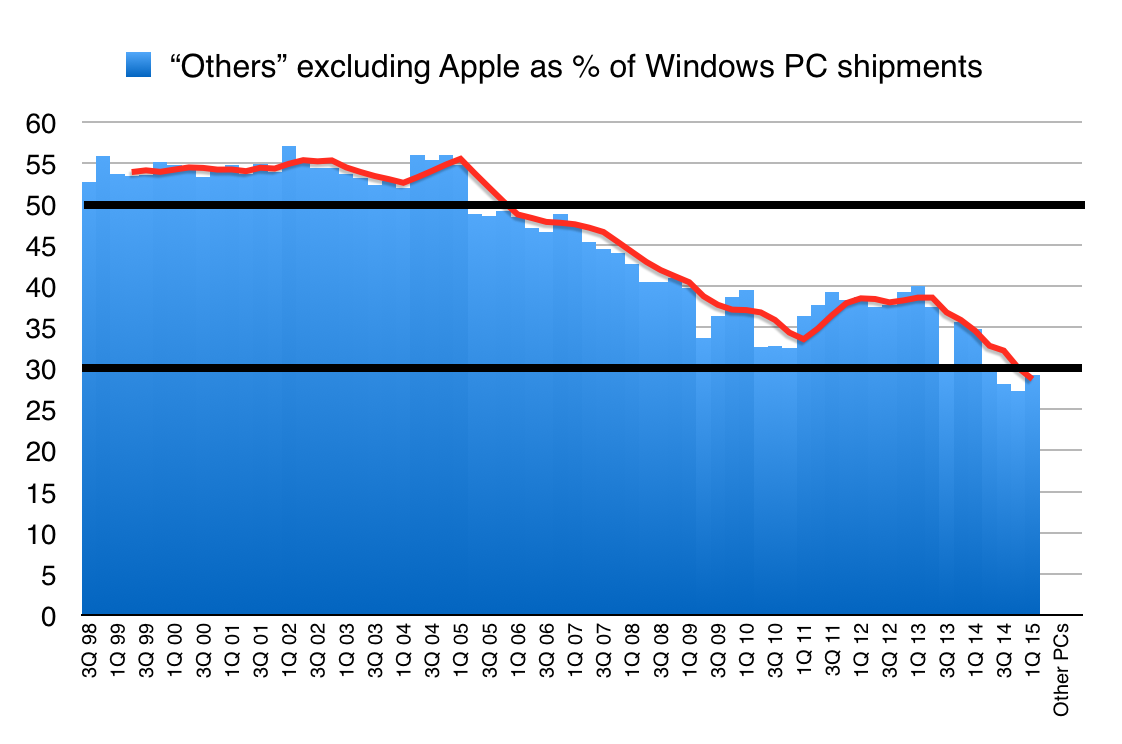
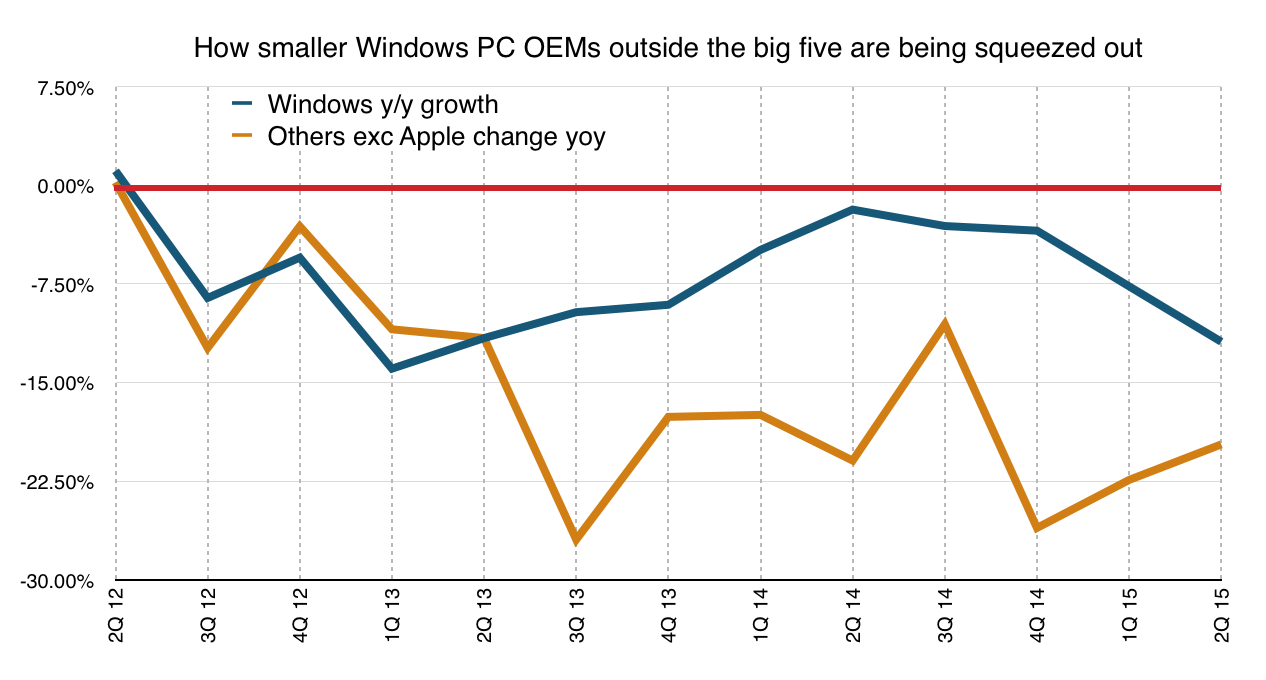
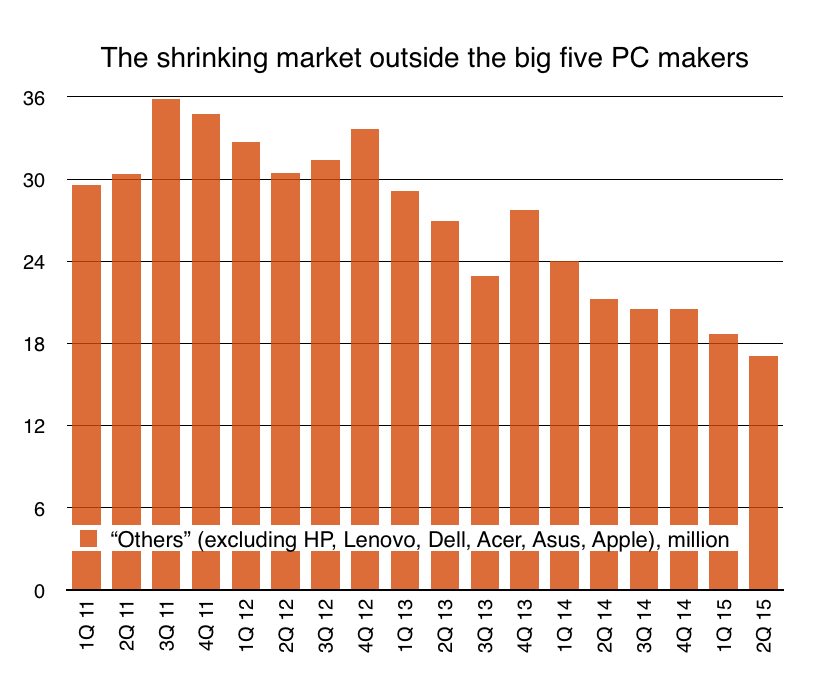
The deaths of “Others”: how the PC market’s implosion is squeezing smaller players

PC market 1998 to 2015: rise and decline

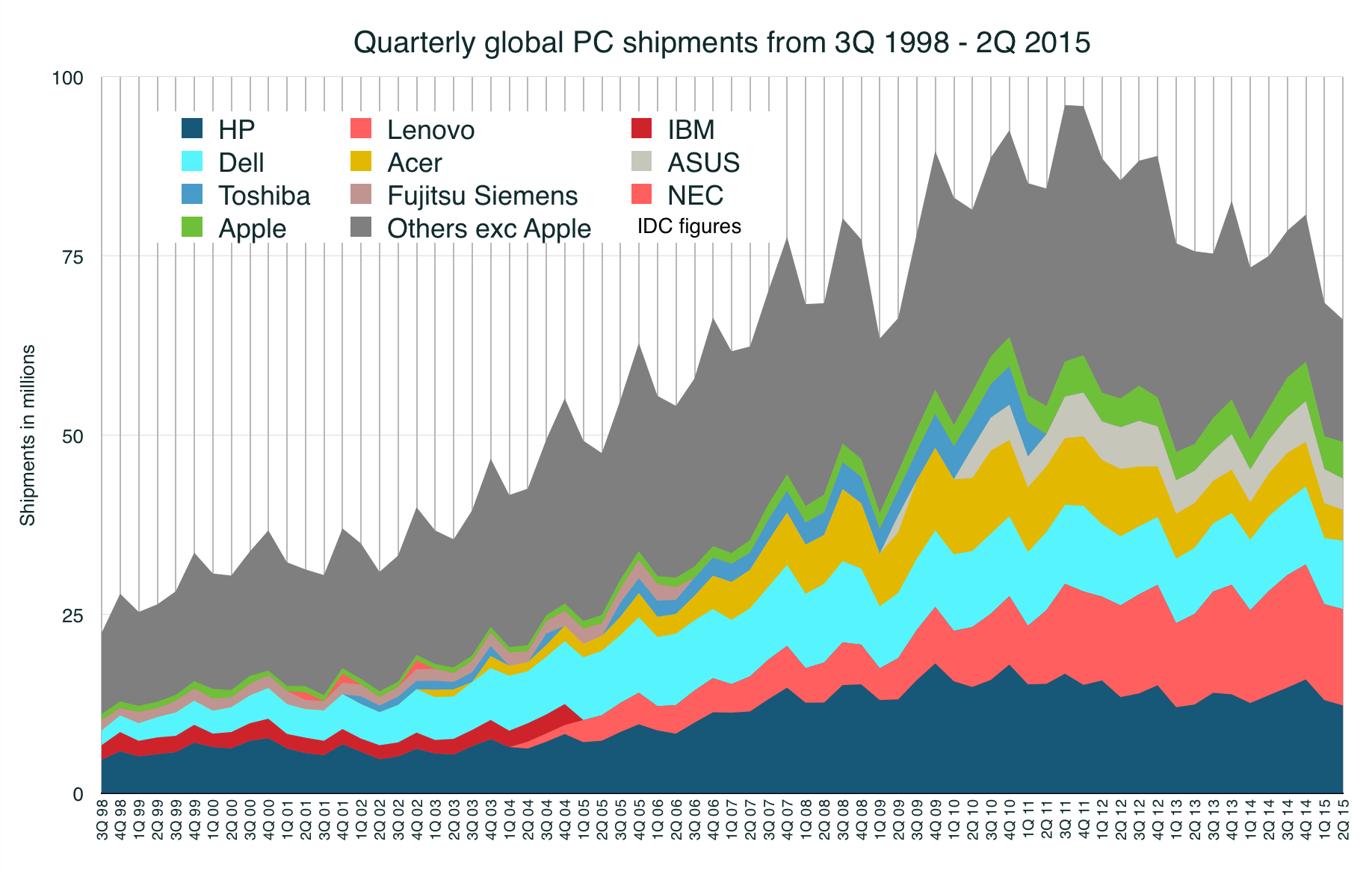
IDC data shows how the PC business has grown – and shrunk. “Others” (grey) are selling fewer and fewer.

Back in April 2011, when the results for the first quarter of PC shipments for the year came in, I wrote a story beginning:

“The PC market is showing signs of having passed its peak. Weak demand by consumers for PCs, coupled with a switch to tablets such as Apple’s iPad, meant that worldwide PC shipments fell compared with the same period in 2010, according to two leading research groups.”

Perhaps predictably, this observation of what the numbers were saying riled some of the PC diehard commenters (generally sysadmins with time on their hands who obsessively trawl comment threads looking for places in which to be superior). “I’m looking forward to seeing the looks on Mac users’ faces when Apple – as they display every intention of eventually doing – pull out of the PC market altogether,” said one.

My own observation was that the principal downturn had come in the mature markets of the US and Europe, and that the forthcoming problem was that the rise of smartphones (especially cheap Android) would mean that in Asia/Pacific and Latin America “lots of those people who a few years ago would have been a prime target for a PC might now not need it.”

And so it turned out. The market actually hit its biggest-ever figure in the third quarter of 2011, with 96m PCs shipped. But since the third quarter of 2012, if you exclude Apple figures, the Windows PC market has shrunk for 12 straight quarters. Now it’s 31% down on that peak, and nobody’s quite ready to call the bottom. It’s going to be under 300m this year – the smallest since 2009, in the midst of the financial crash – and that’s even with the launch of Windows 10. (For those saying “aha, but it’s falling because people are making their own PCs using motherboards” – nope. The motherboard industry is trending down just as quickly as the general PC industry.)

What gets people buying computers? Seems that Apple has the answer – launch new products and promote the hell out of them. (In the second quarter it refreshed the MacBook Air, MacBook Pro and introduced the “MacBook”.) It’s working a lot better for them than for the Windows PC market.

Apple v Windows

For the past 12 quarters, Windows PCs shipment figures have shrunk – while Apple generally grows faster

Apple has stayed fairly consistent, shipping between 4m and 5m personal computers per quarter – apart from the first half of 2013, when it couldn’t supply enough new iMacs to meet demand.

The demand for Macs means that Apple is now the fourth-largest PC company for shipments, behind only Lenovo, Dell and HP, and ahead of Asus and Acer, on IDC’s measurement. (IDC doesn’t include Chromebooks and 2-in-1s.) It’s quite a turn of events, but one where it has grown faster than the Windows PC market for quite a long time.

Windows v Apple, long-term

Long-term trends for Windows PC v Apple growth show Apple ahead for almost all of the past 11 years

Dying in a ditch without a saviour

The deeper question is: what happens to the PC market? It’s become a replacement business, but one in which replacement cycles are also lengthening. There’s barely any innovation – Lenovo’s efforts with the Yoga 2-in-1 seems to be the only thing happening, and that’s a minority sport. Gartner and IDC don’t give clear figures, but there doesn’t seem to be a big move to the new form factors. Thing is, it’s usually new form factors that drive revivals in the market.

So far, though? No. Canalys reckons that in Q1 “hybrid and convertible” shipments (that’s the 2-in-1s, and includes the Surface) totalled 3m, and that was a doubling year-on-year. There’s likely money to be made, but not many buyers handing over the moolah. And Chromebooks? A mighty 1.3m in Q1, also according to Canalys, which reckoned 90% went to the US and Europe. I don’t hold out much hope for a gigantic leap in Q2, though education buyers (the principal ones) will likely bump those Chromebook numbers up in Q3.

Brutal reality: revenue down, profit down

I track the big PC companies’ results, where you can generally find both revenues and operating profits for their PC divisions, though not usually PCs shipped (I take the latter from IDC). Apple is different – it gives you shipments and revenues, but no calculation of operating profit (because it doesn’t split out its figures that way).

And over the past 10 years, there are two trends that stand out: per-PC revenues have been falling along with per-PC profits for Windows makers, while Apple has seen similar pressures but sits miles ahead of the rest.

Average revenues per PC for big 6

“Big six” per-PC revenues, based on financial reports and IDC data.

In fact Apple has such high per-PC revenues that it’s actually now the third-biggest PC maker by revenue – excluding Dell, because we don’t know what Dell’s revenues are, because it is privately owned. Acer and Asus, by contrast, are on a path downwards; it’s notable that for the past couple of quarters they haven’t figured on IDC’s numbers for US shipments, meaning they had fewer than a million sales there. (And in timely fashion, Asus just chopped its notebook shipment forecast for the year to 20m units, down from 22.8m it was aiming for, and below 2014’s 20.3m.)

Total PC revenues for the big 6

Figures to 1Q 2015: despite fewer shipments, Apple’s revenues outdo Acer and Asus

The picture gets even worse if you look at total profits. We have to assume an operating profit for Apple; I use 18.9% because that’s the historical figure, extracted from pre-iPod days. On that measure, Apple makes the largest profit from PCs by a mile.

Per-PC operating profit for the big 6

Apple is miles ahead of the rest, based on an estimated 18.9% historical operating margin

Total profits in the PC industry for the 'big 6'

Data to 1Q 2015: on a historical figure, Apple is miles ahead, while Asus and Acer struggle to break even

The figure for Apple is twice that of any of the others. The graph for Acer isn’t a mistake – its operating profit is all over the shop, and has been negative quite a lot. (Remember this is operating profit – what’s left after paying for the product components, assembly, shipping, associated R+D, sales and marketing.)

The deaths of Others

But if profits are squeezed for the “big five” (or six, now Apple’s in the club), what’s it like for the smaller players such as Toshiba, Samsung, LG? Logically, worse, because just as in the smartphone market they don’t get the economies of scale that let them compete.

The problem is, there just isn’t room for them. Having been above 50% of the whole market back in 2005, they’ve tumbled down until now they’re trending below 30%.

"Other" PC makers are a smaller segment of the market

From 50% before, “others” are now less than 30% of a smaller market. The red line is the four-quarter moving average.

Since the market began shrinking, shipments by “Others” – those Windows PC makers outside the top five (HP, Lenovo, Dell, Asus, Acer) – have really fallen off.

As the PC market has shrunk, the “Others” category has shrunk faster.

Windows market growth v "Others"

The Windows PC market is shrinking – but “Others” is shrinking faster

The deaths of "Others": fewer shipments

Shipments outside the “big 6” have roughly halved from the market peak

“Others” (the remainders outside the top six if you include Apple) has dropped from just under 36m to less than 18m in less than four years. That’s a real crunch.

That means fewer sales, less revenue and less profit (if any) for those bit players – which includes Samsung, LG and a few others. Sony gave up PCs as a bad idea a while back. Samsung pulled out of the European market in late 2014.

Samsung, in particular, doesn’t have anything to gain from making PCs: it can’t make the chips in its foundries (they’re Intel not ARM) and it’s not generally offering touchscreens, so it doesn’t get the “flywheel effects” that it relies on for smartphones, where it makes the parts as well as the finished object.

If I were to bet, I’d expect Samsung to exit the PC market in a year or two. There just isn’t much in it there; you can see from the part of its “IM” division revenues that aren’t smartphones that it’s dwindling.

Ride to the end

There isn’t any good news for the PC industry, and I don’t expect Windows 10 to bring about dramatic changes. (Nor do IDC and Gartner.) There’s always a PC sales lull ahead of a Windows launch, but there’s still not great driving reason for the average consumer to buy a new PC because of Windows 10; remember how Windows 8 didn’t help that downward plunge.

And for businesses, if they’re on Windows 7 then they probably won’t see any reason to shift to Windows 10. And they probably binged on upgrades moving up from XP last year.

So get used to the new normal: PC sales will be increasingly concentrated among the top five or six, for whom R&D is pretty much an afterthought, and Apple is coining it – and pushing with the R&D – just as it is in phones.

How long before Apple’s share is 10%, up from its current 7.8% (which has more than quadrupled from its sub-2% low in the end of 2004)? On current trends (falling PC sales/rising Apple sales), it might be a year or two, but it seems shockingly in reach.

And those “Others”? With less and less market to shoot for, I’d expect some to quietly exit. Sony can’t have been the only one losing money.

Start up: more PC slowdowns, Apple Pay goes big, Facebook gets AI, Uber’s early days, and more

2012 Keynote
Big touchscreens: what are they good for? Photo by Microsoft Ignite NZ on Flickr.

A selection of 9 links for you. Use them wisely. I’m charlesarthur on Twitter. Observations and links welcome.

A compilation of robots falling down at the DARPA Robotics Challenge » YouTube

I for one welcome our new robotic ove.. AH, NOT SO SMART NOW, ARE YOU?


Siri’s search power grows, as Apple accelerates machine learning » Mobile Forward

Hristo Daniel Ushev:

I’m changing my mind about Google’s data-volume-based advantage. I believe Apple sees a volume of (anonymized) user data that’s on the same order of magnitude as Google (on mobile). Google Now may provide Google with more question/intent data, but Apple sees the bigger picture of what consumers (in aggregate) do/need throughout the day. I base my belief on iOS’s huge installed base, high app downloads and usage, and Apple’s full-stack access to iOS devices.

With so many dots to connect – Mac, iPhone, iPad, Apple Watch, Apple TV, Siri, Maps, News, HealthKit, HomeKit, and CarPlay – Apple will have great opportunities to add value to consumers’ daily life.

Machine learning is to 21st century devices as the graphical user interface was to 20th century computers. I don’t mean that as a user interface metaphor, but as a way to express how critical it will be to a high-performance product.

At a machine learning conference the other day, someone said to me: “a really smart AI wouldn’t need a ton of data. It would figure out what lions look like from just one picture of a lion, not hundreds. Maybe Google’s aren’t that good if they need so much data.” Well, perhaps..


Samsung’s new smartwatch to offer mobile payments: Electronic Times » Reuters

Tech giant Samsung Electronics Co Ltd plans to offer a mobile payments function in a smartwatch to be launched in the second half of the year, South Korea’s Electronic Times newspaper reported on Monday citing unnamed sources.

Samsung would use near-field communication (NFC) technology to support mobile payments on the smartwatch, the report said. This is the same technology Apple Inc uses for the Apple Pay function supported by its smartwatches.

How about that.


The future of computers is the mind of a toddler » Bloomberg Business

Jack Clark:

On June 9, Facebook plans to publish a research paper detailing a system that can chew through several million pieces of data, remember the key points, and answer complicated questions about them. A system like this might let a person one day ask Facebook to find photos of themselves wearing pink at a friend’s birthday party, or ask broader, fuzzier questions, like whether they seemed happier than usual last year, or appeared to spend more time with friends.

While AI has long been an area of interest for Hollywood and novelists, companies hadn’t paid much attention to it until about five years ago. That’s when research institutions and academics, aided by new techniques for crunching reams of data, started breaking records in speech recognition and image analysis at an unexpected rate. Venture capitalists took notice and invested $309.2 million in AI startups last year, a twentyfold increase from 2010, according to research firm CB Insights. Some of these startups are helping to break new ground. One in Silicon Valley, called MetaMind, has developed improvements to computers’ understanding of everyday speech. Clarifai, an AI startup in New York, is doing complex video analysis and selling the service to businesses.

Facebook’s office for this is in France. British companies are big in this too. Cannot emphasis enough how important this field is. (Can’t find the research paper, though.)


Apple Pay UK: some retailers to ditch £20 contactless limit » Pocket-lint

Stuart Miles:

As is the case with Apple Pay in the US, Apple has convinced retailers and banks to remove the limit because they can prove the customer is present thanks to the use of the Touch ID fingerprint scanner on the iPhone.

MasterCard have confirmed similar options for Apple Pay retailers in the UK too:

“Currently the vast majority of payment terminals here in the UK are set to accept contactless transactions up to the £20 spending limit, but that will rise to £30 in September (for cards as well),” a spokesman for MasterCard told Pocket-lint when we asked about clarification on the limit thresholds.

“As more digital services like Apple Pay come to market, we’re [MasterCard] supporting retailers and banks as they update the terminals so that they can accept authenticated transactions above that limit from digital devices.”


Uber: An oral history » Fortune

Some fascinating interviews by Adam Lashinsky (with Uber’s cooperation, of course), which are all worth reading; including this by Conrad Whelan, who was its first engineer:

When I joined the company, you couldn’t actually sign up for the product. It was just a way to order the car. So I built the sign-up flows that would take a credit card and make user accounts. So as soon as we did that, we could officially launch, which was June 1st, 2010, two months after I started.

I think the next thing I did, which I really enjoyed, was optimize the dispatch algorithms to take into account drivers that might miss a dispatch. That lasted like three years, or something like that, which is pretty cool.

Sounds throwaway, but gives a hint of the huge complexity involved.


Large touchscreens: what’s different? » Nielsen-Norman Group

Amy Schade tried out a 24in tablet with her children (because children don’t know what they’re not supposed to not do):

While the large screen was completely enthralling to my 2 year olds, the size of the touchscreen was a drawback for my daughter. She leaned on the screen with one hand in order to reach another part of the screen. As a result, the puzzle pieces that she was trying to move jumped from one hand to the other, if they moved at all.

Using the large screen was particularly hard for her, based on her size relative to the device —most of us aren’t using devices that are nearly as big as we are. However, her attempts to use it also illustrate a problem far more likely to be encountered with large touchscreens: that of unintended two-handed touches and other accidental touches.

We see this play out in our testing of mobile devices. We witness more accidental touches or brushes of the screen as people maneuver standard sized tablets than we do when watching people use their phones.

Designs need to anticipate and accommodate accidental touches and consider ways to incorporate larger gestures, hand presses versus finger touches, and multi-hand interactions.


PC inventory issues growing serious in Europe; retailers boycotting vendors dumping inventory » Digitimes

Monica Chen and Joseph Tsai:

First-tier PC vendors reportedly are seeing serious inventory issues in Europe and may try to digest stocks by offering price cuts. At the same time, some channel retailers are reacting to the news by boycotting the vendors to avoid having inventory dumped on them, according to sources from the upstream supply chain.

The PC supply chain was originally optimistic about demand for PCs in the second quarter, but component suppliers have seen their orders from brand vendors weakening during the quarter as most vendors have high inventory levels on hand, which they are struggling to clear as most consumers have halted their notebook purchasing to wait for the release of Windows 10, which is scheduled for the end of July…

…In addition, Windows 10’s free upgrade strategy is also expected to weaken consumers’ demand for buying new PCs.

“First-tier PC vendors” is probably code, here, for Asus and Acer.


Facing the music » All this

Dr Drang on the longest half-hour ever, at the end of the Apple keynote in which Eddy Cue introduced Apple Music:

nothing justifies the dancing. I’m sure Eddy thought it was funny and self-deprecating, but it was just annoying and a waste of our time. I often think Craig Federighi overdoes the jokes, but he knows when to pull it back and doesn’t let his presentation get derailed. Eddy doesn’t have that sense.

As to whether Apple Music is really good, we’ll have to wait and see, but the signs aren’t pointing in that direction. The elevator pitch is that “Apple Music is three things” – an attempt to tie it to the 2007 introduction to the iPhone. (And someone should have explained that to Iovine before sending him onstage. He clearly didn’t understand the audience’s reaction to the “three things” line.) But while the advantages of a multifunction device are obvious, the advantages of a multifunction app aren’t. The App Store’s success is largely based on tightly focused apps, not sprawling suites.


Start up: Intel stutters, Google goes retail, why Apple Watch?, what people really want in news apps, and more


The view for too many small businesses, in Intel’s opinion. Photo by Ella’s Dad on Flickr.

A selection of 7 links for you. To read. I’m charlesarthur on Twitter. Observations and links welcome.

Why is Apple making a gold watch? » Benedict Evans

Apple stores are huge rich-media billboards on every major shopping street in the developed world: I can’t think of any other company that has shops as big as that in such premium locations in as many places. Apple retail is a self-funding marketing operation. So too, perhaps, is the gold watch. Apple might only sell a few tens of thousands, but what impression does it create around the $1,000 watch, or the $350 watch? After all, the luxury goods market is full of companies whose most visible products are extremely expensive, but whose revenue really comes from makeup, perfume and accessories. You sell the $50k (or more) couture dress (which may be worn once), but you also sell a lot of lipsticks with the brand halo (and if you think Apple’s margins are high, have a look at the gross margins on perfume). 

Meanwhile, though other companies are already making metal smart watches, I struggle to imagine Samsung making solid gold watches. Apple’s brand might or might not work there, but no other CE company’s does. That is, if this is marketing, and if it works, it’s marketing that no-one else can do. 

On another tack, perhaps the biggest message that this sends is that the Apple watch is not a technology product. It’s a post-‘feeds and speeds’ product. Today we have prices and release dates for the watch but no tech specs at all – because they’re irrelevant to the user experience.

Perfume margins are amazing. And yes, consider how sales of a Samsung gold smartwatch would go.


An incredibly shrinking Firefox faces endangered species status » Computerworld

Gregg Keizer:

Mozilla’s Firefox is in danger of making the endangered species list for browsers.

Just two weeks after Mozilla’s top Firefox executive said that rumors of its demise were “dead wrong,” the iconic browser dropped another three-tenths of a percentage point in analytics firm Net Applications’ tracking, ending February with 11.6%.

That was Firefox’s lowest share since July 2006, when the browser had been in the market for less than two years…

…In the last 12 months, Firefox’s user share – an estimate of the portion of all those who reach the Internet via a desktop browser – has plummeted by 34%. Since Firefox crested at 25.1% in April 2010, Firefox has lost 13.5 percentage points, or 54% of its peak share.

“Hello? It’s Marissa. Now, about that refund clause..”


Intel lowers first-quarter revenue outlook » Intel Newsroom

Intel Corporation today announced that first-quarter revenue is expected to be below the company’s previous outlook. The company now expects first-quarter revenue to be $12.8bn, plus or minus $300m, compared to the previous expectation of $13.7bn, plus or minus $500m.
 
The change in revenue outlook is a result of weaker than expected demand for business desktop PCs and lower than expected inventory levels across the PC supply chain. The company believes the changes to demand and inventory patterns are caused by lower than expected Windows XP refresh in small and medium business and increasingly challenging macroeconomic and currency conditions, particularly in Europe.

The XP refresh is/was still going on? Amazing. (During the same period last year, Intel’s revenue was $12.7bn. So it might be very close to zero growth.)


What do people want from a news experience? » Tales of a Developer Advocate

Paul Kinlan was building a news app:

I posited that users want (in order of priority):

• Notifications of important news as it happens
• An icon on the launcher so it can be loaded like an app
• News available to them offline (i.e, when they are in the tube)
• A fast site

My own intuition of an industry I am not too heavily involved in probably can’t be trusted as much as I think it can, so I sent out a terribly worded tweet.

What happened next will inform and entertain you. (No really, it will.) It did him.


Thousands have already signed up for Apple’s ResearchKit » Bloomberg Business

Michelle Fay Cortez and Caroline Chen:

Stanford University researchers were stunned when they awoke Tuesday to find that 11,000 people had signed up for a cardiovascular study using Apple Inc.’s ResearchKit, less than 24 hours after the iPhone tool was introduced.

“To get 10,000 people enrolled in a medical study normally, it would take a year and 50 medical centers around the country,” said Alan Yeung, medical director of Stanford Cardiovascular Health. “That’s the power of the phone.”

That’s people who would have had to download the update and opt in. Some fret about the quality of data (biased selection) but:

The data may not be perfect, but many concerns about ResearchKit – such as whether the patient sample is representative – are issues with traditional clinical trials as well, said Todd Sherer, CEO of the Michael J. Fox Foundation for Parkinson’s Research, which has collaborated with nonprofit group Sage Bionetworks on one of the apps.


Forking hell! Baidu gives up on its Android-based OS » Tech In Asia

Steven Millward:

No news means bad news when it comes to tech companies. If they’ve nothing to boast about, the ensuing silence looks suspicious. That’s been the case with Baidu’s version of Android (pictured above), which launched in late 2011.

Despite a high-profile and promising start as Dell made use of Baidu’s Android-based Yun OS for a new China-only phone, the Chinese search giant’s OS thereafter didn’t show any signs of finding favor with the nation’s smartphone shoppers. Yesterday, Baidu confirmed in its Yun OS forums that the Android skin will not get any more updates. The project is now suspended.

Had its own product suite, but missed the boat for this. However, has 500m monthly active users for its mobile search and 200m MAUs for its maps product. Might struggle by.


Google opens its first Google-branded store-in-a-store, in London » WSJ

Saabira Chaudhuri:

Google has opened in London its first Google-branded store-in-a-store selling space.

Housed within Dixons Carphone DC.LN -0.41%’s Currys PC World store on Tottenham Court Road, the Google Shop will give Google the opportunity to show off its range of Android phones and tablets, Chromebook laptops and Chromecasts.

“The pace of innovation of the devices we all use is incredible, yet the way we buy them has remained the same for years. With the Google Shop, we want to offer people a place where they can play, experiment and learn about all of what Google has to offer,” said James Elias, the U.K. marketing director for Google.

In some ways, the Google Shop is more of a branding exercise than an approximation of a standalone store. All sales from the store go to Dixons Carphone.

So it’s to sell.. Chromebooks? Chromecast? And – Google needs branding? Seriously?


Start up: Samsung’s S6, why clickbait works, the music industry’s pain, Lenovo’s clean pledge, and more


What happens when you don’t have enough people in these? The music business hurts. Photo by eldeeem on Flickr.

A selection of 10 links for you. Adjust for daylight savings. I’m charlesarthur on Twitter. Observations and links welcome.

Samsung Galaxy S 6 and Galaxy S 6 edge » Business Insider

The Galaxy S 6 is made entirely of metal and glass and will come in two variations: The “regular” Galaxy S 6 and the Galaxy S 6 edge, which has a curved screen.

Samsung started designing the Galaxy S 6 from the ground up about a year ago under a program it called Project Zero. Whereas the last few Galaxy models were designed with the previous model in mind, the Galaxy S 6 is entirely new. Samsung even abandoned some of its earlier principles in order to highlight the design of the Galaxy S 6. It’s not waterproof. You can’t swap out the battery. And there’s no slot to insert extra memory.

Both models do all the same stuff, except the Galaxy S 6 edge has a few extras. It lets you swipe over from the curved portion of the screen to view a list of your favorite contacts and get alerts when you have a missed call or text from one of them. Other than that, Samsung says the curved screen doesn’t serve any function other than to look good. (It’ll also be more expensive, but Samsung hasn’t said how much either phone will cost yet.)

Besides the physical design, Samsung has cleaned up its software too. The phone isn’t bogged down with a bunch of unnecessary features and extras. The new version of Samsung’s TouchWiz skin for Android is cleaner and easier to navigate. All the basic apps like email, calendar, and music have a new look. Plus, the phone will ship with some of Microsoft’s Android apps like OneNote, OneDrive, and Skype.

As expected (and using its own Exynos processor), though Samsung appears to have used the iPhone 6 as its design template – from some angles you wouldn’t know which was which. I linked to Business Insider because it was the only site I could find easily which had a concise and balanced overview of what’s there in the phone and what’s not.

The list of features it has dumped from previous Galaxy flagships is now longer than those still there. Stuff that’s been dumped yet was previously “essential”: waterproofing, battery swapping, SD card slot, and of course things weird software “features” such as Air View, Air Gesture, Smart Stay and so on.

I have a feeling that this will actually be a bigger success for Microsoft than Samsung. “A curved screen that just looks good”?


Lenovo’s promise for a cleaner, safer PC » Lenovo Newsroom

After that Superfish shenanigans:

by the time we launch our Windows 10 products, our standard image will only include the operating system and related software, software required to make hardware work well (for example, when we include unique hardware in our devices, like a 3D camera), security software and Lenovo applications.  This should eliminate what our industry calls “adware” and “bloatware.”  For some countries, certain applications customarily expected by users will also be included. 

Lenovo is the biggest PC maker in the industry. Rival companies including Acer preinstall third-party apps. Will this force them to stop those installations, with the consequent impact on their margins? If so, that’s going to make it harder for them to thrive against Lenovo – which will get bigger, until Acer (and Asus?) are forced into a niche in the industry.


Why the Music Aficionado was to blame for declining music sales in 2014 » Music Industry Blog

Mark Mulligan:

Music Aficionados are consumers that spend above average time and money with music. They represent just 17% of all consumers but a whopping 61% of all recorded music spending. These consumers shape the fortunes of the music business. In the past this did not matter so much because:

• So many passive majority music fans were spending strongly
• Aficionados were behaving predictably

Now that has all changed. Passives are sating their appetites on YouTube while Aficionados are making major changes to their buying habits. Last year 14% of Aficionados said they were stopping buying CDs while 23% said they were buying fewer albums of any kind and 23% also said they were buying fewer downloads. The 2014 revenue numbers show us just what impact these changes had.

If we extrapolate those percentages to Aficionados’ share of spending in those markets in 2014 we see:

• Aficionados spent $192m less on CDs, which was 67% of the total $326m lost CD spend in 2014
• Aficionados spent $250m less on downloads, which was 86% of the total $290m lost CD spend in 2014

Amazing how concentrated it is – rather like the games app industry which relies on “whales”.


Yes to the Dress? » Medium

Paul Ford, in a masterful piece about media organisations’ reactions to That Story About The Dress (about which in two years’ time we’ll all say, “oh, yeah, wasn’t that stupid?”), and how Buzzfeed got 25 million page views in a day for it:

What I saw, as I looked through the voluminous BuzzFeed coverage of the dress, is an organization at the peak of a craft they’ve been honing since 2006. They are masters of the form they pioneered. If you think that’s bullshit, that’s fine—I think most things are bullshit too. But they didn’t just serendipitously figure out that blue dress. They created an organization that could identify that blue dress, document it, and capture the traffic. And the way they got those 25 million impressions, as far as I can tell from years of listening to their people, reading their website, writing about them, and not working or writing for them, was something like: Build a happy-enough workplace where people could screw around and experiment with what works and doesn’t, and pay everyone some money.

Great!

This is not said as an endorsement of BuzzFeed.

Oh. But it is an endorsement of building organisations that work. Trouble is, most media organisations experiment, but they don’t do it scientifically. That’s the real, fundamental fault.


Microsoft to cut 9,000 Nokia jobs in China » MarketWatch

Microsoft plans to shut two mobile-handset manufacturing plants in China formerly run by Nokia Corp., cutting about 9,000 jobs in total, various reports said Thursday. Microsoft, which bought Nokia’s handset business last April, scheduled the closure of the plants – located in Beijing and the southeastern city of Dongguan – earlier this month and plans to ship some of the manufacturing equipment there to Vietnam, according to a report in the government-run Beijing Youth Daily.

It quoted an unidentified Microsoft China executive as saying the closures and transfer of production capacity to Vietnam would likely be completed by the end of March. The layoffs are part of an estimated 18,000 job cuts which Microsoft announced in the wake of its purchase of the Nokia unit for $7.2bn.

At one time, according to Tomi Ahonen, it was the largest and most modern handset manufacturing facility in the world. Not sure when that time was, though. Think there are probably lots more factories making handsets now.


Why is the internet overrun with clickbait? » The Makegood

Tom Hespos:

I have an undergrad degree in journalism, I’ve been a business journalist for over 15 years, and I’ve worked at newspapers and even started my own. So I like to think I’m a decent headline writer. I wrote the original headlines for a handful of content pieces and watched the numbers roll in.

Some pieces bombed. Others did well. On the suggestion of our sales rep, we decided to test multiple headlines for each content piece. So we wrote 10-12 new headlines for each piece and tested them in isolation. Some of those headlines were typical of what a newspaper editor might write after reading the content. Others were deliberately controversial or, in some cases, playing to fear or uncertainty. You might even say they were starting to skirt the “clickbait” line.

So everything else was kept the same – the visual, the content, the media environments and everything else.  We just ran different headlines. Sure enough, the provocative headlines outperformed campaign averages. Big time. As in 15x lift.

We like to make fun of done-to-death lines like “You’ll never guess what happens next…” or “You’ve been doing [X] wrong your whole life…” We might even wonder out loud how many people actually click on such things. Perhaps we shouldn’t make fun.

I wonder what would happen if newspapers were to do the same with their headlines. You can see it being done by organisations like Taboola, where you can see an evolutionary progression going on with the headlines trying to get people to click through to stories.

Then again, businesses that rely simply on clicks are going to create clickbait. It’s as logical as night following day.


Futures of text » Whoops

Jonathan Libov:

I’m skeptical of a future where we communicate with computers primarily by voice. The visions in 2001: A Space Odyssey and the Her portray voice as the most effortless interaction, but voice actually requires a lot more cognitive and physical effort than pointing with a mouse, typing on a keyboard, or tapping on app icon and then navigating the UI. Consider all those times you’ve exchanged a million texts with someone while making plans when voice would have resolved it much more quickly. Text is often more comfortable even if it’s less convenient.

I believe comfort, not convenience, is the most important thing in software, and text is an incredibly comfortable medium.

Great piece looking at developments in messaging.


Cybergeddon: why the Internet could be the next “failed state” » Ars Technica

Sean Gallagher:

“If we think our kids and grandkids are going to have as awesome and free an Internet as the one we have, we really have to look at why we think that,” Jason Healey, director of the Cyber Statecraft Initiative at the Atlantic Council of the United States, told Ars.

The alternative futures for the Internet are not pretty. In presentations at multiple security conferences, Healey has suggested that the Internet could “start to look like Somalia”—a failed state where security is impossible, going about daily life is hazardous, and armed camps openly wage war over the network.

Healey’s analysis has been reinforced by events over the past two years: record data breaches, zero-day vulnerabilities released that affected a preponderance of Internet services, and visibility into the vast state surveillance of the Internet. The Internet has been “weaponized,” not just by the NSA and its foreign counterparts but by other states and Internet crime organizations. A thriving market for vulnerabilities attracts the bright and ambitious to work on discovering “zero days” for profit.

Sometimes you need an “e-” prefix, sometimes you need “cyber-“. Odd how “cyber-” wins for bad news – cyberwarfare, cyberhacking, and “e-” wins for the nice stuff. Apart from email, obviously.


Google just bought the entire .app web domain for $25m » Cult of Android

Killian Bell:

Fancy a .app web address? You’re going to be buying it from Google. The search giant has splashed out just over $25m on the entire .app web domain, which is around $19m more than any other company has paid for a top-level domain so far.

The actual figure Google paid to the Internet Corporation for Assigned Names and Numbers (ICAAN) is $25,001,000. The second-most expensive domain is .tech, which sold for $6.76m, and the third-most expensive is .reality, which sold for $5,588,888.

Google applied for the top-level domain (TLD) back in 2012, Business Insider reports, four years after ICAAN decided to expand the overall number of TLDs. The company also applied for .docs, .android, .free, .fyi, .foo, and others around the same time.

Makes sense, though now it has all the fun of being a registrar. Will all Google Play apps automatically get a .app address to make them visible in search?

Also, most expensive? Has nobody bought .sex?


Samsung’s rise and fall » Business Insider

Terrific, detailed piece by Steve Kovach:

The success of Samsung’s Mobile in the US began a rift with the Korean headquarters. Sources say the more successful Samsung was in the US, the more complicated the relationship with headquarters got. Instead of getting credit, the US team felt they were being chastised for doing their jobs well. (Samsung declined to comment on this story.)

It got so bad, a source told us, that Samsung flew a plane full of executives to the mobile division’s office in Dallas for an unannounced audit that lasted three weeks in 2012. The Dallas-based employees had to go through all materials they used to sell and market Samsung’s mobile products. They were accused of falsifying sales, bribing the media, and a bunch of other damaging actions that hurt morale in the office. The same US-based office that helped turn Samsung into a brand as recognizable as Apple was suddenly being punished for its work…

…during one meeting with the global teams at Samsung’s headquarters in Korea, executives made the US team stand up in front of several hundred of their peers in an auditorium. The executives told the employees to clap for the US team as encouragement since they were the only group failing the company, even though it was clear to everyone the opposite was true.

Jawdropping.