Start up: Apple v Samsung redux, cornering the DRAM market, what millennials will do to tech


Speed: Facebook’s got it. Photo by _hadock_ on Flickr.

A selection of 8 links for you. Like butterflies, only linkier. I’m charlesarthur on Twitter. Observations and links welcome.

Tools don’t solve the web’s problems, they ARE the problem » QuirksBlog

Peter-Paul Koch:

The web definitely has a speed problem due to over-design and the junkyard of tools people feel they have to include on every single web page. However, I don’t agree that the web has an inherent slowness. The articles for the new Facebook feature will be sent over exactly the same connection as web pages. However, the web versions of the articles have an extra layer of cruft attached to them, and that’s what makes the web slow to load. The speed problem is not inherent to the web; it’s a consequence of what passes for modern web development. Remove the cruft and we can compete again.

The question is, how is Facebook speeding it up, given that it’s going to be shifting the same content? Data compression?


How aging millennials will affect technology consumption » WSJ

Christopher Mims on how the post-1980 “millennials” are moving into a new stage in life:

Data from comScore suggest most switching between Android and iPhone is in favor of Apple, and iPhones have a significantly higher average selling price than Android. So we can assume that, all other things being equal, as millennials age and their earning power increases, their taste in consumer electronics will become more expensive.

This is good news for Apple—and others targeting the higher end of the product spectrum. It’s also fantastic news for pretty much the entire consumer-electronics industry and countless online retailers such as Amazon: A giant demographic bulge is about to enter 20 years of peak earning power. This is a generation that likes its on-demand services, which means the coming decades will almost certainly see more Uber rides and same-day deliveries than ever.


Ad-blocking? No, mobile operators won’t be blocking adverts & charging Google to restore them » Disruptive Wireless

Dean Bubley:

In a nutshell, some European telcos feel they can “get away with” harassing Google and to a lesser degree Apple and Facebook, and get air-cover from their national regulators and the European Commission. While the current trials might have the convenient excuse of “protecting users’ dataplans”, the reality is much more duplicitous – they are jealous that Google has out-innovated and out-maneouvred them, in a similar fashion to their rhetoric about “OTTs”, when they have been asleep at the communications wheel for 20 years…

…[Among advertisers’ countermeasures to such a move] Encryption of content is the most obvious. It is already widespread in mobile, and is growing fast – in some networks, more than 50% is encrypted. There are multiple styles, ranging from SSL built-in to HTTPS traffic, SRTP for WebRTC traffic, through to using compression and proxy servers. Some of these are still theoretically “blockable” based on IP address, but the risk of false positives increases hugely. The inclusion of Google’s SPDY technology into the HTTP2 standard has pretty much ensured this is a one-way ratchet for web traffic in future.

As Bubley also points out, tons of mobile connections are actually made over Wi-Fi. And these points are only the beginning.


Asian component makers take slice of Apple’s iPhone spoils » FT.com

Simon Mundy and Kana Inagaki:

As well as the US-based global market leader Qualcomm, MediaTek must contend with China’s Spreadtrum, a chip designer whose processors are gaining a growing share of the Chinese market. Meanwhile shares in Ningbo-based Sunny Optical, which supplies camera modules to the likes of Xiaomi and Lenovo, have doubled in the past year.

“It’s clear the Chinese brands prefer to have Chinese suppliers,” says Nicolas Baratte, head of technology research for CLSA. “There is a different type of understanding between Chinese companies. The Chinese supply chain is amazingly flexible in terms of tolerance for specification change and redesign, and flexible payment terms.”

Yet with the Chinese market slowing, he adds, some Chinese suppliers — notably phone assembly groups such as Wingtech and Longcheer — are increasingly pinning their expansion hopes on work for faster-growing brands from other countries, especially India.
A reliance on foreign customers has been thrust upon Japan’s handset component suppliers by that country’s dramatic decline in the mobile phone market — but they have responded strongly according to analysts who say Japanese groups account for a third of the parts found in the iPhone, while achieving strong sales of high-tech components to Chinese producers.


EZTV shuts down after hostile takeover » TorrentFreak

A “hostile takeover” by scammers, who got access to the domain details and changed it to their own:

Sladinki007 says that NovaKing must have been devastated by what happened. A life’s work was completely ruined in a few days and access to personal domain names was gone as well.

While EZTV could technically start over using a new name the group’s founder decided to throw in the towel. Too much had already been lost. The group had always been a “fun” non-profit project, and the recent troubles took the fun away.

The scammers, meanwhile, continue to operate both the .it and .ch domain names and are now distributing their own torrents (sourced elsewhere) with the hijacked EZTV brand. They pretend to be the real deal, sending out misleading and false status updates, but they’re not.

Having control over NovaKing’s email address the scammers even reached out to other torrent site operators, claiming that EZTV was back in business. However, most knew better not to fall for it and have retired official EZTV uploader accounts.

So someone who enabled widespread torrenting of TV content (which – astonishingly – doesn’t actually make itself for free) gets scammed and gives up? A “life’s work”? Strike up the world’s smallest violin.


Tipping point ahead: Samsung’s DRAM market share at 40% » BusinessKorea

Cho Jin-young:

Samsung Electronics is riding high with its share of the global DRAM market at 40%.

According to a report on performance in the first quarter of this year published by Samsung on May 17, the company accounted for 43.1% of the DRAM market in Q1 2015, up 2.2% from the number for the entire year of 2014. The figure in Q1 2015 is a nearly 6% increase from the total number for 2013. That data that was mentioned was compiled by market research firm IDC.

Based on market research firm DisplaySearch’s data, Samsung’s share of the global display panel market was 21.8% in Q1 2015, up about 1% from the previous year. The tech giant explained that it is responding to market demand with a full line-up, from ultra large premium displays to those for entry-level UHD and curved TVs.

It made a loss on the TVs, but grew its market share. Could it corner the whole DRAM market? Weird thought.


Apple readies first significant Apple Watch updates, ’TVKit’ SDK for Apple TV » 9to5Mac

Mark Gurman:

Currently in development, the features seek to enhance Apple Watch security, connectivity with other Apple devices, health and fitness features, Wi-Fi capabilities, and integration with third-party applications. Additionally, Apple is also priming major updates for the Apple TV in both the hardware and software departments, including Apple Watch integration. Below, we detail what users can expect from Apple Watches and Apple TVs in the future…

Includes a “Find My Watch” which sounds more like Bluetooth leashing – if the Watch gets some distance away from the phone. There are also promises about health, and others, though they’re also cautioned as “possibly some way off”.


Appeals court finds third trial necessary in first Apple-Samsung case: $380m in damages vacated » FOSS Patents

Florian Müller:

today’s appellate opinion reverses the trade dress-related part of the district court ruling and, on that basis, remands the case for a new trial. A new jury will have to determine damages for all products the first jury found to have infringed an Apple trade dress: the Fascinate, Galaxy S (i9000), Galaxy S 4G, Galaxy S II Showcase (i500), Mesmerize, and Vibrant phones. The total amount of damages (these were only at issue in the 2012 retrial, not the 2013) retrial was over $380m.

The original jury verdict only specified damages by product, but not by product and intellectual property right. That’s why the total damages amount for those products must be redetermined. There’s no way to simply subtract the part that related to design patents.

The Federal Circuit agreed with Samsung that it would have been entitled to judgment as a matter of law (JMOL) on the functionality of the trade dresses on which Apple prevailed. In all other regards, such as invalidity of design and software patents, the Federal Circuit sided with Apple.

Oh good grief. Another trial. Just the other day I was thinking of how Google’s hurried purchase of Motorola for the ludicrous garbillions of dollars belonged to a different age when people thought patents would make a difference in the smartphone struggle. This is nostalgia reflux.

Note though that the appeals court didn’t reverse the jury verdict – as some wilder misunderstanders of legal process had forecast. Judges don’t reverse juries in civil trials without exceptional cause.


Start up: Apple Watch’s big security hole, iPhone rumours!, fight for your right to be forgotten, and more


Forgetful sign. Photo by mikecogh on Flickr.

A selection of 8 links for you. Go on, click them. I’m charlesarthur on Twitter. Observations and links welcome.

Watch OS 1.0 lacks the necessary security features to dissuade thieves » iDownloadblog

Jeff Benjamin:

The Apple Watch contains security measures to prevent thieves from accessing your data, but it doesn’t include the necessary features to dissuade thieves from trying to steal your device to begin with.

The problem stems from the lack of an Activation Lock-like feature on Watch OS 1.0.

Unlike the iPhone, if someone steals your Apple Watch, they can easily reset the device (bypass the passcode), and pair it with a new iPhone logged in to a different iCloud account. In other words, it’s totally feasible to steal an Apple Watch and set it up on a different device as if you just purchased it from an Apple Store.

What a colossal security oversight. Bad, bad, bad.


Maybe Samsung is starting to think wearables through more carefully » ReadWrite

Brian Rubin:

Samsung’s new software development kit for its homegrown mobile OS Tizen offers a few hints about its upcoming Gear A smartwatch (codenamed Orbis)—namely, that it will probably sport a round display and a rotating bezel for taking a spin through the interface.

More important, though, the SDK also suggests that Samsung is taking a more measured approach to its new wearable—one that bodes well for its future efforts in the area.

Rotating bezel sounds a clever idea… until you try to think what you’d control with it. OK, it was a great idea on the iPod for scrolling through a long list. But on a watchface, you’d be obscuring part of the list at least once every revolution.


Introducing Windows 10 Editions » Microsoft

There’s Home, Pro, Enterprise, Education, and…

Windows 10 Mobile is designed to deliver the best user experience on smaller, mobile, touch-centric devices like smartphones and small tablets. It boasts the same, new universal Windows apps that are included in Windows 10 Home, as well as the new touch-optimized version of Office. Windows 10 Mobile offers great productivity, security and management capabilities for customers who use their personal devices at work. In addition, Windows 10 Mobile will enable some new devices to take advantage of Continuum for phone, so people can use their phone like a PC when connected to a larger screen.

Windows 10, a break from the past of confusing SKUs. Also: Windows Mobile. We have always been at war with Eurasia. (There’s a Mobile Enterprise version too.)


Next A9-based iPhone predicted to have 12MP camera, 2GB RAM, rose gold and more, mass production in August » Mac Rumors

As it’s never too early for “next iPhone” rumours, Joe Rossignol channels KGI Securities’ Ming-Chi Kuo (who has done OK on this stuff before):

The main selling point of the so-called “iPhone 6s” and “iPhone 6s Plus” will be Force Touch, the pressure-sensitive display technology built into Apple Watch and new MacBook trackpads. Other predicted features for Apple’s next iPhone, many of which have already been rumored, include an A9 processor with 2GB of RAM, improved 12-megapixel camera, a new Rose Gold colour option, possible sapphire cover lenses and more.

2GM of RAM is overdue. Unsure about the Force Touch thing: would that make the phone thicker? Would it work all over the screen? It might get rid of a moving part that’s probably prone to break (the home button) which could still have a sapphire lens for the fingerprint unlock. Might.

The most surprising forecast is that there won’t be a refashioned 4in model. Will the 5S remain on sale, but ageing? Or are the larger screens the only future?


Fitbit IPO rides on persuading you to dust off your wristband » Bloomberg Business

Caroline Chen:

Some Fitbit users have found they can use smartphone apps to count steps instead of having to wear a wristband. For others, the novelty just wore out. Catherine Toth Fox bought her Fitbit Charge, which sells for $129.95, in January and was done with it after a month.
“I stopped using it when I figured out how much activity it took me to hit 10,000 steps,” the Honolulu freelance writer, 40, said in an e-mail. “I realized very quickly that I was already reaching that goal just by my normal daily activities, so there was no need to have a device to tell me that anymore.” She gave the Fitbit to her mother, who uses it daily. Her husband, on the other hand, has never taken his out of the box.
Keeping users engaged will matter even more as Fitbit increases its offerings to employers. The device maker’s corporate wellness program lets companies buy Fitbits for their workers and monitor their health via a dashboard. For companies that are self-insured, encouraging employees to exercise more can help reduce the firm’s health bill.

That “I figured out how much was enough” point is an important one: it sets a ceiling even on active users.


How Google’s top minds decide what to forget » WSJ

Lisa Fleisher and Sam Schechner:

Google has only been removing results from European domains such as Google.fr or Google.co.uk—but not Google.com, even when accessed in Europe. That can make it simple to find results that have been removed, leading regulators to issue an opinion saying Google’s position didn’t go far enough.

Regulators say their position holds and that Google should comply or face legally binding orders to do so.

“Their position will have to change,” said Isabelle Falque-Pierrotin, head of the CNIL, France’s data-protection regulator, as well as chairwoman of a pan-European advisory body that includes all EU privacy regulators.

Another confrontation looms. (Clever headline, too.)


Google wins privacy case, allowed not to forget in Finland » Ars Technica UK

The (original) headline here is misleading. Let’s see why in this Glyn Moody article:

As the news site yle.fi reports, the case concerned a Finnish man’s business “blunders,” which he claimed were harming him because they continued to turn up in Google’s search results. After Google refused a request to remove them, the man appealed to Finland’s Data Protection Ombudsman. The latter pointed out that “Finland’s business register lists the man as still being involved in business operations, including debt collection.” That presumably meant the links to stories about his past would still be relevant to people who were seeking information about the person in question now. As such, there was no reason for Google to be forced to delete those hits from its search results page.

Ah, so this is an appeal. Which means the “RTBF” (or RTBdelinked) does apply in Finland. As the article continues by explaining:

Finland’s Data Protection Ombudsman is currently dealing with around 30 other complaints about Google’s refusal to delete results. According to the article, “In Finland there have been close to 3,700 requests [to Google] to remove information from roughly 12,000 search results. Google has conformed to about 45%.” This is close to its average compliance rate of 40% across the EU, where Google has received 250,000 requests to remove information from more than 900,000 search engine results.

So in fact the RTBF is enacted *more* strongly in Finland than elsewhere in Europe, on average. After I pointed this out to Moody, he tweaked the headline to “Google wins privacy case, allowed this time not to forget in Finland”.

People get worked up over the RTBF, even though it rests on the same principle as that preventing US companies from grabbing data from Europeans and abusing it. They like the latter, but not the former; except they’re indivisible because of their origin.


Apple Watch vs Android Wear: Why most smartwatches still suck for women » iMore

Serenity Caldwell:

When I first heard about Android Wear last year, I thought the folks behind the OS were doing a lot of things right. And I still do: the approach to notifications is smart, custom watch faces are neat, and Google Now — while creepy — works exceptionally well at providing smart information for your day.

There’s only one problem: There’s not a single Android Wear device designed to fit a small-wristed person.

If wearable technology is the next big thing for our tech-connected society, why is Apple the only company paying attention to the smaller-wristed set? Lady or dude, there are quite a few people on this earth whose arms don’t resemble the trunk of a Sequoia tree — many of whom would be excited to use a smartwatch. I was thrilled when Apple announced multiple sizes for the Apple Watch, and moreover that both were reasonably-sized for the wrist; sadly, I have yet to find an Android Wear device that will fit on my wrist without making it look like the technology equivalent of an iron shackle.


Start up: iPhone sales visualised, stopping VR sickness, Canon lurches downward, mobile design and more


Not so many of these being sold. Photo by lonelysandwich on Flickr.

A selection of 8 links for you. Perhaps. I’m charlesarthur on Twitter. Observations and links welcome.

iPhone sales by quarter » Bare Figures

Have a play with this excellent site, which shows financial data for all sorts of companies. Notable: iPhone sales in the just-gone quarter of 61.2m, up 39.9%. That really is a lot. And the revenues too.


How to reduce VR sickness? Just add a virtual nose » WIRED

Liz Stinson:

Eliminating simulator sickness is a major interest of the burgeoning VR industry, but so far there hasn’t been a clear answer. Home remedies include drinking alcohol, while companies like Oculus Rift are exploring better positional tracking and improved display resolution. But researchers at Purdue University believe they’ve found a way to reduce the negative physical effects of virtual reality by using something that’s right in front of your face.

“We’ve discovered putting a virtual nose in the scene seems to have a stabilizing effect,” says David Whittinghill, an assistant professor in Purdue University’s Department of Computer Graphics Technology.


Windows Phone and Prepaid in the US » Tech.pinions

Jan Dawson:

based on the combination of AdDuplex and Comscore data, it’s likely Cricket has between 1 and 1.5 million Windows Phone devices in its base, which is a fairly significant chunk of Cricket’s overall base, perhaps as much as 25%. Secondly, remember the overall Windows Phone growth numbers we looked at earlier? There was net growth of about 1 million Windows Phone handsets in the base during that same nine month period or, in other words, the difference between those that left the platform and joined it was 1 million. Given Cricket likely added around 1 million during that period, it’s possible it accounted for the vast majority of that net growth.

Cricket isn’t the only prepaid brand where Windows Phone is big, though. It’s hard to get a full postpaid/prepaid breakdown from the AdDuplex numbers because, for the major carrier brands, the two aren’t separated. But even if we just focus on MetroPCS, Cricket and a phone only available on AT&T’s GoPhone prepaid service, these three add up to around 40% of the total base in the US. Add in a few percentage points for other prepaid sales on the major carriers and we could be getting close to half the Windows Phone base on prepaid, compared with about 25% of the total US phone base on prepaid. In this sense, Windows Phone is the anti-iPhone, with the iPhone well underrepresented in the prepaid market, just as Windows Phone is well over-represented.

(The full article is via subscription – monthly or one-off.)


The hidden politics of video games » POLITICO Magazine

Michael Peck:

Sim City lets you indulge your wildest fiscal fantasies. Banish the IRS and set taxes to zero in Teapartyville, or hike them to 99 percent on the filthy rich in the People’s Republic of Sims. Either way, you will discover that the game’s economic model is based on the famous Laffer Curve, the theoretical darling of conservative politicians and supply-side economists. The Laffer Curve postulates that raising taxes will increase revenue until the tax rate reaches a certain point, above which revenue decrease as people lose incentive to work.

Finding that magic tax point is like catnip for hard-core Sim City players. One Web site has calculated that according to the economic model in Sim City, the optimum tax rate to win the game should be 12% for the poor, 11% for the middle class and 10% for the rich.

In other words, playing Sim City well requires not only embracing supply-side economics, but taxing the poor more than the rich. One can almost see a mob of progressive gamers marching on City Hall to stick Mayor McSim’s head on a pike.

The subtle reinforcing effects of such models isn’t much thought about. Philip K Dick did, for his short story War Game.


Canon first-quarter profit drops as compact camera demand collapses » Reuters

Thomas Wilson:

Japan’s Canon Inc reported first-quarter net profit that fell by almost a third on Monday, grossly undershooting expectations, citing a collapse in demand for compact digital cameras.

Profit at the world’s largest camera maker fell to 33.93bn yen (£188 million) in January-March, compared with the 53.64bn yen average estimate of 5 analysts according to Thomson Reuters data.

The result comes as the world’s No.1 camera maker contends with a shift in consumer preference toward increasingly capable smartphone cameras. That shift has dragged Canon’s compact sales down nearly 70% since the market’s peak in 2008 – the year after Apple released its game-changing iPhone.

“Sales volume for low-end (digital camera) models declined due to the ongoing contraction of the market in all regions from the previous year,” said Canon in its earnings release.

Revenues down 1% year-on-year; operating profit by 20%. Also cut this year’s forecasts for compact sales by 23% and for higher-end cameras by 9%.


Telecom act to stifle sales of LG G4, Galaxy S6 » Korea Times

Bahk Eun-ji:

LG Electronics will release its latest smartphone, the G4, on Wednesday and seek to steal customers from its bigger rivals Samsung Electronics and Apple. LG is betting big on the new smartphone to gain fresh momentum in its earnings.

However, it faces a bigger obstacle than Samsung and Apple in the domestic market ― the Telecom Act that caps handset subsidies.

Two weeks ago, the KCC [Korean Communications Commission] raised the maximum amount of subsidy that customers can receive when buying a new handset to 330,000 won [£203/$304], from 300,000 won [£185/$268]. However, the maximum subsidy is possible only for those who choose the highest monthly phone bill rate. For most consumers, the actual subsidies available for them are insignificant. That’s why they are not buying new handsets.

The government has drawn criticism for the enforcement of the Telecom Act from all interested parties, including consumers, telecom companies and retail shop operators.

In particular, retail handset dealerships have condemned the act as their handset sales plunged after the Mobile Distribution Act took effect in October. Under the current law, when consumers buy Samsung’s Galaxy S6 and select a highest phone bill rate, they can receive up to 330,000 won in subsidies.

Normally, retail shop owners get rebates from telecom companies when they sell new handsets, but if customers do not buy the devices at the shop, the owners will not get the rebate.

Besides, if customers cancel their contracts before six months, the shop owners have to pay a 200,000 won [£123/$184] penalty to the telecom companies.

This probably explains the low reported sales of the Galaxy S6. The purpose of the subsidy cap is to prevent carriers and handset makers colluding to lure customers from rivals in South Korea’s saturated market. In 2014, Samsung lobbied to raise the subsidy ceiling. Not hard to work out why.


Racist Camera! No, I did not blink… I’m just Asian! » Flickr

Jared Earle offered a followup to the story on Kodachrome from Monday, pointing to this photo and commentary from 2009:

We got our Mom a new Nikon S630 digital camera for Mother’s Day and I was playing with it during the Angels game we were at on Sunday.
 
As I was taking pictures of my family, it kept asking “Did someone blink?” even though our eyes were always open.

Surprising, to say the least, that Nikon would have this problem.
Time picked up the story about a year later, and pointed out more strange examples where systems seemed to have built-in prejudices.

Of course, you can blame “the algorithms”. But they don’t write themselves.


Obvious always wins » LukeW

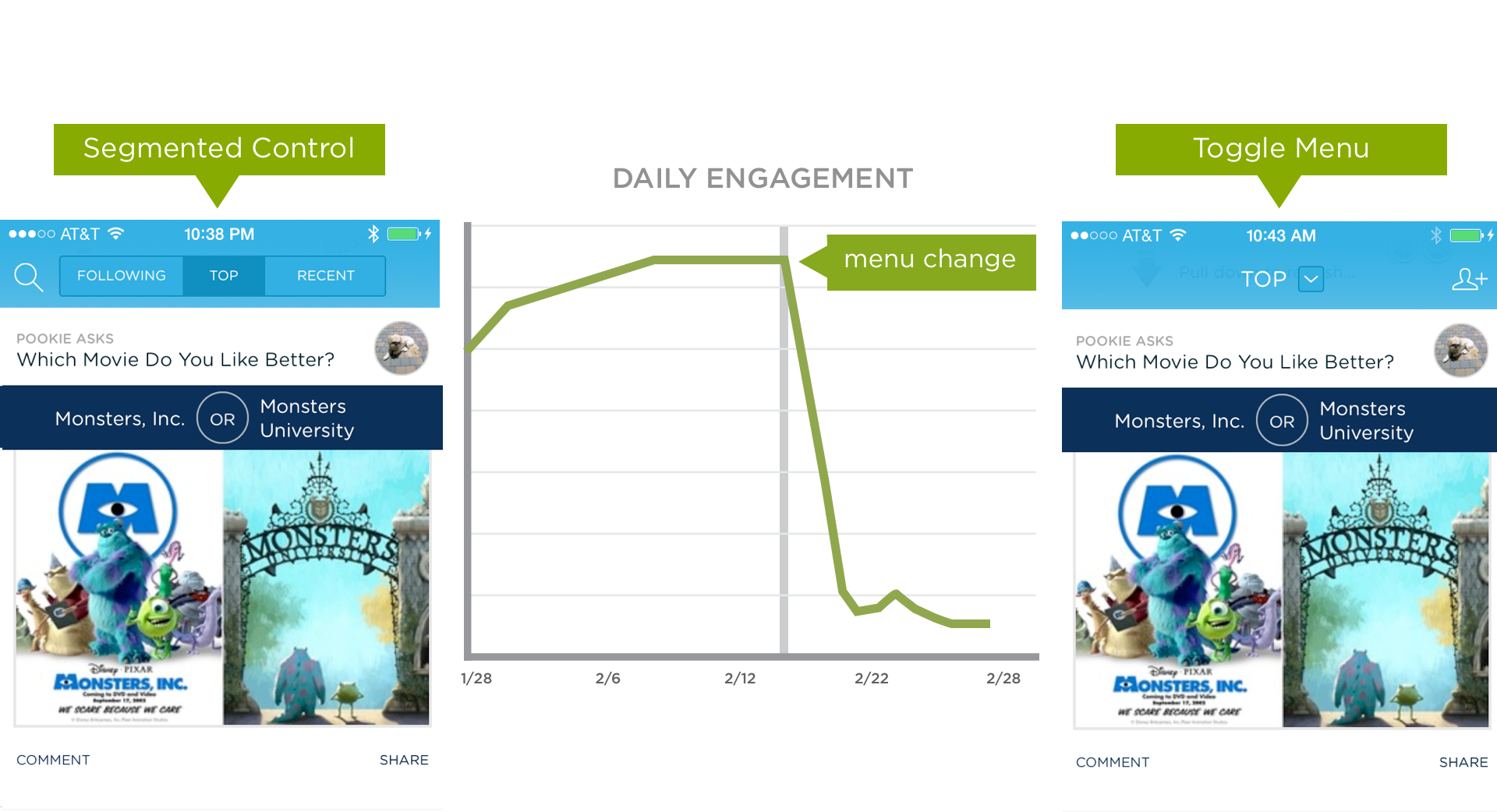
Luke Wroblewski, on how using menu controls (especially “hamburgers” and similar) can create big problems, even though the screen looks “simpler” (and so “better”, right?):

In an effort to simplify the visual design of the Polar app, we moved from a segmented control menu to a toggle menu. While the toggle menu looked “cleaner”, engagement plummeted following the change. The root cause? People were no longer moving between the major sections of the app as they were now hidden behind the toggle menu.

A similar fate befell the Zeebox app when they transitioned from a tab row for navigating between the major sections of their application to a navigation drawer menu. Critical parts of the app were now out of sight and thereby out of mind. As a result, engagement fell drastically.

[By contrast] When critical parts of an application are made more visible, usage of them can increase. Facebook found that not only did engagement go up when they moved from a “hamburger” menu to a bottom tab bar in their iOS app, but several other important metrics went up as well.


Start up: correcting Google, science says videogames don’t make sexists, iPhone forecasts, and more


This is how we used to write and correct “blogposts”, kids. Photo by Julie McGalliard on Flickr.

A selection of 10 links for you. For free! I’m charlesarthur on Twitter. Observations and links welcome.

Electric cars won’t spread even with rapid chargers: Toyota engineer » Yahoo Finance

Electric vehicle (EV) supporters have touted developing high-speed charging technology as the way forward for cars like Nissan Motor Co’s Leaf. But Yoshikazu Tanaka, chief engineer of Toyota’s hydrogen fuel-cell car Mirai, said that would guzzle so much energy at once as to defeat the purpose of the EV as an ecologically sound form of transportation.

“If you were to charge a car in 12 minutes for a range of 500 km (310 miles), for example, you’re probably using up electricity required to power 1,000 houses,” Tanaka told a small group of reporters at the first test-drive event for the production version of the Mirai, the world’s only mass-market fuel-cell car.

“That totally goes against the need to stabilize electricity use on the grid.”

Ah. Good point.


Sub-Rs 10,000 smartphones contributing 75% of sales: Lenovo » India Times

Chinese tech major Lenovo today said almost three-fourth of its smartphone sales is coming from devices priced below Rs 10,000 [US$160].

The company offers smartphones priced in the range of Rs 4,000 to Rs 30,000.

“The industry itself sees about 75% of the sales coming from smartphones priced under Rs 10,000 and we have more or less a similar split,” Lenovo India Director Smartphones Sudhin Mathur told PTI.

The company started as a premium player but now have devices across entry, mid and premium segments, he added.


How many iPhones did Apple sell last quarter? » Fortune

Philip Elmer DeWitt:

BTIG’s Walter Piecyk has the low estimate (50m), independent Faizai Kara of the Braeburn Group the high (64m). The average estimate of each group — pros at 55.6m and amateurs at 59.3m — are not that far apart. Either would represent double-digit growth from the same quarter last year.

Last year’s figure was 43.7m. Apple financials are released after US market close on Monday.


Indian companies pull out of Facebook’s Internet.org amid battle over net neutrality » WSJ Digits blog

Aditi Majhotra:

A viral crusade to keep the Internet equally accessible to all users has won the backing of some of the country’s biggest online companies, which late Wednesday pulled out of a partnership with Facebook’s Internet.org over fears it could allow telecom operators to choose which web applications users can access and how fast.

India’s sophistication in this space shouldn’t be a surprise, yet it is.


From Product Club to Thington Inc. — Welcome to Thington » Medium

Tom Coates:

The more we explored the space, the more we found that however good and interesting the hardware was in the Internet of Things, the software and service layers were generally awful. Gradually, we came to believe that huge problems in these layers were hiding all of the value and the potential of the technology.

Which brings us to Thington! We decided that we wanted to build a new user interface and service layer that would push past all these problems and in the process bring in our experience working on social systems, location sharing, privacy, hardware and the web of data. And we’re super excited by what we’ve come up with. So excited in fact that we’ve put our money where our mouths are and have formally changed the name of the company from Product Club to Thington Inc.

Keep an eye on this: Coates and colleagues have a solid track record in making useful stuff.


The Search for Harm » Official Google Blog

Knowing that the EC would issue a Statement of Objections (because it sent them to Google ahead of time), Amit Singhal, Senior Vice President, Google Search, put his name to this blogpost which aimed to show that all the EC complaints are nonsense.

And it’s Google, so it’s all going to be built on really robust data, right? Except that the blogpost has been updated at least twice:

*Update: An earlier version of this post quoted traffic figures for Bild and The Guardian, researched on a third-party site. The Guardian data were for the domain guardian.co.uk, which is no longer the main domain for the paper. We’ve removed these references and we’re sorry for the error.

That was the first. And then:

Yelp has pointed out that they get 40% of their searches (not their traffic) direct from their mobile apps. They don’t appear to disclose their traffic numbers. We’re happy to correct the record.

Did I start the ball rolling querying the numbers in Singhal’s post? Yes, I did. Someone has to ask questions of Google, and it seems all the bloggers and reporters feverishly writing hot takes didn’t.

But if those two statistics are wrong… what about all the others in Singhal’s blogpost? Guess we’ll have to look at it all in detail at some point soon.


L.A. school district demands iPad refund from Apple » LA Times

The contract with Apple was approved by the Board of Education in June 2013 as part of a deal expected to reach at least $500m. Another $800m was earmarked to improve Internet access at schools.

Under the contract, Pearson was to provide English and math curriculum. The district selected Pearson based only on samples of curriculum — nothing more was available.

L.A. Unified made the deal anyway; it wanted to bundle the curriculum and the device into a single price. A three-year license to use the curriculum added about $200 to the $768 cost of each iPad. The entire purchase then was financed through school construction bonds, which can be used to purchase computers.

L.A. Unified bought 43,261 iPads with the Pearson curriculum. The district purchased another 77,175 iPads under the contract without the Pearson curriculum to be used initially for state standardized tests.

Pearson could offer only a partial curriculum during the first year of the license, which was permitted under the agreement. Teachers and principals never widely embraced the product.

Nearly a year ago, L.A. Unified sent Apple a letter demanding that it address problems with the Pearson curriculum.

“Only two schools of 69 in the Instructional Technology Initiative … use Pearson regularly,” according to an internal March report from project director Bernadette Lucas.

Seems like it’s the Pearson curriculum that’s screwed up more than the iPads, though the two also seem intertwined. The whole contract has unwound horribly.


Sexist Games=Sexist Gamers? A longitudinal study on the relationship between video game use and sexist attitudes » Abstract

Enlisting a 3 year longitudinal design, the present study assessed the relationship between video game use and sexist attitudes, using data from a representative sample of German players aged 14 and older (N=824). Controlling for age and education, it was found that sexist attitudes—measured with a brief scale assessing beliefs about gender roles in society—were not related to the amount of daily video game use or preference for specific genres for both female and male players. Implications for research on sexism in video games and cultivation effects of video games in general are discussed.

Unfortunately the study itself is paywalled, but this is the first potentially rigorous scientific study I’ve seen into the topic. So do we conclude that sexist dolts who play games would just be sexist dolts regardless? I think that’s pretty easy to answer. (Thanks to Jay Kannan for the link.)


Given enough money, all bugs are shallow » Coding Horror

Jeff Atwood on the trouble with open source and bugs (or even just code and bugs):

While I applaud any effort to make things more secure, and I completely agree that security is a battle we should be fighting on multiple fronts, both commercial and non-commercial, I am uneasy about some aspects of paying for bugs becoming the new normal. What are we incentivizing, exactly?

Money makes security bugs go underground

There’s now a price associated with exploits, and the deeper the exploit and the lesser known it is, the more incentive there is to not tell anyone about it until you can collect a major payout. So you might wait up to a year to report anything, and meanwhile this security bug is out there in the wild – who knows who else might have discovered it by then?

If your focus is the payout, who is paying more? The good guys, or the bad guys?


SanDisk forecasts first full-year revenue decline in three years » Reuters

Arathny Nair:

There is strong demand for SanDisk’s solid-state drives and memory chips.

But lower pricing, lean inventory, unplanned maintenance at its chip foundry last year and delay in sales of certain embedded parts has led to two revenue forecast cuts this year, including a warning last month.

“It looks like SanDisk is going to have pretty tough road ahead to haul in 2015,” said Wedbush Securities analyst Betsy Van Hees, adding that the company’s spending is high and will continue at “elevated levels”…

…The company had said in January it had lost a major customer, widely believed to be Apple Inc, which switched to using solid state drives made by Samsung Electronics Co Ltd in its MacBooks.

Would love to know quite how the (SD) memory chip demand is going in smartphones. Something about SanDisk’s SD business reminds me of Iomega – seemed like a great business offering consumer storage, which abruptly collapsed (when CD-Rs got cheap). SanDisk’s financials suggest the glimmerings of a fall in revenue in its “removable” business.


Start up: spotting comment trolls, stopping piracy Of Thrones, where’s Android One?, and more


Try putting those on Bittorrent, suckahs. Photo by Jemimus on Flickr.

A selection of 8 links for you. Use them wisely. I’m charlesarthur on Twitter. Observations and links welcome.

Scientists develop algorithm that can auto-ban internet trolls » The Stack

Martin Anderson:

The study found that on CNN the studied trolls were more likely to initiate new posts or sub-threads, whilst at Breitbart and IGN they were more likely to weigh into existing threads.

The report does not exonerate host communities of all blame for troll behaviour, finding that immediately intolerant communities are more likely to foster trolls:

“[communities] may play a part in incubating antisocial behavior. In fact, users who are excessively censored early in their lives are more likely to exhibit antisocial behavior later on. Furthermore, while communities appear initially forgiving (and are relatively slow to ban these antisocial users), they become less tolerant of such users the longer they remain in a community. This results in an increased rate at which their posts are deleted, even after controlling for post quality.”

Seems mostly accurate, apart from calling breitbart.com a “political hub”. I’d go for “troll-employing troll magnet”, personally.


Game Of Thrones leak and watermark: a stupid tracking system » bru’s blog

The first four episodes of game of thrones leaked nearly 36 hours ago. They have been extensively downloaded, and the only tracking set up HBO seemed to be a watermark in the bottom left corner of the screen. Once blurred, it is useless. This impresses me. It’s 2015 and all you’re using is a “confirm you’re deleted” + “your copy is watermarked” for protection? There are simple schemes that would have allowed HBO to track the leak.

The idea is very simple: make each copy unique in a non-visible way.

Seems like the editing to create unique copies would be a hassle. Not sending them out (by getting people to come in to previews?) might be simpler. But there would be geographic reasons against that. No matter what, though, it only delays the piracy by 36 hours or so. That’s the bigger problem.


BOMBSHELL: MUSL employee might have rigged Hot Lotto computerized drawing » Lottery Post

Prosecutors countered this motion by claiming they have a “prima facie,” or at first glance, case that Tipton tampered with lottery equipment.

In their reply to the defense’s motion, prosecutors argued that Tipton’s co-workers said he “was ‘obsessed’ with root kits, a type of computer program that can be installed quickly, set to do just about anything, and then self-destruct without a trace.” The prosecution claimed a witness will testify that Tipton told him before December 2010 that he had a self-destructing root kit.

Prosecutors also argued in their reply that Tipton was in the draw room on Nov. 20, 2010, “ostensibly to change the time on the computers.” The prosecution alleged the cameras in the room on that date recorded about one second per minute instead of how they normally operate, recording every second a person is in the room.

“Four of the five individuals who have access to control the camera’s settings will testify they did not change the cameras’ recording instructions; the fifth person is Defendant,” the prosecution wrote.

Someone’s writing the screenplay already, yes? The accused bought a ticket that won $14.3m.


What’s Become of Android One? » CCS Insight

Peter Bryer is an analyst:

our checks indicate that Android One has had a limited direct effect on the market, despite initial enthusiasm for the programme. Sales of Android One-based smartphones began more than half a year ago in India, but volumes don’t stand out.

The first Android One products came from Karbonn, Micromax and Spice, with more familiar brands expected to begin adopting the platform. Acer, Asus, HTC, Lenovo and Panasonic were among the smartphone manufacturers listed by Google as partners in the project, but this interest appears to have stalled.

The fading momentum of Android One is an indication of the expanding selection of equally well-specified, low-cost smartphones and tablets in emerging markets. Hundreds of models are available at $100 or below — a once impossible price band has become very ordinary.

The standard having been set, others have matched it. All works for Google. But see later…


Flipkart’s move to dump mobile site could hit Google » WSJ

Rolfe Winkler:

Indian e-commerce giant Flipkart has decided it doesn’t need to rely on the Web to lure shoppers, dumping its mobile site and pushing visitors to its app. That move may spell trouble for the future of Google ‘s cash-cow search engine, which relies heavily on links to shopping sites.

Smartphone users that go to the mobile websites of either Flipkart or its sister site Myntra no longer see the same virtual store shelves as when they visit those sites from a personal computer. Instead they see a message to download the sites’ mobile apps.

The problem for Google is that a large percentage of its ad business is driven by paid links that direct users to e-commerce sites. But mobile apps are walled gardens unto themselves, unconnected by links to the broader Web.

A general problem, but if it starts happening early in countries like India, that is a problem for Google.


Brazil’s iPhone investment falls short on promises of jobs, lower prices » Reuters

Brad Haynes:

The Brazilian iPhone was meant to mark a new era.

When Taiwan’s Foxconn Technology Group agreed in April 2011 to make Apple products here, President Dilma Rousseff and her advisers promised that up to $12 billion in investments over six years would transform the Brazilian technology sector, putting it on the cutting edge of touch screen development. A new supply chain would be created, generating high-quality jobs and bringing down prices of the coveted gadgets.

Four years later, none of that has come true.

Foxconn has created only a small fraction of the 100,000 jobs that the government projected, and most of the work is in low-skill assembly. There is little sign that it has catalyzed Brazil’s technology sector or created much of a local supply chain.

Not quite clear where the blame lies – high expectation by Foxconn, local taxes or local culture.


Formal charges may be next in Europe’s Google antitrust inquiry » NYTimes.com

James Kanter and Conor Dougherty:

Some experts say that Mr. Almunia’s unsuccessful strategy makes further attempts to settle the case without formal charges unlikely.

“Given the history of failed attempts to reach a commitment decision, I just don’t see what she would gain from going down this route again, unless Google has promised more concessions that we don’t know about,” said Liza Lovdahl-Gormsen, the director of the Competition Law Forum at the British Institute of International and Comparative Law.

Without formal charges, Ms. Lovdahl-Gormsen said, “Google might try to buy themselves time by offering commitments that are unlikely to be accepted by the commission, and that it knows won’t be accepted by the market, simply because it does not want to be faced with the instrument of torture — the statement of objections.”

Expect news on Wednesday.


My voice is my passport: Android gets a “Trusted Voice” smart lock » Ars Technica

How secure is this system? We’re wondering the same thing. The popup when you enable “Trusted Voice” warns that the feature is not as secure as a traditional lock screen and that “Someone with a similar voice or a recording of your voice could unlock your device.” We’d love to test it out, but it hasn’t rolled out to any of our devices yet—we only know about it thanks to a report from Android Police.

Android Police hasn’t given it any scrutiny (none of its devices – even Nexuses – seem to have got it.) The commenters on AP don’t seem enamoured, though, pointing out how easy it would be to spoof (as Google itself admits). So there’s now pattern, PIN, face and voice unlock, and also “trusted device” (Android Wear). Flexibility is good, but they aren’t all equally robust, which feels like a problem.


Start up: Samsung’s #bendgate?, algorithms v April Fool, graphene is coming!, the US’s backward financial improvement


This might be what to do with trading algorithms on April Fools Day. Photo by kippster on Flickr.

A selection of 10 links for you. Not thixotropic. I’m charlesarthur on Twitter. Observations and links welcome.

Chinese fingerprint on smartphone trends in Malaysia, Singapore » Digital News Asia

Karamajit Singh:

Chinese smartphone vendors entered the Malaysian market in earnest in 2013, and this accelerated in 2014 with the various brands winning over a sceptical market with their price-to-performance models.
 
As a consequence, what used to be known as the mid-level phone market in Malaysia – the RM700 to RM1,200 (US$190 to US$325) level – is collapsing rapidly, IDC argues.
 
“The story is that the low-end market is getting more competitive and many phones that carry good specs are already priced below RM700,” says [Jensen] Ooi [IDC market analyst for client devices at IDC Asia Pacific].
 
Feeling the pain here from the rapid commoditisation of the mid-tier market are the traditional large players like Samsung, Sony and LG, which are unable to differentiate their phones at price points above RM700.
 
IDC’s data shows that sub-RM700 phones made up nearly 60% of the Malaysia market in 2014, up from nearly 40% the year before. The majority of the growth has been captured by the Chinese vendors at the expense of Samsung, Sony and LG.
 
More bad news for these Android vendors: “Their share in the mid-range and high-end market has weakened and will continue to weaken this year, with only Apple continuing to grow there in 2014,” says Ooi.


Teardown of new Samsung Galaxy smartphone suggests deeper loss for Qualcomm » Reuters

Se Young Lee and Noel Randewich:

Samsung is not only using its own Exynos mobile processor, as had been widely reported, but also decided to rely on its in-house semiconductor business to source other parts, including the modem and power management integrated circuit chips, Ottawa-based consultancy Chipworks said in a web posting dated April 2.

Samsung is counting on its new flagship Galaxy S6 and S6 edge phones to help revive earnings momentum after a disappointing 2014. Strong sales of system chips such as its Exynos processor could also help boost earnings, analysts and investors say.

The Galaxy S6 also comes with Samsung’s Shannon modem chip, US phone carrier AT&T said on its website.

“It’s pretty clear if they’re using Shannon for the modem for AT&T that they’re trying to use all-Samsung silicon,” said Jim McGregor, an analyst at Tirias Research. “With their market share going down they’re under pressure to increase profit margins.”

Makes sense (and poses a problem for Qualcomm): the more Samsung-built chips are in each phone, the greater its profit. Samsung Electronics’s preliminary results – its range of expected revenues and operating profit – are released on Tuesday 7 April; full results by division later in the month.


Apple invents watertight iDevice buttons » Patently Apple

Jack Purcher:

Apple began working on various waterproofing methods for iDevices back in 2010 and in 2013 devised a waterproofing nano coating. In March we posted a report covering Apple’s most advanced invention on waterproofing to date titled “Apple Invents a Waterproofing Method for Future iDevices using Hydrophobic Conformal Coatings and Silicon Seals.” Today, the US Patent & Trademark Office published yet another waterproofing patent application from Apple that specifically covers a water tight button solution for iDevices.

It feels like an obvious solution, and covers the power switch and volume switches. Is the headphone jack and Lightning port close-ended? In that case water resistance would be sorted – and could become another extra feature to differentiate from past models.


Wal-Mart exec calls credit card upgrade a ‘joke’ » CNN

Wal-Mart’s executive in charge of payments thinks the United States’ switch to chip-based credit cards is going to be a disappointment.

The new “chip & signature” program is barely an improvement on security and fraud, said Mike Cook, Wal-Mart’s assistant treasurer and a senior vice president, at this week’s Electronic Transaction Association’s Transact conference in San Francisco. Cook said Wal-Mart would have preferred a “chip and PIN” system that Europe and Africa have, since PINs would protect cards from being stolen.

“The fact that we didn’t go to PIN is such a joke,” Cook told CNNMoney.

Cook said signatures on checks were sufficient 100 years ago, but they’re outdated today. PINs on debit cards were a major improvement to stop thieves decades ago. They’d do the same for credit cards – which is why banks should use them for all cards.

“Signature is worthless as a form of authentication,” Cook said during a presentation at the conference. “If you look at the Target and Home Depot breaches … not a single PIN debit card needed to be reissued in those breaches. The card number was worthless to the individual thief and fraudsters, because they didn’t know the PIN.”

Americans truly have no idea how backwards their financial systems are.


Schaumburg man acquitted after child porn got mixed up in WWII downloads » DailyHerald.com

Barbara Vitello:

Testifying in his own defense, [Wocjciech] Florczykowski, a 40-year-old electrical engineer, described himself as a history buff with an interest in World War II, specifically battlefield memorabilia. In pursuit of that hobby, Florczykowski said he occasionally travels to battlefields in Poland where he and other military history buffs use metal detectors to unearth everything from medals and canteens to shells, grenades and unexploded land mines.

He testified he was using a program called uTorrent (which enables users to share large files) to research explosives on a laptop supplied to him by his former employer DLS Electronic Systems in Wheeling and inadvertently downloaded pornography.

“What I discovered was completely disgusting. I was not looking for this stuff,” he said, adding that he moved the offensive images and other unwanted material to a folder he intended to delete but was fired from his job before he could do so.

Discovering information on explosives on the laptop, his supervisors alerted federal authorities.

And then things got really bad. (Note: on the site itself, you need to answer a survey question to view the content. Can’t decide if that’s great, terrible, or “never going to scale”.) Also: it’s child abuse, not child “porn”.


Grooveshark publishes proactive anti-piracy policy » TorrentFreak

In the Capitol case the Court noted that while Grooveshark keeps records of all processed DMCA takedown complaints and associated users, it does not keep an “independent record” of repeat infringers.

“Escape does not try to identify repeat infringers and fails to keep
records that would allow it to do so,” the judge said.

Grooveshark says it is now dealing with that criticism.

“In an era of simple database queries this new requirement may be redundant, but we will now create an additional independent record of repeat infringers from our existing databases, until our appeal clarifies this issue for Grooveshark and other hosting services committed to complying with the DMCA,” the company writes.

Grooveshark’s entire business model is basically built around passive piracy – letting people upload and then share stuff whose copyright they don’t own. The music labels have been trying to tear it down for years; it’s basically a wart on the face of the web.


Tesla stockholders can’t take a joke » Bloomberg View

On April 1, five minutes before the market closed, Tesla put out a spoof press release on its official feed. The stock leapt, then drooped:

So people lost maybe as much as a few hundred thousand dollars because, for a brief stupid minute, they thought that Tesla was introducing … a watch? No, of course they didn’t. They thought Tesla was introducing a thing called the Model W, and they didn’t read any further than the headline, and they bought Tesla stock hoping that the Model W, whatever it was, would be a huge success (or would be perceived as a huge success by someone else a minute later), and then they realized that they’d been fooled, and they sold the stock at a small loss and moved on with their day. And when I say “people” I mean mostly “algorithms,” which are faster and more literal than humans, though in the space of a minute it is conceivable that an actual human saw that headline and fired off a buy order before reading any further.

Maybe stock algorithms will kill off April Fool’s Day online. Here’s hoping.


How graphene may revolutionize the mobile industry » Android Authority

Roni Peleg (who edits a graphene news aggregation site):

Graphene can allow for super-efficient batteries that charge within minutes and last much longer than conventional Li-ion batteries, composite materials that make devices lightweight and extremely durable, touch screens that are flexible and transparent, and even chips that are extremely small but much faster than silicon chips.

Love graphene as a concept (and reality), but it’s weird how its implementation is always five years away.


SquareTrade tests shows Samsung S6 Edge as bendable as iPhone 6 Plus and more likely to crack under pressure » YouTube

Pretty brutal treatment, though. (Also includes abuse of HTC M9.) Here, by the way, is a Samsung executive at the S6 launch assuring the audience it won’t bend:

A little part of me wonders about the original “bendgate” stories and their origin.


The Economist’s Tom Standage on digital strategy and the limits of a model based on advertising » Nieman Journalism Lab

Joseph Lichterman interviews Standage, who remarks:

we’re not big on linking out. And it’s not because we’re luddites, or not because we don’t want to send traffic to other people. It’s that we don’t want to undermine the reassuring impression that if you want to understand Subject X, here’s an Economist article on it — read it and that’s what you need to know. And it’s not covered in links that invite you to go elsewhere. We’ll link to background, and we’ll link to things like white papers or scientific papers and stuff like that. The idea of a 600-word science story that explains a paper is that you only need to read the 600-word science story — you don’t actually have to fight your way through the paper. There is a distillation going on there.

I do like that thinking, having lived with it the majority of my life. (Do the links here actually help you? Do you click through? Most people don’t.)

Also worth reading: his observations about ads (“they’re going to go away”) and millenials – who, he says, are “all fans of Snapchat, AdBlock and incognito [mode]”.


Start up: Meerkat v Periscope, three new iPhones?, life as a Russian troll, and more


Ahoy there! Periscope is getting noticed. Photo by zoonabar on Flickr.

A selection of 9 links for you. Go on, count them. I’m charlesarthur on Twitter. Observations and links welcome.

Censoring myself for Apple » Marco.org

Marco Arment, on the suggestion that people (especially developers) writing about Apple self-censor so that they won’t be treated vindictively:

every Apple employee I’ve spoken with has not only been receptive of criticism, but has practically begged for honest feedback from developers. The idea that you’d be penalized in the App Store for being critical of Apple on your blog is ridiculous and untrue.

Apple employees are also humans, Apple users, and often former or future independent app developers. Chances are very good that any criticism we have is also being criticized and debated inside Apple. Employees can only exert so much influence inside the company, and they need people like us to blog publicly about important issues to help convince the higher-ups to change policies or reallocate resources. One of the reasons I don’t expect to ever take a job at Apple is that I believe I can be more effective from the outside.

My experience is that highlighting things that are going wrong with outside developers leads to them being treated better. Apple notices this at a high level.


Apple and Synaptics: a convergence in the force » Forbes

Patrick Moorhead, pointing out that Synaptics has had a “force touch” trackpad for a little while, and is in fact moving to its second generation – but Windows OEMs haven’t adopted it:

The rest of the Windows notebook industry will likely be forced to follow Apple and Hewlett-Packard’s lead and start to adopt force touchpads. Also, they will very likely use physical haptic feedback as well, at least on high-end and mid-range designs as it delivers a superior experience. Many Windows notebook OEMs will be seen as copying Apple’s Force Touch touchpad design, but the reality is that Apple isn’t quite the first to market with this technology even though they may have perfected it first.

Also needs support in Windows: will Microsoft get that into Windows 10?


Available storage on 32GB Galaxy S6 will be just over 23GB » SamMobile

Those who go with the 32GB Galaxy S6/S6 edge will have slightly more than 23GB storage available for their apps, files, music, movies and other content. That’s after hooking up a Google account with the device and updating all of the pre-installed apps. Extrapolating this figure shows that users should expect about 55GB free on the 64GB model and around 119GB free on the 128GB model. The numbers might vary based on the region and carrier so these are just ballpark figures.

By comparison, the iPhone 6 OS seems to take up about 3GB. What’s eating up those 9GB?


16 smartphones that were deemed ‘iPhone Killer,’ 2008-2011 » Yahoo Tech

Jason Gilbert:

After the first iPhone came out in 2007, tech publications rushed to identify the phone that would be the “iPhone killer.”

SPOILER: Apple sold more than 190 million iPhones last year. It is safe to say that the iPhone has not, in fact, been killed. 

Terrific list (and you can work out how easy it was to put together once he’d had the excellent idea of doing it). Arguably, though, the Galaxy S2 (in 2011) really made a difference.


EU to open extensive e-commerce sector probe » WSJ

Tom Fairless:

The inquiry, announced Thursday by the EU’s antitrust chief Margrethe Vestager, follows pressure from France and Germany to use EU competition rules and other regulations to better target the business practices of large technology firms.

And it is part of a broader EU strategy to knit together the bloc’s fragmented online ecosystems into a digital single market. Policy makers hope that will help European Internet firms to build their clout to better compete with US web giants like Google and Facebook.

The antitrust investigation, encompassing all 28 EU countries, aims to establish whether some companies are raising contractual or other barriers to limit how consumers can shop online across EU national borders, Ms. Vestager said at a news conference.

It could lead to cases against individual companies that are suspected of abusing their dominant market position to restrict trade, in violation of EU law.


Three phases of consumer products » Medium

Arjun Sethi:

There are three phases. Consumer products start as a want then turn into a need. In the final phase, which most don’t get to, they evolve into a utility. Here’s how I define the three phases:

• Want — Solves a core value proposition that’s very unique and feels like a novelty.
• Need — People can’t live without it and keep coming back for more.
• Utility — It becomes a feature of other products.

The fastest growing consumer products have already gone through these phase,s while the up and coming ones are in the middle of one of these three phases right now. Facebook and Twitter are great examples of growing companies with large user bases that have gone through or are in the middle of this progression…

The ones that become huge are the ones that take the core and spread it out over time. You can’t get there over night and you don’t start by creating the network from day one. You start by creating a novel, memorable experience for people. Most ideas are fun or stupid with a core value proposition and over time they become a utility as they get embedded to become culture.


One professional Russian troll tells all » Radio Free Europe

Dmitry Volchek and Daisy Sindelar:

There are thousands of fake accounts on Twitter, Facebook, LiveJournal, and vKontakte, all increasingly focused on the war in Ukraine. Many emanate from Russia’s most famous “troll factory,” the Internet Research center, an unassuming building on St. Petersburg’s Savushkina Street, which runs on a 24-hour cycle. In recent weeks, former employees have come forward to talk to RFE/RL about life inside the factory, where hundreds of people work grinding, 12-hour shifts in exchange for 40,000 rubles ($700) a month or more.

St. Petersburg blogger Marat Burkhard spent two months working at Internet Research in the department tasked with clogging the forums on Russia’s municipal websites with pro-Kremlin comments. In the following interview, he describes a typical day and the type of assignments he encountered.

Choice quote:

You have to just sit there and type and type, endlessly. We don’t talk, because we can see for ourselves what the others are writing, but in fact you don’t even have to really read it, because it’s all nonsense. The news gets written, someone else comments on it, but I think real people don’t bother reading any of it at all.

Modern salt mines, but much better pay and conditions.


Periscope review: does Twitter’s live-streaming service beat Meerkat? » The Guardian

Alex Hern points to an interesting contrast:

not every comparison between Periscope and Meerkat is fair. In some places, the app has zigged where its competitor has zagged.

That’s no clearer than when you finish a live session, and Periscope pops up a screen which says “preparing for replay”. There’s no ephemerality here (at least, not by default). When a stream is over, it can be rewatched by viewers who missed their chance first time around, and everything – the comments, hearts, and new-viewer notifications – plays out as-live.

“We didn’t want you to miss the experience, we thought it was special because it was live,” explains [Keyvon] Beykpour [Periscope’s co-founder]. “I still believe that, but we want to balance that with practicality. The synchronicity problem” – ensuring that viewers are available at the same time the streamer is – “is hard. There just is a significant drop-off with that problem.

“The true test for us has been does it decrease the percentage of people who watch live, and the answer I think is no. If you’re watching live, given how low latency the product is, you can change what’s happening.”

But one reason why Meerkat has no replay function is to make sure that people who have never streamed themselves before feel comfortable giving it a go. “To do that we wanted to make sure that you feel like you control the content,” said Meerkat founder Ben Rubin at this year’s South by South West festival. “If we want you to go a little bit outside your comfort zone, we want to make sure that you control the content. We want to make sure that people feel comfortable to stream their grandson’s soccer game on a Sunday afternoon.”

Retention versus ephemerality. I wonder if Meerkat will attract a younger demographic, like Snapchat?


Apple to release 3 iPhone models in 2H15 » Digitimes

Rebecca Kuo and Alex Wolfgram:

Apple will release three different iPhones in the second half of 2015, the iPhone 6S, iPhone 6S Plus and a 4-inch device currently being referred to as iPhone 6C, according to industry sources.

All of the handsets will come equipped with LTPS panels and supply for the iPhone 6S Plus and iPhone 6C will come from Japan Display, Sharp and LG Display while that for the iPhone 6S will come from Japan Display and LG.

All of the devices will come equipped with Corning Gorilla Glass, the sources said, adding the 6S series will use A9 chips and the 6C A8 chips. All of the devices will come equipped with NFC and fingerprint scanning technologies.

All makes sense – the 4in device, the fingerprint, the NFC.


Start up: Doppler scrolling, Apple v record labels, the price of attention, where Google+ failed, and more


Photo of houses in Mexico by Oscar Ruiz. Follow the link and there’s a downloadable wallpaper. More details in the first link below.

A selection of 8 links for you. Contains no nuts or squirrels. I’m charlesarthur on Twitter. Observations and links welcome.

House Picture » National Geographic Photo of the Day

Oscar Ruiz:

A few years ago when I was working as a helicopter pilot for a local radio station, we were required to fly around all of Mexico City chasing news and traffic. I remember flying up to the highway that connects Mexico City with the neighboring state of Puebla, and on my way back this housing complex that seemed to go on forever caught my attention. I decided to circle around to observe from up close what I later found out was the recently built San Buenaventura complex, which is located in Ixtapaluca, on the eastern outskirts of Mexico City.

They’re real houses, real sized.


Fight between Apple and Spotify could change digital music; labels said to reject pricing below $9.99 » Billboard

Glenn Peoples:

Apple’s upcoming subscription service, slated for a June launch according to an industry source and media reports, will forego the freemium model for a paid-only approach. It’s an approach Beats Music co-founder Jimmy Iovine, an executive at Apple since the acquisition of Beats Electronics, has consistently favoured.

Negotiations for Apple’s upcoming subscription service are evidence labels are standing firm on pricing. Industry sources say Apple has backed down from its effort to lower monthly pricing for its subscription service to $7.99 from $9.99. Apple would have to absorb the loss if it sets a price lower than the standard $9.99…

…An industry source dismisses rumours that Apple will be able to outmanoeuvre and outbid its competitors on exclusives for most key releases. “Apple is one of the biggest companies in the world. If they want exclusive content, they’re going to have to get out the chequebook.”

Basic economic theory suggests that lowering the price of subscriptions could radically improve the number of subscribers, while also growing the revenue pie. Presently, subscription prices are too far to the right of the demand curve.

(I’ve anglicised the spelling of “favor” and “checkbook” and “outmaneuver”.)


We give the Apple Watch an A+ » BTIG Research

Walter Piecyk’s a fan, and reckons Apple could sell 30m if it can meet production demand:

At the Apple event yesterday, I was able to use and try on several different models of the Apple Watch, when I wasn’t getting shoved out of the way. The operation of the watch was smooth, easy to use and flawless, alleviating prior concerns. There was no lag or latency in its performance and while some of the icons were small on the wrist sized screen, my fat finger always seemed to find the correct button. None of the watches felt hot to the touch and the quality of the materials and feel of the watch lived up to Apple’s typical quality standards. I came in a skeptic and emerged pleasantly surprised buy the product.

Taptic is something different.

The taptic response on the Apple Watch is notable. I have never been a fan of haptics in the past. In my experience the vibration of haptics felt like you were getting an electric shock. But the tap that your wrist feels from an incoming message on the Apple Watch can only and simply be described as light tap. I actually didn’t even notice the tap the first time, it is so subtle. But it is clearly there and very unique.

(Free registration required to read note in full.)


Calls to ban Minecraft in Turkey » Kotaku UK

Brian Ashcraft:

Last month, a Turkish ministry began a probe to investigate whether or not Minecraft should be banned for being “too violent”. Today, the results of the investigation were announced: Minecraft should be banned.

Turkish websites Hürriyet Daily News and LeaderGamer report that the country’s Family and Social Policies Ministry is now calling for Minecraft to be banned in the region. The ministry’s report has been sent to the legal affairs department, along with instructions for the legal process for the ban to begin. Ultimately, whether the game is banned or not will be decided in the Turkish courts…

…”Although the game can be seen as encouraging creativity in children by letting them build houses, farmlands and bridges, mobs [hostile creatures] must be killed in order to protect these structures. In short, the game is based on violence,” the report stated (via Hürriyet Daily News).

Unlike Turkey’s repression of its citizens, which is based on kittens.


Motion sensing using the doppler effect » Daniel Rapp

Recently I stumbled upon an interesting paper for implementing motion sensing requiring no special hardware, only a speaker and mic! Unfortunately the paper didn’t include code to test it, so I decided to reproduce it here on the web!

Amazingly cool:

Would love to see ideas that come out of this. Scrolling by waving your hand is smart enough.


The cost of paying attention » NYTimes.com

Matthew Crawford:

A few years ago, in a supermarket, I swiped my bank card to pay for groceries. I watched the little screen, waiting for its prompts. During the intervals between swiping my card, confirming the amount and entering my PIN, I was shown advertisements. Clearly some genius had realized that a person in this situation is a captive audience.

Attention is a resource; a person has only so much of it. And yet we’ve auctioned off more and more of our public space to private commercial interests, with their constant demands on us to look at the products on display or simply absorb some bit of corporate messaging. Lately, our self-appointed disrupters have opened up a new frontier of capitalism, complete with its own frontier ethic: to boldly dig up and monetize every bit of private head space by appropriating our collective attention. In the process, we’ve sacrificed silence — the condition of not being addressed. And just as clean air makes it possible to breathe, silence makes it possible to think.

What if we saw attention in the same way that we saw air or water, as a valuable resource that we hold in common? Perhaps, if we could envision an “attentional commons,” then we could figure out how to protect it.

I’m constantly amazed by how much advertising Americans are willing to tolerate (and then try to export to everyone else). US TV is essentially unwatchable for anyone brought up in the UK because of the constant ad breaks, which are a form of attention deficit disorder in themselves.


iPhones will ship with Intel LTE chips inside in 2016 » VentureBeat

Mark Sullivan:

Intel will provide the fast wireless modem chip for a new Apple smartphone in 2016, VentureBeat has learned from two sources with knowledge of the companies’ plans.

Intel’s new 7360 LTE modem will occupy a socket on the new iPhone’s circuit board that’s long been reserved for Qualcomm chips.

Intel has been gunning hard during the past year for a place in the iPhone and now appears to have succeeded, at least partly. The 7360 chip will ship inside a special version of the iPhone that will be marketed to emerging markets in Asia and Latin America, the sources said.

First iPhone scoop of the year? A good one if so, and quite a coup for Intel.


What Google+ Should have been » Medium

Kunal Tandon:

I worked at Google when Google+ was in internal beta as the “Emerald Sea” project. I used it all the time. It was a wonderful internal communication, collaboration, and professional networking tool. ie Slack, long before Slack.

Google+ should have been part of, and deeply integrated into the Google Apps suite (email, calendar, drive, docs.) It would have increased the value of those apps dramatically! Google+ could have been the KILLER team collaboration app. And now it’s dead.


Start up: web design for 2015, Nexus 6’s long slipway, hacking journalism under threat?, Zoë Keating v YouTube redux, and more


In 2012 the Nexus 6 designers were expecting to deal with these to unlock the phone. Photo by kevin dooley on Flickr.

A selection of 7 links for you. Refrigerate before use. I’m charlesarthur on Twitter. Observations and links welcome.

The challenge for web designers in 2015 (or how to cheat at the future) » Memespring

Richard Pope:

The 7 years of the Apple App Store and the android equivalents have, in effect, been mass, micro funded experiments in UI design for small, touch sensitive devices with lots of sensors and outputs. They have generated winning patterns like:

Checkboxes replaced by switches
Check-ins
Edit without save button
Everything can be contextual, any bit of UI can disappear between pages
Everything has it’s own settings page
Floating buttons
Keeping primary navigation off canvas (hidden behind the page)
Minimal or zero page header (the context an old school page header / nav gives seems less important when you are holding the app in your hand.)
Multiple, focused apps for the same service
Offline by default
Overscroll to refresh
Reserving dropdown menus for actions on the current context
Search scoped to their current context (the app)
These are patterns that people use day in day out on facebook, Gmail and WhatsApp. These are the new normal, what people expect.

But with a few notable exceptions – eg the mobile versions of Wikipedia and Forecast – these are not patterns that are making their way on to the web.

So, here is the challenge for anyone designing and building for the web in 2015.

He also points out what you can do with HTML5 browsers now too. Worth considering.


Dennis Woodside on Motorola, Google and the future of Dropbox » Telegraph

Matt Warman spoke to Woodside, formerly chief executive at Motorola, and now chief operating officer at Dropbox:

the 6-inch Nexus 6, he can now admit, was stymied by just one of those big players [which he previously criticised for keeping prices high]. A dimple on the back that helps users hold the device should, in fact, have been rather more sophisticated. “The secret behind that is that it was supposed to be fingerprint recognition, and Apple bought the best supplier. So the second best supplier was the only one available to everyone else in the industry and they weren’t there yet,” says Woodside. Nonetheless, he adds, the addition of fingerprint recognition, “wouldn’t have made that big a difference.”

Here’s what’s interesting about this. Apple bought Authentec in mid-2012 (for $356m). The Nexus 6 was released in September 2014. Motorola’s development of that smartphone was so far in train that it didn’t have time to change the design of the back fascia from dimpled to flat.

Smartphones take two or more years to design and implement. Consider that: what comes out now was being worked on in early 2013.

Kudos to Woodside for admitting fingerprint recognition wouldn’t have made much difference. As it wasn’t being tied into a payment system, it would have been a gimmick – and those don’t add lasting value.


We should all step back from security journalism » Medium

Quinn Norton:

Part of Barrett Brown’s 63 month sentence, issued yesterday, is a 12 month sentence for a count of Accessory After the Fact, of the crime of hacking Stratfor. This sentence was enhanced by Brown’s posting a link in chat and possessing credit card data. This, and a broad pattern of misunderstanding and criminalizing normal behavior online, has lead me to feel that the situation for journalists and security researchers is murky and dangerous.

I am stepping back from reporting on hacking/databreach stories, and restricting my assistance to other journalists to advice. (But please, journalists, absolutely feel free to ask me for advice!) I can’t look at the specific data another journalist has, and I can’t pass it along to a security expert, without feeling like there’s risk to the journalists I work with, the security experts, and myself.

Brown’s sentence wasn’t quite as simple as “linking to stolen stuff”, but Norton’s concern is understandable – especially given the tendency of US law enforcement to go like a runaway train after hackers, and those defined as hackers, of all stripes.


Zoe Keating’s experience shows us why YouTube’s attitudes to its creators must change » Music Industry Blog

Mark Mulligan weighs in on the Zoë Keating row linked here on Monday:

it is the Content ID clause that is most nefarious. Content UD is not an added value service YouTube provides to content owners, it is the obligation of a responsible partner designed to help content creators protect their intellectual property. YouTube implemented Content ID in response to rights owners, labels in particular, who were unhappy about their content being uploaded by users without their permission. YouTube’s willingness to use Content ID as a contractual lever betrays a blatant disregard for copyright.

Ben Thompson is much more straightforward: on Stratechery.com he analyses Keating’s position, and suggests – for her particular situation, as a niche player seeking the most eager fans – that she should tell YouTube to take a hike. Especially when you look at her income breakdown: 60,000 tracks (roughly) sold on iTunes generated $38,195, while 1.9m YouTube views (mostly of her music on other peoples’ videos) earned $1,248.

Would the iTunes sales have happened without the YouTube views? Quite possibly not – but using ContentID as a lever, as Mulligan says, is to aggressively deny her copyright.


Digital music sales on iTunes and beyond are now fading as fast as CDs. – The Atlantic

Derek Thompson has some shudder-making figures:

how about the hits? The top 1% of bands and solo artists now earn about 80% of all revenue from recorded music, as I wrote in “The Shazam Effect.”

But the market for streamed music is not so concentrated. The ten most-popular songs accounted for just shy of 2% of all streams in 2013 and 2014. That sounds crazy low. But there are 35m songs on Spotify and many more remixes and covers on SoundCloud and YouTube, and one in every 50 or 60 online plays is going to a top-ten song. With the entire universe of music available on virtual jukeboxes, the typical 3.5-hour listening session still includes at least one song selected from a top-ten playlist that accounts for .00003% of that universe. The long tail of digital music is the longest of tails. Still, there is a fat head at the front.


China buying more iPhones than US » FT.com

Analysts at UBS estimate that China accounted for 36% of iPhone shipments in the most recent quarter, compared with 24% for the US. During the same period last year, 29% of units were sold in the US and 22% were in China, UBS said.

Predictable enough, given the size of China, and the fact that the US is essentially saturated. The fact that two markets probably account for 60% of all iPhone shipments – around 36m phones in the quarter – is perhaps a concern for Apple. It’s much the same for Samsung: losing its lead in China has hurt it and left the US as its key market.

However, this rather gives the lie to those stories from September which said that Apple was washed up in China when smugglers had to cut prices of the iPhone 6 – ignoring the fact that the devices were going to go on sale officially in a few weeks. Nope, then the problem was that

Four years ago, the iPhone 4 was a status symbol, with the black market booming before the product was officially introduced. Today, the iPhone is simply one option among many, as local companies like Xiaomi and Meizu Technology rival Apple in terms of coolness while charging less than half the price.


Demographics of key social networking platforms » Pew Research Center’s Internet & American Life Project

Tons of demographic data (including age, ethnicity, gender, education, income and location) about the online over-18s in the US:
• 71% use Facebook (more women than men, strong in 18-29);
• 23% use Twitter (men strongly growing, skews towards degree-qualified);
• 26% use Instagram (53% of 18-29s; also strong among Hispanics and African-Americans);
• 28% use Pinterest (up from 21% in August 2013; 3:1 women:men, strongly skewed to white)
• 28% use LinkedIn, strongly up among women since 2013, but now equal across sexes; skews strongly to university education

The whole study is fascinating: Facebook growth is slowing down, but it’s still “home base”, and used most daily.


Start up: Microsoft’s holodeck (sorta), Amazon stops its wallet, Facebook squashing hoaxes, how to beat the iPhone


A hologram of the Earth. Perhaps coming to some head-mounted goggles near you in the future? Picture by Kevin M Gill on Flickr.

A selection of 10 links for you. Use in ventilated areas. I’m charlesarthur on Twitter. Observations and links welcome.

Our exclusive hands-on with Microsoft’s unbelievable new holographic goggles » WIRED

Jessi Hempel got the exclusive back in October:

Oh Baraboo [its code name]! It’s bigger and more substantial than Google Glass, but far less boxy than the Oculus Rift. If I were a betting woman, I’d say it probably looks something like the goggles made by Magic Leap, the mysterious Google-backed augmented reality startup that has $592m in funding. But Magic Leap is not yet ready to unveil its device. Microsoft, on the other hand, plans to get Project HoloLens into the hands of developers by the spring.

Kipman’s prototype is amazing. It amplifies the special powers that Kinect introduced, using a small fraction of the energy. The depth camera has a field of vision that spans 120 by 120 degrees—far more than the original Kinect—so it can sense what your hands are doing even when they are nearly outstretched. Sensors flood the device with terabytes of data every second, all managed with an onboard CPU, GPU and first-of-its-kind HPU (holographic processing unit). Yet, [inventor Alex] Kipman points out, the computer doesn’t grow hot on your head, because the warm air is vented out through the sides. On the right side, buttons allow you to adjust the volume and to control the contrast of the hologram.

Microsoft has done something really clever here. Looks like it will be enterprise-first – but that’s fine; consumers can come later. No privacy rows, no suspicion of secret recording, no brand damage.

In fact the toughest part for Microsoft looks like coming up with pictures that show how looking through them looks.


Amazon pulls beta of its Wallet app amid mediocre reviews » TechCrunch

Went live in July, after which Ingrid Lunden explains;

users started to give it negative reviews,undermining Amazon’s bigger strategies to offer services that tie it closer to physical merchants; highlight its hardware; and make consumers’ lives easier.

“No merchant I have tried has been able to scan my phone to get the barcode,” read the first review on Amazon’s page for the app (which you can still see by way of a Google cache). “Doesn’t work with the Fire Phone,” noted another. “This makes it too much trouble to use for reward/loyalty cards,” said a third.

The app had picked up an average of 3.1 out of 5 stars among all reviewers.

Here’s the page from 3 January 2015 on archive.org. It crossed the 10,000 download mark between September and December; from my modelling, I reckon it had about 12,500 downloads when it was yanked.(Star rating of reviews must have been going down quite fast.)

Estimating Amazon Wallet downloads

Growth in downloads (left-hand side) and reviews is fairly constant. If download growth was constant, it hit about 12,500 (LH scale) at the end.

Given that on the same day Amazon also recalled its nappies (diapers in the US) due to leakage – ew – and after the debacle of the Fire Phone, it’s starting to look like so many other companies that throw stuff out and hope it works.


IBM reveals proof of concept for blockchain-powered Internet of Things » Coindesk

Details in this paper:

“All this is achieved without a central controller orchestrating or mediating between these devices,” the paper adds.

According to the paper, a Samsung W9000 washing machine reconfigured to work within the ADEPT system uses smart contracts to issue commands to a detergent retailer in order to receive new supplies. These contracts give the device the ability to pay for the order itself and later receive word from the retailer that the detergent has been paid for and shipped.

This information would be broadcast to the smartphone of the washer’s owner, a device that would also be connected to that home’s network.

Really interesting – getting around the question of which of the things has what position in the hierarchy by getting rid of hierarchy, in essence. I like this concept a lot.


Apple records highest ever market share in Japan & Korea » Counterpoint Technology

Commenting on Apple’s performance in Korea, Counterpoint’s Research Director based in Korea, Tom Kang notes, “No foreign brand has gone beyond the 20% market share mark in the history of Korea’s smartphone industry. It has always been dominated by the global smartphone leader, Samsung. But iPhone 6 and 6 Plus have made a difference here, denting the competition’s phablet sales. Korea being the world’s highest penetrated phablet market (handsets with 5” above screens) earnestly needed a large screen iPhone for quite a time and now this thirst has been quenched. If there was a better supply of iPhone 6 & 6 Plus 64GB & 128GB models (popular SKUs) during the month then Apple’s share could have climbed to the 40% level.”

These are sales, not shipments. Record monthly volumes in China too, and hit 51% in Japan. Could be a good quarter for Apple. Already, though, one starts to think: so what do they do next September?


To beat the iPhone, you have to beat the iPhone’s camera » The Verge

Vlad Savov:

In all the years of Android’s existence, in spite of huge investments of time and money, there’s never been a standout Android cameraphone. Some have cameras that are better in low light than the iPhone’s, many have higher resolution, and a number claim to be faster at focusing — but none pull it all together into the same comprehensive package that the iPhone can offer. Samsung and LG give you a pared-down “just shoot” experience, but they lack software polish and speed; Motorola’s camera launches and shoots quickly, but the quality is mediocre; and Sony manages to combine an excellent image sensor with terrible autofocus. Microsoft’s PureView cameras fare better, but the Windows Phone camera app is comparatively slow and unintuitive, and there’s a reason why former Lumia chief Ari Partinen is now tagging his photos with #iPhone6Plus instead of #Lumia1520.

That reason being that Partinen now works for Apple. A fascinating thinkpiece (aka “thumbsucker”, in journalist parlance) from Savov; the comments are equally interesting for comments from users. (Side note: it’s a modern-day miracle how polite the Verge commenters are. There’s even one in there who simply admits to having been wrong. Amazing.)

So, open question: what’s the thing Android has that the iPhone falls down at?


Microsoft looks to Windows 10 for a Jolt in the mobile realm » NYTimes.com

Nick Wingfield, in a good piece that goes all around the lighthouse of Microsoft’s screwed-up mobile problem:

Microsoft has long acknowledged the need to expand its app selection. The company has offered to finance the development of Windows Phone apps for prominent developers, in some cases paying for outside contractors to do the programming work, according to a former Microsoft executive, who spoke on the condition of anonymity because the discussions were confidential.

But even that was not enough for the executive at one top mobile-game developer, who said Microsoft gave up asking his company to support Windows Phone about a year ago. “We need an actual market and large, global installed base to justify it,” said this executive, who did not want to be named in order to preserve his relationship with Microsoft.

There’s this remaining hope at Microsoft (and supporters outside) that business adoption and integration of smartphones into their functions will mean companies mandating Windows Phone for mobile apps. Let’s come back in a couple of years and see how that went.


Samsung’s Tizen smartphone makes poor first impression in India » Reuters

Nivedita Bhattacharjee:

the initial reaction of analysts and consumers after its Jan. 14 launch suggests the Z1 will struggle to get ahead of a crowded field in a country with about 280 smartphone brands on offer, led by Samsung and closely followed by Indian maker Micromax Informatics Ltd.

“Samsung has been delaying the launch of this Tizen phone for a long time and when they finally did it, it turned out to be an under-powered phone,” said Mumbai-based filmmaker Samir Ahmed Sheikh as he shopped for a new phone for his wife.

The 3.15 megapixel primary camera and 300,000 pixel front camera are “like a phone from 2010”, he said.

“A simple comparison with any of the Android One phones will tell you how much the Z1 is missing,” Sheikh said.

One sudden realisation – or recollection – I had on reading the interview with Hugo Barra by Ben Thompson was how intensely India loves technology. (I notice it in the number of Twitter followers I have who clearly hail from India.) It’s a breeding ground for great technologists, who often then come to the west to set up their own companies or work for big ones and make a huge difference.

The idea that you can fob off India with an also-ran device is a huge mistake.


Profitability is priority, says Acer CEO » Digitimes

Acer has modified its business operational strategies from focusing on revenues and market share to maximizing net profit, and it aims to hike revenue proportions for mobile terminal devices and cloud computing services based on PC sales, according to company CEO Jason Chen.

This is the entirety of the report – along with low/medium/high targets for revenue growth and net profit. Those go from +5% to +15%, and NT$1bn to NT$3bn – the latter about £60m.

I read this as Acer aiming for the high end of the PC market; even though it’s doing better in sheer numbers shipped than compatriot Asus, it’s not making much profit per PC. Plus Intel won’t be subsidising its Intel-based tablets this year.


News Feed FYI: showing fewer hoaxes » Facebook Newsroom

Today’s update to News Feed reduces the distribution of posts that people have reported as hoaxes and adds an annotation to posts that have received many of these types of reports to warn others on Facebook. We are not removing stories people report as false and we are not reviewing content and making a determination on its accuracy.

Bah – just add a link on each story to Emergent. Job done.


Tablet market misconceptions » Tech.pinions

Ben Bajarin:

The biggest fundamental mistake most make when they think about the tablet category is to see it as only one thing. When, in reality, there are many tablet markets. To use a somewhat imperfect analogy, we can use the automotive segment. The auto industry will lump annual sales of all motorized vehicles, cars, trucks, motorcycles, boats, RVs, etc., into a single statistic. The point of this statistic is to simply show how many motorized vehicles were sold each year. Yet, to truly speak accurately about the automotive industry, it is more helpful to see the entire category broken out into each segment. At a big picture level, it is fine to know how many motorized vehicles were sold each year, but that alone doesn’t actually tell us anything truly helpful.

Wonder if the analyst companies will be able to segment the market in the way that Bajarin sees it. My guess is that it might, but only for (high) paying customers, not general consumption.