Podcast guesting: talking premium Android on The Blerg


One sold well, the other not so much. Howcome? Photo by Janitors on Flickr.

The Blerg podcast, if you didn’t know, is run by Chris Lacy, an Android developer who lives in Australia. It’s terrific – Chris has a knack for finding people to chat to who really know their stuff.

Still, his run of good luck had to come to an end, so he got in touch with me to talk about my analysis from August: how in Q2 2015, premium Android hit the wall (while Apple kept on growing).

The podcast is now live. And here are some graphs that I cooked up to help the discussion. Feast your eyes on them as you listen.

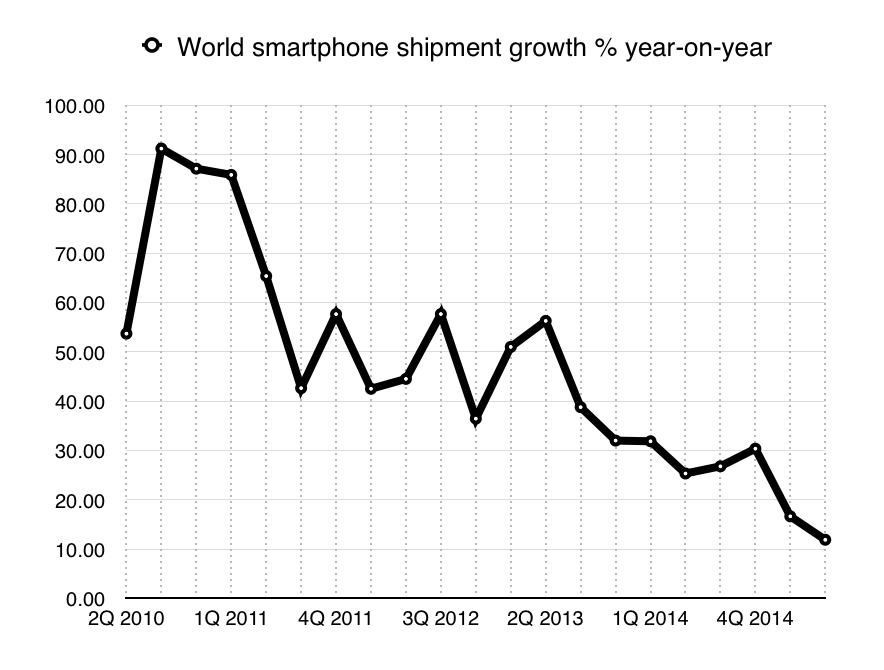
First is the graph showing year-on-year growth in quarterly shipments for all smartphones. The figures are from IDC.

World smartphone growth, year-on-year

From dramatic a couple of years ago, it has gone to so-so.

As you can see, it used to be gigantic, but in the past few quarters it has slowed down considerably. Part of that is the shine coming off China, while India and Africa haven’t yet started contributing in significant numbers. The US is slowing, Europe is slowing.

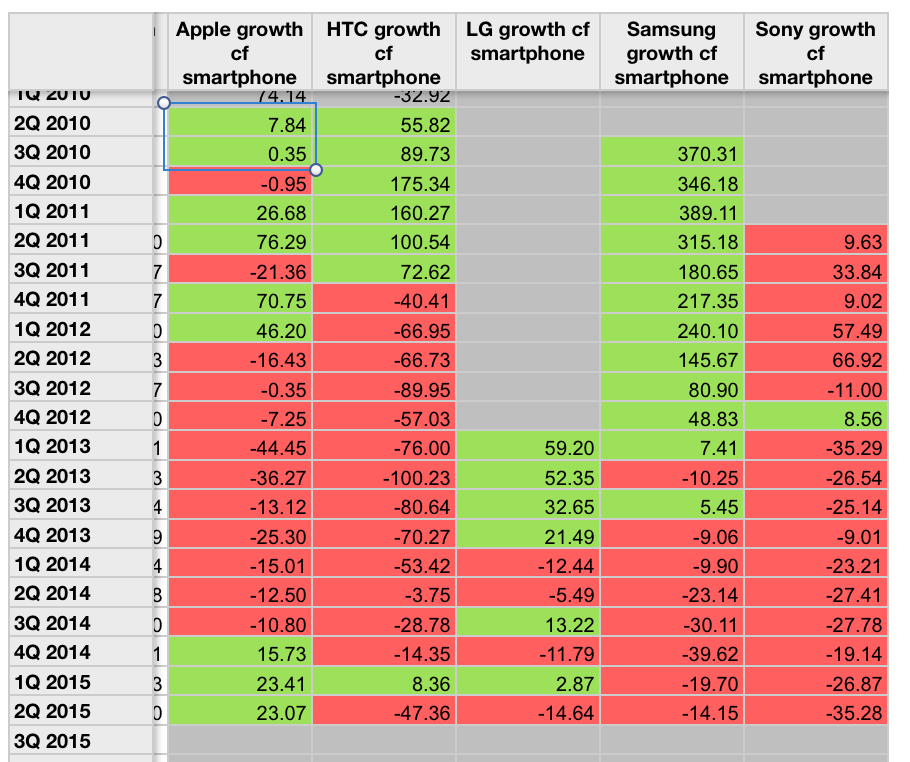
But what has happened to the top-end smartphone makers relative to the growth of the rest of the market? Here’s what the spreadsheet looks like if you subtract their year-on-year shipment growth from that of the smartphone market. Basically, if the cell is red, then its shipments grew less than the market; if green, they grew more.

Ranking smartphone makers against the market

Relative to the overall market growth, which OEMs have thrived, and which haven’t?

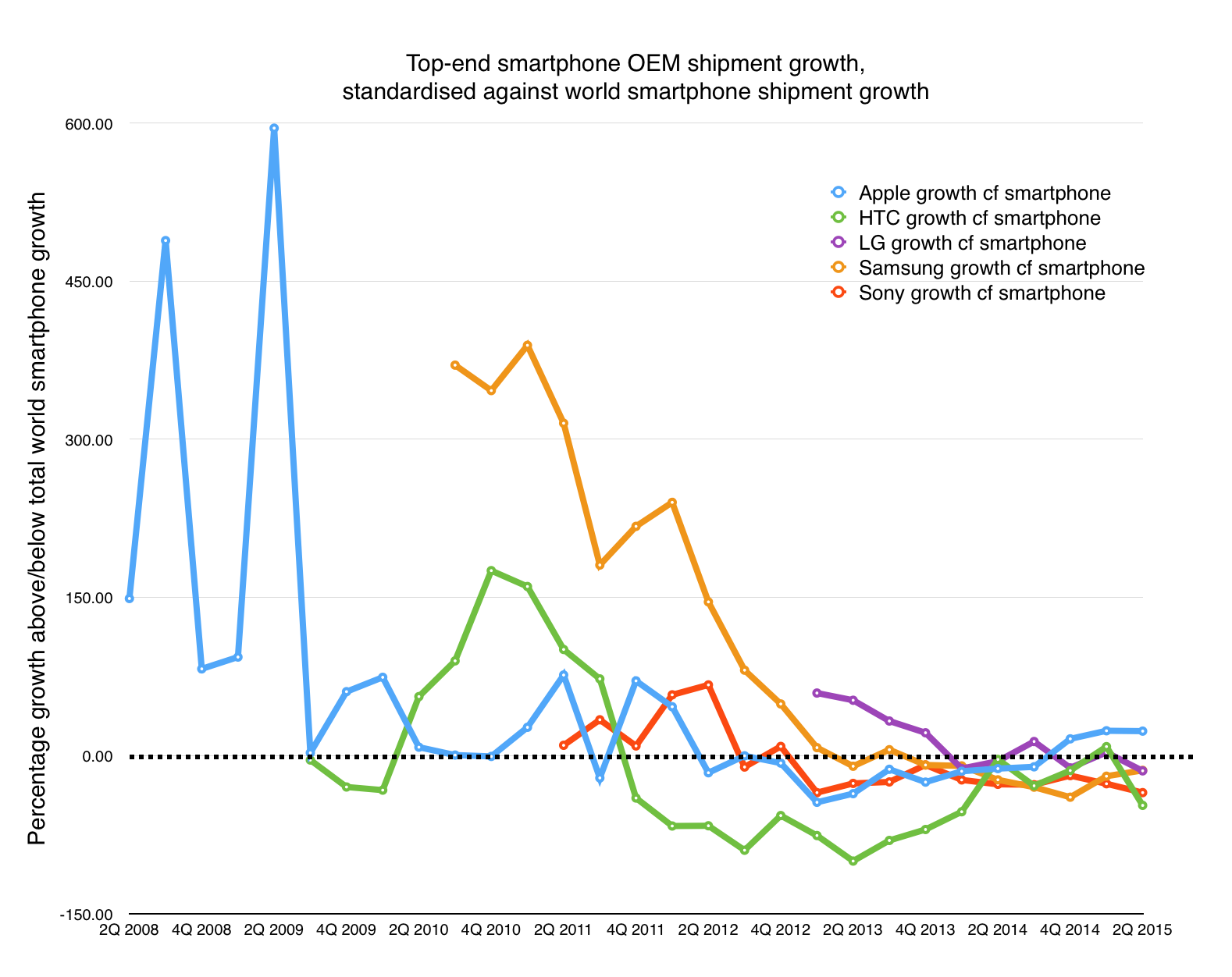
You can also graph this. There’s more data for iPhones, which is why those go back further.

Long term OEM shipment growth v overall market

Not all data is available for all OEMs.

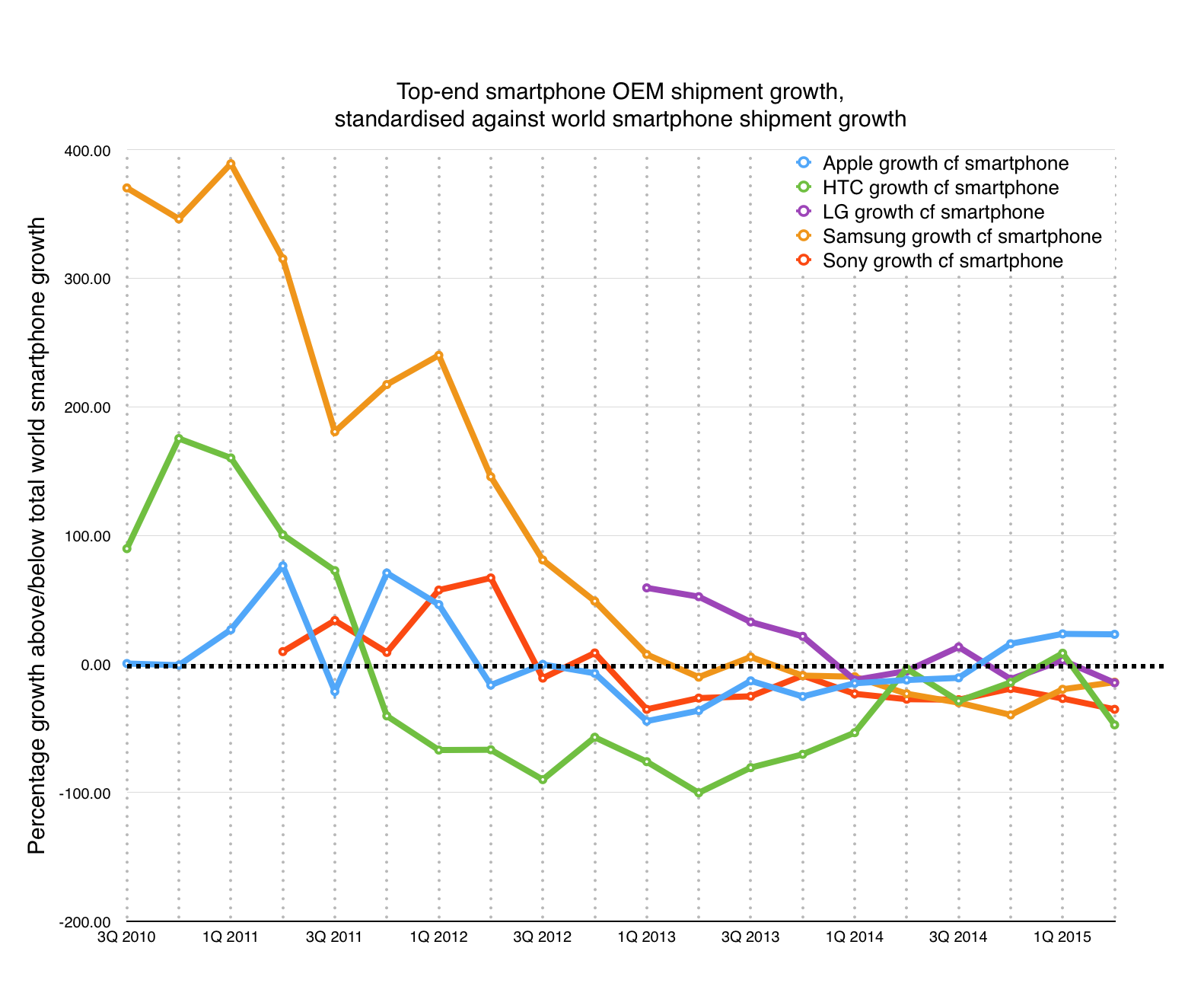
But let’s zero in on the more recent quarters. What this shows is that while all the “top-end Android” companies have decelerated, Apple has for the past three quarters – ie since the launch of the iPhone 6/Plus – been growing faster than the market.

Recent smartphone OEM growth v overall market

Remember, this is normalised against the growth of the whole market.

That to me suggests that any talk about a 4in “iPhone 6C” was dead in the water: what people want is bigger iPhone screens, and if people really want to have a 4in screen, then Apple is happy to sell them 2013’s iPhone 5S at a low, low price.

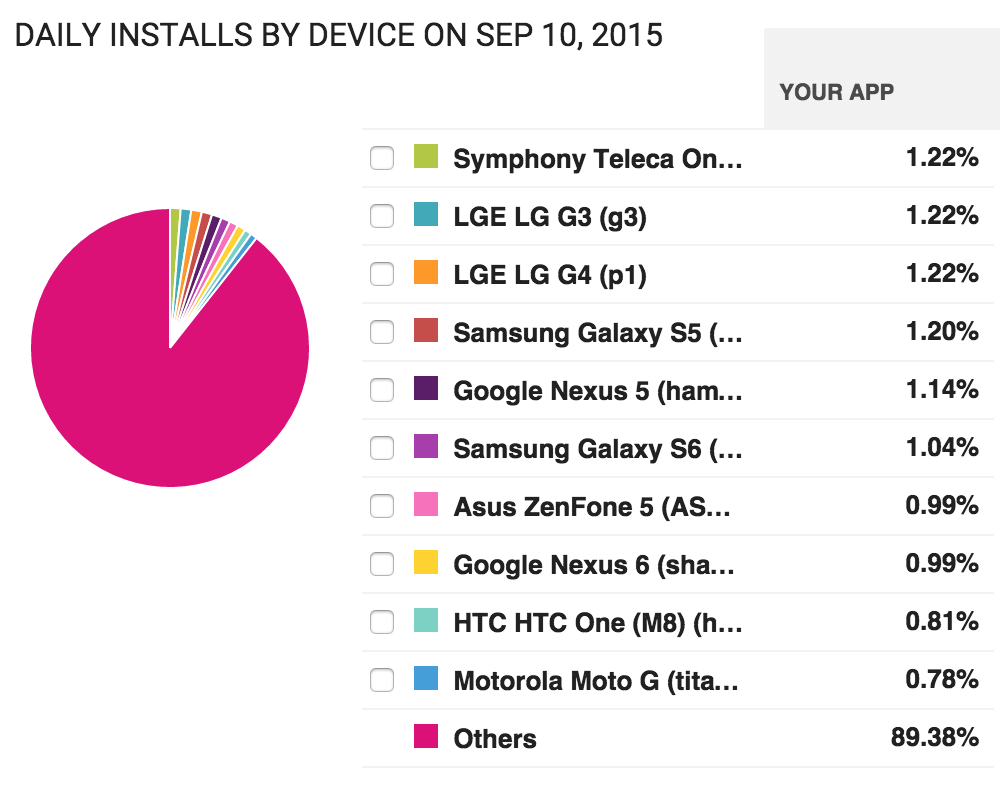
And then there’s Chris’s own data for one of his apps direct from the Google Play store.

Chris Lacy's snapshot of Action Launcher installs

Notice how few phones there are from 2015.


Look down the list, and what do you see? Most of the downloads come from phones which weren’t released this year.

What does that mean for the “premium” Android handset makers though? Chris and I work through this, including discussions about why there isn’t a 32GB iPhone 6/6S/Plus, where all the buyers have gone and what the future holds for people like Chris, who make paid-for apps that you’d expect “premium Android” buyers to be purchasing.

Hey! If you enjoyed the podcast, why not subscribe? You should be pretty safe from hearing me again for a while.

Start up: now on email!, video adblocking, Toshiba’s PC loss, iOS 9 for enterprise, and more


This is the hamburger menu you’re looking for. Photo by jpellgen on Flickr.

Hey! You can now sign up to receive each day’s The Overspill’s Start Up post by email.
You’ll need to click a confirmation link and then it should all roll on. (We’re still ironing out a few bugs in formatting for mobile but otherwise it’s perfect. Ish.)

A selection of 8 links for you. May contain nuts. I’m charlesarthur on Twitter. Observations and links welcome.

Adblockers hit another market: video » Monday Note

Frederic Filloux:

Using its thorough analytics, YouTube was first to understand that viewers should be given the opportunity to skip videos ads. This markedly increased the value of actually viewed clips.

But the damage is done. With ad blockers, the tragedy is that one bad apple contaminates the whole crate. Once installed, the adblocker will indiscriminately eliminate ads from all sites. The few that were willing to preserve a decent user experience were washed away.

Between April and June 2015, SecretMedia, teaming up with with JW Player, reviewed the data from one billion devices in 42 countries. Here, precautions are warranted: SecretMedia, based in New York, sells an anti-adblocking solution for video; its clients are mainly broadcasters. But even though SecretMedia has a vested interest in darkening the picture, its conclusions are consistent with other surveys in the US and Europe.

The point about the bad apple contaminating the crate is key. Oh well, iOS 9 comes out today – and tons of people will begin deploying adblockers. Let’s watch.
link to this extract


​Mozilla quietly deploys built-in Firebox advertising » ZDNet

Steven Vaughan-Nichols:

Darren Herman, Mozilla’s VP of Content Services, announced in May 2015 that “Suggested Tiles represents an important step for us to improve the state of digital advertising.”

Then, this summer, Mozilla quietly launched Suggested Tiles, the organization’s first commercial ad product. Well, it will be ads. At the moment, Mozilla claims it’s not getting paid for them.

Herman explained, “Since early August, we have been delivering promoted content provided by our first wave of partners including Yahoo, a number of top tier news titles including Fortune Magazine and Quartz, and mission-oriented partners such as the Make-a-Wish Foundation and the Electronic Frontier Foundation.”

Not sure that’s going to be popular.
link to this extract


Random thoughts on the new Apple TV » Medium

Ouriel Ohayon of Appsfire:

Most apps live out of ads. Most apps are Free. What was not said today is whether TV apps will be able to monetize with ads the same way iphone apps are monetized with ads. This is a big deal not just for monetization but also for discovery. Ads are one of the key channels for discovery and if no native ads are allowed in TV apps then the only way to get discovered is via the TV app store: meaning you have zero chance unless featured by Apple. I doubt Apple will completely ignore that question: Ads on TV can be a huge opportunity (including for iAds). They may not be ready for it just yet.

But what that means for app developers: get ready to suffer to get your free TV app (or paid app) discovered and monetized.

link to this extract


Toshiba loss on weak TV, PC sales boosts case for revamp » Reuters

Makiko Yamazaki:

Toshiba Corp swung to a first-quarter loss on weak PC and TV sales, raising pressure on its new chief executive to speed up a business revamp in addition to improving governance after a $1.3bn accounting scandal.

The laptops-to-nuclear power conglomerate reported an April-June operating loss of 10.96bn yen ($91m) on Monday compared with a ¥47.7bn profit a year earlier.

Specifically looking at the PC business – which is the one under stress – the Toshiba financials say “The Lifestyle Products & Services segment saw significantly lower sales, reflecting significantly lower sales in the Visual Products business, which includes LCD TVs, and the PC business, due to a shift in focus to redefined sales territories and other factors.
The segment as a whole saw deteriorated operating income (loss), reflecting deteriorated operating income in the PC and Home Appliances businesses.”

Specifically, the PC business shrank from a quarterly ¥169.4bn ($1.4bn) a year ago to ¥116.8bn ($970m) in the April-June period. And to a loss. How long can Toshiba’s PC business carry on?
link to this extract


Apple makes its biggest push to date into the enterprise » Re/code

Sean Ginevan, sr director of strategy, MobileIron:

With iOS 9, Apple is introducing features that will more easily enable IT to control iOS devices and automate provisioning of software. Using iOS 9, an enterprise can provision apps from the App Store silently, and disallow the user from installing their own applications. The operating system also makes it easier to place devices into supervised mode, which enables capabilities like disabling iMessage and locking device settings, round out the abilities to make an iPad Pro more suited to mission-specific tasks enterprise IT wishes to deploy them for…

…Three features have been introduced in iOS 9 that address that issue [of data going to non-managed devices]. The first allows enterprise IT to decide which applications are “managed,” meaning the data within them is owned by IT. Prior to iOS 9, if a user installed a business app from the App Store, then the app was “unmanaged” and could not interact with enterprise data. The user would have to reinstall the app over again through their corporate app storefront to make it managed. Now, enterprise IT can easily flag which apps are managed and reduce the user intervention required.

Second, iOS 9 provides enhanced controls over AirDrop. Prior to iOS 9, the only way to prevent corporate data from being shared with an unauthorized device was to turn off AirDrop completely. Now, enterprises can configure iOS 9 such that managed applications can’t have their data shared out via AirDrop.

Third, Apple decided that “simple passcodes,” will now require a minimum of six characters when a device with TouchID is enabled.

MobileIron is now up against BlackBerry/Good Technology in aiming to manage enterprise iOS devices.
link to this extract


Hamburger menu, the most recognizable thing on the planet » DeveloperTown

Randy Fisher:

Using eye tracking software, we ran 25 people through a series of tasks to gather viewing data. We used Google Inbox as the test site, but created two different versions that were presented at random. Version 1 was Inbox exactly as it is currently designed today with a hamburger menu, and Version 2 was another version we created with a horizontal menu of the same main menu choices hidden in the hamburger.

What happened next will [pick from menu above]
link to this extract


Why tablets are the future of computing » WSJ

Christopher Mims:

Take Intel’s coming line of Skylake chips, which CEO Brian Krzanich has said will enable thinner, lighter notebook PCs with better battery life. All of this will be possible because the chips will be more efficient, with some Skylake chips drawing less than 4½ watts, says IT analyst Patrick Moorhead.
“That power envelope is the first time you can do a fanless device, and fanless means thin,” says Mr. Moorhead. In other words, those svelte, MacBook Air-like “ultrabooks” Intel has been touting have the potential to turn into ultra tablets with detachable keyboards.

These devices won’t just be running Windows, of course, because manufacturers also have plans to sell them with Google’s Chrome operating system and even a version of the Android OS modified to function like a full desktop operating system.

What’s just over the horizon is a weird moment in computing history, when every major desktop and mobile OS, with the notable exception of Mac OS, will be competing on devices with the same ultra tablet form factor. With Windows 10, Microsoft has already blurred the lines between a mobile and a desktop OS, and now Google, Apple and others are following suit.

Arguably it should be “why 2-in-1s are the future of computing”, but it would make the headline unwieldy. Does this mean the Ubuntu Edge idea of a mobile phone you plug into a keyboard/display becomes feasible soon? It seems an idea that comes and goes – some times it’s good (Handspring had a good version in the early 2000s), some times it’s bad (Motorola Atrix).
link to this extract


Notebook retailers in Europe having difficulty clearing inventory » Digitimes

Aaron Lee and Joseph Tsai:

As the year-end holidays approach, the [upstream supply chain] sources are concerned that the retailers may reduce their notebook prices further in order to quickly clear up their inventory, but such a move is expected to greatly impact notebook brand vendors’ profitability and affect overall notebook sales in the second half.

The sources pointed out that brand vendors such as Lenovo and Hewlett-Packard (HP) have been encouraging their retail partners to stock up since May by offering them high commissions. However, weak demand and Windows 10’s failure to kickstart a PC replacement trend have caused the retailers to suffer from high inventory pileup despite their aggressive promotions.

Acer and Asustek Computer, neither of whom has used the high-commission strategy, are still expected to be affected as the retailers are selling competitors’ notebooks at a much lower price range, forcing the two firms to follow suit or risk losing market shares. Currently, Acer and Asustek take up about 30-40% of Europe’s notebook sales.

Asia Pacific is also seeing weakening notebook demand amid a slowing China economy. The PC market in the US is the only one seeing meaningful growth, but only US-based vendors HP, Dell and Apple will benefit.

I’d guess the “sources” in this story aren’t too far from Asus and Acer.
link to this extract


Once more: sign up to receive this and similar posts by email. (Start Up only – not posts from the rest of the blog.)

What Apple’s 3D Touch aims to do: replace the physical iPhone home button


Buttons: who needs ’em? Photo by H is for Home on Flickr.

Apple is a very measured company. It tends not to rush into things. It lays down the foundations, and then it builds on them.

Take the example of Apple Pay. Clearly, executives could years ago see the potential of NFC-based payments; any company in the smartphone business could. But how to implement it so that people would love using it, rather than tolerate it? As things stood three years ago, putting NFC into iPhones would be easy enough. However then you’d have to have an app or interface, and then the user would have to enter a PIN, and we all know that people are terrible both at remembering PINs, and at using long-enough ones for security. Google Wallet used an app+PIN method, and you had to be pretty determined to use it much.

For Apple, that’s too much work to impose on users, because if you’re trying to replace cash or card swiping (in the US) then you don’t replace it with something that’s more difficult and fiddly. It’s also part of why, despite there being millions of NFC-capable Android phones in the US, Google Wallet made no impact. The lack of NFC-capable tills in the US also played a big part – but Google Wallet never went outside the US, even though NFC-capable tills are plentiful in Europe. Clearly, Google’s heart wasn’t in it.

Make it simpler, stupid

So what’s a simpler yet more secure way to do payments? Biometrics, obviously, get around the “remember a password or PIN and enter it” hassle. Which biometric? Retina prints? Bit fussy. Fingerprints? Sure, because you’re already holding the phone. But that means having a reliable fingerprint reader. And NFC.

You see the elements: fingerprint reading, and NFC. Apple clearly saw the potential, so in mid-2012 bought a fingerprint reader company (the best on the market, apparently). It then integrated that into the iPhone 5S for September 2013.

But not NFC. Apple clearly could have put both fingerprint reading and NFC into its new phones at once. But it didn’t.

“Touch ID” laid the foundation for getting people used to using their fingerprints to unlock the phone – and an API meant the fingerprint reader could be used in other apps (Dropbox, etc) and to pay for stuff in the App Store or iTunes Store.

The plan, obviously, was to introduce NFC+fingerprint reading in the iPhone 6, when people would be used to the idea of the fingerprint as a “means to pay”. It also helped that it would be part of an upgrade path: 5S has fingerprint but no NFC; iPhone 6 has fingerprint and NFC. Clear differentiation, but also careful laying of foundations. By looking back, the path forward is obvious.

The path forward from 3D Touch

Now on to 3D Touch. It’s available under different names but the same concept on the new iPhones, some Macs (MacBook and some Retina Pros) and the Watch.

It’s clever – though as Chris Lacy and Ben Sandofsky discussed in The Blerg podcast just after the announcement, apps that are 3D Touch-enabled don’t seem to have any way to make that evident; only by pressing them do you discover whether they have that capability.

You can say that 3D Touch is just Android’s “long press”. It sort of is, and isn’t. The key difference is that long press didn’t have haptic feedback. It just happened: you pressed for longer than usual, and you got a laundry list of options. Google has deprecated “long press” in favour of “hamburger menus”, which are visible all the time on screen. This speaks to the point Lacy and Sandofsky make: user interface affordances that aren’t visibly signposted on a screen can be really hard to find. Apple should add some sort of edging or 3D effect to the icons to make this clear; perhaps app designers will find some common method of doing so.

With 3D Touch, you learn how much harder to press because you get a little pushback when you succeed; if you try pressing on something that doesn’t offer it (I tried the Settings app, hoping for a giant menu of settings – ha) then you get three quick low-intensity taps back, a sort of “nothing here” signal.

3D Touch can also invoke the app switcher: press on the left-hand side of the screen and you get the fan of available apps. (I found this tricky; press-and-roll the thumb inwards seemed to work best for me. Again, practice would improve it; the fingerprint reader used to be “hard” to use at first but is now second nature.)

So fast forward a bit, and in the near future you’ll have all sorts of apps offering 3D Touch capability right from the home screen. It has an API, so developers will surely be spending the next few weeks feverishly aiming for app releases on or around September 25 that use it.

What happens a year from now? Apple introduces new phones, and they of course incorporate 3D Touch. The iPhone 6 becomes the “low-end” model, and thus the only one without it.

But what this new interaction really enables is movement between apps, and quick jumps into apps, that don’t rely on your pressing the home button at all.

Note also how iOS 9 includes a “Back” button of sorts (in the top left corner, if you’ve come from one app to another, you can go straight back – rather than using the home button to invoke the app switcher).

(Screenshot from Jeff Brynes’s thoughts on iOS 9 beta 5)

What’s all that – the “back” button, the 3D Touch capability – about? It’s about not using the Home button.

You should never go Home

To date, the iPhone has been built around the Home button, yet it is increasingly an encumbrance: if you want to go to the icon screen, you have to press it. To get the app switcher, you have to press it. To switch between apps (unless you’re invoking something like “Create event” in Calendar from Mail) you have to press it.

That’s a lot of pressing, and I bet that mechanical failure of Home buttons is one thing that keeps showing up in Apple’s fault reports. Broken screens are easily replaced (and people can get by with broken screens for a looong time), but broken home buttons not so. Grit can get in. Water can get in. Constant movement isn’t ideal in electronics. You might say that it’s just tough if peoples’ Home buttons break, but compared to Android phones which don’t have them, it’s an obvious point of weakness – and customer dissatisfaction.

However, the Home button is needed as the place where your fingerprint is read. But that doesn’t need a moving home button; it just needs a circle of sapphire glass through which your print is read.

Are the foundations that have been laid becoming clear yet? In the new Macbooks and the Force Touch-enabled Retina Pros, the keypad seems to click when you press it. Seems to. Yet in fact it doesn’t move, as Matt Panzarino noted back in March:

The new trackpad does not move, at all.

When you ‘click’ it, it ‘clicks’, but it doesn’t actually click. There is an audible ‘click’ sound (that’s what the silly picture below is, me listening) and it does in fact feel like it clicks, but that is merely an illusion.

There is a set of vibrating motors underneath that provides ‘force feedback’, also known as haptics in some applications. This feedback fools your finger into believing that you’ve pressed down on a hinged button, the way your current trackpad works. This feedback relies on phenomenon called lateral force fields (LFFs), which can cause humans to experience vibrations as haptic ‘textures’. This can give you the feel of a ‘clickable’ surface or even depth. The Force Touch feature of the new trackpad allows you to press ‘deeper’, giving you additional levels of tapping feedback. The effect is done so well that you actually feel like you’re pressing down deeper into a trackpad that still isn’t moving at all. It’s so good it’s eerie.

What if – and it’s just speculation, you know, but what if – you were to put that “seems to move but doesn’t” technology into a phone? Yes, you’d have 3D Touch. That’s happened. But what if you put it into an iPhone home button? You could have something that seemed to move, and felt like it moved, but didn’t. You can double-click the Macbook trackpad; you could double-click a 3D Touch home button. But nothing moves. There’s just a piece of glass, and a sapphire circle for reading, and that’s it.

Think: when do you press the home button? When the phone is off and you’re enabling it, or to switch apps, or to get back to the home screen (so you can switch between app screens).

Most of the time – that is, time when you’re in apps – the Home button serves no purpose at all, except to be a grit-attracting water-allowing problem. Replacing it with a not-moving solid piece of glass would be a design and fault-resistance win.

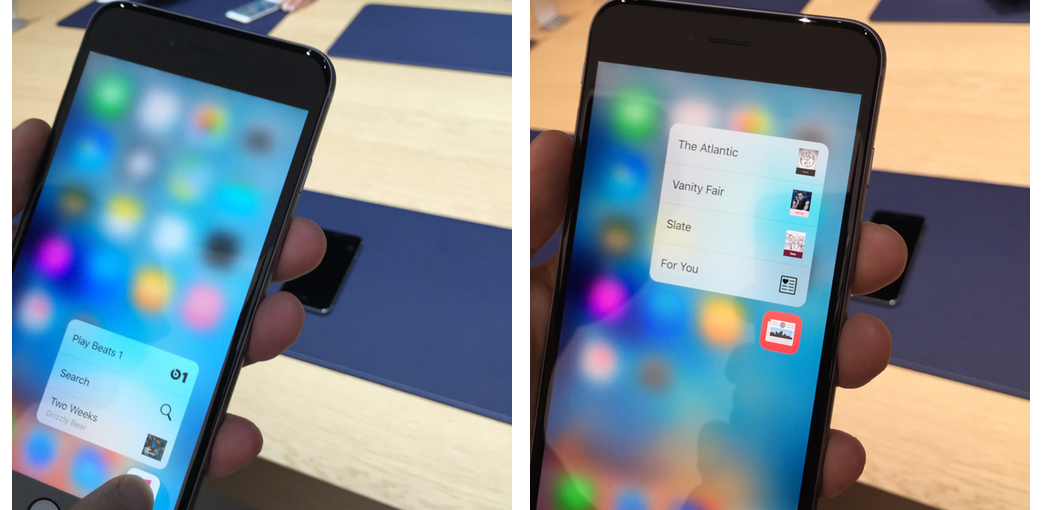
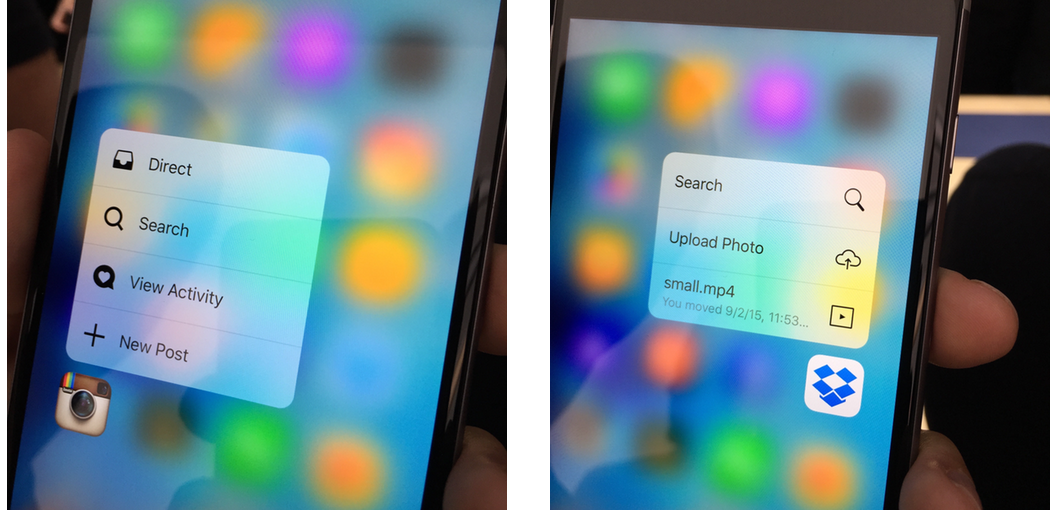
Here’s how 3D Touch works. In the pictures below, I’ve force-pressed on the relevant icons that you see highlighted from the main screen:
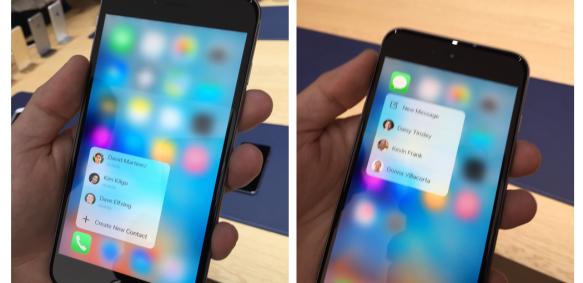
3D Touch brings up contacts

No need to enter the app – 3D Touch brings up recent or favourite contacts in Phone and Messages


Force.. er, 3D-touch on the phone or messages icon and you get your three most recent interactions (or possibly three top favourites for the phone – this may change)

Music and News are 3D Touch-enabled

3D Touch lets you jump straight into elements of apps such as Music and News


Want some Apple Music without opening the app? Or to go straight to News? It’s just a forceful touch away

3D Touch on Dropbox and Instagram

3D Touch on Dropbox and Instagram


Third-party apps can incorporate it too

And as I said, you can also use 3D Touch to invoke the app switcher (I had a picture, but it just looks like the app switcher). So you could, if you were determined, spend entire sessions and never touch the home button – except if you needed Siri (except that would be available via “Hey Siri”) or to make a payment. Only one of those needs a moving home button, and is replaceable too. (You can get to the main icon screen by invoking the app switcher then choosing the icon screen, so no home button needed there either.)

Is this reasonable? Quite separately, Neil Cybart has had the same idea:

Apple’s new 3D Touch feature not only brings an additional user interface to iPhone, but should be thought of as the missing piece for allowing iPhone screens to become even larger without increasing the iPhone’s form factor. 3D Touch begins to reduce the need for the home button, which has turned into a type of reset button used to switch between apps. By removing the iPhone home button and filling the additional space with screen real estate, the iPhone will only gain more power and capabilities when compared to devices like the iPad mini and Air.

His piece appeared after I’d drafted this. Cybart is smart, so I’m glad to find we’re thinking the same way.

Which means that…

Getting 3D/Force Touch into the Home button requires the technology to improve somewhat, and become dependable, and people have to get used to the idea. But after that, what becomes possible?

• The Home button stops being a separate physical element, and just becomes an area on the screen

• You can have a larger screen in the same form factor: you don’t need the black band at the bottom of the device where the home button lives (notice how Android OEMs have been able to enlarge the screen because they don’t have to have a physical button). Weird to think, but Apple could offer a smaller device with the same size screen, thus answering people who don’t like the physical size of the iPhone 6 but do like a bigger screen

• You don’t have the mechanical problems of a moving button

• You can provide clearer haptic feedback when people press the button – the difference between a long press (for Siri) and a double-press becomes evident to the user.

It all makes sense (as these things so often do). So, when will it happen? Only two choices really: next year, with the “iPhone 7”, or after that. Or, OK, third choice, never. I mean, perhaps Jony Ive is really wedded to having a moving home button. But I bet he isn’t. Getting rid of moving trackpads in the MacBook seems to me just the start; the first brick of the building. The Watch was the second part, and iPhones the next. Now wait for next year.

Start up: Uber’s China fight, Stagefright goes public, women and Apple, Wileyfox reviewed, and more


Feast your eyes: you’ll never see its like again. (Hopefully.) Photo by MarkGregory007 on Flickr.

A selection of 10 links for you. Use them wisely. I’m charlesarthur on Twitter. Observations and links welcome.

Inside Uber’s fight with its Chinese nemesis, Didi Kuaidi » WSJ

Fabulous in-depth piece by Eva Dou and Rick Carew:

Both companies have sought to woo drivers with bonuses to those who rack up rides. Uber has offered larger bonuses in an effort to catch up in scale, earlier this year giving as much as 7,000 yuan weekly to Beijing drivers who completed a high number of rides—quadruple a traditional taxi driver’s wages, according to drivers. Both companies have bonuses for individual rides during peak times and smaller bonuses for individual achievements, such as referring friends or getting high ratings.

Now the challenge for both is keeping drivers and riders while weaning them off bonuses and coupons.

Yang Yang, a 33-year-old Uber driver in Beijing, says bonuses are increasingly difficult to get. He stays on the road 12 to 14 hours a day to qualify for the weekly bonus, using minty salves to stay awake.

The lure of bonuses has led drivers to game the system. Uber and Didi Kuaidi battle drivers who book fake rides—known as “brushing” in China. In brushing, the scammer will typically pose as both driver and rider, essentially paying himself multiple times to build up enough fake business to win a bonus.

Rings of scammers use specialized software bought online to rack up fake rides while they sit at home, drivers interviewed say. They say they get calls and texts from people offering to help them scam Uber for a fee. Didi Kuaidi is suffering less from the problem, according to drivers, as its lower driver bonuses are less of a draw.

I love how people find ways to game systems like this; it’s the thing that definitely keeps us a step ahead of the damn robots.
link to this extract


The Washington Post has begun blocking the ad blockers » BuzzFeed News

Matthew Zeitlin:

“Many people already receive our journalism for free online, with digital advertising paying only a portion of the cost,” a Washington Post spokesperson told BuzzFeed News.

“Without income via subscriptions or advertising, we are unable to deliver the journalism that people coming to our site expect from us. We are currently running a test using a few different approaches to see what moves these readers to either enable ads on The Washington Post, or subscribe.”

There’s a kind of Cold War brewing between publishers who say that ad blocking software cuts off the lifeblood of free media online, and readers who complain about pages crammed with garish ads and intrusive trackers, which make many sites bloated and slow to load.

Not sure it’s a cold war. It’s about to get a lot more heated: iOS 9 comes out next week, and the content blocking apps will all be lining up for it.
link to this extract


Android Stagefright exploit code released to public » Threatpost

Michael Mimoso:

[Joshua] Drake, vice president of platform research and exploitation at Zimperium zLabs, said in July the bug could affect more than 950m Android devices. He chose not to publish exploit code at the time, giving Google time to push patches to the Android Open Source Project and subsequently to handset manufacturers and carriers. He originally planned to release exploit code on Aug. 24.

Google, meanwhile, wasted no time in changing the way it releases security updates for Android, announcing at Black Hat that it would send monthly over-the-air updates its Nexus phones. The move was mirrored by others, including Samsung and LG, and the first Nexus updates included patches for Stagefright. Silent Circle also patched its Blackphone and Mozilla patched Firefox, which uses Stagefright code in the browser.

Stagefright is the name of the media playback engine native to Android, and the vulnerabilities Drake discovered date back to version 2.2; devices older than Jelly Bean (4.2) are especially at risk since they lack exploit mitigations such as Address Space Layout Randomization (ASLR) that are present in newer versions of Android.

The problem is that Stagefright is an over-privileged application with system access on some devices, which enables privileges similar to apps with root access.

When the tide goes out, you discover who’s been swimming naked, or hasn’t put on their security trousers.
link to this extract


Focusing on the full picture with data » FlowingData

Nathan Yau:

I don’t know the full context of this discussion, but in the interview below, Hans Rosling talks to media person Adam Holm about why we shouldn’t use the media to form our opinions about the world. Media person disputes. Rosling puts foot on table and says Holm is wrong.

This is terrific. Enjoy.

Rosling also gave a TED talk in 2014: “How not to be ignorant about the world“.
link to this extract


Wileyfox Swift: Brit startup budget ‘droid is the mutt’s nuts » The Register

Alun Taylor:

If someone asked me what my ideal smartphone would be I’d say one that costs no more than £120, has 16GB of storage, at least 2GB of RAM, a 5-inch IPS screen, a removable battery, two SIM slots, space for a microSD card, the best iteration of Android available (that’s the Cyanogen OS Android fork, in my opinion) and is waterproof.

There’s nothing revolutionary about the Swift’s design, it’s just smart and well made
Wileyfox’s new Swift actually fails to meet two of those criteria – the cost is £130, and there’s no waterproofing. But as we’ll see, considering the rest of the package, it’s very easy to forgive those two failings.

In an increasingly competitive market the Swift is up against the likes of the Motorola Moto G and Sony Xperia M4 Aqua, both of which we have reviewed recently. And both of which are rather more expensive at £189 (for the 2GB RAM version) and £199 respectively.

Along with price deflation, Android is splitting into niches, as well as software specialisation – such as the use of Cyanogen here. This is great value; it’s not going to sell in huge volumes (simply because of supply chain constraints) but it’s where the Android market is going.
link to this extract


Bullshit, selfies and Photoshopped smiles: Apple’s iPhone 6S announcement was a joke » Gadgette

Holly Brockwell is pissed off and she isn’t going to take it any more:

It’s no secret that I’m far from Apple’s biggest fan. In fact, despite what Reddit seems to think, I’m firmly Team Android. But that doesn’t mean I don’t give Apple credit where it’s due – it’s just that it seems to be due less and less these days. Last night’s announcement was their worst yet.

Her principal complaint seems to be “these things have all been done before!” along with “there was a Photoshop demo using a woman’s face!”. The “where were the women?” thing seemed to become a mini-meme on Twitter. Perhaps I was missing the bit where Jen Folse came out and demoed Apple TV entirely on her own. Or where a female doctor showed off the iPad Pro, again, entirely on her own. Or a female entrepreneur from Gilt showed what she could do on Apple TV. Sure, there were more men. But that’s true in pretty much any tech event.

My wife constantly quotes a friend says you can divide the world into drains and radiators – some suck you dry, some warm you up. I prefer radiators. Which is why I love this tweet from Lia Napolitano, who used to work on the Apple TV team, praising Folse, who still does.

link to this extract


Production of new 21-inch iMac begins, say Taiwan makers » Digitimes

Aaron Lee and Joseph Tsai:

Production of a new 21-inch iMac featuring a 4096 by 2304 screen kicked off in early September and will be launched in the fourth quarter, with shipments in the quarter estimated at 1.4m-1.5m units, according to Taiwan-based supply chain makers.

With shipments from existing iMac products, Apple’s overall all-in-one PC shipments could surpass those of Lenovo in the second half.

The sources pointed out that the new 21-inch iMac only has a limited change in industrial design, but is upgraded with better hardware specifications, especially the Ultra HD display.

This will probably be no more than a press release from Apple. The current 21in iMac is 1920 by 1080 pixels – so this is going to be an amazing screen.
link to this extract


Amazon finally stops selling the Fire Phone, as company adjusts its hardware strategy » GeekWire

Tricia Duryee:

It’s taken more than a year, but Amazon has finally exhausted its supply of Fire Phones.

At least that appears to be the case based on the phone’s product page, which now lists the device as “currently unavailable,” with an additional note in the buy box, stating: “We don’t know when or if this item will be back in stock.”

That’s true for both the 32GB and 64GB models.

A year ago I calculated that no more than 35,000 had been sold. I wonder what the final number was.
link to this extract


Electronic noise is drowning out the Internet of Things » IEEE Spectrum

Mark McHenry, Dennis Roberson and Robert Matheson:

it is expensive to trace RF [radio frequency] pollution to a source and, when you do, it is often challenging to get offenders to stop offending.

The coming Internet of Things is going to make things worse. Much worse. It will do so by adding complex RF-control chips to countless common devices, like door locks, light switches, appliances of every type, our cars, and maybe even our bodies, which will enable them to connect to the Internet. Each of these chips is a potential source of noise. Plenty of technological fixes are available, of course, but the huge number of chips means that manufacturers will be more reluctant to add costly shielding and other noise-muffling features to their products. Silence is golden: It costs money to get it.

link to this extract


Apple promo video confirms the 6s has a smaller battery » TechCrunch

Fitz Teppper:

a 3D Touch promotional video released by the company seems to confirm that the 6s will indeed have a smaller battery than the iPhone 6. Specifically, GSMArena discovered that the video shows a shot of the battery marked “1715 mAh”, which is less than the iPhone 6’s 1810 mAh battery.

The extra space gained from reducing the device’s battery is most likely being used to fit new, larger components like the Taptic Engine and Force Touch-enabled display.

It’s important to note that this doesn’t mean the device will provide fewer hours of usage. In fact, Apple’s specs on the 6s show that the device will have the exact same talk, Internet browsing, and video playback time as its predecessor. This is most likely due to increased power efficiency in the new phone.

In my (beta) experience, iOS 9 has better battery life than iOS 8. Have to see how the rest of it plays out. Safe bet though that “smaller battery!” will be found in the comments sections of many blogs in the days – months even – to come.
link to this extract


Start up: Apple’s AI hires, Spotify’s smart music, why refugees have smartphones, and more


What’s the motive for downloading the top 40 every week from a torrent site? Completism? Photo by DigitalTribes on Flickr.

A selection of 8 links for you. Handle with care. I’m charlesarthur on Twitter. Observations and links welcome.

Exclusive: Apple ups hiring, but faces obstacles to making phones smarter » Reuters

Apple has ramped up its hiring of artificial intelligence experts, recruiting from PhD programs, posting dozens of job listings and greatly increasing the size of its AI staff, a review of hiring sites suggests and numerous sources confirm.

The goal is to challenge Google in an area the Internet search giant has long dominated: smartphone features that give users what they want before they ask.

As part of its push, the company is currently trying to hire at least 86 more employees with expertise in the branch of artificial intelligence known as machine learning, according to a recent analysis of Apple job postings. The company has also stepped up its courtship of machine-learning PhDs, joining Google, Amazon, Facebook and others in a fierce contest, leading academics say.

But some experts say the iPhone maker’s strict stance on privacy is likely to undermine its ability to compete in the rapidly progressing field.

It’s certainly the case that Apple’s privacy stance is, as Sameer Singh says, its “strategy tax” (a strategy tax is an approach to a business area that prevents you exploiting it to the maximum: “Windows everywhere” was Microsoft’s strategy tax that prevented it doing mobile really well, Google’s is the need to collect data). The question is how much you do need that pooled personal information (as opposed to anonymous information) to do this well.
link to this extract


Field Notice: FN – 63697 – Protective Boot on Certain Network Cables Might Push the Mode Button and Cause an Unexpected Reset on the 48-Port Models of Cisco Catalyst 3650 and 3850 Series Switches » Cisco

“Certain” network cables being “pretty much every Ethernet cable you buy”. Like this:

Design screwups like this deserve their own Tumblr. Of note: the Cisco 3650 was released on October 10 2013; this note is dated October 30 2013. Of course it wasn’t caught in testing, but one suspects that customers discovered this pretty much on day one.
link to this extract


Inside Spotify and the future of music » Tech Insider

Alex Heath:

Spotify’s progress in sorting its library of 35 million songs can be traced back to The Echo Nest, a music intelligence company that was created within the MIT Media Lab a decade ago. Spotify bought The Echo Nest last March in what was reported to be a $100m deal.

Jim Lucchese, CEO of The Echo Nest, tells Tech Insider that his team of about 70 people are focused on delivering “the right listening experience at the right time” within Spotify.

They do this by analyzing the makeup of every song, how people are talking about music online, and how people are listening to it. While the company continues to work with clients like Rdio, Microsoft, Sirius, and Vevo, as it did before it was sold, its most cutting-edge work is developed and honed for Spotify.

One of The Echo Nest’s first projects for Spotify, reported last September on FiveThirtyEight, was developing dossiers of every user’s listening habits, which are now called “taste profiles.”

Ajay Kalia, who oversees the project, tells us they realized early on that there’s an important distinction between the music you listen to and music you actually like.

For example, just because I play a lot of instrumental, ambient music while I’m at work doesn’t mean that I have a particular affinity for those kinds of artists. And just because your significant other plays a lot of country music while you’re both in the car doesn’t mean you want a bunch of country playlists shoved at you.

This “listen to but not like” has often been the problem about music. This makes it sound as though Echo Nest is human-curated, which it really isn’t.
link to this extract


Google nears re-entry to mainland China » The Information

Amir Efrati:

As part of its broader China push, Google is expected to offer new incentives to phone makers to upgrade Android phones to the latest versions of the operating system, says one person briefed on its plans. The company wants more phones to run the advanced version of Android so that the software platform and experience can be more consistent for app developers and consumers.

As more Chinese app developers look to extend their apps beyond China’s borders and more non-Chinese app makers try to tap the Chinese market, Google wants to ensure all the apps work well across Android devices globally. Thus, hardware partners that will distribute Android Wear or Google Play in China will need to adhere to certain global compatibility standards, says the person familiar with the plan.

For its app store, Google has promised authorities that it will follow local laws and block apps that the government deems objectionable, say the people familiar with Google’s plans. In some parts of the world and among Internet policy wonks, this move will be viewed as a back-tracking from Google’s posture following its departure from China in 2010. At that time Google ended its engineering operations in China and moved its Chinese-language Web-search engine to a Hong Kong-based Web domain, out of reach of mainland China officials, after being breached from a cyber attack that it linked to the Chinese government.

Authorities denied involvement in the attack, which successfully breached many American companies and is known as Operation Aurora. At the time, though, Google co-founder Sergey Brin publicly compared China to the totalitarian Soviet Union in which he grew up. (Mr. Brin is now part of Alphabet, Google’s soon-to-be parent company, and isn’t involved in Google’s day-to-day affairs.)

Some forces within Google always believed that the company’s and Mr. Brin’s response was rash. It should have viewed the China-based hacking, which occurred in late 2009, as a natural consequence of being a major tech company in an age of increasing cyber attacks by all governments.

A long extract (but it’s a long article). That last paragraph is telling; Eric Schmidt was the pro-China voice, Brin the no-to-China voice, and Larry Page effectively had the casting vote back in 2010. Sundar Pichai clearly leans towards Eric Schmidt’s stance: better to deal than to stand on principle.
link to this extract


Police raid fails to dent UK Top 40 music piracy » TorrentFreak

Police arrested a Liverpudlian who was a determined uploader of the top 40 releases to torrent sites:

Yet again it appears that the arrest last week was a case of rightsholders and police targeting low-hanging fruit. Using widely available research tools we were able to quickly uncover important names plus associated addresses, both email and physical. It seems likely that he made close to no effort to conceal his identity.

Due to being in the police spotlight it will come as little surprise that there was no weekly upload of the UK’s Top 40 most-popular tracks from OldSkoolScouse last Friday, something which probably disappointed the releaser’s fans. However, any upset would have been very temporary indeed.

As shown below, at least four other releases of exactly the same content were widely available on public torrent sites within hours of the UK chart results being announced last Friday, meaning the impact on availability was almost non-existent.

But who, seriously, actually wants to listen to all the top 40 tracks week after week? It would be pretty numbing even if you worked in the business. I bet this guy barely listened to the music. He, and the downloaders who waited avidly for the songs, strike me as more like stamp collectors: uninterested in what is conveyed, obsessed with completing sets.
link to this extract


iPhone supply chain makers set to see strong sales in September, say sources » Digitimes

Monica Chen and Steve Shen:

Incoming parts and components orders for the new iPhones are even stronger than orders for the iPhone 6 devices in the corresponding period of a year earlier, indicated the sources, adding that shipments of updated iPhones will once again squeeze sales of other vendors including Samsung Electronics, Sony Mobile Communications and LG Electronics, commented the sources.

Thus, sales of the new iPhones are expected to dominate smartphone sales globally in the fourth quarter of 2015 as current sales of LG Electronics’ G4, HTC’s One M9/M9+ series products and Sony Mobile’s Xperia Z3+ have been lower than expected, indicated the sources.

To lessen the impact of the release of the new iPhones, Samsung has been implementing a “Ultimate Test Drive” program that encourages current iPhone users to pay US$1 to test its Galaxy Note 5 or Galaxy S6 Edge+ for one month.

Good luck with that, Samsung.
link to this extract


Academic study reveals urban and rural broadband speed gaps » ISPreview UK

Mark Jackson:

The study (‘Two-Speed Britain: Rural Internet Use‘) claims that more than 1 million people in Britain are “excluded or face challenges in engaging in normal online activities because they live in remote rural areas“, where slow or non-existent Internet connectivity is still a serious problem.

The report separated areas into several groups and examined each separately: Deep Rural (remote), Shallow Rural (less remote) and Urban internet users. It reveals that just 5% of those in Urban areas had an average broadband speed below 6.3Mbps, but in Deep Rural areas only 53% could achieve this “modest speed“.

Furthermore the gap is unsurprisingly found to be most pronounced in upland areas of Scotland, Wales and England, but also in many areas in lowland rural Britain. It affects 1.3 million people in deep rural Britain, and 9.2 million people in less remote areas with poor internet connection (or ‘shallow’ rural areas).

The report itself isn’t available for download (yet?) because neither Oxford University nor dot.rural has actually put a usable link up.
link to this extract


Surprised that Syrian refugees have smartphones? Sorry to break this to you, but you’re an idiot » The Independent

James O’Malley, in somewhat straightforward mood:

So we know that Syria isn’t dirt poor and we know that there’s a lot of mobile phones: but why smartphones? Well, why not? In the West many people own desktop computers, laptops and tablets as well as smartphones. But if you had to give up many of your possessions and live on $1850/year, after clothes and food, what would you buy next? It is hard to think of a more useful thing to own than a smartphone, especially if you’re fleeing your home.

Even when utility isn’t considered, the reason Syrians are using smartphones and not old Nokia 3210s is the same reason that benefits claimants have (gasp!) “flatscreen” TVs… have you tried buying any other kind lately? Budget Android smartphones can be picked up for well under £100, and come with cameras, large screens and everything you would expect from a modern phone. As we’re now in the habit of replacing our phones with a new model every year or two the price of slightly older phones also drops significantly.

The headline certainly falls into the “no mimsy hedging here” bucket.
link to this extract


Start up: Huawei’s ambition, HTC R+D layoffs, 3D copyright, Google’s odd war on app ads, and more


But not with “Google Here”, thank you. Photo by x-ray delta one on Flickr.

A selection of 11 links for you. Still nothing about logos. I’m charlesarthur on Twitter. Observations and links welcome.

FTC settles with Machinima for paying YouTube influencers to endorse Xbox One » GamesBeat | Games | by Dean Takahashi

Dean Takahashi:

According to the FTC’s complaint, Machinima and its influencers were part of an Xbox One marketing campaign managed by Microsoft’s advertising agency, Starcom MediaVest Group. Machinima guaranteed Starcom that the influencer videos receive at least 19 million times.

In a statement, Machinima said, “Machinima is actively and deeply committed to ensuring transparency with all of its social influencer campaigns.  Through collaboration with the FTC, we are pleased to have firmly resolved this matter, related to an incident that occurred in 2013, prior to Machinima’s change of management in March 2014. We hope and expect that the agreement we have reached today will set standards and best practices for the entire industry to follow to ensure the best consumer experience possible.”

In the first phase of the marketing campaign, a small group of influencers received access to prerelease versions of the Xbox One console and video games in order to produce and upload two endorsement videos each. According to the FTC, Machinima paid two of these endorsers $15,000 and $30,000 for producing You Tube videos that garnered 250,000 views and 730,000 views, respectively.

After that, Machinima promised to pay a larger group of influencers $1 for every 1,000 video views, up to a total of $25,000. Machinima did not require any of the influencers to disclose they were being paid for their endorsement.

link to this extract


Huawei chips away at Samsung » WSJ

Juro Osawa:

For the past three years, Samsung Electronics Co. has been the world’s top seller of smartphones, but its global lead is now under attack from fast-growing Chinese rival Huawei Technologies Co.

Long known as a telecommunications-equipment supplier to global carriers, Huawei has already toppled Samsung in China, the world’s biggest market, where 425 million smartphones are expected to be shipped this year. Globally, the Shenzhen-based company became the third-largest smartphone maker in the second quarter, according to data from IDC. This is due, in part, to its ability to gain market share in the Middle East and Africa, where smartphone growth exceeds that of any other region.

With handset revenue up 87% in the first half of this year, Huawei expects profit from its smartphone business to more than double this year. If its pace of growth continues, Huawei hopes to challenge top competitors Samsung and Apple in the smartphone market.

Huawei doesn’t (yet?) break out its handset profits. It’s aiming to ship 109m smartphones this year – a weirdly precise figure – having shifted 47m in the first half, so 62m to go. Apple sold 192m phones in 2014, and 109m in the first half of this year, so the challenge might take a little while yet.

Cleverly, it introduced a phone with a “Force Touch”-style capability at IFA on Wednesday; it showed it estimating the weight of an orange resting on the screen. Not an apple?

The biggest challenge will be teaching non-Chinese how to say the name (Hoo-waa-way).
link to this extract


Chinese mobe market suffers pre-pwned Android pandemic » The Register

G DATA found that more than two dozen phones from different manufacturers were already compromised straight out of the box.

Kit from manufacturers including Huawei, Lenovo and Xiaomi have pre-installed espionage functions in the firmware. G DATA suspects that middlemen modified the device software to steal user data and inject their own advertising to earn money.

Other possibilities include unintentional infection through compromised devices in the supply chain (a problem which affected Vodafone Spain back in 2010) or intentional interference by government spies. Many of the models implicated in the malfeasance sell well in China.

The pre-pwned device issue has become a perennial problem for privacy-conscious smartphone users. Sticking to the Play Store, avoiding dodgy websites and following common-sense security precautions are no help in such cases.

If the phones got to G DATA then it seems unlikely to have been the Chinese government, non? More like middlemen seeking cash for ads.
link to this extract


HTC to lay off 600 employees working in Taiwan » Digitimes

Trevor Huang and Steve Shen:

About 400 out of the more than 9,000 employees currently at HTC’s headquarters in Taoyuan will be laid off, confirmed the Taoyuan City Government, which has received the layoff plan from HTC. The 400 employees include production line works, R&D and backup personnel.

The New Taipei City Government also confirmed that it had received a notification from HTC about discharging 200 workers at its Xindian plant by the end of October. Those who will lose their jobs at the Xindian plant, which has a total of 2,912 employees, are mostly R&D personnel.

Cutting R+D staff seems like an obvious thing to do when finances are tight, but tends to leave you with nothing to go forward with when – if – you emerge from the squeeze.
link to this extract


Apple receiving G/G touch samples for 2016 iPhone » Digitimes

Siu Han and Alex Wolfgram:

Makers have already begun sending samples of fully laminated G/G technology to Apple and Corning along with Asahi Glass have also reportedly sent glass samples.

Market observers have recently noted that Apple is in discussions over whether to go back to G/G instead of in-cell technology for future iPhone devices as in-cell technology is currently struggling with various production bottlenecks that are preventing Apple from adding new features as well as increasing resolutions. As a result, touch panel makers are aiming to create G/G touch panels that would allow Apple to create smartphones similar in thickness to current iPhones equipped with in-cell touch panels.

G/G touch panels may also help Apple develop bezel-free smartphones as in-cell touch panels reportedly are struggling with touch sensitivity on the edges. Additionally, in-cell touch panels also make it difficult for vendors to pursue higher resolutions including Ultra HD (4K) due to current bottlenecks, the observers said.

Tells you something about what Apple might have planned for 2016. Incremental steps every time.
link to this extract


What happened to the Readymake: Duchamp chess pieces? » Scott Kildall

Kildall and Bryan Cera had scanned these very rare pieces and uploaded the scanned files to Thingiverse, a site for sharing Makerbot 3D printing files:


The answer is that we ran into an unexpected copyright concern. The Marcel Duchamp Estate objected to the posting of our reconstructed 3D files on Thingiverse, claiming that our project was an infringement of French intellectual property law. Although the copyright claim never went to legal adjudication, we decided that it was in our best interests to remove the 3D-printable files from Thingiverse – both to avoid a legal conflict, and to respect the position of the estate.

Disputes like this might become commonplace if 3D printing really breaks through.
link to this extract


Beautiful New Designs for Full-Screen In-App Ads » Inside Google AdWords blog

Pasha Nahass, product manager:

Nearly 60% of smartphone users expect their favorite apps to look visually appealing. We’ve always believed that in-app ads can enhance an app’s overall experience by being well designed. So today we’re announcing a completely new look for our interstitial in-app ad formats – also known as full-screen ads – that run on apps in the AdMob network and DoubleClick Ad Exchange.

Ah. So let’s walk through this.
• Full-screen interstitials for apps from mobile search results = bad, attracting search ranking penalties
• Full-screen AdWord ads inside existing apps = good. Especially if, as this post suggests, you use the full-screen interstitials for a mobile app install campaign.

On Twitter, this was described to me as “just don’t block the front door [from search] with an interstitial.” Which makes sense; if you’re already inside the app, you’re less likely to bounce away from a full-page ad.
link to this extract


Silk Road case: US agent investigating dark web drug site admits to $800,000 Bitcoin theft » City A.M.

Clara Guiborg:

Former secret service agent Shaun Bridges has pleaded guilty to Bitcoin theft, admitting to sending over $800,000 worth of the digital currency to his personal account while he was investigating the dark web drug trafficking site.

Silk Road was shut down in the autumn of 2013, having netted Bitcoin sales of over $200m of drugs and other illegal items during its two years of operations. The site’s founder, Ross Ulbricht, who went by the alias “Dread Pirate Roberts”, was sentenced to life imprisonment during a highly-publicised case.

But the investigation itself led to further illicit uses of Bitcoin.

Bridges is the second US federal agent to have fallen foul of Bitcoin theft temptation during the investigation, after former agent Carl Force pleaded guilty to this just two months ago.

Did they think that bitcoins were untraceable? Strange.
link to this extract


Almost no one sided with #GamerGate: a research paper on the internet’s reaction to last year’s mob » Superheroes in Racecars

Livio de la Cruz is a program manager at Microsoft, and has done an exhaustive study on coverage and reactions of Gamergate:

The Week compared GamerGate to a soccer team that has only ever managed to score on its own goal and responds with self-congratulatory remarks on a job well done. Their efforts to silence feminist and political critique of games actually ended up inspiring more of it. Their efforts to convince journalists to stop critiquing gamers for their sexist, bigoted behavior has only amplified people’s awareness of society’s misogyny problem. Their efforts to discredit Zoe Quinn, Leigh Alexander, Anita Sarkeesian, and Brianna Wu have led to them becoming some of the most respected voices in games, as more people are inspired by their work against abuse and their advancement of the medium itself. Their efforts to scare women out of the games industry actually led to more money, time, and talent being dedicated towards fixing tech’s diversity problem.

Before GamerGate, people might have had a rough idea of how diversity in teams was good for companies and how online harassment was maybe a problem that needed to be fixed. But now I suspect that people’s thought processes tend to go like this: Why do we need diversity in tech? Because of GamerGate. Why do need to fix online harassment? Because of GamerGate. Why is feminism so important? Because: GamerGate.

link to this extract


Windows 10 first month worldwide usage well ahead of that recorded by Windows 8 » StatCounter Global Stats

In its first calendar month since launch, Windows 10 worldwide usage share far exceeds that of Windows 8 in the same time period, according to independent web analytics company StatCounter. Its analytics arm, StatCounter Global Stats finds that Windows 10 level of usage after one month also exceeds that recorded by Windows 7.

StatCounter conducted a special analysis of the take up of Edge by Windows 10 users. It found that Edge usage on Windows 10 peaked at 20.1% on 30th July, the day after the global launch, but fell back to 14.1% on the 31st August.

Easy to explain that dropoff: people went back to work on the August Monday (it wasn’t a holiday in the US), stopped using their Windows 10-updated machines at home, and used the old-OS machines at work. The peak in July is probably explained in the same way – people were on holiday.

Remarkable what happens when you force-upgrade peoples’ machines for free.
link to this extract


Google shut down a secret Google Maps project called ‘Google Here’ » Fortune

Nice scoop by Erin Griffith:

The product was called Google Here, according to a document obtained by Fortune that describes the project’s specifications. The effort spanned multiple departments and was led by Dan Cath, a strategic partner manager, and the Google Maps team. The launch included partnerships with retailers, including Starbucks SBUX -2.03% . Had it launched, Google Here would have been available to more than 350 million Android users by early 2015, with plans to support iOS later in the year.

But people familiar with the project say it was shut down for two reasons: Google Here was potentially too invasive, and the company wasn’t sure if many retailers would want it. (Not helping matters, Nokia has used the name “Here” for its own mapping service.) A Google spokesman declined to comment.

Google Here worked by sending a notification to a smartphone user’s lock screen within five seconds of their entering a partner’s location. If the user clicked on the notification, a full screen HTLM5 “app” experience would launch. Google Here would know when to send the notification via Google Maps and beacons placed in the stores of participating partners. Google planned to supply the beacons to partners for the launch, according to the document. The experience could also be found by going to the Google Maps app.

Too invasive? Probably more likely retailers weren’t prepared to put the money in for an unclear return, since it would be permission-based (and hence isn’t really that invasive).
link to this extract


Start up: the people who buy flops, remotely hacking Jeeps, sharing Google’s salaries, and more


Inside the Greenwich foot tunnel: great for (walking) London cyclists. Photo by nick.garrod on Flickr.

A selection of 9 links for you. Use them wisely. I’m charlesarthur on Twitter. Observations and links welcome.

Harbingers of failure » Penn State University

Eric Anderson, Song Lin, Duncan Simester and Catherine Tucker:

We show that some customers, whom we call ‘Harbingers’ of failure, systematically purchase new products that flop. Their early adoption of a new product is a strong signal that a product will fail – the more they buy, the less likely the product will succeed. Firms can identify these customers either through past purchases of new products that failed, or through past purchases of existing products that few other customers purchase. We discuss how these insights can be readily incorporated into the new product development process. Our findings challenge the conventional wisdom that positive customer feedback is always a signal of future success.

The authors aren’t specific, but might another word for such people be “Kickstarter participants”?
link to this extract


You disabled Flash in your browsers, but is that enough? » Fortinet Blog

Bing Liu:

Flash files can not only be embeded in a web page but also in various document formats such as Microsoft Office documents and PDF files. Even if you have disabled Flash in your browsers, Flash exploits can still leverage Flash player vulnerabilities through software like Microsoft Office and Adobe Reader. Let’s do some tests. I will use the PoC of CVE-2015-5122 from the Hacking Team in my test. It will pop up the caculator program when loaded in browsers and other applications that have a vulnerable Flash plugin enabled.

Oh god, please can Flash DIAF?
link to this extract


iPhone, iPad study shows trade stats dramatically overstate the value of US imports from China » American Enterprise Institute

Mark Perry:

This study [from 2011] also confirms our earlier finding that trade statistics can mislead as much as inform. Earlier we found that for every $299 iPod sold in the U.S., the U.S. trade deficit with China increased by about $150. For the iPhone and the iPad, the increase is about $229 and $275 respectively. Yet the value captured from these products through assembly in China is around $10. Statistical agencies are developing tools to gain a more accurate breakdown of the origins of traded goods by value added, which will be attributed based on the location of processing, not on the location of ownership. This will eventually provide a clearer picture of who our trading partners really are, but, while this lengthy process unfolds, countries will still be arguing based on misleading data.

Makes sense: the assembly in China doesn’t really create significant value. Moving those jobs back to the US (which is impossible: the infrastructure isn’t there) wouldn’t make a lot of difference either. (Via Eugene Wei.)
link to this extract


Nanotec Systems NESPA #1 » 6moons audio reviews

The procedure is simple. Place a CD or DVD inside the black box, secure the disc with the magnetic puck and rock the switch. The disc will start spinning and the light will flash 120 times in a 2-minute period. After that, the disc will stop spinning and voila, the disc is finalized.

The flash applied is rated at 1000mW/sec, has a temperature of 5500K and light intensity of one million Lux. So in fact the disc is exposed to sunlight without destroying it.

So marvellous. (Via Peter Bright.)
link to this extract


Apple iPhone 6, the bestselling smartphone for 10 months straight » Counterpoint Technology Market Research

Every year we’ve seen the pattern of the iPhone topping the list in the fourth and first quarter of the year, while the Galaxy S tops the second and third quarter. This pattern now seems to have been broken as the iPhone 6 continues to top the list since September 2014.

The highly anticipated Galaxy S6 Edge was plagued with supply issues in the first month and now suffers from its high price tag – quickly losing its flare as a consequence. We see its sales figures declining since its launch in April. This is a heavy blow to Samsung as it has no other new model launched in 2015 in the top 10 best sellers list.

The list goes: iPhone 6, iPhone 6 Plus, Samsung GS6, Samsung GS6 Edge, iPhone 5S, Xiaomi Mi Note, Samsung Galaxy S5, Samsung Galaxy Note 4, Xiaomi Redmi 2, LG G4. (Relative sizes not given.) This is the first time LG has been in there this year; Xiaomi’s presence is a clear and present danger to Samsung.

Note that the data is for sales to users, not shipments to carriers.
link to this extract


Downward trend: Korean smartphone makers struggle in Latin American market » BusinessKorea

Cho Jin-young:

Korean smartphone makers are expected to face a crisis after showing good performance in Latin America. Samsung Electronics accounted for 29.5% of the smartphone market in Latin America during Q1 2015, down 10% or more compared to the same period last year, according to Hong Kong-based market research firm Counterpoint Research. LG Electronics, which was the second-most-popular smartphone vendor in the region, also experienced a decline in market share within a year, from 14% to 10.9%. The combined share of the two Korean companies amounted to 52.4% in Q1 2014, but the figure for Q1 2015 was 40.4%. Therefore, it is urgent for two Android phone makers to come up with measures to address the problem.

In contrast, a shift in the center of gravity for the global smartphone market is predicted to become a golden opportunity for Chinese firms that mainly produce entry-level and mid-range smartphones. Xiaomi recently entered the Brazilian mobile phone market by showcasing the Redmi2, a mid-range model, in line with the current market environment. The Chinese company decided to produce Android phones in Brazil for local consumption by asking Foxconn to assemble their products in the country.

More concerning for them is that sales of smartphones in Latin America are slowing down – so that’s a falling share in a falling or static market.
link to this extract


Hackers remotely kill a Jeep on the highway—with me in it » WIRED

Andy Greenberg:

The attack tools [Charlie] Miller and [Chris] Valasek developed can remotely trigger more than the dashboard and transmission tricks they used against me on the highway. They demonstrated as much on the same day as my traumatic experience on I-40; After narrowly averting death by semi-trailer, I managed to roll the lame Jeep down an exit ramp, re-engaged the transmission by turning the ignition off and on, and found an empty lot where I could safely continue the experiment.

Miller and Valasek’s full arsenal includes functions that at lower speeds fully kill the engine, abruptly engage the brakes, or disable them altogether. The most disturbing maneuver came when they cut the Jeep’s brakes, leaving me frantically pumping the pedal as the 2-ton SUV slid uncontrollably into a ditch. The researchers say they’re working on perfecting their steering control – for now they can only hijack the wheel when the Jeep is in reverse.

All this is remote and wireless – they aren’t directly plugged in to the car: the car’s phone connection makes it vulnerable if you know its IP address. Let’s just hope these cars aren’t running Flash.
link to this extract


@EricaJoy’s salary transparency experiment at Google (with tweets) » Storify

Joy started a spreadsheet inside Google on which she shared her salary and details about bonuses (she wasn’t receiving any). The sheet went viral inside the organisation. Some choice extracts:

“I was invited to talk to my manager on Mon or Tues. Higher up people weren’t happy. She wasn’t happy. “Why did I do it? Don’t you know what could happen?”

“Nothing. It’s illegal to retaliate against employees for sharing salaries.”

“Wellll….

And another observation of Joy’s:

“Fighting for justice & fairness INSIDE Google doesn’t go over well. Salary sharing is only 1 example. Blogger porn. Real names. Many others.”

One can see how any company would be uncomfortable at having employees all virally sharing details of their remuneration. The irony of Google, which so insists that All Must Be Known And None Shall Be Hidden, getting a taste of it, is quite a thing to behold. (Joy left Google and is now at Slack.)
link to this extract


CityCyclist 1.0 » scraplab

Tom Taylor:

For a few months, in slivers of spare time, I’ve been working on a little app for city bike navigation, called CityCyclist.

I’ve tried to build something clean and accessible, that gets a good bike route on the screen as quickly as possible. That’s glanceable while on a bike, and more useful when off.

Key innovations: there’s a little scrubber on the elevation profile at the bottom to fly quickly along a route without zooming and panning around. My hypothesis was that might make it easier to consign a route to memory. I suspect that’s not true, but I still like it.

The search results use a combination of Foursquare and Apple’s address geocoder, and seem fairly good.

The routing is powered by CycleStreets (backed by OpenStreetMap) with a selection of three options: fast, balanced, quiet. (UK only for now.)

The height detail is really nifty. And yes, cyclists have very different routing needs from drivers or walkers.
link to this extract


Start up: YouTube’s smartest change, Google + Huawei, the truth on ads, Windows Phone redux, and more


When Javascript hits a particular temperature… Photo by Tom Gill on Flickr.

A selection of 11 links for you. Too much, right? I’m charlesarthur on Twitter. Observations and links welcome.

The ‘terrifying’ moment in 2012 when YouTube changed its entire philosophy » Business Insider

Jillian D’Onfro:

the discovery algorithm often recommended videos that weren’t the best fit. For example, if a user searched for the footage from a recent fight, YouTube might recommend a clip with a thumbnail image of a juicy punch and a title about someone getting knocked out. When the user clicked, the actual video would be not fight footage, but a dude sitting in his living room just talking about the epic punch.

But when the frustrated user clicked through several different videos, the algorithm tallied up the views and counted it as an accomplishment.  

“We realized that if we made the viewer click that many times, it didn’t seem to be a good estimate of how much value they were deriving from YouTube,” [YouTube’s director of engineering for search and discovery, Cristos] Goodrow said. “Instead, we realized that if they didn’t leave a video and continued watching, that seemed like a better estimate of the value they were getting.” 

So, after bouts of data collection and analysis coupled with countless meetings, YouTube re-jiggered its search-and-discovery algorithm on March 15 to make watch time, not views, the determining factor in what videos to recommend.

Seems obvious. But actually, that’s the sort of customer dissatisfaction that’s really hard to spot in the first place, and then really hard to change – because it upsets the existing order.


Google’s best Android friend » The Information

Amir Efrati:

Unlike other Android hardware partners like Samsung and Xiaomi, Huawei has no ambition whatsoever to compete with Google in mobile software and services. Huawei has agreed to help Google distribute a mobile app store in China, a market where Google has largely been shut out, say people briefed on the talks between the companies. (It remains to be seen whether Google can get a green light from the government to do so.)

Huawei, whose core networking-equipment business has helped it develop relationships with wireless carriers globally, could help Google expand its nascent wireless network service outside the U.S. and work on other wireless experiments to expand Internet access in emerging markets. Google might also seek to license some of Huawei’s patents in that area.

Meanwhile, Huawei this fall will become the first mainland China manufacturer to produce a “Nexus” smartphone together with Google, people with direct knowledge of the project have said. While the phone likely won’t be a big seller, it will serve as a status symbol for a privately-held Chinese firm that is trying to boost its consumer brand around the world and be as beloved as Coca-Cola.

Risky game for Google: Huawei has found it impossible to shake off suspicions in the US about its Chinese ownership and allegations of spying. There’s absolutely no evidence against Huawei, but that isn’t an obstacle for some.


Content blockers, bad ads, and what we’re doing about it » iMore

Rene Ritchie explains why there are sometimes tons of ads on iMore pages – which led one person to write a content blocker for iOS 9. This part though is worth noting:

Just as desktop ads pay far less than old-fashioned print ads, mobile ads pay far less than desktop. Because phone displays are smaller than desktop, ads are also far harder to ignore. They’re not off to the side or a small strip on a big screen. They’re in our faces and in our way.

As more and more people move to mobile, revenue goes down, and the typical response is to amp up the ads in an attempt to mitigate the loss. That, of course, just makes them even more annoying.

Ad networks have not responded well to any of this. Hell, they still haven’t fully responded to Retina and HiDPI displays, and those came out in 2011.

You’d think the ad industry would be at the forefront of user experience, and that making gorgeous, high performance, highly engaging ads would boost conversion and ultimately income for everyone. Unfortunately, it seems like whatever math they’re running shows crappy ads perform well enough that making great ads isn’t worth the extra effort.

Note that first paragraph: “because phone displays are smaller than desktop, ads are also far harder to ignore”. In that case, why do they pay less on mobile, which has more readers?


Scary internet scam becoming disturbingly common » TidBITS

Randy Singer:

While the legions of Mac viruses still haven’t appeared, there is a new nasty out there that takes advantage of this paranoia. It isn’t a virus, a Trojan Horse, or any other sort of actual malware. Instead, it’s more like a phishing scam, using social engineering to get you to do something that the bad guys want you to do. It does it by scaring the willies out of you, and it is becoming disturbingly common. Some call it “scareware” or “ransomware.”

What happens is that you visit a Web site and seemingly have your browser maliciously frozen. You’ll find that you can’t quit, nor can you navigate away from the page by clicking the Back button.

Next, a page or pop-up appears telling you any of a number of stories (often tailored to your location), perhaps that your Mac has a problem or has illegal material on it, or that your data has been encrypted by some malevolent entity.

The real culprit: a (non-destructive) Javascript hack. But if you follow the scam instructions, you will have a real problem.


Musings on autonomous transport: are self-driving Starbucks the future? » Core77

Michael Ditullo:

what happens when the car evolves from a means of transport to a place itself? Commuting to work? Take a Starbucks owned and operated car where you can get a latte and lounge at a table while working on your laptop along the way. A long drive to see the in-laws? Call for a movie car where you can watch a Michael Bay blockbuster in full surround sound on that two hour ride. Need to run some errands and grab lunch? Sounds like a burrito car. Need to work off the day’s stress on the way home? Pick from a workout car or a zen meditation car.

Once upon a time Starbucks called itself the “third place.” Not home, not work, that other place you wanted to go in-between. The self-driving car could very well evolve into that third place, but a place on-the-go. The in-between place becomes something that can also get you where you need to go. I imagine an entire crop of small businesses existing solely on cars. The payment in exchange for the goods and services these businesses provide would pay for the car journey itself.

This all assumes that we’ll need to travel to exactly the same extent. Can we be sure that’s true? Why take the Michael Bay blockbuster car if you could get the same at home? Does the car become a relief from home? So many assumptions are built into the way we view self-driving cars. More working from home, less travel?


The three unlikely lessons from the Microsoft/Nokia Adventure » VisionMobile

Michael Vakulenko:

Looking at the industry through the lens of software-defined business models has helped us to accurately predict years before the story unraveled the duopoly of Apple and Google (2009), the demise of Palm (2009), the outcome of HP’s foray into mobile with WebOS (2010), BlackBerry’s meltdown (2010), and the failure of Windows Phone (2012).

The story repeats in Internet of Things. Much like in mobile, software-defined business models cause deep shifts in how value is created and delivered. The IoT winners will be decided by business model innovation, not by technology, product features or standard committees. VisionMobile’s Stijn Schuermans wrote about it here – What the Internet of Things is not about.

How bad is it for Microsoft if it misses out on the IoT?


Microsoft takes $7.6bn Nokia writedown and cuts 7,800 jobs » FT.com

Richard Waters and Richard Milne with the collateral damage:

The job cuts will include 2,300 of the 3,200 remaining Nokia handset workers in its home country of Finland, adding to a decline in the pulp and paper industry that has led some to dub it the new “sick man” of Europe as unemployment and public debt levels have risen.

Microsoft took on 25,000 workers with the acquisition in April last year, inflating its headcount to 128,000. By the end of March this year it had cut its workforce back to about 119,000.

“In practice, this means the end of Nokia’s old business in Finland,” Juha Sipilä, the country’s prime minister, told a hastily-convened press conference on Wednesday. The situation is so serious in the country, which has been mired in recession for the past three years, that the new centre-right government has called for an extra budget in September to help the affected workers.

Also in the story:

“It’s a repudiation of the Ballmer strategy to buy Nokia,” said Ken Dulaney, an analyst at Gartner. Microsoft should have acquired BlackBerry instead to focus on its core business users, he added — a strategy that the company backed on Wednesday, as Mr Nadella announced a narrowing of the handset division’s focus to making handsets for workers and a smaller number of “flagship” devices.

Yes: Microsoft really should have bought BlackBerry. Wouldn’t have cost much more, and would have been a valuable asset adding to what it’s trying to do. Love to know the discussions that happened, or didn’t, over that.


Wikileaks release indicates Hacking Team sold spyware to FSB, Russia’s secret police » Forbes

Tom Fox-Brewster:

in December 2012, a NICE employee asked Hacking Team whether it had sold directly to the FSB rather than via the Israeli company.

“Yes we did,” the Hacking Team employee responded. “We discussed this opportunity in the past and you were aware of the fact we were working there. I’d like to take advantage of this conversation to ask you a feedback about Azerbaijan.”

Asked about working in Russia, Hacking Team head of communications Eric Rabe said: “We have not sold to blacklisted countries — at least when they were actually on a blacklist. As you know these things can change and a country, that is considered respectable, may later on turn out not to be.”

So classy. Here’s the Wikileaks link, if you’ve got a few spare years to read through the emails.


Hacking Team Flash zero-day tied to attacks in Korea and Japan… on July 1 » Trend Micro

Weimin Wu:

Earlier this week several vulnerabilities were disclosed as part of the leak of information from the Italian company Hacking Team. We’ve noted that this exploit is now in use by various exploit kits. However, feedback provided by the Smart Protection Network also indicates that this exploit was also used in limited attacks in Korea and Japan. Most significantly, these took place before the Hacking Team leak took place; we first found this activity on July 1.

The exploit code we found is very similar to the code published as part of the Hacking Team leak. As a result of this, we believe that this attack was carried out by someone with access to the Hacking Team tools and code.

According to the Adobe security bulletin, the vulnerability CVE-2015-5119 affects all of the latest Flash versions on Windows, Mac, and Linux. Adobe has since provided a security update for this vulnerability.

Not clear from this – and apparently not to Trend Micro either – whether this attack was by Hacking Team, or by someone who had already broken into their systems and was using this attack for themselves.

In other news, Adobe’s security update team must be one of the hardest-working in the industry.


Apple plans record number of new iPhones » WSJ

Lorraine Luk and Daisuke Wakabayashi say it has ordered 85m-90m devices – up from 70m-80m last year:

The changes in the iPhone models expected to be released later this year will be less noticeable than last year’s. The phones are expected to feature Apple’s Force Touch technology that can distinguish between a light tap and deep press, allowing users to control a device differently depending on how hard they push on the screen, according to people familiar with the matter. Apple has added this feature to the Apple Watch and MacBook laptop computer.

In addition to keeping the display size unchanged, Apple is expected to keep the screen resolution about the same, according to people familiar with the matter.

It may offer a fourth color for the aluminum casing of the iPhone, in addition to silver, gold and space gray, these people said.

Force Touch is being signalled so strongly it would be surprising if it weren’t there. (I’ll elucidate later.)


Finland enlists convicted Lizard Squad hacker to fight cyber crime » Newsweek

Caroline Baylon:

17-year-old Julis Kivimaki, a member of the infamous Lizard Squad hacking group, was found guilty of over 50,000 counts of computer crime by a Finnish court, local media have reported, but rather than face prison time, the judge has ordered that Kivimaki himself help “fight against cyber crime”.

The extent of Kivimaki’s punishment will be a two-year suspended sentence, the confiscation of his computer, and being made to return some €6,500 in profits earned from cyber crime.

Kivimaki, known by the online nickname “zekill”, has been hacking since age 15 and committed a wide range of attacks directed at individuals, engaging in online harassment and identity theft, as well as corporations, where he triggered data breaches, hijacking of emails, and stealing credit card information.

To catch a thief…


Start up: bitcoin for Greece?, news apps’ key problem, when hamburger menus are good, and more


Coming to the UK on 14 July? Apple Pay photo by DopiesLife.com on Flickr.

A selection of 7 links for you. Use them wisely. I’m charlesarthur on Twitter. Observations and links welcome.

Why it’s totally okay to use a hamburger icon » UXmatters

Steven Hoober:

Not too long ago, I was observing a test in which the subject was a mechanic in a truck repair shop. He didn’t have a computer at home, had no access to a smartphone, so had no base of knowledge. But we gave him a smartphone and an app to try out. He did fine with the big, obvious bits on the screen and performed every task. Then, we got to the tricky part. We asked him to reconnect the phone to the IoT (Internet of Things) device we were testing, then refresh the display on the screen.

“Hmm… I don’t see it. Maybe in here?” he said, tapping Menu, where he found the Refresh button. He said, “Ah, there it is,” as he tapped it.

I’ve experienced this sort of observation over and over again. Why? Well, first because of a fundamental behavior of mobile-device users, who do not scan a page top to bottom and left to right, but always gravitate toward the center. In Figure 3, you can see a chart showing where users tapped when presented with a scrolling list of selectable items.

user tapping

The same preference for the center applies to tap accuracy, speed, and comprehension. When designing, I assume users view and read the center, then move outward if they do not find the information they need.

This is actually starting to become a design principle of mine. Assume that users focus on and interact with things at the center of a page, and make sure that you can live with their missing or ignoring things at the top and bottom edges.

Some pushback in the comments: how do you get back from the hamburger?


The problem every news aggregation app faces » Medium

Simon Owens:

The chief problem I have with many news apps is they don’t deliver the level of customization that I can get on Twitter, Facebook, and other social networks. I launched my Twitter account in late 2008. In the intervening years I’ve accumulated a list of over 700 people whom I follow, and for a significant portion of those people I wouldn’t be able to remember my reasoning for following them. In some cases they’re colleagues I’ve worked with. In others they’re writers and journalists I admire. But there are still plenty more I followed because something in their profile caught my eye or they authored an article I enjoyed but have long since forgotten.

But despite not having a complete understanding of all my follow choices, my Twitter feed is a well-oiled machine, one that produces a rich tapestry of news and commentary (and plenty of jokes) every time I open it.

True, but it’s taken him six years to reach that level of aggregation on Twitter. News apps don’t get that. But his key point is that

“The problem is that news tastes go beyond mere categories and keywords.”

And that’s the crux of it.


Some miners generating invalid blocks » bitcoin.org

For several months, an increasing amount of mining hash rate has been signaling its intent to begin enforcing BIP66 strict DER signatures. As part of the BIP66 rules, once 950 of the last 1,000 blocks were version 3 (v3) blocks, all upgraded miners would reject version 2 (v2) blocks.

Early morning UTC on 4 July 2015, the 950/1000 (95%) threshold was reached. Shortly thereafter, a small miner (part of the non-upgraded 5%) mined an invalid block – as was an expected occurrence. Unfortunately, it turned out that roughly half the network hash rate was mining without fully validating blocks (called SPV mining), and built new blocks on top of that invalid block.

Note that the roughly 50% of the network that was SPV mining had explicitly indicated that they would enforce the BIP66 rules. By not doing so, several large miners have lost over $50,000 dollars worth of mining income so far.

All software that assumes blocks are valid (because invalid blocks cost miners money) is at risk of showing transactions as confirmed when they really aren’t. This particularly affects lightweight (SPV) wallets and software such as old versions of Bitcoin Core which have been downgraded to SPV-level security by the new BIP66 consensus rules.

Now bitcoin is getting the inertia problems of widespread use and software updates.


Leak suggests iPhone 6s and 6s Plus will be able to capture 4K video » MobileSyrup.com

Igor Bonifacic:

If a new leak is to be believed, the next iPhone will feature a 12 megapixel rear-facing camera that is able to capture 4K video.

The leak comes courtesy of anonymous poster on China’s Sina Weibo website.

If true, that will mean that the 6s and 6s Plus will boast cameras that are a significant upgrade from the already excellent shooters that are found on their predecessors.

While 4K TVs and computer displays still have a long way to go before they’re ubiquitous, there’s a case to be made that consumers could still get use out all those extra pixels. Current smartphones, TVs and computers might not be able to display 4K content at its native resolution, but consumers will still see an improvement in visual quality through downsampling.

A couple of things. (1) “If a new leak is to be believed”? This takes arms-length writing to an extreme. Later in the piece he says “Of course, it’s impossible to verify a rumour like this one”, which is patently untrue. You just need much, much, much better connections. (2) It can’t be surprising that the next iPhones will have better cameras. The only question will be how much better. (3) I’d like a clearer explanation of how it’s useful to shoot video at that resolution.


Apple Pay expected to go live in the U.K. on July 14th, £20+ transactions starting this fall » 9to5Mac

Mark Gurman:

Apple appears to be planning to enable its Apple Pay iPhone mobile payments service in the United Kingdom on July 14th, according to sources at multiple retailers. Apple has informed some Apple Retail employees in the U.K. that Apple Pay support will go live on that Tuesday, while an internal memos for supermarket Waitrose plus an additional retail partner indicate the same date…

Apple will also begin training its U.K staff on supporting Apple Pay on July 12th.

Given that the UK has widespread availability of NFC terminals, the UK could quickly become the largest location for Apple Pay payments – the penetration of iOS devices is high (32% or so of smartphones).

Vaguely related: it’s 20 years since Mondex tried to create cashless shopping in Swindon. I was there.


Huawei says Honor brand on track to sell 40 million smartphones » Chinadaily.com.cn

Huawei Technologies Co Ltd’s Honor brand has sold 20m smartphones in the first half of 2015 and by should reach its goal of 40m shipments by the year end, double the 2014 figure.

Honor’s sales amounted to $2.6bn of revenue during the first half of the year, Honor President George Zhao said at the launch of the Honor 7 phone in Beijing.

Huawei, the world’s No. 4 handset maker, has invested heavily in the past two years to establish Honor as a stand-alone brand to compete against Beijing-based Xiaomi Inc to win over young, fashion-conscious customers.

Zhao said that he expected 15%, or 6m, of the unit’s total sales this year to come from overseas, with the majority coming from China.

Since you’re wondering, that gives the Honor an average selling price (ASP) of $130 – which puts it some way below the top-end Android price, and lower even than Lenovo.


Fearing return to drachma, some Greeks use bitcoin to dodge capital controls » Reuters

Jemima Kelly:

Although absolute figures are hard to come by, Greek interest has surged in the online “cryptocurrency”, which is out of the reach of monetary authorities and can be transferred at the touch of a smartphone screen.

New customers depositing at least 50 euros with BTCGreece, the only Greece-based bitcoin exchange, open only to Greeks, rose by 400% [translation: tripled – CA] between May and June, according to its founder Thanos Marinos, who put the number at “a few thousand”. The average deposit quadrupled to around 700 euros.

Using bitcoin could allow Greeks to do one of the things that capital controls were put in place this week to prevent: transfer money out of their bank accounts and, if they wish, out of the country.

“When people are trying to move money out of the country and the state is stopping that from taking place, bitcoin is the only way to move any value,” said Adam Vaziri, a board member of the UK Digital Currency Association.

The problem is that in order to translate your euros into bitcoin, you have to find someone willing to take your euros – and you also have to have the euros available. It’s getting money out of the Greek banks that has been the problem lately. And this remains a minority sport.


Start up: the forcePhone, analysts cut Samsung Q2 forecasts, bogus Beats?, the jailbreak economy, and more


Like this (from a MacBook), but in a phone. Photo by LoKan Sardari on Flickr.

A selection of 9 links for you. Use them wisely. I’m charlesarthur on Twitter. Observations and links welcome.

Apple suppliers start making iPhones with Force Touch » Bloomberg Business

Tim Culpan:

Apple has started early production of new iPhone models with a feature called Force Touch, which senses how hard users are pressing down on a screen, people with knowledge of the matter said.

Its newest iPhones, in the same 4.7in and 5.5in versions as the current iPhone 6 and iPhone 6 Plus devices, will have a similar exterior design, the people said. Volume manufacturing is scheduled to ramp up as soon as next month, they said.

Apple is bringing Force Touch, first unveiled for the Apple Watch and the newest MacBook model, to the iPhone at least two years after it started working with suppliers to perfect the pressure-sensitive displays.

Totally makes sense; why do you think Apple has been making so much noise about this feature on its PCs?


China adds 20 million 4G users in May » Chinadaily.com.cn

Xinhua (the official Chinese news agency):

The number of 4G users in China continued to grow in May, with 20 million added during the period, the Ministry of Industry and Information Technology (MIIT) said on Thursday.

There are now 200 million 4G clients in China, as the country steps up investment in the telecom industry to expand broadband coverage. In total, there were 657 million mobile broadband users, including 3G and 4G users, at the end of May.

Even if it’s a some way off, China is still the biggest 4G provider in the world.


Taylor Swift may have triumphed, but Apple will still call the tune » The Guardian

I wrote about the whole Apple/Swift/streaming shenanigans:

Martin Goldschmidt, the founder and chief executive of independent record label Cooking Vinyl, whose artists include Marilyn Manson, Amanda Palmer, Billy Bragg and Groove Armada, says that Swift’s decision could certainly not have been because the video service pays better.

“YouTube has a revenue-sharing scheme from adverts, not per-stream, but compared to Apple or Spotify it pays one-tenth to one-twentieth as much per play,” he says. “People see music on YouTube as promotion – wrongly – and Spotify as the destination, the endgame. The reality is that YouTube is the biggest place for music consumption on the planet.

“The reason is that YouTube has colossal reach. We’re in the strange situation where 10m plays on Spotify is viewed as lost sales, while 10m plays on YouTube is a marketing success.”

It’s often overlooked that YouTube’s ad-supported streaming makes Spotify’s look like chicken feed.


Of Ma and malware: inside China’s iPhone jailbreaking industrial complex » Forbes

Great piece by Thomas Fox-Brewster:

Any hacker who can provide the full code for an untethered jailbreak, where the hack continues to work after the phone reboots, can expect a big pay check for their efforts. “Many experts agree the price for an untethered jailbreak is around $1 million,” says Nikias Bassen, aka Pimskeks, a lanky 33-year-old iOS hacker who is part of the evad3rs hacker collective. More often, sellers of iOS zero-day vulnerabilities – the previously-unknown and unpatched flaws required for jailbreaks – make thousands if not hundreds of thousands of dollars from Chinese firms, private buyers or governments, in particular three-letter agencies from the US.

Such big sums are on offer due to the explosion of the third-party app store industry in China. There are at least 362 million monthly active mobile app users in China, according to data provided by iResearch. Whilst smartphone owners in Western nations are content within the walled gardens of Apple and Google app stores for their games, media and work tools, the Chinese are fanatical about apps and want the broadest possible choice from non-Apple app stores. Jailbreaks, which do away with Apple’s chains and allow other markets on the device, are thus vital to meeting that demand.

Super-detailed piece, which also points to Alibaba’s involvement in this shady practice.


Google helps British criminals polish their image – but what about the innocent » The Register

Andrew Orlowski:

Just to make sure of Google knew its obligations, the Judges pointed out that information had to be “inadequate, irrelevant or no longer relevant” for an applicant to succeed. This would seem to rule out figures in public life wanting details related to their professional lives from succeeding in scrubbing them away … or serious criminals: under UK law, a conviction resulting in a sentence of more than four years is never “spent” under the Rehabilitation of Offenders Act. In serious criminal cases the public interest is unambiguous.

However, someone who has committed no major crime – or merely done something embarrassing – should usually be allowed to have it forgotten at some point rather than having the incident follow them around on the internet forever.

How do ordinary people who have done ordinary things, for whom the law was designed, fare? It’s difficult to say. No deletion requests have been sent to the ICO for the Courts to decide – Google has acted as judge and jury, voluntarily. Google says it has removed 39,000 links and declined to remove 66,000 in the UK. In many cases, academic Julia Powles explained to us, it’s an incidental character such as a witness who actually lodged lodged the request rather than the subject of the story. Requesters are understandably reluctant to attract publicity. Until an academic conducts a credible study.

Yet from the Telegraph and BBC lists, it’s clear that people convicted of serious crimes are getting their reputations cleaned – even if they didn’t request the original deletion. Surely that’s the opposite of what the law intended: Google is rewarding the guilty.


Uh-oh: Beats teardown apparently used Beats knockoffs » Core77

Rain Noe:

The prototype engineer who did the breakdown, Avery Louie, never mentions what model of Beats he tore down. But he refers to the price as $199, which is consistent with Beats’ Solo 2 headphones. However, the color scheme in Louie’s photos doesn’t match the Solo 2 offerings, indicating he used Beats’ discontinued Solo HD, which also retailed for $199. And here’s where it starts to unravel.

Louie found just two drivers, one per ear, in his teardown. But the Solo HD contains four drivers, two per ear. So it appears Louie’s been given a bogus pair.

Entirely possible – wander around Shenzhen and there are “Beats” headphones absolutely everywhere.


Between Kickstarter’s frauds and phenoms live long-delayed projects » Ars Technica

Casey Johnston:

Ethan Mollick, a professor in management at University of Pennsylvania’s Wharton School, does some of the most quoted research on the business of crowdfunding. In a 2013 study, he found that 316 of the 471 successfully funded projects analyzed—all with estimated delivery dates of July 2012 or earlier—promised to deliver a physical product. Only three of those 471 projects had declared failure and offered refunds, while another 11 dropped off the map and stopped responding to their backers. Actual shameless fraud appeared rare.

“The concerns about the ability of projects to deliver, however, are supported,” Mollick wrote. Only 24.9% of the projects analyzed delivered on time, and 33% “had yet to deliver” at the time of analysis. The average delay measured 2.4 months. Projects that raise ten times their goal are half as likely to deliver on time.

Mollick also found a correlation between how much money a project raised and delays: projects that raised under $50,000 had a near-perfect delivery rate after eight months’ delay, while projects that raised more than $50,000 hovered around a 75 percent delivery rate eight months later. According to the New York Times Magazine, Mollick reported that since his 2012 evaluation, another 14 percent of projects had delivered either nothing or a subpar product.

Mollick takes the opposite stance. “I’m impressed so many things get delivered at all,” he told Ars.

Good to have some statistics on this.


The Samsung Galaxy S6 is the world’s fastest smartphone » Tom’s Guide

Sam Rutherford and Alex Cranz:

A fast phone shouldn’t just score well in benchmarks. It should deliver swift, everyday performance, too, whether it’s opening a large file, gaming without lag or firing up its camera faster than you can say “cheese.” We pitted six of the latest smartphones against each other in nine rounds of competition, and the Galaxy S6 blew away the field, finishing first in 6 out of 9 real-world tests and synthetic benchmarks.

The LG G4 is our runner-up, turning in the fastest camera-open time and storage benchmark score. The iPhone 6 finished third, tying for first in our real-world gaming test and second in our PDF load-time score. The biggest letdown was the Nexus 6, which finished fifth overall and dead last in opening our PDF, camera-open and gaming tests.

Turns out there’s barely any difference – could you tell the difference between a camera load time of 52.5 milliseconds v 61.5ms? OK, the Nexus 6 load time of 128ms is a lot more. But many of these are the sorts of “differences that don’t make much difference”.


Estimates of Samsung Electronics’ Q2 profits adjusted downward » BusinessKorea

Cho Jin-young:

Korea Investment & Securities adjusted its forecast downward from 7.717trn won (US$6.957bn) to 7.046trn won (US$6.352bn) on June 24, adding that the profits of every business unit but semiconductors are predicted to fall short of expectations.

[Other analysts cut their forecasts too.] According to financial information provider WISEfn, the average estimate fell from 7.4565trn won (US$6.7222bn) to 7.3488trn won (US$6.6244bn) between late March and early this month, and then to 7.2518trn won (US$6.5376bn) on June 24. As recently as a month ago, Hyundai Securities, IBK Investment & Securities, and HMC Investment & Securities used to expect that it profits would exceed 8trn won.

The drop in estimates can be attributed to sluggish smartphone sales. “It seems that the sales volume of the Galaxy S6 and the Galaxy S6 Edge have been less than expected, due to a supply shortage and consumer preference for the iPhone 6,” Mirae Asset Securities explained. Nomura Securities recently lowered its Galaxy S6 shipment estimates for the second quarter by three million to 18m units.

18 million is still a lot.