Start up: risky USB-C cables, Google’s travel funnel, Uber’s tax diversion, bye-bye 747, and more

This damn thing was silently eating huge chunks of iOS time – and battery – at least until last October. Photo by edowoo on Flickr.

Last chance this week to sign up to receive each day’s Start Up post by email. You won’t believe what happens next. (OK, you might.)

A selection of 8 links for you. Tested on humans for irritancy. I’m charlesarthur on Twitter. Observations and links welcome.

Google engineer Benson Leung finds a USB Type C cable that isn’t just dangerous on paper — it allegedly fried his hardware » Android Police

Bertel King:

Not all USB Type C cables are created equal. Some charge better than others. A number ignore USB spec so much that they run the risk of actually damaging your hardware. This could happen gradually, or in the worst-case scenario, it could be instant.

Googler Benson Leung has taken on the task of going through Amazon and reviewing whichever USB Type C cables he can get his hands on. We’ve recommended a number of them in past deals, feeling confident that we’re steering readers in the direction of safe accessories. We don’t test these products ourselves, so we consider what he does a real service.

Unfortunately, Leung may be taking an extended break. After plugging Surjtech’s 3M USB A-to-C cable (the item shows up now as not available, but here’s the 1M option you’ll presumably also want to avoid) into his 2015 Chromebook Pixel and two USB-PD Sniffer devices, he says the latter failed immediately. Resetting the analyzer and reflashing the firmware did not bring the hardware back to life.

Shouldn’t there be a proper certification system for USB-C? Having to rely on one Google engineer seems barmy. Especially in light of this.
link to this extract


Facebook’s iOS bug led ComScore to overestimate time spent » AdAge

Tim Peterson, on a rejigging after it was realised that Facebook’s app used all sorts of trickery on iOS to make itself appear to be active (silent audio, etc) to the OS:

When looking at Facebook’s iPhone app specifically, total time spent [after some of the bugs – but note, not all – were fixed] was 40% lower in November compared to September [before the fix], and the average amount of time spent per person was 41% lower. For Facebook’s iPad app, total time spent was 39% lower, as was the average amount of time spent per person.

For comparison, total time spent in Facebook’s Android app increased by 2% and average time spent per user was flat when comparing September and November; ComScore’s Android figures are considered more reliable than its iOS figures because the firm is only able to take into account activity when the app is running in the foreground.

A Facebook spokeswoman declined to comment.

Amazing – Facebook’s iOS app really was the spawn of the devil in the way it abused battery life through to October 2015. (And it’s hardly innocent now.)

That up-to-October period includes a lot of testing of new iPhones “in real-life situations” by gadget reviewers, as it happens.
link to this extract


Google revamps travel search queries, almost making web results irrelevant » Search Engine Land

Barry Schwartz:

Google has quietly revamped the mobile user interface for travel-related searches. The result of the change makes it really hard to get to the organic web results once you click on the “more destinations” button. Let me walk you through the experience.

This is called “thrusting the user head-first into the sales funnel”.
link to this extract


Why the sun is setting on the Boeing 747 » The Conversation

Guy Gratton:

Today, the industry has moved towards twin-engine aeroplanes such as the Boeing 777 and the Airbus A330, with three-engine aeroplanes being relatively unpopular because of the high labour costs of working on an engine bedded into the aeroplane fin. The four-engine 747 retained a clear place in the market because twin-engine planes must stay within a certain distance from an airport in case of engine failure. This allowed the 747 to achieve shorter journey times on the longest routes because it can use more direct flight paths.

However, improving engine reliability means authorities have slowly increased the distance a twin-engine airliner can fly from a runway, gradually reducing the advantage of having four engines. And of course, those newer, more reliable engines have also been bigger and more efficient.

Of course, the slowdown in 747 production doesn’t mean the original jumbo jet will disappear from our skies just yet. The latest models are much longer, bigger and operate with more modern engines and instruments than the earlier 747-100s (no longer do the crew have to take sextant readings through the cockpit roof), and the newer aircraft are likely to stay in service for at least another 20 years.

Then: “Where’s the sextant?”
Now: “Where’s the sextant app?”
link to this extract


Uber’s Dutch businesses had zero employees in 2013 » Business Insider

Oscar Williams-Grut:

A European member of parliament has accused Uber’s European business of being “specifically designed, from the start, to reduce its tax liabilities.”

Labour’s Anneliese Dodds made the comment to Business Insider over email after we pointed out that two Dutch companies closely involved in running Uber’s UK business had no employees for up to a year after it launched here.

Uber employed eight people in its Amsterdam offices in 2013. But the corporate entity that immediately controlled the UK operation had none.

*grinds teeth* We’re now at the stage where if an American tech company pays more in tax than the average Briton we’re shocked.
link to this extract


The end of Twitter » The New Yorker

Joshua Topolsky:

what should worry Twitter isn’t the value of its stock. (USA Today reported that, given its cash reserves, the service could run for another four hundred and twelve years with current losses.) What should worry Twitter is irrelevance, and there is growing data to suggest that that is where the company is headed. If Twitter’s real-time feed is its most powerful asset (and it is), it’s not difficult to see a future in which Instagram, Facebook, Snapchat, or even a newcomer like Peach (yes, I am citing Peach) focus enough on real-time news that they obviate the need for Twitter’s narrow, noisy, and oft-changing ideas about social interaction. Considering the fact that Kevin Weil, the head of product, left the company to join Instagram, it’s easy to imagine that service mutating or bifurcating into a speedier, more social platform for sharing links and having conversations. And, for many users—particularly young users, according to a recent survey—Snapchat is already their most important destination. We live in the Age of the Upgrade, and the generation raised on the Internet is the most fickle of brand champions: it loves something passionately, until it doesn’t. Then it moves on.

Ultimately, Twitter’s service is so confused and undifferentiated in the market that it’s increasingly difficult to make a clear case for its existence.

That’s not quite right; it’s more that lots of other services have come along and do similar things (text, pictures, links) but Twitter has always had the focus on The Moment – that it is the place where you see the world unfold, if the world cooperates. Nowhere else can do that.
link to this extract


Why Alto’s Adventure will be free on Android » The Verge

Andrew Webster:

According to both [Ryan] Cash [of development company Snowman] and Noodlecake’s Ryan Holowaty, one of the main reasons they decided to make the game free on Android is piracy. “Piracy on Android is a much bigger issue on the platform especially in the case of premium iOS titles that charge more than $0.99,” Holowaty explains. When Noodlecake ported iOS game Wayward Souls to Android, for example, the studio found that only 11% of installed copies of the game were paid for. The studio even uploaded a special version of its game Shooting Stars on a number of torrent sites as an experiment, one that couldn’t be completed if you were playing a pirated copy.

There were also factors outside of piracy that contributed to the decision. “It made sense to us because of the state of mobile gaming and the reality that the vast majority of players do not pay for games,” says Holowaty. “In addition, Android has a much larger install base than iOS internationally, and games that release in countries like China and Japan are basically free-to-play only at this point. So to really capitalize on the market internationally, it made sense to have a free version.”

That’s Alto’s Adventure, which was released 12 months ago on iOS. Does anyone monitor how long it takes games and other non-platform apps to reach Android from iOS?
link to this extract


Regulators are failing to block fraudulent adverts » FT.com

John Gapper:

Malware robots — “bots” in advertising jargon — are estimated to sit on 10 per cent of home computers in the US, browsing away in the background while the owners do other things, or sleep.

Second, the world of programmatic advert buying and selling is highly automated and bafflingly complex, filled with layers of intermediaries doing slightly different things for commissions. An advertiser places adverts through an online network contracted by its media buying agency. The network may find inventory on which to place them on an exchange such as Google’s DoubleClick Ad Exchange, into which thousands of publishers plug.

That is the simple version. There are more obscure ways to do it, enabled by automation and the internet. The result is that no one knows everyone with whom they trade, or can be sure where ads end up being shown. This makes it easy for fraudsters to infiltrate and infect the advertising supply chain.

Third, companies are desperate. The economics of digital publishing are under severe strain, with publishers being paid small amounts for millions of page views. They need traffic and some are tempted into buying it from brokers that can mysteriously rustle it up. Such publishers look the other way rather than delving too deeply into where the traffic comes from.

I’m currently reading The Big Short, Michael Lewis’s book about the people who realised – slowly but with growing horror and delight – that the bond market built around US subprime mortgage loans was unsustainable, and began to bet against it (“shorting” it). The film derived from the book is fabulous. Go and see it.

Reading the book, you try to think like those people: to look for opportunities in giant, unsustainable businesses whose precise workings aren’t really understood and whose collapse is inevitable, yet which the participants (with an interest in its continuation) insist is fine and dandy.

The online ad business begins to look like that to me.
link to this extract


Errata, corrigenda and ai no corrida: none notified.

Start up: Google’s search rejig, adblockers can’t Play, Sony to exit tablets?, Magic Leap’s big step, and more

No longer can you seek him here or there. Photo by abrinsky on Flickr.

You can now sign up to receive each day’s Start Up post by email. You’ll need to click a confirmation link, so no spam.

A selection of 10 links for you. Use them wisely. I’m charlesarthur on Twitter. Observations and links welcome.

Google search chief [Amit] Singhal to retire, replaced by AI exec » Bloomberg Business

Jack Clark:

“When I started [at Google in 2000], who would have imagined that in a short period of fifteen years, we would tap a button, ask Google anything and get the answer,” Singhal wrote in a Google+ post announcing his retirement. “My dream Star Trek computer is becoming a reality, and it is far better than what I ever imagined.”

With Giannandrea’s appointment, the technology may get smarter. The executive has overseen recent artificial intelligence efforts, including RankBrain, which saw Google plug an AI technology called a neural network into its search engine to boost the accuracy of results and an e-mail service called Smart Reply that automatically writes responses. Other work he has managed include efforts in image recognition and technologies that fetch information based on what users are doing with their devices, rather than what they’re explicitly searching for.

[John] Giannandrea joined Google in 2010 when it acquired a company he co-founded called Metaweb Technologies. Those assets became the basis for Google’s knowledge graph, a vast store of information on hundreds of millions of entities that helps the search engine present factual data in response to certain queries. Singhal’s last day is scheduled to be Feb. 26.
The elevation of Giannandrea represents a further emphasis on the importance of artificial intelligence to Google, a unit of Alphabet Inc. Chief executive officer Sundar Pichai said the technology has been key to recent efforts in search on mobile devices and personal assistant technologies.

Speaking of search..
link to this extract


Garth Gibbs: ‘The archetypal diary writer’ » Press Gazette

An obituary from August 2011:

Garth also managed to spend much of his time chasing various ‘sightings’ of ‘Lucky’ Lord Lucan, who was thought to have fled abroad after apparently mistaking his nanny for his wife and bludgeoning the ‘wrong’ woman to death. Of this colourful period in an almost continually helter-skelter career, Garth himself wrote: ‘As that brilliantly bigoted and crusty old columnist John Junor once cannily observed: ‘Laddie, you don’t ever want to shoot the fox. Once the fox is dead there is nothing left to chase.'”

With a wonderfully fertile imagination – a prerequisite of any good tabloid journalist – plus a good deal of chutzpah, Garth relished the challenge of keeping Lord Lucan alive, but never finding him.

‘I regard not finding Lord Lucan as my most spectacular success in journalism,’he said. ‘Of course, many of my colleagues have also been fairly successful in not finding Lord Lucan. But I have successfully not found him in more exotic spots than anybody else.

‘I spent three glorious weeks not finding him in Cape Town, magical days and nights not finding him in the Black Mountains of Wales, and wonderful and successful short breaks not finding him in Macau either, or in Hong Kong or even in Green Turtle Cay in the Bahamas where you can find anyone.”

Lucan was finally declared dead – though never found – on Wednesday. Not finding him was indeed a splendid task allotted to many journalists down the years. Speaking of search…
link to this extract


#SEO for sale?! Exposing Google loopholes in light of FTC native guidelines » aimClear® Blog

Marty Weintraub:

Mashable, a respected global media company focused on informing and entertaining “the digital generation,” was our inspiration.  Mashable has joined the swelling ranks of websites selling native content articles to advertisers.  Initially we were interested in participating in the program and reached out to Mashable regarding their native post advertising, which is called BrandSpeak or BrandLab.

As the conversation progressed, we were curious as to how Mashable native posts show up in Google search results and disclosure verbiage in light of new FTC native advertising guidelines. After we corresponded with a Mashable sales associate and researched BrandSpeak/BrandLab in detail, we were motivated to share our findings with the community as a point of learning about native content.

Those findings surprised (and astonished) us. Aimclear analysts identified a Google SEO loophole, which is perhaps the greatest ranking algorithm gap in years, allowing marketers to literally buy their way into Google search results with paid content…

…At best, allowing paid SEO tilts the playing field, making it even harder for smaller, perhaps more relevant players to compete for free Web Search results.

Google’s Webmaster Guidelines governing native content and Web Search are firmly rooted in 2013.

Tricky; this stuff is low-quality, but sites are desperate to generate revenue somehow. Speaking of revenue…
link to this extract


Google boots ad blockers from Google Play » TechCrunch

Sarah Perez:

According to Rockship Apps founder and CEO Brian Kennish, maker of Adblock Fast, Google’s app reviews team informed him the app was being removed for violating “Section 4.4” of the Android Developer Distribution Agreement.

This is the section that informs developers they can’t release apps that interfere with “the devices, servers, networks, or other properties or services of any third-party including, but not limited to, Android users, Google or any mobile network operator.”

If that text sounds a little broad-reaching and vague, that’s because it is. It’s also what allows Google to react to changes in the industry, like this one, on the fly.

Kennish says that Google’s app reviews team informed him that he could resubmit after modifying his app so it didn’t “interfere with another app, service or product in an unauthorized manner.”

“We’ve been trying to contact Google through their public channels since Monday, and I tried through private ones all day yesterday…but we haven’t gotten any official response from a human – just autoresponders,” notes Kennish.

He suspects that Adblock Fast was the first to be pulled from Google’s app store because it had climbed the charts so quickly and had achieved a 4.25 rating. Kennish says that the app had around 50,000 installs at the time of its removal.

In addition, the company could have gotten on Google’s radar by pushing out an update that offered a better user experience. (Some people didn’t realize it only worked on Samsung’s 4.0 browser and left 1-star reviews. The update was meant to better highlight the app’s requirements.)

Meanwhile, as of the time of writing, other ad blockers are still live, including Crystal and Adblock Plus (Samsung Browser). However, that may not be the case for long.

Crystal’s developer Dean Murphy also just submitted an update that’s just been declined by Google’s app review team for the same reason cited above. Again, Google references section 4.4 of the Developer Agreement as the reason for stopping the update from going live.

“I have appealed the update rejection, as I assume that I am rejected for ‘interfering’ with Samsung Internet Browser, citing the developer documentation that Samsung have for the content blocking feature,” explains Murphy. “I’m still awaiting their reply.”

Wow, that was fast. Crystal was still there on Wednesday. This is going to ratchet up tensions between Google and Samsung (again); in the comments on the Verge article on this topic (which has less detail) there are people who switched to iOS because of adblocking, or are considering moving back because they can’t get it on Android. A small but possibly significant group.

Google has clearly set its face against adblocking on mobile, but the pressure is starting to build up behind the dam.
link to this extract


About » DeepDetect

DeepDetect (http://www.deepdetect.com/) is a machine learning API and server written in C++11. It makes state of the art machine learning (such as deep learning) easy to work with and integrate into existing applications. Its goal is to simplify and secure both the development and production phases by using possibly different servers and passing models from one to the other.

It originates from the need for industries, businesses and researchers to quickly fit a machine learning pipeline into existing applications, starting with well-known models, and moving toward more targeted ones while measuring accuracy.

DeepDetect allows this by coupling a generic API and a server with high performance machine learning libraries. At the moment it has support for the deep learning library Caffe. More libraries are to be supported in order to span over a larger set of common use cases.

There are free (even for commercial use) models that are downloadable from the site. This lies just over my event horizon for understanding – but reading the details about “getting started” puts me in mind of people feeding a giant brain, or disembodied intelligence, and that gives me pause.

But this stuff is going to be everywhere in two years.
link to this extract


Would you be sad to see Sony withdraw from the tablet market? » Xperia Blog

The mysterious “XB”:

given the challenging smartphone market, as evidenced by last week’s results there is no guarantee that Sony will continue to cater for the tablet market. A recent Japanese blog post by a Sony store manager speculated that the company may withdraw from the tablet market after receiving marketing material suggesting so.

The news would not surprise us, after all, we know that tablets made just 5% of Sony Mobile’s revenues back in 2013 and that was expected to shrink even further. Given the R&D costs of developing and supporting new devices, Sony may feel that producing another tablet for 2016 might not be commercially viable.

I didn’t know that about the tablet revenues; apparently they’re meant to be down to 3-4% now. The question is whether they generate more than 0% in profit – because they must be eating up R+D time and money, which is opportunity cost that Sony probably can’t afford.
link to this extract


The joy of shortcuts » Allen Pike

Next January, Parse is shutting down. The successful Parse apps will get moved to a custom backend like ours was, perhaps using Parse’s excellent open-source server and migration tool. The unsuccessful Parse apps will die. Hundreds of thousands of unsuccessful Parse apps will perish. Like links to long-dead Geocities pages, dead mobile apps that relied on Parse will linger in the App Stores for years, slowly accumulating one-star reviews.

As much as Parse will try to get the word out that they’re shutting down, many apps’ owners don’t even know that they’re reliant on Parse. Parse’s overly generous free plan made them popular with freelancers and consultants building quick app backends for their clients. Many of those clients don’t know what Parse is, let alone that the little app they commissioned a couple years ago is a ticking time bomb.

How many iOS apps, how many Android apps relied on Parse? There needs to be an enumeration.
link to this extract


How the iPhone 6 ruined Apple » All this

Dr Drang:

While it’s certainly possible that the great days of iPhone sales growth are over, I wouldn’t make that prediction just yet. In fact, I was surprised to learn that iPhone sales were merely flat. I was expecting a decline—not because the iPhone is losing popularity, but because the iPhone 6’s first quarter of sales was such a gigantic leap upward. The pent-up demand for a larger iPhone caused sales to increase nearly 50% year over year, to 74.47m from 51.03m the year before. This was the biggest percentage jump in year-over-year sales since the introduction of the 4S (which was goosed a bit because the 4S was delayed). I just didn’t think the 6S could keep up with that. And maybe it won’t.

But look at how things were going before the iPhone 6. Had the trend of 2012–2014 continued through 2015, iPhone sales last quarter would have been 65–70 million. Instead they were just under 75m. It’s only in comparison to the huge holiday quarter of 2014 that last quarter looks dull.

I’m reminded of the devotion climate change deniers had to the year 1998. Because of an intense El Niño that year, global temperatures rose well above the trend line, and it remained the hottest year on record for several years. Deniers hit upon this fact, and claimed that global warming had stopped, even though the overall warming trend had continued. The iPhone 6 was Apple’s El Niño.

link to this extract


Magic Leap Just Landed an Astounding Amount of VC Money » WIRED

Jessi Hempel on the company which has just raised $793.5m in a C round from Alibaba and others (Google and Qualcomm were already on board):

Many believe Magic Leap’s technology—along with a handful of competing virtual and augmented reality products—will usher in a sea change in how we use computers. By placing sensors everywhere and processing the volumes of data they produce, it’s possible to create better immersive environments and believable layers of digital images on top of the physical world. Facebook, Samsung, and Microsoft are creating competing technology and have chosen to make their headsets available even as they’re engineering the products. Google is also beefing up its virtual reality team, and Apple is also reportedly getting into the action. Magic Leap claims to be using a different technology to achieve its effect, and it’s keeping its efforts mostly secret.

The company has made converts out of many of those who have seen demos. New Zealand design studio Weta Workshops has teamed up with Magic Leap to build games. Science fiction writer Neal Stephenson joined the company as its chief futurist. Last fall, Google led a $542m investment, bringing its previous funding total to $592m. But so far, it hasn’t been clear when Magic Leap’s tech will be available for consumers.

Expectations around this are going to be huge, which usually leads to disappointments of the same size. Shipping product matters; having that much of a cash pillow can’t be good, because it won’t help the financial discipline needed to make things (of whatever sort) to a price, for a user, to a specification. Don’t forget the lesson of Leap Motion – big hype, big letdown.
link to this extract


​Startup lands $100m to challenge smartphone superpowers Apple and Google » CNET

Stephen Shankland:

Acadine, which CNET previously reported was initially known by the placeholder name Gone Fishing, plans to build an operating system for smartphones, tablets, wearable devicess and the Internet of Things.

That’ll be a tough challenge. But [fouder Li] Gong believes Acadine’s generous funding [from a Chinese state-controlled company], fast development and international reach will mean consumers finally will see the alternative to Apple and Google that so many other companies have failed to build.

And of course that means his startup and its investors will reap the rewards. “Owning an OS is extremely important if you can do it,” Gong said. “It’s very profitable if you can do it.”

Potential sources of money, Gong said, include being paid to promote services like search, storage, music streaming and e-commerce; revenue sharing from those services when customers pay to use them; and fees generated by advertising and game sales. All of those, though, depend on Acadine succeeding in finding and exploiting gaps where existing OSes are weak then expanding from there to a large user base.

The list of mobile operating systems that have struggled to compete against Android and iOS and gain that large population of users is long: Microsoft’s Windows Phone, Samsung’s Tizen, Jolla’s Sailfish OS, Canonical’s Ubuntu, Hewlett-Packard’s WebOS, BlackBerry’s BlackBerry OS and Mozilla’s Firefox OS. This last project is the one Gong led at Mozilla until he left in April, and it’s the starting point for H5OS.

One hates to say “a fool and his $100m are soon parted”, but it’ll do.
link to this extract


Errata, corrigenda and ai no corrida: I was going to include a link to a video of a male cyclist who was suspected of having a motor in his bicycle (and man, it looked fishy) but realised it is a rabbit hole one would never emerge from.

Start up: Ireland’s judgement day, Yahoo crumbles, a new iPhone?, Swiftkey sold, and more


Modern motors in bikes are better concealed than this. Photo by rich701 on Flickr.

You can now sign up to receive each day’s Start Up post by email. You’ll need to click a confirmation link, so no spam.

A selection of 8 links for you. Use them wisely. I’m charlesarthur on Twitter. Observations and links welcome.

Ireland braces for blizzard of tech rulings » Politico

Chris Spillane:

Gavin Kearney has a telescopic view of the threat facing Dublin’s Silicon Docks, the watery frontier of Ireland’s tech sector. He is braced this week for the first of three verdicts that will have sweeping repercussions on both sides of the Atlantic.

Since Kearney founded the encryption business Jumble two years ago, he has watched Ireland come under fire from the European Court of Justice, the European Union and the U.S. Department of Justice.

The cases involve Facebook, Apple and Microsoft and will decide critical issues confronting the tech industry: data protection and privacy, and corporate tax strategies. The results could spoil Ireland’s reputation as a tech hub, spark an exodus of jobs and investment, and force some to pay hundreds of millions in back taxes.

“If somehow Ireland’s data protection was eroded to be more American and less EU, those entities affected may have to relocate some of the operations to restore the balance,” said Kearney, the chief executive of Jumble. “There’s a bit of a perfect storm in terms of the timing of these issues hitting, but it’s a continent-wide problem and not just a standalone country, so we can shore up against it.”

link to this extract


Microsoft steps up AI push with Swiftkey deal – FT.com

Tim Bradshaw and Murad Ahmed:

Microsoft is paying around $250m to acquire London-based Swiftkey, maker of a predictive keyboard powered by artificial intelligence that is installed on hundreds of millions of smartphones, according to people familiar with the deal.

Jon Reynolds and Ben Medlock, who founded the company in 2008 when both were in their 20s, will each make upwards of $30m from the buyout, which is set to be announced this week.

The pair together own a substantial minority stake in the company after raising a relatively small amount of venture capital, just over $20m, from backers including Accel Partners, Index Ventures and Octopus Investments.

Swiftkey is the latest in a string of UK start-ups with advanced artificial-intelligence capabilities to be snapped up by the biggest names in Silicon Valley.

Great for Swiftkey, though it’s another example of a British firm being gobbled up by an American one. The broader question – why does Microsoft want a smartphone keyboard company? – is more important; the AI element must be really relevant to something it’s doing.
link to this extract


Yahoo to cut 15% of workforce, explore strategic options » WSJ

Douglas MacMillan and Dana Mattioli:

Yahoo Inc. on Tuesday announced plans to eliminate roughly 15% of its workforce and explore “strategic alternatives” for its struggling Internet business, in the strongest indication yet that the company’s board is considering a sale of its Web properties.

The announcement accompanied Yahoo’s fourth-quarter report in which the company reported a loss of $4.4bn, hurt by write downs on Tumblr and other assets, as revenue grew 1.6% to $1.27bn.

But advertising is the way that all sites can thrive, surely? Maybe Yahoo will turn out to be the biggest ad-supported web failure.
link to this extract


Hidden motors for road bikes exist — here’s how they work » CyclingTips

Matt de Neef:

The motor is connected to a battery pack via the electronic control unit housed in the seatpost provided. By default the battery lives in a saddlebag, but it can also be concealed in a bidon seated in the seatpost bidon cage (more on that in a moment).

A simple button to start and stop the motor is then mounted on the underside of the handlebars and routed to the control unit in the seat post.

The Vivax assist motor is rated at 200 watts (the maximum for e-bikes in Australia is 250W, beyond which they are classified as motorbikes) but in reality, we were told, the unit provides somewhere in the vicinity of 110W to the driveshaft. This is in addition to whatever the rider is pushing through the pedals.

After yesterday’s article about the secret motor in a competing rider’s bike. (Thanks Mark Gould for the link.)
link to this extract


Breaking down Alphabet’s Other Bets » Beyond Devices

Jan Dawson:

We’ve taken a look at several aspects of Alphabet’s Other Bets segment, but we’ve only touched on perhaps the most important element: trajectory. In other words, which direction are these numbers heading in? In brief, using Ruth Porat’s suggestion to look at annual results:

• Revenue is growing, at about 37% year on year from 2014 to 2015
• Operating losses are growing faster, from $1.9 billion in 2014 to $3.6 billion in 2015
• Margins are worsening too, from (and these numbers are a bit ridiculous) -488% in 2014 to -685% in 2015
• Capex is growing faster than revenues on an annual basis, and capital intensity rose from 150% in 2014 to almost 200% in 2015.

None of those is moving in a happy direction as far as the future financial performance of Alphabet is concerned.

Google’s ad business is still going strong (principally through growth in ads on YouTube), making up 90% of its revenues, and more of its profit.
link to this extract


Apple eyes March 15 event for iPhone 5se, iPad Air 3 & Apple Watch updates » 9to5Mac

Mark Gurman (who has a strong track record on these things):

As we revealed last month, Apple is planning to reinvigorate the 4-inch iPhone screen size by replacing the iPhone 5s with an iPhone 5se that includes an A9 chip, improved cameras, support for taking Live Photos, and Apple Pay. While the internals are revamped, the 5se’s externals nearly mirror the 5s’s save for “less shiny” and possibly slightly curved edges. The 5se will be priced the same as the 5s, according to sources, starting at $450 for 16GB. A 64GB model will also be offered.

The launch of the new iPad Air 3 will mark the first significant upgrade to Apple’s 9.7-inch tablet line since the Air 2 debuted in October 2014. The Air 3 is expected to include iPad Pro features like enhanced speakers and a Smart Connector, which could mean that a smaller Smart Keyboard is on the way.

Basically brings the iPhone 5S into iPhone 6 capability, apart from the screen. Will the iPad update get the line selling again, though? Other outlets with good track records have confirmed the date of 15 March.
link to this extract


Apple developing wireless-charged iPhone for as soon as 2017 » Bloomberg Business

Tim Culpan:

In 2010 Apple made a patent application outlining a concept of using an iMac personal computer as a hub for wirelessly recharging at a distance of about 1 meter using a technique called near-field magnetic resonance. Apple currently uses a similar technique, called induction, to charge its Watch within millimeters of the power source.

Another Apple patent outlined a method for making aluminum phone casings that allow radio waves to pass through, a technique that would minimize the problem of metal interfering with transmitted signals.

Apple has previously played down its interest in any charging technology that still needs to be plugged into a wall socket because such methods would add little convenience.

Semiconductor makers Broadcom and Qualcomm are among those who have developed or are developing technology and standards for wireless charging.

How much demand is there for wireless charging?
link to this extract


DailyMail Online results: even at huge scale, online news is hard to monetise » Medium

Frank Meehan:

The DailyMail Online is the biggest English language site in the world with 220m unique monthly actives, high engagement and virality of content. It’s a machine.

Yet, in its recent quarterly results announced today, the MailOnline reported advertising revenues of £23m on those 220m.

As the FT’s Lex column points out – that is just 10c of revenue per user [per month].

Not much return for the huge amount of effort put into the content (same may argue that it’s doesn’t take much effort to generate more gossip on the Kardashians, but actually the MailOnline has gossip down to an art form, which is why they are the biggest).

Compare my estimate of The Guardian’s revenue per browser per month of 6.16p.
link to this extract


Errata, corrigenda and ai no corrida:

Start up: Apple’s VR effort, why zebras really have stripes, the PC mergers, Facebook v your battery, and more

Call a locksmith in the US and their yield – and your loss – might be higher than you expect. Photo by zoomar on Flickr.

Did you sign up to receive each day’s Start Up post by email? Then you’re reading this on email. You clicked a confirmation link to say it wasn’t spam. Well done.

A selection of 11 links for you. Made of unobtanium and polished with unicorn tears. I’m charlesarthur on Twitter. Observations and links welcome.

Apple builds secret team to kick-start virtual reality effort » FT.com

Tim Bradshaw:

The company’s latest acquisition in the area is Flyby Media, an augmented reality start-up that lets mobile devices “see” the world around them. Flyby’s team worked closely with Google in developing software for its 3D positioning technology Project Tango.

Apple has been building prototypes of possible headset configurations for several months.

Apple joins a growing focus in Silicon Valley on VR and AR as companies from Facebook and Google to Microsoft and Samsung eye the next big technology platform.

The news comes after the Financial Times reported that Apple had hired Doug Bowman, a leading VR researcher.

Tim Cook, chief executive, declared earlier this week that the technology had broad appeal. “It is really cool and has some interesting applications,” Mr Cook said on Tuesday, as Apple reported iPhone sales growth had slowed to a halt.

Bradshaw has had scoop after scoop since moving to San Francisco.
link to this extract


To lions, zebras are mostly gray » The Atlantic

Ed Yong:

“At most distances, the zebras are going to look to a lion like a gray waterbuck,” says [Tim] Caro [of University of California, Davis]. “Those stripes are going to fuse together and be indistinguishable.”

That rules out both the blends-among-trees idea and the breaks-up-outline one — neither can possibly be true if the predators can’t see the stripes. “If the stripes are doing something exciting, they’ll be doing it close up, by which point the predators have probably realized the zebra is there, because they can smell or hear it,” says Caro. Zebras, being very noisy browsers, are hardly stealthy.

“It’s the first proper test of a very longstanding and prominent idea,” says Martin Stevens from the University of Exeter, who studies camouflage. Its only flaw is that the team didn’t specifically measure how closely a zebra matches its background environment, in either color or brightness. Still, “I very much doubt zebra stripes do work in concealment,” adds Stevens.

So, if not camouflage, then what?

Caro, who has been studying zebras for a decade and has written a forthcoming book about their stripes, thinks he knows the answer. “I’ve come to the conclusion that really, it just has to be biting flies,” he says.

You what now? But yes, it is.
link to this extract


Supply chain braces for possible merger of Vaio, Toshiba, Fujitsu PC units » Digitimes

Aaron Lee and Steve Shen:

Japan-based PC brand vendors Vaio (sold from Sony), Toshiba and Fujitsu reportedly are ready to merge their notebook businesses into a company, a move which will affect Taiwan-based notebook ODMs, particularly Pegatron Technology, according to sources from the upstream supply chain.

Pegatron received over 50% of Toshiba’s notebook orders in 2015 and has also led other rivals to win over 50% of the vendor’s request for the quotation (RFQ) for notebook orders for 2016, the source indicated.

However, Pegatron has recently been notified by Toshiba to halt production of 300,000 units of mainstream models which are scheduled to be shipped soon, indicating that the merger talks between the three Japan-based companies are likely to be finalized shortly, said the sources. Pegatron declined to comment on its orders.

Consolidation among smaller players. Inevitable, given the market. But which brand will they merge under?
link to this extract


Following Apple’s move, Samsung rolls out adblocking to Android devices » TechCrunch

Sarah Perez:

Soon after Samsung’s announcement of an API for content blocking], ad blocker makers launched versions of their apps for supported Samsung phones. This includes Crystal and Adblock Fast, which were among the first out of the gate. The latter claims over 200,000 users for its app that’s also live on Chrome, Opera and Safari. It offers seven optimized filtering rules which make websites run, on average, 51 percent faster, the company says.

Crystal offers a similar filter list, and blocks tracking technology, malware and social networking annoyances, while also offering users the ability to support sites that conform to the Acceptable Ads criteria by allowing non-intrusive advertising.

Expect more to follow. The question now will be whether or not Samsung owners will rush to install these applications, as the iOS audience once did. Even if they don’t show up in droves, the move by Samsung, which had a 22.2% share of the smartphone market in 2015, could see other Android smartphone makers doing the same, as the tech could be seen as a competitive advantage.

Only for Samsung Galaxy devices running Android 4.0 and above, but that’s still a lot. Samsung is clearly responding to Apple; how long before adblocking is natively included in mobile browsers, and how long before it’s enabled by default?
link to this extract


Uninstalling Facebook app saves up to 20% of Android battery life » The Guardian

Samuel Gibbs:

Prompted by [Russell] Holly’s revelation that life on Android was better without Facebook’s app, Reddit user pbrandes_eth tested the app’s impact on the performance of an LG G4.

They found that when the Facebook and Facebook Messenger apps were uninstalled, other apps on the smartphone launched 15% faster. They tested 15 separate apps, and documented the findings, leading other reddit users to test other devices. They found similar results when testing for app loading performance.

After reading Holly’s piece, I had also decided to explore other options for accessing Facebook, to see if, rather than app loading, I could improve my smartphone’s battery life.

I left the Facebook Messenger app installed, but swapped the Facebook app for an app called Metal, which acts as a wrapper for Facebook’s mobile site. Over the course of a day my Huawei Nexus 6P had 20% more battery. This was true on average for every day for the week tried.

In Metal I was using the same notifications and accessing the same features as I had just a week earlier through the Facebook app, so why the difference?

Because the Facebook app uses every trick it can to find out what you’re doing, all the time. I deleted the main app on iOS ages ago (and might do the same for Messenger) and only access it through the mobile site, on a browser. This has two advantages: your battery life improves by many, many hours, and if you use an adblocker, the ads will be blocked.
link to this extract


Secret motor found on cyclist’s bike at world championships » Reuters

Ian Chadband:

The motor was discovered inside the frame of the machine being used by teenager Femke Van den Driessche at the world cyclo-cross championship in Zolder, Belgium, Bryan Cookson, the president of the International Cycling Union (UCI), said.

“It’s absolutely clear that there was technological fraud. There was a concealed motor. I don’t think there are any secrets about that,” Cookson told a news conference.

Yet the 19-year-old Van den Driessche denied suggestions she had deliberately used a motorized bike in the women’s under-23 race and was in tears as she told Belgian TV channel Sporza: “The bike was not mine. I would never cheat.”

Van den Driessche said the bike looked identical to her own but belonged to her friend and that a team mechanic had given it her by mistake before the race.

The bike was later seized after she had withdrawn from the race on Saturday with a mechanical problem.

I would like to know (1) how the motor worked (2) if her story is true, why the friend’s identical-looking bike had a hidden motor.
link to this extract


Worldwide shipments of slate tablets continue to decline while detachable tablets climb to new high » IDC

Total shipments for 2015 were 206.8m, down -10.1% from 230.1m in the prior year. Despite the market’s negative trajectory overall, shipments for detachable tablets reached an all-time high of 8.1m devices.

The transition towards detachable devices appears to be in full swing as pure slate tablets experienced their greatest annual decline to date of -21.1%. On the other hand, detachable tablets more than doubled their shipments since the fourth quarter of last year.

“This quarter was unique as we had new detachables in the market from all three of the major platform players,” said Jitesh Ubrani, Senior Research Analyst with IDC’s Worldwide Quarterly Mobile Device Trackers. “Despite lukewarm reviews, the iPad Pro was the clear winner this season as it was the top selling detachable, surpassing notable entries from Microsoft and other PC vendors. It’s also important to note that the transition towards detachable tablets has presented positive opportunities for both Apple and Microsoft. However, Google’s recent foray into this space has been rather lackluster as the Android platform will require a lot more refinement to achieve any measurable success…”

…”One of the biggest reasons why detachables are growing so fast is because end users are seeing those devices as PC replacements,” said Jean Philippe Bouchard, Research Director, Tablets at IDC. “We believe Apple sold just over two million iPad Pros while Microsoft sold around 1.6 million Surface devices, a majority of which were Surface Pro and not the more affordable Surface 3. With these results, it’s clear that price is not the most important feature considered when acquiring a detachable – performance is.”

That last quote is going to rile some people who insist you need a “full-fat” OS to do “real work” and that the iPad can’t “perform”. (They’ve usually not used one for years.)

This is getting confusing, though. The “detachables” are ranked with the “slates” for sales purposes but treated as different in categorisation.

link to this extract


If the Hull Daily Mail website were a printed paper » YouTube

Terry Kent:

We are trying to demonstrate to the Hull Daily Mail Local publication (owned by parent company Local World )what it is like to read their news website(s) online.

Seems pretty accurate. You may know some sites like this yourself. (It’s not owned by the Daily Mail group, by the way.)
link to this extract


With a bet on a platform strategy, BuzzFeed faces business challenges » Digiday

Laura Moses finds some ad buyers not quite thrilled with what’s on offer:

buyers sometimes find BuzzFeed is more interested in what pops on platforms than what moves the needle for brands.

“We send a brief to BuzzFeed and what comes back is content that is no longer consistent with the brief,” said one ad buyer who requested anonymity because they do work with BuzzFeed.

Ian Schafer, CEO of digital agency Deep Focus, said clients have cooled on BuzzFeed’s content creation abilities, pointing to instances where clients used BuzzFeed for distribution but had the content created elsewhere.

“While brands are still in love with BuzzFeed’s distribution model, they don’t have the same blind faith in BuzzFeed from a branded content creation standpoint,” he said. “BuzzFeed has been skating on the ‘Dear Kitten’ example, but I can name like five of them from The New York Times. [The Times] is more able to deliver high-quality things that you remember.”

link to this extract


Google signals Apple-like direction for Nexus phones » The Information

Amir Efrati:

In the future, based on comments from Googlers to colleagues and outsiders, hardware makers will be much more like order-takers, similar to the way contract manufacturers like Hon Hai (Foxconn) follow Apple’s directions for producing the iPhone. Mr. Pichai also has said future Nexus phones may have only Google’s brand on them.

Google may be better off working directly with contract manufacturers rather than phone brands themselves under the new arrangement. But Google likely doesn’t yet have enough hardware expertise to go that route for phones the way Apple does.

Several of the phone brands might not participate in the program rather than capitulate to Google in such a way. One company that has been in talks with Google for a Nexus phone this year is HTC, says one person briefed on the matter. The person added that given the new arrangement Google has been aiming for, participation has been a controversial topic inside of HTC. After all, HTC was once was a contract manufacturer of phones that turned itself into the first major consumer brand for Android phones. It produced the first ever Android phone in 2008 and the first ever Nexus phone with Google in 2010. But for a variety of reasons, HTC’s consumer brand fell as quickly as it rose and the company is now a shell of its former self, though it still makes high-quality phones and is pushing into virtual reality and wearable devices.

Google has been comfortable with HTC’s engineering chops, and because of its experience producing devices, it might make sense as a partner for Google’s Nexus ambitions in the near term. While HTC is proud of its consumer brand, the company is likely desperate for more revenue and unit-sales volume. It’s possible there are financial or other considerations in its agreement with Google that make it more palatable. Spokespeople for Google and HTC did not comment.

What if… Google bought HTC? It could pick it up for loose change and have a sub-scale phone manufacturer and VR device maker which it could get to do just what it wants, aiming at the high end.
link to this extract


Fake online locksmiths may be out to pick your pocket, too » The New York Times

David Segal, with a terrific piece that uncovers all sorts of fakery around one of the real “captive market” situations – people who need a locksmith in a hurry and hit Google to find one:

Today, a well-oiled system keeps young Israelis flowing to the United States for locksmith jobs. Companies beckon on Israeli employment websites such as Maka (Hebrew for “score”). Among those currently hiring are Green Locksmith, Locksmith Garage, CT Locksmith and Mr. Locks. The latter, which claims its main office is in TriBeCa, promises that employees will earn as much as $4,000 a month and says it is looking for people “who are not afraid of new things.” Like many of these companies, Mr. Locks covers itself by stating — in Hebrew and on a site that caters to Israelis — that it is looking for United States citizens.

Many of the recruits later establish their own lead-gen operations, which then recruit more talent. This has increased competition and made deceiving Google an ever more esoteric pursuit. That was evident during a conversation with Roy Alverado, the owner of Locksmith Force, the company that created the fake pink building in Sun City. He insisted that he ran an authentic local business, with trained and courteous locksmiths.

As for that fake building: “We wanted to have a store in that area, but the rents were too high,” he said. He told a web design firm to create a building using Photoshop. Actually, all but one of the buildings are Photoshop creations, since Locksmith Force’s sole physical location is in Phoenix, Mr. Alverado said. The more buildings on the site, he candidly stated, the more people would believe they were calling someone who could show up at a car or house quickly.

Mr. Alverado said those fake buildings were necessary because getting to the first page in Google results now took ingenuity and cunning.

The “locksmith problem” has been well-known for years, inside and outside of Google. Trouble is, Google has little incentive to fix it; it makes money from people clicking on ads in desperation. (The headline’s slightly off; there are real – not fake – locksmiths, but they’re looking to gouge you if you hire them.)
link to this extract


Errata, corrigenda and ai no corrida:

Start up: Apple’s conundrum, watch birds migrate!, the 5am startup, and more

A Go endgame: where would you play next? DeepMind’s systems would know. Photo by chadmiller on Flickr.

Only humans can sign up to receive each day’s Start Up post by email. They need to click a confirmation link, so no spam.

A selection of 9 links for you. Use them wisely. I’m charlesarthur on Twitter. Observations and links welcome.

Apple wants to be a services company » Business Insider

Jay Yarow with a neat summary of Apple’s conundrum:

So, Apple is in this weird cycle: It wants to grow services revenue, but services revenue depends on iPhone sales. Currencies are falling because the global economy is weak relative to the US economy, which is leading Apple to raise prices on the iPhone, which is hurting iPhone sales, which will limit services revenues.

Apple could lower prices of the iPhone to sell more units and then grow services, but it doesn’t seem to want to do that.

Cook said Apple already had a variety of price points, from the low-tier iPhone 5s to the high-end iPhone 6s Plus.

“I don’t see us deviating from that approach,” Cook said.

This makes sense since Apple is a hardware company. If it were a services company, it would lower prices, go for smartphone unit volume, then get more money from that. But it is not a services company.

It is not principally a services company. The money it does make from services is actually pretty substantial, and threatens to overtake iPad revenue. Poor iPad.
link to this extract


iPhone Headwinds » Tech-Thoughts

Sameer Singh:

Apple also increased iPhone channel inventory by 3.3m over the quarter compared to a decline of 0.2m in the same quarter last year. Keeping in mind that Apple reports sell-in (shipments), not sales to end users, this implies that iPhone sell-through actually declined by 4.3% YoY, from 74.7m to 71.5m units. This is the first such decline in the history of the product.

In addition to this sell-through decline, Apple’s revenue guidance for the next quarter implies a steeper YoY decline in unit sales. And finally, this was accompanied with a YoY increase in average selling price (ASP) which suggests that the iPhone mix is shifting towards higher end models…

…As Clay Christensen is fond of saying, “Disruption is a process, not an event”. The mechanics of low-end disruption have been working ever since the first Android smartphone was unveiled in 2008. The key test for the iPhone will be the iPhone 7 cycle, starting in fiscal Q1 [Oct-Dec] 2017. In a “redesign year”, it will be easier to gauge whether meaningful product improvements can continue to generate increased demand or if today’s smartphones have already reached “good enough” territory.

The sell-through point is valid (only BlackBerry also gives the same data). The odd thing is that rising ASP: it points to people having the disposable income to buy the pricier models, which argues against the “low-end disruption” thesis.

But the gap between the average selling price of an Android handset and the average selling price of an iPhone has never been larger. That must have knock-on effects. But what?
link to this extract


Google AI algorithm masters ancient game of Go » Nature

Elizabeth Gibney:

DeepMind’s program AlphaGo beat Fan Hui, the European Go champion, five times out of five in tournament conditions, the firm reveals in research published in Nature on 27 January. It also defeated its silicon-based rivals, winning 99.8% of games against the current best programs. The program has yet to play the Go equivalent of a world champion, but a match against South Korean professional Lee Sedol, considered by many to be the world’s strongest player, is scheduled for March. “We’re pretty confident,” says DeepMind co-founder Demis Hassabis.

“This is a really big result, it’s huge,” says Rémi Coulom, a programmer in Lille, France, who designed a commercial Go program called Crazy Stone. He had thought computer mastery of the game was a decade away.

The IBM chess computer Deep Blue, which famously beat grandmaster Garry Kasparov in 1997, was explicitly programmed to win at the game. But AlphaGo was not preprogrammed to play Go: rather, it learned using a general-purpose algorithm that allowed it to interpret the game’s patterns, in a similar way to how a DeepMind program learned to play 49 different arcade games.

This means that similar techniques could be applied to other AI domains that require recognition of complex patterns, long-term planning and decision-making, says Hassabis. “A lot of the things we’re trying to do in the world come under that rubric.” Examples are using medical images to make diagnoses or treatment plans, and improving climate-change models.

This is a gigantic result; being good at Go requires a subtle intuition and feel for space. (At least, for a human.) It’s far, far more complex than chess. And that this was done by a non-specific program has colossal implications.

As Nature’s leader on the topic comments, as these systems spread into our lives, “The machine becomes an oracle; its pronouncements have to be believed… Intuitive machines will need more than trust: they will demand faith.”

As a side note, DeepMind looks like one of Google’s smartest purchases – perhaps after YouTube.
link to this extract


Nest thermostat goes from ‘Internet Of Things’ darling to cautionary tale » Techdirt

Karl Bode:

[Tech writer Stacey Higginbotham’s] Nest device began trying to cook her family in the middle of the night, something Nest first tried to blame on her smart garage door opener, then tried to blame on her Jawbone fitness tracker (Nest never did seem to pinpoint the cause). Her report suggests that an overall culture of “arrogance” at Nest shockingly isn’t helping pinpoint and resolve bugs:

“One Nest partner, who declined to be named to preserve his business relationship with the company, said that Nest being quick with the blame didn’t surprise him, citing a culture of arrogance at the company. When something went wrong during integration testing between his device and Nest’s, problems were first blamed on his servers and team.”

And fast-forward to last week, when researchers putting various internet of thing devices through tests found that the Nest thermostat was one of many IOT devices happily leaking subscriber location data in cleartext (with Nest, it’s only the zip code, something the company quickly fixed in a patch). Granted Nest’s not alone in being an inadvertent advertisement for a product’s “dumb” alternatives. In 2016, smart tea kettles, refrigerators, televisions and automobiles are all busy leaking your private information and exposing you to malicious intrusion (or worse).

It’s a fascinating, in-progress lesson about how our lust for the sexy ideal of the connected home appears to be taking a brief pit stop in reality.

link to this extract


Vigilant solutions and the spread of police surveillance » The Atlantic

Conor Friedersdorf:

Throughout the United States—outside private houses, apartment complexes, shopping centers, and businesses with large employee parking lots—a private corporation, Vigilant Solutions, is taking photos of cars and trucks with its vast network of unobtrusive cameras. It retains location data on each of those pictures, and sells it.

It’s happening right now in nearly every major American city.

The company has taken roughly 2.2bn license-plate photos to date. Each month, it captures and permanently stores about 80m additional geotagged images. They may well have photographed your license plate. As a result, your whereabouts at given moments in the past are permanently stored. Vigilant Solutions profits by selling access to this data (and tries to safeguard it against hackers). Your diminished privacy is their product. And the police are their customers.

Sounds a bit similar to the UK police’s Automatic Number Plate Reader network, which extends around the UK, except this is historic too. (Then again, the UK’s ANPR system probably is too.)
link to this extract


How to wake up at 5am and build your startup » Medium

Patrick Park (once he’s got past the stuff about how to, you know, get up at 5am, and gets on to the stuff about building your startup):

It’s hard to admit, but no one really knows what they’re doing at first. Even the largest startup unicorns in the world, took a long time to find their footing. AirBnb survived by selling political themed cereal Obama O’s and Cap’n McCain’s. #Slack came out of a failed game “Glitch.” Even YouTube began as a video dating service “Tune in Hook Up.”

Micro-startups work well with the Lean Startup methodology. Not only are micro-startups easier to implement, but provide a shorter feedback loop that keeps you more in touch with your audience. With 75% of all startups failing, would you rather spend 100 days in a basement building a product your customers “might” like or connect with your audience everyday “while” you adapt your startup to address your customer’s pain-points? Don’t build another Blockbuster.

Start with the assumption that you’re wrong. Constantly validate your theories through micro-experiments. When I first started “Krown.io”. I explained the service as an “Annotation Blogging Platform.” That was, until I found out the majority of people have no idea what “Annotations” are. We tried a variation of “Smart Blogging,” “Highlight Blogging,” “Feedback Blogs,” and “Contextual Blogging Platform.” Which surprise, surprise. People still had no idea what we were talking about. So we added a bare-to-the-bones explanation, “Highlight a text and add comments directly on the highlighted text.” Validate your hypothesis.

The startup advice is fine. Waking up at 5am isn’t that hard, but he makes it sound like one of the 12 tasks of Hercules.
link to this extract


Lenovo used 12345678 as hard-coded password in SHAREit for Windows » Graham Cluley

Cluley is amazed – as you will be:

The first vulnerability [of four, all of which could be exploited remotely] (CVE-2016-1491) is perhaps the most infuriating. CoreLabs discovered that whenever SHAREit for Windows is configured to receive files, this process creates a Wi-Fi hotspot that is ‘protected’ by the password “12345678”.

Not surprisingly, this password just recently earned a top spot on the latest list of worst passwords you could possibly choose.

What is surprising is the fact that Lenovo would incorporate such an insecure password into its application — and one that does not change, no less!

Then again, I suppose the issue could be worse. In the second vulnerability (CVE-2016-1492), which applied only to SHAREit for Android, there is no password set up to protect the Wi-Fi hotspot when the app is configured to receive files.

To be sure, it doesn’t say much when Lenovo could have mitigated two separate vulnerabilities by adhering to the most basic principles of password security.

But moving right along. The third vulnerability (CVE-2016-1490) discovered by CoreLabs builds upon the insecure Windows password issue discussed above

When elephants do software while dancing. Yes, it was Lenovo which preinstalled Superfish.
link to this extract


Mesmerizing migration: watch 118 bird species migrate across a map of the western hemisphere » All About Birds

Pat Leonard:

For the first time, scientists at the Cornell Lab of Ornithology have documented migratory movements of bird populations spanning the entire year for 118 species throughout the Western Hemisphere. The study finds broad similarity in the routes used by specific groups of species—vividly demonstrated by animated maps showing patterns of movement across the annual cycle.

There’s also a version showing which species is which.
link to this extract


Apple India enterprise head Sharad Mehrotra quits, starts up with Hyve Mobility » timesofindia-economictimes

Muntazir Abbas:

Sharad Mehrotra, iPhone maker Apple’s enterprise mobility head in India, has quit and set up a handset company to compete in the world’s fastest-growing smartphone market. Mehrotra, who was with Apple India since October 2007, has cofounded Hyve Mobility , which will launch smartphones using Android, the operating system that rivals Apple’s iOS, by March.

“While consumers today have a lot of options to choose a smartphone, the element of customer delight is seriously missing,” he told ET, adding that it was high time to get into the smartphone market…

…”In the current Android scenario, no brand enjoys customer loyalty and we want to bring the change with our path-breaking products portfolio and service offerings,” said [Aditya] Agarwal, MD of Hyve Mobility.

link to this extract


Errata, corrigenda and ai no corrida: none noted.

Start up: Apple stalls, Japan’s zombies, Samsung on iOS?, the truth about terror, and more

But what are your respective ratings? Photo by ChrisGoldNY on Flickr

You can now sign up to receive each day’s Start Up post by email. You’ll need to click a confirmation link, so no spam.

A selection of 10 links for you. Use them wisely. I’m charlesarthur on Twitter. Observations and links welcome.

Apple’s iPhone growth era comes to an end » FT.com

Tim Bradshaw:

Total revenues for Apple’s fiscal first quarter ending in December rose by just 2% to $75.9bn, a marked slowdown compared with 30% growth in the same period a year earlier, as iPhone sales in the US and Japan declined.

Apple increased net profits to $18.4bn, beating its own record set a year ago for the most profitable quarter in US corporate history, with earnings per share up 7% to $3.28, in line with expectations.

However, iPhone unit sales for the holiday quarter were less than 0.5% higher than the same period a year ago at 74.8m, despite chief executive Tim Cook’s firm insistence three months ago that the iPhone “will grow” in the most important period in the Apple calendar.

Wall Street’s fears that the March quarter would see iPhone sales drop for the first time since its 2007 debut were confirmed by Apple’s revenue guidance, which was below analysts’ consensus of around $55bn.

According to a note by RBC Capital Markets before the release of the results, $50bn in sales would imply iPhone unit shipments of 45m, down 26% on the same period a year earlier.

Sic transit gloria mundi. Like many premium smartphone makers, Apple is now hitting the point where the slowing market, combined with the slowing economy, creates a ceiling for sales. Apple legitimately blamed currency, but that’s hurting everyone.
link to this extract


Japan must let zombie companies die » Bloomberg View

Noah Smith:

Imagine that you’re a Japanese 26-year-old with big dreams. You graduated from Waseda University, an elite private school, with a degree in electrical engineering. You and your college buddies used to hang around your apartment, watching anime on your LCD television, which was made by Sharp Corp. — the world’s 10th-largest LCD TV manufacturer. Even then, you had ideas about how to improve the product.

Now, after graduating and working for four years in the research division of an LCD manufacturer, you’re sure that you have figured out how to make LCD panels more cheaply, at higher quality. You also believe that you could market these TVs more effectively to young people with cool, fun designs. Instead of giving the idea to the higher-ups in your giant corporation — which, knowing Japan, might get you little more than a pat on the head — you decide to leave your job and start a business with your college buddies. You just know that you can beat lumbering, struggling incumbents like Sharp.

Sharp, which is perennially struggling. But is to be bailed out by the Japanese government. Which makes it a zombie which is blocking progress.
link to this extract


I found out my secret internal Tinder rating and now I wish I hadn’t » Fast Company

Austin Carr:

Referred to inside the company as an “Elo score,” a term the chess world uses to rank player skill levels, Tinder’s rating system helps it parse its user base in order to facilitate better matches…

…Tinder CEO Sean Rad confirmed the scoring system to me while I was reporting Fast Company’s recent profile of the company. Rad, who tells me his Elo score is “above average,” stresses that the rating is technically not a measure of attractiveness, but a measure of “desirability,” in part because it’s not determined simply by your profile photo. “It’s not just how many people swipe right on you,” Rad explains. “It’s very complicated. It took us two and a half months just to build the algorithm because a lot of factors go into it.”…

…Rad teased me about it several times over dinner one evening, gauging what my score might be as he swiped through a slew of Tinder profiles on my phone. It was one thing to know my Uber rating, but did I really want to know my Elo score on Tinder? When I asked whether he could look up my rating, Rad responded, “Do you want me to do it now?” All he needed was my email address.

But of course Sean Rad is above average. And that’s not a worrying security hole. Is it?
link to this extract


Exclusive: Samsung plans to bring almost all its apps to iOS » SamMobile

Asif S:

We’ve recently received information from our trusted insiders that Samsung is planning to bring most of its apps (if not all) to Apple’s iOS platform later this year.

According to the information that we’ve received, Samsung is working on Gear Fit Manager for iOS. This will allow people who own the Gear Fit to pair it with an iPhone. To compliment the Gear Fit Manager and Gear Manager apps, Samsung will also release the S Health app for iPhone. S Health app can be used to log daily activity, workouts, food intake, and sleep.

In terms of home entertainment, Samsung is bringing iOS support for the Galaxy View. The company is developing the Remote Control and Family Square apps for the iOS, which can be used to remotely control the Galaxy View using an iPhone and allow different users to stream content to the movable display. There are plans to release the Level app for Samsung’s Level audio devices as well, which will enable iPhone users to use these devices and make use of various effects and an official way of control.

Looks like a way of expanding the total addressable market (TAM) for its peripherals and other products to iPhone users. Sensible.
link to this extract


The Google Pixel C Review » Anandtech

Brandon Chester and Joshua Ho were really, really unimpressed:

On top of the issues with this specific Android build, Android itself is simply too far behind the competition as far as functionality and apps are concerned. I have commented on this in several Android tablet reviews, but the fact that Google is shipping their own tablet makes it important to go over it once again. Quite frankly, I still have yet to see a single app that has an UI that is both optimized for tablets and is as fluid as its iPad counterpart, and with the iPad offering multitasking while Windows offers an entire windowing system, there’s absolutely no way for the Pixel C and other Android tablets to be competitive. This applies just as much to Google’s own apps as it does to third party ones, and it’s really not a stretch to say that they behave like you’re using a blown up smartphone. In the past few years both Apple and Microsoft have stepped up their games with their respective tablet OSes go, but it feels like Android has never really advanced past the first generation of tablet OSes, which leaves Android badly lagging the competition.

Statements from Google engineers make it clear that Google has some changes coming to Android in the future to bring features like multitasking, but at this point it seems to me that either nobody Google really understands what a tablet should be, or they are unable to come to a consensus to get something developed. Adding multitasking doesn’t do anything to fix the fundamental issue with application quality, and Google doesn’t want to take the first step in making proper applications so that other developers can follow.

Note too that Chester points to terrible graphics transitions – and yet in the GPU benchmarks, the Pixel C beats everything else. Another case where benchmarks don’t tell the whole story.
link to this extract


Unpacked: global ad blocker usage on smartphones » Tech.pinions

Ben Bajarin (on a paywalled piece, hence no diagram below) has data much the same as Global Web Index:

over 20% of the global internet audience is already using an ad blocker on their smartphone. 16.1% have not begun using an ad blocker but are interested in doing so. Just over 30% haven’t used an ad blocker and aren’t interested in going through the trouble to install one.

In light of what Matt and I discovered, I decided to slice the answers by demographic to see how different age groups answered the same question.

In line with the discovery Matt [Richman] and I made, ad blocking is most common among the millennial demographic. I can’t stress enough how valuable this demographic is from an advertising standpoint. As ad blocking becomes more the norm with this group, on smartphones and on PCs, it will require significant adjustment. What is also interesting is many of these ad blocking services are not free. Currently over 25% of millennials using an ad blocker paid for it. This has massive consequences for this with advertising-supported business models.

I’ve articulated before my conviction that free-with-ads business models may become things of the past. They certainly are no longer viable in emerging markets.

The point about emerging markets is important: India is a big source of adblocking on mobile, for example.
link to this extract


OPPO sold 50m smartphones in 2015 » Gizmochina

OPPO’s R7, R7S and R7 Plus constituted 15m units in sales alone which is an incredible figure. Specifically speaking the smartphones priced between 2000 Yuan [£210,$300] to 3000 Yuan [£320,$450] segment were highest selling smartphones.

That’s up 67% year-on-year. That would put it around fifth in the world, nudging LG and Sony and behind Xiaomi, Huawei, Apple and Samsung. The big Chinese name nobody in the west has heard of.
link to this extract


The threat is already inside » Foreign Policy

Rosa Brooks (formerly a senior advisor at the US State Department):

By now, the script is familiar: Terrorists attack a Western target, and politicians compete to offer stunned and condemnatory adjectives. British, Chinese, and Japanese leaders thus proclaimed themselves “shocked” by the Paris attacks, which were described variously as “outrageous” and “horrific” by U.S. President Barack Obama; “terrible” and “cowardly” by French President François Hollande; “barbaric” by Indian Prime Minister Narendra Modi; “despicable” by U.N. Secretary-General Ban Ki-moon; and “heinous, evil, vile” by U.S. Secretary of State John Kerry, who possesses a superior thesaurus.

The Paris attacks were all these things. One thing they were not, however, was surprising.

Occasional terrorist attacks in the West are virtually inevitable, and odds are, we’ll see more attacks in the coming decades, not fewer. If we want to reduce the long-term risk of terrorism — and reduce its ability to twist Western societies into unrecognizable caricatures of themselves — we need to stop viewing terrorism as shocking and aberrational, and instead recognize it as an ongoing problem to be managed, rather than “defeated.”

Politicians don’t like to say any of this. But we’re not politicians, so let’s look at 10 painful truths.

Essential reading, really.
link to this extract


Xavier Niel explores move to enter UK mobile market » FT.com

Niel set up Free, a French mobile network which has been a great hit, as Daniel Thomas explains:

Interest from Mr Niel’s telecoms group in the British market will worry rivals, given its record of offering low prices that deeply undercut existing offers.

The launch four years ago of Free, Iliad’s mobile offering in France, disrupted the market, leading to an intense price war that slashed profits among the existing three operators. Orange’s proposed acquisition of Bouygues Telecom is an attempt to reverse the effects of the introduction of the low-cost rival.

A similar deal is being proposed in the UK with the purchase of O2 by Three, the UK’s smallest mobile group, which is owned by Hong Kong’s CK Hutchison. If the deal were to go through, it would reduce the number of competitors from four to three.

However, the deal is set to be challenged in the next week by the European competition regulator, which will set out a range of objections given the potential loss of competition for customers as well as third-party mobile providers that use the two networks under wholesale contracts.

The UK mobile market really is very competitive. Adding Free would shake it up even further.
link to this extract


Internet of Things security is so bad, there’s a search engine for sleeping kids » Ars Technica

JM Porup:

Shodan, a search engine for the Internet of Things (IoT), recently launched a new section that lets users easily browse vulnerable webcams.

The feed includes images of marijuana plantations, back rooms of banks, children, kitchens, living rooms, garages, front gardens, back gardens, ski slopes, swimming pools, colleges and schools, laboratories, and cash register cameras in retail stores, according to Dan Tentler, a security researcher who has spent several years investigating webcam security.

“It’s all over the place,” he told Ars Technica UK. “Practically everything you can think of.”

We did a quick search and turned up some alarming results [of a sleeping baby in Canada, kitchen in Spain, classroom in China, someone’s house].

The cameras are vulnerable because they use the Real Time Streaming Protocol (RTSP, port 554) to share video but have no password authentication in place. The image feed is available to paid Shodan members at images.shodan.io. Free Shodan accounts can also search using the filter port:554 has_screenshot:true.

Shodan crawls the Internet at random looking for IP addresses with open ports. If an open port lacks authentication and streams a video feed, the new script takes a snap and moves on.

link to this extract


Errata, corrigenda and ai no corrida:

Start up: Apple’s phone expectations, Amazon’s giant backdoor, mobile adblocking grows, and more


Virtual reality attracts interest, but where’s the storytelling? Photo by Nick Habgood on Flickr.

Shh! It’s a secret, but you can sign up to receive each day’s Start Up post by email. You’ll need to click a confirmation link, so no spam.

A selection of 11 links for you. Not attributable to tributaries. I’m charlesarthur on Twitter. Observations and links welcome.

Apple 1Q16 Earnings Preview » Above Avalon

Neil Cybart:

Investor anxiety heading into Apple’s upcoming earnings report is at a multi-year high. Fears surrounding slowing iPhone 6s and 6s Plus sales have morphed into broad questions about the iPhone’s long-term viability. While investors are looking for answers that won’t likely be provided this week, management has a very clear goal with its 1Q16 earnings report and conference call: set expectations for 2016.

Cybart reckons in the just-gone quarter to December (Apple’s first fiscal quarter of its financial year) Apple has sold around 77m iPhones, 18m iPads and 5.7m Macs. He also gives gauges for what is low and high. Apple announces its earnings on Tuesday evening (and LG will have published its own by the time you read this).
link to this extract


IAB chief blasts Adblock Plus as an ‘immoral, mendacious coven of techie wannabes’ » Adweek

Christopher Heine:

When Adblock Plus said it had been “disinvited” from this week’s Interactive Advertising Bureau’s Leadership Summit, it raised virtual eyebrows across the Web. Wasting little time and mincing no words, the IAB’s leader kicked off the event by firing back.

“Now, you may be aware of a kerfuffle that began about ten days ago, when an unethical, immoral, mendacious coven of techie wannabes at a for-profit German company called AdBlock-Plus took to the digisphere to complain over and over that IAB had ‘disinvited’ them to this convention,” CEO Rothenberg told the audience in his opening keynote Monday. “That, of course, is as much a lie as the others they routinely try to tell the world…”

…Eyeo GmbH-owned Adblock Plus’ ticket was pulled, Rothenberg said, “for the simple reason that they are stealing from publishers, subverting freedom of the press, operating a business model predicated on censorship of content, and ultimately forcing consumers to pay more money for less — and less diverse — information. AdBlock Plus claims it wants to engage in dialogue. But its form of dialogue is an incessant monologue.”

Well, they had an invitation (which they had to pay for, like everyone else), and then it was withdrawn. Clearly, no Christmas cards between these two. (I’m going to go to Adblock Plus’s meeting in London in a week or so.)
link to this extract


37% of mobile users are blocking ads » Global Web Index

Jason Mander:

According to GWI’s latest wave of research, it’s a significant 37% of mobile users who say they’ve blocked ads on their mobile within the last month. That’s a pretty sizable number if you consider that these tools have only relatively recently come to the attention of consumers. It also shows just how keen users are to improve their mobile experience and to prevent their data allowances and battery lives from being drained.

No less striking is that another 42% of users say they haven’t blocked ads so far but are interested in doing so in the future. That means almost 80% of the mobile audience could be engaging with blockers before too long – a stat which underlines why this is a trend which is unlikely to burn out any time soon.

Big numbers. People have responded by saying that they’re not seeing those figures, but equally adblockers often block Google Analytics too – so adblocking users are ghosts; you’d have to check against server logs to see what’s really happening. GWI has a large sample base, weighted towards the US and UK, though it doesn’t say how many were sampled for this particular survey.
link to this extract


‘iPhone 5se’ likely to have faster A9/M9 chips & always-on Siri, come in 16/64GB capacities » 9to5Mac

Mark Gurman:

Last week we reported that Apple is preparing to announce a new 4-inch iPhone dubbed the “iPhone 5se” as soon as mid-March. Our report noted that the new iPhone is essentially an upgraded iPhone 5s with a faster processor, Apple Pay, new camera features, and curved glass edges instead of sharp chamfers. Now, we have a few additional details about this new iPhone model. First, we are told that there are different prototypes of the device floating around Apple’s campus: some with the A8 and M8 chips that we discussed in our previous report, and some with the iPhone 6s’s A9 and M9 processors. We’ve now learned that the iPhone 5se is more likely to include variants of the A9 and M9 chips instead of the A8 and M8 lines…

Because the iPhone 7 will include a faster chip potentially known as the A10 processor, Apple likely does not want its new 4-inch iPhone to fall two processor generations behind in just six months.

Gurman has an excellent track record on this stuff. So you can pretty much take this as being what’s on the shipping box. Next question: why has Apple decided to renew the 4-inch phone?
link to this extract


Why VR “storytelling” does not currently work. And can it ever work? » Medium

Mike Cartel (who has experience in creating VR experiences):

Storytelling is a RETROSPECTIVE thing. It always has been. People didn’t sit around the campfire telling stories in the timeframes that they actually occurred. And i’m not aware of realtime books. Linear narrative mechanisms have evolved to break down the constraints of time and emotive viewpoint.
But herein lies the VR Storytelling anachronism.

The hardware has raced forward at an incredible speed. It’s barely three years between Oculus Rift DK1, and Oculus Rift CV1, but the change is extraordinary. But with this charge forward brings a storytelling problem. The new Rift, HTC Vive and PSVR headsets behave and look close to real life. Screen door and latency has been nearly obliterated. The hardware is challenging our brains to differentiate with real life.

Hardware mimics real life, and real life timing. Whilst current non-gaming VR content relies upon existing forms of linear narrative. These things do not co-exist. Yet. But will they ever? Can they ever?

Like him, I recall a time when we were assured that CD-ROMs would usher in an age of “choose your own storyline” storytelling. Instead, we got video games – while storytelling has remained much the same.
link to this extract


The muscular dystrophy patient and the Olympic medallist with the same genetic disorder » ProPublica

David Epstein, who wrote a book about genes and sport, and was then contacted out of the blue:

It seemed absolutely crazy. The idea that an Iowa housewife, equipped with the cutting-edge medical tool known as Google Images, would make a medical discovery about a pro athlete who sees doctors and athletic trainers as part of her job?

I consulted Harvard geneticist Robert C. Green to get his thoughts, in part because he has done important work on how people react to receiving information about their genes. Green was open to discussing it, but he recalls a justifiable concern that had nothing to do with science: “Empowering a relationship between these two women could end badly,” he says. “People go off the deep end when they are relating to celebrities they think they have a connection to.” I was skeptical too. Maybe she was a nutjob.

I had no idea yet that Jill, just by investigating her own family, had learned more about the manifestations of her disease than nearly anyone in the world, and that she could see things that no one else could.

Open this in another tab, and make the time to read it today – you’ll need about 15 minutes. It’s stunning. And (for any criticism of Google’s tax affairs below) it’s also testament to the power of Google Images and search engines and the power of having the world’s scientific information available to everyone. Jill extended two peoples’ lives, including her father’s (and probably her own), because she could access information easily.
link to this extract


Two Y-axes » Kieran Healy

Healy takes to task those who would plot using a single x-axis and two sets of data using two y-axes:

When you’re just looking at data, though, it’s enough to bear in mind that it’s already much too easy to present spurious—or at least overconfident—correlations. Scatterplots do the job just fine, as you can see. (Just don’t pay much attention to the sudden clumpy vertical bits in the plot.) Even here, we can make our associations look steeper or flatter by fiddling with the aspect ratio. Two y-axes give you an extra degree of freedom to mess about that, in almost all cases, you really shouldn’t take. Guidelines like this won’t stop people who want to fool you with charts from trying, of course. But they might help you not fool yourself.

Read and take to heart, graph-plotters. (Including Dr Drang.)
link to this extract


Google obeys tax laws, and gives us awesome services for free. Why complain? » Spectator Blogs

Fraser Nelson:

If Google hoped for some good PR in offering £130 million to settle UK tax claims dating back to the Labour years, it was a miscalculation: Labour regards the offer as “derisory” and the BBC is leading its news bulletins the better to sock it to its rival. Why did Google bother? It has run up against the standard anti-business narrative: that the social worth of businesses can be measured only by how much cash they give to the government. In fact, Google provides its services to millions of Britons (worth at least £11bn, by some estimates) at no cost at all: this is its contribution to society. As for its contribution to the government’s coffers, Google has – from the offset – been following the rules. And for this, it has been lambasted.

I don’t quite buy Google as a “rival” to the BBC. The £11bn (one-off?) calculation comes from an analysis released by – surprise! – Google, compiled by Deloitte. But it’s reasonable – jobs created, work done, and so on.

But at the same time, that rests on the argument that Google’s services aren’t fungible; that if it didn’t exist, that there wouldn’t be other companies offering platforms for digital advertising (leading to the need for SEO), for creating content, for writing smartphone apps and so on. I suspect Yahoo, Microsoft and others wouldn’t necessarily agree.
link to this extract


That Google tax deal » Waiting for Godot

Jolyon Maugham:

Well, here’s what Google UK Limited does.

Now, that doesn’t sound much like selling advertising. And it isn’t. Its business is selling services to other Google companies. And it will charge a modest uplift on its costs – and that modest uplift will comprise its profits.

A consequence of this is that Google UK Limited’s accounting profits will never bear any relationship to the profits Google Inc chooses to report to its shareholders as having been generated in the UK. Those profits generated in the UK will never show up in Google UK Limited’s accounts and be subject to UK tax. Google UK Limited is never going to be hugely profitable.

Indeed if Google Ireland Limited and Google Inc were to choose to buy those services from some other jurisdiction, Google wouldn’t generate any accounting profits here at all.

The accounting profits they generate here they generate because they choose to buy services from here. They choose to make profits here.

We’re all being inculcated into the winding roads of multinational tax planning.
link to this extract


Asustek, Gigabyte to ship 4.2-4.5m own-brand motherboards each in 1Q16 » Digitimes

Monica Chen and Joseph Tsai:

With demand from the PC DIY market continuing to decline, global motherboard shipments dropped from 69m units in 2014 to 54m units in 2015, while shipments in China also slumped from 28m units to 26m.

As for second-tier players, excepting ASRock which was still profitable in 2015, Micro-Star International (MSI), Biostar, Elitegroup Computer Systems (ECS) and China-based Colorful all saw their profits from the motherboard business in 2015 drop sharply from 2014.

As for 2016, global motherboard shipments are expected to drop below 50m units, while Asustek and Gigabyte will both be able to maintain their shipments at around 17m units.

Note that point about the DIY market shrinking. (Will VR change that?) Remarkable that two companies have over 60% of the whole market.
link to this extract


Amazon’s customer service backdoor » Medium

Eric Springer:

As a security conscious user who follows the best practices like: using unique passwords, 2FA, only using a secure computer and being able to spot phishing attacks from a mile away, I would have thought my accounts and details would be be pretty safe? Wrong.

Because when someone has gone after me, it all goes for nothing. That’s because most systems come with a backdoor, customer support. In this post I’m going to focus on the most grievous offender: Amazon.com

Amazon.com was one of the few companies I trusted with my personal information. After all, I shop there, I used to work as a Software Developer and I am a heavy AWS user (raking up well over $600/month)

Truly horrendous story. Moral: don’t use a publicly-visible email for your Amazon account. (Now go and change it.)
link to this extract


Errata, corrigenda and ai no corrida:

Start up: weather-forecasting phones, MPs v BT, Google’s UK tax row, Apple Street View?, and more


Smartphones are transforming life in Myanmar. Photo by Timothy Neesam on Flickr.

All the cool kids sign up to receive each day’s Start Up post by email. You’ll need to click a confirmation link, so no spam.

A selection of 10 links for you. Not sure if they’re viral or bacterial. I’m charlesarthur on Twitter. Observations and links welcome.

The Facebook-loving farmers of Myanmar » The Atlantic

Craig Mod:

For six weeks last October and November, just before Myanmar [formerly Burma] held its landmark elections, I joined a team of design ethnographers in the countryside interviewing forty farmers about smartphones. A design ethnographer is someone who studies how culture and technology interact. A common mistake in building products is to base them on assumptions around how a technology might be adopted. The goal of in-field interviewing in design ethnography is to undermine these assumptions, to be able to design tools and products aligned with actual observed use cases and needs.

Myanmar is especially fertile ground for this kind of work. Until recently the military junta had imposed artificial caps on access to smartphones and SIM cards. Many of the farmers we spoke with had never owned a smartphone before. The villages were often without running water or electricity, but they buzzed with newly minted cell towers and strong 3G signals. For them, everything networked was new.

Fascinating points: brands, how the price of data has dived, apps, and how mobile shops have become pivotal.
link to this extract


Clever app turns everyone into a roving weather reporter » WIRED

Tim Moynihan:

With a free app for iOS, Sunshine wants to be the gold standard for weather accuracy. It hopes to achieve this ambitious goal by using altogether different meteorological instruments: People, iPhones, algorithms, and the draw of community and gamification. The app needs your location to work correctly, but the tradeoff is receiving hyper-local weather reports—Sunshine calls them “Nowcasts”—and becoming part of the data-aggregation process.

Using crowdsourced reporting, readings from the barometric pressure sensor in the iPhone 6 and latest iDevices, and predictive algorithms that overlay all that information on a map to deliver 18-hour forecasts, Sunshine generates what Stroponiati calls “weather forecasting at the street level.”

“It’s a weighted scheme of a user’s experience, community appreciation [you can upvote other users], and how much activity,” Stroponiati says. “Users that update often but also get a lot of upvotes get more weight. There is a whole gaming scheme behind it with local leaderboards and titles … As you get more points, you change titles and climb higher on the leaderboards.”

Was liking it until the gamification stuff. (Perhaps that’s necessary?) When she was still at Google in July 2009 I interviewed Marissa Mayer, who put forward exactly this sort of idea as what smartphones would enable.
link to this extract


Can DCMS safely ignore over 120 MPs protesting over constituency broadba[n]d » Computer Weekly

Philip Virgo:

The British Infrastructure Group report publicised in the Daily Telegraph today uses available data (assembled by the House of Commons Library) but puts on it a rather different interpretation to that recently used by BDUK to boast of its achievements to date and thsoe in the pipeline. The consequent call for action is backed by 120 MPs. Whether the break up of BT is the right action is another matter. If it were to be the right “answer” that raises the more interesting questions of whether “merely” separating out Openreach would achieve the objective of stimulating BT to invest in infrastructure (back haul as well as local loop) as opposed to content (alias subsidising premier league football) and whether that would be enough.

Can BT afford the scale and nature of investment necessary to build the communications infrastructure needed to underpin a “smart society”? A ‘smart society” is one in which everything is interconnected: from smart phones, TVs, toys and consumer goods, through smart meters, cars, buildings, telecare and telemedicine to smart grids and cities. It is also one in which those dependent on on-line medical devices (for example) may die when networks go down.

It is not just that BT has not maintained its previous rate of investment in recent years – it does not appear to have plans to increase it in the future and may find it hard to do so.

The BIG report, and others that have come out over the weekend, do make it seem like Openreach is very unloved, not just by customers but also by legislators.
link to this extract


How to save Wikipedia: Start paying editors … or write for machines » The Register

Andrew Orlowski:

Imagine that one giant manufacturer dominated the car market. The cars it made weren’t very good, but they were much cheaper and easier to buy than cars from anyone else, so the car company had ended up dominating the market.

These cars would often break down, spew noxious gasses, and a lot of the time, didn’t go where you wanted them to go.

Car travel was unreliable and sometimes even dangerous. People kept using them hoping that the crashes would happen to somebody else, and the health consequences of the pollution wouldn’t hit them for years.

For us, it isn’t difficult to imagine a better world, a world of reliable and safe cars.

Wikipedia at 15 is the monopoly car company of digital knowledge.

link to this extract


Apple Maps vehicles » Apple

Apple is driving vehicles around the world to collect data which will be used to improve Apple Maps. Some of this data will be published in future Apple Maps updates.

We are committed to protecting your privacy while collecting this data. For example, we will blur faces and license plates on collected images prior to publication.

As Benedict Evans points out, the blurring and publication mentions immediately point to a Street View competitor. (Microsoft also has a Street View product, as I recall, which even came before Google’s.)
link to this extract


Keeping up with Tim Cook’s Apple » Delusions Of Grandeur

Rob Rhyne:

Apple is moving at a blistering pace. Everywhere you look, a bearded neck slams Apple’s software quality. I agree that Apple has shipped some terrible bugs the past few years, but what did you expect? Apple is shipping software at an absurd rate.

When you consider the amount of technology they’re putting out to support new hardware and the number of people who use their software, it’s a mathematical reality that bugs will get out. Some of them can be nasty.

Those assailing Apple’s software quality fail to recognize the particulars of what Apple has shipped and how they have to ship it. If you take time to understand the problems facing a platform vendor and consider Apple’s scale, you might wonder how more bugs haven’t slipped out.

What Apple has accomplished in the past few years is astonishing, but you need to understand the details of how software frameworks are developed and shipped before you can truly appreciate it.

What we need is a graphic of how the hardware and software frameworks have expanded over the past few years. There really isn’t a company that is doing this much on so many fronts at such scale.
link to this extract


How Larry Page’s obsessions became Google’s business » NYTimes.com

Conor Dougherty:

Many former Google employees who have worked directly with Mr. Page said his managerial modus operandi was to take new technologies or product ideas and generalize them to as many areas as possible. Why can’t Google Now, Google’s predictive search tool, be used to predict everything about a person’s life? Why create a portal to shop for insurance when you can create a portal to shop for every product in the world?

But corporate success means corporate sprawl, and recently Google has seen a number of engineers and others leave for younger rivals like Facebook and start-ups like Uber. Mr. Page has made personal appeals to some of them, and, at least in a few recent cases, has said he is worried that the company has become a difficult place for entrepreneurs, according to people who have met with him.

Part of Mr. Page’s pitch included emphasizing how dedicated he was to “moonshots” like interplanetary travel, or offering employees time and money to pursue new projects of their own. By breaking Google into Alphabet, Mr. Page is hoping to make it a more welcoming home for employees to build new businesses, as well as for potential acquisition targets.

It will also rid his office of the kind of dull-but-necessary annoyances of running a major corporation. Several recently departed Google staff members said that as chief executive of Google, Mr. Page had found himself in the middle of various turf wars, like how to integrate Google Plus, the company’s struggling social media effort, with other products like YouTube, or where to put Google Now, which resided in the Android team but was moved to the search group.

Observation by Above Avalon’s Neil Cybart (former Wall Street analyst): “The continued lack of focus is noteworthy.”
link to this extract


Yes, Google’s UK back-tax payment is derisory. Here are the numbers that show it. » The Overspill

I used the public data to do some calculations:

The UK is the only region besides the US for which Google breaks out revenue in its quarterly earnings, because – for whatever reason – the UK represents 10% or more of Google’s total revenue. (Public companies are generally obliged to cite countries or regions which generate more than 10% of revenue in their results.)

Google doesn’t, however, break out profits for any region; it just gives a single figure for operating and net profit.

But what if we were to try to estimate how much profit Google has made in the UK, and then compare that to the tax it has paid, and the tax that it recently paid in a settlement with the UK’s tax authorities, HM Revenue & Customs?

This article from The Register is good background too.

link to this extract


Google’s 2.5% UK tax rate » ITV News

Robert Peston:

Google and HMRC would of course argue that for taxable purposes my calculation of its UK profits is wrong.

They would say that there is a global convention that the profits in the UK should be measured as a margin or increment on top of what it would cost Google to operate here if all its operations were subcontracted to a third party.

Those notional taxable profits would appear to be a bit more than a couple of hundred million quid for for the 18 months to the middle of last year.

And the British taxman would want credit for increasing that margin or increment in its latest negotiations with Google, to capture (in a way that I freely admit I don’t understand) a new assessment of the maturity of its UK business and the low risk of operating here.

They would argue that it would be wholly inappropriate to tax Google on profits measured as I suggested, because most of the costs and business risks of developing Google were taken in the US – and therefore it is only fair that the bulk of the taxable profit of this global giant should be attributable to the US.

In other words, the British taxman and Google would both insist that the Chancellor and the Exchequer are getting quite as much tax as they deserve – perhaps even more – given that multinationals conventionally pay most tax in their homeland (or America in this case).

Here is the punchline. George Osborne, who is struggling to reduce the government’s deficit and needs every penny of tax he can lay his hands on, would seem to concur that he is not being short-changed by mighty Google.

Peston’s calculations are the same as mine.
link to this extract


Google paid Apple $1bn to keep search bar on iPhone » Bloomberg Business

Joel Rosenblatt:

The revenue-sharing agreement reveals the lengths Google must go to keep people using its search tool on mobile devices. It also shows how Apple benefits financially from Google’s advertising-based business model that Chief Executive Officer Tim Cook has criticized as an intrusion of privacy.

Oracle has been fighting Google since 2010 over claims that the search engine company used its Java software without paying for it to develop Android. The showdown has returned to U.S. District Judge William Alsup in San Francisco after a pit stop at the U.S. Supreme Court, where Google lost a bid to derail the case. The damages Oracle now seeks may exceed $1 billion since it expanded its claims to cover newer Android versions.

Annette Hurst, the Oracle attorney who disclosed details of the Google-Apple agreement at last week’s court hearing, said a Google witness questioned during pretrial information said that “at one point in time the revenue share was 34 percent.” It wasn’t clear from the transcript whether that percentage is the amount of revenue kept by Google or paid to Apple.

It’s a good point: if Apple is so critical of Google’s business model, why is it happy to take money to let it run that business model on iOS? True, Safari blocks third-party cookies (including DoubleClick, the ad network Google owns) – until you sign in to Google. But still a point of contradiction, rather like iAds.
link to this extract


Errata, corrigenda and ai no corrida: none noted (though tax manoeuvres are notoriously complicated, so I’m expecting feedback on that).

Yes, Google’s UK back-tax payment is derisory. Here are the numbers that show it.


Google UK: it’s either gigantically expensive to run, or there are tax shenanigans going on. Photo by osde8info on Flickr.

The UK is the only region besides the US for which Google breaks out revenue in its quarterly earnings, because – for whatever reason – the UK represents 10% or more of Google’s total revenue. (Public companies are generally obliged to cite countries or regions which generate more than 10% of revenue in their results.)

Google doesn’t, however, break out profits for any region; it just gives a single figure for operating and net profit.

Update: note that this post doesn’t take into account any of the amazing workarounds that companies use to shift “activity” from one place to another; for example, Google doesn’t even accept that it has a “place of activity” in the UK. For instance, look at Jolyon Maugham’s analysis, and especially the comments that follow it.

But what if we were to try to estimate (in a fag-packet way) how much profit Google has made in the UK, and then compare that to the tax it has paid, and the tax that it recently paid in a settlement with the UK’s tax authorities, HM Revenue & Customs?

Tax, of course, is payable on profit, not revenue. And it’s helpful too to compare Google with other UK media companies which sell advertising and have other activities.

So take a look at the tax paid by another UK-based media company of comparable size – ITV.

ITV’s interim results (for the six months to end June 2015) show six-month revenues of £1.53bn, with profit before tax of £391m, compared to profits for the same period in 2014 of £312m. And here’s the profit before tax figures (for six months).

Screenshot 2016-01-24 17.29.39On which it paid tax of £81m (first six months of 2015) and £64m (first six months of 2014) – an effective tax rate, as it points out, of 21%.
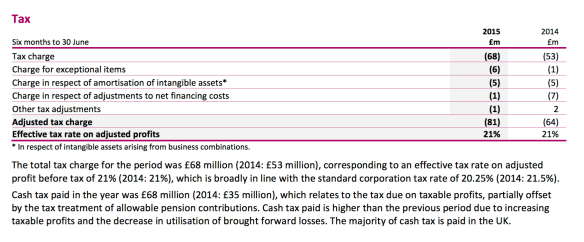
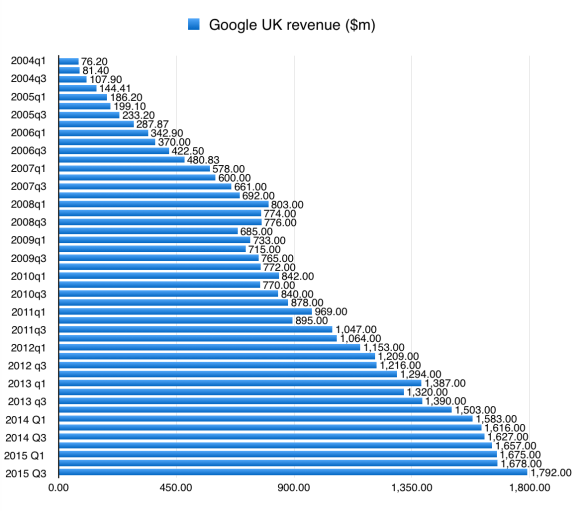
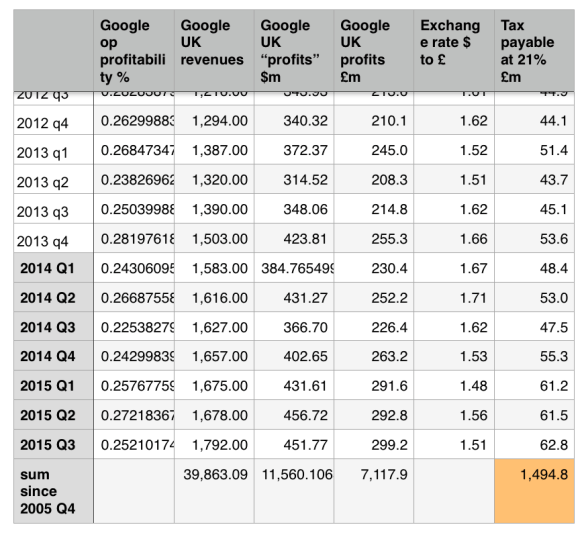
Screenshot 2016-01-24 17.29.27.png

Now let’s move on to Google. Its UK revenues are as follows – all given in US$:

Screenshot 2016-01-24 17.35.09

Note that these are a LOT more than ITV’s. But how do we get from this to its profits? The simple way is just to adopt the overall profitability of Google, the corporation. As a rough-and-ready way of approaching Google’s UK profits, it will have to suffice. The UK doesn’t have the expense of the “moonshot” operations such as self-driving cars; most of the activity is around advertising, though there is also an Android development team (whose work is allegedly actually “happening” in California for tax purposes) and various building works which will all affect immediate profitability because they’re expensive.

But let’s try anyway. Let’s use Google’s overall operating profit margin for each quarter, and use that to calculate the UK profits. It’s not perfect, but it’s a start.

I’ve done that in the table below, using the data from Google’s accounts, and its operating profit/revenue (hence operating profitability margin) to calculate a notional profit; then I’ve multiplied by the prevailing exchange rate (which has varied a lot over the years); and then I’ve multiplied the notional profit by 21% to get the “tax payable”.

Screenshot 2016-01-24 18.19.02

Screenshot 2016-01-24 18.31.14

The numbers are staggering. Google’s UK division has probably made profits of more than 7 billion pounds since the fourth quarter of 2005 (which I used simply because I couldn’t get exchange rates going further back) on revenues (stated) of $39bn – generating an assumed profit of $11.56bn, or £7.11bn.

And the tax payable on that amount? Assuming that same 21% rate as ITV, the total tax payable would be just short of £1.5bn.

And.. how much tax has Google paid in the UK?

The latest stories to emerge of the deal with HMRC suggest that Google is paying back tax to cover just that period to 2005.

“We have agreed with HMRC a new approach for our UK taxes and will pay £130m, covering taxes since 2005,” a Google spokesman said. “We will now pay tax based on revenue from UK-based advertisers, which reflects the size and scope of our UK business.”

How much tax has Google paid in the UK? A total of £200m if you include this latest £130m amount, apparently. Which works out to a tax payment rate of 2.8%. Sure, there may have been lots and lots of costs involved in setting up Google, which are offset against tax. But I doubt they’re bigger than ITV, for instance, has to pay.

Google’s deal with HMRC has been called “derisory”. The figures here suggest that that description is absolutely correct. If Google is generating this much revenue in the UK – a fact which it states in its earnings reports, for which its executives are legally liable – then it would be terrific if it could explain quite how it is so dramatically expensive to run such a business that it generates such pitiful profits. Update: the explanation given by tax experts is that the revenues are *generated* in the UK, but *booked* in Ireland, so that the “profit” arises in Ireland, which doesn’t tax it. This “generated in UK but booked in Ireland” point is the one which led to an almighty furore in 2013 when Matt Brittin of Google

stood by evidence he gave last year that all the company’s European sales were routed through its operation in Ireland and so were not liable to UK taxes.

To which the committee chairman, Margaret Hodge, responded:

“You are a company that says you do no evil and I think that you do do evil in that you use smoke and mirrors to avoid paying tax.”

Among the criticisms of the deal with HMRC are that it must have been done with some sort of principle in the minds of those who agreed the deal for HMRC – in which case it would be useful for other companies to know what principles exactly are in play. It’s time for transparency on this.

Start up: Google’s ad stop, hacking phishers, the lost phone mystery, the adblocking browser and more

A game with these will give you an insight into production processes. Photo by judy_and_ed on Flickr.

You can now sign up to receive each day’s Start Up post by email. You’ll need to click a confirmation link, so no spam.

A selection of 10 links for you. Use them wisely. I’m charlesarthur on Twitter. Observations and links welcome.

Why is your team falling behind? Ask ‘The Penny Game’ » Atomicobject

Eric Shull:

The book Velocity describes an enlightening simulation, a model of a simple manufacturing line. The game uses pennies and dice to represent pieces of work flowing through stations in a factory. It may be simple, but the penny game can improve our understanding of how software teams work, how the interaction of variable processes affect the system as as whole.

In the penny game, pennies come in at one end of the line, are processed by each station, then exit at the other end. This would be rather mundane but for one complication: each station does not always process the same number of pennies.

In the simulation, rolled dice indicate how many pennies each station is allowed to move.

This is fascinating – and gives you real insight into the problems that have to be overcome in manufacturing to tight deadlines. Imagine now if you were processing millions of “pennies”, except they were phones.
link to this extract


Google disabled 49% more ads in 2015 » WSJ Digits blog

Alistair Barr:

More than 1,000 of Google’s 60,000 employees monitor and remove ads, an important task because the company gets about 90% of its revenue from advertising. It’s also been hit financially for not adequately monitoring ads. In 2011, the company agreed to pay $500m to settle allegations by the U.S. Department of Justice that ads for Canadian online pharmacies contributed to the illegal importation of prescription drugs. In the settlement, Google acknowledged it acted “improperly.”

Google blocked more than 12.5m ads in 2015 for drugs that were unapproved or that made misleading claims, up from 9.6m a year earlier.

Ads making misleading weight-loss claims were a big source of user complaints last year, prompting Google to suspend more than 30,000 websites from its ad systems. It declined to give a comparable number for 2014.

Rob Leathern has the growth figure for ad disabling: it’s growing by 50% annually, but still a long way short of catching them all.
link to this extract


How I stumbled upon thousands of Facebook passwords » Medium

“Rukshan”, a Colombo-based medical undergrad and hacker, received a Facebook phishing email and twiddled around with the phishing page:

after modifying the url I checked the folder which contained the php script that handles the post requests and I knew at that moment I hit the jackpot.

There was no index.html file to make sure no one else see the files in that directory or any .htaccess modification, well like I said phishing people are too bored to do all these tech stuff anyway, they’d rather get the passwords and go away.

So I opened the password.html file and I was greeted to the sight of hundreds of Facebook passwords, and by looking at the credentials one there was a pattern:

•Almost all of these accounts belonged to girls who are in their early 20s or teens.
• Almost all of the accounts belonged to females who are from Colombo.

Neat idea; neater still would be to wipe the files. But that would be one sizeable hack further (and probably illegal).
link to this extract


Why don’t you have an Android version? (Or why we develop for iOS first) » Impossible Ventures

Joel Runyon:

Android users may download more apps, but they spend less money than iTunes users.

But that’s not just fake studies either, in our experience with Paleo (io) – a top 20 app in iTunes and ranked even higher in Google Play – we make about 3x the sales on our iTunes listing as we do on Google Play (even though we have a higher ranking in Google Play than iTunes).

Which brings me to the next point: apps are not free to make.

As an app developer, you have to spend time & money on this concept that you have in your head to bring it to reality. The  MVP on an app can cost anywhere between $2k and $20k to build and launch. It might not seem like much if you spend all your time raising VC money and have a $1M+ in the bank, but it can add up if you’re bootstrapping.

In fact, with every dollar you spend, there’s a very real cost (along with another equally as real, opportunity cost).

Of course the argument is completely different in Asia, where it’s generally Android-first (except in Japan, and who knows in China?).
link to this extract


Finding the tennis suspects » Medium

Russell Kaplan, Jason Teplitz, and Christina Wadsworth:

The tennis world was sent reeling when BuzzFeed News and the BBC jointly published The Tennis Racket, which revealed “evidence of widespread match-fixing by players at the upper level of world tennis”. But BuzzFeed refused to publish the names of those players.

We dove into the data and found the names ourselves.

Unless you follow tennis really closely you won’t have heard of any of the names but one, and I do wonder if that one is thrown up by some weird quirk of the analysis. Seems robust, though. I think this might dissuade players – and administrators – from trying to hide this in future, knowing that there are people analysing public data for oddities. Will it put off the gamblers, though?
link to this extract


Why do people keep coming to this couple’s home looking for lost phones? » Fusion

Kashmir Hill:

It started the first month that Christina Lee and Michael Saba started living together. An angry family came knocking at their door demanding the return of a stolen phone. Two months later, a group of friends came with the same request. One month, it happened four times. The visitors, who show up in the morning, afternoon, and in the middle of the night, sometimes accompanied by police officers, always say the same thing: their phone-tracking apps are telling them that their smartphones are in this house in a suburb of Atlanta.

But the phones aren’t there, Lee and Saba always protest, mystified at being fingered by these apps more than a dozen times since February 2015. “I’m sorry you came all this way. This happens a lot,” they’d explain. Most of the people believe them, but about a quarter of them remain suspicious, convinced that the technology is reliable and that Lee and Saba are lying.

“My biggest fear is that someone dangerous or violent is going to visit our house because of this,” said Saba by email. (Like this guy.) “If or when that happens, I doubt our polite explanations are gonna go very far.”

It’s billed as “a tech mystery”, and it really is.
link to this extract


Brave is the name, ad-blocking the game of new browser » Computerworld

Former Mozilla CEO (for 11 days) Brendan Eich is behind a new browser for desktop and mobile which blocks all ads and tracking by default:

“We are building a new browser and a connected private cloud service with anonymous ads,” Eich said.

In effect, Brave will first scrub websites of most of their ads and all tracking, then replace those ads with its own. But the latter will be aimed not at individuals but at the anonymous aggregate of the browser’s user base. If enough people gravitate to the browser, Brave will share its ad revenue with users and content publishers.

“We will target ads based on browser-side intent signals phrased in a standard vocabulary, and without a persistent user id or highly re-identifiable cookie,” Eich said. “By default Brave will insert ads only in a few standard-sized spaces. We find those spaces via a cloud robot.”

No user data will be recorded or stored by Brave, Eich promised.

Elsewhere, Eich said that 55% of Brave’s revenue would be shared with site publishers, and 15% with users, who could then turn that money over to their favorite sites or keep it.

Al Hilwa, an analyst with research firm IDC, applauded the concept of creating an alternate revenue stream from traditional advertising, but wondered whether the browser could compete, even in the niche that Eich described. “This is a laudable idea, but fighting ‘free’ is always risky,” said Hilwa in an email reply to questions.

Not sure the world has an appetite for a new browser, but one can envisage adblocking becoming built in and then enabled, just as pop-up blocking in browsers went from “pop-up what?” to “optional” to “on by default”.
link to this extract


Apple pushes to bolster market share in India » WSJ

Newley Purnell:

India’s smartphone market is expanding quickly and by next year it should overtake the U.S. as the world’s second-biggest behind China, according to research firm IDC.

Just 35% of mobile phones sold in India now are smartphones, meaning there is room for growth as people upgrade from basic devices. Indian consumers, however, tend to purchase inexpensive devices: The average smartphone selling price in the country is likely to fall to $102 in 2018 from $135 in 2014, IDC says.

Apple’s problem has been that the sweet spot for smartphone sales in India has been handsets that cost less than $150. In a country where the average person earns about $1,500 a year and even middle-class consumers make less than $8,000 a year, the standard iPhone — which usually costs between $500 and $1,000 without a data plan — was just too expensive for most people to consider.

“Buying an iPhone is so expensive,” said Sakshi Maurya, a 20-year-old university student in New Delhi. She said she doesn’t understand why an iPhone is five times as expensive as some locally available Android phones. “It’s a luxurious thing.”

India poses a particular marketing challenge for Apple: it’s a mixture of very tech-savvy buyers and low-income buyers. Which does it target first, and how?
link to this extract


iPhone 6S/6S Plus underperform year-ago sales » Consumer Intelligence Research Partners

CIRP finds that the new iPhone 6s and 6s Plus accounted for 67% of total US iPhone sales, with iPhone 6s at 48% and iPhone 6s Plus at 19%. In the December 2014 quarter, iPhone 6 and 6 Plus accounted for 75% of total US iPhone sales with 30% iPhone 6 Plus.

“The iPhone 6s and 6s Plus did quite well,” said Josh Lowitz, CIRP Partner and Co- Founder. “Yet, they did not dominate the same way that iPhone 6 and 6 Plus did a year ago. The total share of the new flagship models fell below the share of the then-new phones in 2014, and the large-format iPhone 6s Plus share of sales dropped compared to the iPhone 6 Plus as well. Customers continue to choose the year-old iPhone 6 and 6 Plus, and even the two-year old iPhone 5S.”

CIRP can’t say whether total sales are higher or lower (it samples 500 buyers of Apple devices in the previous quarter), just the mix. This looks like a subtle price deflation of the iPhone as people opt for 2014’s models over 2015’s – after all, they look the same to other people, even if the newer models has extra features.
link to this extract


Issue 3434 – android – Add APIs for low-latency audio – Android Open Source Project – Issue Tracker

On Tuesday, Apple released its “Music Memos” app, which is intended to let musicians (of any standard) record little musical thoughts that come to them on the guitar or piano directly to their iPhone or iPad, and add musical accompaniment.

Android doesn’t have that, because as has been noted here before its audio latency is too long – over 10 milliseconds, which is the longest pro musicians can bear. So how long have developers been prodding Google to improve Android’s audio latency?

I am developer of real-time audio signal processing applications. I am interested in creating
applications for sale in the android marketplace, but found that android has no method for real-
time low latency audio.

This is the first entry in a bug/feature request which continues to the present (latest entry is June 2015). The date of the entry? July 31, 2009 – slightly over nine months after the first Android phone. Is six and a half years a long time for a feature request to lie open? (And here’s Google’s official list of device latencies. Look for any at 10ms or below.)

Apple effectively gets 100% of the professional audience through this feature.
link to this extract


Errata, corrigenda and ai no corrida: