Start up: who’ll buy HERE?, Loon gets ready, Vermeer and the Apple Watch, web v native redux, and more


A Project Loon balloon. Photo by theglobalpanorama on Flickr.

A selection of 8 links for you. Links as in, you know, links. I’m charlesarthur on Twitter. Observations and links welcome.

Microsoft’s Q3 2015: Surface and Lumia up, but profit down » The Verge

Tom Warren:

Microsoft sold 8.6m Lumia devices in the most recent quarter, and the company says that’s an 18% increase over the prior year. Microsoft completed its acquisition of Nokia around this time last year, and neither company revealed Lumia sales at the time, but it’s safe to say they’re rising again. Either way, Windows Phone revenue has dropped by 16%.

While Microsoft is heading towards finalizing Windows 10 in the coming months, the PC market is still fragile. OEM revenue for Windows decreased by a massive 22% this quarter, following an equally bad quarter over the holiday period. Part of this decline is related to less business PC sales, and the general PC market as a whole. Office appears to be a mixed bag for Microsoft. While it’s helping drive commercial revenues, Office consumer revenues declined 41% due to the transition to Office 365 and weaknesses in Japan where Office is popular on PCs. However, Office 365 Consumer subscriptions have grown to 12.4m, so Microsoft is continuing to convince consumers that the cloud is the future.

If 8.6m is an 18% increase, a total of 7.3m were sold (well, shipped) in Q1 2014. The fall in revenue maybe isn’t surprising as the Lumia line has all been focussed on the lower end.

Surface revenue was up 44% year-on-year to $713m. As usual, no news on how many sold.


How Uber surge pricing really works » The Washington Post

Nicholas Diakopoulos:

is Uber’s surge pricing algorithm really doing what they claim? Do surge prices really get more cars on the road?

My analysis suggests that rather than motivating a fresh supply of drivers, surge pricing instead re-distributes drivers already on the road.

I collected four weeks worth of Uber’s dynamic pricing information from their own publicly available data for five locations in Washington, DC. Every 15 seconds between March 15 and April 11, I pinged their servers and collected the surge price and estimated waiting time for an UberX car at those locations. Though only a tiny sliver of all of Uber’s data, it provided an initial window into how their algorithms are working

…So, why don’t surge prices work to get new drivers on the road? It might simply be that surge prices jump around too much.

Reverse-engineering these algorithms seems to be the way forward.


Nokia targeting Apple, Alibaba and Amazon in maps-unit sale » Bloomberg Business

Nokia Oyj, the Finnish company selling its money-losing maps business, is trying to drum up interest from some of the biggest names in technology including Apple Inc., Alibaba Group Holding Ltd. and Amazon.com Inc., people with knowledge of the matter said.
Those companies as well as Facebook Inc., a group of German carmakers, and private-equity firms are among the companies looking at Nokia’s maps operations, known as HERE, highlighting the ubiquity and utility of location-based services. Nokia is seeking more than €3bn ($3.2bn) from a sale of the unit, said one of the people, who asked not to be identified discussing private information.

Bought it for €8.1bn in 2008; valued at €2bn in the accounts last year. Big lossmaker; the question is how any company that bought HERE would be able to make the purchase worthwhile in monetary terms.


Google’s Project Loon close to launching thousands of balloons » Computerworld

Martyn Williams:

Google says its Project Loon is close to being able to produce and launch thousands of balloons to provide Internet access from the sky.

Such a number would be required to provide reliable Internet access to users in remote areas that are currently unserved by terrestrial networks, said Mike Cassidy, the Google engineer in charge of the project, in a video posted Friday.

The ambitious project has been under way for a couple of years and involves beaming down LTE cellular signals to handsets on the ground from balloons thousands of feet in the air, well above the altitude that passenger jets fly.

“At first it would take us 3 or 4 days to tape together a balloon,” Cassidy says in the video. “Today, through our own manufacturing facility, the automated systems can get a balloon produced in just a few hours. We’re getting close to the point where we can roll out thousands of balloons.”


Why Apple Watch margins should set a new record for Apple » carlhowe.com/blog

Carl Howe with a new thought experiment:

Last week, I asked readers to imagine how they’d manufacture a million Origami lobsters out of paper. I’m going to continue that though experiment theme this week with a different question. If you’re not interested in such context, skip ahead to the next section where we’ll dive into revisions to the model I posted last week.

Meanwhile, this week’s thought experiment question is this:

What were the parts cost and gross margin of a Johannes Vermeer painting in his day?

Johannes Vermeer, of course, was a modestly successful 17th century Dutch painter, known for such paintings as Girl with a Pearl Earring and The Music Lesson. Art historians the world over praise his works for their subtle portrayal of light and his use of brilliant and lifelike color. Today, historians attribute 34 surviving paintings to undoubtedly be Vermeer’s work. While priceless due to their rarity, owners who have sold Vermeer paintings have invariably seen prices in the tens of millions of dollars.

But what did they cost to paint?

In other words, why do we think it’s OK for art to have high added value, but not technology? The whole post is wonderful.


In Google case, do what’s best for consumers » TheHill

Thomas Lenard:

Since the FTC closed its [antitrust investigation] case in 2013, the search space has become, if anything, more competitive. In addition to competition from general search engines such as Bing, Google faces competition from Facebook, Apple (Siri) and Amazon — all of which perform search functions. There is vigorous competition in shopping sites in Europe with Amazon and eBay being the major players. Numerous local shopping sites provide additional competition. In fact, Google is a minor player with a very small share of this (online shopping) market. And there is a whole new world of apps through which consumers search for a variety of information, including product information.

Thus, despite the fact that Google’s share of general search is higher in Europe than in the U.S., it is unlikely the European authorities will now find harm to consumers or to competition where the U.S. authorities didn’t.

Lenard is a senior fellow at the Technology Policy Institute, whose “supporters” include Amazon, Facebook, Intel, the MPAA, Motorola, Yahoo and – hey! – Google. I include this to show the way that one can distort reality by chucking some names in: look at all the alternative search engines! Bing, Yahoo, DuckDuckGo, er, Yandex.. but the reality is that none has more than a tiny fraction of the market in Europe. It’s like Microsoft suggesting that there are loads of desktop OSs – MacOS, Ubuntu, FreeBSD, umm..

And while Google might be a minor player in the local shopping market, the EC data (and to some extent Google itself) suggests it would be nowhere if Google Shopping had to compete in the same way as all the other shopping sites – and hadn’t penalised the search ranking and access to AdWords of rivals (who then complained).

And, finally, “harm to consumers” isn’t the EC test for antitrust. It’s the US test.


Skipping the web » Remains of the Day

Eugene Wei:

Having grown up in the U.S., the web was one of the first and still longest-running touchpoint to the internet. My first was using newsgroups in college, and the web came about towards the end of my undergrad days. I can understand why so many in the U.S. are nostalgic and defensive of the web as a medium. Seeing so much content and online interaction move behind the walls of social networks seems like an epic tragedy to many, and I empathize.

Many people in India, China, and other parts of the world, where bandwidth is low and slow, and where mobile phones are their one and only computer, have no room for such sentimentality. They may never have experienced the same heyday of the web, so they feel no analogous nostalgia for it as a medium. Path dependence matters here, as it does in lots of areas of tech, and one of the best ways to detect it is to widen your geographic scope of study outside the U.S. Asia is a wonderful comparison group, especially for me because I have so many friends and relatives there and because I still interact with them online at a decent frequency.

In the U.S., many tech companies were lauded as pioneers for going mobile first when in Asia companies are already going mobile only.


Mobile malware is like Ebola – an overhyped threat » Net Security

Reporting from the RSA Conference 2015:

In 2012, monitoring 33% of US Mobile Data Traffic, Damballa saw 3,492 out of a total of 23M mobile devices – 0.015% – contacting a domain on the mobile blacklist (MBL). In Q4 2014, monitoring nearly 50% of US Mobile Data Traffic, only 9,688 out of a total of 151M mobile devices contacted mobile black list domains (.0064%). The National Weather Services says the odds of being struck by lightning in a lifetime are 0.01%.

“This research shows that mobile malware in the Unites States is very much like Ebola – harmful, but greatly over exaggerated, and contained to a limited percentage of the population that are engaging in behavior that puts them at risk for infection,” said Charles Lever, senior scientific researcher at Damballa. “Ask yourself, ‘How many of you have been infected by mobile malware? How many of you know someone infected by mobile malware?’”


Start up: Wikipedia’s oldest hoaxes, Android’s audio problem, EC seeks transparent search, and more


No, adding these chips won’t make you smart. Less hungry, maybe. Photo by malias on Flickr.

A selection of 8 links for you. Spread them like butter from the fridge. I’m charlesarthur on Twitter. Observations and links welcome.

Android’s 10 millisecond problem: the Android audio path latency explainer » Superpowered

Gabor and Patrick, who founded the audio-based software company:

Even though music apps make up only 3% of all downloads in the iOS App Store, the Music app category is the 3rd highest revenue generating app category after Games and Social Networking. Which suggests that music apps monetize disproportionately well on platforms that offer low latency performance such as the App Store/iOS devices.
On Android, it is a different story. In the Google Play store, the Music category is not even a top five revenue producing app category.

The overwhelming majority of Android devices suffer from too high audio latency, preventing developers from building apps that would satisfy consumer demand on Android.

As such, Google and Android app developers are leaving billions of dollars on the table for Apple and iOS developers because of Android’s 10 Millisecond Problem.

For the purposes of this explainer, roundtrip audio latency is simply the difference in time between when an audio input is introduced into a mobile device, undergo some sort of needed processing, and exits the same device. As any musician will tell you, we as humans are most comfortable with latencies of ~10 milliseconds. Anything significantly higher tends to disturb us.

Most Android apps have more than 100 ms of audio output latency, and more than 200 ms of round-trip (audio input to audio output) latency. To give you a quick example from the Oscar winning film Whiplash, it’s like the drummer is dragging by a half beat behind the band!

This has been a problem on Android for years; the analysis suggests it may be insoluble. (List of latencies here; some are really long.) The discussion on Hacker News is worth browsing too. (Via Benedict Evans.)


The story behind Jar’Edo Wens, the longest-running hoax in Wikipedia history » The Washington Post

Caitlin Dewey:

On Monday night, [Gregory] Kohs [a former Wikipedia editor who is now a prominent critic] wrapped up an experiment in which he inserted outlandish errors into 31 articles and tracked whether editors ever found them. After more than two months, half of his hoaxes still had not been found — and those included errors on high-profile pages, like “Mediterranean climate” and “inflammation.” (By his estimate, more than 100,000 people have now seen the claim that volcanic rock produced by the human body causes inflammation pain.)
And there are more unchecked hoaxes where those came from. Editors only recently caught a six-year-old article about the “Pax Romana,” an entirely fictitious Nazi program. Likewise “Elaine de Francias,” the invented illegitimate daughter of Henry II of France. And the obvious, eight-year-old hoax of “Don Meme,” a Mexican guru who materializes at parties and mentors hipster bands…

…“I think this has proved, beyond a reasonable doubt, that it’s not fair to say Wikipedia is ‘self-correcting,’” Kohs said.


We put a chip in it! » Tumblr

It was just a dumb thing. Then we put a chip in it. Now it’s a smart thing.

Such as for example these socks:


Elon Musk had a deal to sell Tesla to Google in 2013 » Bloomberg Business

Ashlee Vance, with an extract from a forthcoming book:

“The word of mouth on the [Model S] car sucked,” Musk says. By Valentine’s Day 2013, Tesla was heading toward a death spiral of missed sales targets and falling shares. The company’s executives had also hidden the severity of the problem from the intensely demanding Musk. When he found out, he pulled staff from every department — engineering, design, finance, HR — into a meeting and ordered them to call people who’d reserved Teslas and close those sales. “If we don’t deliver these cars, we are f—ed,” Musk told the employees, according to a person at the meeting. “So I don’t care what job you were doing. Your new job is delivering cars.”
Musk fired senior executives, promoted hungry junior employees, and assigned former Daimler executive Jerome Guillen to fix Tesla’s repair service and get its glitchy cars back on the road. He also proposed what eventually became his public guarantee of the resale price of the Model S: Unsatisfied buyers would get their money back from Musk personally if they couldn’t sell their car at a price comparable to that of another luxury model.

When in charge at Microsoft, Bill Gates used to insist that executives bring him at least one piece of bad news along with any good news. This is what happens when they don’t. Good on Musk getting the turnaround to happen through such a resourceful approach, though. Ah, but what might have been for Google.


EU to investigate transparency of Internet search results: document » Reuters

Julia Fioretti:

In a draft of the Commission’s strategy for creating a digital single market, seen by Reuters, it says it will “carry out a comprehensive investigation and consultation on the role of platforms, including the growth of the sharing economy.”
The investigation, expected to be carried out next year, will look into the transparency of search results – involving paid for links and advertisements – and how platforms use the information they acquire.

European Commission Vice-President Andrus Ansip is expected to formally announce the new strategy on May 6.

The transparency of search results came under particular scrutiny this week when the European competition chief accused Google of cheating competitors by distorting web search results to consistently favor its own shopping service.

There are concerns in Europe over how Internet companies such as Facebook and Amazon use the huge amounts of personal data they acquire.

The inquiry will also look at how platforms compensate rights-holders for showing copyrighted material and limits on the ability of individuals and businesses to move from one platform to another.

Don’t hold your breath for when this will report, though, or whether any of it will be implemented.


China smartphone shipments shed 30% sequentially in 1Q15 » Digitimes Research

Kristina Shih:

Shipments of smartphones by China-based vendors declined by nearly 30% sequentially to 91.8m units in the first quarter of 2015 due to sluggish demand both at home and overseas, as well as reduced production affected by the traditional Lunar New Year holidays, according to Digitimes Research.
Vendors which have a high ratio of export sales saw their shipments decline by over 40% sequentially in the first quarter, and those which focus more on the domestic market suffered declines ranging from 20-25%, Digitimes Research has found.

Huawei’s shipments were less affected by market factors, reaching 13.5m units in the first quarter and making the company the number vendor in the quarter. Xiaomi came in second with shipments totaling 10m units as it lowered the prices of some old models to boost sales.

Of course sequential changes don’t matter when you’re trying to analyse larger trends, but they hurt Digitimes’s intended audience of supply chain companies. That’s quite a drop; usually total worldwide mobile phone sales drop by about 10% from Q4 to Q1.


Instagram develops app for Apple Watch » FT.com

Tim Bradshaw and Hannah Kuchler:

Instagram, which built a billion-dollar business on smartphones, is making its first foray into wearable technology with a new app for the Apple Watch.
The popular photo-sharing app, which is owned by Facebook, will use the smartwatch to help users keep up with their closest friends through alerts as soon as they post a picture…
…“I think the Watch is really about quick information and notifications,” [Instagram designer Ian] Silber told the Financial Times. “It’s a huge use case that’s going to be a little bit different.”

So there’s going to be a version for a device that has only just launched, while the Windows Phone version hasn’t been updated for over a year. The power (or lack of it) of an ecosystem.


The great mobile divergence: how the app universe went beyond universal apps » John Kneeland

Kneeland nails the point that I also made: that just because app developers can write once for any Windows version (phone, PC, Xbox) doesn’t mean they will:

The value of a universal app is that you could write an app and have it easily working on all Windows platforms. If I had a bank app, an airline booking app, a casual game, or another app I was already planning on making for PCs, then sure, the idea of universal apps makes sense…
But what good is a Lyft app on a desktop? What good does the Luxe parking app do on my Xbox? What would Instagram even do on my ThinkPad? How could I use a barcode scanning price comparison app on a PC tethered to my desk? Is a PC going to count my steps or monitor my heart-rate in real-time? Can it help me navigate traffic with Waze? What good is a Starbucks card app (or any store app, or any mobile payments solution for that matter) going to do on a device that isn’t mobile? Heck, what would Grindr do if limited to a desktop—find romantic leads within my specified IP address blocks?

(Thanks Tero Alhonen.)


Start up: Chrome v Safari, designing Windows Phone, Apple Watch value, S6 battery life and more

Remember? That’s when Instagram for Windows Phone was last updated. Photo by Theen Moy on Flickr.

A selection of 9 links for you. Really, they are. I’m charlesarthur on Twitter. Observations and links welcome.

The Roomba for lawns is really pissing off astronomers » WIRED

Davey Alba on how the automated method of mowing lawns (using beacons to guide the mowers) could be a hassle for the star-struck:

the system requires special permission from the FCC due to its restrictions on fixed outdoor infrastructure. In a nutshell, the FCC doesn’t want people creating ad hoc networks of transmitters, which could interfere with existing authorized services like cellular and GPS systems. In its filings, iRobot says it should be exempt because it doesn’t set out to establish a broad communications network — its lawnbot networks would be tightly contained.
Astronomers say that’s not good enough. The frequency band proposed for the lawnbot (6240-6740 MHz) is the very same one several enormous radio telescopes operate on. Astronomers want the FCC to protect their share of the radio spectrum so their telescopes continue observing methanol, which abounds in regions where celestial bodies are forming.


Chrome is still a threat to your MacBook’s battery » The Verge

Vlad Savov on the comparative battery life of MacBooks using the Chrome browser, and Apple’s Safari:

It’s not just the distance you can go with Chrome that’s an issue. The speed and quality of the ride are also compromised. The widely used SunSpider browser benchmark clocks the MacBook Pro in at 203ms when using Chrome. Safari scores 30% better with a time of 144ms. Same machine, very different outcomes. You’d think YouTube would be a spot where Google collects an easy win, but that’s been another cause of distress: the new 4K 60fps videos that YouTube now supports are playable on the MacBook, but only — you guessed it — when using Safari and not Chrome. Google’s own browser chokes while playing back video from Google’s own video service.

Chrome’s problem is that it sets every page up as a virtual machine, demanding its own chunk of memory. Safari.. does it differently. The difference in battery life, though, is huge. Commenters weighing in seem to agree (while also liking the convenience of Chrome).


Apple Watch: an overnight multi-billion dollar business » carlhowe.com

Carl Howe used to analyse this sort of stuff for a living. Here he helps you think of the supply chain issues involved in the Apple Watch by likening it to producing a million origami lobsters:

Now let’s make this a little more realistic. As it turns out, we really want a million lobsters of two different sizes. Further, ordinary paper tears too easily and is the wrong colour for Origami lobsters, so we’ve decided to make our own paper; that will require its own process. We also need to be able to deliver some of the lobsters with glitter and others with hand-painted decorations; we’ll need to plan to supply and apply those materials too. Oh, and we want to make a few thousand out of two colors of pure gold leaf instead of paper. You’ll have to manufacture the paper for that too.
What’s your plan look like now?
There’s no rush; you can deliver your million lobsters any time during the month, provided that you don’t mind people complaining that you are way too slow at getting this done. Oh, and you’ll be criticized in the international press for every failure to produce perfect lobsters.
And now, imagine this same plan, except with this twist: no one has successfully folded this particular type of Origami lobster before, so you really don’t know how it’s all going to turn out. And your reward if you are successful will not be praise, but demands that you build even more next month.

This is such a wonderful post for wrapping your head around supply chain issues – as good in its way as Greg Koenig’s commentary about the amazing mechanics of how the Apple Watch is made.
Howe has a number for how many Watches have been sold, but you need to read his piece to find out. He’s probably right. (He also notes in an update that there’s only one module – that is lobster – so the Watch is even more profitable.)


Galaxy S6 Edge battery life – 4 days later » Android Authority

Let’s revisit Nirave Gondhia and see how he’s getting on with his series:

Another day of 13 to 16 hour battery life suggests that with my usage pattern, this is the most I can expect from the Galaxy S6 Edge. However, considering that the average user works approximately eight hours per day, it’s clear that the Galaxy S6 Edge will last a full working day, allowing you to charge it overnight and rely on it until you get home after work.
Another thing to take away is that using your phone at 50% brightness or less adds several hours to your battery life. I’ve done further testing on this and it’s certainly a key factor. The octa-core processor drives over 3.6 million pixels and if the brightness is set to full, it draws a large amount of power. Reducing to around 50 to 60% could increase your screen-on-time by over 50%.

16-hour battery life would certainly take you through a lot of the day.


Ex-Microsoft designer explains the move away from Metro » Thurrott.com

Paul Thurrott filleted an AMA by the designer of the new version of Office for Windows Phone so you don’t have to wade through the original. Fascinating bits, including:

Why is the hamburger menu in the top left of the display? It’s hard to reach, etc. I actually argued for top right. The issue with top right is that no one else does [it]. Being a special unique snowflake works for art but not design. Design should be invisible, so people shouldn’t be thinking ‘oh that’s odd. I’ve never seen this button used like this. I wonder if it does the same thing?’ … The industry decided top left. So to go against it you need to earn it. You need to be far, far better or else it just stands out awkwardly.”
But people need to be able to use it with one hand. “What the research is showing is that people aren’t actually as wedded to one handed use as we used to believe they are. Don’t get me wrong, this is clearly a tradeoff. Frequently used things have to be reachable, even one-handed. But hamburgers are not frequently used, and one-handed use is not ironclad. Combine those two factors together and you see why the industry has settled on this standard. It wasn’t random … And, sorry. But the hamburger has some real issues, but ‘I can’t reach uncommon things without adjusting my hand on my massive phone and that annoys me because it reminds me of the dominant OS on earth” [is not one of them].
But the bottom is better. “It turns out bottom is not better. You’d think that something 3 pixels from your palm would be easier to reach than something in the middle of the phone. But nope.

This really is a terrific post with so much about comparative user experience; this is the link you really should read today.


It has been one year since Instagram was last updated for Windows Phone » Neowin

Brad Sams:

It was on 3.22.14 that the Instagram beta was last updated and the app has remained unchanged since that day. In essence, this app represents the exact issue Windows Phone fans have expressed tirelessly over the years: It’s not the lack of apps, it’s the lack of support for the apps that do exist.
Twitter is another good example. While this app is updated more frequently, it lacks features of its iOS and Android counterparts. By all accounts, Twitter’s Windows Phone app is a distant second-thought for the company and while it is semi-frequently updated, when it does get new features, it’s months or years after the other apps.
Microsoft is aware of this, to no surprise, and they do hope that their universal apps will help to remedy this situation but it will not be an overnight fix.

It’s nice to hope. Has anyone pointed out yet that Instagram isn’t a desktop app, but is mobile-only, so the big Windows desktop installed base doesn’t matter at all to the company? Let me be the first then. Same for Snapchat, Uber.. the list goes on.


Here’s how much a Samsung Galaxy S6 replacement battery (and screen) costs » PC Mag

Sascha Segan:

According to a Samsung spokesperson in touch with the company’s support team, the Galaxy S6 battery has a one-year warranty. If its maximum capacity drops below 80% of its initial level during that year, your replacement is free (although you still have to pay for shipping.) At any other time, the replacement costs $45, plus shipping, though Samsung did not detail shipping costs.
That’s less than the $79 Apple charges for an iPhone battery replacement, but more than the official $29.99 price for a Galaxy S5 battery…
Samsung has walk-in repair centers in Los Angeles and Plano, Texas that don’t require shipping and do same-day battery swaps, the company said. Samsung is looking to establish those centers in more cities.
Screen replacements, meanwhile, cost $199 for the Galaxy S6 and S6 Edge. That’s more than the $109 Apple charges for iPhone 6 screen repair, but less than the $299 Apple charges for repairs that involve more than the screen. Samsung screen replacements also have a one-day turnaround.


Apple Pay plans to launch in Canada this fall » WSJ

Rita Trichur and Daisuke Wakabayashi, who note that Canada has lots of iPhones (30% installed base of smartphones) and lots of NFC-capable payment systems:

Canadian banks want Apple Pay to work in a way that requires a “secondary authentication” to verify customer information before cards can be used with the phones. That means that a consumer could be required to enter a PIN, log-on to a mobile banking app or use a one-time passcode sent via text message before cards can be used on Apple Pay, those people said.

Fair enough. Seems sensible given the problems US banks saw in letting people add cards without authentication. But then it carries on:

The trouble with that approach, however, is that it creates a clunky experience for consumers who expect mobile payments to be seamless—similar to tap-and-go credit cards that are already in wide use in Canada.

I checked this with the writers – surely the banks just want to authenticate initially, not every time? – but Trichur assured me she was hearing that the banks are considering a per-transaction authentication. Sounds bonkers to me.


This is why daddy drinks » Rusty Rants

Russell Ivanovic has been a dedicated disliker of Samsung phones since the S2 because “they often represented the worst possible Android experience you could have”. But they needed to have an S6 in the Shifty Jelly offices (which do Android app development):

The first thing that struck me was the build quality. It’s really good. The next thing that struck me was the screen. It’s amazing. Bright, super high density (far higher than the iPhone and Moto X I’m used to) and so beautiful. Then I was struck by the speed…this thing is fast…like really fast. Then I took a few test photos, and damned if they didn’t look better than all the same photos I was taking with my iPhone 6. In short I had a ‘huh?’ moment. Was it possible this was a good phone?


Start up: S6 battery life, Datasift squeezed, notifying Apple Watch, and more


Endangered species (one of many)? Photo by DaveCrosby on Flickr.

A selection of 8 links for you. Spread straight from the fridge. I’m charlesarthur on Twitter. Observations and links welcome.

A Japanese court has ordered Google to take down negative business » Quartz

Google was ordered by a Japanese court today to take down anonymous negative business reviews of a medical clinic, written by people who said they were former patients. The decision is the latest sign of the spread of the “right to be forgotten” concept from Europe to Asia.

The case pitted a Japanese medical clinic against the search engine, Japan’s largest. The plaintiff, an unnamed doctor, said in a signed affidavit that the reviews complaining of poor service were false, one person briefed on the case said.

In the ruling, which was not made public but was reviewed by Quartz, Chiba District Court court ruled that Google must remove the reviews from its local and global search results, or face a ¥300,000 ($2,494) fine.

Google will appeal, but reversal is unlikely.


A ‘darker narrative’ of print’s future from Clay Shirky » NYTimes.com

Margaret Sullivan, the New York Times’s ombuds..person, relaying emails from Shirky, who thinks we’re currently in a lull of print decline (which he says will go fast – which the US saw in 2007-9 – and then slow, as now, and then fast at some time in the near future:

The problem with print is that the advantageous returns to scale from physical distribution of newspapers become disadvantageous when scale shrinks. The ad revenue from a print run of 500,000 would be 16 percent less than for 600,000 at best, but the costs wouldn’t fall by anything like 16%, eroding print margins. There is some threshold, well above 100,000 copies and probably closer to 250,000, where nightly print runs stop making economic sense. This risk is increased by The New York Times’s cross-subsidy of print, with its print+digital bundle. This bundle creates the risk of rapid future readjustment, when advertisers reconsider print CPM in light of reduced consumption and pass-around of print by all-access subscribers. (Public editor note: C.P.M. is the cost to the advertiser per thousand readers or viewers, a common measurement in advertising.)

Both your Sunday and weekday readerships are already near important psychological thresholds for advertisers — one million and 500,000. When no advertiser can reach a million readers in any print ad in the Times (2017, on present evidence) and weekday advertising reaches less than half a million (2018, using the 6 percent decline figure you quoted), there will be downward pressure on C.P.M.s. [cost to the advertiser to reach a thousand readers; high CPMs are good for a publisher].

And then things unravel, Shirky suggests.


Galaxy S6 Edge battery life – first 24 hours » Android Authority

Nirave Gondhia is starting a series where he tests the battery life on his new phone:

Testing battery life can be subjective as each person’s usage will vary widely but to try and provide some context to these battery tests, I copied all my data and apps from my Galaxy Note 4 (running Lollipop). Whereas the Galaxy S6 Edge lasted just over 14 hours, my Galaxy Note 4 would usually last 18 to 22 hours with largely the same apps and services running.

The first thing you will notice about the Galaxy S6 Edge battery is that the first 10% seems to drain very quickly. After this initial short burst, the battery begins to level off and settle down. It’s a strange occurrence that many people have reported but it’s possible this is due to the handset being new – after a few days usage, will it still drain the first 10%?

Reviewers have pointed to the S6 having less battery life than the S5; worth watching how this pans out in real life.


Lost In Mobile to close on 18th April » Lost In Mobile

Shaun McGill:

It’s been a good run, but the time has come to finally close LIM. As you will be aware, the content has dropped significantly in recent weeks and this has been due to workloads elsewhere and a continual problem finding mobile news that I consider worthy of sharing.

The mobile industry has changed to the point that I believe that one-man blogs are unable to offer the kind of benefits readers used to receive and with so many resources and larger services out there, I am struggling to find the motivation to keep posting content.

Been going 13 years. A sign of the times?


It’s time to stop tiptoeing around Joni Mitchell’s health condition » The Globe and Mail

Russell Smith:

No news items have revealed what exactly caused her sudden hospitalization, but all have mentioned that she “suffers from Morgellons disease.” This is because Mitchell herself described the affliction and used its name in an interview in 2010. News stories may then carefully allude to the fact that this “disease” is “mysterious” or even “controversial.” But the damage is done: The phrase “suffers from Morgellons” is quite simply inaccurate, and even harmful, in that it perpetuates a delusion.

Those who claim to be suffering from it are more likely suffering a psychiatric illness, experts say. If that’s the case with Mitchell, we should really be saying she “revealed in 2010 that she suffers from delusional parasitosis.” The name Morgellons was invented by a person who is not a doctor and is not employed by any hospital, university or research institution. It was intensely studied by the Centers for Disease Control and Prevention in the United States, and the CDC’s conclusions, released in 2012, were straightforward: Researchers found no common cause of the disease, and say those who believe they have it have often self-diagnosed after encountering websites that describe it. In other words, it is a delusion that is spread by the Internet.

The fact that newspapers are being so tactful about the possibility of psychiatric disturbance in Mitchell’s case is incongruent with the supposedly new attitudes about mental illness that are being trumpeted in those same newspapers. Aren’t we constantly reading about how we should “end the stigma” when it comes to mental illness? Aren’t we being told that there is no shame in psychiatric disorders, that their sufferers should not be morally judged, that they should be open about their ailments?

Smith’s article makes the point strongly: artists are separate from their creations. If Mitchell (whose music I love) has a mental problem, that doesn’t subtract from her music or any of her achievements. It just means she has a mental problem.


To our users: a community update » PressureNet.io

Pressurenet is an Android app that measures barometric pressure and then tries to crowdsource it for, well, weather and related forecasting. But as happens, it has to try to make some money somewhere – including the sale of past data that it collected:

We are aware of the sensitive nature of selling user-contributed data and we want to be open about exactly what information we collect and what control you have over it.

The data is anonymous and is comprised of: an alphanumerical user id that is not directly linked to any personal user information, atmospheric pressure, location (latitude, longitude, and altitude) and time of the pressure reading, phone model type, whether the phone was charging at the time the reading was sent, as well as some other metadata. PressureNet does not and has never collected any personally identifiable information.

Umm. A location doesn’t identify a person, but if you could track the phone by any other means, you’d have a ton of data.


Twitter ends its partnership with DataSift – firehose access expires on August 13, 2015 » Datasift Blog

Nick Halstead:

With the end of our partnership with Twitter the disruption is not only measured by the impact on our 1,000 direct customers, but on the tens of thousands of companies that use applications that are “DataSift-powered”. Many of these companies create insights that drive direct advertising revenue back into Twitter. A direct switch to Twitter/GNIP will not mitigate that disruption. Today, 80% of our customers use our advanced processing capabilities that are not available from Twitter/GNIP.

Really bad news for Datasift (a British company that was one of the first into the “big data” social space), which is now going to turn to Facebook. What happens if that decides to go in-house, though? Maybe DataSift needs to look at processing for private clients such as finance.


What the Apple Watch means for the Age of Notifications » Medium

Steven Levy:

the Age of Notifications is about to face its biggest mess yet, as alerts move from phone screens to watch faces. Notifications are just about the entire point of a smart watch — you’re not going to be reading books, watching movies or doing spreadsheets on them. And a tilt of the wrist is the perfect delivery system for those little blips.

But having that delivery system on your body makes notifications much harder to ignore. It’s jarring enough to get a phone-buzz notifying you of an alert. When it’s something zapping your skin, it’s even more compelling. What’s more, because it’s so easy to simply twist your wrist to see what the fuss is about, the temptation is all the harder to resist.

I don’t get this. It makes it sound as though people are helpless children who can’t figure out what classes of notification (as in, from which app) interest them. The example he gives – a pointless notification from MLB – would have me deciding that MLB was never again going to get the chance to bother me. You don’t need to know about every incoming email (VIPs is fine, for me). Perhaps some people need to retreat a bit from their phones. But that’s no bad thing, whether it comes from buying a smartwatch or just realising they’re failing to live in the moment.


Start up: hacking nannycams, S6 SD/battery poll, Watch wait, and more


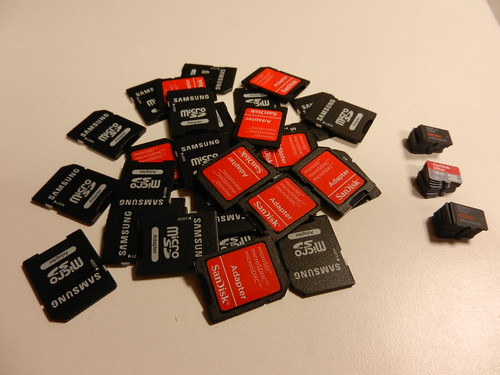
Could Samsung need these more than it thinks? Photo by seeweb on Flickr.

A selection of 9 links for you. Use them wisely. I’m charlesarthur on Twitter. Observations and links welcome.

Rochester family finds their “Nanny Cam” hacked for the world to see » KTTC Rochester, Austin

Mike Sullivan:

Many people across the country use “nanny cams” to monitor their children.  Some are closed circuit, but others allow parents to access their cameras through the Internet.  One Rochester family began to notice odd things happening with their “nanny cam”, but what they found out may shock you.

“We were sleeping in bed, and basically heard some music coming from the nursery, but then when we went into the room the music turned off,” said the Rochester mother who chose to remain anonymous.

Where were these tunes coming from? Would you have guessed another country?

“We were able to track down the IP address through the Foscam software, and found out that it was coming from Amsterdam,” said the concerned mother of one. “That IP had a web link attached to it.”

Creepy.


The $1,000 CPM » Medium

Hank Green:

Imagine that you would like to consume a piece of content, but in between you and that content is a paywall. They’re asking $15 for one person to view the content one time. While a YouTube video might net you $2 per thousand viewers, this fantasy world I’ve just described will net you $15,000 per thousand impressions…A $15,000 CPM!

With a $15,000 CPM, every two thousand views is a full-time, living-wage human per year!

Of course, this model would never work…except that it works every day at every movie theater in America.

Oh yeah. Then again, making a movie is incredibly expensive: the paywall around that process is unbelievable, running to millions of dollars. The barrier to entry for YouTube is effectively zero.


Samsung may have just lost half of its fans with the Galaxy S6 » AndroidPIT

Following a suggestion I made, Android Pit asked its readers whether they wanted a removable battery and/or SD card slot on the Galaxy S6. No data on how many people responded (and of course it’s a self-selecting survey – see later), so take with a pinch of salt what Kris Carlon finds:

The survey results also showed that only about two-fifths of Samsung owners currently carry a spare battery, and that the other three-fifths either don’t have one or rarely use the spare battery they do own.

Only 18% of respondents stated a removable battery was critical and would turn them off buying Samsung in future. Another 28% claimed it was important and that they would consider other manufacturers with removable battery options.

That’s 46% of current Samsung customers not happy with the decision to remove the removable battery. However, 54% said it either didn’t matter so much or that they preferred fast charging to a removable battery.

Pretty much in line with what I expected. Different story with SD cards:

An incredible 82% of respondents currently use a microSD card with a further 6% happy to at least have the option available to them. Only just over one-tenth of current Samsung owners don’t use a microSD card at all.

Almost two-thirds of participants either stated that they would no longer buy Samsung without a SD card slot or would consider buying other manufacturers that do include this feature on their smartphones. That’s 65% of current customers unhappy with Samsung’s decision to remove microSD expansion.

Let’s see if they don’t buy an S6, though. (Note: Samsung’s preliminary quarterly results for the first three months – not including the S6 launch – should now be available via its investor site.)


What to look for in the Apple Watch reviews » Beyond Devices

Jan Dawson:

The hardest thing for reviewers to gauge will likely be one of the most important factors in its ultimate success or failure – whether the Watch is compelling enough as an addition to the iPhone that its appeal lasts beyond the initial period when the novelty wears off. I don’t know how long reviewers will have had the Watch by the time they do their reviews, but it may well not be long enough to draw a conclusion on this. The Watch, like the iPad, lacks a single compelling selling point. Rather, I think each user will have to discover their own reasons why wearing one makes sense.


It’s time for the Watch » Above Avalon

Neil Cybart, in a thorough recap of how the Apple Watch got to where it is, makes a salient point about how we try to rationalise, or find a story thread, in stuff that’s more accidental:

Looking back at the iPad and iPhone, many have developed elaborate stories around those products in order to address the mystery. In reality, they were simply great products that relied on a revolutionary multi-touch user interface. After launching at a too-high price (and different business model based on mobile revenue sharing) and without an app store, it took Apple and the iPhone three years and additional features and changes before hitting mass-market awareness. However, the legend was that Apple foresaw the coming mobile app revolution. Stories are told to provide answers to the unknown. The problem occurs when those answers are fabricated. Apple is launching the watch as a fun, personalized iPhone accessory with different use cases dependent on the user. If one doesn’t leave the complicated stories and theories at the door, it will be difficult to see the Apple Watch for what is and, more importantly, isn’t. 


A new wave of Chinese smartphones set to emerge in 2015 » TechNode

Tracey Xiang:

China’s smartphone market is already crowded. But we’re expecting to see another half a dozen Chinese Android phone brands emerge in 2015. Many of them are already big tech companies in their home sectors.

LeTV, Qihoo, Gree, Smartisan – expect to hear more about them.


Bad data PR: how the NSPCC sunk to a new low in data churnalism » Online Journalism Blog

Paul Bradshaw:

Only Vice magazine decided to ask questions of the stats. And this is what they found:

“It turns out the study was conducted by a “creative market research” group calledOnePoll. “Generate content and news angles with a OnePoll PR survey, and secure exposure for your brand,” reads the company’s blurb. “Our PR survey team can help draft questions, find news angles, design infographics, write and distribute your story.

“… The OnePoll survey included just 11 multiple-choice questions, which could be filled in online. Children were recruited via their parents, who were already signed up to OnePoll.”

There are so many methodological issues here I can’t list them all, but let’s try. Firstly, there’s the issue of how representative OnePoll users are as a whole and how accurately they complete the survey (the site pays 20p per survey completed, and you have to reach £40 before you can withdraw). There’s the issue of self-selection (PDF) and of whether children are in an environment to give honest answers. And there’s the issue of leading questions: “I am addicted to pornography”?

As Vice’s article points out, research into this area is normally carried out very carefully to avoid these problems.

I’m always extremely wary of “surveys” like this; good to know Vice is too. Google News shows 129 hits for “NSPCC pornography”. Will any of them retract their pieces as a result of this untrustworthy data?


November 2014: Is the Rolling Stone story true? » Shots in the Dark

Richard Bradley is a former editor at George magazine, where he dealt with stories written by Stephen Glass which were shot through with untruths – which gave him an eye for it:

Written by a woman named Sabrina Rubin Erdely, the article is called “A Rape on Campus: A Brutal Assault and Struggle for Justice at UVA.”

The article alleges a truly horrifying gang rape at a UVA fraternity, and it has understandably shocked the campus and everyone who’s read it. The consequences have been pretty much instantaneous: The fraternity involved has voluntarily suspended its operations (without admitting that the incident happened); UVA’s president is promising an investigation and has since suspended all fraternity charters on campus; the alumni are in an uproar; the governor of Virginia has spoken out; students, particularly female students, are furious, and the concept of “rape culture” is further established. Federal intervention is sure to follow.

The only thing is…I’m not sure that I believe it. I’m not convinced that this gang rape actually happened. Something about this story doesn’t feel right.

Note that he wrote this when everyone was insisting that the story was true, must be true. Erdely isn’t the first journalist to be spoofed (it’s happened to me, though for much, much lower stakes). The failure was at Rolling Stone, where there wasn’t enough scepticism. And that failing continues throughout a lot of journalism; I notice it a lot (at a lesser scale) in tech journalism.


ActiveX actively going: South Korean gov’t to repeal ActiveX security requirement » BusinessKorea

Mary PArk:

The South Korean government plans to remove ActiveX from the county’s websites to boost foreign online shopping. The Ministry of Science, ICT, and Future Planning said on Wednesday that it will let the private sector drop the troublesome technical requirement, which has been cited as a major obstacle in Internet transactions.  

ActiveX is an Internet Explorer exclusive plug-in that allows Internet Explorer to run executable files on a user’s computer. Most of Korea’s financial websites and online shopping malls have relied on ActiveX to run their proprietary payment systems and online identity protection programs. But the outdated ActiveX dependency has prevented users of other web browsers or mobile devices from using those local websites…

…According to the Ministry, at least 90 percent of the country’s top 100 websites will replace ActiveX with alternative systems and technologies by 2017. This ActiveX-free plan provides subsidies of up to 50% of the financial costs to stop using ActiveX-based systems and to create HTML5-related alternative technologies to replace it, up to 100m won (US$91,734) per web site or 20m won (US$18,345) per solution.

So, so very overdue. South Korea has seen so many hacks due to its reliance on ActiveX, which has also held back mobile commerce.


Start up: Apple’s China watch pricing, Google v EC (and FTC), inside the Watch, and more


Not from Elon Musk, but who knows in future? Photo by Eva the Weaver on Flickr.

A selection of 8 links for you. Use them wisely. I’m charlesarthur on Twitter. Observations and links welcome.

The Apple Watch, China Edition » MarkDMill

Mark Miller:

This is the political and social environment in which the gold Apple Watch Edition enters China. Luxury watches are worn in China as a display of one’s wealth, but right now displaying wealth on one’s wrist is dangerous and, legitimately or not, is taken as a sign of corruption. The gold Apple Watch will sell,  but I would wager an Apple Watch Edition that it won’t be seen on the wrists of government officials or successful business people with political connections (which is most successful business people)–or, if it is seen, that person will quickly be sanctioned or even sacked.

This, then, is why Apple’s positioning of Apple Watch is so brilliant: by releasing Apple Watch Edition at the luxury price of RMB 74,800 ($12,062),1 the “normal” Apple Watch seems downright frugal at RMB 4,188 ($675). Even the most expensive Apple Watch (RMB 8,288; $1336) looks cheap in comparison to the most expensive Apple Watch Edition (RMB 112,800; $18,190). By pricing one collection so high, Apple has managed to make Apple Watch seem downright moderate – even though it costs 15-30% of the average Chinese annual salary!


Twitter meets deep search, and much, much more. — Medium

Mark Yoshitake:

Today Kifi is proud to announce the launch of a Twitter integration that will allow you and millions of others to automatically save links you have shared through Twitter, and use them in an entirely new way. Think of this as a search engine built just for the content you’ve Tweeted. Kifi will also recommend other great content for you to share, based on these links. Join the beta now, its free.

We know one of the huge problems people have is recalling all the wealth of information they’ve found and shared, on Twitter. So we built this incredibly powerful tool to allow you to get back to any link you have shared on Twitter, instantly.

Twitter will either kill this or buy it, won’t it?


iPhone killer: the secret history of the Apple Watch » WIRED

David Pierce:

one thing was clear [to Kevin Lynch, who was surprised to find himself in charge of the project – already underway – on his first day in the job, and two days from a top-level review] from the start: The Watch would succeed or fail on the strength of what’s prosaically called the user interface. The interface would determine whether the Watch ended up displayed in a dozen museums or remembered as Apple’s biggest flop since the Newton.

That’s where Alan Dye comes in. As chief of Apple’s human interface group, he’s in charge of creating the ways you tell your device what to do and how that device responds. Those cool little experiences you have with your laptop and phone and tablet, like when the app icons quiver because they’re ready to move around your screen? That’s the human interface team.

Pierce has written a fantastic piece. The amount of access seems comparable to that afforded the New Yorker. Clearly, Apple wants both the fashion crew and the tech crew to like it; but note how it’s approaching them, in different ways.


Beyond the FTC memorandum: comparing Google’s internal discussions with its public claims » Ben Edelman

Edelman is a specialist in competition law; he has consulted for rivals to Google, including Microsoft, but also for Google. This is a deep dive of what’s in the FTC memorandum and others. Here’s just a taste:

Specialized search and favoring Google’s own services: targeting bad sites or solid competitors?

In public statements, Google often claimed that sites were rightly deprioritized in search results, indicating that demotions targeted “low quality,” “shallow” sites with “duplicate, overlapping, or redundant” content that is “mass-produced by or outsourced to a large number of creators … so that individual pages or sites don’t get as much attention or care.” Google Senior Vice President Jonathan Rosenberg chose the colorful phrase “faceless scribes of drivel” to describe sites Google would demote “to the back of the arena.”

But when it came to the competing shopping services Google staff sought to relegate, Google’s internal assessments were quite different. “The bizrate/nextag/epinions pages are decently good results. They are usually well-format[t]ed, rarely broken, load quickly and usually on-topic. Raters tend to like them. …. [R]aters like the variety of choices the meta-shopping site[s] seem… to give” (footnote 154, citing GOOGSING-000014375).

Here too, Google’s senior leaders approved the decision to favor Google’s services. Google co-founder Larry Page personally reviewed the prominence of Google’s services and, indeed, sought to make Google services more prominent. For example: “Larry thought product [Google’s shopping service] should get more exposure” (footnote 120, citing GOOG-Texas-1004148). Product managers agreed, calling it “strategic” to “dial up” Google Shopping (footnote 120, citing GOOG-Texas-0197424). Others noted the competitive importance: Preferred placement of Google’s specialized search services was deemed important to avoid “ced[ing] recent share gains to competitors” (footnote 121, citing GOOG-Texas-0191859) or indeed essential: “most of us on geo [Google Local] think we won’t win unless we can inject a lot more of local directly into google results” (footnote 121, citing GOOGEC-0069974).

The European Commission’s antitrust group has seen the full FTC report. Speaking of the Commission…


EU lays groundwork for antitrust charges against Google » WSJ

Tom Fairless and Alistair Barr:

The European Commission, the European Union’s top antitrust authority, has been asking companies that filed complaints against Google for permission to publish some information they previously submitted confidentially, according to several people familiar with the requests. Shopping, local and travel companies are among those that have been contacted, one of those people said.

A decision to file charges against Google would kick off the EU’s highest-profile antitrust suit since its lengthy campaign that started a decade ago against Microsoft Corp., which paid the bloc €1.7 billion ($1.8 billion) in fines through 2012.

A settlement in Google’s case is always possible. Even if the EU presses ahead with charges, Google could still strike a deal to resolve the bloc’s concerns that the company abuses its dominance in the European search market.

“Publish” doesn’t mean quite what you’d hope. Here’s what happens:
• If – as now seems certain – the EC raises a “Statement of Objections” against Google, it will include in the SOO that gets sent (privately) to Google some of the info that objectors provided to it confidentially.
• So it has to ask them to send that.
• Google looks at the SOO, redacts any info about itself it thinks is commercially confidential, sends that back to the EC.
• The EC sends the now-Google-redacted SOO to objectors, who can comment to the EC about it
• EC has a finished SOO and can use it against Google.

The process then is still lengthy. Expect all this to carry on through 2015 – possibly even to 2016 – before any resolution. But the possibility of a fine exists, and isn’t minimal.

Margrethe Vestager has clearly decided though to take a different tack from her predecessor, Joaquin Almunia; she’s not looking to settle. He tried three times and failed, in the face of objections from those who had complained, and latterly of politicians in Germany and France.


Google Lab puts a time limit on innovations » WSJ

Alistair Barr:

the new emphasis on Advanced Technology and Projects, which upends some Google traditions. Most projects are limited to two years, after which they are killed, moved into Google, spun off into independent firms or licensed to others. The group jettisons project leaders after two years and hires mostly outside experts.

There have been 11 projects in the group, including Ara, a smartphone with switchable components; Tango, a 3-D mapping technology; and Spotlight Stories, interactive animations and short films for smaller phone screens.

The approach is the brainchild of Regina Dugan, the former head of the U.S. Defense Advanced Research Projects Agency. She joined Motorola, then a division of Google, in 2012 and is close to [Eric] Schmidt, who’s been spending more time at the research lab recently.

“We like this model because it puts pressure on people to perform and do relevant things or stop,” Mr. Schmidt said. “I’ve spent an awful lot of time on projects that never end and products that would never ship.”

Is there just a little note of.. anxiety here? (In passing, Alistair Barr has been doing some great, solid reporting of late.)


Slack hack and broken model of centralized data » Medium

Muneeb Ali:

The interesting thing about security is no one cares about it until shit hits the fan. That shiny new product feature you’re working on seems so much more important than securing your chat logs. Our solution was to simply stop talking about anything sensitive over Slack. You can afford to do that when you’re a small startup and literally sit next to each other. But you can’t scale this as you grow.

To me the Slack hack is yet another reminder that centralized models are broken by design. Slack is an awesome company and I’m sure they’ll comply with the best security practices. It doesn’t look like the hacker got access to chat logs in this hack. But that still means that Slack is a single point of failure. They’re a prime target for hackers. A single place from where confidential information of a lot of other companies can be accessed.

Ali’s company Onename uses a blockchain-based approach for decentralised identity. Interesting approach.


Musk’s tweeted promise not such a surprise after all » FT Tech blog

Richard Waters:

there are no real surprises here, it seems. Speaking on a Tesla earnings call on February 11th, he said the company was working on a “consumer battery that will be for use in people’s houses or businesses”, with a product unveiling “probably in the next month or two”.

SolarCity – the installer of solar systems of which Musk is also chairman – says on its own website that it has been experimenting with a Tesla-branded residential battery at 300 test sites, with another 130 to come. It promises to have a storage product “available again in late summer 2015,” which also fits with the Musk tweet timeline.

The solar company promotes the residential battery as an emergency back-up in case the utility grid fails, “such as after an earthquake or other natural disasters”. That sounds like a product for a niche market: it will be interesting to see how Musk presents it next month.


Start up: Nintendo’s mobile money, Nest misses summer, the non-voice phone, why Tidal will fail, and more


Carphone Warehouse: not the place to look for an Apple Watch. Photo by morebyless on Flickr.

A selection of 10 links for you. None is a leftover April Fool’s. I’m charlesarthur on Twitter. Observations and links welcome.

DeNA, in Nintendo pact, aims for games bringing in over $25m/month » Reuters

Japanese online game maker DeNA Co Ltd on Wednesday said it wants its new partnership with gaming giant Nintendo Co Ltd to yield titles that bring in over 3bn yen ($25.02m) a month.

The alliance, announced on March 17, will bring Nintendo characters such as Super Mario and Donkey Kong to smartphones, and see their jointly developed games available through phones and tablets as well as Nintendo’s Wii U and 3DS consoles.

DeNA Chief Executive Isao Moriyasu said the partners would release their first game later this year, but was coy on which character from Nintendo’s trove of intellectual property (IP) would be featured.

“We want to create games that will be played by hundreds of millions of people,” Moriyasu told Reuters in an interview. “We want to create multiple hit games rather than aiming to succeed with just one powerful IP element.”

Ambitious, but should be feasible. Nintendo takes in roughly 25bn yen per month in software sales at present.


With the Galaxy S6 and S6 Edge, Samsung tries to regain its footing » NYTimes.com

Farhad Manjoo:

In the international market for phones, Samsung’s Galaxys are relatively expensive. They sell for about the same price as Apple’s latest devices, $199 and up with a two-year contract, or more than $650 without a contract. But powerful phones made by low-priced Chinese sellers, like the OnePlus One, often sell for less than half the price of high-end Samsung and Apple devices.

If you pay the premium price to Apple, you get a phone with a well-designed operating system, no overlapping preloaded apps, and a host of services that often work very well, like iMessage, Apple Pay and expanding compatibilities with Apple’s personal computers and devices like the Apple TV and, soon, the Apple Watch. You can criticize Apple’s sticky ecosystem as a form of consumer lock-in, but Apple sure has built a luxurious prison, and customers are willing to pay extra for it.

If you pay that premium to Samsung, you don’t get a whole lot more than you can get on, say, a phone made by Xiaomi, OnePlus or any of a dozen smaller players.

That, indeed, is the problem.


Voice out of vogue for UK mobile phone users » eMarketer

In December 2014 polling from multichannel solutions provider Oxygen8 Group, voice didn’t even make the top 10 list of mobile services used by mobile phone users. Communication needs are more likely being met by other data-led services. For example, according to the survey, the most popular service was messaging, cited by 90.0% of respondents. Email and social media, with respective response rates of 83.0% and 77.6%, also fared well.


Energy companies around the world infected by newly discovered malware » Ars Technica

Dan Goodin:

The United Arab Emirates was the country most targeted by the attackers, followed by Saudi Arabia, Pakistan, and Kuwait.

Computers are initially infected with Laziok through spam e-mails coming from the moneytrans[.]eu domain. The e-mails contain a malicious attachment that exploits a Microsoft Windows vulnerability that was patched in 2012. The same vulnerability has been exploited in other attack espionage campaigns, including one that used the Red October malware platform to infect diplomatic, governmental, and scientific organizations in at least 39 countries. The Laziok exploit typically came in the form of an Excel file.

Patched in 2012, but not patched. The state of security today.


Tidal and the future of music » stratechery

Ben Thompson:

even if Jay-Z and company were truly independent, they would be heavily incentivized to avoid exclusivity as well: remember that music has high fixed costs but (especially on the Internet) zero marginal costs. That means the best way to make money is to sell as many units as possible in order to spread out those fixed costs. That, by extension, means the optimal strategy for whoever owns the music is making it available in as many places as possible – the exact opposite of an exclusive.

This ultimately is why Tidal will fail: it’s nice that Jay-Z and company would prefer to garner Spotify’s (minuscule) share of streaming revenue, but there is zero reason to expect Tidal to win in the market. Tidal doesn’t have Spotify’s head-start or free tier, it doesn’t have Apple’s distribution might and bank account, and it doesn’t have any meaningful exclusives3 — and to be successful, you need a lot of exclusives; it’s too easy and guilt-free to pirate (or simply skip) one or two songs.

And now stay tuned…


Apple’s music strategy looks increasingly risky » Above Avalon

Neil Cybart:

Apple’s strategy with music streaming continues to be a work in progress, but from what we know, curation and discovery will be two main tenets of a service that uses music exclusives as a carrot to entice users. In what could be a major negative, Jimmy Iovine reportedly was unable to get the cost for this music streaming service down to $5/month, with record labels demanding Apple remain steady at the “me-too” $9.99/month price. The primary problem with this chain of events is that music executives are hardly in a position to be dictating pricing and business strategy in an industry that may be fundamentally broken, yet again, by technology.

Music streaming is split into free and paid and there is risk that without a free offering, Apple may not reach enough scale to force consolidation among streaming services. A $5/monthly price was thought to alleviate some of this risk, but with Apple possibly needing to ship at $9.99/month, one has to wonder if management is pleased with how the product is shaping up.

One theme that permeates this discussion is Apple’s forced hand. With iTunes Radio, a seemingly “me-too” product compared to Pandora, Apple has seen moderate levels of success, but nothing that would jump out to an observer as ground-breaking. Apple risks a very similar fate with a paid music streaming service: garnering enough success to warrant respect with the endeavor (mostly because the bar is set so low), yet unable to capture the music industry like it was 2005 again. In essence, Apple would be stuck in catch-up mode.

Without a $5-per-month tier, the music industry is never going to break YouTube’s grip – which is essentially ad-supported streaming where the labels don’t get the same cut as they would from a paid service.


Nest confused by BST » Nest Community

Britain switched to “summer time” (equivalent to US’s Daylight Savings) at the weekend, going an hour ahead of GMT. Seems that Nest didn’t get the message:

The switch to BST seems to have confused my Nest! I have a manual schedule setup, auto schedule is disabled and the Nest didn’t come on at the new time this morning!

Only UK affected, said Nest. (Well, duh.) Puny humans and their clock-changing. (Apple was caught out for years by DST changes, which its alarms didn’t keep up with.)


IEEE waves through controversial FRAND patent policy » EE Times

John Walko, in February:

IEEE’s new standard on patents that lowers royalty fees is making some members angry.

The IEEE’s decision to approve a bitterly contested change to its patent policy, has, perhaps unsurprisingly, caused bitter divisions among its members. The revised rules would see the royalty fees large vendors have to pay reduced significantly, particularly in the wireless sector.

Compensation for a company’s IPR would now be based on a percentage of component price rather than the whole device, as is generally the norm.

Another consequence of the revised approach to royalties is a more realistic definition of what represents Fair, Reasonable and Non-Discriminatory (FRAND) when it comes to valuing a company’s standards-essential patents (SEP) such that the inventors get a fair return on sometimes huge investments into developing innovations, while at the same time not building barriers to entry for new products and new suppliers.

I missed this at the time; but it’s pretty dramatic. Lots of lawsuits have previously involved demands for royalties on finished products, which – if you think about it – is daft: if an essential patent only affects some tiny part of the operation of a device (eg Wi-Fi on the Xbox 360, as an example) why should Microsoft have to pay a proportion of the finished price?

This doesn’t have “non-practising entities”, aka patent trolls, pleased. Here’s Bill Merritt of Interdigital (an NPE) fulminating about it – and saying it won’t play ball.

Seems minimal, but this could have big long-term effects.


Sony Mobile aims to ship 38 million smartphones in FY2015, say sources » Digitimes

Daniel Shen and Steve Shen:

Sony Mobile Communications aims to ship 38m smartphones in fiscal 2015 (April 2015-March 2016), down slightly from 39.2m units shipped in the previous fiscal year, according to sources at Taiwan’s handset supply chain.

The lower shipment target comes as the Japan-based vendor is still overhauling its handset business and has also shifted its focus to the mid-range to high-end segment, said the sources.

Despite the absence of new orders from Sony Mobile since the fourth quarter of 2014, Taiwan’s ODMs have begun shipping some new models to the Japan-based vendor recently, including the Xperia E4 from Arima Communications, Xperia E4g from Compal Electronics and Xperia M4 Aqua from Foxconn/FIH Mobile.

Sony seems to be keeping focus on waterproofing, removable batteries and SD cards – unlike Samsung. How’s this going to play out?


Carphone Warehouse cut off from Apple Watch launch » Telegraph

Chris Williams:

Carphone’s UK chief executive, Graham Stapleton, said that the 800-strong high street chain will not be part of the launch next month.

He added: “We would love to be able to stock the Apple Watch. I’ve got to be careful what I say but I think they are just going another way with it. We have not been given the opportunity.”
Instead of selling its smartwatch thorough the same channels as the iPhone, Apple will court high-end fashion shoppers in more exclusive locations, as it charges prices as high as £13,500 for the top-of-the-range model. Window displays at Selfridges’ flagship Oxford Street store, for instance, were concealed behind Apple-branded hoardings on Tuesday in preparation for the launch.

Colour me totally unsurprised that Apple isn’t selling the Watch through CPW – which, for American readers, is like Best Buy for phones.


Start up: Apple Watch battery life, the trouble with AdBlock, did FBI agents nick Silk Road bitcoin?, and more


Is exporting data like this? Photo by TunnelBug on Flickr.

A selection of 9 links for you. Rub on exposed skin first. I’m charlesarthur on Twitter. Observations and links welcome.

We are losing control of our data in the mobile age » Finer Things

David Chartier:

Apps have never been more accessible, powerful, or affordable. But with the shift to mobile, they have also never been more incompatible, often locking our work, play, and precious moments in sandboxes surrounded by wide, deep moats of proprietary file types or a simple lack of an export option.

Take Evernote, for example. The Mac app has an export option, but I know of only a couple apps (like the Mac, but not iOS, version of Together) that could do anything with your data. The iOS apps have no such option, and I haven’t seen any competitors that offer their own import. Note: there are plenty of apps that build on top of Evernote. That’s different from a competitor that moves all your data away.

Or look at the export option at Facebook, a company that years ago went “mobile first”. You can’t export anything on mobile. But with an old ‘n busted computer, you can download most of your data and then… do what with it? Can you import your sub-140 character posts into Twitter? How about Tumblr? Is there a Facebook competitor, or even an app for regular people, that can do anything with this data?

Call it what you want—a technical oversight, lock-in by design, or something more generous or suspicious—but I believe it will become a real problem.

The “what would you want to do with it?” question is apposite. Much of what we do on mobile is ephemeral: messaging, commenting, viewing.


Citymapper on Apple Watch » Medium

Transit info works well on a device that focuses attention on one thing at a time.

And where the transaction cost (ie hassle) of getting additional information is low (raise your wrist and swipe).

Using a wearable app may also be safer. City dwellers are generally walking too fast, crossing streets, using stairs, jostling through crowds.

Good too for destination (getting off), departure and route info. Recall what Richard Gaywood said about his use of an LG Watch with Android Wear: transport info mattered.


Exploring ‘Rivers of Data’ » Defra digital

Paul Hyatt and Jess Dyer on the Environment Agency’s flood data release:

In terms of building a web mapping application, it was a fairly simple task to load the OS Open River data via OpenLayers’ ability to load GeoJSON with ease. To load in the Environment Agency data some simple requests were made to the Beta API service to bring back a list of Monitoring Stations within a distance of a location, Flood Warnings (if any) for the area of Somerset, and a 3 Day Forecast (national) for floods. In the case of the Monitoring Stations and Flood Warnings further requests needed to be made to bring back the information for each individual warning or Monitoring station. This was a fairly simple process to build a loop to go and make the requests based off the data given in the original JSON response. Then it was just a case of working through those further responses to take the location data from the JSON and make OpenLayers vector features from them and add them to their respective layers.

Huge. This is the big win for Free Our Data – getting flood data.


Hands-on with the Apple Watch: a developer’s experience at Apple’s WatchKit labs » Mac Rumors

Juli Clover:

The design and the feel of the watch were described as “absolutely amazing” and software was described as “fluid” and not like other smart watches available on the market. “Animations on the Apple Watch are really what separate it from its competitors,” he said. Handoff works very well, letting users transfer tasks from the Apple Watch to the iPhone with ease, and Siri’s functionality was described as “absolutely phenomenal.”

He also shared a bit of information about battery life. Wearing the watch all day, he used it regularly to send messages and test his app, and he said the watch battery lasted all day with some to spare. He was really impressed and said, “When Apple says all day battery life, they mean it.”

Overall, the developer that we spoke with thought his time at the Apple WatchKit lab was an “inspirational experience” and in his opinion, Apple is on the right track with the Apple Watch.

Unsurprising that a developer would say this, but the battery life point is worth noting.


2 ex-federal agents in Silk Road case are charged with fraud » NYTimes.com

Benjamin Weiser and Matt Apuzzo:

The charges stem from the agents’ role in one of the federal investigations into Silk Road; a separate Manhattan-based investigation ultimately led to the filing of charges against the website’s founder, Ross W. Ulbricht, who was convicted last month on numerous counts.

Mr. Force, while investigating Silk Road, “stole and converted to his own personal use a sizable amount of Bitcoins,” the digital currency that was used by buyers and sellers on the website and which he obtained in his undercover capacity, the complaint said.

“Rather than turning those Bitcoin over to the government, Force deposited them into his own personal accounts,” it added.

The complaint describes both former agents as members of a Baltimore-based task force that investigated Silk Road. The website had been the subject of investigations in several cities, including Chicago and New York.

The Baltimore investigation resulted in an indictment of Mr. Ulbricht on conspiracy and other charges, but that case has remained pending and the evidence in support of it was kept out of the New York trial, apparently because of the investigation into the agents.

Just amazing.


How springs are made » Atomic Delights

Greg Koenig unearthed this hypnotic, short wonder:


Meerkat is dying – and it’s taking US tech journalism with it » BGR

Tero Kuittinen:

Writing about the mobile app industry is a curious niche; you don’t actually have to understand download statistics, different product segments or other industry fundamentals. Unlike movies, fashion, cars or the book industry, you don’t have to focus on products that possess real consumer appeal. In the United States, app industry reporters can simply choose to cover an app their buddies claim is cool and then prioritize the 200th most popular app in the country over apps that have actual heft and significance.

The whole sordid Meerkat mess is an eerie echo of what happened with Secret, another failed social media app with incredible media coverage.

Soon after its launch in January 2014, Secret was pronounced the next huge social media app by a preening murder of California media crows. Hundreds of stories about the importance of Secret were published in February 2014. The app peaked at No. 130 on the U.S. iPhone download chart — and then it dropped out of the top 1000 by end of February.

It was an utter flop and all subsequent relaunches failed miserably. Yet it managed to raise nearly $9m in March despite the February collapse… and then another $25m the following July.

There’s a lot of truth in this: tech blogs/sites love to think that they’ve picked up on the Next Big Thing. But equally, shouldn’t they pick up on the things that are spiking? I think US tech journalism is pretty ill, though that’s not connected with getting VC money. (Well, not tightly connected.) Mull over this as we move to the next link…


Periscope won’t change the world, whatever journalists say » The Next Web

Mic Wright:

Last week, the arrival of Periscope kicked off a rash of ‘hot takes‘ on how live streaming is about to change news, change our lives, hell, change the whole goddamn world.

But it’s not going to. Certainly not in the hyperbole-drenched way “this will change everything!” people think. It will change the way a small subset of people do their jobs and put even more sources in front of the eyeballs of the world’s newsgatherers but it won’t change news. It definitely won’t change the world. The world changes more slowly than we like to think. It hops forward in fits and starts.

We need to start making a distinction between “news” and “source material” again. Some tweets aren’t news. They’re potential source material for news. A Vine clip is practically never news. As odd as it may sound, live video of a fire, an explosion or a protest isn’t the story, it’s a catalyst for a story. We need analysis and thought to be introduced before something become news. Just being present is not enough.


Publishers and adblockers are in a battle for online advertising » FT.com

Robert Cookson, noting that there are now 144m Adblock users (though some dispute that number, suggesting it’s too high):

“Ad blocking is beginning to have a material impact on publisher revenues,” says Mike Zaneis, general counsel at the Interactive Advertising Bureau, a US industry body whose members account for four-fifths of the country’s online advertising market.

“The free internet that consumers demand cannot coexist with the continued proliferation of ad blockers,” he says, adding that publishers are increasingly looking for “aggressive solutions”.
Andy Hart, head of Microsoft’s advertising business in Europe, says that the consumer backlash against online advertising stems from “really interruptive” ad formats such as pop-ups. The problem, he argues, is that ad-blockers are “a very blunt tool” as they tend to block all forms of advertising, including ads that “enhance the consumer experience”.

Trouble is that those 144m users are generally the ones who advertisers want to reach. AdBlock is a real and growing problem for publishers.


Start up: Doppler scrolling, Apple v record labels, the price of attention, where Google+ failed, and more


Photo of houses in Mexico by Oscar Ruiz. Follow the link and there’s a downloadable wallpaper. More details in the first link below.

A selection of 8 links for you. Contains no nuts or squirrels. I’m charlesarthur on Twitter. Observations and links welcome.

House Picture » National Geographic Photo of the Day

Oscar Ruiz:

A few years ago when I was working as a helicopter pilot for a local radio station, we were required to fly around all of Mexico City chasing news and traffic. I remember flying up to the highway that connects Mexico City with the neighboring state of Puebla, and on my way back this housing complex that seemed to go on forever caught my attention. I decided to circle around to observe from up close what I later found out was the recently built San Buenaventura complex, which is located in Ixtapaluca, on the eastern outskirts of Mexico City.

They’re real houses, real sized.


Fight between Apple and Spotify could change digital music; labels said to reject pricing below $9.99 » Billboard

Glenn Peoples:

Apple’s upcoming subscription service, slated for a June launch according to an industry source and media reports, will forego the freemium model for a paid-only approach. It’s an approach Beats Music co-founder Jimmy Iovine, an executive at Apple since the acquisition of Beats Electronics, has consistently favoured.

Negotiations for Apple’s upcoming subscription service are evidence labels are standing firm on pricing. Industry sources say Apple has backed down from its effort to lower monthly pricing for its subscription service to $7.99 from $9.99. Apple would have to absorb the loss if it sets a price lower than the standard $9.99…

…An industry source dismisses rumours that Apple will be able to outmanoeuvre and outbid its competitors on exclusives for most key releases. “Apple is one of the biggest companies in the world. If they want exclusive content, they’re going to have to get out the chequebook.”

Basic economic theory suggests that lowering the price of subscriptions could radically improve the number of subscribers, while also growing the revenue pie. Presently, subscription prices are too far to the right of the demand curve.

(I’ve anglicised the spelling of “favor” and “checkbook” and “outmaneuver”.)


We give the Apple Watch an A+ » BTIG Research

Walter Piecyk’s a fan, and reckons Apple could sell 30m if it can meet production demand:

At the Apple event yesterday, I was able to use and try on several different models of the Apple Watch, when I wasn’t getting shoved out of the way. The operation of the watch was smooth, easy to use and flawless, alleviating prior concerns. There was no lag or latency in its performance and while some of the icons were small on the wrist sized screen, my fat finger always seemed to find the correct button. None of the watches felt hot to the touch and the quality of the materials and feel of the watch lived up to Apple’s typical quality standards. I came in a skeptic and emerged pleasantly surprised buy the product.

Taptic is something different.

The taptic response on the Apple Watch is notable. I have never been a fan of haptics in the past. In my experience the vibration of haptics felt like you were getting an electric shock. But the tap that your wrist feels from an incoming message on the Apple Watch can only and simply be described as light tap. I actually didn’t even notice the tap the first time, it is so subtle. But it is clearly there and very unique.

(Free registration required to read note in full.)


Calls to ban Minecraft in Turkey » Kotaku UK

Brian Ashcraft:

Last month, a Turkish ministry began a probe to investigate whether or not Minecraft should be banned for being “too violent”. Today, the results of the investigation were announced: Minecraft should be banned.

Turkish websites Hürriyet Daily News and LeaderGamer report that the country’s Family and Social Policies Ministry is now calling for Minecraft to be banned in the region. The ministry’s report has been sent to the legal affairs department, along with instructions for the legal process for the ban to begin. Ultimately, whether the game is banned or not will be decided in the Turkish courts…

…”Although the game can be seen as encouraging creativity in children by letting them build houses, farmlands and bridges, mobs [hostile creatures] must be killed in order to protect these structures. In short, the game is based on violence,” the report stated (via Hürriyet Daily News).

Unlike Turkey’s repression of its citizens, which is based on kittens.


Motion sensing using the doppler effect » Daniel Rapp

Recently I stumbled upon an interesting paper for implementing motion sensing requiring no special hardware, only a speaker and mic! Unfortunately the paper didn’t include code to test it, so I decided to reproduce it here on the web!

Amazingly cool:

Would love to see ideas that come out of this. Scrolling by waving your hand is smart enough.


The cost of paying attention » NYTimes.com

Matthew Crawford:

A few years ago, in a supermarket, I swiped my bank card to pay for groceries. I watched the little screen, waiting for its prompts. During the intervals between swiping my card, confirming the amount and entering my PIN, I was shown advertisements. Clearly some genius had realized that a person in this situation is a captive audience.

Attention is a resource; a person has only so much of it. And yet we’ve auctioned off more and more of our public space to private commercial interests, with their constant demands on us to look at the products on display or simply absorb some bit of corporate messaging. Lately, our self-appointed disrupters have opened up a new frontier of capitalism, complete with its own frontier ethic: to boldly dig up and monetize every bit of private head space by appropriating our collective attention. In the process, we’ve sacrificed silence — the condition of not being addressed. And just as clean air makes it possible to breathe, silence makes it possible to think.

What if we saw attention in the same way that we saw air or water, as a valuable resource that we hold in common? Perhaps, if we could envision an “attentional commons,” then we could figure out how to protect it.

I’m constantly amazed by how much advertising Americans are willing to tolerate (and then try to export to everyone else). US TV is essentially unwatchable for anyone brought up in the UK because of the constant ad breaks, which are a form of attention deficit disorder in themselves.


iPhones will ship with Intel LTE chips inside in 2016 » VentureBeat

Mark Sullivan:

Intel will provide the fast wireless modem chip for a new Apple smartphone in 2016, VentureBeat has learned from two sources with knowledge of the companies’ plans.

Intel’s new 7360 LTE modem will occupy a socket on the new iPhone’s circuit board that’s long been reserved for Qualcomm chips.

Intel has been gunning hard during the past year for a place in the iPhone and now appears to have succeeded, at least partly. The 7360 chip will ship inside a special version of the iPhone that will be marketed to emerging markets in Asia and Latin America, the sources said.

First iPhone scoop of the year? A good one if so, and quite a coup for Intel.


What Google+ Should have been » Medium

Kunal Tandon:

I worked at Google when Google+ was in internal beta as the “Emerald Sea” project. I used it all the time. It was a wonderful internal communication, collaboration, and professional networking tool. ie Slack, long before Slack.

Google+ should have been part of, and deeply integrated into the Google Apps suite (email, calendar, drive, docs.) It would have increased the value of those apps dramatically! Google+ could have been the KILLER team collaboration app. And now it’s dead.


Start up: virtual reality gets real, our AI friends, Oracle’s junk bundle, Google’s Wiki love, games with molten lead, and more

A selection of 8 links for you. Do not try the first at home. Or anywhere. I’m charlesarthur on Twitter. Observations and links welcome.

Dr. Jearl Walker sticks his hand into molten lead » YouTube

Yes. Honestly. He’s demonstrating the Leidenfrost effect. DO NOT TRY THIS.

The dangerous stuff happens at about 4 minutes in when he does it the first time. Then he keeps on doing it.

If you want to read about the Leidenfrost effect, Walker explains it in full (PDF).


Forget Oculus Rift, the incredible HTC Vive experience will blow your mind (hands-on) » Pocket-lint

Chris Hall tried it, and he’s sold:

HTC Vive has been born out of HTC’s partnership with Valve. Announced at Mobile World Congress, HTC Vive and Steam VR is taking virtual reality from a static seated or standing experience where you wiggle your head, to one that plays out like Star Trek’s Holodeck, or virtual worlds imagined in The Matrix or Tron.

The lasers mounted on the walls transect the whole space. The Vive headset and controllers are covered with detection points, so they know exactly where they are within that space. That sort of 3D motion mapping isn’t a new technology – it’s similar to how Hollywood captures movement that then underpins CGI models in blockbuster movies.

But here it’s used to let you roam in Vive’s Full Room Scale virtual reality, meaning you have more freedoms than before. You can sit, stand, kneel, walk, jump, duck, dive, bob, weave, punch, skip, spin and probably stand on your head, and Vive knows what you’re doing and where you’re doing it.

Moore’s Law means VR is rapidly hitting the point where it’s going to work fantastically well. Games are the obvious first use; but selling travel experiences seems like a promising one too. Could VR be the saviour of the high street travel agent?

Promising for HTC as well if it can get this right.


Google, Wal-Mart part ways over local shopping ads » WSJ

Alistair Barr and Rolfe Winkler:

The relationship between Google, the world’s largest Internet search provider, and Wal-Mart Stores, the biggest retailer, has frayed over the data used to lure shoppers into stores.

Last summer, Wal-Mart signed up for a Google advertising service that shows shoppers where specific products are available at nearby stores. Less than a month later, the retailer pulled out over concerns about sharing store inventory and pricing data with Google, according to two people familiar with the situation.

Google requires retailers using its Local Inventory Ads to share prices and product availability by location; it recommends they specify inventory levels. Wal-Mart has about 5,000 U.S. stores, most housing more than 100,000 products, so the company was sending Google more than one billion lines of data daily, one of the people familiar with the matter said. Wal-Mart was particularly worried about exposing prices, which can vary from store to store, another person familiar with the matter said.

Frankly, I’m amazed Wal-Mart ever shared that information. Google will have vacuumed it up and stored and analysed it in so many ways.


Teen clothing retail trumped by gadgets and food as status symbol » IB Times

Nadine DeNinno:

Clothes may make the man, but an iPhone makes a teenager.

Apparel brands like Aeropostale, American Eagle Outfitters and Abercrombie & Fitch have fallen out of favour with teens. The mall-based retailers are reporting low earnings for the first quarter. But the problem goes deeper than a harsh winter that hurt retail sales across the board: Young shoppers simply don’t care about clothes as much as they used to…

…When they do shop, young consumers are looking for gadgets rather than clothes. “Fashion apparel for the teenager is not the first considered purchase,” [Piper Jaffray senior research analyst Stephanie] Wissink said. Teens see electronics as “popularity devices, not utilities.”


Would you buy a ‘smart band’ for an Apple Watch? » TechCrunch

Matthew Panzarino, with a great scoop:

the Apple Watch has a port that the company has yet to show off. It’s being used for diagnostics and direct access to the Watch operating system, but it’s feasible that could be used to connect accessories in the future.

The port has a 6-dot brass contact array inside the groove for the ‘bottom’ strap connector slot. Several sources have confirmed its existence and placement to me. It is very similar to the connector for the Lightning connector in iPhones, as that connector currently only uses 6 of its 8 available pins. Apple recently began opening up the Lightning port for use by third parties. A source says that this port is currently for diagnostic purposes only — but that there is nothing preventing it from being a connection port for future accessories.

Let’s get this out of the way: As far as I know, smart bands will not be a part of the first Apple Watch version.


Will A.I. destroy us? » Medium

Prener Gupta and Parag Chordia, founders of Telepathic (“a company that uses AI to enhance human creativity”):

we believe superhuman machine intelligence is our best chance of long-term survival as a species.

It’s not that artificial intelligence won’t someday become superhuman. It almost certainly will.

But we think the doomsday predictions about A.I. wiping out our species, thought-provoking as they are, fall into the same trap that renders most futurist predictions wrong: they assume everything else will remain constant.

Unconvinced. At least, bt this argument.


Oracle extends its adware bundling to include Java for Macs » ZDNet

Ed Bott commits journalism:

For several years, Oracle has been bundling the Ask toolbar with its Java software for Windows PCs, often using deceptive methods to convince customers to install the unwanted add-on.

With the latest release of Java for the Mac, Oracle has begun bundling the Ask adware with default installations as well, changing homepages in the process.

The unwelcome Ask extension shows up as part of the installer if a Mac user downloads Java 8 Update 40 for the Mac. In my tests on a Mac running that latest release of OS X, the installer added an app to the current browser, Chrome version 41. (In a separate test, I installed Java using the latest version of Safari, where it behaved in a similar fashion.)

As with its Windows counterpart, the Java installer selects the option to install the Ask app by default. A casual Mac user who simply clicks through the dialog boxes to complete the installation will find the app installed and enabled in their browser, with the New Tab page changed to one with an Ask search box.

Do tactics like this belong to companies from a particular generation (my initial feeling)? Then again, the number of hijacks on mobile pages is growing, so perhaps not. It’s just scummy behaviour, which seems to afflict lots of companies.


Google and Wikipedia: Best Friends Forever » Newslines

Mark Devlin points out something important:

The Knowledge Graph is just the most obvious part of the co-dependent relationship between Google and Wikipedia. The relationship most obviously benefits Wikipedia by giving it traffic. Jimmy Wales, Wikipedia’s co-founder, said in 2010 that the site received 60-70% of its traffic from Google. Wikipedia is almost always in Google’s top three results, and more often than not it’s the top result. The top result is clicked 36.4% of the time and one of the top three results is clicked 58.4% of the time. I pointed out in my last article that there is practically no need for the second page of results as 94% of readers click on a link on the first page of results.

This means that Google is giving Wikipedia around one third of its traffic. But how is this good for Google? Surely Google would rather keep people in Google than let them go to Wikipedia? Well firstly, the Knowledge Graph does keep people in Google longer. For example, instead of going to IMDb for movie data, owned by competitor Amazon, the Wikipedia snippet is right there on the page as well as the list of movie roles. The searcher stays in Google’s system.

A more important reason is that the Wikipedia link keeps Google’s competitors off of the top result. For example, the fight between IMDb and Wikipedia for the top spot for movies benefits Google immensely. If Google can shift IMDb from first to second place then IMDb gets 66% less clickthroughs, an enormous number of potential customers lost. Google can then defend itself by saying that Wikipedia has a “better” ranking, but that’s self-serving.

Excellent post, and one to think about.