Start up: iOS 9, Google and adblocking; Kaspersky under attack; the Search for Harm Data, and more


Adblock? Roadblock? Photo by lludovic on Flickr.

A selection of 9 links for you. Oh yes. I’m charlesarthur on Twitter. Observations and links welcome.

A blow for mobile advertising: the next version of Safari will let users block ads on iPhones and iPads » Nieman Journalism Lab

Joshua Benton:

Why would Apple do this?

An Apple partisan might argue it just wants to give users control of their iPhone experience, and having debuted extensions in the last version of iOS, allowing them to alter web content is a natural next step.

An Apple realist might argue that its great rival Google makes more than 90% of its revenue from online advertising — a growing share of that on mobile, and a large share of that on iPhone. Indeed, Google alone makes about half of all global mobile advertising revenue. So anything that cuts back on mobile advertising revenue is primarily hurting its rival.

An Apple cynic might note that the company on Monday unveiled its new News app, which promises a beautiful reading experience — and a monetization model based on Apple’s iAds.

Oh, it’s that cynic again. Alternatively, someone who’s used iOS might have found their browsing hijacked by bad ads that take you to the App Store, and wanted to block those too – they’re a terrible user experience, and Apple hates things that cause bad UX (remember Flash and Java?)

Google gets its slice principally from iOS search – will those get blocked? Meanwhile, and unintuitively, AdBlock Plus doesn’t seem keen on it.


Google losing billions in adblocking devil’s deal » Inside PageFair

Pagefair is an “anti-adblock technology company”:

even more controversial than the debate over the ethics of adblocking is the sheer scale of the payments being made – and what that money is funding.

It is safe to assume that Google – rumored to be paying $25m – is the largest customer on the Acceptable Ads program. This is a relatively small sum for a global corporation with revenues of nearly $60bn, while being a huge cash injection for a fast-growing adblocking startup in Cologne. It is not credible that these funds are simply being spent on the administration of the acceptable ads program. Instead, they are presumably being reinvested in the future development of adblocking.

“Acceptable Ads” means that if you pay up, your ads don’t get automatically blocked. Taboola has done the same; AdBlock Plus must be minting it. And there’s no sign that this is going to go away. For both ABP users and ABP itself, it works perfectly.


Kaspersky Lab investigates attack on its own network » Kaspersky Lab Official Blog

Eugene Kaspersky:

We’ve found that the group behind Duqu 2.0 also spied on several prominent targets, including participants in the international negotiations on Iran’s nuclear program and in the 70th anniversary event of the liberation of Auschwitz. Though the internal investigation is still underway we’re confident that the prevalence of this attack is much wider and has included more top ranking targets from various countries. I also think it’s highly likely that after we detected Duqu 2.0 the people behind the attack wiped their presence on the infected networks to prevent exposure.

Kaspersky hints, but doesn’t outright say, that a nation state was behind the attack.


Washington scrutinizes the sharing economy » NYTimes.com

Rebecca Ruiz:

Matthew W. Daus, former commissioner and chairman of the New York City Taxi and Limousine Commission, took issue with calling Uber a member of the sharing economy.

“We’re coming up with these incredible definitions and clarifications, and I’m just trying to throw some water on everybody’s faces,” Mr. Daus said. “There’s no sharing going on. This is about for-hire transportation, and there needs to be a level playing field,” he said, suggesting that capping the number of vehicles on the road was necessary.

Across town at the exact same time, at another conference focused on the intersection of technology, business and government, the sharing economy was also under the microscope. The conference, called Techonomy Policy, included participation from the F.T.C. and the Federal Communications Commission.

“How sustainable is this?” asked Arun Sundararajan, a professor at New York University’s business school.

Perhaps more sustainable than some would like. Why would AirBnB or Uber go away?


Analysing Google’s public response to the EC’s Statement of Objections

Remember Google’s blogpost “The Search for Harm“, which suffered from misquoted statistics about incoming search to news websites?

This analysis by Foundem (one of the EC complainants over search) suggests – very strongly, with data to back it up – that the graphs Google included there to show how little effect it was having on online price comparison shopping, which is what the EC complaint is about initially, looked at quite different topics.
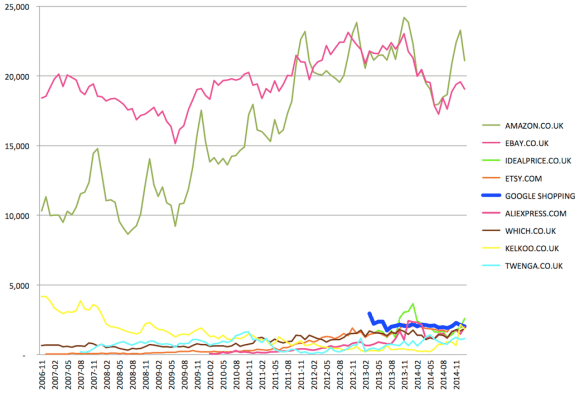
And that when you look more closely at what Google’s been doing, you discover far more effect than you might expect.


It’s a fascinating analysis; Google has questions to answer.


Huawei delays launch of its SmartWatch to September-October in China » TalkAndroid.com

Peter Holden:

Huawei’s Watch was first unveiled at MWC back in March, and it is still one of the better-looking Android Wear devices around. There is no set shipping date for the Huawei Watch just yet, although it is available to pre-order in most countries. Not in China though, availability of the Huawei Watch has been delayed until at least September, although October hasn’t been ruled out if things don’t go to plan.

It all stems down to Google having left the Chinese market due to disagreements with the Chinese government. This means that Google’s Services won’t work in China, which has left Huawei with the task of adapting Android Wear to use its own services. Obviously this isn’t going to be a quick fix.

Given that many westerners can’t pronounce Huawei (it’s Hoo-wah-way), and won’t know it has a smartwatch, no great loss of face. Also, Peter Holden: things stems *from*, not “down to”.


Open data on council spending is largely unread by voters » The Guardian

Ben Worthy at the Public Leaders Network:

there has been less interest in the data than many hoped. Council finance data is viewed around 200 times each month. The person on the street has not been desperate for data. No army of armchair auditors has sprung up. There are some enthusiasts here and there; a concerted campaign in Barnet used open data to build its case against the (now deceased) Conservative council. But few people have the time and, most importantly, the motivation to scroll through complicated pdf documents of raw council spending data. Data needs a narrative, and pdf documents and spreadsheets don’t yet tell a good enough story.

This links to a further problem. If you do find a smoking gun among the spreadsheets, who do you send it to? The council itself, the opposition or the local press? It’s notclear what the next step would be and how it would fit in with the processes by which councils are accountable to citizens.

The better news is that something is being done with the data. Users include businesses, pressure groups and journalists as well as a handful of members of the public. While they haven’t unleashed a wave of accountability, there have been sudden bursts of data-driven questioning of local authorities.

Sounds like there’s been pretty much exactly the right amount of interest in the data. And the key point is, if the councils and politicians know that the data is auditable, they will realise they can’t hide stuff. Compare and contrast: FIFA payments.


Why I’m breaking up with the Apple Watch » NYTimes.com

Jessica Friedman:

the busywork the watch’s apps can replace — handing over airline boarding passes, opening hotel room doors — seems less like an advance than a loss of control. Call me a Luddite, but honestly, I don’t mind unlocking things with my actual hands. The new watches announced this week may change the situation, but I am not sure I have the patience to wait.

Likewise (and I know this will be heresy to anyone really excited about the coming Fitbit initial public offering), the fitness-app aspect — the tracking of my steps, the measuring of my heart rate, the telling me to stand up when I am in the middle of an article — seems more like a burden than freedom.

I have worked hard to wean myself from a reliance on exercise machines telling me how hard I had worked — how many calories I had burned, how many stairs I had climbed — in part because I knew I was cheating pretty much all the time anyway and thus could not trust the results, and in part because it became an excuse to modify, or not, my ensuing behavior.

But the truth is, I know when I am in shape; I can see the difference in my body and feel it when I ride my bike in the park. The watch threatened to drag me back into a numbers-driven neurosis, and that’s a temptation I would rather not have.


The secrets of seven amazingly surreal photos revealed » Lumia blog

When it comes to Lumia photography, we think Pritesh Patel knows a thing or two about inspiring others. His amazingly surreal work is inspiring on many levels, with a magical combination of skill, creativity, and originality all working together to create some seriously fantastic photos.

Pritesh is a 22-year-old Mechanical Engineering graduate from Anand in Gujarat, India who has been a big lover all things Lumia for quite some time. And luckily for us, he’s here to tell us all about the magic behind his super photos — what he loves about his Lumia, what inspired him to create his photos, how he does it, and how you can do it too.

They are clever photos (though lots of post-editing is needed; it would be nice if some were clever trompes l’oeil). Also, “amazingly surreal” photos? Either amazing or surreal. Not both.

Start up: Apple Music?!, preserving the web, watch wars, Sony’s parsimonious storage, and more

Layered Movements
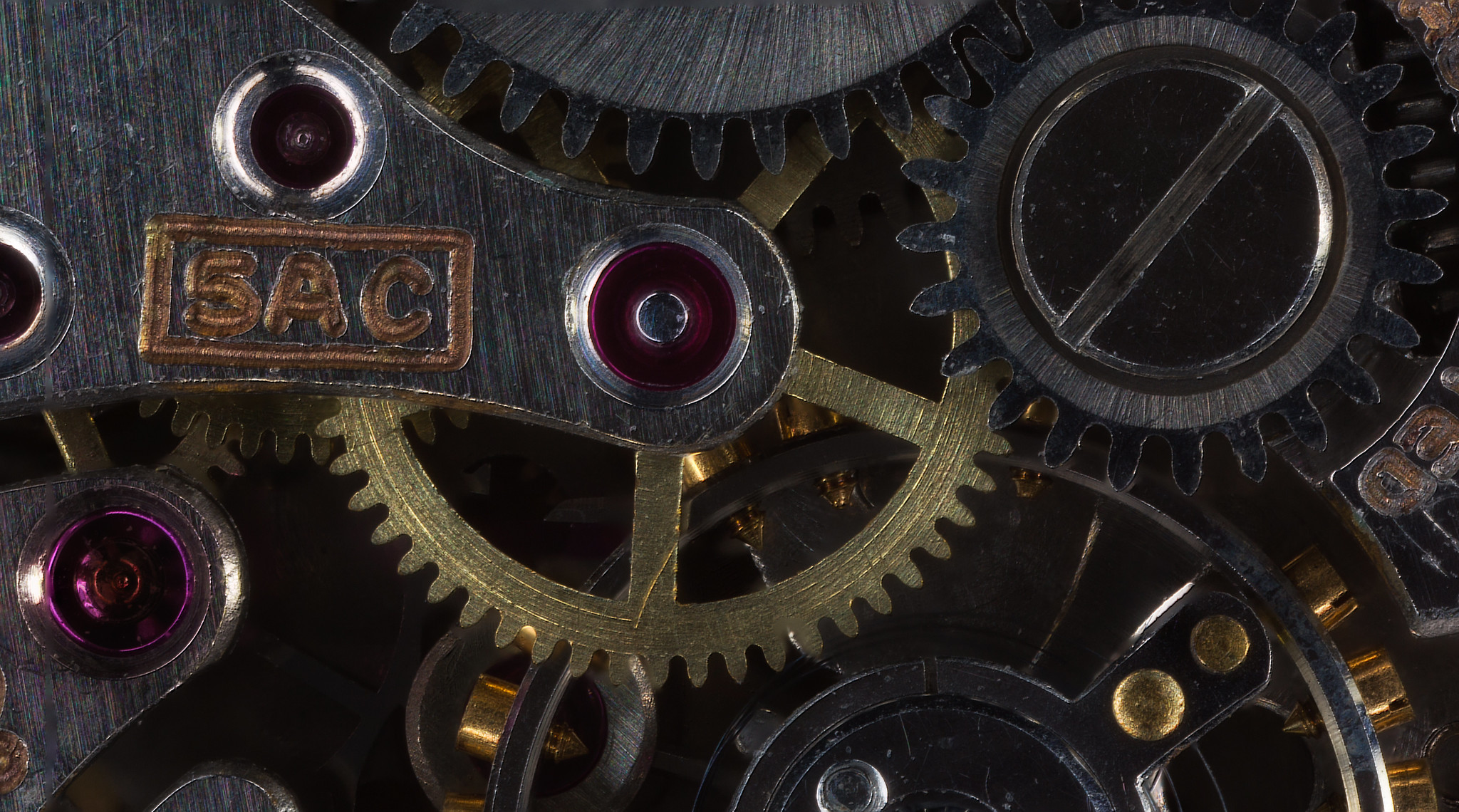
Where’s the Bluetooth module? Photo by Kellar Wilson on Flickr.

A selection of 8 links for you. Not to be sold separately. I’m charlesarthur on Twitter. Observations and links welcome.

What changes at Medium and Yahoo Pipes teach us about the persistence of the web » Scripting.com

Dave Winer:

What we need, and still don’t have, is a systematic way of publishing to the future. Such a system would allow you to pay a fixed sum to keep your content at a specific address for the foreseeable future. No one can make a guarantee, we don’t know what the future holds, but every effort has to be made, upfront, to be sure that the content has the best chance to survive as long as possible. # It would be nice if a visionary entrepreneur would get involved, and an educational institution, perhaps, and/or an insurance company, the kinds of organizations our society creates to be long-lived. It would be great to get input from Stewart Brand and his colleagues at the LongNow Foundation.

Not a bad idea. But isn’t that what the Internet Archive is doing? Winer responds to that: “long-lived context is not the same thing as having a snapshot” [as the IA does].


iPad update won’t work on old devices » Business Insider

Tim Stenovec:

the bad news is that the new features may not work on your iPad, unless it’s one of the newest models. And Split View, which allows you to use two apps at the same time, and is one of the best new features, only works on the iPad Air 2, Apple’s latest iPad, which starts at $499 and was released last fall.

The cynic would say the fact that the new features, which are part of a software update coming later this year, only working on the latest and greatest iPads is a ploy to get you to upgrade your iPad. Apple has struggled with relatively sluggish iPad sales — the company still sells millions each quarter, more tablets than any other single company — but sales continue to fall…

…Of course, using two apps at the same time, or watching a video in the background while doing something else on your iPad, certainly requires more processing power than just using one app, so it may be that the features only work well enough for Apple to include it on its latest and most powerful iPad.

Yeah, but the cynic will disregard that sort of logical argument. All software can run on all hardware, regardless of age, according to the cynic.


Apple Music: a platform play with hidden nuance » Music Industry Blog

Mark Mulligan:

Apple continues to be ridiculed for its failed Ping! music social network. While it was no killer app it nonetheless represented an attempt to turn iTunes into a music platform. Now that same strategy has been rekindled with the launch of Artist Connect. This is Apple’s attempt to turn itself into an artist-fan engagement platform. Artist-fan engagement is the gold dust of the digital era music business. It’s the scarce, invaluable commodity that music fans crave in a post-scarcity music world…

…while DIY sites of various guises are niche, Apple presents the opportunity to reach more than a hundred million of the world’s most valuable (i.e. highest spending) music fans. Sure some of them now pay for Spotify but they’re still iTunes users also. If Apple’s featureset for artist is strong enough, expect strong uptake, especially from the bigger labels and artists.


Chart: Apple Music vs. Spotify, Pandora, Rhapsody and the rest of the streaming competition » GeekWire

Todd Bishop and James Risley:

Apple unveiled its new $9.99/month streaming music service this morning, staking its claim in a market with a large number of existing competitors. Established players include radio services like Pandora, freemium services like Spotify, and industry veterans like Seattle-based Rhapsody. This chart, created by GeekWire, shows how Apple compares to many of these existing services.

The missing element: how many devices is each one effectively preinstalled on? Yeah, Apple Music gets an advantage there. (I admit that I was surprised by the introduction on Android. But it makes perfect sense.)


Apple previews new Apple Watch software » Apple

Coming in autumn (when the new phones come out, one assumes):

Additional watchOS 2 features include: • Nightstand Mode that transforms Apple Watch into a bedside alarm clock, with the Digital Crown and side button serving as snooze and off buttons for the alarm;
• the ability to use merchant rewards and store-issued credit and debit cards with Apple Pay™, which can be added to Wallet;
• support for Transit in Maps*, so you can view detailed transportation maps and schedules, including walking directions to the nearest stations with entrances and exits precisely mapped;
• workouts from third-party fitness apps contributing to your all-day Move and Exercise goals;
• using Siri® to start specific workouts, launch Glances and reply to email; and
• Activation Lock, which lets users secure their Apple Watch with their Apple ID, preventing another user from wiping or activating the device if it is lost or stolen.

That last touch is neat – you remember the discovery of how easily the Watch could be stolen and wiped. Now it has something that sets it apart from any Rolex or other expensive watch (well, apart maybe from an engraved one): stealing it becomes pointless. Lots of stuff that feels as though it just didn’t make the cut for version 1.


Can the Swiss watchmaker survive the digital age? » NYTimes.com

Clive Thompson:

[Frederique Constant watch designer Pim] Koeslag faced a significant problem, though: He had never worked with chips and sensors before. He didn’t even own a soldering iron. Swiss watchmakers don’t need them; their devices are put together with screws and screwdrivers. He led me to a large microscope and placed one of the chip sets under it. When the image appeared on a large computer screen, he zoomed in on the Bluetooth antenna, which looked like a dark, square block. Getting that into the right spot caused him a great deal of trouble, he said. “Under the microscope, we actually welded it on, by hand,” he said.

Well, I guess that answers the question in the headline. Turns out the Swiss watch industry is terrified of the smartwatch’s effect on the $1,200 price segment on their watches which have an accuracy of around 2 seconds per day. Per day?!


Freemium is hard » Marco.org

Marco Arment on how Shuveb Hussain saw app purchases plummet when he went ot freemium:

Freemium is hard. Its effectiveness depends on where you can put that purchase barrier in your app. Many app types simply don’t have a good place for it. In this case, Shuveb faces the fatal combination of two major problems: • His app is a lightly used utility, but he only stands to make money from heavy use. His free tier is good enough for most users.
• His purchase barrier — more than one article per day — discourages more frequent use, which hinders habit-building. When faced with a paywall, most people will try to avoid it unless there’s a compelling reason to pay. The few customers who hit Comfy Read’s paywall probably just think, “I guess I won’t send this article to my Kindle,” or “I guess I’ll use another app for this.” Users aren’t given the chance to let the app become a crucial part of their workflow or build any loyalty toward it, which would make them more willing to pay, before hitting a paywall.


Sony cripples the ‘8GB’ Xperia M4 Aqua » Xperia Blog

We have the European E2303 retail model of the Xperia M4 Aqua, which is SIM free so should have less bloatware than carrier versions. It is running firmware build 26.1.A.1.100 and the screenshots you see below are straight out of the box without installing any new apps. You can see that out of 8GB of storage, 4GB is taken up by Android 5.0 and just over 2GB of pre-installed apps. For our model, this leaves a paltry 1.26GB for our own apps, media, photos and videos. No problem, you might say – just delete some unwanted apps. However, most of the apps are baked in and cannot be uninstalled.

Largest one: Facebook (why?), followed by Google Play Services (124MB) and Android System WebView (120MB) and Google+ (110MB). There’s also Chrome in the list. You can use an SD card, but that’s not ideal. Sony also claims – apparently wrongly – that there’s 3GB of free space. (For comparison, the 8GB iPhone 5C has 4.9GB free for users.)


Start up: find a doppelgänger!, privacy woes, voice input’s promise, Brazil’s smartphone boom, and more


Like this, but online. Photo by pvantees on Flickr.

A selection of 9 links for you. Spreadable from the fridge. I’m charlesarthur on Twitter. Observations and links welcome.

How my doppelgänger used the Internet to find and befriend me » Fusion

Kashmir Hill:

For some reason, we’re obsessed with the idea of finding people in the world who look like us and the wondrousness of looking into a flesh-and-blood mirror. It’s fascinating enough that Canadian photographer Francois Brunelle has spent the last 14 years finding doppelgängers and taking their portraits. He told CBS News he loves capturing the shock that happens when they meet, and that he endlessly gets emails from people who want him to help them find their look-alike. I asked him why he finds face-twins so compelling. “I don’t really know,” he responded by email. “The fascination of seeing two same-looking people side by side.” With the rise of facial recognition, having a doppelgänger can sometimes be problematic. In 2011, a Massachusetts man had his license revoked because an anti-fraud system that scanned people’s photos decided he looked too much like another driver.


My ears, my eyes, my Apple Watch » Living with Usher Syndrome

Molly Watt:

On leaving the ReSound Offices [where she was fitted with hearing aids that connect directly her iPhone] and within 15 minutes I had my Apple Watch set up and it was a real “WOW” moment when I made my first call to my Dad, via my Apple Watch, his voice came straight into my ears, he sounded different, so much clearer than before, it dawned on me, I’d never heard my Dad’s real voice before, my Mum, ever faithful support and chauffeur sat beside me sounded totally different, even I sounded different to myself, it was strange, very strange, hard to process but it made me feel so emotional that day, day one, I was experiencing so much, new things for the first time ever!

I’ve linked to Watt before; her posts are such wonderful examples of how technology can enable people who would otherwise be excluded from so much.


Meet Apple PR’s worst nightmare » Fortune

Philip Elmer-DeWitt:

it’s at WWDC that Gurman’s shoe-leather reporting shines brightest, and he’s worked this year’s event harder than ever. If you want to know what’s coming Monday — or at least what’s expected — you might as well start with the round-up Gurman published Friday. It’s the post everybody else is linking to, including Wall Street analysts. I caught up to Gurman on Saturday at his parents’ home in Los Angeles where, lacking an invitation from Apple, he will watch Monday’s keynote remotely. He’s got one more year in Michigan, where he’s taking a lot of technical courses — software design, server structure, data analysis — at the School of Information. To carve out more time for coursework he cut back this year on day-to-day rumors to focus on the big scoops. After graduation he’s thinking about business school — he likes Stanford — and relocation to San Francisco or New York.

Gurman has got more and more things exactly right as time has gone on.


Talking computers pose a threat to current Apple versus Google market segmentation. Beyond Peak Google. » Praxtime

Nathan Taylor:

Google Now is already shipping and riding a technological tidal wave of machine learning. Let’s tie this back to the discussion on native ads. If Google owns the voice interaction channel to the internet, and can do branded “native ads” whenever someone talks into their phone or watch, then Peak Google is solved. Google will be launched into the next wave without being eclipsed. Billions are (potentially) at stake. Where’s the closest restaurant I’ll enjoy? What’s the best toothpaste to buy? How much are tickets to the game? What apartment can I afford to rent? What kind of car should I buy? Who should I marry? Except for that last question, I’m sure Google will eventually be capable and quite happy to answer. With proper brand product placement of course. And a small finder’s fee owed by the end vendor for any purchase. As Google becomes the front end to a potentially huge new voice interaction distribution channel, they’ll take their cut.


A complete taxonomy of internet chum » The Awl

John Mahoney on those annoying boxes that try to tempt you to click somewhere else, which he calls “chumboxes”:

Like everything else on the internet, traffic flowing through chumboxes must be tracked in order for everyone to be paid. Each box in the grid’s performance can be tracked both individually and in context of its neighbors. This allows them to be highly optimized; some chum is clearly better than others. As a byproduct of this optimization, an aesthetic has arisen. An effective chumbox clearly plays on reflex and the subconscious. The chumbox aesthetic broadcasts our most basic, libidinal, electrical desires back at us. And gets us to click.

Come and meet “Skin Thing”, “Old Person’s Face”, “Miracle Cure Thing” and the rest.


Global markets foreshadow low-cost smartphone opportunity in Brazil » Jana Blog

137 million people in Brazil own a mobile phone, and one-third [41m] of them own a smartphone. Brazil is the second largest country for downloads within the Google Play Store, and its citizens are some of the most eager app consumers. Brazil’s active Android smartphone market presents a huge opportunity for device manufacturers to capture the other 91 million mobile subscribers as they make their first ever smartphone purchase. In recent years, other countries have seen a massive adoption of smartphones thanks to a rush of competing brands entering the market and driving down handset costs. The smartphone market in Brazil is big, but could it be bigger?

Main installed base players: Samsung (50%), Motorola (21.1%) and LG (17%).


Exclusive: In ‘year of Apple Pay’, many top retailers remain skeptical » Reuters

Nandita Bose worked through the top 100 retailers in the US asking whether they would support Apple Pay:

Many companies that accept Apple Pay report that they and their customers are happy with it. Whole Foods spokesman Michael Silverman said that Apple Pay transactions accounted for 2% of its sales dollars as of March and that it expects use to rise. “Our shoppers are really enjoying the speed, convenience and security of Apple Pay,” he said. But for other retailers and consumers, Apple has yet to answer the question “what is in it for us if we use Apple Pay?” said Alberto Jimenez, program director for mobile payments at IBM, which provides technology to mobile wallet makers and retailers. Jimenez would not say whether Apple is among their customers. The program doesn’t offer loyalty rewards to customers, as companies such as Starbucks do with their mobile applications, nor does it provide customer information to retailers about Apple Pay users. For 28 of the retailers surveyed by Reuters, lack of access to data about customers and their buying habits is a key reason they don’t accept Apple Pay. “One of the biggest concerns is data control,” said Mario De Armas, senior director, international payments at the world’s largest retailer, Wal-Mart Stores Inc.

Apple is expected to provide some sort of way for retailers to collect loyalty data about customers – although this seems contrary to its point about not tracking your purchases. Clearly though there’s a tension between retailers and Apple over this. Now read on…


The online privacy lie is unraveling » TechCrunch

Natasha Lomas:

The [US] report, entitled The Tradeoff Fallacy: How marketers are misrepresenting American consumers and opening them up to exploitation, is authored by three academics from the University of Pennsylvania, and is based on a representative national cell phone and wireline phone survey of more than 1,500 Americans age 18 and older who use the internet or email “at least occasionally”. Key findings on American consumers include that — • 91% disagree (77% of them strongly) that “If companies give me a discount, it is a fair exchange for them to collect information about me without my knowing”
• 71% disagree (53% of them strongly) that “It’s fair for an online or physical store to monitor what I’m doing online when I’m there, in exchange for letting me use the store’s wireless internet, or Wi-Fi, without charge.”
• 55% disagree (38% of them strongly) that “It’s okay if a store where I shop uses information it has about me to create a picture of me that improves the services they provide for me.”


HMRC ditches Microsoft for Google, sends data offshore » The Channel

Kat Hall:

Her Majesty’s Revenue and Customs (HMRC) is the first major department to move to Google Apps, part of an apparent loosening of Microsoft’s stranglehold on the government’s software services. The department will join the Cabinet Office and Department for Culture, Media and Sport (DCMS) in deploying the fluffy white stuff. HMRC has 70,000 staff, and as such will be Whitehall’s first mass deployment of Google’s cloud services. The Cabinet Office currently has 2,500 users on Gmail. The government said in March the Google Apps suit best met the user needs for the Cabinet Office and DCMS. “Other solutions (e.g Microsoft 365) also scored highly, but the advanced collaboration and flexible working features of Google Apps were the best fit for our needs,” it said at the time.

Wow. That’s a huge blow to Microsoft, huge win for Google.


Start up: drone questions, Baidu barred in AI comp, why Apple shunned HERE, and more


This is what it looks like when you’re upset, Google. Photo by donnierayjones on Flickr.

A selection of 7 links for you. Use them wisely. I’m charlesarthur on Twitter. Observations and links welcome.

The UX of Commercial Drones » UX Magazine

Dan Saffer:

Let’s examine the customer experience as demonstrated by Amazon: The drone flies in and lands on the back patio. The customer leaves the house. The drone releases the package and flies away. The customer grabs the package and heads back inside. This is all well and good, but a lot of important detail still needs to be addressed. For starters, how does the customer know when the drone is arriving? People aren’t going to want their packages sitting outside unattended, especially in inclement weather (assuming drones will even be able to fly when it’s raining or snowing). And people won’t want to sit around looking out their window for half an hour. But what might work is something like what the car service Uber does: showing you via an app where your drone is and how long until it arrives, as well as alerting you via SMS when it does arrive. This would provide a level of assurance, especially at the onset when the idea of a drone carrying an emergency last-minute birthday gift will seem the height of novelty. When the drone does appear, it’s going to be really tempting to race out and grab the package, especially for kids—and perhaps for dogs and excitable adults as well. One problem: between the person and the package are several spinning, knife-like blades that form the rotors of the drone. Being accidentally hit in the face by one would be a great way to lose an eye or obtain a nasty cut.

“We included plasters in case you get hurt!”


Computer scientists are astir after Baidu team is barred from AI competition » NYTimes.com

John Markoff:

The competition, which is known as the “Large Scale Visual Recognition Challenge,” is organized annually by computer scientists at Stanford University, the University of North Carolina at Chapel Hill and the University of Michigan. It requires that computer systems created by the teams classify the objects in a set of digital images into 1,000 different categories. The rules of the contest permit each team to run test versions of their programs twice weekly ahead of a final submission as they train their programs to “learn” what they are seeing. However, on Tuesday, the contest organizers posted a public statement noting that between November and May 30, different accounts had been used by the Baidu team to submit more than 200 times to the contest server, “far exceeding the specified limit of two submissions per week.”

Previously reported here, before the multiple entries were spotted. Baidu’s team calls their multiple entries “a mistake”.


The new Google Photos app is disturbingly good at data-mining your photos » Fusion

Daniela Hernandez:

What’s particularly incredible is the facial recognition. The app sees individuals in photos even if they are barely in the picture, far in the background, or featured in a photo within a photo. When I did a search for my adult sister’s face, it recognized her in a photo I took of a 20-year-old elementary school picture of her. When I searched for my father’s face, it included a photo I took of a decorative tile-wall in Mexico. I thought it had messed up, because I didn’t see any people in the photo, but when I looked closely, there was a tiny version of my dad at the bottom. Facial recognition has gotten very powerful. Google also seems to know how to flatter its users. When I typed in “skinny,” the search unearthed pictures of me, friends, my sister and my mother, as if it was trying to compliment us. But when I searched for other adjectives, particularly negative ones — fat, sad, upset, angry — Google Photos came up empty. (Some of my colleagues got similar results.) The technology to help computers decipher emotions is out there already, so there’s no technical reason why Google isn’t turning up results for those searches. It gave us results for “love,” but not for “hate.” Whether it’s that we don’t take photos of ugly things, or that Google is shielding us, is something we’d really like to ask the search giant.

You could pick up the phone and ask them…


Eric Schmidt on why Google won’t fail » Business Insider

Jillian D’Onfro:

Shareholders understand Google’s search and ad business, [Schmidt said at the AGM], but they don’t necessarily understand the other projects that the company invests in, like self-driving cars or smart contact lenses. On past earnings calls, analysts and investors have sounded impatient when questioning how those businesses are going to ultimately pay off. But Schmidt assured shareholders Wednesday that ambitious goals like cutting down on car crashes or measuring a diabetic’s blood sugar through their tears are the kinds of things that will ultimately make Google a long-lasting, successful company. “Most companies ultimately fail because they do one thing very well but they don’t think of the next thing, they don’t broaden their mission, they don’t challenge themselves, they don’t continually build on that platform in one way or another,” he says. “They become incrementalists. And Google is very committed to not doing that. We understand the technological change is essentially revolutionary, not evolutionary.”

Are there any lessons from technology companies that have lasted more than a century, such as Nintendo, IBM and Nokia?


Here’s why Apple didn’t want to buy Nokia’s mapping unit HERE » Forbes

Parmy Olson:

Apple appears intent on fixing the problems that cropped up from relying on third-party map providers. One of the reasons Apple Maps was so buggy from when it was launched in June 2012 is the fact that its data percolated in from multiple sources like TomTom, Acxiom, Waze and Yelp By building its own geography dataset, Apple can pare down its reliance on sources like TomTom’s TeleAtlas. Apple’s likely vision is that years from now, we’ll have forgotten about how bad Apple Maps was, because Apple will have taken complete control of its mapping infrastructure and made it watertight.


There’s still plenty of money in dumb phones » Quartz

Leo Mirani:

there’s little doubt that dumb phones and feature phones are a shrinking market. Between the first quarter of 2013 and the first quarter of 2014, the market for non-smartphones shrunk by a 14%, according to CCS Insight (pdf), a research firm. This year, some 590 million non-smartphones will be sold. By 2019, that number will shrink to 350m. But 350m phones in one calendar year is still a lot of phones. And it is, as Microsoft’s Pekka Haverinen of Microsoft’s feature phone division tells Quartz, a predictable market with high volumes and a high market share for Microsoft. It’s not just device-makers who stand to profit from cheap, basic phones. Ericsson reckons (pdf) that by 2020, there will 9.2bn mobile subscriptions, of which 1.4bn will be non-3G subscriptions. This huge market is hungry for services.

Well, sorta. Microsoft’s featurephone segment is shrinking really rapidly; this is a market which is being eaten up by cheap Chinese players for whom, as they say, “your [profit] margin is my opportunity”.


Twitter just killed Politwoops » Gawker

JK Trotter:

A Twitter spokesperson just provided the following statement to Gawker regarding the apparent suspension of Politwoops’ access to Twitter’s developer API, which enabled the Sunlight Foundation-funded site to track tweets deleted by hundreds of politicians. Summarized: Politwoops is no more.

Earlier today we spoke to the Sunlight Foundation, to tell them we will not restore Twitter API access for their Politwoops site. We strongly support Sunlight’s mission of increasing transparency in politics and using civic tech and open data to hold government accountable to constituents, but preserving deleted Tweets violates our developer agreement. Honoring the expectation of user privacy for all accounts is a priority for us, whether the user is anonymous or a member of Congress.

The post also says that Twitter was considering a “quiet reversal” but found itself snookered on the question of “why them and not others”. But if someone tweets something publicly, haven’t they yielded their expectation of “privacy”? In the print days, the UK Ministry of Defence could demand back documents about cruise missile sitings from The Guardian on the basis of copyright. That seems to be what Twitter is imposing here.


Start up: watch the commuters!, SamsungPay’s big obstacle, Apple gets mappy, and more


Mars: likely to remain inhabited only by robots for quite a long time yet. Photo by ridingwithrobots on Flickr.

A selection of 9 links for you. Use them wisely. I’m charlesarthur on Twitter. Observations and links welcome.

The Samsung Galaxy S6 might be the best Android phone of 2015, but it is unusable » Android Beat

Rajesh Pandey:

The Moto X 2014, which has 2GB of RAM, has around 700MB of free RAM with a similar setup. Despite the 1GB difference in RAM, the Moto X — running Android 5.1 — feels significantly smoother to use. The RAM management issue on the Galaxy S6 is so bad that jumping between a Chrome tab and another app running will force the Chrome tab to reload. This makes the phone completely useless for any kind of serious browsing or for doing any transactions through a bank’s website. I have to restart my Galaxy S6 once every 24 hours to make sure the handset does not feel sluggish and slow. On the days that I do forget to reboot the handset, the phone gets so slow that it feels like I am using some low-end Android device and not the best Android handset in the market currently. It’s nothing short of a miracle that I have not yet thrown the phone in sheer frustration. In all probability, the poor RAM management of the Galaxy S6 stems from different memory leaks present in Android 5.0 Lollipop. The Moto X and Nexus devices had similar issues on Android 5.0, so it makes sense that the Galaxy S6 has them as well. However, the Galaxy S6 was released more than 5 months after Google had released Lollipop, which means that Samsung had more than ample time to track down and fix the memory leaks.

I’ve previously linked to the complaints about Lollipop having memory leaks. I haven’t seen this complaint before, though.


The Apple vs. Google battle has changed » Above Avalon

Neil Cybart:

Google I/O made it clear that Google needs Apple and iOS. To ignore such a vibrant base of highly-engaged users, especially when other companies like Facebook enjoy a prominent place in the platform, would be highly destructive to Google’s ambitions. On the other hand, Apple also needs Google as its services remain very popular among iOS users. However, judging from Apple’s prior actions and mission statement to personalize technology, I would expect Apple will continue to try to minimize its dependence on Google as such a situation represents a long-term threat to Apple’s mission. Similar to how the Nexus experience provides the closest thing to pure Android, I suspect Apple wants to continue down the path of being in a position to ship an iPhone and suite of apps and services that make it possible to live within the Apple ecosystem without much interference from Google. While most consumers will end up settling somewhere in the middle, using both Apple and Google products and services, it is this quest to control the entire user experience that ultimately validates the competition between Apple and Google as genuine. The probability of a world where Android excels as a direct result of iOS faltering is becoming more remote as time goes on. Instead, Google is becoming more reliant on a healthy iOS platform…


Watch the City of London pulling in commuters from across the south east like an imploding star » CityMetric

Last week we ran some fascinating maps [Alasdair Rae] created showing the population density (and, consequently, urban area) of major British cities. Now, he’s created a visualisation that shows the limits of this type of static density modelling: an animation that shows the massive population shift that takes place every day as workers commute into the City of London. The visualisation is based on 2011 census data showing daily commuter journeys into the square mile, London’s main financial distract. It shows commuters speeding into the city’s centre from as far away as Bournemouth and Margate. It’s also completely hypnotic to watch:

Now I want the commute home too…


Toyota unintended acceleration and the big bowl of “spaghetti” code » Safety Research & Strategies, Inc

[Embedded software expert Michael] Barr testified: “There are a large number of functions that are overly complex. By the standard industry metrics some of them are untestable, meaning that it is so complicated a recipe that there is no way to develop a reliable test suite or test methodology to test all the possible things that can happen in it. Some of them are even so complex that they are what is called unmaintainable, which means that if you go in to fix a bug or to make a change, you’re likely to create a new bug in the process. Just because your car has the latest version of the firmware — that is what we call embedded software — doesn’t mean it is safer necessarily than the older one….And that conclusion is that the failsafes are inadequate. The failsafes that they have contain defects or gaps. But on the whole, the safety architecture is a house of cards. It is possible for a large percentage of the failsafes to be disabled at the same time that the throttle control is lost.” Even a Toyota programmer described the engine control application as “spaghetti-like” in an October 2007 document Barr read into his testimony. Koopman was highly critical of Toyota’s computer engineering process.

Remember how shonky the interfaces for VCRs and DVDs were? What if the people who did those were writing your car code? What if they already are?


Jobs at Apple » Apple

Job Summary The Maps team is looking for a web technology expert to help make maps work seamlessly on the web. The ideal candidate will be a JavaScript expert, have in- depth knowledge of various core web technologies, and be proficient with web developer tools for debugging and performance analysis.

If you have an iOS device and use iCloud.com, you can use Apple Maps online to do Find My iPhone. Either Apple is looking to expand its desktop Maps so that it’s not just an OSX experience, or this is just strengthening the FMI team.


Mars One reveals true number of applicants » Matter on Medium

Elmo Keep:

On a new page on its site, The Science of Screening Astronauts, Mars One writes, “The total number of completed and submitted applications was 4,227.” Citing a report by NBC, Matter reported the figure of publicly available video applications at 2,782. We don’t know that 4,227 is any more real than 200,000. It’s just what they’re self-reporting. (Mars One did not provide us any clarification despite repeat queries.) Regardless, that falls far short of the 200,000 widely reported initially by countless media outlets, and shorter yet of the one million applicants CEO Bas Lansdorp anticipated at the launch of the project.

This is starting to feel like Capricorn One.


Why SamsungPay is toast » Starpoint Blog

Tom Noyes (who – reminder – called it correctly that the iPhone 6 would have NFC and payments back in May of 2014):

Let’s assume that Samsung solves ALL of the technical issues above and now SamsungPay works on all Android devices. Everyone knows that MNOs decide what gets pre-installed on the phones they subsidize (even Apple). Six weeks before Mobile World Congress [in March], Google made a strategic deal with the US MNOs to buy ISIS in exchange for Android Pay (the new Google wallet) becoming part of Google Mandatory Services (GMS.. just like search and gmail). Part of this is also a new android registration flow that addresses THE KEY weakness of Android profitability.. it gets consumers to add a card and play account (Apple brilliantly required an iTunes account… with accompanying credit card.. in launch of iPhone). Samsung’s wallet could still work.. however IT IS NOT PRE LOADED.. so this is what the consumer would have to do (AFTER REGISTERING FOR ANDROID PAY): 1) Find out about Samsung pay
2) Install Samsung Pay
3) Register for Samsung Pay
4) Understand where they can use Samsung Pay
5) Wave it near the Mag Head reader
6) Then use Android pay for in-app and play purchases..
Forget about the technical issues.

But it can attempt it in other countries.


Sizing up the opportunity for Apple Pay » Kantar

Carolina Milanesi:

Among iPhone 6 and 6 Plus owners in the US, 13% have used Apple Pay, and 11% are planning to do so. Lack of trust and knowledge do not play a major role as reasons not to use it. Only 2.6% said they did not use Apple Pay because they do not trust it, and only 4.1% said they did not use it because they do not understand how it works. Eleven percent said they did not use it because their credit cards work just fine, and 58% just answered “no” without adding any more detail. Among Apple Pay users, men were more numerous than women, with 59% versus 41% of users, and 55% versus 45% of intenders. This is not surprising since early adopters tend to skew male, but what is interesting is that adoption of the new iPhone models has been slightly stronger among women at 52% versus 48% for men… …In March 2015, as a measure of comparison, only 7% of Android users we surveyed in the US said they used NFC/mobile payment. Google Wallet has been around since 2010, and any Android device with NFC capability can access it for payments.

I’d say that’s actually a pretty good showing for Google Wallet.


Three Google directors survive challenge over pay » Reuters

Devika Krishna Kumar and Ross Kerber:

Three Google compensation committee members were re-elected on Wednesday, the technology company said at its annual meeting, despite a challenge from a high-profile proxy adviser that raised concerns over executive pay. Google did not immediately detail by how much of a margin the directors won re-election at the meeting, which was webcast. Proxy adviser Institutional Shareholder Services (ISS) had recommended that Google shareholders withhold votes for the three directors, saying “mega grants” provided to executive chairman Eric Schmidt and chief business officer Omid Kordestani were “problematic.” ISS recommended that votes be withheld for Google compensation committee members John Doerr, Paul Otellini and Ram Shriram. ISS also recommended investors withhold votes from Google director John Hennessy, president of Stanford University, citing what it said is his role as a non-independent member of the board’s nominating committee.


How long can you wait for Android M to be on 50% of devices? Would June 2017 be OK?

Google is announcing all sorts of wonders for Android M (Macadamia Nut fruitcake, or whatever it is) at Google I/O.

At the moment, Lollipop (Android 5.x) is on 9.7% of devices – 9.0% for 5.0 and 0.7% for 5.1, according to Google’s developer dashboard.

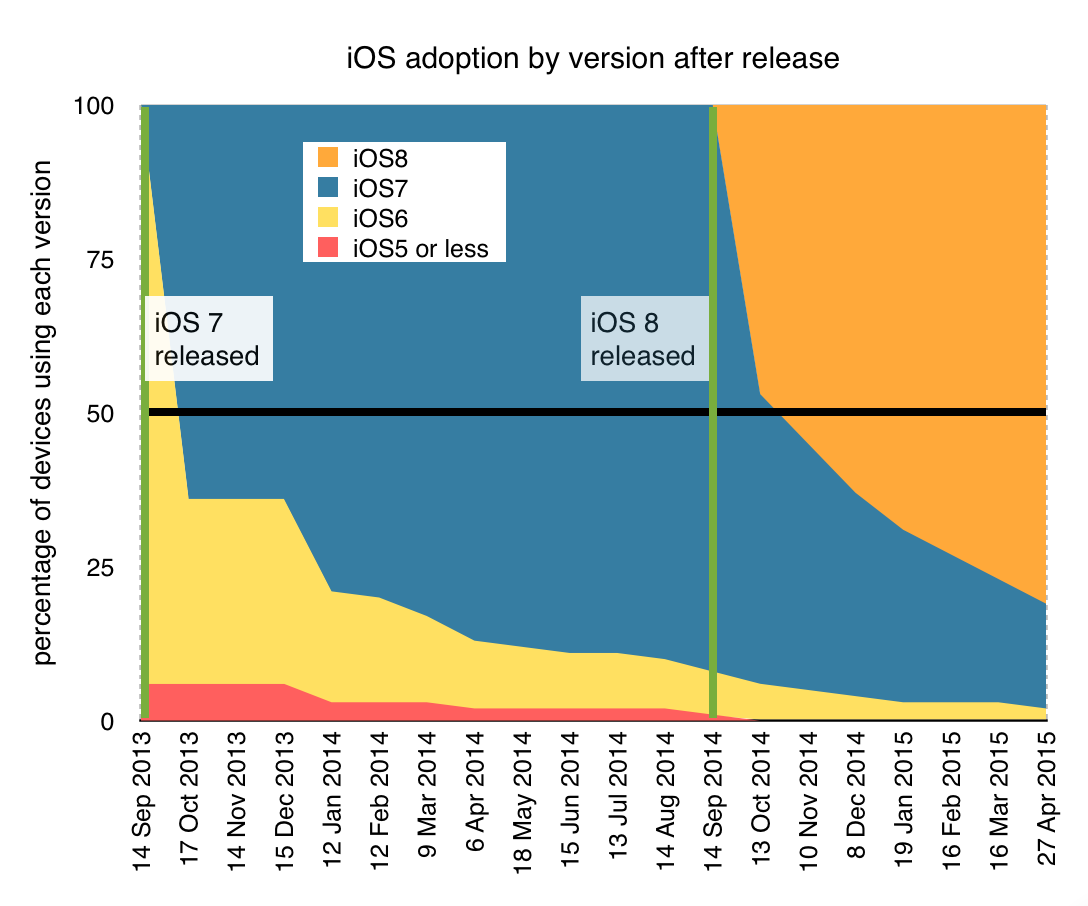
So when you get the announcement of “permissions for apps” (or indeed anything that is M-only), you have to ask: how long will it be before that is actually widespread? And by “widespread”, let’s define it as “on 50% of devices”. That 50% is useful because 50% of the billion of so Google Android devices in use is roughly comparable with the total number of Apple’s iOS devices in use. The thing is, the overwhelming number of active iOS devices get updated to the latest version within three months of the release of a new version; since iOS 6 in 2012 it’s taken just one month for the number running it to pass 50%. (At the time of writing, in May 2015, the current figure is 82% of devices on iOS 8, 16% on iOS 7, and 2% on something earlier. Revisiting it in March 2016 to add grammatical edits, the figure is 79% on iOS 9, which was released in September 2015.)

Apple iOS versions in use

Rapid adoption is a key element of Apple’s iOS due to its direct update mechanism.

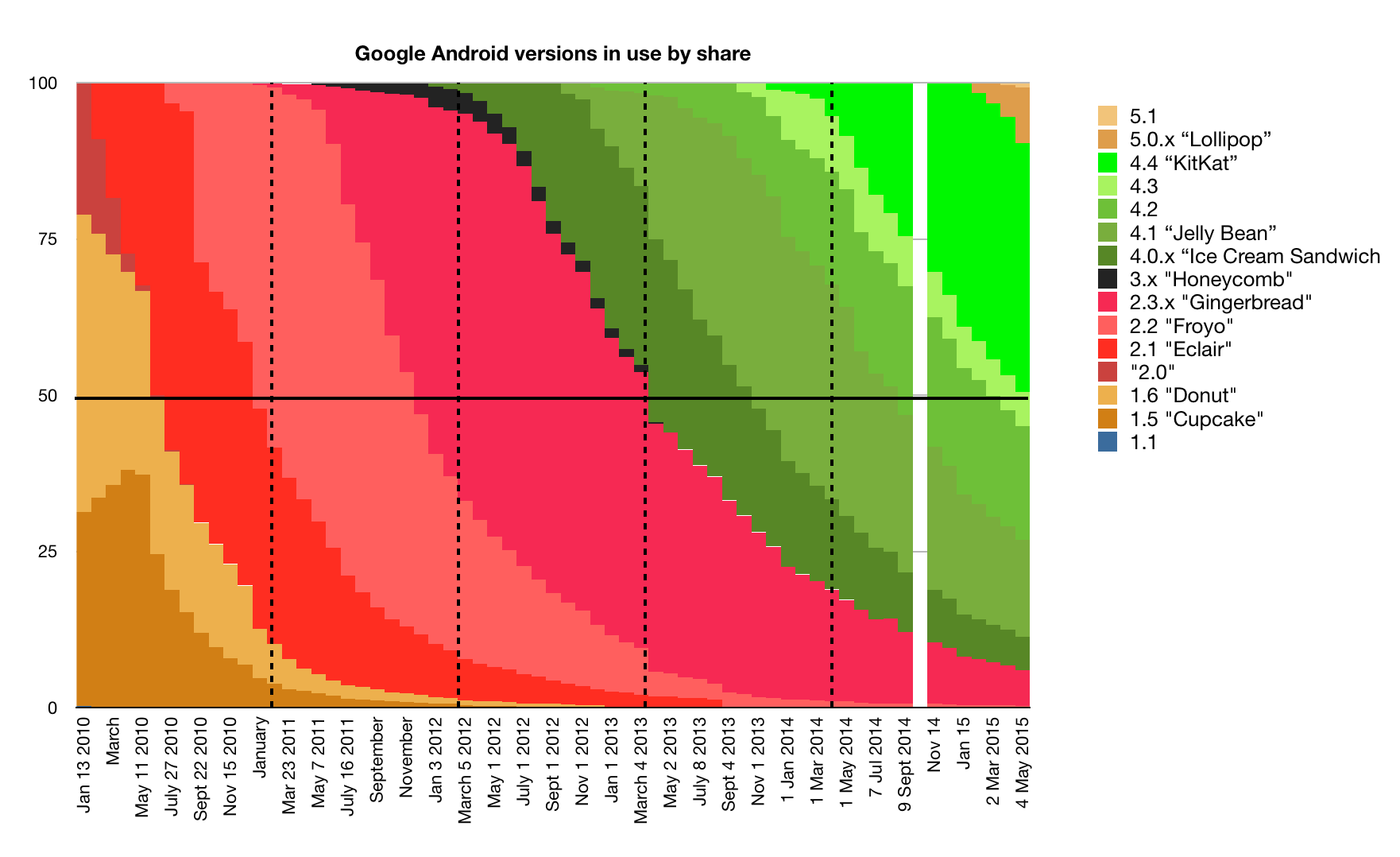
How do we figure this out? We let history be our guide. I’ve been collating the data about versions on the Android developer dashboard for a while, so we can look back to the past. In each case I’ve taken the beginning point as when a version first showed up on the dashboard, not when it was “released”.

Android versions in use

The release of a new version of Android doesn’t necessarily mean it reaches a large proportion of users quickly.

If we take it that “modern” Android starts with version 4 onwards – given that 2.3 (Gingerbread) was super-old, while 3.0 (Honeycomb) was tablet-only, we get this data:

Android 4.0: 16 months for it, or a later version, to be on 50% of devices according to the dashboard (January 2012 to April 2013).

Android 4.1: 13 months (October 2012 to November 2013).

Android 4.2: 22 months (December 2012 to September 2014 – the date of Lollipop’s release, officially).

Android 4.3: 18 months (October 2013 to March 2015)

Android 4.4: 19 months (forecast). Launched in December 2013, at the start of May 2015 it was at 49.5% for 4.4 and successors. It’s a safe bet that in June 2015 the total for Android 4.4 and successors will pass 50%. (Update: this was exactly right: the figure for May 2015 showed 49.5% on 4.4 or later; for June 2015, it was 51.6%, including 5.x; Android 4.4 itself peaked at 41.4% in April 2015.)

Android 5.x: 18 months (forecast). Presently, it’s 9.7% after 4 months, and its uptake pattern is more like 4.3 than 4.4. My forecast for its 50% point: July 2016.

On that basis, I’d say it’s a pretty safe bet that if Android M is released in December 2015 (which is likely) that it will take until June 2017 before it’s on 50% of Android devices according to Google’s measurements. Of course, that will vary regionally – there are still 6% of devices running 2.3 or earlier, which translates into about 60 million devices still in use. Some will get more rapid takeup, some will get less.

To put it into perspective (thanks Mark Blank-Settle on Twitter):
• presently, Apple’s offering iOS 8. It will show off iOS 9 in June.
• by the time Android M is released on devices later this, iOS 9 will already be on 60%+ of iOS devices
• by the time Android M – shown off in early 2015 – is on 50% of devices, Apple will have shown off iOS 10.

So if you’re depending on something such as, oh, the permissions model or Android Pay being introduced in Android M reaching the majority of your users any time soon, might be best to hold your breath. The revolution looks more like an evolution.

Start up, May 28: LG Urbane reviewed, crashing iOS, who really bought Re/Code?, Meeker’s 2015, and more


Strong feelings, and not about the video game. Photo by gato gato gato on Flickr.

A selection of 9 links for you. Use them wisely. I’m charlesarthur on Twitter. Observations and links welcome.

Mary Meeker’s Internet Trends for 2015

Have to admit I haven’t read it (found it late) but it’s always essential reading. Download and peruse.


Apple’s ‘Proactive’ to take on Google Now with deep iOS 9 search, Augmented Reality Maps, Siri API » 9to5Mac

It’s that Mark Gurman guy again:

Apple began to lay the groundwork for Proactive with its acquisition of a personal assistant app called Cue in 2013, seeking to relevantly broaden iOS’s Spotlight and Safari search results. iOS 8’s ability to display Wikipedia Search results within Spotlight was the first taste of the Proactive initiative, and was partially designed to reduce iOS’s search reliance on Google. Sources say that Apple’s internal iOS usage metrics indicate that Google clicks have indeed fallen since iOS 8’s release last fall. Now Apple wants to take Proactive to the next level, and it may do so with iOS 9’s introduction at the annual Worldwide Developers Conference on June 8. While Apple has positioned Siri as an “intelligent personal assistant” since the fall 2011 launch of the iPhone 4S, Proactive will go much further to integrate with your data. To begin with, Proactive will become a new layer within the iOS operating system, replacing the pulldown Spotlight menu currently found on the iOS Home screen.

But he says there’s also disagreement about whether to launch this in iOS 9, which was sorta going to be the “Slow down, Snow Leopard” release. (Also, “augmented reality” always sounds cool and then disappoints. I’ve tried it. It ain’t all that.) I’d love to see the metrics around Gurman’s stories compared to those for Re/Code. I think he might be ahead in pure readership. But of course he doesn’t have a giant conference attached.


Bug in iOS Unicode handling crashes iPhones with a simple text » AppleInsider

AppleInsider reader Kaitlyn on Tuesday discovered that receiving the Unicode characters seen in the screenshot above through Apple’s iOS Messages app triggers iPhone restarts, lockouts from Messages, Springboard crashes and more. A thread on Reddit narrowed down the system crash and reboot errors to iOS Unicode handling. More specifically, the Unicode string in question is part of a much longer block of text that cannot be fully rendered in Notifications.

If you’re thinking this sounds retro, that’s because it is: same sorta bug (different string) did the same thing back in August 2013. Wonder how long the fix will take. Also: Apple Watch apparently not susceptible, which is super-puzzling.


A series of wholly unrelated observations about Vox Media’s acquisition of Recode » The Awl

Matt Buchanan points out that if you pull the threads of both companies for long enough, you end up – from both – at Comcast, where its venture arm is trying to sell a company to the main arm. Trebles all round, or something. Also, take a look at the tags on the story. (Via Charles Knight.)


The Office of the Attorney General of Switzerland seizes documents at FIFA » Swiss Attorney General

Now, I don’t usually care about football (soccer to you Americans), but the evident corruption in FIFA (the “world governing body for football”) has been evident for years. Now, finally, something is happening – but not on just one, but two fronts:

In connection with irregularities surrounding football tournaments, two separate proceedings must be distinguished: The Office of the Attorney General of Switzerland (OAG) is conducting a Swiss criminal investigation regarding the allocation of the 2018 and 2022 World Cups. For inquiries regarding this Swiss criminal investigation, please contact the OAG. In separate proceedings, and independently of the Swiss criminal investigation of the OAG, the US Attorney’s Office for the Eastern District of New York is conducting a criminal investigation into the allocation of media, marketing and sponsoring rights for football tournaments carried out in the United States and Latin America. The Federal Office of Justice (FOJ) supports this criminal investigation as part of international legal assistance.

International Olympic Committee next?


Charles Johnson: world’s worst troll removed from Twitter » News.com Australia

Emma Reynolds:

Chuck is now raising money on his far-right website GotNews.com to have himself reinstated following this “censorship”. But his previous threats of legal action have never led to anything, with a website dedicated to the many times he has planned to sue for libel.

The list of things he has got egregiously wrong – on purpose? – is astonishing. But his whole schtick is about outrage and extremism. It’s more the attention paid to such people that’s the problem. When they’re just shouting to themselves, it means nothing.


Shipments of 2-in-1s to grow over 60% on year in 2015, says MIC » Digitimes

Notebook shipments, which are being impacted by tablets, are expected to drop 2.7% on year to reach 167m units in 2015, but 2-in-1 device shipments are expected to grow 62.5% on year to reach 13m units due to Microsoft’s aggressive promotions, according to figures from the Market Intelligence & Consulting Institute (MIC).

Compare to the estimated 7m Chromebooks: these are both still niche markets.


LG Watch Urbane review: why Android Wear trails Apple’s Watch » WSJ

Geoffrey Fowler:

The Urbane falls behind in its approach to the fundamental smartwatch problem: When technology is attached to our bodies, there’s a thin line between help and nuisance. Android Wear is the annoying little brother of operating systems. It really wants your attention, and to keep you swipe-swipe-swiping away on its little screen. A smartwatch’s purpose is to keep you plugged in so you don’t have to be glued to your phone. Since I started wearing an Apple Watch two months ago, I check my phone roughly 25% less, according to Moment, an app that monitors my habits. Ideally, a smartwatch should give you just enough information to keep your smartphone anxiety in check, but not so much that you’re tempted to keep looking at your wrist. The Urbane’s default settings do the opposite. When I just want to check the time, the Urbane often teases me with a notification “card” on the bottom of its screen. You’ve got four new emails! It’s 68 degrees today! You can quickly swipe it away, but after that one’s gone, there’s usually another card waiting.

Lots of room for improvement – but it’s still very early days. (Hadn’t heard of Moment before. “TRACK HOW MUCH YOU AND YOUR FAMILY USE YOUR PHONE”. Are you brave enough? Um, and it has a Watch version.)


Infomercial GIfs, because real life is hard. » Imgur

Zero tech in this collection of “how hard life is because we don’t have X tech that the informercial will sell you”. Lots of solutions looking for problems – happily, we don’t see the solutions, just guess at them (and, often, the problems). The most impressive, in my view, is the woman in the second GIF who juggles the bottle. That’s really hard to do badly well.


Start up: Ive v the SEC, Android M and the batteries, adblock apocalypse, and more


Imagine acting with this in front of you. Now read the first link.

A selection of 7 links for you. Use them wisely. I’m charlesarthur on Twitter. Observations and links welcome.

Behind the scenes: Car Share, BBC1 » Broadcast

George Bevir:

The premise of BBC comedy series Car Share is simple enough: two colleagues (played by Peter Kay and Sian Foulkes) are forced to travel to work together as a result of a company car share scheme.

But with the action taking place inside a rather compact Fiat 500, the technical setup required to film the Goodnight Vienna production was anything but straightforward.

Kay and Foulkes made it look like two people in a car; seen from their view, you see how difficult it would really be to “act natural”. And what a hell of a rig. (Link via Dave Lee.)


Jony Ive’s “promotion” by Apple is driven by money and fear of SEC disclosure » Forbes

Eric Jackson makes a good case that Ive’s promotion to a non-managing role means that he won’t count as an “executive officer” and so his pay won’t have to appear on SEC filings (which Jackson thinks it should have for the past two years). A lawyer emails him:

Part of a company’s competitive advantage is having an employee that everyone else would salivate over having and not having to give your competitors the data points for exactly what it would take to lure that person over, assuming money would be a big factor for that person’s decision to move (which you point out it almost always is). As we’ve seen, more disclosure of exec comp has had a major correlation to the exponential increases in exec comp over the past 20-25 years. If I ran Apple and had a Jony Ive on my team, I’d put his comp in the same vault as the concept design for the iPhone 7 and Apple Watch 2. It would be treated as a trade secret.


[Rumor] Google taking renewed focus on battery and RAM in Android M, Dev preview expected again this year » Android Police

Liam Spradlin:

According to our information, battery is set to be a big focus in Macadamia Nut Cookie, with Google emphasizing performance and smarter use of features that might drain your battery.

Google is apparently urging its own teams to focus on battery performance by cutting location checkins when possible, trimming down RAM usage, and reducing activity off-charger and when the device’s screen is off. Presumably this renewed focus on performance will extend to Google’s own Play Services package, which frequently manages to wiggle its way to the top of battery usage stats.

According to our info, Google will discuss these changes at I/O.

It’s hard to say how these efforts will materialize in Android M. Google, with additions to L like JobScheduler and Project Volta, has already taken aim at improving battery and performance on Android, but familiar battery life complaints still linger on for many users, even on the Nexus 6 and Nexus 9, Google’s flagship Lollipop devices.

Commenters unimpressed: “every year they say this”.


When Stephen Fry met Jony Ive: the self-confessed fanboi meets Apple’s newly promoted chief design officer » Telegraph

Stephen Fry:

ID [industrial design] is about the physical devices themselves while HI [human interface] is about the images, interactions, sounds, flow and feel of the software that we interact with as we use them.

With control over both, Ive has been able to migrate the mobile and desktop operating systems from their old-fashioned skeuomorphic rendering of app icons as real world representations (ring binders and even torn page effects on the contacts and calendars apps, for instance) into a brighter, clearer set of exquisitely designed images that speak for themselves. Ive’s inventiveness can perhaps most starkly be expressed by revealing that he has nearly 5,000 patents to his name. To give you some point of comparison, Edison was granted 2,332.

If nothing else Ive has done Britain a huge favour. Apple has recently developed a standard British power plug whose prongs fold elegantly back flush into their body. Easily stowed, no agony if accidentally trod on. A separate and wholly different solution to that offered by the Mu Plug which solves the problem in another way.

“It took ages to solve,” Ive says wistfully.

Of note: this piece is in the UK’s Telegraph, which seems to have the scoop (except it’s not written by a journalist); photos are taken by Gabriela Hasbun, a freelance photographer in San Francisco. Notable how the Telegraph is being chosen in the UK for Apple’s announcements.


Adblocks’ doomsday scenarios » Monday Note

Frederic Filloux:

In coming weeks, a large analytic firm will release disturbing figures on the state of the ad blocking scene. According to someone who has advanced knowledge of the data, on desktop computers and on critical segments of the digital audience, the use of ad blocking keeps rising exponentially.

Along with The Netherlands, the German market is by far the most affected one by the ad blocking phenomenon. There, ad block use approaches 40% of the internet population. The reasons for the epidemic are unclear…

…but if you read the comments, people will give you their views. A common refrain is that ads are often used to plant malware – a charge that publishers can’t deny, but which equally isn’t their fault. It never used to be a problem (per se) in print days.


The mystery of the power bank phone taking over Ghana » Quartz

Emmanuel Quartey noticed a bulky phone his friends were using:

I fired up Gmail and clicked the first email in my inbox — a promotional message by e-commerce startup, Jumia where it was the featured deal.
Since then, this phone keeps popping up everywhere I go. It’s obviously very popular, and it’s clearly taking off. But why?
Why’re some of my most stylish, most tech-savvy friends — all of whom already own smartphones — suddenly lugging this thing around?
This is what I’ve found.

Here’re some basic details about the phone:
Costs between 100 and 150 Ghana Cedis (about 25 to 38 USD)
Can hold up to 3 SIM Cards
Has built-in FM radio
Comes with Facebook and WhatsApp pre-installed
Doubles as a power bank to charge small electronics
LED flashlight

10,000 mAh battery = super long life. But then again, why not just have rechargeable battery packs? Answer: because these featurephones don’t have standard connectors.


Global smartphone growth expected to slow to 11.3% in 2015 as market penetration increases in top markets » IDC

The research company says:

smartphone shipments are expected to grow 11.3% in 2015, which is down from 27.6% in 2014. This is on par with IDC’s previous smartphone forecast of 11.8% growth in 2015. While overall smartphone growth will continue to slow, many markets will experience robust growth in 2015 and beyond, and worldwide shipment volumes are forecast to reach 1.9bn units annually by 2019.

IDC expects 2015 to bring two notable milestones. First, IDC projects this to be the first year in which China’s smartphone growth, forecast to be 2.5% in 2015, will be slower than the worldwide market. Second, and somewhat related to the China forecast, Android smartphone growth is also expected to be slower than the worldwide market at 8.5% in 2015. IDC believes both trends will persist throughout the forecast period, which now goes to 2019.

China smartphone shipments shrank year-on-year in the first quarter of 2015, IDC says, claiming saturation. This doesn’t quite make sense though. There are hundreds of millions of people in China, and elsewhere, without a smartphone. The block on growth is down to price, and perceived need: if you can’t get data, what’s the use?


Start up: a Microsoft BlackBerry bid?, Firefox’s dead mobile dream, Montblanc’s smart watchband, and more


Fitness lies within. Photo by cactusbeetroot on Flickr.

A selection of 9 links for you. Counted by computer. I’m charlesarthur on Twitter. Observations and links welcome.

Mozilla overhauls Firefox smartphone plan to focus on quality, not cost » CNET

Scoop by Stephen Shankland:

Mozilla has revamped its Firefox OS mobile software project after concluding that ultra-affordable $25 handsets aren’t enough to take on the biggest powers of the smartphone world, CNET has learned.

The nonprofit organization rose to prominence with the success of its Firefox Web browser a decade ago, but it’s having trouble achieving the same success with its Firefox operating system for smartphones. According to a Thursday email from new Chief Executive Chris Beard, Mozilla has changed its strategy to a new “Ignite” initiative that emphasizes phones with compelling features, not just with lower price tags. It’s also considering letting its operating system run apps written for its top rival, Google’s Android.

The idea that Firefox OS could undercut Android was always ridiculous, because Android volumes brought prices down so quickly. This won’t work either though – there’s no “quality gap” in the middle, and certainly not in the high end. Firefox may be destined for obscurity by the world’s move to mobile.


Montblanc to Apple: our Swiss smartwatch will outlast yours » Bloomberg Business

Corinne Gretler on Montblanc’s “e-strap”, which attaches to the strap, rather than replacing the watch itself:

The device is the first luxury Swiss product to directly compete with the Apple Watch, which costs $349 for the most basic version and $17,000 for an 18-karat gold model. The e-Strap and compatible timepieces will appear in Montblanc boutiques and retailers such as Bloomingdale’s in the U.S.

“The pricing is reasonable,” said Patrik Schwendimann, an analyst at Zuercher Kantonalbank. “If it turns out to be just a fad, at least the consumer still has a nice, normal watch they can continue to wear.”

The e-Strap consists of a stainless steel display attached via a leather strap and designed to be on the backside of the wrist when the watch is on the front. A two-line touchscreen displays e-mails when they arrive.

When connected to a smartphone, Montblanc’s device can select songs and jump through playlists. It has an activity tracker that allows users to set targets for calories burned and steps taken. The e-Strap can also trigger the phone’s camera, facilitating easier “selfie” shots and group photos.

The e-strap is amazingly ugly; I can’t imagine anyone who would buy a Montblanc buying one, let alone using one, to go with their watches which cost (deep breath) $3,700 to $5,800.

One begins to see why Jonathan Ive considered that Switzerland might be screwed.


Samsung layoffs at Milk Music, Milk Video Unit; Kevin Swint exits » Variety

Janko Roettgers:

Samsung’s Media Solutions Center America, which is responsible for the company’s Milk Music and Milk Video services, has been hit by layoffs and a key exec departure over the last couple of weeks, Variety has learned. These events have occurred as Samsung executives take a closer look at many of its business units, which could spell trouble for the company’s content plans going forward.

Media Solutions Center America saw dozens of staffers laid off earlier this month, according to multiple sources. Exact numbers are hard to come by, but one source estimated that as much as 15% of the staff may have been affected. I’ve been told that MSCA employed around 250 people total before the cuts went into effect.

Samsung said it remains committed to delivering “engaging, connected entertainment experiences through its Milk platform.”

Flashback on Samsung denials:
November 2014: Samsung denies ChatOn to close
December 2014: ChatOn to close by March 2015.


Filling the green circle » Marco.org

Marco Arment:

Ever since getting the Apple Watch, not only have I been getting more consistent exercise, but I’m pushing myself further. I take more walks, and I walk faster and further than ever before. I’ve been walking hops around the same streets for four years, but now I’ve been discovering new streets and paths just to extend our walking distance and try to beat my previous walks.

I’ve never cared before, but now, I care.

Apple Watch: a Skinner box in a smartwatch’s clothing.


The new Google Photos app will automatically group your images by faces and recognized objects like cars, skylines, and food » Android Police

Ryan Whitwam:

Google’s current Photos app uses some image processing smarts to piece together auto-awesome compilations and Stories, but the new Photos experience pushes the limits of computer vision. Not only does it pick out and identify faces, it recognizes objects like cars and food. It’s not perfect, but it’s sometimes creepily accurate.

Hmm. Is this one of those “because we can!” features, or something that’s actually really useful? Apple has had a “faces” feature in iPhoto and now Photos (only on desktop), so that is certainly helpful. But “objects”?


DxOMark reviews the HTC One M9, ranks it 22nd best mobile camera on the market » Android Police

Jeff Beck:

DxOMark just released their review of the HTC One M9’s camera. I’m not going to beat around the bush, the results aren’t great (not that any of us here at AP are all that surprised). The HTC One M9 scored a rather abysmal cumulative score of 69, placing the Taiwanese manufacturer’s latest flagship in 22nd place on DxOMark’s top mobile camera list.

Also behind the iPhone 4S (yes, the 2011 device), GoPro Hero3 and Amazon Fire Phone, as well as pretty much everything else. Hard to know to what extent DxOMark’s marks are objective, but this isn’t promising for HTC if it was hoping to pull in new users who care about this stuff.


Edward Snowden comments on ‘Just days left to kill mass surveillance under Section 215 of the Patriot Act’ » Reddit AMA

Edward Snowden in a thread in his reddit AMA, about the recently discovered weakness in SSL caused by 1990s crypto regulations, on what you’d do if you saw some encrypted traffic that looked like it needed investigation:

You then flag those comms and task them to CES [the NSA’s Cryptographic Exploitation Service] for processing. If they’ve got a capability against it and consider your target is worth using it against, they’ll return the plaintext decrypt. They might even set up a processor to automate decryption for that data flow going forward as matching traffic gets ingested as they pass the mass surveillance sensors out at the telecom companies and landing sites. If you don’t meet CES’s justifications for the capability use or they lack a capability, you get nothing back. In my experience NSA rarely uses meaningful decryption capabilities against terrorists, firstly because most of those who actually work in intelligence consider terrorism to be a nuisance rather than a national security threat, and secondly because terrorists are so fantastically inept that they can be countered through far less costly means.

Terrorists: a nuisance rather than a national security threat, and in general fantastically inept. That actually sounds about right. It’s just that sometimes they aren’t, and they aren’t.


‘Buy Buy’ BlackBerry? Microsoft could make offer for sleeping phone giant, rumors say » Somedroid

Rumors have been circulating recently that companies are lining up to acquire Blackberry. The shortlist includes Microsoft, Xiaomi, Huawei and Lenovo for now —  last month, Samsung was reportedly also on the list but backed out after getting a $7.5bn asking price.

As of now, Microsoft seems to be preparing a $7bn offer for the company — that’s a 26% premium for the stock.

If Microsoft does buy it, that would be the second failing phone company it has bought. Personally, I don’t see the point.


BlackBerry laying off workers in handset unit » Re/code

Ina Fried:

BlackBerry confirmed on Saturday that it plans to cut jobs in the unit responsible for its smartphones as it seeks to make that shrinking business profitable.

The company said it has “made the decision to consolidate (the) device software, hardware and applications business, impacting a number of employees around the world.”

BlackBerry did not quantify the number of workers that would be affected.

Fried’s piece has the full statement from BlackBerry, which includes the quote

“One of our priorities is making our device business profitable. At the same time, we must grow software and licensing revenues. You will see in the coming months a significant ramping up in our customer-facing activities in sales and marketing.”

The device business isn’t profitable and would need huge changes – principally cuts in running costs, or a huge leap in handset ASPs – to become so.


Start up: explaining BlackBerry’s demise, Samsung S6 sales concerns, Apple Watch shipments, and more


Remember? Photo by BitchBuzz on Flickr.

A selection of 9 links for you. Use them wisely. I’m charlesarthur on Twitter. Observations and links welcome.

Samsung silent on disastrous Galaxy S6 sales » Forbes

Gordon Kelly:

70 million.

Earlier this year that was the number of Galaxy S6 and Galaxy S6 Edge smartphones Samsung claimed it would sell in 2015. Samsung also claimed to have taken 20m pre-orders prior to both phones’ release. Sadly one month on the reality looks disastrously different…

Korean news agency Yonhap reports that it has taken a month for sales of the Galaxy S6 and Galaxy S6 Edge to reach 10m. Speaking to Yonhap a ‘high-ranking Samsung official’ confirmed this figure for the first time.

Trying to put a positive spin on it the official said: “The sales of the Galaxy S6 series have already surpassed 10 million.”…

…Consequently for combined sales of the Galaxy S6 and Galaxy S6 Edge to only pass 10m in a similar timeframe to the S5 and S4 represents a disastrous return. This is particularly true for the cheaper Galaxy S6 given Samsung has already confirmed demand for the Edge variant has been unexpectedly high.

All of which poses the obvious question: if Galaxy S6 Edge sales are performing above expectations, just how bad are Galaxy S6 sales?

Determined to get to the bottom of this I delayed this post in order to get official comment from Samsung. The company asked for 24 hours to respond, but eventually chose not to dispel any of the negative connotations or correct Yonhap’s figures. Instead its formal statement to me today was simply: “No Comment”.

Disastrous? Disappointing? Samsung supporters say the S5 was launched in 125 countries, the S6 in just 20 – so this 10m figure is “better” than last year’s. However that doesn’t explain how it could make such huge claims for preorders which then don’t seem to have been backed up by newer data.

There’s a growing suspicion in the tech world that the S6 isn’t succeeding as Samsung needs it to – because the business challenge is different from three years ago when the S3 was such a hit.


Apple Watch orders fell sharply after the first day and haven’t grown since, a shopping data firm says » Quartz

Dan Frommer:

Apple has taken orders for almost 2.5m watches in the US through Monday, May 18, according to Slice’s projections, which are based on more than 14,000 online shoppers. More than half of those orders were placed on April 10, the first day Apple accepted watch pre-orders in the US and eight other countries, according to Slice.

Since the first day—which we’ve excluded from this next chart to focus on detail—US orders have generally remained under 30,000 per day, according to Slice’s projections. Note the spike on April 24, the day US pre-orders started arriving—and when people started posting their initial Apple Watch experiences and real-life photos.

…One Wall Street analyst, Morgan Stanley’s Katy Huberty, recently increased her projection of first-year global Apple Watch shipments to 36m, based on survey results showing increased purchase intentions among US consumers. A second firm, however, just reportedly decreased its estimates to less than 15m watches, based on weak demand. To reach 36m shipments, Apple would need to average almost 100,000 per day worldwide.

30,000 in the US alone (if we assume the data is correct). Could the rest of the world triple that? Even if not, it means Apple has taken over the smartwatch market at a stroke.


Tracking protection for Firefox at Web 2.0 Security and Privacy 2015 » Monica Chew

My paper with Georgios Kontaxis got best paper award at the Web 2.0 Security and Privacy workshop today! Georgios re-ran the performance evaluations on top news sites and the decrease in page load time with tracking protection enabled is even higher (44%!) than in our Air Mozilla talk last August, due to prevalence of embedded third party content on news sites. You can read the paper here.

That 44% figure shows how the desire to know more about the audience in order to monetise the audience better is hurting the audience’s experience. That’s the sort of thing that drives adblocking.


The peak of ‘free’ on the Internet » Mashable

Jason Abbruzzese:

maybe we’ll look back at this point in time wistfully, telling tales of freely streaming music and viral videos. Perhaps the best days of the internet are behind us and its now just a platform on which mega-conglomerates can make money.

Or maybe this will come to be seen as a point where the internet’s initial promise of democratized distribution began to be fully realized. There’s a certain shabby charm in the weird old web with its terrible banner ads and dark humour. You can still find it, mostly on reddit.

The bottom line is that just about everything is online these days in every medium and almost all of it is free. As subscription services grow in number and popularity, that’s going to inevitably form a smaller part of the overall internet. The bottom line is that just about everything is online these days in every medium and almost all of it is free. As subscription services grow in number and popularity, that’s going to inevitably form a smaller part of the overall internet.

I think smartphones’ essentially closed nature – that they tend to be endpoints for app content – makes subscription models easier, for those which can charge for them. (A point Abbruzzese makes.) But there are still 750m or so PCs in the hands of consumers. That’s a lot of computing power able to crack DRM.


Analyzing the iPhone user base » Above Avalon Premium Recap

Neil Cybart, in a post that would normally be via premium access only:

Running basic arithmetic with that 48m number [of iPhone 6/6 Plus sold in January-March] and Tim Cook’s comments about the installed base, I get an iPhone installed base of approximately 475 million users. Is this an exact number? No. Is this a good estimate of roughly the number of people with an iPhone (all models)? Yes.  

With this estimate in hand, we can start to break out the iPhone base by model. iPhone 6 has been outselling 6 Plus by approximately 2.5x, while both have been outselling the iPhone 5s and 5c by nearly 4-to-1. Taking into account these ratios, I suspect the current iPhone user base breakout looks something like:

iPhone 6: 85 million users
iPhone 6 Plus: 35 million users
Older (5s, 5c, 5, 4s): 355 million users
Total: 475 million users

He then breaks it down further; turns out the bulge in ownership is of the 5S, at 125m users. (You can sign up for Cybart’s premium analysis on his website. Also: is there any equivalent premium analysis for Android?)


NSA planned to hijack Google App Store to hack smartphones » The Intercept

Ryan Gallagher:

The document outlines a series of tactics that the NSA and its counterparts in the Five Eyes were working on during workshops held in Australia and Canada between November 2011 and February 2012.

The main purpose of the workshops was to find new ways to exploit smartphone technology for surveillance. The agencies used the Internet spying system XKEYSCORE to identify smartphone traffic flowing across Internet cables and then to track down smartphone connections to app marketplace servers operated by Samsung and Google. (Google declined to comment for this story. Samsung said it would not be commenting “at this time.”)

As part of a pilot project codenamed IRRITANT HORN, the agencies were developing a method to hack and hijack phone users’ connections to app stores so that they would be able to send malicious “implants” to targeted devices. The implants could then be used to collect data from the phones without their users noticing.

Irritant horn. Such fabulous names the random two-word generator throws up. Wonder what the scheme that must have existed to do the same to iOS apps was called?


The inside story of how the iPhone crippled BlackBerry » WSJ

Extract from “Losing the Signal”, a book by Jacquie McNish and Sean Silcoff:

If the iPhone gained traction, RIM’s senior executives believed, it would be with consumers who cared more about YouTube and other Internet escapes than efficiency and security. RIM’s core business customers valued BlackBerry’s secure and efficient communication systems. Offering mobile access to broader Internet content, says Mr. Conlee, “was not a space where we parked our business.”

The iPhone’s popularity with consumers was illogical to rivals such as RIM, Nokia Corp. and Motorola Inc. The phone’s battery lasted less than eight hours, it operated on an older, slower second-generation network, and, as Mr. Lazaridis predicted, music, video and other downloads strained AT&T’s network. RIM now faced an adversary it didn’t understand.

“By all rights the product should have failed, but it did not,” said David Yach, RIM’s chief technology officer. To Mr. Yach and other senior RIM executives, Apple changed the competitive landscape by shifting the raison d’être of smartphones from something that was functional to a product that was beautiful.

As Horace Dediu pointed out on Twitter, Yach simply misunderstood the new basis of competition. It wasn’t “functional v beautiful”; it was a new axis of functionality, such as the web browser that BlackBerry didn’t offer.

One nitpick: the writers call mid-2007 RIM (as it was) “the world’s largest smartphone maker”. Nokia was shipping more smartphones, and its smartphone revenue was larger too.

BlackBerry, it’s revealed, didn’t have the flexibility of thinking to adjust to the changed world; the awful Storm (1m sold, 1m needing replacement) was perhaps its nadir.


The lesson of “don’t forget all the parts move” » Learning by Shipping

Steve Sinofsky on the BlackBerry excerpt:

While hindsight is always 20/20, when you are faced with a potentially disruptive situation you have to take a step back and revisit nearly all of your assumptions, foundational or peripheral, because whether you see it or not, they are all going to face intense reinvention.

In disruptive theory we always talk about the core concept that disruptive products are better in some things but worse in many of the things (tasks, use cases, features) that are currently in use by the incumbent product. This is the basis of the disruption itself. In reading the excerpt it is clear that out of the gate this reality was how the RIM executives chose to view the iPhone as introduced as targeting a different market segment or different use cases…

…There’s a natural business reaction to want to see a new entrant through the lens of a subset of your existing market. Once you can do that you get more comfortable doing battle in a small way rather than head-on.  You feel your market size will trump a “niche” player.

Sinofsky also wrote usefully on this topic in 2013. Read both posts along with the WSJ’s BlackBerry one.


Google seeking Taiwan partners to promote Chromebook, say makers » Digitimes

Google recently launched an education-use Chromebook for sale at US$99, the sources noted. In a bid to market inexpensive Chromebooks in emerging markets, Google has adopted chip solutions developed by China-based Fuzhou Rockchip Electronics and won support to launch models from China-based vendors Haier and Hisense as well as India-based Xolo and Indonesia-based Nexian, the sources indicated.

Google shipped 6.5m Chromebooks in 2014, mostly for educational use in the North America market, and expects to ship 8m units in 2015, the sources said.

Also talking to Acer and Asus. Trouble for PC makers is that Chromebooks are an even greater example of the “value trap” than Windows. If you’re selling stuff for $99 and the margin is low, you need huge scale to make any profit at all. And the scale so far is tiny.