
Start up: the people who buy flops, remotely hacking Jeeps, sharing Google’s salaries, and more


Inside the Greenwich foot tunnel: great for (walking) London cyclists. Photo by nick.garrod on Flickr.

A selection of 9 links for you. Use them wisely. I’m charlesarthur on Twitter. Observations and links welcome.

Harbingers of failure » Penn State University

Eric Anderson, Song Lin, Duncan Simester and Catherine Tucker:

We show that some customers, whom we call ‘Harbingers’ of failure, systematically purchase new products that flop. Their early adoption of a new product is a strong signal that a product will fail – the more they buy, the less likely the product will succeed. Firms can identify these customers either through past purchases of new products that failed, or through past purchases of existing products that few other customers purchase. We discuss how these insights can be readily incorporated into the new product development process. Our findings challenge the conventional wisdom that positive customer feedback is always a signal of future success.

The authors aren’t specific, but might another word for such people be “Kickstarter participants”?
link to this extract


You disabled Flash in your browsers, but is that enough? » Fortinet Blog

Bing Liu:

Flash files can not only be embeded in a web page but also in various document formats such as Microsoft Office documents and PDF files. Even if you have disabled Flash in your browsers, Flash exploits can still leverage Flash player vulnerabilities through software like Microsoft Office and Adobe Reader. Let’s do some tests. I will use the PoC of CVE-2015-5122 from the Hacking Team in my test. It will pop up the caculator program when loaded in browsers and other applications that have a vulnerable Flash plugin enabled.

Oh god, please can Flash DIAF?
link to this extract


iPhone, iPad study shows trade stats dramatically overstate the value of US imports from China » American Enterprise Institute

Mark Perry:

This study [from 2011] also confirms our earlier finding that trade statistics can mislead as much as inform. Earlier we found that for every $299 iPod sold in the U.S., the U.S. trade deficit with China increased by about $150. For the iPhone and the iPad, the increase is about $229 and $275 respectively. Yet the value captured from these products through assembly in China is around $10. Statistical agencies are developing tools to gain a more accurate breakdown of the origins of traded goods by value added, which will be attributed based on the location of processing, not on the location of ownership. This will eventually provide a clearer picture of who our trading partners really are, but, while this lengthy process unfolds, countries will still be arguing based on misleading data.

Makes sense: the assembly in China doesn’t really create significant value. Moving those jobs back to the US (which is impossible: the infrastructure isn’t there) wouldn’t make a lot of difference either. (Via Eugene Wei.)
link to this extract


Nanotec Systems NESPA #1 » 6moons audio reviews

The procedure is simple. Place a CD or DVD inside the black box, secure the disc with the magnetic puck and rock the switch. The disc will start spinning and the light will flash 120 times in a 2-minute period. After that, the disc will stop spinning and voila, the disc is finalized.

The flash applied is rated at 1000mW/sec, has a temperature of 5500K and light intensity of one million Lux. So in fact the disc is exposed to sunlight without destroying it.

So marvellous. (Via Peter Bright.)
link to this extract


Apple iPhone 6, the bestselling smartphone for 10 months straight » Counterpoint Technology Market Research

Every year we’ve seen the pattern of the iPhone topping the list in the fourth and first quarter of the year, while the Galaxy S tops the second and third quarter. This pattern now seems to have been broken as the iPhone 6 continues to top the list since September 2014.

The highly anticipated Galaxy S6 Edge was plagued with supply issues in the first month and now suffers from its high price tag – quickly losing its flare as a consequence. We see its sales figures declining since its launch in April. This is a heavy blow to Samsung as it has no other new model launched in 2015 in the top 10 best sellers list.

The list goes: iPhone 6, iPhone 6 Plus, Samsung GS6, Samsung GS6 Edge, iPhone 5S, Xiaomi Mi Note, Samsung Galaxy S5, Samsung Galaxy Note 4, Xiaomi Redmi 2, LG G4. (Relative sizes not given.) This is the first time LG has been in there this year; Xiaomi’s presence is a clear and present danger to Samsung.

Note that the data is for sales to users, not shipments to carriers.
link to this extract


Downward trend: Korean smartphone makers struggle in Latin American market » BusinessKorea

Cho Jin-young:

Korean smartphone makers are expected to face a crisis after showing good performance in Latin America. Samsung Electronics accounted for 29.5% of the smartphone market in Latin America during Q1 2015, down 10% or more compared to the same period last year, according to Hong Kong-based market research firm Counterpoint Research. LG Electronics, which was the second-most-popular smartphone vendor in the region, also experienced a decline in market share within a year, from 14% to 10.9%. The combined share of the two Korean companies amounted to 52.4% in Q1 2014, but the figure for Q1 2015 was 40.4%. Therefore, it is urgent for two Android phone makers to come up with measures to address the problem.

In contrast, a shift in the center of gravity for the global smartphone market is predicted to become a golden opportunity for Chinese firms that mainly produce entry-level and mid-range smartphones. Xiaomi recently entered the Brazilian mobile phone market by showcasing the Redmi2, a mid-range model, in line with the current market environment. The Chinese company decided to produce Android phones in Brazil for local consumption by asking Foxconn to assemble their products in the country.

More concerning for them is that sales of smartphones in Latin America are slowing down – so that’s a falling share in a falling or static market.
link to this extract


Hackers remotely kill a Jeep on the highway—with me in it » WIRED

Andy Greenberg:

The attack tools [Charlie] Miller and [Chris] Valasek developed can remotely trigger more than the dashboard and transmission tricks they used against me on the highway. They demonstrated as much on the same day as my traumatic experience on I-40; After narrowly averting death by semi-trailer, I managed to roll the lame Jeep down an exit ramp, re-engaged the transmission by turning the ignition off and on, and found an empty lot where I could safely continue the experiment.

Miller and Valasek’s full arsenal includes functions that at lower speeds fully kill the engine, abruptly engage the brakes, or disable them altogether. The most disturbing maneuver came when they cut the Jeep’s brakes, leaving me frantically pumping the pedal as the 2-ton SUV slid uncontrollably into a ditch. The researchers say they’re working on perfecting their steering control – for now they can only hijack the wheel when the Jeep is in reverse.

All this is remote and wireless – they aren’t directly plugged in to the car: the car’s phone connection makes it vulnerable if you know its IP address. Let’s just hope these cars aren’t running Flash.
link to this extract


@EricaJoy’s salary transparency experiment at Google (with tweets) » Storify

Joy started a spreadsheet inside Google on which she shared her salary and details about bonuses (she wasn’t receiving any). The sheet went viral inside the organisation. Some choice extracts:

“I was invited to talk to my manager on Mon or Tues. Higher up people weren’t happy. She wasn’t happy. “Why did I do it? Don’t you know what could happen?”

“Nothing. It’s illegal to retaliate against employees for sharing salaries.”

“Wellll….

And another observation of Joy’s:

“Fighting for justice & fairness INSIDE Google doesn’t go over well. Salary sharing is only 1 example. Blogger porn. Real names. Many others.”

One can see how any company would be uncomfortable at having employees all virally sharing details of their remuneration. The irony of Google, which so insists that All Must Be Known And None Shall Be Hidden, getting a taste of it, is quite a thing to behold. (Joy left Google and is now at Slack.)
link to this extract


CityCyclist 1.0 » scraplab

Tom Taylor:

For a few months, in slivers of spare time, I’ve been working on a little app for city bike navigation, called CityCyclist.

I’ve tried to build something clean and accessible, that gets a good bike route on the screen as quickly as possible. That’s glanceable while on a bike, and more useful when off.

Key innovations: there’s a little scrubber on the elevation profile at the bottom to fly quickly along a route without zooming and panning around. My hypothesis was that might make it easier to consign a route to memory. I suspect that’s not true, but I still like it.

The search results use a combination of Foursquare and Apple’s address geocoder, and seem fairly good.

The routing is powered by CycleStreets (backed by OpenStreetMap) with a selection of three options: fast, balanced, quiet. (UK only for now.)

The height detail is really nifty. And yes, cyclists have very different routing needs from drivers or walkers.
link to this extract

Start up: Google and real accident rates, who really buys iPods?, Reddit and trolls, and more


Apple Music is available if you’re running iOS 8.4. Photo by danielooi on Flickr.

A selection of 7 links for you. Do you feel lucky? Well, do ya, punk? I’m charlesarthur on Twitter. Observations and links welcome.

Apple Music adoption » Mixpanel Trends

This is amazing: from 29 June, when iOS 8.4 was released (bringing Apple Music), Mixpanel’s measurement suggests that it passed 50% of all installed iOS devices by 16 July. That’s less than three weeks. It’s gaining about 1% per day. There has to be an upper limit, but it’s pretty high – 84% of devices are running iOS 8.

This also means, if Mixpanel is representative, that about 200m devices could already be able to try Apple Music.
link to this extract


The view from the front seat of the Google self-driving car, chapter » Medium


(That’s Google’s SDC being rear-ended on July 1 in the right-hand lane: the car causing the crash doesn’t even brake.)

Chris Urmson, who leads Google’s SDC effort:

National crashes-per-miles-driven rates are currently calculated on police-reported crashes. Yet there are millions of fender benders every year that go unreported and uncounted  —  potentially as many as 55% of all crashes, according to the National Highway Traffic Safety Administration. (None of the accidents in which people hit us resulted in a police report  —  not even the July 1 crash, even though the police were on site.) Furthermore, the numbers that are available don’t distinguish between miles-driven before causing a crash vs simply being involved in one. This all means no one knows the real crashes-per-miles-driven rates for typical American streets.

link to this extract


Who’s actually buying iPods these days? » BirchTree

Former Target manager Matt Birchler:

Kids would buy (or their parents would buy for them) the iPod Touch because of 3 things:

• It played games (Minecraft, mostly)
• It had YouTube
* It could stream music

A lot of families stopped buying iPod Touches once the iPad Mini got down to the $249 price point. You get a lot more device for your buck, and Touch sales dropped off very quickly. I could go on and on about this, but young kids love iPads more than most of us 20-30 somethings can imagine.

You also see more and more kids just using a hand-me-down smartphone that the parents have since upgraded from.

And then there were older people who bought Touches. They were more rare, but they were people who wanted something to FaceTime with their kids/grandkids. Maybe they wanted to use a couple apps they had heard about, but didn’t want to pay the ridiculous data fees to get them on a smartphone. This was a much smaller market, and many of them would end up buying an iPod Nano (for reasons I’ll address in the next section).

Nano and Shuffle had very different audiences. I asked who used to buy the Classic; his reply: “You’d be shocked how few were sold. Let’s just say it’s too few for me to draw any real conclusions.”
link to this extract


HTC won’t ship the Grip after all, but its fitness ambition lives on » Engadget

Chris Velazco:

Hey, remember that time HTC built a fitness tracker (with a little help from Under Armor) and showed it off in Barcelona? The one that was originally slated for a Spring launch? Well, we’re knee-deep in Summer already, and the company just confirmed to us that it no longer plans to ship the Grip we’ve already seen. As a spokesperson put it, the company “decided to align Grip with the entire product portfolio for health and fitness launching later this year” after “extensive wear testing and user feedback.” In other words, the exact Grip we saw in Spain won’t hit the market, but something better will.

Uh-huh. Let’s see how this progresses. HTC made the right call putting off its smartwatch (pre-announced in February 2014); this would also be a tough sell when it’s losing money. Problem is, how do you make money except with new things?
link to this extract


How iCloud Drive deletes your files without warning » Michael Tsai

Tsai quotes Mark Jaquith:

let’s say that, on your shiny new Mac, you want to move these files from iCloud Drive to your local hard drive, or to another synced drive like Google Drive or Dropbox. Well, you can just drag their folders do the other destination, right? You sure can. Apple kindly warns you that your dragging action is moving that folder, and that the files will be moved to your Mac, and won’t exist on iCloud Drive anymore. Fine. That’s what dragging a file from one place to another generally does!

But what happens if there are files inside this folder that haven’t yet synced to your local machine? Well, the move operation will be slower, because your Mac has to first download them from iCloud Drive. But once they download, they’ll be in their new location. Right?

Nope. Those files are now gone. Forever.

Tsai then follows up to show that Apple knows about this – though also pulls together other comments, including one from an ex-Apple services employee, showing that this problem is known internally, but it is being starved of funding.
link to this extract


Former Reddit CEO Ellen Pao: the trolls are winning the battle for the Internet » The Washington Post

To understand the challenges facing today’s Internet content platforms, layer onto that original balancing act a desire to grow audience and generate revenue. A large portion of the Internet audience enjoys edgy content and the behavior of the more extreme users; it wants to see the bad with the good, so it becomes harder to get rid of the ugly. But to attract more mainstream audiences and bring in the big-budget advertisers, you must hide or remove the ugly.

Expecting internet platforms to eliminate hate and harassment is likely to disappoint. As the number of users climbs, community management becomes ever more difficult. If mistakes are made 0.01% of the time, that could mean tens of thousands of mistakes. And for a community looking for clear, evenly applied rules, mistakes are frustrating. They lead to a lack of trust. Turning to automation to enforce standards leads to a lack of human contact and understanding. No one has figured out the best place to draw the line between bad and ugly — or whether that line can support a viable business model.

The basic problem is that we remember the vicious words and acts more than the kind ones; possibly we’re evolutionarily set out that way.
link to this extract


Dozens of phone apps with 300M downloads vulnerable to password cracking » Ars Technica

Dan Goodin:

many smartphone apps still allow users to make an unlimited number of login attempts. That failure allows attackers to cycle through long lists of the most commonly used passwords. Given the difficulty of entering strong passwords on smartphone keyboards, it’s a likely bet that it wouldn’t be hard to compromise a statistically significant number of accounts over a period of weeks.

According to research from smartphone security firm AppBugs, dozens of Android and iPhone apps downloaded more than 300 million times contain no limits on the number of logins that can be attempted. Per the company’s disclosure policy, researchers give app developers up to 90 days to fix vulnerabilities before making them public. That means most of the 50 or so apps identified by AppBugs still aren’t being made public. Still, the grace period has expired on at least 12 apps, including those from CNN, ESPN, Slack, Expedia, Zillow, SoundCloud, Walmart, Songza, iHeartRadio, Domino’s Pizza, AutoCAD, and Kobo. Three other apps, from Wunderlist, Dictionary, and Pocket, were found to be vulnerable but were later fixed after AppBugs brought the weaknesses to the developers’ attention.

link to this extract

Start up: how we view innovation, FBI malware v Tor, drones on the farm, Samsung in India, and more


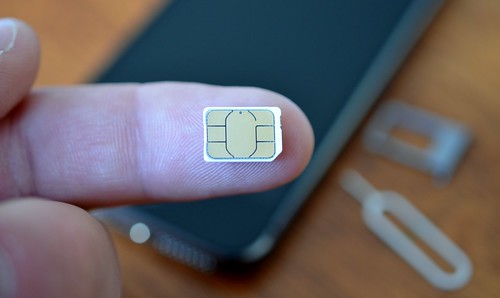
Small; soon invisibly so? Photo of a SIM card by smjbk on Flickr.

A selection of 9 links for you. Use them wisely. I’m charlesarthur on Twitter. Observations and links welcome.

Innovation isn’t dead » Money.com

Morgan Housel, with the only article you need about innovation and people being dismissive of stuff on the basis of “I’d never want one”:

The typical path of how people respond to life-changing inventions is something like this:

• I’ve never heard of it.
• I’ve heard of it but don’t understand it.
• I understand it, but I don’t see how it’s useful.
• I see how it could be fun for rich people, but not me.
• I use it, but it’s just a toy.
• It’s becoming more useful for me.
• I use it all the time.
• I could not imagine life without it.
• Seriously, people lived without it?

This process can take years, or decades. It always looks like we haven’t innovated in 10 or 20 years because it takes 10 or 20 years to notice an innovation.

Planes, lasers, cars, antibiotics, laptops – they’ve all gone through it. What’s going through exactly the same now?
link to this extract


Drawbridge hires Apple ad executive to track users across devices » WSJ

Douglas MacMillan and Elizabeth Dwoskin:

If a desktop computer and a smartphone are connecting to the same WiFi network, the network will recognize the unique ID in each device and pass that information to Drawbridge.

The guesswork gets more accurate the more frequently Drawbridge can capture instances of devices being in the same place or connecting to the same network. Drawbridge uses this cross-device matching system to build rich profiles of people’s behavior, interests, spending habits, demographic information, and sometimes their locations. They claim their matching software is more than 80% accurate.

Methods of tracking consumers online have drawn longstanding criticism from privacy advocates. The advertiser’s holy grail, of capturing every interaction a consumer has with their brand, also requires extensive surveillance of people’s behavior, and increasingly, their comings and goings. Privacy watchdogs say consumers do not want to be monitored in this way, and that the methods companies use to obtain consent to collect people’s data are broken.

Many apps ask for consumers’ permission to collect their location as a condition of downloading the app, but advocates warn that consumers are largely unaware of the extent of the information being collected or how it is being used. A recent study found that roughly 60% of consumers withdrew their consent when presented information about how their data was being shared.

Drawbridge says the company doesn’t maintain a database of names or of people’s real identities, but builds anonymous profiles using identification numbers.

Oh, come on. “Anonymous profiles using identification numbers”? Including, say, location, age, sex, marital status, interests, and so on? Quit the obfuscation; it’s profiling, of people, and Apple tries to limit its extent, and everyone else doesn’t.
link to this extract


Feds bust through huge Tor-hidden child porn site using questionable malware » Ars Technica

Cyrus Farivar and Sean Gallagher:

A newly unsealed FBI search warrant application illustrates yet another example of how the government deploys malware and uses sophisticated exploits in an attempt to bust up child pornography rings.

The 28-page FBI affidavit (text-only, possibly NSFW) was unsealed in a federal court in Brooklyn, New York earlier this month. It describes a North Carolina server hosting a Tor hidden service site. The setup was seized in February 2015, but law enforcement allowed it to run for two additional weeks as a way to monitor its nearly 215,000 users.

Currently, at least three men—Peter Ferrell, Alex Schreiber, and James Paroline—have been charged in connection with this site.

Ferrell, username “plowden23,” is the target of the search warrant affidavit. Schreiber, 66, of Queens, was a former New York City schoolteacher. The two New York men have been released on bond.

“Questionable” malware in the sense that the legal rules about venue of infected PC are very hand-wavey; how do you know where a PC you’re infecting via Tor is based? By getting it to phone home (to the FBI). What if that’s out of venue? Ignore it?
link to this extract


Apple, Samsung in talks with telecom groups to launch e-Sim card » FT.com

Daniel Thomas and Tim Bradshaw:

Apple and Samsung are in advanced talks to join the rest of the telecoms industry to launch electronic Sim cards, in a move could fundamentally change how consumers sign up to mobile operators.

The GSMA, the industry association which represents mobile operators worldwide, is close to announcing an agreement to produce a standardised embedded Sim for consumer devices that would include the smartphone makers.

The traditional Sim card locks in the user to a network but an embedded Sim would enable a smartphone, tablet or wearable user to avoid locking themselves into a plan with a single operator or sign up to switch instantly.

Wouldn’t expect this in 2015, but next year would make perfect sense. And that’s another opening/point of failure removed from phones. I bet Apple is working on making the iPhone 7 “waterproof” – and perhaps at a dual-SIM model.
link to this extract


Agricultural drones: the new farmers’ market » Engineering & Technology Magazine

Katia Moskvitch:

In the past, when farmers had smaller fields, they knew which areas had enough water, or were ready to harvest, just by walking around their land. However, to stay connected with today’s much bigger parcels of farm land, they need precision agriculture, with crop management that relies on GPS and big data analytics to increase yields and profits while cutting down on pesticide and water use.

Many tractors are now guided by GPS, to plant perfectly straight rows of crops. Farmers can monitor the progress of their driverless tractor on a tablet at home. Monsanto, the world’s largest seed company, estimates that data-driven prescriptive planting could increase global crop production by about $20bn a year, or about one-third the value of 2013’s US corn crop.

Drones are the latest addition in the toolkit of precision farming, collecting the key datasets used to make agronomic decisions. Right now, they are still new, and regulations how to use them vary from country to country. But farmers everywhere are waking up to the potential benefits, and “in a few years, drones could be a common sight above British farms,” says Alex Dinsdale, sales manager at Ursula Agriculture, a company that delivers crop intelligence from drones. But are they really useful, or just a technology gimmick?

“I remember driving the vineyards with my grandfather as a child, we would constantly stop, get out, and look at the vines. Right up close,” says Kunde. “He would take off a leaf and look at the undersides, show me, throw it down, then choose another.” At other times groups of men would use magnifying glasses to inspect the leaves, looking for potential pest problems in the vines. Fast-forward to today, and much of that work “could have been helped by advanced tools and aerial imagery,” he says.

link to this extract


How spyware peddler Hacking Team was publicly dismantled » Engaget

The Hacking Team hack has spawned so many stories, but this by Violet Blue pulls together some of the worst behaviour uncovered. Such as:

Ethiopia’s Information Network Security Agency (INSA) was employing Hacking Team to target [security researcher, The Intercept journalist, First Look Media director of security and former Google employee Morgan] Marquis-Boire, likely over his tracking of the company’s malware for Citizen Lab and at Google’s anti-malware team – one which culminated in a particularly bad PR moment for Ethiopia.

The Citizen Lab research in question found Ethiopia’s INSA using Hacking Team’s malware to target journalists; Ethiopian authorities use arbitrary arrests to silence journalists, and detainees routinely allege torture and ill treatment. The Ethiopian government’s spokesperson in Washington vehemently denied the use of products provided by Hacking Team.

Yet PhineasFisher’s haul shows Hacking Team not only provided its products to Ethiopia, but also proposed a new contract with Ethiopia because, according to a leaked email from operations chief Daniele Milan, “700K is a relevant sum.”

link to this extract


Samsung’s smartphone market share falls to 21.5% from 28% in India in June quarter | ETtech

Danish Khan:

Samsung’s smartphone market share fell to 21.5% from 28% in the previous quarter, the report [by tracking firm Cybex Exim Solutions] said. The company, however, still leads the overall handset market in the country with 18.9% share.

Home-bred handset maker Micromax is going steady at the No.2 position, with 12.6% share of the overall mobile phone market in the quarter to June, up from 10% in the previous quarter. In the smartphone segment, Micromax’s market share rose to 17.9% from 13%.

The Indian smartphone market grew by 23.5% sequentially to reach 25m units (according to Cybex). If you do the maths, that means Samsung’s smartphone sales did actually fall, from 5.7m to 5.4m, while Micromax’s rose from 2.6m to 4.5m. Samsung has a problem: it’s being out-competed at the low end.
link to this extract


Navy warns that fingerprint records were compromised in OPM breach » Darkmatters

Anthony Freed:

The Department of the Navy (DON) has sent a notice to more than 436,000 active duty personnel and reservists, as well as over 195,000 civilian employees, warning that data compromised in the recent breach at the Office of Personnel Management (OPM) also included fingerprint records.

“The interagency team has now concluded with high confidence that sensitive information, including the Social Security Numbers (SSNs) of 21.5 million individuals, was stolen from the background investigation databases,” said Thomas W. Hicks in performing the duties of the Under Secretary of the Navy.

“This includes 19.7 million individuals that applied for a background investigation, and 1.8 million non-applicants, predominantly spouses or co-habitants of applicants. Some records also include findings from interviews conducted by background investigators and approximately 1.1 million included fingerprints.”

Please update your fingerprints accordingly, using at least one whorl and two loops. (Though seriously, how can they be abused? Unless you’re going to whirl off into a plot involving a top-flight general using an iPhone with TouchID.)
link to this extract


In praise of Apple Music in my iTunes Library » Six Colors

Jason Snell:

I don’t know what I was expecting from Apple Music integration. I guess I assumed that when I added a track to “my library” from Apple Music, it would go to some special Apple Music tab, or playlist, or library. Nope—that music just shows up in the My Music section of iTunes, mixed in with all of the stuff I’ve bought over the years.

I realize that this approach may not work for everyone—one of the great challenges in designing any computer-based music service is going to be the endlessly different ways people consume to music—but boy, does it work for me. I play music from a lot of self-built playlists, but now I can add Apple Music playlists too, and they’re seamlessly integrated. Apple Music’s integration with my music library lets me listen to music in the same way I’ve been doing it for the past 14 years—but with the addition of tracks from Apple Music’s nigh-endless supply.

I can also see just how insidious this approach is. My music library is no longer pristine, no longer a collection owned by me. Now I’m acquiring albums and tracks not by buying them, but by clicking that Add to Library button. It’s already started to happen, after a couple of weeks. After a few months or years with this service, how will I ever be able to cancel it?

There are roughly 800m iTunes accounts, growing at about half a million per day in 2013.
link to this extract


Start up: life as an “Invisible”, why use adblocking?, how Spotify’s eating your drive, and more


BlackBerry has been a loser as smartphones have taken off in Africa. Photo by shizhao on Flickr.

A selection of 9 links for you. Surprise your friend by tweeting an inline link. Follow The Overspill on Twitter to get updates on what’s posted here. I’m charlesarthur on Twitter. Observations and links welcome.

I was an Invisible Girlfriend for a month » Fusion

Kashmir Hill tried being one of the workers who texts (but never, never sexts) with people who want not-really-just-virtual-but-real boyfriends or girlfriends:

Over all, the number of users who seemed to really want companionship outnumbered the skeptics. The founders say one user told them she was going through chemotherapy and that her real-life boyfriend had dumped her. So her invisible boyfriend had become a serious emotional support while she fought cancer.

I didn’t encounter anyone like that. Instead, I met a guy in his late 20s who wanted to have an extended conversation with his “lovingly nerdy, best-friend-turned-girlfriend” about taxidermy. He said that if he were a taxidermist, he would sew a cat to a dog. I texted, “Would you put a cat head on a dog body or a dog head on a cat body?” But I didn’t get to see his response, nor find out if the conversation was about to go to a darker place that might warrant alerting authorities.

It’s hard to put a price on love. But Crowdsource did. It’s worth a whopping five cents. That’s how much I got paid to write each of these texts.

If I spent an hour answering texts, and took the full five minutes to write each one, I’d be making 60 cents an hour, far below the minimum wage. This is legal because all the workers on the platform are classified as independent contractors rather than employees.

But of course. She’d get $5 for answering 100 texts; the service charged $15-$25 for the same.

Also, this is frighteningly reminiscent of Her, whose central character’s job is writing cards for people too busy to write cards.
link to this


Why I’ve started using an adblocker » Three Dot Lounge

Chuq von Rospach:

The problem for me is not actually the ads. I understand sites need to pay the bills and that advertising is how many sites do that. But so many of the ads today have gotten so aggressive about hiding content from me or blaring unrelated crap into my eyes or in my ears that I have finally had it.

Beyond that, an even bigger problem for me is that more and more networks are using these advertising inclusions to install trackers and beacons to watch me as I wander around the net, and these trackers and beacons are in almost all cases things I have no way to opt out of, have never agreed to use and cannot see what’s being collected and sold about me along the way.

That is why I have finally installed an ad blocker. The ads are in many cases intrusive and annoying, but the growing trend of tracking without my permission and without any way to opt out of the tracking is abusive of me, my privacy and my online experience. And because of that, I’m now blocking the trackers and beacons that do this, and as a side effect the ads have gone away as well. This may hurt the sites that depends on the advertising, and I’m sort of sorry for that — but they are also the sites that have allowed these networks to install these tracker systems onto them, and so they are indirectly complicit in that way.

I don’t see this ending well for small or medium sites reliant on ads; the word about adblocking is going to spread relentlessly, and if it makes sites more pleasant to read then it’s going to snowball. Large sites may be able to shrug off the lure of the crud ads. Smaller ones won’t; you’re already seeing (elsewhere) the effects of the race to the bottom.
link to this


Spotify’s swallowing your disk space – and you can’t stop it » Expert Reviews

Barry Collins:

The streaming service stores a local cache of music on users’ PCs, normally containing their most recently played tracks or music they’ve requested to be stored offline (a feature only available to Premium subscribers).

An update to Spotify earlier this year removed the option to determine where this cache was stored and to limit its size, leaving users who run the software on laptops or tablets with limited capacity SSDs fuming. “I’ve unsubbed yesterday because of this,” wrote one user on the Spotify forums. “I can’t believe how incompetent your software engineers or whoever thought of this idea to take away KEY functionaliites like cache variability and installation paths.”

“Like everyone, I have an SSD as my primary drive and [it] has a very limited space in it,” writes another customer. “With all my music save [sic] offline, Spotify is eating up almost 30% of my SSD space without my knowledge!”

An update to Spotify last week returned the feature that allowed people to select an external drive as the location for the cache. But the option to limit the size of the cache remains missing in action.

Slightly wonkish, but one to properly annoy the wonks.
link to this


Artist arrested on suspicion of ‘abstracting electricity’ to charge iPhone on London Overground train » London Evening Standard

Tom Marshall and Laura Proto:

An artist has criticised transport police after he was arrested for using a plug on a London Overground train to charge his iPhone.

Robin Lee was handcuffed and put into a police van after using the power socket on a train from Hackney Wick to Camden Road on Friday, July 10.

The 45-year-old, who lives in Islington, said the whole episode was “ridiculous” and was first confronted on the train by a police community support officer who said he was taking the electricity illegally.

He was arrested on the platform after getting off at Camden Road. “She said I’m abstracting electricity,” he said. “She kept saying it’s a crime. We were just coming into the station, and there happened to be about four police officers on the platform. She called to them and said ‘This guy’s been abstracting electricity, he needs to be arrested’.”

The plugs say “Cleaners’ use only”. Maybe he should have said he was a cleaner. (He was arrested, and then “de-arrested”.)
link to this


Middle East and Africa smartphone market to top 155m units in 2015 as sub-$200 segment surges » IDC

Featurephone sales fell 20%, smartphone sales grew 66% to hit 36m, or 63% of total regional phone shipments in Q1, driven by cheap Android phones:

almost half of all the smartphones shipped across Africa (45.1%) in Q1 2015 were priced below $100, while almost 75% fall under $200. Low-priced smartphones are also having a considerable impact in the Middle East, with the $100–200 price band accounting for the market’s biggest share. 

“This price bracket seems to be the sweet point for most vendors launching in the region, as well as for established vendors looking to increase their shares by targeting the lower end of the market,” says Nabila Popal, research manager for IDC’s Mobile Phone Tracker in the Middle East, Africa, and Turkey. “This has resulted in phones priced under $200 accounting for about 36% of the Middle East smartphone market, while at the other end of the spectrum the $450+ price band has seen its share fall from 25% in Africa and 48% in the Middle East a year ago, to 14% and 34% today.”

Nigeria and South Africa contributed significantly to the overall growth seen in Africa, with the countries experiencing year-on-year growth of 135% and 56%, respectively. Nigeria accounted for 14% of all smartphone shipments across the continent during Q1 2015, while South Africa was responsible for 12%.  Samsung, Tecno, and Apple were the leading smartphone vendors in Africa during the quarter, with Huawei being ousted from the top three. The three leading vendors accounted for a combined 55% share of Africa’s smartphone shipments in Q1 2015.

Losers in this: BlackBerry (hit by BYOD) and Microsoft (both the Nokia and Lumia models).
link to this


Nintendo president Satoru Iwata dies of cancer » FT.com

Leo Lewis makes an important point:

however dismally its successor has fared, the original Wii console, released in 2006 as the defining management feat of Mr Iwata, was revolutionary.

Even as Nintendo’s celebrated games designer, Shigeru Miyamoto, was receiving the plaudits for the Wii’s groundbreaking controllers and gameplay, the management hand of Mr Iwata was evident.

Three titles of which Mr Iwata was executive producer — Wii Sports, Wii Fit and Wii Play — were games that sold more than 130m units between them and changed not only the physical way that games were played, but the demographic universe of gaming.

In the global list of best selling video games, Nintendo reigns supreme. Of the top 40 games that have sold or been downloaded more than 15m times, 12 were released under the presidency of Mr Iwata.

One has to hope Nintendo had a really solid succession plan in place.
link to this


Satoru Iwata was Nintendo » The Verge

Sam Byford on Nintendo’s chief executive, a skilled programmer who has died of cancer at 55:

everything Iwata did was driven by an unshakeable belief in what Nintendo is and what it stands for. Nintendo is sometimes late to certain parties, but when it does do things that people have long clamored for, like mobile games or an online service, it does so on its own terms. Iwata passionately stood against the devaluation of games, for example, which is why you won’t see ports of existing Nintendo titles on phones. And his forward-thinking perspective extended to how he ran the company on an operational level. “If we reduce the number of employees for better short-term financial results, employee morale will decrease,” he told an investor who was calling for heads to roll in 2013. “I sincerely doubt employees who fear that they may be laid off will be able to develop software titles that could impress people around the world.” The exchange sums up Iwata’s leadership — empathetic on a human level, yet grounded in a firm perspective that it was the right thing to do for business…

…”Trust your passion, believe in your dream,” Iwata said in an inspiring speech at the 2011 Game Developers Conference. “For 25 years, game developers have made the impossible possible. So I ask you, why would we stop now?”

link to this


Facebook’s security chief calls for Adobe Flash to be killed off » HOTforSecurity

Graham Cluley:

Amongst those who would be happy to see the back of Adobe Flash is Alex Stamos, Facebook’s newly-appointed security chief.

In a tweet this weekend, Stamos – who is a respected member of the security community who is credited for improving the security stance of Yahoo at his previous job – said that it was time for Adobe to announce when Flash would be killed off, and for browsers to assist by dropping support at the same time.

“It is time for Adobe to announce the end-of-life date for Flash and to ask the browsers to set killbits on the same day.”

In a followup tweet, Stamos said that Adobe’s death date didn’t have to be today or tomorrow – but a date had to be set in stone for systems to be made more secure:

“Even if 18 months from now, one set date is the only way to disentangle the dependencies and upgrade the whole ecosystem at once.”

Yup. Stake through the heart. Only way.
link to this


Apple’s share of smartphone industry’s profits soars to 92% » WSJ

Shira Ovide and Daisuke Wakabayashi, quoting a Canaccord Genuity report:

One key to Apple’s profit dominance: higher prices. Apple’s iPhone last year sold for a global average of $624, compared with $185 for smartphones running Android, according to Strategy Analytics. In its fiscal quarter ended March 28, Apple sold 43% more iPhones than a year earlier, at a higher price. The average iPhone price in the quarter rose by more than $60 to $659, on the strength of the larger-screen iPhone 6 and 6 Plus models.

As the smartphone market matures and growth slows, it is starting to resemble the personal-computer business in some ways. Average PC prices have plunged, and most manufacturers struggle to eke out profits. But Apple captured more than half of industry profits last year, even though its Mac line accounted for only about six of every 100 computers sold, according to Bernstein Research.

Despite the changing leader boards of the past decade, some industry veterans say Apple’s profit crown looks more secure.

“The dominance of Apple is something that is very hard to overcome,” said Denny Strigl, former chief operating officer of Verizon Communications Inc. “Apple has to stumble somehow or another, and I don’t think that’s going to happen.”

That’s pretty much how I showed it in my latest examination of the PC industry. However, that “92%” figure is misleading; the negative amounts by Microsoft, BlackBerry and others shouldn’t really be included. Otherwise, with Microsoft’s giant $7bn+ writedown on Nokia negating all Samsung’s profit and a chunk of Apple’s, you’ll have a situation in Q2 where Apple makes 150% of industry profits. Clearly not realistic.
link to this


The deaths of “Others”: how the PC market’s implosion is squeezing smaller players

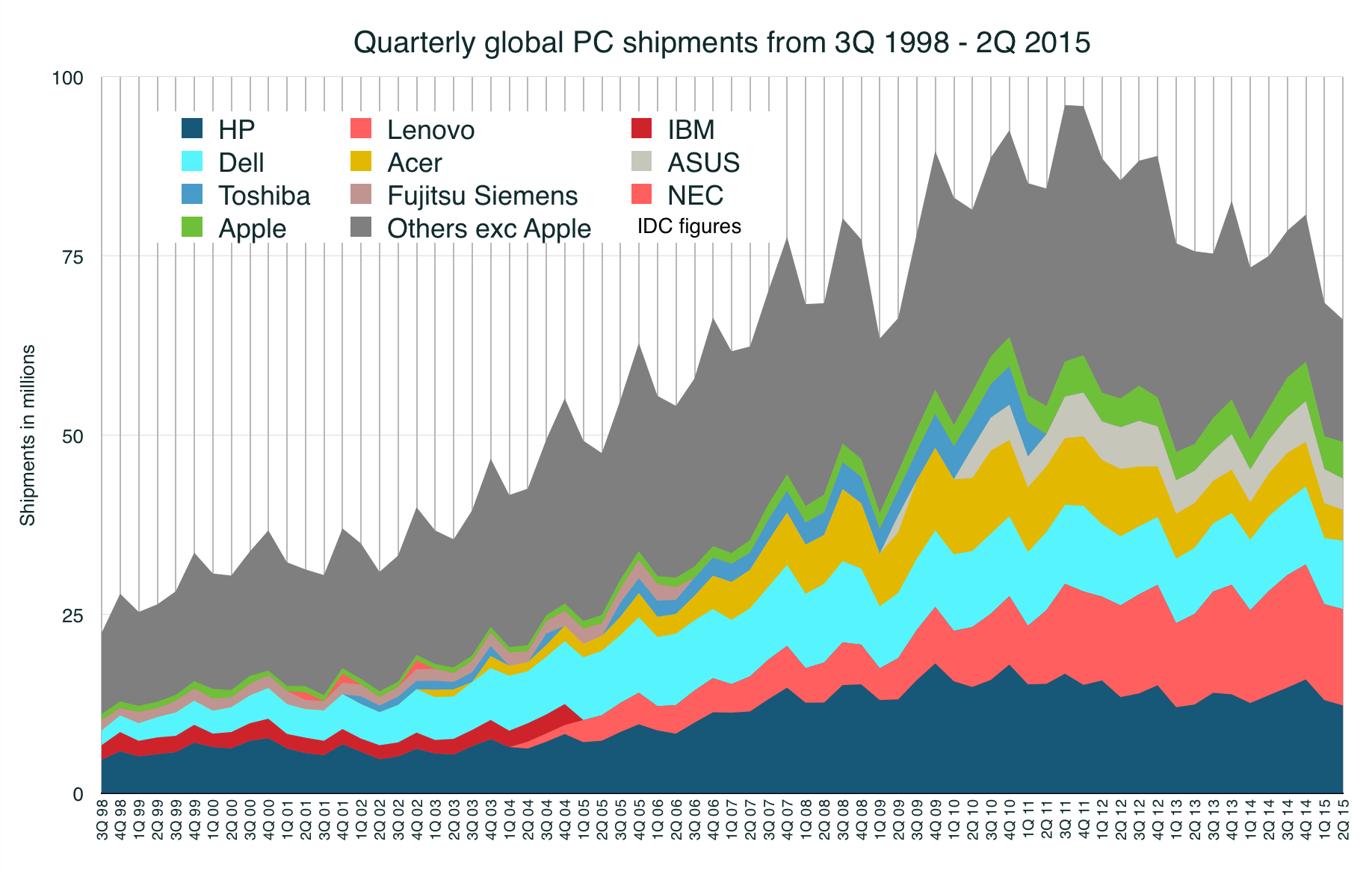
PC market 1998 to 2015: rise and decline

IDC data shows how the PC business has grown – and shrunk. “Others” (grey) are selling fewer and fewer.

Back in April 2011, when the results for the first quarter of PC shipments for the year came in, I wrote a story beginning:

“The PC market is showing signs of having passed its peak. Weak demand by consumers for PCs, coupled with a switch to tablets such as Apple’s iPad, meant that worldwide PC shipments fell compared with the same period in 2010, according to two leading research groups.”

Perhaps predictably, this observation of what the numbers were saying riled some of the PC diehard commenters (generally sysadmins with time on their hands who obsessively trawl comment threads looking for places in which to be superior). “I’m looking forward to seeing the looks on Mac users’ faces when Apple – as they display every intention of eventually doing – pull out of the PC market altogether,” said one.

My own observation was that the principal downturn had come in the mature markets of the US and Europe, and that the forthcoming problem was that the rise of smartphones (especially cheap Android) would mean that in Asia/Pacific and Latin America “lots of those people who a few years ago would have been a prime target for a PC might now not need it.”

And so it turned out. The market actually hit its biggest-ever figure in the third quarter of 2011, with 96m PCs shipped. But since the third quarter of 2012, if you exclude Apple figures, the Windows PC market has shrunk for 12 straight quarters. Now it’s 31% down on that peak, and nobody’s quite ready to call the bottom. It’s going to be under 300m this year – the smallest since 2009, in the midst of the financial crash – and that’s even with the launch of Windows 10. (For those saying “aha, but it’s falling because people are making their own PCs using motherboards” – nope. The motherboard industry is trending down just as quickly as the general PC industry.)

What gets people buying computers? Seems that Apple has the answer – launch new products and promote the hell out of them. (In the second quarter it refreshed the MacBook Air, MacBook Pro and introduced the “MacBook”.) It’s working a lot better for them than for the Windows PC market.

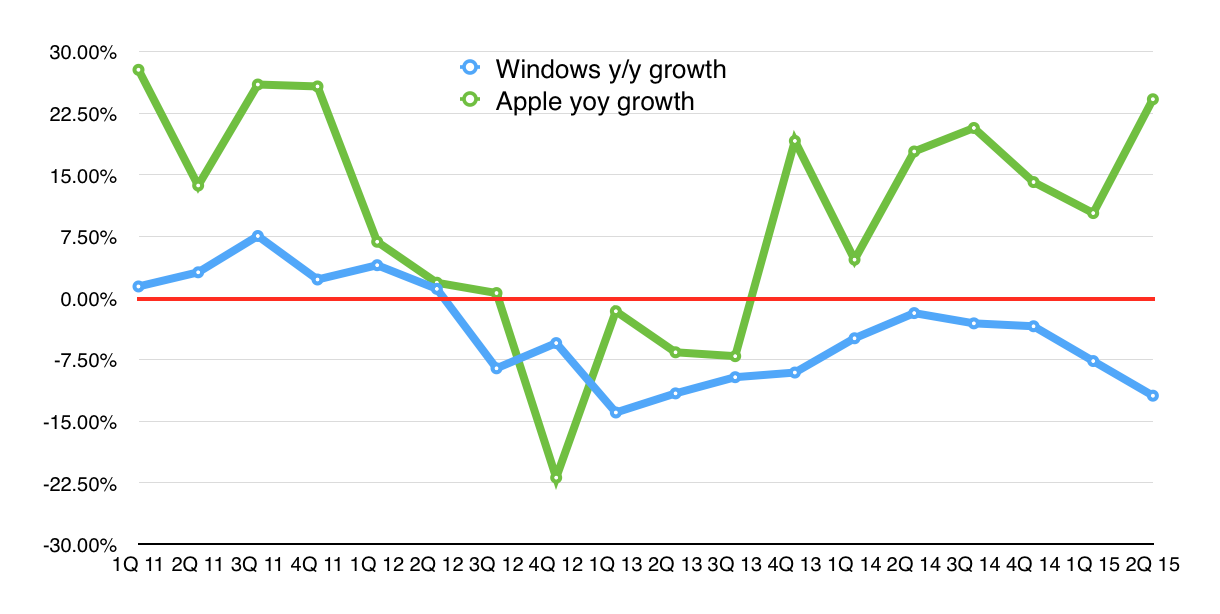
Apple v Windows

For the past 12 quarters, Windows PCs shipment figures have shrunk – while Apple generally grows faster

Apple has stayed fairly consistent, shipping between 4m and 5m personal computers per quarter – apart from the first half of 2013, when it couldn’t supply enough new iMacs to meet demand.

The demand for Macs means that Apple is now the fourth-largest PC company for shipments, behind only Lenovo, Dell and HP, and ahead of Asus and Acer, on IDC’s measurement. (IDC doesn’t include Chromebooks and 2-in-1s.) It’s quite a turn of events, but one where it has grown faster than the Windows PC market for quite a long time.

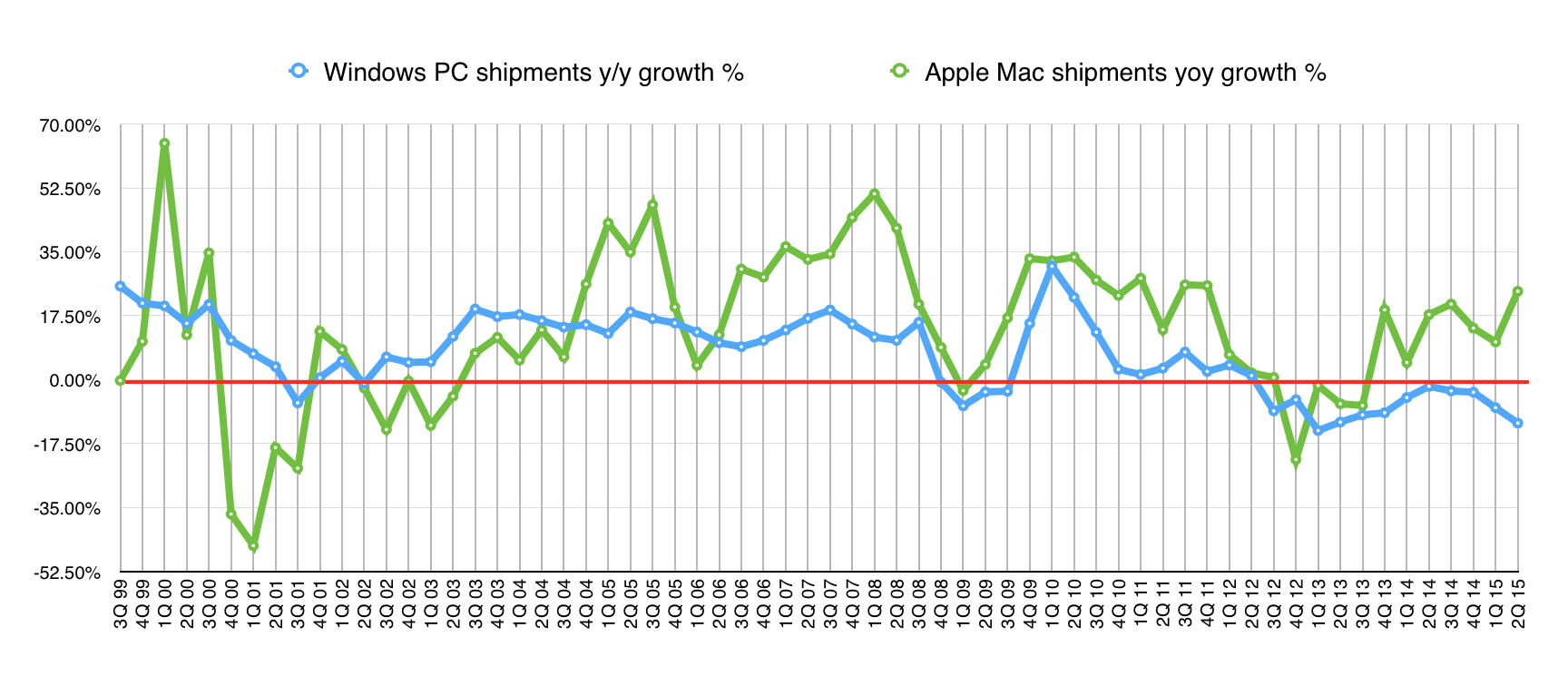
Windows v Apple, long-term

Long-term trends for Windows PC v Apple growth show Apple ahead for almost all of the past 11 years

Dying in a ditch without a saviour

The deeper question is: what happens to the PC market? It’s become a replacement business, but one in which replacement cycles are also lengthening. There’s barely any innovation – Lenovo’s efforts with the Yoga 2-in-1 seems to be the only thing happening, and that’s a minority sport. Gartner and IDC don’t give clear figures, but there doesn’t seem to be a big move to the new form factors. Thing is, it’s usually new form factors that drive revivals in the market.

So far, though? No. Canalys reckons that in Q1 “hybrid and convertible” shipments (that’s the 2-in-1s, and includes the Surface) totalled 3m, and that was a doubling year-on-year. There’s likely money to be made, but not many buyers handing over the moolah. And Chromebooks? A mighty 1.3m in Q1, also according to Canalys, which reckoned 90% went to the US and Europe. I don’t hold out much hope for a gigantic leap in Q2, though education buyers (the principal ones) will likely bump those Chromebook numbers up in Q3.

Brutal reality: revenue down, profit down

I track the big PC companies’ results, where you can generally find both revenues and operating profits for their PC divisions, though not usually PCs shipped (I take the latter from IDC). Apple is different – it gives you shipments and revenues, but no calculation of operating profit (because it doesn’t split out its figures that way).

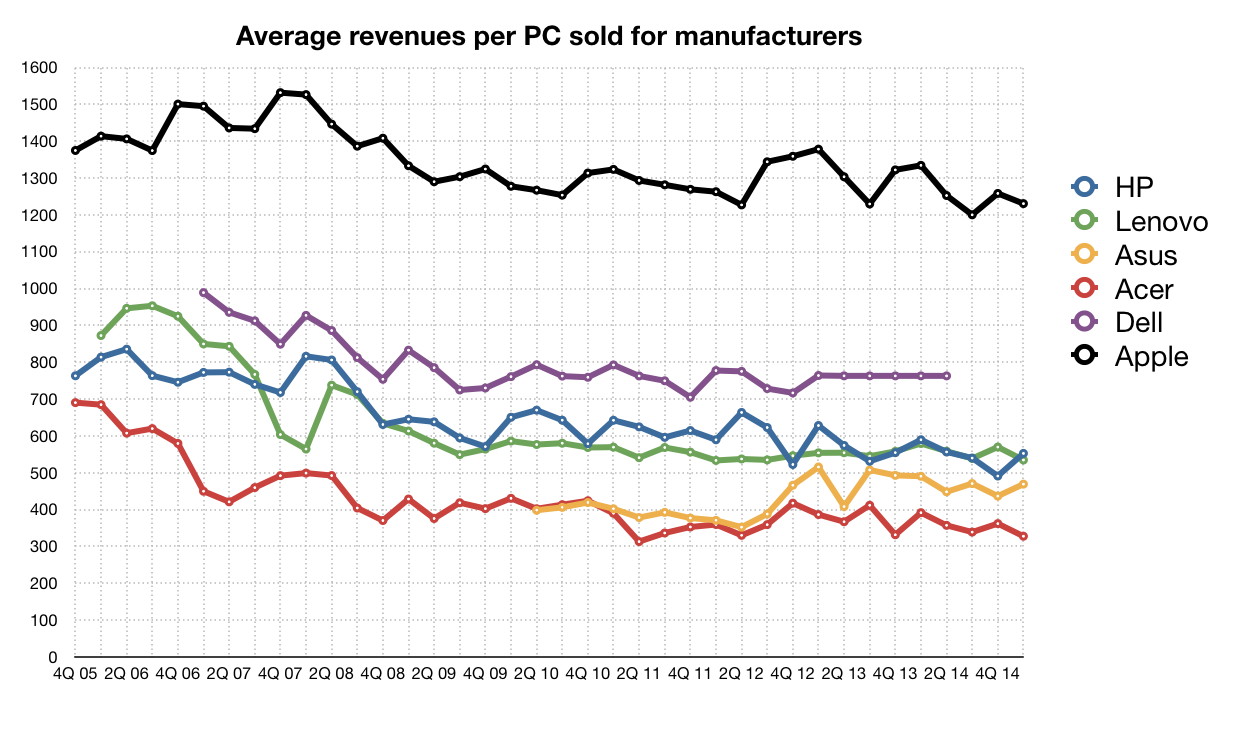
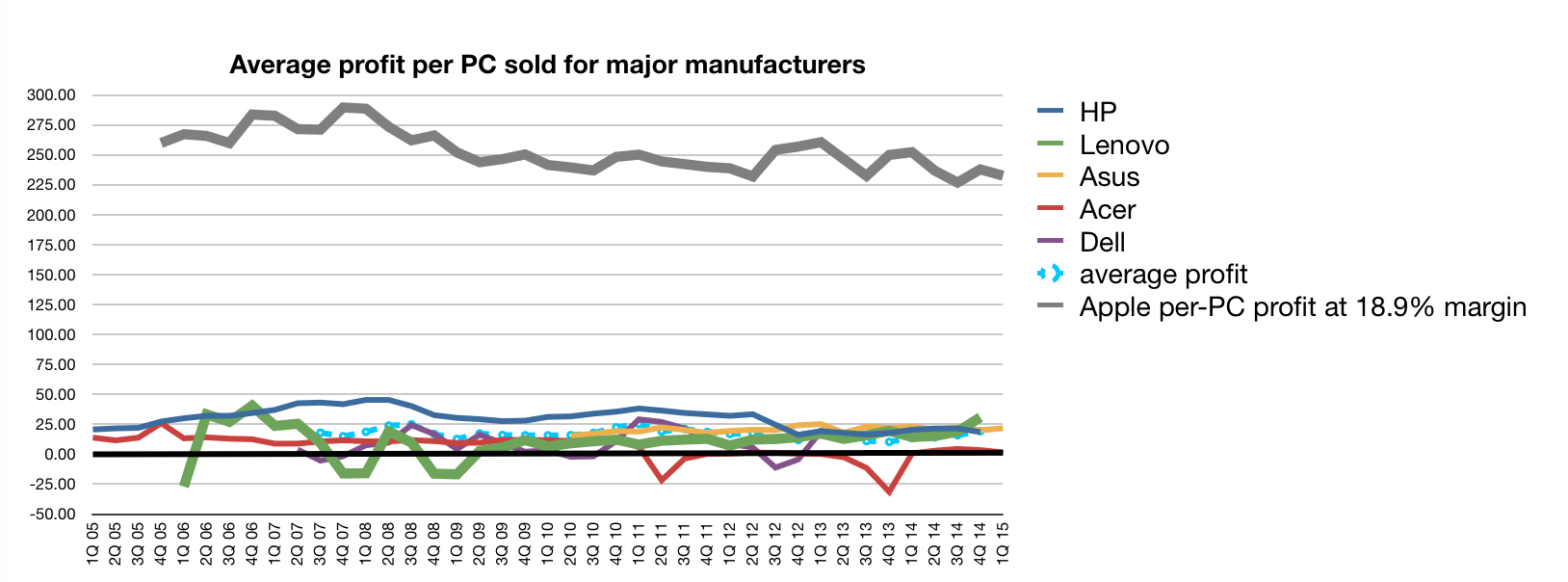
And over the past 10 years, there are two trends that stand out: per-PC revenues have been falling along with per-PC profits for Windows makers, while Apple has seen similar pressures but sits miles ahead of the rest.

Average revenues per PC for big 6

“Big six” per-PC revenues, based on financial reports and IDC data.

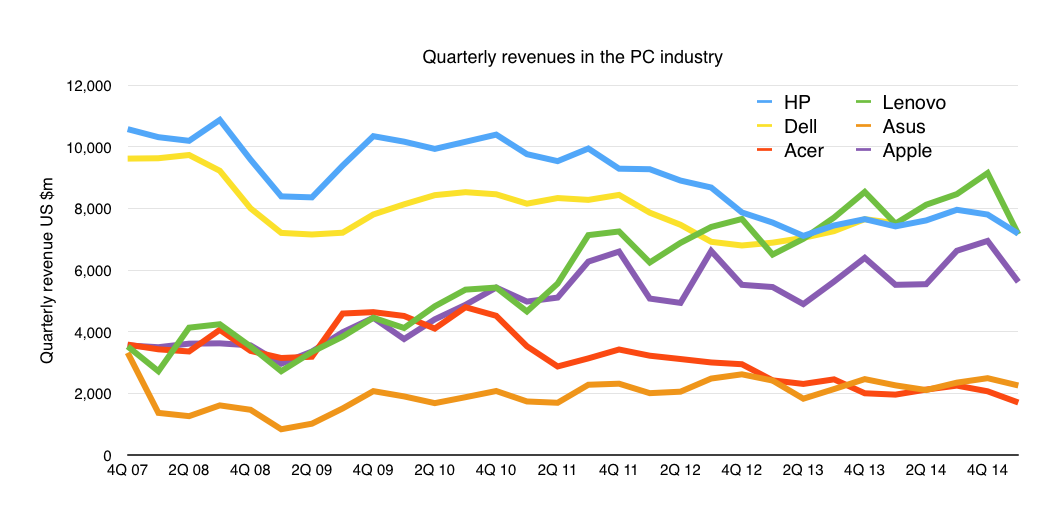
In fact Apple has such high per-PC revenues that it’s actually now the third-biggest PC maker by revenue – excluding Dell, because we don’t know what Dell’s revenues are, because it is privately owned. Acer and Asus, by contrast, are on a path downwards; it’s notable that for the past couple of quarters they haven’t figured on IDC’s numbers for US shipments, meaning they had fewer than a million sales there. (And in timely fashion, Asus just chopped its notebook shipment forecast for the year to 20m units, down from 22.8m it was aiming for, and below 2014’s 20.3m.)

Total PC revenues for the big 6

Figures to 1Q 2015: despite fewer shipments, Apple’s revenues outdo Acer and Asus

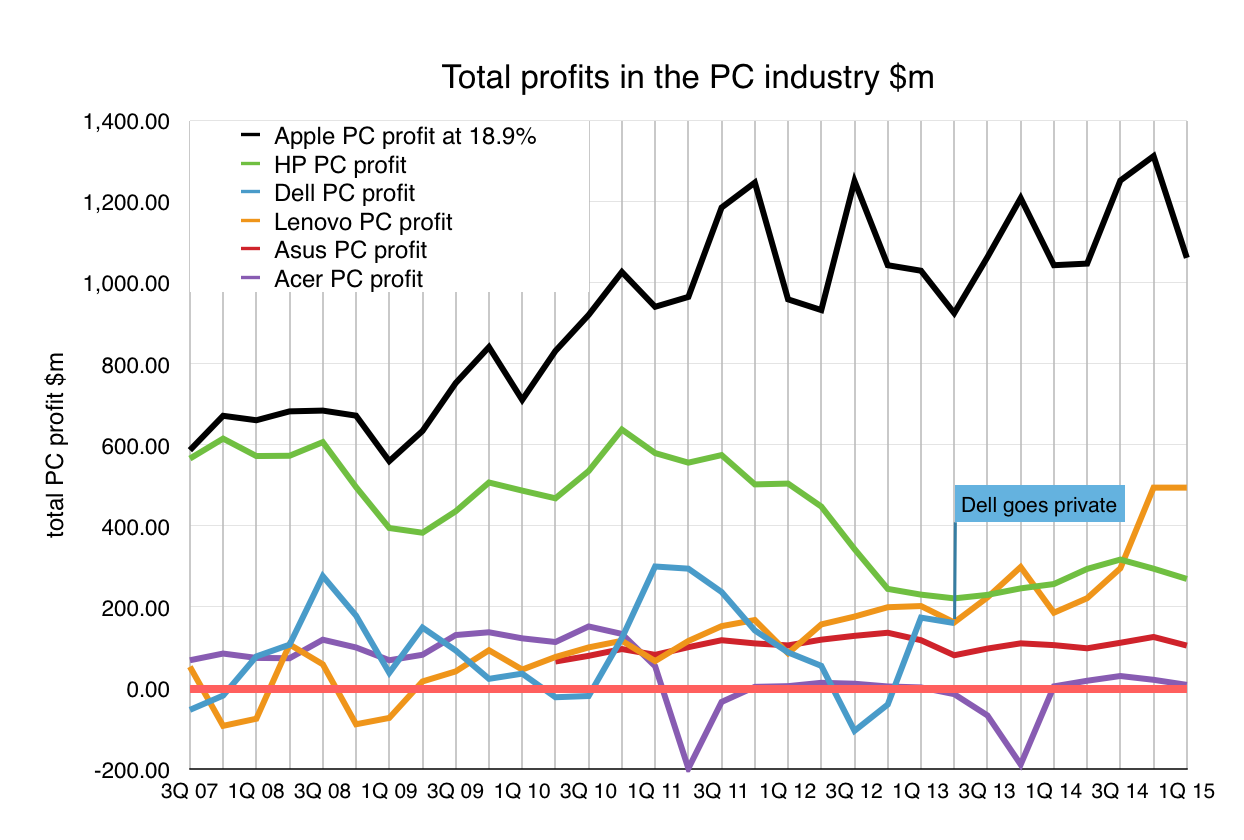
The picture gets even worse if you look at total profits. We have to assume an operating profit for Apple; I use 18.9% because that’s the historical figure, extracted from pre-iPod days. On that measure, Apple makes the largest profit from PCs by a mile.

Per-PC operating profit for the big 6

Apple is miles ahead of the rest, based on an estimated 18.9% historical operating margin

Total profits in the PC industry for the 'big 6'

Data to 1Q 2015: on a historical figure, Apple is miles ahead, while Asus and Acer struggle to break even

The figure for Apple is twice that of any of the others. The graph for Acer isn’t a mistake – its operating profit is all over the shop, and has been negative quite a lot. (Remember this is operating profit – what’s left after paying for the product components, assembly, shipping, associated R+D, sales and marketing.)

The deaths of Others

But if profits are squeezed for the “big five” (or six, now Apple’s in the club), what’s it like for the smaller players such as Toshiba, Samsung, LG? Logically, worse, because just as in the smartphone market they don’t get the economies of scale that let them compete.

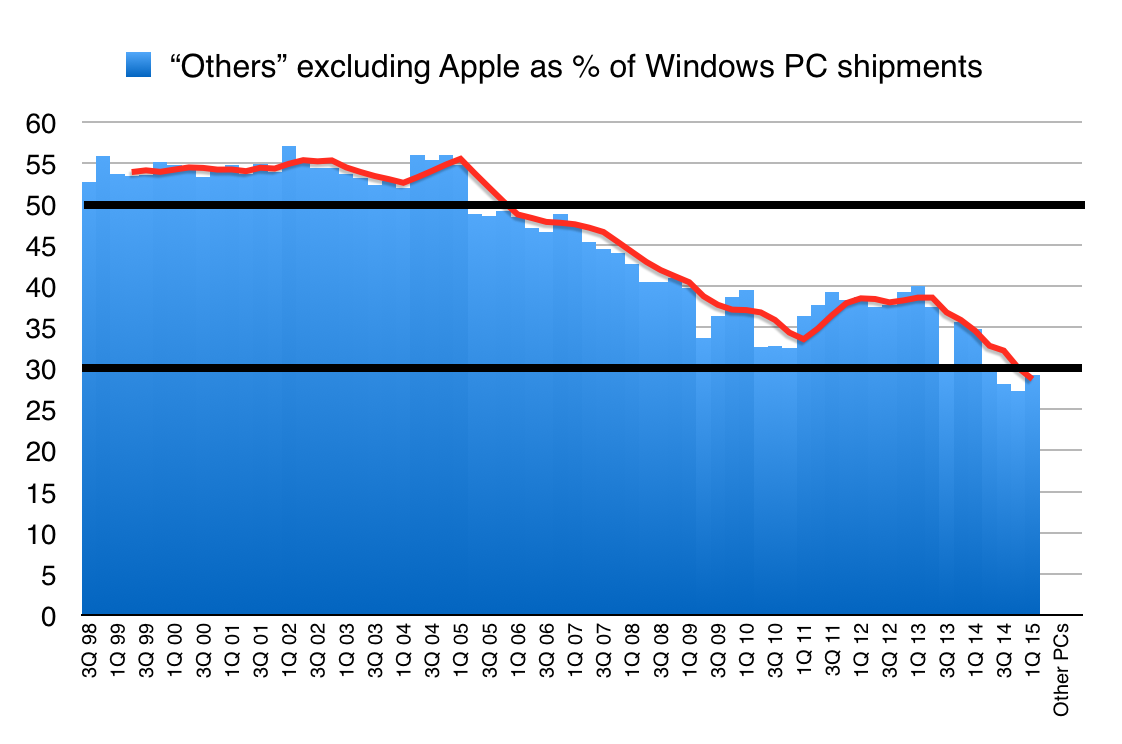
The problem is, there just isn’t room for them. Having been above 50% of the whole market back in 2005, they’ve tumbled down until now they’re trending below 30%.

"Other" PC makers are a smaller segment of the market

From 50% before, “others” are now less than 30% of a smaller market. The red line is the four-quarter moving average.

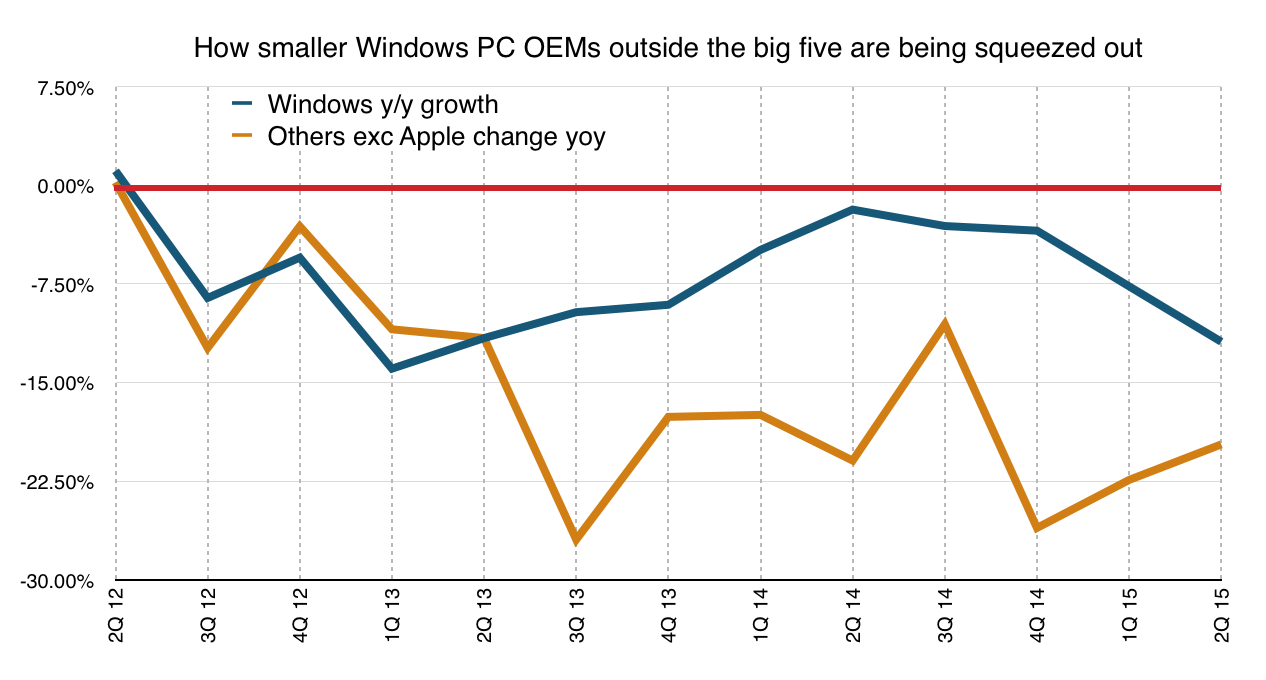
Since the market began shrinking, shipments by “Others” – those Windows PC makers outside the top five (HP, Lenovo, Dell, Asus, Acer) – have really fallen off.

As the PC market has shrunk, the “Others” category has shrunk faster.

Windows market growth v "Others"

The Windows PC market is shrinking – but “Others” is shrinking faster

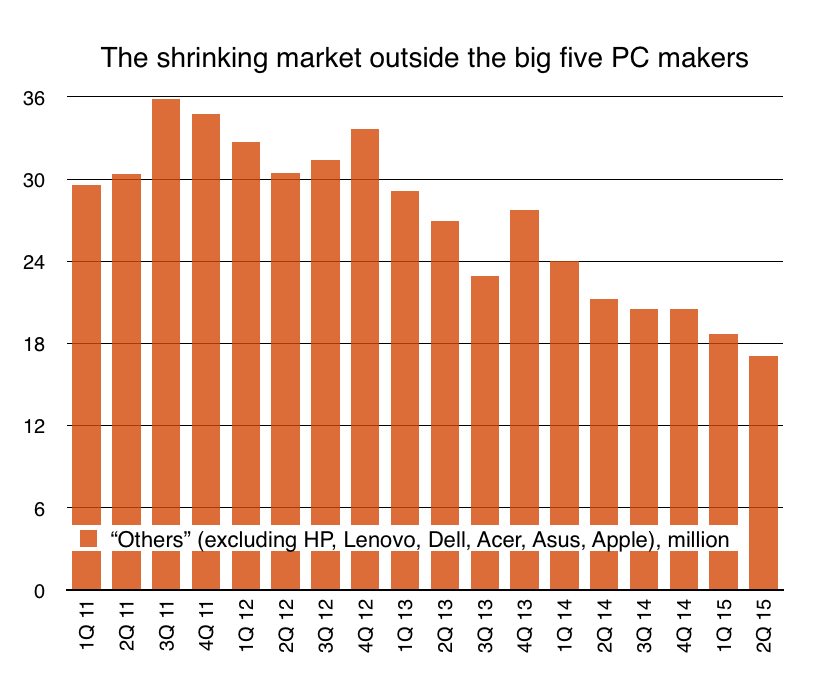
The deaths of "Others": fewer shipments

Shipments outside the “big 6” have roughly halved from the market peak

“Others” (the remainders outside the top six if you include Apple) has dropped from just under 36m to less than 18m in less than four years. That’s a real crunch.

That means fewer sales, less revenue and less profit (if any) for those bit players – which includes Samsung, LG and a few others. Sony gave up PCs as a bad idea a while back. Samsung pulled out of the European market in late 2014.

Samsung, in particular, doesn’t have anything to gain from making PCs: it can’t make the chips in its foundries (they’re Intel not ARM) and it’s not generally offering touchscreens, so it doesn’t get the “flywheel effects” that it relies on for smartphones, where it makes the parts as well as the finished object.

If I were to bet, I’d expect Samsung to exit the PC market in a year or two. There just isn’t much in it there; you can see from the part of its “IM” division revenues that aren’t smartphones that it’s dwindling.

Ride to the end

There isn’t any good news for the PC industry, and I don’t expect Windows 10 to bring about dramatic changes. (Nor do IDC and Gartner.) There’s always a PC sales lull ahead of a Windows launch, but there’s still not great driving reason for the average consumer to buy a new PC because of Windows 10; remember how Windows 8 didn’t help that downward plunge.

And for businesses, if they’re on Windows 7 then they probably won’t see any reason to shift to Windows 10. And they probably binged on upgrades moving up from XP last year.

So get used to the new normal: PC sales will be increasingly concentrated among the top five or six, for whom R&D is pretty much an afterthought, and Apple is coining it – and pushing with the R&D – just as it is in phones.

How long before Apple’s share is 10%, up from its current 7.8% (which has more than quadrupled from its sub-2% low in the end of 2004)? On current trends (falling PC sales/rising Apple sales), it might be a year or two, but it seems shockingly in reach.

And those “Others”? With less and less market to shoot for, I’d expect some to quietly exit. Sony can’t have been the only one losing money.

Start up: Reddit implodes, catching criminals via Spotify, Cameron’s mad encryption plan, and more


A better way to think of Reddit? Photo by avisualstudy on Flickr.

A selection of 11 links for you. With added anchors, so you can link direct to observations Kontra. I’m charlesarthur on Twitter. Observations and links welcome.

Cops nab fugitives in Cabo San Lucas by tracking Spotify IP address » Ars Technica

David Kravets:

Husband Peter Barr and wife Brittany Nunn of Wellington, Colorado, were brought to Denver days ago and face felony charges in connection to the children’s disappearance. Nunn had lost custody of her children to their fathers, but she did not appear when the exchange was supposed to happen in December. The duo had been on the lam ever since, and they are accused of unlawfully taking the woman’s two biological children, 4 and 6, to Mexico, according to The Coloradoan.

The case was broken by Larimer County Sheriff’s investigator Drew Weber. According to the paper:

Drawing on new investigative tactics, Weber executed a search warrant and pulled records from Nunn’s Spotify account. He found it was being used from an IP address in Mexico. He later pulled search records from Netflix and Nunn’s other accounts and eventually tracked a package that Nunn had ordered to be shipped to Cabo San Lucas.

A private investigator soon joined Weber and helped monitor the family for months while agents with FBI, customs officials and the US State Department worked with the consulate in Mexico on a plan to bring the children and alleged abductors home.

This is how it’s going to be from now on: go on the lam, stay offline. Or get caught. And staying offline will be increasingly difficult.
link to this


Student’s Dilemma, a riff of the Prisoner version with extra credit » Flowing Data


By way of Chris Volinsky, a quiz dilemma for students who want extra credit. It’s a variation on the Prisoner’s Dilemma, a popular game theory example that uses two criminals instead of students and lesser jail time instead of extra credit.

What’s your answer? I take the two.

link to this


FTC exploring Apple rules for streaming music rivals in App Store » Reuters

Diane Bartz and Julia Love:

U.S. government antitrust regulators are looking into claims about whether Apple’s treatment of rival streaming music apps is illegal under antitrust law, according to three industry sources.

Apple recently launched a new music streaming service, Apple Music. It also provides the App Store platform for competing streaming services including Jango, Spotify, Rhapsody and others.

Apple takes a 30% cut of all in-app purchases for digital goods, such as music streaming subscriptions and games, sold on its platform.

While $9.99 has emerged as the going monthly rate for music subscriptions, including Apple’s, some streaming companies complain that Apple’s cut forces them to either charge more in the App Store than they do on other platforms or erode their profit margins.

That’s OK – all Apple needs to do is put its Beats sub on the App Store and take a 30% cut. Oh, wait!

But the 30% tithe has been in place since before Apple had a streaming service. Hard to see the antitrust case here, unlike the ebooks “let’s agree to alter prices upwards” case. Google also has the same 30% cut in place, and a larger market share.
link to this


Bruce Schneier: David Cameron’s encryption ban would ‘destroy the internet’ » Business Insider

Rob Price:

amid heightened terror fears, Cameron says “we must look at all the new media being produced and ensure that, in every case, we are able, in extremis and on the signature of a warrant, to get to the bottom of what is going on.”

The prime minister first indicated that he would try to clamp down on secure communications that could not be decrypted by law enforcement in January, after the Charlie Hebdo shootings in Paris. His comments sparked an immediate flurry of condemnation from privacy and security activists, but his recent statements show he’s not backing down. (Number 10 has not responded to requests for clarification about Cameron’s comments.)

Business Insider reached out to Bruce Schneier to discuss the feasibility of Cameron’s proposed ban on “safe spaces” online. Schneier, a widely respected cryptography and security expert, is a fellow at the Berkman Centre for Internet and Society at Harvard Law School, serves on the board of the digital-liberties pressure group the Electronic Frontier Foundation, and writes frequently on encryption and security. He didn’t hold back.

The Cameron suggestions are clearly nonsense, which as Schneier points out, raises the question of why nobody around him has said “er, we can’t implement that, because it’s totalitarian, and also unworkable.”

So how does Cameron extricate himself from this?
link to this


Why Android and Windows should embrace RAW photography before Apple catches up » The Next Web

Napier Lopez:

Sticking with JPEG is like watching The Lion King on VCR when it’s available on Blu-Ray.

Not everyone cares about taking better photos, but it’s clear many do. Just take a look at apple’s “Shot with iPhone” campaign; advertising for flagship phones centers around cameras, flaunting things like resolution and aperture when a more substantial improvement lies with a feature right under our noses.

For Android and Windows Phone, investing resources into making their RAW files more accessible can help give them a big head start over Apple. RAW support on its own is awesome, but software developers and manufacturers need to make it easy to use before the masses adopt it. I should be able to upload a RAW file straight onto Instagram, not be forced to buy a Lightroom Mobile subscription or load it onto my computer.

In any case, it’s likely RAW will come to iOS too.

Might do, although probably only as an option; it sucks up a lot of storage, and some people are already pushing it on their photo libraries.
link to this


Reddit is not the front page of the internet » The Daily Beast

Samantha Allen with an excoriating (but also pinpoint accurate) take:

Reddit became a web destination and a traffic powerhouse by virtue of the clicking, viewing, and typing habits of a relatively narrow subsection of Internet users. 74% of Reddit users are men, the highest of any social networking website. Instagram, Facebook, and YouTube all come much closer to gender parity. Describing Reddit without making reference to its gender asymmetry is akin to reporting on Pinterest, which is 72% female, without noting that the site caters to women.

And, indeed, when The New York Times reviewed Pinterest in 2012, they rightly referred to it as “female-oriented,” but when the CEO of a 74% male social network resigns after facing intense criticism from its users—much of it laced with misogyny—they somehow forget to label Reddit, in turn, as “male-oriented.” Reddit too often passes in the media as unmarked and neutral territory while sites like Pinterest get pigeonholed as girly.

Reddit is also one of the most youthful social networks, with nearly 60% of its visitors coming in under age 34. For comparison, over 60% of Facebook users are above age 34. Increasingly, younger Internet users seem to perceive Facebook as a network for grandmas but, in 2015, grandmas are as vital a part of the internet as anyone else—even if they’d never be caught dead on its supposed “front page.” Only 2% of people over 50 use Reddit.

She also captures it in one phrase elsewhere: “Reddit is not so much the generic front page of the Internet as it is its spacious, tricked-out man cave: a lot of people can fit inside, but only some people feel comfortable hanging out there.”
link to this


The death of Reddit » Chuq Von Rospach

Von Rospach has been in charge of online community efforts at Apple and Palm, among others:

I see poor management with a naive attitude about the use of the site, weak tools and IP, a mis-aligned power structure where there’s no need for the people with the real power to care what the company wants, no real communication between company and its moderators or users, and a lot of really toxic users and groups that have caused the site major PR and reputation disasters but which the company is both reluctant and in many cases unable to control or remove.

Other than that, Mrs. Lincoln, how did you like the play?

How do you fix this?

You don’t. You can’t. Reddit has failed, and we are now witnessing its immolation.
So what should Reddit do? Let me say up front this basic fact: if the Reddit board were to call me up and offer me a blank check to come in and fix Reddit for them, I would laugh and hang up. I wouldn’t touch this disaster under any circumstances. But if they were to ask me what advice I have for the idiot stupid enough to take this gig, here’s what I’d tell them:

Don’t try to fix it. It’s broken. It can’t be fixed. Instead, it’s time to decide what the service you want is, and build that service out of the ashes of the failure of this Reddit. A great starting point is the AMA and the most popular reddits. Figure out the revenue model and make sure it’s baked in to this new model. Anything that isn’t part of this new model that exists on the old site will end up being shut down. you can expect that won’t go well when you announce it.

link to this


The dark side of Google 10x » Business Insider

Jillian D’Onfro on how Google’s “10X” projects, which are meant to be the “moonshots” that are ten times better than anything else, can go awry:

One former exec told Business Insider that the gospel of 10x, which is promoted by top execs including CEO Larry Page, has two sides. “It’s enormously energizing on one side, but on the other it can be totally paralyzing,” he says. 

“Larry’s job is to point out things you haven’t thought of, so he has to suspend reality a little bit,” he said.

When it comes to building out-there ideas like smart contact lenses, that contrarian instinct makes a lot of sense. But this former employee believes it’s dangerous when that logic gets applied to products that don’t need it. 

For example, when Google was designing the remote control for its early iteration of Google TV, Page didn’t think any of the prototypes were ambitious enough.

Why doesn’t it have a screen in case you needed to go to the bathroom and keep watching? Page asked. Why not a mouse pad, a keyboard?

When the team tried to argue that a remote didn’t need those things, Page kept pushing for more ambitious features that no other controllers out there came with. 

There are more.
link to this


Google Photos may be uploading your pics, even if you don’t want it to » Nashville Business Journal

David Arnott:

All I had to do to turn my phone into a stealth Google Photos uploader was to turn on the backup sync, then uninstall the app. Whereas one might reasonably believe uninstalling the app from the phone would stop photos from uploading automatically to Google Photos, the device still does it even in the app’s absence. Since making this discovery, I have re-created the issue multiple times in multiple settings on my Galaxy S5.

I reached out to Google, and after reaching someone on the phone and describing the issue, was told to wait for a comment. Several hours later, I received a terse email that said, “The backup was as intended.” If I want to stop it from happening, I was told I’d have to change settings in Google Play Services.

It goes almost without saying that this makes no sense, and makes me not trust Google. Plus, it seems to me to possibly represent a security issue. If I understand how Google Photos works, none of my photos were made public to the wider world. But that’s beside the point — I didn’t want Google to have them, either.

Here’s his tweet when he first discovered it. This might make sense for people who don’t really care, but you delete the app and it lives on? That’s counterintuitive.
link to this


Consumers are ‘dirtying’ databases with false details » Call Week

It only takes a relatively small percentage of database entries to be ‘dirty’ before its value disproportionately declines, according to the report. Companies therefore need to up their efforts to encourage people to give the right information.

The research shows that 60% of consumers intentionally provide incorrect information when submitting their personal details online. Broken down by the types of data provided, birth dates are the most commonly falsified, as almost a quarter of consumers (23%) give the wrong date of birth to companies ‘some of the time’, 9% do this ‘most of the time’ and 5% ‘always’ give the wrong date.

The research also shows that nearly one-third of people give a fake email address and a made-up name at least some of the time. It is a similar story for incorrect information given about home addresses, phone numbers, job titles and company names.

“The upside of providing information has not been articulated,” says managing director at Verve Colin Strong. “The case is not always made by companies about what consumers
are going to get in return for providing information, but people see the immediate effects of being put on more marketing lists and being pursued by online advertising and email spam.”

The original article is actually on Marketing Week, but you have to register, and — you get the picture. The upside is far smaller than the downside (“happy birthday!” emails from sites you logged in to once, say).
link to this


Microsoft mission statement: so many words, most of them empty » FT.com

The wonderful Lucy KEllaway eviscerates Satya Nadella’s memo in which he axed thousands of jobs in Windows Phone:

With some clearing of the throat about how proud he is in announcing it, the CEO unveils the new mission of Microsoft: “to empower every person and every organisation on the planet to achieve more”.

The first sign of trouble is the word “planet”. There is a rule that says whenever this word is used as a substitute for “world”, the sentence in which it appears is utter tosh. If the cosmic resonance is gratuitous, the author is writing through his hat.

In the early days of Microsoft, Bill Gates came up with a vastly better mission: a computer on every desk and in every home. There was no windy nonsense about planets, nor any tiresome talk of empowering. Best of all, it was precise. The main problem with the new mission is not its grandiosity but its emptiness. Achieve more what? On this vital question, Mr Nadella is silent.

Indeed, the best way to empower people on the planet to achieve more would be to persuade them to love their mobile devices a little less and turn them off occasionally and get on with something real instead.

Not content with announcing his new mission, Mr Nadella empowers himself to achieve still more: “Today I want to share more on the overall context and connective tissue between our mission, worldview, strategy and culture.”

To have a mission and a vision and worldview is greedy. But to have so many abstract things with lots of connective tissue between them leaves one feeling slightly sick.

One good thing, though: parsing this sort of stuff will remain beyond AI for many years to come. Human: “Oh, he’s firing a ton of people in Devices.” Machine: “VOID.”
link to this


Start up: Windows Phone hits the buffers, more Flash woes, do Google ads discriminate?, and more


If there’s a stream and nobody listens… hang on. Photo by jjjj56cp on Flickr.

A selection of 9 links for you. They flip, they bend, they twirl away. I’m charlesarthur on Twitter. Observations and links welcome.

Zero-day Flash player exploit disclosed in ‘Hacking Team’ data dump » The Hacker News

Swati Khandelwal:

While analyzing the leaked data dump, researchers discovered at least three software exploits – two for Adobe Flash Player and one for Microsoft’s Windows kernel.
Out of two, one of the Flash Player vulnerabilities, known as Use-after-free vulnerability with CVE-2015-0349, has already been patched.

However, the Hacking Team described the other Flash Player exploit, which is a zero-day exploit with no CVE number yet, as “the most beautiful Flash bug for the last four years.”
Symantec has also confirmed the existence of the zero-day flaw in Adobe Flash that could allow hackers to remotely execute code on a targeted computer, actually allowing them to take full control of it.

Researchers found a Flash zero-day proof-of-concept (POC) exploit code that, after testing, successfully worked on the most latest, fully patched version of Adobe Flash (version 18.0.0.194) with Internet Explorer.

Successful exploitation of the zero-day Flash vulnerability could cause a system crash, potentially allowing a hacker to take complete control of the affected computer.

Flash depresses me. I removed it from my machine some time ago; it’s basically a malware vector whose functions can almost always be replaced with HTML5 by normal users. See below.


How to enable click-to-play plugins in every web browser » Hot-To Geek

Chris Hoffman:

Most web browsers load Flash and other plug-in content as soon as you open a web page. Enable “click-to-play” plug-ins and your browser will load a placeholder image instead — click it to actually download and view the content.

Click-to-play allows you to conserve download bandwidth, improve page load times, reduce CPU usage, and extend laptop battery life. This feature gained popularity with Flashblock for Firefox and is now built into modern browsers.

Do this, for the safety of your system.


Satya Nadella email to employees on sharpening business focus » Microsoft News Center

Phones. Today, we announced a fundamental restructuring of our phone business. As a result, the company will take an impairment charge of approximately $7.6bn related to assets associated with the acquisition of the Nokia Devices and Services business in addition to a restructuring charge of approximately $750m to $850m.

This isn’t actual lost money, but lost value of the business – a “goodwill” writedown. The phones aren’t any more or less profitable as a result.

I am committed to our first-party devices including phones. However, we need to focus our phone efforts in the near term while driving reinvention. We are moving from a strategy to grow a standalone phone business to a strategy to grow and create a vibrant Windows ecosystem that includes our first-party device family.

Translation: phones that don’t run Windows are not needed. Say goodbye to those Nokia featurephones (24.7m in Q1, likely fewer in Q2, probably zero by Q4).

In the near term, we will run a more effective phone portfolio, with better products and speed to market given the recently formed Windows and Devices Group. We plan to narrow our focus to three customer segments where we can make unique contributions and where we can differentiate through the combination of our hardware and software. We’ll bring business customers the best management, security and productivity experiences they need; value phone buyers the communications services they want; and Windows fans the flagship devices they’ll love.

Translation: cheap Lumias continue; will do a flagship. Business customers will get support on whichever platform.

In the longer term, Microsoft devices will spark innovation, create new categories and generate opportunity for the Windows ecosystem more broadly. Our reinvention will be centered on creating mobility of experiences across the entire device family including phones.

Translation: phones aren’t so important, are they?


September 2013: The deal that makes no sense » Stratechery

Ben Thompson, back in September 2013:

Early this morning Microsoft acquired Nokia for €3.79 billion (plus €1.65 billion for patents). It is a deal that makes no sense.

While industry observers love to pontificate about mergers and acquisitions, the reality is that most ideas are value-destroying. It is far better to form an alliance or partnership; most of the benefits, none of the costs.

A partnership similar, in fact, to the one formed just two years ago between Microsoft and Nokia.

From Microsoft’s perspective, that was a brilliant deal; Matt Drance characterized it as “Microsoft Buys Nokia for $0B,” and he wasn’t far off. The premier pre-iPhone phone maker, with what was even then one of the best supply chains, distribution networks, and brands in the world would be exclusively devoted to Windows Phone.

There is nothing further to be gained by an acquisition.

Actually, turned out to have negative value, financially speaking. (The whole post is very well worth re-reading in hindsight.)


Two-Factor authentication » Apple Developer

Is going to be built in to iOS 9 and OSX 10.11 (aka “El Capitan”):

Whenever you sign in with your Apple ID on a new device or browser, you will verify your identity by entering your password plus a six-digit verification code. The verification code will be displayed automatically on any Apple devices you are already signed in to that are running iOS 9 or OS X El Capitan. Just enter the code to complete sign in. If you don’t have an Apple device handy, you can receive the code on your phone via a text message or phone call instead.

Once signed in, you won’t be prompted for a verification code again on that device unless you erase your device, remove it from your device list, or need to change your password for security reasons. When signing in on the web, you can choose to trust your browser so you won’t be prompted for a verification code the next time you sign in from that computer.

The problem with 2FA is always “what if I lose my phone?” Google gets around this by letting you have printed codes that act as verification numbers; it’s a good idea that Apple might do well to take up.

But this looks a lot better than the version used at present in iCloud.


Study suggests Google’s ad-targeting system may discriminate » MIT Technology Review

Tom Simonite:

Researchers from Carnegie Mellon University and the International Computer Science Institute built a tool called AdFisher to probe the targeting of ads served up by Google on third-party websites. They found that fake Web users believed by Google to be male job seekers were much more likely than equivalent female job seekers to be shown a pair of ads for high-paying executive jobs when they later visited a news website.

AdFisher also showed that a Google transparency tool called “ads settings,” which lets you view and edit the “interests” the company has inferred for you, does not always reflect potentially sensitive information being used to target you. Browsing sites aimed at people with substance abuse problems, for example, triggered a rash of ads for rehab programs, but there was no change to Google’s transparency page.

What exactly caused those specific patterns is unclear, because Google’s ad-serving system is very complex. Google uses its data to target ads, but ad buyers can make some decisions about demographics of interest and can also use their own data sources on people’s online activity to do additional targeting for certain kinds of ads. Nor do the examples breach any specific privacy rules—although Google policy forbids targeting on the basis of “health conditions.” Still, says Anupam Datta, an associate professor at Carnegie Mellon University who helped develop AdFisher, they show the need for tools that uncover how online ad companies differentiate between people.

Google didn’t respond to the researchers’ requests. But, oddly, it changed the language on that transparency page. This is the AdFisher study


Apple Music and the listener-to-buyer ratio » Music Industry Blog

Mark Mulligan on the maths of streaming v buying:

What quickly becomes apparent is that the most viable route to ensuring Apple Music streaming revenue offsets the impact of lost iTunes sales revenue is as big an installed base of streaming users as possible. The more Apple Music users there are, the more likely more of them will find and listen to your music. This is why the scale argument so is so important for streaming and also why small labels feel the effect less quickly. If you have a vast catalogue you don’t need to worry too much about the listener-to-buyer ratio because you have so many tracks that you are a much bigger target to hit. The laws of probability mean that most users are going to listen to some of your catalogue.

Let’s say you are a big major with 1 million tracks out of the 5 million tracks that get played to any meaningful degree in streaming services. That gives you a 20% market share. But if you are an independent with 50,000 tracks that gives you 1%, 20 times less than the major. Which means that you are 20 times less likely to have your music listened to. And that is without even considering the biases that work in favour of the majors such as dominating charts and playlists, and other key discovery points.


YouTube gaming star PewDiePie ‘earned $7m in 2014’ » BBC News

YouTube continues to be a profitable enterprise for its top tier stars, who earn money from advertisements placed around their videos.

The site’s terms and conditions forbid creators from disclosing how much they earn, but on Monday gamer Olajide Olatunji, known as KSI, told the newspaper Metro he had earned enough money to buy his parents a house.

Although some stars supplement their income with product placement deals, [Felix] Kjellberg [aka PewdiePie] says he does not do very many.

“I make more than I need from YouTube,” he wrote on Reddit. “With that freedom, but also to respect my fans for making that possible, I don’t end up doing many endorsements.”

[Ian] Maude [of Enders Analysis] has a word of caution for anybody eyeing up YouTube with dreams of becoming a millionaire.

“As with many things, a few people at the top do exceptionally well but there’s a long tail of people who don’t make any money at all,” he said.

Why can’t they disclose how much they earn?


Apple Watch sales plunge 90% » MarketWatch

Brett Arends:

two-thirds of the watches sold so far have been the lower-profit “Sport” version, whose price starts at $349, according to Slice, rather than the costlier and more advanced models that start at $549.

In an ambitious bid for the luxury market, Apple also unveiled a gold “Edition” model priced at $10,000 or more. So far, fewer than 2,000 of them have been sold in the U.S., Slice contends.

Slice bases its research on electronic receipts sent to millions of email addresses following purchases. The company conducts market research on behalf of consumer-goods companies, among others, many of them in the Fortune 500.

Wall Street has been desperately trying to work out how well the new watch has been selling, but Apple has been refusing to say. The company, which in the past has updated Wall Street on the sales of new products soon after the launch, has yet to release any numbers about the watch.

Those Edition watches will have made a ton of profit. But apparently the fall in sales is “ominous”. Seems like about 3m sold in the US in the quarter. That’s about four times the number of Android Wear devices sold in seven months or so from multiple manufacturers at lower prices worldwide last year. Ominous.


Start up: Samsung’s missing numbers, Lizard Squad hacker convicted (but..), transparent aluminium!, and more


The internet of things, old style. Photo by Leo Reynolds on Flickr.

A selection of 9 links for you. Gawp at them. I’m charlesarthur on Twitter. Observations and links welcome.

Optically clear aluminium provides bulletproof protection » Total Security Solutions

While the U.S. Navy is busy with the development of a new bulletproof material called Spinel, Surmet Corporation is already commercially producing its own version called ALON®. Technically known as aluminium oxynitride, Star Trek fans may be more familiar with the term “transparent aluminium” first proposed by Scotty in the 1986 movie, Star Trek IV: The Voyage Home. While ALON isn’t quite what Scotty had in mind (it’s not truly a transparent metallic aluminium, but rather a transparent aluminium-based ceramic), it’s pretty darn close.

transparent aluminium Bloody hell, it is too. If this isn’t a con, it’s amazing. (And it’s aluminIum, dammit.)
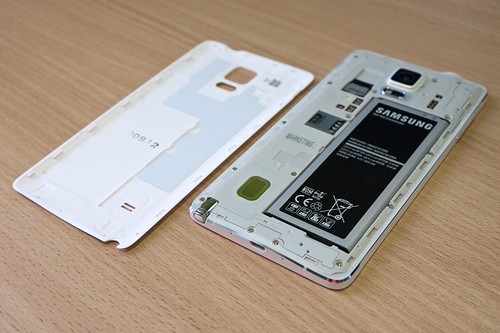

Lizard Squad hacker convicted on 50,000 hacking charges » Daily Dot

William Turton:

Julius “zeekill” Kivimaki, 17, was sentenced to a two-year suspended prison sentence and was “ordered to fight against cybercrime” according to Finnish media. The charges against Kivimaki include data breaches, felony payment fraud, telecommunication harassments, and other counts relate to fraud and violations of company secrets. Neither the Ministry of the Interior, Police Department of Finland, nor the District Court of Espoo, the court presiding over Kivimaki’s case, were available for comment in time for publication due to time differences.

Kivimaki helped lead massive distributed-denial-of-service (DDoS) attacks on Microsoft’s Xbox Live and Sony’s Playstation Network over last year’s winter holidays, making international headlines. Kivimaki appeared on camera during an interview with U.K. television station Sky News. Blair Strater, a victim of Kivimaki’s repeated harassment, was “absolutely disgusted” by the ruling, he told the Daily Dot in a phone interview, because he felt the sentence was too light. Kivimaki has, according to Strater, repeatedly called in fake threats to American law enforcement, resulting SWAT teams arriving at the Strater residence, a practice commonly known as “swatting.” For three years, Kivimaki has harassed the Strater family by stealing their identities and wreaking havoc on their finances and personal lives, Strater said.

Doubt he would have got that little in the US, despite his age.


Television is no longer the screen of choice for kids » Advertising Age

Anthony Crupi:

Mobile devices are so popular with kids that nearly half of the 800 parents quizzed by Miner & Co. reported that they confiscate their kids’ tablets when they act up and make them watch TV instead, thereby fostering a sort of Pavlovian response that equates TV with punishment. (That these parents simply don’t restrict their kids’ access to video altogether when they misbehave suggests that they’re raising a generation of spoiled content junkies, but that’s another story.).

“Go to your room and watch TV!”


The anxious ease of Apple Music » The New Yorker

Alex Ross:

So, contrary to plan, Apple has not necessarily succeeded in making music better. Then again, it might not be doing long-term damage; indeed, it might not be having much effect at all. The musicologist Deirdre Loughridge recently published a blog post about the history of music-subscription services, which date back to sheet-music lending libraries in the 18th century.

By the 1830s, pundits were fretting that such libraries were undercutting the economics of the music business and altering the nature of listening. “One enjoys superficially, one always wants something new,” a critic groused in the Allgemeine musikalische Zeitung. A few decades later, a piano teacher wrote, “Music lending libraries could very well be called ‘music snacking libraries.’” Almost identical complaints are being levelled at Spotify, YouTube, and the rest. These anxieties are now forgotten because, as Loughridge notes, the very existence of music-lending libraries has been forgotten. If they hurt music sales, the damage was soon repaired. Loughridge suggests that this obscure history should promote a “healthier skepticism toward claims that any model represents ‘the’ answer for the music industry.”

All I’d ask for from Apple Music is what Deezer offers, called “Flow”: one press and it generates a neverending playlist based on what you’ve listened to and liked, but adding new “alike” tracks.


How the tech press forces a narrative on companies it covers » Medium

Aaron Zamost:

I don’t remember who told me company narratives were like a clock. I was at Google, where I’d taken a job on the communications team despite zero experience in communications. During my early days there, I tried to navigate my new profession by listening to the many comms experts already at the company from whom I would learn so much. One theory about narratives stuck with me: A company’s narrative moves like a clock: it starts at midnight, ticking off the hours. The tone and sentiment about how a business is doing move from positive (sunrise, midday) to negative (dusk, darkness). And often the story returns to midnight, rebirth and a new day. It was a passing remark, and hardly revolutionary — it closely followed the hero’s journey and other theories of storytelling. But it made a ton of sense.

Oh wow, does it ever. (Though: not just tech, is it?)


Smartphone trends in the US » Tech.pinions

Jan Dawson:

One of the key things I’m hearing – and which was somewhat evident already in the Q1 2015 results the carriers announced – is that the huge upgrade cycle which happened in 2014, and especially in Q4, is somewhat sucking the wind out of sales in 2015 so far. Though that upgrade cycle was partly driven by massive iPhone sales, and is therefore good news for Apple, it seems to be somewhat depressing Android device sales in the first half of 2015, despite the new device launches from major vendors including Samsung, LG, and HTC.

In general, I suspect we’ll see somewhat lower rates of upgrading this year than we did last year, as there were a number of factors that drove higher than usual rates in 2014 and many of those customers will now not be upgrade-eligible until late 2015 or even 2016.

Convenient for Apple that it doesn’t really focus its efforts until late in the year.


Samsung sees seventh straight profit decline » WSJ

Jonathan Cheng and Min-Jeong Lee:

When the Galaxy S6 and its curved-screen variant, the Galaxy S6 Edge, were launched in April, the phones were praised by reviewers and greeted with strong advance orders from consumers. But Samsung appears to have badly miscalculated in its expectations for what kinds of smartphones these consumers were after. According to a person familiar with the matter, the company initially expected to sell four Galaxy S6 smartphones for each Galaxy S6 Edge that it sold, and set up its production facilities accordingly. Instead, demand was much likely closer to even for the two devices, the person said. That led to a glut of unsold Galaxy S6 devices—particularly white-coloured devices—and not enough Galaxy S6 Edge smartphones, the person said.

Analysts quoted in the story are estimating between 71m and 76m smartphones shipped in the quarter, of which the S6 and Edge would be “slightly more than 20%” (that’s 14.2m-15.2m – so take it as 15m). Being left with a colour variant is bad, bad news.


The reddit rebellion, how should reddit make money?, the disappearance of high-end Android » Stratechery

From Ben Thompson’s paid daily briefing:

This is a pretty clear screw-up by Samsung that suggests they don’t understand just how starkly the smartphone market has bifurcated: the only people buying a high-end Android phone want the top-of-the-line, and that means the Edge. Anyone who is concerned about price isn’t going to save $100 by buying a normal S6; they’re going to save $500 and get a perfectly serviceable phone that runs the exact same software. That said, I suspect that even had Samsung properly forecast Edge demand sales would have still been disappointing…

…it does seem likely that the S6 stole whatever HTC One customers existed: the Taiwanese smartphone manufacturer just reported a loss of $261 million on revenues of just over $1 billion; the company originally forecast revenues of $1.57 billion but the One M9 has been a complete flop. It seems likely (pending LG’s numbers) that there is only room for one high-end Android model, for now anyways; small solace for Samsung, but solace nonetheless.

I don’t usually excerpt from subscriber products like Thompson’s (because it’s effectively breaking the paywall, which is his livelihood) but this was too apposite to miss. Subscribe. It’s low-priced and insightful. (His suggestion for how reddit should make money is smart.)


Billion dollar turnaround: Sony Mobile CEO » ArabianBusiness.com

Neil King:

As an inevitable by-product of the unit’s recent performance, [Sony Mobile chief Hiroki] Totoki has had to fend off rumours that Sony is, or was, planning to sell off its mobile division as a result of the dire financial results. A defence, he says, is easy to make when you look at the reasons behind the poor figures. “The speculations arose because in 2014 we made a huge loss as a mobile business,” he says. “It mainly came from the write-off of the goodwill of our impairment asset. When we bought back Ericsson’s share [in 2012], we bought back 100 percent of it. And obviously that price was high. We had to write it down and it made a substantial loss for the company.

“But this was an accounting loss and did not impact our cash flow. Our cash flow is very healthy. But the accounting loss was so huge — that’s why people have speculated like this. “Before that rumour, we exited the VAIO business, which was the PC business. That led people to think that Sony would exit the smartphone business, as well. But the smartphone business is very different from PCs. “Smartphones are completely connected to other devices, also connected to people’s lives — deeply. And the opportunity for diversification is huge. We’re heading to the IoT (Internet of Things) era and have to produce a number of new categories of products in this world, otherwise we could lose out on a very important business domain.”

Two things: the writeoff of value wasn’t the entirety; Sony still made an operating loss, even ignoring goodwill writeoffs. Secondly, the IoT argument is why I think Microsoft will stick with the smartphone business despite its horrendous losses. Interesting to see Sony Mobile using it too.


Start up: Apple Music’s likely effects, no Paypal in Greece, how Bitstamp was hacked, and more


Of 58 aboard, only 15 survived. But was the crash due to machine or human error?

A selection of 8 links for you. Use them wisely. I’m charlesarthur on Twitter. Observations and links welcome.

Why the next few months of Apple Music will throw up a few surprises » Music Industry Blog

Mark Mulligan:

As we revealed on our MIDiA Research report on Apple Music back in March 28% of iOS users stated they were likely to pay for the service. Among downloaders the rate is 39% and for existing subscribers that rate rises to 62%. Consumer surveys of course always over-report so we shouldn’t expect those rates of paid adoption but the relative values are interesting nonetheless.

Given that 50% of existing subscribers are iOS users the implications are that a big chunk of Spotify et al’s subscribers will at the very least try out Apple’s 3 month trial, which is plenty enough time to get build a comprehensive library of playlists and to get hooked. But there is also going to be a big wave of downloaders that do not currently subscribe that will try it out.

As the iOS 8.4 update virtually pushes iTunes Music users into starting the trial on updating, expect pretty widespread uptake of the trial. Apple reached 11 million users for iTunes radio within 5 days of launch, 21 million within 3 months. Apple Music has had a far bigger build up and is much more deeply integrated into iOS so a fairly safe bet is that those numbers will at the very least be matched.

It’s getting people to pony up that’s hard. Adding Android users (with Apple Music for Android in autumn) might just be the icing on the cake; iOS is where the numbers and easy money will be.

Mulligan points to other surprises too – read on there.


Reddit’s AMA subreddit down after Victoria Taylor departure » Business Insider

Biz Carson:

The iAMA and Science subreddits both were set to private today after Reddit’s director of Communications, Victoria Taylor was allegedly dismissed. In a Reddit thread about her departure, she replied that she was “dazed” and “hopefully” plans to stay in the PR field.

Reddit and Taylor have not yet responded to request for comment.

One of Taylor’s job duties was coordinating the site’s popular AMAs.  Two of the site’s most popular posts ever are AMAs: the one with Barack Obama and a conversation with a man with two penises. The AMA subreddit became such a popular section of the site that Reddit eventually spun it out into its own app.

Something’s up at Reddit; it’s either going to come through this much stronger, or run into the sand.


40 states line up with Mississippi in Google Adwords pharma scrap » The Register

Andrew Orlowski:

Attorneys General representing 40 US states have filed an amicus brief backing Mississippi attorney general Jim Hood’s investigation into Google.

In December, the giant multinational sued the state of Mississippi after it had opened an investigation into Google’s business practices (claiming Hood’s complaints did not come under state law jurisdiction), and earlier this year a District Court froze this investigation.

The attorneys say if the freeze is upheld, it will have a chilling effect on investigative subpoenas across the US.

Hood’s 79-page subpoena inquires mainly into Google’s advertising practices, focussing on the sale of illegal and controlled substances.

Four pages consist of inquiries into how Google deals with IP enforcement. It follows from a 2011 non-prosecution agreement (NPA) between Google and the FBI, the FDA and Rhode Island into rogue drug traffickers, who used Google Adwords to move their wares. Google agreed to a $500m fine, $230m of which was funnelled to Rhode Island.

The NPA lapsed in 2013, three months early, with no indication from Federal authorities that Google had actually complied. That’s when the states got serious.

This is an odd case. Hood comes across as a little obsessed (but is that bad in a lawman?), but Google comes across as vindictive – and not a little defensive.


Bitstamp Incident Report (PDF) » Bitstamp

The bitcoin exchange had 18,000 BTC, worth (then) about $5m, stolen:

On 9 December 2014, Bitstamp’s Systems Administrator, Luka Kodric, received a phishing email to his Gmail account. Unlike some of the others targets, Kordic did have access to Bitstamp’s hot wallet. The email header had been spoofed to appear as if it had been sent from konidas@acm[.]org, although it was actually received from a Tor exit node [the email chain and header details can be seen in full at Appendix A].

ACM is the Association for Computing Machinery, which describes itself as the world’s largest educational and scientific computing society. The sender was offering Mr. Kodric the opportunity to join Upsilon Pi Epsilon (UPE), the International Honour Society for the Computing and Information Disciplines.

The UPE site is hosted within the acm.org domain. On 11 December, as part of this offer, the attacker sent a number of attachments. One of these, UPE_application_form.doc, contained obfuscated malicious VBA script. When opened, this script ran automatically and pulled down a malicious file from IP address 185.31.209.145, thereby compromising the machine.

As the security researcher The Grugq observed, “Computer security is such an unsolved problem that Bitstamp lost $5m because someone had macros enabled in Microsoft Word.”


The (slight) rise of _nomap » OpenSignal blog

Samuel Johnson, on OpenSignal’s checking of how many Wi-Fi networks added the suffix “_nomap” to stop Google mapping their location:

Wifi networks with nomap

This graph also shows a rise beginning at the end of 2013 and continuing into 2014. Edward Snowden’s revelations about the NSA’s privacy incursions occurred during the summer of 2013 – and so it is possible that the heightened awareness about privacy issues could have led to more people taking care that Google was not recording their Wi-Fi hotspot. However, compared to the number of global Wi-Fi networks detected by OpenSignal, it is clear that the number that adopted Google’s solution is very small.

So why is this? Obviously it was deeply concerning that Google were tracking payload data – but it is not in itself concerning that they are collecting Wi-Fi SSIDs (after all, this is what we at OpenSignal do). Those technologically savvy enough to have followed the story (and continued to do so months after the initial outburst of outrage) will know that Google had publicly pledged to stop tracking Wi-Fi payload data, and so any appending _nomap to their Wi-Fi hotspots would not make any difference to that.


We’ve finally hit the breaking point for the original Internet » The Washington Post

Brian Fung:

It’s finally happened. The North American organization responsible for handing out new IP addresses says its banks have run dry.

That’s right: ARIN, the American Registry for Internet Numbers, has had to turn down a request for the unique numbers that we assign to each and every smartphone, tablet and PC so they can talk to the Internet. For the first time, ARIN didn’t have enough IP addresses left in its stock to satisfy an entire order — and now, it’s activated the end-times protocol that will see the few remaining addresses out into the night.

The end of IPv4 has been forecast for a few years now. Looks like it’s actually going to happen, and we’ll move to IPv6.


PayPal no longer works in Greece—and why that matters » Quartz

Shelly Banjo:

Adding to their list of woes, Greeks can no longer use their PayPal accounts.

Limits on how much money Greeks can take out of banks put in place by their debt-stricken government as it negotiates with lenders have effectively crippled the online payment service, which relies on traditional banks and credit cards to transfer money.

According to a PayPal spokesman:

Due to the recent decisions of the Greek authorities on capital controls, funding of PayPal wallet from Greek bank accounts, as well as cross-border transactions, funded by any cards or bank accounts are currently not available. We aim to continue serving our valued customers in Greece in full, as we have for over a decade.

Except that they can’t serve their valued customers. So, why does it matter?

PayPal’s shutdown in Greece reminds us how difficult it is to disintermediate banks from the flow of money.

Well duh. Did you think it was all going to bitcoin? As the Bitstamp link above shows, good luck with that.


Faulty credit card-sized connector led to crash of 20-tonne plane » Bloomberg Business

Tim Culpan:

A faulty connector about the size of a credit card helped trigger a series of mechanical and human failures that led to the crash of a 20-ton aircraft in February, killing 43 people, investigators in Taiwan found.

Microscopic tests of a soldered connector joint on the TransAsia Airways Corp. plane engine showed potential cracking, and the connector failed post-crash tests, the Aviation Safety Council said in a report today.

That failure is at the heart of why the ATR72 twin-propeller plane incorrectly sounded a cockpit warning and an engine adjustment known as autofeather. That set in motion a series of pilot errors that eventually crashed the aircraft into a downtown Taipei river Feb. 4.

The autofeather made the engine ineffective. Pilot error then played a big part: they shut down the other engine, wrongly thinking it was the affected one.

How do you design faults like those out of a system? First the machines screw up, then the humans.


Start up: Wi-Fi password sharing?, machine intelligence smart and stupid, Pebble Time review, and more


You’ll never believe what happens if you play it backwards. Photo by Janitors on Flickr.

A selection of 9 links for you. Show them eagerly to the person beside you! I’m charlesarthur on Twitter. Observations and links welcome.

UH OH: Windows 10 will share your WiFi key with your friends’ friends » The Register

Simon Rockman:

A Windows 10 feature, Wi-Fi Sense, smells like a security risk: it shares WiFi passwords with the user’s contacts.

Those contacts include their Outlook.com (nee Hotmail) contacts, Skype contacts and, with an opt-in, their Facebook friends. There is method in the Microsoft madness – it saves having to shout across the office or house “what’s the Wi-Fi password?” – but ease of use has to be teamed with security. If you wander close to a wireless network, and your friend knows the password, and you both have Wi-Fi Sense, you can now log into that network.

Wi-Fi Sense doesn’t reveal the plaintext password to your family, friends, acquaintances, and the chap at the takeaway who’s an Outlook.com contact, but it does allow them, if they are also running Wi-Fi Sense, to log in to your Wi-Fi. The password must be stored centrally by Microsoft, and is copied to a device for it to work; Microsoft just tries to stop you looking at it. How successful that will be isn’t yet known.

“For networks you choose to share access to, the password is sent over an encrypted connection and stored in an encrypted file on a Microsoft server, and then sent over a secure connection to your contacts’ phone if they use Wi-Fi Sense and they’re in range of the Wi-Fi network you shared,” the Wi-Fi Sense FAQ states.

Has been on Windows Phone for ages, yes, but most WP users don’t know any significant number of other WP users (because they’re so few). Not so with Windows. Microsoft says it only allows internet access and not LAN access – via port restrictions? That’s going to get hacked for sure.

Or could people maliciously spread their Wi-Fi details to try to sniff people’s viewing habits and details?


Pebble Time review » Wareable

Sophie Charara:

First things first, the Pebble looks better in real life than the pics you’ll have seen online. The black model is a little boring but will look neat under suit sleeves – for the record, we prefer the red and black Time.

Admittedly, the Time is plasticky, with a stainless steel bezel, but it retains the toy-like charm of the original Pebble while adding friendlier, more unisex curves. It’s very light at just 42.5g including the standard strap, 20% thinner at 9.5mm and the new slightly curved body helps to make it comfortable to wear on the wrist.

It’s amazing how many smartwatch manufacturers are satisfied with making devices that sit flat on top. The Time is the kind of smartwatch you can forget you’re wearing, until it vibrates.

I bought an original Pebble on Kickstarter. This? Looks like a toy compared to the Apple Watch. Not quite half the price, but really nothing like half as attractive.


Apple Sim iPads change the international data roaming game » Fortune

This morning, Apple and GigSky teamed up to offer travelers the ability to instantly connect to a local data network in more than 90 countries and territories upon touchdown—no need to visit a kiosk, talk to a service agent, or really, do anything at all. Instead, iPads with AppleSIM cards will automatically offer the option to sign up for a data plans as soon as a local network is in reach. (The GigSky network includes most of Western Europe, from France and Germany to the Netherlands; Australia; South Africa; parts of the Middle East; and beyond.)

Because travelers are accessing onto local networks, rather that roaming from their domestic carrier, prices are impressively affordable as long as you’re traveling on the beaten path. Entry-level data plans begin at just $10, covering anywhere between 10MB (in Papua New Guinea) to 75 MB (in Italy); in countries with better access, the premium plans top out at 3GB for $50. By comparison, AT&T’s best deal currently charges $30 for 120 MB or $120 for 800 MB.

Latest iPads only have them preinstalled, although for older ones you can get Apple SIMs in its stores, apparently.


Superconductivity record bolstered by magnetic data » Scientific American

Edwin Cartlidge:

The long-standing quest to find a material that can conduct electricity without resistance at room temperature may have taken a decisive step forward. Scientists in Germany have observed the common molecule hydrogen sulfide superconducting at a record-breaking 203 kelvin (–70 ˚C) when subjected to very high pressures. The result confirms preliminary findings released by the researchers late last year, and is said to be corroborated by data from several other groups.

Some physicists urge caution, however. Ivan Schuller at the University of California in San Diego, says that the results “look promising” but are not yet watertight.

Pressure of 1.5 million atmospheres. Don’t hold your breath for this one.


Why the BBC is wrong to republish ‘right to be forgotten’ links » The Guardian

Julia Powles:

The reaction to [BBC Online managing editor Neil] McIntosh’s post was predictable, inaccurate and devastating. The Times led with “BBC lists stories on abusers and rapists hidden under ‘right to be forgotten’”, gratuitously highlighting two stories.

The first was a 12-year-old story about a settlement between an alleged rape victim and the Catholic church, over incidents that occurred a half-century ago. The long-deceased abuser clearly couldn’t have filed the obscurity request with Google – leaving, rather less salaciously, the victim.

The second case concerned a nanny jailed for child abuse. Even a cursory Google search coupled with the basics of the Rehabilitation of Offenders Act would have told the journalist that an unspent conviction for such an offence clearly denied any reasonable claim to delisting. Caution raised, a bit more searching would have revealed the truth: that the conviction was overturned by the Court of Appeal. That former nanny has been exculpated under the law of the land – but not by Google and not, it seems, by the press either.

Other publications followed suit. Boing Boing drew attention to a rape story. Given it concerned a fairly recent conviction in 2012, clearly the sex offender has no entitlement to be delisted.

But what about his friend who was also named in the article because he happened to be in the house where the attack took place?

The “right to be forgotten” is so poorly understood, which frustrates the hell out of me. (See the comments under the article.) I wrote an explanation of what it is, and what it is not; please, before you discuss the topic with me (or anyone), read and absorb it. The topic is simple. It just takes a bit of thought.


Growing conspiracy theory: is spy equipment really included in Samsung smartphone batteries? » BusinessKorea

Cho Jin-young:

A video circulating on Facebook and YouTube that was posted at the beginning of the last week of June shows that after tearing off a sticker that wraps around the battery of the Galaxy S4, the man in the video points to a small coil inside, saying, “This is the spy equipment.”

He remarked, “Samsung can record pictures on your smartphone and overhear your calls through the coil shaped like this antenna,” adding, “So, you’d better tear off the sticker that wraps the battery first and use the phone.”

In fact, this video attracted 12 million views on Facebook only four days after it was initially posted, and around 300,000 people reportedly shared the video.

However, local media outlets pointed out that this conspiratorial video originated from a misunderstanding about the Near Field Communication (NFC) antenna, a communication technology that makes it possible to transmit different kinds of wireless data to a distance of 10 cm.

Would be fun to know how weird ideas like this get started. I’ve seen a few incoming search queries on this to this blog, and wondered what was going on (it was because I wrote about Samsung obviously knowing whether people use replacement batteries).


DRAM spot prices hit 28-month low, says Taiwan Central News Agency » Digitimes

Jessie Chen:

Spot prices for 4Gb DDR3 chips already declined 17.55% in the second quarter, after falling 12.77% in the first quarter, the report quoted DRAMeXchange as saying.

Since 2015, DRAM spot prices have been dragged down by sluggish PC sales and a slowdown in smartphone demand, the report noted.

Hadn’t heard about this slowdown in smartphone demand anywhere else. China has, but elsewhere? Dram prices are often an early warning though.


Google apologises for Photos app’s racist blunder » BBC News

Google says it is “appalled” that its new Photos app mistakenly labelled a black couple as being “gorillas”.

Its product automatically tags uploaded pictures using its own artificial intelligence software.
The error was brought to its attention by a New York-based software developer who was one of the people pictured in the photos involved.

Google was later criticised on social media because of the label’s racist connotations.
“This is 100% not OK,” acknowledged Google executive Yonatan Zunger after being contacted by Jacky Alcine via Twitter.

“[It was] high on my list of bugs you ‘never’ want to see happen.”

Machines can’t be racist, of course; but quite how Google is going to prevent this happening again is an open question. Neural network/deep learning like this isn’t something you can tweak directly. You can’t really peer inside it. Great when it’s drawing arcane pictures, not good when it’s mislabelling pictures.


Could this computer save your life? » CNN

Jillian Eugenios:

“In one panel of scans that we looked at, when you look at the number of times that radiologists sent someone home with a clean bill of health, about 7% of the time that patient was ultimately found to have cancer,” said John Zedlewski, a data scientist with Enlitic, a medical technology company.

When Zedlewski used Enlitic’s algorithm against the same panel, there weren’t any mistakes.

How does it work? Enlitic’s technology uses machine learning — which some say is a version of artificial intelligence. It takes medical information from one patient — whether it’s a CT scan, an X-ray or details about, say, a tumor — and then converts it into a mathematical representation. It’s then added to a large pool of data and compared to other patients who have experienced similar issues.

Think of it as crowdsourcing your symptoms. And not just with one or two people, but millions. The more data the computer has, the smarter it gets, and the more accurate the diagnoses.

At least that’s the dream.

Seems to have a large base of data.