
Start up: finding Waldo, Amazon’s tablet gripe, Samsung 4:3 tablet?, better interface design, and more


OK, that’s not so challenging. Picture by cybertoad on Flickr.

A selection of 9 links for you. May contain nuts. I’m charlesarthur on Twitter. Observations and links welcome.

Sapphire displays to see major step forward with lower reflectivity » Mac Rumors

While GT Advanced experienced difficulties with both the quality and quantity of sapphire, it is possible that Gorilla Glass was the better choice for the iPhone 6 and iPhone 6 Plus after all. TIME reported in September that sapphire, in its current form, has several properties that are less ideal than glass, including being thicker and heavier, more expensive, unable to transmit as much light and less durable after exposure to normal wear and tear. Sapphire also has up to double the screen reflectance of glass, especially under bright light, which could make it difficult to read the screen.

The reflective issue in particular could soon be a thing of the past, however, as DisplayMate confirmed to MacRumors that it has lab tested new sapphire technology that it believes will be a major breakthrough for smartphone displays. The display calibration and evaluation company found the production-ready enhanced sapphire to be at an advantage over both regular sapphire and glass based on the results of its testing, and predicted that “rapidly falling production costs” could make the material go mainstream in the near future.

I doubt that the sapphire being made at GT Advanced was planned for 2014’s iPhones. These problems would have been recognised, and the volumes would be too low to make screens for so many devices. Sapphire feels like a super-top-end product – as it is for Vertu. And that means low volume (comparatively).

Other phone makers are considering it, for sure.


Microsoft’s mobile inabilities » Om Malik

Microsoft has acquired two iOS applications — Acompli (email) and Sunrise* (calendar) — for about $300 million. Those acquisitions are good for the founders (and their investors). Some might see it as a sign of a new Microsoft — aggressive and quick in trying to turnover a new leaf. To me, they are all of that, but more importantly indicative of the much deeper cultural rot facing Microsoft and its now not so new chief executive, Satya Nadella.

“He’s hit all the low-hanging fruit — that said, these things were not easy to do — but now he has to address all the long-term issues,” Brad Silverberg, a former Microsoft executive-turned-venture capitalist told Bloomberg Business in an interview. Spot on — and these two acquisitions are just a perfect example of these long term challenges.

It is a pretty damning indictment that Microsoft had to spend hundreds of millions on front end apps for its own platform –Microsoft Exchange — and it should send alarm bells ringing. Exchange is something Microsoft understands better than most and it should in theory be able to develop good apps as front end for it.

I don’t agree. Nadella is being pragmatic here: Microsoft is a big organisation, and it moves slowly. Everyone recognises that small startups can hit precisely the user needs that big organisations can’t see, or can’t develop for even if they see. It has done poorly in mobile so far.

What it’s doing with these app purchases is strengthening Outlook – locking it in place as a product that will continue to rake in money year after year, especially because everyone will get a great experience using it on mobile via these apps.


Meet the ultimate WikiGnome » Medium

Andrew McMillen:

Maryana Pinchuk and Steven Walling addressed a packed room as they answered a question that has likely popped into the minds of even the most casual users of Wikipedia: who the hell edits the site, and why do they do it?

Pinchuk and Walling conducted hundreds of interviews to find out. They learned that many serious contributors have an independent streak and thrive off the opportunity to work on any topic they like. Other prolific editors highlight the encyclopedia’s huge global audience or say they derive satisfaction from feeling that their work is of use to someone, no matter how arcane their interests. Then Walling lands on a slide entitled, ‘perfectionism.’ The bespectacled young man pauses, frowning.

“I feel sometimes that this motivation feels a little bit fuzzy, or a little bit negative in some ways… Like, one of my favorite Wikipedians of all time is this user called Giraffedata,” he says. “He has, like, 15,000 edits, and he’s done almost nothing except fix the incorrect use of ‘comprised of’ in articles.”

Turns out to be 51-year-old software engineer Bryan Henderson. It beats commenting on websites as a lasting contribution, don’t you think?


The Next Episode: Apple’s plans for Beats-based music service revealed » 9to5Mac

Mark Gurman on the much-anticipated integration of Beats into Apple:

Rather than merely installing the existing Beats Music app onto iPhones, Apple has decided to deeply integrate Beats into iOS, iTunes, and the Apple TV. The company is currently developing new Beats-infused versions of the Music application for the iPad, iPhone, and iPod touch, as well as an updated iTunes application for computers that deeply integrates Beats functionality. A new Apple TV application is also in the works.

Based heavily upon cloud streaming, Apple’s new service is centered around the user’s music library. A new search feature will be able to locate any song in the iTunes/Beats catalog, and users will be able to stream music from the catalog as well as add songs to their personal libraries. Users will be able to select specific tracks to store on their iOS devices and/or computers, or keep all songs solely in the cloud. Apple will also deeply integrate Beats Music’s Playlists, Activities, and Mixes features into the new service, letting users access a vast array of pre-made, human-curated playlists to fit various activities. Surprisingly, Apple is likely to also update Beats’ social networking features, allowing people to follow other users and artists as they did with the failed Ping social music network.

Aiming for a lower price point than the $9.99 per month; Apple wanted $5 but is being pushed to $7.99 by labels. This fits with what I’ve been hearing from analysts and people in the music industry. A lower price is essential to getting more subscribers.


To make tech design human again, look to the past » WIRED

Tom Lakovic of the design company INDUSTRY:

who’s doing it wrong? Examples are everywhere of touch screens existing where no touchscreen should be. Even our favourite innovators over at Tesla Motors have missed out on potentially great DigiLog experiences in their Model S. Personally, I’d love to redesign their console just so I could get that oversized iPad out of their otherwise amazing cars.

You can’t just lean on PARC-style metaphors in every single context moving forward. You have to evaluate and re-evaluate the tradeoffs of digital versus analog interactions. What you gain by dropping in a giant touchscreen that controls every aspect of your vehicle experience is easy to state: customizable skins and software upgradable UIs, but what is lost in the translation?

I’m pleased that he agrees with me about Android Auto and Apple’s CarPlay: I don’t like the distraction they imply. I also liked this diagram of touch done right and wrong:

(Via Neil Cybart’s Above Avalon newsletter. You should subscribe.)


Profitable and uncopyable » Matt Richman

Apple Pay will succeed for one simple reason: Everyone in the system has an interest in it succeeding. Card issuers like Apple Pay because it reduces their fraud liability. Card networks like it because it reinforces their role in the system. Merchants like that it precludes Target-style data breaches. Everyone has a reason to want Apple Pay to succeed, so it will.

How much Apple will profit from Apple Pay is anyone’s guess. Mine is: Over time, a lot. In the US alone, credit and debit card transactions totalled $3.9trn in 2013. Since Apple gets a 0.15% cut of every Apple Pay transaction, a measly 10% transaction share is worth $585m. One year, one country, $585m. Over time, Apple will make billions from Apple Pay.

Though Apple Pay will make Apple a ton of money, the strategic implications of the service are worth far more. With Apple Pay, Apple leveraged its business model, cultural influence, and customer base to enter arguably the most heavily-regulated international system on Earth in a way that everyone already in the system had a reason to like. This is an incredible accomplishment, and no other company could have done it.

Google does not control Android enough to create anything truly comparable to Apple Pay. Even if Google were able to add Apple Pay’s software components to Android, the company would have to rely on its hardware partners to replicate Touch ID and the secure element and to seamlessly integrate everything together. They’re not going to be able to do that for the foreseeable future.

A few nitpicks. Not all retailers like all aspects of Apple Pay – in particular, they don’t get customer data they got previously, and might still want. (Whether they should get that is another matter.) Also, 10% of all transactions is a lot – but his number shows that even a couple of percentage points is very valuable, and almost all profit.

On the topic of Google, there is Google Wallet – whose key problem is poor and inconsistent implementation. The secure element is already available in ARM chips. But it will take a long time to feed through to handsets in use.


Amazon takes issue with report that holiday Fire tablet sales fizzled » Re/code

Dawn Chmielewski:

Researcher IDC said Amazon showed the steepest annual decline among the five major tablet makers, with worldwide shipments of its Kindle Fire devices falling by as much as 70% compared with the holiday 2013 period. The declines come at a time when worldwide shipments in the fourth quarter fell for the first time since the tablet market’s inception in 2010.

But there’s a caveat in the results: IDC doesn’t count shipments of Amazon’s new six-inch version of its Kindle Fire HD tablet, introduced in September and ranked among the “most wished for” gift items of the holiday season. A spokesperson for the retailer criticized IDC’s methodology, saying “our most affordable tablet ever, the Fire HD 6 at $99, which is one of our high volume products, wasn’t included in the report.” She declined to discuss sales.

Er.. if you’re going to call it a “high-volume product”, shouldn’t you help people out by explaining what that volume is? Doing this is like saying the cake you’ve got in the fridge is wayyy bigger than people are saying. But then not opening the fridge. Mmm, cake.

But wait, there’s more:

IDC Senior Research Analyst Jitesh Ubrani said the researcher doesn’t consider the Kindle Fire HD 6 a tablet because of its screen size and its inability to connect to cellular networks. It’s more of a media player, in the researcher’s view. But even if the estimated 1.2m shipments of the device were included in IDC’s numbers, Amazon’s holiday tablet shipments would still be off by 50% from the prior year, he said.

Soooo… the Kindle has hit its ceiling for sales; the Fire phone was a flop; the Fire tablet has fizzled. Let’s look forward to not hearing how the Amazon Echo has sold.


Wishbone: the world’s smallest smart thermometer by Joywing Tech » Kickstarter

The core function of Wishbone is to detect temperature using an infrared sensor. Wishbone is noninvasive, reliable and versatile for many applications. It can accurately measure body temperature by measuring forehead skin and examine liquid temperature from surfaces in just a few seconds. While measuring, Wishbone does not emit any radiation or sound as it uses a passive sensor.  Wishbone can also measure environment temperature by pointing it toward the sky or ceiling. Both Object and Ambient modes are still currently under development.

Works on iOS and Android (it plugs into the headphone jack). I think this is neat; I’ve backed it. (It’s already miles past its goal.) I like the idea of the Object and Ambient modes. Notice too how smartphones are now offering core functionality for medical products like this.

Yes, a simple alcohol thermometer is cheaper – but less flexible. As more people have smartphones, more functions and industries get sucked into them.


New Galaxy Tab 5 might have 4:3 aspect ratio as well » SamMobile

We have already reported that Samsung is working on new Galaxy Tab tablets. It is expected that these tablets are going to have displays with 4:3 aspect ratio instead of the 16:9 aspect ratio that Samsung has stuck with in the past. According to information obtained through the import tracking website Zauba the new Galaxy Tab 5 may also have a 4:3 aspect ratio. The import tracker picked up on a new Galaxy Tab 5 model imported into India and it seems to have a 9.7-inch display, similar to the screen size of Apple’s iPad, which also has a 4:3 ratio.

I’ve been told – endlessly – by people who claim it’s important that 16:9 is the “right” ratio for tablets because it means you can watch films without letterboxing. Now we find that Google (qua the HTC-built Nexus 9) and now perhaps Samsung are going for 4:3, like the iPad… which has seen the most success in the market.


Start up: Apple Watch battery life, Amazon Echo reviewed, 3D lightning, dark web buying, Google MVNO only data?, and more


It’s fine, they’re all micro-USB. Photo by practicalowl on Flickr.

A selection of 10 links for you. Slippery when wet. I’m charlesarthur on Twitter. Observations and links welcome.

Apple targets for Apple Watch battery life revealed, A5-caliber CPU inside » 9to5Mac

Mark Gurman (who has a good track record):

According to our sources, Apple opted to use a relatively powerful processor and high-quality screen for the Apple Watch, both of which contribute to significant power drain. Running a stripped-down version of iOS codenamed SkiHill, the Apple S1 chip inside the Apple Watch is surprisingly close in performance to the version of Apple’s A5 processor found inside the current-generation iPod touch, while the Retina-class color display is capable of updating at a fluid 60 frames per second.

Apple initially wanted the Apple Watch battery to provide roughly one full day of usage, mixing a comparatively small amount of active use with a larger amount of passive use. As of 2014, Apple wanted the Watch to provide roughly 2.5 to 4 hours of active application use versus 19 hours of combined active/passive use, 3 days of pure standby time, or 4 days if left in a sleeping mode.

Umm. 19 hours is.. 7am to 2am of the next day. That could work if you’re really prepared to recharge it daily. Begins to sound like work, though. In September I reckoned that “a watch that needs constant recharging isn’t a watch, it’s a burden”.


Amazon Echo review: listen up » The Verge

David Pierce:

Other than a blue-green light that flashes around the top of the canister, Alexa offers no real feedback while she works. So when a command fails to register, it just… fails. Sometimes she doesn’t hear me; sometimes she doesn’t know quite what I’m saying. In either case, she ignores me and just keeps on playing the 30-second preview of “Uptown Funk.” (This, by the way, is the one place where the Echo can actually buy things for you: just say “Buy that song,” and it’ll get added to your Prime library.)

The hardest thing about using the Echo is that I can’t get a firm grip on its limitations. If I knew not to ask it certain questions, or to always phrase questions certain ways, that would be fine. But I can’t explain why Alexa knows Andrew Jackson is the proper response to “Who was the seventh president of the United States?” but can’t tell me Thomas Jefferson was the third. I can stand right next to it, and it hears me fine… until it doesn’t.

For $200, hard to see the point. A phone can do much the same, and more besides. A Bluetooth speaker is cheaper. Was this a Bezos idea too?


3D lightning » Calculated Images

Richard Wheeler:

Reddit is a great website, where the ability to share and discuss things on the web gives some great little discoveries. Things that would otherwise seem impossibly unlikely, like two people in completely different places getting a photo of the same lightning bolt, suddenly pop up all the time.

And once you have that, you can do some maths and use a couple of assumptions, and draw what the bolt of lightning looked like in 3D space. Oh yes you can. (And again a year later.)

(The rest of the blog is quite fun too, apart from the entry about Elvish script. Not wanted on voyage.)


Apple, marketing, and black culture » Haywire

It isn’t discussed often, and maybe it’s marketing, too — but there’s a pattern here, and a clever one at that. Apple is using powerful images, quotes, videos, and other forms of media created by black artists and orators. And, while it’s great PR, I also believe it’s quite genuine and surely consistent. The company is obviously intentional with how it interacts with the public at large. Many companies may try this kind of PR, but they wouldn’t be able to pull it off. When you step back and look at the language in the letters, the imagery and messages on their site, the cultural strategy in acquiring Beats, and the 2014 holiday video spot, the threads tie together tastefully to portray a different side of Apple not often covered in the tech blogs.

I was really struck by this when I appeared as a guest on Channel 4 News with Lethal Bizzle (look him up if you don’t) to talk about the Beats acquisition. Quietly, yet effectively, Apple is positioning itself to appeal to urban, not just black, culture. Beats is a big part of that.


Ordnance Survey change in operating model: Written statement » UK Parliament

From Matthew Hancock, of the Department of Business, Innovation and Skills:

Ordnance Survey exists in a fast moving and developing global market. There has been rapid technology change in the capture and provision of mapping data, and increasingly sophisticated demands from customers who require data and associated services – including from government. To operate effectively, Ordnance Survey needs to function in an increasingly agile and flexible manner to continue to provide the high level of data provision and services to all customers in the UK and abroad, in a cost effective way, open and free where possible. Company status will provide that.

Mapping data and services are critical in underpinning many business and public sector functions as well as being increasingly used by individuals in new technology. Ordnance Survey sits at the heart of the UK’s geospatial sector. Under the new model, the quality, integrity and open availability of data will be fully maintained, and in future, improved. Existing customers, partners and suppliers will benefit from working with an improved organisation more aligned to their commercial, technological and business needs.

Hmm. Ordnance Survey was a “trading fund” – basically, a little company unto itself inside the government, although making some map data free in 2010 meant it got a straightforward subsidy from government to fund that.

It’s not clear why it should need to change from “trading fund” to “Government Company” (nor even what the difference actually is). Unless – as some fear – it’s a prelude to privatisation.


Deep web marketplaces » Joel Monegro

Monegro bought a pair of boots for his girlfriend to find out more about how these places – accessible only via Tor – work:

Over the past couple of weeks, I’ve been frequenting the deep web marketplaces most famously used for buying drugs online with Bitcoin.

I wanted to see if there was anything we could learn about how these illicit marketplaces work that could be applied to improve the legal marketplaces we invest in at [venture capital company] USV.

As part of my research, I purchased an item on Evolution (no, not drugs – a pair of furry boots) in an effort to understand the dynamics of these marketplaces, from trust and safety to flow of funds. This is what I learned in the process. 

It’s fascinating, and Tor and bitcoin underlie it all. The manoeuvres taken by those who ship from or to physical addresses is hugely inventive too. It’s solving the question of “how do you carry out transactions requiring trust when you don’t, and can’t, trust anyone?”


Google reportedly on the verge of launching ‘Nova,’ a cellular phone service to compete with big four carriers » Android Police

Jacob Long:

The report, first published by The Wall Street Journal, mentions that the program has been codenamed “Nova” internally. That sounded familiar to us, because we had been tipped about a similar program called “Nova” last year. We had not been able to get more info and did not report on it – until now.

Our tipster told us that Google Voice (now, that would probably be Hangouts) would be the backbone of the Google plans, which would be data-only. With access to mobile data and possession of a Voice number, the experience would theoretically be nearly equivalent to a conventional phone plus data plan. The tipster also told us that the plans would offer unlimited data, while leaning on WiFi where available.

Android Police has excellent sources in (or around) Google, and this would make a lot of sense. You’d be pretty screwed for voice call quality if you couldn’t get a 3G signal, though, and as Google is looking to MVNO using Sprint and/or T-Mobile (one is GSM, one is CDMA), their 2G networks aren’t compatible. So you’d need 3G to make a call. And those two networks are smaller than AT&T or Verizon. So you’d be geographically limited.

Looks like Google is banking on people wanting smartphones only for data. In which case you might as well get a tablet..?


Microsoft’s Windows RT isn’t dead…yet » CNET

Shara Tibken:

All of the major device makers working with Windows RT scrapped their products either before they hit the market (such as HP and Toshiba) or following dismal sales once the products were released (in the case of Dell). To say interest in the software was – and remains – low is an understatement. Even the ARM chipmakers who were to benefit from the operating system, including Nvidia and Qualcomm, largely threw in the towel, focusing their investments and efforts elsewhere.

The only device to really utilize the software has been Microsoft’s own Surface tablet. The company released the first generation of its Windows RT-based Surface in late 2012 but revealed in July 2013 that it lost $900m on the device.It released Surface 2 later that year but hasn’t created any more Windows RT tablets since then. At the same time, Microsoft has released three generations of the Surface Pro lines of tablets that run Intel chips, and it continues to heavily advertise the devices.

Would love to know how many Windows RT installs there are, and what percentage are Surfaces. I’d wager it’s around 80% or higher.


Net Neutrality: no on reclassification, yes on adding content & app providers » Inside BlackBerry

John Chen:

Unfortunately, not all content and applications providers have embraced openness and neutrality. Unlike BlackBerry, which allows iPhone users to download and use our BBM service, Apple does not allow BlackBerry or Android users to download Apple’s iMessage messaging service. Netflix, which has forcefully advocated for carrier neutrality, has discriminated against BlackBerry customers by refusing to make its streaming movie service available to them. Many other applications providers similarly offer service only to iPhone and Android users. This dynamic has created a two-tiered wireless broadband ecosystem, in which iPhone and Android users are able to access far more content and applications than customers using devices running other operating systems. These are precisely the sort of discriminatory practices that neutrality advocates have criticized at the carrier level.

Therefore, neutrality must be mandated at the application and content layer if we truly want a free, open and non-discriminatory internet.

Epic trolling by Chen, in this extract from a letter sent to a Senate committee on Commerce, Science and Transportation. Net neutrality, of course, is a debate about whether a network allows bits to flow regardless of origin or destination – not who writes bit-wrangling programs for one endpoint or another.

More briefly, net neutrality is an argument about bridgekeepers and tolls; Chen is trying to make it about “who tries to get across the bridges and to which destination”. It doesn’t take much reflection to see that you can legislate the former for positive net (ha) outcome, but that legislating the latter turns you into a controlled economy. Is John Chen really a secret Marxist?

(Even the people on the Crackberry forums, usually the most loyal of the loyal, don’t back him.)


San Francisco woman pulled out of car at gunpoint because of license plate reader error » American Civil Liberties Union

On March 30, 2009, Denise Green, a 47 year-old black woman, was pulled over by multiple SFPD squad cars. Between four and six officers pointed their guns at her—one had a shotgun, she says—and told her to raise her hands above her head and exit her car. She was ordered to kneel, and she was handcuffed. Green, who suffered from knee problems, complied with all of their orders. Four officers kept their guns trained on her as she stood handcuffed, she says. Officers then searched her car and her person, finding nothing derogatory. After about 20 minutes, the police let her go.

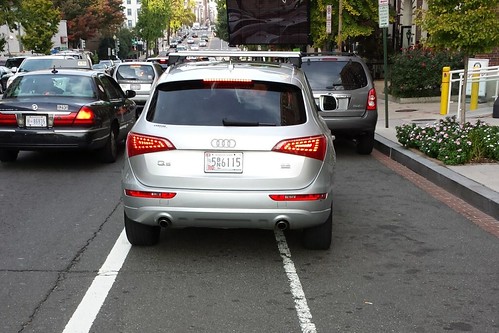
It turns out that Denise Green was stopped because police, acting on a tip from a controversial piece of law enforcement surveillance technology, mistakenly thought she was driving a stolen car. A license plate reader had misread her plate and alerted officers that her car, a Lexus, was stolen.

The reader “saw” a 7 instead of the 3 that was actually there. Equally, there seems to have been plenty of human error in the system too – ignoring Dispatch saying the stolen vehicle was a grey truck, not the burgundy Lexus Green was driving.

Automated face recognition next, of course. All you humans look the same.


Start up: Microsoft’s holodeck (sorta), Amazon stops its wallet, Facebook squashing hoaxes, how to beat the iPhone


A hologram of the Earth. Perhaps coming to some head-mounted goggles near you in the future? Picture by Kevin M Gill on Flickr.

A selection of 10 links for you. Use in ventilated areas. I’m charlesarthur on Twitter. Observations and links welcome.

Our exclusive hands-on with Microsoft’s unbelievable new holographic goggles » WIRED

Jessi Hempel got the exclusive back in October:

Oh Baraboo [its code name]! It’s bigger and more substantial than Google Glass, but far less boxy than the Oculus Rift. If I were a betting woman, I’d say it probably looks something like the goggles made by Magic Leap, the mysterious Google-backed augmented reality startup that has $592m in funding. But Magic Leap is not yet ready to unveil its device. Microsoft, on the other hand, plans to get Project HoloLens into the hands of developers by the spring.

Kipman’s prototype is amazing. It amplifies the special powers that Kinect introduced, using a small fraction of the energy. The depth camera has a field of vision that spans 120 by 120 degrees—far more than the original Kinect—so it can sense what your hands are doing even when they are nearly outstretched. Sensors flood the device with terabytes of data every second, all managed with an onboard CPU, GPU and first-of-its-kind HPU (holographic processing unit). Yet, [inventor Alex] Kipman points out, the computer doesn’t grow hot on your head, because the warm air is vented out through the sides. On the right side, buttons allow you to adjust the volume and to control the contrast of the hologram.

Microsoft has done something really clever here. Looks like it will be enterprise-first – but that’s fine; consumers can come later. No privacy rows, no suspicion of secret recording, no brand damage.

In fact the toughest part for Microsoft looks like coming up with pictures that show how looking through them looks.


Amazon pulls beta of its Wallet app amid mediocre reviews » TechCrunch

Went live in July, after which Ingrid Lunden explains;

users started to give it negative reviews,undermining Amazon’s bigger strategies to offer services that tie it closer to physical merchants; highlight its hardware; and make consumers’ lives easier.

“No merchant I have tried has been able to scan my phone to get the barcode,” read the first review on Amazon’s page for the app (which you can still see by way of a Google cache). “Doesn’t work with the Fire Phone,” noted another. “This makes it too much trouble to use for reward/loyalty cards,” said a third.

The app had picked up an average of 3.1 out of 5 stars among all reviewers.

Here’s the page from 3 January 2015 on archive.org. It crossed the 10,000 download mark between September and December; from my modelling, I reckon it had about 12,500 downloads when it was yanked.(Star rating of reviews must have been going down quite fast.)

Estimating Amazon Wallet downloads

Growth in downloads (left-hand side) and reviews is fairly constant. If download growth was constant, it hit about 12,500 (LH scale) at the end.

Given that on the same day Amazon also recalled its nappies (diapers in the US) due to leakage – ew – and after the debacle of the Fire Phone, it’s starting to look like so many other companies that throw stuff out and hope it works.


IBM reveals proof of concept for blockchain-powered Internet of Things » Coindesk

Details in this paper:

“All this is achieved without a central controller orchestrating or mediating between these devices,” the paper adds.

According to the paper, a Samsung W9000 washing machine reconfigured to work within the ADEPT system uses smart contracts to issue commands to a detergent retailer in order to receive new supplies. These contracts give the device the ability to pay for the order itself and later receive word from the retailer that the detergent has been paid for and shipped.

This information would be broadcast to the smartphone of the washer’s owner, a device that would also be connected to that home’s network.

Really interesting – getting around the question of which of the things has what position in the hierarchy by getting rid of hierarchy, in essence. I like this concept a lot.


Apple records highest ever market share in Japan & Korea » Counterpoint Technology

Commenting on Apple’s performance in Korea, Counterpoint’s Research Director based in Korea, Tom Kang notes, “No foreign brand has gone beyond the 20% market share mark in the history of Korea’s smartphone industry. It has always been dominated by the global smartphone leader, Samsung. But iPhone 6 and 6 Plus have made a difference here, denting the competition’s phablet sales. Korea being the world’s highest penetrated phablet market (handsets with 5” above screens) earnestly needed a large screen iPhone for quite a time and now this thirst has been quenched. If there was a better supply of iPhone 6 & 6 Plus 64GB & 128GB models (popular SKUs) during the month then Apple’s share could have climbed to the 40% level.”

These are sales, not shipments. Record monthly volumes in China too, and hit 51% in Japan. Could be a good quarter for Apple. Already, though, one starts to think: so what do they do next September?


To beat the iPhone, you have to beat the iPhone’s camera » The Verge

Vlad Savov:

In all the years of Android’s existence, in spite of huge investments of time and money, there’s never been a standout Android cameraphone. Some have cameras that are better in low light than the iPhone’s, many have higher resolution, and a number claim to be faster at focusing — but none pull it all together into the same comprehensive package that the iPhone can offer. Samsung and LG give you a pared-down “just shoot” experience, but they lack software polish and speed; Motorola’s camera launches and shoots quickly, but the quality is mediocre; and Sony manages to combine an excellent image sensor with terrible autofocus. Microsoft’s PureView cameras fare better, but the Windows Phone camera app is comparatively slow and unintuitive, and there’s a reason why former Lumia chief Ari Partinen is now tagging his photos with #iPhone6Plus instead of #Lumia1520.

That reason being that Partinen now works for Apple. A fascinating thinkpiece (aka “thumbsucker”, in journalist parlance) from Savov; the comments are equally interesting for comments from users. (Side note: it’s a modern-day miracle how polite the Verge commenters are. There’s even one in there who simply admits to having been wrong. Amazing.)

So, open question: what’s the thing Android has that the iPhone falls down at?


Microsoft looks to Windows 10 for a Jolt in the mobile realm » NYTimes.com

Nick Wingfield, in a good piece that goes all around the lighthouse of Microsoft’s screwed-up mobile problem:

Microsoft has long acknowledged the need to expand its app selection. The company has offered to finance the development of Windows Phone apps for prominent developers, in some cases paying for outside contractors to do the programming work, according to a former Microsoft executive, who spoke on the condition of anonymity because the discussions were confidential.

But even that was not enough for the executive at one top mobile-game developer, who said Microsoft gave up asking his company to support Windows Phone about a year ago. “We need an actual market and large, global installed base to justify it,” said this executive, who did not want to be named in order to preserve his relationship with Microsoft.

There’s this remaining hope at Microsoft (and supporters outside) that business adoption and integration of smartphones into their functions will mean companies mandating Windows Phone for mobile apps. Let’s come back in a couple of years and see how that went.


Samsung’s Tizen smartphone makes poor first impression in India » Reuters

Nivedita Bhattacharjee:

the initial reaction of analysts and consumers after its Jan. 14 launch suggests the Z1 will struggle to get ahead of a crowded field in a country with about 280 smartphone brands on offer, led by Samsung and closely followed by Indian maker Micromax Informatics Ltd.

“Samsung has been delaying the launch of this Tizen phone for a long time and when they finally did it, it turned out to be an under-powered phone,” said Mumbai-based filmmaker Samir Ahmed Sheikh as he shopped for a new phone for his wife.

The 3.15 megapixel primary camera and 300,000 pixel front camera are “like a phone from 2010”, he said.

“A simple comparison with any of the Android One phones will tell you how much the Z1 is missing,” Sheikh said.

One sudden realisation – or recollection – I had on reading the interview with Hugo Barra by Ben Thompson was how intensely India loves technology. (I notice it in the number of Twitter followers I have who clearly hail from India.) It’s a breeding ground for great technologists, who often then come to the west to set up their own companies or work for big ones and make a huge difference.

The idea that you can fob off India with an also-ran device is a huge mistake.


Profitability is priority, says Acer CEO » Digitimes

Acer has modified its business operational strategies from focusing on revenues and market share to maximizing net profit, and it aims to hike revenue proportions for mobile terminal devices and cloud computing services based on PC sales, according to company CEO Jason Chen.

This is the entirety of the report – along with low/medium/high targets for revenue growth and net profit. Those go from +5% to +15%, and NT$1bn to NT$3bn – the latter about £60m.

I read this as Acer aiming for the high end of the PC market; even though it’s doing better in sheer numbers shipped than compatriot Asus, it’s not making much profit per PC. Plus Intel won’t be subsidising its Intel-based tablets this year.


News Feed FYI: showing fewer hoaxes » Facebook Newsroom

Today’s update to News Feed reduces the distribution of posts that people have reported as hoaxes and adds an annotation to posts that have received many of these types of reports to warn others on Facebook. We are not removing stories people report as false and we are not reviewing content and making a determination on its accuracy.

Bah – just add a link on each story to Emergent. Job done.


Tablet market misconceptions » Tech.pinions

Ben Bajarin:

The biggest fundamental mistake most make when they think about the tablet category is to see it as only one thing. When, in reality, there are many tablet markets. To use a somewhat imperfect analogy, we can use the automotive segment. The auto industry will lump annual sales of all motorized vehicles, cars, trucks, motorcycles, boats, RVs, etc., into a single statistic. The point of this statistic is to simply show how many motorized vehicles were sold each year. Yet, to truly speak accurately about the automotive industry, it is more helpful to see the entire category broken out into each segment. At a big picture level, it is fine to know how many motorized vehicles were sold each year, but that alone doesn’t actually tell us anything truly helpful.

Wonder if the analyst companies will be able to segment the market in the way that Bajarin sees it. My guess is that it might, but only for (high) paying customers, not general consumption.


Start up: Google Ventures investment in focus, Apple Watch controls in view, don’t buy Pono!, and more


Genes. Picture by Libertas Academica on Flickr.

A selection of 8 links for you. Do not use on exposed skin. I’m charlesarthur on Twitter. Observations and links welcome.

The man investing Google’s billions says we shouldn’t be afraid to live forever » The Verge

Ben Popper:

Google Ventures, the investment arm tasked with spending the search giant’s billions on exciting new companies, released its annual report last night. Interestingly, the majority of its money did not go into the areas of consumer internet services, mobile apps, and enterprise software that Google is best known for. Instead, of the $1.6bn it has under management, it put a whopping 35% of its new bets in 2014 into the category of life sciences and health, way up from less than 10% in the two years prior.

Google’s PR in action again. Life sciences and health have been attracting colossal amounts of investment for years now; there’s nothing magical about Google Ventures putting money into it. For comparison, VC funding in life sciences increased by 15% in 1Q 2014 to $1.7bn – up from $1.4bn in the same period a year before.

Note that we’re not told how much of the $1.6bn in Google Ventures has gone into life sciences. But it’s got Google’s name, and there’s an offer of a phone interview with someone who runs it and enthuses mightily about living forever – he was behind Project Calico, based on the idea that “no one was studying ageing at the genetic level”. I feel pretty certain that’s false, based on the many scientific researchers I spoke to between 1995 and 2004 at The Independent; just search for news stories about “telomeres” from 2000 onwards. Even so, this not-important announcement gets a big credulous doggie slurp – and doesn’t even get the comparative context I just gave you about investment levels.

And we call this journalism?


Apple Watch iPhone ‘Companion’ app revealed w/ new Watch features, monograms » 9to5Mac

Mark Gurman (yes, him again – Mr 12in Powerbook):

Yesterday, we reported that the latest iOS 8.2 beta reveals that an Apple Watch application for the iPhone is in the works. Now, we have some more details. Within Apple, the application is currently called the Apple Watch “Companion” app for iPhone. This application manages settings for Apple Watch applications, as well as settings for iPhone/Watch interactivity. The Companion app’s settings reveal some novel new functions that are coming to the Apple Watch. Below, we highlight some of the most interesting new features and settings.

Looks, well, like some settings. Not sure about the notifications, unless you can choose which ones you get on the watch – who needs to know they’ve received an email?


The ‘Internet of Things’ now belongs to the product managers » DIGITS to DOLLARS

Jay Goldberg:

the real business of building ecosystems is beginning. It will not be one ‘industry’ but new products and features in many industries.

I think this was best on display at the Lowe’s booth [at CES]. Lowe’s is giant hardware retailer, and I only stopped in their booth by accident, a friend of mine had just bought some locks for his home and saw a new model on display. Lowe’s was promoting its Iris ecosystem of connected devices. Beyond locks, this also included thermostats, sprinklers, windows, alarms and a whole range of other products you could expect to see on their shelves. I do not know much about Iris. It is a freemium service that sends sensor alerts for free and charges a monthly subscription of $10 if you want to apply more detailed rules to that (e.g. alerts when a window opens after 10pm). But they had a whole booth filled with partners. They are not relying on Nest or Apple or AT&T, but Schlage, Pella and other hardware suppliers. Traditional tech industry wisdom holds that eventually there will be one common platform that dominates. That is the economics of software. I think this may not happen in the home IoT segment. The market is just too big, with too many players. We could very well see multiple ecosystems thriving.

How many is “multiple”, though? Mobile just about supports three (iOS, Google Android, AOSP), with two also-rans (BlackBerry, Windows Phone). Would, or could, the IoT have more?


Sony CEO eyes options as pressure mounts on weak TV, mobile » Reuters

Ritsuko Ando:

As he prepares the latest revival plan ahead of the new business year, [chief executive Kazuo] Hirai, 54, must decide what to do with the financially weak operations that have already been subject to heavy cost cuts.

He told a small group of reporters at the Las Vegas show that his reforms have succeeded “in some parts but not in others”.

“Electronics in general, along with entertainment and finance, will continue to be an important business,” he said. “But within that there are some operations that will need to be run with caution – and that might be TV or mobile, for example.”

Yet cost cuts and a focus on high-end phones, a strategy led by Hiroki Totoki, the new chief of Sony’s mobile division, aren’t enough, said Citigroup analyst Kota Ezawa.

“The mobile and TV businesses both require a drastic overhaul,” he said. “Without drastic reforms such as joint ventures or alliances, they will both be in the red three years from now.”

Exiting the TV business would mean heavy restructuring costs and lost sales. Potential buyers might not want all the division’s assets, let alone at a high premium.

Sony only bought the half of the mobile business from Ericsson in 2012; already it’s looking distinctly peaky.


How Amazon tricks you into thinking it always has the lowest prices » Re/code

Jason Del Rey:

a study conducted by a startup called Boomerang Commerce reveals that Amazon’s pricing strategy is much more nuanced than simply undercutting the competition.

Boomerang, founded by Amazon veteran Guru Hariharan, makes software that tracks prices on shopping sites that compete with its clients, then recommends price changes dynamically. Those changes are based on rules its clients set about which products to match prices on and which to boost higher or drop lower than a competitor’s to boost profits or sales, respectively.

The study of Amazon’s pricing uncovered some interesting tactics. First, Amazon doesn’t have the lowest prices across the board, which may not surprise industry insiders but might surprise Amazon shoppers.

Instead, according to Boomerang’s analysis, Amazon identifies the most popular products on its site and consistently prices them under the competition. In one example, Boomerang observed Amazon testing price reductions on a $350 Samsung TV — one of the most popular TVs on Amazon — over the six months leading up to Black Friday. Then, on Black Friday, it dropped the price to $250, coming in well below competitors’ prices.

But when it comes to the HD cables that customers often buy with a new TV, Amazon actually pushed up the price by 33 percent ahead of the holidays.


Don’t buy what Neil Young is selling » Gizmodo

Mario Aguilar:

Though Young and Pono have failed to produce double-blind studies on the benefits of high-rate audio or their music player, inquiring minds have taken the time to do it. In a 2007 paper published in the Journal of the Audio Engineering Society, Brad Meyer and David Moran outline the results of a study in which they presented a large sample of “serious” listeners with a double blind test comparing 44.1 kHz audio from “the best high resolution discs we could find.” The goal was not to show which was better, but simply to find out if people could even tell the difference.

“None of these variables have shown any correlation with the results, or any difference between the answers and coin-flip results,” they write in their conclusion. Later they note, “Further claims that careful 16/44.1 encoding audibly degrades high-resolution signals must be supported by properly controlled double-blind tests.”

There are proponents of high-quality audio, and with really good systems – as in multi-thousand pound/dollar speakers and master tapes – you can definitely hear the difference; I’ve experienced it myself on visits to hi-fi companies, most recently Meridian. But outside listening rooms, out in the real world? You’ll be lucky to notice any difference between an MP3, AAC and CD.


May 2013: Microsoft and Google working together on new YouTube Windows Phone app » The Verge

Tom Warren:

Google is announcing today that it’s working together with Microsoft on a new YouTube application for Windows Phone. Following a fight with Microsoft over its unauthorized YouTube app, the pair appear to have resolved some of their differences. Google demanded that Microsoft should remove its app by May 22nd, but Microsoft issued an update to address some of Google’s concerns earlier this week. Google says “Microsoft and YouTube are working together to update the new YouTube for Windows Phone app to enable compliance with YouTube’s API terms of service, including enabling ads, in the coming weeks.”

January 2015: still nada. Some weeks have more trouble arriving than others. In fact, relations between Google and Microsoft have if anything gotten even worse of late.


AILW: Beta 4 Documentation Changes » David Smith

Smith is a third-party developer who has been doing a lot of work on Apple Watch app development:

I’ve set up a script to go out to download and normalize the WatchKit Programming Guide and Apple Watch Human Interface Guidelines. Nothing fancy but it means that when a new Beta has been released I can easily diff between the old and new to look for relevant, interesting changes.

As you’d expect there are a bunch of little changes — Typos, rewordings, etc. I’m not interested in those for the purpose of this. Just material changes that will affect how I build apps.

They are shown below. Text in green (with an alternate background) is new. Struckthrough text was removed.


Start up: inside the Fire Phone debacle, a selfie stick successor, CES beats the bedroom, CNN’s last-ever video, and more


The Mayday button on the Amazon Fire Phone. Perhaps should have been used before it went on sale. Photo by TechStage on Flickr.

A selection of 8 links for you. Do not use as a flotation device. I’m charlesarthur on Twitter. Observations and links welcome.

The real story behind Jeff Bezos’s Fire Phone debacle and what it means for Amazon’s future » Fast Company

Austin Carr, in a terrific long read, explaining how the Fire Phone project began in 2010, and had Bezos as a micro-manager:

Some designers bristled at Bezos’s presence and privately questioned his taste, while others who were wowed by his wide-ranging insights loved his approach. Regardless, Bezos’s heavy hand certainly took getting used to, even for Chris Green, Lab126’s VP of industrial design. “In the beginning, Chris would take Jeff’s feedback a bit literally,” says Randall, the former Lab126 VP, “and there was many an evening spent over beers and sushi counseling him, saying, ‘Calm down, it’s going to get better.’”

Bezos drove the team hard on one particular feature: Dynamic Perspective, the 3-D effects engine that is perhaps most representative of what went wrong with the Fire Phone. Dynamic Perspective presented the team with a challenge: Create a 3-D display that requires no glasses and is visible from multiple angles. The key would be facial recognition, which would allow the phone’s cameras to track a user’s gaze and adjust the 3-D effect accordingly. After a first set of leaders assigned to the project failed to deliver, their replacements went on a hiring spree. One team even set up a room that they essentially turned into a costume store, filling it with wigs, sunglasses, fake moustaches, and earrings that they donned for the cameras in order to improve facial recognition. “I want this feature,” Bezos said, telling the team he didn’t care how long it took or how much it cost.

Turns out Bezos isn’t as good a micro-manager for building a phone as Steve Jobs. Result:

According to three sources familiar with the company’s numbers, the Fire Phone sold just tens of thousands of units in the weeks that preceded the company’s radical price cuts.

Was it perhaps somewhere around the 35,000 that I estimated in August? My range was between 26,000 and, generously, 35,000. I’d love to hear the actual figure.

The whole piece, though, gives terrific insight into how Bezos can get it wrong. He thought a single phone – one piece of hardware – could reshape Amazon’s brand, and turn it from a “get stuff cheap online” one, into a “we customers love you, take our money” brand. The two aren’t the same.


February 2014: What the world really needs: A telescopic SELFIE STICK » The Register

Simon Rockman in February 2014:

Mobile World Congress is often as interesting for the silly gadgets as it is for the mainstream announcements.

This (right) is the Selfie Stick, an extendable pole with a Bluetooth control for your phone.

The Selfie comes in two versions: a general one and one for Samsung phones where you have focus control.

Hahahahahawhatdo you mean they’re sold out everywhere?


The first wearable camera that can fly » Nixie

Wearable and flyable

The first wrist-band camera quadcopter.
Nixie flies, takes your photo, and comes back to you.

This feels like it could easily be one of those Great Ideas that is too easily bungled in the execution, but if it works well it could put selfie sticks out of business. Until selfie stick owners swat them out of the sky.


CES, the World’s Largest Trade Show, Is Too Big for Vegas » Bloomberg

The Consumer Electronics Show in Las Vegas has a problem that many events would love to have: It’s become too big. And it doesn’t want to get any bigger.

With as many as 160,000 visitors to CES—the world’s largest annual trade show—the Nevada city’s sprawling hotels are stretched to the limit. Last January’s gathering of gadget-loving geeks somehow packed in a full 10,000 more people than Las Vegas has rooms for them to sleep in.

The Consumer Electronics Association, the folks who put on the conference and expo, says CES 2015 will have the equivalent of 35 football fields, or about 2 miles of floor space, filled with phones, televisions, smartwatches, washing machines and throngs of people trying to see it all. “In order to enhance the experience for our attendees, we aim to keep attendance between 150,000 and 160,000 so that everyone can get where they need to go,” says CEA Vice President Karen Chupka.

That’s OK – they can sleep in the lines for press conferences showing off LG’s new dishwasher. Actually, the graph with the story suggests that attendees has exceeded the number of available hotel rooms since 2012. I’m pretty sure I slept there in 2012. Could it be that, shock, some people share rooms? Also, how’s AirBnB coming along there? And might some attendees, um, live in Vegas?


The weirdly-synched life of the Google Nest household » The Register

Richard Chirgwin:

At first glance it looks like the typical Utopian vision of Silicon Valley, but Vulture South took a second look and asked ourselves: “what kinds of life does Google think we live?”

The short answer: wealthy, lazy, and either lonely or in a strange 1950’s-sitcom family synchronisation. Everybody rises and sleeps at the same time, everybody leaves and arrives together, and we’re rich enough to have ‘leccy cars but too poor to charge them.

The most obvious believer in the synchronised family is appliance giant Whirlpool. Its Nest integration can “let your washer and dryer know when you’re home and they will automatically switch to quiet mode”. Unless only one occupant is recognised, that means the only time the appliances are allowed to let their hair down and party is when everyone’s away.

The August Smart Lock will tell Nest to change your thermostat settings when you arrive (warm the house up) or leave (switch off the heating) – which begs the question “what if I lock the front door while other people are still at home?” At least the Kwikset Kevo smart lock understands that more than one person might be in a household.

The Withings Sleep System: when you go to sleep it will “let your Nest Thermostat to a comfortable nighttime temperature. Wake up and it will tell Nest you’re ready to start the day.” Once again, the idea that a household might have sleep and wake times staggered by hours seems alien to the developer.

This is my general objection to “internet of things” and “homes of the future” visions: they don’t account for how we actually live. Them: Look, you’ll be able to get your coffee maker to make coffee before you get out of bed! Me: so I’ll have had to put the coffee in the night before. As I have to go downstairs to get the coffee, why not just make it fresh while I’m there?

And so on. Most IOT/HOTF concepts seem to come from 20-somethings who have no concept of running a household. Hence, I think, their limited success.


This is the video CNN will play when the world ends » Jalopnik

Michael Ballaban, who unearthed this Holy Grail-style rumoured-but-until-now-never-confirmed video, which has the notice:

“HFR till end of the world confirmed.”

Hold for release. CNN, once ever so thorough in its factchecking, knew that the last employee alive couldn’t be trusted to make a call as consequential as one from the Book of Revelation. The end of the world must be confirmed.

That leaves open a whole host of unanswered questions. If this is the last CNN employee alive, in the last CNN bureau on Earth, who do they confirm it with? What does confirmation look like? Who can be the one to make that determination, to pronounce the universe itself dead? Is it Wolf Blitzer himself, ever a fan of the Washington Wizards, and thus a man who would know death when he saw it? Would it be Rick Davis, CNN’s head of standards of practices, who has been with the company since its birth and who thus would know CNN’s journalistic practices better than anyone?

Or would it be some sort of living embodiment of CNN itself, ready to proclaim its own demise, as Judgment Day is truly the only thing able to bring about the long-anticipated death of cable news?

And who would be around to watch it?

Um.. that CNN employee? The machines grinding us into nanoparticles to feed into their hoppers? Take your pick.


Breach puts Morgan Stanley client data up for sale » NYTimes.com

Nathaniel Popper:

the bank traced the breach to a financial adviser working out of its New York offices, a 30-year-old named Galen Marsh, according to a person involved in the investigation who spoke on the condition of anonymity.

Mr. Marsh, who had been with Morgan Stanley since 2008, was quickly fired and is currently the subject of a criminal investigation by the Federal Bureau of Investigation, a person briefed on the investigation said. The Financial Industry Regulatory Authority is also examining the matter.

Morgan Stanley said on Monday that it had determined that Mr. Marsh took data on about 10% of its 3.5 million wealth management customers, including transactional information from customer statements.

The bank said that Mr. Marsh did not take any sensitive passwords or Social Security numbers, and that it had not found any evidence that the breach resulted in any losses to customers. A lawyer for Mr. Marsh, Robert C. Gottlieb, acknowledged on Monday that his client did take the information in question but said that he did not post it online, share it or try to sell it.

Afghanistan war logs: insider breach. NSA/GCHQ documents: insider breach. Morgan Stanley: insider breach. Sony Pictures..?


Hit mobile game Monument Valley and piracy: ‘Only 5%’ of Android players paid for it » VenureBeat

Jeff Grubb:

Piracy is still a big problem on Android.

Developer Ustwo had one of the break out mobile hits in 2014 with its isometric puzzler Monument Valley, but a successful game is not impervious to piracy. The studio confirmed on Twitter today that Monument Valley has had an especially tough time with “unpaid installs” on Android. The company said that 95% of the people playing the game on Google’s mobile operating system did not buy it — although, Ustwo did explain that a small number of those installs are legitimate and were not illegally downloaded. This makes a big dent in Ustwo’s earnings since Monument Valley is a premium-priced game that does not have in-app purchases like Candy Crush Saga or other lucrative mobile releases. Gaming on smart devices surpassed $21bn last year, but it potentially could have more if it weren’t for piracy.

The paid rate was much better on iOS, but it’s still alarming. Ustwo said that 40% of the people who have the game on an Apple mobile device paid for it. Again, that means the majority did not give the developer money.

Depressing numbers, for a game that costs just $4. There’s certainly piracy on iOS – but the astronomical amount on Android really isn’t good news. Does this get factored into the quotes about “revenues from app stores” we see?

There is some confusion over the iOS figure though: it’s not clear whether someone who buys on the iPhone and then downloads to their iPad counts as an “unpaid install”. We also don’t know if that’s how it works on Android – though do 95% of Android owners have multiple devices?


Start up: who knows what about you?, smartphone tracking, slim your iPhone photos!, Xiaomi’s razor margins, and more


An iPad Air 2 being charged, apparently from a bicycle pump. Photo by LoKan Sardari on Flickr.

A selection of 8 links for you. Enjoy. I’m charlesarthur on Twitter. Observations and links welcome.

Amazon’s Echo is a good listener but a wretched assistant >> Gigaom

Stacey Higginbotham:

Never has the gap between a flawless technology experience and a closed ecosystem loomed as large as the gap between the Amazon Echo and the Ubi personal computer. While Amazon’s Echo works beautifully and is a gorgeous cylinder that is ready to hear and (attempt to) obey my every command from pretty much anywhere in the room, it fails because its abilities to connect with a variety of web services are very limited.

Meanwhile, the Ubi, a voice-activated computer that is older and, yes, much more painful to use, wants to do the same thing. Like a teenager, though, it isn’t adept at listening to my commands, sometimes awkwardly interrupting my conversations, and its music playback is not nearly as graceful as the Echo’s.

Pays money, takes choice (or don’t spend the money at all).


Android Vs. iOS start experience >> LukeW

Luke Wroblewski:

How times change… Today’s new iPad Air 2 experience consists of 23 or more steps and no less than three iCloud services (iCloud, iCloud Drive, & iCloud Keychain). In contrast, today’s new Android Nexus experience consists of only 8 steps but with a mandatory 234MB update (some things don’t change). Here’s both start experiences in detail.

You can argue this lots of ways. Apple offers TouchID, Apple Pay, Find My iPad, iMessage – and asks about using location services. Google stuffs many of those into a single screen. Wroblewski doesn’t give a “time taken” for the setup; that might be as useful.


People finding their ‘waze’ to once-hidden streets >> Associated Press

Great piece on a smartphone tragedy of the commons, by John Rogers:

Killeen said her four-mile commute to UCLA, where she teaches a public relations class, can take two hours during rush hour. “The streets on the west side are no longer a secret for locals, and people are angry,” she said.

That’s because the app can’t be outsmarted, Waze spokeswoman Julie Mossler said.

“With millions of users in LA, fake, coordinated traffic reports can’t come to fruition because they’ll be negated by the next 10 people that drive down the street passively using Waze,” she said.

Besides, Mossler added, “people are inherently good,” meaning most wouldn’t really screw with the app, no matter what they might say.

Indeed, of all the angry people interviewed for this story, none would admit doing so, although most said they heard someone else had.

One does have to wonder a little why Killeen doesn’t walk, cycle or get a motorbike for that four-mile commute.


It may be crushing Samsung in China, but Xiaomi barely makes a profit >> Forbes

Parmy Olson:

Chinese smartphone upstart Xiaomi, which this year grabbed Samsung’s No. 1 spot in China with its low-cost smartphones, revealed startlingly-low profits in a filing to the Shenzen stock exchange on Monday, Reuters reported.

The company earned $56m in net profit in 2013, on sales of $4.3bn. That’s an operating margin of just 1.8%, razor-thin when compared to Apple’s operating margin (which was 28.7% in 2013) or even Samsung’s (18.7%), which are being forced down by low-cost Indian and Chinese vendors like Xiaomi.

Eyebrows now raised at the WSJ report from earlier which said Xiaomi made a profit ten times that in 2012. Either the WSJ had the wool pulled, or Xiaomi is expanding dangerously fast. A spokesperson for Xiaomi said this “didn’t represent the whole company”, which somewhat contradicts its filing.


Sales of smartphones grew 20% in third quarter of 2014 >> Gartner

Lots to digest here (two months after the end of the third quarter): the continuing, rapid drop in featurephone sales, which particularly hurt Samsung; the growth of Huawei, ZTE and Xiaomi; that BlackBerry is still bumping along, managing 2.4m sales “to end users” in that period by Gartner’s numbers.


Boxed In >> Platformonomics

Charles Fitzgerald:

To own Box stock, you have to believe they will retain their customers for a really long time to pay back the acquisition costs and/or significantly increase their revenue per customer. It is hard to make this case and Box notably doesn’t make much of an effort.

How will Box extract significantly more revenue per customer? They have neither moat nor unique technology (unless you count their “which one of these things isn’t like the others” participation in the Linux Foundation’s Dronecode Project). They don’t have an operations at scale cost advantage. Their “platform ecosystem” is superficial at best. They face giant competitors like Apple, Google and Microsoft with untold billions in the bank who are happily giving cloud-based storage away as a complement to their other services, as well as Dropbox which continues to ooze into the enterprise with a bottoms-up strategy which has dramatically lower customer acquisition costs. Box is still doing the same thing it always has, even as the market has evolved. They no longer have the luxury of just highlighting SharePoint’s inadequacies. Some argue Microsoft’s refusal to support Android and iOS has been the singular Box value proposition – obviously, that is a window that has closed.

Fitzgerald isn’t an optimist on Box.


iCloud Photo Library beta FAQ >> Apple Support

Q :How does iCloud Photo Library save space on my device?

A: If you turn on Optimize [device] Storage, iCloud Photo Library will automatically manage the size of your library on your iOS device, so you can make the most of your device’s storage and access more photos than ever. iCloud Photo Library stores the original, high-resolution photos and videos in iCloud and can keep lightweight, device-optimized versions on each of your devices. As long as you have enough storage, recent photos and videos that you access the most will stay on your device at full resolution.

You can turn on Optimize [device] Storage from Settings > iCloud > Photos or Settings > Photos & Camera > iCloud Photo Library on your iPhone, iPad, or iPod touch. You need an Internet connection to access an original photo or video that’s stored only in iCloud.

As Mark Rogowsky points out, this is the way to free up space on iOS devices while also letting you see the photos you’ve taken.


Who’s Watching You?

You probably know that Google and Facebook are tracking you, but did you know your car is too? Take this test to find out how tracked you are.

Faintly depressing.


Start up: streaming stick wars, land sale hotspots, iPhone 6 grabs phablet market, Ring calls back, and more


Eye testing for colour blindness. Photo by joeyanne on Flickr.

A morning selection of 6 links for you. Use them wisely. I’m charlesarthur on Twitter. Observations and links welcome.

Note: this is the first of two Start Up: posts today (it’s an experiment). The next will be published in six hours’ time (1300 GMT). Let me know what you think – one post or two?

10% of US broadband households have purchased a streaming media device to date in 2014 >> Parks Associates

Roku is still the leading brand with 29% of sales, but Google Chromecast (20%) has supplanted Apple TV (17%) in second place. New entrant Amazon Fire TV is in fourth place with 10%. Consumer content choices are also increasing, with Showtime and Sony planning to launch their own OTT video services to compete with Netflix and HBO.

“Nearly 50% of video content that US consumers watch on a TV set is non-linear, up from 38% in 2010, and it is already the majority for people 18-44,” said Barbara Kraus, Director, Research, Parks Associates. “The market is changing rapidly to account for these new digital media habits. Roku now offers a streaming stick, and Amazon’s Fire TV streaming stick leaves Apple as the only top player without a stick product in the streaming media device category.”

Note that these are sales, not installed base. But the desire to stream stuff is clearly growing very quickly.


Data shows iPhone 6 Plus drives phablet sales growth >> Kantar Worldpanel ComTech

Although selling for just over a month, the iPhone 6, with 33% market share, became the best-selling model among iOS devices for the three months ending in October 2014. The iPhone 5s was the second best-selling iPhone model with 26%, and the iPhone 5c was third with 18%. The iPhone 6 Plus captured 10% of iOS sales.

In the Android camp, the Galaxy S5 remained the best-selling model with 22% of sales while the Galaxy S4 continued to show its longevity, maintaining second place with a share of 12%.

Of the iPhone 6 and iPhone 6 Plus buyers, 85% were repeat iOS buyers and 9% churned from Android.

Also in the three months ending in October, smartphones sales reached 81% of overall phone sales and 59% of all phones in use in the US. 

And iPhone 6 Plus was 41% of US “phablet” [5.5in or more] sales, despite being on sale for only one month of the three-month period. One model taking 41%? (The Galaxy S5 has a 5.1in screen, so doesn’t count in that.)


One CSV, thirty stories: 15: Hotspots >>Whatfettle

Paul Downey has been experimenting with the open data from the Land Registry about property sales, and used it to build a heatmap of sales from 1995 to 2004:

I’m cock-a-hoop how this image has turned out. The detail looks like bacteria on a petri-dish, but zoomed out it’s apparent not just where people live, but where people buy and sell houses the most, with the coast of East Anglia, Eastbourne and Cornwall darker than you’d expect. I can guess this may be due to turnover of retirement homes or holiday cottages but it’s plain to see there are many more interesting stories begging to be discovered from this simple map weighted with other open data from the likes of the ONS.

The frantic turnover in London and cities you’d expect, but the coasts are much more active than you’d otherwise expect.


Ring CEO responds to critics >> Tech In Asia

JT Quigley:

[Takuro] Yoshida [CEO of Tokyo-based Logbar, which made the Ring] says that he never anticipated delays, despite only giving Ring a four-month window from Kickstarter to shipping. The campaign estimated delivery in July, but backers didn’t start receiving their pledges until October. The long wait would become a source of initial doubt, criticism, and refund requests before backers ever received the Ring itself – likely galvanizing negativity and setting Ring up for even harsher reviews than if it had shown up in mailboxes on time.

What was the Ring team doing on July first – the day shipping should have begun?

“We were still testing the hardware, hoping to ship in August” Yoshida says. “I have a lot of web and mobile app experience, so when there’s a bug I can fix it right away. But with hardware, it can take weeks to fix one problem.”

He admits that the final product wasn’t sent off for mass production until October 9.
In the meantime, Ring was receiving between 10 and 30 angry emails a day – and many more angry comments on its Kickstarter and Facebook pages.

“We had two people, from a team of only eight total members, replying to emails,” Yoshida explains. “With more than 5,000 backers, it was hard for us to respond to everyone, and we just couldn’t reply to the comments section because it kept growing and growing.”

He never anticipated delays because he’d previously worked on web and mobile apps. OK.


Windows 10 could prompt upgrades of 600M aging PCs >> Computerworld

Millions of PCs are aging, and those who have resisted Windows 8 will likely upgrade to computers with Windows 10. The initial reception to a test version of Windows 10 has been positive, as it resolves many usability issues affecting Windows 8.

There are about 600m PCs that are four years or older, and those systems are ripe for upgrades, said Renee James, president at Intel, at the Credit Suisse Technology Conference on Tuesday.

“When we see a healthy macroeconomic environment and an aging installed base we expect a new [OS] deployment. The [PCs] are fantastic and at new price points. That’s kind of a perfect storm, combined with a new OS, and the OS usually pushes the upgrade cycle,” James said.

Actually, the evidence doesn’t suggest that a new OS pushes an upgrade cycle. There’s a noticeable slowdown in purchasing ahead of each new Windows release; and then there’s a mild (over the past three releases) springback, but nothing that indicates that a new OS “pushes” upgrades – apart from the fact that consumers get the OS preinstalled.

Businesses, which is where many of those 600m PCs may be, are more likely to shift to Windows 7; or if they’re there, stick with it.


Startup tackles colour blindness >> EE Times

John Walko, on a Cambridge (UK) startup called Spectral Edge:

Content streamed to the STB [set-top box] incorporating the technology is enhanced on a frame-by-frame basis before transmission to the TV screen. Colour-blind viewers can then significantly better differentiate between red and green when watching, allowing them to see details that previously they could not. Importantly, [managing director Christopher] Cytera says, the enhancement has minimal impact on the quality of the picture seen by viewers not suffering from colour blindness.

The technology is said to use mathematical perception models to modify image colours, and is suitable for both still and moving images. The company suggests colour-blind viewers watching programs that normally contain a lot of red and green in their images – for instance sports and nature – will enjoy the biggest improvements in the “viewing experience.”

Now installed on an unnamed STB maker which is a “major, medium size, international player”. As 1 in 12 males and 1 in 200 females has colour blindness, you might be in need of this without realising it.


Start up: make like Apple?, Samsung sells off fibre optic, authors v Kindle Unlimited, Amazon’s PR push and more


Spring-making machine: photo by Mitch Altman, taken in Shenzhen, China, November 2014

A selection of 10 links for you. Use them wisely. I’m charlesarthur on Twitter. Observations and links welcome.

No, you can’t manufacture that like Apple does >> Medium

What happened when Apple wanted to CNC machine a million MacBook bodies a year? They bought 10k CNC machines to do it. How about when they wanted to laser drill holes in MacBook Pros for the sleep light but only one company made a machine that could drill those 20 µm holes in aluminum? It bought the company that made the machines and took all the inventory. And that time when they needed batteries to fit into a tiny machined housing but no manufacturer was willing to make batteries so thin? Apple made their own battery cells. From scratch.

Pretty much no company, big or small, can afford to do these things. Yes, Apple has done a great job building many of these products and yes, consumers have come to love many of these difficult-to-manufacture features. But you are not Apple. So long as you’re providing value to your customers, taking the fit and finish of your product down a notch is okay. Especially for your first few production runs.

So what should you avoid? Here’s a few things that Apple often does that can cause problems for a startup.

The “white plastic” one in the list that follows is so obvious when you think about it, but non-obvious until it’s pointed out (or seen).


Samsung Electronics exits fibre optics amid sharper focus on reviving smartphones >> Reuters

Samsung Electronics agreed to sell its fibre optics operations to US specialty glass maker Corning Inc, exiting another non-core business to focus on shoring up underperforming key areas like smartphones.

Terms of the sale, including plants in China and South Korea, weren’t disclosed. Announced by both parties on Tuesday, the South Korean firm’s second exit from a business line this quarter comes as it braces for its lowest annual profit in three years, squeezed by stiff competition…

…The firm also said in October it will halt its light emitting diode lighting business outside of its home country, which was also considered a non-core business.


Best >> stratechery

Ben Thompson on disruption, and what Clayton Christensen’s theory lacks because it doesn’t include user experience as a factor:

That’s the thing though: the quality of a user experience has no ceiling. As nearly every other consumer industry has shown, as long as there is a clear delineation between the top-of-the-line and everything else, some segment of the user base will pay a premium for the best. That’s the key to Apple’s future: they don’t need completely new products every other year (or half-decade); they just need to keep creating the best stuff in their categories. Easy, right?

He’s totally right that Apple should have bought Dropbox; but Steve Jobs couldn’t see the inherent, coming value of the cloud – even though it was Jobs, in 1997, who told developers about the importance of network computing and not having to worry about locally stored data.


Android 5.0 Lollipop delay for HTC One and One M8 Google Play Editions >> TechRadar

The reason for the first delay was pretty vague, with Google simply stating that it would “need to re-spin SW”. If we were to Google Translate that confusing statement into plain English, we’d guess that it meant Google needed time to tweak and update the Android 5.0 Lollipop software.

That delay pushed back the expected Lollipop update to December 1. However that date came and went with no sign of the update.
 
It soon emerged that the Lollipop Update has been delayed once again, with Mo Versi, HTC’s VP of Product Management, reporting that the delay this time is due to Google being too busy at the moment, but that we should expect the update soon.

Just to be clear – that’s for the stock Android versions of the HTC One and M8, not those with HTC’s Sense skin. “Too busy” is a great reason.


Author discontent grows as Kindle Unlimited enters its fifth month >> The Digital Reader

Nate Hoffelder:

When Kindle Unlimited launched in the US 4 months ago there were many questioning whether it was good or bad for authors, and if the chorus of complaints over the past few days are any indication then the answer will be no.

HM Ward kicked off the discussion on Friday when she revealed that she was pulling out of KDP Select, the program Amazon uses to funnel indie ebooks into Kindle Unlimited.

Ward withdrew her books not because the average payment had dropped to only $1.33, but because her total revenues had fallen by 75%

Kindle Unlimited is Amazon’s ebook subscription service. All the news from authors seems not to be positive.


Apple had a rough morning >> Bloomberg View

Matt Levine with a terrific explanation of the “flash crash” of Apple stock, which seems to have mostly been driven by computer-based high-frequency trading. Because no human reacts that fast:

You’ve lost several thousand dollars on your Apple trades. Maybe you should cut your losses and get out? Again, you are not, like, pondering this in your heart of hearts: You are an algorithm, and you are programmed with some loss limits, so you cut your losses and start selling. So instead of dampening volatility, you actually start increasing it.


Chesterton’s Fence >> The Epicurean Dealmaker

GK Chesterton argued:

In the matter of reforming things, as distinct from deforming them, there is one plain and simple principle; a principle which will probably be called a paradox. There exists in such a case a certain institution or law; let us say, for the sake of simplicity, a fence or gate erected across a road. The more modern type of reformer goes gaily up to it and says, “I don’t see the use of this; let us clear it away.” To which the more intelligent type of reformer will do well to answer: “If you don’t see the use of it, I certainly won’t let you clear it away. Go away and think. Then, when you can come back and tell me that you do see the use of it, I may allow you to destroy it.”

This is clearly why Chesterton never got venture funding in Silicon Valley.


The real reason Amazon is telling us about its robots >> Huffington Post

Timothy Stenovec applies a suitably sceptical eye to the news, recalling how coincidentally a year ago Amazon told 60 Minutes about its drone plans:

This year, Amazon appears to be trying the same thing again – only this time, it’s with robots. The company recently invited a select group of journalists – I was not one of them – to tour one of its California warehouses and watch robots move 750-pound shelves of products. Amazon says it uses 15,000 such robots in its facilities, and that the machines, a result of Amazon’s $750m purchase of robot-maker Kiva Systems in 2012, will cut costs, save you money and help get products to you faster.

There was no news of Amazon’s robot fleet until just after midnight on Monday, when suddenly a flood of stories appeared – suggesting that the news was “embargoed,” a term for the common media practice of agreeing not to publish certain information until a certain time.

The robots are interesting, and every journalist knows about having something to please the editor for a Monday morning. Perhaps brick-and-mortar stores could start PR schemes where they show how they’re paying tax?


This “smart” ring is another reason to never trust Kickstarter videos >> Gizmodo

With $880,998 in funding, well exceeding its $250,000 asking price, Ring was a smart device that was meant to Bluetooth control everything in your life — except that it doesn’t. Not by a long shot.

We debunked the thing outright as soon as it showed up on Kickstarter in March, but that didn’t stop thousands of backers from signing up for the product and who are now probably regretting that $269 monetary decision. YouTube user Snazzy Labs breaks down every facet of the ring, and why it’s such a terrible, terrible waste of money.

“Comically unusable” is among the more generous phrases used by Snazzy Labs (cool name bro) in the video, which is worth watching just to see how wearables should not be done, ever.


Santa or the Grinch: Android tablet analysis for the 2014 holiday season >> Bluebox Security

Bluebox Labs purchased over a dozen of these Black Friday “bargain” Android tablets from big name retailers like Best Buy, Walmart, Target, Kmart, Kohl’s and Staples, and reviewed each of them for security. What we found was shocking: most of the devices ship with vulnerabilities and security misconfigurations; a few even include security backdoors. What seemed like great bargains turned out to be big security concerns. Unfortunately, unsuspecting consumers who purchase and use these devices will be putting their mobile data & passwords at risk.

(Via John Moltz.)


Start up: Uber’s vanishing blog, Samsung’s shrinking S5 sales, Google’s secret car, and more


What the Google self-driving car “sees”. Photo by Matt Chan on Flickr.

A selection of 10 links for you. Don’t worry, be happy.

The unknown startup that built Google’s first self-driving car >> IEEE Spectrum

Mark Harris:

one of Google’s most strategic acquisitions has mysteriously been actively blocked from public view. An investigation by IEEE Spectrum has uncovered the surprising fact that Google’s innovative self-driving car and the revolutionary Street View camera technology that preceded it were largely built by 510 Systems, a tiny start-up in Berkeley, California.

If you’ve never heard of 510 Systems, that’s exactly the way Google wants it. The purchase of 510 Systems and its sister company, Anthony’s Robots, in the fall of 2011 was never publicly announced. In fact, Google went so far as to insist that some 510 employees sign agreements not to discuss that the acquisition had even occurred. Google’s official history of its self-driving car project does not mention the firm at all. It emphasizes the leadership of Sebastian Thrun, the German computer scientist whose Stanford team won the autonomous-driving Grand Challenge in 2005, sponsored by the Defense Advanced Research Projects Agency (DARPA).

Why has Google worked so hard to keep this one acquisition a secret?

Harris has been doing fantastic digging into the truth about this Google project.


Kickstarter ‘fraudster’ finds second home on Indiegogo, as per usual >> Engadget

What do you do when you’ve been outed as a fraud and your Kickstarter was pulled? You go to Indiegogo, of course. Anonabox was a $45 device that promised to route your home’s internet connection through (privacy-focused network) Tor without any fiddling in the same way that PORTAL works. In the current climate, it was no surprise to see the project earn $600,000 in pledges in just the first few days. Slowly, however, people began to ask questions about creator August Germar after the hardware was found to be an off-the-shelf unit made by a Chinese OEM and the software turned out to be about as secure as a slice of Emmental.

Now the project has been re-born on Indiegogo, with claims that the mistakes of the previous project (and subsequent outcry) has helped the device get better. That’d be fine, and we’d be applauding Germar’s efforts, except for the fact that his claims of involvement with the Tor community have already been debunked. When ITSecurityGuru asked former Tor lead Runa Sandvik, she said that Germar “is making false claims, again.”

Some serious questions to be asked about Indiegogo here.


iPhone eye test spots vision problems cheaply >> New Scientist

Smart Vision Labs, a start-up in New York City, wants to make it easier to diagnose vision problems in developing countries with an iPhone camera add-on.

The World Health Organization estimates that 246 million people have poor vision. Of these, about 90% live in low-income areas without good access to healthcare or expensive diagnostic machines.

To solve this problem Smart Vision Labs has combined two tools often used for eye tests into a single inexpensive and portable device. The first tool, an autorefractor, calculates whether someone is short-sighted or long-sighted, and to what extent, by measuring the size and shape of their eye. The second, an aberrometer, looks for distortions in how light reflects off the eye, which could indicate rarer problems such as double vision.

Android phones would be a lot cheaper to do it with.


The real reason Excite turned down buying Google for $750,000 in 1999 >> Internet History Podcast

George Bell was chief executive of Excite, which was one of the biggest web properties. A bake-off didn’t find much difference between Excite’s search at the time, and Google’s. But he might have done the deal. However:

Ultimately, Larry said, “Look, I like the engineers at Excite. I really like the company. I get that you don’t see a lot of difference.” And, I think we struck a price. I believe that the price was $750,000 in cash, and something like 1% of Excite. The economics of that were really ok to us. The thing that Larry insisted on that we all do recall, is that Larry said, “If we come to work for Excite, you need to rip out all the Excite technology and replace it with Google’s search.” And, ultimately, that’s, in my recollection, where the deal fell apart. Because, we had hundreds of engineers at that point, and culturally, we really were driven by technology. And I didn’t think we could survive… or the differentiation in search results were clearly not dramatic enough to justify the cultural risk that Larry would insist on. So, ultimately, we passed.


Samsung considering shakeup in management >> WSJ

There also have been missteps at Samsung. The mobile division, under Mr. Shin, didn’t seriously question bullish projections for orders of its flagship smartphone, the Galaxy S5, which went on sale globally in April, according to a person familiar with the matter.

Samsung produced about 20% more devices than it did of the Galaxy S5’s predecessor, basing the numbers on a survey of its carrier partners around the world, who were asked to predict demand but who weren’t on the hook for any unsold devices, according to the person. That led to merchandise piling up in warehouses, forcing Samsung to increase marketing expenditures to unload the devices.

In all, Samsung sold about 40% fewer Galaxy S5 smartphones than expected, with about 12m units sold to consumers in the first three months since April compared with about 16m units for the preceding flagship phone, the Galaxy S4, according to people familiar with the matter. Only in one major market did Samsung sell more Galaxy S5 smartphones than it did the S4: the US, Samsung’s biggest market, one of these people said.

Making the point that Samsung’s real customers aren’t end-users, but carriers. S5 sales in China were down by about 50% compared to the S4 in its first six months.


A rare peek into the massive scale of Amazon Web Services >> Enterprise Tech

Timothy Prickett Morgan:

Like many hyperscale datacenter operators, Amazon started out buying servers from the big tier one server makers, and eventually became the top buyer of machines from Rackable Systems (now part of SGI). But over time, like Google, Facebook, Baidu, and its peers, the company decided to engineer its own systems to tune them precisely for its own workloads and, importantly, to mesh hand-in-glove with its datacenters and their power and cooling systems. The datacenters have evolved over time, and the systems have along with them in lockstep.

In the past, Amazon has wanted to hint at the scale of its infrastructure without being terribly specific, and so they came up with this metric. Every day, AWS installs enough server infrastructure to host the entire Amazon e-tailing business from back in 2004, when Amazon the retailer was one-tenth its current size at $7bn in annual revenue.

“What has changed in the last year,” Hamilton asked rhetorically, and then quipped: “We have done it 365 more times.”

That is another way of saying that in the past year AWS has added enough capacity to support a $2.55 trillion online retailing operation, should one ever be allowed to exist.


Apple’s forecast to sell 71.5M iPhones units in Q4, iPhone 6 sales more than double iPhone 6 Plus

According to a fresh report from prominent KGI analyst Ming-Chi Kuo obtained by AppleInsider, quarter-over-quarter Apple iPhone shipments will swell 82% in the fourth quarter of 2014.

Leading the charge is iPhone 6, predicted to account for just shy of 60 percent of all sales for the quarter, or 41.65m units. Coming in a distant second is the iPhone 6 Plus, which has been the more talked about next-generation variation due in large part to its scarcity at retail outlets. Kuo says the 6 Plus supply shortage is not only an indicator of high demand, but also confirmation that suppliers are having production issues. He believes final fourth quarter sales are largely dependent on supply chain success with 6 Plus yields.

Given Apple’s current situation, Kuo foresees a major slip in iPhone sales for the first quarter of 2015, mostly due to poor off-season demand. The analyst pegs shipments at a combined 49.4m units, including 21.6m iPhone 6 handsets and 10.2m iPhone 6 Plus versions.

71.5m units in CQ4 would be a 40% increase, year-on-year (and would probably challenge Samung for shipments). 49.4m in CQ1 would be just a 13% increase. One suspect it might be more evenly split than that.


Gartner says more than a third of US adult smartphone users use their smartphones for video calling >> Gartner

Video calling is growing into a key mainstream activity on smartphones, with high adoption rates in some markets, according to a survey by Gartner, Inc. The survey, which was conducted in June 2014, surveyed more than 6,500 U.S. and German consumers about their technology usage and attitudes in order to gain a better picture of how devices are used for work and leisure. 

More than 50 million adult smartphone users in the U.S. (about 35% of the total surveyed) use their smartphones for video calling. This number is likely to exceed 60 million people when those ages 17 and younger are included. In Germany, more than eight million adult smartphone users (about 20%) use their devices for video calling, a figure more likely to exceed 10 million when those ages 17 and younger are included. Gartner defines video calling as person-to-person communication using a video application such as Apple’s FaceTime, Skype or Google Hangouts…

…The survey results showed adoption is markedly skewed toward the younger demographic, with video calling in the 18 to 24 age group reaching 53.5% in the US and 30% in Germany. Video calling uptake is slanted toward early adopters but shows encouraging signs of expansion across all consumer segments.

FaceTime, Skype, Hangouts – Apple, Microsoft and Google, pitted against each other once again. Except they use it for slightly different purposes: FaceTime ties users to iOS; Skype makes money and has corporate tie-in; Hangouts.. well, that’s a bit less clear. It’s always felt like a wannabe Skype.


Have Microsoft’s Surface Pro vs. MacBook Air TV ads worked? >> Tech.pinions – Perspective, Insight, Analysis

Tim Bajarin:

I recently had a meeting with top officials in one of the major PC companies and asked them about their position on 2-in-1’s and convertibles. They told me they believe they need to have one or two models of these designs in their overall line up but the majority of what they will create and bring to market will still be clamshell based. They pointed out they are not seeing any real demand for these in IT yet and only slight interest by consumers. One reason the interest in something like Surface Pro is low is because of its price. They are two to three times the price of a cheap laptop.

Unless the Surface Pro is targeted at field service or as a replacement for those who use clipboards, I believe IT interest will continue to be soft at least for the 2 in 1 detachable. Lenovo tells me they have actually done well with their Yoga convertibles, especially in enterprise accounts, however it is still a minority when it comes to the total number of clamshell laptops they ship each year.


September 2011: Uberdata: How prostitution and alcohol make Uber better >> Uber Blog

What up humans?! Bradley Voytek here again. Man do we have some crazy #uberdata for you today.

Today is Uber: Freakonomics edition.

In this post I’ll show how where crimes occur — specifically prostitution, alcohol, theft, and burglary — improves Uber’s demand prediction models.

And then over three years later, I’ll delete it! Or someone will, realising that it’s a gigantic stain on our credentials.

First “Rides of glory” (about people avoiding the “walk of shame” by getting a cab some hours after being dropped off at a particular destination) and now now this.

Uber is clearly trying to pretend that its ability to peer at data relating to specific users can somehow be forgotten.

Unfortunately, the Internet Archive begs to differ. Speaking of which, have you donated to its upkeep?


Start up: Uber debated, iPhone ruining Christmas?, Amazon Echo reviewed, (more) Android clipboard malware


Uber driver parked in the bike lane. Photo from Flickr.

A selection of 11 links for you. Use them wisely.

How to get away with Uber >> Matter on Medium

Bobbie Johnson (with whom I used to work, long ago, at The Guardian):

Raw, pure, unbridled ambition is an uncomfortable thing to look at. It’s not that it’s ugly, necessarily. It’s just brutally, shockingly honest. Uber does not pretend to have a glorious philosophy—it wants to make transport easy, but there is no aspiration as lofty as “organize the world’s information” or “make the world more open and connected.” And perhaps that’s the way it should be. After all, would it be more offensive if Uber had a mission beyond itself? It certainly feels like less of a betrayal to know that it just wants to be as big, as powerful, as necessary, as it can be.

He argues that Uber is as greedy to have everything as Amazon – which feels right. (Worth noting: Johnson’s success came from Matter, a Kickstarter-ed project, which was then bought by Medium. So he has experience of being a startup.)


Nothing found for Rides Of Glory >> Uber

Oh, how interesting. Uber has removed the blogpost about tracking peoples’ one-night stands and categorising them by city. Concerned that it revealed invasion of privacy? Concerned about bad publicity?

It’s still in the Wayback Machine if you want it though. Originally put up in August; removed, abruptly, some time after 18 November.


Will Apple’s iPhone 6 ruin Christmas for retailers? >> MarketWatch

Brett Arends:

“We estimate iPhone 6 upgrades and purchases will equate to $4 billion in retail sales in November and December,” warns Canaccord analyst Camilo Lyon in a new research paper. That, he says, equates to “approximately 16% of the $24.3 billion in incremental dollar growth expected this holiday season.”

Or, to put it another way, while Apple is likely to see a sales boom, the rest of the mall will be left with a much more modest increase in sales of around 3.3%, says Canaccord.

Different analysts may play with different numbers for sales of iPhone 6s. And the amount consumers spend will depend to some extent on whether they get subsidized iPhones now, and pay higher mobile fees each month over the next two years, or pay the full cost of the iPhone upfront and then shop around for a cheaper mobile deal.

But even though different people will quibble about the numbers, the analysis is surely “directionally correct,” as we used to say at McKinsey & Co.


Don’t buy a Chromebook just for the 1TB Google Drive storage offer >> Forbes

Tony Bradley:

when Microsoft raised the amount of OneDrive storage it provides for free accounts earlier this year, it also shared an interesting factoid about the data storage habits of the average user. “Our data tells us that 3 out of 4 people have less than 15 GB of files stored on their PC. Factoring in what they may also have stored on other devices, we believe providing 15 GB for free right out of the gate – with no hoops to jump through – will make it much easier for people to have their documents, videos, and photos available in one place.”

Both Google Drive and Microsoft’s OneDrive provide users with 15GB of storage for free. Even if you’re part of the 1 out of 4 users that exceeds 15GB, unless you’re an uber power user with an archive of HD movies to store in the cloud, you most likely won’t exceed 100GB. Both Google and Microsoft offer a 100GB plan for $2 per month. All of this works out to mean that 75% of the users have less than 15GB of data and will get no value out of the Chromebook promotion, while most of the remaining 25% could get by with 100GB of Drive storage, so the actual value of the Chromebook deal is more like $48.

Also, if you do need that much storage, the free offer will run out – and then you’ll be paying $10 per month.


Amazon Echo review: a perfect 10 >> ZDNet

James Kendrick:

I set the Echo on my desk which is toward the middle of my loft apartment. This room is big (approximately 40 x 30 feet) and has poor acoustics due to the concrete celings, hardwood floors, and exposed ventwork.

Having long worked with speech recognition and voice input, I am extremely impressed with how accurately it works on the Echo. The Echo can hear voice commands from over 30 feet away and it does so even with music playing. The microphone array is very, very good.

Alexa handles multiple speakers well. I invited some friends over to see what they thought of the Amazon Echo and had them all give Alexa commands or ask questions from all over the apartment. My friends were as impressed as I was, as Alexa heard each one without fail, and did the bidding of each. I suspect most, if not all, of them will buy an Echo when they are readily available.

Well well – Amazon knocks it out of the park.


Using a password manager on Android? It may be wide open to sniffing attacks >> Ars Technica

Dan Goodin:

In early 2013, researchers exposed some unsettling risks stemming from Android-based password managers. In a paper titled “Hey, You, Get Off of My Clipboard,” they documented how passwords managed by 21 of the most popular such apps could be accessed by any other app on an Android device, even those with extremely low-level privileges. They suggested several measures to help fix the problem.

Almost two years later, the threat remains viable in at least some, if not all, of the apps originally analyzed. An app recently made available on Google Play, for instance, has no trouble divining the passwords managed by LastPass, one of the leading managers on the market, as well as the lesser-known KeePassDroid. With additional work, it’s likely that the proof-of-concept ClipCaster app would work seamlessly against many other managers, too, said Xiao Bao Clark, the Australia-based programmer who developed it.

Password manager companies blame Android’s clipboard function, which is available to any app and has no interface securing it.


Keep an eye on what matters >> CamioCam

Turn any tablet, computer, or smartphone into a home monitoring camera that lets you see what’s happening at home when you’re away… CamioCam records and uploads to the cloud only when motion is detected. Then image analysis and machine learning algorithms identify the most important events that were recorded. CamioCam learns what you care about from the way you use it, so it gets smarter over time.

One device for monitoring is free; each extra one is $9 per month. It’s encrypted (“No one, including CamioCam engineers, can ever see what you’ve recorded unless you choose to share it explicitly”) and claims to use very little upstream bandwidth – 33.3kbps.

Worth trying? For iOS and Android. (I’ve downloaded it, but haven’t yet tried it.)


How to make streaming royalties fair(er) >> Medium

Sharky Laguna:

It sounds perfectly fair and reasonable: if an artist wants to make more money all they need to do is get more plays. But there’s a major disconnect in this economic model that has not been discussed widely: Spotify doesn’t make money from plays. They make money from subscriptions*.

So how is that a disconnect?

Let’s say I am a huge fan of death metal*. And nothing pumps me up more than listening to my favorite death metal band Butchers Of The Final Frontier. So I sign up for Spotify in order to listen to their track “Mung Party”. I listen to the track once, and then I decide Spotify isn’t for me. OK, So who got the benefit of the $10 I paid in subscription fees?

Suggested solution: pay royalties in proportion to the amount that artists are played by subscribers. Interesting idea – it’s almost like paying the artists directly. As if you were buying their content. Uh..


OpenBR >> Openbiometrics

A communal biometrics framework supporting the development of open algorithms and reproducible evaluations.

In other words, face detection and matching, in open source. This stuff is now becoming available to anyone, not just governments. How soon before it’s in apps on phones? Why isn’t it already in apps on phones?


App-pocalypse Now >> Coding Horror

Jeff Atwood:

Nothing terrifies me more than an app with no moral conscience in the desperate pursuit of revenue that has full access to everything on my phone: contacts, address book, pictures, email, auth tokens, you name it. I’m not excited by the prospect of installing an app on my phone these days. It’s more like a vague sense of impending dread, with my finger shakily hovering over the uninstall button the whole time. All I can think is what shitty thing is this “free” app going to do to me so they can satisfy their investors?

His argument is that the low price of apps is inevitable, and that you’re paying with your time. Also, apps are in a mess.


Initiating coverage of SanDisk with Buy and $123 target >> BTIG Research

Part of our bullish thesis on SanDisk is based on the assumption that the NAND industry will behave differently than it has in the past when it comes to increasing supply, whether it be from technological change or the investment decisions of the key participants. This view will likely result in derision from those who have far longer experience than us in evaluating the historical volatility in the memory market, which may prove to be well deserved. However, we think our outlook has merit based on five key factors;

• Moore’s Law is over. The densification of memory cells has reached its limit
• New technologies like 3D [transistors] are costlier and taking longer to deploy
• The drop in price per bit calls into question the value of investing in more capacity
• NAND competitors have different strategic and investment priorities
• There is a sustained strong level of demand

As newcomers to this sector of the ecosystem, we will have to continue to test our thesis but we think investors should, at a minimum, be second-guessing their established views on how the industry works.

Basically, BTIG sees a decline so continuous in pricing that it thinks it’s uneconomic to invest in new capacity. This hasn’t happened in the past, so let’s see how that pans out.