Start up: sneaking iOS apps, spoofing Spotify, CIA director gets hacked, and more


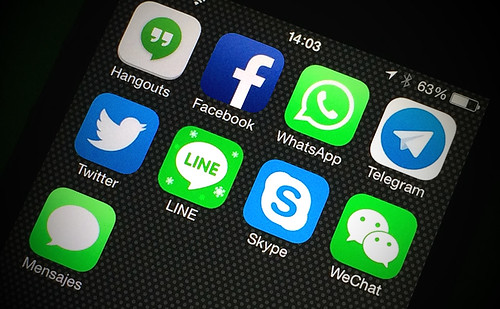
One of these is probably chewing up your battery by playing silent audio (on Android too). But which? Photo by microsiervos on Flickr.

You can now sign up to receive each day’s Start Up post by email. You’ll need to click a confirmation link, so no spam.

A selection of 9 links for you. Like champagne for the mind! Perhaps. I’m charlesarthur on Twitter. Observations and links welcome.

iOS apps caught using private APIs » SourceDNA

Nate Lawson and team:

we noticed that these functions were all part of a common codebase, the Youmi advertising SDK from China.

We then associated the clusters of this SDK’s code with the release dates of the apps that contain them to see how it has evolved over time. The older versions do not call private APIs, so the 142 apps that have them are ok. But almost two years ago, we believe the Youmi developers began experimenting with obfuscating a call to get the frontmost app name.

Once they were able to get this through App Review, they probably became more confident they weren’t being detected and added the above behaviors in order. They also use the same obfuscation to hide calls to retrieve the advertising ID, which is allowable for tracking ad clicks, but they may be using it for other purposes since they went to the trouble to obfuscate this. The latest version of the Youmi SDK (v5.3.0), published a month ago, still gathers all the above information.

Apple has been locking down private APIs, including blocking apps from reading the platform serial number in iOS 8. Youmi worked around this by enumerating peripheral devices, such as the battery system, and sending those serial numbers as a hardware identifier.

Find out now! Just select your developer accounts from a list, and we’ll tell you what we found about your apps. We’ll also show the commercial and open-source code you’re using and alert you to future issues we find.

We found 256 apps (est. total of 1 million downloads) that have one of the versions of Youmi that violates user privacy. Most of the developers are located in China. We believe the developers of these apps aren’t aware of this since the SDK is delivered in binary form, obfuscated, and user info is uploaded to Youmi’s server, not the app’s. We recommend developers stop using this SDK until this code is removed.

Apple’s yanking the apps. Developer? Check it here. It’s always China, isn’t it? But nothing to stop apps from other countries doing the same.
link to this extract


The background data and battery usage of Facebook’s iOS app » MacStories

Federico Viticci:

With iOS 9’s improved energy consumption stats, it’s easier to guess one of the various tricks Facebook may be employing to stay active in the background and drain battery. On my girlfriend’s iPhone, for instance, iOS 9 reports 5 hours of on-screen usage for the last 7 days, and another 11 hours of background audio usage with Background App Refresh turned off.

My guess is that Facebook is hijacking audio sessions on iOS by keeping silent audio in the background whenever a video plays in the app. And because, by default, videos on Facebook auto-play on both Wi-Fi and Cellular and few people ever bother to turn it off, that means there’s a high chance the Facebook app will always find a way to play a video, keep audio in the background, and consume energy to perform background tasks. I’m not alone in noticing the mysterious “Facebook audio” background consumption, and video auto-play seems to me the most likely explanation at this point. I don’t know if turning off auto-play may fix the problem, but I’d recommend doing that anyway to save data.

Un-fricking-believable. The web is suddenly alive with people who have used iOS 9’s better battery monitoring system and discovered that Facebook is eating their battery like nobody’s business.

More discussion here, and a full-on Medium post, which shows Facebook using 3.4hrs in the background with background app refresh turned off.

Just delete it, and use the mobile site – navigate there and create a home page icon for it. And close the tab when done.
link to this extract


Microsoft announces price of 1TB Surface Book — $500 more than the top 13-inch MacBook Pro » GeekWire

James Risley:

The top-of-the-line 1TB Surface Book comes with 16GB RAM and a Core Intel i7 processor for a cool $3,199, $500 more than the fully tricked out 13-inch MacBook Pro, and the same price as the fully enhanced, much larger 15-inch option. The Surface Book does have a few more tricks up its sleeve than the MacBook Pro, including a touchscreen, removable keyboard and a 360-degree hinge, so the price difference isn’t without reason.

The 1TB option joins the lineup that starts at $1,499 for a 128GB Core i5 version. Microsoft isn’t offering many fine-grained customizations for its first laptop, like allowing for more RAM on its 128GB model, but most models look adequately powerful for the everyday user.

“Everyday user”? Wasn’t the point of the Surface Book that it was for some slightly mythical ultra-user? As for the touchscreen and removable keyboard… the case for the touchscreen is still pretty weak for the “everyday user”.
link to this extract


Teen says he hacked CIA director’s AOL account » New York Post

Philip Messing, Jamie Schram and Bruce Golding:

Hillary Rodham Clinton’s email scandal didn’t stop the head of the CIA from using his own personal AOL account to stash work-related documents, according to a high school student who claims to have hacked into them.

CIA Director John Brennan’s private account held sensitive files — including his 47-page application for top-secret security clearance — until he recently learned that it had been infiltrated, the hacker told The Post.

Other emails stored in Brennan’s non-government account contained the Social Security numbers and personal information of more than a dozen top American intelligence officials, as well as a government letter about the use of “harsh interrogation techniques” on terrorism suspects, according to the hacker.

The FBI and other federal agencies are now investigating the hacker, with one source saying criminal charges are possible, law enforcement sources said.

The hacker is getting investigated for criminal charges? Brennan is the one who ought to be prosecuted. If a kid in high school could do this, any Chinese or Russian hacker would have.
link to this extract


Why it’s OK to block ads » Practical Ethics

James Williams:

Think about the websites, apps, or communications platforms you use most. What behavioral metric do you think they’re trying to maximize in their design of your attentional environment? I mean, what do you think is actually on the dashboards in their weekly product design meetings?

Whatever metric you think they’re nudging you toward—how do you know? Wouldn’t you like to know? Why shouldn’t you know? Isn’t there an entire realm of transparency and corporate responsibility going undemanded here?

I’ll give you a hint, though: it’s probably not any of the goals you have for yourself. Your goals are things like “spend more time with the kids,” “learn to play the zither,” “lose twenty pounds by summer,” “finish my degree,” etc. Your time is scarce, and you know it.

Your technologies, on the other hand, are trying to maximize goals like “Time on Site,” “Number of Video Views,” “Number of Pageviews,” and so on. Hence clickbait, hence auto-playing videos, hence avalanches of notifications. Your time is scarce, and your technologies know it.

But these design goals are petty and perverse. They don’t recognize our humanity because they don’t bother to ask about it in the first place.

Neatly argued, by stepping right back from the debate as framed by the ad industry.
link to this extract


I built a botnet that could destroy Spotify with fake listens » Motherboard

William Bedell:

I decided to prototype a robot with an endless appetite for music to see if Spotify could detect what it was doing.

Here is what I coded into life:

Image: William Bedell
First, a remote server used browser automation to sign up for Spotify accounts with randomly generated names, ages, and email addresses. This gave me a limitless supply of accounts to stream songs, so as not to alert Spotify by having a handful of users with inhuman amounts of activity.

A central command server periodically sent out Spotify login credentials to cloud servers (or repurposed personal computers) running dozens of Spotify clients, all masked behind virtual private networks. Each “user” logged in, listened to a few hours of music, then logged out. Their playlists were random selections from various artists I like. Then, I deployed the botnet using a patchwork of free cloud instances and my own hardware.

It was mesmerizing to watch the plays rack up. Unknown albums from minor celebrities I adore suddenly had tens of thousands of hits, where before they had virtually none. With minimal effort, I was generating $32.26 per day in royalties. Inevitably, my thoughts wandered to greed: how profitable would this music royalty factory be if I turned it on music I owned the rights to?

link to this extract


Intel has 1,000 people working on chips for the iPhone » VentureBeat

Mark Sullivan:

Intel now has a thousand people or more working to outfit a 2016 iPhone with its lauded 7360 LTE modem chip, sources say. If all goes well, Intel may end up providing both the modem and the fabrication for a new Apple system on a chip.

Sources close to the matter say Intel is pulling out the stops to supply the modems for at least some of the iPhones Apple manufactures in 2016. This phone will likely be the iPhone 7. VentureBeat was the first to report on the two companies’ work together, and more pieces are falling into place as the project progresses and grows.

Apple may dual-source the LTE modems in its new iPhones from both Intel and Qualcomm. Today, Qualcomm’s 9X45 LTE chip is baked into all iPhone modems.

This story makes one go “hmm..” right up to the point where it talks about dual-sourcing. Then it suddenly makes perfect sense: Apple would look to play the two off against each other, as with CPU supply.
link to this extract


E.U. rule change could be big headache for small businesses » Advertising Age

Kate Kaye:

“I think everybody was hoping [the ECJ] wouldn’t [rule against Safe Harbour], but we were kind of expecting them to rule it this way,” said Acxiom Chief Privacy Officer Jennifer Glasgow. But, she said, “This is not going to disrupt a lot of data flow today or tomorrow or next week.”

The Safe Harbor compact has helped streamline the data flow for more than 4,000 companies including data brokers, ad technology firms and ecommerce companies among others for 15 years. But alarmed by Edward Snowden’s revelations, the E.U. court decided the agreement is not strong enough to protect Europeans’ privacy, including against U.S. spies.

Most large firms handling massive amounts of data such as Google, Facebook and Amazon should already have other legal contracts in place, including previous agreements guiding heavily-regulated health and financial data, that should allow them to continue data transfer as usual. Smaller marketers and data vendors won’t be so lucky, which could have ripple effects throughought the marketing ecosystem.

Correction: the ECJ wasn’t “alarmed” by the revelations; it made a judgement in the light of those revelations about whether EU law could still be applied to data transferred to the US under Safe Harbour.

What’s weird is how people are acting as though this won’t make a difference. If you’re not allowed to transfer data US-owned servers on the basis that it might be rifled through by the US government, how can it not? (Of course, everyone would be howling for safety if these were Chinese-owned servers and companies; witness the US administration’s lockout of China’s Huawei from communications contracts.)
link to this extract


The secrets of a billionaire’s blood-testing startup » The New Yorker

Eric Lach:

Part of the Theranos story is the tension between commerce, science, and secrecy. Ken Auletta explored this tension in the magazine late last year, in his December profile of Holmes. For most of its existence, Auletta wrote, Theranos has “operated with a stealth common to many Silicon Valley startups.” The company has published little data in peer-reviewed journals describing its devices or its test results, and it has kept the workings of its technology a closely guarded secret. Holmes herself prefers speaking about the coming revolution that her company will bring rather than the specifics of the technology itself.

Holmes and the company say this is normal, that Theranos is only trying to protect itself and its trade secrets while it creates something new. The company says that it has taken steps to get its tests approved by the F.D.A. But there are many who say that health-care technology can’t be afforded the same hushed reception as a new model of the iPhone. “Science is peer-reviewed,” Lakshman Ramamurthy, a former F.D.A. official and a vice-president at the consulting company Avalere Health, said, reacting to the Journal article this week.

Of course, Holmes could be a billionaire, or a zeroinaire, depending how things pan out over the next few months.

What the WSJ story also shows (by its impact, and the puzzled followups) is how little understanding there is of biotech among most journalists. Science journalists tend to shy away from it because it involves business, and business journalists aren’t good at figuring out what questions to ask experts about the science.
link to this extract



Start up: Facebook’s dwindling teens, Safe Harbour or balkanisation?, the privacy tsunami, and more


No, really, no difference. Move along there and find another story. Photo by Bob Jouy on Flickr.

A selection of 9 links for you. Soluble in alcohol. I’m charlesarthur on Twitter. Observations and links welcome.

Facebook is big, but big networks can fall » Bloomberg View

Megan McArdle:

Looking at the most recent Pew study on Internet usage among young people,  I see that 71% of teens use Facebook, with the median user having slightly less than 150 friends; 41% of them report that they use Facebook most often. But when I look at a similar Pew study from 2013, it looks to me as if 76 percent of teens were using Facebook, with a median number of 300 friends, and 81% of social media users reported that they used Facebook most often. If I were Facebook, those numbers would keep me awake at night – not because Facebook can’t survive with only 70% of the market, but because a network that is getting smaller and less valuable to its users is a network that is very vulnerable to disruption.

What’s actually astonishing is just how evanescent such strategic advantages have proven. Fifteen years ago, people worried that Microsoft’s network-effect advantages made it unstoppable; now it’s an also-ran in everything new-market except gaming consoles. The rotting corpses of old social media sites litter the landscape. And of course, finding a place to send Aunt Maisie that birthday telegram is getting darned hard.

She also makes a point about network effects: the thing about “all your photos are in Facebook” isn’t a network effect, but a switching cost – a quite different thing.
link to this extract


Apple says battery performance of new iPhone’s A9 chips vary only 2-3% » TechCrunch

Matthew Panzarino:

In a statement to TechCrunch, Apple said that its own testing and data gathered from its customers after a few weeks with the device show that the actual battery life of both devices varies just 2-3%. That’s far, far too low to be noticeable in real-world usage.

With the Apple-designed A9 chip in your iPhone 6s or iPhone 6s Plus, you are getting the most advanced smartphone chip in the world. Every chip we ship meets Apple’s highest standards for providing incredible performance and deliver great battery life, regardless of iPhone 6s capacity, color, or model.

Certain manufactured lab tests which run the processors with a continuous heavy workload until the battery depletes are not representative of real-world usage, since they spend an unrealistic amount of time at the highest CPU performance state. It’s a misleading way to measure real-world battery life. Our testing and customer data show the actual battery life of the iPhone 6s and iPhone 6s Plus, even taking into account variable component differences, vary within just 2-3% of each other.

Though there have been a bunch of articles and videos about how much power one chip or the other uses, the tests have largely been what Apple calls ‘manufactured’. Basically, they are unrealistic machine-driven tests that do not and can not reflect real-world usage.

So this year’s iPhonegate lasted slightly less than 24 hours. Apple is even managing to balance supply and demand here too.
link to this extract


EU Safe Harbour ruling a ‘nightmare’: Wikipedia founder » CNBC

Arjun Kharpal:

Jimmy Wales, the founder of Wikipedia, said the regulatory issues that could come with this might be a problem for some businesses.

“You want your data to be secure, you don’t really care or you shouldn’t have to care where it sits,” Wales told CNBC in an interview at IP EXPO Europe in London.

“If I’m in Europe I hope they are near me on a server in Europe, but other than that I want them to provide the best technical experience for me. And if they suddenly have all those requirements and have to keep certain pictures in certain places, it just sounds like a nightmare, so I like the idea of uniformity in the law so that we can all not worry about it.”

Wales added in a separate session with reporters that the ECJ ruling could lead to a “balkanized era where data has to be secure very specifically across many many different jurisdictions”.

Great point. So does this mean he’ll be lobbying the US to implement strong data protection rules that match those of Europe? I do hope so. I mean, that’s the best way to protect everyone’s interests, isn’t it, Mr Wales?
link to this extract


Why is it so hard to convince people to care about privacy? » The Guardian

Cory Doctorow:

The only way to be sure you don’t leak data is to not collect or retain it, and Big Data’s hype and the cheapness of hard drives has turned every pipsqueak tech company into a Big Data packrat with a mountain of potentially toxic personal info on millions of people, all protected by a password that’s simple enough for a CEO to remember it.

Every week or two, from now on, will see new privacy disasters, each worse than the last. Every week or two, from now on, will see millions of people who suddenly wish there was more they could do to protect their privacy.

For privacy advocates in 2015, the job is clear: have a plan in your drawer. A plan: how to safeguard your privacy, how to understand your privacy, how to understand the breach. A plan that explains that your lack of security isn’t a fact of nature, it’s the result of conscious decisions made by people who were either hostile or indifferent to your wellbeing, who saved or made money through those decisions. A plan that shows you what you can do to keep you and yours safe – and whose head your should be demanding on a pike.

link to this extract


Get AMP’d: Here’s what publishers need to know about Google’s new plan to speed up your website » Nieman Lab

Joshua Benton:

What’s it all mean for publishers?

As I said, AMP [Accelerated Mobile Pages] is full of terrific ideas. It really does speed up load times.

But that success comes with tradeoffs. For most publishers, you’re being asked to set up two parallel versions of your stories. (Unless you really think you won’t need to ever do anything outside what AMP allows on any page, which is unrealistic for most.) That takes significant time and resources. You’re being asked to set aside most or all of the ad tech and analytics that you use. You’re trading in open web standards for something built by Google engineers who, despite what I don’t doubt are the best of intentions, have incentives that don’t line up perfectly with yours. And you’re becoming an disempowered actor in a larger Silicon Valley battle over ad tech. (Google advocating something that blocks enormous slices of contemporary ad tech can’t be viewed in isolation from the fact Google is the dominant force in online advertising, and as interested as any company is in extending its power.)

And it’s yet another case of a technology company coming along to promise a better experience for users that takes one more bit of power away from publishers.

The fact that publishers’ interests aren’t exactly aligned with Google’s shouldn’t be overlooked. And Google’s interests aren’t aligned with third-party ad networks at all, except that they all want to serve up ads. (Meanwhile, iOS 9 content blockers still block ads on the AMP demo.)
link to this extract


This is why Android Pay is asking you for a ‘Google Payments PIN’ when making purchases » Android Central

Andrew Martonik:

when you have a card from one of these supported banks (check the latest list from Google here) in Android Pay, it’s amazingly seamless to make payments. Just unlock your phone, tap the terminal and you just paid.

Confusingly, though, Android Pay actually lets you add unsupported cards to the app as well.

This is a hold over from the old days of Google Wallet, which had an entirely different system that worked without the cooperation of the banks. With Google Wallet, every time you made a transaction it actually made that purchase with a virtual prepaid debit card from “Bancorp Bank” and then that same amount was subsequently charged to your own bank. It was clunky, less secure and downright confusing to everyone involved — and the most annoying user-facing part of this system is the need for an extra PIN code to make a payment.

As Google Wallet hands the reigns over to Android Pay in this transition of mobile payments, this legacy system of using an unsupported card is actually still baked into Android Pay — though Google isn’t exactly promoting it as such. This is partially due to the fact that you can bring previously-used debit and credit cards from Google Wallet into Android Pay, and partially because Android Pay just doesn’t support that many banks yet — just 10 at the time of writing.

My first reaction was that this is a poor user experience; why make people who are new to Android Pay have to use a PIN? Then I realised that most Americans aren’t used to PINs for purchasing, and are just adjusting to chip-and-sign. So this might be faster. (The fact that you might have two cards, and one will require a PIN and one won’t, seems like bad design though.)
link to this extract


Former Reuters journalist Matthew Keys found guilty of three counts of hacking » Motherboard

Sarah Jeong:

In 2010, Keys posted login credentials to the [his then former employer] Tribune Company content management system (CMS) to a chatroom run by Anonymous, resulting in the defacement of an LA Times article online. The defacement was reversed in 40 minutes, but the government argued the attack caused nearly a million dollars in damage…

…”This is not the crime of the century,” Segal said, adding that nonetheless Keys should not get away with his acts. At minimum, he may receive probation. Sentencing is scheduled for January 20, 2016.

Keys said he was disappointed with the verdict, and worried about the sentence affecting his ability to work. However, he also expressed his intention to appeal the conviction, and was optimistic it would be overturned.

Keys added that a few months after his first story about Anonymous, he was approached by the FBI, but Keys refused to allow them to scan his computer. He was indicted a couple of years later.

In order to be convicted under the CFAA, the damage had to exceed $5,000. The government claimed that Keys caused $929,977.00 worth of damage. During the trial, the defense tried to cast doubt on the total damages, claiming that the expenditures in response to the hack were not reasonable, and Tribune employees had grossly inflated the hours spent on incident response.

Lesson 1: change passwords ex-employees had access to. Lesson 2: don’t post passwords of companies that you used to work for on Anonymous chatboards.
link to this extract


Will digital books ever replace print? » Aeon

Craig Mod used to read only ebooks (on Kindle) but now finds he has fallen out of love with it in favour of the physical form again:

Take for example the multistep process of opening a well-made physical edition. The Conference of the Birds (2009), designed by Farah Behbehani and published by Thames and Hudson, is a masterclass in welcoming the reader into the text.

The object – a dense, felled tree, wrapped in royal blue cloth – requires two hands to hold. The inner volume swooshes from its slipcase. And then the thing opens like some blessed walking path into intricate endpages, heavystock half-titles, and multi-page die-cuts, shepherding you towards the table of contents. Behbehani utilitises all the qualities of print to create a procession. By the time you arrive at chapter one, you are entranced.

Contrast this with opening a Kindle book – there is no procession, and often no cover. You are sometimes thrown into the first chapter, sometimes into the middle of the front matter. Wherein every step of opening The Conference of the Birds fills one with delight – delight at what one is seeing and what one anticipates to come – opening a Kindle book frustrates. Often, you have to swipe or tap back a dozen pages to be sure you haven’t missed anything.

Because the Kindle ecosystem makes buying books one-click effortless, it can be easy to forget about your purchases. Unfortunately, Kindle’s interface makes it difficult to keep tabs on those expanding digital libraries: at best, we can see a dozen titles at a time, all as inscrutably small book covers. Titles that fall off the first-page listing on a Kindle cease to exist. Compare that with standing in front of a physical bookshelf: the eye takes in hundreds of spines or covers at once, all equally at arm’s length. I’ve found that it’s much more effortless to dip back into my physical library – for inspiration or reference – than my digital library. The books are there. They’re obvious. They welcome me back.

The pile of unread books we have on our bedside tables is often referred to as a graveyard of good intentions. The list of unread books on our Kindles is more of a black hole of fleeting intentions.

The comparison of a bookshelf to the limited real estate on a screen is so important in many contexts: when we got into a supermarket or bookshop we can scan hundreds of items at once. How many on a screen when you don’t know what you’re searching for?
link to this extract


Sony buys Belgian image sensor technology firm » Reuters

Ritsuko Ando:

Japan’s Sony Corp said it bought Belgian image sensor technology company Softkinetic Systems for an undisclosed sum, stepping up investment in an area that has become one of its strongest amid weak sales of its TVs and smartphones.

Softkinetic specializes in a type of technology that helps measure “time of flight”, or the time it takes for light to reflect off an object and return to an image sensor, Sony said.

Put like that, it sounds like “you’re measuring light round trips? Those are nanoseconds, right?”. Judging from the site, though, it’s more about location in 3D and general position sensing and mapping in domestic environments. So does this mean we’ll go to 3D photos next?
link to this extract


You can now sign up to receive each day’s Start Up post by email. You’ll need to click a confirmation link, so no spam.

Start up: can Google accelerate publishers?, DuckDuckGo profitable, 3D Touch coming to Android?, and more


Antennagate, Bendgate, and now – Transistorgate? It’s the regular iPhone two-weeks-after-launch news cycle. Photo by khaiphotoart on Flickr.

A selection of 11 links for you. Not legal in Delaware. I’m charlesarthur on Twitter. Observations and links welcome.

Google speeds up news article downloads on mobile devices » BBC News

Leo Kelion:

Dozens of leading news organisations, including the BBC, are taking part in a scheme that will allow their web-based articles to load more quickly on smartphones and tablets.

Leaders of the Accelerated Mobile Pages (AMP) initiative promise that the stripped-back versions of the pages will be “lightning fast” to load.

The move has been led by Google, which is providing use of its servers.

Participants believe it may discourage the use of ad-blocking plug-ins.

AMP works by simplifying the technical underpinnings of the pages involved.

Much of the Javascript code used on normal webpages is absent, meaning articles should not only appear faster but use less battery power.

Publishers can continue to tap into the same ad networks as before, but they will not be able to display some types of adverts including pop-ups and “sticky” images that move as users scroll down a page.

Twitter, LinkedIn, Pinterest and WordPress have said they also intend to make use of the technology.

Facebook is a notable exception. The social network recently launched an alternative programme called Instant Articles, which speeds up the delivery of third-party content by hosting it on its own platform.

Less Javascript, eh? Notable that “participants” (in the test) think it will discourage adblocking. I don’t see why they think that. It might forestall some people from using them. But people who visit pages that aren’t on AMP will get the same dire experience; they won’t know if they’re on AMP pages or not, will they? And then they search for “adblocker”…
link to this extract


Google’s Accelerated Mobile Pages – a quick reaction (no js) » Kevin Marks

Marks has long open source experience. He’s not that impressed by Google’s new offering with publishers:

Specifically, they replace img, audio, video with their own versions implemented as custom elements and so requiring javascript to appear. They ban loaded style sheets, requiring inline styles, but oddly allow font-face, one of the slowest things on the mobile web. They also replace the Twitter embed fallback markup with a custom type made up by themselves, which combined with the iframe ban means that you need their blessing to extend the web.

This means that if javascript is not loaded, images will disappear.

They also require a lot of arbitrary weird markup (like emoji in the html element, which violates content encoding), a weird style incantation that makes the page opaque, and require the proprietary schema.org markup.

Now, my site is not very complex; indeed it loads very fast on mobile already, but it does use a few javascript enhancements: fragmention to let you link to a phrase; webmention injection for comments as seen below, and the twitter embed enhancement javascript. Without these, the page still renders and makes sense, and it is parseable as microformats. This is known as progressive enhancement; AMP looks more like graceless degradation.

Ow.
link to this extract


Does your iPhone have a good or bad A9 CPU? » Engadget

Abdul Dremali:

There’s a little drama brewing less than two weeks after Apple released it’s brand new line of iPhones. As reported by Anandtech, the A9 processor of the iPhone 6s and 6s Plus were dual sourced from Samsung and a company called TSMC. The differences between these chips was not evident for some time as fans assumed the smaller 96mm² by Samsung would be the superior chip. Users are conducting tests and reporting the results via forums on Reddit and Mac Rumors which have resulted in the conclusion that the TSMC A9 has approximately 2 hours better battery performance than the Samsung.

It recommends an app you can download to check which make you have. Can we call this Transistorgate? (It’s going to be quite a thing if there really is that big a difference. Though when Apple introduced the retina MacBook Pro, it sourced screens from Samsung and LG; the LG ones were worse. It’s a coin flip..)
link to this extract


Thank HN: for helping me get traction with DuckDuckGo and Traction book – AMA » Hacker News

Gabriel Weinberg, who set up the DuckDuckGo search engine, took the slightly unusual step of doing an AMA (ask me anything) on Hacker News, rather than Reddit, because he credits HN with getting it all off the ground. He also has a book about how his startup(s) got traction to sell. And this nugget:

DuckDuckGo is actually profitable! It is a myth you need to track people to make money in Web search. Most of the money is still made without tracking people by showing you ads based on your keyword, i.e. type in car and get a car ad. These ads are lucrative because people have buying intent. All that tracking is for the rest of the Internet without this search intent, and that’s why you’re tracked across the Internet with those same ads.

(Disclosure: I use DDG as my default. I like it. You can copy a link from the results without it being stuffed with Google obfuscation.)
link to this extract


I used an Android watch with my iPhone — and I hate it » Business Insider

Matt Weinberger:

Now, after more than a week wearing a Huawei Watch provided by Google,  I can say that I don’t care for it very much. It doesn’t actually fulfill the mission of helping me look at my phone less.

It’s not really Huawei’s fault. Not entirely. Apple is notoriously protective of the iPhone’s ecosystem, and it’s a minor miracle that an Android watch can sync with an iPhone at all.

But as it stands, the only real superpower that using an Android Wear watch has going for it is that it pushes your phone’s notifications straight to your wrist with a little buzz. If you actually want to do anything about those notifications, you have to take your phone out of your pocket anyway.

But it was good for telling the time. There was that. Looks like the expectation that Android Wear being able to link to iOS would bring a boom in competition (and sales) was overblown.
link to this extract


Sony may consider options for smartphone unit if no profit next year » Reuters

Reiji Murai:

Sony Corp’s chief executive flagged next year as a make-or-break year for its struggling smartphones, saying it could consider other options for the unit if it failed to turn profitable.

After years of losses, Chief Executive Kazuo Hirai has engineered a successful restructuring drive at Sony, with recent results showing improvement thanks to cost cuts, an exit from weak businesses such as PCs, as well as strong sales of image sensors and videogames. But its smartphone business has been slow to turn around.

“We will continue with the business as long as we are on track with the scenario of breaking even next year onwards,” Hirai told a group of reporters on Wednesday. “Otherwise, we haven’t eliminated the consideration of alternative options.”

Told you: trying to go upmarket in Android is not a smart move, but that’s the strategy Sony tied itself to without having any clear differentiation.
link to this extract


Press release: Synaptics announces ClearForce technology for smartphones » Synaptics

Synaptics, the leading developer of human interface solutions, today announced broad sampling of its ClearPad® ClearForce™ force-sensing solutions. ClearForce enables OEMs to differentiate smartphones by providing customers with new dimensions in user interfaces such as speed scrolling, zoom, gaming, and text or photo editing by applying variable force with a finger or stylus. Synaptics® has been working closely with leading global OEMs and LCMs to deliver this new dimension in touch with force-enabled smartphones expected to ship in early 2016.

With a rich history in force technology dating back to 1996, including over 60 granted and pending patents worldwide, Synaptics’ third-generation force-sensing solution, ClearForce, enables global OEMs and LCMs to differentiate smartphones — with tablet, wearables, and automotive manufacturers to follow. Variable force creates numerous opportunities to invent new user interface capabilities and increases productivity for touchscreen applications.

“ClearForce”. Unlike, say, Force Touch or 3D Touch. What’s the betting that Samsung’s Galaxy S7 includes this? Question is, will it only be for Samsung apps, or will other app developers (even Google?) take advantage of it?
link to this extract


Twitter’s Moment » Stratechery

Ben Thompson is excited about the fact and the potential of Twitter’s new Moments service:

When you first tap the Moments tab at the bottom of the Twitter app you’re dropped into the ‘Today’ view that lists a mishmash of stories that, well, happened today.

• Touch any of the stories to get a curated list of tweets that tell the story in question through videos, images, and sometimes just text. It’s a really great experience, and I found the sports stories with their combination of highlights and tweeted reactions particularly enjoyable

• For any Moment in progress, you can tap a button to add tweets about that Moment to your main timeline. Crucially, though, those tweets only persist for the duration of the event in question; the ‘Unfollow’, which is the most essential action when it comes to building a Twitter feed you actually read, is done for you

• Finally, in what was probably the biggest surprise in the product, there is a carousel at the top leading to more focused categories:

Each of these categories includes not only ‘News’ or ‘Entertainment’ Moments that just happened, but also more timeless content, particularly in ‘Fun.’ Look carefully at those category titles, though — they sure look familiar:

That’s right, Twitter just reinvented the newspaper. It’s not just any newspaper though — it has the potential to be the best newspaper in the world.

link to this extract


Japan’s Murata sees slowdown in global smartphone market growth » Reuters

Makiko Yamazaki and Reiji Murai:

Global demand for smartphones is likely to slow in the next fiscal year due to weaker demand from the world’s biggest market China, the head of Japanese smartphone component maker Murata Manufacturing Co told Reuters on Wednesday.

Chief Executive Tsuneo Murata said growth for the fiscal year starting April 2016 would be in the high, single digits, below the 12 percent growth forecast by the company for fiscal 2015/16.

Murata, however, said this slowdown was unlikely to hurt the company’s business because demand for the high-end phones it provides parts for is expected to remain robust.

“Everyone seems to be worried about the future of the smartphone market, but there should be no change to growth in demand for high-speed and high-performance handsets,” said Murata, one of the sons of the Kyoto-based company’s founder.

“Such high-end handsets need to use more of our products.”

IDC is forecasting overall growth at about 10% for this year compared to 2014; Murata sees that slowing after January.
link to this extract


iOS hits twelve-month low in US ahead of iPhone launch » Kantar Worldpanel

“Across Europe’s ‘big five,’ Android continues to struggle, with only the heavily prepaid markets of Italy and Spain registering a year-over-year share growth,” said Dominic Sunnebo, business unit director at Kantar Worldpanel ComTech Europe. “In Great Britain, Samsung, the undisputed Android leader, dropped market share both period-over-period and year-over-year, while Sony and LG were the only two Android vendors able to grow share over the last year and over the three months ending in July 2015.”

Europe’s “big five” markets are Great Britain, Germany, France, Italy, and Spain.

“In the US, Samsung’s Galaxy S6 grew its share of smartphone sales but did not threaten the iPhone 6 leadership position,” [research director Carolina] Milanesi added. “In April through August 2015 – the months following the launch of the new flagships – only 29% of the Samsung smartphone installed base were upgraded to new devices. Among those who upgraded, 23% changed to a Galaxy S5, 4% to a Galaxy S6, and 1% to a Galaxy S6 Edge.”

Android is hardly “struggling” in Europe; in some countries such as Spain it has nearly 90% sales share. On that last point – this means that of the total US Samsung smartphone installed base (52m according to separate data from ComScore), 29% (15.1m) upgraded; of those 23% (3.4m) got last year’s S5, 4% (0.6m) got an S6 and 1% (150,000) got an Edge. That’s a pretty dramatic preference for the S5; does price alone explain it?
link to this extract


Verizon’s zombie cookie gets new life » ProPublica

Julia Angwin and Jeff Larson:

Verizon is giving a new mission to its controversial hidden identifier that tracks users of mobile devices. Verizon said in a little-noticed announcement that it will soon begin sharing the profiles with AOL’s ad network, which in turn monitors users across a large swath of the internet.

That means AOL’s ad network will be able to match millions of internet users to their real-world details gathered by Verizon, including — “your gender, age range and interests.” AOL’s network is on 40% of websites, including on ProPublica.

AOL will also be able to use data from Verizon’s identifier to track the apps that mobile users open, what sites they visit, and for how long. Verizon purchased AOL earlier this year.

The decision came after a ProPublica article revealed that an online advertiser, Turn, was exploiting the Verizon identifier to respawn tracking cookies that users had deleted. Read the story.

Privacy advocates say that Verizon and AOL’s use of the identifier is problematic for two reasons: Not only is the invasive tracking enabled by default, but it also sends the information unencrypted, so that it can easily be intercepted.

Or you can opt out (and hope it sticks).
link to this extract


Finished here? You can now sign up to receive each day’s Start Up post by email. You’ll need to click a confirmation link, so no spam. (Unless you’re reading it on email, in which case well done. Saved yourself a click.)

Start up: Russia v Android, Citymapper and Crosslink, the Windows 10 problem, and more


Android Marshmallow is out. What’s inside? Photo by Waleed Alzuhair on Flickr.

You can now sign up to receive each day’s Start Up post by email. You’ll need to click a confirmation link, so no spam.

A selection of 11 links for you. Hydrated for greater comfort. I’m charlesarthur on Twitter. Observations and links welcome.

Russian antitrust officials give Google deadline on Android bundling » Re/code

Mark Bergen:

Here’s the edict from the Russian antitrust agency (pulled from Google Translate, since it has yet to update its English site): “In order to restore competition in the market … Google [must] adjust the agreements with the manufacturers of mobile devices to exclude from the agreements anticompetitive requirements limiting the installation of applications and services to other developers.”

Google declined to comment. It could face a fine, according to the Russian agency, of up to 15% of the revenue from the preinstalled apps. Morgan Stanley has estimated that Russia accounts for about $560m of Google’s annual revenue, or roughly 1%.

Yandex, which brought the case, said in a statement it was “satisfied” with the decision. “Our goal is to return fair play to the market – when apps are preinstalled on mobile devices based on how good or how popular they are rather than due to restrictions imposed by the owner of the operating system,” the company added.

As I read it, that would only apply to devices sold inside Russia after the November 18 deadline. Wonder what it means for grey imports. Obviously it can’t be retrospective.
link to this extract


Learning more about Google’s self-driving cars made me terrified to ever drive again » Business Insider

Jillian D’Onfro:

less than 24 hours after Google’s presentation… I had to drive to and from Los Altos, California. What would otherwise have seemed like a completely typical trip suddenly made me realize just how pathetic a driver I am compared to one of Google’s cars.

Although I didn’t commit the cardinal sin of texting while driving, I was for the first time hyper-conscious of how often I let me eyes drift from the road, whether to check Google Maps on my phone or change the radio station. At one point, I needed to slam the brakes: I had been watching traffic, but deep in thought, making my reaction time slower than it should have been.

Suddenly, I couldn’t wait to get out of that car. The person driving next to me, yapping on her phone, immediately seemed like a threat. As did the fact that I was taking my eyes away from the road ahead to look at her. I have never loved driving, but recognizing all the normal minutiae as potentially dangerous distractions makes me hate it. 

I think there are going to be two reactions to SDCs: those like D’Onfro, and those who enjoy the chance to beat the slowpoke super-cautious SDCs by driving aggressively.
link to this extract


Building a city without open data » Medium

Citymapper explains how it began with open data for its travel planning service, but is now working on cities which don’t:

We’ve learned that the goal is not just to launch cities and win fancy prizes, although that’s fun. It’s about maintaining and improving data so that citizens and travellers can trust us to give them the best information when and where they need it.

And this is hard. The largest cities of our planet are complicated and evolve over time. They require dedicated focus. And we’ve found that open data is not enough to satisfy the information demands of the ever wanting smartphone user.

So we’ve been fixing data. And we’ve been improving data. And we’ve been adding data. And in the process of doing so we’ve developed a number of tools to help us scale and solve problems faster. And to empower our heroes to fix things and solve problems without the need for engineering.

We’ve done a lot with these tools. Well for one, we’ve used them to create some fake data…

They can show you what travel in London is going to be like with Crossrail. Terrific.
link to this extract


Android 6.0 Marshmallow, thoroughly reviewed » Ars Technica

Ron Amadeo:

Google says that the new release has a “back to basics” motif with a focus on “polish and quality.” Marshmallow makes many long-requested features a reality with selectable app permissions, a data backup system that actually works, and the ability to format SD cards as Ext4, allowing the system to treat cards just like internal storage. Marshmallow is also prepared for the future with support for USB Type-C’s power delivery spec, a Fingerprint authentication API, and 4K display support. And, as with any Android release, there’s also lots of new Googley stuff—a slick new search interface and a contextual search mode called “Google Now on Tap,” for example.

While this is a review of the final build of “Android 6.0,” we’re going to cover many of Google’s apps along with some other bits that aren’t technically exclusive to Marshmallow. Indeed, big chunks of “Android” don’t actually live in the operating system anymore. Google offloads as much of Android as possible to Google Play Services and to the Play Store for easier updating and backporting to older versions, and this structure allows the company to retain control over its open source platform. As such, consider this a look at the shipping Google Android software package rather than just the base operating system. “Review: New Android stuff Google has released recently” would be a more accurate title, though not as catchy.

The 23rd version of Android, though I’m guessing that includes hundredth-decimal point updates. Amadeo’s predictions about how developers will abuse the battery-saving Doze mode are worth reading (as the whole thing is – allow plenty of time). Finally fixed permissions, eh? Only been waiting since 2012. And definitely read the last page if nothing else.
link to this extract


Carriers are making more from mobile ads than publishers are » Medium

Rob Leathern crunched the numbers, based on the NY Times article about sites’ ad heft:

For each site, take Mb/minute x Avg per/Mb mobile data cost, and weight the average by each site’s monthly unique mobile visitors (so heavier data-using sites get more weight in our calculation) and normalize to one minute of time on each site, for a value ranging from $0.01 to $0.24 per minute. Compare that figure to our average revenue of $0.15/hour = $0.0025/minute and weight the average to get the result:

16.6x more in data costs to the user than mobile ad revenue to these top 50 news sites on average

Even if it isn’t exactly accurate, it’s showing an order of magnitude difference. Publishers get an absolute pittance from ads. Then again, people spend very little time on them – Leathern’s data (from public sources) says it’s about 3.5 minutes per month.
link to this extract


We’re replacing comments with something better » Motherboard

Derek Mead, editor-in-chief of Motherboard:

Comment sections inspire quick, potent remarks, which too easily veer into being useless or worse. Sending an email knowing that a human will actually see it tends to foster thought, which is what we want. So in addition to encouraging that you reach out to our reporters via email or social media, you can now also share your thoughts with editors via letters@motherboard.tv. Once a week or thereabouts we’ll publish a digest of the most insightful letters we get.

The argument for comments has long been that a well-moderated section lowers the barrier to entry for readers to share their thoughts, positive or otherwise. In a vacuum, that sounds like a dream, but the key there is “well-moderated.” Good comment sections exist, and social media can be just as abrasive an alternative. But for a growing site like ours, I think that our readers are best served by dedicating our resources to doing more reporting than attempting to police a comments section in the hopes of marginally increasing the number of useful comments.

Ah, another one. Gresham’s Law continues to apply.
link to this extract


Microsoft lowers its expectations for phones » WSJ

Shira Ovide on the forthcoming launch of new (high end?) Lumia phones:

Microsoft is betting that shoppers and mobile-application developers will find it alluring to buy Windows smartphones, or write applications for them, in tandem with Windows PCs. To lure app makers who have treated Windows smartphones as an afterthought, Microsoft has made it easier to repurpose their iPhone or Android apps for Microsoft phones.

People close to Microsoft say success at proliferating Windows 10—the company aims to have it installed on 1 billion devices by mid-2018—would give a huge lift to Windows smartphones. That would likely invert the pattern set by Apple, which found that people who bought iPhones were more willing to buy a Mac computer.

“The best thing for Windows phone devices is Windows 10 use,” said a person familiar with Microsoft’s strategy.

Microsoft executives hoping for a smartphone turnaround can point to a precedent: the company’s Surface line of tablet-plus-PC devices, a once-struggling hardware business that found its groove even without blockbuster sales.

“Let’s write an Uber app for the desktop!”
link to this extract


I once was in Maps, but now I’m found » Unauthoritative Pronouncements

Joe Steel has some worthwhile objections to Apple Maps:

One of the things I’ve found puzzling about the design of the Apple Maps interface is that you can see traffic, and travel estimates supposedly influenced by traffic, in the route overview, but no traffic information is provided when turn-by-turn is on. All the roads are tranquil, neutral tones, and a serene blue path flows before you. It’s as if you’re in a kayak, on a river, being gently pulled along by the flow of water.

That’s not true, of course, because why would there be that much water in Los Angeles?

At heavy intersections, like Highland Ave. and Franklin Ave., you see no information about the flow of traffic in any direction. Instead of blue, you should see the streets run red with the blood of the Traffic God. Woe betide thee that commute on his most sacred of poorly designed intersections!

Tonight, Apple Maps routed me down Cahuenga to Highland. That sent me past the large, somewhat famous, amphitheater known as The Hollywood Bowl. Not a big deal, unless there’s an event at The Bowl. Guess what? There was an event! Van Halen! There were orange, safety cones and traffic cops directing at intersections. Apple Maps just herp-derped me through that. The only difference in the display was the estimated arrival time slowly ticking upward as I crawled.

On exactly one occasion I had Apple Maps present me with a yellow bar across the top, and Siri’s voice notified me that there was a delay due to an accident. (No alternate routing was provided on this occasion.) Waze has a leg up on Apple and Google when it comes to accident notifications. You even get notified about which lane the accident is in. Google sources some Waze data, but isn’t as specific. On the 101 N last night there was a very sudden slowdown, without warning, at a time of night when there shouldn’t be traffic at all. I waited patiently for Apple Maps to let me know what it was, and Apple Maps was oblivious to it. There was apparently a car accident that closed two lanes, and the car was being loaded on to a flatbed truck, so it wasn’t recent. Why Apple Maps kept silent about it, I don’t know.

The “not showing traffic when you’re en route” question puzzles me too. And TomTom, which is Apple’s data provider, does offer a (paid) service with alerts about traffic. I don’t think Apple’s privacy approach (it splits the route halfway and runs it under another random ID) is the cause, but it seems odd not to feed in traffic data in from other devices on the same route ahead of you.
link to this extract


The death of advertising and the future of advertising » Tech.pinions

Ben Bajarin:

our research indicates the extremely valuable 18-35 yr old demographic ranks highest in our surveys of those who use an ad blocker. In the US particularly, 4 in 10 millennials admit to blocking internet advertising. Anyone in marketing will tell you this age bracket is highly sought after by marketers. In follow-up interviews I’ve had with this demographic, one of the driving motivations for use of an ad blocker is so they can block ads on YouTube. Watching videos on YouTube is a hefty part of millennials’ weekly activity and many indicated to me their desire to skip ads and get right to the video was centered on their feeling ads were a waste of time. They were going to YouTube to see a short video and did not feel a 5 or 15-second ad before a video was an efficient use of their time. I also asked millennials how they found out they could block ads on the web and the most common answer was from a friend. It seems ad blockers are going viral with many US millennials and it is unlikely this trend loses steam any time soon.

Remember too that those young millennials are highly likely to be using an iPhone – where they can now get an adblocker too.
link to this extract


Reverse engineering proves journalist security app is anything but secure » Motherboard

JM Porup:

On Friday, Motherboard reported that the new Reporta app, billed as “the only comprehensive security app available worldwide created specifically for journalists,” may not be secure at all.

After we published our story, Frederic Jacobs, Open Whisper Systems’s lead developer for their secure messaging app, Signal, spent his Friday night at home reverse engineering the Reporta binary for iOS. He published the results here. His conclusion was, in a tweet, “Sloppy engineering. Reporta is forensics & analytics rich.”

“Every action is logged,” he wrote in his report. Google Analytics is built into the app, which stores the logs in a local cache before uploading them to Google’s servers. Reporta also uses Twitter’s Crashlytics crash-reporting framework, he explained.

“If you’re building an app for journalists in ‘potentially dangerous conditions,’” Jacobs wrote in a Twitter direct message, “you shouldn’t be tracking your users that much. And certainly not giving out that information to third parties without asking for consent of their users.”

Also has variable use of https and on-device encryption.
link to this extract


Windows 10 does not change the PC’s fate » Gartner

John Lovelock:


The market is still rebalancing. PC sales continue to decline, and tablets are the preferred consumption device. But new lightweight PCs have emerged that can compete with tablets as an all-day carry device. Made possible by Ivy Bridge architecture in 2013, which has improved steadily since, the new ultramobile premium devices, such as Microsoft’s Surface, now compete with tablets on four fronts; mobility, light weight, all-day batteries and lower price. Windows 10 is targeted at the last of the tablet’s differentiators – ease of use and empowering users.

The global installed base for desktops and laptops will decline for at least five more years, nothing changes that. However, the PC ecosystem now has a Windows 10 device that can re-engage users in the thin, light, all-day ultramobile devices that pack the power of a PC. Ultramobile premium devices halt the decline in PC shipments in 2017 and halt the decline of the PC installed base in 2019.

If you’re into webinars, Gartner is doing a free one at 11am EDT today (Tues October 6) on the PC market’s impact on overall IT spending. “Webinar”. Hmm.
link to this extract


Start up: the Nexus puzzle, Stagefright 2.0 (bigger!), T-Mobile US data hack, Fiorina’s iPod miss and more


How do you make cakes sell better if they make people feel guilty? Photo by ricardogz10 on Flickr.

You can now sign up to receive each day’s Start Up post by email. You’ll need to click a confirmation link, so no spam.

A selection of 12 links for you. Use them wisely. I’m charlesarthur on Twitter. Observations and links welcome.

Google’s Nexus phones are just ads » The Verge

Vlad Savov:

new Nexus phones are also profitless love letters to fans, designed to induce goodwill for the Google brand. How can a company that depends on making money from each unit of hardware sold hope to compete with that?

Motorola went all-out with the Moto X Pure this year, seeking to deliver the cleanest possible Android experience, best possible specs, and lowest possible price, all while operating independently of carrier interference. That’s as close to Google’s Nexus ideal as any Android manufacturer has ever come. So if Google’s Nexus motivation was truly to set a template of good practices to follow, to define a user experience benchmark, and to seed the development of a better Android ecosystem, it would have stopped and applauded Motorola for its efforts this year.

Instead, Google is undercutting the $399 Moto X Pure with the $379 Nexus 5X, which has the added benefit of a fingerprint sensor and matches the Moto X with a highly rated camera capable of 4K video. I don’t know whether to describe this as a knife in the back or an arrow to the knee, but Google’s actions are certainly doing violence to its Android partners’ best-laid plans.

Lenovo/Motorola’s mobile division loses money. So it’s pretty certain that if the Nexus phones undercut them, they lose money. That makes them deflationary to the Android ecosystem; it’s as though Microsoft were selling $150 full-spec PCs under its own brand. Savov hits the nail on the head (once more): the Nexus program just doesn’t make sense in a wider view.
link to this extract


Stagefright 2.0: MP3 and MP4 can hack billion Android phones » Fortune

Robert Hackett:

It’s time to evacuate the Android dance floor—lest you be infected by the sound.

Two new critical vulnerabilities in Google’s mobile operating system announced by security researchers on Thursday put more than a billion Android devices at risk of being hacked. That means “almost every Android device” is affected, ranging from Android version 1.0 to the latest version 5.0, also known as “Lollipop,” the researcher said.

Attackers can exploit these computer bugs by tricking users into visiting websites that host malicious MP3 or MP4 files. Once a victim previews one of these infected multimedia files, which commonly package music or video, that person’s machine can swiftly be compromised. The issue involves how Android processes these files’ metadata through a media playback engine named Stagefright.

Yes, it’s Stagefright, and it’s back; it can once more access data, cameras, microphone and photos. But on pretty much any Android phone ever. It’s incredibly unlikely to be exploited by any but state-level hackers.

Still, Google was told on 15 August, and sent updates to OEMs and carriers on September 10. Have they rolled out? Find out by using Zimperium’s Stagefright detector app. (You have to love the reviews complaining that it shows “false positives”.)
link to this extract


Amazon to ban sale of Apple, Google video-streaming devices » Bloomberg Business

Spencer Soper:

Amazon.com is flexing its e-commerce muscles to gain an edge on competitors in the video-streaming market by ending the sale of devices from Google and Apple that aren’t easily compatible with Amazon’s video service.

The Seattle-based Web retailer sent an e-mail to its marketplace sellers that it will stop selling Apple TV and Google’s Chromecast. No new listings for the products will be allowed and posting of existing inventory will be removed Oct. 29, Amazon said. Amazon’s streaming service, called Prime Video, doesn’t run easily on its rival’s hardware.

Filed under “strategy tax”. Possibly the profits on the Apple TV and Chromecast weren’t very high, but Amazon still sells smart TVs that don’t play Prime Video.
link to this extract


CEO responds to Experian data breach » T-Mobile

John Legere:

We have been notified by Experian, a vendor that processes our credit applications, that they have experienced a data breach. The investigation is ongoing, but what we know right now is that the hacker acquired the records of approximately 15 million people, including new applicants requiring a credit check for service or device financing from September 1, 2013 through September 16, 2015. These records include information such as name, address and birthdate as well as encrypted fields with Social Security number and ID number (such as driver’s license or passport number), and additional information used in T-Mobile’s own credit assessment. Experian has determined that this encryption may have been compromised. We are working with Experian to take protective steps for all of these consumers as quickly as possible.

Obviously I am incredibly angry about this data breach and we will institute a thorough review of our relationship with Experian, but right now my top concern and first focus is assisting any and all consumers affected. I take our customer and prospective customer privacy VERY seriously.

Sure, you take it seriously, Mr Legere (and I mean that seriously) but there’s a single point of failure in the way that you trusted a third party with your customers’ data. That’s poor system design, which means that actually customer privacy wasn’t taken that seriously. Wonder if a class action will follow.
link to this extract


Xiaomi confronts an unnerving time » WSJ

Li Yuan speaks to Xiaomi’s founder Lei Jun:

How Xiaomi responds [to new challengers] could offer a clue to how well China’s booming tech industry transitions to its next stage. Riding a wave of growing mobile Internet adoption, China’s technology sector has churned out significant global companies and minted fortunes. But growth is slowing across the board, presenting challenges to a new generation of entrepreneurs who must learn how to manage in tougher times.

Mr. Lei sees a five-year lull in smartphone innovation that will make “wow” moments harder to come by, and will require competitors to focus on user experience to differentiate and tap consumer niches. The key, he says, is to provide value.

“We’re doing what Uniqlo, Muji and Ikea have been doing,” he said. “Our ultimate goal is to make good but cheap things.”

That five-year lull is quite a thing to contemplate.
link to this extract


The cost of mobile ads on 50 news websites » The New York Times

Gregor Aisch, Wilson Andrews and Josh Keller:

Ad blockers, which Apple first allowed on the iPhone in September, promise to conserve data and make websites load faster. But how much of your mobile data comes from advertising? We measured the mix of advertising and editorial on the mobile home pages of the top 50 news websites – including ours – and found that more than half of all data came from ads and other content filtered by ad blockers.

It’s a hell of a graphic. The “cost to load” data is eye-opening: it’s pretty much always far, far bigger than that of the editorial. (Why? I mean, one comes for the editorial, including pictures; why are ads so much bigger?) The Guardian comes a long way down the list – as in, it has a very low ad load – which might be, I suspect, because the US version of the site doesn’t yet have that many ads.

There’s an accompanying article by Brian X Chen, which also appeared in print.

Note too that articles like this fulfils one of my expectations ahead of the launch of iOS 9: it spreads the word of the existence of this facility on iOS, which will lead to Android users wanting to know how they can get it too.
link to this extract


A creativity lesson from Betty Crocker » Psychology Today

Drew Boyd:

In the 1950s, General Mills launched a line of cake mixes under the famous Betty Crocker brand. The cake mixes included all the dry ingredients in the package, plus milk and eggs in powdered form. All you needed was to add water, mix it all together, and stick the pan in the oven. For busy homemakers, it saved time and effort, and the recipe was virtually error free. General Mills had a sure winner on its hands.

Or so it thought. Despite the many benefits of the new product, it did not sell well. Even the iconic and trusted Betty Crocker brand could not convince homemakers to adopt the new product.

General Mills brought in a team of psychologists. Something unusual was going on. The company needed to make its next move very carefully if it was going to get this product off the ground.

Why were consumers resisting it? The short answer: guilt. The psychologists concluded that average American housewives felt bad using the product despite its convenience. It saved so much time and effort when compared with the traditional cake baking routine that they felt they were deceiving their husbands and guests. In fact, the cake tasted so good that people thought women were spending hours baking. Women felt guilty getting more credit than they deserved. So they stopped using the product.

Now think carefully: what’s your next step? (Scrapping the line is not an option.) I wonder if there are any lessons for smartphone makers in this.
link to this extract


How Steve Jobs fleeced Carly Fiorina » Medium

Steven Levy utterly destroys any claims to negotiating competence that would-be Republican presidential candidate Carly Fiorina might have, pointing to the many ways that Jobs steamrollered her (from the colour of the iPod to the pre-installation of iTunes on HP PCs). But this is the coup de grace:

The ultimate irony is that if Fiorina had been familiar with the assets of the company she ran, she might have had much more leverage to cut a better deal with Jobs. When she made her disastrous 2002 acquisition of Compaq, HP took possession of its patents, including those generated by the research division of the Digital Equipment Corporation, the iconic minicomputer company that Compaq itself bought in 1998. It turns out that researchers in DEC’s Palo Alto lab had created a hard-disk MP3 player — essentially inventing key parts of the iPod several years before Apple did. The project never got any love, though a clunky version of it had actually been announced at CES in 2000. Still, among the patents DEC secured were some very broad ones regarding the way music was drawn from the disk drive while conserving battery power. Had Fiorina known this, she might had been able to get a much better deal with Apple  —  because she could have credibly claimed that the iPod infringed on HP’s intellectual property.

Based on this, you’d have to (holds nose) vote for Trump. At least he has actually succeeded in negotiations, and created rather than destroyed shareholder value. If, that is, you think those are things that matter in presidential candidates. Which isn’t self-evident.
link to this extract


EMV’s reality: more online fraud » PaymentsSource

Rurik Bradbury:

Only 22% of small to mid-sized retailers reported that they are prepared to meet the [October 1] deadline [when retailers have to make customers use EMV-compliant payment terminals]. And, according to a recent SoftwareAdvice.com study, 23% believe upgrading to EMV is unnecessary.

Additional data from a large research firm suggests that almost 50% of U.S. retailers will not be EMV-compliant by the end of 2015. These merchants, just under half of all U.S. retailers, will be in for a rude awakening when they start receiving chargeback bills for fraudulent transactions.

The shift to EMV should significantly reduce in-store fraud for retailers that upgrade their payments processing systems, as the new cards will have an embedded chip that generates a unique token for each transaction, making them extremely difficult or nearly impossible to counterfeit. However, fraudsters will not just throw in the towel and get day jobs, they will simply change their tactics to exploit less secure payment channels.

In many ways, criminal fraud is like running water, when one area is firmly sealed off, it simply flows to the next open gap, which in this case is e-commerce. In the digital world, only the card digits and Card Verification Value (CVV) are used, and chip technology cannot help, which will make digital payments an easier, more lucrative target for fraudsters to target. According to a study by the Aite Group, in Australia, online or card not present (CNP), fraud increased from $72.6 million AU in 2008 to $198.1 million AU in 2011 – a 100 percent increase in CNP fraud in three years following the EMV upgrade. A similar spike occurred in Canada and the UK after each country migrated to EMV terminals.

The same, or worse is expected to happen in the U.S.

link to this extract


Apple’s software king Eddy Cue on streaming battles, the iPhone 6s and getting rid of roaming charges » London Evening Standard

Jimi Famurewa got some time just ahead of the iPhone launch. Most of the interview is straightforward, but for this snippet at the end:

[Cue] taps his phone and makes an offhand comment about “trying not to get roaming charges” while in London which, I note, proves how insanely expensive phone calls and data can be abroad. “It’s sad, it’s another problem,” says Cue. “We’re trying to fix it and we’re making a little bit of progress but you’ve got to convince a lot of people.” It sounds like an impossible task. But that, you would imagine, is where the famous flair will come in.

“We’re trying to fix it”? That throwaway remark is going to fuel a lot of “OMG Apple roaming MVNO” talk. But it’s certainly not an accident.
link to this extract


The new Apple Maps vs. Google Maps: which is right for you? » Howto Geek

Chris Stobing:

If you’ve been using Google Maps for a number of years and your account already has all your contacts saved – great, go for Google. If you prefer to use Siri to launch your Maps application or want to be able to see where you’re going without having to unlock the phone, Apple Maps is on the job. There may have been a point in time when Google Maps held the crown as the best (and for awhile; only) real map app out there, but now Apple Maps lives alongside its legacy with just as much functionality and flexibility as the rest.

“Apple Maps in ‘no longer as bad as on first day'” shocker. (Plus “Google Maps unable to improve beyond where it was three years ago”.) The biggest gap is in public transport; while apps can close that, it’s still unsatisfying when your only offerings are cars or Shanks’s pony.
link to this extract


Samsung TVs appear less energy efficient in real life than in tests » The Guardian

Arthur Nelsen:

The lab studies found that Samsung’s ‘motion lighting’ feature reduced the TV sets’ brightness – and power consumption – under international electrotechnical commission (IEC) test conditions. These involve the playback of fast sequences of varied material, such as recorded TV shows, DVDs and live broadcasts.

But under real-world viewing conditions, no reductions in power consumption were registered, making the sets’ power consumption, fuel bills and carbon emissions correspondingly higher.

After tests in February, a ComplianTV report, which did not name Samsung, said: “The laboratories observed different TV behaviours during the measurements and this raised the possibility of the TV’s detecting a test procedure and adapting their power consumption accordingly. Such phenomenon was not proven within the ComplianTV tests, but some tested TVs gave the impression that they detected a test situation.”

“Samsung is meeting the letter of the law but not the spirit of the law,” Rudolf Heinz, the project manager of ComplianTV’s product lab, told the Guardian.

Oh, come on, Samsung would never.. oh.
link to this extract


Start up: Microsoft and Google make up, the social network paradox, adblocking v disability, and more


Samsung Pay in action. Photo by TheBetterDay on Flickr.

You can now sign up to receive each day’s Start Up post by email. You’ll need to click a confirmation link, so no spam.

A selection of 9 links for you. Use them wisely. I’m charlesarthur on Twitter. Observations and links welcome.

Google, Microsoft resolve global patent fight over phones, Xbox » Bloomberg Business

Susan Decker and Dina Bass:

Google and Microsoft have agreed to end their long-running patent feud over smartphones and video game systems, dropping about 20 lawsuits in the U.S. and Germany.

The two companies, which didn’t disclose financial terms, have been litigating over technology innovations for five years. Google’s former Motorola Mobility unit had been demanding royalties on the Xbox video-gaming system, and Microsoft had sought to block Motorola mobile phones from using certain features.

The companies pledged in a statement to work together in other ways related to intellectual property, including development of a royalty-free, video-compression technology to speed downloads, in an initiative that also involves Amazon.com Inc. and Netflix Inc. They will also lobby for specific rules on a unified patent system throughout Europe.

So all the patent wars of the past five years are pretty much done – aside from Samsung-Apple, which is limited now to the US but still putters along.
link to this extract


The social network illusion that tricks your mind » MIT Technology Review

Network scientists have known about the paradoxical nature of social networks for some time. The most famous example is the friendship paradox: on average your friends will have more friends than you do.

This comes about because the distribution of friends on social networks follows a power law. So while most people will have a small number of friends, a few individuals have huge numbers of friends. And these people skew the average.

Here’s an analogy. If you measure the height of all your male friends. you’ll find that the average is about 170 centimeters. If you are male, on average, your friends will be about the same height as you are. Indeed, the mathematical notion of “average” is a good way to capture the nature of this data.

But imagine that one of your friends was much taller than you—say, one kilometer or 10 kilometers tall. This person would dramatically skew the average, which would make your friends taller than you, on average. In this case, the “average” is a poor way to capture this data set.

Exactly this situation occurs in social networks, and not just for numbers of friends. On average, your coauthors will be cited more often than you, and the people you follow on Twitter will post more frequently than you, and so on.

Basically, it can mean that minority views espoused by those with many followers can be accepted easily as “widely true”. Which of course it isn’t. Sure you can think of many examples.
link to this extract


How ad-blocking software could revolutionise disabled people’s lives » The Guardian

Anna Bawden:

For people with photosensitive epilepsy, frequently flashing or flickering images could trigger or increase the risk of a seizure, while automatic advertising can be distressing for those with learning disabilities because it hinders concentration and therefore comprehension of the content they are trying to consume.

Blind and visually impaired people can also have problems. “If you are blind or visually impaired and using text to speech software on your device, autoplaying animations or video that includes music or audio makes some web pages all but impossible to access,” says Robin Christopherson, head of digital inclusion at charity AbilityNet, in his latest blog. “The audio that automatically starts playing completely obscures the speech of the screen reader. This means that blind people can’t hear the screen reader and therefore they can’t navigate to the ‘stop’ button to stop the noise.”

Shall we call them disability unblockers?
link to this extract


Digicel first mobile group to block ads in battle against Google » FT.com

Robert Cookson:

Mobile operator Digicel has started blocking advertisements on its networks in the Caribbean as part of a plan to force internet companies including Google, Yahoo and Facebook to pay to access its customers.

The company is controlled by Denis O’Brien, Ireland’s richest man, and is the first mobile operator to deploy the blocking technology against big Silicon Valley groups that rely on advertising.

Digicel suggested that if those companies want to unblock their ads, they should contribute to the costs of the mobile telecoms infrastructure required to deliver them.

“Companies like Google, Yahoo and Facebook talk a great game and take a lot of credit when it comes to pushing the idea of broadband for all — but they put no money in,” said Mr O’Brien. “Instead they unashamedly trade off the efforts and investments of network operators like Digicel to make money for themselves.”

This feels wrong – if the countries where it’s done have any sort of view on net neutrality, they would have to intervene over this.
link to this extract


Review: Samsung pays where Apple can’t » WSJ

Geoffrey Fowler:

Samsung Pay is just as easy to use as Apple Pay and Android Pay—you don’t have to dig deep into your phone or type any long passwords. To launch it, even when your phone screen is dark, flick up from the bottom and place your finger on the fingerprint reader.

But Samsung Pay faces an unusual hurdle: awkwardness. Attempting to use it for the past few weeks, I got the stink-eye from many merchants, as if I were some kind of con artist or hacker. Here’s a typical encounter at a downtown San Francisco bakery:

Me: “I’m going to pay with my phone.”

Clerk: “Sorry, we don’t have Apple Pay.”

Me: “This isn’t Apple Pay. It’s like a credit card on my phone.”

Clerk: “We don’t have that.”

Me: “It’s something new called Samsung Pay. It will work.”

Clerk: “No, it won’t.”

It did, but the US is still stuck somewhere in the 20th century when it comes to banks, cards and payments. (Among other things.) Samsung’s hybrid solution, which works with terribly insecure swipe card readers, but securely as Apple or Android Pay, is a good in-between. The US is meant to be implementing chip/sign (it was too cowardly to do chip/PIN) from October; let’s see how that goes.
link to this extract


The state of JavaScript on Android in 2015 is… poor » Discourse Meta

Jeff Atwood:

In a nutshell, the fastest known Android device available today – and there are millions of Android devices much slower than that out there – performs 5× slower than a new iPhone 6s, and a little worse than a 2012 era iPhone 5 in Ember. How depressing.

We’ve done enough research to know this issue is not really specific to Ember, but also affects Angular and most other heavy/complex JavaScript on Android. Why?

Part of it is indeed Chrome/V8 JavaScript optimization issues on Android as you can see from this AnandTech Galaxy S6 review. Note the browser used:


It’s also partly because single core performance on Android is falling way, way behind iOS. Notice that the flagship Android device barely has the single core grunt of an old iPad Mini based on the old A7 core. Compare single core Android GeekBench versus single core iOS GeekBench:


It seems the Android manufacturers are more interested in slapping n slow CPU cores on a die than they are in producing very fast CPU cores. And this is quite punishing when it comes to JavaScript.

This is becoming more and more of a systemic problem in the Android ecosystem, one that will not go away in the next few years, and it may affect the future of Discourse, since we bet heavily on near-desktop JavaScript performance on mobile devices. That is clearly happening on iOS but it is quite disastrously the opposite on Android.

I am no longer optimistic this will change in the next two years, and there are untold millions of slow Android devices out there, so we need to start considering alternatives for the Discourse project.

Attwood’s suggestions include just focussing on iOS users. A native Android app is too time-consuming/expensive, and the problem he’s seeing with Discourse-based sites running slowly comes despite sending only half as much page content to Android phones compared to iOS.

Lots of frustration expressed by others in the comments too. Though as one says, if you’ve never tried the other OS, you’ll never know (or care) what you’re missing – good or bad.
link to this extract


Apple Watch India launch delayed due to lack of interest » India Today

Sahil Mohan Gupta:

Sources in the supply chain have revealed to IndiaToday.in that the delay is more to due to lack of interest in Apple’s channel partners in India. They aren’t convinced about the product and no one is willing to take on a massive inventory for a product, which belongs to a category that’s not yet developed in India.

As per the IDC, Apple has shipped 3.6m units of the Apple Watch in the last quarter trailing only FitBit which shipped 4.4m units. IDC estimates that the Cupertino-based company will ship around 22 million units of the product in the calendar.  

Apple is tailed by Chinese start-up Xiaomi, which shipped 3.1m units of its Mi Band. The wearable market is expected to be the next growth category for technology companies. 72.2m wearables will be shipped in 2015, estimates IDC, which will be massive 173% jump over 26.4m units in 2014.

Apple faces stiff competition from Android Wear based wearables which after a recent update also work with the iPhone.

In India, the wearable market hasn’t taken off.

So that’s stiff competition from products in a market that hasn’t taken off?
link to this extract


What it means to be great » Asymco

Horace Dediu:

Looking at new features like 3D Touch, Live Photos, and better cameras, one can observe how easily acceptable and desirable they are to those who first see them. As were Siri, FaceTime, Touch ID and iCloud, making something meaningfully better is a sign of sustaining innovation which does not over-serve.

Paradoxically, the improvements are not usually things that users ask for. Surveys always show that consumers want “better battery life” or a “bigger screen” but delivering something else entirely which nevertheless leads to mass adoption shows an uncanny insight into what really matters. Indeed, those who deliver only what customers ask for end up marginalized and bereft of profit.

To see improvements which lead to ever-increasing success in the marketplace year after year proves that this is not a transient event. This is no flash-in-the pan. This is not a stroke of genius. This is a process, a factory, a machine. The consistency and relentlessness of success is evidence of something at work that is more permanent.

There are lots of OEMs which offer better battery life than the iPhone (Apple rolled the potential into the iOS 9 software update) and have offered bigger screens for longer than Apple has. And there are OEMs which have offered new functions, yet not integrated into an overarching view of how the device will function now and in the future.
link to this extract


In schools, Google’s laptops will soon outnumber all other devices combined » BuzzFeed News

Molly Hensley-Clancy and Matthew Zeitlin:

There will be more Google Chromebooks in American classrooms by the end of the year than all other devices combined, Google said today at a company event in San Francisco.

The figure is a striking indication of how quickly, and thoroughly, Google has come to dominate the massive education technology market. In 2012, Chromebooks made up just 1% of devices in American schools; iPads had a more than 50% market share. But by 2014, according to market research firm IDC, Chromebooks were outselling iPads in education.

About 30,000 Chromebooks have been activated every day since the beginning of the school year this September, mostly in schools, Google CEO Sundar Pichai said at the event. In schools, “by the end of this year, there will be more Chromebooks than every other device combined,” Pichai said.

Chromebooks were able to overtake iPads in education because they’re far cheaper — sometimes under $200 — have keyboards, and don’t require additional software because they only run Google’s Chrome browser.

If Pichai is correct (note: don’t rely on Google to give correct information in public statements) then a hell of a lot of Windows PCs must have been junked, along with a ton of iPads and Macs.

I’m dubious. In 2008, there were 15.4m PCs in schools, rising by about 1m every year. In August, the NYT Bits blog said 13.2m systems were shipped in 2014, up 33% on 2013, with Chromebooks making up about a third of them.

On that basis, unless every school is dumping their Windows PCs and iPads for Chromebooks since August, I don’t see how Chromebooks will make up more than 50% of the installed base by January. They might be over 50% of the ongoing sales, though.

That’s not to say they aren’t perfect for schools; only that installed base and sales (market) share are two very different things.
link to this extract


Start up: Euler programs, adblocking wars redux, Android M’s security measure,


At last: HTML5 iPlayer on the desktop. Only a beta for now.. Photo by Julie70 on Flickr.

You can now sign up to receive each day’s Start Up post by email. You’ll need to click a confirmation link, so no spam.

A selection of 9 links for you. Use them wisely. I’m charlesarthur on Twitter. Observations and links welcome.

(No, there aren’t any links about the new Google offerings – two phones and a tablet – because I couldn’t find any useful analysis of them beyond “they’re phones” and “it’s a tablet with a keyboard”. If you do want to know about them, try “The nine most important things from Google’s Nexus event” from The Verge.)

About » Project Euler

What is Project Euler?
Project Euler is a series of challenging mathematical/computer programming problems that will require more than just mathematical insights to solve. Although mathematics will help you arrive at elegant and efficient methods, the use of a computer and programming skills will be required to solve most problems.

The motivation for starting Project Euler, and its continuation, is to provide a platform for the inquiring mind to delve into unfamiliar areas and learn new concepts in a fun and recreational context.

Who are the problems aimed at?
The intended audience include students for whom the basic curriculum is not feeding their hunger to learn, adults whose background was not primarily mathematics but had an interest in things mathematical, and professionals who want to keep their problem solving and mathematics on the cutting edge.

The first problem should feel pretty easy if you’ve done any programming. If not, give yourself a little time to solve it. (A different sort of programmer hacked its database in August.) They’re presently up to problem 527; No.528 is up on October 3.
link to this extract


IAB enters publicity, engineering war against ad blockers – Special: Advertising Week 2015 » Advertising Age

Nat Ives:

The IAB has come up with code, for example, that it said will help small publishers detect consumers who show up with ad blocking activated. “We believe this script will actually help enable them in their fight just by enabling their ability to detect,” said Scott Cunningham, senior VP at IAB and general manager of the IAB Tech Lab, at a press conference during the annual IAB Mixx conference, which coincides with Advertising Week.
Related Stories

Some publishers that see ad-blocking visitors arrive greet them with dialogue boxes encouraging a change of heart or, failing that, perhaps becoming paid subscribers. But the open architecture of many web pages has allowed ad blockers to hide even those dialogue boxes, Mr. Cunningham said. The IAB is recommending that publishers switch to more secure protocols to prevent that.

Going to war with people because they’re not your customers isn’t the way to persuade them to become your customers.
link to this extract


Medium: PR Newswire revisited » Business Insider

Biz Carson:

“With this [$57m funding] round we aim to make Medium the dominant pipeline for connecting quality content and conversation,” Andy Doyle wrote. “We don’t focus on page views, unique visitors, or click metrics. We don’t litter the platform with ads that are low-quality, high-clutter.”

That part is true. There are no ugly ads that flash advertising before crashing your browser.

Instead, everyone from San Francisco’s local supervisors to the White House are publishing articles, essays, and press releases, surrounded by the same swaths of white and clean fonts. The bylines are tucked away in the top left corner.

Companies may call this “content.” A lot of it looks like advertising.

And let’s face it: Medium has become a dumping ground for a different generation’s press releases.

Seems harsh, but Carson has a point. Then again, that makes Medium a pretty good “native advertising” supplier; there’s lots of other non-advertising, desirable, readable content in there. I keep finding links to it.
link to this extract


New HTML5 Player beta trial for BBC iPlayer » BBC Internet Blog

James East, product manager for media playout:

Although we’ve been using HTML5 to deliver video to iOS devices for some time, until recently we felt that the consistent experience and efficient media delivery offered by Flash outweighed the benefit of moving to HTML5 on the desktop. However, we’ve been regularly evaluating the features offered by the most popular web browsers and we’re now confident we can achieve the playback quality you’d expect from the BBC without using a third-party plugin.

To opt in, visit our HTML5 Player beta page. This will allow you to set a cookie in your browser so you can access our HTML5 player on BBC iPlayer. If you clear your cookies or switch browsers, you’ll have to return to this page to re-enter the trial. You can also visit this page if you want to opt out and return to our non-beta player.

At last. Alternatively, do what I do: uninstall Flash and invoke the “developer” option in Safari (Preferences » Advanced » “Show Develop menu in menu bar”), and when you visit the BBC and it wants Flash to play a video, change the user-agent to “iPad”. (Via Stef Pause.)
link to this extract


Android Marshmallow’s best security measure is a simple date » The Verge

Russell Brandom:

Android security has always faced a daunting challenge — scrambling to get users, manufacturers, and carriers in sync — but the new Marshmallow operating system has a small feature that could make a big difference in that fight. You’ll find it in the Settings menu, a header titled “Android security patch level,” followed by a date. As of that day, your device is protected with all known Android patches.

Championed by Adrian Ludwig, Google’s head of Android security, the date represents a public bet on the industry’s ability to keep Android devices updated. “It should make it really simple for users to understand the state of the device,” Ludwig says, as part of Android’s larger push toward “making sure that security information and patch level information is available to users.”

That’s going to be a good one to watch.
link to this extract


You can now turn off ads on Techdirt » Techdirt

Mike Masnick:

We’ve even been approached by multiple companies who claim to offer a form of ad blocker blocker, that will either insert new ads even when users have ad blockers, or otherwise pester users with ad blockers turned on.

This seems like the exact wrong approach. It’s somewhat reminiscent of the way the RIAA and MPAA reacted to the internet challenging their business models. Rather than listen, recognize what the public wanted and adapt, they whined, screamed about ethics and went to court. And how’s that worked out for everyone? We’ve always said that those who adapt to these challenges are likely to do better, and part of that means actually listening to your fans and helping them do what they want. So that’s what we’re doing: if you choose to disable ads, you just need to go to your preferences and click a button and that should do it.

Such a smart move. Masnick has built a strong community at Techdirt, and so offering this – while pointing out gently that it costs money to run the site, and there are ways to donate – is a terrific way forward.
link to this extract


The dark, scammy history of JustFab and Fabletics » BuzzFeed News

Sapna Maheshwari:

while JustFab has revenue streams befitting a unicorn, its predecessor companies were less ethereal beasts. For more than a decade, starting at MySpace’s parent company, [Adam] Goldenberg and [Don] Ressler’s customers have frequently complained of getting tricked into recurring credit card charges and fooled by deceptive advertising and misleading promises — promises the FTC said sounded “like magic pixie dust” in a warning to consumers regarding the diet product Sensa. It made more than $300 million in sales before the federal regulator intervened.

The ugly hallmarks of those past enterprises live on in JustFab: The company and its affiliates, for all their happy customers, have often been accused of deceiving shoppers who think they’re making a single purchase into signing up for a subscription that automatically charges them each month unless they opt out within a five-day window. The sites use terms like “VIP Membership” instead of “subscription,” and JustFab and Fabletics in particular downplay the options for avoiding charges each month; cancellations require lengthy phone calls.

Ugh. Inertia marketing – such a horrible, scummy business model, and doomed to failure once customers get wise. The only question is how long that will take.
link to this extract


Axel Springer buys Business Insider » Re/code

Peter Kafka:

The deal values Business Insider at $442m — we had previously told you it would peg the site’s value at $560m — but Springer already owned 9% of the company, and Amazon CEO Jeff Bezos, who had previously put his own money into the company, will leave it in there. When factoring out the cash still on the books, the value comes down to $390 million. Springer will end up writing a check for $343m when the deal closes; it says Business Insider has 76 million readers and 325 employees worldwide.

However you count it, the deal sets a new mark for native digital publisher sales, previously held by the Huffington Post, which AOL acquired for $315m in 2011. While several big digital publishers have taken on financing that values their companies above Business Insider’s sale price, none of them have actually sold at those levels yet.

That’s a big vote of confidence in people carrying on reading content online. 76 million readers is substantial.
link to this extract


Marissa Mayer’s take on ad blocking: ‘It hurts the Web experience’ » Digiday

Ricardo Bilton:

The Yahoo CEO told an Advertising Week audience that ads, particularly those tied to people’s interest and browsing history, actually improve the experience of using the Web rather than hurt it.

“I think that for anyone that uses their browser’s incognito mode and starts getting untargeted ads or no ads at all, the experience on the Web becomes a lot less rich. I personally think it’s a mistake to install ad blockers,” she said at an IAB event during Advertising Week in New York City on Monday. “If I have friends or family members asking if they should install them, I tell them ‘please don’t because I think that your experience on the Web will get worse’.”

As Bilton then points out, Yahoo was responsible for serving malware to millions of people through its ads for nearly a week in August. Those using adblockers will have been fine.

But, you know, tell people what they want to hear.
link to this extract


Start up: ad traffic fraud, adblocking goes paid and free, US v Google?, BlackBerry to Android, and more


Perhaps this one isn’t better as a Live Photo, but parents will like capturing “moments”. Photo by Meigs O’Toole on Flickr.

You can now sign up to receive each day’s Start Up post by email. You’ll need to click a confirmation link, so no spam.

A selection of 11 links for you. Use them wisely. I’m charlesarthur on Twitter. Observations and links welcome.

The fake traffic schemes that are rotting the internet » Bloomberg Business

Ben Elgin, Michael Riley, David Kocieniewski, and Joshua Brustein:

[Ron] Amram is at Heineken USA now, where the annual ad budget is in the $150m range. In 2013 the company replaced its old stubby bottles with a fashionably long-necked version that supposedly keeps the beer cold longer. “We had a healthy investment in TV, local media, and digital,” he says. “We thought digital would come close and compete with television in terms of effectiveness.”

Late that year he and a half-dozen or so colleagues gathered in a New York conference room for a presentation on the performance of the online ads. They were stunned. Digital’s return on investment was around 2 to 1, a $2 increase in revenue for every $1 of ad spending, compared with at least 6 to 1 for TV. The most startling finding: Only 20% of the campaign’s “ad impressions”—ads that appear on a computer or smartphone screen—were even seen by actual people.

“The room basically stopped,” Amram recalls. The team was concerned about their jobs; someone asked, “Can they do that? Is it legal?” But mostly it was disbelief and outrage. “It was like we’d been throwing our money to the mob,” Amram says. “As an advertiser we were paying for eyeballs and thought that we were buying views. But in the digital world, you’re just paying for the ad to be served, and there’s no guarantee who will see it, or whether a human will see it at all.”

Stunning journalism, and a must-read (allow some time). The team finds people who have set up junk sites which attract huge amounts of machine “traffic” which is monetised through ads set up by more-or-less honest ad networks. It’s a house of cards.
link to this extract


On Acceptable Ads » Murphy Apps

Dean Murphy, author of the Crystal content blocker:

There has been a lot of confusion and mis-reporting going on today regarding Crystal allowing advertising. I’m hoping this post will clarify the information.

-What will be changing? 

In my first update (6-10 weeks time?) there will be two new features. A user managed whitelist, where you the user can specify a list of domains that you would like to support and an option to enable/disable Acceptable Ads on the websites you visit.

You are totally free to use all/any/none of these features as you see fit.

-What are acceptable ads? 

Acceptable Ads is an initiative, supported by 3 of my favourite websites  (Reddit, DuckDuckGo, Stack Exchange), that encourages and promotes the use of better advertising on the web. They have 5 rules for publishers and advertisers to stick to: 

• Acceptable Ads are not annoying.
• Acceptable Ads do not disrupt or distort the page content we’re trying to read.
• Acceptable Ads are transparent with us about being an ad.
• Acceptable Ads are effective without shouting at us.
• Acceptable Ads are appropriate to the site that we are on.

His reasoning: as a lone developer, he can’t keep up; Eyeo, maker of Adblock Plus, can. Eyeo will pay him an ongoing fee.
link to this extract


Live Photos are a gimmick — says nobody who has young kids, ever » Medium

Jeremy Olson:

Sometimes hiding behind a bad photo is a beautiful moment. These moments are elusive. They happen too fast to catch on video. You can’t catch them intentionally. The only possible way to catch them is … accidentally.

Sure, I might have been able to record a video of my daughter playing peek-a-boo with me but that is not the point. I’ve only had Live Photos for a day and they are already surfacing the hidden treasures behind both good and bad photos. If I keep Live Photos turned on, I am inevitably going to capture precious moments of my daughter growing up that I would have never captured intentionally.

link to this extract


Wait, what? Mobile browser traffic is 2x bigger than app traffic, and growing faster » VentureBeat | Mobile | by John Koetsier

John Koetsier unpicks a not-quite-apples-with-apples comparison from Morgan Stanley:

Mobile users spend massive numbers of hours in Subway Surfer or Game of War, blowing 80% of their time in just five favorite apps, while they might also visit 10 or 15 mobile web sites of companies that they’re checking out, and spend just a few moments on each. Mobile “traffic” — read unique visitors — are up on mobile web, but mobile time is also up on apps.

The questions proliferate: Why is this happening, what’s best, and what matters most? And, what should brands, companies, and media properties do?

The answer is pretty simple: Deepest engagement for the longest period of time happens in apps, so apps matter, and they matter desperately for brands who want to connect to customers. But since, as we’ve seen in our research, apps-per-smartphone users is maxxing out at an average of 50-60, and no-one besides Robert Scoble is going to install an app for each company, service, or site he or she interacts with, your mobile web experience has to be good, and it has to be strong.

link to this extract


FBI wants better automated image analysis for tattoos » IEEE Spectrum

Tam Harbert:

In June, the six groups [chosen by the US National Institute of Standards and Technology] reported on how well their algorithms performed in five different types of searches. The algorithms did well in three of these searches, achieving success rates of 90% and above in detecting whether a given image contained a tattoo; identifying the same tattoo on the same person, over a span of time; and identifying a small segment of a larger tattoo.

The algorithms performed poorly — with hit rates as low as 15% — at two tasks: identifying visually similar tattoos on different people, and searching for similar tattoos across a variety of media, including sketches, scanned prints, and computer graphics.

Tattoos are hard – much harder than faces.
link to this extract


Native advertising is a bad solution » The Brooks Review

Ben Brooks:

here’s another scenario I see playing out all over the web: a small app is reviewed with great gusto and praise by a site, and a few weeks (or months) later that app is paying for a sponsorship on the site. Now, those are likely two unrelated events — perhaps the app didn’t know about the site before the review, but now they know about the site and the exposure was great, so why not get more by paying for advertisement?

But now the site publisher is in a hairy situation. They know the review was genuine because they wrote it long before they were ever contacted by that developer, but will people still believe it was genuine if they accept this sponsorship? Or will everyone just yell “conspiracy” and find another review site? Will the people who read the review long before the sponsorship rethink that review? Will new readers finding that review disregard the objectivity of the entire site because of this one ad?

There’s no easy solution, unless you don’t ever want to write about products or companies.

Brooks evidently hasn’t ever written for a major online publication: writing about anything and offering a positive or negative view will instantly bring accusations of bias. It happens all the time to every writer. Native advertising, in that sense, is like Churchill’s view of democracy as a form of government: the worst – apart from every other one.
link to this extract


Avi Cieplinski: “This morning I received…” » Twitter

This morning I received the end product of 5 years of work at Apple. Can’t believe I’m really 3D Touching it. 🙂

Cieplinski’s Twitter bio says he’s “co-inventor of Apple’s Force Touch and Taptic Engine”. He’s now at Twitter. The “co-” would have been with lots of others. But it’s the timescale that makes you think: that means this started in 2010, when everyone was excited about the iPhone 4.

What other interaction is five years away now?
link to this extract


Adblock Fast » App Store

Adblock Fast is a free, open-source ad blocker!

Just as webpages grew bloated with ads, so too have ad blockers grown bloated with little-used filtering rules and features that sap their speed and hog your device’s disk space, CPU cycles, and memory. Adblock Fast runs an optimized ruleset to accelerate pages more but consume less system resources than other ad blockers do.

Well that was pretty rapid price deflation.
link to this extract


Google said to be under US antitrust scrutiny over Android » Bloomberg Business

The Federal Trade Commission reached an agreement with the Justice Department to spearhead an investigation of Google’s Android business, the people said. FTC officials have met with technology company representatives who say Google gives priority to its own services on the Android platform, while restricting others, added the people, who asked for anonymity because the matter is confidential.

The inquiry is in its early stages, and it could end without a case against the company. Regardless, it shows the FTC is again turning its attention to one of America’s biggest companies, two years after it closed a separate investigation into Google’s Internet search business. The FTC’s handling of the earlier probe left some technology companies skeptical of the agency’s willingness to bring a case, according to the people.

Spokesmen for the FTC and Google declined to comment.

I thought that a similar case (or class action) had already been tried and failed in the US. I have trouble seeing how the FTC would make the US’s required triumvirate of antitrust proof – dominant position, annexing of adjacent market, harm to consumers – stick. The first two might be true, but the third feels like a hell of a stretch.
link to this extract


Ad-supported is 56% of US streaming revenue » Music Industry Blog

Mark Mulligan:

According to the IFPI ad supported streaming accounted for just 19% of all US streaming revenues in 2014, down from a high of 30% in 2011.  Which points to the success of subscriptions.  Except that those numbers ignore a major part of the equation: Pandora (and other semi-interactive radio services).  The IFPI has Pandora hidden away with cloud locker services, SiriusXM and a mixture of other revenues in ‘Other Digital’.  Extracting the semi-interactive radio revenues that count as label trade revenues wasn’t the most straight forward of tasks but it was worth the effort.  Once Pandora is added into the mix it emerges that 56% of US streaming revenues are from free, ad supported services.  While that share is down from a high of 66% in 2012 it remained flat in 2013 and 2014.  Which means that however fast subscriptions grew Pandora, Slacker, Rhapsody UnRadio and co grew even faster in order to offset the decline in on demand ad supported income.

Sneaky of the IFPI. Pandora is a listed company in the US – can hardly call it core. And this is before you include YouTube, which many teens use to stream entire albums while not actually watching the screen.
link to this extract


BlackBerry’s Android move may be too late » Jackdaw Research

Jan Dawson:

being an Android OEM is a pretty uncomfortable place to be right now. Competition is intensifying, the biggest players are struggling, and small lower-priced vendors are taking increasing share. The big question is whether BlackBerry can really turn handsets around at this point, or whether it’s simply too late for the brand, which has been tarnished by all that has happened over the last few years. My sense is that many users have moved on at this point, and that even if enterprises like the BlackBerry platform, employees won’t. The reality is that there are still some industries where BlackBerry devices are the only option, and therefore I think it’s likely that BlackBerry will continue to make devices for some time to come, but the question is whether that can ever be a profitable business for them again.

Ooh, I know this one! It’s “no”: by my calculations BlackBerry’s handset business has lost money (quite a lot in some cases) for 15 quarters in a row. Android won’t solve that.
link to this extract


Start up: adblockers v retailers, robot nail technicians, who killed Nokia?, the SKU wars, and more


Apple Watch owners might get left behind with new phones unless they back up. Photo by Ian Muttoo on Flickr.

You can now sign up to receive each day’s Start Up post by email. You’ll need to click a confirmation link, so no spam.

(Apologies if yesterday’s didn’t arrive: WordPress’s RSS feed is co-written by Volkswagen, it seems.)

A selection of 9 links for you. Use them wisely. I’m charlesarthur on Twitter. Observations and links welcome.

Symantec employees fired for issuing rogue HTTPS certificate for Google » Ars Technica

Dan Goodin:

Symantec has fired an undisclosed number of employees after they were caught issuing unauthorized cryptographic certificates that made it possible to impersonate HTTPS-protected Google webpages.

“We learned on Wednesday that a small number of test certificates were inappropriately issued internally this week for three domains during product testing,” Symantec officials wrote in a blog post published Friday. “All of these test certificates and keys were always within our control and were immediately revoked when we discovered the issue. There was no direct impact to any of the domains and never any danger to the Internet.”

The post went on to say that the unnamed employees were terminated for failing to follow Symantec policies. Symantec officials didn’t identify the three domains the test certificates covered, but in a http://googleonlinesecurity.blogspot.com/2015/09/improved-digital-certificate-security.html, Google researchers said Symantec’s Thawte-branded certificate authority service issued an Extended Validation pre-certificate for the domains google.com and http://www.google.com.

“This pre-certificate was neither requested nor authorized by Google,” they wrote.

link to this extract


How to swap iPhones and not lose Apple Watch data » Finer Things in Tech

David Chartier:

When you unpair an Apple Watch from an iPhone, your iPhone creates a backup of your Watch data and configuration, then wipes the Watch. Since so many people will be getting a new iPhone 6S [from Friday], I wanted to see if there was an easy way to pair an Apple Watch to a new phone and restore all important data.

According to this Apple document (thanks to Rob Wensing), iPhone includes your Watch backups when it runs an iCloud backup. So, in theory, and supported by a few of my Twitter followers, here is the easiest way to switch your Apple Watch to a new iPhone and keep all your data. I don’t know what your schedule is like, but it might be best to start this the night before you get your new iPhone.

It’s a five-step process but it could take a while; crucial to it is making iCloud/iTunes backups.
link to this extract


Apple’s ad-blocking move is hurting retailers like Walmart » Fortune

Dan Primack points out that the Crystal adblocker doesn’t play nicely with some US retail sites:

Walgreens.com had a similar problem to Sears, when using Crystal. The homepage worked, but the Safari browser went blank after clicking the “Shop Products” link.

And, as Mason said, this issue goes far beyond just image rendering. For example, everything (mostly) loaded just fine on the mobile sites for Lululemon and Walmart with Crystal enabled. But it was impossible to add any products to the shopping cart. So if you just went to browse the pretty pictures, then there’s no problem. If you want to actually buy something, however…

Even for mobile websites that are working properly from a customer perspective, such ad-blocking technology also can strip out back-end code like Google Analytics or Adobe’s Omniture, which provide retailers with real-time insights into customer behavior. And then there is the whole matter of how retailers generate around 60% of their mobile web traffic inorganically, via online ads that Crystal and other ad-blockers are designed to eliminate.

“Retailers can work around it on the consumer side by doing a lot of recoding, but a lot of them freeze their codes on November 1, ahead of the holiday shopping season,” Branding Brand’s Mason says. “So that gives them just over a month or so to get it done. On the back-end they could use different sources of information for sales — kind of like checking the cash register instead of receipts — but it is a different process and also depends, in part, on if the sites are hosted on servers in-house or not.”

Do these retailers have any of the world’s smallest violins in stock? I feel I need one. A few things: Crystal isn’t the only adblocking app; Dean Murphy, Crystal’s developer, is looking at the problem; and as for “real-time insights into customer behaviour”, well, tough. Looks like it might be back to interpreting logs.
link to this extract


Preemadonna turns your smartphone into a nail salon » TechCrunch

Megan Rose Dickey:

Preemadonna just unveiled the Lacey Nailbot, a nail decorating robot, at TechCrunch Disrupt SF 2015.

The Lacey, which will retail for $199, uses your smartphone’s back camera and prints full color art on nails in just a few seconds. The only thing you have to do before putting your finger under the Nailbot is prime your nail with white polish.

The Nailbot uses inkjet, and will eventually use actual nail polish, that is controlled through its system over wireless connection (BLE) to decorate the nail with a swipe or through a motorized solution. The Nailbot utilizes Hewlett Packard’s thermal technology, your phone’s camera, machine vision, computer vision and other technologies. In addition to the Nailbot itself, users can create, design, modify and share their art with the accompanying app.

Wow. If there were a job I would have thought was safe from robots, it would be nail salon worker. Side note: how great to see a story about something involving a service for women.
link to this extract


Who killed Nokia? Nokia did » INSEAD Knowledge

Quy Huy, INSEAD Professor of Strategy and Timo Vuori, Assistant Professor of Strategy, Aalto University:

Nokia’s fall from the top of the smartphone pyramid is typically put down to three factors by executives who attempt to explain it: 1) that Nokia was technically inferior to Apple, 2) that the company was complacent and 3) that its leaders didn’t see the disruptive iPhone coming.

We argue that it was none of the above. As we have previously asserted, Nokia lost the smartphone battle because of divergent shared fears among the company’s middle and top managers led to company-wide inertia that left it powerless to respond to Apple’s game changing device.

In a recent paper, we dug deeper into why such fear was so prevalent. Based on the findings of an in-depth investigation and 76 interviews with top and middle managers, engineers and external experts, we find that this organisational fear was grounded in a culture of temperamental leaders and frightened middle managers, scared of telling the truth.

Ex-Nokia people on Twitter disagree pretty strongly. And it’s hardly as if Apple was led by a gentle consensus-seeking always-relaxed paragon. (We don’t know how frightened its middle managers are/were, either.)
link to this extract


More BlackBerry layoffs: 200 Venice devs binned amid Android shift » The Register

Reuters reports that around 200 hardware and design staff have been laid off, following the completion of work on an Android device codenamed “Venice”. It’s the latest in a succession of “resource reallocations”.

BlackBerry has struggled to achieve significant volumes since BB10 launched in January 2013, with only 1.1 million units shipped last quarter. The total number is shipped is probably lower than 10 million.

BlackBerry’s CEO John Chen has repeatedly said that BlackBerry will only continue to develop handsets if it’s profitable to do so, and that the break-even point hadn’t yet been reached. Chen has shied away from committing to enhancing BlackBerry’s own BB10 platform, and various indicators suggest it’s now Android or bust for BlackBerry phones, with BB10 placed in maintenance mode while continuing to receive critical security updates.

BlackBerry continues to hire in its QNX embedded systems division, but hasn’t advertised for BB10 developers for some time. While the company released a redesigned Passport in August, it hasn’t revealed any significant enhancements to BB10 this year. Its BB10 developer program is gathering cobwebs.

Chen has also qualified a commitment he made at MWC in March to produce four phones this year. It may just be one annually.

BlackBerry announces its second-quarter results at 0800EST (1300BST). Analysts reckon its revenues will be $611m, down a third from a year ago – its lowest figure since the same period in 2006.
link to this extract


Mail Online digital advertising slows down to 16% annual growth » The Guardian

Mark Sweney:

Stephen Daintith, finance director at DMGT [which owns the Daily Mail and Mail Online], said the company expects Mail Online to “comfortably” pass £70m for its full financial year to the end of September.

The company has previously said that it was aiming to make £80m in revenue this year, although it has said this is not a “hard target”.

The slowdown prompted analysts at Exane to publish a note to investors earlier this month warning that Mail Online was likely to miss its stated revenue target of £100m by the end of next year.

“We see the recent revenue slowdown of Mail Online (despite strong audience growth) as more structural than cyclical, with mobile, ad blocking and social media all bringing new challenges to monetisation,” said William Packer, analyst at Exane. “We now expect Mail Online to miss their £100m revenue target.”

Daintith admitted that given the slowdown, hitting £100m next year was now a “big goal”.

Never seen adblocking mentioned before in an analyst note, but this is quite a slowdown; previously it was 50%.
link to this extract


Note to readers » Toronto Sun

James Wallace, vp editorial, Toronto Sun:

As a paper, we pride ourselves both on dishing out and taking criticism – especially when the latter comes from our readers.

And part of that conversation has taken place on our online comment boards.

However, the increasing use of Sun comment boards for anonymous, negative, even malicious personal attacks, albeit by a minority, has led us to conclude our current commenting system is not serving the interests of the majority of our readers.

Therefore we have decided, for the time being, to no longer allow commenting on most online articles until we sort out a better and more accountable way for our readers to interact with us and each other.

Like a growing number of news organizations, we are also moving away from anonymous commenting because there are other options that encourage respectful, civil debate.

Much of that debate already takes place on social media.

Should we call this “reader-blocking”? “Comment-blocking”?
link to this extract


Why aren’t some smartphone makers simplifying SKU count to increase profitability? » Forbes

Patrick Moorhead:

many OEMs who never thought they could compete on the global market are now directly competing with Samsung Electronics and Apple for market share and consumers’ mind share. To compete with Samsung Electronics and Apple, many upcoming OEMs are wasting millions of dollars creating too many SKUs that they may eventually never sell. We created an economic model that shows that through SKU consolidation, one could see an 8% margin improvement through aggressive SKU management. This column is a flyover, but you can find more information here.

Apple has 6 SKUs, globally (different models; memory capacity and colour aren’t counted as SKUs) while Samsung’s SKU count is 14 for the Galaxy S6, 13 for the S6 Edge, 6 for the Edge Plus and 1 for the S6 active. That’s 34 SKUs, even before you look at the Note 5 and all the others.

Too many SKUs are an obvious problem because you have to match production, distribution, demand and sales – else you’re left with inventory or other writeoffs.
link to this extract


Start up: a shorter rounder Pebble, VW v DMCA redux, Lenovo’s other spyware, IAB defends ads, and more


This bloke’s car might offer some clues about Apple’s future offering. Photo by Konabish on Flickr.

You can now sign up to receive each day’s Start Up post by email. You’ll need to click a confirmation link, so no spam.

A selection of 11 links for you. Use them wisely. I’m charlesarthur on Twitter. Observations and links welcome.

Pebble debuts its first round smartwatch with the Pebble Time Round » TechCrunch

Greg Kumparak:

Pebble is thus far known for its solid battery life; in a world where most smartwatches last a day or so at best, Pebble’s lightweight OS and e-ink display traditionally let it crank on for closer to a week.

Curiously, though, the Pebble Time Round has shaved off a fair bit of that signature battery life in favor of a lighter, slimmer design — instead of five or six days of battery life, Pebble Time Round promises two days. A quick charge feature lets you add 24 hours of juice with just 15 minutes on the charger — but you won’t be taking this one for week long camping trips.

Less battery life?
link to this extract


You have the right… to reverse engineer » getwired.com

Wes Miller:

This NYTimes article about the VW diesel issue and the DMCA made me think about how, 10 years ago next month, the Digital Millennium Copyright Act (DMCA) almost kept Mark Russinovich from disclosing the Sony BMG Rootkit. While the DMCA provides exceptions for reporting security vulnerabilities, it does nothing to allow for reporting breaches of… integrity.

I believe that we need to consider an expansion of how researchers are permitted to, without question, reverse engineer certain systems. While entities need a level of protection in terms of their copyright and their ability to protect their IP, VW’s behavior highlights the risks to all of us when of commercial entities can ship black box code and ensure nobody can question it – technically or legally.

Miller advised Russinovich on whether he could publish. The VW case is surely going to lead to a lot of questions about the DMCA and engine control unit (ECU) software – as highlighted yesterday.
link to this extract


What will the Apple Car look like? Jony Ive’s taste for Bentleys and Aston Martins could influence design » IB Times

David Gilbert:

So what will Apple’s car look like? By talking to the people in the industry and those who know Ive and his work, IBT gleaned some idea.

“If you look at the Apple philosophy of less is more, then apply that to a car then you would have an Apple product,” said Chris Longmore, founder if U.K.-based automotive design consultancy Drive. Longmore, who has worked with Ford, Nissan and Rolls Royce who believes it is a huge benefit for Apple to be starting with a blank sheet of paper. “If you take the iPhone and move into different areas, because the building blocks would be common throughout that, the DNA would be common across all the products and that’s how they should be looking to do it,” he said.

That too is the view of Ive’s former boss, Martin Darbyshire, CEO and founder of London-based design company Tangerine, who worked with Ive for 18 months before he moved to Apple.

“Sometimes coming at something with a fresh perspective is fundamental to finding something new and developing a paradigm shift. Of all the design teams in the world one would expect Apple to do something interesting and different,” Darbyshire told International Business Times.

Smart move asking Darbyshire. When you look at all the fan-generated renders of the “iWatch”, you realise the gulf between what people wish for and what Apple really does.
link to this extract


Lenovo collects usage data on ThinkPad, ThinkCentre and ThinkStation PCs » Computerworld

Michael Horowitz:

The task that gave me pause is called “Lenovo Customer Feedback Program 64”. It was running daily. According to the description in the task scheduler: “This task uploads Customer Feedback Program data to Lenovo”.

I have setup my fair share of new Lenovo machines and can’t recall ever being asked about a Customer Feedback program.

The program that runs daily is Lenovo.TVT.CustomerFeedback.Agent.exe and it resides in folder C:\Program Files (x86)\Lenovo\Customer Feedback Program.

Other files in this folder are Lenovo.TVT.CustomerFeedback.Agent.exe.config, Lenovo.TVT.CustomerFeedback.InnovApps.dll and Lenovo.TVT.CustomerFeedback.OmnitureSiteCatalyst.dll.

According to Wikipedia, Omniture is an online marketing and web analytics firm, and SiteCatalyst (since renamed) is their software as a service application for client-side web analytics.

So, while there may not be extra ads on ThinkPads, there is some monitoring and tracking.

Lenovo confirms in a support note that it does this, but says it’s non-personal. It seems the purpose is to see which applications, service and offers you go for during system setup. Which says something about the parlous state of crapware on Windows PCs in its own right.
link to this extract


The Apple bias is real » The Verge

Vlad Savov, bravely:

The next time you read an iPhone review, keep all these biases in mind. The iPhone is the favored tech product of a vast swathe of our planet’s population, serving both utilitarian and aspirational purposes. It is the catalyst for and sole supporter of entire ancillary industries. It is the nexus where communication and commerce blend most easily, and it is the surest harbinger of the future that is to come. Any review that doesn’t account for all of these factors might be considered technically objective and ubiased, but it would also be frightfully uninformative. Assessing an iPhone against a blank canvas is akin to describing Notre Dame or Sagrada Família as old, large, religious buildings.

Apple bias exists in reviews because it exists in the real world. The company’s track record with the iPhone and other products like it — characterized by a great deal more right decisions than wrong ones — encourages optimism about its riskier new ventures today. The Apple Watch is credited with greater potential than the Samsung Gear S2 because of the two companies’ different histories. The Huawei Mate S has Force Touch similar to the iPhone 6S, but only Apple’s phone is expected to turn that technology into a transformative new mode of interaction.

That’s justified bias. That’s relevant context derived from history and experience. Without it, we’d be reciting facts and figures, but no meaning. Megabytes and millimeters matter only after they’ve been passed through the prism of human judgment, and we shouldn’t pretend that it can, or should, ever be unbiased.

link to this extract


Functioning ‘mechanical gears’ seen in nature for the first time » Phys.org

Each gear tooth has a rounded corner at the point it connects to the gear strip; a feature identical to man-made gears such as bike gears – essentially a shock-absorbing mechanism to stop teeth from shearing off.

The gear teeth on the opposing hind-legs lock together like those in a car gear-box, ensuring almost complete synchronicity in leg movement – the legs always move within 30 ‘microseconds’ of each other, with one microsecond equal to a millionth of a second.

This is critical for the powerful jumps that are this insect’s primary mode of transport, as even miniscule discrepancies in synchronisation between the velocities of its legs at the point of propulsion would result in “yaw rotation” – causing the Issus to spin hopelessly out of control.

“This precise synchronisation would be impossible to achieve through a nervous system, as neural impulses would take far too long for the extraordinarily tight coordination required,” said lead author Professor Malcolm Burrows, from Cambridge’s Department of Zoology.

“By developing mechanical gears, the Issus can just send nerve signals to its muscles to produce roughly the same amount of force – then if one leg starts to propel the jump the gears will interlock, creating absolute synchronicity.

link to this extract


Ad blocking: the unnecessary internet apocalypse » Advertising Age

Randall Rothenberg is president and chief executive of the Interactive Advertising Bureau:

Let’s take these challenges in order. Advertising (as everyone reading these words knows well) pays for the ability for nearly anyone around the world to type in any URL and have content of unimaginable variety appear on a screen. Advertising also subsidizes the cost of apps, which can take hundreds of thousands of dollars to produce, but are often free or low-priced.

Without advertising, digital content and services either will vanish, or the cost for their production and distribution will come directly from consumers’ wallets.

Of even greater importance is the impact on the economy itself. Advertising represents $350 billion of the U.S. gross national product, and consumers depend on it to help make $9 trillion of annual spending decisions. “Advertising helps the economy function smoothly,” said Nobel Laureate economists Kenneth Arrow and George Stigler. “It keeps prices low and facilitates the entry of new products and new firms into the market.”

Ad blocking disrupts this engine of competition. I wish I were crying wolf, but I’m not. Some websites, particularly those with millennial audiences, are already losing up to 40% of their ad revenue because of ad blocking. Our own IAB research found at least 34% of U.S. adults use ad blockers.

Good grief, where to start?
(1) Content was online long before advertising shoved its sweaty arse in front of us;
(2) Advertising doesn’t pay for smartphones, PCs or internet connectivity;
(3) advertising doesn’t subsidise the production, it subsidises the presentation of many apps – but substantial numbers are simply paid-for (think of UsTwo’s Monument Valley);
(4) the cost of content etc already comes from our wallets, because the cost of advertising is a factor in any company’s costs and so its products
(5) adblocking isn’t going to kill the whole advertising industry, just the bit that behaves unreasonably online
(6) adblocking actually intensifies competition, because it creates a new space where would-be advertisers have to figure out how to get their message across
(7) wouldn’t it have been good to notice that your members were pissing people off before desktop adblocking had been adopted by a third of one section of your audience, Mr Rothenberg?
link to this extract


Shut Up: Comment Blocker » iOS App Store

Richard Romero:

Shut Up spares you from Internet troglodytes by hiding all comment sections when browsing the web in Safari. You can even set your favorite websites to show comments by default.

This stuff is only just getting started.
link to this extract


Malware with your news? Forbes website victim of malvertising attack » FireEye Inc

From Sept. 8 to Sept. 15, 2015, the Forbes.com website was serving content from a third-party advertising service that had been manipulated to redirect viewers to the Neutrino and Angler exploit kits.  We notified Forbes, who worked quickly to correct the issue.

This type of malicious redirection is known as malvertising, where ad networks and content publishers are abused and leveraged to serve ads that redirect users to malicious sites.

I promise that FireEye is not paying for its position here or in the next links. It’s just on top of the relevant news. Also: pretty good case for desktop adblocking there.
link to this extract


Protecting our customers from XcodeGhost » FireEye Inc

Immediately after learning of XcodeGhost, FireEye Labs identified more than 4,000 infected apps on the App Store. FireEye has since updated detection rules in its NX and Mobile Threat Prevention (MTP) products to detect the malicious apps and their activity on a network.

FireEye NX customers are alerted if an employee uses an infected app while the iOS device is connected to the corporate network. It’s important to note that, although the CnC servers have been taken down, the malicious apps still try to connect to them using HTTP. This HTTP session is vulnerable to hijacking by other attackers.

FireEye MTP management customers have full visibility when a mobile device is infected in their deployment base. End users receive on-device notifications of malware detection and IT administrators receive email alerts of the infection.

Four thousand is a lot. Does Apple have any means to killswitch those apps? It can’t kill them based on the developer certificate, because there are lots of developer certificates involved – it’s not a single malicious developer, it’s a single malicious library (or set of libraries) used by many developers.
Apple also has an FAQ up about the exploit.
link to this extract


Guaranteed clicks: mobile app company takes control of Android phones » FireEye Inc

FireEye Labs mobile researchers discovered a malicious adware family quickly spreading worldwide that allows for complete takeover of an Android user’s device. This attack is created by a mobile app promotion company called NGE Mobi/Xinyinhe that claims to be valued at more than $100M with offices in China and Singapore.

The malicious adware uses novel techniques to maintain persistence and obfuscate its activity, including installing system level services, modifying the recovery script executed on boot, and even tricking the user into enabling automatic app installation. We have observed over 300 malicious, illegitimate versions of Android apps being distributed, including: Amazon, Memory Booster, Clean Master, PopBird, YTD Video Downloader, and Flashlight…

…has infected 20 different versions of Android from 2.3.4 to 5.1.1. Victims with 308 different phone models from more than 26 countries and four continents have been infected.

Another day…
link to this extract