BlackBerry might have no BB7 users left by February 2016 – and that’s a big, bad problem


John Chen, BlackBerry’s chief executive, is a smart guy – but he’s got really big problems ahead. Photo by jdlasica on Flickr.

They really will let any old nonsense onto Seeking Alpha. On Wednesday there was a piece suggesting that “BlackBerry had a decent quarter; turnaround an extremely high probability“.

Yeah, and pigs will fly.

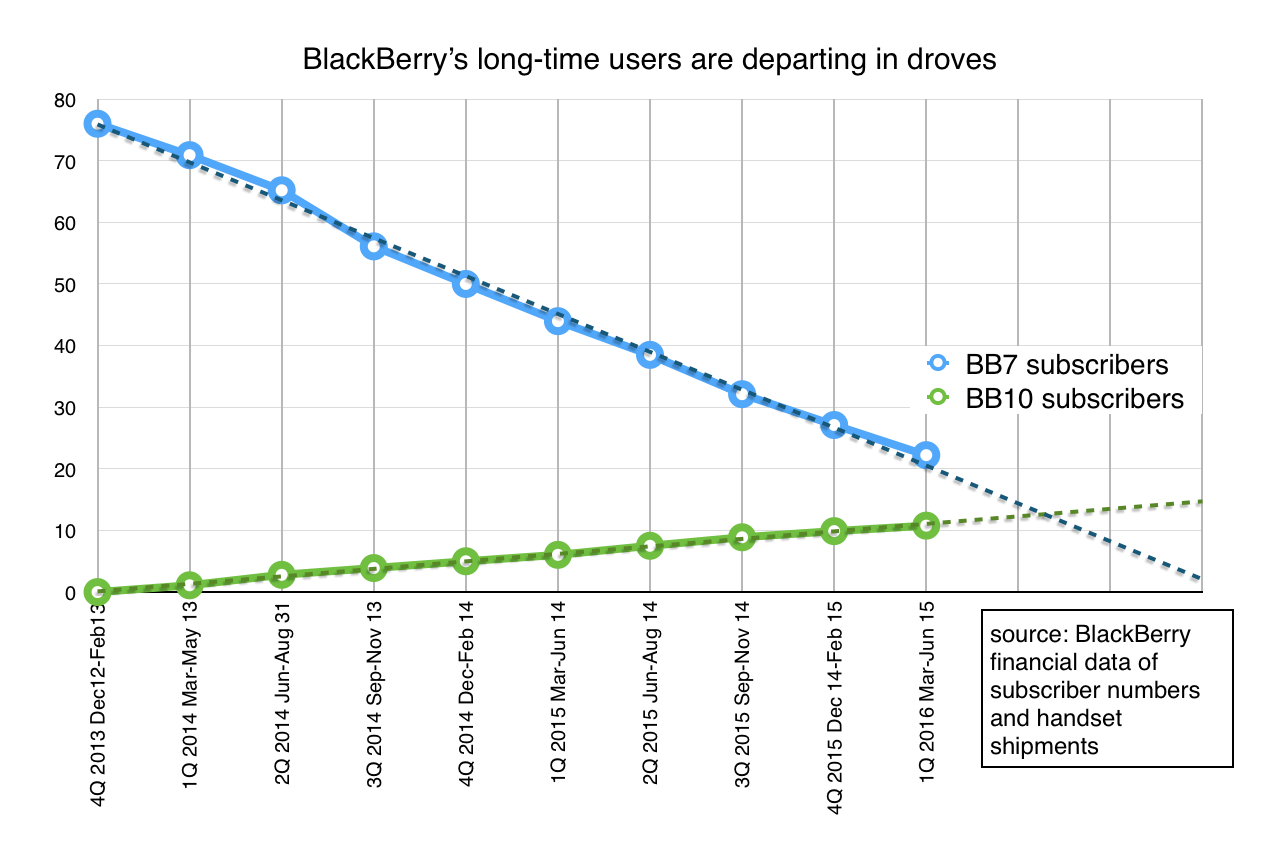
BlackBerry has a real problem, and it only becomes evident when you dig into the numbers. It’s this: BB7 users, who make up about 22m of its 33m subscribers, are deserting the platform at the rate of about 5m per quarter, while it’s only adding about 1m BB10 subscribers in the same period.

If this pattern continues, then by the end of this fiscal year – that is, February 2016 – there will be next to zero BB7 users, and only slightly more than 15m BB10 users. That will represent probably the bottoming out in subscribers, but will also mean that two key sources of revenue for BlackBerry – service revenues and handset sales – will effectively stop.

And in the just-gone quarter, those two categories made up 78% of its revenues – and the profit on the services, which only applies to BB7 users, amounted to about $211m.

Here’s the problem: once the BB7 users are gone, so are pretty much all the service revenues. And look how soon that could happen:
BlackBerry 7 users leaving; BB10 joining slower

BB7 users are departing the platform five times faster than they’re being replaced by BB10 users

With 15m handsets in use, and BB users replacing theirs roughly every three years (as I found previously), that means 5m handset sales per year, which is about where the company is now – and it currently makes horrendous operating losses on handsets. There just isn’t the scale.

Without the service revenue, and because the handsets are horrible money pits, BlackBerry is left with just its software revenues for profit. And oh dear, those aren’t pretty.

Let’s get stuck in

Here are some extra facts dug out of BlackBerry’s Q1 2016 10-Q, the quarterly detailed report:

• 33m subscribers (I estimated 34m; so it has fallen 4m from the previous quarter, an acceleration in decline)

• 81% of the 1.1m phones sold were BB10 (so 0.89m BB10, 0.2m BB7). Recall that BB7 was effectively dead with the launch of BB10 – back in January of 2013. Yet they’re still getting cleared out of the system.

• a total of 1.3m phones were sold through to end customers. That means that over the past eight quarters BlackBerry has “sold” (recognised revenue on) 15m phones, and sell-through has been 23.3m – that’s 55% more. Clearly, there was a gigantic amount of channel stuffing going on previously. And of those 15m phones (or 23.3m, take your pick) only 9.7m were BB10 models.

We know how many subscribers there were when BB10 was introduced, and we know how many there are now; we also know how many BB10 handsets have shipped. That means we know the split between BB7 subscribers and BB10 subscribers.
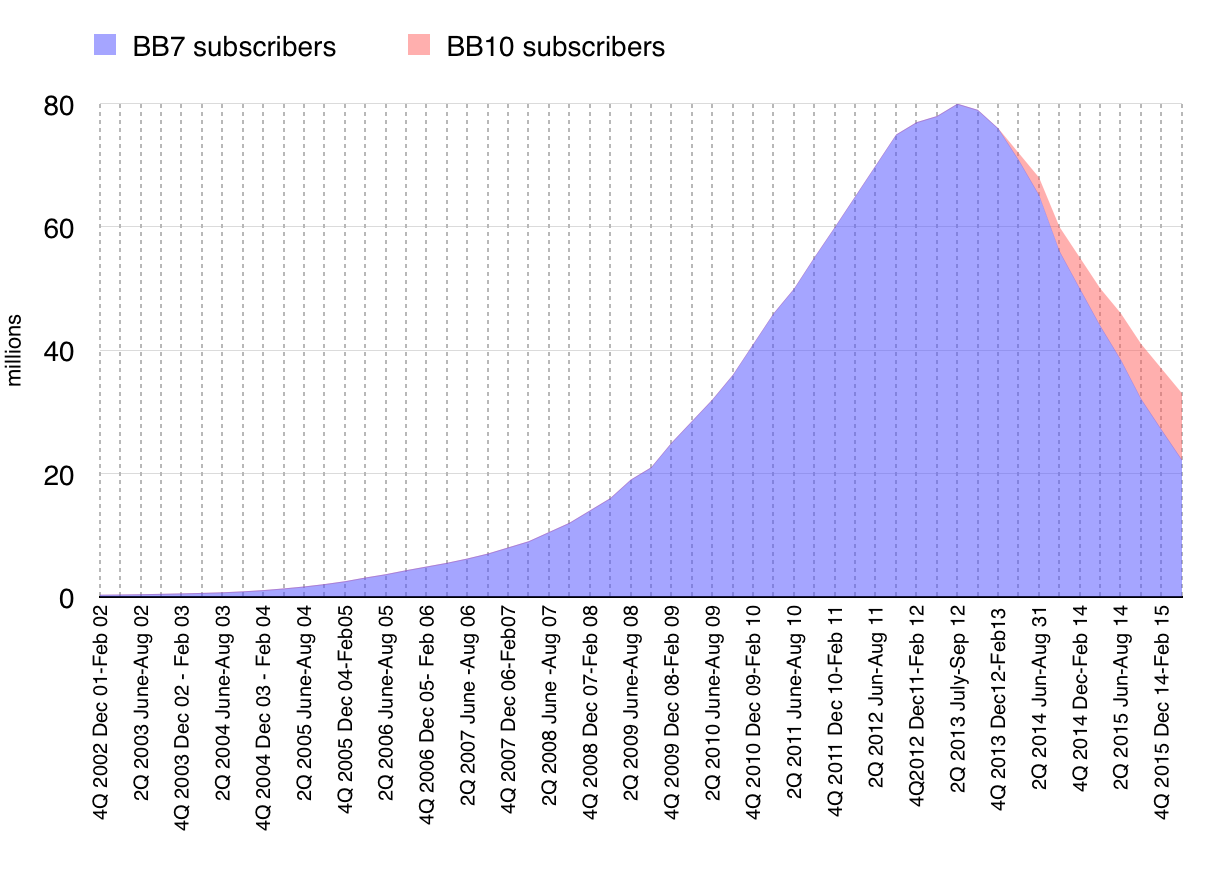
Rise and fall of BlackBerry subscribers

On the basis that every BB10 handset goes to a new user… it’s still not great.

In short, there are still twice as many BB7 users (22m or so) as BB10 users (10.8m). In the just-gone quarter, a total of 4.9m BB7 users left, and 0.89m “joined” BB10. Some of those “joining” will have been ex-BB7 users, of course, but the direction of travel is clear; if that 5:1 pattern continues, then when the last BB7 user exits, BB10 will only have 15.2m users.

And the graph above shows that if it’s a straight line, that will be February next year.

• that much-vaunted jump in software revenues (from $54m to $137m year-on-year, and from $67m to $137m sequentially – a rise of $70m) was actually due to a mysterious patent deal, one with Cisco and another with an unnamed company.

Some thought the rise heralded BlackBerry rising from the ashes as a profitable software business; the stock popped on the early results. But as was clarified in the earnings call and the documents, compared to the year before, software revenues rose by over 20% (Chen suggested “22-23-24%”); as the documents then make clear, software revenues alone actually fell compared to the previous sequential quarter.

As the year-ago software revenue was $54m, and the previous quarter software revenue was $67m, and 67/54 = 1.24, it’s evident that software revenues grew less than 24%. This $67m is the underlying quarterly software revenue figure you can rely on; multiply that by four, and you get pure software revenues for the fiscal year of about $270m.

That’s a long way short of the $500m (which excludes any BBM revenues, which I don’t see happening in a hurry) that Chen is aiming for this year. Of course, if he can sell off – I mean license – lots of patents, then he could be on course for that target; the extra $70m from licensing helps. Multiply that by four (one big deal per quarter!) and you get $280m, so if the licensing people can keep hitting home runs, and everything goes fine, he might hit that $500m target, just.

But there’s no indication that the licensing revenues will keep coming; this might have been a $70m one-off. Or (as is also hinted) the company might just sell some patents, and count those in its “licensing” revenue.

But even that is a downscaling from expectations of a $600m annual software revenue, and the analysts all zeroed in on the sleight of hand in the earnings call. The stock selloff that has followed is clearly their reaction to what weren’t such good numbers after all.

• the sequential rise in US revenues (from $147m to $216m, or $69m) was mostly caused by the licensing deal. (This actually emerged in the earnings call.) According to BlackBerry’s execs, US revenues excepting the licence did grow, slightly; which means we can peg one licensing deal at just under $69m. That leaves the other licensing deal at somewhere around $1m – because the total extra from licensing was about $70m.

Future imperfect

Soooo… you’ve got a handset platform (BB7) that people are abandoning at a remarkable rate, while they aren’t joining the new platform with any great alacrity. If things continue as now, by February 2016 there will be 15m BlackBerry users, and zero service revenue, and lossmaking handset revenue.

The saving grace is that the software is very profitable – about 84% gross margin. (This is in the annual 10K report published in March.)

So how does this look? If we have software revenues of about $125m, that generates $105m of gross profit (ie before expenses like R+D and keeping the lights on).

Now set against that the costs of the hardware business: it made a gross profit (by my calculations using the software profitability) of $13m on 1.1m sales. So everything’s rosy, right?

Unfortunately not – as Chen admitted, getting handsets to operating profitability (where you account for sales/general/administration and R+D) is much harder. By my calculation, allocating those costs in line with hardware revenues, the handset side hasn’t been operationally profitable since November 2011. I don’t think the handsets will ever come back to operating profit. Still, gross profit, eh?

Let’s see how the sums go. For the latest quarter, R+D was $139m, and SGA was $174m.

If those costs stay the same, your mostly-software-and-a-few-handsets company has gross profit of $118m, and immediate costs of $313m – that’s a loss of $195m, before any other costs arising (such as amortisation or inventory writedown or debenture revaluation). And make no mistake, there will be other costs arising.

Conclusion

If BlackBerry holds on to its hardware business, it’s going to run into the sand. It’s also losing its old BB7 userbase extremely fast. John Chen doesn’t have much time to start generating revenue from licences and software. I’d expect to see some sort of crisis point in a couple of quarters. But then, BlackBerry is always in crisis. And nobody much seems to care, either.

Start up: what Chinese hackers steal, Snapdragon overheats Sony, eternal Spotify streaming, and more


Think you could pretend to be one of these? Photo by anotherjesse on Flickr.

A selection of 8 links for you. Use them wisely. I’m charlesarthur on Twitter. Observations and links welcome.

The Reverse Turing Test: pretending to be a chatbot is harder than you think » Motherboard

Uri Bram, with a wonderfully executed idea:

You don’t fully realize how complicated human conversation is until you try to look at it through the eyes of a bot. Alison’s “How about you?” is an example of what the professionals call a tag question. “How about you?” on its own is meaningless; it’s implicitly referring back to my own previous question of “How are you doing today?” Within a few short words you already have a complex system of meaning the bot needs to understand.

Soon Alison was bombarding me with dialogue.

“I am going swimming later. Then I’m going to be an astronaut. I like chocolate. Do you?”

While this isn’t exactly a normal human conversation, a human can easily deal with it. Think about all the things your brain does to process those sentences.

It knows that “I’m going [swimming]” and “I’m going [to be an astronaut]” encode completely different meanings, even though they have superficially similar structures.

Figuring out the gaps when you try to be a bot is surprisingly useful for figuring out what bots need to do. (Tiny voice asks: why do we want bots to be able to fool us, precisely?)


Windows Phone is like religion – it gets people when they are down » The Register

Paul Kunert:

A division of the shipments shows Microsoft grabbed 7.6% of sales [0.57m handsets] during the quarter, up from 5.8% in the prior year quarter. The total market [for UK smartphone sales] declined 1.5% to 7.6m.

“Microsoft is slowly building share without a flagship or high-spec handset – they are after the volume end of the [professional] market. This strategy will probably change when Windows 10 comes out,” Coulling said.

Despite this, Windows barely touches the sides of the sprawling UK shipments achieved by phone royalty Samsung and Apple, the combined sales of which came to 4.93m units.

Sammy declined 8.5% in Q1 to 2.54m devices, giving it a 33.6% share of spoils, as it continued to work through the inventory bottleneck that ruined profits in 2014.

…Apple sales recovered on the back of the iPhone 6’s release, growing 7.8% to 2.43m units, narrowing the gap that Samsung opened up a year ago.

Windows Phone still not really doing anything. Maybe those are being bought by businesses?


Australian metal detector company counts cost of Chinese hacking » Reuters

Byron Kaye and Jane Wardell:

Donald McGurk, chief executive of Australian communications, metal detection and mining technology firm Codan, has watched sales and prices of his firm’s metal detectors collapse since Chinese hackers stole its designs three years ago to sell cheap imitations into Africa.

With the Australian government wary of rocking the boat ahead of this month’s historic signing of a free trade deal, McGurk says he was forced to hire a private investigative firm in China to stage a series of raids on counterfeit factories.

“They said you’re on your own,” McGurk told Reuters, referring to the Australian government officials he lobbied to help with his problem. The Australian government did not immediately respond to queries about Codan.

Codan’s experience provides a rare look at the longer-term impacts of hacking on companies, as most keep the extent of an incident under wraps. In fact, experts say many firms continue to turn a blind eye to cybersecurity even as hackers become increasingly sophisticated.

Often forgotten that hacking has a purpose; often to steal intellectual property. (Though that’s how countries have advanced themselves down the centuries.)


EU questions e-commerce firms as part of sector probe » WSJ

Tom Fairless:

Europe’s antitrust regulator has asked a broad swath of Internet commerce firms to hand over sensitive business information and copies of contracts as part of a sweeping investigation into possible abuses in the sector.

The investigation, announced in March, aims to establish whether some firms are raising contractual or other barriers to limit how consumers can shop online across national borders inside the European Union. The probe could lead to formal antitrust cases against individual companies that are suspected of abusing their dominant market position to restrict trade, in violation of EU law.

Margrethe Vestager really is getting serious.


Samsung offers to cover the difference if you buy a 64GB Galaxy S6 instead of 32GB (via a $100 rebate) » Android Police

Ryan Whitwam:

Samsung calls this the “Ultimate Upgrade.” You have until the end of the day on July 5th to make your purchase.

As with most deals of this sort, you’ll need to submit a copy of your receipt, the device’s MAC address, and the IMEI. It needs to be purchased in the US (sorry, guys) from a carrier or national retailer (i.e. not on eBay or Craigslist). Samsung says it also needs to be purchased at “full price,” which I assume means no additional discounts. Presumably you can still do a contract or payment plan with your carrier.

We’re coming to the end of the Galaxy S6’s first full quarter on sale, and Samsung is offering discounts to encourage sell-through of higher-priced models. This doesn’t seem like a resounding vote of confidence in its sales. It’s also pricey, in marketing terms (though people are pretty rubbish at taking advantage of rebates).


Google’s new self-driving cars can now be spotted on Mountain View roads » 9to5Google

Stephen Hall:

According to Google, the speed of the cars is currently capped at a pretty conservative 25 miles per hour, and they’re driving around at that “neighborhood-friendly” speed using the same software that powered the Lexus line. Ultimately, the goal is for them to be completely autonomous, but it would make sense that Google wants to take that slow to avoid any more sensationalized stories about their safety…

The company announced in the middle of May that the cars had gotten the green light to be put on the road “this summer,” and it looks like “this summer” means right now. Assuming this round of tests go well, we’ll surely be seeing more cars hit the roads over the next few months.


Watch the Xperia Z3+ camera crash in about 3 seconds » AndroidPIT

Kris Carlon:

We were pretty excited to get the Xperia Z3+ in for review. That is until we found one of the worst launch bugs we’ve ever seen. The problem is that the Xperia Z3+ camera crashes almost instantaneously when you throw anything even vaguely heavy at it.

By ”heavy” I simply mean using augmented reality mode or shooting 4K video for a few seconds. These are standard camera modes on the Z3+ so there really shouldn’t be any problems, especially in a phone that’s less than a week old. But we’ve been seeing the camera crash in 4K ever since the Z2. How Sony has failed to correct the issue two generations later is beyond me. 

Commenters concur. The Snapdragon 810 chipset seems to be at the core (sorry) of the problem. And this does look like a problem.


Stream your favorite artist forever » Eternify

Eternify leverages music from Spotify’s catalog in increments of 30 seconds, the minimum length that counts as a play—and as a royalty payment.

Pick your favorite artist, then watch in real time as you generate an average of $.005 for your artist with each play.

Appears to be registered in Germany. Can’t see Spotify allowing this to continue for long.


Start up: HTC and LG struggle, Getty’s Google complaint, Circa’s bad news, and more


Now adjust your calendar. Geographical layout of the London Underground by DigitalUrban on Flickr.

A selection of 10 links for you. See how they run. I’m charlesarthur on Twitter. Observations and links welcome.

Optus hands over customers’ numbers to websites » ZDNet

Josh Taylor:

Optus is sending the mobile phone numbers of customers to websites that those customers are accessing, but has defended the practice, stating that information is only handed to “trusted partners”.

Last week, a user on broadband enthusiast website Whirlpool found, when visiting certain websites that Optus has a commercial relationship with, that their phone number was included in the HTTP header of the web request to that site, through a practice known as HTTP Header Enrichment.

The poster said that they discovered the number had been passed on after receiving premium subscription services to a site they had not signed up to.

Optus is in Australia, but such amazingly sleazy behaviour is likely found elsewhere too.


Getty Images takes Google grievance to EU antitrust regulators » Reuters

Foo Yun Chee:

Getty Images has become the latest company to take its grievances with Google to EU antitrust regulators as it accused the world’s most popular Internet search engine of favoring its own images service at the expense of rivals.

The complaint comes as the European Commission waits for Google to respond to charges of abusing its market power in a dozen EU countries since 2007 by distorting search results to favor its shopping service.

The renowned photojournalism archive said its troubles with Google started in early 2013.

“Web search results that link directly to the Getty Images website are placed low in the search results, frequently, and remarkably, not on the first page of results,” the companysaid on its website.

“This means Google is benefiting from the use of Getty Images content, used to generate results within Google Image Search, without sending the image searchers to the Getty Images website or other competing image search engines.”

It never rains but it pours..


Debugging and reverse engineering: Samsung deliberately disabling Windows Update » BSOD Analysis

Patrick Barker, who is a Microsoft MVP:

On my home forum Sysnative, a user (wavly) was being assisted with a Windows Update (WU) issue, which was going well, aside from the fact that wavly’s WU kept getting disabled randomly. It was figured out eventually after using auditpol.exe and registry security auditing (shown below later) that the program that was responsible for disabling WU was Disable_Windowsupdate.exe, which is part of Samsung’s SW Update software.

SW Update is your typical OEM updating software that will update your Samsung drivers, the bloatware that came on your Samsung machine, etc. The only difference between other OEM updating software is Samsung’s disables WU.

Terrible move by Samsung. It said it did this to prevent WU screwing with Samsung’s drivers.

The bigger puzzle to me is why Samsung continues with PCs. It sells a tiny number (perhaps a couple of million a quarter?) and can’t be making any profit worth writing home about.


HTC ships 4.75m HTC One M9 in three months; unlikely to make new breakthrough in China » Digitimes

Kai-Ti Chiang and Steve Shen:

HTC has so far shipped only 4.75m units of its new flagship smartphone, the HTC One M9, since the model launched in the latter half of March, down 43.75% as compared to shipments of the HTC One M8 during its initial three months, according to a Chinese-language China Business Journal report.

HTC’s market value has also declined to around US$2bn recently compared to its all-time high of US$33.8bn a few years ago, the paper added.

The mid-range to high-end smartphone market (models priced at CNY1,600 (US$258) and up) in China has become mature, but HTC’s flagship models are still set at CNY4,000, pushing consumers to pick up iPhone devices, the journal quoted China-based iiMedia Research as saying.

This would explain the profit warning earlier this month.


Farewell to Circa News » Medium

Matt Galligan:

It’s with great disappointment that we let you know that Circa News has been put on indefinite hiatus*. Producing high-quality news can be a costly endeavor and without the capital necessary to support further production we are unable to continue. Our mission was always to create a news company where factual, unbiased, and succinct information could be found. In doing so we recognized that building a revenue stream for such a mission would take some time and chose to rely on venture capital to sustain. We have now reached a point where we’re no longer able to continue news production as-is.

“Continued negotiations” around its assets and staff.


iOS 9 and Safari View Controller: the future of web views » MacStories

Web views on iOS 9, that is, where apps will be able to present browser windows without needing their own browser code – which will be handled by Safari:

Apple is making sure that user privacy and security are highly valued in how Safari View Controller operates. Safari View Controller runs in a separate process from the host app, which doesn’t “see” the URL or navigation happening inside it. Therefore, Apple claims that Safari View Controller is entirely “safe”, as private user data stays in Safari and is never exposed to a third-party app that wants to open a link in it.

Because of this, Apple has been able to port many of the features that users know from Safari to any app that uses Safari View Controller in iOS 9. Safari View Controller shares cookies and website data with Safari, which means that if a user is already logged into a specific website in Safari and a link to that website is opened in Safari View Controller, the user will already be logged in. This alone could make for a drastically superior experience when tapping, for instance, links to services like Amazon, Pinterest, or Facebook from third-party apps. If those services use Safari View Controller and the user is already logged in from Safari, she’ll get a continuous and consistent experience.

But there’s more.

Popular with developers; likely to roll out fast.


Apple Music signs Beggars Group, Merlin: sources » Billboard

Shirley Halperin and Lars Brandle:

In a letter sent to Merlin members, CEO Charles Caldas writes, “I am pleased to say that Apple has made a decision to pay for all usage of Apple Music under the free trials on a per-play basis, as well as to modify a number of other terms that members had been communicating directly with Apple about. With these changes, we are happy to support the deal.”

The announcement comes on the heels of the company’s 180-degree turn on a deal term asking labels to forego royalty payments during a 90-day-free trial offered to Apple Music users. Criticism was loud and prompted Taylor Swift to write an open letter asking the company to reverse its policy.  

In a way, Swift’s blog helped ward off a slew of bad publicity the company had weathered in recent weeks. Apple was staring down a full-scale revolt from indie labels not affiliated with the majors and major-owned distributors. As it stands, most indie distributors say their labels hadn’t signed, anticipating a new contract for indies with revised terms.

Impossible to know whether this was coming with or without Swift. Seems likely she was the final, very public, straw.


Why adblocking is the new speeding » The Next Web

I wrote this because it occurred to me that the two sides of this debate just can’t hear each other, for the most part:

people who use adblockers aren’t interested in what the publishers or journalists say: just as when you’re in a car, cut off from the world with the radio turned up loud, the complaints of the people standing on the pavement really don’t impinge on your world. The two sides of the argument are cut off from each other. The speeding driver in their air-conditioned car, the adblocking reader at their desk, are both in essence the same.

I’m not condemning adblocking, by the way. I’m not condoning it either. I’m trying to show the two sides why they can’t agree.

So what’s the solution? You know how it works with speeding in local communities: the community organises, and either gets the police (who turn up occasionally) or get something concrete done – usually in the form of actual concrete ‘sleeping policemen,’ or other ‘road calming’ that makes it impossible for drivers to speed.

Publishers and advertisers need to find the online equivalent of road calming too.

Note, above all, that I am not suggesting that adblocking can kill people. Also: contains GIF of kangaroos fighting.


Google owns the platform – twice over » Eerke Boiten’s blog

Boiten wants the granular permissions of Android M because he doesn’t like the landgrab of Android apps at present, as he tweeted:

An interesting discussion with the makers of the London Tube Map (@TubeMapLondon) followed. It turned out that the app actually didn’t have a feature using the calendar! Rather, they were catering for adverts that might want to add calendar events. My first objection to that was that ads could use apps with the appropriate permission to change the calendar, rather than doing it themselves. More importantly though, surely this couldn’t scale? All apps with ads, grabbing all the permissions that all their ads might potentially want? I stuck with not installing the app (it also wants in-app purchases, media, and call info, by the way) and thought no more of it.

Weeks later, on my next visit to London, I used the London Tube Map app again (still the old version, of course). With ads. And suddenly it all became crystal clear. Ads served by … Google. The same Google who give whatever permissions they like to the built-in Android apps that you can’t remove. They own the platform. By serving the ads on third party apps, they own the platform twice over.


Analysts cut Q2 profit forecasts as the LG G4 underperforms » AndroidAuthority

At launch, the LG G4 had been expected to sell 8m units in 2015, meaning that around 2.6m G4s would need to be sold in each remaining quarter of the year. However, second quarter shipments are expected to come in at less than 2.5m units for Q2, meaning that actual sales will be even lower than that. This is a rather poor result for the flagship’s first quarter on the market. Last year’s LG G3 sold 5.9m units in its first year and LG was hoping to beat this target by at least 20%.

There are several possible reasons as to why LG G4 sales may be lower than initially expected. Pricing could be a factor, as could the lack of major differences from last year’s G3. It’s also possible that LG’s promise of another higher-end flagship later this year has resulting in potential customers deferring their purchases.

In addition to under performing sales, LG has also seen its marketing expenditure increase this quarter.

Analysts halved their forecasts for LG mobile operating profit to 60-65bn won ($54m-58m), down from 1Q of 73bn won. The G4 was well received critically, and has a great camera.


Start up: Kickstarter disappointment, the Apple leaks source?, Google is listening, and more


Wikipedia: missing pieces on mobile. Photo by @bastique on Flickr.

A selection of 8 links for you. They join things together. I’m charlesarthur on Twitter. Observations and links welcome.

After raising $1 million, the super-thin CST-01 watch won’t make it to Kickstarter backers » The Verge

Jacob Kastrenakes:

The project has run into quite a few issues, but the broadest one is that the watches just aren’t easy to make. Little more than half of them are fully working after assembly, according to the two engineers behind CST-01, which means that the costs to make them are effectively doubled unless they can resolve the underlying issues. At this point, they can’t. As they explained in an earlier update, their project is basically out of money. One of their engineers supposedly went as far as sleeping in a van outside of the production factory so that he didn’t have to pay for a hotel.

Hardware is difficult.


Thoughts on Mark Gurman’s 9to5Mac article about Apple Watch rumors » Mobile Forward

Hristo Daniel Ushev, who worked at Motorola for eight years, on Gurman’s likely source, who he reckons is probably not an Apple employee:

It’s probably someone helping Apple with consumer research. I’m saying that because the leaked information concerns:

• “Considerations” (as far from a shipping product as a PowerPoint slide)
• Visible features, but no granular attributes (spec-level knowledge or software features)
• Price point variants
• Granular information from consumer research

Let’s combine these: a likely-external person, discussing feature “considerations”, without spec or software detail, about price point variants, and quoting granular information from consumer research. Based on that, I think it’s probably a low level employee (or attention-seeker) from a research firm that Apple trusted. The “considerations” may be features that appeared in a research aid.

Rings true. Takes nothing away from Gurman’s work in developing sources, of course.


Can Wikipedia survive? » The New York Times

Andrew Lih:

One of the biggest threats it faces is the rise of smartphones as the dominant personal computing device. A recent Pew Research Center report found that 39 of the top 50 news sites received more traffic from mobile devices than from desktop and laptop computers, sales of which have declined for years.

This is a challenge for Wikipedia, which has always depended on contributors hunched over keyboards searching references, discussing changes and writing articles using a special markup code. Even before smartphones were widespread, studies consistently showed that these are daunting tasks for newcomers. “Not even our youngest and most computer-savvy participants accomplished these tasks with ease,” a 2009 user test concluded. The difficulty of bringing on new volunteers has resulted in seven straight years of declining editor participation.

In 2005, during Wikipedia’s peak years, there were months when more than 60 editors were made administrator — a position with special privileges in editing the English-language edition. For the past year, it has sometimes struggled to promote even one per month.


Google Chrome listening in to your room shows the importance of privacy defence in depth » Privacy Online News

Pirate Party chief Rick Falkvinge:

it should be noted that this was Chromium, the open-source version of Chrome. If somebody downloads the Google product Google Chrome, as in the prepackaged binary, you don’t even get a theoretical choice. You’re already downloading a black box from a vendor. In Google Chrome, this is all included from the start.

This episode highlights the need for hard, not soft, switches to all devices – webcams, microphones – that can be used for surveillance. A software on/off switch for a webcam is no longer enough, a hard shield in front of the lens is required. A software on/off switch for a microphone is no longer enough, a physical switch that breaks its electrical connection is required. That’s how you defend against this in depth.

Of course, people were quick to downplay the alarm. “It only listens when you say ‘Ok, Google’.” (Ok, so how does it know to start listening just before I’m about to say ‘Ok, Google?’) “It’s no big deal.” (A company stealth installs an audio listener that listens to every room in the world it can, and transmits audio data to the mothership when it encounters an unknown, possibly individually tailored, list of keywords – and it’s no big deal!?) “You can opt out. It’s in the Terms of Service.” (No. Just no. This is not something that is the slightest amount of permissible just because it’s hidden in legalese.) “It’s opt-in. It won’t really listen unless you check that box.” (Perhaps. We don’t know, Google just downloaded a black box onto my computer. And it may not be the same black box as was downloaded onto yours. )

Early last decade, privacy activists practically yelled and screamed that the NSA’s taps of various points of the Internet and telecom networks had the technical potential for enormous abuse against privacy. Everybody else dismissed those points as basically tinfoilhattery – until the Snowden files came out, and it was revealed that precisely everybody involved had abused their technical capability for invasion of privacy as far as was possible.

When Google is making Falkvinge look reasonable, it’s made a bad mistake.


April 2010: Nokia exec: phones to make system cameras obsolete » Reuters

Tarmo Virki:

(From April 2010:) Fast developing cameraphone technology will shortly make SLR system cameras and even professional cameras obsolete, the sales chief of the world’s top cellphone maker Nokia said on Tuesday. “They will in the very near future revolutionise the market for system cameras,” Anssi Vanjoki said in a speech in Helsinki.

“There will be no need to carry around those heavy lenses,” Vanjoki said, pointing to a professional photographer taking pictures of him.

The proliferation of smartphones with picture quality comparable to most pocket cameras has boosted photography around the world, but they have so far not challenged real system cameras due to phones’ smaller size and weaker technology.

Vanjoki said high-definition (HD) quality video recording was also coming to cellphones within the next 12 months.

Wasn’t wrong. Yet the other elements of the smartphone business were more important.


The Asia report: leading the shift from… » Flurry Insights Blog

Flurry’s Chris Klotzbach:

Although we continue to see growth and user engagement in traditional app categories like Messaging & Social and Gaming, users in Asia demonstrated that in 2015, they are utilizing their smartphones and apps for more functional and practical purposes. This is indicated in the growth in the Shopping & Lifestyle and Utilities & Productivity app categories. Asia is the home of the phablet, and we see users have embraced this form factor- not only in terms of installed base but actual app usage. Just as the rest of the world is beginning to catch on to the phablet, only time will tell if we’ll catch up to Asia’s propensity to be productive and shop!


Impact of iOS 9’s space requirement » David Smith

Smith is an iOS developer:

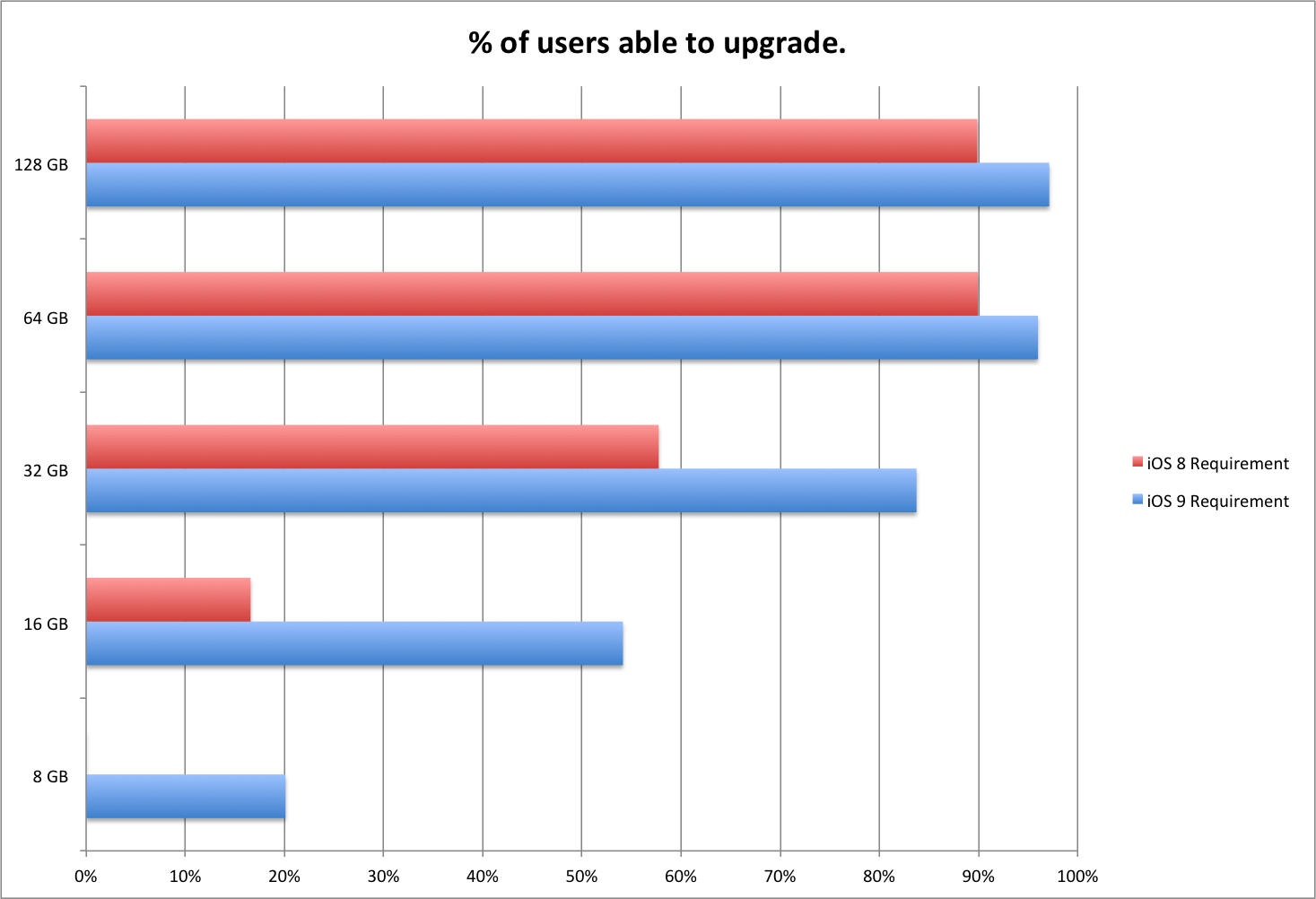
using the dataset I have from my Audiobooks app I took at look at how many of my customers have enough space for the upgrade.

The result was pretty promising.

66% of my customers on eligible devices have at least 1.3GB of free space. This compares to just 37% of users who would have immediately had sufficient space at the old iOS 8 requirement.

The distribution of eligible devices breaks out roughly as you’d expect for the various capacities Apple sells:

Apple iphone upgrade potential

The rate for the 16GB devices (54%) is higher than I would have initially feared. The 16GB capacity accounts for 58% of devices, so it is vitally important that its users have the ability to upgrade.

This reduction in the space requirement (and other things Apple is doing on this front) make me think iOS 9 adoption to be even faster than iOS 8’s.


Google launches free streaming service ahead of Apple Music debut » Reuters

Yasmeen Abutaleb:

Google Inc launched a free version of its music streaming service on Tuesday, as it sought to upstage the debut of Apple Inc’s rival service next week.

Google Play Music has offered a $9.99 per month subscription service for two years but Tuesday’s launch is the first free version of the streaming service. It is available online and will be available on Android and iOS by the end of the week, Elias Roman, Google product manager, said.

Apple said earlier this month it would launch a music streaming service on June 30 for $9.99 per month along with a $14.99 per month family plan, with a free three-month trial.

As with other streaming services, such as Spotify and Rhapsody, Google Play Music curates playlists. Users can tailor playlists based on genre, artist or even activity, such as hosting a pool party or “having fun at work.”

“We believe this is a play that will expose a lot of people to the service,” Roman said in an interview.

Unlike Google’s subscription music service, the free service will carry ads, be unavailable offline and exclude certain songs.

Here’s the official announcement. What I find really weird is that Google, the high priests of “let machines do it”, is highlighting the human-curated nature of these playlists.


BlackBerry results: my forecast: 1.3m phones, $20m operating loss

Ahead of BlackBerry’s results on Tuesday, here’s my forecast, for what it’s worth.

I’m taking the analyst consensus revenue estimate of $690m as my basis. That’s down 30% on the same time last year. If it’s much bigger or smaller than that, then everything else goes off, but it seems reasonable.

I estimate the following:
operating loss: $20m (excluding adjustments for the value of the $1bn debentures)
phones shipped: 1.3m (I don’t see any improvement from last year, when it did 1.6m, including 1.04m BB10 handsets; this time it’s going to be all BB10)
handset revenue: $353m
device ASP (average selling price): $271.54
subscriber accounts: 34m (down 3m from the previous quarter)
per-account service revenue: $7.56 (or $8.50 per BB7 device in use)
services revenue: $257m (based on those accounts)
software and other revenue: $70m and $10m
per-handset operating profit: -$97 (loss of $97)

The operating profit follows directly from the fact that software and services profit is 84% of revenue. I’ve used figures that follow logically from what BlackBerry is doing.

Conclusions (ahead of the numbers; we’ll see how it goes when they’re out):

– handsets still aren’t cutting it. (The Kantar numbers show no significant change.)
– software revenues are still small – nowhere near a $600m per year company
– thank god for the services revenue, but that’s going away too.

Now let’s see the actual numbers..

Start up: tracking Android, the 1998 software warning, Google’s revenge porn move, VUT Swift?, and more


Another micropayment from Amazon! Photo by Amanda Emilio on Flickr.

A selection of 8 links for you. Use them wisely. I’m charlesarthur on Twitter. Observations and links welcome.

Android Tracker » Fiksu

In contrast to the iOS industry statistics, the Android landscape is much more fragmented, with dozens of manufacturers and thousands of devices on the market. We’ve put together four charts to help illuminate the situation:

• Android Tablet vs. Phone Usage
• Android Version Monitor
• Top Android Manufacturers
• Top Android Phones
• Top Android Tablets

The one for phone manufacturers is eye-opening, to say the least. Worth bookmarking. (Via Daniel Tello.)


BlackBerry’s Classic moment, or not » WSJ

Spencer Jakab:

Two things could leave the market pleasantly surprised on Tuesday. One would be an announcement that BlackBerry is distancing itself from handsets, devoting more resources to software. The other would be if that latter business shows signs of meeting some ambitious revenue targets laid out by chief executive John Chen.

A hopeful sign on software sales would affect the share price far more than if BlackBerry’s loss for the period through May was better than the 5 cents a share projected by analysts. They see BlackBerry reporting software and support revenue of $83m for the quarter, up from $56m a year earlier. The company wants to more than double the annual figure in fiscal 2016 to $500m and to produce operating profits on a sustained basis. That would come as services revenue continues to shrivel, falling by about half this fiscal year.

I’ll post my own forecast for BlackBerry’s results an hour or two after this post goes live. (These days people write about BlackBerry almost as a curio; it’s the Crimea of the smartphone wars.)


Launch of the new Companies House public beta service » GOV.UK

In line with the government’s commitment to free data, Companies House is pleased to announce that all public digital data held on the UK register of companies is now accessible free of charge, on its new public beta search service.

This provides access to over 170 million digital records on companies and directors including financial accounts, company filings and details on directors and secretaries throughout the life of the company.

Free access to the data is available both through a web service and an application program interface (API), enabling both consumers and technology providers to access real time updates on companies.

Fabulous. Back in 2006, the pricing was opaque and redacted.


These hackers warned the Internet would become a security disaster. Nobody listened. » The Washington Post

Craig Timberg:

Your computers, they told the panel of senators in May 1998, are not safe — not the software, not the hardware, not the networks that link them together. The companies that build these things don’t care, the hackers continued, and they have no reason to care because failure costs them nothing. And the federal government has neither the skill nor the will to do anything about it.

“If you’re looking for computer security, then the Internet is not the place to be,” said Mudge, then 27 and looking like a biblical prophet with long brown hair flowing past his shoulders. The Internet itself, he added, could be taken down “by any of the seven individuals seated before you” with 30 minutes of well-choreographed keystrokes.

The senators — a bipartisan group including John Glenn, Joseph I. Lieberman and Fred D. Thompson — nodded gravely, making clear that they understood the gravity of the situation. “We’re going to have to do something about it,” Thompson said.

What happened instead was a tragedy of missed opportunity, and 17 years later the world is still paying the price in rampant insecurity.


“Revenge porn” and search » Google Public Policy Blog

Amit Singhal, Google Search SVP:

We’ve heard many troubling stories of “revenge porn”: an ex-partner seeking to publicly humiliate a person by posting private images of them, or hackers stealing and distributing images from victims’ accounts. Some images even end up on “sextortion” sites that force people to pay to have their images removed.

Our philosophy has always been that Search should reflect the whole web. But revenge porn images are intensely personal and emotionally damaging, and serve only to degrade the victims—predominantly women. So going forward, we’ll honor requests from people to remove nude or sexually explicit images shared without their consent from Google Search results. This is a narrow and limited policy, similar to how we treat removal requests for other highly sensitive personal information, such as bank account numbers and signatures, that may surface in our search results.

In the coming weeks we’ll put up a web form people can use to submit these requests to us, and we’ll update this blog post with the link.

You could almost call it a “right to be forgotten” or “right to be delinked”. Let’s see – person requests that information about them which is irrelevant asks to have those pages removed from search. Which are we talking about, Europe or revenge porn?


Amazon’s new plan to pay authors every time someone turns a page » The Atlantic

Peter Wayner:

Soon, the maker of the Kindle is going to flip the formula used for reimbursing some of the authors who depend on it for sales. Instead of paying these authors by the book, Amazon will soon start paying authors based on how many pages are read—not how many pages are downloaded, but how many pages are displayed on the screen long enough to be parsed. So much for the old publishing-industry cliche that it doesn’t matter how many people read your book, only how many buy it.

For the many authors who publish directly through Amazon, the new model could warp the priorities of writing: A system with per-page payouts is a system that rewards cliffhangers and mysteries across all genres. It rewards anything that keeps people hooked, even if that means putting less of an emphasis on nuance and complexity.

So, basically, book streaming? Is Taylor Swift going to come to their aid? Or is it just an encouragement to write books at a length that people want to read? I think every author would like to know where people gave up on their books, if they didn’t finish them. Though that might not be the point at which they stopped being interested.


An Open Letter To Apple » German Association of Independent Music Companies

From 18 June, ie two days before Taylor Swift’s similar open letter:

Your plan not to compensate independent labels during the three-month trial period leads to the assumption that you don´t respect the music of independent artists or the work their partners do. It is obvious that this will reduce the overall income for independent artists and labels significantly at a time when many depend on every cent for survival.

Clearly what VUT needed was to rename itself “Taylor Swifte” or something. Or perhaps this was just another outgrowth of the ire felt among independent musicians. Apple Music (or more accurately the move to streaming and away from downloads) is going to cause yet another earthquake in the industry, rather like when CDs stopped being big.


Samsung’s mobile OS dilemma » Monday Note

Jean-Louis Gassée:

When we look at what it would take for Samsung to come up with its own mobile OS, the first thing to note is that “operating system” is a misnomer. Surely, iOS and Android are operating systems in the old-school “kernel” sense: They manage drivers, memory, input and output streams, user tasks, and the like. But today, an “operating system” is much more than just a kernel, it includes rich frameworks that support a wide range of applications, games, maps, social networking, productivity, drawing… Building these frameworks is a much harder task than adapting a Linux kernel.

And the OS is just the beginning. What Samsung really wants is its own ecosystem, a set of services that will ensure its autonomy, growth, and lasting importance. It wants its own app store, maps, music/video, cloud storage…

How long would it take for Samsung to build all of this? Three years, four years? Add to this the difficulty of “skating to where the puck will be”, to divine where the industry will land four years from now.

Samsung hasn’t been much good at building an ecosystem, either: look at all the content companies it has bought and then dumped, or services (ChatOn) it has started and stopped.


Start up: Swift v Apple, Beats gets heft, Aibos’ mortality, why Upworthy pivoted, and more


A number will get you into many peoples’ emails. Photo by Kohei314 on Flickr.

A selection of 10 links for you. I mean, do you even? I’m charlesarthur on Twitter. Observations and links welcome.

To Apple, love Taylor » Taylor Swift

Taylor Swift (yup, her):

I’m sure you are aware that Apple Music will be offering a free 3 month trial to anyone who signs up for the service. I’m not sure you know that Apple Music will not be paying writers, producers, or artists for those three months. I find it to be shocking, disappointing, and completely unlike this historically progressive and generous company.

This is not about me. Thankfully I am on my fifth album and can support myself, my band, crew, and entire management team by playing live shows. This is about the new artist or band that has just released their first single and will not be paid for its success. This is about the young songwriter who just got his or her first cut and thought that the royalties from that would get them out of debt.

This looks like an obvious one, but it isn’t. Lots of streaming services (all of them?) offer a free month initially, and the evidence suggests they don’t pay artists for those streams. (I’ve yet to confirm that absolutely.) Apple’s three-month deal seems to have come at the cost of higher royalty rates for those who sign up.

So Taylor Swift may be completely right – but that new artist or band might just want the exposure. It would certainly be good if Apple did pay in those three months. But that might then fall foul of antitrust.

Update: oh, internet, you do move fast. At 4.29am Eddy Cue tweeted that Apple would after all pay. More detail by Peter Kafka.


How It’s Made series: Beats By Dre » Medium

Avery Louie:

One of the great things about the [Beats] solo headphones is how substantial they feel. A little bit of weight makes the product feel solid, durable, and valuable. One way to do this cheaply is to make some components out of metal in order to add weight. In these headphones, 30% of the weight comes from four tiny metal parts that are there for the sole purpose of adding weight.

The two larger parts are cast zinc. Cast parts are similar to injection molded parts in that there is a tooling cost and a per-part cost. Compared to injection molding, the tool is marginally more expensive, but the per-part costs are higher, and the tools do not last as long.

The brilliant thing here is that the two large metal parts are not mirror images of each other- they are actually the same part!

The parts give them heft. And do nothing else at all.


How to hack into an email account, with just your victim’s mobile number » Graham Cluley

A bad guy – let’s call him Malcolm – is keen to break into Alice’s account, but doesn’t know her password. However, he does know Alice’s email address and phone number.

So, he visits the Gmail login page and enters Alice’s email address. But Malcolm cannot correctly enter Alice’s password of course (because he doesn’t know it).

So instead he clicks on the “Need help?” link, normally used by legitimate users who have forgotten their passwords.

Rather than choosing one of the other options, Malcolm selects “Get a verification code on my phone: [mobile phone number]” to have an SMS message containing six digit security code sent to Alice’s mobile phone.

This where things get sneaky.

Because at this point, Malcolm sends Alice a text pretending to be Google.

This is very sneaky, and would probably work against lots of people. Beware.


A robotic dog’s mortality » The New York Times

Jonathan Soble on the death of the Aibo – which is running out of juice:

They didn’t shed, chew the sofa or bite the postman, but for thousands of people Sony’s Aibo robotic dog was the closest thing to a real canine companion. So when the Japanese company stopped servicing the robots last year, eight years after it ended production, owners faced a wrenching prospect: that their aging “pets” would break down for good.

Sony introduced the Aibo in 1999, at a price of 250,000 yen (about $2,000 at current exchange rates). The beaglelike robots could move around, bark and perform simple tricks. Sony sold 150,000 units through 2006; the fifth and final generation was said to be able to express 60 emotional states.


Platform Patched – The Awl

John Herrman with a great analysis of why Upworthy has been forced to pivot: because Facebook turned its unique selling point into a feature of the platform:

Upworthy was succeeding according to metrics favored by Facebook, but not necessarily by doing the things Facebook believed those metrics would cultivate. A reader might spend five minutes watching a video on Upworthy and leave satisfied, but the site neither created the video nor hosts it—it would have been created by yet another party and hosted on YouTube, a site owned by Google. For Facebook, this is fine but not optimal: Why not just embed the YouTube video directly into News Feed with the same headline and description? Better yet, why not just host the video directly on Facebook?

Facebook-native video took off with the Ice Bucket Challenge, the success of which Facebook summarized in August and later used in explaining its vision for video. Seeing opportunity, publishers started publishing more videos, and more professional videos, as soon as they could.

And here’s The Awl’s graphic of Upworthy traffic:
Upworthy's falling traffic


1Password inter-process communication: a discussion » Agile blog

Jeff Goldberg, in a long blogpost about the “malicious OSX apps could grab inter-app comms by registering to receive them first” vulnerability:

Neither we nor Luyi Xing and his team have been able to figure out a completely reliable way to solve this problem. We thank them for their help and suggestions during these discussions. But, although there is no perfect solution, there are things that can be done to make such attacks more difficult.

The blogpost goes into a lot more detail; this is a really tricky problem. Though “keep process running all the time in the background” turns out to be a good solution.


Analyzing 10 yrs (and 5TB) of OpenStreetMap » Mapsense

Many fun insights to be found, but this one will ring true for any crowdsourced effort:

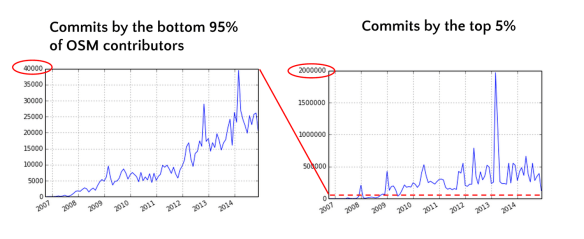
Insight #3- Very few people contribute the vast majority of features

We know the OSM community is growing, but we wanted to know what the impact of that growth is on the map that we all use.  

We segmented users into the top 5% of committers and the bottom 95%.  Here’s how their edits compare:

Open Street Map contributors

The number of commits in the bottom 95% is growing nicely over time, but even at its peak, their commits are orders of magnitude fewer than the commits of the top 5%. These power users are incredibly prolific, often importing large swathes of data such as building outlines or roads.

These users are making a huge impact on OSM- how can we encourage more of this to accelerate OSM’s quality?


Apple vs. Samsung: Samsung asks court to reconsider appeal » San Jose Mercury News

Howard Mintz:

Samsung urged the U.S. Federal Circuit Court of Appeals to rehear the case with its full 12-judge roster, arguing that a three-judge panel erred earlier this year when it left intact a jury’s verdict that the South Korean tech giant’s smartphones and tablets infringed on Apple’s design patents.

That part of the verdict – which has been pared from an original judgment of $1bn – accounts for about $400m of the $548m in damages Samsung still must pay Apple from their first trial.

Samsung’s continued interventions make this now officially the most boring court case in history. (Thanks John Molloy for the link.)


UK private copyright exception ‘unlawful’, rules High Court » Out-law

Prior to introducing the private copying exception, the UK government argued that it did not believe the private copying exception would result in lost sales for rights holders. However, the new regime was challenged by music industry bodies. The British Academy of Songwriters, Composers and Authors (BASCA), the Musicians’ Union (MU) and UK Music claimed that the government should have to compensate them and other rights holders for the harm caused to them by the new exception.

Mr Justice Green said that that the UK government was entitled to “implement a private usage exception” and to define the scope of that right. He said, though, that the government was obliged to introduce a “compensation mechanism” for rights holders if the harm caused to them by the introduction of the private copying exception was above a “de minimis level”.

Here’s the judgement. Not sure how this is going to be implemented – a surcharge on systems that can rip CDs? It’s the very definition of shutting the stable door after the horse has bolted, moved to another town, brought up foals, and died peacefully in its sleep.


Sizing up the suitors for Here, Nokia’s map business » TechCrunch

Ingrid Lunden:

One former longtime senior employee of Here estimates there are around 300 different location attributes, with corresponding historical databases, that can be tracked using Here’s technology. They include more obvious mapping and location-based applications such as driving directions and street maps, but also spatial data technology used in video and gaming applications.

“It’s incredibly difficult to get the type of mapping data that Here has. Base geometry and 20-40 road attributes are relatively easy to collect. However, to collect the 250+ attributes needed for the best navigation experience requires a combination of field teams and user-generated content,” notes entrepreneur Kurt Uhlir.

“Here has proprietary collection hardware and software that is unmatched, even by Google. Plus, they have the most extensive patent portfolio covering collecting and creating spatial content for current generation of maps and dynamic data. Here also has the foundational patents covering usage of spatial data for creating video games, movie content and the upcoming ADAS vehicle applications.”

Unmatched even by Google? Protected by patents? Such talk is heresy.


Start up: Lightning at Twitter, academic publishers strangle libraries, that iOS/OSX hack explained, and more


Do you recognise this person? Photo by Tim Dorr on Flickr.

A selection of 8 links for you. Use them wisely. I’m charlesarthur on Twitter. Observations and links welcome.

New smart home gadget called ELLA Assistant wants you to put down your phone » Tech In Asia

Steven Millward:

The startup team, which is based in Shanghai, sees it being used for things like telling you that you should take an umbrella, reminding you that you’re running late to an appointment, or for turning off all your smart lights at once. With a single press, it could alert your significant other that you’re leaving the house.

All that will depend on it working nicely with the brand of smart lights that you have, or syncing with the online calendar service that you use. The fact that the ELLA Assistant is subservient to your phone and other smart gadgets means it has to work with them all with ease, or it won’t gain favor with consumers. War tells Tech in Asia that the team will add support for various things as demand arises, but there are no specific supported devices or services listed yet – which is because the little gizmo hasn’t even launched. Once it’s out, it’ll have its own app store.

The ELLA Assistant will hit Kickstarter some time in August.

Hmm. Don’t think so, somehow.


This is Twitter’s top secret Project Lightning » BuzzFeed News

Mat Honan:

Project Lightning will bring event-based curated content to the Twitter platform, complete with immersive and instant-load photos and videos and the ability to embed those experiences across the Web — and even in other apps.

“It’s a brand-new way to look at tweets,” says Kevin Weil, who runs product for the company. “This is a bold change, not evolutionary.”

It is also still a few months out, and things could change. But here’s how it will work.

On Twitter’s mobile app, there will be a new button in the center of the home row. Press it and you’ll be taken to a screen that will show various events taking place that people are tweeting about. These could be based on prescheduled events like Coachella, the Grammys, or the NBA Finals. But they might also focus on breaking news and ongoing events, like the Nepalese earthquake or Ferguson, Missouri. Essentially, if it’s an event that a lot of people are tweeting about, Twitter could create an experience around it.

This likely comes out of the machine-intelligence-curated tweet streams from a company that Twitter just bought – under Costolo’s leadership, don’t forget. He just took too long to do it. (By the way, in future could “top secret” – used in the headline – please be reserved for things that actually are top secret, such as the content of the Snowden documents, and not PR-led product demos by the CEO?)


Academic publishers reap huge profits as libraries go broke » CBC News

Researchers rely on journals to keep up with the developments in their field. Most of the time, they access the journals online through subscriptions purchased by university libraries. But universities are having a hard time affording the soaring subscriptions, which are bundled so that universities effectively must pay for hundreds of journals they don’t want in order to get the ones they do.

Larivière says the cost of the University of Montreal’s journal subscriptions is now more than $7m a year  – ultimately paid for by the taxpayers and students who fund most of the university’s budget. Unable to afford the annual increases, the university has started cutting subscriptions, angering researchers.

“The big problem is that libraries or institutions that produce knowledge don’t have the budget anymore to pay for [access to] what they produce,” Larivière said.

“They could have closed one library a year to continue to pay for the journals, but then in twenty-something years, we would have had no libraries anymore, and we would still be stuck with having to pay the annual increase in subscriptions.”

The kicker: the five largest academic publishers produce 53% of scientific papers in natural and medical sciences – up from 20% in 1973. Consolidation and monopoly.


EFF and eight other privacy organizations back out of NTIA face recognition multi-stakeholder process » Electronic Frontier Foundation

Jennifer Lynch:

Despite the sensitivity of face recognition data, however, the federal government and state and local law enforcement agencies continue to build ever-larger face recognition databases. Last year the FBI rolled out its NGI biometric database with 14-million face images, and we learned through a Freedom of Information Act (FOIA) request that it plans to increase that number to 52-million images by this year. Communities such as San Diego, California are using mobile biometric readers to take pictures of people on the street or in their homes and immediately identify them and enroll them in face recognition databases. These databases are shared widely, and there are few, if any, meaningful limits on access. 

EFF has been especially concerned about commercial use of face recognition because of the possibility that the data collected will be shared with law enforcement and the federal government. Several years ago, in response to a FOIA request, we learned the FBI’s standard warrant to social media companies like Facebook seeks copies of all images you upload, along with all images you’re tagged in. In the future, we may see the FBI seeking access to the underlying face recognition data instead.

Huh. The FBI does that, does it?


Apple criticised over ‘presumptuous’ news app email » BBC News

Kevin Rawlinson:

According to Graham Hann, the head of technology, media and communications at the law firm Taylor Wessing, the terms of the deal are broadly in line with industry standards – except the requirement to opt out.

“The content of the notice is not unusual, although it has deliberately been dumbed down, possibly for clarity,” he told the BBC.

“However, the optout approach is very unusual and I don’t see how the notice could form a binding contract without a positive reply.

“Apple clearly wants to launch with as much content as possible and has taken this risk-based approach. Some publishers may object and even threaten to sue.

“However, I think it would be hard to claim damage beyond a reasonable royalty fee.”

Soooo… it’s not actually a big deal?


Internet TV boxes: Nvidia pips Google for Android » FT.com

Tim Bradshaw:

while [Android TV] mostly got the dictation right, it often failed to produce the results I was looking for. Asking for Breaking Bad brought up detailed information about the show and its actors, but no way to watch it. This query also produced a link to Pomodoro Wear, a countdown timer app shaped like a tomato and designed for Google’s Android Wear smartwatch platform.

Even Google itself does not seem to know quite how to use Android TV. Its marketing materials suggest asking for “romantic comedies set in New York”. But when I tried that on the Android TV itself, it produced only a list of YouTube videos, the first of which was about Lego sets from a New York toy fair. With no When Harry Met Sally or Manhattan to be found, I can only wonder whether anyone else — including Google’s own staff — has ever searched for something to watch this way.

Bear in mind that Apple experimented with the same voice dictation system for TV and, by the account in the WSJ, abandoned it.


XARA exploits on Mac, iPhone, and iPad, and what you need to know » iMore

Rene Ritchie with a series of Q+As on the vulnerability disclosed yesterday:

Q: So were the App Stores or app review tricked into letting these malicious apps in?

A: The iOS App Store was not. Any app can register a URL scheme. There’s nothing unusual about that, and hence nothing to be “caught” by the App Store review.

For the App Stores in general, much of the review process relies on identifying known bad behavior. If any part of, or all of, the XARA exploits can be reliably detected through static analysis or manual inspection, it’s likely those checks will be added to the review processes to prevent the same exploits from getting through in the future

Apparently apps now have to state the URL schemes they will use in plaintext in a .plist file; that’s easy to review, and Apple can easily spot duplicates by static testing. Security researchers suggest Apple probably began adding such tests when it was told about the weakness – so this is perhaps already “fixed” in the simplest way it can be. (Checking plist files can be done retrospectively too.)


How useful will Google Now be? » Naofumi Kagami

With Google announcing Google Now on Tap at Google I/O 2015 and Apple announcing Proactive at WWDC 2015, there is now a lot of discussion on how useful these predictive personal assistants will be. In particular, there is a lot of discussion on how much data these personal assistants will need to collect about you, and whether these assistants need to send this data to be analysed in the cloud.

The problem I have with these arguments is that they do not go into specifics. Instead of say “everything is going to be cool”, we should be having a detailed discussion of how each predictive recommendation is actually made, and whether each recommendation could be performed easily on your local device, or whether it needs to be done in the cloud.

I think Kagami’s question is really “What things need to be in the cloud for predictive analysis to work?” You could argue that traffic or transit news needs to be analysed in the cloud (a la Google) so it can warn you about delays; but on the other hand, an Apple device could pull that data from the cloud, and look at what’s in your device, and warn you too.

So the quest goes on.


Start up: Apple’s hacker flaw, Downing St’s FOI oddity, machines that parse art, and more


“You mean all we need to do to defeat him is adopt HTML5? Why didn’t you say?” Photo by Tom Simpson on Flickr.

A selection of 8 links for you. Uninflammable. I’m charlesarthur on Twitter. Observations and links welcome.

Encryption “would not have helped” at OPM, says DHS official » Ars Technica

Sean Gallagher:

pressed on why systems had not been protected with encryption prior to the recent discovery of an intrusion that gave attackers access to sensitive data on millions of government employees and government contractors, [US Office of Personnel Management Katherine Archuleta] said, “It is not feasible to implement on networks that are too old.” She added that the agency is now working to encrypt data within its networks.

But even if the systems had been encrypted, it likely wouldn’t have mattered. Department of Homeland Security Assistant Secretary for Cybersecurity Dr. Andy Ozment testified that encryption would “not have helped in this case” because the attackers had gained valid user credentials to the systems that they attacked—likely through social engineering. And because of the lack of multifactor authentication on these systems, the attackers would have been able to use those credentials at will to access systems from within and potentially even from outside the network…

…nearly every question of substance about the breach—which systems were affected, how many individuals’ data was exposed, what type of data was accessed, and the potential security implications of that data—was deferred by Archuleta on the grounds that the information was classified. What wasn’t classified was OPM’s horrible track record on security, which dates back at least to the George W. Bush administration—if not further.


Serious OS X and iOS flaws let hackers steal keychain, 1Password contents » Ars Technica

Dan Goodin:

The malicious proof-of-concept apps were approved by the Apple Store, which requires all qualifying submissions to treat every other app as untrusted. Despite the supposed vetting by Apple engineers, the researchers’ apps were able to bypass sandboxing protections that are supposed to prevent one app from accessing the credentials, contacts, and other resources belonging to another app. Like Linux, Android, Windows, and most other mainstream OSes, OS X and iOS strictly limit app access for the purpose of protecting them against malware. The success of the researchers’ cross-app resource access—or XARA—attacks, raises troubling doubts about those assurances on the widely used Apple platforms.

“The consequences are dire,” they wrote in a research paper titled Unauthorized Cross-App Resource Access on MAC OS X and iOS. “For example, on the latest Mac OS X 10.10.3, our sandboxed app successfully retrieved from the system’s keychain the passwords and secret tokens of iCloud, email and all kinds of social networks stored there by the system app Internet Accounts, and bank and Gmail passwords from Google Chrome.”…

…It’s not the first time researchers have found flaws in application sandboxes. The attack exploiting WebSocket weaknesses, for instance, can also succeed in Windows under certain conditions, the researchers said. Interestingly, they said application sandboxing in Google’s Android OS was much better at withstanding XARA threats.

For the time being, the researchers told Ars, there isn’t much end users can do except wait for Apple to fix the vulnerabilities.

Bad (though not deluge-of-malware bad; instead it’s sneaky-Trojan bad). Apple was told about this in October 2014. The best hope is that this is fixed in OS X 10.11 and iOS 9, but there’s no clear indication of how hard it is to fix.


Freedom of information turns into Mission Impossible for Downing St emails » FT.com

Jim Pickard and Kiran Stacey:

Emails sent from computers in Downing Street are automatically deleted within three months under a system that makes it harder for the public to obtain answers to “freedom of information” requests, former staff have disclosed.

The system, instigated a decade ago but not widely known about, means that messages are only held beyond that period if an individual saves them. It is widely blamed by government advisers for what one former employee called a sometimes “dysfunctional” operation at the heart of Whitehall.

The email system was introduced under the Labour government in late 2004, just weeks before January 2005 when the Freedom of Information Act belatedly came into force.

“The timing of this very strongly indicates that it was not a coincidence,” said Maurice Frankel, director of the UK Campaign for Freedom of Information.

Gee, ya think?


China and Russia almost definitely have the Snowden docs » WIRED

Bruce Schneier (who is a veritable security expert; if he says it, it’s true):

The vulnerability is not Snowden; it’s everyone who has access to the files.

First, the journalists working with the documents. I’ve handled some of the Snowden documents myself, and even though I’m a paranoid cryptographer, I know how difficult it is to maintain perfect security. It’s been open season on the computers of the journalists Snowden shared documents with since this story broke in July 2013. And while they have been taking extraordinary pains to secure those computers, it’s almost certainly not enough to keep out the world’s intelligence services…

…In general, it’s far easier to attack a network than it is to defend the same network. This isn’t a statement about willpower or budget; it’s how computer and network security work today. A former NSA deputy director recently said that if we were to score cyber the way we score soccer, the tally would be 462–456 twenty minutes into the game.

Even airgapped, never-connected computers can be attacked (don’t ask me how). The Guardian took extraordinary pains with its London copy: two people needed to enter passwords, at least two people needed to be present when documents were read, the computers used had never been online and had no connection.

But a simpler thought is this: if Snowden was one of 10,000 or so NSA staff with access to that data (and more in the UK), what are the chances that absolutely none of those has somehow been coerced or willingly turned over data to foreign powers? Pretty much zero.


Flash will soon be obsolete: it’s time for agencies to adapt » Advertising Age

David Evans on the fact that major browsers on desktop are hurrying to dump Flash:

If this sounds like a big problem to you, you’re absolutely right. If the major browsers were to disable Flash immediately, we could be looking at a scenario where roughly 84% of banners across the internet would not be viewable on desktop browsers. Rather than clicking on a visually dynamic, animated ad created to capture attention with movement and video, users would instead see a static banner in place of the intended ad, and most advertising creatives don’t pay much attention to the creation of static backups.

For advertisers, this could mean shelling out first-class money for economy-class impressions.
Though it might be painful to admit for an industry that has relied on Flash for over a decade, the right choice is to start creating desktop ads in the HTML5 language used to create ads for mobile.

This is a bit obvious to anyone who’s been paying attention for the past three years (minimum), but perhaps advertising has been looking somewhere else.


Market Monitor Q1 2015: LATAM smartphones grow 25% annually » Counterpoint Technology

Tina Lu:

LATAM is third, behind North America and Europe in the global ranking of smartphone shipment penetration.

• Except for Peru, majority of the key LATAM markets are seeing a significantly higher smartphone demand, with shipment penetration of total handsets between 77% and 99%.

• Overall feature phone demand has been declining, and so has been the overall scale and profitability of manufacturing and selling them. As a result, in countries like Argentina, due to government protectionist measures and import restrictions, vendors are manufacturing and selling only the more profitable smartphones. This has led to smartphone shipment penetration of sales to reach 99%; the highest in the region.

Here’s the shipment figure: Latam smartphone shipments Q1 2015

If you do the maths, on a 25% yoy growth both Samsung’s and LG’s shipments actually fell; Apple’s more than doubled. Alcatel and “Others” both grew faster than the market.


Apple’s Siri, Spotlight extend Google-like search inside iOS 9 apps, without tracking users » Apple Insider

Daniel Eran Dilger:

Because Apple is indexing in-app content for its search results, it can more easily suppress “Search Engine Optimization” malicious content or link spamming, as relevancy is tied to user engagement. If few users find a search result worthwhile, it can fade from relevance.

Many of the new search-related features Apple debuted for iOS 9 and OS X El Capitan bear a strong resemblance to some of predictive search features first introduced by Google starting back in 2012 as part of Android 4.1, branded as “Google Now.”

Since then, Google has introduced “app indexing,” a related feature designed to make the company’s web-style search more relevant to mobile users by delivering results that can open within local apps. For example, a recipe might open within a cookbook app, rather than just presenting the same information on a web page or dumping users into the app to find the recipe on their own.

The most profound difference between the two companies’ approach to in-app search is that Apple does not monetize its search with ads, and therefore has no need to capture and store users’ data and behaviors for future profiling, tied to a persistent user and device identifier that individuals can’t easily remove.

Apple is perhaps two years behind Google on this – but most people are using a version of Android that is at least two years old (87% are using 4.4, KitKat, from November 2013, or earlier). Which means that by November or so, Apple will roughly have parity on this feature.


Machine vision algorithm chooses the most creative paintings in history » MIT Technology Review

The job of distinguishing the most creative from the others falls to art historians. And it is no easy task. It requires, at the very least, an encyclopedic knowledge of the history of art. The historian must then spot novel features and be able to recognize similar features in future paintings to determine their influence.

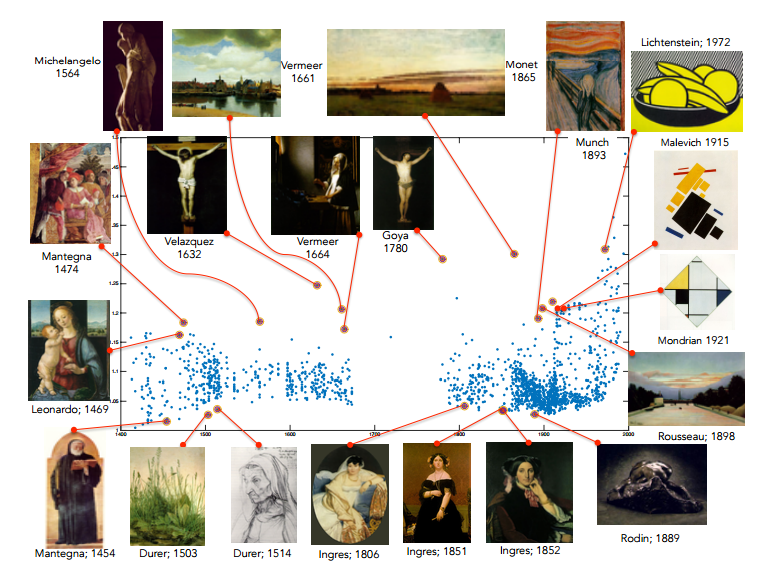
Those are tricky tasks for a human and until recently, it would have been unimaginable that a computer could take them on. But today that changes thanks to the work of Ahmed Elgammal and Babak Saleh at Rutgers University in New Jersey, who say they have a machine that can do just this.

machine vision view of art

They’ve put it to work on a database of some 62,000 pictures of fine art paintings to determine those that are the most creative in history. The results provide a new way to explore the history of art and the role that creativity has played in it.

Can’t be long before someone puts a human art historian up against the machine to see who spots the fake. (By the way, there was no byline I could find on the story. Maybe a robot wrote it.)


Windows Phone: Microsoft’s really good reason to keep it going isn’t about phones


Important equations. Photo by the waving cat on Flickr.

The abrupt departure of Stephen Elop as leader of the hardware devices business at Microsoft, which will instead be united under Terry Myerson, creates a big, obvious question: is Microsoft about to kill the Lumia smartphone business that it bought from Nokia for $9bn?

Let’s go through the arguments for and against.

Kill it because: the Windows Phone business loses money hand over fist – no phone maker, including Nokia, has ever managed to make it profitable. My analysis of its financials suggests that in Q1 it was losing around $40 per handset even if you assumed that featurephones made zero profit. Even assuming a loss per featurephone, the calendar Q1 (fiscal Q3) figures still showed a $29 per handset loss, even with generous assumptions about marketing and ignoring goodwill writeoffs.

And Microsoft has warned that it’s going to take a whacking loss pretty soon on the phones division. The logical time to do that is at the end of the fiscal year – which is two weeks from now. Elop’s leaving just means the mess is already cleaned up when Satya Nadella goes on the analyst call.

Other handset makers simply won’t touch Windows Phone; they know they can’t make money from it. Huawei’s consumer marketing chief famously said last September that it wasn’t worth doing.

In addition, the number of Windows Phone users worldwide is really small in the context of the whole business. Out of more than 2 billion connected smartphone users, around 80m use Windows Phone – and the majority of those are using low-end versions.

Why do they primarily use low-end phones? Because they’re not worried about apps, and that’s fine, because Windows Phone hasn’t managed to attract app developers to any great extent – it’s very much a distant third (or even fourth) for development.

So Windows Phone has no momentum, is a money pit, and nobody’s interested in it – not the users or developers.

Now we come to the reasons to keep it.

Keep it because: Microsoft has to have a play in mobile because mobile is the biggest computing platform on the planet, bar none. Mobile is essential; if you aren’t in that, you simply aren’t in the game. True, Microsoft is writing software for rival platforms (sometimes before it does for Windows Phone itself) but to get any idea of the challenges and advances of what’s happening in the mobile world, you have to be a player yourself. Being exposed to the harsh vicissitudes of the market, and its demands, shows you what it is that people want and need much more immediately than if you’re trying to figure it out at second hand by observing Apple’s or Google’s manoeuvres with their operating systems.

Not only that, but mobile is an intermediate stepping stone between the desktop and the coming internet of things – which you could call sub-mobile. IoT depends on components that have become pervasive through their use in smartphones (GPS, accelerometers, camera sensors, fingerprint sensors, barometers…) and understanding how their capabilities interact, and fuse, and how their price points vary, is essential to seeing what the world is going to look like in five years’ time.

That’s what I see as a subtext in the announcement about the reorganisation of the “devices” side:

Executive Vice President Terry Myerson will lead a newly formed team, Windows and Devices Group (WDG), focused on enabling more personal computing experiences powered by the Windows ecosystem. This new team combines the engineering efforts of the current Operating Systems Group and Microsoft Devices Group.

“More personal computing experiences”? That’s “more personal” as in “closer to the person”, I think, rather than “more things that are PC”. (Update: to clarify, for those it isn’t clear to, I take that to mean things like Hololens – which relies heavily on accelerometers and real-time tracking and lens technology – and wearables. You don’t get much closer to the person than screens a few centimetres from your face and something that’s actually next to your skin.)

So what now?

Even to a Windows Phone sceptic like me (even though I really liked its interface when I first encountered it), it’s obvious that the second argument is by far the stronger one. It would be different if Microsoft couldn’t bear the cost of losses on Windows Phone (if it were, say, HTC), but the fact is that it can. It can bear those losses pretty much endlessly.

Logically, therefore, this is going to happen:
• Microsoft is going to announce a whacking loss on the phones business, which will be merged into the Devices business, at the end of this quarter
• the Lumia business will continue to tick over, functioning essentially as an R+D department for future IoT devices – note how Microsoft killed the proposed Nokia smartwatch in favour of its own Band
• Windows Phone will continue to sell poorly, and lose money, but it won’t matter. For Microsoft, mobile is now a lost battle; it’s moving on to the next thing. Are you ready for the platform battle of the internet of things?