Start up: Dell, the movie!, Surfacebook reviewed, why WD bought SanDisk, IT disasters sized, and more


Studying by the light of a solar lantern. Photo by Barefoot Photography on Flickr.

You can now sign up to receive each day’s Start Up post by email. You’ll need to click a confirmation link, so no spam.

A selection of 10 links for you. Use them wisely. I’m charlesarthur on Twitter. Observations and links welcome.

Theranos CEO: company is in a “pause period” » WSJ

John Carreyrou:

Theranos Inc. founder and Chief Executive Elizabeth Holmes said Wednesday that the Silicon Valley laboratory company is in a “pause period” as it seeks to get its proprietary technology approved by the U.S. Food and Drug Administration.

“We have to move, as a company, from the lab framework and quality systems to the FDA framework and quality systems,” Ms. Holmes said, speaking at the WSJDLive global technology conference in Laguna Beach, Calif.

At the conference, she confirmed that the company is down to offering just one test using a few drops of blood and is performing the other more than 240 blood tests it offers by using larger blood samples drawn with needles from patients’ arms.

The downslope beckons.
link to this extract


Microsoft Surface Book review » SlashGear

Chris Davies:

I’m warily wiling to put most of the flakiness down to early hardware and work-in-progress drivers, but it’s clear that the practicalities of this new architecture are still being ironed out. In theory, the Clipboard shouldn’t allow itself to be detached if it’ll make the system unstable; in practice, that’s not always the case.

Throw in underwhelming battery life for the Clipboard alone, and it’s clear that thinking of the Surface Book as both a laptop and a tablet isn’t really accurate. This isn’t a replacement for your MacBook Pro and your iPad; it’s a PC that tells you to take an hour or so of downtime with a Netflix video before getting back to work. I can’t help but hope that Microsoft uses the same hybrid mechanism in a smaller form-factor, with more of a focus on equal battery life between the halves.

For all the launch day excitement it caused, Surface Book will inevitably be a niche product. As the standard bearer for a new architecture of modular graphics, though, it may be in Microsoft’s better interests in the long run if, Nexus-style, other OEMs see what’s been done and experiment with the same approach themselves.

So not quite a laptop or tablet replacement.
link to this extract


Chip merger pace rises with Western Digital, Lam deals » Bloomberg Business

The merger wave sweeping the computer-chip industry is now engulfing the makers of the machines needed to crank out semiconductors.

Lam Research Corp. said Wednesday that it would buy KLA-Tencor Corp. for $10.6bn in cash and stock. Within four hours, Western Digital Corp. announced a deal to acquire SanDisk Corp. for about $19bn. The pacts added to what was already a record year for chip deals – a total of $76bn before Wednesday.

With half of the spending on the manufacturing equipment coming from just three chipmakers – Samsung Electronics Co., Taiwan Semiconductor Manufacturing Co. and Intel Corp. – suppliers of the gear need to pool resources to keep up with the increasing pace of spending on research and development.

Consolidation is a sign of shrinking profit too. WD is struggling because the disk business is shrinking; the NAND business (where SanDisk) is growing, but getting tougher. Next question: whither Seagate?
link to this extract


Forget “Steve Jobs,” get ready for “Michael Dell” » CONAN on TBS

From my book Digital Wars:

[Bob] Ohlweiler [then at Windows MP3 player MusicMatch] recalls seeing the prototype for the third-generation iPod during a discussion with Apple executives. Steve Jobs made an appearance – “he would kind of drift in and say ‘this is shit’, and walk out,” Ohlweiler recalls. “Or he would say ‘this is far too big. It’s too bulky.’ Then he’d walk out.” (The picture that emerges is of Jobs prowling the corridors of Apple, caroming between meetings in which he offers minimal but essential advice and then moves on to the next one.)…

A month or so later Ohlweiler was at the headquarters of Dell Computer in Austin, Texas. Dell was eager to get into this burgeoning market, reasoning that it could use Microsoft’s software, design its own hardware (as it did with PCs) and use its buying heft to drive down costs to undercut Apple. Dell’s revenues at the time were six times larger than Apple’s. It was going to be easy. The market was there for the taking.

Or perhaps not. Ohlweiler recalls being handed a prototype for the Dell DJ player, which like the iPod used a 1.8in hard drive. “Jeez, this thing is HUGE!” he thought, but managed not to say.

It was noticeably deeper than Apple’s existing iPod, and substantially more so than the forthcoming iPod… Dell had done its part of the horizontal model: it had driven down costs by dual-sourcing components from Hitachi and from Toshiba. The result, though, was a bulkier machine: “one of the Dell designers explained that that was because the Toshiba version of the hard drive had its connector on the side, and the Hitachi one had it on the bottom, but because they were dual-sourcing they could get the price down by 40 cents,” Ohlweiler recalls. “That was the difference in a nutshell. Apple was all about the industrial design and getting it to work. Dell was all driven by their procurement guys.”

Sometimes satire is about telling the truth in a new way.
link to this extract


Uber CEO Travis Kalanick on self-driving cars » Business Insider

Jillian D’Onfro:

In the last year, Uber has poached more than 40 autonomous vehicle experts from the robotics program at Carnegie Mellon University, as well as top car security researchers. 

This move comes at a time when the likes of Google, Apple, and Tesla are all working on some sort of autonomous-driving projects. Kalanick says he believes Google to be the farthest ahead, but that we’re still a while away from seeing any company’s self-driving cars on the roads.

“Getting Google’s cars to a 90% solution is going to happen soon,” he said, but he asks, “when do they get to that 99.99% success level?” By his count, it could be five, 10, even 15 years. 

“It’s going to be interesting, ultimately, to see how cities handle these disruption waves, which are going to be coming faster and faster,” he said. “Some cities are going to allow it, and then they’re going to be the bastion of the future, and the other cities are going to look like they’re in the middle ages.”

link to this extract


The truth and distraction of US cord cutting » REDEF

Liam Boluk:

During the past five and a half years, the cable ecosystem has been hit with heavy losses. Nearly 8.9M net subscribers have been lost (versus 3.3M in net gains from Q3 2004 to Q4 2009) – a fact obsessed upon by journalists and bloggers alike. But at the same time – and with significantly less media coverage – Satellite (DirecTV and Dish) and Telco (i.e. AT&T U-verse and Verizon FiOS) MVPDs have surged to the point of offsetting (or reclaiming) nearly 95% of these net losses.

Looks to me like people are moving away from the standard set of cable offerings. “Gradually, and then suddenly” is how it works.
link to this extract


How solar lanterns are giving power to the people » National Geographic magazine

Michael Edison Hayden:

Prashant Mandal flips on a candy-bar-sized LED light in the hut he shares with his wife and four children. Instantly hues of canary yellow and ocean blue—reflecting off the plastic tarps that serve as the family’s roof and walls—fill the cramped space where they sleep. Mandal, a wiry 42-year-old with a thick black beard and a lazy eye, gestures with a long finger across his possessions: a torn page from a dated Hindu calendar, a set of tin plates, a wooden box used as a chair. He shuts down the solar unit that powers the light and unplugs it piece by piece, then carries it to a tent some 20 yards away, where he works as a chai wallah, selling sweet, milky tea to travelers on the desolate road in Madhotanda, a forested town near the northern border of India.

“My life is sad, but I have my mind to help me through it,” Mandal says, tapping the fraying cloth of his orange turban. “And this solar light helps me to keep my business open at night.”

It’s white LED lights that have made this possible; 40W solar panel feeds them for a long time.
link to this extract


Semantic sensors » Pete Warden’s blog

Pete Warden (you know, the machine learning bought-by-Google guy):

I think we’re going to see a lot of “Semantic Sensors” emerging. These will be tiny, cheap, all-in-one modules that capture raw noisy data from the real world, have built-in AI for analysis, and only output a few high-level signals. Imagine a small optical sensor that is wired like a switch, but turns on when it sees someone wave up, and off when they wave down. Here are some other concrete examples of what I think they might enable:

• Meeting room lights that stay on when there’s a person sitting there, even if the conference call has paralyzed them into immobility.
• Gestural interfaces on anything with a switch.
• Parking meters that can tell if there’s a car in their spot, and automatically charge based on the license plate.
• Cat-flaps that only let in cats, not raccoons!
• Farm gates that spot sick or injured animals.
• Streetlights that dim themselves when nobody’s around, and even report car crashes or house fires.

And lots more. The only questions are how soon, and would we throw away the images or keep them?
link to this extract


Rumor: AMD making custom x86 SOC for Apple’s 2017 and 2018 iMac designs » WCCFTech

Khalid Moammer:

At the 2017-2018 timeframe AMD will have two high performance CPU cores, an ARM based design code named K12 and a second generation Zen “Zen+” x86 design. However the report explains that as the x86 ISA is a necessity in the high-end desktop and prosumer level Apple products a Zen based design is most likely.

In addition to driving cost significantly down for Apple, another high-profile design win for AMD would serve as viability booster for the company’s semi-custom business following its success in the consoles. Both companies have entered a long-standing partnership, with AMD providing the graphics chips for the current iMac and Mac Pro designs.

A semi-custom SOC x86 for the iMac would have to include a high performance x86 component, namely Zen, in addition to a graphics engine to drive the visual experience of the device. Such a design would be very similar to the current semi-custom Playstation 4 and XBOX ONE Accelerated Processing Units, combining x86 CPU cores with a highly capable integrated graphics solution.

Filed under “far enough away that it could even happen”. Chip fab lead times are very long, though, which could make this a reasonable timeframe.
link to this extract


The staggering impact of IT systems gone wrong » IEEE Spectrum

We’ve scoured our archives to create a rogues’ gallery of the most notable, interesting, and emblematic failures from the past decade. We’ve included a diverse assortment of failures, which means there’s no single metric for measuring their impact. Some, like failed IT system upgrades or modernization projects, have straightforward financial consequences. Others, like operational outages and disruptions, are better measured by the time wasted and the number of people affected.

Keep in mind that the failures below are just the tip of the iceberg. They’re just a tiny fraction of the hundreds of incidents we’ve covered in Risk Factor, and an even smaller fraction of the global total. A complete list would be several orders of magnitude larger.

The UK comes out top for the NHS IT writeoff! Hooray! No, wait. (Via Matt Ballantine.)
link to this extract

Start up: Safe Harbour’s failure, Google Photos grows, Android Doze, Theranos redux, and more


Guess what sort of things Facebook’s “M” assistant gets asked to do. Photo by PeterThoeny on Flickr.

You can now sign up to receive each day’s Start Up post by email. You’ll need to click a confirmation link, so no spam.

A selection of 10 links for you. Use them wisely. I’m charlesarthur on Twitter. Observations and links welcome.

The collapse of the US-EU Safe Harbor: solving the new privacy Rubik’s Cube » Microsoft on the Issues

Brad Smith, Microsoft’s chief legal officer:

On Oct. 6, the Court of Justice of the European Union struck down an international legal regime that over 4,000 companies have been relying upon not just to move data across the Atlantic, but to do business and serve consumers on two continents with over 800 million people.

The decision made clear what many have been advocating for some time: Legal rules that were written at the dawn of the personal computer are no longer adequate for an era with ubiquitous mobile devices connected to the cloud. In both the United States and Europe, we need new laws adapted to a new technological world.

As lawyers and officials scurry to assess the situation, it’s apparent that both a variety of smaller steps and a more fundamental long-term change will be needed. We need to focus on both of these aspects.

Haven’t seen a blogpost from Google on this. Have I missed it?
link to this extract


Google Photos cloud storage service hits 100 million monthly users » Re/code

Mark Bergen:

Love for Google Photos inside the Googleplex overfloweth. At conferences, on earnings calls, in cocktail parties, Google execs shower praise on the cloud photo storage and sharing service it launched back in May. For good reason: It’s a simple, practical product that shows off Google’s machine learning prowess without any of the baggage of Google+, from which it was born.

And people are using it. On Tuesday, the search giant announced that Photos, in its first five months, has crossed 100 million monthly active users.

Google+: launched June 2011, claimed 100m users by September 2012. So this is faster – and surely a lot more engaging. Everyone loves their own photos, as opposed to everyone else’s opinions.
link to this extract


Facebook M assistant’s top requests include restaurant suggestions and shopping help » TechCrunch

After an early report from The Information, Facebook provided official details on its M project in August. Built into Messenger, M lets users text in almost any request, from assistance with online chores to booking real-world services or making purchases on their behalf. Requests are currently fielded by a combination of Facebook workers and artificial intelligence.

The hope is that over time, the humans will teach the AI to do more and more complicated tasks on their own. If M succeeds and can be affordably rolled out, it could make people’s lives easier while strengthening their loyalty to Facebook Messenger amid intense competition between chat apps. Though if it’s too costly to scale, Facebook could burn a lot of money on the project.

M could potentially earn revenue itself by taking a margin on top of purchases or services booked for people. But the big opportunity is for Facebook to lock users further into its ecosystem where it makes ample money on News Feed ads. One day, Facebook could even sell ads that convince you to initiate an M request that involves an advertiser’s business.

Right now, Facebook tells me the No. 1 type of request is for restaurant suggestions and reservations. People might know their desired food type, distance, price range, or some quality they’re looking for in a restaurant, and M helps find them the one that fits and gets them a table.

Not so different from what Siri or Google Now or Cortana can do – “find me Mexican restaurants within three minutes’ walk.” Baby steps. But really interesting ones.
link to this extract


Deutsche Telekom said to weigh new antitrust complaint against Google » The New York Times

Mark Scott:

Deutsche Telekom, which owns a controlling stake in T-Mobile US, the cellphone carrier, appears ready to get involved in Europe’s investigation into Google’s Android mobile software as well. Deutsche Telekom is expected to file a formal complaint with European competition authorities in the coming weeks, according to several people with direct knowledge of the discussions.

The complaint, which may be submitted by early November, focuses on whether Google uses its Android mobile operating system to unfairly promote its own products like Google Maps and online search over those of rivals, the people said. They would speak only on the condition of anonymity because they were not authorized to speak publicly.

This is separate from the search antitrust investigation (which is principally looking at desktop).
link to this extract


Google will require OEMs to include unmodified Doze Mode in Android 6.0 » Android Police

Ryan Whitwam:

For years Android has struggled with battery life due to apps running in the background when they aren’t supposed to, and Marshmallow could finally put a stop to it. To make sure device makers play ball, Google’s Android 6.0 Compatibility Definition Document (CDD) explicitly requires Marshmallow phones to include Doze, and OEMs aren’t allowed to monkey around with it.

Doze mode is Google’s answer to the sometimes terrible standby time of Android devices. If a phone or tablet hasn’t been used for a while, the system goes into Doze mode—apps remain asleep and wakelocks are ignored. Important cloud message pings still get through and the device wakes up briefly on occasion to sync, but that’s it…

If you go into the power optimization settings in Android 6.0, you can see which apps are exempt from Doze. On stock Android that’s just Play Services and device manager, but Google will require OEMs to show users anything else they choose to exempt from Doze in that list. That doesn’t necessarily mean you’ll be able to remove the exemption, but you’ll at least know what’s been given special treatment.

It was all going so well until that last sentence. But good to see Google tightening up on this stuff; user experience counts.
link to this extract


City AM becomes first UK newspaper to ban ad blocker users » The Guardian

Mark Sweney:

City AM is launching a trial from Tuesday that will blur out text of stories on cityam.com for desktop users of Firefox browsers who are detected using ad blocking software.

Readers will be encounter a message saying: “We are having trouble showing you adverts on this page, which may be a result of ad blocker software being installed on your device. As City AM relies on advertising to fund its journalism, please disable any adblockers from running on cityam.com to see the rest of this content.”

Martin Ashplant, the digital director at City AM, said about 8% of the site’s 1.2 million monthly browsers use Firefox on desktop and around 20% of those have ad blocking software installed.

The trial currently does not include any other browser types or non-desktop devices such as mobile phones and tablets.

Let’s see if we can guess: adblocker users will move to different browsers? Also, it’s doing this for 1.6% of its users – ie 19,200 people? Perhaps trying to get the thin end of the wedge in there.
link to this extract


Theranos trouble: a first-person account » Monday Note

Jean-Louis Gassée tried them because he has some skin (well, blood) in the game:

It seems a Hungarian forebear passed down an errant JAK2 gene that trips bone marrow into polycythemia vera (PCV), a fancy name for “too many blood cells” — and potential clots, especially as one’s vessels degrade with age. There’s no cure, yet, but with frequent attention the treatment is simple: Hydroxyurea, an inexpensive 19th century urea derivative, slows bone marrow output.

In homage to my ancestor, I perform a decade-old routine, a stroll to Stanford Hospital’s Hematology Lab to give blood samples that are tested for Complete Blood Count (CBC) and Metabolites. My numbers haven’t fluctuated much since my last visit and the kind hematologist pronounces me “medically boring” (Pourvu que ça dure! ). Good for me: If the hematocrit (HCT) number crosses the 45% threshold, I get to meet the vampire and “donate” 500ml of blood. (After which this perfectly good pint of blood must be tossed. Regulations. Sigh…)

On my way back to my University Avenue office, a thought pops up: Why not try Theranos for comparison?

His experience is a tad worrying; the comments below the post from people in the lab/testing industry are pretty eye-opening too. You don’t come away thinking the noise around Theranos is nonsense.
link to this extract


Some tech investors sure seem to be getting defensive lately … » Business Insider

Matt Rosoff with a well-argued counterpoint to the venture capitalists who – while lacking any detailed knowledge – complain about exposés such as the NYT’s on Amazon, or the WSJ’s on Theranos:

Journalists don’t set out to write takedowns of companies. But when a journalist begins investigating a company and finds something is amiss, and the story is well vetted and fairly reported, the venture community should welcome that reporting.

Because every faker, every charlatan, and every company whose product just isn’t good enough to win is taking money that could have been invested in other companies that have a better chance. 

(One more thing. Journalists are happy to hear companies defend themselves. But when a company refuses to share any data that could bolster its case, and refuses to let anything they say privately be used publicly — that’s “off the record” in journalism-speak — it’s awfully hard to take these defenses seriously.)

If you’re a journalist, you’ve surely had the latter experience. Rosoff’s piece really does need to be read in full.
link to this extract


Intel has 1,000 people working on a chip for iPhone? Of course they do » DIGITS to DOLLARS

Jonathan Greenberg (who has a lot of valuable experience in the chip industry):

I would argue that Intel has a lot of levers they can pull to win Apple as a wireless customer. They can offer a bundled deal which includes processors for the MacBook, and even cut Apple a deal to serve as their foundry for future versions of Apple’s A-Series of processors. I have no idea if any of these will ever happen, but I want to point out that this is a complex negotiation environment.
And, of course, there is Apple itself to reckon with. The post makes a big deal about the fact that Apple hired a big team of people from Infineon, but that started years ago, and that team has been using Qualcomm modems for a long time. More intriguing is the idea that Apple just wants to license the modem software from Intel and then design their own chip. That rumor has been circling for a long time. And I think it is important to remember that. Apple wants to manage their suppliers for its own ends. They now have two foundry partners to fight over iPhone share. For the past few years Apple has had little choice but to use Qualcomm for modems, so it is only natural for them to want a second source. When (if?) Intel finally gets its LTE modem working, Apple will have that second source. My guess is that Apple really does not want to design its own modems. That requires a lot of labor intensive software work to keep up with those standards mentioned above.

link to this extract


Tim Cook gets passionate about privacy at “The Wall Street Journal” tech conference » Fast Company

Harry McCracken:

The conversation was more fun when Cook spoke about the new Apple TV. He pushed back on Baker’s contention that the streaming box wasn’t much of a disruptor, and went on an entertaining rant against TV as it’s existed for decades. (“Why does a channel even exist? Think about it. My nephew asked me once, and I couldn’t even answer.”)

But the liveliest portion of the session by far involved privacy. It’s been a big talking point for Cook for a while now. And onstage, he got worked up talking about it in a way that was strikingly different from his normal, preternaturally calm, on-point manner.

“Privacy is a key value of our company,” Cook began, in a manner similar to his previous statements on the topic. “We think it will become increasingly important to more and more people over time as they realize that intimate parts of their lives are in the open and being used for all kinds of things.” He explained that Apple encrypts personal information and keeps it on your phone, drawing an unstated contrast with Google, whose fundamental business model involves storing personal data in the cloud where the company can slice it, dice it, and monetize it with advertising.

But when the discussion turned to government monitoring of the digital world—National Security Agency director Michael Rogers having preceded Cook onstage—Baker said there were basic tradeoffs between privacy and national security. And Cook didn’t buy it. “I don’t agree,” he said. “I think that’s a copout.”

Cook also objected to Baker’s what-if scenario involving a back door that would have let government agents override encrypted data and foil the 9/11 plot before it was carried out: “No one should have to decide, privacy or security. We should be smart enough to do both.”

That point about channels should have been in Cook’s introduction of the new Apple TV in September – except the answer is easy: it’s to give you a predictable experience, just as a newspaper does. Apple lacks a good storyteller at present. (You can read the liveblog on the WSJ Digits blog.)
link to this extract


Start up: sneaking iOS apps, spoofing Spotify, CIA director gets hacked, and more


One of these is probably chewing up your battery by playing silent audio (on Android too). But which? Photo by microsiervos on Flickr.

You can now sign up to receive each day’s Start Up post by email. You’ll need to click a confirmation link, so no spam.

A selection of 9 links for you. Like champagne for the mind! Perhaps. I’m charlesarthur on Twitter. Observations and links welcome.

iOS apps caught using private APIs » SourceDNA

Nate Lawson and team:

we noticed that these functions were all part of a common codebase, the Youmi advertising SDK from China.

We then associated the clusters of this SDK’s code with the release dates of the apps that contain them to see how it has evolved over time. The older versions do not call private APIs, so the 142 apps that have them are ok. But almost two years ago, we believe the Youmi developers began experimenting with obfuscating a call to get the frontmost app name.

Once they were able to get this through App Review, they probably became more confident they weren’t being detected and added the above behaviors in order. They also use the same obfuscation to hide calls to retrieve the advertising ID, which is allowable for tracking ad clicks, but they may be using it for other purposes since they went to the trouble to obfuscate this. The latest version of the Youmi SDK (v5.3.0), published a month ago, still gathers all the above information.

Apple has been locking down private APIs, including blocking apps from reading the platform serial number in iOS 8. Youmi worked around this by enumerating peripheral devices, such as the battery system, and sending those serial numbers as a hardware identifier.

Find out now! Just select your developer accounts from a list, and we’ll tell you what we found about your apps. We’ll also show the commercial and open-source code you’re using and alert you to future issues we find.

We found 256 apps (est. total of 1 million downloads) that have one of the versions of Youmi that violates user privacy. Most of the developers are located in China. We believe the developers of these apps aren’t aware of this since the SDK is delivered in binary form, obfuscated, and user info is uploaded to Youmi’s server, not the app’s. We recommend developers stop using this SDK until this code is removed.

Apple’s yanking the apps. Developer? Check it here. It’s always China, isn’t it? But nothing to stop apps from other countries doing the same.
link to this extract


The background data and battery usage of Facebook’s iOS app » MacStories

Federico Viticci:

With iOS 9’s improved energy consumption stats, it’s easier to guess one of the various tricks Facebook may be employing to stay active in the background and drain battery. On my girlfriend’s iPhone, for instance, iOS 9 reports 5 hours of on-screen usage for the last 7 days, and another 11 hours of background audio usage with Background App Refresh turned off.

My guess is that Facebook is hijacking audio sessions on iOS by keeping silent audio in the background whenever a video plays in the app. And because, by default, videos on Facebook auto-play on both Wi-Fi and Cellular and few people ever bother to turn it off, that means there’s a high chance the Facebook app will always find a way to play a video, keep audio in the background, and consume energy to perform background tasks. I’m not alone in noticing the mysterious “Facebook audio” background consumption, and video auto-play seems to me the most likely explanation at this point. I don’t know if turning off auto-play may fix the problem, but I’d recommend doing that anyway to save data.

Un-fricking-believable. The web is suddenly alive with people who have used iOS 9’s better battery monitoring system and discovered that Facebook is eating their battery like nobody’s business.

More discussion here, and a full-on Medium post, which shows Facebook using 3.4hrs in the background with background app refresh turned off.

Just delete it, and use the mobile site – navigate there and create a home page icon for it. And close the tab when done.
link to this extract


Microsoft announces price of 1TB Surface Book — $500 more than the top 13-inch MacBook Pro » GeekWire

James Risley:

The top-of-the-line 1TB Surface Book comes with 16GB RAM and a Core Intel i7 processor for a cool $3,199, $500 more than the fully tricked out 13-inch MacBook Pro, and the same price as the fully enhanced, much larger 15-inch option. The Surface Book does have a few more tricks up its sleeve than the MacBook Pro, including a touchscreen, removable keyboard and a 360-degree hinge, so the price difference isn’t without reason.

The 1TB option joins the lineup that starts at $1,499 for a 128GB Core i5 version. Microsoft isn’t offering many fine-grained customizations for its first laptop, like allowing for more RAM on its 128GB model, but most models look adequately powerful for the everyday user.

“Everyday user”? Wasn’t the point of the Surface Book that it was for some slightly mythical ultra-user? As for the touchscreen and removable keyboard… the case for the touchscreen is still pretty weak for the “everyday user”.
link to this extract


Teen says he hacked CIA director’s AOL account » New York Post

Philip Messing, Jamie Schram and Bruce Golding:

Hillary Rodham Clinton’s email scandal didn’t stop the head of the CIA from using his own personal AOL account to stash work-related documents, according to a high school student who claims to have hacked into them.

CIA Director John Brennan’s private account held sensitive files — including his 47-page application for top-secret security clearance — until he recently learned that it had been infiltrated, the hacker told The Post.

Other emails stored in Brennan’s non-government account contained the Social Security numbers and personal information of more than a dozen top American intelligence officials, as well as a government letter about the use of “harsh interrogation techniques” on terrorism suspects, according to the hacker.

The FBI and other federal agencies are now investigating the hacker, with one source saying criminal charges are possible, law enforcement sources said.

The hacker is getting investigated for criminal charges? Brennan is the one who ought to be prosecuted. If a kid in high school could do this, any Chinese or Russian hacker would have.
link to this extract


Why it’s OK to block ads » Practical Ethics

James Williams:

Think about the websites, apps, or communications platforms you use most. What behavioral metric do you think they’re trying to maximize in their design of your attentional environment? I mean, what do you think is actually on the dashboards in their weekly product design meetings?

Whatever metric you think they’re nudging you toward—how do you know? Wouldn’t you like to know? Why shouldn’t you know? Isn’t there an entire realm of transparency and corporate responsibility going undemanded here?

I’ll give you a hint, though: it’s probably not any of the goals you have for yourself. Your goals are things like “spend more time with the kids,” “learn to play the zither,” “lose twenty pounds by summer,” “finish my degree,” etc. Your time is scarce, and you know it.

Your technologies, on the other hand, are trying to maximize goals like “Time on Site,” “Number of Video Views,” “Number of Pageviews,” and so on. Hence clickbait, hence auto-playing videos, hence avalanches of notifications. Your time is scarce, and your technologies know it.

But these design goals are petty and perverse. They don’t recognize our humanity because they don’t bother to ask about it in the first place.

Neatly argued, by stepping right back from the debate as framed by the ad industry.
link to this extract


I built a botnet that could destroy Spotify with fake listens » Motherboard

William Bedell:

I decided to prototype a robot with an endless appetite for music to see if Spotify could detect what it was doing.

Here is what I coded into life:

Image: William Bedell
First, a remote server used browser automation to sign up for Spotify accounts with randomly generated names, ages, and email addresses. This gave me a limitless supply of accounts to stream songs, so as not to alert Spotify by having a handful of users with inhuman amounts of activity.

A central command server periodically sent out Spotify login credentials to cloud servers (or repurposed personal computers) running dozens of Spotify clients, all masked behind virtual private networks. Each “user” logged in, listened to a few hours of music, then logged out. Their playlists were random selections from various artists I like. Then, I deployed the botnet using a patchwork of free cloud instances and my own hardware.

It was mesmerizing to watch the plays rack up. Unknown albums from minor celebrities I adore suddenly had tens of thousands of hits, where before they had virtually none. With minimal effort, I was generating $32.26 per day in royalties. Inevitably, my thoughts wandered to greed: how profitable would this music royalty factory be if I turned it on music I owned the rights to?

link to this extract


Intel has 1,000 people working on chips for the iPhone » VentureBeat

Mark Sullivan:

Intel now has a thousand people or more working to outfit a 2016 iPhone with its lauded 7360 LTE modem chip, sources say. If all goes well, Intel may end up providing both the modem and the fabrication for a new Apple system on a chip.

Sources close to the matter say Intel is pulling out the stops to supply the modems for at least some of the iPhones Apple manufactures in 2016. This phone will likely be the iPhone 7. VentureBeat was the first to report on the two companies’ work together, and more pieces are falling into place as the project progresses and grows.

Apple may dual-source the LTE modems in its new iPhones from both Intel and Qualcomm. Today, Qualcomm’s 9X45 LTE chip is baked into all iPhone modems.

This story makes one go “hmm..” right up to the point where it talks about dual-sourcing. Then it suddenly makes perfect sense: Apple would look to play the two off against each other, as with CPU supply.
link to this extract


E.U. rule change could be big headache for small businesses » Advertising Age

Kate Kaye:

“I think everybody was hoping [the ECJ] wouldn’t [rule against Safe Harbour], but we were kind of expecting them to rule it this way,” said Acxiom Chief Privacy Officer Jennifer Glasgow. But, she said, “This is not going to disrupt a lot of data flow today or tomorrow or next week.”

The Safe Harbor compact has helped streamline the data flow for more than 4,000 companies including data brokers, ad technology firms and ecommerce companies among others for 15 years. But alarmed by Edward Snowden’s revelations, the E.U. court decided the agreement is not strong enough to protect Europeans’ privacy, including against U.S. spies.

Most large firms handling massive amounts of data such as Google, Facebook and Amazon should already have other legal contracts in place, including previous agreements guiding heavily-regulated health and financial data, that should allow them to continue data transfer as usual. Smaller marketers and data vendors won’t be so lucky, which could have ripple effects throughought the marketing ecosystem.

Correction: the ECJ wasn’t “alarmed” by the revelations; it made a judgement in the light of those revelations about whether EU law could still be applied to data transferred to the US under Safe Harbour.

What’s weird is how people are acting as though this won’t make a difference. If you’re not allowed to transfer data US-owned servers on the basis that it might be rifled through by the US government, how can it not? (Of course, everyone would be howling for safety if these were Chinese-owned servers and companies; witness the US administration’s lockout of China’s Huawei from communications contracts.)
link to this extract


The secrets of a billionaire’s blood-testing startup » The New Yorker

Eric Lach:

Part of the Theranos story is the tension between commerce, science, and secrecy. Ken Auletta explored this tension in the magazine late last year, in his December profile of Holmes. For most of its existence, Auletta wrote, Theranos has “operated with a stealth common to many Silicon Valley startups.” The company has published little data in peer-reviewed journals describing its devices or its test results, and it has kept the workings of its technology a closely guarded secret. Holmes herself prefers speaking about the coming revolution that her company will bring rather than the specifics of the technology itself.

Holmes and the company say this is normal, that Theranos is only trying to protect itself and its trade secrets while it creates something new. The company says that it has taken steps to get its tests approved by the F.D.A. But there are many who say that health-care technology can’t be afforded the same hushed reception as a new model of the iPhone. “Science is peer-reviewed,” Lakshman Ramamurthy, a former F.D.A. official and a vice-president at the consulting company Avalere Health, said, reacting to the Journal article this week.

Of course, Holmes could be a billionaire, or a zeroinaire, depending how things pan out over the next few months.

What the WSJ story also shows (by its impact, and the puzzled followups) is how little understanding there is of biotech among most journalists. Science journalists tend to shy away from it because it involves business, and business journalists aren’t good at figuring out what questions to ask experts about the science.
link to this extract


Google’s growing problem: 50% of people do zero searches per day on mobile


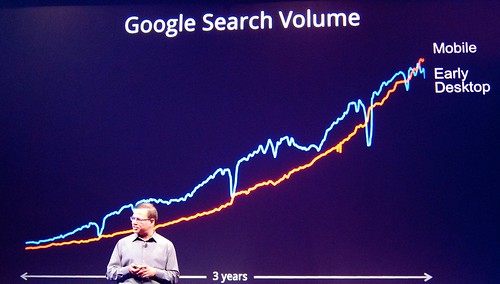
Amit Singhal in 2011 showing a comparison of search volumes from mobile and “early desktop years”. Photo by Niall Kennedy on Flickr.

Amit Singhal, Google’s head of search, let slip a couple of interesting statistics at the Re/Code conference – none more so than that more than half of all searches incoming to Google each month are from mobile. (That excludes tablets.)

This averages out to less than one search per smartphone per day. We’ll see why in a bit.

First let’s throw in some more publicly available numbers.
• more than 100bn searches made per month to Google (total of desktop/ tablet/ mobile).
• about 1.4bn monthly active Google Android devices. (Source: Sundar Pichai, Nexus launch.)
• about 1 billion monthly active Google Play users. (Source: Sundar Pichai, Nexus launch.)
• about 1.5bn PCs in use worldwide.
• about 400m iPhones in use worldwide. Probably about 100m of those are in China. (Analyst estimates.)
• about 100m other smartphones in use (70m Windows Phones, 30m BlackBerrys)
• the mobile search market only generates a third as much revenue as the desktop. (Source: Rob Leathern, via the IAB 2014 report.)

Singhal had already said in July that mobile was larger than desktop in 10 countries; now it’s for the whole world. Google’s numbers effectively exclude China, of course, since Google doesn’t have any presence there. (Android phones and iPhones both use Baidu, the local search engine, as the default there; Google is banned from the mainland, and though people can use it, they overwhelmingly don’t.)

So let’s put these numbers together.
• In all, there are 1400 Google Android + 400 iPhones – 100 iPhones inside China + 100 other = 1.8bn smartphones in use outside China.
• 50bn mobile searches per month = 50bn per 30-day period

Today’s not the day to search

Calculate! 50bn / (1.8bn * 30) = 0.925 mobile searches per day. (Even if you exclude the Windows Phones and BlackBerrys, you still get 0.98 mobile searches per day.)

That’s right – the average (“mean”) person does less than one Google search on mobile per day. The mode (most common number) will be below that too. Over a 30-day period, the mean number of mobile Google searches is 27.8.

For desktop+tablet search, you get roughly the same figure – assume 1.5bn PCs and 300m tablets. But not all of those devices are available to make searches: many PCs are sitting in corporate environments where they aren’t connected to the internet, or can’t be used to make Google searches: think of all the machines in call centres, or functioning to run shop tills, or in factories. They reduce the potential base that can be used to make queries, and so ramp up the real average of per-active-PC/tablet monthly queries.

On the basis that
• the world PC installed base is split roughly 60-40 between corporate and personal users, so 900m and 600m
• guessing that 50% of those corporate machines, ie 450m, can’t make Google searches

then the total number of PCs/tablets available to make Google queries is 600m personal PCs + 450m corporate PCs + 300m tablets, or 1,350m devices.

Do the maths on 50bn searches per 30-day month across 1,350m devices and you get 37 searches per month, or 1.23 searches per day on average. The mode (most common figure) is likely to be 1, but the median (point where you have half as many behind as in front) will be higher. Probably not much higher – this will be an asymmetric distribution, where most of the (in)action is on the low end, so it may look like a Poisson or Pareto function.

Desktop: steady as she goes

This is my rough model of how search distribution might look, generated by plugging figures we know into a Pareto generator and then doing a distribution function for N = integer number of searches per day.

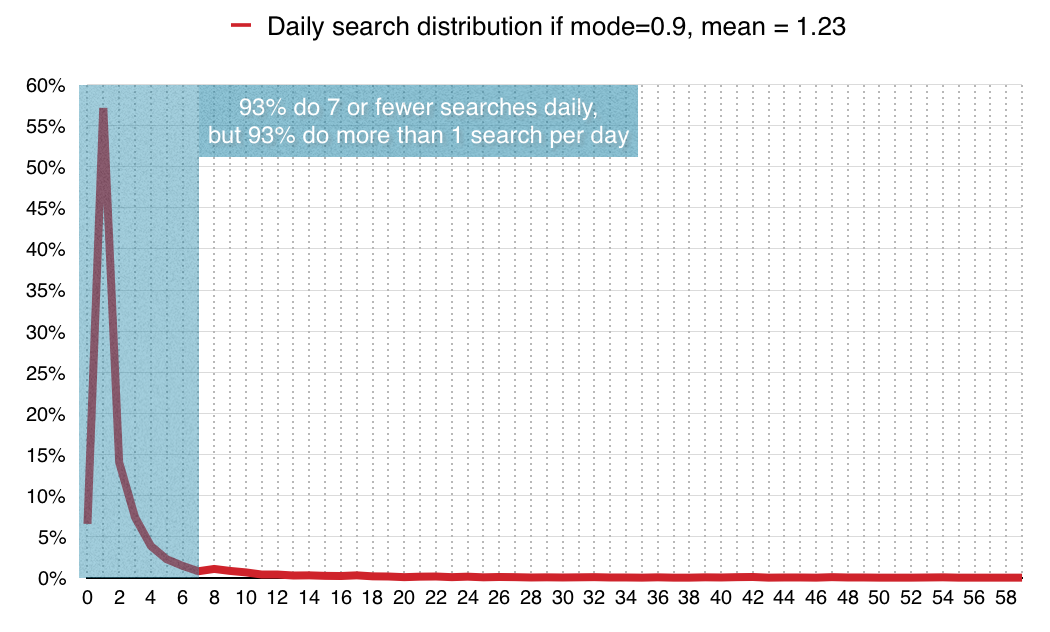
Here’s how it looks for the desktop, using a mode (most common) of 0.9 searches per day and mean of 1.23:

Per-user searches on desktop on Google

Estimated profile of number of searches per day per person on Google on desktop.

What this is saying is that on any given day you get about 55% of people doing just one search, a bit less than 15% doing two searches, just under 5% doing four searches, and so on. Small proportions, but big absolute numbers. And who does what searches isn’t fixed; so someone who did zero searches yesterday might do 10 tomorrow. But equally, the 10-searcher yesterday does none or one or four today. And so on.

(It took some experimentation to get this shape; using a higher mode meant that the number doing zero searches was itself zero, which doesn’t make sense: there must be some people who by accident or design don’t ever hit Google during a day. Here, the proportion of users doing zero searches per day is 6.5%, which seems reasonable.)

Here’s how it breaks out when you look at cumulative percentages:

Google searches on desktop

My model suggests that most people don’t do much searching, but nearly everyone does some.

Note that lots of people don’t do many searches, but huge numbers of people do some searching. Further confirmation: the data release from AOL in 2006, which was just for desktop users, was “~20m records from ~650,000 users over three months” which translates to an average of 31 records per person over that 90-day period, or one-third of a query per day. AOL users in 2006 might not be directly comparable to Google users today, but it’s a useful check that the numbers here are probably broadly correct.

Incidentally, a lot of those present-day searches will be very low complexity. Watch people use a desktop. The most common Google query is “Facebook”. Probably the next most common? “Yahoo”, “Gmail” and “Hotmail”. People literally type those into the Google search box, or their browser search bar, to get to those sites. To a technical audience that’s stunning – why would someone do that? – but it’s observable behaviour. Remember the AOL data leak in 2006? Data there showed that some people used to just hit “Search” when the text box was empty which in turn meant that some advertisers got AdWords hits on the phrase “search terms” (which used to be the text in the box).

Mobile: all change

However on mobile, things are different. People do not, in general, type “Facebook” or “Gmail” into their mobile browser’s search bar. They go to the relevant app – Facebook or email. This behaviour is surely a big reason why mobile searches have been behind desktop for a long time, even though smartphones’ use has rocketed, and time spent on them is greater than for PCs, and they’ve been nudging a comparable installed base for some time.

Thus where someone using a desktop/laptop might fulfil their “average” one or two searches per day by typing “Facebook” when they open their browser, on mobile that doesn’t happen because it doesn’t need to happen; they just open the app.

For Google, that means it’s losing out, even though Google search is front and centre on every Android phone (as per Google’s instructions as part of its Mobile Application Device Agreement, MADA). People don’t, on average, search very much on mobile. The miracle of Google, in retrospect, is building a multi-billion dollar business by accreting millions of rare actions – people doing searches and then clicking on ads. Of course, Google has helped that latter activity by filling the top of its search results page with ads, and making them harder to distinguish from search results. But it’s still a hell of an achievement.

I tried modelling what search activity probably looks like on mobile: I used a mean = 0.925 (as per Singhal) and mode = 0.5. The mode must be below the mean because of the long tail of higher values; 0.5 is a guess, but moving it around doesn’t have a large effect. This gives a median of 0.94, close to the mean, which you’d also expect.

Google mobile search modelled

If mobile searching follows a power law, it might look like this.

You can see that (if we allow these assumptions, which I think are reasonable – remember that they’re based on Google’s own data) then only 5% of users do more than seven searches per day on average. That’s very like the desktop scenario.

Mobile search percentage

As on desktop most people don’t do more than 7 searches – but most people also don’t do one search.

But here’s where things are suddenly very different from the desktop: although the proportion doing more than seven searches per day is about the same (5% or so), you have a far greater number who don’t ever get beyond zero.

Incidentally, this echoes Horace Dediu’s analysis from April 2014, when he noted how the internet population was growing rapidly, but Google’s revenues from non US/UK sources weren’t: US/UK users seemed to generate about $86/yr, while those outside that space generated only $12/yr. (This picture might be distorted by Google’s tax arrangements, of course.)

So there is the problem for Google: the PC base is static or even falling, while the number of people holding smartphones is growing. But the latter group tends not to use search, and so doesn’t see its most profitable ads. (There are in-app ads, but it’s never been very clear how much revenue they generate compared to other search ads. One suspects if they were very lucrative for Google it would be touting its “run rate” from them.)

Hence Google pushes people to use the mobile web more; and also, notably, to expand beyond simple search into services such as Google Now, Now On Tap, and pretty much anything. Seen through that lens, the reorganisation of Google into Alphabet makes sense: it’s seeking to get as many potentially moneymaking new ideas fired off as soon as possible, while search and search revenues are still growing, and before the growth of mobile really pulls the averages down. Dediu, in the link above, notes that 2016 will probably mark the point where internet population growth begins levelling off. And most of the new additions will be mobile-only.

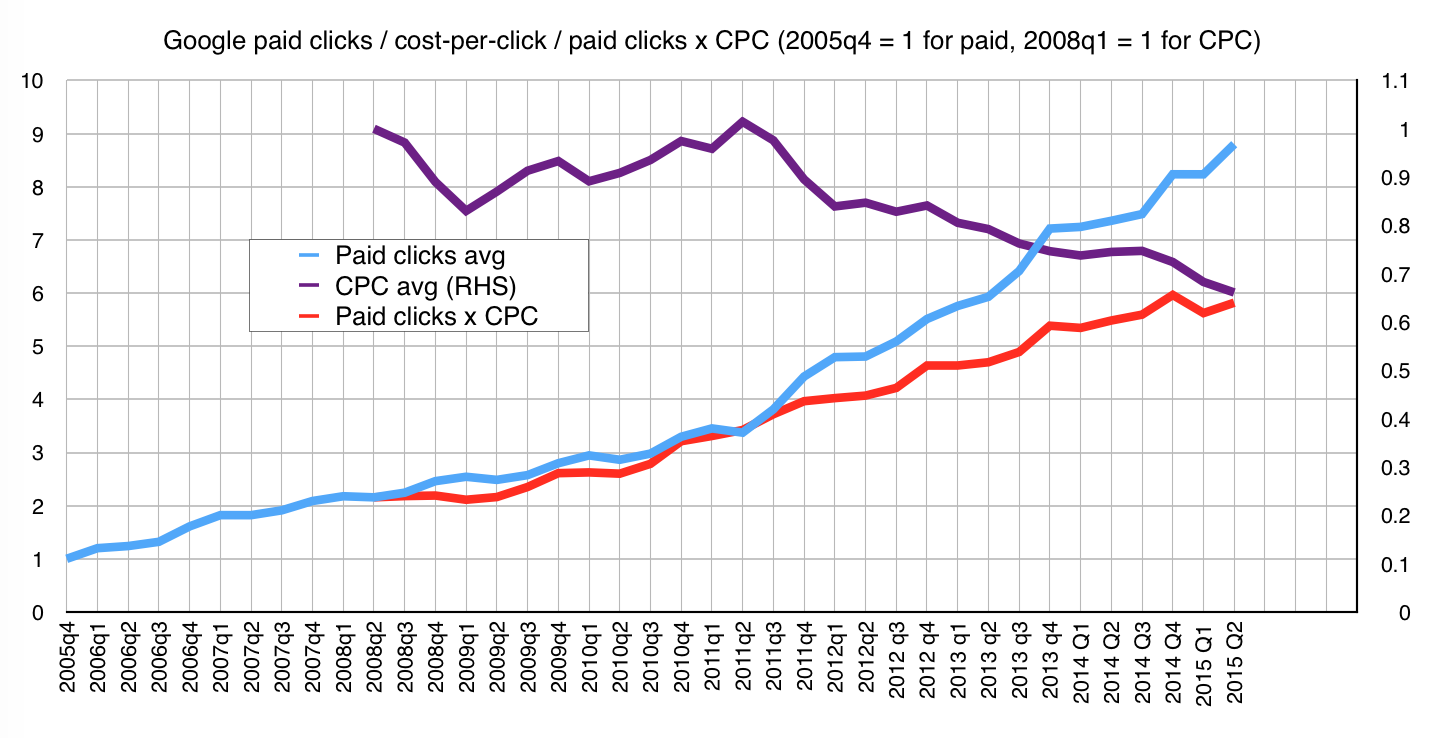
You can see that effect most clearly in data from Google’s financials, where it discusses the number of paid clicks it gets, and the cost-per-click. It doesn’t take much effort to combine the two together to get the “total payments per click”.

Google paid clicks, cost-per-click and product

Paid clicks up, CPC down. Source: Google financials.

What’s clear is that
(a) the number of paid clicks has zoomed up – increased nearly ninefold since the end of 2005 (where the graph starts)
(b) CPC is on a steady downward slope, despite Google’s best (and successful) efforts in mid-2011 to shore it up
(c) combining the two shows that revenue hasn’t increased nearly as fast as paid clicks. In other words, the new users and new platforms on which Google is available aren’t as valuable as the old ones.

In conclusion

So what do we conclude? Mobile search is a real problem for Google: people don’t do it nearly as much as you suspect it would like. But there’s no obvious way of changing that behaviour while users are so addicted to apps on their phones – and there’s no sign of that changing any time soon, no matter whether news organisations wish people would use mobile sites instead (clue: most people get their news via Facebook online).

This is a structural reality of how mobile is now. Buying Android and make it freely available was a defensive move to stop Microsoft being the gatekeeper to the mobile web (more in my book..).

But it turns out that search wasn’t actually the gatekeeper to mobile; having a well-stocked app store is. That’s where the searching really happens. Now Google faces the second stage of the mobile web. What will its answer be?

Start up: Tor for iOS 9?, Google wins book appeal, HTC’s new (i)Phone, DNA suspects, and more


A crucial part of some fake Amazon reviews. Photo by Joe Shlabotnik on Flickr.

You can now sign up to receive each day’s Start Up post by email. You’ll need to click a confirmation link, so no spam.

A selection of 9 links for you. Use them wisely. I’m charlesarthur on Twitter. Observations and links welcome.

New Tor apps for iOS 9 headed to iPhone, iPad » Daily Dot

Patrick Howell O’Neill:

The new iOS offering will come from a group led by Chris Ballinger, founder of ChatSecure and including Frederic Jacobs of Open Whisper Systems; Mike Tigas, who wrote Onion Browser; and Conrad Kramer, a former device jailbreaker. 

That group is working on iCepa, a system-wide iOS Tor client that can change the way every app on iOS connects to the Internet by routing traffic from each app through the Tor network.

Older versions of iOS lacked key capabilities that would allow for an effective Tor app, Freitas said. But certain changes implemented in iOS 9 — specifically the ability to incorporate Tor into multiple apps simultaneously — make the mobile operating system far more attractive for Tor developers.

“iOS has some new capabilities in it,” Freitas said. “You can create a device-wide [virtual private network], and it can be a Tor-based VPN. So we can create an Orbot-like service on iOS 9, which is exciting.”

Orbot empowers other Android apps to use Tor. It’s an anonymity amplifier that’s been impossible on iOS up until now because Tor could only run in a single app at a time.

link to this extract


Dear reader, we’re closing comments » IOL Beta

Adrian Ephraim, managing editor of the South Africa Independent:

Dear IOL reader, we need to talk …

I thought you should be the first to know that Independent Online (IOL) will be closing comments on its online articles with immediate effect.

It is a difficult but necessary decision to make and we arrived at it after careful consideration of all the factors at play.

The freedom of expression guaranteed by our Constitution was never meant to override the personal freedoms and human rights of our fellow citizens.

Let me be clear that commenting on an article is not a right, but a courtesy afforded to you by IOL as a reader.

If you are prone to being racist or sexist in your thinking, by all means express yourself on other platforms that may find such behaviour acceptable, but not on IOL.

We are of the view that instances of abuse in our comments section have become untenable.

..And another one. Just keeping tabs, really.
link to this extract


HTC One A9 photos leak: It’s an iPhone » BGR

Zach Epstein:

We’ve seen a number of leaked images of the upcoming HTC One A9 in the past, but the clearest pictures yet were just accidentally published by European wireless carrier Orange. HTC is already in deep trouble following its One M9 flop, but this phone may very well get the struggling smartphone maker sued into oblivion.

It really does look amazingly like an iPhone 6 (or 6S). Then again, so did the Galaxy S6. Hard to see it making any difference to HTC’s gradual demise.
link to this extract


Getting LEAN with Digital Ad UX » IAB

Scott Cunningham , svp of the Interactive Advertising Bureau’s Tech and Ad operations, begins this post “We messed up”. But the mea culpa also has a nostrum explicatum:

We engineered not just the technical, but also the social and economic foundation that users around the world came to lean on for access to real time information. And users came to expect this information whenever and wherever they needed it. And more often than not, for anybody with a connected device, it was free.

This was choice—powered by digital advertising—and premised on user experience.

But we messed up.

Through our pursuit of further automation and maximization of margins during the industrial age of media technology, we built advertising technology to optimize publishers’ yield of marketing budgets that had eroded after the last recession. Looking back now, our scraping of dimes may have cost us dollars in consumer loyalty.

Loose translation: “We did so much good that we made things worse.” Now the IAB is suggesting ads should be “light; encrypted; ad choice supported; non-invasive”. Nice idea. Not sure “encrypted” is necessary; is that to stop people like AdBlock Plus?
link to this extract


After undercover sting, Amazon files suit against 1,000 Fiverr users over fake product reviews » GeekWire

Jacob Demmitt:

Fiverr is an online marketplace that lets people sell simple services to strangers, like transcribing audio, converting photos or editing video. Amazon simply had to contact Fiverr users who advertised their review-writing services and set up the transaction.

The company said most people offered the undercover Amazon investigators 5-star reviews for $5 each.

One Fiverr.com user that went by bess98 offered to write the reviews from multiple computers, so as to deceive Amazon. Another user, Verifiedboss, unwittingly told the investigators, “You know the your [sic] product better than me. So please provide your product review, it will be better.”

As in the previous lawsuit, Amazon alleges that these reviewers often arranged to have empty boxes shipped to them in order to make it look like they had purchased the products.

Amazon is not suing Fiverr. The company noted in the court filing that these kinds of services are banned by Fiverr’s terms and conditions and Fiverr has tried to cut down on the practice.

Would love to know which products these people reviewed.
link to this extract


Appeals court gives Google a clear and total fair use win on book scanning » Techdirt

Mike Masnick:

The Authors Guild’s never-ending lawsuit against Google for its book scanning project has been hit with yet another blow. The 2nd Circuit appeals court has told the Authors Guild (once again) that Google’s book scanning is transformative fair use. This is not a surprise. Though this case has gone through many twists and turns, a few years ago it was also before the 2nd Circuit on a separate issue (over the appropriateness of it being a class action lawsuit) and the 2nd Circuit panel ignored that question, saying that it shouldn’t even matter because it seemed like this was fair use. Thus it was sent back to the district court, where Judge Danny Chin correctly said that the scanning was fair use. That ruling was appealed, and the AG trotted out some truly nutty legal theories (arguing that it wasn’t fair use because someone like Aaron Swartz might hack into Google’s computers and free the books).

These arguments did not work. The 2nd Circuit has affirmed the lower court ruling and given another nice appellate ruling establishing the importance of fair use — and a reminder that, yes, commercial uses can still be fair use:

Google’s making of a digital copy to provide a search function is a transformative use, which augments public knowledge by making available information about Plaintiffs’ books without providing the public with a substantial substitute for matter protected by the Plaintiffs’ copyright interests in the original works or derivatives of them.

Pretty convincing win for Google.
link to this extract


Your relative’s DNA could turn you into a suspect » WIRED

Brendan Koerner:

In [Michael] Usry’s case the crime scene DNA [from an unsolved killing in 1969] bore numerous similarities to that of Usry’s father, who years earlier had donated a DNA sample to a genealogy project through his Mormon church in Mississippi. That project’s database was later purchased by Ancestry, which made it publicly searchable—a decision that didn’t take into account the possibility that cops might someday use it to hunt for genetic leads.

Usry, whose story was first reported in The New Orleans Advocate, was finally cleared after a nerve-racking 33-day wait—the DNA extracted from his cheek cells didn’t match that of Dodge’s killer, whom detectives still seek. But the fact that he fell under suspicion in the first place is the latest sign that it’s time to set ground rules for familial DNA searching, before misuse of the imperfect technology starts ruining lives.

Mitch Morrissey, Denver’s district attorney and one of the nation’s leading advocates for familial DNA searching, stresses that the technology is “an innovative approach to investigating challenging cases, particularly cold cases where the victims are women or children and traditional investigative tactics fail to yield a solid suspect.”

Not sure if UK police would be able to demand access in the same way. Previously they didn’t need to – there was a national DNA database which included completely innocent people.
link to this extract


Apple’s iPhone finds more fans on Samsung’s home turf » MarketWatch

Jennifer Booton notes that the iPhone has hit a 14% sales share in South Korea over the summer:

Samsung was able to recoup some of the losses incurred from Apple by going after the smaller manufacturers, such as LG Electronics and Pantech. LG’s share slid to 22% from 29%, while Pantech’s nose-dived from 4% to 1%, according to the Counterpoint research. Apple’s influence is having an effect, though.

“Samsung still has a loyal following in Korea,” said Ramon Llamas, research manager at industry tracker IDC. “But Apple is certainly making a run.”

Apple’s share in South Korea, where users have long been accustomed to the Samsung Galaxy Note phablets and other larger-screen Galaxy phones, has been gaining ever since the launch of the 5.5-inch iPhone 6 Plus, Apple’s first large-screen iPhone, Kang said. Its share gain was most prominent right after the iPhone 6 Plus launched, growing sevenfold in the fourth quarter of 2014.

While the growth rate has since slowed, Kang said he believes there’s still room for Apple to grow there as the “iPhone ecosystem effect” — the idea that Apple’s interconnected operating systems and devices keep users within the Apple brand — begins to take hold.

“Mature smartphone users (mostly Android) have started to upgrade to Apple iPhones,” he said.

link to this extract


Soul of a virtual machine » Medium

Jerry Chen:

In 2005, as the product manager for VMware’s enterprise desktop business, I made the pilgrimage down to Round Rock, Texas to meet the executives running Dell’s PC business. This was a year before I created VDI (Virtual Desktop Infrastructure) and VMware was still the small but fast growing, and recently acquired division of EMC. For almost an hour I pitched Dell on the virtues of desktop virtualization. The Dell executives smiled, nodded politely, and at the end of the meeting they asked me, “You understand that we sell PCs here? Why would we ever want to commoditize our differentiation with virtualization?”

I collected my things and flew back to Palo Alto.

2015: Dell buys EMC, including VMWare, for $67bn, as its PC business keeps struggling. Now, VMWare didn’t kill off the PC business directly, but it certainly helped the move to the cloud that has forced Dell into this catchup acquisition.

Note how similar the Dell execs’ question is to Jerry Yang at Yahoo, who in 1997 told two guys with a new search algorithm “but we want people to click multiple search pages, because we can show them ads.” Larry Page and Sergey Brin didn’t come back. Yahoo isn’t dead, but it’s a zombie.
link to this extract


Start up: lightening YouTube, more Flash vulnerability, farewell to Apple’s store fan, NSA cracking, and more


“Yeah, pretty frazzled after a long day writing clickbait headlines. You?” Photo by peyri on Flickr.

You can now sign up to receive each day’s Start Up post by email. You’ll need to click a confirmation link, so no spam.

A selection of 8 links for you. Hand-picked by fingers. I’m charlesarthur on Twitter. Observations and links welcome.

Page weight matters » Chris Zacharias

At YouTube, Zacharias was challenged to get the standard 1.2MB page down below 100KB:

Having just finished writing the HTML5 video player, I decided to plug it in instead of the far heavier Flash player. Bam! 98KB and only 14 requests. I threaded the code with some basic monitoring and launched an opt-in to a fraction of our traffic.

After a week of data collection, the numbers came back… and they were baffling. The average aggregate page latency under Feather had actually INCREASED. I had decreased the total page weight and number of requests to a tenth of what they were previously and somehow the numbers were showing that it was taking LONGER for videos to load on Feather. This could not be possible. Digging through the numbers more and after browser testing repeatedly, nothing made sense. I was just about to give up on the project, with my world view completely shattered, when my colleague discovered the answer: geography.

The explanation is rather smart.
link to this extract


Forbes: a quick adtech video » Medium

Rob Leathern wanted to read an article – you know, one of those text things – on Forbes:

In order for me to read that one article I had to receive 1,083 URL calls from 197 different domains adding up to 18.3 Megabytes of data, summarized here in an Excel spreadsheet. I closed any videos as soon as I could if they had the ability to do so.

Is it worth it? I like Alex Konrad and the article was probably a good one, but given I’m not sure where my data is going, or who some of these entities are (jwpltx.com? wishabi.com?) I just don’t know.

link to this extract


Auto-generating clickbait with recurrent neural networks » Lars Eidnes’ blog

To generate clickbait, we’ll train such an RNN [recurrent neural network] on ~2,000,000 headlines, scraped from Buzzfeed, Gawker, Jezebel, Huffington Post and Upworthy.

How realistic can we expect the output of this model to be? Even if it can learn to generate text with correct syntax and grammar, it surely can’t produce headlines that contain any new knowledge of the real world? It can’t do reporting? This may be true, but it’s not clear that clickbait needs to have any relation to the real world in order to be successful. When this work was begun, the top story on BuzzFeed was “50 Disney Channel Original Movies, Ranked By Feminism“. More recently they published “22 Faces Everyone Who Has Pooped Will Immediately Recognized“. It’s not clear that these headlines are much more than a semi-random concatenation of topics their userbase likes, and as seen in the latter case, 100% correct grammar is not a requirement.

The training converges after a few days of number crunching on a GTX980 GPU. Let’s take a look at the results.

The results are spooky – such as “Taylor Swift Becomes New Face Of Victim Of Peace Talks” and “This Guy Thinks His Cat Was Drunk For His Five Years, He Gets A Sex Assault At A Home”. Because, you know, if you looked out of the corner of your eye, isn’t that what was on some site somewhere? (They weren’t.)

One feels Eidnes’s work should have happened in a Transylvanian laboratory in a thunderstorm. Next you get a machine to write the story that fits the headline, and.. we can all knock off for the century.
link to this extract


Broadband in the UK ‘to stay top of the 5 major EU countries until 2020’ » ISPreview UK

Mark Jackson:

A new BT-commissioned report from telecoms analyst firm Analysys Mason has perhaps unsurprisingly found that the take-up and availability of superfast broadband (30Mbps+) connectivity in the United Kingdom is ahead of Spain, Germany, Italy and France, and will remain there until at least 2020.

The benchmarking report marks the United Kingdom as the “most competitive broadband market of all the countries it features“, although there are a few caveats to its findings. For example, the report overlooks most of Europe’s other states, including those with superior broadband infrastructure to ours, and seems to only focus on fixed line networks.

Furthermore it also makes an assumption that the current roll-out progress will hold to the Government’s promised targets, which may well be the case but we won’t know for certain until 2020. In addition, the study only appears to consider “superfast” services (defined as 30Mbps+ in the report), which overlooks the important area of “ultrafast” (100Mbps+) connectivity.

BT tweeted this headline and added “thanks to BT’s rollout of fibre”, and the culture/media/sport minister Ed Vaizey retweeted it without comment.

Is it really healthy that during an Ofcom examination of BT’s position a minister is doing that? Meanwhile Jackson’s longer analysis provides much-needed scepticism about the claims, and the lack of data in the report.
link to this extract


Adobe Flash Player security vulnerability: how to protect yourself » BGR

Zach Epstein:

The fun never ends with Adobe Flash.

Just one day after Adobe released its monthly security patches for various software including Flash Player, the company confirmed a major security vulnerability that affects all versions of Flash for Windows, Mac and Linux computers. You read that correctly… all versions. Adobe said it has been made aware that this vulnerability is being used by hackers to attack users, though it says the attacks are limited and targeted. Using the exploit, an attacker can crash a target PC or even take complete control of the computer.

And now for the fun part: The only way to effectively protect yourself against this serious security hole is to completely uninstall Flash Player from your machine.

Here’s the security note: “Adobe is aware of a report that an exploit for this vulnerability is being used in limited, targeted attacks. Adobe expects to make an update available during the week of October 19.” Spear phishing, no doubt; but Flash really is beginning to look like the worst thing you can have on your machine, especially if you’re in any sort of sensitive work.
link to this extract


Why Google is wrong to say advertisers should shift 24% of their TV budgets to YouTube » Business Insider

Lindsey Clay in chief executive of Thinkbox, which just happens to be a commercial TV marketing body, and doesn’t like Google’s suggestion:

why would an advertiser remove a quarter of the money they invest in the most effective part of their advertising and give it to something that hasn’t shown any proof of actually selling anything? 

However, it needs a response lest anyone believes Google on this. Here are some things to consider:

This is Google’s data. We’ve asked to see the data itself, but usually Google doesn’t share. If and when it does, we’ll comment on it but we obviously need to comment now. We understand the TV elements are based around a panel of Google users managed by Kantar that does not measure all TV and that the YouTube element is provided by Google themselves.

If that isn’t flaky and biased enough, it is also unaudited. They even called it the “Google Extra Reach Tool”; it is a self-fulfilling prophecy. And does it take account of the 50% of online ads that are not seen by humans? And how does it square with the report in the FT recently revealing that YouTube has been selling fraudulent ad views to advertisers?

Their recommendation also seriously challenges common sense when official industry sources including comScore show that YouTube accounts for 7.5% of 16 to 24-year-olds’ video time, with TV at 65%. The numbers for the whole population are 3.5% and 81%. Ad minutage on commercial TV is approximately 15% of that time, but is much lower on YouTube, and that is before you consider users’ impatient use of its ‘Skip ad’ button.

Clay is hardly impartial, but she raises worthwhile points.
link to this extract


Apple’s biggest fan has died » The Washington Post

Michael Rosenwald:

There are plenty of goofballs — like me — who stand outside Apple stores all night waiting for the company’s latest, thinnest, must-have offering.

There was nobody like Gary Allen, who died Sunday from brain cancer at 67.

Allen didn’t care so much about Apple’s new products (though he bought many of them.) He cared about the stores, the sleek and often innovative ways Apple presented itself to the world — the winding staircases, the floor-to-ceiling glass, the exposed brick.

Allen, a retired EMS dispatcher, traveled around the world — obsessively and expensively — to be among the first in line at the company’s new stores. He attended more than 140 openings, collecting all sorts of trivia. He could even tell you where Apple store tables are made (Utah; he stopped by the factory once to say thanks).

The headline is a trifle unfair; Allen was a fan of the stores, and their design. Rosenwald recounts a story of someone who just liked paying attention to detail; it’s a delightful mini-obituary.
link to this extract


How is NSA breaking so much crypto? » Freedom To Tinker

Alex Halderman and Nadia Heninger:

The Snowden documents also hint at some extraordinary capabilities: they show that NSA has built extensive infrastructure to intercept and decrypt VPN traffic and suggest that the agency can decrypt at least some HTTPS and SSH connections on demand.

However, the documents do not explain how these breakthroughs work, and speculation about possible backdoors or broken algorithms has been rampant in the technical community. Yesterday at ACM CCS, one of the leading security research venues, we and twelve coauthors presented a paper that we think solves this technical mystery.

The key is, somewhat ironically, Diffie-Hellman key exchange, an algorithm that we and many others have advocated as a defense against mass surveillance. Diffie-Hellman is a cornerstone of modern cryptography used for VPNs, HTTPS websites, email, and many other protocols. Our paper shows that, through a confluence of number theory and bad implementation choices, many real-world users of Diffie-Hellman are likely vulnerable to state-level attackers.

Estimated cost: $100m for a system that could break a single Diffie-Hellman key per year. But after two years, with the correctly chosen keys, you could passively eavesdrop on 20% of the top million HTTPS sites. Don’t underestimate the NSA. But of course, don’t underestimate the Chinese, Russians, and so on..
link to this extract


Start up: a cure for ageing?, smartphone slowdown, how many Surface Books?, Playboy’s China link, and more


Probably not the A7 CPU, but it’s the principle that counts. Photo by tsukacyi on Flickr.

A selection of 10 links for you. Use them wisely. I’m charlesarthur on Twitter. Observations and links welcome.

Elizabeth Parrish, CEO of BioViva, claims to undergo anti-aging therapy » MIT Technology Review

Antonio Regalado:

Elizabeth Parrish, the 44-year-old CEO of a biotechnology startup called BioViva, says she underwent a gene therapy at an undisclosed location overseas last month, a first step in what she says is a plan to develop treatments for ravages of old age like Alzheimer’s and muscle loss. “I am patient zero,” she declared during a Q&A on the website Reddit on Sunday. “I have aging as a disease.”

Since last week, MIT Technology Review has attempted to independently verify the accuracy of Parrish’s claims, particularly how she obtained the genetic therapy. While many key details could not be confirmed, people involved with her company said the medical procedure took place September 15 in Colombia.

The experiment seems likely to be remembered as either a new low in medical quackery or, perhaps, the unlikely start of an era in which people receive genetic modifications not just to treat disease, but to reverse aging. It also raises ethical questions about how quickly such treatments should be tested in people and whether they ought to be developed outside the scrutiny of regulators. The field of anti-aging research is known for attracting a mix of serious scientists, vitamin entrepreneurs, futurists, and cranks peddling various paths to immortality, including brain freezing.

When I covered science as well as technology at The Independent (daily national in the UK), I literally lost count of the number of people who sincerely told me that they had finally got gene therapy/cloning/stem cell therapy/Alzheimers licked this time. None of them ever actually did – and the most high-profile announcements always receded fastest once challenged.
link to this extract


SanDisk in merger talks with rivals » FT.com

James Fontanella-Khan and Leslie Hook:

A wave of consolidation has swept across the chip industry since the beginning of the year, as once high-growth companies come to terms with a maturing industry and higher costs. Merger and acquisition activity in the tech sector has reached the highest level since the dotcom bubble of the late 1990s, hitting about $370bn in value, according to Thomson Reuters.

This year Singapore’s Avago acquired US rival Broadcom for $37bn, the biggest acquisition in the semiconductor sector. In March, NXP Semiconductors, the Dutch chipmaker, took over Freescale in an $11.8bn deal, and in June Intel bought Altera, a maker of programmable processors, for $16.7bn.
Meanwhile, Unisplendour, a Chinese state-controlled technology group, acquired a 15 per cent stake in Western Digital for $3.8bn this month.

Global chipmakers are combining rapidly as hardware makers such as Apple and Samsung squeeze them, forcing component makers to reach for greater scale to survive.

Intel’s chief financial officer Stacy Smith told the Financial Times that consolidation among chipmakers could continue. “One factor is that the scale that you need to afford your own factories has got so large, that there are only a couple of companies that have the scale to build their own factory.”

link to this extract


Seeing stars again: US Naval Academy reinstates celestial navigation » Capital Gazette

Tim Prudente:

“We went away from celestial navigation because computers are great,” said Lt. Cmdr. Ryan Rogers, the deputy chairman of the academy’s Department of Seamanship and Navigation. “The problem is,” he added, “there’s no backup.”

Among the fleet, the Navy ended all training in celestial navigation in 2006, said Lt. Cmdr. Kate Meadows, a Navy spokeswoman. Then officers’ training returned in 2011 for ship navigators, she said. And officials are now rebuilding the program for enlisted ranks; it’s expected to begin next fall.

“There’s about 10 years when the Navy didn’t teach to celestial,” said Rogers, the Naval Academy instructor. “New lieutenants, they don’t have that instruction.”

As Prudente observes, “you can’t hack a sextant” – and if GPS shut down, how would you navigate? (How would tons of planes that would be in the air navigate? I’m reliably told they don’t rely only on GPS. Phew.)
link to this extract


Third-quarter global smartphone shipments grew 9.1% to 332m; Huawei succeeds in its target of 10m shipped » Trendforce

Samsung retained its title as the top smartphone brand by contributing up to 25% of the global shipments in the third quarter, but the projected shipments of Galaxy S6 and S series devices for 2015 have been reduced to 40m units [from the 2Q estimate of 45m]. Also, approximately 10m units of the newly launched flagship device, Note 5, will be shipped by the end of this year. Samsung has lost much of its shares in the low-end to mid-range markets to Chinese competitors. TrendForce therefore anticipates that the vendor will see its first ever decline of annual smartphone shipments in 2015, with a 1% year-on-year drop and around 323.5m units shipped.

Apple iPhone 6s, which was released on schedule in September, has captivated consumers with its 3D Touch technology and rose gold exterior. Nonetheless, to surpass the incredible overall shipment result of iPhone 6 will be quite challenging for iPhone 6s as there is not much that sets apart the two devices appearance-wise. Wu noted that the main contributors to this year’s iPhone shipments are the large-size models that Apple introduced for the first time. Based on TrendForce’s analysis, iPhone’s annual shipment growth for this year will reach 16% with about 223.7m units shipped.

Trendforce’s total shipment figures tend to be about 10% lower than those from IDC and Gartner – in the second quarter it put them at 304m, against IDC’s 337m.

The Samsung prediction isn’t surprising; the company has already had four quarters of negative shipment growth, starting in 3Q 2014, and is being torn apart in China and India.
link to this extract


Funding request for Our World In Data » Max Roser

Roser has run the site for a year, but funding will end in December unless someone steps in:

It is easy to be cynical about the world and to maintain that nothing is ever getting better. But fortunately the empirical evidence contradicts this view. I believe it is partly due to a lack of relevant and understandable information that a negative view on how the world is changing is so very common. It is not possible to understand how the world is changing by following the daily news – disasters are happening in an instant, but progress is a slow process that does not make the headlines.

I believe it is important to communicate to a large audience that technical, academic, entrepreneurial, political, and social efforts have in fact a very positive impact. OurWorldInData shows both: It highlights the challenges that lie ahead and it shows visually that we are successfully making the world a better place.

It would be wonderful if someone could fund this. If you know someone who could make that happen, please point them to Roser’s page; it’s a wonderful resource.
link to this extract


China — not online porn — is why Playboy is dumping nude photographs » Quartz

Josh Horwitz:

Dumping the brand’s association with nudity, however mild compared to online porn standards, gives it a better image in countries where government policies towards pornographers can be highly critical—which just happen to be the two most populous countries in the world. Attempts to open Playboy-branded clubs in India were swatted by authorities twice. China, meanwhile, has repeatedly announced anti-porn campaigns in recent years.

Even with the government’s tough attitude to pornography, Playboy earns 40% of its revenues from China, according to the New York Times.

Across the country, it’s not uncommon to see men and women wearing t-shirts or carrying handbags donning the Playboy Bunny. Playboy-branded retailers take up space in high-end department stores and dingy street shops alike. Earlier this year the company made a further push in the Middle Kingdom, signing a 10-year licensing agreement with Handong United the oversee manufacturing and distribution of Playboy-branded items, and to increase its retail presence to 3,500 locations.

It’s remarkable how often the answer to “why is [X] doing this?” actually turns out to be “Because China.” So why didn’t Playboy say this was the reason? Perhaps because it doesn’t want its western audience to think it’s pandering to China’s morality.
link to this extract


Apple found in infringement of University of Wisconsin CPU patent, faces $862M in damages » Apple Insider

Mikey Campbell:

The IP in question, U.S. Patent No. 5,781,752 for a “Table based data speculation circuit for parallel processing computer,” was granted to a University of Wisconsin team led by Dr. Gurindar Sohi in 1998. According to WARF and original patent claims, the ‘752 patent focuses on improving power efficiency and overall performance in modern computer processor designs by utilizing “data speculation” circuit, also known as a branch predictor.

It was argued that Apple willfully infringed on the ‘752 patent, as it cited the property in its own patent filings. Further, the lawsuit claims Apple refused WARF’s requests to license the IP.

The initial complaint named A7 and all the products it powered at the time, a list that included iPhone 5S, iPad Air, and iPad Mini with Retina display. Apple subsequently incorporated the chip into iPad mini 3 models. The A8 and A8X SoCs were later added to the suit and affect iPhone 6, 6 Plus and multiple iPad versions.

WARF leveraged the same patent against Intel’s Core 2 Duo CPU in 2008, a case settled out of court in 2009 for an undisclosed sum, according to a 2014 report from The Register.

Branch prediction is essential for multi-core processors – and WARF sued Intel over the Core2Duo (first dual-core Intel processor) and A7 (first multi-core Apple processor). Pretty egregious of Apple to think it could cite a patent and yet not license it. (It will have to license it for all forthcoming Ax chips too.) Raises the question of who else is licensing this patent, of course: Samsung and Qualcomm make multi-core ARM processors, so they must too. Wisconsin’s alumni research foundation must be coining it.
link to this extract


Here’s how many Surface Books Microsoft could sell » Business Insider

Max Slater-Robins goes to the trouble of, shock, asking someone the question:

Microsoft’s latest product, the Surface Book, could see sales of between 50,000 and 100,000 units in the fourth quarter of 2015, research firm Gartner told Business Insider. 

The laptop, which was unveiled at an event on October 6, can be used with a keyboard dock or in a “clipboard” mode that is similar to a tablet computer. While the Surface Pro competes with the MacBook Air, the Book is designed to go head-to-head with the MacBook Pro. 

Annette Jump, a research director for Gartner, told Business Insider that Microsoft “probably won’t sell millions and millions of Surface Books but it could cause PC vendors to re-look at their current offerings and future offerings.” 

Gartner reckons Apple sold 5.4m MacBook Airs and 2m MacBook Pros in the first six months of the year, out of a total of 9.3m Macs total – so that’s less than 2m desktop machines (iMacs and Mac Pros) sold in the same period. That’s another reason why I don’t think Microsoft will do a “Surface iMac”.
link to this extract


Guaranteeing the integrity of a register » Government Digital Service

Philip Potter:

There are a number of ways of achieving this but one we have been exploring is based around Google’s Certificate Transparency project. At its heart, Certificate Transparency depends on the creation of a digitally signed append-only log. The entries in the log are hashed together in a Merkle tree and the tree is signed. The registrar can append to the log by issuing a new signature. Consumers can request proof that a single entry appears in a particular log. Consumers can also request proof that the registrar has not rewritten history which the registrar can easily provide.

At this point knowledgeable readers will be saying “BLOCKCHAIN! IT’S A BLOCKCHAIN!” And indeed it is. The British government is looking at the feasibility of using blockchain technology for things like registries for everything from restaurant inspections upwards and outwards.
link to this extract


By The Numbers » Daily Mail Online

This is real: it’s the Mail Online’s actual stats page, showing heatmap of where readership is, which commenters are most liked and most reviled, who’s busiest, and so on. A fascinating little insight into the busiest newspaper site in the world. And its readers. (Via Dan Catt.)
link to this extract


You can now sign up to receive each day’s Start Up post by email. You’ll need to click a confirmation link, so no spam.

Start up: inside a content factory, US reacts to Safe Harbour sinking, why Surface?, Android lemons and more


In China, such literalism might really happen. Photo by GotCredit on Flickr.

A selection of 8 links for you. Fee fi fo fum. I’m charlesarthur on Twitter. Observations and links welcome.

The Chicago End-Times » The Awl

Sam Stecklow on the “content factory” at the Chicago Sun-Times, churning out meaningless content because ads:

Network staffers were concerned with the quality of work they were being asked to do, too. Marty Arneberg, a former intern, told me, “When I was applying to jobs, I would send very few Sun Times Network articles. I would mention in my résumé, forty hours a week I worked here, but I would not send them any examples. Because it was such a content factory, you just had to pump stuff out all the time. It was just like, get it out there, we need some pageviews now.” A former editor told me, “I wouldn’t read most of what I wrote if given the choice.” He added, “Spending more than thirty minutes on any article was generally frowned upon.” Arneberg told me that a “post got me the most pageviews of any post that I wrote and it was complete bullshit. It was a total hoax,” he said. “The weird thing is, when it came out that that was a hoax, nobody spoke to me. Nobody said anything, like, ‘Hey, you gotta watch out for that.’ It was just ignored.”

The question of whom, exactly, Sun Times Network is supposed to be for is one I asked everyone I interviewed for this story, and none of them could provide a good answer. I can’t either.

Stecklow’s descent into the toxic hellstew is well-described; it’s like a modern version of The Jungle. This is where content is heading. And not long after that, the stories will be “written” by computers, and you’ll wonder why we don’t just get computers to read them too, and go and do something more worthwhile, such as digging ditches. Oh, and reading The Awl.
link to this extract


The company behind Relish wireless broadband makes a big loss » Engadget

Nick Summers:

Relish’s dream to connect London homes with wireless broadband, rather than traditional landlines, could be in trouble. UK Broadband, the company behind the service, has reported losses of £37.5m for 2014 – almost four times what it was the year before. To make matters worse, turnover slipped from roughly £2m to £1.5m over the same period. Relish was launched in June 2014 as a simpler, but capable broadband alternative to the likes of BT, Sky and Virgin Media. Instead of copper and fibre cables, the company relies on 4G connections to deliver the internet to its customers. The advantages are plentiful — you don’t need to pay for a landline, and because Relish’s network is already up and running, you don’t need an engineer to install anything. Once you’ve signed up, a router is sent round within the next working day and you can instantly get online. The concept is similar to the mobile broadband packages offered by EE, Three and other UK carriers, although here there are no restrictive data allowances. So what’s gone wrong?

Nobody, it seems, knows.
link to this extract


China is building the mother of all reputation systems to monitor citizen behaviour » Co.Exist

Ben Schiller:

“They’ve been working on the credit system for the financial industry for a while now,” says Rogier Creemers, a China expert at Oxford University. “But, in recent years, the idea started growing that if you’re going to assess people’s financial status, you should equally be able to do that with other modes of trustworthiness.”

The document talks about the “construction of credibility”—the ability to give and take away credits—across more than 30 areas of life, from energy saving to advertising. “It’s like Yelp reviews with the nanny state watching over your shoulder, plus finance, plus all of these other things,” says Creemers, who translated the plan.

The system, overseen by the State Council, is made possible by two factors. One, it’s now possible to gather information about behavior as never before. As we use the Internet and different devices, we’re leaving behind a huge footprint of data. Second, the Chinese government sees no reason to safeguard its citizens’ data rights if it thinks that data can benefit them, says Creemers.

“In Europe and the U.S., there’s a notion that the state should be constrained, that it’s not right to intervene in people’s lives, unless for justified reasons. In China, the state has no qualms about that. It says ‘data allows us to make society for better, so we’re going to use it,'” he says.

link to this extract


Behind the European privacy ruling that’s confounding Silicon Valley » NYTimes.com

Robert Levine:

American technology firms are especially worried because they routinely transfer so much information across the Atlantic. “International data transfers are the lifeblood of the digital economy,” said Townsend Feehan, chief executive of IAB Europe, which represents online advertising companies including Google as well as small start-ups. The ruling “brings with it significant uncertainty as to the future possibility for such transfers.”

As Mr. Schrems sees it, however, what is at stake is a deeper conflict between the European legal view of privacy as a right equivalent to free speech and that of the United States, where consumers are asked to read and agree to a company’s terms of service and decide what’s best for themselves. “We only do this in the privacy field — dump all the responsibility on the user,” Mr. Schrems said. He pointed out that consumers are not expected to make decisions about other complex issues, like food or building safety. “In a civilized society,” he said, “you expect that if you walk into a building it’s not going to collapse on your head.”

But if it collapses on your head and kills you, then you sue! No, hang on. (Bonus point to Levine for the handwringing quote from the advertising industry.)
link to this extract


Microsoft Surface: from cross-bearer to standard-bearer » Fast Company

Ross Rubin:

As the Surface Pro customer base has grown, it’s likely that Microsoft is just accommodating potential customers who prefer a more laptop-like device than the Surface Pro 4, which is still a tablet propped up with a kickstand.

While Microsoft is quick to compare its “ultimate laptop”—which starts at $1,500 and goes way, way up—to Apple’s portables, it will walk a far narrower tightrope in competing with its own hardware partners with the Surface Book. Not only does the first model stand to do battle with the best that HP, Dell, Acer, and Lenovo have to offer, but the company is poised to come downmarket with a lower-priced mainstream version, as it did with the $500 Surface 3.

The Surface experience story isn’t quite as good as it looks on paper. Even with the considerable reconciliation of Windows 10 and the arrival of a touch-optimized Office as well as other universal apps, Windows’ interface is still in transition. Many people with Surfaces spend much of their day working not so differently than they would with a no-touch Windows 7 laptop. Even on the marketing side, Microsoft needs to rethink the Surface Pro, which it’s been promoting as the tablet that can replace your laptop. Now that the company wants to sell you a laptop, where does that leave the Surface Pro?

This is slightly the problem: why Surface Pro, if there’s Surface Book? Rubin also thinks there’s a Surface iMac (for want of a better name) brewing in Redmond. This seems unlikely though – the sales figures would be so miniscule it would never make money for anyone. Speaking of which…
link to this extract


Why Apple is still sweating the details on iMac » Medium

Steven Levy was given access to Apple’s Ergonomic Design Lab to get the inside story of how the new iMacs and Magic Mouse and so on were built. But what are they for? Phil Schiller, Apple’s head of marketing, explains:

“The job of the watch is to do more and more things on your wrist so that you don’t need to pick up your phone as often. The job of the phone is to do more and more things such that maybe you don’t need your iPad, and it should be always trying and striving to do that. The job of the iPad should be to be so powerful and capable that you never need a notebook. Like, Why do I need a notebook? I can add a keyboard! I can do all these things! The job of the notebook is to make it so you never need a desktop, right? It’s been doing this for a decade. So that leaves the poor desktop at the end of the line, What’s its job?”

Good question. And the answer?

“Its job is to challenge what we think a computer can do and do things that no computer has ever done before, be more and more powerful and capable so that we need a desktop because it’s capable,” says Schiller. “Because if all it’s doing is competing with the notebook and being thinner and lighter, then it doesn’t need to be.”

But – take note – no intention of introducing a touchscreen iMac. None at all, says Schiller: “The Mac OS has been designed from day one for an indirect pointing mechanism. These two worlds are different on purpose.”
link to this extract


​Android security a ‘market for lemons’ that leaves 87% vulnerable » ZDNet

Liam Tung:

“The difficulty is that the market for Android security today is like the market for lemons,” Cambridge researchers Daniel Thomas, Alastair Beresford, and Andrew Rice note in a new paper.

“There is information asymmetry between the manufacturer, who knows whether the device is currently secure and will receive security updates, and the customer, who does not.”

Their analysis of data collected from over 20,000 Android devices with the Device Analyzer app installed found that 87% of Android devices were vulnerable to at least one of 11 bugs in the public domain in the past five years, including the recently discovered TowelRoot issue, which Cyanogen fixed last year, and FakeID.

The researchers also found that Android devices on average receive 1.26 updates per year.

“The security community has been worried about the lack of security updates for Android devices for some time,” Rice said.

The “security community” hasn’t had much effect, then. The study was part-funded by Google.
link to this extract


US says Apple e-books antitrust monitor no longer needed » Reuters

Nate Raymond:

The US Justice Department has determined that Apple Inc has implemented significant improvements to its antitrust compliance program and that a court-appointed monitor’s term does not need extended, according to a court filing.

The Justice Department in a letter filed late Monday in Manhattan federal court said its recommendation was despite Apple’s “challenging relationship” with Michael Bromwich, who was named monitor after the iPad maker was found liable for conspiring to raise e-book prices.

The Justice Department said its decision to not recommend extending the monitorship beyond its two-year term was “not an easy one,” as Apple “never embraced a cooperative working relationship with the monitor.”

But the department said it was giving greater weight to Bromwich’s “assessment that Apple has put in place a meaningful antitrust compliance program than to the difficult path it took to achieve this result.”

Apple is still considering an appeal to the Supreme Court. The antitrust thing must feel like a stain.
link to this extract


No, wait! You can now sign up to receive each day’s Start Up post by email. You’ll need to click a confirmation link, so no spam.

Start up: Apple v chipmakers, the plot to sell Dell, is Android Auto safe?, casinos’ slotty problem, and more


Hey! Young man! You’ll never get anywhere sitting on desks throwing floppy disks around! Photo from Esparta on Flickr.

A selection of 9 links for you. May contain nuts. I’m charlesarthur on Twitter. Observations and links welcome.

The contortions of the consumer electronics market » DIGITS to DOLLARS

Jonathan Greenberg on Apple’s dual-sourcing of A9 chips:

I know whole villages in China that have been essentially de-populated overnight when the factory that anchors the town lost Apple business and had to shut down.

The rational side of me understands that this is just part of the reality of modern capitalism. What staggers me about last week’s news is that Apple is now putting semiconductor foundries in that position. It costs several billion dollars to build a fab. Imagine spending that kind of money to ensure having enough capacity for Apple, only to lose that business a year from now when the next version o the iPhone comes out.

I know that TSMC, in particular, has angered another very large customer because they devoted so much effort to winning the Apple business. They are going to be in a very tight spot when they go back to Apple to negotiate for A10 production. They have already lost a lot of business from that other customer, and at some point will have to negotiate with Apple for the next chip. If they lose Apple, they will have a an empty $5bn building. Apple knows that, and will use this fact when it comes time to talk about price.

I do not want to paint Apple as some ruthless group of cutthroats. This is just business. Apple may want to reconsider its approach to suppliers, as they may someday need to call in favors, but that day is not today.

This is just the reality of the market. Apple did not invent these practices. When Nokia had 50+% share of handsets, they operated in a similar fashion.

link to this extract


Best of luck Microsoft, but the Surface Book isn’t going to save the PC » Telegraph

James Titcomb:

In making the Surface Book, which by all accounts is the pinnacle of laptop engineering, Microsoft is screaming: “Hey, PCs are still exciting, look at this one!” It is also sending a message to other computer manufacturers that they need to up their game if they want to keep a slice of what is left of the market.

Can it save the PC? Probably not. Consumers are unlikely to give up using their ever-more capable smartphones just because a slightly-better PC comes along. One could argue that laptop and desktop computers will always have to exist to get “real work done”, but it is becoming increasingly apparent that this is not really the case.

Slack, an office collaboration tool that works just as well on mobile as on computers, is replacing email in many workplaces. Last month, Apple unveiled the iPad Pro, a high-powered tablet with a laptop-sized screen and keyboard that many will see as a realistic alternative to buying a new computer. Google has a similar proposition with its new Pixel C.

But history has few instances of a declining technology being saved by a spectacular version of it – Sony’s decision to develop higher-capacity MiniDiscs in response to the iPod never really paid off, to give one example.

Microsoft is doing everything it can to keep the industry that has defined it alive. But it’s probably too late.

There are huge numbers of grumpy old sysadmins in the comments, but Titcomb gets to the meat of the issue: selling a super-premium 2-in-1 isn’t going to help anyone but Microsoft.
link to this extract


Silver Lake explored sale of Dell’s PC business ahead of EMC deal » Re/code

Arik Hesseldahl:

Private equity firm Silver Lake, co-owners of Dell, last week approached Hewlett-Packard, Lenovo and Huawei to explore the possibility of selling off Dell’s personal computing business, sources familiar with the matter told Re/code.

But by Monday, Dell proposed to pay a combined $67 billion to acquire the data storage company EMC and its subsidiary VMware in what is the largest proposed technology M&A deal in history.

It was not immediately clear if Silver Lake acted alone or if Dell was consulted. It is also unclear if Silver Lake or Dell would continue to explore a sale at this point.

Lenovo didn’t think it would get regulatory approval; Huawei doesn’t want a PC anchor; HP has quite enough problems. Hesseldahl’s estimate is that Silver Lake might have sought $8bn – a third of revenue. Compare to the $25bn LBO in 2013: that’s some drop in value.
link to this extract


Biggest tech acquisitions of all time » Business Insider

Matt Rosoff:

Dell’s $67bn purchase of EMC is the biggest pure tech acquisition ever. (AOL’s $162bn buy of Time Warner in 2000 was larger, but Time Warner was a media company, not a tech company.) This chart from Statista shows some of the largest tech acquisitions of the past decade, measured in 2015 dollars. 

There are a lot of dogs on the list.

Remarkably, three of those dogs are by HP: with Compaq (under Carly Fiorina), with EDS (under Mark Hurd), and with Autonomy (under Meg Whitman). Google-Motorola ($13.2bn in 2015 dollars) also stands out as one which really didn’t make its price back.
link to this extract


Casinos bet on growth in table games, removing slot machines to make room » The Washington Post

Joe Heim notes that the number of slot machines in Nevada casinos has dropped precipitously since a high in 2001:

Nevada’s governor, Brian Sandoval (R) last week signed a bill that allows for the development of interactive slot machines. These are games that would presumably be more appealing to millennials who don’t seem interested in the passive — and mostly solitary — experience of playing traditional slot machines.

“This bill allows gaming manufacturers to use cutting-edge technology to meet the challenges prompted by a younger, more technologically engaged visitor demographic,” Sandoval told the Las Vegas Review Journal.

Casinos and machine manufacturers are now free to pursue slot games that would mirror video games and introduce some level of skill rather than pure chance into the slot experience.

Five years ago, Eric Meyerhofer helped found Gamblit Gaming, a Glendale, Calif., company that develops video and mobile games for gambling.

“There was a recognition in the casino gaming industry that the traditional products are doing a great job attracting and entertaining people from their late 40s up into their 60s or 70s, but they have very little penetration into the 45-and-under group,” Meyerhofer said. “And that doesn’t bode well for a casino industry without coming up with ways to adapt.”

Gotta keep the millennials (and Gen Zs) happy.
link to this extract


Mobile is not a neutral platform » Benedict Evans

Evans points to the fact that Google and Apple get to decide how much control and visibility apps and their constituent functions work on their respective platfirms:

the deeper issue is that we haven’t just unbundled search from the web into apps – we’re now unbundling apps, search and discovery into the OS itself. Google of course has always put a web search box on the Android home screen (and indeed one could ask why there needs to be an actual browser icon as well) but this is much more fundamental.

That is, this isn’t really about what kinds of boxes slide onto your screen from where. it’s about how you talk to your friends, how you discover new services and how you decide to spend money. 

This, obviously, is why Facebook keeps trying to insert its own layers into the OS (and why Amazon made a phone). I sometimes feel that every spring Facebook holds F8 and says “this is what interaction on smartphones will look like”!”, and a few weeks later Apple and Google say “look, sorry kid, but…”. It’s not Facebook’s platform to change. But if Facebook is successful in using Messenger to close the loop between its online identity platform (which both Apple and Google lack) and notification and engagement on the phone, then it it’ll have managed to create its own layer at last. 

Really, what we see here is a search for another run-time. We had the web, and then we added apps, and now we look for another. Notifications? Siri/Now? Messaging (as forWeChat in China)? Something else?  But each of the previous run-times lacked search, discovery and acquisition as a fundamental part of the architecture – they had to be added later (and arguably that’s still not there with apps). On Facebook’s desktop platform, in contrast, both halves were there almost from the beginning. The next run-times on mobile might have both halves too. 

link to this extract


Android Auto isn’t slurping Porsche engine data, says Google – but questions remain » The Register

Iain Thomson follows up on the “Android Auto doesn’t want data” denial from Google, pointing out that the CAN bus which controls data flow in cars generally doesn’t have any security:

In the above case, from the OpenXC platform, the Android device can be firewalled off from the critical CAN bus by a suitable CAN-to-USB translator; the Android gadget can only request information, such as wheel speed or whether the parking brake is on.

That gateway could block requests for low-level statistics that manufacturers and drivers would rather keep private. But if that gateway honors any request for data, we’re relying on Google keeping to its word and programming Android Auto to only fetch limited types of information.

The second thing that springs to mind is: can the connected smartphone write to the CAN bus as well as read from it? If the device is completely compromised in some way – such as by malware exploiting Stagefright bugs – can it fire commands into the vehicle’s brain stem? Android Auto needs to be able to control the audio system to pump up the volume or turn it down, for example, and if that means it writes to the CAN bus to do so, then any mayhem can be caused by the phone.

Perhaps the cars compatible with Android Auto have compartmentalized CAN buses so the audio system is blocked by a gateway from the engine control hardware – although reprogramming controllers on the bus to bypass these defenses is possible.

Slightly concerning, actually.
link to this extract


Why the floppy disk is still used today » Digital Trends

Brad Jones:

Today, there’s a pleasing sense of nostalgia to the business model that mimics the product that [Tom Persky’s company Floppydisks.com] sells — while half of orders come via the web store, the other half are typically completed over the phone.

This allows Tom to build up a rapport with his customers, something that typically can’t be found at Staples or OfficeMax. Speaking to the men and women buying his wares also allows Tom to keep track of just how floppies are used circa 2015.

“There are people who love floppy disks,” he tells me, giving the example of a court reporter who uses the format for sheer convenience and force of habit. “There’s a large embroidery company that does 500 jobs a day,” he goes on. “They could do that on a hard drive — except their machinery doesn’t work with a hard drive.”

Therein lies the biggest reason that floppy disks are still in demand in some corners of industry. “In the 1990s, hundreds of thousands of industrial machines were built around floppy disks, which were high-tech of the time,” he tells me. “They were built to last fifty years.”

But floppy disks were not.

Replacing the machines would seem the logical option, but many of them are too valuable to scrap, or can’t be easily replaced by a modern equivilent. Tom lists the aforementioned embroidery machines, as well as ATMs, and some aviation tech as prime examples of devices that still have a need for data introduced through a floppy drive.

The reach of the floppy disk today goes further than you might expect. If the thought of vital flight equipment using a floppy for input seems far-fetched, then you may well be surprised to hear that the format is still in use by the United States Department of Defense.

End date uncertain; owning a million is too many, thinks Persky, but half a million is too few.
link to this extract


From pixels to pixies: the future of touch is sound » Reuters

Jeremy Wagstaff:

UK start-up Ultrahaptics, for example, is working with premium car maker Jaguar Land Rover to create invisible air-based controls that drivers can feel and tweak. Instead of fumbling for the dashboard radio volume or temperature slider, and taking your eyes off the road, ultrasound waves would form the controls around your hand.

“You don’t have to actually make it all the way to a surface, the controls find you in the middle of the air and let you operate them,” says Tom Carter, co-founder and chief technology officer of Ultrahaptics.

Such technologies, proponents argue, are an advance on devices we can control via gesture – like Nintendo’s Wii or Leap Motion’s sensor device that allows users to control computers with hand gestures. That’s because they mimic the tactile feel of real objects by firing pulses of inaudible sound to a spot in mid air.

They also move beyond the latest generation of tactile mobile interfaces, where companies such as Apple and Huawei are building more response into the cold glass of a mobile device screen.

Ultrasound promises to move interaction from the flat and physical to the three dimensional and air-bound. And that’s just for starters.

Not sure about the “invisible controls around your hand” idea. How do you decide if it’s meant to respond or not? 3D interaction is complex already; having invisible things to interact with, even harder. (Think of how confusing people find taps that operate depending on where and how you wave your hand near them. Now try to imagine controlling your radio that way.)
link to this extract


All done? You can sign up to receive each day’s Start Up post by email. You’ll need to click a confirmation link, so no spam.

Start up: porn’s new business model, the real emissions scam, Jamaica’s 419 scammers, and more


What’s really using up the energy in your phone’s battery? Photo by Takashi(aes256) on Flickr.

You can now sign up to receive each day’s Start Up post by email. You’ll need to click a confirmation link, so no spam.

A selection of 10 links for you. Use them wisely. I’m charlesarthur on Twitter. Observations and links welcome.

The Emissionary Position: screwing the motorist the European way » The Register

John Wilkinson with a tour de force on the entire topic of emissions, testing, ECUs, specific heat capacity, diesel taxation, and whether you should buy a secondhand VW. It’s a long read, but will leave you feeling completely informed:

Emission cheating is not new. Caterpillar, Cummins and others were busted in 1998 for doing exactly what VW has now done – and there have been many more offenders before and since. Why has nothing learned from such instances? How is it the US emissions testing authorities appear to have done nothing for all this time to circumvent cheating?

VW is, of course German, whereas the regulations it has failed to meet are American. Years of cheap gasoline means America does not have a history of running small diesel passenger cars, and they do not form a high percentage of the fleet; nothing like the penetration in Europe.

American cars are historically less fuel efficient than European cars. So why are the American diesel emission regulations so much more stringent than the European equivalent? Could it be protectionism … or, perhaps, the European regulations are rubbish?

link to this extract


Four more carmakers join diesel emissions row » The Guardian

Damian Carrington:

In more realistic on-road tests, some Honda models emitted six times the regulatory limit of NOx pollution while some unnamed 4×4 models had 20 times the NOx limit coming out of their exhaust pipes.

“The issue is a systemic one” across the industry, said Nick Molden, whose company Emissions Analytics tested the cars. The Guardian revealed last week that diesel cars from Renault, Nissan, Hyundai, Citroen, Fiat, Volvo and Jeep all pumped out significantly more NOx in more realistic driving conditions. NOx pollution is at illegal levels in many parts of the UK and is believed to have caused many thousands of premature deaths and billions of pounds in health costs.

All the diesel cars passed the EU’s official lab-based regulatory test (called NEDC), but the test has failed to cut air pollution as governments intended because carmakers designed vehicles that perform better in the lab than on the road. There is no evidence of illegal activity, such as the “defeat devices” used by Volkswagen.

link to this extract


Satya Nadella and Microsoft’s very good day » The New Yorker

Nicholas Thompson (who edits the New Yorker website):

Much of the energy in the hardware business has been directed toward phones in recent years. But Microsoft’s strategy is sort of the opposite. The company will never catch up to Apple or to Google’s Android, where phones are concerned, at least in the developed world. So now it’s trying to make all the other devices—namely tablets and laptops—exciting again. You probably won’t buy your next laptop from Microsoft, but the company hopes to have demonstrated to other laptop manufacturers, particularly ones that preload Windows, how to make their devices exciting again. “Here’s my main point that I filter by,” Nadella told me. “Does the world need something like it and does it need it from Microsoft?” With the new laptop, he said, Microsoft was willing to take the risk of spending wildly on R. & D. to show that laptops could be exciting again—perhaps as exciting as phones.

After the event, I wrote to [Mike] Gerbasio [a consultant to construction companies who had been invited to see the event by Microsoft] to ask him if he was, in fact, going to buy anything. He told me that he’d pre-ordered the Surface Pro 4, but was thinking of maybe switching to the laptop. Either way, he said, he was happy with Nadella and the new Microsoft. For the first time, he thinks, the company genuinely cares what he, a normal consumer, actually wants.

link to this extract


Driven to death by phone scammers » CNN.com

Wayne Drash with an in-depth report (though mute the video) about what Britons would call the 419 or “forward fee” scam – where callers say you’ve won tons of money but have to send them money to get it released:

More than 200 Jamaicans a year are killed in connection with lottery scams — a fifth of the killings in the island nation, which has the dubious distinction of being among the most violent countries per capita in the world.

Scammers who sell names and numbers to callers expect a cut of their profits; if they find out they’re being cheated, they’ll hunt down and kill the caller or a member of his family. Other killings occur when rival gang members steal caller lists.

“It’s a cancer in the society,” says Luis Moreno, the U.S ambassador to Jamaica. “Gangs escalate armed competition with each other over who is going to control these lists and who is going to get the best scammers, the best phone numbers, the best phone guys. Even children as young as 10, 12 years old are tied in as couriers.”

In June, a 14-year-old was dragged out of his home and machine-gunned by gang members connected to the scams. The same fate befell a 62-year-old grandmother in July. Two American women were wounded in August at a nightclub when a gang member opened fire on a rival who owed him money. The rival was killed.

“These gangs are often indiscriminate,” says Bunting, the national security minister. “When they come looking for their target, if they don’t find him, they will shoot members of his family to essentially send a message.”

The average Jamaican makes about $300 a month. The top lottery scammers boast of bringing in $100,000 a week. They share videos of washing cars with champagne and show off by setting fire to thousands of dollars in cash…

Lottery scamming sprang up between 1998 and 1999 when legitimate American and Canadian call centers set up operations in Montego Bay. Young Jamaicans were trained on how to empathize with customers.

No one could have known how those skills would result in today’s flourishing scam business.

Unintended consequences, indeed. Just as Indian PC scam calls arose from British companies setting up call centres there.
link to this extract


On Apple’s insurmountable platform advantage » steve cheney

Cheney says it’s all about the chips:

The truth is the best people in chip design no longer want to work at Intel or Qualcomm. They want to work at Apple. I have plenty of friends in the Valley who affirm this. Sure Apple products are cooler. But Apple has also surpassed Intel in performance. This is insane. A device company – which makes CPUs for internal use – surpassing Intel, the world’s largest chip maker which practically invented the CPU and has thousands of customers.

This pedigree that Apple developed now has a secondary powerful force: portable devices serve as the reference platform whereby all chip design starts. Components from the smartphone market now power almost all other markets, giving Apple’s in-house team a comparative advantage as they enter new product categories, like wearables and electric cars.

All of this supplier / buyer power that Apple has secured will be extended to cars. And because cars are lower volume by many orders of magnitude than phones, no other car maker will be able to enter the chip making game. Both the costs and the risks of designing chips are way too high. Tesla sells around 100K cars a year. Apple sold that many iPhones every 30 minutes on opening day weekend.

link to this extract


How MindGeek transformed the economics of porn » Fusion

Felix Salmon:

Porn videos, today, have become free advertising for other business lines—whether that’s camming, or stripping, or outright prostitution. Even in the world of escorting, tube videos are increasingly replacing the photographs of old. As a result, it can make financial sense to appear in porn films even if you get paid very little for doing so, because developing an online following is a great way to build a fan base. And that is where today’s porn stars earn most of their money: fans will pay to see stars like Veronica Rodriguez in a strip club, or for one-on-one Skype sessions, or for IRL sex. It’s the “freemium” business model: most people will be perfectly happy with the free product, but a small minority will pay for more exclusive services.

Meanwhile, the cost of appearing in a porn film—both in terms of production costs and in terms of reputation—has never been lower. We live in a world where young adults are freer than ever to explore and express their sexuality, and where everybody has a high-def video camera in their pocket at all times. The shame factor of porn has been nearly eliminated in popular culture: just ask Kim Kardashian, whose sex tape essentially launched her career.

On the basis that the porn industry presages everything else that happens online..
link to this extract


See the Milky Way anew » Chromoscope

The Milky Way, viewed at different light frequencies – from gamma ray to radio. It looks very different depending on how your eyes work, as you quickly realise. Fun (though possibly not so much on mobile)
link to this extract


Smartphone energy consumption » Pete Warden’s blog

Pete Warden:

I found a lot of very useful estimates for components power usages scattered through the book. These are just rough guides, but they helped my mental modeling, so here are some I found notable:

An ARM A9 CPU can use between 500 and 2,000 mW.
• A display might use 400 mW.
• Active cell radio might use 800 mW.
• Bluetooth might use 100 mW.
• Accelerometer is 21 mW.
• Gyroscope is 130 mW.
• Microphone is 101 mW.
• GPS is 176 mW.
• Using the camera in ‘viewfinder’ mode, focusing and looking at a picture preview, might use 1,000 mW.
• Actually recording video might take another 200 to 1,000 mW on top of that.

A key problem for wireless network communication is the ‘tail energy’ used to keep the radio active after the last communication, even when nothing’s being sent. This is vital for responsiveness, but it can be ten seconds for LTE, so apparently short communications can use a lot more energy than you’d expect. Sending a single byte can use a massive amount of power if it keeps the radio active for ten seconds after!

A Microsoft paper showed that over 50% of the power on several popular games is consumed by the ads they show!

The whole blogpost is really great reading. (Warden used to work at Apple, and then was CTO at Jetpac and did some amazing work on neural network apps; so good that Google bought the company.)
link to this extract


It’s Apple’s world, so why do other smartphone makers even bother? » Bloomberg Business

Ashlee Vance:

Some struggling phone makers likely believe they can profit by selling tons of cheap phones at low margins, says Endpoint’s Kay, while companies like Microsoft and Sony will stay in the business to spread their software as far as possible.

Even Apple may not be immune to these trends. About 2 billion people have smartphones today, and another 150 million to 200 million will buy their first in each of the next three years, estimates researcher EMarketer. Most first-time buyers will be looking for high-powered phones at the lowest possible prices, and every company will have to reckon with that race to the bottom, says McMaster. The companies likely to thrive will be local players that can build money-making services on top of their cheap phones. “We will see sub-$35 devices roll out in sub-Saharan Africa in the next two years,” he says. “It’s just a matter of time.”

The question of how Apple will keep its prices up as every other smartphone maker sees price deflation is a critical one.
link to this extract


PC shipments remain depressed by volatile currencies, inventory, and OS transition in the third quarter, although 2016 should fare better » IDC

Worldwide PC shipments totaled nearly 71.0m units in the third quarter of 2015 (3Q15), according to the International Data Corporation (IDC) Worldwide Quarterly PC Tracker. This volume represented a year-on-year decline of -10.8% – slightly worse than projections for a decline of -9.2%.

The lackluster volume of PC shipments was consistent with expectations that the third quarter would face challenging financial conditions and be a transition period. Across many regions, the channel remained focused on clearing Windows 8 inventory before a more complete portfolio of models incorporating Windows 10 and Intel Skylake processors comes on the scene. Vendors and channels were also working to limit price swings in the face of changes in currency exchange rates. Though easing a bit, currency devaluation continued to inhibit PC shipments in the third quarter.

While Windows 10 has generally received favorable reviews and raised consumer interest in PCs, many users opted to upgrade existing PCs rather than purchase new hardware…

…the top four vendors performed much better than the rest of the market. Collectively, the top 4 vendors saw shipments fall by -4.5% from a year ago compared to a decline of almost -20% for the rest of the market.

2016 could hardly do worse. PC market now down 26% from the same period in 2011, when it peaked.
link to this extract