
Start up: China’s coming smartphone crash, Boston Globe v readers, Google Glass is back!, and more

A bucket with ice water: much cheaper, though it doesn’t have Bluetooth. Photo by mediadeo on Flickr.

You can now sign up to receive each day’s Start Up post by email. You’ll need to click a confirmation link, so no spam. (If you signed up and didn’t receive, please let me know in the comments here.)

A selection of 9 links for you. They are what they are. I’m charlesarthur on Twitter. Observations and links welcome.

Dark patterns by the Boston Globe » The Rationalist Conspiracy

Alyssa Vance:

»After years of falling revenue, some newspapers have resorted to deception to boost their subscription numbers. These dishonest tactics are sometimes called “dark patterns” – user interfaces designed to trick people.

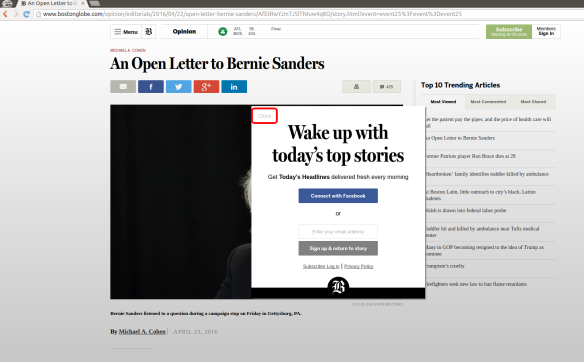
For example, this is a Boston Globe story on Bernie Sanders:

Before you can read the article, there is a pop-up ad asking you to subscribe. By itself, this is annoying, but not deceptive. The real dark pattern is hidden at the top – the ‘Close’ button (circled in red) uses a very low contrast font, making it hard to see. It’s also in the left corner, not the standard right corner. This makes it likely that users won’t see it, causing them to subscribe when they didn’t have to.

One the ‘Close’ link is clicked, deception continues:

At the bottom, there’s a non-removable, high-contrast banner ad asking for a paid subscription. Again, this is annoying, but honest. However, the circled text “for only 99 cents per week” is not honest. It’s simply a lie, as later pages will show.

«
Turns out that 99c is actually $6.93 per week, and you can only unsubscribe by phone. So wicked.
link to this extract


The blockchain menu » net.wars

Wendy Grossman:

»The Internet of Things is such an established concept that I’m startled to note that week’s (Lego) prototype was my first. Three cars want to park…somewhere. Their owners have preset the maximum they will pay. The system locates the nearest parking space, and they bid. The winner is directed to the space, and the fee is automatically deducted from the car’s balance. A display showed the auction in real time. All very nice until I injected reality by grabbing a car and plunking it in the space before bidding ended.

“Usurped” the contested space was now tagged. “You’ll be fined,” Consult Hyperion’s demonstrator said. Who will that stop in Manhattan, where friends have missed two successive movie showings because no parking space? This may be an entertaining solution wishing for a problem.

In that, it was not alone at this week’s Tomorrow’s Transactions Forum, Dave Birch’s quirky annual event where ideas about the future of money are smashed together like particles to see what happens.

«

I love the idea of app developers thinking people would be well-behaved and wait for their app to tell them where to park, while Noo Yawkers just PARK THE DAMN CAR THERE IN THE STOOPID SPACE.

But the article is actually about blockchains, which in a similar way are mostly a solution in search of a problem.
link to this extract


China’s crowded smartphone market heads for an epic shakeout » Bloomberg

David Ramli:

»The startup Dakele looked pretty smart when it released a phone in China four years ago. The market was doubling annually, and the company put brand-name components inside a device that cost a fraction of the iPhone.

That $160 gadget went on sale just four months after Dakele opened its doors, and soon the company, which translates as “Big Cola,” made inroads against Huawei Technologies Co. and Xiaomi Corp. Buzz was building for the Dakele 3 model last year, with online reviews calling it the best Apple Inc. clone.

Then the sizzle started to fizzle. Huawei spent $300 million on marketing, Xiaomi cut prices and clones of the clone appeared. Troubles with a supplier and raising money prompted Dakele to shut down last month—and it likely won’t be alone. China’s herd of 300 phone makers may be halved in 12 months by competition, a sales plateau and economic growth that’s the slowest in a quarter-century, according to executives and analysts.

“The mobile-phone industry changed more quickly and brutally than expected,” Dakele Chief Executive Officer Ding Xiuhong said on his Weibo messaging account. “As a startup, we couldn’t find more strategies and methods to break through.”

«

I can’t decide whether the smartphone market is telescoping a decade of the PC market into two years, or just going through the same as happened in 1985-9 in about the same length of time.
link to this extract


Kickstarter’s biggest shitshow somehow got even messier » Motherboard

Jaason Koebler:

»A decidedly not chill development for 36,000 Kickstarter backers of the “Coolest Cooler”: Coolest is now considering asking people who haven’t yet received their coolers to pay an additional $97 for “expedited delivery” of the long-past-due all-in-one disaster, a prospect that has allegedly led some backers to threaten Coolest employees.

If you’re not familiar, at the time it launched, the Coolest Cooler was the most popular Kickstarter of all time, raising $13 million. The 55-quart cooler has a built-in blender, a waterproof Bluetooth speaker, a USB charger, and a bottle opener. You can buy one on Amazon, right now, and have it by the weekend if you pay $399.99.

That $399.99 price point is important—when Coolest Cooler was launched on Kickstarter, it cost between $165 and $225, a price its creator Ryan Grepper said in an update to backers was far too low…

…Coolest Cooler doesn’t have money to produce the remaining coolers, which is why it’s selling existing stock on Amazon but not sending them to backers who haven’t yet received the product (the company has delivered about 20,000 coolers to backers, but 36,000 more people are waiting). Reviews of the cooler are mixed — most say that it is indeed cool, but that it is very heavy and isn’t worth $400.

«

I’m trying to imagine a cooler that would be worth $400, even with those add-ons. The article’s comparison with the Welsh drone screwup Zano isn’t right, though; Zano had absurdly inflated claims. This is just poor pricing.
link to this extract


CDC: two of every five U.S. households have only wireless phones » Pew Research Center

»More Americans than ever have cut the (telephone) cord, but the growth rate of wireless-only households slowed last year.

About two-in-five (41%) of U.S. households had only wireless phones in the second half of 2013, according to a report released today by the National Center for Health Statistics. The center, the statistical arm of the Centers for Disease Control and Prevention, estimated that 39.1% of adults and 47.1% of children lived in wireless-only households.

«

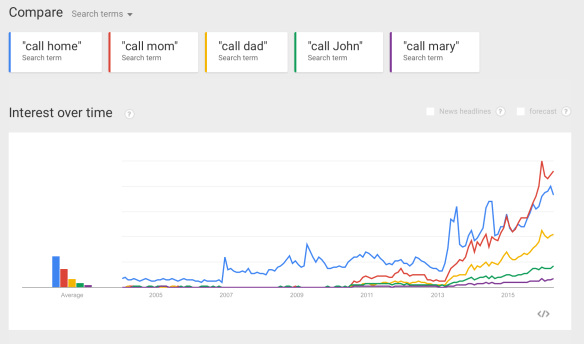
When I noted yesterday that “call mom” had overtaken “call home” as a Google search (hence almost certainly a voice activation), I thought it was because “mom” was likely to be at home. But as was pointed out, there might not be a “home” to call.

(Next up: can we calculate the divorce rate based on the rise of “call mom” v “call dad”?)
link to this extract


Google Glass startup Augmedix raises $17m from healthcare orgs » Re/code

Mark Bergen:

»The next time you spot a Google Glass in the wild, it might not be on the face of a fervid techie. It might be on your doctor.

Augmedix, one of several startups that formed around the computerized headgear — and kept spinning after the search giant ditched its first attempt — is raising a fresh round of capital to get Google Glass into more health care facilities. The four-year-old startup is part of a wave of Silicon Valley companies trying to tap the massive medical market. It primarily builds software for wearable devices that display electronic health records so that doctors can access them hands-free.

“They’re engaging with patients in front of them,” said CEO Ian Shakil. “In the background, we’re doing all the burdensome work.”

He’s not raising cash from Sand Hill Road. Instead, the $17m strategic investment comes from a quintet of medical institutions.

«

I always thought that Glass’s best use would be inside businesses, not among consumers.
link to this extract


Apple’s Watch outpaced the iPhone in first year » WSJ

Daisuke Wakabayashi:

»Apple doesn’t disclose sales, but analysts estimate about 12m Watches were sold in year one. At an estimated average price of $500, that is a $6bn business—three times the annual revenue of activity tracker Fitbit Inc.

By comparison, Apple sold roughly 6m iPhones in its first year. As a new entrant, the Watch accounted for about 61% of global smartwatch sales last year, according to researcher IDC.

And yet, there are detractors such as Fred Wilson, co-founder of venture-capital firm Union Square Ventures, in December declared the Watch a “flop.” Mr. Wilson, who owns shares of Fitbit through a fund, had earlier predicted the Watch wouldn’t be a “home run” like the iPad, iPhone and iPod, saying many people wouldn’t want to wear a computer on their wrist.

The Watch has shortcomings. It is slow, with an underpowered processor that is throttled at times to extend the device’s battery life. It lacks mobile and Global Positioning System connections, meaning it must be accompanied by an iPhone, limiting its usefulness as an independent device. The battery needs to be charged every day.

Perhaps the biggest challenge is the Watch’s lack of a defining purpose. It does certain things well, such as activity tracking, mobile payments and notifications. But there is no task the Apple Watch handles that can’t be done by an iPhone or a less-expensive activity tracker.

«

The comparison with the first-year iPhone is meaningless – the Watch was released in more places, with more fanfare. Fred Wilson’s criticism, well, would the better metric be what proportion of devices are still in use? How would the Watch do against the Fitbit?

As to “defining purpose” – its purpose so far is to be an adjunct. It does that pretty well; satisfaction is high, according to survey firm Wristly.
link to this extract


Exclusive: Bangladesh Bank hackers compromised SWIFT software, warning to be issued » Reuters

Jim Finkle:

»The attackers who stole $81m from the Bangladesh central bank probably hacked into software from the SWIFT financial platform that is at the heart of the global financial system, said security researchers at British defense contractor BAE Systems.

SWIFT, a cooperative owned by 3,000 financial institutions, confirmed to Reuters that it was aware of malware targeting its client software. Its spokeswoman Natasha Deteran said SWIFT would release on Monday a software update to thwart the malware, along with a special warning for financial institutions to scrutinize their security procedures.

The new developments now coming to light in the unprecedented cyber-heist suggest that an essential lynchpin of the global financial system could be more vulnerable than previously understood to hacking attacks, due to the vulnerabilities that enabled attackers to modify SWIFT’s client software.

«

Got in via a poorly secured $10 router, got away with $81m, hacked the software the world’s banks rely on. This could be worse, right?
link to this extract


The secret rules of the internet » The Verge

Catherine Buni and Soraya Chemaly, with a (quite astoundingly) long piece about the history of content moderation on social networks – if by “history” you mean “starting in 2004”:

»When Dave Willner arrived at Facebook in 2008, the team there was working on its own “one-pager” of cursory, gut-check guidelines. “Child abuse, animal abuse, Hitler,” Willner recalls. “We were told to take down anything that makes you feel bad, that makes you feel bad in your stomach.” Willner had just moved to Silicon Valley to join his girlfriend, then Charlotte Carnevale, now Charlotte Willner, who had become head of Facebook’s International Support Team. Over the next six years, as Facebook grew from less than 100 million users to well over a billion, the two worked side by side, developing and implementing the company’s first formal moderation guidelines.

“We were called The Ninjas,” he said, “mapping the rabbit hole.” Like Mora-Blanco, Willner described how he, Charlotte, and their colleagues sometimes laughed about their work, so that they wouldn’t cry. “To outsiders, that sounds demented,” he said.

Just like at YouTube, the subjectivity of Facebook’s moderation policy was glaring. “Yes, deleting Hitler feels awesome,” Willner recalls thinking. “But, why do we delete Hitler? If Facebook is here to make the world more open,” he asked himself, “why would you delete anything?” The job, he says, was “to figure out Facebook’s central why.”

For people like Dave and Charlotte Willner, the questions are as complex now as they were a decade ago. How do we understand the context of a picture? How do we assign language meaning? Breaking the code for context — nailing down the ineffable question of why one piece of content is acceptable but a slight variation breaks policy — remains the holy grail of moderation.

«

One could pick out any part of this piece. It’s interesting all through. The trouble is it’s so long (around 2,500 words) that you may struggle to find its thread, because there isn’t an actual, progressing, story.
link to this extract


Errata, corrigenda and ai no corrida: none notified.
Start up: trouble with bots, big data’s fable, Google and the White House, beware iCloud phishers, and more

Google search for various speech-related commands
“Call mom” has overtaken “call home” in Google search – probably voice commands. Dad still lingers a way behind.

You can sign up to receive each day’s Start Up post by email. Isn’t that something.

A selection of 11 links for you. Well, it is Monday. I’m charlesarthur on Twitter. Observations and links welcome.

How big data creates false confidence » Nautilus

Jesse Dunietz:

»If I claimed that Americans have gotten more self-centered lately, you might just chalk me up as a curmudgeon, prone to good-ol’-days whining. But what if I said I could back that claim up by analyzing 150 billion words of text? A few decades ago, evidence on such a scale was a pipe dream. Today, though, 150 billion data points is practically passé. A feverish push for “big data” analysis has swept through biology, linguistics, finance, and every field in between.

Although no one can quite agree how to define it, the general idea is to find datasets so enormous that they can reveal patterns invisible to conventional inquiry. The data are often generated by millions of real-world user actions, such as tweets or credit-card purchases, and they can take thousands of computers to collect, store, and analyze. To many companies and researchers, though, the investment is worth it because the patterns can unlock information about anything from genetic disorders to tomorrow’s stock prices.

But there’s a problem: It’s tempting to think that with such an incredible volume of data behind them, studies relying on big data couldn’t be wrong. But the bigness of the data can imbue the results with a false sense of certainty. Many of them are probably bogus — and the reasons why should give us pause about any research that blindly trusts big data.

«

link to this extract


Google’s remarkably close relationship with the Obama White House, in two charts » The Intercept

David Dayen:

»[Mikey] Dickerson led the U.S. Digital Service, a new agency whose mission was to fix other technology problems in the federal government. Ex-Google staffers were prevalent there as well. Dickerson attended nine White House meetings with Google personnel while working for the government between 2013 and 2014.

Meetings between Google and the White House, viewed in this context, sometimes function like calls to the IT Help Desk. Only instead of working for the same company, the government is supposed to be regulating Google as a private business, not continually asking it for favors.

Much of this collaboration could be considered public-minded — it’s hard to argue with the idea that the government should seek outside technical help when it requires it. And there’s no evidence of a quid pro quo. But this arrangement doesn’t have to result in outright corruption to be troubling.

The obvious question that arises is: Can government do its job with respect to regulating Google in the public interest if it owes the company such a debt of gratitude?

Google doesn’t think its activities present an antitrust problem. It doesn’t feel constrained from holding incredible amounts of data. But should Google be in a position to make that determination itself? How much influence is too much influence?

«

It’s a very, very comprehensive look at how close Google is to the White House. Would it be any different under Clinton?
link to this extract


SMS phishing attackers continue to pursue Apple users » WeLiveSecurity

Graham Cluley:

»A week ago I reported on my personal blog how criminals were spamming out SMS messages that claimed to come from Apple, but were actually designed to steal personal information for the purposes of identity theft.

The messages all used a cunning piece of social engineering – posing as a notice from Apple that their Apple ID was due to expire that very day – to get unsuspecting users to click on a link to a phishing website.

The SMS messages were even more convincing because they referred to recipients by name, most likely fooling some into believing that there was a genuine reason to act upon the alert and visit the site pointed to by the criminals.

Although the site the criminals were initially using – appleexpired.co.uk – was quickly blocked by the major web browsers and taken down, that didn’t take the wind out of the criminals’s sails.

In the days since it has become clear that the identity thieves have registered a series of other domains – all claiming to be related to Apple or Apple ID. Examples have included icloudauth.co.uk, mobileicloud.uk, and icloudmobile.co.uk.

«

There was a big run of these over the weekend; my wife received two, which used her name. They do come via SMS; it seems that once someone’s address book is hacked, messages are then sent out to people in the address book. Standard phishing attack, jumping from one victim to the potential next.

Apple needs to be proactive and set up a way for people to forward these to its security team. And make two-factor authentication easier to implement. (Too late for those who have been hit.)
link to this extract


Microsoft Android patent-licensing revenue falling » Business Insider

Matt Rosoff:

»Microsoft missed earnings expectations by a couple of cents per share on Thursday afternoon because of an unexpected tax adjustment that skimmed $0.04 off its earnings per share.

In the release, Microsoft noted that its patent-licensing revenue was down 26% from a year ago. And it’s because of Android.

Android phones are still selling just fine, but the market is dominated by cheap handsets being sold in developing countries like China and India.

“The mix of devices in that market has shifted to the low end,” said Chris Suh, Microsoft’s head of investor relations.

Microsoft’s cut is also sinking. Suh also noted that not every Android manufacturer has a licensing deal with Microsoft. He didn’t name names, but Chinese phone makers typically take a very loose approach toward licensing American intellectual property, and as those inexpensive phones take over the world, Microsoft doesn’t benefit as much.

«

Well, OK, but there may be another part to the drop. Read on..
link to this extract


April 2015: Microsoft reportedly cutting patent fees in exchange for pre-installed apps » AndroidAuthority

Rob Triggs, in April 2015:

»Last month, Microsoft announced a global partnership with Samsung and other hardware manufacturers to bring its mobile productivity services, such as its Office suite, to consumers and business users. But there may be more to it than simply offering customers compelling services, DigiTimes Research suggests that Microsoft is tempting Android manufacturers to pre-install its software in exchange for discounts on its licensing fees.

Android hardware manufacturers have all signed a patent licensing agreement with Microsoft for various essential technologies developed by the company. However, according to findings from Taiwan’s and China’s smartphone/tablet upstream supply chain, Microsoft is offering discounts to those who pre-install Office programs such as Word, Excel, PowerPoint and OneNote, as well as OneDrive and Skype onto their Android devices. So far, 11 hardware partners are signed up to the deal.

«

link to this extract


As search changes, Google changes » Search Engine Land

Adam Dorfman:

»Recently, a company known as MindMeld, which provides voice search technologies, surveyed US smartphone users and found that 60% had started using voice search within the past year. You can also see a rise in search queries that are clearly voice commands when you look at Google Trends for phrases such as “call mom,” which are highly unlikely to be typed into a search box.

Voice search is no longer coming. It’s here.

These changes do not bode well for Google’s traditional revenue model, which relies on serving up ads while you search on Google.com. The user interface of talking to your mobile phone or wearable device to order a pizza does not leave any room for a paid search ad. So it’s not surprising that display advertising spend is overtaking search ad spend, and the gap between the two will widen over the next few years.

«

But, as Dorfman points out, Google is adapting. That graph of “call mom” is definitely one which would merit playing around with using a few other search terms. Here’s “Call home” against “call Mom” against “call Dad” and “call John” and “call Mary” (also at top of page).
link to this extract


Amazon unintentionally paying scammers to hand you 1000 pages of crap you don’t read » Consumerist

Kate Cox on a scam related to Kindle Unlimited:

»if you read 75 pages on your Kindle today, then turn the WiFi on and sync it, Amazon will mark you at page 75. If you never pick up the book again, that’s your furthest synced point. If it’s a 300 page book and you finish it, page 300 is your furthest synced point.

But e-books don’t have to be linear. You might, for example, open up a new Kindle book and find it has a link on the first page, to take you to a later chapter or a table of contents or another language. Tapping that link could put you hundreds of pages into the book — which means that the author of that file is now making money off you, even if you haven’t read a word… or even if there’s not a single real word there to be read.

And that is exactly what’s happening. Scammers are basically uploading “books” that are nothing but files full of nonsense with some link on page 1 that puts readers on page 300 or 3000 (the maximum page length for which Amazon will pay out) almost instantly. In between there’s nothing but nonsense, but the scammer can use click farms to drive up the ranking of their book and so people download it anyway.

The user hasn’t paid for this book directly, because they have an unlimited subscription, so they just close the file, forget about it, and move on to the next. But if dozens, hundreds, or even thousands of readers get tricked into the same maneuver, that “author” has just made a decent amount of money for something like 15 minutes’ worth of total work.

«

link to this extract


Bangladesh Bank exposed to hackers by cheap switches, no firewall: police » Reuters

Serajul Quadir:

»Bangladesh’s central bank was vulnerable to hackers because it did not have a firewall and used second-hand, $10 switches to network computers connected to the SWIFT global payment network, an investigator into one of the world’s biggest cyber heists said.

The shortcomings made it easier for hackers to break into the Bangladesh Bank system earlier this year and attempt to siphon off nearly $1 billion using the bank’s SWIFT credentials, said Mohammad Shah Alam, head of the Forensic Training Institute of the Bangladesh police’s criminal investigation department.

“It could be difficult to hack if there was a firewall,” Alam said in an interview.

«

The Internet of Astonishingly Insecure Things.
link to this extract


Bots won’t replace apps. Better apps will replace apps » Dan Grover

Grover points out the nonsense of people thinking AI-driven chatbots will take over from touch-and-choose visual interfaces:

»It shouldn’t require any detailed analysis, then, to point out the patent inanity of these other recent examples of bots and conversational UI proffered by companies on the vanguard of the trend:

This notion of a bot handling the above sorts of tasks is a curious kind of skeumorphism. In the same way that a contact book app (before the flat UI fashion began) may have presented contacts as little cards with drop shadows and ring holes to suggest a Rolodex, conversational UI, too, has applied an analog metaphor to a digital task and brought along details that, in this form, no longer serve any purpose. Things like the small pleasantries in the above exchange like “please” and “thank you”, to asking for various pizza-related choices sequentially and separately (rather than all at once). These vestiges of human conversation no longer provide utility (if anything, they impede the task). I am no more really holding a conversation than my contact book app really is a l’il Rolodex. At the end, a single call to some ordering interface will be made.

«

Earlier Grover points out that the “quick and easy way to order pizza with your chatbot” takes 73 precise clicks (of virtual keys), whereas doing it through the visual menu interface on the Pizza Hut app takes 16 fat-fingered ones.

Case closed.
link to this extract


Four fresh presentations, four key charts » Creative Strategies, Inc

Ben Bajarin looks at why people who have a PC aren’t upgrading, what people like about wearables, who wants virtual reality, and also whether people in India are interested in PCs:

»My gut told me there was an interesting opportunity brewing in India. I decided to commission a study, in collaboration with local researchers, to see if India was ready to move beyond the smartphone. We focused on the regions in India where PCs, smartphones, and tablets have the highest penetration — Delhi, Bangalore, Mumbai, Hyderabad, and Chennai. We did a mix of online studies, focus groups, and 1:1 interviews of 525 Indian consumers in this market.

The theory was simple. As consumers in India mature and have owned more than a few smartphones, they will look to more traditional PC form factors to use for work, school, and more. But with Windows PC penetration in India at less than 10% of the total population and Windows largely being an enterprise/workplace requirement in India, our theory was Android would be more popular as an operating system. As it turns out, it was for the overwhelming majority of consumers looking to buy their first PC in India. Which is encouragingly high for a market that began their journey on the internet on a smartphone.

«

link to this extract


Microsoft, Google end regulatory disputes » WSJ

Stephen Fidler and Sam Schechner:

»According to a person familiar with the matter, the two companies have agreed to talk to each other first in the future before taking any problems to regulators.

The change reflects the shift in approach that followed Microsoft’s 2014 appointment of Satya Nadella as its new chief executive. Mr. Nadella has taken a less combative stance than his predecessor Steve Ballmer, according to a person familiar with the matter.

“The relationship between the two companies has changed,” the person said, adding that “Nadella has made most of the difference.”

Microsoft’s business priorities also have changed, among other things, with the growth of cloud computing.

The relationship between the two companies began publicly to thaw last year as they worked together to settle their long-running patent war involving roughly 20 pending lawsuits, said a person close to Google.

Microsoft also resigned from FairSearch, a group of digital companies—including Nokia Corp. and Oracle Corp.—that are prominent Google complainants. In addition, the software maker has discouraged ICOMP, another lobby group of which it was a member, from pursuing Google.

«

Wow. Going to be interesting to see whether Icomp and Fairsearch can continue without funding from Microsoft.
link to this extract


Errata, corrigenda and ai no corrida: none notified.

How is Google’s mobile revenue rising if 50% of people do zero searches per day?


Ooh look, an ad on a mobile search. Photo by patientpowerful on Flickr.

If, on average, people do less than one search per day on mobile, then how is it that Google keeps reporting that mobile search is bringing in more money?

Isn’t that a refutation of what I said last October, when I said that it was a “growing problem” that 50% of people do zero searches per day on mobile?

Wall Street analysts are interested in this question, because they can see which way the wind’s blowing – towards mobile, away from desktop, where searches in developed countries are likely tailing away in total number. (They certainly are in the US.) If mobile is growing, and fewer people do searches, and Google depends on searches.. isn’t that bad?

But Google says everything’s rosy. Until you examine it more closely.

Here’s Ruth Porat, Google’s chief financial officer, on the Q1 2016 Google earnings discussion and Q+A transcript (from the ever-wonderful SeekingAlpha):

“Our very strong revenue of $20.3bn in Q1… [was] up 23% in constant currency versus last year. The primary driver was the use of Mobile Search by consumers, benefiting from our ongoing efforts to enhance the Mobile Search experience.”

And that’s not all:

“we also benefited from solid growth in desktop and tablet search as well as continued strength in YouTube and programmatic advertising.” Porat also says later (in the Q+A); “mobile search revenue was up considerably”.

So everything’s great. Although Wall St sold off the shares, on the basis that mobile ads weren’t converting well. Huh? Wall St has it wrong, surely?

Porat commented that

“our strongest growth areas, namely mobile and programmatic, carry higher TAC [traffic acquisition costs – when you have to pay someone to bring the traffic to you; an example is the default search on Apple’s desktop and mobile Safari. Google pays Apple a fixed amount, and – it’s reckoned – a per-search amount.]

So how is mobile search bringing in more money? Simple: Google has stuffed more ads into view. On mobile search, you now have to scroll the page before you see an organic search result.

This was brought up in the questions. Carlos Kirjner-Neto of Sanford Bernstein asked Sundar Pichai:

“can you talk a bit about the decision you took last year to have an additional ad on Mobile Search response pages relegating organic results below the fold? How is it good for the user experience to have [an] ad instead of organic? And if it is good, what does it say about the potential for innovation in organic search?”

Pichai’s response:

“We are incredibly sensitive to the user experience on Search. And so we are constantly evolving how we display ads, but we take a very long-term view. Our ads quality efforts [sic], these are people who have been working on this for many, many years and they are squarely focused on optimizing for positive metrics across users and advertisers. So our utmost focus is making sure, for users, these changes have a positive impact. And mobile is an entirely different paradigm and so a lot of things are counter-intuitive. So, for example, users are very comfortable swiping on mobile. So we deeply think about these things, and I’m very comfortable about how we are planning this for the very long term.”

“Users are very comfortable swiping on mobile.” Uh-huh. Though notice that it’s the advert that comes above the organic results. Presumably Google and advertisers wouldn’t be happy at people getting the organic results first and having to swipe to find the ads. Another analyst brought this up too. Justin Post, of Bank of America Merrill Lynch, asked:

“can you help us on query growth, just how that’s trending since Mobile really took off? Is it growing? How is it trending? And do you have more room to monetize, given where your ad coverage is now?”

This is a crucial question. What Post is asking is: do people actually do more searching on mobile? And is the number who do searches growing? (They’re precisely the questions I’d ask if I were on the call, so 👏 to Post.) Will Pichai, the search engine’s boss, answer this? No, it’s Ruth Porat stepping up to the mic.

“On query growth, we don’t really talk about query growth,”

she replies.

Oh.

“As Sundar said, [we’re] focused on answers’ there are a lot of new ways to search on mobile, of course, voice, et cetera. So let me try and actually add a little more on your question on cloud.”

(Post had asked a two-part question, part of which was to do with Google’s for-hire cloud business.)

The pattern keeps being repeated. Analysts try to ask questions to winkle some sort of insight into where mobile search is going; Porat and Pichai duck and dive.

Here’s Brian Nowak of Morgan Stanley:

“Just on Mobile Search and the mobile ad format changes in 3Q of last year… were those changes made globally last year in 3Q?… And then on the desktop, Ruth [Porat], you mentioned that desktop [revenue] growth picked up in the first quarter. What drove that pickup in growth, and [are there] any learnings from the change in the right-hand rail in the first quarter?”

Here, Nowak is first asking about the ad changes on mobile which added another ad. On the desktop, he’s asking another deeply relevant question. Desktop search is slowing down in developing markets, because people spend less time on desktops, more on smartphones.

So earlier this year, Google changed the layout of its desktop results so that there’s no “right-hand rail” of adverts. Instead, all the adverts are piled at the top of the page, followed by the “OneBox” promoting Google services (such as Maps, YouTube, and News).

For “highly commercial” queries (a definition Google isn’t sharing), you’ll get four rather than three ads on top of the results. And who knows, over time perhaps more and more queries that qualify for ads will be defined as “highly commercial”?

As on mobile, the result is that you now have to scroll some distance to get to organic search results on many queries. (If you think this is somehow new, not at all; in 2013 Danny Sullivan was asking “Are Google’s results getting too ad-heavy and self-promotional?”.)

So what happens? Is it possible that people impatiently click on an ad when they see something that looks like an answer? Nowak might be implying that it’s simply this which has driven up desktop revenue; analysts aren’t stupid.

Pichai confirms that the mobile change was global. But then, instead of the head of the search company handling the question about “learnings” from the change in desktop layout, it goes to the finance person, Porat. Here’s what she told Nowak:

“We had a modest benefit from that change where, just to be clear for all, we reduced the ad load by removing ads on the right-hand side of the screen while adding a fourth ad slot for highly commercial queries in the aggregate. That results in a cleaner, more useful, presentation and improved user experience. It was a modest impact, but additive.”

At this point one has to raise a hand. First, Google wouldn’t have made that change if it meant fewer clicks on ads. But how – how? – can having more ads piled on top of the organic results be an “improved user experience”? If the ads are better for the user than the organic results, then why have organic results at all? (Nowak seems to be hinting at this too. All ads would mean Google would absolutely coin it.) If the change means you have to scroll further to get to unpaid results, how is that better? I really don’t get it.

So what are we left with?
• Google stolidly refuses to tell us what’s happening with trends in search on mobile
• there are more ads above the results on both mobile and desktop than a year ago
• Google is getting more revenue, in total from adverts on both mobile and desktop
• Google insists that the addition of adverts above the results on the desktop results in an “improved user experience”
• happily, this improved user experience also results in improved revenues for Google.

Me – well, I’m still fascinated by where this will end up. Can Google just keep adding ads above the results without end, as Morgan Stanley’s Nowak possibly implied, and keep pumping up the revenues from desktop and mobile? If so, how does that square with Google’s long-ago disdain for search engines which put adverts ahead of organic results?

Just in case you want me to SaveYouAClick, the link text there says:

Since it is very difficult even for experts to evaluate search engines, search engine bias is particularly insidious. A good example was OpenText, which was reported to be selling companies the right to be listed at the top of the search results for particular queries [Marchiori 97].… In general, it could be argued from the consumer point of view that the better the search engine is, the fewer advertisements will be needed for the consumer to find what they want.

Those words are nearly 20 years old. But they’re still true.

Start up: fibre’s horsemeat moment, AMD in new Apples?, Sony’s troubled cameras, Xiaomi sales slow, and more

A discredited voice recognition system was used in scores of secret court cases which are now being disputed. Photo by Lotus Carroll on Flickr.

You can now sign up to receive each day’s Start Up post by email. Or just read it online. Choice!

A selection of 10 links for you. But is that 10 in base 10? I’m charlesarthur on Twitter. Observations and links welcome.

Quality woes a challenge for Tesla’s high-volume car » WSJ

Mike Ramsey:

»Anne Carter had her Tesla Motors Inc. Model X sport-utility vehicle for a few days before the $138,000 electric vehicle suffered a mechanical malfunction.

On a recent morning, the car’s falcon-wing doors wouldn’t open as she prepared to drive her children’s carpool to school. “It’s a bummer; you spent all this money…and the doors won’t open,” she said in an interview while waiting for the Model X to be picked up for repairs. She expected some issues, but feels embarrassed that friends might think: “Look at the Carters—they spent all this money and the doors don’t work.”

During a very critical time for the pioneering electric-car maker, its well-to-do customers are confronting not only problems with the Model X’s rear doors but other issues, including a seat latch the company has recalled.

«

Making cars seems to be really pretty difficult.
link to this extract


Nvidia creates a 15bn-transistor chip for deep learning » VentureBeat

Dean Takahashi:

»Nvidia chief executive Jen-Hsun Huang announced that the company has created a new chip, the Tesla P100, with 15 billion transistors for deep-learning computing. It’s the biggest chip ever made, Huang said.

Huang made the announcement during his keynote at the GPUTech conference in San Jose, California. He unveiled the chip after he said that deep-learning artificial intelligence chips have already become the company’s fastest-growing business.

“We are changing so many things in one project,” Huang said. “The Tesla P100 has five miracles.”

Nvidia previously launched its Tesla M4 and Tesla M40 deep-learning chips, and those chips are selling fast. Now the Tesla P100 is in volume production today, Huang said.

“We decided to go all-in on A.I.,” Huang said. “This is the largest FinFET chip that has ever been done.”

«

Maybe Intel could focus on GPUs instead of CPUs? Seems to be where the business is heading.
link to this extract


AMD Radeon 400 series ‘Polaris’ GPUs land major Apple design wins » WCCF Tech

Khalid Moammer:

»From what we’ve been hearing Polaris is no exception. In fact our sources have confirmed that the major OEM design win that we had reported on last year is indeed for Apple.

The Sunnyvale, California based chip maker secured wins for both of its upcoming Radeon 400 series 14nm FinFET graphics chips, Polaris 10 and Polaris 11. Previously known as “Ellesmere” and “Baffin”, both of which are Arctic Islands. The chips have since been renamed to Polaris 10 and 11 respectively, in line with AMD’s newly adopted Astronomy based architectural code naming scheme which Koduri had instated after the Radeon Technologies Group was established last year.

The Polaris 10 and 11 chips will go into new desktops and notebooks from Apple, which the company plans to bring to market later this year. And although these Apple design wins may not be significant volume contributors they are very profitable.

«

That’s going to make for an interesting WWDC in June, then. These Radeon GPUs would be capable of VR work, apparently.
link to this extract


Two thirds ‘misled’ by fibre broadband advertising, experts compare situation to horsemeat scandal » Cable.co.uk

»Research by Cable.co.uk has revealed that two thirds of fibre broadband customers on BT’s Openreach network – which services around 80% of the UK’s total broadband customer base – are unaware their so-called ‘fibre’ service arrives at their home through a standard copper telephone line.

This is important, because the speeds available over copper reduce drastically over distance, severely limiting both current speeds and future upgradability.

Experts, speaking to Cable.co.uk, labeled the way the term ‘fibre broadband’ is widely used in the UK ‘misleading’ and compared the situation to the horsemeat scandal.

This comes just days after the Broadband Infrastructure Group (BIG), a cross-party group of MPs led by Grant Shapps, demanded an end to what it described as a “mis-selling” scandal potentially bigger than PPI and Volkswagen’s emissions tests.

«

link to this extract


On the road to recap » Above the Crowd

Noted venture capitalist Bill Gurley:

»While not obvious on the surface, there has been a fundamental sea-change in the investment community that has made the incremental Unicorn investment a substantially more dangerous and complicated practice. All Unicorn participants — founders, company employees, venture investors and their limited partners (LPs) — are seeing their fortunes put at risk from the very nature of the Unicorn phenomenon itself. The pressures of lofty paper valuations, massive burn rates (and the subsequent need for more cash), and unprecedented low levels of IPOs and M&A, have created a complex and unique circumstance which many Unicorn CEOs and investors are ill-prepared to navigate…

…Perhaps the seminal bubble-popping event was John Carreyrou’s October 16th investigative analysis of Theranos in the Wall Street Journal. John was the first to uncover that just because a company can raise money from a handful of investors at a very high price, it does not guarantee (i) everything is going well at the company, or (ii) those shares are permanently worth the last round valuation. Ironically, Carreyou is not a Silicon Valley-focused reporter, and the success of the piece served as a wake-up call for other journalists who may have been struck by Unicorn fever. Next came Rolfe Winkler’s deep dive “Highly Valued Startup Zenefits Runs Into Turbulence.” We should expect more of these in the future.

«

Every VC I watch on Twitter has gone bananas about this post, which warns that “the game has changed”. Meanwhile, notable that the two articles Gurley points to were in the paywalled Wall Street Journal.
link to this extract


Sony disposal beckons » Bloomberg Gadfly

Tim Culpan:

»In a surprise announcement, Sony cut a further 59.6bn yen [£372m, $533m] from the value of the devices unit, citing camera modules as the culprit, wiping a net 30bn yen from full-year operating income:

»

“Due to a decrease in projected future demand, Sony has revised its Mid-Range Plan for the camera module business in the Devices segment from the period beginning with the fiscal year ending March 31, 2017.”

«

How the star performer morphed into one of Sony’s biggest drags can’t be fully explained by external factors. For sure, the global mobile market is slowing, but smartphones are still posting growth, especially at the high end, as consumers are prepared to pay more for quality components such as cameras. Declines in the PC and digital still camera markets can’t account for the sudden reversal in fortunes, either: That’s been a theme for a few years.

That leaves internal factors. If this truly is a macro problem, then the sudden writedown bears a whiff of incompetence. If, on the other hand, Sony lost a key client, that says something about its ability to retain big customers, or its dependence on too few.

«

Feels like it must have lost a key client in the smartphone space. But who, and to which rival?
link to this extract


Secretive legal committee buries ruling against Theresa May » Politics.co.uk

Ian Dunt:

»The case also saw Dr Harrison, an expert in voice recognition, dismantle the claims about fraud – and their ability to test for fraud – made by the Home Office and ETS, the firm who ran the test. What he said was equally applicable to all the other cases where people had been wrongly accused of fraud. The evidence the Home Office relied on was identical in all cases, so knocking it down for one should knock it down for all.

But it won’t, because the reporting committee is refusing to report it. The decision means that the case cannot be cited, except under very strict and laborious conditions, in other appeals. It means many thousands of people who have been unjustly deported will not even know of its existence. The decision makes the ruling against Theresa May legally useless. It’s as if it never happened. The reporting committee has taken a damning judgement against the home secretary and buried it.

«

Dunt only refers in passing to the voice recognition stuff. ETS apparently had a contract with the UK government to find impersonation – but it “decided not to renew the contract” after the BBC exposed evidence of fraud at two of UK-based centres using the software. ETS blamed “dishonest activities of third-party contractors”. It seems the expert witness blamed ETS.
link to this extract


Postscript: Bill Campbell, 1940-2016 » The New Yorker

Ken Auletta looks back on Campbell’s life as a mentor and advisor, which includes this fascinating tidbit:

»Google relied on Campbell to sort out tempests caused by imperial engineers burdened by oversized egos that prevented them from collaborating. This happened with Andy Rubin, the entrepreneur who created Android and built it into a resounding Google success. The Android team under Rubin was massive. But, as I learned through numerous interviews while writing a book about the company and in later conversations with Google executives, Rubin tended to trust only members of his élite team, and fought with other top executives, including such original Google employees as Salar Kamangar, who supervised YouTube, and Alan Eustace, the head of engineering. The weekly meetings of senior Google executives were filled with tension and discord. Executives became so dispirited by what they saw as Rubin’s dominance that they threatened to quit. Campbell advised Larry Page to make a choice, and to the relief of senior executives Page chose to remove Rubin. Campbell had earlier warned Page that Marissa Mayer, the talented engineer who went on to become the CEO of Yahoo, had a similar my-way-or-the-highway approach, which also led to her demotion to a position where she no longer reported to the CEO. Campbell knew that a lack of empathy often translated into an inability to listen.

«

Campbell had an outstanding ability to listen, as Auletta shows. Clearly he will be sorely missed.
link to this extract


Opera now has a totally free and unlimited built-in VPN » Gizmodo

Jamie Condliffe:

»The new feature is available in the latest developer version of the Opera browser for Windows or OS X. You just go to Settings on Windows or Preferences on a Mac, then toggle the VPN on in the Privacy & Security section. Bingo, you’re browsing over a virtual private network and you mask your IP address to dodge firewalls so that you can view content that you’re unable to from your current country or office. As well as all the other responsible things that a VPN can help you with.

«

“Virtual locations” only in the US, Germany and Australia at first. Which means this will become the “Netflix browser”, until Netflix blocks the Opera VPN IPs.

Even so, I have to wonder: what’s the catch? How does Opera benefit from this? Running VPNs isn’t free, or trouble-free. Am I the only person who has this reaction when free stuff is proffered?
link to this extract


Xiaomi sees sales shrink in Q1 2016 » Tech In Asia

Erik Crouch:

»Xiaomi sold 14.8m smartphones globally in the first quarter of 2016, a notable decline from 17.5m in the last quarter of 2015.

The new figure comes from research by IHS Technology, and the Q4 number from Strategy Analytics. Tech in Asia reached out to Xiaomi about these numbers, and the company declined to comment.

The number shows that Xiaomi’s slowing growth in 2015 is turning into its worst nightmare in 2016: falling sales.

Xiaomi sold 70 million smartphones last year.

These aren’t official Xiaomi statistics, and reports compiled by research firms are best treated as estimates. But even providing for a hefty margin of error – and keeping in mind that Xiaomi has said it wants to move away from “goals such as smartphone sales” and isn’t likely to publish Q1 stats – the figures show a company that will need to improve its numbers if it aims to grow its smartphone department at all this year.

«

Sequential quarter comparisons (especially from 4Q to 1Q) are rarely meaningful, but the year-on-year comparison is still down: Xiaomi shipped 15.3m in Q1 2015, from the figures I have.
link to this extract


Errata, corrigenda and ai no corrida: none notified.

Start up: EC v Android in detail, how neural networks spot nudes, Xbox 360’s black ring of death, and more

But now you can get a smart one with a remote app which doesn’t work! Photo by 1950sUnlimited on Flickr

You can now sign up to receive each day’s Start Up post by email. You’ll need to click a confirmation link, so no spam.

A selection of 12 links for you. Jumping beans for moving goalposts. I’m charlesarthur on Twitter. Observations and links welcome.

Spring cleaning at CNET’s Smart Home starts with a new smart washer and dryer » CNET

Megan Wollerton:

»Here’s how it’s supposed to go:

Select “Add Appliance” in the app and follow the seemingly straightforward step-by-step tutorial. This includes selecting the type of appliance you want to connect – either a washer, dryer, refrigerator or dishwasher – then the app lists the compatible models. Next, you choose the model number that corresponds to your unit, enter the SAID pin (this number is listed in small font on a sticker when you open the washer and dryer’s lid), connect to Wi-Fi, enter your home address and finally, hit the “finish” button.

Unfortunately, I experienced a couple of hiccups during what should have been a 10-minute process. The first time I tried to add the washing machine, the app crashed and would not let me log in for another 2 hours, saying, “Problem Signing In: Please try again Later.”

Once I was able to log in again, I ran into another road block when I hit the “finish” button — the very last step before the machine is connected and you can start using the app. This time the app said, “Registration Error: We couldn’t register the appliance. Please try again later.”

«

Ooh, I love the future. Love it. (Guess they had to get a woman to review it because none of the male writers would know what a washing machine was.)
link to this extract


Commission sends Statement of Objections to Google on Android » European Commission

Obkects over licensing of proprietary apps, “exclusivity” and “anti-fragmentation”, here:

»if a manufacturer wishes to pre-install Google proprietary apps, including Google Play Store and Google Search, on any of its devices, Google requires it to enter into an “Anti-Fragmentation Agreement” that commits it not to sell devices running on Android forks.

Google’s conduct has had a direct impact on consumers, as it has denied them access to innovative smart mobile devices based on alternative, potentially superior, versions of the Android operating system. For example, the Commission has found evidence that Google’s conduct prevented manufacturers from selling smart mobile devices based on a competing Android fork which had the potential of becoming a credible alternative to the Google Android operating system. In doing so, Google has also closed off an important way for its competitors to introduce apps and services, in particular general search services, which could be pre-installed on Android forks.

«

That “prevented from selling” is stated as fact; either it’s Amazon’s Fire Phone (Android OEMs couldn’t make the Fire Phone without breaking the Open Handset Alliance agreement) or something involving Cyanogen and a rival app store.
link to this extract


Android’s model of open innovation » Google Europe Blog

Kent Walker, Google general counsel:

»Android has emerged as an engine for mobile software and hardware innovation.  It has empowered hundreds of manufacturers to build great phones, tablets, and other devices. And it has let developers of all sizes easily reach huge audiences.  The result?  Users enjoy extraordinary choices of apps and devices at ever-lower prices.

The European Commission has been investigating our approach, and today issued a Statement of Objections, raising questions about its impact on competition. We take these concerns seriously, but we also believe that our business model keeps manufacturers’ costs low and their flexibility high, while giving consumers unprecedented control of their mobile devices.

«

Sure, but that isn’t what the EC is worked up about.
link to this extract


The EU’s Android mistake » Beyond Devices

Jan Dawson:

»If the Commission’s main focus is on OEMs rather than consumers, it’s worth evaluating that a little. The reality is that OEMs clearly want to license the GMS [Google Mobile Services] version of Android, because that’s the version consumers want to buy. As Amazon has demonstrated, versions of Android without Google apps have some appeal, but far less than those versions that enable Google search, Gmail, Google Maps, and so on. Vestager’s statement alludes to a desire by at least some OEMs to use an alternative version of Android based on AOSP (presumably Cyanogen), but doesn’t go into specifics. Are there really many OEMs who would like to use both forms of Android in significant numbers, or is their complaining to the Commission just a way to push back on some of the other aspects of Android licensing they don’t like?

It’s certainly the case that OEMs and Android have a somewhat contentious relationship and Google has exerted more power in those relationships over the last recent years, but the main reason for the change in leverage is that Android OEMs have been so unsuccessful in differentiating their devices and hence making money from Android. Inviting the Commission to take action may be a roundabout way to change the balance of power in that relationship, but it’s not the solution to OEMs’ real problems.

«

These are all fair points. Though there’s a certain circularity to the argument of “GMS is what people want to buy, so that’s what is sold”. Dawson does note the above point about the “prevented” development. Was it Amazon? Cyanogen?
link to this extract


September 2012: Why Google’s clash with Acer and Alibaba strains China’s Android market » The Guardian

By me, back in September 2012:

»The search giant lobbied Acer last week to halt its scheduled press showing of a new smartphone aimed at the Chinese market, pointing out that membership of the Open Handset Alliance – the group of companies forming the device, carrier, semiconductor, software and “commercialisation” sides of the Android ecosystem – forbids Acer from making devices that offer forked, or incompatible, versions of Android.

Acer cancelled the launch abruptly, leaving Alibaba fuming publicly at Google’s actions. John Spelich, Alibaba’s international spokesman, told CNet that “Aliyun is different” from Android – dismissing remarks aimed at him by Andy Rubin, head of Google’s mobile efforts including Android, saying to Spelich that “Aliyun uses the Android runtime, framework and tools. And your app store contains Android apps (including pirated Google apps).”

The upshot has been that Acer has withdrawn from the partnership with Alibaba, at least for now. But Digitimes, the Taiwan-based news site for the IT supply chain there and in China, says there is unease on the part of a number of ODMs (original device manufacturers) who would otherwise aim to benefit from making both Android-compatible and forked versions – the latter principally aimed at China.

«

This point is key. To break into or out of China, OEMs needed to be able to have different sets of services in different countries. And some OEMs wanted to be able to offer forks.
link to this extract


What convolutional neural networks look at when they see nudity » Clarifai Blog

Ryan Compton:

»Automating the discovery of nude pictures has been a central problem in computer vision for over two decades now and, because of its rich history and straightforward goal, serves as a great example of how the field has evolved. In this blog post, I’ll use the problem of nudity detection to illustrate how training modern convolutional neural networks (convnets) differs from research done in the past.

*Warning: this blog post contains visualizations corresponding to very explicit nudity, proceed with caution!

«

When it’s *other peoples’* very explicit nudity then it’s worrying, of course, but not if it’s your own. NSFW, unless your work involves teaching neural networks to recognise naked people, I guess.
link to this extract


The Democratic Party now belongs to Hillary Clinton » The American Conservative

Lloyd Green:

»Up until now, [Bernie] Sanders drew rock star crowds as he raged against the machine. Two days before the primary, 28,000 people showed up in Brooklyn’s Prospect Park to watch the candidate and to listen to Grizzly Bear. The Wednesday before, a crowd of 27,000 filled Greenwich Village’s Washington Square Park for Sanders and Vampire Weekend. Who needed Coachella when you had Bernie, people asked.

But opening acts aren’t the same thing as organization, concerts aren’t elections, and grand gestures don’t necessarily make you a winner. As Clinton pointed out in her victory speech, “it’s not enough to diagnose problems. You have to explain how you actually solve the problems.” Left unsaid was Clinton’s hand in making the messes she was complaining about. But never mind, Clinton clearly conveyed the message that Sanders was not ready for prime time.

In hindsight, Sanders’ jetting to the Vatican just days before the primary looks like showboating, and his ill-prepared interview before the New York Daily News editorial board seems reminiscent of a stoner trying to ace a college biology exam. And Sanders paid for all of it.

«

Just keeping you up to date on the US elections. You know.
link to this extract


Intel to cut 12,000 jobs, puts focus on cloud » WSJ

Don Clark and Tess Stynes:

»Makers of handsets overwhelmingly chose chips based on designs licensed from ARM Holdings PLC, which are available from a plethora of suppliers, and Google Inc.’s Android software, which is available free. No matter how good Intel or Microsoft products became, they could never counter those fundamental changes.

Sales of PCs, meanwhile, have been mainly declining since Apple’s iPad emerged in 2010. The market recently seemed to plateau, but sales again dropped in the first quarter, falling nearly 10%, Gartner Inc. estimated.

The continuing decline has forced Intel to focus on growth areas such as computers for data centers and noncomputer devices outfitted with data processing and communications capabilities, known as the Internet of Things.

“They’ve looked at the decline of the PC market and clearly decided that they are going to put most of their effort elsewhere,” said Rob Enderle, a market research who heads the Enderle Group.

«

Let it be recorded that Rob Enderle said something sensible.
link to this extract


Antitrust: e-commerce sector inquiry finds geo-blocking is widespread throughout EU » European Commission

»Margrethe Vestager, Commissioner in charge of competition policy, said “The information gathered as part of our e-commerce sector inquiry confirms the indications that made us launch the inquiry: Not only does geo-blocking frequently prevent European consumers from buying goods and digital content online from another EU country, but some of that geo-blocking is the result of restrictions in agreements between suppliers and distributors. Where a non-dominant company decides unilaterally not to sell abroad, that is not an issue for competition law. But where geo-blocking occurs due to agreements, we need to take a close look whether there is anti-competitive behaviour, which can be addressed by EU competition tools.”

More and more goods and services are traded over the internet but cross-border online sales within the EU are only growing slowly. The Commission’s initial findings from the sector inquiry published today address a practice, so-called geo-blocking, whereby retailers and digital content providers prevent online shoppers from purchasing consumer goods or accessing digital content services because of the shopper’s location or country of residence. This is one factor affecting cross-border e-commerce.

«

Pretty much unnoticed among the hubbub about Android, but likely to have more real effect. More details (and pretty graphs!) in the accompanying factsheet.
link to this extract


Huawei P9 Leica-branded dual-cam actually made by Sunny Optical » Digital Photography Review

Lars Rehm:

»When the Huawei P9 was launched recently, its unusual dual-camera grabbed headlines for a couple of reasons. On one hand, its innovative technological concept, with one 12MP sensor capturing RGB color information and a second 12MP chip exclusively recording monochrome image information, had not been seen in a smartphone before. On the other hand, a Leica badge next to the camera module had imaging enthusiasts speculating about just how much technology from the legendary German camera-maker had made it into the Chinese smartphone.

Huawei later provided additional information, saying the P9’s camera module had been certified by Leica but the German company had not been involved in development or production of the optics. Now it has been revealed that the camera module in question is actually made by the Chinese company Sunny Optical Technology of China, which, according to “insider sources”, is authorized to do so by Leica.

«

Reviewers praised the P9’s camera to the skies. Wonder if they’ll revisit what they wrote?
link to this extract


Achievement unlocked: 10 years – thank you, Xbox 360 » Xbox Wire

Phil Spencer, head of Xbox:

»From the original Zero Hour launch event, to the incredible reaction received last year at E3 when we announced that you could play your Xbox 360 games on Xbox One, the soul of Xbox 360 was about putting gamers at the center of every decision we make – and we apply this principle across our business to this day.

Xbox 360 means a lot to everyone in Microsoft. And while we’ve had an amazing run, the realities of manufacturing a product over a decade old are starting to creep up on us. Which is why we have made the decision to stop manufacturing new Xbox 360 consoles. We will continue to sell existing inventory of Xbox 360 consoles, with availability varying by country.

We know that many of you became gamers on Xbox 360 and are still active, so it’s important to us that while the overall Xbox gaming experience will evolve and grow, we will continue to support the platform you love in multiple ways.

«

During which time it sold not quite 90m units, and was the cause of $1.15bn in writeoffs over the Red Ring of Death.
link to this extract


Is Firefox search worth $375m/year to a Yahoo buyer? » Tech.pinions

I dug into Yahoo’s and Mozilla’s financials:

»Who stands to lose if Yahoo is sold — besides of course Marissa Mayer, who will probably lose her job along with a fair number of Yahoo staff? The surprising, and unobvious, answer is Mozilla and the Firefox browser.

That’s because Mozilla is highly dependent on a five-year contract with Yahoo, signed in December 2014, where it receives about $375m per year to make Yahoo the default search provider in the Firefox browser on the desktop. From 2004 to 2014, that contract was exclusively with Google; now it’s Yahoo in the US, Google in Europe, Yandex in Russia and Baidu in China.

How much is $375m per year compared to Mozilla’s spending? Most of it.

«

Is a Yahoo buyer really going to think that is a deal worth continuing with?
link to this extract


Errata, corrigenda and ai no corrida: none notified.

Start up: the comments pit, Magic Leap v Google Glass, South Korea’s shocking history, sue Kanye!, and more

Seems the EC is going to charge Google with antitrust violations over Android. Photo by Geoff Livingston on Flickr.

You can now receive each day’s Start Up post by email. Confirmation link first, so no spam.

A selection of 10 links for you. Just a little short of Avogadro’s number. I’m charlesarthur on Twitter. Observations and links welcome.

They called it ‘the worst job in the world’ – my life as a Guardian moderator » The Guardian

Marc Burrows was head of the Guardian’s comment moderation team for five years:

»Ultimately, the biggest problems in comment threads come down to “agenda trolls”: the people so convinced they are right that they ride into a conversation not to join it, but to rip it apart.

They are easy to spot: they are the users who will scream “LIAR!” when they mean, “I think you’re wrong”, the ones whose arguments never quite seem to match the comment they are addressing, who resort to insults and TALK IN CAPITALS. You can’t win against those people, because they never truly believe they have lost.

They are comment-thread poison – men’s rights activists who act as if articles about women’s issues are their gender’s single biggest problem, climate change deniers who will drag any conversation about energy policy into murky pseudo-science, and borderline racists for whom there is no issue that cannot be pinned on immigration (UK) or black people (US). It is often known as “whataboutery” and is a tactic designed to throw a conversation off course.

«

Burrows was terrific at his job (which obviously includes leaving comments alone as well as deleting them). This long piece points to the benefits of comments, which absolutely do exist, as well as – like here – the disbenefits, and the problems of making them add value to the article above.

I think it’s that which nobody has quite solved: how to make comments below an article add what’s above. Not only do you need intelligent commenters who want to add value, you need a way for that value to be recognised. It’s notable that the number of articles on the Guardian open for comments had reduced drastically in the past 18 months.
link to this extract


The Guardian eyes content blocking, while Eyeo pleads legitimacy with independent verification » The Drum

Ronan Shields:

»On the opening day of the week-long event, the IAB hosted a panel session entitled ‘Ad Blocking: A New Deal or a Modern Day Protection Racket?’ where representatives from the indsutry’s buy and sell-side, were joined by privacy and ad blocker advocates to debate the issue.

Tim Gentry, The Guardian’s global revenue director, told attendees the title had recently become “far more persistent” in its charge to counter the effect of ad blockers, and this strategy could eventually include blocking access to content if it detects a user has one installed on their browser.

“With a small section we’ve tried to be far more persistent, asking them to either whitelist us, pay to become a member, tell us you’re a subscriber, and with a small sub-sect of people we’ll start to block access to content,” he said.

“What we’ve seen is that up to two-thirds of ad blocker users are willing to whitelist us, because they want quality content,” added Gentry.

Guy Philipson, CEO, IAB, UK, also recounted how “six-or-seven” publishers were exploring the option of following a similar approach adopted by French and Swedish publishers to act in unison to request that users either whitelist them or switch off their ad blockers altogether, or else be refused access to content.

«

The incremental moves by the publishers here are like a chess game where they’re unsure of the strength of their opponent. Ask nicely? Block back? Offer alternatives? The problem is that no tactics works on more than a third, or fewer, of those who use adblockers. So who’s “winning”?
link to this extract


Canada’s competition watchdog drops probe into Google » Reuters

Alastair Sharp:

»Canada’s Competition Bureau said on Tuesday that it was dropping an investigation into Google after saying in 2013 that it suspected the company was abusing its dominant position in online search.

The watchdog said it had found evidence to support one of the allegations against Google but that the company had already made changes to remedy those concerns and agreed not to reintroduce anticompetitive clauses in its contracts.

The Bureau said it did not find sufficient evidence of a substantial lessening or prevention of competition in the market to support its other allegations against Google, now a unit of holding company Alphabet Inc.

«

That’s the good news. Now for the bad news…
link to this extract


Margrethe Vestager to charge Google Wednesday: sources » POLITICO

Nicholas Hirst and Chris Spillane:

»European Competition Commissioner Margrethe Vestager is expected to unveil formal antitrust charges Wednesday against Google’s Android mobile operating system, according to two people briefed on the timing.

Google expects the charges to drill down on its Android distribution agreements, according to one of the people, who requested anonymity because the company’s position isn’t yet public.

The Commission is concerned that some of Google’s terms and conditions unnecessarily restrict phonemakers, giving Google’s own apps — from search to Gmail to maps — an unfair advantage.

«

You could say “popcorn!” except that this will follow this pattern: (a) a charge sheet from the EC (b) a rebuttal blogpost from Google (c) complete silence for a year or more while nothing happens.
link to this extract


South Korea covered up mass abuse, killings of ‘vagrants’ » Associated Press

Kim Tong-Hyung and Foster Klug:

»Choi [Seung-woo] was one of thousands — the homeless, the drunk, but mostly children and the disabled — rounded up off the streets ahead of the 1988 Seoul Olympics, which the ruling dictators saw as international validation of South Korea’s arrival as a modern country. An Associated Press investigation shows that the abuse of these so-called vagrants at Brothers, the largest of dozens of such facilities, was much more vicious and widespread than previously known, based on hundreds of exclusive documents and dozens of interviews with officials and former inmates.

Yet nobody has been held accountable to date for the rapes and killings at the Brothers compound because of a cover-up orchestrated at the highest levels of government, the AP found. Two early attempts to investigate were suppressed by senior officials who went on to thrive in high-profile jobs; one remains a senior adviser to the current ruling party. Products made using slave labor at Brothers were sent to Europe, Japan and possibly beyond, and the family that owned the institution continued to run welfare facilities and schools until just two years ago.

Even as South Korea prepares for its second Olympics, in 2018, thousands of traumatized former inmates have still received no compensation, let alone public recognition or an apology. The few who now speak out want a new investigation.

«

The government opposes it on the grounds that the evidence is “too old”; an official said “there have been so many incidents since the Korean War.” Astonishing investigation, aided by still-extant government documents and living people.
link to this extract


Magic Leap: a new morning » YouTube

»Welcome to a new way to start your day. Shot directly through Magic Leap technology on April 8, 2016 without use of special effects or compositing.

«

I watched this, and immediately I thought “yup, I’ve seen that thing where notifications you’d rather deal with on your phone are shown to you floating in mid-air. What was it? Oh, I know…”
link to this extract


Project Glass: One day… » YouTube

You might remember this, released in April 2012.

»This is an early concept video that was made when Project Glass was just getting started. While a lot has changed since then, our motivation to get technology out of the way remains the same.

«

Anyway, if you do want to read about Magic Leap…
link to this extract


Five burning questions about Magic Leap after Wired’s huge profile » The Verge

Nilay Patel:

»Wired ran an enormous profile on mysterious AR startup Magic Leap today, written by legendary tech journalist Kevin Kelly. It’s incredible, and you should read it, if only because Kelly’s obvious love and enthusiasm for virtual and augmented reality is infectious and energizing.

But the piece also raises many, many more questions about Magic Leap than it answers — and given the extreme opacity that’s surrounded Magic Leap, that’s pretty notable. (To catch you up: Magic Leap is a secretive company that’s raised over a billion in funding from Silicon Valley giants like Google and Andreesen Horowitz, but it’s never given a public demo — most of what we know comes from fantastical pitch decks buried inside patent applications.)

So here are five burning questions about Magic Leap.

«

Patel raises excellent questions (along the lines of “how the hell does this thing works, then?”). Kelly’s article is breathless as ever, almost to the extent of parody. Patel’s questions are worth asking. (One also thinks: perhaps he’ll get the journalists on The Verge to ask similar searching questions when they do breathless pieces too.)
link to this extract


Man sues Kanye West, Tidal, over new album » Bloomberg

Anthony McCartney:

»The proposed class action lawsuit filed in U.S. District Court in San Francisco by Justin Baker-Rhett contends West fraudulently promised fans that his album, “The Life of Pablo,” would only be available on Tidal. The site charges users at least $9.99 a month, but West’s album has since been released for free on Apple Music and Spotify.

Millions of people flocked to Tidal in February because of West’s new album and the rapper’s promise of exclusivity, giving the struggling site a boost and also a trove of user information, the lawsuit states. Baker-Rhett is asking a judge to order Tidal to delete information collected on users who signed up for West’s album.

“Mr. West’s promise of exclusivity also had a grave impact on consumer privacy,” the lawsuit states, noting that users’ credit card information, music preferences and other personal information have been collected.

The lawsuit contends the value of new subscribers and their personal information could be as much as $84m for Tidal.

«

That claim by Kanye (who’s a shareholder in Tidal) that it would be Tidal-only was never credible. But of course everyone feigned belief.
link to this extract


Ears on with the LG G5’s Bang and Olufsen DAC » AndroidAuthority

Rob Triggs:

»For the listening test I donned my pair of AKG K550’s, a reasonably priced set of “reference” headphones with a 32 ohm input impedance and frequency range from 12Hz to 28KHz.

My impressions of both the regular LG G5’s audio output and the B&O DAC are very positive. The default G5 pumps out a mostly well balanced presentation with plenty of detail and clean sounding highs, although there’s not a huge amount of liveliness to them. The bass can be a little lacking in places, especially in punchier tracks, and, while certainly not narrow, the G5’s stereo output isn’t especially wide. We can attribute this to the handset’s mediocre crosstalk test result, which reveals some bleed between the left and right channels.

I struggled to make out any difference between my “Hi-Fi” files and their equivalent CD quality tracks, but those will a very keen ear will be able to pick up on some differences when listening to their compressed alternatives.

«

That middle paragraph could be about wine (“clean highs.. liveliness..”) or any other product where people pretend to themselves that they can distinguish indistinguishable things. 12Hz is far below hearing, while 28kHz is far above it.

The G5’s “Friends” idea might get some audiophiles to spring for it, but I don’t see it catching on.
link to this extract


Errata, corrigenda and ai no corrida: none notified.

Start up: EC v Android?, the human chatbots, Metallica v YouTube, Wall Street’s new mortgage con, and more

Guess what the priciest search ad keywords in the UK are associated with. Photo by Javmorcas on Flickr.

You can now sign up to receive each day’s Start Up post by email. You’ll need to click a confirmation link, so no spam.

A selection of 8 links for you. Be ineffable. I’m charlesarthur on Twitter. Observations and links welcome.

EU prepares for Android crackdown » FT.com

Christian Oliver and Murad Ahmed:

»The EU has given its strongest signal to date of its intent to crack down hard on Google’s mobile operating system, comparing an imminent antitrust case against Android to Brussels’ epic confrontation with Microsoft a decade ago.

People involved in the case said that EU regulators were very close to opening a long-expected new front in their showdown with Google, which has already been hit with charges that it abused its dominance of online searches.

A second charge sheet, in relation to Android, is almost finalised. Margrethe Vestager, competition commissioner, would probably be ready to deliver it as early as this week, the people said, although the timing could not be confirmed.

Ms Vestager said on Monday that she was concerned that Google could be unfairly taking advantage of consumers’ desire to have pre-installed apps, ready for use as soon as “we take a new smartphone out of its box”. This could stifle innovation by keeping fledgling app makers and service providers out of the market.

“Our concern is that, by requiring phonemakers and operators to preload a set of Google apps, rather than letting them decide for themselves which apps to load, Google might have cut off one of the main ways that new apps can reach customers,” she said in a speech in the Netherlands.

Explaining her logic, she alluded to the European Commission’s landmark battle with Microsoft, which lasted years and culminated in 2007 with combined fines of more than €2bn.

«

Very like the search charges (which were filed a year ago, and absolutely nothing has happened). Except that 1) Google really did manipulate search results to keep out rivals 2) phonemakers have always been able to use AOSP and then fill it in with apps – as happened with the Nokia X. I don’t think the Android case is as strong as the search case.
link to this extract


The top 100 most expensive keywords in the UK: new research » Search Engine Watch

Chris Lake:

»Back in the day, around 2003, somebody asked me a question regarding paid search: “Do you know what the most expensive keyword is on Google Adwords, and how much it costs?”

I made a bunch of guesses, gradually increasing the amount I thought it might be acceptable to pay every time somebody clicks on an ad. £20? No? £30? Surely not!

The grand reveal was that I was horribly wrong, and that some advertisers were paying “about £70 a click” for the term ‘mesothelioma’, which is a type of cancer associated with exposure to asbestos. It was immediately apparent that legal firms would spend that kind of money because they were hunting for big ticket compensation lawsuits.

Roll forward to the present day and I wondered how things had changed, as Google’s revenues have grown to more than $67bn globally and keyword inflation is a big deal in a lot of sectors.

The good folks at SEMrush provided me with a huge list of the most expensive keywords in five countries, and for my first piece of research I’ve focused on the UK.

I had 2,000 keywords to analyse (from its database of 12m in the UK) and here are the top results…

«

Now it’s gambling which leads the pack; gambling-related keywords make up 67 of the 100 most expensive key word searches.

In other words, if you’re using Google services for free in the UK (and who isn’t?), then gambling helps pay for it through the expensive keyword ads. The next ones? Financial spread betting and day trading; “big data” and cloud services; business-to-business (especially cheap electricity); and legal compensation. Gambling, finance (or gambling finance), tech, legal and B2B complete the 100.

Would love to know what percent of total AdWord revenues come from each category, and what percentage the top 100 represent.
link to this extract


The humans hiding behind the chatbots » Bloomberg

Ellen Huet:

»[Willie] Calvin joined X.ai [which offers an email chatbot “Amy” which sets up appointments in response to emails] in December 2014 just a few months after graduating from the University of Chicago with a public policy degree. He was under the impression that his $45,000 annual salary job as an AI trainer would be half product development and half reviewing the algorithm’s accuracy. He said he was asked, as part of the job application, to write a one-page essay on why automation would be good for jobs and workers. X.ai declined to comment on specific hiring practices.

He was excited at the chance to do product development at a tech startup, but once he started work, he said he found that the product part of the job never materialized. Instead, Calvin said he sometimes sat in front of a computer for 12 hours a day, clicking and highlighting phrases. “It was either really boring or incredibly frustrating,” he said. “It was a weird combination of the exact same thing over and over again and really frustrating single cases of a person demanding something we couldn’t provide.” Kristal Bergfield, who oversees X.ai’s trainers, said that that the job has evolved over time and entails hard work. “We’re building something that’s entirely new,” she said. “It’s an incredibly ambitious thing, and so are the people who work here.”

«

Still, on the plus side, it means that robots aren’t going to take our jobs. Downside: our jobs will become subsidiary to those of robots.
link to this extract


Metallica manager: ‘YouTube is the devil’ » BBC News

Mark Savage:

»Peter Mensch, the manager of bands including Metallica, Red Hot Chili Peppers and Muse, says YouTube is killing the record industry.

“YouTube, they’re the devil,” he told a BBC Radio 4 documentary on the music business. “We don’t get paid at all.”

He said the site’s business model, in which artists make money by placing ads around their music, was unsustainable.

“If someone doesn’t do something about YouTube, we’re screwed,” he said. “It’s over. Someone turn off the lights.”

Mensch’s arguments echo concerns raised in the annual report of the International Federation of the Phonographic Industry (IFPI), which was released last week.

It said there was widening “value gap” between the volume of music consumed on free, “user-upload” services – including YouTube, Daily Motion and Soundcloud – and the amount of revenue they generate for the industry.

An estimated 900 million consumers on these sites resulted in revenue of $634m (£447m) in 2015. By contrast the world’s 68 million paying music subscribers generated about $2bn (£1.4bn).

«

Once again, Metallica is OK (as they were when they were suing Napster in 2000) but it’s the other, mid-tier bands that will be missing out. Streaming is a terrible business model, but YouTube makes it look like a goldrush.
link to this extract


Sony says Kumamoto plant not main site for smartphone components » Reuters

Makiko Yamazaki:

»Sony Corp said on Monday that its image sensor plant in Kumamoto, which has been shut since earthquakes hit southern Japan last week, makes components mainly for digital cameras.

Sony’s plant in Nagasaki, which resumed full operations on Sunday, is the company’s major production facility for image sensors for smartphones, it said.

The company said it had yet to decide when to restart the Kumamoto plant.

There had been concerns that plant shut downs because of the earthquakes could affect production of Apple Inc’s iPhones, including the iPhone 7.

“The impact of the Kumamoto plant suspension on Apple is expected to be limited,” Hiroyuki Shimizu, principal research analyst at Gartner, said.

«

link to this extract


Wall Street veterans bet on low-income home buyers » NYTimes.com

Alexandra Stevenson and Matthew Goldstein:

»As the head of Goldman Sachs’s mortgage department, Daniel Sparks helped make the bank more than a billion dollars betting against the market as housing prices began to crash in 2007.

Today, he is betting on home buyers who no longer qualify for mortgages in the fallout of that housing crisis.

Shelter Growth Capital Partners, an investment firm Mr. Sparks founded in 2014 with two other former Goldman Sachs executives, has been buying homes that were foreclosed on during the financial crisis and later resold to buyers under long-term installment contracts.

The firm has bought just over 200 homes from Harbour Portfolio Advisors, a Dallas investment firm that has specialized in selling homes to lower-income buyers through what is known as a contract for deed. In these deals, a seller provides the buyer with a long-term, high-interest loan, with the promise of actually owning the home at the end of it.

These contracts, a form of seller financing, have ballooned in recent years as low-income families unable to get traditional mortgages have turned to alternate ways to buy homes.

The homes are often sold “as is,” in need of costly repairs and renovations, and many of the transactions end in eviction when buyers fall behind on payments.

«

So poorer would-be buyers are screwed once again because although money is cheaper than it has ever been (and so the loans don’t have to be high-interest; the houses aren’t going to run away), they are – yet again – the marks in the new shell game being played by Wall Street.
link to this extract


Hacking your phone » CBS News

Sharyn Alfonsi spoke to a team of German hackers who have found a flaw in SS7, aka Signalling System 7, the phone protocol for voice calls and text – and had a demo of how they could hack into her call to a congressman Ted Lieu, who is knowledgeable about technology, by knowing the number for the iPhone that CBS had provided to Lieu :

»[Karsten] Nohl told us the SS7 flaw is a significant risk mostly to political leaders and business executives whose private communications could be of high value to hackers. The ability to intercept cellphone calls through the SS7 network is an open secret among the world’s intelligence agencies — -including ours — and they don’t necessarily want that hole plugged.

“We live in a world where we cannot trust the technology that we use.”

Sharyn Alfonsi: If you end up hearing from the intelligence agencies that this flaw is extremely valuable to them and to the information that they’re able to get from it, what would you say to that?

Rep. Ted Lieu: That the people who knew about this flaw and saying that should be fired.

Sharyn Alfonsi: Should be fired?

Rep. Ted Lieu: Absolutely.

Sharyn Alfonsi: Why?

Rep. Ted Lieu: You cannot have 300-some million Americans– and really, right, the global citizenry be at risk of having their phone conversations intercepted with a known flaw, simply because some intelligence agencies might get some data. That is not acceptable.

«

link to this extract


Investigating the algorithms that govern our lives » Columbia Journalism Review

Chava Gourarie:

»[Algorithms are] also anything but objective. “How can they be?” asks Mark Hansen, a statistician and the director of the Brown Institute at Columbia University. “They’re the products of human imagination.” (As an experiment, think about all of the ways you could answer the question: “How many Latinos live in New York?” That’ll give you an idea of how much human judgement goes into turning the real world into math.)

Algorithms are built to approximate the world in a way that accommodates the purposes of their architect, and “embed a series of assumptions about how the world works and how the world should work,” says Hansen.

It’s up to journalists to investigate those assumptions, and their consequences, especially where they intersect with policy. The first step is extending classic journalism skills into a nascent domain: questioning systems of power, and employing experts to unpack what we don’t know. But when it comes to algorithms that can compute what the human mind can’t, that won’t be enough. Journalists who want to report on algorithms must expand their literacy into the areas of computing and data, in order to be equipped to deal with the ever-more-complex algorithms governing our lives.

«

As Gourarie points out, there aren’t yet any journalists with the title of “Algorithm correspondent”, but maybe there should be; algorithms are (going to be? already?) as powerful as politicians, but less easy to interview. Though in the case of Google search and Facebook’s News feed, no single person, nor even group of people, quite knows for certain why they do what they do. What does that mean?
link to this extract


Errata, corrigenda and ai no corrida:

Start up: more Alphabet trouble, peak desktop?, hacking the Philippines, Japan quakes hit iPhones, and more

A URL shortener would be easier to write, but might it be hacked? Photo by MrZebra on Flickr.

You can now sign up to receive each day’s Start Up post by email. You’ll need to click a confirmation link, so no spam.

A selection of 10 links for you. Eerie, isn’t it? I’m charlesarthur on Twitter. Observations and links welcome.

When a nation is hacked: Understanding the ginormous Philippines data breach » Troy Hunt

Hunt delves into the hacking of 55 million Filipino voters’ details on a government system. The government insisted that no sensitive data was disclosed. Hunt checked with people who were on the released data via his Have I Been Pwned service:

»Yesterday I emailed a number of HIBP [Have I Been Pwned] subscribers and got back some pretty quick responses with everyone willing to assist. I found them spread out across two tables in the data breach, the first being a table called “irdoctable2014” which has the following fields:

# FORM_ID, APP_TYPE, REGISTRATION, LASTNAME, FIRSTNAME, MATERNALNAME, SEX, CIVILSTATUS, SPOUSENAME, RESSTREET, RESPRECINCT, RESPRECINCTCODE, RESREGION, RESBARANGAY, RESCITY, RESPROVINCE, MAILSTREET, MAILEMBASSY, MAILCOUNTRY, REGCOUNTRY, REGEMBASSY, REPSTREET, REPBARANGAY, REPCITY, REPPROVINCE, EMAIL, ABROADSTATUS, ABROADSTATUSSPECIF, FLASTNAME, FFIRSTNAME, FMATERNALNAME, MLASTNAME, MFIRSTNAME, MMATERNALNAME, REPLASTNAME, REPFIRSTNAME, REPMATERNALNAME, DOBYEAR, DOBMONTH, DOBDAY, BIRTHCITY, BIRTHPROVINCE, CITIZENSHIP, NATURALIZATIONDATE, CERTIFICATENB, COUNTRYRES, CITYRESYEAR, CITYRESMONTH, PROFESSION, SECTOR, HEIGHT, WEIGHT, MARKS, DISABLED, ASSISTEDBY, TIN, PASSPORTLOST, PASSPORTNB, PASSPORTPLACE, PASSYEAR, PASSMONTH, PASSDAY, REGBARANGAY, REGREGION, REGCITY, REGPROVINCE, REG_DATE, STATIONID, LOCAL_ID, CREATE_TIME, UPDATE_TIME, IS_EXTRACTED, IS_EXPIRED, IS_CANCELLED, CONTACTNUMBER, EXPIRATION_DATE, APPOINTMENT_DATE, APPOINTMENT_TIME, SCHED_TIME, COUNTER_CHANGES, REFERENCENUMBER, ERBDATE, USER_ID, EMAIL_ID, EXTRACTED_DATETIME, IS_DELETE, UPDATED_DATETIME, IS_FRONTPAGE, IS_REPRINT, IS_OV, IS_COUNTED

This is a very large amount of data and reading through those column names, clearly many of them would be considered sensitive personally identifiable data. However, some of the data is encrypted, namely the person’s name and their data of birth. Part of the irony here though is that the email addresses appear in the clear and often contains both the first and last name anyway! Not all the fields are populated but plenty of them are and they contain very personal info.

«

That’s not the worst of it, though. In some cases fingerprint scans were also leaked. And as Hunt says, “you don’t get to reset that stuff once it’s been released into the wild”. Trend Micro has more analysis of the dataset.
link to this extract


What is the Apple Watch good for? » Martiancraft

Richard Turton evaluates what does work and what doesn’t:

»Third-party watch apps all suffer from slow loading and slow or unreliable communication with the phone. Many of these limitations are inherent in the current generation of hardware and software. But, rather than wave our hands and say that third-party apps might suck now, but it’s all Apple’s fault and it’ll be great on Watch 2, it’s worth taking a look at what our watch apps should be doing and what we, as app creators, should be thinking about.

The watch is not just a small-screened iPhone, in the same way that an iPhone is not just a small-screened Mac. The usage patterns, interactions and user intentions are completely different. No matter how great the watch hardware becomes, users are never going to want to interact with it for more than a few seconds.

«

Don’t forget that eight years ago people were struggling with the concept of how to pack desktop apps into 3.5in screens. (Some still are.) The difference is that the Watch screen won’t get bigger. But as Turton says, you have to embrace what it does well, and avoid what it doesn’t.
link to this extract


Researchers crack Microsoft and Google’s Shortened URLs to spy on people » WIRED

Andy Greenberg:

»For anyone with minimalist tastes or an inability to use copy-paste keyboard shortcuts, URL shorteners may seem like a perfectly helpful convenience. Unfortunately, the same tools that turn long web addresses into a few characters also offer the same conveniences to hackers—including any of them motivated enough to try millions of shortened URLs until they hit on the one you thought was private.

That’s the lesson for companies including Google, Microsoft, and Bit.ly in a paper published today by researchers at Cornell Tech. The researchers’ work demonstrates the unexpected privacy-invasive potential of “brute-forcing” shortened URLs: By guessing at shortened URLs until they found working ones, the researchers say that they could have pulled off tricks ranging from spreading malware on unwitting victims’ computers via Microsoft’s cloud storage service to finding out who requested Google Maps directions to abortion providers or drug addiction treatment facilities.

«

This always seemed a possibility if you slogged through enough shortened URLs; eventually you’ll hit on something interesting. (A few years ago I tried it in a limited way; all one tended to find were scam links set up by, well, scammers doing it on an industrial scale.) Stories like this, though, once you read further, always have a slight letdown: the risk was in the past, because responsible disclosure means they’ve told the companies, who (reluctantly in Microsoft’s case) have changed their practices.
link to this extract


HubSpot is good people » Medium

Todd Garland was at Hubspot early on:

»As you’d expect, meetings were painfully long, and the tiny conference rooms built for eight started to get more crowded with every hire. There was a reason that happened. We were determined to treat our initial customers like family. Heck, a few may have even been family. We knew that if we could solve their pain points, there would eventually be hundreds, if not thousands, of companies lining up to work with us. We imagined it. How couldn’t we? It felt good. It felt like we were on the cusp of trapping lightning in a bottle.

HubSpot, since the very beginning, has been committed to helping small and medium sized businesses grow. It’s all that we cared about back then. I’ve tried to take that same customer commitment with me to BuySellAds. I would be lying if I said that I didn’t draw inspiration from both Brian and Dharmesh. Their passion for helping small and medium sized business was inspiring.

«

This little extract doesn’t quite capture the oleaginous, hagiographic quality of the whole piece, but then it’s the cumulative effect that leads one to the feeling summed up by Private Eye by the phrase “pass the sick bag, Alice.” Hubspot, of course, is the company so beautifully skewered by Dan Lyons in his latest book; this piece reads like something from a cult member, and makes me want to read Lyons’s book all the more.
link to this extract


How the desktop computer will rise again » CNN.com

Peter Shadbolt:

»Poor internet connectivity, uncertain power supply and a simple lack of money have meant that billions have been locked out of the knowledge economy.

Matt Dalio, CEO of Endless Computers, wants to change all of that with the first simplified, robust and affordable desktop aimed at emerging market consumers.

Dalio told CNN he got the idea to create a $169 computer while he was traveling and noticed that, while most homes did not have a desktop computer, they often had an HD screen.

“It was one of those micro-epiphanies,” he said. “I was in India and I looked over at a television and then I looked at my hand and there was a phone in it and I thought why not connect the two?”

«

Tell us how this computer fits in your pocket, Mr Dalio, and what it’s like with phone calls, WhatsApp.. oh, also, we have some news for you just coming up.
link to this extract


Has desktop internet use peaked? » WSJ

Jack Marshall:

»The amount of time people spend accessing the Internet from desktop devices is showing signs of decline, according to online measurement specialist comScore.

Data from the research company indicate overall time spent online in the U.S. from desktop devices—which include laptop computers—has fallen for the past four months, on a year-over-year basis. It dipped 9.3% in December 2015, 7.6% in January, 2% in February and 6% in March.

«

“Great story, Jack! What’s the data look like?”

“Um… here you go. I’ve done it as a graph.”

“Hmm – should we mention the four-month dip in 2014? No, probably better if we don’t. Just leave that out of the story.”

(I suspect desktop use is probably falling, but this isn’t quite proof yet.)
link to this extract


Japan quakes disrupt Sony production of image sensors used in Apple iPhones » Reuters

Makiko Yamazaki and Shinichi Saoshiro:

»Electronics giant Sony Corp said a factory producing image sensors for smartphone makers will remain closed while it assesses the damage from two deadly earthquakes which hit southern Japan. One of its major customers is Apple, which uses the sensors in its iPhones.

Sony said it will extend the closure of its image sensor plant in Kumamoto, which is in the southern island of Kyushu, after major tremblors on Thursday and Saturday rocked the key manufacturing region.

The PlayStation maker said operations at its image sensor plant in Nagasaki, also in Kyushu, will be partially suspended and it does not yet have a timeline for full resumption of operations.

Sony controls about 40 percent of the market for complementary metal-oxide semiconductor (CMOS) image sensors, a type of integrated circuit that converts light into electrical signals. In smartphones they are used to convert images into digital data.

«

Not just iPhones; I think other smartphone companies use them too.
link to this extract


The future: a cat litter box and DRM » Medium

Jorge Lopez:

»I took the SmartCartridge and realized I could just open it up, and fill it myself. Great, I’ll order new ones and get it by Tuesday and I’ll just fill this one up with water for now. So I filled it up with water, and put it into the machine….

It didn’t stop beeping, it knew this wasn’t it’s SaniSolution. Somehow it knew. I wasn’t able to even force it to run without the solution. I did some Googling, and I found that the “Smart” in SmartCartridge is that it has an RFID chip inside of it to keep track of how much solution it has, and once it runs out, well, you can’t refill it. I honestly did not believe this and tore one of the cartridges apart, and there it was, looking back at me, a tiny chip holding up it’s little metal finger.

Seriously CatGenie, you added fairly sophisticated DRM to a litter box? I’m a tad hurt you spent my money on building in a restriction instead of figuring out how to avoid constantly cooking poop.

This made me realize that I don’t actually own a CatGenie, I’m renting it.

«

Could get rid of the cat?
link to this extract


EA lets slip lifetime Xbox One and PS4 consoles sales » Ars Technica

Mark Walton:

»Lifetime Xbox One sales have reached 19m units—at least if EA’s CFO is to believed. During a financial call last night, Blake Jorgensen said the combined install base of the Xbox One and PlayStation 4 had hit an estimated 55m units, a mere two years into the life of the current generation.

While Microsoft has long stopped reporting on the absolute number of Xboxes sold, Sony continues to push out its own figures. Most recently, Sony revealed it has sold an impressive 35.9m PS4s, which—when deducted from EA’s 55m figure — leaves around 19m units for the Xbox One.

“I think our business seems to be operating pretty consistent as it has been over the last couple of years,” said Jorgensen. “The console purchases are up through the end of calendar year ’15. Our estimate is 55 million units out there which has exceeded virtually everyone’s forecast for the year and now almost 50% higher than previous console cycle so, all of that is very, very positive.”

While Sony has a significant lead in terms of units sold, as Jorgensen pointed out, both consoles are doing better than their predecessors did at the same point in their lifecycle.

«

This is from January, but the figures won’t have shifted very much. So that’s two-thirds of the business gone to Sony. Note also that these aren’t big numbers in the context of sales of smartphones, or even PCs: both consoles have now been on sale for two and a half years, or 30 months. That’s an average of less than two million consoles sold per month.

Sony has shipped (and likely sold) more smartphones than PS4s in the same period. It’s made a big loss on the smartphones. Yet the consoles are also meant to be sold at a loss. The difference? The consoles create an ecosystem for Sony. The smartphones don’t. (Since you ask, Microsoft sold more smartphones than it did consoles, and at a loss too.)
link to this extract


Google’s skunkworks loses its leader to Facebook — and has yet to produce any hits » MIT Technology Review

Tom Simonite:

»Facebook just made a high-profile hire from rival Google, luring away Regina Dugan, head of a research team tasked with inventing groundbreaking new hardware known as Advanced Technology and Projects, or ATAP. She will start a similar lab at Facebook. It’s unclear what will happen to the team she’s leaving behind, which has produced many striking demos but no hits.

Dugan previously led the Pentagon research agency DARPA and was hired to set up ATAP by Motorola in 2012, after the mobile phone company was acquired by Google for $12.5 billion. When Google sold off the company to Lenovo for almost $10 billion less in 2014, ATAP stayed behind. It was supposed to inhabit a middle ground between Google’s product development teams and the horizon-scanning “moon shot” laboratory, Google X.

Dugan established the group with a ground rule that projects should produce a marketable product within two years or be abandoned.

«

I guess she didn’t produce a marketable product within two years, so…? Two ways to look at this: ATAP is so young that it’s expecting a lot to think it would come out with a product in less than four years. Or: this looks like another example of an Alphabet division which simply isn’t making stuff happen. Contrast the breathless article in The Verge from May 2015:

»Dugan describes everything ATAP does as “badass and beautiful,” and after watching [360-degree live-action monster movie] Help!, I’m inclined to agree.

«

I’m inclined to think some people can’t tell the difference between a demo and a business. (ATAP is also behind the much-promised oft-delayed Project Ara modular smartphone idea.)
link to this extract


Errata, corrigenda and ai no corrida: none notified.

Start up: goodbye Phorm!, the empty iPhone 5C, why we aren’t sharing now, the trouble with specs, and more

Canada’s police – and the UK and US spy agencies? – have had BlackBerry’s global encryption key for some years. Photo by portalgda on Flickr.

You can now sign up to receive each day’s Start Up post by email. You’ll need to click a confirmation link, so no spam.

A selection of 9 links for you. Pre-packed for freshness. I’m charlesarthur on Twitter. Observations and links welcome.

What children learned from the shared family phone » WSJ

Sue Shellenbarger:

»“My dad can’t come to the phone right now. May I take a message?” It is an expression we hear less and less as the shared family phone disappears.

Nearly half of U.S. households no longer have landlines and instead rely on their cellphones, up from about 27% five years ago, the National Center for Health Statistics says. Among young adults ages 25 through 34, fewer than one-third have landlines. Even at homes with landlines, the phone rings mainly with telemarketers and poll-takers.

Few miss being tethered by a cord to a three-pound telephone. But family landlines had their pluses. Small children had an opportunity to learn telephone manners, siblings had to share, and parents had to set boundaries governing its use. Now, the shared hub of family communication has given way to solo pursuits on mobile devices.

«

Looked at from this distance, they aren’t such gigantic pluses, are they?

link to this extract


Exclusive: Canadian police obtained BlackBerry’s global decryption key » VICE News

Justin Ling and Jordan Pearson:

»A high-level surveillance probe of Montreal’s criminal underworld shows that Canada’s federal policing agency has had a global encryption key for BlackBerry devices since 2010.

The revelations are contained in a stack of court documents that were made public after members of a Montreal crime syndicate pleaded guilty to their role in a 2011 gangland murder. The documents shed light on the extent to which the smartphone manufacturer, as well as telecommunications giant Rogers, cooperated with investigators.

According to technical reports by the Royal Canadian Mounted Police that were filed in court, law enforcement intercepted and decrypted roughly one million PIN-to-PIN BlackBerry messages in connection with the probe. The report doesn’t disclose exactly where the key — effectively a piece of code that could break the encryption on virtually any BlackBerry message sent from one device to another — came from. But, as one police officer put it, it was a key that could unlock millions of doors.

«

This would be akin to the backdoor to the iPhone 5C that Apple didn’t want to offer. The story of how the key’s ownership came to be known is pretty remarkable too – gangland killings and all. And what’s the betting that the key has been widely shared among the “Five Eyes” nations (Australia, Canada, New Zealand, UK, US)?
link to this extract


Aim-listed online ads company Phorm goes bust leaving investors £200m out of pocket » Daily Telegraph

Christopher Williams:

»Phorm, an Aim-listed online advertising technology specialist that once boasted deals with Britain’s biggest broadband providers before it was engulfed by a privacy scandal, is to cease trading with investors due to lose every penny of the £201m sunk into it.

The directors said they were pulling the plug “in light of the company’s uncertain financial position, lack of trading activities and absence of any suitable funding”.

Shareholders will get nothing from any administration or liquidation, they added. After by repeatedly tapping investors for cash while accumulating total losses of around £250m, Phorm was forced to turn to high interest loans to stay afloat. Those have also now been spent, leaving the company without a website because it is unable to pay the hosting bills.

«

Phorm was offering to do DPI (deep packet inspection) and target ads based on what you were browsing, replacing web banners on sites with its own. ISPs and publishers would reap the benefits. Also, Phorm.

People detested the idea of DPI and targeted ads. Phorm never recovered from a storm of bad PR in 2007-8.
link to this extract


Source: Nothing significant found on San Bernardino iPhone so far » CBS News

»A law enforcement source tells CBS News that so far nothing of real significance has been found on the San Bernardino terrorist’s iPhone, which was unlocked by the FBI last month without the help of Apple.

It was stressed that the FBI continues to analyze the information on the cellphone seized in the investigation, senior investigative producer Pat Milton reports.

«

No surprise there. This is the employer-supplied, mobile-device-managed phone that Farook left in his car, back at home with his mother who was looking after his child while he and his wife went and shot people. Two other phones were found destroyed in a dumpster.
link to this extract


Context collapse and context restoration » ROUGH TYPE

The ever-readable Nick Carr on Facebook’s struggle with fewer people offering up their own life details for “sharing”:

»Before social media came along, your social life played out in different and largely separate spheres. You had your friends in one sphere, your family members in another sphere, your coworkers in still another sphere, and so on. The spheres overlapped, but they remained distinct. The self you presented to your family was not the same self you presented to your friends, and the self you presented to your friends was not the one you presented to the people you worked with or went to school with. With a social network like Facebook, all these spheres merge into a single sphere. Everybody sees what you’re doing. Context collapses.

When Mark Zuckerberg infamously said, “You have one identity; the days of you having a different image for your work friends or your co-workers and for the people you know are probably coming to an end pretty quickly,” he was celebrating context collapse. Context collapse is a wonderful thing for a company like Facebook because a uniform self, a self without context, is easy to package as a commodity. The protean self is a fly in the Facebook ointment.

Facebook’s problem now is not context collapse but its opposite: context restoration. When people start backing away from broadcasting intimate details about themselves, it’s a sign that they’re looking to reestablish some boundaries in their social lives, to mend the walls that social media has broken. It’s an acknowledgment that the collapse of multiple social contexts into a single one-size-fits-all context circumscribes a person’s freedom.

«

link to this extract


Chinese phone companies are speaking my language » The Verge

Vlad Savov:

»I think we lose something (maybe not entirely tangible) when we adapt the presentation of technological products to the lowest-common-denominator audience. Apple obviously doesn’t agree, and it set the tone for simplifying technology and making it seem less daunting — but maybe we’ve overcorrected. At the same Mobile World Congress where Xiaomi made me grin with joy at its no-nonsense deep dives into things like Deep Trench Isolation, LG was conducting a slow-motion car crash of an event for its new G5 flagship. The Korean company had hired a distinctly unlikeable actor to demonstrate all the various features of its new phone in a series of video skits. I was left scratching my head as to whether it was a form of self-parody or truly unintentional comedy of awkwardness. Whatever it was, it wasn’t good.

I’m not intimately familiar with the priorities of Chinese consumers, but judging by the devices fashioned out by their local manufacturers, high specs remain highly desirable (along with the rising importance of distinctive and attractive design). Maybe it’s easier for Meizu and Xiaomi to market themselves with a straightforward message to their national audience because that audience isn’t yet jaded and cynical about technological advancements. But I still firmly believe that the message of real technological progress is a universally appealing one.

«

Usually I agree with Savov’s evaluations, but on this I don’t. Most people really don’t care about, and truly don’t understand, technological numbers or concepts. For example, Deep Trench Isolation (which I think did get a mention in Apple’s iPhone 6S launch) is so abstruse that barely anyone can properly understand it; the word for such not-understood-but-used-to-impress phrases is “jargon”.

What people do react to is outcomes – or solutions if you prefer. Does the phone take great pictures? Do things happen quickly? When you scroll, is the scrolling smooth? Those details aren’t determined by hardware numbers alone, which is why “feeds and speeds” don’t tell the story of a device. A deca-core smartphone won’t necessarily do more, or do it faster, than a dual-core one like the iPhone 6S, and understanding why that’s so is important for the journalist (and, arguably, the reader who might spend money).
link to this extract


The digital media bloodbath: hundreds of jobs lost » BuzzFeed News

Matthew Zeitlin:

»For media companies chasing the biggest possible audiences, it’s hard to resist the lure of a story blowing up on Facebook. When the social network’s algorithms smile upon a particularly shareable post, it can put it in front of millions of people — sometimes tens of millions. That has led many ambitious media companies to pursue Facebook traffic relentlessly — a pursuit some believe will be fatal to all but the biggest players.

“The cracks are beginning to show, the dependence on platforms has meant they are losing their core identity,” said Rafat Ali, the founder and editor-in-chief of Skift, a news site focused on the travel industry. “If you are just a brand in the feed, as opposed to a brand that users come to, that will catch up to you sometime.”

Mashable, for example, started out as a narrowly focused publication targeting the social media business and then, engorged with venture capital, chased scale. Ali pointed to sites like Mic and Refinery29 that started out small and are trying to ride viral success to become something larger. “The reality is that scale for scale’s sake will catch up with people.”

«

The biggest number of jobs lost is at Al-Jazeera US, where 700 have gone. The others are generally fewer than 100 (excepting the Guardian, which intends to lay off around 250). The feeling that it’s venture-funded sites that are struggling is tempting, but not quite proven: both AJA and The Guardian have entirely different funding models.
link to this extract


University of California at Davis spent thousands to scrub pepper-spray references from internet » The Sacramento Bee

Sam Stanton and Diana Lambert:

»UC Davis contracted with consultants for at least $175,000 to scrub the Internet of negative online postings following the November 2011 pepper-spraying of students and to improve the reputations of both the university and Chancellor Linda P.B. Katehi, newly released documents show.

The payments were made as the university was trying to boost its image online and were among several contracts issued following the pepper-spray incident.

Some payments were made in hopes of improving the results computer users obtained when searching for information about the university or Katehi, results that one consultant labeled “venomous rhetoric about UC Davis and the chancellor.”

Others sought to improve the school’s use of social media and to devise a new plan for the UC Davis strategic communications office, which has seen its budget rise substantially since Katehi took the chancellor’s post in 2009. Figures released by UC Davis show the strategic communications budget increased from $2.93m in 2009 to $5.47m in 2015.

«

The “right to be forgotten for enough money”. (It’s done by stuffing the web with “favourable” content about the organisation, and/or seeking to get the other content removed.)
link to this extract


Google removes links on celebrity injunction couple » The Guardian

Jasper Jackson:

»Google has removed links to articles about the celebrity couple at the centre of a injunction in response to legal requests.

Searches for the names of either person return notices at the bottom of the page saying results have been removed.

Removed entries on both sets of searches are linked to the same legal requests. However, links to a database which records takedown notices go to pages without any information.

The Daily Mail reported that an online privacy firm claiming to be acting on behalf of the couple had complained about more than 150 links on the search engine.

The removal notices are more normally used for taking down links to copyrighted information. They are different to the messages Google posts when it removes links under EU “right to be forgotten” rules.

Google declined to comment.

«

Well, of course Google wouldn’t comment; how is it going to balance its visceral hate of the “right to be forgotten” with its insistence that it’s “organising the world’s information” while also freeing the oppressed from the yoke of censorship? There’s no way to square that circle. (Is Facebook doing the same?)
link to this extract


Errata, corrigenda and ai no corrida: none notified.

Start up: the sputtering sharing economy, new bots are old, how Facebook helps fake news sites, and more

Financial engineering turned Boots into a nightmare for some. Photo by Leo Reynolds on Flickr.

You can now sign up to receive each day’s Start Up post by email. You’ll need to click a confirmation link, so no spam.

A selection of 10 links for you. Use them wisely. I’m charlesarthur on Twitter. Observations and links welcome.

How Boots went rogue » The Guardian

Aditya Chakrabortty:

»This is the tale of how one of Britain’s oldest and biggest businesses went rogue – to the point where its own pharmacists claim their working conditions threaten the safety of patients, and experts warn that the management’s pursuit of demanding financial targets poses a risk to public health. (Boots denies this, saying that “offering care for our colleagues, customers and the communities which we serve…is an integral part of our strategy.”)

At the heart of this story is one of the most urgent debates in post-crash Britain: what large companies owe the rest of us – in taxes, in wages, and in standards of behaviour.

«

This isn’t about technology, but it is about what financial instruments – aided by technology – can do. And it’s a terrific piece of journalism, talking to the people who are the cogs in the machine. Speaking of which…
link to this extract


Why the gig economy is sputtering » Medium

Steven Hill, a senior fellow at the New America Foundation, is also author of “How the ‘Uber economy’ and runaway capitalism are screwing American workers”:

»A pattern has emerged about the “white dwarf” fate of many of these once-luminous sharing startups: after launching with much fanfare and tens of millions of VC capital behind them, vowing to enact a revolution in how people work and how society organizes peer-to-peer economic transactions, in the end many of these companies morphed into the equivalent of old-fashioned temp agencies (and others have simply imploded into black hole nothingness). Market forces have resulted in a convergence of companies on a few services which had been the most used on their platforms. In a real sense, even the startup king itself, Uber, is merely a temp agency, where workers do only one task: drive cars. Rebecca Smith, deputy director of the National Employment Law Project, compares the businesses of the gig economy to old-fashioned labor brokers. Companies like Instacart, Postmates and Uber, she says, talk as if they are different from old-style employers simply because they operate online. “But in fact,” she says, “they are operating just like farm labor contractors, garment jobbers and day labor centers of old.”

«

Hill’s piece is a must-read, as much as anything because it goes back and finds out what actually happened to all those Techcrunch Disrupt-style companies which attracted so much hoo-ha.
link to this extract


January 2002: Radiohead “buddy” extends a hand » CNET

Stefanie Olsen, in January 2002:

»Capitol Records on Tuesday introduced a new instant chat “buddy” – the first of its kind – designed specifically to respond to questions on the popular rockers. Timed with the launch of the band’s new album, Amnesiac, the Radiohead buddy can chat about the band’s touring dates, up-to-date news, artist bios and album info.

The buddy, named GooglyMinotaur after a character on Amensiac’s artwork, is an exclusive on America Online’s instant messenger service for the next two weeks.

The launch marks one of the first commercial uses of instant messenger, a fast-growing means of communication for families, friends and co-workers. IM networks have long been looking for a way to profit from the millions of people chatting via IM.

«

Just in case you thought this “bot” stuff was new.
link to this extract


In its fight against fake news, Facebook found a resilient foe » BuzzFeed News

Alex KAntrowitz:

»thanks to new tactics and a healthy interest in the typically sensational stories they publish, fake news sites still enjoy widespread reach on Facebook, according to a BuzzFeed News analysis of post engagement data across nine top fake news sites. In many ways, it is the golden age of fake news. Easy access to publishing tools makes it easier than ever to create news sources meant to mislead. And social distribution channels give the stories published by these outlets a clear path to the masses. Facebook does, however, claim to be making headway overall.
In many ways, it is the golden age of fake news.

“Overall since we rolled out updates to down-rank hoaxes on Facebook [last year], we have seen a decline in shares on most hoax sites and posts,” a Facebook spokesperson told BuzzFeed News, describing the process by which it assigns items in its feed high or low rankings, which subsequently affects how often they appear.

To gauge Facebook’s progress in its fight, BuzzFeed News examined data across thousands of posts published to the fake news sites’ Facebook pages, and found decidedly mixed results. While average engagements (likes + shares + comments) per post fell from 972.7 in January 2015 to 434.78 in December 2015, they jumped to 827.8 in January 2016 and a whopping 1,304.7 in February.

«

The fake news sites make their money (in case you wondered) through the ads they show. Do advertisers care that they’re supporting fake news sites?
link to this extract


BuzzFeed didn’t cut its 2016 forecast in half, says BuzzFeed chair Ken Lerer » Re/code

Peter Kafka:

»BuzzFeed’s doing fine. So is the digital media business. Everything’s going to be great, as long as you understand that everything is changing.

That’s the message from BuzzFeed chairman Ken Lerer, who disputes an industry-rattling report that the company has “slashed” its projections for 2016 after missing last year’s goals.

“Anyone who thinks that this isn’t a terrific time to be in digital content is dead wrong,” Lerer said. “It’s a fantastic time.”

While the Financial Times reported Tuesday that BuzzFeed had cut its 2016 revenue goals in half, from $500m to $250m, Lerer says the company’s board hasn’t changed its forecast for this year. He says the company met its projections for the first quarter of this year and is on pace to exceed its projections in Q2 and the rest of the year.

«

One gets the feeling Kafka doesn’t quite buy Lerer’s line.
link to this extract


The five most infamous software bugs in history » OpenMind

»When coding, a developer has to define variables the program will use and also the size those variables will take in the computer’s memory. The amount of memory required by the variable is expressed in bits.

A 16 bits variable can have a value of −32.768 to 32.767.

On the other hand, a 64 bits variable can have a value of −9.223.372.036.854.775.808 to 9.223.372.036.854.775.807 (that’s almost an infinity of options).

On June 4th, 1996 and only 30 seconds after the launch, the Ariane 5 rocket began to disintegrate slowly until its final explosion. Simulations with a similiar flight system and the same conditions revealed that in the rocket’s software (which came from Ariane 4), a 64-bit variable with decimals was transformed into a 16-bit variable without decimals.

These variables, taking different sizes in memory, triggered a series of bugs that affected all the on-board computers and hardware, paralyzing the entire ship and triggering its self-destruct sequence.

«

The other four are pretty good too.
link to this extract


A Neural Network Playground

»Tinker with a neural network in your browser. Don’t worry, you can’t break it. We promise.

«

Created by Daniel Smilkov and Shan Carter. Allow yourself a fair bit of time to understand what is going on here (that is, longer than I gave it).
link to this extract


A farewell to comments » Above the Law

»This summer, Above the Law (“ATL”) will turn ten. The web has changed a great deal in the past decade, and ATL has evolved along with it.

One area where we’ve seen a lot of change: reader comments. In the early days of ATL, especially before the Great Recession, the comments were amazing. A single story could get hundreds of comments, most of them substantive, thoughtful, and related to the subject matter of the story. Yes, the comments could sometimes be edgy or offensive — which is why in January 2009 we tweaked our layout to hide them, requiring the reader to affirmatively click into them – but the value they brought to the table outweighed the offense.

Today the comments are not what they once were. Although occasionally insightful or funny, ATL comments nowadays are generally fewer in number, not very substantive (often just inside jokes among the commentariat), yet still often offensive. They also represent a very small percentage of our total traffic (as we can tell because of the click required to access them)…

…on the whole there is a higher level of seriousness to ATL in 2016 compared to 2006. We work hard to generate content that we’d like to be taken seriously – and we believe that redirecting discussion of our content away from anonymous comments and toward social media is an important step in this direction.

«

That last is relevant: ATL reckons it is more, not less, serious, but that comments haven’t kept pace – they haven’t even maintained their previous level.
link to this extract


Panama papers: how much of an insider job? » Eerke Boiten’s blog

Boiten is a cybersecurity expert, and spoke to Wired, but here he riffs a bit more:

»Mossack Fonseca itself told customers that it was an attack on their email servers. This is what ended up reported in El Espanol and subsequently The Register, but neither have details (e.g. was it really an attack on the server, or a phishing attack on staff via email?). The best source I’ve found for what happened is an article in Sueddeutsche Zeitung (SDZ). Particularly from the telling line “Mossack Fonseca created a folder for each shell firm” I would say an attack on any emails going in/out of MosFon is unlikely to have been the direct cause of the leak. Those MosFon created folders, nor any predictable or comprehensive amounts of info from them, wouldn’t naturally appear in emails. The SDZ article and other reports contain no indication that the journalists have had to deal with scatty information or incomplete files. So what SDZ got was likely complete folders. Otherwise, the report on processing the files would likely have included a huge sorting step at the start.

My overall line on the bad external security of MosFon would be a general judgement on their security measures, along the lines of “If they didn’t even X, then they certainly wouldn’t have Y” – with many basic security issues X described in the Wired article, and Y things like Data Loss Prevention and other methods of discovery of access anomalies. Or in a double-bluff scenario (and here comes the quoted bit), there might have been an insider who knew enough to stay under the radar of any DLP. I still don’t have a better explanation for the files coming out over a long period – files grabbed from emails would have been incomplete, but the total volume would have fitted a single cheap harddisc, so no reason to do it slowly especially when it was risky. A random hacker accidentally finding the security holes wouldn’t have taken the risks.

«

link to this extract


Google Calendar’s newest feature uses machine learning to help you actually accomplish your goals | TechCrunch

Catherine Shu:

»Google Calendar has launched a feature called Goals that uses machine learning to help you figure out when you have time to pencil in stuff like spending time with your family or exercise. The feature is now available for Calendar’s Android and iOS apps.

Goals are set up by clicking into a category (which currently include Exercise, “Build a Skill,” and “Me Time,” though they can also be customized) and selecting a specific activity. Then Calendar will automatically find open slots, fill them in with your goal, and send reminders.

If you schedule something else during those times, Google Calendar will find another window for your goal—but, in a tool that will surely be chronically abused by procrastinators, they can also be deferred. Goal’s machine intelligence, however, will attempt to keep up, finding better time slots for goals until you can no longer avoid it.

«

*turns to camera, begins walking along corridor speaking aloud* By the second decade of the 21st century, some Americans had persuaded themselves that they were working so hard that they had to get a machine to schedule in “family time” on their electronic calendars.
link to this extract


Errata, corrigenda and ai no corrida: none notified.