Start up: Apple Music?!, preserving the web, watch wars, Sony’s parsimonious storage, and more

Layered Movements
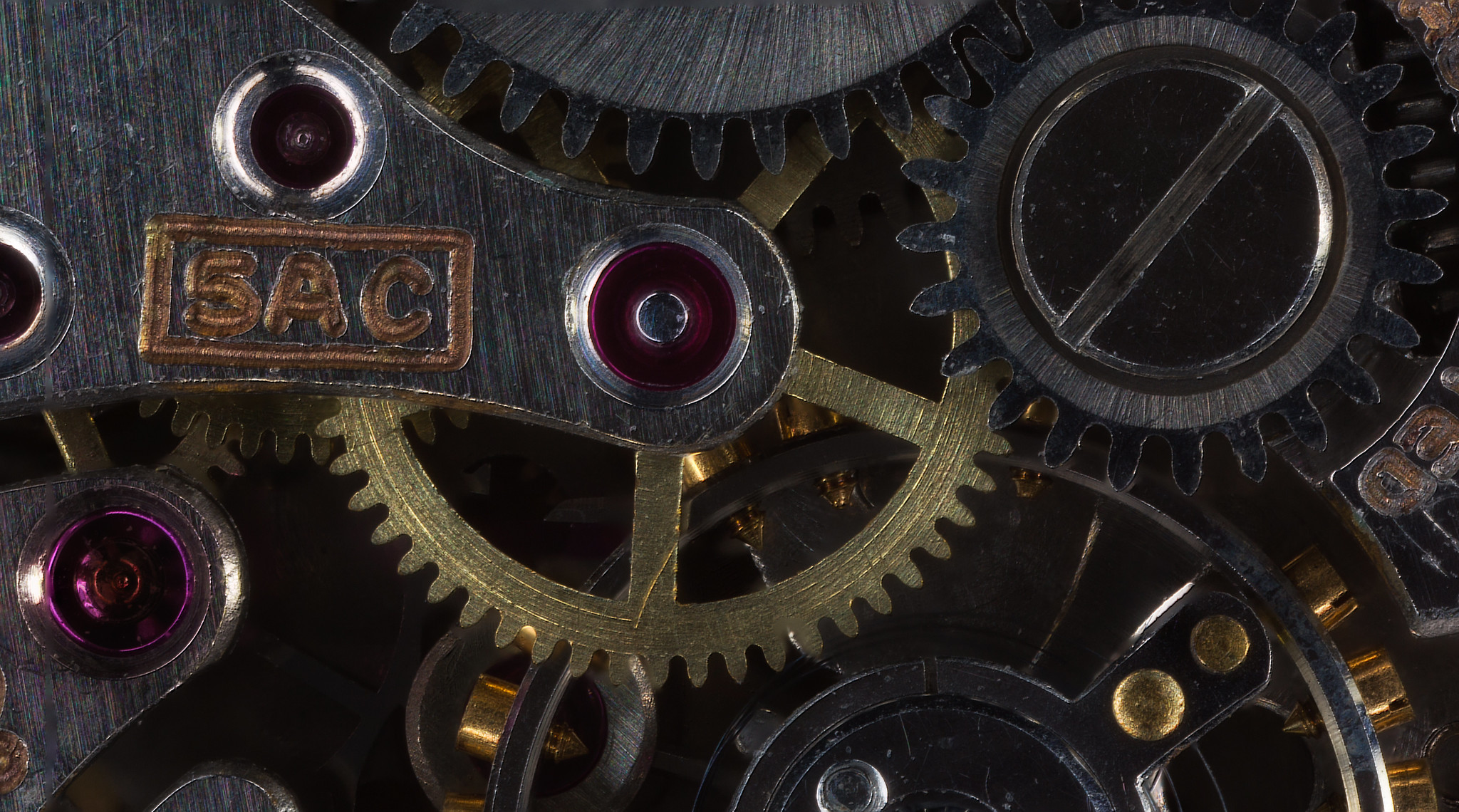
Where’s the Bluetooth module? Photo by Kellar Wilson on Flickr.

A selection of 8 links for you. Not to be sold separately. I’m charlesarthur on Twitter. Observations and links welcome.

What changes at Medium and Yahoo Pipes teach us about the persistence of the web » Scripting.com

Dave Winer:

What we need, and still don’t have, is a systematic way of publishing to the future. Such a system would allow you to pay a fixed sum to keep your content at a specific address for the foreseeable future. No one can make a guarantee, we don’t know what the future holds, but every effort has to be made, upfront, to be sure that the content has the best chance to survive as long as possible. # It would be nice if a visionary entrepreneur would get involved, and an educational institution, perhaps, and/or an insurance company, the kinds of organizations our society creates to be long-lived. It would be great to get input from Stewart Brand and his colleagues at the LongNow Foundation.

Not a bad idea. But isn’t that what the Internet Archive is doing? Winer responds to that: “long-lived context is not the same thing as having a snapshot” [as the IA does].


iPad update won’t work on old devices » Business Insider

Tim Stenovec:

the bad news is that the new features may not work on your iPad, unless it’s one of the newest models. And Split View, which allows you to use two apps at the same time, and is one of the best new features, only works on the iPad Air 2, Apple’s latest iPad, which starts at $499 and was released last fall.

The cynic would say the fact that the new features, which are part of a software update coming later this year, only working on the latest and greatest iPads is a ploy to get you to upgrade your iPad. Apple has struggled with relatively sluggish iPad sales — the company still sells millions each quarter, more tablets than any other single company — but sales continue to fall…

…Of course, using two apps at the same time, or watching a video in the background while doing something else on your iPad, certainly requires more processing power than just using one app, so it may be that the features only work well enough for Apple to include it on its latest and most powerful iPad.

Yeah, but the cynic will disregard that sort of logical argument. All software can run on all hardware, regardless of age, according to the cynic.


Apple Music: a platform play with hidden nuance » Music Industry Blog

Mark Mulligan:

Apple continues to be ridiculed for its failed Ping! music social network. While it was no killer app it nonetheless represented an attempt to turn iTunes into a music platform. Now that same strategy has been rekindled with the launch of Artist Connect. This is Apple’s attempt to turn itself into an artist-fan engagement platform. Artist-fan engagement is the gold dust of the digital era music business. It’s the scarce, invaluable commodity that music fans crave in a post-scarcity music world…

…while DIY sites of various guises are niche, Apple presents the opportunity to reach more than a hundred million of the world’s most valuable (i.e. highest spending) music fans. Sure some of them now pay for Spotify but they’re still iTunes users also. If Apple’s featureset for artist is strong enough, expect strong uptake, especially from the bigger labels and artists.


Chart: Apple Music vs. Spotify, Pandora, Rhapsody and the rest of the streaming competition » GeekWire

Todd Bishop and James Risley:

Apple unveiled its new $9.99/month streaming music service this morning, staking its claim in a market with a large number of existing competitors. Established players include radio services like Pandora, freemium services like Spotify, and industry veterans like Seattle-based Rhapsody. This chart, created by GeekWire, shows how Apple compares to many of these existing services.

The missing element: how many devices is each one effectively preinstalled on? Yeah, Apple Music gets an advantage there. (I admit that I was surprised by the introduction on Android. But it makes perfect sense.)


Apple previews new Apple Watch software » Apple

Coming in autumn (when the new phones come out, one assumes):

Additional watchOS 2 features include: • Nightstand Mode that transforms Apple Watch into a bedside alarm clock, with the Digital Crown and side button serving as snooze and off buttons for the alarm;
• the ability to use merchant rewards and store-issued credit and debit cards with Apple Pay™, which can be added to Wallet;
• support for Transit in Maps*, so you can view detailed transportation maps and schedules, including walking directions to the nearest stations with entrances and exits precisely mapped;
• workouts from third-party fitness apps contributing to your all-day Move and Exercise goals;
• using Siri® to start specific workouts, launch Glances and reply to email; and
• Activation Lock, which lets users secure their Apple Watch with their Apple ID, preventing another user from wiping or activating the device if it is lost or stolen.

That last touch is neat – you remember the discovery of how easily the Watch could be stolen and wiped. Now it has something that sets it apart from any Rolex or other expensive watch (well, apart maybe from an engraved one): stealing it becomes pointless. Lots of stuff that feels as though it just didn’t make the cut for version 1.


Can the Swiss watchmaker survive the digital age? » NYTimes.com

Clive Thompson:

[Frederique Constant watch designer Pim] Koeslag faced a significant problem, though: He had never worked with chips and sensors before. He didn’t even own a soldering iron. Swiss watchmakers don’t need them; their devices are put together with screws and screwdrivers. He led me to a large microscope and placed one of the chip sets under it. When the image appeared on a large computer screen, he zoomed in on the Bluetooth antenna, which looked like a dark, square block. Getting that into the right spot caused him a great deal of trouble, he said. “Under the microscope, we actually welded it on, by hand,” he said.

Well, I guess that answers the question in the headline. Turns out the Swiss watch industry is terrified of the smartwatch’s effect on the $1,200 price segment on their watches which have an accuracy of around 2 seconds per day. Per day?!


Freemium is hard » Marco.org

Marco Arment on how Shuveb Hussain saw app purchases plummet when he went ot freemium:

Freemium is hard. Its effectiveness depends on where you can put that purchase barrier in your app. Many app types simply don’t have a good place for it. In this case, Shuveb faces the fatal combination of two major problems: • His app is a lightly used utility, but he only stands to make money from heavy use. His free tier is good enough for most users.
• His purchase barrier — more than one article per day — discourages more frequent use, which hinders habit-building. When faced with a paywall, most people will try to avoid it unless there’s a compelling reason to pay. The few customers who hit Comfy Read’s paywall probably just think, “I guess I won’t send this article to my Kindle,” or “I guess I’ll use another app for this.” Users aren’t given the chance to let the app become a crucial part of their workflow or build any loyalty toward it, which would make them more willing to pay, before hitting a paywall.


Sony cripples the ‘8GB’ Xperia M4 Aqua » Xperia Blog

We have the European E2303 retail model of the Xperia M4 Aqua, which is SIM free so should have less bloatware than carrier versions. It is running firmware build 26.1.A.1.100 and the screenshots you see below are straight out of the box without installing any new apps. You can see that out of 8GB of storage, 4GB is taken up by Android 5.0 and just over 2GB of pre-installed apps. For our model, this leaves a paltry 1.26GB for our own apps, media, photos and videos. No problem, you might say – just delete some unwanted apps. However, most of the apps are baked in and cannot be uninstalled.

Largest one: Facebook (why?), followed by Google Play Services (124MB) and Android System WebView (120MB) and Google+ (110MB). There’s also Chrome in the list. You can use an SD card, but that’s not ideal. Sony also claims – apparently wrongly – that there’s 3GB of free space. (For comparison, the 8GB iPhone 5C has 4.9GB free for users.)


Start up: find a doppelgänger!, privacy woes, voice input’s promise, Brazil’s smartphone boom, and more


Like this, but online. Photo by pvantees on Flickr.

A selection of 9 links for you. Spreadable from the fridge. I’m charlesarthur on Twitter. Observations and links welcome.

How my doppelgänger used the Internet to find and befriend me » Fusion

Kashmir Hill:

For some reason, we’re obsessed with the idea of finding people in the world who look like us and the wondrousness of looking into a flesh-and-blood mirror. It’s fascinating enough that Canadian photographer Francois Brunelle has spent the last 14 years finding doppelgängers and taking their portraits. He told CBS News he loves capturing the shock that happens when they meet, and that he endlessly gets emails from people who want him to help them find their look-alike. I asked him why he finds face-twins so compelling. “I don’t really know,” he responded by email. “The fascination of seeing two same-looking people side by side.” With the rise of facial recognition, having a doppelgänger can sometimes be problematic. In 2011, a Massachusetts man had his license revoked because an anti-fraud system that scanned people’s photos decided he looked too much like another driver.


My ears, my eyes, my Apple Watch » Living with Usher Syndrome

Molly Watt:

On leaving the ReSound Offices [where she was fitted with hearing aids that connect directly her iPhone] and within 15 minutes I had my Apple Watch set up and it was a real “WOW” moment when I made my first call to my Dad, via my Apple Watch, his voice came straight into my ears, he sounded different, so much clearer than before, it dawned on me, I’d never heard my Dad’s real voice before, my Mum, ever faithful support and chauffeur sat beside me sounded totally different, even I sounded different to myself, it was strange, very strange, hard to process but it made me feel so emotional that day, day one, I was experiencing so much, new things for the first time ever!

I’ve linked to Watt before; her posts are such wonderful examples of how technology can enable people who would otherwise be excluded from so much.


Meet Apple PR’s worst nightmare » Fortune

Philip Elmer-DeWitt:

it’s at WWDC that Gurman’s shoe-leather reporting shines brightest, and he’s worked this year’s event harder than ever. If you want to know what’s coming Monday — or at least what’s expected — you might as well start with the round-up Gurman published Friday. It’s the post everybody else is linking to, including Wall Street analysts. I caught up to Gurman on Saturday at his parents’ home in Los Angeles where, lacking an invitation from Apple, he will watch Monday’s keynote remotely. He’s got one more year in Michigan, where he’s taking a lot of technical courses — software design, server structure, data analysis — at the School of Information. To carve out more time for coursework he cut back this year on day-to-day rumors to focus on the big scoops. After graduation he’s thinking about business school — he likes Stanford — and relocation to San Francisco or New York.

Gurman has got more and more things exactly right as time has gone on.


Talking computers pose a threat to current Apple versus Google market segmentation. Beyond Peak Google. » Praxtime

Nathan Taylor:

Google Now is already shipping and riding a technological tidal wave of machine learning. Let’s tie this back to the discussion on native ads. If Google owns the voice interaction channel to the internet, and can do branded “native ads” whenever someone talks into their phone or watch, then Peak Google is solved. Google will be launched into the next wave without being eclipsed. Billions are (potentially) at stake. Where’s the closest restaurant I’ll enjoy? What’s the best toothpaste to buy? How much are tickets to the game? What apartment can I afford to rent? What kind of car should I buy? Who should I marry? Except for that last question, I’m sure Google will eventually be capable and quite happy to answer. With proper brand product placement of course. And a small finder’s fee owed by the end vendor for any purchase. As Google becomes the front end to a potentially huge new voice interaction distribution channel, they’ll take their cut.


A complete taxonomy of internet chum » The Awl

John Mahoney on those annoying boxes that try to tempt you to click somewhere else, which he calls “chumboxes”:

Like everything else on the internet, traffic flowing through chumboxes must be tracked in order for everyone to be paid. Each box in the grid’s performance can be tracked both individually and in context of its neighbors. This allows them to be highly optimized; some chum is clearly better than others. As a byproduct of this optimization, an aesthetic has arisen. An effective chumbox clearly plays on reflex and the subconscious. The chumbox aesthetic broadcasts our most basic, libidinal, electrical desires back at us. And gets us to click.

Come and meet “Skin Thing”, “Old Person’s Face”, “Miracle Cure Thing” and the rest.


Global markets foreshadow low-cost smartphone opportunity in Brazil » Jana Blog

137 million people in Brazil own a mobile phone, and one-third [41m] of them own a smartphone. Brazil is the second largest country for downloads within the Google Play Store, and its citizens are some of the most eager app consumers. Brazil’s active Android smartphone market presents a huge opportunity for device manufacturers to capture the other 91 million mobile subscribers as they make their first ever smartphone purchase. In recent years, other countries have seen a massive adoption of smartphones thanks to a rush of competing brands entering the market and driving down handset costs. The smartphone market in Brazil is big, but could it be bigger?

Main installed base players: Samsung (50%), Motorola (21.1%) and LG (17%).


Exclusive: In ‘year of Apple Pay’, many top retailers remain skeptical » Reuters

Nandita Bose worked through the top 100 retailers in the US asking whether they would support Apple Pay:

Many companies that accept Apple Pay report that they and their customers are happy with it. Whole Foods spokesman Michael Silverman said that Apple Pay transactions accounted for 2% of its sales dollars as of March and that it expects use to rise. “Our shoppers are really enjoying the speed, convenience and security of Apple Pay,” he said. But for other retailers and consumers, Apple has yet to answer the question “what is in it for us if we use Apple Pay?” said Alberto Jimenez, program director for mobile payments at IBM, which provides technology to mobile wallet makers and retailers. Jimenez would not say whether Apple is among their customers. The program doesn’t offer loyalty rewards to customers, as companies such as Starbucks do with their mobile applications, nor does it provide customer information to retailers about Apple Pay users. For 28 of the retailers surveyed by Reuters, lack of access to data about customers and their buying habits is a key reason they don’t accept Apple Pay. “One of the biggest concerns is data control,” said Mario De Armas, senior director, international payments at the world’s largest retailer, Wal-Mart Stores Inc.

Apple is expected to provide some sort of way for retailers to collect loyalty data about customers – although this seems contrary to its point about not tracking your purchases. Clearly though there’s a tension between retailers and Apple over this. Now read on…


The online privacy lie is unraveling » TechCrunch

Natasha Lomas:

The [US] report, entitled The Tradeoff Fallacy: How marketers are misrepresenting American consumers and opening them up to exploitation, is authored by three academics from the University of Pennsylvania, and is based on a representative national cell phone and wireline phone survey of more than 1,500 Americans age 18 and older who use the internet or email “at least occasionally”. Key findings on American consumers include that — • 91% disagree (77% of them strongly) that “If companies give me a discount, it is a fair exchange for them to collect information about me without my knowing”
• 71% disagree (53% of them strongly) that “It’s fair for an online or physical store to monitor what I’m doing online when I’m there, in exchange for letting me use the store’s wireless internet, or Wi-Fi, without charge.”
• 55% disagree (38% of them strongly) that “It’s okay if a store where I shop uses information it has about me to create a picture of me that improves the services they provide for me.”


HMRC ditches Microsoft for Google, sends data offshore » The Channel

Kat Hall:

Her Majesty’s Revenue and Customs (HMRC) is the first major department to move to Google Apps, part of an apparent loosening of Microsoft’s stranglehold on the government’s software services. The department will join the Cabinet Office and Department for Culture, Media and Sport (DCMS) in deploying the fluffy white stuff. HMRC has 70,000 staff, and as such will be Whitehall’s first mass deployment of Google’s cloud services. The Cabinet Office currently has 2,500 users on Gmail. The government said in March the Google Apps suit best met the user needs for the Cabinet Office and DCMS. “Other solutions (e.g Microsoft 365) also scored highly, but the advanced collaboration and flexible working features of Google Apps were the best fit for our needs,” it said at the time.

Wow. That’s a huge blow to Microsoft, huge win for Google.


Start up: drone questions, Baidu barred in AI comp, why Apple shunned HERE, and more


This is what it looks like when you’re upset, Google. Photo by donnierayjones on Flickr.

A selection of 7 links for you. Use them wisely. I’m charlesarthur on Twitter. Observations and links welcome.

The UX of Commercial Drones » UX Magazine

Dan Saffer:

Let’s examine the customer experience as demonstrated by Amazon: The drone flies in and lands on the back patio. The customer leaves the house. The drone releases the package and flies away. The customer grabs the package and heads back inside. This is all well and good, but a lot of important detail still needs to be addressed. For starters, how does the customer know when the drone is arriving? People aren’t going to want their packages sitting outside unattended, especially in inclement weather (assuming drones will even be able to fly when it’s raining or snowing). And people won’t want to sit around looking out their window for half an hour. But what might work is something like what the car service Uber does: showing you via an app where your drone is and how long until it arrives, as well as alerting you via SMS when it does arrive. This would provide a level of assurance, especially at the onset when the idea of a drone carrying an emergency last-minute birthday gift will seem the height of novelty. When the drone does appear, it’s going to be really tempting to race out and grab the package, especially for kids—and perhaps for dogs and excitable adults as well. One problem: between the person and the package are several spinning, knife-like blades that form the rotors of the drone. Being accidentally hit in the face by one would be a great way to lose an eye or obtain a nasty cut.

“We included plasters in case you get hurt!”


Computer scientists are astir after Baidu team is barred from AI competition » NYTimes.com

John Markoff:

The competition, which is known as the “Large Scale Visual Recognition Challenge,” is organized annually by computer scientists at Stanford University, the University of North Carolina at Chapel Hill and the University of Michigan. It requires that computer systems created by the teams classify the objects in a set of digital images into 1,000 different categories. The rules of the contest permit each team to run test versions of their programs twice weekly ahead of a final submission as they train their programs to “learn” what they are seeing. However, on Tuesday, the contest organizers posted a public statement noting that between November and May 30, different accounts had been used by the Baidu team to submit more than 200 times to the contest server, “far exceeding the specified limit of two submissions per week.”

Previously reported here, before the multiple entries were spotted. Baidu’s team calls their multiple entries “a mistake”.


The new Google Photos app is disturbingly good at data-mining your photos » Fusion

Daniela Hernandez:

What’s particularly incredible is the facial recognition. The app sees individuals in photos even if they are barely in the picture, far in the background, or featured in a photo within a photo. When I did a search for my adult sister’s face, it recognized her in a photo I took of a 20-year-old elementary school picture of her. When I searched for my father’s face, it included a photo I took of a decorative tile-wall in Mexico. I thought it had messed up, because I didn’t see any people in the photo, but when I looked closely, there was a tiny version of my dad at the bottom. Facial recognition has gotten very powerful. Google also seems to know how to flatter its users. When I typed in “skinny,” the search unearthed pictures of me, friends, my sister and my mother, as if it was trying to compliment us. But when I searched for other adjectives, particularly negative ones — fat, sad, upset, angry — Google Photos came up empty. (Some of my colleagues got similar results.) The technology to help computers decipher emotions is out there already, so there’s no technical reason why Google isn’t turning up results for those searches. It gave us results for “love,” but not for “hate.” Whether it’s that we don’t take photos of ugly things, or that Google is shielding us, is something we’d really like to ask the search giant.

You could pick up the phone and ask them…


Eric Schmidt on why Google won’t fail » Business Insider

Jillian D’Onfro:

Shareholders understand Google’s search and ad business, [Schmidt said at the AGM], but they don’t necessarily understand the other projects that the company invests in, like self-driving cars or smart contact lenses. On past earnings calls, analysts and investors have sounded impatient when questioning how those businesses are going to ultimately pay off. But Schmidt assured shareholders Wednesday that ambitious goals like cutting down on car crashes or measuring a diabetic’s blood sugar through their tears are the kinds of things that will ultimately make Google a long-lasting, successful company. “Most companies ultimately fail because they do one thing very well but they don’t think of the next thing, they don’t broaden their mission, they don’t challenge themselves, they don’t continually build on that platform in one way or another,” he says. “They become incrementalists. And Google is very committed to not doing that. We understand the technological change is essentially revolutionary, not evolutionary.”

Are there any lessons from technology companies that have lasted more than a century, such as Nintendo, IBM and Nokia?


Here’s why Apple didn’t want to buy Nokia’s mapping unit HERE » Forbes

Parmy Olson:

Apple appears intent on fixing the problems that cropped up from relying on third-party map providers. One of the reasons Apple Maps was so buggy from when it was launched in June 2012 is the fact that its data percolated in from multiple sources like TomTom, Acxiom, Waze and Yelp By building its own geography dataset, Apple can pare down its reliance on sources like TomTom’s TeleAtlas. Apple’s likely vision is that years from now, we’ll have forgotten about how bad Apple Maps was, because Apple will have taken complete control of its mapping infrastructure and made it watertight.


There’s still plenty of money in dumb phones » Quartz

Leo Mirani:

there’s little doubt that dumb phones and feature phones are a shrinking market. Between the first quarter of 2013 and the first quarter of 2014, the market for non-smartphones shrunk by a 14%, according to CCS Insight (pdf), a research firm. This year, some 590 million non-smartphones will be sold. By 2019, that number will shrink to 350m. But 350m phones in one calendar year is still a lot of phones. And it is, as Microsoft’s Pekka Haverinen of Microsoft’s feature phone division tells Quartz, a predictable market with high volumes and a high market share for Microsoft. It’s not just device-makers who stand to profit from cheap, basic phones. Ericsson reckons (pdf) that by 2020, there will 9.2bn mobile subscriptions, of which 1.4bn will be non-3G subscriptions. This huge market is hungry for services.

Well, sorta. Microsoft’s featurephone segment is shrinking really rapidly; this is a market which is being eaten up by cheap Chinese players for whom, as they say, “your [profit] margin is my opportunity”.


Twitter just killed Politwoops » Gawker

JK Trotter:

A Twitter spokesperson just provided the following statement to Gawker regarding the apparent suspension of Politwoops’ access to Twitter’s developer API, which enabled the Sunlight Foundation-funded site to track tweets deleted by hundreds of politicians. Summarized: Politwoops is no more.

Earlier today we spoke to the Sunlight Foundation, to tell them we will not restore Twitter API access for their Politwoops site. We strongly support Sunlight’s mission of increasing transparency in politics and using civic tech and open data to hold government accountable to constituents, but preserving deleted Tweets violates our developer agreement. Honoring the expectation of user privacy for all accounts is a priority for us, whether the user is anonymous or a member of Congress.

The post also says that Twitter was considering a “quiet reversal” but found itself snookered on the question of “why them and not others”. But if someone tweets something publicly, haven’t they yielded their expectation of “privacy”? In the print days, the UK Ministry of Defence could demand back documents about cruise missile sitings from The Guardian on the basis of copyright. That seems to be what Twitter is imposing here.


Start up: watch the commuters!, SamsungPay’s big obstacle, Apple gets mappy, and more


Mars: likely to remain inhabited only by robots for quite a long time yet. Photo by ridingwithrobots on Flickr.

A selection of 9 links for you. Use them wisely. I’m charlesarthur on Twitter. Observations and links welcome.

The Samsung Galaxy S6 might be the best Android phone of 2015, but it is unusable » Android Beat

Rajesh Pandey:

The Moto X 2014, which has 2GB of RAM, has around 700MB of free RAM with a similar setup. Despite the 1GB difference in RAM, the Moto X — running Android 5.1 — feels significantly smoother to use. The RAM management issue on the Galaxy S6 is so bad that jumping between a Chrome tab and another app running will force the Chrome tab to reload. This makes the phone completely useless for any kind of serious browsing or for doing any transactions through a bank’s website. I have to restart my Galaxy S6 once every 24 hours to make sure the handset does not feel sluggish and slow. On the days that I do forget to reboot the handset, the phone gets so slow that it feels like I am using some low-end Android device and not the best Android handset in the market currently. It’s nothing short of a miracle that I have not yet thrown the phone in sheer frustration. In all probability, the poor RAM management of the Galaxy S6 stems from different memory leaks present in Android 5.0 Lollipop. The Moto X and Nexus devices had similar issues on Android 5.0, so it makes sense that the Galaxy S6 has them as well. However, the Galaxy S6 was released more than 5 months after Google had released Lollipop, which means that Samsung had more than ample time to track down and fix the memory leaks.

I’ve previously linked to the complaints about Lollipop having memory leaks. I haven’t seen this complaint before, though.


The Apple vs. Google battle has changed » Above Avalon

Neil Cybart:

Google I/O made it clear that Google needs Apple and iOS. To ignore such a vibrant base of highly-engaged users, especially when other companies like Facebook enjoy a prominent place in the platform, would be highly destructive to Google’s ambitions. On the other hand, Apple also needs Google as its services remain very popular among iOS users. However, judging from Apple’s prior actions and mission statement to personalize technology, I would expect Apple will continue to try to minimize its dependence on Google as such a situation represents a long-term threat to Apple’s mission. Similar to how the Nexus experience provides the closest thing to pure Android, I suspect Apple wants to continue down the path of being in a position to ship an iPhone and suite of apps and services that make it possible to live within the Apple ecosystem without much interference from Google. While most consumers will end up settling somewhere in the middle, using both Apple and Google products and services, it is this quest to control the entire user experience that ultimately validates the competition between Apple and Google as genuine. The probability of a world where Android excels as a direct result of iOS faltering is becoming more remote as time goes on. Instead, Google is becoming more reliant on a healthy iOS platform…


Watch the City of London pulling in commuters from across the south east like an imploding star » CityMetric

Last week we ran some fascinating maps [Alasdair Rae] created showing the population density (and, consequently, urban area) of major British cities. Now, he’s created a visualisation that shows the limits of this type of static density modelling: an animation that shows the massive population shift that takes place every day as workers commute into the City of London. The visualisation is based on 2011 census data showing daily commuter journeys into the square mile, London’s main financial distract. It shows commuters speeding into the city’s centre from as far away as Bournemouth and Margate. It’s also completely hypnotic to watch:

Now I want the commute home too…


Toyota unintended acceleration and the big bowl of “spaghetti” code » Safety Research & Strategies, Inc

[Embedded software expert Michael] Barr testified: “There are a large number of functions that are overly complex. By the standard industry metrics some of them are untestable, meaning that it is so complicated a recipe that there is no way to develop a reliable test suite or test methodology to test all the possible things that can happen in it. Some of them are even so complex that they are what is called unmaintainable, which means that if you go in to fix a bug or to make a change, you’re likely to create a new bug in the process. Just because your car has the latest version of the firmware — that is what we call embedded software — doesn’t mean it is safer necessarily than the older one….And that conclusion is that the failsafes are inadequate. The failsafes that they have contain defects or gaps. But on the whole, the safety architecture is a house of cards. It is possible for a large percentage of the failsafes to be disabled at the same time that the throttle control is lost.” Even a Toyota programmer described the engine control application as “spaghetti-like” in an October 2007 document Barr read into his testimony. Koopman was highly critical of Toyota’s computer engineering process.

Remember how shonky the interfaces for VCRs and DVDs were? What if the people who did those were writing your car code? What if they already are?


Jobs at Apple » Apple

Job Summary The Maps team is looking for a web technology expert to help make maps work seamlessly on the web. The ideal candidate will be a JavaScript expert, have in- depth knowledge of various core web technologies, and be proficient with web developer tools for debugging and performance analysis.

If you have an iOS device and use iCloud.com, you can use Apple Maps online to do Find My iPhone. Either Apple is looking to expand its desktop Maps so that it’s not just an OSX experience, or this is just strengthening the FMI team.


Mars One reveals true number of applicants » Matter on Medium

Elmo Keep:

On a new page on its site, The Science of Screening Astronauts, Mars One writes, “The total number of completed and submitted applications was 4,227.” Citing a report by NBC, Matter reported the figure of publicly available video applications at 2,782. We don’t know that 4,227 is any more real than 200,000. It’s just what they’re self-reporting. (Mars One did not provide us any clarification despite repeat queries.) Regardless, that falls far short of the 200,000 widely reported initially by countless media outlets, and shorter yet of the one million applicants CEO Bas Lansdorp anticipated at the launch of the project.

This is starting to feel like Capricorn One.


Why SamsungPay is toast » Starpoint Blog

Tom Noyes (who – reminder – called it correctly that the iPhone 6 would have NFC and payments back in May of 2014):

Let’s assume that Samsung solves ALL of the technical issues above and now SamsungPay works on all Android devices. Everyone knows that MNOs decide what gets pre-installed on the phones they subsidize (even Apple). Six weeks before Mobile World Congress [in March], Google made a strategic deal with the US MNOs to buy ISIS in exchange for Android Pay (the new Google wallet) becoming part of Google Mandatory Services (GMS.. just like search and gmail). Part of this is also a new android registration flow that addresses THE KEY weakness of Android profitability.. it gets consumers to add a card and play account (Apple brilliantly required an iTunes account… with accompanying credit card.. in launch of iPhone). Samsung’s wallet could still work.. however IT IS NOT PRE LOADED.. so this is what the consumer would have to do (AFTER REGISTERING FOR ANDROID PAY): 1) Find out about Samsung pay
2) Install Samsung Pay
3) Register for Samsung Pay
4) Understand where they can use Samsung Pay
5) Wave it near the Mag Head reader
6) Then use Android pay for in-app and play purchases..
Forget about the technical issues.

But it can attempt it in other countries.


Sizing up the opportunity for Apple Pay » Kantar

Carolina Milanesi:

Among iPhone 6 and 6 Plus owners in the US, 13% have used Apple Pay, and 11% are planning to do so. Lack of trust and knowledge do not play a major role as reasons not to use it. Only 2.6% said they did not use Apple Pay because they do not trust it, and only 4.1% said they did not use it because they do not understand how it works. Eleven percent said they did not use it because their credit cards work just fine, and 58% just answered “no” without adding any more detail. Among Apple Pay users, men were more numerous than women, with 59% versus 41% of users, and 55% versus 45% of intenders. This is not surprising since early adopters tend to skew male, but what is interesting is that adoption of the new iPhone models has been slightly stronger among women at 52% versus 48% for men… …In March 2015, as a measure of comparison, only 7% of Android users we surveyed in the US said they used NFC/mobile payment. Google Wallet has been around since 2010, and any Android device with NFC capability can access it for payments.

I’d say that’s actually a pretty good showing for Google Wallet.


Three Google directors survive challenge over pay » Reuters

Devika Krishna Kumar and Ross Kerber:

Three Google compensation committee members were re-elected on Wednesday, the technology company said at its annual meeting, despite a challenge from a high-profile proxy adviser that raised concerns over executive pay. Google did not immediately detail by how much of a margin the directors won re-election at the meeting, which was webcast. Proxy adviser Institutional Shareholder Services (ISS) had recommended that Google shareholders withhold votes for the three directors, saying “mega grants” provided to executive chairman Eric Schmidt and chief business officer Omid Kordestani were “problematic.” ISS recommended that votes be withheld for Google compensation committee members John Doerr, Paul Otellini and Ram Shriram. ISS also recommended investors withhold votes from Google director John Hennessy, president of Stanford University, citing what it said is his role as a non-independent member of the board’s nominating committee.


Start up: Russia’s misinformation detailed, USB-C wins!, automation woes?, and more


Endangered species? A truckstop by sunset. Photo by Indigo Skies Photography on Flickr.

A selection of 8 links for you. Because I like the cut of your jib. I’m charlesarthur on Twitter. Observations and links welcome.

App maker files EU complaint against Google, alleging abuse of Android dominance » WSJ

Alistair Barr on the lawsuit filed by Disconnect, which makes an anti-tracking app:

The app maker alleged Google pulled Disconnect because the software disrupted Google’s tracking and advertising efforts, the source of most of the internet company’s revenue and profit. In an email included in the complaint, a Play store employee said the app was removed [from Google Play] because it prevented other apps from delivering ads. Disconnect asked European antitrust regulators to require Google to put its apps back in the Play store and treat the apps the same way Google treats its own privacy and security software. A Google spokesman called Disconnect’s claims “baseless.” Google has allowed more than 200 other privacy apps in the Play store, but blocks any apps that alter other apps’ functionality or remove their way of making money, he added, saying Google applies this policy uniformly, with strong support from Android developers.

Tricky, this: Disconnect says that the key point is that Google doesn’t hold itself to that standard on privacy and security, and that it doesn’t prevent ad-serving – just tracking. Google says that it makes the store, so it decides the rules.


Self-driving trucks are going to hit us like a human-driven truck » Medium

Scott Santens:

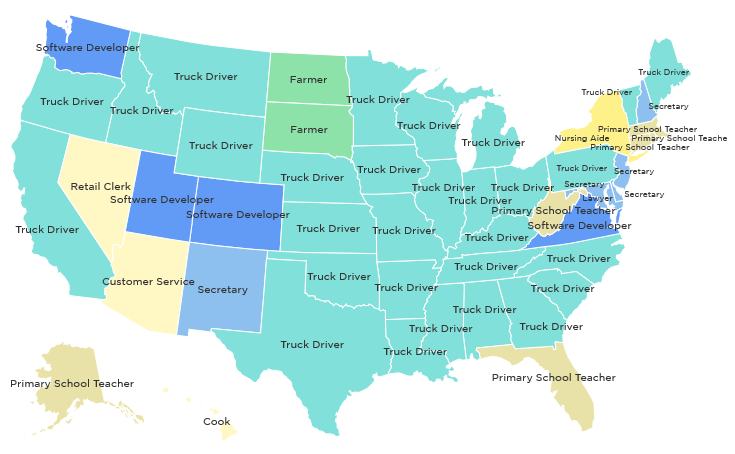
This is a map of the most common job in each US state in 2014. It should be clear at a glance just how dependent the American economy is on truck drivers. According to the American Trucker Association, there are 3.5 million professional truck drivers in the US, and an additional 5.2 million people employed within the truck-driving industry who don’t drive the trucks. That’s 8.7 million trucking-related jobs.

We can’t stop there though, because the incomes received by these 8.2 million people create the jobs of others. Those 3.5 million truck drivers driving all over the country stop regularly to eat, drink, rest, and sleep. Entire businesses have been built around serving their wants and needs. Think restaurants and motels as just two examples. So now we’re talking about millions more whose employment depends on the employment of truck drivers. But we still can’t even stop there…

…Truck driving is just about the last job in the country to provide a solid middle class salary without requiring a post-secondary degree.

You can argue about the exact numbers, but the point that it’s not just the driving that’s affected is important. See also the next link about sewing.


Made to measure » The Economist

Looking at the question of whether automation could put low-paid sewing machine workers out of, well, work in countries such as Myanmar:

it is devilishly difficult to make a machine in which fabric goes in one end and finished garments, such as jeans and T-shirts, come out the other. The particularly tricky bit is stitching two pieces of material together. This involves aligning the material correctly to the sewing head, feeding it through and constantly adjusting the fabric to prevent it slipping and buckling, while all the time keeping the stitches neat and the thread at the right tension. Nimble fingers invariably prove better at this than cogs, wheels and servo motors. “The distortion of the fabric is no longer an issue. That’s what prevented automatic sewing in the past,” says Steve Dickerson, the founder of SoftWear Automation, a textile-equipment manufacturer based in Atlanta, where Dr Dickerson was a professor at the Georgia Institute of Technology.

The company is developing machines which tackle the problems of automated sewing in a number of ways. They use cameras linked to a computer to track the stitching.

I’m moderating a session later this week looking at the questions around this topic: when automation and machine vision and capital come together to take these jobs away, what do the people who would have done them do instead?


USB-C has already won » The Verge

Sam Byford:

Although USB-C seems an inevitable success at this point, it does have a couple of issues to iron out, perhaps the most pressing of which is the complexity of its offering. There will be USB 2.0 devices with USB-C connectors, like the Nokia N1; USB 3.1 devices that use regular USB-A connectors; USB 3.1 “Gen 1” devices only capable of 5Gbps transfer speeds over USB-C, like the new Chromebook Pixel and MacBook; and USB 3.1 Gen 2 devices that give you 10Gbps. USB-C could be the only cable you ever need, but at this point it may be hard to know exactly what performance you’re going to get when you plug something in. “I think there’s the potential for confusion,” says [president and COO of the USB Implementers Forum, Jeff] Ravencraft, whose forum publishes language and usage guidelines for both USB 3.1 and USB-C.

“You do not get performance with the cable, you do not get power delivery with just the cable. The cable is a conduit for those things, right? So to have power delivery, the device has to have a power delivery controller, the host or the hub has to have a power delivery controller, and then you have to have the right cable.” The USB Implementers Forum offers training programs to help employees at retailers like Best Buy and Staples give accurate information to consumers, and is particularly aiming to crack down on “bad-actor” manufacturers that try to deliberately mislead.


MH17: forensic analysis of satellite images released by the Russian Ministry of Defence » bellingcat

With this new report all four major claims made at the Russian Ministry of Defence press conference have now been shown to be false:
– The MH17 flight path was not altered in the way claimed by the Russian Ministry of Defence. Data from the Dutch Safety Board’s preliminary report and other sources show Flight MH17 made no major course changes such as the one described in the Russian Ministry of Defence press conference.
– The Russian Ministry of Defence claimed the video of the Buk missile launcher presented by the Ukrainian Ministry of Interior was filmed in the Ukrainian government control town of Krasnoarmeisk. This has been proven to be untrue, with analysis of the video showing it was filmed in the separatists controlled city of Luhansk.
– Radar imagery was described as showing an aircraft close to Flight MH17 after it was shot down. Experts interviewed by various media organisations have stated this is almost certainly debris from Flight MH17 as it broke up over Eastern Ukraine.
– Satellite imagery shows Ukrainian Buk activity around July 17th. As this report shows, those claims are untrue, and were based on fabricated satellite imagery.

Weird that Russia is claiming to have had no involvement in MH17 and yet still takes the trouble to do this. But when you have a country whose leaders are paranoid.. well, read the next link.


The Agency » NYTimes.com

Adrian Chen on the “Internet Research Agency” in St Petersburg, which has industrialised the practice of trolling social media to promote Russian interests:

[Ludmila] Savchuk’s revelations about the agency have fascinated Russia not because they are shocking but because they confirm what everyone has long suspected: The Russian Internet is awash in trolls. “This troll business becomes more popular year by year,” says Platon Mamatov, who says that he ran his own troll farm in the Ural Mountains from 2008 to 2013.

During that time he employed from 20 to 40 people, mostly students and young mothers, to carry out online tasks for Kremlin contacts and local and regional authorities from Putin’s United Russia party. Mamatov says there are scores of operations like his around the country, working for government authorities at every level. Because the industry is secretive, with its funds funneled through a maze of innocuous-sounding contracts and shell businesses, it is difficult to estimate exactly how many people are at work trolling today. But Mamatov claims “there are thousands — I’m not sure about how many, but yes, really, thousands.”

That, though, is only the amuse-bouche. Then Chen finds himself dragged down the rabbit hole. Today’s must-read.


Lenovo replaces head of smartphone division as sales slump in China » Reuters

Liu Jun, one of four executive vice presidents under CEO Yang Yuanqing and a company veteran of 22 years, will be replaced by Chen Xudong, the head of ShenQi, a sub-division that sells mobile devices, the company said in a statement. Chen, 47, takes the reins of the division at a critical time. He must integrate the Motorola unit acquired from Google Inc for $2.9bn six months ago, while trying to counter a damaging slump in phone shipments. Lenovo, the fifth largest player in the Chinese market, shipped 22% fewer phones in the first quarter compared to the same period a year earlier, according to research firm IDC.

In stark contrast, Apple’s first-quarter China shipments jumped 62%, while Xiaomi and Huawei had gains of 42% and 40% respectively. Lenovo did not offer a reason for Liu leaving the post but said he would continue for an unspecified period as a special consultant to Yang.

Lenovo has a tough challenge with the tightening China market and Motorola’s integration.


How Twitter users can generate better ideas » MIT Sloan Management Review

in analyzing the structure of each employee’s Twitter network, we found that there was a positive relationship between the amount of diversity in one’s Twitter network and the quality of ideas submitted. However, Twitter activity and size measures (such as the number of tweets, number of followers and number of people followed) were not correlated with personal innovation.

We can explain these findings further by examining the Twitter sociograms of two EMC employees. In the diagrams, circles represent Twitter users, and an arrow from one user to another user indicates that the first user is following the second user on Twitter. Even though both employees A and B follow approximately the same number of Twitter accounts, A’s network is far more diverse than B’s. That is to say, the people whom employee A follows on Twitter are, for the most part, not following each other.

We can determine this level of diversity mathematically by using the compactness ratio, which measures the degree to which people in the network are connected to each other. For employee A, the network’s compactness ratio is quite low, at 18%. Our research found that loose Twitter networks, such as employee A’s, are better for ideation, because the potential for accessing a divergent set of ideas is greater.

Is it sort of “be less like Facebook”?


Great truths of our time: “journalists and coders should sit together to create amazing stuff”


Seating plan. Photo by alimander on Flickr.

My previous post on this topic, entitled “Great lies of our time: ‘journalists and coders should sit together to create amazing stuff'” generated a big reaction on Twitter. At all sorts of levels.

It turns out to be much easier to work with Twitter-based stories on Storify than on WordPress (at least, using the tools I’m using here..), so I’ve created a Storify story with all the useful reactions to what I wrote, and a diametrically opposite title, because there are people who have made it work. Which is great.

Read it here: “Great truths of our time: ‘journalists and coders should sit together to create amazing things'”.

I think that should cover all the bases.. for now.

Update: I’ve added it to the Storify, but I think Benji Lanyado’s 2012 post on this topic remains relevant (as does he). Lanyado used to be at the Guardian, and he’s been on both sides of the fence, as both journalist and (now) developer:

Let’s start with the developers. For all their digital wizardry, the average developer will not fully understand the editorial process. If they’ve been kept separate from the newsroom and editorial desks, as is usually the case, how could they? But developers, generally, do not need to be in the same place all the time – IM is enough contact with their product managers and team leaders. Give them a laptop and let them roam. There’s a desk for them if they need it, but otherwise they can pick up their laptop and move around the building. They need to ask a lot of questions. Hell, why not give them an editorial mentor – someone who’s job it is to answer as many questions as the developer wishes to ask. Quite simply, they need to be there – with the journalists, every day, learning.

The journalists need to learn too. Anyone within a news organisation who is making digital decisions needs to understand the digital process, within reason. They don’t need to become fully proficient in CSS or jQuery, but they need to understand the process of how stuff works, and how stuff is built. The developers need to let them in. Once a fortnight, journalists should have to spend a day with a development team, asking as many questions as possible. When the roaming developers come and sit with them, they should be doing the same.

This is the very minimum, but it will go a long way.

Start up: Apple’s transit plans, app monetisation, Samsung’s S6 rebuttal, bitcoin booboo, and more


Surely not caused by a Google car. Photo by Oakland Pirate on Flickr.

A selection of 9 links for you. Free like nitrogen. I’m charlesarthur on Twitter. Observations and links welcome.

Californians are OK with Google self-driving cars and are ready to ban non-self-driving cars » Emerging Technologies Blog

One of the blog’s readers gave their experience:

It’s safe to cut off a Google car. I ride a motorcycle to work and in California motorcycles are allowed to split lanes (i.e., drive in the gap between lanes of cars at a stoplight, slow traffic, etc.). Obviously I do this at every opportunity because it cuts my commute time in 1/3. Once, I got a little caught out as the traffic transitioned from slow moving back to normal speed. I was in a lane between a Google car and some random truck and, partially out of experiment and partially out of impatience, I gunned it and cut off the Google car sort of harder than maybe I needed too… The car handled it perfectly (maybe too perfectly). It slowed down and let me in. However, it left a fairly significant gap between me and it. If I had been behind it, I probably would have found this gap excessive and the lengthy slowdown annoying. Honestly, I don’t think it will take long for other drivers to realize that self-driving cars are “easy targets” in traffic.


Why do we assume everyone can drive competently? » Remains of the Day

Eugene Wei just avoided a cycling crash when a car turned into his cycle lane without warning:

For the next two blocks, I played my near collision on loop in my head like a Vine, both angry at the driver’s reckless maneuver and relieved as I tallied up the likely severity of the injuries I had just managed to escape by less than a foot of clearance. This is not an unusual occurrence, unfortunately. When I bike, I just assume that drivers will suddenly make rights in front of me without turning on their turn signal or looking back to see if I’m coming in the bike lane to their right. It happens all the time. It’s not just a question of skill but of mental obliviousness. American drivers have been so used to having the road to themselves for so long that they feel no need to consider anyone else might be laying claim to any piece of it. Though the roads in Europe are often narrower, I feel a hundred times safer there when biking there than I do in the U.S. All that’s to say I agree wholeheartedly with the writer quoted above that self-driving cars are much less threatening than cars driven by humans. As an avid cyclist, especially, I could think of nothing that would ease my mind when biking through the city than replacing every car on the road with self-driving cars.


iOS 9 Transit Maps to launch in a handful of cities in North America, Europe & China » 9to5Mac

Mark Gurman, for it is he:

While Apple plans to debut its own mass transit directions service for Maps in iOS 9 as soon as June, the rollout will not be as ambitious as some users may have hoped. In its first iteration, Apple’s Transit service will only support approximately a half-dozen cities across the United States, Canada, and Europe, in addition to China, according to sources… In the United States, the planned launch cities are San Francisco and New York, two major metropolitan areas that are known for public transportation, while Toronto will be likely Canada’s sole representative for the iOS 9 Maps Transit feature at launch. In Europe, Apple is said to be gearing up to first launch the feature in London, Paris, and Berlin.

Google has been miles ahead in this for years (which made iOS 6 retrograde). Three years on, there are already lots of apps – especially Citymapper – which offer services like this. But it’s the integration that Apple has really lacked.


Google’s answer to the big problem with wearables » WSJ

Alistair Barr:

Wearable gadgets like smartwatches have seen a lot of hype but little commercial success. An obvious obstacle is that teensy touch screens can make such devices difficult to control. Google thinks it has an answer: a minuscule radar system that senses hand gestures. The company’s Advanced Technology and Projects research group shrank a radar system into a package roughly the size of a micro SD card, small enough to fit in a smartwatch. It beams a signal wide enough to capture hand motions and gestures and turn them into control signals, according to Ivan Poupyrev, who led the initiative called Project Silo. The tiny radar could let people control tiny-screen devices without having to touch them, he said during a session at the Google I/O 2015 developer conference. For instance, it transforms a twisting motion between thumb and forefinger into commands to scroll up and down a smartwatch’s screen. Poupyrev demonstrated by changing the hours and minutes on a small screen by rubbing his thumb and finger near to the radar gesture sensor. He also played a simple soccer game, his finger motions in midair near the sensor shooting an onscreen ball into a goal. ATAP plans to release the system to developers later in 2015, Poupyrev said.

This is one of those things that looks cool in demos, but I suspect could be prone to everything that real life is – mess-ups. Remember Leap Motion, another gesture control system? Went nowhere because waving your hand in the air isn’t a natural way to control things – because it’s prone to misinterpretation. Google might get this right, but it needs a ton of figuring out.


Apps spearhead Google’s battle with Apple » FT.com

Richard Waters and Tim Bradshaw:

Apple’s App Store accounts for about 45% of the revenue that developers make from apps, compared with 29% for Google’s Play, according to Digi-Capital. But counting in the income from handsets in China — where Google’s apps are blocked, meaning it makes no money — pushes the overall Android share to 52%, Digi-Capital calculates. Last week, matching — and trying to surpass — Apple was a strong subtext of Google’s pitch to developers. New features included Android Pay, a rival to Apple Pay and a fresh attempt to break into mobile payments after the disappointment of Google Wallet. A new Google Photos app — with the promise of software that can automatically organise libraries of pictures — also echoed capabilities that are already offered by Apple. But in other areas, Google seemed unprepared. While smartwatches based on last year’s Android Wear technology have been put in the shade by the launch of Apple Watch, Google had little new to show off in response. This was a sign that it is surrendering early leadership in wearables to Apple, according to Carolina Milanesi, an analyst at Kantar Worldpanel.

The download share of Android in China is 62.8%, compared to 22.2% for Google Play, and 13.9% for Apple. Remarkable that non-Google Android is so big – but it only takes 23.8% of revenue, against 28.6% for Google Play, and 44.7% for Apple.


Hello world: Windows 10 available on July 29 » Microsoft Windows blog

Terry Myerson:

We designed Windows 10 to create a new generation of Windows for the 1.5 billion people using Windows today in 190 countries around the world. With Windows 10, we start delivering on our vision of more personal computing, defined by trust in how we protect and respect your personal information, mobility of the experience across your devices, and natural interactions with your Windows devices, including speech, touch, ink, and holograms. We designed Windows 10 to run our broadest device family ever, including Windows PCs, Windows tablets, Windows phones, Windows for the Internet of Things, Microsoft Surface Hub, Xbox One and Microsoft HoloLens—all working together to empower you to do great things. Familiar, yet better than ever, Windows 10 brings back the Start menu you know and love.

“Speech, touch, ink and holograms” is quite enticing. (That’s Hololens, of course.)


Asus brings a choice of sizes to Android Wear with ZenWatch 2 » The Verge

Vlad Savov:

The ZenWatch 2 runs the latest version of Android Wear, which was recently introduced with the LG Watch Urbane, however Asus’ watch is still a long way from actually being released. Asus tells us that it will reveal the full specs, pricing, and availability information during IFA in Berlin this September — leaving this as more of a promise than an actual product. The goal is to keep prices consistent between the two watch sizes, leaving the choice of strap to determine the particular cost. Update: The original article speculated that Asus’ metal crown will function like the digital crown in the Apple Watch, however we’ve now confirmed with Asus that it’s simply an external button and not a physical scroll wheel.

1) Doesn’t this Osborne [kill by preannouncement] the existing Zenwatch, even though there’s no price etc etc for the 2? 2) Which company will be the first, do we think, to mimic Apple’s digital crown and risk the sure-to-ensue lawsuit?


Samsung says S6 sales meet internal forecast » Korea Times

Kim Yoo-chul:

A Samsung spokesman in Seoul refused to release any official information on sales; but the company is expected to unveil figures at its upcoming investor relations forum on [Wednesday] June 3. Such remarks come a few days after Samsung Electronics Corporate Affairs President Park Sang-jin told reporters that the firm has been seeing a steady increase of sales on international markets. “You have to wait and see; however, the S6 and S6 Edge sales will be far higher than those of the S5” he said. The two models were unveiled during the Mobile World Congress 2015 event at the beginning of March. Both models were made available for purchase in April. Citing a report by CounterPoint Research, a research firm, eBEST Investment analyst Kim Hyun-yong said Samsung sold 6.1m S6s and S6 Edges in April. He added 305,000 S6s were being sold daily since the devices’ availability ― better than the S5 and S4’s 124,000 and 241,000 per day, respectively.

I’m finding it hard to believe that the S6 (and Edge?) is selling triple the number of the S5, and 50% more than the S4, at a time when Samsung is down in China and seen sales declines for months, and the S6 is on sale in fewer countries than the S5 was. Though with Samsung it’s hard to know what “sales” means – usually, it’s “sell-in”, as in sales to carriers.


Bitcoin app issues critical update after rare bug leads to total crypto breakdown » The Guardian

Alex Hern:

Bitcoin wallets are typically created by randomly generating a public address and a related private key. As a result, it is important for address and key to be truly random, or else it may be possible to guess the private key by looking at the public address. [Bitcoin wallet app] Blockchain used two sources of random numbers, in what ought to have been a belt-and-braces approach: it pulled a random number from the Android operating system’s built-in random number generator, and then connected to online service Random.org to get a second random number, which it combined with the first. Unfortunately, on some Android phones (reportedly including devices from the Sony Xperia range), the built-in random number generator failed to report back to the blockchain app. Normally, this should have been survivable, because the app used a second source of random numbers. But on 4 January, Random.org strengthened the security of its website, requiring all visits to be made over an encrypted connection. The blockchain app, however, continued to access the site through an unencrypted connection. So rather than getting a random number, as expected, it got an error code telling it that the site had moved. It then used that error code as the random number, every single time.

Not quite bitcoin itself screwed (it’s far too robust) but those using that app could find themselves all sharing a wallet.


Start up: Google Wallet v Android Pay, chip consolidation, Buzzfeed’s news numbers, Android Wear lessons, and more


Cooking, though not devised by computer. Photo by Nicolas Alejandro Street Photography on Flickr.

A selection of 9 links for you. Everyone else is seeing a different set. I’m charlesarthur on Twitter. Observations and links welcome.

MIT cheetah robot lands the running jump » YouTube

Do Androids dream of electric cheetahs in sheeps’ clothing jumping over things? Whatever it is.. this is very worrying.


Google may have left the best Android “M” feature out of the keynote: automatic app data backup and restore » Android Police

David Ruddock:

Yes, it’s happening. Dot. Gif. Android apps are finally getting state backup in the new “M” version of the OS. The full details are here. The short of it is that Android apps will now automatically back up to Google Drive, up to 25MB per app, with no new code required from developers. This is huge. What’s backed up? Settings and app data, which is to say, basically everything so long as you’re not talking about something over 25MB in total size. While this may still mean signing into your apps on a new device depending on the app’s security, once you do log in, the concept here is that all your settings and saved app data should just reappear on your new device. Which, holy cow, haven’t we been asking for this since the beginning of time?

Great – in 2016, Android will have the backup capability that iCloud offered since 2011. Given Google’s huge power in cloud services, it’s really strange this hasn’t been in place much earlier.


Some big changes are coming to Google Wallet now that Android Pay is here » AndroidAuthority

Jimmy Westenberg:

So if Pay is going to be the new payment standard on Android, what’s going to happen to Wallet? Well, a new post on the Google Wallet Google+ account is trying to help clear up this muddy situation. According to the post, the Wallet service has seen a ton of growth in the number of people sending money to one another, whether that’s through Gmail or the Google Wallet application. So, Google Wallet is sticking around, and will receive a big revamp in the coming months that sounds like it will focus on payment transfers, as opposed to actually handling the payments themselves. Here’s a little taste as to what the new Wallet app will bring, as explained by the Wallet team:

The new app will allow anyone with a US debit card to send and receive money for free within minutes – even if the other person doesn’t have the app. The money you receive can either be directly sent to your bank account or it can be spent in stores using the Google Wallet card.

We would be lying if we said this whole situation wasn’t confusing.


char-rnn cooking recipes » Github

“Nylki”:

The following recipes are sampled from a trained neural net. You can find the repo to train your own neural net here: https://github.com/karpathy/char-rnn Thanks to Andrej Karpathy for the great code! It’s really easy to setup.

But now go and read the recipe. Beef! Pineapple! Orange juice! Sherry wheated curdup! “You made the recipe, you eat it.”


Android no longer competes with iOS » Naofumi Kagami

He called it back in April 2013 (“Predicting Android’s change of direction“). Now, he writes:

Google itself mentioned that Android M is mainly about fixing bugs and annoyances in Lollipop, and if that is to be believed, then the next version of Android coming out in 2016 should have many more features. However, since I am now more confident of my reading of Google’s strategic imperatives, I am pretty sure that this will not be the case. I predict that the 2016 version of Android will also not have any major new features. In short, I am now sure that Google no longer intends to compete with iOS with Android. Essentially, they are giving up the high-end smartphone market to Apple and they are cool with that. Instead, Google sees Android as a vehicle to spread their services to market segments that iOS cannot penetrate. How will this strategy fare in the future? This strategy is sound if Google’s sole objective is to learn about what people are doing. However, from a financial standpoint, there are many risks. By far the largest risk is, what if Apple is successful in distancing itself from Google? What if Apple somehow succeeds in significantly reducing the number of Google searches performed on iOS?


Charlie Warzel on Google’s ambitions post-I/O » Daring Fireball

John Gruber mulls:

In the demo, while playing a Skrillex song, Google director of product management Aparna Chennapragada asked the device, “What’s his real name?” And a moment later, the answer came: “Sonny John Moore”. Now on Tap is what allowed Google to know the context for “him”. It was a cool demo. But as soon as I saw it, I took my iPhone, held down the home button, and asked Siri, “What’s Skrillex’s real name?” And a moment later came the answer: “Sonny John Moore”. Allowing Google to index everything the apps you use show or play for you seems like a stiff privacy price to play for the ability to use “him” in that query, especially when, in my opinion, “What is Skrillex’s real name?” is the natural way most people would pose the question. Now on Tap has much more potential than this, of course. But, still. To me, this week’s I/O keynote made me more convinced than ever that Google is turning into the Microsoft of old: a company whose ambitions are boundless, who wants its fingers in every single pie, and who wants to do it all on its own. A company whose coolest stuff is always in the form of demos coming in the future, not products that are actually shipping now.

Wellll… the Photos app, which embodies machine learning (wonder if Pete Warden is involved – his company Jetpac was bought by Google last year), is shipping now, but cross-platform. That’s the thing: the some-day-my-demos-will-be-real things are OS-specific, while the right-here-right-now things are cross-platform. But that “new Microsoft” meme is a hard one to shake off. Notice how it attaches when you keep getting hardware wrong and have to try it again and again.


The five chip companies who will buy all the others » DIGITS to DOLLARS

Jay Greenberg:

As growth slows in an industry, the only way for companies to keep growing is to win market share (hard) or buy other companies. This is especially true in semiconductors because most of these companies outsource their manufacturing to the foundries like TSMC and Global Foundries. When one chip company buys another, the combined entity gets better pricing at the foundry (as they are now a bigger customer). The combination also gets to eliminate the duplicated non-design functions. You do not need two CEOs, nor two CFOs, not even two Corporate Development VPs (a not so subtle reminder that I am now looking for a new job). For several months now, I have been going around talking to friends at chip companies preaching this view – the industry will consolidate from over a hundred companies today down to five in a few years. In these conversations, I have always used Broadcom as an example. I would note that “Even Broadcom is not too big to get acquired someday.” So apparently, someday is yesterday. When the dust settles, I think there will be just five massive companies left in the business. (That will clear the decks for a new form of semis companies to emerge, but that is years away.) Here is my guess as to who the survivors will be.

You can probably guess three of them, but all five?


Five things Google figured out in Android Wear’s first year » Fast Company

Jared Newman:

At this year’s I/O, in lieu of splashy reveals, Google is announcing some minor tools for developers, including a way to show bird’s eye map views in their smartwatch apps. The company also revealed that it has 5,000 true watch apps in the Google Play Store, plus 1,500 custom watch faces. This year’s conference is mainly a time to reflect, and convince app makers that Android Wear is ready to compete with the Apple Watch.

Here are 2 and 3: “nobody agrees what looks good; people want smaller watches”. In pursuit of not achieving 3,

The brunt of the blame falls to the battery, which is the largest component by volume inside Android Wear smartwatches, [Android Wear lead product manager Jeff] Chang says. Still, Google doesn’t want to mandate smaller watches if it means giving up an always-on display or all-day battery life, which he sees as core values. “To accomplish an always-on screen that stays on the whole time, and at least one full day of battery life, and to have a really small volume battery, that’s a big challenge,” Chang says. “We’re working very hard on it, but we do uphold all those principles dearly.”

Good/fast/cheap; small/always-on/one-day. Choose two. (Note how Apple’s choices differ from Android Wear, but it’s still two out of three.)


BuzzFeed’s news is growing, but still a small part of its traffic » Digiday

Lucia Moses:

BuzzFeed drew 76.7 million multiplatform unique visitors in April, according to comScore. The publisher historically hasn’t broken out its content by vertical to comScore, like other top news sites including CNN, Yahoo and The Huffington Post do. But it started to on a limited basis as of last month, when it began breaking out its Entertainment and Life coverage, which stand at 43.7 million and 20.1 million uniques, respectively. BuzzFeed doesn’t break out its news traffic, suggesting it’s still relatively low. Bottom line, BuzzFeed may have made headway a short time, but it is still a small player when it comes to news, in which it includes business, tech, politics and longform. “You’ll hear clients say, ‘We want a BuzzFeed-style article,’” said Kim Alpert, director of digital strategy at Walton Isaacson. But when it comes to news, it hasn’t delivered a consistent product that’s instantly recognizable, she said. “Vice and Mashable, you kind of know what you’re going to get. I don’t believe their news has really matured in that people say, ‘I get my news from BuzzFeed.’” With CEO Jonah Peretti recently hinting at going public, BuzzFeed could invite more scrutiny of its editorial model. BuzzFeed’s main revenue source is native advertising, a format that has been criticized for mimicking editorial. The publisher also has admitted taking down posts at advertisers’ requests.