This is the worst Apple Watch ever. (Think about it.)


Watches could get smaller yet. Photo by JonChanLon on Flickr.

Late in September 2001, Apple invited some American journalists to a little event on its campus. The invite said “Hint: it’s not a Mac.”

The original iPod invite in 2001

Not a Mac? Maybe a printer?

The product turned out to be the iPod – a music player that, as Slashdot’s editor Cmdr Taco famously remarked of its specifications that it had “No wireless. Less space than a [Creative Labs] Nomad” and hence was “Lame”.

We all know how the story turned out; the iPod trampled all the rivals in the space, capturing interest in music players at the time when phones weren’t quite capable of doing all the things one might want from a music player on the move. At the very least, an iPod was easier and faster to load up and navigate than even the phones that were around then.

But look at what the original iPod looked like. If you come across one now, it seems a giant hulking thing. 5GB of storage on a spinning hard drive! It weighed 184g, and had a volume of 124.9 cubic centimetres. It didn’t sell that well either.

Talking ’bout a second generation

Then in July 2002 the second-generation iPod came out: this had a touch-sensitive wheel, double the storage capacity (for an extra 3g in weight) in a package with a volume of 118.7 cubic centimetres – very slightly less volume, you’ll notice.

Fast forward four years from the original, to September 2005, and you had the iPod nano – 4GB of storage, 42.5g (that’s a quarter of the weight), in a volume of 24.9 cubic centimetres (that’s one-fifth of the original’s volume).

iPod evolution visualised

It started big and got smaller (and bigger)

It’s pretty obvious what happens: Apple optimises along certain hardware improvement axes. Screens got larger and added colour while the body got smaller and the controls remained largely the same (even the screenless iPod shuffle has similar controls to its parent, though without the moving scroll wheel).

So the first generation is just the beginning. The hardware will improve in various ways. The question is, which?

Experience: a perfect teacher, if you’re willing to learn

And so we come to the Apple Watch. I’ve been testing one loaned to me by Apple for about four months now. It’s a classic case where a hurried verdict won’t work. Reviewers who tried to decide on its usefulness in a weekend of testing missed the point, I think. There are two things to bear in mind about the Apple Watch (and arguably any smartwatch):
• the products you see now are version one. Everything about them is going to get better
• these are products which have to find a place in your life: every person only understands them in the context that they fit into their own life

The first point is the one that’s easiest to overlook. I’ll lay out the easy criticisms first, because it’s staringly obvious if you look at the iPod data above that lots of these are just hardware issues that will vanish as time goes by.

So here are easy criticisms of the Apple Watch:
• the display doesn’t always detect when you’ve rotated your wrist to view it, so doesn’t always light. This is definitely my biggest bugbear; so sometimes I have to tap the display. Is this a software/gyroscope thing? Definitely. Can it be improved by an update? I’d bet on it.
• the display isn’t lit all the time, so you can’t always see the time. Is this a technology thing? Yup – Android Wear watches have solved this already, so this is not out of reach. (Implementing this would also solve the first problem.)
• the battery doesn’t last for 50 years. In fact, the question people have asked me most often about it is “does the battery last all day?” to which I honestly can answer “Yup”. I often find I can get up to two days or so. If I’m wearing a watch, I don’t like taking it off at night; I like to be able to see the time. So I tend to put the Watch on “power reserve” overnight, which uses about 1% of battery during my typical sleeps, and then charge it first thing in the morning. You can pretty easily get two days of use if you don’t do a lot of exercise. Ben Wood of CCS Insight makes the excellent point about wearables in general: every time you have to take them off to charge them increases the chance you won’t put them back on, perhaps ever.
• third-party apps are slow to load. Uh, yeah. They’re running off the phone, which is talking back and forth with them via Bluetooth. This is going to be solved to a large extent by Watch OS2, due for release imminently. In fact Watch OS2 might fix a number of these things, at least to some extent.

All these things – battery life, display technology, processor speed – are works-in-progress. They haven’t reached an endpoint. You can bet that they will get better, and possibly quite quickly. Think about that in the context of those annoyances listed above.

Now here are the things where it seems to me the Watch is a huge advance on just having an iPhone:
• maps and directions. On the very first day I started using the Watch, I had to walk to another venue. I put the destination in on my phone, started the directions, put the phone in my pocket, and the watch took over – with the Taptic Engine tapping my wrist to indicate it was time to turn left or right (two for left, three for right). Walking along and looking occasionally at your watch is a lot more comfortable than gazing into your phone, or taking out your phone anxiously to see what you should do. (This is the first use that I cite to anyone who asks what it’s useful for; and when I tell them, they get an “ooh, useful” look.)

The same applies when driving – getting direct tactile feedback when a turn is coming up is a hell of a lot more useful than having to glance back and forth from the road to a screen. (The husband of a friend apparently likes the direction system so much he attaches his to his steering wheel. I don’t recommend this.)

• The Taptic Engine is a hell of a useful thing: together with the sounds, it lets you distinguish between an incoming message, a phone call, a calendar event coming due, a notification from another app (I find Dark Sky’s rain warnings helpful), and so on. Again, it’s something you just don’t get elsewhere.

• not having to be tethered to my phone. Of course, your phone still has to be in range (though once Watch OS 2 comes out, only on a Wi-Fi network that both your Watch and phone recognise). I’ve had the experience of being one floor up doing some DIY and having a phone call coming in to my phone a floor below. I took the call on the watch.

• quick responses to (or ignoring) messages. When a message comes in, you can see what it is and ignore it, use a pre-filled response, or dictate a reply. Siri is darned good on the dictation.

• the exercise measurement. I know that this is like Skinner boxes (pretty much the first thing I did was to turn off the “stand at 10 minutes before the hour” notification), but having something passively measuring how much activity you’re doing makes you consider it. Jim Dalrymple’s post on the huge effect that small but cumulative actions can have is inspiring; to that extent, I don’t care if the heart monitor is 100% accurate, as long as it’s consistent. And it seems to have a pretty clear idea of how much physical activity I’ve done in a day. Again, you don’t get that psychological benefit by testing for a weekend.

• it’s personal. Everyone sets their Watch up differently. I like having the “multiple” face, on which I have sunset/sunrise (this matters to me, for domestic reasons); exercise rings; time; day and night temperature highs and lows (this also matters, for domestic reasons; and the charge. There are tons of other things I like – being able to advance songs on the phone, or to like/hate songs on Apple Music, and so on.

The hardest part of using an Apple Watch is definitely getting the notifications under control. It would be easy to have everything on it; but you don’t need email, or tweets, or Instagram, or a ton of other things. The value is in having only the things that are very important to you; in that sense the Watch becomes a sort of proxy assistant (though one you have to set up yourself) which filters most of the crap out. You decide what of the crap you want to have.

Do you believe in the future?

I thought the reaction of the fashion industry to the Watch might be indicative. Apple courted it intensely ahead of and after its launch. There’s not much sign of how much penetration it has achieved there.

But those who would like to call the Watch a flop are, as usual, premature. If you’d seen the first six quarters’ sales of the iPod, you’d have concluded that that was a flop too. Here’s how they looked:

iPod sales - first six quarters

The pattern for iPod sales at the start isn’t encouraging.

Pretty terrible, right? The sixth quarter is below the very first quarter, for a product that was only on sale for part its first quarter. And yet the iPod went on to define an industry.

What happened after those six quarters? Here’s the view over 13 quarters, with the sudden growth coming after the introduction of the iPod mini – which, let’s note, had a capacity of 4GB (less than the original, or the “classic” iPods then available, which started at 15GB) but a weight of only 104g (compared to 158g for the larger “classic” version) and a volume of 58.7 cubic centimetres, compared to 99.6 cubic centimetres for the “classic” version then on sale.
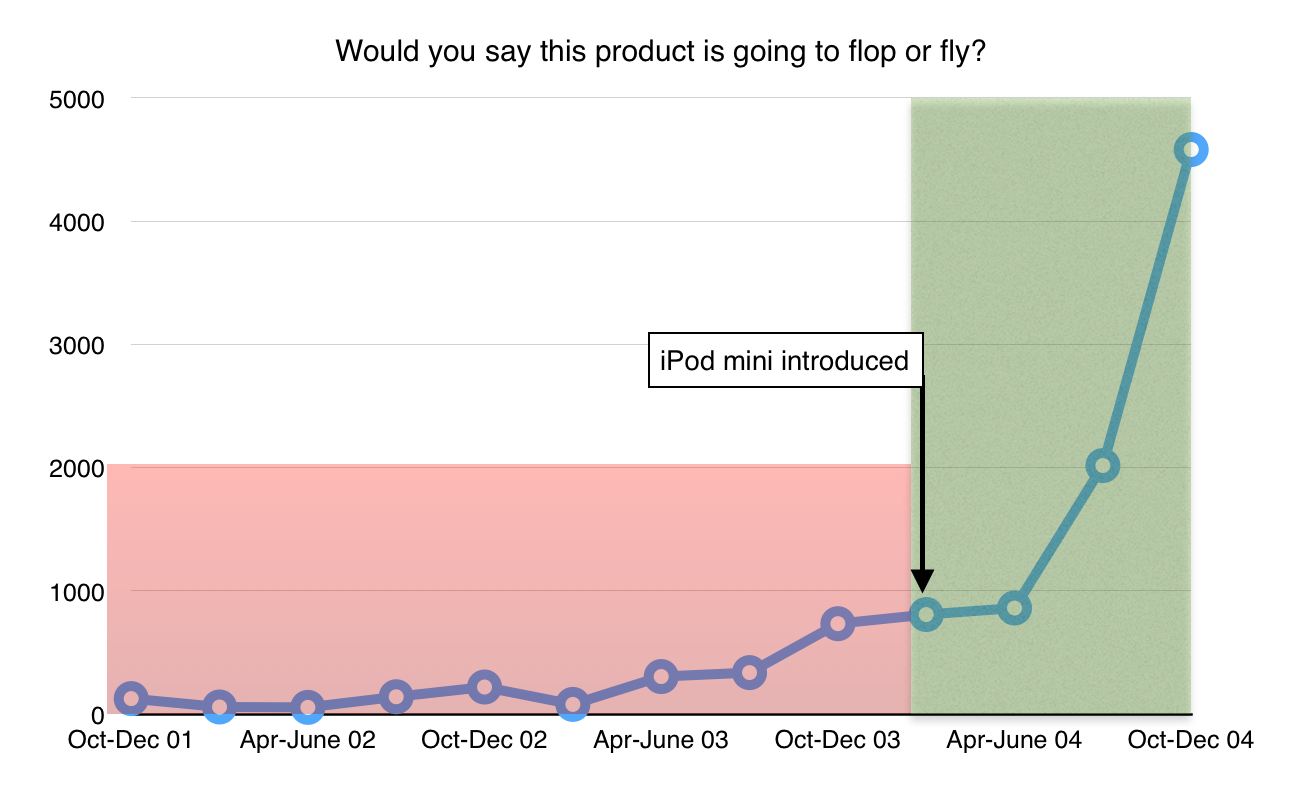
iPod sales over first 13 quarters

That looks healthier.

Clearly, people like lighter and smaller – a trend that Apple has been happy to fulfil with its phones. I can’t see it not doing exactly the same with its Watches as time progresses. Will they be as useful?

Put it this way: do you really think that the smartphone is the endpoint of communications development? Do you think that communication cannot get any more personal? Smartwatches are already showing us that actually, you can do more, and do it even more personally. (Samsung’s out in the lead by adding 3G capability to its models; again, do you think smartwatches will never want that?)

U say UX, I say choices

What about the fact that the Apple Watch is sort of squarish, while Motorola and most recently Samsung have gone for a round face? (Samsung has a particularly nifty UI involving turning the top of the face to scroll through options.)

Obviously this is a choice. A round face is ideally optimised for showing the sweep of hands, and also for turning things. It’s not so good, though, for displaying text. You either have to squash it in, or justify like mad, or reduce the text font size. None is optimal for text display.
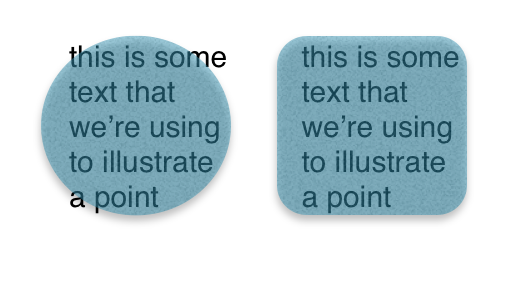
Round v oblong for showing text

Your round watch face isn’t so good at showing text.

I find the Watch’s text size is just big enough to read without the glasses I need to read my phone. There’s probably a font legibility element in there too – San Francisco, the font on the Watch, is slightly different from that on the iPhone.

Flop, fly, forecast

It’s easy to declare that peoples’ inability to grok what a smartwatch really is about means that the category is a flop, and won’t be useful. I think we’re instead going to see a parallel development: the technology will improve, and people will see situations where the phone just doesn’t quite do enough – but a smartwatch would. Apple’s adverts on this latter point are a slow burn; but it’s coming.

The fairest evaluation of the first-generation Apple Watch? It does much more than you might ever expect (and damn, it’s a million times more useful than my Pebble ever was), even at the cost of a couple of annoyances that mark it out as a first-generation product. Technology improves. Our need to communicate remains consistent. The intersection of usefulness and demand will come, and we’ll probably take it for granted when it does.

Start up: design for cars and Xbox 360s, the rural broadband row, is Huawei Samsung v2?, hacking OSX, and more


A magnetic wormhole! Really exists! Looks nothing like this! Photo by w4nd3rl0st on Flickr.

A selection of 9 links for you. Use them wisely. I’m charlesarthur on Twitter. Observations and links welcome.

Google self-driving cars don’t need windshield wipers » Mashable

Chris Perkins:

When asked if the car had windshield wipers, a Google employee replied, “Yes, but not on the windshield. They’re on our sensors—our car’s ‘eyes.'” Essentially, the Google car doesn’t have windshield wipers because it doesn’t need them.

Let that sink in for a second.

The ultimate goal of an autonomous car is to be, well, fully autonomous. A self-driving car wouldn’t require any human input other than specifying a destination. A self-driving car wouldn’t require any human input other than specifying a destination. To that end, Google’s self-driving prototype doesn’t have windshield wipers because humans aren’t required to see out of it.

This brave new world of “cars” truly aren’t cars as we understand them. Yes, they have four wheels and take people from point A to point B, but the similarities end there. If humans don’t need to drive these cars, a very different approach to design is allowed.

Listened to John Gruber and Ben Thompson on the Talk Show earlier. Electric cars, one pointed out, are effectively computers on wheels; you no longer need expertise in pistons and cylinder heads to make a car. That changes the landscape.
link to this extract


How the Red Ring of Death problem happened » Business Insider

Robbie Bach, formerly of Microsoft, has written a book about his time there. Ben Gilbert picks up what happened that led to a billion-dollar cost:

With the Xbox 360, Microsoft took a design-first approach. Here’s how Bach describes it:

We started with design at the front of the process, and we said, ‘This has to be designed with a designer’s sensibility.’ So the enclosure work we did was done relatively early. Not locked in stone, but we have a shell under which we want to fit. So then the engineering team goes and puts things in the shell.

More clearly: Microsoft designed the look of the Xbox 360 and then figured out how to fit the console’s guts inside, which can be risky. Though game consoles are designed to be pretty enough for a living room home theater, their design is also based on heat management. These things are basically computers. If you pack a computer in a tight box, it will eventually overheat.

Worse, it might loosen parts of the system’s internals or cause other havoc. 

Microsoft had run the console through various tests, from heat to longevity to cold to movement, and plenty of others, and the Red Ring of Death problem was apparently something they didn’t come across. It was only when consoles started coming in as returns that Microsoft began to see the scope of the issue.

“Design is how it works, not how it looks”, allegedly. Though Apple has had problems with iBooks in the past, where heat-related issues led to some failures. But not a billion dollars worth.
link to this extract


June 2015: MPs set up rural broadband all-party Parliamentary group to tackle BT » ISPreview UK

Mark Jackson:

A group of MPs, primarily from Devon and Somerset in England’s South West, have established a new All-Party Parliamentary Group that will investigate the roll-out of superfast broadband (24Mbps+) services. The group also intends to “put pressure” on BT to stop the operators alleged “delaying antics” and be more transparent with their coverage plans.

It’s understood that the group’s formation was sparked last week after 50 MPs from the South West gathered to moan about progress in the Government’s Broadband Delivery UK programme, which aims to make fixed line superfast broadband services available to 95% of the UK by 2017/18.

The new group will be chaired by Ian Liddell-Grainger MP and has support from Rebecca Pow MP and Neil Parish MP among others. Unfortunately the Government’s register of APPG’s hasn’t been updated since March 2015 (here) and as such the details are still a bit thin on the ground.

Might there be some progress now MPs are about to come back into session?
link to this extract


Why the smartwatch hype machine is running five years fast » Bloomberg Business

Amy Thomson:

Here’s why you probably want a smartwatch: You can use it to do cool stuff like open doors, pay for coffee, and start cars. Here’s why you probably won’t buy one for another five years or so: There still aren’t many doors, stores, or cars that your smartwatch will work with.

At the IFA electronics show in Berlin this week, Samsung Electronics, Lenovo Group and Huawei unveiled updated watches with upgraded features like tap-to-pay and the ability to interact with other devices ranging from your cell phone to your thermostat to your minivan.  

The stumbling block is that it will take several years before there are enough sensors in homes, businesses and vehicles to make it worth the trouble to strap on a smartwatch.

“For watches to become more popular and more mainstream, they have to deliver a number of capabilities to be relevant,” said Andy Griffiths, head of Samsung’s UK and Ireland division. “Our expected timeline is out to 2020.”

link to this extract


Magnetic wormhole created for first time » UAB Barcelona

The researchers used metamaterials and metasurfaces to build the tunnel experimentally, so that the magnetic field from a source, such as a magnet or a an electromagnet, appears at the other end of the wormhole as an isolated magnetic monopole. This result is strange enough in itself, as magnetic monopoles – magnets with only one pole, whether north or south – do not exist in nature. The overall effect is that of a magnetic field that appears to travel from one point to another through a dimension that lies outside the conventional three dimensions.

The wormhole in this experiment is a sphere made of different layers: an external layer with a ferromagnetic surface, a second inner layer, made of superconducting material, and a ferromagnetic sheet rolled into a cylinder that crosses the sphere from one end to the other. The sphere is made in such a way as to be magnetically undetectable – invisible, in magnetic field terms – from the exterior.

The magnetic wormhole is an analogy of gravitational ones, as it “changes the topology of space, as if the inner region has been magnetically erased from space”, explains Àlvar Sánchez, the lead researcher.

That last sentence has a new use of the word “explains”. Potential applications already exist for MRIs etc.
link to this extract


HTML5 deck of cards » Github

That’s it, really. Code available on Github. Neat.
link to this extract


Huawei is the new Samsung » The Verge

As in it’s a “fast follower” (read: mimic), argues Vlad Savov. But he notes that it does it more subtly than Samsung did:

When Huawei takes risks on rumored new features, as it is doing with Force Touch, it does so in a limited manner. The Force Touch version of the Mate S will only be available in certain markets — mainly the ones where you can say “Force Touch” without being immediately slapped down by Apple’s lawyers — so whatever extra cost there is to adding it in can be borne even if it doesn’t stimulate any extra sales. But then, the Mate S has already stirred up hype and discussion by following Apple’s lead so closely and obviously. Even if you never buy a Force Touch Mate S, you’re now better aware of it because of that Apple analogy.

Samsung knew this better than anyone else: biting the heels of the top dog is a great way to get noticed. And if you happen to have a well-priced, technically appealing product, you can convert that hype into sales. Huawei has been chasing the hype with unquenchable thirst, and by grabbing all the best ideas it sees in the market, it’s been delivering those technically proficient devices to make it prosperous. It’s no accident that Huawei is the third-biggest smartphone vendor in the world. The Chinese company combines the best of what’s available and sells it at a lower price — which it can afford to do because it only needs to spend on engineering. The innovative ideas are already out there waiting to be plucked. It might not be fair, but it sure is effective.

link to this extract


Researchers discover new keychain vulnerability in OSX » CSO Online

Steve Ragan:

The command creates a situation where, instead of asking for a user’s Keychain password, Keychain will prompt them to click an allow button instead. The two researchers then took their theory further and developed a proof-of-concept exploit that triggers the command and simulates a user mouse click in the exact location where the allow button would appear.

This process happens in milliseconds (less than 200ms to be exact), right in front of the user, who wouldn’t notice a thing.

“The ‘allow’ button appears 10% to the right of the centre of the screen and 7% below it,” Jebara said in an email.

“We noticed that the only issue that could affect the location of this ‘allow’ button is the size of the dock, so we also issue a command that hides the dock for 500ms in order for us to successfully press the ‘allow’ button.”

After the allow button is pressed, the password is intercepted and sent via SMS to the attacker’s phone. However, SMS could be replaced by any delivery system, including exfiltration to a C&C server, or it could be stored locally for later retrieval.

This seems to use the Accessibility API – but I didn’t think that was automatically enabled on OSX. A subtle and dangerous flaw.
link to this extract


Sony – Plethora of pixels » Radio Free Mobile

Richard Windsor on Sony’s 806 pixels-per-inch Xperia Z5 Premium:

the 4K is screen is, in my opinion, fairly useless for a number of reasons.
• First. In order to see the difference between this screen and a 1080p device the user will have to hold the device between 5-8 inches from his eyes. The viewing distance of most smartphones is around 9-12 inches meaning that in most use cases, users will not be able to tell the difference.
• Second. There is no content available for it meaning that everything has to be up-scaled by a graphics processor to display correctly on the screen. Historically, the Japanese companies have been by far the best at upscaling technologies, but there is still a significant risk that most content and apps will not display optimally.
• Third. Even compressed using VP9 or H.265, 4K video takes up far more space than 1080p and requires up to 4x the bandwidth to be transmitted.

Consequently, users will be able to store less content on their devices and incur up to 4x the cost and 4x the wait to view content that in most cases will look no better than 1080p.
However, despite the practical limitations of a 4K smartphone, it is well known that pointless gimmicks sell phones.

Not so sure about that last point. This is a classic spec-war move; Sony is constrained in what it can do with software, so it has a meaningless spec. (And there’s no suggestion so far of using it in VR, unlike the Note 4, though Sony does have a VR project called Morpheus.)
link to this extract


Start up: Apple Music?!, preserving the web, watch wars, Sony’s parsimonious storage, and more

Layered Movements
Where’s the Bluetooth module? Photo by Kellar Wilson on Flickr.

A selection of 8 links for you. Not to be sold separately. I’m charlesarthur on Twitter. Observations and links welcome.

What changes at Medium and Yahoo Pipes teach us about the persistence of the web » Scripting.com

Dave Winer:

What we need, and still don’t have, is a systematic way of publishing to the future. Such a system would allow you to pay a fixed sum to keep your content at a specific address for the foreseeable future. No one can make a guarantee, we don’t know what the future holds, but every effort has to be made, upfront, to be sure that the content has the best chance to survive as long as possible. # It would be nice if a visionary entrepreneur would get involved, and an educational institution, perhaps, and/or an insurance company, the kinds of organizations our society creates to be long-lived. It would be great to get input from Stewart Brand and his colleagues at the LongNow Foundation.

Not a bad idea. But isn’t that what the Internet Archive is doing? Winer responds to that: “long-lived context is not the same thing as having a snapshot” [as the IA does].


iPad update won’t work on old devices » Business Insider

Tim Stenovec:

the bad news is that the new features may not work on your iPad, unless it’s one of the newest models. And Split View, which allows you to use two apps at the same time, and is one of the best new features, only works on the iPad Air 2, Apple’s latest iPad, which starts at $499 and was released last fall.

The cynic would say the fact that the new features, which are part of a software update coming later this year, only working on the latest and greatest iPads is a ploy to get you to upgrade your iPad. Apple has struggled with relatively sluggish iPad sales — the company still sells millions each quarter, more tablets than any other single company — but sales continue to fall…

…Of course, using two apps at the same time, or watching a video in the background while doing something else on your iPad, certainly requires more processing power than just using one app, so it may be that the features only work well enough for Apple to include it on its latest and most powerful iPad.

Yeah, but the cynic will disregard that sort of logical argument. All software can run on all hardware, regardless of age, according to the cynic.


Apple Music: a platform play with hidden nuance » Music Industry Blog

Mark Mulligan:

Apple continues to be ridiculed for its failed Ping! music social network. While it was no killer app it nonetheless represented an attempt to turn iTunes into a music platform. Now that same strategy has been rekindled with the launch of Artist Connect. This is Apple’s attempt to turn itself into an artist-fan engagement platform. Artist-fan engagement is the gold dust of the digital era music business. It’s the scarce, invaluable commodity that music fans crave in a post-scarcity music world…

…while DIY sites of various guises are niche, Apple presents the opportunity to reach more than a hundred million of the world’s most valuable (i.e. highest spending) music fans. Sure some of them now pay for Spotify but they’re still iTunes users also. If Apple’s featureset for artist is strong enough, expect strong uptake, especially from the bigger labels and artists.


Chart: Apple Music vs. Spotify, Pandora, Rhapsody and the rest of the streaming competition » GeekWire

Todd Bishop and James Risley:

Apple unveiled its new $9.99/month streaming music service this morning, staking its claim in a market with a large number of existing competitors. Established players include radio services like Pandora, freemium services like Spotify, and industry veterans like Seattle-based Rhapsody. This chart, created by GeekWire, shows how Apple compares to many of these existing services.

The missing element: how many devices is each one effectively preinstalled on? Yeah, Apple Music gets an advantage there. (I admit that I was surprised by the introduction on Android. But it makes perfect sense.)


Apple previews new Apple Watch software » Apple

Coming in autumn (when the new phones come out, one assumes):

Additional watchOS 2 features include: • Nightstand Mode that transforms Apple Watch into a bedside alarm clock, with the Digital Crown and side button serving as snooze and off buttons for the alarm;
• the ability to use merchant rewards and store-issued credit and debit cards with Apple Pay™, which can be added to Wallet;
• support for Transit in Maps*, so you can view detailed transportation maps and schedules, including walking directions to the nearest stations with entrances and exits precisely mapped;
• workouts from third-party fitness apps contributing to your all-day Move and Exercise goals;
• using Siri® to start specific workouts, launch Glances and reply to email; and
• Activation Lock, which lets users secure their Apple Watch with their Apple ID, preventing another user from wiping or activating the device if it is lost or stolen.

That last touch is neat – you remember the discovery of how easily the Watch could be stolen and wiped. Now it has something that sets it apart from any Rolex or other expensive watch (well, apart maybe from an engraved one): stealing it becomes pointless. Lots of stuff that feels as though it just didn’t make the cut for version 1.


Can the Swiss watchmaker survive the digital age? » NYTimes.com

Clive Thompson:

[Frederique Constant watch designer Pim] Koeslag faced a significant problem, though: He had never worked with chips and sensors before. He didn’t even own a soldering iron. Swiss watchmakers don’t need them; their devices are put together with screws and screwdrivers. He led me to a large microscope and placed one of the chip sets under it. When the image appeared on a large computer screen, he zoomed in on the Bluetooth antenna, which looked like a dark, square block. Getting that into the right spot caused him a great deal of trouble, he said. “Under the microscope, we actually welded it on, by hand,” he said.

Well, I guess that answers the question in the headline. Turns out the Swiss watch industry is terrified of the smartwatch’s effect on the $1,200 price segment on their watches which have an accuracy of around 2 seconds per day. Per day?!


Freemium is hard » Marco.org

Marco Arment on how Shuveb Hussain saw app purchases plummet when he went ot freemium:

Freemium is hard. Its effectiveness depends on where you can put that purchase barrier in your app. Many app types simply don’t have a good place for it. In this case, Shuveb faces the fatal combination of two major problems: • His app is a lightly used utility, but he only stands to make money from heavy use. His free tier is good enough for most users.
• His purchase barrier — more than one article per day — discourages more frequent use, which hinders habit-building. When faced with a paywall, most people will try to avoid it unless there’s a compelling reason to pay. The few customers who hit Comfy Read’s paywall probably just think, “I guess I won’t send this article to my Kindle,” or “I guess I’ll use another app for this.” Users aren’t given the chance to let the app become a crucial part of their workflow or build any loyalty toward it, which would make them more willing to pay, before hitting a paywall.


Sony cripples the ‘8GB’ Xperia M4 Aqua » Xperia Blog

We have the European E2303 retail model of the Xperia M4 Aqua, which is SIM free so should have less bloatware than carrier versions. It is running firmware build 26.1.A.1.100 and the screenshots you see below are straight out of the box without installing any new apps. You can see that out of 8GB of storage, 4GB is taken up by Android 5.0 and just over 2GB of pre-installed apps. For our model, this leaves a paltry 1.26GB for our own apps, media, photos and videos. No problem, you might say – just delete some unwanted apps. However, most of the apps are baked in and cannot be uninstalled.

Largest one: Facebook (why?), followed by Google Play Services (124MB) and Android System WebView (120MB) and Google+ (110MB). There’s also Chrome in the list. You can use an SD card, but that’s not ideal. Sony also claims – apparently wrongly – that there’s 3GB of free space. (For comparison, the 8GB iPhone 5C has 4.9GB free for users.)


Start up: Apple Watch v Android Wear, the old smartphone buyers, Google halts Mapmaker (finally), and more


Seems to be free of intentional errors so far. Photo by scarlettfawth on Flickr.

A selection of 9 links for you. Slather them over your body like peppercorn sauce. I’m charlesarthur on Twitter. Observations and links welcome.

Philly.com got 555 comments on an article about changes to comments » Poynter

Kirsten Hare: You’re making an effort to keep comments in a time when many sites have scrapped them. Why is that?

Erica Palan: There are definitely folks in our newsrooms — and in the industry overall — who would be happy to see comments go away. But our digital leadership team is committing to keeping comments. Commenters are some of our most dedicated readers. They come back again and again to our stories. Also, the Internet is a big, chatty place. If we don’t give our readers the opportunity to talk about the news, they’ll go elsewhere.

KH: There were 545 comments with this piece! Is that normal?

EP: Ha, not at all! Some of our stories will generate a ton of comments, but 545 is a lot no matter what barometer we’re using. I was really nervous it’d be crickets for awhile, because it was a few hours before it took off! (How embarrassing to write an article about comments and then receive no comments?) To me, it showed that our commenters really do care about being a part of Philly.com.

KH: I noticed you moderated them. Any advice for other journalists or news outlets?

EP: At Philly.com we’ve been really inspired by the work being done by the Engaging News Project. They put out a study that showed that having writers moderate and comment on their own stories improved the tenor of comments overall. A handful of reporters for the Inquirer and Daily News have started to do this and anecdotally, we feel it’s been pretty successful.

I reckon different dynamics apply: that the people with the most useful insights reserve those for places where they’ll be most valuable, which isn’t necessarily comment sections. “Commenters are some of our most dedicated readers” is true, but that doesn’t necessarily mean they’re the ones who attract other readers. (Also, having writers moderate comments on their own stories probably isn’t smart – nor a great use of their time. I didn’t moderate comments at The Guardian; no writer did.)


US smartphone sales among consumers earning less than $30,000 grow more than 50% » NPD Group

As US mobile phones sales transition to predominately smartphones, buyers have become significantly older and less affluent. For the third consecutive three-month period ending February 2015, sales among consumers earning less than $30K per year grew by more than 50%. This demographic is now the largest segment of the smartphones market, accounting for 28% of all sales. In contrast, sales among consumers earning more than $100K a year increased by just 24%. For the three months ending February 2015, buyers aged 55+ also represented 28% of all sales, up 24% from a year ago, and were the fastest growing age segment of the population.

Over the three month period ending in February, overall sales of mobile phones rose 28% compared to last year, while smartphone sales increased 35%. During the same three-month period, the share of sales for non-smartphones declined to just 14%…

…Apple and Samsung accounted for two out of every three smartphones sold over the three month period, although Apple sales increased by 45% and Samsung’s just 10%.

And here’s a brand breakdown:

NPD seems to think it’s the oldies buying the new models. So, old geezers are going to rule the mobile biz?


What to Wear? » Rusty Rants

Russell Ivanovic, of Shifty Jelly, in a comparison that I’ve been wanting to read since the Apple Watch came out:

One of the benefits of being curious about technology and running a company where we get to buy it to test on, is that I get to play with a lot of cool gadgets. When it comes to watches alone I have the Apple Watch, LG G, LG Watch R, Moto 360, Samsung Galaxy Gear and the Sony Smartwatch 3. I thought it might be interesting to compare Android Wear and Apple Watch as they are today.

The must-read for today, if only to keep up with how the two platforms are evolving. I think he’s spot-on with each prediction, too.


Baidu leads in artificial intelligence benchmark » WSJ Digits blog

Robert McMillan:

The company’s Minwa supercomputer scanned ImageNet, a database of just over one million pictures, and taught itself how to sort them into a predefined set of roughly 1,000 different categories. This meant learning the difference between a French loaf and a meatloaf, but also trickier challenges such as distinguishing a Lakeland terrier from a wire-haired fox terrier.

Five years ago, the possibility that computers would surpass humans at this work appeared remote. But computers run by Microsoft, Google, and now Baidu have all done better than the best human results in the past few months.

With practice, humans correctly identify all but about 5% of the ImageNet photos. Microsoft’s software had a 4.94% error rate; Google achieved 4.8%. Baidu said that it had reduced the error rate further to 4.58%.

The so-called deep learning algorithms that Baidu and others are using to ace these tests have only recently made the leap from academia to Silicon Valley. But they’re starting to have an impact in daily life.

Unfortunately the broader “impact in daily life” isn’t specified. Google used it for voice recognition in Android, but that’s not quite “daily life”.

Also notable: Chinese companies starting to challenge western ones in this field.


After several public Google Maps hacks, Google forced to suspend Map Maker to prevent more fake edits » SearchEngineLand

Barry Schwartz:

Google has temporarily suspended Google Map Maker, a service to allow the community to make edits to Google Maps similar to how Wikipedia edits work. The reason the service was suspended was because of the recent public edits made to show how easy it is to make fraudulent edits to businesses.

We covered the loopholes that showed how Edward Snowden was at the White House and how Android relieved itself on Apple. But these hacks and fraudulent edits have been going on for a long long time.

Indeed – recall locksmiths and the US Secret Service and the restaurant a rival said was closed at weekends. The problem with the “peeing Android” edit was that it was multi-stage, by a “trusted” editor. This isn’t going to be solved easily.


High profile tech start-up Ninja Blocks goes bust » The Age

Rose Powell:

Ninja Blocks built and sold home automation systems that allowed users to control electrical devices through their smart phone. It managed both the software and also manufactured a range of sleek hardware products.

The company was launched three years ago and sustained its growth through sales and a series of successful crowdfunding campaigns: $103,000 in 2012 and $703,000 in 2013. Both brought in double or triple their original goal. It also raised $2.4m in three funding rounds, which included leading Australian tech investors Square Peg Capital, Blackbird Ventures, Atlassian founders Mike Cannon-Brookes and Scott Farquhar as well as Sing Tel’s Innov8.

Crowdfunding campaigns require significant, ongoing public communication. The company went quiet in April as their latest product, the Ninja Sphere, ran over time and over-budget.

In a blog post, the team wrote the fact it was receiving “far below what they would expect to get somewhere else” their burn rate could not be sustained.

Unclear if the dollar amounts are Australian or US, but shows that hardware remains a tough business in which to succeed. (Side note: Powell’s byline describes her as “journalist”. Helpful.)


Hard numbers for public posting activity on Google Plus » Stone Temple Consulting

Eric Enge dives very deep into numbers that many have tried to dive deep into many times before:

Our extrapolated total suggests that about 23.4 million people have put public posts on Google+ within a given 30 day period. There is a hyperactive group of 358K+ people who do 50 or more public posts per month. After adjustments, we see these two numbers drop to 16M and 106K respectively.

These numbers should give you a good sense of what’s really going on in the G+ stream at this point.

Note that we also found that a small percentage (0.16%) of the total profiles examined currently return 404 errors (which means that the page does not exist), suggesting that the accounts have been abandoned or shut down.

The invalid profiles may include profiles that were robotically created in attempts to artificially game Google+. Those of you who are active on G+ are familiar with your follower count dropping at those times when Google clears a bunch of these out.

Isn’t going away, though, for reasons Enge then goes on to explain.


Four reasons why the Apple Watch will be a success » GlobalWebIndex

Jason Mander:

while the smart(est) money will probably wait for v2 of the Apple Watch to become available – the one where all of the initial annoyances and shortcomings have been addressed – there can be no doubt that, Apple’s first foray into this sector will finally push it into the mainstream. Quite simply, it’s inevitable that this watch will be a success – and here are four reasons why.

GWI provides wide-scale demographic information about web users worldwide. Of particular interest: it finds that those who have already bought a wearable are the most interested in using an Apple device, as here:

(Makes a change from all the “why Apple’s Watch will flop” pieces, anyhow.)


Regulator probes pitfalls of ‘sharing economy’ » FT.com

Barney Jopson and Tim Bradshaw on the US FTC’s plan to look into a number of companies:

In the US, the past actions of the FTC — which enforces federal antitrust and consumer protection laws — indicate that it sees ride-hailing apps such as Uber, Lyft and Sidecar as a positive force for competition
It has written to state and city legislators urging them not to pass laws that would put them at a disadvantage to traditional taxis.
But the agency wants to probe two practices that are central to peer-to-peer platforms — the accumulation of personal data and the use of rating systems — as well as questions over legal liability for injuries.
“We want to see to what extent sharing economy platforms should be able to monitor participants by collecting, let’s say, location data,” said Ms Lao. “And if they do monitor, how can they do so while adequately protecting the privacy of the participants?”


Start up: how Brin/Page handle email, smartwatch disruption and use, from $500k to zero on Kickstarter, and more


The Google founders’ approach to triaging email. Photo by M@XONGS on Flickr.

A selection of 8 links for you. May contain the word “smartwatch”. I’m charlesarthur on Twitter. Observations and links welcome.

Use cases for smart watches » Action at a Distance

Richard Gaywood:

I have been using an Android Wear smartwatch for the last three months, exploring different software options and possibilities. What follows is a list of the roles I have found it playing in my life — my use cases, in software engineer jargon. I’m not going to pretend this isn’t a very personal list; perhaps none of these things appeal to you, would be a reason for you to desire a smartwatch. But then again, there are surely more use cases I don’t care about or haven’t found that you do. This is by no means an exhaustive list.

However, note that there are a couple of well-discussed banner features people associate with smartwatches that I’m going to skip over purely because they have already been thoroughly discussed elsewhere: fitness (not only through step counters and heart rate tracking, but also utilities like interval trainers and performance recording like Strava and Runkeeper) and notification triage. What I’m trying to do with this post is point out some less commonly thought of use cases than these.

Good to hear from someone who has actually been using this for longer than a few minutes.


David Shin’s answer to ‘How do Bill Gates, Larry Page, Mark Zuckerberg and Jack Dorsey manage their email?’ » Quora

Shin’s response:

When I worked at Google in 2006/2007, Larry and Sergey held a Q&A session, and this exact question was asked of them. One of them answered (I don’t remember which) with the following humorous response (paraphrased):

“When I open up my email, I start at the top and work my way down, and go as far as I feel like. Anything I don’t get to will never be read. Some people end up amazed that they get an email response from a founder of Google in just 5 minutes. Others simply get what they expected (no reply).”

Seems pretty sensible to me. That’s roughly how I work. Which is why I haven’t responded to your email, and probably never will.


Syncthing

Interesting product which

replaces proprietary sync and cloud services with something open, trustworthy and decentralized. Your data is your data alone and you deserve to choose where it is stored, if it is shared with some third party and how it’s transmitted over the Internet.

Selling points (if you can have that on something that’s free):

• Private. None of your data is ever stored anywhere else than on your computers. There is no central server that might be compromised, legally or illegally.
• Encrypted. All communication is secured using TLS. The encryption used includes perfect forward secrecy to prevent any eavesdropper from ever gaining access to your data.
• Authenticated. Every node is identified by a strong cryptographic certificate. Only nodes you have explicitly allowed can connect to your cluster.


Apple Watch isn’t good enough (that’s great news), and overlooked jobs » Valuing Disruption

Bill Esbenshade looks at Apple’s Watch as a low-end disruptor:

A lot of people are looking at the Watch and saying “it’s not good enough” because of a range of issues related to functionality/reliability: battery life too short, watch too thick or clunky looking, too tethered to the iPhone, not enough health sensors, etc.

The irony is that these shortcomings should be good news for the Watch’s future. That’s because under disruption theory, when a product isn’t good enough on a range of performance dimensions, then the vendor has lots of things to improve — through new product versions — before the product starts overserving. See Concepts page and discussion of Clayton Christensen. This means there’s lots of room for Apple — as an integrated manufacturer — to making sustaining leaps ahead of more modular smartwatch competitors relying on Android. See post titled Apple’s Long Term Advantages. Apple has plenty of room to improve the user experience and move up the improvement trajectory without overserving.

(Esbenshade owns Apple stock.) My own query is – shouldn’t this sort of disruption be coming in from the high end or the low end? The Watch seems to approach from somewhere around the middle.


No, the CIA isn’t stealing Apple’s secrets » Errata Security

Robert Graham on The Intercept’s story on the matter:

The Intercept doesn’t quote people who actually know what they are talking about. As I repeat over and over, for every Snowden document, there’s some expert who has presented on that topic at BlackHat, DefCon, or similar hacking/cybersec conference. There’s no excuse for writing a story on these topics and quoting only activists like Soghoian rather than technical experts from these conferences. For example, a quick search of “BlackHat reverse engineering chips” quickly lead to this presentation.

I point this out because another subject of that Intercept article was about trojaning XCode, the Apple development tool used to compile iOS apps. A quick search would have come up with a BlackHat presentation by Errata Security’s own David Maynor where he trojaned Microsoft’s compiler, GCC, and a lesser known compiler called LCC. There’s no excuse for writing this story without reaching out to Maynor, or even Ken Thompson, the co-creator of C/Unix who inspired compiler-trojaning.

Again with compilers, there’s context that is carefully hidden by the Intercept story.

Complex topic, though, which has got everyone looking over their shoulders, and quizzically at their compiler errors, saying “But is it a REAL error, or..?”


How a half-million dollar Kickstarter project can crash and burn » Medium

Haje Jan Kamps has the scars to prove it:

the legal costs were only step one of the battle. The electronics and software design for Triggertrap Ada ended up costing vastly more than we had originally budgeted, in part because it turned out that we couldn’t use the microprocessor we wanted to (the electronics agency claimed that the original microprocessor didn’t have enough memory), and had to do several more design iterations than we had anticipated. Compared to our original project budget, we spent 9.4x more on this phase than we planned to.

In part because of the additional design iterations, we ended up having to spend two and a half times what we had budgeted on our prototyping costs — high-quality 3D printing and subsequent hand-finishing of prototype plastics is hideously expensive — and our industrial and plastics design went significantly over budget.

(Via Matt Baxter-Reynolds.)


Quick take on disruptive potential of smartwatches » Naofumi Kagami

Kagami is a student of disruption theory and practice, and has an interesting take: that it’s the existing watch brands that will thrive in the newly created smartwatch space:

Without going into detail, this is what I expect the smartwatch landscape to look like after the dust has settled;

• Apple will be the undisputed number 1. They will aggressively innovate on the Apple Watch, even to the extent that it cannibalises the iPhone. The Apple Watch will gradually become more and more independent of the iPhone.

• The current Android smartphone OEMs will initially play in the smartwatch market, but they will fail to make profits due to their lack of brand power. Eventually most will retreat from the smartwatch market and focus on making big and powerful smartphones. The few that remain will only get the scraps from the very low-end of the market. The exception might be Samsung. If their Tizen operating system enables them to innovate faster than Android Wear, there is the possibility that Samsung will be able to profit from smartwatches (due to the lock-in they get).

• Current watchmakers will be the major Android Wear players in the smartwatch space, especially in profits. The electronics will be provided by the Shenzhen ecosystem or a chipset provider (maybe Intel). Depending on how well Google can monetise from Android Wear, we might see some rapid innovation.

But read all of it for what that then implies for those smartphone OEMs…


Microsoft has its ‘groove back,’ say some CIOs » WSJ

Clint Boulton:

Michael Sajor, CIO of Apollo Education Group, stopped meeting with Microsoft sales executives a few years ago because they tried to sell him software without bothering to learn about it would help him run his business. “They were, all-around, just a pretty ugly company to deal with,” Mr. Sajor said.

But Mr. Sajor said the company is showing “signs of life” improving its focus under Mr. Nadella. Now Microsoft representatives ask how they can better support the 250,000 University of Phoenix students for whom Mr. Sajor provides technology. Two months ago, Apollo converted from the on-premises Office software to Microsoft’s Office 365 productivity software, which includes the version of Office for iPad. He said the company still has some work to do to solidify customers’ trust in the company, but he’s optimistic in his experience with the company under Mr. Nadella. “If they stay on track, they’ll win our hearts and minds like other companies have done by becoming real partners,” Mr. Sajor said.

Mobile-first, cloud-first. Nadella is a smart strategist.


Start up: harassment claims against Google, android dog funerals, self-destructing handset makers? and more


A Dropcam watches the snow fall, pretending to ignore you. Photo by Scott Beale on Flickr.

A selection of 10 links for you. Contains minimal Watch content. I’m charlesarthur on Twitter. Observations and links welcome.

Dropcam’s slow slide into Nest — and therefore Google — begins » PandoDaily

Nathaniel Mott:

Dropcam users are being asked to create Nest accounts — regardless of whether or not they own a Nest product — so they can use “new features and improvements” to their cameras.

The Verge reports that the new accounts will be used to support some of the integrations Nest promised when it acquired Dropcam for around $555 million in cash June 2014. It will also ensure that Dropcam customers have agreed to Nest’s updated terms of service.

Anyone who wasn’t worried before about Google acquiring these companies (it acquired Nest in January 2014; Nest then acquired Dropcam in June) before should be worried now.

But of course, you’ve already got a Dropcam (which looks pretty useful). So setting up an account, well..


Google hit with sexual harassment complaint from ex-employee » Betanews

Mark Wilson on Kelly Ellis’s allegations – which are serious, and go up as far as behaviour by Vic Gundotra – made over the weekend:

Google would much prefer to be seen encouraging women into technology but Ellis – who worked on the Google+ team – dismisses this as nothing more than “PR bullshit”. She also says that she was let down by co-workers who failed to back her up.

Ellis spent a good deal of time on Saturday tweeting a series of snippets about her time at Google where she worked from 2010 to 2014. The tweets started with a very blunt statement: “At Google I was sexually harassed by someone who was later promoted to director”. Dozens of tweets then followed giving more details about what had happened.

Now working as a software engineer at Medium, Ellis says that the harassment was the main reason she left the company back in July. She says “I don’t care if people believe me or not”, but, we have to refer to what she says as allegations. She says that Roderick Chavez, another Google engineer, harassed her:

Google hasn’t responded to the allegations at the time of this being collated.


The privacy and security questions we must ask about the Apple Watch » Fusion

Kashmir Hill:

Apple wants to be your iDoctor. Even if its devices aren’t actually FDA-approved, the apps it makes available that could offer up diagnoses and treatment will be.

Now that our iDevices are going to be collecting even more information from us, what privacy and security concerns do we need to be freaking out about?

“Freaking out about”? Asking about, perhaps. It seems there’s nothing to freak out about.


Imaginary ISIS attack on Louisiana and the twitterbots who loved it » Boing Boing

Cory Doctorow:

On September 11, 2014, [Gilad] Lotan, a data scientist, started researching a massive, coordinated, and failed hoax to create panic over an imaginary ISIS attack on a chemical plant in Centerville, Louisiana. The hoax included Twitter, Facebook and Wikipedia identities (some apparently human piloted, others clearly automated) that had painstakingly established themselves over more than a month. Also included: fake news stories, an imaginary media outlet called “Louisiana News,” and some fascinating hashtag trickery whereby a generic hashtag was built up in Russian Twitter by one set of bots, then, once trending, was handed over to a different set of English-language bots that used it to promote the hoax.

More interesting is the fact that the hoax failed. Lotan shows that Facebook’s Edgerank proved to be resistant to gaming using the process employed by the hoax’s creator(s); that Twitter clusters can be trumped by real news sources; and that Wikipedia’s vigilance was adequate to catching fakesters who create hoax pages.

One feels it’s important to add the proviso: “this time”. There’s more from John Borthwick on Medium. And speaking of Twitter bots…


This is what a graph of 8,000 fake Twitter accounts looks like » Terence Eden’s Blog

Like this:

Eden spent a weekend digging into the nests of fake accounts:

There appears to be several “loops” – that is bots which are in an almost closed network with each other. I see at least half a dozen circles – the rest appear to be following other fake accounts at random.

The centre of those circles appear to be real people. I can’t say why they have lots of fake followers – it’s possible that they – or someone else – has just bought them to make it look like they’re more popular than they really are. There’s no suggestion that they control the fake accounts.

One of the central nodes has 650,000 followers. It’s not possible to know quite how many of those are fake – I’m guessing the majority are.

It seems that there’s a nasty nest of these bots. In the last few weeks I’ve reported a dozen or so for spam – but with literately tens of thousands in the network it’s impossible for any individual to make a meaningful impact.


Avoidable Contact: the watery Big Bang, the 32-step power steering fluid check, disposable faux-ury » The Truth About Cars

Jack Baruth starts with racing cars, then veers into watches…

Hublot and other watchmakers are busy CAD-creating their own “manufacture movements” to replace the generic ETA/Sellita/Valjoux movements found in their products. In this, the Cretaceous period of watch enthusiasm, the ability to engineer and manufacture one’s own mechanical watch movement is essential for “credibility”. Not that the genuine prestige watchmakers all used their own movements anyways, but there’s a certain amount of Cadillac-at-the-Nurburgring idiocy going on: Rolex makes their own movements, and they are a respected brand, so we need to have our own movements as well, even more complicated and feature-packed, and then we will be more respected than Rolex.

There’s just one little problem with that strategy. The proliferation of quick-bake “manufacture” movements is creating an entire generation of hugely expensive, amazingly complicated, completely “bespoke” watches which will be impossible to fix.

…and then he comes out the other side and goes into Porsches, and 993s v Boxsters, but it’s really about durability and inheritability. Very appropriate in light of you-know-what.


Chart: Samsung leads the smartwatch market » Statista

Who are the main players in the smartwatch market? Like the smartphone market, Samsung is going to be Apple’s main competitor. The South Korean technology behemoth sold approximately 1.2 million units in 2014, ahead of second placed Pebble with 700,000. The top three was rounded off by Fitbit who sold 600,000 smartwatches.

Fitbit does a smartwatch? Also, Motorola seems to have been subsumed into Lenovo, so that the Moto 360 looks like it did 500,000 units.

My one problem with these numbers is that they don’t fit with the number of Android Wear devices sold and activated, which we know is 720,000 (give or take a few).


The global handset industry is set for self-destruct » Digits To Dollars

Jay Goldberg isn’t happy:

Let’s say you make a product, and you have a lot of competitors, dozens, hundreds. Prices are falling. More people are piling into the market. Now it is time for you to design a new product. Do you experiment with a radically new form factor? Let a single designer attempt to craft a finely honed product that stands out for its quality? Or do you come out with a product that is just a modest upgrade of last year’s product, with no distinguishing design or features?

Well, when you put it like that…..

Really, I am kinda dumbfounded. That handset OEMs seem to be on a path of self-destruction. I visited every major OEM’s booth and dozens of smaller vendors. I am sure I missed one or two interesting devices with some novel feature, but at some point, I can only stare at identical black, plastic slabs for so long. There is nothing new or differentiated out there, and this cannot last.

I have to admit, at one point, I almost lost my temper. A couple times actually. The industry seems to be in some very complicated form of denial. And there seem to be a couple common threads to their excuses.

His idea of a QWERTY Android phone to sweep up the disenfranchised BlackBerry users is one that keeps being put forward, but nobody is brave enough to do. Point is it would have to be enormously tall, and what happens when you turn the phone sideways? Should it be a slide-phone like the G1?


If an algorithm wrote this, how would you even know? » NYTimes.com

Shelley Podolny (well, perhaps):

The multitude of digital avenues now available to us demand content with an appetite that human effort can no longer satisfy. This demand, paired with ever more sophisticated technology, is spawning an industry of “automated narrative generation.”

Companies in this business aim to relieve humans from the burden of the writing process by using algorithms and natural language generators to create written content. Feed their platforms some data — financial earnings statistics, let’s say — and poof! In seconds, out comes a narrative that tells whatever story needs to be told.

These robo-writers don’t just regurgitate data, either; they create human-sounding stories in whatever voice — from staid to sassy — befits the intended audience. Or different audiences. They’re that smart. And when you read the output, you’d never guess the writer doesn’t have a heartbeat.

Consider the opening sentences of these two sports pieces:

“Things looked bleak for the Angels when they trailed by two runs in the ninth inning, but Los Angeles recovered thanks to a key single from Vladimir Guerrero to pull out a 7-6 victory over the Boston Red Sox at Fenway Park on Sunday.”

“The University of Michigan baseball team used a four-run fifth inning to salvage the final game in its three-game weekend series with Iowa, winning 7-5 on Saturday afternoon (April 24) at the Wilpon Baseball Complex, home of historic Ray Fisher Stadium.”

If you can’t tell which was written by a human, you’re not alone.

Cue observation about how many US news reports have read like they’re written by machines for years anyway.


Japan’s robot dogs get funerals as Sony looks away » Newsweek

Lauren Walker:

“I can’t imagine how quiet our living room would have been if Ai-chan wasn’t here,” Sumie Maekawa, a longtime Aibo owner, told The Wall Street Journal, using an honorific suffix applied to girls’ names.

Tatsuo Matsui, who owns two digital dogs with his wife, added, “I can’t risk my precious dogs because they are important members of our family.”

Despite the loyal fanbase, Sony decided to discontinue the bot in 2006, after selling around 150,000 units.

“Our core businesses are electronics, games and entertainment, but the focus is going to be on profitability and strategic growth,” a Sony spokeswoman said at the time. “In light of that, we’ve decided to cancel the Aibo line.”

For years following the announcement, Sony would repair Aibos that experienced technical difficulties. But in July 2014, those repairs stopped and owners were left to look elsewhere for help.

Do androids dream of electric dog funerals?


Start up: Microsoft apps on Galaxy S6?, ransomware’s reward, the absent smartwatches, and more


A boy with measles in 1974; forty years later it’s avoidable, but some aren’t taking the right action. Photo by pni on Flickr.

A selection of 7 links for you. Edible up to three days after opening. I’m charlesarthur on Twitter. Observations and links welcome.

There is no smartwatch market » Tech-Thoughts

Sameer Singh:

It is clear to me that smartwatch technology has improved significantly over the past year. But the fact that this has had no impact on consumer adoption should be worrying. It is becoming increasingly clear that the use cases targeted by smartwatches (at least today) are primarily valued by a niche segment of technology enthusiasts. The list of questions about wearables, seems to be getting longer, but we are no closer to finding answers.

Also worth reading: Jan Dawson’s study from August 2014 on what people wanted (and didn’t) from wearables, including smartwatches; and his take on the experience of using Android Wear. And don’t forget my analysis of precisely how many Android Wear devices have been activated – though that’s not the same as “active”.


Apple’s inability to monitor standards lets Pegatron pay low wages, NGO says » Reuters

Michael Gold:

A labor rights group said Apple Inc is unable to effectively monitor standards along some of its supply chain, allowing companies such as Taiwanese assembler Pegatron Corp to keep base wages below local living expenses.

Low costs helped Pegatron win business from Apple, who moved some orders from Foxconn after an increase in labor costs aimed at addressing a spate of worker suicides in 2010, China Labor Watch (CLW) said in a report released on Thursday.

CLW, which based its findings on 96 pay stubs submitted by an unknown number of employees, said low pay compels workers to put in more hours. Its report came on the same day Apple published its 2015 Supplier Responsibility Progress Report, which showed a decline in compliance related to working hours.

“Apple constantly claims that it is monitoring suppliers’ compliance with Apple labor standards,” New York-based CLW said. “Apple consistently suppresses labor costs by shifting production to the cheapest manufacturer.”


Fitbit advises rash sufferers to take a break from wearable » Re/code

Lauren Goode:

“We continue to be aware of a very limited percentage of users reporting skin irritation among our users,” a Fitbit spokeswoman said in a statement to Re/code, adding that the skin reactions are not uncommon with jewellery or other wearable devices that are pressed against the skin for long periods of time.

“According to our consulting dermatologists, they are likely from wearing the band too tight; sweat, water, or soap being held against the skin under the device; or from pressure or friction against the skin.” The irritation “should resolve quickly when users take a break from the device, usually within hours or days.”

A fitness tracker that you can’t wear to track your fitness? Seems like a problem.


CTB Locker AMA : Malware » Reddit

hello. I use CTB locker and im bored now so i decided to make this ama [Ask Me Anything]. In case you didn’t know CTB locker is a form of ransomware, probably the 2nd most wide spread after cryptowall.

Assuming this person is truthful, they claim that the percentage of affected users in “tier 1” countries who pay is 5-7%, and “0.5% on crap like India… the poorer the country the lower the rate”. Quite big income (which he then launders) but also some sizeable expenses – $2k-$10k on supporting technologies.


The sickeningly low vaccination rates at Silicon Valley day cares » WIRED

Joanna Pearlstein:

The scientists, technologists, and engineers who populate Silicon Valley and the California Bay Area deserve their reputation as innovators, building entire new economies on the strength of brains and imagination. But some of these people don’t seem to be vaccinating their children.

A WIRED investigation shows that some children attending day care facilities affiliated with prominent Silicon Valley companies have not been completely vaccinated against preventable infectious diseases.

6 of 12 had vaccination levels below the 92% needed for herd immunity. And there’s an amazing stat at one of the Google daycares – though Google says that that’s due to outdated records. Unnerving, even so.


Exclusive: Galaxy S6 software will bring some amazing changes » SamMobile

Today, we have new info on the software side of things of the Galaxy S6, thanks to one of our insiders. There are some really interesting things Samsung is doing if our info is correct, and perhaps the biggest change the S6 will bring is the removal of all pre-installed Samsung apps, or at least that’s how our insider put it.

It’s unclear just what kind of apps Samsung has removed. It’s possible that things like S Voice, S Health, S Note or Scrapbook will not be pre-loaded anymore and will instead be offered on the Galaxy Apps store. What’s interesting is that Samsung has apparently pre-installed quite a few Microsoft apps, possibly as a result of the deal the two companies made recently in relation to the patent royalty case they were embroiled in.

The Galaxy S6 will come with apps like Microsoft OneNote, OneDrive, Office Mobile (with a free Office 365 subscription), and Skype. With Windows Phone failing to make a dent on the smartphone market, Microsoft has recently shifted focus to its software services, and having them pre-installed on one of the bestselling Android smartphone lineups might just give the Redmond giant the exposure it needs to court consumers into switching from Google’s massively more popular services that come preloaded on all Android devices.

This would make sense from all parties’ point of view. Wonder what Google would make of it, though.


What are they afraid of: will Schmidt take the Fifth again in @agjimhood’s Mississippi investigation? » MUSIC • TECHNOLOGY • POLICY

Chris Castle:

During Eric Schmidt’s Senate antitrust subcommittee hearing in 2011, a strange thing happened–Eric Schmidt refused to answer under oath on the advice of counsel when Senator John Cornyn–formerly of the Texas Supreme Court–asked questions about Google’s then-recent non-prosecution agreement with the U.S. Department of Justice.  While he didn’t give the usual catechism of “taking the 5th” around the answer, he definitely refused to answer on the advice of counsel.  And when you’re testifying before the US Senate, invoking your right to refuse to answer on the advice of counsel pretty much has one meaning.

So it’s not surprising that Google is now trying to block Mississippi Attorney General Jim Hood’s investigation into the self same “plea bargain” that Google struck with the Criminal Division of the US Department of Justice for which Google paid $500,000,000.

There’s something about that agreement that Google really, really, really doesn’t want to discuss.

This is related to Google paying $500m for having advertised prescription drugs from Canada to US users, which broke the law. Now the Mississippi attorney-general is after them, and this article points out how there’s some very strange goings-on.


Start up: smartwatches are go!, tablets shrink, bitcoins all spent?, Yahoo keeps growing in search, and more


What’s Apple up to with its privacy drive? Photo by dmelchordiaz on Flickr.

A selection of 8 links for you. Use them wisely. I’m charlesarthur on Twitter. Observations and links welcome.

Pebble has now sold over 1 million smartwatches » The Verge

While Google and Apple have been getting the lion’s share of attention for smartwatches lately, indie darling Pebble has been quietly soldiering on, improving its product and selling watches. In an exclusive interview, CEO Eric Migicovsky revealed that the company shipped its one millionth Pebble on December 31st of last year. That’s more than double what Pebble reported in March, indicating that price cuts and new feature additions later in the year successfully boosted sales figures.

Pebble’s biggest and most visible competitor so far has been Google’s Android Wear, which launched in the middle of 2014 and is found on devices from Motorola, Samsung, LG, Sony, and Asus. Google has yet to reveal how many Android Wear watches have been sold in the six months or so it has been on the market, so it is difficult to determine if the platform is a success or not.

Google’s silence speaks volumes; it must know, surely? Also, how many of its employees are still wearing their LG smartwatch Christmas gift? A million is good going for Pebble. Seems like the smartwatch market will split three ways: Apple, Android, Pebble. (I have a Kickstarter Pebble, and recently rediscovered its usefulness through its step-and-sleep counting Misfit app.)


Worldwide tablet shipments experience first year-over-year decline in the fourth quarter while full year shipments show modest growth » IDC

Worldwide tablet shipments recorded a year-over-year decline for the first time since the market’s inception in 2010. Overall shipments for tablets and 2-in-1 devices reached 76.1 million in the fourth quarter of 2014 (4Q14) for -3.2% growth, according to preliminary data from the International Data Corporation (IDC) Worldwide Quarterly Tablet Tracker. Although the fourth quarter witnessed a decline in the global market, shipments for the full year 2014 increased 4.4%, totaling 229.6m units.

“The tablet market is still very top heavy in the sense that it relies mostly on Apple and Samsung to carry the market forward each year,” said Jitesh Ubrani, senior research analyst, worldwide quarterly tablet tracker.

Apple, Samsung, Asus, Amazon, all lost share and sales; only Lenovo, third-largest, grew (by 0.3m), which may have been mainly in 2-in-1s. Amazon’s dropoff is dramatic in both the Q4 and full year. But remember that tablets are principally going to consumers, have saturated their market, and have a replacement period of around four years. Compare that to PCs, which go to companies and consumers, and were at some times replaced as rapidly as every two years.


New findings suggest nearly 90% of all bitcoin holdings already spent » CoinSpeaker

Nearly 90% of those who have purchased or mined Bitcoin may have already cashed out their holdings, it emerged this weekend. Before now, it was thought that just 36% of bitcoins had currently been spent or sold, an argument often used by both advocates and their adversaries to support the fact that Bitcoin is both likely and unlikely to succeed as an asset class over the long term.

The findings were posted by Reddit user intmaxt64 and are being revealed in the Bitcoin press for the first time here at Coinspeaker…

…the findings may indicate that the Bitcoin price has suffered directly as a result of the major holders of Bitcoin liquidating their holdings while claiming the opposite. Many of the potential sellers appear to be the same individuals and organizations who got buyers to purchase during 2011-2013, since the large quantities of unit exchanges happened during this time.

Very deep implications to this, including the potential to corner the market.


Yahoo gains further US search share in January » StatCounter Global Stats

January saw Yahoo further increase the gain it made in US search share last month, according to the latest data from independent website analytics provider, StatCounter. Google fell below 75% in the US for the first time since StatCounter Global Stats began recording data [in June 2008].

StatCounter Global Stats reports that in January, Google took 74.8% of US search referrals followed by Bing on 12.4% and Yahoo on 10.9%, its highest US search share for over five years.

This is desktop-only, of course, and it’s not a giant change. But US users are surely the most valuable ones. Take Firefox out of the equation, and Google’s share remains where it was (despite Google’s attempts to win them back)

So what sort of people use Firefox and don’t change their search engine back to Google? Well, there’s Katharine Viner, editor-in-chief of the Guardian’s US operation. Did she notice the change?

https://twitter.com/KathViner/status/562213757300903936

So why’s she sticking with Yahoo?

https://twitter.com/KathViner/status/562214149329940480


How new versions of Android work » Rusty Rants

Russell Ivanovic of Shifty Jelly, which makes Android and iOS apps:

People are often quick to mis-interpret these numbers. “iOS 8 adoption is at 64%, but Android 4.4, a version that’s years old isn’t even at that!”. There’s two things wrong with these kinds of comments. Firstly there are roughly 6-8x more Android devices than iOS devices in the world, depending on which market share numbers you use. This means that if a version of Android achieves 39% adoption, that’s a huge deal, and you could develop just for that platform and address a larger user base than targeting iOS 8 with its 64%. Secondly people confuse overall numbers, with actual numbers of people who buy apps. Here for example are the version breakdowns of people who buy Pocket Casts on Android:

So while Android 5.0 has less than 1% adoption in the overall Android ecosystem, 23% of our customers already run it. This makes sense when you put a bit of thought into these numbers. People that have the money to buy apps, and are passionate about Android, have up to date phones.

I find Ivanovic a necessary counterpoint to a lot of what one reads about Android and iOS. He’s sincere, and expresses his views directly. (He’s Australian, so..) One point about Pocket Casts is that it’s a podcast player. There are paid-for podcast players on iOS (Marco Arment, obviously) but it seems to me the opportunity is much larger because there’s no OS-level podcast app on Android as there is for iOS.

That said, Ivanovic’s points are still valid. It’s install base x amount paid that really matters for developers (and, to some extent, users, as they benefit from the availability of apps, driven by the size of the ecosystem). Also, he wrote this piece before today’s data about Lollipop share – 1.6% of all Google Play installs as of 2 February.


Apple on privacy, security and identity » Benedict Evans

Evans tries to connect the dots that Apple has left around, on the basis that products it has now – such as Apple Pay – are obvious in retrospect (TouchID + Passbook). With that in mind, why Apple’s focus on “privacy”, he asks:

it may also be that as our phones go from sharing pictures to unlocking our front doors, privacy becomes a much more valuable selling point. This might be one reason why Nest is being kept semi-detached at Google. Worrying that Google knows what you search for has always seemed to me rather like worrying that your bank knows how much money you have, but Google knowing when you get out of bed or unlock your front door might be different (though of course it gets a fair bit of this through Android). So, perhaps Apple is talking about privacy not because of its current products, but because it thinks privacy will be a real competitive advantage for future ones. Not the iPhones, but the Watch, or other wearables, or the connected home. There’s an interesting question here – is the big data dividend worth the privacy implications? Is it better to let Google know when you flush the loo for what it can tell you about your bowels, or would people really rather not? 


Why I’ve found that online communities on media sites always seem doomed to fail » Martin Belam

I used to work with Martin at The Guardian (he’s now at the Daily Mirror); he’s got great insights into how communities fail or work. His key points – “The behaviour of the regular users becomes self-limiting for the community as a whole” and “The community believes they are representative of the primary audience” are, to me, the essence of the problem.

As a reminder, I did a pseudo-economic analysis of why comments on media sites just don’t work, which comes down to “the crap drive out the good”. I think that’s what Martin’s saying in his first point, only more nicely. Also, as he notes:

At the moment we don’t have comments on the Mirror site where I work, and I must confess it is a slight relief not to be immediately called a twat every time I press publish, but equally I find sites without comments don’t feel as alive. You know an article has had an impact when it has generated hundreds of comments.

I’d disagree on that latter point. You know an article has generated hundreds of comments when it generates hundreds of comments. But if you read them, you might find there’s no actual impact at all – as in, the comments haven’t added to the sum of human knowledge in the slightest.


Apple Watch sightings picking up ahead of official launch » Mac Rumors

Juli Clover:

Due to the large number of employees testing the device, Apple Watch sightings in the wild have become more common over the course of the last few weeks. On the MacRumors forums, readers are aggregating photos and stories of device sightings, giving us an in-use look at the device that will be attached to many of our wrists in just a few short months.

One of the first major Apple Watch sightings occurred several weeks ago, when Vogue Editor Suzy Menkes snapped a photo of someone wearing the device. Rumors and speculation have suggested the arm in the photo could belong to Marc Newson, the designer who now works at Apple part time alongside Jony Ive.

The forums aren’t that helpful (lots of vague discussion); James Cook at BusinessInsider has wrapped the (few) pics together.

Though the iPhone was announced before its public release, the only person I recall ever being seen in public using it ahead of that was Steve Jobs. This quiet seeding and testing is quite different.

Of course – and ponder this for a moment – everyone’s got an internet-connected camera now. Maybe there were tons more iPhones in public testing in 2007. We just didn’t hear about them.


Start up: India blocks Xiaomi, Chinese app habits, Office gets Bing, hacking smartwatches, and more


Refuelling a Toyota Prius. By the time he’s grown up, it might have paid for itself. Photo by Chris Yarzab on Flickr.

A selection of 9 links for you. Slippery when wet. I’m charlesarthur on Twitter. Observations and links welcome.

Breaking News: Delhi High Court grants injunction against Xiaomi >> Spicy IP

[On Monday] the Delhi High Court granted an ex parte injunction order against Chinese operator Xiaomi for infringement of Ericsson’s patents. The patents in question are Standards-Essential Patents (SEPs) which are subject to FRAND (Fair, Reasonable and Non-Discriminatory) terms. However, they may also be the same patents which are the subject matters of litigation Ericsson has mounted against Micromax, Gionee and Intex. As Shamnad Sir noted earlier today, while Ericsson has largely favourable orders against Micromax and Gionee, the same cannot be said for its case against Intex. Therefore, when the same patents are potentially in question under other cases as well, there was no need for the Courts to rush to grant an injunction against a new defendant, namely Xiaomi.

At this juncture, it is more interesting to note the reasons provided for granting the said injunction. One factor that the Court found persuasive was that Xiaomi had not responded to Ericsson’s repeated communications  (6 in number from July 2014). However, it must be questioned whether Xiaomi’s purported laxity in this matter is a sufficient reason to grant an injunction against them. More so, when an alternative remedy in the form of damages is available which is one of the cardinal principles that goes against the granting of injunctions.

This ex parte order injuncts Xiaomi from selling, advertising, manufacturing or importing devices that infringe the SEPs in question. The judge also directed the Customs officials to stop the imports under the IPR Rules, 2007. Moreover, local commissioners have been appointed to visit Xiaomi officers to ensure the implementation of these orders.

This is going to put a whole new complexion on Xiaomi’s expansion – and profitability – outside China, and probably means it won’t be coming to the US any time soon.


Chinese mobile app UI trends >> Dan Grover

Slightly to his surprise, San Francisco native Grover finds himself a product manager on Chinese messaging app WeChat, in Guangzhou; from the photo, it’s Shenzhen, as that’s where WeChat is headquartered. This isn’t the cheesy opener to a TV series, unless you make it so:

Moving to a new country has meant learning how to do lots of things differently: speaking a new language, eating, shopping, getting around. In a few months, I’m surprised at how acclimated I’ve become to what, at first, seemed such an overwhelmingly alien place.

This has applied to my digital life too. I’ve replaced all my apps with those used here, owning both to my keen interest as someone in the tech industry, and to “go native” to the extent I can. Since then, I’ve similarly become blind to the adaptations required there, too.

One day, for the fun of it, I started writing a list in my notebook of all the things that are different between apps here and those I’m accustomed to using and creating back in the US. When I finished, I was surprised by how long the list was, so it seemed fitting to flesh it out into a post.

You’ll look at it and say “oh, that’s why feature X that I never use is in iOS 8”. Plus much more. China may be like Japan – a harbinger of some of the mobile future, but not all. The trouble is figuring out which bits are which.


How the Prisoner’s Dilemma explains the lack of forked Android phones outside China >> Tech-Thoughts

I’ve taken liberties with the headline on Sameer Singh’s article, but that’s basically what he’s doing:

[in the classic minimax game] the best payoff for both prisoners will be achieved if both remain silent. But the best individual payoff requires each to betray the other. So the only rational course for any self-interested party (like profit-generating enterprises) is to betray each other. In the case of Android OEMs, it may benefit the whole industry (from a differentiation and profit standpoint) to fork Android and exclude Google services. But the threat of selling a non-competitive forked device, while others sell devices with Google services is too great for this to ever happen.

The rest is insightful too. Sameer’s been quiet for a while; pieces like this contribute greatly to our understanding of ecosystems:

There are close to 2 billion smartphone users today and that will grow to roughly 4 billion over the next few years. However, the purchasing power of these users will be far lower than that of the existing user base, i.e. they will probably buy $25-$50 devices and not $600 or even $200 devices. How do you monetize a user who can only afford to pay $25-$50 for a phone?

The answer: services, dear boy, services.


PC makers may beat Apple to the punch with new ‘fingerprint ID’ sensors built into notebook touchpads >> Apple Insider

Calling it the “first solution to integrate fingerprint ID technology into the TouchPad,” the Synaptics SecurePad is a 4-by-10-millimeter sensor on the surface of a notebook’s cursor controls. The SecurePad activates with the touch of a finger, and like Apple’s Touch ID, it supports fingerprint detection at any angle.

The Synaptics SecurePad is a Fast Identity Online-ready authenticator supporting the use of password-free security. It will allow PC makers to implement fingerprint scanning technology without the need to duplicate hardware components, allowing for simpler integration into existing notebook designs.

Once a user scans their fingerprint when prompted for a password, SecurePad initiates a cryptographically secure challenge and response with an online service provider. The Synaptics solution does away with storing password databases in the cloud, further improving security with FIDO-compliant partners.

Useful for enterprise PCs; unclear whether there will be much demand for it from consumers (though users of iOS devices with TouchID might like the idea). It all rests on the execution.


Microsoft begins integrating Bing search into Office >> ZDNet

Microsoft is beginning to integrate its Bing search technology into Office, starting with Word Online, company officials announced on December 10.

Microsoft is calling the new embedded search capability “Insights for Office”. Microsoft is rolling out the capability worldwide (everywhere where Bing is available) starting today, December 10. The rollout should be complete within the next few days, officials said.

Users don’t need to do anything to get the new capability; it will just be added to Word Online automatically. The new “intelligent search experience,” as Microsoft officials are calling this, isn’t ad supported. It’s free.

Bill Gates wanted to include Microsoft’s search solution in Office back in 2003, but antitrust concerns, and the Office team’s refusal to help the search team, killed it. (Source: my book, Digital WarsUS version. Just the present for you or someone like you.)


With $2 Gas, the Toyota Prius Is for drivers who stink at math >> Businessweek

It would take almost 30 years of fuel savings from the hybrid Prius to cover its price premium over the little Chevy Cruze, although that doesn’t account for the Chevy buyer marking savvy investments with her savings in the meantime. It doesn’t matter since we will all be flying around in futuristic Teslas before the Prius pays off. The all-electric Nissan gets a lot closer: The all-electric Nissan Leaf, without any gas stops, take just 3.8 years on the road to beat the cheaper sticker price of the Cruze.

The Cruze gets a respectable 30 miles per gallon of combined highway and city driving, but its real strength is relative affordability. Without a second engine and a massive battery, the average Cruze had a $21,322 sticker price last month, compared with almost $31,973 for a Prius and $32,933 for a Leaf. Even after federal tax breaks, Cruze buyers start with an advantage of $8,151 over the Prius and $4,111 over the Leaf. That’s a lot of gas money.

For the 13 states with no hybrid incentives, this is where the equation stops.

This is the real reason why the US hasn’t made any progress on electric cars: the lack of tax incentive. True, the idea that carbon emissions are a problem is relatively new, but the US’s dependence on foreign oil (and hence oil) was seen as a problem as far back as Jimmy Carter’s time in the 1970s.


Eric Young on Twitter: “”I work for 1 of largest credit issuers n world…”

Eric Young quoting a source at “a major [US] bank: “I work for 1 of [the] largest credit issuers n [in the] world. We processed way more Apple Pay transactions than all of Google Wallet since its beginning”.

I’ve calculated there have been 20m Google Wallet downloads (it’s US-only), and people who should know have subsequently suggested that perhaps one-tenth of those are active. Apple Pay is very likely far past Google Wallet for number of active users in the US, even though Google Wallet came out in 2011 – and Apple Pay in September.


Mobile Enterprise Apps >> Apple

The first fruits of the collaboration with IBM, yielding what Apple calls “a new class of apps — entirely reimagined for the mobile enterprise, made for iOS, and designed to empower employees wherever their work takes them”. I was struck by the one for pilots, and this one for law enforcement officers:

With the Incident Aware app, police officers can know each other’s whereabouts with greater insights in emergency situations. When law enforcement officials receive an emergency call, responders can go in with a bird’s-eye view of the scene’s perimeter that includes GPS map data, the location of those involved in the incident, and live video feeds updated in real time on their iPhone devices. This powerful and intuitive app can even access police records to calculate risk, letting other law enforcement stakeholders know where and when other responders will appear.

It relies of course on Apple Maps, which will really up the stakes on getting that right and up-to-date.


Data sent between phones and smartwatches wide open to hackers >> Ars Technica

The growing number of smart devices that interoperates with smartphones could leave text messages, calendar entries, biometric data, and other sensitive user information wide open to hackers, security researchers warn.

That’s because most smart watches rely on a six-digit PIN to secure information traveling to and from connected Android smartphones. With only one million possible keys securing the Bluetooth connection between the handset and the smart device, the PINs are susceptible to brute-force attacks, in which a nearby hacker attempts every possible combination until finding the right one.

Researchers from security firm Bitdefender mounted a proof-of-concept hack against a Samsung Gear Live smartwatch that was paired with a Google Nexus 4 running Android L Preview. Using readily available hacking tools, they found that the PIN obfuscating the Bluetooth connection between the two devices was easily brute forced. From that point on, they were able to monitor the information passing between the watch and the phone.

Trying to feel anxious. Somehow can’t summon up the necessary level of worry about someone seeing a calendar alert.