
Start up: S6 battery life, Datasift squeezed, notifying Apple Watch, and more


Endangered species (one of many)? Photo by DaveCrosby on Flickr.

A selection of 8 links for you. Spread straight from the fridge. I’m charlesarthur on Twitter. Observations and links welcome.

A Japanese court has ordered Google to take down negative business » Quartz

Google was ordered by a Japanese court today to take down anonymous negative business reviews of a medical clinic, written by people who said they were former patients. The decision is the latest sign of the spread of the “right to be forgotten” concept from Europe to Asia.

The case pitted a Japanese medical clinic against the search engine, Japan’s largest. The plaintiff, an unnamed doctor, said in a signed affidavit that the reviews complaining of poor service were false, one person briefed on the case said.

In the ruling, which was not made public but was reviewed by Quartz, Chiba District Court court ruled that Google must remove the reviews from its local and global search results, or face a ¥300,000 ($2,494) fine.

Google will appeal, but reversal is unlikely.


A ‘darker narrative’ of print’s future from Clay Shirky » NYTimes.com

Margaret Sullivan, the New York Times’s ombuds..person, relaying emails from Shirky, who thinks we’re currently in a lull of print decline (which he says will go fast – which the US saw in 2007-9 – and then slow, as now, and then fast at some time in the near future:

The problem with print is that the advantageous returns to scale from physical distribution of newspapers become disadvantageous when scale shrinks. The ad revenue from a print run of 500,000 would be 16 percent less than for 600,000 at best, but the costs wouldn’t fall by anything like 16%, eroding print margins. There is some threshold, well above 100,000 copies and probably closer to 250,000, where nightly print runs stop making economic sense. This risk is increased by The New York Times’s cross-subsidy of print, with its print+digital bundle. This bundle creates the risk of rapid future readjustment, when advertisers reconsider print CPM in light of reduced consumption and pass-around of print by all-access subscribers. (Public editor note: C.P.M. is the cost to the advertiser per thousand readers or viewers, a common measurement in advertising.)

Both your Sunday and weekday readerships are already near important psychological thresholds for advertisers — one million and 500,000. When no advertiser can reach a million readers in any print ad in the Times (2017, on present evidence) and weekday advertising reaches less than half a million (2018, using the 6 percent decline figure you quoted), there will be downward pressure on C.P.M.s. [cost to the advertiser to reach a thousand readers; high CPMs are good for a publisher].

And then things unravel, Shirky suggests.


Galaxy S6 Edge battery life – first 24 hours » Android Authority

Nirave Gondhia is starting a series where he tests the battery life on his new phone:

Testing battery life can be subjective as each person’s usage will vary widely but to try and provide some context to these battery tests, I copied all my data and apps from my Galaxy Note 4 (running Lollipop). Whereas the Galaxy S6 Edge lasted just over 14 hours, my Galaxy Note 4 would usually last 18 to 22 hours with largely the same apps and services running.

The first thing you will notice about the Galaxy S6 Edge battery is that the first 10% seems to drain very quickly. After this initial short burst, the battery begins to level off and settle down. It’s a strange occurrence that many people have reported but it’s possible this is due to the handset being new – after a few days usage, will it still drain the first 10%?

Reviewers have pointed to the S6 having less battery life than the S5; worth watching how this pans out in real life.


Lost In Mobile to close on 18th April » Lost In Mobile

Shaun McGill:

It’s been a good run, but the time has come to finally close LIM. As you will be aware, the content has dropped significantly in recent weeks and this has been due to workloads elsewhere and a continual problem finding mobile news that I consider worthy of sharing.

The mobile industry has changed to the point that I believe that one-man blogs are unable to offer the kind of benefits readers used to receive and with so many resources and larger services out there, I am struggling to find the motivation to keep posting content.

Been going 13 years. A sign of the times?


It’s time to stop tiptoeing around Joni Mitchell’s health condition » The Globe and Mail

Russell Smith:

No news items have revealed what exactly caused her sudden hospitalization, but all have mentioned that she “suffers from Morgellons disease.” This is because Mitchell herself described the affliction and used its name in an interview in 2010. News stories may then carefully allude to the fact that this “disease” is “mysterious” or even “controversial.” But the damage is done: The phrase “suffers from Morgellons” is quite simply inaccurate, and even harmful, in that it perpetuates a delusion.

Those who claim to be suffering from it are more likely suffering a psychiatric illness, experts say. If that’s the case with Mitchell, we should really be saying she “revealed in 2010 that she suffers from delusional parasitosis.” The name Morgellons was invented by a person who is not a doctor and is not employed by any hospital, university or research institution. It was intensely studied by the Centers for Disease Control and Prevention in the United States, and the CDC’s conclusions, released in 2012, were straightforward: Researchers found no common cause of the disease, and say those who believe they have it have often self-diagnosed after encountering websites that describe it. In other words, it is a delusion that is spread by the Internet.

The fact that newspapers are being so tactful about the possibility of psychiatric disturbance in Mitchell’s case is incongruent with the supposedly new attitudes about mental illness that are being trumpeted in those same newspapers. Aren’t we constantly reading about how we should “end the stigma” when it comes to mental illness? Aren’t we being told that there is no shame in psychiatric disorders, that their sufferers should not be morally judged, that they should be open about their ailments?

Smith’s article makes the point strongly: artists are separate from their creations. If Mitchell (whose music I love) has a mental problem, that doesn’t subtract from her music or any of her achievements. It just means she has a mental problem.


To our users: a community update » PressureNet.io

Pressurenet is an Android app that measures barometric pressure and then tries to crowdsource it for, well, weather and related forecasting. But as happens, it has to try to make some money somewhere – including the sale of past data that it collected:

We are aware of the sensitive nature of selling user-contributed data and we want to be open about exactly what information we collect and what control you have over it.

The data is anonymous and is comprised of: an alphanumerical user id that is not directly linked to any personal user information, atmospheric pressure, location (latitude, longitude, and altitude) and time of the pressure reading, phone model type, whether the phone was charging at the time the reading was sent, as well as some other metadata. PressureNet does not and has never collected any personally identifiable information.

Umm. A location doesn’t identify a person, but if you could track the phone by any other means, you’d have a ton of data.


Twitter ends its partnership with DataSift – firehose access expires on August 13, 2015 » Datasift Blog

Nick Halstead:

With the end of our partnership with Twitter the disruption is not only measured by the impact on our 1,000 direct customers, but on the tens of thousands of companies that use applications that are “DataSift-powered”. Many of these companies create insights that drive direct advertising revenue back into Twitter. A direct switch to Twitter/GNIP will not mitigate that disruption. Today, 80% of our customers use our advanced processing capabilities that are not available from Twitter/GNIP.

Really bad news for Datasift (a British company that was one of the first into the “big data” social space), which is now going to turn to Facebook. What happens if that decides to go in-house, though? Maybe DataSift needs to look at processing for private clients such as finance.


What the Apple Watch means for the Age of Notifications » Medium

Steven Levy:

the Age of Notifications is about to face its biggest mess yet, as alerts move from phone screens to watch faces. Notifications are just about the entire point of a smart watch — you’re not going to be reading books, watching movies or doing spreadsheets on them. And a tilt of the wrist is the perfect delivery system for those little blips.

But having that delivery system on your body makes notifications much harder to ignore. It’s jarring enough to get a phone-buzz notifying you of an alert. When it’s something zapping your skin, it’s even more compelling. What’s more, because it’s so easy to simply twist your wrist to see what the fuss is about, the temptation is all the harder to resist.

I don’t get this. It makes it sound as though people are helpless children who can’t figure out what classes of notification (as in, from which app) interest them. The example he gives – a pointless notification from MLB – would have me deciding that MLB was never again going to get the chance to bother me. You don’t need to know about every incoming email (VIPs is fine, for me). Perhaps some people need to retreat a bit from their phones. But that’s no bad thing, whether it comes from buying a smartwatch or just realising they’re failing to live in the moment.


Start up: iMessage v Android, Waze in Costa Rica, Google knows your face!, and more


A bit like Costa Rica’s maps. But here comes Waze! Photo by Ted’s photos on Flickr.

A selection of 10 links for you. Use them wisely. I’m charlesarthur on Twitter. Observations and links welcome.

Back to Android » AVC

Rather like those rich people who split their time between whichever hemisphere is sunny, venture capitalist Fred Wilson spends six months a year on an iPhone, and six on an Android phone:

After a few days on iOS I wrote a post about what I liked and did not like about iOS. Reading it now after six months on iOS, it is still pretty accurate. But now that I am back on Android, the two things I really miss about he iPhone are TouchID and iMessage. If Android had both of those two things, I wouldn’t miss anything. I don’t totally understand why Apple doesn’t make an iMessage client for Android. They have the most popular messenger in the US (maybe the world) and they aren’t taking advantage of it. They are doing the same thing with iMessage that Blackberry did with BBM.

Is this man really trusted with other peoples’ money? BlackBerry didn’t fail because it didn’t open BBM; the opposite is true – people stayed on the platform despite its worsening lack of apps because of BBM. (But eventually the lack was too much.) Similarly, iMessage is a USP (unique selling point) for iOS and OSX; making an Android version would add no value to Apple at all. (And in all the fulminating comments, nobody points this out.)


Why Google’s struggles with the EC – and FTC – matter » The Overspill

ICYMI, I read the (half) FTC report so you don’t have to. And:

“Google doesn’t have any friends,” I was told by someone who has watched the search engine’s tussle with the US Federal Trade Commission and latterly with the European Commission. “It makes enemies all over the place. Look how nobody is standing up for it in this fight. It’s on its own.”


Karen, an app that knows you all too well » NYTimes.com

Frank Rose on London-based Blast Theory’s forthcoming (April 16) app:

Unlike most real life-coaching apps, this one displays video rather than text — a tactic that makes it easy to forget the distinction between what’s digital and what’s human. When you open the app, Karen (played by Claire Cage, an actress who has appeared on the British TV series “Coronation Street” and “Being Human”) starts speaking to you directly, asking a series of questions.

She seems winsome and friendly — a little too friendly, perhaps. “She’s only recently out of a long-term relationship,” explained Matt Adams, one of the three members of Blast Theory, “and she has a hunger for a new social alternative.”

The dynamic that unfolds is somewhat reminiscent of “Her,” the 2013 Spike Jonze film in which Joaquin Phoenix’s character falls in love with an operating system. With Karen, however, it’s not the user but the app that starts exhibiting inappropriate behavior. “She develops a kind of friend crush,” Mr. Adams said. “And over the next 10 days or so, she feeds back to you things she’s learning about you — including some things you’re not quite sure how she knows or why.”


Why Waze is so incredibly popular in Costa Rica » The Washington Post

Matt McFarland:

“It’s a nightmare.” That’s how Eduardo Carvajal describes the Costa Rican way to give an address.

“If I want to give the address of my office I say ‘Okay, go to the ice cream cone shop in Curridabat then drive 100 meters south and 50 meters east,” Carvajal said.

He’s part of the team of volunteers who mapped Costa Rica in Waze, a crowdsourced traffic and navigation app. Carvajal, whose day job is running a software company, has made hundreds of thousands of edits to Waze’s map of Costa Rica.

Fellow volunteer Felipe Hidalgo spent 50 hours a week for almost two years helping to map the country. Hidalgo has made 378,000 edits to maps in Costa Rica, Nicaragua, Cameroon, St. Helena Island, Panama and Trinidad and Tobago. He described the work as addicting. Since the mapping of Costa Rica was completed, he scaled back to 10-15 hours a week.

Pity that it wasn’t OpenStreetMap; then everyone could have benefited, including Waze. But as the article shows, Waze “addresses” have become part of the culture there – so much so that the government partnered with it on road closures.


Google: our new system for recognizing faces is the best one ever » Fortune

Derrick Harris:

Last week, a trio of Google researchers published a paper on a new artificial intelligence system dubbed FaceNet that it claims represents the most-accurate approach yet to recognizing human faces. FaceNet achieved nearly 100% accuracy on a popular facial-recognition dataset called Labeled Faces in the Wild, which includes more than 13,000 pictures of faces from across the web. Trained on a massive 260-million-image dataset, FaceNet performed with better than 86% accuracy.

Researchers benchmarking their facial-recognition systems against Labeled Faces in the Wild are testing for what they call “verification.” Essentially, they’re measuring how good the algorithms are at determining whether two images are of the same person…

…However, the approach Google’s researchers took goes beyond simply verifying whether two faces are the same. Its system can also put a name to a face—classic facial recognition—and even present collections of faces that look the most similar or the most distinct.


Samsung Galaxy S6 and Galaxy S6 edge review » Android Central

Andrew Martonik:

Bottom Line: The Galaxy S6 finally offers the hardware that we’ve long desired, and it’s included a wonderful camera. But not everything is perfect — the software experience and battery life just aren’t up to speed.

Harsh? But Jessica Dolcourt at Cnet seems to be unhappy too, saying battery life is less than the S5. (Hers is a review worth reading too.)


Samsung earnings point to smartphones pick-up » FT.com

Simon Mundy:

Samsung executives had stoked anticipation for the first-quarter results with bullish public statements. “We’re done with recovery,” Kim Hyun-seok, head of Samsung’s television business, told local reporters last week.

Nevertheless, revenue was lower than expected, in part a reflection of weaker household electronics revenue in Europe and some emerging markets, whose currencies have fallen significantly in recent months.

And while the earnings figure was up from Won5.3tn in the prior quarter, it reflected significant margin shrinkage following strong profits in the first half of last year — a level of profitability Samsung will not regain in the near future, said CW Chung, an analyst at Nomura, pointing to the ever-fiercer competition in the smartphone market.

“Last year’s smartphone profit in the first half was about Won11tn, but this year it will be maximum Won6tn,” he said…

…Samsung’s first-quarter results were boosted by early shipments of 3m Galaxy S6 phones, said Daniel Kim at Macquarie, citing guidance from the company.

Telling final detail there: Samsung likes to shove handsets into the channel for early revenues. Here’s the graph of Samsung’s revenue and operating profit growth. Really interested to see how the S6/Edge fare.

Samsung revenue and operating profit change

Year-on-year change in operating profit (green) and revenues (blue) at Samsung Electronics


Interview with Matt MacInnis, CEO of Inkling » Pi.co

A long interview by Om Malik with MacInnis, who seems to want – yet also not to want – to “reinvent” the book. This point struck me as particularly relevant:

I look at content through another axis, which is its longevity. If you look at the scale of how long something lasts, a Tweet can have a shelf life of minutes. There are exceptions, but in general a blog post might have a shelf life of a few weeks, sometimes months. If you look at news articles, they tend to have a shelf life of a day. Nobody wants to pick up the New York Times from a week ago and read it for the news. Monthly magazines with long-form feature pieces are interesting on the span of months. And then you get into things like nonfiction and textbooks, which have shelf lives of years. Travel guides have the shelf life of about a year.

You’re talking about taking content that has a long shelf life, things like facts that don’t change, data about the history of something that informs the present, and using it to inform the news article that has a shelf life of a few days. You watch the Tour De France and you want to know who won yesterday. That information that was reported about who got where in the interim period is useless to you once somebody wins the Tour De France.


Angela Ahrendts says a ‘significant change in mindset’ to launching Apple Watch online » Business Insider

Jim Edwards:

For observers, shortages of Apple products have appeared to be a PR advantage. When Apple ran out of the gold iPhone 5S shortly after launch, it generated yet more publicity for the product. Some people have even thought these shortages are part of Apple’s marketing strategy — to make them seem more desired and scarce than they actually are.

The Ahrendts memo, however, is an indicator that Apple does not like being unable to meet demand or leave customers frustrated. Channelling customers online partly solves that problem. Customers will still have to wait if there isn’t enough product, but at least they know the product is on its way — and they’re not wasting their time showing up at Apple’s stores.

For the Apple Watch launch in the UK, the only way to get an Apple Watch will be to order online and then have it shipped to your home, even if you’re in the store.

So much for “observers”.


Google denies YouTube Kids app unfairly targets children » The Guardian

Sam Thielman:

[US] TV rules, for example, mandate “bumpers” between programs and commercials – the five-second segments that announce that the show will be right back – while YouTube Kids goes on in an uninterrupted stream.

More seriously, the complaint alleges YouTube violates its own advertising guidelines: “Products related to consumable food and drinks are prohibited, regardless of nutritional content,” says the company’s Advertising on YouTube Kids page, and yet the stream of watchable videos (not the ads, the actual programs) includes a McDonald’s channel, complete with a video starring Mythbusters’ Grant Imahara called “Our Food. Your Questions: What Are McDonald’s Chicken Nuggets Made Of?”

A small tag in the corner reads “promotional consideration provided by McDonald’s.” The complaint alleges that this counts as deceptive marketing by YouTube of the Kids app, not to kids, but to parents.

The complaint also questions “unboxing” videos – user0generated videos of new products, ranging from iPhones and new toys and sneakers, being opened for the first time. Last year Google said it had received 20m searches for “unboxing.”

Google, the complaint notes, “urges advertisers to ‘[c]onsider how unboxing videos might help your brand connect with consumers.’”

Google, YouTube and advertising. I’m reminded of the fable of the fox, the river and the scorpion.


Start up: hacking nannycams, S6 SD/battery poll, Watch wait, and more


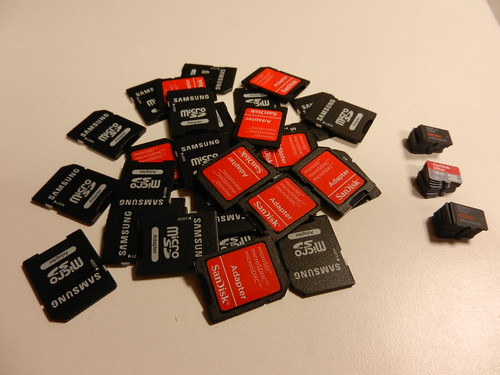
Could Samsung need these more than it thinks? Photo by seeweb on Flickr.

A selection of 9 links for you. Use them wisely. I’m charlesarthur on Twitter. Observations and links welcome.

Rochester family finds their “Nanny Cam” hacked for the world to see » KTTC Rochester, Austin

Mike Sullivan:

Many people across the country use “nanny cams” to monitor their children.  Some are closed circuit, but others allow parents to access their cameras through the Internet.  One Rochester family began to notice odd things happening with their “nanny cam”, but what they found out may shock you.

“We were sleeping in bed, and basically heard some music coming from the nursery, but then when we went into the room the music turned off,” said the Rochester mother who chose to remain anonymous.

Where were these tunes coming from? Would you have guessed another country?

“We were able to track down the IP address through the Foscam software, and found out that it was coming from Amsterdam,” said the concerned mother of one. “That IP had a web link attached to it.”

Creepy.


The $1,000 CPM » Medium

Hank Green:

Imagine that you would like to consume a piece of content, but in between you and that content is a paywall. They’re asking $15 for one person to view the content one time. While a YouTube video might net you $2 per thousand viewers, this fantasy world I’ve just described will net you $15,000 per thousand impressions…A $15,000 CPM!

With a $15,000 CPM, every two thousand views is a full-time, living-wage human per year!

Of course, this model would never work…except that it works every day at every movie theater in America.

Oh yeah. Then again, making a movie is incredibly expensive: the paywall around that process is unbelievable, running to millions of dollars. The barrier to entry for YouTube is effectively zero.


Samsung may have just lost half of its fans with the Galaxy S6 » AndroidPIT

Following a suggestion I made, Android Pit asked its readers whether they wanted a removable battery and/or SD card slot on the Galaxy S6. No data on how many people responded (and of course it’s a self-selecting survey – see later), so take with a pinch of salt what Kris Carlon finds:

The survey results also showed that only about two-fifths of Samsung owners currently carry a spare battery, and that the other three-fifths either don’t have one or rarely use the spare battery they do own.

Only 18% of respondents stated a removable battery was critical and would turn them off buying Samsung in future. Another 28% claimed it was important and that they would consider other manufacturers with removable battery options.

That’s 46% of current Samsung customers not happy with the decision to remove the removable battery. However, 54% said it either didn’t matter so much or that they preferred fast charging to a removable battery.

Pretty much in line with what I expected. Different story with SD cards:

An incredible 82% of respondents currently use a microSD card with a further 6% happy to at least have the option available to them. Only just over one-tenth of current Samsung owners don’t use a microSD card at all.

Almost two-thirds of participants either stated that they would no longer buy Samsung without a SD card slot or would consider buying other manufacturers that do include this feature on their smartphones. That’s 65% of current customers unhappy with Samsung’s decision to remove microSD expansion.

Let’s see if they don’t buy an S6, though. (Note: Samsung’s preliminary quarterly results for the first three months – not including the S6 launch – should now be available via its investor site.)


What to look for in the Apple Watch reviews » Beyond Devices

Jan Dawson:

The hardest thing for reviewers to gauge will likely be one of the most important factors in its ultimate success or failure – whether the Watch is compelling enough as an addition to the iPhone that its appeal lasts beyond the initial period when the novelty wears off. I don’t know how long reviewers will have had the Watch by the time they do their reviews, but it may well not be long enough to draw a conclusion on this. The Watch, like the iPad, lacks a single compelling selling point. Rather, I think each user will have to discover their own reasons why wearing one makes sense.


It’s time for the Watch » Above Avalon

Neil Cybart, in a thorough recap of how the Apple Watch got to where it is, makes a salient point about how we try to rationalise, or find a story thread, in stuff that’s more accidental:

Looking back at the iPad and iPhone, many have developed elaborate stories around those products in order to address the mystery. In reality, they were simply great products that relied on a revolutionary multi-touch user interface. After launching at a too-high price (and different business model based on mobile revenue sharing) and without an app store, it took Apple and the iPhone three years and additional features and changes before hitting mass-market awareness. However, the legend was that Apple foresaw the coming mobile app revolution. Stories are told to provide answers to the unknown. The problem occurs when those answers are fabricated. Apple is launching the watch as a fun, personalized iPhone accessory with different use cases dependent on the user. If one doesn’t leave the complicated stories and theories at the door, it will be difficult to see the Apple Watch for what is and, more importantly, isn’t. 


A new wave of Chinese smartphones set to emerge in 2015 » TechNode

Tracey Xiang:

China’s smartphone market is already crowded. But we’re expecting to see another half a dozen Chinese Android phone brands emerge in 2015. Many of them are already big tech companies in their home sectors.

LeTV, Qihoo, Gree, Smartisan – expect to hear more about them.


Bad data PR: how the NSPCC sunk to a new low in data churnalism » Online Journalism Blog

Paul Bradshaw:

Only Vice magazine decided to ask questions of the stats. And this is what they found:

“It turns out the study was conducted by a “creative market research” group calledOnePoll. “Generate content and news angles with a OnePoll PR survey, and secure exposure for your brand,” reads the company’s blurb. “Our PR survey team can help draft questions, find news angles, design infographics, write and distribute your story.

“… The OnePoll survey included just 11 multiple-choice questions, which could be filled in online. Children were recruited via their parents, who were already signed up to OnePoll.”

There are so many methodological issues here I can’t list them all, but let’s try. Firstly, there’s the issue of how representative OnePoll users are as a whole and how accurately they complete the survey (the site pays 20p per survey completed, and you have to reach £40 before you can withdraw). There’s the issue of self-selection (PDF) and of whether children are in an environment to give honest answers. And there’s the issue of leading questions: “I am addicted to pornography”?

As Vice’s article points out, research into this area is normally carried out very carefully to avoid these problems.

I’m always extremely wary of “surveys” like this; good to know Vice is too. Google News shows 129 hits for “NSPCC pornography”. Will any of them retract their pieces as a result of this untrustworthy data?


November 2014: Is the Rolling Stone story true? » Shots in the Dark

Richard Bradley is a former editor at George magazine, where he dealt with stories written by Stephen Glass which were shot through with untruths – which gave him an eye for it:

Written by a woman named Sabrina Rubin Erdely, the article is called “A Rape on Campus: A Brutal Assault and Struggle for Justice at UVA.”

The article alleges a truly horrifying gang rape at a UVA fraternity, and it has understandably shocked the campus and everyone who’s read it. The consequences have been pretty much instantaneous: The fraternity involved has voluntarily suspended its operations (without admitting that the incident happened); UVA’s president is promising an investigation and has since suspended all fraternity charters on campus; the alumni are in an uproar; the governor of Virginia has spoken out; students, particularly female students, are furious, and the concept of “rape culture” is further established. Federal intervention is sure to follow.

The only thing is…I’m not sure that I believe it. I’m not convinced that this gang rape actually happened. Something about this story doesn’t feel right.

Note that he wrote this when everyone was insisting that the story was true, must be true. Erdely isn’t the first journalist to be spoofed (it’s happened to me, though for much, much lower stakes). The failure was at Rolling Stone, where there wasn’t enough scepticism. And that failing continues throughout a lot of journalism; I notice it a lot (at a lesser scale) in tech journalism.


ActiveX actively going: South Korean gov’t to repeal ActiveX security requirement » BusinessKorea

Mary PArk:

The South Korean government plans to remove ActiveX from the county’s websites to boost foreign online shopping. The Ministry of Science, ICT, and Future Planning said on Wednesday that it will let the private sector drop the troublesome technical requirement, which has been cited as a major obstacle in Internet transactions.  

ActiveX is an Internet Explorer exclusive plug-in that allows Internet Explorer to run executable files on a user’s computer. Most of Korea’s financial websites and online shopping malls have relied on ActiveX to run their proprietary payment systems and online identity protection programs. But the outdated ActiveX dependency has prevented users of other web browsers or mobile devices from using those local websites…

…According to the Ministry, at least 90 percent of the country’s top 100 websites will replace ActiveX with alternative systems and technologies by 2017. This ActiveX-free plan provides subsidies of up to 50% of the financial costs to stop using ActiveX-based systems and to create HTML5-related alternative technologies to replace it, up to 100m won (US$91,734) per web site or 20m won (US$18,345) per solution.

So, so very overdue. South Korea has seen so many hacks due to its reliance on ActiveX, which has also held back mobile commerce.


Start up: Samsung’s #bendgate?, algorithms v April Fool, graphene is coming!, the US’s backward financial improvement


This might be what to do with trading algorithms on April Fools Day. Photo by kippster on Flickr.

A selection of 10 links for you. Not thixotropic. I’m charlesarthur on Twitter. Observations and links welcome.

Chinese fingerprint on smartphone trends in Malaysia, Singapore » Digital News Asia

Karamajit Singh:

Chinese smartphone vendors entered the Malaysian market in earnest in 2013, and this accelerated in 2014 with the various brands winning over a sceptical market with their price-to-performance models.
 
As a consequence, what used to be known as the mid-level phone market in Malaysia – the RM700 to RM1,200 (US$190 to US$325) level – is collapsing rapidly, IDC argues.
 
“The story is that the low-end market is getting more competitive and many phones that carry good specs are already priced below RM700,” says [Jensen] Ooi [IDC market analyst for client devices at IDC Asia Pacific].
 
Feeling the pain here from the rapid commoditisation of the mid-tier market are the traditional large players like Samsung, Sony and LG, which are unable to differentiate their phones at price points above RM700.
 
IDC’s data shows that sub-RM700 phones made up nearly 60% of the Malaysia market in 2014, up from nearly 40% the year before. The majority of the growth has been captured by the Chinese vendors at the expense of Samsung, Sony and LG.
 
More bad news for these Android vendors: “Their share in the mid-range and high-end market has weakened and will continue to weaken this year, with only Apple continuing to grow there in 2014,” says Ooi.


Teardown of new Samsung Galaxy smartphone suggests deeper loss for Qualcomm » Reuters

Se Young Lee and Noel Randewich:

Samsung is not only using its own Exynos mobile processor, as had been widely reported, but also decided to rely on its in-house semiconductor business to source other parts, including the modem and power management integrated circuit chips, Ottawa-based consultancy Chipworks said in a web posting dated April 2.

Samsung is counting on its new flagship Galaxy S6 and S6 edge phones to help revive earnings momentum after a disappointing 2014. Strong sales of system chips such as its Exynos processor could also help boost earnings, analysts and investors say.

The Galaxy S6 also comes with Samsung’s Shannon modem chip, US phone carrier AT&T said on its website.

“It’s pretty clear if they’re using Shannon for the modem for AT&T that they’re trying to use all-Samsung silicon,” said Jim McGregor, an analyst at Tirias Research. “With their market share going down they’re under pressure to increase profit margins.”

Makes sense (and poses a problem for Qualcomm): the more Samsung-built chips are in each phone, the greater its profit. Samsung Electronics’s preliminary results – its range of expected revenues and operating profit – are released on Tuesday 7 April; full results by division later in the month.


Apple invents watertight iDevice buttons » Patently Apple

Jack Purcher:

Apple began working on various waterproofing methods for iDevices back in 2010 and in 2013 devised a waterproofing nano coating. In March we posted a report covering Apple’s most advanced invention on waterproofing to date titled “Apple Invents a Waterproofing Method for Future iDevices using Hydrophobic Conformal Coatings and Silicon Seals.” Today, the US Patent & Trademark Office published yet another waterproofing patent application from Apple that specifically covers a water tight button solution for iDevices.

It feels like an obvious solution, and covers the power switch and volume switches. Is the headphone jack and Lightning port close-ended? In that case water resistance would be sorted – and could become another extra feature to differentiate from past models.


Wal-Mart exec calls credit card upgrade a ‘joke’ » CNN

Wal-Mart’s executive in charge of payments thinks the United States’ switch to chip-based credit cards is going to be a disappointment.

The new “chip & signature” program is barely an improvement on security and fraud, said Mike Cook, Wal-Mart’s assistant treasurer and a senior vice president, at this week’s Electronic Transaction Association’s Transact conference in San Francisco. Cook said Wal-Mart would have preferred a “chip and PIN” system that Europe and Africa have, since PINs would protect cards from being stolen.

“The fact that we didn’t go to PIN is such a joke,” Cook told CNNMoney.

Cook said signatures on checks were sufficient 100 years ago, but they’re outdated today. PINs on debit cards were a major improvement to stop thieves decades ago. They’d do the same for credit cards – which is why banks should use them for all cards.

“Signature is worthless as a form of authentication,” Cook said during a presentation at the conference. “If you look at the Target and Home Depot breaches … not a single PIN debit card needed to be reissued in those breaches. The card number was worthless to the individual thief and fraudsters, because they didn’t know the PIN.”

Americans truly have no idea how backwards their financial systems are.


Schaumburg man acquitted after child porn got mixed up in WWII downloads » DailyHerald.com

Barbara Vitello:

Testifying in his own defense, [Wocjciech] Florczykowski, a 40-year-old electrical engineer, described himself as a history buff with an interest in World War II, specifically battlefield memorabilia. In pursuit of that hobby, Florczykowski said he occasionally travels to battlefields in Poland where he and other military history buffs use metal detectors to unearth everything from medals and canteens to shells, grenades and unexploded land mines.

He testified he was using a program called uTorrent (which enables users to share large files) to research explosives on a laptop supplied to him by his former employer DLS Electronic Systems in Wheeling and inadvertently downloaded pornography.

“What I discovered was completely disgusting. I was not looking for this stuff,” he said, adding that he moved the offensive images and other unwanted material to a folder he intended to delete but was fired from his job before he could do so.

Discovering information on explosives on the laptop, his supervisors alerted federal authorities.

And then things got really bad. (Note: on the site itself, you need to answer a survey question to view the content. Can’t decide if that’s great, terrible, or “never going to scale”.) Also: it’s child abuse, not child “porn”.


Grooveshark publishes proactive anti-piracy policy » TorrentFreak

In the Capitol case the Court noted that while Grooveshark keeps records of all processed DMCA takedown complaints and associated users, it does not keep an “independent record” of repeat infringers.

“Escape does not try to identify repeat infringers and fails to keep
records that would allow it to do so,” the judge said.

Grooveshark says it is now dealing with that criticism.

“In an era of simple database queries this new requirement may be redundant, but we will now create an additional independent record of repeat infringers from our existing databases, until our appeal clarifies this issue for Grooveshark and other hosting services committed to complying with the DMCA,” the company writes.

Grooveshark’s entire business model is basically built around passive piracy – letting people upload and then share stuff whose copyright they don’t own. The music labels have been trying to tear it down for years; it’s basically a wart on the face of the web.


Tesla stockholders can’t take a joke » Bloomberg View

On April 1, five minutes before the market closed, Tesla put out a spoof press release on its official feed. The stock leapt, then drooped:

So people lost maybe as much as a few hundred thousand dollars because, for a brief stupid minute, they thought that Tesla was introducing … a watch? No, of course they didn’t. They thought Tesla was introducing a thing called the Model W, and they didn’t read any further than the headline, and they bought Tesla stock hoping that the Model W, whatever it was, would be a huge success (or would be perceived as a huge success by someone else a minute later), and then they realized that they’d been fooled, and they sold the stock at a small loss and moved on with their day. And when I say “people” I mean mostly “algorithms,” which are faster and more literal than humans, though in the space of a minute it is conceivable that an actual human saw that headline and fired off a buy order before reading any further.

Maybe stock algorithms will kill off April Fool’s Day online. Here’s hoping.


How graphene may revolutionize the mobile industry » Android Authority

Roni Peleg (who edits a graphene news aggregation site):

Graphene can allow for super-efficient batteries that charge within minutes and last much longer than conventional Li-ion batteries, composite materials that make devices lightweight and extremely durable, touch screens that are flexible and transparent, and even chips that are extremely small but much faster than silicon chips.

Love graphene as a concept (and reality), but it’s weird how its implementation is always five years away.


SquareTrade tests shows Samsung S6 Edge as bendable as iPhone 6 Plus and more likely to crack under pressure » YouTube

Pretty brutal treatment, though. (Also includes abuse of HTC M9.) Here, by the way, is a Samsung executive at the S6 launch assuring the audience it won’t bend:

A little part of me wonders about the original “bendgate” stories and their origin.


The Economist’s Tom Standage on digital strategy and the limits of a model based on advertising » Nieman Journalism Lab

Joseph Lichterman interviews Standage, who remarks:

we’re not big on linking out. And it’s not because we’re luddites, or not because we don’t want to send traffic to other people. It’s that we don’t want to undermine the reassuring impression that if you want to understand Subject X, here’s an Economist article on it — read it and that’s what you need to know. And it’s not covered in links that invite you to go elsewhere. We’ll link to background, and we’ll link to things like white papers or scientific papers and stuff like that. The idea of a 600-word science story that explains a paper is that you only need to read the 600-word science story — you don’t actually have to fight your way through the paper. There is a distillation going on there.

I do like that thinking, having lived with it the majority of my life. (Do the links here actually help you? Do you click through? Most people don’t.)

Also worth reading: his observations about ads (“they’re going to go away”) and millenials – who, he says, are “all fans of Snapchat, AdBlock and incognito [mode]”.


Start up: Nintendo’s mobile money, Nest misses summer, the non-voice phone, why Tidal will fail, and more


Carphone Warehouse: not the place to look for an Apple Watch. Photo by morebyless on Flickr.

A selection of 10 links for you. None is a leftover April Fool’s. I’m charlesarthur on Twitter. Observations and links welcome.

DeNA, in Nintendo pact, aims for games bringing in over $25m/month » Reuters

Japanese online game maker DeNA Co Ltd on Wednesday said it wants its new partnership with gaming giant Nintendo Co Ltd to yield titles that bring in over 3bn yen ($25.02m) a month.

The alliance, announced on March 17, will bring Nintendo characters such as Super Mario and Donkey Kong to smartphones, and see their jointly developed games available through phones and tablets as well as Nintendo’s Wii U and 3DS consoles.

DeNA Chief Executive Isao Moriyasu said the partners would release their first game later this year, but was coy on which character from Nintendo’s trove of intellectual property (IP) would be featured.

“We want to create games that will be played by hundreds of millions of people,” Moriyasu told Reuters in an interview. “We want to create multiple hit games rather than aiming to succeed with just one powerful IP element.”

Ambitious, but should be feasible. Nintendo takes in roughly 25bn yen per month in software sales at present.


With the Galaxy S6 and S6 Edge, Samsung tries to regain its footing » NYTimes.com

Farhad Manjoo:

In the international market for phones, Samsung’s Galaxys are relatively expensive. They sell for about the same price as Apple’s latest devices, $199 and up with a two-year contract, or more than $650 without a contract. But powerful phones made by low-priced Chinese sellers, like the OnePlus One, often sell for less than half the price of high-end Samsung and Apple devices.

If you pay the premium price to Apple, you get a phone with a well-designed operating system, no overlapping preloaded apps, and a host of services that often work very well, like iMessage, Apple Pay and expanding compatibilities with Apple’s personal computers and devices like the Apple TV and, soon, the Apple Watch. You can criticize Apple’s sticky ecosystem as a form of consumer lock-in, but Apple sure has built a luxurious prison, and customers are willing to pay extra for it.

If you pay that premium to Samsung, you don’t get a whole lot more than you can get on, say, a phone made by Xiaomi, OnePlus or any of a dozen smaller players.

That, indeed, is the problem.


Voice out of vogue for UK mobile phone users » eMarketer

In December 2014 polling from multichannel solutions provider Oxygen8 Group, voice didn’t even make the top 10 list of mobile services used by mobile phone users. Communication needs are more likely being met by other data-led services. For example, according to the survey, the most popular service was messaging, cited by 90.0% of respondents. Email and social media, with respective response rates of 83.0% and 77.6%, also fared well.


Energy companies around the world infected by newly discovered malware » Ars Technica

Dan Goodin:

The United Arab Emirates was the country most targeted by the attackers, followed by Saudi Arabia, Pakistan, and Kuwait.

Computers are initially infected with Laziok through spam e-mails coming from the moneytrans[.]eu domain. The e-mails contain a malicious attachment that exploits a Microsoft Windows vulnerability that was patched in 2012. The same vulnerability has been exploited in other attack espionage campaigns, including one that used the Red October malware platform to infect diplomatic, governmental, and scientific organizations in at least 39 countries. The Laziok exploit typically came in the form of an Excel file.

Patched in 2012, but not patched. The state of security today.


Tidal and the future of music » stratechery

Ben Thompson:

even if Jay-Z and company were truly independent, they would be heavily incentivized to avoid exclusivity as well: remember that music has high fixed costs but (especially on the Internet) zero marginal costs. That means the best way to make money is to sell as many units as possible in order to spread out those fixed costs. That, by extension, means the optimal strategy for whoever owns the music is making it available in as many places as possible – the exact opposite of an exclusive.

This ultimately is why Tidal will fail: it’s nice that Jay-Z and company would prefer to garner Spotify’s (minuscule) share of streaming revenue, but there is zero reason to expect Tidal to win in the market. Tidal doesn’t have Spotify’s head-start or free tier, it doesn’t have Apple’s distribution might and bank account, and it doesn’t have any meaningful exclusives3 — and to be successful, you need a lot of exclusives; it’s too easy and guilt-free to pirate (or simply skip) one or two songs.

And now stay tuned…


Apple’s music strategy looks increasingly risky » Above Avalon

Neil Cybart:

Apple’s strategy with music streaming continues to be a work in progress, but from what we know, curation and discovery will be two main tenets of a service that uses music exclusives as a carrot to entice users. In what could be a major negative, Jimmy Iovine reportedly was unable to get the cost for this music streaming service down to $5/month, with record labels demanding Apple remain steady at the “me-too” $9.99/month price. The primary problem with this chain of events is that music executives are hardly in a position to be dictating pricing and business strategy in an industry that may be fundamentally broken, yet again, by technology.

Music streaming is split into free and paid and there is risk that without a free offering, Apple may not reach enough scale to force consolidation among streaming services. A $5/monthly price was thought to alleviate some of this risk, but with Apple possibly needing to ship at $9.99/month, one has to wonder if management is pleased with how the product is shaping up.

One theme that permeates this discussion is Apple’s forced hand. With iTunes Radio, a seemingly “me-too” product compared to Pandora, Apple has seen moderate levels of success, but nothing that would jump out to an observer as ground-breaking. Apple risks a very similar fate with a paid music streaming service: garnering enough success to warrant respect with the endeavor (mostly because the bar is set so low), yet unable to capture the music industry like it was 2005 again. In essence, Apple would be stuck in catch-up mode.

Without a $5-per-month tier, the music industry is never going to break YouTube’s grip – which is essentially ad-supported streaming where the labels don’t get the same cut as they would from a paid service.


Nest confused by BST » Nest Community

Britain switched to “summer time” (equivalent to US’s Daylight Savings) at the weekend, going an hour ahead of GMT. Seems that Nest didn’t get the message:

The switch to BST seems to have confused my Nest! I have a manual schedule setup, auto schedule is disabled and the Nest didn’t come on at the new time this morning!

Only UK affected, said Nest. (Well, duh.) Puny humans and their clock-changing. (Apple was caught out for years by DST changes, which its alarms didn’t keep up with.)


IEEE waves through controversial FRAND patent policy » EE Times

John Walko, in February:

IEEE’s new standard on patents that lowers royalty fees is making some members angry.

The IEEE’s decision to approve a bitterly contested change to its patent policy, has, perhaps unsurprisingly, caused bitter divisions among its members. The revised rules would see the royalty fees large vendors have to pay reduced significantly, particularly in the wireless sector.

Compensation for a company’s IPR would now be based on a percentage of component price rather than the whole device, as is generally the norm.

Another consequence of the revised approach to royalties is a more realistic definition of what represents Fair, Reasonable and Non-Discriminatory (FRAND) when it comes to valuing a company’s standards-essential patents (SEP) such that the inventors get a fair return on sometimes huge investments into developing innovations, while at the same time not building barriers to entry for new products and new suppliers.

I missed this at the time; but it’s pretty dramatic. Lots of lawsuits have previously involved demands for royalties on finished products, which – if you think about it – is daft: if an essential patent only affects some tiny part of the operation of a device (eg Wi-Fi on the Xbox 360, as an example) why should Microsoft have to pay a proportion of the finished price?

This doesn’t have “non-practising entities”, aka patent trolls, pleased. Here’s Bill Merritt of Interdigital (an NPE) fulminating about it – and saying it won’t play ball.

Seems minimal, but this could have big long-term effects.


Sony Mobile aims to ship 38 million smartphones in FY2015, say sources » Digitimes

Daniel Shen and Steve Shen:

Sony Mobile Communications aims to ship 38m smartphones in fiscal 2015 (April 2015-March 2016), down slightly from 39.2m units shipped in the previous fiscal year, according to sources at Taiwan’s handset supply chain.

The lower shipment target comes as the Japan-based vendor is still overhauling its handset business and has also shifted its focus to the mid-range to high-end segment, said the sources.

Despite the absence of new orders from Sony Mobile since the fourth quarter of 2014, Taiwan’s ODMs have begun shipping some new models to the Japan-based vendor recently, including the Xperia E4 from Arima Communications, Xperia E4g from Compal Electronics and Xperia M4 Aqua from Foxconn/FIH Mobile.

Sony seems to be keeping focus on waterproofing, removable batteries and SD cards – unlike Samsung. How’s this going to play out?


Carphone Warehouse cut off from Apple Watch launch » Telegraph

Chris Williams:

Carphone’s UK chief executive, Graham Stapleton, said that the 800-strong high street chain will not be part of the launch next month.

He added: “We would love to be able to stock the Apple Watch. I’ve got to be careful what I say but I think they are just going another way with it. We have not been given the opportunity.”
Instead of selling its smartwatch thorough the same channels as the iPhone, Apple will court high-end fashion shoppers in more exclusive locations, as it charges prices as high as £13,500 for the top-of-the-range model. Window displays at Selfridges’ flagship Oxford Street store, for instance, were concealed behind Apple-branded hoardings on Tuesday in preparation for the launch.

Colour me totally unsurprised that Apple isn’t selling the Watch through CPW – which, for American readers, is like Best Buy for phones.


Start up: Google swipes ad injectors, streaming v vinyl, Galaxy S6 reviewed, FTC-Google scrutiny, and more


Wait, is that from Amazon? Photo by star5112 on Flickr.

A selection of 9 links for you. None is an April Fool. (Apparently it’s necessary to say this stuff.) I’m charlesarthur on Twitter. Observations and links welcome.

Out with unwanted ad injectors » Google Online Security Blog

Nav Jagpal, software engineer for “safe browsing”:

To increase awareness about ad injectors and the scale of this issue, we’ll be releasing new research on May 1 that examines the ad injector ecosystem in depth. The study, conducted with researchers at University of California Berkeley, drew conclusions from more than 100 million pageviews of Google sites across Chrome, Firefox, and Internet Explorer on various operating systems, globally. It’s not a pretty picture. Here’s a sample of the findings:

• Ad injectors were detected on all operating systems (Mac and Windows), and web browsers (Chrome, Firefox, IE) that were included in our test.
• More than 5% of people visiting Google sites have at least one ad injector installed. Within that group, half have at least two injectors installed and nearly one-third have at least four installed.
• 34% of Chrome extensions injecting ads were classified as outright malware.
• Researchers found 192 deceptive Chrome extensions that affected 14 million users; these have since been disabled. Google now incorporates the techniques researchers used to catch these extensions to scan all new and updated extensions.


Tidal, Apple, Beyonce, and the future of streaming music » NextDraft Originals

First of two links on this. Point 8 (you should also read 1-7):

You just held a press conference with some of the biggest celebrities of our time. And the consumer buzz and press you got wasn’t even close to a Tim Cook Apple keynote. You’re in the technology business now. And we’re all in a new world. Today, product is a bigger star than any celebrity. That’s so important and so right, I’m gonna make it the chorus of this post and repeat it a couple more times. Product is a bigger star than any celebrity … Product is a bigger star than any celebrity. And in the high end tech business, we got 99 problems, but UI ain’t one. Seriously, if you think having a beef with another rapper is dangerous, try dealing with a product manager who disagrees with your vision. Here’s what the company that acquires Tidal should do to further differentiate itself…

9. Push back against the Internet-era dogma that we all hate having our music streams hosted by a human curator. That idea was never more than an assumption. And it’s one that needs to be tested. You’ll still have access to uninterrupted music when you want it. But when you want a radio station or a hosted playlist, then someone should let you hear a human voice.

True. Will Zane Lowe be the human voice on Beats?


Google and Asus announce the Chromebit, a sub $100 Chrome PC » MobileSyrup.com

Igor Bonifacic:

Thanks to Google and Asus, an entirely new type of Chrome OS computer is coming this summer. The two companies just announced the Chromebit, a $100 computer on a HDMI dongle.

Each one comes equipped with a 1.8GHz ARM Cortex-A17 processor, 2GB of RAM, 16 GB of solid state storage, Bluetooth 4.0, a dual band 802.11ac WiFi chip and a single full-size USB 2.0 port. Using its HDMI port, the Chromebit can be connected with any other HDMI-equipped monitor or television.

When it ships this summer, the Chromebit will be available in three different colours—blue, orange and grey. Google and Asus haven’t yet announced how much the unit will retail for in Canada, but based on a post on its Chrome Blog, it appears the company’s aim is to have the Chromebit cost less than $100 everywhere it’s sold. Of course, those that purchase one will still need to provide a Bluetooth mouse and keyboard.

So you need an HDMI monitor, mouse and keyboard. Who’s going to have those hanging around yet not have a PC?


Samsung Galaxy S6 review: the iPhone 6 has met its match » WSJ

Joanna Stern:

No, neither of the new Galaxys brings any original ideas to the evolution of the smartphone. If anything, Samsung has actually sucked out the differentiators, including the waterproof design and removable storage and battery. And Samsung still needs some schooling in the software department.

Yet with a series of improvements, the Galaxy now has a leg up on the hardware of other Android phones and the iPhone. It’s got me, a once extremely satisfied iPhone 6 owner, wishing for a better screen, sharper camera and faster charging.

One reason I probably like the new Galaxys so much—especially the white models I’ve been testing — is that the design looks like a compilation of the iPhone’s greatest hits.

Okey doke. The one thing the S6 does have: a dual-app view. Hard to pull off, but potentially useful. The cameras (S6 v iPhone 6) seem like a dead heat.

And this isn’t where the battle will be fought. It’ll be in China, and Europe.


Noah Smith on Twitter: “10/And what near-future sci-fi used to be – Neuromancer, Snow Crash, etc. – is now just called “real stuff happening in the news”.”

What with the events in Turkey.. part of a larger tweetstorm that’s worth reading at Eugene Wei’s blog.


US recording industry dips slightly, streaming and vinyl jump » Billboard

Ed Christman:

The story within digital remains intriguing. While streaming revenue jumped nearly 29% – to $1.87bn from $1.45bn – download sales fell 9.5%, to $2.64bn from $2.92bn. That means that overall digital grew by $140bn, 3.2%, to $4.5bn, up from $4.37bn in the prior year.

Looking more closely at digital streaming revenue, paid subscriptions’ value jumped to nearly $800m, via 7.7m subscribers, up 25% from 2013’s $639m in revenue and 6.2m subscribers. The RIAA also reports that ad-supported streaming services’ contribution to the overall U.S. music industry grew 34%, to nearly $295m – from $220m in the prior year – while SoundExchange distributions grew 31%, to $773.4m.

CD albums fell 12.3%, to $1.85bn from $2.12bn in 2013. Overall CD sales, on a unit basis, were down 16.3%m to 144.1m from $172.2m…

On a bright note, vinyl sales continued to grow, contributing $320.8m to the total pie, from the prior year’s total of $213.7m – a 50% growth.

Got that? Ad-supported “free” streaming generated less revenue than vinyl in the world’s largest, most connected market. (This likely doesn’t include YouTube revenues, though.)


Key senator to take closer look at FTC-Google meetings » NASDAQ.com

A key US senator plans to ask the Federal Trade Commission for information about meetings it had with Google Inc. executives during the time it was investigating the company for possible antitrust violations.

Sen. Mike Lee (R., Utah), who chairs the Senate’s antitrust panel, will conduct a preliminary inquiry to determine what conversations took place between the FTC and the Internet giant during the probe, people in his office said on Monday.

The senator could later expand his inquiry to include conversations people in the White House had with the FTC and Google, these people said.

A Republican senator is looking at Google’s relationship with the White House? No doubt to irk Obama, but it makes Google’s blogpost thumbing its nose at the Wall Street Journal (in which it used GIFs of babies) look both incredibly jejeune and ill-judged. Even if (as is likely) this comes to nothing, I suspect it will be embarrassing for Google to explain the post, which detailed visits to the White House by Google staff.


Criminal charges against FBI agents reveal staggering corruption in the Silk Road investigation » Forbes

Sarah Jeong describes

a sprawling case tainted by an unbelievable web of corruption. A state’s witness took the fall for an agent’s theft, thus becoming the target for a murder-for-hire—a murder that was then faked by the same agent. The Silk Road case was compromised again and again as Force and Bridges allegedly took every opportunity to embezzle and steal money. With so much bitcoin on their hands, the two had to coax various bitcoin and payments companies to help convert their ill-gotten gains to dollars. When companies resisted, investigations were launched, subpoenas were issued, and civil forfeitures were sought in retaliation.

Someone’s gotta be writing the screenplay, right? More to the point, I wonder if there was some assumption that bitcoin transactions would be anonymous on anyone’s part..


Amazon Dash Button » Amazon

Dash Button comes with a reusable adhesive and a hook so you can hang, stick, or place it right where you need it. Keep Dash Button handy in the kitchen, bath, laundry, or anywhere you store your favorite products. When you’re running low, simply press Dash Button, and Amazon quickly delivers household favorites so you can skip the last-minute trip to the store.

I know, it looks like an April Fool’s. But it isn’t – it’s real. Amazon is making it easier to order stuff directly, with a very clever, Internet of Things approach.

Next question is whether people will trust Amazon to always be the cheapest to deliver this. Miles ahead of supermarkets – though what’s to stop them doing the same? Maybe your washing machine will be festooned with buttons offering lights showing which is cheaper at any time (excluding P&P, of course).


Start up: why Google lost its Safari appeal, US gov trumps Kim Dotcom, S6 still bloated?, and more


But also for your “we’d like to be in VR now that it’s hip (again)” moments. Photo by TORLEY on Flickr.

A selection of 10 links for you. Use them wisely. I’m charlesarthur on Twitter. Observations and links welcome.

Second Life is still around and getting ready to conquer virtual reality » Business Insider

Matt Weinberger:

although you probably haven’t heard much about it lately, Second Life hasn’t gone anywhere. With 900,000 active users a month, who get payouts of $60m in real-world money every year, and a virtual economy that has more than $500m in GDP every year, Second Life is still a world of opportunity. 

Today, the rising tide of virtual reality — with companies like Facebook, HTC, and Sony betting big on immersive 3D technology — means that Second Life’s time may have come around.

“Now the world is waking up again,” Ebbe Altberg, CEO of Second Life developer Linden Lab, which now has over 200 employees, told Business Insider.

Linden Lab is marshalling its expertise and experience in building immersive, functional virtual worlds to make a proper successor to the Second Life platform and take advantage of the bold new world of immersive VR. Specifically, Linden sees a huge opportunity in making it easier for people to build and share cool virtual reality experiences. 


Holway says RIP to his Blackberry Bold » TechMarketView

Richard Holway is yet another of those moving on, having used a BlackBerry since the year dot:

I loved – still love – my Blackberry Bold. It is the best email sender/receiver ever invented. Its physical qwerty keyboard is still better than the puny iPhone 6 touchscreen. Its battery lasts for days too. But, it can’t really do anything else.

And that last sentence is the key thing, isn’t it?


Driverless cars need to be spy machines so they don’t kill you » Fusion

Daniela Hernandez:

For instance, an app that controls the [self-driving Mercedes] F 015 can also turn the cameras it uses to see the road as remote prying eyes. Through the app, you can connect to the car’s cameras to spy on the car’s surroundings through your phone. It effectively turns your car into a lurking Dropcam that can be used to watch unknowing passersby, anywhere, anytime. Or as another journalist on the junket put it, it turns every single vehicle into a Google Street View car. The privacy implications will be huge.

But it doesn’t stop there. Just like your iPhone or Android device, your car will communicate with other internet-connected devices in your life. It’ll learn your habits and adapt to your needs. For instance, say your car “realizes” you’re on your way home at dinner time. It “knows” your smart fridge is stocked with nothing but booze, so it prompts you to go to the grocery store or local eatery to pick up some grub. It’ll pull up the number of your favorite restaurant or suggest a new one based on your preferences. While you call, your robo-butler adjusts its course to take you where you need to go. By the time you arrive for curbside pickup, your credit card will already have been charged.

“We call it predictive learning,” said Mercedes’ Tattersall. “This will be something not so far away.”


Google Inc v Vidal-Hall & Ors [2015] EWCA Civ 311 (27 March 2015) » Bailii

“Bailii” is the British and Irish Legal Information Institute; it collects written judgements from courts in those countries. This is the key passage in the decision by the court of appeal on the “Safari hack” by Google of three complainants:

We come back then to the question we have to decide. Against the background we have described, and in the absence of any sound reasons of policy or principle to suggest otherwise, we have concluded in agreement with the judge that misuse of private information should now be recognised as a tort for the purposes of service out the jurisdiction. This does not create a new cause of action. In our view, it simply gives the correct legal label to one that already exists. We are conscious of the fact that there may be broader implications from our conclusions, for example as to remedies, limitation and vicarious liability, but these were not the subject of submissions, and such points will need to be considered as and when they arise.

(A “tort” is a legal wrong.) Google has fought this case all the way – particularly because the original judge, Tugendhat, decided that hacking someone’s device to follow them to collect data about what they look at online is a tort. Google will probably appeal this to the UK supreme court.

The full decision is twisty, so don’t rush it.


US government wins dozens of millions from Kim Dotcom » TorrentFreak

“Ernesto” (TorrentFreak’s founder):

A few hours ago District Court Judge Liam O’Grady ordered a default judgment in favour of the US Government. This means that the contested assets, which are worth an estimated $67m, now belong to the United States.

“It all belongs to the US government now. No trial. No due process,” Dotcom informs TF.

More than a dozen Hong Kong and New Zealand bank accounts have now been forfeited (pdf) including some of the property purchased through them. The accounts all processed money that was obtained through Megaupload’s alleged illegal activities.

The list of forfeited assets further includes several luxury cars, such as a silver Mercedes-Benz CLK DTM and a 1959 pink Cadillac, two 108″ Sharp LCD TVs and four jet skis.

The wheels of justice grind slow…


The Samsung Galaxy S6 has as much bloatware as ever » Gizmodo

Eric Limer:

At first glance, the new S6 and S6 Edge appear to be less cluttered, but you’ll actually find some 56 applications pre-installed. That’s 6 more than the 50 you’ll find on the Galaxy Note 4! Between the Google Apps you’ll find on every phone (Play Newstand? Come on), Samsung’s apps like S Voice and S Health, the new Microsoft apps like OneDrive (intended to soften the blow of no microSD slot), assorted social apps like Whatsapp and Instagram, and carrier apps (6 on T-Mobile), there’s a ton of cruft. A Moto G I have hanging around — which runs near stock Android — starts with just 33.

And despite statements from Samsung that “Samsung has allowed users to remove the pre-installed applications on Galaxy S6 and S6 Edge,” the most severe action you can take is “disabling” them. This removes them from the app drawer and the homescreen, but not from the phone entirely. You’re basically opting instead to put them in a sort of stasis, out of sight but not out of storage.

They don’t take much storage – Limer suggests about 100MB – but it’s the principle, really. Will the reviewers find the S6 “stripped back” even so?


HTC’s lead designer leaves after less than a year » Engadget

Richard Lai:

For a tech company that places so much emphasis on design, we can’t help but think something’s up when one of the key designers leaves. Today, we bring you the sad news that HTC’s VP of Industrial Design, Jonah Becker, has announced his departure on Twitter. To our surprise, that’s less than a year after he picked up from where his predecessor Scott Croyle left off.

It’s not “sad” news. It’s news. The more interesting part:

we have learned from our sources that there is an ever increasing power struggle between the design team and sales team these days. Another source told us the switch from the M8’s UltraPixel main camera to the M9’s 20-megapixel counterpart is an example of such.

HTC is in so much flux, yet clings on doughtily to existence.


Six surprising facts about who’s winning the operating system and browser wars in the U.S. » ZDNet

Ed Bott:

What I love about this data is that we finally have statistically meaningful details about which technologies people are using in the United States today. The database is enormous, and it should be broadly representative of the U.S. population, with a mix of consumers and businesses represented. (The data reported here is not strictly limited to the United States, of course. People from foreign countries occasionally need information from the United States government. But for the sake of this article one can consider the data to be an accurate snapshot of the U.S.)


Google investors will love these charts. Android developers will hate them. » Business Insider

Jillian D’Onfro:

As investors and analysts panic about how Google’s search advertising revenue growth is slowing because it can’t charge as much for mobile ad clicks as desktop ad clicks, this move gives Google another huge avenue for mobile monetization. 

“We view this move as akin to when the company first introduced 
sponsored links in the search engine results page,” analysts from Credit Suisse wrote in a note Friday morning.

Credit Suisse included two charts in its note that perfectly underscore exactly why investors and analysts love this move and why it could have negative effects for Android developers. 

Because they’ll have to pay for advertising, which is 20% of revenues – so after the 30% cut, that means Google gets 50% of revenues. #savedyouaclick


You’ll soon get 10TB SSDs thanks to new memory tech » Engadget

Steve Dent:

SSDs and other flash memory devices will soon get cheaper and larger thanks to big announcements from Toshiba and Intel. Both companies revealed new “3D NAND” memory chips that are stacked in layers to pack in more data, unlike single-plane chips currently used. Toshiba said that it’s created the world’s first 48-layer NAND, yielding a 16GB chip with boosted speeds and reliability. The Japanese company invented flash memory in the first place and has the smallest NAND cells in the world at 15nm. Toshiba is now giving manufacturers engineering samples, but products using the new chips won’t arrive for another year or so.

I can wait a year, though I haven’t managed to fill the 512GB drive on my laptop in three years.


Start up: Meerkat v Periscope, three new iPhones?, life as a Russian troll, and more


Ahoy there! Periscope is getting noticed. Photo by zoonabar on Flickr.

A selection of 9 links for you. Go on, count them. I’m charlesarthur on Twitter. Observations and links welcome.

Censoring myself for Apple » Marco.org

Marco Arment, on the suggestion that people (especially developers) writing about Apple self-censor so that they won’t be treated vindictively:

every Apple employee I’ve spoken with has not only been receptive of criticism, but has practically begged for honest feedback from developers. The idea that you’d be penalized in the App Store for being critical of Apple on your blog is ridiculous and untrue.

Apple employees are also humans, Apple users, and often former or future independent app developers. Chances are very good that any criticism we have is also being criticized and debated inside Apple. Employees can only exert so much influence inside the company, and they need people like us to blog publicly about important issues to help convince the higher-ups to change policies or reallocate resources. One of the reasons I don’t expect to ever take a job at Apple is that I believe I can be more effective from the outside.

My experience is that highlighting things that are going wrong with outside developers leads to them being treated better. Apple notices this at a high level.


Apple and Synaptics: a convergence in the force » Forbes

Patrick Moorhead, pointing out that Synaptics has had a “force touch” trackpad for a little while, and is in fact moving to its second generation – but Windows OEMs haven’t adopted it:

The rest of the Windows notebook industry will likely be forced to follow Apple and Hewlett-Packard’s lead and start to adopt force touchpads. Also, they will very likely use physical haptic feedback as well, at least on high-end and mid-range designs as it delivers a superior experience. Many Windows notebook OEMs will be seen as copying Apple’s Force Touch touchpad design, but the reality is that Apple isn’t quite the first to market with this technology even though they may have perfected it first.

Also needs support in Windows: will Microsoft get that into Windows 10?


Available storage on 32GB Galaxy S6 will be just over 23GB » SamMobile

Those who go with the 32GB Galaxy S6/S6 edge will have slightly more than 23GB storage available for their apps, files, music, movies and other content. That’s after hooking up a Google account with the device and updating all of the pre-installed apps. Extrapolating this figure shows that users should expect about 55GB free on the 64GB model and around 119GB free on the 128GB model. The numbers might vary based on the region and carrier so these are just ballpark figures.

By comparison, the iPhone 6 OS seems to take up about 3GB. What’s eating up those 9GB?


16 smartphones that were deemed ‘iPhone Killer,’ 2008-2011 » Yahoo Tech

Jason Gilbert:

After the first iPhone came out in 2007, tech publications rushed to identify the phone that would be the “iPhone killer.”

SPOILER: Apple sold more than 190 million iPhones last year. It is safe to say that the iPhone has not, in fact, been killed. 

Terrific list (and you can work out how easy it was to put together once he’d had the excellent idea of doing it). Arguably, though, the Galaxy S2 (in 2011) really made a difference.


EU to open extensive e-commerce sector probe » WSJ

Tom Fairless:

The inquiry, announced Thursday by the EU’s antitrust chief Margrethe Vestager, follows pressure from France and Germany to use EU competition rules and other regulations to better target the business practices of large technology firms.

And it is part of a broader EU strategy to knit together the bloc’s fragmented online ecosystems into a digital single market. Policy makers hope that will help European Internet firms to build their clout to better compete with US web giants like Google and Facebook.

The antitrust investigation, encompassing all 28 EU countries, aims to establish whether some companies are raising contractual or other barriers to limit how consumers can shop online across EU national borders, Ms. Vestager said at a news conference.

It could lead to cases against individual companies that are suspected of abusing their dominant market position to restrict trade, in violation of EU law.


Three phases of consumer products » Medium

Arjun Sethi:

There are three phases. Consumer products start as a want then turn into a need. In the final phase, which most don’t get to, they evolve into a utility. Here’s how I define the three phases:

• Want — Solves a core value proposition that’s very unique and feels like a novelty.
• Need — People can’t live without it and keep coming back for more.
• Utility — It becomes a feature of other products.

The fastest growing consumer products have already gone through these phase,s while the up and coming ones are in the middle of one of these three phases right now. Facebook and Twitter are great examples of growing companies with large user bases that have gone through or are in the middle of this progression…

The ones that become huge are the ones that take the core and spread it out over time. You can’t get there over night and you don’t start by creating the network from day one. You start by creating a novel, memorable experience for people. Most ideas are fun or stupid with a core value proposition and over time they become a utility as they get embedded to become culture.


One professional Russian troll tells all » Radio Free Europe

Dmitry Volchek and Daisy Sindelar:

There are thousands of fake accounts on Twitter, Facebook, LiveJournal, and vKontakte, all increasingly focused on the war in Ukraine. Many emanate from Russia’s most famous “troll factory,” the Internet Research center, an unassuming building on St. Petersburg’s Savushkina Street, which runs on a 24-hour cycle. In recent weeks, former employees have come forward to talk to RFE/RL about life inside the factory, where hundreds of people work grinding, 12-hour shifts in exchange for 40,000 rubles ($700) a month or more.

St. Petersburg blogger Marat Burkhard spent two months working at Internet Research in the department tasked with clogging the forums on Russia’s municipal websites with pro-Kremlin comments. In the following interview, he describes a typical day and the type of assignments he encountered.

Choice quote:

You have to just sit there and type and type, endlessly. We don’t talk, because we can see for ourselves what the others are writing, but in fact you don’t even have to really read it, because it’s all nonsense. The news gets written, someone else comments on it, but I think real people don’t bother reading any of it at all.

Modern salt mines, but much better pay and conditions.


Periscope review: does Twitter’s live-streaming service beat Meerkat? » The Guardian

Alex Hern points to an interesting contrast:

not every comparison between Periscope and Meerkat is fair. In some places, the app has zigged where its competitor has zagged.

That’s no clearer than when you finish a live session, and Periscope pops up a screen which says “preparing for replay”. There’s no ephemerality here (at least, not by default). When a stream is over, it can be rewatched by viewers who missed their chance first time around, and everything – the comments, hearts, and new-viewer notifications – plays out as-live.

“We didn’t want you to miss the experience, we thought it was special because it was live,” explains [Keyvon] Beykpour [Periscope’s co-founder]. “I still believe that, but we want to balance that with practicality. The synchronicity problem” – ensuring that viewers are available at the same time the streamer is – “is hard. There just is a significant drop-off with that problem.

“The true test for us has been does it decrease the percentage of people who watch live, and the answer I think is no. If you’re watching live, given how low latency the product is, you can change what’s happening.”

But one reason why Meerkat has no replay function is to make sure that people who have never streamed themselves before feel comfortable giving it a go. “To do that we wanted to make sure that you feel like you control the content,” said Meerkat founder Ben Rubin at this year’s South by South West festival. “If we want you to go a little bit outside your comfort zone, we want to make sure that you control the content. We want to make sure that people feel comfortable to stream their grandson’s soccer game on a Sunday afternoon.”

Retention versus ephemerality. I wonder if Meerkat will attract a younger demographic, like Snapchat?


Apple to release 3 iPhone models in 2H15 » Digitimes

Rebecca Kuo and Alex Wolfgram:

Apple will release three different iPhones in the second half of 2015, the iPhone 6S, iPhone 6S Plus and a 4-inch device currently being referred to as iPhone 6C, according to industry sources.

All of the handsets will come equipped with LTPS panels and supply for the iPhone 6S Plus and iPhone 6C will come from Japan Display, Sharp and LG Display while that for the iPhone 6S will come from Japan Display and LG.

All of the devices will come equipped with Corning Gorilla Glass, the sources said, adding the 6S series will use A9 chips and the 6C A8 chips. All of the devices will come equipped with NFC and fingerprint scanning technologies.

All makes sense – the 4in device, the fingerprint, the NFC.


Start up: FTC rebuts critics, Mars One or Capricorn One?, failures of tech criticism, how open is ResearchKit?, and more


Flooded view in Oxford. Photo by the.approximate.photographer on Flickr.

A selection of 9 links for you. None includes Jeremy Clarkson or One Direction. I’m charlesarthur on Twitter. Observations and links welcome.

Statement of Chairwoman Edith Ramirez, and Commissioners Julie Brill and Maureen K. Ohlhausen regarding the Google Investigation » Federal Trade Commission

The Federal Trade Commission conducted an exhaustive investigation of Google’s internet search practices during 2011 and 2012. Based on a comprehensive review of the voluminous record and extensive internal analysis, of which the inadvertently disclosed memo is only a fraction, all five Commissioners (three Democrats and two Republicans) agreed that there was no legal basis for action with respect to the main focus of the investigation – search. As we stated when the investigation was closed, the Commission concluded that Google’s search practices were not, “on balance, demonstrably anticompetitive.”

Contrary to recent press reports, the Commission’s decision on the search allegations was in accord with the recommendations of the FTC’s Bureau of Competition, Bureau of Economics, and Office of General Counsel.

Some of the FTC’s staff attorneys on the search investigation raised concerns about several other Google practices. In response, the Commission obtained commitments from Google regarding certain of those practices.  Over the last two years, Google has abided by those commitments.

I’d just like the full report published. Or reports – there seem to have been one from the competition bureau and one from the economic bureau.


Winter testing of the Oxford Flood Network » Nominet R&D blog

Bryan, who helped build it:

It’s been an extremely useful period for us all and in particular we’ve learnt a great deal about deploying devices in real conditions.

There are the hardware considerations: dull but important issues such as fixings become all important; how exactly do you fix a sensor to a disused 60cm cast iron pipe? (see photo below for the answer)

There are the radio considerations: how do you realistically achieve a 250m connection across wooded areas?

There are system deployment considerations: how do you remotely reboot a Raspberry PI gateway that is held securely in someone else’s property?

And there are some basic user interface considerations: how big do the buttons on a mobile app need to be when your fingers have gone numb from standing in a wet muddy field in December? 

The key thing to remember about the Internet of Things is that it is where the physical world meets the digital world. The physical world is complex and messy. A warm, protected office (where applications are inevitably built) can hide that messy world.

I find this enormously encouraging. Flood level and river data is the one key public dataset that the Environment Agency still won’t make publicly available for free commercial reuse; it’s been a sticking point for the Free Our Data campaign (nine years old this month, but pretty much sorted since 2010). Let’s get it sorted.


Mars One finalist speaks out, says Dutch non-profit likely scamming its rubes » Ars Technica

Megan Geuss:

there was an insidious side to the dream that Mars One put forward. So much of it didn’t add up. The $6 billion budget seemed ridiculously low, and the company was light enough on details and partnerships to suggest that something was either very secret or very suspect.

[Joseph] Roche [a professor at Dublin’s Trinity School of Education, with a PhD in physics and astrophysics, and a Mars One finalist] now seems to think it’s the latter, saying that not once did he ever meet with someone from Mars One in person, despite the fact that he was selected to be one of the “Mars One Hundred”—the lucky 100 people who advanced to the next level in the competition over spaceship seats.

The professor told Keep that ranking within Mars One is points-based; when you are selected to advance through the application process, you join the “Mars One Community,” and you are given points as you move through each next level. The points are arbitrary and have nothing to do with ranking, but “the only way to get more points is to buy merchandise from Mars One or to donate money to them,” Roche told Keep. So, in essence, people are likely paying their way to a final round.

Even so, that’s not going to raise $6bn, unless they’ve got Bill Gates aboard. (Have they?)


BlackBerry is about to hit bottom » Quartz

Dan Frommer:

BlackBerry’s turnaround strategy—focusing on software as its smartphone business has declined—has not been pretty. But the worst may be here.

When BlackBerry reports its fourth-quarter results on Mar. 26, it could post its lowest revenue number in nine years. That’s the warning from RBC analyst Mark Sue in a research note this week.

Sue predicts that BlackBerry’s fourth-quarter sales could drop to $661m, down 32% year-over-year and well below the Wall Street consensus of around $800m. BlackBerry hasn’t reported revenue that low since 2006, just as the smartphone industry was set to explode.

But after you hit bottom, you rise. At least that’s what RBC is forecasting, along with 1.3m phones shipped and perhaps a little profit in the future. (BlackBerry’s results are on Friday.)


The Taming of Tech Criticism » The Baffler

Evgeny Morozov reviews Nick Carr’s new book “The Glass Cage”, and makes many insightful points about how much technology criticism (including, he argues, Carr’s) can’t see the wood for the trees:

Take our supposed overreliance on apps, the favorite subject of many contemporary critics, Carr included. How, the critics ask, could we be so blind to the deeply alienating effects of modern technology? Their tentative answer—that we are simply lazy suckers for technologically mediated convenience—reveals many of them to be insufferable, pompous moralizers. The more plausible thesis—that the growing demands on our time probably have something to do with the uptake of apps and the substitution of the real (say, parenting) with the virtual (say, the many apps that allow us to monitor kids remotely)—is not even broached. For to speak of our shrinking free time would also mean speaking of capital and labor, and this would take the technology critic too far away from “technology proper.”

It’s the existence of this “technology proper” that most technology critics take for granted. In fact, the very edifice of contemporary technology criticism rests on the critic’s reluctance to acknowledge that every gadget or app is simply the end point of a much broader matrix of social, cultural, and economic relations. And while it’s true that our attitudes toward these gadgets and apps are profoundly shaped by our technophobia or technophilia, why should we focus on only the end points and the behaviors that they stimulate? Here is one reason: whatever attack emerges from such framing of the problem is bound to be toothless—which explains why it is also so attractive to many.

I think Morozov has by far the better perspective on this than Carr, because he isn’t grounded in an American social view.


ResearchKit and open source » Rusty Rants

Russell Ivanovic looks more closely and queries where the “open source” bit is:

ResearchKit, just like most other iOS frameworks, is a set of tools for building an iOS app that simplifies some of the things you’d need to do to collect patient data. The intention of open sourcing this part of it seems to be to encourage developers to build modules for it which would all be iOS only as well. Apple states as much in their technical document:

…developers are encouraged to build new modules and share them with the community

So, currently at least, there’s no open source server components, no open format for exchanging data and an iOS only open source framework that Apple want developers to build modules for. Don’t get me wrong, this still sounds like a huge step forward for medical research data collection. What it doesn’t sound like though is Apple’s altruistic gift to the world from which they receive no benefits.


China market buoying iPhone shipments » Digitimes

Cage Chao and Jessie Shen:

In China, sales of Apple’s iPhone 6 reached 15-20m units in the fourth quarter of 2014, the sources noted. China-sales of the 6-series are set to remain at similar levels in the first quarter of 2015, the sources said.

Judging from current order visibility, the sources estimated that 45-50m iPhone 6 devices would be shipped worldwide in the second quarter of 2015 with China contributing one-third of total shipments…

…While sales of Apple’s iPhone 6 series have been strong since launch, sales of Android-based smartphones have not picked up, according to industry sources. Except Samsung Electronics, which has started to enjoy growth in sales of its recently-announced Galaxy S6, other Android phone makers have seen their sales thus far in 2015 lower than a year earlier, the sources indicated.

Sources at Taiwan-based IC design houses have revealed that orders placed by their Android device customers have been weaker than expected which may affect their sales performance in the first quarter. The IC design houses said they are also cautious about orders placed by Android phone makers for the second quarter.

The iPhone figures feel like lowballing – Apple will probably pass 50m units for the quarter. It’s the part about Android phones that is intriguing. Is it just the Taiwan IC houses feeling the pinch?


What happened, and what’s going on » AllCrypt Blog

Read this, and feel the hairs stand up on the back of your neck:

We are not sure if AllCrypt was targeted, or if it was a “fortunate” thing for the hacker. Our hypothesis is this: The user’s email account was breached, and in looking through the emails, saw that he had some admin rights for AllCrypt.com. In that account were emails from myself and our MD. After playing on AllCrypt for some time, the hacker tries to do a WordPress password reset for all of the allcrypt related emails he sees. My personal email was not the email for the main admin blog account, and either was the user who’s email was breached. Our MD, however, did use his personal email. A password reset was issued, and sent to the MD.

The massive screwup that led to the loss of funds is when the MD forwarded that email to myself and the tech team member. He forwarded the password reset link. To the breached email account.

The hacker reset the MD’s password, and had administrative access to the blog. Access which allows uploading of new files/plugins for WordPress.

The hacker first uploaded a file, class.php. After we examined it, we discovered that it grants web-based command line access to any files the web user has access to. Namely, the entire http tree. Quick looks through the web source files is all it takes to see the hostnames, login names, and passwords for the database. The database credentials WERE protected in a ‘hidden’ file in a non-www accessible directory, however, anyone smart enough to read code can find the include lines that point to that file. The www user must have read access to that file, so the class.php the hacker uploaded also had read access.

Then, using WordPress, he uploaded adminer.php – a web based database management tool similar to PHPMyAdmin. It was a simple task to then query the database.

The hacker created a new user account on AllCrypt, used adminer.php to UPDATE userbalances SET balance=50 WHERE userid=whatever AND symbol=BTC to set his balances to whatever he wanted. Then he began to issue withdrawals. Lots of them.

You hosted WordPress and your bitcoin exchange on the same server. Also includes “Angry questions and contrite answers” section.


Samsung beaten by local smartphone brand in the Philippines » Tech In Asia

Judith Balea:

Philippine budget phone maker Cherry Mobile beat South Korean giant Samsung as the leading smartphone brand in the Philippines in 2014, IDC said today. It was the second straight year that Cherry has whipped Samsung in the nation.

According to the research firm, Cherry cornered 21.9% of the Philippine market in terms of volume of smartphones shipped in 2014, overtaking Samsung, whose share declined further to 13.3%.

Cherry has held the spot as the number one smartphone vendor in the Philippines since 2013. That year, it captured 24.3% of the market, and Samsung held 19.9%, based on data provided by IDC to Tech in Asia.

However, the smartphone market expanded by 76% yoy (from 7.2m to 12.6m), so Samsung’s shipments actually increased by 17.6% (from 1.42m to 1.68m). Big headline, but pretty much a rounding error for Samsung.


Start up: Apple gets prismatic, the tricorder cometh, smart home dilemmas, oceans in trouble, and more


Coming to a future iPhone camera? Photo by refeia on Flickr.

A selection of 9 links for you. Use them wisely. I’m charlesarthur on Twitter. Observations and links welcome.

The HTC One M9 review: part 1 » AnandTech

Why part 1? Because, Joshua Ho explains, there was a big ol’ software update last Friday which changed lots of stuff. Which is a good thing:

Friday’s software update introduced significant changes to the phone’s power and temperature management capabilities, which in turn has introduced a significant changes in the phone’s performance. HTC’s notes on the matter are very brief – updates to the camera, the UI, and thermal throttling – in practice it appears that HTC has greatly altered how the phone behaves under sustained loads. Our best guess at this point is that HTC appears to have reduced the maximum skin temperature allowed on the phone, which means that for short, bursty workloads that don’t approach the maximum skin temperature the changes are minimal, but for sustained loads performance has gone down due to the reduction in the amount of heat allowed to be generated.

Case in point, our GFXBench 3.0 battery life results were significantly altered by the update. With the initial version of the phone’s software we hit 1.73 hours – the phone ran fast but almost unbearably hot – and after the software update the One M9 is over 3 hours on the same test with a maximum temperature of 45C, a still-warm but certainly much cooler temperature, as seen in the photo above. And none of this takes into account the camera changes, which so far we are finding to be similarly significant. It has made the One M9 a very different phone from when we started.

Part 2 will look at the camera.


Apple invents 3-sensor iPhone camera with light splitting cube for accurate colors, low-light performance » Apple Insider

Mikey Campbell on a Apple patent filed in 2011 that has just been published:

Older three-CCD cameras relied on the tech to more accurately capture light and negate the “wobble” effect seen with a single energy-efficient CMOS chip. Modern equipment employs global shutter CMOS modules that offer better low-light performance and comparable color accuracy, opening the door to entirely new shooting possibilities.

Apple’s design uses light splitting techniques similar to those applied in current optics packages marketed by Canon, Panasonic, Philips and other big-name players in the camera space. For its splitter assembly, Apple uses a cube arrangement constructed using four identical polyhedrons that meet at dichroic interfaces.

By coating each interface with an optical coating, particular wavelengths of incident light can be reflected or allowed to transmit through to an adjoining tetrahedron. Adjusting dichroic filters allows Apple to parse out red, green and blue wavelengths and send them off to three sensors positioned around the cube. Aside from RGB, the patent also allows for other color sets like cyan, yellow, green and magenta (CYGM) and red, green, blue and emerald (RGBE), among others.

Light splitters also enable other desirable effects like sum and difference polarization, which achieves the same results as polarization imaging without filtering out incident light. The process can be taken a step further to enhance image data for feature extraction, useful in computer vision applications.

Basically, it’s about Apple wanting to have the smartphone with the best and fastest camera on the planet. Nothing more or less.


MAGZET: the audio jack reinvented with the power of magnets » Kickstarter

Basically, it’s Apple’s MagSafe idea applied to headphone jacks. A neat idea, though with a gigantic target of over a quarter of a million dollars. But I like it, so I backed it. (Then again, think how often your headphone lead has saved your phone from plunging to the floor. On the other hand, it may have yanked your phone out of your pocket.. oh anyway.)


The tricorder, an all-in-one diagnostic device, draws nigh » ReadWrite

After pushing back deadlines by a few months, the 10 remaining teams in the Tricorder X Prize are nearing the day they will deliver a device that can diagnose 15 diseases and other basic health information through at-home tests. The teams are scheduled to deliver working prototypes in June to a UC-San Diego study that will test the devices on patients with known medical disorders to measure their accuracy.

“We’re pretty confident that the majority of the 10 finalist teams will actually be able to deliver,” senior director Grant Company said. “Some may merge, and some may fall out, just because they can’t pull it together. And that just reinforces how big of a challenge this really is. It’s because the goals are very high.”

Another thing posited in Star Trek (the original series) being made reality.


Improbable: enabling the development of large-scale simulated worlds » cdixon blog

Chris Dixon of a16z, which is putting $20m into London-based Improbable, a spin-out from the University of Cambridge:

The Improbable team had to solve multiple hard problems to make this work. Think of their tech as a “spatial operating system”: for every object in the world — a person, a car, a microbe —the system assigns “ownership” of different parts of that entity to various worker programs. As entities move around (according to whatever controls them  — code, humans, real-world sensors) they interact with other entities. Often these interactions happen across machines, so Improbable needs to handle inter-machine messaging. Sometimes entities need to be reassigned to new hardware to load balance. When hardware fails or network conditions degrade, Improbable automatically reassigns the workload and adjusts the network flow. Getting the system to work at scale under real-world conditions is a very hard problem that took the Improbable team years of R&D.

Wow! What will it be used for? Mars missions? Lunar missions? Climate calculations?

One initial application for the Improbable technology is in gaming.

Gnnnh..

Beyond gaming, Improbable is useful in any field that models complex systems — biology, economics, defense, urban planning, transportation, disease prevention, etc. Think of simulations as the flip side to “big data.” Data science is useful when you already have large data sets. Simulations are useful when you know how parts of the system work and want to generate data about the system as a whole. Simulations are especially well suited for asking hypothetical questions: what would happen to the world if we changed X and Y? How could we change X and Y to get the outcome we want?

Better.


Connected car lawsuits begin » LinkedIn

Peggy Smedley:

It was only a matter a time before this was going to happen. And now it has. A lawsuit has been filed against three leading automakers seeking damages in the millions. But as I talked about on my radio show http://www.peggysmedleyshow.com a little more than a week ago, this lawsuit just might surprise you.

From court documents filed in Dallas, Texas, it appears this class action has been issued against Toyota, Ford Motor Co., and General Motors, for selling connected vehicles for allegedly knowing these in-vehicle systems could be hacked.

But, more importantly, the court documents go on to assert the automakers attempted to mislead consumers by not revealing the dangers associated with connected cars and not addressing the safety concerns.


The smart home decade dilemma » Tech.pinions

Bob O’Donnell thought he might be in line for some new (and smart?) appliances:

The new GE connected refrigerator won’t be available until later this spring but we needed to replace our fridge now. Plus, frankly, all the smart fridge seems to offer is a warning the water filter needs to be replaced and an optional alarm when someone leaves the door open. Nice to have, sure, but really essential? Hardly. Same thing with the new smart dishwasher. Getting an alert the dishes are done isn’t my idea of something I need to have.

In the case of the smart oven, the ability to remotely start preheating your oven, get a timer notice when something has finished cooking, or change the temperature or turn off the oven from the comfort of your sofa, did actually sound modestly interesting. But then the paranoid side of me kicked in and I realized that, though highly unlikely, a device sitting on my home WiFi network could theoretically get hacked (despite both mine and GE’s best efforts.) Now, if there was one appliance in my home I really didn’t want to be taken over and remotely controlled by someone other than my family, it would be the oven because, in theory, it could actually end up burning your house down. So, my previous disappointment with not getting at least one smart appliance in the overhaul actually morphed into a modest sense of relief.

The “decade” reference in the title is to the fact that appliances have typical lifespans of at least 10 years, and often 20. That’s longer than some tech companies.


Global warming is now slowing down the circulation of the oceans — with potentially dire consequences » The Washington Post

http://www.washingtonpost.com/posttv/c/embed/c1f126ae-d192-11e4-8b1e-274d670aa9c9

Chris Mooney:

Welcome to this week’s installment of “Don’t Mess with Geophysics.”

Last week, we learned about the possible destabilization of the Totten Glacier of East Antarctica, which could unleash over 11 feet of sea level rise in coming centuries.

And now this week brings news of another potential mega-scale perturbation. According to a new study just out in Nature Climate Change by Stefan Rahmstorf of the Potsdam Institute for Climate Impact Research and a group of co-authors, we’re now seeing a slowdown of the great ocean circulation that, among other planetary roles, helps to partly drive the Gulf Stream off the U.S. east coast. The consequences could be dire – including significant extra sea level rise for coastal cities like New York and Boston.

Somehow just linking to this feels insufficient. Equally, we’re talking about the world’s oceans here, and it’s hard to know quite what to do.


Gartner recommends Samsung, LG partner with watchmakers » Korea Times

Yoon Sung-won:

Gartner said Tuesday that Samsung Electronics and LG Electronics may need to adjust strategies in the wearable device business to strengthen their brand’s position.

The global market research agency said in a briefing session in Seoul that many fashion brands are launching smartwatches as jewellery or luxury items in the second phase of the wearable devices market. Gartner stressed that electronics makers are recommended to partner with traditional watch brands on quality features.

“Customers believe that fashion brands can set a new trend in the smartwatch industry tapping into their strong brand power and consumer channels, which many electronics makers do not have,” Gartner’s research director Angela McIntyre said.

Yeah, might help.