Start up: Safe Harbour’s failure, Google Photos grows, Android Doze, Theranos redux, and more


Guess what sort of things Facebook’s “M” assistant gets asked to do. Photo by PeterThoeny on Flickr.

You can now sign up to receive each day’s Start Up post by email. You’ll need to click a confirmation link, so no spam.

A selection of 10 links for you. Use them wisely. I’m charlesarthur on Twitter. Observations and links welcome.

The collapse of the US-EU Safe Harbor: solving the new privacy Rubik’s Cube » Microsoft on the Issues

Brad Smith, Microsoft’s chief legal officer:

On Oct. 6, the Court of Justice of the European Union struck down an international legal regime that over 4,000 companies have been relying upon not just to move data across the Atlantic, but to do business and serve consumers on two continents with over 800 million people.

The decision made clear what many have been advocating for some time: Legal rules that were written at the dawn of the personal computer are no longer adequate for an era with ubiquitous mobile devices connected to the cloud. In both the United States and Europe, we need new laws adapted to a new technological world.

As lawyers and officials scurry to assess the situation, it’s apparent that both a variety of smaller steps and a more fundamental long-term change will be needed. We need to focus on both of these aspects.

Haven’t seen a blogpost from Google on this. Have I missed it?
link to this extract


Google Photos cloud storage service hits 100 million monthly users » Re/code

Mark Bergen:

Love for Google Photos inside the Googleplex overfloweth. At conferences, on earnings calls, in cocktail parties, Google execs shower praise on the cloud photo storage and sharing service it launched back in May. For good reason: It’s a simple, practical product that shows off Google’s machine learning prowess without any of the baggage of Google+, from which it was born.

And people are using it. On Tuesday, the search giant announced that Photos, in its first five months, has crossed 100 million monthly active users.

Google+: launched June 2011, claimed 100m users by September 2012. So this is faster – and surely a lot more engaging. Everyone loves their own photos, as opposed to everyone else’s opinions.
link to this extract


Facebook M assistant’s top requests include restaurant suggestions and shopping help » TechCrunch

After an early report from The Information, Facebook provided official details on its M project in August. Built into Messenger, M lets users text in almost any request, from assistance with online chores to booking real-world services or making purchases on their behalf. Requests are currently fielded by a combination of Facebook workers and artificial intelligence.

The hope is that over time, the humans will teach the AI to do more and more complicated tasks on their own. If M succeeds and can be affordably rolled out, it could make people’s lives easier while strengthening their loyalty to Facebook Messenger amid intense competition between chat apps. Though if it’s too costly to scale, Facebook could burn a lot of money on the project.

M could potentially earn revenue itself by taking a margin on top of purchases or services booked for people. But the big opportunity is for Facebook to lock users further into its ecosystem where it makes ample money on News Feed ads. One day, Facebook could even sell ads that convince you to initiate an M request that involves an advertiser’s business.

Right now, Facebook tells me the No. 1 type of request is for restaurant suggestions and reservations. People might know their desired food type, distance, price range, or some quality they’re looking for in a restaurant, and M helps find them the one that fits and gets them a table.

Not so different from what Siri or Google Now or Cortana can do – “find me Mexican restaurants within three minutes’ walk.” Baby steps. But really interesting ones.
link to this extract


Deutsche Telekom said to weigh new antitrust complaint against Google » The New York Times

Mark Scott:

Deutsche Telekom, which owns a controlling stake in T-Mobile US, the cellphone carrier, appears ready to get involved in Europe’s investigation into Google’s Android mobile software as well. Deutsche Telekom is expected to file a formal complaint with European competition authorities in the coming weeks, according to several people with direct knowledge of the discussions.

The complaint, which may be submitted by early November, focuses on whether Google uses its Android mobile operating system to unfairly promote its own products like Google Maps and online search over those of rivals, the people said. They would speak only on the condition of anonymity because they were not authorized to speak publicly.

This is separate from the search antitrust investigation (which is principally looking at desktop).
link to this extract


Google will require OEMs to include unmodified Doze Mode in Android 6.0 » Android Police

Ryan Whitwam:

For years Android has struggled with battery life due to apps running in the background when they aren’t supposed to, and Marshmallow could finally put a stop to it. To make sure device makers play ball, Google’s Android 6.0 Compatibility Definition Document (CDD) explicitly requires Marshmallow phones to include Doze, and OEMs aren’t allowed to monkey around with it.

Doze mode is Google’s answer to the sometimes terrible standby time of Android devices. If a phone or tablet hasn’t been used for a while, the system goes into Doze mode—apps remain asleep and wakelocks are ignored. Important cloud message pings still get through and the device wakes up briefly on occasion to sync, but that’s it…

If you go into the power optimization settings in Android 6.0, you can see which apps are exempt from Doze. On stock Android that’s just Play Services and device manager, but Google will require OEMs to show users anything else they choose to exempt from Doze in that list. That doesn’t necessarily mean you’ll be able to remove the exemption, but you’ll at least know what’s been given special treatment.

It was all going so well until that last sentence. But good to see Google tightening up on this stuff; user experience counts.
link to this extract


City AM becomes first UK newspaper to ban ad blocker users » The Guardian

Mark Sweney:

City AM is launching a trial from Tuesday that will blur out text of stories on cityam.com for desktop users of Firefox browsers who are detected using ad blocking software.

Readers will be encounter a message saying: “We are having trouble showing you adverts on this page, which may be a result of ad blocker software being installed on your device. As City AM relies on advertising to fund its journalism, please disable any adblockers from running on cityam.com to see the rest of this content.”

Martin Ashplant, the digital director at City AM, said about 8% of the site’s 1.2 million monthly browsers use Firefox on desktop and around 20% of those have ad blocking software installed.

The trial currently does not include any other browser types or non-desktop devices such as mobile phones and tablets.

Let’s see if we can guess: adblocker users will move to different browsers? Also, it’s doing this for 1.6% of its users – ie 19,200 people? Perhaps trying to get the thin end of the wedge in there.
link to this extract


Theranos trouble: a first-person account » Monday Note

Jean-Louis Gassée tried them because he has some skin (well, blood) in the game:

It seems a Hungarian forebear passed down an errant JAK2 gene that trips bone marrow into polycythemia vera (PCV), a fancy name for “too many blood cells” — and potential clots, especially as one’s vessels degrade with age. There’s no cure, yet, but with frequent attention the treatment is simple: Hydroxyurea, an inexpensive 19th century urea derivative, slows bone marrow output.

In homage to my ancestor, I perform a decade-old routine, a stroll to Stanford Hospital’s Hematology Lab to give blood samples that are tested for Complete Blood Count (CBC) and Metabolites. My numbers haven’t fluctuated much since my last visit and the kind hematologist pronounces me “medically boring” (Pourvu que ça dure! ). Good for me: If the hematocrit (HCT) number crosses the 45% threshold, I get to meet the vampire and “donate” 500ml of blood. (After which this perfectly good pint of blood must be tossed. Regulations. Sigh…)

On my way back to my University Avenue office, a thought pops up: Why not try Theranos for comparison?

His experience is a tad worrying; the comments below the post from people in the lab/testing industry are pretty eye-opening too. You don’t come away thinking the noise around Theranos is nonsense.
link to this extract


Some tech investors sure seem to be getting defensive lately … » Business Insider

Matt Rosoff with a well-argued counterpoint to the venture capitalists who – while lacking any detailed knowledge – complain about exposés such as the NYT’s on Amazon, or the WSJ’s on Theranos:

Journalists don’t set out to write takedowns of companies. But when a journalist begins investigating a company and finds something is amiss, and the story is well vetted and fairly reported, the venture community should welcome that reporting.

Because every faker, every charlatan, and every company whose product just isn’t good enough to win is taking money that could have been invested in other companies that have a better chance. 

(One more thing. Journalists are happy to hear companies defend themselves. But when a company refuses to share any data that could bolster its case, and refuses to let anything they say privately be used publicly — that’s “off the record” in journalism-speak — it’s awfully hard to take these defenses seriously.)

If you’re a journalist, you’ve surely had the latter experience. Rosoff’s piece really does need to be read in full.
link to this extract


Intel has 1,000 people working on a chip for iPhone? Of course they do » DIGITS to DOLLARS

Jonathan Greenberg (who has a lot of valuable experience in the chip industry):

I would argue that Intel has a lot of levers they can pull to win Apple as a wireless customer. They can offer a bundled deal which includes processors for the MacBook, and even cut Apple a deal to serve as their foundry for future versions of Apple’s A-Series of processors. I have no idea if any of these will ever happen, but I want to point out that this is a complex negotiation environment.
And, of course, there is Apple itself to reckon with. The post makes a big deal about the fact that Apple hired a big team of people from Infineon, but that started years ago, and that team has been using Qualcomm modems for a long time. More intriguing is the idea that Apple just wants to license the modem software from Intel and then design their own chip. That rumor has been circling for a long time. And I think it is important to remember that. Apple wants to manage their suppliers for its own ends. They now have two foundry partners to fight over iPhone share. For the past few years Apple has had little choice but to use Qualcomm for modems, so it is only natural for them to want a second source. When (if?) Intel finally gets its LTE modem working, Apple will have that second source. My guess is that Apple really does not want to design its own modems. That requires a lot of labor intensive software work to keep up with those standards mentioned above.

link to this extract


Tim Cook gets passionate about privacy at “The Wall Street Journal” tech conference » Fast Company

Harry McCracken:

The conversation was more fun when Cook spoke about the new Apple TV. He pushed back on Baker’s contention that the streaming box wasn’t much of a disruptor, and went on an entertaining rant against TV as it’s existed for decades. (“Why does a channel even exist? Think about it. My nephew asked me once, and I couldn’t even answer.”)

But the liveliest portion of the session by far involved privacy. It’s been a big talking point for Cook for a while now. And onstage, he got worked up talking about it in a way that was strikingly different from his normal, preternaturally calm, on-point manner.

“Privacy is a key value of our company,” Cook began, in a manner similar to his previous statements on the topic. “We think it will become increasingly important to more and more people over time as they realize that intimate parts of their lives are in the open and being used for all kinds of things.” He explained that Apple encrypts personal information and keeps it on your phone, drawing an unstated contrast with Google, whose fundamental business model involves storing personal data in the cloud where the company can slice it, dice it, and monetize it with advertising.

But when the discussion turned to government monitoring of the digital world—National Security Agency director Michael Rogers having preceded Cook onstage—Baker said there were basic tradeoffs between privacy and national security. And Cook didn’t buy it. “I don’t agree,” he said. “I think that’s a copout.”

Cook also objected to Baker’s what-if scenario involving a back door that would have let government agents override encrypted data and foil the 9/11 plot before it was carried out: “No one should have to decide, privacy or security. We should be smart enough to do both.”

That point about channels should have been in Cook’s introduction of the new Apple TV in September – except the answer is easy: it’s to give you a predictable experience, just as a newspaper does. Apple lacks a good storyteller at present. (You can read the liveblog on the WSJ Digits blog.)
link to this extract

Google’s growing problem: 50% of people do zero searches per day on mobile


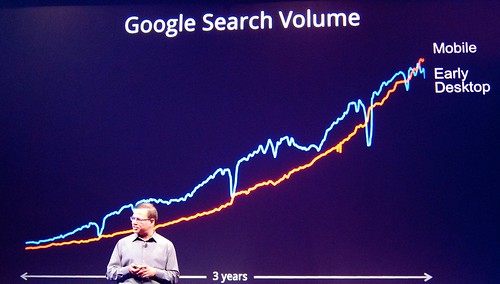
Amit Singhal in 2011 showing a comparison of search volumes from mobile and “early desktop years”. Photo by Niall Kennedy on Flickr.

Amit Singhal, Google’s head of search, let slip a couple of interesting statistics at the Re/Code conference – none more so than that more than half of all searches incoming to Google each month are from mobile. (That excludes tablets.)

This averages out to less than one search per smartphone per day. We’ll see why in a bit.

First let’s throw in some more publicly available numbers.
• more than 100bn searches made per month to Google (total of desktop/ tablet/ mobile).
• about 1.4bn monthly active Google Android devices. (Source: Sundar Pichai, Nexus launch.)
• about 1 billion monthly active Google Play users. (Source: Sundar Pichai, Nexus launch.)
• about 1.5bn PCs in use worldwide.
• about 400m iPhones in use worldwide. Probably about 100m of those are in China. (Analyst estimates.)
• about 100m other smartphones in use (70m Windows Phones, 30m BlackBerrys)
• the mobile search market only generates a third as much revenue as the desktop. (Source: Rob Leathern, via the IAB 2014 report.)

Singhal had already said in July that mobile was larger than desktop in 10 countries; now it’s for the whole world. Google’s numbers effectively exclude China, of course, since Google doesn’t have any presence there. (Android phones and iPhones both use Baidu, the local search engine, as the default there; Google is banned from the mainland, and though people can use it, they overwhelmingly don’t.)

So let’s put these numbers together.
• In all, there are 1400 Google Android + 400 iPhones – 100 iPhones inside China + 100 other = 1.8bn smartphones in use outside China.
• 50bn mobile searches per month = 50bn per 30-day period

Today’s not the day to search

Calculate! 50bn / (1.8bn * 30) = 0.925 mobile searches per day. (Even if you exclude the Windows Phones and BlackBerrys, you still get 0.98 mobile searches per day.)

That’s right – the average (“mean”) person does less than one Google search on mobile per day. The mode (most common number) will be below that too. Over a 30-day period, the mean number of mobile Google searches is 27.8.

For desktop+tablet search, you get roughly the same figure – assume 1.5bn PCs and 300m tablets. But not all of those devices are available to make searches: many PCs are sitting in corporate environments where they aren’t connected to the internet, or can’t be used to make Google searches: think of all the machines in call centres, or functioning to run shop tills, or in factories. They reduce the potential base that can be used to make queries, and so ramp up the real average of per-active-PC/tablet monthly queries.

On the basis that
• the world PC installed base is split roughly 60-40 between corporate and personal users, so 900m and 600m
• guessing that 50% of those corporate machines, ie 450m, can’t make Google searches

then the total number of PCs/tablets available to make Google queries is 600m personal PCs + 450m corporate PCs + 300m tablets, or 1,350m devices.

Do the maths on 50bn searches per 30-day month across 1,350m devices and you get 37 searches per month, or 1.23 searches per day on average. The mode (most common figure) is likely to be 1, but the median (point where you have half as many behind as in front) will be higher. Probably not much higher – this will be an asymmetric distribution, where most of the (in)action is on the low end, so it may look like a Poisson or Pareto function.

Desktop: steady as she goes

This is my rough model of how search distribution might look, generated by plugging figures we know into a Pareto generator and then doing a distribution function for N = integer number of searches per day.

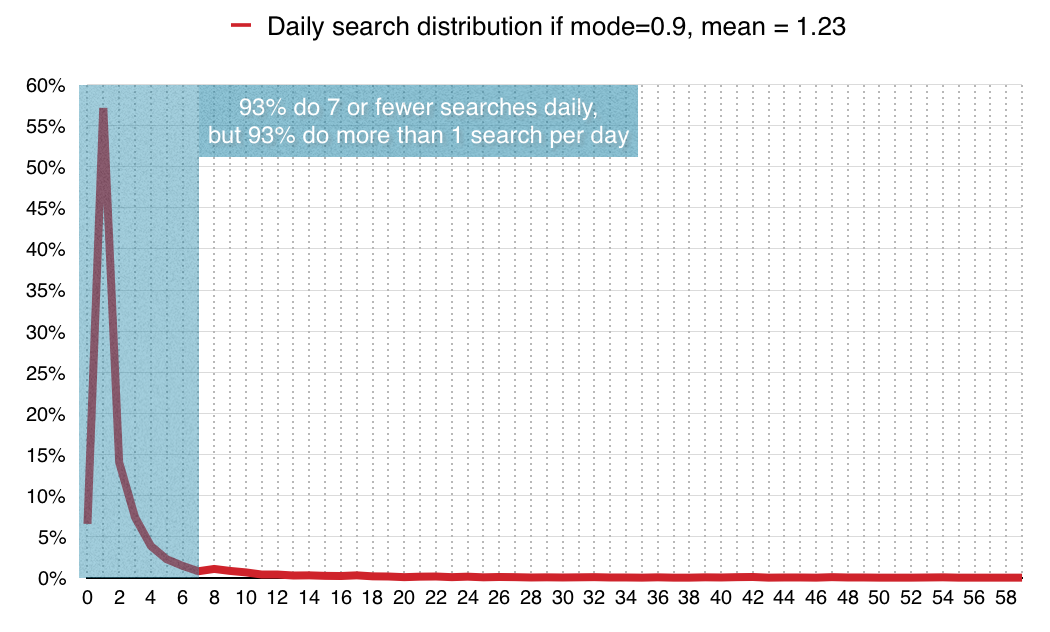
Here’s how it looks for the desktop, using a mode (most common) of 0.9 searches per day and mean of 1.23:

Per-user searches on desktop on Google

Estimated profile of number of searches per day per person on Google on desktop.

What this is saying is that on any given day you get about 55% of people doing just one search, a bit less than 15% doing two searches, just under 5% doing four searches, and so on. Small proportions, but big absolute numbers. And who does what searches isn’t fixed; so someone who did zero searches yesterday might do 10 tomorrow. But equally, the 10-searcher yesterday does none or one or four today. And so on.

(It took some experimentation to get this shape; using a higher mode meant that the number doing zero searches was itself zero, which doesn’t make sense: there must be some people who by accident or design don’t ever hit Google during a day. Here, the proportion of users doing zero searches per day is 6.5%, which seems reasonable.)

Here’s how it breaks out when you look at cumulative percentages:

Google searches on desktop

My model suggests that most people don’t do much searching, but nearly everyone does some.

Note that lots of people don’t do many searches, but huge numbers of people do some searching. Further confirmation: the data release from AOL in 2006, which was just for desktop users, was “~20m records from ~650,000 users over three months” which translates to an average of 31 records per person over that 90-day period, or one-third of a query per day. AOL users in 2006 might not be directly comparable to Google users today, but it’s a useful check that the numbers here are probably broadly correct.

Incidentally, a lot of those present-day searches will be very low complexity. Watch people use a desktop. The most common Google query is “Facebook”. Probably the next most common? “Yahoo”, “Gmail” and “Hotmail”. People literally type those into the Google search box, or their browser search bar, to get to those sites. To a technical audience that’s stunning – why would someone do that? – but it’s observable behaviour. Remember the AOL data leak in 2006? Data there showed that some people used to just hit “Search” when the text box was empty which in turn meant that some advertisers got AdWords hits on the phrase “search terms” (which used to be the text in the box).

Mobile: all change

However on mobile, things are different. People do not, in general, type “Facebook” or “Gmail” into their mobile browser’s search bar. They go to the relevant app – Facebook or email. This behaviour is surely a big reason why mobile searches have been behind desktop for a long time, even though smartphones’ use has rocketed, and time spent on them is greater than for PCs, and they’ve been nudging a comparable installed base for some time.

Thus where someone using a desktop/laptop might fulfil their “average” one or two searches per day by typing “Facebook” when they open their browser, on mobile that doesn’t happen because it doesn’t need to happen; they just open the app.

For Google, that means it’s losing out, even though Google search is front and centre on every Android phone (as per Google’s instructions as part of its Mobile Application Device Agreement, MADA). People don’t, on average, search very much on mobile. The miracle of Google, in retrospect, is building a multi-billion dollar business by accreting millions of rare actions – people doing searches and then clicking on ads. Of course, Google has helped that latter activity by filling the top of its search results page with ads, and making them harder to distinguish from search results. But it’s still a hell of an achievement.

I tried modelling what search activity probably looks like on mobile: I used a mean = 0.925 (as per Singhal) and mode = 0.5. The mode must be below the mean because of the long tail of higher values; 0.5 is a guess, but moving it around doesn’t have a large effect. This gives a median of 0.94, close to the mean, which you’d also expect.

Google mobile search modelled

If mobile searching follows a power law, it might look like this.

You can see that (if we allow these assumptions, which I think are reasonable – remember that they’re based on Google’s own data) then only 5% of users do more than seven searches per day on average. That’s very like the desktop scenario.

Mobile search percentage

As on desktop most people don’t do more than 7 searches – but most people also don’t do one search.

But here’s where things are suddenly very different from the desktop: although the proportion doing more than seven searches per day is about the same (5% or so), you have a far greater number who don’t ever get beyond zero.

Incidentally, this echoes Horace Dediu’s analysis from April 2014, when he noted how the internet population was growing rapidly, but Google’s revenues from non US/UK sources weren’t: US/UK users seemed to generate about $86/yr, while those outside that space generated only $12/yr. (This picture might be distorted by Google’s tax arrangements, of course.)

So there is the problem for Google: the PC base is static or even falling, while the number of people holding smartphones is growing. But the latter group tends not to use search, and so doesn’t see its most profitable ads. (There are in-app ads, but it’s never been very clear how much revenue they generate compared to other search ads. One suspects if they were very lucrative for Google it would be touting its “run rate” from them.)

Hence Google pushes people to use the mobile web more; and also, notably, to expand beyond simple search into services such as Google Now, Now On Tap, and pretty much anything. Seen through that lens, the reorganisation of Google into Alphabet makes sense: it’s seeking to get as many potentially moneymaking new ideas fired off as soon as possible, while search and search revenues are still growing, and before the growth of mobile really pulls the averages down. Dediu, in the link above, notes that 2016 will probably mark the point where internet population growth begins levelling off. And most of the new additions will be mobile-only.

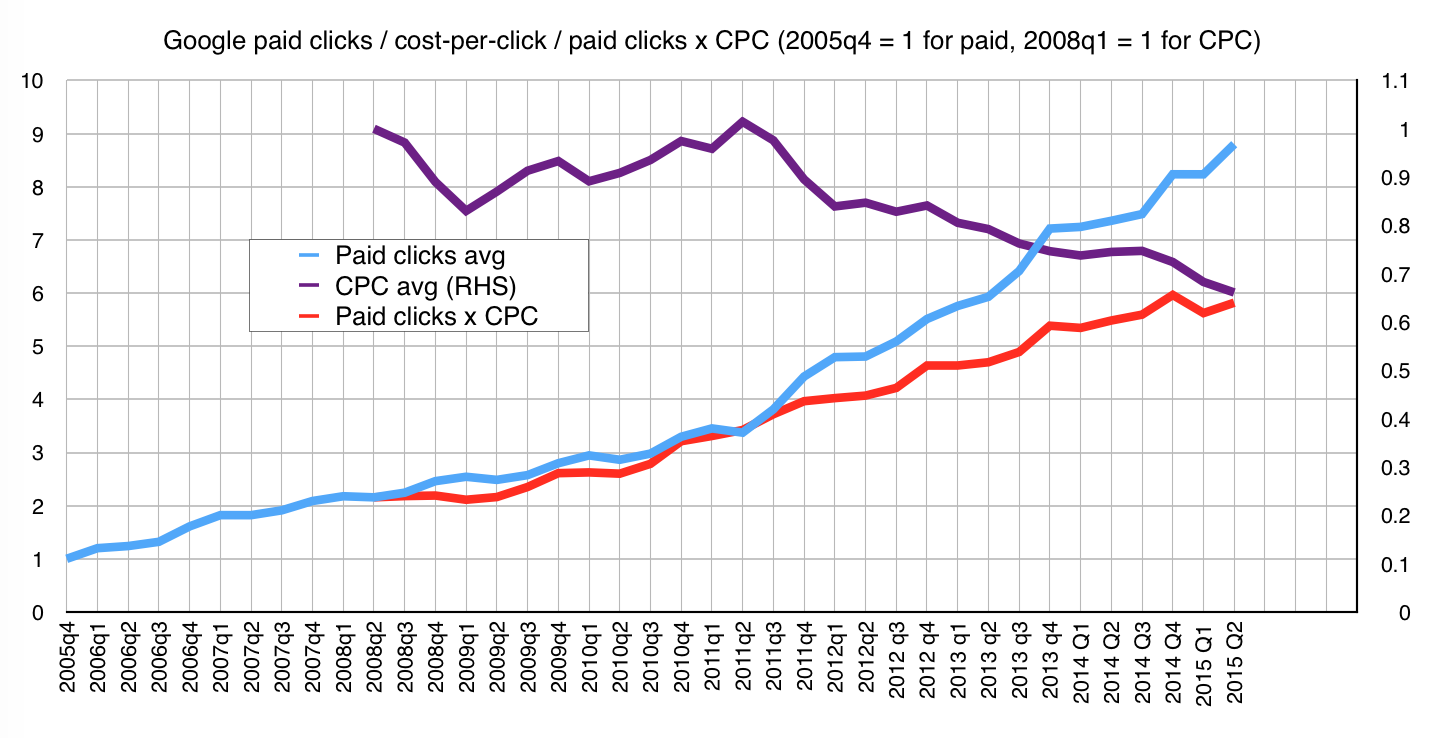
You can see that effect most clearly in data from Google’s financials, where it discusses the number of paid clicks it gets, and the cost-per-click. It doesn’t take much effort to combine the two together to get the “total payments per click”.

Google paid clicks, cost-per-click and product

Paid clicks up, CPC down. Source: Google financials.

What’s clear is that
(a) the number of paid clicks has zoomed up – increased nearly ninefold since the end of 2005 (where the graph starts)
(b) CPC is on a steady downward slope, despite Google’s best (and successful) efforts in mid-2011 to shore it up
(c) combining the two shows that revenue hasn’t increased nearly as fast as paid clicks. In other words, the new users and new platforms on which Google is available aren’t as valuable as the old ones.

In conclusion

So what do we conclude? Mobile search is a real problem for Google: people don’t do it nearly as much as you suspect it would like. But there’s no obvious way of changing that behaviour while users are so addicted to apps on their phones – and there’s no sign of that changing any time soon, no matter whether news organisations wish people would use mobile sites instead (clue: most people get their news via Facebook online).

This is a structural reality of how mobile is now. Buying Android and make it freely available was a defensive move to stop Microsoft being the gatekeeper to the mobile web (more in my book..).

But it turns out that search wasn’t actually the gatekeeper to mobile; having a well-stocked app store is. That’s where the searching really happens. Now Google faces the second stage of the mobile web. What will its answer be?

Start up: Tor for iOS 9?, Google wins book appeal, HTC’s new (i)Phone, DNA suspects, and more


A crucial part of some fake Amazon reviews. Photo by Joe Shlabotnik on Flickr.

You can now sign up to receive each day’s Start Up post by email. You’ll need to click a confirmation link, so no spam.

A selection of 9 links for you. Use them wisely. I’m charlesarthur on Twitter. Observations and links welcome.

New Tor apps for iOS 9 headed to iPhone, iPad » Daily Dot

Patrick Howell O’Neill:

The new iOS offering will come from a group led by Chris Ballinger, founder of ChatSecure and including Frederic Jacobs of Open Whisper Systems; Mike Tigas, who wrote Onion Browser; and Conrad Kramer, a former device jailbreaker. 

That group is working on iCepa, a system-wide iOS Tor client that can change the way every app on iOS connects to the Internet by routing traffic from each app through the Tor network.

Older versions of iOS lacked key capabilities that would allow for an effective Tor app, Freitas said. But certain changes implemented in iOS 9 — specifically the ability to incorporate Tor into multiple apps simultaneously — make the mobile operating system far more attractive for Tor developers.

“iOS has some new capabilities in it,” Freitas said. “You can create a device-wide [virtual private network], and it can be a Tor-based VPN. So we can create an Orbot-like service on iOS 9, which is exciting.”

Orbot empowers other Android apps to use Tor. It’s an anonymity amplifier that’s been impossible on iOS up until now because Tor could only run in a single app at a time.

link to this extract


Dear reader, we’re closing comments » IOL Beta

Adrian Ephraim, managing editor of the South Africa Independent:

Dear IOL reader, we need to talk …

I thought you should be the first to know that Independent Online (IOL) will be closing comments on its online articles with immediate effect.

It is a difficult but necessary decision to make and we arrived at it after careful consideration of all the factors at play.

The freedom of expression guaranteed by our Constitution was never meant to override the personal freedoms and human rights of our fellow citizens.

Let me be clear that commenting on an article is not a right, but a courtesy afforded to you by IOL as a reader.

If you are prone to being racist or sexist in your thinking, by all means express yourself on other platforms that may find such behaviour acceptable, but not on IOL.

We are of the view that instances of abuse in our comments section have become untenable.

..And another one. Just keeping tabs, really.
link to this extract


HTC One A9 photos leak: It’s an iPhone » BGR

Zach Epstein:

We’ve seen a number of leaked images of the upcoming HTC One A9 in the past, but the clearest pictures yet were just accidentally published by European wireless carrier Orange. HTC is already in deep trouble following its One M9 flop, but this phone may very well get the struggling smartphone maker sued into oblivion.

It really does look amazingly like an iPhone 6 (or 6S). Then again, so did the Galaxy S6. Hard to see it making any difference to HTC’s gradual demise.
link to this extract


Getting LEAN with Digital Ad UX » IAB

Scott Cunningham , svp of the Interactive Advertising Bureau’s Tech and Ad operations, begins this post “We messed up”. But the mea culpa also has a nostrum explicatum:

We engineered not just the technical, but also the social and economic foundation that users around the world came to lean on for access to real time information. And users came to expect this information whenever and wherever they needed it. And more often than not, for anybody with a connected device, it was free.

This was choice—powered by digital advertising—and premised on user experience.

But we messed up.

Through our pursuit of further automation and maximization of margins during the industrial age of media technology, we built advertising technology to optimize publishers’ yield of marketing budgets that had eroded after the last recession. Looking back now, our scraping of dimes may have cost us dollars in consumer loyalty.

Loose translation: “We did so much good that we made things worse.” Now the IAB is suggesting ads should be “light; encrypted; ad choice supported; non-invasive”. Nice idea. Not sure “encrypted” is necessary; is that to stop people like AdBlock Plus?
link to this extract


After undercover sting, Amazon files suit against 1,000 Fiverr users over fake product reviews » GeekWire

Jacob Demmitt:

Fiverr is an online marketplace that lets people sell simple services to strangers, like transcribing audio, converting photos or editing video. Amazon simply had to contact Fiverr users who advertised their review-writing services and set up the transaction.

The company said most people offered the undercover Amazon investigators 5-star reviews for $5 each.

One Fiverr.com user that went by bess98 offered to write the reviews from multiple computers, so as to deceive Amazon. Another user, Verifiedboss, unwittingly told the investigators, “You know the your [sic] product better than me. So please provide your product review, it will be better.”

As in the previous lawsuit, Amazon alleges that these reviewers often arranged to have empty boxes shipped to them in order to make it look like they had purchased the products.

Amazon is not suing Fiverr. The company noted in the court filing that these kinds of services are banned by Fiverr’s terms and conditions and Fiverr has tried to cut down on the practice.

Would love to know which products these people reviewed.
link to this extract


Appeals court gives Google a clear and total fair use win on book scanning » Techdirt

Mike Masnick:

The Authors Guild’s never-ending lawsuit against Google for its book scanning project has been hit with yet another blow. The 2nd Circuit appeals court has told the Authors Guild (once again) that Google’s book scanning is transformative fair use. This is not a surprise. Though this case has gone through many twists and turns, a few years ago it was also before the 2nd Circuit on a separate issue (over the appropriateness of it being a class action lawsuit) and the 2nd Circuit panel ignored that question, saying that it shouldn’t even matter because it seemed like this was fair use. Thus it was sent back to the district court, where Judge Danny Chin correctly said that the scanning was fair use. That ruling was appealed, and the AG trotted out some truly nutty legal theories (arguing that it wasn’t fair use because someone like Aaron Swartz might hack into Google’s computers and free the books).

These arguments did not work. The 2nd Circuit has affirmed the lower court ruling and given another nice appellate ruling establishing the importance of fair use — and a reminder that, yes, commercial uses can still be fair use:

Google’s making of a digital copy to provide a search function is a transformative use, which augments public knowledge by making available information about Plaintiffs’ books without providing the public with a substantial substitute for matter protected by the Plaintiffs’ copyright interests in the original works or derivatives of them.

Pretty convincing win for Google.
link to this extract


Your relative’s DNA could turn you into a suspect » WIRED

Brendan Koerner:

In [Michael] Usry’s case the crime scene DNA [from an unsolved killing in 1969] bore numerous similarities to that of Usry’s father, who years earlier had donated a DNA sample to a genealogy project through his Mormon church in Mississippi. That project’s database was later purchased by Ancestry, which made it publicly searchable—a decision that didn’t take into account the possibility that cops might someday use it to hunt for genetic leads.

Usry, whose story was first reported in The New Orleans Advocate, was finally cleared after a nerve-racking 33-day wait—the DNA extracted from his cheek cells didn’t match that of Dodge’s killer, whom detectives still seek. But the fact that he fell under suspicion in the first place is the latest sign that it’s time to set ground rules for familial DNA searching, before misuse of the imperfect technology starts ruining lives.

Mitch Morrissey, Denver’s district attorney and one of the nation’s leading advocates for familial DNA searching, stresses that the technology is “an innovative approach to investigating challenging cases, particularly cold cases where the victims are women or children and traditional investigative tactics fail to yield a solid suspect.”

Not sure if UK police would be able to demand access in the same way. Previously they didn’t need to – there was a national DNA database which included completely innocent people.
link to this extract


Apple’s iPhone finds more fans on Samsung’s home turf » MarketWatch

Jennifer Booton notes that the iPhone has hit a 14% sales share in South Korea over the summer:

Samsung was able to recoup some of the losses incurred from Apple by going after the smaller manufacturers, such as LG Electronics and Pantech. LG’s share slid to 22% from 29%, while Pantech’s nose-dived from 4% to 1%, according to the Counterpoint research. Apple’s influence is having an effect, though.

“Samsung still has a loyal following in Korea,” said Ramon Llamas, research manager at industry tracker IDC. “But Apple is certainly making a run.”

Apple’s share in South Korea, where users have long been accustomed to the Samsung Galaxy Note phablets and other larger-screen Galaxy phones, has been gaining ever since the launch of the 5.5-inch iPhone 6 Plus, Apple’s first large-screen iPhone, Kang said. Its share gain was most prominent right after the iPhone 6 Plus launched, growing sevenfold in the fourth quarter of 2014.

While the growth rate has since slowed, Kang said he believes there’s still room for Apple to grow there as the “iPhone ecosystem effect” — the idea that Apple’s interconnected operating systems and devices keep users within the Apple brand — begins to take hold.

“Mature smartphone users (mostly Android) have started to upgrade to Apple iPhones,” he said.

link to this extract


Soul of a virtual machine » Medium

Jerry Chen:

In 2005, as the product manager for VMware’s enterprise desktop business, I made the pilgrimage down to Round Rock, Texas to meet the executives running Dell’s PC business. This was a year before I created VDI (Virtual Desktop Infrastructure) and VMware was still the small but fast growing, and recently acquired division of EMC. For almost an hour I pitched Dell on the virtues of desktop virtualization. The Dell executives smiled, nodded politely, and at the end of the meeting they asked me, “You understand that we sell PCs here? Why would we ever want to commoditize our differentiation with virtualization?”

I collected my things and flew back to Palo Alto.

2015: Dell buys EMC, including VMWare, for $67bn, as its PC business keeps struggling. Now, VMWare didn’t kill off the PC business directly, but it certainly helped the move to the cloud that has forced Dell into this catchup acquisition.

Note how similar the Dell execs’ question is to Jerry Yang at Yahoo, who in 1997 told two guys with a new search algorithm “but we want people to click multiple search pages, because we can show them ads.” Larry Page and Sergey Brin didn’t come back. Yahoo isn’t dead, but it’s a zombie.
link to this extract


Start up: can Google accelerate publishers?, DuckDuckGo profitable, 3D Touch coming to Android?, and more


Antennagate, Bendgate, and now – Transistorgate? It’s the regular iPhone two-weeks-after-launch news cycle. Photo by khaiphotoart on Flickr.

A selection of 11 links for you. Not legal in Delaware. I’m charlesarthur on Twitter. Observations and links welcome.

Google speeds up news article downloads on mobile devices » BBC News

Leo Kelion:

Dozens of leading news organisations, including the BBC, are taking part in a scheme that will allow their web-based articles to load more quickly on smartphones and tablets.

Leaders of the Accelerated Mobile Pages (AMP) initiative promise that the stripped-back versions of the pages will be “lightning fast” to load.

The move has been led by Google, which is providing use of its servers.

Participants believe it may discourage the use of ad-blocking plug-ins.

AMP works by simplifying the technical underpinnings of the pages involved.

Much of the Javascript code used on normal webpages is absent, meaning articles should not only appear faster but use less battery power.

Publishers can continue to tap into the same ad networks as before, but they will not be able to display some types of adverts including pop-ups and “sticky” images that move as users scroll down a page.

Twitter, LinkedIn, Pinterest and WordPress have said they also intend to make use of the technology.

Facebook is a notable exception. The social network recently launched an alternative programme called Instant Articles, which speeds up the delivery of third-party content by hosting it on its own platform.

Less Javascript, eh? Notable that “participants” (in the test) think it will discourage adblocking. I don’t see why they think that. It might forestall some people from using them. But people who visit pages that aren’t on AMP will get the same dire experience; they won’t know if they’re on AMP pages or not, will they? And then they search for “adblocker”…
link to this extract


Google’s Accelerated Mobile Pages – a quick reaction (no js) » Kevin Marks

Marks has long open source experience. He’s not that impressed by Google’s new offering with publishers:

Specifically, they replace img, audio, video with their own versions implemented as custom elements and so requiring javascript to appear. They ban loaded style sheets, requiring inline styles, but oddly allow font-face, one of the slowest things on the mobile web. They also replace the Twitter embed fallback markup with a custom type made up by themselves, which combined with the iframe ban means that you need their blessing to extend the web.

This means that if javascript is not loaded, images will disappear.

They also require a lot of arbitrary weird markup (like emoji in the html element, which violates content encoding), a weird style incantation that makes the page opaque, and require the proprietary schema.org markup.

Now, my site is not very complex; indeed it loads very fast on mobile already, but it does use a few javascript enhancements: fragmention to let you link to a phrase; webmention injection for comments as seen below, and the twitter embed enhancement javascript. Without these, the page still renders and makes sense, and it is parseable as microformats. This is known as progressive enhancement; AMP looks more like graceless degradation.

Ow.
link to this extract


Does your iPhone have a good or bad A9 CPU? » Engadget

Abdul Dremali:

There’s a little drama brewing less than two weeks after Apple released it’s brand new line of iPhones. As reported by Anandtech, the A9 processor of the iPhone 6s and 6s Plus were dual sourced from Samsung and a company called TSMC. The differences between these chips was not evident for some time as fans assumed the smaller 96mm² by Samsung would be the superior chip. Users are conducting tests and reporting the results via forums on Reddit and Mac Rumors which have resulted in the conclusion that the TSMC A9 has approximately 2 hours better battery performance than the Samsung.

It recommends an app you can download to check which make you have. Can we call this Transistorgate? (It’s going to be quite a thing if there really is that big a difference. Though when Apple introduced the retina MacBook Pro, it sourced screens from Samsung and LG; the LG ones were worse. It’s a coin flip..)
link to this extract


Thank HN: for helping me get traction with DuckDuckGo and Traction book – AMA » Hacker News

Gabriel Weinberg, who set up the DuckDuckGo search engine, took the slightly unusual step of doing an AMA (ask me anything) on Hacker News, rather than Reddit, because he credits HN with getting it all off the ground. He also has a book about how his startup(s) got traction to sell. And this nugget:

DuckDuckGo is actually profitable! It is a myth you need to track people to make money in Web search. Most of the money is still made without tracking people by showing you ads based on your keyword, i.e. type in car and get a car ad. These ads are lucrative because people have buying intent. All that tracking is for the rest of the Internet without this search intent, and that’s why you’re tracked across the Internet with those same ads.

(Disclosure: I use DDG as my default. I like it. You can copy a link from the results without it being stuffed with Google obfuscation.)
link to this extract


I used an Android watch with my iPhone — and I hate it » Business Insider

Matt Weinberger:

Now, after more than a week wearing a Huawei Watch provided by Google,  I can say that I don’t care for it very much. It doesn’t actually fulfill the mission of helping me look at my phone less.

It’s not really Huawei’s fault. Not entirely. Apple is notoriously protective of the iPhone’s ecosystem, and it’s a minor miracle that an Android watch can sync with an iPhone at all.

But as it stands, the only real superpower that using an Android Wear watch has going for it is that it pushes your phone’s notifications straight to your wrist with a little buzz. If you actually want to do anything about those notifications, you have to take your phone out of your pocket anyway.

But it was good for telling the time. There was that. Looks like the expectation that Android Wear being able to link to iOS would bring a boom in competition (and sales) was overblown.
link to this extract


Sony may consider options for smartphone unit if no profit next year » Reuters

Reiji Murai:

Sony Corp’s chief executive flagged next year as a make-or-break year for its struggling smartphones, saying it could consider other options for the unit if it failed to turn profitable.

After years of losses, Chief Executive Kazuo Hirai has engineered a successful restructuring drive at Sony, with recent results showing improvement thanks to cost cuts, an exit from weak businesses such as PCs, as well as strong sales of image sensors and videogames. But its smartphone business has been slow to turn around.

“We will continue with the business as long as we are on track with the scenario of breaking even next year onwards,” Hirai told a group of reporters on Wednesday. “Otherwise, we haven’t eliminated the consideration of alternative options.”

Told you: trying to go upmarket in Android is not a smart move, but that’s the strategy Sony tied itself to without having any clear differentiation.
link to this extract

Press release: Synaptics announces ClearForce technology for smartphones » Synaptics

Synaptics, the leading developer of human interface solutions, today announced broad sampling of its ClearPad® ClearForce™ force-sensing solutions. ClearForce enables OEMs to differentiate smartphones by providing customers with new dimensions in user interfaces such as speed scrolling, zoom, gaming, and text or photo editing by applying variable force with a finger or stylus. Synaptics® has been working closely with leading global OEMs and LCMs to deliver this new dimension in touch with force-enabled smartphones expected to ship in early 2016.

With a rich history in force technology dating back to 1996, including over 60 granted and pending patents worldwide, Synaptics’ third-generation force-sensing solution, ClearForce, enables global OEMs and LCMs to differentiate smartphones — with tablet, wearables, and automotive manufacturers to follow. Variable force creates numerous opportunities to invent new user interface capabilities and increases productivity for touchscreen applications.

“ClearForce”. Unlike, say, Force Touch or 3D Touch. What’s the betting that Samsung’s Galaxy S7 includes this? Question is, will it only be for Samsung apps, or will other app developers (even Google?) take advantage of it?
link to this extract


Twitter’s Moment » Stratechery

Ben Thompson is excited about the fact and the potential of Twitter’s new Moments service:

When you first tap the Moments tab at the bottom of the Twitter app you’re dropped into the ‘Today’ view that lists a mishmash of stories that, well, happened today.

• Touch any of the stories to get a curated list of tweets that tell the story in question through videos, images, and sometimes just text. It’s a really great experience, and I found the sports stories with their combination of highlights and tweeted reactions particularly enjoyable

• For any Moment in progress, you can tap a button to add tweets about that Moment to your main timeline. Crucially, though, those tweets only persist for the duration of the event in question; the ‘Unfollow’, which is the most essential action when it comes to building a Twitter feed you actually read, is done for you

• Finally, in what was probably the biggest surprise in the product, there is a carousel at the top leading to more focused categories:

Each of these categories includes not only ‘News’ or ‘Entertainment’ Moments that just happened, but also more timeless content, particularly in ‘Fun.’ Look carefully at those category titles, though — they sure look familiar:

That’s right, Twitter just reinvented the newspaper. It’s not just any newspaper though — it has the potential to be the best newspaper in the world.

link to this extract


Japan’s Murata sees slowdown in global smartphone market growth » Reuters

Makiko Yamazaki and Reiji Murai:

Global demand for smartphones is likely to slow in the next fiscal year due to weaker demand from the world’s biggest market China, the head of Japanese smartphone component maker Murata Manufacturing Co told Reuters on Wednesday.

Chief Executive Tsuneo Murata said growth for the fiscal year starting April 2016 would be in the high, single digits, below the 12 percent growth forecast by the company for fiscal 2015/16.

Murata, however, said this slowdown was unlikely to hurt the company’s business because demand for the high-end phones it provides parts for is expected to remain robust.

“Everyone seems to be worried about the future of the smartphone market, but there should be no change to growth in demand for high-speed and high-performance handsets,” said Murata, one of the sons of the Kyoto-based company’s founder.

“Such high-end handsets need to use more of our products.”

IDC is forecasting overall growth at about 10% for this year compared to 2014; Murata sees that slowing after January.
link to this extract


iOS hits twelve-month low in US ahead of iPhone launch » Kantar Worldpanel

“Across Europe’s ‘big five,’ Android continues to struggle, with only the heavily prepaid markets of Italy and Spain registering a year-over-year share growth,” said Dominic Sunnebo, business unit director at Kantar Worldpanel ComTech Europe. “In Great Britain, Samsung, the undisputed Android leader, dropped market share both period-over-period and year-over-year, while Sony and LG were the only two Android vendors able to grow share over the last year and over the three months ending in July 2015.”

Europe’s “big five” markets are Great Britain, Germany, France, Italy, and Spain.

“In the US, Samsung’s Galaxy S6 grew its share of smartphone sales but did not threaten the iPhone 6 leadership position,” [research director Carolina] Milanesi added. “In April through August 2015 – the months following the launch of the new flagships – only 29% of the Samsung smartphone installed base were upgraded to new devices. Among those who upgraded, 23% changed to a Galaxy S5, 4% to a Galaxy S6, and 1% to a Galaxy S6 Edge.”

Android is hardly “struggling” in Europe; in some countries such as Spain it has nearly 90% sales share. On that last point – this means that of the total US Samsung smartphone installed base (52m according to separate data from ComScore), 29% (15.1m) upgraded; of those 23% (3.4m) got last year’s S5, 4% (0.6m) got an S6 and 1% (150,000) got an Edge. That’s a pretty dramatic preference for the S5; does price alone explain it?
link to this extract


Verizon’s zombie cookie gets new life » ProPublica

Julia Angwin and Jeff Larson:

Verizon is giving a new mission to its controversial hidden identifier that tracks users of mobile devices. Verizon said in a little-noticed announcement that it will soon begin sharing the profiles with AOL’s ad network, which in turn monitors users across a large swath of the internet.

That means AOL’s ad network will be able to match millions of internet users to their real-world details gathered by Verizon, including — “your gender, age range and interests.” AOL’s network is on 40% of websites, including on ProPublica.

AOL will also be able to use data from Verizon’s identifier to track the apps that mobile users open, what sites they visit, and for how long. Verizon purchased AOL earlier this year.

The decision came after a ProPublica article revealed that an online advertiser, Turn, was exploiting the Verizon identifier to respawn tracking cookies that users had deleted. Read the story.

Privacy advocates say that Verizon and AOL’s use of the identifier is problematic for two reasons: Not only is the invasive tracking enabled by default, but it also sends the information unencrypted, so that it can easily be intercepted.

Or you can opt out (and hope it sticks).
link to this extract


Finished here? You can now sign up to receive each day’s Start Up post by email. You’ll need to click a confirmation link, so no spam. (Unless you’re reading it on email, in which case well done. Saved yourself a click.)

Start up: boarding pass hacks, Microsoft Surfaces, the truth about Android Auto, ad fraud explained, and more


Kindle display at Waterstone’s: they were coming soon, now they’re gone. Photo by DG Jones on Flickr.

A selection of 10 links for you. Contains no additives. I’m charlesarthur on Twitter. Observations and links welcome.

What’s in a boarding pass barcode? A lot » Krebs on Security

Brian Krebs was contacted by a reader who had looked at a friend’s boarding pass:

“I found a website that could decode the data and instantly had lots of info about his trip,” Cory said, showing this author step-by-step exactly how he was able to find this information. ‘

“Besides his name, frequent flyer number and other [personally identifiable information], I was able to get his record locator (a.k.a. “record key” for the Lufthansa flight he was taking that day,” Cory said. “I then proceeded to Lufthansa’s website and using his last name (which was encoded in the barcode) and the record locator was able to get access to his entire account. Not only could I see this one flight, but I could see ANY future flights that were booked to his frequent flyer number from the Star Alliance.”

The access granted by Lufthansa’s site also included his friend’s phone number, and the name of the person who booked the flight. More worrisome, Cory now had the ability to view all future flights tied to that frequent flyer account, change seats for the ticketed passengers, and even cancel any future flights.

The information contained in the boarding pass could make it easier for an attacker to reset the PIN number used to secure his friend’s Star Alliance frequent flyer account. For example, that information gets you past the early process of resetting a Star Alliance account PIN at United Airline’s “forgot PIN” Web site.

Worrying. Keep it on your phone instead.
link to this extract


Every device is a compromise, part 2 » Beyond Devices

Jan Dawson:

immediately after the SP4 was introduced, we were shown the Surface Book. Which is a laptop. And Panos Panay, the presenter, started out by talking about all the things a laptop does that the Surface Pro does poorly – a better typing experience, a bigger screen, and so on. This was one of the most bizarre juxtapositions I’ve ever seen at a tech event. After 30 minutes of talking about how the Surface Pro 4 could replace your laptop with no compromises, the very same presenter offered up a laptop which was clearly better, because it didn’t make certain of those compromises.

Taking a step back for a minute, both products look really promising. I’ll withhold final judgment until I get to use these devices (or at least until others I trust have done so and shared their opinions). But this “no compromise” nonsense continues to do a massive disservice to Microsoft and to its customers.

link to this extract


Microsoft has warmed my cold cynical heart with hot new hardware » The Verge

Vlad Savov:

The brand new Surface Book is, like the original Surface Pro, another effort at complete reinvention. The Surface Book deconstructs the laptop and reconstitutes it in the shape of a hybrid device of the sort we’ve never seen before. Microsoft didn’t just make a new tablet with a detachable keyboard, it designed a whole new hinge and attachment mechanism, and it intelligently split up the internal components to deliver both a light and sleek tablet and a powerful laptop. The discrete Nvidia graphics chip sits among a battery of batteries inside the keyboard dock, liberating the tablet of most of its heft when power is not a priority, but keeping it substantially PC-like when the whole thing is connected and operating as one.

I am hugely impressed by the clear-eyed purpose underpinning every one of the decisions that Microsoft has made with its two Surface devices introduced today. The boundlessly charismatic Panos Panay — now in charge of both the Lumia and Surface product lines at Microsoft — simply didn’t allow a moment’s questioning or dubiety. Every time he presented a new feature or change, he asked the rhetorical “why?” question himself, and he answered it convincingly. Here are a thousand levels of pressure sensitivity for the stylus, and here’s what you can do with that. Here’s a keyboard with 1.6mm of travel and here’s why you’d want to mash your fingers against it. Panay elicited something that every tech company strives for, but few achieve: desire.

Presentation is so important, as is explaining why something needs to exist; that’s something Steve Jobs really used to do well. Apple doesn’t have anyone who can enunciate the need for something to exist in the way he could, and technology really needs that skill.

That said, Microsoft hasn’t priced these (or its Surface Pro 4) cheaply. Which means the rest of the PC OEMs will be left scrapping for dollars while, if these sell at all, Microsoft reaps both the hardware and software profits.
link to this extract


Verizon scraps its exclusive Sony phone before it even launches » CNET

Roger Cheng:

Sony said both companies agreed on the cancellation. “The decision was made after we have taken into consideration such factors as the competitive landscape and launch timing,” said a company spokeswoman. A Verizon spokesman echoed those sentiments without offering additional specific details.

There have been hints of problems with the Xperia Z4v, which was a modified version of the Xperia Z4 that added a larger battery and wireless charging. After its initial unveiling in June, both companies grew silent about the product. A Sony event held in New York over the summer was dominated by games from PlayStation, its virtual reality system, and other products like cameras, with only a single small area dedicated to showing off the Xperia Z4v.

Then there is the Xperia Z5 family, which debuted at the IFA trade show in September. The announcement of the three new phones rendered the Xperia Z4v outdated before it even launched.

link to this extract


Fraud is a million $ business; Here’s how they’re doing it » LinkedIn

Mike Nolet digs into a “golf” site which had fencing content (huh) and an absurd number of video views per visitor (177 per week?) but whose referrers seemed to be porn sites, among others:

as I mentioned in my disclaimer there’s never a way to know for sure, but here’s what I suspect:

• Unsurprisingly, I think the site is fake. No real users that go there.
• Traffic is sourced from adware programs and porn sites and show the site in popups, most likely hidden from view.
• They used to do display fraud, but got busted, and so started putting fake display ads to make the site seem more legitimate. They still get away with Video.
• They run a series of checks to try to determine whether or not they are being watched, and if they are, the sites behave normally.
• When they’re not being watched that they spam as many videos into a popup as they can.
• Gross they are generating $1.5m/week in ad impressions on this one site which is clearly part of a network of sites.
• Now, this traffic was caught, but even if only 2% of their traffic gets past the filters, it’s still a million $ business.

Scary. And this is just one site in a huge network. Hurrah for online advertising!
link to this extract


13 cool facts about the 2017 Porsche 911 » Motor Trend

Jonny Lieberman:

There’s no technological reason the 991/2 doesn’t have Android Auto playing through its massively upgraded PCM system. But there is an ethical one. As part of the agreement an automaker would have to enter with Google, certain pieces of data must be collected and mailed back to Mountain View, California. Stuff like vehicle speed, throttle position, coolant and oil temp, engine revs—basically Google wants a complete OBD2 dump whenever someone activates Android Auto. Not kosher, says Porsche. Obviously, this is “off the record,” but Porsche feels info like that is the secret sauce that makes its cars special. Moreover, giving such data to a multi-billion dollar corporation that’s actively building a car, well, that ain’t good, either. Apple, by way of stark contrast, only wants to know if the car is moving while Apple Play is in use. Makes you wonder about all the other OEMs who have agreed to Google’s requests/demands, no?

That’s Acura, Chevrolet, Honda, Hyundai, and Volkswagen to start with. (Insert joke about the VW data being worthless.) None of the stories which used this snippet then bothered to ask Google if it’s true – apart from Android Police, which was told:

we take privacy very seriously and do not collect the data the Motor Trend article claims such as throttle position, oil temp and coolant temp. Users opt in to share information with Android Auto that improves their experience, so the system can be hands-free when in Drive, and provide more accurate navigation through the car’s GPS.

link to this extract


Apple acquires startup developing advanced AI for phones » Bloomberg Business

Jack Clark and Adam Satariano:

Apple [has] acquired Perceptio, a startup developing technology to let companies run advanced artificial intelligence systems on smartphones without needing to share as much user data.

The company’s leaders, Nicolas Pinto and Zak Stone, are both established AI researchers who specialize in developing image-recognition systems using deep learning. Deep learning is an approach to artificial intelligence that lets computers learn to identify and classify sensory input…

Perceptio’s goals were to develop techniques to run AI image-classification systems on smartphones, without having to draw from large external repositories of data. That fits Apple’s strategy of trying to minimize its usage of customer data and do as much processing as possible on the device.

Apple said last week that it had acquired a U.K.-based software startup that made AI technology to create Siri-like digital personal assistants capable of having longer conversations.

Apple really is going all-in on AI. Which of course it needs to.
link to this extract


Waterstones is removing Kindles from stores » The Bookseller

Lisa Campbell:

Waterstones is removing Amazon’s Kindle devices from many of it stores as sales “continue to be pitiful”.

The company’s managing director James Daunt said there had been no sign of a “bounce” in Kindle sales, so the company was “taking the display space back” to use for physical books instead. 

He told The Bookseller: “Sales of Kindles continue to be pitiful so we are taking the display space back in more and more shops. It feels very much like the life of one of those inexplicable bestsellers; one day piles and piles, selling like fury; the next you count your blessings with every sale because it brings you closer to getting it off your shelves forever to make way for something new. Sometimes, of course, they ‘bounce’ but no sign yet of this being the case with Kindles.”

David Prescott, chief executive of Blackwell’s, has also confirmed that fewer e-reading devices were being sold at his chain. “We’re not seeing a great deal of people who are buying an e-reader for the first time now,” he said. “People are buying e-reader replacements, but that’s it.”

Douglas McCabe, analyst for Enders, said it was “no surprise” Waterstones was removing Kindle device sales from its shops. “The e-reader may turn out to be one of the shortest-lived consumer technology categories,” he said.

I dunno, have to compete with the Kinect there.
link to this extract


Taking pictures with flying government lasers » Generalising

Andrew Gray:

A few weeks ago, the Environment Agency released the first tranche of their LIDAR survey data. This covers (most of) England, at varying resolution from 2m to 25cm, made via LIDAR airborne survey.

It’s great fun. After a bit of back-and-forth (and hastily figuring out how to use QGIS), here’s two rendered images I made of Durham, one with buildings and one without, now on Commons:


The first is shown with buildings, the second without. Both are at 1m resolution, the best currently available for the area. Note in particular the very striking embankment and cutting for the railway viaduct (top left). These look like they could be very useful things to produce for Commons, especially since it’s – effectively – very recent, openly licensed, aerial imagery…

You can play too – just download QGIS (open source, Windows/Mac/Linux) and find the place where you live. Oh, LIDAR? Laser Interferometry Detection And Ranging (though Wikipedia has it as “Laser Imaging”). You’re welcome. The whole Generalising blog is worth browsing if you like people noodling with data. They do it wonderfully.
link to this extract


Scrivener crashes after upgrading to El Capitan (OS X 10.11) » Literature & Latte Support

There is a bug in El Capitan that can cause crashes in 32-bit applications when they try to access font data. Because Scrivener is 32-bit, some of our users have reported frequent crashes when Scrivener is used after updating OS X to 10.11 El Capitan. These crashes often occur when Scrivener is launched, but sometimes they may occur while it is in use.

The fix involves a little twiddling in the Terminal. Included because if you’re doing writing of any sort, you should use Scrivener. Also available on Windows.
link to this extract


You can now sign up to receive each day’s Start Up post by email. You’ll need to click a confirmation link, so no spam.

Start up: Russia v Android, Citymapper and Crosslink, the Windows 10 problem, and more


Android Marshmallow is out. What’s inside? Photo by Waleed Alzuhair on Flickr.

You can now sign up to receive each day’s Start Up post by email. You’ll need to click a confirmation link, so no spam.

A selection of 11 links for you. Hydrated for greater comfort. I’m charlesarthur on Twitter. Observations and links welcome.

Russian antitrust officials give Google deadline on Android bundling » Re/code

Mark Bergen:

Here’s the edict from the Russian antitrust agency (pulled from Google Translate, since it has yet to update its English site): “In order to restore competition in the market … Google [must] adjust the agreements with the manufacturers of mobile devices to exclude from the agreements anticompetitive requirements limiting the installation of applications and services to other developers.”

Google declined to comment. It could face a fine, according to the Russian agency, of up to 15% of the revenue from the preinstalled apps. Morgan Stanley has estimated that Russia accounts for about $560m of Google’s annual revenue, or roughly 1%.

Yandex, which brought the case, said in a statement it was “satisfied” with the decision. “Our goal is to return fair play to the market – when apps are preinstalled on mobile devices based on how good or how popular they are rather than due to restrictions imposed by the owner of the operating system,” the company added.

As I read it, that would only apply to devices sold inside Russia after the November 18 deadline. Wonder what it means for grey imports. Obviously it can’t be retrospective.
link to this extract


Learning more about Google’s self-driving cars made me terrified to ever drive again » Business Insider

Jillian D’Onfro:

less than 24 hours after Google’s presentation… I had to drive to and from Los Altos, California. What would otherwise have seemed like a completely typical trip suddenly made me realize just how pathetic a driver I am compared to one of Google’s cars.

Although I didn’t commit the cardinal sin of texting while driving, I was for the first time hyper-conscious of how often I let me eyes drift from the road, whether to check Google Maps on my phone or change the radio station. At one point, I needed to slam the brakes: I had been watching traffic, but deep in thought, making my reaction time slower than it should have been.

Suddenly, I couldn’t wait to get out of that car. The person driving next to me, yapping on her phone, immediately seemed like a threat. As did the fact that I was taking my eyes away from the road ahead to look at her. I have never loved driving, but recognizing all the normal minutiae as potentially dangerous distractions makes me hate it. 

I think there are going to be two reactions to SDCs: those like D’Onfro, and those who enjoy the chance to beat the slowpoke super-cautious SDCs by driving aggressively.
link to this extract


Building a city without open data » Medium

Citymapper explains how it began with open data for its travel planning service, but is now working on cities which don’t:

We’ve learned that the goal is not just to launch cities and win fancy prizes, although that’s fun. It’s about maintaining and improving data so that citizens and travellers can trust us to give them the best information when and where they need it.

And this is hard. The largest cities of our planet are complicated and evolve over time. They require dedicated focus. And we’ve found that open data is not enough to satisfy the information demands of the ever wanting smartphone user.

So we’ve been fixing data. And we’ve been improving data. And we’ve been adding data. And in the process of doing so we’ve developed a number of tools to help us scale and solve problems faster. And to empower our heroes to fix things and solve problems without the need for engineering.

We’ve done a lot with these tools. Well for one, we’ve used them to create some fake data…

They can show you what travel in London is going to be like with Crossrail. Terrific.
link to this extract


Android 6.0 Marshmallow, thoroughly reviewed » Ars Technica

Ron Amadeo:

Google says that the new release has a “back to basics” motif with a focus on “polish and quality.” Marshmallow makes many long-requested features a reality with selectable app permissions, a data backup system that actually works, and the ability to format SD cards as Ext4, allowing the system to treat cards just like internal storage. Marshmallow is also prepared for the future with support for USB Type-C’s power delivery spec, a Fingerprint authentication API, and 4K display support. And, as with any Android release, there’s also lots of new Googley stuff—a slick new search interface and a contextual search mode called “Google Now on Tap,” for example.

While this is a review of the final build of “Android 6.0,” we’re going to cover many of Google’s apps along with some other bits that aren’t technically exclusive to Marshmallow. Indeed, big chunks of “Android” don’t actually live in the operating system anymore. Google offloads as much of Android as possible to Google Play Services and to the Play Store for easier updating and backporting to older versions, and this structure allows the company to retain control over its open source platform. As such, consider this a look at the shipping Google Android software package rather than just the base operating system. “Review: New Android stuff Google has released recently” would be a more accurate title, though not as catchy.

The 23rd version of Android, though I’m guessing that includes hundredth-decimal point updates. Amadeo’s predictions about how developers will abuse the battery-saving Doze mode are worth reading (as the whole thing is – allow plenty of time). Finally fixed permissions, eh? Only been waiting since 2012. And definitely read the last page if nothing else.
link to this extract


Carriers are making more from mobile ads than publishers are » Medium

Rob Leathern crunched the numbers, based on the NY Times article about sites’ ad heft:

For each site, take Mb/minute x Avg per/Mb mobile data cost, and weight the average by each site’s monthly unique mobile visitors (so heavier data-using sites get more weight in our calculation) and normalize to one minute of time on each site, for a value ranging from $0.01 to $0.24 per minute. Compare that figure to our average revenue of $0.15/hour = $0.0025/minute and weight the average to get the result:

16.6x more in data costs to the user than mobile ad revenue to these top 50 news sites on average

Even if it isn’t exactly accurate, it’s showing an order of magnitude difference. Publishers get an absolute pittance from ads. Then again, people spend very little time on them – Leathern’s data (from public sources) says it’s about 3.5 minutes per month.
link to this extract


We’re replacing comments with something better » Motherboard

Derek Mead, editor-in-chief of Motherboard:

Comment sections inspire quick, potent remarks, which too easily veer into being useless or worse. Sending an email knowing that a human will actually see it tends to foster thought, which is what we want. So in addition to encouraging that you reach out to our reporters via email or social media, you can now also share your thoughts with editors via letters@motherboard.tv. Once a week or thereabouts we’ll publish a digest of the most insightful letters we get.

The argument for comments has long been that a well-moderated section lowers the barrier to entry for readers to share their thoughts, positive or otherwise. In a vacuum, that sounds like a dream, but the key there is “well-moderated.” Good comment sections exist, and social media can be just as abrasive an alternative. But for a growing site like ours, I think that our readers are best served by dedicating our resources to doing more reporting than attempting to police a comments section in the hopes of marginally increasing the number of useful comments.

Ah, another one. Gresham’s Law continues to apply.
link to this extract


Microsoft lowers its expectations for phones » WSJ

Shira Ovide on the forthcoming launch of new (high end?) Lumia phones:

Microsoft is betting that shoppers and mobile-application developers will find it alluring to buy Windows smartphones, or write applications for them, in tandem with Windows PCs. To lure app makers who have treated Windows smartphones as an afterthought, Microsoft has made it easier to repurpose their iPhone or Android apps for Microsoft phones.

People close to Microsoft say success at proliferating Windows 10—the company aims to have it installed on 1 billion devices by mid-2018—would give a huge lift to Windows smartphones. That would likely invert the pattern set by Apple, which found that people who bought iPhones were more willing to buy a Mac computer.

“The best thing for Windows phone devices is Windows 10 use,” said a person familiar with Microsoft’s strategy.

Microsoft executives hoping for a smartphone turnaround can point to a precedent: the company’s Surface line of tablet-plus-PC devices, a once-struggling hardware business that found its groove even without blockbuster sales.

“Let’s write an Uber app for the desktop!”
link to this extract


I once was in Maps, but now I’m found » Unauthoritative Pronouncements

Joe Steel has some worthwhile objections to Apple Maps:

One of the things I’ve found puzzling about the design of the Apple Maps interface is that you can see traffic, and travel estimates supposedly influenced by traffic, in the route overview, but no traffic information is provided when turn-by-turn is on. All the roads are tranquil, neutral tones, and a serene blue path flows before you. It’s as if you’re in a kayak, on a river, being gently pulled along by the flow of water.

That’s not true, of course, because why would there be that much water in Los Angeles?

At heavy intersections, like Highland Ave. and Franklin Ave., you see no information about the flow of traffic in any direction. Instead of blue, you should see the streets run red with the blood of the Traffic God. Woe betide thee that commute on his most sacred of poorly designed intersections!

Tonight, Apple Maps routed me down Cahuenga to Highland. That sent me past the large, somewhat famous, amphitheater known as The Hollywood Bowl. Not a big deal, unless there’s an event at The Bowl. Guess what? There was an event! Van Halen! There were orange, safety cones and traffic cops directing at intersections. Apple Maps just herp-derped me through that. The only difference in the display was the estimated arrival time slowly ticking upward as I crawled.

On exactly one occasion I had Apple Maps present me with a yellow bar across the top, and Siri’s voice notified me that there was a delay due to an accident. (No alternate routing was provided on this occasion.) Waze has a leg up on Apple and Google when it comes to accident notifications. You even get notified about which lane the accident is in. Google sources some Waze data, but isn’t as specific. On the 101 N last night there was a very sudden slowdown, without warning, at a time of night when there shouldn’t be traffic at all. I waited patiently for Apple Maps to let me know what it was, and Apple Maps was oblivious to it. There was apparently a car accident that closed two lanes, and the car was being loaded on to a flatbed truck, so it wasn’t recent. Why Apple Maps kept silent about it, I don’t know.

The “not showing traffic when you’re en route” question puzzles me too. And TomTom, which is Apple’s data provider, does offer a (paid) service with alerts about traffic. I don’t think Apple’s privacy approach (it splits the route halfway and runs it under another random ID) is the cause, but it seems odd not to feed in traffic data in from other devices on the same route ahead of you.
link to this extract


The death of advertising and the future of advertising » Tech.pinions

Ben Bajarin:

our research indicates the extremely valuable 18-35 yr old demographic ranks highest in our surveys of those who use an ad blocker. In the US particularly, 4 in 10 millennials admit to blocking internet advertising. Anyone in marketing will tell you this age bracket is highly sought after by marketers. In follow-up interviews I’ve had with this demographic, one of the driving motivations for use of an ad blocker is so they can block ads on YouTube. Watching videos on YouTube is a hefty part of millennials’ weekly activity and many indicated to me their desire to skip ads and get right to the video was centered on their feeling ads were a waste of time. They were going to YouTube to see a short video and did not feel a 5 or 15-second ad before a video was an efficient use of their time. I also asked millennials how they found out they could block ads on the web and the most common answer was from a friend. It seems ad blockers are going viral with many US millennials and it is unlikely this trend loses steam any time soon.

Remember too that those young millennials are highly likely to be using an iPhone – where they can now get an adblocker too.
link to this extract


Reverse engineering proves journalist security app is anything but secure » Motherboard

JM Porup:

On Friday, Motherboard reported that the new Reporta app, billed as “the only comprehensive security app available worldwide created specifically for journalists,” may not be secure at all.

After we published our story, Frederic Jacobs, Open Whisper Systems’s lead developer for their secure messaging app, Signal, spent his Friday night at home reverse engineering the Reporta binary for iOS. He published the results here. His conclusion was, in a tweet, “Sloppy engineering. Reporta is forensics & analytics rich.”

“Every action is logged,” he wrote in his report. Google Analytics is built into the app, which stores the logs in a local cache before uploading them to Google’s servers. Reporta also uses Twitter’s Crashlytics crash-reporting framework, he explained.

“If you’re building an app for journalists in ‘potentially dangerous conditions,’” Jacobs wrote in a Twitter direct message, “you shouldn’t be tracking your users that much. And certainly not giving out that information to third parties without asking for consent of their users.”

Also has variable use of https and on-device encryption.
link to this extract


Windows 10 does not change the PC’s fate » Gartner

John Lovelock:


The market is still rebalancing. PC sales continue to decline, and tablets are the preferred consumption device. But new lightweight PCs have emerged that can compete with tablets as an all-day carry device. Made possible by Ivy Bridge architecture in 2013, which has improved steadily since, the new ultramobile premium devices, such as Microsoft’s Surface, now compete with tablets on four fronts; mobility, light weight, all-day batteries and lower price. Windows 10 is targeted at the last of the tablet’s differentiators – ease of use and empowering users.

The global installed base for desktops and laptops will decline for at least five more years, nothing changes that. However, the PC ecosystem now has a Windows 10 device that can re-engage users in the thin, light, all-day ultramobile devices that pack the power of a PC. Ultramobile premium devices halt the decline in PC shipments in 2017 and halt the decline of the PC installed base in 2019.

If you’re into webinars, Gartner is doing a free one at 11am EDT today (Tues October 6) on the PC market’s impact on overall IT spending. “Webinar”. Hmm.
link to this extract


Start up: flat design problems , ad tech stocks drop, life inside HP, LG’s challenge, and more


Google’s got a new motto. Photo by vizeur_photos on Flickr.

You can sign up to receive each day’s Start Up post by email. You’ll need to click a confirmation link, so no spam.

A selection of 11 links for you. Use them wisely. I’m charlesarthur on Twitter. Observations and links welcome.

Flat design: its origins, its problems, and why Flat 2.0 is better for users » Nielsen-Norman Group

Kate Meyer:

Google’s Material design language is one example of flat 2.0 with the right priorities: it uses consistent metaphors and principles borrowed from physics to help users make sense of interfaces and interpret visual hierarchies in content.

The Evernote app for Android is a good example of the possible benefits of flat 2.0. Despite having a mostly flat UI, the app provides a few subtle shadows on the navigation bar and the floating plus button (‘add new’). It also makes use of the card metaphor to display content as flat, layer-able planes in a 3D space.

As with any design trend, we advise balance and moderation. Don’t make design decisions that sacrifice usability for trendiness. Don’t forget that—unless you’re designing only for other designers—you are not the user. Your preferences and ability to interpret clickability signifiers aren’t the same as your users’ because you know what each element in your own design is intended to do.

Early pseudo3D GUIs and Steve-Jobs-esque skeuomorphism often produced heavy, clunky interfaces.Scaling back from those excesses is good for usability. But removing visual distinctions to produce fully flat designs with no signifiers can be an equally bad extreme. Flat 2.0 provides an opportunity for compromise—visual simplicity without sacrificing signifiers.

link to this extract


Ad tech stocks keep falling » WSJ

Jack Marshall notes they’re down by 17%-50%:

Serious questions about the future of ad tech and online advertising are also mounting. Some online publishers say they’re now actively avoiding working with third-party ad tech firms, for example, because they argue the vendors devalue their ad space.

Meanwhile the industry is struggling to come to grips with major challenges such as the growth of ad-blocking technologies, and the ongoing problem of fraudulent or “non-human” Internet traffic.

The latter problem might be the one that really does for ad tech companies.
link to this extract


Autonomy ex-boss Lynch tells of poisonous life within HP in High Court showdown » The Register

Neil McAllister:

The suit asserts that many parties within HP “viewed Autonomy negatively,” including HP CFO Cathie Lesjak, who had never liked how the merger looked on paper; HP’s then-software boss Bill Veghte, who hadn’t played a role in the acquisition and reportedly felt snubbed; and the bosses of HP’s hardware division, who viewed Apotheker’s software-centric strategy as a threat.

Even where there was no direct animosity at play, other HP divisions were given perverse incentives to undermine Autonomy, Lynch claimed.

“In Autonomy’s case, other HP business units did not receive ‘quota credit’ or commissions for sales of Autonomy products,” the suit reads. “As a result, HP business units were incentivized to market and sell competing third-party products rather than Autonomy software.”

When HP did sell Autonomy to its customers, the suit alleges, it often did so at deep discounts, without Autonomy’s knowledge. In other cases, HP sales teams would jack up Autonomy’s price tag to boost their own bottom line, which had the result of making competing software look like a better bargain.

Similarly, sales of HP hardware to Autonomy didn’t count toward the hardware division’s sales quota. Thus, Lynch’s suit alleges, the hardware group refused to certify Autonomy on its machines. Dealings with the hardware group were so fraught, the suit adds, that even obtaining HP hardware on which to demo Autonomy proved impossible, and the demo machines were ultimately sourced from competitors, such as Oracle.

Read all about it. Seems like quite standard corporate politics, especially in a sales-driven environment like HP.
link to this extract


Apple’s clever tech makes the iPhone 6s nearly waterproof » WIRED

Brian Barrett:

The phones that have offered this level of water resistance, though, haven’t exactly been chart-toppers. The Samsung Galaxy S6 Active; the Sony Xperia Z3; the HTC Desire Eye; these are phones (or variants) you may have heard of, but their aquaphobia hasn’t demonstrably made them any more desirable. Besides which, the new iPhones aren’t necessarily more water-resistant than others, at least not in any way that’s easily perceivable to consumers; they’re just water-resistant in a more clever way.

Even if it’s largely invisible to its customers, that cleverness could pay off soon for Apple. “Now that you can pay a small monthly fee and get a new iPhone every year, Apple’s going to be getting a lot of iPhones back,” says Suovanen of the company’s new iPhone Upgrade Plan. “In the long run this may help them save money. Because the iPhones are less susceptible to water damage, they’re getting them back in better condition.”

That helps explain, too, Apple opting not to coat the case itself. The same features that make a waterproof case effective make it hell to take apart or repair.

“Nearly waterproof” is a nothing phrase; it’s like “nearly pregnant”. It’s water-resistant to a higher IP rating than previous models. That nothing has been bruited about this seems anomalous.
link to this extract


Google’s ‘Don’t Be Evil’ becomes Alphabet’s ‘Do the Right Thing’ » WSJ

Alistair Barr:

“Don’t be evil” is so 2004.

Alphabet Inc. posted a new code of conduct for its employees Friday, after Google completed its transformation into a holding company. There were few substantive changes in more than 20 documents filed with the Securities and Exchange Commission; the Alphabet code of conduct, posted on its website, is among them.

Google’s code of conduct, of course, is best-known for its first line, which was also included in Google’s 2004 filing for its initial public offering: “Don’t be evil.”

Alphabet’s code doesn’t include that phrase. Instead, it says employees of Alphabet and its subsidiaries “should do the right thing – follow the law, act honorably, and treat each other with respect.”

“Don’t be evil” marked Google’s aspiration to be a different company. But the phrase also has been held up by critics who say Google has not always lived up to it.

Google’s code of conduct is much longer than Alphabet’s. It includes idiosyncracies about drinking alcohol at work (OK but not too much) and taking pets to the office (dogs are cool but cats are discouraged).

The Alphabet code sticks to the basics: avoid conflicts of interest, maintain integrity and obey the law.

link to this extract


Apple patent for iPhone with wraparound screen » Business Insider

Lisa Eadicicco:


The patent, which was published on September 29, is a continuation of various patents Apple has filed in the past. It’s not necessarily a new idea — Apple has been filing similar patent applications since 2013. Regardless, it’s still interesting to speculate that the company may still be experimenting with these types of ideas.

In the document, Apple says that a design like this could change the way we use our iPhones. If the screen of your iPhone were extended, you wouldn’t be limited to interacting with the device’s screen only on the front of the phone.

Apple notes that other aspects of the device found along the side — such as the mute switch, power, and volume buttons — can’t be used with apps since they’re only programmed to perform one task.

Apple’s been doing this since 2013, which implies it thinks it’s a fruitful thing to follow. Notice there’s no home button. (10yo’s opinion: “they haven’t thought this through. People drop their phones and if you have a wraparound one it will break.”)
link to this extract


FBI: We unmasked and collared child porn creep on Tor with spy tool » The Register

Luis Escobosa, of Staten Island, admitted to Feds he broke federal child pornography laws by viewing depraved photos on a hidden Tor service. Unknown to Escobosa, the Feds were running the hidden server, and were using it to feed him spyware.

The child porn website’s systems were seized in Lenoir, North Carolina, after agents got a court order in February. The Feds continued to keep it in operation for two weeks afterwards to catch perverts using it. The site had nearly 215,000 users.

Because users had to use Tor to access the warped website, the web server’s logs were of little use to investigators – they simply listed the nodes of the anonymizing network. Instead, the FBI deployed a NIT – a “network investigative technique,” or what in the hands of criminals would be termed spyware.

The FBI has been using NITs for over a decade. While the Escobosa indictment doesn’t give details, other court documents have stated that the software was developed by adapting a tool written by white hat hacker HD Moore called the Metasploit Decloaking Engine.

A NIT works like this: a file, typically a Flash file, is hosted by a seized child porn website, and sent to web browsers when perverts visit the hidden service via Tor. This Flash file is run in Adobe’s plugin, and establishes a direct connection to an FBI-controlled server on the public internet without going through Tor.

The Feds can then, in most cases, read off the user’s real public IP address from this connection, unmasking the scumbag.

Hmm – maybe keep Flash just for Tor sites? Wait, this is complicated.
link to this extract


Apple Pay’s grim reality » PaymentsSource

Daniel Wolfe:

Drilling down to individual financial institutions, there is still little movement among consumers, even at major debit issuers like SunTrust.

“Adoption numbers are pretty small at this point,” said Shannon Johnson, SunTrust’s senior vice president of consumer deposits and payments, in a separate presentation at PayThink. “At SunTrust, about 15% of iPhone 6 owners have provisioned their card and about 25% of those have done [at least one] transaction.”

First Financial Credit Union also presented Apple Pay adoption figures at the event. Of its 65,000 members, 9,000 use mobile banking and 48% of those use an iPhone. Of the iPhone users, just 8% – 345 members – use Apple Pay.

The lack of use stems, in part, from a lack of creativity among Apple partners, Johnson said. For most issuers, Apple Pay abruptly appeared on the scene with little warning but a clear message to get on board.

“Prior to that it was conceptual, the option of mobile wallets; it then became real,” she said. “We’re so early in the stages in terms of understanding the opportunity.”

Low use isn’t surprising, because until last week in the US you could just swipe your card to make a transaction: quicker than Apple Pay. Now, people will have to insert their cards into readers (“dip”) and sign, at least; or dip-and-PIN. This has already led to longer queues, apparently. So Apple Pay might appeal as a quicker way to do things. Being ready to catch markets just as they take off is the key.
link to this extract


Apple CEO Tim Cook: ‘privacy is a fundamental human right’ » NPR

The full interview is on the page; there are short transcript extracts, including this:

Let me be clear. If you buy something from the App Store, we do know what you bought from the App Store, obviously. We think customers are fine with that. Many customers want us to recommend an app.

But what they don’t want to do, they don’t want your email to be read, and then to pick up on keywords in your email and then to use that information to then market you things on a different application that you’re using. …

If you’re in our News app, and you’re reading something, we don’t think that in the News app that we should know what you did with us on the Music app — not to trade information from app to app to app to app.

That latter part is the real distance between Apple and Google. Question is, which leads to the better customer experience over time?
link to this extract


Will LG’s V10 flagship be able to shake China’s and India’s smartphone market? » Strategy Analytics

Woody Oh of the analysis company takes an overview of LG’s new phone:

it’s getting clear that LG has put the utmost efforts in creating V10 in the following aspects.

1. Dual Screens : While it is estimated to be an extremely hard task to implement dual screens with one LCD panel, LG did a great job in creating the small, but “always-on” secondary display where you can make your smartphone usage better and more diversified.

2. Dual Cameras (5MP+5MP, Front-facing) : While we have to wait for LG’s updates on the applicable usages by this dual front-facing cameras, the purported function to be able to widen the angle when taking the selfie would be regarded as a differentiator, requiring no need to bring the selfie stick when you are in a hurry.

3. Separate 32bit Hi-Fi Audio DAC (Digital to Analog Convertor) supporting 384kHz and Headphone AMP : Listening to music on smartphones are becoming a common habit for almost all smartphone users, young generation in particular, so users are naturally keen to seek for better audio quality while listening. LG’s new bid for integrating the separate Hi-Fi audio chip and headphone amplifier will be a clear differentiator in this respect as more and more people are inclined to carry only one multi-media focused device these days.

4. Professional Mode of Camera and Video: Needless to say, LG is one of the best smartphone makers who can create the best still image quality with its differentiated software, enabling an even novice to take the best picture with very easy mode setting. With V10, LG is expected to make a step further, making the common users become the best movie maker with its easy, but professional setting mode.

I look at that list, and I think: if Apple put those into a new phone, which would it make a noise about? Which would reviewers and customers make a noise about? I think the audio and “camera pro mode” things are gimmicks: you’ll never, ever, ever hear the difference in sound (young users have never, ever sought “better audio quality”; ironically, that’s for oldsters, whose hearing is already deteriorating). Camera pro modes are recipes for confusion.

The dual screen? Depends how useful it really is. The dual front cameras? Might be popular.

The real question is: what’s the difference between a truly useful feature and a gimmick? I don’t think it’s self-evident. (The whole SA note is worth reading for its points about branding too.)
link to this extract


Taiwan market: Toshiba no longer selling consumer notebooks » Digitimes

Aaron Lee and Adam Hwang:

Toshiba has shifted its notebook marketing focus from consumer to business-use models in Asia, Latin America and Central Europe, and has stopped selling consumer notebooks in Taiwan, according to the vendor’s Taiwan sales agent Grainew.

However, Toshiba will maintain marketing of consumer and business notebooks in West Europe and North America markets because consumer models are still profitable there, Grainew said.

In the Taiwan market, Grainew sells about 1,000 units of a Toshiba high-end business notebook model a month currently and expects monthly sales to increase 10-20% in 2016, the company indicated. While unit sales has decreased after giving up the consumer segment, overall gross margin has increased significantly, Grainew said.

Tiny numbers; smaller companies like Toshiba will increasingly withdraw completely from the consumer PC market because the margins aren’t there.
link to this extract


Start up: the Nexus puzzle, Stagefright 2.0 (bigger!), T-Mobile US data hack, Fiorina’s iPod miss and more


How do you make cakes sell better if they make people feel guilty? Photo by ricardogz10 on Flickr.

You can now sign up to receive each day’s Start Up post by email. You’ll need to click a confirmation link, so no spam.

A selection of 12 links for you. Use them wisely. I’m charlesarthur on Twitter. Observations and links welcome.

Google’s Nexus phones are just ads » The Verge

Vlad Savov:

new Nexus phones are also profitless love letters to fans, designed to induce goodwill for the Google brand. How can a company that depends on making money from each unit of hardware sold hope to compete with that?

Motorola went all-out with the Moto X Pure this year, seeking to deliver the cleanest possible Android experience, best possible specs, and lowest possible price, all while operating independently of carrier interference. That’s as close to Google’s Nexus ideal as any Android manufacturer has ever come. So if Google’s Nexus motivation was truly to set a template of good practices to follow, to define a user experience benchmark, and to seed the development of a better Android ecosystem, it would have stopped and applauded Motorola for its efforts this year.

Instead, Google is undercutting the $399 Moto X Pure with the $379 Nexus 5X, which has the added benefit of a fingerprint sensor and matches the Moto X with a highly rated camera capable of 4K video. I don’t know whether to describe this as a knife in the back or an arrow to the knee, but Google’s actions are certainly doing violence to its Android partners’ best-laid plans.

Lenovo/Motorola’s mobile division loses money. So it’s pretty certain that if the Nexus phones undercut them, they lose money. That makes them deflationary to the Android ecosystem; it’s as though Microsoft were selling $150 full-spec PCs under its own brand. Savov hits the nail on the head (once more): the Nexus program just doesn’t make sense in a wider view.
link to this extract


Stagefright 2.0: MP3 and MP4 can hack billion Android phones » Fortune

Robert Hackett:

It’s time to evacuate the Android dance floor—lest you be infected by the sound.

Two new critical vulnerabilities in Google’s mobile operating system announced by security researchers on Thursday put more than a billion Android devices at risk of being hacked. That means “almost every Android device” is affected, ranging from Android version 1.0 to the latest version 5.0, also known as “Lollipop,” the researcher said.

Attackers can exploit these computer bugs by tricking users into visiting websites that host malicious MP3 or MP4 files. Once a victim previews one of these infected multimedia files, which commonly package music or video, that person’s machine can swiftly be compromised. The issue involves how Android processes these files’ metadata through a media playback engine named Stagefright.

Yes, it’s Stagefright, and it’s back; it can once more access data, cameras, microphone and photos. But on pretty much any Android phone ever. It’s incredibly unlikely to be exploited by any but state-level hackers.

Still, Google was told on 15 August, and sent updates to OEMs and carriers on September 10. Have they rolled out? Find out by using Zimperium’s Stagefright detector app. (You have to love the reviews complaining that it shows “false positives”.)
link to this extract


Amazon to ban sale of Apple, Google video-streaming devices » Bloomberg Business

Spencer Soper:

Amazon.com is flexing its e-commerce muscles to gain an edge on competitors in the video-streaming market by ending the sale of devices from Google and Apple that aren’t easily compatible with Amazon’s video service.

The Seattle-based Web retailer sent an e-mail to its marketplace sellers that it will stop selling Apple TV and Google’s Chromecast. No new listings for the products will be allowed and posting of existing inventory will be removed Oct. 29, Amazon said. Amazon’s streaming service, called Prime Video, doesn’t run easily on its rival’s hardware.

Filed under “strategy tax”. Possibly the profits on the Apple TV and Chromecast weren’t very high, but Amazon still sells smart TVs that don’t play Prime Video.
link to this extract


CEO responds to Experian data breach » T-Mobile

John Legere:

We have been notified by Experian, a vendor that processes our credit applications, that they have experienced a data breach. The investigation is ongoing, but what we know right now is that the hacker acquired the records of approximately 15 million people, including new applicants requiring a credit check for service or device financing from September 1, 2013 through September 16, 2015. These records include information such as name, address and birthdate as well as encrypted fields with Social Security number and ID number (such as driver’s license or passport number), and additional information used in T-Mobile’s own credit assessment. Experian has determined that this encryption may have been compromised. We are working with Experian to take protective steps for all of these consumers as quickly as possible.

Obviously I am incredibly angry about this data breach and we will institute a thorough review of our relationship with Experian, but right now my top concern and first focus is assisting any and all consumers affected. I take our customer and prospective customer privacy VERY seriously.

Sure, you take it seriously, Mr Legere (and I mean that seriously) but there’s a single point of failure in the way that you trusted a third party with your customers’ data. That’s poor system design, which means that actually customer privacy wasn’t taken that seriously. Wonder if a class action will follow.
link to this extract


Xiaomi confronts an unnerving time » WSJ

Li Yuan speaks to Xiaomi’s founder Lei Jun:

How Xiaomi responds [to new challengers] could offer a clue to how well China’s booming tech industry transitions to its next stage. Riding a wave of growing mobile Internet adoption, China’s technology sector has churned out significant global companies and minted fortunes. But growth is slowing across the board, presenting challenges to a new generation of entrepreneurs who must learn how to manage in tougher times.

Mr. Lei sees a five-year lull in smartphone innovation that will make “wow” moments harder to come by, and will require competitors to focus on user experience to differentiate and tap consumer niches. The key, he says, is to provide value.

“We’re doing what Uniqlo, Muji and Ikea have been doing,” he said. “Our ultimate goal is to make good but cheap things.”

That five-year lull is quite a thing to contemplate.
link to this extract


The cost of mobile ads on 50 news websites » The New York Times

Gregor Aisch, Wilson Andrews and Josh Keller:

Ad blockers, which Apple first allowed on the iPhone in September, promise to conserve data and make websites load faster. But how much of your mobile data comes from advertising? We measured the mix of advertising and editorial on the mobile home pages of the top 50 news websites – including ours – and found that more than half of all data came from ads and other content filtered by ad blockers.

It’s a hell of a graphic. The “cost to load” data is eye-opening: it’s pretty much always far, far bigger than that of the editorial. (Why? I mean, one comes for the editorial, including pictures; why are ads so much bigger?) The Guardian comes a long way down the list – as in, it has a very low ad load – which might be, I suspect, because the US version of the site doesn’t yet have that many ads.

There’s an accompanying article by Brian X Chen, which also appeared in print.

Note too that articles like this fulfils one of my expectations ahead of the launch of iOS 9: it spreads the word of the existence of this facility on iOS, which will lead to Android users wanting to know how they can get it too.
link to this extract


A creativity lesson from Betty Crocker » Psychology Today

Drew Boyd:

In the 1950s, General Mills launched a line of cake mixes under the famous Betty Crocker brand. The cake mixes included all the dry ingredients in the package, plus milk and eggs in powdered form. All you needed was to add water, mix it all together, and stick the pan in the oven. For busy homemakers, it saved time and effort, and the recipe was virtually error free. General Mills had a sure winner on its hands.

Or so it thought. Despite the many benefits of the new product, it did not sell well. Even the iconic and trusted Betty Crocker brand could not convince homemakers to adopt the new product.

General Mills brought in a team of psychologists. Something unusual was going on. The company needed to make its next move very carefully if it was going to get this product off the ground.

Why were consumers resisting it? The short answer: guilt. The psychologists concluded that average American housewives felt bad using the product despite its convenience. It saved so much time and effort when compared with the traditional cake baking routine that they felt they were deceiving their husbands and guests. In fact, the cake tasted so good that people thought women were spending hours baking. Women felt guilty getting more credit than they deserved. So they stopped using the product.

Now think carefully: what’s your next step? (Scrapping the line is not an option.) I wonder if there are any lessons for smartphone makers in this.
link to this extract


How Steve Jobs fleeced Carly Fiorina » Medium

Steven Levy utterly destroys any claims to negotiating competence that would-be Republican presidential candidate Carly Fiorina might have, pointing to the many ways that Jobs steamrollered her (from the colour of the iPod to the pre-installation of iTunes on HP PCs). But this is the coup de grace:

The ultimate irony is that if Fiorina had been familiar with the assets of the company she ran, she might have had much more leverage to cut a better deal with Jobs. When she made her disastrous 2002 acquisition of Compaq, HP took possession of its patents, including those generated by the research division of the Digital Equipment Corporation, the iconic minicomputer company that Compaq itself bought in 1998. It turns out that researchers in DEC’s Palo Alto lab had created a hard-disk MP3 player — essentially inventing key parts of the iPod several years before Apple did. The project never got any love, though a clunky version of it had actually been announced at CES in 2000. Still, among the patents DEC secured were some very broad ones regarding the way music was drawn from the disk drive while conserving battery power. Had Fiorina known this, she might had been able to get a much better deal with Apple  —  because she could have credibly claimed that the iPod infringed on HP’s intellectual property.

Based on this, you’d have to (holds nose) vote for Trump. At least he has actually succeeded in negotiations, and created rather than destroyed shareholder value. If, that is, you think those are things that matter in presidential candidates. Which isn’t self-evident.
link to this extract


EMV’s reality: more online fraud » PaymentsSource

Rurik Bradbury:

Only 22% of small to mid-sized retailers reported that they are prepared to meet the [October 1] deadline [when retailers have to make customers use EMV-compliant payment terminals]. And, according to a recent SoftwareAdvice.com study, 23% believe upgrading to EMV is unnecessary.

Additional data from a large research firm suggests that almost 50% of U.S. retailers will not be EMV-compliant by the end of 2015. These merchants, just under half of all U.S. retailers, will be in for a rude awakening when they start receiving chargeback bills for fraudulent transactions.

The shift to EMV should significantly reduce in-store fraud for retailers that upgrade their payments processing systems, as the new cards will have an embedded chip that generates a unique token for each transaction, making them extremely difficult or nearly impossible to counterfeit. However, fraudsters will not just throw in the towel and get day jobs, they will simply change their tactics to exploit less secure payment channels.

In many ways, criminal fraud is like running water, when one area is firmly sealed off, it simply flows to the next open gap, which in this case is e-commerce. In the digital world, only the card digits and Card Verification Value (CVV) are used, and chip technology cannot help, which will make digital payments an easier, more lucrative target for fraudsters to target. According to a study by the Aite Group, in Australia, online or card not present (CNP), fraud increased from $72.6 million AU in 2008 to $198.1 million AU in 2011 – a 100 percent increase in CNP fraud in three years following the EMV upgrade. A similar spike occurred in Canada and the UK after each country migrated to EMV terminals.

The same, or worse is expected to happen in the U.S.

link to this extract


Apple’s software king Eddy Cue on streaming battles, the iPhone 6s and getting rid of roaming charges » London Evening Standard

Jimi Famurewa got some time just ahead of the iPhone launch. Most of the interview is straightforward, but for this snippet at the end:

[Cue] taps his phone and makes an offhand comment about “trying not to get roaming charges” while in London which, I note, proves how insanely expensive phone calls and data can be abroad. “It’s sad, it’s another problem,” says Cue. “We’re trying to fix it and we’re making a little bit of progress but you’ve got to convince a lot of people.” It sounds like an impossible task. But that, you would imagine, is where the famous flair will come in.

“We’re trying to fix it”? That throwaway remark is going to fuel a lot of “OMG Apple roaming MVNO” talk. But it’s certainly not an accident.
link to this extract


The new Apple Maps vs. Google Maps: which is right for you? » Howto Geek

Chris Stobing:

If you’ve been using Google Maps for a number of years and your account already has all your contacts saved – great, go for Google. If you prefer to use Siri to launch your Maps application or want to be able to see where you’re going without having to unlock the phone, Apple Maps is on the job. There may have been a point in time when Google Maps held the crown as the best (and for awhile; only) real map app out there, but now Apple Maps lives alongside its legacy with just as much functionality and flexibility as the rest.

“Apple Maps in ‘no longer as bad as on first day'” shocker. (Plus “Google Maps unable to improve beyond where it was three years ago”.) The biggest gap is in public transport; while apps can close that, it’s still unsatisfying when your only offerings are cars or Shanks’s pony.
link to this extract


Samsung TVs appear less energy efficient in real life than in tests » The Guardian

Arthur Nelsen:

The lab studies found that Samsung’s ‘motion lighting’ feature reduced the TV sets’ brightness – and power consumption – under international electrotechnical commission (IEC) test conditions. These involve the playback of fast sequences of varied material, such as recorded TV shows, DVDs and live broadcasts.

But under real-world viewing conditions, no reductions in power consumption were registered, making the sets’ power consumption, fuel bills and carbon emissions correspondingly higher.

After tests in February, a ComplianTV report, which did not name Samsung, said: “The laboratories observed different TV behaviours during the measurements and this raised the possibility of the TV’s detecting a test procedure and adapting their power consumption accordingly. Such phenomenon was not proven within the ComplianTV tests, but some tested TVs gave the impression that they detected a test situation.”

“Samsung is meeting the letter of the law but not the spirit of the law,” Rudolf Heinz, the project manager of ComplianTV’s product lab, told the Guardian.

Oh, come on, Samsung would never.. oh.
link to this extract


Start up: ad traffic fraud, adblocking goes paid and free, US v Google?, BlackBerry to Android, and more


Perhaps this one isn’t better as a Live Photo, but parents will like capturing “moments”. Photo by Meigs O’Toole on Flickr.

You can now sign up to receive each day’s Start Up post by email. You’ll need to click a confirmation link, so no spam.

A selection of 11 links for you. Use them wisely. I’m charlesarthur on Twitter. Observations and links welcome.

The fake traffic schemes that are rotting the internet » Bloomberg Business

Ben Elgin, Michael Riley, David Kocieniewski, and Joshua Brustein:

[Ron] Amram is at Heineken USA now, where the annual ad budget is in the $150m range. In 2013 the company replaced its old stubby bottles with a fashionably long-necked version that supposedly keeps the beer cold longer. “We had a healthy investment in TV, local media, and digital,” he says. “We thought digital would come close and compete with television in terms of effectiveness.”

Late that year he and a half-dozen or so colleagues gathered in a New York conference room for a presentation on the performance of the online ads. They were stunned. Digital’s return on investment was around 2 to 1, a $2 increase in revenue for every $1 of ad spending, compared with at least 6 to 1 for TV. The most startling finding: Only 20% of the campaign’s “ad impressions”—ads that appear on a computer or smartphone screen—were even seen by actual people.

“The room basically stopped,” Amram recalls. The team was concerned about their jobs; someone asked, “Can they do that? Is it legal?” But mostly it was disbelief and outrage. “It was like we’d been throwing our money to the mob,” Amram says. “As an advertiser we were paying for eyeballs and thought that we were buying views. But in the digital world, you’re just paying for the ad to be served, and there’s no guarantee who will see it, or whether a human will see it at all.”

Stunning journalism, and a must-read (allow some time). The team finds people who have set up junk sites which attract huge amounts of machine “traffic” which is monetised through ads set up by more-or-less honest ad networks. It’s a house of cards.
link to this extract


On Acceptable Ads » Murphy Apps

Dean Murphy, author of the Crystal content blocker:

There has been a lot of confusion and mis-reporting going on today regarding Crystal allowing advertising. I’m hoping this post will clarify the information.

-What will be changing? 

In my first update (6-10 weeks time?) there will be two new features. A user managed whitelist, where you the user can specify a list of domains that you would like to support and an option to enable/disable Acceptable Ads on the websites you visit.

You are totally free to use all/any/none of these features as you see fit.

-What are acceptable ads? 

Acceptable Ads is an initiative, supported by 3 of my favourite websites  (Reddit, DuckDuckGo, Stack Exchange), that encourages and promotes the use of better advertising on the web. They have 5 rules for publishers and advertisers to stick to: 

• Acceptable Ads are not annoying.
• Acceptable Ads do not disrupt or distort the page content we’re trying to read.
• Acceptable Ads are transparent with us about being an ad.
• Acceptable Ads are effective without shouting at us.
• Acceptable Ads are appropriate to the site that we are on.

His reasoning: as a lone developer, he can’t keep up; Eyeo, maker of Adblock Plus, can. Eyeo will pay him an ongoing fee.
link to this extract


Live Photos are a gimmick — says nobody who has young kids, ever » Medium

Jeremy Olson:

Sometimes hiding behind a bad photo is a beautiful moment. These moments are elusive. They happen too fast to catch on video. You can’t catch them intentionally. The only possible way to catch them is … accidentally.

Sure, I might have been able to record a video of my daughter playing peek-a-boo with me but that is not the point. I’ve only had Live Photos for a day and they are already surfacing the hidden treasures behind both good and bad photos. If I keep Live Photos turned on, I am inevitably going to capture precious moments of my daughter growing up that I would have never captured intentionally.

link to this extract


Wait, what? Mobile browser traffic is 2x bigger than app traffic, and growing faster » VentureBeat | Mobile | by John Koetsier

John Koetsier unpicks a not-quite-apples-with-apples comparison from Morgan Stanley:

Mobile users spend massive numbers of hours in Subway Surfer or Game of War, blowing 80% of their time in just five favorite apps, while they might also visit 10 or 15 mobile web sites of companies that they’re checking out, and spend just a few moments on each. Mobile “traffic” — read unique visitors — are up on mobile web, but mobile time is also up on apps.

The questions proliferate: Why is this happening, what’s best, and what matters most? And, what should brands, companies, and media properties do?

The answer is pretty simple: Deepest engagement for the longest period of time happens in apps, so apps matter, and they matter desperately for brands who want to connect to customers. But since, as we’ve seen in our research, apps-per-smartphone users is maxxing out at an average of 50-60, and no-one besides Robert Scoble is going to install an app for each company, service, or site he or she interacts with, your mobile web experience has to be good, and it has to be strong.

link to this extract


FBI wants better automated image analysis for tattoos » IEEE Spectrum

Tam Harbert:

In June, the six groups [chosen by the US National Institute of Standards and Technology] reported on how well their algorithms performed in five different types of searches. The algorithms did well in three of these searches, achieving success rates of 90% and above in detecting whether a given image contained a tattoo; identifying the same tattoo on the same person, over a span of time; and identifying a small segment of a larger tattoo.

The algorithms performed poorly — with hit rates as low as 15% — at two tasks: identifying visually similar tattoos on different people, and searching for similar tattoos across a variety of media, including sketches, scanned prints, and computer graphics.

Tattoos are hard – much harder than faces.
link to this extract


Native advertising is a bad solution » The Brooks Review

Ben Brooks:

here’s another scenario I see playing out all over the web: a small app is reviewed with great gusto and praise by a site, and a few weeks (or months) later that app is paying for a sponsorship on the site. Now, those are likely two unrelated events — perhaps the app didn’t know about the site before the review, but now they know about the site and the exposure was great, so why not get more by paying for advertisement?

But now the site publisher is in a hairy situation. They know the review was genuine because they wrote it long before they were ever contacted by that developer, but will people still believe it was genuine if they accept this sponsorship? Or will everyone just yell “conspiracy” and find another review site? Will the people who read the review long before the sponsorship rethink that review? Will new readers finding that review disregard the objectivity of the entire site because of this one ad?

There’s no easy solution, unless you don’t ever want to write about products or companies.

Brooks evidently hasn’t ever written for a major online publication: writing about anything and offering a positive or negative view will instantly bring accusations of bias. It happens all the time to every writer. Native advertising, in that sense, is like Churchill’s view of democracy as a form of government: the worst – apart from every other one.
link to this extract


Avi Cieplinski: “This morning I received…” » Twitter

This morning I received the end product of 5 years of work at Apple. Can’t believe I’m really 3D Touching it. 🙂

Cieplinski’s Twitter bio says he’s “co-inventor of Apple’s Force Touch and Taptic Engine”. He’s now at Twitter. The “co-” would have been with lots of others. But it’s the timescale that makes you think: that means this started in 2010, when everyone was excited about the iPhone 4.

What other interaction is five years away now?
link to this extract


Adblock Fast » App Store

Adblock Fast is a free, open-source ad blocker!

Just as webpages grew bloated with ads, so too have ad blockers grown bloated with little-used filtering rules and features that sap their speed and hog your device’s disk space, CPU cycles, and memory. Adblock Fast runs an optimized ruleset to accelerate pages more but consume less system resources than other ad blockers do.

Well that was pretty rapid price deflation.
link to this extract


Google said to be under US antitrust scrutiny over Android » Bloomberg Business

The Federal Trade Commission reached an agreement with the Justice Department to spearhead an investigation of Google’s Android business, the people said. FTC officials have met with technology company representatives who say Google gives priority to its own services on the Android platform, while restricting others, added the people, who asked for anonymity because the matter is confidential.

The inquiry is in its early stages, and it could end without a case against the company. Regardless, it shows the FTC is again turning its attention to one of America’s biggest companies, two years after it closed a separate investigation into Google’s Internet search business. The FTC’s handling of the earlier probe left some technology companies skeptical of the agency’s willingness to bring a case, according to the people.

Spokesmen for the FTC and Google declined to comment.

I thought that a similar case (or class action) had already been tried and failed in the US. I have trouble seeing how the FTC would make the US’s required triumvirate of antitrust proof – dominant position, annexing of adjacent market, harm to consumers – stick. The first two might be true, but the third feels like a hell of a stretch.
link to this extract


Ad-supported is 56% of US streaming revenue » Music Industry Blog

Mark Mulligan:

According to the IFPI ad supported streaming accounted for just 19% of all US streaming revenues in 2014, down from a high of 30% in 2011.  Which points to the success of subscriptions.  Except that those numbers ignore a major part of the equation: Pandora (and other semi-interactive radio services).  The IFPI has Pandora hidden away with cloud locker services, SiriusXM and a mixture of other revenues in ‘Other Digital’.  Extracting the semi-interactive radio revenues that count as label trade revenues wasn’t the most straight forward of tasks but it was worth the effort.  Once Pandora is added into the mix it emerges that 56% of US streaming revenues are from free, ad supported services.  While that share is down from a high of 66% in 2012 it remained flat in 2013 and 2014.  Which means that however fast subscriptions grew Pandora, Slacker, Rhapsody UnRadio and co grew even faster in order to offset the decline in on demand ad supported income.

Sneaky of the IFPI. Pandora is a listed company in the US – can hardly call it core. And this is before you include YouTube, which many teens use to stream entire albums while not actually watching the screen.
link to this extract


BlackBerry’s Android move may be too late » Jackdaw Research

Jan Dawson:

being an Android OEM is a pretty uncomfortable place to be right now. Competition is intensifying, the biggest players are struggling, and small lower-priced vendors are taking increasing share. The big question is whether BlackBerry can really turn handsets around at this point, or whether it’s simply too late for the brand, which has been tarnished by all that has happened over the last few years. My sense is that many users have moved on at this point, and that even if enterprises like the BlackBerry platform, employees won’t. The reality is that there are still some industries where BlackBerry devices are the only option, and therefore I think it’s likely that BlackBerry will continue to make devices for some time to come, but the question is whether that can ever be a profitable business for them again.

Ooh, I know this one! It’s “no”: by my calculations BlackBerry’s handset business has lost money (quite a lot in some cases) for 15 quarters in a row. Android won’t solve that.
link to this extract


Start up: DMCA v Volkswagen, cruel opt-outs, self-parking cars win, HP’s irrelevance, and more


The tsunami that hit the Fukushima reactor nearly led to a meltdown – but how many people died from radiation release? Photo by NRCgov on Flickr.

You can now sign up to receive each day’s Start Up post by email. You’ll need to click a confirmation link, so no spam.

A selection of 10 links for you. Use them wisely. I’m charlesarthur on Twitter. Observations and links welcome.

Researchers could have uncovered Volkswagen’s emissions cheat if not hindered by the DMCA » Electronic Frontier Foundation

Kit Walsh:

Automakers argue that it’s unlawful for independent researchers to look at the code that controls vehicles without the manufacturer’s permission. We’ve explained before how this allows manufacturers to prevent competition in the markets for add-on technologies and repair tools. It also makes it harder for watchdogs to find safety or security issues, such as faulty code that can lead to unintended acceleration or vulnerabilities that let an attacker take over your car.

The legal uncertainly created by the Digital Millennium Copyright Act also makes it easier for manufacturers to conceal intentional wrongdoing. We’ve asked the Librarian of Congress to grant an exemption to the DMCA to make it crystal clear that independent research on vehicle software doesn’t violate copyright law. In opposing this request, manufacturers asserted that individuals would violate emissions laws if they had access to the code. But we’ve now learned that, according to the Environmental Protection Agency, Volkswagen had already programmed an entire fleet of vehicles to conceal how much pollution they generated, resulting in a real, quantifiable impact on the environment and human health.

This code was shielded from watchdogs’ investigation by the anti-circumvention provision of the DMCA. Surprisingly, the EPA wrote in [PDF] to the Copyright Office to oppose the exemptions we’re seeking.

With a headline like that, it sounds like an episode of Scooby-Doo. The EPA’s argument in the linked letter is actually reasonable: you know that people will hack the ECM, especially if they get the source code.
link to this extract


The Cruelest Opt-Out Forms » Tumblr

A project in which @lydialaurenson collects all those forms where, when you decline, you’re meant to feel guilty for doing so. Such as this:

Of course you don’t have to read it. You could just miss the best chance of your life.
link to this extract


Self-parking cars are better than humans at parking » Fusion

A new study from the AAA put human drivers who considered themselves adept at parallel parking in a “park-off” against five models of self-parking cars. The result? Human drivers got absolutely destroyed by the automated cars in a test of basic parking skills.

Nearly 80% of survey respondents contacted by the AAA said they were “confident in their parallel parking abilities.” But self-parking cars hit the curb 81% less often than human drivers in the road test, and parked themselves with 47% fewer maneuvers. Self-parking cars were also able to park 37% closer to the curb than human drivers, and—to add insult to injury—they did it 10% faster than the humans.

“Self-parking cars” somehow doesn’t sound as sexy, you know? But the clincher is: only one in four of the people in a survey said they’d trust a car to do the parking. This is the knowledge gap that’s so crucial: we don’t know how good robots are at things.
link to this extract


One million Android users infected with malware through an IQ testing application » Softpedia

Catalin Cimpanu:

The app is called Brain Test and is a simple IQ testing utility, which comes packed with a combination of complex malware strands.

According to Check Point’s research staff, the application was detected via the company’s Mobile Threat Prevention system, first on a Nexus 5 device.

Because its owner, after receiving the malware alert, did not manage to uninstall the malicious app, this prompted Check Point’s team to have a closer look at the source of the infection.

By reverse-engineering the Brain Test app, researchers found a very well-designed piece of malware, which allowed attackers to install third-party applications on the user’s phone, after previously rooting the device and even managing to become boot-persistent.

Brain Test came with a complex detection avoidance system

Looking even further into the issue, researchers found a complex system that allowed the malware to avoid detection by Google’s Bouncer, an automated app testing system that checks for known security issues.

The malware contained code that prevented it from executing if it detected it was being run from certain IP ranges, or domains containing “google”, ”android”, ”1e100.”

After managing to get around Bouncer’s checks and getting installed on a user’s phone, Brain Test would execute a time bomb function whenever the user would run it for the first time.

Even after Google zapped it, the app was re-uploaded five days later. Software that detects when it’s being tested really is the flavour of the month, isn’t it?
link to this extract


London Collision Map Beta

Discover where road traffic collisions have happened in London since 2005; then filter by year, road user, collision severity and age group.

Figures for 2014 show that the number of people Killed or Seriously Injured (KSI) on London’s roads fell to the lowest level since records began. Safe Streets for London, London’s road safety plan, set out the ambition to work towards roads free from death and serious injury and the Mayor’s new target is to halve the number of KSIs by 2020 compared to the Government baseline.

Nice idea, but it’s pretty hellish to use. Heatmaps might have worked better.

link to this extract


Why HP is irrelevant » Om Malik

A few years ago, in a conversation with my friend Pip Coburn (who spent a long time as a tech-stocks strategist for UBS before starting his own firm, Coburn Ventures), I mentioned that a certain company was dead, though not many realized it. And by “dead,” I didn’t mean that it was bankrupt, out of money or out of business. I meant it was dead in its ability to find growth, excitement and new ideas. Any positive energy had flattened and turned negative. “With that lens on, HP has been ‘dead’ for 15+ years,” Pip emailed me this morning.

Pip says that “companies have a space and time and purpose and when those fade the company would be wise to steadily shut itself down.” Like some other large tech companies, HP fits that bill. In a note to some of his clients, Pip pointed out, “The company [HP] doesn’t even do a good job of pretending to have a strategy.” And he is right.

It’s true: HP hasn’t made a market since, what the inkjet printer? Bubblejet printer? Laser printer? Whichever, it’s been a long time.
link to this extract


When radiation isn’t the real risk » The New York Times

George Johnson:

This spring, four years after the nuclear accident at Fukushima, a small group of scientists met in Tokyo to evaluate the deadly aftermath.

No one has been killed or sickened by the radiation — a point confirmed last month by the International Atomic Energy Agency. Even among Fukushima workers, the number of additional cancer cases in coming years is expected to be so low as to be undetectable, a blip impossible to discern against the statistical background noise.

But about 1,600 people died from the stress of the evacuation — one that some scientists believe was not justified by the relatively moderate radiation levels at the Japanese nuclear plant.

None of the workers who went into the stricken plant has died of radiation poisoning. The biggest problem for those workers is heatstroke caused by the extra protective equipment they wear.

Truly, the media reaction to Fukushima was enormously overblown; we are all bad at evaluating risk, but the media perhaps worst of all because “if it bleeds, it leads”.
link to this extract


BT pledges better broadband for UK » BBC News

BT has hit back at rivals calling for its break-up, with a strategy to make the UK the fastest broadband nation.

It revealed plans to connect 10 million homes to ultrafast broadband [300-500Mbps] by the end of 2020 and raise the minimum broadband speed for homes that cannot get fibre to 5-10Mbps (megabits per second).

It comes in a week when rivals have denounced the quality of UK broadband.

In a letter to the Financial Times on Monday, they said BT should be split.

Sky, Vodafone and TalkTalk were among signatories to the letter which claimed that millions of customers currently have a “substandard” broadband service.

Homes currently passed by fibre, according to Ofcom: 23.6m (with 30% takeup, ie 7.1m users).
Households in UK: 26.4m.

However, the gap between that pledge of ultrafast and minimum is just absurd. And it’ll be those who need the faster speeds – in rural areas – who won’t get it.
link to this extract


Soft underbelly » Asymco

Horace Dediu suggests that existing carmakers are underestimating the threat they face from computer-industry entrants:

Traditional car making is capital intensive due to the processes and materials used. There are however alternatives on the shelf. iStream from Gordon Murray Design proposed switching to tubular frames and low cost composites.  BMW has an approach using carbon fiber other composites. 3D printing is waiting in the wings. All offer a departure from sheet metal stamping.

With new materials, costs for new plants can be reduced by as much as 80% and since amortizing the tooling is as much as 40% of the cost of new car, the margins on new production methods could result in significant boosts in margin.

There is a downside however. What is usually compromised when using these new methods is volume and scale of production. So that becomes the real question: how many cars can Apple target? 10k, 50k, 100k per year? Could they target 500k? That would be 10 times Tesla’s current volumes but only a bit more than the output of the Mini brand.

Now consider that the total market is 85 million vehicles per year. For Apple to get 10% share would imply 8.5 million cars a year, a feat that is hard to contemplate right now with any of the production systems. On the other hand selling 80 million iPhones and iPads in a single quarter has become routine for Apple and that was considered orders of magnitude beyond what they could deliver. Amazing what 8 years of production ramping can offer.

Given that cars are increasingly computers with fancy cases on wheels, you really don’t want to rule out low-end or even high-end disruption.
link to this extract


Ad tech always wins: Ad blocker users are the new hot ad-targeting segment » Digiday

Lucia Moses:

“We want to find ways to reach these consumers in ways that suit how they want to be communicated to and with,” Laura Mete Frizzell, gm of search/analytics/media at 360i. “They are part of an audience for which the brand is relevant and can offer utility.”

The potential to target ad blockers is “on the radar,” said Jon Anselmo, senior vp, managing director of digital innovation at MediaVest. “People’s behaviors, including ad blocking, do provide us insights about who they are and what they care about. A tech-savvy nature could absolutely be one such insight.”

On the seller side, too, the idea of targeting blockers is starting to pop up in conversations with publishers like Complex, said its CEO and founder Rich Antoniello. “Those are the hardest to reach people,” he said. One response by Complex has been to use the space normally given over to ads to present ad blocker users with a message asking for their emails to target them regardless.

Mark that last one, because it must surely be the dumbest thing you’ll see today. (Via Rowland Manthorpe.)
link to this extract