Start up: Adele v pirates, Alphabet’s challenge, Mayer’s end? and more


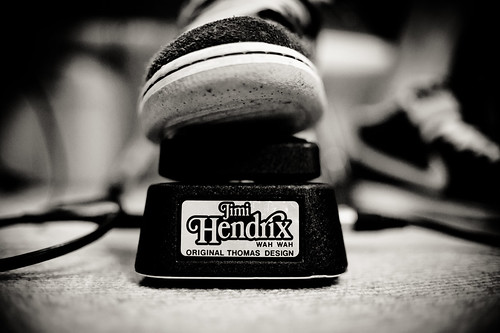
The authentic feel of everything from Shaft to.. everything else. Photo of a wah-wah pedal by Kmeron on Flickr.

You can now sign up to receive each day’s Start Up post by email. You’ll need to click a confirmation link, so no spam.

A selection of 10 links for you. Handle with care. I’m charlesarthur on Twitter. Observations and links welcome.

Burma gives a big thumbs-up to Facebook » Foreign Policy

Christian Caryl:

As the vote count draws to a close, it’s clear that Burma’s long-suffering opposition has scored a landslide victory in Sunday’s historic national election. And the leader of that opposition knows whom to thank. As she was explaining the reasons for her party’s remarkable triumph in an interview with the BBC this week, Nobel Prize Laureate Aung San Suu Kyi said this: “And then of course there’s the communications revolution. This has made a huge difference. Everybody gets onto the net and informs everybody else of what is happening. And so it’s much more difficult for those who wish to commit irregularities to get away with it.”

She could have been a little more specific, though. When people here in Burma refer to the “Internet,” what they often have in mind is Facebook — the social media network that dominates all online activity in this country to a degree unimaginable anywhere else.

link to this extract


Inside the problem with Alphabet » The Information

Amir Efrati and Jessica Lessin:

[Larry] Page unveiled Alphabet in August as a way to empower entrepreneurs and strong CEOs to build new companies “with a long term view.” Mr. Page had already been creating new companies under Google, like Calico, the secretive life-extension startup that former Genentech CEO Art Levinson is leading.

Some of those companies wanted more autonomy from Google and its bureaucracy, on issues big and small; [Arthur] Levinson [in charge of Calico], for instance, bristled when Google’s food services staff tried to apply Google’s nutritional guidelines to dining areas that served Calico employees, according to several people Mr. Page told about it.

Many details about the new structure have yet to be figured out. They include whether and how Alphabet companies can raise outside capital; who will control the IP they create, especially if they borrowed some from the old Google; and how they will use Google’s technical infrastructure.

If Google’s world-class cybersecurity software extends to the new Alphabet companies and those companies are later spun out or sell a significant chunk of themselves to another party, will those companies still get to use the Google software? Does it make sense for people at an Alphabet company to get Alphabet stock as part of their compensation, given that the performance of Alphabet will be heavily influenced by the performance of Google Search ads?

link to this extract


Wireless carriers are favouring the iPhone » The Motley Fool

Sam Mattera:

The gradual decline of contract plans has sparked a wave of innovation in the U.S. wireless industry. In the past, consumers mostly signed two-year agreements in exchange for heavily subsidized handsets. Today, they have a vast array of choices, including installment options and leasing programs. Most of these plans reduce upfront costs by doing away with down payments, and give consumers the ability to upgrade their smartphones more often.

But some of these plans – the most advantageous, in fact – are only available to buyers of Apple’s iPhone.

I could have sworn that the hot take on the end of subsidies (aka contract plans) was that it meant dire trouble for Apple.
link to this extract


The last days Of Marissa Mayer? » Forbes

Miguel Helft goes into detail and finds many of the same stories we’ve been hearing for the past couple of years:

Mayer hired some executives without fully vetting them with her team, and some of those decisions proved costly. One of her first big hires was Google sales executive Henrique De Castro, brought on as chief operating officer. De Castro failed to meet sales goals and Mayer fired him after 15 months, but not before he reportedly pocketed as much as $109 million in compensation and severance. Mayer also spent a year without a chief information officer after her IT operations chief David Dibble quit for personal reasons in 2013. In August 2014 Mayer finally announced to her executive staff that she had found the right person in Netflix executive Mike Kail, who came recommended by her husband, the investor Zachary Bogue. Three months later Netflix sued Kail for fraud, after he allegedly collected kickbacks from vendors. Yahoo quietly let him go in May.

Mayer’s propensity for micromanaging also exasperated many of her executives. By her own admission, Mayer spent an entire weekend working with a team of designers to revamp the Yahoo corporate logo, debating such details as the right slant for the exclamation point (9 degrees from vertical). Mayer also insisted on personally reviewing even minor deviations from a compensation policy she had instituted. When managers wanted to give top performers a bonus or raise above the parameters she had set, they had to write her an e-mail explaining the circumstances and wait for an approval or denial. Some managers dispute that this was a hard-and-fast rule. Mayer also insisted on reviewing the terms given to hundreds of contractors and vendors on a quarterly basis, whether they were engineers or writers or makeup artists. “She would go line by line and decide on what date a contract should end,” says a senior executive. Adds another: “It was a colossal waste of time.”

There’s detail, and then there’s detail that doesn’t merit a chief executive’s very expensive time.
link to this extract


EE proposes restrictions on mobile adverts » Telegraph

Christopher Williams:

EE, Britain’s biggest mobile operator, is considering introducing technology that will hand smartphone users the power to control the advertising they see online, in a clampdown that would cause major upheaval in the £2bn mobile advertising market.

Olaf Swantee, EE’s chief executive, has launched a strategic review that will decide whether the operator should help its 27 million customers to restrict the quantity and type of advertising that reaches their devices, amid concern over increasingly intrusive practices.

The review will look at options for creating new tools for subscribers that would allow them to block some forms of advertising on the mobile web and potentially within apps, such as banners that pop up on top of pages or videos that play automatically. EE customers could also get the ability to control the overall volume of advertising.

Mr Swantee told The Sunday Telegraph: “We think it’s important that, over time, customers start to be offered more choice and control over the level and intensity of ads on mobile.

“For EE, this is not about adblocking, but about starting an important debate around customer choice, controls and the level of ads customers receive.”

It’s about adblocking. And potentially creating a whitelist.. in paid-for manner?
link to this extract


Syria’s climate-fuelled conflict, in one stunning comic strip » Mother Jones

I would hotlink to the strip directly, to embed it, but that would probably take more scrolling room than you want to bother with here. However, it makes a crucial point: the Arab Spring wasn’t caused by some abrupt realisation among the peoples of the Middle East that democracy would be nice; instead, it was driven by the rising cost of staple foods and rural displacement to cities, which created huge tensions – which authoritarian regimes couldn’t handle without causing more unrest.

Thus when people snigger at Prince Charles saying that the refugee crisis is a result of climate change, he’s not the one who’s wrong; they are.
link to this extract


Adele is NOT No.1 on this chart (and it’s a really important one) » Music Business Worldwide

Tim Ingham:

The Pirate Bay’s regularly-updated Music chart shows the 100 most popular torrents on the service in the past 48 hours.

The shock news: [Adele’s new album] 25 is nowhere. Literally nowhere.

Below, you can see the 25 most popular music files on TPB as of yesterday morning (November 22) UK time – two days after the astonishingly successful release of Adele’s new LP.

Not only does 25 not feature in the tracks we’ve featured above – it didn’t feature in the entire top 100.

It was the same story on Saturday (November 21) – a day after release – and it’s the same story this morning.

Adele did briefly claim a position on the TPB chart yesterday, MBW noticed – at No.63, with her previous release 21 – but she’s since disappeared.

Speaks again to the different generations interested in Adele. If it had been, say, a new Nine Inch Nails album, it would have been all over the pirate sites.
link to this extract


I worked in a video store for 25 years. Here’s what I learned as my industry died » Vox

Dennis Perkins makes the point that a lot of it is about choice and curation:

It was a point of pride that we had everything and could turn people on to some obscurity we knew would appeal. A video store had sneaky cultural punching power — movies championed by our staff got watched. They stayed alive. You know, as long as we did.

By contrast: Netflix routinely adds and removes films at a whim based almost exclusively on licensing agreements. These agreements just don’t mean that movies any respectable video store would have remain “unavailable for streaming,” but that a substantial portion of Netflix’s (rather small) 10,000 film inventory is garbage: direct-to-DVD movies (or movies that bypass DVD for streaming entirely) accepted as part of package deals to get the rights to titles somebody might actually want to see. Although not everything you might want to see. As of this writing, you can’t watch Annie Hall, Argo, The Exorcist, This Is Spinal Tap, Taxi Driver, Schindler’s List, The Muppet Movie, A Nightmare On Elm Street, Fight Club, or Frozen on Netflix. You can, however, stream Transmorphers or Atlantic Rim, two suspiciously titled low-budget knockoffs of the movie you meant to watch.

His other key point: you had to choose to go to a video store. Netflix and its kin generally offer “let’s settle for this” content.
link to this extract


How LSD microdosing became the hot new business trip » Rolling Stone

Andrew Leonard:

“Ken” is 25, has a master’s degree from Stanford and works for a tech startup in San Francisco, doing a little bit of everything: hardware and software design, sales and business development. Recently, he has discovered a new way to enhance his productivity and creativity, and it’s not Five Hour Energy or meditation.

Ken is one of a growing number of professionals who enjoy taking “microdoses” of psychedelics – in his free time and, occasionally, at the office. “I had an epic time,” he says at the end of one such day. “I was making a lot of sales, talking to a lot of people, finding solutions to their technical problems.”

A microdose is about a tenth of the normal dose – around 10 micrograms of LSD, or 0.2-0.5 grams of mushrooms. The dose is subperceptual – enough, says Rick Doblin, founder and executive director of the Multidisciplinary Association for Psychedelic Studies, “to feel a little bit of energy lift, a little bit of insight, but not so much that you are tripping.”

This will become the new go-to explanation for crazy startup ideas.
link to this extract


The invention of the wah-wah pedal » Priceonomics

In 1965, in a small back room of a Los Angeles facility, Thomas Organ’s engineers began to build Vox amplifiers. Among these engineers was a bright-eyed 20-year-old by the name of Brad Plunkett.

Plunkett was given a challenging task by Thomas Organ’s CEO: he was to take apart a Vox AC-100 guitar amp and find a way to make it cheaper to produce while still maintaining the sound quality.

“The first thing I noticed,” he recalls in the documentary Cry Baby, “was this little switch [on the amp] entitled ‘MRB.’”

This switch, invented by British engineer Dick Denney and installed on all Vox AC-100 amps at the time, stood for “middle range boost.” When flicked on, it would highlight the middle sound frequencies of the guitar (notes between 300 and 5,000 hertz); in doing so, it would tame the extremes (very high and very low pitches), and produce a flattened, smoother sound. Plunkett realized that he could replace this pricey switch with a potentiometer – essentially an adjustable knob that divided voltages and acts as a variable resistor – and achieve the same effect.

“The switches were very expensive, about $4 each,” Plunkett continues. “The potentiometer would only cost about 30 cents.”

After a few days of fiddling around with spare parts, Plunkett succeeded in designing a circuit that could change the frequency of notes by simply rotating a potentiometer. Then, something unexpected happened.

(This makes an hour-long video.)

Patented as “foot controlled continuously variable preference circuit for musical instruments”. The patent came too late. Everyone could figure it out. Still, should the wah-wah pedal be added to the list of serendipitous discoveries, along with vulcanized rubber and Post-It notes?
link to this extract


Errata, corrigenda and ai no corrida: none notified.

Start up: how self-driving cars will change life, why *is* http on port 80?, iPad Pro reviewed, and more


Creating a more beautiful subway map for Tokyo wasn’t easy. Photo by aka.me on Flickr.

You can now sign up to receive each day’s Start Up post by email. You’ll need to click a confirmation link, so no spam.

A selection of 9 links for you. Smoosh them. I’m charlesarthur on Twitter. Observations and links welcome.

How Uber’s autonomous cars will destroy 10 million jobs and reshape the economy by 2025 » Zack Kanter

Industry experts think that consumers will be slow to purchase autonomous cars – while this may be true, it is a mistake to assume that this will impede the transition. Morgan Stanley’s research shows that cars are driven just 4% of the time, which is an astonishing waste considering that the average cost of car ownership is nearly $9,000 per year. Next to a house, an automobile is the second most expensive asset that most people will ever buy – it is no surprise that ride sharing services like Uber and car sharing services like Zipcar are quickly gaining popularity as an alternative to car ownership. It is now more economical to use a ride sharing service if you live in a city and drive less than 10,000 miles per year. The impact on private car ownership is enormous: a UC-Berkeley study showed that vehicle ownership among car sharing users was cut in half. The car purchasers of the future will not be you and me – cars will be purchased and operated by ride sharing and car sharing companies.

And current research confirms that we would be eager to use autonomous cars if they were available. A full 60% of US adults surveyed stated that they would ride in an autonomous car, and nearly 32% said they would not continue to drive once an autonomous car was available instead.

Today’s children are the last generation that will have to pass a driving test. Think about that briefly. Then read the rest of Kanter’s piece. (It’s actually optimistic, overall.) And one more thing: it doesn’t have to be about Uber.
link to this extract


Fantastical designs from the frontier of subway maps » Washington Post

For many designers, creating a better subway map is an irresistible puzzle — “infinitely alterable, incredibly vexing, with no definitive answer,” writes Emily Badger. Badger’s new article looks at some amazing examples of metro maps from the frontier of design, including the beautiful 2010 diagram of all of the rails in the Tokyo region, designed by Kim Ji-hwan.

link to this extract


Rooted, Trojan-infected Android tablets sold on Amazon » Help-Net Security

Zeljka Zorz:

If you want to buy a cheap Android-powered tablet, and you’re searching for it on Amazon, the best thing you can do is carefully read all the negative reviews you can find. If you are lucky, you’ll see some that will warn you about the device being rooted and coming pre-installed with malware.

Security researchers from Cheetah Mobile have recently discovered a slew of these devices – over 30 tablet brands in total – being sold on Amazon and other reputable online stores.

Here’s a short overview of affected devices, along with a sample of reviews warning about the malware.

The malware in question is the Cloudsota Trojan, which allows remote control of the infected devices and conducts malicious activities without user consent.

Remember, a Trojan is for life, not just for Christmas. Estimated that over 17,000 have been sold.
link to this extract


The case against a Google phone » The Information

Amir Efrati on the rumours that Google is looking to design its own phone chips:

the ecosystem of partners that build and sell Android phones has matured to some extent; those companies have 1.4bn customers (there’s one third as many iPhones in customer’s hands, by contrast). While many of those customers aren’t necessarily loyal, and surprising upstarts are gaining ground, Google won’t be able to suddenly capture a significant amount of market share with a better device, at their expense. (It would also risk its chance to return to China, given that it is working with local handset brands to do so.) There is no going back.

Even if Google wanted to compete on price by offering devices cheaper than the iPhone, it would still have to engineer a marketing apparatus so impressive that it convinces smartphones buyers that the Google phone is the best in the world. That’s the only way it could convert iPhone and even some Samsung Galaxy S users — who are wealthier than typical Android users — to the Google phone. Good luck with that.

Then there’s the fact that prices for phones have come down so much as components become cheaper that it’s become exceedingly difficult for existing Android phone brands to stand out in the market.

Even if the Google phone struck a chord, it’s hard to see it selling more than tens of millions of devices in the next few years, and that’s optimistic.

I can believe that Google is interested in designing ARM architecture chips. But I think it’s more likely considering them for its server farms. People inside Google already know Efrati’s argument (which holds water). Sundar Pichai is hardly the sort to hang on to an idea for pride. He killed Google+, remember?
link to this extract


Ad Replacer: turn spammy ads into breaking news

We take those terrible, misleading ads that take you to garbage websites (or worse!) and switch them out for real-time, human-curated headlines and links from ONLY the most trusted, reliable websites.

Sites that never end in best-deals-4-everyone.ru. Sites that never pop up 8 windows asking if you’re SURE you want to click away. Just sites you like and stories you want to read, all seamlessly integrated into your browsing experience before you even notice it’s changed. Doesn’t that sound nice?

Neat idea; Chrome extension only for now.
link to this extract


Facebook Messenger adds facial recognition » Tech Insider

Alex Heath:

Adding facial recognition to Messenger may seem odd given that it’s primarily considered to be a messaging app, but when you consider that people send a staggering 9.5 billion photos through Messenger every month, the decision begins to make more sense.

Messenger is very proactive in prompting to share a photo with friends it thinks are in a photo — the app will send a notification asking you to send a photo to people on Facebook it thinks are tagged. (This specific behavior can be turned off in the Messenger app’s settings.)

Australia only for now, but your feeling on whether this is creepy or great will probably depend on age. Note though that it’s machine learning/AI being deployed as utterly normal; even five years ago this would have been hard to implement on such scale.
link to this extract


iPad Pro review: jack of all trades, master of most » WSJ

Joanna Stern:

On paper, 12.9 inches may not seem much bigger than the standard iPad’s 9.7 inches, but the Pro screen made me more productive. I spent much of my week writing in Microsoft Word on the left hand of the screen and toggling between websites and my inbox on the right. Text looks incredibly crisp, especially in comparison with my MacBook Air’s display, which has just half the pixels.

The A9X processor and 4GB of RAM kept those apps running swiftly. But most impressive? When I exported the same 4K video in iMovie on both the Pro and my Intel Core i5-powered MacBook Air with 8GB of RAM, the iPad reached the finish line a minute and a half faster. And, unlike the Air, it didn’t sound like it was about to blast off from Cape Canaveral.

For real work, it’s all about attaching Apple’s $170 Smart Keyboard. You don’t do this via Bluetooth, but rather with the new magnetic Smart Connector. I quickly fell in love with the feel of the bouncy fabric keys, and it became second nature to hit Command+Tab to toggle between apps. Oh, and did I mention the keyboard is spill-proof? Seriously, my iced latte just wiped right off.

Still, many times I wished for something closer to Microsoft’s Surface Type Cover. Apple’s keyboard only props the screen at a 120-degree angle; attaching it and folding it take origami skill. It all almost toppled off my lap a few times, and the keys aren’t backlit. Plus, there’s no trackpad, like the Type Cover’s. I constantly had to reach out and touch the screen to scroll or select text and icons…

…Despite iOS 9’s improved multitasking, there are still shortcomings. You can’t customize the home screen’s comically large icons with files or other shortcuts. You can’t place the same app—say two Safari windows—side by side. And iOS’s lack of real file management can be maddening. Microsoft saddles its Surface Pro with full-blown desktop Windows while the iPad Pro is still too closely related to an iPhone. Apple has to keep working to find the happy middle.

Pricey. But here’s the kicker:

There’s one thing the iPad has over all other laptops and competing tablets though: incredible apps. The Pro helped me realize that I’ve been living in the past, using legacy desktop programs to accomplish things.

link to this extract


Why was 80 chosen as the default HTTP port and 443 as the default HTTPS port? » How To Geek

According to superuser jcbermu:

The Internet Assigned Numbers Authority (IANA) is a department of ICANN, a non-profit private corporation that oversees global IP address allocation, the Domain Name System (DNS), well-known ports, and other Internet Protocol-related symbols and numbers.

During March of 1990, they published a document (RFC 1060) where they listed all the well-known ports at that time. In that list there was no protocol assigned to port 80 (it jumped from 79 to 81). 79 was assigned to “finger” (find out if someone was online) and 81 to HOSTS2-NS, the HOSTS2 Name Server.

At that time, port 80 was officially free. In 1991, Tim Berners-Lee issued the first version of HTTP in a document (HTTP 0.9) where he stated “If the port number is not specified, 80 is always assumed for HTTP.”

HTTPS? Lost in time. Blamed on someone at NCSA Mosaic. So there’s your pub quiz question/answer pair.
link to this extract


Apple Music » Android Apps on Google Play

It arrived as an app on Android, as version 0.9.0:

Introducing the beta of Apple Music on Android.
Notes about the beta period:
• Music videos are coming soon.
• Family membership sign-ups and upgrades require Mac or iOS.
• Sign-up process to be optimized for Android.

Notable that it hasn’t attracted the hate reviews that the “Move to iOS” app did; there are actually a lot of five-star reviews. (Average 3.1.) The key element looks like the “family membership” element; that’s a really powerful reason for Apple to want to reach Android users – because families are mixed users.
link to this extract


Errata, corrigenda and ai no corrida:

Start up: Google open-sources machine learning, Adele v streaming, Facebook’s Belgian problem, and more


Steve Reich’s Piano Phase, as a video, by Alexander Chen.

You can now sign up to receive each day’s Start Up post by email. You’ll need to click a confirmation link, so no spam.

A selection of 9 links for you. Made without nuts. I’m charlesarthur on Twitter. Observations and links welcome.

Preserving security in Belgium » Facebook

Alex Stamos works on online security for Facebook, while a Belgian court has ruled that the “datr” cookie it uses is not legal. Stamos isn’t happy:

The reason I’m bullish on the datr cookie is because for at least the last five years we have used it every day to defend people’s accounts through the following actions:
• Preventing the creation of fake and spammy accounts
• Reducing the risk of someone’s account being taken over by someone else
• Protecting people’s content from being stolen
• Stopping DDoS attacks that could make our site inaccessible to people

If the court blocks us from using the datr cookie in Belgium, we would lose one of our best signals to demonstrate that someone is coming to our site legitimately. In practice, that means we would have to treat any visit to our service from Belgium as an untrusted login and deploy a range of other verification methods for people to prove that they are the legitimate owners of their accounts. It would also make Belgian devices more attractive to spammers and others who traffic in compromised accounts on underground forums…

The datr cookie is only associated with browsers, not individual people. It doesn’t contain any information that identifies or is tied to a particular person. At a technical level, we use the datr cookie to collect statistical information on the behavior of a browser on sites with social plugins, such as the Like button, to help us distinguish patterns that look like an attacker from patterns that look like a real person.

Tricky.
link to this extract


Why streaming doesn’t really matter for Adele » Music Industry Blog

Mark Mulligan:


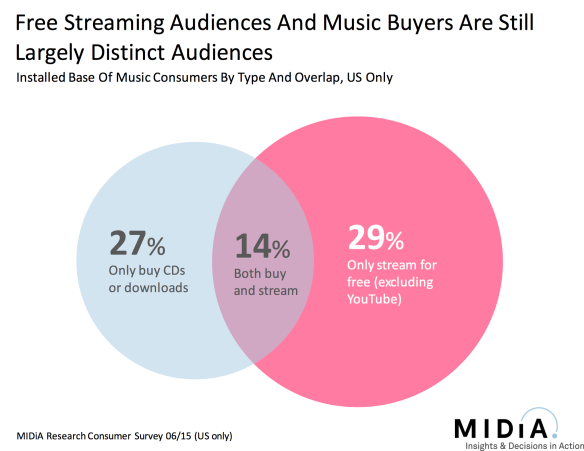
Looking at mid-year 2015 consumer data from the US we can see that music buyers (i.e. CD buyers and download buyers) are still a largely distinct group from free streamers (excluding YouTube). While this may seem counter intuitive it is in fact evidence of the twin speed music consumer landscape that is emerging. This is why ‘Hello’ was both a streaming success (the 2nd fastest Vevo video to reach 100m views) and a sales success (the first ever song to sell a million downloads in one week in the US). These are two largely distinct groups of consumers.

As a reader of this blog you probably live much or most of your music life digitally, but for vast swathes of the population, including many music buyers, this is simply not the case. Given that the mainstream audience was so key to ‘21’s success we can make a sensible assumption that many of these will also fall into the 27% of consumers that buy music but do not stream.

This is also why it was so tricky for Apple to move into streaming: lots of iTunes users simply don’t. And also why Adele’s audience and prospects are very different from Taylor Swift’s.
link to this extract


Facing pressure in China, Xiaomi also stalls in India » The Information

Amir Efrati:

the domestic Chinese market has slowed, while Xiaomi has dropped to No. 2 there after Huawei Technologies in terms of market share for the third quarter of this year, according to research firm Canalys.

The results in India seem to bear out the bear thesis on Xiaomi’s expansion plans: that it will be harder to succeed outside of China because it would have to work within the bounds of Google’s version of Android, where it can’t customize the software—and run an app store—the way it does inside of China, where Google mobile apps are almost completely absent.

In India, Xiaomi is “just another low-cost phone hardware company,” says one rival executive.

One Indian e-commerce executive whose firm sells smartphones says Xiaomi has “stagnated” online and that sales of Samsung and Motorola phones were much stronger during a recent period of online promotions known as “Big Billions Days.” Xiaomi, bucking its traditional practice of selling phones only online, has been willing to sacrifice some margin and sell phones through some retail stores in India.

If you have to offer Google Mobile Services, in the end your differentiation will be whittled away.
link to this extract


Tim Cook: Apple CEO on the company’s latest venture – the iPad Pro » The Independent

David Phelan bagged an interview while the Apple chief was in London:

The iPad Pro is the most expensive tablet yet, £679 and up. At a time when iPad sales are flat, was he tempted to do as some competitors have done and released, say, a £50 tablet? “No, there are no good £50 tablets. We’ve never been about making the most, we’ve been about making the best. This was a way of making a product that people can do a lot of things with. I think it will attract a lot of PC users and people who are not currently using Apple products. And I think it will be a reason for people to upgrade who love iPad and who have been waiting for something very different and now here it is.”

Along with the Pencil, there’s a keyboard cover. Cook says it’s different from rival keyboards because with none of those would you say it “came from the same parent” as the tablet itself. “Now all of a sudden you have a keyboard that has been perfectly designed for the iPad, it’s integrated and then you’ve got the software with split view and it’s inherently very productive. I’m travelling with the iPad Pro and other than the iPhone it’s the only product I’ve got.” 

You have to love Cook’s rejection of “why did you do a stylus?” “It isn’t a stylus, it’s a Pencil.” Hear the capital. And his description of his youth as a trombone player is hilarious.
link to this extract


DTEK by BlackBerry » Android Apps on Google Play

Interesting move by BlackBerry: DTEK looks at how often and to what extent other apps have been accessing your location, contacts and so on:

In this world of interconnected apps and networks, controlling what is shared and who it’s shared with can be a challenge. BlackBerry® DTEK for Android™ allows you to view and improve your privacy level and monitor application access to your camera, microphone, location and personal information. Take control with DTEK by BlackBerry.
Key Features:

• Monitor – Know at a glance the overall security rating for your device, as well as for specific security features. You can identify whether or not you need to take any action to improve the security of your device.

And so on. For Android 5.0 and up; seems like it would be a useful app for anyone on Android. Certainly some of the folk at UTB blogs found Facebook taking amazing liberties – such as Facebook accessing the phone location 561 times in 60 hours. That’s roughly every 6 minutes. You were asking about your battery life? (Apparently there’s a version coming for iOS too.)
link to this extract


TensorFlow: smarter machine learning, for everyone » Official Google Blog

Sundar Pichai:

It’s a highly scalable machine learning system—it can run on a single smartphone or across thousands of computers in datacenters. We use TensorFlow for everything from speech recognition in the Google app, to Smart Reply in Inbox, to search in Google Photos. It allows us to build and train neural nets up to five times faster than our first-generation system, so we can use it to improve our products much more quickly.

We’ve seen firsthand what TensorFlow can do, and we think it could make an even bigger impact outside Google. So today we’re also open-sourcing TensorFlow. We hope this will let the machine learning community—everyone from academic researchers, to engineers, to hobbyists—exchange ideas much more quickly, through working code rather than just research papers. And that, in turn, will accelerate research on machine learning, in the end making technology work better for everyone. Bonus: TensorFlow is for more than just machine learning. It may be useful wherever researchers are trying to make sense of very complex data—everything from protein folding to crunching astronomy data.

No quibbles: this is excellent news. Main site is http://www.tensorflow.org. Written in Python; binaries available for Linux and Mac. I’m sure there’s another desktop OS, isn’t there?
link to this extract


RECONSIDER » Medium

David Heinermeier Hansson (he usually goes by “DHH”), who founded Basecamp which – yawn! – is just mildly and continually successful:

it’s hard to carry on a conversation with most startup people these days without getting inundated with odes to network effects and the valiance of deferring “monetization” until you find something everyone in the whole damn world wants to fixate their eyeballs on.

In this atmosphere, the term startup has been narrowed to describe the pursuit of total business domination. It’s turned into an obsession with unicorns and the properties of their “success”. A whole generation of people working with and for the internet enthralled by the prospect of being transformed into a mythical creature.

But who can blame them? This set of fairytale ideals are being reinforced at every turn.
Let’s start at the bottom: People who make lots of little bets on many potential unicorns have christened themselves angels. Angels? Really?

link to this extract


Piano Phase » Alexander Chen

This site is based on the first section from Steve Reich’s 1967 piece Piano Phase. Two pianists repeat the same twelve note sequence, but one gradually speeds up. Here, the musical patterns are visualized by drawing two lines, one following each pianist.

The sound is performed live in the browser with the Web Audio API, and drawn in HTML5 Canvas.

This is really wonderful. Chen is a creative director at Google Creative Lab – he has done lots of other visualisations of music.
link to this extract


The consumerization of the automobile supply chain » DIGITS to DOLLARS

Jonathan Greenberg:

Last week I saw an interesting post on Venture Beat about Acer Launching an Electric All-Terrain Vehicle [quad bike, for UK readers]. This struck a chord because Taiwan-based Acer is a manufacturer of PCs and other consumer electronics (CE) devices. Acer is one of the most prominent companies in Taiwan’s CE complex, which builds almost all of our consumer gadgets. They are closely tied to some of the industry’s most important ODMs, component vendors and contract manufacturers. It is not that surprising to see a consumer electronics giant diversify into higher priced devices as they move up the value chain. However, if you don’t look at Acer as an device maker, but instead view them as a flagship of the Taiwanese electronics industry, the announcement has broader implications.

You can see where this is going, can’t you?
link to this extract


Errata, corrigenda and ai no corrida: none reported.

Start up: payday search predators, the natural nuclear reactor, Facebook’s code problem and more


Shh! Don’t tell Facebook! Photo by The Keenes on Flickr.

You can now sign up to receive each day’s Start Up post by email. You’ll need to click a confirmation link, so no spam.

A selection of 11 links for you. Please note: the “link to this extract” link doesn’t work if you’re using it from the email. Who shall we blame? Meanwhile, I’m charlesarthur on Twitter. Observations and links welcome.

People’s deepest, darkest Google searches are being used against them » The Atlantic

Adrienne Lafrance:

Consider, for example, a person who googles “need rent money fast” or “can’t pay rent.” Among the search results that Google returns, there may be ads that promise to help provide payday loans — ads designed to circumvent Google’s policies against predatory financial advertising. They’re placed by companies called lead generators, and they work by collecting and distributing personal information about consumers online. So while Google says it bans ads that guarantee foreclosure prevention or promise short-term loans without conveying accurate loan terms, lead generators may direct consumers to a landing page where they’re asked to input sensitive identifiable information. Then, payday lenders buy that information from the lead generators and, in some cases, target those consumers—online, via phone, and by mail—for the very sorts of short-term loans that Google prohibits.

But look, if Google bans those ads, then it’s taking a position. Shouldn’t it only accept ads from organisations that it has vetted? Or just not accept ads on those searches?
link to this extract


In the 1970s, scientists discovered a two billion-year-old nuclear reactor in west Africa » Medium

The Physics ArXiv blog explains:

When the ore in Gabon was laid down some 2 billion years ago, the concentration of uranium-235 would have been about 4%, more than enough for a self-sustaining nuclear reaction.

The idea is that when a neutrons hits an atom of uranium-235, the atom splits producing two smaller nuclei and several neutrons. These neutrons go on to split other atoms in an ongoing chain reaction.

However, the liberated neutrons are high-energy particles that tend to fly away rapidly. So nuclear reactors usually contain a moderating material that slows down the neutrons so that they can interact with other uranium atoms.

It turns out that water is a reasonable neutron moderator. So an important component of this natural reactor was the presence of water seeping through the uranium ore. And this had an interesting impact on the way the reactors operated.

Nuclear scientists believe that the Oklo reactors operated in pulses. As water flowed into the rock, it moderated the neutrons, allowing a chain reaction to occur. But this increased the temperature of the rock, boiling the water into steam which escaped.

Kept running for 300,000 years. More useful than that is what it taught scientists about how fission waste products migrate from burial sites. Turns out the answer is: not that much.
link to this extract


Facebook’s code quality problem » Graham King

Facebook has a software quality problem. I’m going to try to convince you with three examples. This is important because it demonstrates the time-honored principle that quality matters. In demonstrates it, as Facebook engineers like to say, at scale. I don’t work at Facebook or any competitor, I’m just an observer.

The three examples – 18,000 Objective-C classes in the iOS app with 429 people working on it (note: delete the app), database restarts and the fact that the site works better when its engineers aren’t there, all speak to a classic problem.
link to this extract


Hackers claim million-dollar bounty for iOS zero-day attack » WIRED

Andy Greenberg:

On Monday, the security startup Zerodium announced that it’s agreed to pay out that seven-figure sum to a team of hackers who have successfully developed a technique that can hack any iPhone or iPad that can be tricked into visiting a carefully crafted web site. Zerodium describes that technique as a “jailbreak”—a term used by iPhone owners to hack their own phones to install unauthorized apps. But make no mistake: Zerodium and its founder Chaouki Bekrar have made clear that its customers include governments who no doubt use such “zero-day” hacking techniques on unwitting surveillance targets.

In fact, Bekrar tells WIRED that two teams of hackers had attempted to claim the bounty, which was announced in September with an October 31st deadline. Only one proved to have developed a complete, working iOS attack. “Two teams have been actively working on the challenge but only one has made a full and remote jailbreak,” Bekrar writes. “The other team made a partial jailbreak and they may qualify for a partial bounty (unconfirmed at this time).”

I’d like to see documentary proof of the hack before I take this at face value. Zerodium is clearly seeking publicity; and the incentive to, um, bend the truth around seven-figure annoucements is high.
link to this extract


Ranking Digital Rights – Ranking ICT sector companies on respect for free expression and privacy

For the inaugural Index, Ranking Digital Rights analyzed a representative group of 16 companies that collectively hold the power to shape the digital lives of billions of people across the globe. Leading global ESG research and ratings provider, Sustainalytics, co-developed the methodology.

Eight publicly listed Internet companies and eight publicly listed telecommunications companies were selected based on factors including geographic reach and diversity, user base, company size, and market share. These companies were assessed on 31 indicators across three categories – commitment, freedom of expression, and privacy – drawn heavily from international human rights frameworks, as well as emerging and established global principles for privacy and freedom of expression.

The research revealed a deep need for improvement:

Only six companies scored at least 50% of the total possible points;
The overall highest score was only 65%;
Nearly half the companies in the Index scored less than 25%, showing a serious deficit of respect for users’ freedom of expression and privacy.

Google came top in internet companies. List at https://rankingdigitalrights.org/index2015/. Apple isn’t there – doesn’t it have any impact?

Anyhow, speaking of digital rights and freedom of expression…
link to this extract


A surprisingly difficult question for Facebook: do I have boobs now? » The Guardian

Hannah Jane Parkinson talks to Courtney Demone, a trans woman (ie born male) who asks the question that Facebook apparently finds exceptionally hard to answer:

Demone says that Facebook likes to present itself as a liberal and progressive organisation, but that most of its actions in this regard are decidedly low-risk. She mentions Facebook’s introduction of a widget allowing users to overlay their profile pictures with a rainbow flag and notes that it was to celebrate a gay marriage law which had been passed by the US supreme court – not before, in support of it.

Demone says that [Facebook’s] allowing users to define their gender in a free-form field, and offering a choice of pronouns, is progressive, but it is decidedly lower risk rather than, say, challenging the paradigm that female nipples should be covered up. This, of course, would run the risk of offending advertisers and in the case of Instagram, result in a 17+ user rating in app stores.

This gets to such a deep question: why should American organisations get to decide the mores of the countries that they export their business to? Mark Zuckerberg once said he hoped Facebook could solve the Arab-Israeli conflict by making people friends. But topics such as this shows why it can be seen as more like an enemy of social change.
link to this extract


India LTE smartphone shipments grew 2400% annually climbing to 10m units in Q3 2015 » Counterpoint Technology Market Research

Tarun Pathak has the details. Here’s one of the more interesting pullouts (from lots) about a local OEM:

Micromax maintained the second position in both overall mobile phone market and the smartphone segment with a market share of 13.7% and 17.7% respectively.

The brand’s share from online channel increased during the quarter. However, it is now facing pressure competition in $50-$100 price segment from Intex, Lava and others.

Micromax’s Cyanogen based online only brand ‘Yu’ launched its cheapest LTE model ‘Yunique’ during the quarter and the brand has been growing steadily ever since its launch.

Micromax Yu brand alone is now selling more smartphones than Xiaomi online, depicting it’s going to be challenging even for popular brands such as Xiaomi to scale in Indian market

If Xiaomi can’t succeed in India, it’s going to have a real problem.
link to this extract


Google abandons plan for a retail store in New York City » Crain’s New York Business

Daniel Geiger:

Google has abandoned plans to open its first-ever retail store in New York City.

The company is trying to sublease a 5,442-square-foot SoHo space it leased last year, and wants $2.25m annually in rent for it, according to sources.

The decision to abandon its retail store came after the Internet giant spent $6m renovating the 131 Greene St. location. The outpost was supposed to be one of Google’s first stand-alone stores in the U.S., putting it in direct competition with Apple, which has a host of brick-and-mortar shops that showcase and sell its products in the city, as well as other tech firms with a retail presence. Just last week, Microsoft opened its flagship store on Fifth Avenue.

A spokeswoman for Google didn’t immediately respond to a request for comment.

According to reports, Google planned to begin opening stores to sell products such as the Chromebook, a line of laptops and desktop computers made by several manufacturers that operate on Google software, and smartphones that run its Android operating system. Because Google is subleasing the Greene Street location, it would appear that the company has changed its mind and is pulling back on its plan to open physical stores. However, Google reportedly recently opened a kiosk within a larger electronics store in London earlier this year.

Even so. Why would you have a Google store? It doesn’t make sense.
link to this extract


Over 40% of China’s online sales counterfeit, shoddy: Xinhua » Reuters

Adam Jourdan:

More than 40% of goods sold online in China last year were either counterfeits or of bad quality, the official Xinhua news agency said, illustrating the extent of a problem that has bogged down the fast-growing online sector.

According to the report, which was delivered to China’s top lawmakers on Monday, just under 59 percent of items sold online last year were “genuine or of good quality”, Xinhua said.

China has been trying to shake off a notoriety for pirated and counterfeit goods, long a major headache for global brands targeting the Chinese market from iPhone maker Apple to luxury retailer LVMH.

Chinese e-commerce giant Alibaba Group Holding Ltd has been lobbying to stay off a US blacklist for fakes after coming under renewed pressure this year over suspected counterfeits sold on its shopping platforms.

link to this extract


It’s official: Amazon is opening its first-ever bookstore in Seattle » GeekWire

Taylor Soper:

Internet giant Amazon.com, which got its start selling books online, confirmed this afternoon that it will open its first-ever brick-and-mortar bookstore at Seattle’s University Village on Tuesday morning.

The company sent a letter to customers on Monday with details about the store, which is called “Amazon Books.” In the letter, Amazon Books VP Jennifer Cast calls the store a “physical extension of Amazon.com.”

Someone should disrupt that thing…
link to this extract


Microsoft reneges on ‘unlimited’ OneDrive storage promise for Office 365 subscribers » ZDNet

Ed Bott:

Here’s the key part of tonight’s announcement:

We’re no longer planning to offer unlimited storage to Office 365 Home, Personal, or University subscribers. Starting now, those subscriptions will include 1 TB of OneDrive storage.
100 GB and 200 GB paid plans are going away as an option for new users and will be replaced with a 50 GB plan for $1.99 per month in early 2016.

Free OneDrive storage will decrease from 15 GB to 5 GB for all users, current and new. The 15 GB camera roll storage bonus will also be discontinued. These changes will start rolling out in early 2016.

Microsoft blames a few greedy storage users for the change in heart. “A small number of users,” they wrote, “backed up numerous PCs and stored entire movie collections and DVR recordings. In some instances, this exceeded 75 TB per user or 14,000 times the average.”

That shouldn’t be surprising. If you advertise “unlimited” cloud storage, perhaps you should expect that some people will take you at your word and move large collections to the storage space you so generously offered?

Bott also portrays a division in some upheaval, which doesn’t quite fit the calm exterior Microsoft has been trying to put forward over its cloud work.

That “14,000 times the average” suggests that the average person was storing 5GB of data. Though that probably amounts to 10 Microsoft Word documents, given how the format has bloated. (Thanks @pedrostephano.)
link to this extract


Start up: Surface Book v MacBook Pro, Microsoft’s cloud boost, HP’s cloudburst, BlackBerry’s last stand?, and more


Facebook has noticed that your battery is dying and thinks it might be its fault. Photo by Poster Boy NYC on Flickr.

You can now sign up to receive each day’s Start Up post by email. You’ll need to click a confirmation link, so no spam.

A selection of 8 links for you. Use them wisely. I’m charlesarthur on Twitter. Observations and links welcome.

Surface Book vs. MacBook Pro: It isn’t twice as fast. It’s three times as fast » PCWorld

Gordon Mah Ung:

Rather than rely on a synthetic game benchmark, I also decided to throw a real game at it. Square Enix’s Tomb Raider is available on Steam on both platforms. It’s a fairly recent game and came out for PC and consoles in 2013. Feral Interactive ported the game to OSX the same year.

One caveat here: As a port there’s clearly a lot of things that could be different between the PC version and the Mac version. For my test, I ran it at 1400×900, which was the default resolution on the Mac, and selected the “Normal” quality setting on both. I also poked around the game’s graphics settings to see if there was any variance between them that got lost in translation.

The result is a bone-crushing blow for the MacBook Pro 13: Tomb Raider ran at a pathetic sub-24 fps, while the Surface Book whizzes along at 74 fps.

If Microsoft based its marketing statements on this test alone, it could have safely said “triple the performance of a MacBook Pro.”

To be fair, if you’ve read this far, you know the Surface Book isn’t  twice as fast or three times as fast as the MacBook Pro 13 in all things.

Benchmarks – especially skewed ones like this (is the game optimised for Windows? Bet it is) – really bore me. They capture nothing of the general experience of using a device. But hey, there’s the headline that will be used.
link to this extract


Facebook app: we recently heard reports of some people… » Ari Grant on Facebook

Grant is a Facebook developer:

We recently heard reports of some people experiencing battery issues with the Facebook iOS app and have been looking into the causes of these problems. We found a few key issues and have identified additional improvements, some of which are in the version of the app that was released today.

The first issue we found was a “CPU spin” in our network code. A CPU spin is like a child in a car asking, “Are we there yet? Are we there yet? Are we there yet?”with the question not resulting in any progress to reaching the destination. This repeated processing causes our app to use more battery than intended. The version released today has some improvements that should start making this better.

The second issue is with how we manage audio sessions. If you leave the Facebook app after watching a video, the audio session sometimes stays open as if the app was playing audio silently. This is similar to when you close a music app and want to keep listening to the music while you do other things, except in this case it was unintentional and nothing kept playing.

Still ain’t going to reinstall. Note that it’s not *all* of the identified improvements in the new app.
link to this extract


Microsoft quarterly revenue beats as cloud demand rises » Reuters

The company said Office 365, another key cloud-based offering, had about 18.2m consumer subscribers at the end of its first quarter, an increase of about 3m from the end of the preceding quarter.

Microsoft launched Windows 10, its first new operating system in almost three years, in July. The system, seen as critical for the company, won positive reviews for its user-friendly and feature-packed interface.

The company launched a number of new devices earlier this month, including its first ever laptop and a new Surface Pro tablet, all running on Windows 10.

Revenue in the company’s “More Personal Computing” business, which includes the Windows operating system, fell 17% to $9.4bn.

Excluding the impact of the strong dollar, revenue in the business fell 13%.

Sharp observation by Stefan Constantine: there are more people paying for Spotify than for Office 365. That’s likely to be reversed in a couple of quarters, though.

Phone revenue dropped 54%.
link to this extract


HP shutting down HP Helion public cloud » Business Insider

Matt Weiberger:

Cloud computing is a hot market, letting customers swipe a credit card and get access to essentially unlimited supercomputing power. Developers at startups and large enterpries alike love it because it gives them the ability to get really big, really quickly. 

But while Amazon, Google, and Microsoft have all found great success in the public cloud market, simply buying and maintaining all the servers required to get up to the massive economies of scale necessary to compete in this kind of low-margin business is really hard.

That’s something HP has found out the hard way, with the HP Helion public cloud [which will be shut down from January] constantly coming under fire for being too small and too unfocused on the market to seriously make a dent. 

And so, HP is going to shut down the HP Helion public cloud to stick with what its good at: Helping customers run their own data centers with hardware, software, and services to run at cloud levels of efficiency.

HP’s blogpost announcing this move is a masterful piece of corporate doublespeak: it makes it sound as though everything’s going so well they just have to shut down the public cloud offering.
link to this extract


Force Touch patent: will pressure input be possible in Samsung’s Galaxy S7? » BusinessKorea

Marie Kim:

Samsung Electro-Mechanics filed a patent application with the Korea Intellectual Property Office (KIPO) for Force Touch, which is virtually the same as 3D Touch used in the iPhone 6S. This technology offers different types of functions based on the strength of a push on the screen.

According to the patent information retrieval system of KIPO on Oct. 20, Samsung Electro-Mechanics filed a patent named “touch input equipment and electronics device with touch input” with KIPO on April 9, 2014. Considering that the Korean company supplies core components for Samsung Electronics’ smartphones, the patent is likely to be used in the Galaxy S7.

Would be surprised if it wasn’t. But Samsung’s problem is that pretty much every third-party developer will ignore it; it will have to wait for Google to implement it in Android. Will Apple trouble to sue, though? (At a guess, not.)
link to this extract


The dominance of Alphabet » Global Web Index

Felim McGrath:

With Alphabet set to post healthy financial results later today and  hot on the heels of the announcement of YouTube Red, Thursday’s Chart of the Day looks at just how important this company has become.

Among the hundreds of websites tracked by GlobalWebIndex, Alphabet has the two most popular properties among online adults outside of China. Close to 9 in 10 visit Google each month, while 82% visit YouTube. These figures place Alphabet’s sites above Facebook – which three quarters visited last month – and give it a healthy lead over rival search giant Yahoo (half visit this site monthly). 

This vast user base underlines just how central Alphabet remains to internet users’ online activities despite the ongoing shift to mobile.

link to this extract


Dell may sell assets to pay for EMC deal » Re/code

Arik Hesseldahl from a Q+A with Marius Haas, chief commercial officer of Dell:

Q: It looks like after the close Dell will essentially absorb the EMC federation, but will adapt that structure for its own purposes by making it bigger with pieces like Secureworks, Virtustream and Pivotal. Is that how we should think about it? And if so, how does that complicate or enhance your mission here?

If you dissect what has already been published, you will see there is a strong commitment to de-leveraging or paying down the debt very quickly. There are different angles and different levers we can pull to do that. This is why we have such high confidence in what we’re doing.

Q: That implies that paying down the debt won’t just come by way of cash from operations. Does that mean you might consider selling some assets? Is there anything within Dell that doesn’t stay?

We’re not prepared to talk about that yet, but it’s probably not a bad train of thought.

What’s it going to sell, though? The PC business?
link to this extract


BlackBerry might have leaked the Priv’s specs and release date (update: confirmed) » Engadget

Daniel Cooper:

we know that the Priv is packing a fair bit of power beneath the hood, but has a listed price of $749. There’s no indication if that figure is for the US or Canada — but the page does reference the (GSM) handset not working on American CDMA networks like Verizon and Sprint. You’ll also spot that the device is marked for release on November 16th, so we won’t have long to find out if all of this is true or not.

Performance-wise, the Priv is packing a 1.8Ghz Qualcomm Snapdragon 808 with 3GB RAM, 32GB storage and a microSD card slot that’ll take up to 2TB. Much was made of the Priv’s curved screen, and we know that it’s a 5.4-inch plastic AMOLED with a 2,560 x 1,440 resolution (540 DPI) that can handle styluses and gloves. The physical keyboard measures 37mm high by 77.2mm wide, and there’s a 3,410mAh battery that’s rated for 22.5 hours of use tucked inside.

Price in the UK: £580, against £539 for an iPhone 6S with 16GB and £450 for a Samsung Galaxy S6. At that price, BlackBerry will have positive gross margins on the device (it’s not selling it for less than it costs to make), but so few will sell that you can start the timer now on how soon John Chen announces that the hardware division just isn’t making money because of the costs involved in R+D, distribution, marketing and administration – which feed through to operating profit, or loss. Remember, last financial quarter BB sold 0.8m phones, and made an operating loss on those.
link to this extract


Start up: sneaking iOS apps, spoofing Spotify, CIA director gets hacked, and more


One of these is probably chewing up your battery by playing silent audio (on Android too). But which? Photo by microsiervos on Flickr.

You can now sign up to receive each day’s Start Up post by email. You’ll need to click a confirmation link, so no spam.

A selection of 9 links for you. Like champagne for the mind! Perhaps. I’m charlesarthur on Twitter. Observations and links welcome.

iOS apps caught using private APIs » SourceDNA

Nate Lawson and team:

we noticed that these functions were all part of a common codebase, the Youmi advertising SDK from China.

We then associated the clusters of this SDK’s code with the release dates of the apps that contain them to see how it has evolved over time. The older versions do not call private APIs, so the 142 apps that have them are ok. But almost two years ago, we believe the Youmi developers began experimenting with obfuscating a call to get the frontmost app name.

Once they were able to get this through App Review, they probably became more confident they weren’t being detected and added the above behaviors in order. They also use the same obfuscation to hide calls to retrieve the advertising ID, which is allowable for tracking ad clicks, but they may be using it for other purposes since they went to the trouble to obfuscate this. The latest version of the Youmi SDK (v5.3.0), published a month ago, still gathers all the above information.

Apple has been locking down private APIs, including blocking apps from reading the platform serial number in iOS 8. Youmi worked around this by enumerating peripheral devices, such as the battery system, and sending those serial numbers as a hardware identifier.

Find out now! Just select your developer accounts from a list, and we’ll tell you what we found about your apps. We’ll also show the commercial and open-source code you’re using and alert you to future issues we find.

We found 256 apps (est. total of 1 million downloads) that have one of the versions of Youmi that violates user privacy. Most of the developers are located in China. We believe the developers of these apps aren’t aware of this since the SDK is delivered in binary form, obfuscated, and user info is uploaded to Youmi’s server, not the app’s. We recommend developers stop using this SDK until this code is removed.

Apple’s yanking the apps. Developer? Check it here. It’s always China, isn’t it? But nothing to stop apps from other countries doing the same.
link to this extract


The background data and battery usage of Facebook’s iOS app » MacStories

Federico Viticci:

With iOS 9’s improved energy consumption stats, it’s easier to guess one of the various tricks Facebook may be employing to stay active in the background and drain battery. On my girlfriend’s iPhone, for instance, iOS 9 reports 5 hours of on-screen usage for the last 7 days, and another 11 hours of background audio usage with Background App Refresh turned off.

My guess is that Facebook is hijacking audio sessions on iOS by keeping silent audio in the background whenever a video plays in the app. And because, by default, videos on Facebook auto-play on both Wi-Fi and Cellular and few people ever bother to turn it off, that means there’s a high chance the Facebook app will always find a way to play a video, keep audio in the background, and consume energy to perform background tasks. I’m not alone in noticing the mysterious “Facebook audio” background consumption, and video auto-play seems to me the most likely explanation at this point. I don’t know if turning off auto-play may fix the problem, but I’d recommend doing that anyway to save data.

Un-fricking-believable. The web is suddenly alive with people who have used iOS 9’s better battery monitoring system and discovered that Facebook is eating their battery like nobody’s business.

More discussion here, and a full-on Medium post, which shows Facebook using 3.4hrs in the background with background app refresh turned off.

Just delete it, and use the mobile site – navigate there and create a home page icon for it. And close the tab when done.
link to this extract


Microsoft announces price of 1TB Surface Book — $500 more than the top 13-inch MacBook Pro » GeekWire

James Risley:

The top-of-the-line 1TB Surface Book comes with 16GB RAM and a Core Intel i7 processor for a cool $3,199, $500 more than the fully tricked out 13-inch MacBook Pro, and the same price as the fully enhanced, much larger 15-inch option. The Surface Book does have a few more tricks up its sleeve than the MacBook Pro, including a touchscreen, removable keyboard and a 360-degree hinge, so the price difference isn’t without reason.

The 1TB option joins the lineup that starts at $1,499 for a 128GB Core i5 version. Microsoft isn’t offering many fine-grained customizations for its first laptop, like allowing for more RAM on its 128GB model, but most models look adequately powerful for the everyday user.

“Everyday user”? Wasn’t the point of the Surface Book that it was for some slightly mythical ultra-user? As for the touchscreen and removable keyboard… the case for the touchscreen is still pretty weak for the “everyday user”.
link to this extract


Teen says he hacked CIA director’s AOL account » New York Post

Philip Messing, Jamie Schram and Bruce Golding:

Hillary Rodham Clinton’s email scandal didn’t stop the head of the CIA from using his own personal AOL account to stash work-related documents, according to a high school student who claims to have hacked into them.

CIA Director John Brennan’s private account held sensitive files — including his 47-page application for top-secret security clearance — until he recently learned that it had been infiltrated, the hacker told The Post.

Other emails stored in Brennan’s non-government account contained the Social Security numbers and personal information of more than a dozen top American intelligence officials, as well as a government letter about the use of “harsh interrogation techniques” on terrorism suspects, according to the hacker.

The FBI and other federal agencies are now investigating the hacker, with one source saying criminal charges are possible, law enforcement sources said.

The hacker is getting investigated for criminal charges? Brennan is the one who ought to be prosecuted. If a kid in high school could do this, any Chinese or Russian hacker would have.
link to this extract


Why it’s OK to block ads » Practical Ethics

James Williams:

Think about the websites, apps, or communications platforms you use most. What behavioral metric do you think they’re trying to maximize in their design of your attentional environment? I mean, what do you think is actually on the dashboards in their weekly product design meetings?

Whatever metric you think they’re nudging you toward—how do you know? Wouldn’t you like to know? Why shouldn’t you know? Isn’t there an entire realm of transparency and corporate responsibility going undemanded here?

I’ll give you a hint, though: it’s probably not any of the goals you have for yourself. Your goals are things like “spend more time with the kids,” “learn to play the zither,” “lose twenty pounds by summer,” “finish my degree,” etc. Your time is scarce, and you know it.

Your technologies, on the other hand, are trying to maximize goals like “Time on Site,” “Number of Video Views,” “Number of Pageviews,” and so on. Hence clickbait, hence auto-playing videos, hence avalanches of notifications. Your time is scarce, and your technologies know it.

But these design goals are petty and perverse. They don’t recognize our humanity because they don’t bother to ask about it in the first place.

Neatly argued, by stepping right back from the debate as framed by the ad industry.
link to this extract


I built a botnet that could destroy Spotify with fake listens » Motherboard

William Bedell:

I decided to prototype a robot with an endless appetite for music to see if Spotify could detect what it was doing.

Here is what I coded into life:

Image: William Bedell
First, a remote server used browser automation to sign up for Spotify accounts with randomly generated names, ages, and email addresses. This gave me a limitless supply of accounts to stream songs, so as not to alert Spotify by having a handful of users with inhuman amounts of activity.

A central command server periodically sent out Spotify login credentials to cloud servers (or repurposed personal computers) running dozens of Spotify clients, all masked behind virtual private networks. Each “user” logged in, listened to a few hours of music, then logged out. Their playlists were random selections from various artists I like. Then, I deployed the botnet using a patchwork of free cloud instances and my own hardware.

It was mesmerizing to watch the plays rack up. Unknown albums from minor celebrities I adore suddenly had tens of thousands of hits, where before they had virtually none. With minimal effort, I was generating $32.26 per day in royalties. Inevitably, my thoughts wandered to greed: how profitable would this music royalty factory be if I turned it on music I owned the rights to?

link to this extract


Intel has 1,000 people working on chips for the iPhone » VentureBeat

Mark Sullivan:

Intel now has a thousand people or more working to outfit a 2016 iPhone with its lauded 7360 LTE modem chip, sources say. If all goes well, Intel may end up providing both the modem and the fabrication for a new Apple system on a chip.

Sources close to the matter say Intel is pulling out the stops to supply the modems for at least some of the iPhones Apple manufactures in 2016. This phone will likely be the iPhone 7. VentureBeat was the first to report on the two companies’ work together, and more pieces are falling into place as the project progresses and grows.

Apple may dual-source the LTE modems in its new iPhones from both Intel and Qualcomm. Today, Qualcomm’s 9X45 LTE chip is baked into all iPhone modems.

This story makes one go “hmm..” right up to the point where it talks about dual-sourcing. Then it suddenly makes perfect sense: Apple would look to play the two off against each other, as with CPU supply.
link to this extract


E.U. rule change could be big headache for small businesses » Advertising Age

Kate Kaye:

“I think everybody was hoping [the ECJ] wouldn’t [rule against Safe Harbour], but we were kind of expecting them to rule it this way,” said Acxiom Chief Privacy Officer Jennifer Glasgow. But, she said, “This is not going to disrupt a lot of data flow today or tomorrow or next week.”

The Safe Harbor compact has helped streamline the data flow for more than 4,000 companies including data brokers, ad technology firms and ecommerce companies among others for 15 years. But alarmed by Edward Snowden’s revelations, the E.U. court decided the agreement is not strong enough to protect Europeans’ privacy, including against U.S. spies.

Most large firms handling massive amounts of data such as Google, Facebook and Amazon should already have other legal contracts in place, including previous agreements guiding heavily-regulated health and financial data, that should allow them to continue data transfer as usual. Smaller marketers and data vendors won’t be so lucky, which could have ripple effects throughought the marketing ecosystem.

Correction: the ECJ wasn’t “alarmed” by the revelations; it made a judgement in the light of those revelations about whether EU law could still be applied to data transferred to the US under Safe Harbour.

What’s weird is how people are acting as though this won’t make a difference. If you’re not allowed to transfer data US-owned servers on the basis that it might be rifled through by the US government, how can it not? (Of course, everyone would be howling for safety if these were Chinese-owned servers and companies; witness the US administration’s lockout of China’s Huawei from communications contracts.)
link to this extract


The secrets of a billionaire’s blood-testing startup » The New Yorker

Eric Lach:

Part of the Theranos story is the tension between commerce, science, and secrecy. Ken Auletta explored this tension in the magazine late last year, in his December profile of Holmes. For most of its existence, Auletta wrote, Theranos has “operated with a stealth common to many Silicon Valley startups.” The company has published little data in peer-reviewed journals describing its devices or its test results, and it has kept the workings of its technology a closely guarded secret. Holmes herself prefers speaking about the coming revolution that her company will bring rather than the specifics of the technology itself.

Holmes and the company say this is normal, that Theranos is only trying to protect itself and its trade secrets while it creates something new. The company says that it has taken steps to get its tests approved by the F.D.A. But there are many who say that health-care technology can’t be afforded the same hushed reception as a new model of the iPhone. “Science is peer-reviewed,” Lakshman Ramamurthy, a former F.D.A. official and a vice-president at the consulting company Avalere Health, said, reacting to the Journal article this week.

Of course, Holmes could be a billionaire, or a zeroinaire, depending how things pan out over the next few months.

What the WSJ story also shows (by its impact, and the puzzled followups) is how little understanding there is of biotech among most journalists. Science journalists tend to shy away from it because it involves business, and business journalists aren’t good at figuring out what questions to ask experts about the science.
link to this extract


Start up: inside a content factory, US reacts to Safe Harbour sinking, why Surface?, Android lemons and more


In China, such literalism might really happen. Photo by GotCredit on Flickr.

A selection of 8 links for you. Fee fi fo fum. I’m charlesarthur on Twitter. Observations and links welcome.

The Chicago End-Times » The Awl

Sam Stecklow on the “content factory” at the Chicago Sun-Times, churning out meaningless content because ads:

Network staffers were concerned with the quality of work they were being asked to do, too. Marty Arneberg, a former intern, told me, “When I was applying to jobs, I would send very few Sun Times Network articles. I would mention in my résumé, forty hours a week I worked here, but I would not send them any examples. Because it was such a content factory, you just had to pump stuff out all the time. It was just like, get it out there, we need some pageviews now.” A former editor told me, “I wouldn’t read most of what I wrote if given the choice.” He added, “Spending more than thirty minutes on any article was generally frowned upon.” Arneberg told me that a “post got me the most pageviews of any post that I wrote and it was complete bullshit. It was a total hoax,” he said. “The weird thing is, when it came out that that was a hoax, nobody spoke to me. Nobody said anything, like, ‘Hey, you gotta watch out for that.’ It was just ignored.”

The question of whom, exactly, Sun Times Network is supposed to be for is one I asked everyone I interviewed for this story, and none of them could provide a good answer. I can’t either.

Stecklow’s descent into the toxic hellstew is well-described; it’s like a modern version of The Jungle. This is where content is heading. And not long after that, the stories will be “written” by computers, and you’ll wonder why we don’t just get computers to read them too, and go and do something more worthwhile, such as digging ditches. Oh, and reading The Awl.
link to this extract


The company behind Relish wireless broadband makes a big loss » Engadget

Nick Summers:

Relish’s dream to connect London homes with wireless broadband, rather than traditional landlines, could be in trouble. UK Broadband, the company behind the service, has reported losses of £37.5m for 2014 – almost four times what it was the year before. To make matters worse, turnover slipped from roughly £2m to £1.5m over the same period. Relish was launched in June 2014 as a simpler, but capable broadband alternative to the likes of BT, Sky and Virgin Media. Instead of copper and fibre cables, the company relies on 4G connections to deliver the internet to its customers. The advantages are plentiful — you don’t need to pay for a landline, and because Relish’s network is already up and running, you don’t need an engineer to install anything. Once you’ve signed up, a router is sent round within the next working day and you can instantly get online. The concept is similar to the mobile broadband packages offered by EE, Three and other UK carriers, although here there are no restrictive data allowances. So what’s gone wrong?

Nobody, it seems, knows.
link to this extract


China is building the mother of all reputation systems to monitor citizen behaviour » Co.Exist

Ben Schiller:

“They’ve been working on the credit system for the financial industry for a while now,” says Rogier Creemers, a China expert at Oxford University. “But, in recent years, the idea started growing that if you’re going to assess people’s financial status, you should equally be able to do that with other modes of trustworthiness.”

The document talks about the “construction of credibility”—the ability to give and take away credits—across more than 30 areas of life, from energy saving to advertising. “It’s like Yelp reviews with the nanny state watching over your shoulder, plus finance, plus all of these other things,” says Creemers, who translated the plan.

The system, overseen by the State Council, is made possible by two factors. One, it’s now possible to gather information about behavior as never before. As we use the Internet and different devices, we’re leaving behind a huge footprint of data. Second, the Chinese government sees no reason to safeguard its citizens’ data rights if it thinks that data can benefit them, says Creemers.

“In Europe and the U.S., there’s a notion that the state should be constrained, that it’s not right to intervene in people’s lives, unless for justified reasons. In China, the state has no qualms about that. It says ‘data allows us to make society for better, so we’re going to use it,'” he says.

link to this extract


Behind the European privacy ruling that’s confounding Silicon Valley » NYTimes.com

Robert Levine:

American technology firms are especially worried because they routinely transfer so much information across the Atlantic. “International data transfers are the lifeblood of the digital economy,” said Townsend Feehan, chief executive of IAB Europe, which represents online advertising companies including Google as well as small start-ups. The ruling “brings with it significant uncertainty as to the future possibility for such transfers.”

As Mr. Schrems sees it, however, what is at stake is a deeper conflict between the European legal view of privacy as a right equivalent to free speech and that of the United States, where consumers are asked to read and agree to a company’s terms of service and decide what’s best for themselves. “We only do this in the privacy field — dump all the responsibility on the user,” Mr. Schrems said. He pointed out that consumers are not expected to make decisions about other complex issues, like food or building safety. “In a civilized society,” he said, “you expect that if you walk into a building it’s not going to collapse on your head.”

But if it collapses on your head and kills you, then you sue! No, hang on. (Bonus point to Levine for the handwringing quote from the advertising industry.)
link to this extract


Microsoft Surface: from cross-bearer to standard-bearer » Fast Company

Ross Rubin:

As the Surface Pro customer base has grown, it’s likely that Microsoft is just accommodating potential customers who prefer a more laptop-like device than the Surface Pro 4, which is still a tablet propped up with a kickstand.

While Microsoft is quick to compare its “ultimate laptop”—which starts at $1,500 and goes way, way up—to Apple’s portables, it will walk a far narrower tightrope in competing with its own hardware partners with the Surface Book. Not only does the first model stand to do battle with the best that HP, Dell, Acer, and Lenovo have to offer, but the company is poised to come downmarket with a lower-priced mainstream version, as it did with the $500 Surface 3.

The Surface experience story isn’t quite as good as it looks on paper. Even with the considerable reconciliation of Windows 10 and the arrival of a touch-optimized Office as well as other universal apps, Windows’ interface is still in transition. Many people with Surfaces spend much of their day working not so differently than they would with a no-touch Windows 7 laptop. Even on the marketing side, Microsoft needs to rethink the Surface Pro, which it’s been promoting as the tablet that can replace your laptop. Now that the company wants to sell you a laptop, where does that leave the Surface Pro?

This is slightly the problem: why Surface Pro, if there’s Surface Book? Rubin also thinks there’s a Surface iMac (for want of a better name) brewing in Redmond. This seems unlikely though – the sales figures would be so miniscule it would never make money for anyone. Speaking of which…
link to this extract


Why Apple is still sweating the details on iMac » Medium

Steven Levy was given access to Apple’s Ergonomic Design Lab to get the inside story of how the new iMacs and Magic Mouse and so on were built. But what are they for? Phil Schiller, Apple’s head of marketing, explains:

“The job of the watch is to do more and more things on your wrist so that you don’t need to pick up your phone as often. The job of the phone is to do more and more things such that maybe you don’t need your iPad, and it should be always trying and striving to do that. The job of the iPad should be to be so powerful and capable that you never need a notebook. Like, Why do I need a notebook? I can add a keyboard! I can do all these things! The job of the notebook is to make it so you never need a desktop, right? It’s been doing this for a decade. So that leaves the poor desktop at the end of the line, What’s its job?”

Good question. And the answer?

“Its job is to challenge what we think a computer can do and do things that no computer has ever done before, be more and more powerful and capable so that we need a desktop because it’s capable,” says Schiller. “Because if all it’s doing is competing with the notebook and being thinner and lighter, then it doesn’t need to be.”

But – take note – no intention of introducing a touchscreen iMac. None at all, says Schiller: “The Mac OS has been designed from day one for an indirect pointing mechanism. These two worlds are different on purpose.”
link to this extract


​Android security a ‘market for lemons’ that leaves 87% vulnerable » ZDNet

Liam Tung:

“The difficulty is that the market for Android security today is like the market for lemons,” Cambridge researchers Daniel Thomas, Alastair Beresford, and Andrew Rice note in a new paper.

“There is information asymmetry between the manufacturer, who knows whether the device is currently secure and will receive security updates, and the customer, who does not.”

Their analysis of data collected from over 20,000 Android devices with the Device Analyzer app installed found that 87% of Android devices were vulnerable to at least one of 11 bugs in the public domain in the past five years, including the recently discovered TowelRoot issue, which Cyanogen fixed last year, and FakeID.

The researchers also found that Android devices on average receive 1.26 updates per year.

“The security community has been worried about the lack of security updates for Android devices for some time,” Rice said.

The “security community” hasn’t had much effect, then. The study was part-funded by Google.
link to this extract


US says Apple e-books antitrust monitor no longer needed » Reuters

Nate Raymond:

The US Justice Department has determined that Apple Inc has implemented significant improvements to its antitrust compliance program and that a court-appointed monitor’s term does not need extended, according to a court filing.

The Justice Department in a letter filed late Monday in Manhattan federal court said its recommendation was despite Apple’s “challenging relationship” with Michael Bromwich, who was named monitor after the iPad maker was found liable for conspiring to raise e-book prices.

The Justice Department said its decision to not recommend extending the monitorship beyond its two-year term was “not an easy one,” as Apple “never embraced a cooperative working relationship with the monitor.”

But the department said it was giving greater weight to Bromwich’s “assessment that Apple has put in place a meaningful antitrust compliance program than to the difficult path it took to achieve this result.”

Apple is still considering an appeal to the Supreme Court. The antitrust thing must feel like a stain.
link to this extract


No, wait! You can now sign up to receive each day’s Start Up post by email. You’ll need to click a confirmation link, so no spam.

Start up: Facebook’s dwindling teens, Safe Harbour or balkanisation?, the privacy tsunami, and more


No, really, no difference. Move along there and find another story. Photo by Bob Jouy on Flickr.

A selection of 9 links for you. Soluble in alcohol. I’m charlesarthur on Twitter. Observations and links welcome.

Facebook is big, but big networks can fall » Bloomberg View

Megan McArdle:

Looking at the most recent Pew study on Internet usage among young people,  I see that 71% of teens use Facebook, with the median user having slightly less than 150 friends; 41% of them report that they use Facebook most often. But when I look at a similar Pew study from 2013, it looks to me as if 76 percent of teens were using Facebook, with a median number of 300 friends, and 81% of social media users reported that they used Facebook most often. If I were Facebook, those numbers would keep me awake at night – not because Facebook can’t survive with only 70% of the market, but because a network that is getting smaller and less valuable to its users is a network that is very vulnerable to disruption.

What’s actually astonishing is just how evanescent such strategic advantages have proven. Fifteen years ago, people worried that Microsoft’s network-effect advantages made it unstoppable; now it’s an also-ran in everything new-market except gaming consoles. The rotting corpses of old social media sites litter the landscape. And of course, finding a place to send Aunt Maisie that birthday telegram is getting darned hard.

She also makes a point about network effects: the thing about “all your photos are in Facebook” isn’t a network effect, but a switching cost – a quite different thing.
link to this extract


Apple says battery performance of new iPhone’s A9 chips vary only 2-3% » TechCrunch

Matthew Panzarino:

In a statement to TechCrunch, Apple said that its own testing and data gathered from its customers after a few weeks with the device show that the actual battery life of both devices varies just 2-3%. That’s far, far too low to be noticeable in real-world usage.

With the Apple-designed A9 chip in your iPhone 6s or iPhone 6s Plus, you are getting the most advanced smartphone chip in the world. Every chip we ship meets Apple’s highest standards for providing incredible performance and deliver great battery life, regardless of iPhone 6s capacity, color, or model.

Certain manufactured lab tests which run the processors with a continuous heavy workload until the battery depletes are not representative of real-world usage, since they spend an unrealistic amount of time at the highest CPU performance state. It’s a misleading way to measure real-world battery life. Our testing and customer data show the actual battery life of the iPhone 6s and iPhone 6s Plus, even taking into account variable component differences, vary within just 2-3% of each other.

Though there have been a bunch of articles and videos about how much power one chip or the other uses, the tests have largely been what Apple calls ‘manufactured’. Basically, they are unrealistic machine-driven tests that do not and can not reflect real-world usage.

So this year’s iPhonegate lasted slightly less than 24 hours. Apple is even managing to balance supply and demand here too.
link to this extract


EU Safe Harbour ruling a ‘nightmare’: Wikipedia founder » CNBC

Arjun Kharpal:

Jimmy Wales, the founder of Wikipedia, said the regulatory issues that could come with this might be a problem for some businesses.

“You want your data to be secure, you don’t really care or you shouldn’t have to care where it sits,” Wales told CNBC in an interview at IP EXPO Europe in London.

“If I’m in Europe I hope they are near me on a server in Europe, but other than that I want them to provide the best technical experience for me. And if they suddenly have all those requirements and have to keep certain pictures in certain places, it just sounds like a nightmare, so I like the idea of uniformity in the law so that we can all not worry about it.”

Wales added in a separate session with reporters that the ECJ ruling could lead to a “balkanized era where data has to be secure very specifically across many many different jurisdictions”.

Great point. So does this mean he’ll be lobbying the US to implement strong data protection rules that match those of Europe? I do hope so. I mean, that’s the best way to protect everyone’s interests, isn’t it, Mr Wales?
link to this extract


Why is it so hard to convince people to care about privacy? » The Guardian

Cory Doctorow:

The only way to be sure you don’t leak data is to not collect or retain it, and Big Data’s hype and the cheapness of hard drives has turned every pipsqueak tech company into a Big Data packrat with a mountain of potentially toxic personal info on millions of people, all protected by a password that’s simple enough for a CEO to remember it.

Every week or two, from now on, will see new privacy disasters, each worse than the last. Every week or two, from now on, will see millions of people who suddenly wish there was more they could do to protect their privacy.

For privacy advocates in 2015, the job is clear: have a plan in your drawer. A plan: how to safeguard your privacy, how to understand your privacy, how to understand the breach. A plan that explains that your lack of security isn’t a fact of nature, it’s the result of conscious decisions made by people who were either hostile or indifferent to your wellbeing, who saved or made money through those decisions. A plan that shows you what you can do to keep you and yours safe – and whose head your should be demanding on a pike.

link to this extract


Get AMP’d: Here’s what publishers need to know about Google’s new plan to speed up your website » Nieman Lab

Joshua Benton:

What’s it all mean for publishers?

As I said, AMP [Accelerated Mobile Pages] is full of terrific ideas. It really does speed up load times.

But that success comes with tradeoffs. For most publishers, you’re being asked to set up two parallel versions of your stories. (Unless you really think you won’t need to ever do anything outside what AMP allows on any page, which is unrealistic for most.) That takes significant time and resources. You’re being asked to set aside most or all of the ad tech and analytics that you use. You’re trading in open web standards for something built by Google engineers who, despite what I don’t doubt are the best of intentions, have incentives that don’t line up perfectly with yours. And you’re becoming an disempowered actor in a larger Silicon Valley battle over ad tech. (Google advocating something that blocks enormous slices of contemporary ad tech can’t be viewed in isolation from the fact Google is the dominant force in online advertising, and as interested as any company is in extending its power.)

And it’s yet another case of a technology company coming along to promise a better experience for users that takes one more bit of power away from publishers.

The fact that publishers’ interests aren’t exactly aligned with Google’s shouldn’t be overlooked. And Google’s interests aren’t aligned with third-party ad networks at all, except that they all want to serve up ads. (Meanwhile, iOS 9 content blockers still block ads on the AMP demo.)
link to this extract


This is why Android Pay is asking you for a ‘Google Payments PIN’ when making purchases » Android Central

Andrew Martonik:

when you have a card from one of these supported banks (check the latest list from Google here) in Android Pay, it’s amazingly seamless to make payments. Just unlock your phone, tap the terminal and you just paid.

Confusingly, though, Android Pay actually lets you add unsupported cards to the app as well.

This is a hold over from the old days of Google Wallet, which had an entirely different system that worked without the cooperation of the banks. With Google Wallet, every time you made a transaction it actually made that purchase with a virtual prepaid debit card from “Bancorp Bank” and then that same amount was subsequently charged to your own bank. It was clunky, less secure and downright confusing to everyone involved — and the most annoying user-facing part of this system is the need for an extra PIN code to make a payment.

As Google Wallet hands the reigns over to Android Pay in this transition of mobile payments, this legacy system of using an unsupported card is actually still baked into Android Pay — though Google isn’t exactly promoting it as such. This is partially due to the fact that you can bring previously-used debit and credit cards from Google Wallet into Android Pay, and partially because Android Pay just doesn’t support that many banks yet — just 10 at the time of writing.

My first reaction was that this is a poor user experience; why make people who are new to Android Pay have to use a PIN? Then I realised that most Americans aren’t used to PINs for purchasing, and are just adjusting to chip-and-sign. So this might be faster. (The fact that you might have two cards, and one will require a PIN and one won’t, seems like bad design though.)
link to this extract


Former Reuters journalist Matthew Keys found guilty of three counts of hacking » Motherboard

Sarah Jeong:

In 2010, Keys posted login credentials to the [his then former employer] Tribune Company content management system (CMS) to a chatroom run by Anonymous, resulting in the defacement of an LA Times article online. The defacement was reversed in 40 minutes, but the government argued the attack caused nearly a million dollars in damage…

…”This is not the crime of the century,” Segal said, adding that nonetheless Keys should not get away with his acts. At minimum, he may receive probation. Sentencing is scheduled for January 20, 2016.

Keys said he was disappointed with the verdict, and worried about the sentence affecting his ability to work. However, he also expressed his intention to appeal the conviction, and was optimistic it would be overturned.

Keys added that a few months after his first story about Anonymous, he was approached by the FBI, but Keys refused to allow them to scan his computer. He was indicted a couple of years later.

In order to be convicted under the CFAA, the damage had to exceed $5,000. The government claimed that Keys caused $929,977.00 worth of damage. During the trial, the defense tried to cast doubt on the total damages, claiming that the expenditures in response to the hack were not reasonable, and Tribune employees had grossly inflated the hours spent on incident response.

Lesson 1: change passwords ex-employees had access to. Lesson 2: don’t post passwords of companies that you used to work for on Anonymous chatboards.
link to this extract


Will digital books ever replace print? » Aeon

Craig Mod used to read only ebooks (on Kindle) but now finds he has fallen out of love with it in favour of the physical form again:

Take for example the multistep process of opening a well-made physical edition. The Conference of the Birds (2009), designed by Farah Behbehani and published by Thames and Hudson, is a masterclass in welcoming the reader into the text.

The object – a dense, felled tree, wrapped in royal blue cloth – requires two hands to hold. The inner volume swooshes from its slipcase. And then the thing opens like some blessed walking path into intricate endpages, heavystock half-titles, and multi-page die-cuts, shepherding you towards the table of contents. Behbehani utilitises all the qualities of print to create a procession. By the time you arrive at chapter one, you are entranced.

Contrast this with opening a Kindle book – there is no procession, and often no cover. You are sometimes thrown into the first chapter, sometimes into the middle of the front matter. Wherein every step of opening The Conference of the Birds fills one with delight – delight at what one is seeing and what one anticipates to come – opening a Kindle book frustrates. Often, you have to swipe or tap back a dozen pages to be sure you haven’t missed anything.

Because the Kindle ecosystem makes buying books one-click effortless, it can be easy to forget about your purchases. Unfortunately, Kindle’s interface makes it difficult to keep tabs on those expanding digital libraries: at best, we can see a dozen titles at a time, all as inscrutably small book covers. Titles that fall off the first-page listing on a Kindle cease to exist. Compare that with standing in front of a physical bookshelf: the eye takes in hundreds of spines or covers at once, all equally at arm’s length. I’ve found that it’s much more effortless to dip back into my physical library – for inspiration or reference – than my digital library. The books are there. They’re obvious. They welcome me back.

The pile of unread books we have on our bedside tables is often referred to as a graveyard of good intentions. The list of unread books on our Kindles is more of a black hole of fleeting intentions.

The comparison of a bookshelf to the limited real estate on a screen is so important in many contexts: when we got into a supermarket or bookshop we can scan hundreds of items at once. How many on a screen when you don’t know what you’re searching for?
link to this extract


Sony buys Belgian image sensor technology firm » Reuters

Ritsuko Ando:

Japan’s Sony Corp said it bought Belgian image sensor technology company Softkinetic Systems for an undisclosed sum, stepping up investment in an area that has become one of its strongest amid weak sales of its TVs and smartphones.

Softkinetic specializes in a type of technology that helps measure “time of flight”, or the time it takes for light to reflect off an object and return to an image sensor, Sony said.

Put like that, it sounds like “you’re measuring light round trips? Those are nanoseconds, right?”. Judging from the site, though, it’s more about location in 3D and general position sensing and mapping in domestic environments. So does this mean we’ll go to 3D photos next?
link to this extract


You can now sign up to receive each day’s Start Up post by email. You’ll need to click a confirmation link, so no spam.

Start up: Facebook’s AI ambitions, it’s the Galaxy S7!, the value of comments, Apple goes Android, and more


Peace began the new war. Photo by ‘Lil on Flickr.

You can now sign up to receive each day’s Start Up post by email. You’ll need to click a confirmation link, so no spam.

A selection of 8 links for you. Use them wisely. I’m charlesarthur on Twitter. Observations and links welcome.

Facebook’s problem: Its algorithms aren’t smart enough » Fortune

Mathew Ingram:

Zuckerberg said: “Under the current system, our community reports content that they don’t like, and then we look at it to see if it violates our polices, and if it does we take it down. But part of the problem with that is by the time we take it down, someone has already seen it and they’ve had a bad experience.”

The promise of artificial intelligence, said the Facebook founder, is that some day computers might be able to filter such content more accurately, and allow people to personalize their news-feed. “But right now, we don’t have computers that can look at a photo and understand it in the way that a person can, and tell kind of basic things about it… is this nudity, is this graphic, what is it,” he said.

Zuckerberg said that in the case of the Syrian child lying dead on the beach, he thought that image was very powerful, because it symbolized a huge problem and crystallized a complex social issue. “I happen to think that was a very important photo in the world, because it raised awareness for this issue,” he said. “It’s easy to describe the stats about refugees, but there’s a way that capturing such a poignant photo has of getting people’s attention.”

Any AI that could make the right call about that photograph, though, would be as wise as the super-experienced editors around the world. It would have passed the Turing test and then some.
link to this extract


New ad blocker “Peace” tops iTunes paid apps chart within hours » Marketing Land

Danny Sullivan:

For months, marketers have been worrying over the possibility that consumers might embrace ad blocking that’s made easier in iOS 9. Now iOS 9 is out, and within hours of its launch yesterday, a new ad blocker called “Peace” became the most popular paid app.

The Peace app was created by Marco Arment, former CTO of Tumblr and founder of Instapaper. It sells for $2.99 in Apple’s app store. Within hours of the app going live, it topped the iTunes chart for paid apps for iPhone.

In addition to Peace, Purify Blocker also made the charts ranked fifth for iPhone. The Blockr app is ranked 28th. Crystal, which had some attention earlier this month, is listed at 110 in the free charts. It’s supposed to change to a paid model shortly.

As for iPad, Peace was the number two paid app (Purify is further down at 22; Blockr at 36):

The app is technically a “content blocker,” because it blocks not only ads but other types of tracking codes and anything that is deemed worth blocking based on a list that Ghostery maintains.

Ads are only blocked in Safari, not in other browsers like Chrome. It also doesn’t block ads within apps.

So the outbreak of war began with Peace. But not in other browsers like Chrome, because they don’t use the new WKWebKit viewer, available since iOS 8, which is really fast and powerful and, in iOS 9, enables content blockers. Wonder if Google has considered it? Read on…
link to this extract


Issue 423444 – chromium – Use WKWebView on iOS 8+ » Chromium Project

Stuart Morgan of Google’s Chromium project discussing, in October 2014, whether to use WKWebView instead of UIWebView in Chrome on iOS:

Unfortunately, despite the advantages of WKWebView, it has some significant technical limitations that UIWebView does not, which means we can’t simply drop it in as a replacement. A partial list of regressions relative to UIWebView that we’re currently aware of:
– There is no cookie management API, which means there is no obvious way to clear/manage cookies
– Protocol handlers no longer work, which breaks several very important features
– POST bodies are missing from delegate callbacks, which breaks certain aspects of form handling

We’re still actively investigating WKWebView, looking for possible alternate approaches, and providing feedback to Apple about issues. We certainly hope to use WKWebView in the future, but there’s currently no way of knowing if or when that will be possible.

The thread continues through the introduction of iOS 9, right up to 10 days ago. Still no movement. It seems remarkable that the newest, most powerful webview on iOS should be so behind in things that Google sees as essential. So Chrome on iOS uses the old – creaking, now – UIWebView instead of WKWebView. No modern compatibility (and lots of crashes, according to some) but equally, no adblocking on Chrome on iOS. (Thanks @reneritchie for pointing it out.)
link to this extract


Trash talk » Popbitch

The article (byline unprovided) does useful work in estimating the cost of moderating comments at the Mail Online and Guardian (it’s remarkably high) and then looks at sites that have shut down comments, and notes:

A number of journalists from across the political spectrum have spent this last week voicing their displeasure at Twitter, talking about how unpleasant it’s all become. It used to be fun and productive and helpful, they say, but the conversation nowadays is just vicious fighting.

Those reporting on the Scottish referendum last year complained of the same thing too; many threatening to quit social media in the face of brutal Cybernat campaigns. The sheer volume of vitriol leveled at them became unbearable, unmanageable.

Sadly, this will be the inevitable result of shutting down comments sections. People aren’t going to suddenly want to stop voicing their opinions. That’s one genie that won’t ever go back in the bottle. Instead those displaced commenters will simply take up an alternative platform, and the most obvious one of those is social media.

They can do that anyway, of course – the option has been open to them for as long as Facebook and Twitter have been around – but it’s no coincidence that the current trend for editors wanting to direct the conversation away from comments sections and onto social media correlates exactly with journalists’ growing dissatisfaction at the level of discourse on social media.

Comments sections are easy to avoid when you know where they are.

This I don’t agree with. People will find you on social media regardless of whether there are comments sections. The big advantage? There, you can block them. I prefer Mic Wright’s characterisation: comments are the radioactive waste of the web, there effectively forever, and never really useful. (And I speak as someone who has left a fair number of comments all over the place.) Gresham’s Law applies.
link to this extract


Welcome to hell: Apple vs Google vs Facebook and the slow death of the web » The Verge

Nilay Patel:

with iOS 9 and content blockers, what you’re seeing is Apple’s attempt to fully drive the knife into Google’s revenue platform. iOS 9 includes a refined search that auto-suggests content and that can search inside apps, pulling content away from Google and users away from the web, it allows users to block ads, and it offers publishers salvation in the form of Apple News, inside of which Apple will happily display (unblockable!) ads, and even sell them on publishers’ behalf for just a 30% cut.

Oh, and if you’re not happy with Apple News, you can always turn to Facebook’s Instant Articles, which will also track the shit out of you and serve unblockable ads inside of the Facebook app, but from Apple’s perspective it’s a win as long as the money’s not going to Google.

This is the dynamic to keep in mind — especially when you see Apple bloggers like [John] Gruber forcefully discount the notion that Apple’s decisions will affect small publishers. The Apple vs. Google fight has never been more heated or more tense, and Facebook’s opportunity to present itself as the savior of media has never been bigger — through hey-it’s-just-about-speed Instant Articles, which will almost certainly be featured higher in the News Feed, and huge things like its massive video initiative, which is a direct assault on YouTube. And oh — Apple’s new tvOS, that huge bet on bringing apps to TV? Doesn’t support WebKit at all.

Malicious view of Apple adding content blocking to Safari: it’s trying to kill Google.
Non-malicious view of Apple adding content blocking to Safari: it’s trying to kill ads which take over the mobile browsing experience, bouncing you to an app or putting up a non-removable screen (because the close button is off the screen), and/or trying to keep enterprise buyers happy that they can restrict what their users view.

Patel portrays this as a knife fight, but overlooks the fact that ads will work perfectly well inside iOS apps (annoying as they might be). Apple’s trying to do two things here: stop annoying, intrusive ads on Safari and in Safari web views, and trying to keep apps at the forefront of what people do on iPhones.

Both of those have collateral damage for Google, but it’s a stretch to think of this as a desperate fight to the death. He’s worried for his site, sure. And so he should be. But as I’ve said previously, web ads have to evolve. Nobody said they were somehow protected.
link to this extract


Sony shuts down its UK online retail store » AndroidAuthority

Andrew Grush:

Sony has never had a major presence in the US, offering most of its products either through its website or a partnering retailer. Sony has also had a carrier presence, but it has generally been limited to just T-Mobile or Verizon. This summer, Sony shut off one of these channels: its retail store. This meant that Sony fans had to either go through a site like Amazon, or turn to carriers. And now they are essentially doing the same in the UK.

Effective immediately, Sony shoppers will now be reliant on carriers or Sony’s partnering retails for Sony devices in the UK. The Japanese giant’s UK website will continue to offer advice on their phones but will no longer sell them, similar to what we have seen with the US website.

Sony gets so much right with the design of their phones, but unfortunately fails at the areas that matter most to average consumers: pricing, availability, and marketing.

That last sentence reminds me of a famous cricket writeup: “there are only three things wrong with the English team: can’t bat, can’t bowl, can’t field.”
link to this extract


Move to iOS » Android Apps on Google Play

Would it surprise you to hear there are lots of 1-star reviews? (But also, weirdly, lots of 5-star ones, though rather outnumbered by the 1-stars.)

Sample 1-star: Poor functionality:

I attempted to switch to iOS (apparently zombies ate my brain) and my iPhone 3G would not accept my data. Also, my micro USB would not fit.

Sample 5-star:

Reading all these reviews about people who say “1 star because I don’t want to move to Apple” ticks me off! THIS APP WAS NOT MEANT FOR YOU! Unlike everyone else who thinks Android is all that, there are people who make the jump to Apple. There are also people who switch to Samsung from Apple. (Using Samsung smart switch). Working for a MAJOR US cell phone carrier; this app is perfect!!!! Before we had to use stupid Celbrite machines or our made transfer app. Thank you Apple for making this!

So, you know, horses for courses.
link to this extract


Exclusive: first Galaxy S7 details emerge, codenamed Project Lucky » SamMobile

Abhijeet M:

Our insiders tell us that the Galaxy S7 is being tested with Samsung’s screaming fast UFS 2.0 storage, but the company might have found a way to make it work with SD cards. As we explained earlier this year, the memory controller on SD cards and the UFS 2.0 storage aren’t compatible with each other, making it impossible for them to co-exist on the same device. Samsung probably is trying out interfacing techniques to get around the limitation, though it would be best to not get too hopeful that the final product will bring back expandable storage to Samsung’s flagship line.

Finally, Samsung is supposedly testing a new 20-megapixel ISOCELL camera on the Galaxy S7, and also a project called the “all lens cover.” We have no idea what this project is; it’s perhaps a cover that will add additional lenses for the camera on to the phone, but we admit we’re in the dark about what the actual purpose will be.

The SD card explanation didn’t get much traction, did it? It makes complete sense, but Samsung sacrificed the broader principle of forward feature compatibility for a hard-to-see benefit in read/write speed. How many people say “wow, the read/write speed on this phone is great!” compared to the number who say “I can still use my SD card in this one!”
link to this extract


Start up: Pariser on the Facebook bubble, Android Wear’s Wi-Fi tweak, bitcoin economics, and more


Is Facebook keeping you inside this? Photo by sramses177 on Flickr.

A selection of 9 links for you. Use them wisely. I’m charlesarthur on Twitter. Observations and links welcome.

Facebook published a big new study on the filter bubble. Here’s what it says. » Medium

Eli Pariser, author of The Filter Bubble:

Here’s the upshot: Yes, using Facebook means you’ll tend to see significantly more news that’s popular among people who share your political beliefs. And there is a real and scientifically significant “filter bubble effect” — the Facebook news feed algorithm in particular will tend to amplify news that your political compadres favor.

This effect is smaller than you might think (and smaller than I’d have guessed.) On average, you’re about 6% less likely to see content that the other political side favors. Who you’re friends with matters a good deal more than the algorithm.

You’re probably friends with people who share your beliefs, though. Pariser also has fun facts from the study, which is being torn apart by the wolves of Twitter in various places.


SSD storage: ignorance of technology is no excuse » KoreBlog

Kore stores data as evidence. So it has to be correct:

Digital evidence storage for legal matters is a common practice. As the use of Solid State Drives (SSD) in consumer and enterprise computers has increased, so too has the number of SSDs in storage increased. When most, if not all, of the drives in storage were mechanical, there was little chance of silent data corruption as long as the environment in the storage enclosure maintained reasonable thresholds. The same is not true for SSDs.

A stored SSD, without power, can start to lose data in as little as a single week on the shelf.

SSDs have a shelf life. They need consistent access to a power source in order for them to not lose data over time…

…What started this look into SSDs? An imaging job of a laptop SSD left in storage for well over the 3-month minimum retention period quoted by the manufacturer of the drive before it was turned over to us. This drive had a large number of bad sectors identified during the imaging period. Not knowing the history, I did not consider the possibility of data loss due to the drive being in storage. Later, I learned that the drive was functioning well when it had been placed into storage. When returned to its owner a couple of months after the imaging, the system would not even recognize the drive as a valid boot device. Fortunately, the user data and files were preserved in the drive image that had been taken, thus there was no net loss.

Now imagine a situation in which an SSD was stored in legal hold where the data was no longer available for imaging, much less use in court.

Bet you thought SSDs “store their data forever, no power needed”. Turns out it’s mag disks that do that.


Google can’t ignore the Android update problem any longer (op-ed) » Tom’s Hardware

Lucian Armasu:

For years, Apple has made fun of Android and its fragmented update system, and it will continue for years more. Microsoft has recently started doing the same. The update system on Android is something Google can ignore no longer, and it needs to do whatever it takes to fix it. Otherwise, it risks having users (slowly but surely) switch to more secure platforms that do give them updates in a timely manner. And if users want those platforms, OEMs will have no choice but to switch to them too, leaving Google with less and less Android adoption.

Google also can’t and shouldn’t leave the responsibility to OEMs and carriers anymore, because so far they’ve proven themselves to be quite irresponsible from this point of view. At best, we see flagship smartphones being updated for a year and a half, and even that is less than the time most people keep their phones.

Even worse, the highest volume phones (lower-end handsets) usually never get an update. If they do it’s only one update, and it comes about a year after Google released that update to other phones, giving malicious attackers plenty of time to take advantage of those users.

Google’s (or its fans’) argument is that updates to Play Services do most of this task. In which case, why have OS updates at all? Even so, there doesn’t seem to be any clear suggestion for how Google can do this. And there’s no real evidence that it turns users off. Chances of change: minimal.


Android Wear on Wi-Fi: Using a smartwatch without a phone nearby » Computerworld

JR Raphael:

The two devices don’t have to be on the same network or in the same physical location; your phone could be sitting in your car and you could be miles away in a building with Wi-Fi access. As long as the phone is getting some sort of data – be it via Wi-Fi or a mobile data network – and the watch is in a place with an accessible Wi-Fi network, you’re good to go.

I tested this by turning off my phone’s Wi-Fi and Bluetooth and heading out to the gym. Once I was inside the building (and thus in range of its Wi-Fi network), my watch showed itself as being online in less than 30 seconds. From that point forward, without my phone nearby or in any way connected, the Watch Urbane received notifications like new text messages, Hangouts messages, and emails. I could respond to those messages from the watch via voice. And I could send new messages by using the new Contacts list in the latest Wear update, which is accessible by swiping to the left twice from the main Wear home screen.

I could even use apps like Google Keep – viewing existing notes and lists and dictating new ones (which I confirmed showed up in my account almost instantly). I could give regular “Okay, Google” voice commands, too, but those worked somewhat sporadically; some of the time, the watch would time out and give me a “Disconnected” error instead of an answer. That was the only function that didn’t work consistently for me in this context.

This seems potentially useful, and like the sort of thing Apple might add too in a future update – perhaps next year? No point hurrying…


On the clothing of emperors: a rant about 21.co and the future of bitcoin mining » Medium

Bernie Rihn digs into the economics of bitcoin, and mining, and demolishes the idea that 21.co is going to sell “devices you’ll use in your home that will mine bitcoin and pay you back”:

We’ve established from the above (rant-warm-up) that 21 can’t (sustainably, with a straight face) sell anything that mines bitcoin in our house as a network-connected device masquerading as a “heater.”

They are clearly already in the mining business (their mining pool, pool34 was recently outed and is humming along nicely at 3–4 petahashes / second). They are clearly building an ASIC (Application Specific Integrated Circuit, commonly called a “chip”). The question is, for what?


How Google keeps execs from leaving » Business Insider

The title on the page is “Google has a secret ‘bench’ program that keeps executives at the company even when they’re not leading anything”, which says it better. Alexei Oreskovic and Jillian D’Onfro explain:

The bench system is an effective but little-discussed strategic tactic in Google’s playbook as the company looks to expand into new markets and keep an edge over a growing crop of web challengers that are all desperate for seasoned internet business experts.

“It helps keep people off the market,” one former Google executive says. “It helps keep the institutional knowledge if you need them back for any reason. And it costs [Google] so little to retain these people rather than to have them leave and start the next Facebook.”

About one-third of Google’s first 100 hires still work at the company, according to “Work Rules!” a recent book by HR boss Laszlo Bock.

It’s more of an informal system than an established program, sources say. But the underlying intention and goals are clear and purposeful. “It’s very rational,” the former Google executive says. (Google declined to comment on this story.)

With its deep pockets and sundry internal projects, Google can offer its elites attractive incentives to hang around, even after they have moved on from, or been replaced in, their previous role. The company will often tell someone to take 18 months or 24 months to figure out what he or she wants to do next at the company, the former Googler says.

Keeping those smart people out of other companies, and keeping their institutional knowledge inside Google, is a really clever move.


RCS is still a zombie technology, “28 quarters later” » Disruptive Wireless

Dean Bubley:

In February 2008, a number of major telcos and technology vendors announced the “Rich Communications Suite Initiative” (see here).  I first saw the details a couple of months later, at the April 2008 IMS World Forum conference in Paris.

It is now 7 years, 2 billion smartphones, and 800m WhatsApp users later.

Or to put it another way, 28 Quarters Later*. [Actually 29 but 28 since he discovered the details. Hence the asterisk.]

However, unlike Danny Boyle’s scary, fast-moving monsters in the 28 Days and 28 Weeks Later movies, RCS is not infected with the “Rage Virus”, but is more of a traditional zombie: dead, but still shambling slowly about and trying to eat your brains. It’s infected with bureaucracy, complexity and irrelevance.

To remind you: April 2008 was also a few months after the launch of the first iPhone, and a few months before the launch of the AppStore. It was also when Facebook Chat, now Messenger, was switched on in my browser for the first time – while I was waiting on the podium, to start chairing the IMS event. The world of mobile devices, apps and – above all – communications has moved on incredibly far since then.

But not for RCS.

Mobile operators never like to admit something’s dead.


Are social sharing buttons on mobile sites a waste of space? » Moovweb

Short answer: yes. Longer answer: still yes.

Just because sharing buttons have been popular on the desktop web does not mean they can be ported over with the same experience on the mobile web. And while .02% of mobile users clicking on a social sharing button is a minuscule figure, it does reflect the way social media usage on mobile has evolved: away from the web and toward apps.
Most mobile users access social networks via an app, so they are often not logged in to the corresponding social networks on the mobile web. Pinterest, for example, gets 75% of its traffic from apps.
The heart of the sharing problem is that users must be logged in in order to share. If you’re not logged in, sharing can be kind of a nightmare.


HIV and syphilis biomarkers: smartphone, finger prick, 15-minute diagnosis » ScienceDaily

A team of researchers, led by Samuel K. Sia, associate professor of biomedical engineering at Columbia Engineering, has developed a low-cost smartphone accessory that can perform a point-of-care test that simultaneously detects three infectious disease markers from a finger prick of blood in just 15 minutes. The device replicates, for the first time, all mechanical, optical, and electronic functions of a lab-based blood test. Specifically, it performs an enzyme-linked immunosorbent assay (ELISA) without requiring any stored energy: all necessary power is drawn from the smartphone.

ELISA kit typically costs over $18,000; the dongle for this test about $34.