Start up: streaming runs dry?, the absent unicorn, Watch myths and more


“Waddya mean, you lost my shareholder pass?” Photo by Wired Photostream on Flickr.

A selection of 10 links for you. We counted. I’m charlesarthur on Twitter. Observations and links welcome.

Losses point to bleak future for music streaming services » FT.com

Robert Cookson:

The future appears bleak for companies whose sole business is music streaming. An increasing number of investors and people in the record industry expect that digital music distribution will be dominated by a few large, cash-rich technology groups — in particular, Apple, Google and Amazon.

“When you have the likes of Apple fighting against you, it becomes very difficult to survive,” says Mark Tluszcz, chief executive of Mangrove, the venture capital firm and one of the original investors in Rdio. It sold its shares several years ago after concluding that no matter how many subscribers the streaming service managed to attract, it would never be able to turn a profit.

“As a streaming platform, your relative value is nil, because you don’t own the content,” he says. “This is not a good business to be in.”

The fundamental challenge for streaming services is that they are largely at the mercy of music copyright holders — including Sony Music Entertainment, Vivendi’s Universal Music Group, and Warner Music Group. These three record companies alone control about three-quarters of the $15bn-a-year global recorded music market.

To stand a chance of attracting a large number of subscribers, a streaming service must offer a broad catalogue of songs from all three major record companies.

Related: Coldplay keeping new album (released today, Friday!) off any streaming service offering a free tier. So won’t be on Spotify, but will be on Apple Music (presumably) and Tidal.
link to this extract


Why companies are switching from Google Apps to Office 365 » CIO

Mary Branscombe notes that Office 365 seems to have passed Google Docs on some measures:

The simplicity of Gmail and Google Docs clearly appeals to some users, but as one of the most widely used applications in the world, the Office software is familiar to many. “When you put these products into companies, the user interface really matters,” McKinnon says. “For email, the user interface really matters. Google Apps is dramatically different from Office and that’s pretty jarring for people who’ve been using Outlook for a long time. It’s like it beamed in from outer space; you have to use a browser, the way it does conversations and threading with labels versus folders, it’s pretty jarring.”

And it’s hard to use Outlook with Google, many customers report. “Some companies, they go to Google and they think they are going to make it work with Outlook; what they find out when they start using the calendar is that it just doesn’t work as well with the Google Apps backend as it does when you’re using Office 365. The user interface is so important that it pulls them back in. Even if you like the Google backend better, you have thousands of users saying ‘what happened to my folders?’”

link to this extract


Swift is open source » Hacker News

That’s Swift, the language that Apple introduced in June 2014 – having kept it a complete secret – and said it would make open source by the end of this year. The above link goes to the discussion about it having done that. There’s also this page on the language’s forward evolution.

Sure that Andy Rubin will tweet about this really soon.
link to this extract


Ballmer chides Microsoft over cloud revenue disclosures and apps plan » Bloomberg Business

Dina Bass:

Ballmer said he has discussed the issue [of the non-disclosure of profit margins and total sales from cloud products] with the company and that after almost two years out of the CEO job, he can’t even guess what these numbers are.

“We enjoy a regular dialogue with Steve, and welcome his input and feedback, as we do from our other investors.” said Chris Suh, Microsoft’s general manager for investor relations.

Ballmer also criticized Nadella’s answer to an audience member questioning the lack of key apps, like one for Starbucks, on the company’s Windows Phone. Nadella responded by citing the company’s plan to appeal to Windows developers by allowing them to write universal applications that work on computers, phones and tablets, targeting a larger array of devices than just Microsoft’s handsets that have just a single-digit share of the mobile market.

“That won’t work,” Ballmer commented as Nadella spoke. Instead, the company needs to enable Windows Phones “to run Android apps,” he said.

Chris Suh’s comment is basically “sod off”. At this rate Ballmer is destined to become Microsoft’s Steve Wozniak (as portrayed in the film Steve Jobs, rather than as in real life).
link to this extract


Engadget unveils redesign focused on technology’s effect on society » WSJ

Lukas Alpert:

Launched in 2004, Engadget’s audience had begun to decline in recent years, Mr. Gorman said. Despite that, advertising revenue has remained steady, said Ned Desmond, general manager of AOL Tech.

“Revenue has been fine for quite a while,” he said. “Of course it is a better scenario when your audience is growing again in a sustainable way. Advertisers appreciate that.”

As the site increasingly began to focus on broader tech issues earlier this year, traffic has begun to tick back up. Unique visitors to the site in October were up 25% compared with same month last year at 10.8 million, according to comScore Inc. By comparison, rival CNET was slightly down in October year-over-year at 32.2 million. Traffic to the Verge jumped 27% in the same period to 19.8 million.

Overall, the tech media space has become very crowded in recent years, making it harder to stand out.

That “audience declined but advertising revenue stayed the same” suggests more ads being thrown at people, which could make them go away faster. Changing the editorial position seems to be the way to reverse that. But the “social impact” space could get crowded fast too.
link to this extract


Why are there no unicorns …. or are there? » Pulling on the corkscrew of life

Dr Mike Ward tried to puzzle out the answer to a question I posed on Twitter: since we have deer with bilateral horns, and rhino with central “horns” (you’ll see why the quotes are there), why don’t we have horses or deer with central horns, ie unicorns?

The ancestors of modern deer also had tusks. Later they evolved horns and their tusks withered away as their horns grew. I see no reason – in principle – why deer or antelope (or other ungulates) could not have evolved to grow (say) only their left horns and why that single horn could not (with a slight asymmetrical deformation in skull development) have moved over towards the centre of the head. Such a “unicorn” would not be quite symmetrical but, given that they have helical horns, unicorns aren’t really symmetrical either.

In fact, thinking about it, I don’t really see why – if the horn were composed of two fused halves (like the swordfish “bill”) – we couldn’t have had a “unicorn” with a single untwisted horn.

Evolutionary advantage in lacking a horn, or lack of it in having a horn, might have played a part. Or sheer dumb lack of happenstance? Your views welcome.
link to this extract


December 2010: mobile OS – what is in store for the future? » Nota Bene: Eugene Kaspersky’s Official Blog

In December 2010, Kaspersky (the antivirus guy) offered a bet:

And now for a bit of a global long-term forecasting.

What’s the story going to be with mobile operating systems in the future? In say around five years?

I’m ready to bet that – if the current manufacturers of mobile phones don’t change their strategies – the mobile OS market in the five years perspective will be split up as follows:

80% – Android
10% – iPhone OS
10% – all the Others.

Pretty much dead on: actual figure for 2015 is 78/14/8, via Gartner. Read his post for his reasoning; when he made the bet, Android had 6% share, iOS 14, and others 80%. (He celebrated being right the other day.)
link to this extract


This Ford can drive itself in motorway traffic and park while you wait » IB Times

Alistair Charlton:

Called Traffic Jam Assist, the first system works alongside the car’s cruise control and uses cameras and radar to monitor road markings and surrounding traffic. When driving in stop-start traffic on a busy motorway, the feature can be switched on via the steering wheel; it then takes control of the steering, brakes and accelerator.

Shown off for the first time in Germany, the system will keep the car in the centre of your lane, a safe distance from the vehicle in front, and below the speed limit (which the driver sets before switching the system on). It also works, unlike current cruise control systems, after the car has come to a halt, with it setting off again to keep up with the flow of the traffic…

…Next up is Remote Park Assist, an upcoming feature which will let car owners park in tight spaces without even being in the car. They park near the space, step out, then use the car fob to tell the car to park itself. The system works in reserve too, so drivers can extract their car from a tight space if someone has parked too close to them. Again, this system is also available on the new 7-Series, but Ford will bring it into the hands of drivers on a much lower budget.

link to this extract


Leaked documents reveal Dothan police department planted drugs on young black men for years, district attorney Doug Valeska complicit » The Henry County Report

Jon B Carroll:

The Alabama Justice Project has obtained documents that reveal a Dothan Police Department’s Internal Affairs investigation was covered up by the district attorney. A group of up to a dozen police officers on a specialized narcotics team were found to have planted drugs and weapons on young black men for years. They were supervised at the time by Lt. Steve Parrish, current Dothan Police Chief, and Sgt. Andy Hughes, current Asst. Director of Homeland Security for the State of Alabama. All of the officers reportedly were members of a Neoconfederate organization that the Southern Poverty Law Center labels “racial extremists.” The group has advocated for blacks to return to Africa, published that the civil rights movement is really a Jewish conspiracy, and that blacks have lower IQ’s . Both Parrish and Hughes held leadership positions in the group and are pictured above holding a confederate battle flag at one of the club’s secret meetings.

Depressing.
link to this extract


My favourite Apple Watch myths » Horace Dediu

Apple Watch was released April 10th 2015. Eight months later we are holding the first Apple Watch conference. To kick off the discussion, here are my favorite myths about this new product.

These aren’t obvious, except when you read them. I particularly liked this one:

Myth 8: The Watch has a weak battery
I’ve never gone a day with less than 50% battery remaining. Since we need to recharge ourselves once a day, the watch conforms to our biology. Unless you sleep far away from a source of electric power, the Apple Watch has enough battery life.

link to this extract


Errata, corrigenda and ai no corrida: none noted.

You can now sign up to receive each day’s Start Up post by email. You’ll need to click a confirmation link, so no spam.

Start up: Gravity’s mystery CEO, Android audio latency, Engadget v Wikipedia v AI, and more


The Pill – so well-known and powerful it only needs the noun to describe it. Photo by Beppie K on Flickr.

Haven’t you heard? You can receive each day’s Start Up post by email. None of this “web” nonsense. (You’ll need to click a confirmation link, so no spam.)

A selection of 10 links for you. Aren’t they pretty. I’m charlesarthur on Twitter. Observations and links welcome.

The CEO paying everyone $70,000 salaries has something to hide » Bloomberg BusinessWeek

Karen Weise does a wonderful job of just checking the damn facts about Dan Price, the guy who cut his own salary and raised his staff’s to $70,000 on 13 April:

In a follow-up interview in mid-November, I pressed Price about the inconsistency. How could what he told me about being served two weeks after announcing the raise be true when the court records indicated otherwise?

“Umm, I’m not, I have to look,” he said. The court document, I said, definitely says March 16. “I am only aware of the suit being initiated after the raise,” he replied.

“The court record shows you being served on March 16 … at 1:25 p.m.,” I said. “And actually, your answer to it was dated April 3,” also before the pay hike.

“I am only aware of the suit being initiated after the raise,” he repeated. I asked again how that could be, saying the declaration of service shows Price was served with the complaint, the summons, and other documents, “that you are a male, who is white, age 30, 5-feet-8-inches, medium height, dark hair.”

He paused for 20 seconds. “Are you there?” he asked, then twice repeated his statement that he was only aware of the suit being initiated in late April. “I’d be happy to answer any other questions you may have,” he added.

That’s not the end of it either. There’s deeper stuff to come.
link to this extract


Android audio latency in depth: it’s getting better, especially with the Nexus 5X and 6P » Android Police

Martim Lobao:

In a study published by the Audio Engineering Society, researchers attempted to determine the lowest latency detectable by different kinds of musicians…

What they found was a set of values below which absolutely no kind of delay or artifact was detected at all. With an 80% confidence level, this value was at least 28 ms for keyboards, whereas for drums, guitars, and bass, it was 9 ms, 5 ms, and 5 ms, respectively. Predictably, the lowest value found was for vocals, where singers only began to notice some slight artifacts at around 2 ms.

Using this data, we drew up another chart to compare these values with several Nexus devices running different versions of Android, as well as the iPhone 6, the iPad Air 2, and human reaction times to various kinds of stimuli. The red and green dashed lines represent the typical thresholds for detecting audio lags and for perceiving audio artifacts, respectively.

While it’s clear that OS updates play a large role (perhaps even the most important one), not everything can be attributed to software alone. Devices with older hardware like the 2013 Nexus 7 still have a latency of 55 ms, compared to the 15 ms on the Nexus 9 — and yet both are running Android 6.0. On the other hand, the Note 5 is roughly on par with the Nexus 5, even though the former runs Lollipop and the latter runs Marshmallow.

Audio latency is a perennial “it’ll get better next time, honest” challenge for Android. What the graph clearly shows is that every iOS device runs under the “detectable lag” threshold, and that every tested Android device runs above that same threshold. (Lobao calls this “unfortunate” and “an unfair advantage”, as though iOS were somehow cheating.)

Lobao pulls out some excellent examples of what the real-world effect of different delays sound like, such as this from SoundCloud.
link to this extract


Doing real design work on an iPad » Subtraction.com

Khoi Vinh (who works at Adobe):

Some folks may have little tolerance for hoop jumping at all when OS X is so powerful and precise, and many people I talk to find my desire to go all iPad all the time to be somewhat pointless. But it’s more than an academic exercise to me; I genuinely enjoy using my iPad more than my MacBook. It’s lightness and portability is a joy, and its nimbleness—I can use it in portrait or landscape, with or without a Bluetooth keyboard, seated, standing or even walking—makes it right for almost every usage scenario. I also like its ability to run iOS apps because that’s what I’m thinking about in my day-to-day work more than anything; it’s invaluable to me to be embedded in the native environment and mostly free from accessing desktop apps.

I’ve already written a column about the “real work” conundrum for next Sunday’s Tech Monthly in The Guardian. Notable how articles like this are cropping up more and more.
link to this extract


Samsung pulls out of cameras in the UK, cites decline in interest » Pocket-lint

Rik Henderson:

Samsung has confirmed to Pocket-lint that it will phase out the sale and marketing of digital cameras, camcorders and related accessories in the UK.

The company had been rumoured to be considering such a move on a global scale, with some suggesting that it would make a formal announcement during the CES trade show in Las Vegas in January. However, in response to such speculation in September, Samsung replied that it would be continuing with production of cameras and lenses.

It just won’t be selling them in the UK anymore, it seems.

First PCs, now this. Hard to think anyone is buying digital cameras or camcorders in appreciable numbers any more.
link to this extract


I taught a computer to write like Engadget » Engadget

Aaron Souppouris:

Building on this, you can seed Engadgetbot with an idea by adding some “primetext” that it’ll build a sentence or paragraph from. A few examples, with the primetext in italics:

A display with 1,920 x 1,080 resolution, for all it’s worth, is an excellent companion at $200.

The problem with Android is one that affects the search to find a standard chipset for Android.

The problem with iPhone is products of the same section and everything is closer than one of the plungentications.

Some of those sentences are more prescient than others, and I don’t know where it learned “plungentications” from, but structurally all of these sentences are perfect. An RNN certainly can’t replace an Engadget writer, but an RNN can definitely form sentences like an Engadget writer.

Definitely. I can see it getting its own blog pretty soon.
link to this extract


Despite privacy scare, Adele smashes secondary ticketing » MusicAlly

Stuart Dredge:

Coldplay’s six UK dates had 17,631 tickets available across the three secondary sites; Rihanna’s six UK gigs had 9,290 tickets available; and Adele’s 12-concert run had 649 tickets for secondary sale.

Or to put it another way, the average number of secondary tickets per Coldplay gig was 2,939, compared to 1,548 for Rihanna and just 54 for Adele:


Sources: Seatwave, GetMeIn, StubHub – evening of 1 December 2015

Even with caveats – Adele is playing arenas while Coldplay and Rihanna are playing stadiums, and StubHub had no Adele tickets available at all – those figures are startling.

The promise by Adele’s management that “the resale of tickets will not be tolerated” appears to have been followed through with action that hugely restricted the secondary market for the most-anticipated tour in years – Songkick said more than 500,000 people registered on Adele’s website for the pre-sale.

What action? “Songkick provided the opportunity to allow fans to register, and to use its proprietary technology to identify touts, reduce their ability to purchase tickets when advance sales commenced on December 1 and to cancel as many tickets appearing on secondary ticketing sites as possible,” claimed that company’s statement.

No further details have been given, but we suspect there’s a bigger story in that “proprietary technology to identify touts”.

Adele’s manager later said that 18,000 “known or likely touts” had been deregistered before presales, and more than 100 tickets cancelled after appearing on secondary sites. Chalk another one up to Adele and her management.

Wonder if they’ll share the “known or likely” list with other sites and/or artists?
link to this extract


The Pill versus the Bomb: what digital technologists need to know about power » Medium

Tom Steinberg:

The oral contraceptive pill doesn’t, at first glance, appear to have the same visceral connection to power as a bomb or an engine. And yet as a technology that shifts power around it is perhaps unmatched.

This is because the Pill allowed women from the late 1960s onwards to control their own fertility, which allowed them to postpone marriage, postpone the birth of their first child, and turn these advantages into more education and greater involvement in the employment markets. Put together this gave women with access to the pill relatively greater power than they had before, both through greater earnings and through greater ability to choose how to live their own lives.

But what is most interesting to me about the nature of this technological power shift is that it did not dissipate as the technology became ubiquitous.

…Like a diode, the power of the Pill only flows one way.

(Emphasis in original.) Steinberg, who set up MySociety, and was a technology adviser to the 2010-2015 coalition in the UK, is now looking for people who’ve got comparable power-spreading technologies.
link to this extract


Nokia’s Ozo VR camera marks a rebirth for the phone giant » WIRED

Maurizio Pesce:

The Ozo is set to be unveiled on November 30 in Los Angeles, and expected to cost around $50,000. That’s about three times the price tag of the GoPro Odyssey. However, while the GoPro’s footage must still be assembled in laborious post-production processes, the Ozo can generate a full 360-degree stereoscopic video in real time. Thanks to HD-SDI connections on the body, the camera can stream 1.5 Gbps of compressed RAW footage to store data from the streams from the eight lens, broadcast full 360-degree panoramic video, and also stream a low-res feed for monitoring. The camera is Wi-Fi enabled, too, allowing filmmakers to control the system remotely in real time while shooting.

Nokia’s bold move into virtual reality is a clear statement that the Finns are still alive, and that they’re more interested in the projected $150bn dollar VR industry than they are in the mobile handset industry.

It’s less a “rebirth” – Nokia’s network business has been doing OK – than a new direction, but the point about the VR industry compared to the handset business is a good one. And this is clearly aimed at content producers, a smart move.

So… when does Apple update Final Cut Pro to handle VR? Or will it introduce something entirely new?
link to this extract


Wikipedia deploys AI to expand its ranks of human editors » WIRED

Cade Metz:

With his new AI project — dubbed the Objective Revision Evaluation Service, or ORES — [senior research scientist at the Wikimedia Foundation, Aaron] Halfaker aims to boost participation by making Wikipedia more friendly to newbie editors. Using a set of open source machine learning algorithms known as SciKit Learn—code freely available to the world at large—the service seeks to automatically identify blatant vandalism and separate it from well-intentioned changes. With a more nuanced view of new edits, the thinking goes, these algorithms can continue cracking down on vandals without chasing away legitimate participants. It’s not that Wikipedia needs to do away with automated tools to attract more human editors. It’s that Wikipedia needs better automated tools.

“We don’t have to flag good-faith edits the same way we flag bad-faith damaging edits,” says Halfaker, who used Wikipedia as basis for his PhD work in the computer science department at the University of Minnesota.

In the grand scheme of things, the new AI algorithms are rather simple examples of machine learning. But they can be effective. They work by identifying certain words, variants of certain words, or particular keyboard patterns. For instance, they can spot unusually large blocks of characters. “Vandals tend to mash the keyboard and not put spaces in between their characters,” Halfaker says.

I CAN TYPING confirmed as fact. Next step: get the AI to write the Wikipedia articles. (Step after that: humans stop bothering to read Wikipedia?)
link to this extract


The Surface Phone you’ve always wanted is happening » Windows Central

Daniel Rubino:

Sources familiar with Microsoft’s plans have revealed that the rumored Intel-powered Windows 10 phone slated for May 2016 has been cancelled. Instead, an all-new flagship phone lead by Panos Panay and the team of engineers that built the Microsoft Surface and Surface Book has been given the green light. Slated for a release in the second half of 2016 this may be the long-wished-for Surface phone. Here is what we know and what we don’t.

What we know:
1) it’s about five years too late.
2) that’s all, really. It doesn’t matter if it’s a super-amazing premium flagship able to cure cancer while landing on the moon. Nobody (to a sufficiently good approximation) will buy it.
link to this extract


Errata, corrigenda and ai no corrida:

Start up: truths about music, neural nets for you, PC v iPad, Apple Watch abandonment, and more


Saturn’s rings. What if they were around Earth instead? We have pictures. Photo by alpoma on Flickr.

Lots of other people have already signed up to receive each day’s Start Up post by email. Unless that’s where you’re reading it. Remember how you clicked a confirmation link to avoid spam?

A selection of 10 links for you. Ooh look, December already (where I am, anyway). I’m charlesarthur on Twitter. Observations and links welcome.

The running list of things that I hate hearing about the music business » Medium

Ethan Kaplan has a fine (and growing) list, of which this is an example:

There are two forms of intelligence that will help you find music: machine and human. Music discovery companies target the type of music listener who’s heuristics will always yield better results from the machine. They bring enough probabilism to bear to ensure good outcomes from collaborative filtering.

This is not most people. Most people won’t have inputs such as “post punk from Boston between 1980 and 1984 who toured along side but not with R.E.M.”

Most people have inputs like “something inoffensive that won’t bother me and that my kids won’t fight about.” For most people the music discovery engine that matters still has an actual name. It always did. It may be Keith McPhee [music supervisor on the Tonight Show] or Kevin Weatherly [SVP of programming at CBS] or Bob Pittman [CEO of iHeartMedia, formerly ClearChannel].

It isn’t and never will be the name of that latest startup.

link to this extract


Apple Music comes to Sonos on December 15 » BuzzFeed News

John Paczkowski:

Sonos will let people access Apple Music’s For You, My Music, New, and Radio — basically everything but “Connect,” a social feature intended to link artists with their fans. The focus is curated streaming, which Sonos co-founder and CEO John MacFarlane says drives most of the music listening that occurs on Sonos speakers these days.

“Well over 90% of the music people listen to on Sonos speakers is from streaming services,” MacFarlane told BuzzFeed News. “We think Apple Music is going to be a catalyst that will raise that percentage even higher. What we’ve found is that as Sonos owners discover streaming services like Apple Music they use the local collections they have on their home computers and cell phones less and less.”

For Sonos, which has long offered a robust menu of streaming music services that includes everything from Spotify to Tidal, the addition of Apple Music seems a no-brainer, particularly since its Beats Music predecessor had been available on Sonos since January of 2014 until it was shut down on November 30. So why wait? Why did Apple not offer Apple Music right out of the gate? “It’s important to get the integration right the first time out,” [Apple software and services veep Eddy] Cue told BuzzFeed News. “Apple has a high bar for this stuff; So does Sonos. Apple Music isn’t even six months old yet, so this really did not take much time at all.”

Here’s the signup for the beta. Personally, this is the Christmas present I really want.
link to this extract


Application-ready deep neural net models » Deep Detect

Below are a range of deep neural network models that are free, even for commercial use in your applications. These models have been trained over images for a range of domains. Thus they should accomodate a range of applications, from fashion item recognition to sports and gender classification.

This page lists a growing list of available models, along with information on how to use them and how they were built.

If you have a business of any appreciable size which works on data, I’d suggest you should be investigating what a neural network could do. Even the simple result on the page is remarkable.
link to this extract


Apple Watch and dissatisfaction » Tech.pinions

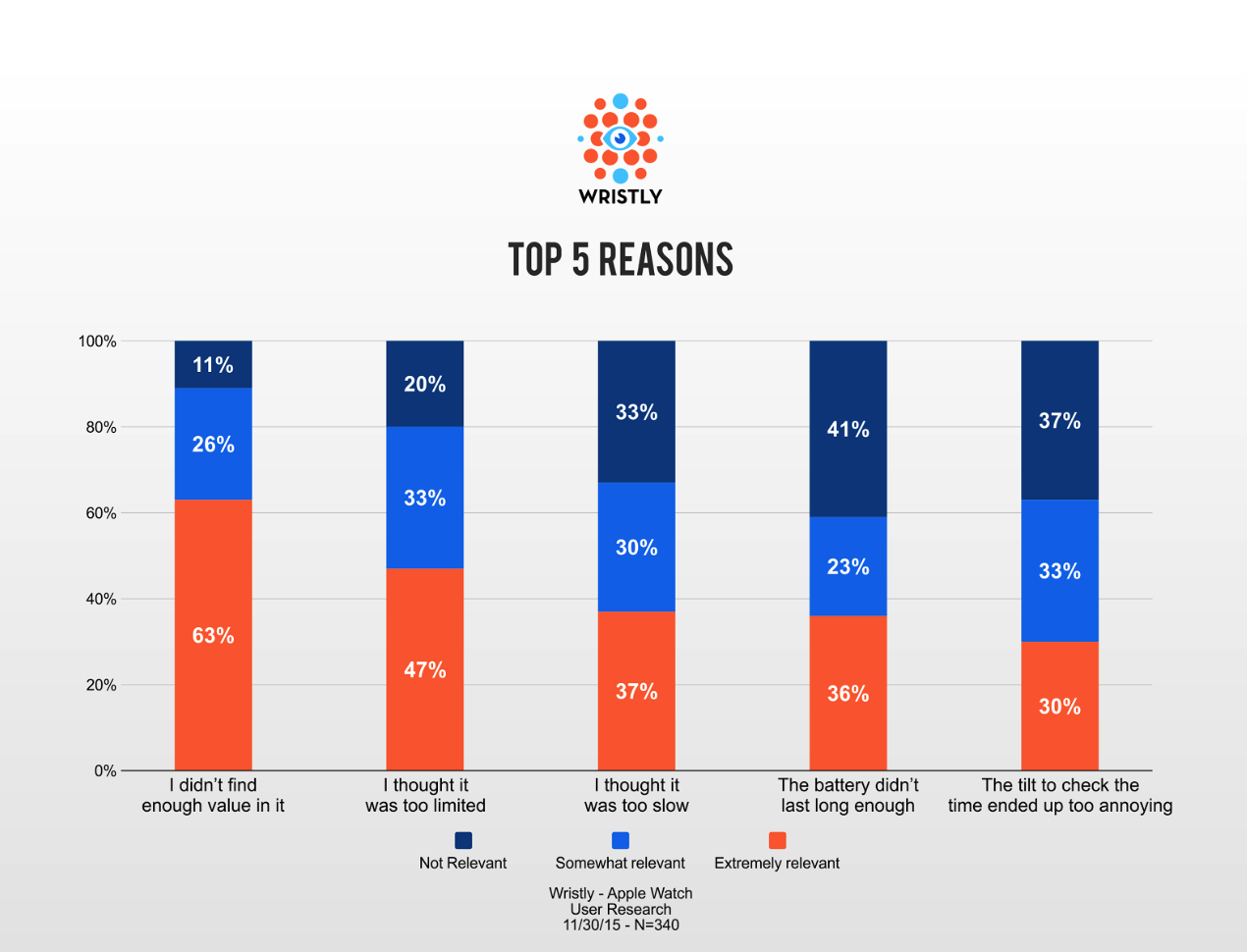
Ben Bajarin on the results from a Wrist.ly survey of people who gave up using their Watch:

Here are the top five reasons this group gave for giving up on the Apple Watch.

The most insightful part of this particular question was the follow on, fill in the blank area where 300 people who took the survey wrote a comment about the product. I read through them all and a number of things stood out. The biggest theme in the critiques was about performance. Many thought the Apple Watch was too slow, particularly around data retrieval and third party apps. The other was about battery. Many commented on their desire to have the watch face be visible at all times and not have to charge daily. Another interesting thread in the comments was the high number of people who said they would have liked it more if it was more independent from the iPhone. This is a similar thread to comments from our larger Wristly panel of satisfied owners. Another common thread I saw from this group was the price. Many who commented suggested the price was too high and we know from this panel 65% of those who responded bought a Sport. This indicates that even $349 felt too expensive for the value for this group.

link to this extract


What would Earth’s skies look like with Saturn’s rings? » The Planetary Society

Illustrator and author Ron Miller specializes in, among other things, incredible visualizations of other worlds. He has rendered the surface of Titan, peered into black holes for Discover magazine, and designed a Pluto stamp that is currently hurtling toward the far reaches of our solar system aboard the New Horizons spacecraft.

Now, Miller brings his visualizations back to Earth for a series exploring what our skies would look like with Saturn’s majestic rings. Miller strived to make the images scientifically accurate, adding nice touches like orange-pink shadows resulting from sunlight passing through the Earth’s atmosphere. He also shows the rings from a variety of latitudes and landscapes, from the U.S. Capitol building to Mayan ruins in Guatemala.

We’ll start with Washington, D.C. and work our way southward.

These are very beautiful, and thought-provoking, images. Wish that a film like Interstellar had used something like them. (Is there a film of Ringworld in production? If not, why not?)
link to this extract


Six Features That Allow Your PC To Do More Than Your Phone » About.com

Hilarious advertorial from Intel. See what you make of the six things, which are

• it offers a much larger screen
• It has uncompromised performance
• You don’t have to worry about paying for data
• It doesn’t skimp on software
• It’s upgradable and expandable
• There’s no middleman

Any of these alone could raise a laugh, but my favourite may be “you don’t have to worry about paying for data”. Intel magically makes data appear? Love it. Now let’s move on to our next entry…
link to this extract


Can the MacBook Pro replace your iPad? » Fraser Speirs

Yes, you did read that headline correctly:

Despite their far greater size, and consequently weight, there is no MacBook Pro model that gets better battery life than the iPad Pro. You have to wonder about the efficiency of the Intel platform. The MacBook Pro line also requires device-specific chargers. Although most recent models use the MagSafe 2 connector, each model comes with its own rating of charger. Compared to the iPad Pro’s use of the widely-available Lightning connector and its ability to charge from small battery packs, this significantly reduces your chances of being able to just borrow a charger for a quick top-up when out and about. Not to mention the fact that none of those increasingly-common public charging lockers support MagSafe 2.

While we are on the subject, let’s talk about ports. The designers of the MacBook Pro seem to have gone port-crazy. The MacBook Pro takes up a lot of space on the sides of the device for ports that most people will likely not use very often: SD Card readers, HDMI connectors and even dual thunderbolt ports. Having multiple ports that do the same thing is probably confusing for many users, which is likely why you see newer designs like the 2015 MacBook moving closer to the iPad approach to connectivity with a single port for power and peripherals.

There’s a point at which trolling (and satire) are indistinguishable from real life. This is one of those times.
link to this extract


BlackBerry exits Pakistan to avoid state’s email monitoring » Bloomberg Business

Faseeh Mangi:

BlackBerry Ltd. said it’s shutting its Pakistan operations to avoid allowing authorities in the nation to monitor its main business enterprise server and e-mail messages.

The Pakistan Telecommunication Authority notified the country’s mobile phone operators in July that BlackBerry’s BES servers would no longer be allowed to operate for security reasons, Marty Beard, chief operating officer at BlackBerry, said in a blog post on Monday. “The truth is that the Pakistani government wanted the ability to monitor all BES traffic.”

The regulator is still in talks with BlackBerry and “hopefully it’ll be sorted out,” Pakistan Telecommunication Authority Chairman S. Ismail Shah said by phone. The discussions will go on for a month and could be extended, he said.

Going to leave 5,000 BES customers there high and dry. What do Apple and Google do there, though?
link to this extract


US Retail Black Friday report 2015 » IBM Commerce

Lots of data, such as:

• Consumers balance mobile and desktop shopping: consumers continued to shop via their mobile devices — mobile traffic exceeded desktop, accounting for 57.2% of all online traffic, an increase of 15.2% over 2014. Mobile sales were also strong, with 36.2% of all online sales coming from mobile devices, an increase of nearly 30% over last year.

• Tablets outspend desktops: for the first time, tablets’ average order value of $136.42 exceeded that of desktops, which ended the day at $134.06. Smartphone shoppers spent $121.06 per order, an increase of 4.3% over 2014.

• Smartphone shoppers dominate: smartphones remained the Black Friday shopper’s device of choice. Smartphones accounted for 44.7% of all online traffic, 3.5x that of tablets at 12.5%. Smartphones surpassed tablets in sales, driving 20.6% of online sales (up nearly 75% over 2014) versus tablets at 15.5%.

Of course tablets aren’t used for “real work”. Also some data about iOS/Android split in spending terms – which goes as you might expect.
link to this extract


Lost in music: the world of obsessive audiophilia » The Guardian

Jonathan Margolis:

although I have been immersed in this world for 25 years, I still don’t quite know who buys the stuff. Hi-fi stores are often in modest, ordinary towns and suburbs. Who is it in Crewe that is spending the price of a very nice new car on speaker wires?

Some of the enthusiasts, of course, are the rich and famous. Douglas Adams had a system in his Islington home that reputedly cost £25,000. The crime writer Ian Rankin is an aficionado, having been a hi-fi reviewer in the 1980s. Celebrity physicist Brian Cox reportedly loves “high end” hi-fi. And the internet says Frank Zappa was big on it, along with Clint Eastwood and Hugh Laurie – and that Russian prime minister Dmitry Medvedev has a system by Naim, a Salisbury manufacturer.

In a proper hi-fi dealer, Richer Sounds included, you can buy a good system of parts from various manufacturers for as little as £1,000. The bits won’t match, though – heaven forbid they should look nice. None of it will have what hi-fi men call WAF – Wife Acceptance Factor.

Yep this is a thing. Non-ironic. I believe.

Women broadly have too much sense to be audiophiles…

…my wife believes hi-fi is the male version of wrinkle cream – dubious claims, expensive prices, results only apparent to the buyer.

I think his wife is right on the money.
link to this extract


Errata, corrigenda and ai no corrida:

Start up: inside Apple’s A9X, Amazon unlimited?, VTech hacked, YouTube v Palestine, and more

This could be the prelude to hypothermia. But what does that feel like? Photo by Nicolas Valentin on Flickr.

You can now sign up to receive each day’s Start Up post by email. You’ll need to click a confirmation link, so no spam.

A selection of 10 links for you. Use them wisely. I’m charlesarthur on Twitter. Observations and links welcome.

All-in-one PC shipments to drop over 10% in 2015 » Digitimes

Aaron Lee and Joseph Tsai:

All-in-one PC shipments may drop a double-digit percentage on-year in 2015 due to weaker-than-expected demand. Shipments in 2016 are unlikely to see any major growth and may stay flat from 2015, according to sources from the upstream supply chain.

The largest all-in-one PC vendor, Lenovo, is expected to see flat shipment performance and a worldwide market share of around 30% in 2016. Despite the fact that the China government has recently lifted restrictions on opening internet cafes in the country which has boosted demand for all-in-one PCs, Lenovo will not benefit much from related demand since most Internet cafe players require customization, an area that Lenovo is having difficulties to coordinate, causing the opportunities to be mainly seen by second-tier and China white-box makers, the sources noted.

As for the second-largest, Apple, its iMac shipments are expected to grow 5% on year in 2016. iMac’s main manufacturer, Quanta Computer, reportedly has increased its personnel for the product line for 2016, but the ODM declined to comment on market speculation.

link to this extract


Inside the Apple A9X chip » The Motley Fool

Ashraf Eassa on the chip powering the iPad Pro:

Following is a die shot of the A9X, courtesy of Chipworks:

Chipworks’ Dick James tells me that he sees a 12-cluster GPU, two CPU cores, and an absence of the level-three cache memory found inside the A9 chip (I’ll explain why I think Apple didn’t include it later in this article). I agree with his assessment. The two CPU cores can be seen in the green box, and I believe that inside of each blue box are two GPU clusters, for a total of 12 clusters…

According to Chipworks, the chip measures in at approximately 147 square millimeters, a whopping 40% larger than the size of the TSMC-built variant of the A9 chip inside of the iPhone 6s/6s Plus. This is an absolutely huge increase in area (and by extension transistor count) from the A9, which no doubt means that this monster of a chip is far more difficult to manufacture, especially on a relatively new manufacturing technology.

Two CPU cores? Bah. Surely it should be at least eight to be worth talking about?
link to this extract


Is Amazon’s online storage really ‘unlimited’? Read the fine print » ZDNet

Ed Bott:

It’s a trial offer, with the price for the second and subsequent years rising to $60, and renewing automatically unless you say no.

I can tell that some of you are ready to begin migrating the 10 terabytes of data you stored in Microsoft’s OneDrive before they killed that golden goose. May I suggest you first read the Amazon Cloud Drive Terms of Use?

When you do, you will discover that that word, unlimited, does not mean what you think it means.

And you might find that if you really have a lot of data to store that you won’t be able to after all, because they research reserve the right to suspend or terminate “if we determine that your use violates the Agreement, is improper, substantially exceeds or differs from normal use by other users, or otherwise involves fraud or misuse of the Service…” (Emphasis added.)
link to this extract


Israel to coordinate with Google and YouTube to censor Palestinian videos of conflict » Informed Comment

Saed Bannoura:

The Israeli Deputy Foreign Minister, Member of Knesset Tzipi Hotovely, held meetings this week with representatives of YouTube and Google, to find ways of cooperating to censor Palestinian videos from occupied Palestine, videos she dubbed as “inciting violence and terrorism.”

Israeli daily Maariv said Hotovely will be working with Google and YouTube officials in a joint mechanism that will be in charge of “monitoring and preventing” any publication of materials deemed by Tel Aviv to be “inflammatory.”

Hotovely announced in a Hebrew-only press release that she met with YouTube CEO Susan Wojcicki, and Google’s Director of Public Policy, Jennifer Oztzistzki, at Google’s Silicon Valley Offices.

Hotovely said that she received a comprehensive review mechanism for companies to monitor the films that allegedly incite violence, claiming that the supposed ‘incitement videos’ drive young children to go out and stab: “The attacks daily in Israel are the result of youths and children incited by the education system and the social networks, this is a daily war of incitement.”

You can’t be a video hosting service without getting caught in the politics of an area. And of course “incitement to violence” is over the boundary of free speech pretty much everywhere.
link to this extract


As freezing persons recollect the snow: first chill, then stupor, then the letting go » Outside Online

Peter Clark with a scary description of what happens as hypothermia sets in:

When your Jeep spins lazily off the mountain road and slams backward into a snowbank, you don’t worry immediately about the cold. Your first thought is that you’ve just dented your bumper. Your second is that you’ve failed to bring a shovel. Your third is that you’ll be late for dinner. Friends are expecting you at their cabin around eight for a moonlight ski, a late dinner, a sauna. Nothing can keep you from that.

Driving out of town, defroster roaring, you barely noted the bank thermometer on the town square: minus 27 degrees at 6:36. The radio weather report warned of a deep mass of arctic air settling over the region. The man who took your money at the Conoco station shook his head at the register and said he wouldn’t be going anywhere tonight if he were you. You smiled. A little chill never hurt anybody with enough fleece and a good four-wheel-drive.

But now you’re stuck.

(Via Eugene Wei.)
link to this extract


A 59-year-old woman reviews the Apple Watch in real life » Privilege

“Lisa”:

I do think it’s important that we women and we midlifers engage in the tech cycle, if only to ensure that the Brave New World isn’t designed just for 28-year old men.

I first realized I liked the watch as I pushed a cart through Whole Foods. I’d invited my family over for dinner, and was doing the grocery shopping. I’d texted both my sister-in-law and sister to find out if their kids would be OK with the menu. The replies came as I passed the tortilla section. And I did not have to stop, block the aisle, and find my phone in my bag –  just pressed the Message smile emoji. A lightweight interaction.

Besides, the Watch is very good-looking, as Mom might say.

But let us review and deconstruct. Not literally. Taking apart solid state devices is not my idea of fun.

link to this extract


100 million LTE phones shipped in China in Q3 2015 » Counterpoint Technology Market Research

Neil Shah:

This has been primarily driven by a meteoric rise in consumers adopting LTE technology as the always-on high speed mobile internet becomes the crux of Chinese consumers’ lives aided by competitive pricing by China Mobile. More than 200m 4G LTE subscribers have been added at the end of Q3 2015 compared to exactly a year ago. China’s LTE subscriber base also crossed 300m users during the quarter. It took just 20 months to cross 300m 4G subs, whereas for 3G subs it took more than 50 months.

Mature Chinese smartphone user base are upgrading their digital lives faster than any other mobile user on this planet. The growing traction of mobile-centric commerce, rise of O2O services, content consumption (video, audio and so forth) coupled with deeply integrated social and messaging communication is making  high quality ubiquitous mobile internet a basic need for the Chinese consumers.

Huawei was the no 1 LTE phone supplier with slightly less than one-fifth of the market, followed by Xiaomi, Apple, Oppo and Vivo.

link to this extract


One of the largest hacks yet exposes data on hundreds of thousands of kids » Motherboard

Lorenzo Franceschi-Bicchierai:

The personal information of almost 5 million parents and more than 200,000 kids was exposed earlier this month after a hacker broke into the servers of a Chinese company that sells kids toys and gadgets, Motherboard has learned.

The hacked data includes names, email addresses, passwords, and home addresses of 4,833,678 parents who have bought products sold by VTech, which has almost $2 billion in revenue. The dump also includes the first names, genders and birthdays of more than 200,000 kids.

What’s worse, it’s possible to link the children to their parents, exposing the kids’ full identities and where they live, according to an expert who reviewed the breach for Motherboard.

That expert being Troy Hunt, who has a long writeup on how crap VTech has been. All this harvesting of personal data ahead of inevitable hacks? No way to delete your account (hardly any companies give you that option).
link to this extract


Report: Apple plans to nix 3.5mm port on iPhone 7, require Lightning for wired headphones » 9to5Mac

Citing a reliable source, a report from Japanese blog Macotakara claims that Apple plans to remove the 3.5mm headphone port from the upcoming iPhone 7, helping to achieve a “more than 1mm” reduction in thickness compared to the iPhone 6s. While the screen shape and radius will remain similar, the device will once again become Apple’s thinnest iPhone ever, albeit with a new restriction: headphones will only be able to connect over Lightning or Bluetooth…

Macotakara says that the 3.5mm port “can hardly be thinner because it is the world standard,” which is accurate, though the current-generation iPod touch is 1mm thinner than the iPhone 6s despite having a 3.5mm port inside. It should be noted that Apple actively contemplated switching to the smaller but less popular 2.5mm headphone port standard many years ago, abandoning the plan after users complained about the original iPhone’s recessed 3.5mm port.

Will be good business for Bluetooth headphone companies. Such as Beats?
link to this extract


More China firms developing own ARM-based chips » Digitimes

Monica Chen and Jessie Shen:

China-based ZTE has received a cash injection from the government enabling the company to accelerate the development of its own application processors, while Lenovo also intends to develop ARM-based chips in-house, according to industry sources.

ZTE has received CNY2.4bn (US$73.8m) from China’s National IC Industry Investment Fund, which will help it accelerate the mobile chip development, said the sources.

Huawei has its subsidiary HiSilicon provide ARM-architecture SoCs, which are found in many of the smartphone vendor’s models including high-end ones, the sources indicated. Huawei’s increasing use of HiSilicon chips is already unfavorable to the existing suppliers including MediaTek and Qualcomm.

All essentially trying to differentiate themselves from rivals. Didn’t know about Huawei’s subsidiary, but it makes sense for a network infrastructure company to have a chip designer.
link to this extract


Errata, corrigenda and ai no corrida: none notified.

Start up: the smartphone generation, OLED for iPhone?, VR’s Atari moment, and more


A new paper says this might not be enough to give an accurate measurement of your blood. Oh, hello, Theranos, didn’t see you there. Photo by biologycorner on Flickr.

You can now sign up to receive each day’s Start Up post by email. You’ll need to click a confirmation link, so no spam.

A selection of 10 links for you. (Ooh, are those turkey sandwiches?) I’m charlesarthur on Twitter. Observations and links welcome.

The generation that doesn’t remember life before smartphones » Popular Mechanics

Jacqueline Detwiler:

Zac [aged 18] probably started developing memories around 1999, the year Napster upended the music industry by turning songs into sharable files that nobody owned. Or maybe in 2000, the year Google became Google. Regardless, he is part of the first generation of human beings who never really lived before the whole world was connected by pocket-sized electronic devices. These kids might never read a map or stop at a gas station to ask directions, nor have they ever seen their parents do so. They will never need to remember anyone’s phone number. Their late-night dorm-room arguments over whether Peyton or Eli Manning won more Super Bowl MVPs will never go unsettled for more than a few seconds. They may never have to buy a flashlight. Zac is one of the first teenagers in the history of teenagers whose adult personality will be shaped by which apps he uses, how frequently he texts, and whether he’s on Facebook or Instagram or Twitter or Snapchat. Or whatever comes after Snapchat. Clicking like, clicking download, clicking buy, clicking send—each is an infinitesimal decision in the course of the modern American teenager’s life. They do this, collectively, millions of times a minute. But together these tiny decisions make up an alarming percentage of their lives. This generation is the first for whom the freedom to express every impulse to the entire world is as easy as it used to be to open your mouth and talk to a friend.

link to this extract


Samsung Gear VR review: virtual reality finds its Atari moment » WSJ

Geoffrey Fowler:

unlike other phone-goggle contraptions, the Gear VR headset has its own motion sensors, so it does a much better job of tracking your head movements when you’re turning or looking up. And it pushes the Samsung phone’s processor to cut motion delay to under 20 milliseconds, reducing the nausea-inducing blur. (My test Galaxy S6 Edge Plus worked so hard when mounted, it could blow through its huge battery with an hour or two of intensive VR.)

Other improvements also make Gear VR much more comfortable: The headset itself is less heavy—slimmed 19% from an experimental headset Samsung debuted last year. You can comfortably fit glasses inside, and there’s also a focus adjustment that makes the view more pleasurable for aging eyes.

Yet there’s still some discomfort. Wearing anything on your face for an hour can get old. Also, I occasionally encountered what appeared to be a flicker in the brightest parts of the screen. (Samsung says that’s rare, and has to do with the way my brain processes the screen refresh itself.)

link to this extract


Home Office meeting re IPBill » RevK’s rants

Adrian Kennard (who runs an internet service provider) went to talk to MPs about their Draft Investigatory Powers bill:

At the start of the briefing the the bill was explained, and we heard a story very similar to Theresa May’s comments along the lines of:-

“Consider the case of a teenage girl going missing. At present we can ask her mobile provider for call records before she went missing which could be invaluable to finding her. But for Internet access, all we get is that the Internet was accessed 300 times. What would be useful would be to know she accessed twitter just before she went missing in the same way as we could see she make a phone call”

Now, I am sure this is a well-practised speech, used many times before. I am sure the response has been nodding of heads and agreement with how important “Internet connection records” are, obviously.

However, I, and other ISPA members immediately pointed out the huge flaw in this argument. If the mobile provider was even able to tell that she had used Twitter at all (which is not as easy as it sounds), it would show that the phone had been connected to Twitter 24 hours a day, and probably Facebook as well. This is because the very nature of messaging and social media applications is that they stay connected so that they can quickly alert you to messages, calls, or amusing cat videos, without any delay.

This seemed to fool them somewhat and they had no real answer – we were not just nodding and agreeing, and that was unexpected 🙂

Not much wisdom on any other point either – including whether he could be compelled to lie if he were to use a “canary” over search warrants.
link to this extract


Apple to adopt OLED display for iPhone from 2018 » Nikkei Asian Review

Apple plans to introduce organic light-emitting diode displays for iPhones starting in 2018, sending suppliers racing to fine-tune the technology and invest in capacity expansion.

In light of the decision, South Korea’s LG Display is already planning capacity upgrades. But securing enough panels for the more than 200m phones Apples ships globally every year will likely prove difficult. The US company is thus likely to opt for offering OLED iPhones alongside those using LCD screens.

There are technical challenges as well. The brightness, energy-saving capacity and other functions of OLED panels tend to degrade over time. Apple has begun consulting with display makers and their suppliers of manufacturing equipment about the technology. The companies will work over the next year or so to see whether those drawbacks can be eliminated and a stable supply of screens secured…

…Apple’s shift to OLED displays will have major implications for two Japanese suppliers – Sharp, which is scrambling to rebuild its faltering operations, and Japan Display, which relies on the technology giant for 30% of its business.

2018? That’s a long way off. Why not jump to AMOLED? (Note: LG is spending $8.7bn on a new OLED plant to begin production in the first half of 2018. Coincidence?
link to this extract


New study spills doubt on some fingerprick blood tests » Ars Technica UK

Beth Mole:

Tiny blood droplets that leak successively from a pricked finger can have widely variable contents, researchers reported in the American Journal of Clinical Pathology. In some cases, test results on such finger-bled droplets had nearly eight times more variation than vein-harvested blood samples—the gold standard. Only when the authors tested upwards of five drops combined (60 to 100 microliters) were they able to get accurate results. The study raises concerns that new diagnostic tests that rely on blood drops may yield inaccurate results.

*turns slowly to look at Theranos*
link to this extract


OnePlus concedes that its USB type-C cables are out of spec, will offer refunds » Android Police

Ryan Whitwam:

Google engineer Benson Leung recently started a crusade against bad USB type-C cables, and one of the cables he warned people to stay away from is the one sold by OnePlus. Now OnePlus has responded to the uproar, saying that it will offer refunds to customers who purchased these cables. Well, you can apply for a refund. It’s not clear how long it’ll take.

The issue is that OP’s type-C cable and the type-C adapter both have a 10kΩ resistor, which as Benson Leung has been pointing out, is potentially dangerous to use with some devices. A proper type-C cable has a 56kΩ resistor, and OnePlus says it is in the process of designing a new version of its accessories that have this resistor. OnePlus’ Carl Pei stresses that the cable and adapter are safe to use with the OnePlus 2 because it only pulls 2A of current. However, a phone like the Nexus 5X or 6P draws 3A, and that can cause damage to the power source.

Seems like a big oversight to miss getting the correct resistor.
link to this extract


Reader’s Digest and other WordPress sites compromised to push Angler EK » Malwarebytes Unpacked

Jérôme Segura:

We’re seeing another uptick in WordPress compromises, using a slightly different modus operandi than the EITest campaign we recently blogged about, being responsible for a large number of infections via the Angler exploit kit.

The attack consists of a malicious script injected within compromised WordPress sites that launches another URL whose final purpose is to load the Angler exploit kit. Site owners that have been affected should keep in mind that those injected scripts/URLs will vary over time, although they are all using the same pattern (see IOCs below for some examples).

The website of popular magazine Reader’s Digest is one of the victims of this campaign and people who have visited the portal recently should make sure they have not been infected. The payload we observed at the time of capture was Bedep which loaded Necurs a backdoor Trojan, but that of course can change from day to day.

Solution: don’t read sites on desktop? (Thanks Ivan Ivanovich.)
link to this extract


Macbook charger teardown: the surprising complexity inside Apple’s power adapter » Righto

The wonderful Ken Shirriff, who does electronics teardowns of fabulous sophistication and insight:

The Macbook 85W charger costs $79 from Apple, but for $14 you can get a charger on eBay that looks identical. Do you get anything for the extra $65? I opened up an imitation Macbook charger to see how it compares with the genuine charger. From the outside, the charger looks just like an 85W Apple charger except it lacks the Apple name and logo. But looking inside reveals big differences. The photos below show the genuine Apple charger on the left and the imitation on the right.


Inside the Apple 85W Macbook charger (left) vs an imitation charger (right). The genuine charger is crammed full of components, while the imitation has fewer parts.

The imitation charger has about half the components of the genuine charger and a lot of blank space on the circuit board. While the genuine Apple charger is crammed full of components, the imitation leaves out a lot of filtering and regulation as well as the entire PFC [Power Factor Correction] circuit. The transformer in the imitation charger (big yellow rectangle) is much bulkier than in Apple’s charger; the higher frequency of Apple’s more advanced resonant converter allows a smaller transformer to be used.

Also included: a microprocessor with as much power as the original Mac.
link to this extract


The Telharmonium was the Spotify of 1906 » Atlas Obscura

Ella Morton:

Invented by lawyer Thaddeus Cahill and initially known as the dynamophone, the telharmonium made use of telephone networks to transmit music from a central hub in midtown Manhattan to restaurants, hotels, and homes around the city. Subscribers could pick up their phone, ask the operator to connect them to the telharmonium, and the wires of their phone line would be linked with the wires emerging from the telharmonium station. The electrically generated tunes would then stream from their phone receiver, which was fitted with a large paper funnel to help pump up the volume. (The electric amplifier had not yet been invented.) 

The music was generated live at what Cahill called a “music plant,” which was located at Broadway and 39th Street. An entire floor of the building, which came to be known as Telharmonic Hall, was filled with the 200 tons of machinery required to generate the telharmonium’s tunes. With its banks of spinning rotors, switchboards, transformers, and alternators, the behemoth instrument gave “the impression of nothing so much as a busy machine-shop, or the center of a considerable manufacturing industry,” according to a 1906 article in McClure’s Magazine.

“Facebook, invented by Thaddeus Zuckerberg..” Why isn’t anyone called Thaddeus anymore? Notice also that this is an American publication, yet it uses “Spotify” as its shortcut for “streaming service” rather than, say, Pandora.
link to this extract


Jonathan Mayer, well-known online security expert, joins F.C.C. » The New York Times

Natasha Singer:

Among digital security experts, Mr. Mayer is known, among other things, as the Stanford computer scientist who reported in 2012 that Google was bypassing privacy settings in Apple’s Safari browser by placing bits of code in digital ads that tracked the sites users visited. Google subsequently agreed to pay a $22.5 million fine to settle charges by the Federal Trade Commission that the company had misrepresented its privacy practices.

Now Mr. Mayer, 28, has a new handle: federal regulator.

On Tuesday, the Federal Communications Commission said it had hired Mr. Mayer as chief technologist in the agency’s enforcement bureau.

Impressive hiring.
link to this extract


Errata, corrigenda and ai no corrida: none notified.

Start up: farewell Steve Wildstrom, PS4 = 30m, cooling on Xiaomi, Google crunches Yelp, and more


Which slogans do you actually remember, from which ads? Mad Men icon reimagined by p3liator on Flickr.

Then again, you could sign up to receive each day’s Start Up post by email. You’ll need to click a confirmation link, so no spam.
A selection of 13 links for you. Simpler than talking to your relatives. I’m charlesarthur on Twitter. Observations and links welcome.

Steve Wildstrom, tech journalist, dies after battle with brain cancer » TechCrunch

John Biggs:

Born in Detroit, Wildstrom went to the University of Michigan and began writing for BusinessWeek in 1972 where he served as news editor in BusinessWeek’s Washington bureau. He was also active in the Children’s Chorus of Washington.

“Steve Wildstrom at Business Week was hands-down the best person in the 1990s-2000s to explain to a broad nationwide audience what tech meant to them in their personal and business lives,” wrote Bill Howard, an editor at PC Magazine. “Steve put his effort into researching, analyzing and writing rather than building the Brand of Wildstrom.”

Very sad news. Wildstrom’s “Tech and You” column in BusinessWeek was an inspiration to me. Certainly all the phone and other reviews on tech sites now owe what they’re doing in part to Wildstrom.
link to this extract


Sony’s PlayStation 4 scores more than 30m sales » WSJ

Takashi Mochizuki:

Sony Corp. said Wednesday that it has sold more than 30.2 million PlayStation 4 videogame consoles, two years after the launch of a system that the company says has sold faster than any of its predecessors.

“We are sincerely grateful that gamers across the globe have continued to choose PS4 as the best place to play since launch two years ago,” said Andrew House, President and Global CEO of Sony Computer Entertainment Inc.

The latest total, as of Nov. 22, is up from more than 20m in March, when Sony provided its most recent update on PlayStation 4 sales. Sony has said it aims to ship more than 17.5m units during the current fiscal year, which ends in March 2016.

Wii U at 10.7m, and Xbox One estimated at about 15m. Sony has crushed its rivals this time round. Yet there will probably be another console generation for virtual reality – is 2018 too soon?
link to this extract


The worst app » Allen Pike

App maker Pike started getting angry support emails. Problem was, they weren’t for his app. But the creator of a scam app had put his company’s contact email in its “report a problem” link. So you contact Apple and get them to take it down, right?

Now, the App Store review process is a mixed bag. While it definitely has some problems, its fickle nature has an upside. When an app is in egregious violation of common sense and decency, Apple can simply pull it from the store. All you need to do is contact Apple about the app.

Unfortunately, one does not simply contact Apple about an app. The official way to complain about an app is via the “Report a Problem” link from when you buy the app. Of course, I’m not going to buy this scam app just to complain about it, so I dug up an alternate form to report a problem. Maddeningly, one of the required fields on that form is an order number – the one you receive when you buy the app. Stalemate.

It gets worse. And then, happily, better. The power of a blogpost.
link to this extract


‘Outsiders’ crack 50-year-old math problem » Quanta Magazine

Erica Klarreich:

The proof, which has since been thoroughly vetted, is highly original, [Assaf] Naor [a mathematician at Princeton] said. “What I love about it is just this feeling of freshness,” he said. “That’s why we want to solve open problems — for the rare events when somebody comes up with a solution that’s so different from what was before that it just completely changes our perspective.”

Computer scientists have already applied this new point of view to the “asymmetric” traveling salesman problem. In the traveling salesman problem, a salesman must travel through a series of cities, with the goal of minimizing the total distance traveled; the asymmetric version includes situations in which the distance from A to B differs from the distance from B to A (for instance, if the route includes one-way streets).

The best-known algorithm for finding approximate solutions to the asymmetric problem dates back to 1970, but no one knew how good its approximations were. Now, using ideas from the proof of the Kadison-Singer problem, Nima Anari, of the University of California, Berkeley, and Shayan Oveis Gharan, of the University of Washington in Seattle, have shown that this algorithm performs exponentially better than people had realized. The new result is “major, major progress,” Naor said.

Abstruse yet with lots of implications for real-world problems involving processing, signalling and networks. It’s the Kadison-Singer problem, if you want to airily mention it over your latte.
link to this extract


Axel Springer goes after iOS 9 adblocker in new legal battle » TechCrunch

Sarah Perez:

German media giant Axel Springer, which operates top European newspapers like Bild and Die Welt, and who recently bought a controlling stake in Business Insider for $343m, has a history of fighting back against ad-blocking software that threatens its publications’ business models. Now, it’s taking that fight to mobile ad blockers, too. According to the makers of the iOS content blocker dubbed “Blockr,” which is one of several new iOS 9 applications that allow users to block ads and other content that slows down web browsing, Axel Springer’s WELTN24 subsidiary took them to court in an attempt to stop the development and distribution of the Blockr software.

Final ruling on 10 December; court seems likely (based on preliminary hearing) to side with Blockr.
link to this extract


How the Mad Men lost the plot » FT.com

Ian Leslie (a former Mad Man):

[Professor Byron] Sharp’s first law [in his book “How Brands Grow”] is that brands can’t get bigger on the back of loyal customers. Applying a statistical analysis to sales data, he demonstrates that the majority of any successful brand’s sales comes from “light buyers”: people who buy it relatively infrequently. Coca-Cola’s business is not built on a hardcore of Coke lovers who drink it daily, but on the millions of people who buy it once or twice a year. You, for instance, may not think of yourself as a Coke buyer, but if you’ve bought it once in the last 12 months, you’re actually a typical Coke consumer. This pattern recurs across brands, categories, countries and time. Whether it’s toothpaste or computers, French cars or Australian banks, brands depend on large numbers of people — that’s to say, the masses — who buy them only occasionally, leave long gaps between purchases and buy competing brands in between.

If you work for a brand owner, the implications are profound. First, you will never increase your brand’s market share by targeting existing users — the task that digital media performs so efficiently. The effort and expense marketers put into targeting their own customers with emails and web banners is largely wasted; loyalty programmes, says Sharp, “do practically nothing to drive growth”. What seems like a prudent use of funds — focusing on people who have already proved they like the brand — is actually just spinning wheels.

Second, and paradoxically, a successful brand needs to find a way of reaching people who are not in its “target” (in the sense of “people who are predisposed to buy it”) market…

…Marketers consistently undervalue consistency. Diageo recently carried out an audit of all the endlines that it had attached to one of its biggest brands, Guinness, and were embarrassed to discover it had used more than 20 different slogans in 15 years. What’s more, when it asked people to recall an endline, the only one they remembered was “Good things come to those who wait”, which hadn’t run since 1999. Vast sums of money had been spent on campaigns which probably had short-term effects but barely left a trace in consumer memories.

Long piece, but eminently worth finding a way to read. Sharp’s book sounds worth a read too.
link to this extract


Apple has acquired Faceshift, maker of motion capture tech used in Star Wars » TechCrunch

Ingrid Lunden:

[Faceshift’s] main focus, so to speak, was on visual effects in areas like gaming and film. In a world where animation technology can be costly and time-consuming to implement, the startup’s main product was marketed a game changer: “Faceshift studio is a facial motion capture software solution which revolutionizes facial animation, making it possible at every desk,” according to the company.

Even so, the technology is also making an appearance at the highest level of wow: it’s used in the latest Star Wars film to make non-human characters more human-like in their expressions.

Apple itself already has patents and assets across motion capture, facial recognition and augmented reality, partly by way of three other European acquisitions, respectively PrimeSense, Polar Rose and Metaio. Faceshift could complement and expand Apple’s capabilities in these areas going forward.

Seems like Apple miiiight be looking at the virtual reality space, though it’s hard to see quite how this fits into anything we recognise in its portfolio.
link to this extract


Xiaomi’s $45bn valuation seen ‘unfeasible’ as growth cools » Bloomberg Business

Tim Culpan saves the best for the last line in this story about Xiaomi rowing back on its aims even of 80m handset shipments this year, while it tries to expand “ancillaries” such as air purifiers and scooters:

The ancillary businesses are still relatively small, with the company expecting the services units to account for just $1bn of its $16bn in projected revenue this year, Barra said in a July interview. Sales of smartphones outside China accounted for just 7% of its total in the third quarter, according to Strategy Analytics.

Xiaomi has struggled partly because competitors Huawei, Lenovo Group Ltd. and Gionee – among others – quickly copied its business model with ultra-thin devices, glossy websites and lower prices, allowing consumers to easily switch to the hippest new phone.

“Xiaomi was very popular because it was the first brand that marketed its phones as being limited edition,” said Chen Si, a 25-year-old real estate worker in Beijing who bought the Mi 3 after its 2013 release, citing its cool design. “I wouldn’t say I am loyal to Xiaomi, I just think that a phone should be affordable and easy to use. If not, then I’ll just change.”

A year later, she switched to the iPhone 6.

*mic drop*
link to this extract


O2 explores ad blocking across its network » Business Insider

O2 is one of the UK’s four big carriers, with about 25m customers:

O2 executives told Business Insider the company is actively testing using technology that can block mobile ads at a network-level before they even get served. In addition, the company is considering whether to offer customers easy access to ad blocking apps and browser extensions. O2 is also working with advertisers to improve the standard of mobile advertising.

The hope is that the carrier can help customers filter out bad advertising that interrupts mobile browsing, eats up consumers’ data allowances, and ultimately puts a strain on its own network infrastructure. One ad blocking company estimates that ads are gobbling up between 10-50% of customer’s data plans each month.

This comes after EE, the biggest UK carrier, said it was looking at the same thing. Notice that “working with advertisers to improve the standard of mobile advertising”: no doubt such work has a price.
link to this extract


Google claims mobile search result impacting Yelp, TripAdvisor is ‘a bug’ » Re/code

Mark Bergen:

Over the weekend, executives from public Internet companies Yelp and TripAdvisor noted a disturbing trend: Google searches on smartphones for their businesses had suddenly buried their results beneath Google’s own. It looked like a flagrant reversal of Google’s stated position on search, and a move to edge out rivals.

Nope, it’s a bug, claims Google. “The issues cited were caused by a recent code push, which we’re working quickly to fix,” a Google spokeswoman said.

In the meantime, the “issues” may be diverting tons of traffic from Google’s competitors. Some, particularly Google’s longtime rival Yelp, are not pleased. “Far from a glitch, this is a pattern of behavior by Google,” said its CEO Jeremy Stoppelman.

Have there been many – or any – occasions where these code pushes have accidentally buried Google’s products?
link to this extract


I’m leaving Android for iOS, and I blame late games » Polygon

Ben Kuchera reluctantly swapped his Galaxy Note 4 for an iPhone 6S Plus:

You can argue about install base and walled gardens until you’re blue in the face, but the reality is you’ll be waiting for games if you use an Android device. I caught up with Barry Meade, whose studio created The Room series, to ask why the game launched first on iOS. His answer is a common one.

“It’s the same reason everybody has — Android takes way longer to test for due to the diffusion of devices,” Meade told Polygon. “With iOS you only have to test maybe eight to 10 devices, and that’s only because we choose to support pretty old devices, many don’t. With Android you’re looking at hundreds of devices off the bat, each with different hardware/screen set-ups.”

The other side of this is that the iOS players are kind of testing the game for the eventual Android players.

“So with an iOS-first strategy you can release the game to many users with only a small chance of bugs arising due to differences in hardware, which means that when a bug does arise on iOS it’s likely unconnected to the hardware and by fixing it, you are also fixing that bug for any future Android build,” Meade continued. “What Android users forget is that because their versions come later they get the least buggy, higher performance version of the game because iOS users are, in an indirect way, guinea pigs for the other releases.”

I hope that makes Android players feel better, but I’m just so tired of waiting.

The comments – including the (polite) argument between two game developers – are worth reading too.
link to this extract


Secure Messaging scorecard » Electronic Frontier Foundation

In the face of widespread Internet surveillance, we need a secure and practical means of talking to each other from our phones and computers. Many companies offer “secure messaging” products—but are these systems actually secure? We decided to find out, in the first phase of a new EFF Campaign for Secure & Usable Crypto.

Surprising how poorly BBM and Google Hangouts score on this; and also how many other services actually get perfect scores. One, called Mxit, whiffs every line, though – not even encrypted in transit. (Via Benedict Evans.)
link to this extract


Google and the shift from web to apps, indexing app-only content, streaming apps » Stratechery by Ben Thompson

From Ben Thompson’s subscriber-only update, looking at Google’s streaming apps effort:

To be sure, streaming apps will be a worse experience than natively installed apps, at least for the foreseeable future. In fact, the effort is so nascent that Google is launching the initiative with only nine apps and only in the Google App on recent Android devices and only over Wifi. You have to start somewhere, though, and betting on the continued expansion of broadband and Moore’s Law goes hand-in-hand with Google’s brute force approach. And, as for the experience, everything is relative: a streamed app is better than having to download an app just to see a search result, and more fundamentally, a streamed app is better than not having access to the information at all.

As for iOS devices, while I’ve criticized Google in the past for its insistence on always launching Android first, I suspect there are real technical and legal challenges that come with streaming iOS apps in a similar fashion; it’s here that Google’s misguided insistence on competing with Apple head-on really hurts. I don’t see anything in this initiative that is necessarily threatening to Apple beyond the fact that app streaming helps Google. Ergo, were Google not a direct competitor (a la Microsoft today), Apple might be willing to lend a hand to ensure iOS customers had a better search experience.

Danny Sullivan also has a writeup of app streaming (which is a clever implementation: apps run inside virtual machines), and points out how awful it would have been if every site was its own app.
link to this extract


Errata, corrigenda and ai no corrida: none notified.

Start up: why Win10 update was pulled, Android v the law, post-iPad mini, neural nets on the move, and more


Quiet eye? Roger Federer winds up to serve. Photo by not enough megapixels on Flickr.

You can now receive each day’s Start Up post by email. You’ll need to click a confirmation link, so it ain’t spam.

A selection of 11 links for you. Hug them to your chest like your long-lost children. I’m charlesarthur on Twitter. Observations and links welcome.

Microsoft pulled the Windows 10 November Update due to privacy setting bug » Winbeta

Zac Bowden:

Microsoft has today detailed why they chose to pull the Windows 10 November Update from Windows Update and the Media Creation Tool over the weekend. Their initial comment regarding the situation claimed the company decided that all users needed to update via Windows Update, but it appears that was not the entire story.

Microsoft told WinBeta the update was pulled due to issues with privacy concerns. More specifically, upon installing the update, Windows would not remember the users set privacy settings, meaning Windows would simply default them. While not a huge bug, it did raise a few privacy concerns amongst those upgrading.

link to this extract


How the ‘quiet eye’ technique makes athletes more coordinated » The Atlantic

David Kohn:

Until recently, most researchers viewed these skills in terms of coordination and reflex, believing that those who were better at making a free-throw or suturing a wound simply had had superior physical dexterity. But in the past few years, a small group of neuroscientists have identified a new way of understanding coordination, one that focuses on visual and cognitive skills over physical prowess.

The concept, known as the quiet-eye theory, is deceptively simple: Before you perform an action, you focus your gaze on the salient aspects of your goal—the rim, the catcher’s mitt, the malignant tissue, and so on. In recent years, using eye-tracking technology, researchers have found that locking onto the relevant stimulus during the right time frame—typically the few hundred milliseconds before, during and after the movement—greatly improves your chances of success.

“When your eyes provide the data, your motor system just knows what to do,” says Joan Vickers, a cognitive psychologist at the University of Calgary and one of the originators of the quiet-eye theory. “Your brain is like a GPS system. It detects target, speed, intensity, and distance.”

link to this extract


On smartphone encryption and public safety » Manhattan District Attorney’s Office

There are a larger variety of Android devices than Apple devices. Forensic examiners are able to bypass passcodes on some of those devices using a variety of forensic techniques. For some other types of Android devices, Google can reset the passcodes when served with a search warrant and an order instructing them to assist law enforcement to extract data from the device. This process can be done by Google remotely and allows forensic examiners to view the contents of a device.

For Android devices running operating systems Lollipop 5.0 and above, however, Google plans to use default full-disk encryption, like that being used by Apple, that will make it impossible for Google to comply with search warrants and orders instructing them to assist with device data extraction.

Did not know about the remote reset.
link to this extract


Peak iPad mini » Above Avalon

Neil Cybart:

The iPad mini’s best days are behind it. Using app analytics data from Fiksu and Mixpanel, along with my own iOS device sales estimates and projections, I was able to derive iPad mini sales since launch. Over the past two years, iPad mini sales trends have deteriorated much faster than most people think. When taking into account the move to larger iPhones and iPads, the iPad mini’s value proposition has likely been weakened to such a degree that the decline in sales is permanent. 

Seems that the real decline in iPad sales is of the mini – not the bigger one. So how will the giant iPad fare? Cybart’s analysis is always thoughtful.
link to this extract


You may be more exposed to the tech bubble than you think » Quartz

Allison Schrager:

First, you might have a stake in these companies if you own any actively managed mutual funds, perhaps through your retirement plan. According to Todd Rosenbluth, director of mutual fund research at Standard &Poor’s, large mutual funds have been investing in non-public companies for years. “Most people have no idea.” he says. The payoffs can be big if some of these firms successfully go public, but the risks are significant because it’s impossible to assign a consistent, accurate value to these investments, and they are hard to sell if the fund faces redemptions. However, regulation keeps mutual funds from holding large amounts of private shares, which would mitigate the impact. “It’s a tiny part of their portfolios,” Rosenbluth says. For example, only about 2% of the Fidelity Blue Chip Growth fund is made up of tech startup investments.

The second way you’re exposed is through public pensions, whether you’re a direct beneficiary or not.

Feels like a stretch, to be honest. And certainly nothing like the dot-com bust.
link to this extract


YouTube Kids app faces new complaints » The New York Times

Ceclia Kang:

Visit YouTube Kids and it typically does not take long before promotions for junk food appear. The advertisements regularly appear in the form of funny contests and animated stories.

In complaints filed to federal officials on Tuesday, two prominent consumer advocacy groups argued that those ads are deceptive, particularly for children. The two complaints, made to the Federal Trade Commission, expand on filings the groups made to the agency in April and could increase pressure on federal officials to intervene in the fast-growing online video market.

The groups, the Campaign for Commercial-Free Childhood and the Center for Digital Democracy, argue in the complaints that online video aimed at children has become too commercialized and is not held to the same standards as cable and broadcast TV. The complaints call for an investigation of food marketers, video programmers and Google, which owns YouTube, as well as a broad examination of advertising of such food to children online.

If YouTube by default becomes the new online TV, shouldn’t it be held to the same standards as broadcast TV?
link to this extract


Sony employees on the hack, one year later » Slate

Amanda Hess:

Outside Sony, it would eventually seem as if all the studio’s info had been exposed for everyone to see. But inside the studio, nobody could access anything. “Everything was so completely destroyed. It was surreal. Everything was down,” one ex-employee told me. “It wasn’t just one system or one part of the lot or one building. The network was completely chewed up by the virus.”

“It was like a bomb went off,” one staffer says. “We looked around. We were still alive. So we started doing triage.”

The telephone directory vanished. Voicemail was offline. Computers became bricks.  Internet access on the lot was shuttered. The cafeteria went cash-only. Contracts—and the templates those contracts were based on—disappeared. Sony’s online database of stock footage was unsearchable. It was near impossible for Sony to communicate directly with its employees—much less ex-employees, who were also gravely affected by the hack—to inform them of what was even happening and what to do about it. “It was like moving back into an earlier time,” one employee says. The only way to reach other Sony staffers was to dial their number directly—if you could figure out what it was—or hunt them down and talk face to face.

link to this extract


NeuralTalk and Walk » Vimeo

Kyle McDonald:

NeuralTalk and Walk from Kyle McDonald on Vimeo.

Andrej Karpathy’s “NeuralTalk” code (github.com/karpathy/neuraltalk2) slightly modified to run from a webcam feed. I recorded this live while walking near the bridge at Damstraat and Oudezijds Voorburgwal in Amsterdam.

All processing is done on my 2013 MacBook Pro with the NVIDIA 750M and only 2GB of GPU memory. I’m walking around with my laptop open pointing it at things, hence the shaky footage and people staring at themselves.

Pretty smart.
link to this extract


Top Android app devs found exfiltrating mystery stealth packets » The Register

Four researchers have found two thirds of the most popular Android apps indulge in seemingly-useless covert chatter with remote servers.

Top developers including Gameloft, Unity3d, and grillgames are implicated to varying degrees.

The chatter has no use to users. About half of the traffic is related to analytics, such as that used by Twitter and Pandora, with the rest of unknown purpose.

They make the findings in the paper Covert Communication in Mobile Applications (PDF).

“…In fact, some applications start collecting analytics information even before they get activated. For example, twitter, Walmart and Pandora start their data collection as soon as the phone is booted and continue, periodically, during the phone’s entire up time, even if the applications themselves were never used. In most cases, the user cannot opt-out from such data sharing without uninstalling the application.”

Five apps died when the covert chatter was killed off after the code in question was manipulated by the research team.

link to this extract


Automated scanning of Firefox extensions is security theatre (and here’s code to prove it) » Dan Stillman

Stillman wrote a simple Javascript extension that grabs sites and passwords, yet passes Mozilla’s “scanner” which looks for “malware”:

I asked in February how the scanner would possibly catch things like this, and the response from Mozilla’s Add-ons Developer Relations Lead was that most malware authors are lazy and that he believed the scanner could be made to “block the majority of malware”. The fact that, nine months later, and a few weeks before an enforcement deadline that was already postponed by several months, someone can write a trivial extension in a few minutes that steals passwords, runs a local process, and executes arbitrary remote code, but that is still automatically signed, demonstrates just how ill-conceived this scheme is. It also destroys any argument that whitelisting would put users at greater risk for malware, and it’s infuriating that we’ve had to waste the last few months arguing about the dangers of a whitelisted Zotero. And it’s just depressing that the entire Mozilla developer community spent the last year debating extension signing and having every single counterargument be dismissed only to end up with a system that is utterly incapable of actually combating malware.

link to this extract


Android One fails to make a mark despite revamp » The Economic Times

Danish Khan:

According to Counterpoint Research, only 1.2m units of Android One [handsets] were shipped to India during its first year (September 2014 to September 2015) in the country, making up only 3.5% of the $50-$100 phone market, the segment which sells the most phones.

Only 3m devices are said to have been shipped in total across the 19 countries that Android One has launched in. Of this, 85% of sales took place in the Asia-Pacific market.

Counterpoint’s Tarun Pathak said that for Android One to succeed in India, Google and its partners need to scale down to lower price points and differentiate the product from biggest competitor which is “Android” itself, which is competing with Android One via original equipment makers (OEM) that are present across $50-$100 price band in India.

Lack of LTE turns out to be a key mistake.
link to this extract


Errata, corrigenda and ai no corrida: none notified.

Dark matter full of piranhas: Android, Apple and the 3Q 15 smartphone scorecard


Remind you of the smartphone market? Red piranhas photo by Stig Nygaard on Flickr.

A friend of mine recently showed me his new handset. “It’s a Huawei,” he said. “Never heard of them, but it was a good price, and it does all I need.” He’d bought it to replace his ageing Nexus 4, and he seemed happy.

And so goes another example of Android dark matter: a company that is selling lots of handsets, but where we have no idea whether it’s making any money from them.

Yet we might guess that the answer is a qualified “no” when we look around at its rivals. Another quarter, and the profit story remains much the same: Apple and Samsung are making it all. The others whose financials we can actually see – LG, Sony, HTC, Lenovo, Microsoft, BlackBerry – all lost money as though it was what you’re meant to do. The big mystery: Huawei, which was the third biggest smartphone maker in this period, but doesn’t release financials. Is it making money? If so, it’s the only Android OEM besides Samsung which is to any notable extent.

But the third quarter, from June to the end of September (already receding into the distance) is notable because we’re now seeing the effect we’d expect from the rapid expansion of the Android OEM business: price deflation. It’s becoming rampant, and it’s beginning to tear into Samsung, which is being eaten from below by piranhas.

The effect of this was that even though Samsung shipped more smartphones than it has ever done before – a titanic 84.5m – its mobile revenues were only its 9th largest, and its mobile profits only one-third the size of its biggest (which came in early 2013).

That equally raises a very important question for the future of the big noise in the smartphone business: Apple. If even the biggest Android OEM is having its prices yanked down by smaller but numerous rivals, how (or how long) can Apple maintain its gigantic difference in pricing compared to those rivals?

Note too that the smartphone market is still decelerating; from 11.9% growth (compared to the same period in 2014) in the second quarter, to 6.8% in the third, according to IDC’s numbers, which are the ones I use for consistency. (Gartner has a higher growth rate.)

World smartphone shipment growth by quarter

Data from IDC

Score that

I’ve added two columns to the scorecard this quarter: year-on-year shipment growth, and that growth normalised against the whole smartphone market. Apologies if this demands a lot of horizontal scrolling.

OEM S/phone revenue US$ (approx) Op profit US$m Op margin % S/phones shipped Implied ASP per s/phone Implied profit per s/phone Shipment growth y/y Shipment growth v s/phone mkt (6.8%)
HTC $0.674bn -$154m –23.1% 2.6m $259.27 –$59.85 –46.9% –53.7%
Sony $2.32bn -$171.7m –7.4% 6.7m $346.12 –$25.62 –32.3% –39.1%
LG $2.96bn –$88.6m –2.3% 14.9m $198.49 –$5.95 –11.3% –18.1%
Samsung $20.70bn* $2,440m 11.79% 84.5m $248.55 $28.86 +7.6% +0.9%
Lenovo
(inc Motorola)
$2.37bn* -$217m –9.2% 18.8m $126.22 –$11.54 –32.9% –39.6%
Total for ‘public’ Android $29.024bn $1,810m 6.2% 127.5m $227.64 $14.20 –7.7% –14.5%
Huawei ????? ????? ????? 26.5m ????? ????? +57.7% +50.9%
Xiaomi ????? ????? ????? 18.3m ????? ????? +1.1% –5.7%
ZTE ????? ????? ????? 16.2m ????? ????? +42.1% +35.3%
Total for “dark Android” ????? ????? ????? 61.0m ????? ????? +35.6% +28.8%
Apple $32.21bn $9,022m* (28% est) 48.05m $670.38 $187.76* +22.6% +15.8%
Microsoft Mobile $0.72bn* –$603m –83.8%% 5.8m $105.00 –$104.00 –38.6% –45.4%
BlackBerry $0.20bn –$180m* –89% 0.83m $242.16 –217.00 –61.9% –68.7%

* estimated smartphone revenues/profits/ASP only – excluding featurephones and tablets.

Working assumptions:
HTC: all revenues from smartphones – zero from the Nexus 9 tablet (pretty certainly true), zero from the HTC Re camera (probably true).
Sony: all revenues and profits from smartphones; zero from tablets – of which it shifted fewer than 1.6m, given IDC’s numbers; and zero profit from tablets. If tablets generated significant revenue and were profitable, then the smartphone ASP goes down, as does per-handset profit. (If tablets lost money, the per-handset loss is less.)
LG: $100 average selling price for the 1.6m tablets I’m estimating it shifted in the quarter. (That would put it equal with shipments in the previous quarter.) Tablets assumed to have zero profit, though they might have made some loss that made everything else look worse.
Samsung: featurephones (it shipped 20.5m) sold for $15, zero profit; tablets (8.0m) sold for $175 at zero profit. If the tablets or featurephones made any profit, then the profit from smartphones were lower.
Lenovo: assuming the 3.1m tablets it sold had an ASP of $100, and zero operating profit. If the tablet ASP was lower, Lenovo smartphone revenues were higher; if the tablets were profitable, per-smartphone loss was greater.
Apple: operating margin, as previously, of 28%. You could halve this, or even put it level with Samsung’s declared margin, and its operating profit would still be more than all the others’ profits (even ignoring losses) put together.
Microsoft Mobile: the figures here have to be backed out from the not-quite-stated phone revenue, including featurephones: “phone revenue decreased 58% by $1.5bn”, which takes us down to $1.1bn. There’s no gross margin given for phones, so I assumed –$104m, as in the previous quarter. Microsoft shipped 25.5m featurephones (up from 19.4m the quarter before, but down from 42.9m the year before) and 5.8m Lumia smartphones (stated; down from 8.4m the quarter before, and 9.4m the year before). Assuming featurephones had an ASP of $15 and made zero profit (same as with Samsung). The Lumia ASP has to be estimated, but seems reasonable.
BlackBerry: device revenue is given in financial statement; assuming software/services have gross margins of 84.5% (true historically), and that hardware R+D and sales costs are proportional to device revenues as % of overall revenues.

Troubles in common

Here’s the surprise: a number of Android OEMs managed to make their device ASPs rise from the previous quarter. First is Sony – up from $319.40 to $346.12. And who knows whether the $5m spent on product placement for Sony smartphones in the James Bond film Spectre won’t pay off some time. (They’ll have to have a hell of a return on investment, though.) HTC also managed it: up from $236.90 to $259.27. Lenovo also did it, up from $115.06 to $126.22.

And what else did those three companies, along with LG, all do? Lost money. The problem for premium Android goes on. We’re seeing the rise of “dark Android” – the companies which have huge reach (especially inside China) but whose finances are opaque. (All three of Huawei, ZTE and Xiaomi sell many, if not a majority, of their phones without Google’s services installed, because they sell them inside China.) Meanwhile Apple raises its ASP, and its profit rises in line, as far as we can tell.

The really interesting case is Samsung. A year ago, in the third quarter of 2014, Samsung had a terrible time: profits crashed and its semiconductor division became the most profitable part of the business – which is still the case. At that time, Samsung discovered that making a new “S” series phone wasn’t a guarantee of success; it was caught with lots of unsold Galaxy S5s sitting with wholesalers, and had to offer all sorts of discounts to get them moving, which hurt profits.

This time around, Samsung’s profits have risen year-on-year, but only because the same time last year it was so dire. The Wall Street Journal had some interesting data about how it managed to get so many phones sold: basically, it concentrated on the low-to-mid end. Screw the S6 and S6 Edge and its kin; this was about getting phones out the door.

…while 55% of its smartphones were priced at $301 per unit or more at this time last year, that high-end segment has fallen to just 40% of Samsung’s overall smartphone sales, Counterpoint said.

Phones priced $200 or below now account for 38% of total units shipped at Samsung, versus 30% this time last year.

You can work this out pretty easily:

Samsung phones sales, by price segment

Data from Counterpoint Research for 3Q 14 and 3Q 15

Here’s how that looks when you visualise it:

Samsung phone sales by segment, visualised

Data from Counterpoint Research. The mid-level segment is growing at the expense of the high-end one.

Look at how the blue and green edge up into the pricier yellow – which is now much smaller. And we’re comparing, remember, with last year, where the yellow (pricey) segment went pretty badly for Samsung as it was.

This is Samsung reacting to what’s going on in the market, and responding as it does best: by using its manufacturing and distribution might to try to squash competition. But in places like China and India, for example, local suppliers can compete pretty evenly:

“Samsung Electronics has decided to release the products priced at some 100,000 won for price competitiveness with Chinese and Indian smartphone makers. Local manufacturers, such as Xiaomi and Micromax, have already launched many models in the same price range. An official from the industry said, “Now, it is impossible to hold a dominant position in the competition just with a brand image of Samsung Electronics without releasing models in the same price range with local companies. When we have similar price competitiveness, we can defend our market share but profitability will get worse further.”

And LG? It’s getting walloped. Strategy Analytics says (in a super-pricey report I won’t buy) “LG’s global handset shipments dipped -21% YoY in Q3 2015. Competition from ZTE, Huawei and others ramped up across Asia and North America. A major challenge for LG is that it still has too many eggs in too few country baskets and it badly needs to diversify geographically for regrowth in 2016.”

I don’t see that happening. What I find remarkable is that top-end Android vendors are now howling into the hurricane. The LG G4 has a camera that seems remarkable in all the sample shots I’ve seen; yet it’s struggling to sell them. HTC might hope that the newly released iPhone-alike A9 will raise revenues briefly this quarter, but I’m pretty sure they won’t reverse its per-handset losses, which are looking awful:

HTC US$ operating profit per handset

Data calculated from HTC financials

Android’s dark matter

Consumers are clearly beginning to think that many other Android handsets are “good enough”. My friend with his cheap Huawei handset is just one example. ZTE and Xiaomi and OnePlus and, now, the UK’s WileyFox and Marshall (the amplifier makers, yes) and even Pepsi are all piling into the handset market, sure that they can make money.

In some cases, it’s quite possible they are: by restricting its supply and distribution, OnePlus has a model that can scale as long as it can keep a lid on demand. What the phone OEMs really want is to be able to move closer to a Dell-type model: where you order the device and it’s pretty much custom-made for you from modular parts. That means lower inventory, and certainty about pricing components and satisfying demand.

Meanwhile, Android OEMs such as LG, Sony and Samsung are faced with the harsh reality spelt out by Ben Bajarin in one of his columns:

as a market matures, the early innovators get disrupted by competitors who come into their space with lower priced products, similar specs (the specs that matter), and eat into the market share of the early innovator in the category. Once the market embraces “good enough” products, the innovator can no longer push premium innovations as their value is diminished once a “good enough” mentality sets in. Android devices in the $200-$400 range are “good enough” for the masses, leaving Samsung’s $600 devices and above stranded on an island.

As he points out:

the innovator’s dilemma, in this case, only applies to Android-land because all the hardware OEMs run the same operating system. As I’m fond of saying, when you ship the same operating system as your competition you are only as good as their lowest price.

This is what Samsung is reacting to, but Sony and LG and HTC can’t react to without cutting their own throats even more. They have high fixed costs in order to produce those super-high-resolution phones (QuadHD, anyone? Even if you can’t tell the difference?) but it doesn’t cut any ice with the public.

Meanwhile Huawei, ZTE and Xiaomi the dark matter of the smartphone business: we know they’re there because of the enormous influence they wield on everyone around them. They’re also the only part of the Android OEM business that’s growing. But it’s very hard to have any idea of their financial position. (You can get some idea: CoolPad says it can’t make sufficient profit to sell a tablet to compete with Xiaomi’s newest model at the same price.) The way that the low-price piranhas are piling into Android does remind me of the days when the iTunes Music Store was taking off, and every company in a vaguely associated area scrambled to have their own download store – HMV, Tesco, Wal-Mart, Virgin – without much consideration of how they’d turn it profitable; they just reckoned it was a good idea. (Most have now shuttered those stores.)

In the same way, offering an Android phone is beginning to look like a possible sideline for all sorts of companies, which speaks to the problem that the big Android players have: if anyone can make a smartphone, why are they making a smartphone? Sure, the rivals don’t outsell the big players, but they don’t need to. For almost any price, control your inventory and demand and you control your profitability.

Black days for BlackBerry

You’ll notice BlackBerry’s figure, where its costs are so mad that it’s effectively losing enormous amounts on each device it sells. Chief executive John Chen may say handsets are “profitable”, but that’s gross margin, before you take away distribution, administration, sales, and R+D. In day-to-day terms, BlackBerry’s hardware division is a mess, and I don’t see why Chen doesn’t say “we’re going to go into a maintenance mode where we supply legacy handsets to existing clients on demand” and simply focus on the software/services business for profit. The BlackBerry Priv would have to be a colossal hit to make up this ground, and there is simply no sign of that happening. Richard Windsor agrees:

The new BlackBerry Priv and its rumoured successors are aimed at such a narrow niche that I doubt that they will ever make money. Once this realisation has sunk in, I think that BlackBerry will abandon its hardware business and focus on its software business which has recently been bolstered with the acquisition of Good Technology.

The iPhone pricing puzzle and the single spec that matters

How much longer can Apple keep on with its premium pricing? This question has been asked pretty much since the first Macintosh was launched. The answer from the PC market seems to be “a lot longer than you might expect”. In the smartphone market, the distance between the iPhone ASP and the average Android handset ASP, even on these public figures, is $450, which is itself double the price of the average Android ASP. And it’s unlikely that the missing Android data covers handsets with higher prices.

This seems like a situation that can’t last, and yet we’ve seen in the PC market that it can and does: Apple’s ASP there is over $1,200, while that of the big five Windows PC makers wobbles around $500. Apple also makes about twice the operating profit on PCs as HP, Lenovo, Asus and Acer combined.

Yet in a space where prices of phones are dropping precipitously, the iPhone’s price tag seems more and more anomalous. Yet by standing outside those price wars, and by incrementally improving its offering again and again, it keeps pulling it off. In part, that’s because of the price: as CCS Insight noted in April,

Apple’s success in opening up new, high-growth markets such as China, India and Indonesia is significant. Although its products are out of reach for many people, the iPhone is widely regarded as a badge of success in these countries and there are still enough buyers who are affluent enough to afford one.

In that sense, the price is a spec – one where rivals are actually being degraded. It sounds completely contrary, but to a number of people an iPhone is an affordable luxury. Think of it like a car: some people really want Porsches. But if you could buy a Porsche for the same price as any other car, would it still have that cachet?

Maturity and change

We’re now moving into a situation where the biggest markets – China and the US – are approaching saturation, so that it becomes increasingly hard to persuade the remaining featurephone owners to trade up, and people are less willing to buy a new device just because it’s new. That CCS Insight forecast in April also says that smartphone sales in western Europe and North America will peak in 2017; but it also expects Apple’s share to grow.

Again, this seems contrary – won’t that just lead to people being driven by price? But in a mature market, you can get a move towards perceived quality and luxury, because you’re in a situation of plenty. As I showed using Ericsson’s data from mature markets, Apple can gain users in that situation, creaming them off from Android (and to a less extent from Windows Phone).

Conclusion: segue to VR

Three months or so back I wrote about “premium Android” hitting the wall. Now it’s sliding down, and being swallowed by dark matter and eaten by piranhas. So what keeps the lossmaking companies in the business? I think it’s pretty evident that they now have their eyes on the future: virtual reality. It’s a hugely promising technology which demands integrated systems with gyroscopes and, moreover, super-high-quality screens where you can’t discern pixels even if it’s a few inches from your face. That’s what Sony, LG, HTC and Samsung are all aiming at; each has its own offering in VR, while Apple hasn’t so far made a move.

Perhaps, though, history is going to repeat itself here. Each of those companies was strong in phones before Apple came onto the scene with the iPhone. It cannot have escaped Apple’s notice that VR is a promising market, with lots of applications. And it has been granted patents in that space.

Maybe in a few years’ time, we’ll be scoring profits in the VR market. For now, though, it’s all about smartphones – and there are still only two clear winners.

More articles to read:
BlackBerry might have no BB7 users left by February 2016
Premium Android hits the wall: the Q2 2015 smartphone scorecard
Google’s growing problem: 50% of people do zero searches per day on mobile
The adblocking revolution, and iOS 9

Start up: Adele v pirates, Alphabet’s challenge, Mayer’s end? and more


The authentic feel of everything from Shaft to.. everything else. Photo of a wah-wah pedal by Kmeron on Flickr.

You can now sign up to receive each day’s Start Up post by email. You’ll need to click a confirmation link, so no spam.

A selection of 10 links for you. Handle with care. I’m charlesarthur on Twitter. Observations and links welcome.

Burma gives a big thumbs-up to Facebook » Foreign Policy

Christian Caryl:

As the vote count draws to a close, it’s clear that Burma’s long-suffering opposition has scored a landslide victory in Sunday’s historic national election. And the leader of that opposition knows whom to thank. As she was explaining the reasons for her party’s remarkable triumph in an interview with the BBC this week, Nobel Prize Laureate Aung San Suu Kyi said this: “And then of course there’s the communications revolution. This has made a huge difference. Everybody gets onto the net and informs everybody else of what is happening. And so it’s much more difficult for those who wish to commit irregularities to get away with it.”

She could have been a little more specific, though. When people here in Burma refer to the “Internet,” what they often have in mind is Facebook — the social media network that dominates all online activity in this country to a degree unimaginable anywhere else.

link to this extract


Inside the problem with Alphabet » The Information

Amir Efrati and Jessica Lessin:

[Larry] Page unveiled Alphabet in August as a way to empower entrepreneurs and strong CEOs to build new companies “with a long term view.” Mr. Page had already been creating new companies under Google, like Calico, the secretive life-extension startup that former Genentech CEO Art Levinson is leading.

Some of those companies wanted more autonomy from Google and its bureaucracy, on issues big and small; [Arthur] Levinson [in charge of Calico], for instance, bristled when Google’s food services staff tried to apply Google’s nutritional guidelines to dining areas that served Calico employees, according to several people Mr. Page told about it.

Many details about the new structure have yet to be figured out. They include whether and how Alphabet companies can raise outside capital; who will control the IP they create, especially if they borrowed some from the old Google; and how they will use Google’s technical infrastructure.

If Google’s world-class cybersecurity software extends to the new Alphabet companies and those companies are later spun out or sell a significant chunk of themselves to another party, will those companies still get to use the Google software? Does it make sense for people at an Alphabet company to get Alphabet stock as part of their compensation, given that the performance of Alphabet will be heavily influenced by the performance of Google Search ads?

link to this extract


Wireless carriers are favouring the iPhone » The Motley Fool

Sam Mattera:

The gradual decline of contract plans has sparked a wave of innovation in the U.S. wireless industry. In the past, consumers mostly signed two-year agreements in exchange for heavily subsidized handsets. Today, they have a vast array of choices, including installment options and leasing programs. Most of these plans reduce upfront costs by doing away with down payments, and give consumers the ability to upgrade their smartphones more often.

But some of these plans – the most advantageous, in fact – are only available to buyers of Apple’s iPhone.

I could have sworn that the hot take on the end of subsidies (aka contract plans) was that it meant dire trouble for Apple.
link to this extract


The last days Of Marissa Mayer? » Forbes

Miguel Helft goes into detail and finds many of the same stories we’ve been hearing for the past couple of years:

Mayer hired some executives without fully vetting them with her team, and some of those decisions proved costly. One of her first big hires was Google sales executive Henrique De Castro, brought on as chief operating officer. De Castro failed to meet sales goals and Mayer fired him after 15 months, but not before he reportedly pocketed as much as $109 million in compensation and severance. Mayer also spent a year without a chief information officer after her IT operations chief David Dibble quit for personal reasons in 2013. In August 2014 Mayer finally announced to her executive staff that she had found the right person in Netflix executive Mike Kail, who came recommended by her husband, the investor Zachary Bogue. Three months later Netflix sued Kail for fraud, after he allegedly collected kickbacks from vendors. Yahoo quietly let him go in May.

Mayer’s propensity for micromanaging also exasperated many of her executives. By her own admission, Mayer spent an entire weekend working with a team of designers to revamp the Yahoo corporate logo, debating such details as the right slant for the exclamation point (9 degrees from vertical). Mayer also insisted on personally reviewing even minor deviations from a compensation policy she had instituted. When managers wanted to give top performers a bonus or raise above the parameters she had set, they had to write her an e-mail explaining the circumstances and wait for an approval or denial. Some managers dispute that this was a hard-and-fast rule. Mayer also insisted on reviewing the terms given to hundreds of contractors and vendors on a quarterly basis, whether they were engineers or writers or makeup artists. “She would go line by line and decide on what date a contract should end,” says a senior executive. Adds another: “It was a colossal waste of time.”

There’s detail, and then there’s detail that doesn’t merit a chief executive’s very expensive time.
link to this extract


EE proposes restrictions on mobile adverts » Telegraph

Christopher Williams:

EE, Britain’s biggest mobile operator, is considering introducing technology that will hand smartphone users the power to control the advertising they see online, in a clampdown that would cause major upheaval in the £2bn mobile advertising market.

Olaf Swantee, EE’s chief executive, has launched a strategic review that will decide whether the operator should help its 27 million customers to restrict the quantity and type of advertising that reaches their devices, amid concern over increasingly intrusive practices.

The review will look at options for creating new tools for subscribers that would allow them to block some forms of advertising on the mobile web and potentially within apps, such as banners that pop up on top of pages or videos that play automatically. EE customers could also get the ability to control the overall volume of advertising.

Mr Swantee told The Sunday Telegraph: “We think it’s important that, over time, customers start to be offered more choice and control over the level and intensity of ads on mobile.

“For EE, this is not about adblocking, but about starting an important debate around customer choice, controls and the level of ads customers receive.”

It’s about adblocking. And potentially creating a whitelist.. in paid-for manner?
link to this extract


Syria’s climate-fuelled conflict, in one stunning comic strip » Mother Jones

I would hotlink to the strip directly, to embed it, but that would probably take more scrolling room than you want to bother with here. However, it makes a crucial point: the Arab Spring wasn’t caused by some abrupt realisation among the peoples of the Middle East that democracy would be nice; instead, it was driven by the rising cost of staple foods and rural displacement to cities, which created huge tensions – which authoritarian regimes couldn’t handle without causing more unrest.

Thus when people snigger at Prince Charles saying that the refugee crisis is a result of climate change, he’s not the one who’s wrong; they are.
link to this extract


Adele is NOT No.1 on this chart (and it’s a really important one) » Music Business Worldwide

Tim Ingham:

The Pirate Bay’s regularly-updated Music chart shows the 100 most popular torrents on the service in the past 48 hours.

The shock news: [Adele’s new album] 25 is nowhere. Literally nowhere.

Below, you can see the 25 most popular music files on TPB as of yesterday morning (November 22) UK time – two days after the astonishingly successful release of Adele’s new LP.

Not only does 25 not feature in the tracks we’ve featured above – it didn’t feature in the entire top 100.

It was the same story on Saturday (November 21) – a day after release – and it’s the same story this morning.

Adele did briefly claim a position on the TPB chart yesterday, MBW noticed – at No.63, with her previous release 21 – but she’s since disappeared.

Speaks again to the different generations interested in Adele. If it had been, say, a new Nine Inch Nails album, it would have been all over the pirate sites.
link to this extract


I worked in a video store for 25 years. Here’s what I learned as my industry died » Vox

Dennis Perkins makes the point that a lot of it is about choice and curation:

It was a point of pride that we had everything and could turn people on to some obscurity we knew would appeal. A video store had sneaky cultural punching power — movies championed by our staff got watched. They stayed alive. You know, as long as we did.

By contrast: Netflix routinely adds and removes films at a whim based almost exclusively on licensing agreements. These agreements just don’t mean that movies any respectable video store would have remain “unavailable for streaming,” but that a substantial portion of Netflix’s (rather small) 10,000 film inventory is garbage: direct-to-DVD movies (or movies that bypass DVD for streaming entirely) accepted as part of package deals to get the rights to titles somebody might actually want to see. Although not everything you might want to see. As of this writing, you can’t watch Annie Hall, Argo, The Exorcist, This Is Spinal Tap, Taxi Driver, Schindler’s List, The Muppet Movie, A Nightmare On Elm Street, Fight Club, or Frozen on Netflix. You can, however, stream Transmorphers or Atlantic Rim, two suspiciously titled low-budget knockoffs of the movie you meant to watch.

His other key point: you had to choose to go to a video store. Netflix and its kin generally offer “let’s settle for this” content.
link to this extract


How LSD microdosing became the hot new business trip » Rolling Stone

Andrew Leonard:

“Ken” is 25, has a master’s degree from Stanford and works for a tech startup in San Francisco, doing a little bit of everything: hardware and software design, sales and business development. Recently, he has discovered a new way to enhance his productivity and creativity, and it’s not Five Hour Energy or meditation.

Ken is one of a growing number of professionals who enjoy taking “microdoses” of psychedelics – in his free time and, occasionally, at the office. “I had an epic time,” he says at the end of one such day. “I was making a lot of sales, talking to a lot of people, finding solutions to their technical problems.”

A microdose is about a tenth of the normal dose – around 10 micrograms of LSD, or 0.2-0.5 grams of mushrooms. The dose is subperceptual – enough, says Rick Doblin, founder and executive director of the Multidisciplinary Association for Psychedelic Studies, “to feel a little bit of energy lift, a little bit of insight, but not so much that you are tripping.”

This will become the new go-to explanation for crazy startup ideas.
link to this extract


The invention of the wah-wah pedal » Priceonomics

In 1965, in a small back room of a Los Angeles facility, Thomas Organ’s engineers began to build Vox amplifiers. Among these engineers was a bright-eyed 20-year-old by the name of Brad Plunkett.

Plunkett was given a challenging task by Thomas Organ’s CEO: he was to take apart a Vox AC-100 guitar amp and find a way to make it cheaper to produce while still maintaining the sound quality.

“The first thing I noticed,” he recalls in the documentary Cry Baby, “was this little switch [on the amp] entitled ‘MRB.’”

This switch, invented by British engineer Dick Denney and installed on all Vox AC-100 amps at the time, stood for “middle range boost.” When flicked on, it would highlight the middle sound frequencies of the guitar (notes between 300 and 5,000 hertz); in doing so, it would tame the extremes (very high and very low pitches), and produce a flattened, smoother sound. Plunkett realized that he could replace this pricey switch with a potentiometer – essentially an adjustable knob that divided voltages and acts as a variable resistor – and achieve the same effect.

“The switches were very expensive, about $4 each,” Plunkett continues. “The potentiometer would only cost about 30 cents.”

After a few days of fiddling around with spare parts, Plunkett succeeded in designing a circuit that could change the frequency of notes by simply rotating a potentiometer. Then, something unexpected happened.

(This makes an hour-long video.)

Patented as “foot controlled continuously variable preference circuit for musical instruments”. The patent came too late. Everyone could figure it out. Still, should the wah-wah pedal be added to the list of serendipitous discoveries, along with vulcanized rubber and Post-It notes?
link to this extract


Errata, corrigenda and ai no corrida: none notified.

Android, iOS and Ericsson’s new leaky bucket meet the featurephone swamp


“You sell those Apple-Google-Samsung phones here?” Photo by rante_to4ak on Flickr.

Amid the tedious rows that punctuate the smartphone landscape, a recurrent cause of outraged comments is the idea of “switching”: that people might actually move from one smartphone platform to another, and do it of their own volition, and to a platform that is different from the one the commenter uses.

This tends to be seen not as an interesting insight into consumer behaviour, but instead as some sort of outright offence. That in itself is quite telling: it shows how personal our smartphones are. Insult (or leave) my smartphone platform, insult me.

That said, study after study tends to suggest the same thing: as a smartphone platform, Android is a “leaky bucket”: people join, but they leave too. By contrast, the iPhone is more of a roach motel (or Hotel California, if you prefer): people join, and they tend to stay.

There are plenty of examples of earlier studies that suggested this. Here’s an August 2013 piece I did on the “leaky bucket” prediction by Yankee Group, which has some supporting data from CIRP, and another from January 2014 by a UK company called Foolproof. Note how a lot of the comments say it’s nonsense because, well, it just must be.

Now there’s a new switching study, embedded in Ericsson’s Mobility Report for Q3 2015. You have to scroll down a fair way to find it (it’s on page 28/9), but it’s summed up in two graphics, where it splits the movement between the three mobile ecosystems into a “before a new iPhone launch” and “after a new iPhone launch”. Here’s “before”:

Ericsson: switching behaviour before iPhone  launch

And “after”:

Ericsson: platform loyalty after iPhone launch

Note the caveat of where the data comes from:

“This analysis is based on measurements before and after the launch of new iOS smartphone models in a selected number of mature mobile broadband networks in Europe, Asia and North America. The study encompassed iOS, Android and Windows devices. Other operating systems like BlackBerry, Symbian and FirefoxOS had very low penetration in all measured networks and therefore were not included.”

“Mature markets” probably means the US, Canada, some or most of the “big five” in Europe (UK, Germany, France, Spain, Italy) and perhaps a couple of others, plus Japan, China and perhaps South Korea.

So those who want to disagree with this data will already be saying “bah, mature markets”.

The mature approach

That overlooks the fact though that all markets for a product eventually become mature markets. Ericsson is giving us a glimpse of the future.

What the data says is quite informative. A few quick takeaways:
• in a “before” month, 6.3% of people buy a new phone – though only 2.87% (45% of them) change platforms
• in an “after” month, 10.3% buy a new phone – with 3.4% (33%) of them changing platforms. (Nearly half of those buying a new phone are iPhone owners.)
• nobody, by this data, ever changes from an iPhone to Windows. Yes, yes, I know your second aunt’s cousin who works in IT did, but we’re talking here about scale – across millions of users. 0.01% of a million equates to 100 people. Apparently not even at that scale does this happen enough to register.
• on the 6.3% and 10.3% turnover rate, everyone replaces their phone somewhere between 10 and 16 months.
• Windows Phone users seem to be the busiest in buying phones.

I thought it would be interesting to model how this changes the user base if it’s repeated over time. Note that Ericsson is suggesting it’s only a snapshot for a few weeks, and only for people who get a new phone and stay on the same carrier. (But the latter is true of most people.) If this is how things play out, perhaps we can learn something. So I put the data into a spreadsheet, and set up the algorithm to step through month by month according to the Ericsson platform change stats. So from 10,000 Android users, in a “before” month you’d get 30 going to iOS and 7 to Windows Phone (see the diagram above). And so on.

My spreadsheet is here. I used the 1.4bn figure for the Android base, 400m for the iPhone, and 80m for Windows Phone – about the total number of Lumias sold since their inception. (The extra 0.1 that appears over time is due to imprecision in the calculation – each “before” month adds 0.01 to the figure.)

The graph doesn’t show much perceptible change:

Modelling platform change from Ericsson data

Note that this assumes 15 months with only one iPhone launch.

Note that this is over 16 months, but with only one iPhone “launch” right at the start (whose effects then carry on for four months) – so you can see that the iPhone launch doesn’t make a big difference to the general trend.

Equally, you can also see that there isn’t a huge amount of movement. The iPhone chunk gets wider: in this example, with a four-month “after launch” period and eight-month “before launch” period, by the end of the 12th month
• the iPhone has gained 51.9m users
• Android has lost 40.1m
• Windows Phone has lost 11.8m.

In percentage terms, it’s pretty unimportant to Android – 2.9% loss – but big for iPhone (+13.0%) and bigger for Windows Phone (-14.8%).

If you change to a 12-month “before launch” year, the changes are -25.1m for Android (1.8% change), +31.1m for iPhone (+7.2%), and -5.9m for Windows Phone (8.2%).

You can quibble with the starting figures. Playing around with them, I found the following properties:
• the larger the initial figure for Android, the larger its final fall (obvious) but also the larger its percentage fall
• the larger the initial figure for iOS, the smaller the absolute and percentage growth
• iOS is the only platform to show overall growth on any combination of the “before launch”/”after launch” model.

The featurephone swamp

In which case, you might ask, howcome Android’s installed base is still growing? Simple: there’s still a huge base of featurephone owners who are being converted upwards to smartphones. They’re easy to overlook, but key to this dynamic.

For instance, in the Yankee Group study from August 2013 quoted above, the key mistake that it made in forecasting that iPhone use would overtake Android use by 2014 was to overlook the continuing source of new Android users – from featurephone owners moving to smartphones. In August 2013, there were 90m of them, according to ComScore; the latest figure, from September 2015, says there are still 56.2m of them (so 33.8m fewer).

In that period,
•the number of US iPhone users has grown from 59.0m to 84.3m (up 25.3m);
• the number of Android users has grown from 74.8m to 98.8m (up 24m).

There’s hardly a dramatic difference in growth between Android and the iPhone (contrary to what Forrester expected). You wonder where the other net users came from besides featurephones? The fall in BlackBerry users (5.8m to 2.3m). In the same period, Windows Phone users barely grew (4.6m to 5.5m). And there are 12m extra featurephone users in September 2015 compared to August 2013 making up the gap.

As for Windows Phone: if Ericsson’s numbers say it’s losing users, the obvious question is: how did it get to 80m (or so) users in the first place? The easy answer: Ericsson’s diagrams don’t show the pipeline bringing users into Windows Phone from featurephones – usually via the Lumia 5xx low-end range.

The eternal puzzle of iPhone growth

Even allowing for that, it’s notable that the ComScore data says that in the US iPhone users have grown more (both in percentage and sheer numbers) than Android users. Sure, home distortions and all that. But why is that the case in the other mature markets too? Why is iPhone ownership growing in other places, and why don’t they leave?

It’s this last point which befuddles and almost infuriates people. Why on earth, they say, do people buy iPhones, which only have a dual-core CPU with 2GB of RAM running at 1.8GHz and without an SD card slot, when for less money they can get an octacore phone running at 2.6GHz with 4GB of RAM, an SD card slot, removable battery and a QuadHD screen? You can hear the puzzlement in comments from people who can read a spec list, yet can’t see why the inertial scroll on the iPhone is a more pleasing experience than the rolling velcro on even top-end Android phones. (I keep going and checking the scrolling on each new Android phone. Still isn’t smooth. Clearly 2012’s Project Butter still needs to be supplanted by Project Ghee.)

There’s more than that, though. I don’t think anyone buys an iPhone by accident. I don’t think people walk into a store not intending to buy an iPhone and then find themselves surprised to be holding one as they walk out.

Whereas choosing between Android phones can be like a beauty contest of clones. You put various models of Samsung phone against LG phones against the slightly harder edges of the Sony against the iPhone-alikeness of the HTC models, and you try to pick. How do you choose? Probably on some subtle mixture of the price tag, tickboxes and comparative sizes of numbers on the spec list and.. that’s probably about it.

You can argue (and oh my giddy aunt people do) about why people buy iPhones. I’d say there’s clearly a perception among those who do that they’re getting something premium. The price tag alone suggests that.

That isn’t enough however to keep people on a platform if the experience didn’t also work for them. Do some people migrate from Android to iPhone, and then migrate back? Undoubtedly. But the data suggests most who make the shift don’t.

Is your argument that people get “locked in to the Apple ecosystem”? Perhaps. But it’s not just on iOS, as this comment from an article about Android Wear demonstrates:

Comment on Android Wear

Note the nose-spiting-face nature of the first one..

On that basis, people should be just as reluctant to move to iOS as away from it. Again, the evidence disagrees.

I think there’s a frustration factor driving some movement too; I watched the friend of a relative struggle to get the maps on her Sony phone work recently. First to find the apps, then to find the maps app, then to get any sensible input, then to get sensible output. (Since you ask, she’s one of the country’s leading barristers.)

I couldn’t help but wonder if she would have found it simpler to have a Maps icon front and centre. Apple’s reputation for simplicity is actually a selling point for such users, even if it isn’t for the gigahertz-SD-RAM-removable battery crowd.

Feeling it

Conveniently, just as I was writing this piece, Ben Thompson wrote a piece on Stratechery about “Selling feelings“, with this notable point:

how silly must you be to carry a $5,000 handbag with far less functionality than another a fraction of the price, or wear a $10,000 watch or $200 necktie? What about flying first class or staying in a five-star hotel — you can’t take either with you! It’s completely irrational.

Or, rather, it’s irrational if you only look at features. The entire point is how these purchases make you feel, and it’s that feeling, whether it be an appreciation for craftsmanship, status, or simply being pampered, that provides the sort of differentiation that makes all of these products profitable. One could argue that an insistence on limiting the calculation of value to items that are permanent, physical, and easily listed on a spreadsheet is the real irrationality.

There’s no shortage of that latter group who’ll tell you that the iPhone is rubbish. Meanwhile, continuing evidence from a growing number of studies says that over time, the iPhone base continues to grow. The question is, once the swamp of featurephone users is drained, what happens over the longer term?