Start up: smartphone jobs bloodbath, Apple v watch sales, Android’s messy sharing, and more


Content blockers for iOS are having their first tests: how do they do? Photo by WSDOT on Flikr.

A selection of 10 links for you. Use them wisely. I’m charlesarthur on Twitter. Observations and links welcome.

JFK displays actual wait times using sensors that monitor mobile phones » Blip Systems : Blip Systems

Passengers moving through JFK Airport’s Terminal 4 are now presented with estimated processing times on 13 new screens. The large and prominent screens are placed at TSA Security and Customs and Border Protection checkpoints, as well as the indoor taxi queue.

“It continuously updates,” says Daryl Jameson, vice president at the company JFKIAT, which runs Terminal 4. People like to know how long they are going to wait in queues. Nobody likes to wait in lines and signage helps to manage expectations.”

The wait times are driven by sensors that monitor passenger’s mobile devices as they move through the airport. The BlipTrack solution, invented by Denmark-based BLIP Systems, and installed by Lockheed Martin, detects Wi-Fi or Bluetooth devices in “discoverable” mode, found in mobile phones and tablets. When a device passes the sensors, its non-personal unique ID—called a MAC address—is recorded, encrypted and time-stamped. By re-identifying the device from multiple sensors, the travel times, dwell times and movement patterns become available.

Neat idea, though when you’re waiting in an inescapable queue, you don’t actually want to know your wait time; you want a distraction. This is why lift designers put mirrors and TVs showing news in lobbies where people wait for lifts: so you can do something else while you wait. Doesn’t speed up the lift; does reduce the subjective queuing time.
link to this extract


Ashley Madison search sites like Trustify are harvesting email addresses and spamming searched victims » Troy Hunt

I had this forwarded to me earlier today and frankly, I couldn’t believe it. I mean I knew Trustify were making email addresses publicly searchable and somehow not falling foul of DMCA takedowns whilst others doing the same thing were (possibly because Trustify has more lawyers than employees), but I had no idea they’d actually harvest addresses and then send unsolicited emails, so I Googled a bit and found a very unsympathetic Reddit thread on it. There’s a series of responses from thejournalizer (reportedly the content marketing director at Trustify) which provide such enlightening insights as:

The email OP received was actually established to help you and warn you that someone is seeking out details about you.

Ah, it’s there to help you! So after you search on the site and it says “You’ve been compromised” and provides a handy form to sign up to their commercial services, an email is also sent to you because, well, it might not be you.

Isn’t capitalism great, especially where data breaches are concerned.
link to this extract


Smartphone giants have lost 15,000 jobs to cheap Android phones this year » Quartz

Josh Horwitz:

The world’s smartphone manufacturing giants are losing their luster, leading to a steady stream of job cuts inside previously prestigious mobile units.

The most recent high-profile cuts occurred last week, when HTC and Lenovo each reported less than stellar earnings reports. HTC, after reporting a loss that exceeded analyst estimates five-fold (and caused its market valuation to fall below its cash assets), told investors it would cut fifteen percent of its workforce, amounting to over 2,000 jobs.

Lenovo, meanwhile, announced that it would reduce its workforce by 3,200 people, and cut its non-manufacturing headcount by 10%. The company didn’t specify which specific jobs were at risk, but it pointed to flagging global PC sales, along with the need to streamline its mobile phone unit, as its key goals for the coming year. The company’s net profits were down 51% year-on-year, and its Motorola handset division saw shipments plummet 31% to 5.9 million units.

You can argue about whether Microsoft, the source of half those 15,000 job losses, counts as a “smartphone giant” – shifted more units than Motorola, Sony or HTC – but when Lenovo (now owning Motorola) is cutting, that’s something.
link to this extract


Apple helps push US watch sales to biggest drop in seven years » Bloomberg Business

Thomas Mulier:

US watch sales fell the most in seven years in June, one of the first signs Apple’s watch is eroding demand for traditional timepieces.

Retailers sold $375m of watches during the month, 11 percent less than in June 2014, according to data from NPD Group. The 14% decline in unit sales was the largest since 2008, according to Fred Levin, head of the market researcher’s luxury division.

“The Apple Watch is going to gain a significant amount of penetration,” he said Thursday in a phone interview. “The first couple of years will be difficult for watches in fashion categories.”
The market for watches that cost less than $1,000 is most at risk, as consumers in that price range have indicated they’re the most likely to buy an Apple Watch, Levin said.

Well, it’s a data point.
link to this extract


Crystal benchmarks » Murphy Apps

Dean Murphy is developing a Safari content blocker called Crystal for iOS 9:

For this experiment, I have picked 10 pages from different news websites – Some I use regularly, some I don’t. The metrics I’m monitoring is page size (in MB) and load time (in Seconds). 10 pages is far from a good sample size for the web, I know, but the web is a big place, and my time to benchmark is limited. 

Websites tested: New York Times, Business Insider, Macworld, Wired, The Verge, PC Gamer, iMore, Kotaku, Huffington Post, Vice.

Method: All sites tested on an iPhone 6+, connected to wifi (154Mb Fiber). All metrics are taken from Safari Web Inspector after doing an Ignored Cache Reload (CMD+Shift+R).

Results

On average, pages loaded 74% faster with Crystal and used 53% less bandwidth. Just by having Crystal installed, I saved a total of 70 seconds and 35MB of data on these 10 pages.

These are dramatic differences. (Click through for the graphs.) I’m beta testing Crystal myself; it makes the mobile web very attractive, all of a sudden. Though perhaps sites don’t feel the same way.
link to this extract


Staff exodus plus pressure from Microsoft and Apple hits Google Now » Re/code

Mark Bergen:

[Sundar] Pichai [who now heads Google] is known as an executive who seeks consensus rather than conflict. A former Googler who worked on Now recalled Pichai’s response to their protests [when Google Now was shifted from the Android division to the search division – seen as the “boring” area, and not the right fit for a mobile OS framework]: “‘Look, I’ve got a lot on my plate. Chrome and Android are my top priorities. Google Now is not on that. I can’t fight that battle for you.’”

Now has its own battles in store. It has a solid user base, more than a hundred million monthly ones, according to multiple sources. (Google declined to comment on these numbers.) Yet it’s unclear how active those users are, and only a slim slice of them are on the iOS app.

Apple, for its part, looks prepared to launch a competitor to Now on Tap. With its proactive assistant and spotlight search, the Apple entry could elbow Google out. Several people said it was unusual for Google to pre-announce a feature like Now on Tap before it is ready. That hurriedness may have been to pre-empt Apple’s announcement the following month.

And now Bing, which powers search on Apple devices, has its own Now on Tap foil.

iOS 9, with Proactive, will make Google Now largely pointless for the vast majority of iOS users; Google Now will be fine for Android users. Microsoft might pick up a few diehards, but it’s hard to see it really making an impact.

Google, meanwhile, is discovering internal politics in a big way. And that’s before Alphabet.
link to this extract


Sharing on Android is Broken » Terence Eden’s Blog

I’ve been using Android – Google’s mobile OS – it since before it was launched. I now love and loathe it in equal measure.

Consider the simple act of sharing a piece of content. A fairly common activity which the OS should be able to handle in a standard manner. Yet Google’s own apps each have a radically different way of completing this basic task.

Let’s take a look at the latest versions of Play, Maps, YouTube, Chrome, Google+, and Docs – all running on Lollipop.

• Google Play, has the normal Share Icon.
• Google Maps hides the option in a menu.
• YouTube has two share buttons, neither of which look like the one in Play.
• Chrome hides the option in a dropdown (weird how it floats over the menu button, unlike Maps).
• Google+ takes us back to the regular share icon (with no text label).
• Google Docs uses a floating bottom menu (what?!) with a yet another icon and a “Send file” text label.
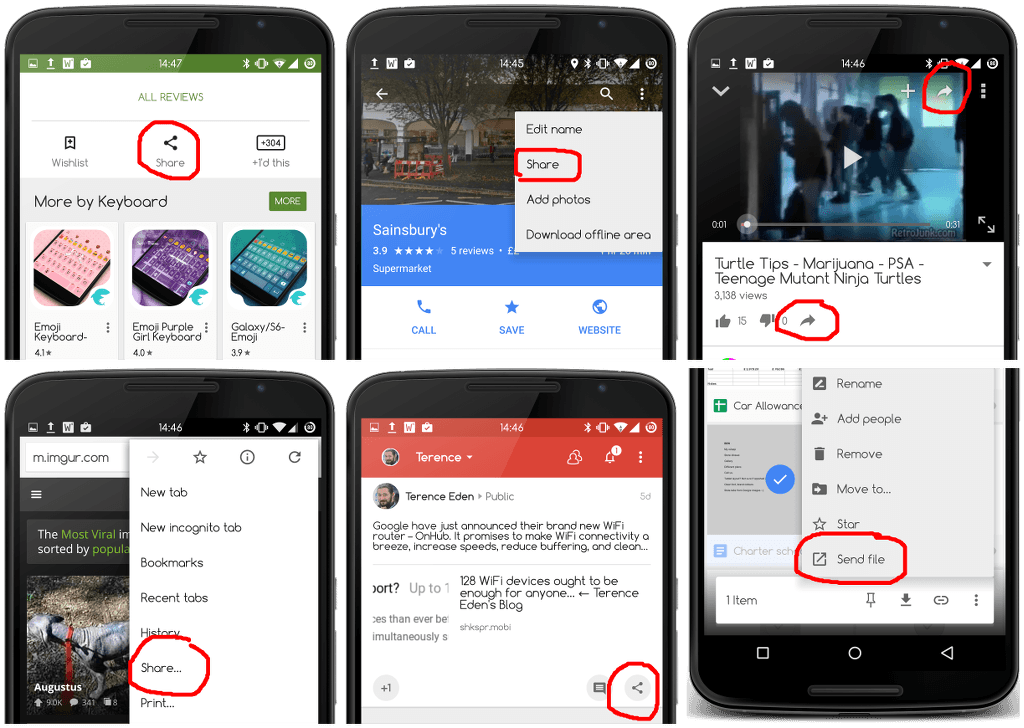
Things get even worse once you open the Share menu, though. Eden makes a good point: there’s clearly no single person in charge of this UX element for Android, even for Google’s own apps, despite the fact that they’re on every single Android phone sold outside China.
link to this extract


Samsung smart fridge leaves Gmail logins open to attack » The Register

John Leyden:

Pen Test Partners discovered the MiTM (man-in-the-middle) vulnerability that facilitated the exploit during an IoT hacking challenge run by Samsung at the recent DEF CON hacking conference.

The hack was pulled off against the RF28HMELBSR smart fridge, part of Samsung’s line-up of Smart Home appliances which can be controlled via their Smart Home app. While the fridge implements SSL, it fails to validate SSL certificates, thereby enabling man-in-the-middle attacks against most connections.

The internet-connected device is designed to download Gmail Calendar information to an on-screen display. Security shortcomings mean that hackers who manage to jump on to the same network can potentially steal Google login credentials from their neighbours.

Yeah, it’s that “jump on the same network” thing which is the sticking point. I’d wager that most home networks are secured nowadays.
link to this extract


EU deepens antitrust investigation into Google’s practices » WSJ

Natalia Drozdiak:

In one of the questionnaires [sent out to website operators] inquiring about “exclusivity obligations”—whether Google prevents or obstructs website operators from placing ads on their websites that compete with Google’s advertising business—the commission asks companies to update responses they made about the issue in 2010 and to provide a copy of all their advertising agreements with Google over the last four years.

A separate questionnaire, investigating the allegations that Google copies or “scrapes” content from rival sites, asks companies to provide more information about whether Google takes content, such as images, from the companies and uses it in its own online services.

The images question – raised by Getty – is about Google Images effectively bypassing visits to sites, and making copies of images. The latter is potentially a bigger problem than most other topics; “fair dealing” (the UK version of the US’s “fair use”) is hard to argue when you’re copying and storing entire image libraries.
link to this extract


BT may have to hive off Openreach to improve the UK’s broadband services » Telegraph

Labour MP Chris Bryant, who lives in a rural constituency:

The government’s roll-out of broadband has been far too slow.

The Government has cannibalised the BBC licence fee to fund otherwise not commercially viable superfast connections to the tune of more than £1bn. Yet they have already missed their initial deadline of May 2015 and shifted it back by two and a half years to December 2017.

Even the 2017 deadline is only a hope, as senior BT executives and almost half of councils have warned it could end up being 2018 before the roll-out to 95% of the country is finished. But there is also another problem. The Government designed the tender process for the superfast roll-out in such a way that it was virtually impossible for anyone other than BT to win. The end result was that BT Openreach won 44 out of 44 contracts and its monopoly was reinforced.

Although BT Openreach, which owns the existing copper network and delivers the rollout, is nominally at arm’s length from BT, it is right that Ofcom is now considering whether this provides an unfair advantage to BT and whether it should be split off in the interests of transparency and fair competition.

No question; it should. BT Openreach had an operating profit margin of around 50% in the most recent quarter – while the rest of BT languished. BT OR is being milked, and we’re the cows.
link to this extract


Start up: what Chinese hackers steal, Snapdragon overheats Sony, eternal Spotify streaming, and more


Think you could pretend to be one of these? Photo by anotherjesse on Flickr.

A selection of 8 links for you. Use them wisely. I’m charlesarthur on Twitter. Observations and links welcome.

The Reverse Turing Test: pretending to be a chatbot is harder than you think » Motherboard

Uri Bram, with a wonderfully executed idea:

You don’t fully realize how complicated human conversation is until you try to look at it through the eyes of a bot. Alison’s “How about you?” is an example of what the professionals call a tag question. “How about you?” on its own is meaningless; it’s implicitly referring back to my own previous question of “How are you doing today?” Within a few short words you already have a complex system of meaning the bot needs to understand.

Soon Alison was bombarding me with dialogue.

“I am going swimming later. Then I’m going to be an astronaut. I like chocolate. Do you?”

While this isn’t exactly a normal human conversation, a human can easily deal with it. Think about all the things your brain does to process those sentences.

It knows that “I’m going [swimming]” and “I’m going [to be an astronaut]” encode completely different meanings, even though they have superficially similar structures.

Figuring out the gaps when you try to be a bot is surprisingly useful for figuring out what bots need to do. (Tiny voice asks: why do we want bots to be able to fool us, precisely?)


Windows Phone is like religion – it gets people when they are down » The Register

Paul Kunert:

A division of the shipments shows Microsoft grabbed 7.6% of sales [0.57m handsets] during the quarter, up from 5.8% in the prior year quarter. The total market [for UK smartphone sales] declined 1.5% to 7.6m.

“Microsoft is slowly building share without a flagship or high-spec handset – they are after the volume end of the [professional] market. This strategy will probably change when Windows 10 comes out,” Coulling said.

Despite this, Windows barely touches the sides of the sprawling UK shipments achieved by phone royalty Samsung and Apple, the combined sales of which came to 4.93m units.

Sammy declined 8.5% in Q1 to 2.54m devices, giving it a 33.6% share of spoils, as it continued to work through the inventory bottleneck that ruined profits in 2014.

…Apple sales recovered on the back of the iPhone 6’s release, growing 7.8% to 2.43m units, narrowing the gap that Samsung opened up a year ago.

Windows Phone still not really doing anything. Maybe those are being bought by businesses?


Australian metal detector company counts cost of Chinese hacking » Reuters

Byron Kaye and Jane Wardell:

Donald McGurk, chief executive of Australian communications, metal detection and mining technology firm Codan, has watched sales and prices of his firm’s metal detectors collapse since Chinese hackers stole its designs three years ago to sell cheap imitations into Africa.

With the Australian government wary of rocking the boat ahead of this month’s historic signing of a free trade deal, McGurk says he was forced to hire a private investigative firm in China to stage a series of raids on counterfeit factories.

“They said you’re on your own,” McGurk told Reuters, referring to the Australian government officials he lobbied to help with his problem. The Australian government did not immediately respond to queries about Codan.

Codan’s experience provides a rare look at the longer-term impacts of hacking on companies, as most keep the extent of an incident under wraps. In fact, experts say many firms continue to turn a blind eye to cybersecurity even as hackers become increasingly sophisticated.

Often forgotten that hacking has a purpose; often to steal intellectual property. (Though that’s how countries have advanced themselves down the centuries.)


EU questions e-commerce firms as part of sector probe » WSJ

Tom Fairless:

Europe’s antitrust regulator has asked a broad swath of Internet commerce firms to hand over sensitive business information and copies of contracts as part of a sweeping investigation into possible abuses in the sector.

The investigation, announced in March, aims to establish whether some firms are raising contractual or other barriers to limit how consumers can shop online across national borders inside the European Union. The probe could lead to formal antitrust cases against individual companies that are suspected of abusing their dominant market position to restrict trade, in violation of EU law.

Margrethe Vestager really is getting serious.


Samsung offers to cover the difference if you buy a 64GB Galaxy S6 instead of 32GB (via a $100 rebate) » Android Police

Ryan Whitwam:

Samsung calls this the “Ultimate Upgrade.” You have until the end of the day on July 5th to make your purchase.

As with most deals of this sort, you’ll need to submit a copy of your receipt, the device’s MAC address, and the IMEI. It needs to be purchased in the US (sorry, guys) from a carrier or national retailer (i.e. not on eBay or Craigslist). Samsung says it also needs to be purchased at “full price,” which I assume means no additional discounts. Presumably you can still do a contract or payment plan with your carrier.

We’re coming to the end of the Galaxy S6’s first full quarter on sale, and Samsung is offering discounts to encourage sell-through of higher-priced models. This doesn’t seem like a resounding vote of confidence in its sales. It’s also pricey, in marketing terms (though people are pretty rubbish at taking advantage of rebates).


Google’s new self-driving cars can now be spotted on Mountain View roads » 9to5Google

Stephen Hall:

According to Google, the speed of the cars is currently capped at a pretty conservative 25 miles per hour, and they’re driving around at that “neighborhood-friendly” speed using the same software that powered the Lexus line. Ultimately, the goal is for them to be completely autonomous, but it would make sense that Google wants to take that slow to avoid any more sensationalized stories about their safety…

The company announced in the middle of May that the cars had gotten the green light to be put on the road “this summer,” and it looks like “this summer” means right now. Assuming this round of tests go well, we’ll surely be seeing more cars hit the roads over the next few months.


Watch the Xperia Z3+ camera crash in about 3 seconds » AndroidPIT

Kris Carlon:

We were pretty excited to get the Xperia Z3+ in for review. That is until we found one of the worst launch bugs we’ve ever seen. The problem is that the Xperia Z3+ camera crashes almost instantaneously when you throw anything even vaguely heavy at it.

By ”heavy” I simply mean using augmented reality mode or shooting 4K video for a few seconds. These are standard camera modes on the Z3+ so there really shouldn’t be any problems, especially in a phone that’s less than a week old. But we’ve been seeing the camera crash in 4K ever since the Z2. How Sony has failed to correct the issue two generations later is beyond me. 

Commenters concur. The Snapdragon 810 chipset seems to be at the core (sorry) of the problem. And this does look like a problem.


Stream your favorite artist forever » Eternify

Eternify leverages music from Spotify’s catalog in increments of 30 seconds, the minimum length that counts as a play—and as a royalty payment.

Pick your favorite artist, then watch in real time as you generate an average of $.005 for your artist with each play.

Appears to be registered in Germany. Can’t see Spotify allowing this to continue for long.


Start up: iOS 9, Google and adblocking; Kaspersky under attack; the Search for Harm Data, and more


Adblock? Roadblock? Photo by lludovic on Flickr.

A selection of 9 links for you. Oh yes. I’m charlesarthur on Twitter. Observations and links welcome.

A blow for mobile advertising: the next version of Safari will let users block ads on iPhones and iPads » Nieman Journalism Lab

Joshua Benton:

Why would Apple do this?

An Apple partisan might argue it just wants to give users control of their iPhone experience, and having debuted extensions in the last version of iOS, allowing them to alter web content is a natural next step.

An Apple realist might argue that its great rival Google makes more than 90% of its revenue from online advertising — a growing share of that on mobile, and a large share of that on iPhone. Indeed, Google alone makes about half of all global mobile advertising revenue. So anything that cuts back on mobile advertising revenue is primarily hurting its rival.

An Apple cynic might note that the company on Monday unveiled its new News app, which promises a beautiful reading experience — and a monetization model based on Apple’s iAds.

Oh, it’s that cynic again. Alternatively, someone who’s used iOS might have found their browsing hijacked by bad ads that take you to the App Store, and wanted to block those too – they’re a terrible user experience, and Apple hates things that cause bad UX (remember Flash and Java?)

Google gets its slice principally from iOS search – will those get blocked? Meanwhile, and unintuitively, AdBlock Plus doesn’t seem keen on it.


Google losing billions in adblocking devil’s deal » Inside PageFair

Pagefair is an “anti-adblock technology company”:

even more controversial than the debate over the ethics of adblocking is the sheer scale of the payments being made – and what that money is funding.

It is safe to assume that Google – rumored to be paying $25m – is the largest customer on the Acceptable Ads program. This is a relatively small sum for a global corporation with revenues of nearly $60bn, while being a huge cash injection for a fast-growing adblocking startup in Cologne. It is not credible that these funds are simply being spent on the administration of the acceptable ads program. Instead, they are presumably being reinvested in the future development of adblocking.

“Acceptable Ads” means that if you pay up, your ads don’t get automatically blocked. Taboola has done the same; AdBlock Plus must be minting it. And there’s no sign that this is going to go away. For both ABP users and ABP itself, it works perfectly.


Kaspersky Lab investigates attack on its own network » Kaspersky Lab Official Blog

Eugene Kaspersky:

We’ve found that the group behind Duqu 2.0 also spied on several prominent targets, including participants in the international negotiations on Iran’s nuclear program and in the 70th anniversary event of the liberation of Auschwitz. Though the internal investigation is still underway we’re confident that the prevalence of this attack is much wider and has included more top ranking targets from various countries. I also think it’s highly likely that after we detected Duqu 2.0 the people behind the attack wiped their presence on the infected networks to prevent exposure.

Kaspersky hints, but doesn’t outright say, that a nation state was behind the attack.


Washington scrutinizes the sharing economy » NYTimes.com

Rebecca Ruiz:

Matthew W. Daus, former commissioner and chairman of the New York City Taxi and Limousine Commission, took issue with calling Uber a member of the sharing economy.

“We’re coming up with these incredible definitions and clarifications, and I’m just trying to throw some water on everybody’s faces,” Mr. Daus said. “There’s no sharing going on. This is about for-hire transportation, and there needs to be a level playing field,” he said, suggesting that capping the number of vehicles on the road was necessary.

Across town at the exact same time, at another conference focused on the intersection of technology, business and government, the sharing economy was also under the microscope. The conference, called Techonomy Policy, included participation from the F.T.C. and the Federal Communications Commission.

“How sustainable is this?” asked Arun Sundararajan, a professor at New York University’s business school.

Perhaps more sustainable than some would like. Why would AirBnB or Uber go away?


Analysing Google’s public response to the EC’s Statement of Objections

Remember Google’s blogpost “The Search for Harm“, which suffered from misquoted statistics about incoming search to news websites?

This analysis by Foundem (one of the EC complainants over search) suggests – very strongly, with data to back it up – that the graphs Google included there to show how little effect it was having on online price comparison shopping, which is what the EC complaint is about initially, looked at quite different topics.

And that when you look more closely at what Google’s been doing, you discover far more effect than you might expect.


It’s a fascinating analysis; Google has questions to answer.


Huawei delays launch of its SmartWatch to September-October in China » TalkAndroid.com

Peter Holden:

Huawei’s Watch was first unveiled at MWC back in March, and it is still one of the better-looking Android Wear devices around. There is no set shipping date for the Huawei Watch just yet, although it is available to pre-order in most countries. Not in China though, availability of the Huawei Watch has been delayed until at least September, although October hasn’t been ruled out if things don’t go to plan.

It all stems down to Google having left the Chinese market due to disagreements with the Chinese government. This means that Google’s Services won’t work in China, which has left Huawei with the task of adapting Android Wear to use its own services. Obviously this isn’t going to be a quick fix.

Given that many westerners can’t pronounce Huawei (it’s Hoo-wah-way), and won’t know it has a smartwatch, no great loss of face. Also, Peter Holden: things stems *from*, not “down to”.


Open data on council spending is largely unread by voters » The Guardian

Ben Worthy at the Public Leaders Network:

there has been less interest in the data than many hoped. Council finance data is viewed around 200 times each month. The person on the street has not been desperate for data. No army of armchair auditors has sprung up. There are some enthusiasts here and there; a concerted campaign in Barnet used open data to build its case against the (now deceased) Conservative council. But few people have the time and, most importantly, the motivation to scroll through complicated pdf documents of raw council spending data. Data needs a narrative, and pdf documents and spreadsheets don’t yet tell a good enough story.

This links to a further problem. If you do find a smoking gun among the spreadsheets, who do you send it to? The council itself, the opposition or the local press? It’s notclear what the next step would be and how it would fit in with the processes by which councils are accountable to citizens.

The better news is that something is being done with the data. Users include businesses, pressure groups and journalists as well as a handful of members of the public. While they haven’t unleashed a wave of accountability, there have been sudden bursts of data-driven questioning of local authorities.

Sounds like there’s been pretty much exactly the right amount of interest in the data. And the key point is, if the councils and politicians know that the data is auditable, they will realise they can’t hide stuff. Compare and contrast: FIFA payments.


Why I’m breaking up with the Apple Watch » NYTimes.com

Jessica Friedman:

the busywork the watch’s apps can replace — handing over airline boarding passes, opening hotel room doors — seems less like an advance than a loss of control. Call me a Luddite, but honestly, I don’t mind unlocking things with my actual hands. The new watches announced this week may change the situation, but I am not sure I have the patience to wait.

Likewise (and I know this will be heresy to anyone really excited about the coming Fitbit initial public offering), the fitness-app aspect — the tracking of my steps, the measuring of my heart rate, the telling me to stand up when I am in the middle of an article — seems more like a burden than freedom.

I have worked hard to wean myself from a reliance on exercise machines telling me how hard I had worked — how many calories I had burned, how many stairs I had climbed — in part because I knew I was cheating pretty much all the time anyway and thus could not trust the results, and in part because it became an excuse to modify, or not, my ensuing behavior.

But the truth is, I know when I am in shape; I can see the difference in my body and feel it when I ride my bike in the park. The watch threatened to drag me back into a numbers-driven neurosis, and that’s a temptation I would rather not have.


The secrets of seven amazingly surreal photos revealed » Lumia blog

When it comes to Lumia photography, we think Pritesh Patel knows a thing or two about inspiring others. His amazingly surreal work is inspiring on many levels, with a magical combination of skill, creativity, and originality all working together to create some seriously fantastic photos.

Pritesh is a 22-year-old Mechanical Engineering graduate from Anand in Gujarat, India who has been a big lover all things Lumia for quite some time. And luckily for us, he’s here to tell us all about the magic behind his super photos — what he loves about his Lumia, what inspired him to create his photos, how he does it, and how you can do it too.

They are clever photos (though lots of post-editing is needed; it would be nice if some were clever trompes l’oeil). Also, “amazingly surreal” photos? Either amazing or surreal. Not both.


Start up: Russia’s misinformation detailed, USB-C wins!, automation woes?, and more


Endangered species? A truckstop by sunset. Photo by Indigo Skies Photography on Flickr.

A selection of 8 links for you. Because I like the cut of your jib. I’m charlesarthur on Twitter. Observations and links welcome.

App maker files EU complaint against Google, alleging abuse of Android dominance » WSJ

Alistair Barr on the lawsuit filed by Disconnect, which makes an anti-tracking app:

The app maker alleged Google pulled Disconnect because the software disrupted Google’s tracking and advertising efforts, the source of most of the internet company’s revenue and profit. In an email included in the complaint, a Play store employee said the app was removed [from Google Play] because it prevented other apps from delivering ads. Disconnect asked European antitrust regulators to require Google to put its apps back in the Play store and treat the apps the same way Google treats its own privacy and security software. A Google spokesman called Disconnect’s claims “baseless.” Google has allowed more than 200 other privacy apps in the Play store, but blocks any apps that alter other apps’ functionality or remove their way of making money, he added, saying Google applies this policy uniformly, with strong support from Android developers.

Tricky, this: Disconnect says that the key point is that Google doesn’t hold itself to that standard on privacy and security, and that it doesn’t prevent ad-serving – just tracking. Google says that it makes the store, so it decides the rules.


Self-driving trucks are going to hit us like a human-driven truck » Medium

Scott Santens:

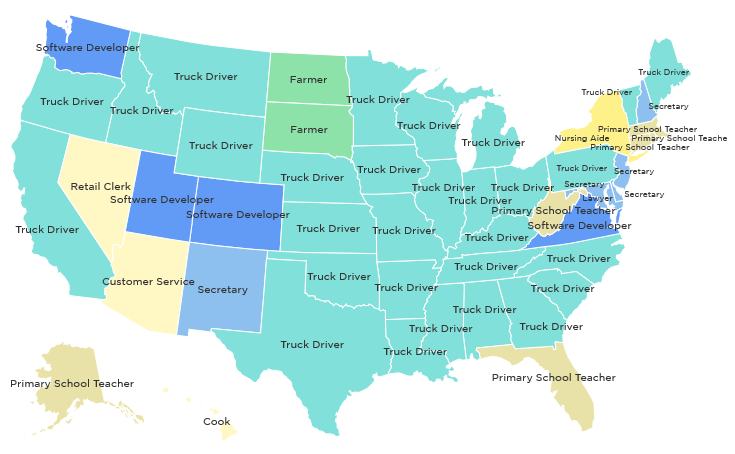
This is a map of the most common job in each US state in 2014. It should be clear at a glance just how dependent the American economy is on truck drivers. According to the American Trucker Association, there are 3.5 million professional truck drivers in the US, and an additional 5.2 million people employed within the truck-driving industry who don’t drive the trucks. That’s 8.7 million trucking-related jobs.

We can’t stop there though, because the incomes received by these 8.2 million people create the jobs of others. Those 3.5 million truck drivers driving all over the country stop regularly to eat, drink, rest, and sleep. Entire businesses have been built around serving their wants and needs. Think restaurants and motels as just two examples. So now we’re talking about millions more whose employment depends on the employment of truck drivers. But we still can’t even stop there…

…Truck driving is just about the last job in the country to provide a solid middle class salary without requiring a post-secondary degree.

You can argue about the exact numbers, but the point that it’s not just the driving that’s affected is important. See also the next link about sewing.


Made to measure » The Economist

Looking at the question of whether automation could put low-paid sewing machine workers out of, well, work in countries such as Myanmar:

it is devilishly difficult to make a machine in which fabric goes in one end and finished garments, such as jeans and T-shirts, come out the other. The particularly tricky bit is stitching two pieces of material together. This involves aligning the material correctly to the sewing head, feeding it through and constantly adjusting the fabric to prevent it slipping and buckling, while all the time keeping the stitches neat and the thread at the right tension. Nimble fingers invariably prove better at this than cogs, wheels and servo motors. “The distortion of the fabric is no longer an issue. That’s what prevented automatic sewing in the past,” says Steve Dickerson, the founder of SoftWear Automation, a textile-equipment manufacturer based in Atlanta, where Dr Dickerson was a professor at the Georgia Institute of Technology.

The company is developing machines which tackle the problems of automated sewing in a number of ways. They use cameras linked to a computer to track the stitching.

I’m moderating a session later this week looking at the questions around this topic: when automation and machine vision and capital come together to take these jobs away, what do the people who would have done them do instead?


USB-C has already won » The Verge

Sam Byford:

Although USB-C seems an inevitable success at this point, it does have a couple of issues to iron out, perhaps the most pressing of which is the complexity of its offering. There will be USB 2.0 devices with USB-C connectors, like the Nokia N1; USB 3.1 devices that use regular USB-A connectors; USB 3.1 “Gen 1” devices only capable of 5Gbps transfer speeds over USB-C, like the new Chromebook Pixel and MacBook; and USB 3.1 Gen 2 devices that give you 10Gbps. USB-C could be the only cable you ever need, but at this point it may be hard to know exactly what performance you’re going to get when you plug something in. “I think there’s the potential for confusion,” says [president and COO of the USB Implementers Forum, Jeff] Ravencraft, whose forum publishes language and usage guidelines for both USB 3.1 and USB-C.

“You do not get performance with the cable, you do not get power delivery with just the cable. The cable is a conduit for those things, right? So to have power delivery, the device has to have a power delivery controller, the host or the hub has to have a power delivery controller, and then you have to have the right cable.” The USB Implementers Forum offers training programs to help employees at retailers like Best Buy and Staples give accurate information to consumers, and is particularly aiming to crack down on “bad-actor” manufacturers that try to deliberately mislead.


MH17: forensic analysis of satellite images released by the Russian Ministry of Defence » bellingcat

With this new report all four major claims made at the Russian Ministry of Defence press conference have now been shown to be false:
– The MH17 flight path was not altered in the way claimed by the Russian Ministry of Defence. Data from the Dutch Safety Board’s preliminary report and other sources show Flight MH17 made no major course changes such as the one described in the Russian Ministry of Defence press conference.
– The Russian Ministry of Defence claimed the video of the Buk missile launcher presented by the Ukrainian Ministry of Interior was filmed in the Ukrainian government control town of Krasnoarmeisk. This has been proven to be untrue, with analysis of the video showing it was filmed in the separatists controlled city of Luhansk.
– Radar imagery was described as showing an aircraft close to Flight MH17 after it was shot down. Experts interviewed by various media organisations have stated this is almost certainly debris from Flight MH17 as it broke up over Eastern Ukraine.
– Satellite imagery shows Ukrainian Buk activity around July 17th. As this report shows, those claims are untrue, and were based on fabricated satellite imagery.

Weird that Russia is claiming to have had no involvement in MH17 and yet still takes the trouble to do this. But when you have a country whose leaders are paranoid.. well, read the next link.


The Agency » NYTimes.com

Adrian Chen on the “Internet Research Agency” in St Petersburg, which has industrialised the practice of trolling social media to promote Russian interests:

[Ludmila] Savchuk’s revelations about the agency have fascinated Russia not because they are shocking but because they confirm what everyone has long suspected: The Russian Internet is awash in trolls. “This troll business becomes more popular year by year,” says Platon Mamatov, who says that he ran his own troll farm in the Ural Mountains from 2008 to 2013.

During that time he employed from 20 to 40 people, mostly students and young mothers, to carry out online tasks for Kremlin contacts and local and regional authorities from Putin’s United Russia party. Mamatov says there are scores of operations like his around the country, working for government authorities at every level. Because the industry is secretive, with its funds funneled through a maze of innocuous-sounding contracts and shell businesses, it is difficult to estimate exactly how many people are at work trolling today. But Mamatov claims “there are thousands — I’m not sure about how many, but yes, really, thousands.”

That, though, is only the amuse-bouche. Then Chen finds himself dragged down the rabbit hole. Today’s must-read.


Lenovo replaces head of smartphone division as sales slump in China » Reuters

Liu Jun, one of four executive vice presidents under CEO Yang Yuanqing and a company veteran of 22 years, will be replaced by Chen Xudong, the head of ShenQi, a sub-division that sells mobile devices, the company said in a statement. Chen, 47, takes the reins of the division at a critical time. He must integrate the Motorola unit acquired from Google Inc for $2.9bn six months ago, while trying to counter a damaging slump in phone shipments. Lenovo, the fifth largest player in the Chinese market, shipped 22% fewer phones in the first quarter compared to the same period a year earlier, according to research firm IDC.

In stark contrast, Apple’s first-quarter China shipments jumped 62%, while Xiaomi and Huawei had gains of 42% and 40% respectively. Lenovo did not offer a reason for Liu leaving the post but said he would continue for an unspecified period as a special consultant to Yang.

Lenovo has a tough challenge with the tightening China market and Motorola’s integration.


How Twitter users can generate better ideas » MIT Sloan Management Review

in analyzing the structure of each employee’s Twitter network, we found that there was a positive relationship between the amount of diversity in one’s Twitter network and the quality of ideas submitted. However, Twitter activity and size measures (such as the number of tweets, number of followers and number of people followed) were not correlated with personal innovation.

We can explain these findings further by examining the Twitter sociograms of two EMC employees. In the diagrams, circles represent Twitter users, and an arrow from one user to another user indicates that the first user is following the second user on Twitter. Even though both employees A and B follow approximately the same number of Twitter accounts, A’s network is far more diverse than B’s. That is to say, the people whom employee A follows on Twitter are, for the most part, not following each other.

We can determine this level of diversity mathematically by using the compactness ratio, which measures the degree to which people in the network are connected to each other. For employee A, the network’s compactness ratio is quite low, at 18%. Our research found that loose Twitter networks, such as employee A’s, are better for ideation, because the potential for accessing a divergent set of ideas is greater.

Is it sort of “be less like Facebook”?


Lessons from history: the effect on Microsoft’s culture of the US antitrust verdict. Who’s next?


Internet Explorer: a voodoo doll, but for who? Photo by Verpletterend on Flickr.

The following is an extract from Chapter 2 of my book “Digital Wars: Apple, Google, Microsoft and the Battle for the Internet”, published by Kogan Page (and now in its second edition – make sure you get the 2014 version with the colourful cover). It’s available on:

• Amazon UK paperback, Kindle
• Amazon US paperback, Kindle
iBooks
It’s also been translated into Finnish, Korean, Russian, Chinese, Thai, and (I think) Spanish. Someone near you is sure to sell it in a language you want to read it in, or that you want to learn. (Note that none of those is an affiliate link. All I get is the author royalties..)

I’m publishing this as a reference for anyone who wants to know how US antitrust law works (note particularly the point about “harm to consumers”), and what happens to companies that fall foul of it.

Note that in Europe, the EC’s antitrust rules don’t require it to show harm to consumers – only that competition has been stifled.

Obviously, it’s interesting to consider the cultural changes that are described by the Microsoft observers both inside and outside the company to the antitrust ruling, and wonder whether there are any parallels for Google – currently facing a Statement of Objections from the EC over its Shopping service, and an investigation to see whether its licensing for use of the Android mobile operating system is anti-competitive.


By the time Ballmer took charge [as chief executive of Microsoft, replacing Bill Gates, on 13 January 2000], the antitrust trial [against the Department of Justice] was over; the judge’s Findings of Fact had been delivered. They were damning: Microsoft had abused its monopoly in Windows to extend them to other areas. That was illegal. But no sentence had been delivered.

The trial, and especially the testimony and press coverage, had an enormous effect on the internal culture of Microsoft. The staff didn’t stop thinking they were the best programmers in the world. But quite suddenly they couldn’t attract the rest of the best programmers in the world. Partly that was because as the antitrust trial ground on through 1998 and 1999 the dot-com boom took off, promising enormous riches to smart coders who hitched a ride with the right company. Get your stock options cheaply, and when the business IPOs you’ll be rich, just like those lucky guys at Netscape and Yahoo. But there was also the feeling that to work for Microsoft was to compromise your ethics.

Inside Microsoft, there was soul-searching. An early example had come at the 1999 annual executive retreat, where Gates and Ballmer wanted to talk over the finances of the company, examine its performance and chart the next product lines – the “roadmap”. The antitrust trial’s “Findings of Fact” – the judge’s established truth about the company – hadn’t yet been published. But Microsoft had been hauled over the coals in court; Bill Gates in particular had been made to look evasive and arrogant in his videoed deposition with the prosecution’s Robert Boies.

At the meeting, Orlando Ayala, then head of sales for Latin America and the south Pacific, told the top executives that he didn’t want to talk about the roadmap. One participant recalls Ayala saying that “we’ve got to talk about what our values are at this company. I can’t work here any more if my brother [who didn’t work for Microsoft] keeps challenging what I’m doing.” The attendee describes it as an example of “stopping the normal company process of growth and business as usual, saying we have to change how this company does business.”

The attendee says: “We said ‘no, we don’t want to discuss that [roadmap], because we’re in a crisis here and we need to address what we stand for as a company’… We’ve been called evil; most of us with outside friends and family are being questioned by them, asked why we’re working for Microsoft if it’s an evil company.”

The executive admits it was an “uncomfortable” feeling: “we all recognised the ability of Microsoft to build great software that would change the world.” The trouble was that outside the company, it was simply thought of as acting like a gangster, threatening those who looked as though they might set up on a patch adjacent to its own ground. (The judge, Thomas Penfield Jackson, talking to journalists under embargo during the trial, suggested that Microsoft’s actions were like those of drug traffickers or gangland killers.)

The court’s Findings of Fact said Microsoft held a monopoly of PC operating systems; it could artificially set licence prices, safe in the knowledge that barely anyone would decline. Judge Penfield Jackson pointed to an internal Microsoft study, provided in evidence, which determined that charging $49 for the Windows 98 upgrade would earn a reasonable return on investment, but that charging $89 would maximise revenue, hitting the sweet spot of the demand curve beyond which too many would-be buyers would stick with what they had. Only a monopoly would have that pricing power.

Being a monopoly (generally defined as having 80% or more of a market) is not illegal in the US; nor does it necessarily attract sanctions. But using a monopoly in one field to extend or create one in another field is, and does, if it can be shown to have harmed consumers in either or both markets. By going after the Netscape browser, which had begun to set itself up as a platform of sorts (albeit one which almost always ran on Windows), and using its control of Windows first to deny Netscape access to some APIs it needed for Windows 95, and then to boost its own Internet Explorer by insisting on its inclusion – at the threat to OEM PC makers of not getting Windows licences, which would kill their businesses – Microsoft crossed the line.

Among those also targeted for Microsoft’s arm-twisting via Windows to try to crush other products in different fields, the trial heard, were Intel, Sun Microsystems, Real Networks, IBM – which was denied an OEM licence for Windows 95 until a quarter of an hour before its official launch, and so missed out on huge swathes of PC sales – and Apple. In particular, Apple was offered a deal: stop developing its own systems for playing music and films on Windows, and let Microsoft handle them using its DirectX system. If it did, Microsoft would stop putting obstacles in the way of Apple’s Quicktime on Windows. Steve Jobs, who was at the meeting in June 1998, rejected the idea because it would limit the ability for third parties to develop content that would run on Windows PCs and Apple machines. (In retrospect, that declsion may be one of the most significant to Apple’s later success that Jobs ever made, since it meant that Microsoft could not control how Apple-encoded music was played on Windows.)

Internet Explorer was the focus of the trial, though: the number of Microsoft staff working on it had grown from a handful in early 1995 to more than a thousand in 1999. And Microsoft gave it away because reaching an effective monopoly share (50% of the browser market would be good; 80% and up ideal) was the target. Penfield Jackson completed the necessary trio needed for an antitrust conviction by pointing to harm not only for the companies affected, but also for consumers: tying Internet Explorer into Windows “made it easier for malicious viruses that penetrate the system via Internet Explorer to infect non-browsing parts of the system”.

The stock market wasn’t worried by the Findings of Fact; in the month after their publication, Microsoft’s stock value actually jumped, and it reached its all-time peak market capitalisation, $612.5bn, on the last working day of December 1999. The rest of the market for technology stocks rose too – though one analysis suggested that this was because Jackson (a pro-business Republican) had cleared the way for other companies to begin competing effectively.

Then in April 2000, with Ballmer four months into his new job, Jackson handed down his sentence: Microsoft should be split into two – one company making operating systems, one making applications.

Microsoft fought the order with all its might and wile. Jackson, it transpired, had compromised his supposedly impartial position by talking to the New Yorker’s Ken Auletta during the trial, for a book to be published immediately after it. In February 2001 a group of appeal judges declared that Jackson had violated judicial ethics with his conversations. (The real problem was that his remarks were published before the appeals process was exhausted, instead of when his verdict was published.) The breakup was halted over Jackson’s “perceived bias”. He railed that any bias was Microsoft’s fault, because it “proved, time and time again, to be inaccurate, misleading, evasive, and transparently false . . . Microsoft is a company with an institutional disdain for both the truth and for rules of law that lesser entities must respect. It is also a company whose senior management is not averse to offering specious testimony to support spurious defences to claims of its wrongdoing.”

Inside the company there was relief – and also a realisation that it had dodged a bullet. Though the sentence had been set aside, the Findings of Fact, and conviction, had not been overturned. At the next annual worldwide sales conference – held in the Seattle Mariners stadium – Ballmer explained that the culture had to change: no longer could Microsoft use its advantage in one field to dominate another. (The European Commission was to follow with similar investigations which rumbled on in parallel before coming out with demands for Microsoft to open up its software interfaces in 2003.) But it was the US case which reached down into the company’s soul…

…Some inside the company felt they had already abandoned the practices for which they were being condemned. “Arguably some of the things that we’d written in contracts were sailing a bit close to the wind,” admits one former Microsoft staffer. “But frankly if you look now at other peoples’ current contracts, whether it’s Apple’s around the iPhone, or Google’s, or even Intel’s, you’d say they were far more egregious than any of the contract terms that Microsoft signed up with Intel.” Which misses the point: it wasn’t the contracts which were bad, but the tactics, allied to Microsoft having a monopoly. Apple has no monopoly share of smartphones. Intel and Google arguably do in their own fields – and have both attracted attention (in Intel’s case, to enormous cost) from antitrust investigators…

…Pieter Knook, who worked for Microsoft through the period in its Asian business, says that the post-judgement process was exhaustive. “Every executive officer, every year, had to go through antitrust training, certify they were in compliance with the terms of the [antitrust settlement] agreement – so there was this very strong understanding, and obligation that you felt to do the right thing.”

“It had a big impact, and even a decade later it was still having an impact,” says Mary Jo Foley, a journalist who has followed Microsoft for years. “When they think about adding new features to different products or how they make sure their products work together, I think in the back of their minds is always this lingering kind of thought or checklist, like: ‘if we do that, are we going to get sued by so and so for antitrust?’ ‘Are we going to get sued by so?’ And so or so and so.” When any feature was being thought about, that question kept coming up: will it break the antitrust ruling? “I think it has almost had a chilling effect on the way they do product development,” Foley suggests.

With Microsoft suitably admonished, and now living under a new regime of oversight, the scene was set for Microsoft’s next challenges: in search, digital music and in mobile phones. First was a little startup that was already becoming the talk of internet users, one which was to form its corporate thinking around a motto that tried to express a desire not to be Microsoft: “don’t be evil”.


If you found this useful, you might like the book. It’s longer. Links above.

Start up: correcting Google, science says videogames don’t make sexists, iPhone forecasts, and more


This is how we used to write and correct “blogposts”, kids. Photo by Julie McGalliard on Flickr.

A selection of 10 links for you. For free! I’m charlesarthur on Twitter. Observations and links welcome.

Electric cars won’t spread even with rapid chargers: Toyota engineer » Yahoo Finance

Electric vehicle (EV) supporters have touted developing high-speed charging technology as the way forward for cars like Nissan Motor Co’s Leaf. But Yoshikazu Tanaka, chief engineer of Toyota’s hydrogen fuel-cell car Mirai, said that would guzzle so much energy at once as to defeat the purpose of the EV as an ecologically sound form of transportation.

“If you were to charge a car in 12 minutes for a range of 500 km (310 miles), for example, you’re probably using up electricity required to power 1,000 houses,” Tanaka told a small group of reporters at the first test-drive event for the production version of the Mirai, the world’s only mass-market fuel-cell car.

“That totally goes against the need to stabilize electricity use on the grid.”

Ah. Good point.


Sub-Rs 10,000 smartphones contributing 75% of sales: Lenovo » India Times

Chinese tech major Lenovo today said almost three-fourth of its smartphone sales is coming from devices priced below Rs 10,000 [US$160].

The company offers smartphones priced in the range of Rs 4,000 to Rs 30,000.

“The industry itself sees about 75% of the sales coming from smartphones priced under Rs 10,000 and we have more or less a similar split,” Lenovo India Director Smartphones Sudhin Mathur told PTI.

The company started as a premium player but now have devices across entry, mid and premium segments, he added.


How many iPhones did Apple sell last quarter? » Fortune

Philip Elmer DeWitt:

BTIG’s Walter Piecyk has the low estimate (50m), independent Faizai Kara of the Braeburn Group the high (64m). The average estimate of each group — pros at 55.6m and amateurs at 59.3m — are not that far apart. Either would represent double-digit growth from the same quarter last year.

Last year’s figure was 43.7m. Apple financials are released after US market close on Monday.


Indian companies pull out of Facebook’s Internet.org amid battle over net neutrality » WSJ Digits blog

Aditi Majhotra:

A viral crusade to keep the Internet equally accessible to all users has won the backing of some of the country’s biggest online companies, which late Wednesday pulled out of a partnership with Facebook’s Internet.org over fears it could allow telecom operators to choose which web applications users can access and how fast.

India’s sophistication in this space shouldn’t be a surprise, yet it is.


From Product Club to Thington Inc. — Welcome to Thington » Medium

Tom Coates:

The more we explored the space, the more we found that however good and interesting the hardware was in the Internet of Things, the software and service layers were generally awful. Gradually, we came to believe that huge problems in these layers were hiding all of the value and the potential of the technology.

Which brings us to Thington! We decided that we wanted to build a new user interface and service layer that would push past all these problems and in the process bring in our experience working on social systems, location sharing, privacy, hardware and the web of data. And we’re super excited by what we’ve come up with. So excited in fact that we’ve put our money where our mouths are and have formally changed the name of the company from Product Club to Thington Inc.

Keep an eye on this: Coates and colleagues have a solid track record in making useful stuff.


The Search for Harm » Official Google Blog

Knowing that the EC would issue a Statement of Objections (because it sent them to Google ahead of time), Amit Singhal, Senior Vice President, Google Search, put his name to this blogpost which aimed to show that all the EC complaints are nonsense.

And it’s Google, so it’s all going to be built on really robust data, right? Except that the blogpost has been updated at least twice:

*Update: An earlier version of this post quoted traffic figures for Bild and The Guardian, researched on a third-party site. The Guardian data were for the domain guardian.co.uk, which is no longer the main domain for the paper. We’ve removed these references and we’re sorry for the error.

That was the first. And then:

Yelp has pointed out that they get 40% of their searches (not their traffic) direct from their mobile apps. They don’t appear to disclose their traffic numbers. We’re happy to correct the record.

Did I start the ball rolling querying the numbers in Singhal’s post? Yes, I did. Someone has to ask questions of Google, and it seems all the bloggers and reporters feverishly writing hot takes didn’t.

But if those two statistics are wrong… what about all the others in Singhal’s blogpost? Guess we’ll have to look at it all in detail at some point soon.


L.A. school district demands iPad refund from Apple » LA Times

The contract with Apple was approved by the Board of Education in June 2013 as part of a deal expected to reach at least $500m. Another $800m was earmarked to improve Internet access at schools.

Under the contract, Pearson was to provide English and math curriculum. The district selected Pearson based only on samples of curriculum — nothing more was available.

L.A. Unified made the deal anyway; it wanted to bundle the curriculum and the device into a single price. A three-year license to use the curriculum added about $200 to the $768 cost of each iPad. The entire purchase then was financed through school construction bonds, which can be used to purchase computers.

L.A. Unified bought 43,261 iPads with the Pearson curriculum. The district purchased another 77,175 iPads under the contract without the Pearson curriculum to be used initially for state standardized tests.

Pearson could offer only a partial curriculum during the first year of the license, which was permitted under the agreement. Teachers and principals never widely embraced the product.

Nearly a year ago, L.A. Unified sent Apple a letter demanding that it address problems with the Pearson curriculum.

“Only two schools of 69 in the Instructional Technology Initiative … use Pearson regularly,” according to an internal March report from project director Bernadette Lucas.

Seems like it’s the Pearson curriculum that’s screwed up more than the iPads, though the two also seem intertwined. The whole contract has unwound horribly.


Sexist Games=Sexist Gamers? A longitudinal study on the relationship between video game use and sexist attitudes » Abstract

Enlisting a 3 year longitudinal design, the present study assessed the relationship between video game use and sexist attitudes, using data from a representative sample of German players aged 14 and older (N=824). Controlling for age and education, it was found that sexist attitudes—measured with a brief scale assessing beliefs about gender roles in society—were not related to the amount of daily video game use or preference for specific genres for both female and male players. Implications for research on sexism in video games and cultivation effects of video games in general are discussed.

Unfortunately the study itself is paywalled, but this is the first potentially rigorous scientific study I’ve seen into the topic. So do we conclude that sexist dolts who play games would just be sexist dolts regardless? I think that’s pretty easy to answer. (Thanks to Jay Kannan for the link.)


Given enough money, all bugs are shallow » Coding Horror

Jeff Atwood on the trouble with open source and bugs (or even just code and bugs):

While I applaud any effort to make things more secure, and I completely agree that security is a battle we should be fighting on multiple fronts, both commercial and non-commercial, I am uneasy about some aspects of paying for bugs becoming the new normal. What are we incentivizing, exactly?

Money makes security bugs go underground

There’s now a price associated with exploits, and the deeper the exploit and the lesser known it is, the more incentive there is to not tell anyone about it until you can collect a major payout. So you might wait up to a year to report anything, and meanwhile this security bug is out there in the wild – who knows who else might have discovered it by then?

If your focus is the payout, who is paying more? The good guys, or the bad guys?


SanDisk forecasts first full-year revenue decline in three years » Reuters

Arathny Nair:

There is strong demand for SanDisk’s solid-state drives and memory chips.

But lower pricing, lean inventory, unplanned maintenance at its chip foundry last year and delay in sales of certain embedded parts has led to two revenue forecast cuts this year, including a warning last month.

“It looks like SanDisk is going to have pretty tough road ahead to haul in 2015,” said Wedbush Securities analyst Betsy Van Hees, adding that the company’s spending is high and will continue at “elevated levels”…

…The company had said in January it had lost a major customer, widely believed to be Apple Inc, which switched to using solid state drives made by Samsung Electronics Co Ltd in its MacBooks.

Would love to know quite how the (SD) memory chip demand is going in smartphones. Something about SanDisk’s SD business reminds me of Iomega – seemed like a great business offering consumer storage, which abruptly collapsed (when CD-Rs got cheap). SanDisk’s financials suggest the glimmerings of a fall in revenue in its “removable” business.


Start up: spotting comment trolls, stopping piracy Of Thrones, where’s Android One?, and more


Try putting those on Bittorrent, suckahs. Photo by Jemimus on Flickr.

A selection of 8 links for you. Use them wisely. I’m charlesarthur on Twitter. Observations and links welcome.

Scientists develop algorithm that can auto-ban internet trolls » The Stack

Martin Anderson:

The study found that on CNN the studied trolls were more likely to initiate new posts or sub-threads, whilst at Breitbart and IGN they were more likely to weigh into existing threads.

The report does not exonerate host communities of all blame for troll behaviour, finding that immediately intolerant communities are more likely to foster trolls:

“[communities] may play a part in incubating antisocial behavior. In fact, users who are excessively censored early in their lives are more likely to exhibit antisocial behavior later on. Furthermore, while communities appear initially forgiving (and are relatively slow to ban these antisocial users), they become less tolerant of such users the longer they remain in a community. This results in an increased rate at which their posts are deleted, even after controlling for post quality.”

Seems mostly accurate, apart from calling breitbart.com a “political hub”. I’d go for “troll-employing troll magnet”, personally.


Game Of Thrones leak and watermark: a stupid tracking system » bru’s blog

The first four episodes of game of thrones leaked nearly 36 hours ago. They have been extensively downloaded, and the only tracking set up HBO seemed to be a watermark in the bottom left corner of the screen. Once blurred, it is useless. This impresses me. It’s 2015 and all you’re using is a “confirm you’re deleted” + “your copy is watermarked” for protection? There are simple schemes that would have allowed HBO to track the leak.

The idea is very simple: make each copy unique in a non-visible way.

Seems like the editing to create unique copies would be a hassle. Not sending them out (by getting people to come in to previews?) might be simpler. But there would be geographic reasons against that. No matter what, though, it only delays the piracy by 36 hours or so. That’s the bigger problem.


BOMBSHELL: MUSL employee might have rigged Hot Lotto computerized drawing » Lottery Post

Prosecutors countered this motion by claiming they have a “prima facie,” or at first glance, case that Tipton tampered with lottery equipment.

In their reply to the defense’s motion, prosecutors argued that Tipton’s co-workers said he “was ‘obsessed’ with root kits, a type of computer program that can be installed quickly, set to do just about anything, and then self-destruct without a trace.” The prosecution claimed a witness will testify that Tipton told him before December 2010 that he had a self-destructing root kit.

Prosecutors also argued in their reply that Tipton was in the draw room on Nov. 20, 2010, “ostensibly to change the time on the computers.” The prosecution alleged the cameras in the room on that date recorded about one second per minute instead of how they normally operate, recording every second a person is in the room.

“Four of the five individuals who have access to control the camera’s settings will testify they did not change the cameras’ recording instructions; the fifth person is Defendant,” the prosecution wrote.

Someone’s writing the screenplay already, yes? The accused bought a ticket that won $14.3m.


What’s Become of Android One? » CCS Insight

Peter Bryer is an analyst:

our checks indicate that Android One has had a limited direct effect on the market, despite initial enthusiasm for the programme. Sales of Android One-based smartphones began more than half a year ago in India, but volumes don’t stand out.

The first Android One products came from Karbonn, Micromax and Spice, with more familiar brands expected to begin adopting the platform. Acer, Asus, HTC, Lenovo and Panasonic were among the smartphone manufacturers listed by Google as partners in the project, but this interest appears to have stalled.

The fading momentum of Android One is an indication of the expanding selection of equally well-specified, low-cost smartphones and tablets in emerging markets. Hundreds of models are available at $100 or below — a once impossible price band has become very ordinary.

The standard having been set, others have matched it. All works for Google. But see later…


Flipkart’s move to dump mobile site could hit Google » WSJ

Rolfe Winkler:

Indian e-commerce giant Flipkart has decided it doesn’t need to rely on the Web to lure shoppers, dumping its mobile site and pushing visitors to its app. That move may spell trouble for the future of Google ‘s cash-cow search engine, which relies heavily on links to shopping sites.

Smartphone users that go to the mobile websites of either Flipkart or its sister site Myntra no longer see the same virtual store shelves as when they visit those sites from a personal computer. Instead they see a message to download the sites’ mobile apps.

The problem for Google is that a large percentage of its ad business is driven by paid links that direct users to e-commerce sites. But mobile apps are walled gardens unto themselves, unconnected by links to the broader Web.

A general problem, but if it starts happening early in countries like India, that is a problem for Google.


Brazil’s iPhone investment falls short on promises of jobs, lower prices » Reuters

Brad Haynes:

The Brazilian iPhone was meant to mark a new era.

When Taiwan’s Foxconn Technology Group agreed in April 2011 to make Apple products here, President Dilma Rousseff and her advisers promised that up to $12 billion in investments over six years would transform the Brazilian technology sector, putting it on the cutting edge of touch screen development. A new supply chain would be created, generating high-quality jobs and bringing down prices of the coveted gadgets.

Four years later, none of that has come true.

Foxconn has created only a small fraction of the 100,000 jobs that the government projected, and most of the work is in low-skill assembly. There is little sign that it has catalyzed Brazil’s technology sector or created much of a local supply chain.

Not quite clear where the blame lies – high expectation by Foxconn, local taxes or local culture.


Formal charges may be next in Europe’s Google antitrust inquiry » NYTimes.com

James Kanter and Conor Dougherty:

Some experts say that Mr. Almunia’s unsuccessful strategy makes further attempts to settle the case without formal charges unlikely.

“Given the history of failed attempts to reach a commitment decision, I just don’t see what she would gain from going down this route again, unless Google has promised more concessions that we don’t know about,” said Liza Lovdahl-Gormsen, the director of the Competition Law Forum at the British Institute of International and Comparative Law.

Without formal charges, Ms. Lovdahl-Gormsen said, “Google might try to buy themselves time by offering commitments that are unlikely to be accepted by the commission, and that it knows won’t be accepted by the market, simply because it does not want to be faced with the instrument of torture — the statement of objections.”

Expect news on Wednesday.


My voice is my passport: Android gets a “Trusted Voice” smart lock » Ars Technica

How secure is this system? We’re wondering the same thing. The popup when you enable “Trusted Voice” warns that the feature is not as secure as a traditional lock screen and that “Someone with a similar voice or a recording of your voice could unlock your device.” We’d love to test it out, but it hasn’t rolled out to any of our devices yet—we only know about it thanks to a report from Android Police.

Android Police hasn’t given it any scrutiny (none of its devices – even Nexuses – seem to have got it.) The commenters on AP don’t seem enamoured, though, pointing out how easy it would be to spoof (as Google itself admits). So there’s now pattern, PIN, face and voice unlock, and also “trusted device” (Android Wear). Flexibility is good, but they aren’t all equally robust, which feels like a problem.


Why Google’s struggles with the EC – and FTC – matter


Margrethe Vestager, the Danish-born EC competition commissioner. Photo by Radikal Venstre on Flickr.

“Google doesn’t have any friends,” I was told by someone who has watched the search engine’s tussle with the US Federal Trade Commission and latterly with the European Commission. “It makes enemies all over the place. Look how nobody is standing up for it in this fight. It’s on its own.”

The release, apparently accidentally, of the FTC staff’s report on whether to sue Google over antitrust in 2012 to the Wall Street Journal has highlighted just how true that is. We only got every other page of one of two reports. But that gives us a lot to chew on as the EC prepares a Statement of Objections against Google that will force some sort of settlement. (It’s obvious that the EC is going for an SOO: three previous attempts to settle without one foundered, and the new competition commissioner Margrethe Vestager clearly isn’t going to go down the same road into the teeth of political disapproval.)

The Wall Street Journal has published the FTC staffers’ internal report to the commissioners. And guess what? It shows them outlining many ways in which Google was behaving anticompetitively.

The FTC report says Google
• demoted rivals for vertical business (such as Shopping) in its search engine results pages (SERPS), and promoted its own businesses above those rivals, even when its own offered worse options
• scraped content such as Amazon rankings in order to populate its own rankings for competing services
• scraped content from sites such as Yelp, and when they complained, threatened to remove them from search listings
• crucially, acted in a way that (the report says) resulted “in real harm to consumers and to innovation in the online search and advertising markets. Google has strengthened its monopolies over search and search advertising through anticompetitive means, and has forestalled competitors and would-be competitors’ ability to challenge those monopolies, and this will have lasting negative effects on consumer welfare.”
• among the companies that complained to the FTC, confidentially, were Amazon, eBay, Yelp, Shopzilla and more. Amazon and eBay stand out, because they’re two of Google’s biggest advertisers – yet there they are, saying they don’t like its tactics.

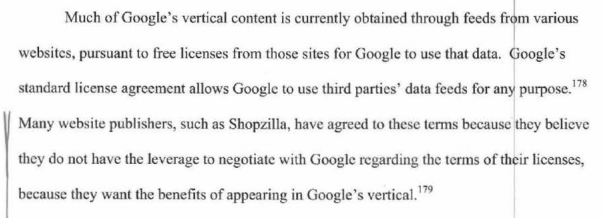
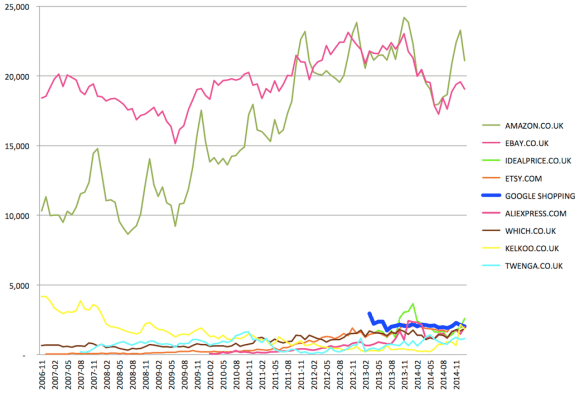
Now the WSJ has published what it got from the FTC: every other page of the report prepared by the staff looking at what happened, with some amazing stories. It’s worth a read. Particularly worth looking at is “footnote 154”, which is on p132 of the physical report, p71 of the electronic one on the WSJ. This is where it shows how Google put its thumb on the scale when it came to competing with rival vertical sites.

What does Google want, though?

Before you do that, though, bear in mind the prism through which you have to understand Google’s actions.

Google’s key business model is to offer search across the internet, and sell ads against peoples’ searches for information (AdWords) or reading on sites where it controls the ads (AdSense).

For that business model to work at maximum efficiency, Google needs
• to be able to offer the “best” search results, as perceived by users (though it’s willing to sacrifice this – see later – and you could ask whether the majority of users will notice)
• to have the maximum possible access to information across the internet to populate search results. Note that this is why it’s in Google’s interests to make cost barriers to information to be pushed to zero, even if that isn’t in the interests of the people or organisations that initially gather and actually own and collate the information; it’s also in Google’s interests to ignore copyright for as long and as far as possible until forced to comply, because that means it can use datasets of dubious legality to improve search results
• to capture as much search advertising as it can
• to capture as much online display advertising as it can

None of those is “evil” in itself. But equally, none is fairies and kittens. It’s rapacious; the image in Dave Eggers’s The Circle (a parable about Google), of a transparent shark that swallows everything it can and turns it into silt, is apt.

YouTube (which it has owned since 2005) is an interesting supporting example here. It’s in Google’s interests for there to be as much material as possible on it, regardless of copyright, so that it can show display adverts (those irritating pre-rolls). It’s in its interests for videos to follow endlessly unless you stop them (an “innovation” it has recently introduced, and from which you have to opt out).

It’s also in its interests for YouTube to rank as highly as possible in search results even if it isn’t the optimum, original or most-linked source of a video, because that way Google captures the advertising around that content, rather than any content owner capturing value (from rental or sale or associated advertising).

It’s also in its interests to do only as much as it absolutely has to in order to remove copyrighted content – and even then, it will often suggest to the copyright owner instead that they just overlook the copyright infringement, and monetise it instead in an ad revenue split. Where of course Google gets to decide the split. (Example: film studios, and all the pirated content from their productions; record labels, and all the uploaded content there, which is monetised through ContentID. Pause for a moment and think about this: you and I wouldn’t have a hope of making money from content other people had uploaded without permission to our website. And particularly not to be able to decide the revenue split from any such monetisation. That Google can and does with YouTube shows its market power – and also the weakness of the law in this space. The record labels couldn’t get a preemptive injunction; so they were left with a fait accompli.)

Think vertical

In building associated businesses (aka “vertical search” – so-called because they’re specific to a field) – such as Google Shopping (where listing was at first free, but then became paid-for just like AdWords), or Google Flight Search (where Google could benefit from being top), or Google Product Search, the FTC report confirmed what everyone had said repeatedly: Google pushed its own product above rivals, even when its own were worse, and even at its own expense.

The FTC report is instructive here. It cites a number of examples where Google either forced other sites to give it content, or took that content (even when the other sites didn’t want it to), or sacrificed search quality in order to push its own vertical products.

Forcing sites to give it content? In building Google Local, Google copied content from Yelp and many other local websites. When they protested – Yelp cut off its data feed to Google – Google tried for a bit, and then came up with a masterplan: it set up Google Places and told local websites that they had to allow it to scrape their content and allow it there, or it would exclude them altogether from web search. Ta-da! There were all the reviews that Google needed to populate Google Local, provided by its putative rivals for free, despite all the effort and cost it had taken them to gather them.

Classic Google: access other peoples’ content for free; ignore the consequential benefits. For Google, it isn’t important whether those local websites survive or not, because it has their data. For a company like Yelp, which relies on people coming to its site and using it, and inputting data, and makes its money from local ads and brand ads, any move by Google to annex its content is a serious threat.

This also points to Google’s dominance. Sites like Shopzilla, the FTC noted, were scared to deny Google the free rein to its data because they worried that people wouldn’t find them.

Shopzilla worried about exclusion from Google's listings

Google offers you a ‘standard licence’, and you’d better accept it.

That’s arm-twisting of the first order.

Google was definitely worried about verticals taking away from its core business: in 2005 Bill Brougher, a Google product manager, said in an internal email that “the real threat” of Google not “executing on verticals” (ie having its own offerings) was

“(a) loss of traffic from Google.com because folks search elsewhere for some queries (b) related revenue loss for high spend verticals like travel (c) missing opportunity if someone else creates the platform to build verticals (d) if one of our big competitors builds a constellation of high quality verticals, we are hurt badly”.

You’ve got questions

Obviously, you’ll be going “but..”:
1) But aren’t “verticals” just another form of search? No – though they need search to be visible. A retailer of any sort is a “vertical”: a shop needs to know what it has to sell in order to offer it for sale. But populating the shop, tying up deals with wholesalers, figuring out pricing – those aren’t “search”. Amazon is a “vertical”; Moneysupermarket is a “vertical” (where it sells various deals, and wraps it with information in its forums). Hotel booking sites, shopping sites, they’re all “verticals”.

Their problem is that they need what they’re offering (“hotel tonight in Wolverhampton”) to be visible via general search, but they don’t want that to be something that can be scraped easily.

Amazon, for example, gave Google limited access to its raw feed; but Google wanted more, including star ratings and sales rankings. Amazon didn’t want to give that up for bulk use (though it was happy for it to be visible individually, when users called a page up). Google simply scraped the Amazon data, page by page – and used the rankings to populate its own shopping services. It did the same with Yelp – which eventually complained and sent a formal cease-and-desist notice.

In passing, this is a classic example of Google having it both ways: if your dataset is big enough, as with Amazon’s, then Google – and its supporters – can claim that scooping up of extra data such as shopping rankings and star ratings is “fair use”; if your dataset is small, then you’re probably small too, and will be threatened by the possibility of exclusion if you refuse to yield it up – witness Shopzilla, above.

(Side note: Microsoft wasn’t above doing something similar when it was dominant. Just read about the Stac compression case: Microsoft got a deep look at a third-party technology that effectively doubled your storage space in the bad old days of MS-DOS; then it took the idea and used rolled it into MS-DOS for free, rather than licensing it. Monopolists act in very similar ways.)

2) But rival search sites are “just a click away”. You don’t have to use Google. The FTC acknowledges this point, which is one that Eric Schmidt and Google have made often. There’s a true/not true element to this. The search engine business effectively collapsed after the dot-com boom in 2000: Alta Vista, which was then the biggest (in revenue and staffing terms) lost all its display ads. And Google did the job better. That’s undeniable. But for at least five crucial years, it had pretty much zero competition. Microsoft was in disarray, and Google was able to attract both search data and advertisers to corner the market.

What’s more, it was the default for search on Firefox and Safari, which helped propel its use. The combination of “better, unrivalled and default” made it a monopoly. Most people don’t even know there’s an alternative, and couldn’t find one if asked. Just listen how many times in everyday conversation – on the radio, in the street, in newspapers – you hear “google” used as a verb.

One thought on that “just a click away” – Google has poured huge amounts of money into making sure that people aren’t presented with any other search engine to begin with. The Mozilla organisation’s biggest source of funds for years has been Google, paying to be its default search (until last autumn, when Yahoo paid for the US default and Google, I understand, didn’t enter a bid – because Google Chrome is now bigger than Firefox). Google pays Apple billions every year to be the default search on Safari on the Mac, iPhone and iPad.

Clearly, Google doesn’t want to be in the position where it’s the one that’s a click away. That’s because it knows that the vast majority of people – usually 95% or so, for any setting – use the defaults.

The reality is that we are where we are: Google is the most-used search engine, it has the largest number and value of search advertisers, and crucially it is annexing other markets in verticals. This dominance/annexation nexus is exactly the point that Microsoft was at with Windows and Internet Explorer.

The difference, the FTC acknowledged, is in the “harm to consumers”. Antitrust, under the US Sherman act, rests on three legs: monopoly of a market; using that monopoly to annexe other markets; harm to consumers. In US v Microsoft, the “harm to consumers” was that by forcing inclusion of Internet Explorer,

“Microsoft foreclosed an opportunity for OEMs to make Windows PC systems less confusing and more user-friendly, as consumers desired” and “by pressuring Intel to drop the development of platform-level NSP software, and otherwise to cut back on its software development efforts, Microsoft deprived consumers of software innovation that they very well may have found valuable, had the innovation been allowed to reach the marketplace. None of these actions had pro-competitive justifications”; furthermore, in the final line of the judgement, Thomas Penfield Jackson says “The ultimate result is that some innovations that would truly benefit consumers never occur for the sole reason that they do not coincide with Microsoft’s self-interest.”

In the case of the FTC and Google, the harm to consumers is less clear-cut; in fact, that’s part of why the FTC held off. Yet it’s hard to look at the tactics that Google used – grabbing other companies’ content, demoting vertical rivals in search, promoting its own verticals even though they’re worse – and not see the same restriction of innovation going on. Might Shopzilla have turned into a rival to Amazon? Could Yelp have built its own map service? Or become something else? History is full of companies which have sort-of-accidentally “pivoted” into something remarkable: Microsoft with MS-DOS for IBM (a contract it got because the company IBM first contacted didn’t respond); Instagram into photos (it was going to be a rival to Foursquare).

What’s most remarkable about the demotion of rivals is that users actually preferred the rivals to be ranked higher according to Google’s own tests.

Footnote 154: the smoking gun

In footnote 154 (on page 132 of the report, but referring to page 29 of the body – which is sadly missing), the FTC describes what happened in 2006-7, when Google was essentially trying to push “vertical search” sites off the front page of results. Google would test big changes to its algorithms on “raters” – ordinary people who were asked to judge how much better a set of SERPs were, according to criteria given them by Google. I’m quoting at length from the footnote:

Initially, Google compiled a list of target comparison shopping sites and demoted them from the top 10 web results, but users preferred comparison shopping sites to the merchant sites that were often boosted by the demotion. (Internal email quote: “We had moderate losses [in raters’ rating – CA] when we promoted an etailer page which listed a single product because the raters thought this was worse than a bizrate or nextag page which listed several similar products. Etailer pagers which listed multiple products fared better but were still not considered better than the meta-shopping pages like bizrate or nextag”).

Google then tried an algorithm that would demote the CSEs [comparison shopping etailer], but not below sites of a certain relevance. Again, the experiment failed, because users liked the quality of the CSE sites. (Internal email quote: “The bizrate/nextag/epinions pages are decently good results, They are usually formatted, rarely broken, load quickly and usually on-topic. Raters tend to like them. I make this point because the replacement pages that we promoted are occasionally off-topic or dead links. Another positive aspect of the meta-shopping pages is that they usually give a variety of choices… The single retailer pagers tend to be single product pages, For a more general query, raters like the variety of choices the meta-shopping site seems to give.”)

Google tried another experiment which kept a CSE within the top five results if it was already there, but demoted others “aggressively”. This too resulted in slightly negative results.

Unable to get positive reviews from raters when Google demoted comparison shopping sites, Google changed the raters’ criteria [my emphasis – CA] to try to get positive results.

Previously, raters judged new algorithms by looking at search results before and after he change “side by side” (SxS), and rated which search results was more relevant in each position. After the first set of results, Google asked the users to instead focus on the diversity and utility of the whole set of results, rather than result by result, telling users explicitly that “if two results on the same side have very similar content then having those two results may not be more valuable than just having one,” When Google tried the new rating criteria with an algorithm which demoted CSEs such that sometimes no CSEs remained in the top 10, the test again came back “solidly negative”.

Google again changed changed its algorithm to demote CSEs only if more than two appeared in the top 10 results, and then, only demoting those beyond the top two. With this change, Google finally got a slightly positive rating it its “diversity test” from its raters. Google finally launched this algorithm change in June 2007.

Here’s the point to hold on to: users preferred having the comparison sites on the first page. But Google was trying to push them off because, as page 28 of the report explains,

“While Google embarked on a multi-year strategy of developing and showcasing its own vertical properties, Google simultaneously adopted a strategy of demoting, or refusing to display, links to certain vertical websites in highly commercial categories. According to Google, the company has targeted for demotion vertical websites that have ‘little or no original content’ or that contains ‘duplicative’ content.”

On that basis, wouldn’t Google have to demote its own verticals? There’s nothing original there. But Google also decided that comparison sites were “undesirable to users” – despite all the evidence that it kept getting from its raters – while at the same time deciding that its own verticals, which sometimes held worse results, were desirable to users.

Clearly, Google doesn’t necessarily pursue what users perceive to be the best results. It’s quite happy to abandon that in the pursuit of what’s perceived as best for Google.

Fair fight?

Now, that’s fair enough – up to a point. Google can mess around with its SERPs but only until it uses its search monopoly to annex other markets to the disbenefit of consumers. It’s easy to argue that in preventing rival verticals getting visibility, it reduced the options open to consumers. What’s much harder is proving harm. That’s where the FTC stalled.

But in Europe, that last part isn’t a block. Monopoly power together with annexation is enough to get you hauled before the European Commission’s DGCOMP (directorate-general of competition). The FTC and EC coordinated closely on their investigations, to the extent of swapping papers and evidence. So the EC DGCOMP has full copies of both the FTC reports. (If only they would leak..)

There’s been plenty of complaining that the EC’s pursuit of Google is just petty nationalism. People – well, Americans – point to the experiment where papers prevented Google News linking to them. Their traffic collapsed. They came back to Google News. Traffic recovered. Sure, this shows that Google is essential; cue Americans crowing about how stupid the newspapers were.

However, if you stop to think about the meaning of the word “monopoly”, that’s not necessarily a good thing for Google to have demonstrated – even unwittingly – in Europe. Now the publishers, who have what could generously be called a love-hate relationship with Google, can show yet another piece of evidence to DGCOMP about the company’s dominant position.

What happens next?

Vestager will issue a Statement of Objections (which, sadly, won’t be public) some time in the next few weeks; that will go to Google, which will redact the commercially confidential bits, then send it back to Vestager, who will show it to complainants (of whom there are quite a few), who will comment and then give it back to Vestager.

Then the hard work starts. Whether Google seeks to settle will depend on what Vestager is demanding. Will she try to forestall Google from foreclosing emerging spaces – the future verticals we don’t know about? Or just try to change how it treats existing verticals? (Ideally, she’d do both.) Many of the issues around scraping and portability of advertising which Almunia enumerated in May 2012 have been settled already (now that Google has wrapped them up; the scraped datasets aren’t coming out of its data roach motel).

Neither is going to make all the revenue lost to Google favouring its own services come back. And as with record labels and YouTube, it’s likely that Google will try to stretch this out for as long as possible; the more it does, the more money it gets, and the less leverage its rivals have.

Even so, I can’t help thinking that rather as with Microsoft and Internet Explorer, the chance to act decisively has long been missed. Instead, a different phenomenon is pushing Google’s dominance on the desktop aside: mobile. Mobile ads are cheaper, see fewer clicks, and search is used less compared to apps. I’d love to see a breakdown of Google’s income from mobile between app sales and search ad sales (and YouTube ad sales): I wonder if apps might be the bigger revenue generator. Yelp, meanwhile, seems to do OK in the new world of mobile. It’s possible – maybe even likely – that Google’s dominance of the desktop will be, like Microsoft, broken not by the actions of legislators but by the broader change in technologies.

Right and wrong lessons

But the wrong lesson to take from that would be “legislators shouldn’t do anything”. Because there’s always the potential for inaction to corner a market and foreclose on real innovation. Big companies which become dominant need to worry that legislators will come after them, because even that consideration makes them play more fairly.

And that’s why the Google tussle with the FTC and EC matters. It might not make any difference to those that feel wronged by Google on the desktop. But it could forestall whoever comes next, and it will focus the minds of the legislators and the would-be rivals. Google might not have any friends. There might come a time when it will wish it had some, though.

Start up: Apple’s China watch pricing, Google v EC (and FTC), inside the Watch, and more


Not from Elon Musk, but who knows in future? Photo by Eva the Weaver on Flickr.

A selection of 8 links for you. Use them wisely. I’m charlesarthur on Twitter. Observations and links welcome.

The Apple Watch, China Edition » MarkDMill

Mark Miller:

This is the political and social environment in which the gold Apple Watch Edition enters China. Luxury watches are worn in China as a display of one’s wealth, but right now displaying wealth on one’s wrist is dangerous and, legitimately or not, is taken as a sign of corruption. The gold Apple Watch will sell,  but I would wager an Apple Watch Edition that it won’t be seen on the wrists of government officials or successful business people with political connections (which is most successful business people)–or, if it is seen, that person will quickly be sanctioned or even sacked.

This, then, is why Apple’s positioning of Apple Watch is so brilliant: by releasing Apple Watch Edition at the luxury price of RMB 74,800 ($12,062),1 the “normal” Apple Watch seems downright frugal at RMB 4,188 ($675). Even the most expensive Apple Watch (RMB 8,288; $1336) looks cheap in comparison to the most expensive Apple Watch Edition (RMB 112,800; $18,190). By pricing one collection so high, Apple has managed to make Apple Watch seem downright moderate – even though it costs 15-30% of the average Chinese annual salary!


Twitter meets deep search, and much, much more. — Medium

Mark Yoshitake:

Today Kifi is proud to announce the launch of a Twitter integration that will allow you and millions of others to automatically save links you have shared through Twitter, and use them in an entirely new way. Think of this as a search engine built just for the content you’ve Tweeted. Kifi will also recommend other great content for you to share, based on these links. Join the beta now, its free.

We know one of the huge problems people have is recalling all the wealth of information they’ve found and shared, on Twitter. So we built this incredibly powerful tool to allow you to get back to any link you have shared on Twitter, instantly.

Twitter will either kill this or buy it, won’t it?


iPhone killer: the secret history of the Apple Watch » WIRED

David Pierce:

one thing was clear [to Kevin Lynch, who was surprised to find himself in charge of the project – already underway – on his first day in the job, and two days from a top-level review] from the start: The Watch would succeed or fail on the strength of what’s prosaically called the user interface. The interface would determine whether the Watch ended up displayed in a dozen museums or remembered as Apple’s biggest flop since the Newton.

That’s where Alan Dye comes in. As chief of Apple’s human interface group, he’s in charge of creating the ways you tell your device what to do and how that device responds. Those cool little experiences you have with your laptop and phone and tablet, like when the app icons quiver because they’re ready to move around your screen? That’s the human interface team.

Pierce has written a fantastic piece. The amount of access seems comparable to that afforded the New Yorker. Clearly, Apple wants both the fashion crew and the tech crew to like it; but note how it’s approaching them, in different ways.


Beyond the FTC memorandum: comparing Google’s internal discussions with its public claims » Ben Edelman

Edelman is a specialist in competition law; he has consulted for rivals to Google, including Microsoft, but also for Google. This is a deep dive of what’s in the FTC memorandum and others. Here’s just a taste:

Specialized search and favoring Google’s own services: targeting bad sites or solid competitors?

In public statements, Google often claimed that sites were rightly deprioritized in search results, indicating that demotions targeted “low quality,” “shallow” sites with “duplicate, overlapping, or redundant” content that is “mass-produced by or outsourced to a large number of creators … so that individual pages or sites don’t get as much attention or care.” Google Senior Vice President Jonathan Rosenberg chose the colorful phrase “faceless scribes of drivel” to describe sites Google would demote “to the back of the arena.”

But when it came to the competing shopping services Google staff sought to relegate, Google’s internal assessments were quite different. “The bizrate/nextag/epinions pages are decently good results. They are usually well-format[t]ed, rarely broken, load quickly and usually on-topic. Raters tend to like them. …. [R]aters like the variety of choices the meta-shopping site[s] seem… to give” (footnote 154, citing GOOGSING-000014375).

Here too, Google’s senior leaders approved the decision to favor Google’s services. Google co-founder Larry Page personally reviewed the prominence of Google’s services and, indeed, sought to make Google services more prominent. For example: “Larry thought product [Google’s shopping service] should get more exposure” (footnote 120, citing GOOG-Texas-1004148). Product managers agreed, calling it “strategic” to “dial up” Google Shopping (footnote 120, citing GOOG-Texas-0197424). Others noted the competitive importance: Preferred placement of Google’s specialized search services was deemed important to avoid “ced[ing] recent share gains to competitors” (footnote 121, citing GOOG-Texas-0191859) or indeed essential: “most of us on geo [Google Local] think we won’t win unless we can inject a lot more of local directly into google results” (footnote 121, citing GOOGEC-0069974).

The European Commission’s antitrust group has seen the full FTC report. Speaking of the Commission…


EU lays groundwork for antitrust charges against Google » WSJ

Tom Fairless and Alistair Barr:

The European Commission, the European Union’s top antitrust authority, has been asking companies that filed complaints against Google for permission to publish some information they previously submitted confidentially, according to several people familiar with the requests. Shopping, local and travel companies are among those that have been contacted, one of those people said.

A decision to file charges against Google would kick off the EU’s highest-profile antitrust suit since its lengthy campaign that started a decade ago against Microsoft Corp., which paid the bloc €1.7 billion ($1.8 billion) in fines through 2012.

A settlement in Google’s case is always possible. Even if the EU presses ahead with charges, Google could still strike a deal to resolve the bloc’s concerns that the company abuses its dominance in the European search market.

“Publish” doesn’t mean quite what you’d hope. Here’s what happens:
• If – as now seems certain – the EC raises a “Statement of Objections” against Google, it will include in the SOO that gets sent (privately) to Google some of the info that objectors provided to it confidentially.
• So it has to ask them to send that.
• Google looks at the SOO, redacts any info about itself it thinks is commercially confidential, sends that back to the EC.
• The EC sends the now-Google-redacted SOO to objectors, who can comment to the EC about it
• EC has a finished SOO and can use it against Google.

The process then is still lengthy. Expect all this to carry on through 2015 – possibly even to 2016 – before any resolution. But the possibility of a fine exists, and isn’t minimal.

Margrethe Vestager has clearly decided though to take a different tack from her predecessor, Joaquin Almunia; she’s not looking to settle. He tried three times and failed, in the face of objections from those who had complained, and latterly of politicians in Germany and France.


Google Lab puts a time limit on innovations » WSJ

Alistair Barr:

the new emphasis on Advanced Technology and Projects, which upends some Google traditions. Most projects are limited to two years, after which they are killed, moved into Google, spun off into independent firms or licensed to others. The group jettisons project leaders after two years and hires mostly outside experts.

There have been 11 projects in the group, including Ara, a smartphone with switchable components; Tango, a 3-D mapping technology; and Spotlight Stories, interactive animations and short films for smaller phone screens.

The approach is the brainchild of Regina Dugan, the former head of the U.S. Defense Advanced Research Projects Agency. She joined Motorola, then a division of Google, in 2012 and is close to [Eric] Schmidt, who’s been spending more time at the research lab recently.

“We like this model because it puts pressure on people to perform and do relevant things or stop,” Mr. Schmidt said. “I’ve spent an awful lot of time on projects that never end and products that would never ship.”

Is there just a little note of.. anxiety here? (In passing, Alistair Barr has been doing some great, solid reporting of late.)


Slack hack and broken model of centralized data » Medium

Muneeb Ali:

The interesting thing about security is no one cares about it until shit hits the fan. That shiny new product feature you’re working on seems so much more important than securing your chat logs. Our solution was to simply stop talking about anything sensitive over Slack. You can afford to do that when you’re a small startup and literally sit next to each other. But you can’t scale this as you grow.

To me the Slack hack is yet another reminder that centralized models are broken by design. Slack is an awesome company and I’m sure they’ll comply with the best security practices. It doesn’t look like the hacker got access to chat logs in this hack. But that still means that Slack is a single point of failure. They’re a prime target for hackers. A single place from where confidential information of a lot of other companies can be accessed.

Ali’s company Onename uses a blockchain-based approach for decentralised identity. Interesting approach.


Musk’s tweeted promise not such a surprise after all » FT Tech blog

Richard Waters:

there are no real surprises here, it seems. Speaking on a Tesla earnings call on February 11th, he said the company was working on a “consumer battery that will be for use in people’s houses or businesses”, with a product unveiling “probably in the next month or two”.

SolarCity – the installer of solar systems of which Musk is also chairman – says on its own website that it has been experimenting with a Tesla-branded residential battery at 300 test sites, with another 130 to come. It promises to have a storage product “available again in late summer 2015,” which also fits with the Musk tweet timeline.

The solar company promotes the residential battery as an emergency back-up in case the utility grid fails, “such as after an earthquake or other natural disasters”. That sounds like a product for a niche market: it will be interesting to see how Musk presents it next month.


Start up: Google v FTC (and Europe), Tim Cook on Apple’s culture, Xiaomi on Microsoft, and more


Shopping! Flights! Things that rivals offered which Google does now! Photograph by keso on Flickr.

A selection of 7 links for you. It’s a bit Google/Apple/Microsofty today. I’m charlesarthur on Twitter. Observations and links welcome.

EU said to ask Google’s foes to share evidence in probe » Bloomberg Business

Aoife White:

Google’s antitrust foes were asked to allow the search-engine giant to see secret evidence they gave to European Union regulators, two people familiar with the case said.

The EU request for complainants to declassify some of their documents may be a sign that officials are preparing to escalate their four-year-long antitrust investigation, according to the people who asked not to be identified because details of the probe aren’t public.

“If the commission is contacting the parties to declassify stuff, it is a smoke sign that a statement of objections may be underway,” said Nicolas Petit, a law professor at the University of Liege. “As soon as a statement is out” the company “will request access to the file to see what’s in the commission’s hand.”

Margrethe Vestager, the new EC antitrust chief, seems more inclined to go for the aggressive Statement of Objections than her predecessor.


Inside the US antitrust probe of Google » WSJ

Typically crap US newspaper headline; the subhead, “Key FTC staff wanted to sue internet giant after finding ‘real harm to consumers and to innovation'” was used in its email alert, and a version of that would have made an arresting headline.

Anyhow, the WSJ got hold of a copy of the internal FTC staff report that was sent to the five commissioners in 2012; the staff wanted to sue for antitrust. (FTC staff I was speaking to in 2012 for my book were saying this – which I also mentioned in stories.) Then the FTC commissioners decided not to fight it.

This seems a key element from the story by Brody Mullins, Rolfe Winkler and Brent Kendall:

The staff report said Google’s conduct “helped it to maintain, preserve and enhance Google’s monopoly position in the markets for search and search advertising” in violation of the law. Google’s behavior “will have lasting negative effects on consumer welfare,” the report said.

Google has long disputed any characterization that it is a monopoly, saying that competition is “just a click away.”

In discussing one of the issues the FTC staff wanted to sue over, the report said the company illegally took content from rival websites such as Yelp, TripAdvisor Inc. and Amazon to improve its own websites. It cited one instance when Google copied Amazon’s sales rankings to rank its own items. It also copied Amazon’s reviews and ratings, the report found. A TripAdvisor spokesman declined to comment.

When competitors asked Google to stop taking their content, Google threatened to remove them from its search engine.

“It is clear that Google’s threat was intended to produce, and did produce, the desired effect,” the report said, “which was to coerce Yelp and TripAdvisor into backing down.”

Brings a new meaning to “just a click away”. I do hope the WSJ will publish the full document.


The New York Times and fear mongering about the Apple Watch and wearable tech » Scienceblogs

“Orac” (aka David Gorski) on an article by Nick Bilton for the New York Times that seems to have people very worked up, because it asks whether there might be any cancer risk from wearables.

This week, the NYT Style section has printed pseudoscience.

I’m referring to an article by Nick Bilton entitled The Health Concerns in Wearable Tech. It’s an article that’s so obviously designed to take advantage of the high level of media interest in the Apple Watch since Tim Cook announced it two weeks ago. I’d say it was click bait, except that, this being the Gray Lady and all, at least the editor resisted the temptation to slap too obvious a clickbait headline on it, but the article starts out in a way that makes its author’s intentions quite clear.

The only cancer risk from a wearable would be from some material leaching into your skin, but Bilton doesn’t seem to have looked at that – it’s just about “will phones give you cancer?”, 20 years on. The first time I wrote a story about that was 20 years ago. Since then phones emit less EMR, are usually held further away from the face, and we’ve had 20 years of extra data. Result: no link to cancer found. It looks as safe as a thing can be.

Oh, and the NYT public editor has responded on the same day saying “The column clearly needed much more vetting”. Er, yuh.


Upgrading to Windows 10 on pirated versions won’t get you a valid license » Neowin

Vlad Dudau:

Yesterday Microsoft announced plans to allow pirated versions of Windows to upgrade to Windows 10 once the new operating system launches. Now the company has clarified some of its statements and the picture is a bit less rosy.

Yesterday’s good news may have been a bit too good to be true. Microsoft’s Terry Myerson announced that the upcoming free upgrade to Windows 10 would be available to pirates as well, in an effort to bolsters adoption numbers and “re-engage” the hundreds of millions of users that are running non-genuine software.

Unfortunately, the company had scaled back a bit on its plans saying that the free upgrade, though available, won’t actually change the license state of a user’s OS. In plain speak this means that if you were running a pirated copy of Windows, you’ll still be running a pirated copy even after upgrading to Windows 10.

Microsoft hurried this “clarifying” statement out after Reuters correctly quoted what was said at a Microsoft press conference (which then spread ALL OVER THE INTERWEBS).

The problem is with Microsoft’s language. It’s chronically incapable of expressing an idea simply; this is multiplied 10-fold when it comes to anything about licensing. It confused people about what it meant on upgrades by not being clear (and it’s still being unclear about what happens a year after release). Now it’s trying to herd the cats of blogging back into line. Good luck with that.


Clarifying Microsoft’s announcement re Windows 10 build for Xiaomi Mi4 » Hugo Barra

We received many questions from Mi fans about an announcement made by Microsoft yesterday regarding Windows 10 Technical Preview for Mi 4 users in China. We’d like to clarify a few points.

– This is an experimental program led by Microsoft, working directly with the Mi fan community in China. 

– Microsoft is working on a build of Windows 10 specifically for Mi 4 devices. This Windows 10 build will not be running on top of Android nor be available as a dual-boot option. A small number of Mi 4 power users from the Xiaomi Forum in China who choose to take part in this experimental program will have to manually re-flash their Mi 4 devices with this Windows 10 ROM, in the same way they would re-flash other Android ROMs.

Also, “Xiaomi continues to fully embrace the Android ecosystem”. This is a Microsoft initiative through and through.


Google’s self-driving cars hit regulatory traffic » WSJ

Alistair Barr:

Bryan Salesky, technical program manager for Google’s self-driving car program, told the Jan. 27 workshop that most of Google’s experts have been working on the technology for more than a decade. To think outsiders could develop enough expertise in a few months for their scrutiny to reach a “definitive conclusion” for state officials would be “naive,” he said.

“There’s this open question about the appropriate way to certify the safety of autonomous vehicles,” said Steven Shladover, a transportation expert at the University of California, Berkeley, who is advising the state’s DMV on the technology.

In September, the California DMV introduced rules for testing autonomous vehicles on public roads, and issued permits to companies including Google, Daimler AG’s Mercedes-Benz unit and Volkswagen AG’s Audi unit, which have started testing. But the agency is struggling to devise a way to assess the safety of the self-driving systems for full public use.

Should have thought the sensible move would be to look at what happens with certifying fly-by-wire aircraft and autopilots.


Tim Cook on Apple’s Future: everything can change except values » Fast Company

Long exclusive interview, with many bits worth picking out, but this one stood out for me:

Rick Tetzeli: You talked about the sense of limitlessness that Steve created. Part of that was the insistence on insane standards of excellence. He seemed to personally enforce that. Do you now play that same role, or is that kind of quality control more spread out?

Tim Cook: The truth is that it has always been spread out. Steve couldn’t touch everything in the company when he was here, and the company is now three times as large as it was in 2010. So do I touch everything? No, absolutely not. It’s the sum of many people in the company. It’s the culture that does that.

Steve was almost viewed from the exterior as the micromanager checking to make sure that every i was dotted, and every t was crossed, that every circuit was correct, that every color was exactly right. And yes, he made a lot of decisions. His capacity was unbelievable. But he was just one person—and he knew that.

It was his selection of people that helped propel the culture. You hear these stories of him walking down a hallway and going crazy over something he sees, and yeah, those things happened. But extending that story to imagine that he did everything at Apple is selling him way short. What he did more than anything was build a culture and pick a great team, that would then pick another great team, that would then pick another team, and so on.

He’s not given credit as a teacher. But he’s the best teacher I ever had by far. There was nothing traditional about him as a teacher. But he was the best. He was the absolute best.

Definitely one to read and ponder. The culture of a company, and how it’s transmitted downwards and upwards, determines its arc.