Start up: PC shipments slump (again), are reviews broken?, Tidal’s challenge, monetising Android and more


Now containing fewer PCs. Photo by runner310 on Flickr.

A selection of 8 links for you. Use them wisely. I’m charlesarthur on Twitter. Observations and links welcome.

Mercury News editorial: Google’s YouTube Kids should meet TV ad standards » San Jose Mercury News

It’s disappointing that Google didn’t voluntary follow the Federal Communications Commission’s longtime TV standards with its online YouTube Kids app, which ignores basic protections for children whose developing brains cannot grasp the difference between ads and entertainment.

The Federal Trade Commission, not the FCC, has jurisdiction over online commerce, and it needs to catch up. Google apparently decided to push the envelope, given its mission as a public company is to maximize profits.

But as one of the Valley’s biggest success stories — it could reach a market capitalization of $1 trillion in this decade — Google should be a leader in taking responsibility for the welfare of children viewing products designed for them. So should Netflix, Apple and any other Valley company producing or contemplating kids programming.

Now the FTC is investigating. You won’t however have been surprised by Google’s behaviour if you read my piece on Google, EC, antitrust and the FTC, which looked at the tenets the search company works by.


Product reviews are broken » Above Avalon

Neil Cybart:

I still think the world needs independent product reviews. There is enough prior misbehaviour on behalf of companies to suggest such third-party reviews can serve a purpose by giving consumers value. The problem is that many reviewers don’t know what kind of value that is. The move into personalized wearables has largely turned the traditional tech gadget review into an artifact from a begone era. The nature of the tech review should have changed, but many tech reviewers haven’t adapted their review process to this new wave of technology. While adding video may represent a new dimension to the review, the underlying premise of the review needs to be rethought.

I agree with Cybart. Reviews have turned into a mess; the desire on social networks to attract attention by being outrageous dilutes the thoughtful ones. And commenters’ desire to attach a single value to a device’s “worth” – is it one star, five stars? Why is that four stars but this five – wipes subtlety away in pursuit of a blunt distinction.


How TIDAL can deliver on its promises » Music Industry Blog

Mark Mulligan:

With streaming, music fans don’t need to waste time listening to music they don’t like upon first listen. They can bypass the duff. They also tend to listen less to any single piece of music in general because they have so much other music to choose from at no additional cost. Artists earning a 150th per stream of what they earn from a download is thus only part of the problem. Most of the time their mainstream fans (and by that I mean not their top 10% of super fans) aren’t listening to them enough.

Scale will come, but it will take time.

The theory is that this will be fixed by scale, that a massive installed base of users will result in bigger listening volumes.  But it’s not that easy.


Apple Maps now includes hotel reviews from TripAdvisor and Booking.com » Mac Rumors

Eric Slivka:

Since the release of Apple’s in-house Maps app as part of iOS 6 back in 2012, Yelp has been the company’s sole partner for integrating customer reviews of businesses and other points of interest. In recent days, however, Apple’s Maps app has begun including reviews from TripAdvisor and Booking.com on select hotel listings.

Very slow but steady improvement. Apple Maps is getting better and better at finding whatever you want.


PC shipments beat expectations despite weak currencies and product transitions » IDC

Worldwide PC shipments totalled 68.5m units in the first quarter of 2015 (1Q15), a year-on-year decline of -6.7%, and slightly ahead of previous projections, according to the International Data Corporation (IDC) Worldwide Quarterly PC Tracker.

Following a strong second half of 2014, which benefitted from the tailwind of the Windows XP refresh and pockets of price-driven consumer activity, the Q1 market faced multiple headwinds – including inventory build-up of Windows Bing based notebooks, commercial slow down following the XP refresh and constrained demand in many regions due to currency fluctuations and unfavorable economic indicators. As a result, growth and volume declined with Q1 shipments below 69m units, the lowest recorded volume since Q1 2009.

Those have to have been some low expectations. And here’s the threat:

“Although shipments did exceed an already cautious forecast, the market unfortunately remains heavily dependent on pricing being a major driver, with entry SKU volume masking a still tenuous demand for higher priced systems that is needed to sustain a more diverse PC ecosystem. Pricing pressure is bringing many premium SKUs into formerly mid-level pricing tiers” said Jay Chou, Senior Research Analyst, Worldwide PC Trackers. “As more vendors find it increasingly difficult to compete, we can expect additional consolidation in the PC market.”

Who’ll withdraw next? Samsung? Toshiba? Actually, Acer is seeing terrible profits – about $3 per unit sold at an ASP of $363, based on operating profit and revenue numbers.


Understanding tech penetration in Latin America » TechCrunch

Fascinating article by Omar Téllez, a director of Moovit:

With more than 85 million Facebook users and around 15 million Twitter accounts growing at 25 percent per year, it’s no wonder the Wall Street Journal called Brazil “The Social Media Capital of the Universe.”

Brazilians spend on social media networks more time per month than anyone else in the world.

Latin American startups have a canny ability to take a proven business model, and execute like crazy to improve on it.

After winning “Best International Startup” in the 2012 Crunchies, Peixe Urbano the online to offline (O2O) daily deal company, went on to grow to more than 25 million users and 30K merchant partners, and recently sold control to China’s Baidu, the No. 2 Internet search engine in the world, for and undisclosed amount.

While it’s easy to be amazed by the growth that taxi app companies such as Easy Taxi and 99Taxis have driven in Brazil, after raising hoards of money, it’s difficult not to be impressed by Tappsi. With a focus in Colombia, Perú and Ecuador, Tappsi has easily surpassed 1.3 million bookings per month with only $600K in seed funding.


Universities Inc. in the UK

After yesterday’s link about Procter & Gamble’s disruptive capacity, David Colquhoun from University College London pointed out that it’s not all sweetness and light – far from it:

Dr Aubrey Blumsohn MBBCh, PhD, MSc, BSc(hons), FRCPath was, until 2006, a senior lecturer and honorary consultant in metabolic bone diseases at Sheffield University. He, and his boss, Richard Eastell, were doing a clinical study of a Procter & Gamble Pharmaceuticals (P&G) drug, Actonel (risedronate), The work was funded by Procter & Gamble.

Richard Eastell is Professor of Bone Metabolism, and was Research Dean.

Procter & Gamble refused, from 2002 onwards, to release the randomisation codes for the trial to the authors whose names appear on the paper. After trying to see the data for years, and getting little support from his employer, Blumsohn subsequently got hold of it in 2005, and then discovered flaws in the analysis provided by P&G’s statistician. P&G wrote papers on which the names of university academics as authors. Blumsohn did the only thing that any honest scientist could do: he went public with his complaint.

Bad things ensued.


Goldman Sachs says Android is making Google very little money » Business Insider

Nicholas Carlson:

according to a new report from a group of Goldman Sachs analysts, Android users aren’t clicking on very many Google ads.

Earlier this week, Goldman’s analysts estimated that Google did $11.8bn in mobile search revenue in 2014.

Goldman estimated that 75% of that revenue, $8.9bn, came from web searches made using iPhones and iPads.

That means that, at most, Google generated $3bn from searches made on Android devices in 2014.

$3bn is a paltry amount compared to Google’s overall business, which generated $66bn in the last twelve months. For further context, consider that Facebook generated more than $2.65bn in mobile ad revenues during the fourth quarter of 2014 alone.

It makes you wonder: Will Android ever become a big business?

On the basis of a billion Android users, that $3 per user per year. That’s likely to go down as the user base grows because most developed countries are pretty saturated; those coming onstream are in emerging countries with lower per-capita income. All additive for Google, though. Not a great business, but a profitable one. (Also, how about the actual BI headline: “Android is supposed to save Google, but it’s actually a terrible business”?)


Start up: iMessage v Android, Waze in Costa Rica, Google knows your face!, and more


A bit like Costa Rica’s maps. But here comes Waze! Photo by Ted’s photos on Flickr.

A selection of 10 links for you. Use them wisely. I’m charlesarthur on Twitter. Observations and links welcome.

Back to Android » AVC

Rather like those rich people who split their time between whichever hemisphere is sunny, venture capitalist Fred Wilson spends six months a year on an iPhone, and six on an Android phone:

After a few days on iOS I wrote a post about what I liked and did not like about iOS. Reading it now after six months on iOS, it is still pretty accurate. But now that I am back on Android, the two things I really miss about he iPhone are TouchID and iMessage. If Android had both of those two things, I wouldn’t miss anything. I don’t totally understand why Apple doesn’t make an iMessage client for Android. They have the most popular messenger in the US (maybe the world) and they aren’t taking advantage of it. They are doing the same thing with iMessage that Blackberry did with BBM.

Is this man really trusted with other peoples’ money? BlackBerry didn’t fail because it didn’t open BBM; the opposite is true – people stayed on the platform despite its worsening lack of apps because of BBM. (But eventually the lack was too much.) Similarly, iMessage is a USP (unique selling point) for iOS and OSX; making an Android version would add no value to Apple at all. (And in all the fulminating comments, nobody points this out.)


Why Google’s struggles with the EC – and FTC – matter » The Overspill

ICYMI, I read the (half) FTC report so you don’t have to. And:

“Google doesn’t have any friends,” I was told by someone who has watched the search engine’s tussle with the US Federal Trade Commission and latterly with the European Commission. “It makes enemies all over the place. Look how nobody is standing up for it in this fight. It’s on its own.”


Karen, an app that knows you all too well » NYTimes.com

Frank Rose on London-based Blast Theory’s forthcoming (April 16) app:

Unlike most real life-coaching apps, this one displays video rather than text — a tactic that makes it easy to forget the distinction between what’s digital and what’s human. When you open the app, Karen (played by Claire Cage, an actress who has appeared on the British TV series “Coronation Street” and “Being Human”) starts speaking to you directly, asking a series of questions.

She seems winsome and friendly — a little too friendly, perhaps. “She’s only recently out of a long-term relationship,” explained Matt Adams, one of the three members of Blast Theory, “and she has a hunger for a new social alternative.”

The dynamic that unfolds is somewhat reminiscent of “Her,” the 2013 Spike Jonze film in which Joaquin Phoenix’s character falls in love with an operating system. With Karen, however, it’s not the user but the app that starts exhibiting inappropriate behavior. “She develops a kind of friend crush,” Mr. Adams said. “And over the next 10 days or so, she feeds back to you things she’s learning about you — including some things you’re not quite sure how she knows or why.”


Why Waze is so incredibly popular in Costa Rica » The Washington Post

Matt McFarland:

“It’s a nightmare.” That’s how Eduardo Carvajal describes the Costa Rican way to give an address.

“If I want to give the address of my office I say ‘Okay, go to the ice cream cone shop in Curridabat then drive 100 meters south and 50 meters east,” Carvajal said.

He’s part of the team of volunteers who mapped Costa Rica in Waze, a crowdsourced traffic and navigation app. Carvajal, whose day job is running a software company, has made hundreds of thousands of edits to Waze’s map of Costa Rica.

Fellow volunteer Felipe Hidalgo spent 50 hours a week for almost two years helping to map the country. Hidalgo has made 378,000 edits to maps in Costa Rica, Nicaragua, Cameroon, St. Helena Island, Panama and Trinidad and Tobago. He described the work as addicting. Since the mapping of Costa Rica was completed, he scaled back to 10-15 hours a week.

Pity that it wasn’t OpenStreetMap; then everyone could have benefited, including Waze. But as the article shows, Waze “addresses” have become part of the culture there – so much so that the government partnered with it on road closures.


Google: our new system for recognizing faces is the best one ever » Fortune

Derrick Harris:

Last week, a trio of Google researchers published a paper on a new artificial intelligence system dubbed FaceNet that it claims represents the most-accurate approach yet to recognizing human faces. FaceNet achieved nearly 100% accuracy on a popular facial-recognition dataset called Labeled Faces in the Wild, which includes more than 13,000 pictures of faces from across the web. Trained on a massive 260-million-image dataset, FaceNet performed with better than 86% accuracy.

Researchers benchmarking their facial-recognition systems against Labeled Faces in the Wild are testing for what they call “verification.” Essentially, they’re measuring how good the algorithms are at determining whether two images are of the same person…

…However, the approach Google’s researchers took goes beyond simply verifying whether two faces are the same. Its system can also put a name to a face—classic facial recognition—and even present collections of faces that look the most similar or the most distinct.


Samsung Galaxy S6 and Galaxy S6 edge review » Android Central

Andrew Martonik:

Bottom Line: The Galaxy S6 finally offers the hardware that we’ve long desired, and it’s included a wonderful camera. But not everything is perfect — the software experience and battery life just aren’t up to speed.

Harsh? But Jessica Dolcourt at Cnet seems to be unhappy too, saying battery life is less than the S5. (Hers is a review worth reading too.)


Samsung earnings point to smartphones pick-up » FT.com

Simon Mundy:

Samsung executives had stoked anticipation for the first-quarter results with bullish public statements. “We’re done with recovery,” Kim Hyun-seok, head of Samsung’s television business, told local reporters last week.

Nevertheless, revenue was lower than expected, in part a reflection of weaker household electronics revenue in Europe and some emerging markets, whose currencies have fallen significantly in recent months.

And while the earnings figure was up from Won5.3tn in the prior quarter, it reflected significant margin shrinkage following strong profits in the first half of last year — a level of profitability Samsung will not regain in the near future, said CW Chung, an analyst at Nomura, pointing to the ever-fiercer competition in the smartphone market.

“Last year’s smartphone profit in the first half was about Won11tn, but this year it will be maximum Won6tn,” he said…

…Samsung’s first-quarter results were boosted by early shipments of 3m Galaxy S6 phones, said Daniel Kim at Macquarie, citing guidance from the company.

Telling final detail there: Samsung likes to shove handsets into the channel for early revenues. Here’s the graph of Samsung’s revenue and operating profit growth. Really interested to see how the S6/Edge fare.

Samsung revenue and operating profit change

Year-on-year change in operating profit (green) and revenues (blue) at Samsung Electronics


Interview with Matt MacInnis, CEO of Inkling » Pi.co

A long interview by Om Malik with MacInnis, who seems to want – yet also not to want – to “reinvent” the book. This point struck me as particularly relevant:

I look at content through another axis, which is its longevity. If you look at the scale of how long something lasts, a Tweet can have a shelf life of minutes. There are exceptions, but in general a blog post might have a shelf life of a few weeks, sometimes months. If you look at news articles, they tend to have a shelf life of a day. Nobody wants to pick up the New York Times from a week ago and read it for the news. Monthly magazines with long-form feature pieces are interesting on the span of months. And then you get into things like nonfiction and textbooks, which have shelf lives of years. Travel guides have the shelf life of about a year.

You’re talking about taking content that has a long shelf life, things like facts that don’t change, data about the history of something that informs the present, and using it to inform the news article that has a shelf life of a few days. You watch the Tour De France and you want to know who won yesterday. That information that was reported about who got where in the interim period is useless to you once somebody wins the Tour De France.


Angela Ahrendts says a ‘significant change in mindset’ to launching Apple Watch online » Business Insider

Jim Edwards:

For observers, shortages of Apple products have appeared to be a PR advantage. When Apple ran out of the gold iPhone 5S shortly after launch, it generated yet more publicity for the product. Some people have even thought these shortages are part of Apple’s marketing strategy — to make them seem more desired and scarce than they actually are.

The Ahrendts memo, however, is an indicator that Apple does not like being unable to meet demand or leave customers frustrated. Channelling customers online partly solves that problem. Customers will still have to wait if there isn’t enough product, but at least they know the product is on its way — and they’re not wasting their time showing up at Apple’s stores.

For the Apple Watch launch in the UK, the only way to get an Apple Watch will be to order online and then have it shipped to your home, even if you’re in the store.

So much for “observers”.


Google denies YouTube Kids app unfairly targets children » The Guardian

Sam Thielman:

[US] TV rules, for example, mandate “bumpers” between programs and commercials – the five-second segments that announce that the show will be right back – while YouTube Kids goes on in an uninterrupted stream.

More seriously, the complaint alleges YouTube violates its own advertising guidelines: “Products related to consumable food and drinks are prohibited, regardless of nutritional content,” says the company’s Advertising on YouTube Kids page, and yet the stream of watchable videos (not the ads, the actual programs) includes a McDonald’s channel, complete with a video starring Mythbusters’ Grant Imahara called “Our Food. Your Questions: What Are McDonald’s Chicken Nuggets Made Of?”

A small tag in the corner reads “promotional consideration provided by McDonald’s.” The complaint alleges that this counts as deceptive marketing by YouTube of the Kids app, not to kids, but to parents.

The complaint also questions “unboxing” videos – user0generated videos of new products, ranging from iPhones and new toys and sneakers, being opened for the first time. Last year Google said it had received 20m searches for “unboxing.”

Google, the complaint notes, “urges advertisers to ‘[c]onsider how unboxing videos might help your brand connect with consumers.’”

Google, YouTube and advertising. I’m reminded of the fable of the fox, the river and the scorpion.


Start up: FTC rebuts critics, Mars One or Capricorn One?, failures of tech criticism, how open is ResearchKit?, and more


Flooded view in Oxford. Photo by the.approximate.photographer on Flickr.

A selection of 9 links for you. None includes Jeremy Clarkson or One Direction. I’m charlesarthur on Twitter. Observations and links welcome.

Statement of Chairwoman Edith Ramirez, and Commissioners Julie Brill and Maureen K. Ohlhausen regarding the Google Investigation » Federal Trade Commission

The Federal Trade Commission conducted an exhaustive investigation of Google’s internet search practices during 2011 and 2012. Based on a comprehensive review of the voluminous record and extensive internal analysis, of which the inadvertently disclosed memo is only a fraction, all five Commissioners (three Democrats and two Republicans) agreed that there was no legal basis for action with respect to the main focus of the investigation – search. As we stated when the investigation was closed, the Commission concluded that Google’s search practices were not, “on balance, demonstrably anticompetitive.”

Contrary to recent press reports, the Commission’s decision on the search allegations was in accord with the recommendations of the FTC’s Bureau of Competition, Bureau of Economics, and Office of General Counsel.

Some of the FTC’s staff attorneys on the search investigation raised concerns about several other Google practices. In response, the Commission obtained commitments from Google regarding certain of those practices.  Over the last two years, Google has abided by those commitments.

I’d just like the full report published. Or reports – there seem to have been one from the competition bureau and one from the economic bureau.


Winter testing of the Oxford Flood Network » Nominet R&D blog

Bryan, who helped build it:

It’s been an extremely useful period for us all and in particular we’ve learnt a great deal about deploying devices in real conditions.

There are the hardware considerations: dull but important issues such as fixings become all important; how exactly do you fix a sensor to a disused 60cm cast iron pipe? (see photo below for the answer)

There are the radio considerations: how do you realistically achieve a 250m connection across wooded areas?

There are system deployment considerations: how do you remotely reboot a Raspberry PI gateway that is held securely in someone else’s property?

And there are some basic user interface considerations: how big do the buttons on a mobile app need to be when your fingers have gone numb from standing in a wet muddy field in December? 

The key thing to remember about the Internet of Things is that it is where the physical world meets the digital world. The physical world is complex and messy. A warm, protected office (where applications are inevitably built) can hide that messy world.

I find this enormously encouraging. Flood level and river data is the one key public dataset that the Environment Agency still won’t make publicly available for free commercial reuse; it’s been a sticking point for the Free Our Data campaign (nine years old this month, but pretty much sorted since 2010). Let’s get it sorted.


Mars One finalist speaks out, says Dutch non-profit likely scamming its rubes » Ars Technica

Megan Geuss:

there was an insidious side to the dream that Mars One put forward. So much of it didn’t add up. The $6 billion budget seemed ridiculously low, and the company was light enough on details and partnerships to suggest that something was either very secret or very suspect.

[Joseph] Roche [a professor at Dublin’s Trinity School of Education, with a PhD in physics and astrophysics, and a Mars One finalist] now seems to think it’s the latter, saying that not once did he ever meet with someone from Mars One in person, despite the fact that he was selected to be one of the “Mars One Hundred”—the lucky 100 people who advanced to the next level in the competition over spaceship seats.

The professor told Keep that ranking within Mars One is points-based; when you are selected to advance through the application process, you join the “Mars One Community,” and you are given points as you move through each next level. The points are arbitrary and have nothing to do with ranking, but “the only way to get more points is to buy merchandise from Mars One or to donate money to them,” Roche told Keep. So, in essence, people are likely paying their way to a final round.

Even so, that’s not going to raise $6bn, unless they’ve got Bill Gates aboard. (Have they?)


BlackBerry is about to hit bottom » Quartz

Dan Frommer:

BlackBerry’s turnaround strategy—focusing on software as its smartphone business has declined—has not been pretty. But the worst may be here.

When BlackBerry reports its fourth-quarter results on Mar. 26, it could post its lowest revenue number in nine years. That’s the warning from RBC analyst Mark Sue in a research note this week.

Sue predicts that BlackBerry’s fourth-quarter sales could drop to $661m, down 32% year-over-year and well below the Wall Street consensus of around $800m. BlackBerry hasn’t reported revenue that low since 2006, just as the smartphone industry was set to explode.

But after you hit bottom, you rise. At least that’s what RBC is forecasting, along with 1.3m phones shipped and perhaps a little profit in the future. (BlackBerry’s results are on Friday.)


The Taming of Tech Criticism » The Baffler

Evgeny Morozov reviews Nick Carr’s new book “The Glass Cage”, and makes many insightful points about how much technology criticism (including, he argues, Carr’s) can’t see the wood for the trees:

Take our supposed overreliance on apps, the favorite subject of many contemporary critics, Carr included. How, the critics ask, could we be so blind to the deeply alienating effects of modern technology? Their tentative answer—that we are simply lazy suckers for technologically mediated convenience—reveals many of them to be insufferable, pompous moralizers. The more plausible thesis—that the growing demands on our time probably have something to do with the uptake of apps and the substitution of the real (say, parenting) with the virtual (say, the many apps that allow us to monitor kids remotely)—is not even broached. For to speak of our shrinking free time would also mean speaking of capital and labor, and this would take the technology critic too far away from “technology proper.”

It’s the existence of this “technology proper” that most technology critics take for granted. In fact, the very edifice of contemporary technology criticism rests on the critic’s reluctance to acknowledge that every gadget or app is simply the end point of a much broader matrix of social, cultural, and economic relations. And while it’s true that our attitudes toward these gadgets and apps are profoundly shaped by our technophobia or technophilia, why should we focus on only the end points and the behaviors that they stimulate? Here is one reason: whatever attack emerges from such framing of the problem is bound to be toothless—which explains why it is also so attractive to many.

I think Morozov has by far the better perspective on this than Carr, because he isn’t grounded in an American social view.


ResearchKit and open source » Rusty Rants

Russell Ivanovic looks more closely and queries where the “open source” bit is:

ResearchKit, just like most other iOS frameworks, is a set of tools for building an iOS app that simplifies some of the things you’d need to do to collect patient data. The intention of open sourcing this part of it seems to be to encourage developers to build modules for it which would all be iOS only as well. Apple states as much in their technical document:

…developers are encouraged to build new modules and share them with the community

So, currently at least, there’s no open source server components, no open format for exchanging data and an iOS only open source framework that Apple want developers to build modules for. Don’t get me wrong, this still sounds like a huge step forward for medical research data collection. What it doesn’t sound like though is Apple’s altruistic gift to the world from which they receive no benefits.


China market buoying iPhone shipments » Digitimes

Cage Chao and Jessie Shen:

In China, sales of Apple’s iPhone 6 reached 15-20m units in the fourth quarter of 2014, the sources noted. China-sales of the 6-series are set to remain at similar levels in the first quarter of 2015, the sources said.

Judging from current order visibility, the sources estimated that 45-50m iPhone 6 devices would be shipped worldwide in the second quarter of 2015 with China contributing one-third of total shipments…

…While sales of Apple’s iPhone 6 series have been strong since launch, sales of Android-based smartphones have not picked up, according to industry sources. Except Samsung Electronics, which has started to enjoy growth in sales of its recently-announced Galaxy S6, other Android phone makers have seen their sales thus far in 2015 lower than a year earlier, the sources indicated.

Sources at Taiwan-based IC design houses have revealed that orders placed by their Android device customers have been weaker than expected which may affect their sales performance in the first quarter. The IC design houses said they are also cautious about orders placed by Android phone makers for the second quarter.

The iPhone figures feel like lowballing – Apple will probably pass 50m units for the quarter. It’s the part about Android phones that is intriguing. Is it just the Taiwan IC houses feeling the pinch?


What happened, and what’s going on » AllCrypt Blog

Read this, and feel the hairs stand up on the back of your neck:

We are not sure if AllCrypt was targeted, or if it was a “fortunate” thing for the hacker. Our hypothesis is this: The user’s email account was breached, and in looking through the emails, saw that he had some admin rights for AllCrypt.com. In that account were emails from myself and our MD. After playing on AllCrypt for some time, the hacker tries to do a WordPress password reset for all of the allcrypt related emails he sees. My personal email was not the email for the main admin blog account, and either was the user who’s email was breached. Our MD, however, did use his personal email. A password reset was issued, and sent to the MD.

The massive screwup that led to the loss of funds is when the MD forwarded that email to myself and the tech team member. He forwarded the password reset link. To the breached email account.

The hacker reset the MD’s password, and had administrative access to the blog. Access which allows uploading of new files/plugins for WordPress.

The hacker first uploaded a file, class.php. After we examined it, we discovered that it grants web-based command line access to any files the web user has access to. Namely, the entire http tree. Quick looks through the web source files is all it takes to see the hostnames, login names, and passwords for the database. The database credentials WERE protected in a ‘hidden’ file in a non-www accessible directory, however, anyone smart enough to read code can find the include lines that point to that file. The www user must have read access to that file, so the class.php the hacker uploaded also had read access.

Then, using WordPress, he uploaded adminer.php – a web based database management tool similar to PHPMyAdmin. It was a simple task to then query the database.

The hacker created a new user account on AllCrypt, used adminer.php to UPDATE userbalances SET balance=50 WHERE userid=whatever AND symbol=BTC to set his balances to whatever he wanted. Then he began to issue withdrawals. Lots of them.

You hosted WordPress and your bitcoin exchange on the same server. Also includes “Angry questions and contrite answers” section.


Samsung beaten by local smartphone brand in the Philippines » Tech In Asia

Judith Balea:

Philippine budget phone maker Cherry Mobile beat South Korean giant Samsung as the leading smartphone brand in the Philippines in 2014, IDC said today. It was the second straight year that Cherry has whipped Samsung in the nation.

According to the research firm, Cherry cornered 21.9% of the Philippine market in terms of volume of smartphones shipped in 2014, overtaking Samsung, whose share declined further to 13.3%.

Cherry has held the spot as the number one smartphone vendor in the Philippines since 2013. That year, it captured 24.3% of the market, and Samsung held 19.9%, based on data provided by IDC to Tech in Asia.

However, the smartphone market expanded by 76% yoy (from 7.2m to 12.6m), so Samsung’s shipments actually increased by 17.6% (from 1.42m to 1.68m). Big headline, but pretty much a rounding error for Samsung.


Start up: making the Apple Watch, Tinder with an AI, web v apps again, what’s the real mobile search?, and more


Uvas reservoir, California, in February 2014. Photo by ian_photos on Flickr.

A selection of 9 links for you. Can be hung on string to deter tigers. I’m charlesarthur on Twitter. Observations and links welcome.

Tinder users at SXSW are falling for this woman, but she’s not what she appears » Adweek

Tinder users at the SXSW festival on Saturday were encountering an attractive 25-year-old woman named Ava on the dating app. A friend of ours made a match with her, and soon they were have a conversation over text message.

But when he opened up Ava’s Instagram, it became clear something was amiss. There was one photo and one video, both promoting Ex Machina, a sci-fi film that just happened to be premiering Saturday night here in Austin. The link in her bio went to the film’s website. And it turns out the woman in the photos is Swedish actress Alicia Vikander, who plays an artificial intelligence in the movie.

The conversation is rather clever, in the context of the film. I liked this as a promotional idea. (Other people didn’t. I’d say, abandon hope all ye who go on Tinder, and you won’t be disappointed.)


How Apple makes the Watch » Atomic Delights

This link has been shared all over the place, but you might have chosen to avoid it. That’s a mistake; you can discover so much just about manufacturing from reading it. Here’s just a tiny piece of Greg Koenig’s writeup, based solely on the Apple Watch manufacturing video:

Apple chooses to not show what is likely the most unique and important step in the production of the Watch; cold forging. In production forging, a blank of metal is placed between two extraordinarily hard steel dies that have the bottom and top halves formed into open faced molds. The hammer – a piece of capital equipment roughly the size of a house laid on it’s end – slams the dies closed with force measured in tens of thousands of tonnes. Under such pressure, the metal reaches a state called “plastic deformation” and literally bends, compresses and flows into the shaped cavities of the die. For complex, or high-precision forging, multiple dies with successively deeper cavities are used to gradually tease the material into the desired shape.

Forging produces what’s called a “net shape” part; the process is unable to create precision holes, pockets, threads and other features that will require a trip to the CNC mills. What forging does do is create parts of exceptional strength.

A hammer the size of a house. Consider that for a moment. Koenig merits your attention.


Can the mobile Web win back developers from iOS, Android? » CNET

Stephen Shankland speaks to Dominique Hazaël-Massieux of the W3C:

Web allies are working to make up for lost time. The Application Foundations effort, announced in October 2014, adds new heft to existing work to improve standards. It emphasizes a collection of priorities like video chat, cryptography, typography, responsiveness and streaming media.

“There are challenges around performance, around making apps work offline and outside the browser,” Hazaël-Massieux said. One big part of the fixes is a standard called Service Workers that dramatically remakes Web apps’ deeper workings. Service Workers are programs that run in the background, letting Web apps work even if there’s no network connection and enabling things like push notifications. With Service Workers, those notifications could come through even if a person is using another app.

“A component provided by the browser registers itself with the operating system. When the OS receives a notification, it knows it should wake up the browser, and the browser wakes up the Web application,” Hazaël-Massieux said. “Service Workers are about getting the Web to live also outside the browser. That opens up interesting opportunities.”

Another feature he’s excited about is payments provided with an interface that would take Apple and Google out of the loop, letting the programmer choose what payment mechanisms to offer.

In general, the answer has to be “no”, though. Simply because (as Matt Gemmell has pointed out) a web app is “an app running on an app running on the system”, where an app is “an app running on the system”. It’s a bit like interpreted v compiled code.


I’ve seen the new face of Search, and it ain’t Google » Alex Iskold

The “ten blue links” aren’t optimum on mobile (Google already knows this, of course);

imagine, that instead of Google text field or browser bar, you get a familiar Text Messaging interface and you can ask questions. Here is what happens next:

1. You will ask questions in the natural form, like you do in real life.

2. Your questions will be naturally compact, because you are used to compact form of text messaging, but they won’t be one word or one phrase like we type into Google. You still can have typos, and missing punctuation.

3. This format naturally lends itself onto the conversation. That is, you don’t expect 10 links, you expect a human response. And you expect to respond in response to this response, and so on – that is, you expect a conversation.

4. ‘The answer’ will be things / objects / places, and links will become secondary. The answer will be 1 or 2 or 3 things but not 10 things. The choice will be naturally added via a conversation and iteration, not by pushing 10 links on the user upfront.

5. You won’t be able to tell the difference between a person or machine replying to you. This is where all the amazing AI stuff (looking at you, Amy) is going to come handy and will really shine.

6. You won’t think of this as search anymore, but as your command and control for all things you need – tasks, purchases and of course good old search. It will be like Siri, except it will be based on text, and have a lot more capabilities. And it will actually work great. (No offense Siri, but you have ways to go).

Sounds a bit like the (failed) Jelly, but he suggests Magic, Sensay and Cloe as possible implementations. This feels like it’s heading in the right direction. Search shouldn’t really be might-be-right links on mobile.


California has about one year of water left. Will you ration now? » LA Times

Jay Famigliette:

As difficult as it may be to face, the simple fact is that California is running out of water — and the problem started before our current drought. NASA data reveal that total water storage in California has been in steady decline since at least 2002, when satellite-based monitoring began, although groundwater depletion has been going on since the early 20th century.

Right now the state has only about one year of water supply left in its reservoirs, and our strategic backup supply, groundwater, is rapidly disappearing. California has no contingency plan for a persistent drought like this one (let alone a 20-plus-year mega-drought), except, apparently, staying in emergency mode and praying for rain.

In short, we have no paddle to navigate this crisis.

I wonder what this means for all the technology companies in that region.


Connected audio products to grow at a CAGR of 88% from 2010-2018, says IHS » Digitimes

Annual shipments of connected audio products, including wireless speakers, wireless soundbars, and connected AV receivers, are expected to grow at a CAGR of 88%, from 1.5m units in 2010 to nearly 66m units in 2018, according to IHS.

The popularity of mobile devices and changing consumer habits in media consumption are not only increasing demand for wirelessly connected audio devices, but also rapidly altering the home audio landscape.

Within this composite group of products, connected soundbars and wireless speakers are expected to provide noteworthy growth, not just within home audio, but also within the overall consumer electronics market. Combined shipments are forecast to grow at a CAGR of 94% over the same period.

That’s some pretty dramatic growth, driven by people listening to audio at home from their mobile.


Samsung seals big SSD chip deal with Apple » Korea Times

The latest agreement is calling for Samsung Electronics to sell its latest solid state drive (SSD) storage devices using its V-NAND technology to Apple’s new range of ultra-slim and high-end notebook models, two people directly involved with the deal told The Korea Times, Friday.

“Samsung Electronics recently agreed with Apple to provide SSDs using its latest three-dimensional (3D) V-NAND tech. The deal is estimated to be worth a “few billion dollars,” said one of the people.

Samsung’s chip factory in Xian, China, will handle the production.

Still best of frenemies.


What Is Android 5.1’s anti-theft “Device Protection” feature and how do I use it? » Android Police

David Ruddock wrestles with this feature, which is basically the same as Apple’s iCloud lock (introduced in 2013) and Samsung’s similar feature:

With Android 5.1, Google revealed that it was releasing a new feature for handsets called Device Protection. This anti-theft feature makes it basically impossible for a thief to use your phone in the event it is stolen and wiped. First things first, though: how do you get this feature?

Right now (as in, at the time of this article), there is a single device with the feature currently enabled: the Nexus 6. The Nexus 9 will get device protection as well, but its Android 5.1 update has not yet rolled out. Nexus 4, 5, 7 (2012 and 2013), and 10 will not receive the factory reset Device Protection feature. Allegedly, no phone or tablet that did not ship with Android 5.1 or higher out of the box will receive the factory reset protection feature (again, except Nexus 6 and Nexus 9), at least according to Google at this time.

However, Google’s support site says the info applies to devices that have 5.0 or higher preinstalled (as in shipped with), though, so it’s not clear if devices that shipped with 5.0 and then later upgrade to 5.1 (or higher) will then get it. Google didn’t provide a satisfactory response to this question, unfortunately.

I get the faint feeling with Lollipop that Google is struggling to keep everything from falling off the table. First the rollback on encryption, now this. (Some commenters claim to see it on their Nexus 5, but Ruddock says it’s “simply a leftover that Google forgot to remove from the ROMs of unsupported 5.1 devices.”)


MWC: not all 4G LTE modems are created equal according to tests with Qualcomm and Samsung » Moor Insights & Strategy

Even though many modems and networks may currently only be capable of Category 4 LTE speeds (150 Mbps downlink), there are still some differences in how much those modems perform given the exact same conditions. In some cases, our testing at 20 MHz band width showed that the performance differences between Qualcomm’s and Samsung’s modems can be as big as 20%, meaning that one user can get their files 20% faster than someone else with a competitor’s phone and they are also saving power by getting that file faster and shutting down the data connection quicker.

Also finds differences in power consumption – Qualcomm’s Snapdragon 810 is 5-10% better there too. But Samsung benefits by buying its own modems, of course.


How many Android Wear devices out of 720,000 were activated in 2014? Here’s the number

Canalys announced on Wednesday that 720,000 Android Wear devices shipped in 2014.

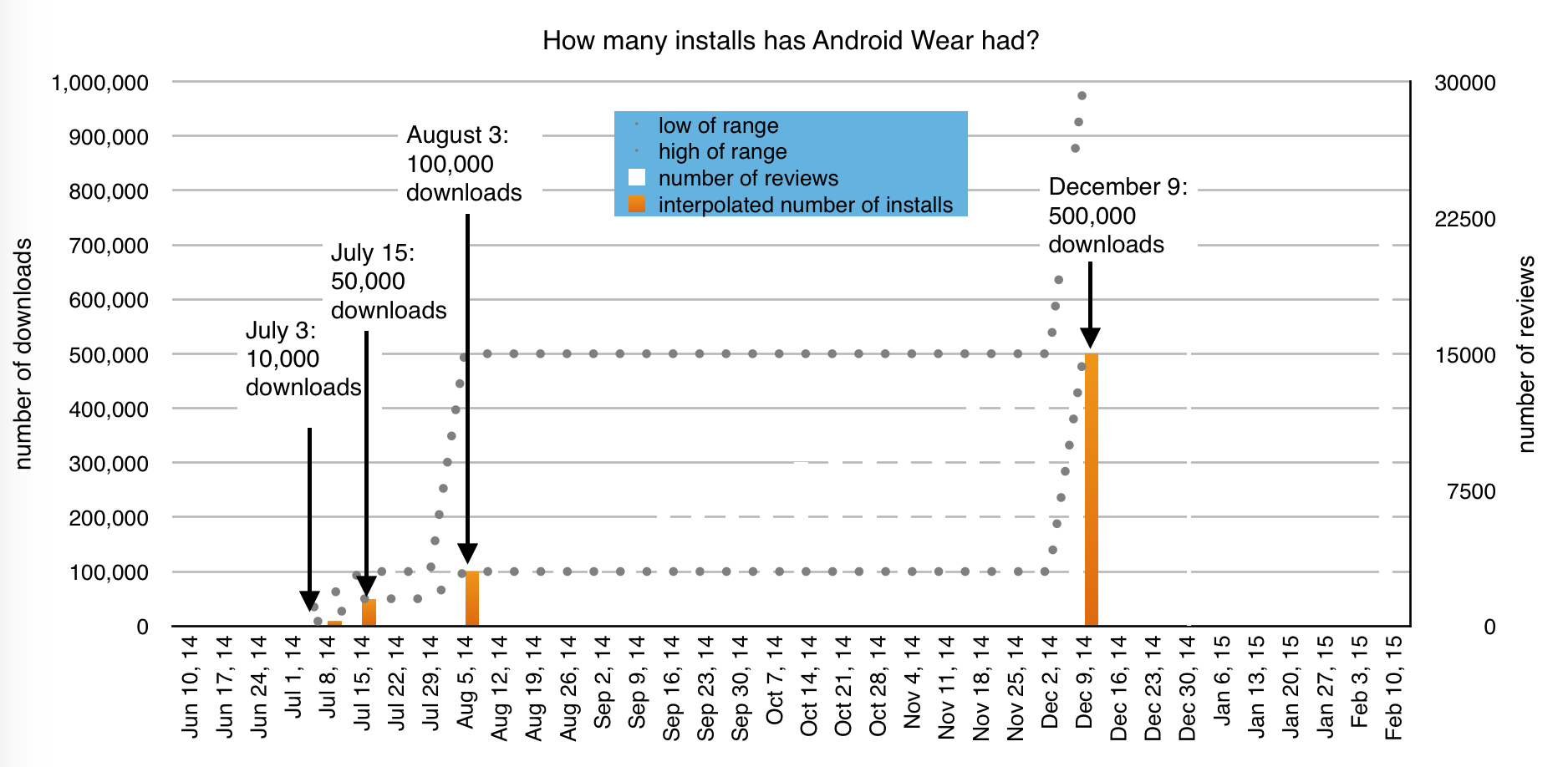
But how many got onto peoples’ wrists? You can get an idea by looking at the number of downloads of the Android Wear app on Google Play.

However it’s intentionally vague – Google just gives you limits between which the install number lies. The levels are between 5k-10k installs, 10k-50k installs, 50k-100k installs, 100k-500k installs, 500k-1m installs, and so on.

Digging in

If you do some digging on the past captures of the Android Wear page on Google Play, you can quite quickly figure out when the number of installs passed various milestones. (Updates don’t count as extra downloads, so each “download” is a unique activation.)

A little bit of twiddling shows that the Android Wear app
• passed 10,000 downloads on July 3
• passed 50,000 downloads on July 15 (good progress!)
• passed 100,000 downloads on August 3
• passed 500,000 downloads between December 2 and 9.

The page also includes the number of reviews, which is also a useful thing to track.

So I graphed it out, and once you add in the download breakpoints, and especially the reviews, there’s a fairly clear straight-line relationship over time.

Here is is with just the download breakpoints:

Android Wear: download breakpoints

Using the Internet Archive shows you when downloads of Android Wear passed particular points.

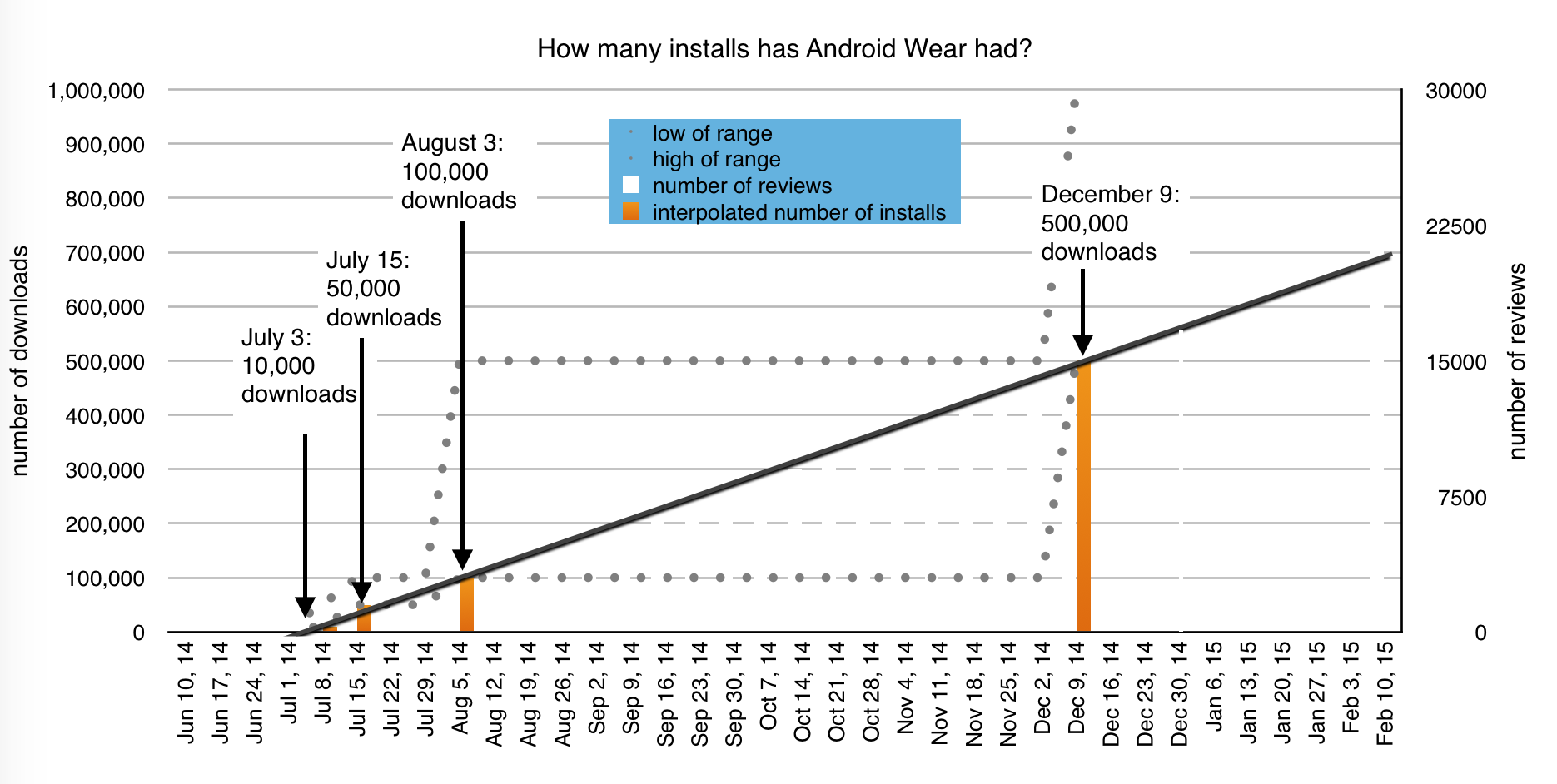
Then we can draw a straight-line trendline

Android Wear: trendline

The download breakpoints offer a straight line interpolation

The number of reviews (graphed on the right-hand axis) seems to reinforce that there’s roughly a straight-line relationship.

Android Wear: reviews

Adding in the number of reviews from the app page suggests a straight-line growth in downloads

If you look in more detail, there seems to have been a rush of reviews early on, a bit of a dip from August to the end of October, and a fairly clear linear relationship after that. But that’s not surprising, given that Google handed out a few thousand Android Wear devices at Google I/O in June.

So that trendline looks even better once you’ve got the reviews graphed:

Android Wear: downloads and reviews

Downloads and reviews of Android Wear seem to agree pretty well. So how many by the end of 2014?

That’s pretty solid. And here’s what this graph says: by December 30, there had been about 560,000 downloads of Android Wear.

By 11 February, based on the number of reviews, it’s around 700,000.

Android Wear: all the numbers

Put it together, and we have about 560,000 Android Wear activations by the end of 2014, and 700,000 to mid-February.

Is that a good or bad figure? I’ve no idea, to be honest. (If you assume 1.2bn Google Android phones in use, with Android Wear working on everything from 4.3 upwards, which takes in 47.6% of Android phones, then you have a potential addressable market of over 570m phones. (If you take it as 1bn Google Android phones, then it’s an addressable market of 476m.)

The much more important question – which I don’t know how you measure – is how many are still being used. Abandonment of wearables has been quite high, at around a third of all users.

Update: at the suggestion of @jasonostrander on Twitter, one might get an idea of the split of use via watchface downloads. There’s a ton of them, and people seem to have downloaded at least two each.

Start up: smartwatches are go!, tablets shrink, bitcoins all spent?, Yahoo keeps growing in search, and more


What’s Apple up to with its privacy drive? Photo by dmelchordiaz on Flickr.

A selection of 8 links for you. Use them wisely. I’m charlesarthur on Twitter. Observations and links welcome.

Pebble has now sold over 1 million smartwatches » The Verge

While Google and Apple have been getting the lion’s share of attention for smartwatches lately, indie darling Pebble has been quietly soldiering on, improving its product and selling watches. In an exclusive interview, CEO Eric Migicovsky revealed that the company shipped its one millionth Pebble on December 31st of last year. That’s more than double what Pebble reported in March, indicating that price cuts and new feature additions later in the year successfully boosted sales figures.

Pebble’s biggest and most visible competitor so far has been Google’s Android Wear, which launched in the middle of 2014 and is found on devices from Motorola, Samsung, LG, Sony, and Asus. Google has yet to reveal how many Android Wear watches have been sold in the six months or so it has been on the market, so it is difficult to determine if the platform is a success or not.

Google’s silence speaks volumes; it must know, surely? Also, how many of its employees are still wearing their LG smartwatch Christmas gift? A million is good going for Pebble. Seems like the smartwatch market will split three ways: Apple, Android, Pebble. (I have a Kickstarter Pebble, and recently rediscovered its usefulness through its step-and-sleep counting Misfit app.)


Worldwide tablet shipments experience first year-over-year decline in the fourth quarter while full year shipments show modest growth » IDC

Worldwide tablet shipments recorded a year-over-year decline for the first time since the market’s inception in 2010. Overall shipments for tablets and 2-in-1 devices reached 76.1 million in the fourth quarter of 2014 (4Q14) for -3.2% growth, according to preliminary data from the International Data Corporation (IDC) Worldwide Quarterly Tablet Tracker. Although the fourth quarter witnessed a decline in the global market, shipments for the full year 2014 increased 4.4%, totaling 229.6m units.

“The tablet market is still very top heavy in the sense that it relies mostly on Apple and Samsung to carry the market forward each year,” said Jitesh Ubrani, senior research analyst, worldwide quarterly tablet tracker.

Apple, Samsung, Asus, Amazon, all lost share and sales; only Lenovo, third-largest, grew (by 0.3m), which may have been mainly in 2-in-1s. Amazon’s dropoff is dramatic in both the Q4 and full year. But remember that tablets are principally going to consumers, have saturated their market, and have a replacement period of around four years. Compare that to PCs, which go to companies and consumers, and were at some times replaced as rapidly as every two years.


New findings suggest nearly 90% of all bitcoin holdings already spent » CoinSpeaker

Nearly 90% of those who have purchased or mined Bitcoin may have already cashed out their holdings, it emerged this weekend. Before now, it was thought that just 36% of bitcoins had currently been spent or sold, an argument often used by both advocates and their adversaries to support the fact that Bitcoin is both likely and unlikely to succeed as an asset class over the long term.

The findings were posted by Reddit user intmaxt64 and are being revealed in the Bitcoin press for the first time here at Coinspeaker…

…the findings may indicate that the Bitcoin price has suffered directly as a result of the major holders of Bitcoin liquidating their holdings while claiming the opposite. Many of the potential sellers appear to be the same individuals and organizations who got buyers to purchase during 2011-2013, since the large quantities of unit exchanges happened during this time.

Very deep implications to this, including the potential to corner the market.


Yahoo gains further US search share in January » StatCounter Global Stats

January saw Yahoo further increase the gain it made in US search share last month, according to the latest data from independent website analytics provider, StatCounter. Google fell below 75% in the US for the first time since StatCounter Global Stats began recording data [in June 2008].

StatCounter Global Stats reports that in January, Google took 74.8% of US search referrals followed by Bing on 12.4% and Yahoo on 10.9%, its highest US search share for over five years.

This is desktop-only, of course, and it’s not a giant change. But US users are surely the most valuable ones. Take Firefox out of the equation, and Google’s share remains where it was (despite Google’s attempts to win them back)

So what sort of people use Firefox and don’t change their search engine back to Google? Well, there’s Katharine Viner, editor-in-chief of the Guardian’s US operation. Did she notice the change?

https://twitter.com/KathViner/status/562213757300903936

So why’s she sticking with Yahoo?

https://twitter.com/KathViner/status/562214149329940480


How new versions of Android work » Rusty Rants

Russell Ivanovic of Shifty Jelly, which makes Android and iOS apps:

People are often quick to mis-interpret these numbers. “iOS 8 adoption is at 64%, but Android 4.4, a version that’s years old isn’t even at that!”. There’s two things wrong with these kinds of comments. Firstly there are roughly 6-8x more Android devices than iOS devices in the world, depending on which market share numbers you use. This means that if a version of Android achieves 39% adoption, that’s a huge deal, and you could develop just for that platform and address a larger user base than targeting iOS 8 with its 64%. Secondly people confuse overall numbers, with actual numbers of people who buy apps. Here for example are the version breakdowns of people who buy Pocket Casts on Android:

So while Android 5.0 has less than 1% adoption in the overall Android ecosystem, 23% of our customers already run it. This makes sense when you put a bit of thought into these numbers. People that have the money to buy apps, and are passionate about Android, have up to date phones.

I find Ivanovic a necessary counterpoint to a lot of what one reads about Android and iOS. He’s sincere, and expresses his views directly. (He’s Australian, so..) One point about Pocket Casts is that it’s a podcast player. There are paid-for podcast players on iOS (Marco Arment, obviously) but it seems to me the opportunity is much larger because there’s no OS-level podcast app on Android as there is for iOS.

That said, Ivanovic’s points are still valid. It’s install base x amount paid that really matters for developers (and, to some extent, users, as they benefit from the availability of apps, driven by the size of the ecosystem). Also, he wrote this piece before today’s data about Lollipop share – 1.6% of all Google Play installs as of 2 February.


Apple on privacy, security and identity » Benedict Evans

Evans tries to connect the dots that Apple has left around, on the basis that products it has now – such as Apple Pay – are obvious in retrospect (TouchID + Passbook). With that in mind, why Apple’s focus on “privacy”, he asks:

it may also be that as our phones go from sharing pictures to unlocking our front doors, privacy becomes a much more valuable selling point. This might be one reason why Nest is being kept semi-detached at Google. Worrying that Google knows what you search for has always seemed to me rather like worrying that your bank knows how much money you have, but Google knowing when you get out of bed or unlock your front door might be different (though of course it gets a fair bit of this through Android). So, perhaps Apple is talking about privacy not because of its current products, but because it thinks privacy will be a real competitive advantage for future ones. Not the iPhones, but the Watch, or other wearables, or the connected home. There’s an interesting question here – is the big data dividend worth the privacy implications? Is it better to let Google know when you flush the loo for what it can tell you about your bowels, or would people really rather not? 


Why I’ve found that online communities on media sites always seem doomed to fail » Martin Belam

I used to work with Martin at The Guardian (he’s now at the Daily Mirror); he’s got great insights into how communities fail or work. His key points – “The behaviour of the regular users becomes self-limiting for the community as a whole” and “The community believes they are representative of the primary audience” are, to me, the essence of the problem.

As a reminder, I did a pseudo-economic analysis of why comments on media sites just don’t work, which comes down to “the crap drive out the good”. I think that’s what Martin’s saying in his first point, only more nicely. Also, as he notes:

At the moment we don’t have comments on the Mirror site where I work, and I must confess it is a slight relief not to be immediately called a twat every time I press publish, but equally I find sites without comments don’t feel as alive. You know an article has had an impact when it has generated hundreds of comments.

I’d disagree on that latter point. You know an article has generated hundreds of comments when it generates hundreds of comments. But if you read them, you might find there’s no actual impact at all – as in, the comments haven’t added to the sum of human knowledge in the slightest.


Apple Watch sightings picking up ahead of official launch » Mac Rumors

Juli Clover:

Due to the large number of employees testing the device, Apple Watch sightings in the wild have become more common over the course of the last few weeks. On the MacRumors forums, readers are aggregating photos and stories of device sightings, giving us an in-use look at the device that will be attached to many of our wrists in just a few short months.

One of the first major Apple Watch sightings occurred several weeks ago, when Vogue Editor Suzy Menkes snapped a photo of someone wearing the device. Rumors and speculation have suggested the arm in the photo could belong to Marc Newson, the designer who now works at Apple part time alongside Jony Ive.

The forums aren’t that helpful (lots of vague discussion); James Cook at BusinessInsider has wrapped the (few) pics together.

Though the iPhone was announced before its public release, the only person I recall ever being seen in public using it ahead of that was Steve Jobs. This quiet seeding and testing is quite different.

Of course – and ponder this for a moment – everyone’s got an internet-connected camera now. Maybe there were tons more iPhones in public testing in 2007. We just didn’t hear about them.


Start up: where’s Apple’s Hololens?, the Xiaomi copiers, CES or Skymall product?, YouTube’s tough licensing, and more


Where’s Apple in this virtual reality landscape? No iPhones there. A screenshot from the Drax files Oculus Rift view by draxtor on Flickr.

A selection of 8 links for you. Can be swapped for Green Shield stamps at participating stores. I’m charlesarthur on Twitter. Observations and links welcome.

Apple needs a Microsoft HoloLens augmented reality competitor » Business Insider

Dave Smith:

By all accounts, it sounds like augmented reality devices like these are “the next big thing.” And at this point, Microsoft, Google, Facebook, Samsung, and others have invested hundreds of millions — even billions — of dollars into these new virtual and augmented reality experiences. 

Apple, meanwhile, is nowhere to be found. 

Oh no! And already millions– well, thousands– ok, hundreds.. er, dozens of people are using Oculus Rift, and Google has retreated on Google Glass. So where the hell is Apple in this.. race? Smith continues:

Last June, I wrote about how Apple’s patent for “interactive holograms” was one I wanted to see become a reality. Filed in October 2012 but published in April 2014, Apple had created a system that allows you to interact with projected images that appear to hang in mid-air, even letting you control and manipulate those virtual objects with the swipes and gestures iOS users are used to (pinch to zoom, etc.)

It’s not too late for Apple to use this patent.

Not too late? If anything, it’s way too early for Apple to use it. It seems people don’t learn the lessons of Google Wallet v Apple Pay, or Palm and RIM v the iPhone: throwing technology out there isn’t enough; you need the business and experience to fit in too.


5 new phone makers hoping to replicate Xiaomi’s success » Tech In Asia

Much more detail in the article, but the five brands (or sub-brands) are:
• Yu Yureka (by Micromax)
• Shenqi (by Lenovo)
• Ivvi (by Coolpad)
• OnePlus (born out of Oppo)
• Himax.


DNS poisoning slams web traffic from millions in China into the wrong hole » The Register

A widespread DNS outage hit China on Tuesday , leaving millions of surfers adrift.

DNS issues in China between 7am and 9am GMT left millions of domains inaccessible. Two-thirds of China’s DNS (Domain Name System) infrastructure was blighted by the incident, which stemmed from a cache poisoning attack.

Chinese netizens were left unable to visit websites or use social media and instant messaging services as a result of the screw-up, the Hong Kong-based South China Morning Post reports.

The snafu, which affected China’s root servers, meant all queries resolve to the IP address 65.49.2.178. A fix was implemented around two hours after the snag first surfaced.

Put like that, it sounds like “yeah, yeah”. But when it happens to you, as it did to Craig Hockenberry, it’s very different.


Quiz: CES gadget or SkyMall product? » PandoDaily

SkyMall produced an in-flight magazine selling “Innovations”-style products (as in, stupid, useless, and yet able to make you go “ooh!”), but has now filed for bankruptcy. David Holmes had the brilliant idea of making this quiz:

judging by some of the products that caught the media’s attention at CES this year, I’m not sure SkyMall and Silicon Valley are so far off in their passion for absurdity. The “Rollkers” at CES? Sounds a lot like these OrbitWheels sold through SkyMall. Or what about the “gTar”? Is it so different than the All-Star Guitar, which is basically a fake guitar you plug into an iPad? Can you even tell which one is from CES and which one is a SkyMall product?

I didn’t even try to score myself because I’d put them all in both category. But the fact that Holmes can confuse us at all shows what a microcosm of crap CES has become.


What should I do about Youtube? » Zoë Keating

Keating is a successful cellist whose videos have a respectable, if not mind-boggling, number of views:

My Google Youtube rep contacted me the other day. They were nice and took time to explain everything clearly to me, but the message was firm: I have to decide. I need to sign on to the new Youtube music services agreement or I will have my Youtube channel blocked.

This new music service agreement covers my Content ID account and it includes mandatory participation in Youtube’s new subscription streaming service, called Music Key, along with all that participation entails. Here are some of the terms I have problems with:

Must have ads, must be in 320kbps (nonsensical), can’t release elsewhere first, must allow all catalog in free and paid music service, five-year contract. Non-optional. Keating wants control; YouTube doesn’t want her to have control. And there seem to be strange goings-on in search:

Here is something weird. Until yesterday a search for “Zoe Keating” would yield a Google Knowledge Graph box on the right with all my info, including links to listen to my music. It always bugged me that those links were only to Google Play, Rhapsody and Spotify, all services which have hardly any of my music in them. If the metadata about me is really pure, why not link to the only services that actually have all my music? i.e. Bandcamp, SoundCloud and iTunes? I know the links were there yesterday because I searched to get the list for this blog. As of today, there are no music links whatsoever. Ideas?

Her sad conclusion: “The revolution has been corporatized.” And now read on..


Is Google playing fair with Android developers? » The Information

Transcript of long and really interesting interviews with various developers from The Information’s “Next Phase of Android” event held recently. Lots to consider, but I was struck by this:

Tom Moss, CEO of Nextbit: The next phase of Android is that people have finally shifted away from asking, “Is there going to be a third mobile platform?” or, “My friends all use iOS, so is Android a thing?” And now you can think, if you can’t compete with Android, you can compete with Google by co-opting Android. That’s what Kirt is doing. In my own game theory, I was thinking, “God, I hope Microsoft doesn’t adopt Android and come out with a bunch of services to grab market share.” It’s not the OS wars any more. It’s the services.

Kirt McMaster [CEO of Cyanogen]: This notion of a creating a Windows Phone or a Facebook phone is absurd. All of these guys have failed. We’re able to build on top of Android and make Android better. Now we’re opening up Android and partnering with everybody you can imagine. Google is running the table, and nobody likes that. We’ve emerged as the white horse that opens the entire platform up. We think this is where the innovation is going to happen.

(The piece is paywalled.) The idea that “Google is running the table, and nobody likes that” might sound surprising. Moss’s fear about Microsoft and services sounds like Nokia X – which still seems to me a tolerable idea, except that Google would make AOSP an unusable husk if Microsoft really made headway with it.


Smart mousetraps and lazy mice » Drop Labs

Cherian Abraham, explaining the – surprising – 6% figure (at peak) for fraud committed using Apple Pay according to early reports:

No, iPhones weren’t stolen and then used for unauthorized purchases, TouchID was not compromised, Credentials weren’t ripped out of Apple’s tamper proof secure element – nor the much feared but rarely attempted MITM attacks (capture and relay an NFC transmission at a different terminal). Instead fraudsters bought stolen consumer identities complete with credit card information, and convinced both software and manual checks that they were indeed a legitimate customer.

Partly, that’s because banks didn’t have very good checks (called the “Yellow Path” – is it an Oz reference?) to verify identity when someone wanted to enter a credit card onto a phone.

Apple bears some of the responsibility though:

In fact initially “Yellow Path” was marked optional for card issuers by Apple – which meant that only a couple of Issuers directed much focus at it. Apple reversed its decision and made it mandatory less than a month before launch – which led to issuers scrambling to build and provide this support. Why any bank would consider this optional is beyond me.

Either way, Card issuer implementations of the Apple Pay Yellow Path have proved to be inadequate.

It’s the whole insecure US credit system in microcosm.


Google suggesting Firefox users change their search engine & home page » Search Engine Land

Danny Sullivan on how Firefox users visiting Google are being encouraged to switch away from Yahoo:

I figured it was inevitable Google would do this, if the Firefox-Yahoo deal really did seem to be having an impact. Even the loss of a little share might be enough to scare investors. Certainly, I’ve taken enough calls from various press outlets wondering if the deal and subsequent share loss meant a big problem for Google.

My response has always been that if Google was worried, it could and would fight back in this type of manner. Now it is, and I suspect it will regain some of that share lost to Yahoo.

I also suspect Yahoo won’t gain much more search share than it has, because with the Firefox deal fully rolled out, it’s effectively hit a high water mark for all that particular channel is likely to produce.

“People can switch away any time.”


In the land of the refuseniks: what Kantar’s latest smartphone data reveals

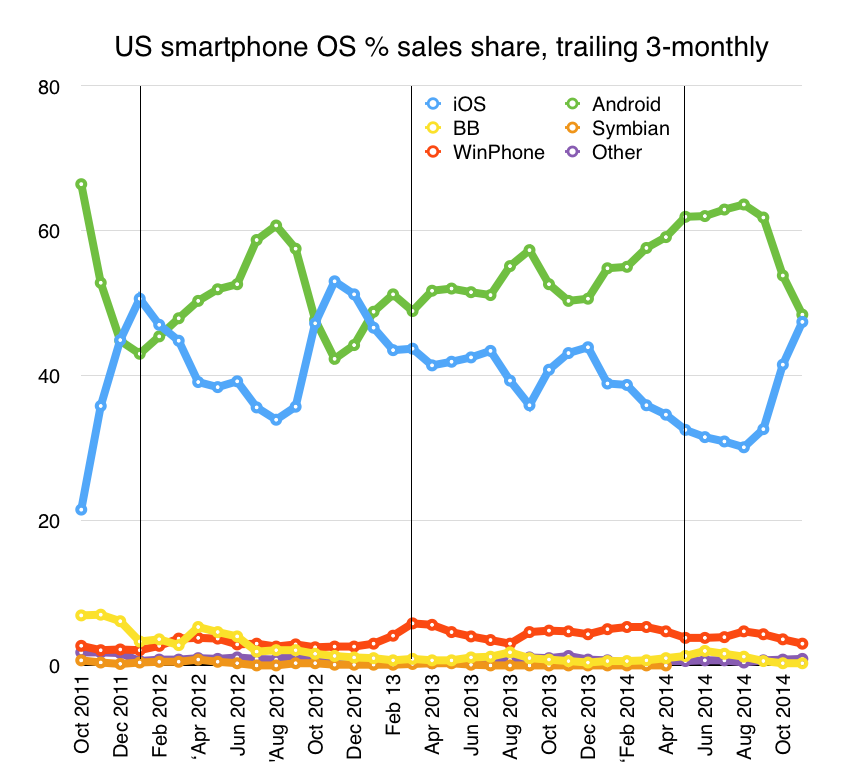
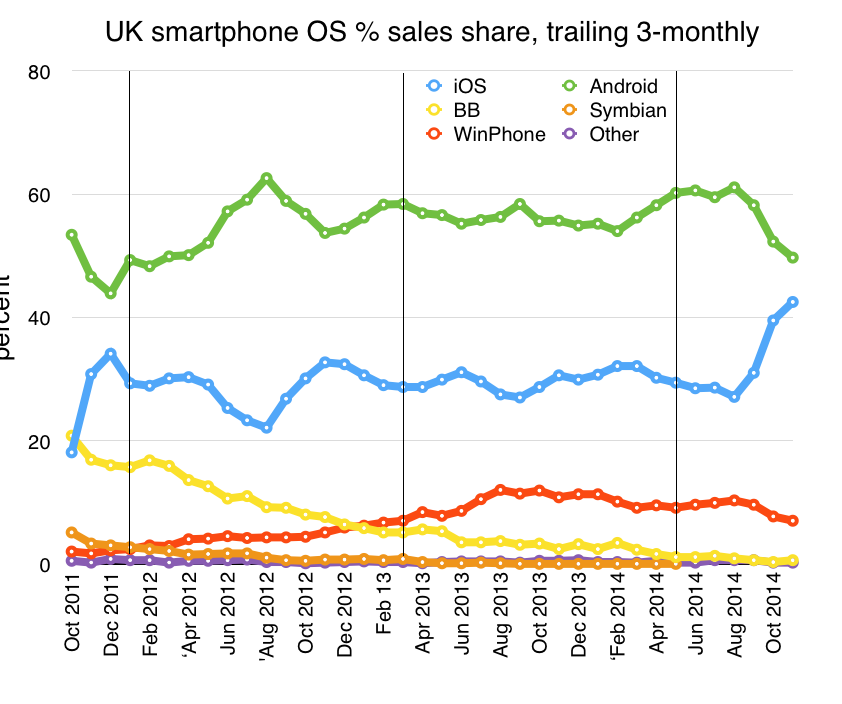
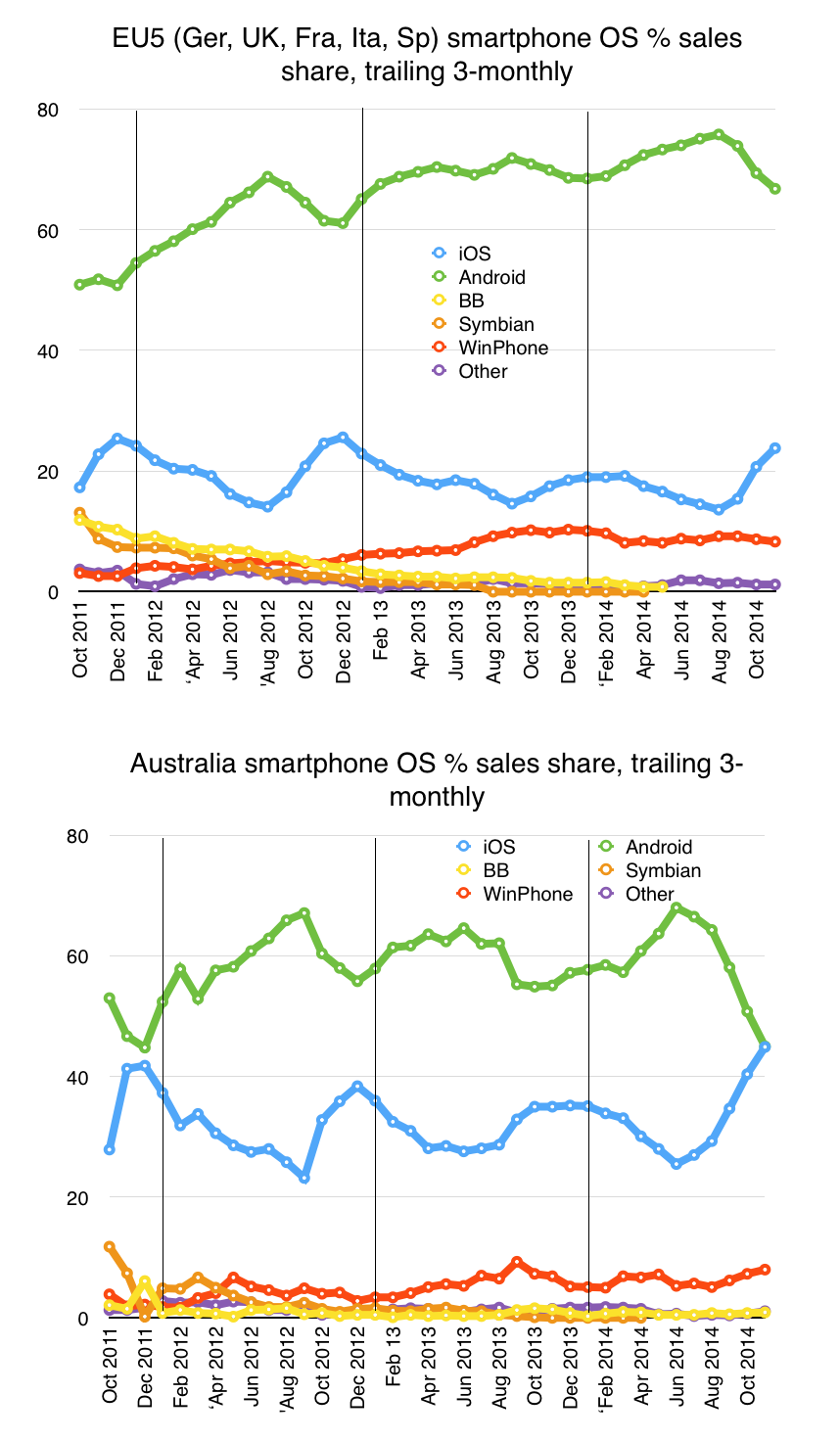
Kantar ComTech Worldpanel’s latest numbers for smartphone sales share are out (or dig the groovy but very dark animation), and pretty much as expected they show that iPhones have had a terrific time in sales terms for the three months to the end of November – so that covers September, October, and November, basically all the time that the new range has been on sale.

My only frustration with Kantar is that it doesn’t index the numbers from year to year; there’s no way to know if sales in 2014 are lower, higher or the same than the previous year or year before. You might think that because more people own smartphones that volume must be increasing, but it’s not necessarily the case; GfK data suggested that mobile phone sales value fell in Christmas 2013 compared to 2012, though increased in 2014 (helped, one suspects, by the Apple phones).

I’ve asked Kantar previously to include an indexing figure (eg 2012 = 100, 2013 = 105, ie 5% greater in sales volume) with these numbers, but they haven’t. (In a future post I’ll try estimating this from general levels of mobile sales from quarter to quarter, and country populations and smartphone shares.)

In the absence of that, we just have the graphs – which I’ll put below. But there’s a much more interesting story which hasn’t been picked out of the press release, though they put it in there. It’s about the refuseniks: the people who have a featurephone, but are determined not to move to a smartphone.

US smartphone sales share to end November 2014

Data from Kantar. iPhone share is high, but not as high as the iPhone 5 launch. (No comparative data on volumes, however.)

UK smartphone sales share to end November 2014

UK smartphone sales share to end November 2014, from Kantar; iOS share is highest ever recorded

EU5 and Australia smartphone sales share

Share of smartphone sales for three months to end November 2014, via Kantar. (EU5 = Germany, UK, France, Italy, Spain = 184m smartphone users; Australia = 16.4m smartphone users)

(Note among all these that Windows Phone is still not making anything resembling progress; nor is “other”, though Firefox phones are few and very far between in these countries. The smartphone platform space is played out.)

Here’s the most interesting part, left to the very last paragraph of the release:

Smartphone penetration reached 58% in the US and 65% across Europe’s big five economies. “While die-hard featurephone owners state they are not planning to buy a smartphone in the next 12 months, they might not have a choice as vendors continue to transition their portfolio away from featurephones to smartphones”, concluded [Kantar head of research Carolina] Milanesi. Forty-seven percent of featurephones owners looking to change their current device in the next six months in the US and 35% across Europe’s top five [countries] are not planning to upgrade to a smartphone.

Once again: 47% and 35% of featurephone owners in the US and EU5 (Germany, UK, Italy, Spain, France) who are looking to change device won’t go to a smartphone.

Now, you could flip those numbers over: out of all (remaining) featurephone owners, 53% in the US and 65% in the EU5 may go to a smartphone in the next six months. It’s only “may” because they haven’t said they will, only that it isn’t definite they won’t.

The longrunning ComScore data in the US, meanwhile, which tracks installed base, shows that at the end of October there were about 65m featurephone users remaining there. For the UK, I calculate that smartphone penetration of mobile phone users is now 80.2% – based on the data and calculations I did for a piece last April using Kantar’s data.

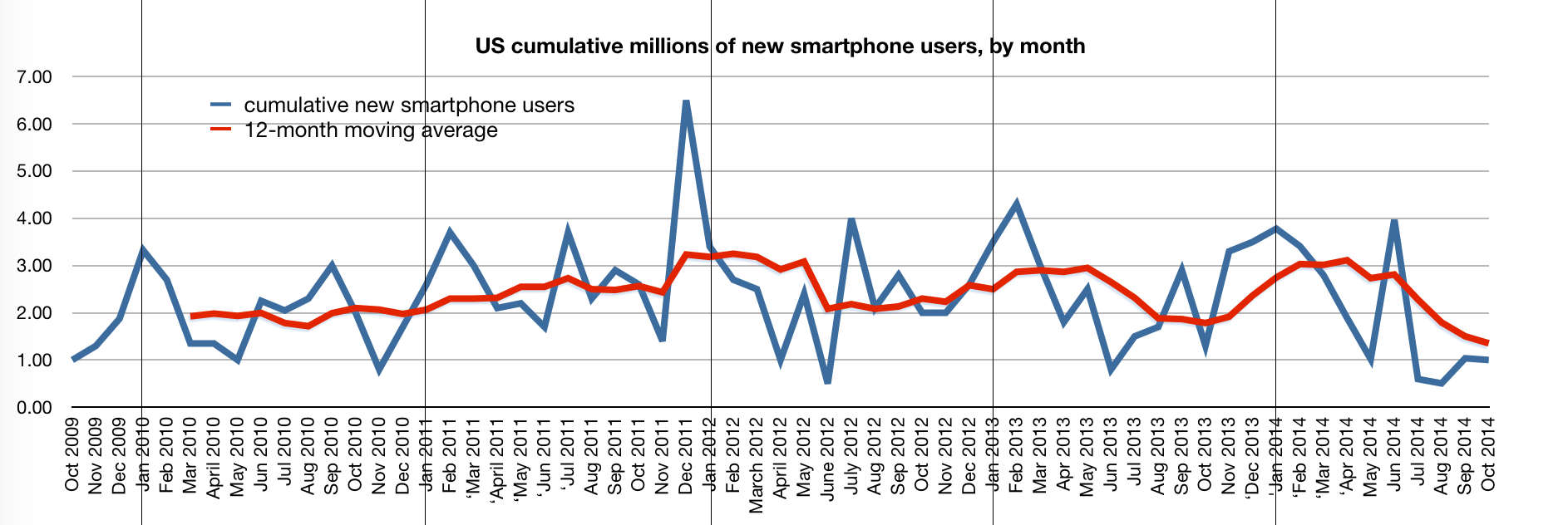
In the US, the number of featurephone users converting to smartphones had been fairly constant, at a few million per month, but as the graph below shows, it nosedived during 2014 (the data only goes up to the end of October) – indicating that fewer are shifting up to smartphones.

Number of US featurephone users moving to smartphones, by month

Data calculated from ComScore, showing how many featurephone users shifted to smartphones in the US. The trendline seems to have fallen off in 2014.

And indeed, why would you shift to a smartphone in the US if you don’t particularly need one, given its crazy system where you pay a huge per-month fee for the phone, and then for carrier service, and then for data, and then perhaps for “extras” (loosely defined)?

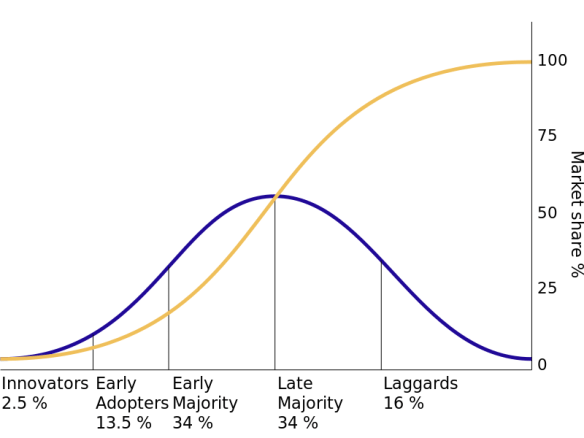
Thus we may now be at the point where the only ones without smartphones are the refuseniks – the people who don’t want a smartphone. In other words, we’re hitting the “laggards” – the 16% who don’t care. Given that the best fit for the data suggests smartphone penetration will top out at 92%-95%, and with 80% already using them (in the UK), we’re clearly in laggard territory.

Diffusion of innovations: segmentation

Stages of adoption of innovations. Source: Wikipedia

What does this mean? Mostly, that selling more phones becomes a battle where the existing smartphone platforms try to win people over from their rivals, while there’s also a gradual accretion from the last featurephone holdouts – who, as Milanesi says, might find they have barely any choice when it comes to replacing their dead one.

For BlackBerry, this is almost played out; it’s down to something like 40m users worldwide, of whom perhaps 8m are consumers and thus remain to be poached.

For Windows Phone – well, it’s unclear quite what’s happening there. The numbers sold remain consistently small, and low-end, and there just doesn’t seem to be a lot of movement. There’s some anecdotal suggestions that many of the low-end ones are used as sort of semi-smartphones, with pay-as-you-go contracts and little use made of their internet capabilities.

Android and iOS

The more interesting flow, aka churn, is between iOS and Android, and Android and iOS: in percentage terms for the three months, 11% of iPhone buyers were previously Android users; and 13% of Android buyers were previously iPhone buyers.

I know – the simplistic view would be that iOS is losing users overall. Except the numbers don’t work out that way; there are more Android users than iPhone users in the US (92m v 73.7m), so that iOS is actually gaining users.

Here’s how:
• 13% of 73.7 = 9.6 iPhone users shifting to Android;
• 11% of 92 = 10.1 Android users shifting to iOS.
Assume that the number of people changing phone is proportional to the total installed base at any time (which is likely), and the iPhone user base grows – just.

Even so, that churn must be a concern to Apple. Maybe the new screen sizes of the iPhone 6 and 6 Plus will reduce that, or perhaps it’s inherent in the dynamics of smartphone platforms.

Meanwhile, if you know a refusenik, do ask them what they’ll do when their phone breaks. Smartphone without data? Buy a featurephone on eBay?

Whatever; it’s unlikely the refuseniks are going to make a big impact now. In the developed world, the smartphone platform wars are so played out.

Start up: Monumental confusion, obligatory (useless) 4K, drone cost surprise, Yahoo’s search inroad, ereaders stall, and more


However, it’s rather difficult to define quite what constitutes “piracy” in some situations. Photo from robotson on Flickr.

A selection of 11 links for you. Not valid in Ohio. I’m charlesarthur on Twitter. Observations and links welcome.

Mobile game piracy isn’t all bad, says Monument Valley producer (Q&A) » Re/code

Remember the remarkable “95% unpaid installs on Android, 60% on iOS” stat from Us Two Games? Here’s a followup:

Re/code: First off, how was that 95 percent statistic determined?

Dan Gray: Five percent are paid downloads, so the ratio is 9.5 to 1, but a portion of those are people who have both a phone and a tablet, people who have more than one Android device with them. So a small portion of that 95 percent is going to be taken up by those installs.

Q: Do you know how big that portion is?

A: It’s impossible for us to track that data. The only thing we can do is, two bits of data: One, how many purchases we have and, two, how many installs we’ve got. And we just leave people to draw conclusions from that as they wish, because we can’t clarify any further than that…

…When you compare the most affluent regions, obviously that kind of slants it toward developing markets and Android devices, where people are less inclined to spend $4 on a game. Let’s say you take U.S. only: those paid rates for Android and iOS are actually considerably closer. They’re closer than five and 40%.


The TidBITS Wishlist for Apple in 2015 » TidBITS

Though Apple fulfilled many user wishes in 2014, there is still more to be done. Here are some of what the TidBITS crew would like to see from Apple in 2015. We’ll circle back to this article at the end of the year to see what changed.

Tidbits is a longstanding online Mac weekly newsletter/site, and all the points made here – too many to enumerate briefly – are spot-on. This ought to be circulated within Apple.


4K TVs are coming for you, even if you don’t want them » Yahoo Tech

Rob Pegoraro, pointing out that manufacturers are pushing 4K resolution as hard as they can, despite the lack of bandwidth to transmit it or content to show. And there’s another thing:

Will you see that added resolution from your couch? You will on the CES show floor, where the crowds force you to within a few feet of sets that span from 50 to more than 100in across. From that perspective, 4K TVs almost always look spectacular.

Things change when you’re gazing at a 4K screen smaller than 55 inches (Samsung’s start at 48 inches and Sharp’s at 43 inches) from across the living room. In many cases, your existing set already shows all the resolution you can discern with 20/20 vision.

How close will you need to sit to see all those extra pixels? A Panasonic rep said the company recommends a viewing distance of 3.5 feet for a 50in 4K set, the smallest it will sell this year. That’s cozy even by Manhattan-apartment standards.

The average screen size has crept up — the NPD Group says 50 to 64in now represents the mainstream of the market — but the math of visual acuity suggests that to get sufficient benefit from 4K, you’re best off buying at the upper end of that scale.

I’ve seen the point made repeatedly that you won’t get any benefit from 4K across the average living room. This isn’t going to prevent a spec-based marketing push though.


The privacy tool that wasn’t: SocialPath malware pretends to protect your data, then steals it » Lookout Blog

Lookout recently discovered SocialPath, a piece of malware that advertises itself as an online reputation management tool. It claims that it will alert its users any time their photo is uploaded somewhere on the Internet. Instead, it steals the victim’s data.

We found one variant associated with this family in Google Play. We alerted Google to the malware and it has since been removed. This app offers a slightly different service — it promises to act as a backup service saving your contacts. It says it will also soon add features for saving your photos, videos, and other data “so if you lose your phone, you will not lose its contents.”

SocialPath targets Sudan predominantly — a region that has been rife with political unrest since the country split when an oil-rich South Sudan seceded.

Unclear whether it’s a nefarious government scheme – seems unlikely, but just possible. However then we come to Lookout’s advice:

You should always:
• Download apps from trusted developers — read reviews, research the developers, make sure you’re choosing a trustworthy product, especially if this tool is promising to help you protect sensitive information
• Don’t download apps from third party marketplaces

But this was on Google Play, at least in one variant. How do you decide in that situation?


Can drones deliver? (PDF) » IEEE Xplore

A guest editorial on the economic viability (or otherwise) of Amazon’s drone delivery, by Rafaeillo D’Andrea, formerly of Kiva:

A high-end lithium-ion battery costs roughly $300/kW h, and can be cycled about 500 times, resulting in a cost of roughly 0.8 cents per km for a 2 kg payload. The total cost of batteries and power is thus 1 cent per km for a 2 kg payload.

So, is package delivery using flying machines feasible? From a cost perspective, the numbers do not look unreasonable: the operating costs directly associated with the vehicle are on the order of 10 cents for a 2 kg payload and a 10 km range. I compare this to the 60 cents per item that we used over a decade ago in our Kiva business plan for the total cost of delivery, and it does not seem outlandish.

This seems surprising, and it would be helpful to know what proportion of Amazon deliveries are 2kg or less. There’s a non-PDF version with more discussion at Robohub.


Xiaomi’s Ambition » stratechery

Ben Thompson, explaining how demographics and non-renting in China works in Xiaomi’s favour as it expands its portfolio with super-keen fan buyers:

This, then, is the key to understanding Xiaomi: they’re not so much selling smartphones as they are selling a lifestyle, and the key to that lifestyle is MiUI, Xiaomi’s software layer that ties all of these things together.

In fact, you could argue that Xiaomi is actually the first “Internet of Things” company: unlike Google (Nest), Apple (HomeKit), or even Samsung (SmartThings), all of whom are offering some sort of open SDK to tie everything together (a necessity given that most of their customers already have appliances that won’t be replaced anytime soon) Xiaomi is integrating everything itself and selling everything one needs on Mi.com to a fan base primed to outfit their homes for the very first time. It’s absolutely a vertical strategy – the company is like Apple after all – it’s just that the product offering is far broader than anything even Gene Munster [proponent for years of a TV set from Apple] could imagine. The services Lei Jun talks about sell the products and tie them all together, but they are all Xiaomi products in the end.

Just bear in mind that there are about a billion people in China, and the one-child rule is being relaxed, and you begin to glimpse how big Xiaomi could be. “A computer on every desk”? Pah. A Xiaomi device in every room in all of China and beyond, more like.


“Best” Apple Mac mini (Late 2014) 2.8GHz review » Macworld UK

Andrew Harrison:

one thing we don’t ordinarily expect is for a newly revised computer to appear which computes more slower than the model that it replaces. Particularly when there’s been not one but two long years between the now-obsolete and shiny new editions.

That’s exactly what’s happened with Apple’s 2014 model of the Mac mini though. Today’s 2014 Mac mini range is in many respects slower than the 2012 range it replaces. Read: 2014 Mac mini v 2012 Mac mini comparison review.

Utterly amazing. It doesn’t offer a quad-core option, the RAM is soldered in place, and changing the disk drive is nigh on impossible. It’s like the worst sort of con job that Apple used to pull when Steve Jobs was in charge. I’d love to hear the reasons for these changes-that-aren’t-improvements.


Yahoo achieves highest US search share since 2009 » StatCounter Global Stats

In December Yahoo achieved its highest US search share for over five years according to the latest data from StatCounter, the independent website analytics provider. Google fell to the lowest monthly share yet recorded by the company*. These December stats coincide with Mozilla making Yahoo the default search engine for Firefox 34 users in the US.

StatCounter Global Stats reports that in December Google took 75.2% of US search referrals followed by Bing on 12.5% and Yahoo on 10.4%.

If you allow that StatCounter’s numbers are correct, Yahoo moved from 8.2% of US search in November 2014 to 10.4% in December. How many Firefox users does that represent? How many have yet to move to version 34? How many have/will switch their default from Yahoo back to Google? One to watch.


Kindle sales have ‘disappeared’, says UK’s largest book retailer » Telegraph

Waterstones, which expects to break even this year. plans to open at least a dozen more shops this year as the ebook revolution appears to go in reverse.

Amazon launched the Kindle, which is now in its seventh generation, in 2007. Sales peaked in 2011 at around 13.44m, according to Forbes. That figure fell to 9.7m in 2012, with sales flat the following year. It is estimated that Amazon has sold around 30m Kindles in total.
At the same time, British consumers spent £2.2bn on print in 2013, compared with just £300m on ebooks, according to Nielsen.

London bookstore Foyles has reported a surge in sales of physical books over Christmas.
US book giant Barnes & Noble is looking to spin off its Nook ereader business, which is estimated to be losing $70m a year. Meanwhile, core sales, excluding Nook, rose 5pc in the most recent quarter.

It seems that e-readers had a natural ceiling on adoption, which was far short of 100% (or even 90%). That in turn means that ebooks aren’t going to take over the world. Physical books, meanwhile, are pretty much guaranteed a readership somewhere. Now the challenge for publishers is working out the correct balance of effort and investment to put into ebooks and physical ones.


A&E in crisis: a special report » Daily Telegraph

Robert Colville:

here’s where I’m going to start: in a small green-painted room off one of the main corridors of that same hospital, where 10 women and two men are studying the spreadsheet projected on the walls and firing jargon back and forth.

“Four in urology with a decision to admit.” “306 is gone, 728 still waiting.” “With all that agreed, does that give you any ITU capacity?” “They’re desperate to bring the liver over from Worcester.” “Time to be seen is at 1hr 54.”

This is the “Ops Centre” of one of the country’s biggest hospitals, where I am spending the week as a fly on the wall. At this and other daily bed meetings, the senior nurses and managers get together to work out who is in the hospital, and where they need to go next.
They go through, ward by ward, listing spare beds and allocating them to the people in A&E. They can see who’s been waiting longest, where the pressure points are, and what needs to be done to resolve them.

This, then, is the story about the NHS that I want to tell. It’s the story of the NHS as a system – a system that takes millions of patients through from the GP surgery and A&E department to treatment, recovery and discharge.

This is a tour de force from Colville, in a piece so long and deep it could have come from the New Yorker (of the 1980s). If you want to understand the pressures on the UK’s NHS emergency services – which are clearly shown here not to be just about “money” – this is the single article to read.


Reporting on cyberattacks: the media’s urgent problem » Medium

Dave Lee is a (terrific) BBC technology writer, here writing in a personal capacity about the impossibility of knowing what’s really going on in some stories:

Let’s take an active story. The hack on Sony Pictures raises many issues about the reporting of hack attacks, and the coverage so far carries worrying implications.

Experts are queueing up to dispute the FBI’s confident claim that it was North Korea — mainly because the evidence pointing the finger at Kim Jong-un is either a) flakey at best or b) top secret, and therefore not open to scrutiny, journalistic or otherwise.

The result of this political back-and-forth is far-reaching, and one that from here on in is being reported on without anyone having any real clue whether the basis of the story — that it was North Korea — is in any way accurate.

We simply don’t know who did it — and yet the atmosphere created by the coverage means the US is considering reclassifying North Korea as a terrorist state. That move would open the door significantly when it comes to what the US considers a “proportional response” to the attack on Sony.


Start up: Do Not Track dying, Android’s lost money, EU’s VAT problem, AdBlocking? surprise!, Xiaomi laptop = fake, and more


Moving from Do Not Track to “ah, just track it then”. Photo by Rh+ on Flickr.
++
Hey, it’s the last one of the year. See you in 2015.
++

A selection of 12 links for you. Wash repeatedly. I’m charlesarthur on Twitter. Observations and links welcome.

Android hardware profits tanked in 2014 >> Re/code

Down by half from 2013, according to mobile analyst Chetan Sharma:

A lot of that is due to the big drop in profits at Samsung, the largest player in the Android market. China’s Xiaomi gained significant market share, but is only modestly profitable thanks to its slim margins. Meanwhile, other players like Sony and Motorola lost money in their Android-based mobile businesses.

That’s obviously of concern to the hardware companies, but it should also be worrisome for Google.

“It is important for Google that the ecosystem stays healthy and balanced,” Sharma told Re/code. “Without profitability, some of these players will eventually disappear and it will primarily become a Samsung + Chinese OEMs ecosystem, which is probably not what Google wants.”

Not sure Google is too worried, as long as lots of people use Android, or Google apps on iOS.


Ebooks Direct and new EU digital sales rules: what now? >> Out of Ambit

Diane Duane:

If you’re a large company with accountants this is one of those things you just shrug and deal with, since you’re already registered for VAT and you’ll just fold this extra paperwork and bureaucracy-management into all the other paperwork your accountants already deal with. However, if you’re (for example) someone on disability who’s keeping themselves afloat by selling digital comics, or a stay-at-home mom running a small electronic travel-publication business from her kitchen table—or for that matter, if you’re a pair of science fiction and fantasy writers running a small ebook publishing business from a tiny cottage at the foot of the Wicklow Mountains—then the extra bureaucracy and paperwork burden is not at all welcome. For some of our colleagues, this increased burden of regulations and bureaucracy simply means they’ll have to shut down. They can’t afford the cost of VAT registry or an accountant, or they won’t be able to procure the necessary IDs and proofs of location from their customers, much less store them for a decade.

This situation is even more onerous in places where, until now, businesses this small were spared having to register for VAT at all. But the EU law regarding sale of digital goods has no such eligibility threshold—no equivalent level above which you’re expected to afford accountancy services and so forth, since you’re making enough money to make it worthwhile registering for VAT in the first place.

The regulations seem onerous – if you sell anything at all electronically, you have to register for VAT. Regulations like this make a subversion via Bitcoin much more attractive and hence likely, which could have a serious (negative) effect on government revenues.


Here’s proof the Xiaomi MacBook Air clone story is fake

Steven Millward:

A reverse Google image search on the fake Xiaomi laptop reveals that the closest image source seems to be an undated clone, with the splendid name Kaka i5 (pictured below), that already has an orange power button. So the Xiaomi laptop hoaxers simply had to Photoshop on an orange Xiaomi logo.

The dubious story first appeared in English on GizmoChina, a site we’ve never heard of before, and then was picked up without further investigation by well-known sites such as 9to5Mac and BusinessInsider (update: story screenshots here and here, respectively). Not so much Pulitzer prize for journalism as Wurlitzer prize for churnalism.

Round of applause for that last phrase, sir. Chapeau.


AdBlock Plus’s effect on Firefox’s memory usage >> Nicholas Nethercote

Nicholas Nethercote, with what could also be titled “AdBlockPlus actually makes your browser and computer run slower”:

we recently learned that ABP can greatly increase the amount of memory used by Firefox.

First, there’s a constant overhead just from enabling ABP of something like 60–70 MiB. (This is on 64-bit builds; on 32-bit builds the number is probably a bit smaller.) This appears to be mostly due to additional JavaScript memory usage, though there’s also some due to extra layout memory.

Second, there’s an overhead of about 4 MiB per iframe, which is mostly due to ABP injecting a giant stylesheet into every iframe. Many pages have multiple iframes, so this can add up quickly. For example, if I load TechCrunch and roll over the social buttons on every story (thus triggering the loading of lots of extra JS code), without ABP, Firefox uses about 194 MiB of physical memory. With ABP, that number more than doubles, to 417 MiB. This is despite the fact that ABP prevents some page elements (ads!) from being loaded.

An even more extreme example is this page, which contains over 400 iframes. Without ABP, Firefox uses about 370 MiB. With ABP, that number jumps to 1960 MiB. Unsurprisingly, the page also loads more slowly with ABP enabled.

AdBlock Plus has about 19m users. That’s a lot of people penalising their computing experience in order not to penalise their visual experience (and penalise the sites they use).


Fake “The Interview” app is really an Android banking trojan >> Graham Cluley

Researchers at McAfee – in a joint investigation with the Technische Universität Darmstadt and the Centre for Advanced Security Research Darmstadt (CASED), has identified that a threat campaign has been active in South Korea in the last few days, attempting to exploit the media frenzy surrounding “The Interview”‘s release.

McAfee security expert Irfan Asrar tells me that a torrent making the rounds in South Korea, poses as an Android app to download the movie to mobile devices.

However, in truth, it contains an Android Trojan detected by McAfee products as Android/Badaccents.

Android/Badaccents claims to download a copy of “The Interview” but instead installs a two-stage banking Trojan onto victims’ devices.

Amazon-hosted files, sending data back to a site in China, which checks for whether the devices are made in North Korea – though the latter is likely not an important detail.


The slow death of ‘Do Not Track’ >> NYTimes.com

Fred Campbell, who is executive director of the “Center for Boundless Innovation in Technology”, and also a former chief of the Federal Communications Commission’s Wireless Telecomms Bureau:

The idea, known as “Do Not Track,” and modeled on the popular “Do Not Call” rule that protects consumers from unwanted telemarketing calls, is simple. But the details are anything but.

Although many digital advertising companies agreed to the idea in principle, the debate over the definition, scope and application of “Do Not Track” has been raging for several years.

Now, finally, an industry working group is expected to propose detailed rules governing how the privacy switch should work. The group includes experts but is dominated by Internet giants like Adobe, Apple, Facebook, Google and Yahoo. It is poised to recommend a carve-out that would effectively free them from honoring “Do Not Track” requests.

If regulators go along, the rules would allow the largest Internet giants to continue scooping up data about users on their own sites and on other sites that include their plug-ins, such as Facebook’s “Like” button or an embedded YouTube video. This giant loophole would make “Do Not Track” meaningless.

Essentially because, the article points out, collecting user data has become the raison d’etre for so many companies, and the money hose that affords “free” maps, email, and so on. But the US Federal Trade Commission, which is meant to protect consumers, has given up on the task.


How to completely remove Birthdays from Google Calendar >> Medium

Let Brendan Mulligan be your helpful source of future apologies.


How not to run an A/B test >> Evan Miller

Suppose your conversion rate is 50% and you want to test to see if a new logo gives you a conversion rate of more than 50% (or less). You stop the experiment as soon as there is 5% significance, or you call off the experiment after 150 observations. Now suppose your new logo actually does nothing. What percent of the time will your experiment wrongly find a significant result? No more than five percent, right? Maybe six percent, in light of the preceding analysis?

Try 26.1% – more than five times what you probably thought the significance level was.

The “equal sampling” point is often missed in trying to extract significant difference. Terrific piece. Also includes a “Sample size calculator” to help you.


Government secures landmark deal for UK mobile phone users >> GOV.UK

From the Department of Culture, Media and Sport (via Culture minister Savid Javid):

Under the agreement all four of the mobile networks have collectively agreed to:

• a guaranteed £5bn investment programme to improve mobile infrastructure by 2017;
• guaranteed voice and text coverage from each operator across 90% of the UK geographic area by 2017, halving the areas currently blighted by patchy coverage as a result of partial ‘not-spots’;
• full coverage from all four mobile operators will increase from 69% to 85% of geographic areas by 2017;
• provide reliable signal strength for voice for each type of mobile service (whether 2G/3G/4G) – currently many consumers frequently lose signal or cannot get signal long enough to make a call; and
• make the deal legally binding by accepting amended licence conditions to reflect the agreement – it will be enforceable by Ofcom.

What’s odd about this is that the detail of the agreement hasn’t been published, and the problem of coverage tends to be on trains – these requirements could be fulfilled by sticking some mobile masts on the Scottish highlands, but wouldn’t solve many peoples’ problems.

Also, why is a culture minister prodding carriers? Shouldn’t it be the Department for Business, Innovation and Skills?


BlackBerry Classic review: the best BlackBerry ever made >> WSJ

Joanna Stern was a confirmed BlackBerry lover back in the day, and delights in the physical keyboard, trackpad, battery life, call quality, and email-to-calendar features. But:

while I’d love for all those great BlackBerry features to make a comeback, others simply feel out of date.

Calendar and email aside, other preloaded apps are slow and poorly designed. A Rand McNally map from the gas station is likely more up-to-date—and speedier—than BlackBerry’s own maps app. Not only did it struggle to help me find the closest Starbucks in New York City, but it lacks typical features like transit directions and 3-D map options.

BlackBerry recommends dissatisfied users try third-party apps, like Waze or Navfree. But while BlackBerrys can run Android apps, the industry-leader Google Maps isn’t available for the platform.

That brings me to the terrible and confusing app situation. There are now two app stores preloaded on the Classic: Amazon’s App Store and BlackBerry World, which sounds like an amusement park I would have loved in 2008. While you can download Android apps from Amazon’s App Store, many big ones are missing—not just the Google family of apps, but also Uber and Instagram.

You can ignore BlackBerry’s warnings and load other Android apps manually, but it takes work.

So in that sense, it’s still like BlackBerrys from a few years ago – and the app gap is still one that is going to put the standard consumer off.

Highly recommended: Dieter Bohn’s great piece of review writing (which is actual writing as entertainment as well as information): BlackBerry Classic review at The Verge.


Infography: iPhone vs. Android shows north vs. south split (and in real time) >> TomSoft

The results are quite interesting: it shows that the split android/iPhone happens more at a country/continent level than at a user level. USA, England, Japan are in their vast majority « iPhone users », while South America, Spain, Indonesia are much more Android focused. France is one of the few balanced countries.

In other words, seems another north vs. south split, or rich vs. poor (it seems for instance that some Brazilian big cities are iPhone users while the rest of the country is much more Android).

Dubious about this; Android has the majority smartphone installed base in pretty much every country. And geolocated tweets are a tiny part of the total; hard to tell if they’re represented proportionally.