Unknown's avatar

About charlesarthur

Freelance journalist - technology, science, and so on. Author of "Digital Wars: Apple, Google, Microsoft and the battle for the internet".

Start up: digging into Samsung’s numbers, Pono launches, a billion tablets!, a CES wearables binge, and more


These, but multiplied by a big number. Photo of tablets by Martin Voltri on Flickr.

A selection of 8 links for you. Contains small parts. I’m charlesarthur on Twitter. Observations and links welcome.

I tried on 56 wearables today. Here’s a photo of every single one of them » VentureBeat

Harrison Weber:

I just tried on every single wearable I could find at CES 2015, and yes, I’m freaking exhausted.

The total count (so far) totals to 56 wearables across every category you can think of, from clip-on trackers to full-fledged Android and Linux-powered wrist computers. Heck, I even wore a smart sweatband.

Really worth scrolling through this lot.


Tablet users to surpass 1 billion worldwide in 2015 » eMarketer

More than 1 billion people worldwide will use a tablet in 2015, according to new figures from eMarketer, representing nearly 15% of the global population and more than double the number three years ago. By 2018, the number of tablet users in the world will reach 1.43 billion.

This is the first time eMarketer has made projections for the number of tablet users worldwide. The key takeaway is that growth in the global tablet-using population will slow dramatically in 2015 and continue to taper off.

That’s almost as many tablets as PCs; and that 2018 figure surely is. The slowing growth in sales of tablets doesn’t mean people are giving up on tablets – just that they’ve sold in amazing numbers already.


The truth about 4K and curved TVs » Business Insider

Let Henry Blodget walk the floor of CES and tell you it like it is:

true: 4K TVs do look sharper than regular high-definition TVs. But they do not offer anywhere near the same leap in sharpness and enjoyment as the jump from regular def to high-def did. So don’t prepare to be astounded.

As I was getting my first look at 4K TVs, I asked myself how much the 4K feature would be worth to me.

I concluded that if both TVs were the same price, I’d take the 4K. Why not? It’s sharper.

I concluded that if the 4K were maybe 10% or 20% more than the HD, I might even shell out that much extra for the 4K.

But there is no way I would pay two times the premium that 4K TVs are commanding.

Wait until you hear what he thinks of curved screens, too.


Samsung’s mobile moment of Truth – The Information

Jessica Lessin:

The world’s largest consumer electronics company showed off a giant television, a slew of “Internet of Things” connected devices and an oven that cooks two dishes at once. (Don’t all ovens do that?)

But the spectacle was all a sideshow for what really matters for the hardware company. That is how it plans to remain relevant in the area of technology that will end up controlling these futuristic connected devices: smartphones…

…Most at risk is Samsung’s mobile chief J.K. Shin. While he survived a management shakeup at the end of last year, people who work at the company say he may only have one more chance to prove he can stabilize the business. He will fire that shot in the spring with the launch of the latest version of Samsung’s Galaxy phones, the hotly anticipated S6…

…Unfortunately for Mr. Shin, according to those people [in his mobile group] there’s little about the device that could help restore Samsung’s momentum. While company executives have been internally praising its slick design, reported images leaked online show a device that is little different from the most recent Galaxy phone.

(Subscription required)


Samsung earnings hint at recovery » WSJ

Jonathan Cheng, on the pre-announcement announcement from Samsung Electronics that Q4 2014 revenues will be down about 12%, and operating profit down about 37% (to a margin of 10%):

In the third quarter of 2014, Samsung’s mobile profit margins dropped to just 7.1% from nearly 20% at the beginning of the year.

In the fourth quarter, the mobile division likely suffered a drop in handset shipments compared with the third quarter, even as the company rolled out its new Galaxy Note 4 smartphone-tablet hybrid, according to a person familiar with the matter.

The company is already beginning to look beyond smartphones for growth. Earlier this week, Samsung co-chief executive B.K. Yoon said in a keynote address at the Consumer Electronics Show in Las Vegas that by 2020, “every single piece of Samsung hardware will be an IoT device, whether it is an air purifier or an oven.”

I’ve tried modelling how many handsets Samsung shipped, based on this small amount of data; the “drop in handset shipments” suggests fewer than 78.5m.

The only way I could get that is (1) mobile revenues are about 45% of total revenues and (2) average selling price (ASP) is $300-$325, substantially ahead of the $230 ASP of Q3. That would give a range of 72-78m. A lower ASP or higher proportion of revenues could easily push it to 80m. We’ll see.


Yahoo’s US share on Firefox quadruples after deal » Computerworld

Gregg Keizer, with more fine-grained detail that I wondered about yesterday:

As of Jan. 6, Yahoo’s search usage share on Firefox 34 was 32.2%, or more than four times the 7.5% that Yahoo had on Firefox 33 on the same day.

The Yahoo increase in Firefox 34 came at the expense of Google, which had a 60.8% share in that version, significantly lower than the 86.1% in Firefox 33. Meanwhile, Microsoft’s Bing search engine, at 5.5% in Firefox 34, was only slightly up from the 5.4% in Firefox 33.

On Jan. 6, StatCounter’s search provider usage shares for all browsers in the US were 75.3% for Google, 12.4% for Bing and 10.5% for Yahoo. In other words, Firefox 34 users were more than three times likelier to reach a destination page from a Yahoo search than the US average because of the new default.

Now wondering how much value that yields to Yahoo, and whether it will have to detail the financial arrangement in its next quarterly filing.. this month.


Palm makes a comeback! China’s TCL to ‘recreate’ the brand » Facebook

Lynn Hill Fox, a PR, noted the CNet story about this and wondered what Ed Colligan – who ran Palm – thought of it. Colligan popped up to comment:

I think it’s amazing these companies think they can buy a brand and stick some crappy products under it, and somehow they will get the benefit of the brand. The reason the brand was strong is we built compelling products that delighted our customers over 15 years. The word Palm is still a great name for mobile products, but they’ll have to actually build great products and be a great company to instill brand value in it again. Good luck to them.

I think that last sentence actually means the opposite of what he said.


PonoMusic store launches with album prices up to $27.49 » Musically

Stuart Dredge:

The store’s launch provides an answer to one of the key questions about PonoMusic: how much it would charge for its high-definition albums. More than regular downloads, yes, but how much more? Judging by the music available at launch, individual tracks are going for between $1.99 and $2.99, while albums can range from $17.99 up to $27.49 – although admittedly the latter is for the deluxe version of Led Zeppelin IV.

The obvious comparison is with vinyl rather than iTunes. However, there may be some concerns over fragmentation on the PonoMusic store, not just in terms of price but in terms of audio quality.

Pono has a “music quality spectrum” infographic showing that music will be available in four separate tiers of quality: from 16-bit 44.1KHz up to 24-bit 192Khz, with an “audio resolution” bar showing which each album falls into. It is difficult to imagine, say, Apple following a similar path rather than standardising a quality level for its suppliers.

This will sink straight off the slipway.


In the land of the refuseniks: what Kantar’s latest smartphone data reveals

Kantar ComTech Worldpanel’s latest numbers for smartphone sales share are out (or dig the groovy but very dark animation), and pretty much as expected they show that iPhones have had a terrific time in sales terms for the three months to the end of November – so that covers September, October, and November, basically all the time that the new range has been on sale.

My only frustration with Kantar is that it doesn’t index the numbers from year to year; there’s no way to know if sales in 2014 are lower, higher or the same than the previous year or year before. You might think that because more people own smartphones that volume must be increasing, but it’s not necessarily the case; GfK data suggested that mobile phone sales value fell in Christmas 2013 compared to 2012, though increased in 2014 (helped, one suspects, by the Apple phones).

I’ve asked Kantar previously to include an indexing figure (eg 2012 = 100, 2013 = 105, ie 5% greater in sales volume) with these numbers, but they haven’t. (In a future post I’ll try estimating this from general levels of mobile sales from quarter to quarter, and country populations and smartphone shares.)

In the absence of that, we just have the graphs – which I’ll put below. But there’s a much more interesting story which hasn’t been picked out of the press release, though they put it in there. It’s about the refuseniks: the people who have a featurephone, but are determined not to move to a smartphone.

US smartphone sales share to end November 2014

Data from Kantar. iPhone share is high, but not as high as the iPhone 5 launch. (No comparative data on volumes, however.)

UK smartphone sales share to end November 2014

UK smartphone sales share to end November 2014, from Kantar; iOS share is highest ever recorded

EU5 and Australia smartphone sales share

Share of smartphone sales for three months to end November 2014, via Kantar. (EU5 = Germany, UK, France, Italy, Spain = 184m smartphone users; Australia = 16.4m smartphone users)

(Note among all these that Windows Phone is still not making anything resembling progress; nor is “other”, though Firefox phones are few and very far between in these countries. The smartphone platform space is played out.)

Here’s the most interesting part, left to the very last paragraph of the release:

Smartphone penetration reached 58% in the US and 65% across Europe’s big five economies. “While die-hard featurephone owners state they are not planning to buy a smartphone in the next 12 months, they might not have a choice as vendors continue to transition their portfolio away from featurephones to smartphones”, concluded [Kantar head of research Carolina] Milanesi. Forty-seven percent of featurephones owners looking to change their current device in the next six months in the US and 35% across Europe’s top five [countries] are not planning to upgrade to a smartphone.

Once again: 47% and 35% of featurephone owners in the US and EU5 (Germany, UK, Italy, Spain, France) who are looking to change device won’t go to a smartphone.

Now, you could flip those numbers over: out of all (remaining) featurephone owners, 53% in the US and 65% in the EU5 may go to a smartphone in the next six months. It’s only “may” because they haven’t said they will, only that it isn’t definite they won’t.

The longrunning ComScore data in the US, meanwhile, which tracks installed base, shows that at the end of October there were about 65m featurephone users remaining there. For the UK, I calculate that smartphone penetration of mobile phone users is now 80.2% – based on the data and calculations I did for a piece last April using Kantar’s data.

In the US, the number of featurephone users converting to smartphones had been fairly constant, at a few million per month, but as the graph below shows, it nosedived during 2014 (the data only goes up to the end of October) – indicating that fewer are shifting up to smartphones.

Number of US featurephone users moving to smartphones, by month

Data calculated from ComScore, showing how many featurephone users shifted to smartphones in the US. The trendline seems to have fallen off in 2014.

And indeed, why would you shift to a smartphone in the US if you don’t particularly need one, given its crazy system where you pay a huge per-month fee for the phone, and then for carrier service, and then for data, and then perhaps for “extras” (loosely defined)?

Thus we may now be at the point where the only ones without smartphones are the refuseniks – the people who don’t want a smartphone. In other words, we’re hitting the “laggards” – the 16% who don’t care. Given that the best fit for the data suggests smartphone penetration will top out at 92%-95%, and with 80% already using them (in the UK), we’re clearly in laggard territory.

Diffusion of innovations: segmentation

Stages of adoption of innovations. Source: Wikipedia

What does this mean? Mostly, that selling more phones becomes a battle where the existing smartphone platforms try to win people over from their rivals, while there’s also a gradual accretion from the last featurephone holdouts – who, as Milanesi says, might find they have barely any choice when it comes to replacing their dead one.

For BlackBerry, this is almost played out; it’s down to something like 40m users worldwide, of whom perhaps 8m are consumers and thus remain to be poached.

For Windows Phone – well, it’s unclear quite what’s happening there. The numbers sold remain consistently small, and low-end, and there just doesn’t seem to be a lot of movement. There’s some anecdotal suggestions that many of the low-end ones are used as sort of semi-smartphones, with pay-as-you-go contracts and little use made of their internet capabilities.

Android and iOS

The more interesting flow, aka churn, is between iOS and Android, and Android and iOS: in percentage terms for the three months, 11% of iPhone buyers were previously Android users; and 13% of Android buyers were previously iPhone buyers.

I know – the simplistic view would be that iOS is losing users overall. Except the numbers don’t work out that way; there are more Android users than iPhone users in the US (92m v 73.7m), so that iOS is actually gaining users.

Here’s how:
• 13% of 73.7 = 9.6 iPhone users shifting to Android;
• 11% of 92 = 10.1 Android users shifting to iOS.
Assume that the number of people changing phone is proportional to the total installed base at any time (which is likely), and the iPhone user base grows – just.

Even so, that churn must be a concern to Apple. Maybe the new screen sizes of the iPhone 6 and 6 Plus will reduce that, or perhaps it’s inherent in the dynamics of smartphone platforms.

Meanwhile, if you know a refusenik, do ask them what they’ll do when their phone breaks. Smartphone without data? Buy a featurephone on eBay?

Whatever; it’s unlikely the refuseniks are going to make a big impact now. In the developed world, the smartphone platform wars are so played out.

Start up: Monumental confusion, obligatory (useless) 4K, drone cost surprise, Yahoo’s search inroad, ereaders stall, and more


However, it’s rather difficult to define quite what constitutes “piracy” in some situations. Photo from robotson on Flickr.

A selection of 11 links for you. Not valid in Ohio. I’m charlesarthur on Twitter. Observations and links welcome.

Mobile game piracy isn’t all bad, says Monument Valley producer (Q&A) » Re/code

Remember the remarkable “95% unpaid installs on Android, 60% on iOS” stat from Us Two Games? Here’s a followup:

Re/code: First off, how was that 95 percent statistic determined?

Dan Gray: Five percent are paid downloads, so the ratio is 9.5 to 1, but a portion of those are people who have both a phone and a tablet, people who have more than one Android device with them. So a small portion of that 95 percent is going to be taken up by those installs.

Q: Do you know how big that portion is?

A: It’s impossible for us to track that data. The only thing we can do is, two bits of data: One, how many purchases we have and, two, how many installs we’ve got. And we just leave people to draw conclusions from that as they wish, because we can’t clarify any further than that…

…When you compare the most affluent regions, obviously that kind of slants it toward developing markets and Android devices, where people are less inclined to spend $4 on a game. Let’s say you take U.S. only: those paid rates for Android and iOS are actually considerably closer. They’re closer than five and 40%.


The TidBITS Wishlist for Apple in 2015 » TidBITS

Though Apple fulfilled many user wishes in 2014, there is still more to be done. Here are some of what the TidBITS crew would like to see from Apple in 2015. We’ll circle back to this article at the end of the year to see what changed.

Tidbits is a longstanding online Mac weekly newsletter/site, and all the points made here – too many to enumerate briefly – are spot-on. This ought to be circulated within Apple.


4K TVs are coming for you, even if you don’t want them » Yahoo Tech

Rob Pegoraro, pointing out that manufacturers are pushing 4K resolution as hard as they can, despite the lack of bandwidth to transmit it or content to show. And there’s another thing:

Will you see that added resolution from your couch? You will on the CES show floor, where the crowds force you to within a few feet of sets that span from 50 to more than 100in across. From that perspective, 4K TVs almost always look spectacular.

Things change when you’re gazing at a 4K screen smaller than 55 inches (Samsung’s start at 48 inches and Sharp’s at 43 inches) from across the living room. In many cases, your existing set already shows all the resolution you can discern with 20/20 vision.

How close will you need to sit to see all those extra pixels? A Panasonic rep said the company recommends a viewing distance of 3.5 feet for a 50in 4K set, the smallest it will sell this year. That’s cozy even by Manhattan-apartment standards.

The average screen size has crept up — the NPD Group says 50 to 64in now represents the mainstream of the market — but the math of visual acuity suggests that to get sufficient benefit from 4K, you’re best off buying at the upper end of that scale.

I’ve seen the point made repeatedly that you won’t get any benefit from 4K across the average living room. This isn’t going to prevent a spec-based marketing push though.


The privacy tool that wasn’t: SocialPath malware pretends to protect your data, then steals it » Lookout Blog

Lookout recently discovered SocialPath, a piece of malware that advertises itself as an online reputation management tool. It claims that it will alert its users any time their photo is uploaded somewhere on the Internet. Instead, it steals the victim’s data.

We found one variant associated with this family in Google Play. We alerted Google to the malware and it has since been removed. This app offers a slightly different service — it promises to act as a backup service saving your contacts. It says it will also soon add features for saving your photos, videos, and other data “so if you lose your phone, you will not lose its contents.”

SocialPath targets Sudan predominantly — a region that has been rife with political unrest since the country split when an oil-rich South Sudan seceded.

Unclear whether it’s a nefarious government scheme – seems unlikely, but just possible. However then we come to Lookout’s advice:

You should always:
• Download apps from trusted developers — read reviews, research the developers, make sure you’re choosing a trustworthy product, especially if this tool is promising to help you protect sensitive information
• Don’t download apps from third party marketplaces

But this was on Google Play, at least in one variant. How do you decide in that situation?


Can drones deliver? (PDF) » IEEE Xplore

A guest editorial on the economic viability (or otherwise) of Amazon’s drone delivery, by Rafaeillo D’Andrea, formerly of Kiva:

A high-end lithium-ion battery costs roughly $300/kW h, and can be cycled about 500 times, resulting in a cost of roughly 0.8 cents per km for a 2 kg payload. The total cost of batteries and power is thus 1 cent per km for a 2 kg payload.

So, is package delivery using flying machines feasible? From a cost perspective, the numbers do not look unreasonable: the operating costs directly associated with the vehicle are on the order of 10 cents for a 2 kg payload and a 10 km range. I compare this to the 60 cents per item that we used over a decade ago in our Kiva business plan for the total cost of delivery, and it does not seem outlandish.

This seems surprising, and it would be helpful to know what proportion of Amazon deliveries are 2kg or less. There’s a non-PDF version with more discussion at Robohub.


Xiaomi’s Ambition » stratechery

Ben Thompson, explaining how demographics and non-renting in China works in Xiaomi’s favour as it expands its portfolio with super-keen fan buyers:

This, then, is the key to understanding Xiaomi: they’re not so much selling smartphones as they are selling a lifestyle, and the key to that lifestyle is MiUI, Xiaomi’s software layer that ties all of these things together.

In fact, you could argue that Xiaomi is actually the first “Internet of Things” company: unlike Google (Nest), Apple (HomeKit), or even Samsung (SmartThings), all of whom are offering some sort of open SDK to tie everything together (a necessity given that most of their customers already have appliances that won’t be replaced anytime soon) Xiaomi is integrating everything itself and selling everything one needs on Mi.com to a fan base primed to outfit their homes for the very first time. It’s absolutely a vertical strategy – the company is like Apple after all – it’s just that the product offering is far broader than anything even Gene Munster [proponent for years of a TV set from Apple] could imagine. The services Lei Jun talks about sell the products and tie them all together, but they are all Xiaomi products in the end.

Just bear in mind that there are about a billion people in China, and the one-child rule is being relaxed, and you begin to glimpse how big Xiaomi could be. “A computer on every desk”? Pah. A Xiaomi device in every room in all of China and beyond, more like.


“Best” Apple Mac mini (Late 2014) 2.8GHz review » Macworld UK

Andrew Harrison:

one thing we don’t ordinarily expect is for a newly revised computer to appear which computes more slower than the model that it replaces. Particularly when there’s been not one but two long years between the now-obsolete and shiny new editions.

That’s exactly what’s happened with Apple’s 2014 model of the Mac mini though. Today’s 2014 Mac mini range is in many respects slower than the 2012 range it replaces. Read: 2014 Mac mini v 2012 Mac mini comparison review.

Utterly amazing. It doesn’t offer a quad-core option, the RAM is soldered in place, and changing the disk drive is nigh on impossible. It’s like the worst sort of con job that Apple used to pull when Steve Jobs was in charge. I’d love to hear the reasons for these changes-that-aren’t-improvements.


Yahoo achieves highest US search share since 2009 » StatCounter Global Stats

In December Yahoo achieved its highest US search share for over five years according to the latest data from StatCounter, the independent website analytics provider. Google fell to the lowest monthly share yet recorded by the company*. These December stats coincide with Mozilla making Yahoo the default search engine for Firefox 34 users in the US.

StatCounter Global Stats reports that in December Google took 75.2% of US search referrals followed by Bing on 12.5% and Yahoo on 10.4%.

If you allow that StatCounter’s numbers are correct, Yahoo moved from 8.2% of US search in November 2014 to 10.4% in December. How many Firefox users does that represent? How many have yet to move to version 34? How many have/will switch their default from Yahoo back to Google? One to watch.


Kindle sales have ‘disappeared’, says UK’s largest book retailer » Telegraph

Waterstones, which expects to break even this year. plans to open at least a dozen more shops this year as the ebook revolution appears to go in reverse.

Amazon launched the Kindle, which is now in its seventh generation, in 2007. Sales peaked in 2011 at around 13.44m, according to Forbes. That figure fell to 9.7m in 2012, with sales flat the following year. It is estimated that Amazon has sold around 30m Kindles in total.
At the same time, British consumers spent £2.2bn on print in 2013, compared with just £300m on ebooks, according to Nielsen.

London bookstore Foyles has reported a surge in sales of physical books over Christmas.
US book giant Barnes & Noble is looking to spin off its Nook ereader business, which is estimated to be losing $70m a year. Meanwhile, core sales, excluding Nook, rose 5pc in the most recent quarter.

It seems that e-readers had a natural ceiling on adoption, which was far short of 100% (or even 90%). That in turn means that ebooks aren’t going to take over the world. Physical books, meanwhile, are pretty much guaranteed a readership somewhere. Now the challenge for publishers is working out the correct balance of effort and investment to put into ebooks and physical ones.


A&E in crisis: a special report » Daily Telegraph

Robert Colville:

here’s where I’m going to start: in a small green-painted room off one of the main corridors of that same hospital, where 10 women and two men are studying the spreadsheet projected on the walls and firing jargon back and forth.

“Four in urology with a decision to admit.” “306 is gone, 728 still waiting.” “With all that agreed, does that give you any ITU capacity?” “They’re desperate to bring the liver over from Worcester.” “Time to be seen is at 1hr 54.”

This is the “Ops Centre” of one of the country’s biggest hospitals, where I am spending the week as a fly on the wall. At this and other daily bed meetings, the senior nurses and managers get together to work out who is in the hospital, and where they need to go next.
They go through, ward by ward, listing spare beds and allocating them to the people in A&E. They can see who’s been waiting longest, where the pressure points are, and what needs to be done to resolve them.

This, then, is the story about the NHS that I want to tell. It’s the story of the NHS as a system – a system that takes millions of patients through from the GP surgery and A&E department to treatment, recovery and discharge.

This is a tour de force from Colville, in a piece so long and deep it could have come from the New Yorker (of the 1980s). If you want to understand the pressures on the UK’s NHS emergency services – which are clearly shown here not to be just about “money” – this is the single article to read.


Reporting on cyberattacks: the media’s urgent problem » Medium

Dave Lee is a (terrific) BBC technology writer, here writing in a personal capacity about the impossibility of knowing what’s really going on in some stories:

Let’s take an active story. The hack on Sony Pictures raises many issues about the reporting of hack attacks, and the coverage so far carries worrying implications.

Experts are queueing up to dispute the FBI’s confident claim that it was North Korea — mainly because the evidence pointing the finger at Kim Jong-un is either a) flakey at best or b) top secret, and therefore not open to scrutiny, journalistic or otherwise.

The result of this political back-and-forth is far-reaching, and one that from here on in is being reported on without anyone having any real clue whether the basis of the story — that it was North Korea — is in any way accurate.

We simply don’t know who did it — and yet the atmosphere created by the coverage means the US is considering reclassifying North Korea as a terrorist state. That move would open the door significantly when it comes to what the US considers a “proportional response” to the attack on Sony.


Start up: inside the Fire Phone debacle, a selfie stick successor, CES beats the bedroom, CNN’s last-ever video, and more


The Mayday button on the Amazon Fire Phone. Perhaps should have been used before it went on sale. Photo by TechStage on Flickr.

A selection of 8 links for you. Do not use as a flotation device. I’m charlesarthur on Twitter. Observations and links welcome.

The real story behind Jeff Bezos’s Fire Phone debacle and what it means for Amazon’s future » Fast Company

Austin Carr, in a terrific long read, explaining how the Fire Phone project began in 2010, and had Bezos as a micro-manager:

Some designers bristled at Bezos’s presence and privately questioned his taste, while others who were wowed by his wide-ranging insights loved his approach. Regardless, Bezos’s heavy hand certainly took getting used to, even for Chris Green, Lab126’s VP of industrial design. “In the beginning, Chris would take Jeff’s feedback a bit literally,” says Randall, the former Lab126 VP, “and there was many an evening spent over beers and sushi counseling him, saying, ‘Calm down, it’s going to get better.’”

Bezos drove the team hard on one particular feature: Dynamic Perspective, the 3-D effects engine that is perhaps most representative of what went wrong with the Fire Phone. Dynamic Perspective presented the team with a challenge: Create a 3-D display that requires no glasses and is visible from multiple angles. The key would be facial recognition, which would allow the phone’s cameras to track a user’s gaze and adjust the 3-D effect accordingly. After a first set of leaders assigned to the project failed to deliver, their replacements went on a hiring spree. One team even set up a room that they essentially turned into a costume store, filling it with wigs, sunglasses, fake moustaches, and earrings that they donned for the cameras in order to improve facial recognition. “I want this feature,” Bezos said, telling the team he didn’t care how long it took or how much it cost.

Turns out Bezos isn’t as good a micro-manager for building a phone as Steve Jobs. Result:

According to three sources familiar with the company’s numbers, the Fire Phone sold just tens of thousands of units in the weeks that preceded the company’s radical price cuts.

Was it perhaps somewhere around the 35,000 that I estimated in August? My range was between 26,000 and, generously, 35,000. I’d love to hear the actual figure.

The whole piece, though, gives terrific insight into how Bezos can get it wrong. He thought a single phone – one piece of hardware – could reshape Amazon’s brand, and turn it from a “get stuff cheap online” one, into a “we customers love you, take our money” brand. The two aren’t the same.


February 2014: What the world really needs: A telescopic SELFIE STICK » The Register

Simon Rockman in February 2014:

Mobile World Congress is often as interesting for the silly gadgets as it is for the mainstream announcements.

This (right) is the Selfie Stick, an extendable pole with a Bluetooth control for your phone.

The Selfie comes in two versions: a general one and one for Samsung phones where you have focus control.

Hahahahahawhatdo you mean they’re sold out everywhere?


The first wearable camera that can fly » Nixie

Wearable and flyable

The first wrist-band camera quadcopter.
Nixie flies, takes your photo, and comes back to you.

This feels like it could easily be one of those Great Ideas that is too easily bungled in the execution, but if it works well it could put selfie sticks out of business. Until selfie stick owners swat them out of the sky.


CES, the World’s Largest Trade Show, Is Too Big for Vegas » Bloomberg

The Consumer Electronics Show in Las Vegas has a problem that many events would love to have: It’s become too big. And it doesn’t want to get any bigger.

With as many as 160,000 visitors to CES—the world’s largest annual trade show—the Nevada city’s sprawling hotels are stretched to the limit. Last January’s gathering of gadget-loving geeks somehow packed in a full 10,000 more people than Las Vegas has rooms for them to sleep in.

The Consumer Electronics Association, the folks who put on the conference and expo, says CES 2015 will have the equivalent of 35 football fields, or about 2 miles of floor space, filled with phones, televisions, smartwatches, washing machines and throngs of people trying to see it all. “In order to enhance the experience for our attendees, we aim to keep attendance between 150,000 and 160,000 so that everyone can get where they need to go,” says CEA Vice President Karen Chupka.

That’s OK – they can sleep in the lines for press conferences showing off LG’s new dishwasher. Actually, the graph with the story suggests that attendees has exceeded the number of available hotel rooms since 2012. I’m pretty sure I slept there in 2012. Could it be that, shock, some people share rooms? Also, how’s AirBnB coming along there? And might some attendees, um, live in Vegas?


The weirdly-synched life of the Google Nest household » The Register

Richard Chirgwin:

At first glance it looks like the typical Utopian vision of Silicon Valley, but Vulture South took a second look and asked ourselves: “what kinds of life does Google think we live?”

The short answer: wealthy, lazy, and either lonely or in a strange 1950’s-sitcom family synchronisation. Everybody rises and sleeps at the same time, everybody leaves and arrives together, and we’re rich enough to have ‘leccy cars but too poor to charge them.

The most obvious believer in the synchronised family is appliance giant Whirlpool. Its Nest integration can “let your washer and dryer know when you’re home and they will automatically switch to quiet mode”. Unless only one occupant is recognised, that means the only time the appliances are allowed to let their hair down and party is when everyone’s away.

The August Smart Lock will tell Nest to change your thermostat settings when you arrive (warm the house up) or leave (switch off the heating) – which begs the question “what if I lock the front door while other people are still at home?” At least the Kwikset Kevo smart lock understands that more than one person might be in a household.

The Withings Sleep System: when you go to sleep it will “let your Nest Thermostat to a comfortable nighttime temperature. Wake up and it will tell Nest you’re ready to start the day.” Once again, the idea that a household might have sleep and wake times staggered by hours seems alien to the developer.

This is my general objection to “internet of things” and “homes of the future” visions: they don’t account for how we actually live. Them: Look, you’ll be able to get your coffee maker to make coffee before you get out of bed! Me: so I’ll have had to put the coffee in the night before. As I have to go downstairs to get the coffee, why not just make it fresh while I’m there?

And so on. Most IOT/HOTF concepts seem to come from 20-somethings who have no concept of running a household. Hence, I think, their limited success.


This is the video CNN will play when the world ends » Jalopnik

Michael Ballaban, who unearthed this Holy Grail-style rumoured-but-until-now-never-confirmed video, which has the notice:

“HFR till end of the world confirmed.”

Hold for release. CNN, once ever so thorough in its factchecking, knew that the last employee alive couldn’t be trusted to make a call as consequential as one from the Book of Revelation. The end of the world must be confirmed.

That leaves open a whole host of unanswered questions. If this is the last CNN employee alive, in the last CNN bureau on Earth, who do they confirm it with? What does confirmation look like? Who can be the one to make that determination, to pronounce the universe itself dead? Is it Wolf Blitzer himself, ever a fan of the Washington Wizards, and thus a man who would know death when he saw it? Would it be Rick Davis, CNN’s head of standards of practices, who has been with the company since its birth and who thus would know CNN’s journalistic practices better than anyone?

Or would it be some sort of living embodiment of CNN itself, ready to proclaim its own demise, as Judgment Day is truly the only thing able to bring about the long-anticipated death of cable news?

And who would be around to watch it?

Um.. that CNN employee? The machines grinding us into nanoparticles to feed into their hoppers? Take your pick.


Breach puts Morgan Stanley client data up for sale » NYTimes.com

Nathaniel Popper:

the bank traced the breach to a financial adviser working out of its New York offices, a 30-year-old named Galen Marsh, according to a person involved in the investigation who spoke on the condition of anonymity.

Mr. Marsh, who had been with Morgan Stanley since 2008, was quickly fired and is currently the subject of a criminal investigation by the Federal Bureau of Investigation, a person briefed on the investigation said. The Financial Industry Regulatory Authority is also examining the matter.

Morgan Stanley said on Monday that it had determined that Mr. Marsh took data on about 10% of its 3.5 million wealth management customers, including transactional information from customer statements.

The bank said that Mr. Marsh did not take any sensitive passwords or Social Security numbers, and that it had not found any evidence that the breach resulted in any losses to customers. A lawyer for Mr. Marsh, Robert C. Gottlieb, acknowledged on Monday that his client did take the information in question but said that he did not post it online, share it or try to sell it.

Afghanistan war logs: insider breach. NSA/GCHQ documents: insider breach. Morgan Stanley: insider breach. Sony Pictures..?


Hit mobile game Monument Valley and piracy: ‘Only 5%’ of Android players paid for it » VenureBeat

Jeff Grubb:

Piracy is still a big problem on Android.

Developer Ustwo had one of the break out mobile hits in 2014 with its isometric puzzler Monument Valley, but a successful game is not impervious to piracy. The studio confirmed on Twitter today that Monument Valley has had an especially tough time with “unpaid installs” on Android. The company said that 95% of the people playing the game on Google’s mobile operating system did not buy it — although, Ustwo did explain that a small number of those installs are legitimate and were not illegally downloaded. This makes a big dent in Ustwo’s earnings since Monument Valley is a premium-priced game that does not have in-app purchases like Candy Crush Saga or other lucrative mobile releases. Gaming on smart devices surpassed $21bn last year, but it potentially could have more if it weren’t for piracy.

The paid rate was much better on iOS, but it’s still alarming. Ustwo said that 40% of the people who have the game on an Apple mobile device paid for it. Again, that means the majority did not give the developer money.

Depressing numbers, for a game that costs just $4. There’s certainly piracy on iOS – but the astronomical amount on Android really isn’t good news. Does this get factored into the quotes about “revenues from app stores” we see?

There is some confusion over the iOS figure though: it’s not clear whether someone who buys on the iPhone and then downloads to their iPad counts as an “unpaid install”. We also don’t know if that’s how it works on Android – though do 95% of Android owners have multiple devices?


Start up: more on AMOLED deterioration, Panic in the stores, tracking the trolls, questions for 2015 and more


AMOLED screens. What will they look like in a few years’ time? Photo by RafeB on Flickr.

A selection of 9 links for you. May contain nuts. I’m charlesarthur on Twitter. Observations and links welcome.

Are AMOLED displays at risk of burn-in? >> PC Pro

Paul Ockenden:

The blacks are better on an AMOLED screen, since its pixels are turned off and emit no light; IPS black pixels merely attempt to block the backlight, with only partial success. AMOLED screens aren’t as sharp as IPS panels, however, and can be more difficult to read in bright sunlight. To my mind, however, the biggest problem with AMOLED displays is that they suffer from screen burn.

The problem is the “O” in the AMOLED acronym, which stands for “organic”. The organic compounds used in AMOLED displays are polymers or copolymers, such as polyfluorene (PFO) and polyphenylene vinylene (PPV), both of which degrade with use.

This is partly due to the fact that the chemistry involved in creating the electroluminescence is irreversible, so the luminous pixels degrade as they’re used up, like a battery. These organic materials tend to crystallise, too – an effect that is exacerbated at higher temperatures. That’s something to bear in mind the next time your phone becomes warm while you’re playing a game or watching a video.

The answer to the headline’s question is “yes”. This seems like the sort of thing that would be easily overlooked by reviewers who use a device for a few days and praise its “gorgeous AMOLED screen“. But come back in a couple of years, and is it still?


The 2014 Panic report >> Panic Blog

Cabel Sasser:

This is the biggest problem we’ve been grappling with all year: we simply don’t make enough money from our iOS apps. We’re building apps that are, if I may say so, world-class and desktop-quality. They are packed with features, they look stunning, we offer excellent support for them, and development is constant. I’m deeply proud of our iOS apps. But… they’re hard to justify working on.
Here’s a way to visualize the situation. First up is a sample look at Units Sold for the month of November 2014: Wow! 51% of our unit sales came from iOS apps! That’s great!

But now look at this revenue chart for the same month… Despite selling more than half of our total units, iOS represents just 17% of our total revenue.
There are a few things at work here:
1. We’re not charging enough for our iOS apps. Or Mac users are simply willing to pay more for apps. Or both.
2. We’re not getting the word out well enough about our iOS apps.
3. The type of software we make just isn’t as compelling to iOS users as it is to Mac users. Our professional tools are geared for a type of user that simply might not exist on the iPad — admins and coders. We might have misjudged that market.

It’s really hard to say for sure. One thing is for certain: we are more likely to increase the price of our iOS software over time in an effort to make it make sense. And we’re less likely to tackle any huge new iOS projects until we get this figured out.

The problem with getting enough revenues from the iOS store, quite apart from the hassle Panic had when one of its apps was yanked from the store by Apple, is one that will be echoed by many companies. The question is whether it’s inherent to mobile – that niche apps (high value-added, small user numbers) – or to Apple’s store structures, which don’t allow trials (for example).


Global smartphone market to record de-growth [in value] for the first time in 2015, semiconductor to advance as high return industry >> ETNews Korea

It has been forecast that 2015 will be a year in which the global smartphone market will record the first negative growth in history based on the amount. Although a growth is expected based on the forwarding volume, the rate at which average selling price (ASP) decreases has accelerated. The global smartphone market scale in 2014 is estimated at $298.1bn, which increased by 10% from the year before. However, it is forecast that the scale will decrease by 4.3% to $285.2bn next year.

Stock market analyst Kim Hye-yong from Woori Investment and Securities forecast, “The global smartphone ASP this year [2014] is $234.50, which decreased by 13.9% from last year. Next year [2014], it will drop by 16.3% to $196.”

According to Kim, common carrier subsidy policy is not working in the emerging market that centers on the open market and, as a result, high-end smartphones are not selling well across the world. He estimated that Chinese companies, despite their growth on the outside, will record a deficit or just about meeting the breakeven point as their profitability is insufficient.


The Death Of Expertise >> The Federalist

Tom Nichols:

I am (or at least think I am) an expert. Not on everything, but in a particular area of human knowledge, specifically social science and public policy. When I say something on those subjects, I expect that my opinion holds more weight than that of most other people.

I never thought those were particularly controversial statements. As it turns out, they’re plenty controversial. Today, any assertion of expertise produces an explosion of anger from certain quarters of the American public, who immediately complain that such claims are nothing more than fallacious “appeals to authority,” sure signs of dreadful “elitism,” and an obvious effort to use credentials to stifle the dialogue required by a “real” democracy…

…I fear we are witnessing the “death of expertise”: a Google-fueled, Wikipedia-based, blog-sodden collapse of any division between professionals and laymen, students and teachers, knowers and wonderers – in other words, between those of any achievement in an area and those with none at all…

…None of this ignorance stops people from arguing as though they are research scientists. Tackle a complex policy issue with a layman today, and you will get snippy and sophistic demands to show ever increasing amounts of “proof” or “evidence” for your case, even though the ordinary interlocutor in such debates isn’t really equipped to decide what constitutes “evidence” or to know it when it’s presented. The use of evidence is a specialized form of knowledge that takes a long time to learn, which is why articles and books are subjected to “peer review” and not to “everyone review,” but don’t tell that to someone hectoring you about the how things really work in Moscow or Beijing or Washington.

This is a storming essay about the ways in which the value of real domain expertise is being degraded and devalued. Read it and gape.


20 questions for 2015 >> Benedict Evans

I wrote a detailed post a few weeks ago looking at some of the key structural questions in mobile – with the platform wars over (their first phase, at least), what’s happening to Android, what will happen to interaction models and so on. But it’s also worth looking at just how much could change just in 2015 – or even in January. Everything is wide open. So, here, in no special order, are 20 questions for 2015, any one of which would change things a lot. I’ve written about most of these topics already in 2014 – in 2015 they’re even more interesting.


Apple questions for 2015 >> Above Avalon

Neil Cybart:

In recognition of the beginning of a new year, I want to share my running list of questions that I have been keeping for Apple in 2015. By no means is this an exhaustive list, but rather things that I know to be on the lookout for.

It’s a pretty long list, if not exhaustive. Some key questions in there, with designer Marc Newson, SVP operations Jeff Williams and ex-iOS chief Scott Forstall all in there. Plus would you believe in an Apple Pen?


Meet the dogged researchers who try to unmask haters online >> MIT Technology Review

Adrian Chen:

Internet hatred [näthat] is a problem anywhere a significant part of life is lived online. But the problem is sharpened by Sweden’s cultural and legal commitment to free expression, according to Mårten Schultz, a law professor at Stockholm University and a regular guest on Troll Hunter, where he discusses the legal issues surrounding each case. Swedes tend to approach näthat as the unpleasant but unavoidable side effect of having the liberty to say what you wish. Proposed legislation to combat online harassment is met with strong resistance from free speech and Internet rights activists.

What’s more, Sweden’s liberal freedom-of-information laws offer easy access to personal information about nearly anyone, including people’s personal identity numbers, their addresses, even their taxable income. That can make online harassment uniquely invasive. “The government publicly disseminates a lot of information you wouldn’t be able to get outside of Scandinavia,” Schultz says. “We have quite weak protection of privacy in Sweden.”

Imagine what the childish (and sometimes dangerous) doxxing wars being played out over various hashtags would look like if every country made available the amount of information that Sweden does. Stieg Larsson, author of the “Dragon Tattoo” books and an investigator into far-right hate groups, didn’t get married because doing so would have required him to state his place of residence.


What it would really take to reverse climate change >> IEEE Spectrum

Ross Koningstein and David Fork were in charge of Google’s “moonshot” announced in 2007 to come up with renewable energy sources that cost less than coal. It was shut down in 2011:

Our reckoning showed that reversing the trend would require both radical technological advances in cheap zero-carbon energy, as well as a method of extracting CO2 from the atmosphere and sequestering the carbon.

Those calculations cast our work at Google’s RE<C program in a sobering new light. Suppose for a moment that it had achieved the most extraordinary success possible, and that we had found cheap renewable energy technologies that could gradually replace all the world’s coal plants—a situation roughly equivalent to the energy innovation study’s best-case scenario. Even if that dream had come to pass, it still wouldn’t have solved climate change. This realisation was frankly shocking: Not only had RE<C failed to reach its goal of creating energy cheaper than coal, but that goal had not been ambitious enough to reverse climate change.

We’re a long way down the climate change road; what would really be needed would be an all-in effort on something like fusion and solar power.


No credit >> All this

Dr Drang:

Thursday night I got a fraud notice via text and email. When I called the bank, I found several charges from an online video game company that my older son uses. He’d made a single purchase, which went through, and then fifteen minutes later four or five charges from that same vendor were attempted and blocked. Was this a programming error at the game company? fraud by the company? fraud by some third party masquerading as the game company? Don’t know. I do know it wasn’t because my son was buying things by mistake—he’s eighteen and has enough experience online to know better. The bank cancelled the credit card and we canceled his game account. Happy New Year.

As I said, this will be our fifth card in the past twelve months. We started 2014 with a card we’d had for a couple of years, but it was replaced in early February after the Target breach. Sometime in spring, the bank caught a fraudulent charge at a Kmart in Chicago, so our 3–4 month old card was cancelled and a new one issued. That one lasted all the way to October, when it was cancelled because of the Home Depot breach. And now this.

When the new card arrives on Monday, I’ll go through the list of accounts and change them all to the new number. My list is on paper, but this time I’m going to switch to a system like Jamie Phelps’s, that’ll allow me to just click a single link instead of dig my way through a series of pages for each account.

It’s puzzling how European banks and retailers were able to coordinate the introduction of Chip+PIN – which would kill this sort of fraud almost dead – and yet the US has completely failed at it. The UK introduced Chip+PIN in 2004. The problem hasn’t gone away – it’s forced it to different places, principally online, where phishing is still a big problem that await Apple Pay-style methods to reduce them.


Start up: fooling image algorithms, Xiaomi’s big year, how AMOLED screens degrade, and more


A thing of beauty – and an endangered species? Image by bozontee on Flickr.

A selection of 9 links for you. I’m not at CES, but if anything amazing happens there I might link to it through the week. (This doesn’t feel like an “amazing” year though. The last one to fit that description was probably 2011, when the Motorola Xoom and BlackBerry PlayBook made their first appearances. Ah, memories.)

I’m charlesarthur on Twitter. Observations and links welcome.

Optical illusions that fool Google-style image recognition algorithms >> MIT Technology Review

A technique called deep learning has enabled Google and other companies to make breakthroughs  in getting computers to understand the content of photos. Now researchers at Cornell University and the University of Wyoming have shown how to make images that fool such software into seeing things that aren’t there.

The researchers can create images that appear to a human as scrambled nonsense or simple geometric patterns, but are identified by the software as an everyday object such as a school bus. The trick images offer new insight into the differences between how real brains and the simple simulated neurons used in deep learning process images.

In other words, this sort of thing:


How my mom got hacked >> NYTimes.com

Alina Simone’s mother had her computer encrypted by Cryptowall (essentially uncrackable), ransomed to $500 payable in Bitcoin – which wasn’t easy to sort:

it appeared her payment had arrived too late as well: By the time I got home from Greenpoint, her CryptoWall ransom had been raised to $1,000, and the $500 in Bitcoins she had deposited had vanished. In a panic, she wrote to Mike Hoats asking for advice. What he told her sounded crazy to me. Use the CryptoWall message interface to tell the criminals exactly what happened. Be honest, in other words.

So she did. She explained that the virus had struck the same week that a major snowstorm hit Massachusetts and the Thanksgiving holiday shut down the banks. She told them about the unexpected Bitcoin shortfall and about dispatching her daughter to the Coin Cafe A.T.M. at the 11th hour. She swore she had really, really tried not to miss their deadline. And then a weird thing happened: Her decryption key arrived.

When I shared the news with Mr. Hoats, he was jubilant. “That is great news, truly!” he wrote. “Whoever these yahoos are, they have some little shred of humanity.”

But Mr. Wisniewski had a more pragmatic take. “From what we can tell, they almost always honor what they say because they want word to get around that they’re trustworthy criminals who’ll give you your files back.”


Netflix cracks down on VPN and proxy “pirates” >> TorrentFreak

Netflix is starting to block subscribers who access its service using VPN services and other tools that bypass geolocation restrictions. The changes, which may also affect legitimate users, have been requested by the movie studios who want full control over what people can see in their respective countries.


Do AMOLED phone screens degrade over time? Yes, proof time, but… >> All About Windows Phone

Steve Litchfield wanted to find out whether the colour in AMOLED screens “washes out”:

I happen to have ended up with two Lumia 1020s – one is the workhorse that I’ve used almost every day for eighteen months, while the other is an AT&T model that doesn’t work on UK frequencies and so had hardly been used at all – just the odd test here and there. So, why not try looking at the same screens of content on both the ‘old’ 1020 and the ‘as new’ 1020? Would I be able to tell any difference?

Helping me were my family, who each voted on which screen looked clearer and crisper, without being told of the reason for the test or what they should be looking for. Each phone was set up with the same app, the same content and the same ‘Automatic’ brightness setting. Minor concerns were that the ‘old’ 1020 was on the Developer Preview programme and thus had a slightly newer version of the OS.

He took pictures and everything:

the very pentile nature of the 1020’s screen (and remember the same will be true for devices like the 925) means that a lot of the detail is being handled by the alternating red and blue sub-pixels, effectively edging the smartphone screen down from 768p to a very humble 384p.

18 months doesn’t seem like a long time.


Xiaomi confirms it sold 61m phones in 2014, has plans to expand to more countries >> TechCrunch

Xiaomi, the Chinese smartphone maker that raised $1.1bn last month, has confirmed that it sold 61.12m phones last year, bringing in an apparent revenues of 74.3bn CNY (US$12bn) in the process.

The new figures were released by CEO Lei Jun on Weibo and are right in line with the company’s expectation for the year. Xiaomi sold 18.7m devices in 2013, and 7.2m in 2012, so the four-year-old company is continuing to grow its business at a rapid rate — its recent funding round valued it at $45bn and it is now the world’s third largest smartphone maker.

Great! Although note that those numbers mean it sold fewer in calendar Q4 than Q3 (Ben Bajarin charted it here – from 18.1m to 17.1m. Why? No explanation given, but (you’d hope) the venture capitalist investors must have known when they piled in. Bajarin reckons (and it seems very likely) that they fell out of the world’s top five smartphone makers in Q4.

So where’s Xiaomi going? Into multiple smart devices – phones will quickly get played out – but I don’t see any chance of them coming to the US or Europe with a phone in 2015. They’d get fried over the intellectual property issues relating to smartphone patents, where they’ve already been burnt in India.


Mourn the death of the wallet – it holds memories as well as money >> The Guardian

Jess Carter-Morley (who is The Guardian’s fashion editor):

the wallet, that great talisman of adult life, is heading for extinction. As a day-to-day essential, it will die off with the generation who read print newspapers. Most of us, as children, played shops with Fisher Price tills, counting out the plastic coins and swapping them for plastic tomatoes. And we have grown up, and continued to do real shopping, in almost exactly the same way. But that kind of shopping – where you hand over notes and count out change in return – now happens only in the most minor of our retail encounters. Buying a bar of chocolate or a pint of milk, from a cornershop or a train station kiosk. At the shops where you spend any real money, that money is increasingly abstracted. And this is more and more true, the higher up the scale you go. At the most cutting-edge retail flagships – Victoria Beckham on Dover Street, say, or Burberry on Regent Street – you don’t go and stand at any kind of till, when you decide to pay. The staff are equipped with iPads which they can whip out and use to take your payment while you relax on a sofa.

She has a very good point. Also, what will kids do shop-play with in a generation’s time? Will they wave their plastic phones over their plastic readers to say they’ve bought something?


46 times Vox totally fucked up a story >> Deadspin

The Gawker site takes the “we’ll explain the news to you and make it fun!” site to task, pointing out that it’s pretty hard to have people who are really experts in every field they write about. These ones particularly caught my eye (but there are 44 others):

9. Article Headline: Ignore age—define generations by the tech they use

Correction: This post originally gave incorrect dates for the introduction of radio and television technology and the invention of the cell phone. It also mis-labeled the web as the internet. We regret these errors.

10. Headline: The man who escaped both doomed Malaysian Airlines flights

Correction: Many of the key elements of Maarten de Jonge’s story have been disproven by subsequent reporting (particularly by Slate). There is no evidence that De Jonge actually booked a ticket on either flight. We’re sorry for repeating unverified claims.

Getting hoaxed is so dangerously easy for journalists online now. But some bring it on themselves. Now read on..

Peeling an onion: Phony iPhone 6 doom starts a chain reaction >> Macworld

2014 is over, but the Macalope is still cleaning up the mess from the crappiest New Year’s Eve party ever. Because as 2014 wound down, tech sites got wound up about some survey results.

“Here’s Proof That Samsung Owners Are Happier With Their Phones Than iPhone Owners” (indirect link and tip o’ the antlers to mylestaylor)

Business Insider‘s Julie Bort knows the score: It’s Samsung a billion and Apple zero. Or, well, 81 to 79, according to the American Customer Satisfaction Index.

The Macalope is great at this sort of riffing, but there’s a serious point here. As gets pointed out, Business Insider sourced this from Engadget, which sourced it from BGR, and yet none of them looked to see quite when the survey was carried out by ACSI. Turns out it was in May (you can see the unchanged scores – Samsung 81, Apple 79 – that are quoted).

There’s huge amounts of guesswork rolled into the BI piece and another at Hot Hardware (“#bendgate may have affected the scores”). All based on a survey from seven months ago.

And people wonder why “tech sites” didn’t get the Snowden leaks.


Two ‘Lizard Squad’ hackers arrested after Christmas DDoS attacks >> Hacker News

Vinnie Omari, an alleged member of Lizard Squad, arrested by the police investigating PayPal thefts and cyber-fraud offences occurred in 2013-14 while raiding his London home. Law enforcement officials reportedly seized phones, laptops and an Xbox from his home.

“The arrest is in connection with an ongoing investigation into cyber-fraud offences which took place between 2013 and August 2014 during which victims reported funds being stolen from their PayPal accounts,” Thames Valley police said in a press release.
Omari, who is a student of network security and ethical hacking, provided a copy of the search warrant to the Daily Dot, but the details have not been confirmed with local police yet. The press release from the Thames Valley Police Department confirms that Omari was arrested “on suspicion of fraud by false representation and Computer Misuse Act offences [sic].”

“They took everything… Xbox One, phones, laptops, computer USBs, etc.,” Omari said in an email to the Daily Dot, who broke the story.

The Federal Bureau of Investigation (FBI) is also reportedly investigating another Lizard Squad member named Julius “Ryan” Kivimaki a 17-year-old teenager, for his connection to the alleged DDoS attacks against Xbox Live and PlayStation Network. He was arrested by Finnish authorities later this week.

Tick, tock…


Start up: botnets worsen, who really hacked Sony?, mobile PCs in 2015, LizardSquad in detail


This stuff doesn’t work on mobile, apparently. Photo by Justin in SD on Flickr.

A selection of 9 links for you. Use them wisely. I’m charlesarthur on Twitter. Observations and links welcome.

Botnet summary 2014 >> Spamhaus

To nobody’s surprise, botnet activity appears to be increasing. The majority of detected botnets are targeted at obtaining and exploiting banking and financial information. Botnet controllers (C&Cs) are hosted disproportionately on ISPs with understaffed abuse departments, inadequate abuse policies, or inefficient abuse detection and shutdown processes. Botnet C&C domains are registered disproportionately with registrars in locations that have lax laws or inadequate enforcement against cybercrime.

In 2014, Spamhaus detected 7,182 distinct IP addresses that hosted a botnet controller (Command & Control server – C&C). That is an increase of 525 (or 7.88%) botnet controllers over the number we detected in 2013. Those C&Cs were hosted on 1,183 different networks.

Depressing.


New York Times bets on native ads to drive mobile-ad revenue >> Media – Advertising Age

The New York Times is looking at native advertising, sponsorships and video to wring more money from readers coming to the Times on their mobile phones, according to Mark Thompson, president and CEO of The New York Times Co.

Just 10% of the Times’ digital advertising revenue was from mobile ads in the third quarter, but more than half its digital traffic came through mobile devices. Although mobile ad revenue is “growing rapidly,” this gap represents a “significant delta,” Mr. Thompson said at the UBS Global Media and Communications Conference in New York on Tuesday.

“It’s a challenge to overcome, but we will overcome it,” he said.

This seems like a natural and necessary evolution, given the low rates of mobile. They won’t make up for desktop, which in turn didn’t make up for print. Advertising rates are falling to zero.


What is going to happen >> AVC

Venture capitalist Fred Wilson with his list of predictions, from which we’ll pick these two:

4/ After a big year in 2014 with the Facebook acquisition of Oculus Rift, virtual reality will hit some headwinds. Oculus will struggle to ship their consumer version and competitive products will underwhelm. The virtual reality will eventually catch up to the virtual hype, but not in 2015.

5/ Another market where the reality will not live up to the hype is wearables. The Apple Watch will not be the homerun product that iPod, iPhone, and iPad have been. Not everyone will want to wear a computer on their wrist. Eventually, this market will be realized as the personal mesh/personal cloud, but the focus on wearables will be a bit of a headfake and take up a lot of time, energy, and money in 2015 with not a lot of results.

I’m very interested in trying Oculus Rift. Wearables are a tough sell anyway. However, Apple isn’t positioning its Watch as any part of what has gone before.


FBI briefed on alternate Sony hack theory >> Politico

Tal Kopan:

Researchers from the cyber intelligence company Norse have said their own investigation into the data on the Sony attack doesn’t point to North Korea at all and instead indicates some combination of a disgruntled employee and hackers for piracy groups is at fault.

The FBI says it is standing by its conclusions, but the security community says the agency has been open and receptive to help from the private sector throughout the Sony investigation.

Norse, one of the world’s leading cyber intelligence firms, has been researching the hack since it was made public just before Thanksgiving.

Norse’s senior vice president of market development said the quickness of the FBI’s conclusion that North Korea was responsible was a red flag.

1) a riled insider or insiders is a far, far more likely path to this hack
2) there’s no way in the world, now that the FBI has said that North Korea did it, and President Obama has echoed that, that the FBI or US government will ever admit to being wrong unless it is part of some gigantic diplomatic deal with North Korea. One has to wonder what NK would give the US in return for making the US eat humble pie in public.


Competition to intensify in flagging mobile PC market in 2015 >> TrendForce

Google’s low-cost Chromebook notebook computer performed well this year, benefiting from its cloud storage capacity and strong data security capabilities. But Chromebook sales were affected by Microsoft’s subsidized low-cost Windows notebooks. In 2014, Google sold about 6.5m Chromebooks and the device’s market penetration [of the mobile market] reached 4%. But if Chromebook uses the 2-in-1 PC concept, it will be difficult for Google to keep the device’s price low, Chen said. TrendForce forecasts Chomebook sales will increase slightly to 8m units in 2015. 

This year, Microsoft and Intel both launched subsidy plans for their notebooks and tablets, which had reduced their revenues. “Because they lower manufacturers’ costs, subsidies indirectly benefit consumers, but it will be better if Microsoft and Intel can find more substantial ways to develop the market, such as by utilizing the 2-in-1 concept or cloud computing,” [Caroline] Chen [Trendforce notebook analyst] said. 

Notably, this group describes the expected 12.9in iPad as a “2-in-1” device, not a tablet. There’s a certain amount of disagreement between analyst companies on what is a PC, what’s mobile, what’s a 2-in-1, and what’s a tablet; it can make decoding what they say really tricky.


May 2014: Samsung says new Galaxy S5 smartphone is off to a strong start >> WSJ

Noted here for its hindsight value, from an interview in May 2014:

J.K. Shin, who also heads Samsung’s mobile business, said in an interview at company headquarters that sales of the new smartphone reached more than 11m units since its launch in early April, outpacing the Galaxy S4, which sold about 10m in the first month after it was unveiled last year.

Speaking halfway into Samsung’s second quarter, Mr. Shin also said he thinks strong Galaxy S5 sales will lead to higher mobile profit margins and market share in the quarter. He declined to provide specific figures.

“It’s been a month since we began selling the S5, and out of the gate, sales are much stronger than the Galaxy S4,” Mr. Shin said, noting sales were especially good in developed markets such as the U.S., Australia and Germany.

The comments from the top executive at the world’s biggest smartphone maker paint a rosier picture of Samsung’s mobile business than many analysts and investors had been expecting.

What then happened is that Samsung made 20% more S5s than it had S4s, but sold 10% fewer. This meant oversupply in the channel (wholesalers/carriers) and forced price cuts, and so lower profits and slower sales.

Worth considering when you next see a chief executive interviewed, and weigh up what analysts are expecting.

Samsung Electronics should announce its preliminary 4Q results some time next week.


Here’s why The Hunt’s app developer hearts Android >> VentureBeat | Dev | by Barry Levine

While “the conventional wisdom is build first for iOS,” he said, “if we had to do it all over again, I would launch on Android first,” or at the same time as iOS. More than half of The Hunt’s downloads are to Android devices.

The Hunt’s Android version launched last month, and its iOS version came out last year.

The Hunt allows its three million, mostly female users to post a picture of some product they’ve seen online — such as a photo of a dress in a news story — and get feedback from the community of retailers and fellow shoppers about where that item or something similar is sold.

Weingarten noted that his company has “a very successful iPhone app, [with] thousands of daily downloads.”

“I’m not being negative about Apple.”

But, he pointed out, his company is “seeing much stronger engagement rates on Android.”

As one example, more than a third of Android users who have downloaded the app have started Hunts, while only 20% of iOS users have. Additionally, 40% of iOS weekly users are following to see if their Hunt queries have found the product in question, while half of Android users are.

Be good to know some more of the demographics of the users showing these behaviours. An interesting data point though.


Inadvertent algorithmic cruelty >> Eric Meyer

Yes, my year looked like that.  True enough.  My year looked like the now-absent face of my little girl.  It was still unkind to remind me so forcefully.

And I know, of course, that this is not a deliberate assault.  This inadvertent algorithmic cruelty is the result of code that works in the overwhelming majority of cases, reminding people of the awesomeness of their years, showing them selfies at a party or whale spouts from sailing boats or the marina outside their vacation house.

But for those of us who lived through the death of loved ones, or spent extended time in the hospital, or were hit by divorce or losing a job or any one of a hundred crises, we might not want another look at this past year.

To show me Rebecca’s face and say “Here’s what your year looked like!” is jarring.  It feels wrong, and coming from an actual person, it would be wrong.  Coming from code, it’s just unfortunate.  These are hard, hard problems.  It isn’t easy to programmatically figure out if a picture has a ton of Likes because it’s hilarious, astounding, or heartbreaking.

This post has been widely shared, but it is worth reflecting on from a distance. Algorithms have dangerous power because once we start them off, it’s really hard to stop them.


Lizard Squad kids: a long trail of fail >> Krebs on Security

In a show of just how little this group knows about actual hacking and coding, the source code for the service appears to have been lifted in its entirety from titaniumstresser, another, more established DDoS-for-hire booter service. In fact, these Lizard geniuses are so inexperienced at coding that they inadvertently exposed information about all of their 1,700+ registered users (more on this in a moment).

These two services, like most booters, are hidden behind CloudFlare, a content distribution service that lets sites obscure their true Internet address. In case anyone cares, Lizardstresser’s real Internet address currently is 217.71.50.57, at a hosting facility in Bosnia.

In any database of leaked forum or service usernames, it is usually safe to say that the usernames which show up first in the list are the administrators and/or creators of the site. The usernames exposed by the coding and authentication weaknesses in LizardStresser show that the first few registered users are “anti” and “antichrist.” As far as I can tell, these two users are the same guy: A ne’er-do-well who has previously sold access to his personal DDoS-for-hire service on Darkode — a notorious English-language cybercrime forum that I have profiled extensively on this blog.

One of the duo alleged to make up Lizard Squad is a 22-year-old Briton who has been arrested and bailed by Thames Valley Police. He’s on Twitter, has been interviewed by Sky News, and denies having taken part in any hack (or DDOS?) of Sony or Microsoft; he claims just to be the group’s spokesman, if his Twitter feed reflects his views.

Let’s see how that works out. He also says the alleged offences for which he has been bailed include some from 2013.


Start up: Do Not Track dying, Android’s lost money, EU’s VAT problem, AdBlocking? surprise!, Xiaomi laptop = fake, and more


Moving from Do Not Track to “ah, just track it then”. Photo by Rh+ on Flickr.
++
Hey, it’s the last one of the year. See you in 2015.
++

A selection of 12 links for you. Wash repeatedly. I’m charlesarthur on Twitter. Observations and links welcome.

Android hardware profits tanked in 2014 >> Re/code

Down by half from 2013, according to mobile analyst Chetan Sharma:

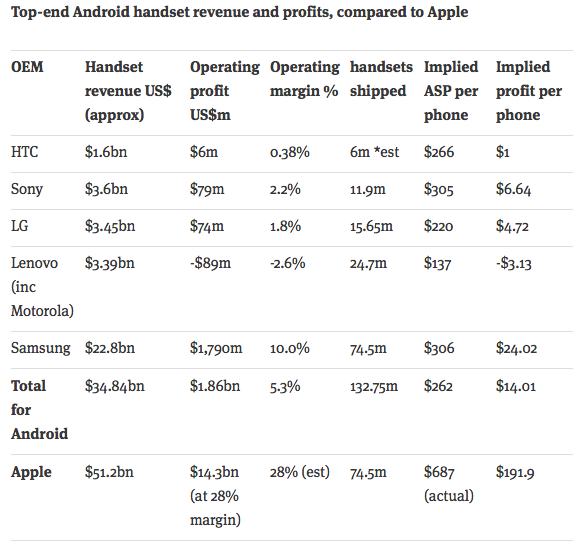
A lot of that is due to the big drop in profits at Samsung, the largest player in the Android market. China’s Xiaomi gained significant market share, but is only modestly profitable thanks to its slim margins. Meanwhile, other players like Sony and Motorola lost money in their Android-based mobile businesses.

That’s obviously of concern to the hardware companies, but it should also be worrisome for Google.

“It is important for Google that the ecosystem stays healthy and balanced,” Sharma told Re/code. “Without profitability, some of these players will eventually disappear and it will primarily become a Samsung + Chinese OEMs ecosystem, which is probably not what Google wants.”

Not sure Google is too worried, as long as lots of people use Android, or Google apps on iOS.


Ebooks Direct and new EU digital sales rules: what now? >> Out of Ambit

Diane Duane:

If you’re a large company with accountants this is one of those things you just shrug and deal with, since you’re already registered for VAT and you’ll just fold this extra paperwork and bureaucracy-management into all the other paperwork your accountants already deal with. However, if you’re (for example) someone on disability who’s keeping themselves afloat by selling digital comics, or a stay-at-home mom running a small electronic travel-publication business from her kitchen table—or for that matter, if you’re a pair of science fiction and fantasy writers running a small ebook publishing business from a tiny cottage at the foot of the Wicklow Mountains—then the extra bureaucracy and paperwork burden is not at all welcome. For some of our colleagues, this increased burden of regulations and bureaucracy simply means they’ll have to shut down. They can’t afford the cost of VAT registry or an accountant, or they won’t be able to procure the necessary IDs and proofs of location from their customers, much less store them for a decade.

This situation is even more onerous in places where, until now, businesses this small were spared having to register for VAT at all. But the EU law regarding sale of digital goods has no such eligibility threshold—no equivalent level above which you’re expected to afford accountancy services and so forth, since you’re making enough money to make it worthwhile registering for VAT in the first place.

The regulations seem onerous – if you sell anything at all electronically, you have to register for VAT. Regulations like this make a subversion via Bitcoin much more attractive and hence likely, which could have a serious (negative) effect on government revenues.


Here’s proof the Xiaomi MacBook Air clone story is fake

Steven Millward:

A reverse Google image search on the fake Xiaomi laptop reveals that the closest image source seems to be an undated clone, with the splendid name Kaka i5 (pictured below), that already has an orange power button. So the Xiaomi laptop hoaxers simply had to Photoshop on an orange Xiaomi logo.

The dubious story first appeared in English on GizmoChina, a site we’ve never heard of before, and then was picked up without further investigation by well-known sites such as 9to5Mac and BusinessInsider (update: story screenshots here and here, respectively). Not so much Pulitzer prize for journalism as Wurlitzer prize for churnalism.

Round of applause for that last phrase, sir. Chapeau.


AdBlock Plus’s effect on Firefox’s memory usage >> Nicholas Nethercote

Nicholas Nethercote, with what could also be titled “AdBlockPlus actually makes your browser and computer run slower”:

we recently learned that ABP can greatly increase the amount of memory used by Firefox.

First, there’s a constant overhead just from enabling ABP of something like 60–70 MiB. (This is on 64-bit builds; on 32-bit builds the number is probably a bit smaller.) This appears to be mostly due to additional JavaScript memory usage, though there’s also some due to extra layout memory.

Second, there’s an overhead of about 4 MiB per iframe, which is mostly due to ABP injecting a giant stylesheet into every iframe. Many pages have multiple iframes, so this can add up quickly. For example, if I load TechCrunch and roll over the social buttons on every story (thus triggering the loading of lots of extra JS code), without ABP, Firefox uses about 194 MiB of physical memory. With ABP, that number more than doubles, to 417 MiB. This is despite the fact that ABP prevents some page elements (ads!) from being loaded.

An even more extreme example is this page, which contains over 400 iframes. Without ABP, Firefox uses about 370 MiB. With ABP, that number jumps to 1960 MiB. Unsurprisingly, the page also loads more slowly with ABP enabled.

AdBlock Plus has about 19m users. That’s a lot of people penalising their computing experience in order not to penalise their visual experience (and penalise the sites they use).


Fake “The Interview” app is really an Android banking trojan >> Graham Cluley

Researchers at McAfee – in a joint investigation with the Technische Universität Darmstadt and the Centre for Advanced Security Research Darmstadt (CASED), has identified that a threat campaign has been active in South Korea in the last few days, attempting to exploit the media frenzy surrounding “The Interview”‘s release.

McAfee security expert Irfan Asrar tells me that a torrent making the rounds in South Korea, poses as an Android app to download the movie to mobile devices.

However, in truth, it contains an Android Trojan detected by McAfee products as Android/Badaccents.

Android/Badaccents claims to download a copy of “The Interview” but instead installs a two-stage banking Trojan onto victims’ devices.

Amazon-hosted files, sending data back to a site in China, which checks for whether the devices are made in North Korea – though the latter is likely not an important detail.


The slow death of ‘Do Not Track’ >> NYTimes.com

Fred Campbell, who is executive director of the “Center for Boundless Innovation in Technology”, and also a former chief of the Federal Communications Commission’s Wireless Telecomms Bureau:

The idea, known as “Do Not Track,” and modeled on the popular “Do Not Call” rule that protects consumers from unwanted telemarketing calls, is simple. But the details are anything but.

Although many digital advertising companies agreed to the idea in principle, the debate over the definition, scope and application of “Do Not Track” has been raging for several years.

Now, finally, an industry working group is expected to propose detailed rules governing how the privacy switch should work. The group includes experts but is dominated by Internet giants like Adobe, Apple, Facebook, Google and Yahoo. It is poised to recommend a carve-out that would effectively free them from honoring “Do Not Track” requests.

If regulators go along, the rules would allow the largest Internet giants to continue scooping up data about users on their own sites and on other sites that include their plug-ins, such as Facebook’s “Like” button or an embedded YouTube video. This giant loophole would make “Do Not Track” meaningless.

Essentially because, the article points out, collecting user data has become the raison d’etre for so many companies, and the money hose that affords “free” maps, email, and so on. But the US Federal Trade Commission, which is meant to protect consumers, has given up on the task.


How to completely remove Birthdays from Google Calendar >> Medium

Let Brendan Mulligan be your helpful source of future apologies.


How not to run an A/B test >> Evan Miller

Suppose your conversion rate is 50% and you want to test to see if a new logo gives you a conversion rate of more than 50% (or less). You stop the experiment as soon as there is 5% significance, or you call off the experiment after 150 observations. Now suppose your new logo actually does nothing. What percent of the time will your experiment wrongly find a significant result? No more than five percent, right? Maybe six percent, in light of the preceding analysis?

Try 26.1% – more than five times what you probably thought the significance level was.

The “equal sampling” point is often missed in trying to extract significant difference. Terrific piece. Also includes a “Sample size calculator” to help you.


Government secures landmark deal for UK mobile phone users >> GOV.UK

From the Department of Culture, Media and Sport (via Culture minister Savid Javid):

Under the agreement all four of the mobile networks have collectively agreed to:

• a guaranteed £5bn investment programme to improve mobile infrastructure by 2017;
• guaranteed voice and text coverage from each operator across 90% of the UK geographic area by 2017, halving the areas currently blighted by patchy coverage as a result of partial ‘not-spots’;
• full coverage from all four mobile operators will increase from 69% to 85% of geographic areas by 2017;
• provide reliable signal strength for voice for each type of mobile service (whether 2G/3G/4G) – currently many consumers frequently lose signal or cannot get signal long enough to make a call; and
• make the deal legally binding by accepting amended licence conditions to reflect the agreement – it will be enforceable by Ofcom.

What’s odd about this is that the detail of the agreement hasn’t been published, and the problem of coverage tends to be on trains – these requirements could be fulfilled by sticking some mobile masts on the Scottish highlands, but wouldn’t solve many peoples’ problems.

Also, why is a culture minister prodding carriers? Shouldn’t it be the Department for Business, Innovation and Skills?


BlackBerry Classic review: the best BlackBerry ever made >> WSJ

Joanna Stern was a confirmed BlackBerry lover back in the day, and delights in the physical keyboard, trackpad, battery life, call quality, and email-to-calendar features. But:

while I’d love for all those great BlackBerry features to make a comeback, others simply feel out of date.

Calendar and email aside, other preloaded apps are slow and poorly designed. A Rand McNally map from the gas station is likely more up-to-date—and speedier—than BlackBerry’s own maps app. Not only did it struggle to help me find the closest Starbucks in New York City, but it lacks typical features like transit directions and 3-D map options.

BlackBerry recommends dissatisfied users try third-party apps, like Waze or Navfree. But while BlackBerrys can run Android apps, the industry-leader Google Maps isn’t available for the platform.

That brings me to the terrible and confusing app situation. There are now two app stores preloaded on the Classic: Amazon’s App Store and BlackBerry World, which sounds like an amusement park I would have loved in 2008. While you can download Android apps from Amazon’s App Store, many big ones are missing—not just the Google family of apps, but also Uber and Instagram.

You can ignore BlackBerry’s warnings and load other Android apps manually, but it takes work.

So in that sense, it’s still like BlackBerrys from a few years ago – and the app gap is still one that is going to put the standard consumer off.

Highly recommended: Dieter Bohn’s great piece of review writing (which is actual writing as entertainment as well as information): BlackBerry Classic review at The Verge.


Infography: iPhone vs. Android shows north vs. south split (and in real time) >> TomSoft

The results are quite interesting: it shows that the split android/iPhone happens more at a country/continent level than at a user level. USA, England, Japan are in their vast majority « iPhone users », while South America, Spain, Indonesia are much more Android focused. France is one of the few balanced countries.

In other words, seems another north vs. south split, or rich vs. poor (it seems for instance that some Brazilian big cities are iPhone users while the rest of the country is much more Android).

Dubious about this; Android has the majority smartphone installed base in pretty much every country. And geolocated tweets are a tiny part of the total; hard to tell if they’re represented proportionally.


Analysis: another BlackBerry quarter: there must be a horse in there somewhere

Those BlackBerry results for the quarter to the end of November. Terrible? Yes. A fall in revenues quarter-on-quarter, and a whopping operating and net loss. The title of this post is, yes, a reference to the old joke – the guy with a spade who is working his way through a mountain of horse crap. Someone comes up and asks him what he’s doing. “With this much crap, there’s gotta be a horse in here somewhere,” the man replies. In the same way, I’m fairly sure there’s a profitable business somewhere inside BlackBerry. The trouble is finding it. John Chen has done an impressive job since he came on board just over a year ago. But he hasn’t found the profit either (we’ll get to the little financial twiddling that let Chen claim a profit later). I wrote about how much trouble BlackBerry is in after its last quarter. How are things three months on? There’s obviously a profitable business hidden in there: it provides high-security keyboard-based smartphones to governments and businesses which put a premium on connectivity and security. The trouble is extricating that from the loss-making consumer side, and the high costs of making smartphones at far less than scale, and how to fight off the competition to be in charge of mobile device management (MDM) at big companies and in governments. So, let’s start digging. (Click on images for a large-sized version.) Bad headlines The headline numbers are bad. Revenue fell 33.5% year-on-year to $793m, and 14% sequentially.

GEOGRAPHIC

BlackBerry revenues by geographic region, by quarter

Shown separately: EMEA is the largest, but all are struggling. Source: BlackBerry

BlackBerry geographic revenue by quarter

EMEA is still the biggest region by revenue, but it’s all got much smaller. Source: BlackBerry

The graph shows how things aren’t working for the company. EMEA (Europe, Middle East and Africa) has long been the largest segment, principally because of subscribers in South Africa and the rest of Africa; the UK used to be a stronghold too, but that’s faded. Asia-Pacific hasn’t looked too rosy either for the past few quarters; but those are consumer areas, and that side of BlackBerry’s business just isn’t happening.

HARDWARE

BlackBerry shipped 2m units but “sell-through” (to end users) was 1.9m, which suggests there’s no surplus in the channel now; it’s cleaned out. Does that mean there are no more BB7 devices like the Bold to buy? Again, unclear. But the ASP (average selling price) cratered:

Derived from total hardware revenue divided by handsets shipped. Source: BlackBerry

Derived from total hardware revenue divided by handsets shipped. Source: BlackBerry

Note that the ASP has halved from the December 2008 quarter, six years ago. Chen expects that to pick up now. Yet BlackBerry is struggling to fulfil even quite small demands, it seems. Chen is very vague about how many Passports were shipped (and paid for) in Q3 (transcript from Seeking Alpha)

Going forward, because of the new products, we expect the ASP to start picking back up again. We’re able to fulfil about 200,000 Passport orders that was preordered at the time we announced it, while reducing the manufacturing lead times to roughly now between four to six weeks. However, because we have sold our stock out a number of times in the quarter waiting for the fulfilment, we were only able to fulfil order backlog of Q3 by December 12. So that was clearly already into Q4. And I also want to remind everybody that our revenue of these devices are all recognised on a sell-through basis. So not every one of those units, in fact most of those units revenue are not recognised in Q3. And we obviously will recognise as they lead [ph] up in throughout the next few quarters.

Data point: 61% of Passport sales were in the US. See how much that helped revenues? Oh, sure, it didn’t. Revenues fell in North America. Also, Chen said that the hardware side could be profitable with sales of 10m units per (fiscal) year. It’s some way from that: 5.7m shipped after three quarters of the fiscal year (7m in the past four quarters); or 6.8m “sell-in” (to customers) in three quarters – and the magic 10.2m of sell-in over the past four quarters.

SERVICES

BlackBerry has made lots of profit from services. But it needs to make revenues from services for that to work. The Service Activation Fee (SAF) is what it gets from people who activate BB7 phones. And it’s declining: SAF revenues were down 13% sequentially, and will fall by about 15% in the next quarter according to the finance director. Looking at BlackBerry’s service revenues, those fell from $424m to $364.8m – which is a 13% fall. So that suggests that most of its service revenues are from SAF. That makes sense, looking at how the service revenues track the numbers of subscribers. The correlation between published subscriber figures and service revenues is really strong:

Correlation between BlackBerry subscribers and service revenue

Service revenues and subscriber numbers are closely linked – BlackBerry used to get more money per subscriber than it does now.

The linking lines show the progression of the link between revenue and subscribers; notice how it goes below the correlation line to begin with (more money for fewer subscribers) and then goes above the line, and starts heading backwards (less money for the same number of subscribers). So whereas in the June-August 2010 quarter there were 50m subscribers generating $785m in revenue, for the March-June 2014 quarter, when there were 50m subscribers, they only generated $519m in revenue. And that’s going to continue to decline; on the 15% decline forecast by Chen, that means a $310m service revenue announced in March, covering the current quarter (to the end of February).

SUBSCRIBERS

For some time the best questions in the BlackBerry analyst call have come from Ehud Gelblum at Citi, and he didn’t disappoint. “Is there a subscriber number update that we can hang our hat on?” he asked Chen. Answer: “No, not right now.” We can do some calculating about subscriber numbers, though. There’s a figure of “service revenue per subscriber account” that you can work out from the published number of subscribers and the service revenues. To get to the drop in service revenues, there are three choices: • subscriber numbers stayed the same, but per-subscriber payments fell • subscriber numbers fell, but per-subscriber payments stayed the same • both subscriber numbers and per-subscriber payments fell. If it was the first, wouldn’t you expect Chen to have spoken up and spun it a bit? He didn’t. If it were the second, wouldn’t you expect him to spin it a bit? He didn’t. There’s a clue, though. Here’s Chen talking about the problem of going from BB7 to BB10:

I’m not go to be providing you the margin of the Classic but it is a positive margin and revenue of course is in the $400 plus. But then I lose $3 to $5 a month [in service fees] when that conversion happens. Sometime over the lifetime of this will cross over.

At $3 per month in service revenues, $364.78m suggests about 40m subscribers. If we model about 5m fewer subscribers per quarter over the past four or five quarters, we also get a consistent fall in per-account subscription.

BlackBerry subscriber numbers

The fall in BlackBerry subscriber numbers (red = estimated, based on public data) is pretty fast.

BlackBerry service revenue per subscriber account

Service revenue per subscriber account is constantly falling as consumers, carriers and businesses move away from the Service Activation Fee (SAF).

And according to Richard Yersh, about 80% of those subscribers are business users – so that’s 32m business users and 8m consumers on BB7. On the upside, with 6.9m business licences (pretty much all on free tryout) for its EZPass BES12 server, that does mean lots of potential clients. If – big if – it can get them to sign up for its services. The other problem about falling subscriber numbers is that it gives you fewer people to sell new handsets to. On a basis of a two-year refresh cycle, the further you fall below 40m, the lower the refresh. Over the past seven quarters, the sell-through (to end users) has been 24.6m – average 3.5m per quarter – which would be 28m per two years. Trouble is, the sell-through is falling; the latest is the smallest recorded. Why should things improve?

PROFIT?

Still, it made a profit, right? CFO James Yersh:

In the quarter we also turned in a non-GAAP net profit of $6 million or $0.01 per share. These results were largely attributable to disciplined management of margins and expenses.

“Non-GAAP” means “not using official measurements”. (“GAAP” is “Generally Accepted Accounting Principles”.) I don’t mind companies leaving out exceptionals – one-off payments for laying off staff or closing factories, say. The reasons here are trickier: GAAP operating expenses included $150m of revaluation of its $1bn of convertible debt, the value of which increased. It’s a non-cash charge, and doesn’t affect anything about how the business is actually run. Just as a flashback, the reason why BlackBerry is carrying a debenture debt is because it decided to go for a bailout after a buyout effort failed. The debenture raised $1bn at 6%, giving debenture holders the right to convert the debt into $10 shares in November 2020. The debentures have to be marked-to-market – that is, valued – because they’re a continuing obligation: they’re a risk to the company, because convertible debentures can be a risk to a company through short-selling. But even if we allow the non-GAAP profit of $6m, we have to ask what BlackBerry has ahead of it. Let’s recap: • it’s struggling to fulfil hardware orders, but has cleared out a lot of BB7 inventory, so now has to try to sell lots of handsets, which will be made for it by Foxconn • service revenues are falling • subscriber numbers are falling • it now has to convert business users who had the free EZPass deal to actually pay money, rather than going with a rival for less Actually, a forecast that looks about right to me comes from one of the (many) BlackBerry analysts on Seeking Alpha, who sets out what it will take for the company to achieve profitability in its next financial year: • hardware sales of 13m over the fiscal year (my comment: possible, but it shows no signs of coming close this fiscal year) • service revenues as a result of those hardware sales of $1.27bn for the year (my comment: might just be achievable, at $300m per quarter, which is where it’s heading). There’s a newer article by the same author, who seems pretty sensible. Recommended. BlackBerry used to straddle the smartphone world; now it has become a curio, one with a niche business that it has to turn into profit as the consumer side of its business subsides. But there must be a horse in there somewhere, right?

Start up: Coolpad’s built-in malware backdoor, LG v Samsung, Rockstar’s patent fizzle, Google’s PR spin game, and more


A Coolpad smartphone. Back door not shown.

++++++++++++++++++++++
This is the last collection of Overspill links until next week (at least). Have a great Christmas – and thanks to the hundreds of people who are coming to read every day. You’re always welcome.
++++++++++++++++++++++

A selection of 11 links for you. I’m charlesarthur on Twitter. Observations and links welcome.

SuperBeam Pro: easy & fast WiFi direct file sharing >> iTunes App Store

Works by Wi-Fi Direct (aka p2p sharing). Seems to be superfast, but one also wonders if Apple is going to be entirely happy about this. (Found via Producthunt.)


Rockstar consortium to sell 4,000 patents to RPX Corp. for $900m >> WSJ

Starting late last year, Rockstar sued several companies for allegedly infringing their patents, including Google and Cisco. Last month, Rockstar settled its suits against Google and Cisco. Financial details weren’t disclosed, but Cisco told investors in early November that it had recorded a pretax charge of $188 million to settle the Rockstar litigation.

As part of the deal with RPX, Rockstar will drop the remainder of its suits, which include claims against Samsung Electronics, LG, HTC and Huawei.

The settlements follow others in the long-running smartphone patent wars.

For instance, in May, Apple and Google agreed to drop all lawsuits between the two companies, and in August, Apple and Samsung agreed to end all litigation between the two companies outside the U.S. Apple and Samsung are still battling in federal court in California, where Apple has won two jury verdicts finding that Samsung infringed its designs for the iPhone.

Whether the Rockstar companies recouped its $4.5bn investment is an open question. In the minds of some experts, the $4.5bn figure reflected the high point of a frothy market that developed for patents in the earlier days of the smartphone industry.

The Rockstar companies squeezed more than three years of use out of the 4,000 patents, and will keep licenses going forward. The 2,000 patents they held back from Rockstar—and aren’t part of the sale to RPX—were among some of the most valuable in the Nortel portfolio.

Turns out that smartphone patents were just a sideline which led both Google and its rivals to drop huge amounts. (Google rather more than the others, through Motorola’s continued losses until it could sell it off. But nobody won.)


CoolReaper revealed: a backdoor in Coolpad Android devices >> Palo Alto Networks Blog

Claud Xiao and Ryan Olson:

Coolpad is the sixth largest manufacturer of smartphones in the world, and the third largest in China. We recently discovered that the software installed on many of Coolpad’s high-end Android phones includes a backdoor which was installed and operated by Coolpad itself. Today we released a new report detailing the backdoor, which we’ve named “CoolReaper.”
After reviewing Coolpad complaints on message boards about suspicious activities on Coolpad devices, we downloaded multiple copies of the stock ROMs used by Coolpad phones sold in China. We found the majority of the ROMs contained the CoolReaper backdoor.

CoolReaper can perform the following tasks:
• Download, install, or activate any Android application without user consent or notification
• Clear user data, uninstall existing applications, or disable system applications
• Notify users of a fake over-the-air (OTA) update that doesn’t update the device, but installs unwanted applications
• Send or insert arbitrary SMS or MMS messages into the phone.
• Dial arbitrary phone numbers
• Upload information about device, its location, application usage, calling and SMS history to a Coolpad server.

Fabulous! All that extra software for no charge! (Coolpad is on sale in the west, by the way.)

They say it’s specifically tailored to hide what it does, and that Coolpad has ignored customer complaints about unwanted app installs. Their conclusion:

CoolReaper is the first malware we have seen that was built and operated by an Android manufacturer. The changes Coolpad made to the Android OS to hide the backdoor from users and antivirus programs are unique and should make people think twice about the integrity of their mobile devices.


Google adds song lyrics to search results but it feels like a cheap cash grab >> PCWorld

Ian Paul:

Google has figured out a way to deliver more instant answers in search results and boost music sales on Google Play simultaneously: song lyrics. Following Bing’s lead from October, Google is now surfacing lyrics for a limited number of songs when you search for “[song title] lyrics.”

Unlike Bing, however, you won’t see the full list of song lyrics in your search results. To see the complete lyrics you have to click a link to Google Play. There you’ll also have options to buy the track or subscribe to Google Play’s All Access subscription service.

If Bing’s song lyrics roll out convinced you to switch to Microsoft’s search engine, however, don’t bother switching back. Google’s song lyric catalog is extremely limited compared to its competitor. In fact, the new feature seems like more of a ploy to push people to Google Play than a truly helpful search function.

I hadn’t noted that Bing was already doing song lyrics. Google says it has licensed the lyrics it displays. But – as this article notes, and Techcrunch points out – it’s another annexation by Google of a content business.


LG boss may miss CES due to washing machine fiasco >> CNET

Cho Mu-Hyun:

South Korean prosecutors have imposed a travel ban on Jo Seong-jin, head of LG’s Home Appliance and Air Solution Company, who had been slated to represent LG at the upcoming Consumer Electronics Show 2015 in Las Vegas.

Samsung earlier this year filed a lawsuit for property damages and defamation against Jo and four other LG Electronics executives after the IFA tradeshow in Berlin, Germany, claiming that the LG execs intentionally sabotaged the door hinges of one of its washing machines at an electronics store there. Samsung provided as evidence the damaged washing machine and CCTV footage allegedly showing Jo “willfully” damaging the appliance.

Who knew bathos could be so hilarious.


Xiaomi may adopt sapphire for covers of 5.7in smartphone >> Digitimes

China-based smartphone vendor Xiaomi Technology is likely to adopt sapphire for protective covers of Xiaomi 5, its 5.7-inch flagship model that will be showcased at the 2015 Consumer Electronics Show, Taiwan-based supply chain makers cited industry sources in China as indicating.

Japan-based Kyocera in early 2014 launched smartphones with protective covers made from internally-produced sapphire in the US market through cooperation with Verizon Wireless, while China-based Vivo and Huawei Device also launched smartphones with sapphire covers, the sources said.

If Xiaomi decides to adopt sapphire, existing sapphire production capacity is not sufficient to meet the demand, according to sources with Taiwan-based sapphire wafer makers.

Even with Xiaomi’s smartphone volumes, this probably isn’t possible. Maybe a high-end model?


Why Sony’s breach matters >> Learning by Shipping

Steve Sinofsky, who (of course) used to be at Microsoft:

in late 1996, seemingly all at once everyone started opening Word documents to a mysterious alert like the one below.

This annoying but benign development was actually a virus. The Word Concept virus (technically a worm, which at the time was a big debate) was spreading wildly. It attached itself to an incredibly useful feature of Word called the AutoOpen macro. Basically Word had a snazzy macro language that could do anything automatically that you could do in Word just sitting in front typing (more on this later). AutoOpen allowed these macros to run as soon as you opened a document. You’d receive a document with Concept code in AutoOpen and upon opening the document it would infect the default (and incredibly useful) template Normal.dot and then from then on every document you opened or created was subsequently infected. When you mailed a document or placed it on a file server, everyone opening that document would become infected the same way. This mechanism would become very useful for future viruses.

Looking at this on the team we were rather consternated. Here was a core business use case. For example, AutoOpen would trigger all sorts of business processes such as creating a standard document with the right formats and metadata or checking for certain conditions in a document management system. These capabilities were key to Word winning in the marketplace. Yet clearly something had to be done.

And that was just the start of a long run of malware. But he thinks we’re better off now.


Google just had to spin the Sony hack >> The Illusion of More

David Newhoff on Google’s PR spin around the “Goliath” emails uncovered by the Sony hack, which he calls a Pavlovian bell-ringing for its meme of “internet freedom”:

It’s no secret that motion picture producers and Google have an ongoing dispute with regard to piracy of filmed entertainment, and I think it’s a safe bet both parties regularly consult with counsel regarding their own interests. As such, I personally think one of the more serious results of this leak is the rather dramatic breach of attorney/client privilege. I don’t think we want a society in which hackers can arbitrarily violate this fundamental right in our legal system. Apparently, though, Google’s Sr VP and General Counsel, Kent Walker, was unfazed by this implication — perhaps Google is hacker proof — when he was quoted in Variety saying, “We are deeply concerned about recent reports that the Motion Picture Association of America (MPAA) led a secret, coordinated campaign to revive the failed SOPA legislation through other means.”  And as of this week, Google has launched a campaign it calls Zombie SOPA. Ding-a-ling!

Walker is not speaking as an attorney, but rather as a PR guy, when he plays the word secret like that in order to imply a conspiracy, knowing full well that communications between clients and attorneys are almost always secret. But near the end of the article, he is also quoted plaintively wondering why champions of the First Amendment like the MPAA would “want to censor the Internet.”  Hear them ring! Of course any discussion about legal remedies to mitigate piracy are tantamount to censorship, right?


Why Samsung is losing out to low cost rivals >> Jana Mobile

Samsung’s flagship Galaxy series is extremely popular among the emerging market smartphone users that make up mCent’s user base (eight of the top ten devices used to access the mCent app in November 2014 came from the Samsung Galaxy series). However, the Galaxy is likely to become less popular as lower-priced competitors enter the market. This is partly due to the total price of components and assembly for Galaxy devices, which have steadily risen in the face of prevailing market trends. If the current trend is sustained, manufacturing and component costs for a Samsung Galaxy [from 2010] will be higher than the global average selling price for a smartphone in 2015…

…In November 2014, Samsung accounted for 40% of sessions on the mCent app for Android. It has been the most popular smartphone brand among users in our markets since the launch of the mCent app in June 2014, yet its popularity has been waning. In the key markets of Brazil, Indonesia, and India, Motorola, Smartfren, and Micromax have become noticeably more popular. We expect this trend to continue into 2015.

With the caveat, however, that they’re talking about the flagship Galaxy phones, not the cheapo phones that it sells at rock-bottom prices.

Though this is becoming a story that everyone is telling: Samsung losing out to the low-cost rivals. Its earnings guidance for the fourth quarter will come out in early January.


Mathematicians have finally figured out how to tell correlation from causation >> Quartz

Zach Wener-Fligner:

determining causal relationships is really hard. But techniques outlined in a new paper promise to do just that. The basic intuition behind the method demonstrated by Prof. Joris Mooij of the University of Amsterdam and his co-authors is surprisingly simple: if one event influences another, then the random noise in the causing event will be reflected in the affected event.

For example, suppose we are trying to determine the relationship between the the amount of highway traffic, and the time it takes John to drive to work. Both John’s commute time and traffic on the highway will fluctuate somewhat randomly: sometimes John will hit the red light just around the corner, and lose five extra minutes; sometimes icy weather will slow down the roads.

But the key insight is that random fluctuation in traffic will affect John’s commute time, whereas random fluctuation in John’s commute time won’t affect the traffic.

Smart – watch for this to filter through into all sorts of everyday algorithms in the next few years.


Did North Korea really attack Sony? >> The Atlantic

Bruce Schneier:

Allan Friedman, a research scientist at George Washington University’s Cyber Security Policy Research Institute, told me that from a diplomatic perspective, it’s a smart strategy for the U.S. to be overconfident in assigning blame for the cyberattacks. Beyond the politics of this particular attack, the long-term U.S. interest is to discourage other nations from engaging in similar behavior. If the North Korean government continues denying its involvement no matter what the truth is, and the real attackers have gone underground, then the U.S. decision to claim omnipotent powers of attribution serves as a warning to others that they will get caught if they try something like this.

Sony also has a vested interest in the hack being the work of North Korea. The company is going to be on the receiving end of a dozen or more lawsuits—from employees, ex-employees, investors, partners, and so on. Harvard Law professor Jonathan Zittrain opined that having this attack characterized as an act of terrorism or war, or the work of a foreign power, might earn the company some degree of immunity from these lawsuits.

I worry that this case echoes the “we have evidence — trust us” story that the Bush administration told in the run-up to the Iraq invasion.

Schneier is very sceptical of the US explanation. It’s noticeable how few security experts are on board with the US’s claims over this.