Colours, names and numbers: why is it ‘iPhone 7’ but just ‘MacBook Air’?


Phil Schiller introducing the iPhone 7/Plus in San Francisco. Yes, but why “7”? Photo by tuaulamac on Flickr.

Yes, Apple launched new phones the other day. Yes, there isn’t a 3.5mm headphone jack – which will cause varying amounts of trouble for people and accessory makers. There are “AirPods” to buy ($159, or £159 – even with VAT that doesn’t make sense on the exchange rate front).

We know too that Apple faces challenges: the premium smartphone market is saturated, so that pretty much all sales now will be to people who are replacing an existing smartphone; and Apple only targets the premium end, since even the iPhone SE (which does have a 3.5mm headphone hack, and a 16GB model) starts at $350, which is the lower limit of what analysts call “premium”.

But there’s a subtler question around this iPhone. And it’s this: why does Apple call it “7”? Sure, they’ve moved things around, and redesigned this and tweaked that (oh, yeah, headphone jack has gone). This is known as a “refresh” in the business.


The MacBook. Who can tell which year they’re from? Only the colour indicates that the right-hand one isn’t from 2015. Photos by tuaulamac on Flickr.

So why do we have a number for this product, and yet when the MacBook line had a refresh earlier in 2016, that wasn’t called “MacBook 2” – or even “MacBook 3”, as there was one back in 2010?

Similarly, the expected and long overdue refresh of the Mac Pro isn’t going to be the “Mac Pro 2”; nor is the MacBook Pro line going to get a “MacBook Pro 9”, given that there have been eight iterations already since the line was introduced in February 2011.

On its face, this is puzzling. Apple wants people to upgrade their hardware – that’s where vast amounts of its revenue comes from – and with the iPhone, it signals to people that there are new models available through the numbering system, and also through the colours available. (In 2013, the 5S came in a “gold” colour; in 2015 there was the new “rose gold”.)

By contrast, the PCs come with very little variation in appearance – you have to be quite nerdy to spot the difference between a 2012-vintage model MacBook Pro and the 2015 one, say. Though the MacBook does come in multiple colours, and the “MacBook 2” added rose gold as a colour option. (Hence above we know the right-hand one is a 2016 model.)

Colour as a “novelty” signal has long been a favourite for Apple: remember the original iMac, in “Bondi blue”, where the colour range then expanded – signalling how much newer your model was – until it went mad with the Dalmatian range. Of course if the numbering system were used for the iMac, we’d be up to something like “iMac 20” by now, what with all the variations of the 1998 teardrop, the lampstand, and now the flat-panel version.

Yet the more you look across the product range, the more peculiar this choice of numbering only for phones becomes. It has even been dropped for the iPads; where we used to have iPad 2, 3, 4, and then “iPad mini”, and then Air and Air 2, we now just have iPad Pro and iPad Air. (And mini. Not sure how long that will survive. It’s something of an “iPod touch for the iPad range”.) There’s the Apple TV. Can you tell them apart? Only by size. They don’t get “Apple TV 4”. Airport Express? Airport Extreme?

And how about the iPod? That didn’t get numbers – though it did get descriptors as the range grew (“Classic”, “mini”, “nano”, “shuffle”, “touch”). The changing design was itself sufficient differentiation, perhaps.

Here’s another example from a saturated market: cars don’t get numbers. They get names. There’s the Ford Focus, the Vauxhall Zafira, the Chrysler Plymouth, and so on. Ah – except as John Dodds points out, BMW uses numbers for its ranges (BMW 3 series, 5 series). Hmm.

Note, by the way, that the Watch is getting a “Series 2” moniker, and also new materials and colours. But the descriptors (“Edition”, “Sport”) have been abandoned.

What’s in a name and a number?

What do we conclude? Perhaps those more steeped in marketing will provide a better analysis, but it feels to me as though there’s an urgency in using numbers to name a product: it immediately dates the old one and give the new one a sense of being right here, right now. (Except – odd detail – you won’t find the phone number on the phone itself. Nor is it even displayed in or on the phone. The back of the iPhone used to show the memory; now it doesn’t even do that.)

Why not do the same on the PCs then? It’s not that there’s suddenly a temptation to slide past a lengthening upgrade cycle; Apple used to upgrade them every six months or so like clockwork, but recently has become less interested in doing so. But it didn’t have a number or even descriptor for its PCs back when it was pushing new ones out.

Add in the fact that it’s almost impossible to differentiate between the iPhone 6/6S/7 (and 6+/6S+/7+ – except the latter has dual cameras) except if they’re in unusual colours, and you have a conundrum. Apple attaches numbers to these products in its marketing; yet there’s none on the devices themselves. Perhaps it’s to help people pretend that they have the latest when in fact they don’t; the “unashamedly plastic” 5C sold comparatively poorly (against expectations if Apple had simply continued the iPhone 5, which is what the 5C actually was inside) perhaps because owning one indicated to the world that you didn’t have enough money to buy the top-end new model, the 5S, and that you hadn’t had it the year before either (because you’d have had the 5).

So if the phones don’t have the numbers, why does the marketing? Possibly it’s just to do what marketing should: make you aware there’s a new product. Even if you can’t tell which one other people – or even you – are using. (Do you know which model of phone you have? This might be indicative of how susceptible you are to this marketing method.)

The only other question is: when will Apple stop numbering its iPhones? Will the 2017 version, being the tenth anniversary edition, be the “iPhone Edition” or some such? Once you’re on this thing, it seems unlikely to stop – but I can’t wrap my head around the concept of 2020 rolling around and the “iPhone 9” being unveiled while a few weeks later one of the PCs gets an update that makes it autonomously intelligent with VR, and yet it’s just called “the MacBook”.


(From an idea on Twitter by Joe Asbridge – thanks Joe. Told you I’d write it up eventually.)


Liked this? Each day there’s a Start Up post with links and commentary. You can sign up to receive each day’s Start Up post by email. You’ll need to click a confirmation link, so no spam.


Start up: three steps to AI, Intel sets McAfee loose, Land Registry saved?, the wearable slowdown, and more


It’s the iPhone 7! Probably. Photo by tuaulamac on Flickr.

A selection of 15 links for you. Yeah, well, just do your best. I’m charlesarthur on Twitter. Observations and links welcome.

The hype — and hope — of artificial intelligence • The New Yorker

Om Malik:

»

Michelle Zhou spent over a decade and a half at I.B.M. Research and I.B.M. Watson Group before leaving to become a co-founder of Juji, a sentiment-analysis startup. An expert in a field where artificial intelligence and human-computer interaction intersect, Zhou breaks down A.I. into three stages. The first is recognition intelligence, in which algorithms running on ever more powerful computers can recognize patterns and glean topics from blocks of text, or perhaps even derive the meaning of a whole document from a few sentences. The second stage is cognitive intelligence, in which machines can go beyond pattern recognition and start making inferences from data. The third stage will be reached only when we can create virtual human beings, who can think, act, and behave as humans do.

We are a long way from creating virtual human beings. Despite what you read in the media, no technology is perfect, and the most valuable function of A.I. lies in augmenting human intelligence…

…Using Zhou’s three stages as a yardstick, we are only in the “recognition intelligence” phase—today’s computers use deep learning to discover patterns faster and better. It’s true, however, that some companies are working on technologies that can be used for inferring meanings, which would be the next step. “It does not matter whether we will end up at stage 3,” Zhou wrote to me in an e-mail. “I’m still a big fan of man-machine symbiosis, where computers do the best they can (that is being consistent, objective, precise), and humans do our best (creative, imprecise but adaptive).”

«

link to this extract


Intel, TPG to form jointly-owned, cybersecurity company called McAfee • ZDNet

Stephanie Condon:

»

Intel has reached a deal to sell a majority stake in Intel Security to the private equity firm TPG, creating a jointly-owned, pure-play cybersecurity company called McAfee, Intel announced Wednesday.

Intel will get $3.1bn in cash for the deal, as well as a 49% stake in the new business. TPG will own the remaining 51% and will make a $1.1bn equity investment in the business. The transaction values Intel Security at $4.2bn.

Intel Security general manager Chris Young will be appointed CEO of the new company once the transaction closes. Young published an open letter to Intel Security’s stakeholders on Wednesday, outlining the benefits of the deal.

«

Bought it for $7.7bn in 2011. A relevant detail that somehow fell out of the story. So it gets $3.1bn and has 49% of $4.2bn, or $2.1bn: that’s $5.2bn. In other words, $2.5bn of value vanished in five years.
link to this extract


Facebook’s ‘Trending’ feature exhibits flaws under new algorithm • WSJ

Georgia Wells:

»

After “trending” became automated on Aug. 26, Facebook replaced all headlines with a keyword, which users can hover over for a description of the story.

Some of the keywords don’t accurately represent the main topic of the news story. News recently labeled “The Hamptons” was about presidential candidate Hillary Clinton’s recent fundraising efforts there.

The credibility of “trending” news took a hit in the past week. It featured a story from conservative site EndingtheFed.com about Fox News anchor Megyn Kelly that falsely claimed that Fox News fired Ms. Kelly because she secretly supported Mrs. Clinton for president.

A Fox News spokeswoman said the story was an “egregious mistake.” EndingtheFed.com said it isn’t responsible for the content that appeared on its site because it was taken from another site, Conservative101.com. Conservative101.com didn’t respond to a request for comment.

A Facebook spokeswoman said the story met standards because there was a sufficient number of articles about it.

«

“Exhibits flaws” is one way to put it.
link to this extract


The “secret browser” inside iOS 10 • Recode

David McIntosh:

»

With iOS 10, people will have access to apps within iMessage that allow them to seamlessly add a visual layer to the messages they send — everything from disappearing text to animated GIFs, stickers and videos. These apps are invoked natively from within iMessage, and can tap into many of the same OS-level capabilities as an app that sits on your homescreen. Beyond exposing a tray of app icons inside iMessage, the platform enables users to send fully programmable apps (“MSMessages”) that are embedded in iMessage conversations that, when tapped, invoke a fully programmable and dynamic screen.

Apple is not the first to introduce this type of platform; Kik launched one of the first HTML5 Messaging platforms back in 2013, and Facebook Messenger pioneered messaging platforms. However, Apple brings two unique powers to bear: It owns and operates the largest and most-used messenger in North America as well as the underlying operating system itself, putting the company in a strong position to dominate the industry.

As more people take their conversations from the public web into private conversations via messengers, there’s an enormous opportunity for a new category of services as well as a threat to products that rely on public sharing and the web.

«

You mean Google, don’t you, David?
link to this extract


Apple iPhone 7 Plus camera: Dual camera tech explained • Pocket-lint

Mike Lowe:

»

Pro photographers love their background blur, known as bokeh, which depends on wide apertures (and subject distance and focal length, to varying degrees) to produce that soft background and popping subject depth.

Now Apple wants to extend bokeh to the masses (or fauxkeh, given that it’s digitally produced) by using both the iPhone 7 Plus’s cameras in one. The 23mm (equivalent) wide-angle lens can be compared to the 56mm (equivalent) tele lens to create a depth map, with close-up subjects rendered in focus, more distant objects out of focus and the faux effect added.

We’re yet to see any manufacturer produce a perfect bokeh in post-production – HTC, Huawei, LG and more have certainly tried – so Apple’s limiting of this effect to its new Portrait mode may limit its potential to slip-up. We’ll have to wait and see.

Now both iPhone 7 and iPhone 7 Plus have that 23mm (equivalent) lens, with an f/1.8 aperture – which is brighter than the iPhone 6S’s f/2.2 aperture by a full stop and, therefore, lets in 50% more light than last time. It’s not the brightest lens on the market – Samsung already offers f/1.7 on its latest Galaxy phones – but will mean greater control and better low-light results than before.

Both cameras also offer optical image stabilisation for the first time – that was reserved for solely the Plus model previously.

«

So if OIS is now on both, you’ll probably get dual cameras on both models next year. That’s how it works. Huawei’s bokeh effect is smart – pick the focus point, pick an aperture. Have to see how Apple’s works out.
link to this extract


The 16GB iPhone is dead • WSJ

Joanna Stern:

»

It will be remembered fondly for its cheaper price and less fondly for its catchphrase, “Storage Almost Full.”

The 16GB model is survived by three new models, all with plentiful amounts of storage (for now). Apple’s iPhone 7 will be the first iPhone to be available with a base of 32GB, starting at $649. On up from there, Apple will offer 128GB and 256GB.

Android competitors long have offered 32GB as the entry-level option, and most of those phones feature an option to expand storage via a MicroSD slot.

“I will deeply miss the 16GB storage option and the rush to delete photos so I could take just one more,” said no one ever.

«

Now that is how you do snark, people on Twitter. (Um, except there’s still a 16GB iPhone SE model.)
link to this extract


Lightning to 3.5 mm Headphone Jack Adapter • Apple

Costs $9 in the US; costs £9 in the UK. At present exchange rate, $9 = £6.75; add VAT at 20% and that’s £8.10. Huh?
link to this extract


Apple Watch Series 2 improves a tick with GPS • WIRED

Brian Barrett:

»

But the most significant changes are happening on the inside. It’s now waterproof, so you can wear it in the shower and use it to track your swimming workouts. The new Watch has GPS as well, which helps untether it from your iPhone even more. That’s good news for runners and wanderers, but it’ll be interesting to see what kind of hit the battery life takes.

That’s an important step toward independence, the true goal of any smartwatch. But without being able to tap into mobile data, the Watch will still be the iPhone’s marionette, an extension of what your main display does rather than its own entity. That’s not altogether bad, and plenty of people enjoy the Watch as is. It’s something Apple reportedly, and rightly, has been working on, though. Until it happens, Apple’s iPhone killer will be brimming with untapped potential.

Otherwise, you’re looking at the usual spec bumps. Apple Watch Series 2 has a new chip that’s 50% faster and doubles the graphics performance, Apple says. There’s a new, brighter display that burns with the power of 1,000 nits.

«

Point for the headline. (“Improves a tick”.) Minus for not explaining what a nit is. (Gizmodo did in 2010.)

link to this extract


This image shows how camera lenses beautify or uglify your pretty face • Gizmodo

Jesus Diaz, in November 2011:

»

If you have ever used a dating site and thought “damn, he/she looked so hot in those pictures! What happened?” or “wow! He/she looks a lot better in person!” you know exactly what I’m talking about.
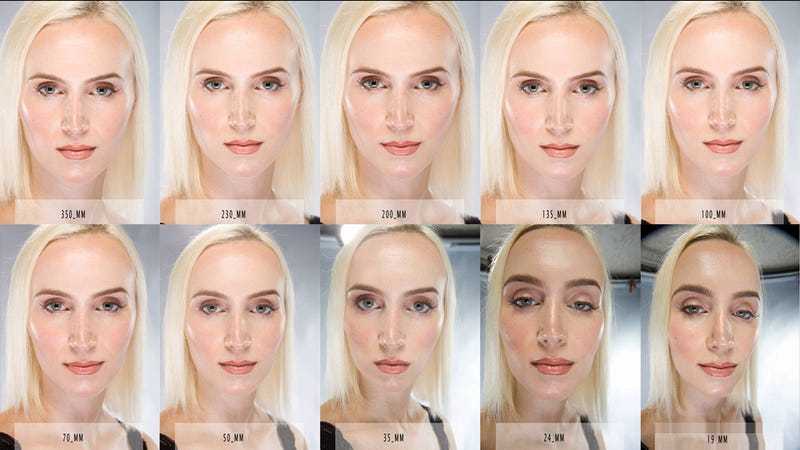
It’s all about the lens distortion (which is also affected by the subject’s distance to the camera). Lenses make the world look different than it does through your eyes. They bend light rays, capturing the scene within a certain field of view into a limited bi-dimensional frame: the photograph. Depending on the lens’ focal length, the image will deform more or less, affecting how faces and objects look in photos.

You can see how the deformation works in this Eastwood’s series, who took the same photo with a wide range of optics, going from a 350mm to 19mm. Eastwood moved the camera to frame the subject in exactly the same position so you could clearly see the effect.

«

Seems relevant, now that some people will get access to telephoto capabilities on their phoens.
link to this extract


Callblock’s new iOS app will block calls from over two million telemarketers • TechCrunch

Sarah Perez:

»

A new application, Callblock, coming to the iTunes App Store, claims to block phone calls from over 2 million telemarketers by type, including things like robocallers, debt collectors, political campaigners, scammers, and more. To identify which calls should be blocked, the app uses a combination of public and private records, ongoing research, and user reports, the company explains. As new entries are added to the database, the app will automatically update to include the changes.

Callblock is the latest release from Rocketship, the bootstrapped and profitable app studio behind a popular mobile ad blocker called Adblock Fast, which today has 750,000 users and is rated 4.5 stars and 4 stars on the Apple App Store and Google Play…

…Using Callblock is a lot like using a mobile ad blocker on iOS. However, instead of going into Safari’s Settings, you head into Settings –> Phone, then toggle the Callblock switch on. In the app, you can then configure which type of calls you want to block, by checking or unchecking its series of rules.

«

Adblocking comes to phone calls.
link to this extract


September 2015: What Apple’s 3D Touch aims to do: replace the physical iPhone home button • The Overspill

Me, just under a year ago, musing on 3D Touch and its possibilities:

»

What if – and it’s just speculation, you know, but what if – you were to put that “seems to move but doesn’t” technology into a phone? Yes, you’d have 3D Touch. That’s happened. But what if you put it into an iPhone home button? You could have something that seemed to move, and felt like it moved, but didn’t. You can double-click the Macbook trackpad; you could double-click a 3D Touch home button. But nothing moves. There’s just a piece of glass, and a sapphire circle for reading, and that’s it.

Think: when do you press the home button? When the phone is off and you’re enabling it, or to switch apps, or to get back to the home screen (so you can switch between app screens).

Most of the time – that is, time when you’re in apps – the Home button serves no purpose at all, except to be a grit-attracting water-allowing problem. Replacing it with a not-moving solid piece of glass would be a design and fault-resistance win.

«

link to this extract


Basic wearables soar and smart wearables stall as worldwide wearables market climbs 26.1% in the second quarter • IDC

»

Shipments of wearable devices reached 22.5m in the second quarter of 2016 (2Q16) according to the International Data Corporation (IDC) Worldwide Quarterly Wearable Device Tracker. Despite a decline in shipments for one of the largest vendors, the overall market for wearable devices grew 26.1% year over year as new use cases are slowly starting to emerge.

“Fitness is the low-hanging fruit for wearables,” said Jitesh Ubrani, senior research analyst for IDC Mobile Device Trackers. “However, the market is evolving and we’re starting to see consumers adopt new functionality, such as communication and mobile payments, while enterprises warm to wearables’ productivity potential.”

While the overall wearables market grew during 2Q16, its two categories traveled at different speeds and directions. Basic wearables (devices that do not support third party applications) grew 48.8% from 2Q15 levels while smart wearables (devices that support third party applications) declined 27.2% year over year.

“Basic wearables, which include most fitness trackers, have benefited from a combination of factors: a clear value proposition for end-users, an abundant selection of devices from multiple vendors, and affordable price points,” said Ramon Llamas, research manager, Wearables. “Consequently, basic wearables accounted for 82.8% of all wearable devices shipped during the quarter, and more vendors continue to enter this space. The danger, however, is that most devices end up being copycats of others, making it increasingly difficult to differentiate themselves in a crowded market.”

«

IDC puts Apple Watch shipments for the second quarter at 1.6m, down from 3.6m the year before. You’re reading this after Apple’s announcement of the new model(s), so we can all expect a big boost to those sales in the third and especially fourth calendar quarters.

What struck me though is that there isn’t a single Android Wear vendor in the top five. (Samsung isn’t there either; presumably it’s sixth.) On Google Play, it still hasn’t passed 5m activations. That’s a platform that is really struggling.
link to this extract


UK shelves privatisation of Land Registry • FT

Gill Plimmer:

»

The proposal was part of a programme of mooted sell-offs by the Treasury under the former chancellor George Osborne, aimed at raising £5bn by 2020.

But the plans attracted trenchant criticism from opponents including the Competition and Markets Authority, and John Manthorpe, former chief land registrar, who argued that a change in status could risk the confidence that homebuyers and other users have in the service.
The Open Data Institute, which was established by the government in 2012 to promote transparency as well as unions and other anti-privatisation campaign groups such as We Own It, also campaigned against the change in status.

A government source said: “No decision has been taken on the future of the Land Registry.
“A consultation on the Land Registry’s future closed in May and we are carefully considering our response. It is only right that new ministers take time to look at all their options before making a decision.”

«

Will feel happier when it’s definitely shelved, but this is good news for now.
link to this extract


Exclusive: how Elizabeth Holmes’s house of cards came tumbling down • Vanity Fair

Nick Bilton digs into the Theranos story, and has this acute observation along the way:

»

In Silicon Valley, every company has an origin story—a fable, often slightly embellished, that humanizes its mission for the purpose of winning over investors, the press, and, if it ever gets to that point, customers, too. These origin stories can provide a unique, and uniquely powerful, lubricant in the Valley. After all, while Silicon Valley is responsible for some truly astounding companies, its business dealings can also replicate one big confidence game in which entrepreneurs, venture capitalists, and the tech media pretend to vet one another while, in reality, functioning as cogs in a machine that is designed to not question anything—and buoy one another all along the way.

It generally works like this: the venture capitalists (who are mostly white men) don’t really know what they’re doing with any certainty—it’s impossible, after all, to truly predict the next big thing—so they bet a little bit on every company that they can with the hope that one of them hits it big. The entrepreneurs (also mostly white men) often work on a lot of meaningless stuff, like using code to deliver frozen yogurt more expeditiously or apps that let you say “Yo!” (and only “Yo!”) to your friends. The entrepreneurs generally glorify their efforts by saying that their innovation could change the world, which tends to appease the venture capitalists, because they can also pretend they’re not there only to make money. And this also helps seduce the tech press (also largely comprised of white men), which is often ready to play a game of access in exchange for a few more page views of their story about the company that is trying to change the world by getting frozen yogurt to customers more expeditiously. The financial rewards speak for themselves. Silicon Valley, which is 50 square miles, has created more wealth than any place in human history. In the end, it isn’t in anyone’s interest to call bullshit.

«

That the WSJ’s John Carreyrou was interested in calling bullshit – and, crucially, finding out facts with which to make that call – is what set him apart.
link to this extract


Theranos: a library of articles and links 2006-2016 • Discoveries In Health Policy

Bruce Quinn MD PhD:

»

This blog began in December 2014, when a no-longer-existing blog ran a critical review of the favorable New Yorker article on Elizabeth Holmes and Theranos.

For over a year, this blog entry records an informal log of online news articles about Theranos.   I do not review it for the dead links that likely accumulate over time.

«

Goes back to 2006. What’s noticeable (via Mike Masnick): lots of the writeups aren’t in the tech press at all (biotech, and biology, puzzles most tech writers; plus there’s no advertising in it, and barely any readers).
link to this extract


You can now sign up to receive each day’s Start Up post by email. You’ll need to click a confirmation link, so no spam. Send it to a friend if you like.

Errata, corrigenda and ai no corrida: bitcoin isn’t exactly “tied to the desktop” (from yesterday’s commentary) – though the mobile implementations are a bit clunky.

Start up: Twitter’s question, the iPhone future, Clinton’s email report, predicting bestsellers, and more


HTC’s Vive may impress, but sales – at least to Steam users – seem to have stalled. Photo by Red_Shuheart on Flickr.

You can now sign up to receive each day’s Start Up post by email. You’ll need to click a confirmation link, so no spam.

A selection of 11 links for you. Washes whiter or your money back! I’m charlesarthur on Twitter. Observations and links welcome.

After a quiet summer, Twitter’s board will take a hard look at what comes next • Recode

Kurt Wagner:

»

The social communication company’s board of directors is set to meet this Thursday in San Francisco, and there are plenty of things to discuss. That includes, said sources, its fate as a standalone company.

That’s no surprise, since Twitter has been the subject of numerous takeover and acquisition rumors over the last few months, each one sending the stock up as investors hold out hope that Twitter will find a buyer.

There are the big corporate names that might take another close look at Twitter, such as Google (there’s an unusual scenario one source mentioned in which it becomes part of some Alphabet media spinoff), Apple and even media mogul Rupert Murdoch, either via 21st Century Fox or News Corp. Other possible bidders include private equity firms that may want to take the company private, where it can solve some of its issues out of the public eye.

«

Still struggling to imagine the universe in which Apple would want to buy Twitter.
link to this extract


The impossible Bloomberg makeover • UX Magazine

Dominique Leca on how you’ll never persuade Bloomberg to do a redesign on its terminals’ user interface to make it easier to use:

»

The Bloomberg terminal is the perfect example of a lock-in effect reinforced by the powerful conservative tendencies of the financial ecosystem and its permanent need to fake complexity.

Simplifying the interface of the terminal would not be accepted by most users because, as ethnographic studies show, they take pride on manipulating Bloomberg’s current “complex” interface. The pain inflicted by blatant UI flaws such as black background color and yellow and orange text is strangely transformed into the rewarding experience of feeling and looking like a hard-core professional.

The more painful the UI is, the more satisfied these users are.

The Bloomberg Terminal interface looks terrible, but it allows traders and other users to pretend you need to be experienced and knowledgeable to use it. Having been a user of the Bloomberg Terminal for five months, it took me a week and a few painful hours to handle it, and I am no genius. The only real impediments were the unbearable UI, remembering which key to push to make the “magic” work, and having to go through the 86-page manual.

«

link to this extract


14 excerpts from the FBI’s report on Hillary Clinton’s email • Mother Jones

Kevin Drum read the report so you don’t have to:

»

Oddly, the FBI never really addresses the issue of whether Hillary violated federal record retention rules. They obviously believe that she should have used a State email account for work-related business, but that’s about it. I suppose they decided it was a non-issue because Hillary did, in fact, retain all her emails and did, in fact, turn them over quickly when State requested them.

There’s also virtually no discussion of FOIA. What little there is suggests that Hillary’s only concern was that her personal emails not be subjected to FOIA simply because they were held on the same server as her work emails.

If you read the entire report, you’ll find bits and pieces that might show poor judgment on Hillary’s part. The initial decision to use one email device is the obvious one, something that Hillary has acknowledged repeatedly. Another—maybe—is her staff’s view of what was safe to send over unclassified email. But this is very fuzzy.

«

Perhaps the most amazing bit is the number of BlackBerries she got through. On average, each one lasted six months.
link to this extract


Is it possible to predict a NYT bestseller? • Medium

Andrew Rhomberg kept being asked about the upcoming book “The Bestseller Code”, which looks at what makes a blockbuster:

»

there is statement in the book that is misunderstood by many of those who interviewed me about the book and that is “the algorithm can predict if a book will be a best seller with accuracy 80%”.

I had a sense when being interviewed that most journalists thought this meant something along the following lines of: “if there are something like 500 New York Times best sellers this year, then this algorithm can produce a list of 500 titles and 400 of those will indeed turn out to be bestsellers”. Well that’s not actually what 80% accuracy means. The misunderstanding is in the “will produce a list of 500”…

…Let’s construct a different scenario. Imagine a Barnes & Noble megastore in the Midwest with 200,000 nicely ordered titles on its shelves including 1,000 titles in a section called “Past and Present New York Times Bestsellers”.

Now a mob of Trump supporters enters the stores and throws all the books on the floor in protest at Trump’s “Art of the Deal” not being displayed in the bestseller section. They don’t actually take any of the books with them, because, well, they are not really interested in reading books, so there are now 200,000 books lying in a jumble on the floor.

«

Question: how many of the bestsellers will be put back in the correct place, and how many won’t?
link to this extract


Not all networks are equal when wanting the best smartphone experience • CCS Insight

Ben Wood:

»

Different flavours of LTE are known by category — abbreviated to Cat x — which indicates the data throughput that the chip is capable of. Most of the phones listed above either use Qualcomm’s Snapdragon 820 platform or Samsung’s home-grown Exynos chip. These chipsets support the variants of LTE up to Cat 12 (downlink). Of course most consumers will have absolutely no idea what this means — and it’s certainly nothing to do with fluffy kittens.

For many users in Europe, there’s one LTE variant, known as Cat 9, that’s available in a growing number of commercially available networks. More importantly, operators are increasingly supporting a technical advancement known as carrier aggregation. This is where multiple channels are combined within a network operator’s spectrum holding to deliver more capacity — think of it as more lanes on a motorway, which eases traffic. All of those lanes are then used simultaneously to maximise the raw data throughput that an operator can deliver to a single device.

The catch for users is that not all operators support this. In the UK, where I live for example, only EE currently can offer LTE Cat 9 and it supports three aggregated frequencies: two blocks of 2.6 GHz and one block of 1.8 GHz giving a maximum theoretical speed of 415 Mbps.

«

I’m with Three, and I’m just happy that with one dot (out of five) of 4G I get faster speeds than on my home broadband.
link to this extract


iPhones and the crown • Counterpoint Technology Market Research

»

All eyes are on the upcoming iPhone 7, even if the upgrades won’t be revolutionary across the board but should be more than enough to interest the maturing smartphone users around the world which are still using two to three year old devices and looking to upgrade to the latest iPhone which would be more than 10x improvement in performance and features.

We will continue to see Apple iPhone 7 to continue to keep the crown of the best-selling smartphone in the world over the next twelve months though challenges in some key markets such as China, India, Latin America will remain from players such as Huawei, Oppo and Samsung bringing cutting edge tech such as dual camera, fast-charging, AMOLED curved displays and so forth faster to the market.

«

The Huawei 9 Plus (linked above) has a dual camera system which lets you take a picture and then afterwards determine where you want the focus point to be, and what depth of focus you want. It’s very smart. Fairly confident that’s what Apple will announce with at least one iPhone today. It’s a very cool, potentially very useful – imagine going back to a picture pair and extracting fresh information – feature.

You’ll remember too that Huawei was the first with a Force/3D Touch implementation a year ago. That went nowhere. Meanwhile, every phone Apple announces from here on will include it by default.
link to this extract


VR adoption among Steam users has crashed to a halt • VentureBeat

Jeff Grubb:

»

The hot days of summer have not led to gamers looking for an escape in virtual reality.

The number of new HTC Vive owners on Steam grew only 0.3 percentage points in July and was flat in August, according to a survey (via Reddit) of customers that use Valve’s distribution network. The Oculus Rift headset from the Facebook subsidiary saw similar stagnation of 0.3% in July and 0.1% in August. At this point, only 0.18% of Steam users own the Vive and only 0.10% own the Rift. And with lethargic sales, both of these high-end head-mounted displays are going to need a lot of help to catch on with audiences.

July and August are important because they were the first months where both HTC and Oculus no longer had supply constraints. Through most of that two-month period, consumers could go online or even drive to a store to pick up one of these units instantly. The problem, however, is that no one is doing that.

«

Steam has more than 125m registered accounts, and typically more than 10m concurrent users. So 0.18% owning a Vive would be 225,000 in use (0.10% = 125,000), if the survey is representative of the entire user base. But it probably isn’t, and the number is likely a lot lower.
link to this extract


The Google X moonshot factory is struggling to get products out the door • Recode

Mark Bergen (who has been a very reliable source on all things Google – not overhyped, and not rushing to publish):

»

In the past, Alphabet had budgeted more than $1bn a year for X, according to one high-level source*. Most funds went to its car project, now seven years old, and Google Glass, the much-hyped wearable that fizzled in its first incarnation and left X last year.

But hiring slowed to a crawl when the Alphabet reorganization arrived, sources said, part of a drive to evaluate spending on the company’s ambitious offshoots.

And people started leaving. The most high-profile exit was a cadre of self-driving car engineers who formed the startup Otto earlier this year, then sold it to Uber this month.

Multiple people who have left X told me that the inability to ship products was a leading reason for the departures.

Multiple people have also told me that Astro Teller, the longtime X chief, is increasingly frustrated. Sources describe most of X’s public projects — Project Loon, drones, robotics and wind energy kites — as rudderless.

X still employs many gifted roboticists, designers and engineers. Google founders Larry Page and Sergey Brin are both actively involved with the teams, sources said. They moved their Alphabet offices to the third floor of the X building, according to one source.

“It’s Sergey’s Batcave,” said one former employee.

«

Compare this piece, which has actual journalism, to the next one…
link to this extract


The death of Project Ara shows Google is all grown up • WIRED

Davey Alba:

»

Look, some things are gonna die and some are gonna live. ATAP is building other stuff, and maybe that will fare better. But the reality is that when a company gets to be the size of the Google, the smaller stuff has a harder time surviving. Alphabet can help. As [Jackdaw Research’s Jan] Dawson says, with Alphabet, Google seems to be saying, people “can’t just keep tinkering in the corner, and hope that no one discovers what the true financial state of things is.” And that’s about right. But at the same time, you do need people tinkering in the corner.

«

Two things. First, “all grown up” is a horrible phrase that leering newspapers use about women who have just passed their 16th birthday and so hey, legal. Note to editors: don’t use.

Second, as @papanic points out, if this had been Apple then everyone would be saying “can’t innovate/doomed”. On the contrary: Apple doesn’t break its divisions out as Google does, and you don’t know what little projects it does and doesn’t have people tinkering away on in the corner – Force Touch, anyone? (Ditto Microsoft, Uber, Samsung, etc etc.)

Meanwhile, it might be insightful to look at projects that have been announced by Google and then run into the sand. Smart contact lenses, anyone?
link to this extract


Cyber threat grows for bitcoin exchanges • Reuters

Gertrude Chavez-Dreyfuss:

»

When hackers penetrated a secure authentication system at a bitcoin exchange called Bitfinex earlier this month, they stole about $70 million worth of the virtual currency.

The cyber theft – the second largest by an exchange since hackers took roughly $350m in bitcoins at Tokyo’s MtGox exchange in early 2014 – is hardly a rare occurrence in the emerging world of crypto-currencies.

New data disclosed to Reuters shows a third of bitcoin trading platforms have been hacked, and nearly half have closed in the half dozen years since they burst on the scene.

This rising risk for bitcoin holders is compounded by the fact there is no depositor’s insurance to absorb the loss, even though many exchanges act like virtual banks.

Not only does that approach cast the cyber security risk in stark relief, but it also exposes the fact that bitcoin investors have little choice but to do business with under-capitalized exchanges that may not have the capital buffer to absorb these losses the way a traditional and regulated bank or exchange would.

“There is a general sense in the bitcoin community that any centralized repository is at risk,” said a U.S.-based professional trader who lost about $1,000 in bitcoins when Bitfinex was hacked. He declined to be named for this article.

«

Acceptable risk of new technology? Or inherent security problem with a system that seems irredeemably tied to the desktop? The article doesn’t come down on either side, but the statistics – and the experts’ views – seem to point to it being an inherent problem.
link to this extract


Image super-resolution through deep learning • GitHub

David Garcia:

»

Image super-resolution through deep learning. This project uses deep learning to upscale 16×16 images by a 4x factor. The resulting 64×64 images display sharp features that are plausible based on the dataset that was used to train the neural net.

Here’s an random, non cherry-picked, example of what this network can do. From left to right, the first column is the 16×16 input image, the second one is what you would get from a standard bicubic interpolation, the third is the output generated by the neural net, and on the right is the ground truth.

As you can see, the network is able to produce a very plausible reconstruction of the original face. As the dataset is mainly composed of well-illuminated faces looking straight ahead, the reconstruction is poorer when the face is at an angle, poorly illuminated, or partially occluded by eyeglasses or hands.

«

Even so, bloody amazing. That’s three hours of training on a GTX 1080 GPU.
link to this extract


Errata, corrigenda and ai no corrida: none notified

Lenovo’s Yoga Book: a brilliant idea – for 15 minutes or so


Lenovo’s Yoga Book: is this the new face of tablet computing? Not quite. Photo by bjtechnewsphotolibrary on Flickr.

I went to IFA in Berlin last week (courtesy of Harman Kardon; they have some interesting stuff I’ll write about presently) and during my time there got a chance to look at Lenovo’s new Yoga Book, which has attracted some interest.

(Here’s the TL;DR: it’s an interesting design, and it’s great that Lenovo is at least thinking of different ways to approach tablet design. But in the end it’s a short-term feature that doesn’t actually offer anything over other designs.)

Lenovo has a gigantic stand there, with the Motorola brand now limited to a little island in the middle of it. There were no smartwatches on view. There was a lot of space devoted to the Yoga Book.

Book your place

How to describe it? The photos mostly do it justice. If it were a laptop, you’d say it was very thin. There’s a hinge, and a tablet-style 10.1in display which is touch-sensitive, and then there’s a basalt-black lower (or side) slab which is where the keyboard would be in a laptop.


The Yoga Book’s “basalt slab” lights up to show an illuminated keyboard; otherwise it’s black. Photos by bjtechnewsphotolibrary on Flickr.

But rather than having moving keys, this lower part is just black – until you press a lit virtual button at the top right, which turns on the underlights (backlights isn’t right) to a virtual keyboard.

That is, indeed, impressive. Seeing the keyboard light into life is one of those “technology delight” moments. There was nothing, now there’s something! And you can type on it, as accurately and quickly as on any hard-surface virtual keyboard. (I can type pretty fast on them, and spent a little while proving it to myself on one of the Yoga Books.)

That isn’t quite all that the basalt slab can do: it’s also touch-sensitive, so that you can draw on it using a normal pencil or pen, though it might be advisable – as the photos show – to do that with a piece of paper in between. Great! You can copy your drawings that you made on the back of napkin into whichever drawing app you’re using. (I did not test this. No napkins to hand.) But I did see it being demonstrated plenty on the stand.

The screen itself is also touch-sensitive, in the same way as an iPad or any Android or Windows tablet. That’s because the Yoga Book is both of the last two – it can dual-boot, into Windows or Android or more precisely, either: you can buy a Windows version or Android one. (It doesn’t seem to be dual-boot.)

Here’s the thing, though. What else can the basalt slab do? Nothing. It can’t light up and display more content. It just does a keyboard. (I assume it can do different keyboards, according to language, though I didn’t check this.)

What’s the problem this solves?

So the basalt slab is nice, and it has a “delight the potential buyer” element. But let’s ask: how much better off are you with this than with, say, an iPad Pro with a detachable keyboard (or any iPad with a Logitech or similar attachable keyboard)? Or a Surface Pro?

The Yoga Book has one thing those don’t:
• you can alter the viewing angle for the screen to any angle, including bending the keyboard underneath the screen so that you have a tablet stand at any angle.

And that’s it.

But, but, but, you say: what about all the writing on the basalt slab?

OK, what about it? How is it better to be able to write with a pencil at one remove from the screen itself (rather like using a Wacom tablet) than being able to write directly onto the screen with an Apple Pencil or Surface stylus? I puzzled about this for a while, but I really cannot see any scenario where anyone but a serious artist would want this function. If you occasionally need to get some handwritten content into an app, get something that accommodates a Pencil/stylus. Or, hell, just take a picture of it and draw over it in an illustration app. (Apps such as Procreate make this easy.)

Target market

Lenovo does seem to be targeting the “real artist” slice, judging by its promo material (from the link above):

Draw with the included Real Pen that detects 2048 levels of pressure—capturing subtle nuances of every stroke. No need to worry about batteries; the Real Pen works without ever needing a charge. You can even be more creative by using two hands: one on the screen to select tools, pan, and pinch-to-zoom the other hand using the Real Pen to draw on the Create Pad.Best of all, you can see your creations come alive on the display – unlike most tablets, where your hand blocks the display as you draw.

Ah yeah – the Real Pen costs £43. (Apple’s Pencil costs £79, and doesn’t say how many pressure levels it detects.)


You can draw on the basalt slab with the Real Pen. But why would you, rather than just drawing directly onto the tablet screen? Photos by bjtechnewsphotolibrary on Flickr.`

Perhaps is the basalt slab giving tons more battery life? Apparently not: Lenovo talks of 13 hours’ battery life on Android, which is tablet-ish but not “oh wow that’s utterly incredible, did you do that by hiding the battery in the basalt slab, wow”; though for the Windows tablet it suggests 15 hours, which is a lot more impressive for a Windows tablet.

When you look at it like this, the basalt slab looks less like a “really clever thing” and more like “yeah, it’s a touch-sensitive display that doesn’t display anything but black and white keys”, which is a good way to keep costs down. (Windows developer Mike Hole points out that it’s a bit like the dual-screen Acer Iconia tablet – which he describes as “very niche and flat keyboard [is] a no-no”.)

For all that, the Yoga Book retails for £430 in the UK, which is substantially more than the other two tablets here, which go for £130 and £180. Lenovo’s problem has been that it couldn’t break out of the Android tablet morass, which led it to lose money on them. So the Yoga is a clever move in that regard.

That’s the real problem that it solves: making money in the tablet market.

But is the Yoga Book a breakthrough in tablet design, bringing us dazzling new possibilities? Afraid not. It’s neat, but after a while you realise that the innovation is sustaining, not disruptive.


Liked this? Each day there’s a Start Up post with links and commentary. You can sign up to receive each day’s Start Up post by email. You’ll need to click a confirmation link, so no spam.


Start up: pregnant on the internet, mapping road deaths, think car!, the joy of comments, and more


Multiply by 2.5 million, and you get an expensive sort-of recall. Photo by HL | B on Flickr.

You can now sign up to receive each day’s Start Up post by email. You’ll need to click a confirmation link, so no spam.

A selection of 10 links for you. Without a doubt. I’m charlesarthur on Twitter. Observations and links welcome.

The internet thinks I’m still pregnant • The New York Times

Amy Pittman was overjoyed to find herself pregnant (and downloaded an app to follow her embryo’s virtual progress), and then deeply saddened when she miscarried at one month:

»all those milestones I had been anticipating came and went: first ultrasound, hearing the heartbeat, fingernail development, the gender reveal and so on.

Had I been pregnant, each phase would have filled me with excitement, trepidation and wonder. As each non-milestone ticked by, I lay awake at night imagining the little chocolate chip growing to the size of a walnut and then a peach as the sadness descended upon me and remained until I fell asleep.

I hadn’t realized, however, that when I had entered my information into the pregnancy app, the company would then share it with marketing groups targeting new mothers. Although I logged my miscarriage into the app and stopped using it, that change in status apparently wasn’t passed along.

Seven months after my miscarriage, mere weeks before my due date, I came home from work to find a package on my welcome mat. It was a box of baby formula bearing the note: “We may all do it differently, but the joy of parenthood is something we all share.”

«

Yes, you guessed. The app passed on her pregnancy status (even though she had told it of her miscarriage).
link to this extract


People in Los Angeles are getting rid of their cars • BuzzFeed News

Priya Anand:

»Eric Spiegelman grew up in a six-car family in the San Fernando Valley and has lived in Los Angeles for the majority of his life. At the end of May, he let the lease on his Volkswagen CC expire, opting to live car-free in a city synonymous with car culture. For the past three months, he’s been commuting to and from work exclusively via Uber and Lyft — mostly using Pool and Line, cheaper options that allow passengers to share trips with other riders on similar routes.

“It ran so contrary to the culture that I’d been brought up in, and also my sense of what was doable,” Spiegelman, 39, told BuzzFeed News. “It was the most unnatural feeling thing at first. But it was so freeing.”
An understandable sentiment — after all, Spiegelman is president of the LA Taxicab Commission.

Spiegelman had been studying the economics of riding Uber and Lyft versus a taxi or driving a personal vehicle when he decided to run the math for his own car. He made a spreadsheet outlining the cost of leasing his Volkswagen: $458 monthly for the lease itself, $158 for insurance, $70 for gas, and at least $72 for parking, for a total cost of about $758. Based on those calculations, he said he has saved more than $1,100 in the last three months, spending an average of $3.42 for each UberPool or Lyft Line ride to work in August.

«

Thinly sourced; there’s no real data on how many people are getting rid of their cars. But as an indicator, it could be relevant. Parking tickets (and the hassle of finding parking places) rather than other costs might be important. Notice how large parking charges were in Spiegelman’s calculation.
link to this extract


How the Apple iCar could crack the automotive industry • Autocar

Greg Kable:

»Those who have held talks with the Apple president during the past 12 months, including executives from Audi, BMW, Fiat Chrysler, Ford, General Motors and Mercedes-Benz are under no illusion of the company’s intentions. They are convinced Cook has already given the go-ahead to the partly autonomous iCar and expect it will be launched by 2021 as a precursor to a fully autonomous successor model to be introduced around 2026 as regulatory conditions are altered to allow features such as fully automated parking.

Apple’s goal? An initial 500,000 sales annually, according to those that have met with Cook. That might not sound like much for a company that manages to shift some 230 million smartphones each year. However, it is an acceptable target for a company new to the automotive scene and 10 times what another one of California’s electric car startups, Tesla, managed in 2015. As a further point of reference, combined sales of the BMW i3 and i8 totalled just 29,500 last year.

To ensure widespread appeal for the Apple car, Cook is relying on the implementation of what automotive business leaders interviewed by Autocar describe as “disruptive technologies” – a term given to features that are expected to significantly change the face of motoring in much the same way the touchscreen altered our use of the mobile phone: highly efficient electric propulsion, rapid charging, autonomous driving capability, gesture control, holographic displays, wireless internet functions, artificial intelligence… the list goes on.

The iCar will get you from A to B, but it’s set to be much more than mere transport for masses. Like the iPhone, it has been conceived to also be a personal assistant with a level of connectivity far beyond that of any existing car of today.

«

There’s a fair bit of speculation, but also plenty of hard fact in this. The 500,000 sales figure is gigantic in comparison to other electric car companies. One to watch.
link to this extract


Mapping traffic fatalities • Lucas Puente

»On Monday, August 29, DJ Patil, the Chief Data Scientist in the White House Office of Science and Technology Policy, and Mark Rosekind, the Administrator of the National Highway Traffic Safety Administration (NHTSA), announced the release of a data set documenting all traffic fatalities occurring in the United States in 2015. As part of their release, they issued a “call to action” for data scientists and analysts to “jump in and analyze it.” This post does exactly that by plotting these fatalities and providing the code for others to reproduce and extend the analysis.

«

Looks like this:

I know: close all the roads! Should sort it. (Something like this would be great for the UK too, of course. The data thing.)
link to this extract


Huge damages: Samsung unlikely to achieve goals of sales, operating profit after Galaxy Note 7 recalls • BusinessKorea

Cho Jin-young:

»The biggest problem is sales suspension of the new handset. When a company has low sales, it makes more losses. A senior official from the industry said, “The more smartphones a company produces, the lower fixed costs it will achieve. So, operating profits can rapidly reduce when production stops and there are no new sales due to the incident. The amount can even reach trillions of won.”

Marketing is another problem. The company has to delay or cancel new marketing campaigns which are scheduled this month. An official from the industry said, “There are limits to increase production so the company can boost the production by 10 to 20 percent. However, it is impossible to double it. The company may have an extensive marketing plans after the release and it will make an additional loss when the plan doesn’t go well as scheduled.”

This is why some market watchers say that the company will see a vicious cycle that new sales suspension and contracted marketing plans can lead to the decrease in operation profits and then to lower sales of new products. In particular, many expect that it is the structure that hit both semiconductor and display sectors at the same time. It means that the low sales of the Galaxy Note 7 will adversely affect on the performance of the semiconductor and display divisions of Samsung Electronics, reducing the total profits. Moreover, how to bear losses with component firms will have a considerable effect on the performance.

«

Estimates it will hit profits in the quarter by $1.3bn. I wonder, though, if it will lose sales: the Note 7 is hardly an impulse buy, so wouldn’t those who want it be prepared to wait? Also, it’s not quite an official recall; it’s a sort-of sales halt with replacement. (Recalls are more expensive.)
link to this extract


Apple reportedly hikes order volumes for new iPhone devices • Digitimes

Siu Han and Steve Shen:

»Apple reportedly has revised upward orders by 10% for parts and components needed for production of the new iPhone devices scheduled to be released on September 7, according to sources from the iPhone supply chain in Taiwan.

The hike in order volumes indicates that Apple still remains positive about replacement demand for new iPhones from existing iPhone users, said the sources, adding that Apple originally predicted that shipments of the new iPhone devices in the second half of 2016 will reach only 60% of iPhone shipments recorded in the year earlier period.

Shipments of iPhone 6s reached 30m units a month on average in the second half of 2015, the sources noted.

«

So that’s.. 66% of last year’s figure? Or 70%? Either way, the market saturation at the top end is biting.
link to this extract


Dan Lyons: ‘It made me confront myself… I’d never felt old before’ • The Guardian

Andrew Anthony interviewed Lyons, whose wonderful book Disrupted is now published in the UK:

»Q: As a tech journalist, startups weren’t an entirely new world to you. But were you taken by surprise?
DL: It was a big revelation. I had a lot of ideas about what it would be like. They turned out to be wrong or incomplete. One big thing, for example: I always thought that when these tech guys go on about changing the world and making it a better place that once us reporters went home and they were on their own they sort of laughed. That they were cynical and it was bullshit.

I didn’t expect that there were people who really believed that stuff. I was really taken aback by that. I thought, I can do that fake changing the world shit. I can do that marketing song and dance, I know the racket. But I was shocked by that – that people had really drunk the Kool-Aid.

Q: One point you make in your book is that the financial structure of startups is less about creating new products than shifting money to a few fortunate individuals. Was that a shock?

DL: You think I’d have known that beforehand. I think I’d never seen it that clearly. It was a revelation to me that to some of these guys, the companies were secondary to extracting money. The companies were just vehicles to achieve that.

«

link to this extract


These are the subtle tweaks that Kayak, Google, and Marriott are using to make you spend more • Quartz

Leslie Josephs:

»Earlier this year, travel search site Kayak swapped out the word “Select” when listing flight options to “View Deal” and said a 1% bump in revenue followed. For its Europe site, Kayak highlighted a recent price decline using a bright green font, which also led to a 1% increase in sales.

It gets higher commissions from hotel bookings than from airlines, so it also sets hotels as the default search on its site, even though some customers may have other preferences for their lodging.
Kayak told Quartz it conducts some 30 experiments a month, testing out new designs and language. Many users may not even notice anything has changed on the site. (Google this summer also added a “deal” label that pops up when a hotel’s price is below historical rates for certain dates.)

Where you book may not seem like a big deal, but it is to a hotel company, which doesn’t want to pay out a commission to third-party online travel agents like Kayak. So they’re trying to make life easier.

«

When Google did its search deal with AOL, the finance was on a knife edge. Then one of the coders discovered that putting the search ads in bold led to more clicks. It guaranteed Google’s profit. Tweaks can make a big difference.
link to this extract


Everyone seems to hate online reader comments. Here’s why I treasure them • The Washington Post

Margaret Sullivan:

»I find value in reader comments that can’t be adequately reproduced elsewhere. The argument that the conversation has migrated to Facebook and Twitter is flawed. Those are good places for discussion, but they are no substitute for having discussion take place where the story itself lives. I’m convinced that many smart readers with something to contribute will not follow a story onto social media to talk about it. News organizations should fix online comments rather than ditch them.

They need fixing, for sure. Too often, they are a place where trolls congregate, ready to offer their mean-spirited opinions. Too often, comments are racist, misogynistic, abusive and even libelous. They can also hurt newsgathering, sometimes criticizing reporters’ sources and making them more reluctant to talk to reporters next time.

In 2010, when I was the editor of the Buffalo News, managing editor Brian Connolly and I were disturbed enough by the gutter-bound, destructive comments to try an experiment. It was weird enough to get us some national attention, though that wasn’t our goal: we took away the anonymity of reader comments, requiring readers to use their names and tell us their locations, in much the same way as traditional letters to the editor.

It was inconvenient and time-consuming for us, and it reduced the number of comments substantially — but it made a world of difference in terms of civility.

«

I will write at greater length about comments (honest), but the key problem with news sites’ use of them is that they don’t have a method to highlight good ones and make the useless ones vanish. Good comments are invaluable. But without being able to find the good ones quickly, you’re left with a timesucking morass.
link to this extract


Vendors realising the importance of robust offline smartphone distribution in tier 2&3 cities and beyond • IDC India

»The China based vendors on the back of their quality products at affordable prices and wide availability have largely contributed to the growth of price segment $150-$200 & $200-$250 across top 30 cities contributing 28% in Tier 1 cities in Q2 2016 as compared to 19% in Q1 2016 and 24% in Tier 2&3 cities as compared to 17% in the previous quarter.

“Apart from Reliance Jio (Lyf), other Indian vendors were unable to hold on to their market share in Q2 2016. Similar was with global vendors except for Samsung which managed to sustain its market leadership position. This has led to a sharp increase in the market shares of China based vendors across all Tiers even with their mid segment ASPs (ranging from $150-$200) purely on the back of strong distribution channel, better channel schemes and huge promoter programmes as compared to the rest” says Varun Singh , Market Analyst, IDC India. “This is a clear indication that the offline channel cannot be wished away by vendors for operating long term in highly competitive Indian market” adds Singh.

«

Chinese vendors, unable to find growth at home, are muscling in on India. Meanwhile Apple’s tiny share of the overall market there translates to a 35.6% share of the $300+ market.
link to this extract


Errata, corrigenda and ai no corrida: none notified

Start up: the app implosion, 2012 Bravia v YouTube, OpenOffice on the edge, smartphone slowdown, and more


OK, this might be tougher, but most passwords are a lot easier to crack. Photo by WindKoh on Flickr.

You can now sign up to receive each day’s Start Up post by email. You’ll need to click a confirmation link, so no spam.

A selection of 9 links for you. Use them wisely. I’m charlesarthur on Twitter. Observations and links welcome.

Breaking through • AVC

Fred Wilson:

»

I exchanged an email with a friend who is trying to get a mobile app business off the ground. I told him that he and his team are attempting to do something that is hard and has gotten a lot harder in the past few years.  He replied that he is looking for a way to break through. I encouraged him and wished him well.

This morning I did something I do on a regular basis. I went through the iOS and Android app store free app leaderboards looking for non-game apps that have broken into the top 100 and stayed there for months. I could not find any. It’s possible that I missed something. My technique is not scientific. I just browse and use my memory, which is not exactly a foolproof method. There are better ways to do this but I like to do it this way.

I think launching a consumer focused mobile app and getting sustained traction (>1mm MAUs for six straight months), is almost impossible right now. That doesn’t mean it can’t be done. I am sure there will be exceptions that will prove the rule.

«

Yup. The mobile app business has commoditised at amazing speed. The bigger the user base, the faster it happens.
link to this extract


50 Sony BRAVIA TV models from 2012 will lose access to YouTube on Sept. 30 • 9to5Google

»

In the past, Google API changes have resulted in YouTube no longer working on older Apple TVs and other devices running previous OS versions. 50 Sony BRAVIA TVs models released in 2012 are about to loose support for YouTube playback due to recent changes made by Google.

Many owners of affected sets have reported that watching videos through the “New YouTube on TV” app has resulted in black screens, freezes, and halted playback. A hardware bug or defect is not the cause of the issue, but rather a specification change made on Google’s end that “exceed the capability of the TV’s hardware.”

Sony is removing the YouTube icon and making the app unavailable staring September 30. 50 different models ranging from 20 to 89-inches across the EX, HX, and X series will be affected by the removal. Head to Sony’s support site for the full list of models. Buying a Chromecast or other streaming stick is a quick and easy way to regain YouTube playback and get access to other smart TV features.

Sony does not cite the exact specification change, but Google recently announced that all YouTube connections will soon be encrypted with HTTPS.

«

From the launch of Google TV in the UK in 2012:

»

Suveer Kothari, Google’s head of global TV distribution, said this launch was “the beginning of a long journey” for the company’s TV ambitions in Europe.

“We think there’s going to be huge benefits from bringing the internet to TV. Google TV attempts to address the problem that there’s not really a great experience to access the internet on your TV screen, which is a similar problem we saw in the smartphone market five years ago.”

«

link to this extract


Fast, lean, and accurate: modeling password guessability using neural networks • USENIX

William Melicher and others at Carnegie Mellon:

»

Human-chosen text passwords, today’s dominant form of authentication, are vulnerable to guessing attacks. Unfortunately, existing approaches for evaluating password strength by modeling adversarial password guessing are either inaccurate or orders of magnitude too large and too slow for real-time, client-side password checking. We propose using artificial neural networks to model text passwords’ resistance to guessing attacks and explore how different architectures and training methods impact neural networks’ guessing effectiveness.

We show that neural networks can often guess passwords more effectively than state-of-the-art approaches, such as probabilistic context-free grammars and Markov models. We also show that our neural networks can be highly compressed—to as little as hundreds of kilobytes— without substantially worsening guessing effectiveness. Building on these results, we implement in JavaScript the first principled client-side model of password guessing, which analyzes a password’s resistance to a guessing attack of arbitrary duration with sub-second latency.

«

The slides are quite scary too. (Thanks Pete for the link.)
link to this extract


Lunch with the FT: Nick Denton • FT.com

Matthew Garrahan:

»

I ask how he is adjusting to life as a bankrupt. “I go on the subway into the office,” he says, in a mid-Atlantic accent that betrays his years in the US. “I look around at people and probably 80% of them are worrying about what would happen to them if they didn’t get their next pay cheque. Or they are worrying about how they are going to meet their rent in this incredibly expensive city.” He puts on his sunglasses. “It helps put things into perspective.”

Our lobster bisques are promptly delivered to our table. I mention that he seems happier than when I saw him at Gawker’s wake. “I can’t afford to be that affected.” Gawker’s fate was “predestined”, he says, “the end-product of having made a decision early on to give writers freedom and encouragement to say what was on their minds”.

That seems like a stretch when you think that it was a sex tape featuring a wrestler with a tan the same colour as our soup that triggered Gawker’s downfall. But Denton continues, insisting that the site never shied away from covering anyone — no matter who they were. The alternative, he says, would have been “to be a media company like all the others”.

«

link to this extract


OpenOffice, after years of neglect, could shut down • Ars Technica

Jon Brodkin:

»

Many developers have abandoned OpenOffice to work on LibreOffice, a fork that got its first release in January 2011. While LibreOffice issues frequent updates, OpenOffice’s most recent version update was 4.1.2 in October 2015. That was the only OpenOffice release in 2015, and there were only two updates in all of 2014. LibreOffice got 14 version updates in 2015 alone.

In July, OpenOffice issued an advisory about a security vulnerability that had no fix. The problem could let attackers craft denial-of-service attacks and execute arbitrary code. One of the workarounds suggested by the OpenOffice project was to use LibreOffice or Microsoft Office instead. A patch for that problem that can be applied to existing versions of OpenOffice was released in late August, but concerns about fixing future security problems remain.

Though the vulnerability didn’t become public until recently, [OpenOffice vp Dennis] Hamilton wrote that the problem and a proof of concept was reported to the OpenOffice team just as version 4.1.2 was about to be released. Developers figured out a source code fix in March this year, but “we were sitting on the fix because we didn’t want to give anyone ideas when they saw it applied to the source code unless there was a release in the works,” Hamilton wrote.

«

link to this extract


How Hi-Fi magazines write about cables, part 19: magic rocks • Kirkville

Kirk McElhearn takes us to the zone of weirdness that is “Brilliant Pebbles”, which allegedly improve the sound of your hi-fi. How?

»

»

The original glass bottles for Brilliant Pebbles have been replaced by clear zip lock bags, which have a more linear response than glass. We employ a number of highly-specialized, proprietary techniques in the preparation/assembly of Brilliant Pebbles to enhance the crystals’ inherent characteristics.

«

Plastic certainly has a more linear response than glass. Paper bags might be more efficient still. Or no bags at all.

»

The fundamental operating principle of Brilliant Pebbles involves a number of atomic mechanisms in the crystals. Brilliant Pebbles will enhance the performance of your audio system so your favorite music and even your experience playing online fantasy games will become a mind blowing auditory experience.

«

«

Perhaps you’re wondering how they’re used. McElhearn can help:

link to this extract


Is the Google Car in trouble? • Autocar

Hilton Holloway:

»

Perhaps one of the reasons for [Google Car project leader Chris] Urmson’s exit was the Google Car project’s philosophical U-turn performed last September, with the hiring of ex-Hyundai US boss John Krafcik as CEO of the Google self-driving project. Google has also just signed a deal with Fiat-Chrysler to build autonomous prototypes based on the company’s Chrysler Pacifica MPV, all of which suggests that any idea that Google would put its own self-driving cars into production now looks increasingly unlikely.

Perhaps such a tie-up with the car industry was inevitable. Despite the time spent on testing and development, the Google self-driving cars had covered a relatively modest 1.7m miles as of this summer. In stark contrast, Tesla claimed that, by May this year, drivers of its cars had clocked up 100 million miles with the Autopilot function engaged. While this is nowhere near the same as the intended full autonomy of the Google cars, it shows the huge disadvantage of trying to jump straight to a fully autonomous car from experimental vehicles.

Furthermore, not only do the Google cars have a selfimposed 25mph top speed, it took until 2011 for fully autonomous testing on public roads to become legal in the US, when Nevada changed its local laws. California — Google’s home state — didn’t change the law until this year. It is still only legal in four states.

«

In trouble? More likely it’s shifting its focus, as the hire of Krafcik implies – away from a “make it ourselves” model, towards a “license it out” model.
link to this extract


The anosognosic phone • Safely Ignored

Hans Gerwitz, in October 2014:

»

Back in September, a design student posted a design fiction video of Phonebloks, a modular phone platform. It got a lot of attention, but I counted myself among numerous skeptics of the design, given how much size and weight would be added and the unrealistic sizing of the imagined modules.

During October’s Dutch Design Week in Eindhoven, I had the chance to chat with aforementioned student, who seemed more interested in his small-scale plastic recycling project. It did not take long to confirm that he was an “idea guy”, not to be bothered with the realities of implementation; that’s for the magician engineers to work out. My skepticism was confirmed.

But that same week, Google Motorola (no slouch of engineering) announced Project Ara, which is basically the same concept, and “partnered” with Phonebloks to share in the attention.

«

You’re wondering: anosognosic? From Wikipedia:

»

Anosognosia (/æˌnɒsɒɡˈnoʊziə/, /æˌnɒsɒɡˈnoʊʒə/; from Ancient Greek ἀ- a-, “without”, νόσος nosos, “disease” and γνῶσις gnōsis, “knowledge”) is a deficit of self-awareness, a condition in which a person who suffers some disability seems unaware of the existence of his or her disability.

«

The rest of Gerwitz’s post nails Ara, two years ahead of its death. (And ahead of my post on its death.)
link to this extract


Flat smartphone growth projected for 2016 as mature markets veer into declines • IDC

»

Worldwide smartphone shipments are expected to reach 1.46 billion units with a year-over-year growth rate of 1.6% in 2016 according to the latest forecast from the International Data Corporation (IDC) Worldwide Quarterly Mobile Phone Tracker.

Although growth remains positive, it is down significantly from the 10.4% growth in 2015. Much of the slowdown is attributed to the decline expected in developed regions in 2016, while emerging markets continue with positive growth. Developed markets as a whole (United States, Canada, Japan, and Western Europe) are expected to see a compound annual growth rate (CAGR) of -0.2%, while emerging markets (Asia/Pacific excluding Japan, Central and Eastern Europe, Middle East and Africa, and Latin America) will experience a CAGR of 5.4% over the 2015-2020 forecast period.

“Growth in the smartphone market is quickly becoming reliant on replacing existing handsets rather than seeking new users,” said Jitesh Ubrani, senior research analyst with IDC’s Worldwide Quarterly Mobile Device Trackers. “From a technological standpoint, smartphone innovation seems to be in a lull as consumers are becoming increasingly comfortable with ‘good enough’ smartphones. However, with the launch of trade-in or buy-back programs from top vendors and telcos, the industry is aiming to spur early replacements and shorten lifecycles. Upcoming innovations in augmented and virtual reality (AR/VR) should also help stimulate upgrades in the next 12 to 18 months.”

«

IDC in June forecast that growth would be 3.1% for the year, so this is quite a cut already. The premium market (developed countries) is saturated; all that’s left for growth, for now, is the low-end business.
link to this extract


Errata, corrigenda and ai no corrida: none notified

A short history of Project Ara, in breathless headlines and sceptical observations


Project Ara’s Spiral 2 prototype. This is about as far as it got. Photo by pestoverde on Flickr.

Never heard of Project Ara? Start here. Know it all about Project Ara? Start here, and enjoy the ride.

April 2014:Building blocks: how Project Ara is reinventing the smartphone” (The Verge):

Ara modules need to have a way to communicate with the rest of the phone, but physical contacts are often dirty and unreliable. So instead, the modules will use “capacitive interconnects,” which are wireless and theoretically more reliable, especially at high speeds. The capacitive pads also will help save space on the modules, since they’re smaller than physical pins.

When it comes to keeping the modules in place, physical latches are fiddly and can easily break. Instead, Ara phones will use electropermanent magnets to hold them in place…

…The head of Project Ara, Paul Eremenko, says he is planning “the most custom mass-market product ever created by mankind” without a trace of irony in his voice.

He and his team have just one year left to do it.

The Verge there, with pretty much the ur-version of the “breathless visit to the lab” feature. And, I’ll point out, it illustrates another classic element of Verge journalism: no effort to seek an outside view from an analyst, OEM, or even a person in the street to ask them “would a phone like this ever sell/make a profit?” It’s this lack of attempt to triangulate on claims that frustrates me again and again about The Verge. So often it’s average trade paper journalism dressed up in pretty web clothes.

My commentary at the time: (when I recorded the link): “The smartphone business is zero-profit for most players. How would a business made up of competing parts suppliers be any more profitable – even if the finished product can be made to work as well as a unified phone designed by a single company? It would either flop, or be driven to commodity (and so drive out suppliers) almost at once.”

Kudos therefore to Craig Grannell, who days afterwards wrote for Stuff that “Modular smartphones are the building blocks of a tech shambles” (Stuff):

“what first seems like a simple, obvious idea is in reality a mess waiting to happen, and one that will offer few benefits for the end user. They won’t save a great deal of money, few will care about interchangeable parts anyway, some will wonder why there are big gaps on the back of their smartphones if they can’t get the various bits to line up properly, and a few geeks will proclaim it the best thing ever, before getting distracted approximately eight seconds later by some great new Google robot that gets injected directly into your hypothalamus.”

Things went quiet for a little while. And then came autumn, and a bit more publicity.

October 2014:Google plans to make a component store for its modular phone” (Engadget):

Google’s Paul Eremenko, director of Project Ara, recently revealed that the company will be taking a cue from the Play store to create a similar shopping experience for its modular smartphone. What this means, essentially, is you’d be able to buy or sell different components from a single hub, just as is the case now with apps, music, books and more on Google Play – and it would also include reviews and recommendations.

Me: “At a guess, Ara isn’t going to end up as a phone project at all, but something more like Arduino or Raspberry Pi – a playground for hacking things together.”

November 2014: “Project Ara modularized smartphone to enter commercial production in 2015” (Digitimes):

Project Ara under Google’s Advanced Technology and Projects Group (ATAP) is currently working with more than 20 partners and aims to bring its modularized smartphone into commercial production in 2015, according to industry sources.

Makers in Taiwan’s supply chain will play an important role to help realize the production of modularized phones, with related handset frames to be produced by Quanta Computer and connector boards by Foxconn Electronics.

Hardware partners will ship modularized parts, including displays, camera modules, CPUs, wireless modules, batteries, memory devices and cases, to consumers directly through Google’s platform.

Things then went quiet. And quieter. And it turned out there had been “a delay” for unspecified reasons, but something to do with the problem of getting the parts to fit together and communicate.

August 2015:Some thoughts on the Project Ara delay” (Phoneblocks blog): Dave Hakkens, of Phonebloks, said:

When I shared Phonebloks it was just an idea, something I thought would make sense to reduce e-waste. It was a future vision, something that would hopefully be made in 5-10 years.

Some companies are trying to make a modular phone. Of all those companies Google is taking the biggest leap. They have an insane amount of resources/smart guys and set a 2 year timeframe for themselves to get it done. Seemed unrealistic and turns out it is. They are delayed for over a year!

However this is not bad. Sure the sooner it would be in our hands the better since we could save e-waste.

Me, at the time: “There will never be a useful phone using phonebloks. The premise might work for some lab/testing/environmental equipment, but the price and size will make it pointless when you can get a pocket supercomputer with phone functions for $50.”

April 2016:Google hires Rick Osterloh as SVP for new unified hardware division” (Recode, under the same umbrella as The Verge): Putting the ex-Motorola chief in charge of Nexus, Chromecast, consumer hardware (laptops), OnHub (router), Project Ara and Glass.

At the time I asked “Won’t [Nest] get folded into Osterloh’s division now?” And lo, in August, it did.

May 2016:Modular phone Ara to finally launch” (The Register). Except without a modular screen, GPU, CPU, RAM or sensors. What exactly was there to be modular then?

The world waited, and meanwhiel LG launched its G5 smartphone, which did have modular elements; it sold poorly. In summer Motorola launched the Moto Z, with “Mods” which nobody seemed very keen on (“a good phone headed down the wrong path“,” said Vlad Savov at The Verge – one of the few writers there who does take a reality-based position).

September 2 2016:Exclusive: Google shelves plan for phone with interchangeable parts – sources” (Reuters):

Alphabet Inc’s Google has suspended Project Ara, its ambitious effort to build what is known as a modular smartphone with interchangeable components, as part of a broader push to streamline the company’s hardware efforts, two people with knowledge of the matter said.

The move marks an about-face for the tech company, which announced a host of partners for Project Ara at its developer conference in May and said it would ship a developer edition of the product this autumn.

The company’s aim was to create a phone that users could customize on the fly with an extra battery, camera, speakers or other components.

A spokeswoman for Google declined to comment on the matter.

While Google will not be releasing the phone itself, the company may work with partners to bring Project Ara’s technology to market, potentially through licensing agreements, one of the people with knowledge of the matter said.

Is that an end to it? Probably.

But don’t worry. There’s always another idea lurking in the labs waiting for someone from The Verge to give it a writeup. Wind back to May 2016, and another ATAP division project, this one called Soli, which aims to put radar chips into electronics so you can use hand gestures to control things:

Google built a tiny radar system into a smartwatch for gesture controls (The Verge):

“How are you going to interact with an invisible computer?”

When you hear a question like that posted in a conference room at a major tech corporation like Google, you expect you’re going to be in for an hour or two of technophizing with few tangible results at the end of it.

But then somebody sets a smartwatch on the table in front of you. You snap your fingers in the air just a couple of inches away from it. And the digital watch face starts spinning.

Give it a couple of years and we’ll be writing the obituaries, I guess.

Like this? There’s also Start Up, a collection of 8-12 links at 0700GMT each day, posted here or available by email. You can sign up to receive each day’s Start Up post by email. You’ll need to click a confirmation link, so no spam.

Start up: AI cucumber sorting, the EU-US tax war, Samsung dinged on patents, tablets keep slowing, and more


“Look, just type what I say, OK?” Photo by abrinsky on Flickr.

You can now sign up to receive each day’s Start Up post by email. You’ll need to click a confirmation link, so no spam.

A selection of 8 links for you. Use them wisely. I’m charlesarthur on Twitter. Observations and links welcome.

Malware in Transmission client • Transmission

»

Q. What happened?

A. It appears that on or about August 28, 2016, unauthorized access was gained to our website server. The official Mac version of Transmission 2.92 was replaced with an unauthorized version that contained the OSX/Keydnap malware. The infected file was available for download somewhere between a few hours and less than a day. Additional information about the malware is available here and here.

«

Keydnap steals credentials from the OSX keychain (where system and personal passwords live). Yes, there is a certain irony in a Bittorrent client being subverted like this.
link to this extract


How a Japanese cucumber farmer is using deep learning and TensorFlow • Google Cloud Big Data and Machine Learning Blog

»

In Japan, each farm has its own classification standard and there’s no industry standard. At Makoto’s farm, they sort them into nine different classes, and his mother sorts them all herself — spending up to eight hours per day at peak harvesting times.

“The sorting work is not an easy task to learn. You have to look at not only the size and thickness, but also the color, texture, small scratches, whether or not they are crooked and whether they have prickles. It takes months to learn the system and you can’t just hire part-time workers during the busiest period. I myself only recently learned to sort cucumbers well,” Makoto said.


Distorted or crooked cucumbers are ranked as low-quality product

There are also some automatic sorters on the market, but they have limitations in terms of performance and cost, and small farms don’t tend to use them.

Makoto doesn’t think sorting is an essential task for cucumber farmers. “Farmers want to focus and spend their time on growing delicious vegetables. I’d like to automate the sorting tasks before taking the farm business over from my parents.”

«

Wonderful story.
link to this extract


Speech is 3x faster than typing for English and Mandarin text entry on mobile devices • Stanford University

»

With the ubiquity of mobile devices like smartphones, two new widely used methods have emerged: miniature touch screen keyboards and speech-based dictation. It is currently unknown how these two modern methods compare. We therefore evaluated the text entry performance of both methods in English and in Mandarin Chinese on a mobile smartphone. In the speech input case, our speech recognition system gave an initial transcription, and then recognition errors could be corrected using either speech again or the smartphone keyboard.

We found that with speech recognition, the English input rate was 3.0x faster, and the Mandarin Chinese input rate 2.8x faster, than a state-of-the-art miniature smartphone keyboard. Further, with speech, the English error rate was 20.4% lower, and Mandarin error rate 63.4% lower, than the keyboard. Our experiment was carried out using Baidu’s Deep Speech 2, a deep learning-based speech recognition system, and the built-in Qwerty or Pinyin (Mandarin) Apple iOS keyboards. These results show that a significant shift from typing to speech might be imminent and impactful.

«

That’s a big difference. But do you really want people burbling away to their phone with their Facebook update?
link to this extract


Beyond Verbal will tell us what people are thinking • Tech In Asia

Osman Husain:

»

wouldn’t it be neat if emotions could be decoded? If there was an app out there that could analyze human interaction and stop us from acting on assumptions?

Beyond Verbal is trying to tackle this mammoth problem. Its tech allows developers to understand people’s moods, attitudes, and emotional characteristics in real-time, as they speak.

“We envision a world in which personal devices understand our emotions and well-being, enabling us to become more in tune with ourselves,” explains Yuval Mor, CEO of Beyond Verbal. “Understanding emotions can assist us in finding new friends, unlocking new experiences and, ultimately, helping us understand better what makes us truly happy.”

The startup’s software can be integrated into existing products, helping devices and applications envision not just what users type, click, or touch, but also how they feel and what they mean.

«

I’m sceptical; it’s hard to measure what verbal signals mean, even harder to interpret non-verbal signals. Humans aren’t always good at it.
link to this extract


The €13bn bite • The Economist

»

America criticised the [EC ruling against Apple’s Irish tax arrangements], calling it “unfair”. It had warned that it might retaliate in some way if Brussels went ahead. It argues that the commission is trying to turn itself into a “supranational tax authority”, threatening the consensus achieved through BEPS on the crucial “arm’s-length principle” at the heart of transfer-pricing rules. These govern the prices that subsidiaries of a multinational in different countries charge each other for the products and services that flow between them.

The Americans are fretting mainly because the ruling signals that Europe will lay claim to some of the more than $2 trillion of profits that American firms have amassed offshore, under the deferral provisions. Policymakers in Washington believe only the federal government has the right to tax this, as and when it is brought home. The Brussels decision may spur American politicians to set aside their differences on tax reform and agree on a package with a reduced tax rate for profits that firms repatriate; better that than to let Europe dip into the offshore pot, they think.

«

Apple has allowed for this tax in its accounts – whether to be paid in the US or to Europe. The Economist nails this: the row now is over whether the money goes to European countries or to the US, not the principle of whether profits should be taxed.
link to this extract


EDTX triples damages award against Samsung due to false testimony, discovery violations • IPWatchdog.com | Patents & Patent Law

Steve Brachmann:

»

The court decided to award enhanced damages in this case because of egregious behavior on behalf of Samsung, including attempts to copy the technology and demonstrably false testimony given by Samsung. For example, Samsung’s representatives testified under oath that they only became aware of Imperium IP’s patents in June 2014, when the infringement action was first brought to court. Depositions and other discovery proved this to be incorrect. One witness who worked at ESS Technologies, the company to which the ‘884 patent was first assigned, testified that Samsung sought specific information on anti-flicker and flash technology. It was also proven that Samsung had previously attempted to purchase the patents-in-suit from Imperium, concealing its identity through a patent broker. Instead of June 2014, the court found that Samsung knew about Imperium’s patents since at least April 2011.

Samsung’s egregious conduct also included its failure to produce relevant documents. Although Samsung was aware since July 15th, 2015, about the need to produce e-mail and documents relevant to the patent broker used by Samsung to conceal its identity, those documents were only produced at 2:19 AM on the fourth day of the jury trial. As the court noted, the time to produce these documents was during discovery, not during trial.

«

Awkward. Technologies used in the Galaxy Tab 7 and 7.7 tablets, ATIV laptop and network-connected cameras.
link to this extract


Worldwide tablet market expected to rebound in 2018 as Windows opens doors for growth and ipads come out of a slump • IDC

»

The decline of the worldwide tablet market is set to continue for the remainder of 2016 as year-over-year growth reaches an all-time low of -11.5% and shipments of 183.4 million units, according to forecast data from the International Data Corporation (IDC) Worldwide Quarterly Tablet Tracker. Positive growth is set to return in 2018 and continue through 2020 with shipments reaching 194.2 million tablets as detachable tablets continue to steal share from traditional PCs.

“Appealing to the commercial audience will be key as detachable tablets aim to take a larger piece of the traditional PC market,” said Jitesh Ubrani, senior research analyst with IDC’s Worldwide Quarterly Mobile Device Trackers. “Windows and iOS already have solid detachable offerings and with the latest version of Android, Google will also have a horse in the race as they finally offer better multitasking support and added security features.”

«

The notable thing about the forecast is that it suggests Android’s 2020 share will be 9 points lower than in 2015/6 (58% v 67%), almost all of which will be taken by Windows.

Then again, five-year forecasts are for the optimistic.
link to this extract


Blame your lousy internet on poles • Backchannel

Susan Crawford:

»

Poles, as it turns out, seethe with operatic drama. They are creosote-soaked, 40-foot-high wooden battlegrounds. And, right now, a handful of companies — the usual villains in the internet access story — is very interested in keeping the status quo in place by quietly making sure that access to these vertical conflict zones is fraught with difficulties.
Chattanooga, again, was lucky. It has a city-owned electric utility that controls its own poles, so the city can use the utility to carry out its fiber dreams. That’s allowed Chattanooga to reap the benefits of roughly $1 billion in the form of new jobs and other spillover effects the city has seen since 2011.

But many cities don’t control their own poles. In some areas, poles are controlled by utilities, or even telecom companies. Anyone hoping to string fiber in those places faces two nightmarish, indefinite periods of delay and uncontrolled costs: first getting an agreement in place with the pole owners, and then getting the poles physically ready for a new wire. We’ll call these steps Swamp One and Swamp Two.

«

Much the same applies in Britain: BT had the state monopoly on poles and is only reluctantly being forced by Ofcom to let other companies use that infrastructure that it was given effectively for free on privatisation.
link to this extract


Errata, corrigenda and ai no corrida: none notified

Start up: the Nougat niggles, the Yoga PC-tablet, Swift has hacker trouble, SETI only found TI, and more


“Oh, I’m not interested in your joining my professional network on LinkedIn, then.” Photo by pinprick on Flickr.

You can now sign up to receive each day’s Start Up post by email. You’ll need to click a confirmation link, so no spam.

A selection of 13 links for you. Use them wisely. I’m charlesarthur on Twitter. Observations and links welcome.

Why isn’t your old phone getting Nougat? There’s blame enough to go around • Ars Technica

Andrew Cunningham:

»

Not all of the big Android phone makers have announced their plans for the Nougat update, but if you look at Sony’s and Google’s and HTC’s official lists (as well as the supplemental lists being published by some carriers), you’ll notice they all have one big thing in common. None of the phones are more than a year or two old.

And while this is sadly the norm for the Android ecosystem, it looks like this isn’t exclusivelythe fault of lazy phone makers who have little incentive to provide support for anything they’ve already sold you. Sony, for instance, was working on a Nougat build for 2014’s Xperia Z3 and even got it added to the official Nougat developer program midway through, only to be dropped in the last beta build and the final Nougat release.

After doing some digging and talking to some people, we can say that it will be either very difficult if not completely impossible for any phone that uses Qualcomm’s Snapdragon 800 or 801 to get an official, Google-sanctioned Nougat update (including the Z3). And that’s a pretty big deal, since those two chips powered practically every single Android flagship sold from late 2013 until late 2014 and a few more recent devices to boot.

This situation has far-reaching implications for the Android ecosystem. And while it can be tempting to lay the blame at the feet of any one company—Google for creating this update mess in the first place, Qualcomm for failing to support older chipsets, and the phone makers for failing to keep up with new software—it’s really kind of everybody’s fault.

«

Though largely Qualcomm’s. Not sure you can really blame Google “for creating this update mess in the first place”. Updating software is what software companies do.

But this is a terrific piece of exposition of all the moving parts, and why some of them actually don’t move.
link to this extract


Lenovo’s Yoga Book could make physical keyboards an endangered species • CNET

»

Lenovo on Wednesday introduced the Yoga Book, a unique tablet/hybrid PC with two touchscreen displays that fold in on each other. A normal display makes up the top half, while the bottom half is a touchscreen featuring a digital “smart keyboard.”

Lenovo’s investment in such a product underscores the shifting patterns in how consumers — particularly younger people — interact with devices. The company’s research found that people under 30 took to the digital keyboard immediately, while those older than 30 approached it with skepticism. If the Yoga Book takes off, it could mark the starting point for when the physical keyboard loses its spot as the go-to tool for composing a note.

“While the traditional keyboard or laptop are unlikely to disappear entirely, other devices will take over more of our computing tasks,” said Avi Greengart, an analyst at Current Analysis.

If anyone can pull this off, it might be Lenovo. The company has led the world in PC sales for more than three years, and has led the charge in moving beyond basic laptops toward hybrids and two-in-one PCs that incorporate tablet elements. Indeed, Jeff Meredith, vice president of Lenovo’s Android and Chrome computing business group, said his team designed the Yoga Book based on the tablet, not a PC.

«

Clever idea. Apologies for this and the later CNet link, which has autoplay video enabled – you have been warned.
link to this extract


Dropbox: leaked DB of 68 million account passwords is real • The Register

Richard Chirgwin:

»

A leaked database purported to contain login information for 68 million Dropbox accounts is the real deal. The cloud biz confirmed the authenticity of the records to The Register, with independent verification from IT security guru Troy Hunt.

The archive, which is being shared online, contains Dropbox user IDs and hashed passwords stolen by hackers in 2012. Today’s confirmation follows a mass reset of passwords by Dropbox last week when copies of the database started surfacing on the internet.

A spokesperson told The Register: “We are confident that this is not a new incident; this data is from 2012, and these credentials were covered by the password reset.”

The Register’s conversation with Hunt – the operator of HaveIBeenPwned and a security educator – bears that out to a degree: while Hunt has identified his pre-2012 user ID in the list, your humble hack’s post-2012 account is not in the nearly 70 million records.

«

HIBP is a terrific resource.
link to this extract


Swift warns banks about successful raids by hackers • FT.com

Martin Arnold:

»

Hackers have carried out a series of successful raids on banks via the Swift global payments network, the organisation has warned its members this week as it pushes them to tighten their cyber security.

In a letter seen by the Financial Times, Swift told its 11,000 members that “a good number” of the attacks had been repelled after being spotted by its own security programme or by other banks, but some of the hackers had made off with an unspecified amount of cash.

The non-profit co-operative, which is owned by the banks, has faced concerns about its vulnerability after cyber criminals made off with $81m from the Bangladeshi central bank in February. Several similar cases, some of which were successful, have since emerged at banks in Vietnam, the Philippines and Ecuador…

…The letter added: “The customers that have been targeted have varied in size and geography; used diverse connectivity methods and a range of interfaces from different vendors. The targeted customers have, however, shared one thing in common; they have all had particular weaknesses in their local security.”

«

link to this extract


Samsung delays shipments of Galaxy Note 7 for quality control testing • The Guardian

Samuel Gibbs:

»

There have been several unconfirmed local reports of users claiming that the battery of the Galaxy Note 7 battery exploded during charging. Samsung did not elaborate on what further testing was required and to where shipments of the high-priced phablet were being delayed.

The Galaxy Note 7 is the first Samsung smartphone to have a USB-C connector. The new connector brings with it a new charging standard to which some third-party cables have been found to be non-compliant, causing damage to devices from laptops to smartphones using the new port. Amazon recently clamped down on the non-compliant and dangerous cables.

«

USB-C, eh? *taps nose*
link to this extract


Turns out the signal astronomers saw was “strong” because it came from Earth • Ars Technica

Oh well, we tried to get (y)our hopes up.
link to this extract


Privacy groups file FTC complaint over Whatsapp Facebook privacy ‘bait and switch’ • Techdirt

Karl Bode:

»

As expected, EPIC and the Center for Digital Democracy have filed a formal complaint with the FTC (pdf), accusing Facebook of violating Section 5 of the Federal Trade Commission Act. In public statements, both organizations accuse Facebook and Whatsapp of a “bait and switch” on previous promises that user information would not be used for marketing across the Facebook social media empire:

»

“The FTC has an obligation to protect WhatsApp users. Their personal information should not be incorporated into Facebook’s sophisticated data driven marketing business,” said Katharina Kopp, Ph.D., and CDD’s Director of Policy. “Data that was collected under clear rules should not be used in violation of the privacy promises that WhatsApp made. That is a significant change that requires an opt-in, according to the terms the FTC set out. It’s not complicated. If WhatsApp wants to transfer user data to Facebook, it has to obtain the user’s affirmative consent.”

«

«

Did you read Dave Eggers’ The Circle? Remember the transparent shark? Facebook is that shark. (If you haven’t: highly recommended.)
link to this extract


How LinkedIn’s search engine may reflect a gender bias • The Seattle Times

Matt Day:

»

Search for a female contact on LinkedIn, and you may get a curious result. The professional networking website asks if you meant to search for a similar-looking man’s name.

A search for “Stephanie Williams,” for example, brings up a prompt asking if the searcher meant to type “Stephen Williams” instead.

It’s not that there aren’t any people by that name — about 2,500 profiles included Stephanie Williams.

But similar searches of popular female first names, paired with placeholder last names, bring up LinkedIn’s suggestion to change “Andrea Jones” to “Andrew Jones,” Danielle to Daniel, Michaela to Michael and Alexa to Alex.

The pattern repeats for at least a dozen of the most common female names in the U.S.

Searches for the 100 most common male names in the U.S., on the other hand, bring up no prompts asking if users meant predominantly female names.

LinkedIn says its suggested results are generated automatically by an analysis of the tendencies of past searchers. “It’s all based on how people are using the platform,” spokeswoman Suzi Owens said.

«

Algorithmic bias is hard to spot, but it’s there all right.
link to this extract


Video games allow characters more varied sexual identities • The New York Times

Laura Parker:

»

Jesse Fox, an assistant professor in the School of Communication at Ohio State University who studies how online interactions influence people’s offline attitudes, found that avatars can powerfully affect how people act in the real world. In a series of studies she conducted from 2009 through 2013, she saw that participants responded better to avatars modeled on their real appearances, as opposed to generic-looking avatars.

This is linked to what is known as the Proteus effect, a concept introduced in 2007 by the Stanford researchers Nick Yee and Jeremy Bailenson, who concluded that the appearance of a person’s online avatar had a significant impact on his or her behavior, in and out of a virtual environment. In one study, participants who were assigned a more attractive avatar in a virtual environment were found to exhibit more confidence and intimacy in the real world than those assigned to a less attractive avatar.

“This tells us that avatars can change our behaviors,” Ms. Fox said. “They allow us to practice and test out certain behaviors in a virtual world.”

Ms. Durkee said this was true for her. Before her transition, she began playing The Sims in 2001 and found comfort in being able to live vicariously through the female characters.

“When I was younger, I always wanted to play games as a female character, even before I knew why,” she said. “I can’t fathom how different my life would be if I were exposed to positive representation of trans people at a young age.”

«

Interesting topic. But man, NYT headlines are the absolute pits. No wit, no zing.
link to this extract


Historic Dell and EMC transaction set to close on September 7, 2016 • Business Wire

»

“This is an historic moment for both Dell and EMC. Combined, we will be exceptionally well-positioned for growth in the most strategic areas of next generation IT including digital transformation, software-defined data center, converged infrastructure, hybrid cloud, mobile and security,” said Michael Dell, chairman and CEO of Dell Technologies. “Our investments in R&D and innovation, along with our 140,000 team members around the world, will give us unmatched scale, strength and flexibility, deepening our relationships with customers of all sizes.”

“I am proud of everything we’ve built at EMC – from humble beginnings as a Boston-based startup to a global, world-class technology company with an unyielding dedication to our customers,” said Joe Tucci, chairman and chief executive officer of EMC. “The combination of Dell and EMC creates a new powerhouse in the industry – providing the essential technology for the next era in IT.”

«

The corporate equivalent of a snake swallowing a cow. Let’s see how the snake’s digestion proceeds.
link to this extract


For Samsung’s Gear s3, size matters. And that’s a problem • CNet

Roger Cheng:

»

Samsung on Wednesday unveiled the Gear S3, its latest entry into the burgeoning market of wearable tech. The new smartwatch is more durable and runs longer than its predecessor. It also includes an LTE cellular radio so it doesn’t always have to pair with your phone.

The catch is that the S3 also surpasses the previous model in size.

The two versions of the Gear S3, the Frontier and the Classic, both come with the same gain in bulk. Samsung said it needed the extra room to pack in new features. It’s also paying attention to trends — the company said that men are overwhelmingly buying more smartwatches than women, so it felt comfortable with the larger Gear S3. While the exact number varies from region to region, roughly 80% of smartwatch buyers are men.

This may, however, be a case where a one-size-fits-all philosophy ends up backfiring. Men may be leading the way in buying smartwatches now, but that may not necessarily be the case in the future. By designing a product that appeals more to men, Samsung could be powering a self-fulfilling prophecy that would trap it in that demographic.

“I don’t want to look like a kid playing dress-up with her daddy’s watch,” CNET editor Jessica Dolcourt said after trying out the Gear S3. “This watch obviously isn’t made for my wrist.”

«

The S3 is actually bigger than the S2. This seems retrograde, and not in a good way.
link to this extract


Live polls and online polls tell different stories about the election • FiveThirtyEight

Harry Enten at the vote-prediction (and other statistical things) site:

»

FiveThirtyEight generally takes an inclusive attitude towards polls. Our forecast models include polls from pollsters who use traditional methods, i.e., live interviewers. And we include surveys conducted with less tested techniques, such as interactive voice response (or “robopolls”) and online panels. We don’t treat all polls equally — our models account for the methodological quality and past accuracy of each pollster — but we’ll take all the data we can get.

This split, however, between live-interview polls and everything else, is something we keep our eye on. When we launched our general election forecasts in late June, there wasn’t a big difference in the results we were getting from polls using traditional methodologies and polls using newer techniques. Now, it’s pretty clear that Hillary Clinton’s lead over Donald Trump is wider in live-telephone surveys than it is in nonlive surveys.

We don’t know exactly why live-interview polls are getting different results than other types of surveys; there are a lot of potential causes and it’s something we’ll be digging into.

«

If I were in Clinton’s camp, I’d find this worrying; people are more likely to be honest about their intentions when they’re not talking to another person, as UK pollsters have repeatedly found.
link to this extract


As browsers accelerate, innovation outpaces security • The Parallax

Seth Rosenblatt:

»

Browser security flaws have such a major impact on consumer security that hackers participating in an annual browser hacking contest take home tens of thousands of dollars for finding previously undocumented security holes in major browsers. And quickly addressing those security flaws is important for the sake of more than just safety; an IBM study from 2010 estimates it’s 100 times more expensive to fix a bug after it has reached the public.

Web-browsing security risks extend to vulnerabilities in the sites browsers access and deliver to your device. A June 2016 WhiteHat Security study found that it takes site publishers an average of 150 days to address most vulnerabilities and an average of 500 days to patch high-risk vulnerabilities. That’s plenty of time for a hacker to drive an attack through a hole.

«

link to this extract


Errata, corrigenda and ai no corrida: none notified